Author Archives: weeklysift

Doug Muder is a former mathematician who now writes about politics and religion. He is a frequent contributor to UU World.

“Make a Deal”: My Contribution to the Trump/Mueller Musical

If Michael Cohen really is the key to bringing down Trump, you have to figure that when the musical version gets made, Mueller’s pitch to flip Cohen will deserve its own song. Here’s my suggestion, which is sung to the tune of “Cabaret“.

What good is taking the rap for some clown?
You’re hooked and I hold the reel.
Life is the art of deals, my friend.
Come in and make a deal.

Forget about pardon, you know it won’t come.
His loyalty’s not real.
I’ve heard there’s an art of deals, you know.
Come in and make a deal.

Tell what you’ve seen.
Tell what you know.
Go wear a wire and get him talking.
Come tomorrow you’ll be walking.

What good is pining away in a cell
Waiting on your appeal?
Life can be one big deal, my friend.
Come in and make that deal.

I used to know a mobster, name of Gotti.
The Teflon Don, he could be rather naughty.
He wasn’t satisfied with vice and looting.
He took out the top bosses with a shooting.

He thought that he could never be convicted
With witnesses and jurors so conflicted.
But when we made his chief lieutenant sing
The case became a very lovely thing.

I think of Gotti to this very day.
That’s how you put the guy on top away.

I said, “Come on, Sammy, you’ve got one last chance.
“There’s no better time to squeal.”
Life is the art of deals, my friend.
He came in and made a deal.

And as for you,
And as for you,
You can help me bring down the hammer
Or spend your best years in the slammer.

You know that he never would go down for you.
He doesn’t care how you feel.
Life is the art of deals, he says.
He’s the Crown Prince of Deals, he says.
But I love to make a deal.

The Monday Morning Teaser

It’s been the kind of week where the retirement of the Speaker of the House can get lost in the shuffle: The US attacked Syria, Michael Cohen’s office was raided, Jim Comey’s book leaked ahead of its publication date, the inspector general’s report on Andrew McCabe came out … and probably some other important stuff I’m forgetting.

I’m going to start today by having some fun. I love to write song and poem parodies — during the Trump administration I’ve already chronicled the failure of ObamaCare repeal in the form of “Casey at the Bat” and re-imagined “If” as Trump’s advice to his sons. This week, I present the musical version of Robert Mueller trying to persuade Michael Cohen to testify against Trump (and reminiscing about Sammy the Bull flipping on John Gotti). It’s “Make a Deal” to the tune of “Cabaret”. That should post soon.

The second featured article is my take on what Paul Ryan is thinking. At some point this week I realized that I have written thousands and thousands of words about Ryan during the last six years, and read tens of thousands more by or about Ryan. I kind of feel like I get him by now, so I suspect my version of his thoughts is as good as anybody else’s. That should post before 10 EDT.

The weekly summary will also raise some questions about the Syria raid. (Do we have a strategy? Is the attack even legal?) I have few answers. Also, some thoughts about Michael Cohen, and a few reflections on how my taxes would be different if I had different kinds of income (as an illustration of how the tax code is stacked against working people). (I’m still debating whether to spin that off into its own article.) I didn’t have the connections to get a pre-release copy of Comey’s book, which comes out tomorrow, so I’ll probably have more to say about that next week. The summary should be out before noon.

Scoping the Issues

Assault weapons and large-capacity magazines are not within the scope of the personal right to “bear arms” under the Second Amendment.

Judge William G. Young, U.S. District of Massachusetts

This week’s featured post is “Trump’s long-term effect on American democracy: How worried should we be?

This week everybody was talking about trade

The stock market has been see-sawing several hundred points a day, as investors try to figure out where Trump’s trade dispute with China will go. Are both sides exchanging bluff and bluster in preparation for negotiating some agreement? Or is the recent back-and-forth of tariff announcements exactly what it appears to be?

The really worrisome thought is that the ignorant things Trump (and his Commerce Secretary Wilbur Ross and trade advisor Peter Navarro) says represent the true depth of the administration’s policy. Matt Yglesias spells out what Ross and Navarro seems to believe: that the equation

GDP = Government spending + Consumer spending + Business investment – Trade Deficit

is more than just an accounting definition. He and Trump seem to believe that if you cut the trade deficit, GDP will automatically rise.

Here’s a quick way to tell that something has gone wrong with the Ross-Navarro argument. Last year, the United States imported $180 billion worth of petroleum products — oil and such.

According to Ross and Navarro, if the United States made it illegal to import oil, thus wiping $180 billion off the trade deficit, our GDP would rise by $180 billion. With labor constituting 44 percent of GDP, that would mean about $80 billion worth of higher wages for American workers. So why doesn’t Congress take this simple, easy step to boost growth and create jobs?

Well, because it’s ridiculous.

What would actually happen is that gasoline would become much more expensive, consumers would need to cut back spending on non-gasoline items, businesses would face a higher cost structure, and the overall economy would slow down with inflation-adjusted incomes falling. Modeling the precise impact of a total shutdown of oil imports is hard (hence the computer models). But we know from experience that the directional impact of sharp disruptions in the supply of imported oil, and it’s not at all what Ross and Navarro say it would be.

Trump seems to believe something similar about trade with China: that getting rid of that $500 billion trade deficit would automatically increase GDP. That’s why he tweets “When you’re already $500 Billion DOWN, you can’t lose!”

and chemical weapons

There’s been another major chemical weapons attack in Syria, and once again the Assad regime looks like the attacker.

When this happened under President Obama, he negotiated Assad giving up his chemical weapons stockpile in a deal guaranteed by Assad’s ally Russia. When it happened again in the early days of the Trump administration, Trump ordered a missile strike against a Syrian airbase.

This time, Trump has tweeted:

President Putin, Russia and Iran are responsible for backing Animal Assad. Big price to pay.

Whatever that means.

and Scott Pruitt

Since taking over the EPA, Scott Pruitt has had the mission of reversing his agency’s mission: It’s now supposed to protect polluters from regulations rather than use regulations to protect the environment from polluters.

He’s been good at that job. He’s reversed Obama’s Clean Power Plan for lowering carbon emissions from power plants, and is in the process of undoing the higher CAFE standards for cars’ gas mileage. He’s doing his best to muzzle EPA’s scientists.

That industry-pleasing performance is why he’s managed (so far) to weather revelations of corruption that would have sunk any cabinet secretary in any previous administration. Pundits continue to predict that his days are numbered, and even a few Republican senators are saying he has to go. But only one opinion matters, and Trump thinks he is doing a great job.

but here’s somebody you should meet

Trump’s attempt to ban transgender soldiers may seem abstract, unless you know one. Here’s one.

and you also might be interested in …

The indications of a 2018 blue wave are holding. Wisconsin elected a liberal supreme court judge by a wide margin.


Andrew McCabe’s wife says all the stuff she couldn’t say when her husband worked at the FBI.

I have spent countless hours trying to understand how the president and so many others can share such destructive lies about me. Ultimately I believe it somehow never occurred to them that I could be a serious, independent-minded physician who wanted to run for office for legitimate reasons. They rapidly jumped to the conclusion that I must be corrupt, as part of what I believe to be an effort to vilify us to suit their needs.


A federal judge in Massachusetts has rejected a claim that Massachusett’s assault-weapons ban infringes Second Amendment rights. The Massachusetts law more-or-less duplicates the federal assault-weapons ban that was in place from 1994-2004. The opinion, which quotes Justice Scalia’s Heller opinion at length, argues that the AR-15 is fundamentally a military weapon, and that there is no constitutional right for civilians to own military weapons.

This ruling mirrors an appeals court ruling on a similar Maryland law, which the Supreme Court refused to review.


HuffPost has a good article on the roots of the teacher revolts in Oklahoma and Kentucky. Meanwhile, Kansas approved a big increase in education spending, in response to its Supreme Court ruling that the previous budget did not meet the state’s obligations under the Kansas constitution.


Health insurance in Iowa has just gotten more precarious. The state has undercut the ObamaCare market by approving new plans that it says aren’t really insurance, and so don’t have to meet the standards in the ACA. In other words, it’s back to the junk insurance the ACA got rid of. The policies are intended for basically healthy people, and will work for them only as long as they stay basically healthy.

The inevitable result will be a lot of healthy people leaving the ObamaCare system for the cheaper, junkier plans. So insurers will have to raise rates, which will cause more people to leave, and so on.


The Trump administration’s zeal to deport anyone they can now extends to at least one honorably discharged veteran:

Xilong Zhu, 27, who came from China in 2009 to attend college in the United States, enlisted in the Army and was caught in an immigration dragnet involving a fake university set up by the Department of Homeland Security to catch brokers of fraudulent student visas.

Zhu paid tuition to the University of Northern New Jersey, created by DHS to appear as a real school, long enough to ship to basic training using the legal status gained from a student visa issued to attend that school.

Then ICE found him and asked the Army to release him for alleged visa fraud. He left Fort Benning, Ga., on Nov. 16, 2016, in handcuffs as an honorably discharged veteran.

Zhu is a native speaker of Mandarin, a skill the Army values. He had enlisted “through a program designed to trade fast-tracked citizenship for medical and language skills”.


I was going to link to this article last week, but it somehow got lost in the shuffle. The Atlantic raises the question: “Is It Time for the Jews to Leave Europe?” One side effect of the increased Muslim presence in European countries is that many of these immigrants are strongly anti-Semitic. At the same time, the generation of Europeans that felt responsible for the Holocaust is dying off.

There’s a weird counter-productivity going on: The Muslims largely act out against their local Jews because they hate Israel. But if the European Jews leave, many will probably go to Israel, making Israel stronger.


More than half a year after Hurricane Maria, some Puerto Ricans still don’t have power. The image shows how slowly the grid was coming back in the first two weeks. It’s still not all the way back, and the next hurricane season starts June 1.


The Dutch news-comedy show Zondag net Lubach (Sunday with Lubach) tells its viewers about the “devastating humanitarian crisis” afflicting the United States: Nonsensical Rifle Addiction.

and let’s close with something classically funny

I could use a laugh about now, so here are a few Buster Keaton clips.

Trump’s long-term effect on American democracy: How worried should we be?

If you have been paying attention to the current administration with any sense of skepticism at all, you probably worry about whether President Trump is a threat to American democracy as we have known it. Briefly:

In January, as he marked the first complete year of the Trump administration, Benjamin Wittes characterized this as “banana-republic-type stuff” and commented

His aspirations are as profoundly undemocratic and hostile to the institutions of democratic governance as they have ever been. He announces as much in interview after interview, in tweet after tweet.

And yet, Wittes judged that during Trump’s first year, the response of the rest of the government was “ultimately encouraging”.

Trump simply cannot look back on the last year and be satisfied with the success of his war on the Deep State. His battle to remake it in his image has been largely unavailing—and has come at far greater cost to his presidency than to the institutions he is trying to undermine.

And that is very good news.

So how bad is it really? In other words, the rest of the government has largely remained true to American ideals, and has blocked Trump’s most authoritarian efforts. The courts remain independent, and have struck down several of his most egregious orders. The media has refused to be intimidated, and continues to hold him accountable. Law enforcement has largely — but not entirely — held steadfast against his encroachments on its integrity; so the Mueller investigation continues, and there have been no show trials of high-profile Trump enemies. The military has pushed back against his improper orders, and the intelligence services refuse to simply tell him what he wants to hear, help him subvert the justice system, or propagandize the American people. Even the Republican Congress, while often a lapdog, has occasionally growled: High-profile Republicans have protected Jeff Sessions, and threatened unspecified consequences if Robert Mueller is fired.

So how disturbed should we be? Is Trump simply a bad cold that American democracy will eventually throw off and return to good health? Or is his administration a cancer that our country might fight for a while, but will eventually succumb to? How do we even think rationally about such questions, rather than alternately give in to rosy denial or black despair as the mood strikes us?

Comparable challenges. If we were going to try to think about this like reasonable people, the first question to ask is: When have democracies faced challenges like this before? How did that go? How does our situation compare to theirs?

Trump, after all, is not the first demagogue with authoritarian tendencies to gain popularity in a democratic nation. Sometimes the fever passes, sometimes the nation falls into tyranny (Putin in Russia, Erdogan in Turkey), and some cases look bad but might still be salvageable (Orban in Hungary, Duda in Poland).

He’s not even the first American president to stress our democracy, or to be feared by the opposition as a rising dictator. Just about all our major wartime presidents fit that description: Much of what Lincoln did, including the Emancipation Proclamation, was constitutionally suspect, relying on implicit “war powers” that had never been precisely spelled out before. Wilson jailed Eugene Debs during the World War I, and approved the Palmer Raids against leftists in the postwar red scare. FDR broke the two-term tradition, tried to pack the Supreme Court with allies, and approved the Japanese internment.

We don’t usually think of those presidents as potential autocrats, because in each case subsequent administrations (sometimes under pressure from Congress) pulled back from autocracy, returning to what Wilson’s successor Harding called “normalcy“. Lincoln, Wilson, and Roosevelt all left American government changed, but in each case the expansion of executive power was eventually controlled, sometimes by codifying it in law and sometimes by setting new limits to keep it from happening again.

Nixon was another president who stretched and abused executive power. But he was forced to resign and voters gave the opposition party an overwhelming majority in Congress. Congress then passed the War Powers Act, wrote new campaign finance laws, and increased its oversight of the intelligence services. His presidency became a warning sign rather than a precedent; no subsequent president has justified his actions by claiming Nixon as his example.

So how does that all work? When does a democracy slide into dictatorship and when does it pull itself back from the brink? If that sounds like a major research project, you don’t have to take it on yourself: Steven Levitsky and Daniel Ziblatt already did in the recent book How Democracies Die. (If Ziblatt’s name is familiar, that might be because in December I tried to infer the lessons How Democracies Die makes explicit from his previous book, Conservative Parties and the Birth of Democracy.)

The importance of norms. Levitsky and Ziblatt’s first point is that the U. S. Constitution contains no magic formula that prevents democracy from failing here. Whatever “American exceptionalism” might mean, it doesn’t give us some kind of immunity from the diseases other democracies are prone to. Numerous countries have modeled their constitutions on ours, and seen democracy fail anyway.

Institutions alone are not enough to rein in elected autocrats. Constitutions must be defended — by political parties and organized citizens, but also by democratic norms. Without robust norms, constitutional checks and balances do not serve as the bulwarks of democracy we imagine them to be.

(Longtime Sift readers will recognize this as a theme I’ve been harping on for years in posts like “Countdown to Augustus” and “Tick, Tick, Tick … the Augustus Countdown Continues“.)

Much of our problem today predates the Trump administration, and stems from the fact that our norms have been sliding for decades. The Senate’s refusal to recognize President Obama’s appointment of Merrick Garland to the Supreme Court, or to respond to it with hearings and a vote, for example, was not explicitly unconstitutional, but was unheard of in all previous American history. Ditto for brinksmanship with the debt ceiling, or the decades-long evolution of the filibuster from a rarely used break-glass-in-case-of-emergency practice to an automatic tactic of minority obstruction. The other branches of government have changed their own norms to deal with Congress’ dysfunction: Presidents issue more sweeping executive orders (like Obama’s DACA), and the Supreme Court reinterprets mis-stated laws (like the Affordable Care Act) that it would once have sent back to Congress for correction.

If you go back to the bulleted list at the top of this post, you’ll notice that hardly any of my complaints about Trump are explicitly constitutional. The Constitution never says that the President can’t order the FBI to investigate the candidate he just defeated, that he can’t tell big whopping lies on a regular basis, or that he has to give the public enough information to judge whether or not he is corrupt. Those aren’t rules, they’re just good practices. That’s how we do things here in America.

Or how we used to do them.

The root norms. It would be easy to fill pages with the norms that Trump is breaking. Our system, for example, has a tradition of decorum. (“Will the distinguished gentleman from Oklahoma yield the floor for a question?”) No previous president has publicly talked about political rivals in such consistently belittling terms as Lyin’ Ted, Crooked Hillary, or Pocahontas.

But rather than list hundreds of specific norms, Levitsky and Ziblatt boil democracy’s essential norms down to two:

  • mutual toleration, “the understanding that competing parties accept one another as legitimate rivals”
  • forbearance, “the idea that politicians should exercise restraint in deploying their institutional prerogatives”

All the others stem from these. American government works well when the parties regard each other as rivals rather than enemies, and exercise their powers according to the Constitution’s underlying spirit, rather than wringing every conceivable advantage out of its words. Democracy is in trouble whenever one party regards the other as fundamentally treasonous, and then uses that opinion to justify pushing the powers of whatever offices it holds to their constitutional limits.

Much of what I’ve been doing in my “Augustus” series is chronicling the tit-for-tat loss of restraint between the parties. Most Americans have no appreciation of how far this could go, so I’ll provide an example: The 12th Amendment specifies that the sealed votes of the Electoral College are sent to the President of the Senate, who counts them “in the presence of the Senate and House of Representatives.” What if the President of the Senate, with the connivance of majorities in both houses, simply miscounted the votes and proclaimed someone else to be president?

There’s no provision for dealing with that scenario — and with innumerable similar situations — because the Founders never anticipated that our political leaders would go that far. And they wouldn’t. Or would they?

The 21st century road to dictatorship. The old model of democratic breakdown was the coup: Caesar illegally taking his army across the Rubicon, seizing Rome, and proclaiming himself Dictator for Life. That was the path of many 20th century dictators like Muammar Gaddafi in Libya or Saddam Hussein in Iraq. But 21st century autocrats have realized the usefulness of maintaining the trappings of democracy.

Vladimir Putin’s Russia, for example, still has elections, rival political parties, and dissident newspapers. Popular opposition leaders, however, have a way of finding themselves in prison or in exile or dead. Ditto for troublesome journalists. When the media empire of oligarch Boris Berezovsky became unreliable, he was forced to leave it behind him and flee the country. After a few years in exile, he was found hanged. When Mikhail Khodorkovsky, once the richest man in Russia, began financing dissident politicians, he went to prison.

It was all legal, of course. (Well, not the assassinations, but no investigator would dare trace them back to Putin.) The men who went to jail were convicted of real crimes (and maybe even committed some of them; it’s hard to reach the top of a corrupt system without breaking a law sometime). Similar stories could be told about Turkey or Hungary or Venezuela. The system resembles the quip variously attributed to either Mark Twain or Emma Goldman: “If voting could change anything, they’d make it illegal.”

Levitsky and Ziblatt use a soccer analogy to map out the steps by which an elected president becomes an autocrat:

  • Capture the referees. In other words, get your people in charge of the judiciary, law enforcement, and intelligence, tax, and regulatory agencies. Anyone who used to be a neutral arbiter must become your partisan. You can do this in the judiciary, for example, by expanding the size of the Supreme Court and appointing your people to the new positions (as Roosevelt tried to do), or by impeaching judges who rule against you (as the Republican-controlled legislature is trying to do in Pennsylvania). (In North Carolina, the gerrymandered Republican majority in the legislature has done court-packing in reverse: It shrunk the size of the State Court of Appeals to prevent the new Democratic governor from filling the open seats.)
  • Sideline star players on the other side. “Opposition politicians, business leaders who finance the opposition, major media outlets, and … religious or other cultural figures” are “sidelined, hobbled, or bribed into throwing the game.” With the referees already in your pocket, the carrots of government contracts and positions, or the sticks of ruinous regulations, taxes, and prosecutions can hollow out the institutions that otherwise might channel public opinion against you.
  • Rewrite the rules in your favor. We were already seeing a lot of rule-rewriting on the state level prior to Trump: Gerrymandering and voter suppression have locked in large Republican majorities in states (like North Carolina) where the voters are more-or-less evenly split between the parties. In last November’s election in Virginia, Democratic candidates for the House of Delegates won the popular vote 53%-44%, but Republicans maintained a 51-49 majority. Combining a biased legal system with a lifetime ban on felon voting (as in Florida, where the Sentencing Project estimates that 20% of adult blacks can’t vote) can sideline a large chunk of the opposition electorate. In countries like Russia, field-tilting rules make it difficult for new parties to form, for genuine opposition candidates to get on the ballot, or for opposition voices to get their message out.

Once the right measures are in place, an aspiring autocrat doesn’t need the traditional trappings of tyranny — gulags, thought crimes, children informing on their parents, secret police breaking down doors in the middle of the night — to act with impunity and stay secure in his job.

Resistance. Unlike a coup, though, the subversion of a once-democratic system takes time. While you are corrupting some of the referees, suborning some opposition leaders, and rewriting some rules, the still-intact parts of the system can rise against you — if enough people recognize what is going on and transcend their previous differences. Putin, you may remember, did not become a dictator overnight.

Also, if a country is lucky — and I think the U.S. might have gotten “lucky” in this way with Trump — the would-be autocrat may not be particularly adept. Margaret Drabble’s metaphor of babies eating their mothers’ manuscripts might apply: “The damage was not, in fact, as great as it appeared at first sight to be, for babies, though persistent, are not thorough.” Trump may be persistent in his aggressions against democracy, but he lacks the discipline to be as effective as he otherwise might.

The rosy path. It’s easy to imagine that someday Trump will leave office peacefully — by choice or otherwise — and afterwards there will be a bipartisan effort to shore up the norms he violated.

Such a thing has happened before. For example, after FDR violated the unwritten rule that presidents should retire after two terms, Congress codified that limit in the 22nd Amendment. As a result, FDR’s four terms didn’t lead to a series of presidents-for-life. As I mentioned before, Nixon’s excesses led to a large Democratic majority in Congress that passed a number of executive-restraining laws.

Something similar could happen after Trump: Congress could mandate good practices that previously were taken for granted, forcing presidents to release their tax returns or hold their assets in blind trusts. Laws could spell out in detail which payments are constitutionally-banned “emoluments”. The wall separating the presidency from the investigative branches of the Justice Department could be strengthened.

Other changes wouldn’t require new laws: Voters could begin insisting again on virtues that Trump lacks, like experience, expertise, and honesty. They could once again value respectful and respectable behavior. Congress could begin taking its oversight role more seriously, rather than abusing or neglecting it depending on whether or not the presidency and Congress are controlled by the same party.

If that’s what happens, then the Trump administration will be like that time you drove home after a few drinks and arrived safely without incident. Yeah, it wasn’t a good idea and you shouldn’t make a habit of it, but ultimately no harm was done.

The dystopian possibility. So far, democracy has been protected by two main forces: The so-called “Deep State” (i.e., career government officials who are more committed to the missions of their organizations than to the orders they receive from the White House) and Trump’s overall unpopularity.

So, for example, career prosecutors — even if they are Republicans — have not been willing to sacrifice their integrity by manufacturing a case against Hillary Clinton, or ignoring evidence against Trump himself, just because he tweets that they should. Career EPA officials are refusing to become pawns of the fossil fuel industry no matter how much Scott Pruitt wants them to. Career economists at the Treasury didn’t concoct a bogus tax-cuts-pay-themselves analysis just because Steve Mnunchin promised they would.

That’s the Deep State in action: It’s not a conspiracy masterminded by some shadowy cabal. It’s the professional integrity of people who believe that their jobs mean more than just a paycheck or their bosses’ approval. (That’s true even in some cases where I disagree with them. I think a lot of CIA and Pentagon people really believe in America’s imperial mission, and in the disasters that will happen if they let down their guard. In their own minds, they are patriots.)

That’s both its strength and its weakness. You can’t kill the Deep State just by finding its leader and bribing, threatening, or imprisoning him or her. But conversely, it has no sense of strategy. It is made up of individuals, and individuals can be worn down. The Deep State has held its own for a little over a year, but can it hold for four years or eight?

If, God forbid, Trump got to replace one or two of the liberals on the Supreme Court, the courts might suddenly become pliable.

Trump’s unpopularity has shored up many institutions of democracy. The media has remained critical, rather than giving in the way it did to George W. Bush after 9-11. Republicans in Congress haven’t expressed much criticism, but they also haven’t cooperated with Trump’s desire to rewrite the rules. (The Senate keeps ignoring his plea to abolish the filibuster, and the idea of changing civil service laws to enable an executive-branch purge, or libel laws to muzzle the press, are non-starters.) Congressional Democrats have stayed unified rather than finding excuses to strike individual compromises. Federal judges have not been afraid to stick their necks out.

All that might change if Trump’s approval rating hovered around 60% rather than 40%, or if it were Democrats who were worrying about losing their jobs this fall rather than Republicans.

Levitsky and Ziblatt review cases where democracy held for a while, and then started to crumble, like Fujimori‘s Peru. It’s not hard to imagine how that could happen here: The predicted Democratic wave fails to materialize in the fall. The economy stays strong, the country avoids any new shooting wars or trade wars, and Trump’s victims — immigrants, Muslims, LGBT people, etc. — remain isolated. Much of the country then starts to say, “What was all that alarmism about?” When Jim Comey or Andrew McCabe winds up in jail, it seems like a one-off case rather than an assault on law enforcement.

Conversely, suppose Democrats overcome gerrymandering and regain control of the House. (It will take at least an 8% margin in the popular vote to do so.) Then laws will not change in Trump’s favor, Congress will investigate and expose excesses, and if Bob Mueller turns up evidence of impeachable offenses, the impeachment process will begin. We’ll be on our way to getting rid of Trump in 2020 (if not sooner), and starting to rebuild what has been torn down.

The crucial year, and the long-term challenge. Levitsky and Ziblatt don’t end with specific predictions, but my impression after reading their book is that 2018 is crucial. Neither complacency about American democracy’s resilience nor hopelessness about turning things around is warranted. The outcome is still undetermined.

In each party, there is a question: Will Democrats put aside their differences in the face of the larger threat, or will they let their factions be played off against each other? In the recent successful campaigns (Lamb in Pennsylvania, Jones in Alabama), they stayed united and won, but the divisions of 2016 are still not healed.

For Republicans, the question is whether their various factions will continue to let themselves be bought off — evangelicals by court appointments, business leaders by tax cuts and deregulation, and so on — or will enough of them come to understand what is really at stake? If they will not join the resistance, will they at least stay on the sidelines?

Long term, both parties need to figure out how to strengthen the norms of forbearance and tolerance, which were in trouble long before Trump arrived on the scene. Unless we can re-establish them, getting past Trump will not solve our problems. His failure, if it happens, might simply be a training example for new and better demagogues.

The Monday Morning Teaser

You see a lot of warnings that American democracy is in trouble in the Trump Era. (You see some of those warnings on this blog.) But how serious is the situation really? Are the comparisons to Mussolini or Putin overblown, or are the people who think so in denial? Will we bounce back and repair the damage as soon as Trump is gone, or has the country been put on a new track that may take us places we never imagined America could go? Or have we already been on that track for a while, and that’s how we got Trump in the first place? Can we get off it, or is already too late?

If only there were some way to set the current challenges in some kind of international or historical perspective and think about them like reasonable people, rather than swinging back and forth between optimism and despair according to whatever mood strikes us.

That’s why the featured article this week traces the discussion in the new book How Democracies Die by Steven Levitsky and Daniel Ziblatt. They’ve done the research in a comprehensive way, rather than just seeking out whatever parallel proves some predetermined point. That should be out between 9 and 10 EDT.

In the weekly summary, I will do my best not to be blasé about the usual mix of corruption, foreign disasters, shootings, and rumblings of trade war. I picture that posting around noon.

Playing Beanbag

Sure, politics ain’t bean-bag. ‘Tis a man’s game, an’ women, childer, cripples an’ prohybitionists ‘d do well to keep out iv it.

Mr. Dooley, an Irish-American character created by writer Finley Peter Dunne (1895)

This week’s featured post is “Why does the Right hate victims?

This week everybody was talking (once again) about chaos and scandal in the White House

Like several other Trump officials, Scott Pruitt has already been under fire for overspending on travel and office remodeling. But this week something more serious came out: For his first six months in the Trump administration, Pruitt lived in a condo owned by a lobbyist, and paid a sweetheart rate. One of the lobbyist’s clients was Cheniere Energy, which according to Time, “is best known for its role in the growing U.S. liquefied natural gas industry.”

Worse, there appears to be a quid that pairs with this quo. One of the trips Pruitt overspent on was to Morocco, where

Pruitt met with top foreign affairs and energy officials … The EPA cited outlining the “potential benefit of liquified natural gas (LNG) imports on Morocco’s economy” as a reason for the trip even though promoting U.S. energy is not technically part of Pruitt’s job description.

That’s kind of an understatement. An EPA Director who actually cared about the environment would be encouraging other countries to reduce fossil fuel consumption, rather than encouraging them to buy more fossil fuels from American companies.

So who exactly was Pruitt working for on this trip?


The EPA was also in the news for distributing to its employees “a list of eight things they are allowed to publicly say about climate change.” None of the entries on the list is “Whatever the science shows is true.” Here’s some of what can be said.

Human activity impacts our changing climate in some manner. The ability to measure with precision the degree and extent of that impact, and what to do about it, are subject to continuing debate and dialogue.

While there has been extensive research and a host of published reports on climate change, clear gaps remain including our understanding of the role of human activity and what we can do about it.


Ad on Craigslist for Washington, DC: “SEEKING LEAD ATTORNEY FOR DIFFICULT CLIENT (1600 Pennsylvania Ave NW)”.


One of the weirder stories this week was Trump nominating White House physician Ronny Jackson to be head of the Veterans Administration.

A biography released by the White House shows Jackson is credentialed and experienced in medicine but has no background in management.

If you’re not a veteran, you probably only think about the VA when there’s a headline-grabbing scandal. But it’s huge. It “employs 360,000 people and has a $186 billion annual budget”.

You don’t have to think Jackson is a bad guy to believe that he’s way under-qualified. (The departing VA chief, David Shulkin, had been president and CEO of the Beth Israel Medical Center in New York.) Imagine what such a promotion would be like for you, or for someone in your field. My degree is in mathematics, and when I was actively employed in the field (I have a lot of rust on me now) I was reasonably good at it. But even at my best, what would I have known about managing some big organization that employs a lot of mathematicians, like say the university system in a state like California or New York? Not much.

How did he get the job?

White House physician Ronny Jackson’s performance during an extended grilling over President Donald Trump’s health and cognitive fitness played a part in his nomination for secretary of Veterans Affairs, a White House official told CNN Wednesday.

Jackson was almost a cheerleader for Trump’s health, praising his “great genes” and claiming that he might “live to be 200″ if he’d eat a healthier diet. He also signed off on a report listing Trump at 6’3” and 239 pounds — numbers that sound unlikely to “girthers“.

Of course, if you start asking questions about Jackson’s ability to manage the VA, you’re implying that government requires some kind of relevant knowledge or skill. And that idea is anathema in the Trump administration, where Rick Perry is Energy Secretary, Betsy DeVos is Education Secretary, Ben Carson runs HUD, and Donald Trump is President.


Shulkin, meanwhile, claims that his firing is really about his opposition to privatizing the VA.


Crazy story about Shulkin’s firing, which is best learned from Chris Hayes’ interview of Shulkin. (Watch Chris’ face. Normally he’s a subdued interviewer, but this time he can’t suppress expressions of bewilderment. Compared to his usual demeanor, it’s like watching a Looney Tunes character do wild takes. )

On the morning he was fired, Shulkin had a phone conversation with Trump, who gave no indication Shulkin’s job was on the line. Later that day, he gets a call from John Kelly moments before Trump announces via Twitter that Shulkin is fired.

The most plausible speculation I’ve heard is that after the bad press that came from firing Rex Tillerson over Twitter, Kelly insisted Trump do the job himself and arranged the call with Shulkin. Once the call started, though, Trump chickened out and had Kelly do the dirty work later. This, of course, is yet another example of Trump not really being the decisive businessman he played on TV.

Trump, perhaps afraid of unpleasant confrontations, lacks the courage to drop the hatchet himself, preferring to make staffing changes through tweets, leaving officials to learn of their fates from others.

and the Stephon Clark shooting

Clark was shot March 18 in his grandmother’s back yard. Police claimed to mistake the cellphone he was carrying for a gun.

There’s a lot to be suspicious about here. For one thing, police muted their body cameras a few minutes after the shooting, which invites speculation that they wanted to get their story straight. An autopsy shows that most of Clark’s wounds are in the back.

Sacramento has seen several nights of protests this week.


Meanwhile, there’s a bizarre case in Houston, which was caught on video by bystanders. Danny Ray Thomas was walking down the street in broad daylight with his pants around his ankles. When police showed up, he kept waddling towards them in spite of their commands to stop, so they killed him.

and the census

The Atlantic:

On Monday evening, the Commerce Department announced that it would make a controversial change to the next Census that the Trump administration has signaled for months: the addition of a question asking participants about their citizenship status.

The significance of that requires a little explanation: The census is mandated in the Constitution (Article 1, Section 2). It’s always been a count of residents, not citizens. And that count of residents determines how many representatives each state gets in Congress. The 14th Amendment says:

Representatives shall be apportioned among the several States according to their respective numbers, counting the whole number of persons in each State

The problem with the citizenship question is that it might intimidate households that include undocumented immigrants, so that they don’t respond to the census at all. The Census Bureau says that it won’t turn people over to ICE, but the Trump administration says a lot of things that later turn out not to be true. (It’s not a purely paranoid thought: During World War II, census information was used in the infamous Japanese interment.) Given the potential consequences, I can understand respondents being careful.

The result would likely be a significant undercount in states with a lot of undocumented residents, or a lot of citizens and legal residents who live with undocumented relatives. These tend to be Democratic states like California and New York, so the likely result would be to shift Congress more towards Republicans. And because the census also determines how federal money gets distributed among the states, the change would shift federal spending to be even more in favor of red states than it is now.

Digby makes a good parallel:

Imagine the tantrums and rent garments on the right if instead of asking about citizenship status, Commerce Secretary Wilbur Ross inserted a question on the 2020 census that asked how many guns people keep in their homes.

A plot, I tell you! Why, it will lead to tyranny! It will keep white males from answering, resulting in an undercount and their underrepresentation in Congress.

But adding a question that might result in browner-skinned neighbors not responding? No problem.

I can imagine an argument that representation should be based on citizens alone, rather than on non-citizen residents and even ones who are here without permission. But the proper way to make that argument is to amend the Constitution. Until then, we should do what the Constitution says.


The citizenship question doesn’t just represent bad policy, it’s also bad process. There’s a procedure for introducing new questions into the census. Experiments are done to determine how valuable the data will be, and what the new question will do to the response rate. The citizenship question hasn’t been through that process. The Commerce Secretary just ordered it added with no study.

The Census Scientific Advisory Committee issued a statement:

There is a hierarchy of needs for the decennial census, with an accurate count of foremost importance, so any proposed changes should be evaluated in consideration of the potential impact on completeness and accuracy. … Fundamentally, the absence of evidence is not evidence of absence. In other words, just because there is not clear evidence that adding the question would harm the census accuracy, this is not evidence that it will not.


Secretary Ross claims the new data will help the Justice Department enforce the Voting Rights Act. But as best anybody can tell, this is the first indication that the Justice Department has any interest in enforcing the Voting Rights Act. It looks like a pretext.

but yesterday was Easter

It was also April Fool’s Day, a convergence that I’m sure inspired a lot of irreverent jokes. I’m going to leave that alone.

Believe or not, I led an Easter service in 2013. Funny story there: I signed up for that date because I had it open on my schedule, and only later realized I had volunteered for Easter. Anyway, I ended up talking about what Easter could mean to people with a secular worldview. I’m still pleased with how it came out.


But as long as it was also April Fool’s Day, there’s this: “Welsh Dragon Successfully Hatched at Bangor University“. It’s about as believable an article as could have been attached to that headline.

The Dragon was born at 00:01hrs this morning, 1st April, as far as we can tell, he appears to be a healthy Welsh Dragon and we‘ve called him Dewi, he is likely to develop his full red colouring on maturity, in about 250 years.

The puff of steam in the photo is a nice touch.

and you also might be interested in …

Tuesday, former Supreme Court Justice John Paul Stevens wrote an NYT op-ed calling for repeal of the Second Amendment.  This is not a completely new position for Stevens. In his 2014 book Six Amendments, he proposed inserting five words into the Amendment:

A well regulated Militia, being necessary to the security of a free State, the right of the people to keep and bear arms when serving in the Militia shall not be infringed.

That’s not a repeal, but it would take the Second Amendment out of the current gun-control debate.

Since a repeal is not going to happen, Stevens’ op-ed was interesting mainly for the responses it provoked. Lawrence Tribe in The Washington Post expressed a fairly widespread liberal view:

For years, [the NRA’s] most effective way to shoot down proposed firearms regulations has been to insist, falsely, that any new prohibition would lead to the eventual ban of all firearms. It is easy for those who revile our lax gun laws to lose sight of how many Americans cherish the right of law-abiding citizens to keep guns at home for self-defense or hunting.

The NRA’s strongest rallying cry has been: “They’re coming for our beloved Second Amendment.” Enter Stevens, stage left, boldly calling for the amendment’s demise, thereby giving aid and comfort to the gun lobby’s favorite argument.

You know what we sound like when we talk that way? Family members of a violent lunatic. “Just don’t set him off,” we tell each other.

Personally, I don’t see a need to lobby for a repeal, because I don’t believe that the Second Amendment blocks any particular thing I want to do. I don’t believe, for example, that the Second Amendment protects a personal right to own an AR-15. (Maryland passed an assault-weapons ban covering the AR-15 in 2013. In February, 2017, the federal 4th Circuit Court of Appeals ruled the law constitutional, and the Supreme Court refused to review that ruling last November.)

But I also don’t see why a repeal should be off the table. In a larger sense, I don’t see why we should tip-toe around on any issue, for fear of setting off conservatives. Is there any issue where they give us similar consideration? Quite the opposite: Setting off liberals is often a goal of conservative proposals. On social media, right-wing trolls rejoice in producing “liberal tears”.

Take abortion, for example. Sometimes conservatives whittle away at abortion rights, with waiting periods and time limits and onerous standards for clinics. But that doesn’t stop other conservatives (or even the same conservatives) from proposing to ban abortion outright. They don’t worry at all that their radical proposals will rile up people against their more reasonable-sounding proposals. In fact, it’s the very existence of the radical proposals that makes the other proposals sound reasonable. (This phenomenon is called the Overton Window.)

Or gay rights. Some conservatives are subtly anti-gay, while others openly call for killing gays. I don’t see conservatives trying to police themselves on any issue at all. Why should liberals police ourselves on gun control? If you want to repeal the Second Amendment, you should feel free to say so. It’s a legitimate proposal.


Feeling stymied by the recent spending bill, Trump has floated the idea that the Pentagon should build his wall — it’s national defense, don’t you know?

Because of the $700 & $716 Billion Dollars gotten to rebuild our Military, many jobs are created and our Military is again rich. Building a great Border Wall, with drugs (poison) and enemy combatants pouring into our Country, is all about National Defense. Build WALL through M!

Think about that: “Our military is again rich.” In other words, his increased defense budget was not based on any military necessity, so Trump now sees the Defense Department as a big slush fund he can tap for pet projects.

So anyway, that’s the solution to a mystery I noticed last week: In Trump’s bill-signing ceremony, he claimed that a border wall would put us “in a position, militarily, that is very advantageous”. A military advantage over Mexico? I wondered. Is he anticipating a war there? Nope. He’s just anticipating doing a snow job on the generals.

Personally, I’m still waiting for Mexico to volunteer to pay for the wall. Anybody who claims Trump is keeping his campaign promises needs to explain what happened to that one.


Brian Klaas:

The White House intern photo is like a Where’s Waldo for a non-white person —in a country that is about 40% non-white.


Interesting developments happening out there: Michigan Republican Congressman Mike Bishop has changed the issues page of his web site:

[The page] no longer mentions guns or the Second Amendment. Also scrubbed from the page are descriptions of Bishop as a supporter of right to work laws, his opposition to abortion and to amnesty for undocumented immigrants.

The campaign site now features largely bipartisan issues, including the opioid epidemic, college affordability, Great Lakes conservation and protecting children from predators.

The previous version described him as “a life-long conservative leader with the record to prove it” and called attention to his A/A+ rating from the NRA.


Teachers are getting fed up in more and more states. This week: Oklahoma and Kentucky.

and let’s close with something delicious

I’m a sucker for Top Ten countdowns and Best Something in Every Something articles. (I once lost an hour watching NFL Network count down the top ten left-handed quarterbacks in football history. Would #1 be Steve Young or Ken Stabler?) Well, Food Network has made its official pronouncement of the best dip in every state and where to find its quintessential manifestation.

OK, it doesn’t take a genius to tell you to look for guacamole in California (though I couldn’t have pinpointed La Puerta in San Diego), or green chile salsa in New Mexico (Frontier’s in Albuquerque). But who knew that Vermont (The Skinny Pancake in Burlington) is the place for cheddar spinach artichoke dip? Road trip!

Why does the Right hate victims?

Attack the Parkland kids? Of course they do.


We’ve seen this script play out before: One or maybe a small group of people suffer a tragedy in their lives, and it motivates them to speak out. They speak for themselves. They speak for those who didn’t survive. They speak for countless people like them who have suffered similar losses. Their voices ring with authenticity, and the public begins to listen.

And then conservatives try to rip the hell out of them.

That’s the story of Ann Coulter and the 9-11 widows. “I’ve never seen people enjoy their husbands’ deaths so much,” she wrote in her book Godless: The Church of Liberalism. “These broads are millionaires, lionized on TV … reveling in their status as celebrities. These self-obsessed women seem genuinely unaware that 9/11 was an attack on our nation and acted as if the terrorist attacks happened only to them.”

It’s the story of Donald Trump, his supporters, and the Khan family. Captain Humayun Khan had rushed at a explosive-laden taxi in Iraq. The driver then detonated prematurely, killing himself and Khan, but sparing the hundreds of soldiers in the mess hall the bomb had been intended for. Khizr and Ghazala Khan appeared at the Democratic Convention to tell Trump that Muslim families like theirs are also Americans, that many of them have paid a high price to be good Americans, and that they do not deserve his bigotry. Trump responded by demeaning their religion and their marriage, saying that Mr. Khan alone spoke to the Convention because “maybe she wasn’t allowed to have anything to say. You tell me.” His supporters (like Roger Stone) went further, claiming that the Khizr Khan was a “Muslim Brotherhood agent”. The honorary Trump campaign co-chair for New York argued to Fox News’ Alan Colmes that Khan was a “terrorist sympathizer“.

It’s the story of Trump and all the women he has molested. They’re liars paid by the Democrats, and besides, they’re too ugly to be assault bait.

After Cleveland police gunned down Tamir Rice, a black 12-year-old playing with a toy gun in his own neighborhood — and did it within seconds of arriving on the scene — a story about his father’s “history of domestic violence” got shared on Facebook over eight thousand times. The Rices aren’t victims, you see, they had it coming.

And Trayvon Martin wasn’t just an innocent teen-ager shot down by an over-zealous neighborhood watch guy, whose death the police didn’t think was worth investigating until the community protested. He wasn’t just a victim of Florida’s ridiculous stand-your-ground law that promotes gun violence. He was a “dope smoking, racist gangsta wannabe“. Even his last purchase — Skittles and a soft drink from a convenience store — became evidence of a drug habit.

No victimization is too trivial to let stand. Remember Ahmed Mohamed, the 14-year-old “Clock Boy” who tried to impress his teacher by showing her the electronic clock he had made, and wound up arrested on suspicion of building a bomb, or maybe a “hoax bomb”, or something? His experience drew attention to the excessive suspicion American Muslims live with every day, so he had to be taken down. The whole event was staged, the conspiracy theorists said. Ahmed intended to get arrested, you see. It was all a plot by his terrorist-supporting father to make their town (Irving, Texas) look bad, because its mayor had been outspoken against the Muslim threat. “For some reason Irving is important to the Islamists,” Glenn Beck speculated to the mayor, who did not dispute the point, replying only that “I would hate to think that’s true.”

If I included attacks on public figures, I could go on forever: John Kerry’s wounds in Vietnam were only “superficial”; that’s why delegates to the Republican Convention wore band-aids with purple hearts on them. Ann Coulter claimed Max Cleland was “lucky” that the accident that cost him three limbs happened in Vietnam, where it would make a better story for a political campaign. Tammy Duckworth, who lost her legs in a helicopter crash in Iraq, doesn’t “stand up” for veterans; when she argues, she “doesn’t have a leg to stand on“. On and on and on.

Sandy Hook. The most direct parallel to the Parkland kids are the Sandy Hook parents. They also were “crisis actors” participating in a “hoax” designed to take away Americans’ guns and pave the way to dictatorship.

Four years on, the genuinely crackpot notion that the attack was a staged hoax — that no one died — has persisted, and the harassment of victims and their families in the name of investigating the idea shows little sign of abating.

A recent Vice News report followed the administrator of the Sandy Hook Hoax Facebook page, as he toured Parkland and tried to project the same theories onto that shooting.

Did people die? I don’t know. But I don’t think what happened here is a genuine calamity. There was something perpetrated here that defies logic, that I think was something done deceitfully to bring about political change. It’s Sandy Hook all over again, if you ask me.

And Sandy Hook parent Lenny Pozner agrees: It’s Sandy Hook all over again.

There’s almost nothing different in the conspiracy theories relating to the Parkland shooting. The hoaxer playbook is immediately finding any inconsistency in any footage that’s being shown online, and then freeze-framing it, and drawing circles and lines and arrows on it, and claiming that this is faked, that’s staged, this person is practicing their lines.

The Parkland kids. So why should anyone be surprised to see them come after the survivors of the Parkland shooting?

Did you see the picture of Emma Gonzalez ripping the Constitution? Or David Hogg giving a Nazi salute? Did you know that Hogg wasn’t really at school during the shooting and made up everything he said about it? Did you see the videos where Gonzales is compared to the Hitler Youth and Hitler’s voice is dubbed over Hogg’s speech at the March for Our Lives?

On top of the fabrications were the insults. Gonzalez is a “skinhead lesbian“. Congressman Steven King went after Gonzalez for wearing a Cuban flag patch on her jacket:

This is how you look when you claim a Cuban heritage yet don’t speak Spanish and ignore the fact that your ancestors fled the island when the dictatorship turned Cuba into a prison camp, after removing all weapons from its citizens; hence their right to self defense. [1]

An aide to a Tampa state representative emailed the Tampa Bay Times that Gonzalez and Hogg “are not students here but actors that travel to various crisis when they happen.” They’re “poor, mushy-brained children” who are “liars” and “soulless”.

These kids have skills. To a surprising extent, though, the teens have been able to hold their own. Leslie Gibson, the Maine state legislature candidate who made the “skinhead lesbian” comment, also called Hogg “a bald-faced liar. Hogg struck back like this:

Who wants to run against this hate loving politician he’s is running UNOPPOSED RUN AGAINST HIM I don’t care what party JUST DO IT.

Maybe rivals just sensed his vulnerability rather than took orders from Hogg, but Gibson fairly quickly picked up both Republican and Democratic opposition, and then dropped out.

Fox News host Laura Ingraham also went after Hogg, needling him for getting rejected by four colleges (like that’s anybody’s business) and accusing him of “whining” about it. Hogg responded by tweeting a list of Ingraham’s largest advertisers. Advertisers started leaving Ingraham’s show, and then she gave a half-hearted apology. When that didn’t work, she took a vacation.

Probably the best response happened when The American Spectator blamed the Parkland kids for bullying the shooter, Nicholas Cruz. (See, they really did have it coming.) Isabelle Robinson wrote an op-ed in the NYT: “I tried to befriend Nicholas Cruz. He still killed my friends.

That kind of skill has just been making the attackers more unhinged. Paul Waldman quotes National Review editor Rich Lowry whining about “The Teenage Demagogues” and how sympathetic they are.

“It is practically forbidden in much of the media to dissent from anything they say,” Lowry says, claiming for the right the status of noble victims, brutally silenced by a system that forbids them to speak their opinions out loud.

But is that true? Tell me: What opinion on the subject of guns has been declared verboten in the current American debate, never to pass the lips of a conservative lest he be banished from the media forever?

… Despite what conservatives say, no one is going to criticize them when they disagree with the Parkland students on any substantive matter. If Rich Lowry argues that the students are wrong and goes on to explain why the minimum age to buy a rifle should remain at 18, no one will respond, “How dare you disagree with those lovely teenagers?”

No, what conservatives are really mad about is that the tactic of demonizing those they disagree with … has, in this case, been taken away from them.

Just politics. It’s tempting to say that this kind of thing is “just politics”. Politics, after all, “ain’t beanbag“. As soon as you step into the arena, you’re fair game.

But revictimizing victims is a strangely one-sided kind of politics. Did the 2008 Democratic Convention make fun of John McCain’s years as a POW? In fact, nobody did that until Trump.

Kate Steinle’s death and the murder trial of her shooter became a focus for anti-immigrant anger. A bill to deny federal grants to sanctuary cities became known as “Kate’s Law“. And yet, I can’t recall a single conspiracy theory about her. No one Trayvoned her, or went after her family for wanting her death to lead to political change. Not trusting my memory, I just googled “Kate Steinle smear” and “Kate Steinle conspiracy theory”. I found nothing. The Wikipedia section on the reactions to her shooting is all about policy, not about bizarre attempts to claim she had it coming, or is still alive somewhere, or maybe never existed in the first place.

Victims-of-immigrant-crime is in fact a whole genre in conservative media. I’ve never heard anyone argue that those victims (or their families) are crisis actors. We argue the statistics of immigrant crime, and question the appropriateness of the remedies conservatives propose. But we leave the victims alone.

So what’s the difference? Why is attacking victims such an important part of conservative rhetoric that when it’s taken away (by victims who are simultaneously too sympathetic and too skilled), they feel that they’re being silenced?

It’s simple: At its root, conservative policy is about giving the powerful even more power. So, by its nature, conservatism is constantly producing victims: When guns are everywhere, people get shot. When you take away health insurance, people die. When you rev up deportations, families get ripped apart. When you restrict food stamps, people go hungry. When you defund food inspectors, people get food poisoning. When you stop policing polluters, people get cancer.

Real people. Innocent people who are just trying to live their lives. People you would sympathize with if you met them.

To be a conservative at all, you have to live in denial of all this: There are no victims. Cuts in government spending don’t impact real people, they just prevent more money from swirling down a drain somewhere. There are no transgender soldiers who just want to serve their country. There are no committed same-sex couples who just want to get married like everybody else. There are no young black men getting shot by police for no reason.

When you deny something, and then somebody tries to make you see it, you get angry. That’s how people are: I was happy in my denial, and then these victims came along and screwed everything up for me. How dare they!

When people get angry, they want to strike back. They want to make the victims go away, or at least to make them stop showing up on TV where they’re hard to ignore.

The basic pattern — denial leads to anger leads to striking back at victims — is human. You can find examples of it across the political spectrum. But denial is much more central to conservatism than to liberalism. So victim-bashing has to be at the center of nearly every issue. When that rhetorical tool is taken away, or made counterproductive, they feel disarmed.


[1] This is bogus in numerous ways. First, Cuba’s gun control isn’t particularly oppressive. There are about 4.8 privately owned guns in Cuba for every 100 residents — not as many as in “free” countries like the U.S. (101) or Yemen (54.8), but more than in such despotic nations as Ireland (4.3) and the Netherlands (3.9). Second, the Cuban flag predates Castro, and is flown or worn by many Cuban Americans. And finally, King is making up special rules for Hispanics that no one applies to Europeans. When I raise a stein for Oktoberfest, nobody shames me for not speaking German.

The Monday Morning Teaser

With the March for Our Lives behind us and the post-Parkland gun-control moment showing no signs of ending, attacks on the Marjory Stoneman Douglas High School survivors ratcheted up again. But the kids seem to be up to the challenge, as Laura Ingraham is finding out.

In the featured post this week, I take a step back and connect this set of attacks to previous revictimizations, like Ann Coulter going after the 9-11 widows, the smearing of Trayvon Martin, and the conspiracy theories about Sandy Hook. “Why does the Right hate victims?” should be out by 10 EDT or so.

In the weekly summary, I can’t take my eyes away from the continuing chaos in the White House. I know that’s what they want us paying attention to, rather than the gutting of environmental laws, ICE’s cruel deportations, or a hundred other things of real consequence, but it’s hard not to watch the dumpster fire. I do manage to leave a little space for the attempt to manipulate the census, anti-Semitism in Europe, the police shootings in Sacramento and elsewhere, musings on Easter/April Fools’ Day, and a few other things, before closing with a Food Network article that answers an important question: I’m stuck in the back of Beyond and I’m hungry; what is the quintessential chip-and-dip combo of this region and where can I find it?  I’ll try to get the summary out by noon.

The Voters are Coming

Either represent the people or get out. Stand for us or beware. The voters are coming.

Cameron Kasky, survivor of the Stoneman Douglas shooting

This week’s featured post is “The Return of the Chicken Hawks“.

This week everybody was talking about the March for Our Lives

The Washington Post estimates that “hundreds of thousands” of protesters marched on Washington Saturday to demand an end to gun violence. Hundreds of satellite demonstrations were held around the country. Mayor Bill de Blasio estimated New York City’s march at 175K. Even a capital as small as Montpelier, Vermont saw 2,500 marchers.

Time magazine has assembled “the most powerful speeches” from the rally.

This march, like the nationwide school walkout on March 14, rises out of the Stoneman Douglas shooting in Parkland, Florida on February 14.

I suspect Congress will do little to respond, though there are little tidbits in the spending package passed this week: For example, the ban on federal research into gun violence has ended. (Or has it?) The full significance of marches like this won’t be felt until the fall elections, which should challenge the widespread belief that it’s political suicide to challenge the NRA. Maybe we’ll see that there are large regions of the country where it has become political suicide to get too close the NRA. That would change things.


The Parkland students have become targets of conservative media, which has doctored photos to produce negative memes about them. They’ve also become targets of a huge amount of whataboutism, some of which has gotten picked up by well-meaning people. So: what about bullying? What about learning CPR? What about just being nice to everyone? What about anything that takes the focus off guns?

Students deciding to befriend outcasts who otherwise might someday seek revenge sounds like a good idea, and who really can be against it? But if it’s presented in terms of “if the Parkland kids really wanted to do something, they’d …”, it’s whataboutism.

A key feature of whataboutism is that support for the laudable or important idea it purports to advocate vanishes as soon as the discussion shifts away from guns or whatever other difficult topic it had been on. The point is to divert the conversation, not to discuss the new subject. The obvious example is the way that conversations about police killings of blacks get derailed by “what about black-on-black violence?” The conservatives who bring that up quickly lose interest as soon as public attention shifts away from police killings.


BTW: There’s been another outrageous police killing in Sacramento.


One of the common NRA pushbacks is to say that the kids are using their First Amendment rights to try to take away gun-owners’ Second Amendment rights.

As I explained a few weeks ago, there is absolutely no reason to believe that the Constitution guarantees a right to own an AR-15. The U.S. used to have an assault weapons ban; it wasn’t rejected by the courts, it just expired. Maryland has one now. An appeals court upheld it, saying that “assault weapons and large-capacity magazines are not protected by the Second Amendment.” The Supreme Court refused to review that decision, so it is the most current precedent.


In other gun-related news, Remington filed for bankruptcy.

and Cambridge Analytica

It’s a British political consulting firm started by the Mercers, the conservative donor family that also gave us Steve Bannon and Brietbart. According to whistleblowing insiders, it got hold of 50 million Facebook profiles illicitly, and used that data to target messages intended to persuade voters to pick Trump. It also gave a corporate client, sanctioned Russian mega-corp Lukoil, briefings on how to micro-target American voters. One mystery of the Russian internet campaign for Trump has been how it was so good at targeting voters in a foreign country. This might be the answer.

The Guardian has a page summarizing the story.

and John Bolton

Bolton is the center of this week’s featured post “The Return of the Chicken Hawks“.

In addition to what I say there, it’s interesting to observe the “Scoop. Denial. Scoop confirmed.” pattern at work: At the beginning of this month, CNN and NBC began reporting that H.R. McMaster’s days as National Security Advisor would soon end, perhaps within the month. Trump derided that as “fake news“:

“I was just with President Trump and H.R. McMaster in the Oval Office,” the spokesman, Michael Anton, said in a statement provided to pool reporters. “President Trump said that the NBC News story is ‘fake news,’ and told McMaster that he is doing a great job.”

On March 15, The Washington Post reported McMaster would soon be fired, and mentioned John Bolton as a replacement. Press Secretary Sarah Huckabee Sanders denied it.

So Thursday, Trump tweeted the non-fake news: McMaster is out, Bolton is in.

The Bolton appointment also follows another pattern that I mentioned last week, of Trump hiring people he likes to watch on Fox News. I expect Judge Judy to be his next Supreme Court pick. (Seriously, I think Judge Napolitano might have a shot.)

and the $1.3 trillion spending bill

This is an omnibus spending bill that appropriates money through the end of the fiscal year (September 30). It’s two thousand pages long, so it’s very hard to summarize. It includes a lot of defense spending, and Republicans had to give Democrats some domestic spending in return. Trumped described that as “things that are really a wasted sum of money”. But it includes stuff like opioid funding, a rail tunnel connecting New York City with New Jersey, and funding for the states to bolster election security against stuff like, say, Russian hacking.

Like so much that has passed recently, the bill shows no concern about the deficit, so Trump wanted to both sign the bill and distance himself from it. That’s why he said he would “never sign another bill like this again.” To avoid facing that choice, he demanded the Senate end the filibuster (which isn’t going to happen) and that he be given a line-item veto (which is unconstitutional).


Trump blamed Democrats for the bill’s failure to address the situation of undocumented immigrants who were allowed to come out of the shadows under President Obama’s DACA program.

DACA recipients have been treated extremely badly by the Democrats. We wanted to include DACA. We wanted to have them in this bill — 800,000 people. And actually, it could even be more. And we wanted to include DACA in this bill. The Democrats would not do it.

This is a little like a kidnapper claiming that he wants to return your little girl, but he can’t because you’ve failed to come up with all the ransom he demanded. Trump is the one who cancelled DACA. In these negotiations, he was holding out for full funding of his wall, all $25 billion of it (which Mexico is contributing none of), in exchange for a temporary extension of DACA. If Democrats were going to pay that much ransom, they wanted a permanent solution for the DACA participants, but Trump wouldn’t agree to that.

Trump and the Republicans could restore DACA any time they want. Just offer a clean bill with no ransom demands, and every Democrat will vote for it.


Three other things struck me odd in Trump’s signing ceremony. First, he said:

I want to address the situation on border security, which I call national defense. I call it stopping drugs from pouring across our border. And I call it illegal immigration. It’s all of those things. But national defense is a very important two words. Because by having a strong border system, including a wall, we are in a position, militarily, that is very advantageous.

Are we anticipating a war with Mexico? If not, why are we seeking military advantages over it?

Second:

we’ve gotten just about a hundred percent of our land back from ISIS

Does the U.S. have territory in Syria or Iraq that I didn’t know about? Talking about “our” land can only remind Syrians and Iraqis of Trump’s assertion — both during the campaign and after he took office — that we should have stolen Iraq’s oil when we had the chance.

Third is something that I can’t find anybody else commenting on. Defense Secretary Mattis noted the big increase in defense spending, and said:

We, in the military, are humbled and grateful to the American people for their sacrifices on behalf of this funding. Now, it’s our responsibility in the military to spend every dollar wisely in order to keep the trust and the confidence of the American people and the Congress.

Here’s what’s wrong with that: I know Mattis is a retired general, but as long as he is Secretary of Defense he is not part of the military. The Secretary of Defense is a civilian, and civilian control of the military is a key principle of American government. Mattis had to get a waiver from Congress to accept the DefSec role, because previous law said Defense secretaries had to have been out of the military for at least seven years.

So if Mattis is still thinking of himself as part of the military, that’s yet another barrier against autocracy that the Trump administration has cast aside.

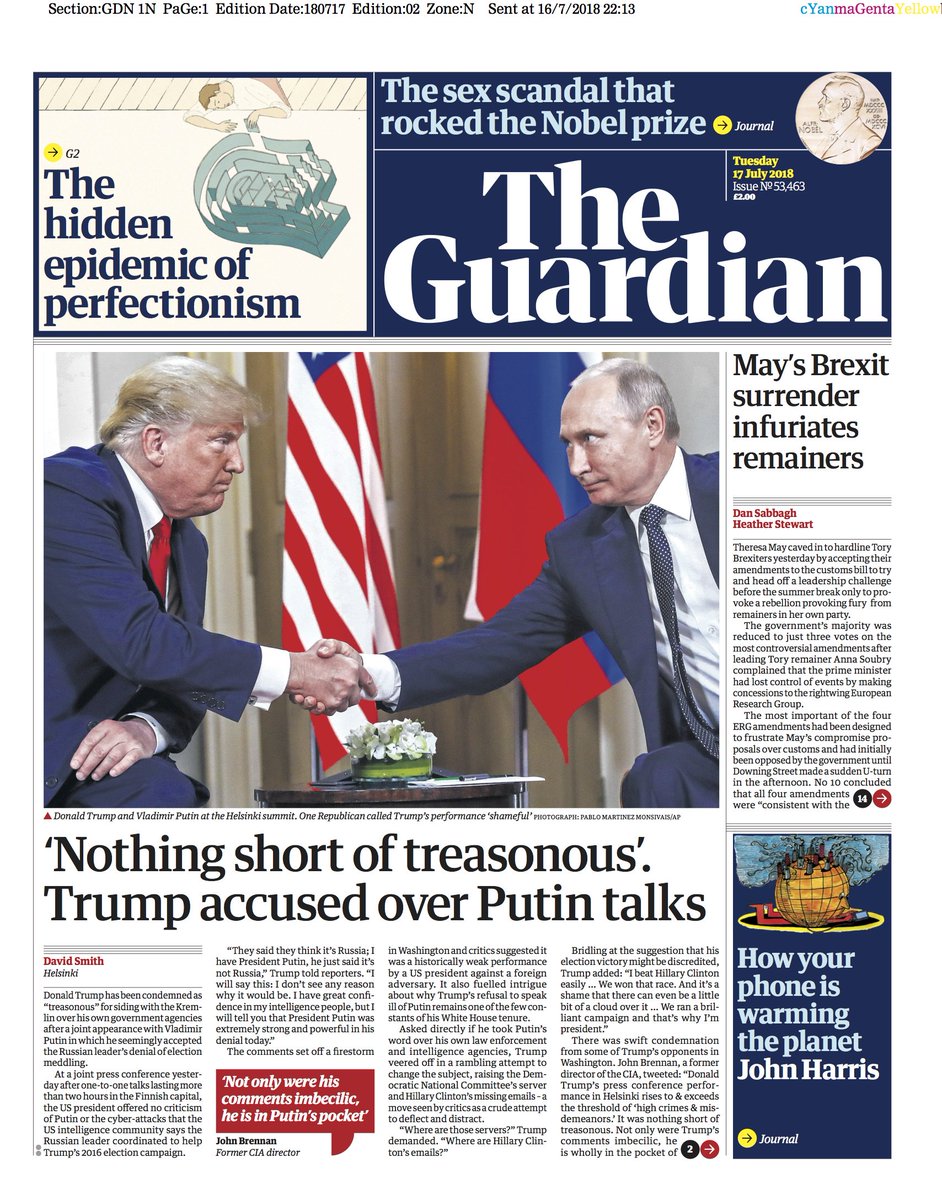
and Trump’s submissiveness towards Putin

In spite of briefing notes that said DO NOT CONGRATULATE in capital letters, Trump called Putin to congratulate him on his recent victory in what passes for a presidential election in Russia. He talked about meeting Putin in person soon (a surprise to everybody else in the White House), and didn’t bother to mention pesky details like Russian meddling in the 2016 election or Russia’s chemical weapons assassination of an ex-spy in the UK. He is reportedly furious that the press found out about his briefing notes, but hasn’t expressed any second thoughts about his conversation.

Since the Mueller investigation is refusing to leak, the most convincing publicly-available evidence of Trump/Russia collusion comes from the administration’s own behavior:

  • Whenever Trump’s people have been asked about their Russia contacts, they’ve lied.
  • Trump consistently behaves as if he is in Putin’s pocket.

Innocent people don’t act this way, as even Republican Congressman Trey Gowdy has noted.


There is a weird disconnect between Trump and his administration on this issue: This morning Sarah Huckabee Sanders announced that the U.S. is expelling 60 Russian diplomats in response to the UK poisoning. Reportedly, that was on Trump’s order, but once again Trump himself is nowhere to be seen. Both McMaster and Tillerson made strong anti-Russia statements just before they got fired. Should the world pay attention to what they said, or to the fact that they got fired?


Trump defenders have pointed to the time Obama congratulated Putin on an election win. I have two things to say about that:

  • It was also a mistake when Obama did it.
  • Obama’s mistake was much more excusable than Trump’s. In 2012, Putin hadn’t yet stolen Crimea from Ukraine, he wasn’t skirmishing with American troops in Syria, and he hadn’t just ordered a chemical-weapons assassination in the United Kingdom.

and tariffs

Trump is threatening to impose tariffs on $60 billion of imported Chinese products, but there’s a 30-day period to reach some other agreement. The stock market is bouncing up and down, because nobody knows how seriously to take all this. Is it a negotiating tactic, or is it the “economic nationalism” we hear so much about?

The Americans with the most to lose here are farmers, who don’t account for that many votes any more, but are still key to the economies of Trump-supporting states like Iowa and Missouri.

and the Austin bomber

23-year-old Mark Anthony Conditt left a cellphone confession before blowing himself up Wednesday morning. He is believed to have been responsible for six package bombs that he Fed-Exed to his targets in Austin and San Antonio. Two people died and five others were injured, but how he picked them is not clear.

Conditt apparently was part of a Christian survivalist homeschooling group from ages 8 to 13. He had correspondingly conservative social and political views, but it’s not clear that they motivated the bombings.

It’s interesting to watch how careful the media is being not to jump on some detail of Conditt’s life and use it to define him and explain his violent rampage. He is also not being characterized as a terrorist, because that would imply a political motive that he didn’t mention in his confession. Austin police Chief Brian Manley said:

He does not at all mention anything about terrorism, nor does he mention anything about hate. But, instead, it is the outcry of a very challenged young man talking about challenges in his personal life that led him to this point.

That caution might be appropriate, but at the same time it contrasts sharply with how black or Muslim attackers are treated. Imagine if the bomber had been at a Sunni madrassah from 8 to 13. I suspect that would be all the evidence anybody needed to proclaim him a jihadi terrorist. And I doubt we’d be hearing so many reports from his friends and relatives about what a nice young man they thought he was.

That’s a big chunk of white Christian privilege: No matter what you do, people will try to see your point of view.

but I couldn’t help myself and watched the Stormy Daniels interview

In the spirit of all those men through the decades who have bought Playboy for the articles, I’m paying attention to the Stormy Daniels story because of the questions it raises about campaign finance violations and abuse of power. So is Vox’ Dylan Matthews:

As Daniel’s interview on 60 Minutes Sunday night makes clear, this isn’t a scandal about sex. I don’t care if Donald Trump had consensual sex with a woman other than his wife; that’s a matter for him and Melania to handle privately. What I do care about is that the President is a bully, who attempts to silence through money and intimidation anyone (but particularly women) who stands between him and what he wants.

The Daniels interview came just days after Anderson Cooper interviewed Karen McDougal, a Playboy Playmate of the Year — I bet there were great articles in that issue — whose story of an affair with Trump was hushed up just before the election.

The other reason to pay attention to this issue is to watch Evangelicals explain why it doesn’t matter. At the very least, they owe Bill Clinton an apology, because during the Clinton scandals everything they said about moral principles and God’s eternal laws was clearly bullshit. There is no moral principle here for them; it’s just partisanship. Trump is on their side; Clinton was on the other side. End of story.

and you also might be interested in …

In addition to replacing McMaster with Bolton (see above), Trump also either lost or got rid of John Dowd as his lawyer in the Russia investigation, and hired Joseph diGenova, another Fox News talking head who is fond of promoting conspiracy theories without evidence, like his recent charge that “A group of FBI and DOJ people were trying to frame Donald Trump of a falsely created crime.” (It now looks like there might be a snag in the diGenova hiring.)

It’s been widely speculated that the Dowd-out/diGenova-in move points to a change in strategy. Dowd had advised cooperation with the Mueller investigation; perhaps Trump wants to be more combative. Thursday, Rachel Maddow added an ominous spin: She observes that Trump’s legal team is far from a top-flight group. (Major-league Republican lawyers like Ted Olson reportedly aren’t interested.) Maybe that’s because dealing with this case legally is not the plan.

Maybe this is the kind of team he thinks he needs to fight the fight with Mueller’s prosecutors. But, if we are being honest here, let’s get real. What he’s putting together is not the kind of team you put together to mount a legal defense for a president, or in fact to do any serious legal work at all. It appears that that part is over.

What the President is putting together is the kind of team a guy like him might put together to run a PR operation on TV explaining the President’s actions. As hilarious as the President’s D-list lineup of lawyers is starting to look, I’m pretty sure they’re not actually there to do legal work. Him putting these people in place makes it seem like he is going to try to end this by some other means, and they are going to be the team that explains it on Fox News.


It’s official: Republican candidate Rick Saccone conceded the Pennsylvania special election to Conor Lamb.


In Tuesday’s Illinois primary, a Nazi won the Republican nomination in Illinois’ 3rd congressional district. The 3rd is one of those oddly-shaped gerrymandered districts, this time working in the Democrats’ favor. (It includes a chunk of Chicago’s South Side, and then snakes down towards Joliet.) In 2016, Republicans didn’t bother to run a candidate, but this year Arthur Jones, a former head of the American Nazi Party, decided to run as a Republican. The state party denounced him, but didn’t come up with anybody to run against him.

Local media covered the race pretty extensively, so anybody paying attention knew what was going on. There was no cost for skipping that race on the ballot: Running unopposed, Jones was going to win the nomination anyway. But 20,000 Republicans voted for him. It will be interesting to see how much support he gets in November.


An interesting primary is coming up in West Virginia on May 8. One of three candidates running for the chance to challenge Democratic Senator Joe Manchin is Don Blankenship, the coal baron whose corner-cutting on safety led to the deaths of 29 miners in the Upper Big Branch mine disaster.

If there were justice in the world, Blankenship would still be in prison on a manslaughter charge. But he’s rich enough to afford the best lawyers, so instead he’s free after serving one year for conspiring to violate federal safety standards. So he’s running for the Senate, because, why not? I mean, what better way is there to thumb your nose at liberal do-gooders and their bureaucratic rules than to vote for a guy who defied those rules? Going to prison just makes him a martyr, unlike the 29 miners who are merely collateral damage.


Trump’s first attempt to ban transgender Americans from the military fell apart under a combination of legal problems and pushback from the Pentagon. So there’s a new version out. It’s not quite as sweeping as the first version, but accomplishes most of the purpose: getting transgender Americans out.

There’s really no military justification for this policy; the Pentagon isn’t asking for it. But trans people give Trump’s base the creeps, so they feel satisfaction when Trump aims a kick in that direction. Jennifer Finney Boylan writes in the NYT:

God forbid that these most marginalized, maligned and misunderstood Americans make anyone uncomfortable — while staying in a homeless shelter. God forbid that students in high school be free from the threat of violence and bullying. God forbid that trans soldiers be honored for their service, rather than ridiculed, demeaned and discharged by — in Senator Tammy Duckworth’s elegant phrase — “Cadet Bone Spurs.”

The only possible cause served by such unrelenting ignorance and cruelty is the cause of bigotry. For our president, it’s the only motivation he’s ever needed.


The new collective bargaining agreement at the Department of Education is unique in two ways: It wasn’t bargained and the union didn’t agree. The Washington Post’s reading of a union statement says the “agreement”

“guts employee rights, including those addressing workplace health and safety, telework, and alternative work schedules.” Provisions on workplace discrimination, performance appraisals, compensation, child care and training “have all been deleted and replaced with nothing.”

It looks like the Department entered negotiations with the proposal “We’re going to screw you.” The union answered “No you’re not.” The Department interpreted that response as the union failing to negotiate, which it claims allows it to impose the agreement it wants.

It’s not clear to me what leverage the union has: It could shut down the Department of Education with a strike, but the administration doesn’t care about education and would probably be happy to see the Ed Department go away. It’s easy to imagine something similar happening at all the other departments and agencies the administration doesn’t care about: HUD, EPA, HHS … basically everything but Defense, Treasury, and ICE.

and let’s close with something self-diagnostic

Do you suspect you might have a cognitive bias? This graphic (high-res version you might actually be able to read) claims to cover all of them.

The Return of the Chicken Hawks

When Donald Trump started staffing his administration, many of us worried about the number of generals he put in high positions: Michael Flynn, John Kelly, Jim Mattis. Chief Strategist Steve Bannon had never made it to general, but his seven years as an officer in the Navy was a key part of his self-image. So many of the other members of the administration were lightweights who had little-to-no knowledge or experience relevant to their jobs: Ben Carson, Betsy DeVos, Rick Perry, Jared Kushner, Ivanka, and Trump himself. It seemed obvious that in a crisis, everybody would be looking for the generals to tell them what to do.

In a country founded on civilian control of the military, pundits wondered, wasn’t that dangerous?

Subsequently, Flynn was fired and replaced by another general, H.R. McMaster. Bannon left. John Kelly moved up from Secretary of Homeland Security to Chief of Staff. When the press referred to “the grown-ups” in the Trump administration, they meant the generals, plus a few other people like Rex Tillerson and Gary Cohn.

In the latest reshuffle, Cohn has been replaced by Larry Kudlow, another lightweight without any real credentials relevant to his job. (He played an economist on TV, but really isn’t one.) Tillerson is gone, replaced by Mike Pompeo. McMaster has been replaced by John Bolton. Kelly’s (always limited) ability to control Trump is fading, and his job either is or isn’t secure, depending on the hour and who you talk to.

In short, the Day of the General seems to be waning, and we are being reminded that there are people more dangerous than generals: chicken hawks.

What is a chicken hawk? A chicken hawk is somebody full of warlike rhetoric who somehow never gets around to experiencing war first-hand. [1] His (they’re not all men, but great majority are) lack of experience doesn’t make him cautious, it insulates his thinking against consequences. He sees the uses of war and dreams of being a Churchill who maneuvers forces on a global scale, but has never understood the real costs of war. He has never learned that a mistake that starts a war is the worst kind of mistake a statesman can make.

At The Week, Joel Mathis points out the danger of having a chicken-hawk president:

The problem with Trump’s pugnaciousness? He’s never had to face consequences for it. There have always been bone spurs, or security guys, or the fact that professional wrestling isn’t real. As far as we know, he’s never started a fight and gotten his nose bloodied for the trouble. Anybody who has experienced that lesson never forgets it. It’s best not learned on the international stage.

A general is a priest of War who has seen what can happen when he calls down the wrath of his god. A chicken hawk has heard glory-filled stories of that god, watched the priests with envy, and longs to unleash that kind of power.

Bush era chicken hawks. The George W. Bush administration was full of chicken hawks, most notably Vice President Dick Cheney, who engineered the Iraq War after artfully maneuvering to avoid the draft during the Vietnam era. (As he told a reporter, “I had other priorities in the ’60s than military service.”) Other notable Iraq War hawks — Paul Wolfowitz, Karl Rove, Richard Perle, Douglas Feith — were also blissfully devoid of military experience. (As Colin Powell’s top assistant Colonel Lawrence Wilkerson put it: “None of these guys ever heard a bullet go by their ears in combat.“)

Some of the loudest Iraq War hawks outside the Bush administration were similarly uninterested in actual fighting, like Bill Kristol, and any number of gung-ho College Republicans who were of the right age to volunteer for the Iraq War, but chose to leave that honor to someone else. (It’s debatable whether Iraq-invasion-promoting columnist Thomas Friedman qualified as a chicken hawk. He never served in the military, but he probably did hear bullets whiz past his ear when he was reporting in Beirut.)

Bush himself avoided Vietnam by somehow getting a coveted spot in a National Guard unit that was never called up (and maybe, depending on who you believe, he just stopped showing up at some point). His military experience was zipping through the clear skies of Texas in a supersonic fighter jet, and he relived that excitement by landing on the USS Lincoln near San Diego so that he could give his famous “Mission Accomplished” speech declaring victory in Iraq.

By contrast, the top general in the Bush administration, Secretary of State Colin Powell, while consistently loyal to administration policy, was not so eager to invade. He was the one who coined what he called the Pottery Barn Rule: “If you break it, you own it.” He also was subsequently more open than most Bush officials about what went wrong and what might be learned from it. Colonel Wilkerson became a critic of the war.

The once and future chicken hawk. Like George W. Bush, John Bolton used the National Guard to avoid Vietnam, a war he supported. Wikipedia fleshes out his subsequent account of his decision:

He wrote in his Yale 25th reunion book “I confess I had no desire to die in a Southeast Asian rice paddy. I considered the war in Vietnam already lost.” In an interview, Bolton discussed his comment in the reunion book, explaining that he decided to avoid service in Vietnam because “by the time I was about to graduate in 1970, it was clear to me that opponents of the Vietnam War had made it certain we could not prevail, and that I had no great interest in going there to have Teddy Kennedy give it back to the people I might die to take it away from.”

But his turning away from personally serving in Vietnam was not part of a more general turning away from war. Bolton was not just part of the crew that maneuvered the country into the Iraq War, he also worked to expand that war.  In “The Untold Story of John Bolton’s Campaign for War with Iran“, The American Conservative charges:

Bolton’s high-profile advocacy of war with Iran is well known. What is not at all well known is that, when he was under secretary of state for arms control and international security, he executed a complex and devious strategy aimed at creating the justification for a U.S. attack on Iran. Bolton sought to convict the Islamic Republic in the court of international public opinion of having a covert nuclear weapons program using a combination of diplomatic pressure, crude propaganda, and fabricated evidence.

Despite the fact that Bolton was technically under the supervision of Secretary of State Colin Powell, his actual boss in devising and carrying out that strategy was Vice President Dick Cheney.

Most of the other Iraq War chicken hawks are in history’s trash can by now. Whether they learned anything from that blunder or not, no one is listening to them any more. But Bolton has now returned to influence, emphatically has not learned a lesson, and does not even admit that invading Iraq was a mistake.

Preventive War. The Iraq War was premised not just on manufactured reports about Saddam’s weaponry, but also on a doctrine of preventive war: If we think a country is developing a threat to us, we should attack it before that threat materializes. [2] Bolton still believes that doctrine. Here’s what he wrote in the WSJ at the end of February:

It is perfectly legitimate for the United States to respond to the current “necessity” posed by North Korea’s nuclear weapons by striking first.

In other words, North Korea is developing weapons that could strike us, so we should treat that as if it were a plan to strike us, and strike them first. Our strike could result in a retaliatory nuclear strike against Seoul or Tokyo, or just a devastating bombardment of Seoul (a city of 25 million) by conventional artillery. But hey, collateral damage. It’s better that cities of our Asian allies get destroyed than our own cities.

In 2015, he advocated a preventive strike against Iran, and scoffed at the possibility of resolving the nuclear issue peacefully.

The inescapable conclusion is that Iran will not negotiate away its nuclear program. Nor will sanctions block its building a broad and deep weapons infrastructure. The inconvenient truth is that only military action like Israel’s 1981 attack on Saddam Hussein’s Osirak reactor in Iraq or its 2007 destruction of a Syrian reactor, designed and built by North Korea, can accomplish what is required. Time is terribly short, but a strike can still succeed.

When Obama got the deal Bolton said was impossible, Bolton denounced it, and has urged Trump to pull out of it. That, of course, takes us back to Square One with regard to Iran’s nuclear program: Either we accept the reality of Iran getting nuclear weapons (as President Bush did with North Korea) or we attack them.

In The Daily Beast, Mark Leon Goldberg characterizes Bolton’s tenure as UN Ambassador in 2005-2006:

The memoir he wrote of his experience at the UN was titled “Surrender is Not an Option.” But Bolton’s time at the UN suggests that, to him, the natural give and take of diplomacy is akin to “surrender” and must be avoided at all costs. Understanding how he performed his job at the UN gives us big clues as to how he might approach the job as National Security Advisor to which he has just been named.

At the United Nations, Bolton demonstrated a profoundly zero-sum view of international relations. Other countries’ gains — no matter how insignificant —  were ipso-facto America’s losses.

In other words, he will reinforce one of Trump’s greatest weaknesses: his inability to see the win/win nature of good diplomacy.

Leading the chorus for war with Iran. As National Security Advisor, Bolton will not have any planes or troops under his direct command. Nor will he have a staff capable of generating attack plans without cooperation from the Pentagon. He chairs the National Security Council; his job is to consolidate the advice of the military, foreign policy, and intelligence establishments and package it for the President. His power rests entirely in his ability to influence the President’s decisions.

That job is particularly important when the President has no expertise or experience of his own. (Dwight Eisenhower, who had already managed half of a global war before he became president, changed NSAs almost every year. It didn’t make a huge difference.) As a tough-talking chicken hawk himself, Trump needs to be surrounded by people who understand the reality of war. Initially, he was, but that is becoming less and less true.

With the possibility of a Trump/Kim summit meeting — I’m still not convinced that’s really going to happen — North Korea is the challenge most people are focused on right now. But another deadline on Iran is also looming: U.S. sanctions on Iran were not repealed after the 2015 agreement; instead (according to the Corker-Cardin law) the President must waive them every 90 days. The current waiver runs out on May 12. If the sanctions on Iran are resumed, the deal that stopped Iran’s march to nuclear weapons will start to unravel.

Trump didn’t want to issue the previous waivers, but he let Tillerson and McMaster push him into doing so. Back in January, he warned that he wanted major changes in the agreement, which during the campaign he had called “one of the most incompetently drawn deals I’ve ever seen“. So far, these demands have led to no additional concessions from the Iranians. [3]

This time around, Tillerson and McMaster are gone. Like Bolton, new Secretary of State Mike Pompeo is an Iran hawk. So is UN Ambassador Nikki Haley. [4] Along with Trump’s own inclinations, this chorus virtually guarantees that the next waiver will not be granted, sanctions will be reimposed, and Iran stop complying with the nuclear deal.

The next question is: What then? During the campaign, Trump’s “America First” slogan seemed to point away from foreign adventurism. [5] He was almost unique among Republican presidential candidates in clearly declaring the Iraq War a mistake. [6] But with no brakes on Iran’s nuclear program, and with Bolton leading the chorus of Pompeo and Haley, war with Iran will be a constantly available option, waiting for the moment when Trump is in a war-making mood.


[1] It’s worth pointing out that I also have never served in the military, observed combat, or even been shot at in civilian life. But I am also cautious about committing someone else to fight on my behalf. When military people tell me that war is hell, and that the outcome is never as predictable as you think, I believe them.

[2] There’s an important distinction between preventive war and preemptive war. Both are examples of striking first, but a preemptive war is much less controversial than a preventive one, because it makes fewer assumptions about an enemy’s intentions. A preemptive strike disrupts a specific imminent attack, while a preventive strike intends to eliminate the possibility that an enemy might eventually attack at some indefinite time and place.

An example helps here: If the U.S. had struck the Japanese fleet just as it got within range of Pearl Harbor, that would have been preemptive: A specific attack was in the works, and our attack would have disrupted theirs. But the Japanese attack itself was preventive. At the time the U.S. had no specific plan to attack Japan. But the Japanese anticipated that the U.S. would eventually go to war to stop Japanese expansion, so they crippled the fleet that would spearhead that war.

When you start a preventive war, you turn your back on the possibility that the attack you claim to be preventing could have been averted in some peaceful way. A key example there is the Cold War: Various American military figures in the 1950s and 60s advocated for a preventive nuclear strike against the USSR. But we didn’t strike that preventive blow, and the nuclear war those men were anticipating never happened anyway.

[3] That’s typical. Trump dislikes all our international agreements and believes he can negotiate better ones, but so far he has not produced any significant new deals. (Wait: Something with South Korea was announced this morning.)

[4] Experts seem to agree that Iran is fulfilling its end of the agreement, so Haley has been moving the goalposts.

The question of Iranian compliance is not as straightforward as many people believe. It’s not just about the technical terms of the nuclear agreement. It requires a much more thorough look.

[5] In an address to Congress a little over a year ago, he implicitly criticized the expense of the Iraq War: “America has spent approximately six trillion dollars in the Middle East, all this while our infrastructure at home is crumbling. With this six trillion dollars we could have rebuilt our country –- twice.”

[6] He considered it such a mistake that he had to rewrite history to portray himself as a war critic from the beginning.