Monthly Archives: March 2021

Those Who Dare

Mr. Potato Head! An army of Mr. Potato Heads!

– Weird Al Yankovic
planning session for “Dare To Be Stupid

This week’s featured post is “Silly Season in the Culture Wars“.

Last month’s post “Why You Can’t Understand Conservative Rhetoric” has become the Sift’s first authentically viral post in a long time. It should pass 20,000 page views soon, the first Sift post to do that since “You Don’t Have to Hate Anybody to be a Bigot” in 2015. Given the changes in the social media landscape, I had wondered if that was still possible.

This week everybody was talking about Covid Relief passing the Senate

Biden’s $1.9 trillion Covid relief package passed the Senate Saturday without the $15 minimum wage, but without a lot of other major changes. Because it isn’t exactly what the House had passed, the House needs to pass it again. Democrats hope to do that tomorrow, getting the bill on President Biden’s desk before some previous Covid-related benefits run out on March 14.

At the risk of counting unhatched chickens, I want to point something out: Congress is doing something major, and getting it done on time. No posturing and then pointing fingers at each other about why nothing is happening. No driving up to the cliff, giving yourself an extension, and then driving up to the cliff again. Biden won’t go back and forth on whether to sign this, as Trump did in December. This isn’t a reality-TV show that needs some suspense to boost its ratings, it’s governance.

I think the American people are going to like this: You say something needs to get done, and then you go do it. That’s not what we’re used to out of Congress.

I think people are also going to notice that this passed without a single Republican vote in either house. Republicans are trying to spin that in their favor: When the Republican Senate passed a bill in December, it was bipartisan. But that’s putting lipstick on a pig: The December bill was bipartisan because Republicans didn’t have the votes to pass anything without Democratic help, not even in the Senate. A bunch of their people wouldn’t vote for any Covid relief at all.
https://paulkrugman.substack.com/p/nonstimulus-arithmetic

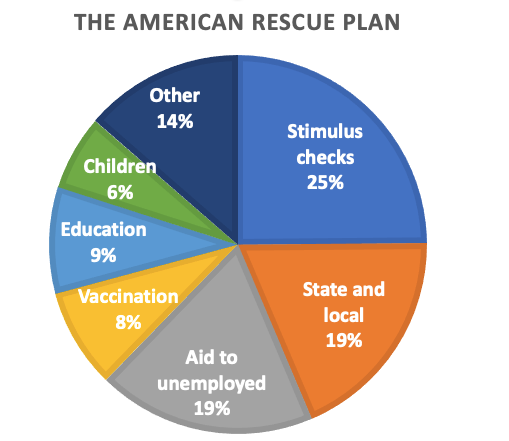
Paul Krugman analyzes what’s in the plan, and why he thinks it needs to be this big. Basically, it funds stuff that needs to happen to fight the virus (vaccinations, testing) and get the country back to normal (preparing schools to reopen safely). It helps individuals who are in financial trouble because of the pandemic (unemployment, stimulus checks). And it makes up for state and local tax shortfalls that otherwise would have governments laying people off at the worst possible time. Some people who need help don’t fit into any obvious categories, so they’re hard to target; that’s where the checks-to-almost-everybody feature comes in. That makes the price tag bigger than a perfectly efficient bill would carry, if anybody knew how to design one.

Will the bill overstimulate the economy and produce inflation? Krugman admits he doesn’t know: We’ve never been in this situation before. If it does cause inflation, he foresees more of a one-time pop than the kind of inflationary spiral we saw in the 1970s.

https://jensorensen.com/2021/03/06/naked-partisans-both-sidesism/

and Covid itself

https://theweek.com/cartoons/969609/editorial-cartoon-covid-vaccine

Things are looking good in the battle against the pandemic, but a number of Republican governors are spiking the ball on the five-yard line. They’re acting like the battle is already won and everything can go back to normal right away — repeating the mistake that so many of them made last May, after the March/April surge began to die down.

The good news is that with the third vaccine now available, vaccination rates are soaring. 59 million Americans have gotten at least one shot, and more than 30 million are fully vaccinated. 2.9 million shots were given Saturday, and the 7-day average is up to 2.2 million. This is well past Biden’s post-election pledge of 100 million shots in 100 days. His current projection is that enough vaccine will be produced for every American adult to be vaccinated by the end of May. At some point, the problem will shift from not having enough vaccine to convincing reluctant Americans to get vaccinated.

While the share that is most enthusiastic to get vaccinated increased across racial and ethnic groups, Black and Hispanic adults continue to be more likely than White adults to say they will “wait and see” before getting vaccinated. Nearly four in ten Republicans and three in ten rural residents say they will either “definitely not” get vaccinated or will do so “only if required,” as do one-third (32%) of those who have been deemed essential workers in fields other than health care.

The sort-of-good news is that after hiccuping these last two weeks, the new-case curve looks like it is continuing downward, but at a slower pace than the precipitous fall we saw from mid-January to mid-February. The current daily average of new cases is just under 60K, down from a peak of 250K. But don’t forget: The peak that had us all so rattled last summer was 70K, so it’s not like we’re in a good place yet.

The bad news is that red states — especially Texas — are rolling back their Covid restrictions and canceling their mask mandates. This is the same mistake that many of the same states made last May, leading to the virus’ second wave in the summer.


Meanwhile, there’s actual evidence that mask mandates save lives and indoor dining costs lives. And whatever masking-and-distancing is doing to fight Covid, we can see that it clobbered the flu this year. Chris Hayes says this stat blew his mind: Positive flu specimens in week 7 of flu season were 174K last year and 1.5K this year.


“At least 100” protesters gathered in front of the Idaho state capitol in Boise Saturday. They burned face-masks to dramatize their opposition to government-imposed mask mandates.

https://www.theguardian.com/world/2021/mar/06/idaho-covid-protesters-burn-masks-state-capitol

Supposedly this has something to do with freedom and limited government, but I don’t get it. Does it violate your freedom when restaurants insist you wear shoes? When stores require pants?


Many Catholic bishops have an issue with the J&J vaccine, because it uses “lab-grown cells that descend from cells taken in the 1980s from the tissue of aborted fetuses”. I’m not a theologian, Catholic or otherwise, but it seems to me that at some point the clock runs out on these kinds of moral considerations. The J&J vaccine will keep people alive, while refusing to take it will not save a single fetus, much less bring back any of the ones aborted in the 1980s.

We use the body parts of organ donors who die by violence or are victims of drunk drivers. Getting some good out of their deaths does not condone the violence or excuse those responsible. So if you hold the un-Biblical belief that fetuses have souls, I think you should say a short prayer of appreciation for their sacrifice, and then roll up your sleeve.

and more legislation in the pipeline

The House has passed the George Floyd Police Reform Act and the For the People Act to protect voting rights and defend democracy. Both face Republican resistance in the Senate, and aren’t amenable to the reconciliation work-around that let Democrats pass Covid relief. The Biden administration is working on its infrastructure proposal, which could go through under reconciliation, but 50th vote Joe Manchin doesn’t want it to. Of course, Manchin still believes that Republican cooperation is possible, so we’ll see what he does when he discovers that it isn’t.

In any case, the filibuster issue is going to come to a head before much longer. Republicans at the state level are doubling down on voter suppression. (The lowlight here is Georgia’s proposal that would make it illegal to give water to someone waiting in line to vote.) They clearly believe that the solution to their problems isn’t to win over more voters, it’s to make sure fewer people vote, and to continue rigging the system so that they can return to power even if a majority votes against them.

It’s going to be a serious crisis for the Democratic Party if they do nothing while their voters are disenfranchised, because they are more loyal to “bipartisanship” or “Senate tradition”.

and you also might be interested in …

Texas consumers were overcharged around $16 billion for electricity during the recent winter-storm crisis, but the Texas Public Utility Commission has decided not to do anything about it. “It’s nearly impossible to unscramble this sort of egg, and the results of going down this path are unknowable.”


Amazon workers in Alabama are trying to unionize, and fighting an anti-union campaign from the company. You can help.

To support Amazon workers and let the company know that we do not approve of their union-busting tactics, a one-week boycott of the company has been planned. From Sunday, March 7th to Saturday, March 13th, everyone is being asked to not use Amazon or Amazon Prime and do not stream videos using the Amazon Prime video service.


In case you needed it, here’s more evidence that Trump only cares about Trump: His lawyers sent a cease-and-desist letter to the Republican National Committee, the National Republican Congressional Committee and the National Republican Senatorial Committee. They’ve been using his name and image in fund-raising pitches, and he doesn’t even get a cut!


Missouri Republican Senator Roy Blunt says he’s not running for re-election. Wisconsin’s Ron Johnson hasn’t decided, but says he’s leaning against running. Rob Portman of Ohio is also not running.

2022 is going to see some off-the-wall primary campaigns, as Republicans compete to be the most outrageous, Trumpiest candidate. Wisconsin is a swing state, but Missouri is deep red and Ohio is trending that way. But history shows that a wacky enough candidate can blow an election in any state.


One more data point in favor of a guaranteed basic income:

The city of Stockton, California, embarked on a bold experiment two years ago: It decided to distribute $500 a month to 125 people for 24 months — with no strings attached and no work requirements. The people were randomly chosen from neighborhoods at or below the city’s median household income, and they were free to spend the money any way they liked. Meanwhile, researchers studied what impact the cash had on their lives.

Conservatives say that if you give people money, they won’t work. Liberals say that no-strings money will help people escape the poverty traps that keep them from working. The Stockton experiment supports the liberal theory.

The most eye-popping finding is that the people who received the cash managed to secure full-time jobs at more than twice the rate of people in a control group, who did not receive cash.Within a year, the proportion of cash recipients who had full-time jobs jumped from 28 percent to 40 percent. The control group saw only a 5 percent jump over the same period.

My theory: Looking for a job is like looking for a date. If you’re too desperate, you’re unattractive.


Jen Psaki continues to be a press secretary worthy of The West Wing.


In case your nightmares have been getting repetitive, here’s something new: six-foot long bioluminescent sharks. You’re welcome.


The featured post responds to this week’s conservative ravings about imaginary liberal attempts to “cancel” Dr. Seuss, Mr. Potato Head, and the Muppets. But here’s what an attempt to cancel really looks like: a petition to get American Girl to pull its Doll of the Year off the shelves, because her backstory involves two lesbian aunts.

and let’s close with something life affirming

I can’t explain why watching this beaver chow down on cabbage makes me smile. It just does.

Silly Season in the Culture Wars

https://www.gocomics.com/johndeering/2021/03/05

If the only message you have is to stoke your base’s grievances, occasionally you have to make some up.


This week contained a lot of important news, so you might imagine that conservative news networks would have a lot to talk about. You might even say they had work cut out for them.

  • President Biden’s $1.9 trillion (with a T) spending bill was being debated in Congress, and the opposition message wasn’t getting through to the American people. In one poll, the proposal won support from 68% of Americans, including 37% of Republicans.
  • The battle against the Covid pandemic had major developments: Biden announced that enough vaccine for all adult Americans would be available by the end of May, two months earlier than previously thought. Meanwhile, Republican governors in Texas and Mississippi were removing mask mandates and other pandemic-related restrictions from their economies, and others were thinking of following suit — despite the fact that daily case-numbers and death-totals are either worse or not much different than when those restrictions were announced.
  • The Senate has been holding hearings on the January 6 insurrection, including testimony from the FBI director.
  • Police reform and voting rights bills passed the House.
  • Refugees are returning to our southern border.
  • A big-state Democratic governor is battling scandal.
  • The Senate still has Biden nominees to confirm. Surely one or more of them has done something worth getting upset about.
  • Biden is planning another trillion-with-a-T infrastructure bill to rebuild America in ways that Trump promised but never delivered on.

Serious stuff. Worth calling viewers’ attention to. Some of it even invites a conservative spin.

But instead, right-wing hosts like Tucker Carlson and Sean Hannity filled entire segments of their shows with Mr. Potato Head and Dr. Seuss, two purported examples of “cancel culture” that (1) are trivial by comparison to several of the issues I just listed, and (2) don’t stand up to even a small amount of scrutiny.

Let’s examine the reality at the root of these controversies.

Mr. Potato Head. Not quite two weeks ago, Hasbro announced that it was changing how it markets its Mr. Potato Head toys:

Hasbro is officially renaming the MR. POTATO HEAD brand to POTATO HEAD to better reflect the full line.

In other words, Hasbro is de-centering masculinity: Instead of being an “accessory” to her husband, Mrs. Potato Head is now an equal member of the family. Horrors! Your daughter might get the idea that she can find her own place in the world, and doesn’t need a man to define her. And then the Hasbro announcement got even more sinister:

Launching this Fall, the CREATE YOUR POTATO HEAD FAMILY is a celebration of the many faces of families allowing kids to imagine and create their own Potato Head family with 2 large potato bodies, 1 small potato body, and 42 accessories. The possibilities to create your own families are endless with mixing and mashing all the parts and pieces.

So the toy is no longer hetero-normative. If they want, children can build a family with two Mommies or two Daddies. The branding no longer fights that. (Like that matters. I mean, you never cross-dressed Barbie and G. I. Joe, right? Sure. Me neither.) Of course, if you want a Potato Head Family with a Mommy, a Daddy, and a Tater Tot of your own gender, that still works too. (And you can still remove Daddy’s mouth, so he can’t yell at the Tot.) As best I can see, there are no losers here.

https://tribunecontentagency.com/article/20210303edshe-b-tif/

Dr. Seuss. The Dr. Seuss situation is similar: A private enterprise is managing its brand in a way that hurts no one.

When Theodore Seuss Geisel died in 1991, the copyrights on his works passed to his widow, Audrey Geisel, who lived until 2018.

In 1993 she founded Dr. Seuss Enterprises, whose stated mission was to “protect the integrity of the Dr. Seuss books while expanding beyond books into ancillary areas.”

Since then, DSE has done a pretty good job keeping Geisel’s flame burning.

Dr. Seuss — who died in 1991 — was one of the top-earning dead celebrities of 2020, with $33 million in total earnings, according to Forbes. That’s up from $9.5 million in 2015. His estate actually earned more than any late celebrity except for Michael Jackson, whose estate earned $48 million.

So maybe they know their business, and their judgement deserves the benefit of the doubt. Tuesday, Dr. Seuss Enterprises announced that six of its more obscure titles would no longer be published.

Dr. Seuss Enterprises, working with a panel of experts, including educators, reviewed our catalog of titles and made the decision last year to cease publication and licensing of the following titles: And to Think That I Saw It on Mulberry Street, If I Ran the Zoo, McElligot’s Pool, On Beyond Zebra!, Scrambled Eggs Super!, and The Cat’s Quizzer. These books portray people in ways that are hurtful and wrong.

None of these six was particularly popular.

“And to Think That I Saw It on Mulberry Street,” one of the six books pulled by the estate, sold about 5,000 copies last year, according to BookScan. “McElligot’s Pool” and “The Cat’s Quizzer” haven’t sold in years through the retailers BookScan tracks.

For comparison, DSE sold over half a million of Oh, the Places You’ll Go!.

So what about these particular six books is “hurtful and wrong”? Unless you have copies lying around — and most people don’t, that’s what it means to be unpopular — it’s hard to judge for yourself. In situations like this, mainstream publications don’t want to call your attention to something just to demonstrate how hurtful it is. (And nether do I, so I’ll provide links you can chase if you’re curious rather than post the images themselves.)

The problem isn’t with the text of the books so much as the illustrations. None of them that I have seen is aggressively racist, like Nazi caricatures of Jews often were, but they contain demeaning stereotypes of Africans and Asians. (The anti-Japanese cartoons Geisel drew after Pearl Harbor, though, are aggressively racist, as many cartoons of the era were. None of them are currently being published by DSE.) You’re not supposed to hate these books’ non-white characters so much as find them different and strange. (The theme of Mulberry Street is that you don’t have to go far to see bizarre things, like “a Chinaman who eats with sticks“.) And a lack of diversity doesn’t help: The monkey-like African natives in If I Ran the Zoo would be less problematic (though still far from acceptable) if they weren’t the book’s only black characters.

(For what it’s worth, I’ll tell a story on myself: When I was three, I had pneumonia and my parents took me to the hospital. In the waiting room, I saw a Black family, maybe the first real-life Black people I had ever noticed. Dark skin was something I only knew from cartoons, when characters fell into mud puddles or got blown up with dynamite. “Mommy!” I announced (or so I’ve been told). “Those people are dirty.”)

If you’ve watched many old Disney or Warner Brothers cartoons — a lot of which have quietly been taken out of circulation — you know that none of this is unusual for the era. Explicitly non-white characters were rare, and the ones that do show up represent something “other”; you’re supposed to react to them, not identify with them. So the problem isn’t that Dr. Seuss was a bad man in the context of his time — in many ways his books were more progressive than their competitors — but that some of his work has aged badly.

What should be done about that depends on what you want Dr. Seuss to be in 2021. If he’s to be a historical figure — a leading children’s-book author of the mid-to-late 20th century — then his work should speak for itself. Leave it alone, and organize a conversation around it, as HBO Max did when it briefly withdrew and then re-launched Gone With the Wind. (GWTW is a spectacular example of 1930s movie-making, as well as a valuable artifact in the history of America’s attitudes towards race. So I encourage you to watch it. Just don’t imagine that its Lost Cause mythology is an accurate depiction of the Old South or the Reconstruction Era.)

But if Theodore Geisel’s legacy is supposed to be timeless — Audrey’s vision — if his work is supposed to live through our era and beyond, then it needs to be curated. Parents and grandparents should be able to trust the Dr. Seuss brand. When you sit down to read to your four-year-old, you should be able to pick up a Dr. Seuss book without worrying that you might put something bad into a developing mind.

That curation is precisely what Dr. Seuss Enterprises was doing when it removed these six books from its catalog. By taking this action, DSE is making it more likely that kids will still be reading The Cat in the Hat or How the Grinch Stole Christmas in 2050.

The conservative policy vacuum. To understand the overblown response to the Potato Head and Dr. Seuss news, think back for a moment to Reagan Era conservatism. Whether you loved it or hated it — and even if you believed some ulterior motive was hiding in its background — you knew its defining principles:

  • Bold foreign policy that maintains America’s military strength and isn’t afraid to use it.
  • Free trade.
  • Less regulation, lower federal spending, and lower taxes.
  • Local self-determination with less central control from Washington.

That all went out the window with Trump. He liked to spend a lot of money on weapons, brag about American military strength, and occasionally threaten other nations with “fire and fury”. But he also pulled back from wars in Iraq, Afghanistan, and Syria; distanced the US from allies like NATO, Japan, and South Korea; and let Vladimir Putin do whatever he wanted wherever he wanted to do it. Mao was probably wrong when he referred to the US of his era as a “paper tiger“, but Trump’s America really was one.

Free trade was replaced by tariffs and trade wars. Some regulations went away — particularly those protecting the environment — but others he stretched to interfere more aggressively in the decisions of US and foreign corporations. Big spending (and big deficits) weren’t worth mentioning any more. And no president in my lifetime did quite so much to impose federal policy on cities and states that didn’t want it. (Last summer, only resistance from the Pentagon kept him from invoking the Insurrection Act and sending active-duty troops into American cities.)

As a result of this reversal, and the absence of any new guiding principles to explain it, today’s Republican Party no longer has a policy agenda. The 2020 Republican platform was to support Trump — period. When the GOP controlled the White House and both houses of Congress, it couldn’t decide what to do with that power, other than pass one big tax cut for rich people. It couldn’t even fulfill its promise to repeal ObamaCare, because that would leave a void that it had no idea how to fill. “Complain all you want that the covid-19 relief bill has been packed with all sorts of unrelated stuff from the Democratic wish list,” Megan McArdle wrote yesterday. “At least the Democrats have a wish list. What’s the Republican equivalent?”

Conservatism today is defined not by principles or programs, but by a Leader, an identity, and (most of all) an attitude: Conservatives are mad as hell and aren’t going to take it any more. Mad at “Them” — the libs, the Deep State, Big Tech, the blood-drinking pedophiles — who keep threatening and insulting them.

But the Biden administration is policy-centered, so to the extent that Biden is driving the national conversation, Republicans have little to say. If they wanted to oppose Biden on substance, they’d need to have a Covid relief proposal of their own. (Ten GOP senators did make a laughably low-ball offer that they knew Biden couldn’t accept, but even they only represented themselves. The Republican leadership offered no proposal at all.) Or a coherent response to January 6 and the larger problem of domestic terrorism. Or an infrastructure plan. Or an immigration plan. Or something.

With no ideas to offer, they can only keep their base riled by promoting a never-ending string of “outrages”. Otherwise they’ve got nothing.

The cancel-culture freak-out. The essence of Trump’s message to his base (a message no other Republican is in a position to compete with) is grievance: Somebody is trying to take something from you, so you need a strong authoritarian leader to fight for you.

Some of these threats may be exaggerated, but they have at least a foothold in reality. Many Democrats really would like to take away assault rifles and other military-grade weaponry, or at least stop Americans from buying more. But the number proposing to “disarm” the country entirely is vanishingly small. Many Americans do compete for jobs with foreigners abroad and immigrants at home, though trade and immigration also create jobs and the balance is debatable.

But other “threats” are almost entirely imaginary: Non-white races are trying to “replace” you. Gays and lesbians are conspiring to destroy marriage and the family. Liberals want to criminalize Christianity. Big Tech is trying to steal your voice. Covid is a conpsiracy to take away your freedom. It has become a formula: When the Right needs to energize its base, they invent some nebulous force — “Them!” — that is trying to take away something that should be yours.

This week’s Seuss/Potato story has made this technique really obvious, because the frame fits so badly. Nothing is being taken away from anybody. Whatever you had hoped to do with Mr. Potato Head, you can still do. No one is coming for your Dr. Seuss books. And if you want more, you can buy more, except for a few books you probably had forgotten even existed. What’s more, the rights to those books never belonged to you anyway; if Dr. Seuss Enterprises thinks its brand is healthier without them, that’s up to them.

Conservative rabble-rousers did their best to pretend something else was happening. “They are banning Dr. Seuss books,” said Glenn Beck. They. Not the legal owners of the copyrights, or the organization created by Seuss’ widow to protect his legacy, but a nebulous “panel of ‘educators’ and ‘experts’.”

How much more do you need to see before all of America wakes up and goes “This is fascism!”? This is fascism. You don’t destroy books. What is wrong with us, America? Go out and buy those books today. Find out if you can get them. Buy Mr. and Mrs. Potato Head, because it’s the end of an era. It is the end of freedom in America.

Beck is so strongly attached to these six books — none of which are being destroyed — that he gets some of their names wrong.

He wasn’t alone. On Fox & Friends, Donald Trump Jr. also warned about the sinister “they”, and seemed to imply The Cat in the Hat had been canceled.

There’s no place that they won’t go. This week alone, they canceled Mr. Potato Head, they canceled the Muppets. They’re canceling Dr. Seuss from reading programs. … I literally know The Cat in the Hat by heart without the book there because I read it so many times to my children.

(I almost forgot about the Muppets. Last month, Disney Plus began streaming all five seasons of The Muppet Show, making it more easily available than it has ever been. But Disney committed the unforgivable sin of putting content warnings on some episodes, like the one where Johnny Cash sings in front of a Confederate flag. But you can still watch it. No one has had the Muppets taken away from them.)

Kevin McCarthy similarly implied that the most beloved Dr. Seuss books were being canceled — not by the organization charged with maintaining his brand, but by people who don’t like Dr. Seuss. He tweeted “I still like Dr. Seuss” and then read Green Eggs and Ham on Twitter. Why didn’t he read If I Ran the Zoo and show us the primitive African natives?

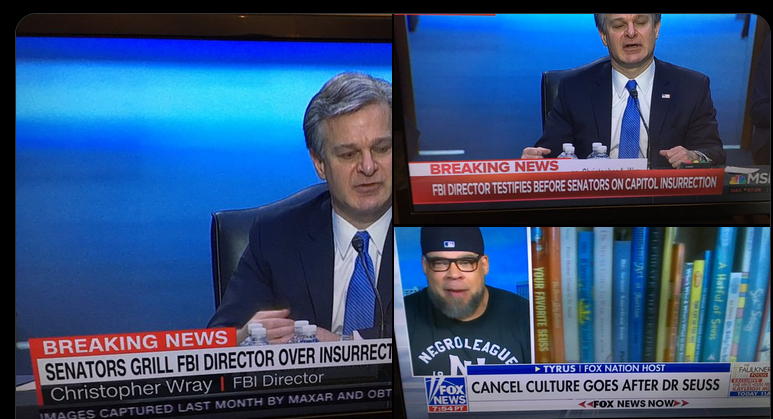
Tuesday morning, as Christopher Wray verified that white supremacist groups were involved in the Capitol insurrection and Antifa wasn’t, Ted Johnson noticed a subtle difference in what news networks were covering.

The Washington Post provided the numbers:

Over the course of the past week, Fox News has spent 4 hours and 38 minutes on Dr. Seuss, Mr. Potato Head and Biden’s comments about Neanderthals, according to a tally by the liberal watchdog Media Matters for America. That compared to 42 minutes from CNN and 39 minutes from MSNBC on those topics.

Fox News on Tuesday alone devoted an hour and nine minutes to Dr. Seuss — more than the combined amount it spent on the coronavirus vaccine and FBI testimony about the Jan. 6 insurrection.

https://www.mediamatters.org/fox-news/fox-news-dr-seuss-obsession-numbers

So this is what conservative media has come to: If you have nothing to say to America, and yet you need to keep your base riled up, then you need to rile them up about nothing.

The Monday Morning Teaser

It’s always a dilemma for me when a Nothingburger story gets hot. If all I’m going to do is point out that this story doesn’t deserve the attention it’s getting, then I have become part of the problem: I’m drawing your attention to something that doesn’t deserve it.

The alternative is to go meta: Of all the Nothingburgers in the world, why has this one turned into a Big Mac? Who is pushing it? Why does it serve their purposes? How have they managed to distort it into something it’s not?

You’ve probably guessed where I’m going with this: Dr. Seuss. Mr. Potato Head. Some private companies did some completely innocuous rebranding, and the whole conservative media went wild. Hang on to the cat in your hat, because the “woke mob” is banning the icons of your childhood! “This is fascism!” Glenn Beck announced, as if piles of Green Eggs and Ham and plastic potato parts were being doused with lighter fluid and set aflame.

I couldn’t let that go, so I went meta. The featured post this week is “Silly Season in the Culture Wars”. First off, I’ll tell you something Tucker Carlson never will: exactly what happened and who did it. In particular, I won’t use “they” or “them” without an antecedent, as Trump Jr. did when he said, “They’re canceling Dr. Seuss.”

Then comes the meta part: Conservative media needs to invent outrages like this, because in the post-Trump world, they have no ideas to discuss. There was no 2020 Republican platform, there is no conservative legislative program, and they don’t even have a coherent critique of what Biden is proposing. If not for an endless series of outrages-of-the-week, they’d have a lot of dead air.

The form of an outrage-of-the-week is that liberals are trying to take something you love away from you: your guns, your job, your freedom, your son’s masculine identity, … something. So a story about liberals taking away your fond childhood memories fits right in. The fact that it isn’t true is just a detail to work around.

Anyway, that’s ready to post, so it should be out soon. The weekly summary then has the week’s actual news to cover: The Covid relief bill is getting close to Biden’s desk. Other important bills are in the pipeline, and the moment-of-truth on the Senate filibuster is approaching. Vaccinations are accelerating. Covid case-numbers have started going down again, but are still so high that Texas is crazy to end all restrictions. The Senate held hearings on the Capitol insurrection. Andrew Cuomo’s future is in serious doubt. Plus we have bioluminescent sharks, an excuse to link to my favorite Weird Al video, and one very enthusiastic beaver. I should have that out before noon.

Phantoms of the Night

Morning glow, by your light
We can make the new day bright,
And the phantoms of the night
Will fade into the past.

– Stephen Schwartz, “Morning Glow
from the musical Pippin

This week’s featured posts are “North Dakota Is About to Kill the National Popular Vote Compact” and “The Action Shifts to Congress“.

This week everybody was talking about Congress

One of the featured posts covers the progress of bills through Congress (Covid relief, the Equality Act) plus Senate action on Biden’s nominees.

and bombing Syria

Thursday, America planes struck in Syria near the Iraqi border. The raid was aimed at Iranian-backed militias that the Pentagon says attacked American and allied forces in Iraq with rockets. President Biden sent a letter to congressional leaders explaining the attack, as the War Powers Act requires. He found justification for the raid in “the United States’ inherent right of self-defense”.

A lot of Americans have probably forgotten that we still have troops in Iraq, but we do: about 2,500 of them. Their main mission is to prevent the Islamic State from reforming.

and Covid

The precipitous drop in new Covid cases looks like it might have leveled off. The 7-day average of new cases per day bottomed out at around 66K on February 21. Coincidentally, that’s two weeks after the Super Bowl. So maybe people let down their guard for Super Bowl get-togethers, or maybe the more-transmissible variants are starting to take hold, or maybe it’s random fluctuation. 66K is way below the peak of 259K on January 8 (two weeks after Christmas), but would have been considered shockingly high back in early October.

Curiously, deaths also have plateaued at around 2,000 per day, down from over 3,300 at the peak. This is odd because death totals usually trail new-case totals by a week or two, so they should still be going down.

Vaccination continues to gain ground. As of Sunday evening, 49.8 million Americans had received at least one shot, and 24.8 million have been fully vaccinated.

The Johnson & Johnson vaccine got FDA approval Saturday. Sunday, the CDC recommended it for use.

“The J&J vaccine, which is easier to transport and store… is going to dramatically increase our vaccine availability,” Dr. Jonathan Reiner, a professor of medicine at George Washington University, told CNN Saturday. “It’s a big, big deal.” About 3.9 million doses will be available for ordering right away, according to Lori Tremmel Freeman, CEO of the National Association of County and City Health Officials — which could add about 25% more Covid-19 vaccination capacity for states.

3.9 million doses are available, and distribution might start today. Matt Yglesias speculates:

If Pfizer, Modern, and J&J all hit their stated delivery targets we’re going to be doing 4 million doses/day in March, and by April the whole vaccine story will shift to be about reluctance/hesitancy/resistance.


The NYT posted a very powerful short film: “Death Through a Nurse’s Eyes“.

and CPAC

Trump made his return to the public stage yesterday, giving his first speech since leaving the White House. Reportedly, he talked for 90 minutes, so (life being short) I haven’t watched it. CNN’s Chris Cillizza listed the 50 most ridiculous lines, and I couldn’t even make through them.

Trump’s fans (and many of the people who fear him) still don’t realize he’s a has-been, but he is. He lost in 2020 by over 7 million votes. After he lost he tried to overthrow American democracy. He’s stuck in the past talking about personal grievances that have nothing to do with the lives of American voters. And odds are at least 50-50 he’ll be in jail when 2024 rolls around. So if Republicans want to run that loser again — hey, don’t let me stop you.


Two crazy stories come out of CPAC. One is true and the other is at best an amazingly unfortunate coincidence. The true one is that CPAC featured a golden statue of Trump. Comparisons to the Biblical golden calf idol appeared independently all over social media, but CPAC participants happily got their photos taken with their own idol anyway. The kicker is that the statue was made in Mexico.

The other story is CPAC’s main stage, whose elaborate design closely resembles the Norse odal rune, a symbol used by the Nazis. That sounds like the kind of insane thing Twitter users are always going on about, but the resemblance is hard to deny, once it has been pointed out to you.

https://www.reddit.com/r/PoliticalHumor/comments/lt938v/im_sure_the_fact_that_cpac_modeled_their_stage/

The unresolved question is whether this was an intentional message to the international far right, a weird attempt to invoke some kind of dark magic, or some other sinister thing. Snopes calls such claims “unproven”, which it’s hard to argue with. CPAC organizers deny any intent and seem appropriately outraged, if not appropriately embarrassed. (I mean, the rune is really there, and the Nazis really did use it. I’d be embarrassed.)

I wasn’t going to mention the controversy if it was was just liberals entertaining each other by finding faces in the clouds and tweeting their outrage. But I decided to ask two additional questions: What do the people who cover Norse paganism think? And are actual Nazis getting the message?

As for the pagans, the Wild Hunt blog is taking this seriously. The Hunt notes that the stage shape is not driven by functionality, so somebody liked the design for other reasons:

The wings of the CPAC stage lead nowhere – they do not lead to stairs, and the stage’s entrances and exits are in the rear, flanking the back wall. The red triangle toward the rear of the stage similarly serves no apparent functional use. This means that the set was intentionally designed this way, not for its utility, but for its visual appeal – an image that looks, unquestionably, like the odal rune.

The Nazi connection runs deeper than just a photo of some SS officer’s collar insignia. (Go to the Hunt’s article if you want the full history.) And it’s not hard to see why, if you know the rune’s traditional interpretations:

The odal rune’s historical meaning deals with inherited estates, homelands, or the aristocracy.

So it’s an ideal “Make das Vaterland great again” symbol. In addition, the significance is not just Hitler-era history.

In the present day, the odal rune has been adopted as a replacement for the swastika in American far-right circles, notably by the National Socialist Movement (NSM), who changed their logo to the odal rune in November 2016. The change was specifically in response to the election of Donald Trump, as the NSM’s leadership hoped there would be an opening for their entry into mainstream conservative contexts under Trump and believed the odal rune would be more presentable to the public than the swastika.

On the other hand, I failed to find any actual Nazis high-fiving each other about this. I don’t have much in the way of Nazi contacts, but I looked around on the Daily Stormer and Stormfront web sites — I wonder what lists that got me onto — and didn’t run across any excited odal-rune chatter (though lots of folks at Stormfront were planning to livestream Trump’s speech).

and the report on the Khashoggi murder

The Biden administration released an unclassified report on the murder of Washington Post journalist Jamal Khashoggi in the Saudi embassy in Istanbul. The short version: MBS did it. The report is just four pages, and doesn’t say how the operation went down or how we know what happened, presumably in order not to reveal how we spy on MBS and the Saudis generally.

Congress had demanded a report during the Trump administration, but Trump stonewalled in order to protect the Saudi Crown Prince, who was chummy with Jared Kushner. Biden released the report to fulfill his obligation.

It’s hard to know what to do next. MBS ordered an American resident murdered. But he’s also the de facto head of state of a country that the US sees as a counterweight to Iran in the Middle East. We no longer need Saudi oil ourselves, but our allies do. Biden has already shown an intention to distance the US from Saudi Arabia somewhat. For example, we are backing away from the Saudi proxy war in Yemen, though it’s not clear exactly what that means.

and you also might be interested in …

Things got worse for Andrew Cuomo this week. In addition to the recent scandal about reporting Covid deaths in nursing homes, he now faces a second accusation of sexual harassment. The new charge is of verbal harassment — when they were alone in a room, the governor allegedly asked a young female aide leading questions that seemed to suggest they should start a sexual relationship. Earlier, another female aide had accused him of giving her an unwanted kiss after a number of similarly suggestive conversations.

The NYT looked for someone to corroborate the first accuser’s story:

The New York Times spoke to three people who worked in the governor’s office during Ms. Boylan’s time there. The people, who spoke on the condition of anonymity, said that while they could not corroborate her allegations, they concurred that the governor would sometimes make inappropriate remarks during work and comment on people’s appearances.

Cuomo denied the accusation, but responded to the second with one of those half-way apologies that seemed to cover the first accusation as well.

At work sometimes I think I am being playful and make jokes that I think are funny. I do, on occasion, tease people in what I think is a good natured way. … I now understand that my interactions may have been insensitive or too personal and that some of my comments, given my position, made others feel in ways I never intended. I acknowledge some of the things I have said have been misinterpreted as an unwanted flirtation. To the extent anyone felt that way, I am truly sorry about that.

The WaPo’s Karen Tumulty believes Cuomo will be forced to resign, and I think that is appropriate. At the very least, he should announce that he will not run for a fourth term in 2022. Trump can claim that his dozens of accusers are all liars, and be confident that members of his cult will just repeat whatever he says. But standards are higher among Democrats.

BTW: Those who talk about the “liberal media” need to recognize that it wasn’t Fox News that broke this story. It was the New York Times.


The Perseverance Mars rover sports decals of its “family” of previous Mars rovers.


Two counties in North Dakota are trying to save their coal-mining jobs by blocking wind power. A local coal-powered electric plant might close, and if it does, the nearby coal mine that supplies it will probably close as well, with a total cost of a thousand jobs.

The problem is that coal isn’t competitive economically any more, not just with renewables, but with natural gas as well. Stopping farmers from letting wind-energy companies put up windmills on their land probably won’t save the coal jobs for long.


In a 50/50 Senate, West Virginia Democrat Joe Manchin can kill a bill or a nominee (or save the filibuster) all by himself. Frustrated progressive Democrats often ask, “Can’t we do better?”. Philip Bump looks at the last several elections in West Virginia, both presidential and senatorial. He concludes that the answer is no.


Another test for the QAnon theory: Thursday is March 4, which was the original Inauguration Day before the 20th Amendment changed it to January 20. Well, apparently, nothing that happened after 1871 is really legit.

QAnon believers claim that the US federal government secretly became a corporation under a law they believe passed in 1871 but does not actually exist, rendering every president inaugurated and every constitutional amendment passed in the years since illegitimate. But on March 4, the narrative goes, Trump will return as the 19th president, the first legitimate president since Ulysses S. Grant, with former Secretary of State Mike Pompeo as his vice president.

Any resemblance to the many restoring-an-ancient-line-of-kings myths is purely coincidental, I’m sure. Don’t say you weren’t warned.

and let’s close with something clever

Not my cleverness, other people’s. Like this young man’s technique for watching a movie on his phone.

Lisa Turner has collected dozens of such “life hacks” — some more clever than others — on her My Health Gazette blog.

The Action Shifts to Congress

https://www.ajc.com/news/luckovich-blog/226-mike-luckovich-heckler/M5V3NKMKC5FBRJD2WVXQSQ24Y4/

The country now depends on its most dysfunctional branch of government.


Joe Biden began his presidency with a flurry of executive orders, concerning everything from public health to immigration to racial equality. But the United States is not (and should not be) a dictatorship, so executive orders can only go so far. Executive orders can redecorate the rooms of our government, but they can’t remodel the building. To make real change, you need Congress to appropriate money and pass laws.

So as the Biden administration enters its sixth week, the action has shifted to Congress. Congress (as I have pointed out before) is the most dysfunctional branch of American government, and its weakness is the root cause the dysfunction of the other two branches: Both the White House and the courts overreach, because someone has to pick up the responsibilities that Congress drops.

Syria. We saw an example this week, when Biden ordered an air strike on Syria. The legality of this is questionable, because Congress has never specifically authorized military action in Syria. But the last few administrations have justified whatever they wanted to do in the Middle East by stretching the Authorization for the Use of Military Force (AUMF) resolutions that Congress passed in 2001 after 9-11 and in 2002 prior to the Iraq invasion. The entire Obama/Trump campaign against ISIS, which culminated in Syria, happened under authority that Congress never realized it was granting two decades ago.

But the blame here belongs to Congress. A responsible legislative body would debate the exact bounds of presidential war-making in the area, and pass a new AUMF that repealed the previous two. Some — Senators Tim Kaine (D-VA) and Todd Young (R-IN), for example — have pushed for this, but most congresspeople would rather dodge responsibility and then complain later if things go wrong in either direction.

In this case, you can be sure that if the US suffered some major reversal in the Iraq/Syria theater — say, a high-casualty attack against our forces or a resurgence of ISIS — many of the same congresspeople who complain about unauthorized military action now would be complaining then that the President hadn’t done enough. Again, this pattern is independent of parties. It was equally true in the Trump and Obama administrations, and under congressional leadership of Republicans and Democrats alike.

https://theweek.com/cartoons/968678/political-cartoon-gop-democrats-covid-stimulus

Covid relief. The biggest bill facing Congress right now is the $1.9 trillion Covid relief package, which passed the House Saturday without a single Republican vote and two Democrats defecting. The Washington Post summarizes the content:

Beyond the minimum-wage increase, the sprawling relief bill would provide $1,400 stimulus payments to tens of millions of American households; extend enhanced federal unemployment benefits through August; provide $350 billion in aid to states, cities, U.S. territories and tribal governments; and boost funding for vaccine distribution and coronavirus testing — among myriad other measures, such as nutritional assistance, housing aid and money for schools.

The bill is popular with the American people, as well as with many Republican governors and mayors. But that isn’t enough to get it Republican votes in Congress. Mitch McConnell and Kevin McCarthy have imprinted the lesson they learned during the Obama administration: If you monkey-wrench the economy, ultimately the party in the White House will get blamed for it.

Heather Cox Richardson:

The Democrats will be able to pass a bill popular with more than 3 out of 4 of us only because they have a slight majority in the House and can use a special budget measure to work around the Republican senators who represent 41.5 million fewer Americans than the Democrats do.

The coronavirus relief bill illustrates just how dangerously close we are to minority rule.

Minimum wage. Meanwhile, the Senate parliamentarian ruled that raising the minimum wage doesn’t fit inside the rules defining the reconciliation process. So if Senate Democrats use that process to pass Covid relief — as it looks like they must to overcome the expected Republican filibuster — the minimum wage won’t be in it. Raising the minimum wage is also popular on its own, and will probably be offered as a stand-alone bill. But popularity with the American people probably won’t garner it enough Republican support to overcome a filibuster.

https://www.facebook.com/180024368705304/posts/your-greed-is-hurting-the-economy/923712524336481/

The New Yorker blows up one central argument against raising the minimum wage:

The fast-food chains insist that if they were to pay their employees more they would have to raise menu prices. Their wages are “competitive.” But in Denmark McDonald’s workers over the age of eighteen earn more than twenty dollars an hour—they are also unionized—and the price of a Big Mac is only thirty-five cents more than it is in the United States. There are regional American fast-food chains that take the high road with their employees. The starting wage at In-N-Out Burger, which is based in Southern California, and has two hundred and ninety-five restaurants in California and the Southwest, is eleven dollars. Full-time workers receive a complete benefits package, including life insurance—and the burgers are cheap and good.

Matt Yglesias:

The genius of America is you need a 60-vote supermajority to raise the minimum wage, but the president can bomb some militia in Iran based on … I dunno … an AUMF from two decades ago that was about something else entirely or something.

The Equality Act. Thursday, the House passed the Equality Act, which would explicitly protect Americans against discrimination based on their sexual orientation or gender identity. It’s not inconceivable that the bill could also pass the Senate and become law, but getting the ten Republican votes necessarily to overcome a filibuster looks like an uphill struggle.

Whether it passes or not, the bill is becoming a hot-button culture war issue for conservatives, raising all kinds of dark fantasies that have little basis in reality. Most conservative attempts to argue this point don’t even try to assemble evidence, and the few that do are unconvincing. For example, a Heritage Foundation report against allowing access to single-sex facilities according to gender identity includes a nine-page appendix listing “Individuals charged with sex crimes in intimate facilities”, including such incidents as voyeuristic men dressing as women to enter women’s bathrooms.

I’m sure Heritage believes its readers should be impressed with this mound of “evidence”. But the question is not whether such incidents happen, or whether they continue to happen in venues that allow trans access to bathrooms corresponding to their gender identity. The question is whether changing the rules causes such incidents to increase. A trans-friendly bathroom policy exists in enough places now that the question should be answerable.

The Heritage report also does not consider the danger that a transwoman faces if the law forces her to use a men’s bathroom. It’s as if violence and harassment directed at transgender people should not count.

I also note another example of the selectivity of conservative care: They regard the possibility of opposite-sex voyeurism in bathrooms as a world-shaking problem. But men entering men’s bathrooms to look at boys elicits no policy response at all; the status quo is just fine.

The looming filibuster battle. I can imagine readers asking “What’s the point? Why pass bills in the House that Republicans can successfully filibuster in the Senate? They’re not going to change anything.”

That question has both a principled and a practical answer. The principled answer is that you always want to give people a chance to do the right thing, even if you don’t think they will. When politicians make excuses for not serving the people, they should never be able to say, “Nobody asked me.” All the major advances in civil rights started with people making demands that (in the short term) they knew would be turned down. Asking the question is how you get from a vague “It’s just not possible” to a specific “It would happen if those people stopped blocking it.”

The practical answer is that a showdown over the filibuster is looming, and Democrats need to be united to win it. Currently they’re not: Both Joe Manchin of West Virginia and Krysten Sinema of Arizona have come out against eliminating the filibuster.

Turning them around is going to require building popular support. But the filibuster itself is a procedural Senate thing that the average voter doesn’t care about. So the debate will turn on what the filibuster means to ordinary people as they live their lives. Popular bills need to come up and go down — along with the For the People Act, which would ban gerrymandering and many voter suppression tactics, as well as controlling dark money and encouraging small-donor campaign financing — to connect the filibuster with problems that people can see.

Defenders of the filibuster sometimes warn that Democrats will be sorry if they end the filibuster and then lose the Senate, as they might in 2022 (while still representing more voters than the GOP). But that observation ignores how the Republican Party has changed in the last decade: It has no legislative program beyond tax cuts, which can pass through reconciliation.

Conversely, Democrats are more likely to lose the Senate if voters see that a Democratic Senate can’t accomplish its goals.

Biden’s nominees. Politico published a summary of how Biden’s nominees were faring in the Senate as of Thursday. Attorney General nominee Merrick Garland is likely to be approved by the Judiciary Committee today, sending his nomination to the Senate floor for final approval.

PBS Newshour notes the “pattern of minority nominees encountering more political resistance than white counterparts”. A look at Politico’s list demonstrates that the difference isn’t across-the-board. Some Black (UN Ambassador Linda Thomas-Greenfield, Defense Secretary Lloyd Austin), female (Greenfield, Treasury Secretary Janet Yellin, Director of National Intelligence Avril Haines), Latino (Homeland Security Secretary Alejandro Mayorkas), and gay (Transportation Secretary Pete Buttigieg) nominees have gotten through the process relatively unscathed.

But where Republicans have unleashed fireworks, the targets have largely been people of color, particularly women, and white transwoman Rachel Levine, who endured some abusive questioning from Rand Paul. The Newshour article focuses on Deb Haaland, who seems likely to become the first Native American Secretary of the Interior, but took some harsh grilling from Republicans on the Energy Committee. Afterwards, John Kennedy of Louisiana told reporters she was “a neo-socialist, left-of-Lenin whack job”. (Haaland’s sin appears to be a desire to phase out fossil fuels. I suspect Lenin was pro-fossil-fuel, so Kennedy may not be completely wrong.)

https://theweek.com/cartoons/953708/political-cartoon-trump-neera-tanden-tweets

Newshour continues:

The confirmation of Neera Tanden, who would be the first Indian American to head the Office of Management and Budget, was thrown into doubt when it lost support from Democratic Sen. Joe Manchin of West Virginia. He cited her controversial tweets attacking members of both parties.

Critics also have targeted Vanita Gupta, an Indian American and Biden’s pick to be associate attorney general, and California Attorney General Xavier Becerra as Health and Human Services secretary. Conservatives launched campaigns calling Gupta “dangerous” and questioning Becerra’s qualifications.

I think the apparent racism is less personal animosity than an attempt to exploit the implicit racism of the Republican base. (Manchin is a Democrat, but needs Republican votes to stay in office.) The GOP strategy is to paint Biden’s nominees as way-out, far-left, bomb-throwing extremists. As Republicans noticed during the Obama administration, and later refined in their attacks on the Squad, that kind of mud doesn’t stick as well to a white man as it does to a woman of color. (That’s why when Bernie Sanders and AOC support the same thing, the attack goes against AOC. The GOP has made AOC the face of the Green New Deal, while poor cosponsor Ed Markey can barely get any credit.) The base doesn’t even have to notice that they’re responding in a racist or sexist fashion, they just have to unquestioningly accept accusations against the chosen targets that they might doubt if the same things were said about white men.

Julian Brave NoiseCat writes about Deb Haaland:

What Haaland actually brings — and what the Republican Party seems to consider so dangerous — are experiences and perspectives that have never found representation in the leadership of the executive branch. In fact, Republicans’ depiction of the first Native American ever nominated to the Cabinet as a “radical” threat to a Western “way of life” revealed something about the conservative id: a deep-seated fear that when the dispossessed finally attain a small measure of power, we will turn around and do to them what their governments and ancestors did to us.

North Dakota Is About to Kill the National Popular Vote Compact

http://www.masshist.org/features/juniper/assets/who-counts/carousels/toles_electoralcollege_tt_exh.jpg

Presidential elections are rigged in favor of Republicans. North Dakota wants to keep it that way.


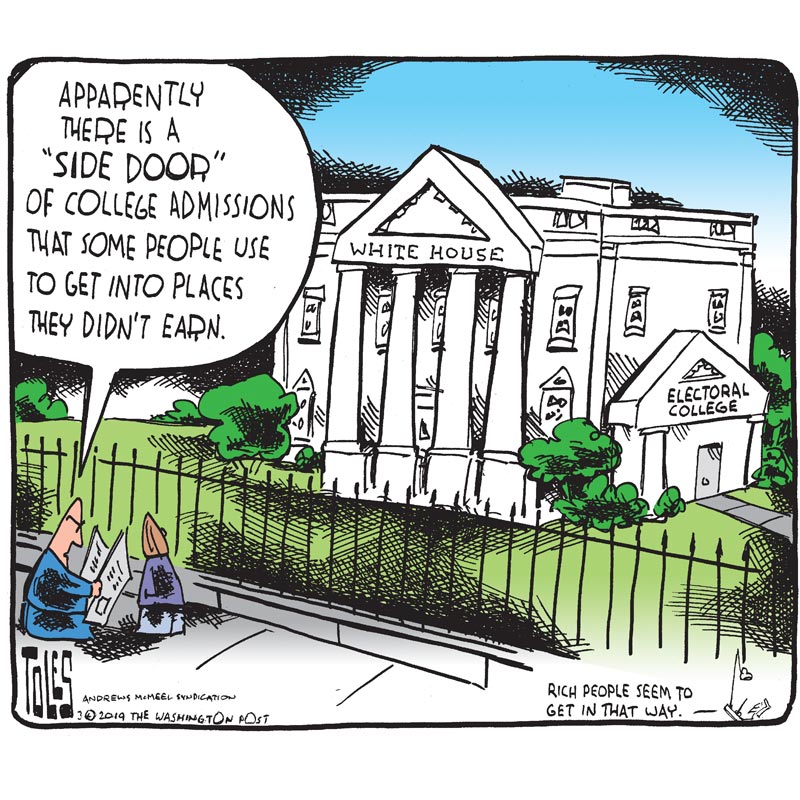
As we’ve seen in the last two elections, the Electoral College gives the Republican candidate about a 3-4% advantage, which might be growing as the rural areas (which the EC over-weights) get more conservative and the cities (which it underweights) more liberal.

Hillary Clinton won the 2016 popular vote by 2.1% but still lost the election, and Biden’s 4.4% victory in 2020 goes away if you lower his margin by .7% across the board. (He loses Arizona, Georgia, and Wisconsin, leading to a 269-269 tie that the House — with one vote per state delegation — would have decided in Trump’s favor.) Hillary would still have lost if you similarly boosted her margin in every state by .7%.

So the Electoral College’s thumb-on-the-scale was worth about 2.8% in 2016 and 3.7% in 2020. Republicans like to talk about “rigged elections”. Well, they’re right: Presidential elections are rigged in their favor.

The straightforward way to unrig our elections would be to pass a constitutional amendment eliminating the Electoral College and awarding the presidency to the candidate who gets the most votes. But that path requires a 2/3rds majority in both houses of Congress and ratification by 3/4ths of the states, so it can’t pass without bipartisan support. Few Republicans have a sense of fair play or respect for democracy, so they’re not going to give up the unfair advantage the EC gives them. [1]

An alternative scheme for unrigging our elections is the National Popular Vote Interstate Compact: States agree to appoint electors for the candidate who wins the national popular vote, even if that candidate didn’t win in their particular state. If states representing 270 electoral votes all passed a law joining the compact and fulfilled their commitments, the Electoral College would never screw the American people again.

I have mentioned before that, as much as I like this idea, I would never trust this agreement. In 2020, we saw how many bad-faith actors hold positions of authority in the Republican Party. (Though most Republican election officials did their jobs honestly; Biden could not have won without them.) It was hard enough to feel secure that Republican legislatures wouldn’t step in and illegitimately award their electors to Trump, even though he got fewer votes both in their states and in the nation as a whole. If a Republican legislature in a place like Georgia or Wisconsin could give a Republican the White House just by agreeing with the voters in their state, I have to believe they would, no matter what commitments they might have made previously. [2]

Well, it looks like messing up the NPVIC is even easier than I had thought. North Dakota, owner of exactly three electoral votes, may be about the skewer the whole thing: The state senate has passed a law that forbids state election officials to release their popular vote totals until after the Electoral College meets.

[A] public officer, employee, or contractor of this state or of a political subdivision of this state may not release to the public the number of votes cast in the general election for the office of the president of the United States until after the times set by law for the meetings and votes of the presidential electors in all states

The upshot is that there would be no official national popular vote total. Compare this to the process laid out in the NPVIC:

Prior to the time set by law for the meeting and voting by the presidential electors, the chief election official of each member state shall determine the number of votes for each presidential slate in each State of the United States and in the District of Columbia in which votes have been cast in a statewide popular election and shall add such votes together to produce a “national popular vote total” for each presidential slate.

The chief election official of each member state shall designate the presidential slate with the largest national popular vote total as the “national popular vote winner.”

The presidential elector certifying official of each member state shall certify the appointment in that official’s own state of the elector slate nominated in that state in association with the national popular vote winner.

If everyone involved would carry out the spirit of this agreement in good faith, probably there would be no problem. It’s extremely unlikely that North Dakota’s votes would make the difference in the national popular vote, so even without knowing their totals, the popular-vote winner should be apparent. In 2016, for example, only 344K votes were cast in North Dakota, and Hillary won nationally by 2.9 million.

But now let’s talk about the real world, where bad-faith actors abound. If I’m, say, a Republican official in 2016 Wisconsin, where a good-faith application of the NPVIC would have me appoint pro-Hillary electors even though Trump won my state, I can claim that without the North Dakota votes the conditions of the NPVIC have not been fulfilled. Would the Republican legislature or a Republican-appointed judge overrule me? I kind of doubt it.

So I think the National Popular Vote Interstate Compact is dead. This particular hole could be patched without a constitutional amendment, if Congress could pass a law (over a Republican filibuster) mandating that states release their vote totals in a timely fashion. But I think this would just start a game of whack-a-mole. And what if a red state whose vote totals do matter, like Texas, decides to play?

I think the monkey-wrenchers win this battle, and we’re stuck with the Electoral College until we can muster a constitutional amendment.


[1] Electoral College advocates sometimes hide their partisan intentions by making arguments that sound good, but don’t hold up to even a small amount of scrutiny. For example:

A presidential campaign aimed at achieving a popular vote majority would completely ignore most states and focus, instead, on a few populous states containing the nation’s largest cities. This urban-centric strategy would silence the political voice of most regions of the country.

Anybody who has lived in a state with a big city knows this isn’t true. If it were, no Illinois candidate would ever leave Chicago, Texas campaigns would only happen in Houston and Dallas, and Florida candidates would camp out in Miami. They don’t — and for good reason. Consider, for example, the map of the Ted Cruz/Beto O’Rourke Senate race of 2018. Cruz lost just about all the cities — Houston, Dallas, San Antonio, El Paso — but won anyway because the rural areas came through for him.

In a popular-vote system, candidates look for votes wherever they think they can get them, because all votes count the same. Convincing somebody to vote for you in Chugwater, Wyoming counts just as much as convincing somebody in Los Angeles.

In fact, if you apply the make-them-campaign-everywhere argument honestly, it will point you in exactly the opposite direction: Because of the Electoral College, presidential candidates only campaign in swing states like Pennsylvania and Florida, and ignore most of the American people. Here’s a map where states are sized according to how many presidential campaign events happened there in 2012. Three of the four biggest states — California, Texas, and New York — don’t even show up. But neither do small states like Alaska, Utah, or Rhode Island, because nobody bothers to compete in states where the electoral votes aren’t up for grabs.

In a popular-vote system, it would make sense for a Democratic candidate to campaign in, say, the Black neighborhoods of Memphis or the Hispanic areas around El Paso — because there are people there who might be convinced to vote for you. Similarly, a Republican candidate should hold rallies in upstate New York or conservative Chicago suburbs. But they don’t, because in the Electoral College system, competing for votes that won’t tip a whole state is wasted effort.

So in fact it’s the Electoral College that silences “the political voice of most regions of the country”.

[2] The Compact tries to deal with the question of states changing their minds:

Any member state may withdraw from this agreement, except that a withdrawal occurring six months or less before the end of a President’s term shall not become effective until a President or Vice President shall have been qualified to serve the next term.

But there is no enforcement mechanism, and a basic principle of our system of government says that no legislature can claim power over a future legislature. (As Jefferson put it: “The dead should not rule the living.”) So if Wisconsin, Pennsylvania, and Michigan had joined the compact in 2015, and then in 2016 one of them passed a law refusing to award their electors to Hillary, I think Trump still becomes president. States might sue each other later, but the deed would be done.

The Monday Morning Teaser

The center of the news this week has been Congress, which is a refreshing change. The Founders intended Congress to be the most powerful branch of government, but the combination of partisan gridlock and a Republican Party that has no legislative agenda has all but sidelined Congress in recent years.

So one of the two featured posts this week, “The Action Shifts to Congress”, will cover the current state of various bills and other Congressional actions: Covid relief, the Equality Act, the minimum wage, and approving Biden’s nominees (or not). That should be out sometime between 10 and 11 EST.

In the meantime, though, I want to call your attention to a small state wielding a big monkey wrench: North Dakota looks poised to pass a law that could completely skewer the National Popular Vote Interstate Compact. The NPVIC, if you remember, is an attempt to sideline the Electoral College by getting enough states to agree to give their electoral votes to the winner of the national popular vote. You might think that North Dakota, with its three electoral votes and tiny electorate, couldn’t do much to mess that up. But where there’s a will to preserve minority rule, there’s a way.

That post, “North Dakota Is About To Kill the National Popular Vote Compact”, should appear soon.

That leaves the weekly summary with virus and vaccine updates, the Syria bombing, the bizarre personality-cult spectacle that CPAC has turned into, the finally-released report on Saudi Arabia’s murder of Washington Post journalist Jamal Khashoggi, Andrew Cuomo’s troubles, and a few other things. Let’s project that to appear between noon and 1.