Tag Archives: war

In times of hysteria

Six things ordinary people can do to restore sanity.


One of the most difficult experiences of democracy is to watch your country going crazy, and feel responsible. In a dictatorship you could just zone out: The Powers That Be will do what they do, and your opinion doesn’t matter anyway. Your neighbors, your friends, your co-workers — their opinions don’t matter either, so there’s no point in arguing with them, or even letting them know you disagree. You might as well just binge-watch something light on TV, and wait for the wave to pass.

In a democracy it’s different: We are the wave. Politicians really do respond to certain kinds of public opinion, sometimes to our shame. So, for example, my Democratic governor (Maggie Hassan of New Hampshire, who I have voted for, given money to, and was planning to support for the Senate) called for a halt on admitting Syrian refugees. (She later reduced it to a “pause“, “until intelligence and defense officials can assure that the process for vetting all refugees is as strong as possible to ensure public safety.” But the damage was done: Any governor who wants to come out against refugees can claim bipartisan support.) My representative (Annie Kuster of NH-2, who I have also voted for and given money to) voted Yes on the American Security Against Foreign Enemies Act, which at a minimum would delay any new refugee resettlements by 2 or 3 months, and might snafu the process altogether. [1] (Check your representative’s vote here.)

If my side has been characterized by politicians timidly letting the panic sweep them away, on the other side it’s been bedlam. Ben Carson is openly dehumanizing refugees with metaphors about “rabid dogs”. Donald Trump is talking about closing mosques, because “we’re going to have no choice”. He has advocated forcing American Muslims to register with the government, so that they can be tracked in a database. Marco Rubio expanded Trump’s proposal to call for shutting down “anyplace where radicals are being inspired”. Ted Cruz and Jeb Bush want a religious test for refugees: We should accept Christians, but not Muslims. John Kasich wants to create a government agency to promote “Judeo-Christian values” around the world. [2]

Chris Christie says we shouldn’t even let in little kids. Like, say, this Syrian girl, who mistook the photographer’s camera for a gun and tried to surrender.

And remember this Syrian boy? His photo evoked international compassion a couple months ago, but that never lasts, does it?

When Governor Jay Nixon didn’t try to block Syrian refugees, state Rep. Mike Moon called for a special session of the legislature to stop “the potential Islamization of Missouri“. But the bull goose loony (to borrow Ken Kesey’s phrase) was a Democrat: Roanoke Mayor David Bowers, who justified his refusal to cooperate with resettling refugees by citing FDR’s Japanese internment camps during World War II. That national disgrace is now a precedent. (Who knows? Maybe slavery or the Native American genocide will become precedents too.)

I had never heard of Rep. Moon or Mayor Bowers before, but none of the Republican presidential candidates seemed this insane when they started campaigning. So I suspect they’re just saying what they think will appeal to their voters. They may be pandering to the public fear, attempting to benefit from it, and playing their role in spreading it, but they didn’t start it.

We did that. Ordinary people like us. Our friends, our relatives, our co-workers, the people we know through social media. And so I suspect it’s up to us to stop it.

I have to confess I didn’t see this coming. After the Paris attacks, I expected a push to hit ISIS harder, maybe even to re-invade Iraq and add Syria to the occupation zone. (Jeb Bush recently joined Ben Carson, John Kasich, and Lindsey Graham in calling for ground troops, though he was vague about how many.) I didn’t foresee an Ebola-level panic [3] focused on the refugees who are running from the same people we want to fight, much less the yellow-starring of American citizens who practice an unpopular religion.

But OK, here we are. Our country is going crazy and we are right in the middle of it. What do we do now?

1. Don’t make it worse. In particular, don’t be the guy hysterically running around and yelling at other people not to panic. Sanity begins within. You have to find it in yourself before you can transmit it to other people.

So: calm down. If you need help, seek out other calm voices. The needed attitude is a firm determination to slow this panic down, not a mad urge to turn the mob around and run it in the opposite direction.

Once you start to feel that determination, you’re ready to engage: Participate in conversations (both face-to-face and in social media). Write letters to the editor. Write to your representatives in government.

Don’t yell. Don’t humiliate. Just spread calm, facts, and rationality. When engagement starts to make you crazy, back away. Calm down again. Repeat.

2. Disrupt the spread of rumors. Panics feed on fantasies and rumors. Fantasies tell people that horrible things could happen. Rumors assert that they already are happening.

Social media is the ideal rumor-spreading medium, so it takes a lot of us to slow a rumor down. But you don’t have to be a rhetorical genius to play your part. Simple comments like “I don’t think this is real” or “That’s been debunked” are often sufficient, especially if you have the right link to somebody who has checked it out. The debunking site Snopes.com has tags devoted to Paris attack claims and Syrian refugees.

Here are a couple of the false rumors I’ve run into lately:

Current Syrian refugees resettled in America are not “missing”. I heard this one during a Trump interview with Sean Hannity. Trump refers to “people” who are missing — with the implication that they have gone off the grid and joined some kind of underground. Hannity corrected to “one person … in New Orleans”. (Think about that: It’s gotten so bad that Sean Hannity has to tone stuff down.) But Catholic Charities has debunked that story: They resettled the guy in Louisiana, and then he moved. He’s not missing. (The source of this rumor was probably the desperate David Vitter campaign for governor, which tried to ride the refugee panic to a comeback victory. It didn’t work.)

No, lying to further the cause of Islam is not a thing. Under the doctrine of taqiya, a Muslim may lie about his faith to escape serious persecution or death. Anti-Muslim propagandists have tried to turn this into a sweeping principle that justifies any lie to an unbeliever — and consequently justifies non-Muslims in disbelieving anything Muslims say. But it doesn’t work that way. Now, I’m sure ISIS has undercover operatives (just like we do) and that Muslim leaders lie (just like leaders of other faiths). But there’s no special reason to think Muslims are less truthful than the rest of us.

I won’t try to predict what further rumors will arise. But when you run into one, check Snopes, google around a little, and see if somebody has already done the hard work of checking it out.

As you participate, remember: In social media, you’re not just talking to the person you’re responding to (who might be hopeless), you’re also talking to his or her friends. Some of those friends might have been ready to like or share the rumor until they saw your debunking comment. You’ll never know who they are, but their hesitation is your accomplishment.

3. Make fantasies confront reality. Fearful fantasies work best when they’re vague and open-ended. For example: Terrorists are going to sneak in as refugees and kill us!

Think about that: A terrorist is going to submit to a one-or-two-year screening process, establish a life in this country, and then drop off the grid, strap on a suicide vest, and blow himself up in some crowded place.

Does that scenario make any sense? Wouldn’t it be simpler to come as a tourist? An aspiring terrorist could get in much faster with less scrutiny, spend a few weeks visiting Disney World or hiking the Grand Canyon, and then start killing us, while his fake-refugee brothers-in-arms are still tangled in red tape.

Sometimes the most devastating response to a nightmare fantasy is the simple question: “How does that work, exactly?” If you can get a person to admit “I don’t know”, you’ve restored a little sanity to the world.

4. Call out distractions. The Slacktivist blog makes this point so well that I barely need to elaborate.

As a general rule with very few exceptions, whenever you encounter someone arguing that “We [America] shouldn’t be doing X to help those people over there until we fix Y over here for our own people,” then you have also just encountered someone who doesn’t really give a flying fig about actually doing anything to fix Y over here.

So if somebody says we shouldn’t be taking in Syrian refugees while there are still homeless children or veterans or whatever in this country, the right response is to ask what they’re currently doing to help the people they say are more deserving. Odds are: nothing. Their interest in homeless American vets begins and ends with the vets’ value as a distraction from helping refugees.

Once you grasp this tactic, you’ll see it everywhere. So: “All those resources you want to devote to fighting climate change would be better spent helping the poor.” “OK, then, what’s your plan for using those resources to help the poor? Can I count on your vote when that comes up?” Silence.

When people argue that there’s a limited amount of good in the world, so we shouldn’t waste it on anybody but the most deserving, ultimately they’re going to end up arguing that they should keep the limited amount of good they have, and not use it help anybody but themselves.

5. Make sensible points. If you can capture somebody’s attention long enough to make a point of your own, try to teach them something true, rather than just mirror the kind of bile they’re spreading. This is far from a complete list, but in case you’re stuck I have a few sensible points to suggest:

The process for vetting refugees is already serious. Time explains it here, and Vox has an actual refugee’s account of how she got here.

America needs mosques. Research on terrorism (not to mention common sense) tells us that the people to worry about aren’t the ones who are pillars of their communities. The young men most likely to become terrorists are not those who feel at home in their local houses of worship, but the loners, or the ones have only a handful of equally alienated friends. (That’s not just true for Muslims like the Tsarnaev brothers, but also white Christian terrorists like Dylann Roof.) When you can’t connect face-to-face, that’s when you start looking around online for other radical outcasts you can identify with.

So it would be bad if American mosques just magically went away, as if they had never existed. But it would be infinitely worse for the government to start closing them. What could be more alienating to precisely the young men that ISIS wants to recruit?

Religious institutions aide assimilation. Imagine what would have happened if we had closed Italian Catholic churches to fight the Mafia, or Irish Catholic churches for fear of the IRA, or Southern Baptist churches that had too many KKK members.

The Founders envisioned American religious freedom extending to Muslims. As Ben Franklin wrote:

Even if the Mufti of Constantinople were to send a missionary to preach Mohammedanism to us, he would find a pulpit at his service.

We seldom look back with pride on decisions made in a panic. This is where the Japanese internment precedent should be quoted: That’s the kind of stuff we do when we get caught up in a wave of fear and anger. So should our refusal to take in Jewish refugees from Nazi Germany. The Red Scare is another precedent. More recently: Everybody who jumped from 9-11 to “Invade Iraq!” or “We need to torture people!” — are you proud of that now?

6. Look for unlikely allies, and quote them. Listening to Trump, Cruz, and the rest, it’s easy to imagine that everybody in the conservative base is part of the problem. But that’s not true. Here are a few places you may not realize you have allies.
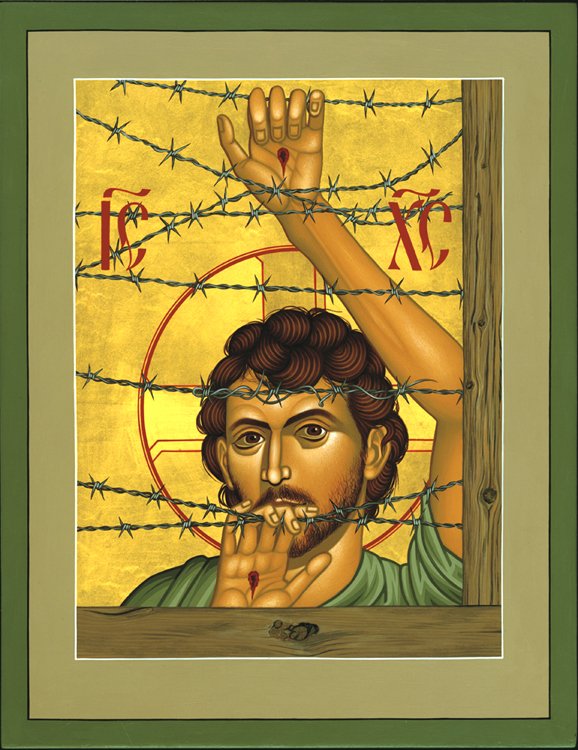
Christians. I know: The self-serving Christians [4] so dominate the public conversation that sometimes it’s hard to remember the existence of actual American Christians, i.e., people trying to shape their lives around the example and teachings of Jesus. But if you screen out the clamor of “Christians” focused on the competition between their tribe and the rival tribe of Muslims, you will hear people who are trying to figure out what the Good Samaritan would do.

And I’m not just talking about liberal Christians from the mainstream sects. Lots of evangelical Christian churches have been involved in resettling refugees in their local areas. They know exactly how bad it is for refugees, and can put faces on the issue. They’re not happy with the people who are trying to demonize Jamaal and Abeela and their three kids.

The Mormon community retains its collective memory of being outcasts. [5] So Utah stands out as a red state whose governor has not rejected settling Syrian refugees.

Ryan Dueck sums up:

as Christians, there are certain things that we just don’t get to do.

We don’t get to hunt around for excuses for why we don’t need to include “those people” in the category of “neighbour.”

We don’t get to look for justifications for why it’s better to build a wall than open a door.

We don’t get to label people in convenient and self-serving ways in order to convince ourselves that we don’t have to care for them.

We don’t get to speak and act as if fear is a more pragmatic and useful response than love.

We don’t get to complain that other people aren’t doing the things that we don’t want to do.

We don’t get to reduce the gospel of peace and life and hope to a business-as-usual kind of political pragmatism with a bit of individual salvation on top.

We don’t get to ask, as our default question, “How can I protect myself and my way of life?” but “How does the love of Christ constrain and liberate me in this particular situation?”

And all of this is, of course, for the simple reason that as Christians, we are convinced that ultimately evil is not overcome by greater force or mightier weapons or higher walls or more entrenched divisions between “good people” and “bad people,” but by costly, self-sacrificial love. The kind of love that God displayed for his friends and his enemies on a Roman cross.

If you read the comments on that post, or look at this rejoinder from National Review, you’ll see that Dueck’s point of view is not universal among people who think of themselves as Christians. But it’s out there.

Libertarians. Some parts of the libertarian right understand that oppression is unlikely to stop with Muslims. So Wednesday the Cato Institute posted its analysis: “Syrian Refugees Don’t Pose a Serious Security Threat“. Conservatives who won’t believe you or Mother Jones might take Cato more seriously.

Scattered Republican politicans. I don’t want to exaggerate this, but here’s at least one Republican trying to slow the hysteria down: Oklahoma Congressman Steve Russell. He said this on the floor of the House:

America protects her liberty and defends her shores not by punishing those who would be free. She does it by guarding liberty with her life. Americans need to sacrifice and wake up. We must not become them. They win if we give up who we are and even more-so without a fight.

Russell eventually knuckled under to the pressure and voted for the SAFE Act, but says that he got something in return from the Republican leadership: the promise of a seat at the table in the subsequent negotiations with the Senate and the White House. We’ll see if that makes a difference.


These next few days, I think it’s particularly important for sensible people to make their voices heard, and to stand up for the courageous American values that make us proud, rather than the fear and paranoia that quake at the sight of orphan children.

Every time you stick your neck out — even just a little — you make it easier for your neighbor to do the same. Little by little, one person at a time, we can turn this around.


[1] What disturbs me most about the supporters of the SAFE Act is that they’re not calling for any specific changes in the way refugees are screened, they just want more of it. I suspect most of the congresspeople who voted for the act have no idea how refugees are vetted now, much less an idea for improving that process.

As we have seen in the discussion of border security, more is one of those desires that can never be satisfied. If this becomes law and in 2-3 months the administration comes out with its new refugee-screening process, we will once again face the cries of “More!”, along with the same nightmare fantasies about killer refugees.

[2] Actually, the main thing wrong with Kasich’s proposal is that he sticks an inappropriate religious label on the values he wants to promote: “the values of human rights, the values of democracy, freedom of speech, freedom of religion, and freedom of association.” Russian dissident (and former chess champion) Garry Kasparov has a better term for these: modern values.

In the West, these values were championed by Enlightenment philosophers, many of whom were denounced as heretics and atheists by the Christian and Jewish authorities of their era. So no, these are not Judeo-Christian values.

[3] The two panics have a number of similarities, as John McQuaid points out. In each case “a terrifying and poorly-understood risk has stirred up apocalyptic fantasies and brought out the worst in the political system.”

If you want a paradigm for fear-mongering, you can’t beat this Donald Trump quote, which combines the appearance of factuality with no actual content whatsoever:

Some really bad things are happening, and they’re happening fast. I think they’re happening a lot faster than anybody understands.

One similarity between the two panics is noteworthy: Both times Republicans attributed President Obama’s sane and measured response to his lack of loyalty to the United States. During Ebola, Jodi Ernst said Obama hadn’t demonstrated that he cares about the American people, and recently, Ted Cruz said Obama “does not wish to defend this country.”

Strangely, though, over-reacting during a panic seems to carry no political cost, because everyone forgets your excesses while they are forgetting their own. In a sane world, Chris Christie’s over-the-top response to Ebola would disqualify him from further leadership positions — especially since it turned out that the CDC was right and he was wrong. But no one remembers, so he is not discouraged from flipping his wig now as well.

[4] You know who I mean: The ones who find the Bible crystal clear when it justifies their condemnation of somebody they didn’t like anyway, but nearly impenetrable when it tells them to do something inconvenient. So the barely coherent rant of Romans 1 represents God’s complete rejection of any kind of homosexual relationship, but “Sell your possessions and give to the poor” is so profoundly mysterious that it defies interpretation.

[5] My hometown of Quincy, Illinois took in a bunch of them after they were expelled from Missouri in 1838. That event has its own little nook in the local history museum, because generous decisions are the ones descendants are proud of.

BTW, you read that right: The Mormons were expelled from Missouri. Just as pre-Civil-War states could establish slavery, they could also drive out unpopular religious groups. Didn’t hear about that in U.S. History class, did you?

If This Is Munich, We Must Be Germany

The public debate is framing the Iran nuclear deal exactly backwards.


As Congress prepares to vote on the recent agreement with Iran, the deal’s Republican opponents have been competing to see who can describe it in the most horrifying terms. Mike Huckabee claimed President Obama would “take the Israelis and march them to the door of the oven”. Senator Ted Cruz said “it will make the Obama administration the world’s leading financier of radical Islamic terrorism.” In a committee hearing, Senator Lindsey Graham scolded the Secretaries of State, Defense, and Energy, implying that the administration had been too eager to avoid war.

Could we win a war with Iran? Who wins the war between us and Iran? Who wins? Do you have any doubt who wins? … We win!

In a speech whose video has been watched more than half a million times on YouTube, former congressman Alan West denounced the “weakling in the White House” saying:

How dare Barack Obama, how dare John Kerry, how dare Valerie Jarrett, or any of these other charlatans that occupy Washington D.C., surrender this great constitutional republic to the Republic of Iran!

Senator Marco Rubio also sees “weakness”:

President Obama has consistently negotiated from a position of weakness, giving concession after concession to a regime that has American blood on its hands, holds Americans hostage, and has consistently violated every agreement it ever signed.

Chris Christie said that President Obama was “giving Iran a nuclear weapon”. And he implied that they will bully more “gifts” out of us, now that the realize how weak our president is:

You give them your belt, they’ll want your pants next. That’s the way it goes

Defenses of the deal, by contrast, have been measured. The New Yorker‘s Steven Coll‘s positive analysis, for example, concludes:

The deal is imperfect but good enough, and it offers a tentative promise of a less dangerous Middle East.

Or, as the Chairman of the Joint Chiefs, General Martin Dempsey, put it:

Relieving the risk of a nuclear conflict with Iran diplomatically is superior than trying to do that militarily.

Listening to this discussion, particularly the portion that penetrates the conservative bubble and bounces around its echo chamber, you might reasonably imagine that whatever small concessions we got from Iran, we gave up far too much in return. Those hard-headed and hard-fisted mullahs bullied that hapless jellyfish that we call a president, who was so eager to get any kind of deal that he gave away the store.

If that’s what you believe, you have the story exactly backwards: There is a bully in the story, but it’s the United States. We got Iran’s lunch money, and we gave up nothing.

How can that be? And if it is that way, why doesn’t President Obama beat his chest and say so?

Who? Us? The central myth of the era of American dominance (i.e., since World War II) is that our power is benign. No matter how many countries we invade or bomb, or how many governments we overthrow (as we overthrew Iran’s fledgling democracy in 1953 and reinstalled the brutal Shah), we always act on the side of right and justice. Sure, we police the world, but we’re Officer Friendly. We’re never the kind of cops who throw their weight around.

In acceptable American political debate, neither Republican nor Democratic leaders are allowed to challenge that myth. And that puts the Obama administration at a significant disadvantage as it tries to claim credit for its diplomatic victory over Iran. Because this time we did throw our weight around, and we got something.

Retelling the story. So let’s put aside the myth of benign American power and retell the story of the current agreement, beginning with the basic issue: Will Iran construct a nuclear weapon? In other words, will Iran do something that we did 70 years ago, that Israel did 50 years ago, and that Pakistan (Iran’s rival in the looming Sunni/Shia conflict) did almost 20 years ago?

I grant that in many parts of the Middle East, Iran funds and supplies groups that fight against our allies (though we find ourselves on the same side against ISIS). I grant that we (and Israel and Saudi Arabia) have good reasons to want to keep Iran from building a bomb. But let’s not pretend that Iran was doing something monstrous and unheard of when they built a secret complex capable of producing (eventually) a weaponizable quantity of fissionable material.

Iran is a moderately large country (with a population larger than traditional nuclear powers like United Kingdom or France) with oil wealth and a heritage of civilization going back to Cyrus the Great (who freed the Jews from the Babylonian Captivity). It sees a club of great nations (plus a few lesser nations) and believes it deserves to join. The fact that we have reasons to want to keep them out does not imply that their desire to join is illegitimate.

Threats of war. OK, so what have we done to stop them? During the Bush years, we negotiated a few sanctions, but mainly we rattled our sabers. (The Bush U.N. ambassador, John Bolton, is still rattling. And Republican presidential candidate Scott Walker has said “the next president could be called to take aggressive actions, including military action, on the first day in office”.) Every few months, the press would publish rumors that we (or Israel with or without our approval) were planning an attack on Iran’s nuclear laboratories and reactors, as Israel attacked Iraq’s Osirak reactor in 1981.  Presumably, at least some of that buzz came from intentional leaks meant to intimidate the Iranians. When the Obama administration came in, it continued to insist that “all options are on the table“. In other words, if we don’t get what we want, we might launch an attack.

If you look for any corresponding Iranian saber-rattling at us, what you mainly find are threats to counter-attack if we attack them. (These threats usually get covered in the American press as if hitting back were barbarous.)

So if there’s a Munich analogy here — I wouldn’t go there, but Jeb Bush, Ted Cruz, John Bolton, and many other Obama critics did (including The Drudge Report photoshopping Obama’s face onto Neville Chamberlain in the photo above)  — the only way it can make any sense is if we are in the Hitler role. We’re the ones who have been threatening war unless another nation agrees to our demands.

Economic warfare. But the saber-rattling wasn’t working, so the Obama administration opened a second front: Through diplomacy, it got the UN Security Council to impose far harsher sanctions on Iran than the Bush administration had managed. We had to convince Russia and China to go along with us on that, which wasn’t easy. (Russia’s desire to oppose the West in Iran goes back the Great Game between the Czars and the British Empire.) But President Obama and Secretary Clinton got it done.

The sanctions took a serious bite out of the Iranian economy, which pushed them to the negotiating table. In the negotiations that just concluded, they agreed to restrictions on their nuclear program that should prevent them from having nuclear weapons for the near-to-medium term. (Whoever is president when the agreement expires will still have all of his or her options on the table.)

Who’s the bully? In exchange for those very real concessions, we agreed to a gradual relaxing of the sanctions that we created. What we’re “giving” the Iranians are their own frozen assets. And we’re going to allow them to participate in the world economy, like any other country would.

In what sense is any of that a “concession” on our part? Imagine you’re in school, and you get a smaller kid in a headlock. He gives you his lunch money and you let him go. Have you “conceded” anything to him, really?

Your fellow bullies might claim that you let him off too easy, that if you’d squeezed a little harder he might have given you his sneakers too. And maybe they’re right: By walking away unscathed, the kid gained much more than you did, compared to the scenario where you beat the crap out of him and took his lunch money anyway. (As Senator Graham says, if it comes to war, “We win!”)

But in a larger sense, all you’ve done is let him out of a situation that you created. You have his lunch money and he has nothing of yours.

That’s the Iran deal: We have an agreement to keep them from building a bomb any time soon, and an inspection regime to make sure they keep that agreement. They got nothing from us.

The Islamic State: separating insight from stereotype

The Atlantic published a much-discussed article about ISIS.
About half of it was deeply insightful.


What does the Islamic State of Iraq and Syria want? How is it different from al Qaeda? Why does it act the way it does? What are its leaders trying to do? What draws in Muslims from all over the world? And if we understood all those things, what strategy would we use to fight it?

Graeme Wood’s article “What ISIS Really Wants” in The Atlantic touched off a heated discussion of these important questions, and was answered by a flurry of other articles like “The Atlantic‘s Big Islam Lie” in Salon, “What The Atlantic Gets Dangerously Wrong about ISIS and Islam” in ThinkProgress, and many others. Just looking at the headlines might convince you that Wood’s article just touches off another he-said/she-said argument and isn’t worth the investment you’d need to figure out what it’s about.

That would be a mistake, because Wood’s article is a rare combination of deep insight with deep flaws. What’s even rarer, the insights don’t depend on the flaws. In other words, you can learn a lot from Wood about how Islam figures in the self-image and self-definition of the Islamic State, but avoid picking up Wood’s stereotyped view of Islam in general.

Let’s start with the insight. Wood raises two topics that hadn’t gotten much attention previously in the mainstream articles about ISIS, and makes a good case that they are highly significant in understanding the Islamic State:

  • a particular Muslim vision of the end times
  • ISIS’s leader Abu Bakr al-Baghdadi styling himself as a caliph who controls territory.

The End Times. Wood writes:

The Islamic State differs from nearly every other current jihadist movement in believing that it is written into God’s script as a central character. It is in this casting that the Islamic State is most boldly distinctive from its predecessors, and clearest in the religious nature of its mission. …

The Islamic State has attached great importance to the Syrian city of Dabiq, near Aleppo. It named its propaganda magazine after the town, and celebrated madly when (at great cost) it conquered Dabiq’s strategically unimportant plains. It is here, the Prophet reportedly said, that the armies of Rome will set up their camp. The armies of Islam will meet them, and Dabiq will be Rome’s Waterloo or its Antietam. … Now that it has taken Dabiq, the Islamic State awaits the arrival of an enemy army there, whose defeat will initiate the countdown to the apocalypse.

Students of Christianity will recognize the parallels to Megiddo, a.k.a. Armageddon, a site in Israel about twenty miles from Haifa. Like Armageddon, whose single sketchy reference in one verse of Revelation gets spun into Volume 11 of the Left Behind series, Dabiq is part of an elaborate projection of ancient prophecy onto current events.

Groups that see themselves playing a role in a prophesied Apocalypse (like ISIS) are different from predominantly political groups (like al Qaeda).

In broad strokes, al-Qaeda acts like an underground political movement, with worldly goals in sight at all times—the expulsion of non-Muslims from the Arabian peninsula, the abolishment of the state of Israel, the end of support for dictatorships in Muslim lands. The Islamic State has its share of worldly concerns (including, in the places it controls, collecting garbage and keeping the water running), but the End of Days is a leitmotif of its propaganda.

Apocalyptic groups have access to a higher level of fervor, but they are also more rigid. When the Americans brought overwhelming force to Afghanistan, Bin Laden could fold his tents and disappear. But if an enemy army really does show up at Dabiq, the Islamic State will have to fight it or face enormous loss of legitimacy.

The Caliphate. Bin Laden’s “franchised” terrorist movement had a highly flexible post-modern organizational structure. He envisioned a restored Caliphate as a distant goal, not something he might hope to rule (or even see) in his lifetime.

The Islamic State, by contrast, controls territory and has (according to Wood) “billboards, license plates, stationery, and coins”. At the moment that territory might amount to slivers of land nobody else wants badly enough to bleed for (see Wood’s map), but the fact that it exists — and that al-Baghdadi has been proclaimed Caliph of it — has enormous significance inside a particular interpretation of Sharia.

Wood quotes an Australian follower (whom the Australian government has been prevented from emigrating to the Islamic State):

Cerantonio explained the joy he felt when Baghdadi was declared the caliph on June 29—and the sudden, magnetic attraction that Mesopotamia began to exert on him and his friends. “I was in a hotel [in the Philippines], and I saw the declaration on television,” he told me. “And I was just amazed, and I’m like, Why am I stuck here in this bloody room?”

If there is a legitimate Caliph of Islam — like Popes and Highlander prize-winners, there can be only one — then all Muslims owe him allegiance.

Before the caliphate, “maybe 85 percent of the Sharia was absent from our lives,” Choudary told me. “These laws are in abeyance until we have khilafa”—a caliphate—“and now we have one.” Without a caliphate, for example, individual vigilantes are not obliged to amputate the hands of thieves they catch in the act. But create a caliphate, and this law, along with a huge body of other jurisprudence, suddenly awakens. In theory, all Muslims are obliged to immigrate to the territory where the caliph is applying these laws.

But maintaining control of that territory is part of the deal. A legitimate Caliph can’t just be the head of a franchised post-modern terror network, he has to control land and implement Sharia there.

So al-Baghdadi would lose his claim to the Caliphate if, like Bin Laden, he retreated to some equivalent of Tora Bora and then vanished. More than that: Islam would lose its Caliphate — which true Muslims have a duty to establish and maintain, according to Islamic State dogma — if it no longer controlled territory.

Dogma also puts restrictions on the kind of diplomacy ISIS can practice. In the long term, it is the duty of the Caliph to expand the Caliphate, so any treaties or boundaries established by treaties can only be temporary.

If the caliph consents to a longer-term peace or permanent border, he will be in error. Temporary peace treaties are renewable, but may not be applied to all enemies at once: the caliph must wage jihad at least once a year. He may not rest, or he will fall into a state of sin.

… It’s hard to overstate how hamstrung the Islamic State will be by its radicalism. The modern international system, born of the 1648 Peace of Westphalia, relies on each state’s willingness to recognize borders, however grudgingly. For the Islamic State, that recognition is ideological suicide. Other Islamist groups, such as the Muslim Brotherhood and Hamas, have succumbed to the blandishments of democracy and the potential for an invitation to the community of nations, complete with a UN seat. Negotiation and accommodation have worked, at times, for the Taliban as well. (Under Taliban rule, Afghanistan exchanged ambassadors with Saudi Arabia, Pakistan, and the United Arab Emirates, an act that invalidated the Taliban’s authority in the Islamic State’s eyes.) To the Islamic State these are not options, but acts of apostasy.

This territory-focus also makes its followers less immediately dangerous to the West: Staying in your home country and blowing things up is a second-best option. The higher goal is to move to the Islamic State and live under true Sharia.

During his visit to Mosul in December, Jürgen Todenhöfer interviewed a portly German jihadist and asked whether any of his comrades had returned to Europe to carry out attacks. The jihadist seemed to regard returnees not as soldiers but as dropouts. “The fact is that the returnees from the Islamic State should repent from their return,” he said. “I hope they review their religion.”

What ISIS implies about Islam. Where Wood goes wrong — and gets soundly thrashed for it in a number of articles — is  in his framing of the nature of Islam — not just what it means to al-Baghdadi and his followers, but what it means in a more absolute sense. He begins by setting up the straw-man argument that the Islamic State is “un-Islamic” and then knocks it down like this:

Many mainstream Muslim organizations have gone so far as to say the Islamic State is, in fact, un-Islamic. It is, of course, reassuring to know that the vast majority of Muslims have zero interest in replacing Hollywood movies with public executions as evening entertainment. But Muslims who call the Islamic State un-Islamic are typically, as the Princeton scholar Bernard Haykel, the leading expert on the group’s theology, told me, “embarrassed and politically correct, with a cotton-candy view of their own religion” that neglects “what their religion has historically and legally required.” Many denials of the Islamic State’s religious nature, he said, are rooted in an “interfaith-Christian-nonsense tradition.”

TPM’s Josh Marshall reacted to the straw man with:

The Wood piece is a fascinating read. But did someone read this and think, Damn, these ISIS folks are really hardcore and they are seriously into Islam!

And Fareed Zakaria writes:

Wood’s essay reminds me of some of the breathless tracts during the Cold War that pointed out that the communists really, really believed in communism. [see endnote 1]

Wood’s (and Haykel’s) argument is a slight-of-hand that works by interchanging two meanings of Islamic. On the one hand, Islam is a tradition that begins with Muhammad and the Qur’an and continues through the centuries. In that sense, Wood’s claim that the Islamic State is “very Islamic” is true: ISIS arises out of one strand of interpretation of sources in the Islamic tradition. Few, if any, critics are claiming that ISIS’s religious fervor is simply a false face consciously wallpapered over secular intentions.

But Islam is also the spiritual practice of 1.6 billion people, each of whom has a unique perspective on the true spirit of the faith. When Muslims say that ISIS is “un-Islamic”, they mean that the religion they are in relationship with finds ISIS’s practices abhorrent. (It’s similar to the way you might react if a close friend were accused of a heinous crime: “The Bob I know would never do that.”)

An appropriate Christian analogy [2] would be the white-supremacist Christian Identity movement. Its rhetoric is incomprehensible without a detailed knowledge of the Bible, so it is very Christian in the sense that it grows out of the Christian tradition. But is it in harmony with the true spirit of Christianity? The vast majority of practicing Christians would say no.

And lest secularists think this is all some defect of religion, Soviet Communism is an inescapable part of the Western secular tradition. It billed its view of history as “scientific”, and its underlying philosophy of dialectical materialism was incomprehensible without reference to the secular Western concept of history as linear and conducive to progress.

There’s a lesson here: If you don’t want to take responsibility for everything that grows out of the roots of your own tradition, you don’t get to assign similar responsibilities to people from other traditions.

Seriousness. Wood’s article embodies an attitude I’ve criticized here and here: that only extremists are “serious” about their beliefs. Again he quotes Haykel, who attributes to ISIS “an assiduous, obsessive seriousness that Muslims don’t normally have.”

When you are the victim of this “seriousness” fallacy, the flaw is obvious: Communists are the only “serious” liberals and Fascists the only “serious” conservatives. If Martin Luther King had been “serious”, he would have demanded black supremacy rather than integration. Only the strictest Libertarians are “serious” about freedom. Have you ever based a decision on emotion or intuition? Ever appreciated a work of art or music without being able to explain why? Then you’re not “serious” about rationality. Would you fight against the rape of your daughter or take up arms to liberate Auschwitz? Sorry, but you’re really a war-monger at heart; only absolute pacifists are “serious” opponents of violence.

I could go on, but I hope I’ve given enough examples for you to find one that offends you.

Wood’s defeat of the ISIS-is-un-Islamic straw man leads him seamlessly into the implication that ISIS is where Islam goes if you are “serious” about it. Any tendency to co-exist with the modern world marks you as an un-serious Muslim, with a “cotton candy view” of Islam. [3] From a defense of the obviously true notion that the Islamic State is based on one interpretation of Islam, Wood segues to the dubious implication that it is the only “serious” interpretation.

Well, almost. Eventually, if you read far enough into Wood’s article, you get this caveat:

It would be facile, even exculpatory, to call the problem of the Islamic State “a problem with Islam.” The religion allows many interpretations, and Islamic State supporters are morally on the hook for the one they choose. And yet simply denouncing the Islamic State as un-Islamic can be counterproductive, especially if those who hear the message have read the holy texts and seen the endorsement of many of the caliphate’s practices written plainly within them.

He counters ISIS with another “serious” interpretation: one that also wants to recreate the 7th century, but has a personal rather than political focus.

These quietist Salafis, as they are known, agree with the Islamic State that God’s law is the only law, and they eschew practices like voting and the creation of political parties. But they interpret the Koran’s hatred of discord and chaos as requiring them to fall into line with just about any leader, including some manifestly sinful ones. … Much in the same way ultra-Orthodox Jews debate whether it’s kosher to tear off squares of toilet paper on the Sabbath (does that count as “rending cloth”?), they spend an inordinate amount of time ensuring that their trousers are not too long, that their beards are trimmed in some areas and shaggy in others. Through this fastidious observance, they believe, God will favor them with strength and numbers, and perhaps a caliphate will arise. At that moment, Muslims will take vengeance and, yes, achieve glorious victory at Dabiq. But Pocius cites a slew of modern Salafi theologians who argue that a caliphate cannot come into being in a righteous way except through the unmistakable will of God.

So those are your choices, Muslims: You can go to Dabiq, pledge allegiance to al-Baghdadi, and prepare to fight the Crusader invasion. Or you can spend your life avoiding politics, following sinful leaders, and worrying about the length of your trousers. Or, if you’d rather live in the 21st century, you can refuse to be “serious” and practice “cotton-candy” Islam.

Interpretation. Every useful insight Wood has about end-times prophecy or the Caliphate is compatible with the more common scholarly view that ISIS’s version of Islam is one interpretation among many. One writer who strikes that balance well is Hussein Ibish. As he said in an interview:

Neither is ISIS authentically Islamic, nor is it in any meaningful sense not Islamic. It is a bizarre interpretation of Islam yoked to a political agenda which is very modern. If we just stop fretting about the relationship of ISIS to the religious base of its ideology and accept that it’s a bunch of extremists who come out of a tradition that they manipulate to justify their crimes and their ambitions, it’s not so complicated.

Think Progress quotes Jerusha Tanner Lamptey, Professor of Islam and Ministry at Union Theological Seminary:

[Islamic] texts have never been only interpreted literally. They have always been interpreted in multiple ways — and that’s not a chronological thing, that’s been the case from the get-go.

Such interpretation is necessary, because (like any set of founding texts [4]), taking every line of the Qur’an as a truth that applies to every situation in the most obvious way leads to contradictions. Non-literal interpretation is also necessary for the Islamic State, because the Qur’an contains peaceful, merciful verses as well as violent, cruel ones.

ISIS exegetes these verses away I am sure, but that’s the point. It’s not really about one perspective being literal, one being legitimate, one ignoring things … it’s about diverse interpretations.

The various versions of Sharia — there’s not just one — are themselves interpretations that arose centuries after Muhammad. For example, all the Islamic State dogma about the significance of the Caliphate has to be post-Qur’anic interpretation for a very simple reason: In Muhammad’s day there was no institutional Caliphate; there was just Muhammad. (Similarly, the New Testament contains no mention of the Papacy. The institution-builders came later.)

Don’t give ISIS what it wants. There are two reasons we should try to understand ISIS: so what we can predict what it will do (and maybe even manipulate it to our advantage), and so that we don’t inadvertently give it what it wants.

Here are some things ISIS wants:

  • To be seen as the only Muslims who take Islam seriously. Wood and many others are giving al-Baghdadi what he wants.
  • To be Islam’s representative in an apocalyptic Islam-against-the-infidels holy war. So when Bill O’Reilly announces “The Holy War has begun.”, he’s endorsing ISIS’ narrative.
  • Polarization. An essential aspect of the Apocalypse is that everybody has to pick a side. The worst thing for ISIS is to be viewed as nothing more than one bizarre splinter of Islamic interpretation. We should be encouraging other Muslims to ask: “So how’s that working out for you? Are you prosperous and thriving? Or have you turned your corner of the Earth into a little piece of Hell?”
  • Drama. Jihadists come to the Islamic State looking to fight the ultimate battle. So the more boring we can make their lives, the harder it will be for them. Keeping ISIS bottled up inside its current boundaries may seem like no progress, but it may be the best strategy. The search for drama may lead ISIS to splinter into factions that fight each other over trivial doctrinal differences.
  • To strike terror into the hearts of infidels. Whenever American pundits frame ISIS’ jihadists as the baddest baddies in the history of badness, they’re serving the ISIS propaganda effort. The reason ISIS has to keep racheting things up — from beheadings to burning people alive — is that they need to shock us. We should refuse to be shocked.

Face it on our terms. In the long run, al-Baghdadi can only succeed if he can create an economy based on more than just loot and ransom. That will be hard to do with the territory he has, so keeping him bottled up in it is a good strategy.

The United States military has two major advantages: First, we can bomb the hell out of any army that tries to mass and advance. That’s how we stopped the progress of ISIS towards Kirkuk and Baghdad, and in general how we can hope to keep it bottled up.

Second, our troops can win any pitched battle on open ground. Where we run into trouble is in the kind of guerrilla fighting where we can’t tell who the enemy is.

If the Islamic State doesn’t dissolve into frustrated splinters, we may someday need to fight that pitched battle on open ground. And unlike al Qaeda or the Taliban, ISIS will have a hard time avoiding it.


[1] It’s striking how closely current anti-Islam rhetoric tracks Cold War anti-Communist rhetoric. For example, here’s a Cold War quote from Ronald Reagan in the 1960s (lifted from The Invisible Bridge): “The inescapable truth is that we are at war, and we are losing that war simply because we don’t or won’t realize we are in it.” Compare this to Newt Gingrich discussing our current war with Islam: “You cannot win this war if you don’t admit that it’s a war.”

[2] Whenever people make such analogies, a linguistic problem shows up: Muslims have two adjectives — Muslim and Islamic — where Christians have only the adjective Christian. A Muslim is an imperfect human being who practices Islam. To say that something is Muslim means only that it is associated with Muslims. So Egypt is Muslim country, because you can expect to run into a lot of Muslims there.

But to Muslims, something is Islamic only if it is part of the religion of Islam, and there is a strong implication that it is a true part of Islam, since Islam is the true faith. So it would be inappropriate to say that Egypt is an Islamic country, unless you believe that the current military junta governs according to Allah’s true will.

Hence the controversy over the phrase Islamic terrorism. The Charlie Hebdo massacre was clearly Muslim terrorism, since the people who carried it out were Muslims. But to call it Islamic terrorism implies that the terrorists were faithfully serving Allah when they killed their victims. The terrorists themselves made that claim, but Muslims around the world disagreed. Those who describe the massacre as Islamic terrorism are implicitly taking the terrorists’ side in this argument.

[3] Sam Harris uses serious in a similar way: “There are hundreds of millions of Muslims who are nominal Muslims, who don’t take the faith seriously, who don’t want to kill apostates, who are horrified by ISIS.”

[4] As former Supreme Court Justice David Souter pointed out, the same is true of the Constitution. Interpretation is necessary because “the Constitution contains values that may well exist in tension with each other, not in harmony.”

There’s a whole other essay to write here, but traditional societies tend to govern themselves according to collections of contradictory aphorisms that serve to frame the community discussion of any particular case. (Is this a “look before you leap” situation, or a “he who hesitates is lost” situation?) That’s a system, not a flaw; it’s how timeless folk wisdom mixes with immediate circumstances. Only when you start using Enlightenment-style rationality and treating the aphorisms like Euclidean axioms do the contradictions become a problem.

Newspeaking About Torture

If you can’t ban a word, break it.


One major theme of George Orwell’s 1984 is the importance of language to oppressive governments. From the beginning of recorded history, crude dictators have punished people for criticizing their rule. But modern, sophisticated dictators change the language itself, so that thoughts undermining the ruling ideology are hard to put into words, and no one would understand what you were saying if you did.

Orwell described this technique in detail in an essay he appended to 1984, “The Principles of Newspeak“.

The purpose of Newspeak was not only to provide a medium of expression for the world-view and mental habits proper to the devotees of Ingsoc, but to make all other modes of thought impossible. … This was done partly by the invention of new words, but chiefly by eliminating undesirable words and by stripping such words as remained of unorthodox meanings, and so far as possible of all secondary meanings whatever.

That’s a fine strategy if you already run a totalitarian government like the one in Orwell’s Oceania. But it completely ignores the problems faced by movements still trying to rise to power, like today’s American conservatives. Despite controlling Congress, they can’t just ban words they don’t like.

All they have besides Congress is a media empire, vast wealth, and an amazing degree of message discipline. What can you accomplish with those resources?

Just by being loud and persistent, you can try to alter common usage to favor your ideology. Sometimes that works (“death tax“) and sometimes it doesn’t (“homicide bomber“). But the real challenge is to disarm a word that works against you or for your enemies.

In Oceania they’d simply remove the word from the dictionary and correct everyone who kept using it. (“It’s not in the dictionary, so it’s not proper Newspeak.”) Or they’d keep the word, but remove all its offending meanings, again correcting the people who persisted in using it incorrectly.

But what if you don’t have that kind of power? American conservatives solved this problem a long time ago: If you can’t ban a word, you apply your resources to break it through misuse.

I’m not sure when this started. (That’s the great thing about breaking a word; eventually everybody stops using it, so it never comes to mind again. Your tracks are covered, because hardly anybody ever asks “How did zimzam become unusable?”) Maybe it was during the Reagan years, when liberal became an insult to throw at people you don’t like. I’m not sure. I wasn’t paying attention to the right things then. None of us were, or we might have tried to defend liberal rather than just stop using it.

I first noticed word-breaking* years later, during the second Bush administration. A lot of nasty stuff was happening then: The U.S. government was torturing people in secret prisons, spying on its own citizens, locking people up indefinitely without trials, and manufacturing bogus reasons to invade a foreign country. The administration was justifying all that by putting forward bizarre new legal interpretations of “the unitary executive” and the nearly unlimited “Article II power” he had whenever he determined that we were at war. Standing previous conservative small-government and fiscal-responsibility rhetoric on its head, the administration was creating huge new programs to buy off key constituencies, and not raising any revenue to pay for them. (Just tack them on to the deficit. No worries.)

As I was reading an Economist article characterizing Bush’s ideology as “big-government conservatism”, I wondered: Why use such a cumbersome phrase, when English already had a perfectly good word for this configuration of ideas and policies — fascism.

The answer was that fascism had become unusable, because misuse had broken it. Just when America needed the word to describe what was going on, conservatives were instead discussing “liberal fascism” and “Islamo-fascism” and so forth. In the conservative media, suddenly anything and everything was fascist, except the kind of militaristic, torturing, secretive, prying, corporatist, big-government conservatism that had been practiced by Mussolini, Hitler, Franco, and Pinochet — and was increasingly being adopted by Bush.

The word fascist could have been a rallying call for the enemies of American conservatism. But conservatives averted that threat by breaking fascist through misuse. As a result, today you are perfectly free to talk about fascism — I just did — but no one will know what you mean. Fascist is nothing but an insult now; it has no real content. If you use it, you aren’t saying anything in particular, you’re just being aggressive and rude.

Terrorism was broken in another way, like a proud wolf who gets turned into an attack dog. Terrorism used to have a clear meaning: threatening or perpetrating violence against civilians for political purposes. It was an ideologically neutral description of a tactic that any political movement might resort to. But after a decade of misuse, terrorism has become any violent act conservatives disapprove of. So the Fort Hood massacre is terrorism, even though it was an attack against a military base. Whatever ISIS does is terrorist, even fielding an army and fighting pitched battles against other soldiers. But hardly anyone (except me) called the Sikh Temple murderer what he was: a white right-wing Christian terrorist. White Christian right-wingers can’t be terrorists any more; it’s an oxymoron.

More recently, religious freedom and religious persecution have been broken. A generation ago those were ACLU words, used by atheists, Jews, and other minority movements that struggled against oppression by the Christian majority.

That oppression hasn’t disappeared; in many ways it’s getting worse. But the words to fight it have been hijacked so that they’re barely usable any more. Today, religious persecution is telling a Christian baker that a gay couple is part of the general public his business serves. Or maybe it’s just saying “Happy Holidays” instead of “Merry Christmas”. Religious freedom means that a Christian employer is “free” to block any part of his employees’ health-care coverage that he doesn’t like, and a Christian pharmacist can freely decide whether he approves of your prescription (and the lifestyle it implies) before he fills it. Separation of church and state — which used to be the hallmark of religious freedom — is now a Communist idea that is part of the conspiracy to persecute Christians.

So now, when Kennesaw, Georgia won’t let a Muslim group rent space to worship in their town, or a parole officer forces an atheist to attend a religious program under threat of returning to jail, there are no words to describe what’s happening. Calling it “religious persecution” just confuses people.

And that brings us to torture. For the longest time, the primary defense of the Bush torture program was that it didn’t happen. There was no torture, there was just enhanced interrogation, a phrase brazen enough to do Newspeak proud.

But that defense has become untenable now that the Senate report on torture is out. Once the public heard the details, the claim that this wasn’t torture was exposed as ridiculous. (That’s only going to get worse as more details appear.) And although some are trying, the word torture can’t be reclaimed from the dark side. There’s no way to say, “We’re the Torture Party and that’s a good thing.”

But there is an alternative strategy: misuse the word torture until it breaks.

Dick Cheney pointed the way during his Meet the Press interview with Chuck Todd. When Todd asked how Cheney defined torture, Cheney deflected with this:

Well, torture, to me, Chuck, is an American citizen on a cell phone making a last call to his four young daughters shortly before he burns to death in the upper levels of the Trade Center in New York City on 9/11.

Todd followed up by asking whether rectal feeding was torture, and Cheney continued his distract-with-shiny-objects strategy.

I’ve told you what meets the definition of torture. It’s what 19 guys armed with airline tickets and box cutters did to 3,000 Americans on 9/11.

The misuse campaign is on. The American Thinker blog reports on the “real torture scandal in America“, which is abortion. General Boykin says “Torture is what we’ve done by having the IRS go after conservative groups.” The Koch-funded American Energy Alliance is calling EPA fossil-fuel regulations “torture”:

Whether it’s the costliest regulation in history or the coal-killing power plant rules (that Obama’s law professor says raise “constitutional questions”), it’s clear that the CIA isn’t the only government agency engaged in torture. At least the CIA isn’t torturing Americans.

The AEA illustrated its point with this cartoon:

Yes, “raising energy costs” and “harassing property owners” are now torture.

Expect to hear a lot more of this. Soon, every inconvenience to a conservative special interest group is going to be “torture”. Anything and everything will be “torture” — except a CIA interrogator looking into the eyes of a helpless (and possibly innocent) prisoner and threatening excruciating pain, trauma, or humiliation unless he talks.

Torture can’t be defended, so the word torture has to become meaningless. If you can’t ban a word, break it.


* I anticipate the question: “What about the ways that liberals try to change the language?” There are a number of words liberals have tried to remove from the language, like nigger or faggot. We discourage men from referring to adult females as girls, and so on. But these efforts have been above-board and transparent. For example, we have largely removed nigger from common usage among whites by openly discussing the reasons whites shouldn’t say nigger. If conservatives want to start a similarly open discussion to convince people to stop saying torture, I invite them to try.

Terrorist Strategy 101: a review

What if ISIS acts like our worst nightmare because it needs us to attack?


It’s been ten years since I wrote “Terrorist Strategy 101: a quiz” explaining how Osama bin Laden’s apparent insanity actually made sense. In retrospect, I overestimated Al Qaeda’s ability to launch attacks in the U.S. — a popular mistake at the time — but the general framework holds up pretty well. Replace “Bin Laden” with “al-Baghdadi” and “al Qaeda” with “ISIS”, and the main points still apply today.

The core message of TS-101 is that if you are a violent extremist with a big dream, your toughest problem isn’t that there are violent extremists on the other side ready to oppose you. Your toughest problem is that almost all the people who (at least at some level) share your big dream have better things to do with their lives. They have jobs and kids and classes, bands that might hit it big, possible lovers to flirt with, and novels they’re sure would be best-sellers if only they could get them finished.

If you’re a would-be Supreme Leader, it’s a huge challenge: Around the world, people would rather get on with the business of living than give their all to the Great Struggle.

Somehow you have to screw that up.

So your big mission — which, ironically, you share with the extremists on the other side of the spectrum — is to flatten the bell curve. In order to bring your air-castles to Earth, you need to make the center untenable. All those folks who consider themselves moderates — if you let them, they’ll muddle along while you get old and the Great Historical Moment slips away. You need everyone to realize right now that compromise is impossible, the other side can’t be trusted, and we all have to kill or be killed.

Perversely, your best allies in this phase of the struggle are the people you hate most, who also hate you. Of course you’d never actually conspire with them, minions of Satan that they are. But you don’t need to, because the steps in your dance are obvious from either tail of the distribution: rachet up the rhetoric and escalate an attack-and-reprisal cycle until compromise really is impossible and everyone is radicalized. Only after the center is gone do the two extremes meet in the second round of the play-offs. It’s a very basic pattern of history, and it never changes: from Caesar/Pompey to Bin Laden/Cheney, extremists have to come in pairs, because they need each other.

What ISIS has.

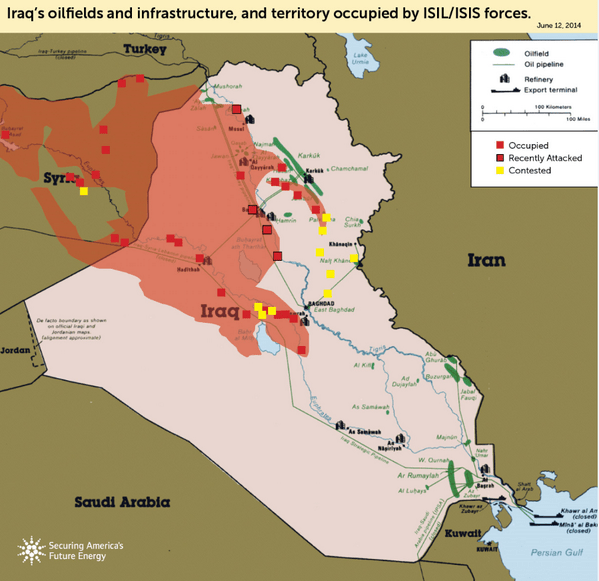
OK, so now imagine you’re Abu Bakr al-Baghdadi, leader of ISIS. At the moment, you control a large swath of not very much. In Iraq, the Shiite government holds the southern oil fields around Basra, and the Kurds have the northern fields around Kirkuk. You’ve got the western desert. In Syria, flip it around: All the good stuff is in the west, and you’ve got the east. You made headlines by expanding your map-area really fast, but that’s because there wasn’t much there in the first place. (John McCain and Lesley Graham describe your territory as “the size of Indiana“, but a better analogy would be the parts of Nevada that don’t include Reno or Vegas.)

But you do have one important asset. You are the current holder of the Big Dream: a re-unified Caliphate, all the Muslims in the world (or at least the Sunnis) joined in the kind of empire that made Harun al-Rashid a storybook legend. Once, before the West cut the Dar-al-Islam into little pieces and put puppet kings and sticky-fingered generals in charge of each one, Baghdad was the jewel of the world, the center of the greatest empire on Earth.

It could be again.

Lots and lots of the world’s billion-or-so Muslims share that dream at a low level, the way suburban Methodists share the dream of Jesus’ return. It’ll happen someday and that’ll be great, but … you know … I’ve got to get ready for that thing at the office Monday afternoon, and then there’s little Jamal’s soccer game in the evening.

You need to screw that up — all the distracting stuff that gives Muslims from Morocco to Indonesia more to live for than the dream of the Caliphate — and you can’t do it alone. You need help if you’re going to radicalize enough idealistic young men and women to overthrow the current governments of Jordan, Egypt, Saudi Arabia, Pakistan, and a dozen other places.

A restored Islamic Caliphate.

You need America.

In particular, you need a big, blundering, violent America that kills children and calls it “collateral damage” as if Muslims weren’t human at all. You need American troops kicking down doors of innocent families and looking under the chadors of virtuous women in case they might have weapons down there. You need the American president acting like he’s Emperor of the World, drawing other countries’ borders and deciding who can be involved in their governments.

You need an America that says it’s at war with all of Islam — not just you, all of it. Nobody believes you when you say that, but when Americans say it, they will.

You need an America that won’t let its own Muslims assimilate, that harasses them whenever they try to fly or build houses of worship or just walk around looking like Muslims.

You need an America that is scared of you. Nobody cares if you proclaim yourself Grand High Poobah of Everything. But if Americans are on global TV, telling the world that you’re the Baddest Baddy in the History of Badness … you can work with that. That looks great on your website. Deep down, lots of the people whose allegiance you are seeking wish they had what it takes to make U.S. senators quiver with fear or quake with anger. If you have that special something, they’re going to want to identify with you.

Maybe you need to wave a red handkerchief at the American bull to get him to charge. So don’t just execute the Americans you find. (Any thug can do that.) Cut off their heads and put the videos on YouTube. You and I both know that it makes no difference — dead is dead, after all, whether the instrument of death is a barbaric sword or a civilized missile from a high-tech aerial drone. But Americans go crazy when you do shit like that. Maybe crazy enough to come back and start killing people again, crazy enough to return their soldiers to places where ordinary people can get a shot at them. And then the cycle will become self-stoking, because the dead can’t have died in vain, can they? Once you get the feedback loop started, death justifies more death.

So far, it seems to be working.

And so you don’t have to be a mind-reader to know what al-Baghdadi is thinking right now: Thank you John McCain and Lindsey Graham. Thank you, Joe Biden. Thank you, Phil Robertson and Sean Hannity. Thanks to all the other crazy right-wing Christian preachers far too numerous to list. Thanks to everybody who is making it impossible for President Obama to follow his own advice not to “do stupid stuff“.

The stupid stuff ISIS needs from America is on its way, so al-Baghdadi is grateful to all of you. You’re doing a job he could never do for himself.

But he owes you nothing, because it’s a fair trade: He’s radicalizing your followers just like you’re radicalizing his. The bell curve is flattening. The center is becoming untenable.

It’s amazing what extremists can accomplish when they share a common goal.

Gaza, as seen from a distance

Last week I punted on the Israel/Gaza situation, because what I was reading contained more noise and spin than information and insight, and I didn’t want to make that situation worse. This week I can do a little better.

Immediate causes. ThinkProgress provides a timeline tracing the back-and-forth escalation that began with the disappearance (on June 12) of three Israeli teens who later (June 30) were found dead. Israel blamed Hamas, whose leaders didn’t claim responsibility (as they usually do; Hamas’ leadership constantly battles the perception that it’s toothless against Israel), and began arresting Hamas leaders and their associates in the West Bank, including some released in a previous deal. Hamas saw the kidnapping as a pretext for Israel to renege on that deal, and fired (mostly ineffective) rockets from Gaza in protest.

From there things escalated as they so often do. Israeli troops entered Gaza Thursday night.

A different angle on the immediate causes of the conflict comes from Nathan Thrall’s op-ed in the NYT. Since 2007, the limited autonomy that Israel allows Palestinians has been split between Hamas in Gaza and Fatah in the West Bank. But Hamas has fallen on hard times recently because of the rapidly diminishing value of its alliances. You can think of Hamas as the Palestinian franchise of the Muslim Brotherhood. The Egyptian franchise controlled that country for about a year between the fall of the Mubarak government in 2011 and the subsequent military coup, but is now struggling to survive a major crackdown. The Assad regime in Syria was another Hamas ally, but it is now focused on its own problems. Iran’s aid has also diminished.

So in June Hamas was driven to reconcile with Fatah, more or less turning Gaza over to the Palestinian Authority in the West Bank, but leaving its 43,000 civil servants in place. Currently, none of those people is being paid, mostly for reasons having to do with Israel and the United States. (Qatar is willing to pay them until something else can be worked out, but that solution is being blocked.) The other thing Hamas hoped to accomplish by getting itself out of the governance business was that Egypt might re-open its border with Gaza, which would be a big deal in the Gazan economy. That’s not happening either.

So Hamas wants:

  • Israeli troops out of Gaza.
  • End the recent Israeli crackdown on Hamas’ people and release the ones who had nothing to do with the kidnapping.
  • Get the Gaza civil servants paid somehow.
  • Open Gaza’s Egyptian border.

Israel wants Hamas to stop firing rockets into Israel and to stop kidnapping/murder operations in Israel. (The rockets don’t seem to be doing a whole lot of harm, but it’s the principle of the thing.) I’m not sure what Egypt’s military government wants.

This is where the topsy-turvy logic of the situation comes into play: A ceasefire doesn’t get Hamas most of what it wants — which is why it rejected an Egyptian proposal — but all Hamas has to threaten Israel with at the moment (beyond those pinprick rockets) is bad publicity. The more Gazan civilians die, the more support builds for boycotts of Israel and divestment from companies that do business with Israel. It’s like: “If you don’t give us what we want, you’ll have to kill more of us, and then you’ll be sorry.”

In the long run, how does this end? Whenever the Israel/Palestine conflict flares up, it’s easy to get lost in arguments about the most recent actions of each side; whether what one side just did justifies what the other just did, and so forth. I think it’s important to keep pulling back to the big question: How does this conflict end? I can only see four outcomes:

  1. Two states. Some border line is agreed upon between Israel and Palestine, and they become two independent countries with full sovereignty.
  2. One state with democracy. The Palestinians are made full citizens of a unified state. Given demographic trends, they are eventually the majority.
  3. It never ends. The Palestinians remain a subject population ruled or otherwise dominated by Israel. Israelis continue to be targets of terrorist resistance.
  4. Ethnic cleansing. Israel kills or expels large numbers of Palestinians (or otherwise induces them to emigrate), leaving behind a Greater Israel with a clear and sustainable Jewish majority.

It’s important to realize that anyone who finds both (1) and (2) unacceptable is de facto advocating (3) or (4), because those are the only choices.

Some Israelis seem to believe in an outcome (3A), in which the Israeli occupation continues, but the Palestinians are so beaten down that they submit peacefully. I’m pretty sure that’s a fantasy. I don’t know what level of oppression would be necessary to make (3A) happen (if it’s possible at all), but everything that the Russians have been willing to unleash on the Chechens has been insufficient. Israelis need to take that example seriously: They’d need a strongman stronger than Putin to make (3A) work.

Another version of (3A) is: Palestinians end all resistance for a long enough time that Israelis feel safe, and then Israel will consider what rights the Palestinians should have. That’s another fantasy. Nothing in the history of Israel’s dealings with the Palestinians entitles them to that level of trust. In fact, I don’t trust the Israelis that far, and I’ve got no skin in the game at all. I believe that once the terrorist threat subsided, Israel would forget about the Palestinians until the violence restarted, and then claim all over again that no deal can be reached until the violence stops.

So I repeat: The four outcomes listed above are the only ones.

With that in mind, it’s discouraging to read the recent remarks by Prime Minister Netanyahu.

I think the Israeli people understand now what I always say: that there cannot be a situation, under any agreement, in which we relinquish security control of the territory west of the River Jordan.

That eliminates (1). (2) is obviously unthinkable to anyone who values Israel’s identity as a Jewish state. So this goes on forever or there’s ethnic cleansing.

Moral calculus. A lot of the media back-and-forth concerns the morality of the two sides. The argument comes down to: Hamas targets civilians while Israel takes steps to avoid killing civilians, but Israel’s weapons are so much more effective that they end up killing far more civilians than Hamas does, on the order of hundreds to one.

Another reason for the disparity is that Israel prioritizes civil defense, while Hamas puts military targets in civilian areas and doesn’t even build bomb shelters. As Netanyahu put it on Fox News:

Here’s the difference between us. We are using missile defense to protect our civilians, and they’re using their civilians to protect their missiles.

Charles Krauthammer quoted that line in a WaPo column called “Moral Clarity in Gaza“.

Personally, I see this less as a moral difference between the two sides than a difference in their tactical situations. Gaza has no way to stop the Israeli attack by force. Israel will stop when the number of dead civilians creates enough international pressure. So Gazan civil defense would just enable the Israeli attacks to go on longer, with the same eventual body count. What’s Hamas’ motivation to go that route?

And that brings me to a moral principle that I think deserves more attention: Asymmetric warfare is morally asymmetric. In other words: If you are so much more powerful than your adversaries that your decisions create the gameboard and dictate the moves available to the players, then your actions have to be judged differently. You bear responsibility for the shape of the game itself, and not just for the moves you make.

Friendly frustration. Even pro-Israel commentators at some level realize the tactical and strategic realities. Krauthammer writes:

[Hamas rocket fire] makes no sense. Unless you understand, as Tuesday’s Post editorial explained, that the whole point is to draw Israeli counterfire.

Taken for granted here is that the Israelis are helpless in the face of this masterful strategy: They must fire back, even if that’s what Hamas wants. Perversely, Krauthammer presents Hamas as the player powerful enough to have choices, while Israel is driven by necessity.

Friends of Israel more in touch with reality are frustrated by the Netanyahu government’s lack of vision. Fred Kaplan describes the short-term logic of invading Gaza, but then laments:

The Israeli government seems to have forgotten how to think strategically; at the very least, they have a self-destructive tendency to overplay their hands. … Until this conflict with Gaza, Israel had been enjoying a level of security it hadn’t seen in many years. Terrorist attacks from the West Bank are all but nonexistent. Its enemies to the north—Syria, Hezbollah, and a gaggle of Islamist terrorist movements—are embroiled in their own wars with one another. Egypt is once again in the firm grip of a military government committed to putting down the Muslim Brotherhood and its allies (including Hamas). Iran has—at least for now—frozen its nuclear program, as a result of negotiations led by the Obama administration. … Instead of capitalizing on Israel’s unusually strong strategic position, Netanyahu risks squandering it—destroying what little support he has in the West and making it hard for Arab governments that share his interests (Egypt, Jordan, and, even now, the Palestinian Authority) to sustain their tacit alliances.

At The Jewish Daily Forward, J. J. Goldberg marked yesterday as the moment when the tide turned against Israel. After initially receiving a certain amount of international support — or at least seeing Hamas condemned in equal-or-worse terms

What happened next was something that’s happened over and over in Israel’s military operations in recent years: The government overestimated the depth of its international support and decided to broaden the scope of the operation. … The sympathy Israel won because of the kidnapping and shelling is melting before our eyes. Until the weekend, protests of Israel’s actions were limited to street demonstrations by leftists and Muslims in various cities around the world, with almost no governmental backing. Now governments are starting to switch sides. … Many Israelis will argue in the next few days that the mounting international criticism is hypocritical, that Israel has a right to defend itself and that the fast growing civilian toll is entirely Hamas’ fault. Whatever the merits of the arguments, they have lost their audience.

Meta-discussion. In some ways as interesting as the discussion itself is the meta-discussion about how to discuss such a divisive topic, where the sides are dug in so deeply and so many of the arguments rehearsed and ready to pull off the shelf. Also at The Jewish Daily Forward, Jay Michelson posts “5 Ways To Turn Down the Social Media Flame“. He’s basically rediscovering the three principles of Quaker discussions: Is it true? Is it kind? Is it necessary? And he asks:

If a bunch of privileged Americans with so little at personal stake can’t internalize the importance of multiple narratives, how do we expect Israelis and Palestinians — both of whom are living under threat of imminent death, while I sit behind a screen in Brooklyn — to do better?

And the blog This is Not Jewish gives instructions on “How to Criticize Israel Without Being Anti-Semitic“. Knowing how off-base the line “Democrats think anybody who criticizes Obama is racist” is, I was ready to be skeptical of “Jews think anybody who criticizes Israel is anti-Semitic.” In each case, it’s easy to be a lot more racially or ethnically offensive than you realize, and so get hit with criticism that you deserve, but think you don’t deserve. (“What I meant …” is not a defense. And anything that includes the phrase “if I offended anybody” is not an apology.)

Many of the tips are common sense, if you stop to think about it (i.e., don’t appeal to stereotypes). But I had never made the connection between labeling Israel-supporting Jews as “bloodthirsty” and the pogrom-causing blood libel, in which Jews are accused of literally drinking the blood of sacrificed Christian children. I don’t believe I’ve ever violated that rule, but duh, why didn’t I see that? Also be careful about equating Jews, Israelis, and Zionists, who are three different groups of people.

And finally, it’s crazy to hold your local Jewish community responsible for whatever Israel might be doing. (Just like it was crazy to hold your local Muslims responsible for 9-11.) As John Lloyd points out:

There’s a very large, and often very rich, Russian community in London – and there are no attacks on Russians or their mansions, restaurants or churches because of the Russian seizure of Crimea and sponsorship of uprisings in eastern Ukraine.

All four of my grandparents were German-Americans during the World Wars. None of that was our fault, and I’m willing to let Americans of all other ethnicities make similar claims.

Iraq is Still Broken, We Still Can’t Fix It

Was our mistake pulling out, or invading in the first place?


The fall of Mosul to Sunni extremists has put Iraq back in the headlines, pulling it out of the memory hole where it had been since American troops left in 2011.

Pundits and politicians have responded in two ways. If you were for the war, Mosul’s fall shows that President Obama was wrong to pull our troops out before the Iraqi government was established well enough to stand on its own; we should at least send in air strikes or possibly even return with soldiers.

If you were against the war, the fact the nearly nine years of American occupation could come unraveled so quickly — that the Iraqi army we spent so much time and money on “standing up” so that ours could “stand down” abandoned its weapons and ran in the face of a smaller, less well equipped enemy — underlines what a huge blunder it was to invade the country in the first place; re-entering the war would just repeat that mistake.

I stand by the position I took in August, 2005 in a Daily Kos piece called “Cut and Run“. (Two months later I would start the blog that eventually morphed into The Weekly Sift.)

We all know the rhetoric against an immediate pull-out: We can’t cut and run. We have to stay until the job is finished. Otherwise our 1800-and-counting dead soldiers will have died in vain. We have to stay until we fix all the things we’ve broken.

Eventually, though, those who understand that the invasion was a mistake will have to face a second hard truth: We’re not fixing anything by staying. Whether we leave in a week or a year or in twenty years, Iraq will be a broken country. The only difference is this: Will 1,800 soldiers have died in vain, or thousands more? … We can leave Iraq now, or we can leave after our losses have grown. That is the only choice we have.

If we had cut and run in 2005, Iraq would probably have devolved into sectarian civil war. So instead, we stayed another 6+ years, spent additional hundreds of billions, killed a lot Iraqis, and got another two-and-a-half thousand of our own troops killed … and Iraq has devolved into a sectarian civil war.

But putting hindsight and I-told-you-sos aside, what is happening now and what is likely to happen in the future? All through the Iraq War, Juan Cole (a professor of Middle Eastern history at the University of Michigan) has provided clear insight. Now he sees Iraq in sectarian (rather than national) terms. The national army commanded by the Shiite-dominated government has proven itself useless at defending its Sunni-dominated territory against a Sunni insurgency. The only effective fighting forces are the sectarian militias: The Kurdish Pesh Merga is defending Kirkuk, and the Shiite militias are rising to defend Baghdad (which is largely Shiite after the 2006-2008 civil war pushed out many of its Sunnis). If the national army holds together at all, it will probably do so as a Shiite force. Prime Minister Maliki’s

inability to reach out to Sunni Arabs made plausible what the entire Iraqi parliament rejected when it came out, the Biden plan for the partition of the country.

This time, though, eastern Syria is part of the Sunni partition, leaving an Alawite state in the west.


Neocons argue that we can’t allow such a Sunni state, particularly one controlled by ISIS, because it will lead to another 9/11 — as if there have been no terrorist training camps in the world since we invaded Afghanistan, and as if Afghanistan was the only place 9/11 could have been prevented.

More realistically, we can’t prevent terrorists from training. We can’t even prevent them from training in America, as our home-grown right-wing militias do. And yet, we have managed to prevent any 9/11-scale attacks on U.S. soil for the last dozen years. The existence of terrorist safe havens is bad, but not nearly so bad that we need to control the world to keep ourselves safe. Attacking any region that threatens to become a terrorist haven is a recipe for constant warfare, which in the long run may create more America-hating terrorists than it kills.

The Sunni lines also fail to include either of Iraq’s large oil fields: the southern one around Basra and the northern one around Kirkuk. That’s one reason the partition plan never took off: Sunnis knew they were drawing the short straw.


Here’s the most annoying aspect of the current discussion of Iraq: The media treats as experts the same people who were so horribly wrong about Iraq before we invaded. Surely they proved in 2002 that they are not Iraq experts.

Arguing against the points they make only legitimizes their “expertise”. The only proper response to them is Ygritte’s line from Game of Thrones: “You know nothing, Jon Snow.” If neocons want to convince me that re-engaging in Iraq is a good idea, let them send out a spokesman who at least understands what a bad idea the invasion was to begin with.

On Thursday, during a segment in which she pointed out the similarities to the way the large American-equipped South Vietnamese army dissolved in 1975, Rachel Maddow targeted one of the most discredited of the “Iraq experts”: Kenneth Pollack, who Maddow describes as “the captain of Team Wrong in 2002”. Pollack’s book The Threatening Storm: the case for invading Iraq, which came out a month before the invasion and re-packaged many of the points he had been making in op-eds all through 2002, gave spectacularly bad advice about more-or-less everything. This, for example:

Those who would argue that the United States would inevitably become the target of unhappy Iraqis generally also assume that the Iraqi population would be hostile to U.S. forces from the outset. However, the best evidence we have suggests that the Iraqi people would be pleased to be liberated.

So don’t worry about those unhappy Iraqis, they’ll welcome us like the Munchkins welcomed Dorothy.

But that didn’t stop the NYT from quoting Pollack Wednesday without mention of his abysmal record. This is yet an aspect of the problem Chris Hayes pointed out in Twilight of the Elites: There is no accountability in the expert class. No matter how many times you are wrong, you are still an expert. That’s why I support James Poniewozik’s proposal:

Rule: where available, all 2014 Iraq punditry must be accompanied by link(s) to the author’s 2002/3 Iraq punditry.

Here is one of Juan Cole’s last pre-invasion posts: “It Appears To Be Case That Iraq Simply has no nuclear weapons program“. From there you can easily get to the rest of his 2003 archives.

This Is How It Ends

The anger directed at Bowe Bergdahl only makes sense if you remember what the War on Terror was supposed to be.


From this distance, it is hard to recall the heady days at the beginning of the Afghan War. Americans had been stunned on 9/11, and for some time afterwards we felt uncertain and sad. “Why do they hate us?” we asked. But then the rage came and blew our depression away. President Bush didn’t start that process, but he channeled it like this:

Our grief has turned to anger and anger to resolution. Whether we bring our enemies to justice or bring justice to our enemies, justice will be done.

We were furious, certain of the righteousness of our anger, and confident in our power to exact revenge. No other cocktail of emotions is quite so invigorating.

And we were not just powerful, we were great and beneficent. In our majesty, we would grant freedom and democracy to lesser peoples who might never achieve such good fortune on their own. Not just in Afghanistan, where the attack against us had been planned, but in Iraq, and perhaps later in Iran and Syria and even eventually in Saudi Arabia and the oil emirates. We were the avatars of the great goddess Liberty and no one could stand in our way.

Remember?

“Tell me how this ends,” said General David Petraeus, then a mere division commander, as his unit crossed into Iraq. He was wise and experienced enough to know that no amount of shock and awe was going make Jeffersonianism break out across the Middle East, so something else had to happen. But what?

Now we know. We spent trillions of dollars, lost thousands of American lives, and killed tens or maybe hundreds of thousands of Afghanis and Iraqis. And in the end we are leaving — without a parade, without a “thank you”, leaving a legacy of weak governments still beset by insurgents. Most likely, those governments will either get stronger until they rival the tyrannical ones we overthrew, or they will perish and be replaced by something tougher.

Not what we pictured, is it? Our recessional might be Peggy Lee’s “Is That All There Is?”

Anyway, this is how it ends: We leave. We leave on a date circled on someone’s calendar, a day that no doubt will look just like the day before or the day after. We leave, not because we have finished something or accomplished something, but just because it’s time. We left Iraq that way on December 18, 2011. Our combat mission ends in Afghanistan at the end of this year, and all our troops are supposed to be out by the end of 2016. President Obama said:

Americans have learned that it’s harder to end wars than it is to begin them. Yet this is how wars end in the 21st century.

Could we stay longer? Maybe. Probably, if we wanted to badly enough. But how long? Until we accomplish … what? If there’s no what, then that future date is just another circle on a calendar. If then, why not now? Why not a long time ago?

So this is how it ends. We give back their people, they give back the one guy of ours they still have, because … what else are you going to do? Keep them forever? Why?

It feels crappy, doesn’t it? If you think dispassionately enough about it, you’ll realize that it was always going to feel crappy eventually, because … how else could it come out? Our Liberty-avatar high was bound to crash. What were we going to do? Slay the dragon? Marry the princess? What? But as long as we stayed, as long as we kept it all going, we didn’t have to think about that. We could keep pretending we were on our way to somewhere, keep imagining that someday soon we would feel again the way we felt back in those let’s-roll rid-the-world-of-evil days at the end of 2001.

My best advice for how to deal with that crappy feeling is just to let it run its course. Embrace the suck, as the soldiers used to say. Emotions are like water; if you just let them wash over you, before long they drip off and head for the nearest drain (rather than mounting up behind a dam and sooner or later devastating everything in their path). Let this one wash over, and eventually, we’ll feel something else. Maybe the next wave will motivate us to do something constructive and realistic that we can all be proud of some day.

It could happen. Really.

Or we could try some hair of the dog. Get angry again. Get angry at the president who set the clock that is running out, because he wouldn’t let us push this crappy feeling any further off into the future. Get angry at the deal to return that last prisoner. Get angry at the prisoner himself, because this is all his fault really.

Isn’t it? It feels like it must be. If not for him … something, I don’t know. Fill in the blank. It’s got to be his fault because I know it isn’t mine. I didn’t do anything. I was a perfectly marvelous avatar of Liberty and it felt great. Why did it have to end?

I don’t how else to make sense of the fury that has been directed at Bowe Bergdahl and his family this past week. You can say “It’s politics”, but that just shifts the question rather than answering it. Why does the politics work this way? Sure, Republicans are always looking for something they can pin on Obama (and if you can work the word impeachment into the conversation, so much the better), but how did they know this would do such a good job of firing up their base?

Just a few months ago, the conservative base was demanding that President Obama get Bergdahl back. Vox noticed this pattern:

[J]ust before Bergdahl was released, conservatives on Twitter loved to blast Obama for not freeing Bergdahl. There was even a whole meme on conservative Twitter saying Bergdahl was “abandoned by this administration.” But all of a sudden after Bergdahl was released, these people changed their tune.

Numerous congresspeople have had to scrub their Twitter-feeds to remove the evidence that they briefly thought getting an American POW back was a good thing. Most obviously, John McCain has turned on a dime from saying that he could approve the deal that had been on the table for months — Bergdahl for precisely these five named guys — to denouncing the deal after President Obama made it. He’s not alone. The most you-can’t-make-this-stuff-up reversal came from Oliver North of Iran/Contra fame; nobody’s allowed to negotiate with the bad guys but Ollie and his boss Ronny, I guess.


Steve Benen, Jean MacKenzie, and Hesiod have done a good job of taking down most outrageous talking points about Bergdahl.

  • Bergdahl is not a deserter. He seems to have been AWOL when captured, but he had wandered away from his base before and come back. Five years imprisonment with the Taliban is far greater punishment than a soldier typically gets for temporarily going AWOL.
  • He isn’t anti-American. Before coming to Afghanistan, he had been idealistic about how our military was “helping” the Afghan people. The realities of the war, the dysfunctionality of his unit, and the attitudes of his fellow soldiers towards the Afghanis disillusioned and disgusted him (and may explain why some of those soldiers are trashing him now). That’s where those out-of-context quotes about being “ashamed to be an American” come from. A longer quote: “These people need help, yet what they get is the most conceited country in the world telling them that they are nothing and that they are stupid, that they have no idea how to live.” If that’s disloyalty, then a sizable chunk of the American public is disloyal, including me and probably most of my readers.
  • He didn’t get other soldiers killed. Men did die while on patrol, and Bergdahl was one of the things they were supposed to be looking for. But the NYT quotes an informed officer: “Look, it’s not like these soldiers would have been sitting around their base.”
  • He wasn’t turned. He even escaped once for a while.

Many of the talking points about the five men Bergdahl was exchanged for are equally ridiculous. Vox and CNN have more details, but here’s the gist.

  • They’re not terrorists. One downside of framing post-9/11 military operations as a “War on Terror” is that we started reflexively labeling all our enemies “terrorists” and equating them with the 9/11 hijackers. But at the time we invaded Afghanistan, the Taliban was a government fighting an insurgency. These men were involved in that government or that war. Granted, the Taliban was a horrible government and the tactics (on both sides) in that pre-9/11 civil war were reprehensible. So no one denies that some of the five are bad men — or at least they were 12 years ago. But to the extent that the word terrorist still means anything other than “enemy of America”, they were not terrorists. They weren’t even enemies of America until we invaded their country.
  • They’re not supermen. TV series like 24 and Homeland have created the myth of the Terrorist Superman: an unkillable mastermind who sees everything, has agents everywhere, and is always plotting ten moves ahead. But even in their prime, none of these guys were superhuman. And whatever they once were, they have been completely out of the loop for 12 years. A lot of the people they worked with and trusted are probably dead. No doubt they have symbolic value for the Taliban, but their military significance is questionable. Think about Mafiosi who get out after long prison terms, a situation that occurred more than once on The Sopranos. The gang celebrates their return, but doesn’t necessarily have a place for them now. And an imprisoned Mafioso isn’t nearly as cut off as these guys have been.

Finally, there’s the question of whether or not releasing the five detainees from Guantanamo broke the law — a decision Bergdahl himself had no part in. And the answer is: It’s a complex legal issue in which both parties justify themselves by switching the positions they held during the Bush administration. Adam Serwer describes the situation in detail.

To make a long story short: Ever since the Constitution divided responsibility for war and foreign policy between them, the President and Congress have been tussling over the boundary. Congress occasionally passes laws that limit the President’s power to do something-or-other, and presidents routinely claim these laws are unconstitutional. The War Powers Act is the prime example. Since 1973, when it passed over President Nixon’s veto, both branches have avoided a test case that the Supreme Court would have to rule on. Presidents have mostly complied with the Act, but always with the proviso that they were doing so as a courtesy; no president of either party has acknowledged the Act’s constitutionality. For its part, Congress has never tried to force a president to pull out troops he had committed.

So Section 1035 of the 493-page National Defense Authorization Act of 2014 regulates transfers from Guantanamo, and says:

The Secretary of Defense shall notify the appropriate committees of Congress of a determination of the Secretary under subsection (a) or (b) not later than 30 days before the transfer or release of the individual under such subsection.

President Obama signed the NDAA — the Pentagon would have gone unfunded if he had vetoed it — but attached a Bush-like signing statement.

Section 1035 of this Act gives the Administration additional flexibility to transfer detainees abroad by easing rigid restrictions that have hindered negotiations with foreign countries and interfered with executive branch determinations about how and where to transfer detainees. Section 1035 does not, however, eliminate all of the unwarranted limitations on foreign transfers and, in certain circumstances, would violate constitutional separation of powers principles. The executive branch must have the flexibility, among other things, to act swiftly in conducting negotiations with foreign countries regarding the circumstances of detainee transfers.

Citing a need to “act swiftly” to get this exchange done without endangering Sgt. Bergdahl, the Obama administration gave Congress only one day of notice rather than 30, having previously given Congress an “anticipatory briefing” laying out “the prospect of such an exchange”. In doing so, the administration claims to have respected the “spirit” of the law.

Jack Goldsmith, the head of the Bush Justice Department’s Office of Legal Counsel, describes this as “quite a hard legal issue, with few real precedents.”

So Obama is definitely violating the anti-signing-statement rhetoric of his 2008 campaign. He’s being hypocritical in exactly the same way as his Republican critics who accepted Bush’s signing statements without objection and waved their hands about the President’s “Article II power” — as long as the president was somebody they liked.

Is that legalism and mutual hypocrisy what the conservative base’s man-on-the-street is fired up about? I kind of doubt it. I think they’re remembering that intoxicating post-9/11 fantasy about setting the whole world right, and wondering what became of it.

Is that all there is?

Congress is listening: What should you say?

I was for Obama, against the Iraq War, and I wish Clinton had stopped the Rwanda genocide. What should I tell my undecided representative in Congress?


When President Obama asked for Congress to authorize a strike against Syria, he created a chance for your voice to be heard.

I’ve long believed that our power is rooted not just in our military might, but in our example as a government of the people, by the people, and for the people. And that’s why I’ve made a second decision: I will seek authorization for the use of force from the American people’s representatives in Congress.

It’s just a chance, mind you. Congress often does unpopular things when powerful interests are involved or inside-the-beltway opinion-makers decide that the People don’t really understand the situation. And while the President asked for congressional authorization, he also said that he didn’t need it and he didn’t promise not to act without it. So it’s entirely possible that the attack will go forward whether the American public approves or not.

Still, you have opportunity to be heard. Lots of senators and representatives in both parties are still reported to be undecided, and I believe a number of them honestly don’t know what to do. The White House and the leadership of both parties in Congress want some form of an authorization to pass, so there will be a lot of pressure coming from that direction. If representatives don’t feel countervailing pressure from their constituents, the path of least resistance will be to go along.

So you should definitely contact your representative and senators this week, before they vote. But what should you say?

Pro-Obama but (mostly) anti-war. Syria has been a difficult question for me, and it seems to be difficult for many of my friends, both the face-to-face and Facebook varieties. As this blog’s regular readers undoubtedly know, I generally (though not always) support President Obama. I voted for him twice, I believe in his overall good intentions, and I tend to give him the benefit of the doubt.

I also am not a pacifist. I supported President Clinton’s bombing campaign in Kosovo, and I regret that the United States did not try to stop the genocides in Rwanda and Darfur. And though I was ambivalent about getting involved in the First Gulf War, when I saw how it played out I gave the first President Bush credit for engineering a broad international effort that achieved a decisive victory.

But I also grew up watching the Vietnam War unfold on television, and was glad that the draft ended before I had to decide what to do. While I initially supported the Afghan War (as part of the broad national consensus that we had to chase down the 9-11 planners no matter what government stood in our way), I soon became disillusioned with it. And I opposed the Iraq War from the beginning, because the second Bush administration’s multiple, conflicting justifications just didn’t add up. I supported anti-war candidates like Howard Dean in 2004 and (I thought) Barack Obama in 2008.

So now I have to think about Syria.

Make it stop. In some ways, Syria resembles Rwanda or Darfur: Civilians are being killed by the thousands — more than 4,000 in August, according to PBS. The UN estimates that more than 2 million people have left the country, and another 4.5 million are displaced inside Syria. In a country with a prewar population around 22 million, that means that more than 1/4 of the country has been displaced.

So it’s hard to argue with that voice in your head that says: “Make it stop.” But how?

The August 21 attack. The trigger for the current crisis was the chemical weapons attack on August 21, which the US government has estimated to have killed 1,429 people, mostly civilians, including 429 children. The Assad regime had been accused of using chemical weapons before, prompting President Obama to make his “red line” comment. (Assad’s ally Russia has put out a report claiming that the Aleppo chemical attack in March happened, but anti-Assad rebels were responsible. France, Britain, and the US have accused Assad.) But the evidence for the August 21 attacks near Damascus is clearer.

Multiple independent accounts make it fairly certain that somebody used chemical weapons near Damascus on August 21. You can argue how certain it is that Assad is responsible.  The most persuasive case I’ve heard that he wasn’t behind the August 21 attack comes from the octogenarian foreign policy analyst William Polk. Polk’s argument is basically that (because he was already winning the civil war) Assad had little to gain and a lot to lose by launching a chemical attack that would further destabilize Syria and give the United States a reason to intervene. Conversely, the rebels had reason to want to shake things up.

The German newspaper Bild Am Sonntag quotes German intelligence sources as saying that Assad’s forces launched the chemical attacks without his authorization, which seems a little far-fetched, particularly if you believe the Aleppo attacks happened. Assad also seems to be in no hurry to bring his war-criminal underlings to justice.

A variety of conspiracy theories blame third parties for the attacks: Obama did it, the Israelis did it, and so on. (I haven’t found a space-alien theory yet, but why not? It sounds like exactly the kind of thing the Founders from the Gamma Quadrant would do to foment internal discord among the humans.) I have a high evidence threshold for such theories, so I’m ignoring them until I hear something a lot more substantial than what’s come out so far.

Maybe this is my general give-Obama-the-benefit-of-the-doubt assumption talking, but I find the argument the US government is making more convincing: Simultaneous attacks on multiple locations implies a level of coordination the rebels don’t have. The locations correspond to places the regime was shelling anyway. Satellite images show rocket launches from regime-controlled areas. And:

We intercepted communications involving a senior official intimately familiar with the offensive who confirmed that chemical weapons were used by the regime on August 21 and was concerned with the U.N. inspectors obtaining evidence. On the afternoon of August 21, we have intelligence that Syrian chemical weapons personnel were directed to cease operations.

Now, you and I can’t check the satellite imagery and the communication intercepts; all we have is the word of people like John Kerry. Presumably the classified briefing given to Congress had more details. According to the Washington Post, after hearing the briefing

Lawmakers from both parties said there was widespread agreement with the evidence that Bashar al-Assad’s regime carried out the chemical attacks

(That includes Ron Wyden, a Democrat who is skeptical of administration claims on other intelligence-related issues.) I interpret this to mean that if you doubt Assad is responsible, you have to believe that the Obama administration is fabricating evidence out of whole cloth. After the Bush administration’s handling of Iraq, that kind of villainy in high places is not unthinkable. But I just don’t believe Obama is that dishonest, and I don’t see his motivation for trumping up an unnecessary war. (I know about the Iran pipeline theory, but I’m not persuaded.)

So I’m assuming the Assad regime used chemical weapons on August 21 near Damascus, and quite likely in March and April near Aleppo. I don’t see why we can’t or shouldn’t wait for the UN inspectors to confirm that conclusion — former UN inspector Hans Blix made this point to Rachel Maddow — but I expect that they will confirm it.

Why attack? The next step in the administration’s case is that we have a responsibility to enforce the international norms against chemical weapons use. Secretary of State Kerry put it like this: Our response

matters because a lot of other countries, whose polices challenges these international norms, are watching. … They are watching to see if Syria can get away with it, because then maybe they too can put the world at greater risk.

This is where they lose me, in the steps from “Assad has done something evil.” to “Somebody should do something about it.” to “The United States should launch an attack.”

Inconsistent motives. The problem is that we’re juggling two very different motives: The humanitarian desire to make it stop (where the chemical attacks are only one slice of “it”) and the desire to punish Assad for using chemical weapons, in the belief that his punishment will deter governments in general from using chemical, biological, or nuclear weapons in the future.

Punishment produces the vision of a surgical strike: We’ll launch a wave of cruise missiles that destroy a bunch of stuff Assad values, convincing him that future chemical attacks will cost him more than he’ll gain. The whole thing will last a couple of days and then we can stand aside again. But make-it-stop requires a much more involved commitment: We need to hit Assad hard enough (with the threat of more later) to convince him he can’t win militarily, then broker a peace settlement and maybe provide peacekeeping troops to enforce it. (That’s the Kosovo scenario.)

Make-it-stop pushes us to act quickly: People are dying every day. That’s why we can’t wait for a laborious (and possibly broken) UN process to assess Assad’s responsibility and do something about it. But the punishment scenario is much less time-sensitive. If Assad winds up deposed and facing the World Court in five or ten years, the point will be made.

I’m worried that the combination of motives will get us in trouble: We’ll move quickly and imagine we can disengage quickly, only to discover we haven’t really accomplished either objective. Then what?

The Emperor of the World. The punishment motive also has two roots: Are we punishing Assad for violating international norms against chemical weapons, or for doing something the President of the United States told him not to do.

Much of the inside-the-Beltway talk revolves around the second root: President Obama drew a red line, and now he has to back it up. We have to prove that we mean what we say. Otherwise the United States will lose face in the world, with dire consequences like Iran going forward with a nuclear weapons program.

This is imperial thinking, and I believe it’s dangerously misguided. It frames the President as the Emperor of the World, empowered to decide who is allowed to fight whom and which countries can be granted which kinds of weapons. If we think this way, we will always be fighting a war somewhere, until ultimately our economy breaks under the strain.

I totally understand the temptation to fantasize about ruling the world and making everyone behave. Without that fantasy, the future is filled with fears I have no answer for, what-if-Iran-gets-the-bomb being only the beginning. But it is a fantasy and we need to plan for the real world, where not even the United States has the power to make everyone behave. It is simply insane to be debating whether we can afford Food Stamps or Social Security while at the same time imagining that we have the resources to rule the world.

Another example of imperial thinking: We always imagine that our opponents will submit to whatever moves we make rather than respond with moves of their own. We imagine that the battlefield will be the one we define, and the enemy won’t step outside it. What if we’re wrong about that? What if Assad or Iran or Hezbollah decides to expand the battlefield with assassinations or subway bombings or hostage-taking or something else we’re not discussing? If you’re prepared to take the first step, are you prepared to take more steps if that’s not the end of it?

The international process. I spent a little time this week looking into the international-law aspect of chemical weapons, and it turns out to be iffier than you might think. (Ezra Klein does an excellent summary.) The Geneva Protocol of 1925 (which Syria signed) does ban chemical weapons for “use in war”. At the time, everybody was thinking about World War I, so whether it was intended to ban governments from gassing their own people is still a dubious point. (Is Assad “at war” in the Geneva-1925 sense?) The Chemical Weapons Convention of 1993 is more sweeping, but Syria never signed it.

Still, let’s assume that taken together, these and other international agreements establish a global consensus against chemical-weapon attacks. How should that be enforced?

The CWC creates the Organisation for the Prohibition of Chemical Weapons to monitor the agreement and delegates enforcement to the UN. Article XII says:

The Conference shall, in cases of particular gravity, bring the issue, including relevant information and conclusions, to the attention of the United Nations General Assembly and the United Nations Security Council.

Rajon Menon at The National Interest summarizes the weakness of Obama’s international-law case:

The president has also stated that it’s essential to ensure that the bans on chemical weapons are respected. Yet the 1925 Geneva Protocol contains no provisions for unilateral enforcement by states, let alone via military force. The same goes for the Chemical Weapons Convention (which Syria has not signed). It calls for “collective measures…in conformity with international law” to address serious breaches. There’s no basis for the United States to don the mantle of self-styled enforcer.

And the legal case for unilateral action is further weakened by the lack of a self-defense rationale under the terms of the UN Charter: Assad has not used chemical (or any other) weapons against the United States.

Our case would also be stronger if we supported international law across the board, rather than only when it suits us.

Everyone is assuming Russia will veto any action against Assad in the UN Security Council. But we don’t actually know that, and if it happens, we could still appeal to the General Assembly. (Both steps depend on the UN inspectors agreeing with our assessment that Assad used chemical weapons, or at least not contradicting it.) If that failed, we could still assemble a coalition of nations outside the UN. Assembling that coalition will be easier if the UN process is demonstrably broken, rather than if we just assume it won’t work and don’t try it.

The Iraq lesson. We always have these discussions in analogies. Is this Iraq or Kosovo or Vietnam or World War II? (BTW: I think it’s time to retire the Munich analogy. Assad is not going to conquer France if we fail to stop him now.)

Obviously, Syria is its own unique situation. So if we bring up another country from another time, we need to be specific about what lesson we’re trying to apply.

Here’s the lesson I bring forward from the decision to invade Iraq: It’s important to pin down one clear reason to act, with one clear goal for the action.

In the 2002-2003 Iraq debate, the Bush administration had at least half a dozen reasons to invade: Saddam was developing nuclear weapons, Saddam was evil to his own people, Iraq was a threat to Israel, we could make Iraq a beacon of democracy for the Muslim world, Saddam was responsible for 9-11, Saddam might give WMDs to al Qaeda, and on and on and on. None of them exactly held water, but if you challenged one, administration spokespeople would shift to another rather than answer your objections. So arguments with well-informed critics tended to go round and round rather than reach any clear conclusion.

The result of that muddle was that we invaded with no clear goal, so we could never declare victory and get out. We couldn’t get out quickly after toppling the regime, or later when we captured Saddam, or later when our inspectors determined there were no WMDs.

We’re out now. Do you feel victorious?

And so in Syria: Are we attacking to end the suffering of the Syrian people? To topple Assad? To punish a violation of international norms? To prove to Iran that we mean what we say?

You can’t say “all of the above” because there is no plan that accomplishes all those things. The only reason the administration is hinting in all those directions is that no single reason persuades enough people.

That’s dangerous. It invites mission creep, where we decide we’re doing a quick-and-easy strike to punish Assad, and then go further rather than explain why the strike didn’t accomplish all the objectives people had in mind when they supported it.

The objectives one-by-one. Make-it-stop is the motive I most sympathize with, but also the one that calls for the most open-ended commitment with the least chance of success. I like the goal, but I’m not willing to pay the price.

Punish-Assad-for-using-chemical-weapons is the low-cost scenario, but we need to be open about the limitations of the goal. We’ll hit Assad, stop, the killing will go on, and eventually Assad will probably win the war anyway. The public needs to understand that from the outset. So far, the administration has been hiding that limitation rather than explaining it clearly. I can’t support them until they discuss this more honestly, because otherwise we’re setting ourselves up for the mission to creep towards make-it-stop.

By itself, the anti-chemical-weapons motive is not time sensitive, and I think we’ll succeed better by playing a long game that goes through the UN process. Whether that process succeeds or fails, we’ll build a larger coalition that will be a more persuasive deterrent going forward.

Punish-Assad-for-defying-the-World-Emperor is part of a long-term delusion that will eventually crash the United States if we don’t root it out. We have to reject this thinking wherever it appears.

What I am telling Rep. Annie Kuster (NH-02), and what I hope you’ll tell your representative. The primary lesson of Iraq is that an intervention needs two things:

  • a single clear justification that gives us a single clear goal
  • a plan that leads to that goal at a price we are willing to pay

So far, President Obama has not identified that justification/goal/plan/price. Until he does, Congress should not authorize an intervention in Syria.

“This War Must End”

The issues on which President Obama has most disappointed liberals (and strayed farthest from his 2008 campaign rhetoric) have centered on the War on Terror. Yes, he got our combat troops out of Iraq (slowly) and is winding down the Afghan War (finally). He did renounce torture as an interrogation technique. But rather than reverse Bush administration’s expansion of presidential power and paint it as a one-time over-reaction to an emergency (like the Japanese internment camps of World War II), Obama has largely ratified Bush’s power-grab, and in some cases even grabbed more. As many of us feared at the time, it is hard for a president to cut back his own power, even if that’s what his principles say he should do.

Thursday, in a major speech at the National Defense University at Fort McNair, President Obama sounded a lot more like Candidate Obama in two ways: He took civil liberties issues more seriously than he has in some while, and he talked to us as if we were adults who can think about complex issues. In that second sense, it was his best speech since his campaign speech about race.

To put a few of my own words in Obama’s mouth: War is bad for democracy. A government at war needs to keep secrets, and it needs to favor security over freedom. The bigger the war, the worse for democracy.

Modeling the threat as a “Global War on Terror” amalgamates every little extremist group and home-grown terrorist into one giant enemy that justifies fighting one giant war. Maybe there was some justification for that framing immediately after 9-11, when Al Qaeda had a unified leadership that seemed to be able to direct multiple efforts all over the world. But:

Today, the core of al Qaeda in Afghanistan and Pakistan is on the path to defeat.  Their remaining operatives spend more time thinking about their own safety than plotting against us.  They did not direct the attacks in Benghazi or Boston.  They’ve not carried out a successful attack on our homeland since 9/11.

Instead, what we’ve seen is the emergence of various al Qaeda affiliates.  From Yemen to Iraq, from Somalia to North Africa, the threat today is more diffuse … Unrest in the Arab world has also allowed extremists to gain a foothold in countries like Libya and Syria.  But here, too, there are differences from 9/11.  In some cases, we continue to confront state-sponsored networks like Hezbollah that engage in acts of terror to achieve political goals.  Other of these groups are simply collections of local militias or extremists interested in seizing territory.  And while we are vigilant for signs that these groups may pose a transnational threat, most are focused on operating in the countries and regions where they are based.  And that means we’ll face more localized threats like what we saw in Benghazi, or the BP oil facility in Algeria

What we face now, in other words, are a lot of little threats, not one big threat like Bin Laden’s Al Qaeda of 2001.

the scale of this threat closely resembles the types of attacks we faced before 9/11. [my italics] … if dealt with smartly and proportionally, these threats need not rise to the level that we saw on the eve of 9/11. … Beyond Afghanistan, we must define our effort not as a boundless “global war on terror,” but rather as a series of persistent, targeted efforts to dismantle specific networks of violent extremists that threaten America.

And he recognizes that he can’t promise a perfect defense against those threats.

Neither I, nor any President, can promise the total defeat of terror.  We will never erase the evil that lies in the hearts of some human beings, nor stamp out every danger to our open society.  But what we can do — what we must do — is dismantle networks that pose a direct danger to us, and make it less likely for new groups to gain a foothold, all the while maintaining the freedoms and ideals that we defend.

I read this as a rebuke of President Bush’s sweeping statement three days after 9-11: “our responsibility to history is already clear: to answer these attacks and rid the world of evil.”

If that’s our goal, then we are never done and we have never gone far enough. But if we have a more manageable goal (say, to reduce the risk of terrorism to below the level of many other risks we live with), then democracy might have a chance to survive.

The rest of the speech is more specific and tactical.

Drones. Obama defends drone strikes as “effective” (“measured against the history of putting American troops in distant lands among hostile populations”) and “legal” (i.e., in accordance with the Authorization for the Use of Military Force passed by Congress after 9-11), but admits the discussion can’t end there.

America’s legitimate claim of self-defense cannot be the end of the discussion.  To say a military tactic is legal, or even effective, is not to say it is wise or moral in every instance. For the same human progress that gives us the technology to strike half a world away also demands the discipline to constrain that power — or risk abusing it.

Obama claims that “clear guidelines, oversight and accountability that is now codified in Presidential Policy Guidance that I signed yesterday” embodies that needed discipline.  (I haven’t studied those guidelines — which he partially outlines — but I doubt I’m going to buy their sufficiency, given how easily Obama or some future president could change them or just ignore them. He later mentions options for moving some oversight outside the executive branch, but doesn’t commit himself.)

He specifically defends the targeting of Anwar al-Awlaki, an American citizen:

when a U.S. citizen goes abroad to wage war against America and is actively plotting to kill U.S. citizens, and when neither the United States, nor our partners are in a position to capture him before he carries out a plot, his citizenship should no more serve as a shield than a sniper shooting down on an innocent crowd should be protected from a SWAT team.

“Force alone cannot make us safe.” Obama says we need to increase foreign aid, and that we should support transitions to democracy in places like Egypt, Tunisia, and Libya “because the peaceful realization of individual aspirations will serve as a rebuke to violent extremists.”

In this country, we should “work with the Muslim-American community” to “prevent violent extremism inspired by violent jihadists”. Speaking in my own words: The guy who is a committed member of a American Muslim community mosque is not going to blow himself up, any more than a Baptist deacon is going to blow up an abortion clinic. In any religion, the people to worry about are the alienated loners who want to go from loser to hero in one big step.

Civil liberties. Even after the Boston bombings, Obama says, “we do not deport someone or throw somebody in prison in the absence of evidence.” He also says we need “careful constraints on the tools the government uses to protect sensitive information, such as the state secrets doctrine.”

His defense of press freedom, calling for a shield law for journalists and saying “Journalists should not be at legal risk for doing their jobs” in some ways misses the point. The targets of the AP investigations are leakers, not journalists. But a journalist’s ability to investigate the government is compromised if sources suspect their communications are going to be intercepted.

Repeal the AUMF. The  AUMF was a very sweeping grant of power that Congress gave President Bush after 9-11. It didn’t have a time limit, but maybe its mission has been accomplished.

I look forward to engaging Congress and the American people in efforts to refine, and ultimately repeal, the AUMF’s mandate.  And I will not sign laws designed to expand this mandate further.  Our systematic effort to dismantle terrorist organizations must continue.  But this war, like all wars, must end.  That’s what history advises.  That’s what our democracy demands.

Close Guantanamo. Finally, he discusses closing Guantanamo, which was one of the first things he pledged to do after taking office. In asking Congress to cooperate with him this time, he invokes the judgment of history.

Imagine a future — 10 years from now or 20 years from now — when the United States of America is still holding people who have been charged with no crime on a piece of land that is not part of our country.  Look at the current situation, where we are force-feeding detainees who are being held on a hunger strike.  … Is this who we are?  Is that something our Founders foresaw?  Is that the America we want to leave our children?  Our sense of justice is stronger than that.

And that  may be the best reason to hope that President Obama is serious this time, and that he might really start to disassemble the wartime presidency that Bush built. As he gets closer to leaving office, the temptation to shore up presidential power should wane, and the judgment of history may start to weigh on his mind.