Tag Archives: law

Crime in the Cabinet

Most administrations come and go
without credible evidence of a crime by a cabinet official.
There were two this week alone.


In January of 2017, as Barack Obama was getting ready to hand the presidency over to Donald Trump after eight years in office, the Heritage Foundation’s Hans von Spakovsky pushed back on the “myth” that Obama had presided over a “scandal-free administration”. Von Spakovsky listed six of what he described as “some of the worst scandals of any president in recent decades”.

One — using the IRS to “target political opponents” — was nothing more than a canard that circulated inside the conservative information bubble. (The IRS was skeptical of the tax-exempt status of new political organizations founded to take advantage of the Supreme Court’s Citizens United ruling. Most of the investigated organizations were conservative, but that was due to the flow of money rather than specific targeting of conservative organizations. In the end, nearly all of them were recognized as tax-exempt. More importantly: No link back to the White House was ever established.)

Others — Benghazi, government personnel records getting hacked, losing track of guns allowed into Mexico as part of a smuggling investigation, veterans dying while waiting for appointments at the VA — were screw-ups not rooted in any nefarious intentions.

Only one — the Hillary Clinton email controversy — involved any credible accusation of a crime. That was investigated by the State Department during the first Trump administration, and the report found “no persuasive evidence of systemic, deliberate mishandling of classified information.” No one was ever charged with a crime, much less convicted.

That’s not unusual. Crime in the cabinet is exceedingly rare. In the history of the United States, no cabinet official was convicted of a crime until 1929, when former Interior Secretary Albert Fall was found guilty of taking bribes in the Teapot Dome scandal. Three Nixon cabinet members and his vice president were convicted of crimes, which is one reason why the Nixon administration is remembered for its corruption.

But the Trump administration has a way of wearing down our standards and making us forget that lawlessness high in the executive branch used to be exceptional. For example, Trump officials violate the Hatch Act (banning government officials from using their offices for political activity) just about every day. Such violations went unpunished in the first Trump administration, so hardly anyone notices any more.

Even so, it was striking to hear two independent credible accusations of crimes by Trump cabinet officials in the same week.

  • DHS Secretary Kristi Noem all but confessed to contempt of court yesterday when she admitted she knew a federal judge had ordered a plane carrying detainees to El Salvador to turn around, but she ordered it to continue.
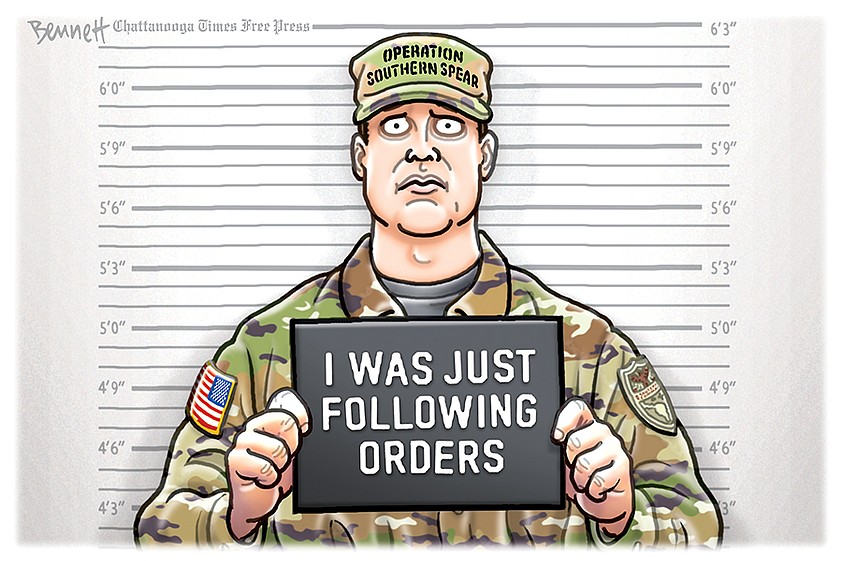
  • Department of War Defense Secretary Pete Hegseth reportedly gave an order to “kill everybody” in an attack on an alleged drug-smuggling boat in the Caribbean. Two survivors clinging to wreckage were then killed in a second attack. Even if the initial attack were legitimate (which it wasn’t), killing defenseless survivors is a war crime.

The second crime is more serious than the first, so let’s start there.
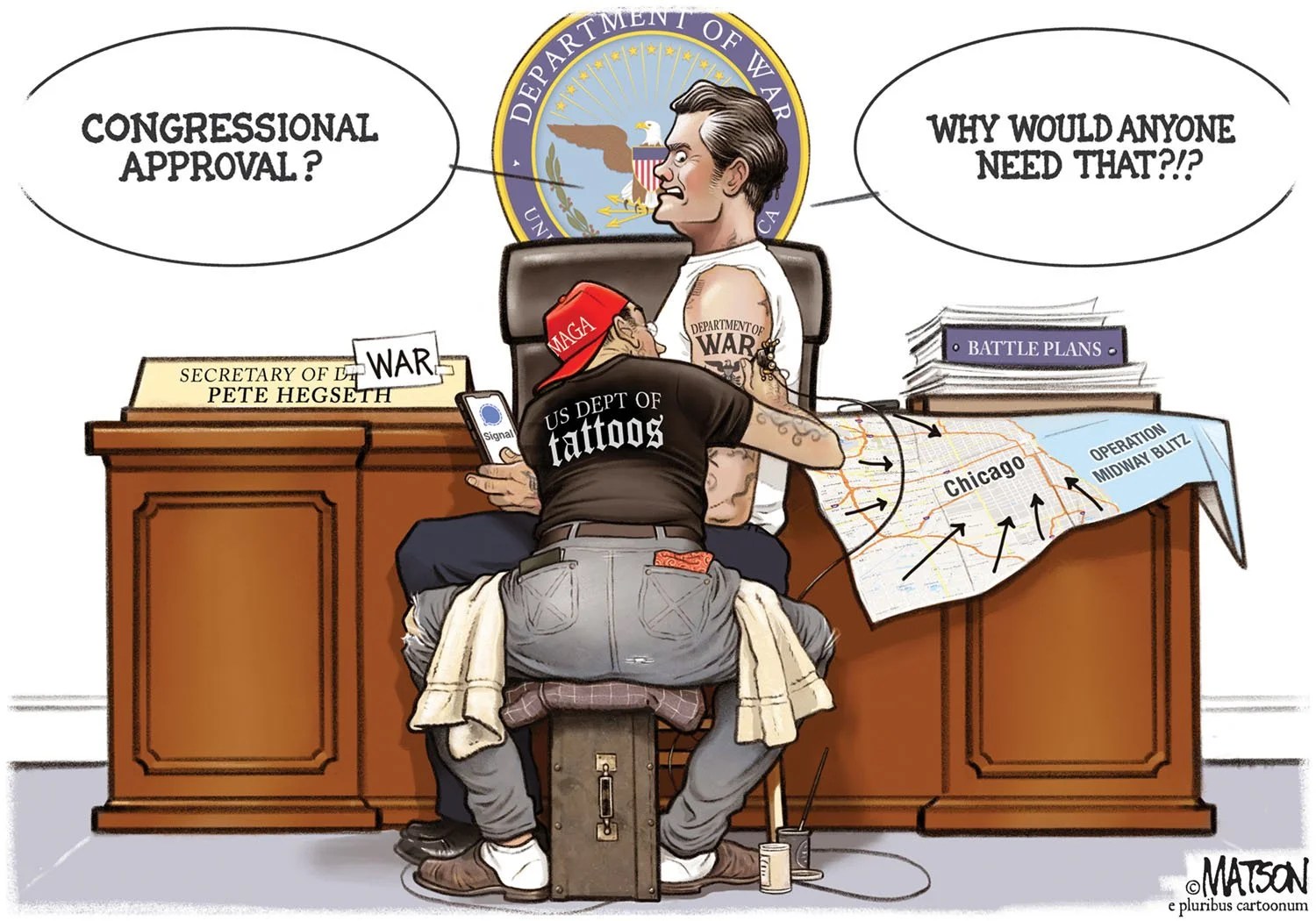
Kill everybody”. Since September 2, the Trump regime has launched at least 21 attacks against boats on the high seas that it claimed were smuggling drugs, killing at least 83 people. Friday, that story got even worse, when the Washington Post published a report that Defense Secretary Hegseth had given a “kill everybody” order for the first attack. Two people survived the initial attack and were clinging to the wreckage when a second attack was ordered. It blew the survivors to bits.

If true, that incident is a clear war crime attributed to a specific person, Hegseth.

Horrifying as that is, I think it would be a mistake to lose sight of the larger picture: If we frame this wrong, it might seem as if the air campaign against the boats was fine until helpless survivors were targeted. It wasn’t. Whether Hegseth ever said “Kill everybody” or not, under his command the Department of Defense has committed 83 murders.

No operational consideration justifies the attacks. They are not like the drone attacks that have assassinated terrorist leaders, controversial and morally dubious as those might have been. In those cases, the targets might not have stayed in known locations long enough for a strike team to get there. Or the host country might not have allowed our strike team in. Often, the choice was either to send a drone or let the terrorists go on about their business.

That’s not the case here. These boats were in open seas dominated by our Navy. They could have been seized and could not have gotten away. Whatever drugs they might have been carrying would never have reached American consumers. The crews could have been captured alive, and might have given us valuable information about their suppliers or distributors.

So attacking the boats achieved nothing that couldn’t have been achieved without killing people. Instead, the Trump regime chose to kill 83 people.

Remember: Smuggling drugs is not a capital crime. Even if the alleged smugglers had been captured and given due process, they could not have legally been sentenced to death.

It’s worthwhile to put this in a more familiar context. In Clint Eastwood’s Dirty Harry movies, Harry Callahan is a cop who chafes under the legal restrictions that bind him, and that allow criminals to eventually go free. In the first movie, Harry dares a suspect to go for a gun so that he can legally kill him.

But the second movie, Magnum Force, pits Harry against a death squad of rogue cops who start a campaign of assassinations against the city’s underworld kingpins. The squad expects Harry to join them, but rogue assassinations are too much even for him. “A man’s got to know his limitations,” Harry says.

That’s what we’re seeing now: Trump and Hegseth have turned the US Navy into a rogue assassination squad. They see enough evidence to convince themselves boats are smuggling drugs, show that evidence to no one, and kill the alleged smugglers on their own authority.

Even if you’re as tough on crime as Dirty Harry, you shouldn’t approve. A government has got to know its limitations.

The Trump regime gives two justifications: First, the end justifies the means (which is precisely what Dirty Harry’s rogue cops argued). On October 23rd, Trump made the ridiculous claim that each boat blown up saves the lives of 25,000 Americans. (This is the same kind of math that caused Pam Bondi to claim that drug seizures during Trump’s first 100 days had saved 119-258 million lives.) He postulated that if he told the Congress about the operation (not to seek their authorization, which he says he doesn’t need) “I can’t imagine they’d have any problem with it. … What are they going to do, say ‘We don’t want to stop drugs pouring in’?”

Again, those boats could be stopped without blowing them up or killing anybody.

Second, the regime stretches the definition of “war” to cover this operation. The drug cartels, say Hegseth and Trump, are like ISIS or Al Qaeda. This is typical of the way the regime perverts language, so that reminding soldiers of their legal responsibility not to follow unlawful orders is “sedition”, or individuals deciding to cross our border is an “invasion”.

Smuggling has been part of the American economy since before the Revolution, from British tea to Prohibition whiskey to Colombian cocaine. It has never been considered an act of war. Those 83 people on those fishing boats were not soldiers and were not at war with the United States. They’re murder victims.

But just for a moment, grant the claim that these attacks are part of a war. That’s where the Post’s new revelations come in: Once your enemies are disarmed and helpless, it’s a war crime to kill them. If the report is true, Pete Hegseth and those down the chain who carried out his orders are guilty of war crimes.

It appears, at least for the moment, that Republicans in Congress are not going to cover this up.

Republican Sen. Roger Wicker of Mississippi, chairman of the Senate Armed Services Committee, and its top Democrat, Rhode Island Sen. Jack Reed, said in a joint statement late Friday that the committee “will be conducting vigorous oversight to determine the facts related to these circumstances.”

That was followed Saturday with the chairman of the House Armed Services Committee, Republican Rep. Mike Rogers of Alabama, and the ranking Democratic member, Washington Rep. Adam Smith, issuing a joint statement saying the panel was committed to “providing rigorous oversight of the Department of Defense’s military operations in the Caribbean.”

Hegseth denies giving the order and calls the Post’s report “fake news”.

And before I leave this topic, there is one more dot worth connecting: Military judge advocate generals (JAGs) are supposed to vet these legal issues for the armed forces. But Hegseth purged the JAGs back in February, about a month into his term:

Hegseth told reporters Monday that the removals were necessary because he didn’t want [the JAGs] to pose any “roadblocks to orders that are given by a commander in chief.”

The plan from the beginning was to give illegal orders and remove all obstacles to carrying them out.

Kristi Noem’s contempt of court. Remember back in March, when a judge ordered DHS not to deport a bunch of Venezuelans to the CECOT concentration camp in El Salvador, including turning around planes already in the air? And DHS in fact did not turn those planes around, defying the judge’s order?

The judge, James Boasberg, has kept pursuing the question of who is responsible and whether they should be charged with criminal contempt of court. Tuesday, government lawyers answered the first question: DHS Secretary Kristi Noem made the call, after consulting with Deputy Attorney General Todd Blanche, Principal Associate Deputy Attorney General (now federal appellate judge) Emil Bove, and DHS acting general counsel Joseph Mazzara.

Dean Blundell cuts through the spin and legalese to draw this conclusion: The regime just threw Noem under the bus. Government lawyers say they’ll be happy to answer any further questions in writing, but that “No live testimony is warranted at this time.” In other words: We’ll answer the questions we want to answer with very carefully crafted spin, and we don’t want to give the court or anybody else the ability to frame their own questions or insist on clear answers.

Blundell summarizes:

  • They’re naming Noem now.
  • They’re trying to keep her off the stand.
  • And they’re trying to keep other insiders and whistleblowers from testifying live

Noem responded yesterday in an interview with ABC’s Jonathan Karl:

KARL: So, I have two questions on that. First of all, is that right? Does the — does the buck effectively stop with you on this? Was this your responsibility? And had you known the judge had ordered those planes to be turned around when that order was issued?

NOEM: Yes, I made that decision. And that decision was under my complete authority and following the law and the Constitution and the leadership of this president, who is dedicated to getting dangerous criminal terrorists and gangs and cartels out of our country. And I’m so grateful that we get the opportunity every day to do that and to make decisions that will keep America safe.

KARL: Did you know about — did you know about the judge’s order when you issued your order for the planes to go (ph)?

NOEM: You know, this is an activist judge. And I understand, you know, we’re still in litigation with this against this activist judge who’s continuously tried to stop us from protecting the American people.

We continue to win. His ridiculous claims are not in good standing with the law or the Constitution. We’ll win this one as well. And we comply with all federal orders that are lawful and binding and we will continue to do that.

But I’m proud of the decision that I’ve made. Proud to work for this president each and every day to keep America safe.

So there you have it: It’s up to the regime, and not the courts, to decide what is “lawful and binding”. She disagreed with the judge, so she ignored his order. If that’s not contempt of court, I don’t know what is.
Could a Third Term Happen?

It’s far-fetched but not impossible.


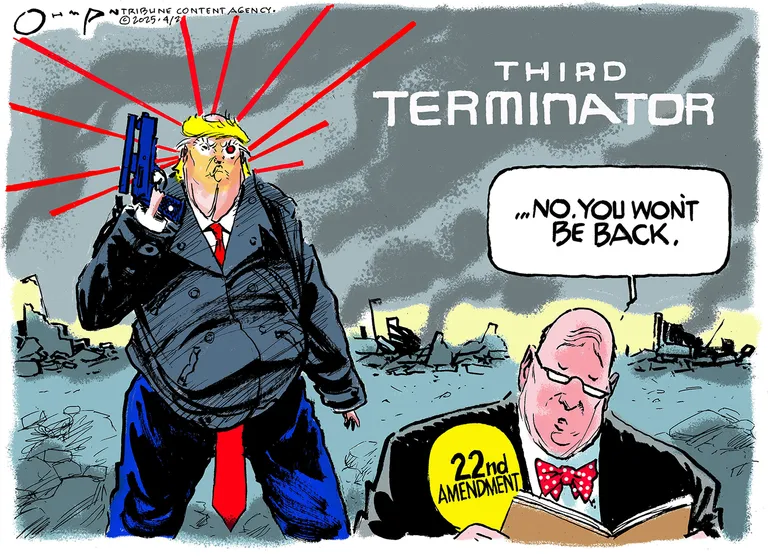
For months Trump has alternately encouraged and then tamped down speculation that he might seek a third term. Wednesday, he acknowledged the constitutional reality that “it’s pretty clear I’m not allowed to run”. But since it’s always a mistake to assume that any Trump statement is his final word, the third term idea will likely surface again at some point.

So how seriously should we take this? My conclusion: moderately seriously. Pay attention, but don’t lose your mind about it. That’s an attitude I’m trying to model this post.

The main reason to take it somewhat seriously is this: If Trump floated an idea like this and nobody pushed back, before long he’d be doing it. As you may remember from junior high, that’s how bullies operate. Every abuse, from pulling your pony tail to rape, starts as a joke. “Why do you have to be like that? I was just kidding around.” But if your response to the joke indicates that he might get away with it, it’s game on.

The main reason not to take it seriously is the 22nd Amendment, which seems pretty clear:

No person shall be elected to the office of the President more than twice, and no person who has held the office of President, or acted as President, for more than two years of a term to which some other person was elected President shall be elected to the office of the President more than once.

And yet, Steve Bannon believes he has a way to get around that prohibition.

“There’s many different alternatives,” Bannon said when asked about the 22nd Amendment. “At the appropriate time, we’ll lay out what the plan is.”

And Trump himself said back in March “There are methods which you could do it.”

So let’s think about what those methods might be.

Is there a loophole? Sort of. In a New Yorker conversation with Michael Luo, Ruth Marcus explains:

Note that it says “elected . . . more than twice,” not “serve as President for more than two terms.” The way—maybe—to get around that would be to have Trump elected Vice-President, and then to have whoever is the incumbent President resign to make way for a third Trump term. (Trump himself, by the way, said that this approach was “too cute,” and that “the people wouldn’t like that.”)

Alternatively, and even more fancifully, Trump could be elected Speaker of the House (you don’t have to be a House member to be Speaker), putting him in line for the Presidency, and both the elected President and Vice-President would clear the decks for him.

Marcus’ “maybe” depends on how the Supreme Court interprets the 12th Amendment, which says:

But no person constitutionally ineligible to the office of President shall be eligible to that of Vice-President of the United States.

Again, though, Trump could argue that he’s not ineligible to be president, he’s just ineligible to be elected president. So maybe the same loophole covers the 12th Amendment too. An honest Supreme Court — especially one that puts so much emphasis on the original intent of the laws — would not allow this, but we don’t have an honest Supreme Court. So maybe it flies.

Could it work? Not if the 2028 election has anything to do with the will of the American people. Remember a few things:

Not to mention the fact that Trump is right: The plan to run a stooge (or two stooges) who then resign is too cute for the public to back. And then there’s the execution problem: Would you trust J. D. Vance to resign once he had been sworn in as President? Trump doesn’t seem like the trusting type.

Summing up: In any free and fair election, a Stooge/Trump or Stooge/Stooge ticket would lose in a landslide. Anybody who seriously proposes the plan, i.e., Steve Bannon, must also be planning to rig the election in a significant way. A small amount of corner-cutting wouldn’t do the job.

Whether that can happen or not is a different topic.

Does Trump understand that it won’t work? Hard to say. He seemed to understand it Wednesday, but I have long subscribed to the theory of Trump’s mind that David Roberts enunciated in 2016:

When he utters words, his primary intent is not to say something, to describe a set of facts in the world; his primary intent is to do something, i.e., to position himself in a social hierarchy. … Even to call him dishonest, to say he “lies,” doesn’t quite seem to capture it. The whole notion of lying presumes beliefs — to lie is to say something that one believes to be false, to knowingly assert something that does not correspond to the facts.

It’s not that Trump is saying things he believes to be false. It’s that he doesn’t seem to have beliefs at all, not in the way people typically talk about beliefs — as mental constructs stable across time and context. Rather, his opinions dissolve and coalesce fluidly, as he’s talking, like oil on shallow water. That’s why he gives every indication of conviction, even when, say, denying that he has said something that is still posted on his Twitter feed.

Wednesday, Trump found it useful to agree with people like Mike Johnson that he can’t run. (Of course, he also said this was “sad”, because “I have my highest numbers that I’ve ever had”, which is completely delusional. So Wednesday’s comment did not come at some moment of peak lucidity.) Tomorrow, he may find it useful to agree with Steve Bannon.

What makes this problematic for Republicans in general, even the fascist ones, is the Mad King problem: No one can tell Trump he is wrong. So if he starts asserting that one of the third-term scheme works, and in fact works easily because he’s so popular, who’s going to tell him that some serious election-rigging is needed?

Meanwhile, no Republican legally entitled to compete for the presidency can start organizing a campaign, for fear of antagonizing the Mad King. Typically, the primary field starts to assemble in earnest after the midterm elections, so there’s still time. But Democrats like Governors Newsom and Pritzker are already starting to position themselves. Republican candidates would too if the field were clear.

What does the third-term talk accomplish for Trump? At least for his followers (or for Republicans intimidated by his followers), talk of a third term pushes back the moment when he becomes a lame duck. No one is going to risk breaking the law for him if they anticipate someone else holding the presidency soon. But the fantasy of Trump remaining in office indefinitely keeps that realization at bay.

Will the courts hold the line?

The Trump administration has suffered a series of defeats in court recently. Will that matter?


It’s been a bad week or two for Trump in court. Jay Kuo counts the ways:

After Kuo’s post, Trump suffered another loss in court:

A federal judge on Wednesday ruled Donald Trump’s administration unlawfully terminated about $2.2bn in grants awarded to Harvard University and can no longer cut off research funding to the Ivy League school.

The judges in these cases have been sending a clear message: The law still counts for something, and it doesn’t change just because Trump says so.

But for that message to stick, two things have to happen: The Supreme Court has to back up the lower-court decisions, and the Trump administration has to obey the court orders once they become final. Will those things happen? I’ve seen both optimistic and pessimistic views.

Kuo is the optimist.

There’s an understandable tendency to hear about a big court victory for the good guys but then cynically dismiss it, claiming either that the Supreme Court will overturn it, or that the Trump White House will simply ignore the courts’ orders.

I want to encourage readers to not fall into this trap. True, the Supreme Court has intervened in a few cases to lift a few injunctions imposed by lower courts, and that admittedly has been awful to see. But it hasn’t ruled substantively on much of anything yet. And that has allowed court victories by the good guys to produce some real progress.

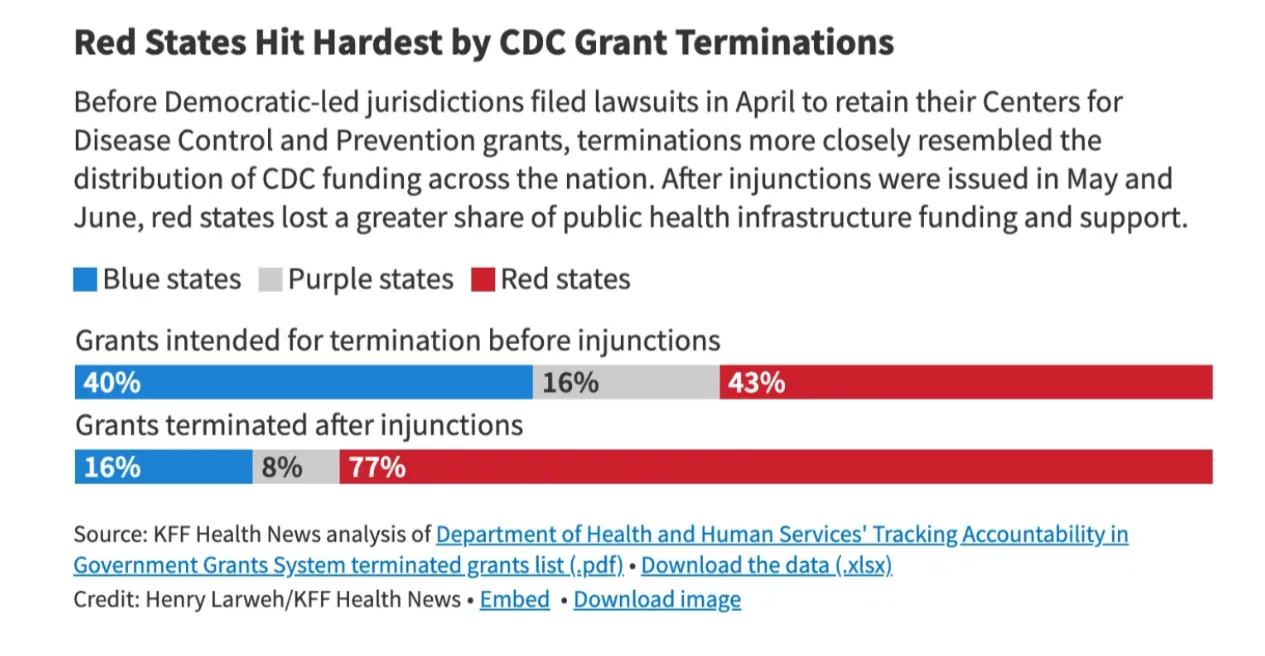
He points to blue-state attorneys general suing to claw back CDC grants the Trump administration had frozen. Red states, with their Trump-worshipping AGs, have taken the loss.

The Department of Justice wants the American public to assume that none of the orders granted by federal judges are being heeded. They want us to believe that they, and not the judiciary, are in control. But this is simply not the case.

Kuo points to the Guatemalan-children case, where (unlike in an earlier case with adults) planes in the air really did turn around, because “this time the government wasn’t up to playing more games with the courts”.

The pessimist side is represented by Vox’ Ian Milhiser, who summarizes “The overwhelming evidence that the Supreme Court is on Donald Trump’s team“.

The Court’s Republican majority now hands Trump several victories every month, only explaining themselves when they feel like it. When they do explain those decisions, they are often incomprehensible. The Republican justices exempt Trump from rules that apply to every other litigant, including the most recent Democratic president. Their decision permitting Trump to commit crimes doesn’t even attempt to argue that presidential immunity can be found in the Constitution — instead making a policy argument that Trump should not be chilled from taking “bold and unhesitating action” for fear of prosecution.

Nor is Trump the only litigant who receives this Court’s special treatment. The Republican justices favor religious conservatives so much that they will make up fake facts to bolster Christian conservative litigants. Meanwhile, they hate abortion providers so much that they once handed down an anti-abortion decision that, if taken seriously, would permit every state to neutralize any constitutional right.

If any other government official behaved this way, it would be obvious they were placing partisanship ahead of the law. It is no less obvious when these six specific government officials do so. The most reasonable explanation for the Republican justices’ behavior is that they are acting in bad faith.

It’s possible that even the most well-reasoned lower-court decisions against Trump will be reversed based on some gobbly-gook reasoning that we can expect to conveniently vanish should a Democrat ever again assume the presidency. That’s certainly what happened in the Trump immunity ruling.

But it’s worth noting that although the Court has thrown procedural hurdles in the way of those who would stop Trump’s lawlessness, and has sometimes reversed injunctions without much explanation, so far it has given Trump very few outright victories on the underlying merits of the cases. Birthright citizenship, for example, still stands.

The people caught in the middle are the lower-court judges themselves, ten of whom took the unusual step of talking anonymously to NBC News. Their problem is simple: When you do your best to apply the law as it was written and has always been interpreted, and then the Supreme Court reverses your decision in a shadow-docket ruling with little or no explanation, what do you do with the next case? You can’t apply the Court’s new reasoning, because that reasoning was never published.

In late July, the Constitution Daily Blog listed five Trump executive orders that are likely to hit the Supreme Court soon:

  • reversing birthright citizenship.
  • invoking the Alien Enemies Act to deport immigrants
  • using emergency powers to impose tariffs
  • firing heads of agencies protected by Congress
  • banning transgender people from serving in the military

I could imagine (but not agree with) the Court siding with Trump on the last two. But if any of the first three get the Court’s blessing, something is seriously wrong.

“Unitary Executive” is a euphemism for Tyrant

How a conservative legal theory set us on a path to fascism.


If you clear your mind of preconceptions and read the Constitution end to end, I think you’ll see not just a list of rules and procedures, but a vision of the proper governance of a free people. [1] The newly established Government of the United States does not rule over its people in totality. Instead, the People have granted the government a specific list of powers to achieve specific goals.

Alexander Hamilton, for example, thought this structure made an explicit Bill of Rights unnecessary.

For why declare that things shall not be done which there is no power to do? Why, for instance, should it be said that the liberty of the press shall not be restrained, when no power is given by which restrictions may be imposed?

During the ensuing centuries, the power of the US government has grown, largely because social and economic change made the powers granted to it more significant. Interstate and international commerce, for example, was a comparatively small part of the average American’s life in 1787. Today, on the other hand, restricting your purchases to products wholly made within your home state would involve radical lifestyle choices. The power to regulate interstate commerce, consequently, opened the door to a much broader regulatory power.

Similarly, technological progress has opened up unforeseen new worlds of commerce and communication, requiring someone to define new ground rules. America’s ascension to world power likewise extended the powers of our government.

But those enhanced powers did not automatically flow to the President. The Constitution gave those expandable powers to Congress, including what has become known as the Elastic Clause, because it can be stretched in so many ways.

The Congress shall have Power… To make all Laws which shall be necessary and proper for carrying into Execution the foregoing Powers, and all other Powers vested by this Constitution in the Government of the United States, or in any Department or Officer thereof.

Other powers are split between Congress and the President. So, for example, the President can enforce the laws, but cannot make laws. The President is commander-in-chief, but cannot build an army or declare war. [2] The judiciary, in turn, defines what the laws mean.

The 20th century saw the growth of what has become known as the “administrative state”: The kind of detailed and fast-changing regulation that the government’s new powers required couldn’t be managed through a body as cumbersome as Congress. [3] And so Congress empowered a smorgasbord of agencies: FDA, SEC, EPA, Federal Reserve, and so on — each with its own power and purview.

In this manner, some of the spirit of Constitution was preserved, even as the executive branch expanded: Specific powers were granted for specific purposes. Each agency had its own mission, and while the agencies were part of the executive branch and overseen by presidential appointees, the rank-and-file employees belonged to the civil service and maintained a degree of independence. [4]

The norms of the presidency, in turn, required a President to compartmentalize, or at least to maintain the appearance of compartmentalization. So, for example, it was considered scandalous if President Obama was directing the IRS to give conservative organizations a hard time. [5] President Biden and Attorney General Merrick Garland kept their distance from Special Counsel Jack Smith’s investigation and subsequent indictment of Donald Trump.

A President is human and has enemies and resentments, but s/he is not supposed to use the government to exact personal vengeance. The person-with-enemies and the President-with-powers are intended to be kept separate.

But during the Reagan years, conservatives began to float the notion of a “unitary executive”. The theory is based on the first line of Article II of the Constitution, which says:

The executive Power shall be vested in a President of the United States of America.

For a long time this was interpreted loosely: Any grant of executive power had to pass through the President in some way, but did not come from him minute-to-minute. FBI directors, for example, were appointed by a President, but served 10-year terms that stretched well beyond the 4- or 8-year term of the appointing President, and were fired only for cause. [6] Similarly, chairs of the Federal Reserve are appointed by a President, but have never been replaced simply because a new President takes office.

But the Unitary Executive Theory says that any executive power is by definition a presidential power. The various agencies and officials of the executive branch are essentially fingers of the President’s hand. They do the detail work that is beneath the President’s notice, but have no real independence.

For a long time the unitary executive was a crank theory, but under the partisan Roberts Supreme Court it has increasingly become the law of the land. [7] In Trump’s second administration, the Court has allowed the firing of a series of people previously believed to be independent and protected by law.

“By means of such actions, this Court may facilitate the permanent transfer of authority, piece by piece by piece, from one branch of Government to another,” Justice Elena Kagan wrote for herself, as well as Justices Sonia Sotomayor and Ketanji Brown Jackson.

Most recently, Trump has attempted to reshape (and shrink by half) the Department of Education simply by firing its employees. [8]

Proponents of the unitary executive argue — as authoritarians often do — that government power will be wielded more efficiently by a single hand, and that government will be more responsive to the voters when elected officials are better able to implement the programs they ran on.

But the behavior of the Trump administration belies these claims. In a government of largely independent agencies, each wielding its own power to achieve a specific mission, American individuals and institutions have to worry about the laws and agencies as individual entities. So: You worry about the IRS at tax time, and try to make sure that your returns follow their rules. You worry about the Justice Department if you are contemplating some crime of theft or violence. A corporation worries about the SEC in its dealings with the market and their own stockholders, about the EPA when it considers what emissions its factories are putting into the environment, and about OSHA when it designs its work environment. And so on.

But under a unitary executive, when all these agencies are fingers of the same hand, everyone has to worry about being seen as enemies of the government. If we have displeased the executive in some way, any agency of government might be used to punish us or whip us back into line.

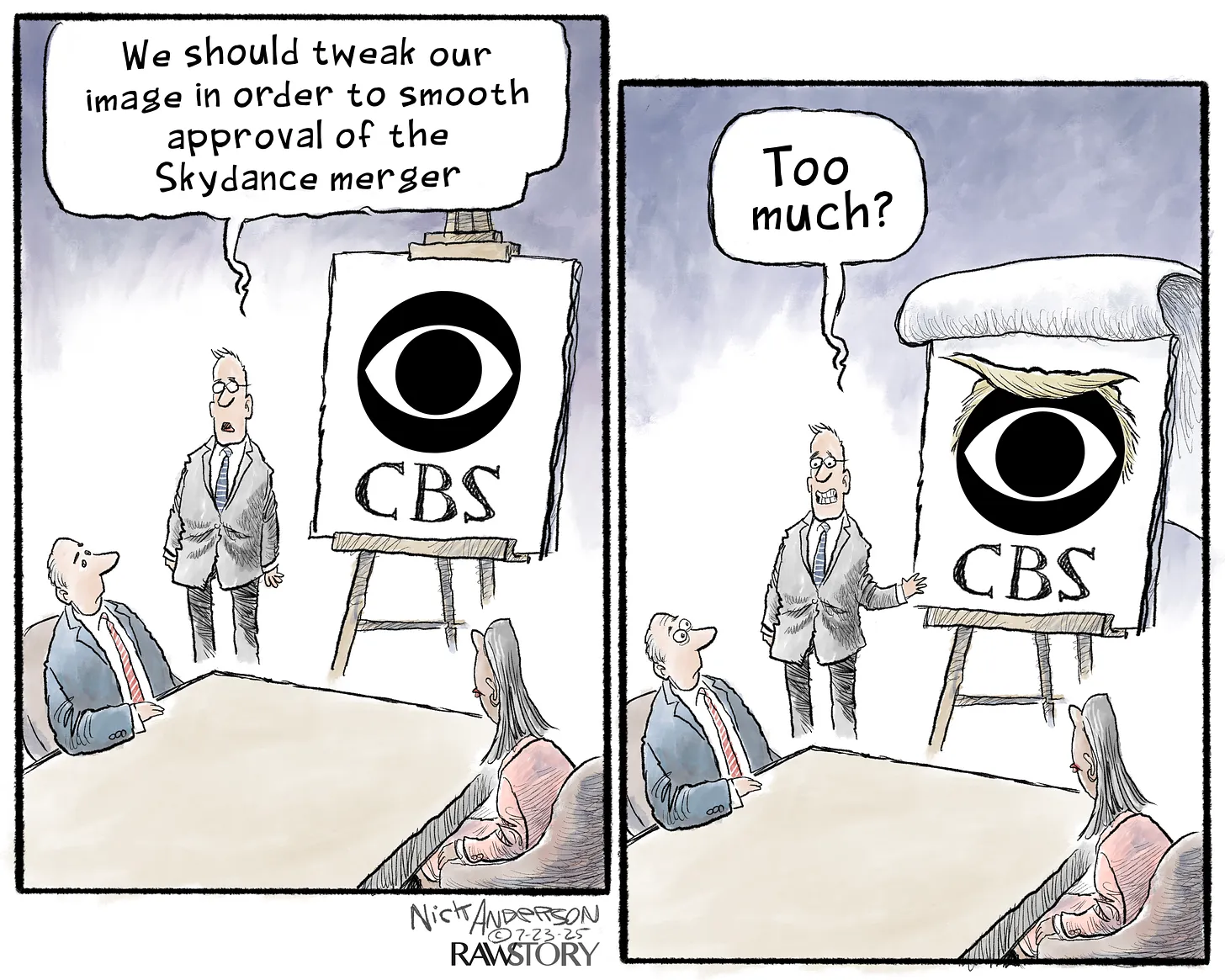
Take CBS. Does their news coverage displease Trump? Then the FCC balks at the corporate merger of CBS parent Paramount and cash-rich Skydance. It balks not until a specific public interest is satisfied, as would be the case under another administration’s FCC, but until Paramount has paid Trump $16 million to settle an otherwise baseless lawsuit, until Stephen Colbert’s show is cancelled, and until CBS agrees to have an ombudsman address complaints of anti-Trump “bias” in its news coverage.

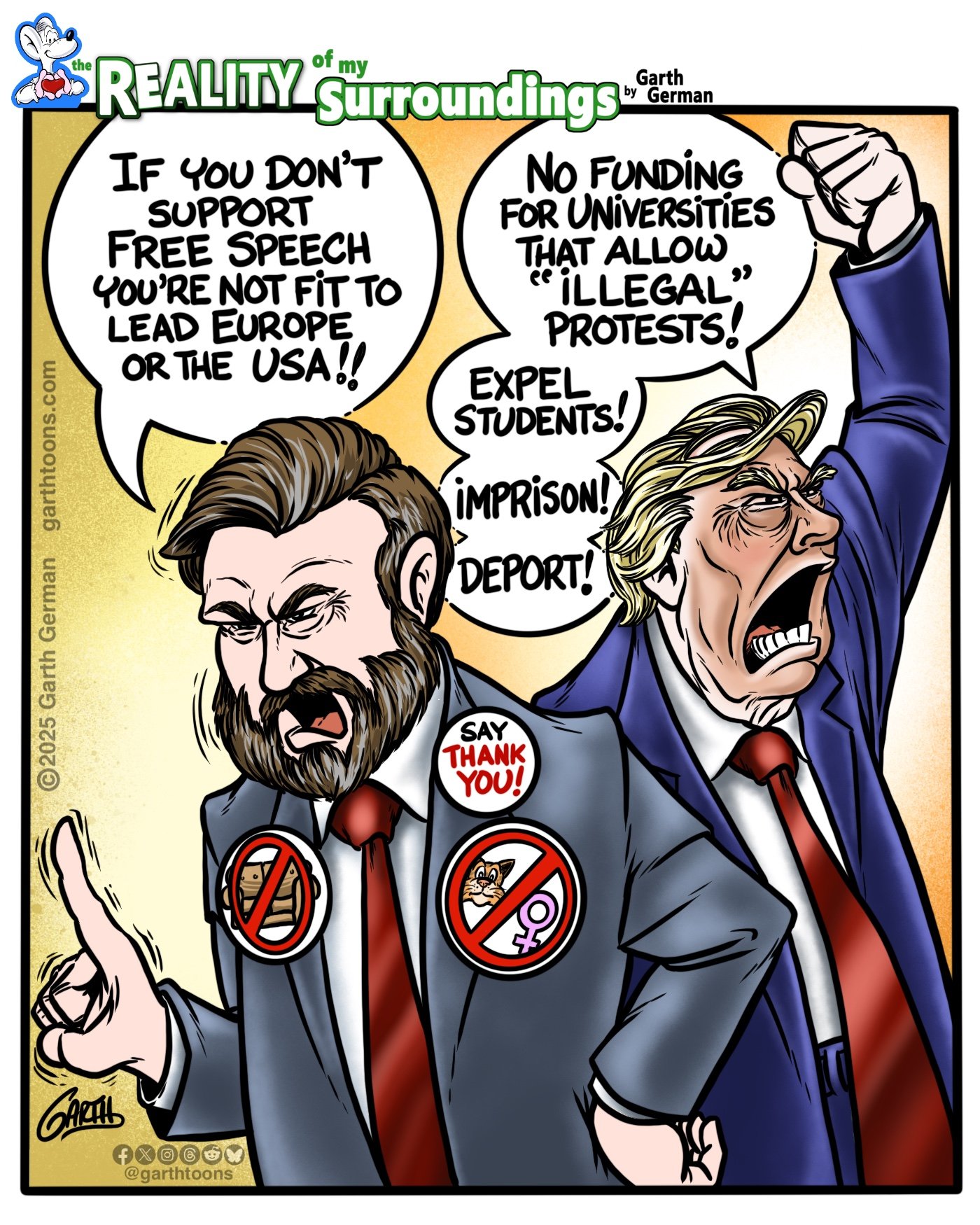
Take Columbia University. Complaints that university wasn’t doing enough to protect Jewish students from harassment would ordinarily fall under the civil rights division of the Education Department, which might make a referral to the civil rights division of the Justice Department, with a narrow focus on the experience of the university’s Jewish students. But under a unitary executive, the offense is more general and the consequences far more sweeping: Columbia allowed pro-Palestinian demonstrations that expressed opinions contrary to Trump’s support of Israel’s government.

And so, the State Department revoked the green card and student visa of protest leader Mahmoud Khalil, allowing ICE (which is part of Homeland Security, not the the State Department) to arrest and detain Khalil for three and a half months without filing any criminal charges against him. Columbia’s research grants (primarily from the Health and Human Services Department) were frozen, and all of its federal grants were threatened. [9]

And the result? Not a specific set of adjustments to Columbia’s policies about antisemitism (antisemitism was always just a pretext), but a sweeping agreement to get Columbia right with the Trump administration, “including the re-organisation of its Middle Eastern studies department, and hiring a team of ‘special officers’ empowered to remove students from campus and make arrests”.

A similar administration assault on Harvard resulted in demands to

  • shift power from “faculty and administrators more committed to activism than scholarship” to “those most devoted to the scholarly mission of the University and committed to the changes indicated in this letter”, i.e., from Trump-hostile faculty to Trump-friendly faculty.
  • “reform its recruitment, screening, and admissions of international students to prevent admitting students hostile to the American values and institutions inscribed in the U.S. Constitution and Declaration of Independence” and “report to federal authorities … any foreign student … who commits a conduct violation”.
  • authorize an “external party” satisfactory to the government “to audit the student body, faculty, staff, and leadership for viewpoint diversity, such that each department, field, or teaching unit must be individually viewpoint diverse”. [10]

Again, the administration has mounted pressure by trying to freeze funds from a wide range of government departments. This is happening not at the end of a process in which Harvard has been found guilty of something and refused voluntary reforms, but as cudgel to beat the University into line with the administration. (Harvard is fighting this in court.)

The administration has also gone after law firms, getting concessions in exchange for release from a variety of threats that include

limiting the ability of attorneys to obtain access to government buildings, stopping any consideration for future employment with the government, canceling government contracts, and preventing any company that uses such a firm from obtaining federal contracts.

To sum up: Increasingly, we are in an environment where it is not enough to obey the laws. Instead, you need to maintain a friendly relationship with the government, and particularly not offend Trump himself. Otherwise, the full power of the government might come down on you.

The Germans have a word for this: gleichschaltung.

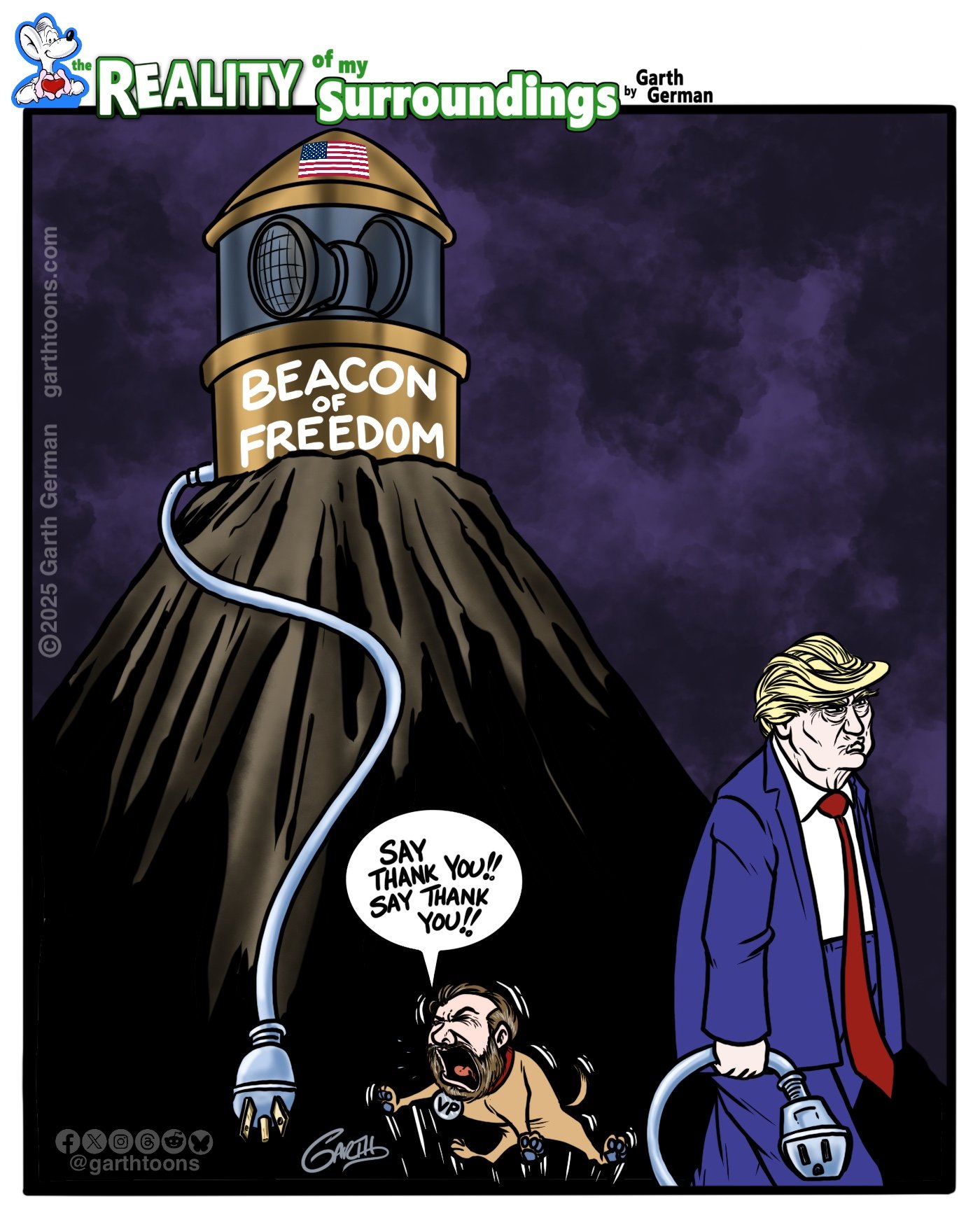
Gleichschaltung is a compound word that comes from the German words gleich (same) and Schaltung (circuit) and was derived from an electrical engineering term meaning that all switches are put on the same circuit allowing them all to be simultaneously activated by throwing a single master switch.

This unitary-executive metaphor goes back to the Nazis, because of course it does.

The Nazi term Gleichschaltung, meaning “synchronization” or “coordination“, was the process of Nazification by which Adolf Hitler—leader of the Nazi Party in Germany—established a system of totalitarian control and coordination over all aspects of German society “from the economy and trade associations to the media, culture and education”.

The unitary executive is precisely the person with his or her hand on that master switch. If American society retains any freedom, it will be due to the restraint of that executive, not to our inherent human rights.

So getting rid of Trump will not be enough to restore American freedom, as long as his successor — whether MAGA or some Democrat — continues to be a unitary executive holding the government’s master switch. Restoring freedom will require a sweeping change in the Supreme Court, as well as in re-establishing cultural expectations of the compartmentalization of presidential power.


[1] Recognizing, of course, that in 1787 not everyone was free. Much of our social progress in the last quarter-millennium has consisted of extending that vision of freedom more and more widely.

[2] The Founders never imagined the US achieving the kinds of world-spanning power it has today, or that it would need to maintain powerful armed forces in peacetime. Nor could they imagine a nuclear war, which could be lost before Congress could be convened.

[3] Imagine having to pass a new law each time a pharmaceutical company marketed a new drug or a food company began using a new preservative.

[4] This is the origin of the notion of a “Deep State”. President after president came into office with ideas for sweeping change, only to discover that the actual government had a great deal of bureaucratic inertia. The career employees of the various agencies had their own vision of their mission, which did not change just because they had a new boss.

You can see this today, for example, in the Justice Department, where many career employees — more than half in some offices — have quit rather than carry out orders that, by their lights, are corrupt. It’s impossible to know how many other civil servants have quietly sabotaged plans that violate what they see as their agency’s mission.

People join the EPA because they want to protect the environment, DoD because they want to defend the country, and so on. If asked to do something counter to those goals, they will do their best not to cooperate.

Properly understood, then, the Deep State is a culture, not a conspiracy.

[5] He wasn’t. IRS targeting of conservative groups for heightened scrutiny was never conclusively established, and no link to the Obama White House was ever found.

[6] Prior to Trump, only Bill Clinton had fired an FBI director — for ethical violations, in that case.

But President Trump fired FBI Director James Comey on a pretext in 2017, only four years into his term. During his transition period in 2024, Trump announced Kash Patel as his replacement for his own appointee Christopher Wray, seven years into Wray’s term. Wray might have challenged his apparent dismissal, but chose instead to resign.

[7] At least when Republicans are in the White House. The Roberts Court repeatedly found that President Biden had overstepped his legal authority. But now that Trump is president again, the bounds of presidential power have become increasingly vague and malleable.

[8] I have to wonder how well this would have worked for Biden. Would the Court have allowed him to eliminate student debt by firing all the people tasked with keeping track of it or collecting payments?

[9] Ordinarily, ending federal grants might be the conclusion of an anti-discrimination finding against a recalcitrant institution, not an opening salvo.

[10] “Viewpoint diversity” is a common MAGA euphemism for giving preference to MAGA-friendly students and professors. An economics department with no Marxists can be “viewpoint diverse”, but a biology department with no creationists might not be.

Are Trump’s Tariffs Legal?

Can Trump decide for himself the extent of his own power?


Many of the Trump administration’s most controversial actions are based on novel (and perhaps far-fetched) interpretations of existing laws. The most objectionable deportations are based on a bizarre reading of the 1798 Alien Enemies Act, and soon the Supreme Court will have to rule on whether it really does give Trump he power he claims. Similarly, many of the tariffs he has declared are based on the International Emergency Economic Powers Act of 1977.

But the same question arises: In the IEEPA, Congress delegated certain powers to the President. But did it delegate these powers, to be used in this situation.

Wednesday, the United States Court of International Trade said no.

The argument. Simplifying somewhat, the Trump administration argues that the IEEPA gives Trump essentially unlimited powers over tariffs. He can invoke the IEEPA by declaring a national emergency of his choosing, and once he does, the emergency powers Congress has delegated to the President allow him to do just about whatever he wants. Courts have no power to intervene, because the existence of an emergency and the measures necessary to deal with it are “political questions” that unelected judges have no business resolving.

The counter-argument is that emergency laws like the IEEPA delegate specific powers with limitations, not dictatorial powers for the President to use however he likes. Even if you could interpret the language of the law to grant unlimited power, that would itself be unconstitutional: Congress can only delegate its power up to a point.

Moreover, the courts have a necessary role in interpreting whether a President’s use of an emergency power is within the limitations of the statute. Otherwise we’re back in the dictatorial situation: The President has as much power as he says he has, and no one can say otherwise.

Ordinary tariffs. Some background: Presidents don’t ordinarily make tariffs. Tariffs are taxes, and the Constitution assigns Congress “Power To lay and collect Taxes, Duties, Imposts and Excises”. Congress is also empowered to “regulate Commerce with foreign Nations”. So that’s typically how tariffs get done: Congress passes a law establishing them, like the ill-fated Smoot-Hawley Tariff Act of 1930.

This Congress has not passed a tariff bill, and Trump has not asked it to. Instead he has invoked the IEEPA, which Wikipedia describes like this:

The IEEPA authorizes the president to declare the existence of an “unusual and extraordinary threat … to the national security, foreign policy, or economy of the United States” that originates “in whole or substantial part outside the United States.” It further authorizes the president, after such a declaration, to block transactions and freeze assets to deal with the threat and requires the president to report to Congress every 6 months on the circumstances, threats and actions taken. In the event of an actual attack on the United States, the president can also confiscate property connected with a country, group, or person that aided in the attack.

IEEPA falls under the provisions of the National Emergencies Act (NEA), which means that an emergency declared under the act must be renewed annually to remain in effect.

A textbook example of the IEEPA in action was what President Bush II did after 9-11: He declared an emergency and blocked the assets of organizations identified as terrorist.

Emergency tariffs. Tariffs come into the picture because President Nixon used a predecessor of IEEPA (the Trading With the Enemy Act of 1917, or TWEA) to raise tariffs across the board. That action was contested in court, and an appeals court reversed a lower-court finding that the tariffs exceeded the power Nixon was delegated under TWEA. In reversing that decision, the higher court emphasized that the President’s power was not unlimited. Nixon had

imposed a limited surcharge, as a temporary measure calculated to help meet a particular national emergency, which is quite different from imposing whatever tariff rates he deems desirable

After that ruling, Congress passed IEEPA to pull back some of the power it had delegated to the President. The TWEA powers were now reserved for wartime, while IEEPA covered “national emergencies” short of war. These powers

may only be exercised to deal with an unusual and extraordinary threat with respect to which a national emergency has been declared for purposes of this chapter and may not be exercised for any other purpose.

Questions related to the balance of trade are dealt with in a separate piece of legislation: Section 122 of the Trade Act, where the President’s powers are still more restricted: Tariff surcharges are limited to 15% and 150 days.

But the Trump administration’s position in court is that the IEEPA’s delegation of power is essentially unlimited: It’s up to the President to decide what a national emergency is and what measures are necessary to “deal with” it. Courts can’t second-guess him, because that’s a “political question” off limits to the unelected judiciary. (So if the President declares that vaping constitutes a national emergency and banning pogo sticks is necessary to deal with it, courts have no power to intervene.)

The court didn’t buy any of that. The language of the statute is not the President’s to interpret.

This language, importantly, does not commit the question of whether IEEPA authority “deal[s] with an unusual and extraordinary threat” to the President’s judgment. It does not grant IEEPA authority to the
President simply when he “finds” or “determines” that an unusual and extraordinary threat exists. … Indeed, “[t]he question here is not whether something should be done; it is who has the authority to do it.” [Biden v. Nebraska, 600 U.S. at 501]. The court simply asks whether the President’s action “deal[s] with an unusual and extraordinary threat.” Congress provided the necessary standards for resolving this inquiry when it enacted IEEPA, and the court’s task is to apply them.

Which tariffs are at issue? Trump used IEEPA authority to impose tariffs of three types

  • worldwide tariffs. The 10% tariff on all imports.
  • retaliatory tariffs. The country-by-country tariffs Trump announced on “liberation day”.
  • trafficking tariffs. Tariffs against Canada, Mexico, and China to pressure them to prevent fentanyl smuggling into the US.

The court rejects all of them. There are other tariffs, including tariffs on metals and car parts, that Trump invoked on other authorities. Those were not questioned.

Nondelegation and Major Questions. During the Biden administration, the Supreme Court created new legal principles to restrain executive power. Nondelegation is essentially the idea that certain powers are so central to Congress’ role that they can’t be delegated. So legislation that delegates those powers broadly, rather than in very specifically defined circumstances, is unconstitutional.

The major questions doctrine says that large-scale grants of power to the executive branch must be made explicitly in the authorizing legislation. For example, the Court used this doctrine to knock down President Biden’s cancellation of student debt. The authorizing legislation allowed the executive branch to tinker with student loan repayments. But if Congress had intended to allow the President to cancel over a trillion dollars of debt, it would have said so explicitly.

Findings. The Court of International Trade found that Trump’s worldwide and retaliatory tariffs were balance-of-trade remedies that belonged under the restrictions of Section 122, not the IEEPA. A trade deficit by itself is not an “unusual and extraordinary threat” that invokes IEEPA emergency powers.

The President’s assertion of tariff-making authority in the instant case, unbounded as it is by any limitation in duration or scope, exceeds any tariff authority delegated to the President under IEEPA. The Worldwide and Retaliatory tariffs are thus ultra vires and contrary to law

The trafficking tariffs fail because they do not “deal with” the emergency that the President has declared. Fentanyl smuggling may well be a national emergency, but the connection to tariffs on Mexico, Canada, and China is too indirect and tenuous.

“Deal with” connotes a direct link between an act and the problem it purports to address. A tax deals with a budget deficit by raising revenue. A dam deals with flooding by holding back a river. But there is no such association between the act of imposing a tariff and the “unusual and extraordinary threat[s]” that the Trafficking Orders purport to combat.

Trump argues that the tariffs are necessary to put pressure on the targeted nations, so that they will crack down on fentanyl smuggling.

The Government’s “pressure” argument effectively concedes that the direct effect of the country-specific tariffs is simply to burden the countries they target. It is the prospect of mitigating this burden, the Government explains, that will induce the target countries to crack down on trafficking within their jurisdictions. See Gov’t Resp. to Oregon Mots. at 39. But however sound this might be as a diplomatic strategy, it does not comfortably meet the statutory definition of “deal[ing] with” the cited emergency. It is hard to conceive of any IEEPA power that could not be justified on the same ground of “pressure.”

The Government’s reading would cause the meaning of “deal with an unusual and extraordinary threat” to permit any infliction of a burden on a counterparty to exact concessions, regardless of the relationship between the burden inflicted and the concessions exacted. If “deal with” can mean “impose a burden until someone else deals with,” then everything is permitted. It means a President may use IEEPA to take whatever actions he chooses simply by declaring them “pressure” or “leverage” tactics that will elicit a third party’s response to an unconnected “threat.” Surely this is not what Congress meant when it clarified that IEEPA powers “may not be exercised for any other purpose” than to “deal with” a threat.

The ruling concludes:

In so holding, the court does not pass upon the wisdom or likely effectiveness of the President’s use of tariffs as leverage. That use is impermissible not because it is unwise or ineffective, but because [the law] does not allow it.

What happens now. The International Trade Court is not the final authority, and the administration has already appealed to the appellate court for the Federal Circuit. That court has put a stay on the ITC’s ruling until it has time to consider the case. Ultimately, this is probably headed to the Supreme Court.

That will be an interesting test for this Supreme Court, which expanded its own power to overrule presidential orders during the Biden administration. But do the same limitations apply to Democratic and Republican presidents? Or has the law become partisan, so that what was done matters less than who did it?

The politics. The Trump administration interprets all its losses in court as judges making their own policy decisions and trying to impose them on the executive branch. Stephen Miller, for example, decried how “15 Communist judges” spread through the courts can “block and freeze each executive action”.

That framing allows Trump’s people to describe the issues the way they want, and then say that judges are against what the administration is for. Trump wants to deport dangerous criminals, while judges want to stop him. Trump wants to defend our economy from predatory foreign countries, but judges want to stop him, and so on.

But that framing sidesteps whether the United States will continue to be a country of laws, or whether it will become a Trump dictatorship. The Constitution defines the powers of our government, and assigns them to different branches. When Trump gathers all those powers to himself — and more powers that the Constitution does not assign to anyone — our way of life is endangered.

Whatever legitimate goals Trump may have — deporting criminals or protecting American jobs or whatever — can be accomplished in legal ways. (For example, Trump could ask Congress for a new tariff law. He could deport criminals through the immigration courts.) When he ignores legal pathways in favor of illegal ones, he needs to be stopped.

What’s up with the Supreme Court?

Consider this a follow-up to last week’s post of qualified optimism about the prospects for American democracy to outlive the Trump administration. We continue to be steaming towards a direct clash between Trump and the Supreme Court. How that plays out will be a big factor in whether our way of government survives.

A lot of the pessimists I talk with say this clash has already happened and the bad guys won. Specifically, the Court told the Trump administration to bring Kilmar Abrego Garcia back from the concentration camp Trump has established in El Salvador. Trump has ignored that order and gotten away with it. So: courts and laws are powerless and Trump will do as he pleases. For all practical purposes, American democracy is already dead.

I read the situation somewhat differently. To me, the Supreme Court and the Trump administration look like two fighters circling each other warily, each waiting to see if the other really wants to do this.

It already seems clear that the Court will not endorse Trump’s most obviously illegal acts. It will not deny that the 14th Amendment guarantees birthright citizenship, no matter how badly Trump wants that denial. It won’t agree that he can invoke wartime powers (like the Alien Enemies Act) when there is no war. It won’t endorse him unilaterally unmaking agencies made and funded by Congress. The administration seems to understand this, which is why it hasn’t pushed for the Court to resolve those issues quickly.

Instead, Trump’s lawyers keep offering the Court ways to surrender quietly, by writing itself out of the picture. For example, the portion of the birthright citizenship case that the administration argued in front of the Court this week did not seek an answer to the central question. Instead, it focused on whether lower court injunctions could cover the entire country. The acting Solicitor General argued for a system in which each loss in a lower court only affected the specific plaintiffs involved, leaving the administration free to ignore the birthright citizenship of any other Americans until they sued too. Only a Supreme Court ruling could shut the administration down completely.

This leaves an enormous loophole: If the administration simply refused to appeal a series of lower-court losses, none of the cases would make it to the Supreme Court, so there could be no national ruling against them.

In other words: You don’t have to endorse our position, Supremes, just write yourself out of the picture and let us proceed.

For its part, the Court has so far treated the Trump administration as if it were a good-faith actor, which it clearly is not. In the Garcia case, the Supremes supported a lower-court order to “facilitate” Garcia’s release, leaving the details to the executive branch. (That’s appropriate if the executive branch is acting in good faith, because the executive is presumed to be better equipped to deal with foreign governments.) In essence, it was offering Trump the opportunity to stop all this nonsense and start behaving like the kind of American president the Constitution envisions.

But of course he did not. The Trump administration interpreted “facilitate” in a ridiculously narrow way, and — surprise! — the details of Garcia’s release haven’t worked out. The government continues to give the lower-court judge a run-around as to what it is or is not doing to get Garcia back.

Sooner or later, Judge Xinis is going to tire of this and order the administration to present Garcia in his court on a particular date. That order will also get appealed up to the Supreme Court, which will then have to decide whether it is ready to confront Trump or surrender to him. If it isn’t ready to surrender, then Trump will have to decide whether he recognizes the authority of the Court. If he doesn’t, that’s the crisis point.

I don’t think anyone knows whether we’ll get there, or what will happen then. Trump himself may not know, and the answer may turn on how popular Trump is at the time, how the economy is going, how vigorously Republicans in Congress are standing up for him, how well organized anti-Trump protesters are, and a lot of other factors that have nothing to do with the case at hand.

It’s worth noting that so far the Trump administration is not acting as if it had thrown off the burden of judicial oversight. For example, on Friday the Supreme Court extended its previous ban on deporting any more people under the authority of the Alien Enemies Act until the administration’s invocation of the AEA’s wartime powers can be fully adjudicated. As best we can tell, the administration is obeying the order.

At least for now.

Rights, Privileges, and Mahmoud Khalil

Can a legal permanent resident be deported for expressing views the President disagrees with?


A long-standing debate runs through American history: Does the Bill of Rights enumerate human rights, i.e., something that anyone can claim by virtue of being human, or privileges of citizenship that our government can ignore when it deals with non-citizens?

The Declaration of Independence uses theistic language to promote a human-rights view: Human beings (or at least “all men”) have been “endowed” with rights “by their Creator”. To say that a man lacks rights is tantamount to claiming that he was not created by God. But in the Dred Scott decision of 1857, the Supreme Court took the opposite view: Rights derive from the social contract embodied in the Constitution. Africans residing in the United States, the Court held, were not party to that contract, and thus they “had no rights which the white man was bound to respect”.

Dred Scott has long been in the dustbin of history, and is widely viewed as one of the Court’s worst decisions. Currently binding Supreme Court precedents take an in-between view that leans towards human rights. Basically, the Court interprets the Constitution and the laws to mean exactly what they say: If lawmakers had intended a provision to apply only to citizens, they would have used the word “citizen” rather than some more general term like “person”. For example, the 14th Amendment uses both words:

No State shall make or enforce any law which shall abridge the privileges or immunities of citizens of the United States; nor shall any State deprive any person of life, liberty, or property, without due process of law; nor deny to any person within its jurisdiction the equal protection of the laws.

So there are privileges that apply only to citizens (the right to vote, for example), but due process and equal protection are not among them.

The Trump administration shows every sign of wanting to move that line. Just how far it wants to go is not clear. But the first case in point is Mahmoud Khalil.

Who is Mahmoud Khalil? Two weeks ago, Khalil (an Algerian citizen born in a Palestinian refugee camp in Syria) had the next layer of privileges short of American citizenship: He came here originally on a student visa, but became a legal permanent resident, a “green card holder”. He is married to an American citizen, who is eight months pregnant. If nothing goes wrong, in another month he’ll be the father of an American citizen.

He is also a pro-Palestine activist. Last spring, he participated in demonstrations at Columbia University, where he was a student at the time. (He has since finished his degree.) Wikipedia describes his views like this:

Following the start of the Gaza war in 2023, Khalil became involved in pro-Palestinian activism. He served as a negotiator for students associated with Columbia University Apartheid Divest (CUAD) when they were bargaining with Columbia University officials. In a 2024 interview, Khalil said, “As a Palestinian student, I believe that the liberation of the Palestinian people and the Jewish people are intertwined and go hand by hand, and you cannot achieve one without the other.” He characterized the movement as one “for social justice and freedom and equality for everyone”. Of concerns about antisemitism, Khalil said, “There is, of course, no place for antisemitism. What we are witnessing is anti-Palestinian sentiment that’s taking different forms, and antisemitism, Islamophobia, racism [are] some of these forms.”

The Trump administration describes him differently, claiming that he “led activities aligned to Hamas” and “engaged in pro-terrorist, anti-Semitic, anti-American activity“. But it has produced no specifics to back those claims up, and the language itself is slippery. What does it mean that an activity is “aligned with Hamas”? Aligned in whose view? Similarly, unless Khalil himself endorsed terrorism or attacked Jews or America in so many words — and if he had, I’d expect his critics to have produced specific quotes — “pro-terrorist, anti-Semitic, anti-American” is an opinion, not a fact.

Khalil’s arrest. A week ago yesterday, agents from the Homeland Security department arrested Khalil at his home in New York. Khalil’s wife Noor Abdalla recorded the event on her phone while simultaneously talking to Khalil’s lawyer on his phone. It isn’t exactly a classic police-state arrest — Khalil is not roughed up, for example — but it still has a lot of disturbing aspects. When Khalil’s wife asks for the names of the arresting agents, she is told “We don’t give our names.” They also refuse to say which agency they represent. All they’re willing to tell her is where Khalil is being taken: Immigration Custody at 26 Federal Plaza. They refuse to talk to Khalil’s lawyer, who is on the phone. “They’re literally running away from me,” Noor reports to the lawyer.

When Noor tried to visit Khalil at a detention center in New Jersey, she was told he was no longer there. It took some time for his lawyer to determine that Khalil had been moved to a facility in Louisiana, where at first he was not allowed to consult privately with lawyers. An immigration hearing to have him deported was scheduled for March 27.

Last Monday, a federal judge in New York ordered that Khalil not be removed from the US until a hearing in his court can determine whether deporting him violates constitutional rights.

The Just Security blog analyzes the legalities: No one in the executive branch can unilaterally revoke a green card.

To obtain authority to deport a green card holder, the government must charge (or accuse, as this is not a criminal matter) them with a condition under the immigration laws that in some way makes them “deportable.” “Deportable” is a term of art under the immigration laws. It refers to conduct defined in a set of provisions—most though not all involving criminal activity—codified at 8 U.S.C. 1227(a).

To prove that an [legal permanent resident] is deportable, the government must convene a “removal hearing” before an immigration judge. At that hearing, government attorneys must prove deportability by “clear and convincing” evidence.

Notably, the Trump administration has not accused Khalil of committing crimes, or of committing fraud in his green-card application (another deportability condition). Instead, it points to a condition that has never been used in this way before:

the government has invoked a rarely used “foreign policy” ground of deportation. That provision, located in section 237(a)(4)(C) of the Immigration and Nationality Act, makes deportable any “alien whose presence or activities in the United States the Secretary of State has reasonable ground to believe would have potentially serious adverse foreign policy consequences for the United States” (emphasis added).

The statute contains a (freedom of speech and association) safe harbor, incorporated by reference to the inadmissibility provisions, prohibiting deportation “because of the alien’s past, current, or expected beliefs, statements, or associations, if such beliefs, statements, or associations would be lawful within the United States,” but then contains an exception for the safe harbor: “unless the Secretary of State personally determines that the alien’s [presence] would compromise a compelling United States foreign policy interest” (emphasis added).

It’s worth pointing out that much of what the administration claims about Khalil (even if true) consists of “beliefs, statements, or associations would be lawful within the United States”. The First Amendment would protect an American saying “I support what Hamas did on October 7”, even if most other Americans would find that statement reprehensible. (Again, Khalil seems not to have said anything like that.)

The foreign-policy justification is pretty obviously absurd: Khalil is up for deportation because Trump promised to deport pro-Palestinian campus demonstrators. There is no “compelling US foreign policy interest” involved. What the administration will probably argue, though, is that identifying US foreign policy interests is a judgment call that belongs to the executive branch, not the judiciary.

The case, then, will turn on whether an immigration judge feels empowered to use common sense, which says that the foreign policy interest here is a pretext, not a reason.

Protests. The administration has pledged that a Khalil deportation will be “the first of many“, and has already arrested a second Columbia protester. A third has returned to India after having her student visa revoked.

Protests calling for Khalil’s release were held in several cities this weekend. The most striking was organized by Jewish Voice for Peace. Thursday, over 100 demonstrators were arrested for occupying Trump Tower in New York.

It would be a mistake to conclude from this that American Jews in general support Khalil. (A pro-Israel group is apparently fingering pro-Palestinian protesters for deportation.) But the administration’s usurpation of the fight against “antisemitism” as an excuse for curtailing freedom of speech is making a number of American Jews uneasy. Whatever pretext they claim for curtailing human rights, authoritarian governments have a way of using their powers against Jews eventually. Elon Musk’s antisemitism, as well as Trump’s and Vance’s embrace of the antisemitic Alliance for Germany party, undermines the administration’s claims to be fighting antisemitism.

In truth, the administration seems to be fighting freedom of speech, not antisemitism. The Khalil case shows the lengths it will go in order to find legal pretexts to punish people it disagrees with. That should worry all of us, no matter what we think about Palestine or Israel.

The Immunity Decision: End of the Republic or No Big Deal?

Should we “fear for our democracy”, or is that reaction
“wholly disproportionate to what the Court actually does”?


In their dissents in the Trump immunity case, Justice Sonya Sotomayor explicitly expresses “fear for our democracy” and Justice Ketanji Brown Jackson warns that “the seeds of absolute power for Presidents have been planted”. But in his majority opinion, Chief Justice John Roberts dismisses such concerns:

As for the dissents, they strike a tone of chilling doom that is wholly disproportionate to what the Court actually does today

So who is right? In granting Donald Trump nearly all the immunity he asked for, did the Court “reshape the institution of the Presidency” and “make a mockery of the principle, foundational to our Constitution and system of Government, that no man is above the law”, as Sotomayor claims? Or did it simply make explicit principles that since the Founding have been implicit in the separation of powers and in Article II’s concise “The executive Power shall be vested in a President of the United States of America”?

I won’t leave you in suspense: Sotomayor and Jackson are right. Roberts and the conservative majority have embedded a time bomb in the Constitution. That bomb could sit peacefully for decades until it is disarmed by some future Court, or it could go off as soon as next January.

What is this case about? Trump v United States arises from the indictment being prosecuted against Donald Trump (now a private citizen) in regard to his attempt to hang onto power by fraud and force after being defeated in the 2020 presidential election. While it is often referred to as “the January 6 case”, the indictment presents the January 6 riot not as a one-day event, but in the context of Trump’s months-long attempt to delegitimize the election that he lost and monkeywrench the usual constitutional and procedural processes that lead to the peaceful transfer of power.

The first steps of that effort were lawful, as Trump and his allies filed many dozens of lawsuits to challenge the election results in various states. These suits were routinely swatted down by courts that demanded evidence commensurate with Trump’s outlandish claims of fraud and procedural malfeasance, as well as his calls for unprecedented responses to those claims. He had no such evidence to present, and no further evidence has emerged in the subsequent years.

From there, Trump pressured state and local election officials to refuse to certify the election results. Up to a point, this too might have been lawful, as any candidate for office might suggest that officials look into election procedures he found suspicious. But much of it seemed to cross a line, as when Trump pressured Georgia Secretary of State Brad Raffensperger to “find” the votes he needed to win Georgia, and suggested Raffensperger could be prosecuted if he didn’t.

Trump then tried to leverage the authority of the Justice Department, by having DoJ write letters to legislatures in states that Trump lost, falsely claiming that an investigation had found fraud in their elections and suggesting that they hold special sessions to replace the Biden electors the voters had chosen. Justice Department officials refused, and threatened to quit en masse if Trump appointed a puppet attorney general to send such letters.

The next step was to recruit fake electors who would present fraudulent papers to Congress claiming that their votes for Trump were the official Electoral College votes for their state, allowing either Vice President Pence or Congress as a whole to declare either that Trump had won or that the result of the election was unclear, initiating constitutional chaos that he hoped to turn in his favor.

As part of his pressure campaign on Vice President Pence and Congress, Trump assembled a mob on January 6 and sent them to the Capitol. They proceeded to battle police (injuring more than 100), invade the Capitol, and send members of Congress (and the vice president) running for their lives. While this was happening, Trump watched the riot on television, refusing for hours either to ask the rioters to go home or to call out the national guard to restore order.

The legal process. After many delays, this case was nearly ready to go to trial when Trump’s lawyers claimed the indictment was unlawful because the former president had “absolute immunity” from prosecution for any actions taken during his term in office. Special Prosecutor Jack Smith, recognizing the likelihood that the question would go to the Supreme Court eventually and hoping to get the trial done before the fall election, asked the Court to take the case on an expedited basis in December. They refused.

The case then went through the ordinary process, with every judge involved rejecting Trump’s immunity claim. For example, a unanimous three-judge panel from the D.C. Circuit Court of Appeals declared on February 6:

For the purpose of this criminal case, former President Trump has become citizen Trump, with all of the defenses of any other criminal defendant. But any executive immunity that may have protected him while he served as President no longer protects him against this prosecution.

Most court-watchers and legal scholars found the appellate court ruling compelling, and many expected the Supreme Court to let it stand without a further hearing. When the Court did take up the case two weeks later, even court-watchers skeptical of the conservative majority’s motives saw the move simply as an attempt to aid Trump by delaying his trial past the election. [1] The Court’s scheduling — hearing arguments in April on the last day for hearing arguments and announcing the results on the last day of the term in July — seemed to confirm that suspicion. Right up to the decision’s announcement on July 1, few anticipated that the Court might find in Trump’s favor.

But they did.

What did the Court decide? As far back as the oral arguments in April, it was clear that the Court was going far afield from the case the appellate court had considered. Both the appellate court and the district court had focused the case in front of them: Trump’s claim of immunity for the acts alleged in the grand jury’s indictment. But the conservative justices showed little interest in the details of what happened on January 6 or the events that led up to that riot. Instead, they discussed abstract theories about executive power and elaborate hypothetical situations bearing no resemblance to the case at hand. [2]

So instead of a decision on whether the case against Trump should move forward, the conservative justices (excluding Barrett on at least one key point we’ll get to) laid out the following theoretical framework.

  • There is absolute immunity “with respect to the President’s exercise of his core constitutional powers”.
  • Presidents also have “at least presumptive immunity” for all other official acts “unless the Government can show that applying a criminal prohibition to that act would pose no ‘dangers of intrusion on the authority and functions of the Executive Branch’.” [The internal quote is from Nixon v Fitzgerald, which will come up a lot]
  • There is no immunity for “unofficial acts”, but prosecuting even these acts might be difficult, given that “courts may not inquire into the President’s motives”, and official acts cannot even be presented “as evidence in a criminal prosecution of a President”. [3]

The Trump case will be sent back to the District Court so that Judge Chutkan can apply the Court’s principles to the indictment.

How does Roberts justify this ruling? Not very well, and not at all consistently with the conservative majority’s “originalist” or “textualist” philosophy. As Sotomayor points out:

It seems history matters to this Court only when it is convenient.

Criminal immunity for the president is mentioned nowhere in the Constitution, in spite of the fact that (as Sotomayor points out) at the time several state constitutions gave immunity to their governors. So it’s unlikely this significant provision just slipped the Founders’ minds. It also appears nowhere in American history, and some historical events make no sense if criminal immunity is assumed. (Why, for example, did President Ford offer Richard Nixon a pardon, and why did he accept it?) In justifying his vote not to impeach Trump for January 6, Mitch McConnell said:

President Trump is still liable for everything he did while he was in office as an ordinary citizen, unless the statute of limitations is run, still liable for everything he did while he’s in office. He didn’t get away with anything yet — yet. We have a criminal justice system in this country. We have civil litigation. And former presidents are not immune from being accountable by either one.

At the time, this point was not considered controversial. Trump’s own lawyer had told the Senate

If my colleagues on this side of the chamber actually think that President Trump committed a criminal offense, and let’s understand, a high crime is a felony, and a misdemeanor is a misdemeanor. The words haven’t changed that much over time. After he’s out of office, you go and arrest him.

Literally no one in America [4] believed in presidential criminal immunity until Trump raised the issue in his recent trials.

Roberts’ main argument is that if the the president is subject to future prosecution he might “be chilled from taking the ‘bold and unhesitating action’ required of an independent Executive”. He projects this opinion into the minds of the Founders by quoting Alexander Hamilton and George Washington lauding “vigor” and “energy in the executive” as an advantage the new Constitution offered over the old Articles of Confederation. However, he gives us no quotation in which this “energy” is connected to immunity from prosecution (because there is none).

Sotomayor writes:

In sum, the majority today endorses an expansive vision of Presidential immunity that was never recognized by the Founders, any sitting President, the Executive Branch, or even President Trump’s lawyers, until now. Settled understandings of the Constitution are of little use to the majority in this case, and so it ignores them.

Lacking any support in the text of the Constitution or American history, Roberts rests most of his argument on the precedent Nixon v Fitzgerald, the source of that “bold and unhesitating action” quote, in which the court ruled that presidents were immune from civil litigation based on their official acts. Roberts repeatedly quotes Fitzgerald, largely ignoring one substantial difference between civil suits and criminal indictments: Anyone can file a lawsuit, which (until a trial is held) is a “mere allegation” (as Fitzgerald puts it and Roberts quotes). But a criminal indictment comes from an impartial grand jury, and deserves considerably more respect. It easy to imagine an ex-president being peppered with thousands of frivolous lawsuits. But if multiple grand juries are finding probable cause that a president committed crimes, that seems like a more serious situation.

Nor may courts deem an action unofficial merely because it allegedly violates a generally applicable law. … Otherwise, Presidents would be subject to trial on “every allegation that an action was unlawful,” depriving immunity of its intended effect.

Again, the quote is from Fitzgerald, as if a grand jury indictment were simply an allegation.

The dissents’ positions in the end boil down to ignoring the Constitution’s separation of powers and the Court’s precedent and instead fear mongering on the basis of extreme hypotheticals about a future where the President “feels empowered to violate federal criminal law.” The dissents overlook the more likely prospect of an Executive Branch that cannibalizes itself, with each successive President free to prosecute his predecessors, yet unable to boldly and fearlessly carry out his duties for fear that he may be next.

But this problem never occurred before Trump, who both committed multiple crimes in office and now threatens to gin up sham prosecutions against President Biden, should he regain power. This is not a structural problem in American government; it’s the consequence of one man’s vices.

Sotomayor responds:

The majority seems to think that allowing former Presidents to escape accountability for breaking the law while disabling the current Executive from prosecuting such violations somehow respects the independence of the Executive. It does not. … [T]he majority believes that a President’s anxiety over prosecution overrides the public’s interest in accountability and negates the interests of the other branches in carrying out their constitutionally assigned functions. It is, in fact, the majority’s position that “boil[s] down to ignoring the Constitution’s separation of powers.”

Roberts three-part division. Roberts sketches out three zones: absolute immunity, presumptive immunity that can be overcome in certain situations, and no immunity. How much comfort should this system give us?

Not much, in my opinion. The need for a very small zone of protection appears in our history: Congress shouldn’t be able to make laws that restrict a president’s constitutional powers, and then try to prosecute him for violating those limits. This happened after the Civil War, when Congress made a law preventing President Andrew Johnson from firing cabinet officials, and then impeached him for breaking it. We can easily imagine Congress restricting the pardon power, say, by banning a president from pardoning members of his family or his administration. If he did so anyway, a subsequent administration might prosecute him. A court would be justified in tossing out such prosecutions before trial.

Sotomayor finds this kind of immunity irrelevant to the current case.

In this case, however, the question whether a former President enjoys a narrow immunity for the “exercise of his core constitutional powers,” has never been at issue, and for good reason: Trump was not criminally indicted for taking actions that the Constitution places in the unassailable core of Executive power. He was not charged, for example, with illegally wielding the Presidency’s pardon power or veto power or appointment power or even removal power. Instead, Trump was charged with a conspiracy to commit fraud to subvert the Presidential election

But Roberts’ zone of absolute immunity is much larger, and includes immunity for everything a president might do with his core powers. In the current case, this blows away the part of the indictment where Trump attempted to induce the Justice Department to send that false letter to the Georgia legislature.

The indictment’s allegations that the requested investigations were “sham[s]” or proposed for an improper purpose do not divest the President of exclusive authority over the investigative and prosecutorial functions of the Justice Department and its officials. And the President cannot be prosecuted for conduct within his exclusive constitutional authority. Trump is therefore absolutely immune from prosecution for the alleged conduct involving his discussions with Justice Department officials.

Testimony about such discussions cannot even be used to inform a jury’s evaluation of a president’s unofficial actions.

If official conduct for which the President is immune may be scrutinized to help secure his conviction, even on charges that purport to be based only on his unofficial conduct, the “intended effect” of immunity would be defeated.

Again, the quote is from Fitzgerald, who was talking about civil lawsuits, not criminal charges. Again, this removal of any “scrutiny” is where Barrett diverged from Roberts. [3]

In the zone of presumptive immunity, the presumption is almost impossible to overcome. The prosecution must “pose no ‘dangers of intrusion on the authority and functions of the Executive Branch’.” Sotomayor notes that this is a much higher bar than any precedent can justify.

No dangers, none at all. It is hard to imagine a criminal prosecution for a President’s official acts that would pose no dangers of intrusion on Presidential authority in the majority’s eyes. Nor should that be the standard. Surely some intrusions on the Executive may be “justified by an overriding need to promote objectives within the constitutional authority of Congress.” [Nixon v. Administrator of General Services]. Other intrusions may be justified by the “primary constitutional duty of the Judicial Branch to do justice in criminal prosecutions.” [United States v. Nixon] According to the majority, however, any incursion on Executive power is too much. When presumptive immunity is this conclusive, the majority’s indecision as to “whether [official-acts] immunity must be absolute” or whether, instead, “presumptive immunity is sufficient,” hardly matters.

And then we come to the “no immunity for unofficial acts zone”. If a president were to sexually assault a woman, maybe “grab her by the pussy”, say, that would presumably be an unofficial act for which he could be prosecuted.

But even here, we run into a president’s prerogative to use his official powers to obstruct justice. Recognizing his legal exposure, a president might order federal officers to destroy evidence, or even kill the woman before she could report the crime. He might then pardon the officers who carried out this order. These would be official acts, and so completely immune from prosecution.

Chilling doom. Justice Jackson’s dissent lays out how the fundamental structure of our government has changed: The executive and judicial branches gain power and Congress loses power. The very vagueness of the current decision empowers the Supreme Court to decide what presidential behavior is or isn’t permitted.

[T]he majority does not—and likely cannot—supply any useful or administrable definition of the scope of that “core.” For what it’s worth, the Constitution’s text is no help either; Article II does not contain a Core Powers Clause. So the actual metes and bounds of the “core” Presidential powers are really anyone’s guess. … [T]he Court today transfers from the political branches to itself the power to decide when the President can be held accountable. What is left in its wake is a greatly weakened Congress, which must stand idly by as the President disregards its criminal prohibitions and uses the powers of his office to push the envelope, while choosing to follow (or not) existing laws, as he sees fit. We also now have a greatly empowered Court, which can opt to allow Congress’s policy judgments criminalizing conduct to stand (or not) with respect to a former President, as a matter of its own prerogative.

She also hints at the likely partisan applications of this power.

Who will be responsible for drawing the crucial “ ‘line between [the President’s] personal and official affairs’ ”? To ask the question is to know the answer. A majority of this Court, applying an indeterminate test, will pick and choose which laws apply to which Presidents

And finally, Sotomayor takes the long view:

Looking beyond the fate of this particular prosecution, the long-term consequences of today’s decision are stark. The Court effectively creates a law-free zone around the President, upsetting the status quo that has existed since the Founding. This new official-acts immunity now “lies about like a loaded weapon” for any President that wishes to place his own interests, his own political survival, or his own financial gain, above the interests of the Nation. The President of the United States is the most powerful person in the country, and possibly the world. When he uses his official powers in any way, under the majority’s reasoning, he now will be insulated from criminal prosecution. Orders the Navy’s Seal Team 6 to assassinate a political rival? Immune. Organizes a military coup to hold onto power? Immune. Takes a bribe in exchange for a pardon? Immune. Immune, immune, immune. Let the President violate the law, let him exploit the trappings of his office for personal gain, let him use his official power for evil ends. Because if he knew that he may one day face liability for breaking the law, he might not be as bold and fearless as we would like him to be. That is the majority’s message today.

With other safeguards stripped away, the only protection the people have is their own vote, for a long as that is allowed and recognized. We must elect only presidents of high character who will not use the “loaded weapon” this Court has provided. Because once presidents are in power, little can be done to constrain them.


[1] Here’s Slate’s Dahlia Lithwick and Mark Joseph Stern on February 6:

The question is not whether a majority will ultimately agree with Trump (it won’t) but whether a majority will abet Trump’s efforts to run out the clock (it might).

[2] The faux humility of Roberts’ opinion sometimes reads like a bad joke.

the current stage of the proceedings in this case does not require us to decide whether this immunity is presumptive or absolute. Because we need not decide that question today, we do not decide it.

In reality, the only thing the Court needed to decide is what should happen to the current indictment. Roberts’ whole opinion is a gratuitous exercise in judicial overreach. But no, after much theorizing about situations that may or may not ever occur, the specifics of this case are what get punted back to the lower courts for another yo-yo ride of decisions and appeals that can waste months or maybe years.

[3] This is where Justice Barrett leaves the conservative bloc, giving this example:

Consider a bribery prosecution—a charge not at issue here but one that provides a useful example. The federal bribery statute forbids any public official to seek or accept a thing of value “for or because of any official act.” The Constitution, of course, does not authorize a President to seek or accept bribes, so the Government may prosecute him if he does so. Yet excluding from trial any mention of the official act connected to the bribe would hamstring the prosecution. To make sense of charges alleging a quid pro quo, the jury must be allowed to hear about both the quid and the quo, even if the quo, standing alone, could not be a basis for the President’s criminal liability.

In other words, in this hypothetical bribery case, a jury could only hear about the bribe, and couldn’t be told what the president did to earn the bribe. Did he commute the last month of a dying man’s prison sentence, or did he give terrorists a nuclear weapon? Sorry, jurors, but we can’t tell you.

Barrett’s dissent has even more significance when you consider that both Thomas and Alito should have recused themselves from this case: Thomas because his wife could be a material witness, and Alito because the flags flying over his two houses raise legitimate concerns about his impartiality.

Do the math: Barrett should have been the swing vote in a 4-3 decision, and her dissent should have been the majority opinion.

[4] No one, perhaps, beyond Richard Nixon, who told David Frost “when the president does it … that means that it is not illegal.” Prior to the current case, this quote had widely been considered horrifying. Now, in most cases, it is the law.

Down to the Wire

Having admitted (in the previous article) to being wrong about the debate, I might as well confess something else: I had expected the Supreme Court to release their Trump immunity decision Friday, the second-to-last day of this term.

Obviously, the Court’s Republican majority wants to delay as long as possible, in order to make sure that their party’s presidential candidate doesn’t stand trial again before the election. (Such political considerations used to be beneath the Supreme Court, but little is beneath the Roberts court.) Jack Smith asked them to take the case back in December, and his prosecution of Trump’s post-2020-election conspiracy has been frozen ever since. (The trial should be over by now.) The Court actually took it in February, they heard oral arguments in April, and subsequently they have been sitting on their hands for more than two months. We can all see what they’re (not) doing.

But the Court pretends to be oblivious to politics, so delaying every possible second would make the game a little too obvious, or so I thought. Announcing their decision on the last day, I anticipated, would be too big a fuck-you to the American people.

Well, guess what, American people? I gave them too much credit. Today is when they will announce their last rulings of the term, and the immunity decision still hasn’t come out as of 10:30 EDT.

What they did announce this week was serious enough. The Court always procrastinates to a certain extent, so every year there’s a flurry of decisions in the last few days. But this year is extreme, and I (like several other observers) wonder whether that’s intentional: When you release hundreds and hundreds of pages of legal reasoning in a few days, who has time to process it all and inform the voters about it before the news cycle moves on to something else?

Not me, apparently. This week I haven’t done the kind of detailed analysis I’ve done the last two weeks. So while I’ve dipped into the text of the decisions, I’ve also had to rely on other people’s summaries. Here’s what the Court did this week.

They legalized bribery. Not in so many words, of course, but that’s the upshot. As Amy Howe delicately put it on SCOTUSblog, they “limited the scope of anti-bribery laws”.

The gist of Brett Kavanaugh’s opinion (supported by the entire conservative faction: Gorsuch, Barrett, Thomas, Alito, and Roberts) is that bribery is when a public official is paid off before making a decision. If he’s paid off afterwards, it’s a gratuity, which is fine. So going forward, paying officials to do you a favor will only be a crime if you do it stupidly. (“No, no, I’m tipping you for last week’s decision. Tomorrow’s decision is completely up to you. Do whatever you think is best.”)

There’s been a lot of conservative rhetoric lately about Trump’s prosecution making the US a “third-world country”. But (until now) one important feature has separated the US from the bad-example kind of small countries: Public officials don’t ordinarily expect gratuities for doing their jobs. For example, I’ve never tipped the people who process my driver’s license renewals at the DMV. In some countries, I’d be expected to. Maybe that’s the direction Kavanaugh pictures us going.

Typically, in order to illustrate just how bad a decision is, you have to make up some hypothetical example that takes the decision’s logic to an extreme, like “What if a president had Seal Team 6 assassinate his rivals?” Here, though, you just have to recount the facts of the case at hand (which Kavanaugh doesn’t do, but Justice Jackson’s dissent does): While he was mayor of Portage, Indiana, James Snyder oversaw the purchase of new garbage trucks at a cost of $1.1 million.

Snyder put one of his friends, Randy Reeder, in charge of the bidding process, despite Reeder’s lack of experience in administering public bids. Evidence presented at Snyder’s trial showed that Reeder tailored bid specifications for two different city contracts to favor Great Lakes Peterbilt, a truck dealership owned by brothers Robert Buha and Stephen Buha. Evidence also showed that during the bidding process, Snyder was in contact with the Buha brothers, but no other bidders. … Reeder testified that he crafted some specifications, including delivery within 150 days, knowing they would favor Great Lakes Peterbilt. The board of works voted to award Great Lakes Peterbilt the contract. Evidence at trial showed that the city could have saved about $60,000 had it not prioritized expedited delivery. …

Shortly after the second contract was awarded, Snyder paid the Buha brothers a visit at their dealership. “I need money,” he said. He asked for $15,000; the dealership gave him $13,000. When federal investigators heard about the payment and came calling, Snyder told them the check was for information technology and health insurance consulting services that he had provided to the dealership. He gave different explanations for the money to Reeder and a different city employee.

Employees at Great Lakes Peterbilt testified that Snyder never performed any consulting work for the dealership. And during the federal investigation, no written agreements, work product, evidence of meetings, invoices, or other documentation was ever produced relating to any consulting work performed by Snyder. All of this confirmed testimony from the dealership’s controller, who had cut the check to Snyder: Snyder had instead been paid for an “inside track.”

Kavanaugh doesn’t dispute those facts, he just chooses not to mention them, while ruling that this kind of thing is OK now. Any other interpretation of the law, he says, would criminalize harmless gratuities, such as “gift cards, lunches, plaques, books, framed photos, or the like”. But Jackson points to the word “corruptly” in the law. In order to convict an official, a jury has to believe that the gratuity was large enough that its anticipation corrupted the official’s judgment. A plaque probably wouldn’t do that, but $13,000 goes a long way in Portage.

Kavanaugh also reasons that he is only monkey-wrenching the federal anti-corruption law, so Snyder might still be prosecuted under local law. This entirely misses the point of federal anti-corruption laws. Local corruption needs to be subject to federal oversight, because local processes may have been corrupted. That’s why Eliot Ness’ Untouchables could take down Al Capone when the Chicago police had failed.

I think the cartoonist is on to something: Presumably, it would now be OK if James Snyder wrote Brett Kavanaugh a check in appreciation of his fine judicial wisdom and his grasp of political reality in towns like Portage. (Did I mention that corrupt Clarence Thomas signed on to Kavanaugh’s opinion?) The best summary of the situation comes from Elie Mystal:

According to Brett Kavanaugh and the conservatives, it’s only bribery if it comes from the Bribérie region of France. Everything else is just sparkling corruption.

They allowed local governments to criminalize homelessness. Again, that’s not said in so many words, at least not until you get to Justice Sotomayor’s dissent. The case centers on a law in Grants Pass, Oregon that “prohibits activities such as camping on public property or parking overnight in the city’s parks”. Here’s why Sotomayor thinks that’s a problem:

Sleep is a biological necessity, not a crime. For some people, sleeping outside is their only option. The City of Grants Pass jails and fines those people for sleeping anywhere in public at any time, including in their cars, if they use as little as a blanket to keep warm or a rolled-up shirt as a pillow. For people with no access to shelter, that punishes them for being homeless. That is unconscionable and unconstitutional. Punishing people for their status is “cruel and unusual” under the Eighth Amendment.

But Justice Gorsuch says the law doesn’t punish homelessness, because the law applies to everybody, not just the homeless.

Grants Pass’s public-camping ordinances do not criminalize status. The public-camping laws prohibit actions undertaken by any person, regardless of status. It makes no difference whether the charged defendant is currently a person experiencing homelessness, a backpacker on vacation, or a student who abandons his dorm room to camp out in protest on the lawn of a municipal building.

So if Elon Musk unrolled his Patagonia sleeping bag in a Grants Pass park, he’d be arrested too. What better illustration could there be of what Anatole France wrote in 1894?

In its majestic equality, the law forbids rich and poor alike to sleep under bridges, beg in the streets, and steal loaves of bread.

In his concurrence, Clarence Thomas wants to go further than Gorsuch and overturn the precedent this case is based on. In other words, you should be able to criminalize someone’s status.

Gorsuch and Sotomayor paint very different pictures of what Grants Pass is trying to accomplish. Gorsuch mostly ignores Grants Pass itself, but talks about other cities with similar laws. (Notice the pattern: The conservative justices want to discuss anything other than the specific facts of the cases at hand.) Cities like San Francisco, Gorsuch claims, are making a good-faith attempt to help the homeless by getting them into shelters, using anti-camping laws as the stick in a carrot-and-stick approach. But Sotomayor sees Grants Pass hoping the homeless will leave and become some other town’s problem:

For someone with no available shelter, the only way to comply with the Ordinances is to leave Grants Pass altogether. … The Grants Pass City Council held a public meeting in 2013 to “identify solutions to current vagrancy problems.” The council discussed the City’s previous efforts to banish homeless people by “buying the person a bus ticket to a specific destination,” or transporting them to a different jurisdiction and “leaving them there.”

That was unsuccessful, so the council discussed other ideas, including a “ ‘do not serve’ ” list or “a ‘most unwanted list’ made by taking pictures of the offenders . . . and then disseminating it to all the service agencies.” The council even contemplated denying basic services such as “food, clothing, bedding, hygiene, and those types of things.” … The council president summed up the goal succinctly: “[T]he point is to make it uncomfortable enough for [homeless people] in our city so they will want to move on down the road.”

They grabbed power away from federal agencies and claimed it for themselves. The Chevron doctrine is a legal principle that you will probably never run into in your personal life, but it has a bankshot effect on everything the government does. What’s at stake here is Congress’ ability to write open-ended laws whose details can be nailed down by the relevant federal agencies. Here’s an example I gave in January:

A typical example is the Clean Air Act. The CAA was first passed in 1963 and then overhauled in 1970. It established air quality standards (NAAQS) for a few well-known pollutants like carbon monoxide, sulfur dioxide, and lead, but then it defined a general category of “hazardous air pollutants” (HAPs) made up of other gases and particulates that “threaten human health and welfare”. It tasked the EPA with making and maintaining a list of HAPs and creating emission regulations for controlling them.

Hold that in your mind for a minute: In passing the CAA, Congress banned or controlled substances that the members of Congress had never even heard of. That’s how the regulatory system works.

If the CAA didn’t work that way, Congress would have to pass a new law every time some company created a new pollutant. Corporations move faster than Congress does, so our lives would be constantly in danger. (Plus, corporations can now give “gratuities” to congressmen who procrastinate on new laws. See above.)

In 1984, the Supreme Court decided the Chevron case, establishing the principal that if a law Congress wrote is vague about something, and if an agency’s interpretation of that vagueness is reasonable, then courts should defer to the agency’s interpretation. This deference makes sense for two reasons:

  • Courts can’t match the expertise assembled in federal agencies like the EPA or the FDA.
  • Federal agencies are overseen by presidents, who can be voted out of office. Courts are overseen by judges appointed for life.

The Chevron precedent has stood for forty years. Friday the Court tossed it out, without identifying any significant problem they were solving.

I didn’t manage to read the whole opinion, so I refer you to Joyce Vance.

Want to know if you can use the abortion drug mifepristone? Despite studies confirming the drug is safer than Viagra and Tylenol, that decision is up to Judge Matthew Kacsmaryk in Amarillo, Texas. If he decides the FDA was wrong to approve it, well then, he can deny women access to medication abortion. What happens if a company that builds airplanes objects to an agency decision that requires them to use, say, six bolts to attach an engine to a plane? They can go to court and make their case to a federal judge. And then, that judge—a lawyer, not an engineer—gets to decide how it will work. The arbitrary action the court expresses concern agencies might take is replaced by arbitrary action from far less qualified federal judges—possibly shopped for in the infamous one-judge-divisions like the one that gave us the mifepristone case. Do you feel less safe suddenly?

Set up a future showdown on abortion — after the election. So Idaho law only allows abortions that save a woman’s life, while a federal law (EMTALA — the Emergency Medical Treatment and Labor Act) mandates that hospitals receiving federal money (i.e. Medicare) stabilize any patient who shows up in their emergency rooms, including pregnant women who will suffer serious health consequences without an abortion.

But there’s a gray area, where a woman faces serious consequences but isn’t about to die. For women who fall into that gap, state law forbids what federal law mandates. A district court issued an injunction allowing the abortions, on the principle that federal law preempts state law. In January, the Supreme Court stayed that injunction, leaving the Idaho ban in place. Justice Kagan lays out the consequences of that move:

With that stay in effect, Idaho could enforce its abortion ban even when terminating a pregnancy was necessary to prevent grave harm to the woman. The on-the-ground impact was immediate. To ensure appropriate medical care, the State’s largest provider of emergency services had to airlift pregnant women out of Idaho roughly every other week, compared to once in the prior year (when the injunction was in effect). … Those transfers measure the difference between the life-threatening conditions Idaho will allow hospitals to treat and the health-threatening conditions it will not, despite EMTALA’s command.

So this week the Court’s three liberals (Kagan, Sotomayor, and Jackson) got together with three conservatives (Roberts, Barrett, and Kavanaugh) to lift the stay and rule that the Court should not have gotten involved in this case yet.

That’s good as far as it goes; for the next few months, Idaho hospitals can stop airlifting women to Oregon or wherever. But the case is likely to come back next term. And even if it doesn’t, other states’ abortion laws also conflict with EMTALA.

So both Jackson and Alito want to know why the case can’t be decided now: The Court has heard all the arguments and knows everything it’s going to know when the case comes back. (Both think the proper decision is obvious, but they disagree about what it is.)

But it looks like Roberts, Barrett, and Kavanaugh have made a political move: Denying health care to women with serious pregnancy-related health problems is really unpopular, so pushing such a decision to the other side of the election helps Trump and other Republicans. “It is so ordered.”

Let some January 6 rioters off the hook. This case, Fischer, looks more complicated than the others, because even though the margin (6-3) is familiar, two justices have switched sides: Barrett joined the liberals and Jackson joined the conservatives.

This fell off my stack, so here’s Amy Howe’s summary:

The Supreme Court on Friday threw out the charges against a former Pennsylvania police officer who entered the U.S. Capitol during the Jan. 6, 2021, attacks. By a vote of 6-3, the justices ruled that the law that Joseph Fischer was charged with violating, which bars obstruction of an official proceeding, applies only to evidence tampering, such as destruction of records or documents, in official proceedings.

Friday’s ruling could affect charges against more than 300 other Jan. 6 defendants. The same law is also at the center of two of the four charges brought by Special Counsel Jack Smith against former President Donald Trump in Washington, D.C.

In other words, obstructing an official proceeding physically, by taking over the building, isn’t covered by this law.

I still don’t grasp the impact of this ruling. Several lawyers writing for MSNBC claim only a small number of January 6 defendants will be affected, and even the ones who are won’t go free, since they were convicted of other offenses as well. Many articles claim this interpretation will help Trump in his January 6 case, but the MSNBC article claims the opposite. It will take a while for me to sort this out.

The Limits of Originalism

The Rahimi case isn’t getting a lot of coverage, because (as an 8-1 victory for common sense), it doesn’t make good clickbait. But the conservative judges are having an important discussion about the future of originalism.


Imagine you’re at a dinner party. On your way back from the bathroom, you happen to overhear a snatch of conversation from the kitchen: Your hosts have been discussing whether to poison your meal, and decide not to.

How should you feel about that? Relieved? Poisoning is a bad thing, and it’s not going to happen to you tonight. Angry? Why? Murder is wrong, and your hosts have decided not to do it. They’ve made the moral choice. Good for them.

Or maybe you focus on this question: Why were they having that conversation to begin with?

The Rahimi case. Now you can imagine how I feel about the outcome of United States v Rahimi, which the Supreme Court announced Friday. They decided that Congress does have the right to pass laws that take guns away from domestic abusers who are under restraining orders. Or, looking at it from the other side of the gun, men who have been judged by a court to pose a credible threat to their intimate partners do not have an absolute right to bear arms.

Good job, justices. With only one dissent (corrupt Clarence Thomas) they made the right call. Good for them. But why were they having that conversation to begin with? Why did anyone think that in one of the most obvious potential-murder situations imaginable [1], our legal system is banned from offering a woman even the simplest kind of protection?

In particular, why did anyone think it might be unconstitutional to disarm Zackey Rahimi, who perfectly exemplifies why domestic abuse laws exist? Rahimi didn’t just threaten the estranged mother of his child with a gun and then violate the restraining order she got for her own (and her child’s) protection, he also was involved in several other shooting incidents, some related to his personal anger-control issues and others stemming from his professional role as a drug dealer.

That guy. Even worse, Rahimi was making what is known as a facial challenge to the law disarming domestic abusers. In ordinary English, the law is unconstitutional on its face; there are no conceivable situations in which the law could be applied without violating the Second Amendment.

Why would anybody take that claim seriously enough that the Supreme Court should have to decide it?

Two reasons, really:

  • Two years ago, in the Bruen case (which was announced almost simultaneously with the Dobbs decision reversing Roe v Wade), the Court proclaimed a new test for Second Amendment constitutionality that called nearly all American gun laws into question.
  • And then in 2023, one of the few courts even more batshit crazy than the Supreme Court itself (the Fifth Circuit Court of Appeals) applied the Bruen test to Zackey Rahimi and ordered the government to give him back his guns.

So that’s where we were as of Thursday: Unless the Court acted, Rahimi was getting his guns back, and the mother of his child had just better watch out. Not only wouldn’t the government help her, it was constitutionally barred from ever doing so, no matter what Congress or any other elected officials might think.

The Bruen test. You’ll never guess who wrote the majority opinion in Bruen. OK, maybe you will: corrupt Clarence Thomas, with the backing of the other five conservative justices, including all three of the Trump justices. The heart of that ruling is this:

[W]e hold that when the Second Amendment’s plain text covers an individual’s conduct, the Constitution presumptively protects that conduct. The government must then justify its regulation by demonstrating that it is consistent with the Nation’s historical tradition of firearm regulation. Only then may a court conclude that the individual’s conduct falls outside the Second Amendment’s “unqualified command.”

In a hearing before the Fifth Circuit, the government offered various colonial or founding-era analogues of the domestic abuse law in question, and the judges found none of them quite analogous enough. Justice Sotomayor’s concurrence with Friday’s decision explained why this might be:

Given the fact that the law at the founding was more likely to protect husbands who abused their spouses than offer some measure of accountability, see, e.g., R. Siegel, “The Rule of Love”: Wife Beating as Prerogative and Privacy, 105 Yale L. J. 2117, 2154–2170 (1996), it is no surprise that that generation did not have an equivalent to [the law Rahimi has challenged]. Under the dissent’s [i.e. Thomas’] approach, the legislatures of today would be limited not by a distant generation’s determination that such a law was unconstitutional, but by a distant generation’s failure to consider that such a law might be necessary. History has a role to play in Second Amendment analysis, but a rigid adherence to history, (particularly history predating the inclusion of women and people of color as full members of the polity), impoverishes constitutional interpretation and hamstrings our democracy.

Putting her point more bluntly: When the Second Amendment was ratified in 1791, women were not really people, and wives in particular were subject to the whims of their husbands in ways we no longer accept. So you’re not going to find much in the way of domestic-violence legislation from that era, much less laws disarming domestic abusers. But that’s because the founding generation just didn’t think domestic violence was a problem worthy of government action, not necessarily because they endorsed the right of dangerous people to be armed.

But the Fifth Circuit didn’t look at it that way: Nobody disarmed the Zackey Rahimis of 1791, so we shouldn’t be able to disarm Zackey Rahimi today.

Originalism. Like Justice Alito’s majority opinion in Dobbs, Thomas’ opinion in Bruen (and his dissent in Rahimi) is an example of a method of constitutional interpretation known as originalism. All six conservative justices claim to be originalists. In his Rahimi concurrence, Justice Kavanaugh restates the fundamental notion of originalism:

The first and most important rule in constitutional interpretation is to heed the text—that is, the actual words of the Constitution—and to interpret that text according to its ordinary meaning as originally understood.

Originalism was popularized by the late Justice Anton Scalia, who spent most of his career in the minority, writing rousing dissents. But in recent years, originalists have become the majority on the Court, raising a significant issue: How do you turn a critical theory into a governing theory? [2] Most of the time, Scalia didn’t have to worry about the practical implications of his views, because they weren’t going to be adopted anyway. Now, though, originalists have to be concerned with consequences, like arming the Zackey Rahinis of the world.

In arguing against originalist interpretations, it’s important to understand precisely where originalists are and aren’t coming from. The point isn’t that the Founders were divinely inspired lawgivers like Moses (though some conservatives do believe this). Originalism says something more fundamental about the basis of law in a constitutional democratic republic like the United States: For laws to be binding on the People, the People must at some point have accepted that burden. So any legitimate originalist analysis [3] revolves around the questions: When did the People accept this restriction or give the government this power?

So, for example, look back at another case in this term: Cargill, the bump-stock case. That case revolves around two questions: When did the American people give up their right to own machine guns? And what did they think a “machine gun” was at that time? The answer to the first question is that (through their elected representatives) they gave up that right in the National Firearms Act of 1938. The NFA contains a definition of machine gun, which the justices then argue about.

The blurring effects of time. The root problem with originalism is that a text’s “ordinary meaning as originally understood” is way more complicated than Kavanaugh makes it sound. Individual people living in the same era think at different levels of abstraction. So consider the “bear arms” phrase in the Second Amendment. To one American living in 1791, the Amendment might apply abstractly to all “bearable arms” — any weapon that can be carried by one person. [4] His neighbor might have a more specific way of thinking, and so picture “arms” as the weapons he has seen or handled personally: flintlocks, sabres, and bows. A third citizen might think about the effects of arms: To him, the Amendment applies to anything that does roughly the same amount of damage as flintlocks, sabres, and bows. He might not have been picturing African blowguns, but if you described them to him he would probably see them as “arms” as well.

At that one particular moment in 1791, those three ways of thinking were in alignment: The arms that could be borne were flintlocks, sabres, and bows, but not cannons. The three citizens have different mental notions, but they will agree on any specific case that comes up.

But as the world changes, notions that once agreed come out of alignment. Transport our three founding-era citizens to World War II and show them a bazooka. The first citizen sees a weapon bearable by one person, the second sees something totally unlike any weapon he has used, and the third sees something more analogous to a cannon than a flintlock. So what is the “original meaning” of Second Amendment “arms” as applied to a bazooka?

That’s why our jurisprudence is so inconsistent in its originalism. (My advice: Don’t try to buy a bazooka.) Take the NFA of 1938 for example. Our first citizen looks at a 1938 Thompson submachine gun (or our era’s combat-ready M-16) and sees a bearable weapon, so to him the NFA’s ban on such weapons is clearly unconstitutional. But none of our current “originalist” justices took that position in Cargill.

The blurring legal environment. Sometimes what changes isn’t technology, but the context of other laws that surround a given law. That’s what happened with same-sex marriage. The Obergefell decision that legalized same-sex marriage nationally in 2015 was based on the 14th Amendment, which was ratified in 1868. [5]

But did the people of 1868 or their elected representatives realize they were legalizing same-sex marriage? Of course not. In the legal environment of the time, same-sex marriage didn’t even make sense. At the time, husbands and wives had different rights and responsibilities under the law, so “Which one of you is the husband and which one is the wife?” was a legitimate question. Also, men had more legal rights than women — most obviously the right to vote, but many others as well. So all opposite-sex households had one vote, but a same-sex household had either zero votes or two. How could that be justified?

By 2015, though, all those legal problems had gone away, for reasons that had nothing to do with homosexuality. Under the law, there are two spouses with legal equality, and neither role requires any special rights only available to one gender or the other. So the only reason to write marriage laws restricted to opposite-sex couples is prejudice against same-sex couples — something “equal protection of the laws” doesn’t allow.

Americans of 1868 couldn’t have foreseen how “equal protection of the laws” would apply to marriage in 2015. But they understood what “equal protection” meant as a principle, and they agreed to it.

Back to Rahimi. Except for Thomas himself, all the justices — liberal and conservative alike — recognize that the originalist logic of Bruen has led the Court to the edge of an abyss: Rahimi should get his guns back. This obviously is a bad outcome, and who knows what worse monsters might also regain their arms and go on to murder their intimate partners or ex-intimate partners? This result is not only bad in itself, but — like Dobbs — will incite a voter backlash against the Court, and against the Republican Party that appointed this conservative majority.

That majority, above all, is partisan. Thomas and Alito clearly want to retire, but will only do so if a Republican president can replace them. The others (with the possible exception of Barrett, who hasn’t done enough yet to earn my negative judgment) enjoy being in the majority and don’t want a re-elected President Biden to shrink that majority by appointing liberals.

Possibly even worse is the effect Bruen has had on the lower courts. The standard of keeping the laws “consistent with the Nation’s historical tradition of firearm regulation” is not only impossibly vague, but the example Bruen sets — cherry-pick history until you get the result you want — invites the worst kind of judicial activism.

Justice Jackson (who hadn’t joined the Court yet when Bruen was decided) lays this out as politely as possible.

This case highlights the apparent difficulty faced by judges on the ground. Make no mistake: Today’s effort to clear up “misunderst[andings],” [from Roberts’ majority opinion] is a tacit admission that lower courts are struggling. In my view, the blame may lie with us, not with them.

The message that lower courts are sending now in Second Amendment cases could not be clearer. They say there is little method to Bruen’s madness. It isn’t just that Bruen’s history-and-tradition test is burdensome (though that is no small thing to courts with heavier caseloads and fewer resources than we have). The more worrisome concern is that lower courts appear to be diverging in both approach and outcome as they struggle to conduct the inquiry Bruen requires of them. Scholars [in an amicus brief on this case] report that lower courts applying Bruen’s approach have been unable to produce “consistent, principled results,” and, in fact, they “have come to conflicting conclusions on virtually every consequential Second Amendment issue to come before them”.

So Bruen needs to be fixed somehow, or at least reined in. But how?

Liberal interpretation. Everyone on the Court is an originalist up to a point: If the text of a law is clear, if its “ordinary meaning as originally understood” can be ascertained, and the varied understandings of people at the time are still more-or-less in alignment, then that well-understood text should be respected. If such a law needs to be fixed according to our current notions of justice, Congress should do it, not the Court.

Conservatives claim liberals don’t believe this [6], but we do.

On most issues controversial enough to reach the Supreme Court, though, liberals recognize that there is no “original understanding” that covers the contemporary situation. (See the examples above.) And yet there is a case that needs to be decided: Rahimi either gets his guns back or he doesn’t.

To state the liberal view more simplistically than probably any of the current liberal justices would: Liberals want to give the original lawmakers the benefit of the doubt. Maybe they couldn’t have foreseen the current situation, but they didn’t intend for us to do something stupid with their words. And while much has changed since the 1700s — women and the non-European races have become people, as Sotomayor points out — certain abstract notions of justice are closer to timeless, and are still more-or-less the same. So we can use those shared values to update our interpretation of the text.

Ideally, the most important texts come up fairly often, so that the record of judicial precedents represents a continuous updating rather than an abrupt break with the past (as Dobbs, Bruen, and Heller were). Like the laws themselves, precedents should be read generously, because the justices of the past also wouldn’t want us to do something stupid with their words.

Of course, this approach requires that current justices have some measure of wisdom and aren’t too humble to use it. That openly confident wisdom is anathema to originalists, who insist that any application of contemporary wisdom must happen covertly, by manipulating history and then claiming to follow it.

Originalism trying to fix itself. Every conservative justice but Alito wrote an opinion on this case. Thomas’ lonely dissent doubles down on Bruen: If the logic of Bruen sends us over a cliff, then here we go. But the other four aren’t willing to jump with him, and feel obligated to explain why not. All of them are sneaking some version of liberal interpretation into their thinking, while denying that they do so.

Roberts’ majority opinion claims that a law can be “consistent with the Nation’s historical tradition of firearm regulation” even if there is no exact parallel, as long as it is analogous to laws from the colonial or founding eras. How close does the analogy need to be? How many parallel regulations establish a “tradition” rather than an anomaly? He doesn’t precisely say. The point is to get enough wiggle room that we don’t have to give back Rahimi’s guns, an outcome that violates “common sense”.

Taken together, the surety and going armed laws confirm what common sense suggests: When an individual poses a clear threat of physical violence to another, the threatening individual may be disarmed.

Such an appeal to contemporary common sense clearly doesn’t sit well with the other conservative justices, who have to write concurrences to put their own spin on it. Kavanaugh’s opinion in particular is a long and fairly dull exposition of originalism that rarely mentions the current case. (As I read, I kept saying “Dude, write a textbook.”) To me, he seems to need to repledge his fealty to originalism precisely because he knows he’s violating it.

The only conservative concurrence that seems honest to me is Barrett’s. (I am developing a grudging affection for Barrett. She’ll probably disillusion me soon, but I have to give credit where it’s due.) Like Jackson, she recognizes that lower courts have had trouble applying Bruen, as well as the inherent limitations of the historical method Kavanaugh extols at such length.

[I]mposing a test that demands overly specific analogues has serious problems. To name two: It forces 21st-century regulations to follow late-18th-century policy choices, giving us “a law trapped in amber.” And it assumes that founding-era legislatures maximally exercised their power to regulate, thereby adopting a “use it or lose it” view of legislative authority. Such assumptions are flawed, and originalism does not require them.

“Analogical reasoning” under Bruen demands a wider lens: Historical regulations reveal a principle, not a mold.

Examining founding-era firearms regulations reveals the “contour” of the right the Founders thought they were recognizing, but doesn’t always lay down its precise terms. Barrett recognizes that being a judge requires applying a certain amount of wisdom to past examples, to draw out the abstract principles behind them. It’s not just “calling balls and strikes” as Roberts claimed at his confirmation hearing and Kavanaugh endorsed in his concurrence. She ends up deciding that the majority opinion in this case “settles on just the right level of generality”, and so she concurs.

I read that as a statement of confidence in her contemporary wisdom, not an effort to hide her judgment behind a fog of historicism.

Conclusion. The Rahimi case is not getting a lot of press coverage, largely because it came to a common-sense conclusion: Rahimi (and other malefactors like him) shouldn’t be armed. It is within the power of Congress and state legislatures to make such decisions.

But the conservative judges are subtly arguing about how to sneak contemporary wisdom (sometimes disguised as “common sense”) back into judicial reasoning. As a governing theory, originalism will have to recognize that the wisdom of the past does not solve all our problems. At some point, judges have be judicious.


[1] According to the Department of Justice:

Of the estimated 4,970 female victims of murder and nonnegligent manslaughter in 2021, data reported by law enforcement agencies indicate that 34% were killed by an intimate partner … Overall, 76% of female murders and 56% of male murders were perpetrated by someone known to the victim. About 16% of female murder victims were killed by a nonintimate family member—parent, grandparent, sibling, in-law, and other family member

[2] This problem parallels the one in the House of Representatives, where MAGA rebels suddenly have real power.

[3] I use the word legitimate because, as I’ve stated in other posts, I don’t believe that most originalist arguments are made in good faith. By cherry-picking historical examples and engaging in opportunistic reasoning no historian studying that era would vouch for, a judge can almost always find an “originalist” justification for whatever conclusion he wants to come to.

Justice Alito’s majority opinion in Dobbs, in my opinion, was an example of this kind of bad-faith historicism. And so was Justice Scalia’s opinion in 2008’s Heller case, which (as Justice Jackson puts it in her concurrence) “unearthed” a new individual right to bear arms, upsetting a consensus interpretation of the Second Amendment that Justice Breyer’s dissent in Heller claimed “ha[d] been considered settled by courts and legislatures for over two centuries”.

Justice Kavanaugh can’t admit that Scalia invented his Heller interpretation out of nothing, but does say: “Second Amendment jurisprudence is still in the relatively early innings, unlike the First, Fourth, and Sixth Amendments, for example. That is because the Court did not have occasion to recognize the Second Amendment’s individual right until recently.”

[4] This is the position Justice Scalia laid out in Heller:

the Second Amendment extends, prima facie, to all instruments that constitute bearable arms, even those that were not in existence at the time of the founding.

[5] Justice Kennedy’s majority opinion rooted his argument in the 14th Amendment’s Due Process clause, but (like some of the concurring justices) I think the 14th Amendment’s guarantee of “the equal protection of the laws” is a cleaner justification.

[6] Kavanaugh’s concurrence warns against “an approach where judges subtly (or not so subtly) impose their own policy views on the American people”, which he sees as the only alternative to originalism’s historical method of interpreting “vague” text.