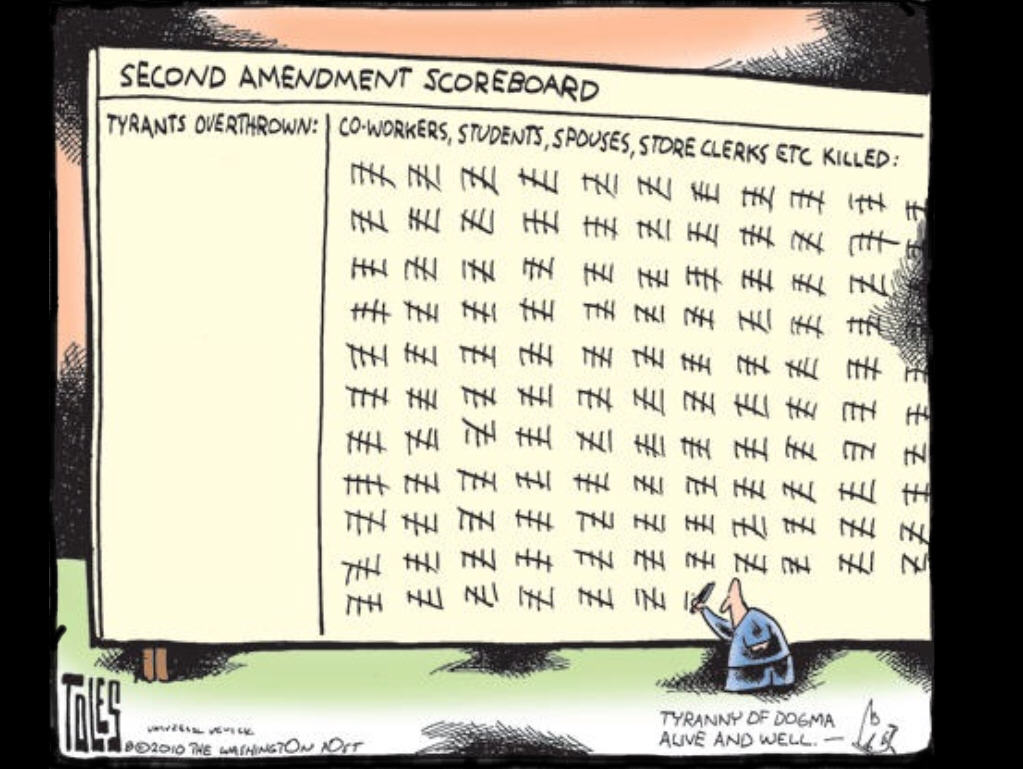
Tag Archives: guns

The Limits of Originalism

The Rahimi case isn’t getting a lot of coverage, because (as an 8-1 victory for common sense), it doesn’t make good clickbait. But the conservative judges are having an important discussion about the future of originalism.


Imagine you’re at a dinner party. On your way back from the bathroom, you happen to overhear a snatch of conversation from the kitchen: Your hosts have been discussing whether to poison your meal, and decide not to.

How should you feel about that? Relieved? Poisoning is a bad thing, and it’s not going to happen to you tonight. Angry? Why? Murder is wrong, and your hosts have decided not to do it. They’ve made the moral choice. Good for them.

Or maybe you focus on this question: Why were they having that conversation to begin with?

The Rahimi case. Now you can imagine how I feel about the outcome of United States v Rahimi, which the Supreme Court announced Friday. They decided that Congress does have the right to pass laws that take guns away from domestic abusers who are under restraining orders. Or, looking at it from the other side of the gun, men who have been judged by a court to pose a credible threat to their intimate partners do not have an absolute right to bear arms.

Good job, justices. With only one dissent (corrupt Clarence Thomas) they made the right call. Good for them. But why were they having that conversation to begin with? Why did anyone think that in one of the most obvious potential-murder situations imaginable [1], our legal system is banned from offering a woman even the simplest kind of protection?

In particular, why did anyone think it might be unconstitutional to disarm Zackey Rahimi, who perfectly exemplifies why domestic abuse laws exist? Rahimi didn’t just threaten the estranged mother of his child with a gun and then violate the restraining order she got for her own (and her child’s) protection, he also was involved in several other shooting incidents, some related to his personal anger-control issues and others stemming from his professional role as a drug dealer.

That guy. Even worse, Rahimi was making what is known as a facial challenge to the law disarming domestic abusers. In ordinary English, the law is unconstitutional on its face; there are no conceivable situations in which the law could be applied without violating the Second Amendment.

Why would anybody take that claim seriously enough that the Supreme Court should have to decide it?

Two reasons, really:

  • Two years ago, in the Bruen case (which was announced almost simultaneously with the Dobbs decision reversing Roe v Wade), the Court proclaimed a new test for Second Amendment constitutionality that called nearly all American gun laws into question.
  • And then in 2023, one of the few courts even more batshit crazy than the Supreme Court itself (the Fifth Circuit Court of Appeals) applied the Bruen test to Zackey Rahimi and ordered the government to give him back his guns.

So that’s where we were as of Thursday: Unless the Court acted, Rahimi was getting his guns back, and the mother of his child had just better watch out. Not only wouldn’t the government help her, it was constitutionally barred from ever doing so, no matter what Congress or any other elected officials might think.

The Bruen test. You’ll never guess who wrote the majority opinion in Bruen. OK, maybe you will: corrupt Clarence Thomas, with the backing of the other five conservative justices, including all three of the Trump justices. The heart of that ruling is this:

[W]e hold that when the Second Amendment’s plain text covers an individual’s conduct, the Constitution presumptively protects that conduct. The government must then justify its regulation by demonstrating that it is consistent with the Nation’s historical tradition of firearm regulation. Only then may a court conclude that the individual’s conduct falls outside the Second Amendment’s “unqualified command.”

In a hearing before the Fifth Circuit, the government offered various colonial or founding-era analogues of the domestic abuse law in question, and the judges found none of them quite analogous enough. Justice Sotomayor’s concurrence with Friday’s decision explained why this might be:

Given the fact that the law at the founding was more likely to protect husbands who abused their spouses than offer some measure of accountability, see, e.g., R. Siegel, “The Rule of Love”: Wife Beating as Prerogative and Privacy, 105 Yale L. J. 2117, 2154–2170 (1996), it is no surprise that that generation did not have an equivalent to [the law Rahimi has challenged]. Under the dissent’s [i.e. Thomas’] approach, the legislatures of today would be limited not by a distant generation’s determination that such a law was unconstitutional, but by a distant generation’s failure to consider that such a law might be necessary. History has a role to play in Second Amendment analysis, but a rigid adherence to history, (particularly history predating the inclusion of women and people of color as full members of the polity), impoverishes constitutional interpretation and hamstrings our democracy.

Putting her point more bluntly: When the Second Amendment was ratified in 1791, women were not really people, and wives in particular were subject to the whims of their husbands in ways we no longer accept. So you’re not going to find much in the way of domestic-violence legislation from that era, much less laws disarming domestic abusers. But that’s because the founding generation just didn’t think domestic violence was a problem worthy of government action, not necessarily because they endorsed the right of dangerous people to be armed.

But the Fifth Circuit didn’t look at it that way: Nobody disarmed the Zackey Rahimis of 1791, so we shouldn’t be able to disarm Zackey Rahimi today.

Originalism. Like Justice Alito’s majority opinion in Dobbs, Thomas’ opinion in Bruen (and his dissent in Rahimi) is an example of a method of constitutional interpretation known as originalism. All six conservative justices claim to be originalists. In his Rahimi concurrence, Justice Kavanaugh restates the fundamental notion of originalism:

The first and most important rule in constitutional interpretation is to heed the text—that is, the actual words of the Constitution—and to interpret that text according to its ordinary meaning as originally understood.

Originalism was popularized by the late Justice Anton Scalia, who spent most of his career in the minority, writing rousing dissents. But in recent years, originalists have become the majority on the Court, raising a significant issue: How do you turn a critical theory into a governing theory? [2] Most of the time, Scalia didn’t have to worry about the practical implications of his views, because they weren’t going to be adopted anyway. Now, though, originalists have to be concerned with consequences, like arming the Zackey Rahinis of the world.

In arguing against originalist interpretations, it’s important to understand precisely where originalists are and aren’t coming from. The point isn’t that the Founders were divinely inspired lawgivers like Moses (though some conservatives do believe this). Originalism says something more fundamental about the basis of law in a constitutional democratic republic like the United States: For laws to be binding on the People, the People must at some point have accepted that burden. So any legitimate originalist analysis [3] revolves around the questions: When did the People accept this restriction or give the government this power?

So, for example, look back at another case in this term: Cargill, the bump-stock case. That case revolves around two questions: When did the American people give up their right to own machine guns? And what did they think a “machine gun” was at that time? The answer to the first question is that (through their elected representatives) they gave up that right in the National Firearms Act of 1938. The NFA contains a definition of machine gun, which the justices then argue about.

The blurring effects of time. The root problem with originalism is that a text’s “ordinary meaning as originally understood” is way more complicated than Kavanaugh makes it sound. Individual people living in the same era think at different levels of abstraction. So consider the “bear arms” phrase in the Second Amendment. To one American living in 1791, the Amendment might apply abstractly to all “bearable arms” — any weapon that can be carried by one person. [4] His neighbor might have a more specific way of thinking, and so picture “arms” as the weapons he has seen or handled personally: flintlocks, sabres, and bows. A third citizen might think about the effects of arms: To him, the Amendment applies to anything that does roughly the same amount of damage as flintlocks, sabres, and bows. He might not have been picturing African blowguns, but if you described them to him he would probably see them as “arms” as well.

At that one particular moment in 1791, those three ways of thinking were in alignment: The arms that could be borne were flintlocks, sabres, and bows, but not cannons. The three citizens have different mental notions, but they will agree on any specific case that comes up.

But as the world changes, notions that once agreed come out of alignment. Transport our three founding-era citizens to World War II and show them a bazooka. The first citizen sees a weapon bearable by one person, the second sees something totally unlike any weapon he has used, and the third sees something more analogous to a cannon than a flintlock. So what is the “original meaning” of Second Amendment “arms” as applied to a bazooka?

That’s why our jurisprudence is so inconsistent in its originalism. (My advice: Don’t try to buy a bazooka.) Take the NFA of 1938 for example. Our first citizen looks at a 1938 Thompson submachine gun (or our era’s combat-ready M-16) and sees a bearable weapon, so to him the NFA’s ban on such weapons is clearly unconstitutional. But none of our current “originalist” justices took that position in Cargill.

The blurring legal environment. Sometimes what changes isn’t technology, but the context of other laws that surround a given law. That’s what happened with same-sex marriage. The Obergefell decision that legalized same-sex marriage nationally in 2015 was based on the 14th Amendment, which was ratified in 1868. [5]

But did the people of 1868 or their elected representatives realize they were legalizing same-sex marriage? Of course not. In the legal environment of the time, same-sex marriage didn’t even make sense. At the time, husbands and wives had different rights and responsibilities under the law, so “Which one of you is the husband and which one is the wife?” was a legitimate question. Also, men had more legal rights than women — most obviously the right to vote, but many others as well. So all opposite-sex households had one vote, but a same-sex household had either zero votes or two. How could that be justified?

By 2015, though, all those legal problems had gone away, for reasons that had nothing to do with homosexuality. Under the law, there are two spouses with legal equality, and neither role requires any special rights only available to one gender or the other. So the only reason to write marriage laws restricted to opposite-sex couples is prejudice against same-sex couples — something “equal protection of the laws” doesn’t allow.

Americans of 1868 couldn’t have foreseen how “equal protection of the laws” would apply to marriage in 2015. But they understood what “equal protection” meant as a principle, and they agreed to it.

Back to Rahimi. Except for Thomas himself, all the justices — liberal and conservative alike — recognize that the originalist logic of Bruen has led the Court to the edge of an abyss: Rahimi should get his guns back. This obviously is a bad outcome, and who knows what worse monsters might also regain their arms and go on to murder their intimate partners or ex-intimate partners? This result is not only bad in itself, but — like Dobbs — will incite a voter backlash against the Court, and against the Republican Party that appointed this conservative majority.

That majority, above all, is partisan. Thomas and Alito clearly want to retire, but will only do so if a Republican president can replace them. The others (with the possible exception of Barrett, who hasn’t done enough yet to earn my negative judgment) enjoy being in the majority and don’t want a re-elected President Biden to shrink that majority by appointing liberals.

Possibly even worse is the effect Bruen has had on the lower courts. The standard of keeping the laws “consistent with the Nation’s historical tradition of firearm regulation” is not only impossibly vague, but the example Bruen sets — cherry-pick history until you get the result you want — invites the worst kind of judicial activism.

Justice Jackson (who hadn’t joined the Court yet when Bruen was decided) lays this out as politely as possible.

This case highlights the apparent difficulty faced by judges on the ground. Make no mistake: Today’s effort to clear up “misunderst[andings],” [from Roberts’ majority opinion] is a tacit admission that lower courts are struggling. In my view, the blame may lie with us, not with them.

The message that lower courts are sending now in Second Amendment cases could not be clearer. They say there is little method to Bruen’s madness. It isn’t just that Bruen’s history-and-tradition test is burdensome (though that is no small thing to courts with heavier caseloads and fewer resources than we have). The more worrisome concern is that lower courts appear to be diverging in both approach and outcome as they struggle to conduct the inquiry Bruen requires of them. Scholars [in an amicus brief on this case] report that lower courts applying Bruen’s approach have been unable to produce “consistent, principled results,” and, in fact, they “have come to conflicting conclusions on virtually every consequential Second Amendment issue to come before them”.

So Bruen needs to be fixed somehow, or at least reined in. But how?

Liberal interpretation. Everyone on the Court is an originalist up to a point: If the text of a law is clear, if its “ordinary meaning as originally understood” can be ascertained, and the varied understandings of people at the time are still more-or-less in alignment, then that well-understood text should be respected. If such a law needs to be fixed according to our current notions of justice, Congress should do it, not the Court.

Conservatives claim liberals don’t believe this [6], but we do.

On most issues controversial enough to reach the Supreme Court, though, liberals recognize that there is no “original understanding” that covers the contemporary situation. (See the examples above.) And yet there is a case that needs to be decided: Rahimi either gets his guns back or he doesn’t.

To state the liberal view more simplistically than probably any of the current liberal justices would: Liberals want to give the original lawmakers the benefit of the doubt. Maybe they couldn’t have foreseen the current situation, but they didn’t intend for us to do something stupid with their words. And while much has changed since the 1700s — women and the non-European races have become people, as Sotomayor points out — certain abstract notions of justice are closer to timeless, and are still more-or-less the same. So we can use those shared values to update our interpretation of the text.

Ideally, the most important texts come up fairly often, so that the record of judicial precedents represents a continuous updating rather than an abrupt break with the past (as Dobbs, Bruen, and Heller were). Like the laws themselves, precedents should be read generously, because the justices of the past also wouldn’t want us to do something stupid with their words.

Of course, this approach requires that current justices have some measure of wisdom and aren’t too humble to use it. That openly confident wisdom is anathema to originalists, who insist that any application of contemporary wisdom must happen covertly, by manipulating history and then claiming to follow it.

Originalism trying to fix itself. Every conservative justice but Alito wrote an opinion on this case. Thomas’ lonely dissent doubles down on Bruen: If the logic of Bruen sends us over a cliff, then here we go. But the other four aren’t willing to jump with him, and feel obligated to explain why not. All of them are sneaking some version of liberal interpretation into their thinking, while denying that they do so.

Roberts’ majority opinion claims that a law can be “consistent with the Nation’s historical tradition of firearm regulation” even if there is no exact parallel, as long as it is analogous to laws from the colonial or founding eras. How close does the analogy need to be? How many parallel regulations establish a “tradition” rather than an anomaly? He doesn’t precisely say. The point is to get enough wiggle room that we don’t have to give back Rahimi’s guns, an outcome that violates “common sense”.

Taken together, the surety and going armed laws confirm what common sense suggests: When an individual poses a clear threat of physical violence to another, the threatening individual may be disarmed.

Such an appeal to contemporary common sense clearly doesn’t sit well with the other conservative justices, who have to write concurrences to put their own spin on it. Kavanaugh’s opinion in particular is a long and fairly dull exposition of originalism that rarely mentions the current case. (As I read, I kept saying “Dude, write a textbook.”) To me, he seems to need to repledge his fealty to originalism precisely because he knows he’s violating it.

The only conservative concurrence that seems honest to me is Barrett’s. (I am developing a grudging affection for Barrett. She’ll probably disillusion me soon, but I have to give credit where it’s due.) Like Jackson, she recognizes that lower courts have had trouble applying Bruen, as well as the inherent limitations of the historical method Kavanaugh extols at such length.

[I]mposing a test that demands overly specific analogues has serious problems. To name two: It forces 21st-century regulations to follow late-18th-century policy choices, giving us “a law trapped in amber.” And it assumes that founding-era legislatures maximally exercised their power to regulate, thereby adopting a “use it or lose it” view of legislative authority. Such assumptions are flawed, and originalism does not require them.

“Analogical reasoning” under Bruen demands a wider lens: Historical regulations reveal a principle, not a mold.

Examining founding-era firearms regulations reveals the “contour” of the right the Founders thought they were recognizing, but doesn’t always lay down its precise terms. Barrett recognizes that being a judge requires applying a certain amount of wisdom to past examples, to draw out the abstract principles behind them. It’s not just “calling balls and strikes” as Roberts claimed at his confirmation hearing and Kavanaugh endorsed in his concurrence. She ends up deciding that the majority opinion in this case “settles on just the right level of generality”, and so she concurs.

I read that as a statement of confidence in her contemporary wisdom, not an effort to hide her judgment behind a fog of historicism.

Conclusion. The Rahimi case is not getting a lot of press coverage, largely because it came to a common-sense conclusion: Rahimi (and other malefactors like him) shouldn’t be armed. It is within the power of Congress and state legislatures to make such decisions.

But the conservative judges are subtly arguing about how to sneak contemporary wisdom (sometimes disguised as “common sense”) back into judicial reasoning. As a governing theory, originalism will have to recognize that the wisdom of the past does not solve all our problems. At some point, judges have be judicious.


[1] According to the Department of Justice:

Of the estimated 4,970 female victims of murder and nonnegligent manslaughter in 2021, data reported by law enforcement agencies indicate that 34% were killed by an intimate partner … Overall, 76% of female murders and 56% of male murders were perpetrated by someone known to the victim. About 16% of female murder victims were killed by a nonintimate family member—parent, grandparent, sibling, in-law, and other family member

[2] This problem parallels the one in the House of Representatives, where MAGA rebels suddenly have real power.

[3] I use the word legitimate because, as I’ve stated in other posts, I don’t believe that most originalist arguments are made in good faith. By cherry-picking historical examples and engaging in opportunistic reasoning no historian studying that era would vouch for, a judge can almost always find an “originalist” justification for whatever conclusion he wants to come to.

Justice Alito’s majority opinion in Dobbs, in my opinion, was an example of this kind of bad-faith historicism. And so was Justice Scalia’s opinion in 2008’s Heller case, which (as Justice Jackson puts it in her concurrence) “unearthed” a new individual right to bear arms, upsetting a consensus interpretation of the Second Amendment that Justice Breyer’s dissent in Heller claimed “ha[d] been considered settled by courts and legislatures for over two centuries”.

Justice Kavanaugh can’t admit that Scalia invented his Heller interpretation out of nothing, but does say: “Second Amendment jurisprudence is still in the relatively early innings, unlike the First, Fourth, and Sixth Amendments, for example. That is because the Court did not have occasion to recognize the Second Amendment’s individual right until recently.”

[4] This is the position Justice Scalia laid out in Heller:

the Second Amendment extends, prima facie, to all instruments that constitute bearable arms, even those that were not in existence at the time of the founding.

[5] Justice Kennedy’s majority opinion rooted his argument in the 14th Amendment’s Due Process clause, but (like some of the concurring justices) I think the 14th Amendment’s guarantee of “the equal protection of the laws” is a cleaner justification.

[6] Kavanaugh’s concurrence warns against “an approach where judges subtly (or not so subtly) impose their own policy views on the American people”, which he sees as the only alternative to originalism’s historical method of interpreting “vague” text.
This week’s legal decisions

A temporary victory for abortion pills, the effective legalization of machine guns, and lower court protection for families with trans children. Meanwhile, continued stalling to protect Donald Trump from prosecution.


We’re getting near the end of the Supreme Court’s term, so the rulings will come hot and heavy for the rest of the month. Several important cases are still pending, but a few decisions came in this week.

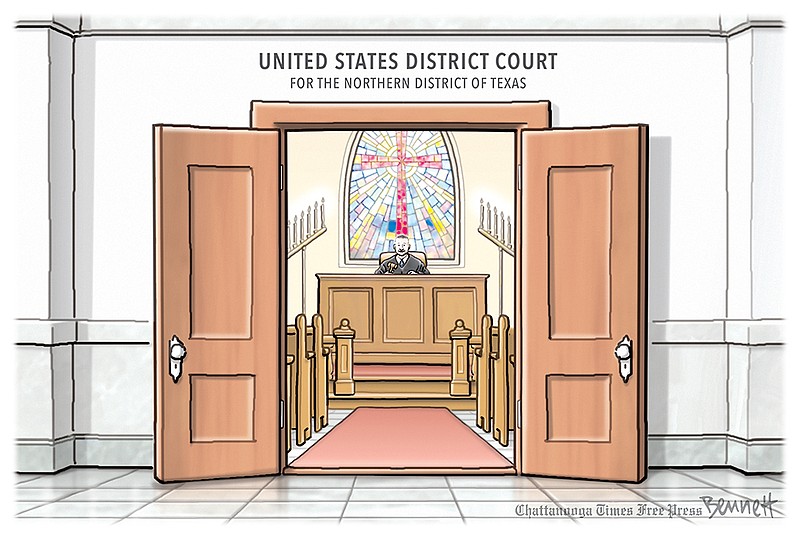
The abortion pill mifepristone got a reprieve. As I’ve explained in the past, there is a federal district around Amarillo where cases are wired to go in front of a Christian nationalist judge, Matthew Kacsmaryk, and go from there to the nation’s most conservative appeals court, the Fifth. In the spring of 2023, anti-abortion groups (established in Amarillo precisely to take advantage of this legal pipeline) targeted mifepristone, the drug used in more than half of abortions nationally.

Predictably, Kacsmaryk suspended the FDA’s approval of mifepristone, effectively banning it nationally. That decision was partially reversed by the Fifth Circuit, and then totally stayed by the Supreme Court, pending its own decision. (So far, no one has been prevented from using mifepristone in states where it would otherwise be permitted.)

There are many ways to reverse Kacsmaryk’s decision, because it is baseless both legally and scientifically. Vox described the scientific situation like this:

The case has virtually no scientific merit, and challenging the use of a drug that has been studied and safely used for over two decades is highly unusual. Jack Resneck Jr., the president of the American Medical Association, said in a statement Friday night that Kacsmaryk’s “disregard for well-established scientific facts in favor of speculative allegations and ideological assertions will cause harm to our patients and undermines the health of the nation.”

But the Court decided not to go there. Instead, it pointed to the legal ridiculousness of the lawsuit: The plaintiffs have no standing to sue. [1]

As was obvious from the beginning, these plaintiffs — primarily doctors who don’t prescribe mifepristone — have no standing. They made up, and two levels of federal courts accepted, a ridiculous explanation of how mifepristone harms them: On the rare occasions when mifepristone fails, a woman caught in the middle of a miscarriage might show up on their doorsteps or emergency rooms, and they might have to do a procedure they morally object to in order to save her life.

Putting aside the issue of how any principle requiring a doctor to do nothing while he watches a woman die can be considered “moral”, Justice Kavanaugh (writing for a rare 9-0 Court) noted that federal conscience protections already protect the doctors, so they are not injured. So the suit should never have been heard in the first place. Slate’s Dahlia Lithwich and Mark Joseph Stern comment:

A doctor who opposes abortion, the court affirmed, may stand by and watch a patient bleed out rather than treat her in contravention of his conscience. Ironically, then, an anti-abortion statute that protects anti-abortion doctors played a key role in defeating the plaintiffs’ claim. Their own lavish safeguards against terminating a pregnancy—or even just treating a patient who already terminated a pregnancy—helped defeat their attempt to pull mifepristone off the market.

They go on to observe:

Yet the decision was not a total defeat for anti-abortion activists. Among other things, Kavanaugh slipped language into his opinion that could expand protections for physicians who refuse to provide emergency abortions, potentially imperiling the lives of patients.

The Court’s ruling also left open the fundamental issue — whether the FDA was right (or within its legal authority) to approve mifepristone at all. The most likely course forward from here is that new plaintiffs with different explanations of why they are not busybodies will pick up the suit, and the whole circus will start again.

One path flows from a brief line near the end of the Alliance opinion: “[I]t is not clear that no one else would have standing to challenge FDA’s relaxed regulation of mifepristone.” Last January, Kacsmaryk ruled that three red states — Idaho, Missouri, and Kansas — could join this lawsuit and press the claim that mifepristone should be banned. 

It is far from clear how these states are injured by the mere fact that mifepristone is legal. But Kacsmaryk’s (and the Fifth Circuit’s) behavior in this case and others shows that he’s willing to bend the law into pretzels in order to rule against abortion rights. It is likely, in other words, that Kacsmaryk will simply make up some reason why the red states have standing to sue and then issue a new order attempting to ban mifepristone.

In other words, this isn’t over. Another path forward is that Trump could win the election and instruct the FDA to rescind its approval or impose new restrictions on mifepristone’s use, or reinterpret the Comstock Act of 1873 to prevent distribution of mifepristone by mail. Good luck getting a straight answer out of him on those questions.

It’s now legal to alter your AR-15 to function as a machine gun. If you’ve ever watched a gangster movie set in the Al Capone era, you’ve seen the destructive power of that era’s submachine guns, the weapon of choice in the St. Valentine’s Day Massacre of 1929.

Responding to that problem, Congress made tommy guns and other fully automatic weapons illegal for civilian use in the National Firearms Act of 1934. By 2002, though, a new technology had inserted a loophole in that ban: the bump stock. A bump stock is an add-on piece of equipment that uses a semiautomatic rifle’s recoil to release and pull the trigger over and over again, so that the shooter’s experience resembles firing a machine gun.

Most explanations of bump stocks available on the internet are by pro- or anti-gun activists, and so should be taken with a grain of salt. However, this one comes from a general how-things-work channel, Zack Nelson’s JerryRigEverything. The video was made while bump stocks were legal.

Zack refuses to state an opinion on whether bump stocks should be legal or not, saying ambiguously: “Personally, I think guns are a great hobby, but not everyone in the world is sane.”

Most people had never heard of bump stocks until the Las Vegas massacre of 2017, when a gunman used one to fire more than 1,000 rounds down on a crowd gathered for a music festival. He killed 60 and wounded over 400, with an almost equal number injured in the stampede of people trying to get to safety. (Like tommy guns, bump-stocked AR-15s aren’t very accurate, making them poor sniper weapons. But if you’re firing at thousands of people, accuracy isn’t that important.) To the untrained ear, audio from the massacre certainly sounds like somebody is firing a fully automatic weapon. (For what it’s worth, real gun people claim otherwise, that a fully automatic machine gun fires even faster.)

Responding to public outrage, the Trump administration Bureau of Alcohol Tobacco and Firearms (ATF) changed its interpretation of the NFA’s machine gun ban, ruling that a bump stock converted a semiautomatic weapon into an automatic weapon, and so was illegal. That ruling was challenged in court, and the case has taken six years to make it to the Supreme Court.

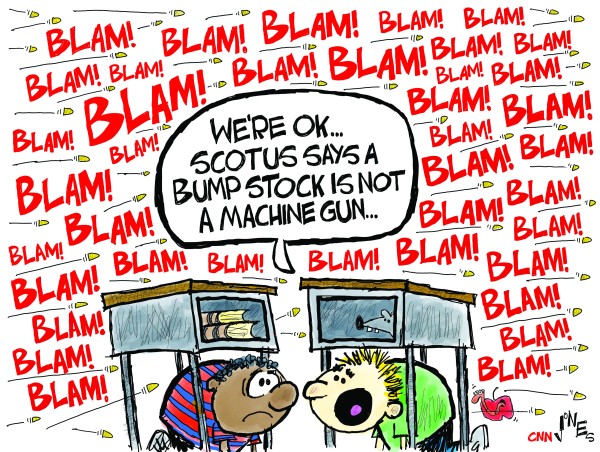
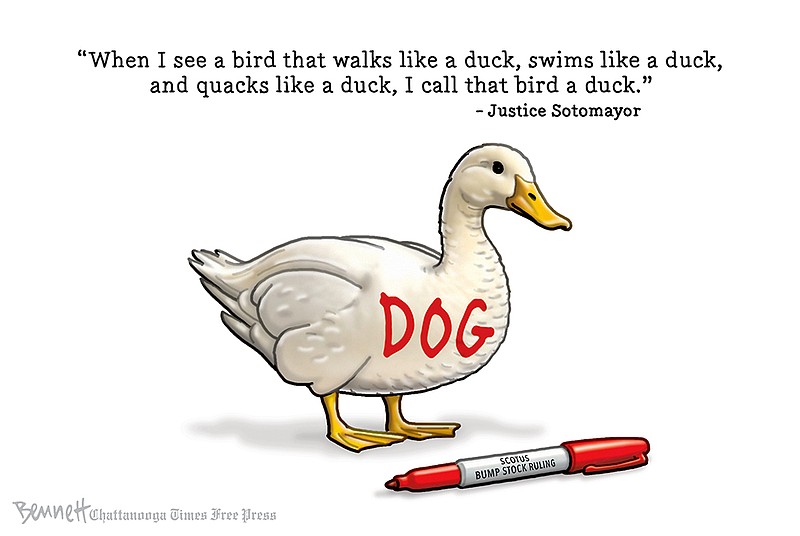
Friday, the Court struck down the bump stock ban in a ruling that split 6-3 along the usual ideological divide. The majority opinion was written by the corrupt Justice Clarence Thomas [2]. It centers on the exact definition of “machinegun” in the NFA:

any weapon which shoots, is designed to shoot, or can be readily restored to shoot, automatically more than one shot, without manual reloading, by a single function of the trigger.

Thomas goes on to focus on the “function of the trigger” in its mechanical sense: As far as the gun is concerned, its trigger is being pulled once for each shot. In her dissent, Justice Sonya Sotomayor focuses on the experience of the shooter, who pulls the trigger once and keeps his finger stationary as the gun bucks back and forth against it. The Congress of 1934, I suspect, intended to focus on the experience of the victims, but they didn’t phrase the law that way, so here we are.

In an ideal world, it’s obvious what would happen next: Congress would say “oops” and would amend the NFA based on some other criteria, like perhaps the rate of fire. That’s what President Biden wants [3], and what Justice Alito’s concurrence suggests, perhaps disingenuously.

There is a simple remedy for the disparate treatment of bump stocks and machineguns. Congress can amend the law—and perhaps would have done so already if ATF had stuck with its earlier interpretation. Now that the situation is clear, Congress can act.

The reason I suggest Alito’s recommendation might not be completely serious is that he knows his right-wing allies won’t allow this to happen. I would be amazed if Speaker Johnson allowed even the narrowest possible bump-stock ban to make it to the House floor for a vote, and Republicans would almost certainly filibuster such a bill in the Senate.

Sunday, possible Trump VP Senator Tim Scott dodged taking any position on a bump stock ban, while another Trump VP hopeful from the House, Byron Donalds went full gaslight:

A bump stock does not cause anybody to be shot in the United States. That is the shooter that does that.

Donalds might want to explain that to the families of the Las victims, many of whom would probably be alive if the shooter had not been able to use a bump stock. It’s also worth pointing out that Donalds’ logic justifies legalizing any weapon, no matter how destructive. After all, nuclear weapons don’t destroy cities, people destroy cities.

Meanwhile, a spokesman for the Republican Party’s lord and savior, convicted felon Donald Trump, for once expressed faith in our justice system.

The court has spoken and their decision should be respected.

This pattern is not a coincidence: If you make Congress dysfunctional and unresponsive to the people, and then interpret the laws and the powers of agencies like the ATF strictly, the result is that when technology changes, old regulations lapse and can’t be updated. That’s not some unfortunate bit of happenstance; it’s two sides of the same strategy. Today it results in the effective legalization of machine guns. Tomorrow the loophole will be in the Clean Air Act or the antitrust rules. When the laws stand still, malefactors adapt.

Gender-affirming care. In an important lower-court case, a judge found a Florida law banning gender-affirming care for minors to be unconstitutional. This ruling differs from the case of a similar Alabama law, which was upheld by the 11th Circuit appeals court (where this case is headed) in that Judge Robert Hinkle found malice on the part of the legislature. That issue wasn’t raised in the Alabama case.

The plaintiffs have shown that animus motivated a sufficient number of statutory decisionmakers.

Judge Hinkle found that “gender identity is real” and is distinct from an individual’s “external sexual characteristics and chromosomes”. He also noted that the treatments at issue — puberty blockers and hormones like estrogen and testosterone [4] — are legal in Florida for other purposes.

[C]onsider a child that a physician wishes to treat with GnRH agonists to delay the onset of puberty. Is the treatment legal or illegal? To know the answer, one must know whether the child is cisgender or transgender. The treatment is legal if the child is cisgender but illegal if the child is transgender, because the statute prohibits GnRH agonists only for transgender children, not for anyone else.

If these treatments have risks, parents of non-trans kids (in consultation with doctors) are allowed to judge those risks for themselves. But in trans cases, the state’s judgment prevails.

Susan Doe, Gavin Goe, and Mr. Hamel have obtained appropriate medical care. Qualified professionals have properly evaluated their medical conditions and needs in accordance with the well-established standards of care. The minors, to the extent of their limited ability, and their parents, and Mr. Hamel, all in consultation with the treating professionals, have determined that the benefits of their gender-affirming care will outweigh the risks. The parents’ and Mr. Hamel’s ability to evaluate the benefits and risks of this treatment in their individual circumstances far exceeds the ability of the State of Florida to do so.

Judge Hinkle found a motive for the State of Florida assuming the power to overrule parental and medical judgment:

The defendants [i.e., the State of Florida] have explicitly admitted that prohibiting or impeding individuals from pursuing their transgender identities is not a legitimate state interest. But the record shows beyond any doubt that a significant number of legislators and others involved in the adoption of the statute and rules at issue pursued this admittedly illegitimate interest.

The ruling quotes numerous statements by legislators or Governor DeSantis that show animus, such as referring to transgender witnesses at hearings as “mutants” and “demons”, denying the reality of gender identity, or exaggerating gender-affirming care by talking about “castrating” young boys. The fact that no one supporting the anti-care bill contested these statements, according to the judge, was evidence that such sentiments were widespread in the legislature.

Trump’s immunity. The Court continues to sit on the apparently simple issue of Donald Trump’s absolute-immunity claim, which has been rejected by every lower-court judge who heard it. By taking the case and refusing to rule promptly, the Court has made it all-but-certain that no trial can be held prior to the election on Trump’s plot to stay in power after losing in 2020. Without the Court’s interference, the public would already have heard testimony under oath from key witnesses like Mike Pence and Mark Meadows.

Particularly given the apparent bias of Justices Alito (whose home and vacation home were the site for pro-insurrection flags) and Thomas (whose wife traded texts with Mark Meadows to encourage resistance to accepting the will of the voters), it’s hard to see the Court’s actions as anything other than an attempt to put its thumb on the scale to Trump’s benefit.

My prediction is that the immunity ruling will come out on the second-to-last day of the term. Putting it last would underline the Court’s intent to delay justice, so the conservative majority will probably sacrifice a day or two of delay to avoid that poor appearance.


[1] Standing is one of the basic concepts of civil lawsuits: A court can only rule on a situation if a suit is brought by someone actually affected. For example, I can’t sue for divorce on behalf of one of my friends, no matter how convinced I am that she needs to be out of that marriage. Requiring that a plaintiff have standing is basically a no-busybodies rule.

[2] I am going to use the word corrupt whenever Thomas’ name comes up until he is either removed from the Court or is called to account in some other way. This week we found out that Thomas has received even more billionaire gifts than the $4 million that were previously known.

Thomas claims these gifts are not bribes, but fall into a loophole for gifts from “friends”. However, Thomas’ rich friends are right-wing donors he had never met before joining the Court.

So as far as this blog is concerned, “corrupt Justice Clarence Thomas” is his full name.

[3] Biden would also like to see an assault weapon ban in that amended bill, but is likely to sign a smaller reform if he gets the chance.

[4] Gender-affirming surgeries on minors, according to the judge, “are extraordinarily rare and are not involved in this litigation.”

I am radicalizing against guns

Anger is replacing sadness and hope.
Gun worship is American society’s greatest sickness.
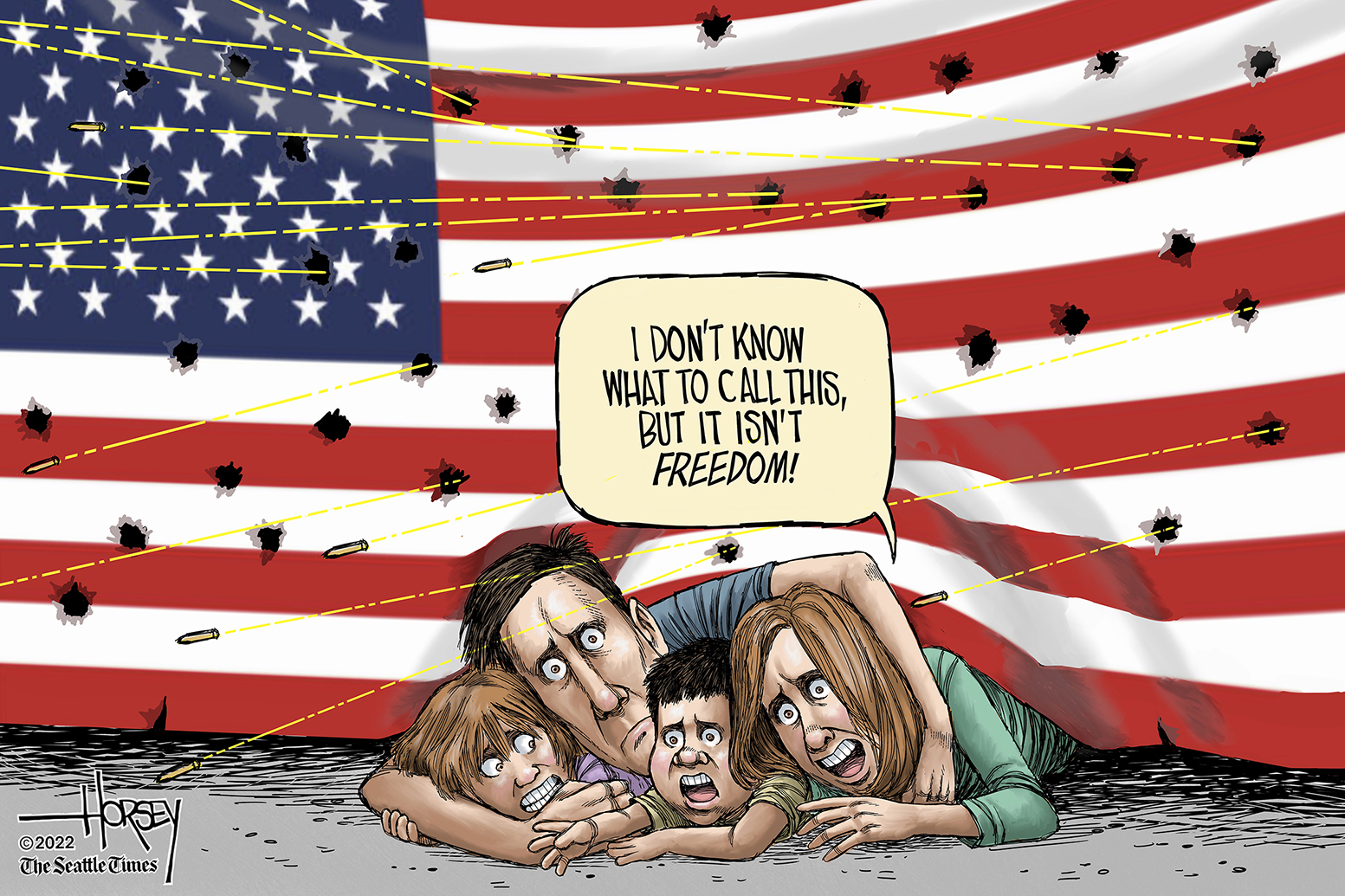
Guns don’t preserve freedom, they threaten it.
And if the Second Amendment won’t allow action, it has to go.


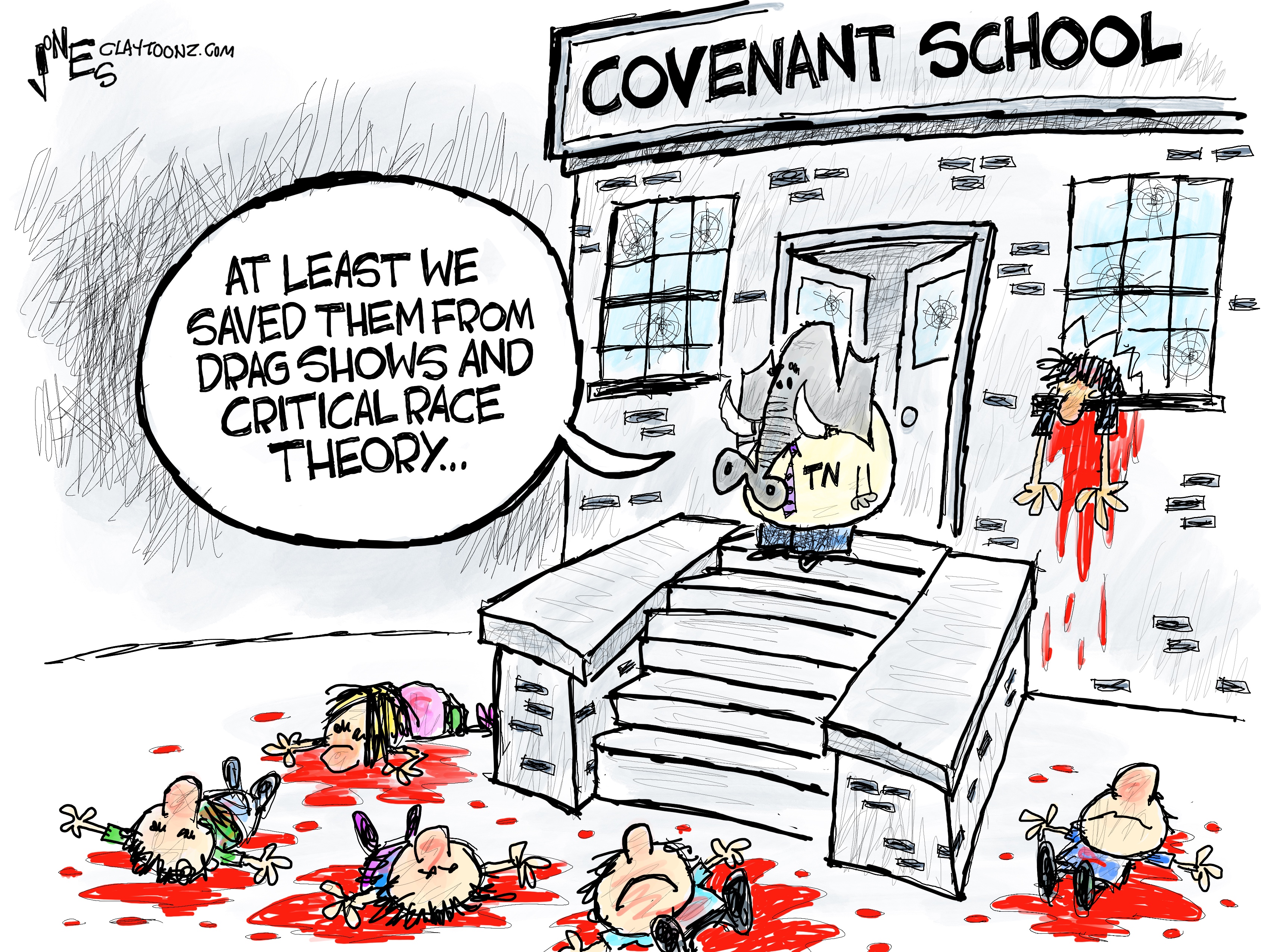
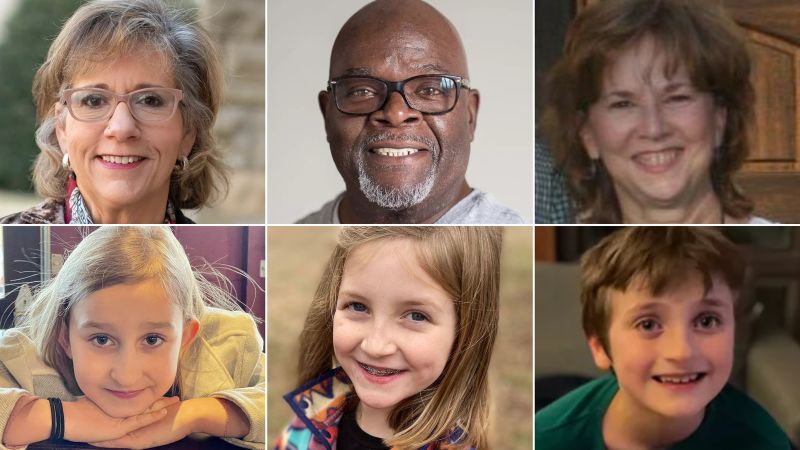
Last Monday, three students and three staff members of the Covenant School in Nashville were killed by a shooter. As you all know, this is not a new phenomenon in America. The Gun Violence Archive says it was the 130th mass shooting in the US in 2023. Gun violence has now replaced auto accidents as the #1 cause of death for children and teens.

But all the same, something about it felt different. At least to me.

Covenant School shooting victims

Earlier school shootings, like Columbine or Sandy Hook or Parkland, left the nation with a sense of horror and sadness. But there was also a tinge of hopefulness: Maybe this would be as far as it goes. Maybe now, at long last, everyone would see that we had to do something about our gun problem.

That hopefulness is gone now. We’ve been through this so many times that the truth has become very clear: Some people will never see. They don’t want to see.

So last Monday, I didn’t feel any hopefulness in myself or see it in others. Instead, what I felt and saw was anger.

Post-Covenant rage. It started right away. Last Monday, Ashbey Beasley jumped in front of the cameras after Nashville police finished briefing the news media on the shooting, and ranted against our national inaction. Beasley and her son had been at the 4th of July parade in Highland Park last summer where a sniper killed seven people, and now she was on vacation in Nashville for another mass shooting.

How is this still happening? Why are our children still dying and why are we failing them? … These mass shootings will continue to happen until our lawmakers step up and pass gun safety legislation.

Rep. Jamaal Bowman of New York, a former middle school principal, was angry too. He stood outside the House chamber and railed at Republican congressman as they walked past.

They’re all cowards! They won’t do anything to save the lives of our children at all! Question them! Force them to respond to the question: “Why the hell won’t you do anything to save America’s children?” And let them explain that all the way up to election day in 2024.

When Kentucky’s gun-worshiping Congressman Thomas Massie stopped to argue with him, saying that schools that arm teachers haven’t had shootings, Bowman didn’t back down.

More guns lead to more deaths. Look at the data. You’re not looking at any data. … Have you ever worked in a school?

Both of these clips went viral as people responded to the justified outrage. Meanwhile, a Republican congressman was also going viral: Tim Burchett from Knoxville, who was fatalistic about gun violence. He acknowledged that the Nashville shooting was a “horrible, horrible situation”, but then said:

We’re not going to fix it. Criminals are going to be criminals. And my daddy fought in the Second World War, fought in the Pacific, fought the Japanese, and he told me, he said, “Buddy,” he said, “if somebody wants to take you out and doesn’t mind losing their life, there’s not a whole heck of a lot you can do about it.”

That caused Daily Show host John Leguizamo to respond with this:

That’s the best you have to offer? You’re a congressman. If you don’t have any ideas for how to keep our kids safe, get the fuck out of the way and go work at a Pinkberry or some shit.

Hundreds, mostly young people, protested at the Tennessee Capitol Thursday.

Meanwhile, in the House, two Democratic lawmakers caused a temporary shutdown when they began yelling, “Power to the people” through a megaphone.

For so long, gun-control advocates have tried to be the soft voice of reason, and to project empathy for the strong feelings of gun advocates. Democratic politicians have treated the issue as a loser. The conventional wisdom said that pro-gun people would vote their convictions, while gun-control advocates wouldn’t. And so politicians who aren’t in the NRA’s pocket have offered only small measures: “Can we at least have background checks on gun sales? Can we at least keep guns away from the mentally ill or people with restraining orders for domestic violence?”

And the answer has inevitably been No.

Republicans are pushing guns more than ever. As the American people have been moving in one direction, Republicans at the state level have been moving in the other.

Tennessee lawmakers have instead moved to make firearms even more accessible, proposing bills this year to arm more teachers and allow college students to carry weapons on campus, among other measures. … In Kentucky, Ohio, Nebraska, Texas and Virginia, Republicans have pushed this year to limit gun-free zones, remove background checks and roll back red-flag laws that seek to remove firearms from those who are a danger to themselves or others.

Even before the recent steps backward, Tennessee was already one of the worst states in the country when it comes to addressing gun violence, ranking 9th in gun deaths per capita. [1] Back in 2017, the minority leader of the Tennessee House, Rep. Mike Stewart, demonstrated just how ridiculous the state’s gun laws were by offering an AK-47 for sale at a downtown lemonade stand. Private gun sales required no background checks then and still don’t. He had bought the assault rifle in a parking lot with no background check and was proposing to sell it the same way.

The sickness of gun worship. But laws are not the whole problem. Arguably, our gun culture is worse. Guns in America are not just tools for self-defense or sport. They are symbols of identity and objects of cult veneration. They are, quite literally, worshiped.

Look at Andy Ogles, the congressman who represents the Covenant School neighborhood. He is not just pro-gun-rights. Here is his family Christmas card. Something well beyond simple second-amendment advocacy is going on here.

When asked whether he regretted that card after the Covenant School shooting, Ogles said: “Why would I regret a photograph with my family exercising my rights to bear arms?”

Let me answer that question for Rep. Ogles: You and your family are endorsing and propagating a deep sickness in our society.

The Ogles family doesn’t just own guns, it chooses them to represent its identity and values. And the guns it highlights are not target pistols or duck-hunting shotguns, they are weapons of war, weapons that are often used to kill people in large numbers.

Apparently, those who hear from the Ogles once a year (on the birthday of the Prince of Peace, who told Peter “all who take the sword shall perish by the sword”) need to know that the Ogles are a gun-toting family. The Ogles could send out a picture of the family volunteering at a soup kitchen, or touring the Grand Canyon, or sitting around the table for a Norman Rockwell Thanksgiving. But no: They are a family of guns. [2]

Ogles is not alone. Rep. Thomas Massie and Rep. Lauren Boebert also display the family arsenal on their Christmas cards. Several Republican members of Congress have been spotted wearing AR-15 pins. I mean, why wear a flag or a cross when you can show your fealty to an instrument of violence that regularly slaughters American children?

Yes, guns are everywhere in America. But our problem goes far beyond that. For a considerable segment of our society, guns have taken on totemic value. They have become idols. [3] Guns symbolize strength, they symbolize freedom. The bigger your gun, the more manly you are.

So it shouldn’t surprise anyone that so many Americans who feel weak and helpless think they need to shoot somebody.

More guns, more death. When Rep. Bowmann told Rep. Massie “More guns lead to more deaths. Look at the data.”, he had the facts on his side. Looking at all the world’s richest countries, the number of guns correlates with the number of gun deaths — and the US is an outlier in both.

Comparing US states yields a weaker correlation (probably because it’s so easy to buy a gun in one state and use it in another), but the guns-lead-to-deaths relationship is still there.

Guns don’t protect freedom. One of the craziest recent statements came from the Michigan Republican Party. Two weeks ago, they tweeted a picture showing a box of wedding rings the Nazis had collected from Holocaust victims. “Before they collected all these wedding rings,” said the meme, “they collected all the guns.”

#History has shown us that the first thing a government does when it wants total control over its people is to disarm them. President Reagan once stated, “if we lose #freedom here, there is nowhere else to escape to. This is the last stand on Earth.” #2A #GOP

When challenged on “trivializing the memory of millions murdered by the Nazis”, the party leadership doubled down.

Considering the history of governments abusing their citizens, the only thing vile is that the Michigan Democratic party is incrementally seeking to disarm citizens. Our #2A rights shall not be infringed! Disarmed Citizens = Government Tyranny[.] #Defend2A.

Again, I’m thinking that the sane part of American society has been way too tolerant of this kind of nonsense. Posting something like this is like wearing a t-shirt that says: “I am stupid. I know nothing about history.” This ought to be pointed out to them whenever they do it.

They don’t seem to realize that the US is not the only country in the world with freedom and democracy. We’re not even the most free or the most democratic. And the other free countries do not have anything like the number of guns we have.

In one recent ranking of countries by the quality of their democracy, the top five countries in the world were Denmark, Norway, Finland, Sweden, and Germany. The US ranked 36th. Another organization ranks countries by civil liberties. Their top five are Switzerland, New Zealand, Denmark, Estonia, and Ireland. The US is 15th.

Now let’s look at the number of guns in civilian hands in those countries. Of the free and democratic countries listed above, Finland has the most guns: 32 per 100 civilians, compared to 120 in the US. Denmark, the only country that is top-five on both lists, has 10 guns per 100 civilians, and its gun laws are much stricter than US laws.

Denmark has one of the strictest – possibly the strictest – gun ownership laws in Europe. The only type of weapon that civilians may own without a licence are air rifles of a calibre of 4.5 mm or less. All other firearms, including gas pistols, alarm weapons and deactivated weapons, require a licence. In Denmark, self-defence is not a legitimate reason for acquiring a weapon, and civilians are never granted a firearm licence for self-defence reasons. The only two reasons for being granted a firearms licence are for sports shooting and hunting purposes. To gain an individual licence, sports shooters are required to have been active members of a sports shooting club for at least two years. Members without a firearms licence may practise their shooting at the firing range of the club to which they belong using the club’s own licensed weapons, but they may not take any of these weapons home. Sport shooting clubs in Denmark currently have approximately 75,000 members; of these, about 20,000 members hold firearms licences. Dynamic sports shooting with semiautomatic rifles, as defined by the International Practical Shooting Confederation, is not allowed in Denmark. To have the right to hold a licence for hunting, individuals must pass an advanced hunting exam, which includes skills on how to handle weapons properly. Although Danish law accepts that hunters use semi-automatic rifles with a magazine capacity of more than two cartridges, hunters may never carry more than two cartridges in their semi-automatic rifles at one time.

So here’s what I say to the Michigan GOP: When the Danish government starts herding its unarmed citizens into concentration camps, let me know. Until then just shut up about guns and tyranny, because you don’t know anything. [4]

Guns threaten freedom. The most popular post in Weekly Sift history is “Not a Tea Party, a Confederate Party“, which posted in 2014 and has over half a million page views. One of the observations I made in that post was that while the Tea Party attributed its ideology to the Founders, most of it actually came from the Confederacy. The true ancestor of the Tea Party wasn’t Samuel Adams or Thomas Jefferson, it was John Calhoun.

Something similar is going on with guns. Today’s gun worshipers fantasize about an armed populace overthrowing a tyrannical government, and they imagine themselves to be descendants of the colonial Minutemen. But that is all fantasy. The Minutemen and other colonial militias were organized openly by local governments, and they were not the primary force that defeated the British. The main force was the army authorized and funded by the Continental Congress and led by General Washington.

The revolution, in short, was a war fought between the army of a local government versus the army of a foreign government. Anti-government partisans played only a minor role.

However, there is an example in America history of armed partisans overthrowing an established government: The white supremacist Redeemer movement that overthrew the interracial democracy established in the South during Reconstruction and replaced it with the Whites-only government of Jim Crow.

Jim Crow didn’t just happen. White Southerners used a campaign of organized terrorism to disrupt elections, kill politicians loyal to the United States, and prevent Black Americans from voting.

The roots of the current militia movement go back to that history, not to the Revolutionary War. Their true ancestor is Nathan Bedford Forrest, not George Washington.

Many gun-owning Americans have a Red Dawn fantasy, in which they take their guns into the hills when Communism overruns the US. The much more likely outcome is that they will be the instruments of tyranny, not its opponents. They will be the Brownshirts of American fascism, as the Oath Keepers and Proud Boys tried to be on January 6.

The Second Amendment. I think the Supreme Court has completely misinterpreted the Second Amendment in recent years, starting with Justice Scalia’s Heller opinion in 2008 and continuing through Justice Thomas’ last year in Bruen. I don’t believe the amendment confers an individual right to bear arms, and I think the words “militia” and “well-regulated” appear in the amendment for a reason. That was the prevailing opinion on the US Supreme Court before 2008.

In short, the prevailing constitutional interpretation of gun rights is exactly what conservatives used to rail against: law created out of nothing by unelected judges.

And things are only getting worse. What Justice Thomas did in Bruen wasn’t just to invalidate a century-old New York state law sharply limiting the concealed carry of handguns. Thomas initiated a whole new standard for evaluating restrictions on guns, and we still don’t know what that standard will lead to. Recently a lower court used it to strike down a law taking guns away from domestic abusers.

One solution would be to reverse what the NRA did: elect sympathetic presidents who will appoint judges to undo the current court’s ideological overreach. That means waiting for the Court’s current majority to retire or die, which could take decades. A quicker option would be to expand the Court, allowing Biden or the next Democratic president to change the majority immediately. That’s radical and sets a dangerous precedent, but the current court is so far out of line that it may be necessary. (As I’ve pointed out many times, the current Court majority has never been based on a popular majority. Trump’s three appointees in particular were nominated by a president who lost the popular vote and were approved by a Republican Senate majority whose members represented far less than half the citizenry.)

But if we’re going for a radical solution, I think there’s a third option to consider: If the Second Amendment really does mean that the individual right to own and carry weapons is unlimited, and is not constrained by situations where it appears to conflict with other basic rights, then the Second Amendment needs to be repealed. I’ve already discussed how I would rewrite the amendment (a post that via Google caught the attention of pro-gun people and got me the most negative comments I’ve ever received). But I think it’s time to stop tip-toeing around the irrational gun nuts in our midst: If the Second Amendment really is a suicide pact, and if the only way it can be interpreted forces us to keep watching children being slaughtered, then it has to go.

That may seem impossible today, but things can change quickly when the American people make up their minds about something. The majority will not stay in the box the radical minority has built for us.

Those who have a more reasonable interpretation of gun rights need to be put on notice. In the long run, if they can’t constrain their lunatic fringe, they’re going to lose all their gun rights. Because Americans will not put up with this forever.


[1] Except for New Mexico, the eight states with more gun deaths per capita also have Republican legislatures. The idea that blue states like New York or Illinois are more violent is just false.

[2] Except for the youngest, who seems to be holding a book rather than a gun. I saw one commenter on Twitter express sympathy for him. He looks like he belongs in a different family, one with sane values.

[3] If any Christian pastors are looking for a sermon topic, let me suggest that one.

[4] As for Hitler and Stalin controlling guns, Salon debunked this myth ten years ago.

The Right has an immature notion of Freedom

https://theweek.com/political-satire/1014953/not-freedom

Highland Park is one more example of a simple truth:
Our inability to enforce sensible rules is destroying our liberty.


Many years ago, when my young body still tolerated harsh environments, I used to go to Burning Man. I happened to be there the first year (don’t ask me when it was) that the organizers laid out streets.

The difference it made was amazing: The year before, you’d leave your tent in daylight, go have a bunch of adventures, and then return in the dark. In the meantime, more tents had been pitched, some of the objects you had taken for landmarks had moved, and finding your way home had turned into an adventure of its own. Every night, the camp was full of lost people tripping over each other’s tent stakes.

But then: streets. Now you had a clear path home, and even an address of sorts. Staying out late and coming back exhausted (or impaired) was a workable plan. You didn’t have to allocate a big chunk of time for stumbling around in the dark.

Experiencing those first streets of Black Rock City taught me an important lesson: Accepting a simple rule — don’t camp in the streets — made us all more free to do the things we actually wanted to do.

Once you understand that idea, you can see it everywhere: Traffic rules, for example, are what makes the road system usable. Even if all the same slabs of concrete stayed in place, it would take forever to drive from New England to Florida, as I do every December, if there were no traffic rules. In theory, getting rid of the rules means I could drive 100 mph and get there much faster. But there’s no way I would do that in reality, for fear that some other guy was using my lane to go 100 mph in the opposite direction.

Without the rules, the whole plan of driving to Florida would be unworkable. I would lose that option, and hence be less free. Because freedom isn’t maximized by having no rules; it’s maximized by having the right rules.

The economist John Kenneth Galbraith put it this way in 1969 when he wrote the introduction to the second edition of his 1958 book The Affluent Society:

Even the most stalwart conservative who dares not venture out in the street at night and hesitates on occasion to drink the water or breathe the air must now wonder if keeping public services at a minimum is really a practical formula for expanding his personal liberty.

It turns out that having really low taxes, and being free to burn or toss into the river whatever we want to get rid of, diminishes our freedom to do more important things, like drink and breathe.

The last few years, our political discourse has been dominated by the loud voices of people too immature to understand this simple notion. (Five of them have even made it onto the Supreme Court.) Throughout the pandemic, for example, sensible folks have been searching for public-health rules that would allow us all to do more things safely. Maybe, for example, it could be safe to eat in a restaurant if we knew everybody would be vaccinated, or go to a movie if everybody would be vaccinated and masked.

But no, we couldn’t do that, because those would be RULES, and rules restrict our FREEDOM.

In my case, being in my sixties and married to someone with a few additional risk factors, I had so much FREEDOM I could barely leave the apartment.

This week we got an even clearer example of how the no-rules notion of freedom in fact makes us less free: the Highland Park shooting. A rooftop gunman killed seven during a Fourth of July parade in an upscale suburb along Lake Michigan. Forty-six others were either wounded by gunfire or injured in the ensuing panic.

Different shootings affect people differently, independent of the number killed or injured. This one, I think, is going to stick with me. I suspect it’s going to stick with a lot of people.

I don’t think I’ve ever been to Highland Park, and you probably haven’t either. But you’ve seen it. The movies use Chicago’s North Shore suburbs to symbolize affluent communities so sheltered from the scary aspects of modern life that teens have to seek out adventure for themselves. Ferris Bueller lived in Highland Park; so did Joel Goodsen from Risky Business. That idyllic family life The Good Wife had before her crooked-politician husband went to jail and everything fell apart? It was in Highland Park. The town sits between Lake Forest, where 1980 Best Picture Ordinary People was set, and Winnetka, site of the Home Alone house. (But parts of that movie were shot in Highland Park too.)

During their glory days with the Bulls, basketball legends Michael Jordan and Scotty Pippen had Highland Park mansions. Jefferson Airplane’s Grace Slick was born there. About 30K people live there now, and the 2010 census says the median household income is over $100K.

Here’s what I’m trying to get across: If a mass shooting can happen in Highland Park, it can happen anywhere. It can happen in your town too.

And who hasn’t been to a Fourth of July parade? Or sat in a crowded park waiting for the fireworks to start? The last time you did that, did you think you were taking a chance? Putting your family at risk? Did you plan which way you’d all run if gunfire broke out?

Now you will. We all will. Or maybe we’ll just stop having Fourth of July parades at all. After all, our inability to make sensible rules about guns is leaving us with damn little real freedom to celebrate.

America’s guns have changed in my lifetime

The guns I grew up with wouldn’t have been much use in a massacre.


Comparing the United States to other countries is one of the most powerful arguments for gun control. Recurring mass shootings is a problem unique to the US, and so it requires an equally unique explanation. Other industrialized countries also have mental illness, video games, abortion, secularism, and all the other factors NRA-sponsored politicians and pundits raise to divert attention from guns. But other wealthy countries don’t have America’s mass-shooting problem, or its gun-violence problem in general, because they don’t have America’s guns.

It really is that simple.

https://en.wikipedia.org/wiki/List_of_countries_by_firearm-related_death_rate

The best attempt I’ve seen to counter this argument is to compare the US not with any other country, but with our own past: The problem can’t be the sheer number of guns in the US, because Americans have always owned a lot of guns.

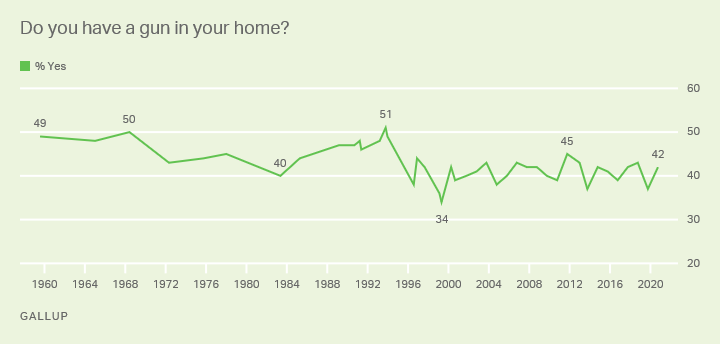
Gallup has been asking about gun ownership since the 1960s, and the percentage of American households with guns has been fairly stable, perhaps even showing a slight downward trend.

Mass shootings weren’t considered a major problem in 1960, this counter-argument goes, so the cause can’t just be guns. Whatever the X-factor is, it has to be something that has changed in recent decades. That, presumably, is how people come to blame video games, abortion, and secularism, despite their presence in other countries.

The flaw in this logic is that the guns of America’s civilian arsenal have changed a lot in recent decades. Yes, a lot of Americans have always owned guns. But they didn’t own guns like this.

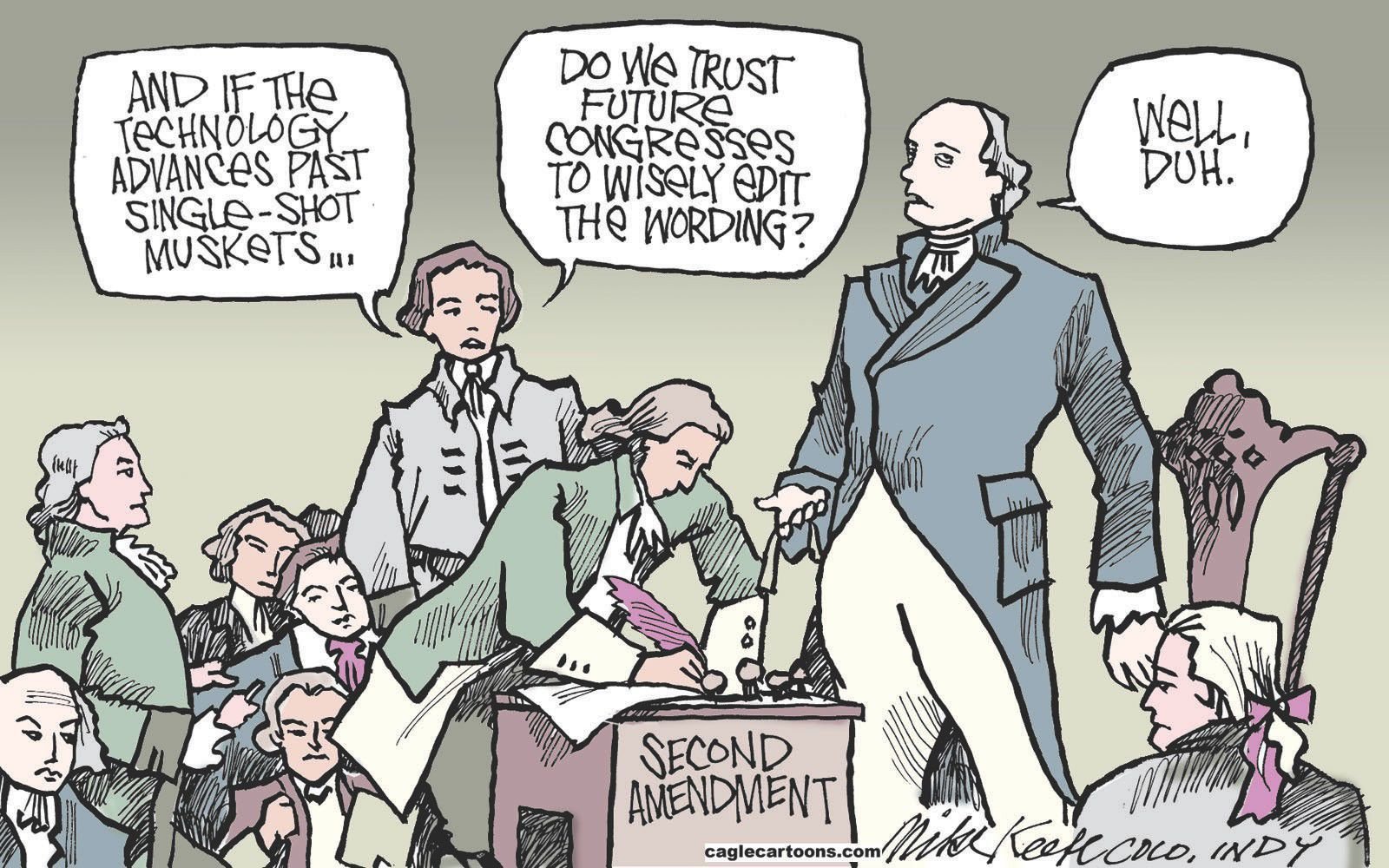
You’ll often see this point made about the guns of the 18th century, the ones the Founders had in mind when they wrote the Second Amendment — as in this cartoon.

https://www.nj.com/opinion/2022/05/the-second-amendment-is-231-years-old-and-should-be-treated-as-such-sheneman.html

What’s not as well appreciated is how much guns have changed in living memory. My memory, for example.

Sometime in my pre-teen years in the late 1960s, my Dad thought it might be a bonding experience for us to go hunting. So he bought a 12-gauge shotgun for himself and a .410 shotgun for me. His held five shells and mine three. Both moved new shells into the firing chamber with a pump action. Pumping could throw off your aim, so without a lot of practice it was just about impossible to shoot even the five or three shells quickly, at least if you wanted to hit anything.

And while reloading wasn’t that hard, once you got onto it, it wasn’t nearly as quick or easy as snapping in a new clip. But it didn’t need to be. The point was to keep firing until your quarry either fell or fled, which would probably happen in a matter of seconds. After that, you were looking at another extended period of stalking — that’s why the sport is called “hunting” rather than “shooting” — so you had plenty of time to dig a few shells out of a pocket and slide them into the shotgun.

Dad also owned a .22 rifle, which typically lived out on our farm, about 15 miles from our house in town. I don’t remember how many bullets it held, but it wasn’t many. I occasionally shot targets with it, but not with any practical goal like hunting or self-defense. (A post on a survivalist message board is blunt about such a rifle’s self-defense limitations: “A .22 round has virtually no ‘stopping power’. It takes a hit directly to vital organs like the heart or brain to ‘stop’ somebody with a .22.”)

That was our whole arsenal. We were, I believe, a more-or-less typical gun-owning family of the era. (At least in the rural Midwest. Perhaps things were already different in the South; I wouldn’t know.) Many of my friends had a similar exposure to guns, which they used (rarely, and under adult supervision) to hunt quail or ducks or rabbits. (I once ate fried squirrels that a neighbor had killed. They did indeed taste like chicken.) I heard about men going on deer-hunting trips, but I don’t remember my friends bragging about hunting deer themselves.

One possible use for our guns never came up: killing people intentionally. Everyone knew, of course, that a shotgun or a rifle of any caliber could kill someone. Occasionally I would hear about hunting accidents, or that someone (though not anyone I knew personally) had committed suicide with a gun. My dentist once surprised burglars at his vacation home, and they shot him with a shotgun they were stealing from him. (At least that’s the story I remember hearing. He lived, but ever after had marks on his face from where the pellets hit. Years later he became the father-in-law of my best friend from elementary school.)

But shooting people was an accident to be avoided, not something we trained to do. For practice we shot at bottles or clay pigeons, not human figures on paper. Dad and I never talked about repelling a home invasion with our shotguns, and I doubt he had such a plan. (Our home would have been pretty easy to invade in the summer, when we often just fastened a screen door with a hook. The shotguns were in the basement and unloaded. Using them quickly would have been difficult. If Dad secretly kept a more convenient gun, I believe I would have found it when I cleaned out the house after he died.) And we certainly never discussed joining a group that might fight against the government.

The guns also were not a part of our identity, either as individuals or as a family. They were sporting equipment, like baseball gloves or basketballs, and had little symbolic significance. So we did not assemble a collection to display with pride, or join a shooting club, or hang around in gun shops. I don’t think I knew what the NRA was.

I had a toy M-16 as a kid, so I knew about such weapons, which soldiers were using in Vietnam. Apparently the civilian semi-automatic version, the AR-15, was already on the market. But it never occurred to me that we might buy one. (Why would we? If you hit a rabbit with a burst from an AR-15, there wouldn’t be much left.)

In short, our gun-owning household didn’t have anything like the destructive capability that millions and millions of American households have today. If I had ever gone on a rampage with our guns, I couldn’t have run up anything like the body counts we’ve seen lately, and most of my victims would probably have lived. Once the police arrived, I couldn’t have held them at bay for long.

I don’t even remember having that fantasy. Owning a shotgun made me an occasional hunter, not a warrior. My warrior fantasies, such as they were, involved joining the military, not going out in a blaze of glory on Main Street.

So no, past America is not comparable to America today in terms of an individual’s ability to commit mass murder. The percentage of gun-owning households may not have changed that much in the past 60 years, but the guns Americans own certainly have.

Repeating myself about guns

https://theweek.com/political-satire/1013894/the-web

The only change since the last time I covered this issue is that more people have died.


From your cousin on social media to TV talking heads and syndicated columnists, everybody who comments on current events is facing the same conundrum: What do you say when nothing has changed since the last time you spoke out? There are no new insights to offer, no arguments that didn’t prove to be futile last time.

And yet, how can you stay silent? Silence is complacency that can even be interpreted as consent. Ten-year-olds get massacred in a public school? Grandmothers get killed for shopping-while-Black? Asians get shot at a church luncheon? It happens. This is America. Things that don’t happen anywhere else happen here, sometimes one right after another. And in spite of all the other countries that have responded to horrifying mass killings by taking effective action, nothing can be done here. This is America.

This week, I’ve decided to be open about the fact that I have nothing new to say. December 14 will be the tenth anniversary of the Sandy Hook massacre of 20 six- and seven-year-olds. April 20 was the 23rd anniversary of Columbine. So I’ve had decades to compose my thoughts on mass shootings and gun control. There’s very little I can write that I haven’t written before.

So rather than repeat everything as if I just thought of it, I’ve decided to post a guide (and partial update) to my previous posts on guns. [1]


My most serious look at America’s gun problem was “How Should We Rewrite the Second Amendment?” in 2019. Google, in its great algorithmic wisdom, recommended that post to people interested in the Second Amendment, netting me more than 18,000 page views and 300 comments, almost all of them negative.

The gist of my essay was that we argue so vociferously about the Second Amendment because it no longer has any recoverable meaning relevant to current issues. From the Supreme Court to that loud guy at the bar, anybody who “interprets” the Second Amendment and “applies” it to today’s world is really just making stuff up. We yell our own particular interpretations so loudly because interpretation is all we have at this point. To the extent that we can discern the “original intent” of the Founders at all, it’s completely tangential to anything happening today.

So I proposed that we replace the Second Amendment with a new amendment to capture what we really want out of guns in this era. The core of my rewrite was:

Congress shall make no law preventing individuals from securing adequate means to defend their homes and persons, or preventing state or local governments from equipping police forces adequate to enforce their laws and ensure public safety.

I gave the federal government explicit permission to regulate interstate transportation and sale of guns, while granting states the power to regulate guns within their borders.

In the face of the pushback, I wrote a sequel the next week to summarize and address my critics’ points. In retrospect, I’m surprised how much good humor I maintained after all that abuse.

https://billingsgazette.com/news/opinion/guest/ask-the-judge-how-the-second-amendment-was-written/article_b11e679d-d42e-5e75-943a-9549c5d06b1d.html

Militiaman

As for what the Constitution doesn’t say about guns, see my 2018 post “Three Misunderstandings about Guns and the Constitution“. In particular, the Second Amendment was never intended to facilitate an armed uprising against the federal government.

The “well-regulated militia” it envisioned was supposed to make a large federal standing army unnecessary, not to fight against one. Militias, in the Founders’ vision, would enable state and local governments to maintain public peace and enforce their laws without begging the feds for help. Because of the militias, the federal army would only be needed in case of war with a foreign power like Britain or Spain, and otherwise would be a tiny force that wouldn’t tempt an unpopular president to stage a coup.

Not a militiaman

One reason why I later proposed rewriting the amendment was that all the ships in the Founders’ harbor sailed long ago. The outcome the Founders wanted to avoid when they wrote the Second Amendment is already here: We do have a large standing army with forts all over the country, as well as various kinds of federal police from the FBI to DEA to Treasury to TSA to ICE. We can still argue about whether any of that was a good idea. But one way or the other, here we are.


In 2016 I observed that “Our gun problem IS a terrorism problem“. Given our lax gun laws, complex 9-11-style plots aren’t necessary. Also in 2016, “The Asterisk in the Bill of Rights” pointed out how Second-Amendment rights really only belong to White people.


But perhaps my best gun post is “Guns are security blankets, not insurance policies” from 2015. This looks at the psychology of the gun issue, building on a tweet from cyberpunk novelist William Gibson:

People who feel safer with a gun than with guaranteed medical insurance don’t yet have a fully adult concept of scary.

One reason the gun debate goes nowhere is that the two sides aren’t really discussing the same issue. Gun-control advocates are looking at a public-health problem: Guns kill tens of thousands of Americans every year. What can be done to lower that total?

If that’s how you frame the issue, you look at numbers and graphs and examine how reforms have worked in other countries.

But most pro-gun arguments are story-based, because gun advocates are addressing something else entirely: Sometimes a dark fantasy gets stuck in your head and you can’t get it out. What do you do about that? Armed intruders invading your home, your daughter getting raped in the park, roaming street gangs killing people at random — those images can disrupt your peace of mind, no matter what the statistics say about their probability. Some policy change that experts predict would cut rapes in half, for example, doesn’t really help you deal with the what-if in your brain.

That’s what a gun is for. It’s a magical talisman that enables a counter-fantasy you can invoke to dispel whatever dark fantasy might be plaguing you. Home invaders? You’ll win a shoot-out with them. Your daughter? She’ll manage to get the gun out of her backpack and plug the guy before he can take it away and shoot her instead. (And the gun will never haunt her imagination on days when she’s feeling suicidal.) Gangs? You, the neighbors, and your AR-15s will form an impromptu urban warfare platoon to take them out.

Will any of that work in reality? Hardly ever, as ABC demonstrated with this gun-training exercise. But realistic thinking misses the point. If the problem lives in your personal fantasy world, a fantastic solution works just fine.

That’s why even the most common-sense gun reforms get bogged down in improbable scenarios. As in this argument against limiting the size of gun magazines: “Criminals don’t always act alone. It is often necessary to have enough ammunition to hold off multiple assailants.” Often? Would that be “often in the author’s experience” or “often in the author’s dark fantasies”?

We’ve seen that division play out this week. Gun-control advocates are looking at statistics, like how the number of gun deaths in a state correlates with the number of guns.

Meanwhile, the NRA’s mouthpieces float action-movie ideas that may help you overcome your paralyzing my-child-gets-killed-at-school nightmare, but are totally disconnected from reality.

Texas Attorney General Ken Paxton’s arm-the-teachers suggestion is a good example. Maybe a teacher with a gun gives his particular school-shooting fantasy a happy ending. But until she retired a few years ago, my sister was an elementary school teacher in the real world. Try as I might, I can’t picture her outshooting an attacker who has an assault rifle, body armor, and the element of surprise.

But maybe Paxton is imagining something more like Kindergarten Cop, where Arnold Schwarzenegger is an LAPD detective who goes undercover as a teacher. No doubt that movie character would fare much better against a shooter than my sister would. Which raises the question: What if we stopped recruiting teachers from wimpy liberal arts colleges and instead hired, say, ex-special-forces operatives (without raising pay, of course)? Or maybe it would be more cost effective to train the kids to defend themselves, in a scenario something like Spy Kids, or maybe Home Alone.

I’m sure that would work. I feel better already.


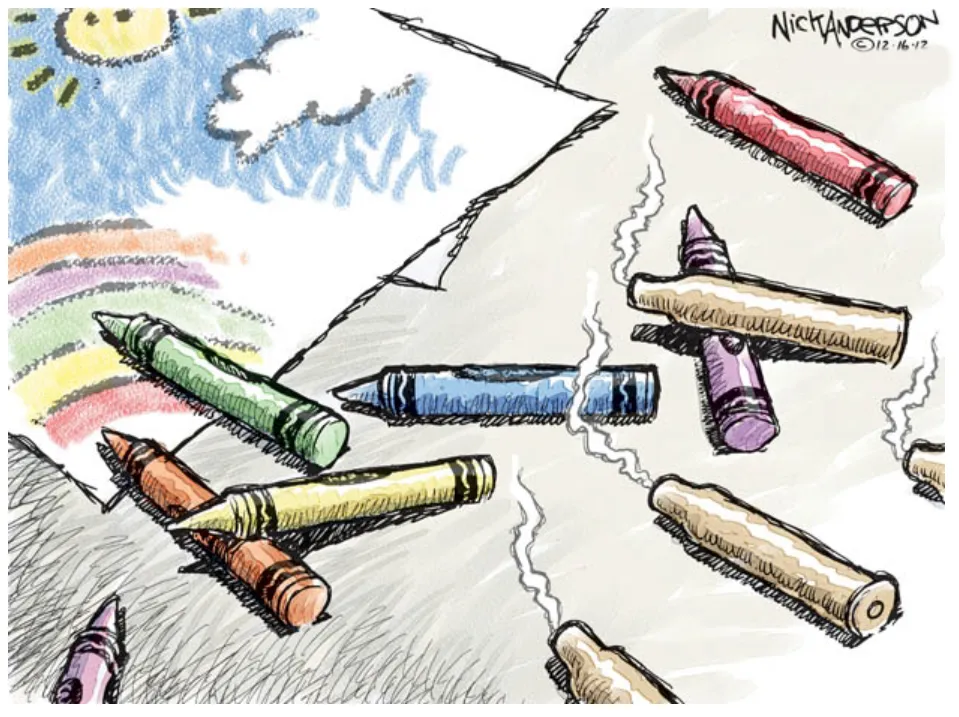
[1] I’m not the only person to take this approach. The Atlantic is doing the same thing. So is James Fallows. So is cartoonist Nick Anderson.

Follow-up to “How Should We Rewrite the Second Amendment?”

Last Monday evening, I was reading on my iPad when something strange happened: Notifications started popping up about comments on the article I had posted that day, “How Should We Rewrite the Second Amendment?“. Every minute or so, there was a new comment. I usually get 5-10 comments total on a featured post, not 5-10 comments in a few minutes, so I knew something strange was happening.

When I’m writing a post, I usually lose myself in what I’m trying to say. But as soon as I hit the Post button, I start imagining it catching on with readers: Maybe they agree with it, or maybe it just makes them look at something a different way, so they like it and tell their friends. Those friends tell their own friends, and a positive chain reaction gets rolling.

But that wasn’t what had happened. My anti-Second-Amendment post was getting attention not just from my usual readers (who I think mostly agreed with it), or from new readers who liked it, but from outraged NRA types. It was a chain reaction, all right, but not a positive one. People were telling their friends about it because they hated it.

Nothing motivates like outrage, so the post got 15K page views (independent of subscribers, who see posts via email) and 290 comments, the vast majority of which were negative. (For comparison, the previous week’s featured post had done quite well by recent standards: 1182 page views and 8 comments.)

Something similar had happened to me once before: Back in 2011, “Why I Am Not a Libertarian” became one of my first viral posts, and for a while it was the Sift’s most popular article. (Numbers are not really comparable any more, because changes in social-media algorithms have made it harder for posts to go viral, but the Libertarian article got 28K views and 282 comments.) It did that not by impressing people with its clear thinking and crisp prose, but by pissing them off. The vast majority of the comments (and I suspect of the page views as well) came from offended Libertarians.

So back in 2011, I saw a road to notoriety opening up: I could be a provocateur, the kind of blogger that folks love to hate. I could write posts that trolled large groups of people, and then make sure that they knew I was running them down (maybe by seeding a few links on the appropriate Reddit groups). They’d shoot emails and Facebook comments and text messages back and forth, saying “Can you believe what this jerk is saying about us?”. And my numbers would take off. If I simultaneously started having advertising on the Sift, this might turn into some real income.

I didn’t do that.

There are writers who love the provocateur role and even some who are good at it, and I don’t want to judge them. But to me it would be a kind of hell. It’s not in my character to take satisfaction in the hate and anger of others, so I don’t know how I could get up every morning and intentionally aggravate people.

But eight years had gone by, and I had accidentally done it again. I doubt there are a lot of 2nd Amendment absolutists in my subscriber base, so I don’t know how word of “How Should We Rewrite the Second Amendment” filtered out to them. I can’t find any popular pro-gun blog that blew the outrage trumpet, and I certainly didn’t seek out that kind of attention myself. So it’s a mystery.

But it produced an interesting artifact: that 290-long comment stream. I pretty quickly decided I wasn’t going to answer them all individually. (A real provocateur would. Annoy enough of the commenters individually and who knows how often they’d come back and how many of their friends they’ll tell. Trying to annoy me back might become a minor hobby.) However, I have read them all. They provide an interesting window into a world outside my usual neighborhood.

For those of you who don’t have the time to wade through all of them, the rest of this post is my summary.


A large number were just statements of disagreement, without much attempt to convince: The Second Amendment doesn’t need rewriting. Keep your hands off the Second Amendment. And so on.

Many others were statements of disagreement plus some insult. The shortest was my favorite: “Idoit”. Whether that was a typo or a bit of intentional cleverness, I’m not sure. (When I was in high school, my friends and I would intentionally mispronounce pseudo-intellectual the way it looks: puh-sway-dough-intellectual.)

I didn’t feel like any of these needed a response. I said something; you disagree. Fine.

One version of this was to dispute my assertion that the Second Amendment has become meaningless by counter-asserting that its meaning is perfectly clear. I’ve often seen this happen with Bible verses: If your ministers and teachers repeat an interpretation to you often enough, that meaning begins to seem obvious to you, no matter how obscure the original text is in reality. Apparently, the same process works with the Constitution.

Other people made objections that I felt I had already answered in the article, like saying that gun ownership is necessary to protect us against tyranny. I had considered that idea and rejected it for specified reasons. If people had a response to those reasons, I considered their views. But if they just reiterated the original point, my response was already available.

Several people repeated the myths about Hitler and Stalin disarming their people; I had already provided a link debunking those myths.


Some commenters entered into the spirit of my post, but want to rewrite the Second Amendment to make the NRA’s intended meaning clearer: that any gun-control laws at any level are unconstitutional.

Those comments speak for themselves and need no reply from me. Again: I said something; you disagree.


One of the stranger misconceptions in the comments was that I had said something about Denmark. “Denmark” shows up six times in the comments, and not at all in article. (I actually mentioned the Netherlands as a nation without an armed populace, but which doesn’t seem to be threatened by tyranny.) I think this was probably because Denmark had annoyed Trump this week, so it was in the minds of his minions.


Several bizarre theories about the Constitution were put forward.

A number of commenters asserted that the Bill of Rights can’t be changed. I’m not sure where that comes from or who promotes it, but it’s just flat wrong. Article V of the Constitution is pretty clear about that:

The Congress, whenever two thirds of both Houses shall deem it necessary, shall propose Amendments to this Constitution, or, on the Application of the Legislatures of two thirds of the several States, shall call a Convention for proposing Amendments, which, in either Case, shall be valid to all Intents and Purposes, as Part of this Constitution, when ratified by the Legislatures of three fourths of the several States, or by Conventions in three fourths thereof, as the one or the other Mode of Ratification may be proposed by the Congress; Provided that no Amendment which may be made prior to the Year One thousand eight hundred and eight shall in any Manner affect the first and fourth Clauses in the Ninth Section of the first Article; and that no State, without its Consent, shall be deprived of its equal Suffrage in the Senate.

One thing the Constitution does not give anyone the power to do is to is to amend the Constitution in a way that can’t be amended back. So when the First Congress wrote the Bill of Rights, it was creating a set of amendments that could be repealed in the future through the same amendment process.

Several people seemed not to get the whole idea of amending the Constitution. Quoting the Second Amendment against the idea of repealing the Second Amendment makes no sense.

Two anonymous comments (probably the same commenter posting twice) claimed that “the Preamble” said that our rights come from God. (He was kind of obnoxious about it, calling some other commenter “you of weak mind”.) This is false. Neither God nor any religious synonym appears in the Constitution, in the Preamble or anywhere else. Mr. Anonymous had confused the Declaration of Independence (a Revolutionary War polemic that has no legal significance) with the Constitution.

Others similarly found a religious significance in the Constitution that I doubt the Founders intended to put there. (More about that below.)

The constitution should be treated as sacred as the bible is. Both to be held in the highest regard and NEVER changed or messed with in any way. The government should stay the hell away from it, and keep their fat traps shut. If this country would live by both, the bible being the most followed, then we wouldn’t be in the crap hole this country is in. But we shouldn’t be changing it as we see fit, but follow it as the founding fathers and GOD saw fit.

The Constitution is a thoroughly secular document that sets up a secular republic. Some of the Founders had religious motives and some didn’t, but they didn’t write their religion into the Constitution.

If we regarded the Constitution as sacred and never changed it, blacks would still be slaves and women wouldn’t be able to vote. Anybody who regards the Founders as divinely inspired and their work as sacrosanct needs to own that.


Other commenters couldn’t comprehend the idea that the world can change out from under a text and leave it meaningless. (Back in 2015, I explained how changes in opposite-sex marriage had made bans against same-sex marriage indefensible, even though they had made sense a century or two before. Change erodes meaning.) Several argued that we could know what the Founders thought because they left extensive writings behind. And that’s true: We can know quite a bit about what they thought about the world they lived in.

What we can’t know is what they thought about the world we live in. And that’s my point: Applying the Second Amendment to the world we live in is just senseless. On either side, people are just making stuff up, because actual text doesn’t mean anything any more.


As an aside, this is one way that the Constitution does resemble the Bible: There are parts of the Bible that are meaningless now, because no one knows how to translate them into modern language. Anyone who says they know what the commandment against “coveting” means is lying to you, for example. So is anyone who claims to know the meaning of “witch” in “Thou shalt not suffer a witch to live.” Any honest discussion of those verses has to start by saying, “We don’t really know what this means.”


Quite a few commenters seemed to think that even talking about rewriting the Second Amendment should be taboo, because then somebody could rewrite all the amendments and take our rights away.

This is kind of a silly point, because amending the Constitution is a Herculean task. It will only happen when there is good reason for it to happen.

So yes, it is completely possible that we could repeal the First Amendment, or the 15th, or whichever one is closest to your heart. The Founders never intended to write a Holy Scripture. Jefferson was undoubtedly an extremist in this regard, but I doubt he was the only one who believed this:

no society can make a perpetual constitution, or even a perpetual law. The earth belongs always to the living generation.

And yes, some of the arguments I made about the Second Amendment becoming meaningless can apply to others, because time is constantly eroding the meaning of texts. I was explicit about that.

Old laws become encrusted with layers and layers of debatable interpretations. If judges do their jobs well, the public may retain confidence that some “spirit” of the law lives on, even as it applies to novel and unforeseen situations. But at some point, we need to accept that the original meaning has been entirely lost, and so it’s time to shake off the encrustations and reconsider the relevant issues from scratch.

The First Amendment, like the Second, is often applied to situations the Founders didn’t foresee. Personally, I still find a “spirit of the law” in First-Amendment interpretations that I don’t find in Second-Amendment interpretations (where it seems to me that everyone is just making stuff up), so I would not favor repealing and replacing the First Amendment.

If, however, we found ourselves in a situation where an unfortunate application of the First Amendment was leading to thousands of deaths every year, I might change my mind.

But I do agree this far: We should absolutely be talking about all the rights in the Constitution, and evaluating what they mean and/or should mean, because we are the living generation. The earth belongs to us and not to the dead. If any part of the Constitution no longer serves us, and if that has become so clear that we can get supermajority agreement about it, we should change it.


One common criticism was that I didn’t know history, but usually commenters floated that objection without attaching it to anything in particular, so who knows what they meant or whether the criticism has any validity. Chances are, they have seen some of the bogus history the NRA spreads, so the criticism could just be turned back on them. But there was one exception: I in fact did not know about some of the bizarre early versions of multi-shot weapons.

Several commenters made claims about weapons the Founders might have seen, but only one provided a reference link. Admittedly, it’s a link to an NRA blog, so I take all this with a grain of salt. But apparently there were multi-barrel guns that were capable of multiple shots.

I have to question how reliable, accurate, or otherwise practical any of those guns were. But even if they worked reasonably well, I see no reason to change my conclusion that

An attack like the recent Dayton shooting, in which one man killed nine people and wounded 14 others in half a minute, would have been unimaginable [to the authors of the Second Amendment].


To sum up, nothing in the comment stream makes me want to go back and rewrite the original article, or change the amendment I would like to pass. Likewise, none of it changes my conviction that the Constitution is (and was always intended to be) open to amendment. As Jefferson said, the world belongs to the living, not the dead.

How Should We Rewrite the Second Amendment?

We argue so vociferously about the meaning of the Second Amendment because it doesn’t really mean anything any more. We should replace it with a new amendment protecting freedoms that matter to us today.


Whenever you pick up an article about gun control — pro or con — you can be virtually certain of one thing: The author believes that the Second Amendment has a unique and definite meaning, which he or she knows with certainty.

So the Amendment either clearly supports an individual right to own and use guns, or it was intended purely to prevent the federal government from disarming state militias (i.e., the National Guard). If it does indeed protect an individual right, the “arms” we are allowed to bear include only the guns appropriate for defending our homes — which leaves out military weapons — or else the Founders wanted us to have the means to overthrow the federal government should it prove tyrannical, making military-grade weapons not only permitted, but absolutely necessary. And so on.

I want to turn that conversation upside-down: Our arguments about the Second Amendment are so dogmatic because we are arguing about shadows in the dark. Each of us projects our own desired meaning onto the Amendment, because the Second Amendment no longer has any meaning of its own. With regard to the role of guns in society, so much has changed in the last 200 years that whatever the Founders intended when they wrote the Amendment is entirely inapplicable to us.

We argue so intensely because there is no answer. We’re like middle-aged siblings arguing about what Dad wants, when Dad has advanced Alzheimer’s and doesn’t know where he is or who we are. Rather than looking at the world as it is and deciding what we want to do with it, we sit around a Ouija board trying to contact the ghosts of the Founders — and then we complain that somebody else is pushing the planchette rather than letting the spectral vibrations work their will.

How meaning gets lost. Any text is vulnerable to having the world change out from under it, and the Founders gave us the power of amendment precisely because they never intended their words to stand as eternal truths. Is, say, the First Amendment’s protection of “freedom of speech” intended to protect your right to set up bots to spread disinformation on social media? What, exactly, was James Madison’s opinion on that issue? What would George Washington say about using facial recognition software to identify individuals as they move through a world whose public spaces are covered by networked surveillance cameras?

Judges make decisions about such issues because they have to; cases come to their courts and something must be done with them. And so old laws become encrusted with layers and layers of debatable interpretations. If judges do their jobs well, the public may retain confidence that some “spirit” of the law lives on, even as it applies to novel and unforeseen situations.

But at some point, we need to accept that the original meaning has been entirely lost, and so it’s time to shake off the encrustations and reconsider the relevant issues from scratch. That’s where we find ourselves with respect to the Second Amendment. Anyone who says he knows what the Second Amendment really means today is either fantasizing or lying, because it doesn’t mean anything any more.

Consider how different the world was when the First Congress wrote the Bill of Rights.

  • State militias were the first line of national defense. Political leaders of the Founding era were afraid of the tyrannical potential of a centrally controlled professional army, and imagined that the new nation would have either no army in peacetime or a very small one. [1] That army would grow in wartime, but wars were supposed to be rare, because early American foreign policy intended to avoid “entangling alliances” that would pull the United States into European wars. [2] A state militia (perhaps with help from the militias of neighboring states) would be adequate to deal with Indian raids, slave revolts, riots, criminal gangs, and other challenges that might occur more frequently. In Federalist 29, Alexander Hamilton described a “well-regulated militia” in detail, and judged it to be “the only substitute that can be devised for a standing army, and the best possible security against it, if it should exist.”
  • Private citizens played a much larger role in law enforcement. American cities wouldn’t start organizing modern police forces until more than half a century later.
  • Guns were single-shot weapons that took time and skill to reload. Modern re-enactors can reload 18th-century muskets in about 15 seconds, assuming no one is trying to interfere with them. An attack like the recent Dayton shooting, in which one man killed nine people and wounded 14 others in half a minute, would have been unimaginable.
  • The Bill of Rights did not apply to state and local governments. [3] Prior to the Supreme Court’s Heller decision in 2008, state and local governments could and often did regulate guns. About a century after the Second Amendment, the gunfight at the O.K. Corral was a dispute about gun control: The Earp brothers were lawmen enforcing the laws of Tombstone, Arizona, which required visitors to disarm. Many towns in the Old West had some form of gun control. They passed those laws for the same reasons people want such laws today: Law-abiding citizens should be able to go to a store or to church or send their children to school without worrying about getting caught in a crossfire.

Today, we have entangling alliances, fight more-or-less constant wars, and live in the midst of the large standing army that the militias were supposed to make unnecessary. Even small towns have professional police forces, and state and county police forces cover rural areas. The vast majority of citizens do not at any point in their lives belong to a well-regulated militia. (And no, self-appointed bands of armed yahoos running around in the woods bear no resemblance to the Founders’ vision.)

In short, the original reasons citizens needed to be armed no longer apply, the weapons themselves have changed beyond recognition, and the notion that no one can restrict weaponry is entirely new. Given all that, how can anyone interpret the Second Amendment with confidence?

Why mess with it? Currently, both sides deal with the Second Amendment’s fundamental emptiness in the same way: Decide what you want the Amendment to mean, and then try to win elections so that you can appoint judges who will pretend it says what you want it to say.

Two things are wrong with this approach. First, it’s dishonest and undermines respect for the law. The right way to change laws is to pass new laws, and the right way to change the Constitution is to amend it. Each side may claim that it is restoring the “true” meaning of the Second Amendment. But, as I have argued above, there is no longer any true meaning to recover. The society that gave the Second Amendment its meaning is gone forever.

Second, both sides in this argument need a credible goal, even if that goal is politically impractical at the present moment. The current approach of gun-control advocates (of whom I am one) is, “Can you just give us this much?” So we ask for background checks or assault-weapon bans or limits on bump stocks or large magazines. All those proposals are very reasonable, but even in combination they are not a solution to America’s gun problem. So even if those restrictions become law, sooner or later we’ll be back to ask for more.

This smallball strategy plays into the NRA’s slippery-slope argument, which claims that the ultimate unspoken goal is complete confiscation. I know of very few people who advocate complete confiscation, even in private. But as long as the gun-control movement has no stated goal, the NRA has complete freedom to assign us whatever goal most frightens its members. The response “No, I just want background checks” isn’t credible, so gun owners who want to protect any gun rights at all will want to hold the line.

Conversely, the NRA’s strategy of disrupting any potentially political conversation about guns — it opposes even studying the public-health implications of widespread gun ownership, as well as developing technology to make guns safer — is similarly untenable and provokes similar paranoia on the left: They won’t be satisfied until we’re all dodging bullets every day.

On each side, rewriting the Second Amendment is a worthy goal. It will force gun control advocates to grapple with the question of confiscation, and challenge gun-rights advocates to justify exactly which rights are worth protecting and why. The conversation about what the Second Amendment means can never reach consensus, because there is no meaning to converge on. But a conversation about what it should say has more potential.

The rest of this article describes and justifies my own attempt to rewrite the Second Amendment.

What rights don’t need constitutional protection? To be perfectly blunt, a lot of the reasons people want to own guns are frivolous. Those reasons might be perfectly fine in their own ways, but they don’t rise to the level of a right that needs constitutional protection.

Guns, I admit, are very clever mechanisms; they even can be said to have a certain kind of beauty. So I understand why someone might want to own a collection of them, just as someone else might collect the pocket watches of various eras. But the Constitution doesn’t protect any other collections; it shouldn’t protect this one either..

Similarly, target shooting is a worthy sport. It demands skill and concentration. Some people are particularly gifted at it, just as some are gifted at pole-vaulting or throwing footballs. But if a community decides that public safety demands restricting this sport, so be it. Ditto for the sport of hunting. It may be traditional and so forth, but it’s a sport. Baseball is also traditional, and raises similar sentiments about passing down interests from father to son. But my right to play baseball should not be enshrined in the Constitution, and neither should hunting.

What about overthrowing a tyrannical government? Then we come to the most contentious issue: resisting or overthrowing the government, should it turn tyrannical. A disarmed populace, according to this argument, is the precondition for tyranny, and gun control is often a precursor to taking away other rights.

The are a few things to note about this point: First, if you believe that an unarmed populace is an invitation to tyranny, I have two suggestions: Reconsider the history you think you know, and go visit the Netherlands. The Dutch have only 2.6 weapons for every 100 people (compared to our 120), and very strict gun-control laws. They also have a higher democracy index than we do: 8.89 to our 7.96.

Second, if retaining the ability to fight the government is the justification for the right to bear arms, then it’s hard to argue for any restrictions on armaments at all. Red State founder Erick Erickson made this explicit:

You may think a 30 round magazine is too big. Under the real purpose of the second amendment, a 30 round magazine might be too small.

Indeed, if my purpose in owning guns is to preserve my option to join a Red Dawn resistance and fight the U.S. Army, then I need a lot more than just an AR-15. I need grenade launchers and anti-tank weapons and shoulder-fired Stinger missiles that can take down helicopters (or airliners as they take off or land).

Do you really want to go there? I don’t. As much as I fear the current administration, I’d rather take my chances with the American government than get on a plane knowing that Stingers are available at Walmart.

And that leads to what I see as the biggest problem with this vision:  In the NRA fantasy, the American people are unified in their resistance to a vicious cabal at the top, and must fight to restore democracy. Second Amendment proponents like to think about the Minutemen or the French Resistance in World War II. But those aren’t the most likely scenarios.

You know what’s much more likely? A violent minority tries to impose its will on the rest of us through terrorism. That, in fact, is what we’re seeing now from armed white supremacists like the El Paso and Pittsburgh shooters. Their problem is that they don’t represent the American people and so they can’t achieve their white-homeland vision through the democratic process. That’s why they need guns.

The US has seen this pattern in the past as well. The Atlantic’s Mark Nuckols offers two examples:

  • Bleeding Kansas of the 1850s, where pro- and anti-slavery marauders tried to drive each other’s supporters out of the territory.
  • The post-Civil-War South, where the KKK and other white-supremacist groups terrorized blacks out of voting. The resulting white-supremacist governments eventually disenfranchised blacks legally and instituted Jim Crow.

In short, the situation we have now, in which a decreasing minority of people owns an increasing numbers of guns, doesn’t secure our democracy, it endangers our democracy. [4]

The right to self defense should be protected from federal interference. So far it sounds like I’m making a confiscation argument, because I haven’t identified any type of gun-ownership that deserves constitutional protection. But I believe self-defense qualifies on a number of grounds:

  • Self-defense is a fundamental human right. If someone attacks you, you shouldn’t have to just stand there and die. Depending on the severity of the attack, you may be justified in using lethal force. Few things are more horrifying than the thought that someone is coming for you or your loved ones, but there’s nothing you can do about it.
  • Americans broadly believe in a right to self-defense, whether or not they personally own weapons or get self-defense training.
  • Despite the risks that come with gun ownership, many people have in fact driven off or captured or killed attackers by using their own guns. The risk/reward balance of owning a gun varies from place to place and individual to individual, so judgments about it should not be made on the federal level.

Some of these considerations also apply on the city and state level, so the federal government shouldn’t prevent a lower-level government from equipping a force to defend the public safety or enforce the laws.

That said, there are some legitimate roles for the federal government to play. Self-defense is not an open door for any kind of weaponry at all. No one needs a tank or a nuclear bomb to defend their home or person, or to drive coyotes away from their sheep. Likewise, no one needs an assault rifle with a 100-round magazine or an armory with dozens of weapons. A closer analysis of what means of self-defense might be necessary in one place or another is better done at the state level, but the federal government should be able to make some broad restrictions.

Additionally, states that want to control guns more tightly need protection against their laws being undermined by neighboring states with looser laws. So in addition to its general power to regulate interstate commerce, the federal government’s power to regulate, police, or completely ban the interstate transportation or sale of firearms should be spelled out.

A few final considerations. The Constitution sets up a federal government whose powers are limited to those expressly granted. [5] But history has shown that the government can leverage the powers the Constitution grants to wield other powers that it doesn’t grant. A relatively harmless example was the 55-MPH speed limit set in 1974 as an energy-conservation measure. The Constitution doesn’t grant any speed-limit-setting powers to Congress, so it passed a law that denied federal highway funds to states that didn’t enact a 55-mph limit. Before the Supreme Court struck it down, the Affordable Care Act’s Medicaid expansion was another attempt at using federal funds to force state action.

So any amendment that limits federal power to regulate guns, but allows state and local powers more extensive powers, should also guard against federal coercion of the states.

Conversely, the federal government needs the power to regulate anything that otherwise would work around restrictions it can legally make. So, for example, if Congress can ban automatic weapons, it should also be able to ban kits for converting semi-automatic weapons to fully automatic ones.

What should it say? Here’s my proposal:

1. The Second Amendment to this Constitution is hereby repealed.

2. Congress shall make no law preventing individuals from securing adequate means to defend their homes and persons, or preventing state or local governments from equipping police forces adequate to enforce their laws and ensure public safety.

3. Congress shall have the power to regulate the interstate transportation and sale of weapons, ammunition, and other weapon-related items.

4. States shall have the power to regulate the use, manufacture, ownership, and transfer of weapons within their borders, or to delegate such powers to local governments.

5. No federal expenditure or regulation shall be contingent on a state or local government using its power to regulate weapons in a manner specified by federal law.

What does it mean? Several things:

  • In order to pass a gun restriction, Congress would need to establish that individuals still have the means to defend their homes and persons. So Congress could ban assault weapons, but not handguns. It could limit the size of your arsenal, but not disarm you completely.
  • More detailed gun laws would have to be passed at the state level, so states could implement wildly divergent visions. If Texas believes that guns-everywhere makes the public safer, it can try that. But if Illinois wants to let Chicago ban guns completely, it can try that too. People who feel unsafe in one state or the other don’t have to go there. (Texans who come to Chicago would have to check their guns, just as they would have when entering Tombstone.) Colorado might decide to allow a wide range of guns, but regulate guns and their users in a similar way to cars and drivers. This state-by-state diversity would be healthy; we would see clearly what does and doesn’t work.
  • State and local governments would keep the ability to enforce their own laws, and would not have to depend on a federal force. This was one of the main tyranny-restraining pieces of the Founders’ vision, and one of the few implications of the Second Amendment that still makes sense today.

Or write your own. The main advantage my amendment would have over the current Second Amendment is that it would mean something, independent of everyone’s hopes and fears. As a result, both sides could have more confidence about its interpretation. We could lessen the paranoia that now attends every presidential election or Supreme Court nomination.

The choices I have made are far from the only ones possible. I have left a lot of decisions to the states; you may wish to have a more uniform policy across the country. I have allowed outright bans on the local level; you may not want that. I have left room for interpretation by using the word “adequate” rather than spelling out exactly how I expect future generations to defend themselves. And so on.

But if you write your own version and we each promote our favorite, look how the discussion has changed: We are no longer arguing about something unknowable, such as what was in the minds of people centuries ago, or what they would want if they could see us now. Instead, we are arguing about the world we live in and what we want for our future. Anyone can participate in that discussion by drawing on their own experiences; you don’t have to be (or pretend to be) a historian or legal scholar.

That is a conversation that has potential for growth and change and compromise.

Conversely, no one who considers the recent history of Second-Amendment interpretation should have any confidence that they know what it will “mean” a generation from now. The Supreme Court’s current interpretation was considered a fringe position a generation ago. [6] Unless we replace the Amendment with one that has clear meaning to people of our era, no one can say what ideas on the fringe today might be constitutional doctrine tomorrow.


[1] After the Treaty of Paris ended the Revolutionary War, the Continental Army was reduced to a single regiment of about 700 men stationed on the western frontier.

[2] President Washington said in his Farewell Address:

Europe has a set of primary interests which to us have none; or a very remote relation. Hence she must be engaged in frequent controversies, the causes of which are essentially foreign to our concerns. Hence, therefore, it must be unwise in us to implicate ourselves by artificial ties in the ordinary vicissitudes of her politics, or the ordinary combinations and collisions of her friendships or enmities.

[3] In general, constitutional restrictions didn’t apply to the states until the 13th, 14th, and 15th amendments were passed after the Civil War. The 14th Amendment says:

No state shall make or enforce any law which shall abridge the privileges or immunities of citizens of the United States; nor shall any state deprive any person of life, liberty, or property, without due process of law; nor deny to any person within its jurisdiction the equal protection of the laws.

Over time, the Supreme Court came to interpret “liberty” to include the rights described in the Bill of Rights. This doctrine is known as the “incorporation of the Bill of Rights“. The incorporation of the Second Amendment wasn’t fully recognized until 2010.

[4] People who are honestly worried about the future of American democracy should focus instead on making it work: End gerrymandering and voter suppression. Limit the influence of big-money donors, corporate lobbyists, and hostile foreign governments.

As long as the American people retain the ability to vote out governments that don’t serve their interests, the resort to guns won’t be necessary.

[5] For this reason, in Federalist 84, Alexander Hamilton argued against including a Bill of Rights in the Constitution because he believed it would be unnecessary.

For why declare that things shall not be done which there is no power to do? Why, for instance, should it be said, that the liberty of the press shall not be restrained, when no power is given by which restrictions may be imposed?

[6] As Jeffrey Toobin writes in the current New Yorker: “The Court changed the Second Amendment, and the Court can change it back again.” But unfettered by a text with any actual meaning, it could also go somewhere else entirely.


UPDATE

I was kind of overwhelmed by the quantity and negativity of the comments, so I decided not to answer them one by one. Instead, I wrote a sequel that summarizes a lot of the points commenters made and answers the ones that seem to need or deserve answering.

Why does the Right hate victims?

Attack the Parkland kids? Of course they do.


We’ve seen this script play out before: One or maybe a small group of people suffer a tragedy in their lives, and it motivates them to speak out. They speak for themselves. They speak for those who didn’t survive. They speak for countless people like them who have suffered similar losses. Their voices ring with authenticity, and the public begins to listen.

And then conservatives try to rip the hell out of them.

That’s the story of Ann Coulter and the 9-11 widows. “I’ve never seen people enjoy their husbands’ deaths so much,” she wrote in her book Godless: The Church of Liberalism. “These broads are millionaires, lionized on TV … reveling in their status as celebrities. These self-obsessed women seem genuinely unaware that 9/11 was an attack on our nation and acted as if the terrorist attacks happened only to them.”

It’s the story of Donald Trump, his supporters, and the Khan family. Captain Humayun Khan had rushed at a explosive-laden taxi in Iraq. The driver then detonated prematurely, killing himself and Khan, but sparing the hundreds of soldiers in the mess hall the bomb had been intended for. Khizr and Ghazala Khan appeared at the Democratic Convention to tell Trump that Muslim families like theirs are also Americans, that many of them have paid a high price to be good Americans, and that they do not deserve his bigotry. Trump responded by demeaning their religion and their marriage, saying that Mr. Khan alone spoke to the Convention because “maybe she wasn’t allowed to have anything to say. You tell me.” His supporters (like Roger Stone) went further, claiming that the Khizr Khan was a “Muslim Brotherhood agent”. The honorary Trump campaign co-chair for New York argued to Fox News’ Alan Colmes that Khan was a “terrorist sympathizer“.

It’s the story of Trump and all the women he has molested. They’re liars paid by the Democrats, and besides, they’re too ugly to be assault bait.

After Cleveland police gunned down Tamir Rice, a black 12-year-old playing with a toy gun in his own neighborhood — and did it within seconds of arriving on the scene — a story about his father’s “history of domestic violence” got shared on Facebook over eight thousand times. The Rices aren’t victims, you see, they had it coming.

And Trayvon Martin wasn’t just an innocent teen-ager shot down by an over-zealous neighborhood watch guy, whose death the police didn’t think was worth investigating until the community protested. He wasn’t just a victim of Florida’s ridiculous stand-your-ground law that promotes gun violence. He was a “dope smoking, racist gangsta wannabe“. Even his last purchase — Skittles and a soft drink from a convenience store — became evidence of a drug habit.

No victimization is too trivial to let stand. Remember Ahmed Mohamed, the 14-year-old “Clock Boy” who tried to impress his teacher by showing her the electronic clock he had made, and wound up arrested on suspicion of building a bomb, or maybe a “hoax bomb”, or something? His experience drew attention to the excessive suspicion American Muslims live with every day, so he had to be taken down. The whole event was staged, the conspiracy theorists said. Ahmed intended to get arrested, you see. It was all a plot by his terrorist-supporting father to make their town (Irving, Texas) look bad, because its mayor had been outspoken against the Muslim threat. “For some reason Irving is important to the Islamists,” Glenn Beck speculated to the mayor, who did not dispute the point, replying only that “I would hate to think that’s true.”

If I included attacks on public figures, I could go on forever: John Kerry’s wounds in Vietnam were only “superficial”; that’s why delegates to the Republican Convention wore band-aids with purple hearts on them. Ann Coulter claimed Max Cleland was “lucky” that the accident that cost him three limbs happened in Vietnam, where it would make a better story for a political campaign. Tammy Duckworth, who lost her legs in a helicopter crash in Iraq, doesn’t “stand up” for veterans; when she argues, she “doesn’t have a leg to stand on“. On and on and on.

Sandy Hook. The most direct parallel to the Parkland kids are the Sandy Hook parents. They also were “crisis actors” participating in a “hoax” designed to take away Americans’ guns and pave the way to dictatorship.

Four years on, the genuinely crackpot notion that the attack was a staged hoax — that no one died — has persisted, and the harassment of victims and their families in the name of investigating the idea shows little sign of abating.

A recent Vice News report followed the administrator of the Sandy Hook Hoax Facebook page, as he toured Parkland and tried to project the same theories onto that shooting.

Did people die? I don’t know. But I don’t think what happened here is a genuine calamity. There was something perpetrated here that defies logic, that I think was something done deceitfully to bring about political change. It’s Sandy Hook all over again, if you ask me.

And Sandy Hook parent Lenny Pozner agrees: It’s Sandy Hook all over again.

There’s almost nothing different in the conspiracy theories relating to the Parkland shooting. The hoaxer playbook is immediately finding any inconsistency in any footage that’s being shown online, and then freeze-framing it, and drawing circles and lines and arrows on it, and claiming that this is faked, that’s staged, this person is practicing their lines.

The Parkland kids. So why should anyone be surprised to see them come after the survivors of the Parkland shooting?

Did you see the picture of Emma Gonzalez ripping the Constitution? Or David Hogg giving a Nazi salute? Did you know that Hogg wasn’t really at school during the shooting and made up everything he said about it? Did you see the videos where Gonzales is compared to the Hitler Youth and Hitler’s voice is dubbed over Hogg’s speech at the March for Our Lives?

On top of the fabrications were the insults. Gonzalez is a “skinhead lesbian“. Congressman Steven King went after Gonzalez for wearing a Cuban flag patch on her jacket:

This is how you look when you claim a Cuban heritage yet don’t speak Spanish and ignore the fact that your ancestors fled the island when the dictatorship turned Cuba into a prison camp, after removing all weapons from its citizens; hence their right to self defense. [1]

An aide to a Tampa state representative emailed the Tampa Bay Times that Gonzalez and Hogg “are not students here but actors that travel to various crisis when they happen.” They’re “poor, mushy-brained children” who are “liars” and “soulless”.

These kids have skills. To a surprising extent, though, the teens have been able to hold their own. Leslie Gibson, the Maine state legislature candidate who made the “skinhead lesbian” comment, also called Hogg “a bald-faced liar. Hogg struck back like this:

Who wants to run against this hate loving politician he’s is running UNOPPOSED RUN AGAINST HIM I don’t care what party JUST DO IT.

Maybe rivals just sensed his vulnerability rather than took orders from Hogg, but Gibson fairly quickly picked up both Republican and Democratic opposition, and then dropped out.

Fox News host Laura Ingraham also went after Hogg, needling him for getting rejected by four colleges (like that’s anybody’s business) and accusing him of “whining” about it. Hogg responded by tweeting a list of Ingraham’s largest advertisers. Advertisers started leaving Ingraham’s show, and then she gave a half-hearted apology. When that didn’t work, she took a vacation.

Probably the best response happened when The American Spectator blamed the Parkland kids for bullying the shooter, Nicholas Cruz. (See, they really did have it coming.) Isabelle Robinson wrote an op-ed in the NYT: “I tried to befriend Nicholas Cruz. He still killed my friends.

That kind of skill has just been making the attackers more unhinged. Paul Waldman quotes National Review editor Rich Lowry whining about “The Teenage Demagogues” and how sympathetic they are.

“It is practically forbidden in much of the media to dissent from anything they say,” Lowry says, claiming for the right the status of noble victims, brutally silenced by a system that forbids them to speak their opinions out loud.

But is that true? Tell me: What opinion on the subject of guns has been declared verboten in the current American debate, never to pass the lips of a conservative lest he be banished from the media forever?

… Despite what conservatives say, no one is going to criticize them when they disagree with the Parkland students on any substantive matter. If Rich Lowry argues that the students are wrong and goes on to explain why the minimum age to buy a rifle should remain at 18, no one will respond, “How dare you disagree with those lovely teenagers?”

No, what conservatives are really mad about is that the tactic of demonizing those they disagree with … has, in this case, been taken away from them.

Just politics. It’s tempting to say that this kind of thing is “just politics”. Politics, after all, “ain’t beanbag“. As soon as you step into the arena, you’re fair game.

But revictimizing victims is a strangely one-sided kind of politics. Did the 2008 Democratic Convention make fun of John McCain’s years as a POW? In fact, nobody did that until Trump.

Kate Steinle’s death and the murder trial of her shooter became a focus for anti-immigrant anger. A bill to deny federal grants to sanctuary cities became known as “Kate’s Law“. And yet, I can’t recall a single conspiracy theory about her. No one Trayvoned her, or went after her family for wanting her death to lead to political change. Not trusting my memory, I just googled “Kate Steinle smear” and “Kate Steinle conspiracy theory”. I found nothing. The Wikipedia section on the reactions to her shooting is all about policy, not about bizarre attempts to claim she had it coming, or is still alive somewhere, or maybe never existed in the first place.

Victims-of-immigrant-crime is in fact a whole genre in conservative media. I’ve never heard anyone argue that those victims (or their families) are crisis actors. We argue the statistics of immigrant crime, and question the appropriateness of the remedies conservatives propose. But we leave the victims alone.

So what’s the difference? Why is attacking victims such an important part of conservative rhetoric that when it’s taken away (by victims who are simultaneously too sympathetic and too skilled), they feel that they’re being silenced?

It’s simple: At its root, conservative policy is about giving the powerful even more power. So, by its nature, conservatism is constantly producing victims: When guns are everywhere, people get shot. When you take away health insurance, people die. When you rev up deportations, families get ripped apart. When you restrict food stamps, people go hungry. When you defund food inspectors, people get food poisoning. When you stop policing polluters, people get cancer.

Real people. Innocent people who are just trying to live their lives. People you would sympathize with if you met them.

To be a conservative at all, you have to live in denial of all this: There are no victims. Cuts in government spending don’t impact real people, they just prevent more money from swirling down a drain somewhere. There are no transgender soldiers who just want to serve their country. There are no committed same-sex couples who just want to get married like everybody else. There are no young black men getting shot by police for no reason.

When you deny something, and then somebody tries to make you see it, you get angry. That’s how people are: I was happy in my denial, and then these victims came along and screwed everything up for me. How dare they!

When people get angry, they want to strike back. They want to make the victims go away, or at least to make them stop showing up on TV where they’re hard to ignore.

The basic pattern — denial leads to anger leads to striking back at victims — is human. You can find examples of it across the political spectrum. But denial is much more central to conservatism than to liberalism. So victim-bashing has to be at the center of nearly every issue. When that rhetorical tool is taken away, or made counterproductive, they feel disarmed.


[1] This is bogus in numerous ways. First, Cuba’s gun control isn’t particularly oppressive. There are about 4.8 privately owned guns in Cuba for every 100 residents — not as many as in “free” countries like the U.S. (101) or Yemen (54.8), but more than in such despotic nations as Ireland (4.3) and the Netherlands (3.9). Second, the Cuban flag predates Castro, and is flown or worn by many Cuban Americans. And finally, King is making up special rules for Hispanics that no one applies to Europeans. When I raise a stein for Oktoberfest, nobody shames me for not speaking German.

Three Misunderstandings About Guns and the Constitution

I. Armed civilians and tyranny

What’s misunderstood about it. One common argument in favor of private ownership of military-style weapons like the AR-15 is that a well-armed population is a necessary defense against tyranny, i.e., that the general population needs to retain the ability to overthrow the central government by military force. Ted Cruz has written that the Second Amendment serves as “the ultimate check against government tyranny — for the protection of freedom.”

A parallel argument is that historically, dictators like Hitler disarmed the public before imposing full tyranny. Once disarmed, the argument goes, the people were as helpless as sheep. This Facebook meme is typical, and features typically misleading quotes.

Both quotes are doctored.

What’s wrong with that view? Just about everything.

Let’s start with Hitler. Salon’s Alex Seitz-Wald debunks “The Hitler Gun-Control Lie“, leaning on a more scholarly article by historian Bernard Harcourt. The 1938 gun law that NRA voices like Wayne LaPierre so often cite actually weakened the gun-control laws of the Weimar Republic.

The 1938 law signed by Hitler that LaPierre mentions in his book basically does the opposite of what he says it did. “The 1938 revisions completely deregulated the acquisition and transfer of rifles and shotguns, as well as ammunition,” Harcourt wrote. Meanwhile, many more categories of people, including Nazi party members, were exempted from gun ownership regulations altogether, while the legal age of purchase was lowered from 20 to 18, and permit lengths were extended from one year to three years.

The Hitler quote in the illustration refers not to German civilians, but to non-Aryans in occupied Russian territory. Obviously, he would not have referred to himself as a “conqueror” of the German nation, or to the Nazi master race as a “subjected people”.

If the NRA’s point were valid, you would expect the most democratic nations in the world to be the ones with the most guns, but if anything, the correlation runs in the opposite direction. Here are the four most democratic nations, according to the UK-based Economist Intelligence Unit.

Nation democracy index guns per 100 civilians
Norway 9.87 31.3
Iceland 9.58 30.3
Sweden 9.39 21
New Zealand 9.26 22.6

Even these gun-ownership numbers, I suspect, are exaggerated in comparison with the U.S., since they probably include very few weapons like the AR-15. (Norway’s parliament is reportedly ready to pass a complete ban on semi-automatic weapons, which would include a number of popular handguns as well as rifles.)

Here are the nations with the most guns in civilian hands.

Nation democracy index guns per 100 civilians
United States 7.98 101
Serbia 6.41 58.21
Yemen 2.07 54.8
Cyprus 7.59 36.4

Of particular note is Japan, where the average 100 civilians own a mere 0.6 guns, but whose democracy index on a par with the U.S.: 7.88. If a disarmed population is just asking for a totalitarian takeover, why isn’t one happening in Japan?

Switzerland and Israel are frequently cited as democratic countries with a large number of guns and little civilian gun violence, but in both countries possession of a gun is associated with military service, and is strongly regulated otherwise. The BBC quotes a Swiss gun-owner, who does not keep ammunition in his house and stores his gun’s barrel in a separate part of the house from its body:

The gun is not given to me to protect me or my family. I have been given this gun by my country to serve my country.

Finally, there are those quotes from the Founding Fathers like the one in the illustration above, nearly all of which have been either taken out of context, mis-attributed, or simply invented out of nothing. The Jefferson quote above is rejected on the official Monticello web site. Other frequently-cited fake quotes from the Founders are debunked at Guncite.com.

II. The original intent of the Second Amendment.

What’s misunderstood about it. It’s believed that the Founders passed the Second Amendment to protect an individual right to own militarily useful weapons (like, in our era, the AR-15), so that the People would have the ability to resist a tyrannical federal government.

What more people need to understand. That belief is historically baseless.

Legally, it doesn’t matter whether privately-owned weapons actually deter tyranny or not. (They don’t.) If the Founders believed they did, and wrote that belief into the Second Amendment, and if no generation since has seen fit to repeal it, then it’s the law. But that’s not what the Second Amendment is about at all.

At this point it’s worthwhile to look at the full text of the Amendment, which is short.

A well regulated Militia being necessary to the security of a free State, the right of the people to keep and bear Arms, shall not be infringed.

Militiaman.

Today, we often tend to read right past the first clause and focus on the second. But it’s worth remembering what the Founders thought of when they saw the word militia: the Minutemen. In other words, a force of citizen-soldiers authorized by state or local governments, which could be called into action in a crisis. The current-day successor to the federal-era militias is the National Guard, not the self-appointed sovereign-citizen yahoos who drill up in the woods of Montana. The Constitution makes that quite clear in Article I, Section 8.

The Congress shall have Power … To provide for organizing, arming, and disciplining, the Militia, and for governing such Part of them as may be employed in the Service of the United States, reserving to the States respectively, the Appointment of the Officers, and the Authority of training the Militia according to the discipline prescribed by Congress.

The so-called militias we hear about today refuse to be organized, armed, or disciplined by Congress, or to be trained or have their officers appointed the states. So they’re not at all what the Constitution is talking about.

Not a militiaman.

Why, then, was a well-regulated militia “necessary to the security of a free State”? Not so that it could fight against the federal government. In fact, Article I, Section 8 also explicitly gives Congress the power “to provide for calling forth the Militia”, which will then (Article II, Section 2) be under the command of the President. In case of insurrection, the Constitution foresees the militia fighting for the federal government, not against it.

The vision that worried the founding generation (enough to create the Second Amendment) was that the federal government might disband the militias and replace them with a large professional standing army, which would then need to have forts and bases throughout the country. Rather than repel an Indian raid itself, for example, a frontier community would have to call for help from the Army. Slave-owning states particularly worried about the possibility of an anti-slavery president refusing to put down a slave uprising (or maybe just dragging his feet). They wanted to be sure they would retain enough local power to keep their slaves under control.

Even more, the Founders feared that professional soldiers would grow to be loyal to their Commander in Chief rather than to the nation. The existence of this force might tempt a president to launch a coup and establish a military dictatorship. The point of a militia was to make that large permanent professional force unnecessary, not to fight pitched battles against it.

You can argue that we’ve already gone a long way down the road the Founders didn’t want us to travel: We have a large standing army with nationwide bases, and towns do not drill their citizens on the town green, as Lexington and Concord did. (However, we also have state and local police departments  — which didn’t exist in the Founding era — so we’re not entirely dependent on the federal government for our security.) But self-appointed Rambos arming themselves to resist the federal government was no part of the Founders’ vision. The whole point of the Constitutional system was to allow for peaceful replacement of an unpopular government. As the Supreme Court wrote in 1951:

Whatever theoretical merit there may be to the argument that there is a “right” to rebellion against dictatorial governments is without force where the existing structure of the government provides for peaceful and orderly change.

III. The weapons the Second Amendment protects.

What’s misunderstood about it. Some Americans see virtually any restriction on the weapons they can own, or even registration of those weapons, as a violation of their Second Amendment rights.

What’s wrong with that? In the entire history of the United States, no court has understood the Second Amendment that way.

Given that the Second Amendment was part of the Bill of Rights passed by the first Congress, you’d expect all its major provisions to have a long history of judicial interpretation. But in fact the individual right to own specific weapons wasn’t recognized until the 2008 Heller case, a hotly contested 5-4 decision of the Supreme Court. Prior to that, courts construed the Amendment’s “right to bear arms” as a collective right belonging to “the People” as a whole, not individual persons. Historian Michael Waldman wrote:

“A fraud on the American public.” That’s how former Chief Justice Warren Burger described the idea that the Second Amendment gives an unfettered individual right to a gun. When he spoke these words to PBS in 1990, the rock-ribbed conservative appointed by Richard Nixon was expressing the longtime consensus of historians and judges across the political spectrum.

Until Heller, the Supreme Court’s landmark gun-rights case was Miller, in which it rejected the argument that the National Firearms Act (regulating sawed-off shotguns, among other weapons) violated constitutional rights. Even the Heller decision (written by the late Justice Antonin Scalia) doesn’t endorse the NRA’s view of the Second Amendment. It struck down a District of Columbia law banning handguns, while allowing that

Like most rights, the Second Amendment right is not unlimited. It is not a right to keep and carry any weapon whatsoever in any manner whatsoever and for whatever purpose.

Challenges to the Federal Assault Weapons Ban that was in force from 1994 to 2004 never made it to the Supreme Court, though the law was upheld by lower courts.

What today’s Court would do with an assault-weapons ban, or even a complete ban on semi-automatic weapons, is very much up in the air. Scalia’s Heller opinion found an expectation that the militia would assemble carrying weapons “in common use at the time” for legal purposes. How extensive that use needs to be was not specified. Whether AR-15s and other assault weapons are “in common use” would no doubt be hotly debated. Certainly they are not as widely used as handguns were in 2008, and the main legal purpose for which handguns were used (self-defense) carries more constitutional weight than the nebulous legal uses of assault weapons.

No court decision anywhere invalidates the government’s legitimate power to register weapons.

No court has rejected the federal ban on automatic weapons or the regulation of high explosives, so there is clearly a line somewhere between weapons that can and can’t be banned. The question would be which side AR-15s fall on.

Just to give one obvious example, it would be incredibly stupid for the government to allow people who live on the flight paths of major airports to own surface-to-air missiles. And yet, the argument that individuals have to be prepared to fight a tyrannical government would seem to justify those weapons. (How are we going to resist the government if we can’t take down its air power?) Those who believe the resist-the-government interpretation of the Second Amendment should be pushed to say whether any weapons can be banned or regulated, and why exactly such limitations are consistent with their theory.