Tag Archives: democracy

Not a Tea Party, a Confederate Party

Tea Partiers say you don’t understand them because you don’t understand American history. That’s probably true, but not in the way they want you to think.


Late in 2012, I came out of the Lincoln movie with two historical mysteries to solve:

  • How did the two parties switch places regarding the South, white supremacy, and civil rights? In Lincoln’s day, a radical Republican was an abolitionist, and when blacks did get the vote, they almost unanimously voted Republican. Today, the archetypal Republican is a Southern white, and blacks are almost all Democrats. How did American politics get from there to here?
  • One of the movie’s themes was how heavily the war’s continuing carnage weighed on Lincoln. (It particularly came through during Grant’s guided tour of the Richmond battlefield.) Could any cause, however lofty, justify this incredible slaughter? And yet, I realized, Lincoln was winning. What must the Confederate leaders have been thinking, as an even larger percentage of their citizens died, as their cities burned, and as the accumulated wealth of generations crumbled? Where was their urge to end this on any terms, rather than wait for complete destruction?

The first question took some work, but yielded readily to patient googling. I wrote up the answer in “A Short History of White Racism in the Two-Party System“. The second turned out to be much deeper than I expected, and set off a reading project that has eaten an enormous amount of my time over the last two years. (Chunks of that research have shown up in posts like “Slavery Lasted Until Pearl Harbor“, “Cliven Bundy and the Klan Komplex“, and my review of Ta-Nehisi Coates’ article on reparations.) Along the way, I came to see how I (along with just about everyone I know) have misunderstood large chunks of American history, and how that misunderstanding clouds our perception of what is happening today.

Who really won the Civil War? The first hint at how deep the second mystery ran came from the biography Jefferson Davis: American by William J. Cooper. In 1865, not only was Davis not agonizing over how to end the destruction, he wanted to keep it going longer. He disapproved of Lee’s surrender at Appomattox, and when U. S. troops finally captured him, he was on his way to Texas, where an intact army might continue the war.

That sounded crazy until I read about Reconstruction. In my high school history class, Reconstruction was a mysterious blank period between Lincoln’s assassination and Edison’s light bulb. Congress impeached Andrew Johnson for some reason, the transcontinental railroad got built, corruption scandals engulfed the Grant administration, and Custer lost at Little Big Horn. But none of it seemed to have much to do with present-day events.

And oh, those blacks Lincoln emancipated? Except for Booker T. Washington and George Washington Carver, they vanished like the Lost Tribes of Israel. They wouldn’t re-enter history until the 1950s, when for some reason they still weren’t free.

Here’s what my teachers’ should have told me: “Reconstruction was the second phase of the Civil War. It lasted until 1877, when the Confederates won.” I think that would have gotten my attention.

It wasn’t just that Confederates wanted to continue the war. They did continue it, and they ultimately prevailed. They weren’t crazy, they were just stubborn.

The Lost Cause. At about the same time my American history class was leaving a blank spot after 1865, I saw Gone With the Wind, which started filling it in like this: Sadly, the childlike blacks weren’t ready for freedom and full citizenship. Without the discipline of their white masters, many became drunks and criminals, and they raped a lot of white women. Northern carpetbaggers used them (and no-account white scalawags) as puppets to control the South, and to punish the planter aristocrats, who prior to the war had risen to the top of Southern society through their innate superiority and virtue.

But eventually the good men of the South could take it no longer, so they formed the Ku Klux Klan to protect themselves and their communities. They were never able to restore the genteel antebellum society — that Eden was gone with the wind, a noble but ultimately lost cause — but they were eventually able to regain the South’s honor and independence. Along the way, they relieved their beloved black servants of the onerous burden of political equality, until such time as they might become mature enough to bear it responsibly.

A still from The Birth of a Nation

That telling of history is now named for its primary proponent, William Dunning. It is false in almost every detail. If history is written by the winners, Dunning’s history is the clearest evidence that the Confederates won. [see endnote 1]

Margaret Mitchell’s 1936 novel had actually toned it down a little. To feel the full impact of Dunning-school history, you need to read Thomas Dixon’s 1905 best-seller, The Clansman: a historical romance of the Ku Klux Klan. Or watch the 1915 silent movie made from it, The Birth of a Nation, which was the most popular film of all time until Gone With the Wind broke its records.

The iconic hooded Klansman on his horse, the Knight of the Invisible Empire, was the Luke Skywalker of his day.

The first modern war. The Civil War was easy to misunderstand at the time, because there had never been anything like it. It was a total mobilization of society, the kind Europe wouldn’t see until World War I. The Civil War was fought not just with cannons and bayonets, but with railroads and factories and an income tax.

If the Napoleonic Wars were your model, then it was obvious that the Confederacy lost in 1865: Its capital fell, its commander surrendered, its president was jailed, and its territories were occupied by the opposing army. If that’s not defeat, what is?

But now we have a better model than Napoleon: Iraq.

After the U.S. forces won on the battlefield in 1865 and shattered the organized Confederate military, the veterans of that shattered army formed a terrorist insurgency that carried on a campaign of fire and assassination throughout the South until President Hayes agreed to withdraw the occupying U. S. troops in 1877. Before and after 1877, the insurgents used lynchings and occasional pitched battles to terrorize those portions of the electorate still loyal to the United States. In this way they took charge of the machinery of state government, and then rewrote the state constitutions to reverse the postwar changes and restore the supremacy of the class that led the Confederate states into war in the first place. [2]

By the time it was all over, the planter aristocrats were back in control, and the three constitutional amendments that supposedly had codified the U.S.A’s victory over the C.S.A.– the 13th, 14th, and 15th — had been effectively nullified in every Confederate state. The Civil Rights Acts had been gutted by the Supreme Court, and were all but forgotten by the time similar proposals resurfaced in the 1960s. Blacks were once again forced into hard labor for subsistence wages, denied the right to vote, and denied the equal protection of the laws. Tens of thousands of them were still physically shackled and subject to being whipped, a story historian Douglas Blackmon told in his Pulitzer-winning Slavery By Another Name.

So Lincoln and Grant may have had their mission-accomplished moment, but ultimately the Confederates won. The real Civil War — the one that stretched from 1861 to 1877 — was the first war the United States lost.

The missed opportunity. Today, historians like Eric Foner and Douglas Egerton portray Reconstruction as a missed opportunity to avoid Jim Crow and start trying to heal the wounds of slavery a century sooner. Following W.E.B. DuBois’ iconoclastic-for-1935 Black Reconstruction, they see the freedmen as actors in their own history, rather than mere pawns or victims of whites. As a majority in Mississippi and South Carolina, and a substantial voting bloc across the South, blacks briefly used the democratic system to try to better their lot. If the federal government had protected the political process from white terrorism, black (and American) history could have taken an entirely different path.

In particular, 1865 was a moment when reparations and land reform were actually feasible. Late in the war, some of Lincoln’s generals — notably Sherman — had mitigated their slave-refugee problem by letting emancipated slaves farm small plots on the plantations that had been abandoned by their Confederate owners. Sick or injured animals unable to advance with the Army were left behind for the slaves to nurse back to health and use. (Hence “forty acres and a mule”.) Sherman’s example might have become a land-reform model for the entire Confederacy, dispossessing the slave-owning aristocrats in favor of the people whose unpaid labor had created their wealth.

Instead, President Johnson (himself a former slave-owner from Tennessee) was quick to pardon the aristocrats and restore their lands. [3] That created a dynamic that has been with us ever since: Early in Reconstruction, white and black working people sometimes made common cause against their common enemies in the aristocracy. But once it became clear that the upper classes were going to keep their ill-gotten holdings, freedmen and working-class whites were left to wrestle over the remaining slivers of the pie. Before long, whites who owned little land and had never owned slaves had become the shock troops of the planters’ bid to restore white supremacy.

Along the way, the planters created rhetoric you still hear today: The blacks were lazy and would rather wait for gifts from the government than work (in conditions very similar to slavery). In this way, the idle planters were able to paint the freedmen as parasites who wanted to live off the hard work of others.

The larger pattern. But the enduring Confederate influence on American politics goes far beyond a few rhetorical tropes. The essence of the Confederate worldview is that the democratic process cannot legitimately change the established social order, and so all forms of legal and illegal resistance are justified when it tries.

That worldview is alive and well. During last fall’s government shutdown and threatened debt-ceiling crisis, historian Garry Wills wrote about our present-day Tea Partiers: “The presiding spirit of this neo-secessionism is a resistance to majority rule.”

The Confederate sees a divinely ordained way things are supposed to be, and defends it at all costs. No process, no matter how orderly or democratic, can justify fundamental change.

When in the majority, Confederates protect the established order through democracy. If they are not in the majority, but have power, they protect it through the authority of law. If the law is against them, but they have social standing, they create shams of law, which are kept in place through the power of social disapproval. If disapproval is not enough, they keep the wrong people from claiming their legal rights by the threat of ostracism and economic retribution. If that is not intimidating enough, there are physical threats, then beatings and fires, and, if that fails, murder.

That was the victory plan of Reconstruction. Black equality under the law was guaranteed by the 14th Amendment. But in the Confederate mind, no democratic process could legitimate such a change in the social order. It simply could not be allowed to stand, and it did not stand.

In the 20th century, the Confederate pattern of resistance was repeated against the Civil Rights movement. And though we like to claim that Martin Luther King won, in many ways he did not. School desegregation, for example, was never viewed as legitimate, and was resisted at every level. And it has been overcome. By most measures, schools are as segregated as ever, and the opportunities in white schools still far exceed the opportunities in non-white schools.

Today, ObamaCare cannot be accepted. No matter that it was passed by Congress, signed by the President, found constitutional by the Supreme Court, and ratified by the people when they re-elected President Obama. It cannot be allowed to stand, and so the tactics for destroying it get ever more extreme. The point of violence has not yet been reached, but the resistance is still young.

Violence is a key component of the present-day strategy against abortion rights, as Judge Myron Thompson’s recent ruling makes clear. Legal, political, social, economic, and violent methods of resistance mesh seamlessly. The Alabama legislature cannot ban abortion clinics directly, so it creates reasonable-sounding regulations the clinics cannot satisfy, like the requirement that abortionists have admitting privileges at local hospitals. Why can’t they fulfill that requirement? Because hospitals impose the reasonable-sounding rule that their doctors live and practice nearby, while many Alabama abortionists live out of state. The clinics can’t replace them with local doctors, because protesters will harass the those doctors’ non-abortion patients and drive the doctors out of any business but abortion. A doctor who chooses that path will face threats to his/her home and family. And doctors who ignore such threats have been murdered.

Legislators, of course, express horror at the murder of doctors, just as the pillars of 1960s Mississippi society expressed horror at the Mississippi Burning murders, and the planter aristocrats shook their heads sadly at the brutality of the KKK and the White Leagues. But the strategy is all of a piece and always has been. Change cannot stand, no matter what documents it is based on or who votes for them. If violence is necessary, so be it.

Unbalanced. This is not a universal, both-sides-do-it phenomenon. Compare, for example, the responses to the elections of our last two presidents. Like many liberals, I will go to my grave believing that if every person who went to the polls in 2000 had succeeded in casting the vote s/he intended, George W. Bush would never have been president. I supported Gore in taking his case to the courts. And, like Gore, once the Supreme Court ruled in Bush’s favor — incorrectly, in my opinion — I dropped the issue.

For liberals, the Supreme Court was the end of the line. Any further effort to replace Bush would have been even less legitimate than his victory. Subsequently, Democrats rallied around President Bush after 9/11, and I don’t recall anyone suggesting that military officers refuse his orders on the grounds that he was not a legitimate president.

Barack Obama, by contrast, won a huge landslide in 2008, getting more votes than any president in history. And yet, his legitimacy has been questioned ever since. The Birther movement was created out of whole cloth, there never having been any reason to doubt the circumstances of Obama’s birth. Outrageous conspiracy theories of voter fraud — millions and millions of votes worth — have been entertained on no basis whatsoever. Immediately after Obama took office, the Oath Keeper movement prepared itself to refuse his orders.

A black president calling for change, who owes most of his margin to black voters — he himself is a violation of the established order. His legitimacy cannot be conceded.

Confederates need guns. The South is a place, but the Confederacy is a worldview. To this day, that worldview is strongest in the South, but it can be found all over the country (as are other products of Southern culture, like NASCAR and country music). A state as far north as Maine has a Tea Party governor.

Gun ownership is sometimes viewed as a part of Southern culture, but more than that, it plays a irreplaceable role in the Confederate worldview. Tea Partiers will tell you that the Second Amendment is our protection against “tyranny”. But in practice tyranny simply means a change in the established social order, even if that change happens — maybe especially if it happens — through the democratic processes defined in the Constitution. If the established social order cannot be defended by votes and laws, then it will be defended by intimidation and violence. How are We the People going to shoot abortion doctors and civil rights activists if we don’t have guns?

Occasionally this point becomes explicit, as when Nevada Senate candidate Sharron Angle said this:

You know, our Founding Fathers, they put that Second Amendment in there for a good reason and that was for the people to protect themselves against a tyrannical government. And in fact Thomas Jefferson said it’s good for a country to have a revolution every 20 years. I hope that’s not where we’re going, but, you know, if this Congress keeps going the way it is, people are really looking toward those Second Amendment remedies and saying my goodness what can we do to turn this country around? I’ll tell you the first thing we need to do is take Harry Reid out.

Angle wasn’t talking about anything more “tyrannical” than our elected representatives voting for things she didn’t like (like ObamaCare or stimulus spending). If her side can’t fix that through elections, well then, the people who do win those elections will just have to be intimidated or killed. Angle doesn’t want it to come to that, but if liberals won’t yield peacefully to the conservative minority, what other choice is there?

Gun-rights activist Larry Pratt doesn’t even seem regretful:

“The Second Amendment is not for hunting, it’s not even for self-defense,” Pratt explained in his Leadership Institute talk. Rather, it is “for restraining tyrannical tendencies in government. Especially those in the liberal, tyrannical end of the spectrum. There is some restraint, and even if the voters of Brooklyn don’t hold them back, it may be there are other ways that their impulses are somewhat restrained. That’s the whole idea of the Second Amendment.”

So the Second Amendment is there not to defend democracy, but to fix what the progressive “voters of Brooklyn” get wrong.

It’s not a Tea Party. The Boston Tea Party protest was aimed at a Parliament where the colonists had no representation, and at an appointed governor who did not have to answer to the people he ruled. Today’s Tea Party faces a completely different problem: how a shrinking conservative minority can keep change at bay in spite of the democratic processes defined in the Constitution. That’s why they need guns. That’s why they need to keep the wrong people from voting in their full numbers.

These right-wing extremists have misappropriated the Boston patriots and the Philadelphia founders because their true ancestors — Jefferson Davis and the Confederates — are in poor repute. [4]

But the veneer of Bostonian rebellion easily scrapes off; the tea bags and tricorn hats are just props. The symbol Tea Partiers actually revere is the Confederate battle flag. Let a group of right-wingers ramble for any length of time, and you will soon hear that slavery wasn’t really so bad, that Andrew Johnson was right, that Lincoln shouldn’t have fought the war, that states have the rights of nullification and secession, that the war wasn’t really about slavery anyway, and a lot of other Confederate mythology that (until recently) had left me asking, “Why are we talking about this?”

By contrast, the concerns of the Massachusetts Bay Colony and its revolutionary Sons of Liberty are never so close to the surface. So no. It’s not a Tea Party. It’s a Confederate Party.

Our modern Confederates are quick to tell the rest of us that we don’t understand them because we don’t know our American history. And they’re right. If you knew more American history, you would realize just how dangerous these people are.


Endnotes

[1] The other clear evidence stands in front of nearly every courthouse in the South: statues of Confederate heroes. You have to be blind not to recognize them as victory monuments. In the Jim Crow era, these stone sentries guarded the centers of civic power against Negroes foolish enough to try to register to vote or claim their other constitutional rights.

Calhoun way up high

In Away Down South: a history of Southern identity, James C. Cobb elaborates:

African Americans understood full well what monuments to the antebellum white regime were all about. When Charleston officials erected a statue of proslavery champion John C. Calhoun, “blacks took that statue personally,” Mamie Garvin Fields recalled. After all, “here was Calhoun looking you in the face and telling you, ‘Nigger, you may not be a slave but I’m back to see you stay in your places.’ ” In response, Fields explained, “we used to carry something with us, if we knew we would be passing that way, in order to deface that statue — scratch up the coat, break up the watch chain, try to knock off the nose. … [C]hildren and adults beat up John C. Calhoun so badly that the whites had to come back and put him way up high, so we couldn’t get to him.”

[2] The vocabulary of this struggle is illuminating. A carpetbagger was a no-account Northerner who arrived in the South with nothing more than the contents of a carpetbag. A scalawag was a lower-class Southern white who tried to rise above his betters in the post-war chaos. The class-based nature of these insults demonstrates who was authorizing this history: the planter aristocrats.

For a defense of the claim that the aristocrats intentionally led the South into war, see Douglas Egerton’s Year of Meteors: Stephen Douglas, Abraham Lincoln, and the Election that Brought on the Civil War.

[3] Though Congress had to find other “high crimes and misdemeanors” for their bill of impeachment, Johnson’s betrayal of the United States’ battlefield victory was the real basis of the attempt to remove him.

[4] Jefferson Davis and the Confederates also misappropriated the Founders. It started with John Calhoun’s Discourse on the Constitution and Government of the United States, published posthumously in 1851, which completely misrepresented the Founders and their Constitution. Calhoun’s view (that the Union was a consortium of states with no direct relationship to the people) would have made perfect sense if the Constitution had begun “We the States” rather than “We the People”.

Calhoun disagreed with Jefferson on one key point: All men are not created equal.

Modern conservatives who attribute their views to the Founders are usually unknowingly relying on Calhoun’s false image of the Founders, which was passed down through Davis and from there spread widely in Confederate folklore.

More Than Just Affirmative Action

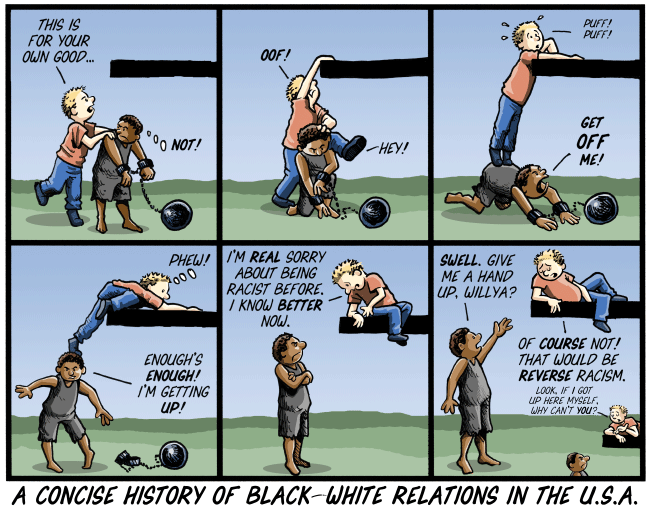
The Court has decided to trust majority rule to defend minority rights. That didn’t work very well the last time.


It’s hard to appreciate this week’s Supreme Court decision on affirmative action without knowing about a case from the 19th century.

The Civil Rights Cases. In 1883, just a few years after Union troops stopped occupying the states of the former Confederacy, the Supreme Court ruled on five cases it combined into the Civil Rights Cases (Wikipedia, text of decision). Eight justices ruled unconstitutional the Civil Rights Act of 1875, which banned racial discrimination in “accommodations, advantages, facilities, and privileges of inns, public conveyances on land or water, theaters, and other places of public amusement”. The Court said that Congress had overstepped its power, because the 13th and 14th Amendments only gave it “corrective” power to reverse state laws that denied blacks their civil rights. Congress couldn’t legislate directly to guarantee those rights.

And then the Court went on to make a more sweeping statement:

When a man has emerged from slavery, and, by the aid of beneficent legislation, has shaken off the inseparable concomitants of that state, there must be some stage in the progress of his elevation when he takes the rank of a mere citizen and ceases to be the special favorite of the laws, and when his rights as a citizen or a man are to be protected in the ordinary modes by which other men’s rights are protected.

In other words, if the former slaves needed this kind of protection, they should seek it from their state governments, the way white people would. No doubt that sounded very reasonable to most whites, even most Northern white liberals: Slavery was over; the former slaves were citizens now; they should avail themselves of the protections the law had made for other citizens.

But Douglas Blackmon observed in Slavery By Another Name that things didn’t quite work out that way.

Civil rights was a local, not federal issue, the Court found. The effect was to open the floodgates for laws throughout the South specifically aimed at eliminating those new rights for former slaves and their descendents. … [A] declaration by the country’s highest courts that the federal government could not force states to comply with the constitutional requirement of the equal treatment of citizens, regardless of race, opened a torrent of repression.

As reasonable as it may have sounded at the time, from the perspective of history the Civil Rights Cases decision was the opening bell for the Jim Crow era. Due process and equal protection under the laws had become pro forma rights; if a state preserved certain outward appearances, it need not provide any real equality. Or, more accurately, the state continued to have a moral obligation to provide equality, but the federal government had no authority to enforce that obligation. The lone dissent of Justice John Harlan (not to be confused with his grandson, John Harlan II, a 20th-century Supreme Court justice whose opinions figure as precedents in this week’s ruling) was prophetic:

[I]f the recent amendments are so construed … we shall enter upon an era of constitutional law when the rights of freedom and American citizenship cannot receive from the nation that efficient protection which heretofore was unhesitatingly accorded to slavery and the rights of the master.

Harlan also was the lone dissent in the 1896 Plessy v Ferguson decision that enshrined separate-but-equal. He deserves to be more famous than he is.

Michigan. Now let’s talk about this week’s decision, Schuette v Coalition to Defend Affirmative Action. Like most race cases these days, there has been a back-and-forth that makes the underlying principles hard to sort out: Until 2003, the University of Michigan used race as a consideration for admission to both its undergraduate program and its law school. That year, the Supreme Court ruled on both: It threw out the undergraduate system in the Gratz decision but upheld the law school system in Grutter.

Both cases hung on the same issues, and Justices O’Connor and Breyer were the swing votes. Previous cases had identified only one interest that could justify affirmative action by a state university: the overall educational advantage provided by a diverse student body. In other words, the state couldn’t favor one race for the simple purpose of giving that race an advantage, but it could decide that a diverse student body provides a better education for everyone. (Imagine studying the Civil War in an all-white classroom versus a classroom where other races are represented. Probably the discussions would be very different, and a university might legitimately decide that the mixed-race classroom experience is better.) But the Court insisted that the particular plan to promote diversity had to be narrowly tailored for that purpose, rather than resembling a racial quota system. The law-school plan passed muster under the narrowly-tailored standard; the undergraduate plan didn’t.

But Michigan’s anti-affirmative-action groups weren’t satisfied with a split decision, so in 2006 (as a direct response to Grutter), a referendum added an amendment to the Michigan Constitution banning “preferential treatment to any individual or group on the basis of race, sex, color, ethnicity, or national origin” in education, hiring, or contracting by the state or any public institution under the authority of the state. Overall, the amendment passed with a clear 58%-42% majority, but the exit poll showed major demographic splits: White men voted for it 70%-30%, while non-white women opposed it 82%-18%. If you work out the numbers, the entire margin of victory came from white men (42% of the electorate), while everyone else split almost evenly.

So you wind up with two separate levels of dispute: affirmative action itself, but also the limits of democracy. In other words, if the majority doesn’t get its way for some reason, under what circumstances can it change the rules?

The Political Process doctrine. The history of the Civil Rights movement since 1883 has been a story of the white majority changing the rules whenever the black minority seemed about to rectify some disadvantage. If the 15th Amendment gave blacks the right to vote, poll taxes and literacy tests could take it away, while grandfather clauses protected poor or illiterate whites from disenfranchisement. If Arkansas couldn’t keep blacks out of Little Rock’s Central High, the governor could shut the school down. Slavery By Another Name is about how Southern whites circumvented the elimination of slavery itself by inventing bogus crimes that blacks could be convicted of and then sentenced to hard labor.

The Supreme Court cases on race — from the Civil Rights Cases to Brown and beyond into enforcing Brown‘s requirement of integrated schools — revolve around the Court’s increasing realization that it couldn’t deal with state and local governments under the assumption of good faith. The white majority simply did not want blacks to receive due process and equal protection under the laws, and any high principles announced by the Court would be examined for loopholes rather than implemented.

As a result, the Court evolved what came to be called the Political Process doctrine: If a minority achieves one of its goals through the ordinary decision-making process — courts, school boards, elections, etc. — and the majority responds by changing the rules to move the decision to a different body where the minority will lose, that rule-change deserves special scrutiny from the courts. If there was no compelling reason to change the process beyond frustrating the minority, the change is invalid.

Justices Sotomayor, Ginsberg, Scalia, and Thomas all agree that the Political Process doctrine applies to this case. Sotomayor and Ginsberg want to invoke it to invalidate the Michigan constitutional amendment, while Scalia and Thomas want to take this opportunity to reverse the doctrine entirely. The plurality opinion (written by Justice Kennedy, and joined by Roberts and Alito), is another example of something I complained about two weeks ago: covertly reversing decisions without appearing to do so. After Schuette, the Political Process doctrine is dead. While it remains as a precedent, it’s hard to imagine a situation where it could be invoked.

And that development has consequences beyond affirmative action.

The opinions. The plurality opinion (representing Kennedy, Roberts, and Alito) was written by Justice Kennedy. If you’ve been reading the Sift since last summer, you know I don’t think much of Justice Kennedy’s writing style and the muddled mind it seems to represent. (Lower court judges seem not to know how to apply Kennedy’s rulings, which tells you something.) I suspect that’s why the Chief Justice chose Kennedy to write this opinion rather than doing it himself. Any judge who tries to invoke the Political Process doctrine in the future will have to glean some principles of application from Kennedy’s opinion; probably they will just throw up their hands and decide the case on some other basis.

Kennedy reminds us that “It cannot be entertained as a serious proposition that all individuals of the same race think alike”, that there are no clear legal standards for determining the interests of a racial group, or even of defining who is in or out of the group, and so on. If the Court allows that there are racial interests that prevent rule changes, race might be dragged into any number of issues in order to freeze the process in place.

In short, if racial majorities decide to act in bad faith, judges are simply not clever enough to catch them. Kennedy concludes:

Democracy does not presume that some subjects are either too divisive or too profound for public debate.

as if anyone had ever made that claim.

Scalia’s dissent (joined by Thomas) is painful to read, because as he gets older, Scalia is less and less able to pretend that he respects anyone who disagrees with him. So his opinions increasingly contain more attitude than law. But at least he does go through the relevant precedents, explaining why they were all wrongly decided. I would love to hear Justice Scalia’s opinion on the Civil Rights Cases, or whether rule changes that disadvantage a minority should ever be thrown out by the Court. Most of all, I want to hear how he will square all this with what he rules in the upcoming Hobby Lobby case, where the minority seeking protection is abortion-opposing Christian employers.

Justice Breyer’s concurrence shows more honest inner conflict than any of the others. He wants to support both the democratic process and minority rights, but has to come down on the side of democratic process.

the principle that underlies [the Political Process doctrine precedents] runs up against a competing principle, discussed above. This competing principle favors decisionmaking through the democratic process. Just as this principle strongly supports the right of the people, or their elected representatives, to adopt race-conscious policies for reasons of inclusion, so must it give them the right to vote not to do so.

Justice Sotomayor’s dissent (joined by Ginsberg) is as long as all the rest put together, probably because she alone is arguing that the Court needs to pay attention to nuance. Like Scalia, she takes the precedents seriously, but she wants to apply those precedents rather than reverse them. She also thinks the Court needs to consider where the Michigan constitutional amendment fits in the long history of changing the rules to short-circuit minority victories.

As a result of [the amendment], there are now two very different processes through which a Michigan citizen is permitted to influence the admissions policies of the State’s universities: one for persons interested in race-sensitive admissions policies and one for everyone else. A citizen who is a University of Michigan alumnus, for instance, can advocate for an admissions policy that considers an applicant’s legacy status by meeting individually with members of the Board of Regents to convince them of her views, by joining with other legacy parents to lobby the Board, or by voting for and supporting Board candidates who share her position. The same options are available to a citizen who wants the Board to adopt admissions policies that consider athleticism, geography, area of study, and so on. The one and only policy a Michigan citizen may not seek through this long-established process is a race-sensitive admissions policy that considers race in an individualized manner when it is clear that race-neutral alternatives are not adequate to achieve diversity. For that policy alone, the citizens of Michigan must undertake the daunting task of amending the State Constitution.

But that point of view lost. As in last summer’s Voting Rights decision (in which Chief Justice Roberts announced the profound legal principle that “things have changed”) the history of racism and racial progress in America is not considered relevant by the Roberts Court. Going forward, the Court appears ready to assume good faith on the part of the white majority. Let’s hope it works out better this time.

Democracy By Coincidence

A new study concludes that We the People sometimes get what we want, but not because we have any real power.


For months after the Sandy Hook shootings, polls showed that large majorities of American voters wanted at least some strengthening of gun control laws, with support for universal background checks on gun buyers reaching the almost unheard-of level of 90%. A well organized and well funded interest group, the National Rifle Association, opposed this groundswell of popular opinion and won. A bipartisan bill that expanded background checks to sales at gun shows (and included a specific ban on the national gun registry the NRA said the proposal would lead to) failed in the Senate.

Recently, hopes for gun control rose again — not because of any further increase in its popularity, but because one rich man (billionaire and former NYC Mayor Mike Bloomberg) announced his intention to spend $50 million on the issue.

Forget for a moment the specific arguments for or against gun control: Does that resemble any process you studied in civics class? Do you think that’s what Lincoln had in mind when he talked about “government of the people, by the people, and for the people”?

There are plenty of other examples where the public has a definite opinion, but has been unable to get the result it wants: getting the NSA to stop tracking our phone calls, sending some bankers to jail after the known crimes of the housing bubble, or even things I disagree with, like prayer in public schools. One current issue is raising the minimum wage: It’s popular, but so far that hasn’t made much difference.

In addition to individual issues, consider our presidential primary process, an elimination race in which candidates compete until they run out of money. Until the 2012 cycle, you could argue that (while money was certainly influential) the voters were still driving the feedback process between money and elections: success at the polls led to contributions that keep the campaign going long enough to have another electoral success.

But the first presidential cycle after Citizens United worked a little differently: Casino billionaire Sheldon Adelson kept Newt Gingrich’s campaign going single-handedly, contributing $16.5 million. (Adelson went on to spend at least $98 million on the entire 2012 election cycle, a drop in the bucket for a man worth $37 billion. To get some perspective, imagine 37,000 millionaires each contributed $2650. Collectively, they would equal one Sheldon Adelson.) Rick Santorum, the other Romney challenger to survive deep into the process, had his own billionaire backer contributing millions of dollars: Foster Friess.

So if Romney (worth $250 million himself) had stumbled down the stretch, the only candidates in a position to benefit had been put there by individual rich men. Those without a billionaire backer were long gone. Does that resemble any process you studied in high school?

As persuasive as such stories may seem, they’re only anecdotes. People who think American democracy is working fine can find their own anecdotes in which popular opinion changes and something happens, apparently as a result. Majorities initially supported the Iraq invasion, especially in the early days when it appeared to be succeeding. But as the war dragged on, the public turned against it, and our combat troops are out now. Maybe the withdrawal took longer than it should have, but ultimately the voters got what they wanted.

In 2008, Barack Obama and the Democrats ran on a health plan very much like ObamaCare. They won huge majorities and implemented the program they ran on. In 2010, Republicans ran on deficit reduction, won, and the deficit has been considerably reduced. That’s democracy in action.

My anecdotes, somebody else’s anecdotes — who’s right? That’s the question political science professors Martin Gillens of Princeton and Benjamin Page of Northwestern set out to answer in their paper “Testing Theories of American Politics: Elites, Interest Groups, and Average Citizens” which will appear in the Fall issue of the refereed journal Perspectives in Politics published by the American Political Science Association.

Gillens and Page (or more likely their graduate students) examined “1,779 instances between 1981 and 2002 in which a national survey of the general public asked a favor/oppose question about a proposed policy change”. They stipulated that the questions had to be specific enough to determine four years later whether or not the public had gotten its way, and that the results had to be broken down by income. They also compiled lists of major interest-group organizations (trade groups, labor unions, groups focused on single issues like abortion, mass-membership groups like AARP, etc.) and their public positions on these issues, then constructed an index (“Net Interest Group Alignment”) to measure the overall interest-group pressure on each issue.

From there, what makes the analysis difficult is that the policies favored by average citizens, wealthy citizens, and interest groups often overlap, so some advanced statistical juggling has to be done to determine who’s driving the bus and who’s just riding on it. (For example, you and your neighbor may have disagreed about background checks at gun shows, and one of you got your way. But was the really significant argument between you and your neighbor, or between the NRA and Mike Bloomberg?) I haven’t examined the specific techniques Gillens and Page used, but the general idea is that the variables that predict the outcome most often are assumed to be more powerful, and the power of the remaining variables is assessed after the influence of the more powerful variables is factored out. (Or, simplifying a bit, when public opinion and wealthy opinion contradict each other, who wins?)

Here’s what they concluded:

These results suggest that reality is best captured by mixed theories in which both individual economic elites and organized interest groups (including corporations, largely owned and controlled by wealthy elites) play a substantial part in affecting public policy, but the general public has little or no independent influence. …

Since the preferences of ordinary citizens tend to be positively correlated with the preferences of economic elites, ordinary citizens often win the policies they want, even if they are more or less coincidental beneficiaries rather than causes of the victory. … In any case, normative advocates of populistic democracy may not be enthusiastic about democracy by coincidence, in which ordinary citizens get what they want from government only when they happen to agree with elites or interest groups that are really calling the shots.

The authors realize that this paper represents an incomplete theory. They don’t, for example, come up with a formula that reliably predicts policy outcomes from elite opinion and interest group alignment. The degree of correlation they find isn’t large enough to suggest that such a formula is possible; probably other variables are at work as well. For example, they aren’t modeling

  • the views of opinion-makers who are only incidentally wealthy (like Glenn Beck, Anderson Cooper, or Rachel Maddow);
  • the interests of entrenched government bureaucracies like the Pentagon or the Federal Reserve;
  • the option-shaping power of academic elites at universities and think tanks.

or any of the other factors bound up in the idea of “serious people”. (The influence of “serious people” shows most clearly in issues like NSA spying. I don’t think the wealthy are any happier about having their calls logged than the rest of us, and there’s no NRA-like group that defends domestic spying. But “serious people”, like the ones who are presented as experts on the weekend talk shows, don’t make the case for reining in the NSA, and people who do aren’t taken seriously.)

In addition, the authors recognize weaknesses in their data that they believe understate the influence of the very wealthy. After all, even a poll that breaks down results by income isn’t going to provide a significant sample of billionaires. (The authors estimate the opinions of the wealthy by using data about the richest 10% of responders, figuring that the differences between opinion at the 50th percentile and the 90th percentile are indicative of greater differences higher up the ladder.) A method that more directly measures the views of the 1% or the .01% might find an even greater correlation with policy outcomes.

We also don’t know why there’s an overlap between elite opinion and public opinion. Perhaps the wealthy are paternalistically trying to do what’s best for everybody. (Mayor Bloomberg appears to have no personal stake in limiting guns, and Bill Gates‘ kids aren’t likely to need the public schools.) Perhaps public opinion itself has already been shaped by the influence of the rich. (Think of all the working-class people who vehemently oppose “the death tax” — not realizing it’s not triggered until your estates exceeds $5 million.)

Finally, there’s a point of view that says elites should run things. Maybe, as a class, the rich are more educated, better informed, and more insightful than the rest of us. (Then again, maybe our public discussion of poverty has such an abstract, other-worldly quality because the rich people whose opinions really matter don’t know any poor people.) That’s certainly a discussion worth having, but we ought to have it honestly, recognizing that we’ve decided to abandon all our 1776-ish rhetoric about government being founded on the will of the People.

Worst of all, though, is the thought of how that discussion would be judged: The elite wouldn’t have to convince the general public that they deserve to lead, because the opinion of the general public really doesn’t matter. Instead, the public would have to convince the elite that we deserve to be listened to.

Themes of 2013: Minority Rule

It’s hard to remember now how 2013 began: with the Republicans (having believed their own skewed-polls rhetoric) in shock at having lost the 2012 presidential election by five million votes, and having lost even the aggregate House of Representative tally by 1.3 million (even if gerrymandering gave them a majority of seats). But … but … but … the deficit … unemployment … Benghazi … Obama is the worst president ever … real Americans are conservatives …

How could it have happened?

Demographics. The closer they looked at the exit polls, the worse it got. Sure, Obama got 93% of the black vote; everybody expected that. But also 71% of Latinos and 72% of Asians. (Asians? Aren’t they supposed to be the model minority? Don’t they have more makers than takers? How could they side with the Kenyan usurper?) 60% of 20-somethings and 55% of 30-somethings. 70% of folks who list their religion as “none”.

All those groups are growing. The groups that kept the election from being a complete blow-out are the ones that seem to be shuffling off center stage: Over-65s went for Romney 56%-44%. White men voted Republican 62%-35%. (In Teddy Roosevelt’s day, white men were the electorate. How can you get 62% of white men and lose?)

So 2012 wasn’t just a loss for Republicans, it was a loss that augured bigger losses in the future. All the predictions Jonathan Chait had made the previous February in “2012 or Never” seemed to be coming true, and it was looking like Never. As the balls fell and the corks popped to welcome 2013, Republicans were asking: What do we have to do to become the majority again?

Change? Some answers seemed obvious. (The best collection of these answers was put together by College Republicans.) Stop talking about Hispanic immigration as if it were the barbarian invasion of Rome. Tone down the anti-gay rhetoric (not because the gay vote is so pivotal, but because homophobic hate-mongering turns off young straights). Stop pandering to the radical fringe on abortion and other social issues. Come up with competing conservative answers to questions that loom ever larger to middle-class Americans: Where are the jobs going to come from? How are the kids going to pay for college? What will happen to me and my family if I get sick?

The new year brought an obvious issue to focus on first: gun violence. (The first Sift of 2013 started: “This week everybody was talking about guns again.”) Sandy Hook was still fresh when the new Congress was sworn in, and (unlike the response to previous mass shootings), the furor didn’t seem to be dying down.

By wide margins, the public supported universal background checks for gun buyers, re-instituting the assault-weapon ban that President Bush let lapse, and banning the high-capacity magazines that had played such a key role in the Tucson shooting. For a time, some kind of bipartisan gun bill looked to be a no-brainer.
Then we saw the pattern that would repeat itself again and again all year: Some well-funded extremist group (in this case the NRA) rallied the conservative base with scare tactics (Obama was planning to confiscate guns by executive order!), threatened primary challenges against wavering Republicans, and whipped the Republican leadership into line.

In the end, a Republican-led filibuster blocked even a weak-tea gun bill that 54 senators supported.

Something similar happened to immigration reform: In this case a bipartisan bill made it through the Senate only to be refused a vote by the Republican House leadership, which offered no alternative.

Take that, Hispanics! Screw you and your fastest-growing-voter-bloc BS. Think we care? Think again!

Ditto for women, who are already a voting majority. Again and again, Republicans pandered to the an extreme anti-abortion or anti-birth-control minority with the most outrageous proposals and rhetoric. The most extreme recent example is Michigan’s “rape insurance” law, which won’t allow insurance companies to cover abortion (even in cases of rape) in any general-purpose health plan. Unless you planned on being raped and paid in advance for a special abortion rider on your healthcare policy, you’re out of luck.

Did anybody notice a post-2012 let-up in Republican anti-gay rhetoric or an olive branch to people who don’t go to church? Or a Republican jobs plan? Or any healthcare plan beyond “repeal ObamaCare”? Nope.

In the fall, poll after poll showed large majorities against a government shutdown or a threat to the debt ceiling. Did that matter? No.

This isn’t how we’re used to seeing political parties behave. So what’s going on here? How do Republicans plan to persuade a majority of Americans to support them?

It’s simple: They don’t.

Minority rule. That is the single biggest development of 2013: Republicans have given up on the idea of persuading a majority to agree with them. Instead, conservatives plan to rule from the minority.

In the old days that might have meant a military coup or something, but modern minority-rule techniques are much more imaginative. The strategy is simple: take advantage of all the hurdles that exist between the will of the majority and the enforcement of a law. If you can knock that majority down just a little at each stage, what looked like a tidal wave can become just a little ripple.

Defense in depth. Consider all of the structural things Republicans have been pushing. Stop looking at them one-by-one and think about them as a system.

  • Voter suppression. You don’t have to ban people from voting, just make it difficult. Limit the days and hours and number of voting machines so that you create long lines. Find excuses to remove legitimate voters from the roles. Require IDs they don’t have, and don’t accept the IDs they do have. Change the rules late in the game. Plenty of determined people will manage to vote anyway, but all you’re trying to do is knock the numbers down.
  • Unlimited money. You don’t have to buy elections outright, you just want to control them a little. With unlimited money, you can keep incumbents in line by threatening a primary challenge based on fringe issues. You can eliminate the need for volunteers by hiring professionals. You can keep candidates in the race longer or knock them out earlier. You can create issues out of nothing, de-legitimize real issues, or just confuse the voters. You can make the campaign obnoxious and ugly, so that voters don’t want to participate.
  • Gerrymandering. If you concentrate the other party’s voters in a few districts, you can give your party an advantage in a majority of districts, even if you have fewer voters. The paradigm here is Pennsylvania, where a slim Democratic voting majority led to a 13-5 Republican advantage in members of Congress. The Senate itself is a form of gerrymandering: It took 7.7 million Democratic votes to elect Dianne Feinstein to the Senate, but only 102 thousand votes put Republican Lisa Murkowski in. Their Senate votes count the same. (The conservative pipe dream of repealing the 17th Amendment would make this situation worse.)
  • Shadow government. You may think your state laws come from the legislators you elected. Wrong! If your legislature has a Republican majority, chances are your state laws are being written by the American Legislative Executive Council (ALEC), a national pseudo-legislature whose controlling members are corporations rather than people.
  • Emergency managers. Here’s a neat trick: Cut state aid to cities and their school districts, then when they get into financial trouble replace their elected governments with “emergency managers“, i.e., dictators appointed by the governor, who can void union contracts and refuse to fund pensions already earned. More than half of the black citizens of Michigan have lost their right to local government. If the voters don’t like it and vote for repeal, pass the law again and make it referendum-proof. Think that can’t happen in your state or your town? Why not?
  • The Hastert Rule. Immigration reform is one of a number of ideas that are believed to be supported by a majority of House members, but never come up for a vote. Shutting down the government, on the other hand, had only minority support, but it happened. How does that work? The House operates by the majority-of-the-majority principle, a.k.a. the Hastert Rule. Speaker Boehner won’t bring bills up for a vote unless a majority of the House Republican caucus supports them. So instead of needing 218 votes (a majority) to block something, you can do it with only 117 (a majority of the 233-member Republican majority). The logic of primary challenges is similar: It doesn’t matter what the majority of voters in a Republican congressman’s district think, if a majority-of-the-majority (i.e., a majority of voters in his Republican primary) want to throw him out.
  • The filibuster. In the Senate, 41 votes can block legislation. Until recently, 41 votes could also block presidential appointments, which Republicans were using to prevent President Obama from altering the current conservative bias in the judiciary. So the senators representing the 21 smallest states — total population 35.4 million, or about 11% of the country — can block any law.
  • Hostage-taking. Sure a minority can block things, but how can they pass laws of their own? Simple: take hostages. That’s what the 2013 government shutdown and debt-ceiling crisis was about. An extremist minority could block the government from taking necessary actions, and what it wanted in return for not burning down the house was to repeal ObamaCare. Ordinarily that would take a majority, but not if you have a gun to the economy’s head.
  • Nullification. A similar tactic was implicit in a new use of the filibuster to nullify existing laws. Refuse to approve anybody to certain enforcement positions. So, you would need a majority to scrap all the nation’s labor laws, but they can’t be enforced if the National Labor Relations Board doesn’t have a quorum, and you can block appointments via the filibuster. Voila! No labor laws! (Nullification is what caused Democrats to eliminate the filibuster on presidential appointments.)
  • Judicial activism. Even if a law makes it past all those hurdles, it just takes five Supreme Court justices to declare it unconstitutional. The integrity of the system depends on judges not abusing their power, but sometimes they do. During the Warren Court of the 1960s, judicial activism was a liberal thing. That’s ancient history now, as we saw most clearly in the ObamaCare decision. At the time the Affordable Care Act was passed, there was no legal precedent to justify invalidating it, and few legal analysts were concerned about the possibility. (Salon’s Andrew Koppelman: “The constitutional limits that the bill supposedly disregarded could not have been anticipated because they did not exist while the bill was being written.”) But in a matter of months, a new interpretation of the Commerce Clause was invented and gained the support of the Court’s five conservative justices. (Justice Roberts narrowly saved the law by re-interpreting the individual mandate as a tax rather than a penalty, but the new narrowing of the Commerce Clause stands and could skewer any number of government programs in the future.) Conservative judicial activism has been key in the whole minority-rule enterprise, by unleashing the unlimited money and opening the door to voter suppression, which red states have been happy to walk through.

Across the board, Republicans are defending and in some cases sharpening the tools of minority rule. So if they annoy a majority of Americans with their extremist agenda, who cares? Democrats would need a really large majority, say 5-7%, just to overcome gerrymandering and get even in the House, not to mention getting 60 votes in the Senate. And even then, unlimited money can usually buy a handful of Democrats with a local special interest, and the Supreme Court can invent new kinds of “religious freedom” or “corporate rights” to keep any real change from happening.

The long term threat. In the long run, a dedicated majority can get its way. If Democrats can win the state legislatures in 2020, they can de-gerrymander both the congressional districts and the legislative districts within the states. If Democrats can hold the presidency long enough, they can end conservative judicial activism. Then, if that same dedicated majority will keep those Democrats honest, there’s a chance America can start controlling money in politics and make progress towards real democracy that serves the public interest.

But that’s the question: Will a majority stay dedicated, through years of watching politics amount to nothing? Those young people who believed Candidate Obama when he said, “Yes we can” — what will become of them? What if they conclude “No we can’t” and just stop bothering?

That’s the ultimate goal of minority rule: a discouraged majority that stops looking to political action as a way to solve its problems.

The Filibuster and the War on Women

The abuse of the filibuster is a hard issue to get people excited about. It’s one of those technical political things that takes too long to explain and is hard to connect to problems voters care about.

This week, making those connections was a little easier. If you care about a woman’s right to decide whether she gets pregnant or has a baby, the connection to the filibuster was all too clear. Here are three of this week’s big stories:

  • Senator John Cornyn threatened to filibuster anyone President Obama nominates to the D. C. federal appeals court. He’s not making objections to the specific judges Obama has picked, he’s arguing that Obama shouldn’t be allowed to make any picks at all. The court’s current 4-4 conservative/liberal balance should be locked in, no matter how many elections Democrats win.
  • That same court issued a temporary injunction to suspend ObamaCare’s contraception mandate for certain firms, in anticipation of a permanent ruling that employers’ religious freedom gives them power over employees’ health decisions. The judge who wrote the majority opinion is a radical conservative that Democrats tried to block when President Bush nominated her, but they had to back down when Republicans threatened the “nuclear option” to eliminate the filibuster permanently.
  • Another judge from that same batch of Bush appointees lifted a lower-court injunction against a Texas anti-abortion law that (among other restrictions) instantly closes about 1/3 of Texas abortion clinics, leaving large areas of the state without abortion services, again in anticipation of the law’s ultimate approval.

Let’s take those one at a time.

Filibuster abuse and the D. C. court. Wikipedia describes the federal appeals court for the District of Columbia circuit like this:

While it has the smallest geographic jurisdiction of any of the United States courts of appeals, the D.C. Circuit, with eleven active judgeships, is arguably the most important inferior appellate court. The court is given the responsibility of directly reviewing the decisions and rulemaking of many federal independent agencies of the United States government based in the national capital, often without prior hearing by a district court. Aside from the agencies whose statutes explicitly direct review by the D.C. Circuit, the court typically hears cases from other agencies under the more general jurisdiction granted to the Courts of Appeals under the Administrative Procedure Act. Given the broad areas over which federal agencies have power, this often gives the judges of the D.C. Circuit a central role in affecting national U.S. policy and law.

A judgeship on the D.C. Circuit is often thought of as a stepping-stone for appointment to the Supreme Court.

The court has 11 active judgeSHIPs, but only 8 active judges. (It had only 7 — and a 4-3 conservative majority — until Obama finally got his first pick approved in May. It also has six semi-retired senior judges. If you count them, the court has a 9-5 conservative majority.) That’s because there are three vacancies. The Constitution (Article II, Section 2) specifies how those vacancies should be filled:

The President … shall nominate, and by and with the Advice and Consent of the Senate, shall appoint Ambassadors, other public Ministers and Consuls, Judges of the supreme Court, and all other Officers of the United States, whose Appointments are not herein otherwise provided for

The filibuster is a historical accident. The Founders didn’t envision it, and although an 1806 rule change made filibusters possible, the first one didn’t happen until 1837. They were rare until the 1970s, and truly skyrocketed when the Republicans became the Senate minority after the 2006 election.

Filibusters of presidential nominations were rare until the Clinton administration, and then Democrats retaliated during the Bush years. But even then, the justification for a filibuster was always some alleged problem with the individual nominee. (Bush nominee Janice Rogers Brown, for example, was filibustered for a history of inflammatory decisions, having once written of Social Security: “Today’s senior citizens blithely cannibalize their grandchildren because they have the right to get as much ‘free’ stuff as the political system will permit them to extract.”)

What’s new in the Obama years is the use of the filibuster to nullify a federal office by refusing to approve anyone to head it, regardless of character or qualifications. Until Senate Democrats threatened to invoke the so-called nuclear option in July, Republicans were on track to invalidate the entire National Labor Relations Board, essentially nullifying all laws protecting workers’ rights to organize unions and bargain collectively in good faith.

Cornyn proposes an extension of this unprecedented tactic: using the filibuster to nullify the three vacancies on the D. C. court, ostensibly because the court’s case load doesn’t require 11 judges. (He wasn’t bothered by an even lower case load when Bush appointed Rogers.)

If over-staffing of the D.C. court is indeed a problem (and not just a pretext to stave off a liberal majority), the Constitution provides a way to solve it in Article I, Section 8:

The Congress shall have Power … To constitute Tribunals inferior to the supreme Court

In other words, Congress could pass a law shrinking the D. C. court, if that were really a problem. But legislation requires a majority vote in both houses and the signature of the President, which Cornyn can’t get because his party can’t win national elections.

This is what the filibuster has become: not just a way to block new laws or objectionable appointments, but a way for a minority to repeal legislation already passed or to achieve its goals without passing laws at all.

Who needs to win elections?

The contraception mandate. Thursday, the previously mentioned Janice Rogers Brown (of Social-Security-is-cannibalism fame) was the deciding vote in a 2-1 decision by the D. C. appeals court to grant an injunction blocking enforcement of ObamaCare’s contraception mandate on a business owned by two Catholic brothers. The ruling isn’t a final decision in the case, but it reads like one, because one key consideration in granting such an injunction is a belief that the injunction-seeking side is likely to prevail.

Fortunately, Rogers stopped short of declaring that corporations are protected by the First Amendment’s free-exercise-of-religion clause, which would have produced true chaos. But the 400-employee company is owned by two brothers who claim to operate according to Catholic principles (i.e., having pro-life bumper stickers on their trucks), so the brothers’ religious freedom is violated by the requirement that they provide contraception coverage to their female employees.

I’ve stated my position on this issue at length before: I believe these claims of “religious freedom” are actually passive aggression, stretching claims of one’s own moral purity to ridiculous lengths in order to control the behavior of others. I was pleased to see many of my own favorite arguments show up in the dissenting opinion of  Senior Judge Harry Edwards (the only Democratic appointee among the senior judges) (I’m not claiming Edwards reads the Sift or that the arguments are original to me):

It has been well understood since the founding of our nation that legislative restrictions may trump religious exercise. Braunfeld v. Brown, 366 U.S. 599, 603 (1961). Were it otherwise, “professed doctrines of religious belief [would be] superior to the law of the land, and in effect permit every citizen to become a law unto himself.”

and illustrates the point with an example Sift readers will recognize:

A Christian Scientist, whose religion has historically opposed conventional medical treatment, might claim that his corporation is entitled to a religious exemption from covering all medical care except healers who treat medical ailments with prayer.

Edwards sees the conflict between the owners’ religious beliefs and the mandate, but does not find that it meets the legal standard of a “substantial burden”, using another analogy I’ve used here.

The Supreme Court has never applied the Free Exercise Clause to find a substantial burden on a plaintiff’s religious exercise where the plaintiff is not himself required to take or forgo action that violates his religious beliefs, but is merely required to take action that might enable other people to do things that are at odds with the plaintiff’s religious beliefs.

… The Gilardis do not contend that their religious exercise is violated when Freshway pays wages that employees might use to purchase contraception, and the Mandate does not require the Gilardis to facilitate the use of contraception any more directly than they already do by authorizing Freshway to pay wages.

Edwards quotes a 1982 Supreme Court decision:

Congress and the courts have been sensitive to the needs flowing from the Free Exercise Clause, but every person cannot be shielded from all the burdens incident to exercising every aspect of the right to practice religious beliefs. When followers of a particular sect enter into commercial activity as a matter of choice, the limits they accept on their own conduct as a matter of conscience and faith are not to be superimposed on the statutory schemes which are binding on others in that activity.

If not for the filibuster, that might be the majority opinion.

Texas abortion law. One of the other Bush judicial appointees who made it through the Senate under threat of the nuclear option was Priscilla Owen, whose appointment the Houston Chronicle opposed with these words:

The problem is not that Owen is “too conservative,” as some of her critics complain, but that she too often contorts rulings to conform to her particular conservative outlook. It’s saying something that Owen is a regular dissenter on a Texas Supreme Court made up mostly of other conservative Republicans.

No less a conservative than Alberto Gonzales once characterized Owen’s opinion in a Texas abortion case as “an unconscionable act of judicial activism”. In other words, even among conservative judges, she stood out as particularly radical.

The stipulation in the recent Texas abortion law (the one Wendy Davis delayed for a session with her famous state-legislature filibuster) that doctors who perform abortions have admitting privileges in local hospitals is one of a number of regulations designed to close clinics, and is largely devoid of any legitimate purpose. The lower-court judge found that the law was “without a rational basis and places a substantial obstacle in the path of a woman seeking an abortion.” Similar laws in Wisconsin and other states have been blocked by federal judges.

But thanks to Judge Owen, this one is allowed to take effect. Abortion clinics are already closing, and it is estimated the 1/3 of all abortion clinics in Texas — already not that common — will be unable to meet the requirement.

End the filibuster. Right now, conservatives are benefitting from the fact that Senate Republicans have been more willing to play hardball than Democrats. Democrats under Bush attempted to block only the most outrageous nominees, and for the most part they failed. Those judges are on the bench now, fighting the war on women.

That’s just one front of the struggle, the one whose dots were most easily connected this week. Ultra-conservative judges have brought us Citizens United, came close to constructing an entirely novel interpretation of the Commerce Clause specifically to torpedo ObamaCare, and across-the-board have extended the rights of corporations and the rich over workers, consumers, and the general public.

President Bush did not try to be “reasonable” in his appointments or seek uncontroversial nominees. He nominated the most activist conservative judges he could find, and Senate Republicans refused to let the Democrats filibuster even the worst of them.

Now that the tables have turned, the filibuster has been expanded into a general tool of minority rule. It’s time to end it, once and for all.

Seven Key Points About the Shutdown

1. This is not a pox-on-both-your-houses situation. The Republicans planned this shutdown and carried it out.

Last Monday, on the eve of the shutdown, Rachel Maddow showed the tapes of one Republican candidate after another making campaign speeches about shutting down the government and being cheered for it. That never happens on the Democratic side. No Democratic candidate for Congress tells his crowds he’s going to shut down the government and expects to get a cheer. Rachel summarized:

What is happening tonight is happening tonight because this is what Republicans want to do. This is what they promised to do. … Elect Republicans and they will burn the place down and they will laugh while they do it and have a great time.

The Daily Beast’s David Freedlander talked to a number of Republican donors from the banking industry, who said Rep. Walden (chair of the National Republican Congressional Campaign Committee, which wants their money) told them “We have to do this because of the Tea Party.” (An NRCC spokesman denies Walden said that.)

Jonathan Chait traces the Republicans’ post-2012-defeat strategy to a meeting in January.

If you want to grasp why Republicans are careening toward a potential federal government shutdown, and possibly toward provoking a sovereign debt crisis after that, you need to understand that this is the inevitable product of a conscious party strategy. Just as Republicans responded to their 2008 defeat by moving farther right, they responded to the 2012 defeat by moving right yet again. Since they had begun from a position of total opposition to the entire Obama agenda, the newer rightward lurch took the form of trying to wrest concessions from Obama by provoking a series of crises.

The first element of the strategy is a kind of legislative strike. Initially, House Republicans decided to boycott all direct negotiations with President Obama, and then subsequently extended that boycott to negotiations with the Democratic Senate. (Senate Democrats have spent months pleading with House Republicans to negotiate with them, to no avail.) This kind of refusal to even enter negotiations is highly unusual. The way to make sense of it is that Republicans have planned since January to force Obama to accede to large chunks of the Republican agenda, without Republicans having to offer any policy concessions of their own.

2. This “budget” showdown has nothing to do with the budget. Both sides agree on the spending number that should be in the continuing resolution.

That’s because Democrats agreed to the Republicans’ number. In other words, the only genuine concession in this process has come from the Democrats. John Boehner could have taken that concession, passed a continuing resolution to avoid the shutdown, and then called a press conference to declare victory. Instead he shut down the government.

3. The threat not to raise the debt ceiling is unprecedented, except for when these same Republicans made the same threat in 2011.

Posturing about the debt ceiling is perennial: “Look how profligate the party in power is. They’ve run up so much debt we have to raise the ceiling.” But making a credible threat not to raise the debt ceiling unless your legislative demands are met? No. That is an absolutely new tactic in American politics.

Slate’s David Weigel goes through all the alleged examples of the Democrats threatening the debt ceiling. In 1981, Tip O’Neil tried to get President Reagan to promise that Republicans wouldn’t use a debt-ceiling vote against incumbent Democrats in the next election cycle (i.e., no policy demands), but passed it in plenty of time. In 1984, a Democratic committee chair blocked a debt ceiling bill for one day, seeking defense spending cuts. He was roundly criticized for “brinksmanship” and backed down.

That’s it. Dozens of other times Democratic majorities in Congress have passed debt-ceiling increases proposed by Republican presidents without making an issue of it.

If Democrats accepted the tactic Republicans are using, the September, 2007 debt-ceiling increase would have been an opportunity for Nancy Pelosi to demand deficit-reducing changes like a repeal of the Bush tax cuts or an end to Iraq War. But that didn’t happen, because Democrats don’t operate by extortion.

4. Republicans have redefined he words negotiate and compromise.

ThinkProgress’ Judd Legum summed up the Republican “negotiation”:

Can I burn down your house?
No
Just the 2nd floor?
No
Garage?
No
Let’s talk about what I can burn down.
No
YOU AREN’T COMPROMISING!

In a real compromise, both sides give something and both sides get something. So far, the Democrats have been offered nothing.

In the 2011 crisis, President Obama repeatedly tried to negotiate a “grand bargain” with Speaker Boehner that would knock trillions off the long-term deficit. That failed, and the “supercommitte” negotiations that were supposed to replace the sequester failed, on the same point: Republicans insisted there could be no tax increases in the deficit reduction plan. Zero. During one Republican presidential debate, the candidates were asked whether they would accept a 10-to-1 ratio of spending cuts to tax increases. All said no.

Since April, Harry Reid has been trying to form a conference committee so that the House and Senate can work out a budget compromise. The Republicans have refused to appoint their conferees, preferring to wait until they had the “leverage” of a government shutdown and debt default. The point here is exactly what Chait said above: to extort concessions out of the Democrats without offering any concessions of their own. “OK then, half the ransom” is not a concession, no matter what Ted Cruz says.

5. The principle at stake is majority rule.

I talked about this in detail last week. Speaker Boehner wants to tell the story that the shutdown represents a disagreement between two branches of government that have conflicting popular mandates: The public elected President Obama, but it also elected a Republican House of Representatives.

That’s not what this is about at all. If it were, Boehner could bring the Senate’s clean continuing resolution to the House floor for a vote and defeat it. He can’t do that, because given the chance the people’s representatives would pass it. In blocking that resolution, Boehner does not represent the majority of the House, he only represents “the majority of the majority”, i.e. a minority.

The entire give-us-what-we-want-or-we’ll-burn-the-house-down strategy is against all American ideals of democracy. The constitutional way to pass a law (or repeal a law you don’t like) is to do what the Democrats did to pass ObamaCare in the first place: Win not just a majority in the House, but also a substantial majority in the Senate (to overcome a filibuster, which the Founders never envisioned), and win the White House (to avoid a veto). The Republicans can’t do that, because they are a minority. (Even their House candidates collectively got a million fewer votes than the Democrats in 2012.)

6. Don’t believe the leak that John Boehner won’t allow a debt-ceiling default.

Thursday the NYT quoted multiple anonymous Republican congressmen saying that Boehner had told them he wouldn’t allow a default. But Matt Yglesias points out that Boehner has been saying such things all along, while also saying the opposite.

Boehner’s position, dating back to 2011, has been twofold. On the one hand he says that failing to raise the debt ceiling would be catastrophic and that he favors avoiding catastrophe. On the other hand he says that he requires unrelated public policy concessions in order to agree to a measure that he himself says he supports.

It is, in other words, the classic suicide hostage strategy: Do what I want or I’ll detonate the bomb strapped to my chest. This has always been Boehner’s position.

For example, on Friday Boehner said:

I don’t believe that we should default on our debt. It’s not good for our country. But after 55 years of spending more than what you bring in, something ought to be addressed. I think the American people expect if we’re going to raise the amount of money we can borrow, we ought to do something about our spending problem and the lack of economic growth in our country.

In other words, he wants concessions. And notice: Boehner doesn’t suggest doing something about the deficit, which has a revenue side. He only wants to discuss “our spending problem”. So he’s seeking spending cuts with no tax increases, the same no-compromise position that doomed the budget negotiations in 2011.

And then Sunday he reiterated:

STEPHANOPOULOS: So under no circumstances will you pass a clean debt limit?

BOEHNER: We’re not going down that path.

Stephanopoulos’ question: “So you sit down with the president. What would you offer him in that conversation?” got no answer. And when pushed on the tax issue Boehner said: “Very simple. We’re not raising taxes.”

He described Harry Reid’s proposal to negotiate about the budget after the shutdown and debt ceiling had been dealt with as

My way or the highway. That’s what he’s saying. Complete surrender and then we’ll talk to you.

So he wants concessions and won’t give anything in return. Without his extortion demand, he has nothing to talk about, so giving it up is “complete surrender”.

7. The clearest head in the room belongs to Elizabeth Warren.

The boogeyman government is like the Boogyman under the bed. It’s not real. It doesn’t exist. What is real, what does exist are all those specific important things that we as Americans have chosen to do together through our government. In our democracy, government is not some make-believe thing that has an independent will of its own. In our democracy, government is just how we describe the things that We the People have already decided to do together.

Apocalyptic Optimism

It’s the end of the world as we know it*, but Gar Alperovitz and David Graeber feel fine.


Lately Robert Jensen has been importing religious terms into journalism. Borrowing from the seminal theologian Walter Brueggermann, Jensen defines three stances from which a journalist can report:

  • royal, relaying the vision of the Powers That Be
  • prophetic, calling the Powers That Be to repent and reform, as the prophets confronted the kings in the Old Testament
  • apocalyptic, announcing that the status quo is beyond reform and calling on the people to think in dramatically new ways

It’s easy for a royalist to be optimistic, because the system is basically sound and a few policy tweaks — a tax cut, a jobs bill, a new general with an improved strategy — will fix whatever temporary problems we might be having. A prophet may rail against current trends, but prophetic warnings rest on the optimistic subtext that we still have time to change our ways. If we just end the war or restore the Constitution or throw the crooks out, we’ll be back on track.

“I was planning to rebuild anyway.”

But the rarest kind of optimism is apocalyptic. The apocalyptic reporter sees that the cavalry won’t arrive in time or isn’t coming at all or will just make the destruction more complete. To be an apocalyptic optimist, you need to see the new seeds already sprouting in the shadow of the doomed sequoia.

In his new book What Then Must We Do?, Gar Alperovitz recognizes all the signs that the American-system-as-we-know-it can’t survive.

  • Even after crashing the world economy in 2008, the big banks are still too powerful to regulate, and the private-profit/public-risk dynamic still dominates. So given time, they’ll crash the economy again.
  • Greenhouse gases keep accumulating in the atmosphere, but even now that we’re seeing the results in droughts, heat waves, and violent storms, we still can’t raise the will to do anything about it.
  • Inequality keeps growing, regardless of which party holds power. For decades, all the apparent growth in the economy has been captured by the rich. The  average person’s standard of living is not improving at all, even as valuable intangibles (like job security) are being lost.
  • Our health-care system gets ever more expensive, and yet we get worse results than the other wealthy countries.
  • The unlimited corporate money pouring into political campaigns has captured both parties. The Democrats may be slightly less receptive to the corporate agenda, but they can’t stand against it either.

And while he by no means rejects traditional political organizing and movement-building, Alperovitz doesn’t think politics will solve the problem. Historically, progressive change in America happened in two big bursts — the New Deal and the Great Society — and both depended on external circumstances that aren’t likely to recur. The New Deal needed not just the desperation of the Depression, but a conservative president (Hoover) to blame for it. If things had shaken out differently, all that despair could have energized the Right, as in Germany. (Imagine the nativist backlash if the immigrant-backed Catholic liberal Al Smith had won in 1928 and been in the White House when the bottom fell out in 1929.) The Great Society couldn’t have happened without the confidence and generosity that resulted from two decades of widely-shared growth; and that couldn’t have happened if World War II hadn’t wrecked all our industrial competitors.

So yes, political reform movements can make a difference, but only in the presence of circumstances we can’t count on. And that’s pretty much what we’ve been seeing: We had three consecutive wave elections: Democratic in 2006 and 2008, and Republican  in 2010. But how much actual change did they bring?

And if we somehow managed the political will to, say, break up the too-big-to-fail banks, wouldn’t they just merge back together as soon as our attention shifted? Isn’t that what the old AT&T phone monopoly did?

Looking at things that way should make a person pessimistic, right? Not exactly. Alperovitz’s introductory chapter ends like this:

as a historian and political economist, it is obvious to me that difficult historical times do not always or even commonly persist forever. In my judgment “we shall overcome” is not simply a slogan but in fact the likely, though not inevitable, outcome of the long struggle ahead.

It is possible, quite simply, that we may lay the groundwork for a truly American form of community-sustaining and wealth-democratizing transformative change—and thereby also the reconstitution of genuine democracy, step by step, from the ground up.

The key phrase here is “long struggle”. We can’t just be socially conscious and politically active for a few months, elect President Wonderful, and then go back to sleep. We tried that; it didn’t work.

Alperovitz’s long struggle isn’t purely political. It’s more than just a series of marches and demonstrations that you attend before returning to your old life. The struggle he envisions involves creating institutions that democratize wealth: co-ops, credit unions, employee-owned businesses, and so on. Alperovitz envisions replacing the flighty government/capitalist partnerships of today with more stable alliances joining local governments with fixed local institutions (like hospitals and universities) and the worker-and-consumer-owned businesses that could service and supply them.

The seeds of that revolution are all around us. (I suggested painless ways you can start participating two weeks ago.) And Alperovitz believes they may sprout first and best in the places where the old system has failed most completely — rust belt wastelands like Detroit or Cleveland. (He cites Cleveland’s Evergreen Cooperatives, which are modeled on the successful Mondragon Cooperatives of the Basque region of Spain.) His logic is perverse but compelling: As long as capitalists can threaten to move the factory to China, they have the community over a barrel. But after the factory is gone, why listen to capitalists any more?

Alperovitz foresees a snowballing process as each new democratizing institution changes the consciousness of the people who participate and enlarges the constituency for democratically managed solutions. Before long, the resources that communities waste enticing corporations to locate there will instead become available to invest in the community solving its own problems.

David Graeber’s new book The Democracy Project, presents a somewhat different brand of apocalyptic optimism. (His last book, which I also reviewed, was a marvelous work of economic anthropology called Debt: the first 5,000 years.)

Graeber is one of the architects of Occupy Wall Street, and is at least partly responsible for coining the term “the 99%”. That makes him a leading voice in what The New Yorker has dubbed “the anarchist revival“, and puts him in something of a delicate situation: In order to promote anarchism, he has to shut down the media’s attempt to anoint him as the movement’s leader. Graeber is a “horizontal” activist who believes in groups finding consensus, not a “vertical” activist who wants to tell folks what to do. If you think people should either lead, follow, or get out of the way, Graeber is not for you.

The essence of Graeber’s worldview is a question: How would groups co-operate if they knew from the beginning that they couldn’t force dissenters to go along with what the group decides? That makes him more radical than a Libertarian, because Libertarians believe in a police-enforced property system.

Like Alperovitz, Graeber sees the approaching end of the current system, which he believes is based ever-more-nakedly on extracting value by force, under the pretense of increasingly empty rituals like elections and loans and trade agreements. Today’s young people, for example, face a choice between accepting unstable careers at minimum wage or borrowing heavily to get an education, then working as unpaid interns before beginning to earn money to pay off their debts. How different is that from feudalism or slavery?

But he also is optimistic that new ways are sprouting in the shadow of the old. The establishment view of Occupy is that it failed because it didn’t produce a set of demands that could become the platform of a political party. But to Graeber that outcome would have been failure. (In Jensen/Brueggermann terms, it would recast OWS as prophetic rather than apocalyptic.) To make that case, The Democracy Project not only retells the history of Occupy from the inside, it retells the history of American democracy and of revolutionary movements in general.

And the punch line is: The really successful revolutions don’t seize power, they change our common sense about what power is and what it can do. The French and Russian revolutions failed to the extent that they became new governments; Robespierre and Stalin represent the defeat of the revolutionary ideals, not their victory. But both revolutions succeeded as “planetwide transformations of political common sense”. The French Revolution ended monarchy as a viable option for forming new governments, and the Russian Revolution drew a line in the sand that capitalists didn’t dare cross. The New Deal and the social democracy of postwar Europe never would have happened happen without the Russian Revolution.

Similarly, Graeber points to another so-called “failure” — the antiwar movement of the Johnson/Nixon years. Arguably, it didn’t shorten the Vietnam War. But American governments have avoided high-casualty wars for the four decades since. (Put together, the Iraq and Afghan Wars have produced about 1/10th the number of combat deaths as each of the Vietnam and Korean Wars.) That attempt to avoid casualties led to increased “collateral damage” as we bombed from a distance rather than aimed down a barrel. That stiffened local resistance and

pretty much guarantee[d] that the United States couldn’t achieve its military objectives. And remarkably, the war planners seemed to be aware of this. It didn’t matter. They considered it far more important to prevent effective opposition at home than to actually win the war. It’s as if American forces in Iraq were ultimately defeated by the ghost of Abbie Hoffman.

So as Occupy morphs into the future, its goal should not be to launch a new party or seize control of an old one. It should be trying to change political common sense. Graeber closes his book by suggesting places where a change in common sense could make a significant difference. Most have to do with the nature of work, the virtue of working long hours, the value of helping people rather than producing more stuff, and bureaucracy as a problem in both the public and private sectors — a problem that could be avoided if groups organized in ways that didn’t require forcing dissenters to co-operate.

Graeber does not minimize or wish away the signs of global catastrophe, but Occupy has made him hopeful because

the age of revolutions is by no means over. The human imagination stubbornly refuses to die. And the moment any significant number of people simultaneously shake off the shackles that have been placed on that collective imagination, even our most deeply inculcated assumptions about what is and is not politically possible have been known to crumble overnight.


* I’ve never thought about R.E.M. and the Tarot in the same sitting before, so I never noticed: Isn’t that the Fool’s dog in the End of the World video?

“This War Must End”

The issues on which President Obama has most disappointed liberals (and strayed farthest from his 2008 campaign rhetoric) have centered on the War on Terror. Yes, he got our combat troops out of Iraq (slowly) and is winding down the Afghan War (finally). He did renounce torture as an interrogation technique. But rather than reverse Bush administration’s expansion of presidential power and paint it as a one-time over-reaction to an emergency (like the Japanese internment camps of World War II), Obama has largely ratified Bush’s power-grab, and in some cases even grabbed more. As many of us feared at the time, it is hard for a president to cut back his own power, even if that’s what his principles say he should do.

Thursday, in a major speech at the National Defense University at Fort McNair, President Obama sounded a lot more like Candidate Obama in two ways: He took civil liberties issues more seriously than he has in some while, and he talked to us as if we were adults who can think about complex issues. In that second sense, it was his best speech since his campaign speech about race.

To put a few of my own words in Obama’s mouth: War is bad for democracy. A government at war needs to keep secrets, and it needs to favor security over freedom. The bigger the war, the worse for democracy.

Modeling the threat as a “Global War on Terror” amalgamates every little extremist group and home-grown terrorist into one giant enemy that justifies fighting one giant war. Maybe there was some justification for that framing immediately after 9-11, when Al Qaeda had a unified leadership that seemed to be able to direct multiple efforts all over the world. But:

Today, the core of al Qaeda in Afghanistan and Pakistan is on the path to defeat.  Their remaining operatives spend more time thinking about their own safety than plotting against us.  They did not direct the attacks in Benghazi or Boston.  They’ve not carried out a successful attack on our homeland since 9/11.

Instead, what we’ve seen is the emergence of various al Qaeda affiliates.  From Yemen to Iraq, from Somalia to North Africa, the threat today is more diffuse … Unrest in the Arab world has also allowed extremists to gain a foothold in countries like Libya and Syria.  But here, too, there are differences from 9/11.  In some cases, we continue to confront state-sponsored networks like Hezbollah that engage in acts of terror to achieve political goals.  Other of these groups are simply collections of local militias or extremists interested in seizing territory.  And while we are vigilant for signs that these groups may pose a transnational threat, most are focused on operating in the countries and regions where they are based.  And that means we’ll face more localized threats like what we saw in Benghazi, or the BP oil facility in Algeria

What we face now, in other words, are a lot of little threats, not one big threat like Bin Laden’s Al Qaeda of 2001.

the scale of this threat closely resembles the types of attacks we faced before 9/11. [my italics] … if dealt with smartly and proportionally, these threats need not rise to the level that we saw on the eve of 9/11. … Beyond Afghanistan, we must define our effort not as a boundless “global war on terror,” but rather as a series of persistent, targeted efforts to dismantle specific networks of violent extremists that threaten America.

And he recognizes that he can’t promise a perfect defense against those threats.

Neither I, nor any President, can promise the total defeat of terror.  We will never erase the evil that lies in the hearts of some human beings, nor stamp out every danger to our open society.  But what we can do — what we must do — is dismantle networks that pose a direct danger to us, and make it less likely for new groups to gain a foothold, all the while maintaining the freedoms and ideals that we defend.

I read this as a rebuke of President Bush’s sweeping statement three days after 9-11: “our responsibility to history is already clear: to answer these attacks and rid the world of evil.”

If that’s our goal, then we are never done and we have never gone far enough. But if we have a more manageable goal (say, to reduce the risk of terrorism to below the level of many other risks we live with), then democracy might have a chance to survive.

The rest of the speech is more specific and tactical.

Drones. Obama defends drone strikes as “effective” (“measured against the history of putting American troops in distant lands among hostile populations”) and “legal” (i.e., in accordance with the Authorization for the Use of Military Force passed by Congress after 9-11), but admits the discussion can’t end there.

America’s legitimate claim of self-defense cannot be the end of the discussion.  To say a military tactic is legal, or even effective, is not to say it is wise or moral in every instance. For the same human progress that gives us the technology to strike half a world away also demands the discipline to constrain that power — or risk abusing it.

Obama claims that “clear guidelines, oversight and accountability that is now codified in Presidential Policy Guidance that I signed yesterday” embodies that needed discipline.  (I haven’t studied those guidelines — which he partially outlines — but I doubt I’m going to buy their sufficiency, given how easily Obama or some future president could change them or just ignore them. He later mentions options for moving some oversight outside the executive branch, but doesn’t commit himself.)

He specifically defends the targeting of Anwar al-Awlaki, an American citizen:

when a U.S. citizen goes abroad to wage war against America and is actively plotting to kill U.S. citizens, and when neither the United States, nor our partners are in a position to capture him before he carries out a plot, his citizenship should no more serve as a shield than a sniper shooting down on an innocent crowd should be protected from a SWAT team.

“Force alone cannot make us safe.” Obama says we need to increase foreign aid, and that we should support transitions to democracy in places like Egypt, Tunisia, and Libya “because the peaceful realization of individual aspirations will serve as a rebuke to violent extremists.”

In this country, we should “work with the Muslim-American community” to “prevent violent extremism inspired by violent jihadists”. Speaking in my own words: The guy who is a committed member of a American Muslim community mosque is not going to blow himself up, any more than a Baptist deacon is going to blow up an abortion clinic. In any religion, the people to worry about are the alienated loners who want to go from loser to hero in one big step.

Civil liberties. Even after the Boston bombings, Obama says, “we do not deport someone or throw somebody in prison in the absence of evidence.” He also says we need “careful constraints on the tools the government uses to protect sensitive information, such as the state secrets doctrine.”

His defense of press freedom, calling for a shield law for journalists and saying “Journalists should not be at legal risk for doing their jobs” in some ways misses the point. The targets of the AP investigations are leakers, not journalists. But a journalist’s ability to investigate the government is compromised if sources suspect their communications are going to be intercepted.

Repeal the AUMF. The  AUMF was a very sweeping grant of power that Congress gave President Bush after 9-11. It didn’t have a time limit, but maybe its mission has been accomplished.

I look forward to engaging Congress and the American people in efforts to refine, and ultimately repeal, the AUMF’s mandate.  And I will not sign laws designed to expand this mandate further.  Our systematic effort to dismantle terrorist organizations must continue.  But this war, like all wars, must end.  That’s what history advises.  That’s what our democracy demands.

Close Guantanamo. Finally, he discusses closing Guantanamo, which was one of the first things he pledged to do after taking office. In asking Congress to cooperate with him this time, he invokes the judgment of history.

Imagine a future — 10 years from now or 20 years from now — when the United States of America is still holding people who have been charged with no crime on a piece of land that is not part of our country.  Look at the current situation, where we are force-feeding detainees who are being held on a hunger strike.  … Is this who we are?  Is that something our Founders foresaw?  Is that the America we want to leave our children?  Our sense of justice is stronger than that.

And that  may be the best reason to hope that President Obama is serious this time, and that he might really start to disassemble the wartime presidency that Bush built. As he gets closer to leaving office, the temptation to shore up presidential power should wane, and the judgment of history may start to weigh on his mind.

Who do representatives represent?

Earlier this month, a study by political science graduate students at Berkeley and the University of Michigan uncovered a fascinating fact: By a considerable margin, candidates for state legislatures think the voters of their districts are more conservative than they actually are.

Maybe it’s not surprising that conservative candidates would overestimate the conservatism of their districts; we all want to believe that our ideas are popular, and it’s human nature to hang around with people who agree with you. But strikingly, even liberal candidates overestimate the popularity of conservative views.

The results are summed up in these two graphs:

They’re a little hard to read, but gist is that if you ask politicians how much support universal health care or same-sex marriage has in their district, and then compare that result to polls of actual voters, conservative politicians underestimate the public’s support for these liberal proposals by about 20 points — approximately, the authors note, the difference between California and Alabama. And liberal politicians underestimate by a smaller, but still significant, margin.

Most politicians appear to believe they are representing constituents who are considerably different than their actual constituents.

This happens despite the fact that polling has become ubiquitous and relatively cheap compared to other campaign expenses.

in an era when correctly ascertaining district opinion would represent little burden for most politicians, American politicians appear to operate under massive misperceptions about their constituents’ demands that they make little effort to correct.

The authors also tested a fairly extreme conservative proposal: “Abolish all federal welfare programs.” Nationally, only about 13% agree with this statement. But conservative politicians, on average, think almost 40% of Americans agree, while liberal politicians imagine that 25% do.

Maybe this generalized myopia explains why universal background checks on gun buyers are hard to pass, even though polls consistently show 70-90% of the public supports them. A background-check proposal may not pass in Minnesota, despite a local poll showing 72% public support. (79% favor the idea in Washington state and 90% in Ohio.) A Republican Minnesota legislator simply knows that such a result can’t be true.

“There is a lot of opposition,” said Cornish. “I think the survey is bogus. If you have legislators who believe that 70 or 80 percent were in favor of this, you would think they would vote for it.”

You would, wouldn’t you?

Similarly, polls consistently show large majorities in favor of reducing the deficit by closing tax loopholes that favor the rich or cutting defense rather than Social Security or Medicare, but Congress seems to be leaning the other way.

The authors didn’t investigate the cause of this pro-conservative perception bias, attributing it mostly to political mythology like Richard Nixon’s “silent majority”. But Salon’s David Sirota wonders if politicians are in fact answering a different question: Maybe they’re not estimating public opinion in their districts as a whole, but support among the people they actually represent — the wealthy. Being wealthy themselves, most politicians enter politics “unfamiliar with their constituencies”. Then things get worse.

Ensconced in a bubble of conservative-minded corporate lobbyists and mega-donors, they come to wrongly assume that what passes for a mainstream position in that bubble somehow represents a consensus position in the larger world.

The electoral process, of course, is supposed to be the panacea – it is supposed to pop that bubble and force a connection between the representative and the represented. However, because getting elected to office is now less about town meetings than about buying expensive television ads, even the campaign process fails to familiarize politicians with rank-and-file voters.

This would match the results in a seminal paper by Princeton political scientist Larry Bartels

In almost every instance, senators appear to be considerably more responsive to the opinions of affluent constituents than to the opinions of middle-class constituents, while the opinions of constituents in the bottom third of the income distribution have no apparent statistical effect on their senators’ roll call votes. Disparities in representation are especially pronounced for Republican senators, who were more than twice as responsive as Democratic senators to the ideological views of affluent constituents.

Maybe that’s why liberal politicians’ assessment of their constituents’ views are somewhat more accurate, if also skewed: Liberal politicians aren’t any more perceptive than conservative ones, they’re just slightly less responsive to the wealthy.

When Centralized Institutions Fail, Is Anarchy an Answer?


Last week I raised the topic of institutional failure: Why is institutional trust and trustworthiness failing more-or-less across the board? Corporations, political parties, the various layers and branches of government, churches, academia, the banking system, the media — none provides a solid base to stand on while we reform the others.

Two leaps. Then I made a leap you might not agree with: Even though each institution has its own failure story, I decided to look for some common cause, which I called a UFT (Unified Fuck-up Theory). I chose a tongue-in-cheek label because I realize I’m getting uncomfortably close to conspiracy-theory territory. (In Valis, Philip Dick wrote, “It certainly constitutes bad news if the people who agree with you are buggier than batshit.”) But the alternative is big-coincidence territory, and I’m not comfortable there either.

I followed that leap with another, which I’ve since come to call the Agatha Christie Hypothesis: If the clues don’t add up, it means that the culprit never made it onto your suspect list. So the common cause is likely to be something we instinctively don’t question.

Chris Hayes went down that path in Twilight of the Elites and pointed his finger at meritocracy. The certainly satisfies the ACH: Literally nobody had been saying “Our problem is that talented, hard-working people get ahead.”

As I laid out in more detail last week, Hayes argues that meritocracy justifies a level of inequality that has created a new ruling class, i.e., the elite have enough power to game the system that there is no longer anything like the level playing field meritocratic theory assumes. As a result, our institutions are run by an entrenched, hyper-competitive, self-serving elite that feels entitled to whatever it can grab. We have re-created the noblesse without the oblige.

In The Leaderless Revolution, former British diplomat Carne Ross adds another unexpected culprit to the suspect list: representative democracy.

Sheep and Shepherds. The basic idea of representative democracy is that a world of sheep and shepherds is fine, as long as sheep get to elect their shepherds. Presumably, the sheep will choose good shepherds, who will stay good because the sheep could replace them.

Ross criticizes this model from both sides: First, the options offered to the people are too limited and too easily manipulated by those with money and power. My favorite expression of this situation comes from the Cake song “Comfort Eagle

Some people drink Pepsi, some people drink Coke.
The wacky morning DJ says democracy’s a joke. 

More prosaically, Benjamin Barber wrote:

We are seduced into thinking that the right to choose from a menu is the essence of liberty, [but] the powerful are those who set the agenda, not those who choose from the alternatives it offers.

In November, for example, the American people will elect either Romney or Obama. How many important issues does that choice take off the table?

Second, the job of “good shepherd” is impossible in such a complex, diverse, inter-connected world. Even with the best intentions, no one can “represent” a nation like the United States or the United Kingdom. The very attempt (as Ross knows from personal experience) leads you to adopt grossly oversimplified worldviews that create more problems than they solve.

Representing the UK at the UN. The stories from Ross’ diplomatic career are worthwhile whether you end up agreeing with his conclusions or not.

The British Foreign Office is an elite Chris Hayes would recognize. A hyper-competitive process selects Ross and a few others out of thousands of applicants.

We were a chosen elite, given to expect that in due course we would become ambassadors and undersecretaries, the most senior exponents of our country’s wishes. I was elated to join this exclusive club and happy to undergo the many compromises membership in this group entailed.

Then the recruits are indoctrinated into the groupthink of the Foreign Office, which affirms the diplomats’ superiority: Only they know the classified information. Only they have unfettered access to the real experts — each other.

Eventually, Ross becomes head of the Middle East section of the British mission to the UN, where he and his American allies design and maintain the trade sanctions against Saddam Hussein’s Iraq — sanctions that were not only based on false assumptions about Iraq’s WMDs, but whose burden fell mainly on the Iraqi poor. Ross now accepts demographers’ calculations that the sanctions caused an “excess mortality rate” of half a million Iraqi children.

In other words, half a million children died. Though Saddam Hussein doubtless had a hand too, I cannot avoid my own responsibility. This was my work; this was what I did.

In what way, Ross now wonders, did he “represent” the people of the United Kingdom? Given the information and responsibility he had, how many of Ross’ sheep would have let hundreds of thousands of Iraqi children die in exchange for a small theoretical increase in their own safety? Might they instead have shown some compassion and courage? And if ordinary citizens of both countries had met in the same room, might they have come up with completely different options?

Rather than a series of gates through which information and power flow, representative democracy has become a series of walls: The people are cut off from their diplomats, and the diplomats in turn are cut off from the foreign peoples their actions affect.

Similar stories could be told in every country, about every aspect of government policy.

Renouncing the pact. So Ross is attacking government from a different side than conservative libertarians do. Libertarian rhetoric focuses on the tyranny of governments interfering with sovereign individuals, and minimizes any collective or social responsibility. “Society” is just a myth that justifies the few ruling the many.

Ross is saying almost the exact opposite: Not only do we have collective responsibilities to do things like take care of the planet, help each other, establish justice, and live together in peace, but those responsibilities are too important to hand off to leaders. He wants us to renounce what he calls “the pact”:

We vote, they act; we get on with our lives, they protect. … For most of us, politics is a spectator sport.

He cites the 2008 Obama campaign. Obama called for and got unprecedented participation from individual citizens. But

The political end of his campaign was not change itself, but for him to be elected to deliver change — a subtle but crucial distinction, and the disjunction at the heart of representative democracy.

Grey anarchy. Ross uses the word anarchy in a positive sense, but he means something subtle by it. Usually we talk about anarchy in a black-or-white way. We have a government or we don’t; anarchy is achieved by overthrowing government and not replacing it.

Ross’ anarchy has more grey in it. Government isn’t evil, just hopelessly inadequate. We need to figure out how to work around government — rather than through it — in order to fulfill our social responsibilities.

If government cannot provide for the stability, safety and just arbitration of our common affairs, who can? The answer is both radical and discomforting. For there is only one alternative if government cannot successfully provide: We must do so ourselves. Self-organized government is one term; another, rather more loaded term, is anarchism.

His model is more the everybody-pitch-in model of Wikipedia than the every-man-for-himself model of conservative libertarianism. Rather than electing the next savior, activists should focus on creating new arenas of interaction and trust where creative self-organization becomes possible.

The goal is to make the leaders become the followers: Rather than change society through politics, directly create social change that the politicians will have to react to.

Methods, not programs. Predictably, Ross’ prescriptions are on the vague side, and are more about methods than programs. (If he said, “Pass my program” he’d be back in the representative democracy model, offering himself as a leader.) He ends with nine principles for action, but unfortunately they take more space to unpack than I have. So I’ll have to do my own summary.

The ideal anarchic action, from Ross’ point of view, is something that will start a wave: It tackles the problem in some small but direct way, other people will see it, and they will be inspired to imitate. It is nonviolent and builds new trustworthy relationships. It will achieve something even if it doesn’t totally catch on. It focuses on those who are suffering most, and asks what they want rather than imposing a solution on them.

Gandhi’s salt march, Rosa Parks not giving up her seat — these are both cited as good examples.

Or maybe we could look at Ross’ current project, which he describes in this interview on the Colbert Report: He’s working an Occupy Wall Street bank.