Tag Archives: 2016 election

Smearing Bernie, a preview

A Murdoch paper shows us how Republicans will go after Sanders, once they start taking him seriously.
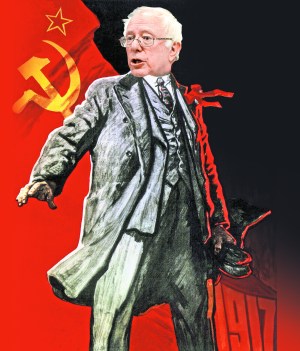

Soviet propaganda poster.

Bernie Sanders, as seen by the New York Post

So far, Republican presidential candidates have been positioning themselves to run against Hillary Clinton.

In the transcript of the most recent Republican debate, I found only five mentions of Bernie Sanders.  Two occurred when John Kasich was asked about the possibility of running against Sanders, and brushed it off:

We’re going to win every state if Bernie Sanders is the nominee. That’s not even an issue.

In the other three, Sanders’ name was invoked to tar somebody else. Marco Rubio said Ted Cruz typically joined with Sanders to vote against defense bills in the Senate. Twice, Sanders and Clinton were yoked together, so that Clinton could be associated with a position Bernie has taken more explicitly: Ben Carson said Clinton and Sanders blame everything on “those evil rich people”, and Chris Christie said both would raise Social Security taxes.

Clinton, on the other hand, seemed to come up in every answer. She was described as “a national security disaster”, “someone who lies to the families of those four victims in Benghazi”, “an enabler of sexual misconduct”, who wants “to take rights away from law-abiding citizens”, and whose weakness “will lead to greater war in the world”. In other settings, Donald Trump has speculated that Hillary is running “to stay out of jail“, and Chris Christie has promised to prosecute her.

In short, the Right’s barrage against Hillary targets far more than her vision of America’s future or her proposals for getting there. It’s personal, and has been since Bill’s candidacy first drew their attention a quarter century ago.

At times, Republicans even appear to consider Sanders an ally in the anti-Clinton struggle. Karl Rove’s American Crossroads PAC is running an anti-Hillary ad in Iowa, echoing a Sanders-campaign charge about contributions from Wall Street. Bloomberg reports:

During Sunday night’s Democratic debate, the Republican National Committee made the unusual move of sending no fewer than four real-time e-mails to reporters defending the self-described democratic socialist from attacks by Hillary Clinton or echoing his message against her.

It’s not a complete love-fest, though. Republican leaders or Fox News or other conservative outlets occasionally trash the whole idea of socialism or a socialist president. But so far their criticisms of Sanders have mostly stayed philosophical: Bernie’s a good guy, he just has bad ideas.

You know that won’t last, if a Sanders presidency starts to look like a serious possibility. I suppose an optimist could imagine a Sanders/Trump, Sanders/Cruz, or Sanders/Rubio race becoming a national debate about Bernie’s issues: universal health care, an increased minimum wage, creating jobs by rebuilding America’s public infrastructure, making college free, breaking up the big banks, and so on. The GOP’s candidate could explain why he opposes Bernie’s agenda and try to convince the American people to agree with him.

But I suspect the Republicans will take a different approach, because they always do. In a general-election campaign, they won’t be satisfied to say that Sanders is wrong; instead, they’ll want to argue that there is something wrong with him. A campaign that is already centered on hatred and fear won’t change its character for Bernie. Once he is seen as a serious challenger, there will have to be reasons to hate and fear Bernie Sanders.

What reasons? Let’s assume for the moment that there is no legitimate scandal in Bernie’s past, nothing that would give pause to an objective, well-informed voter. Let’s go further and assume that he hasn’t had allies or acquaintances who can be demonized, like Jeremiah Wright or Bill Ayers.

Does that put him in the clear? I don’t think it does. Even if Sanders and everyone he has ever associated with are paragons of saintly virtue, “scandals” can always be manufactured out of nothing.

The Obama-birther issue is a classic example: Barack Obama was born in Hawaii. The State of Hawaii says so, local newspapers published birth announcements at the time, and there was never any reason (beyond the wishful thinking of people who didn’t like him) to doubt his birth or citizenship or eligibility for the presidency. But that didn’t keep the “controversy” from raging for years. (Trump voters still don’t believe Obama was born in America.)

Going back a little further, John Kerry served admirably in Vietnam, was wounded three times, and received both a bronze and a silver star for heroism. But all that was turned against him in the campaign that gave swift-boating its name. Mike Dukakis was accused of being against the Pledge of Allegiance, and responded too slowly because he just couldn’t believe anyone would take the charge seriously. (They did.)  The suicide of Clinton aide Vince Foster was hyped as a murder, supposedly to cover up an affair with Hillary. (But according to a contradictory rumor, Hillary is lesbian.) Al Gore said several true things that got exaggerated, and then the blame for being a “serial exaggerator” got pinned back on him. Howard Dean yelled at the wrong time, so he was clearly unhinged.

No matter how much you admire Bernie Sanders, nobody is so perfect that they can’t be lied about or ridiculed for some blameless statement or action. If Sanders becomes a threat, the Right will go after him — personally. Not his policies or political philosophy, him.

How will they do it?

We got a preview in the January 16 edition of Rupert Murdoch’s New York Post. In a column the Post categorized as News (not Opinion), Paul Sperry wrote “Don’t be fooled by Bernie Sanders — he’s a diehard Communist.

The article is long and full of details, but even so, the evidence Sperry assembles for his claim is … well, sketchy would be a compliment.

  • As a student in 1964, Sanders belonged to the Young Socialists League. (The article gives no evidence that YSL was all that sinister. And besides, a lot can happen in half a century. At about the same time, Hillary Clinton was a Goldwater girl.)
  • He worked for a union that was investigated by the infamous House Un-American Activities Committee. (That’s the one Joe McCarthy used for his witchhunts. If everyone HUAC investigated had actually conspired with the Soviets, the Republic would have fallen a long time ago.)
  • In the 1970s, he “headed the American People’s History Society, an organ for Marxist propaganda”. (No evidence is given for the Marxist-propaganda claim, other than a documentary favorable to the early-20th-century American socialist and labor crusader Eugene Debs. Elsewhere, a University of Vermont librarian elaborates: “In the brochure’s ‘Dear Educator’ section, Sanders announced that Debs was the first documentary in a new series called ‘The Other Side of American History,’ which would ‘deal with people and ideas that the major profit oriented manufacturers of audio-visual material will not cover because of economic and political reasons’.”)
  • Bernie’s Senate office displays a portrait of Debs, who like a lot of people at that time — George Bernard Shaw and H. G. Wells come to mind — was slow to recognize the dark side of the Russian Revolution. (Saying nice things about the Bolsheviks was far from the center of Debs’ political identity, which was more about organizing unions, trying to keep the U.S. out of World War I, and popularizing then-radical notions like unemployment insurance and Social Security.)
  • In the 1970s, Sanders belonged to the Liberty Union Party, which wanted banks and utilities to be publicly owned. (Contrary to the “diehard Communist” claim, the leader of that party says they parted ways because “Sanders was moving right”.)
  • As Mayor of Burlington, he supported rent control and land trusts. (In hindsight, it worked out pretty well.)
  • While he was mayor, Burlington’s minor-league team was called the Vermont Reds (possibly because it was a farm team of the Cincinnati Reds. Life imitates art here: In the 1970s conspiracy-theory romp Illuminatus!, a right-wing rabble-rouser warns an Ohio crowd that the time to thwart Communist world domination is now: “Are we going to wait until the godless Reds are right here in Cincinnati?”)
  • In the 1980s, he didn’t support President Reagan’s attempt to overthrow the elected government of Nicaragua by force, and instead attempted to find a peaceful solution to the conflict. (The Sandinistas eventually lost an election and left office voluntarily, so maybe they weren’t such Stalinist monsters after all.)
  • Burlington has a sister city in Russia (as part of a program established by President Eisenhower). As Mayor, Sanders and his new wife went on a group trip to that sister city not long after they got married, creating the sort-of-true claim that he “honeymooned in the Soviet Union“.

There’s more, but you get the idea. For decades, Sanders has been on the left side of the American political spectrum. He’s been suspicious of what unregulated capitalists might do and in favor of workers organizing unions to counter their power. Like the late Howard Zinn, he believes (correctly, I think) that the left side of American political history got misrepresented during the Cold War, and still isn’t told accurately. He’s been skeptical of the perpetual-warfare state, and its efforts to focus our attention on external enemies rather than internal injustice.

If that’s diehard Communism, then there are a lot more diehard Communists than I thought — including me, I guess.

Looking at the weakness of the case, you might be tempted to laugh it off. But swift-boating John Kerry was absurd too, and it worked. With money, media power, and a significant slice of the population ready to repeat whatever nonsense they’re told, the Right can go places with a narrative like this — especially against a candidate most of the country doesn’t know.

So if you were a Republican candidate running against Sanders next fall, why would you risk discussing single-payer health care on its merits (and defending the health insurance companies nobody likes) when you could instead turn the question to whether Bernie Sanders is a loyal American? I mean, Stalin supported single-payer health care, and Castro — so why are we even discussing how it works and who it benefits? The GOP candidate will favor American healthcare, not Soviet healthcare like Comrade Sanders.

Why bother disputing the moral and economic virtues of a higher minimum wage, when you could say: “I believe in wages that you earn fairly in the free market, while Comrade Sanders believes the government should set your wages”? Why defend the too-big-to-fail enormity of Citibank and Bank of America when you could instead rail against Comrade Sanders’ plan for a government takeover of the banking system? (If ObamaCare could be labeled a “government takeover of the healthcare system“, why not do the same to Sanders’ bank-break-up plan?) You could point out that strong American presidents of both parties, from Harry Truman to Ronald Reagan, won the Cold War. So why are we giving in to Communism now?

And since Sanders has declared his independence from all special interests, the Republican nominee will have much more money to use setting the terms of the general-election debate. He’ll be able to launch five attacks for every Sanders defense. Even when Sanders gets free media attention, he’ll find himself confronted with questions about Soviet healthcare and government takeovers and giving in to Communism. When you talk to your crazy uncle who lives inside the Fox News bubble, those phrases will form a buzzword-wall that you’ll never get past.

That is why the decision to vote for Sanders in the primaries — here in New Hampshire, my decision is coming up faster than most — is more complicated than it seems. Because Sanders has yet to face the full force of the right-wing bullshit machine, I put no stock at all in the polls showing him running better against Republican candidates than Hillary does, or picking up Trump voters in a race against some other Republican. And while I want to see a full public debate of the issues Bernie is raising, I’m not at all sure that will happen if we nominate him.

That may sound crazy, but the campaign you get is often not the one you thought you were signing up for. Mike Dukakis knew he’d have to defend his ideas about creating jobs, but he never expected to become the Guy Who Hates the Pledge of Allegiance or the Pro Black Rapist Candidate. (Looking back, he said: “I made a decision we weren’t going to respond. That was it. About two months later I woke up and realized I was getting killed with this stuff.”) Elizabeth Warren anticipated criticism of her banking proposals, but not how much time she would have to spend denying that she invented Native American ancestors to cash in on affirmative action.

Being in the right only helps up to a point. If the other side can launch a series of attacks that have just enough surface plausibility to demand a response, the public’s attention may never turn to the issues you’re trying to run on. The voters may never listen to all those wonderful points you want to make.

So if he’s nominated, I have to wonder how much of Bernie’s message will make it out to the voters, and how much will be swamped by bullshit issues. How much time will he spend establishing that he’s not a Bolshevik (or worse, refusing to establish that he’s not a Bolshevik, on the high principle that he shouldn’t have to), or defending some easily misrepresented Burlington city ordinance from thirty years ago? Having seen how completely the Right can re-invent a recent historical figure like Saul Alinsky, I can barely imagine what they’ll do with Eugene Debs.

Dealing with bullshit issues patiently but firmly (and occasionally managing to turn them to your advantage) requires its own kind of political skill, the kind John Kennedy demonstrated when he defused fears of his Catholicism, or Obama showed when he spoke about race and Jeremiah Wright. (That speech was the moment I realized I wanted Obama to be president.) No one believes Hillary Clinton has the oratorical gifts of JFK or Obama, but she’s been facing right-wing smears for more than two decades, and has gotten pretty good at fending them off, as she showed when she stared down the House Benghazi Committee for 11 hours in October.

Does Bernie Sanders have that in him? I don’t know. So far, nothing in his career has required it. I worry that when Fox News and Rush Limbaugh and Alex Jones put him in the crosshairs, he’ll get testy and defensive. Baseless attacks might raise his preachy side, leading him to lecture reporters rather than answer their questions or artfully deflect them or humorously turn them around. His idealism might lead him to insist that because bullshit issues shouldn’t matter, they don’t.

They do. In election after election, we’ve seen that they do. We need a candidate who can deal with them.

Is Bernie Sanders that candidate? I don’t know. That — maybe even more than how I feel about the policy differences between Clinton and Sanders — is the thing I have to decide in the next two weeks.

The Positive Republican Message, Annotated

After South Carolina Governor Nikki Haley gave the official Republican response to the State of the Union address, the media focused all its attention on the anti-Trump implications of her call to “resist [the] temptation” to “follow the angriest voices”, particularly where immigration was concerned.

But I was more interested in where she went from there: If the GOP is going to be more than just a megaphone for anger and fear, it needs to present a positive vision for America’s future. In other words, it needs to compete for the hope-and-change vote that Barack Obama monopolized in his 2008 landslide. So Haley laid out this hopeful program for the next Republican presidency, which I quote in full:

If we held the White House, taxes would be lower for working families, and we’d put the brakes on runaway spending and debt.

We would encourage American innovation and success instead of demonizing them, so our economy would truly soar and good jobs would be available across our country.

We would reform education so it worked best for students, parents, and teachers, not Washington bureaucrats and union bosses.

We would end a disastrous health care program, and replace it with reforms that lowered costs and actually let you keep your doctor.

We would respect differences in modern families, but we would also insist on respect for religious liberty as a cornerstone of our democracy.

We would recognize the importance of the separation of powers and honor the Constitution in its entirety. And yes, that includes the Second and Tenth Amendments.

We would make international agreements that were celebrated in Israel and protested in Iran, not the other way around.

And rather than just thanking our brave men and women in uniform, we would actually strengthen our military, so both our friends and our enemies would know that America seeks peace, but when we fight wars we win them.

Growth, jobs, education, better health insurance, liberty, the rule of law, stronger diplomacy, and seeking peace but winning wars when we’re forced to fight them — what’s not to like? That’s a far more attractive vision than the Great Wall of Mexico, or invading ISIS’ godforsaken desert, or bombing Iran, or watching a special police force round up and expel 11 million Hispanic immigrants.

My only argument with Haley (other than the issues she leaves out completely, like climate change, voting rights, the environment, racial justice, and so on) concerns the Republican policies that are supposed to produce these wonderful outcomes. And that’s why I think her litany needs some line-by-line annotation. Let’s start at the top:

If we held the White House, taxes would be lower for working families,

Maybe. But the tax cuts proposed by all Republican candidates focus their benefits on the rich. As was true of the Bush and Reagan tax cuts, anything working families get is just shiny wrapping on a package addressed to the wealthy.

Typically Republicans deny that their tax cuts will explode the deficit, but they always do, and then the next step is to seek cuts in programs working families count on, like Social Security and Medicare. (That small tax cut you get will be eaten up pretty quickly if you have to support your aging parents.) The following chart is from 2012, so the right side is a little out of date, but the general point is still valid.

No party could openly propose: “Let’s slash rich people’s taxes and make up the difference by cutting Social Security and Medicare.” But that is the Republican agenda. They will pass it by breaking it in two: First pass huge tax cuts that mainly benefit the rich, and then treat the resulting deficit as an emergency no one could have foreseen. Working people will have to “sacrifice” their Social Security and Medicare benefits to deal with the “emergency” created by the tax cuts.

and we’d put the brakes on runaway spending

As this chart from the libertarian Cato Institute shows, federal spending has been fairly level during the Obama administration, after increasing sharply under Bush.

and debt.

Republican candidates do propose cutting spending on things like food stamps, but after accounting for increased defense spending, the net spending cut is typically far smaller than the tax cut. So the deficit is likely to jump sharply during a Republican administration (after falling under Obama), as it did when Reagan and Bush cut taxes.

We would encourage American innovation and success instead of demonizing them,

Listening to Haley, you might imagine Democrats spouting absurdities like, “Damn that iPhone!” or “What good is this Internet fad anyway?” — which we never do. Her statement only contacts reality after you realize that innovation and success is a euphemism for billionaires. Democrats haven’t “demonized” billionaires, but we have been (correctly) pointing out that billionaires soak up just about all of America’s economic growth, leaving little for anyone else.

so our economy would truly soar and good jobs would be available across our country.

The theory that making the rich richer will produce growth and good jobs for everyone is known as trickle-down economics. In the history of humankind it has never worked, for a simple reason: When the poor and middle class have more money, they buy things that somebody needs to produce, creating new jobs and industries. But when the rich have more money, they bid up the prices of limited goods like stocks, Van Gogh paintings, and beachfront property, inflating speculative bubbles that eventually pop and damage the economy the rest of us depend on.

We would reform education so it worked best for students, parents, and teachers, not Washington bureaucrats and union bosses.

No one has gone after teachers’ unions harder than Gov. Scott Walker of Wisconsin. The benefits of this to students and parents are virtually invisible, and teachers are undeniably worse off. Sam Brownback’s Kansas exemplifies another Republican approach to education: When his tax cuts for the wealthy didn’t produce the economic boom he promised (because trickle-down economics doesn’t work), he made up the deficit by cutting money for public schools.

But Republican education reform would definitely benefit one group: corporations who want a bigger chunk of the education market.

We would end a disastrous health care program, and replace it with reforms that lowered costs and actually let you keep your doctor.

The “disaster” of ObamaCare continues to exist mainly in the conservative fantasy world. In reality, the percentage of American adults without health insurance has dropped from 16% when Obama took office to under 9% today, is still dropping, and would have dropped much more if Republican governors hadn’t refused to expand Medicaid. Predictions that ObamaCare would “kill jobs” have not proven out.

The Republican replacement for ObamaCare is also a fantasy. Six years after the Affordable Care Act became law, Republicans have still not agreed on an alternative, and no GOP presidential candidate has anything more than the barest sketch of a plan. Any claims about what such “reform” would do are meaningless until enough details get specified that outside experts can analyze the program’s costs and individual families can tell whether or not they’re covered. Those details are still a long way off, and may never arrive.

We would respect differences in modern families,

Would they? I think the vagueness of this claim speaks for itself. No Republican candidate will openly say, “I respect gay or lesbian couples who get married and raise children” or “I respect transgender Americans.” Large parts of the Republican base would be offended if a candidate said, “I respect blacks and whites intermarrying.”

but we would also insist on respect for religious liberty as a cornerstone of our democracy.

Americans’ freedom to worship the deity of their choice has not changed during the Obama years. But in conservative rhetoric, religious liberty has expanded well beyond any previous meaning, to become code for conservative Christians controlling the behavior of others. No one has been able to explain how this expanded religious liberty can be granted to non-Christians, particularly atheists or Muslims, so the Constitution’s guarantee of “the equal protection of the laws” is out the window.

We would recognize the importance of the separation of powers and honor the Constitution in its entirety. And yes, that includes the Second and Tenth Amendments.

But what about the 14th Amendment? After Republican-appointed Supreme Court justices undo the recent decision legalizing same-sex marriage — as numerous candidates have promised — how will gays and lesbians receive the equal protection of the marriage laws? And conservative legal arguments against birthright citizenship — another guarantee of the plain language of the 14th Amendment — are far more convoluted than any alleged “judicial activism” of liberal judges.

It has also become common for Republicans to get misty-eyed talking about the sacred writ of the Constitution, and then demand drastic changes with their next breath.

We would make international agreements that were celebrated in Israel and protested in Iran, not the other way around.

When President Obama and Secretary Clinton got the world to agree to harsh sanctions on Iran — which forced them to bargain seriously about their nuclear program for the first time — I doubt the Iranians celebrated. And I can’t help wondering: who would these agreements Haley is talking about be with? Actual agreements require compromise. If you want to dictate terms to other countries, you have to defeat them in war first. Is that the plan?

And rather than just thanking our brave men and women in uniform, we would actually strengthen our military,

Actually she means instead of thanking our brave men and women in uniform. Republicans are good at starting wars, but not so good at taking care of the people who fight them.

so both our friends and our enemies would know that America seeks peace, but when we fight wars we win them.

The last Republican administration started two wars and won neither of them. And yet, the last eight years have seen no Republican soul-searching or new approaches to foreign policy. (The exception is Rand Paul, who has barely any support.) If a Republican wins the presidency in November, expect to see the Pentagon and State Department led by the same people who invaded Iraq and had no plan for what to do next.

In short, I would love to see the eventual Republican nominee run on a positive vision for America rather than on anger and fear. But it would be even more wonderful if the candidate offered proposals that stood some chance of achieving that vision. That’s something neither Haley nor any other Republican has yet attempted.

Trump Supporters and Liberals: Why aren’t we on the same side?

Working Americans do need to “take our country back”. But from who?


Back in 2011, in “One Word Turns the Tea Party Around“, I suggested a simple change to Tea Party rhetoric: Wherever the word government occurs, replace it with corporations. When I did that, suddenly I could agree wholeheartedly with the people Tea Party web sites loved to quote. Like Ronald Reagan:

Man is not free unless corporations are limited.

or Ayn Rand:

We are fast approaching the stage of the ultimate inversion: the stage where a corporation is free to do anything it pleases, while the citizens may act only by permission.

After the switch, Grover Norquist is still a radical, but I can see where he’s coming from:

We want to reduce the size of corporations in half as a percentage of GNP over the next 25 years. We want to reduce the number of people depending on corporations so there is more autonomy and more free citizens.

When I changed Washington to Wall Street, Rand Paul was right on target:

Wall Street is horribly broken. I think we stand on a precipice. We are encountering a day of reckoning and this movement, this Tea Party movement, is a message to Wall Street that we’re unhappy and that we want things done differently.

Running the wrong way. Looking at the Tea Party rank and file — the ordinary people who swelled its ranks rather than the ones who funded it or constructed its message or rode it to Congress — I found a lot to identify with. I agreed with them on a lot of key points, which I listed:

  • Honest, hard-working Americans are seeing their opportunities dry up.
  • The country is dominated by a small self-serving elite.
  • Our democracy is threatened.
  • The public is told a lot of lies.
  • People need to stand up and make their voices heard.
  • If we stand together, we’re not as helpless as we seem.

The problem, as I saw it then, was that somehow these people had gotten turned around — to illustrate, I linked to a video of Jim Marshall’s famous wrong-way touchdown run —  so that when they thought they were striking back at an oppressive government, they were in fact carrying the ball for the real sources of oppression: the billionaires and the corporations.

Tallying up. Four and a half years later, we can tally up the results of that wrong-way run. Tea Partiers provided the victory margin that gave Congress and many governorships to the Republican Party. But what has that power been used for?

Whose agenda is that? How does any of it address the issues that created the Tea Party in the first place?

“Anti-establishment” Republicans. Recently, a lot of Tea Partiers claim to be catching on, so they’re now in revolt against the Republican establishment. Instead, they’re supporting supposedly anti-establishment Republicans like Ben Carson, Ted Cruz, Carly Fiorina, and especially Donald Trump.

But to me, it looks like they’re falling for the same shell game all over again. Because they’re still turned around, still trying to make common cause with billionaires and corporations against the scourge of Big Government, still expecting the wolves to help them keep the sheep dogs in check. Again, the form of the rhetoric is right, if only a few words would change. Then Ben Carson would denounce the billionaire class instead of the political class, and Carly Fiorina would say:

This is not an economy anymore that works for everyone. We have come to a pivotal point in our nation’s history where, truly, the possibilities for too many Americans — entrepreneurship and innovation — is being crushed. It’s being crushed by corporations that have grown so big, so powerful, so costly, so corrupt and so inept.

Ordinary Americans do need to “take our country back”. The question that separates liberals from Tea Partiers is: Who do we need to take our country back from?

Divide and conquer. All through American history, the very rich have used a divide-and-conquer strategy to stay on top of the more numerous classes. Particularly in desperate times, their message to working people has always been the same: There is an even more desperate class of workers coming to take what’s yours. So in order to keep what you have, you must help us keep what we have.

In the Old South, the more desperate workers were the black slaves, if they should ever get their freedom. So poor Southern whites fought and died to maintain the human property of the plantation owners. Even after the war, they were the shock troops of the KKK, whose terrorist violence crushed the Reconstruction state governments and took away the new rights of the freedmen. And was their loyalty rewarded? No, it was not. Throughout the New South, the old aristocracy continued to keep its own taxes low, maintain few public services, and (in particular) not fund the public education that might have allowed poor whites to better their lot.

All the poor whites had done was to disenfranchise their potential black allies, who might have helped them take power from their real enemies, the aristocrats.

Something similar was happening in the North, against other “invasions” of desperate workers: the Irish, the Italians, the Jews. Who benefited? The robber barons: Rockefeller, Carnegie, Vanderbilt, and all the rest. Railroad tycoon Jay Gould is supposed to have boasted that he could hire half the working class to kill the other half.

The targets then weren’t just the new ethnic groups. They were also union organizers: “communists” and “anarchists”. In the coal mines, workers sang:

They say in Harlan County
There are no neutrals there
You’ll either be a union man
Or a thug for J.H. Blair.

Which side are you on?

And the working people who stayed loyal to the bosses, were they rewarded? In the short run, a little. Busting heads for the Pinkertons paid decent money. And scab wages were good, for as long as the strike lasted. But after the moment passed, things always went back to normal fairly soon.

You load sixteen tons, and what do you get?
Another day older and deeper in debt.

In the 1920s, President Coolidge proclaimed, “The business of America is business.” His administration, followed by President Hoover’s, saw no problem in the speculative excesses of the financiers. And when it all collapsed, leaving millions of working Americans without jobs, did either the plutocrats or their politicians say, “These workers built America, we have to take care of them.”? Of course not.

Once I built a railroad, I made it run
Made it race against time
Once I built a railroad, now it’s done
Brother, can you spare a dime?

Once I built a tower up to the sun
Brick and rivet and lime
Once I built a tower, now it’s done
Brother, can you spare a dime?

Taking the country back. But you know something? Those people actually did take their country back. How? They elected a liberal: Franklin Roosevelt. That’s how we got Social Security and union rights and a minimum wage.

For once, working people didn’t let themselves be split against each other, white against black, Protestant against Catholic, native-born against immigrant. They stayed united against the people FDR called “the malefactors of great wealth”. And as a result, when World War II was over and there was new money to be made, it flowed to all classes, not just to a few people at the top. For three decades, we had rising wages, shrinking gaps between rich and poor, and increasing opportunity across the board.

Even Republicans turned liberal in those days. Dwight Eisenhower built the ultimate Big Government monument: the interstate highway system. Richard Nixon signed the Clear Air Act, put forward a national health care plan, and pursued a fiscal policy that led Milton Friedman to quip “We are all Keynesians now.” Those were good times for working people.

Today. Recent decades haven’t been so good. There’s room to argue about what caused it or which choices made it better or worse, but one thing is clear: More and more people feel desperate. And so the rich are making their old pitch: Even more desperate workers are coming to take what’s yours. If you want to keep what you have, you have to help us keep what we have.

If you’re wondering what has happened to your piece of the pie, they want you to look down the ladder at immigrants and the poor, not up at them. Look at the undocumented Hispanics, who aren’t in a position to demand the minimum wage or a 40-hour week or even safe working conditions, for fear their bosses will turn them in to the immigration police. Look at the blacks who work two minimum-wage jobs and still don’t make enough to get by without food stamps. Look at the Muslims who came here looking for a better life, just like Catholics did 150 years ago. (In those days, Catholics were the ones whose religion was supposed to be incompatible with American values.) Those are the folks you’re supposed to be afraid of and guard yourself against, not the wealthy few who are monopolizing all the benefits of the expanding economy.

Trump. The chief pitch-man for this message is a billionaire, one whose wealth comes from inherited capital and connections, who has probably never done a day’s physical labor in his life, and who I suspect has gone decades at a time hearing nothing from working people other than “Yes, Mr. Trump” and “No, Mr. Trump.” and “I’ll get that for you right away, Mr. Trump.”

He’s the guy who’s supposed to be speaking for Joe Sixpack and all the other Americans who just want a chance to work hard for a fair wage. Does that make any sense?

Trump lives here, but your wages are too high.

But, you might object, FDR was rich too. So let’s look at what Trump wants to do. He’s mostly kept things vague, but he does have a few specific proposals and positions: His tax plan gives a huge cut to the very rich; the top tax rate comes down from 39.6% to 25%, and the corporate rate shrinks even further to 15%. He opposes raising the minimum wage, calling American wages “too high”. If he has come out clearly against any of the plutocratic policies I listed above, I haven’t heard it. As the Who sang:

Meet the new boss
Same as the old boss.

The only thing that’s different about Trump is that he’s not “politically correct”. In other words, he harkens back to a day when white men didn’t have to worry about insulting blacks or Hispanics or women or gays or the disabled. Back then, if you had white skin and a penis, you just let your words fly and never looked back. (Or so I’m told.)

I suppose if you’re a white man who has been tut-tutted once too often, it can be satisfying to watch somebody flout all those new rules of courtesy. But face it: None of that is going to do anything to take the country back for working people or make America great again.

Bernie. You know who is offering a program to take our country back? Bernie Sanders. Like FDR, he wants to create jobs by rebuilding America’s infrastructure, investing money in things that produce economic growth, like roads and rail lines and airports and the electrical grid — not a wall across the middle of the desert. He has offered the only realistic plan to replace ObamaCare without cutting off millions of people’s health insurance. He’s behind a higher minimum wage. He wants everybody to be able to afford a college education. He advocates breaking up the big banks, so that they never again have the economy over a barrel like they did in 2008. He has proposed a constitutional amendment that gives Congress back the power the Supreme Court took away with the Citizens United decision: the power to keep billionaires from buying our political system.

Those plans would make a real difference in the lives of working people. But there is a downside, if you want to call it that: Rich people and corporations would have to pay more tax, and Wall Street would have to pay a tax that would discourage financial manipulations by introducing some friction into their transactions.

Sanders’ proposals are also politically impossible, we are told. He can’t be elected, and if he were he wouldn’t be able to get any of his ideas through Congress. Well, they wouldn’t be impossible if all the hard-working Americans who want to take the country back would get behind him. If working-class people — and, let’s face it, specifically white working-class people — would ignore all the fear-mongering and race-baiting and instead ask themselves what’s really going to change their lives for the better, then 2016 could see a liberal sweep that could reverse all those wrong-way touchdowns of 2010 and 2014.

In order to do that, though, a lot white working-class Americans would have to turn around. They’d have to stop looking at the imaginary threats below them and focus instead on the very real ways that those at the top of the pyramid — the billionaires and the corporations — are cutting off their hopes. They’d have to stop worrying so much about Big Government — which we can get control of if we all stand together — and worry more about Big Money, which we’re never going to control without using the power of government.

Will it happen? Probably not. It’s hard to turn around once you get up a head of steam. But it has happened before, and each election is a new chance, maybe to take the country back, or at the very least, “to get down on my knees and pray we don’t get fooled again.”

Themes of 2015: the Presidential Race

I started 2015 with clear expectations about how I’d cover the campaign. But by Fall, I had to back up and try to answer a more fundamental question than the ones I ‘d been addressing: WTF?


Back in January, I had it all laid out.

I figured that for the first half of the year I’d resist the temptation to speculate about who was and wasn’t running, whether Clinton and Bush were inevitable nominees or not, and what the earliest Iowa polls meant (because they probably didn’t mean anything). Presidential politics has a way of crowding out all other political thought, and I wasn’t going to play that game.

By summer, I’d be looking at the candidates one-by-one, and cutting through the media’s endless horse-race coverage to focus on where each one wanted to take the country. I figured I’d have to sort through all sorts of tax-and-budget schemes, education plans, environmental positions, programs for giving more or fewer undocumented immigrants a path to citizenship, and so forth. I’d have to argue that both global warming and racism are real, tax cuts don’t pay for themselves, privatization doesn’t work, the market isn’t going to fix inequality by itself, and so on. Different faces, different specifics, but basically the same philosophical battle the country has been having for decades.

Instead, we’re talking about throwing 12 million people out of the country, and banning Muslims from coming here at all. We’re discussing what fascist means, and whether one of our front-runners qualifies. A sizable chunk of the country believes that Planned Parenthood has a lucrative business in harvesting fetal organs, and wants to shut down the government (or maybe start shooting people) to put a stop to it.

In short, things didn’t go the way I expected.

The divergence started simply enough: Large numbers of candidates got into the race so early that I had felt I had to start covering them at the end of March, when I wrote my introduction to the Republican primary process. Shortly afterwards, I started my 2016 Stump Speeches series, which was intended to focus on each candidate’s implicit or explicit answer to the question: “Where does America need to go and why am I the person to lead us there?”

In retrospect, that looks ridiculously naive.

Democrats. On the Democratic side, I sort of did what I intended. I confess to ignoring Martin O’Malley, even though I’ve seen him twice and he seems like a competent guy. But he never convinced me that he brought anything special to the race, in policy, in message, or in electability.

Chafee and Webb were gone before they caught my attention. Biden didn’t run. Lawrence Lessig tried to run, and his exclusion from the process is an interesting and disturbing story I’ll get around to telling eventually. That left Clinton and Sanders.

I covered Sanders’ announcement speech and a later speech he gave at the conservative Christian Liberty University. It was easy for me to like Bernie and his message, but less easy to imagine him leading the party to victory. I know the polls don’t detect that problem yet, but I find myself wondering what completely bogus issues the Republicans will be able to throw at him if they start seeing him as something more than just a tool to use against Hillary. (I lived through 1988, when Bush the First was able to completely dumbfound Mike Dukakis by making a serious issue out of the Pledge of Allegiance. You never forget an experience like that.) Coming from the relatively pristine political environment of Vermont, is Bernie ready for that? Can he keep his composure when he’s waist-deep in bullshit? I have serious doubts.

Hillary strongest argument, from my point of view, is that she has endured everything the GOP could throw at her for more than 20 years. (The all-day Benghazi hearing in October was a microcosm of their inability to beat her down.) But what did I think of her as a person and what could I believe about her as a president? Is better-than-a-Republican all I can say about her?

So I did my homework. I pulled three Clinton speeches into one article, and added the insight I got from reading three books by her and two about her. After spending that much time listening to her author’s voice, I kind of get Hillary now, in a way that I don’t think most of her critics on the left do. If God tasked me with picking our next president, I’m sure I could find somebody I liked better. But I’ve gotten to be OK with Hillary. I will probably vote for Bernie in the primary to send a message, but when Clinton is nominated — as I expect her to be — I’ll have no problem with that. Given that we live in a you-can’t-always-get-what-you-want world, Hillary will do fine.

Republicans. With the Republicans, though, my project broke down. I started out diligently analyzing the speeches and proposals of Ted Cruz, Marco Rubio, Rand Paul, Rick Santorum, and even Ben Carson.

And then, suddenly, we were in the Year of Trump, and any hope of a sensible, substantive discussion on the Republican side went away. It wasn’t just Trump; it was also what everyone else thought they had to do to compete with him. There was a chunk of the electorate energized by Trump, and suddenly everyone had to try to reach it.

I characterized one Republican debate as “Three Hours in Bizarro World“, but basically all of them have been that way. Fact-checking them has been pointless, because the distortions, lies, and mis-statements of fact have not been isolated incidents that can be picked out and corrected. The Republican campaign is happening in a completely different reality from the one I live in.

The NYT’s Patrick Healy nailed something important:

One of the most striking takeaways from the first two Republican debates and Tuesday’s first Democratic debate is that the two parties do not just disagree on solutions to domestic and foreign policy issues — they do not even agree on what the issues are.

That’s the root cause of the country’s polarization: People who want to solve a problem can usually find a way to compromise their solutions. But you can’t compromise about whether something’s a problem or not. If one side is discussing climate change while the other is trying to decide how big a wall to build on the Mexican border, what’s the compromise?

Eventually, I stopped trying to explain that Ben Carson’s “tithe” tax plan wouldn’t work, or why Jeb Bush’s claims about his economic record in Florida don’t stand up to scrutiny. I didn’t quite realize it at the time, but by the Fall I was trying to answer a more fundamental question: What the fuck?

Instead of mapping out policy differences, I found myself describing the difference between hucksters (Trump) and crackpots (Carson). I looked at models of fascism, and discussed how the Trump campaign did or didn’t fit them. I tried to figure out what leadership means to me, and what kind of leader we should be looking for. I traced the history of freedom rhetoric, and why it so often runs counter to rights. And whether it qualifies as fascist or not, how the Trump electorate has been building for years, and is the logical culmination of Republican politics.

I end this political year with more humility. I thought I knew what it meant to cover a presidential campaign, and it turns out that this year I didn’t. It’s not about taxes or infrastructure or education or drone strikes any more. Maybe someday it will be again, but for now I’ve still haven’t gotten past “What the fuck?”

I think I’ll be working on that question for a considerable chunk of the year to come.

How Republicans Trumped Themselves

You can’t complain just because somebody demagogues better than you do.


This week the airwaves were full of Republicans wringing their hands: What can the Party do about the wave of bigotry and hatred that Donald Trump has unleashed on their presidential primary race? How can they avoid a backlash that could wash away their 2016 chances?

That sentiment had been brewing for months, but it came to a head last Monday afternoon, when Trump made his proposal to ban Muslims from entering the United States. So let’s start there: Exactly what did Trump propose?

Keeping Muslims out. His initial announcement wasn’t very specific — Trump’s proposals seldom are — and the first campaign spokesperson who elaborated said that American Muslims who leave the country wouldn’t be able to come back. (“Mr. Trump says ‘everyone’.”) But Trump backed off of that. So fine, Shaq can attend the Rio Olympics if he wants, and Dave Chappelle can do a show in London. They don’t have to quit America for good because of their religion.

But if a businessman from Indonesia wants to come over to negotiate a deal, or his wife wants to shop on Rodeo Drive, or his children want to see Disney World or study engineering at Purdue — no. They can’t come, because they’re Muslims. Now, their passports don’t have MUSLIM stamped on them, so it’s not clear how we’d know to keep them out. (Asking would only keep out the honest Muslims, which kind of misses the point. Maybe the Trump administration could require everybody who goes through customs to spit on a Qu’ran or something.) But let’s not get lost in the details of enforcement. Trump hasn’t thought about them, so why should we?

Trump supporters wave off criticism by pointing out that the ban is supposed to be temporary. But Trump defined the end point as “until our country’s representatives can figure out what is going on”. When CNN’s Don Lemon asked what that meant, Trump replied:

Why is there such hatred and such viciousness? Why is somebody willing to fly airplanes into the World Trade Center? … Where does this hatred come from? Why does it come? We need to figure it out.

In other words, lifting the ban is tied to a question from 14 years ago, one that has been answered many times, but with an answer that Trump and his followers don’t like. Why do they hate us? Because for decades we overthrew their attempts at democratic governments and installed brutal dictators who would sell us oil. Because our troops kicked down their doors and dragged their fathers off to hellholes like Abu Ghraib. Because we send our killer drones wherever we want, and deny that most of the people we kill are innocent. In short, many of the people who hate us have very good reasons that Trump and his supporters have no interest in doing anything about, except possibly adding to them.

So basically, Trump’s ban would stay in place until he’s willing to learn things he doesn’t want to know. That doesn’t sound very temporary to me.

This time he’s done it. The immediate talking-head response to Trump’s proposal was that this time he had finally gone too far: The American people would recoil in horror at the thought of turning away refugees and immigrants and students and tourists because we don’t approve of their religion, a religion shared by millions of loyal American citizens, decorated American soldiers, and two members of Congress.

Well, most of the American people, maybe. Whether or not they are horrified, 57% told an NBC/WSJ poll that they disagree with keeping Muslims out of the country, while only 25% agree. (Count CNBC pundit Larry Kudlow among those who disagree, but only because he wants something more sweeping: “I say seal the borders. … We need a wartime footing if we are going to protect the American homeland.” And Laura Ingraham: “I’d do a pause on all immigration.”)

However, this is a primary campaign, not a general election. And Republican respondents were split: 38% for Trump’s proposal and 39% against. So in a multi-candidate field, the Muslim ban seems to be helping him. His lead in the RCP polling average is as big as it has ever been.

Locking up the racist/fascist vote. The anti-Muslim proposal increased the number of people willing to describe Trump as either a racist or a fascist — a term I discussed two weeks ago. But whatever you think of that usage, the undeniable racists and fascists have started welcoming Trump to their ranks. Former KKK leader David Duke has endorsed Trump, saying that he “understands the real sentiment of America”.

Buzzfeed reports:

Visitors to the website for the Council of Conservative Citizens — a white nationalist group cited by Charleston church shooter Dylan Roof — will find a steady stream of pro-Trump articles.

BF quotes the white supremacist website American Renaissance:

If Mr. Trump loses, this could be the last chance whites have to vote for a president who could actually do something useful for them and for their country.

and neo-Nazi Stormfront radio personality Don Advo:

whether or not Trump wins, his campaign is “gonna give people the ability to come openly out of the shadows and really work very hard for something that will have a lasting effect.”

“This anger, this fire, is not going to go away,” he said. “It’s not going to go away at all. And that has not been noticed by the neocons — or perhaps we should them neo-Cohens — in the Republican Party.”

The Establishment still doesn’t understand. Republican establishment types may not grasp the implications of being “neo-Cohens” yet, but they finally do seem to be getting the message that Trump could be nominated, with catastrophic short-and-long-term effects on the Party. A year ago, it seemed possible that Jeb Bush or Marco Rubio might finesse a campaign that appealed to the Republicans’ Southern white base without being so blatantly bigoted as to drive Hispanics and all other non-whites and non-Christians into a coalition against them. But that option has pretty well vanished. (Second place in national polls and first place in Iowa have been taken by Ted Cruz, who is not that different from Trump.)

What Republicans still don’t seem to grasp, though, is that they did this to themselves. William Greider traces the problem back to the deal between Richard Nixon and Strom Thurmond that created the modern GOP, the “Southern strategy”. All that time, country-club Republicans and racist working-class whites have had little in common, but

Nixon and his successors hid behind ideology and obscured the contradictions by pursuing a strategy I would call “no-fault bigotry.” Every now and then, especially in election seasons, the Republicans played the race card in dog-whistle fashion to smear Democrats, with savage effect. The GOP never attempted to repeal civil-rights legislation but sought cheap ways to undermine enforcement and remind whites, South and North, that the party was on “their” side.

So what caused the current rebellion in the GOP ranks? It finally dawned on loyal foot soldiers in the odd-couple coalition that they were being taken for suckers. Their causes always seemed to get the short end of the stick. The GOP made multiple promises and fervent speeches on the social issues, but, for one reason or another, the party establishment always failed to deliver. … the Republican establishment brought this crisis on itself by cynically manipulating its own rank and file.

Paul Krugman echoes the point:

But there is a strong element of bait-and-switch to this strategy. Whatever dog whistles get sent during the campaign, once in power the G.O.P. has made serving the interests of a small, wealthy economic elite, especially through big tax cuts, its main priority — a priority that remains intact, as you can see if you look at the tax plans of the establishment presidential candidates this cycle.

Sooner or later the angry whites who make up a large fraction, maybe even a majority, of the G.O.P. base were bound to rebel … So along comes Donald Trump, saying bluntly the things establishment candidates try to convey in coded, deniable hints, and sounding as if he really means them.

And Timothy Egan writes:

What [Trump has] done is to give marginalized Americans permission to hate. He doesn’t use dog whistles or code. His bigotry is overt. But the table was set by years of dog whistles and code. The very “un-American” sentiment that Republican elders now claim to despise has been a mainstay of conservative media for at least a decade.

When truth stops mattering. One more point is needed to complete the picture: the Republican embrace of post-truth politics. A party that exploits ridiculous conspiracy theories to energize its base — Birtherism, known falsehoods about Benghazi, Obama is a Muslim, the persecution of American Christians, the “war on cops” — has no defense when a better liar comes along.

Republican Congressman Deven Nunes has only been in office since 2002, but he reports a startling change in his communications from constituents.

“I used to spend ninety per cent of my constituent response time on people who call, e-mail, or send a letter, such as, ‘I really like this bill, H.R. 123,’ and they really believe in it because they heard about it through one of the groups that they belong to, but their view was based on actual legislation,” Nunes said. “Ten per cent were about ‘Chemtrails from airplanes are poisoning me’ to every other conspiracy theory that’s out there. And that has essentially flipped on its head.” The overwhelming majority of his constituent mail is now about the far-out ideas, and only a small portion is “based on something that is mostly true.” He added, “It’s dramatically changed politics and politicians, and what they’re doing.”

This trend may have gotten worse recently, but it isn’t new. David Frum wrote about it in 2011:

Backed by their own wing of the book-publishing industry and supported by think tanks that increasingly function as public-relations agencies, conservatives have built a whole alternative knowledge system, with its own facts, its own history, its own laws of economics. Outside this alternative reality, the United States is a country dominated by a strong Christian religiosity. Within it, Christians are a persecuted minority. Outside the system, President Obama—whatever his policy ­errors—is a figure of imposing intellect and dignity. Within the system, he’s a pitiful nothing, unable to speak without a teleprompter, an affirmative-action ­phony doomed to inevitable defeat. Outside the system, social scientists worry that the U.S. is hardening into one of the most rigid class societies in the Western world, in which the children of the poor have less chance of escape than in France, Germany, or even England. Inside the system, the U.S. remains (to borrow the words of Senator Marco Rubio) “the only place in the world where it doesn’t matter who your parents were or where you came from.”

And AutoStraddle‘s Heather Hogan more recently described the effect on a personal level:

Over the last ten years, everyone I know has lost a friend or family member or mentor to Fox News. Like me, they have watched helplessly as people they love have become part of the conservative punditry herd and, over time, traded their compassion for paranoia; their thoughtful opinions for manufactured outrage; and their empathy for hateful rhetoric.

It seems quaint now that, back in 2008, John McCain corrected a questioner who said that she couldn’t trust Barack Obama because he was “an Arab”. He defended Obama as “a decent family man and citizen that I just happen to have disagreements with on fundamental issues”. (Trump, facing an even more outrageous questioner this September, did nothing of the kind. He later criticized McCain’s response, saying McCain was “harsh” when he “ripped the microphone out of the woman’s hands”. Actually, McCain reached for the microphone while saying, “No, ma’am.”)

But the McCain of 2008 was already a dinosaur in Republican circles. His younger running mate, Sarah Palin, catered to misperceptions of her audience, understanding that anything goes if it whips up your supporters.

Eight years later we have Donald Trump, who doesn’t know or care much about reality, but is really good at whipping up his supporters. Unreality, along with the irrational fears and passions it commands, is a powerful weapon in politics. The problem is that no one can own it. If you use it, you have no safe refuge when someone turns it against you.

The 2016 Campaign: a mid-course assessment

We’re still almost two months away from the Iowa caucuses, but it already seems like the 2016 presidential campaign has been going on forever. Pundits started speculating about it even before all the 2014 races were decided. And although I resisted that temptation as long as I could, I’ve been writing about it since the spring. So I think it’s time to take a step back and assess both how the campaign is going and how I’ve been doing at covering it.

Before I do that, though, I need to set up the proper expectations. I’ve been covering the campaign as a Democrat. (The claim I make is only that The Weekly Sift is honest, not that it’s unbiased or non-partisan.) So my coverage of the Democratic race centers on my own decision as a New Hampshire voter about who I’m going to support in the primary. Conversely, my coverage of the Republican race is sizing up the opposition:  Who are we likely to face in the general election? What forces are brewing in the Republican electorate, and how can we counter them?

With that distinction in mind, I’ll discuss each party individually.

Democrats. Clinton is now leading Sanders 60%-30% nationwide, according to Quinnippiac, up from 53%-35% a month ago. More and more, it looks like the Republicans sealed Clinton’s nomination at the Benghazi hearings.

The silver lining for Sanders is that he performs slightly better in head-to-head match-ups with Republicans: Clinton beats Trump (47%-41%) and Cruz (47%-42%) while Sanders’s leads are larger (49%-41% and 49%-39%).

I’m inclined to discount that Sanders advantage for a simple reason: The Republican attack machine that has been after the Clintons since 1992 hasn’t really taken aim at Sanders yet. So far, Republican anti-Sanders comments have been more-or-less generic attacks on a socialist running for president. They haven’t gone after him personally yet, and they haven’t started making up complete crap about him — which they will if he gets nominated.

If you think Bernie’s upright nature protects him from this, you’re kidding yourself. Anybody can be lied about. (Remember Kitty Dukakis burning the American flag? Or Michelle Obama’s “whitey” speech? George W. Bush — the guy who dodged Vietnam by using political pull to score a cushy stateside National Guard spot — managed to turn John Kerry’s war record against him.) Picture Sanders wanting to talk about the minimum wage or his infrastructure-building jobs plan, but instead having to fend off totally baseless questions about illegitimate children or male prostitutes. How hard would it be to get some Russian emigre to claim he was in the KGB in the 1980s, and Sanders was his agent? I doubt Bernie has the temperament to deal with that kind of stuff, while Hillary clearly does.

I can claim deep insight into exactly one New Hampshire Democrat — me. Here’s what I’ve been thinking: I agree with Sanders’ positions more than Hillary’s, but I think Hillary is the stronger general-election candidate for the reason I just gave: She comes pre-slimed, while we don’t know yet what a slimed Bernie looks like. That leads to this perverse logic: The more convinced I am that Clinton will be nominated, the likelier I am to vote for Sanders.

The scenario I worry about with Hillary is that she’ll make a strategic decision to move to the right for the general election. For example, she picks a red-state Democrat for VP — some white male who is NRA-acceptable, wants a more active war against ISIS, and repeats a lot of Republican talking points about “religious freedom” and “all lives matter” and so on. Not only would that bode ill for a Clinton administration, it’s also the only way I can see her losing — by depressing turnout among the young and non-white parts of the Obama coalition.

So while I want Clinton to be nominated, I also want her to know that the party has a left wing she can’t take for granted. I doubt Elizabeth Warren wants to be VP — I think she likes the job she has — but if not her, I want some other very solidly liberal VP like Sherrod Brown or Al Franken. I want Clinton to run to raise turnout, presenting a strong contrast with the GOP on climate change and guns and income inequality and racism. (Incidentally, raising turnout is also the best way to get the Senate back and narrow the gap in the House.) When the primary rolls around, the best way to send Clinton that message might be for me to vote for Bernie.

Republicans. According to CNN, Trump is solidly atop the Republican field with 36% and Ted Cruz is second at 16%. (Cruz’ showing represents a 12-point surge since the mid-October poll.) Pre-season favorite Jeb Bush is sixth at 3%.

It’s time to start reviewing some of the assertions I’ve made about the Republican field. The boldest one (from July) was that Trump isn’t running a serious campaign, because when the time came to put up real money — in November and December, I thought — he won’t do it.

That’s what happens when the crystal ball shows you a half-truth: Trump hasn’t been putting up serious money: The NBC News pie chart on the right shows him spending just $217,000 on TV ads, compared to Bush’s $28.9 million. (Here in New Hampshire, I still haven’t seen a Trump ad.) What I didn’t foresee was that money would be having so little impact this late in the campaign. Will Trump ever need to put up significant amounts of his own money? If that time arrives, will he do it? We still don’t know.

My comments about Chris Christie look a little better: After seeing a Christie town hall meeting in April, I predicted that his skill in that format would pay off in New Hampshire — maybe not enough to win the primary, but enough to do better than pundits were predicting at that time. That seems to be happening. A recent PPP poll has Christie rising into fourth place in NH with 10%, leading Carson (9%) and Bush (5%).

I discounted Rubio’s chances because he was everybody’s second choice, but didn’t clearly represent any of the GOP’s four factions. That was also in April, when I didn’t foresee that the leading Corporatist candidates (Bush and Walker) would run such terrible campaigns. Today, Rubio looks like the Corporatists’ only chance for an acceptable nominee.

Sticking with the four-faction (Corporatist, Theocrat, Libertarian, and NeoCon) analysis, the big news is in the Theocrat wing, where Huckabee and Santorum have failed to catch fire, and Cruz is starting to edge out Carson. The Libertarian wing of the party has proven to be a non-factor. (Early on, Rand Paul decided he had to transcend his Libertarian base if he was going to win the nomination, and no one has tried to pick it up from him. As a result, both Paul and the Libertarians are nowhere.) What nobody could have foreseen was Trump’s appeal to NeoCon voters: When there’s a terrorist attack, he surges. But Trump seems to be transcending the factions: He also gets considerable Theocrat support, despite having no religious credibility at all.

In March I wrote:

The hardest factor to predict is how well candidates will perform on the campaign trail. … I expect Cruz and Christie to perform well, and Jindal and Paul to perform badly. (Watch Paul’s interview with Rachel Maddow.) The big wild card is Bush, who has never campaigned for national office, or for anything at all since 2002.

Well, now we know about Bush: He’s an absolutely terrible campaigner and debater. All the money in the world can’t save him.

So my four-faction analysis has shrunk to three factions, and at the moment it produces Trump, Rubio, and Cruz as finalists. If you’re wondering why I focus so much on which Democrat can do better in the general election, just say “President Cruz” a few times and I think you’ll understand.

The Political F-word

When and how should we talk about fascism?


Satirical Trump campaign logo.

When Donald Trump started talking about closing American mosques and perhaps even having Muslims register with the government, when he called for a “deportation force” to search out and expel the 11 million Hispanic immigrants estimated to be in the country illegally, and then when he justified his supporters in “roughing up” a protester at his rally, a number of his fellow Republicans began to use the word fascist.

Once you start viewing Trump through that lens, a number of his previous statements — many of which were seen at the time as so outrageous they would doom his campaign — take on a different significance, particularly his xenophobic comments about immigrants and the way his speeches rely more on assertions of his own greatness than on any identifiable policies or political philosophy. (It also wasn’t the first time he had justified the violence of his followers.)

Pundits have reacted to labeling Trump a fascist in three different ways:

None of those reactions is entirely wrong, as we’ll see. But that conclusion just raises a larger question: Would we have a basis for calling any contemporary figure a fascist? Or has the word just become an insult with no identifiable content? What is fascism, anyway?

If you try to answer that question by looking at expert opinion, you’ll find a muddle. Just about any good article on fascism starts by explaining why it’s so hard to define. Here’s how David Neiwert puts it:

In contrast [to communism], hardly anyone can explain what it is that makes fascism, mainly because all we really know about it is the regimes that arose under its banner. There are no extant texts, only a litany of dictatorships and atrocities. When we think of fascism, we think of Hitler and perhaps Mussolini, without even understanding what forces they rode to power.

Communism has a very concise description: public ownership of the means of production under the dictatorship of the proletariat. Liberal democracy is a government elected by the majority but constitutionally restrained from violating minority rights. For fascism, well, we’ve got the example of Hitler. But what was it about Hitler that made him Hitler? [1] Given that we don’t want another Hitler regime, or anything remotely like it, what should we be looking for and trying to avoid?

In his influential essay “Ur-Fascism“, Umberto Eco warns:

It would be so much easier, for us, if there appeared on the world scene somebody saying, “I want to reopen Auschwitz, I want the Black Shirts to parade again in the Italian squares.” Life is not that simple.

You can’t identify fascism by blindly correlating policies. Hitler built the autobahn and Eisenhower built the interstate highway system, but Eisenhower was not a Hitler. Reagan and Hitler both increased military spending, but Reagan was not a Hitler. Fascism also is not a political philosophy. (Eco: “Mussolini did not have any philosophy: he had only rhetoric.”) It’s not an economic theory, and it’s not tied to a particular religion.

In his book In God’s Country (about the American Patriot movement of the 1990s), Neiwert adopts this definition (which he attributes to “historians and sociologists”):

a political movement based in populist ultranationalism and focused on an a core mythic ideal of phoenix-like societal rebirth, attained through a return to “traditional values.”

But Eco, who grew up under Mussolini, avoided all definitions, writing that “fascism had no quintessence”. Instead he tried to find deeper, pre-rational roots: “Fascism was philosophically out of joint, but emotionally it was firmly fastened to some archetypal foundations.” and “behind a regime and its ideology there is always a way of thinking and feeling, a group of cultural habits, of obscure instincts and unfathomable drives.”

He reduced these “unfathomable drives” to 14 traits of what he called Ur-Fascism, upon which any specific form of fascism would be based. These 14, he said, “cannot be organized into a system; many of them contradict each other, and are also typical of other kinds of despotism or fanaticism.” The traits include a cult of tradition, anti-intellectualism [2], equating disagreement with treason, fear of difference, permanent warfare, and contempt for the weak. But the one that I want to focus on is #6:

Ur-Fascism derives from individual or social frustration. That is why one of the most typical features of the historical fascism was the appeal to a frustrated middle class, a class suffering from an economic crisis or feelings of political humiliation, and frightened by the pressure of lower social groups. [italics in the original]

This points to what I see as the real difficulty of defining fascism as a political movement: It’s not fundamentally about politics at all. Fascism is primarily a phenomenon of social psychology. I would summarize it as a dysfunctional attempt of people who feel humiliated and powerless to restore their pride by:

  • styling themselves as the only true and faithful heirs of their nation’s glorious (and possibly mythical) past,
  • identifying with a charismatic leader whose success will become their success,
  • helping that leader achieve power by whatever means necessary, including violence,
  • under his leadership, purifying the nation by restoring its traditional and characteristic virtues (again, through violence if necessary),
  • reawakening and reclaiming the nation’s past glory (by war, if necessary),
  • all of which leads to the main point: humiliating the internal and external enemies they blame for their own humiliation. [3]

Now, I think, we’re in a position to talk about Donald Trump and his relationship to the conservative movement. Trump may or may not harbor fascist ambitions himself, but his campaign targets a segment of the population that is psychologically ready for fascism: working-class white Christian males, who have seen their privileged place in American society erode as blacks, women, gays, non-English-speakers, and non-Christians get closer to equality. What’s more, the good-paying no-college-necessary jobs that allowed their fathers to achieve the American dream have vanished, leaving them incapable of carrying forward their patriarchal legacy.

In his scapegoating of immigrants at home and foreign enemies abroad, and his vague promises to “make America great again” by applying his own greatness to a government that for decades has been run by “losers”, Trump is playing the role of a charismatic fascist leader.

But the audience he is appealing to didn’t pop out of nowhere. Its sense of grievance has been carefully nurtured and cultivated by decades of conservative propaganda, which has diligently pointed its resentment  downward at scapegoat groups like blacks, Muslims, and Hispanic immigrants, rather than upward at the wealthy bosses who profited by shipping jobs overseas.

In their defense, the propagandists probably didn’t intend to create a fascist movement. Instead, from one election to the next, it was easy to split the natural constituency of the Left by appealing to a sense of victimization among the white working class, using xenophobia, racism, and hot-button religious issues to turn them against the non-white working class, against women and gays, and against the liberal politicians who looked out for the interests of the emerging minorities. [4] As Neiwert concluded in 2004 after an analysis of Rush Limbaugh’s rhetoric:

What this exercise reveals is not so much that Limbaugh is a fascist, but rather, that he is making a career out of transmitting the themes and memes upon which fascism feeds to a mainstream conservative audience.

The result is the confusion that Trump has sown inside the Republican establishment. Fascistic themes of wounded pride and affronted identity were supposed to keep working-class white Christian men voting against their economic interests. [5] But nobody was supposed to take things this seriously.

Now that Trump is doing so, establishment Republicans are starting to yell “fascist!” But that won’t work at this late date, because by now “the themes and memes upon which fascism feeds” have been woven too deeply into standard conservative rhetoric. The audience that Trump has found and speaks to are the same people whose support Jeb Bush and Marco Rubio hoped to gain with winks and nods.

You can, if you want, regard that last sentence as a conclusion marking the end of the article. Or you can keep reading as we make a deeper pass through the psychology of fascism and its relationship to mainstream American conservatism.


To grasp fascism and its shape-shifting nature, you need to understand a series of concepts that can manifest differently in different times and places. What follows are some “themes and memes” of fascism, and where you can hear them in conservative rhetoric today.

Volkheit. A fascist believes that his nation has an essence, which does not evolve with the times, but is a fixed and eternal ideal. In German, an ethnic group is ein Volk, and their Volkheit (i.e. folkhood) is whatever makes them what they are.

The United States is a nation of immigrants that hasn’t seen itself as English for a long time, so its volkheit wouldn’t be strictly ethnic. For a time it was defined by the constructed ethnicity “White”, but even that characterization has become obsolete. Consequently, the “essence” that makes an American an American is hard to define.

But that doesn’t mean we don’t have a volkheit. The yearning towards a volkheit can be seen in way that various Americans feel threatened by non-English-speaking citizens, by the equality of non-whites, by multiculturalism, by non-Christian religions, and by any transnational authority like the United Nations or the WTO. Race plays a role in defining the American volk, but other factors weigh in the scale as well.

Whenever someone uses the phrase real Americans to mean something more than the people who live in or are citizens of the United States, they’re talking about our volkheit, particularly if they cite “real Americans” as the upholders of our “traditional values”.

One place you can see this playing out is in the otherwise inexplicable attempts to make President Obama an “other”: the baseless controversy over his birth certificate, the attempt to portray him as a Muslim, the unique sense of outrage when he does things many previous presidents did without anyone noticing or caring. It’s easy to read this as simple racism, but the real point being argued is that Obama doesn’t belong to the American volk. [6]

Herrenvolk. Fascism depends on a belief in the special status of our particular volk. There is a natural hierarchy of peoples, and we are meant to be at the top of it.

Herrenvolk is usually translated as “master race”, but that’s not exactly right. Herr has an aspect of master or lord — the German word for dominance is Herrschaft — but also of a respected head-of-household. (Herr Schmidt is just Mr. Schmidt.) So the herrenvolk doesn’t necessarily hold everyone else on a leash, but in a well-ordered world all the other volk recognize its natural superiority.

The contemporary American form of herrenvolk is American Exceptionalism. When de Toqueville described Americans as “exceptional” in the 1800s, he meant only that a uniquely favorable set of circumstances — like the lack of a competing power on our continent, and the absence of an established class structure and its corresponding centuries-long grudges — had given us a unique opportunity to leave behind Europe’s baggage and make a new start on civilization. That’s why our revolution could succeed, but the revolution in de Toqueville’s France got sidetracked into the Reign of Terror.

But since then, American Exceptionalism has developed into something more than just circumstantial: We are morally exceptional, so things that would be wrong for anybody else are OK for us. Consequently, we can torture people; we can start unprovoked wars; Iran shouldn’t feel threatened by our nuclear arsenal, but we’d be justified in attacking to prevent them acquiring nukes; and so on, because we’re the herrenvolk.

Grievance. Fantasies of belonging to the herrenvolk are like fantasies of secret royalty: If a child is happy with her life and home, she doesn’t need to dream about her real parents coming to claim her. This is why fascism is a product of hard times. When a nation is doing well — its ruling class feels secure, its middle class is confident in its upward mobility, and its lower classes are more docile than desperate — fascism has no place to take root.

But once you start claiming herrenvolk status, you’re left with a conundrum: Why is my life so hard? We’re better than everyone else, so why aren’t we more successful? This is the issue Trump is raising when he complains that “America doesn’t win any more.”

Fascism’s answer is that we have been robbed of our rightful place in the world. Again, fascism’s local variability comes into play. Every fascism has to claim that its volk has been robbed. But who robbed us and how can change in every country.

Neiwert:

Indeed, one of the lessons I’ve gleaned from carefully observing the behavior of the American right over the years is that the best indicator of its agenda can be found in the very things of which it accuses the left.

There is no better example of this than Bill O’Reilly’s characterization of the Left as running a “grievance industry“. O’Reilly’s show is little more than a stream of grievances, of wrongs committed against whites, against Christians, against conservatives, against men, and against Real Americans of all types.

Purity. The strength of a volk is in its purity. Conversely, fascism ties a nation’s problems to its failure to guard its purity.

In Nazism, Jews were the impurity corrupting the German volk. In contemporary America, this impurity worry focuses on non-white, non-Christian, or non-English-speaking immigrants, as well as on American blacks who seem not to be assimilating into the white-dominated society.

Purity is a primal, pre-rational concern, which is why the irritation is not soothed by analyses of the economic benefits from immigration, or the overall good behavior of undocumented Hispanics and refugees, or even the rise in deportations during the Obama administration. Meanwhile, every individual crime by an immigrant sets it off again. The belief that foreigners are corrupting the purity of America is foundational; since this impurity is the cause of all our problems, the simple fact that we still have problems is evidence of its corrosive effect.

Another aspect of impurity is moral. The idealized Real America of the white suburbs and small towns of the 1950s had no place for homosexuals or the transgendered. So their presence — and even acceptance! — in contemporary America is evidence of our impurity. Again, evidence is beside the point. Forget that the gay couple living next door trims the lawn perfectly, or that their daughter is valedictorian. If we have problems — and who can say that we don’t? — the impurities we tolerate all around us must be the cause.

Our glorious past. Fascism looks back to a time before impurity set in, when the volk lived securely in its volkheit. For Mussolini, this was the Roman Empire and il Duce was the new Augustus. American conservatives similarly idealize four golden eras: Philosophically, the Golden Age was the founding era, and the Founders are portrayed as divinely inspired prophets. Economically, the Golden Age was the Gilded Age, when capitalists worked their magic unhindered by regulations. Militarily, it was World War II, when our entire society was mobilized behind the war effort. Culturally, the Golden Age happened in the Ozzie-and-Harriet suburbs and small towns of the 1950s.

The importance of this mythology is why any accurate assessment of American history is so threatening to conservatives that they find it necessary to promote their own pseudo-historians. In his announcement speech, for example, Ben Carson attributed the rise of America to the “can-do attitude” of the “early settlers”. His point comes completely undone if you understand the role of land stolen from the Native Americans and developed by slave labor. Similarly, conservatives can only see World War II as a battle of Freedom against Barbarism; the suggestion that dropping nuclear bombs on civilians is barbaric cannot be entertained.

Any reading of history in which America is a nation like other nations, exemplifying both good and evil, is beyond the pale.

Betrayal. Any myth of a glorious past is vulnerable to the criticism Jack Burden makes in All the King’s Men:

If it was such a God-damned fine, beautiful time, why did it turn into this time which is not so damned fine and beautiful if there wasn’t something in that time which wasn’t fine and beautiful? Answer me that one.

Impurity of the volk is only a partial answer, and the machinations of our enemies can’t be a complete answer either, because they shouldn’t be able to stand against the herrenvolk. No, we are suffering now because we have been betrayed by our leaders and by the culturally influential classes.

For Hitler, this was the famous Dolschstosslegende, the myth that German armies did not lose World War I in the field, but were “stabbed in the back” by traitors in high places at home.

You can hear the current dolschstosslegende in Ted Cruz saying that President Obama “does not wish to defend this country”. Or Michele Bachmann’s description of Obama’s immigration policy:

We have this invasion because a political decision was made by our president to intentionally flaunt the laws of the land and put at risk the American people, our culture, our way of life, our economic standing, and also he’s willing to allow a pandemic of disease to come into our country.

The conservative version of recent American history is full of betrayals: FDR betrayed the cause of freedom at Yalta, JFK surrendered American sovereignty to the UN, the Democratic Congress gave away the victory Nixon had won in Vietnam, and Obama not only gave away Bush’s victory in Iraq, but negotiated a “surrender” to Iran.

What the Republican establishment never expected was that they too would be included among the betrayers. But when John Boehner announced his retirement, no one cheered louder than the Republican base. And who imagined that Eric Cantor would be tarred as a traitor to conservatism? Ben Carson says, “I’ll tell you a secret. The political class comes from both parties and it comes from all over the place.” And Ted Cruz writes:

In 2010, we were told that Republicans would stand and fight if only we had a Republican House. In 2014, we were told that Republicans would stand and fight just as soon as we won a majority in the Senate and retired Harry Reid. In both instances, the American people obliged. Now we’re told that we must wait until 2017 when we have a Republican president.

Trump is just echoing them when he says, “I am more disappointed in the Republicans than the Democrats.”

Cruelty. Psychologically, the key to fascism is the (usually unstated) belief that you can work out your own humiliation by humiliating others. Did you fight bravely in the Great War, only to see your country shamed at Versailles, and your family lose everything in the subsequent inflation and depression? Go beat up a union organizer, or throw rocks through the windows of a Jewish shopkeeper; you’ll feel better.

And maybe you do, for a while, but in the morning you return to the same life you had yesterday. So like any addiction, the temptation is to try more next time. Maybe if you’d killed the organizer or set fire to the shop, the feeling would have lasted.

A similar pattern explains the way Republican presidential candidates seem to glory in their cruelty and heartlessness. Trump mimicked and ridiculed a reporter’s disability (echoing Rush Limbaugh’s mocking of Michael J. Fox), Chris Christie didn’t just call for leaving Syrian refugees to their fate, he specifically said he would refuse entry to “orphans under the age of five”. Several candidates have called for the return of torture, even though it accomplishes little beyond making suspected terrorists suffer. The persistent weakness in the protect-traditional-marriage argument was that its proponents could not identify anybody who would benefit; the point was entirely to make gay and lesbian lives harder. Republican deportation policies will break up families, and no one benefits from sending DREAMers back to a country they don’t remember. But none of that seems to matter.

What does matter is that when a candidate says something that is harsh or offensive, his poll numbers go up. [7] The Republican base is angry and is looking for a candidate who will inflict pain on its enemies. That pain is not a regrettable side-effect of a policy that accomplishes something else; inflicting pain is the accomplishment.

What’s the matter with Kansas today? For decades, the Republican establishment has used fascist themes as a tactic: While their policies destroyed unions, empowered employers, shifted the tax burden from the rich to the middle class, allowed higher education to become unattainably expensive for families not already wealthy, and made it easier to ship blue-collar jobs overseas, they could appeal to working-class whites on a symbolic level, offering them pride rather than paychecks or opportunities.

Now those chickens are coming home to roost: Republicans have set the stage for America to have an actual fascist movement, one that will see them as part of the corruption that needs to be purged. Like the businessmen who funded Hitler as a way to distract workers from communism, they thought they could control this, but they can’t.

Donald Trump is taking advantage of this situation, but he is not the problem. Ted Cruz will happily fill his role if something goes wrong, and if the fascist movement can’t win the Republican nomination or the presidency in 2016, there’s always 2020 or 2024. Who knows who might step forward to claim its leadership?

In the long run, I can only see one way out of this trend: Democrats need to offer a program that will genuinely do something for the working class, in the same way that the New Deal headed off American fascism in the 1930s. Americans who feel frustrated and humiliated by the culture and economy of the 21st century need to know that they can get help fixing their lives; there’s no need to seek relief by making others suffer too.


[1] Jonah Goldberg’s Liberal Fascism is almost comical in its willingness to latch onto Hitler’s superficial traits (like his vegetarianism and support for universal health care) while never zeroing in on his movement’s toxic essence. The Onion could not write a line more ridiculous than this:

The quintessential Liberal Fascist isn’t an SS storm trooper; it is a female grade school teacher with an education degree from Brown or Swarthmore.

[2] The anti-intellectual nature of fascism is one reason it remains undefined. A real fascist is in the streets, not sitting in a library making up theories.

[3] The dysfunctionality of this program is why fascist regimes tend toward short-but-spectacular lives, particularly if the Leader is a true believer, and is not just using the movement to gain power. Humiliating others doesn’t really soothe your own humiliation, so the regime must constantly up the ante to maintain its supporters’ enthusiasm. Ultimately, no conquest and no level of enemy humiliation is enough. The world must fall, and the enemies must be exterminated.

[4] This is the theme of Thomas Frank’s What’s the Matter With Kansas? from 2004.

[5] For example, the struggling whites in Kentucky who just voted to eliminate their own health insurance.

[6] As you might expect, Trump voters believe these stories about Obama at a higher rate than supporters of other candidates.

[7] Josh Marshall has an interesting take on this: He believes that it isn’t Trump’s cruelty that appeals to the Republican base so much as his refusal to apologize for it.

In times of hysteria

Six things ordinary people can do to restore sanity.


One of the most difficult experiences of democracy is to watch your country going crazy, and feel responsible. In a dictatorship you could just zone out: The Powers That Be will do what they do, and your opinion doesn’t matter anyway. Your neighbors, your friends, your co-workers — their opinions don’t matter either, so there’s no point in arguing with them, or even letting them know you disagree. You might as well just binge-watch something light on TV, and wait for the wave to pass.

In a democracy it’s different: We are the wave. Politicians really do respond to certain kinds of public opinion, sometimes to our shame. So, for example, my Democratic governor (Maggie Hassan of New Hampshire, who I have voted for, given money to, and was planning to support for the Senate) called for a halt on admitting Syrian refugees. (She later reduced it to a “pause“, “until intelligence and defense officials can assure that the process for vetting all refugees is as strong as possible to ensure public safety.” But the damage was done: Any governor who wants to come out against refugees can claim bipartisan support.) My representative (Annie Kuster of NH-2, who I have also voted for and given money to) voted Yes on the American Security Against Foreign Enemies Act, which at a minimum would delay any new refugee resettlements by 2 or 3 months, and might snafu the process altogether. [1] (Check your representative’s vote here.)

If my side has been characterized by politicians timidly letting the panic sweep them away, on the other side it’s been bedlam. Ben Carson is openly dehumanizing refugees with metaphors about “rabid dogs”. Donald Trump is talking about closing mosques, because “we’re going to have no choice”. He has advocated forcing American Muslims to register with the government, so that they can be tracked in a database. Marco Rubio expanded Trump’s proposal to call for shutting down “anyplace where radicals are being inspired”. Ted Cruz and Jeb Bush want a religious test for refugees: We should accept Christians, but not Muslims. John Kasich wants to create a government agency to promote “Judeo-Christian values” around the world. [2]

Chris Christie says we shouldn’t even let in little kids. Like, say, this Syrian girl, who mistook the photographer’s camera for a gun and tried to surrender.

And remember this Syrian boy? His photo evoked international compassion a couple months ago, but that never lasts, does it?

When Governor Jay Nixon didn’t try to block Syrian refugees, state Rep. Mike Moon called for a special session of the legislature to stop “the potential Islamization of Missouri“. But the bull goose loony (to borrow Ken Kesey’s phrase) was a Democrat: Roanoke Mayor David Bowers, who justified his refusal to cooperate with resettling refugees by citing FDR’s Japanese internment camps during World War II. That national disgrace is now a precedent. (Who knows? Maybe slavery or the Native American genocide will become precedents too.)

I had never heard of Rep. Moon or Mayor Bowers before, but none of the Republican presidential candidates seemed this insane when they started campaigning. So I suspect they’re just saying what they think will appeal to their voters. They may be pandering to the public fear, attempting to benefit from it, and playing their role in spreading it, but they didn’t start it.

We did that. Ordinary people like us. Our friends, our relatives, our co-workers, the people we know through social media. And so I suspect it’s up to us to stop it.

I have to confess I didn’t see this coming. After the Paris attacks, I expected a push to hit ISIS harder, maybe even to re-invade Iraq and add Syria to the occupation zone. (Jeb Bush recently joined Ben Carson, John Kasich, and Lindsey Graham in calling for ground troops, though he was vague about how many.) I didn’t foresee an Ebola-level panic [3] focused on the refugees who are running from the same people we want to fight, much less the yellow-starring of American citizens who practice an unpopular religion.

But OK, here we are. Our country is going crazy and we are right in the middle of it. What do we do now?

1. Don’t make it worse. In particular, don’t be the guy hysterically running around and yelling at other people not to panic. Sanity begins within. You have to find it in yourself before you can transmit it to other people.

So: calm down. If you need help, seek out other calm voices. The needed attitude is a firm determination to slow this panic down, not a mad urge to turn the mob around and run it in the opposite direction.

Once you start to feel that determination, you’re ready to engage: Participate in conversations (both face-to-face and in social media). Write letters to the editor. Write to your representatives in government.

Don’t yell. Don’t humiliate. Just spread calm, facts, and rationality. When engagement starts to make you crazy, back away. Calm down again. Repeat.

2. Disrupt the spread of rumors. Panics feed on fantasies and rumors. Fantasies tell people that horrible things could happen. Rumors assert that they already are happening.

Social media is the ideal rumor-spreading medium, so it takes a lot of us to slow a rumor down. But you don’t have to be a rhetorical genius to play your part. Simple comments like “I don’t think this is real” or “That’s been debunked” are often sufficient, especially if you have the right link to somebody who has checked it out. The debunking site Snopes.com has tags devoted to Paris attack claims and Syrian refugees.

Here are a couple of the false rumors I’ve run into lately:

Current Syrian refugees resettled in America are not “missing”. I heard this one during a Trump interview with Sean Hannity. Trump refers to “people” who are missing — with the implication that they have gone off the grid and joined some kind of underground. Hannity corrected to “one person … in New Orleans”. (Think about that: It’s gotten so bad that Sean Hannity has to tone stuff down.) But Catholic Charities has debunked that story: They resettled the guy in Louisiana, and then he moved. He’s not missing. (The source of this rumor was probably the desperate David Vitter campaign for governor, which tried to ride the refugee panic to a comeback victory. It didn’t work.)

No, lying to further the cause of Islam is not a thing. Under the doctrine of taqiya, a Muslim may lie about his faith to escape serious persecution or death. Anti-Muslim propagandists have tried to turn this into a sweeping principle that justifies any lie to an unbeliever — and consequently justifies non-Muslims in disbelieving anything Muslims say. But it doesn’t work that way. Now, I’m sure ISIS has undercover operatives (just like we do) and that Muslim leaders lie (just like leaders of other faiths). But there’s no special reason to think Muslims are less truthful than the rest of us.

I won’t try to predict what further rumors will arise. But when you run into one, check Snopes, google around a little, and see if somebody has already done the hard work of checking it out.

As you participate, remember: In social media, you’re not just talking to the person you’re responding to (who might be hopeless), you’re also talking to his or her friends. Some of those friends might have been ready to like or share the rumor until they saw your debunking comment. You’ll never know who they are, but their hesitation is your accomplishment.

3. Make fantasies confront reality. Fearful fantasies work best when they’re vague and open-ended. For example: Terrorists are going to sneak in as refugees and kill us!

Think about that: A terrorist is going to submit to a one-or-two-year screening process, establish a life in this country, and then drop off the grid, strap on a suicide vest, and blow himself up in some crowded place.

Does that scenario make any sense? Wouldn’t it be simpler to come as a tourist? An aspiring terrorist could get in much faster with less scrutiny, spend a few weeks visiting Disney World or hiking the Grand Canyon, and then start killing us, while his fake-refugee brothers-in-arms are still tangled in red tape.

Sometimes the most devastating response to a nightmare fantasy is the simple question: “How does that work, exactly?” If you can get a person to admit “I don’t know”, you’ve restored a little sanity to the world.

4. Call out distractions. The Slacktivist blog makes this point so well that I barely need to elaborate.

As a general rule with very few exceptions, whenever you encounter someone arguing that “We [America] shouldn’t be doing X to help those people over there until we fix Y over here for our own people,” then you have also just encountered someone who doesn’t really give a flying fig about actually doing anything to fix Y over here.

So if somebody says we shouldn’t be taking in Syrian refugees while there are still homeless children or veterans or whatever in this country, the right response is to ask what they’re currently doing to help the people they say are more deserving. Odds are: nothing. Their interest in homeless American vets begins and ends with the vets’ value as a distraction from helping refugees.

Once you grasp this tactic, you’ll see it everywhere. So: “All those resources you want to devote to fighting climate change would be better spent helping the poor.” “OK, then, what’s your plan for using those resources to help the poor? Can I count on your vote when that comes up?” Silence.

When people argue that there’s a limited amount of good in the world, so we shouldn’t waste it on anybody but the most deserving, ultimately they’re going to end up arguing that they should keep the limited amount of good they have, and not use it help anybody but themselves.

5. Make sensible points. If you can capture somebody’s attention long enough to make a point of your own, try to teach them something true, rather than just mirror the kind of bile they’re spreading. This is far from a complete list, but in case you’re stuck I have a few sensible points to suggest:

The process for vetting refugees is already serious. Time explains it here, and Vox has an actual refugee’s account of how she got here.

America needs mosques. Research on terrorism (not to mention common sense) tells us that the people to worry about aren’t the ones who are pillars of their communities. The young men most likely to become terrorists are not those who feel at home in their local houses of worship, but the loners, or the ones have only a handful of equally alienated friends. (That’s not just true for Muslims like the Tsarnaev brothers, but also white Christian terrorists like Dylann Roof.) When you can’t connect face-to-face, that’s when you start looking around online for other radical outcasts you can identify with.

So it would be bad if American mosques just magically went away, as if they had never existed. But it would be infinitely worse for the government to start closing them. What could be more alienating to precisely the young men that ISIS wants to recruit?

Religious institutions aide assimilation. Imagine what would have happened if we had closed Italian Catholic churches to fight the Mafia, or Irish Catholic churches for fear of the IRA, or Southern Baptist churches that had too many KKK members.

The Founders envisioned American religious freedom extending to Muslims. As Ben Franklin wrote:

Even if the Mufti of Constantinople were to send a missionary to preach Mohammedanism to us, he would find a pulpit at his service.

We seldom look back with pride on decisions made in a panic. This is where the Japanese internment precedent should be quoted: That’s the kind of stuff we do when we get caught up in a wave of fear and anger. So should our refusal to take in Jewish refugees from Nazi Germany. The Red Scare is another precedent. More recently: Everybody who jumped from 9-11 to “Invade Iraq!” or “We need to torture people!” — are you proud of that now?

6. Look for unlikely allies, and quote them. Listening to Trump, Cruz, and the rest, it’s easy to imagine that everybody in the conservative base is part of the problem. But that’s not true. Here are a few places you may not realize you have allies.

Christians. I know: The self-serving Christians [4] so dominate the public conversation that sometimes it’s hard to remember the existence of actual American Christians, i.e., people trying to shape their lives around the example and teachings of Jesus. But if you screen out the clamor of “Christians” focused on the competition between their tribe and the rival tribe of Muslims, you will hear people who are trying to figure out what the Good Samaritan would do.

And I’m not just talking about liberal Christians from the mainstream sects. Lots of evangelical Christian churches have been involved in resettling refugees in their local areas. They know exactly how bad it is for refugees, and can put faces on the issue. They’re not happy with the people who are trying to demonize Jamaal and Abeela and their three kids.

The Mormon community retains its collective memory of being outcasts. [5] So Utah stands out as a red state whose governor has not rejected settling Syrian refugees.

Ryan Dueck sums up:

as Christians, there are certain things that we just don’t get to do.

We don’t get to hunt around for excuses for why we don’t need to include “those people” in the category of “neighbour.”

We don’t get to look for justifications for why it’s better to build a wall than open a door.

We don’t get to label people in convenient and self-serving ways in order to convince ourselves that we don’t have to care for them.

We don’t get to speak and act as if fear is a more pragmatic and useful response than love.

We don’t get to complain that other people aren’t doing the things that we don’t want to do.

We don’t get to reduce the gospel of peace and life and hope to a business-as-usual kind of political pragmatism with a bit of individual salvation on top.

We don’t get to ask, as our default question, “How can I protect myself and my way of life?” but “How does the love of Christ constrain and liberate me in this particular situation?”

And all of this is, of course, for the simple reason that as Christians, we are convinced that ultimately evil is not overcome by greater force or mightier weapons or higher walls or more entrenched divisions between “good people” and “bad people,” but by costly, self-sacrificial love. The kind of love that God displayed for his friends and his enemies on a Roman cross.

If you read the comments on that post, or look at this rejoinder from National Review, you’ll see that Dueck’s point of view is not universal among people who think of themselves as Christians. But it’s out there.

Libertarians. Some parts of the libertarian right understand that oppression is unlikely to stop with Muslims. So Wednesday the Cato Institute posted its analysis: “Syrian Refugees Don’t Pose a Serious Security Threat“. Conservatives who won’t believe you or Mother Jones might take Cato more seriously.

Scattered Republican politicans. I don’t want to exaggerate this, but here’s at least one Republican trying to slow the hysteria down: Oklahoma Congressman Steve Russell. He said this on the floor of the House:

America protects her liberty and defends her shores not by punishing those who would be free. She does it by guarding liberty with her life. Americans need to sacrifice and wake up. We must not become them. They win if we give up who we are and even more-so without a fight.

Russell eventually knuckled under to the pressure and voted for the SAFE Act, but says that he got something in return from the Republican leadership: the promise of a seat at the table in the subsequent negotiations with the Senate and the White House. We’ll see if that makes a difference.


These next few days, I think it’s particularly important for sensible people to make their voices heard, and to stand up for the courageous American values that make us proud, rather than the fear and paranoia that quake at the sight of orphan children.

Every time you stick your neck out — even just a little — you make it easier for your neighbor to do the same. Little by little, one person at a time, we can turn this around.


[1] What disturbs me most about the supporters of the SAFE Act is that they’re not calling for any specific changes in the way refugees are screened, they just want more of it. I suspect most of the congresspeople who voted for the act have no idea how refugees are vetted now, much less an idea for improving that process.

As we have seen in the discussion of border security, more is one of those desires that can never be satisfied. If this becomes law and in 2-3 months the administration comes out with its new refugee-screening process, we will once again face the cries of “More!”, along with the same nightmare fantasies about killer refugees.

[2] Actually, the main thing wrong with Kasich’s proposal is that he sticks an inappropriate religious label on the values he wants to promote: “the values of human rights, the values of democracy, freedom of speech, freedom of religion, and freedom of association.” Russian dissident (and former chess champion) Garry Kasparov has a better term for these: modern values.

In the West, these values were championed by Enlightenment philosophers, many of whom were denounced as heretics and atheists by the Christian and Jewish authorities of their era. So no, these are not Judeo-Christian values.

[3] The two panics have a number of similarities, as John McQuaid points out. In each case “a terrifying and poorly-understood risk has stirred up apocalyptic fantasies and brought out the worst in the political system.”

If you want a paradigm for fear-mongering, you can’t beat this Donald Trump quote, which combines the appearance of factuality with no actual content whatsoever:

Some really bad things are happening, and they’re happening fast. I think they’re happening a lot faster than anybody understands.

One similarity between the two panics is noteworthy: Both times Republicans attributed President Obama’s sane and measured response to his lack of loyalty to the United States. During Ebola, Jodi Ernst said Obama hadn’t demonstrated that he cares about the American people, and recently, Ted Cruz said Obama “does not wish to defend this country.”

Strangely, though, over-reacting during a panic seems to carry no political cost, because everyone forgets your excesses while they are forgetting their own. In a sane world, Chris Christie’s over-the-top response to Ebola would disqualify him from further leadership positions — especially since it turned out that the CDC was right and he was wrong. But no one remembers, so he is not discouraged from flipping his wig now as well.

[4] You know who I mean: The ones who find the Bible crystal clear when it justifies their condemnation of somebody they didn’t like anyway, but nearly impenetrable when it tells them to do something inconvenient. So the barely coherent rant of Romans 1 represents God’s complete rejection of any kind of homosexual relationship, but “Sell your possessions and give to the poor” is so profoundly mysterious that it defies interpretation.

[5] My hometown of Quincy, Illinois took in a bunch of them after they were expelled from Missouri in 1838. That event has its own little nook in the local history museum, because generous decisions are the ones descendants are proud of.

BTW, you read that right: The Mormons were expelled from Missouri. Just as pre-Civil-War states could establish slavery, they could also drive out unpopular religious groups. Didn’t hear about that in U.S. History class, did you?

I’d rather have Trump

Who expected that when the Republicans anointed a new front-runner, it would be somebody worse?


Ever since he announced his candidacy last summer, political insiders have been telling us that Donald Trump was a fluke of the season: It was early in the process, and people weren’t serious yet. As the primaries got closer, Trump would fade and a more acceptable mainstream candidate like Bush or Rubio or Walker would emerge. Pundits recalled the 2012 cycle, where boomlets for far-out candidates like Michele Bachmann or Hermann Cain came and went every few weeks, but the establishment eventually nominated its man, Mitt Romney. As John Podhoretz put it:

Most of those who are telling pollsters they support the outsiders are basically dating Trump and Carson. They’ll likely settle down with someone else.

And Ross Douthat predicts GOP primary voters will soon start saying this to themselves:

The Donald is fun and I admire Carson, but let’s get real: I’m going to vote Rubio.

Well, according to the Real Clear Politics poll average, Trump replaced Jeb Bush as the front-runner on July 20, and stayed on top not for just a few weeks, but until November 4. And then, it wasn’t Bush or Rubio who passed him (Walker being long gone, along with fellow mainstream GOP candidate Rick Perry). No, in the November 4 average, Ben Carson took the lead with 24.8% to Trump’s 24.6%. [1]

To me, that’s a sign not that things are settling down, but that they’ve wobbled even further off course.

The Music Man. When I think of Donald Trump, the word that comes to mind is huckster. He’s a darker version of Harold Hill from The Music Man, spinning a vision of how fantastic things will be if people do what he wants. Right now we’re looking at trouble in River City, but after we elect him America will be great again. There will be lots of good jobs for real Americans, because he’ll throw out all the Mexicans who are stealing them now, and build a big, beautiful wall to stop any more from coming in. Don’t worry about what that wall will cost, because Mexico will pay for it (from its vast storehouse of wealth). China will stop dumping cheap stuff into our economy, Putin will behave, and we’ll finally crush ISIS. Taxes will be low, and we won’t have to do without any important government service, but there won’t be a deficit.

What’s not to like? [2]  After I hear Trump speak, I can’t get “76 Trombones” out of my head.

It’s hard to be a good huckster, though, if you don’t also know a lot about how the real world works. So if you look inside Trump’s business empire, I’ll bet somewhere you’ll find a legal department that hires lawyers and an accounting department full of accountants. Middle management probably includes a lot of MBAs. I haven’t noticed any of his flashy buildings falling down, so I suspect they are designed by architects and built by engineers.

That’s why, although I would expect a Trump administration to do a lot of things I wouldn’t like, I picture it doing them in a fairly sensible way. Whatever crazy things he had to say to get elected, once he was in office he’d get his economic advice from economists, his military advice from generals, and so on. His priorities would be misguided and some people would get hurt, but we’ve survived bad presidents before.

Carson is different. When you watch Ben Carson, it’s tempting to view him through the lens of Trump, as this Nick Anderson cartoon does: They say similarly crazy things, but in different styles.

But this week Carson had two major bursts of bad publicity, and in one of them [3] we see a personality type very different and far more dangerous than the huckster: Ben Carson is a crackpot.

Now, we’ve had reason to suspect Carson of crackpottery for some time, because his whole campaign has been a fountain of strange notions: The Holocaust wouldn’t have happened if Germany’s Jews had been armed; anarchy might force the 2016 elections to be cancelled; Russian president Putin, Palestinian leader Abbas, and Iranian leader Khamenei were all students together in 1968; Medicare and Medicaid fraud amounts to half a trillion dollars; Satan motivated Darwin to create the theory of evolution; and the signers of the Declaration of Independence had no elected office experience. He found fault with the victims of a mass shooting. He told Fox News’ Megyn Kelly: “I never saw a body with bullet holes that was more devastating than taking the right to arm ourselves away.” He wants to use the Department of Education to police liberal (but not conservative) bias at colleges and universities (and justified the need for such policing by citing an event that didn’t quite happen the way he claimed).

But even the odd sound bites don’t capture the weird vibe you’ll pick up if you listen to longer chunks of Carson’s speeches. He has the crackpot’s way of saying certain common phrases as if they had an occult meaning. Political correctness, for example, is far more sinister than just an exaggerated fear of giving offense, and secular progressives are much more dangerous than just liberals who don’t go to church. Why? I haven’t been initiated into that priesthood, so I can’t guess.

Many of his stranger ideas come from a Cold War era kook, W. Cleon Skousen, a man that even the conservative National Review has characterized as an “all-around nutjob“. In an interview with Alan Colmes, Carson recommended reading Skousen’s 1958 conspiracy-theory screed The Naked Communist as a way to see the connections between Hitler’s Mein Kampf, the writings of Lenin, Saul Alinsky’s Rules for Radicals, and the Obama administration. [4]

Pyramids. This week all doubt about Carson’s crackpottery was removed when Buzzfeed unearthed a 15-minute clip from the commencement speech Carson gave at Andrews University in 1998.

At around the 3-minute mark, he starts talking about the career of the Biblical patriarch Joseph as prime minister of Egypt, building up a grain surplus from the seven fat years to eat during the seven lean years. Andrews is a religious institution (associated with Carson’s own Seventh Day Adventist denomination), so recounting a famous Bible story is a perfectly reasonable thing for a commencement speaker to do. But then Carson goes off the rails and starts talking about the pyramids. As you listen, bear three things in mind:

  • The pyramids aren’t any part of the Joseph story as recounted in the Bible. Nor do they figure in any other Bible story; the Bible is pyramid-free.
  • Nobody asked Carson about the pyramids.
  • The pyramids don’t seem to have anything to do with the overall themes of his speech.

In other words, he just saw a microphone in front of him and decided to lay this bit of wisdom on his audience:

My own personal theory is that Joseph built the pyramids in order to store grain. Now, all the archaeologists think that they were made for the pharaohs’ graves. But, you know, it would have to be something awfully big — when you stop and think about it, and I don’t think it would just disappear over the course of time — to store that much grain. And when you look at the way the pyramids are made, with many chambers that are hermetically sealed, they would have to be that way for a reason.

And, you know, various scientists have said, “Well, you know, there were alien beings that came down, and they had special knowledge and that’s how [garbled, maybe ‘they arose’].” And, you know, it doesn’t require an alien being when God is with you. And that’s really the key. People may not even be able to explain what it is that you’re accomplishing. But they don’t have to be able to explain it when God is there. All you have to do is accept His presence, and His total understanding of everything and link yourself with that.

All the archaeologists think one thing, but I’m a smart guy, so why shouldn’t I have a different opinion and include it in my commencement speech, even though I have no idea what I’m talking about? (He’s not joking; nobody laughs.)

And the competing theory Carson rejects — and attributes to “scientists” — is that aliens built the pyramids. (Though, I suppose, if you imagine the pyramids being built during a seven-year period, you’d need more-than-human tech.) I mean, run the experiment yourself: Google “aliens built the pyramids”. You don’t get references from Nature or Scientific American. You get a rival camp of crackpots.

This is not some unfair reference to Carson’s misspent youth. (Every interesting person has believed something weird if you go back far enough. Heck, I used to be a libertarian.) When asked, Carson verified that, yes, he still believes Joseph built the pyramids. Present-day Ben Carson attributes criticism of his pyramid theory to those ubiquitous “secular progressives”, and so tries to turn it into an argument about religion and exploit the persecution complex many conservative Christians share: Are we saying a Biblical literalist can’t be president? How is that different from a statement Carson took heat for, that a Muslim shouldn’t be president?

But the point is far simpler than that, and doesn’t depend on bias against any particular religion or even religion in general: A crackpot shouldn’t be president. I don’t care if he or she is Christian, Muslim, atheist, or whatever. If (as Paul Waldman puts it) your beliefs are “impervious to evidence” and you hold them with an “an alarming lack of what we might call epistemological modesty”, then you shouldn’t be president. [5]

Contempt for expertise. Carson’s I-thought-about-this-for-five-minutes opposition to “all the archaeologists” is a symptom of a larger problem: his contempt for people who study things and know them more deeply than Carson does. Consider this recent Carson tweet:

It is important to remember that amateurs built the Ark and it was the professionals that built the Titanic.

In the context of the pyramid quote, you realize that this isn’t just a quip. Carson really means it: Noah’s Flood is a historical event, and the Ark is one of the great achievements of ancient engineering — more evidence of what you can accomplish when God is with you.

In interview after interview, Carson proves that he hasn’t bothered to study for the presidency; he seems to believe that a president doesn’t need to understand things any better than he already does. Marketplace‘s Kai Ryssdal interviewed him on economic issues, and the transcript makes scary reading. When asked about raising the debt ceiling, Carson seems not to grasp what it is, talking instead about refusing to increase the budget. And when asked what he would cut to balance the budget, he offers nothing, and doesn’t even seem to think it would be his job to do so.

Take every departmental head, or sub-department head and tell them, “I want a 3 to 4 percent reduction.” Now anybody who tells me there’s not 3 to 4 percent fat in virtually everything that we do is fibbing to themselves. … They would have to find a place to cut. … I would provide the kind of leadership that says, “Get on the stick guys, and stop messing around, and cut where you need to cut, because we’re not raising any spending limits, period.”

Because, apparently, no previous president has thought to tell Congress or the bureaucracy to “get on the stick”.

He has proposed a flat tax (based on the Biblical notion of tithing), but doesn’t know what the rate will be. When challenged during the CNBC debate by moderator Becky Quick, who thought his plan would blow a hole in the budget even at the highest rate he has considered (15%), he told her that her math was wrong. It wasn’t.

The Carson cabinet. Think about what all this portends for a Carson presidency. Unlike Trump, he wouldn’t be looking for advice from economists or generals or constitutional lawyers, or from people who speak foreign languages and study foreign cultures and know the history of the conflicts we’re getting involved in. Those “experts” are like the builders of the Titanic. Instead, President Carson would be looking at potential cabinet members and asking “Is God with them?”. If so, then he’d count on them to build whatever arks or pyramids America needs.

That doesn’t sound like The Music Man, it sounds like the Children’s Crusade of the 13th century.

A boy began preaching in either France or Germany claiming that he had been visited by Jesus and told to lead a Crusade to peacefully convert Muslims to Christianity. Through a series of supposed portents and miracles he gained a considerable following, including possibly as many as 30,000 children. He led his followers south towards the Mediterranean Sea, in the belief that the sea would part on their arrival, allowing him and his followers to march to Jerusalem, but this did not happen. They were sold to two merchants (Hugh the Iron and William of Posqueres) who gave free passage on boats to as many of the children as were willing, but they were actually either taken to Tunisia and sold into slavery by the cruel merchants, or died in a shipwreck on San Pietro Island off Sardinia during a gale.

A crackpot president poses a far greater danger than a huckster president. The huckster knows that he’s spinning a yarn, and understands that he’s going to have to finagle something when his story starts meeting the real world. But the crackpot doesn’t grasp this. He’ll walk right onto his invisible bridge and plunge into the abyss. And anybody who follows will plunge in after him.


[1] By Saturday, Trump had regained a similarly tiny lead. It’ll probably take a week or so for this to settle out.

[2] Unless, of course, you’re one of those Mexicans he’ll throw out, or care about any of them. So Trump’s vision looks good — to steal a phrase from a recent novel — “not counting the people who don’t count”.

[3] The kerfuffle I’m not going to say much about centers on a variety of anecdotes contained in Carson’s autobiography Gifted Hands. CNN went looking for other people who might have remembered these incidents, and couldn’t find any.  Politico claimed Carson had admitted one of them was false, but then had to tone down its headline, though it claims it stands by the story.

Let me explain why these reports don’t bother me: When Carson wrote Gifted Hands in 1992, the point was to tell an inspiring up-from-poverty story, not to build a case for becoming president. He wanted black kids in dodgy situations to realize that it wasn’t too late to turn their lives around and do something fantastic. So if he exaggerated how bad his life got before he turned it around to become a famous surgeon, that’s like a perfectly trim fitness instructor fibbing about how fat a slob she used to be.

I’m not inclined to hang him for it, because the overall story of Gifted Hands is still true: He was born into a bad situation and succeeded anyway. (But the NYT’s Charles Blow takes a harsher view.)

Now, his response to these criticisms — attributing them to “the liberal media” or “secular progressives”, and shooting back by referring to weird theories about Obama’s past that the press supposedly let slide — does bear on the crackpot question.

[4] Having finally read Rules for Radicals, I suspect Carson gets all his information about it from somebody else, probably fellow Skousen fan Glenn Beck. The book itself bears no resemblance to what Carson says about it.

You have to recognize that one of the rules in Saul Alinsky’s Rules for Radicals, is you make the majority believe that what they believe is no longer relevant and no intelligent person thinks that way and the way you believe is the only way intelligent people believe. And that way they’ll keep silent. Because I’ll tell you something. They don’t care if you don’t believe what they believe, as long as you keep your mouth shut.

There is no way that Carson has actually read the book, if this is what he thinks it says. A more accurate summary of Alinsky’s views is in his Playboy interview, done shortly before his death.

My only fixed truth is a belief in people, a conviction that if people have the opportunity to act freely and the power to control their own destinies, they’ll generally reach the right decisions. The only alternative to that belief is rule by an elite, whether it’s a Communist bureaucracy or our own present-day corporate establishment.

[5] As a further example of “lack of epistemological modesty”, Waldman references a later part of the commencement address, when Carson relates how he stumped a scientist with a simple question:

Would you just reconcile those two things for me, the Big Bang and entropy? Well of course he has no answer for that.

Carson repeated that anecdote almost word-for-word this September, which caused FactCheck.org to produce the answer Carson’s scientist couldn’t. It’s not that complicated, for people who want to understand it. I sincerely doubt that the conversation Carson describes really happened, because no scientist worthy of the name would be flustered by Carson’s question.

This stumping-the-scientist-with-an-obvious-question story is one of the mythic anecdotes you will hear often if you hang around in fundamentalist and evangelical circles. Others include the-famous-atheist-who-converted-on-his-deathbed and the-skeptic-who-set-out-to-list-all-the-Bible’s-contradictions-and-instead-found-God. The names and circumstances in the stories change, but the motifs have been around for centuries. They are basically religious urban legends. (So no: Christopher Hitchens did not convert on his deathbed; neither did David Hume or Thomas Paine.)

Notes From Hillary’s Benghazi Show-Down

In the full sunlight of public attention, one very smart, very well prepared Democrat is more than a match for a roomful of Republicans who have been breathing the stale air inside the conservative news bubble.


Unlike so many of the stories that Republicans use to rally their base — Obama’s plot to persecute conservative political organizations through the IRS, Planned Parenthood’s attempt to make big money through the baby-body-parts market, or the conspiracy of the international scientific community to establish a world socialist government by trumping up a global warming crisis — the attack on the American outpost in Benghazi on September 11, 2012 really happened. Four Americans died, including our ambassador to Libya, Chris Stevens.

It was a bad day for America. Not nearly as bad as, say, October 23, 1983, when a Marine barracks in Beirut was bombed, killing 299 American and French servicemen, but a bad day nonetheless.

In hindsight, a lot of people might have done something differently. For instance, Republicans in Congress might have funded the State Department’s security program at the level requested, rather than repeatedly cutting it. Or the State Department might have allocated more of that scarce funding to the Benghazi compound. Or, simplest of all, Ambassador Stevens might have chosen to spend the anniversary of 9-11 in a more secure location.

Hindsight is like that. You can always find something. What’s harder — but far more important — is to find actual lessons for keeping our diplomats safer in the future. That’s the legitimate point of having Congress investigate Benghazi.

As The New Yorker‘s Jane Mayer observed a year-and-a-half ago, a good model for that investigation would have been the one the Democratically controlled House did in 1983: It respected the human tragedy of the Beirut bombing, didn’t use the lives of American servicemen as political poker chips, produced a genuinely bipartisan report, put rumors to rest rather than fanning them, and completed its job in a timely fashion rather than spawning second, third, and fourth House investigations that might have gone on for years. The bombing did not become a major issue to use against President Reagan’s 1984 re-election campaign.

As we know, Republicans in Congress decided not to follow that model. Investigating Benghazi has turned into an industry and the investigation never ends. Depending on how you count, the House Select Committee chaired by Rep. Trey Gowdy is maybe the ninth Benghazi investigation. Mayer’s article concluded:

If you compare the costs of the Reagan Administration’s serial security lapses in Beirut to the costs of Benghazi, it’s clear what has really deteriorated in the intervening three decades. It’s not the security of American government personnel working abroad. It’s the behavior of American congressmen at home.

What went wrong with the previous eight investigations — from the Republican point of view — is that they didn’t decisively nail either President Obama or then-Secretary of State Clinton. They didn’t result in grounds for impeachment, or justify fantasies of putting Hillary in jail. They didn’t substantiate rumors of a rescue mission that was ready to roll until either Obama or Clinton pulled the plug and let our people die. They didn’t justify crowd-pleasing lines like Lindsey Graham’s, “Hillary Clinton got away with murder.

For three years now, Republican politicians have been like the guy who tells his wife he’s working to launch a new business that will make them rich, when really he’s been spending his afternoons at the bar. (“Someday soon it’s all going to come together, honey, and then you’ll see.”) They’ve been telling their base that they have the goods on Secretary Clinton. They’ve been winking and nodding at every scurrilous rumor right-wing talk radio can manufacture, implying that when they finally get Hillary under oath, they’ll confront her with the hard evidence and expose her for the whole country to see.

Unfortunately, they missed the lesson that every tale-spinning husband should know: You never actually schedule that demonstration. The fantasy that your ship is coming in can’t survive if you circle a date on the calendar and invite all your friends and relatives down to the docks.

Well, Thursday the circled date on the calendar arrived. There was Hillary Clinton, under oath, on national TV, outnumbered, in a setting designed and controlled by the House Select Committee’s Republican Chairman Trey Gowdy. But for a one-hour lunch break, they kept her answering hostile questions from 10 a.m. to 9 p.m.

I’m sure the Republicans thought they had a chance. They had ten hours, and they only needed a ten-second lapse. If Clinton stumbled once, if she contradicted herself, if she looked guilty or flustered, if she lost her cool, if she had a Freudian slip … then Fox News would have its lead story and the eventual Republican nominee would have his attack ad. It would all be worth it.

What actually happened is pretty well summed up by the cartoon at the top of the page. (Hillary didn’t really say that line. In Watchmen, Rorschach says it to his fellow prison inmates.) The Republicans didn’t have Hillary where they wanted her, she had them. For 11 hours on national TV on multiple networks, she demonstrated her most presidential qualities: She’s smart, she knows her stuff, she’s unflappable, and she has amazing stamina. Not only did she defuse Benghazi and her email server as issues — if you’ve really got something on her, why couldn’t you produce it? — but she also shut down the argument that she’s too old to be president.

I mean, young Marco Rubio (currently the betting favorite to win the GOP nomination) couldn’t stay presidential for 15 minutes when he gave the Republicans’ State of the Union response in 2013. Josh Marshall had the same thought:

Seriously, can you imagine Marco Rubio in the same chair under the same sort of questioning? Not to mention Donald Trump or – God forbid – the increasingly Chauncey Gardner-esque Ben Carson?

Meanwhile, Chairman Gowdy came out shining with sweat and looking like he’d been through the mill. (I can sympathize. When I saw Clinton this summer inside an oven — I mean, a school gym — in Nashua, I came out soaked and she still looked fresh.)

In short, it was a put-up-or-shut-up moment for the Republicans, and they had nothing to put up.

I would compare Clinton’s testimony to the time in 2010 when President Obama submitted to a Q&A at the retreat of the House Republican Caucus. He ran rings around them that day, and so they never invited him back. Needing to conform to the bizarre fantasies popular among the conservative base is a severe disadvantage when Republicans venture into the view of the general public.

I’ll conclude with some short observations.


You need a comedian to cover the Benghazi hearing properly. Trevor Noah, say.


One way you can tell how an all-day spectacle like this is going is to check which news network cuts away first: that’s the side that thinks it’s losing. Liberal MSNBC stuck with Hillary’s testimony all the way to 9 p.m., while conservative Fox News abandoned ship in mid-afternoon. MSNBC’s Steve Benen sums up

that’s how awful yesterday’s hearing was for Republicans: even conservatives who desperately wanted it to go well for the right had to concede that the gambit was a failure.


As so often happens, right-wingers are annoyed that their people let them down (if you click that link, be sure to read the comments), but won’t consider the idea that there is no Benghazi scandal to ferret out. The clamor for yet another investigation is bound to start soon.

The Republican base views investigations like fortune cookies in a big box. They think that if they open enough of them, they’re bound to find one that says what they want.


I can’t find the link, but I recall TPM’s Josh Marshall complaining a month or two ago that Clinton-haters are so rabid and unfair in their attempts to bring Bill & Hillary down that he ends up rooting for the Clintons, even though he’d rather support more liberal candidates. That effect, combined with Hillary’s strong performance in the first debate, seems to be working.

Recently, Bernie Sanders held a lead in several New Hampshire polls and had even edged ahead in Iowa, but his advantage seems to have evaporated. Two new polls in Iowa show Clinton with a commanding lead. She has a smaller 38%-34% lead in a recent New Hampshire poll.

The articles on those polls attribute her bounce to the debate, but I imagine that the growing focus on the partisan nature of the Benghazi hearings has helped her too. I expect another bounce now that she has sailed through that grueling interrogation on national TV.

You might wonder why Clinton got the debate bounce when Sanders seemed to have all the good lines. I explain it like this: Clinton came into the campaign as the presumed nominee, much as an incumbent president would. In such cases, most voters make a two-part decision: First, a yes-or-no decision on the front-runner — am I satisfied with her or am I looking for an alternative? — and only if the first decision is negative do they proceed to a him-or-her decision between the presumptive nominee and a challenger.

To a lot of Democrats, Clinton looked good enough in the debate to win the first decision. After they said “I’m OK with her as the nominee”, Sanders’ performance really didn’t matter.

If the Benghazi hearings are working in her favor, I’d expect to see the effect most strongly among women, who would be quicker to identify with a woman being picked on unfairly, and especially with a woman who faces down her critics with poise and intelligence. The Quinnipiac poll in Iowa shows Clinton with a 59%-33% advantage with women, overcoming Sanders’ 51%-39% lead among men. We’ll see if that gap grows after the Benghazi hearings.


The Week‘s Paul Waldman sums up the most damning things we’ve discovered about Benghazi:

in May of last year, we learned of a memo that a White House communication official wrote at the time, encouraging staffers not to say Benghazi represented a failure of administration policy. In other words, a guy whose job it is to craft spin crafted some spin. … At another point in the hearing, a Republican congressman spent nearly 15 minutes aggressively interrogating Clinton over whether — brace yourself — her press secretary tried to make her look good to reporters.

The bait-and-switch pattern of Republican rhetoric has been the same from the beginning: They start out talking about four dead Americans and whether Obama/Clinton could have saved them. But when it comes time to detail what the administration might have done wrong, they focus on whether the post-attack talking points contained too much spin.

I want to hear a clear acknowledgment of this obvious fact: Nothing that could have been said on the next Sunday’s talk shows would have retroactively saved Ambassador Stevens. If we’re talking about talking points, we’re not talking about saving lives.


Maybe the most bizarre aspect of Thursday’s hearing was the repeated focus on Hillary’s communication with Sidney Blumenthal. It’s an example of one of those aspects of conservative discourse that has no liberal parallel: demonizing otherwise obscure people and then associating them with anybody else you want to bring down.

That’s what’s going on when conservatives talk about Saul Alinsky, for example, ignoring the fact that he died decades ago and his books go largely unread. (If your local library owns an Alinsky book — it may not — go look for it; I guarantee it won’t be checked out. Most of the Amazon reviews on Rules for Radicals are written by conservatives who think they’ve found the Rosetta Stone of the Obama presidency.) Bill Ayers is another one; if anybody can show me some major decision that turned on Bill Ayers’ opinion, I’d love to see it. Glenn Beck went so far as to put an octogenarian college professor most liberals have never heard of — Frances Fox Piven — at the center of the vast left-wing conspiracy. His web site did at least 24 stories about her in 2011-2012. If not for Beck, I still wouldn’t know who she is.

The dystopian fantasy of a hidden left-wing power structure (that will only be revealed after the Revolution) goes back to the McCarthy Red Scare, or maybe even further to ravings about the Illuminati or the Elders of Zion. Right-wing ideas like that never die.

Here’s the closest comparison I can find: Liberals demonize billionaires who contribute hundreds of millions to conservative causes — the Koch brothers, say — and we’ll connect you to them if you get lots of their money. That’s the best I can do.