If Obama …

A series of thought experiments Democrats have been running for the last three years is the “What if Obama did this?” genre. It most recently showed up Wednesday, when House Manager Adam Schiff created a fantasy about Obama’s race against Mitt Romney in 2012. (Romney, of course, is now a senator and was sitting in the room.)

[Schiff] suggested the hypothetical example of Obama telling [the Russian president at the time Dmitry] Medvedev, “I know you don’t want me to send this money to Ukraine cause they’re fighting and killing your people. I want you to do me a favor though,” Schiff said, echoing wording in Trump’s July call with Ukrainian President Volodymyr Zelensky in which he allegedly asked him to investigate the Bidens.

“I want you to do an investigation of Mitt Romney and I want you to announce you found dirt on Mitt Romney,” Schiff continued with his hypothetical. “And if you’re willing to do that quid pro quo, I won’t give Ukraine the money to fight you on the front line. “

Schiff then asked senators if there is any question Obama would have been impeached for that kind of conduct.

“That’s the parallel here,” he said.

At times I wonder about the usefulness of if-Obama thought experiments, because they’re based on the assumption that the same moral rules ought to apply to everyone. In recent years, though, more and more Republicans have adopted a purely tribal point of view which rejects any reciprocity between Our Side and Their Side. Of course it would be wrong if Obama had done the same thing that is right when Trump does it, because by definition Obama is wrong and Trump is right. [1] Republicans seem to be losing the capacity to feel shame about this kind of hypocrisy. [2]

Even recognizing that, though, I can’t resist one more if-Obama thought experiment, because I don’t think Schiff’s fantasy goes quite far enough. Instead of 2012, let’s think about 2016, and suppose that Obama believed — as he undoubtedly did believe — that Trump’s election would be a disaster for the country.

Let’s take one further step and imagine that Obama understood what Vladimir Putin was capable of. Already in July of 2015, Trump is telling Russian agent Maria Butina that he would revoke the sanctions Obama had placed on Russia after its invasion of Crimea. [3] So Putin has good reasons to want Trump elected. But what if Obama goes to Putin and puts in a higher bid for his support?

Maybe he says something like: “During the transition period after the election but before the new president takes office, I’ll be in a position to help you out in Ukraine — at least if the election turns out the way I hope it does. We’ll forget about sanctions, and if you want to take over the rest of Ukraine, that would be OK too; we wouldn’t do anything. Of course, we’d expect something in return. But anyway, I just wanted you to know that you should be rooting for Clinton, the same way I am.”

Obama doesn’t want to be guilty of a criminal conspiracy, so he doesn’t spell out what he wants, other than for Putin to “root”. But let’s say Obama’s personal lawyer — just to make it specific, let’s choose Greg Craig, a Democrat who was indicted in a Mueller-related case, but found not guilty — talks to some of Putin’s people and lets them know that Putin should do for Clinton all the stuff he had been planning to do for Trump. Again, nothing specific — just do it.

So Putin does: His people hack Republican computers and Trump campaign computers, then pick out the most embarrassing stuff and release it (drip, drip, drip) via WikiLeaks. They use their social media resources to push hundreds of anti-Trump fake news stories to exactly the kinds of wavering voters Trump needs. And all that stuff doesn’t happen to Clinton.

When Clinton wins, Obama does exactly what he said he would. He cancels the Russia sanctions, and stands by idly while Putin carves up the rest of Ukraine.

On the one hand, this is all reprehensible: My fantasy of Evil Obama has torpedoed an ally, put the rest of eastern Europe at risk of Russian expansion, and invited foreign interference in a US election. But by the standards put forward by Trump’s current defenders Obama has done nothing wrong.

  • He never specified what Putin should do, so there was no deal. He hinted and Putin understood what he meant, possibly due to more roundabout channels of communication, but that doesn’t matter. As Jim Jordan said about Trump’s Zelensky phonecall: “Tell me where the quid pro quo was.” If it’s not spelled out, it doesn’t count.
  • Laws were broken — anti-hacking laws, campaign finance laws, etc. — but because Putin broke them without Obama’s direct instructions, that’s crime doesn’t count against Obama. There may have been all kinds of collusion between Obama’s people and Putin’s people, but (as the Mueller Report says) “Although the investigation established that the Russian government perceived it would benefit from a Trump presidency and worked to secure that outcome, and that the Campaign expected it would benefit electorally from information stolen and released through Russian efforts, the investigation did not establish that members of the Trump Campaign conspired or coordinated with the Russian government in its election interference activities.” If there’s not enough evidence to establish a criminal conspiracy, there’s no problem.
  • Whether or not to defend Ukraine is a policy decision that is within the president’s power. He can’t be officially called to account for exercising his legitimate prerogatives, no matter how destructive to the national interest those decisions turn out to be. “Maladministration,” Alan Dershowitz tells us, “is not a ground for impeachment.”
  • But what about his corrupt intent in making this deal-that-wasn’t-a-deal? His party may have gotten political advantage from it, and national security may have suffered, but that doesn’t make it corrupt because Obama honestly believed Clinton’s election was in the public interest. Serving his party’s partisan interest above the national interest is not an abuse of power, because in the President’s mind, his party’s partisan interest is the national interest. As Dershowitz put it: “If a president does something which he believes will help him get elected in the public interest, that cannot be the kind of quid pro quo that results in impeachment.” It would be even less of a problem if he thought somebody else’s election was in the public interest.

So: trading Ukraine to the Russians to get Hillary Clinton into the White House — you may not like it, but it’s just one of those things. “Get over it,” Mick Mulvaney would say.


[1] This shows up most clearly in the Republicans whose beliefs about impeachment have made a 180-reversal since Bill Clinton’s impeachment in 1998 and his trial in 1999. Lindsey Graham is the most obvious example; he proposed a very expansive definition of “high crimes and misdemeanors” for Clinton then but a very restricted one for Trump now. Mitch McConnell looks just as bad. In 1998 he asked the question: “Will we pursue the search for truth, or will we dodge, weave, and evade?” This time around, he’s on the side of dodge, weave, and evade.

Lawyers who testified for the Republicans have also reversed themselves since Clinton. Then, Alan Dershowitz said “you don’t need a technical crime” to impeach Clinton. But as he watched these last two decades from his seat in the Afterlife, James Madison must have changed his mind. Because for Trump “the Framers intended that the criteria be, high crimes and misdemeanors — that is, existing criminal statutes.”

Jonathan Turley likewise didn’t think Republicans needed to prove that Clinton violated any specific law. “While there’s a high bar for what constitutes grounds for impeachment, an offense does not have to be indictable. Serious misconduct or a violation of public trust is enough.” But it’s not enough now that Democrats have impeached a Republican. “This would be the first impeachment in history where there would be considerable debate, and in my view, not compelling evidence, of the commission of a crime.”

Given this context, I’m not surprised that Republican senators don’t worry about the precedent they’re setting for a future Democratic administration. The precedent is that the rules are looser for Republicans than for Democrats. I expect them to uphold that precedent in any future impeachment.

In case you’re wondering, I laid out my criteria for impeachment before I knew what Robert Mueller would report, and long before the Ukraine scandal erupted. The current articles of impeachment fit them perfectly:

(1) Loyalty to self has eclipsed loyalty to the country. … (2) The president’s actions threaten the integrity of the election process. … (3) The president’s actions prevent investigations of (1) or (2).

[2] I wonder how much this tribal perspective is related to the increasing identification between the GOP and evangelical Christianity. Evangelicals see no similarity between their own sins (which God forgives) and other people’s sins (for which they will burn in Hell). So Trump is forgiven and Clinton is not — end of story.

[3] The 2015 video of Trump responding to Butina is worth watching for another reason: It demonstrates how much mental deterioration Trump has suffered in the last five years. In this video, he is asked a question and he answers it. He stays on topic for two whole minutes and speaks coherently the whole time. How long has it been since you’ve seen him do that?

The Monday Morning Teaser

The big news of the week is that the Republicans in the US Senate lived down to my lowest expectations: They resolved Friday that they will not make any independent effort to find out what Trump did. So, they will not hear from John Bolton or any other witnesses. They will not subpoena any documents. They’ll have some speeches this week and then vote Wednesday to acquit Trump of whatever it is somebody says he’s supposed to have done — not that they’ve been paying attention to that. Along they way, Trump’s lawyers made some truly appalling arguments that would do away with Congress’ impeachment power for any practical purposes, and more-or-less do away with checks and balances completely. (Good thing Republicans will forget all this stuff as soon as a Democrat gets elected.)

But the world didn’t stop to watch. The coronavirus kept spreading through China, and the world’s stock markets began thinking about the economic effects of the plague. Jared Kushner’s long-awaited Mideast peace plan came out, and was as one-sided as expected. (Israel gets what it wants, and the Palestinians are just supposed to give up.) Brexit finally happened. A chunk of Trump’s impenetrable wall blew over in a windstorm. Next year’s budget deficit is expected to pass $1 trillion, a mark never before reached in a year without an economic catastrophe.

Oh, by the way, the Iowa caucus is tonight. Nobody has the faintest idea who’s going to win.

So I wrote an extended fantasy about how the ideas expounded by Trump’s defenders would have allowed Obama to rig the 2016 election for Hillary Clinton without doing anything wrong. That should be out shortly. My reaction to Jared’s “vision” for peace just kept getting longer and longer, so I finally had to move it out of the weekly summary into its own article. That should come out by 10:30 EST. The weekly summary will mention all that other stuff, before closing with a Weird Al music video celebrating palindromes. That should be out around noon or so.

What Matters

Right matters. And the truth matters. Otherwise we are lost.

Adam Schiff

This week’s featured post is “Can Bankers Become Allies Against Climate Change?

This week everybody was talking about the impeachment trial in the Senate


Tuesday was taken up with procedural votes that all went along party lines: Republicans rejected motions to call witnesses or subpoena documents prior to hearing the lawyers’ arguments. Another vote will be taken this week, and is expected to also hew close to party lines.

All through the week, Republican senators kept saying that they were hearing nothing new. Senator Kirsten Gillibrand responded:

To my Republican colleagues who’ve complained that there’s no new evidence in this impeachment trial: You voted more than ten times to block relevant witnesses and evidence. Don’t bury your head in the sand and then complain that it’s dark.

The House managers presented the case against Trump Wednesday, Thursday, and Friday. Adam Schiff was the lead voice, and he was brilliant. His 2 1/2 hour opening statement Wednesday pulled the various pieces of the argument together in a compelling way. His 48-minute closing statement Friday pre-buted the arguments Trump’s lawyers will make this week.


That no-new-evidence stance got a lot harder to justify yesterday, when leaks about John Bolton’s book appeared in the NYT. I can see why Trump doesn’t want him to testify.

President Trump told his national security adviser in August that he wanted to continue freezing $391 million in security assistance to Ukraine until officials there helped with investigations into Democrats including the Bidens, according to an unpublished manuscript by the former adviser, John R. Bolton.

The president’s statement as described by Mr. Bolton could undercut a key element of his impeachment defense: that the holdup in aid was separate from Mr. Trump’s requests that Ukraine announce investigations into his perceived enemies.

We’ve also seen a cover letter showing that Bolton sent the White House a copy of his manuscript on December 30. So presumably Trump’s lawyers know what’s in it. That raises another question about whether they have intentionally lied during the Senate trial.

Will any of this make any difference to GOP senators? I’m starting to doubt it. More and more it looks like seemingly independent senators like Collins or Murkowski or Romney are still puppets of McConnell, who is a puppet of Trump (who is a puppet of Putin).


To the extent that it makes any sense at all, Trump’s defense is basically the same one a clever mob boss would use: He worked by implication rather than by making explicit deals. Trump’s phone call was “perfect” because he got his point across without telling Zelensky something like: “Here’s the deal: I deliver the aid you need to defend your country from Russia, and you announce that you’re investigating Joe Biden.” Instead, Trump segued from Zelensky’s mention of Javelin missiles to “I need you to do us a favor, though” and then talked about investigations. The quid pro quo was implicit, so it’s OK. (And in case Zelensky was dense, Trump representatives like Gordon Sondland and Kurt Volker and Rudy Giuliani had previously explained the explicit quid pro quo to Zelensky’s people.)

It’s like when the mob boss says, “That’s such a lovely daughter you’ve got. I’m sure you worry a lot about the kinds of things that can happen to girls these days.” and then goes on to say what he wants the father to do for him. Because he never says, “I’m threatening you. Do what I say or your daughter gets hurt.” it’s a perfect conversation. At least in TrumpWorld.


Finally, somebody makes the obvious counter-argument to Trump defenders’ claim that impeachment is disenfranchising the voters who elected Trump. Frank Bruni:

If Republican leaders were really so invested in a government that didn’t diverge from voters’ desires, more of them would be questioning the Electoral College. Because of it, the country has a president, Trump, who received about three million fewer votes than his opponent.

Impeachment-and-removal is a constitutional process for getting rid of a corrupt president. Yes, it partially reverses the 2016 election. (It’s far from a complete reversal, because Mike Pence, not Hillary Clinton, becomes the next president.) And so it partially undoes the votes of the 63 million people who voted for Trump. But the Electoral College, another constitutional process, already completely undid the votes of 66 million Clinton voters. Trump’s people were fine with that disenfranchisement.


The strangest “defense” of Trump came from Lindsey Graham:

All I can tell you is from the president’s point of view, he did nothing wrong in his mind

That’s not a claim of innocence, it’s an insanity plea. I’m not exaggerating. One of the original statements of the insanity defense is known as the M’Naghten Rule:

to establish a defence on the ground of insanity, it must be clearly proved that, at the time of the committing of the act, the party accused was labouring under such a defect of reason, from disease of the mind, as not to know the nature and quality of the act he was doing; or if he did know it, that he did not know he was doing what was wrong.

Isn’t that more or less word-for-word what Graham is claiming?


More support for the insanity defense: Wednesday, Trump tweeted or retweeted 142 times, a new record. Consider what that means: If you were online for 14 hours and tweeted something every six minutes, you’d still only get to 140. I think the guy needs to get a real job.


A Trump tweet from Sunday morning: “Shifty Adam Schiff … has not paid the price, yet, for what he has done to our Country!” A bit of translation is in order: In Trumpspeak, “our Country” means “me”.

So if you’re violent Trumpist like the El Paso shooter, you have your marching orders. The term for this is “stochastic terrorism“.


Last week I pointed out that the White House’s closing arguments had become more and more about intimidation. Thursday, CBS News tweeted:

A @POTUS confidant tells CBS News that GOP senators were warned: “vote against the president & your head will be on a pike.”

But what other argument do they have? It’s not like they can tell senators to do the right thing.

GOP senators are denying that the warning ever took place. I can imagine that the “@POTUS confidant” was speaking figuratively rather than relaying an exact quote.


Are there any bigger snowflakes than Republican senators? They were outraged that Jerry Nadler called their cover-up a cover-up. They were outraged when Adam Schiff referred to the CBS report about the “head on a pike” threat. (But so far they have expressed no outrage about Trump’s implicit threat of violence against Schiff.) It’s all distraction; they’d rather talk about their outrage than about what the president did, or how abjectly they’re bowing down to him.


More new evidence: A short video of a dinner in 2018 where Lev Parnas told Trump that he needed to get rid of Ambassador Yovanovich, and Trump said, “Get rid of her.” The importance of the video isn’t so much that Trump wanted Yovanovich out — presidents can have the ambassadors they want. (This is part of a 90-minute audio.)

The significance is twofold: First, Trump was lying when he said he didn’t know Parnas. This isn’t just a photo op, it’s a dinner conversation with a significant policy discussion. (Parnas’ attorney says he has other recordings of conversations with Trump.) Second, it’s not clear who Trump is telling to get rid of Yovanovich. If it’s Lev Parnas, that’s really weird, because Parnas is just a guy working with Rudy Giuliani, Trump’s personal attorney.

and the new virus from China

Coronaviruses are common, and normally cause things like colds. But a new strain of coronavirus has appeared in the Chinese city of Wuhan, where it has caused pneumonia symptoms in thousands of people, leading to 80 deaths so far. Comparisons are being made to the SARS virus, which killed nearly 800 people in 2002-2003. Isolated cases of the new virus have been found in other countries, including five so far in the US. All five had traveled here from Wuhan, so thusfar there is no example of somebody catching the virus in the US.

China is taking this very seriously: Wuhan has been quarantined. At last count, the quarantine affected 50 million people, making it the largest quarantine in history.

One of the things I learned reading The Great Influenza (about the 1918-1920 Spanish flu epidemic) was that there is no libertarian answer to plague. Still, public health experts have considerable skepticism about the authoritarian approach China is taking. Somebody has to make public-health decisions and enforce them, but they only work if the public cooperates; that depends on a level of trust between leaders and citizens that is often lacking in authoritarian states.

and Mike Pompeo

Mike Pompeo’s interview with NPR’s Mary Louise Kelly, and her description of its aftermath, speaks volumes about this administration’s attitudes towards the press and the public. The interview is 9 1/2 minutes long, with an extra 1 1/2 minutes of Kelly describing what happened next. [Listen.]

The first topic is Iran. Pompeo repeats a number of common Trump administration lies about what Obama’s Iran nuclear deal did and how well Iran was complying with it. Kelly points out that since Trump pulled out of the deal, there are no longer any constraints on Iran’s nuclear program. She asks how the administration plans to stop Iran from getting nuclear weapons. Pompeo stonewalls.

KELLY: My question again: How do you stop Iran from getting a nuclear weapon?

POMPEO: We’ll stop them.

KELLY: How? Sanctions?

POMPEO: We’ll stop them. The President made it very clear. The opening sentence in his remarks said that we will never permit Iran to have a nuclear weapon. The coalition that we’ve built out, the economic, military, and diplomatic deterrence that we have put in place will deliver that outcome.

Then Kelly shifts to Ukraine, and in particular to whether Pompeo adequately stood up for Ambassador Yovanovich, who was targeted by Rudy Giuliani’s smear campaign, and then removed suddenly without explanation. Kelly is a tough but fair interviewer here, refusing to let Pompeo mischaracterize her question as based on “unnamed sources”, and referencing precisely the testimony she’s referring to. Pompeo again stonewalls (“I’ve done what’s right for every single person on this team” with no specifics.), and then abruptly cuts off the interview.

Kelly describes to he All Things Considered co-host Ari Shapiro what happened next:

You heard me thank the Secretary. He did not reply. He leaned in, glared at me, and then turned and with his aides left the room. Moments later, the same staffer who had stopped the interview re-appeared, asked me to come with her — just me, no recorder, though she did not say we were off the record, nor would I have agreed. I was taken to the Secretary’s private living room, where he was waiting, and he shouted at me for about the same amount of time as the interview itself had lasted. He was not happy to have been questioned about Ukraine. He asked, “Do you think Americans care about Ukraine?” He used the F-word in that sentence and many others. He asked if I could find Ukraine on a map. I said yes. He called out for his aides to bring him a map of the world with no writing, no countries marked. I pointed to Ukraine. He put the map away. He said, “People will hear about this.” And then he turned and said he had things to do, and I thanked him again for his time and left.

So asking tough questions gets a reporter yelled and cursed at. I assume the beatings won’t start until the second term. (I’m being a little flip there, but not much. How out of character would it be?)


Afterwards, Pompeo claimed:

NPR reporter Mary Louise Kelly lied to me, twice. First, last month, in setting up our interview and, then again yesterday, in agreeing to have our post-interview conversation off the record.

At least one of those claims was a lie. In an email exchange with Pompeo’s press aide Katie Martin, Kelly refused to limit her questions to Iran, as the aide had suggested.

Kelly responded, “I am indeed just back from Tehran and plan to start there. Also Ukraine. And who knows what the news gods will serve up overnight. I never agree to take anything off the table.”

Martin replied, “Totally understand you want to ask other topics but just hoping . . . we can stick to that topic for a healthy portion of the interview .

Pompeo went on to imply, while leaving himself room to deny it later, that Kelly pointed to Bangladesh. In addition to probably being a lie as well, what’s with that test anyway? It’s obviously a planned thing, because how many people keep blank world maps handy? And incidentally, how many countries does he think Trump could find on a blank map?


Former Ukraine Ambassador Bill Taylor (who you may remember from his testimony in the impeachment hearings) answered Pompeo’s “Do you think Americans care about Ukraine?” by explaining why we should.

Russia is fighting a hybrid war against Ukraine, Europe and the United States. This war has many components: armed military aggression, energy supply, cyber attacks, disinformation and election interference. On each of these battlegrounds, Ukraine is the front line.

and you also might be interested in …

Retired basketball star Kobe Bryant, star of five championship-winning teams, died yesterday in a helicopter crash. He was 41.


Trump’s trip to Davos cost over $4 million, plus another couple million for Air Force One.


The number of US service members reporting concussions or traumatic brain injuries from the Iranian missile attack two weeks ago is now up to 34. Immediately after the attack, Trump announced: “no Americans were harmed in last night’s attack by the Iranian regime. We suffered no casualties, all of our soldiers are safe, and only minimal damage was sustained at our military bases.”

As we all know, the Great Leader can never be wrong. So he has stuck by that assessment, dismissing the injuries as “headaches”.


I’ve noted on several occasions that in the last several years American life expectancy has been negatively affected by so-called “deaths of despair“: premature deaths due to suicide, drug overdoses, or the long-term effects of substance abuse.

A new study claims that we can do something to mitigate that problem: raise the minimum wage.

Using data from all 50 American states and the District of Columbia from 1990 to 2015, the authors estimate that a $1 increase in the minimum wage is associated with a 3.5% decline in the suicide rate among adults aged 18 to 64 with a high-school education or less. This may sound small, but the numbers add up. The authors reckon that a $1 increase would have prevented 27,550 suicides in the 25 years covered by the study; a $2 increase would have prevented 57,000.

I have to make the standard correlation-is-not-causality disclaimer. Maybe it’s not the minimum wage per se that produces the effect. It’s possible that the connection is more roundabout. For example, maybe high-minimum-wage states are mostly blue states that have fewer guns. (Guns make suicide attempts much more effective, and so raise the suicide rate.) Or maybe they have better mental health services.


Even if you’re not into basketball, you might find this NYT sports-medicine article interesting. Zion Williamson is 19 years old, stands 6-6, weighs 284 pounds, and is an incredible leaper. When he jumps, he puts more pressure on the floor (and hence on his body, in a Newtonian equal-and-opposite reaction) than any athlete previously tested. In college last year, he once changed directions with so much force that his sneaker exploded.

Two things result from that jumping and cutting ability in a man his size: (1) He was the #1 choice in last spring’s NBA draft, is widely projected to be the next great pro basketball star, and (2) he tore the lateral meniscus in his right knee during the pre-season, so he only played his first NBA game this week.

The article centers on two questions: Is Williamson’s knee just doomed to break down under the unprecedented stress, or can he still have a long career if he strengthens supportive tissues and learns to jump and land with better stress-distributing technique? And more generally, does premature specialization — playing nothing but basketball from an early age, rather than the usual seasonal round of sports — lead to greater injury risk in adulthood?


Hardly anybody noticed when, just before Christmas, ICE changed its standards to allow harsher treatment of detained immigrants. This week, Texas Observer noticed:

ICE broadened the reasons a detainee can be placed in solitary confinement and removed language preventing officers from using “hog-tying, fetal restraints, [and] tight restraints.” The agency also extinguished requirements for new facilities to have outdoor recreation areas and provisions guaranteeing that nonprofit organizations have access to the detention centers. There were also significant revisions to protocols in the case of serious injury, illness, or death, such as allowing guards to notify ICE “as soon as practicable” (as opposed to immediately) that a detainee needs to be transferred to a hospital and removing any mention of how to proceed if a detainee dies during the transfer. …

The new guidelines apply to as many as 140 facilities across the United States, including as many as 18 in Texas. The standards primarily apply to local jails and prisons that have contracted with ICE to rent beds to hold immigrants alongside other inmates. … Under the new weaker standards, chances are that local jails and prisons will have an easier time passing inspections and keeping their lucrative contracts with ICE in place.

But the new standards may just codify bad behavior that ICE was allowing anyway.

Although ICE conducts annual inspections in most detention centers, even those that repeatedly violate the standards are given a pass. Among the most egregious examples is Alabama’s Etowah County Detention Center, deemed one of the worst in the country, where the sheriff personally pocketed $400,000 meant to buy food for detainees while roughly 300 of them were served barely edible food. Despite the fact that the Department of Homeland Security’s Office of Civil Rights and Civil Liberties called for ICE to stop detaining immigrants at Etowah, a contract remains in place.

This is the end result of the Trump administration’s dehumanizing rhetoric about immigrants. (He seldom mentions immigrants without talking about “invasions“, or about criminal gangs, who are “animals” that “infest” our country.) We tolerate inhumane treatment because we’ve stopped seeing the victims as fully human.


Good article in Grist about plant-based meat. It has a lot of potential, but so far it’s mostly a curiosity. In order to have a serious impact on the climate, production will have to scale up a lot. And the people in the best position to produce on that scale, ironically, are the established meat-processing companies.

Right now, the best results are in replacing burgers or chicken nuggets. Imitating steak is much harder.

and let’s close with something amusing

Some signs at airports tell us more than we want to know.

Can Bankers Become Allies Against Climate Change?

The people who run the global financial system are beginning to recognize that “the stability of the Earth system is a prerequisite for financial and price stability”.


Bankers are easy to demonize. They are generally more interested in money than in people, and when they do show interest in people, it’s usually not the ones who are poorest and most in need of concern. On the contrary, they often align with large corporate interests that squeeze profits out of anyone they can victimize.

In short, if you approach the world from a moral perspective, you will often find bankers on the wrong side of the issues you care about. (At least in their role as bankers. In private life some may, for all I know, vote Green and write checks to the Sierra Club.)

But no matter how often they side with the dark angels, bankers are not themselves demonic. They are not into evil-for-evil’s-sake, and (unlike certain religious sects) they would rather not hasten the apocalypse. They just look at the world through a particular lens, and moral concerns have to bounce off several distant mirrors before hitting that lens.

Stability. One thing bankers do value is stability. Morally, that is sometimes a bad thing; it’s why they can be friendly to tyrants and skeptical of even the most justified revolutions. (In the lead-up to the Civil War, for example, few bankers were abolitionists, even in the North. Slaves represented a huge amount of capital, which collectively collateralized loans of enormous dollar-value. What would happen to the economy if all those people suddenly belonged to themselves, rather than to the owners who had borrowed against their value?) But stability is also a mirror in which they can see the threat of climate change: What could be more unstable than a world going through a climate catastrophe?

This week the Bank of International Settlements (described by the NYT as “an umbrella organization for the world’s central banks”) put out a report: The Green Swan: central banking and financial stability in the age of climate change. A lot of that report is full of banker-speak and is hard for non-bankers to read. But nonetheless I think environmentalists would do well to pay attention, because central banks could become allies in certain fights if environmentalists learn how to talk to them and recruit them. (The same might be said of generals, because the Pentagon also recognizes the dangers of climate change).

Perhaps more importantly, a lot of powerful people who don’t trust environmentalists or care about polar bears do trust bankers and care about the risk of financial collapse. Quoting the BIS (or the subsequent reports I hope to see from the Federal Reserve or the European Central Bank) will carry more weight with such people than quoting Bill McKibben or a report from the Environmental Defense Fund. Learning the language financial people use to express their climate concerns could help mobilize a larger coalition.

Background: black swans. One thing you need to understand about serious central bankers and macro-economists is that the Great Recession shook their confidence. A lot of them look back on the 2007-2008 collapse and think “Who knew that could happen?” Risks that they had been modeling as independent variables turned out to be correlated in ways nobody expected. So when the dominoes started to fall, the chain reaction went much further than anyone would have predicted.

That experience has led to interest in what have become known as “black swan events“. Black swans are an old metaphor for a simple fallacy: If you see a large number of things that look very similar (white swans), you start to assume that something radically different (a black swan) is impossible. But in fact black swans do exist. The term was popularized in financial circles by Nassim Nicholas Taleb, who had the good timing to publish The Black Swan: the impact of the highly improbable in 2007.

The simple version of the black swan fallacy is that just because you’ve seen a lot doesn’t mean you’ve seen it all. You may feel confident because your data goes back 50 years, but what if there are catastrophic events that only happen every 100 years or 500 years?

The more complex version of the black swan fallacy is that statistical analysis often assumes that risk variables obey a normal distribution when the distribution actually isn’t known. That mistake can make extreme events seem far more improbable than they actually are. (When you hear statisticians talk about “long tails”, that’s what they mean.) Maybe something you’ve modeled as a once-in-500-years event is actually a once-in-40-years event that is overdue to happen.

Worse, there is a difference between risk and uncertainty. A risk is something that can be known and modeled. (A insurance company is taking a risk when it sells me life insurance, because I might die before I pay enough premiums to make them a profit. But the odds of a man my age dying in some particular future year are well understood.) Uncertainty is something you just don’t know. (Will Trump wind up in a war with Iran? How could you attach a number to that possibility?) Modeling something as a risk when it is actually uncertain can fool you into thinking you understand things much better than you do.

Green swans. One big problem climate-change activists have is that they are predicting things no living person has seen before. So rather than sober risk-managers, they can sound like religious fanatics. After all, somebody is always predicting the end of the world, and yet here we are.

We’ve seen a lot, so we think we’ve seen it all. And we’ve never seen Iowa turn into a desert or Miami get swallowed by the sea. (Until recently, though, we’d never seen Australia on fire either.) A very natural human response to such predictions is to say “That never happens.”

So the first challenge the BIS report has to overcome is its readers’ temptation to write the whole thing off as Chicken Littleism. That’s the point of its key image: the green swan. Green swans, like black swans, are unprecedented and largely unpredictable shocks to the system. But they don’t just surprise us because we’ve mis-estimated their probability; rather, they surprise us because we’ve entered new territory that we don’t really understand.

A green swan … is a new type of systemic risk that involves interacting, nonlinear, fundamentally unpredictable, environmental, social, economic and geopolitical dynamics, which are irreversibly transformed by the growing concentration of greenhouse gases in the atmosphere. Climate-related risks are not simply black swans, i.e. tail risk events. With the complex chain reactions between degraded ecological conditions and unpredictable social, economic and political responses, with the risk of triggering tipping points, climate change represents a colossal and potentially irreversible risk of staggering complexity.

Two kinds of shocks to the system. Green swan events are of two major types: physical shocks and transition shocks. A physical shock is something that happens in the natural world: fire, drought, flood. Normally such things happen on a local scale that local systems can more-or-less take care of. But climate change could cause much larger physical shocks; for example, if a major ice sheet slid into the ocean all at once, raising sea levels suddenly rather than gradually. Think about this not from a human perspective, but from a central-bank perspective: Port facilities around the world all get wrecked at the same time; all the beachfront property in the world has suddenly dropped in value; banks that hold mortgages on that property are insolvent, as are insurance companies. As in the Great Recession, the financial dominoes start falling; you can’t pay me, so I can’t pay the other guy, and bankruptcies cascade to people and businesses nowhere near the ocean.

A transition shock is the market’s sudden revaluation of some class of assets, maybe because of a new government policy (like a carbon tax) or because some herd instinct causes investors to all change their minds at the same time. Dealing with climate change is going to involve revaluing a lot of assets. The biggest example is the value of fossil fuels still in the ground. Energy companies carry those assets on their books and value them at trillions of dollars. But if the world gets serious about climate change, most of those fuels will never be burned, so they’re not worth much at all. What happens to the world financial system if trillions of dollars of assets are suddenly worthless?

The two kinds of shocks trade off against each other: If we transition to a low-carbon economy quickly, we’ll see fewer physical shocks, but more transition shocks. If we move slowly, there won’t be so many transition shocks, but bigger physical shocks are coming.

The tragedy of the horizon. This is another bit of econo-speak that environmentalists can use. Every economist understands the “tragedy of the commons”, when a shared asset gets ruined because each individual can profit by overusing it.

So like “green swan”, the “tragedy of the horizon” plays off a well-understood concept. This time, the tragedy is that typical financial analysis happens on a timescale that minimizes climate effects. This is a “tragedy” because there’s no villain; financial analysis just isn’t trustworthy over long timescales, so practical people have learned to ignore it. (Example: Estimates of next year’s US federal budget deficit are usually pretty good, but nobody believes the ten-year estimate.)

This is what Mark Carney (2015) referred to as “the tragedy of the horizon”: while the physical impacts of climate change will be felt over a long-term horizon, with massive costs and possible civilisational impacts on future generations, the time horizon in which financial, economic and political players plan and act is much shorter. For instance, the time horizon of rating agencies to assess credit risks, and of central banks to conduct stress tests, is typically around three to five years.

One challenge the BIS report sets for the financial community, but does not solve itself, is how to overcome that tragedy. To appreciate the full scope of climate change, you have to look 50 or 100 years into the future. A climate plan that just tells us how to get by for the next ten years is all but useless. But how can that kind of thinking interact with models of inflation or unemployment or GDP that are pure fantasy at those timescales?

Epistemological breaks. A lot of the subtext of the report is that bankers are going to have to get used to living with uncertainty. Climate change is a large-scale multi-disciplinary problem that doesn’t lend itself to the kind of precise econometric modeling a central banker would like to see. (An unpredictable drought may cause an unpredictable migration of refugees and an unpredictable glut in the labor market of the sanctuary country.)

The term the report uses for this is the “epistemological break”. In other words: the way you’ve been thinking about things just doesn’t work any more. The kind of “knowledge” you’re looking for doesn’t exist.

The report calls for two epistemological breaks: First, to place less importance on predictive analysis based on past data (i.e., next year’s earnings estimates), and instead to stress-test against a variety of forward-looking scenarios (i.e., how would this bank do in case of a sudden jump in the cost of carbon emissions?).

[T]raditional approaches to risk management consisting in extrapolating historical data based on assumptions of normal distributions are largely irrelevant to assess future climate-related risks. Indeed, both physical and transition risks are characterised by deep uncertainty, nonlinearity and fat-tailed distributions. As such, assessing climate-related risks requires an “epistemological break” (Bachelard (1938)) with regard to risk management. In fact, such a break has started to take place in the financial community, with the development of forward-looking, scenario-based risk management methodologies.

And second, to be proactive in pushing both governments and the private sector to implement carbon-limiting policies.

Whereas they cannot and should not replace policymakers, [central bankers] also cannot sit still, since this could place them in the untenable situation of climate rescuer of last resort

Central bankers like to portray themselves as “above politics”, but they certainly express opinions about taxes and deficits; they should do so about climate policy as well. (The report regards some form of carbon tax or carbon pricing as a no-brainer. Governments should do at least that much.)

So what’s a central banker to do? Typical central banking picks up the pieces after disasters happen. That’s what banks and governments did after the Great Recession: bought up troubled assets and created a lot of new money to get economies rolling again.

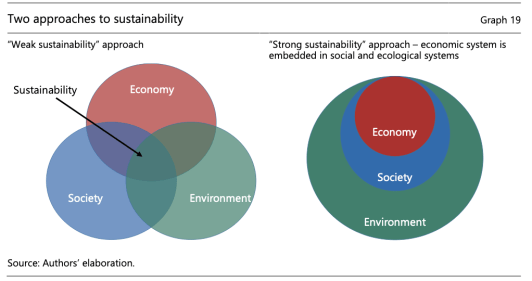
The report says that won’t work as a green-swan policy, because of the “limited substitutability between natural capital and other forms of capital”. In other words, if the Earth stops producing the stuff humans need to survive, giving people money won’t help. In a limited disaster, money allows the people affected to import resources from elsewhere. But in a global disaster, there is no elsewhere.

Central banks’ main power is in creating money and setting interest rates, but they also regulate the banking system, which in turn influences the companies the banks deal with.

The ways in which accounting norms incorporate (or not) environmental dimensions remains critical: accounting norms reflect broader worldviews of what is valued in a society (Jourdain (2019)), at both the microeconomic and macroeconomic level. From a financial stability perspective, it therefore remains critical to integrate biophysical indicators into existing accounting frameworks to ensure that policymakers and firm managers systematically include them in their risk management practices over different time horizons

The report (in some of its more technical passages, which may have gone over my head) proposes a number of ways central banks might use this power to change the economy as a whole. By defining new measures of sustainability and demanding that client banks report those measures, a central bank can alter the overall financial culture, with the result that “climate-related risks become integrated into financial stability monitoring and prudential supervision”.

[A] systematic integration of climate-related risks by financial institutions could act as a form of shadow pricing on carbon, and therefore help shift financial flows towards green assets. That is, if investors integrate climate-related risks into their risk assessment, then polluting assets will become more costly. This would trigger more investment in green assets, helping propel the transition to a low carbon economy (Pereira da Silva (2019a)) and break the tragedy of the horizon by better integrating long-term risks

Adding up to this:

Faced with these daunting challenges, a key contribution of central banks and supervisors may simply be to adequately frame the debate. In particular, they can play this role by: (i) providing a scientifically uncompromising picture of the risks ahead, assuming a limited substitutability between natural capital and other forms of capital; (ii) calling for bolder actions from public and private sectors aimed at preserving the resilience of Earth’s complex socio-ecological systems; and (iii) contributing, to the extent possible and within the remit of the evolving mandates provided by society, to managing these risks

What’s it mean for us? The direction of the world seldom changes all at once, and different sectors catch on at different rates. As different segments of society change their minds, it’s important to let them do so, and to encourage them. Each will have its own language for talking about its new ideas, and they can’t be expected to learn our language just because we got there first.

During the transition period, people whose worldview comes from that sector will have both the new frame and the old frame in their minds simultaneously, and either can be activated depending on how you approach them. (This is similar to what George Lakoff says about swing voters. It isn’t that they have a well-worked-out in-the-middle worldview; it’s that their minds contain both a liberal frame and a conservative frame. Depending on how they are approached, one frame or the other will be activated.) If you want to get such people on your side, it helps if you learn the language of their new frame and bypass obsolete arguments, rather than sticking with the old terminology and insisting on winning those arguments.

The Monday Morning Teaser

I think you’ll be pleased to learn that this week’s Sift is not entirely about impeachment. I’ll pay attention to the Senate trial, of course, because how can you not? But the featured article is about a much longer-term situation: I’ll explain some of what’s in a fascinating report from the Bank of International Settlements, The Green Swan: Central banking and financial stability in the age of climate change.

OK, maybe that didn’t sound as fascinating to you as it did to me, but give me another sentence or two. The report represents an important shift: the world’s central bankers are starting to get religion about climate change. They could become allies instead of enemies, at least on some issues. The report contains this line, which is (on the one hand) obvious to environmentalists, but (on the other) revolutionary in central-banking circles: “The stability of the Earth system is a prerequisite for financial and price stability.”

I’m running a little late this morning, so that article probably won’t be out until 11 or so EST. The weekly summary has a lot to cover and will run long: the impeachment trial, the drip-drip of new evidence against Trump, the Chinese coronavirus, Mike Pompeo’s outrageous attack on an NPR reporter, the sports-medicine significance of Zion Williamson’s knee, and a number of other things. I’ll predict that to appear around 1.

Pestilence and Cure

If I see Trump as a pestilence, I may not see in your tome of plans a cure.

– Charles Blow “To Beat Trump, Put Ideals Before Ideas
1-15-2020

This week’s featured post is “Ten Principles that Unify Democrats (and most of the country)“.

This week everybody was talking about the impeachment trial

House impeachment managers head over to the Senate.

So it’s official now. The House delivered the articles of impeachment to the Senate on Wednesday. Thursday, the senators took an oath to render “impartial justice”. The substance of the trial will start tomorrow.

Fairly soon, the Senate will have to vote on the key question of whether to hear witnesses. Trump blocked the most important witnesses from testifying before the House, but would have a harder time blocking them from the Senate, if the Senate chooses to subpoena them. Mitch McConnell is against witnesses, because the less the public learns about this case, the better for Trump.

How this vote will go is still not clear. All 47 Democrats will probably want to hear witnesses. USA Today picks out Mitt Romney, Susan Collins, Lisa Murkowski, and Lamar Alexander as the most likely Republicans to vote for witnesses. I’d love to hear how other Republicans facing tough re-elections — Cory Gardner of Colorado comes to mind — will try to spin this. They have to realize that stuff is going to come out anyway. (John Bolton is writing a book, after all.) How will a decision to participate in Trump’s cover-up look when it does?


It’s striking how much of the closing message of Trump’s defenders is just simple intimidation. Here’s Rand Paul’s threat to Republican incumbents who might be thinking of taking their oath seriously:

Paul says if four or more of his GOP colleagues join with Democrats to entertain new witness testimony, he will make the Senate vote on subpoenaing the president’s preferred witnesses, including Hunter Biden and the whistleblower who revealed the Ukraine scandal — polarizing picks who moderate Republicans aren’t eager to call. So he has a simple message for his party: end the trial before witnesses are called.

“If you vote against Hunter Biden, you’re voting to lose your election, basically. Seriously. That’s what it is,” Paul said during an interview in his office on Wednesday. “If you don’t want to vote and you think you’re going to have to vote against Hunter Biden, you should just vote against witnesses, period.”

And Marc Thiessen warns that Hunter Biden could just be the beginning of a parade of witnesses that would lead to the former Vice President himself.

Biden has been shaky under mild questioning during the debates. How would he fare under the withering pressure of legal cross-examination? If he stumbled, or appeared confused, it could expose to voters how old and frail he really is at the very moment they are going to the polls to decide their party’s presidential nominee. Do Democrats really want to put Biden through that, especially since they know that the president is going to be acquitted?

And for what? Democrats have no idea what Bolton will say under oath. His testimony may be exculpatory for the president, in which case they will have opened the Pandora’s box of witness testimony for nothing. So, call your witnesses, Sen. Schumer. They may very well pose a greater danger to Biden’s presidential prospects than they do to Donald Trump.

Trump’s defenders can’t credibly argue that he’s innocent, so this is what they’re left with: Do what we say and nobody gets hurt. [BTW: I think the Biden-is-shaky point is off-base. Biden has a lifelong stuttering problem, which can make it hard for him to answer quickly, as you have to do in a debate. As a witness, he could take a moment to compose his answers.]

and the new evidence

Maybe I’m paranoid, but I get suspicious when a bad guy suddenly switches sides and starts telling us exactly what we want to hear. Lev Parnas is under indictment, so it would make sense for him to tell this stuff to his prosecutors to get a plea deal. But it’s not clear what advantage he gets from putting it all out there in public. So I’m listening closely to what Parnas is saying, looking at the corroborating documents he’s providing, and wondering where the trap is.

Nonetheless, I think Tom Malinowski has got it right:

GOP Senators are entitled to be skeptical of Parnas, since he wasn’t under oath. They’re not entitled to be skeptical while refusing to call sworn witnesses who could corroborate or refute him.

That point makes sense across the board. Again and again, Republicans have complained about the evidence House Democrats assembled: The witnesses weren’t always in the center of the action they were describing, few of them talked to Trump directly, and so on. Those are all reasonable things to complain about in the abstract. But it’s unreasonable to complain about those issues when you have the power to resolve them, but you’re refusing to do so.


Another major development this week was that a GAO report came out, saying that Trump’s freezing of the Ukraine aid violated the Impoundment Control Act. So much for the “no laws were broken” defense.


So who is Parnas anyway? He’s a crony of Rudy Giuliani who was working the Ukraine side of Trump’s get-Biden scheme. He did a long interview with Rachel Maddow that broadcast this week, and he’s provided a bunch of text messages and other relevant documents to the House impeachment investigators. Pieces of the Maddow interview are available online, but I haven’t found a complete video or transcript of it yet.

The Hill boils it down to five big points:

  • Trump was ready to withhold all aid from Ukraine if they didn’t announce a Biden investigation.
  • Bill Barr “had to have known everything”.
  • Trump knew exactly what was going on.
  • When Mike Pence cancelled his trip to the Ukraine president’s inauguration, that was part of the pressure campaign.
  • The effort to pressure Ukraine was never about corruption; it was about Biden.

In addition, I was struck by how clear Parnas makes it that Giuliani was operating as Trump’s personal attorney, not as a government official. So far, none of Trump’s defenders has been able to explain why (if this whole scheme was legit) it had to be done outside ordinary channels. To me, the off-the-books nature of things looks like consciousness of guilt.

Why, for example, couldn’t Trump just fire or transfer Ambassador Yovanovitch because he wanted to? Why did she have to be smeared and followed and threatened first?


Another thing that’s striking me: For a long time there, Rudy Giuliani just couldn’t shut up. He was all over TV saying all kinds of crazy things. Since Parnas started talking though, where has Rudy been?


Ben Rhodes asks a more general question:

Can you imagine how many corrupt grifters there are like Parnas circling around Trump’s foreign policy? On Saudi, UAE, Venezuela, China, Russia?

and the Democratic debate

The featured post was inspired by watching Tuesday’s debate, but doesn’t actually say that much about it. Here’s the transcript.

The debate in Des Moines was much like the previous debates, with the difference that there were only six candidates. That meant that each got to speak often enough that I never forgot who was up there. So while the previous debates looked like cattle calls, this one looked like a collection of possible nominees (with the possible exception of Steyer, who I still can’t take seriously). That had to work to the benefit of Amy Klobuchar, who trails the clump of Iowa front-runners (Biden, Buttigieg, Sanders, Warren), but looked like she belonged in that group.

Any of the front-running four is polling close enough to the top to win, especially considering how bizarre the caucus process is. So I don’t understand how soft all the other candidates were with Biden. Biden is the leader in almost every national poll. He could win Iowa, and if he does, that victory could be the beginning of the bandwagon that he rides to the nomination. This debate was the last chance to take him down before the caucus, so I don’t understand why nobody tried to exploit that opportunity.

So while Biden wasn’t all that sharp in the debate — he almost never is — to me he came off as the winner, because his opponents missed another opportunity to knock him down.


The NYT endorsement came out this morning: a split decision between Elizabeth Warren and Amy Klobuchar.


The whole Bernie-and-Elizabeth spat has got to be the dumbest story in this debate. Warren claims Sanders told her that a woman couldn’t beat Trump; Sanders denies saying that. It was a one-on-one conversation, so there’s no tie-breaking witness. I have two reactions:

  • So what if he did? Lots of people — most of them women — have told me in private conversations that (after watching what Hillary went through) they doubt that a woman can beat Trump. If Sanders were arguing publicly that people should vote for him rather than Warren because women aren’t electable, that would be terrible, because he’d be trying to cash in on the public’s sexism. But in private it’s a completely legitimate point of strategy for two politicians to discuss. So I think this whole thing should never have become an issue and CNN shouldn’t have asked about it. If Warren is responsible for raising the issue (and she may not have been), she shouldn’t have.
  • I thought Bernie’s response in the debate (“as a matter of fact, I didn’t say it”) was unskillful, because he turned the disagreement into a somebody-must-be-lying issue. I agree with GoodNewsRoundup on Daily Kos, that people can remember conversations differently without either party lying about what was said. So Bernie could have answered: “That’s not what I believe, so I can’t imagine that I would have said something like that. But apparently something I did say gave Elizabeth that impression, so I wish I had caught that misunderstanding at the time.” From there he could have segued into the rest of his answer: “If any of the women on this stage or any of the men on this stage win the nomination … I will do everything in my power to make sure that they are elected in order to defeat the most dangerous president in the history of our country.”

and you also might be interested in …

I’m not all that interested in the British royal family, so I’ve mostly ignored the Harry-and-Meghan-move-to-Canada story. However, BuzzFeed did some interesting research into what might have motivated the move: The article pairs 20 Meghan stories in the British press with directly comparable stories about her sister-in-law Kate Middleton. Again and again, something that was covered positively or indulgently for Kate and William was covered negatively for Meghan and Harry.


Here’s the transcript of a rally Trump held in Wisconsin on Tuesday. It’s common to read isn’t-that-outrageous articles based on specific quotes from Trump rallies. But what strikes me about this rally isn’t any particular part; it’s the impact of reading the whole thing.

If your Dad or Grandpa were this incoherent, the family would need to have a conference and make some decisions. You wouldn’t want him living on his own any more, and probably you’d want someone with him whenever he went out.

BTW, he still says Mexico is going to pay for the wall. “It’s all worked out. Mexico’s paying.” Sad.


The claim that no Americans were injured in the Iranian missile attack on January 8 … let’s just say it wasn’t completely accurate.

and let’s close with something that will blow you away

You might think that since the Netherlands is so flat, Dutch bicycle races wouldn’t be that arduous. However, there is one very Dutch obstacle: the wind. Every year on some very windy day they hold the Dutch Headwind Cycling Championships: 8.5 kilometers straight into a wind that gusted up to 127 kilometers an hour, riding a standard upright single-speed bicycle.

Since I don’t speak Dutch, most of the YouTube postings on the event are unintelligible to me. But Global Cycling News covered it like this, with one word of commentary: “Nutters.”

Ten Principles that Unify Democrats (and most of the country)

By focusing attention on comparatively minor policy differences, the debates are obscuring a broad Democratic consensus that voters need to hear about.


Several years ago I was having lunch with a friend when the Democratic candidate for Congress came through the nearly empty restaurant, shaking the few hands available. After she left, our young waitress came to the table, and I could tell that she had a question unrelated to food. I expected her to ask whether we knew anything about the candidate, but her actual question was much more basic: “Do you know anything about Congress? Is it, like, important?”

That encounter taught me a lesson I have not forgotten: People who pay attention to politics often talk about “low-information voters”, but most of us have no idea just how low-information they are.

Back in 2004, Chris Hayes learned similar lessons from the undecided voters he canvassed in Wisconsin.

The majority of undecided voters I spoke to couldn’t name a single issue that was important to them. This was shocking to me. Think about it: The “issue” is the basic unit of political analysis for campaigns, candidates, journalists, and other members of the chattering classes. It’s what makes up the subheadings on a candidate’s website, it’s what sober, serious people wish election outcomes hinged on, it’s what every candidate pledges to run his campaign on, and it’s what we always complain we don’t see enough coverage of.

But the very concept of the issue seemed to be almost completely alien to most of the undecided voters I spoke to. … The undecideds I spoke to didn’t seem to have any intuitive grasp of what kinds of grievances qualify as political grievances. Often, once I would engage undecided voters, they would list concerns, such as the rising cost of health care; but when I would tell them that Kerry had a plan to lower health-care premiums, they would respond in disbelief — not in disbelief that he had a plan, but that the cost of health care was a political issue. It was as if you were telling them that Kerry was promising to extend summer into December.

Year after year, elections come out they way they do because people like my waitress or Hayes’ undecideds vote one way or the other or stay home. Those decisions are made on a much simpler level than we usually imagine, and the arguments we find so convincing often miss their targets completely. If such voters are persuaded, it is more likely because of our earnestness or our tone or something we said in the first ten seconds. Or maybe we inadvertently convinced them to vote against our candidate for some similarly tangential reason.

That’s what I was thinking Tuesday as I watched the final Democratic debate before the Iowa caucus, which will happen February 3. Debates draw out differences, and when candidates share basic goals and values, their differences are often deep in the details of policy. Those policy distinctions — like Medicare for All vs. Medicare for All Who Want It vs. adding a Medicare-like public option to ObamaCare — mean nothing to most low-information voters.

Worse, the squabbling over programmatic details hides the candidates’ vast areas of agreement. The New York Times, justifying its decision to endorse both progressive Elizabeth Warren and moderate Amy Klobuchar this morning, wrote:

The Democratic primary contest is often portrayed as a tussle between moderates and progressives. To some extent that’s true. But when we spent significant time with the leading candidates, the similarity of their platforms on fundamental issues became striking.

I believe that those points of consensus should be the central message of the campaign against Trump. That consensus is the best definition of what it means to be a Democrat, and is a better predictor of what the next Democratic administration will accomplish than any particular candidate’s program — even the winner’s. (In 2008, Hillary Clinton’s healthcare plan had an insurance mandate and Barack Obama’s didn’t. But when Obama signed the Affordable Care Act into law in 2010, it had a mandate. So if you voted for Obama over Clinton to avoid a mandate, you failed in your purpose.)

Political wonks are always tempted to dive down into the weeds of policy and argue why Candidate X’s plan is superior to Candidate Y’s. And I understand how those differences can seem terribly significant when you are in the throes of a primary campaign. But I think that’s exactly the wrong thing to be doing when we get rare moments of national attention, as we did Tuesday. What the public needs to hear are the principles that unify Democrats and set them against the current administration, not the fine details of policy that differentiate one Democrat from another.

Charles Blow made a similar point Wednesday morning:

Trump has laid out his vision for America: It is the racial Hunger Games. … The Democratic candidates, too, would be well warned to stick to a vision — a diametrically opposite and dynamically animating vision that will activate and energize the targets of Trump’s aggressions.

If I see Trump as a pestilence I may not see in your tome of plans a cure.

Here’s where I stand: If Candidate A’s policies are analytically superior, but Candidate B is the more convincing proponent of the Democratic consensus, I want to vote for B. That’s the difference I’d like to see the debates showcase. That’s not “electability” as it is commonly discussed; it’s who we should want as our spokesperson.

What do I think is in the Democratic consensus? I thought you’d never ask.

1. If you get sick, you should get the care you need, and your family shouldn’t have to go bankrupt paying for it.

If you showed this statement to the 20-odd candidates who have run for the Democratic nomination in this cycle, I firmly believe they would all agree with it.

Their differences are all about how to get there: What is the most efficient way to deliver that much healthcare? How would the country pay for it? What’s the most politically expedient path forward?

Bernie Sanders wants to get there in one fell swoop, with a government insurance plan that eliminates private insurance and is paid for by taxes. Most of the other candidates on the debate stage (Biden, Buttigieg, Klobuchar) don’t believe they could pass such a plan, so they want to take a smaller step in the same direction by building on ObamaCare. (Once the public sees how that works and develops confidence in it, take another step.) Elizabeth Warren is somewhere between, proposing a Bernie-like program with a phase-in period.

That’s what they’ve been arguing about. Trump, on the other hand, has sabotaged ObamaCare, tried to repeal it in Congress, and is still backing a lawsuit that would declare it unconstitutional. Despite a lot of rhetoric about “replacing” ObamaCare, he has never released a plan for doing so. The upshot is that if he succeeds in his aims, tens of millions of people will lose health coverage.

2. We can and should do much more to slow down climate change.

President Obama did a number of things to slow down climate change, but Trump has undone almost all of them: Obama joined the Paris Climate Accord; Trump withdrew from it. Obama substantially raised fuel economy standards for cars and trucks; Trump initially froze them at the old levels, then agreed to a minor increase. Trump reversed Obama’s Clean Power Plan to cut carbon emissions from plants that generate electricity. Trump’s plan to roll back standards on methane emissions is too radical even for some oil companies.

All the Democratic candidates want to do more than Obama did, not less. They disagree about how much more and how fast it can happen.

None of the candidates denies or tries to minimize the significance of the scientific consensus on climate change: It is real. We already are seeing the effects. It is caused primarily by the carbon emissions that happen when we burn fossil fuels. It will reach catastrophic levels if the world does not substantially reduce its carbon emissions.

3. If you’re willing to work hard, you should be able to find a job that pays a decent wage.

Trump has reason to crow about the unemployment rate, which is very low right now. (Whether low unemployment is due to any policy of his, or is just the continuation of trends that started under Obama — that’s another debate.) But a lot of the people who have jobs are still not making a wage they can live on.

The federal minimum wage is still $7.25, the same as it was in 2009. The purchasing power (after inflation) of the minimum wage peaked in 1968. (The value of 1968’s $1.60 wage is $12.00 today.) In none of the 50 states is a two-bedroom apartment affordable on a full-time minimum wage.
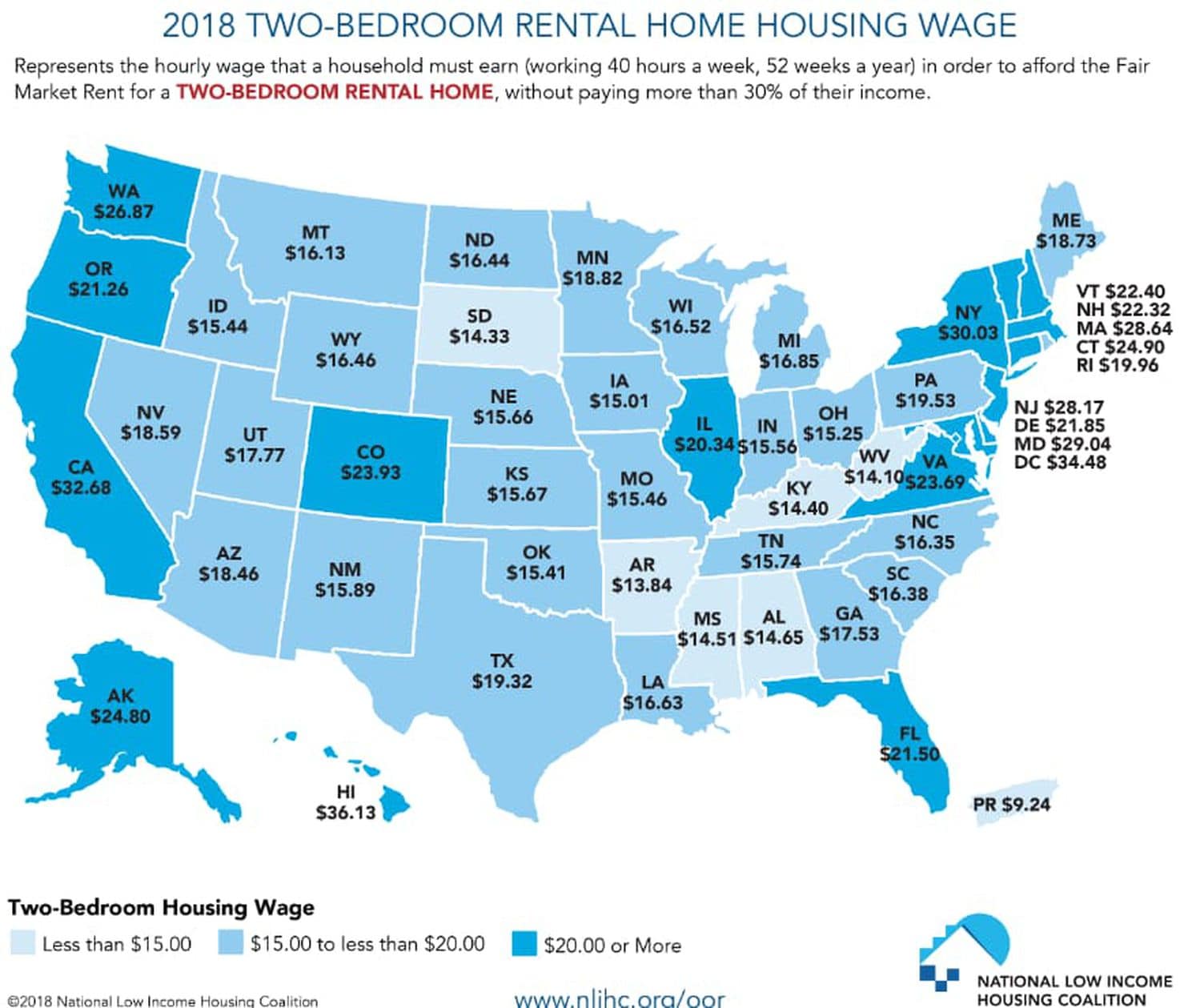
President Obama tried to raise minimum wage to $9, but couldn’t get Republicans in Congress to go along. All Democratic candidates want a much greater increase. Both Bernie Sanders (the most liberal Democratic candidate) and Joe Biden (one of the least liberal) are calling for $15.

Democrats across the board want to create jobs paying good wages by repairing our country’s roads and bridges, modernizing the electrical grid, and shifting to renewable energy sources that don’t contribute to climate change.

4. The burden of taxes should fall primarily on those best able to bear it.

The benefits of the Trump tax cut went almost entirely to large corporations and the very rich. Despite the promises he often made during the 2016 campaign and repeated early in his administration, the new tax rules particularly favor people like him. In fact, many of the tax breaks that the law preserves or extends seem to be targeted precisely at benefiting Trump himself or his family. (That’s one reason he doesn’t want you to see his tax returns.)

This is part of a long-term trend that has lowered the tax rates paid by the super-rich.

(Sometimes you’ll see an article claiming that the very rich carry more of the tax burden than they used to, but these claims are deceptive: The very rich have seen their incomes go up many times faster than the rest of us. They get a much bigger piece of the pie than they used to, but while their share of the tax burden has gone up somewhat, it has not gone up proportionately.)

Corporations are also carrying a much smaller tax burden than they did in decades past. The Institute for Taxation and Economic Policy lists 60 corporations that among them made nearly $80 billion in profits, but paid no taxes in 2018 under Trump’s new law.

Meanwhile, the federal deficit (which Republicans thought was an existential crisis when Obama was president, but have since forgotten about) has nearly doubled under Trump — from $665 billion in FY 2017 to a projected $1.1 trillion next year. This comes at a time in the economic cycle when the deficit ought to be going down, because it will rise even further when the next recession comes.

All the major Democratic candidates would reverse most of the Trump tax cuts, and all call for shifting more of the tax burden back to the rich. Elizabeth Warren is the most vocal about this, calling for a 2% wealth tax on fortunes over $50 million. The rest don’t go quite that far, but all  agree that the rich should pay more.

5. If you want to develop your talents through education, money shouldn’t stand in your way.

States used to put big money into their university systems, but they no longer do. As a result, college of any kind has become unreasonably expensive — far more expensive than it was a generation ago. (Until 1970, the University of California charged California residents zero tuition.)

As a result, too many of our young people face a terrible choice: Give up on developing their talents after high school, or take on debts that they may never be able to pay off. Or their parents face the choice: See their children stuck in dead-end jobs, or take all the money they had hoped to retire on and hand it to a university.

Wasted talent isn’t just a personal tragedy, it’s a loss for all of us. If our young people don’t learn 21st-century skills, American businesses will have a harder time finding good people, foreign companies won’t want to open branches here, our economy as a whole will be less prosperous, and the professionals we have to deal with in our personal lives (doctors, accountants, dentists, teachers, etc.) won’t be the best people. There is also a more subtle cost: the loss of the American dream. When only the rich can afford to send their children to college, the upper classes become entrenched; where you are born is where you will stay.

Democratic candidates have a variety of plans to do something about this: Some want to make public colleges free for everyone, or maybe just free for people whose parents aren’t rich. Some want to forgive all student debt, or only part of it. As with healthcare, the difference isn’t in the general principle, it’s in how to bring it about and who will pay for it.

The Trump administration’s priorities are diametrically opposed: They are constantly looking for ways to cut back on student aid or student loans, or to make them harder to pay off. Secretary of Education Betsy DeVos has consistently shown more interest in for-profit colleges that rip students off than in the students being victimized.

6. America should be a positive example to the rest of the world. When international cooperation is necessary to solve global problems, our country should lead.

We’ve fallen a long way from the “shining city on a hill” Ronald Reagan used to brag about. These days, if you’re a third-world dictator and you want to torture people or channel government money into your own pocket or use your law enforcement agencies to investigate people who cross you or accuse the press of being “the enemy of the people” or claim a phony emergency to grab power from your legislature, you just point to the United States and quote its president. It’s fine. All the best countries are doing it.

We’re now a country none of the other countries trust, because our word means nothing. Imagine how shocked our loyal allies in Canada were when we raised tariffs because we considered Canada a risk to our national security. Or talk to the Kurds, if you can still find any.

Historically, America has been an idealistic nation. Since World War II, it has led the community of nations towards higher standards of human rights and a freer exchange of ideas and people. The US has been key in setting up regional alliances for mutual security, with NATO being the shining example.

Today, the world faces many problems that no nation can solve on its own; most significantly, climate change, but also terrorism, nuclear proliferation, floods of refugees fleeing wars or climate-change-related catastrophes, and several others. But the Trump administration has chosen to step back from world leadership with a go-it-alone policy. Given our military power and central role in the world economy, no other nation can take our place.

Democrats want the US to be a good citizen of the community of nations, and to rally the nations of the world to confront the unique challenges of this century.

7. Every American should be encouraged to vote, and all votes should count equally.

For the last decade or so, Republicans all over the country have been putting obstacles in the way of people who want to vote, particularly if they are poor, black, HIspanic, or in school. Even if such people do manage to vote, gerrymandering can concentrate them in a small number of districts so that they wind up with fewer representatives in Congress or state legislatures. You can see the result in a state like Wisconsin, where Republicans maintain power no matter how the people vote. (In 2018, 54% of Wisconsinites voted for Democratic candidates for the state assembly, but those candidates won only 36% of the seats.)

The first bill Democrats passed when they got control of the House of Representatives last year was House Resolution 1 of 2019: The For the People Act. That law would end gerrymandering, extend voting rights, and set up a program to limit the power of large donors to political campaigns. The Republican-controlled Senate refused to vote on it.

Ultimately, Democrats would also like to get rid of the Electoral College — which allowed Donald Trump to become president even though Hillary Clinton got nearly 3 million more votes.

8. All Americans should be equal before the law, regardless of race, gender, sexual orientation, income, religion, or any other characteristic that isn’t relevant to the purposes of the law. All citizens should be treated with equal respect by law enforcement.

“Liberty and justice for all” is a key part of our national identity, but we haven’t been doing a good job of delivering it. Race makes a difference at every level of our justice system: Black neighborhoods are more heavily policed, leading to more arrests. Arrested blacks are more likely to be charged with crimes; charged blacks are more likely to be convicted; convicted blacks on average get longer sentences. The result is that a substantial portion of the black male population is in jail. (Laws preventing felons from voting, even after they leave prison, are a major way that minorities are prevented from exercising political power proportionate to their numbers.)

Far too often, black men and women die in encounters with police without ever reaching the justice system.

These problems existed long before Donald Trump took office. But as with climate change, the Obama administration was trying to do something about them, and the Trump administration has undone all that progress. In particular, Trump’s Justice Department has all but stopped oversight of racism in local police departments. Trump himself has actively encouraged police to physically abuse suspects.

Any Democratic candidate for president would get back on the Obama/Holder track of trying to reduce the racism in law enforcement and the legal system.

9. As much as possible, politics should be insulated from the corrupting influence of concentrated wealth.

Briefly, controlling campaign finance looked like a bipartisan issue. Republican Senator John McCain made it a central plank of his first presidential campaign in 2000, and he teamed with Democrat Russ Feingold to produce the McCain-Feingold Act in 2002.

But Supreme Court justices appointed by Republican presidents have subsequently declared unconstitutional just about any substantive limits on political spending. One of the few remaining options for controlling big-money politics is disclosure (i.e., letting the public know who is financing political ads, rather than letting big-money interests hide behind shell organizations with vacuous names like “Concerned Citizens Against …”), but the Republican Senate has blocked any such legislation.

This is one of the clearest differences between the parties: Republicans want big-money donors to have as much power as possible, while Democrats want to limit the power of money in general, and (to the extent that those limitations prove impractical) enhance the power of small donors.

10. The basic constitutional covenant is still necessary and should be respected: majority rule that respects minority rights, three branches of government that check and balance each other, and an appropriate balance between the public good and individual freedom.

For years, preserving or restoring the Constitution has played a major role in Republican rhetoric, but President Trump has made a mockery of all that. This is one of the major issues in his impeachment, and should be a major issue in the 2020 campaign as well.

The Constitution assigns Congress the “power of the purse”, which means that no money can be spent without Congress’ approval. But when Congress refused to fund Trump’s border wall last year, even after a lengthy government shutdown, he declared a phony “state of emergency” and seized the money from other programs. He also illegally held up money that Congress had appropriated to aid Ukraine.

Congress has a constitutional duty to keep oversight over the executive branch, but Trump has routinely refused to provide subpoenaed documents and witnesses, arguing in court that he has “absolute immunity” against any investigations whatsoever. His legal arguments are absurd, but will serve to delay things in the courts long enough to keep the public from finding out what he’s been doing until after the election.

The Constitution gives Congress the power to declare war, but he committed an act of war against Iran without consulting Congress.

Again and again, Trump has shown that he admires dictators: Vladimir Putin, Kim Jong Un, Xi Jinping, and many others. (The New Yorker’s satirical Borowitz Report says “Ayatollah Mystified That He is the Only Dictator Trump Dislikes“.) That’s because he wants to be one.

In spite of decades of Republican rhetoric, Democrats are now the party that stands for the Constitution.

The Monday Morning Teaser

Of course the big news this week centered on impeachment: The trial in the Senate formally started, we got a bunch of new evidence from Lev Parnas (who I still don’t trust), and the Government Accounting Office officially stated that Trump’s hold on the Ukraine aid was illegal.

What I decided to write about this week, though, was inspired by the Democratic debate on Tuesday — not any particular point made in the debate itself, but the general impression it left: If you were a low-information voter who happened to tune into this event, you would probably not grasp just how many things Democrats agree on, and how sharply that consensus differs from what the Trump administration and Republicans across the country are trying to do. By emphasizing differences, the debate format creates the false impression that the various Democratic candidates represent wildly different points of view.

So I decided to counter that with a piece I’m calling “Ten Principles that Unify Democrats (and most of the country)”. That should be out, let’s say, around 10 EST.

The weekly summary will cover the impeachment developments, what the Democrats actually did debate about, and a few other things, before closing with an extremely odd Dutch bicycle race. That should appear sometime after noon.

Ascribed Meanings

There is always a temptation to ascribe a deep, unspoken strategy to Trump’s improvised approach to politics—to find order in the chaos, a signal in the noise. But all of the available evidence suggests that there is no plan at all, that Trump is a deeply incompetent liar who has no idea what he is doing and no respect for the few people around him who do. If there is war with Iran, it will be because of Trump’s incompetence and lies; if there is not, it will be in spite of these things. Coverage that attempts to find the hidden meaning behind his actions only obscures what’s really happening.

– Alex Shephard “What the Media is Getting Wrong about Soleimani’s Killing
The New Republic 1-7-2020

This week’s featured post is a review of how every president since FDR has talked about war: “Remember Normal Presidents?

This week everybody was talking about Iran

This week’s news has been dominated by the multiple incoherent stories the Trump administration has been telling about the killing of Soleimani.

One thing just about everybody in this country agrees on is that Soleimani was a bad guy. (Though Trump lies about this: “The Democrats and the Fake News are trying to make terrorist Soleimani into a wonderful guy“. If anybody has heard a single major voice in either the media or the Democratic leadership imply such a thing, mention it in the comments. I don’t know of any.) However, he was an Iranian official carrying out Iranian policy. Blaming him personally for every attack Iran has supported seems misguided. He was a replaceable individual who has been replaced; the Quds Force has a new commander, who presumably is following the same policy directives.


There has been much back-and-forth about whether Soleimani was killed to prevent an “imminent” attack, or just because he was evil. It’s important to understand why this point keeps coming up, because Trump keeps trying to have it both ways: He claims that an attack was imminent, but if challenged too hard backs off tobut it doesn’t really matter because of his horrible past!”

If Soleimani’s assassination wasn’t intended to break up an attack that was in progress and about to happen — and it’s hard to see how that could be; I mean, Soleimani wasn’t going to drive a truck bomb himself — then it’s arguable that Trump had no legal authority to order it. If, instead, he just decided that Soleimani was a bad guy and Iran had been getting away with too much, he should have sought authorization from Congress. “his horrible past” is an argument that Trump could have offered to Congress, but it’s not a justification now.

At the very least, Trump had an obligation to inform the Gang of Eight that the attack was happening.

This disrespect for Congress is why Republican Senator Mike Lee blew his stack after the classified briefing of the Senate by the Secretaries of State and Defense, and the heads of the CIA and the Joint Chiefs.

He also fumed that officials refused to acknowledge any “hypothetical” situations in which they would come to Congress for authorization for future military hostilities against Iran.

It’s fairly apparent that the administration is just making up the “imminent attack” argument, and dodging the legal authority issue. The briefing showed profound arrogance; the briefers walked away after 75 minutes with questions unanswered.

Trump himself has been lying outrageously, for example claiming that Soleimani was planning attacks on four US embassies. Apparently, though, the Secretary of Defense knew nothing about this, and the embassies in question were never notified that they faced an imminent threat.


When no one was killed in Iran’s reprisal strike against the Iraqi base where the Soleimani attack originated, many Trumpists declared the exchange a “win” for the US: We killed a major person on their side and they killed nobody on our side.

Ben Rhodes demonstrates how an adult looks at this: according to the results, not the body count.

Iran abandoned nuclear deal limits. Iraq wants us out. Counter ISIS mission is suspended. We don’t know what asymmetric attacks could come from Iran. Yet I see Trump supporters celebrating a “win”. What are we winning?

Is there any way in which Americans or our allies are safer now than before the assassination? Was some strategic purpose achieved?


Nobody really knows whether Iran intended to kill Americans or not in its missile strike. Of course Iran would say that the result was intended.


Iraq’s parliament voted unanimously that the prime minister should ask our 5200 troops to leave the country, and apparently the PM has asked Secretary of State Pompeo to send a delegation to Baghdad to negotiate the withdrawal. But we’re not going to do that. Here’s how a State Department spokesperson put it:

Our military presence in Iraq is to continue the fight against ISIS and as the secretary has said, we are committed to protecting Americans, Iraqis, and our coalition partners. At this time, any delegation sent to Iraq would be dedicated to discussing how to best recommit to our strategic partnership — not to discuss troop withdrawal, but our right, appropriate force posture in the Middle East.

That makes us sound more like an occupying power than an ally. Any Iraqi militia that kills American troops can now claim that it is repelling invaders.

The Trump administration is also making economic threats against our “ally” Iraq if it insists on our troops leaving:

The Trump administration this week warned Iraq that it could lose access to its central bank account at the Federal Reserve Bank of New York if Baghdad expels American troops from the region, Iraqi officials told The Wall Street Journal.


One of the week’s weirder stories was about a letter that somehow got shared with the Iraqi military.

The document in question was an unsigned draft of a memo from the US Command in Baghdad notifying the Iraqi government that some US forces in the country would be repositioned. It also seemed to suggest a removal of American forces from the country, prompting an immediate wave of questions, particularly after US officials in Baghdad said the letter was authentic but could not confirm whether it indicated a troop withdrawal.

You need to be a comedian, like Trevor Noah, to respond to this appropriately.

These people control nuclear weapons and they can’t even handle Microsoft Outlook.


If you want to put it all in perspective, again, it helps to be a comedian. Like Seth Meyers.


One of the points in the featured post is that Trump is not even trying to talk to the people who didn’t vote for him. That point was also made by Anderson Cooper in a Ridiculist segment about the 301 days that have passed since the last White House press briefing.

If you’re wondering “Who’s Stephanie Grisham?” you’re probably not a regular Fox News viewer, because that channel is seemingly the one place she feels safe enough to regularly appear.

… If a president were to escalate the potential danger to U.S. interests overseas by killing a high-ranking Iranian general, you might think the White House press secretary would head to the podium to keep the country and the world abreast of what’s going on, to try to fill in some gaps between the President’s Twitter threats. But that doesn’t happen any more.

Remember CJ on The West Wing? Imagine her going most of a year without filling the podium in the briefing room.

and impeachment

Nancy Pelosi says the articles of impeachment will go to the Senate soon, probably this week. The debate has begun about what, if anything, was accomplished by the delay. In my mind, it was important to put at least a little distance between the House and Senate processes, so that even low-information voters realize that the Senate isn’t going to hear any witnesses of its own, even though it could. If the case could still be pending when Trump gives his State of the Union address on February 4, that would be a bonus.

and Iowa

The Iowa caucuses are February 3, or three weeks from today. (Yes, they happen on a Monday. Every time.) The last Democratic debate before the caucuses happens tomorrow. Only six candidates qualified: Biden, Buttigieg, Klobuchar, Sanders, Steyer, and Warren.

The RCP polling average shows the top four bunched up. Sanders 21.3%, Buttigieg 21.0, Biden 17.7, Warren 17.0. Because the caucus process yields a much lower turnout than a primary would, and because there are complex rules about minor candidates’ supporters switching their votes, polls often do a bad job of predicting the outcome. So it would not really be an upset if any of those four won.

I would say that the front-runner is whoever the other candidates decide to attack in the debate. And if either Steyer or Klobuchar decides to go kamikaze and relentlessly attack one of the top four, that candidate probably won’t win. I’m not predicting that, but the possibility demonstrates how unpredictable the process is at this point.

and you also might be interested in …

The planet continues to heat up:

The Copernicus Climate Change Service (C3S) announces today that 2019 was the fifth in a series of exceptionally warm years and the second warmest year globally ever recorded.


Maybe the secret to getting infrequent voters to the polls is to have their friends ask them.


5G will arrive in 2020, but it won’t live up to the hype.


Australia is still on fire.


The cancer death rate is down 29% between 1991 and 2017, with a 2.2% drop in 2017, the most recent year where statistics are available. Lung cancer accounts for much of the decline; researchers credit decreased smoking, as well as improvements in treatment.

I hate tie every story to Trump, but he has a way of inserting himself, sort of like Rhupert the Ostrich photobombing classic paintings. In this case, Trump took credit for the long-term trend whose most recent data is from the same year he took office: “A lot of good news coming out of this Administration.”


The justification for holding asylum seekers in concentration camps is that they won’t show up for their hearings, and instead will just vanish into the general immigrant population. At a rally last January, Trump claimed that only 2% show up “And those people, you almost don’t want, because they cannot be very smart.”

Transactional Records Access Clearinghouse (TRAC) at Syracuse University presents the actual numbers:

With rare exception, asylum seekers whose cases were decided in FY 2019 also showed up for every court hearing. This was true even though four out of five immigrants were not detained or had been previously released from ICE custody. In fact, among non-detained asylum seekers, 99 out of 100 (98.7%) attended all their court hearings.


Conservative rhetoric lauds local control and disparages rule by distant politicians and bureaucrats — except when localities want to protect the environment or gay rights or something. In Florida, Coral Gables outlawed plastic bags at stores and styrofoam containers at restaurants — and lost a lawsuit from a trade organization representing the big retail chains. State law doesn’t allow “regulation of the use of sale of polystyrene products by local governments.” Take that, small government.

Republicans are the party of big corporations, not local control. When WalMart can get what it wants from the state legislature, why let city councils screw that up?


Remember the whole pseudo-scandal about the Clinton Foundation and Uranium One?

A Justice Department inquiry launched more than two years ago to mollify conservatives clamoring for more investigations of Hillary Clinton has effectively ended with no tangible results, and current and former law enforcement officials said they never expected the effort to produce much of anything.

That’s a similar result to the State Department’s investigation of Hillary Clinton’s emails. So if you decided not to vote for Hillary because you figured there had to be fire somewhere under all that smoke — no, there wasn’t. You were conned.

Media Matters’ Matt Gertz traces the Uranium One story back to its source: Clinton Cash, a hit job written by Peter Schweitzer and pushed by Steve Bannon. A subsequent Schweitzer book, Secret Empires, is a source of much of the bogus reporting about Hunter Biden. Gertz comments on Schweitzer’s new book, Profiles in Corruption, which reportedly will target not just Biden but also “Cory Booker, Bernie Sanders, Amy Klobuchar, and Elizabeth Warren.”

Journalists should consider this final and inevitable collapse of Schweizer’s bogus claims as they decide whether and how to cover his forthcoming book, which will reportedly target the purported corruption of several Democratic presidential candidates.

and let’s close with something wild and woolly

I never thought of wool as a medium for animation, but I guess it is.

Remember Normal Presidents?

Every previous president since Pearl Harbor would have handled the Soleimani announcement very differently.


It’s now been ten days since the United States assassinated top Iranian General Qasem Soleimani near the Baghdad airport, and we still have no coherent explanation of why it was done, why it was legal, and what strategy the assassination is a piece of. Apparently even Congress hasn’t been able to get these questions answered in a classified briefing.

One of the ways Trump gets normalized is that we often compare his actions to his own previous conduct, as in “This is even worse than the last ridiculous thing he did.” As a result, our expectations of presidential behavior drift continually downward. I mean, sure, the claims of an “imminent” threat to American lives, some deadly Iranian scheme that came apart because we killed Soleimani, are almost certainly false. (Once a plot is under way, i.e., truly “imminent”, you disrupt it by stopping the perpetrators, not blowing up the mastermind. Killing Bin Laden after the hijackers were on their way to the airport would have done nothing to prevent 9/11.) But Trump’s like that — what’s one more lie after the many thousands we’ve already heard from him?

Another way we normalize Trump is to cut his actions into tiny pieces and find horrifying precedents for each one. (As in: “So Trump lied about the imminent threat? W lied about WMDs.”) And so we allow the Trump administration to become a Frankenstein monster, stitched together from all the worst aspects of previous presidencies.

To correct these normalizing tendencies, I want to raise the question: What do we normally expect from an American president when there’s been a major military development?

Talk to us. The very least we expect from a normal president is that he address the American people, to acknowledge what has happened himself, as soon as possible.

This tradition is as old as mass media. The day after the Pearl Harbor attack, President Franklin Roosevelt addressed a joint session of Congress, calling December 7 “a date that will live in infamy” and asking the House and Senate to declare war on Japan. The speech was broadcast live over the radio, and “attracted the largest audience in US radio history, with over 81% of American homes tuning in”.

[The speech] was intended not merely as a personal response by the President, but as a statement on behalf of the entire American people in the face of a great collective trauma. In proclaiming the indelibility of the attack, and expressing outrage at its “dastardly” nature, the speech worked to crystallize and channel the response of the nation into a collective response and resolve.

Every subsequent president has carried on this tradition of using the mass media to reach out to the American people when issues of war and peace arose. This week I examined a number of such examples, including these:

How a normal president sounds. I could have included many other examples, but the list above is a good sampling. Some the actions announced turned out well and some turned out badly. (It’s probably unfair to expect him to have foreseen this, but Nixon’s Cambodia campaign was a step down the road to the killing fields.) Some of the speeches were more honest than others. (The Gulf of Tonkin incident, for example, was not quite how LBJ described it.) But despite the differences in era and philosophy and personality, all these speeches share a number of features that made them “presidential”.

The most obvious thing they share is a tone: They are all calm but serious. The President, whoever he might have been at the time, projects an attitude of thoughtful determination, as if he were saying “I know there will be consequences to this act, but I have thought them out to the best of my ability. I am not acting rashly out of unreasoning fear or blind anger.”

They are also in some manner humble. This might seem like a strange trait for a leader to display when he is invoking the greatest power his office affords him, but American presidents do not hold their power as a personal possession, the way a divine-right king would. Presidential power is held in trust for the American people. No one is worthy of the power to start bombing some other country or to send troops into harm’s way, but our country has to place that power somewhere. So we have placed it in our president, under supervision from the Congress, who is just a human being like the rest of us. Any human who assumes that power is quite right to be awed by it.

The speeches are not self-aggrandizing, which is the opposite of humble. FDR, for example, could have used the opportunity to pat himself on the back: He had shown the foresight to begin a draft a little over a year before. His Lend-Lease program had armed countries that would now be our allies, and had developed a weapons industry we would now be relying on. But he mentioned none of that.

Unity. Every one of the speeches is an attempt to unify Americans behind the action being announced and the policy it represents. Consequently, they all strive to be non-partisan. Again, look at FDR: He could have reminded the country that Republican congressmen voted against Roosevelt’s Lend-Lease Act 24-135, a decision that now looked short-sighted. That might have scored points with the voters and helped Democrats unseat those Republicans. But he made no mention of parties: The nation had been attacked, and he called for the nation — not just his party — to respond.

That model has stood until the present administration. Frequently in the speeches above, the president quotes or refers to some past member of the other party to demonstrate the bipartisan nature of the policy he is carrying out. Ronald Reagan quoted former Democratic Speaker Sam Rayburn. Nixon referenced a bipartisan list of presidents:

In this room, Woodrow Wilson made the great decisions which led to victory in World War I. Franklin Roosevelt made the decisions which led to our victory in World War II. Dwight D. Eisenhower made decisions which ended the war in Korea and avoided war in the Middle East. John F. Kennedy, in his finest hour, made the great decision which removed Soviet nuclear missiles from Cuba and the western hemisphere.

Johnson’s speech is especially noteworthy in this regard, because it took place in August, 1964, just three months before the election. The idea that Barry Goldwater was a hothead not to be trusted with nuclear weapons would soon become a theme of Johnson’s reelection campaign, but nothing in the Gulf of Tonkin speech hints at that. Quite the opposite:

I have today met with the leaders of both parties in the Congress of the United States, and I have informed them that I shall immediately request the Congress to pass a resolution making it clear that our government is united in its determination to take all necessary measures in support of freedom and in defense of peace in Southeast Asia. I have been given encouraging assurance by these leaders of both parties that such a resolution will be promptly introduced, freely and expeditiously debated, and passed with overwhelming support. And just a few minutes ago, I was able to reach Senator Goldwater, and I am glad to say that he has expressed his support of the statement that I am making to you tonight.

In none of the speeches does the president snipe at his predecessors, blame them for the current predicament, or gloat over the way things have turned out. No president ever had a better opportunity to throw shade at the previous president than Barack Obama, who had succeeded at something George W. Bush had failed to do for seven years: kill Bin Laden. But Obama passed up that opportunity to boost himself by tearing down his predecessor. Instead, he acknowledged the “tireless and heroic work of our military and our counterterrorism professionals” over the previous ten years. He closed by asking Americans to

think back to the sense of unity that prevailed on 9/11. I know that it has, at times, frayed. Yet today’s achievement is a testament to the greatness of our country and the determination of the American people. … Let us remember that we can do these things not just because of wealth or power, but because of who we are: one nation, under God, indivisible, with liberty and justice for all.

What is presidential? The presidential speeches seek to evoke three kinds of unity: Unity as Americans facing an external challenge, unity of vision between the president and Congress, and unity of the United States with its allies. The speeches are not always entirely truthful — among his other roles, the president is the country’s chief propagandist — but the untruths are aimed at the enemy, not at other Americans. The president takes a generous, hopeful view of how Congress, our allies, and the nation as a whole will respond. The vision is consistently about what we can do together, not what the president as an individual is doing for us or against our opposition. He seeks to paper over any past differences, in hopes of moving forward as a united nation.

Now look at Trump. The day after the Soleimani assassination, Trump made a public statement, but not a particularly formal one. He addressed reporters at Mar-a-Lago, not the nation from the White House. (The text begins “Hello everybody”, not “My fellow Americans”.) The brief announcement does not mention Congress or our allies, but has an unusual number of first-person references: “at my direction … under my leadership … I am ready and prepared to take whatever action is necessary”, leading up to Trump’s list of accomplishments:

Under my leadership, we have destroyed the ISIS territorial caliphate, and recently, American Special Operations Forces killed the terrorist leader known as al-Baghdadi. The world is a safer place without these monsters.

Trump also took a slap at previous administrations:

What the United States did yesterday should have been done long ago. A lot of lives would have been saved.

The message asks for nothing — not from the public, not from Congress, not from our allies. Trump simply reports what he has done for reasons that are not entirely clear. (It can’t be that we have a right to know.) He does not warn us of hardships to come, or of possible Iranian reprisals. He warns Iran, though of what “I” will do.

The United States has the best military by far, anywhere in the world. We have best intelligence in the world. If Americans anywhere are threatened, we have all of those targets already fully identified, and I am ready and prepared to take whatever action is necessary. And that, in particular, refers to Iran.

After Iran’s response — a missile attack on the Iraqi base from which the Soleimani mission was launched — Trump finally gave a more formal speech from the White House. He begins, not with a salutation to the audience or even with a statement of the policy of the United States, but with a pledge from Trump the Individual:

As long as I am President of the United States, Iran will never be allowed to have a nuclear weapon.

He does not say how he will prevent that from happening, given that he tore up the agreement that had been blocking Iran’s nuclear program. He goes on to ramble fairly incoherently about the evils of Iran. Again he does not mention Congress, and while he does mention both NATO and the partner countries in the Iran nuclear deal, it is not at all clear what he wants them to do, other than “recognize reality”.

Again, he exaggerates his “accompliments”:

Over the last three years, under my leadership, our economy is stronger than ever before and America has achieved energy independence.  These historic accompliments [accomplishments] changed our strategic priorities.  These are accomplishments that nobody thought were possible.  And options in the Middle East became available.  We are now the number-one producer of oil and natural gas anywhere in the world.  We are independent, and we do not need Middle East oil.

The American military has been completely rebuilt under my administration, at a cost of $2.5 trillion. … Three months ago, after destroying 100 percent of ISIS and its territorial caliphate, we killed the savage leader of ISIS, al-Baghdadi. … Tens of thousands of ISIS fighters have been killed or captured during my administration.

But the most unpresidential thing of all in this speech is the way that he goes after his predecessor, in some cases distorting the truth to do so, and in other cases just simply lying. Under Obama’s Iran deal, “they were given $150 billion”. [False. A much smaller sum of Iran’s own money was unfrozen. Iran was “given” nothing.] “The missiles fired last night at us and our allies were paid for with the funds made available by the last administration.” [Theoretically possible, but Trump provides no evidence. He appears to have just made this up.] “The very defective JCPOA expires shortly anyway, and gives Iran a clear and quick path to nuclear breakout.” I’ll let PolitiFact handle that one:

This is False.

The Iran deal put a cap on enriched uranium that would have lasted until 2030, at which point other agreements would have continued to limit Iran’s nuclear development.

Some of the deal’s restrictions would have eased beginning in 2025, but the key elements that prevented Iran from enriching the levels of uranium needed to make a bomb would have remained in effect until 2030.

Other terms would have lasted forever, including the prohibition on manufacturing a nuclear weapon and a provision requiring compliance with oversight from international inspectors.

Think about what these statements do, relative to what we would expect from any previous president. They feed a cult of personality around Trump. He is not the current avatar of the President of the United States, he is himself, accomplishing things that his predecessors at best played no role in, and more often provided obstacles he had to overcome. He wields power as a personal possession, not in trust from the American people or overseen by Congress. America’s allies are not equals, they are vassal states that he need not consult, but can make demands on.

He makes no appeal for unity, and does not reach out to the opposition party. Instead, he uses the attention provided by the current crisis to claim his predecessor’s accomplishments (we became the top oil producer under Obama), and to spread lies about him. Democrats should feel slapped in the face by this, not invited into an American unity.

In addition to the televised addresses, Trump has access to media FDR never imagined. His Twitter feed has been non-stop partisan, in the most vicious way. Just this morning, for example, he retweeted an image of Chuck Schumer and Nancy Pelosi in Muslim dress, with an Iranian flag behind them. In his own words, he told this lie:

The Democrats and the Fake News are trying to make terrorist Soleimani into a wonderful guy

Nothing he says speaks to Democrats in Congress, or to the 54% of the American people who voted for someone else in 2016, or the 53.4% who voted for Democratic candidates for Congress in 2018. He is leading us down a path that may well end up in war, without seeking approval from Congress or even trying to make a case to anyone other than the minority of the country that supports him.

No previous president would do such a thing.