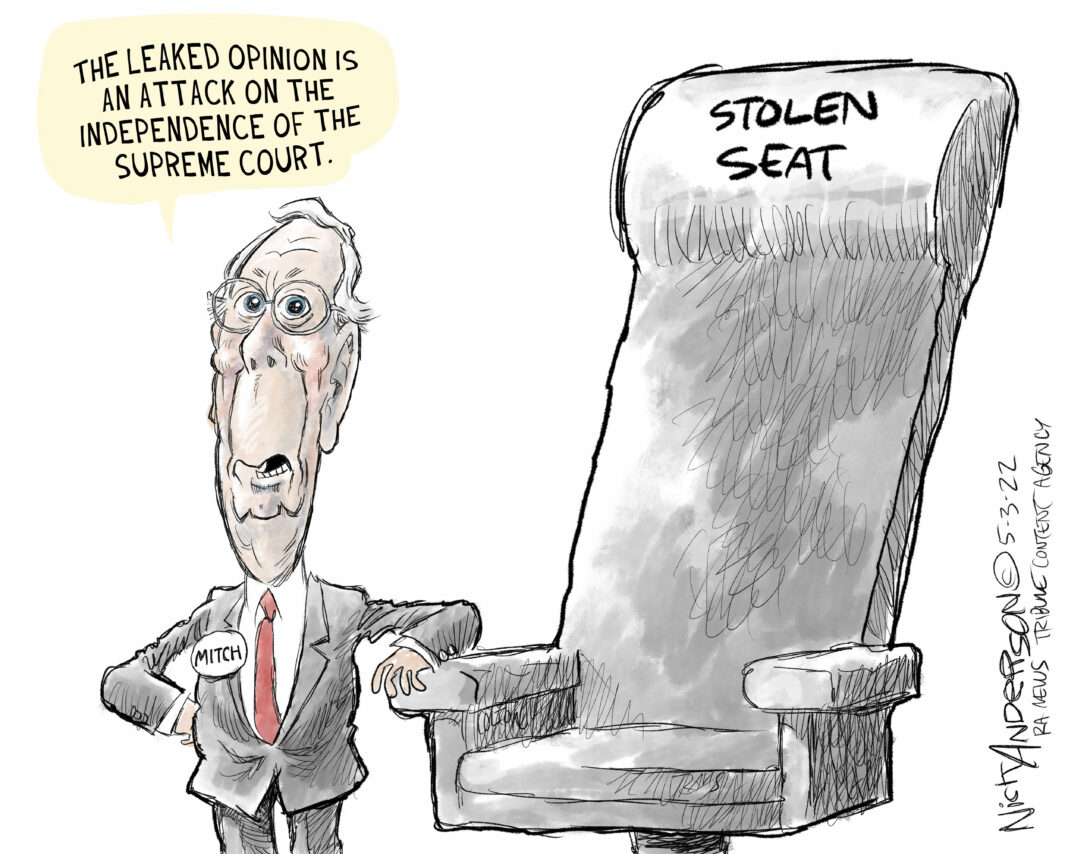
What Alito wrote

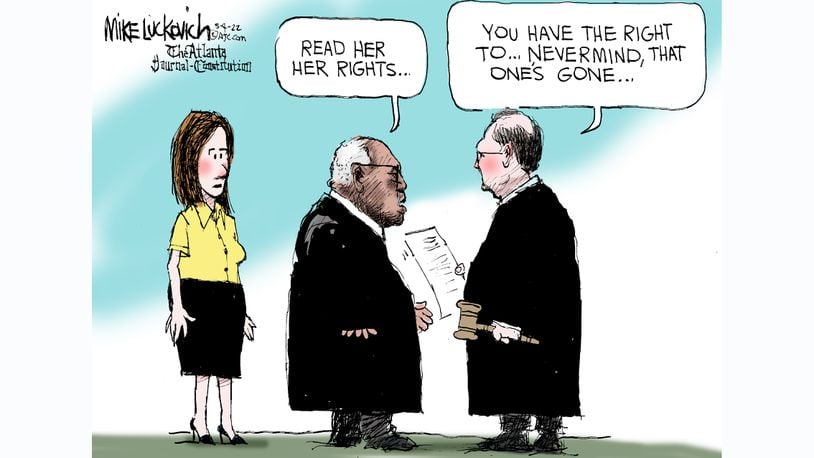
https://www.ajc.com/opinion/mike-luckovich-blog/54-mike-luckovich-going-going-gone/PW5FT437ZJENHNII5YQRL2STFM/

A summary of his arguments, and how they might be used to take away other constitutional rights.


A week ago, Politico released a leaked draft of Supreme Court Justice Samuel Alito’s opinion overturning Roe v Wade. Politico claimed this was to be the majority opinion, representing not just Alito, but supported by Justices Thomas, Gorsuch, Kavanaugh, and Barrett as well. The draft dates from February, and we do not know what revisions may have been made since. The decision on the case (Dobbs v Jackson Women’s Health) is expected to be released before the Court’s current term ends in June.

The case concerns a Mississippi law that bans abortions after 15 weeks, in violation of the existing Supreme Court precedents. The Court has three basic options:

  • Respect the Roe and Casey precedents by invalidating the Mississippi law.
  • Create a loophole that allows the law to take effect, and chips away at abortion rights in general, but does not overturn Roe in its entirety.
  • Overturn Roe, allowing states to regulate or ban abortions as they see fit.

This is how I summarized the situation in March:

So it’s clear which approach Roberts will favor: Don’t make headlines by reversing Roe, but chew away at it by creating a loophole for Mississippi, maybe by changing the definition of “viability”. The language of such a decision could subtly invite states to push the boundary further, until a woman’s right to control her own pregnancy would have little practical meaning. Roe would continue to stand, but like a bombed-out building without walls or a roof, would protect no one.

That probably won’t happen, though, for a simple reason: When Barrett replaced Ruth Bader Ginsburg, Roberts lost control of the Court. He is no longer the swing vote, so he loses 5-4 decisions when he sides with the Court’s three surviving liberals.

And I warned that reversing Roe would not be the final chapter of this saga.

Roe doesn’t stand alone. It is part of a web of substantive due process decisions on a variety of issues. Reversing Roe will send ripples through the whole web, putting all those rights up for grabs.

So here we are. Unless something inside the Court has drastically changed since February, the constitutional right to abortion, which has existed for 49 years, will vanish sometime in June, and a number of other rights will be in doubt, including the right to use birth control, for consenting adults to choose their own sexual practices, and for two people of any race or gender to marry.

What does Alito’s ruling do? Alito has written an unambiguous reversal of Roe.

We hold that Roe and Casey must be overruled. The Constitution makes no reference to abortion, and no such right is implicitly protected by any constitutional provision. … Roe was egregiously wrong from the start. Its reasoning was exceptionally weak, and the decision has had damaging consequences.

Unenumerated rights. No one claims that the word “abortion” appears in the Constitution. But there are several places where a judge might find implicit protection for rights not specifically listed:

  • The Ninth Amendment, which says “The enumeration in the Constitution, of certain rights, shall not be construed to deny or disparage others retained by the people.” This recognizes the existence of rights beyond those the Constitution mentions, but provides little basis for identifying them.
  • The Equal Protection Clause of the 14th Amendment, which guarantees “any person” within the jurisdiction of the states “the equal protection of the laws”. Judges at many levels have, for example, rooted same-sex marriage here — same-sex couples are guaranteed the equal protection of the marriage laws — but Justice Kennedy’s majority opinion in Obergefell gave equal protection a secondary role.
  • The Due Process Clause of the 14th Amendment, which says that no one can be deprived of “liberty” without due process of law. Abortion and the related privacy rights have been rooted here, in a doctrine called “substantive due process”, which I described in March.

Another place to look for an unenumerated right is in Supreme Court precedents themselves. Under the doctrine of stare decisis, the Court will usually stand by a previous decision, even if the current justices believe the case was wrongly decided. For example, corporate personhood arises from a bad decision the Court made in 1886. It continues to be upheld despite the fact that the word “corporation” does not appear in the Constitution.

His arguments. Alito dismisses the equal-protection option like this:

[I]t is squarely foreclosed by our precedents, which establish that a State’s regulation of abortion is not a sex-based classification and is thus not subject to the “heightened scrutiny” that applies to such classifications. The regulation of a medical procedure that only one sex can undergo does not trigger heightened constitutional scrutiny unless the regulation is a “mere pretext designed to effect an invidious discrimination against one sex or the other.”

Due-process rights not otherwise mentioned in the Constitution, Alito writes, have to pass what is called the Glucksberg Test:

[T]he Court has long asked whether the right is “deeply rooted in [our] history and tradition” and whether it is essential to our Nation’s “scheme of ordered Liberty.”

He concludes that the right to abortion does not pass this test.

Until the latter part of the 20th century, there was no support in American law for a constitutional right to obtain an abortion. Zero. None. No state constitutional provision had recognized such a right. Until a few years before Roe was handed down, no federal or state court had recognized such a right. Nor had any scholarly treatise of which we are aware. …

Not only was there no support for such a constitutional right until shortly before Roe, but abortion had long been a crime in every single State.

Much of the opinion’s 98 pages consists of a long history lesson about state laws and common law cases.

Alito also addresses the possibility that a right to abortion is part of a broader right to privacy, which does pass Glucksberg.

Casey described it as the freedom to make “intimate and personal choices” that are “central to personal dignity and autonomy”. Casey elaborated: “At the heart of liberty is the right to define one’s own concept of existence, of meaning, of the universe, and of the mystery of human life.”

Alito also dismisses this justification in what is by far the weakest part of his argument, consisting mostly (in my opinion) of question-begging and because-I-said-so.

Our nation’s historical understanding of ordered liberty does not prevent the people’s elected representatives from deciding how abortion should be regulated. … This attempts to justify abortion through appeals to a broader right to autonomy and to define one’s “concept of existence” prove too much. Those criteria, at a high level of generality, could license fundamental rights to illicit drug use, prostitution, and the like.

What sharply distinguishes the abortion right from the rights recognized in the cases on which Roe and Casey rely is something that both those decisions acknowledged: Abortion destroys what those decisions call “potential life” and what the law at issue in this case regards as the life of an “unborn human being.” None of the other decisions cited by Roe and Casey involved the critical moral question posed by abortion. They are therefore inapposite. They do not support the right to obtain an abortion

And finally he dismisses stare decisis.

In this case, five factors weigh strongly in favor of overruling Roe and Casey: the nature of their error, the quality of their reasoning, the “workability” of the rules they imposed on the country, their disruptive effect on other areas of the law, and the absence of concrete reliance.

I found this part bizarre. Alito’s first two factors just reiterate that he disagrees with the original decision, which is a precondition for stare decisis being relevant at all. (If you agree with a precedent, you don’t need a doctrine to tell you to follow it.) His examples of the “unworkability” and “disruptive effect” of the Roe framework (as adjusted by Casey) are mostly examples of state legislatures persistently attempting to find loopholes that allow them to harass women seeking abortions, and engaging in bad-faith efforts to sneak harassment in as health regulations, building codes, and other Trojan horses.

Would Alito find gun-right decisions (like Heller) “unworkable” if blue states persistently harassed gun owners and forced courts to keep striking down bad-faith laws by the dozens year after year? I doubt it.

And as for “reliance”, I look at my own reliance on Roe (which I explained ten years ago): My wife and I planned our life together around the assumption that we would not have children. We took precautions to prevent pregnancy, but ultimately we could not have fully trusted our plans if abortion had not been an option.

This is not something special about us. Around the nation, women are planning their lives and careers based on the belief that they will not have to carry a fetus, give birth, or raise a child until they decide to do so. In a very real sense, women are not equal to men in a world without abortion.

More critically, since any form of birth control can fail, women whose lives will be in danger if they get pregnant will have to give up sex if abortion is not available.

So Alito’s assertion that there are no “reliance interests” in Roe is just absurd. He doesn’t rely on Roe, so he thinks no one does.

The problem with “deeply rooted in this Nation’s history and tradition”. You know what definitely is “deeply rooted in this Nation’s history and tradition”? Sexism, racism, and bigotry of all sorts. If “liberty” is going to be defined by what that word meant when the 14th Amendment passed in 1868, then only straight White Christian men will ever have unenumerated rights protected by substantive due process. Justice Kennedy acknowledged as much in his Obergefell opinion:

If rights were defined by who exercised them in the past, then received practices could serve as their own continued justification and new groups could not invoke rights once denied.

Jill Lepore went further in The New Yorker:

There is nothing in [the Constitution] about women at all. Most consequentially, there is nothing in that document—or in the circumstances under which it was written—that suggests its authors imagined women as part of the political community embraced by the phrase “We the People.” There were no women among the delegates to the Constitutional Convention. There were no women among the hundreds of people who participated in ratifying conventions in the states. There were no women judges. There were no women legislators. At the time, women could neither hold office nor run for office, and, except in New Jersey, and then only fleetingly, women could not vote. Legally, most women did not exist as persons.

… Women are indeed missing from the Constitution. That’s a problem to remedy, not a precedent to honor.

Think about the common-law authorities Alito cites, and some of their other opinions. In addition to opinions about abortion, for example, Sir William Blackstone’s Commentaries on the Laws of England also includes this assessment of a wife’s personhood:

By marriage, the husband and wife are one person in law: that is, the very being or legal existence of the woman is suspended during the marriage, or at least is incorporated and consolidated into that of the husband: under whose wing, protection, and cover, she performs every thing; and is therefore called in our law-french a feme-covert; is said to be covert-baron, or under the protection and influence of her husband, her baron, or lord; and her condition during her marriage is called her coverture.

And Thomas Hale, who, in addition to sentencing two women to death for witchcraft, also had a lasting impact on the law unrelated to abortion, which became known Hale’s Principle:

but the husband cannot be guilty of a rape committed by himself upon his lawful wife, for by their mutual matrimonial consent and contract the wife hath given up herself in this kind unto her husband, which she cannot retract.

Lepore notes the opinions that Alito does not cite:

Alito cites a number of eighteenth-century texts; he does not cite anything written by a woman, and not because there’s nothing available. “The laws respecting woman,” Mary Wollstonecraft wrote in “A Vindication of the Rights of Woman,” in 1791, “make an absurd unit of a man and his wife, and then, by the easy transition of only considering him as responsible, she is reduced to a mere cypher.” She is but a part of him. She herself does not exist but is instead, as Wollstonecraft wrote, a “non-entity.”

So Alito’s litany that prior to the 20th century abortion rights can be found in

no state constitutional provision, no statute, no judicial decision, no learned treatise

is much less impressive when you realize that no woman had any input into these documents. I find it hard to argue with Lepore’s conclusion:

To use a history of discrimination to deny people their constitutional rights is a perversion of logic and a betrayal of justice.

How should we justify unenumerated rights? History is a fine tool to use when judging what unenumerated rights the Constitution implicitly guarantees to individuals and groups who were enfranchised and empowered at the time (such as straight White Christian men). But in order to keep those rights from further enlarging the unfair advantages those individuals and groups already have, we need to combine those historical findings with a generous respect for the equal protection of the laws.

Justice Kennedy recognized just such a conjunction of prinicples in Obergefell:

The Due Process Clause and the Equal Protection Clause are connected in a profound way, though they set forth independent principles. Rights implicit in liberty and rights secured by equal protection may rest on different precepts and are not always co-extensive, yet in some instances each may be instructive as to the meaning and reach of the other. In any particular case one Clause may be thought to capture the essence of the right in a more accurate and comprehensive way, even as the two Clauses may converge in the identification and definition of the right.

For example: Do men have a traditional right to bodily autonomy, even when someone else’s life is at stake? Of course they do. American law has never forced a man to, say, donate a kidney to someone who will die without it. That would be absurd. But if a woman can be forced to risk her own lives to save the life of a fetus, does she enjoy the equal protection of the laws? I don’t think so.

Many of the same men who would force a woman to give up months of her life or even risk death for a fetus also believe that the Constitution protects them against the comparatively trivial inconvenience of a vaccine shot that might save not just their own lives, but the lives of the fellow citizens that they might otherwise infect. This is not equality under the law.

And about that history … A number of authors suggest that Alito’s reading of the history of abortion is biased. One of the more amusing examples of the historical acceptance of abortion in America is Ben Franklin’s abortion recipe, which he published in 1748 as part of a textbook.

And a brief prepared for this case by the American Historical Association contradicts Alito:

The common law did not regulate abortion in early pregnancy. Indeed, the common law did not even recognize abortion as occurring at that stage. That is because the common law did not legally acknowledge a fetus as existing separately from a pregnant woman until the woman felt fetal movement, called “quickening,” which could occur as late as the 25th week of pregnancy. This was a subjective standard decided by the pregnant woman alone and was not considered accurately ascertainable by other means.

Are other rights at risk? Alito explicitly denies that his reasoning leads to the end of other rights associated with substantive due process:

As even the Casey plurality recognized, “abortion is a unique act” because it terminates “life or potential life”. … And to ensure that our decision is not misunderstood or mischaracterized, we emphasize that our decision concerns the constitutional right to abortion and no other right. Nothing in this opinion should be understood to cast doubt on precedents that do not concern abortion.

While it is true that lower courts cannot directly quote Alito’s ruling to support eliminating other privacy rights, anti-abortion extremists also describe the pill, Plan B, and IUDs — and basically all birth control other than barrier methods — as “abortificants”. If states can ban abortion, they can ban these as well.

A bill currently advancing through the Louisiana legislature would define personhood as beginning “at fertilization”, which would make the use of an IUD attempted murder. This law would probably pass muster with Alito, who says that abortion laws going forward need only pass a rational basis test, the loosest possible legal standard.

And nothing stops these same five justices from walking the same path for a different issue on a different case. Consider what Alito writes about a right to abortion:

Not only are respondents and their amici unable to show that a constitutional right to abortion was established when the Fourteenth Amendment was adopted, but they have found no support for the existence of an abortion right that predates the latter part of the 20th century — no state constitutional provision, no statute, no judicial decision, no learned treatise.

This statement is equally true if you replace “abortion” with “same-sex marriage” or “interracial marriage” or “sodomy”. Why would the radical conservative justices not make that substitution in some future case?

Vox’ Ian Millhiser points out that Alito has already made a similar argument against same-sex marriage.

Though Alito’s Dobbs opinion largely focuses on why he believes that the right to abortion fails the Glucksberg test, there is no doubt that he also believes that other important rights, such as same-sex couples’ right to marry, also fail Glucksberg and are thus unprotected by the Constitution. Alito said as much in his Obergefell dissent, which said that “it is beyond dispute that the right to same-sex marriage is not among those rights” that are sufficiently rooted in American history and tradition.

Every issue, when you come down to it, is “unique” in some way. If criminalization in 1868 shows that a right does not exist, then clearly the right of consenting adults to choose their own sexual practices, for example, is not “deeply rooted in this Nation’s history and tradition” or “implicit in the concept of ordered liberty”. Neither is the right to marry the person of your choice.

This is where it matters that Alito and his fellow conservative justices made so many misleading and deceptive statements during their confirmation hearings. Could Alito’s statement that he does not “cast doubt on precedents that do not concern abortion” be one more deceptive reassurance that will only last until the five radical justices find a more convenient opportunity to take away other rights that contradict their conservative interpretations of Christianity?

Harvard Law Professor Mary Ziegler thinks it probably is:

The Court can draw whatever distinctions it likes and dodge the cases it doesn’t. But the draft of Dobbs v. Jackson Women’s Health Organization stresses that states were criminalizing abortion. True enough. But in the late 19th century, Congress passed the Comstock Amendment, which criminalized contraception. States criminalized same-sex intimacy.

The draft suggests that abortion is different because of the state’s impact on fetal life. This language — and the draft’s historically questionable narrative about the doctors who originally pushed to ban abortion — will encourage antiabortion leaders to ask the conservative justices to declare that a fetus is a rights-holding person under the Fourteenth Amendment — and that abortion is unconstitutional in blue as well as red states.

If this is where a final opinion ends up, the Court has painted itself into a corner — and maybe by design. Whether abortion is different or not, the Court will not likely send this back to the states for good. It will simply invite conservatives back for the next round.

In short, anyone who trusts Alito’s statement, and so believes that birth control (Griswold), same sex marriage (Obergefell), interracial marriage (Loving), and homosexuality (Lawrence) are secure, is a fool.

We know who Samuel Alito is, and he is not trustworthy.

The Monday Morning Teaser

This week’s Sift is going to center on the Supreme Court and abortion.

If you haven’t been on Mars or under a rock, you know that a draft of a Supreme Court decision overturning Roe v Wade and eliminating constitutional protection for abortion rights came out Monday night. This is a big deal, both in itself and in what it presages about future decisions. We can expect red states to pass not only laws banning abortion (which are already on the books in many of them), but also challenges to birth control, same-sex marriage, and other previously accepted constitutional rights. This decision may not immediately validate such laws, but the logic it uses could be repurposed to overturn other Supreme Court precedents.

I’ve written two featured posts that consider this issue from different angles. The first, which should be out shortly, is a legal analysis of what Justice Alito’s draft says, assuming that it becomes the opinion of the Court next month. The second asks how we got here, and more specifically “Who’s to blame for overturning Roe?” That should appear around 10 EDT.

Even that doesn’t finish covering the issue, though, so the weekly summary will take up the political implications going forward.

Also in the summary: Today is Victory Day in Russia, and yet the new offensive in Ukraine continues to go badly. Trump Defense Secretary Mark Esper has a book giving new reasons to believe Trump is/was unfit to be president, and that we dodged a bullet by getting him out of office without even greater damage to the Republic. The pandemic continues to heat up again. The debate about what to do about student loans continues. And a few other things are going on.

I’ll try to get that out by noon.

WWRJD?

Ask yourself this question: If Russian journalists, who are losing their livelihoods and their freedom for daring to report on what their own government is doing, if they had the freedom to write any words, to show any stories, or to ask any questions, if they had, basically, what you have, would they be using it in the same way that you do? Ask yourself that question every day, because you have one of the most important roles in the world.

Trevor Noah, at the White House Correspondents Dinner

This week’s featured post is MAGA 2.0.

During my week off, I spoke at the Unitarian Church of Quincy, Illinois (my hometown). I converted the Sift post “How did Christianity become so toxic?” into a sermon “Where Christianity Went Wrong”. The text is here and the audio there.

This week everybody was still talking about Musk and Twitter

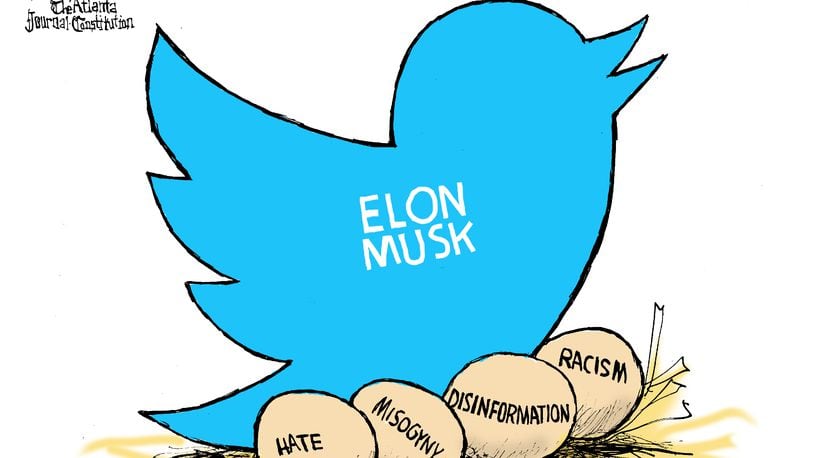
https://www.ajc.com/opinion/mike-luckovich-blog/427-mike-luckovich-soon-to-hatch/Z54QNZBSNBCVFDEMUYX2SVAAME/

So far it looks like Musk’s takeover is really happening, though it still could fall through.

Like Adam Serwer, I am skeptical of Musk’s “free speech” rhetoric.

The fight over Twitter’s future is not really about free speech, but the political agenda the platform may end up serving. As Americans are more and more reliant on a shrinking number of wealthy individuals and companies for services, conservatives believe having a sympathetic billionaire acquire Twitter means one less large or influential corporation the Republican Party needs to strongarm into serving its purposes. Whatever Musk ends up doing, this possibility is what the right is actually celebrating. “Free speech” is a disingenuous attempt to frame what is ultimately a political conflict over Twitter’s usage as a neutral question about civil liberties, but the outcome conservatives are hoping for is one in which conservative speech on the platform is favored and liberal speech disfavored. …

The fact that conservative concerns about Big Tech vanish the second a sympathetic billionaire buys a social-media platform, however, illustrates the shallowness of their complaints about the power of Silicon Valley. Conservatives are not registering their concern over the consolidation of corporate power so much as they are trying to ensure that consolidation serves their interests. Put simply, conservatives hope that Twitter will now become a more willing vehicle for right-wing propaganda.

An issue that hasn’t gotten nearly enough attention is that Musk-ownership links Twitter’s interests to Tesla’s. And Tesla builds and sells a lot of cars in China. What happens when the Chinese government demands favorable treatment on Twitter (or deplatforming of its critics), and threatens to shut Tesla down? If Musk thinks he’s too rich to push around, he should have a talk with Alibaba’s Jack Ma.

and more January 6 revelations

Few stories illustrate the corruption of the Republican Party like the recent Kevin McCarthy tapes. It started with a report in the new book “This Shall Not Pass” by NYT reporters Alexander Burns and Jonathan Martin, that shortly after the 1-6 insurrection, House GOP Leader McCarthy told other members of the leadership team that he was going to tell President Trump it was time to resign. McCarthy branded the report “totally false and wrong”, and his spokesman said “McCarthy never said he’d call Trump to say he should resign.”

Except that he did, and it’s on tape.

McCarthy has long since come crawling back to Trump, of course, and now he hopes for Trump’s support in becoming Speaker, should the GOP take the House majority this fall. You might think that Trump would be angry to find out that McCarthy was saying such things in private, but in fact he’s not.

Trump doesn’t need Republican leaders to believe in him. He just needs them to be spineless, and McCarthy is.


Texts exchanged before the election between Sean Hannity and Mark Meadows came out. Meadows, who was then White House chief of staff, gave Hannity instructions about what to stress on his radio show, to which Hannity replied “Yes sir.”

The texts show the kind of political subservience that CNN fired Chris Cuomo for. But Fox News’ standards are much lower, and Hannity has not been disciplined in any way.


The Manhattan grand jury investigating Donald Trump for possible fraudulent bank and tax fraud is expiring without issuing an indictment, making such charges unlikely, though the DA says investigations will continue. The Washington Post has published a summary of the various Trump investigations and where they stand.

and the line between church and state

The Supreme Court heard arguments in the case of a football coach who led players in prayer on the 50-yard-line after games. His claim is that his prayers are private religious acts protected by the First Amendment’s free-exercise clause. I’m not sure why this private act needs to happen on the 50-yard-line, but the Court’s conservative majority didn’t seem bothered by this.

I will be more interested in the Court’s reasoning than in the decision itself. Whatever standard the justices use to find in the coach’s favor, does it apply to non-Christians, or is this yet another special right that Christians have and no one else does? It seems entirely implausible to me that we would be having this discussion if the coach were performing a Muslim or Hindu ritual.

The best thing I read about this case appeared in Baptist News Global, where the coach’s case was related to another recent story about Christians who turned a commercial air flight into a hymn-sing.

The common thread is performative Christianity that operates out of a place of assumed privilege. That is a privilege so taken for granted that the average American Christian has no clue they are swimming in it.

… The parallel to this, of course, is the thousands of evangelicals who have been trained — literally trained — to use places like airplanes to evangelize their seatmates. What Christians may see as a God-ordained witnessing opportunity, the poor seatmate may see as religious assault.

Such attitudes and actions from Christians are not evil, but they are misguided. And they originate from a place of assumed privilege. As I’ve written before, there’s an easy test to understand this: What if the roles were reversed and you, dear Christian, were seated next to an evangelizing Muslim or Hindu or Mormon or atheist? Would you afford them the same assumed privilege you claim for yourself? I don’t think so.

Modern Christians must understand that we live in an increasingly pluralistic society and that assuming Christian privilege actually does more harm than good. If you want to be a good witness for Jesus, this is not the way to do it. It is tone deaf and arrogant and rude — pretty much the opposite of every virtue of love described in 1 Corinthians 13.


Chaz Stevens, whose Twitter handle describes him as “stunt activist“, is responding to a new Florida law giving parents more input into school decisions by asking school districts across the state to ban the Bible.

On the one hand, he’s pushing precisely the point I was making above: The law needs to apply to Christians the same way it applies to everyone else. And he’s absolutely correct that the Bible describes murder, adultery, sexual immorality, and infanticide — stuff that would absolutely get any other book banned from Florida schools.

But at the same time, this tactic points out a strategic weakness in the secular position: We want to defend public schools, while Christian nationalists are looking for excuses to privatize them. Any tit-for-tat that drives public support away from the schools hurts us in the long run. If we ban their books after they ban ours, we’re still losing.


Meanwhile, Marjorie Taylor Greene says of Catholic Relief, an organization that assists immigrants: “Satan’s controlling the church.


In previous weeks, I’ve talked about the right-wing takeover of the public library system in Llano County, Texas, which resulted in firing a librarian who wouldn’t cooperate. Last week, residents sued in federal court, charging that books are being removed without public hearings or any other due process.


The Texas school district in Southlake got bad publicity last fall when an administrator was taped advising teachers to “balance” books about the Holocaust with opposing perspectives.

The school district has come up with a way to make sure that doesn’t happen again: A “non-disparagement clause” has been added to teachers’ contracts. The problem isn’t what the administrator said, it’s that somebody snitched to the press.

and the war in Ukraine

It’s too soon to draw a firm conclusion about how Russia’s Plan B — advance in the Donbas rather than try to take Kyiv — is going, but the early reports look familiar: slow progress and heavy losses.


The Economist has a fascinating article about the Russian army’s radio problems. They know how to make secure hard-to-jam radios, but they didn’t procure enough of them, so only elite units have them. When those units try to coordinate with less-elite units, they end up reverting to more primitive equipment, including off-the-shelf walkie-talkies. The Ukrainians intercept their communications, and sometimes jam them by broadcasting heavy metal music on the same frequencies.

This is one example of a larger logistical problem: Apparently the Russian procurement system is even less efficient and more corrupt than ours.

“They put a lot of money into modernisation,” says [retired Czech] General [Petr] Pavel. “But a lot of this money was lost in the process.”

and the pandemic

Reported cases per day in the US have doubled since they bottomed out at 26K on April 3. They’re now up to 56K. Hospitalizations turned up about two weeks later, as they usually do. They bottomed at 14.8K on April 18, and are now at 17.1K. The number of Covid patients in ICUs bottomed at 1886 on April 22, and is now 1985.

Deaths are still dropping, about four weeks after case numbers turned up, and more than a week after ICU patients bottomed. An average of 321 Americans are dying of Covid each day, down considerably from 2652 on February 1. I thought that might be unusual, but it appears not. The last time deaths turned upward was on November 30, 20 days after hospitalizations bottomed, and 18 days after ICU patients bottomed. That would suggest that we’re about 10 days from deaths beginning to increase.

and you also might be interested in …

The White House Correspondents’ Dinner was held Saturday. Trevor Noah’s monologue is worth the time.


Solar energy is booming in both Texas and California, but in different ways that reflect different styles of government.

Texas solar projects often come with a “batteries not included” designation. In the Lone Star State, among Interconnection Agreement-signed projects expected to reach COD through 2024, only 28% of the 120 solar projects with completed are solar + battery projects. Again, this compares to nearly 99% of solar projects in California.

California is aiming towards a future where renewable energy replaces fossil fuels, and that requires batteries. Otherwise, you still need fossil-fuel or nuclear plants to generate electricity when the sun isn’t shining and the wind isn’t blowing.

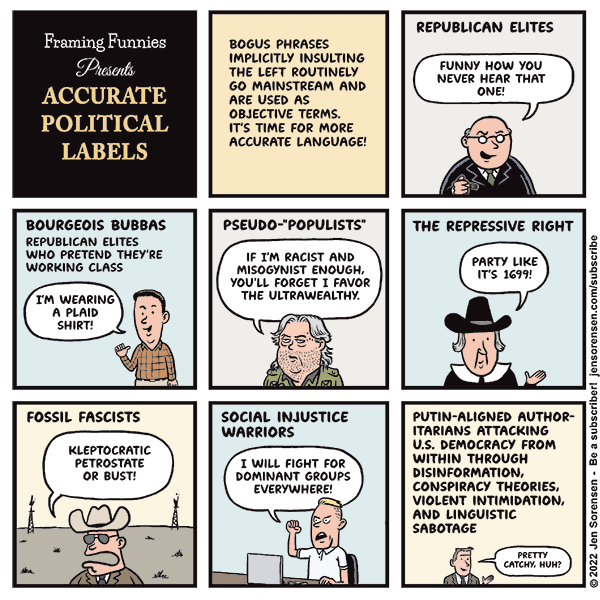
https://jensorensen.com/2022/04/20/accurate-political-labels/

and let’s close with something bookish

Back in the old days, the stereotypic librarian was a dowdy woman shushing anybody who spoke above a whisper. These days, though, a big part of a librarian’s job is doing silly things to encourage reading. Electric Lit has collected librarian music parodies, like “Unread Book” to the tune of “Uptown Funk”.

MAGA 2.0

https://www.ajc.com/opinion/mike-luckovich-blog/422-mike-luckovich-mickey-and-ronald/472WF6YUX5AHJLNSUV2HPYQ5CU/

What if Trump isn’t the worst of our problems?


To many Americans, what’s been going on in Florida lately must seem so bizarre as to be almost comic. It’s gotten increasingly difficult to tell real headlines from stories in The Onion.

The witchhunt against critical race theory has gotten so out of hand that math textbooks are being banned. Public-school teachers who tell their students about the mere existence of same-sex marriages or people who transition from one gender to another (facts that may be necessary to understand other students in the classroom or their families) are not just breaking the law, they are said to be grooming the students for abuse by pedophiles. And if you object to that law, you too are probably grooming kids for pedophiles.

When the Disney Corporation came out (too late) against the law, the DeSantis administration punished it by getting the legislature to reverse the company’s completely unrelated tax advantage — a move which might be illegal, but otherwise will put two Florida counties on the hook for a billion dollars of debt.

When was the last time a Republican governor declared war on a corporation that employs 75,000 of his constituents?

If you think DeSantis’ actions don’t fit any American model of political behavior, you’re right. But that doesn’t mean they’re completely unprecedented. As Zack Beauchamp observed in Vox, the model is Viktor Orbán’s “illiberal democracy” in Hungary. And it may be the next step in the evolution of Trumpism.

The difference between Orbánism and traditional conservatism. The central message of traditional American conservatism is that government needs to get out of the way so that the private sector can create prosperity. So: low taxes, limited regulation, limited government services for the people. What working people miss in public goods (like parks, public education, healthcare, and economic security) supposedly will be more than balanced by all the good-paying jobs that will trickle down from unfettered capitalism.

That rhetoric was never fully embodied in conservative policy, which was fine with government intervention that subsidized oil exploration, the defense industry, and other big-corporate interests. But in spite of occasional inconsistencies, it was a reliable first guess at how conservatives would view an issue.

Traditional conservatives nodded in the direction of the culture war, but their hearts were never in it. Instead, they made cynical use of social/cultural issues to win elections, so that they could assemble enough power to push their small-government economic agenda, as Thomas Frank described in What’s the Matter With Kansas? in 2004.

The trick never ages; the illusion never wears off. Vote to stop abortion; receive a rollback in capital gains taxes. Vote to make our country strong again; receive deindustrialization. Vote to screw those politically correct college professors; receive electricity deregulation. Vote to get government off our backs; receive conglomeration and monopoly everywhere from media to meatpacking. Vote to stand tall against terrorists; receive Social Security privatization. Vote to strike a blow against elitism; receive a social order in which wealth is more concentrated than ever before in our lifetimes, in which workers have been stripped of power and CEOs are rewarded in a manner beyond imagining.

Orbánism, by contrast, uses social/cultural issues as a way to increase government power and entrench the Orbán regime’s hold on that power. Beauchamp explains:

Orbán’s political model has frequently employed a demagogic two-step: Stand up a feared or marginalized group as an enemy then use the supposed need to combat this group’s influence to justify punitive policies that also happen to expand his regime’s power. Targets have included Muslim immigrants, Jewish financier George Soros, and most recently LGBTQ Hungarians.

Whoever the current scapegoat is, the ultimate enemy is always the same: the “cultural elite”.

Broadly speaking, both Orbán and DeSantis characterize themselves as standing for ordinary citizens against a corrupt and immoral left-wing cosmopolitan elite. These factions are so powerful, in their telling, that aggressive steps must be taken to defeat their influence and defend traditional values. University professors, the LGBTQ community, “woke” corporations, undocumented immigrants, opposition political parties — these are not merely rivals or constituents in a democratic political system, but threats to a traditional way of life.

In such an existential struggle, the old norms of tolerance and limited government need to be adjusted, tailored to a world where the left controls the commanding heights of culture. Since the left can’t be beaten in that realm, government must be seized and wielded in service of a right-wing cultural agenda.

The difference between Orbánism and Trumpism. At its root, Trumpism has always been a personality cult. If that wasn’t already obvious in 2016, it certainly had became so by 2020, when the Republican Convention refused to update its platform, replacing it instead with a resolution whose only substantive point was

RESOLVED, That the Republican Party has and will continue to enthusiastically support the President’s America-first agenda

In other words: The Republican Party stands for whatever President Trump chooses to announce. The party’s position on healthcare, education, foreign policy, immigration, and everything else is whatever Trump says it is.

Since Trump lost the 2020 election and tried (unsuccessfully) to stay in power anyway, Trumpworld has gotten even more culty: Where you stand in MAGA-land depends not on your support or opposition to any political philosophy or policy proposal, but what you say about Trump. Liz Cheney has been tossed out of the Wyoming Republican Party because she denies that Biden stole the election and holds Trump responsible for the 1-6 coup attempt. Marjorie Taylor Greene is at the center of the movement, because she has never breathed a word against the Orange One. If Brad Raffensperger had “found” the 11,780 votes Trump needed to win Georgia, he’d have Mar-a-Lago’s full support. But he didn’t, so Trump is campaigning against him.

Trump has become associated with both social conservatism and traditional conservatism, but the relationship is almost entirely opportunistic: Trump says things to his crowds, and if they respond he uses the line again. In the course of the 2016 campaign, these applause lines evolved into slogans, like “Build a Wall”. After he took office, underlings were tasked with turning those slogans into policies. The policies often seemed half-baked because they were: Candidate Trump never had any idea how he would implement his applause lines.

But in hindsight we often overlook all the times when candidate Trump floated liberal ideas, like when he told 60 Minutes that his healthcare plan would cover everybody and “the government’s gonna pay for it”. Or when he said his tax plan would raise taxes on the rich. If his stadium crowds had responded to those proposals the way they responded to building a wall or banning Muslims, he would happily have stolen Bernie’s agenda, and underlings would have been tasked with turning those slogans into programs.

The point was never policy. It was big, beautiful crowds cheering for Trump.

He got elected as a Republican, so he staffed his administration with Republicans and leaned on Republicans in Congress to create legislative victories for him. That was as far as his governing vision went. Paul Ryan already had a tax plan — one that handed trillions of dollars to corporations and the very rich — so that got passed. No two Republicans in Congress had the same vision of how to replace ObamaCare, so nothing happened.

Trump ended up appealing to the same kind of voters Orbán targeted — the racists, sexists, homophobes, xenophobes, and Islamaphobes Hillary Clinton labeled a “basket of deplorables” — so Trumpism started converging towards Orbánism. But it never completely got there, because ultimately Trumpism could only be about Trump. Beauchamp explains:

During his presidency, many observers on both sides of the aisle compared Trump to the Hungarian autocrat — and not without some justification. But after a 2018 visit to Hungary, I concluded that Trump was not competent or disciplined enough to implement Orbán-style authoritarianism in America on his own. The real worry, I argued, was a GOP that took on features of Orbán’s Fidesz party.

In the end, Trump is Trumpism’s biggest weakness: It’s the personality cult of a man with an unappealing personality. No wonder over 80 million Americans turned out to vote against him in 2020.

The law as a weapon. One point of convergence between Trump and Orbán is the use of boogeymen: Trump’s invading migrant caravans, for example. But it’s never been in Trump’s character to go full apocalyptic: There are villains in the world, but none of them are a match for Trump. His worldview is ultimately too episodic to support a death-struggle against the Apocalypse. Every day is a new story in which he defeats his enemies. He wins today, he won yesterday, he’ll win tomorrow. Anybody who tells you he’s not winning is peddling fake news.

Orbánism is much darker. Satanic forces threaten our entire way of life, and only a government much stronger than the current one can stand against it. Norms of civility and fair play can’t be allowed to stop us from defending society from the existential threat.

What’s hardest to grasp from a traditional American point of view is that the law, whatever it says, is just a weapon to use in the apocalyptic struggle. It does not embody ideals or principles of any kind. It’s nothing more than a stick you can use to club your enemies.

Trump sometimes used laws this way, but denied he was doing it — illustrating the adage that hypocrisy is the homage vice pays to virtue. Title 42 is a good example: A 1944 public health law allows the government to keep asylum-seeking immigrants from entering the country during a public-health emergency.

We know, of course, what Trump thought about the Covid pandemic: He repeatedly and consistently played down the idea that it was an emergency requiring drastic action, and encouraged his followers to behave as if nothing unusual were happening. When state governors took emergency anti-Covid actions, Trump tweeted things like “Liberate Michigan” while armed protesters surrounded the state capitol and conspirators plotted to kidnap Governor Whitmer.

But he wanted to shut down immigration, and Title 42 was a law that allowed him to do it. So for that purpose, and that purpose only, the Covid pandemic was an emergency.

In the Orbán model, by contrast, there is no need for hypocrisy or denial. Society is in a death struggle, so you pick up whatever weapon happens to be lying around and use it without apology.

That’s what DeSantis is doing against Disney. There is no cover story that lays out a connection between the Reedy Creek Improvement District and the Don’t Say Gay law. Nor does DeSantis claim that his sudden interest in Disney’s tax status is coincidental. Disney has sided with the pedophiles threatening to destroy American society, so it must be punished. (And other corporations must be warned what can happen if they step out of line.)

It’s not about ideology or the spirit of the laws; it’s about clubbing your enemies.

It’s worth pointing out that a government powerful enough to keep corporations in line by threatening reprisals is precisely the nightmare scenario of traditional conservatives. It is almost certainly illegal to use state power this way. But will courts packed with conservative judges say so? And if they do now, what if a President DeSantis gets to appoint even more judges?

That’s how events played out in Hungary. Here’s Beauchamp again:

This use of regulatory power to punish political opponents is right out of Orbán’s playbook. In 2015, Lajos Simicska — an extremely wealthy Hungarian businessman and longtime Orbán ally — turned on his patron, using a vulgar term to describe the prime minister.

In retaliation, the government cut its advertising in Simicska’s media outlets and shifted contracts away from his construction companies. After Fidesz’s 2018 election, Simicska sold his corporate holdings (mostly to pro-government figures). He moved to an isolated village in western Hungary; his last remaining business interest was an agricultural firm owned by his wife.

Technically, that was all probably illegal under Hungarian law too. But by then, the judiciary was under control.

The broader movement. DeSantis’ move to Orbánism did not come from nowhere. The Hungarian model has been widely praised and publicized in conservative circles for some time now. Tucker Carlson has broadcast his show from Hungary. Later this month, CPAC will hold a meeting in Budapest, with Viktor Orbán as its featured speaker.

This week, the New York Times has been running a series on Tucker Carlson and his message. Part 3 focuses on just how dark and apocalyptic that message has become.

Night after night, the host of the most-watched show in prime-time cable news uses a simple narrative to instill fear in his viewers: “They” want to control and then destroy “you”.

A key part of the Carlson worldview is “replacement theory”, that Democrats want to import a new electorate that can be counted on to outvote the previous White majority. He also uses the “grooming” smear to legitimize violence:

I don’t understand where then men are. Like, where are the dads? Some teacher’s pushing sex values on your third grader. Why don’t you go in there and thrash the teacher? This is an agent of the government pushing someone else’s values on your kid about sex. Where’s the pushback?

Moving on? Already, we are seeing stories about how the Republican Party is “moving on” from Trump. That buzz might gain momentum if Trump-endorsed candidates underperform in the upcoming GOP primaries, or if the January 6 Committee’s public hearings in June capture public attention. As the 2024 presidential cycle begins, Democrats, moderates, and traditional conservatives alike may be tempted to sigh with relief if some alternative to Trump emerges.

But we need to be careful not to relax too quickly. Most likely, the Trump alternative will not be some Liz Cheney or Mitt Romney-like traditional conservative, or represent a Lisa Murkowski or John Kasich-ish move back towards the political center. The alternative could be DeSantis himself, or some other MAGA 2.0 figure. We’ll need to pay attention to the darkness of the rhetoric and the commitment to the rule of law. If people believe what this candidate is saying about the threats to our way of life, what will they be willing to do to win? Or do to their enemies after they win?

The Monday Morning Teaser

The most important thing I read this week was an article in Vox: “How Ron DeSantis is following a trail blazed by a Hungarian authoritarian“. The reason it’s so hard to make sense out of what DeSantis is doing is that he’s not imitating Trump or following any other American model; he’s translating a Hungarian model of fascism into an American context. This article fits well with a series that the New York Times is doing on another American Orbánist, Tucker Carlson. This week’s featured post ties the two together in “MAGA 2.0”. It should be out between 10 and 11 EDT.

The weekly summary has a lot to cover: the Russian offensive in Eastern Ukraine continues, the pandemic is now clearly on the upswing, Elon Musk’s bid for Twitter appears to be succeeding, the Supreme Court appears ready to knock a few more bricks out of the wall separating Church and State, and GDP shrank in the first quarter. Plus, a lot of insightful things were written about the future of American democracy, and I’ll link to the talk I gave during my week off.

The summary should appear by 1.

Consolidation

No Sift next week. The next new posts will appear May 2.

Consolidating control is not the way to protect democracy and enhance free expression

Samir Jain,
director of policy at the Center for Democracy and Technology

This week’s featured post is “Elon and Twitter“.

This week everybody was talking about Elon Musk’s bid for Twitter

That’s the subject of the featured post.

and the Ukraine War

Ukrainian missiles sunk the Moskva, a guided-missile cruiser that was the flagship of the Russian Black Sea fleet. Russia disputed claims that Ukraine was responsible, instead saying just that a fire broke out (which is undoubtedly true, if not complete). After initially saying it didn’t know, US intelligence eventually confirmed the Ukrainian account.

If you want to speculate on exactly how this happened, Naval News postulates a chain of Russian failures rather than one clever Ukrainian tactic.


Ukrainian forces are still holding on to the Azov Sea port of Mariupol, but it could fall at any moment. Currently, Mariupol is the only holdout between Russian forces in the Donbas and those in Crimea.


Eliminationist Russian rhetoric towards Ukraine (which I noted last week) is spreading. The Washington Post characterizes it as “genocidal speech” and gives these examples:

On state television, a military analyst doubled down on Russia’s need to win and called for concentration camps for Ukrainians opposed to the invasion.

Two days later, the head of the defense committee in the lower house of parliament said it would take 30 to 40 years to “reeducate” Ukrainians.

And on a talk show, the editor in chief of the English-language television news network RT described Ukrainians’ determination to defend their country as “collective insanity.”

“It’s no accident we call them Nazis,” said Margarita Simonyan, who also heads the Kremlin-backed media group that operates the Sputnik and RIA Novosti news agencies. “What makes you a Nazi is your bestial nature, your bestial hatred and your bestial willingness to tear out the eyes of children on the basis of nationality.”

WaPo searched for an expert assessment.

Ruth Deyermond, a Russia expert in the Department of War Studies at King’s College London, said such arguments are “hard to read in any other way than a justification for mass killing. It’s extremely disturbing language and clearly has genocidal overtones. It’s not that they, Ukrainians, have a Führer or a political ideology or a Nazi system. They’re just Nazi.”


Long but interesting background reading: Retired Lieutenant General Mark Herling tells stories about his interactions over the years with both the Russian and Ukrainian militaries. When he first interacted with them, both were corrupt and inept. But the Ukrainians worked to get better.


A Finnish writer explains one way Putin’s invasion of Ukraine has backfired: Finland wasn’t planning to join NATO, but now many Finns think it must.

and the pandemic

I’ve described the last few weeks as a stalemate between the fading of the previous Covid wave and the start of the next one. The battle line was around 30K new cases per day.

This week the new wave made a decisive breakthrough. Cases are now running at about 38K per day. Hospitalizations and deaths are still headed downward. I’d expect hospitalizations to turn upward in a week or two, but whether deaths turn around is an interesting question. More and more of the infected people have at least some resistance from either a vaccination or a previous infection. Also, treatments keep improving. So maybe deaths, which have come down to about 500 per day from peaks over 3000 in January of 2021 and a recent peak over 2600 in early February of this year, can stay around 500 for a while.


Nate Silver tweets some interesting numbers:

Some tangible indications of the return to “normal” pre-pandemic social behavior in the US: Restaurant reservations = 100% of pre-pandemic levels MLB attendance = 100% of pre-pandemic levels Air travel = 90% of pre-pandemic levels


Tucker Carlson spoke at a church and told them he isn’t vaccinated, something he has never revealed before during his many anti-vax rants. Jimmy Kimmel doesn’t believe him:

Tucker Carlson is the vaccine equivalent of the guy on the Titanic who dresses as a woman to get on the lifeboat first. The sickest part is his audience is mostly scared and impressionable senior citizens, who happen to be the most vulnerable group when it comes to Covid. This is like selling Girl Scout cookies outside a diabetes clinic. But I’m glad to see the church welcoming prostitutes, as Jesus taught us to do.

and presidents’ relatives involved in corruption

https://www.reformaustin.org/political-cartoons/the-trump-clan-2/

I have to be careful about covering this topic without engaging in whataboutism. The fact that what Jared Kushner did is so much worse than what Hunter Biden is accused of is not an excuse for ignoring Biden.

Since the point of whataboutism is to avoid discussing something bad about your own side, let’s start with Hunter Biden. Frank Figliuzzi at MSNBC outlines what needs to be investigated there.

Hunter Biden’s contract with [Chinese energy company] CEFC is questionable not only because of the large sums involved in return for services that he appears ill-suited to provide, but also because of the characters it brought him in contact with.

Figliuzzi, a former counter-intelligence director at the FBI, sees this as part of a larger pattern of foreign adversaries attempting to form relationships with people close to powerful figures. Hunter Biden is supposed to have closed off business dealings with CEFC before his father became president, and

We may never know precisely what executives, said to be affiliated with the Chinese government, thought the Bidens could do for them.

But at a minimum this is an example of bad judgment. Democrats have been slow to take any of this seriously because the previous conspiracy theories about Hunter and Ukraine were so badly overblown. But if Biden did something illegal, the law should apply to him the way it would to anyone else.

Now let’s talk about Jared Kushner.

Six months after leaving the White House, Jared Kushner secured a $2 billion investment from a fund led by the Saudi crown prince, a close ally during the Trump administration, despite objections from the fund’s advisers about the merits of the deal.

… But days later the full board of the $620 billion Public Investment Fund — led by Crown Prince Mohammed bin Salman, Saudi Arabia’s de facto ruler and a beneficiary of Mr. Kushner’s support when he worked as a White House adviser — overruled the panel [of advisers].

Ethics experts say that such a deal creates the appearance of potential payback for Mr. Kushner’s actions in the White House — or of a bid for future favor if Mr. Trump seeks and wins another presidential term in 2024.

You don’t say. Hunter Biden was close to a powerful figure, and we can’t identify an actual quid-pro-quo. It looks like the Chinese just wanted to generally get in good with the Bidens.

Kushner, on the other hand, was himself a powerful figure who repeatedly did favors for the Saudis, and for MBS personally, while he was in office. And now he’s gotten his payment.

and culture wars

The Missouri House was debating an amendment that would ban trans students from school sports (one of several anti-trans bills in the Missouri legislature this term) when Ian Mackey, a gay Democratic legislator from St. Louis, blew his top. It’s worth listening to. Speaking directly to the amendment’s sponsor, Mackey said,

I was afraid of people like you growing up. … Gentlemen, I’m not afraid of you any more. Because you’re going to lose. You may win this today, but you’re going to lose.

State Rep. Martha Stevens, a Democrat from Columbia (site of Missouri’s flagship state university) also wasn’t inclined to be polite about Republican legislators scoring political points by attacking children.

It makes my blood boil and the same time it breaks my heart that children have to keep traveling to this capitol to face adults, elected officials, … that they have to come down here and justify their existence.

Both speeches are several minutes longer than those excerpts, and are well worth your attention.


https://www.startribune.com/sack-cartoon-the-kids-have-a-reading-problem/600148675/

Last month, I told you about a librarian getting fired in Llano, Texas because she resisted conservative censorship. Yesterday, The Washington Post added a lot of detail about the right-wing-Christian takeover of the Llano public library system.

“God has been so good to us … please continue to pray for the librarians and that their eyes would be open to the truth,” Rochelle Wells, a new member of the library board, wrote in an email. “They are closing the library for 3 days which are to be entirely devoted to removing books that contain pornographic content.”

[Local parent Leila] Green Little [who has started an anti-censorship group] said little is known about what administrators did during the time the libraries were closed. The book “Caste: The Origins of Our Discontents,” a work about systemic racism by Pulitzer Prize-winning author and journalist Isabel Wilkerson, has mysteriously vanished, and the fate of several other works remains unknown, she said.

A library board of political appointees is meeting secretly to make decisions about what books to keep or purchase.


An English teacher at Greenfield High School in Greenfield, Missouri has been fired for teaching “critical race theory”. Her offense was distributing a worksheet “How Racially Privileged Are You?” to prepare the class for reading the award-winning young-adult novel Dear Martin. (The novel is about a Black teen-ager in Atlanta who tries to make sense of his run-in with police, and more generally his life as a Black scholarship student in a predominantly White prep school, by writing a series of letters to the spirit of Martin Luther King.)

The worksheet is a list of 15 true/false questions for readers to answer about their own experiences, like: “I can go shopping alone most of the time and feel sure that I will not be followed or harassed.” and “I can be pretty sure that if I ask to speak to ‘the person in charge’ I will be facing someone of my own race.”

A letter from the Superintendent Chris Kell

stated this reason: “Your decision to incorporate the worksheet associated with the novel ‘Dear Martin,’ due to the content and subject matter.”

In a subsequent interview with the News-Leader, [Kell said the vote was not unanimous. He said the vote not to rehire Morrison went against his recommendation and that of the high school principal.

What probably drew complaints is the scoring scale at the bottom of the worksheet. The upper range of scores sits above the statement:

You are privileged. You may or may not know it. It means a lot of other people in the world don’t live life with the advantages you have, and that’s something you should always be aware of, as you can use your voice to help those who are marginalized.

Incidents like these make it clear what anti-CRT laws are trying to protect White students from: learning about the existence of racial privilege in America. It’s very important that White teens who “may not know” about their privilege remain ignorant.


https://claytoonz.com/2022/04/16/woke-math/

The Florida Department of Education announced Friday that it is banning 54 of the math textbooks submitted for use in Florida public schools.

28 (21 percent) are not included on the adopted list because they incorporate prohibited topics or unsolicited strategies, including CRT.

FDoE’s announcement gave no examples to illustrate how the math books were teaching critical race theory. The Miami Herald explains the larger process, and why math books are the current targets:

The state has a textbook adoption cycle that rotates through subjects every six years. When buying books for their schools, districts turn to the state’s approved list to make sure they align with state standards. Next up is social studies, and many educators have predicted the effort will be more confrontational than in past years

In DeSantis Newspeak, textbooks have to be banned in order to stop “attempts to indoctrinate students”.


A lawsuit challenging Florida’s Don’t Say Gay law is calling out the law’s vagueness as implicit discrimination. While the text doesn’t specifically target LGBTQ discussions,

the law plainly isn’t intended to ban discussion of sexual orientation or gender identity related to “non-LGBTQ people.” It doesn’t intend to ban a teacher from presuming “the normalcy of opposite-sex attraction while teaching literature,” or to ban “run of the mill references” to people’s heterosexuality.

So the suit argues that under the measure, “anyone who discusses or acknowledges any aspect of LGBTQ identity must fear running afoul of the law,” while it’s “taken for granted that discussing heterosexuality or cisgender identity in school settings is perfectly fine.”

and you also might be interested in …

Easter humor is tricky, but some people manage to pull it off.

https://cooperlit.com/last-supper/

Alex Jones is trying to escape responsibility for his lies by declaring bankruptcy.


Texas Governor Greg Abbott is backing away from his disruption of trade with Mexico. He has accomplished nothing, but the supply chain issues and increased inflation he caused will probably get blamed on Biden.


The Republican National Committee voted unanimously to pull out of the Commission on Presidential Debates, saving Trump the embarrassment of losing another debate in 2024. If Trump is the candidate, he will have to spend his entire campaign avoiding obvious questions, like why he tried so hard to hang onto power after he lost the election in 2020. His whole campaign will take place inside a bubble of sycophants.

The move is part of a decades-long trend on the Right: Any organization they don’t control must be biased against them. Recently Facebook has been showing me ads for a conservative rival of AARP, because any group that isn’t explicitly conservative must be “woke”. (The research I do on conservative issues sometimes confuses Facebook’s algorithms.)


Relationship coach Matthew Fray writes in Atlantic about his amazing discovery: When people you love tell you they’re unhappy about something, you should listen to them. (I don’t know how I’ve survived 38 years of marriage without the benefit of insights like this.) The book-length version of Fray’s startling wisdom came out last month.


On his Substack blog (which I subscribe to and recommend), James Fallows writes about DC’s ban on gas-powered leaf blowers. Banning these devices may seem like one of those laws whose main effect is to annoy homeowners, but actually it’s a big deal. In Fallows’ words:

  • The little pieces of equipment are a genuine concern. They are far and away the most-polluting form of machinery still in legal use. In California they produce more ozone pollution than all cars combined. They emit carcinogenic fumes. For neighbors, their unique noise might be irritating; for lawn crews, it can be deafening
  • They’re one more example of poorer people being exposed to greater environmental risks. The people breathing the fumes all day, and being battered by high-decibel sound within inches of their ears, are disproportionately low-wage and often non-English-speaking. They’re sacrificing themselves to keep some customer’s lawn pristine.
  • There are wholly practical alternatives, thanks to the battery revolution transforming all industries.

Fallows is also one of the best observers of news-media behavior. In this post, he discusses a number of topics in current framing:

  • How the mainstream media’s life-in-a-red-state lens colors all news from places like Texas, which are much more three-dimensional than they get credit for.
  • The pointless fixation on trying to predict how elections will come out, which pundits are bad at anyway. Unlike coverage of government or the mechanics of democracy, the value of even accurate predictions evaporates once there is a real outcome to report.
  • How all things Trump are graded on a curve. Attacks on democracy or financial corruption are just “Trump being Trump”, rather than the front-page stories they’d be if anyone else did the same things.
  • The important distinction between “tough” reporters who stage confrontations with powerful newsmakers, and authentically tough reporters who respectfully but firmly insist on getting their questions answered.

Jen Psaki sort-of defended Fox News reporter Peter Doocy on Pod Save America Thursday. The host asked her if Doocy really was a “stupid son of a bitch” (as President Biden said in a hot-mic moment in January and then apologized for), “or does he just play a stupid son of a bitch on TV?” Psaki answered that Doocy

works for a network that provides people with questions that, nothing personal to any individual including Peter Doocy, but might make anyone sound like a stupid son of a bitch.

So (in my words) Doocy is a victim of what we might call “systemic stupidity”. Psaki went on to tell “a nice Peter Doocy story”.

The President did call him a stupid son of a bitch, right? So, that happens and it was like, “oh, okay. That happened.” So, what do you do about it? The President called him. He’s talked about this a little bit. The President called and apologized and what have you. So, he went on TV that night and I actually watched Sean Hannity to see what he said. … But Sean Hannity asked him about the, you know, what the President had said and what he said back and he could have been like, “he is a son of a bitch” or, “I’m standing up for —” whatever. He could have said anything. And instead, he said, “you know, he called me. We had a really nice conversation. I’m just asking my questions. He’s doing his job.” So, I will say that was a moment of grace. You don’t have to like everything Peter Doocy says or does but that is certainly a moment of grace by Peter Doocy.

and let’s close with something

I’ve closed with Holderness Family song parodies before. In this one, Penn Holderness starts with the music from Dua Lipa’s “Levitating”, and turns it into an ode to his wife Kim’s different way of dealing with the world: “Introverting“.

Elon and Twitter

https://theweek.com/political-satire/1012516/elon-the-puddy-tat

Will Elon Musk buy Twitter? Should he? What if he does?


Wednesday, when Elon Musk announced a $38 billion offer to buy the 90.8% of Twitter stock he didn’t already own, the news feeds I follow erupted in two very different directions:

  • Political commentators began assessing the implications of the world’s richest man gaining sole control of one of the world’s most influential social-media platforms.
  • Financial writers skeptically asked, “Is this really going to happen?”

The financial question seems logically prior to the political question, so let’s start there. Better yet, let’s start with some general background.

Who is Elon Musk? Musk is a high-tech entrepreneur whose start-ups have struck gold several times, with the proceeds getting rolled into ever-bigger efforts. As a result, he is now believed to be the richest person in the world, with a net worth recently estimated at $273 billion (a figure that fluctuates with the stock market). He is most famous (and richest) from his investment in the electric automobile company Tesla. But he also founded and owns a large chunk of the satellite-launching company SpaceX. He has founded and sold off businesses that became part of Compaq and PayPal.

Born in South Africa, he moved to Canada as a teen-ager to avoid serving in the South African army, which was then fighting to defend the apartheid system. From Canada he moved to the United States and became a US citizen in 2002. (If you hope or fear that he might become president someday, naturalized citizens aren’t eligible.)

His political views are a mixture of right and left: He takes climate change seriously, and Tesla plays an important role in the electrify-everything strategy to reduce carbon emissions. He also has a strong libertarian streak, opposing most government regulation and boosting cryptocurrencies. But libertarianism hasn’t stopped him from taking advantage of government programs when he can. He opposes raising taxes on rich people like himself. He moved to Texas to avoid California taxes.

He has used his 81-million-follower Twitter account to spread Covid misinformation, and he resisted shutting down Tesla’s California factory during the lockdown. He is anti-woke. and anti-cancel-culture. His stated motive for buying Twitter is to protect free speech, but he does not seem worried about Twitter’s disinformation problem.

His public image is larger than life. If you like him, he fits the billionaires-will-save-us model of Bruce Wayne and Tony Stark, or perhaps Hank Rearden. If you don’t, he’s a James Bond villain waiting to make his move — BitCoinFinger, maybe.

Why Twitter? If you want to acquire influence on America’s (and the world’s) politics and culture, Twitter gives you more bang for your buck than any comparable platform. Buying other social media giants like Meta (owner of Facebook and Instagram) or Alphabet (owner of Google and YouTube) would cost more than even an Elon Musk can hope to come up with. Meta has a $570 billion market capitalization, and Alphabet’s is $1.7 trillion.

The reason Twitter is comparatively cheap (i.e., tens of billions rather than hundreds of billions) is that it hasn’t exploited surveillance capitalism as effectively as the other major social-media platforms. Not that it hasn’t been trying, but it hasn’t had the same level of success.

In the surveillance-capitalism model, the purpose of offering free internet services is to accumulate data about the people who use them. That data, in turn, can be used to exploit or manipulate the people who inadvertently provided it. Targeted advertising is the most obvious (and one of the most benign) uses of this data. Facebook, for example, has figured out that I’m learning to cook, so it shows me ads for air fryers and carbon-steel skillets. This beats the less-well-targeted old days, when spam email tried to sell me viagra and pictures of underage girls.

But the data can also be used to make the platform itself more addictive, and to design disinformation that individual users will be most likely to believe and act on. Unfortunately for democracy and civil society, the most addicted users are the ones who have gone down some conspiracy-theory rabbit hole. So that’s where the algorithms lead.

Twitter’s comparatively poor financial performance relative to Facebook and Google is one reason why Musk skeptics are alarmed by his ambition to “unlock” Twitter’s “enormous potential”.

Will Musk really buy Twittter? Musk announced on March 14 that he had bought 9.2% of Twitter. At first there was speculation that he wanted a seat on the board, or for the company to agree to some list of changes. But Wednesday he announced an offer to buy the whole company for a price that puts Twitter’s value at $43 billion. That would make Twitter a private company, and Musk could do whatever he wanted with it.

Financial types were immediately skeptical. Sure, Musk says he wants to spend another $38 billion buying Twitter stock. But Musk says a lot of things.

[J]ust because Elon Musk says something doesn’t mean it’s so — even when he’s talking about his own money. Musk is, at a minimum, maddeningly inconsistent. In 2018, for instance, he announced — on Twitter — that he wanted to turn Tesla into a private company and that he had “funding secured.” Which turned out not to be true.

The next question was whether Musk even has $38 billion. He’s certainly worth much more than $38 billion, but (as any rich-on-paper homeowner knows) that doesn’t mean he has cash. He could raise cash by selling or borrowing against his Tesla and SpaceX holdings, but does he really want to do that? Such a move might risk him losing control of the rest of his empire at some point down the road.

And then there’s the possibility that Twitter may fight to stay out of Musk’s control. Friday the Twitter board adopted a proposal that would make it more expensive to acquire.

Twitter said on Friday it adopted a poison pill that would dilute anyone amassing a stake in the company of more than 15% by selling more shares to other shareholders at a discount. Known formally as a shareholder rights plan, the poison pill will be in place for 364 days.

Just how much more money Musk would have to commit depends on how the existing shareholders respond to the plan, and how much capital they could come up with. There’s also the possibility of a rival bid emerging.

It’s also possible that Musk never intended to buy Twitter, but instead anticipates burnishing his crusading reputation after the company fends off his bid. In other words: He tried to save us, but the corrupt system defended itself.

Finally, Musk may be engaging in an elaborate market manipulation. Sometimes would-be takeover targets offer greenmail to make predator capitalists go away. Or if Musk’s offer elicits an rival offer for a higher price, he could walk off with a considerable profit on the shares he already owns.

But what if he succeeds? Whether you think Musk is the answer to Twitter’s problems depends on what you think those problems are. Voices from both the Left and Right worry about social media platforms forming a bottleneck that limits political discussion, but they frame that problem very differently.

If the problem is Big-Tech political bias, then Musk could be the answer. Conservatives see any institution they don’t control as biased against them, so they cast Twitter and Facebook as powerful allies of “cancel culture” and “woke-ism”. (Whether Big Tech actually is biased against conservative beliefs is questionable. But any anti-disinformation effort is going to affect conservatives more than liberals, because conservatives spread more disinformation.)

So Tucker Carlson, a powerful disinformation-spreader himself, is rooting for Musk to take over Twitter. MAGA types anticipate Trump getting his Twitter account back. (He lost it after using Twitter to promote the January 6 coup attempt.) And given how badly Trump’s copycat Truth Social platform is going, getting back on Twitter must look good to him, in spite of his claims to the contrary.

But if the problem is the bottleneck itself, Musk just makes it worse. A small number of corporations have an inordinate influence on what can be discussed and how widely a given point of view spreads. As public companies, those entities are accountable at least to their stockholders, and (to a lesser extent) to the public. A Musk-owned Twitter, by contrast, would be accountable to him alone. Trusting the world’s richest man to look after the public interest seems incredibly naive. (I am reminded of sci-fi humorist Terry Pratchett’s description of the system of government in Ankh-Morpork: “Ankh-Morpork had dallied with many forms of government and had ended up with that form of democracy known as One Man, One Vote. The Patrician was the Man; he had the Vote.”)

Another piece of the nightmare is what Musk (or any unfettered individual) could do with the kind of data Twitter collects (or could decide to collect in the future). This is not just tweets, but perhaps also the location data from smartphones running the Twitter app. If you always knew who was with who when, how much blackmail material would you have?

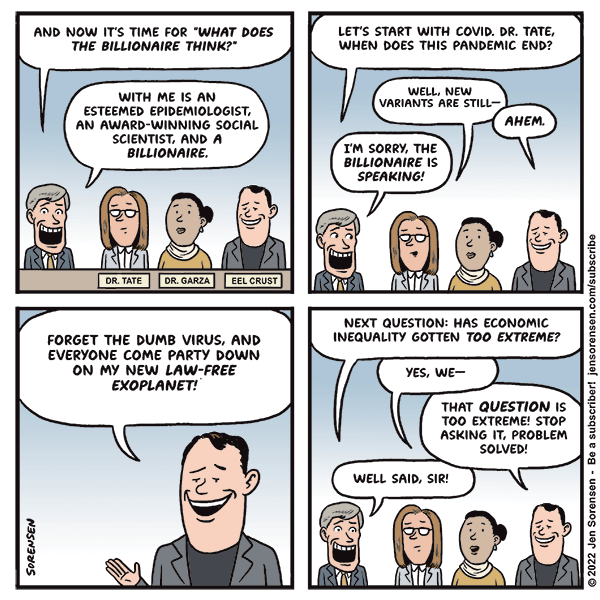
https://jensorensen.com/2022/04/08/the-marketplace-of-ideas-media-conspiracy/

Could competition emerge? Conservative attempts to respond to their perception of Twitter’s bias by creating their own platforms, like Parler and Truth Social, have so far not taken off. (I have to wonder whether conservatives really want their own platform. Isn’t the whole point to troll liberals?) Whether liberals would be any more successful is anybody’s guess.

Attempts by one Big Tech corporation to invade another’s territory have also done badly. Google launched Facebook alternative Google+ with much fanfare in 2011, but shut it down in 2019.

The basic problem is a network effect: Any social network where people already gather for a specific purpose has a huge advantage over a new network attempting to fill the same niche. The problem is especially difficult when the existing service is free, preventing competition on price.

However, imagine if Musk’s “free speech” alterations make Twitter all but unusable. Tweets you actually want to see might get buried under disinformation and hate speech. Posting anything at all might open you up to abusive attacks and cyber-stalking. (In other words: Like now, but moreso.) A better curated platform might become attractive enough that a deep-pocketed competitor might emerge. (What if, for example, Amazon started a paid-subscription model, but the cost was folded into Amazon Prime membership?)

What’s the real problem? My own feeling is that trying to fix America’s “free speech problem” (as Musk claims to want to do), is misguided, because the root problem is actually much bigger. Free speech, bad faith, incivility, disinformation, and a simultaneous lack of public trust and public trustworthiness are all part of the same picture. We’re not going to solve one of those problems without thinking about all of them.

The Monday Morning Teaser

There was already no lack of news Wednesday when Elon Musk announced his intention to buy Twitter. We still had the continuing stories of the Ukraine War, the pandemic, a long list of anti-gay and anti-trans bills progressing through red-state legislatures, the drip-drip-drip of revelations about Trump administration corruption and conspiracy, and much else.

But Musk and Twitter are each controversial in their own ways, so the possibility that they might merge was like a pop-music princess dating an action-movie hero. Everything else faded into the background, and I kept waiting for the tabloids to make up a Bennifer name like “Twelon” (which Google tells me is already the name of a song).

I usually go one of two ways with stories like this: Either I decide it’s overblown and mention it briefly with a link to a fuller explanation, or I write a featured post with the intention of cutting through the hype. I’m going the second way today. “Elon and Twitter” should post by 10 EDT.

The weekly summary will try to cover all the ongoing news stories, before closing with a humorous ode to introverts. That should post sometime after noon.

Big War

What Putin has been doing for many, many years is building up to a big war. At a certain point, I felt crazy for saying it because the big war kept not starting. But the logic of his rhetoric, the logic of his actions, the logic of totalitarianism in general — all of these things required a big war.

Masha Gessen

This week’s featured post is “Why the Russians did it“.

This week everybody was talking about Russian atrocities in Ukraine

https://claytoonz.com/2022/04/06/state-news-fake-news/

The atrocities, and why I believe in them, are discussed in the featured post.


Everyone is saying that the war in Ukraine has entered a new phase. The attack on Kyiv from Belarus appears to be over. Forces are being shifted to the Donbas region in the east, where Russia is trying to conquer the two Ukrainian territories that it has recognized as independent countries.

This is sort-of-good news. Putin seems to understand that the effort to conquer the whole country has failed, and is scrambling to achieve secondary goals that he could still spin as a victory. Without admitting any failures, Putin has replaced the invasion’s top general.

A Russian column has been reported headed towards Kharkiv. It’s not clear whether this force will do any better than the one that targeted Kyiv.

Military experts and western officials have also speculated that Putin’s generals are feeling the pressure to deliver some sort of results ahead of May 9, when Russia marks Victory Day, the defeat of Nazi Germany in 1945. But a fresh analysis from the Institute for the Study of War (ISW), a US-based think tank, casts some doubt on Russia’s ability to concentrate the forces needed to make a breakthrough in the Donbas.

“We assess that the Russian military will struggle to amass a large and combat-capable force of mechanized units to operate in Donbas within the next few months,” the analysis states. “Russia will likely continue to throw badly damaged and partially reconstituted units piecemeal into offensive operations that make limited gains at great cost.”


Fiona Hill has a book coming out soon. The story about her in the NYT Magazine makes connections between Trump’s first impeachment, 1-6, and Putin’s Ukraine invasion.

“In the course of his presidency, indeed, Trump would come more to resemble Putin in political practice and predilection than he resembled any of his recent American presidential predecessors.”

Hill found it dubious that a man so self-​interested and lacking in discipline could have colluded with Russia to gain electoral victory in 2016 … Still, she came to see in Trump a kind of aspirational authoritarianism in which Putin, Erdogan, Orban and other autocrats were admired models.

… Hill was at her desk at home on the morning of Jan. 6, 2021, writing her memoir, when a journalist friend she first met in Russia called. The friend told her to turn on the television. Once she did so, a burst of horrific clarity overtook her. “I saw the thread,” she told me. “The thread connecting the Zelensky phone call to Jan. 6. And I remembered how, in 2020, Putin had changed Russia’s Constitution to allow him to stay in power longer. This was Trump pulling a Putin.”

In the Economist, John Mearsheimer makes the blame-America case for the Ukraine invasion: We provoked Putin by raising the possibility that Ukraine could join NATO. I’m not convinced by that, because I don’t regard NATO-invades-Russia-for-no-reason as a credible fear; it’s been hard enough getting the alliance to unite in helping Ukraine defend itself. But Hill puts an interesting spin on that argument: Leaving Ukraine dangling as a maybe-someday NATO member was “the worst of all possible worlds”. We should either have let it in and helped defend it, or made it clear to Russia that NATO had no interest in extending that far.

and the larger lesson about autocracy

The most insightful thing I read this week was The.Ink’s interview with Masha Gessen, the Russian-American author who often writes for The New Yorker. She has written a biography of Putin, and a book-length account of contemporary Russian society. Her grasp of authoritarianism and totalitarianism reminds me of Hannah Arendt.

The opening part of the interview is focused on the Ukraine war and how it might play out. (Gessen takes the threat of nuclear war seriously, and believes that Putin, like Hitler, will not fall without bringing his country down with him. But, unless he dies soon of some other cause, he will fall.)

Then the discussion goes global, and this is the part I find most fascinating: Putin is part of a larger momentum towards right-wing autocracy, a wave that includes Orban in Hungary, Trump in the US, and Le Pen in France. Putin’s social rhetoric, she says, should be very familiar to Americans.

It’s how the American right weaponizes fear of your kids turning trans. It’s shorthand for the decadent West. It’s shorthand for the Other. It’s the promise of returning to an imaginary past when there was nothing that made you uncomfortable, like having to accept weird gender stuff and other queerness.

The message is: If you want to feel at home in the world again, if you want to feel at home in your country again, we have to get rid of this Western contagion. …

Erich Fromm very accurately describes preconditions for autocracy in Escape From Freedom. He wrote in the late 1930s and looked at extreme economic anxiety and mass displacement. Extreme economic anxiety related not only to hyperinflation in Germany but more broadly to a changing world, a world in which it was impossible for people to imagine who they’ll be and how they’ll live some years from now, or where their children will be. Those are conditions that are very much present in many parts of the world. There are kinds of societies and governments that try to address anxieties, and there are kinds that don’t. We definitely have the kind that doesn’t. I think that’s a culture-wide failure that isn’t concentrated on the right.

Is the point you’re making that, in a sense, the bad guys do address those kinds of anxieties whereas the good guys don’t?

Yes, that is the point I’m making. I think we see some attempts from the Biden administration to address those anxieties, but they’re meek, unconvincing, and unsustainable.

… What we need is recognition on the part of politicians that people all over the world are in this state of extreme anxiety, for very good reasons, and they need to be addressed as “my dears” [as the mayor of Kharkiv did recently]. We can’t just leave it to the bad guys to address the anxieties.

She sees Zelensky as a model, because he makes an FDR-like emotional connection with his people: He feels their fear and speaks to it, rather than telling them that everything is OK.

He models political speech. It is not about policy, and it is not about military strategy. It’s about people. No matter who he is addressing, he’s addressing people directly. He’s speaking directly to their experience.

and Justice Jackson

Thursday, Ketanji Brown Jackson became the first Black woman to be confirmed as a Supreme Court justice. The vote was 53-47, with all 50 Democrats voting in favor. They were joined by only three Republicans: Collins, Murkowski, and Romney. Romney was the only Republican with the good grace to applaud for her.

Justice Jackson will take her seat this summer, when Justice Breyer’s retirement takes effect.


Marjorie Taylor Greene tweeted that voting for Jackson’s confirmation made the Collins, Murkowski, and Romney “pro-pedophile“. I wasn’t going to make a big deal about that desperate plea for attention, but then it turned into this bru-ha-ha with Jimmy Kimmel. In his response, Kimmel coined a useful term: snociopath, a person who is both a sociopath and a snowflake.

and the pandemic

A tug-of-war is going on between the fading of the January wave and the start of a new wave. The result is case numbers that have been more-or-less flat for almost a month. Falling numbers in the Midwest and South have masked rising numbers in the Northeast.

Probably because the increase is in the highly vaccinated Northeast, deaths continue to fall nationally. (When cases rise in Mississippi, more people die than when cases rise in Vermont.) They’re now averaging 570 a day, cut about in half in the last month. Hospitalizations and ICU admissions are also still falling.


The Tyee, an independent news site from British Columbia, summarized a study in Nature of Sweden’s hands-off approach to Covid. The results were not good: Sweden’s death rate (though enviable by American standards) was four times its neighbor Norway. The Canadian writer finds parallels to

places like Alberta, Saskatchewan, Manitoba, B.C. and Ontario, where political leaders didn’t adopt consistent public health goals, withheld data and offered little transparency about the decision-making process.

Yeah, but did they push quack treatments, demonize researchers, turn public health into a partisan issue, hold super-spreader events, ridicule people who wear masks, and personally spread the virus to others, as our former president did? That could be why Canada’s total of 991 Covid deaths per million people will never catch the US’s 3026. More than 600K Americans would still be alive if we had handled the pandemic as well as Canada. That should be a national scandal.

and the Trump coup

Newly released text messages show that Donald Trump Jr. was already envisioning how his father could stay in power in spite of the voters on November 5, two days after the election and before any news organizations had declared a winner.

The November 5 text message outlines a strategy that is nearly identical to what allies of the former President attempted to carry out in the months that followed. Trump Jr. makes specific reference to filing lawsuits and advocating recounts to prevent certain swing states from certifying their results, as well as having a handful of Republican state houses put forward slates of fake “Trump electors.”

If all that failed, according to the Trump Jr. text, GOP lawmakers in Congress could simply vote to reinstall Trump as President on January 6.

“We have operational control Total leverage,” the message reads. “Moral High Ground POTUS must start 2nd term now.”


Arizona’s Republican Attorney General Mark Brnovich reported on his six-month investigation into the 2020 presidential election in Arizona. He has uncovered no mass fraud that could have changed the outcome of the election.


By law, the State Department is supposed compile an annual list of gifts US officials receive from foreign governments. But there is no accounting of gifts to Trump or other White House people in 2020, because the Trump administration routinely flouted anti-corruption laws.

and the culture wars

When radical Christian lawmakers propose extreme bills that hurt people, liberal politicians have a tendency to go easy on them: They have sincere beliefs, they mean well, they’re basically good people, and so on.

Well, not in Nebraska this week. Senator Megan Hunt represents a blue district in Omaha and is term-limited out of running again, so she’s got no appearances to keep up any more. She successfully led a filibuster of an abortion trigger law that would kick in if the Supreme Court overturns Roe “in whole or in part”, as it’s expected to do in June. The bill would have outlawed killing fertilized ova in just about all circumstances, including rape, incest, ectopic pregnancy, and possibly in-vitro fertilization, depending on how judges interpret its language.

Hunt played political hardball: Her maneuvers prevented amendments that might soften the bill to get the last few votes needed to end debate. So her filibuster held by two votes.

Her speech on the floor of the state’s unicameral legislature didn’t pull any punches:

There is no scenario where this will be amended, because I got to it first. You guys pulled the wrong bill. If this bill advances, IPP motions [to indefinitely postpone activity] are going on the bills of every proponent, because to me, yeah, this is personal.

I am not a person who can say, if you think my 11-year-old should be forced to give birth, that we can still be friends. I don’t understand a person who can say something like that. Maybe it’s a person who can’t give birth. Maybe it’s a person who’s never been raped. Somebody who doesn’t have a clue what it is to go through it. …

In life, sometimes we go through things where we have to draw a boundary. It is healthy for me, as a mother, as a rape survivor, to draw a boundary and say if you think that my child should be forced to give birth, you are not my friend.

And if I go to the Pearly Gates and meet your God someday—which sounds great, I hope I do—I don’t think I’m gonna get in any trouble for killing all of your bills who vote for this. I don’t think your God’s gonna have any problem with that. And I don’t think I’m gonna see any of you there either.


The guy who started the Republican panic about critical race theory is now planning a direct attack against public schools and public universities. “To get universal school choice,” he says, “you really need to operate from a premise of universal public school distrust.”


https://boingboing.net/2022/04/06/q-nuts-dont-say-gay.html

By belatedly objecting to Florida’s Don’t Say Gay law, Disney has made itself a target for conservative authoritarians.

Remember: In other contexts, conservatives believe that corporations are people and have a right to their own moral views. That’s why the Obama administration wasn’t allowed to make Hobby Lobby pay for birth control.

Now, if conservative individuals don’t want to do business with Disney any more, that’s their right. I’m fine with them declaring a boycott and trying to get people to unsubscribe from Disney Plus. It’s hypocritical to do that while denouncing “cancel culture”, but hypocrisy is not illegal. (I should mention here that I own some small amount of Disney stock. I don’t think it’s affecting my view of this situation, but full disclosure and so on.)

However, threats to retaliate against Disney by using government power in unrelated areas — that’s corrupt; it’s basic machine politics. Government power should be wielded for the benefit of citizens, and not to further partisan political goals. So it’s corrupt for Governor DeSantis to threaten to revoke the special local-government status of Disney’s holdings in Orlando. (As a protection racketeer might say: “Nice park you got there. Be a shame if anything happened to it.”) And Fox News host Laura Ingraham was promoting corruption when she said:

when Republicans get back into power, Apple and Disney need to understand one thing: Everything will be on the table–your copyright and trademark protection, your special status within certain states, and even your corporate structure itself.

I can only imagine Ingraham’s howl of rage if President Obama had similarly declared war on Hobby Lobby for getting in his way, or on Koch Industries because the Koch brothers contributed to conservative political campaigns. (That’s exactly what Trump repeatedly tried to do to Amazon to get back at Jeff Bezos for letting The Washington Post criticize him. But we already knew Trump was corrupt.)

(BTW: I have long opposed Congress’ repeated moves to extend copyright just as Mickey Mouse approaches the public domain. Lawrence Lessig is right about this. If the current conservative temper tantrum gets us a sensible copyright law, that would be good.)

https://robrogers.com/2022/04/08/dont-say-gay/

Friday, Alabama became the latest state to pass laws targeting trans teens. Alabama’s SB184 is only 11 double-spaced pages, so you can read it for yourself. The bill makes a Class C felony out of medical treatments

performed for the purpose of attempting to alter the appearance of or affirm the minor’s perception of his or her gender or sex, if that appearance or perception is inconsistent with the minor’s sex as defined in this act

The banned treatments include puberty-blocking drugs, cross-sex hormones, and surgery.

The law justifies itself by claiming “Some in the medical community are aggressively pushing for interventions on minors”, and arguing the state knows better than either doctors or parents do. (Conservatives often claim to support “parental rights”, but that’s only when they approve of the parents’ decisions.)

Minors, and often their parents, are unable to comprehend and fully appreciate the risk and life implications, including permanent sterility, that result from the use of puberty blockers, cross-sex hormones, and surgical procedures.

Section 4b creates an exception for surgeries that attempt to turn intersex infants into boys or girls. (Conservatives only support “nature” when nature does what they want.)

Section 5 of the law forces nurses, counselors, teachers, and administrators at public or private schools to violate their students’ trust. They are forbidden to

(1) Encourage or coerce a minor to withhold from the minor’s parent or legal guardian the fact that the minor’s perception of his or her gender or sex is inconsistent with the minor’s sex.

(2) Withhold from a minor’s parent or legal guardian information related to a minor’s perception that his or her gender or sex is inconsistent with his or her sex.

Governor Ivey also signed HB322, which is just four pages. Section 1 of that bill requires public schools to segregate multiple-person bathrooms and locker rooms by sex. Students must use the facilities associated with the sex specified by their birth certificates.

Section 2 is a don’t-say-gay provision:

An individual or group of individuals providing classroom instruction to students in kindergarten through the fifth grade at a public K-12 school shall not engage in classroom discussion or provide classroom instruction regarding sexual orientation or gender identity in a manner that is not age appropriate or developmentally appropriate for students in accordance with state standards.

It also requires the State Board of Education to establish such standards. (As with parental rights, local control is only a conservative value if local officials do what conservatives want.)


Reason eventually prevailed in Starr County, Texas: The woman arrested for murder after she had a miscarriage will not be prosecuted. She was charged with murder when the hospital reported to the county sheriff’s office that the miscarriage was self-induced. The local DA later announced that this was “not a criminal matter”. It was never clear exactly which law was being enforced.

Texas Public Radio has details.

Lynn Paltrow, executive director of National Advocates for Pregnant Women, said it was also troubling that this incident began with hospital staff making a report to police.

“We should not be living in a country where people who get pregnant are afraid to go for help at a hospital, because somebody there will turn them in or might turn them in, and it will result in arrest,” Paltrow told TPR.


Apparently there are some depths that Republicans are not willing to sink to yet. The Republican Party of Hampton, Virginia tried to remove the local Republican electoral board chair after his Facebook post assailed Defense Secretary Lloyd Austin and retired three-star general Russell Honoré as “dirty stinking ni**ers” (without the asterisks) and recommended “a good public lynching” as “the best way to pull us back from the brink”.

That seems to be a step too far, at least for now. The Hampton GOP has revoked his membership and returned his contribution. But I’ve got to wonder how this guy managed to rise so far without anyone noticing he was a raving bigot.

The official in question, David Dietrich, refused to resign until Governor Youngkin stepped in. Dietrich faulted Austin for his attempts to remove White nationalists (who Dietrich characterizes as “conservative, freedom-loving Americans”) from the military. Honoré’s sin was to accept Speaker Pelosi’s invitation to review Capitol security infrastructure in the wake of the 1-6 insurrection. Dietrich says Honoré, who is Creole, sounds like “a Black nationalist”.

and you also might be interested in …

With hardly anybody noticing, the economy continues to do quite well. New claims for unemployment last week came in at the lowest level since 1968.


https://www.pinterest.com/pin/179088522660170911/

Europe is reconsidering nuclear power. The Ukraine war is causing European countries to question their dependence on Russian natural gas. According to Grist

Roughly one-fourth of Europe’s energy comes from natural gas, and as much as 40 percent of it flows from Russia.

If you do the math, 10% of Europe’s energy comes from Russian gas. There are ways to replace that 10%, but they’ll take time: increasing renewable power (which is already ramping up, but not fast enough), and importing liquified natural gas from places like the US (the port facilities for unloading it aren’t adequate yet). Europeans could turn down their thermostats, but that’s not going to be a popular solution.

In addition, the prospect of replacing gas-powered cars with electrics requires more generating capacity, not just maintaining the current capacity.

Normally, you wouldn’t think of nuclear power as a quick solution, because nuclear plants take a long time to approve and build. But Europe has recently decommissioned a number of plants, and more are scheduled to close over the next few years. Restarting the closed nuclear plants and extending the life of those still online would indeed provide a short-term boost over currently anticipated generating capacity.

Not everyone likes this idea, of course. Disasters like Chernobyl and Fukushima loom large in European thinking, as they should. The Grist article is a pretty well balanced look at the pros and cons.


A guy who has bounced around from one working-class job to another, and now cleans carpets, has a remarkable knack for languages. He speaks 24 languages, and has a lower-level understanding of many more. He didn’t set out to break any records, he just wants to understand what people are saying.


Proposed mergers involving smaller airlines Jet Blue, Spirit, and Frontier are a challenge to regulators. Air travel is dominated by four big carriers: United, American, Delta, and Southwest. Either of the proposed mergers would create a fifth large airline. Is that good or bad for competition in general?

and let’s close with something stupid

We should all be more familiar with economist Carlo Cipolla’s work on human stupidity. Cipolla had a very succinct definition of stupid people: those who cause harm to others without benefit to themselves.

Cipolla’s Five Laws of Stupidity are:

  1. Always and inevitably, each of us underestimates the number of stupid individuals in the world.
  2. The probability that a certain person is stupid is independent of any other characteristic of the same person.
  3. A stupid person is one who causes harm to another person or group without at the same time obtaining a benefit for himself or even damaging himself.
  4. Non-stupid people always underestimate the harmful potential of stupid people.
  5. The stupid person is the most dangerous person that exists.

Cipolla’s theory leads to this four-bin categorization:

My one quibble with this model is in the upper left quadrant, which should be divided: If you understand that you are harming yourself to help others, you are generous. But if you don’t, you are gullible, and are probably being victimized by a bandit.

Why the Russians did it

https://www.ajc.com/opinion/mike-luckovich-blog/327-mike-luckovich/M3CWVXFYINEPLGIBUKQMMLTFVE/

The atrocities discovered when Ukrainian forces retook Bucha are in perfect harmony with Kremlin rhetoric.


As Russia retreated from its attempt to encircle Kyiv, Ukrainian forces entering the town of Bucha reported finding the bodies of hundreds of civilians, many of them killed execution-style, with their hands tied behind their backs. Some bodies were buried in mass graves while others were left lying in the road.

My first thought was that it was wise to be skeptical of these reports. [1] It obviously serves the Ukrainian cause if the world believes Russia’s soldiers behaved in monstrous and inhuman ways, or that the Kremlin authorized them to do so. Using atrocity stories as propaganda goes back at least as far as World War I, when the British exaggerated stories of German crimes in Belgium.

Predictably, Russia claimed the Ukrainians had faked everything. This theory, though, is no less outrageous, because it seems to imply that the Ukrainian forces killed their own people when they re-entered the town.

As evidence mounts, I have come around to believing the Ukrainian reports. Independent reporters were brought in quickly and given a lot of freedom to wander about and talk to survivors. Satellite photos and intercepted radio chatter from before the Russians withdrew appear to correspond to some of the bodies found. The more we hear, the more the Ukraine-faked-it theory acquires the common flaw of most bad conspiracy theories: The number of people who would have to be in on the plot has grown beyond reasonable bounds.

The Ukrainian reports also fit with the Russia’s apparent disregard for civilian casualties when it shells cities. The most recent example was the missile attack on a train station in Kramatorsk. Previous Russian campaigns in Chechnya and Syria have been similarly brutal. (A general associated with massive civilian casualties in Syria has just been put in charge of the Ukraine campaign.)

But what clinches the case for me is not anything from Ukrainian or NATO sources, or from the western press. It’s an article called “What should Russia do with Ukraine?” by Russian political scientist Timofey Sergeytsev, published a week ago by the Russian state news agency RIA Novosti. (Alternate translation here.)

Sergeytsev is not a soldier, not in Ukraine, and as far as I know has killed no one. But he has documented, and state media has published, an argument that would justify (and perhaps even welcome) all the actions Russia has been accused of.

The article revolves around “de-Nazifiying” Ukraine, a phrase that has been the centerpiece of Russian war propaganda. To Sergeytsev, this term means much more than simply deposing the current “Nazi” government led by President Zelensky, a Jewish Ukrainian whose grandfather’s brothers were killed in the Holocaust. The deeper problem, you see, is that the Ukrainian people support Zelensky and don’t want to be dominated by Russia.

De-Nazifying is necessary when a significant part of the people – most likely, the majority – have been sucked into the Nazi regime politically. That is, when the “people are good – the government is bad” hypothesis no longer works.

In other words: the Ukrainian people are not just misled, they are bad and deserve to be punished.

De-Nazifying is the measure applied towards the masses of Nazi followers whom one is not able to subject to direct punishment as war criminals because of technicalities.

… Besides the top leaders, a significant part of the masses are guilty as accomplices of Nazism, the passive Nazis. They supported and indulged the Nazi power. The just punishment of this part of the population is possible through inflicting the unescapable hardships of our just war against the Nazi system, with careful and cautious relations towards other civilians when feasible.

In order to de-Nazify Ukraine, Russia needs total control. A “Nazified” populace has no right to self-determination or democracy.

De-Nazifying requires winning, which means achieving the unconditional control over the de-Nazifying process and the government that maintains this control. Hence, a de-Nazified country cannot be sovereign. Being the de-Nazifying country, Russia cannot practice a Liberal approach to de-Nazifying. The guilty party subjected to de-Nazifying cannot dispute our de-Nazifier’s purpose.

What will Russia do with once it achieves total control?

De-Nazifying the population further consists in re-education through an ideological repression (suppression) of Nazi attitudes and a strict censorship: not only in the political sphere, but also critically, in culture and education.

Of course, Ukraine will have to be cut off from the West, and especially from Western aid that might rebuild the country after the war.

Their political aspirations cannot be neutral – the expiation of guilt before Russia for treating it as an enemy can transpire through relying on Russia in the processes of restoration, revival and development. No “Marshall Plans” should be allowed for these territories. There can be no “neutrality” in the ideological and practical sense, compatible with de-Nazifying. The cadres and organizations that are the de-Nazifying instrument in the newly de-Nazified republics cannot but rely on Russia’s direct military and organizational support.

For how long? Decades, at a minimum.

The de-Nazifying time frame is no less than one generation that needs to be born, brought up and to have reached maturity during the process of de-Nazifying.

In the process, the very idea of Ukraine has to be stamped out, and replaced with the identities of “Minor Russia” and “New Russia”. [2]

De-Nazifying will inevitably also be a de-Ukrainizing, i.e., rejecting the large-scale artificial overblowing of the ethnic component in self-identification of the population of the territories of the historical Minor Russia and New Russia. … Unlike Georgia and the Baltic countries, Ukraine is impossible as a nation-state, as history has shown, and any attempts to “build” a nation-state naturally lead to Nazism. Ukrainism is an artificial anti-Russian construct that does not have its own civilizational content; it’s a subordinate element of an alien and unnatural civilization.

The territory-formerly-known-as-Ukraine will have to be divided by an “alienation line” that separates Russia-loving people in the east (who could aspire to “potential integration into Russian civilization”) from Russia-hating people in the west (some of whom will have to be relocated from the east). But even the western part will never be independent.

The guarantee of the preservation of this residual Ukraine in a neutral state should be the threat of an immediate continuation of the military operation in case of non-compliance with the listed requirements. Perhaps this will require a permanent Russian military presence on its territory.

Again: This is not some Western analysts’ dark fantasy of what Russians are thinking. This is Russian state media telling Russians what they should think.

So imagine that you are a Russian soldier and that you believe you are entering a Nazi country (which is not really a country, but “an artificial anti-Russian construct that does not have its own civilizational content”) whose civilians bear the “guilt” of treating Russia as an enemy. Imagine that only “technicalities” prevent these civilians from being punished as war criminals, and that “the unescapable hardships of our just war” constitute their “just punishment”.

What would restrain you from committing crimes like those whose evidence is being found in Bucha? After all, it’s only the “other civilians” (not the Nazi-supporting majority) you need to be careful with, and only then “when feasible”.


[1] I hate that people like Tucker Carlson and Joe Rogan have poisoned the phrase “just asking questions”. Questions should be asked, but as part of a process of seeking answers.

The problem with Carlson and Rogan isn’t that they’re asking questions, but that they’re not seeking answers. Instead, they ask questions simply to blow smoke and create paralyzing doubt. They imply that the questions they ask have no good answers, invent repressive forces that are trying to stop people from asking them, and cast themselves as brave rebels against those imagined forces.

I remember, early in Covid vaccination campaign, hearing Carlson do this same routine about vaccine safety. It took me less than a minute to google one of his “courageous” questions and discover that it had been asked and answered on the CDC web site. If Carlson didn’t want to accept the CDC’s answer, fine; but to pretend that the authorities had no answer and were trying to suppress the question was just dishonest.

[2] The article identifies Ukrainian nationalism with S. Bandera. (One translation calls the current regime “Banderite”.) I had to look up who that was: Stepan Bandera was a World-War-II-era Ukrainian nationalist who (depending who you talk to) was either a Nazi collaborator or a Ukrainian patriot who tried to play the Nazis and Soviets off against each other.