The Monday Morning Teaser

The war in Ukraine seemed to enter a new phase this week. Russian forces have pulled back from their attempt to encircle Kyiv, and appear to be starting a new offensive in the east, attempting to secure the two Ukrainian provinces Russia has recognized as independent states.

As Ukrainians retook territory north of Kyiv, evidence of Russian war crimes against civilians came out. Russia, of course, claims this is fake news. I had my doubts at first, recognizing how useful war-crimes charges are to the Ukrainian effort to get more help from NATO. But punishing the civilian population of Ukraine lines up perfectly with the kind of rhetoric currently coming out of the Putin regime. I’ll explain that by quoting extensively from an article by a Russian political scientist that was published by a pro-Putin Russian news outlet. My post is called “Why the Russians did it”. It should come out around 9 or 10 EDT.

I’m still undecided whether there will be a second featured post. The most insightful thing I read this week was an interview with Masha Gessen, discussing not just Russia and Ukraine, but the rising tide of autocracy globally. I’ll either write an article about that or quote extensively from it in the weekly summary.

The weekly summary also has Judge Justice Jackson’s confirmation to cover, including Jimmy Kimmel’s hilarious back-and-forth with MTG. A Nebraska legislator really cut loose against Christian religious extremism as she successfully filibustered a radical anti-abortion bill. Alabama passed two similarly radical anti-trans and anti-gay laws. A Texas woman who miscarried was charged with murdering her fetus. The pandemic spun its wheels as one surge faded while another began. Disney is now a right-wing political target. And I’ll close by quoting the Five Laws of Stupidity.

I’m running behind today, so the summary may not appear until after 1.

Limitations of Experience

No Sift next week. The next new articles will appear on April 11

He characteristically would tell us things that we knew but would rather forget; and he told us much that we did not know due to the limitations of our own experience.

Supreme Court Justice Byron White
“A Tribute to Justice Thurgood Marshall”

This week’s featured post is “Where Does the Religious Right Go After Roe?

How did Christianity become so toxic?“, from two weeks ago, was one of the rare posts to have a bigger second week than its first. It has now gotten over 17,000 page hits, and is still running. That puts it in 13th place on the Sift’s all-time hit list, mostly behind posts from the era when Facebook algorithms let links go viral more easily.

This week everybody was talking about Judge Jackson

https://theweek.com/political-satire/1011725/the-protector-of-criminals

The televised interviews with the Judiciary Committee are over now. The committee vote on Ketanji Brown Jackson’s nomination is planned for April 4, and she seems likely to pass on a party-line vote.

The full Senate will vote sometime after that. She can be approved with only Democratic votes. So far, no senator of either party has announced a decision to break ranks. Senator Manchin recently came out in support, which probably means she’s in, though Senator Sinema still hasn’t committed herself.


Charles Blow pointed out how far the Senate has gotten from its constitutional duties. The point of the confirmation hearings on Judge Jackson’s nomination has never been to examine her qualifications or judicial philosophy. The point, rather, is to “put on a show”.


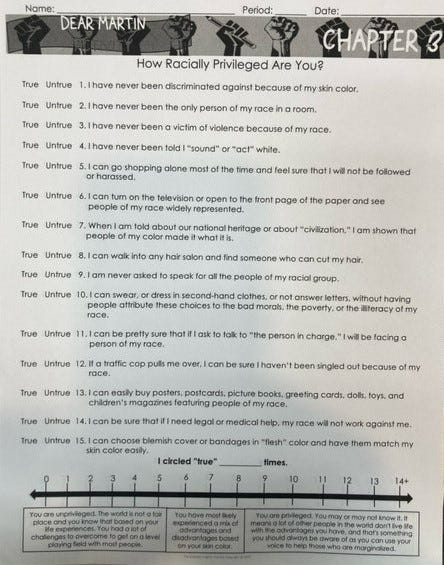
Lindsey Graham and various other Republican senators used the hearings to air their issues with Brett Kavanaugh’s confirmation hearings. But from my point of view, comparing those hearings makes a very different point: If you’ve ever wondered what white male privilege consists of, the contrast between the two hearings makes it obvious.

Judge Jackson had to be responsive, civil, and under control at all times, while Republican senators frequently interrupted her or talked over her. Kavanaugh, on the other hand, was free to go on a partisan rant, push a conspiracy theory, cry and express anger, lie and misdirect, and throw hostile questions back at his questioners. A Black woman could never get away with that kind of behavior.


The Republican senators at the hearing knew they were using smear tactics. Ted Cruz, for example, tied Jackson to books that are used at a private school where Jackson serves on the board (as if she had personally selected those books). He then misrepresented the books.


GOP senators repeatedly referenced Wesley Hawkins, an 18-year-old who Judge Jackson sentenced to three months prison, three months home detention, and six years of supervision because he possessed child pornography. He’s now 27 and has not been charged with anything since. The WaPo detailed his case and talked to him.


One popular falsehood I’ve heard during the hearings is that conservatives believe in judicial restraint while liberals want to expand judicial power. WaPo’s Henry Olsen put it like this:

Democrats favor the court expanding its jurisdiction into political matters; Republicans favor a restrictive view, generally deferring to democratically elected bodies at all levels of government rather than making the court the final arbiter of public policy. This is one of the most important political issues of our time.

If that was ever true, which I doubt, it certainly is not true now.

One case this week demonstrated how conservative justices are reaching for power: Three conservative justices — Thomas, Alito, and Gorsuch — tried to insert judges into the Navy’s chain of command, undercutting President Biden’s role as commander-in-chief.

Another right-wing judicial power grab is the push for “nondelegation“, a theory under which Congress cannot delegate regulatory power to agencies of the executive branch like the EPA or the SEC. In practice, this makes the Supreme Court the ultimate regulator, as it decides which regulations are or aren’t sufficiently specified by Congress’ authorizing legislation.

And finally, we can’t ignore the two places where conservative justices regularly invent new rights: for corporations and for right-wing Christians. Corporations are not mentioned in the Constitution, and yet conservatives are constantly defending their right to influence elections or to act on their religious convictions as “corporate persons“. And right-wing Christians (but not other religious groups) are held to be largely exempt from laws they don’t like.

and Ginni Thomas

https://theweek.com/political-satire/1011842/ginnis-banner

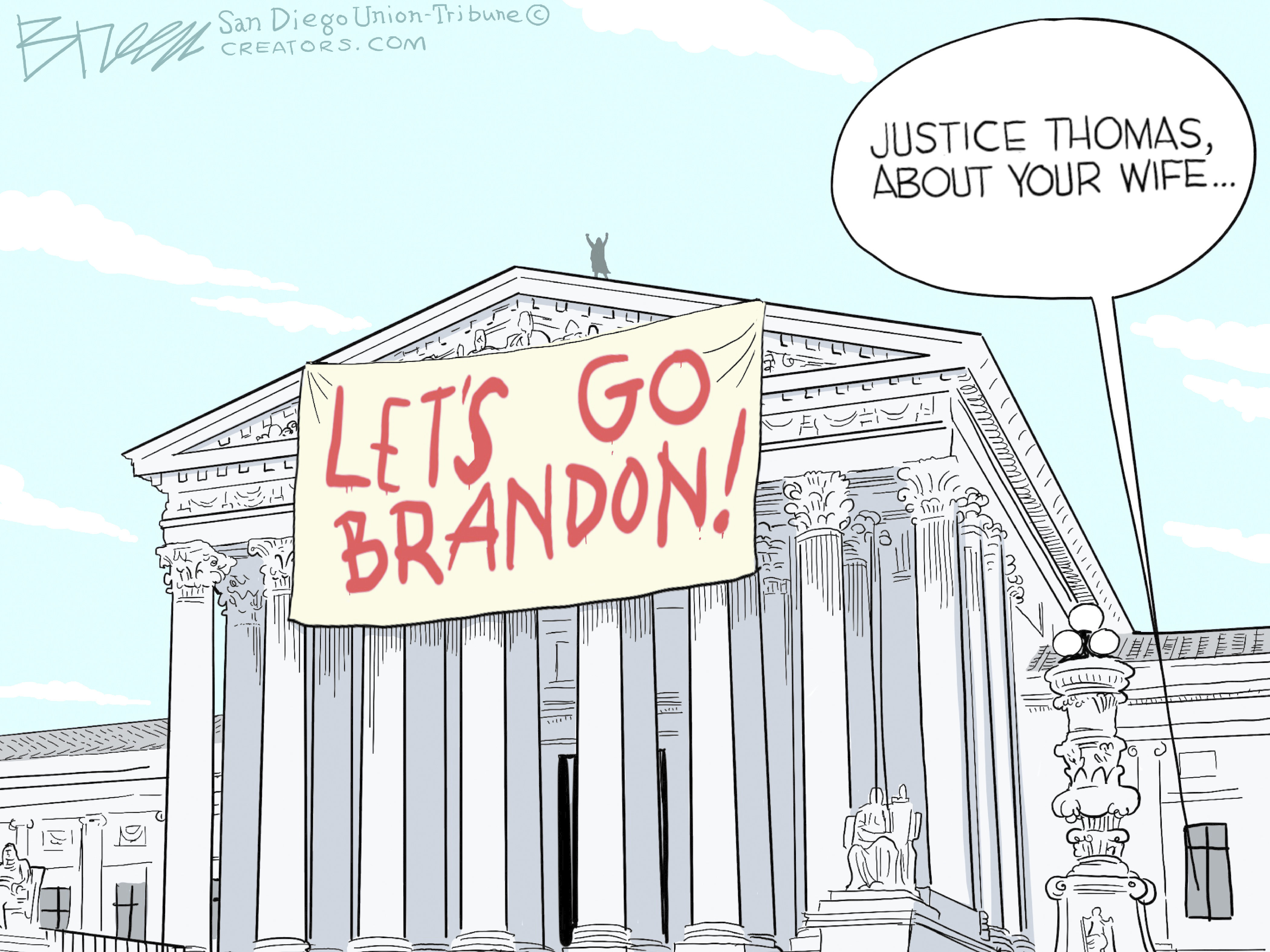
People who pay attention have known for years that Ginni and Clarence Thomas were a scandal waiting to happen: Ginni is a right-wing political organizer, and she runs a profit-making lobbying firm. Her husband Clarence is a Supreme Court justice who rules on cases that sometimes overlap with Ginni’s interests. That’s been going on for years. The New Yorker detailed the ethical problems the Thomases raise back in January. The NYT Magazine followed in February.

What’s new this week are text messages she exchanged with Trump’s Chief of Staff Mark Meadows during the period between the election and the January 6 riot.

The messages — 29 in all — reveal an extraordinary pipeline between Virginia Thomas, who goes by Ginni, and President Donald Trump’s top aide during a period when Trump and his allies were vowing to go to the Supreme Court in an effort to negate the election results.

Ginni encourages Meadows (and Trump) to “stand firm” against “the greatest Heist of our History”. She gives strategic legal advice on a case that her husband might have needed to rule on.

Among Thomas’s stated goals in the messages was for lawyer Sidney Powell, who promoted incendiary and unsupported claims about the election, to be “the lead and the face” of Trump’s legal team.

She repeatedly embraced the most bizarre and baseless conspiracy theories about the election.

Ginni has admitted attending the January 6 rally, but claims to have left early, before the assault on the Capitol.

Clarence was the lone dissent in an 8-1 decision not to hear Trump’s objections to the National Archives delivering documents to the January 6 Committee. The Ginni/Meadows texts were not part of that trove, but his wife’s involvement certainly creates a strong appearance of impropriety.

and Ukraine

This week Ukraine has been pushing back Russian troops threatening Kyiv, while Russian forces continue to make slow progress in the eastern part of the country.

Russia is now claiming that everything has gone according to plan.

“The main objectives of the first stage of the operation have generally been accomplished,” Sergei Rudskoi, head of the Russian General Staff’s Main Operational Directorate, said in a speech Friday. “The combat potential of the Armed Forces of Ukraine has been considerably reduced, which … makes it possible to focus our core efforts on achieving the main goal, the liberation of Donbas.”

Of course, the combat potential of the Russian forces has also been reduced, which probably wasn’t part of the plan. Maybe this announcement means that Russia has scaled down its ambitions and no longer intends to conquer the entire country. Or maybe the speech is just noise. It’s always hard to tell.


Karolina Wigura and Jaroslaw Kuisz write in the NYT about the divide within NATO. Everybody supports Ukraine against Russia, but the former Warsaw Pact countries in the East frame the issue differently than NATO’s original members in the West, including the United States.

For Western countries, not least the United States, the conflict is a disaster for the people of Ukraine — but one whose biggest danger is that it might spill over the Ukrainian border, setting off a global conflict.

For Central and Eastern European countries, it’s rather different. These neighbors of Russia tend to see the war not as a singular event but as a process. To these post-Soviet states, the invasion of Ukraine appears as a next step in a whole series of Russia’s nightmarish assaults on other countries, dating back to the ruthless attacks on Chechnya and the war with Georgia. To them, it seems foolhardy to assume Mr. Putin will stop at Ukraine. The danger is pressing and immediate.

While the West believes it must prevent World War III, the East thinks that, whatever the name given to the conflict, the war against liberal democratic values, institutions and lifestyles has already started. …

NATO’s cautious steps look to many Central and Eastern Europeans like an echo of the phony war of 1939, when France and Britain undertook only limited military actions and did not save their eastern ally, Poland.

Estonian Prime Minister Kaja Kallas summed up the Eastern view:

At NATO, our focus should be simple: Mr. Putin cannot win this war. He cannot even think he has won, or his appetite will grow.


Elliot Ackerman is a former Marine and intelligence officer writing for The Atlantic. He had an enlightening conversation with a former Marine now fighting for Ukraine about the way weapons like the Javelin missile have changed the tactics of warfare.

When Ackerman was in Fallujah in 2004, Abrams tanks were key in the infantry’s advance into the city — a role the tank has played since it was invented in World War I to lead soldiers over enemy trenches.

On several occasions, I watched our tanks take direct hits from rocket-propelled grenades (typically older-generation RPG-7s) without so much as a stutter in their forward progress. Today, a Ukrainian defending Kyiv or any other city, armed with a Javelin or an NLAW, would destroy a similarly capable tank.

If the costly main battle tank is the archetypal platform of an army (as is the case for Russia and NATO), then the archetypal platform of a navy (particularly America’s Navy) is the ultra-costly capital ship, such as an aircraft carrier. Just as modern anti-tank weapons have turned the tide for the outnumbered Ukrainian army, the latest generation of anti-ship missiles (both shore- and sea-based) could in the future—say, in a place like the South China Sea or the Strait of Hormuz—turn the tide for a seemingly outmatched navy. Since February 24, the Ukrainian military has convincingly displayed the superiority of an anti-platform-centric method of warfare.

They also discussed the difference in philosophy between the Russian and the more NATO-style Ukrainian command structures.

Russian doctrine relies on centralized command and control, while mission-style command and control—as the name suggests—relies on the individual initiative of every soldier, from the private to the general, not only to understand the mission but then to use their initiative to adapt to the exigencies of a chaotic and ever-changing battlefield in order to accomplish that mission.

The Russian system breaks down when soldiers wind up in situations that make it impossible to carry out their specific orders. (As orders to go to a particular place break down when the roads are jammed with traffic.) They can’t improvise effectively, because they don’t know what the larger mission is.


Wednesday, the NYT and CNN published articles about US contingency planning for scenarios where Russia escalates to nuclear, chemical, or biological warfare. It’s very hard to tell how seriously to take this possibility.

Dictators have a long history of playing chicken with democracies, figuring that a leader not accountable to public opinion has more room to take risks, so he will be able to get elected leaders to back down. This is basically the story of Hitler and the West prior to his attack on France in 1940.


He is the very model of a Russian major general.

and the pandemic

Last week I wondered if we were in the eye of the storm. This week the trend definitely seems to have turned: After two months of steep drops in the number of new Covid cases, the curves look like they’re turning upward again.

Last week, new cases per day were running just under 30K, this week they’re just over. If you use a two-week window, that’s still a 12% decline. But the national flattening out over the last week hides the fact that cases have turned upward in the parts of the country that usually lead the statistics (New York City, for example), but are still falling in parts that lag.

This is personal to me. My wife takes a cancer-survivor drug that can have immune-suppressing side effects, so we’ve been especially cautious during the pandemic. And though I’ve started to enjoy cooking during the pandemic, I still miss the days when we ate out often. (Take-out is not the same.) A few weeks ago we made a judgment: If new-cases-per-100K in our Boston-suburb county got into single digits, we could eat indoors at restaurants if we avoided the times when they’re crowded.

We didn’t get there. Our county’s number bottomed out at 11 sometime last week, and is now back up to 16. This morning it’s snowing again, and outdoor dining seems far away.

and anti-LGBTQ oppression

https://theweek.com/political-satire/1011769/get-in-the-closet

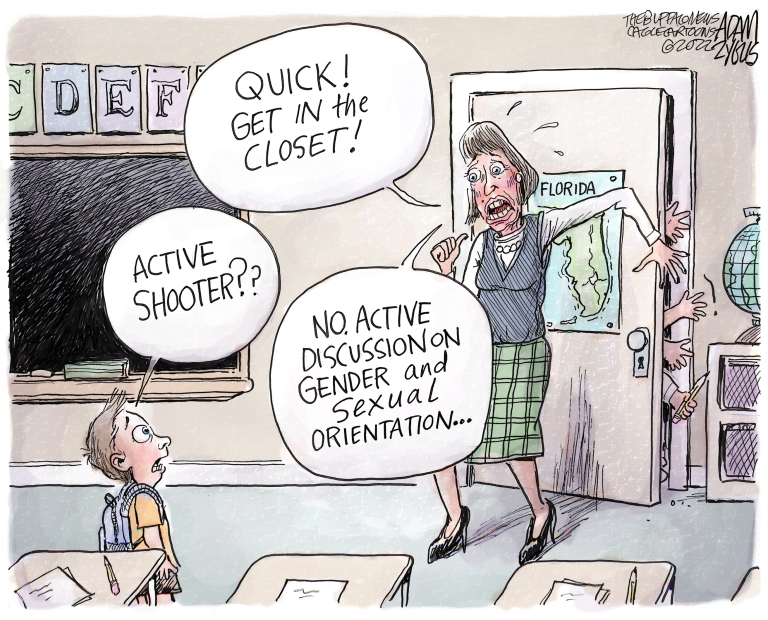
Texas Attorney General Ken Paxton has sent the Austin Independent School District a letter informing them of his opinion that their Pride Week is illegal.

By hosting “Pride Week”, your district has, at best, undertaken a week-long instructional effort in human sexuality without parental consent. Or, worse, your district is cynically pushing a week-long indoctrination of your students that not only fails to obtain parental consent, but subtly cuts parents out of the loop.

AISD says the focus of its Pride Week is “creating a safe, supportive and inclusive environment”, not teaching about human sexuality. Apparently, Paxton can’t see the difference between teaching students to accept one another and teaching them how to perform sexual acts.

The district shows no signs of giving in; the superintendent tweeted back:

I want all our LGBTQIA+ students to know that we are proud of them and that we will protect them against political attacks

Paxton, you may recall, also opines that gender-affirming therapy is child abuse, and was investigating nine Texas families with trans children until a state court made him stop.

After he’s done persecuting children and their families, I have to wonder how much time he has left to do his job as the state’s chief law enforcement officer.


If you want to know where right-wing rhetoric about schools “grooming” children for pedophiles is headed, look at Mississippi’s former legislator and gubernatorial candidate Robert Foster, who tweeted:

Some of y’all still want to try and find political compromise with those that want to groom our school aged children and pretend men are women, etc. I think they need to be lined up against wall before a firing squad to be sent to an early judgment.

When Mississippi Free Press requested an interview to discuss this, Foster messaged back:

I said what I said. The law should be changed so that anyone trying to sexually groom children and/or advocating to put men pretending to be women in locker rooms and bathrooms with young women should receive the death penalty by firing squad.

So if you’re advocating for trans people to choose their own bathrooms, or trans women to be allowed to compete in women’s sports, you should be shot. Or let me boil that down further: I should be shot. Maybe you should be shot too.

It’s hard to come up with the right response to stuff like this, because real pedophiles do exist, just not with anything like the numbers or the organizational power of Foster’s fantasies. In the same way, there were a handful of real Soviet spies during the Red Scare, and probably some tiny percentage of the six million Jews Hitler killed were up to no good.

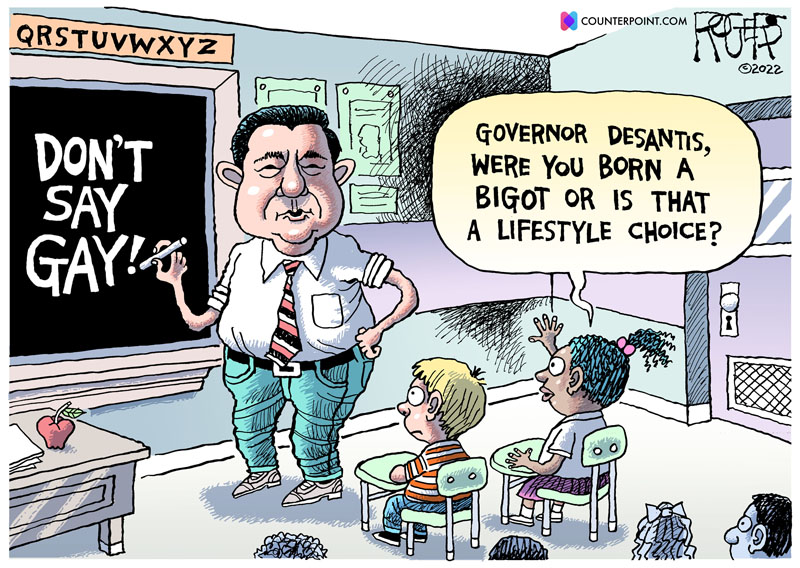
To be fair, this guy is nobody. He didn’t get nominated for governor, and there are a lot of crazy former state legislators out there. But Florida Governor DeSantis’ spokesperson has also described opponents of the Don’t Say Gay bill (that’s me again) as “groomers”.

If you’re against the Anti-Grooming Bill, you are probably a groomer or at least you don’t denounce the grooming of 4-8 year old children. Silence is complicity. This is how it works, Democrats, and I didn’t make the rules.

Foster is just pointing out where that kind of thinking leads.


The WaPo calls attention to books quietly vanishing from school library shelves. Administrators are ignoring the defined processes for dealing with complaints and just pulling books without any process, often over the objections (or without the knowledge) of librarians.

And after the school libraries are purged, they’ll come for the public libraries. Llano County, Texas just fired a librarian for refusing to remove books. KXAN quotes a library patron as saying “There are very clear rules that should be followed with regards to censorship to books in the public library, those rules were not followed.”

and you also might be interested in …

If you missed the Oscars, CODA won as best picture. Here’s a list of all the other winners.


One reason more and more Republicans feel they need to move on from Donald Trump is that he is stuck in the past; he’s still fixated on his crushing defeat in the 2020 election, which he lost by 7 million votes.

Well, this week he moved on from 2020, but in the wrong direction: to 2016. He’s filed a lawsuit in a Florida federal court against, as TPM puts it, “Everyone Who Ever Offended Him Over 2016 Election”.

At the core of Trump’s claim is the idea that Clinton ordered others to spread lies about him regarding Russia and the 2016 election. With Clinton at its head, the argument goes, a vast conspiracy to deprive Trump kicked into action, featuring people and entities that have populated Trump’s rhetoric since before he won in 2016 and, subsequently, right-wing media.

They include Fusion GPS, the opposition research firm that the lawsuit accuses of creating “false and/or misleading dossiers” to damage Trump’s chances in the election.

Jim Comey, the former FBI director, makes the cut to be a defendant, as do FBI officials Peter Strzok and Lisa Page. The DNC and its 2016 chief, Debbie Wasserman Schultz, also show up as defendants.

WaPo’s Phillip Bump points out the most ridiculous aspect of the suit: In order to “prove” that Clinton masterminded a conspiracy to manufacture a Trump/Russia “hoax”, the suit quotes from DNC emails illegally hacked by Russia to benefit the Trump campaign.

Whenever Trump’s 2016 conspiracy theory comes up, I feel obligated to repeat the established facts:

  • Russia did help Trump get elected in 2016.
  • That Russian effort included crimes, such as hacking computers at the DNC, and distributing illegally obtained emails through WikiLeaks during the fall campaign.
  • Trump knew Russia was helping him, to the point of saying in public “Russia, if you’re listening …”.
  • The Trump campaign had two major interfaces with the Russian effort: campaign manager Paul Manafort, who had been paid millions of dollars by Russian oligarch Oleg Derapaska, and long-time Trump ally Roger Stone, who was the campaign’s link to WikiLeaks. Neither man cooperated with the Mueller investigation, and Trump rewarded both of them with pardons.

In view of all that, and the likelihood that Trump would have to answer questions under oath if the suit made it to trial, probably the point is to scam more money out of his followers.


Oh, and they’re still trying to make a thing out of Hunter Biden’s laptop.


Belarus has granted asylum to a man charged in the January 6 insurrection. Putin’s allies consider people who rioted to keep Trump in power after he lost the election to be political prisoners.


In case you were still doubting that Mike Flynn is insane, he buys into the Bill-Gates-wants-to-microchip-you theory. The following picture is not authentic.

https://starecat.com/bill-gates-youre-not-worth-microchipping-change-my-mind/

Vanity Fair has the sordid story of how the conservative Project Veritas obtained Ashley Biden’s diary.


If you ever watched the TV series Heroes, and if you had witnessed the scuffle involving actress Hayden Panettiere Thursday, could you have resisted calling out “Save the cheerleader!”?

and let’s close with some literal interpretation

This Dad assigned his kids the task of writing instructions for making peanut butter and jelly sandwiches. He then followed their instructions as literally as possible, with amusing results.

While I think this exercise taught the kids a valuable lesson, I predict Dad will soon regret having done it, as the kids will start following his instructions literally as well. “You told me to go to school. You didn’t tell me to go inside the school.”

Where Does the Religious Right Go After Roe?

https://politicalcharge.org/2021/09/04/the-weeks-best-cartoons-texas-abortion-ban/

Suppose the Supreme Court reverses Roe v Wade this term. Then what?


The Dobbs case. The Supreme Court has already heard arguments on Dobbs v Jackson Women’s Health Organization, a case centering on a law Mississippi passed in 2018. That law bans all abortions after 15 weeks, in direction violation of the 24-week standard the Court laid out in Roe v Wade in 1973 and affirmed in Planned Parenthood v Casey in 1992. This is the first major abortion case to hit the court since Amy Comey Barrett’s arrival gave conservatives a 6-3 majority. A ruling is expected before the Court’s current term ends in June.

Based on the justices’ general philosophies, and on their comments and questions during the hearing on this case in December, most observers expect the Court to uphold Mississippi’s law. The question is how they will do it: Will the conservative majority leave the framework of Roe and Casey in place, but find a loophole that lets Mississippi’s law stand? Or will it fulfill the decades-old dream of the Religious Right and reverse Roe and Casey outright, essentially declaring that those decisions were mistakes?

If you’ve been following Chief Justice John Roberts over the years, you know that big reversals are not his style, particularly in cases where a majority of the public disagrees, as it does here. Roberts has a partisan Republican agenda, but he likes to keep it just below the public’s radar, and he is wary of sparking a left-wing backlash that could benefit Democrats. The last thing he wants is to make the Court itself a central issue in the 2022 midterms, or to reawaken talk of packing the Court with enough new justices to overcome the conservative majority installed by presidents and Senate majorities that didn’t represent a majority of voters.

So it’s clear which approach Roberts will favor: Don’t make headlines by reversing Roe, but chew away at it by creating a loophole for Mississippi, maybe by changing the definition of “viability”. The language of such a decision could subtly invite states to push the boundary further, until a woman’s right to control her own pregnancy would have little practical meaning. Roe would continue to stand, but like a bombed-out building without walls or a roof, would protect no one.

That probably won’t happen, though, for a simple reason: When Barrett replaced Ruth Bader Ginsburg, Roberts lost control of the Court. He is no longer the swing vote, so he loses 5-4 decisions when he sides with the Court’s three surviving liberals. That’s what happened in September when the Court refused to grant an injunction stopping Texas’ six-week abortion ban from taking effect. The Court did not rule on the validity of the law, so Roe was not overturned. But it refused to enforce Roe, so abortion is effectively banned in Texas for the time being. (And other states are passing similar laws.) Like many observers, I read that refusal to act as a tacit acknowledgement that Roe is doomed: Why should the Court bother to enforce a precedent they’re going to reverse soon anyway?

Justices Alito and Thomas have made no secret of their desire to reverse Roe. The three Trump appointees (Barrett, Kavanaugh, and Gorsuch) all refused to commit themselves during their confirmation hearings. But the conservative movement that backed them intended for them to reverse Roe, and it will feel betrayed if they don’t.

Getting through Senate confirmation tends to encourage boldness that wasn’t apparent during the hearings. In 2018, for example, Brett Kavanaugh convinced swing-vote Senator Susan Collins of his reverence for precedent, which Collins interpreted to mean Roe. But by the time Dobbs was argued last December, Kavanaugh was singing the praises of reversals.

If you think about some of the most important cases, the most consequential cases in this Court’s history, there’s a string of them where the cases overruled precedent. Brown v. Board outlawed separate but equal. Baker versus Carr, which set the stage for one person/one vote. West Coast Hotel, which recognized the states’ authority to regulate business. Miranda versus Arizona, which required police to give warnings when the right to — about the right to remain silent and to have an attorney present to suspects in criminal custody. Lawrence v. Texas, which said that the state may not prohibit same-sex conduct. Mapp versus Ohio, which held that the exclusionary rule applies to state criminal prosecutions to exclude evidence obtained in violation of the Fourth Amendment. Giddeon versus Wainwright, which guaranteed the right to counsel in criminal cases. Obergefell, which recognized a constitutional right to same-sex marriage.

In each of those cases — and that’s a list, and I could go on, and those are some of the most consequential and important in the Court’s history — the Court overruled precedent. And it turns out, if the Court in those cases had — had listened, and they were presented in — with arguments in those cases, adhere to precedent in Brown v. Board, adhere to Plessy, on West Coast Hotel, adhere to Atkins and adhere to Lochner, and if the Court had done that in those cases, you know, this — the country would be a much different place.

Given that Kavanaugh was the new justice considered most likely to follow Roberts’ lead, sometime in June we can expect a 5-4 decision reversing Roe, as part of a 6-3 decision upholding Mississippi’s law. The Religious Right will erupt in celebration, as a half-century quest reaches a successful conclusion. Like the Ring of Sauron melting into the flames of Mount Doom, Roe will be gone forever.

But what then? Is that the end of the saga, or will there be sequels? Maybe the Religious Right will be like the dog that final catches the car and doesn’t know what to do next. Maybe they’ll hold a victory party and then break up, like a caravan that has crossed the desert and finally reached its destination.

Or maybe not. Maybe the Religious Right and the Court’s conservative radicals still have places to go.

The legal roots and branches of Roe. Conservative rhetoric makes Roe a prime example of “legislating from the bench”. In this way of telling the story, seven justices in 1973 thought a right to abortion was a good idea, even though the Constitution doesn’t mention it. So like a small, un-elected, lifetime-tenured legislature, they voted to establish that right. Of course they had to construct some hocus-pocus argument to hide their usurpation of legislative power, but really they conjured abortion rights out of thin air.

That’s not how it happened. Roe was part of a long process that included several decisions before it and several after, most of which had nothing to do with abortion. And just as Roe wasn’t conjured out of thin air, it can’t vanish in a puff of smoke either. Whatever logic reverses it will have far-reaching consequences that may take decades to play out.

Roe, along with several other important decisions, arises out of an interpretation of the 14th amendment, one of the three post-Civil-War amendments that freed the slaves and defined their place in American society. (A series of terrible 19th-century Supreme Court decisions undercut those amendments, opening the way for the former Confederate states to disenfranchise Black voters and replace slavery with Jim Crow. But that’s a topic for another day.) In particular, the 14th amendment says:

No state shall make or enforce any law which shall abridge the privileges or immunities of citizens of the United States; nor shall any state deprive any person of life, liberty, or property, without due process of law; nor deny to any person within its jurisdiction the equal protection of the laws.

It’s not hard to figure out what it means to deprive someone of life or property, but lawyers have been arguing ever since about the definitions of liberty and due process. A narrow definition of liberty might just mean staying out of jail; a broad definition might extend to living the way you want to live.

And if some state is telling you that you can’t live the way you want to live, how much process are you due? Maybe due process just means that a state has to dot all its i’s and cross all its t’s before it starts dictating your major life decisions. Or maybe some decisions are so central to a life of liberty that states need really good reasons to interfere in them. And maybe some are so important that a state can’t limit them at all.

The idea that the 14th Amendment’s due process promises more than just a procedural standard is known as substantive due process. Fundamentally, this notion is neither liberal nor conservative. Roe is rooted in substantive due process, but so are arguments against vaccine mandates. (Contra Senator Cornyn, though, Dred Scott was not a substantive due process case.) Conservative courts from the Progressive Era to the early New Deal used substantive due process to throw out liberal reforms like limited work-weeks or a minimum wage: Telling workers they couldn’t work long hours for low wages was seen as such an egregious violation of their liberty that no process was deemed sufficient. (The Court at the time did not appreciate the irony of using an anti-slavery amendment to justify working long hours for low wages. Obviously, those decisions are not in force today.)

The path from the 14th Amendment to Roe goes like this: Substantive due process implies that each person lives inside a sphere of personal liberty, which cannot be violated by governments for any but the most serious reasons, if at all. (Vaccine mandate cases, for example, revolve around whether a pandemic killing almost a million Americans sufficiently justifies invading the personal sphere of anti-vaxxers.)

Prior to Roe, that personal sphere was found (in Skinner) to contain a right to procreate even if the state would like to sterilize you, (in Loving) to include a right to marry someone of any race, and (in Griswold) to encompass a married couple’s right to use birth control. (Justice Douglas wrote: “Would we allow the police to search the sacred precincts of marital bedrooms for telltale signs of the use of contraceptives? The very idea is repulsive to the notions of privacy surrounding the marriage relationship.”)

After Roe, the personal sphere grew (in Lawrence) to include the right of consenting adults to choose their own sexual acts, and (in Obergefell) to allow same-sex couples to marry.

In short, Roe doesn’t stand alone. It is part of a web of substantive due process decisions on a variety of issues. Reversing Roe will send ripples through the whole web, putting all those rights up for grabs.

Conservative understand this, and welcome it. This week, at Ketanji Brown Jackson’s confirmation hearing, Senator Cornyn of Texas pushed Jackson to disavow substantive due process entirely.

Justice Jackson, … you’ve suggested that policy making isn’t in your lane and you strive to be apolitical, something I applaud. But why isn’t substantive due process just another way for judges to hide their policy making under the guise of interpreting the Constitution?

He went on to rail against the Obergefell decision on same-sex marriage. And Senator Braun of Indiana had this exchange with the Indianapolis Star:

Question: Would you apply that same basis to something like Loving v. Virginia, the Supreme Court case that legalized interracial marriage?

Answer: When it comes to the issues, you can’t have it both ways. When you want that diversity to shine within our federal system, there are going to be rules and proceedings, they’re going to be out of sync with maybe what other states would do. It’s a beauty of the system, and that’s where the differences among points of view in our 50 states ought to express themselves. And I’m not saying that rule would apply in general depending on the topic, but it should mostly be in general, because it’s hard to have it on issues that you just are interested in when you deny it for others with a different point of view.

Question: So you would be OK with the Supreme Court leaving the question of interracial marriage to the states?

Answer: Yes, I think that that’s something that if you’re not wanting the Supreme Court to weigh in on issues like that, you’re not going to be able to have your cake and eat it too. I think that’s hypocritical.

And Senator Braun is correct: Unless the argument used to reverse Roe is very precise and subtle — and I’ve seen no sign that any of the conservative justices combines the skill and will needed to write such an opinion — it will also be an argument for reversing a long list of rights Americans have come to rely on.

Those rights will not go away immediately when Dobbs is settled in June, but red-state legislatures will recognize the Court’s invitation to pass laws violating them. And once those cases reach the Supreme Court (which may take several years), the conservative bloc will see no option other than to make a decision compatible with their reversal of Roe.

After all, as Brett Kavanaugh explained to Susan Collins, the Court has to respect precedent.

The Monday Morning Teaser

The Ketanji Brown Jackson confirmation hearings this week were an embarrassment for the Senate, as Republican senators pandered to Q-Anon with specious claims that Jackson was somehow pro-pedophile. But they also served a valuable purpose: The senators’ concerns pointed to the issues the Court’s culture-warrior majority will pursue after it overturns Roe v Wade in June.

Same-sex marriage, access to birth control, interracial marriage, and many other currently recognized rights are all based on the same constitutional interpretation as Roe, a doctrine called “substantive due process”. Reversal of Roe will call substantive due process into question, and bring these other rights into the Court’s crosshairs. This week’s featured post “Where Does the Religious Right Go After Roe?” explains how Roe fits into the web of other rights not explicitly listed in the Constitution, and how Roe’s reversal might ripple outwards.

That post should be out shortly.

The weekly summary covers the week’s developments in Ukraine, the Jackson confirmation hearings, the dangerous “grooming” rhetoric of anti-gay and anti-trans extremists, the Ginny Thomas texts, Trump’s crazy new lawsuit, and the apparent bottoming out of Covid case numbers. That should post before noon EDT.

Whose House?

It’s not Russian airspace. It’s Ukrainian airspace.

– former NATO commander Wesley Clark
commenting on a no-fly zone over Ukraine

This week’s featured post is “About Those Gas Prices“. Last week’s “How did Christianity become so toxic?” is the most popular Sift post since last October’s “Reading While Texan“.

This week everybody was talking about Ukraine

From the NYT: Russian forces advance slowly in the East and South, but are stalled in the North.

This week, the conventional wisdom began entertaining a question that seemed absurd a few weeks ago: Could Russia actually lose this war?

Early on, everyone took for granted that Russia’s military superiority over Ukraine meant that of course they would eventually overrun the entire country, just as the US had overrun Iraq. The question then would shift (as it did in Iraq) to whether Russian occupation forces could pacify the country well enough to install a friendly government and keep it in power for the long term.

And they still might get to that point; maybe that’s still the most likely scenario. But the resilience of Ukrainian resistance, Russian military incompetence, and the unity NATO’s determination to keep Ukrainian fighters well supplied, have combined to raise the question: What if Russia can’t overrun Ukraine? How long can Russia sustain these kinds of losses before their army’s best option is to turn around and go home? And facing that situation, would Putin lash out in some desperate way with chemical or nuclear weapons?

The WaPo summarizes:

in the absence of substantive progress on the ground and given the scale of the losses being inflicted on its ranks, Russia’s military campaign could soon become unsustainable, with troops unable to advance because they lack sufficient manpower, supplies and munitions, analysts and officials say.


President Zelensky gave a virtual speech to the U.S. Congress on Wednesday. Zelensky had a narrow path to walk: He wanted to express gratitude for the help the US and NATO have given his country, but he also wanted to challenge us: “I call on you to do more.”

He asked for some very specific things:

  • air defense. He’d like NATO to defend Ukrainian airspace directly by declaring a no-fly zone. But he seemed to realize he won’t get that commitment. “If this is too much to ask, we offer an alternative. You know what kind of defense systems we need, S-300 and other similar systems.” S-300s are Soviet-era air-defense missiles that three NATO countries (Bulgaria, Greece, and Slovakia) field. Slovakia has offered to provide S-300s to Ukraine if other NATO allies would replace them with some equivalent system. Russia has said it “will not allow” such a transfer, whatever that means. Presumably Zelensky specified S-300s because Ukrainians already know how to operate them.
  • broader sanctions. “We propose that the United States sanctions all politicians in the Russian Federation who remain in their offices and do not cut ties with those who are responsible for the aggression against Ukraine, from State Duma’s members to the last official who has lack of morale to break this state terror. All Americans’ company must leave Russia from their market, leave their market immediately because it is flooded with our blood. All American ports should be closed for Russian goods.”
https://www.seattletimes.com/opinion/a-stark-contrast-in-leadership/

After Zelensky’s speech, President Biden announced an additional $1 billion of military aid.

800 Stinger anti-aircraft systems, 100 drones, “over 20 million rounds of small arms ammunition and grenade launcher and mortar rounds,” 25,000 sets of body armor, 25,000 helmets, 100 grenade launchers, 5,000 rifles, 1,000 pistols, 400 machine guns, 400 shotguns, as well as “2,000 Javelin, 1,000 light anti-armor weapons, and 6,000 AT-4 anti-armor systems.”

The US will specifically provide Switchblade drones to Ukraine, two sources familiar with the matter told CNN. The small, portable, so-called kamikaze drones carry warheads and detonate on impact. The smallest model can hit a target up to 6 miles away


Arnold the former Governator has a powerful message for the Russian people and Russian soldiers in Ukraine. Apparently a lot of people are hearing it.


Netflix has brought back Zelensky’s comedy TV series “Servant of the People”. You can also watch it on YouTube.


Varia Bartsova laments the Russia she grew up in, now that Soviet-style repression and Iron-Curtain-like isolation have returned.


Vladimir Putin gave his own speech Wednesday, a quite scary one that seemed to threaten a Stalin-style purge.

The Russian people will always be able to distinguish true patriots from scum and traitors and simply spit them out like a fly that accidentally flew into their mouths. I am convinced that such a natural and necessary self-purification of society will only strengthen our country, our solidarity, cohesion and readiness to respond to any challenges.

A report from the Institute for the Study of War indicates that a purge may already be going on within the military and intelligence services. Some officials are being fired, while others are being arrested.

Putin reportedly fired several generals and arrested Federal Security Service (FSB) intelligence officers in an internal purge. Ukrainian Secretary of the National Security and Defense Council Oleksiy Danilov stated on March 9 that the Kremlin has replaced eight generals due to their failures in Ukraine, though ISW cannot independently verify this information.[21] Putin additionally detained several personnel from the FSB’s 5th Service, which is responsible for informing Putin about the political situation in Ukraine. The Federal Protective Service and 9th Directorate of the FSB (its internal security department) reportedly raided the 5th Service and over 20 other locations on March 11. Several media outlets reported that 5th Service Head Sergey Beseda and his deputy Anatoly Bolyukh are under house arrest on March 11.[22] Independent Russian media outlet Meduza claimed the 5th Service might have provided Putin with false information about the political situation in Ukraine ahead of his invasion out of fear of contradicting Putin‘s desired prognosis that a war in Ukraine would be a smooth undertaking.[23] Putin is likely carrying out an internal purge of general officers and intelligence personnel. He may be doing so either to save face after failing to consider their assessments in his own pre-invasion decision-making or in retaliation for faulty intelligence he may believe they provided him.


Everyone is focused on the war’s effect on the world’s energy production. (See the featured post.) But a more serious problem might be the effect on food production: Not only are Ukraine (where the next crop is not getting planted) and Russia (whose exports are sanctioned) top grain-exporters, but Russia and Belarus are important suppliers of potash, one of the key ingredients in fertilizer. Crop yields far from the battle zone may be affected.

And like the oil price rise, the expected rise in food prices will come at a time when prices are already high. This will be an annoyance to most Americans, and we may fight political battles over whether to offer some special food subsidy to the poor. But the world’s less well off countries could face real shortages.

There have been a lot of dark jokes about the apocalypse these last two years, as the world has faced Pestilence, Death, and now War. But soon the fourth horseman, Famine, may make an appearance.

and the pandemic

I feel like we’re in the eye of a storm. Here in the US, case numbers have been falling almost everywhere since January. We now average fewer than 30K new cases per day, a level not seen since July. Deaths are still over 1100 per day, but that also is lower than we’ve seen since a very brief period around Thanksgiving, and before that you have to go back to August.

So: great news. But there are also ominous signs: A new subvariant is out there (BA.2 where Omicron was BA.1). Europe, which experienced the original Omicron surge before we did, is currently having a BA.2 surge. And wastewater testing, the earliest warning signal of a new outbreak, is finding more Covid in many parts of the US.

It’s also hard to know how much trust to put in the case-number statistics these days. A lot of the less serious cases might never appear in the stats. (People I know personally have tested positive at home and dealt with their symptoms without telling the medical establishment.) It’s tempting to shrug off those easily managed cases. But the virus is the virus; you may or may not do as well as the person who infected you.

Hospitalizations and deaths are more reliable numbers, but they lag in time.

So deciding what risks to take is tricky right now. Maybe you should seize this chance to go to a concert or take a trip. Or maybe the new surge has already started, but we won’t notice it for a week or two.


Both Pfizer and Moderna have asked the FDA to approve a fourth vaccination shot. My advice: Trust your doctor on this. If the FDA approves it and your doctor recommends it, get it.

and the culture wars

Kim Davis is back in the news. She was the county clerk in Kentucky who in 2015 refused to process wedding licenses for same-sex couples who were legally entitled to them. She eventually got voted out, but two couples that she refused to serve are suing her. Friday, a judge ruled that as a matter of law, she did violate their civil rights. Now a jury has to decide what damages to award.

Davis is offering the usual defense: Because her bigotry arises from her “Christian” beliefs, discrimination laws don’t apply to her. I find it impossible to imagine this argument being taken seriously if you substitute a different faith. What if a county health commissioner refused to approve new steakhouses because of his sincerely held Hindu beliefs?

Davis’ lawyers say the case “has a high potential of reaching the Supreme Court”. Given the current Court’s record of inventing special rights for Christians, she may win.


Paul Waldman explains why the Republican plan to double down on unpopular culture war positions can make short-term political sense.

[T]o engineer a political backlash, you don’t actually need to win converts to your cause. Often, all you need is to persuade the people who haven’t changed their minds as the world changes around them to get more upset.

Which is what we’re seeing right now. Particularly at the state level, Republicans have successfully convinced their base that their entire way of life is under dire threat from a trans girl who wants to play on her middle school softball team or from the books that are sitting in school libraries.


Speaking of which: When USA Today included HHS Assistant Secretary Rachel Levine in their Women of the Year list, conservatives couldn’t take that lying down, because she’s trans. Texas Attorney General Ken Paxton tweeted “Rachel Levine is a man”, and National Review wrote a whole article to protest the choice. NR quoted Levine’s message to people questioning their gender identity:

I think you have to be true to yourself and I think that you have to be who you are. You have tremendous worth just for who you are, no matter who you love, no matter who you are, no matter what your gender identity, sexual orientation or anything else, and to be, be true to that. And then everything else will follow.

and commented “This is terrible advice.” Don’t be who you are; be who we say you are.


In an article focused on trans athletes in women’s sports, The New Yorker commented:

There was something absurd in the spectacle of conservative politicians who have never shown any interest in supporting women’s sports, which are chronically underfunded and underexposed, moralizing about the sanctity of collegiate women’s swimming.


I’m relieved to learn that no NFL team I root for won the bidding war for quarterback Deshaun Watson, who faces 22 civil lawsuits for sexual assault and other forms of sexual misconduct, but will not be criminally charged. Watson denies everything, which at some point starts to make it even worse: When you’ve got 22 accusers, it’s not a he-said/she-said any more. Denial doesn’t make you sound innocent, just unrepentant.

The Cleveland Browns gave up three first-round draft picks to get Watson from the Texans, and then signed him to a five-year contract for $230 million that sets an NFL record for the most guaranteed money. The contract is structured so that he’ll lose the minimum amount possible when the NFL gets around to suspending him for the start of next season. Given the way the NFL works, Cleveland has mortgaged the franchise for Watson; if he doesn’t work out, they can’t draft his replacement and they’ll have no money available to offer a free agent.

Just about any NFL team occasionally puts somebody on the field who is hard to root for, and like most football fans, I’ve adjusted by not thinking about it too hard. But I wouldn’t be able to stretch this far. Quarterbacks are so central in the NFL that rooting for the Browns next season means rooting for Watson. I couldn’t do it.

Yahoo sports columnist Shalise Manza Young makes the comparison to Colin Kaepernick: Kneeling during the national anthem to protest racism got him (unofficially) banned for life. Watson will probably be suspended for a few games, and then will be the public face of the NFL in Cleveland.

and you also might be interested in …

When Texas was passing its latest voter-suppression law, critics said its main effect would be to screw up people trying to vote legally. And guess what? That’s exactly what has happened.

As Texans’ ballots were cast and tallied across the Lone Star State last week, Monica Emery received multiple letters from county election officials saying that her attempt to vote by mail had failed.

The problem, she learned, stemmed from SB1, Texas Republicans’ restrictive new voting law that not only requires an ID number on voters’ absentee ballots and applications, but also that the type of ID number match the number that a voter originally used to register. 

That law, signed by Governor Greg Abbott (R) last year, has now caused a massive spike in rejected applications to vote by mail. And for absentee voters in last week’s primary election, many of whom are elderly or disabled, it added an extra hurdle to what was once a simple process. 

Apparently, the number Emery wrote on her ballot — she thinks it was her driver’s license number — was not the one she used when she registered to vote. Other options include various state ID numbers and the last four digits of her Social Security number. Any of those numbers could be a voter’s ID number, it’s a question of which one a voter provided when they first registered.

“I did that 40 years ago,” Emery told TPM of her voter registration. “I just put a number down.”

When law-makers are warned that a law has unfortunate consequences, and they pass it anyway, you have to assume those consequences are intended.


Haven’t you suspected all along that Stacey Abrams was from the future?


The Webb space telescope is starting to produce sharp images.


Senate hearings on Supreme Court nominee Ketanji Brown Jackson begin today.

Josh Hawley, the Senator who gave a raised-fist salute to the seditionists on January 6, and then put the image on a coffee mug for his supporters (without permission from the news organization that took the photo), has come up with a particularly slimy charge to throw at Jackson: She “has a pattern of letting child porn offenders off the hook for their appalling crimes”.

One characteristic of an effective smear is that the charge is easier to grasp than an explanation of what really happened. For those who really want to understand, Ian Millhiser goes through the details. Other writers simply observe that Judge Jackson’s sentencing practices are in line with most other judges. Sentencing guidelines in child porn cases are widely believed to be out of whack, particularly in their inability to distinguish more serious cases (i.e., professional producers of child porn) from less serious ones.

Senator Hawley has already voted to approve judges whose sentencing practices are similar to Jackson’s.

Other Republicans looking for ammunition against Judge Jackson are joining this attack.


I’m not grasping the reasoning behind the push to make daylight saving time permanent. I can see not wanting to change clocks twice a year, but why not standardize on the original time system, rather than move it by an hour?

and let’s close with something soothing

If life has been too hectic lately, take a few minutes to watch an otter getting a good combing.

About Those Gas Prices

As someone born into the era of big tail fins and bumpers with breasts, it’s not news to me that we Americans get irrational about our cars.

So of course we also obsess about gas prices. If the rent or the cable bill goes up, we’ll grumble and pay it. If the price of beef skyrockets, we’ll eat more chicken. When there was no toilet paper on the shelves, the most common response was frantic desperation, not anger. But high gas prices bring out the pitchforks and torches: This has to be somebody’s fault, and we’re going to make them pay.

So maybe it’s Biden’s fault or Putin’s or Exxon’s or environmentalists’. Let’s see if we can sort this out, starting from the beginning.

How bad is it? Various commenters had already been talking about “record gas prices” for several weeks, but prices didn’t actually start breaking records until March 7. Even then records were not being broken by much, and only if you didn’t adjust for inflation. In July of 2008, national average gas prices hit $4.11. Cumulative inflation in the last 14 years has been 32%, so gas prices won’t equal 2008 prices in inflation-adjusted dollars unless they hit $5.42. AAA’s current national average price is $4.25.

The price a year ago, when Covid was keeping most people close to home, was an unusually low $2.89. So there’s been a steep increase since then, but not to off-the-charts levels.

Rockets and feathers. The apparent reason for the increase was that the price of oil went up. But oil prices crashed back down this week, and gas prices are still high. (Though they are trending somewhat downward. AAA reports a drop from $4.33 in the last week.) This is the main reason people give when they blame the oil companies for price gouging.

The following chart was on the Trending Economics web site Saturday morning.

So a year ago, the world price of oil was about $60 a barrel. It started creeping upward as economies recovered from the Covid emergency, reaching $90 by late February, when the Ukraine crisis began to get serious. Post-invasion and post-sanctions, it jumped up to $123 on March 8. Then it fell back below $100, and ended last week at $104.70.

The complaint is that gas prices go up immediately when the price of oil rises, but they don’t fall immediately when it drops. This is not your imagination.

The trend is called “rocketing and feathering,” according to oil industry analysts. Gas prices rocket up and then they come down slowly like a feather in the wind.

Think about how this works: Suppose you run oil tankers back and forth between, say, Nigeria and the United States. A trip takes weeks, maybe a month, depending on conditions. So the oil you loaded in Lagos was worth about $90 a barrel, but by the time you get to America, the price has risen to $120. So what do you sell for?

The way a lot of people’s economic intuition works, you ought to sell for $90 plus a reasonable profit on your expenses; say, $93 or $95. (Those numbers are based on several minutes worth of googling, so don’t use them for anything other than illustration.) This way of thinking is called “just price economics“, and it was popular in the Middle Ages.

But the world doesn’t really work that way. Of course you sell for $120, making a $30-a-barrel windfall profit. On other trips you might have windfall losses, so you’d better take the money now.

That’s how rocketing works, all the way up and down the path from oil well to gas pump: Increases get incorporated into the price immediately. Imagine you own a local gas station. Your last delivery arrived when you were selling gas for $3.50 a gallon, so in theory you could still sell for $3.50 and make a profit. But your next delivery is going to cost $4 a gallon. So why would you sell something for $3.50 when it’s going to cost you $4 to replace it?

But now picture what happens when prices fall: You paid $4 a gallon for the gas in your tanks now, so you’re going to be reluctant to sell it for less than that, even if you can replace it for $3.50. You’ll lower your price when you have to, i.e., when the gas station across the street lowers its price.

How fast prices fall depends on how much competition there is. If there are bottlenecks in the market — say, a small number of refineries producing gas for a large region — the businesses that control that bottleneck are in a position to insist on getting at least a just price. And they will. You would too.

The conclusion I draw from all this is that no one in the rocketing-and-feathering scenario is particularly villainous. Price drops would happen faster if markets were more competitive, as in the classic Adam Smith model. But this situation is very different from monopoly pricing, where sellers are only restrained by consumers’ inability or unwillingness to keep paying. (True monopolists don’t need an excuse to raise prices or to keep them high.) Supply-and-demand is working, albeit with a little sluggishness.

A long-term partial solution — nothing would solve it completely — would be more rigorous antitrust enforcement. Short-term, a direct government payment financed by a windfall profits tax would deal with the painful symptoms.

Why is oil so high? Oil is an unusual commodity, because in the short term, neither supply nor demand have much elasticity. An oil field isn’t like a car factory that can run longer shifts, pay overtime, and deliver more cars to the dealers in a matter of days. In the medium term, an oil company can drill more wells, and reopen wells that weren’t economical to run at lower prices. Longer term, it can explore for new oil fields. But none of that increases supply immediately.

Similarly, when the price goes up by 10-20%, you still have to get to work, and you’re probably not going to cancel your vacation plans. Airlines aren’t going to cancel flights. It takes time to arrange a carpool, replace your gas-guzzler with an electric, or move closer to your job.

The result of that lack of elasticity is that oil prices swing more wildly than most commodities. It goes way up and way down because that’s what it takes to change people’s behavior. (Remember what a market price is: The price at which buyers want the exact quantity that sellers are offering. So price moves that don’t cause people to enter or leave the market aren’t big enough.) So when demand crashed at the beginning of the Covid lockdowns, the price on the most volatile oil markets briefly went negative. (Imagine the grocery paying you to take away their excess milk.) Here’s the 25-year version of the graph above.

Not a lot of other prices relevant to your life went up 7 times between 2002 and 2008, only to crash all the way back by 2020.

I learn a few things from this graph.

  • If you just look at the 2020-2022 part, the price is skyrocketing. But if you take a longer view, you see a lot of zigging and zagging within a wide range. It’s a mistake to imagine that the Covid-lockdown price of $20 was “normal”.
  • I’m not surprised that oil production doesn’t instantly ramp up in response to a high price. If I’m deciding whether to drill a well that I expect to be productive over 5-10 years, how can I be sure the price won’t be much lower for most of that time?
  • The price increase didn’t start with the Ukraine War. Oil prices went up because the world economy was recovering (and speculators anticipated further recovery). The effect of war and sanctions sits on top of that rise.

Is Biden to blame? Mostly no, but there are hooks you can hang that argument on if you really want to.

First, there’s inflation in general. Like many other governments, the US policy response to the Covid lockdowns focused on avoiding a depression, which was a real possibility. So the Federal Reserve pumped a lot of money into the economy, and the government distributed money directly to individuals and businesses. Both policies started under Trump, but Biden continued and even increased the depression-avoiding spending with his American Rescue Plan.

Two consequences come out of that: the intended one of keeping the economy afloat, and the unintended (but somewhat expected) one of inflation. So unemployment is now at 3.8%, down from 6% a year ago and 15% two years ago. It’s close to the pre-Covid 3.5% that Trump claimed as evidence of “the greatest economy ever”.

The price of those jobs is inflation, which was up to 7.9% before the Ukraine invasion and the sanctions against Russia. Personally, I think that’s a price worth paying. But other people may disagree, and many more will argue in bad faith, criticizing Biden for the inflation without crediting him for the jobs.

Second, we come to the sanctions, which again are a trade-off. Getting Russian oil off the market leaves a production gap, which raises prices. I don’t have a good explanation for why oil has almost returned to its pre-invasion level, but I wouldn’t count on it to stay there.

It’s possible that a President Trump might have been able to call his good buddy MBS and get the Saudis to produce more to make up the gap. (Of course he won’t do that now, because a larger oil supply would just benefit America, and not Trump personally.) Other possible sources of increased oil production would be the other sanctioned countries: Iran and Venezuela. (Iranian oil might not be sanctioned at all if Trump hadn’t scrapped the Iranian nuclear deal.) But none of that has worked out either.

Finally, there’s the question of American production. And here is where the case against Biden is flimsiest. The accusation is that American oil production would be much higher if Biden weren’t so hostile to the oil industry. If he had only kept building the Keystone XL pipeline, or opened more federal land to drilling, or not rejoined the Paris Climate Accord, or maybe had just smiled more at oil executives — then we’d have so much production the world wouldn’t need Russia.

This is nonsense, and I can’t explain it any better than Jen Psaki did.

  • Keystone XL wouldn’t be operating yet anyway. It wasn’t scheduled to open until 2023.
  • Pipelines don’t produce oil, they just move it. The Canadian oil Keystone XL would move is getting to market by other means.
  • Psaki claimed (and I have no way of checking) that the oil companies have 9,000 unused drilling permits. It’s not that they have nowhere to drill.
  • US production went down when the price of oil went down, but it is ramping back up. Next year the US should produce more oil than ever before.

Some of the points here are related to the next blame-object, environmentalists.

Are environmentalists to blame? As Fox News reporter Peter Doocy put it (in a question to Psaki): “How high would [gas prices] have to get before President Biden would say ‘I’m going to set aside my ambitious climate goals and just increase domestic oil production, get the producers to drill more here, and we can address the fossil fuel future later’?”

The unstated assumption behind that question is that climate change isn’t really that big a deal. Global warming is the liberal version of made-up conservative issues like critical race theory and cancel culture. So in the face of a real threat like Russia, and a real consequence like $4 gas, why can’t liberals just get off it?

But the vast consensus of scientists who study this issue is that climate change is a big deal, and will have catastrophic consequences (some of which are already apparent) if humanity continues to burn fossil fuels at an ever-increasing rate. There will always be competing problems that present more obvious short-term dangers. If we let those problems delay action on climate issues, we will never take action, with dire results.

Breathing is more of a short-term necessity than eating, but if we are to survive, we must envision a future where we can do both. In the same way, we have to find a path into the future where we deal with both aggressive autocrats and climate change.

Right now, Germany’s decision to close its nuclear plants makes it more dependent on Russian natural gas. (The proper role of nuclear power in limiting carbon emissions is a debatable issue that I haven’t studied.) That choice has certainly made the current situation more difficult.

But in a longer view, the faster we get to a sustainable-energy future, the less dependent we will be on fossil-fuel exporting countries, many of whose governments are repugnant. The price of wind energy has not increased at all in the last few months, and Vladimir Putin cannot affect it.

https://jensorensen.com/2022/03/16/gas-prices-giant-truck-suv-ev-cartoon/

In conclusion, higher gas prices have two main causes: The general inflation that comes from choosing to stimulate job creation as we come out of the Covid economic downturn, and the reduced supply of oil as Russian oil is pushed off the market. Those are both policy decisions that were made for good reasons.

Other Biden decisions, like canceling the Keystone XL pipeline, have had little to no effect. Anything the US government could do now to stimulate oil production wouldn’t produce results for many months or even years. Meanwhile, market forces are raising US oil production without any new government encouragement.

Oil companies are gaining windfall profits as the price of oil rises, but I don’t see anything sinister going on there. They could altruistically decide to charge less, but none of the rest of us do that. If those profits are a problem, they could be taxed.

And in the long run, the pain caused by the current high gas prices is one more reminder that we need to become less dependent on fossil fuels. Trying to get out of the present crisis by finding more oil somewhere is just trading one problem for another.

The Monday Morning Teaser

We may be glued to our TVs watching Ukrainian President Zelensky speak to Congress, but the war really starts to affect most Americans’ lives when we go to the gas station. Gas prices hit a record about a week ago, and haven’t fallen much since, even as the price of oil dropped back near pre-invasion levels.

Cars have a special place in the American psyche, so gas prices produce emotional reactions out of proportion to their practical impact. Rather than grumble and pay, as we do when other prices rise, we want to blame someone and take revenge when filling the tank costs more than we think it should.

So this week’s featured post looks at gas prices: How high are they really? What caused the increase and what (if anything) can be done about it? That post should be out a little after 9 EDT.

The Ukrainian War produces such a big chunk of notes for the weekly summary that I was tempted to break it out into a second featured post, but decided not to. The pandemic regains some of the attention I didn’t give it the last two weeks: Case numbers continue to drop, as if we were about to beat Covid for good. But at the same time, a new surge is mounting in Europe and China, and there are a few ominous signs emerging here.

Hearings on Supreme Court nominee Ketanji Brown Jackson start tomorrow, and we can expect to hear any number of scurrilous attacks from Republicans like Josh Hawley.

Other notes include Georgia Senate candidate Hershel Walker saying one of the dumbest things ever about evolution, the Cleveland Browns deciding that 22 sexual-predation lawsuits aren’t really a big deal for a franchise quarterback, and a few other upsetting things. After writing them up, I decided we could all use something soothing, so I’ll close with a video of an otter getting combed. Nobody can yawn like a comfortable otter.

The weekly summary should post around noon.

Win or Lose

Is there somehow Putin can back off from this? I mean, in poker terms, he has gone all in. So he either wins or he loses. And I think, for us, Putin has to lose this war.

Prime Minister Kaja Kallas of Estonia

This week’s featured post is “How did Christianity become so toxic?” It’s the most Christian Weekly Sift post ever, but I doubt everybody will see it that way.

This week everybody was talking about Ukraine

https://theweek.com/political-satire/1011208/putins-way-out

If the Ukraine War were a mini-series, we’d all be complaining that the plot moves too slowly. Just like last week and even the week before, Russia has an overwhelming advantage in nearly every factor of war: more airplanes, more tanks, more trained and experienced soldiers. And yet, like last week and the week before, the Ukrainians are doing much better than anyone expected. They’re slowing the Russian forces down and making them pay a huge price, but they can’t push them back. Little by little, Russia is advancing towards Ukraine’s major cities, including Kyiv. As hope for a quick victory fades, the invaders get more indiscriminately destructive. So we see more refugees, and more scenes of urban devastation.

“OK, I get it,” I keep saying to the TV. “Can we move this along a little?”

Meanwhile, there’s an economic battle of wills going on. So far, Russia’s been getting the worst of it. Both their stock market and ours have been sinking, but we’re getting a correction at the end of a boom, while they’re seeing a crash so bad they can’t even open the exchanges. It takes more dollars to keep your car running, but a rouble is now worth less than a penny. Americans may wonder how we’re going to pay our credit card bills, but at least the cards still work. You don’t see thousands of Americans stuck in foreign countries with no way to pay their bills.

https://theweek.com/political-satire/1011143/high-costs

Putin, though, has one major advantage over Biden: It’s a lot easier for him to ignore his people’s suffering, and there’s a lot less they can do to challenge him. So the Russian people can be forced to endure economic devastation, but we still don’t know whether the American people have the stomach for a recession. It’s one thing to put a flag decal on your truck and talk about how willing you are to die for freedom. But how long will such patriots be willing to spend over $100 to fill their trucks’ gas tanks?

Stay tuned. It may be several episodes before that question gets answered.


President Zelensky will address Congress (virtually) on Wednesday.


Would the owner of this $700 million yacht please step forward? Otherwise we’re going to think it belongs to Putin.


A professor of strategic studies at Scotland’s St. Andrews University has a fascinating interpretation of the Russian advance: They have enough fuel trucks to supply their army as long as it’s within 90 miles of supply depots. And that’s about how far they’ve advanced into Ukraine. “Logistics Rule,” he says.


https://jensorensen.com/2022/03/09/russia-america-dont-say-gay-lgbtq-rights-cartoon/

Russia and Tucker Carlson have been claiming that the US is funding mysterious bio-weapons labs in Ukraine. The NYT fact-checked and characterized the claims as “baseless”.

And as he so often does, Carlson snuck in another piece of Russian disinformation in an off-hand remark:

In 2014, [Undersecretary of State] Toria Nuland engineered a coup in Ukraine

You remember, that was the Revolution of Dignity that sent Putin’s corrupt puppet (and Paul Manafort’s former client) Viktor Yanukovych running back to Russia, where he still lives in his $52 million house. A central piece of Russian propaganda is that this was an American plot rather than a popular uprising. Carlson buys this, because of course he does.


Trump still won’t criticize Putin. But at least he’s not stooping to the level of Rep. Madison Cawthorn, who called President Zelensky a “thug” and the Ukrainian government “incredibly evil”.

and legalized bigotry

Florida’s Don’t Say Gay bill passed the legislature on Tuesday. Governor DeSantis is expected to sign it.

Friday, a Texas state court ruled that the Governor Abbott had violated the state constitution with his new policy of investigating families for “child abuse” if their children got medical treatment for gender dysphoria. Nine investigations had been underway.

and you also might be interested in …

The Purdue Pharma bankruptcy settlement finally got approved. Unlike a previous version, the Sackler family isn’t immunized against future criminal charges.


For months I was on the Trump mailing list to keep track what he was up to. Often there were fund-raising gimmicks, where contributing would enter you to win something-or-other. It turns out that sometimes he just takes the money and nobody wins the prize. Who could have imagined that the founder of Trump University would con his fans like that?


WNBA star Brittney Griner has been held in Russia for weeks on drug-smuggling charges. NY Magazine wonders why this isn’t a bigger story.


Last week, the NYT devoted way too much space to University of Virginia student Emily Camp’s complaints about being made to feel uncomfortable when she expresses her beliefs, as if this is a new thing that never happened to anybody but White conservatives.

Jessica Valenti responds:

And that’s what is at the heart of so many of these ‘cancel culture’ complaints; conservatives don’t just want to be bigots, they want to be bigots with friends. They want to say terrible things and still get swiped right on; they want to support legislation that puts people’s lives in danger and somehow still get invited to parties. 

But here’s the thing: Expressing unlikeable views often makes you unlikeable. That’s not censorship, it’s life. 

What people call cancel culture is really just run-of-the-mill social and moral consequences—which have been around forever. A society decides what kind of values they find important, and which they find intolerable. You are more than welcome to be on the wrong side of history, but it certainly doesn’t entitle you to friends. 

and let’s close with something artistic

Check out John Atkinson’s webtoons, many of which are somewhat drastic abridgements of classic books.

How did Christianity become so toxic?

Six ways conservative theology undercuts the teachings of Jesus.


If you devote much of your time to trying to make the world a better place, you’ve probably noticed a paradox.

On the one hand, some of your most dedicated co-workers are church people. You may not have realized it right away, because they’re not the kind of Christians who say “Praise the Lord” whenever something good happens. Rather than preach at you or try to lead the group in prayer, they just show up and share the work: ladle the soup, stuff the envelopes, hammer the nails, make the phone calls. Only after you spend some down time talking do you start to understand what motivates them: They think some guy named Jesus had some pretty good ideas about healing the sick, feeding the hungry, and welcoming the stranger.

But at the same time, when you look at the bigger picture, it’s hard to escape the idea that Christianity is your enemy. The loudest, best-funded, and best-organized groups working to make the world harsher, crueler, and less forgiving are the ones waving the cross. There’s nothing subtle about it. All their rhetoric is about what God wants, what God hates, and the “Christian values” that the law should impose on Christians and non-Christians alike.

And strangest of all, those “Christian values” seldom have anything to do with healing the sick, feeding the hungry, or welcoming the stranger. These followers of the Prince of Peace aspire to be “spiritual warriors“. They revere a man whose self-sacrifice brought forgiveness to the world, but their focus is on punishment.

The name of Jesus shows up in every paragraph of their rhetoric; his teachings, not so much.

The value of cruelty. Pretty much any time you want, you can pull examples out of the headlines. Recently, the people Christians want to punish have been kids who express the wrong gender identity or sexual orientation, as well as the adults who support them.

Until Friday, when a state judge put a stop to the practice for violating the state constitution, Texas was investigating nine families for “child abuse” because they’d been seeking medically approved treatment for their child’s gender dysphoria. One child’s mother commented:

I know what the law says. And yet it is terrifying to have a [Child Protective Services] worker come into your home and threaten to take your children away for doing nothing more than loving them unconditionally.

https://www.reformaustin.org/political-cartoons/refugees/

Florida’s new Don’t Say Gay law will stop kids who are uncertain about their sexual orientation from confiding in teachers or school counselors: By law, school employees have to break their students’ trust and out them to their parents; otherwise, the school district could be sued. And if you’re a teacher or principal who sees elementary-school kids being bullied because of their gender expression, you can’t start a conversation about that without risking a lawsuit, because such topics are not “age appropriate”.

As soon as you picture either law in practice, the cruelty is obvious, and it’s hard to see who benefits. But if you ask the people behind these efforts what motivates them, one answer almost always comes up: their Christian values. The Tennessee version of Don’t Say Gay includes this in its list of justifications:

WHEREAS, the promotion of LGBT issues and lifestyles in public schools offends a significant portion of students, parents, and Tennessee residents with Christian values” …

Where on Earth did these “Christian values” come from? Not Jesus.

Did Jesus have “Christian values”? If you’ve never read the gospels, but you’ve listened to the people who invoke his name, you might think Jesus talked about sex and gender constantly. But in fact you’d be wrong. Homosexuality never comes up in his sermons and parables, and Jesus never rebukes his followers for getting their gender roles confused.

Sex is on the mind of the Pharisee who faults Jesus for letting a prostitute touch him, and on the minds of the men he stops from stoning an adulteress, but little in the text indicates that Jesus himself made a big deal out of people’s genitals or what they did with them. (Examine, say, the parable of the sheep and the goats. None of the failings that keep people out of Heaven are sexual.)

If you believe that Jesus defines Christianity, then persecuting gay and trans people isn’t a Christian value at all.

Other Christian values. Those are recent headlines, but these last few weeks have been nothing special. If I’d written this article in a different month, I might have talked about the Christians who were doing their damnedest to help a deadly virus spread freely and kill as many people as possible.

Religious liberty” now includes churches’ right to host superspreader events, which many of them have been eager to do. Rather than thank God for the scientists who found and tested a vaccine so quickly, many Christians spread lies and conspiracy theories about the vaccines (“For those of you who say you are Christians, what will your life review look like at the end of your life? Will the Lord say to you: ‘You coerced people into being injected with this gene-modification technology that irreversibly disrupts your chromosomes?’”). Wearing a mask in church became evidence that you didn’t trust God’s protection. (But if you really trusted God, wouldn’t you jump off a tall building?)

In other weeks, the headlines have been about Christian attempts to shut down discussion of systemic racism, or to stop children from learning America’s racist history.

Making women bear their rapist’s child is a Christian value. (“As plain as day, God spoke to me. … And I said yes Lord, I will. It’s coming back. It’s coming back. We are going to file that bill without any exceptions.”) But miscarriage-inducing herbs have been part of women’s folklore since the beginning of time. Isn’t it strange that Jesus never mentioned them?

Keeping refugees and asylum-seekers out of the country is a Christian value. Some prominent pastors defended breaking up immigrant families, while others invented elaborate sophistries to explain why the Bible’s many references to immigrants don’t mean what they say.

The Bible warns us not to bear false witness. But Christian churches have become the prime breeding ground for the most vicious and baseless conspiracy theories.

Jesus told a young man to “sell your possessions and give to the poor“. But now getting rich is a Christian value, and successful Christian preachers live in palaces and travel in personal jets.

Joel Osteen’s house

“Put away your sword,” Jesus said in Gethsemane. But now gun-toting vigilantes are Christian heroes, and the faithful are carrying concealed weapons in church. (What was that about trusting God’s protection?)

You know who’s also a Christian hero these days? Vladimir Putin. A Republican candidate for the Senate praised Russia as a “Christian nationalist nation” and told CPAC

I identify more with Putin’s Christian values than I do with Joe Biden.

As far back as 2014, Franklin Graham was lauding Putin for the even harsher Russian version of Don’t Say Gay:

Isn’t it sad, though, that America’s own morality has fallen so far that on this issue — protecting children from any homosexual agenda or propaganda — Russia’s standard is higher than our own?

And of course I have to mention the righteous politician who in 2020 garnered 80% support from White Evangelicals: a compulsive liar and conman, who has cheated on all three of his wives and traded the first two in for younger models, who can’t name a single Bible verse and admits that he has never sought God’s forgiveness. What a guy!

How did this happen? You might imagine that the teachings of Jesus would be a pole star for Christians, and that any time they started to drift away, the Sermon on the Mount would guide them back.

Clearly that’s not happening. But why not?

The reason is simple: Jesus told stories and gave advice, but he never laid out a systematic theology or worldview. He used imagery that was designed to upend the way his disciples were thinking, but he never told them step-by-step how they should think.

So in Jesus’ stories, mustard seeds — which were the scourge of Mediterranean gardeners because once mustard got into your garden you never got rid of it — were good things. An employer paid everyone the same, no matter how many hours they worked. A priest and a Levite could be bad neighbors compared to some nameless Samaritan. It was all pretty confusing.

Jesus hinted that you’re not really supposed to understand right away. The Kingdom of God, he said, is like yeast; it works on you invisibly. His images and stories are supposed to sit in the back of your mind and ferment, not proceed logically from axioms to theorems.

And while that’s a fine guru-to-disciple teaching technique, it leaves an opening for people who do lay out systematic theologies and worldviews, and do tell people what to think. Over the centuries that’s what’s happened. A conservative worldview has built up around Jesus’ teachings and almost completely sealed them off.

Here’s a simple example: According to John, Jesus once made this enigmatic statement: “The Father and I are one.” But he never explained exactly how that worked. The result has been centuries and centuries of theological battles about the precise nature of the Trinity, arguments that have occasionally erupted into gruesome executions or even warfare.

In short: People got lost in the mystery of that one line, and wound up on the other side of the world from loving their neighbors.

How conservative theology leads people astray. Today, when you come to an Evangelical church, the main thing you are met with is a worldview that contains simple answers about what’s going on in the world and how you should respond to it. Sometimes those answers are proof-texted back to something Jesus said (though more often they point back to Paul or Leviticus or some verse in Revelation that could mean just about anything). But invariably the logic only works one way: After the idea is presented to you, you can squint at one of Jesus’ more puzzling statements and say “Oh, that’s what he meant.” But you can’t walk that path in the opposite direction; what Jesus said would never lead you to the idea if some community-endorsed authority hadn’t already put it in your head.

I’m not claiming this is a complete list, but here are six ways that a conservative theology and worldview tilts Evangelical thinking in directions that eventually put a wall around Jesus and his teachings.

  1. Focusing on the Devil opens a person to conspiracy theories.
  2. Believing that we’re in the End Times justifies suspending normal reasoning.
  3. Traditional religion values tradition more than religion.
  4. A focus on individual souls and individual salvation makes systemic or social reasoning heretical.
  5. Fundamentalism promotes bad-faith reasoning.
  6. Christian imagery and rhetoric tilts towards autocracy.

1. The Devil is the prime conspirator. The conventional wisdom isn’t always right, and occasionally powerful people do conspire for nefarious purposes. But the problem with conspiracy-theory thinking is that it’s too easy: You can always come up with some way to fit current events into whatever story you want to believe. No matter what actually happens, you can make it prove that whoever you like is the hero and whoever you hate is the villain.

So if you want to live in the real world rather than some dramatic fantasy of your own choosing, you need some standards that filter out the crazy conspiracies. The most important standard is to realize that conspiring is hard. People all have their own motives and purposes, so keeping a large number of them on the same page is difficult, especially if you have to do it secretly.

So the first questions a rational person asks about a conspiracy theory are: How many people would have to commit to this, and why would they? What keeps them all pulling in the same direction? Why don’t they rat each other out?

Those questions sink most conspiracy theories. Take the central Q-Anon theory for example: that the world is run by a ring of child-sex traffickers, and has been for a long time. Now picture yourself as a rising star in the world of money and politics. At what point would the conspirators reach out to you? And what if child sex wasn’t your particular kink? It just seems really hard to make this work.

But now imagine you believe in the Devil. (Satan does show up in Jesus’ stories, but those references are easy to misread. Our current picture of the Devil stitches together diverse Biblical characters with different names, and didn’t fully congeal until a century or so after Jesus. Neil Forsyth described the process in The Old Enemy.) The Devil doesn’t need a motive to launch some evil plot, because for the Devil, evil is its own reward. Minions of the Devil, likewise, do things just for the sake of being evil.

If you can imagine a core of people like that, who don’t need the conspiracy to bring them wealth or power or status or any other visible benefit beyond the simple opportunity to do evil, then just about any conspiracy becomes feasible. The door to believing whatever you want is wide open.

2. Strange things happen during the End Times. In the summer of 2013, 77% of Evangelicals told the Barna Group that they agreed with this statement: “The world is currently living in the ‘end times’ as described by prophecies in the Bible.” Evangelicals not only believe this, they seem to enjoy thinking about it: The Left Behind series of novels (based on a literalistic interpretation of the Book of Revelation) has sold more than 80 million books and inspired six movies.

Paradoxically, a belief that the world is ending soon has always been prominent in Christian circles. As far back as the first or second century AD, St. John could close his Book of Revelation with

He who testifies to these things says, “Yes, I am coming soon.” Amen. Come, Lord Jesus.

That’s Jesus’ second coming he’s talking about, the one Christians are still waiting for. Nearly two thousand years later, John’s “soon” has still not turned into “now”.

But in spite of this extended delay, the persistence of the end-times belief is not hard to understand. Basically, it’s a form of self-aggrandizement, because it makes our lifetimes special. Nobody, apparently, wants to believe that they live in a humdrum era.

Now think about the everyday significance of that belief: More than three-quarters of conservative Christians approach the evening news the way the rest of us approach the final chapters of a novel. They expect diverse plot threads to start coming together. Connections that would ordinarily be wild coincidences are almost required. (Of course the serving girl with amnesia is the Duke’s long-lost niece! I should have seen that a mile away.)

What’s more, as the final battle of Good versus Evil approaches, the participants should become easier to identify. So of course there’s an international conspiracy of blood-drinking child molesters. How could there not be?

3. Traditional religion is more traditional than religious. Religious teachings are one of the prime ways that a community maintains its institutions and passes down its folk wisdom. The practices in one part of the world may be completely different than those somewhere else, but you can be pretty sure that in both places, some local deity wants things to work that way.

New empires often bring new religions (which usually complete the circle by justifying the new imperial order). But community practices change much more slowly than military or political power structures. So old practices get woven into the new mythology and the new belief system, as if they had been part of the new religion all along. The annual fertility rite of a pagan deity continues, but instead is blessed by a Catholic saint. And no matter how many Islamic scholars say that the Quran does not endorse honor killings, many common people in Muslim countries keep on believing that it does.

In 21st century America, “traditional values” and “Christian values” are often used interchangeably, but they ought to be very different concepts. Countless varieties of bigotry are traditional in America: racism, sexism, antisemitism, anti-gay prejudice, and many others. Like any dominant religion, Christianity has often been co-opted to justify abusing “outsiders” (however that term has been defined at different times in different places). But custom shouldn’t turn prejudices into Christian values.

4. Bias towards individuality. One of Jesus’ most mysterious phrases is “the Kingdom of God”. He said it a lot, and anyone who claims to know exactly what he meant by it is kidding somebody, most likely himself. Sometimes it sounds like a vision of an ideal future. Other times it seems more like a metaphor for the state of consciousness Jesus had achieved and was trying to teach. Once in a while it resembled an afterlife.

Nobody really knows. It’s even possible that Jesus meant different things at different times, or that the gospels occasionally misquote him.

But in the conservative theology I was taught growing up, the Kingdom of Heaven was a literal place that I could hope to reach after death. I’d get there as an individual, because we all have individual souls, which will be judged at the end of time. There’s no such thing as a collective soul (except in Ralph Waldo Emerson and Walter Wink’s creative reimagining of angels).

My teachers never admitted that all this stuff about souls is speculative. It’s not really spelled out anywhere in scripture. (If the sheep and goats story is supposed to be a description of literal events, it’s just about the only parable that is.) Heaven is speculative also, and (like the Devil) has meant different things in different eras.

Once you’ve made that speculative leap, though, any kind of social thinking is going to give you problems. If good and evil are only accounted for in judgments about individuals, then good and evil must only exist in individuals.

Systemic racism, then, can only be a heresy. If racism is evil, then that evil has to be accountable to individuals, not to systems. If stealing is a sin, then the man who steals a loaf of bread is guilty, and not the society that left him no other way to feed his family. If enslaving people is evil, then George Washington, Robert E. Lee, and many other people we might want to admire were evil. Slavery can’t be blamed on society, because society will never stand before St. Peter and be sent to Heaven or Hell. So maybe slavery wasn’t really so bad.

Theologians created these problems by going too far out on a limb. They’ve constructed a semi-logical structure around some hints in scripture, and that structure leads them into absurdities and injustices.

5. From apologetics to bad-faith denial. Apologetics is the art of using rational argument to support positions that originate in faith. It often looks like philosophy, but it isn’t, because practitioners aren’t reasoning in order to find truth. Instead, they believe they’ve already found truth through their faith, and are now just trying to persuade others. So apologists start with their conclusions already established, and try to tie them to convincing first principles via logic.

Apologetics can be an honorable practice if the apologists are open about what they’re doing. (And philosophy can even benefit if the arguments are sharp enough. Aquinas’ Summa Theologicae proudly claims to be apologetic, but philosophers still read it.) The practice goes back at least as far as the Middle Ages, and is still taught in seminaries.

But for most of its history, apologetics was an esoteric field of study. Parishioners in the pews might believe what they were taught or doubt it, but they didn’t really care whether St. Anselm’s proof of the existence of God was sound.

That all changed in the 19th century, when geologists discovered a world far older than Genesis described, and biologists developed a theory of human origins very different from God shaping Adam out of dust. Science was now invading turf that had previously belonged to religion, and many religious people believed they had to fight back.

That was the origin of fundamentalism.

But a problem soon became apparent: If you restrict yourself facts and logic, Genesis is just wrong. If you’re going to argue that it’s right (without invoking faith), you have to cheat. You have to make bad-faith scientific arguments and hope you can sell them. So fundamentalists did that. They’re still doing it.

The result was that fundamentalist churches encouraged their members to reason badly, and to accept any kind of nonsense if it supported a literal interpretation of the Bible. In essence, they built a back door into their members’ reasoning processes. But in the long run, that kind of corner-cutting always has unforeseen consequences. In the subsequent decades, self-induced gullibility has made fundamentalists prey to intellectual hackers and conmen of all sorts.

Today, motivated reasoning is the rule in Evangelical churches, and has spread to topics that have little to do with the Bible. So Evangelical churches have become centers of climate change denial and Covid denial, as well as hotbeds of Q-Anon conspiracy thinking. Rose-colored views of American history — where the Founders are latter-day prophets, slavery wasn’t really so bad, and the Native American genocide shouldn’t be examined too closely — are practically dogma among White Evangelicals.

Evolution denial established the notion that if enough people don’t want to believe some true thing, it’s OK for them to support each other in denying it. That genie is out of its bottle now, and it will work ever-greater mischief in conservative churches until they recognize the problem they have made for themselves.

The Divine Monarchy. When monotheism replaced polytheism, the Universe began to be viewed as a vast autocratic system. You can see the transition happening already in Aeschylus’ Prometheus Bound, written in the fifth century BC. There are still many gods at this point, but the sky god is sovereign to the point of tyranny. In the opening scene, the personification of Power explains to Hephaistos why he must complete the disagreeable job of chaining Prometheus to the mountain: “Zeus alone is free.”

Jesus often talked about the Kingdom of Heaven, but St. Paul supported worldly kings in Romans 13:

Let everyone be subject to the governing authorities, for there is no authority except that which God has established. The authorities that exist have been established by God. Consequently, whoever rebels against the authority is rebelling against what God has instituted, and those who do so will bring judgment on themselves.

If we know that Heaven is a kingdom, then maybe Earth should be a kingdom too. Maybe we should find the godliest man we can (of course it has to be a man), and do whatever he says. (And by the way, have I told you about the lying, womanizing, unrepentant, Bible-illiterate conman all the other Christians are voting for? Maybe he’s the guy.)

Today, Christians talk about “Christ the King” and say “Jesus is Lord!” with the enthusiasm of football fans saying “We’re #1!” But again, Jesus never laid out his political theory. If you think you know what kind of theocracy Jesus wants you to establish, or even who Jesus thinks you should vote for, you’re standing at the end of a long chain of speculation.

I can’t tell you what Jesus would think, but I can tell you what I think: If that long chain of speculation has you supporting cruelty, and if it gets in the way of healing the sick, feeding the hungry, and welcoming the stranger, then you probably did it wrong.

The Monday Morning Teaser

This week I’m releasing a post that has been sitting unfinished in my draft pile for months: “How did Christianity become so toxic?”, subtitled “Six ways conservative theology undercuts the teachings of Jesus.”

I started writing this piece to explain what I see as a paradox: Any time you’re out there working to make the world better in some way, chances are that you’re elbow-to-elbow with somebody who goes to church and is trying to live by the Sermon on the Mount. But at the same time, organized Christianity is your biggest enemy. The people who are either creating the problem you’re working to solve, or making it worse, claim to be championing “Christian values”.

How the Hell did that happen?

My answer is that Jesus’ enigmatic, person-to-person teaching style left room for subsequent generations to build a structure around his teachings, one that offers simple answers rather than mysteries and challenges. By now, the structure that got built in Evangelical churches has Jesus completely walled off.

I pick out six particular ways that works, like “Focusing on the Devil opens people to conspiracy theories.” I also explain how denial of evolution blazed a path for denial of climate change, of Covid, of systemic racism, and just about anything else people don’t want to believe. Stuff like that.

Anyway, this article that started with a paradox is itself a paradox: It’s simultaneously a denunciation of Christianity and the most Christian thing I’ve ever written. Go figure.

I’ll try to get it out by 10 EDT. The weekly summary should follow noonish.