Two Glimpses into the Future

Will American democracy survive after Whites become a minority?
And will the super-rich care whether civilization survives at all?


Following 2020 and 2022 elections, a number of articles have suggested that Democrats losing their hold on Hispanic voters, a development portrayed in liberal circles as something ominous that needs to be fixed. For years, the increasing number of Hispanic Americans was thought to promise Democrats some sort of demographic inevitability, and now they seem to be blowing it.

I’m of two minds about this line of thought. On the one hand, no segment of the electorate should be taken for granted, so the complaints that Democrats are offering Hispanic voters “noble rhetoric but never a seat at the table” deserve serious attention.

On the other, the whole emerging Democratic majority argument now seems wrong-headed, for reasons that Yascha Mounk spells out in the The Great Experiment: Why diverse democracies fall apart and how they can endure.

Mounk is deeply worried about the possible future in which we have a White Party and a People of Color Party. If the major-party identities get fixed in such a tribal way, he has a hard time seeing how democracy in America avoids devolving into civil strife, as it has in, say, Lebanon. Democracy should be about voters who are open to changing their minds when the other party presents a compelling vision, not about rival blocs you are born into and never leave. In a racially-defined two-party system, neither party can hope to convince the other’s voters, so they will end up competing in less positive ways.

To the extent that the parties themselves believe in demographic inevitability, they start to take their own demographic groups for granted and cast the other party’s demographic groups as enemies. You can see this happening already among MAGA Republicans, who see the coming non-White majority as a “Great Replacement” of White people, and try to head off that threat by rigging the system so that the dawning non-White majority never achieves power: stop non-White immigration, stop non-White immigrants from becoming citizens, make it hard for non-White citizens to vote, herd them into gerrymandered districts that minimize their political strength, and so on. Some on the right are ready to jettison democracy entirely rather than face a future where Whites lose power.

Many Democrats, on the other hand, fail to see why they need to win Hispanic votes. I mean, they’re Hispanics. What’s wrong with them if they can’t see which party they’re supposed to support? Conversely, White Evangelicals get written off, and they shouldn’t be. There are good Christian reasons to support liberal policies, and that argument needs to be made.

But Mounk is an optimist in that he believes the melting pot is still bubbling, at least for some groups. The original ethnic majority in the US was English, then Northern European (minus the Irish), and then grew to include Eastern and Southern Europeans (plus the Irish). (Jews, I think, are a special case — assimilated in some ways but not others, and still a political identity in a sense that Italians and Poles no longer are. Jews are separate enough that Doug Mastriano would try to make an issue of Josh Shapiro’s religion in the 2022 Pennsylvania governor’s race. But they’re accepted enough that he failed by a wide margin.) So why couldn’t it also absorb Hispanics, Asians, and Muslims? He thinks that’s starting to happen, and sees it as a good thing: There should be no need for either a White Party or a People of Color Party.

When their race or religion stops being a defining characteristic, Hispanic, Asian, and Muslim political views may come to more closely resemble the rest of the country. Hispanic businessmen, for example, may start to vote like other businessmen, Hispanic Catholics like other Catholics, and Asian or Muslim professionals like other professionals. If Republicans stop casting non-Whites and non-Christians as enemies, people of any race or religion may decide that they prefer lower taxes, less regulation, and other traditionally Republican policies.

Mounk glides over what this means for Black people, whose path into the mainstream has always been more difficult. (To an extent, non-Blackness has been the unifying principle of America’s ever-expanding “White” majority.) Mounk doesn’t explain why this will change, which I think is a major hole in his argument. But I believe this much of his thesis is sound: It’s a mistake to think that people will or won’t vote for you purely because they belong to this race or that religion. There’s nothing inevitable about Democratic dominance in a post-White-majority America — and that’s a good thing for democracy. Both parties would do well to recognize that fact and compete to win the allegiance of the new voters.


Another interesting recent book is Survival of the Richest: escape fantasies of the tech billionaires by Douglas Rushkoff.

Rushkoff describes himself in the introduction as a “Marxist media theorist” and “a humanist who writes about the impact of digital technology on our lives”. So he is “often mistaken for a futurist” and often finds himself at the same futuristic conferences as tech billionaires. One time he was paid to fly out to a desert compound, and discovered that the small conference he thought he would address was actually a handful billionaires who wanted advice on where to site their apocalyptic refuges and how to keep control of their mercenaries after the legal system collapses.

His book describes a fundamental change in capitalism and the capitalist mindset. Originally, the point of establishing some income-producing enterprise — a shop, a farm, a factory, or whatever — was to create something that could be passed down through the generations like a medieval fiefdom. (This is my interpretation of Rushkoff’s point, and the examples that follow are mine rather than his.) For example, I imagine Henry Ford would have been thrilled to glimpse a future in which the Ford Motor Company still existed 75 years after his death and was still a major source of wealth for his descendants. Some small-scale capitalist — let’s call him Jack — might well have a similar fantasy of a great-grandchild still owning and operating Jack’s Bar & Grill a century hence.

But recently, particularly in the tech world, the prevailing fantasy has shifted to one where you cash out. Elon Musk‘s original fortune, for example, came from co-founding Zip2 and then selling it to Compaq for $300 million. He then co-founded an online bank, which merged into PayPal, which was eventually bought by eBay.

These days, that’s what a tech entrepreneur hopes to do: turn an idea into a business that works, then sell that business and move on to the next idea. It’s as if, rather than open a Mom & Pop grocery and hope to pass it down to your kids someday, you started M&P Grocery Franchises with the idea of selling it to Walmart or Kroger in a few years.

The old model softened capitalism somewhat by connecting the capitalist to the community, because the community was the arena in which success would ultimately play out. Your shop might become a landmark, or your factory could make you a pillar of the community. Some rich families were easily identified with their cities, like the Pillsburys in Minneapolis or the Buschs in St. Louis.

The new model, though, is about transcending the community. You build a team to implement your idea. You hire workers to provide your service or build your product. And once all those relationships are established, you sell and move on.

Rushkoff refers to this as “The Mindset”, and he thinks it explains the wealthy’s disinterest in preventing possible future dystopias: My ultimate fantasy doesn’t rely on the world not going to hell, but on transcending Earth-bound society by colonizing Mars, or uploading my consciousness to the Cloud, or building my Bond-villain bunker in the wilds of Alaska (assuming I can figure out how to control my mercenaries after the legal system collapses).

[T]hese people once showered the world with madly optimistic business plans for how technology might benefit human society. Now they’ve reduced technological progress to a video game that one of them wins by finding the escape hatch.

The Monday Morning Teaser

Last Monday, the Club Q shooting was recent enough that I hadn’t thought it through yet. Quick reactions to disturbing events often turn out to be misguided, and I didn’t want to muddy the waters any further. But the more I think about it, the more I reaffirm my original sense that this represents something even worse than the typical mass shooting. I write that while realizing that it’s crazy to diminish any mass shooting by calling it “typical”. What could possibly be worse?

That’s what I’ll try to flesh out this morning in “Is Club Q just the beginning?” What’s particularly disturbing about the Club Q massacre is that the far-right end of our political spectrum didn’t react with the horror that mass shootings usually require, at least in public. Usually, people whose rhetoric has attacked the targeted group may not take responsibility for their malign influence, but they usually at least go silent for a while. This time they didn’t. Anti-trans rhetoric in particular continued apace. The people pushing it had to recognize the they-had-it-coming interpretation of their words, but they didn’t seem to care.

Of course there will be more mass shootings in general. That seems to go without saying in our gun-saturated country. But going forward, it seems increasingly likely that there will be more mass shootings like this one. To me, that’s disturbing in a new way.

That post will be out late, maybe not until noon EST. Before that, I’ll post a review of two recent books: Yascha Mounk’s The Great Experiment about diverse democracy, and Douglas Rushkoff’s Survival of the Richest about a bizarre change in the fantasies of the very rich. That should be out shortly.

The weekly summary will cover guns, Twitter, protests in Iran and China, Alaska’s ranked-choice voting system, and a few other things, before closing with an extremely condensed version of Dickens. That should be out by 1 or so.

The Unfinished Mission

I look forward – always forward – to the unfolding story of our nation: a story of light and love, of patriotism and progress, of many becoming one, and, always, an unfinished mission to make the dreams of today the reality of tomorrow.

Speaker Nancy Pelosi

This week’s featured post is “When can I stop writing about Trump?“.

This week everybody was talking about the new Congress

We finally have a result in the House: the Republicans will have a narrow majority, with somewhere between 3 and 11 more seats than the Democrats. (For comparison, Democrats came out of the 2020 elections with 9 more seats than the Republicans.) Kevin McCarthy was reelected leader of the GOP House caucus, but whether that means he has the votes to become speaker is still undetermined.

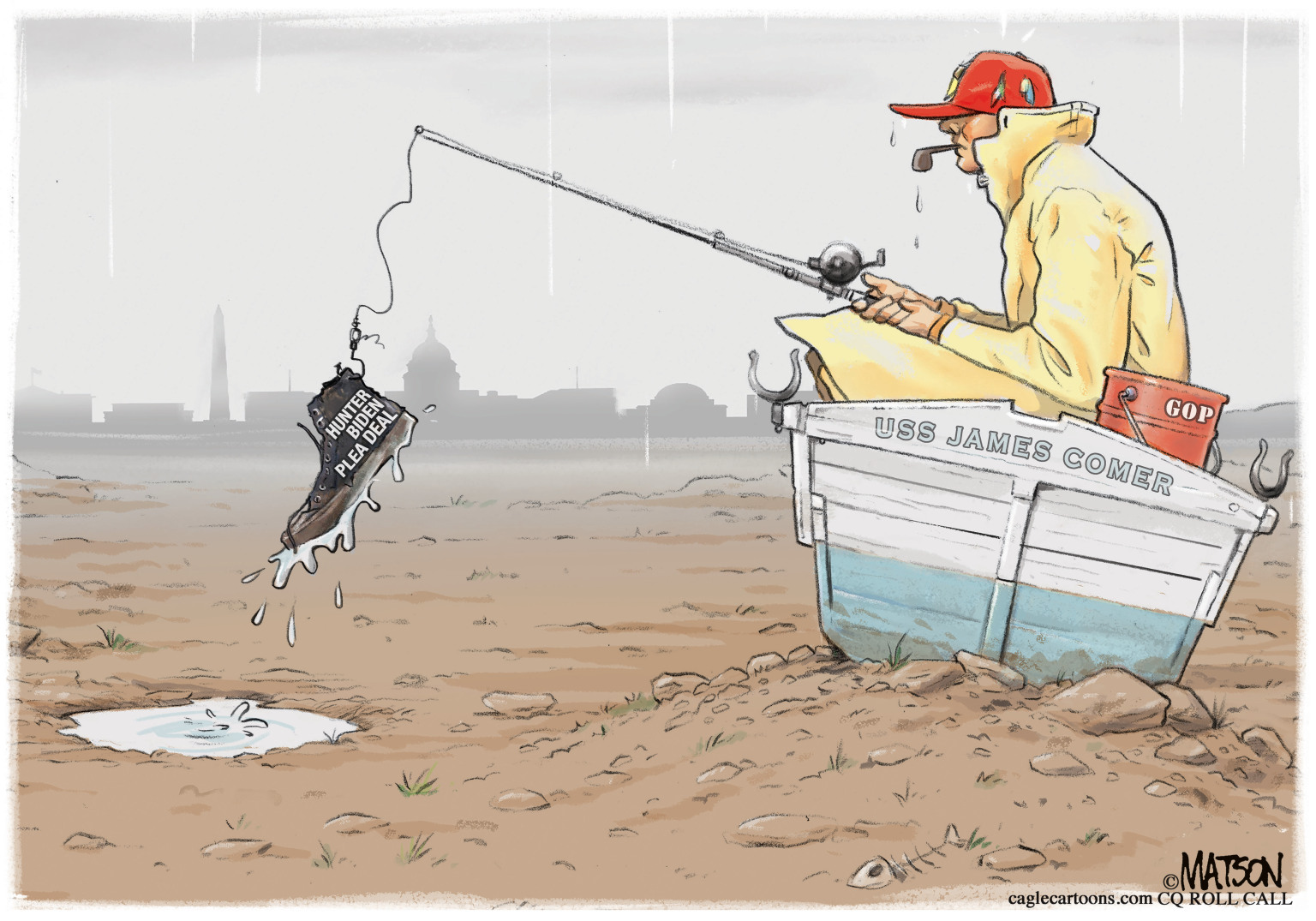
Successful Republican candidates ran on the issues of inflation and crime, so McCarthy immediately unveiled a legislative program to address those problems. NO, I’M KIDDING. Republicans immediately starting talking about investigating Hunter Biden.

At a press conference on Thursday, when a reporter began to pose a question about the plans of the coming Republican majority that was not linked to the Biden family, [incoming Chair of the House Oversight Committee James] Comer, from Kentucky, sprang forward to say, “If we could keep it about Hunter Biden, that would be great.”

This investigation is supposed to own the libs somehow, but I don’t know any Democrats who actually care about Hunter (other than, I assume, his Dad). Hunter is a private citizen who (unlike, say, Ivanka and Jared) has held no position in his father’s administration. In four years, the Trump Justice Department somehow failed to prosecute Hunter for anything, and there’s already a DoJ investigation and a grand jury hearing testimony about him in Delaware. But if McCarthy thinks the House can do better, he should have at it. (BTW: Marcy Wheeler’s opinion is that the “Hunter Biden laptop” is a forensic mess.)

If Hunter does wind up in jail someday, though, I don’t see that outcome having any effect on the country or even the government, other than making the President sad.

McCarthy promises investigations plural, but again, little in the way of legislation that will offer Republican solutions that the Democratic Senate will have to respond to. Other investigations might include harassing the Department of Justice for investigating Trump’s crimes (because the Durham investigation worked out so well), promoting conspiracy theories about the origin of Covid-19, examining Biden’s withdrawal from Afghanistan, and the state of our border with Mexico (which could be interesting if Republicans look at it honestly, which I suspect they won’t).

Marjorie Taylor Greene claims that she has gotten a promise from McCarthy to “investigate Speaker Nancy Pelosi and the Justice Department for their treatment of defendants jailed in connection with the Jan. 6 attack on the Capitol.” Because, you know, they’re all political prisoners who didn’t really do anything wrong, no matter what the juries say.


Will the GOP learn anything from its disappointing 2022 results? Looking at the lame-duck agenda of the Pennsylvania House, which will flip to the Democrats in January, Amanda Marcotte thinks not.

[Philadelphia District Attorney Larry] Krasner’s impeachment is just a symptom of this larger problem. We shouldn’t expect any Republicans, anywhere, to respond to these midterm losses by actively trying to deradicalize their party. If only. They’ll just double down on conspiracy theories and lies, in a last-ditch attempt to delegitimize the voters who keep rejecting them.


Josh Hawley’s WaPo op-ed is a somewhat mixed bag, but mostly proves Marcotte’s point. The GOP’s problem, Hawley thinks, is that it hasn’t been radical enough.

For the past two years, the Republican establishment in Washington has capitulated on issue after issue, caving to Democrats on the Second Amendment and on the left’s radical climate agenda (“infrastructure”).

“Caving to Democrats on the Second Amendment” is a reference to the very modest (and very popular) reform bill passed in June, which increased background checks for gun buyers under 21 and made it harder for domestic abusers to own guns. (Hawley is welcome to propose a “give guns back to domestic abusers” bill if he wants.) And I wonder what his alternative to “the left’s radical climate agenda” is. Let it burn?

The positive side of Hawley’s article is that he wants Republicans to stop threatening Social Security and Medicare, and siding with Big Pharma on insulin prices. But then there’s this:

Republicans will only secure the generational victories they crave when they come to terms with this reality: They must persuade a critical mass of working class voters that the GOP truly represents their interests and protects their culture. [my italics]

When he wrote the phrase “working class”, Hawley left out the modifying phrase “older White Christian”, which is clearly implied. A government that “protects the culture” against change is the essence of Orbanism, which appears to be the new model for Republican authoritarian government. That agenda is not just anti-immigrant, but also pro-fossil-fuel, pro-Don’t-Say-Gay, anti-trans, anti-voting-rights, and against any attempt to tell school children about America’s history of racism. I don’t think younger voters support that agenda, even in the White Christian working class.


What happened to the Impeachment 10, the ten Republicans in the House who voted for Trump’s second impeachment? Only one, Dan Newhouse of Washington, got re-elected. Dan Valadao of California got renominated and leads, though his race still hasn’t been called.

Four retired: Adam Kinzinger of Illinois, Anthony Gonzalez of Ohio, Fred Upton of Michigan, and John Katko of New York. Gonzalez’ district got eliminated when Ohio lost a seat after the 2020 census. Republicans held Kinzinger’s and Katko’s seats, but lost Upton’s.

Four lost primaries: Liz Cheney of Wyoming, Tom Rice of South Carolina, Jaime Herrera Beutler of Washington, and Peter Meijer of Michigan. Republicans held Cheney’s and Rice’s seats, but lost Beutler’s and Meijer’s.

So: One re-elected. One re-election still undecided. One seat eliminated. Four seats held by new Republicans. Three seats lost to Democrats. So Trump mostly got the scalps he was after, but at a cost to his party.

and Nancy Pelosi

She was going to have to give up the speakership anyway, now that the Republicans have won the majority and will take over the House in January. But she also announced that she won’t run to lead the House Democratic caucus, a position she has held since 2003. She has been speaker twice, 2007-2011 and 2019-2023.

Progressives like to bash Pelosi for favoring moderate positions, but I can’t think of an example during her speakership of a progressive bill that passed the Senate but got stuck in the House. If some part of the Obama or Biden agenda had a legitimate chance to become law, Speaker Pelosi passed it. She is widely given credit for the legislative maneuver that pushed ObamaCare over the finish line after the Democrats unexpectedly lost their filibuster-proof Senate majority.

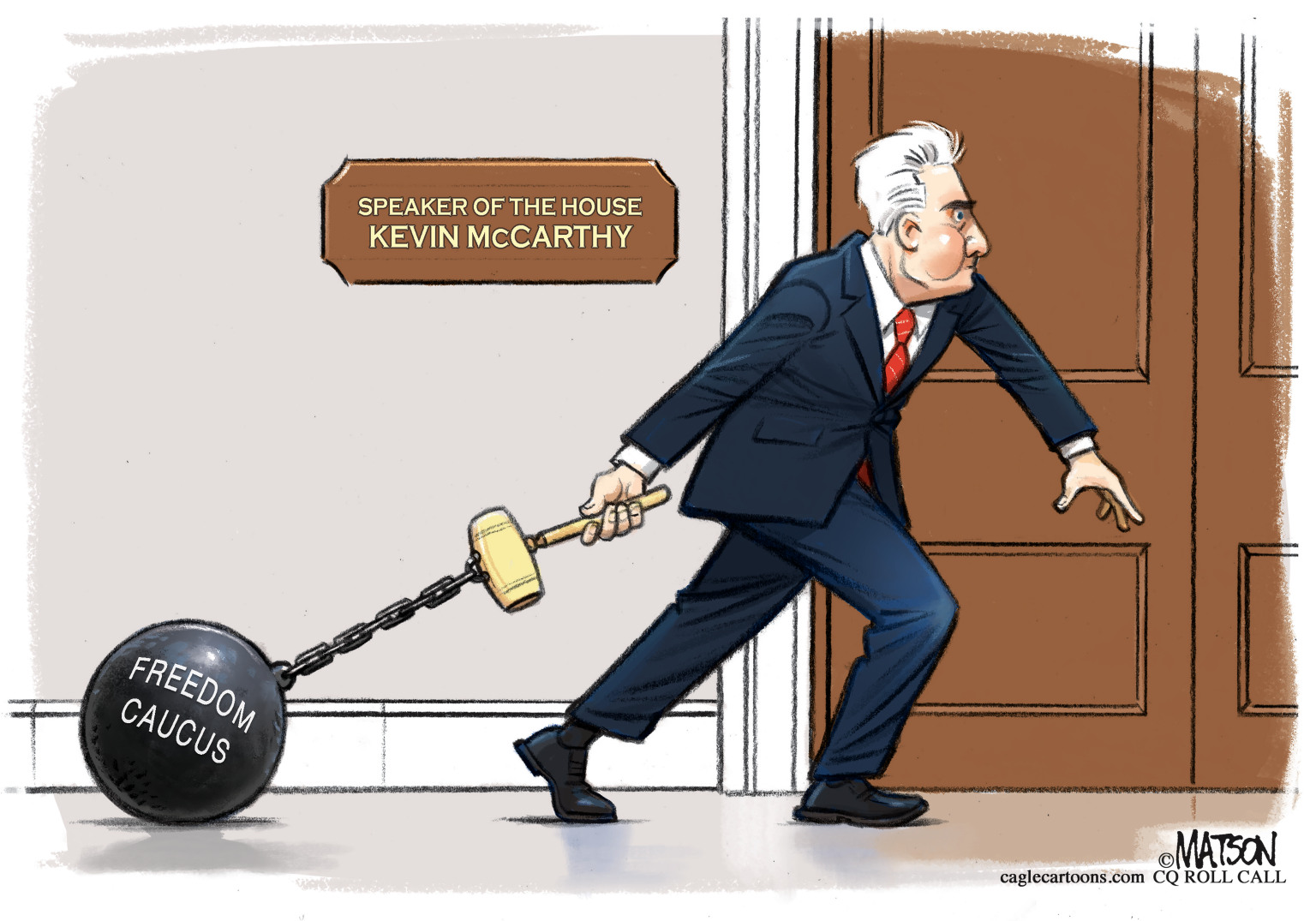
I think Kevin McCarthy is about to show us just how difficult it is to be speaker when you have a narrow majority. (John Boehner and Paul Ryan had trouble governing with much larger majorities, or even predicting what their caucus was going to do.) Like Ginger Rogers matching Fred Astaire’s moves backwards and in heels, Pelosi has made speakership look easy these last few years, but it’s not.


It’s not just Pelosi stepping aside, but also her second and third in command, Steny Hoyer and James Clyburn. That clears a path for a new generation of Democratic leaders. The new minority leader is likely to be Hakeem Jefferies, a 52-year-old from New York. 58-year-old Katherine Clark of Massachusetts and 43-year-old Pete Aguilar of California are likely to join him in the Democratic leadership.


Pelosi’s resignation speech on the floor of the House included a classic Pelosi insult-by-omission.

It has been my privilege to play a part in forging extraordinary progress for the American people.  I have enjoyed working with three Presidents, achieving historic investments in clean energy with President George Bush, transformative health care reform with President Barack Obama, and forging the future – from infrastructure to health care to climate action – with President Joe Biden.

Wait. Wasn’t some fourth guy president during part of her speakership? Give me a minute. His name is right on the tip of my tongue.

and Trump

The featured post looks at the convergence of several Trump stories this week: the announcement of his candidacy, the surprisingly cool reaction that announcement got, Merrick Garland naming a special prosecutor to investigate Trump, and Elon Musk reactivating Trump’s Twitter account, which it’s not clear that he’s going to start using again.

and Twitter

This week Twitter continued to hemorrhage users, engineers, advertisers, and cash. MarketWatch reports on the engineers:

Elon Musk’s managerial bomb-throwing at Twitter has so thinned the ranks of software engineers who keep the world’s de-facto public square up and running that industry insiders and programmers who were fired or resigned this week agree: Twitter may soon fray so badly it could actually crash.

Musk ended a very public argument with nearly two dozen coders critical to the microblogging platform’s stability by ordering them fired this week. Hundreds of engineers and other workers then quit after he demanded they pledge to “extremely hardcore” work by Thursday evening or resign with severance pay.

The newest departures mean the platform is losing workers just at it is gears up for the 2022 FIFA World Cup, which opens Sunday. It’s one of Twitter’s busiest events, when tweet surges heavily stress its systems.

The Wall Street Journal describes the money situation:

Nearly 90% of its revenue last year came from advertising, and it traditionally has been the company’s main source of revenue. … The exodus of advertisers poses a threat for a company so reliant on that revenue stream. “As an online ad company, you’re flirting with disaster,” said Aswath Damodaran, a finance professor at New York University’s Stern School of Business. … Market-research firm Insider Intelligence Inc. recently cut its annual ad-revenue revenue outlook for Twitter by nearly 40% through 2024.

Meanwhile, Twitter has interest payments to meet. Musk financed $13 billion of his $42 billion purchase by loading the company with debt. That debt is at higher interest rates because the credit rating has dropped.

As for users, I am regularly seeing messages from my Facebook friends telling me their new Mastodon address. I rarely use Twitter for anything other than posting links to Weekly Sift articles, but I will probably try out Mastodon soon.

I’m thinking that this might turn into a big enough disaster to change the culture. Going forward, it’s going to be really hard to make the case that billionaires are rich because they’re so much smarter than the rest of us.

and you also might be interested in …

There was a lot of fear in the air Tuesday when a missile crossed the Ukrainian border and hit inside Poland. What if this was a deliberate Russian attack, a warning shot telling NATO to stop supporting Ukraine? Would NATO have to respond somehow? If it did, would we be be on some kind of tit-for-tat escalation path towards World War III?

Apparently not. The currently accepted theory is that Russia’s missile attacks on Ukraine led the Ukrainians to fire air defense missiles. One of those went astray and landed inside Poland, killing two people.

During the coverage of this incident I learned that Russian misfires (which this strike now appears not to be) are more and more likely as the war goes on. Russia has used up nearly all of its most accurate missiles and is now shooting off whatever it has left. For example, they’ve started using anti-aircraft and anti-ship missiles against land targets.

Strikes from a Russian S-300 air defense system “don’t have the ‘oomph’ to really hit hardened military targets and they don’t have the accuracy in a land attack role to even strike the building you want to hit,” [Ian] Williams [of the Center for Strategic and International Studies] said. “This really is just firing them into the ether and seeing where they land.”


It’s still too soon to say anything conclusive about the shooting at a Colorado Springs LGBTQ club Saturday night, but it has all the marks of a hate crime.

While no motive in the shooting has been disclosed by authorities, the violence comes amid heightened tensions for the LGBTQ community. Several drag events around the country have drawn protests and threats, with some protesters carrying firearms, and more than 240 anti-LGBTQ bills were filed in the first three months of this year, most of them targeting trans people.


The COP-27 climate conference in Egypt was a mixed bag. The decision to create a loss-and-damage fund is big, but the commitment to phase out fossil fuels didn’t happen.

and let’s close with something epic

A strangely acquired taste is the Epic Rap Battles of History on YouTube. My favorite so far is Eastern vs. Western philosophers.

When can I stop writing about Trump?

Maybe soon. Trump-related stories were all over the news this week,
but they point towards a future where Trump may not matter.


I didn’t want to write another Trump post this week, but the convergence of headlines was hard to ignore. This week:

  • Trump announced his 2024 candidacy.
  • Republicans and conservative media were surprisingly cool about a Trump candidacy.
  • Merrick Garland named a special prosecutor to investigate/prosecute Trump.
  • Elon Musk restored Trump’s Twitter account.

So I guess I have to pay attention.

Has he finally jumped the shark? Last week I was skeptical that the GOP was finally getting over Trump. Sure, he endorsed a string of bad candidates who lost winnable races, and a statistical analysis indicated that MAGA Republican candidates for Congress ran about five points behind non-MAGA Republican candidates. And yes, Ron DeSantis’ surprisingly large victory margin in Florida supported the idea that he is a winner while Trump is a loser. So it wasn’t all that surprising that a few GOP leaders and conservative pundits began inching away from the Former Guy.

A week ago, I wasn’t buying it. Republicans have tried to move away from Trump before — most recently after he incited a mob to attack Congress in an effort to hang onto power after losing the 2020 election. But it never lasts. After January 6, it took about three weeks for Kevin McCarthy to go from wanting Trump to resign to making a Mar-a-Lago pilgrimage. Why should this time be different?

But this week, maybe I am buying it. I’m at least examining the possibility. Trump announced his 2024 candidacy Tuesday, and the response was not what either he or I expected. No major network carried the whole speech live: Fox and CNN started to, but then cut away as Trump rambled. The Fox coverage was particularly Orwellian: As Trump droned on, the network’s talking heads enthused about the greatness of the event they had stopped broadcasting. “This was an absolutely brilliant speech,” Mike Huckabee proclaimed, using the past tense to describe something that was still happening, “the best I have heard him give in a long time.”

Most news outlets ran articles on the speech, but they were more skeptical than thrilled or horrified. The snarkiest was Rupert Murdoch’s New York Post, whose cover said “Florida Man Makes Announcement, page 26”. Trump had probably pictured his fans cheering and his enemies trembling in fear or outrage. But I don’t think he expected so many people to laugh.

The Democratic response is also telling. Democrats worry about whether Biden is up for another run, about who could replace him if he isn’t, and about whether younger Trumpists like DeSantis or Youngkin might be harder to demonize than the Mar-a-Loser. Beating Trump, on the other hand, is a familiar challenge. We did it before, we’ll do it again.

Et tu, pastor? Apparently even Evangelical leaders are jumping off Trump’s sinking yacht.

“He used us to win the White House. We had to close our mouths and eyes when he said things that horrified us,” [televangelist Mike] Evans wrote. “I cannot do that anymore.”

Had to? The supposed heirs to the tradition of the Prophet Nathan and John the Baptist had to bow down to Trump. And the spark causing Evans to turn away is not some new outrage that he just can’t stomach — or even a straw that finally broke his back — but Trump’s loss of power and influence.

What might be happening. Here’s my theory: The hard-core Trump cultist worries about being a loser, but in his mind he becomes a winner by identifying with the ultimate winner, Donald Trump. As the classic children’s hymn “Jesus Loves Me” puts it: “They are weak, but He is strong.” Trump is fighting the same dark forces that the cultist blames for his own disappointments, but Trump is going to defeat them.

Trump constantly stokes this identification, claiming that people who attack him are really attacking his followers, as if his followers had been assaulting women, taking money from foreign governments, or stealing classified documents.

But what if Trump starts to look like a loser himself? He rolled through the 2016 primaries, then in November unexpectedly won in the Electoral College in spite of losing the popular vote by millions. When he lost bigly to Biden in 2020, he said he really won, and his cult agreed to believe that story. But in 2022, Trump’s candidates lost all over the country. (And this is where the Trump cult’s anti-Biden and anti-Democrat propaganda boomerangs: How could all those MAGA Republicans possibly have lost? Biden is senile. Fetterman is a vegetable after his stroke. Everybody hates Gretchen Whitmer because of her Covid tyranny. How did they win? How did they beat Trump?)

So you lose once and claim the other guy cheated. OK, maybe. But you can’t go to that well over and over. The message has to be: “The other guy cheated me, and I’m going to make him pay.” If you can’t make him pay, if you get cheated again and again — then you’re just like the rest of the losers.

What happens then? I don’t expect Trump’s followers to turn on him because he has stopped winning. But I do think their enthusiasm starts to fade, because he’s not delivering the ego boost they need any more. So maybe they just quietly drift away.

Establishment Republicans hope someone like DeSantis can excite the base without reproducing Trump’s embarrassing transgressions, but I don’t that’s going to work. Trump’s trangressiveness is an irreplaceable part of his appeal. He does whatever he wants. He calls Mexicans rapists, cheats the taxman, taunts his opponents with playground nicknames, grabs women by the pussy — and gets away with it all. That’s what being a “winner” means to Trump’s base.

Telling it like it isn’t. The Atlantic’s David Graham made another good observation about the difference between Trump 2024 and Trump 2016. In spite of all his exaggerations and lies, Trump 2016’s appeal

was built on his willingness to speak the supposedly obvious facts that other politicians would not. He would tell voters that the political system was rigged toward donors. He would say that free-trade policies had harmed many Americans. If they were racist or xenophobic, he’d speak their truths, too. The central appeal was common sense, even when it was neither common nor sensical.

But Trump 2024 asks his followers to disbelieve things they can see and misremember events they lived through.

Consider this account of his presidency from the announcement speech: “Two years ago when I left office, the United States stood ready for its golden age. Our nation was at the pinnacle of power, prosperity, and prestige, towering above all rivals, vanquishing all enemies, and striding into the future confident and so strong … There was never a time like this … When the virus hit our shores, I took decisive action and saved lives and the U.S. economy.”

Some people might want to remember 2020 that way, but few will be able to manage it.

The special counsel. Friday, Attorney General Merrick Garland appointed Jack Smith as special counsel to investigate events related to January 6, and also to the classified documents and presidential records found at Mar-a-Lago. In his press conference, Garland said:

Based on recent developments, including Trump’s announcement that he is a candidate for president in the next election, and the current president’s intention to be a candidate in the next election, I have concluded it is in the public interest to appoint a special counsel.

This announcement has both optimistic and pessimistic interpretations for people who want to see Trump held accountable for his crimes. The pessimistic interpretation is that Merrick Garland is adding his name to the list of people who couldn’t manage to nail Trump. James Comey couldn’t do it. Bob Mueller. The first and second sets of impeachment managers. The January 6 Committee. And now Merrick Garland. He passes the baton to Jack Smith — and why should Smith do any better than the previous investigators?

Andrew Weissman, who was part of the Mueller investigation and wrote the book Where Law Ends about it, believes this time is different.

The new Special Counsel, unlike Special Counsel Mueller, WILL be able to indict Trump as he is no longer POTUS and WILL NOT have to worry about being fired from one day to the next by sitting POTUS. And he inherits a large amount of evidence and a team that is in place already. The new Special Counsel also will not have to overcome, as Special Counsel Mueller did, Trump’s dangling presidential pardons to thwart cooperation with the investigation. Or using DOJ to stymie and misrepresent the investigation.

New York magazine’s Intelligencer column presents a more balanced view: However it unfolds, this process is still going to take a long time. The big timing decision for Smith to make is whether to indict Trump quickly for the Mar-a-Lago documents — a fairly simple case that is nearly ready to go — or to wait until a more complex January 6 investigation is complete and charge everything at once.

Trump and Twitter. And speaking of sinking yachts, Elon Musk arbitrarily announced the reactivation of Trump’s Twitter account Saturday evening. Trump had been banned from Twitter because he misused it to foment violence on January 6, and seemed like to misuse it again. To me, that logic still holds, but apparently not to Musk. He had previously said that the no major reinstatements would happen until he could convene “a content moderation council with widely diverse viewpoints”. But never mind. Musk posted a poll Thursday and announced the result Saturday.

Anyway, at the moment all this means is that Trump’s old tweets are available again. Trump has not tweeted anything new yet, and his agreement with Truth Social (which he at least partially owns) puts restrictions on what he can post on other social-media platforms. So we’ll see what happens.

He may be worried about returning to Twitter only to see it quickly declare bankruptcy, which Musk has floated as a possibility. There’s a limit to how much failure his public image can stand to be associated with.

The Monday Morning Teaser

I’m getting really tired of writing about Donald Trump, but this week I feel like I don’t have a choice. In quick succession, he announced his 2024 candidacy, a lot of high-profile Republicans and conservative pundits refused to endorse that candidacy, Merrick Garland appointed a special counsel to investigate and possibly prosecute Trump, and Elon Musk reactivated Trump’s Twitter account.

So here we are, I’m writing about him again. That article should be out around 10 EST or so.

In other news, the new Congress is finally taking shape. Democrats retain control of the Senate while Republicans claim the House by a surprisingly narrow (and still undetermined) margin. The new House leadership wasted no time announcing its extensive legislative agenda, which centers on … wait for it … Hunter Biden. I can hardly wait, and I can already feel America’s greatness returning.

Meanwhile, House Democrats are turning over their leadership, as Nancy Pelosi promised four years ago.

The collapse of Twitter continues apace. I’ll be interested to see if Trump starts posting again. Can two sinking ships hold each other up?

The missile that crossed the Polish border caused a lot of angst, but after investigation it looks like a Ukrainian misfire rather than a Russian provocation. So we’re not heading into World War III in the near future. And the climate conference in Egypt closed to mixed reviews.

I’ll try to get the weekly summary out by noon.

Every County

Every county, every vote. … I never expected that we were going to turn these red counties blue. But we did what we needed to do. And we had that conversation across every one of those counties. And tonight, that’s why I’ll be the next U.S. senator from Pennsylvania.

John Fetterman

This week’s featured post is “Notes on the midterm elections“.

This week everybody was talking about the midterms

That’s the subject of the featured post.

I noticed this too late to include in that post, but it perfectly illustrates how unlikely MAGA Republicans are to learn from their mistakes. Like their object of worship, they don’t make mistakes, so how could they learn from them?

The American Greatness blog has put its finger on who’s to blame for MAGA candidates’ failure: the voters.

The problem here is voter quality.

The picture we got from Tuesday is that of a decadent, vegetative electorate easily swayed by platitudes and sentimental appeals, fervently attached to its entitlements. … Republicans performed well with married men and women—the people who should be the center of our civic life, while Democrats dominated with unmarried women and the twitchy, nihilist Gen Z. 

Again: voter quality.

The writer only expects things to get worse “after another 10 or 15 years of mass immigration have taken their toll”. He doesn’t say it, but the obvious answer is to give up on democracy entirely and take power by force.


David Frum recalls how after 2016, reporters from the “liberal media” went on tours of small-town diners to connect with the white-working-class voters that had surprised them by turning out for Trump. Lots of liberals (me, for example), read J.D. Vance’s Hillbilly Elegy in an attempt to understand. He wishes MAGA Republicans would do something similar now, but he doesn’t believe they will. He quotes historian Bernard Lewis:

The question, ‘Who did this to us?’ has led only to neurotic fantasies and conspiracy theories. The other question—‘What did we do wrong?’—has led naturally to a second question, ‘How do we put it right?’ In that question … lie[s] the best hope for the future.

and Twitter

It’s been stunning to watch how quickly Elon Musk has destroyed his reputation as a great businessman. The problem in a nutshell is that Twitter’s revenue comes from advertising, and most advertisers hate to have their ad next to hate speech. It’s just a bad association. So they got spooked when Musk described himself as a “free speech absolutist” and fired Twitter’s content-moderation people. That flight of advertisers tanked the company’s revenue, and now Musk is floating the possibility of bankruptcy.

One of the more interesting takes on this situation comes from Josh Marshall. Marshall’s TPM site used to be supported by advertising, but after years of trying to make an advertising model work he moved to a subscription model. (His Twitter article is behind his paywall, so I’ll quote liberally.)

Because of that, for upwards of fifteen years I had to deeply immerse myself not only in the advertising business generally but in the niche of advertising in political media. It was a huge part of my work for years and I had to understand it really, really well — because the existence of TPM depended on it. …

When I first got into advertising, TPM was hot. We had a big audience and it was pretty clear that it was just a matter of agreeing to sell this lucrative ad space. Our audience was educated, fairly well off. We would print money.

I soon realized it was quite a bit more complicated.

It’s not just that advertisers don’t want to be near hate speech or awful things. It goes way beyond that. They want to tell you about their brand when you’re in a good, comfortable, feel-good moment.

He points out that the Drudge Report had a huge audience for many years, but it never had high-quality advertisers, because it was “hot and contentious” and left its readers in an “agitated state”.

This aspect of the advertising business is actually a big, big reason for what we sometimes call “bothsides” journalism. This is often presented as an outmoded style of journalism. It’s really more a business model. In a politically polarized society advertisers are very, very cautious about giving any hint that they are taking sides in the great political or political factional controversies of the day.

So while it may look like Musk has gotten into the social media business, actually he has gotten into the advertising business, which he doesn’t understand.

He wants to be the world’s biggest troll, play to his new far-right/Trumpy fan base and have all the high dollar national brand advertisers flock to the platform he just wildly overpaid for. That was always an absurd proposition.


Wish I’d said this: “Buying Twitter is Musk’s invasion of Ukraine.” Guys who surround themselves with people who believe they are geniuses eventually start doing stupid things.


Wired explains how Twitter has become a “scammer’s paradise“.

and Ukraine

Ukrainian troops have taken Kherson, a key Black Sea port that the Russians occupied in the early days of the invasion. President Zelenskyy visited there today, and vowed that “We are step by step coming to all the temporarily occupied territories.”

I’m not an expert on Russian or Ukrainian culture, but I know that the folklore is full of heroes who confidently bluff and bluster. I remember Boris Yeltsin — backed by nobody in particular at the time — standing on a tank outside the Parliament building and announcing that he would see the leaders of the ongoing coup brought to justice. It worked.

It’s hard to imagine a bigger contrast of imagery than Zelenskyy touring a front-line city versus Putin sitting alone at the end of his long table. One of them is a folk hero and the other isn’t. I have to think that the people of both countries see that.


Last week I linked to Masha Gessen’s warning in The New Yorker that Putin might really use nukes. Now Alexander Gabuev is saying something similar in The Atlantic.

and Trump’s legal situation

Getting past the midterms has reawakened speculation about when or whether Trump might be indicted for a variety of crimes. (DoJ policy discourages indictments that might influence an election.) The source I trust most here is Marcy Wheeler. She’s been following the investigations closely, but tries to avoid making sensational claims that she’ll have to walk back later.

An indictment of Trump is not going to happen today. In the stolen document case, that’s likely true because DOJ will first want to ensure access to the unclassified documents seized in August, something that won’t happen until either the 11th Circuit decision reverses Judge Aileen Cannon’s decision to appoint a Special Master (that will be ripe for a hearing after November 17) or after a judgement from Special Master Raymond Dearie on December 16 that Cannon chooses to affirm. It’s not impossible, however, that DOJ will take significant actions before then — perhaps by arresting one or more of Trump’s suspected co-conspirators in hoarding the documents, or by executing warrants at other Trump properties to find the documents still believed to be missing.

The next most likely indictment to drop is in the fake-electors scheme, but Wheeler thinks there’s a layer of conspirators who will be indicted before Trump. Ditto for January 6. She isn’t sure what to predict about the Fulton County election-tampering investigation, which is still is fighting to get testimony from Lindsey Graham and a few other witnesses. (One objection I have to the media coverage of these battles: They’re being treated as if avoiding testifying is a normal thing to do, and few are drawing the obvious conclusion that Graham et al know things they don’t want investigators to know.)


Meanwhile, the lawyers who filed Trump’s massive (and quickly dismissed) lawsuit against everyone involved in starting the Trump/Russia investigation (i.e., Hillary Clinton, Jim Comey, and 29 others) have been sanctioned by the judge in the case. He ordered them to pay $50K to the court and $16K in legal fees to Charles Dolan, the defendant who asked for sanctions. Such sanctions are warranted under the law when a lawsuit’s claims are “objectively frivolous” and “the person who signed the pleadings should have been aware they were frivolous”.

The judge’s order says:

Plaintiff deliberately misrepresented public documents by selectively using some portions while omitting other information including findings and conclusions that contradicted his narrative. This occurred with the Danchenko Indictment, the Department of Justice Inspector General’s Report for Operation Hurricane, and the Mueller Report. It was too frequent to be accidental.

Every claim was frivolous, most barred by settled, well-established existing law. These were political grievances masquerading as legal claims. This cannot be attributed to incompetent lawyering. It was a deliberate use of the judicial system to pursue a political agenda.

But the courts are not intended for performative litigation for purposes of fundraising and political statements.


Trump’s last-ditch attempt to avoid showing his tax returns to the House Ways and Means Committee is at the Supreme Court. The six partisan Republican justices could do their buddy a solid just by dragging their feet until Republicans take over the House (assuming they do) in January. I expect the Court to avoid this unsavory option and make an actual ruling, but it’s an open question.


Trump’s former chief of staff and Homeland Security Secretary John Kelly is the latest ex-official to describe attempted wrong-doing. He doesn’t have a book to sell, but …

Mr. Kelly said he chose to respond now because Mr. Trump had publicly claimed last week that he had used the Justice Department and the F.B.I. to help Gov. Ron DeSantis win election in Florida in 2018. Mr. Kelly, who was Mr. Trump’s chief of staff at the time, said Mr. Trump never made such a request. If he had, Mr. Kelly said, it would have been an improper use of the Justice Department and the F.B.I.

(MSN fact-checked Trump’s statement and found “no evidence” to support it.) Kelly went on to describe other times when Trump wanted to misuse the IRS and other government agencies to help his friends or harm his enemies.

“I would say, ‘It’s inappropriate, it’s illegal, it’s against their integrity and the I.R.S. knows what it’s doing and it’s not a good idea,’” Mr. Kelly said he told Mr. Trump.

“Yeah, but they’re writing bad things about me,” Mr. Kelly said Mr. Trump told him.

A spokesman for Trump denied the claims, calling Kelly “a psycho”.


Meanwhile, Mike Pence does have a book to sell, so he’s finally dishing on Trump. Trump’s “reckless” words on January 6, he says, “endangered me and my family”. Maybe he should have told the Senate that during the second impeachment trial.

and you also might be interested in …

A Trump-appointed judge has blocked Biden’s student-loan forgiveness program. This case will have to work its way through the system before anybody sees debt relief.


A study in the New England Journal of Medicine compared Massachusetts school districts that dropped mask mandates to those that maintained them. Conclusion: masks work.

Among school districts in the greater Boston area, the lifting of masking requirements was associated with an additional 44.9 Covid-19 cases per 1000 students and staff during the 15 weeks after the statewide masking policy was rescinded.


Two more raped minors have had to leave Ohio to get abortions.


Remember that billion dollars Alex Jones is supposed to pay to the Sandy Hook parents? That was just the actual damages. A judge has added another $473 million of punitive damages.


Dean Baker points out something important: In the early years of the 21st century, health-care spending as a percentage of GDP was headed inexorably upward. That seemingly unstoppable trend caused economists to make a lot of ominous projections. But instead health-care inflation moderated, and the percent of GDP spent on healthcare is now below where it was in 2014, when ObamaCare was implemented.

This is an example of how good government is hard to campaign on. Democrats passed the Affordable Care Act in March of 2010, and then got clobbered in the 2010 midterms, largely because Republicans were able to raise so many fears about “death panels“, rationing, and all sorts of other things ObamaCare supposedly included.

So here’s to all the Democrats in Congress who lost their seats in 2010 because they did the right thing. The purpose of having power should be to use it well, not to hang onto it.


Friday wasn’t just Veterans’ Day, it was also Kurt Vonnegut’s 100th birthday. I recently passed through Indianapolis, Vonnegut’s home town, and went to the Vonnegut museum there. I particularly enjoyed reading Vonnegut’s rejection letters from publishers, which are framed and hung on the wall.

and let’s close with something powerful

Like a fleet of snowplows. Last year, the Minnesota Department of Transportation started a contest to name new snowplows. Predictably, the big winner was Plowy McPlowface.

But now that the obvious name is out of the way, things have gotten more interesting. The next generation of plows named by the public display much more creativity.

Runner-up names are also listed. My favorite is Sled Zeppelin.

Notes on the midterm elections

Saturday night, when Nevada had counted enough votes to declare Catherine Cortez Masto re-elected, we learned that the Democrats would hold onto the Senate. They may even gain a seat, if Raphael Warnock can win the December 6 run-off in Georgia.

As of this morning, almost a week after election day, Republicans are leading in the House, but still have not nailed down a majority. 212 races have been called for Republican candidates, 204 for Democrats. 218 are needed for a majority. NBC is estimating that when all the counting is complete, the GOP will have a slim 219-216 majority. (So assuming Lauren Boebert hangs on to her current slim lead, Speaker McCarthy will lose any vote in which he can’t get Boebert, Matt Gaetz, and Marjorie Taylor Green’s support.)

In the states, Florida went very red, but both Michigan and Minnesota very blue. Democrats flipped governorships in Massachusetts and Maryland, Republicans in Nevada. Arizona is still undecided.

There’s probably a lot to learn from these results that I haven’t deciphered yet. But here are a few conclusions that seem obvious.

Voters in swing states don’t believe the Big Lie about 2020, and want to continue having democratic elections. My biggest fear about the midterms was that they would herald the end of democratic elections in the United States. But that didn’t happen. Yesterday, the NYT’s home page included the headline “Every election denier who sought to become the top election official in a critical battleground state lost at the polls“.

During the 2020 election, it was secretaries of state — both Democrats and Republicans — who stood up to efforts by Mr. Trump and his allies to overturn the results. State election officials certified vote tallies over Republican objections, protected election workers from aggressive partisan poll watchers and, in at least one case, refused a personal entreaty from the president.

The next spring, several candidates pushing the false narrative that the 2020 election had been stolen announced their intention to run to be the top election officials in critical states.

Republican candidates for secretary of state in places like Arizona, Nevada, Colorado, and New Mexico claimed the 2020 election had been stolen from Donald Trump, without basing that belief on the slightest bit of evidence. In Pennsylvania the secretary of state is appointed by the governor, and gubernatorial candidate Doug Mastriano was running as a rabid election denier (in addition to being a Christian nationalist and a barely-in-the-closet antisemite). In Georgia, incumbent Republican Brad Raffensperger had beaten back an election-denier challenge in the primary.

Victories by election-denying candidates would have opened the possibility that in 2024, MAGA secretaries of state might refuse to recognize a Democrat’s victory. If they needed no evidence beyond Trump’s say-so to declare fraud in 2020, why wouldn’t they do the same in 2024?

Fortunately, all those candidates lost. Some of the races were disturbingly close — though Mastriano got soundly thrashed — but they lost. Only Indiana chose an election-denying secretary of state. That could be a problem locally, but it’s unlikely to affect a national election, since a Democratic presidential candidate could only carry Indiana in a national landslide. (Barack Obama barely did in 2008.)

Sweeping abortion bans are unpopular. A lot of Americans have conflicted views about abortion, so the wording of a proposal matters. But if you put a broad abortion ban in front of the voters, they’ll reject it even in some pretty conservative states.

We saw that already in August, when Kansas (which Trump carried 56%-42% in 2020) held a referendum that would have given the legislature the power to ban abortion. (The state’s supreme court had found a Roe-like right to abortion in the state’s constitution. This proposed amendment would have removed that right.) The legislature scheduled the vote to coincide with a primary election that was likely to draw more Republicans than Democrats, but it didn’t matter: Turnout was huge and the proposal failed 59%-41%.

Tuesday, proposals to protect reproductive rights were on the ballot in Vermont, California, and Michigan, while voters had a chance to restrict abortion rights in Kentucky and Montana. The pro-choice side won all five.

The abortion issue is also getting credit for the Democrats avoiding the typical midterm-election-collapse of a party in power. It’s hard to say precisely why voters decide to show up and lean one way or another, but the turnout of young voters was high and heavily Democratic, and Democrats won 68%-31% among single women. Chances are that abortion had something to do with that.

[BTW, it has been hilarious to watch conservative pundits struggle not to grasp that single women don’t want the Republic of Gilead controlling their bodies and making major life decisions for them. Fox News’ Jesse Watters noted that married women tend to vote Republican, so he had a solution: “We need these ladies to get married. And it’s time to fall in love and just settle down. Guys, go put a ring on it.” One America News’ Addison Smith went even further down the patriarchal rabbit hole: “Secular progressivism has turned people into masochists. … 68% of single women voted for people who vowed to let them legally murder their children and continue on living miserable single lives without purpose, without responsibility or meaning.” Attention single women: After a quick search, I wasn’t able to determine whether Addison Smith is married, so he might still be available to bring purpose and meaning to your otherwise pointless life.]

Trump is hurting the Republican Party. He wasn’t losing any races himself this time, but he screwed up the GOP in two other ways. First, the unqualified and too extreme candidates he pushed to victory in the Republican primaries went on to lose winnable elections.

New Hampshire is a good example. Republican Governor Chris Sununu, who kept his distance from Trump, cruised to a 57%-42% victory. But Trump-endorsed election-denying Don Bolduc lost to incumbent Senator Maggie Hassan 54%-44%. Those two results are from the same voters on the same day, so about 1 NH voter in 8 must have voted a Sununu/Hassan split ticket.

Similarly in Georgia, Brian Kemp (who defeated a Trumpist challenger in the GOP primary after certifying Biden’s 2020 victory) won the governorship 53%-46%, while Trump’s handpicked senate candidate Herschel Walker faces a run-off after trailing 49%-48% Tuesday.

The second way Trump undercut the GOP was to divert attention towards himself, his petty grievances, and his backward-looking complaints about 2020, and away from issues like inflation that were working for Republicans. He doesn’t seem to realize that if the 2020 election were run again, he would get his butt kicked again. Most unpopular presidents see their images improve in hindsight, but not Trump. 54% of the public still views him unfavorably.

Conservative power brokers like Rupert Murdoch and mainstream Republican politicians like Paul Ryan see what’s going on and would like to free the party from Trump’s destructive influence, but I’m betting against them. There’s a lot of Trump-blaming in conservative media right now, but that just means it’s January 7 again. Before long, the would-be rebels will be crawling to Mar-a-Lago to kiss the ring, as they did only weeks after January 6. The NYT’s Jamelle Bouie agrees with me:

The idea that Republican elites could simply swap Trump for another candidate without incurring any serious damage rests on two assumptions: First, that Trump’s supporters are more committed to the Republican Party than they are to him, and second, that Trump himself will give up the fight if he isn’t able to win the party’s nomination.

I think these assumptions show a fundamental misunderstanding of the world Republican elites brought into being when they finally bent the knee to Trump in the summer and fall of 2016.

But Jonathan Chait disagrees. It’s different this time, he says, because Ron DeSantis provides a real alternative.

Either way, it’s going to be ugly. Trump has already shown that he will try to burn down a democracy that won’t re-elect him. No one should be surprised if he burns down a party that won’t re-nominate him.

Gerrymandering matters. For years, voters in Michigan have voted for Democratic candidates for the legislature, only to see Republicans keep control. But in 2018, Michigan voters reestablished democracy in their state by overwhelmingly passing Proposal 2, which created a nonpartisan redistricting commission. Tuesday was the first election held under the new nonpartisan maps, and Democrats won majorities in both houses for the first time in almost 40 years.

Compare Michigan to Wisconsin, which is still heavily gerrymandered in Republicans’ favor. Democratic Governor Tony Evers was re-elected with 51% of the vote, and Republican Senator Ron Johnson was re-elected with just over 50%, suggesting an evenly divided electorate. But Democrats narrowly avoided a veto-proof Republican supermajority in both houses of the legislature, which would have made Governor Evers virtually powerless.

Both parties gerrymander when they can, because it’s political suicide to let the other side play by different rules. (Though no Democratic-controlled state mirrors Michigan, with an entrenched Democratic legislature thwarting a Republican majority in the electorate.) But Democrats want to end this game: An anti-gerrymandering provision was part of the For the People Act, which has passed the House in 2019, 2020, and 2021, only to be blocked by Republican filibusters in the Senate. A scaled-down proposal, the Freedom to Vote Act, was put together by Senators Manchin and Klobuchar. But it also was blocked by a filibuster.

The stuff Biden did is way more popular than Biden himself. The pundits predicting a red wave were fooled by Biden’s low approval rating: 41.5% in the latest 538 average, barely higher than Trump’s 39.9%. Normally, a president with numbers like that sees his party get clobbered in the midterm elections.

But Friday, Chris Hayes made an interesting comparison to 2010, when there really was a red wave. In 2010, the Democratic Congress had just passed ObamaCare, and it was very unpopular. (Since it hadn’t taken effect yet, Republicans could claim anything they wanted about it, and they did.) The way Republicans ran against Democratic incumbents that year was simply to point to that vote.

Nothing in this cycle played that same role of connecting Biden’s unpopularity to specific votes in Congress. If Democrats got criticized for voting for the Inflation Reduction Act, they could say, “Yes, I lowered your prescription drug costs, invested in renewable energy, and created jobs for American workers.” The bipartisan infrastructure bill? “Yes, I voted to rebuild America’s roads and bridges, bring broadband internet to rural areas, and replace lead water pipes that have been poisoning our children.” American Rescue Plan? “I voted to get Americans vaccinated, send money to people who couldn’t work during the pandemic, and give loans to businesses so they wouldn’t have to fire people.”

And so on.

So sure, Americans are frustrated with inflation, and Republicans were able to fan people’s fears about rising crime and a few other issues. But how could challengers pin those problems on the incumbent senators or representatives they were trying to replace? And while 2010 Republicans could promise to repeal ObamaCare, what exactly were 2022 Republicans proposing to do about inflation, crime, or anything else?

Polls are more-or-less accurate if you don’t expect too much out of them. I’ve seen a lot of the-polls-were-wrong-again punditry, but I don’t think it’s deserved.

Take the Georgia Senate race, for example. 538’s final pre-election analysis said that Herschel Walker had a 63% chance of winning, with a predicted margin of 1.2%. But now that the votes have been counted, Warnock holds a .9% lead. (Warnock is still short of 50%, so a run-off is happening December 6.)

So Nate Silver’s prediction was off by 2.1%. You can’t really expect pre-election polling to be more accurate than that.

At best, a poll is a snapshot of where the electorate was a day or two before the election, accurate to within some margin of error. Averaging a bunch of polls (as 538 does) should shrink that margin, but not to zero. And as for people who decide at the last minute to vote (or not vote), or who change their minds in the booth — there’s really no accounting for them.

In short, the right response to the Georgia outcome is not “538 was wrong to say Walker would get more votes, because Warnock did”, but “538 said the race was going to be close and it was.”

That’s why the model said “63% chance”. Just for reference, NBA star Giannis Antetokounmpo is currently hitting 65% of his free throws (well below the league average of around 78%). That’s better than a coin flip, but when he steps to the line, Bucks fans are holding their breath rather than counting the points.

Is a more accurate system possible? Well, maybe, but you won’t like it. I suspect that somewhere in the basement of Meta headquarters, somebody has developed an algorithm that predicts how each of Facebook’s tens of millions of users will vote. (For most of us, it wouldn’t be that hard.) Facebook users may not be absolutely typical of the electorate, but the differences are probably not difficult to model and compensate for after you review the data from a few election cycles. And on election day, if the app on your phone is tracking your location, it knows whether you went to the polls.

Facebook’s huge sample base would eliminate nearly all the statistical error. Since it’s a spying algorithm rather than a request for information, you couldn’t just refuse to answer, eliminating another source of polling error. And in order to lie to the algorithm, you’d have to change your whole online behavior, which hardly anybody is going to do. The algorithm’s estimates would always be up to the minute, and in the end it would know a lot about who voted.

I’ll bet that system could be pretty accurate.

Expert speculation, on the other hand, isn’t worth the attention it gets. All that talk of a “red wave” didn’t come from the polls. 538’s generic-ballot polling average finished with a Republican advantage of 1.2%, which would lead a person to expect a Republican Congress, but not a sweeping rejection of Nancy Pelosi’s Democrats. (Compare that margin to true wave elections: In 2010, Republican House candidates got 6.8% more votes than Democratic candidates. In 2018, Democrats did 8.6% better than Republicans.)

The red-wave speculation came from pundits, both too-optimistic Republicans and too-pessimistic Democrats.

The right lesson to draw is that we spend way too much time listening to people speculate about stuff they don’t really know. Psychologically, it’s understandable: We get anxious leading up to an election or some other big event, so we want to believe that someone can tell us what’s going to happen. Even hearing that things are going to go badly can be more comforting than facing life’s real uncertainty.

It’s also understandable from the networks’ point of view: Actual reporting is hard and can be expensive, but gathering a panel of talking heads in the studio is easy and cheap. (A lot of them have a book to sell, a candidate to push, or some other reason they want to be on your show. So you may not have to pay them at all.) By air time, an investigative reporter may or may not have cracked whatever story she/he/they has been working on, but a pundit can be guaranteed to have a speculation ready on demand.

Unfortunately, those speculations aren’t worth much. If listening to them makes you feel better, fine. But don’t kid yourself that you’re receiving valuable information. Life really is terrifyingly uncertain.

So in the end, I wind up agreeing with the conclusion of the editorial I linked to about the polls being wrong again, if you change “study polls” to “try to prognosticate”:

Voters would do well to study the issues more than they [try to prognosticate], and media would do well to provide valuable issue-oriented reporting instead of reporting on a horse race that can change minute to minute.

[BTW: If political predictions were intended to be accurate, networks would keep detailed statistics on which pundits were right or wrong, and there would be bidding wars over the ones with the best records. That doesn’t happen, does it? The red-wave predictors aren’t going to lose their jobs, and somebody who got it right isn’t going to suddenly vault to the top of the profession the way a market-beating hedge-fund manager would.]

The Monday Morning Teaser

Last week, I told you I was planning not to watch the election returns Tuesday night. I thought it would be hard, that I’d be jumpy like an addict needing a fix, and that every couple hours I would lose my resolve and check how things were going.

It wasn’t like that at all. I felt oddly serene in my news-free bubble, and went to bed with no idea what was happening. In the morning, I puttered for an hour or two to extend the sense of peace. But I knew that eventually I’d have to distort my life to avoid finding out how things were going, so I checked. Surprise! No red wave.

After nearly a week, we still don’t know which party will control the House or who the governor of Arizona will be. But we’ve learned a few things, and I’ll cherry-pick the most obvious in the featured post, which I’m calling “Notes on the midterm elections”. That should be out shortly.

The weekly summary also covers the unfolding disaster at Twitter, the Ukrainians recapturing Kherson, where the Trump investigations might go now that the pre-election pause is over, and a few other things before closing with an introduction to Minnesota’s new snowplows. I’ll aim to get that out before noon EST.

Except for all the others

No one pretends that democracy is perfect or all-wise. Indeed, it has been said that democracy is the worst form of government — except all those other forms that have been tried from time to time.

– Winston Churchill

This week’s featured post is “Can conservatives be allies against climate change?

And if you’re wondering what I did with my week off, here’s the talk I gave.

This week everybody has been talking about tomorrow’s elections

Ordinarily, the day before an election I write a guide for people who plan to watch the returns come in, including things like poll closing times in various states, which early-reporting races are likely to be bellwethers for how the night is going, and so on.

I’m not doing that this time, because I’m not planning to watch, so I’m not sure that I want to encourage you to watch. Probably I won’t be able to resist briefly turning the TV on every hour or two, but I don’t think that an all-evening watch party will be good for my health and sanity.

It’s not that I’m sure my candidates will lose, although the polls have been trending that way for the last few weeks. It’s possible that the attack on Paul Pelosi (see next note) was a wake-up call to the electorate, that Obama’s tour of swing states will make a difference, or that the polls have been undercounting young women who previously haven’t voted, but will turn out to protect their reproductive rights. So there’s reason to hope, reason to vote, and reason to do whatever you can to encourage others to vote.

The reason I’m planning to restrain myself from watching the returns is that I have a bad attitude: I’m pissed at the American people. A lot of these races shouldn’t be close. Herschel Walker, for one, should not have gotten anywhere near the Senate, and the idea that he can run (against a minister like Rafael Warnock) as the “Christian” candidate should scandalize anyone who cares about Jesus or the churches founded in his name. And Ron Johnson didn’t just wink and nod as Trump tried to overthrow American democracy, he was an active participant in the plot to count the votes of fake electors. I could go on.

I didn’t used to feel this way. When John McCain in 2008 and Mitt Romney in 2012 ran against Barack Obama, for example, I had no doubt that I wanted Obama to win. But I also saw some virtues in McCain and Romney, and I understood how someone with different values could rate those virtues higher than Obama’s virtues. (During the 2012 primaries, I wrote “The Tragedy of Mitt Romney” about the candidate he could have been.)

This year, I’ve lost that vision and that generosity of spirit. I can’t twist a few knobs in my values and picture myself supporting Doug Mastriano or Kari Lake. How does that go? “Sure, he’s antisemitic, but …” or “I know she’s against democracy, but …”

With exceptions I can count on my fingers, the Republican Party is now a personality cult, and the man they worship is a fascist. I can’t get past that.

So anyway, there are polls. Nate Silver is currently giving Republicans an 83% chance to take the House and a 55% chance to take the Senate.

The key Senate races are Georgia (where Herschel Walker has a 58% chance of defeating Raphael Warnock), Nevada (Paul Laxalt has a 57% chance to defeat Catherine Cortez Masto), and Pennsylvania (John Fetterman has a 54% chance to defeat Mehmet Oz). Whichever party takes two of those three races probably wins the Senate.

and the Pelosi attack

The narrative here is pretty simple: Republican rhetoric has been demonizing Nancy Pelosi for decades, and we’ve known for a while that some of the more unhinged right-wing partisans take that demonic image very seriously. QAnon folks, for example, promote the libel that she (and other top Democrats) drink the blood of children. Some of the seditionists on January 6 were roaming the halls of the Capitol calling “Nancy … Nancy” like villains in a horror movie.

So early in the morning of Friday October 28, the Speaker’s 82-year-old husband woke up to find a man standing over his bed with a hammer, asking where Nancy was. He said he was there to “have a little chat” with Speaker Pelosi, and later told police he intended to kidnap the Speaker and break her kneecaps unless she told him “the truth”, whatever he imagined the truth to be.

Paul Pelosi then had a bizarre conversation with the attacker, during which he managed to call 911. When police arrived, the attacker hit Pelosi in the head with the hammer. We don’t have a lot of details about his injuries, but he needed surgery and didn’t get out of the hospital until Thursday.

It’s important to be clear on what Republicans are and aren’t responsible for here. The attacker looks to be a deranged loner, rather than part of an organized fascist group like the Oath Keepers or Proud Boys, or even the men recently convicted of plotting to kidnap Michigan Governor Gretchen Whitmer. No one is accusing Trump or any of the leaders of his cult with planning or carrying out the attack.

At worst, this seems to be “stochastic terrorism” — promoting the idea that your political enemies deserve violence, while knowing that you have violent followers who are likely to respond. The classic example is King Henry II saying “Will no one rid me of this troublesome priest?“, which resulted in the murder of Thomas Becket. Henry’s hands may have stayed clean, but he knew or should have known what might happen.

Even that judgment may seem a bit harsh, until you look at how Republicans reacted to news of the attack. Their immediate reflex was to make up and promote a false narrative in which the attack had nothing to do with politics, but instead reflected badly on Paul Pelosi himself.

The flood of falsehoods showed how ingrained misinformation has become inside the G.O.P., where the reflexive response of the rank and file — and even a few prominent figures — to anything that might cast a negative light on the right is to deflect with more fictional claims, creating a vicious cycle that muddies facts, shifts blame and minimizes violence.

Donald Trump Jr. quickly tweeted a joke about the attack, and Trump Sr. told an interviewer that there were “weird things going on in that household the last couple of weeks”, as if the Pelosis had done something to invite violence. Kari Lake got uproarious laughter by telling a campaign crowd “Nancy Pelosi, well, she’s got protection when she’s in D.C. Apparently, her house doesn’t have a lot of protection.” Lake did not appear shocked by the response, and did nothing to rein in the hilarity.

What should Republicans say? Well, here’s what Bernie Sanders said in 2017 (which is how far back you have to go to find any comparable liberal political violence) after the shooter of Steve Scalise turned out to have been a volunteer for the Sanders presidential campaign:

I am sickened by this despicable act. Let me be as clear as I can be. Violence of any kind is unacceptable in our society and I condemn this action in the strongest possible terms. Real change can only come about through nonviolent action, and anything else runs against our most deeply held American values. My hopes and prayers are that Representative Scalise, congressional staff and the Capitol Police Officers who were wounded make a quick and full recovery. I also want to thank the Capitol Police for their heroic actions to prevent further harm.

No jokes, no conspiracy theories, no implications that Scalise was asking for it somehow. No excuses about how “passionate” Sanders’ supporters are, or how “angry” the state of the country has made them. Just: This is wrong. Don’t do it.

Given the upswing in right-wing violence since Trump lost the 2020 election, I’d like to hear an even stronger statement:

If any of my supporters think they’re doing me a favor by physically attacking my political rivals, they’re wrong. If you’re involved in any ongoing plots, I want you to stop.

But Trump and the other MAGA Republicans won’t say anything like that, because don’t believe political violence is “unacceptable”. Quite the opposite: They’re counting on it.

https://www.facebook.com/photo/?fbid=10230123580292973&set=a.10214282881365400

and Twitter

So, after months of stop-and-start will-he-or-won’t-he, Elon Musk finally owns Twitter. He immediately fired a lot of people and announced a lot of intentions that may not manifest for some while, if ever. There’s some evidence that trolling and hate speech have already increased in anticipation of lower standards and more lax enforcement.

My personal experience of Twitter hasn’t changed yet, so I’m in a wait-and-see mode. I’m hearing a lot of people talk about closing their account and moving to some rival platform, but there’s not a simple Coke/Pepsi or iPhone/Android replacement.

What we need is a sagacious, media-savvy voice of sanity, and I’ll nominate James Fallows. He makes a few key points in his Substack post “Twitter is Our Future“.

  • He plans to stay on Twitter for the time being.
  • He’s not going to pay a monthly fee to maintain his “blue check mark” (which verifies that he is who he says he is), because those check marks benefit the system as a whole, not him as an individual.
  • Twitter is a “bellwether” for changing media platforms in general. Many online communities are going to be displaced as media sites change, but the process is happening much faster on Twitter.
  • While individual tweets aren’t reliable sources of information, they are valuable tips about what might be happening.
  • Musk himself is “like a rich football fan buying an NFL team and imagining that he can name draft-picks and call plays.” Fallows also quotes a line from The Great Gatsby: “They were careless people… they smashed up things and creatures and then retreated back into their money or their vast carelessness… and let other people clean up the mess they had made.”
  • No single site will replace Twitter, but “there will have to be many, and we’ll blunder and feel our way forward.”

The substitute most Twitter-refugees are choosing is Mastodon, which is not exactly the same thing. I haven’t tried it yet.

and nuclear threats

If the rest of the news wasn’t depressing enough this week, The New Yorker’s resident Putin expert, Masha Gessen, warns that we need to take his threat to use nuclear weapons seriously.

In the end, every “rational” case for why Putin won’t use nuclear weapons in Ukraine falls short. He is not afraid of losing support from his current allies, because he misapprehends Russia’s position in the world; he sees Russia as politically, economically, and militarily stronger than it is. Chinese and Indian leaders may express alarm at the use of extreme measures such as nuclear weapons, but to Putin this points to their lack of resolve—their weakness, not the Kremlin’s. And, if need be, he is prepared to make outlandish denials, no matter how implausible. …

The arguments that Putin won’t use nuclear weapons because doing so would endanger Russians, including himself, are blind to the fact that Putin believes he has the right, possibly the moral obligation, to sacrifice hundreds of thousands or millions of people. The argument that a nuclear strike wouldn’t help Putin achieve his strategic goals mistakes Russia’s strategic goals as anything but inflicting terror on Ukrainians. The losses the Russian military is suffering now can only motivate Putin to create more terror, against more people.

you also might be interested in …

The week’s good news was that Jair Bolsonaro narrowly lost his re-election bid in Brazil, and it looks like he’s going to accept that he has to leave office. Brazilian election officials made an interesting choice: They avoided the appearance of election shenanigans by going with electronic voting systems that produce instant results. In the long run, though, they’ve made real voting fraud easier, because the lack of paper ballots makes the system impossible to audit.


“Already?”

Benjamin Netanyahu is poised to reclaim the prime minister’s office following the recent elections. It’s tempting to shrug and say “We’ve been here before”, but actually we haven’t. This time his coalition includes some right-wing parties that used to be beyond the pale in Israeli politics.

Some members of his likely parliamentary majority believe in Jewish supremacy and support racist policies that may ultimately change the way the state of Israel protects the rights of its citizens, whether Palestinians who hold citizenship or leftists, activists, and critics who seek equal rights for Palestinians in the occupied territory.

NYT columnist Thomas Friedman says “The Israel we knew is gone.

Netanyahu has been propelled into power by bedfellows who: see Israeli Arab citizens as a fifth column who can’t be trusted; have vowed to take political control over judicial appointments; believe that Jewish settlements must be expanded so there is not an inch left anywhere in the West Bank for a Palestinian state; want to enact judicial changes that could freeze Netanyahu’s ongoing corruption trial; and express contempt for Israel’s long and strong embrace of L.G.B.T.Q. rights.


and let’s close with something moving

When the world gets to be too much, you can always dance, even if the music isn’t from your era.

Can conservatives be allies against climate change?

They’ve given us a lot of reasons to be skeptical.
But we’re surrendering to hopelessness if we assume bad faith.


A week ago Friday, the NYT published an essay I’m still puzzling over: Bret Stephens — a Times columnist whose hiring I have always attributed to the newspaper’s affirmative-action-for-conservatives policy — wrote “Yes, Greenland’s Ice is Melting, But …“. Reading it raised a question in my mind: “Yes, conservative minds are changing, but … can they ever change enough to make them real allies?”

Anybody who has been watching this topic has seen the pattern. Over the last decade or so, conservatives who aren’t willing to deny reality completely have staged a retreat worthy of a great general, slowly falling back from one line of defense to the next. The major defense lines, as I remember them (and still run into them from time to time), look like this:

Most frustrating of all are the people who shift back and forth from between defensive positions. One day they’re admitting greenhouse gas emissions are changing the climate, and the next day it’s all a hoax again. But whatever line of defense they choose, the conclusion is always the same: Do nothing. It’s the wrong time, or the wrong tactic, or we’ll never get China and India to cooperate, or something. There’s always something.

So it’s easy to get cynical, and to assume that any conservative who briefly seems to be talking sense about the climate is doing so in bad faith. Their new understanding, whatever it is, is just the next line of defense against doing anything substantive to avert the looming disaster.

But here’s the problem with that cynicism. The people who are already convinced drastic action is necessary aren’t a big enough voting bloc to carry out drastic action.

Occasionally I’ll see polls that indicate otherwise, but those numbers are deceiving: Many will tell a pollster they support climate-change action, but then will be protesting in the streets as soon as a carbon tax makes gas prices rise or their heating bills go up. (See, for example, the “yellow vests” in France.)

So if we’re actually going to tackle this problem, we need converts — real ones who understand that sacrifices need to be made if we’re going to save future generations from much worse prospects. From there it follows that we need to welcome converts, rather than give them the third degree to make sure they’re serious enough.

What’s more, lots of people aren’t going to change their minds all at once. Road-to-Damascus conversions do happen, but they’re rare. Many who come to see the reality of the climate challenge are going to see it in stages. So while that bulleted list above may be a line of successive defenses for bad-faith pseudo-converts, it can also be a road of progress for good-faith real converts. Is your it’s-all-a-hoax cousin now admitting that temperatures are going up? Rejoice! It’s a step.

I understand that it’s frustrating as hell to stand on the deck of the Titanic and try to stay calm while people tell you it’s not time to lower the life boats yet. But if you’re not able to lower the lifeboats by yourself, what else can you do? You need to meet these people where they are and coax them into doing the right thing. That may be time-consuming and time may be short, but if there’s not a more direct path …

And that brings me back to Bret Stephens. There are lots of reasons to be cynical here. “Yes, Greenland’s Ice is Melting, But …” is laid out like a new line of defense, with the “but” seeming to lead to “we still shouldn’t do anything”. And that’s kinda-sorta where most of the essay goes. His argument is structured as a series of buts: Yes, Greenland’s ice is melting,

  • but we need to recognize clean energy’s limitations
  • but we’ve gotten better at mitigating climate disasters
  • but we need to accept economic growth as a benefit
  • but we need solutions that align with human nature
  • but we need to avoid alarmist activism
  • but the market, not the state, will solve the problem

Sounds terrible, right? I mean, alarmist is one of those right-wing boogyman words, like woke or socialist. It doesn’t have any objective definition, it’s just a pejorative that conservatives throw at people who say things they don’t want to hear. Human nature is another much-abused term, strongly related to the idea that anything I object to is “unnatural”. And greenhouse-gas emission, like all pollution, is a classic example of a market externality, a cost the market can’t see because it’s primarily borne by someone other than buyers and sellers. Markets won’t address externalities unless government restructures transactions to make the cost visible (say, by creating an artificial cost through taxation). So even a “market” solution will not be the market acting instead of the state, it will be the market acting in concert with the state.

But even after all that, Stephens concludes with a point that’s not a “but” at all.

  • The conservative movement needs to set an example for its children and prepare for the future.

A problem for the future is, by its very nature, a moral one. A conservative movement that claims to care about what we owe the future has the twin responsibility of setting an example for its children and at the same time preparing for that future. The same prudential logic that applies to personal finances, business decisions, Social Security, the federal debt or other risks to financial solvency should dictate thoughtful policies when it comes to climate.

So in other words, Stephens writes a litany of but-this and but-that, but comes around to the conclusion that we have to do something.

That conclusion made me reevaluate who all the yes-buts were for. What if they’re there not to provide further lines of defense against action, but to reassure conservatives that he’s still one of them? As in: I still believe in markets and growth, and I still look skeptically at big government programs, but I also think we have to do something about climate change. I haven’t drunk the woke liberal new-world-order kool-aid, but I think we have to do something about climate change.

Conservative media has created a caricature of climate-change activists as wild-eyed religious fanatics who support one-world socialist dictatorship, hate technology, want to take us back to the Dark Ages, and don’t care if a few billion people have to starve to death while we’re getting there.

Stephens is writing largely for folks who have bought that propaganda, so he can’t just announce that he’s become one of Them now. If he’s going to bring any part of this fan-base with him, he has to write something like this essay — as if facing reality about the climate without going insane is some brand-new position he just discovered, and you can join him there without also joining AOC, who presumably is off on some other island out there somewhere.

So what can he teach me? Respect. As I said above, I don’t think Stephens’ essay was written with me in mind, so a lot of his points don’t say much to me. But I do learn a few things.

The first noteworthy nugget is how this whole adventure started: Back in 2017, Stephens wrote a climate-change-skeptical column, which a lot of scientists denounced. One of them was oceanographer John Englander of the Rising Seas Institute.

Two years later, on a visit to New York, he wrote me out of the blue and asked to meet. Unlike most of my detractors, his note was so cordial that it seemed churlish to say no. We met the next day.

Englander is a trim, affable and eloquent man of 72 who once ran the Cousteau Society and reminds me of a bearded Patrick Stewart, albeit with an American accent. His pitch was simple: The coastline we have taken for granted for thousands of years of human history changed rapidly in the past on account of natural forces — and would soon be changing rapidly and disastrously by man-made ones. A trip to Greenland, which holds one-eighth of the world’s ice on land (most of the rest is in Antarctica) would show me just how drastic those changes have been. Would I join him?

Again, it seemed churlish to say no (though the pandemic would delay my trip by two years). More to the point, if my main objection to the climate activists was my impression of their overweening certitude, didn’t it behoove me to check my own? Where — except in the risk of changing my mind — was the harm in testing my views?

In other words, Englander made an assumption of good faith. He reached out not with insults or claims of authority, but simply said “Come and see for yourself.”

Now, most of us are not in a position to take people to Greenland. But we can approach them in a manner that offers them an opportunity to be their best selves.

That approach defuses precisely the propaganda I pointed to above. If you and I are real people, then we might have a discussion where real ideas get exchanged. But if we’re two caricatures, that’s not going to happen. So it’s important to break the frame in both directions: I’m not casting a negative image on the other person from the outset, and (because I’m aware of the caricature in their head) I’m not invoking their negative image of people like me.

Lesson 2: risk. The conservative caricature of a climate-change activist is “alarmist” — someone running around saying “We’re all gonna die!” And yes, there are a few such people; drawing undue attention to them is one way that Fox News supports the caricature. Stephens ends up restating the risk for himself:

Talk of an imminent climate catastrophe is probably misleading, at least in the way most people understand “imminent.” A continual drumbeat of alarm may do more to exhaust voters than it will to rouse them. A more accurate description of the challenge might be a “potentially imminent tipping point,” meaning the worst consequences of climate change can still be far off but the end of our ability to reverse them is drawing near. Again, the metaphor of cancer — never safe to ignore and always better to deal with at Stage 2 than at Stage 4 — can be helpful.

I’m not sure who he thinks will find this description new — certainly not most climate scientists. And how is it inappropriate to sound the alarm about a “potentially imminent tipping point” or a stage-2 cancer?

But the key point here is to recognize that people are bad at thinking about distant but high-impact risks. Stephens addresses this problem by consulting the kind of risk-assessor conservatives respect: a hedge-fund manager. That’s not where I would have gone, but he ends up getting good advice.

“If you face something that is potentially existential,” he explained, “existential for nations, even for life as we know it, even if you thought the risk is, say, 5 percent, you’d want to hedge against it.”

How?

“One thing we try to do,” he said, “is we buy protection when it’s really inexpensive, even when we think we may well not need it.” The forces contributing to climate change, he noted, echoing Englander, “might be irreversible sooner than the damage from climate change has become fully apparent. You can’t say it’s far off and wait when, if you had acted sooner, you might have dealt with it better and at less cost. We have to act now.”

Lesson 3: Purity. When you frame something as a moral problem, one temptation is to “Go and sin no more.” In other words, we’ve been harming the environment, so from this day forward we should fight against anything that harms the environment.

But there’s a problem with that: Any form of drastic climate action is going to have environmental side-effects, not all of them good. One example Stephens cites is mining: If we’re going to switch to electric cars, we’re going to need a lot more rare-earth minerals for batteries. All that mining is going to have some negative consequences, especially local ones in the mining communities.

Similarly, hydro-electric dams produce power without carbon emissions, but they also change the eco-systems of the dammed rivers. Nuclear power plants produce zero-carbon power, but leave us with a thousands-of-years waste-management problem. If regulated properly to minimize methane leaks, fracking can produce a fuel that still emits carbon, but less of it than coal.

None of those are sin-no-more solutions. They’re paths into the future that trade some environmental damages off against other environmental damages.

And this is where conservatives who actually want to solve the problem can play a role. Because while markets suck at sinning no more, if they’re properly regulated they can be good at trading some kinds of risks and harms off against others.

Purity makes for good slogans. But actual solutions are going to involve trade-offs. We’re going to have to make judgments about how much pain the public is willing to accept at any given moment, and to work as efficiently as possible within that pain-budget.

So is he serious? Maybe, maybe not. But I think we have to hope that he is, and that he is blazing a trail for some larger number of conservatives who don’t want their grandchildren to remember them as villains. The kind of action we want requires a bigger consensus than we have. So we need to gather converts wherever we can find them.