Tag Archives: books

Why everything seems to be getting worse

Cory Doctorow’s recent book not only outlines how “enshittification” works, but lays out solutions.


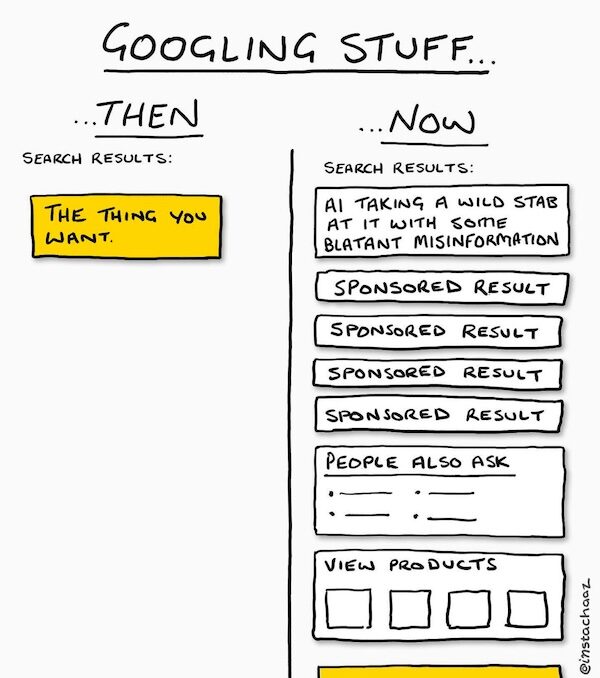
The problem with Google. Recently I was trying to plan an upcoming trip to Paris. Having heard warnings that the Louvre can book up, I set out to buy advance tickets online. Googling “Louvre tickets” took me to louvre-museum-tickets.org, where I was unable to find the 22-euro tickets the guidebook assured me existed. Instead, I was offered significantly more expensive options that combined a Louvre ticket with something else, like an audio guide or a Seine cruise.

Eventually I realized that (in spite of the .org suffix) I wasn’t really on a Louvre web site, but had found an independent ticketing agency. So I googled “Louvre official site”, which took me to another overpriced ticketing agency (paristickets.com) that wasn’t the Louvre. Only after I clicked “Hide sponsored results” did I find the Louvre’s actual site louvre.fr and its English-language page at louvre.fr/en. That’s where the 22-euro tickets were.

In other words, Google knew what I wanted, but just chose to show me something else because it could make more money that way.
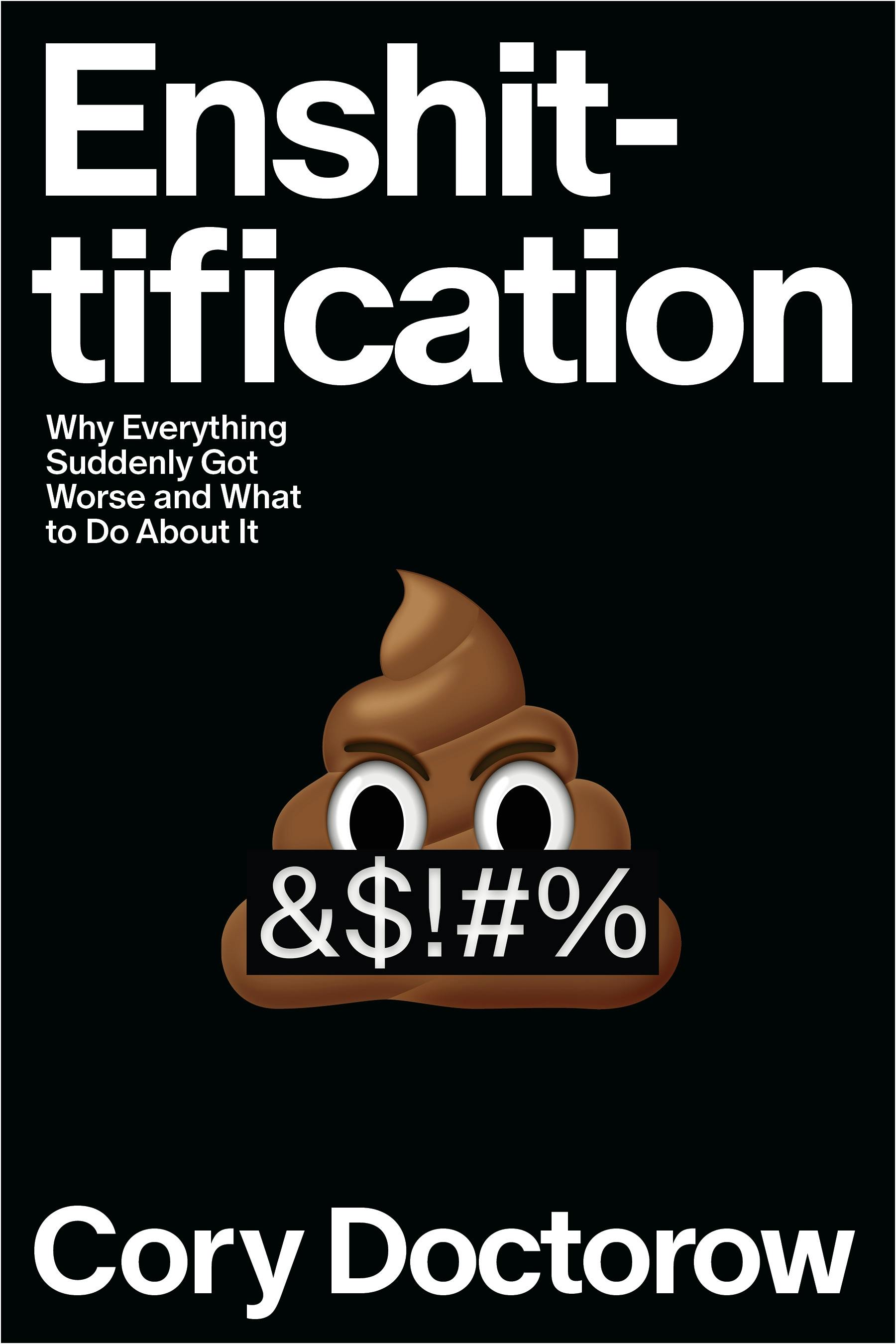
I was experiencing Step 2 of a process Cory Doctorow calls “enshittification”.

  1. First, platforms are good to their users. They become popular for good reasons. Either through network effects or because monopolistic business practices eliminate competition, they become hard to leave.
  2. Because users don’t want to leave, the platform can degrade their experience to make things better for its business customers. It becomes an essential business tool.
  3. But now businesses can’t leave either, so the platform can degrade their experience as well, capturing all the value for itself.

The result, Doctorow claims, is “a giant pile of shit” that makes lots of money while serving no one.

Not so many years ago, the Google algorithm was a revelation. Previous search engines like Altavista might have produced a many-thousand-entry list of every site that mentioned “Louvre”, leaving me to come up with more search terms to narrow it down. Finding what you actually wanted on such lists was a bit of an arcane art. But Google went right to it. At the time, it seemed miraculous.

That was Step 1 Google. But little did we all realize that providing a valuable service was just a means to an end. Eventually, Google became rich enough to buy the default-browser slot in nearly every app you might use. (Google pays Apple about $20 billion a year to be the default in Siri and Safari.) Since then, Google has no need to give users anything like the value it used to. It has enshittified itself.
Uber, Amazon, Facebook. Doctorow gives plenty of other examples. Uber, for one, used to simply match people who were willing to pay for rides with drivers who were willing to drive them. There was enough slack in the middle for Uber to take a cut while making a good deal for both riders and drivers.

Since then, though, Uber has been gathering data about both riders and drivers, so it has an informational advantage over both. So its algorithm can drive hard bargains in both directions: It simultaneously makes good guesses about both the highest rate you might be willing to pay and the lowest rate a driver might be willing to take. So enshittified Uber captures nearly all of the surplus value its app creates.

Similarly, Amazon’s search engine isn’t trying to find you the best product at the best price. Instead, it’s using everything it knows about you to pitch you the highest-margin product you might buy. Simultaneously, it’s charging manufacturers the most they might be willing to pay to get their products moved up the list Amazon shows you.

But the enshittified platform I feel the most nostalgia for is Facebook. In the early 2010s, Facebook showed you what your friends posted, including the links they thought you should look at. That wasn’t just good for you and your friends, it also created an engine for launching viral blog posts. If you posted a link to something, all your friends saw it. Enough of them might repost it to reach a new layer of readers, and a chain reaction might ensue.

That made Facebook an ally of any aspiring blogger. Every now and then, a Weekly Sift post would hit escape velocity and take off. Two posts in particular went viral, The Distress of the Privileged in 2012 and Not a Tea Party, a Confederate Party in 2014, accounting for more than a million page views between them. When I delved into the details of those page views, a large majority of them came via Facebook.

A few years later, I was noticing that it had been a long time since I’d had a 100K post. And then I connected that fact with the option Facebook had been giving me to “boost” my posts for a fee. In other words, if I paid them money, they would do what they used to do automatically — show my posts to all my friends. I refused to pay, and the numbers kept dropping. Today, a Sift post that gets a thousand views at weeklysift.com is a big deal. (This doesn’t count the six thousand or so people who subscribe and get posts by email. I have no idea how many of them read those emails.)

The viral path is still there — I still have friends and friends-of-friends and so on. But (without a monetary “boost”) the Facebook algorithm snuffs out would-be viral posts the way a control rod stops chain reactions in nuclear reactors: Some percentage of my friends never see my posts, some percentage of friends-of-friends don’t see my friends’ attempts to share my work, and so on. So the chain reaction dies out.

Bloggers of all types noticed this phenomenon in the mid-to-late 2010s. And simultaneously, Facebook users noticed that their feeds were filling up with crap: advertisements, links from major-media outlets, posts from famous people kinda/sorta in their echo chamber, and some stuff that defied explanation.

I just did a quick count: Of the first 20 items on my Facebook feed, only 3 are from my friends.

It isn’t just capitalism. You might think that this is just capitalism. Of course middlemen try to charge their customers more and pay their providers less. “Buy low, sell high” and all that; it goes back to the beginning of markets. But that doesn’t explain why enshittification has taken over everything at precisely this moment. Doctorow argues that we’re in a new economic age: the Enshittocene, or the Great Enshittening.

And yes, this is a sort of capitalism. But technology has created new avenues to enshittify products at precisely the same time that the forces containing enshittification have eroded. Corporations are enshittening their products because they can. But why can they? And why particularly now?

When a whole population starts to change in the same way at the same time, it’s a sign that something external and systemic is underway. Rather than looking for the origins of enshittification inside the companies, we should look at the world the companies operate in.

Doctorow identifies four forces that could punish or control an enshittifying company, and finds that they have all weakened in recent years.

  • competition. If a company is taking too much advantage of its users or clients, they’ll go somewhere else, if they can. But anti-trust enforcement has weakened considerably, allowing monopolies, near-monopolies, and collusive agreements like the one through which Facebook and Google set rages for online advertising.
  • regulation. Governments can establish enforceable rules on a company’s behavior. But de-regulation has been in vogue since the Reagan administration.
  • self-help. Users or other companies can create work-arounds to avoid the most onerous features of an enshittified platform, like the third-party ink cartridges for HP printers. But many work-arounds are now treated as illegal hacking or copyright infringement by laws that the software industry lobbied to pass. For example: What if a new e-book reader gave you the option to leave Kindle or iBooks and take your books with you. That would be illegal; it violates Amazon’s or Apple’s intellectual property.
  • worker power. Many tech workers have a dedication to visions of an idealistic mission. Enshittification is not part of that vision, so workers have often resisted it. But the job market in tech has worsened considerably in recent years. If you don’t want to go along, they can easily find somebody to replace you. “Axing twelve thousand Googlers in 2023 and thousands more in 2024 was a small price for Google to pay to allow managers total discretion about when they’d cheat and how. It was a price Google paid gladly, and we’re all living in its aftermath.”

Solutions. All the policies that created the opening for enshittification are reversible. Antitrust enforcement can be strengthened to break monopolies. Regulation can police anti-competitive behavior. The laws that prevent interoperability and competitive hacking can be weakened or repealed. Privacy laws can prevent companies from accumulating data about their users and transparency laws can force them to reveal information that current apps make invisible (like what other Uber drivers are getting for driving similar routes).

Doctorow has a lot to say about each of those paths, and how they can be done in ways that work in the real world. That’s all a little too detailed for me to cover here, and why you might want to read the book.

Enshittification destroys the capitalist myth. If you read the Wall Street Journal or listen to speakers from Heritage Foundation and other pro-capitalist institutions, you’ll often hear arguments based in the Cold War struggle against the Soviet Union: Communist governments claimed to be all about the worker and the common person, but long-term they strangled economic growth and made their whole society poorer. By contrast, the capitalist West out-produced Soviet-bloc countries and created a widely shared prosperity. You may not like the economic inequality that goes along with capitalism, but in the end even the people near the bottom are better off than they would be in a society that didn’t let anyone get rich.

If you delve into why that should be, you’ll get an answer something like this: When inventors and entrepreneurs create better ways of doing things, they can’t capture all the benefits for themselves. Invariably, the gains spill over into the rest of society.

So: Thomas Edison got rich from his light bulb, but consumers got reliable cheap lighting, cities became safer, and Edison used his wealth to fund research into more inventions that produced more social benefits.

But here’s the problem: Those days are over.

Inventors and entrepreneurs don’t produce widespread benefits out of generosity. They do it only when they have no other choice. From their point of view, every benefit of their innovations that they don’t capture for themselves is an inefficiency.

As we get deeper into the Enshittocene Era, the big tech companies and their billionaire/trillionaire owners get more and more efficient at capturing the benefits of technological progress. As the era goes on, the benefits of capitalist innovation get less and less widespread. Wealth inequality stops being a side-effect of the system and becomes the central feature.

Technology used to promise us products that would get better and better every year: Faster and cheaper computers with more memory running programs that seemed like magic.

But that’s not our primary experience of tech any more. Now we deal with Google and Facebook and Uber and Amazon and a host of other enshittifying corporations. Every day their products get worse, require us to look at more and more things we’d rather not see, and cost more.

The AI-driven future. Now we’re supposed to be dazzled by the promise of AI. AI tools like ChatGPT and Claude are free to play with and sometimes produce amazing results. Yes, it must cost something (maybe a lot) to provide that free service, but companies are burning through investor capital to make it happen.

We all know that can’t last. Eventually, AI tools will lead to more complex systems that can only be navigated by AI agent. Then the free service will end, and you’ll need to pay a subscription fee in order to participate in the economy. And then the AI agents themselves will begin to turn on you. They won’t find the best deals or the best arrangements for you, but they’ll channel you into paths that the AI producers want you to walk.

Don’t start depending on AI until you’ve fully imagined enshittified AI.

An answer for the economists. One of the mysteries economists are confronting right now is why people think the economy is bad. GDP keeps rising. Wages are more-or-less keeping pace with inflation. Unemployment is low. So what’s the problem?

According to a report from Yahoo Finance, consumer sentiment is near historic lows even as objective measures of well-being have reached all-time highs.

Maybe enshittification is the answer. All around you, the world is less and less responsive to your wants and needs. More and more, you have to jump through somebody else’s hoops just to do things you used to take for granted. Maybe it doesn’t show up in your paycheck and isn’t fully reflected in the prices you pay. But every day you are confronted with a world that is not as good as it used to be.


Beth Macy Goes Home Again

The author of Dopesick goes back to her small Ohio home town and wonders: Could a troubled teen do today what she did decades ago? Maybe. But the hurdles to jump are higher now.


In the Broadway musical A Little Night Music, a minor character sings a poignant song about hope and hopelessness in the serving class. In “The Miller’s Son“, the verses argue with the chorus, as a kitchen maid alternately dreams of a better life and realizes that the only pleasures available to her are momentary ones that lead nowhere.

Her opening thought is that “I shall marry the miller’s son, pin my hat on a nice piece of property.” Each verse lets the fantasy run a little wilder: “I shall marry the businessman, five fat babies and lots of security”, and then “I shall marry the Prince of Wales, pearls and servants and dressing for festivals.” Of course, if the pleasures of the moment lead to a pregnancy, none of that is possible. But was it ever possible? She ends by bitterly repeating “I shall marry the miller’s son”, recognizing that for her such a match is no more likely than the Prince of Wales.

Beth Macy is 60-something now. She came from a poor family with an alcoholic father in the small town of Urbana, Ohio. She studied hard in school and was a good if unspectacular student. She went to college on a Pell Grant, became a journalist, and (eventually) an author of several best-selling books — one of which, Dopesick, about how corporate greed led to an opioid crisis in small-town America, was made into an Emmy-winning miniseries.

Her life, from one point of view, is the quintessential American rags-to-riches story we like to tell children: Work hard, don’t give up, and you can make something of yourself, no matter how unlikely that may seem at the moment. Abe Lincoln went from a log cabin to the White House; you can too.

But in her new book Paper Girl, Macy goes back to Urbana and (over a period of years) interviews everyone from her relatives to troubled high school students to the mayor. The main question on her mind: Is the path that she walked still open today? Along the way she learns a lot about hopelessness in the White working class, its turn to the political right, and political polarization in general.

Getting a degree. The quick answer to Macy’s original question is: The path is still open, but much narrower and more treacherous than it was in her day.

She follows several of Urbana’s young people who grew up in difficult circumstances, and runs into the same story again and again: They have the talent and ambition to get out of poverty and possibly make it in the wider world, teacher and other mentors are rooting for them, but something comes up. Juggling a job, school, and ongoing family trauma gets to be too much. Or some close relative needs care and has no one else to provide it. Or maybe it’s something as simple as a car repair they have no money to cover; the fifty miles to the state university turns into an insurmountable obstacle.

Almost as bad as the immediate problems is the fatalism they lead to: Of course something would come up. People don’t actually walk the path to education or training and a secure future any more. It was never in the cards for them to marry the miller’s son.

What reminded me of “The Miller’s Son” was how the get-educated path can sound just as improbable as the make-the-NBA or become-a-rap-star path. People have done it, but could you do it? Is it worth making sacrifices (and asking others to make sacrifices for you) to keep that dream alive?

Politics. So what changed between the 1970s and 80s and the 2020s? Part of it is political: As a society, we stopped investing in education. When Macy got her Pell grant, it was a free ticket to college, but it no longer is. Once, Pell grants were how we made real the promise of America, and we told ourselves (truthfully) that a college grad’s increased lifetime earnings would lead to income tax payments that more than reimbursed the government for its generosity. But during the miserly years of the Reagan revolution (and Clinton’s ratification of much of that course change), poor young people in college became just another kind of welfare queen.

And as federal support was drying up, colleges themselves have gotten more expensive, largely because states pay a much smaller part of the costs of their state university systems. Financial aid shifted from grants to loans, so that a graduate might start a career with six-figure debts. And if you didn’t graduate — if, say, something came up that knocked you out of college — you’d have almost as much debt but not the degree to help you pay it off.

Piling on further, the degree itself is not worth as much in the job market. Even a STEM degree might not help you if the job market is looking for some other kind of STEM degree the year you graduate. (For example, the freshmen who chose a computer science major four years ago may not have realized they’d have to compete with AI algorithms for entry-level jobs.)

I’m not sure anybody is asking this question, but they should: What kind of program would it take to make the promise of America real today?

Family. Macy quickly notices the symptoms that students’ lives have changed: High school graduation rates are down. Attendance is down. Ohio’s liberalized homeschooling laws make even those numbers look better than they actually are, as parents who can’t get their children to school and are sick of dealing with truant officers sign a paper saying their child is being homeschooled. No one checks that the child is actually getting an education.

Meanwhile, public schools are losing funds to Ohio’s private-school voucher program, which makes private schools less expensive for the well-off without truly making them accessible to the poor.

Of course, homeschooling only works if home is working. And here we run into the opioid crisis Macy chronicled in Dopesick. She tells stories of teens who either couchsurf or are homeless through high school, because one parent is a drug addict and the other is in jail. It’s hard to say whether there is more sexual abuse than in Macy’s teen years, but there is certainly a lot of it. Paying attention to trigonometry or Shakespeare is probably not at the forefront of many students’ minds.

Many teachers, counselors, and coaches try to step into the breach, but it’s too much for them. A gay man who runs a teen center wrangled a grant out of the state, but couldn’t get the local government to sign off on it because of homophobic fears that he was “recruiting” teens into the gay lifestyle.

Community. In Macy’s day, Urbana was a more integrated community, at least in the sense of class. One way she coped with her dysfunctional family was by spending a lot of time with friends whose families were thriving. But increasingly, Urbana is siloed into the haves and have-nots.

Urbana is basically the country club and the ghetto, and neither group has any idea that the other group exists.

So a present-day Beth Macy may not know about those thriving families or be invited into their homes. She might not hear friends’ professional-class dreams and wonder “Why not me?”

A journalist herself, who began her career writing features about local characters for local newspapers, Macy sees great significance in the decline of local journalism: Urbana’s main local news outlets are Facebook pages and advertising sheets that publish press releases rather than news stories. How do Urbana’s people hear about folks unlike themselves? How do they find out about events happening outside their silo?

The results are twofold: On the one hand, Urbana’s citizens have lost their town as a source of identity, causing them to seek identity in politics or religion. On the other, they have lost a sense of their fellow citizens as Us, and have a corresponding willingness to accept conspiracy theories about Them.

Polarization. Urbana, and in particular its working-class population, is among the victims of globalization. The family business that once was the town’s major employer was long ago sold off, and most of its jobs have gone overseas. When Bill Clinton was pushing NAFTA and similar once-Republican free-trade policies, the promise was that new jobs would replace the old jobs, and that the overall benefit to the American economy would allow us to invest in retraining the displaced workers.

That never worked out. The new jobs weren’t where they needed to be, and the retraining rarely prepared the displaced workers adequately. Most of them wound up working in places like WalMart and never regaining the financial stability the old jobs had offered. Many found ways to retire early or claim disability.

So when Trump tells such people that they’ve been forgotten, he’s not wrong. Much of what he tells them after that is false; the Haitians in nearby Springfield were never eating the local dogs and cats. But having seen them and offered at least some explanation of their situation gets him in the door. When he offers to deport the immigrants who are “stealing their jobs”, that’s at least a plan of some sort.

Now connect that with the sense of hopelessness in the young people: They can’t hope to get the jobs their parents or grandparents had. Getting post-high-school training and going on to land the good jobs that still exist — that seems like a pipe dream, not a realistic plan. Parents can’t look forward to their children having a better life than they did.

One of the questions “Make America Great Again” always raises is “When was the great age that ‘again’ promises to restore?” The obvious answers raise issues of racism and sexism: Was America great during Jim Crow? Was it great when women couldn’t get a credit card without their husbands’ signature? When gays had to be in the closet? When?

And yes, MAGA has always been tainted by a background scent of bigotry. But fundamentally, “again” appeals to the feeling among White working-class families that Americans like them used to have hope. Those dim memories make them feel entitled to hope, and to recognize that they don’t have it now.

Someone must have taken it from them.

That’s the opening that Q-Anon and other conspiracy theories exploit. Macy recounts many conversations with relatives or high school friends who have bought some form of conspiracy theory. When Macy tries to offer facts, she is told “You can’t trust the media.” And she replies “But I am the media.” If this provokes any cognitive dissonance in people who ought to trust her, it’s not enough.

That disconnect is, I think, typical of the college/non-college divide. If you went to college, and even moreso if you went to graduate school, you have a sense of the accessibility of expertise. I may not know Anthony Fauci, for example, but I know biologists who understand infectious diseases. There was a point in my life where I could have gone into biology or climate science or a discipline at the center of some other alleged conspiracy. When would the conspirators have read me in? Why don’t my friends ever tell me about such moments?

But if you didn’t go to college, those disciplines may seem so distant that literally anything could be happening there.

Privilege. I think I also understand now why the MAGA working class is so hostile to any “woke” talk about White privilege or male privilege. Again, racism and sexism probably play some role, but maybe not the main role.

It’s always been the habit or ruling classes to rob Peter to pay Paul. If a ruling class has a debt, chances are it will steal from someone else to pay it, like the United States taking Liberia to offer to freed slaves. I mean, God forbid that those who profited from slavery should shoulder the cost!

Integration of public schools followed a similar pattern: Well-to-do Whites thrust that social experiment onto working-class Whites, while either moving to upscale suburbs or sending their own children to private schools.

So if recognition of privilege takes hold, who will be asked to pay the debt owed to the un-privileged groups? White or male MAGAts anticipate being handed the bill themselves, and not being able to pass it on to the billionaires. And they’re probably not wrong.

How to win them back? For too long, Democrats have tried to depend on Truth to win out: Climate change is real. Privilege exists. Immigrants benefit the economy. Cutting rich people’s taxes never works out for those who aren’t rich. And so on.

What we miss is that Truth will not win out if the Truth is hopeless. If the Truth is: “You’re screwed. Try to get used to it”, that Truth will not win elections for us, even if the other party offers transparent nonsense.

We need to recognize the hopeless parts of America and begin speaking to them. We need to begin offering plans for them and their children and their communities to have futures they can believe in.

Two Glimpses into the Future

Will American democracy survive after Whites become a minority?
And will the super-rich care whether civilization survives at all?


Following 2020 and 2022 elections, a number of articles have suggested that Democrats losing their hold on Hispanic voters, a development portrayed in liberal circles as something ominous that needs to be fixed. For years, the increasing number of Hispanic Americans was thought to promise Democrats some sort of demographic inevitability, and now they seem to be blowing it.

I’m of two minds about this line of thought. On the one hand, no segment of the electorate should be taken for granted, so the complaints that Democrats are offering Hispanic voters “noble rhetoric but never a seat at the table” deserve serious attention.

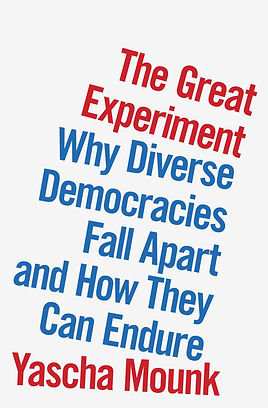
On the other, the whole emerging Democratic majority argument now seems wrong-headed, for reasons that Yascha Mounk spells out in the The Great Experiment: Why diverse democracies fall apart and how they can endure.

Mounk is deeply worried about the possible future in which we have a White Party and a People of Color Party. If the major-party identities get fixed in such a tribal way, he has a hard time seeing how democracy in America avoids devolving into civil strife, as it has in, say, Lebanon. Democracy should be about voters who are open to changing their minds when the other party presents a compelling vision, not about rival blocs you are born into and never leave. In a racially-defined two-party system, neither party can hope to convince the other’s voters, so they will end up competing in less positive ways.

To the extent that the parties themselves believe in demographic inevitability, they start to take their own demographic groups for granted and cast the other party’s demographic groups as enemies. You can see this happening already among MAGA Republicans, who see the coming non-White majority as a “Great Replacement” of White people, and try to head off that threat by rigging the system so that the dawning non-White majority never achieves power: stop non-White immigration, stop non-White immigrants from becoming citizens, make it hard for non-White citizens to vote, herd them into gerrymandered districts that minimize their political strength, and so on. Some on the right are ready to jettison democracy entirely rather than face a future where Whites lose power.

Many Democrats, on the other hand, fail to see why they need to win Hispanic votes. I mean, they’re Hispanics. What’s wrong with them if they can’t see which party they’re supposed to support? Conversely, White Evangelicals get written off, and they shouldn’t be. There are good Christian reasons to support liberal policies, and that argument needs to be made.

But Mounk is an optimist in that he believes the melting pot is still bubbling, at least for some groups. The original ethnic majority in the US was English, then Northern European (minus the Irish), and then grew to include Eastern and Southern Europeans (plus the Irish). (Jews, I think, are a special case — assimilated in some ways but not others, and still a political identity in a sense that Italians and Poles no longer are. Jews are separate enough that Doug Mastriano would try to make an issue of Josh Shapiro’s religion in the 2022 Pennsylvania governor’s race. But they’re accepted enough that he failed by a wide margin.) So why couldn’t it also absorb Hispanics, Asians, and Muslims? He thinks that’s starting to happen, and sees it as a good thing: There should be no need for either a White Party or a People of Color Party.

When their race or religion stops being a defining characteristic, Hispanic, Asian, and Muslim political views may come to more closely resemble the rest of the country. Hispanic businessmen, for example, may start to vote like other businessmen, Hispanic Catholics like other Catholics, and Asian or Muslim professionals like other professionals. If Republicans stop casting non-Whites and non-Christians as enemies, people of any race or religion may decide that they prefer lower taxes, less regulation, and other traditionally Republican policies.

Mounk glides over what this means for Black people, whose path into the mainstream has always been more difficult. (To an extent, non-Blackness has been the unifying principle of America’s ever-expanding “White” majority.) Mounk doesn’t explain why this will change, which I think is a major hole in his argument. But I believe this much of his thesis is sound: It’s a mistake to think that people will or won’t vote for you purely because they belong to this race or that religion. There’s nothing inevitable about Democratic dominance in a post-White-majority America — and that’s a good thing for democracy. Both parties would do well to recognize that fact and compete to win the allegiance of the new voters.


Another interesting recent book is Survival of the Richest: escape fantasies of the tech billionaires by Douglas Rushkoff.

Rushkoff describes himself in the introduction as a “Marxist media theorist” and “a humanist who writes about the impact of digital technology on our lives”. So he is “often mistaken for a futurist” and often finds himself at the same futuristic conferences as tech billionaires. One time he was paid to fly out to a desert compound, and discovered that the small conference he thought he would address was actually a handful billionaires who wanted advice on where to site their apocalyptic refuges and how to keep control of their mercenaries after the legal system collapses.

His book describes a fundamental change in capitalism and the capitalist mindset. Originally, the point of establishing some income-producing enterprise — a shop, a farm, a factory, or whatever — was to create something that could be passed down through the generations like a medieval fiefdom. (This is my interpretation of Rushkoff’s point, and the examples that follow are mine rather than his.) For example, I imagine Henry Ford would have been thrilled to glimpse a future in which the Ford Motor Company still existed 75 years after his death and was still a major source of wealth for his descendants. Some small-scale capitalist — let’s call him Jack — might well have a similar fantasy of a great-grandchild still owning and operating Jack’s Bar & Grill a century hence.

But recently, particularly in the tech world, the prevailing fantasy has shifted to one where you cash out. Elon Musk‘s original fortune, for example, came from co-founding Zip2 and then selling it to Compaq for $300 million. He then co-founded an online bank, which merged into PayPal, which was eventually bought by eBay.

These days, that’s what a tech entrepreneur hopes to do: turn an idea into a business that works, then sell that business and move on to the next idea. It’s as if, rather than open a Mom & Pop grocery and hope to pass it down to your kids someday, you started M&P Grocery Franchises with the idea of selling it to Walmart or Kroger in a few years.

The old model softened capitalism somewhat by connecting the capitalist to the community, because the community was the arena in which success would ultimately play out. Your shop might become a landmark, or your factory could make you a pillar of the community. Some rich families were easily identified with their cities, like the Pillsburys in Minneapolis or the Buschs in St. Louis.

The new model, though, is about transcending the community. You build a team to implement your idea. You hire workers to provide your service or build your product. And once all those relationships are established, you sell and move on.

Rushkoff refers to this as “The Mindset”, and he thinks it explains the wealthy’s disinterest in preventing possible future dystopias: My ultimate fantasy doesn’t rely on the world not going to hell, but on transcending Earth-bound society by colonizing Mars, or uploading my consciousness to the Cloud, or building my Bond-villain bunker in the wilds of Alaska (assuming I can figure out how to control my mercenaries after the legal system collapses).

[T]hese people once showered the world with madly optimistic business plans for how technology might benefit human society. Now they’ve reduced technological progress to a video game that one of them wins by finding the escape hatch.