The Monday Morning Teaser

OK, I’m back now. I had a wonderful trip back to my hometown, where I gave this talk. Sorry I neglected to announce in advance that I was canceling the October 21 Sift.

This week, there’s still a lot of shutdown-aftermath to sift through. In particular, since everything played out so precisely as the Tea Party’s critics said it would, we’re left with the question: Why did they do it? As events were unfolding, you could imagine that Cruz & Company were planning some master-stroke that the rest of us just didn’t see coming. But they turned out to have nothing. So what were they thinking?

That’s one of this week’s articles. (I still haven’t titled it.) The other is “A State-by-State Update on Voter Suppression”. In one Republican-controlled state after another, voting is getting harder and harder. And then The Daily Show’s Aasif Mandvi got a North Carolina Republican to explain why.

The weekly summary also covers the uproar about HealthCare.gov, the future-of-journalism dialog between Glenn Greenwald and the NYT’s Bill Keller, the strange case of a Wisconsin woman imprisoned for the sake of her fetus, plus a few other things.

The voter suppression article will come out first, then the Tea Party article, then the weekly summary.

No Sift This Week

Sorry for not putting out an announcement sooner. (I’m on vacation and have been driving all day.) The Weekly Sift will be back next week. Posts will appear on Monday the 28th in the general vicinity of noon (eastern time).

Apocalyptic Methods

WILLARD: They told me that you had gone totally insane, and that your methods were unsound.
KURTZ: Are my methods unsound?
WILLARD: I don’t see any method at all, sir.

Apocalypse Now (1979)
quoted Saturday by Ross Douthat, “The Kurtz Republicans

This week’s featured post: “Don’t Means-Test Medicare“. Because the first step in gutting a program is to get the rich people out of it.

This week everybody was talking about a possible end to the shutdown/debt-ceiling crisis

Little by little, the Republicans are realizing that the shutdown battle isn’t Mr. Smith Goes to Washington, it’s “The Ransom of Red Chief“. The longer this hostage crisis goes on, the more painful it is for them.

Wednesday Gallup showed the Republican Party with a 28% approval rating, down ten points from the previous month, and even lower than the 31% nadir they hit during the Clinton impeachment. Thursday, an NBC/WSJ poll said that the public blames them for the shutdown (53%-31%), while both President Obama and the Affordable Care Act have become more popular. The public says (47%-39%) that it wants to see a Democratic Congress in 2014.  To me, the most damaging result was Question 16. Asked whether President Obama was being a strong leader or putting politics ahead of what’s good for the country, the public was mildly negative (46%-51%). But the same question about congressional Republicans produced a landslide: 70% said Republicans were putting politics first.

The business community has also been weighing in against them. On shutdown eve, a coalition of 251 trade associations (including big Republican donor, the U.S. Chamber of Commerce) sent a letter to Congress:

It is not in the best interest of the employers, employees or the American people to risk a government shutdown that will be economically disruptive and create even more uncertainties for the U.S. economy.

Likewise, we respectfully urge the Congress to raise the debt ceiling in a timely manner and remove any threat to the full faith and credit of the United States government.

Thursday, the head of the American Bankers Association (former Republican governor Frank Keating) framed the debt ceiling issue the way Democrats do:

Failing to raise the debt ceiling in time would be an unprecedented mistake. … To use a credit card analogy, the decision about what to buy on credit tomorrow must take into account the debt we already owe, but that is never an excuse for not paying the current bill on time and in full.

Even the Koch brothers started pulling back (after spending an estimated quarter-billion dollars on groups that promoted this crisis). Wednesday Koch Industries sent a letter to all senators denying that they had a position on the shutdown.

The stock market never did crash, exactly, but the Dow slid from a mid-September high of 15709 to 14727 Wednesday morning. That’s when rumors started that the Republicans were going lower their ransom demands (as Red Chief’s captors did shortly before realizing how bad a situation they were in). Sure enough, defunding ObamaCare wasn’t in the demand list any more. (Aside: Doing the research on this topic is frustrating, because news articles often leave out the most important details, like what was actually proposed.)

But the idea of ransom wasn’t gone. In exchange for a six-week extension on the debt ceiling (and not re-opening the government), Ryan wanted to replace the sequester cuts (which originally were designed to be equally offensive to both parties, but which the Republicans are happier about than the Democrats) with cuts to Social Security and Medicare. So: we’ll let the hostages live another six weeks if you give us something.

President Obama wasn’t interested. Then over the weekend the Senate tried to work something out, again with smaller ransom demands. Senator Susan Collins (R-Maine) proposed to extend the debt ceiling through January and fund the government through March. In exchange she wants some lesser changes to ObamaCare (repealing or delaying the medical device tax, plus making some changes to eligibility which I can’t find spelled out anywhere).

The problem here is that that new sequester cuts go into effect in January. What the Democrats hoped to accomplish in budget negotiations was to avoid some of those cuts. That’s why the continuing resolutions they supported accepted Republican-supported spending levels, but ended before January 1. Senate Democrats view a CR that lasts until March as a concession. And what they get in exchange for that concession is to let the Republicans out of the box they voluntarily got into.

So Senate Democrats rejected that deal and proposed a clean debt-ceiling extension until after the 2014 elections, which the Republicans filibustered. Since then, stuff has been happening behind closed doors and who knows what it means. In general, the Democrats are united while the Republicans are fragmented. That makes the Republicans hard to negotiate with, because who knows what any particular leader can deliver? (The weirdest story I’ve heard is that when Senate Republicans came to the White House, they had to ask Obama what the House Republicans had proposed.)

The stock market seems edgy (down 75 when I last checked) but not panicking. Debt-ceiling disaster is scheduled for Thursday. Conservatives are still telling each other than “Obama will blink” if they push this to the edge.

As has been true from the beginning, the pundits keep telling us something will work out, but they’re not sure what the deal will be and they have no scenario in mind for how it happens. I’m making no predictions. When you push important stuff off to the last minute, sometimes it doesn’t get done, even if you really intended to do it.


The funniest commentary on the shutdown came from The Daily Show’s Jason Jones. He decided to take the ransom metaphor literally and seek advice from a professional hostage negotiator. Why do people take hostages? Jones asks.

Negotiator: In their world, they’ve tried a lot of other things, and everything they’ve tried up to that point has failed. They view themselves as extremely significant people, so they’re mystified that they’re not being followed more. And they’re hurt by it and they feel very abandoned by it.

Jones: You know, I thought calling in a hostage negotiator would kind of be funny, a funny joke, but it’s kind of incredible how this metaphor is lining up.

Negotiator: Even batshit insane has its own rules.

and trying to understand Republicans

Fascinating look at the Republican rank-and-file (summaryfull 30-page report — which is worth reading if you’ve got the time). A liberal group, Democracy Corps, ran focus groups of like-minded Republicans of three types: Evangelicals, Tea Partiers, and moderates. (I find this interesting in view of my post The Four Flavors of Republican from January, 2012. Democracy Corps’ groups seem to correspond to my theocrats, libertarians, and corporatists. The NeoCons are nowhere to be found. I wonder whether they are a beltway phenomenon with little grass-roots support, or if DC just didn’t raise foreign-policy issues.)

My takeaways: Tea Partiers and Evangelicals together make a majority of Republicans, and while they disagree on the importance of social issues, they share an apocalyptic feeling that the country may slip away from them for good unless they take drastic action now. They’re scary that way.

The role of race is interesting. The point of like-minded focus groups was to get people saying things they wouldn’t say in mixed circles. So DC expected the occasional racist remark or slur, which didn’t happen; there was no explicit racial hostility. But the America Republicans are nostalgic for and feel in danger of losing is clearly a white America. As an Evangelical man from Roanoke put it:

It’s a little bubble. So everybody – it’s like a Lake Wobegon. Everybody is above average. Everybody is happy. Everybody is white. Everybody is middle class, whether or not they really are. Everybody looks that way. Everybody goes to the same pool. Everybody goes – there’s one library, one post office. Very homogenous.

In many of the comments, blacks and Hispanics are not villains so much as pawns in the liberal plot to create pliable voting majorities by extending dependence on government. As Bloomberg’s Francis Wilkinson summarized:

Obama has extended a new entitlement to create a class of lazy, poor voters whose well-being is dependent upon the Democratic Party.

Moderates are about a quarter of Republicans. They know they don’t fit any more but can’t see themselves as Democrats. They’re pro-business and anti-regulation, but they’re also open to gay rights, admiring of science, and convinced that government only works if everyone compromises for the greater good. The current Tea/Evangelical Republican Party embarrasses them. They might well agree with Ross Douthat:

there is still something well-nigh-unprecedented about how Republicans have conducted themselves of late. It’s not the scale of their mistake, or the kind of damage that it’s caused, but the fact that their strategy was such self-evident folly, so transparently devoid of any method whatsoever.


A Methodist pastor examines the Dominionist theology that justifies tactics like the shutdown.


Political historian Rick Perlstein has been doing an eye-opening series “Thinking Like a Conservative”. Parts 1, 2, 3, and 4.

Whenever an exasperated liberal points out that the basic architecture of the Affordable Care Act matches a plan drawn up by the Heritage Foundation in the 1990s, I feel a stab of exasperation myself—with my side. Theirs is not a clinching argument, or even a good argument. It means nothing to point out to conservatives that Heritage once proposed something like Obamacare. The Heritage plan was a tactic of a moment—a moment that required something to fill in the space to the right of President Clinton’s healthcare plan, an increment toward the real strategic goal of getting the government out of the healthcare business altogether… someday.

and you also might be interested in …

The Ride for the U. S. Constitution was a vision that would put the fear of God into those corrupt left-wing politicians: ten thousand truckers shutting down the Washington beltway for the whole Columbus Day weekend, then delivering their list of demands to a sympathetic congressman, Louis Gohmert of Texas. Or maybe it would be “hundreds of thousands of truckers and millions of citizens“.

They’d convene a citizens’ grand jury (a.k.a. a lynch mob) to indict and arrest “everyone in government who has violated their oath of office” — Obama, certainly, but also Nancy Pelosi and Dianne Feinstein, among others.

They wouldn’t rely on the lamestream media to spread the word (well, except for Fox News, where Megan Kelly gave them five minutes of air time; independent media magnate Glenn Beck also pushed their cause). They’d do their own viral messaging through Facebook, Twitter, and plain old fliers posted at truck stops. The People would speak so loudly that no one could ignore them!

Of course, in America we have this other way for the People to speak: elections. We just had one last year, and President Obama was re-elected by almost five million votes. It’s not a perfect institution — Republicans retained control of the House of Representatives in spite of getting 1.3  million fewer votes than the Democrats (spreadsheet) — but it’s been working reasonably well ever since it was established in … well, it’s in that Constitution they’re riding for, isn’t it?

But if the People want to speak some other way too, that’s fine with me. (Well, other than that lynch mob thing.) So how many truckers turned out? About 30. I haven’t heard how the arrest of Nancy Pelosi went.


But you can see why We the (dozens of) People would be upset: Government spending is out of control, as this chart clearly shows:

Sorry, wrong chart. Let’s try this one:

Crap! I don’t know what’s wrong with these charts. What if we measure the size of government in employees? Then we’ll really see how out of control the octopus is.

(The peak in 2010 was for temporary census workers.) OK, but the deficit — we know that’s going through the roof. That’s what justifies the Tea Party’s hostage-taking tactics: If we don’t get control of the deficit now, our children will be debt slaves of the Chinese!

Ah, screw the data. We’re just mad as hell and we’re not going to take it any more, whatever it is.


As Congress move towards actual budget negotiations, we can expect to hear a lot of hysteria about the national debt. An opening shot was Niall Ferguson’s WSJ op-ed. Economist Brad DeLong explains why Ferguson is peddling complete nonsense.


Voter suppression: The conservative appellate judge who sustained Indiana’s voter-ID law has changed his mind:

the problem is that there hadn’t been that much activity with voter identification. Maybe we should have been more imaginative….We weren’t really given strong indications that requiring additional voter identification would actually disfranchise people entitled to vote. … I don’t think we had enough information.

Unfortunately, the Supreme Court followed him down that path 6-3.

Meanwhile, Kansas and Arizona are planning a new tactic: second-class voters. A Supreme Court ruling against an Arizona law requiring voters to show proof of citizenship apparently applies only to federal elections. So if states split elections into a federal ballot and a state/local ballot, maybe they could give only the federal ballot to voters who haven’t shown proof of citizenship. At least the Supremes haven’t said otherwise yet, so it’s worth a try.

I explained my take on voter suppression two weeks ago: The Republicans have given up on convincing a majority of the American people to agree with them, and are now focused on tactics that allow them to govern from the minority. Voter suppression, gerrymandering, the filibuster, the Hastert Rule, blocking a path to citizenship in any immigration reform, the congressional hostage-crisis we’re in the middle of now … it’s all part of the larger plan for minority rule.


The history of the Republican Party in three buttons:

Along the same lines: Listening to NPR’s interview with Bill Minutaglio, author of the new book Dallas, 1963, I was struck by how the extreme Right remains the same from one era to the next. Minutaglio says:

For some reason out in the heartland in the middle of Texas, really powerful people coalesced around this notion that Kennedy was a traitor and in fact was guilty of treason. And these weren’t just folks who were idly thinking these thoughts; they were acting on them and forming organizations and movements to essentially overthrow Kennedy. … He was perceived to be a traitor. He was a socialist, he was on bended knee to so many different entities — communism, socialism and even the pope.

We look back at that now and say, “Those people were crazy.” Today, not even the Tea Party (at least not most of it) claims that JFK was a traitor or a Communist, or that we can’t have a Catholic president because he’ll take orders from the Pope. But they don’t see the connection between that craziness and what they are saying about Obama today.


The L.A. Times has decided it’s only willing to tolerate climate-denier letters up to a point:

I do my best to keep errors of fact off the letters page; when one does run, a correction is published. Saying “there’s no sign humans have caused climate change” is not stating an opinion, it’s asserting a factual inaccuracy.


Hey, interns: Now you can be sexually harassed while you work for no pay. Is this a great country or what?

Don’t Means-Test Medicare

Sooner or later (I hope) Congress will get past self-created problems like the shutdown and the debt ceiling and start talking about something real: the long-term budget and how to pay for expensive-but-necessary programs like Social Security and Medicare. And when that day comes, one idea the Republicans will put forward is means-testing. (It’s already happening: Tuesday 51 Republican congressmen wrote to Speaker Boehner calling for “Means-testing benefits for high-income recipients of Social Security”.)

At first glance, it makes sense: The $15,000 a year that Social Security pays the average retiree may be a lifesaver to people who didn’t manage to save anything when they were working (or who did save but lost it all to fraud, accident, or a health problem), but Warren Buffett probably won’t even notice if his checks stop coming. And how much are janitors and check-out clerks putting into Medicare just so the government can pay for Warren’s cancer treatments?

Back in February, Yuval Levin put the case like this:

Democrats want to close the budget gap by having the government lean more heavily on the wealthy, while Republicans want to close it by having the government spend less money. Both sides should agree at least to spend less money on the wealthy — via means testing. It may surprise some Americans to learn that the United States spends quite a lot on the affluent, especially through the entitlement programs at the heart of the budget fight: Social Security and Medicare. Both programs move money from relatively poorer young people to relatively richer old people, and they are growing ever more expensive. Means-testing — allocating benefits according to need — might offer both sides a way out.

Levin is a conservative who used to work for the Bush administration, edits the right-leaning National Affairs, and occasionally writes for the conservative flagship, National Review. So what does he have against the rich? And why does a liberal like Paul Krugman defend those upper-class benefits?

Part of the issue is technical: When you do the math, means-testing doesn’t save any significant amount of money unless you’re cutting benefits for people considerably closer to the middle class than Warren Buffett. (Conservatives often make that case with regard to tax increases, but it’s much more true here. The top 1% make 19.3% of the national income, but I doubt they account for 19.3% of Medicare spending.)

But that can’t be the heart of it, because every little bit helps, right? Even if we’re not talking about much money, every dollar we don’t spend on wealthy people is one more we don’t have to borrow.

Here’s the heart of it: Means-testing is actually the opening shot in a much longer strategy to cut entitlement benefits for everyone. It relies on a broader principle you can see all around you: If you want to destroy a public program, first get the rich people out of it.

Think about cities with first-class public transportation like San Francisco or Washington. At rush hour on the BART or the Metro you’ll see a lot of three-piece suits, because no matter how much money you make, public transit is just a good way to get to work. But in cities with crappy systems — dirty buses that don’t come very often and don’t go where you want — public transit is mainly for the underclass. Maids and janitors take the bus to work, but bankers don’t.

Now obviously, rich people have options, so they won’t ride a crappy system. But the arrow of causality also points the other way: Systems that rich people don’t ride tend to get crappier and crappier. It’s not hard to understand why: When there’s a budget crunch, the people who decide what to cut are rich, or at least well-to-do politicians who have to answer to rich donors. If they think of public transit as something other (i.e. poorer) people use, it’s easy for them to imagine those people making do with less. But if they use it themselves, they’re going to fight to keep it operating at a high level.

Ditto for schools. In towns where everybody’s kids — rich and poor alike — go to the public high school, you can be sure the school will have a full range of options and amenities. When times are tough, the well-to-do decision-makers may not understand why poor kids need foreign languages or music or calculus. But it’s different if their own kids and grandkids are going to have to do without (and explain that deficiency when they apply to Harvard).

So if you want to kill public schools in your town, start a voucher program that draws the children of the well-to-do to private schools. That way, rich and professional-class parents — people who have the ear of decision-makers and could be articulate spokesmen for all parents — will stop taking public-school issues personally. Debates about public education will be about those people — and what can you really expect out of their kids anyway? Rhetoric about “throwing money down a rat hole” won’t offend anybody who really matters.

Imagine if we means-tested the public libraries or the parks. You could only get in if you could prove that you were too poor to afford your own books or a yard big enough for your kids to play in. I think before long we’d decide that the poor don’t need a lot of books, and if their parks are over-crowded and poorly maintained, well, what do they expect?

So yeah, let’s remove the rich people from Medicare. Let’s turn it into a welfare program, and make non-participation a status symbol. Then when we cut taxes again and create new deficits, budget-cutters can sharpen their pencils, secure in the knowledge that benefit cuts won’t hurt anybody who lives in their neighborhood. (I mean, seriously, do waitresses really need the latest chemo-therapy drugs? What do those people expect, anyway?)

On the other hand, we could let entitlements be entitlements — care you get not because you’re poor, but because you’re American. Then when future budget-cutters make their proposals, they’ll have to explain why Americans don’t deserve the best.

The Monday Morning Teaser

I don’t think you need me to tell you that the government is still shut down and we’re getting scarily close to the debt ceiling. Nonetheless, I think there’s some value in trying to sort out where the situation stands. I’ll do that in the weekly summary.

When things do start to happen, they’ll probably happen fast. And those last-second flurries of activity are when bad ideas are most likely to find their way into law. So for one particularly bad idea I’ve decided to get my protest in now, before it’s a done deal. The featured article this week will be: “Don’t Means-Test Medicare”. It should come out shortly. The thesis is simple: If you want to destroy a government service, the first thing you do is get the rich people out of it.

The rest of the weekly summary (called “Apocalyptic Methods” after a lead-in quote from Apocalypse Now) will include

  • a report Democracy Corps wrote after doing focus-groups of like-minded Republicans. It’s fascinating inside-the-locker-room talk that most liberals never hear.
  • reviewing the facts about the growth of government under Obama: spending is flat, the deficit is shrinking, and the number of government employees is down sharply. This comes as a surprise to most people, which tells you something about media bias: If the media were biased in one direction, you’d expect them to create popular misconceptions that slanted that way. So the popular misconceptions about the growth of government point to a conservative media bias.
  • the hilarious story of the Ride for the Constitution, a protest where ten thousand truckers were going to shut down the D.C. beltway all last weekend, demanding the arrest of liberal politicians who have violated their oath of office. It was going to be America’s “Egypt moment”, and millions of people around the country were going to join the protest in all sorts of ways. In reality, about 30 trucks showed up and rode around the beltway for a while, disturbing no one. Conservatives saw the lack of coverage (except for Fox, or course) as more evidence of liberal media bias; I guess because they think Anderson Cooper shows up whenever 30 liberals get together to protest something.

Burning Down the House

No visible means of support and you have not seen nothin’ yet.
Everything’s stuck together.
I don’t know what you expect staring into the TV set,
fighting fire with fire,
burning down the house.

Talking Heads

This week’s featured posts both have something to do with the shutdown/debt-ceiling crisis. “Countdown to Augustus” takes the long view, while “7 Key Points About the Shutdown” is more immediate.

This week everybody was talking about (what else?) the shutdown

Usually I try to be the calm voice in the room, and to balance the over-hyped Big Issue that the news networks fixate on by pointing out that other things are happening in the world.

This week, though, I’m probably more obsessed with the government-shutdown/debt-ceiling-default than my readers are, and I keep wondering why everybody isn’t more freaked out. Like, why is the stock market drifting gently downward rather than crashing?

I continue not to see an end to this that doesn’t involve some market-crash or riots-in-the-streets type of disaster. I don’t think the Democrats can give in without setting up more hostage crises down the road. So the only way out is for the Republicans to back down without extorting anything in return. And I don’t think they can do that, because their whole mindset says that re-assessing your position in the face of reality is weakness.

So something external has to force this. It doesn’t end any other way.


Jon Stewart has been amazing through this whole mess. It’s hard to pick a favorite, but I think I go with his Rockin’ Shutdown Eve last Monday.

and raids against al Qaeda

The U.S. launched two raids in Africa this weekend. The Libya raid successfully captured Abu Anas al Libi, allegedly a high-ranking al Qaeda guy. And the Sudan raid ran into heavy resistance, but may have killed a guy who may have been connected to last week’s mall shooting in Kenya. So far all we know is what the government is telling us, so wait and see before you draw any conclusions.

and ObamaCare

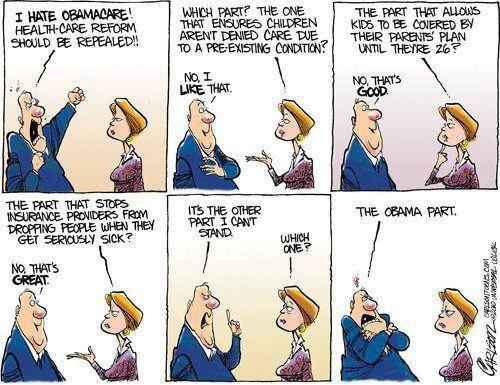
The web site had problems, as often happens as things roll out. Keep in mind that ObamaCare is fundamentally about health insurance, not about the web. So a problem about the web site is not necessarily a problem with ObamaCare.

Last week I linked to part one of Kurt Eichenwald’s Vanity Fair series on ObamaCare. It covered the lies conservatives have been telling about ObamaCare, and so had a polemic tone. It’s hard to discuss blatant lies calmly and dispassionately.

Part two is much drier: It focuses on the logic of ObamaCare, the problem it’s trying to solve, and what’s in it for you even if you already have insurance. It is full of facts about the uninsured, the cost of providing emergency care for them through our current system, why they die sooner than they should, and the uncomfortable reality that

the vast, vast majority of them are hard-working Americans who simply do not have the same salary and benefit opportunities that others might. And again, no, there are not tens of millions of higher-paying jobs with benefits sitting out there unfilled.

and you also might be interested in

Michele Bachmann claims that her decision not to seek re-election has nothing to do with the ethics charges against her 2012 presidential campaign. But AP reports this about the guy on the other side of the transaction:

Iowa state Sen. Kent Sorenson … resigned from office Wednesday after investigator Mark Weinhardt concluded Sorenson likely broke ethics rules in receiving $7,500 in monthly income from Bachmann’s political action committee and presidential campaign in exchange for being Bachmann’s state chair in 2011.

The Ron Paul campaign is also implicated. Sorenson switched his allegiance to Paul, allegedly after receiving $75,000 in what AP calls “suspicious payments that may be linked to Paul’s campaign”.


Here’s a consequence of the shutdown that is going to hit people where they live: Notre Dame might have to drop two games out of its football schedule. It’s scheduled to play the Air Force academy on October 26 and Navy on November 2. The academies are currently shut down with the rest of the government. [Tuesday update: Not really. See the comments for a correction.]


A Pro Publica investigation shows that Tylenol is not as harmless as you probably think.


Some straight talk about rape prevention:

If your advice to a woman to avoid rape is to be the most modestly dressed, soberest and first to go home, you may as well add “so the rapist will choose someone else”.


About that IRS scandal … never mind.

Seven Key Points About the Shutdown

1. This is not a pox-on-both-your-houses situation. The Republicans planned this shutdown and carried it out.

Last Monday, on the eve of the shutdown, Rachel Maddow showed the tapes of one Republican candidate after another making campaign speeches about shutting down the government and being cheered for it. That never happens on the Democratic side. No Democratic candidate for Congress tells his crowds he’s going to shut down the government and expects to get a cheer. Rachel summarized:

What is happening tonight is happening tonight because this is what Republicans want to do. This is what they promised to do. … Elect Republicans and they will burn the place down and they will laugh while they do it and have a great time.

The Daily Beast’s David Freedlander talked to a number of Republican donors from the banking industry, who said Rep. Walden (chair of the National Republican Congressional Campaign Committee, which wants their money) told them “We have to do this because of the Tea Party.” (An NRCC spokesman denies Walden said that.)

Jonathan Chait traces the Republicans’ post-2012-defeat strategy to a meeting in January.

If you want to grasp why Republicans are careening toward a potential federal government shutdown, and possibly toward provoking a sovereign debt crisis after that, you need to understand that this is the inevitable product of a conscious party strategy. Just as Republicans responded to their 2008 defeat by moving farther right, they responded to the 2012 defeat by moving right yet again. Since they had begun from a position of total opposition to the entire Obama agenda, the newer rightward lurch took the form of trying to wrest concessions from Obama by provoking a series of crises.

The first element of the strategy is a kind of legislative strike. Initially, House Republicans decided to boycott all direct negotiations with President Obama, and then subsequently extended that boycott to negotiations with the Democratic Senate. (Senate Democrats have spent months pleading with House Republicans to negotiate with them, to no avail.) This kind of refusal to even enter negotiations is highly unusual. The way to make sense of it is that Republicans have planned since January to force Obama to accede to large chunks of the Republican agenda, without Republicans having to offer any policy concessions of their own.

2. This “budget” showdown has nothing to do with the budget. Both sides agree on the spending number that should be in the continuing resolution.

That’s because Democrats agreed to the Republicans’ number. In other words, the only genuine concession in this process has come from the Democrats. John Boehner could have taken that concession, passed a continuing resolution to avoid the shutdown, and then called a press conference to declare victory. Instead he shut down the government.

3. The threat not to raise the debt ceiling is unprecedented, except for when these same Republicans made the same threat in 2011.

Posturing about the debt ceiling is perennial: “Look how profligate the party in power is. They’ve run up so much debt we have to raise the ceiling.” But making a credible threat not to raise the debt ceiling unless your legislative demands are met? No. That is an absolutely new tactic in American politics.

Slate’s David Weigel goes through all the alleged examples of the Democrats threatening the debt ceiling. In 1981, Tip O’Neil tried to get President Reagan to promise that Republicans wouldn’t use a debt-ceiling vote against incumbent Democrats in the next election cycle (i.e., no policy demands), but passed it in plenty of time. In 1984, a Democratic committee chair blocked a debt ceiling bill for one day, seeking defense spending cuts. He was roundly criticized for “brinksmanship” and backed down.

That’s it. Dozens of other times Democratic majorities in Congress have passed debt-ceiling increases proposed by Republican presidents without making an issue of it.

If Democrats accepted the tactic Republicans are using, the September, 2007 debt-ceiling increase would have been an opportunity for Nancy Pelosi to demand deficit-reducing changes like a repeal of the Bush tax cuts or an end to Iraq War. But that didn’t happen, because Democrats don’t operate by extortion.

4. Republicans have redefined he words negotiate and compromise.

ThinkProgress’ Judd Legum summed up the Republican “negotiation”:

Can I burn down your house?
No
Just the 2nd floor?
No
Garage?
No
Let’s talk about what I can burn down.
No
YOU AREN’T COMPROMISING!

In a real compromise, both sides give something and both sides get something. So far, the Democrats have been offered nothing.

In the 2011 crisis, President Obama repeatedly tried to negotiate a “grand bargain” with Speaker Boehner that would knock trillions off the long-term deficit. That failed, and the “supercommitte” negotiations that were supposed to replace the sequester failed, on the same point: Republicans insisted there could be no tax increases in the deficit reduction plan. Zero. During one Republican presidential debate, the candidates were asked whether they would accept a 10-to-1 ratio of spending cuts to tax increases. All said no.

Since April, Harry Reid has been trying to form a conference committee so that the House and Senate can work out a budget compromise. The Republicans have refused to appoint their conferees, preferring to wait until they had the “leverage” of a government shutdown and debt default. The point here is exactly what Chait said above: to extort concessions out of the Democrats without offering any concessions of their own. “OK then, half the ransom” is not a concession, no matter what Ted Cruz says.

5. The principle at stake is majority rule.

I talked about this in detail last week. Speaker Boehner wants to tell the story that the shutdown represents a disagreement between two branches of government that have conflicting popular mandates: The public elected President Obama, but it also elected a Republican House of Representatives.

That’s not what this is about at all. If it were, Boehner could bring the Senate’s clean continuing resolution to the House floor for a vote and defeat it. He can’t do that, because given the chance the people’s representatives would pass it. In blocking that resolution, Boehner does not represent the majority of the House, he only represents “the majority of the majority”, i.e. a minority.

The entire give-us-what-we-want-or-we’ll-burn-the-house-down strategy is against all American ideals of democracy. The constitutional way to pass a law (or repeal a law you don’t like) is to do what the Democrats did to pass ObamaCare in the first place: Win not just a majority in the House, but also a substantial majority in the Senate (to overcome a filibuster, which the Founders never envisioned), and win the White House (to avoid a veto). The Republicans can’t do that, because they are a minority. (Even their House candidates collectively got a million fewer votes than the Democrats in 2012.)

6. Don’t believe the leak that John Boehner won’t allow a debt-ceiling default.

Thursday the NYT quoted multiple anonymous Republican congressmen saying that Boehner had told them he wouldn’t allow a default. But Matt Yglesias points out that Boehner has been saying such things all along, while also saying the opposite.

Boehner’s position, dating back to 2011, has been twofold. On the one hand he says that failing to raise the debt ceiling would be catastrophic and that he favors avoiding catastrophe. On the other hand he says that he requires unrelated public policy concessions in order to agree to a measure that he himself says he supports.

It is, in other words, the classic suicide hostage strategy: Do what I want or I’ll detonate the bomb strapped to my chest. This has always been Boehner’s position.

For example, on Friday Boehner said:

I don’t believe that we should default on our debt. It’s not good for our country. But after 55 years of spending more than what you bring in, something ought to be addressed. I think the American people expect if we’re going to raise the amount of money we can borrow, we ought to do something about our spending problem and the lack of economic growth in our country.

In other words, he wants concessions. And notice: Boehner doesn’t suggest doing something about the deficit, which has a revenue side. He only wants to discuss “our spending problem”. So he’s seeking spending cuts with no tax increases, the same no-compromise position that doomed the budget negotiations in 2011.

And then Sunday he reiterated:

STEPHANOPOULOS: So under no circumstances will you pass a clean debt limit?

BOEHNER: We’re not going down that path.

Stephanopoulos’ question: “So you sit down with the president. What would you offer him in that conversation?” got no answer. And when pushed on the tax issue Boehner said: “Very simple. We’re not raising taxes.”

He described Harry Reid’s proposal to negotiate about the budget after the shutdown and debt ceiling had been dealt with as

My way or the highway. That’s what he’s saying. Complete surrender and then we’ll talk to you.

So he wants concessions and won’t give anything in return. Without his extortion demand, he has nothing to talk about, so giving it up is “complete surrender”.

7. The clearest head in the room belongs to Elizabeth Warren.

The boogeyman government is like the Boogyman under the bed. It’s not real. It doesn’t exist. What is real, what does exist are all those specific important things that we as Americans have chosen to do together through our government. In our democracy, government is not some make-believe thing that has an independent will of its own. In our democracy, government is just how we describe the things that We the People have already decided to do together.

Countdown to Augustus

Losing the Republic one day at a time


About once a year, I recommend that Sift readers take a look at Colleen McCullough’s Masters of Rome series of novels. It covers the final century of the Roman Republic, from the rise of Gaius Marius to the establishment of the Empire under Caesar Augustus. I recommend the series not just because it’s a good yarn (which it is), but because it’s a cautionary tale about how republics are lost.
Your high school world history class probably gave you a highlight-reel version of the fall of the Roman Republic — crossing the Rubicon and all that — but didn’t really cover the century-long erosion of public trust that made the big rockslides inevitable.

The highlight reel may have left you with the impression that at a few key moments, individuals failed or made bad, self-serving decisions: If Cicero and Cato had carried the day, if Julius Caesar didn’t march on Rome, if Octavian had restored the power of the Senate after Actium rather than becoming Emperor… everything would have worked out. And so people who apply the Roman model to the American Republic usually end up matching personalities: Who is our Caesar, our Cicero, our Brutus? Is there a parallel between FDR’s four terms and Marius’ seven consulships? Between the assassinations of the Kennedies and of the Gracchi brothers? And so on.

That’s a fun party conversation for history geeks, but the closer (and scarier) match is in the steady erosion of political norms.

As Chris Hayes has observed on several occasions (at around the 3:30 mark here, for example), republics don’t work just by rules, the dos and don’t explicitly spelled out in their constitutions. They also need norms, things that are technically within the rules — or at least within the powers that the rules establish — but “just aren’t done” and arouse public anger when anyone gets close to doing them. But for that public anger, you can often get an advantage by skirting the norms. And when it looks like you might get away with it, the other side has a powerful motivation to cut some other corner to keep you in check.

For the last few decades, we’ve been in a Romanesque downward spiral of norm-skirting. One side does something that just isn’t done, but calibrates it to avoid a rush of public anger. And the other side responds by doing something else that isn’t (or didn’t used to be) done.

One example has been growing use of the filibuster in the Senate. Once an arcane device that showed up more often in movies than in the Capitol, the filibuster is now in such constant use that journalists now write as if the Constitution required 60 Senate votes to pass a law. The brand new use of the filibuster not just to block the passage of laws but to nullify laws already passed (by blocking appointments to the agencies that enforce those laws) led the Obama administration to push the boundaries of recess appointments, which then led the courts to push the boundaries of their norms against getting involved in political conflicts between the executive and legislative branches.

Another example is impeachment. When Democrats began an impeachment process against President Nixon  in 1974, both parties proceeded somberly and with utmost caution, because the only precedent, Andrew Johnson’s impeachment in 1868, wasn’t something to take pride in. By contrast, the impeachment and trial of President Clinton in 1998-1999 had a circus atmosphere; Republicans were giddy that one of their endless investigations had turned up something they could exaggerate into an impeachable offense. Today, Tea Party Republicans see the Constitution’s definition of an impeachable offense as a technicality. This August, Rep. Kerry Bentivolio (R-MI) told his constituents that impeaching President Obama would be a “dream come true” except for the annoying little detail that “you’ve got to have evidence” and he doesn’t have any.

That follows a pattern that a Masters of Rome reader easily recognizes: The rules give an explicit power to some office, along with the implicit duty to wield that power to achieve a particular public purpose. But as the erosion of norms proceeds, the power becomes something the officeholder owns, and can use however he likes. So Congress was given the impeachment power to save the Republic from a president who had been suborned by a foreign power or domestic special interest. But the Tea Party believes a Republican Congress just owns that power to use according to its whims; the hurdle to overcome isn’t assembling the evidence, it’s acquiring the votes.

Similarly, the president has the power to enforce the laws and the Supreme Court has the power to interpret the Constitution. More and more, those institutions are coming to own those powers rather than wield them for a public purpose. So the meaning Constitution’s commerce clause changes from one case to the next, according to the whims of the Court’s conservative majority.

An abuse by one branch legitimizes an abuse by another. Congress’ inability to even compose a new immigration law (much less debate it and bring it to a vote) allows President Obama to be the champion of the popular Dreamers by stretching his powers of prosecutorial discretion. The norms of Congress used to allow simple legislative fixes to complex programs during the implementation phase; even if you opposed a program to begin with, you supported improving it once it was already established in law. But the refusal of the Republican House to allow any changes in ObamaCare short of repeal or sabotage has legitimized Obama in pushing the limits of executive orders.

That also is something an MoR reader will recognize: About half of the erosion in Rome was done by the good guys, in order to seek justice for popular causes that the system had stymied.

And that brings us to the present showdown over funding the government and managing the debt ceiling. Until Newt Gingrich, government shutdowns were glitches: Congress thought it could get the laws passed in time, but something went wrong and the government had to shut down for a day or two until Congress could get it fixed. With Gingrich the government shutdown became a tactic, comparable to a labor strike closing a factory: Give us what we want, or we’ll shut the place down.

In 1995-96, the public recognized that the norms had been violated and reacted with appropriate anger. Gingrich had to back down, and his partner-in-crime Bob Dole was soundly thrashed by Bill Clinton in the next presidential election.

President Bush’s clashes with Democrats in Congress were bitter, but impeachment and shutdown were never serious threats. With the anti-Obama backlash and the rise of the Tea Party in 2010, government shutdown has again become just another tool in the congressional toolbox. And for the first time, threatening the debt ceiling has become a tactic. Both parties had repeatedly postured over the debt ceiling in the past, but in 2011 it was a brand new norm-violation to demand concessions in exchange for allowing the government to pay debts lawfully incurred. Obama blundered by not standing on principle then, and so we are where we are.

Later today I’ll have more to say about where that is, but right now I just want to point out where it fits in the larger pattern. The Republicans have President Obama in a Roman-style box: He can surrender to this new minority-rule tactic with the prospect of more surrenders in the future, or he can watch havoc unleashed on the financial markets, with unpredictable effects on the American economy, or he can break the norms himself by invoking the 14th Amendment or minting a trillion-dollar coin or choosing which of Congress’s contradictory laws (the appropriations bills or the debt ceiling) he will enforce.

In the short run, the third choice — find your own norms to violate — does the least damage to the country.  But it keeps the countdown-to-Augustus clock ticking. As Congress becomes increasingly dysfunctional, as it sets up more and more of these holding-the-country-hostage situations, presidents will feel more and more justified in cutting Congress out of the picture.

We know where that goes: Eventually the Great Man on Horseback appears and relieves us of the burden of Congress entirely. He may come from either the Left or the Right, but when he arrives the people will cheer — as the people cheered first Julius Caesar and then Caesar Augustus — because the trust they have placed in the Republic has been so badly abused.

The Monday Morning Teaser

I’m in a weird position this week. Normally, I think of the Weekly Sift as a balance to the hype of the TV news networks: They fixate on one story at a time and tell you the same five details over and over with breathless anxiety; my role is to remind you that there’s a lot more going on in the world, and to calm you down on the One Big Story they’re overblowing.

But I can’t play that role on the shutdown/debt-ceiling story, because I’m probably more obsessed with it than you are. And I keep wondering why people aren’t more freaked out about this than they are. So if you are coming to the Sift today looking for a steadying, calming voice and a reminder that we’ve been here before and it worked out fine — I have to warn you that you’ve come to wrong place.

I’ll be posting two featured articles this week: One that I haven’t named yet (actually I have; it’s “N Points About the Shutdown”, but I still haven’t determined the value of N) about the specifics of the current debate, and “Countdown to Augustus” discussing how this confrontation fits into the long-term story of the decline of the Republic. Those two articles give the weekly summary a shutdown theme also, so it’s called “Burning Down the House”.

I don’t know what to predict about when those articles will appear, because I’ll also have one eye on the breaking news. (The Dow futures point to the market opening sharply downward. Is this the crash I was talking about last week, or just another step in an orderly retreat?)

Plagues

A second flood, a simple famine, plagues of locusts everywhere,
or a cataclysmic earthquake I’d accept with some despair.
But no — You sent us Congress.
Good God, Sir, was that fair?

— John Adams, 1776

This week everybody was talking about government shutdown

I covered that in a separate article, “Tea Trek: Into Darkness“. The gist is that the current government-shutdown and debt-ceiling confrontation represents something bigger than a fight over ObamaCare. It’s about the Republicans giving up on democracy and seeking to rule from the minority.

and lots and lots of nonsense about ObamaCare

Critics exaggerate the unpopularity of ObamaCare, usually by lumping together the people who want the government to do nothing to help the uninsured (i.e., most Republicans, as Ross Douthat more-or-less acknowledges) with the people who want universal insurance through a single-payer system (i.e., me).

But even to the extent ObamaCare is actually unpopular, you have to take into account that it is the most lied-about program in the history of government. If some guy wants ObamaCare repealed because Rick Santorum convinced him his special-needs child will be euthanized — well, how much weight does that opinion deserve? How much consideration should you give to people who are against ObamaCare but support the Affordable Care Act?

Vanity Fair’s Kurt Eichenwald refutes some of the most outrageous anti-ObamaCare claims, but he opens with a level of vitriol that your conservative friends will never wade through. (So send them excerpts rather than a link.) The NYT’s Philip Boffey addresses the ObamaCare-is-killing-jobs argument. Gannett’s Fact-Checker column gave a 0-out-of-10 rating to the truthfulness of the Congress-exempted-itself-from-ObamaCare claim.

As for various implementation glitches as the exchanges roll out on Tuesday: All large government programs have them. The difference with ObamaCare is that Republicans in Congress have refused to cooperate in the post-passage/pre-implementation process of legal fine-tuning that is usually bipartisan and uncontroversial. Any Republicans who genuinely wanted to improve the program rather than sabotage it would find Democrats more than willing to work with them.


Matt Yglesias points out the irony of Senator Cruz reading Green Eggs and Ham during his anti-ObamaCare pseudo-filibuster Tuesday: The Dr. Seuss classic is about irrational resistance to something you’ve never tried. If anyone is Sam I Am in this analogy it’s President Obama, who knows the country will like ObamaCare if it ever gets to try it.


Posts by Middle Class Political Economist explain why two pillars of Republican health-care reform won’t work.

We know selling insurance across state lines is a bad idea because we’ve seen this movie before with interstate banking: Rather than increase competition, banks just moved their credit-card operations to the states with the weakest consumer protections, South Dakota and Delaware. The framing of this idea is also weird, particularly for a party that claims to limit federal power: “Allowing” interstate competition is the same as “banning” states from regulating their health-insurance markets, i.e., the federal government will be the only effective health insurance regulator.

We know medical-malpractice reform won’t cut costs, because 39 states have tried this kind of reform with no significant effect. Texas is the prime example.

I’ll add a personal reflection on malpractice reform: The claim is that “defensive medicine” (doctors doing unnecessary tests or treatments to avoid malpractice lawsuits) drives up costs, and so legal reform can lower them. But my wife and I both believe that defensive medicine saved her life. In 1996 she had a mildly suspicious mammogram, and the radiologist recommended rescanning her in six months. But the doctor who had just changed her birth control to something riskier breast-cancer-wise (in other words, the one on the hook for malpractice) insisted on a biopsy. She had stage-2 breast cancer, which could have been stage 3 or 4 six months later.

and promising foreign-policy developments

Just a few weeks ago, I’d have said this was impossible: Friday the UN Security Council voted unanimously — that means Russia and China too — to make Syria give up its chemical weapons. Today, the international team that is supposed to oversee the destruction of Syria’s chemical weapons is leaving from The Hague. They should arrive in Damascus tomorrow.

Now, there’s a lot that can still go wrong. But so far nobody seems to be slow-rolling this process, which is what you’d expect if the critics are right and it’s all some elaborate ruse to help Assad keep his weapons rather than get rid of them.

In other news, President Obama and new Iranian President Hassan Rouhani talked on the phone. That may not sound like much, but nothing similar has happened since the days of the Shah. They said nice things to each other. Will that conversation go somewhere? Unclear, but it’s the first optimistic turn in US/Iranian relations in a long, long time.

and the new IPCC report on climate change

The United Nations’ Intergovernmental Panel on Climate Change (IPCC) released the first part of its Fifth Assessment report, updating the Fourth Assessment in 2007. The report itself, even just the 36-page summary for policy-makers, is dense reading for the non-scientist. Grist’s John Upton , ThinkProgress’ Ryan Koronowski and Quartz’ Eric Holthaus summarize.

If you’ve been paying attention to the climate-change issue, there are no big shockers. Between 2007 and 2013, models get better, levels of certainty increase, and the story remains the same: By burning fossil fuels, humans are raising the level of CO2 in the atmosphere, which causes the Earth to reflect less of the Sun’s energy back into space. That’s causing atmospheric temperatures to increase, the ocean to get more acidic, sea levels to rise, glaciers to recede, and so on.

Holthaus calls attention to one process detail worth noting:

What makes the IPCC so important is simple: They are required to agree. Last night, the group pulled an all-nighter to ensure that representatives from all 195 member countries agreed on every single word of the 36-page “summary for policymakers” (pdf).

in a saner world, that process by itself would lay to rest the idea that there is some kind of scientific “controversy” about global warming. There are disagreements about levels of certainty, or how fast things are changing, but the scientists who spend their lives studying this stuff agree on the general outlook.

Predictably but sadly, the release of any major new scientific report about climate change is matched by climate-change deniers turning up the volume on their disinformation campaign. Debunking climate-denier disinformation soaks up a lot of scientific effort that could be better spent elsewhere, but it has to be done: here, here, here, and elsewhere.


In a move you will understand if you read the comments on any major-news-service article on the IPCC report, Popular Science announced Tuesday that its web site will no longer allow readers to comment on news stories. The reason is kind of sad: The trolls won. PopSci realized that its comment threads were promoting more ignorance than knowledge.

A politically motivated, decades-long war on expertise has eroded the popular consensus on a wide variety of scientifically validated topics. Everything, from evolution to the origins of climate change, is mistakenly up for grabs again. Scientific certainty is just another thing for two people to “debate” on television. And because comments sections tend to be a grotesque reflection of the media culture surrounding them, the cynical work of undermining bedrock scientific doctrine is now being done beneath our own stories, within a website devoted to championing science.

and you also might be interested in

When I’m not writing about politics, I write about religion. Here’s my latest column for UU World.


The NSA revelations keep dribbling out. Now, the NSA is mapping social connections between Americans. In theory, the NSA is only supposed to spy on foreigners and Americans who have some connection to terrorism investigations. But more and more it looks like that’s just about everybody. It’s a six-degrees-of-Bin-Laden game.

In other NSA news, NSA head General Keith Alexander refused to give a straight answer to Senator Wyden’s question of whether the NSA uses GPS data from American cell phones to track people. The larger theme of Senator Wyden’s tenure on the Senate Intelligence Committee has to do with his frustration about knowing secrets that he can’t tell the public, even though the public ought to know. So probably this interaction is about Wyden trying and failing to get something into the public record that he already knows is true.


New laws in Texas really are keeping people from voting. ThinkProgress tells the story of 84-year-old Dorothy Card, whose legal-aide daughter is making a fourth attempt to get Dorothy a voter-ID card.


Remember how for several years the economy would seem to be coming back in the winter only to sputter in the summer? Turns out that was a glitch. The 2008-2009 crash happened in the winter, so for three years after that the seasonal-adjustment algorithm tried to seasonally adjust to another crash. When the economy didn’t re-crash in the subsequent winters, the seasonal adjustment made it look like it was doing great. The algorithm would then smooth things out by making the summer look bad.

I know, I know: The reporting system can’t be that stupid, can it? Looks like it could. Major policy decisions were based on recoveries and set-backs that never really happened.


The early skirmishes of 2016 are taking place in image-making feature articles.

Liberal Democrats (i.e., people like me) are torn: As in the 2008 cycle, Hillary Clinton is the early favorite. In terms of name recognition and public respect, she looks like the Democrats’ strongest candidate to keep the White House, particularly if she can sail through the primaries without a serious challenge. She’d also rally the women’s vote, which has to be an important part of any Democratic strategy.

OTOH, Clinton would carry forward everything I (and folks like Jonathan Chait) dislike about Obama: the surveillance state, kowtowing to Wall Street, and so on. The presidency of her husband, Bill (The-Era-of-Big-Government-is-Over) Clinton, was a time of peace and relative prosperity, but it left us with a low-expectations liberalism that was content to watch the 1% capture all the economic growth.

That ambivalence is playing out in feature articles. Without discussing 2016 directly or putting forward somebody to run against her, what if we remind everyone of the downside of Clintonism and see if that story takes off? So New Republic has an article about sleazy Clintonista Doug Band, while New York Magazine runs a more positive Hillary profile.

and let’s end with something to make you smile

The New York Times Magazine has a wonderful article about a 103-year-old New Yorker who still enjoys fine restaurants.

“Maybe because I’m eating alone at my age, people at other tables start conversations,” he said. Yes, he tells them, he lives alone, in a modest studio apartment on West 57th Street in Manhattan, and he always eats dinner out, always orders the fish. “They always ask my age, and I often lie and tell them I’m 90,” he said. “If I tell them my real age, it becomes the whole subject of conversation and makes it look like I’m looking for attention, which I’m not.”