How the Fall Elections are Shaping Up for Democrats

Up until now, I’ve been ignoring the speculation about who’s going to win in the fall elections for two reasons:

  • The mainstream media already does way too much speculating. Who’s-going-to-win speculation is easier and cheaper than covering government, or figuring out whether what the candidates are saying is true, or analyzing how well their proposals mightwork. Instead, you can fill air time with wild guesses that no one takes responsibility for*. (Remember the people who on election eve in 2012 confidently predicted a Romney win? Peggy Noonan, George Will, Karl Rove, Charles Krauthammer — did the networks take any of those people out of their rolodexes, or do you still see them on TV making new baseless predictions?)
  • I expect the narrative of the race to change in ways that will make current speculation obsolete. We’ve already seen that to a certain extent. Six months ago, Republicans were expecting to win a 2010-like wave election because of what a disaster ObamaCare was turning out to be. Then the web site got fixed, people signed up, and good things started to happen. ObamaCare still isn’t getting all the credit it deserves — and may not even by fall — but unless you’re in a very red state I don’t think you can win campaign just on the awfulness of ObamaCare.

Recently, though, a friend asked a very practical question: She’s a Democrat planning to contribute some money to candidates (hardly anything on the Sheldon Adelson scale, but not nothing either), and would like it to go to the best possible place; in other words, to good candidates in tight races where a little money might make a difference. (She asked the same question in 2012; I gave her Elizabeth Warren and Tammy Baldwin. Warren’s race turned out not to be as close as I expected, but in general I’m pleased with those suggestions.)

Three elections. The first thing to realize is that the rhythm of American elections is producing three very different situations in the Senate, the House, and the governorships.

  • Senators have six-year terms, so Democrats are defending the Senate seats they won in the Obama landslide of 2008. Consequently, they have more seats at stake, and in particular they have seats to lose in red states like Arkansas and Alaska.
  • Most governors have four-year terms, so in the statehouses, the story is the exact opposite: Republicans are defending what they won in the Tea Party wave of 2010. Not only are they defending governorships in blue states like Pennsylvania and Michigan, many of their incumbents are extremists in moderate states like Wisconsin and Florida.
  • In the House, Republicans are still benefiting from the gerrymandering after the 2010 census. Democratic candidates totaled 1.3 million more votes than Republicans in 2012, but still lost the House by a wide margin. Estimates are that it would take a 4-7% national margin in the popular vote for Democrats to win the House.

In general, I would pay most attention to the Senate. Winning the House is a bridge too far, while losing the Senate is a real possibility. (At the moment, the Senate looks like a toss-up; I think the overall winds will shift a little in the Democrats favor by November.) Obviously, the governor of your own state is going to have a big effect on your life, but holding the majority of governorships is more about bragging rights than real consequences.

Sizing up the Senate. The 64 senators not up for re-election this year split into 34 Democrats** and 30 Republicans. Of the 36 seats up for grabs, currently Democrats hold 21 and Republicans 15. Nate Silver’s analysis from March is a little out of date, but Larry Sabato’s up-to-date model tells the same basic story: Each side has 48 seats it can feel some confidence in winning, so control of the Senate*** comes down to four states: Alaska, Arkansas, Louisiana, and North Carolina. In each of them, a Democratic incumbent is trying to hang on in a state that Obama lost in 2012.

Those four races are:

  • Alaska: Senator Mark Begich against a Republican still to be chosen, probably former attorney general Daniel Sullivan. (Though Joe Miller — the Tea Party candidate who beat Lisa Murkowski in the 2010 primary, but lost to her in the general — is making it interesting by claiming that he’s the only real climate-change denier in the race. In fact, all the Republican candidates are deniers, but Miller is the most extreme and most consistent.) A recent poll has Begich ahead of Sullivan 42-37%, but that could change if Republicans pull together after the primary.
  • Arkansas. Senator Mark Pryor against Congressman Tom Cotton. Pryor was behind, but has pulled into a slight lead by attacking Cotton’s vote in the House for the Republican Study Committee’s budget that would raise the Social Security and Medicare eligibility age to 70. That’s a big deal in the working class, where jobs aren’t easy to do after your knees start to give out, and life expectancy isn’t nearly as high as that of richer folks.
  • Louisiana. Senator Mary Landrieu against multiple Republicans, in a system where there’s a run-off if no one gets a majority. Her main opponent seems to be Congressman Bill Cassidy. Landrieu is running ahead in most polls, but below 50%.
  • North Carolina. Senator Kay Hagan against NC Speaker of the House Thom Tillis. The RCP polling average has Tillis slightly ahead, though it seems unduly influenced by an outlying result from a conservative polling group.

Of those four, the Democrat I would miss least is Landrieu, while Hagan is the one I’d miss most. Hagan’s opponent Thom Tillis is the ringleader of the North Carolina legislature’s sharp lurch to the right, which provoked the Moral Monday protests. Pretty much whatever Tea Party proposal you can think of has passed in North Carolina — voter ID, non-expansion of Medicaid, ending extended unemployment benefits, shifting money from public schools to vouchers, expanding the public places where you can carry guns … the whole deal.

Northern Democrats tend to think of southern states as lost causes, but Obama carried NC in 2008 and lost it closely in 2012. So if I had to pick one race to focus on, it would be Hagan’s.

If you want an underdog. One of the 48 seats Republicans are supposed to feel comfortable about is Mitch McConnell’s in Kentucky, though RCP rates it a toss-up and the polls are close.

But McConnell seems beatable, Alison Lundergan Grimes is a good candidate to beat him with, and if she does, that’s all anybody is going to be talking about on election night. McConnell is fumbling what was supposed to be his main issue, ObamaCare, because he doesn’t know how to handle the popularity of ObamaCare’s local manifestation, Kynect.

The one reason to avoid the Kentucky race is that the money totals are getting so high that your contribution may seem irrelevant. I’m not sure what you do with $100 million in a small market like Kentucky. Chris Cillizza reports:

As one veteran Democratic strategist noted to us, it’s possible that Kentucky radio and television stations will simply run out of inventory; there, literally, won’t be anything left to buy with all the money pouring into the state.

If that turns you away, underdog-supporters may want to look a little further south, to Michelle Nunn’s race in Georgia.

If you want a governor’s race. Maine. It’s hard to find a more extreme right-wing governor than Maine’s Paul LePage, who won in a three-way race in 2010 and may do it again.

If you want a House race.  I have a bias: My representative Ann Kuster is a top target of the Koch brothers’ Americans For Prosperity. But she’s ahead in the polls anyway. The other NH seat belongs to Carol Shea-Porter, another good candidate whose race is rated a toss-up.


* That raises the question of my own record. In April, 2012 I did my first serious look at the Obama/Romney race. I had Obama leading in electoral votes 242-206, with eight swing states worth 90. In the fall, Obama won all eight and had a 332-206 victory.

But my 2010 record wasn’t so good. I don’t think I made definite predictions, but I was late coming around to the realization that Democrats were in serious trouble.

** Bernie Sanders of Vermont and Angus King of Maine are technically independents, but they’ve been caucusing with the Democrats.

*** In a 50-50 Senate, Joe Biden casts the deciding vote as vice president, so Democrats retain control.
 

#YesAllWomen and the Continuum of Aggression

Men look at Elliot Rodger and say, “I would never do something like that.” Women look at his victims and say, “That could totally happen to me.”


Last week the Isla Vista murders — and Elliot Rodger’s bizarre rants justifying his revenge on the female gender because women wouldn’t have sex with him — were recent enough that I hadn’t processed them. I described my snap reaction as feeling “slimed”. Letting Rodger’s thoughts into my head just made me feel dirty, polluted, unclean. And I wrote, “I can’t imagine how women feel about it.”

This week women told the world how they feel about it. (They were already starting to tell the world last Monday, but I hadn’t discovered it yet.) I have read only a tiny fraction of what has been tweeted with the #YesAllWomen hashtag, but it has been eye-opening.

The struggle for meaning. Every striking news event starts a debate about what it means, or if it even means anything. For a lot of men, Isla Vista didn’t mean much: Crazy people do crazy things. Shit happens.

For others, it restarted the eternal gun-control debate, which always ends in the same place: Yes, a large majority of Americans want at least minor restrictions on guns, and no, it’s not going to happen, because America really isn’t a democracy any more. A victim’s father channeled the majority’s frustration in an interview with Anderson Cooper: “I don’t want to hear that you’re sorry about my son’s death,” he said to any politicians who might be planning to make a condolence call. “I don’t care if you’re sorry about my son’s death. You go back to Congress and you do something, and you come back to me and tell me you’ve done something. Then I’ll be interested in talking to you.”

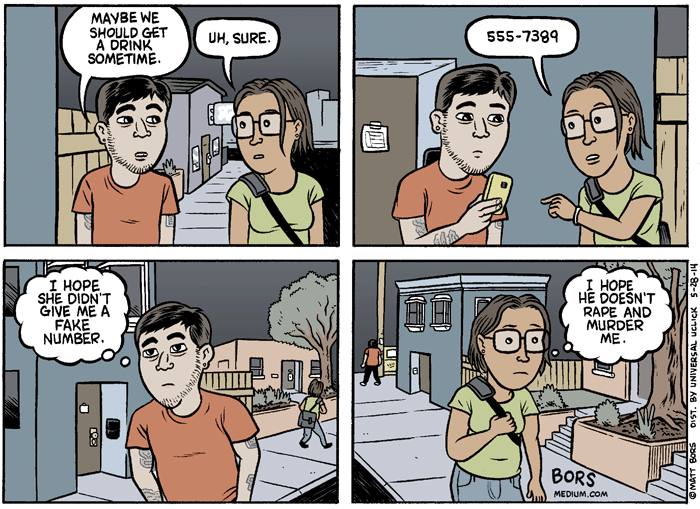
Bizarre exception, or part of a pattern? To a lot of women, though, Isla Vista looked very different. Rather than a bizarre random event, it seemed like the extreme edge of the male aggression they experience constantly: They get grabbed or groped; men yell obscenities at them or make unwanted “flattering” comments about their bodies; they are harassed online; men demand their attention and refuse to go away; when women try to walk away, men grab their wrists or stand in the doorway or follow them as stalkers; men get angry and abusive when their uninvited advances are rejected; and on and on and on.

And while the exact statistics on rape are hotly debated — the difference depends in large part on how forcefully a woman has to say “no” before you count it — I have a lot of confidence in this qualitative statement: Just about every woman knows somebody who has been raped. (If you don’t believe me, ask some.) Whatever the definition is and whatever percentage that leads to, rape is not a monsters-in-the-closet phobia; it’s the well-founded fear that what happened to her (and maybe also to her and her and her) could happen to me.

So while men look at Elliot Rodger and say, “I would never do something like that”, women look at his victims and say, “That could totally happen to me.” Men divide the world into murderers and non-murderers, observing that the murderer pool is very small. Women look at murder as the extreme edge of a continuum of aggression, disrespect, and threat that affects them every day.

#YesAllWomen. And that is what I see as the point of #YesAllWomen: encouraging women to express and men to feel the oppressive weight of that continuum. #YesAllWomen is at its best when women simply tell their stories, one after another. Read enough stories and the bigger reality starts to break through: The meaning of Isla Vista isn’t that shit happens, it’s that the same kinds of shit keep happening day after day all over the country. And when there’s an widespread pattern like that, sooner or later it’s going to break out into something really horrific.*

The brilliance of #YesAllWomen is in its framing: It sidesteps the objection “Not all men are like that.” True or not, that objection misses the point. Whether or not feminist terms like misogyny or rape culture unfairly tar some good men is a minor issue compared to the environment of danger all women have to live in. Let’s not drop the larger issue to discuss the smaller one.**

And let’s not fall into the trap of interpreting every problem in the forest as the fault of individual trees. Laurie Penny explains:

of course not all men hate women. But culture hates women, so men who grow up in a sexist culture have a tendency to do and say sexist things, often without meaning to. … You can be the gentlest, sweetest man in the world yet still benefit from sexism. That’s how oppression works. Thousands of otherwise decent people are persuaded to go along with an unfair system because it’s less hassle that way. … I do not believe the majority of men are too stupid to understand this distinction

[And before we leave the gun-control issue entirely, can we discuss how the two issues interact? Think about the open-carry demonstrations in Texas or Georgia’s new guns-everywhere law. Now picture a woman you care about having a drink after work with some friends, and being accosted by a strange man who won’t go away. Now picture him armed. And no, NRA spokesmen, picturing a second gun in your sister/daughter/friend’s purse doesn’t fix the situation.]

The game. Men, by and large, have not handled our side of this discussion well, attempting either to disown the problem or to mansplain what women should do to fix it.*** But a few men have had intelligent things to say. I thought the Daily Beast piece by self-described nerd Arthur Chu was particularly on point:

[T]he overall problem is one of a culture where instead of seeing women as, you know, people, protagonists of their own stories just like we are of ours, men are taught that women are things to “earn,” to “win.” That if we try hard enough and persist long enough, we’ll get the girl in the end. Like life is a video game and women, like money and status, are just part of the reward we get for doing well.

The game metaphor explains a lot about what was wrong with Rodger’s point of view, and how it relates to a problem in the larger culture. Elliot Rodger’s complaint wasn’t that he couldn’t find his soulmate or that his genes might fail in the Darwinian struggle for immortality. It wasn’t even about pleasure, really, because you don’t need a partner for that. The essence of Rodger’s complaint was that he couldn’t level up — no matter how long he played or how hard he tried — in the multi-player game of sex.

To grasp the full dysfunction of that game, you need to understand who the players are: men. Rodger wasn’t playing with or even against women when he went out looking for sex. He was playing against other men to gain status. Women are just NPCs — non-player characters. Figuring out what to say or do to get their attention or their phone numbers or to get them into bed is like solving the gatekeeper’s riddle or finding the catch that opens the door to the secret passage.

Rodger’s virginity wasn’t just a lack of experience, comparable to someone who has never seen the ocean or been to Paris or tasted champagne. It was his state of being. He was a newby, a beginner, a loser. And it wasn’t fair. He had put so much of his time and effort and passion into the game; he deserved to get something out.

Chu explains the error:

other people’s bodies and other people’s love are not something that can be taken nor even something that can be earned—they can be given freely, by choice, or not.

We need to get that. Really, really grok that, if our half of the species ever going to be worth a damn. Not getting that means that there will always be some percent of us who will be rapists, and abusers, and killers.

What will we pass on? Phrasing the game metaphor in computer terms makes it sound like a new problem of the internet generation, but it’s not.**** Computer games are just a good way of describing an attitude that has been around since Achilles and Agamemnon argued over a slave girl: that women are just tokens in a competition among men. In junior high in the 70s, my friends and I talked about “getting to second base”, and today commercials sell Viagra and Grecian Formula to older men by telling us we can “get back in the game”. We all know what game they’re talking about.

As long as that attitude gets passed down from one generation of men to the next, there’s going to be an aggression-against-women problem. Because that’s how men play: You sneak some vaseline onto the ball, hide an ace up your sleeve, take that performance-enhancing drug, or push away a defender when the refs aren’t looking. If you can get away with it, it’s part of the game. So if it raises your score to grab some body part otherwise denied you, or to intimidate women into submission, take advantage of their unconsciousness, drug them, or even kidnap and imprison them, someone’s going to do it.

No one ever asks a boy whether he wants to play this game. At some point in your adolescence, you just find yourself in the middle of it, being told that you are losing and advised on how to win. There are competing visions that (for most men, I believe) eventually win out as they mature: the search for companionship, or looking for an ally to help you face life’s challenges. In those visions, women can be “protagonists of their own stories” rather than NPCs. But no one ever tells you there is a choice of visions and lays out the consequences.

If we did discuss these competing visions openly with boys, I don’t think the game metaphor would stand up to conscious scrutiny. Few men would openly defend the idea that women exist to be tokens of our competition, and even most teens already have enough empathy and experience for it to ring false. But the game attitude survives because we don’t bring it out into the light and discuss it.

Changing that dynamic would be a fine response to #YesAllWomen.


* I shake my head at the people who want to make an either/or out of whether the blame for Isla Vista belongs to a misogynistic culture or to Rodger’s personal insanity. Growing up, I had the chance to observe a paranoid relative. She went crazy during the McCarthy red scare, so the Communists were after her. If she’d broken with reality a few years earlier it might have been the Nazis; a few years later, the Mafia. Maybe people go crazy because their brains malfunction, but how they go crazy is shaped by their culture.


** One of the prerogatives of any form of privilege is that your concerns move to the top of the agenda, even if they are comparatively minor. Privileged classes of all sorts take this prerogative for granted and have a hard time seeing it as an injustice. So it is here: Men who feel smeared by a term like rape culture tend to think the conversation should immediately shift to their hurt feelings. It shouldn’t. To the extent that this objection is justified, it can wait. Let’s talk about it later. (Privileged classes aren’t used to hearing that response, but under-privileged classes hear it all the time.)

An important reason it should wait, in addition to its comparative insignificance, is that when a man fully grasps the continuum of aggression, it’s hard to claim that he’s never played any role in perpetuating it. (I know I can’t make that claim.) But by changing the subject to their own victimization, men avoid that realization.


*** Most advice about how to avoid rape — how to dress, places to avoid, not leaving your drink unattended — is really about making sure the rapist picks someone else. It’s like, “You don’t have to swim faster than the shark, you just have to swim faster than your sister.” It’s got zero impact on the overall rape problem.


**** And the attitude behind it is not even unique to men. In the pre-war chapters of Gone With the Wind, Scarlett is playing her own version of the game. While she wants to wind up with Ashley eventually, in the meantime she wants every eligible man in Georgia to be her suitor, and she “wins” whenever a bride realizes that she has married one of Scarlett’s cast-offs.

But there’s one important difference between the male and female versions of the game: Men who tire of Scarlett’s game can get on their horses and ride away, and in the end, it’s up to Rhett to decide whether or not he gives a damn. Women would like to have those options in the male version of the game.

The Monday Morning Teaser

It’s another week where my word-limit target is laughing at me.

Last week I had only a couple sentences about the Isla Vista murders. This week the #YesAllWomen hashtag exploded on Twitter, and blogging world seems divided between those who comment on it and those who don’t dare. For the last few days I’ve been pulling together the best ideas I’ve seen on the topic and trying to add a little of my own.

Simultaneously, I’ve been trying to answer a reader’s question: If you have only a limited amount of energy/money/attention to spend on the 2014 elections, would races should you focus on? That’s not a quickly covered topic either.

So both articles will post today, and the idea of keeping the Sift down to 3500 words a week will have to just stand aside. “#YesAllWomen and the Continuum of Aggression” will come out first, probably before too long, and “How the Fall Elections Are Shaping Up for Democrats” will follow later this morning. In general, I try to get the weekly summary out by noon (NH time). We’ll see if that happens this week.

Owning and Disowning

We inherit our ample patrimony with all its incumbrances; and are bound to pay the debts of our ancestors.

— Timothy Dwight “The Charitable Blessed” (1810)

The last slaveholder has been dead for a very long time. The last soldier to endure Valley Forge has been dead much longer. To proudly claim the veteran and disown the slaveholder is patriotism à la carte.

— Ta-Nehisi Coates “The Case for Reparations” (2014)

This week’s featured article is “Ta-Nehisi Coates Goes There: Reparations“.

This week everybody was talking about yet another mass shooting

Every mass shooting is stomach-turning, but this one has a special feature: the idea that men are entitled to female sexual partners we find attractive, and that if we don’t get them we are justified in seeking revenge on the entire gender. I feel slimed. I can’t imagine how women feel about it.

The guns-make-us-safer arguments of the NRA are almost believable if you picture home invaders who want something rational like jewelry or electronics. But when somebody wants to go out in a blaze of glory, more and bigger guns just make a bigger blaze.

and reparations for the oppression of blacks

Ta-Nehisi Coates of The Atlantic wrote the article of the year: “The Case for Reparations” and I wrote an almost-as-long article commenting, elaborating, and taking it personally. Centuries of public policy created the wealth gap between blacks and whites. Why is it unthinkable to use public policy to undo that?

and (still) the VA

This is going to go on for a while, because there’s a genuine mystery here that may not have a simple resolution. Some of the basics: The VA gives veterans world-class care once they manage to get in the door. But there have been long-standing problems both with appointment backlogs and backlogs in processing claims. In recent years the VA established metrics to measure how well they were solving those problems, and reported that they were doing remarkably well.

Unfortunately, they were cooking the books. Somebody (or maybe a lot of somebodies) saw their mission as delivering good numbers, not delivering timely medical care. This is a common problem in our data-obsessed times. (See, for example, the Atlanta public schools, which decided its mission was to improve test scores, not education. Or watch just about any season of The Wire.) Of course all those somebodies at the VA need to be found and fired, and maybe some of them should go to jail. But that just gets us back to Square One with the problem of caring for our veterans.

Partly, the problem goes back to the cardinal sin of the Iraq War: The Bush administration refused to let anyone plan for the possibility that the war might be long and costly. Even after the wounded starting coming home, National Journal reports, the Defense Department was cooking the numbers:

Early on, the department was publicly counting only about a third of the casualties stemming from the War on Terror. That was because the Department was only counting servicemen and women immediately targeted in the department’s wounded-in-action statistics. That accounting method left out those who were not targeted but were wounded nonetheless, such as troops injured when they were riding two trucks back from one that was hit by a roadside bomb, or those hurt in training or transportation.The underreporting made it more difficult for the VA to prepare for the coming influx of requests for help.

So the Obama administration knew there was a resource problem — not enough money, facilities, doctors, etc. — when they took office. And they thought they were solving it. Under Obama, the VA’s budget has gone from $97.7 billion in FY 2009 to $153.8 billion in FY 2014.

But already a year ago, Huffington Post reported:

“We’re glad to see the increase in the budget,” said Paul Reickhoff, chief executive officer of Iraq and Afghanistan Veterans of America. But he was highly skeptical of the VA claims that it is making progress on reducing the backlog of veterans claims for benefits. “The customers on the ground, our members, don’t see it,” he said.

So where has the money been going? A piece of the mystery is that along with the new money came new responsibilities. National Journal says:

the Obama administration has also changed the rules to give more benefits to veterans. In 2010, the administration expanded coverage related to exposure to Agent Orange, a Vietnam War-era defoliant that has created a vast list of health problems. Veterans have long tied an assortment of illnesses to Agent Orange, and now more of those illnesses are covered. Additionally, the administration made it easier for veterans to get coverage for posttraumatic-stress disorder, a disease less easily diagnosed and adjudicated than physical injuries.

But that doesn’t sound like the whole story, and nothing else I’ve heard so far does either. Nobody has a partisan motive to short-change our veterans. And so far there are no reports of sweetheart deals that sent billions to some favored contractor for nothing, or enormous bridge-to-nowhere facilities that sit empty. This situation calls for a real investigation that is neither a whitewash nor a witch hunt. It will interesting to see if our political system is capable of making that happen.

and another NBA owner talking about race

This time it’s Mark Cuban of the Dallas Mavericks. I find I’m willing to cut Cuban slack, though, because I think he’s clumsily saying something more-or-less right. (In my terminology prejudice is an unavoidable aspect of being human, while bigotry is something we should be trying to eradicate. I hear Cuban confessing that he has prejudices that he is trying to keep from becoming bigotry.) I agree with ESPN’s Michael Wilbon:

If we’re going to have honest conversations about race and bigotry and prejudice, then we’re going have to have some uncomfortable moments. What’s most important to me here is that clearly and without qualification, Mark Cuban condemns bigotry. … This in no way, in my mind, comes into the area code of Donald Sterling’s comments.

Whites have been denying our racial prejudices for a long, long time. (Wilbon again: “I hear people say, ‘I don’t see color.’ And I say, ‘Stop. Everybody sees color.'”) So it’s totally to be expected that when we finally begin to talk seriously about race, we’re not going to phrase everything in the most sensitive way. By all means blacks (and whites with more experience discussing race) should point out to Cuban the ways that he’s still invoking offensive stereotypes — those “uncomfortable moments” Wilbon is talking about — but also give him credit for what he’s doing right.

That’s more-or-less the approach that NYT columnist Charles Blow takes.

Cuban says in the interview, “I know that I’m not perfect.” None of us are, Mr. Cuban, and I applaud your candor even as I correct your assertions. That is how the race discussion must be conducted.

and you also might be interested in …

Chris Hayes is doing a great series on the conservative heartland. This week the show focused on Kansas, which has become a laboratory for far-right policies. How’s that working?


Update on last week’s article “Climate Denial is a Sunday Truth” in which I argued that the business community — especially the insurance industry — is well aware that climate change is real. From ThinkProgress:

Last month, Farmers Insurance Co. filed nine class-action lawsuits arguing that local governments in the Chicago area are aware that climate change is leading to heavier rainfall but are failing to prepare accordingly. The suits allege that the localities did not do enough to prepare sewers and stormwater drains in the area during a two-day downpour last April.

And the NYT:

Most insurers, including the reinsurance companies that bear much of the ultimate risk in the industry, have little time for the arguments heard in some right-wing circles that climate change isn’t happening, and are quite comfortable with the scientific consensus that burning fossil fuels is the main culprit of global warming.

“Insurance is heavily dependent on scientific thought,” Frank Nutter, president of the Reinsurance Association of America, told me last week. “It is not as amenable to politicized scientific thought.”


Great article about diet: What if fat isn’t just an issue of excess calories? What if the body is actively looking for foods it can easily turn into fat? When you eat them, you’re still hungry, because they went straight to fat and didn’t give your body any calories to run on.


When Sainsburys dressed a mannequin in a 12-Years-a-Slave outfit, they weren’t really trying to sell their customers the runaway-slave look. Turns out, that was just a tasteless part of their buy-the-DVD display. But for a minute, it seemed like the “Derelicte” scene from Zoolander had burst into reality.


Authors need to slow down: Important books are piling up faster than I can read them. (Yes, Elizabeth Warren, I’m looking at you; or at least at your picture on the cover. Get in line behind Thomas Piketty.) So I haven’t even picked up Glenn Greenwald’s No Place to Hide about his role in the Snowden leaks.

But sometimes you don’t have read a book to know that a criticism of it is off-base. In his review for the NYT, Michael Kinsley writes this about leaking government secrets:

The question is who decides. It seems clear, at least to me, that the private companies that own newspapers, and their employees, should not have the final say over the release of government secrets, and a free pass to make them public with no legal consequences. In a democracy (which, pace Greenwald, we still are), that decision must ultimately be made by the government.

If government officials have the final say on what information the voters are allowed to know before they pass judgment on those same government officials, then democracy is pretty much a sham: You get to judge me, but only based on the information I choose to tell you.

This situation calls for one of those marvelous Madisonian check-and-balance processes, but unfortunately there’s no prospect of us getting one. So in a broken system, anyone who finds him/herself in a position to take action — Snowden, Greenwald, Julian Assange, whoever — has to use his/her own judgment. Nobody thinks this is ideal, but it’s not Glenn Greenwald’s fault. Glenn should not defer to the government until the improbable moment when the government unveils its ideal information-releasing process.


David Atkins reads the tea-leaves of the European Parliament elections: In hard economic times with a lot of immigrants still coming in, the most likely political beneficiaries are the fascists. Centrists preaching austerity have no defense against the far right.

The only possible way that a party of social tolerance survives for long in this sort of economic environment is if it goes hard after the plutocrats truly responsible for the economic malaise. The social liberal/economic conservative mold of Bloomberg is a recipe for political disaster.


Curing cervical cancer is one kind of problem. Curing cervical cancer in Haiti, using tech that a Haitian clinic might be able to afford, is a different problem entirely. The NYT Sunday Magazine recounts the fascinating story of “The MacGyver Cure for Cancer“.


An illustration of what the book Cornered was about: Even when monopolistic power isn’t being used to raise consumer prices, it’s still not benign. Amazon is trying to squeeze book publishers, and those who don’t go along are finding that their books are hard to buy and take forever to ship. Sure, you can distribute your books without Amazon. Good luck with that.

Today our anti-trust laws are only enforced against companies that use their market power directly against consumers. But it can be just as damaging to the economy for a near-monopoly to use its market power against producers, by re-organizing the market around its artificially constructed bottleneck. This is the main reason to oppose the Comcast/Time Warner Cable merger, even if it’s true that the two cable giants don’t compete for the same customers.

and let’s close with an amazing catch (sort of)

by the ball girl, not the outfielder.

Snopes says it never really happened, but why let reality stand in the way of a good video? And ball girls and ball boys really have made some outstanding catches. (I also tip my hat to several of the announcers, who were able to come up with their names without missing a beat.)

Ta-Nehisi Coates Goes There: Reparations

The wealth gap between blacks and whites is the direct result of centuries of policy. Why should using policy to fix it be unthinkable?


Wealth is off limits.

For as long as I can remember, the idea of paying reparations to African Americans has been the boogyman in any discussion of race. Just say the word reparations in any room with more than one white person, and rational discussion ends. And if you can tie any other program to reparations — affirmative action, food stamps, whatever — rational discussion of that ends too. That’s what Rush Limbaugh meant to do when he invoked reparations in an attack on ObamaCare:

This is income redistribution. This is returning the nation’s wealth to its quote/unquote “rightful owners”. This is a civil rights bill, this is reparations — whatever you want to call it.

He didn’t go on to explain why that would be bad, or even why blacks aren’t really the “rightful owners” of more than they own now. He didn’t have to explain, because reparations are literally unthinkable: Just say the word and whites stop thinking.

So The Atlantic‘s senior editor Ta-Nehisi Coates was throwing down a gauntlet this week when he wrote the current cover article “The Case for Reparations“: Approve of them or not, reparations are not unthinkable. Here’s the argument. Think about it.

Coates’ article is very good and very long, and you should absolutely read it rather than just my summary of it. (Second best: Watch Bill Moyers interview Coates.) But judging from the comment thread on even a relatively liberal site like The New Republic (not to mention Free Republic , where the most popular reparations offer is “25 grand and a plane ticket back to Africa”) a lot of people are struggling very hard to continue not thinking about it. Rather than engage any of Coates’ arguments, they are going off in response to that one offending word.

In “How to tell who hasn’t read the new Atlantic cover story” NPR’s Gene Demby quoted this Adam Serwer tweet:

How to Read TNC’s piece on reparations: 1. Read the title. 2. Stop reading. Do not read past the title. 3. Explain that racism is over.

So before you react, at least understand these two things about Coates’ article:

  • It’s not just about slavery.
  • He’s not saying, “All you white people need to send me a check.”

What it’s about. Coates’ argument is that the wealth gap between whites and blacks in America has a simple cause: Throughout American history, blacks have been systematically cut off from the sources of wealth. It started (but didn’t end) with slavery: Black labor cleared the forests and drained the swamps to create those southern plantations, and black labor built the planters’ mansions, but after the Civil War all that black-created wealth stayed with the whites. The first reparations proposal — forty acres and a mule — would have been simple justice for the people who built the South, but it never happened.

Instead of restoring some of the Confederacy’s wealth to the people whose labor had created it, or even just starting blacks at the bottom and letting them work their way up, it wasn’t long before whites instituted a new system for building their wealth with black labor. In a story told at length by Douglas Blackmon in Slavery By Another Name, blacks in the post-Reconstruction South were blocked from owning land, preventing from leaving, forced back into exploitative relationships with whites, and denied access to the courts when they were cheated. Tens of thousands were literally re-enslaved: convicted of bogus crimes and sentenced to hard labor for a white employer. This lasted well into the 20th century.

Blacks who managed to succeed in spite of the system were often the targets of white violence. Today the words race riot evoke thoughts of black uprisings in the 1960s — Watts, Detroit, etc. — but white race riots against blacks had been going on for a long time: New York in 1863, Louisiana in 1873, Atlanta in 1906, Chicago in 1919, and many others. (Add to that the 3,446 blacks who died in lynchings between 1882 and 1968.) Two riots in particular — Greenwood, OK in 1921 and Rosewood, FL in 1923 — destroyed entire black communities that were thriving and building wealth for their citizens.

In a story told at length by Ira Katznelson in When Affirmative Action Was White, blacks were largely cut out of the mid-20th-century New Deal and Fair Deal programs that created the white middle class. Even the benefits of the G. I. Bill were constructed in such a way that blacks had difficulty taking full advantage.

Coates talks at some length about real estate discrimination. Legally until the mid-1960s and practically for some time afterward, blacks were allowed to buy homes only in certain neighborhoods. The Federal Housing Administration considered those neighborhoods high-risk and refused to insure mortgages in them. Banks followed that lead with red-lining, refusing to issues mortgages at all on those houses. Blacks who wanted to own their own homes were forced to buy on contract from brokers who frequently cheated them.

For most middle-class American families in the post-World-War-II era, home ownership was a wealth-building tool that the government subsidized through mortgage insurance and mortgage-interest tax deductions. But that tool was not available to many black families.

Red-lining concentrated urban blacks in a few neighborhoods. And — surprise! — those neighborhoods often had poor infrastructure and bad schools, a pattern that continues to this day. They are also over-policed, resulting in blacks being far more likely to go to jail for minor crimes (like smoking pot) that whites commit equally often. This story is told at length in Michelle Alexander’s The New Jim Crow.

Taking it personally. On the surface, I have a good case for claiming that this all has nothing to do with me: My family never owned slaves, hired convict labor, or profited from real-estate scams targeting urban blacks. I was a working-class kid who entered the professional class on his own merit, by getting an education that led to a high-paying job.

But look again. My town’s public high school did well by me. I went to a state university in an era when tuition covered only a fraction of the cost. My Ph.D. was paid for by the National Science Foundation. So, sure, I worked for what I have. But I also had help every step of the way.

Now consider: What if my family had been red-lined into a neighborhood with crummy schools? Maybe I never step on that educational escalator to begin with. And what if generations of hard knocks had hammered home the point that even when people like me work hard and play by the rules, somebody just invents a new rule to take it all away from us? Under those circumstances, do I really stick it out all the way to a Ph.D? Or do I grab the first shiny career-bauble that shows up?

Finally: My sister and I just sold the small farm that our grandfather bought in the 1920s. For each of us, that sale put the capstone on a retirement plan. And why shouldn’t it? Grandpa took a risk and worked hard, and my father worked hard after him. Why shouldn’t we benefit?

But family lore tells of a crisis during the Depression. Failing crops weren’t paying the bills, and new bank loans were out of the question now that Grandpa’s $22K farm was appraising at $8K. Fancy footwork by a friendly lawyer stalled foreclosure long enough for a New Deal farm-loan program to become available. Would those breaks have gone in our favor if we were black? Or would the white lawyer have shrugged and the white federal bureaucrat have moved our application to the bottom of the stack? Maybe. And then our family would have lost the farm — totally legally and by the rules — and had to start over in our attempt to accumulate wealth. If I complained about that circumstance now, what would people tell me? “Well, you gotta pay your debts. Your grandfather should have known that.”

As I’ve describe at length elsewhere, the point of that what-if fantasy isn’t to make me feel guilty, and in fact it doesn’t make me feel guilty; it makes me feel lucky. It gives me a more accurate assessment of my success. The Week‘s Ryan Cooper elaborates:

I think what motivates the worst responses to Coates’ piece is … a resistance to being labeled a racist. And that is missing the point. His article is not a personal critique; it is a structural one, which ought to minimize some of its personal sting. Structural racist outcomes (mostly) aren’t the fault of white people alive today; they’re about the foundations of society and the legacy of history. Such analysis isn’t about making white people feel guilty, it’s about providing countervailing structural pressure to right past wrongs.

Why we’re not fixing it. In order to understand where Coates is coming from, you need to appreciate where we are: The Supreme Court believes that any government action for the specific purpose of benefiting blacks (or any racial group) is unconstitutional. To the extent that affirmative action still exists, it has to claim other justifications. (A racially diverse classroom provides a better educational experience, a racially diverse police force can relate to the community better, and so on.) Legally, reparations are the dirty secret of affirmative action. If a program is caught trying to fix the racial injustice of American history, it is thought to violate the equal protection clause of the 14th amendment.

That legal situation is reinforced by the political situation: Even colorblind attempts to deal with America’s underclass, or to make life easier for the poor (even the working poor), are undercut by the politics of white racial resentment. If you want to campaign against food stamps or the minimum wage or Medicaid, all you have to do is suggest that this is really a racial transfer from white makers to black takers. It’s no coincidence that Arkansas is the only state of the Confederacy to accept Medicaid expansion under ObamaCare, while all but four Union states have. (And two of those are still on the fence.)

If you ask, whites will explain that if black oppression happened at all, it is ancient history. We have said this in every era. In 1837, Senator John Calhoun argued that slavery was a benefit to blacks:

Never before has the black race of Central Africa, from the dawn of history to the present day, attained a condition so civilized and so improved, not only physically, but morally and intellectually. It came among us in a low, degraded, and savage condition, and in the course of a few generations it has grown up under the fostering care of our institutions, reviled as they have been, to its present compara­tively civilized condition.

In 1883, the Supreme Court explained why further civil rights laws were unnecessary, now that whites had ended slavery through “beneficent legislation”.

When a man has emerged from slavery, and, by the aid of beneficent legislation, has shaken off the inseparable concomitants of that state, there must be some stage in the progress of his elevation when he takes the rank of a mere citizen and ceases to be the special favorite of the laws, and when his rights as a citizen or a man are to be protected in the ordinary modes by which other men’s rights are protected.

And in 1896, the Court saw the problem of segregation as existing mainly in black psychology.

We consider the underlying fallacy of the plaintiff’s argument to consist in the assumption that the enforced separation of the two races stamps the colored race with a badge of inferiority. If this be so, it is not by reason of anything found in the act, but solely because the colored race chooses to put that construction upon it.

I could go on. The Brown decision leveled the playing field in 1954. Or maybe the civil rights legislation of the 1960s leveled it. The election of Obama proved it was level. And so on down to John Roberts gutting the Voting Rights Act last summer by simply saying “Things have changed.”

In every era, whites claim that we have done everything justice demands, and that any remaining problem is due to some inherent black inferiority of either biology or culture. And then a few decades later we realize that wasn’t true then, but it certainly is now.

What Coates wants. In his Atlantic article, Coates doesn’t put forward any specific plan, beyond endorsing a perennial bill by John Conyers to study reparations.

the crime with which reparations activists charge the country implicates more than just a few towns or corporations. The crime indicts the American people themselves, at every level, and in nearly every configuration. A crime that implicates the entire American people deserves its hearing in the legislative body that represents them.

John Conyers’s HR 40 is the vehicle for that hearing. No one can know what would come out of such a debate. Perhaps no number can fully capture the multi-century plunder of black people in America. Perhaps the number is so large that it can’t be imagined, let alone calculated and dispensed. But I believe that wrestling publicly with these questions matters as much as—if not more than—the specific answers that might be produced.

Coates fears that the details any specific reparations proposal will become the issue, and allow whites to jump right past the question of whether reparations are justified in principle. And so the history of “multi-century plunder” will continue to be ignored.

But he also wants more than just a hearing or an apology, as he makes clearer in his Moyers interview. What he proposes is not personal reparations — trying to figure out what each individual is owed and cutting them a check — but a reorientation of public policy that holds the history of white supremacy in mind. (As a successful American, Coates expects that any tax increase to pay for this would hit him as well; quite the opposite of expecting me to send him money.) Rather than run away from policies that disproportionately benefit blacks, if we were looking for a way to make reparations we would consciously embrace such policies. We would recognize that black poverty and other social dysfunctions in the black community are not just specific examples of the general problem of poverty or social dysfunction. They are unique problems with a unique history, and they exist because they were created by public policy.

[W]e would not have to retreat to other language like quote unquote class. We would say, no, no, no, this is about white supremacy. And we have a problem with this. And we have had a problem with this for a long time. And we need to be conscious of that in our policy. When we pass a stimulus budget, for instance, we need to specifically think about helping people who have been injured in our past, because they’ve occupied a certain place in our country.

And when the Limbaughs charge that ObamaCare amounts to reparations, there could be simple response: Good.

The Monday Morning Teaser

I’m not sure how much attention it’s getting in the country at large, but the current Atlantic cover article “The Case for Reparations” hit the blogosphere like a bomb. Reparations for the systematic oppression of blacks is one of those topics that produces knee-jerk reactions from whites, even before they consider exactly what is being proposed or why. Most whites don’t know the history of white supremacy in America — it goes way beyond slavery — and a lot don’t want to know.

It’s rare for a major writer to confront this denial as directly or as well as Ta-Nehisi Coates has in this article. You can agree or disagree, but you can’t keep treating reparations as if the idea were unthinkable. What ought to be unthinkable is the absurd notion that the wealth gap between whites and blacks is some kind of accident, or that it has been caused primarily by some deficiency in black DNA or culture. That gap is the natural result of centuries of policy that prevented black families from building wealth. Any discussion of black poverty needs to recognize that fact.

So the featured article today will be “Ta-Nehisi Coates Goes There: Reparations”. I’ll summarize and elaborate on what he said, plus discuss how it applies to me personally. I still need to look up some historical quotes I only vaguely remember, which takes an amount of time that is hard to predict. So I’m not sure when I’ll post.

Later on, the weekly summary will discuss yet another mass shooting, the VA, Mark Cuban, and a bunch of other stuff.

The Worth of Ice

We never know the worth of water, until the well is dry.

Thomas Fuller, Gnomologia #5451 (1732)

This week’s featured article is “Climate Denial is a Sunday Truth“.

This week everybody was talking about Antarctic ice

The apparently slow pace of climate change creates the comforting illusion that we have time to dawdle before we respond: The worst outcomes aren’t due for a century or so, so surely it won’t matter if we twiddle our thumbs for another few years.

But there’s also a long lag time between action (burning fossil fuels) and response (higher temperatures). And so we can pass a tipping point without realizing it: The carbon already in the atmosphere may already make certain outcomes inevitable, even if they take decades to arrive.

Two recent reports say that the melting of the western Antarctic ice sheet has now passed such a tipping point. As NASA’s press release puts it:

the glaciers in the Amundsen Sea sector of West Antarctica “have passed the point of no return,” according to glaciologist and lead author Eric Rignot, of UC Irvine and NASA’s Jet Propulsion Laboratory in Pasadena, California. The new study has been accepted for publication in the journal Geophysical Research Letters. These glaciers already contribute significantly to sea level rise, releasing almost as much ice into the ocean annually as the entire Greenland Ice Sheet. They contain enough ice to raise global sea level by 4 feet (1.2 meters) and are melting faster than most scientists had expected.

In The Guardian, Rignot elaborated:

We announced that we had collected enough observations to conclude that the retreat of ice in the Amundsen sea sector of West Antarctica was unstoppable, with major consequences – it will mean that sea levels will rise one metre worldwide. What’s more, its disappearance will likely trigger the collapse of the rest of the West Antarctic ice sheet, which comes with a sea level rise of between three and five metres. Such an event will displace millions of people worldwide.

Two centuries – if that is what it takes – may seem like a long time, but there is no red button to stop this process.

Chris Mooney at Mother Jones called this “a holy shit moment for global warming“. But it’s also typical in this sense: The Amundsen ice looks more-or-less the same today as it did last week, when we didn’t know it was doomed. Plus, it’s metaphoric: The real damage is happening on the underside of the Antarctic glaciers, where we can’t see. As the glaciers melt, they get lighter and their seaborne edges ride higher. That lets more water seep underneath, and lifts the glaciers away from insulating land, melting them faster.

These kinds of feedback loops are what tipping points are all about. (Another one that’s in the offing, though nobody can date its arrival, is when methane trapped in the Siberian permafrost starts escaping into the atmosphere. Methane is itself a greenhouse gas, so once the escape starts it will warm the planet and accelerate the escape.)

Steven Colbert captured the moment’s dark humor:

Unstoppable melting, it’s out of our hands now. I mean, what a relief! I didn’t think it would happen, but we finally ran the clock out on the possibility of my personal sacrifice making a difference.

The New Yorker‘s Elizabeth Kolbert makes the connection to our dysfunctional political debate:

Of the many inane arguments that are made against taking action on climate change, perhaps the most fatuous is that the projections climate models offer about the future are too uncertain to justify taking steps that might inconvenience us in the present. The implicit assumption here is that the problem will turn out to be less serious than the models predict; thus, any carbon we have chosen to leave in the ground out of fear for the consequences of global warming will have gone uncombusted for nothing.

But the unfortunate fact about uncertainty is that the error bars always go in both directions. While it is possible that the problem could turn out to be less serious than the consensus forecast, it is equally likely to turn out to be more serious. In fact, it increasingly appears that, if there is any systemic bias in the climate models, it’s that they understate the gravity of the situation.

Try to think of any other risk we treat this way: We’re going to do nothing about it until we’re 100% sure that we’re headed for disaster.

and the VA

VA hospitals have been making veterans wait ridiculously long for appointments, and then have falsified data to hide their systemic poor performance. So far, everyone from Congress to the president to VA Secretary Eric Shinseki claims to be “mad as hell” about the situation, but it’s not clear what happens next.

Somebody who has been criticizing the VA for years is Rachel Maddow. She’s the one I’ll be watching

and the 60th anniversary of the Brown decision

Saturday was the 60th anniversary of Brown v Board of Education, the Supreme Court decision that proclaimed the end of “separate but equal” as a defensible legal concept.

The best discussion of this I saw was on Chris Hayes’ show, where he interviewed some surviving members of the Brown family.

and the apparent dwindling of the Tea Party

In case you missed it: Friday, tens of millions of “patriot” protesters descended on Washington for an “American Spring“. They overthrew the federal government and sent former President Obama to Gitmo. Or at least that was the plan. The actual turnout was more like a few hundred — far less than what liberal Moral Mondays can turn out in North Carolina. The government is intact and President Obama remains at large.

Chris Hayes interpreted this non-event as end of the Tea Party’s ability to turn out big crowds: “As a grass roots movement, it is no more.”

Similarly, the media narrative for this spring’s round of Republican primaries has been the victory of the Republican establishment over Tea Party challengers. (Notable exception: Ben Sasse in Nebraska, who is being billed as “the next Ted Cruz“.) Establishment figures like Mitch McConnell no longer need to quake in their boots over the prospect of a Tea Party primary opponent.

But while all this is true, one piece of the story is often left out: The Tea Party is vanishing because it won. The “establishment” candidates who are winning these primaries — like North Carolina’s Thom Tillis — have done so by agreeing down-the-line with Tea Party positions on the issues. You’ll know the Tea Party has actually lost if John Boehner brings the Senate’s bipartisan immigration bill to the floor, or if Republicans work with President Obama to get the corporate tax reform both sides want. Don’t hold your breath.

and you also might be interested in …

Rockford, IL in 2009

Wednesday, Rachel Maddow did a marvelous piece on the history of tank-car explosions like the recent one in Lynchburg, VA, and the NTSB’s decades-long unsuccessful battle to get safety upgrades to the DOT-111 car that is used for 70% of the energy industry’s rail shipments. As I watched one scene after another of giants balls of flame erupting in various places around the country, I kept thinking: What if Al Qaeda were rolling tankers full of crude oil into our towns and cities, and blowing them up with the same frequency that these tankers are blowing up on their own? What would we be willing to spend to make that stop?


Poor, persecuted Tim Tebow

Remember that televised same-sex kiss (that I posted a picture of last week) after Michael Sam was drafted by the St. Louis Rams? Well, it generated a new round of Christian persecution claims: The media has a double standard because Sam is getting positive coverage for being gay, while Tim Tebow got negative coverage for his conservative Christianity. (More accurately: Tebow got less than 100% positive coverage; a lot of Tebow-mania was downright worshipful. For a more balanced view of Tebow’s image, listen to another outspoken Christian quarterback, Kurt Warner.)

Rachel191 explains the difference Sam and Tebow:

[T]here is a distinct difference between sharing a celebratory kiss during a special moment with a significant other, and Tebowing. Now, if Michael Sam somehow manages to turn every appearance on the field into a demonstration or endorsement of his sexuality, yeah, they’ll be similar. But nothing of the sort has happened (or is even likely possible).

… Existing as a gay man, including having a family, is not “evangelizing” for homosexuality. It’s just existing. And being uncomfortable at the sight of gay men existing is not evidence that homosexuality is being “forced” on you. It’s evidence that you have issues you need to work through.


If during a blockbuster movie you ever find yourself wondering “How much of that is real and how much is computer generated?”, listen to Godzilla director Gareth Edwards narrating one of his scenes.


Republicans warned you that ObamaCare would cause organizations to shut down. Finally we have an actual example: the Rotacare Free Clinic in Tacoma, Washington. It closed its doors because its volunteer doctors and nurses aren’t needed now that its former patients have real insurance.

 “It happened very quickly. We had to start telling our providers not to come because we didn’t have enough patients,” Mary Hoagland-Scher, a Tacoma family practitioner who served as the clinic’s medical director, told TPM. “It just dried up. Poof.”


Last Monday, a Republican Senate filibuster killed a bipartisan energy efficiency bill that the Republican House had previously passed. The Energy Efficiency Improvement Act was a baby-step forward: It raised efficiency requirements on government buildings, while creating a voluntary certification program for private buildings.

But even that was too much to ask. Senate Republicans wouldn’t consider it without tying it to approval of the controversial Keystone XL Pipeline. Grist’s Ben Adler elaborates:

When the bill passed the House, I concluded that energy-efficiency measures could win Republican support if they avoided any mandates on the private sector and any spending of government money. After all, there is nothing for conservatives to oppose about making government more efficient and offering voluntary programs to help companies save money.

Well, now you can add another condition to the list of Republican demands: Even a modest energy-efficiency measure cannot be passed without including unrelated giveaways to fossil-fuel industries.

And there’s one other motive behind the filibuster: The names attached to the Senate version of the bill are Democrat Jeanne Shaheen of New Hampshire and Republican Rob Portman of Ohio. Shaheen is running for re-election this year, and being challenged by Massachusetts import Scott Brown. Brown lobbied his former Republican colleagues in the Senate not to give Shaheen an accomplishment to run on.

and let’s end with a big dream

What if the roads were paved with solar panels, creating a decentralized power grid?

Climate Denial is a Sunday Truth

On Monday morning, the business community knows better.


Probably every religion has what in the Christian world is known as Sunday truth: those comfortable notions that make you nod and shout “Amen!” when you hear them from the pulpit, but which conveniently evaporate from your mind by Monday morning when you have to conduct serious business.

Centuries ago, Sunday truth was mostly moral: Lying is always bad; you should never take advantage of the helpless; charging interest on a loan is wrong; and other sweet ideas that businessmen found inconvenient. But when the scientific revolution got rolling in the 1600s, educated people began to experience a different kind of Sunday truth: You’d agree on Sunday that the Earth was the center of the universe, and then on Monday use Copernicus’ methods to compute the dates of future Easters.

From there it only got worse. Now there are biologists who nod on Sunday to the idea that evolution is a satanic lie, and then on Monday go back to work in a profession that makes no sense without the evolutionary theory that holds it all together. Professors of linguistics teach the Tower of Babel in Sunday school, then tell their secular students something completely different on Monday. Astronomers listen without objection when preachers tell them the universe is less than 10,000 years old, then work out better methods for detecting stars billions of light-years away. Geologists likewise acknowledge a young Earth on Sunday, and then (when they are searching for oil on Monday) look for rock formations millions of years old.

Critics of religion have slang for this tendency to forget everything your profession teaches you when you step inside a church: It’s called “checking your brain at the door” — a colorful phrase that conjures images of brains in cubbyholes waiting to be reclaimed when the service is over, as illustrated here by the Naked Pastor.

When political movements become ideologically extreme, they can develop their own forms of Sunday truth and build their own check-stations for brains. As in religion, you say things not because they are true, but because you want to stay in the community. If the community defines itself by a set of bizarre beliefs, then you loudly confess those beliefs in order to assert your identity as a member in good standing. But you’re not stupid, so you don’t act on those beliefs when people aren’t looking and you have serious decisions to make.

The business community understands this. This week I found myself reading a Bank of America/Merrill Lynch report urging its investment clients to invest in stocks related to water. It outlined the global pressures on water supplies, and then titled a section “Climate change is making things worse”:

Given how closely food, water and energy security are connected, an impending perfect storm of events appears to be looming for the food and energy sectors, in a world constrained by extreme weather and climate change.

No caveats, no footnotes, no if-this-turns-out-to-be-true. Politically, Bank of America’s contribution profile leans conservative; their top three recipients are the Republican National Committee and the national committees to elect Republicans to the House and Senate. But if you’re trusting Bank of America to advise you on investing, they want you to know that climate change is happening and you’d better adjust to it.

And that makes me wonder how many BoA/ML clients are making a similar distinction between Sunday and Monday truths. Your investments are between you and your broker, so maybe at that point Tea Partiers retrieve their brains from the check room and act on what they know is real: climate change.

Insurance companies (who also give more to Republicans than Democrats) have been adjusting to climate change for years, because this is money we’re talking about. It’s serious. You don’t choose ideology over science when there’s money on the line. Evan Mills watches the insurance industry’s response to climate change for Lawrence Berkeley National Lab:

Allstate, for instance, has said that climate change has prompted it to cancel or not renew policies in many Gulf Coast states, with recent hurricanes wiping out all of the profits it had garnered in 75 years of selling homeowners insurance (Conley 2007). The company has cut the number of homeowners’ policies in Florida from 1.2 million to 400,000 with an ultimate target of no more than 100,000. The company has curtailed activity in nearly a dozen other states. In 2008, State Farm—Florida’s largest private insurer—stopped writing new policies in the state (Garcia and Benn 2008). This was after suspending sales of new commercial and homeowners policies in Mississippi the year before (Tuckey 2007). A few months later, after being denied a 47% average rate increase, State Farm announced a complete pull-out, (Hays 2009). About 1.2 million customers will be affected. The Florida Insurance Commissioner referred to the decision as “unnecessary destabilization of the insurance market” (Hays 2009). The editor of trade magazine published an editorial about the problem entitled “Like a Bad Neighbor?” (Friedman 2009).

Also in 2008, Farmers announced that they would stop writing homeowners policies throughout North Carolina and not renew existing ones. Such decisions are not taken lightly; Farmers will forego $55 million in annual premiums but claims that losses would be twice this amount (Hemenway 2008). … Insurers are recognizing that simply raising prices to keep pace with the impacts of climate change may be an elusive undertaking.

Munich Re is a reinsurance company — its clients are primarily other insurance companies, not the general public — whose profitability depends on its accuracy in assessing risk. It describes climate change as “one of the greatest risks facing mankind”.

That’s how the business community acts on Monday mornings, when it’s doing serious work. But business is also an important part of the Republican establishment, and Republicanism has become an extreme ideological movement defined by bizarre beliefs, one of which is climate change denial. And so you have moments like this during the debate between GOP candidates for the Senate in North Carolina — one of those states where insurance companies are cutting back coverage because of climate change. “Is climate change a fact?” asks the moderator. Chuckles are heard in the audience and all four candidates — even the eventual winner Thom Tillis, supposedly the “establishment” candidate — say a curt “no”. (The Rand Paul candidate, Greg Brannon, adds: “God controls the climate.“, upstaging Mike Huckabee’s candidate, Mark Harris, who is supposed to represent the GOP’s evangelical wing.)

This is typical. After Jon Huntsman’s failure as the reality-based Republican presidential candidate, no one wants to take up that banner. Increasingly, rank-and-file Republicans (about half nationally*, including 61% of those who don’t identify as Tea Party) believe climate change is real, and about half of those attribute it to human activity. But what Republican leaders are willing to stand up in public and represent that position? Anybody?

Many of them know the facts. In late 2007, I sat in the front row at a John McCain town hall meeting in Nashua, New Hampshire, a few blocks from where I live. He told us emphatically that climate change was happening and the government needed to do something about it. The following May, he still whole-heartedly supported the McCain-Lieberman cap-and-trade bill. But by fall, his ads were implicitly against cap-and-trade, and by the time he ran for re-election to the Senate in 2010, he was openly against his own bill.

Such Galileo-like recantations are a standard feature of repressive religious environments. (See Romney and RomneyCare.) Did McCain learn something new that changed his mind? Don’t be silly; the scientific support for climate change just keeps getting stronger. But he needed to re-affirm his conservative identity, so he accepted conservative Sunday truth the same way he accepted Sarah Palin as his running mate.

The problem with adopting a Sunday truth, though, is that sometimes it’s not enough to nod and say “Amen!”; you may need to defend the Sunday truth against the infidels. And that can be difficult when you’re smart enough to know that it’s nonsense.

That’s what happened to Marco Rubio this week. He has already wrecked his position in the early presidential polls by trying to solve the immigration problem — a conservative candidate isn’t supposed to try to pass bipartisan legislation that addresses a problem — and even recanting hasn’t restored him to grace. He can’t afford to contradict the right-wing catechism anywhere else, so when conservative-friendly interviewer Jonathan Karl brought up climate change Rubio recited the Sunday truth:

I do not believe that human activity is causing these dramatic changes to our climate the way these scientists are portraying it. … And I do not believe that the laws that they propose we pass will do anything about it, except it will destroy our economy.

But sadly (for him) that wasn’t the end of it. Tuesday at the National Press Club he was asked: “What information, reports, studies or otherwise are you relying on to inform and reach your conclusion that human activity is not to blame for climate change?” He had to dodge, because he had been asserting his conservative identity, not championing a coherent theory that he adopted after prudent investigation. Instead, he put forward a new position:

The truth of the matter is the United States is a country. It is not a planet. … But for people to go out and say if you passed this bill that I am proposing, this will somehow lead us to have less tornadoes and hurricanes. And that’s what I take issue with.

In other words, the United States can’t fix climate change alone — a point even Al Gore wouldn’t dispute. So that response wasn’t satisfactory either, and Rubio had to go on Sean Hannity’s radio show and try again. This time he opted for distraction by flashing the big, shiny object of abortion: Liberals deny the settled science that human life begins at conception**, so why shouldn’t he deny the science of climate change?

I can’t imagine Rubio is endearing himself to the conservative base with these awkward gyrations. But that’s the problem when you show up on Monday morning spouting Sunday truth: You can’t give reasons, because you didn’t adopt the position for reasons. It’s about identity, not evidence or logic.

So that’s how you have to defend it. It’s simple, Marco: The Koch brothers said it. I believe it. That settles it.


* The recent trend line here might be suspect. A lot of polls that track opinion by party identification show a similar divergence between Republican and independent opinion. The reason isn’t that people in those camps are changing their minds in opposite directions, but that a lot of Tea Partiers have begun telling pollsters they’re independent rather than Republican.

** In addition to putting forward a two-wrongs-make-a-right argument — my denial of science doesn’t justify your denial of science — Rubio was also attacking a straw man. I’ve never heard any abortion-rights activist deny that a zygote is alive or that its DNA is human. The argument is about the point at which a fetus has developed sufficiently to merit the moral status we accord to a person. A typical abortion-rights position — mine, for example — is that a fetus grows into its personhood rather than being a person from conception. The disagreement is entirely moral and spiritual, and is unrelated to the science Rubio cites.

The Monday Morning Teaser

Climate change was hard to ignore this week. Not only did we learn that a big chunk of the Antarctic ice shelf is doomed, but Marco Rubio picked a bad moment to come out publicly as a climate-change denier. Every day or two he found a new way to stumble over follow-up questions that weren’t much more complicated than “Seriously?”

By coincidence, this week I found myself looking at a research report from an investment firm that gives most of its political cash to Republicans. It said in no uncertain terms that climate change is happening, and suggested ways to invest accordingly. And that got me wondering: How many conservatives cheer when a candidate denounces all this climate-change nonsense, and then apply a completely different worldview when they’re making decisions about something they take seriously, like money?

There’s an obvious parallel to religion, where a man might yell “Amen!” during a Sunday-morning sermon about young-Earth creationism, then Monday go to work as a geologist and look for oil in rock formations that he knows are many millions of years old. In religion, such things are called “Sunday truths”, and scientifically educated believers handle them by “checking your brain at the door”. And that led to this week’s featured article: “Climate Denial is a Sunday Truth”. It should be out in an hour or so.

Later this morning, the weekly summary will say more about that Antarctic ice, the scandal at the VA, the strange apparent outcome of the Republican Civil War (the establishment is winning at the ballot box by surrendering to the Tea Party on policy), and a number of other short notes, closing with a couple who have a big dream: paving the roads with solar panels.


Present Danger

Climate change is not a distant threat. It is affecting the American people already. On the whole, summers are longer and hotter, with longer periods of extended heat. Wildfires start earlier in the spring and continue later into the fall. Rain comes down in heavier downpours. People are experiencing changes in the length and severity of seasonal allergies. And climate disruptions to water resources and agriculture have been increasing.

Dr. John Holdren, presidential science advisor

This week’s featured articles are “New Evidence that ObamaCare is Working” and “Privilege and the Bubble of Flattery“.

This week everybody was talking about the kidnapped Nigerian girls

If you’re like me and know next to nothing about the internal politics of most African nations, Vox’s “Everything You Need To Know About Nigeria’s Kidnapped Girls” is a good place to start. “Everything you need to know about …” is a one of the standard formats on Vox (Ezra Klein’s news start-up), and it’s perfect for a story like this.

and Ukraine

Likewise, I can’t claim any deep understanding of the Ukraine/Russia conflict. I’m following the day-by-day developments via the NYT and CNN, like everyone else.

In Foreign Policy, Peter Pomerantsev wonders if Putin has re-invented war for the 21st century, something he calls “non-linear war”.

The NYT’s Ukraine Crisis in Maps feature helps.

BBC compares the relative military strength of Russia and Ukraine: Ukraine has about half the troops of Russia, and the other numbers are far more lopsided. If it comes to war and Ukraine doesn’t get NATO help, Russia will win on the battlefield. (As we saw in Iraq, whether it would be able to control the populace afterwards is a different matter.)

and the national climate assessment

The White House published the 2014 National Climate Assessment. The full report is enormous (841 pages), so I suspect most people will do better with the 148-page highlights. As in this week’s Sift quote, it is emphasizing that the effects of climate change are already visible, and fighting the impression that climate change is some distant threat that may never arise.

and a privileged Princeton freshman

Tal Fortgang became something of a sensation when Time published his essay “Why I’ll Never Apologize for My White Male Privilege“. On the Left, it seemed like everybody had to respond, including me. I thought Salon’s Mary Elizabeth Williams covered it pretty well:

Young man, if you honestly think this country doesn’t care about religion or race, then you are privileged. You have grown up in an America that has enabled you to not know otherwise. And I don’t need to you to be sorry about it, because you didn’t create that. I’d just love for you to someday understand it.

and separation of church and state

The Supreme Court’s 5-4 decision (it’s the usual 5 against the usual 4) in Greece v Galloway follows the same pattern we saw in the affirmative action case two weeks ago: If you’re in the majority and you want to lord it over the minority, the Court thinks you should dot your i‘s and cross your t‘s first, but otherwise, go ahead.

In this case the majority is religious rather than racial. The town board of Greece, NY started opening its monthly meeting with prayer in 1999, each time inviting a different local minister to be “chaplain of the month”. Except for a few months in 2008 when it was trying to avoid this lawsuit, all the chaplains have been Christian and many of them have delivered sectarian prayers. The town claims no malice towards non-Christian faiths and they haven’t been barred from delivering prayers, but it just didn’t make any particular effort to include them or let them know how they might volunteer to lead prayers.

The majority opinion makes all this sound perfectly reasonable and in line with precedents where the Court has given its blessing to Congress and the state legislatures opening with prayer, respecting a long tradition. (And as in the affirmative action case, it makes any alternative sound fraught with issues beyond the ken of any court: Somebody would have to specify prayers acceptable to everyone, or dictate codes of conduct for the invited clergy.) But Justice Kagan’s dissent (beginning on page 56 of the 80-page PDF file) destroys that argument completely, pointing out two major differences:

  • Chaplains for Congress and the state legislatures lead prayers for the legislators who hire them, and citizens who attend the sessions are neither addressed nor expected to participate. By contrast, in Greece the chaplain stands with his back to the Board, facing the citizens, who the chaplain calls to stand and pray — usually without any acknowledgment of their right to opt out.
  • The meetings are not just legislative; they are also a prime way that citizens bring their concerns to the Board. So the result of the practice is this: Before you can raise your concerns with the Board — asking them, say, to put a crosswalk on a street your children use or repair the potholes in your neighborhood — you either have to pray with them first or refuse their invitation to pray.

Kagan invites us to consider other public venues where it would clearly be wrong to ask you to pray a sectarian prayer: before a judge will hear your case, when you ask for a ballot, or before you are granted citizenship. You shouldn’t have to jump a religious hurdle to exercise your rights.

That’s not at all a difficult concept to understand or implement, if you really want to.

and the changing politics of ObamaCare

The longer ObamaCare is in place, the more evidence that it’s working as designed, and the nightmare scenarios laid out by its opponents aren’t coming to pass. (Has anybody you know faced a Death Panel yet?) In “New Evidence ObamaCare is Working” I sum up the most recent information.

It’s happening slower than it ought to, but politicians on both sides are beginning to adjust to the changing politics of ObamaCare. The GOP had expected to turn the confirmation of HHS Secretary Katherine Sebelius’ successor into an anti-ObamaCare show trial, but now that it’s happening, they are becoming shy. Instead, incumbent North Carolina Senator Kay Hagan was on offense over the refusal of Republican legislatures to extend Medicaid.

On the campaign trail, it’s often the Republican candidate who runs into difficult questions about ObamaCare.

which lead to new Benghazi hearings

The GOP was supposed to coast to a Senate majority this fall by talking about nothing but what a disaster ObamaCare is. But as more and more people get affordable health insurance and some already have ObamaCare-saved-my-life stories to tell their friends and relatives, that strategy looks increasingly suspect. What’s a party to do? Tout the accomplishments of the Republican Congress? Run on a job-creation plan that is more than just the tax-cuts-will-solve-everything notion nobody believes any more? Come up with their own ObamaCare alternative?

Don’t be silly. The new plan is to run on Benghazi, even though the questions they’ve been raising were answered a long time ago, and there is no new evidence — or any evidence to speak of — of wrong-doing. Meanwhile, Democrats have to decide whether they want to boycott the new House Select Committee on Benghazi. It’s pretty clear the committee’s Republican majority has no intention of running an impartial investigation — Chairman Trey Gowdy has already slipped and called the hearing a “trial”.

and you also might be interested in …

To this New England Yankee, Georgia’s new open carry law seems insane. One example: A man wandered around a public park in Forsyth County showing his gun to people at a Little League game. According to a local parent:

He’s just walking around [saying] “See my gun? Look, I got a gun and there’s nothing you can do about it.” He knew he was frightening people. He knew exactly what he was doing.

I remember some of the weird guys who hung around Little League games when I was a kid. We could ignore them because they were no threat with our parents around. Of course, they weren’t armed. But this guy caused Forsyth parents to halt the game because they didn’t think their kids were safe. And guess what? He was right. When police came, there was nothing they could do.

In Texas, members of Open Carry Texas staged a demonstration in a plaza with a Home Depot and a Jack in the Box. When men came into their store with semi-automatic weapons, the Jack in the Box workers got sufficiently scared that they locked themselves in the freezer. Digby comments:

All of this is allegedly being done to protect our freedoms. But it’s only the “freedom” of the person wearing a firearm that matters. Those parents who want their kids to feel safe in a public park aren’t free to tell a man waving a gun around to leave them alone, are they? Patrons and employees of Starbucks aren’t free to express their opinion of open carry laws when one of these demonstrations are taking place in the store. Those Jack in the Box employees aren’t free to refuse service to armed customers. Sure, they are all theoretically free to do those things. It’s their constitutional right just like it’s the constitutional right of these people to carry a gun. But in the real world, sane people do not confront armed men and women. They don’t argue with them over politics. They certainly do not put their kids in harm’s way in order to make a point. So when it comes right down to it, when you are in the presence of one of these armed citizens, you don’t really have any rights at all. 


The Pope called for a redistribution of wealth. Sean Hannity seems shocked to discover that the Sermon on the Mount wasn’t about abortion.

and let’s end with something you wouldn’t have seen last year

Openly gay football player Michael Sam got picked by the St. Louis Rams in the final round of the NFL draft (which, according to Nate Silver, is about where he should have been drafted, given that his size and skills are a difficult fit for a typical NFL defense). He reacted the way straight players have reacted for years, by kissing his sweetheart.