The Monday Morning Teaser

For a current-events blog, The Weekly Sift focuses an unusual amount of its attention on the past. That’s because I believe American history is often mistold and misunderstood, leaving most Americans with a false image of who we are and where our current problems come from.

This is especially true with regard to race, slavery, and the Civil War. Three of the Sift’s most popular posts retell the post-Civil-War history of America: “Not a Tea Party, a Confederate Party“, “A Short History of White Racism in the Two-Party System“, and “Slavery Lasted Until Pearl Harbor“.
 This week I push back into the pre-Civil-War period with a review of Edward Baptist’s recent book The Half Has Never Been Told: Slavery and the Making of American Capitalism.

In the usual high-school U.S. history class, slavery is what Alfred Hitchcock used to call a MacGuffin: something for the characters to compete over that has no real significance otherwise. (The Maltese Falcon, for example). From the Constitutional Convention to the Civil War, white politicians come up with all kinds of plots to increase or diminish slavery, but what the slaves actually do is only discussed in sidebars, if at all. So, for example, “Dred Scott” is a story about the Supreme Court, not about Dred Scott. Even abolitionism is mainly the story of William Lloyd Garrison and Harriet Beecher Stowe, with African Americans making only cameo appearances.

Baptist turns all that upside-down, and tells the Washington-to-Lincoln history of America as the story of slaves and their enslavers: How the work of slaves built the wealth of America, and how the battle to control those slaves and that wealth structured America. Telling the story that way, it turns out, connects all kinds of episodes that seem like a random list of stuff-that-happened in the usual telling.

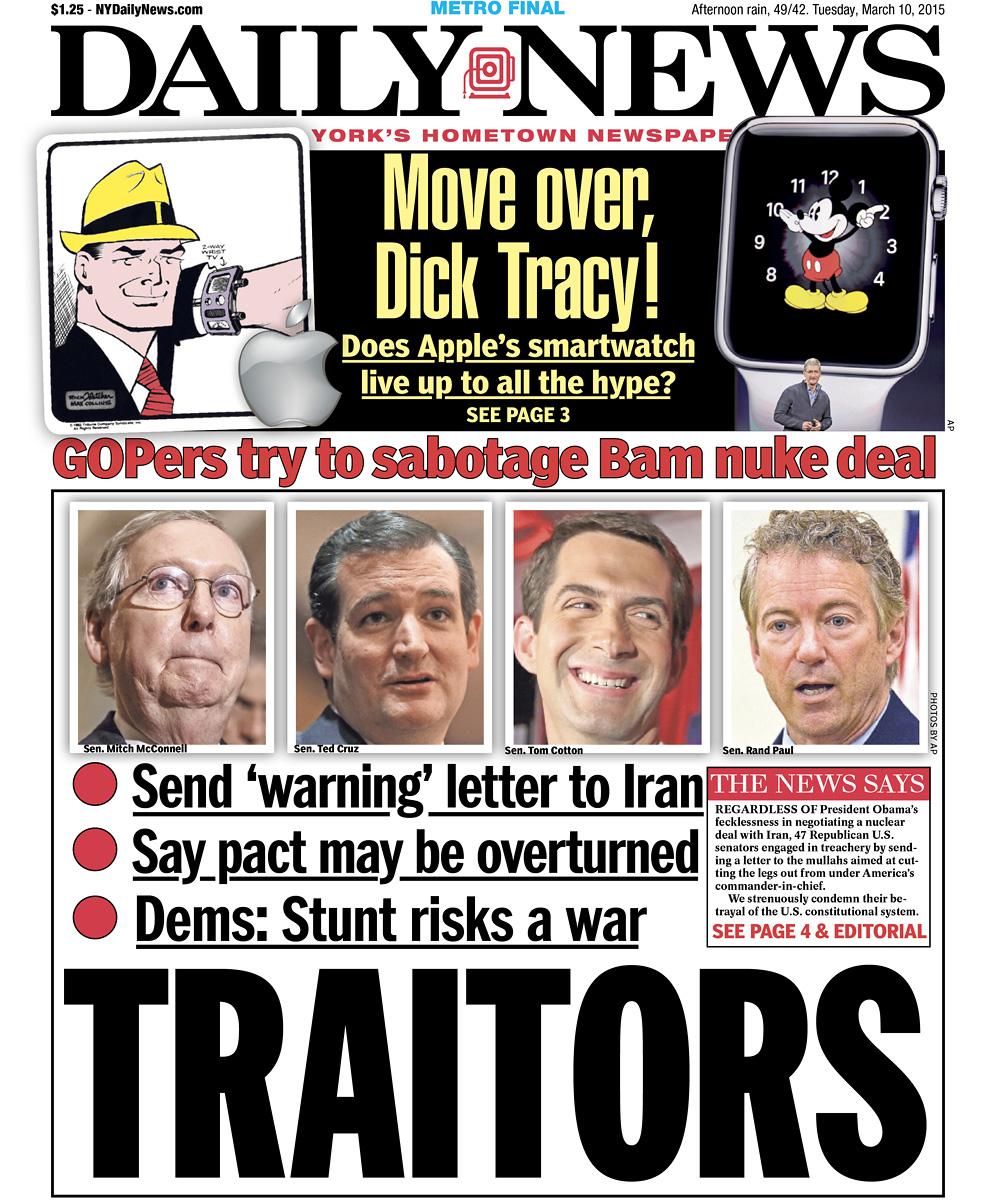
I figure to have that post out by nine. The weekly summary (let’s say around 11) will talk about the Republican senators’ letter to Iran; the resignations, protests, and shootings that resulted from the Justice Department’s report on Ferguson; the racist-frat flap at University of Oklahoma; and a few other things, including the death of Terry Pratchett.

Money and Motion

What was the law, when bright shiny money was in sight?
Money make the train go.

— Charley Barbour,
quoted in The American Slave, a Composite Autobiography

This week’s featured post is “Justice in Ferguson“.

This week everybody was talking about Ferguson again

The Justice Department published two reports Wednesday, one about the Michael Brown shooting and the other about the Ferguson Police Department. I discuss them in detail in “Justice in Ferguson“, but the short version is that Darren Wilson’s story is plausible and he shouldn’t be indicted, while the FPD is a predatory institution that needs drastic reform.

and Selma

Tens of thousands of people marched across the Edmund Pettis Bridge in Selma, Alabama to mark the 50th anniversary of the Selma-to-Montgomery marches that led to the passage of the Voting Rights Act.

President Obama’s speech was a marvelous expression of the liberal vision of America.

It’s the idea held by generations of citizens who believed that America is a constant work in progress; who believed that loving this country requires more than singing its praises or avoiding uncomfortable truths. It requires the occasional disruption, the willingness to speak out for what is right, to shake up the status quo. … That’s what it means to love America. That’s what it means to believe in America. That’s what it means when we say America is exceptional. … That’s what America is. Not stock photos or airbrushed history, or feeble attempts to define some of us as more American than others. We respect the past, but we don’t pine for the past. We don’t fear the future; we grab for it. America is not some fragile thing.

Meanwhile (and Obama referred to this) the achievements of fifty years ago are threatened. The Supreme Court has gutted the enforcement provisions of the Voting Rights Act and the Republican Congress continues to refuse to fix it. The hole that the Court blew in the VRA has invited voter suppression of all sorts.

and Netanyahu vs. Iran

The politics of Prime Minister Netanyahu’s speech to Congress has been widely discussed, both here and in Israel. But reading the text, I found myself thinking more about the content: Is he right about Iran?

Some of what he had to say was obviously exaggerated. Like this:

In the Middle East, Iran now dominates four capitals, Baghdad, Damascus, Beirut and Sanaa. And if Iran’s aggression is left unchecked more will surely follow.

Juan Cole examines this claim capital-by-capital, but the gist is that Iran has given material support to factions in local conflicts that it did not start. (In Baghdad, we started it.) Those factions have been successful in varying degrees, but in none of the four cases has there been anything like an Iranian conquest or occupation, nor is there likely to be. Iran is playing the Great Game, just as we are and Israel is.

A more interesting notion lies in the background of Netanyahu’s remarks, and in most neo-con discussion of Iran: the idea that an Iranian bomb would be uniquely horrible, because Iran’s nature as an Islamic Republic makes it immune to the kind of deterrence that kept the Soviet Union in check. In this telling of the story, Iran’s leadership is motivated by an apocalyptic theology that would happily use nukes against Israel and glory in the ensuing end-of-the-world destruction when Israel retaliated with the nukes it has never admitted it has.

Having discussed just two weeks ago how another force in the region — ISIL — is motivated by apocalyptic theology, I can’t just reject this argument as absurd. But is it true? Is Iran essentially a nation-sized suicide bomber?

Other people have studied this question, and the answer seems to be no. Back in 2011, Matthew Duss wrote “The Martyr State Myth” for Foreign Policy.

The “martyr state” myth is based upon two flawed assumptions. First, that the Islamic Republic of Iran has been uniquely willing to endure the deaths of its own citizens in order to achieve its policy goals. Second, that the Iranian Shiite regime’s End Times theology actually induces it to trigger a conflagration.

Quoting previous studies, he finds that Iran’s willingness to sacrifice its citizens pales in comparison to the Soviet and Chinese regimes that were deterred by retaliation, and that claims of the Iranian regime’s desire for martyrdom

are unsupported by anything like evidence, but rather have achieved the status of conventional wisdom simply by repetition.

Former Iranian President Mahmoud Ahmadinejad did like to talk in apocalyptic terms, but he

  • is not president any more
  • didn’t have control of Iranian military policy when he was president
  • was criticized for his apocalypticism by the ruling imams.

By contrast, Iran’s Supreme Leader is in no particular hurry to be Supreme Leader of a pile of rubble.

and the Supreme Court looking at ObamaCare again

The oral arguments in King vs. Burwell have begun. The case hangs on one sentence in the Affordable Care Act, which (if interpreted without reference to anything outside that sentence) would mean that ObamaCare subsidies could only go to people in states that had their own ObamaCare exchanges, rather people living in states whose exchanges were set up by the federal government.

There has been a certain absurdity to the case from the beginning, since there is ample evidence that no one in Congress intended that result. So the plaintiff’s arguments have all been a little like “You didn’t say ‘Simon says’.”

The Obama administration’s counter-argument is that the executive branch has a responsibility to interpret laws in ways that work, rather than in ways that don’t work, so the IRS has acted correctly in interpreting the law as it has. The precedents seem to be on its side, and I don’t believe this case would ever have reached the Supreme Court without a number of activist conservative judges seeking to repeal laws they don’t like.

The big thing we’ve learned from the justices’ questioning is that there is a conservative reason reject the case, hinted at by Justice Kennedy and drawn out further by Justice Sotomayor: Congress may not have had the power to pass the law as the conservative activist judges have been interpreting it, at least not under a conservative interpretation of the relationship between the federal government and the states.

If the law really did only subsidize people on exchanges states set up, that would be a substantial penalty to states that refused to set up their own exchanges. That kind of monetary pressure (to set up state exchanges) was precisely why (when ObamaCare reached the Court in 2012) the Court threw out the provisions of the law that pushed the states to expand Medicaid.

The legal principle Chief Justice Roberts invoked when he cast the deciding vote to save ObamaCare in 2012 was that the courts have to presume that Congress intended to pass laws that are constitutional. So if one interpretation of a law makes it constitutional and another unconstitutional, courts should favor the constitutional interpretation.

and you also might be interested in …

Correction: Last week I identified FBI agents as potential victims of a Homeland Security shutdown. As a commenter pointed out, the FBI isn’t in DHS, it’s in the Department of Justice.

Meanwhile, Speaker Boehner relented and allowed the House to vote on a clean bill to fund DHS through September. It passed, as it would have weeks ago, without any sturm und drang. The problem for Boehner was that his caucus wanted to continue holding the country’s security hostage: Republicans voted against the clean funding bill 167-75.

Vox added this example to its list of “every major crisis or near-crisis that’s been resolved by Boehner giving up on conservatives and passing a bill with Democratic support.”


Next up: the debt limit. Mitch McConnell says it will pass, but he also says:

We’ll figure some way to handle that and hopefully it might carry some other important legislation that we can agree on in connection with it.

In other words, there’s going to be another hostage crisis. You can replace “other important legislation” with “list of demands”.

I could repeat everything I said last week about Republican governance, but I think I’ll just link to it.


Jonathan Waldman in the NYT says “Don’t Kill Keystone XL, Regulate It“.

“Pipelines are the safest way to move oil,” he says, and they could be made better if regulators insisted on the best technology. I have no argument with that. But he takes one thing as given:

[B]locking [the pipeline] won’t actually prevent Canada from extracting its tar sands oil. Ours is an energy-thirsty world, and when demand eventually drives up the price of oil, out it will come.

I’m not willing to grant that. Canada is going to extract some of its tar sands oil. How much it makes sense to extract at a given oil-price depends on transportation costs, which depends on infrastructure like Keystone XL. And alternative fuels are competitive enough to keep the price of oil from going to infinity.


An incident at UCLA has raised discussion about anti-semitism on campus. Anti-semitism in America is a tricky thing to measure and document, because American Jews tend to be above average in many kinds of achievement and representation. It also gets tied up with political opinions about Israel and America’s support of Israel.

I’ve been mostly silent about anti-semitism not because I’ve decided it doesn’t exist or doesn’t matter, but because I don’t have a good handle on it. I’m still thinking and reading, so maybe that will change.


A fifth-grade teacher in Chicago writes a letter of apology to her students before inflicting on them the latest round of standardized tests.

I do not agree that these tests will tell me what I really need to know about you as a learner or as a human being. I do not agree that these tests will make me a better teacher. I do not agree that these tests will improve our schools. I do not agree that you need to sit in front of a computer for over five hours in order for the government to find out what you know and what you can do. I do not agree that you should not have a choice in how you are able to show all of the things that you are capable of doing. I do not agree that in order for the state to know that I am doing my job that you have to suffer through tests that could quite possibly ruin much of the hard work that we have done together in building your confidence this year and in helping you to see yourselves as readers and writers. I do not agree with these tests.

and let’s close with something amusing

I believe no dogs were harmed in the making of “12 Dogs Who Really Didn’t Expect the Snow to Be This Deep“.

Justice In Ferguson

Darren Wilson gets off, but the Ferguson police and courts don’t.


Through the late summer and into the fall, no issue in America was more polarizing than the shooting of Michael Brown and the demonstrations of public anger that it sparked. Objective reality seemed to have vanished. The “facts” you saw or believed or told other people depended almost entirely on your prior commitments, what news sources you trusted, and who your friends were.

In Ferguson’s African-American community, everybody knew somebody who knew somebody who had seen Brown gunned down in cold blood, his hands up, trying to surrender. Meanwhile the police (and later the prosecutor) were doing Darren Wilson’s public relations, selectively leaking whatever evidence supported Wilson’s story or made Michael Brown look like a thug.

When the prosecutor organized a defense of Wilson in front of the grand jury, the result — no indictment — seemed predetermined and changed very few minds. If you had believed Wilson from the start, you felt vindicated. But if not, the Brown’s murder was just one more example of police misconduct swept under the rug.

The federal Department of Justice was uniquely situated to bridge the gap. It had the direct access to the witnesses and evidence that the community lacked, and the desire to find the truth that the police and prosecutor seemed to lack.

Wednesday, the Department of Justice released two reports, one specifically about the Brown shooting and the other examining the general state of policing in Ferguson. Taken as a whole, the two reports fit the narrative of neither side. But I heard a convincing ring of truth in them.

Policing in Ferguson. You get the clearest picture if you read the general report first, because the community’s response to the Brown shooting makes no sense until you understand its long-term relationship to the FPD.

The essence of the problem in Ferguson can be summarized in one sentence:

Ferguson’s law enforcement practices are shaped by the City’s focus on revenue rather than by public safety needs.

In other words, the City of Ferguson relies on fines for a major portion of its revenue. It regularly budgets for fines to increase, and it pressures the police department to meet its budget goals by finding more offenses it can cite citizens for. Its municipal court is an opaque, inflexible system that is hard to navigate, particularly if you are poor and/or lack transportation.

As a result, a minor initial offense can snowball into an endless and expensive series of interactions if a citizen fails to appear in court when expected (whether notification of a court date has been received or not) or fails to pay the full fine assessed (regardless of the citizen’s ability to pay).

In short, the Ferguson justice system is predatory and the citizens are the prey.

The report illustrates with many examples — most taken from the FPD’s own files — the following series of abuses:

  • Police regularly stop citizens without probable cause of any wrong-doing.
  • They demand that citizens submit to unjustified searches of their persons or vehicles.
  • Refusal of unlawful commands or attempts to claim constitutional rights are met with punitive arrests and/or violence.
  • While in custody, citizens are controlled by violence and threats of violence. For example, protesting the basis of an arrest, passively refusing to cooperate, or verbally abusing an officer frequently results in being shot with a taser.
  • The FPD ignores its own system for tracking officers’ use of force. When supervisors do submit a report on a use of force, typically only the arrest report written by the officer in question is consulted, even if that report contains internal contradictions.
  • Complaints from the public are discouraged, are frequently ignored, and can result in punitive investigations of the complaining citizens.
  • Officers are rated and promoted based largely on their “productivity”, i.e., the number of revenue-producing citations they write. Citizen complaints or repeated use of force does not significantly affect an officer’s career.

The damage done by a rogue police force can be mitigated by the courts, if the courts are motivated to pursue justice. However,

The Ferguson municipal court handles most charges brought by FPD, and does so not with the primary goal of administering justice or protecting the rights of the accused, but of maximizing revenue.

The municipal court, in other words, is part of the predatory system.

Racism. The report describes a general pattern of abusing the powerless, with sections on the mentally ill or mentally handicapped (whose inability to comprehend or respond to police commands is often taken as resistance and met with violence), and students (the officers assigned to Ferguson high schools escalate situations towards arrests — more revenue! — rather than trying to establish and maintain peace).

But the largest of these sections focuses on racism. The FPD, the city government, and the municipal court are overwhelming staffed by whites, in a city that is two-thirds black. Blacks are disproportionately the prey of the municipal justice system, and the more extreme the police action, the more likely the victim is to be black. For example,

The department’s own records demonstrate that, as with other types of force, canine officers use dogs out of proportion to the threat posed by the people they encounter, leaving serious puncture wounds to nonviolent offenders, some of them children. Furthermore, in every canine bite incident for which racial information is available, the subject was African American. This disparity, in combination with the decision to deploy canines in circumstances with a seemingly low objective threat, suggests that race may play an impermissible role in officers’ decisions to deploy canines.

The more an officer’s discretion is involved in an arrest, the more likely the arrested citizen is black. For example,

With respect to speeding offenses for all roads, African Americans account for 72% of citations based on radar or laser, but 80% of citations based on other or unspecified methods. Thus, as evaluated by radar, African Americans violate the law at lower rates than as evaluated by FPD officers.

Another factor was the practice of police and court employees “fixing” traffic tickets and other municipal citations for friends and relatives. Given the racial composition of the city’s staff, the recipients of these favors were probably overwhelmingly white.

In addition to statistics, the report culled a number of racist emails from the police and court systems. Like:

A November 2008 email stated that President Barack Obama would not be President for very long because “what black man holds a steady job for four years.”

Justice Department investigators could find no record of recipients objecting to such emails or of superiors reprimanding the senders. Often such offensive jokes were forwarded to others.

Reading the report, I was left with an impression not of Klan-like, get-the-niggers racism, but of widespread racial stereotyping that affected decisions at all levels. Being a young black male was in itself seen as probable cause of wrong-doing that police should look into. Uncooperative blacks were seen as inherently violent and dangerous, justifying police violence to control them. Violence directed at blacks was considered a less serious matter than similar incidents against whites* would be. The overall predatory nature of the system was more easily ignored or rationalized because its victims were mostly black.

Michael Brown. When Darren Wilson killed Michael Brown in broad daylight on a city street in front of many witnesses, the African-American community saw a chance for some good to come of this tragedy: Maybe finally the police had done something so outrageous that it couldn’t be covered up. Maybe finally the world would have to notice the abusive system they lived in, and a policeman would have to pay.

It is no wonder, then, that the community was quick to believe the worst about Darren Wilson. Accounts in which he gunned down Brown for no real reason fit very well with the accounts they heard every day from their friends and neighbors: of dogs set on young blacks for no real reason, or tasers used when blacks mouthed off or just didn’t move fast enough to suit police.

Likewise, it is no wonder that witnesses saw what they expected to see, that they exaggerated what they did see, or that they stayed away from TV cameras if what they saw supported Wilson’s account.

The Justice Department’s report on the Brown shooting recommends no charges against Darren Wilson. It goes through the evidence in great detail, and concludes not that everything happened the way Wilson said, but that it could have happened that way. (In Mythbusters terms, Wilson’s story is “plausible”.)

Wilson’s account goes like this: He tried to stop Brown on suspicion of a petty theft (of a handful of small cigars from a convenience store). Brown punched him and reached into his vehicle to struggle for Wilson’s gun. Wilson fired the gun once while inside the car, causing Brown to run away. Wilson pursued, and Brown turned to charge him. Wilson started shooting again, but Brown did not stop until Wilson had fired the fatal shot to the top of Brown’s head.

None of the physical evidence contradicts that story. Some eye-witness testimony supports it. The testimony that contradicts Wilson would not impress a jury, because there are no witnesses who

  • contradict Wilson
  • tell a story consistent with the physical evidence
  • have told the same story consistently to all investigators.

So the Justice Department concludes that prosecuting Wilson would be a waste of time.

The separate accounts of the various witnesses paint a picture of more than just the Brown shooting: a community that wants this shooting to be what it needs rather than what the incident was. Again and again, witnesses against Wilson confess that they have mixed the part of the event they saw with what they have heard on the street. Witnesses supporting Wilson are reluctant to come forward, either because they want Wilson convicted or because they don’t want to be known in the community as the witness who got Wilson off. Some just don’t talk and we don’t know why.

Putting the two reports together, I am left with questions about Wilson, even if I know that I couldn’t vote to convict him. Was killing Brown really necessary, or was it the kind of punitive violence that is endemic in the FPD? To what extent was Wilson worried about his own safety, and to what extent was he just angry that Brown disrespected his authority? (For example, Wilson explains why he reached for his gun rather than his taser during the struggle in his SUV. He doesn’t explain why — given a brief period of time to collect himself before pursuing Brown — he didn’t switch weapons.) Was it really necessary to keep firing, or did the stereotype of the unstoppable black beast affect Wilson’s decision? (Wilson’s choice of words — comparing Brown to a demon — suggests it did.)

I’ll never know for sure. But I couldn’t convict Wilson just on my questions. He should go free.

Justice. In the end, although the Justice Department hasn’t given the black citizens of Ferguson Darren Wilson’s scalp, it has given them what they really need: Exposure of the corrupt and predatory system they live under, and some hope of relief.

Friday, Attorney General Holder pledged that the Justice Department is “prepared to use all the power that we have … to ensure that the situation changes.”

Asked if that included dismantling the Ferguson Police Department, Holder said, “If that’s what’s necessary, we’re prepared to do that.”

Sunday’s NYT illustrated all the ways that Ferguson is not unique, particularly in St. Louis County, but also in communities across the country. There are other predatory police-and-court systems out there. Those towns and cities will be watching Ferguson closely. If the DoJ follows through, the effects could ripple across the nation.

That may not be the conclusion that either side was asking for, but it may be the best ending this tragic story could have received.


* For contrast, consider this:

In one 2012 incident, for example, officers reported responding to a fight in progress at a local bar that involved white suspects. Officers reported encountering “40-50 people actively fighting, throwing bottles and glasses, as well as chairs.” The report noted that “one subject had his ear bitten off.” While the responding officers reported using force, they only used “minimal baton and flashlight strikes as well as fists, muscling techniques and knee strikes.” While the report states that “due to the amount of subjects fighting, no physical arrests were possible,” it notes also that four subjects were brought to the station for “safekeeping.”

The Monday Morning Teaser

The featured article this week is about Ferguson. The feds released two reports based on their investigations — one about the Michael Brown shooting and another about the general state of policing in Ferguson. The short version: Darren Wilson gets off but the FPD doesn’t.

My conclusion after reading both is that overall this is a good ending to a tragic story. The point of the Ferguson protests was never just the Brown shooting; the Brown shooting was supposed to be an egregious example of a larger problem.

In the weekly summary: The Selma anniversary. Was Netanyahu right about Iran? New hope in the ObamaCare case before the Supreme Court. And some dogs in very deep snow.

I’m still on the road and my internet connection is acting flaky this morning, so I hesitate to make predictions about when either post will appear.

Partisans

We are all Republicans, we are all Federalists.

— Thomas Jefferson,
First Inaugural Address (1801)

There is not a liberal America and a conservative America — there is the United States of America.

— Barack Obama
Keynote Address to the Democratic National Convention” (2004)

This week’s featured post is “The Myth of Republican Governance“. The big issues in this week’s summary have all come up (and been discussed in detail) before, so I’m going to linking to a lot of previous Sift articles.

This week everybody was talking about funding Homeland Security

Late Friday night, Congress avoided a shutdown of the Homeland Security Department by passing a one-week continuing resolution. So we get to do the whole thing over again this week.

As in previous shutdown confrontations, the Senate passed a “clean” bill funding DHS for the rest of the fiscal year (through September), without attaching any riders rolling back President Obama’s executive actions on immigration. The Senate bill almost undoubtedly would have passed in the House, ending the crisis, had Speaker Boehner allowed it to come to the floor. According to CNN, doing so might have sparked House conservatives to oust him as Speaker, but National Journal says no.

Conservative rhetoric says they are “defending the Constitution” by trying to reverse President Obama’s “lawless” re-prioritization of  immigration enforcement. In fact, the administration studied the legal limits of executive action and made a strong case that it was staying within them, as I outlined in November. The rhetoric is another example of what I described in “A Conservative-to-English Lexicon“:

Like the Bible, [the Constitution] means whatever conservatives want it to mean, regardless of its actual text.

Conservatives jurisdiction-shopped to find a federal judge who agrees with them, so there is an injunction temporarily halting Obama’s executive actions. Slate‘s Eric Posner gives it “little chance of withstanding appeal“. If conservatives truly believed their rhetoric about constitutionality, they could let the conservative majority on the Supreme Court handle it.

and Net Neutrality

A little over a year ago, the headlines were saying that net neutrality was dead, killed by an appeals-court ruling. If you read the ruling, though, things still seemed up in the air. As I wrote at the time:

The gist of the court ruling is that the FCC has classified cable companies as information-services providers, but that its net-neutrality rules regulate them like telecommunications carriers. So the FCC’s net-neutrality rules can’t stand. But — and this is the observation that snatches victory from the jaws of defeat — it’s totally within the FCC’s current powers and mandate to just reclassify the cable companies.

So net neutrality is dead. But if the FCC wants to revive it, all they have to do is issue new rules.

And that’s what they just did: reclassified internet providers as utilities, like the telephone companies. Now, I don’t want to minimize how courageous that was, given the amount of money and influence Verizon and Comcast have been throwing around. But it was always within the FCC’s power.

So now we have net neutrality rules again, and the same court decision that threw out the old rules defends the new ones. The non-profit Mozilla Foundation celebrates “a major victory for the open web“, and Ezra Klein explains what that means:

and the Keystone Pipeline

President Obama vetoed a bill that would have given the government’s go-ahead to the Keystone Pipeline, but he did it on procedural grounds:

Through this bill, the United States Congress attempts to circumvent longstanding and proven processes for determining whether or not building and operating a cross-border pipeline serves the national interest.

So don’t get excited that Obama has finally taken a stand on the pipeline; he hasn’t. He’s just said it shouldn’t be approved this way.

My position on the pipeline hasn’t changed since I wrote “A Hotter Planet is in the Pipeline” two years ago: We can’t burn all the fossil fuels without doing catastrophic damage to the climate, so some will have to stay in the ground. The tar sands whose product Keystone would transport are good candidates.


The case for Keystone revolves around the number of jobs it would create. Estimates vary, but the important thing to realize is that the vast majority would be temporary construction jobs that might last six months to a year, plus some other jobs for people providing services to those temporary workers (who would probably eat a lot of Big Macs before they moved on). Politifact assessed Van Jones’ claim that the pipeline would provide only 35 permanent jobs, and judged it to be true.

On the other hand, the risk of oil spills and groundwater contamination will be permanent, as well as the environmental damage from the carbon released.


The hardest thing to assess about projects like this are the net effects. For example, in the absence of a pipeline, probably less oil will be recovered from those fields to begin with. (The last oil produced from a field is typically the most expensive; whether it gets pumped out at all depends partly on transportation costs.) That’s how the pipeline relates to leaving oil in the ground.

But the oil that is recovered will be transported some other way. Those other ways have their own environmental downsides, and their own employment upsides. The 35 long-term pipeline jobs might be outweighed by the lost railroad and trucking jobs, making the pipeline a net job destroyer. But it’s also hard to guess how many train-car accidents a pipeline would prevent, and what their environmental impact would be.


In a sane world, you could imagine a deal that allowed everyone to save face: Keystone in exchange for environmental concessions elsewhere. Michael Bloomberg outlines one deal. May Boeve explains why it would be a bad deal. But neither has an answer for the “sane world” problem.

and Netanyahu’s speech

It’s happening today, maybe as you read this. Vox gives the background.

and Bill O’Reilly

Bill O’Reilly’s defining characteristic is his lack of self-awareness. He stands in his yard and throws stones without ever noticing the glass house behind him.

So when NBC’s news anchor Brian Williams got into trouble for telling tall tales about his past reporting experiences, O’Reilly pounced, misrepresenting Williams’ exaggerations as being part of his live reporting, and implying that Williams was reporting falsely for ideological purposes:

When hard news people deceive their viewers and readers to advance a political agenda, that’s when the nation gets hurt.

[To be fair, O’Reilly didn’t make the Williams-is-a-lying-ideologue charge in so many words. He just segued directly from this abstract statement to the Williams scandal, as if the two had something to do with each other.]

Well, it turns out that O’Reilly also tells tall tales about his past reporting. The biggest exaggeration concerns a demonstration in Buenos Aires in 1982, when Argentines were upset by their government’s surrender in the Falklands War. Nobody else considered the demonstrations that big a deal; fellow CBS reporter Eric Engberg described is as “the chummiest riot anyone had ever covered”. But O’Reilly has described Buenos Aires as “a war zone”, and often uses that mischaracterization to justify claiming that he has “been there” in combat. His specific retrospective claims about that day — that police fired live ammunition into the crowd and killed many people — are contradicted by the news coverage at the time and by the accounts of everyone else who was there.

But of course O’Reilly is not going to admit — or even recognize —  that he did anything wrong, or that he did precisely what he condemned Williams for doing. Instead, he claims that evidence supports him (when in fact it does no such thing), and that the issue is not his personal dishonesty, but an attack on all of Fox News because “Fox gives voice to conservatives and traditional people”. That makes it an us-against-them issue, not a Bill-is-a-serial-liar issue, so it calls threats and intimidation against journalists who try to investigate.

And of course Fox News is going to stand by him rather than suspend him as NBC did Williams. Columbia Journalism Review draws the obvious conclusion:

Fox has made clear that it doesn’t see itself bound by the same rules of public accountability it calls on other news organizations to uphold.

And that, in turn, demonstrates an even more general principle: Moral standards are just lower on the Right. To give a second example: Eliot Spitzer’s upward-trending political career ended within days after it came out that he had seen a prostitute. A similar scandal was just a blip for David Vitter, who continued in the Senate and was re-elected. And there is no liberal-media-star parallel to Rush Limbaugh’s drug history.


Once the idea got broached that O’Reilly makes exaggerated claims, other examples have followed: hearing the gunshot when a JFK-assassination witness committed suicide, and seeing the execution-style murders of Salvadoran nuns.

and you also might be interested in …

RIP, Leonard Nimoy. May your legacy live long and prosper.

Also dead this week: Earl Lloyd, basketball’s Jackie Robinson.


Thursday, Senator Inhofe (R-Exxon-Mobil) proved global warming is a myth by throwing a snowball while speaking to the Senate. Vox described it as “the dumbest thing that happened on the Senate floor today” and performed the thankless task of explaining rationally why Inhofe is wrong.

Sometimes these kinds of incidents make me mad, but this time I’m just embarrassed. This is the Senate of the United States of America. My country has put complete idiots in positions of power.


The American Family Association has created a “Bigotry Map” to identify “groups and organizations that openly display bigotry toward the Christian faith.” The icons mark atheist groups, humanist groups, “anti-Christian” groups, and “Homosexual agenda” groups.

This is just a screen capture. The original is much fancier, allowing you to zoom in or out and click on icons to identify the groups closest to you. (I’m right between Lowell Atheists and GLSEN New Hampshire. AFA seem to have missed the Concord Area Humanists; I’m sure my friends on the steering committee will be miffed.)

Friendly Atheist comments:

Not a single one of the atheist/Humanist/LGBT rights groups that I can see on the map have ever supported violent acts or taking away rights from Christians. They’ve always been on the side of tolerance and inclusivity. They want non-Christian beliefs to be treated by the government the same way Christianity is treated, with no group getting special privilege.

This is how desperate right-wing groups are to show the fictional marginalization of Christians. They think criticism is the same as bigotry. They think neutrality is the enemy.

The map is also an example of privileged distress: As a group becomes less dominant and has less power to lord it over others, that slippage feels like persecution. I mean, imagine if the government starts to treat Jesus’ birthday with the same respect it shows to, say, Buddha’s or Krishna’s. What’s next? Death camps?


Evangelist Franklin Graham, Billy’s son, says on Fox News that the White House (along with several unspecified European governments) has been “infiltrated by Muslims”. But he can’t name any.


Every year around this time, Pastor Kenneth Swanson’s 2012 radio rant against buying Girl Scout cookies (because he claims the Scouts promote lesbianism) shows up in my Facebook news feed. This year, it got me wondering what Rev. Swanson has been up to lately.

On Feb. 20, he interviewed Rev. Marion Clark, whose new book The Problem of Good: when the world seems fine without God explores the disturbing conundrum that non-Christians aren’t constantly doing evil, and may even be nice people.

SWANSON: There are a lot of unbelievers — neighbors, co-workers — they’re nice. They’re nice people. How do you explain that, Marion?

CLARK: Well, that was the question that really troubled me. And I’ll say that the problem of good, which you’re talking about, troubled me more than the problem of evil. Evil exists; it’s out there. But what kept tripping me up were my nice neighbors, nice family members, people who — I would hate to say it — were nicer than I was. And yet they were unregenerate. And how could that be?

How indeed? It’s like seeing the inverted image of Greg Epstein’s Good Without God.


Gerrymandering explained:


Male privilege explained:

And a young man explains men’s responsibility for preventing sexual assault.

and let’s close with something funny

Australian comic Jim Jefferies on gun control.

The Myth of Republican Governance

If your ideology says government can’t succeed, why prove yourself wrong?


Any day now, we are often assured, Republicans in Congress will start to take their jobs seriously. It hasn’t happened yet, but soon.

“I think a lot of people better get serious about governing,” Pennsylvania Republican Congressman Charlie Dent said last Friday, after the House failed to fund the Department of Homeland Security past next Friday. It’ll happen. Any day. Any minute.

Of course, they were very serious about governing during the George W. Bush administration. But nobody — not even Bush’s closest relatives — want to think too hard about those days now.

And then the Obama landslide of 2008 made Republicans almost irrelevant for two years. Suddenly there was no point trying to take responsibility for anything, and Republicans discovered the invigorating thrill of pure nihilism. They were free to propose nothing and say no to everything, even their own ideas from that era we don’t talk about any more.

So when Obama based his healthcare proposal on Romneycare, Romney opposed it. McCain turned against the McCain-Lieberman cap-and-trade plan, and voted against his own immigration reform. Republicans were all mad as hell and they weren’t going to take it any more — whatever it was.

But when the low-turnout election of 2010 made John Boehner Speaker of the House, it was time to get serious and get back to governing responsibly. Wasn’t it? [1]

Then followed four years of playing chicken with the well-being of the Republic. That series of crises culminated in the government shutdown of 2013, when the executive branch was very nearly put in the impossible situation of being obligated to carry out Congress’ appropriations bills, but forbidden to raise the money by either taxing or borrowing. Crazy ideas like the trillion-dollar coin bounced around, because they were no crazier than everything else that was happening.

At the time, Republicans’ poll numbers dropped, and there was some thought that the voters might punish the party in 2014. But in fact the exact opposite happened: The voters gave them control of the Senate too.

But now, with control of both houses, they have something to prove. Don’t they? In January as the new completely-Republican-controlled Congress opened, John McCain expressed the party line:

I think a majority [of Republicans] recognize that we have to govern responsibly. We have to show that we can be a productive party, and that, I think, will have a direct effect on whether we’re able to elect a Republican as president in 2016.

Two months later, DHS is living paycheck to paycheck, because House Republicans are mad as hell about immigration. They don’t have a coherent plan to undo President Obama’s executive actions, and they certainly don’t have an immigration plan of their own [2], but they’re mad! They have to do … something.

Meanwhile, we’re now up to 50 votes repealing ObamaCare, and not a single one on a Republican plan to replace it. Republicans nearly all acknowledge that parts of ObamaCare should be kept. (The part about pre-existing conditions, for example.) But coming up with a plan that actually does that? Making the compromises necessary to pass it into law? You’ve got to be kidding.

Discipline. In years past, the voters played the wait-til-your-father-gets-home role in American politics. A little bit of posturing and headline-grabbing was fine, even expected. But if a political temper tantrum gave the public reason to doubt the basic functions of government, somebody would pay come the next election.

Democrats, media pundits, and would-be grown-ups among the Republicans (i.e., McCain, Boehner, and McConnell) keep trying to invoke that discipline. But think about it: In 2013, for the sake of a plan that never had any chance of working, the Republican back-benchers shut down the government and very nearly broke the full faith and credit of the United States. And 13 months later, the voters gave their party more power.

We live in a new world, where Dad isn’t coming home and there’s no reason the kids should ever finish their vegetables and go to bed.

It’s time we understood how this new world works.

The difference between the parties. A cynical view of politics says that the two parties are just mirror images of each other, rival gangs competing for territory like West Side Story‘s Jets and Sharks.

But there is one key difference between the two: Democrats believe that government can change people’s lives for the better, and that we can do things together that we can’t do for ourselves. Together, we can have parks and libraries and public schools and clean air. We can soften the dog-eat-dog aspects of the capitalist system so that ordinary people have a chance. We can insure each other against disasters from hurricanes to cancer.

Republicans believe that government can only screw things up.

So when Republicans govern well, they refute themselves. If a Republican official solves a problem — like Mitt Romney did with health care in Massachusetts — it just creates an appetite for more government.

And that’s bad. To really prove the point that government can only screw things up, Republicans elected to office need to screw things up.

Turnout, not persuasion. In the old model of politics, there were “swing voters” — voters not identified with either party, who were open to persuasion. Each side had its partisans, but the one that convinced the swing voters would win.

One thing that swing voters found convincing was performance; that was where the discipline came from. If you made the United States look like a joke, they’d vote you out.

But that’s not how it works these days. Overwhelmingly, the people who care about politics enough to vote are identified with one party or the other, no matter what that party does. Today the question isn’t who you’ll vote for, it’s whether you’ll vote. (That’s how, for example, Mitt Romney got zero votes in some inner-city precincts of Philadelphia and Cleveland. Similarly, there were evangelical churches in the South where if you voted, you voted against Obama. So parties don’t bother trying to convince either set of voters, they just get their own to the polls.)

Take a look at how that works out in the vote totals for House races. (Data from Wikipedia.)

year Republican Democratic Total House split
2008 52,249,491 65,237,840 117,487,331 178-257
2010 44,827,441 38,980,192 83,807,633 242-193
2012 58,228,253 59,645,531 117,873,784 234-201
2014 40,024,866 35,626,309 75,651,175 247-188

A few things to notice:

  • Republicans got their biggest House majority in 2014, when they polled the fewest votes.
  • When there’s a big turnout, the Democrats win the popular vote, but when turnout is small, Republicans win. Another way to say the same thing is that the Republican vote is steadier than the Democratic vote. The lowest Republican vote (2014) is still more than two-thirds of the highest (2012), while the lowest Democratic vote (2014) is barely more than half the highest (2008). Conclusion: The people who might or might not vote are overwhelmingly Democrats.
  • Gerrymandering has locked in a certain amount of Republican advantage, so that winning the popular vote in 2012 didn’t get the Democrats control of the House.

Demographics. The big story after the 2012 election was that demographic trends favor the Democrats. The percentage of the country that is white shrinks every year, and Democrats are favored by non-whites. Young voters (who will be around for a while) trend Democratic, while old voters (who won’t) trend Republican. Christian voters (shrinking) trend Republican, while no-specified-religion voters (growing) trend Democratic.

Salivating over those delicious trends, Democrats started trying to predict the date when Texas turns blue. A report by College Republicans said that their party had to change: compromise on immigration and gay marriage, reach out to Hispanics, blacks, and young people.

None of those changes happened in 2014, and yet the GOP won big. How? The rising demographic groups didn’t vote.

Comparing yesterday’s exit polls to those of 2012, the first thing that jumps out at you is a big shift in age demographics: under-30 voters dropped from 19 percent of the electorate in 2012 to 13 percent in 2014, while over-65 voters climbed from 16 percent in 2012 to 22 percent in 2014. That’s quite close to the age demographics of 2010.

Rather than continue its inexorable decline, the white vote increased from 72% in 2012 to 75% in 2014.

And that’s the secret to the lasting Republican congressional majority, and maybe to electing a Republican president in 2016: Don’t try to convince swing voters that Republicans can govern better than Democrats (or even govern at all). Just keep the rising demographic groups from voting.

No hope, no change. A portion of the blame/credit for the low turnout among minorities and youth in 2014 has to go to the intentional voter suppression Republicans have been focused on since 2010. They discovered that you don’t have to formally disenfranchise people to keep them away from the polls, you just have to make voting harder and less rewarding. Make people who don’t own cars (and so have no reason to already have a photo-ID drivers license) jump through an extra hoop. Make college students vote where their parents live. Gerrymander districts so that election results are a foregone conclusion. Shorten poll hours, make sure the lines are long in Democratic precincts, and so forth.

Marginal voters tend to have less slack in their lives than the more established non-urban whites of the Republican base. Getting to the polls is tougher, and standing in line for hours might mean you get fired or the kids are left unsupervised. So sure, each new hurdle in front of the voting booth is going to discourage more Democrats than Republicans.

That all has some effect, and will probably have more and more as it becomes normal and fails to provoke the backlash that motivated blacks (in particular) in 2012. But the real secret to lasting Republican power is motivational, or rather, de-motivational: Ruin people’s hope that politics can change their lives for the better.

People get involved in politics because they believe it can stop a war, save a school, jail the bankers who wrecked the economy, open doors for their racial group, give working people a chance, or secure their future against disasters of all sorts. They run away from politics when it looks like one of those pointless internet flame wars. Life is short and energy is limited. If politics is a waste of time, people who aren’t already committed to it will stay away — especially if their lives are hard enough already.

So when the marginal voters would vote against you, dysfunction becomes a strategy. Republican ideology already says that government can’t do anything but screw up. So if Congress is seen as just a bunch of jokers, that proves their point. If even the most obvious bill becomes impossible to pass, and the federal government lurches from crisis to crisis without doing anything that helps people … what better voter suppression is there?

Democrats need hope and change to motivate people to be active and vote. Republicans need no hope and no change to keep them tuned out. And they’re getting it.

That’s how we have the perverse polling we’ve seen: Just before the 2014 election, National Journal found only 9% approved of the job Congress was doing while 80% disapproved. In a Pew Research poll, disapproval of the Republican Party has been consistently running 68/23 neighborhood, compared to Democrats’ somewhat less unfavorable 60/32 split. And that led to increasing the Republican House majority and giving them control of the Senate too.

Why? National Journal has the answer: Americans wish the parties would co-operate more, but don’t believe they will. So:

More of those surveyed looked outside the political system for changes that might improve their lives.

What next? Whether or not we stop paying FBI agents next Friday, don’t expect Republicans in Congress to stop playing games with the government. And yes, it will drive down the popularity of Congress and of the Republican Party.

But so what? That dysfunction will also convince more Americans to lose faith in politics. More and more, voting will become that pointless thing old white people do. And why would you campaign for a candidate or donate to a campaign, unless you represent a special interest that needs to buy a favor?

Winning the House in 2010 gave Republicans the power to screw things up in Washington. And marginal voters responded to the screwed-up state of politics by staying home in 2014 and giving Republicans control of the Senate as well. Maybe they now have the power to screw things up on a grand enough scale to elect a Republican president in 2016.

But, then, surely, with control of both Congress and the White House, Republicans will have to take governing seriously. Won’t they?

Don’t count on it.


[1] It’s worth giving some thought to exactly what “responsible governing” would mean, so that it isn’t just thrown around as a buzzword.

In general, responsible governing means compromising to find a way forward that can be passed into law, rather than turning everything into a test of ideological purity. Finding a workable compromise is something a politician should be proud of, not a shameful act that can only be accomplished under the threat of a dire emergency.

Responsible governing also means being for something, rather than just criticizing everybody else’s solutions. Don’t like President Obama’s immigration plan? Fine. Tell me yours.

Above all, responsible governing means an end to hostage-taking, i.e., threatening to do something that nobody wants if you don’t get your way. Compromise means weighing what I want against what you want. But when one of us starts threatening to do things that nobody wants, we’re playing a different game entirely. The debt ceiling is the clearest example of a hostage — nobody really wants to see the United States default on its legal commitments — but nobody wants to see DHS shut down either.

It’s weird that the people most committed to ideological purity and most opposed to compromise claim to be representing the point of view of the Founders. The Founders were champion compromisers. The United States wouldn’t exist at all if they weren’t.

[2] Marco Rubio had an immigration plan, but has been making what Bloomberg Politics called an “apology tour” for daring to pass it through the Senate. If it had become law, hara-kari would have been his only honorable option.

The Monday Morning Teaser

This week the clown show was back in town: Friday, Republicans in the House came within hours of shutting down the Homeland Security Department, and managed to pass only a one-week funding bill. So this week they can play the same game of chicken all over again.

That’s why today’s featured article will be “The Myth of Republican Governance”. Every time the Republicans get more power — first the House, then the Senate — we hear how now they’re going to have to get serious and prove to the voters that they can govern responsibly.

They haven’t and they won’t. Government dysfunction is actually a strategy now, and until we understand that, we’re going to keep trying to live in a bygone era. “Can’t make me!” the bratty little kid says, and in this case he might be right.

The weekly summary will also cover the net neutrality win, Obama’s Keystone Pipeline veto, Bill O’Reilly’s troubles, and the “problem of good” that right-wing Christians have discovered, before closing with a hilarious Jim Jefferies routine about gun control.

As for when these posts will appear, I make no promises. I still have a lot of supporting links to find for the featured post, and posting from the road (I’m in Savannah, on my way to Florida) is always a little unpredictable. Be patient.


True Love

I love America more than any other country in the world, and, exactly for this reason, I insist on the right to criticize her perpetually.

– James Baldwin

This week’s featured article is “The Islamic State: Separating Insight from Stereotype“.

This week everybody was talking about what the Islamic State wants

It all started with “What ISIS Really Wants” in The Atlantic. The reason that article inspired so much back-and-forth is that it’s the hardest kind of article to sort out: one that contains both major insights and major flaws. So I want to encourage you both to learn from it and not to be fooled by it. Hence this week’s featured article.

and who loves America

One measure of our democracy’s lack of vitality is the triviality of the things we talk about. This week at a Scott Walker event, Rudy Giuliani said:

I do not believe, and I know this is a horrible thing to say, but I do not believe that the president loves America. He doesn’t love you. And he doesn’t love me. He wasn’t brought up the way you were brought up and I was brought up through love of this country.

Walker avoided committing himself, saying that he doesn’t know whether Obama loves America. He also doesn’t know whether Obama is Christian.

People who had any substantive vision of their own to put forward wouldn’t be talking about stuff like this.

And if we’re going to talk about loving America, consider this: After 9-11, President Bush’s approval rating shot above 90%, because when the country was threatened, liberals lined up behind a president they didn’t like and didn’t even necessarily believe had legitimately won the election. How many conservatives love America like that?

and Netanyahu’s upcoming speech to Congress

It’s really a weird situation: Congress is providing a platform for a foreign leader to campaign for re-election by denouncing American policy. Rabbi David Teutsch has responded with his “first fully public statement criticizing a sitting Israeli government official”.

Netanyahu has stated that in coming to speak to Congress, he represents the voice of world Jewry. At best, that claim is a delusion, and at worse, a self-serving lie. There has never been any one person able to speak for world Jewry, an ideologically, theologically, and culturally diverse group of communities. He surely does not speak for me, nor for thousands of active, Jews committed to Israel.

Back when JFK was running for president, anti-Catholic rhetoric said that Catholics couldn’t be loyal Americans, because their first loyalty was to the Pope. Anti-Semites say the same thing about American Jews and Israel. This kind of rhetoric from Netanyahu doesn’t help. M.J. Rosenberg responds:

If American Jews feel that they are being forced to choose between the United States and Israel, there can be little doubt that they will choose the country they live in and to which they have always been devoted. Netanyahu is playing with fire when he even hints at such a choice.

On the substance of the issue Netanyahu wants to talk about — a nuclear deal with Iran — see James Fallows.

and you also might be interested in …

One question that I hope gets raised repeatedly in the 2016 presidential campaign is: Can conservatives acknowledge past mistakes and learn new lessons?

Paul Krugman raised that question with regard to economic policy. He notes that Scott Walker and Rick Perry have been courting the supply-side economics crowd, whose predictions have been consistently wrong for the past eight or nine years: Not only didn’t they see the real-estate bubble or the Great Recession coming, but they have spent the Obama years warning about the return of inflation and high interest rates — the exact opposite of what has been happening.

It also came up this week when Jeb Bush made a lackluster foreign policy speech at the Chicago Council on Global Affairs. (He read the text as if his speechwriters had left it sitting on the podium and he was seeing it for the first time.) His claims to be his “own man” clashed with his list of foreign-policy advisers, nearly all of whom were architects of his father and brother’s foreign policy — including Paul Wolfowitz, Dick Cheney’s only rival for the title “The Man Most Consistently Wrong About Iraq”.

Krugman sums up:

Across the board, the modern American right seems to have abandoned the idea that there is an objective reality out there. … If anything, alleged experts seem to get points by showing that they’re willing to keep saying the same things no matter how embarrassingly wrong they’ve been in the past.

Whether they share his name or not, Republican presidential candidates (other than maybe Rand Paul) still seem to be running for George W. Bush’s third term. Even after eight years to think about it, they have announced no lessons that they have learned from the across-the-board failures of his first two terms.


Matt Yglesias has a good analysis of the gender wage gap.


Ben Carson says that all’s fair in war. I’m afraid to ask him about love.

OK, that was too flip. What Carson actually did was object to fighting a “politically correct war”. Instead, he said: “If you’re gonna have rules for war, you should just have a rule that says no war. Other than that, we have to win.”

What is lost in this point of view — and marks Carson as dangerously naive in military affairs — is that the tactics of war have to serve the objectives of war. If your objectives are more subtle than just “kill everybody and come home”, you need rules of engagement, and you need to punish soldiers who break those rules.

and let’s close with a simple sex fantasy

The Islamic State: separating insight from stereotype

The Atlantic published a much-discussed article about ISIS.
About half of it was deeply insightful.


What does the Islamic State of Iraq and Syria want? How is it different from al Qaeda? Why does it act the way it does? What are its leaders trying to do? What draws in Muslims from all over the world? And if we understood all those things, what strategy would we use to fight it?

Graeme Wood’s article “What ISIS Really Wants” in The Atlantic touched off a heated discussion of these important questions, and was answered by a flurry of other articles like “The Atlantic‘s Big Islam Lie” in Salon, “What The Atlantic Gets Dangerously Wrong about ISIS and Islam” in ThinkProgress, and many others. Just looking at the headlines might convince you that Wood’s article just touches off another he-said/she-said argument and isn’t worth the investment you’d need to figure out what it’s about.

That would be a mistake, because Wood’s article is a rare combination of deep insight with deep flaws. What’s even rarer, the insights don’t depend on the flaws. In other words, you can learn a lot from Wood about how Islam figures in the self-image and self-definition of the Islamic State, but avoid picking up Wood’s stereotyped view of Islam in general.

Let’s start with the insight. Wood raises two topics that hadn’t gotten much attention previously in the mainstream articles about ISIS, and makes a good case that they are highly significant in understanding the Islamic State:

  • a particular Muslim vision of the end times
  • ISIS’s leader Abu Bakr al-Baghdadi styling himself as a caliph who controls territory.

The End Times. Wood writes:

The Islamic State differs from nearly every other current jihadist movement in believing that it is written into God’s script as a central character. It is in this casting that the Islamic State is most boldly distinctive from its predecessors, and clearest in the religious nature of its mission. …

The Islamic State has attached great importance to the Syrian city of Dabiq, near Aleppo. It named its propaganda magazine after the town, and celebrated madly when (at great cost) it conquered Dabiq’s strategically unimportant plains. It is here, the Prophet reportedly said, that the armies of Rome will set up their camp. The armies of Islam will meet them, and Dabiq will be Rome’s Waterloo or its Antietam. … Now that it has taken Dabiq, the Islamic State awaits the arrival of an enemy army there, whose defeat will initiate the countdown to the apocalypse.

Students of Christianity will recognize the parallels to Megiddo, a.k.a. Armageddon, a site in Israel about twenty miles from Haifa. Like Armageddon, whose single sketchy reference in one verse of Revelation gets spun into Volume 11 of the Left Behind series, Dabiq is part of an elaborate projection of ancient prophecy onto current events.

Groups that see themselves playing a role in a prophesied Apocalypse (like ISIS) are different from predominantly political groups (like al Qaeda).

In broad strokes, al-Qaeda acts like an underground political movement, with worldly goals in sight at all times—the expulsion of non-Muslims from the Arabian peninsula, the abolishment of the state of Israel, the end of support for dictatorships in Muslim lands. The Islamic State has its share of worldly concerns (including, in the places it controls, collecting garbage and keeping the water running), but the End of Days is a leitmotif of its propaganda.

Apocalyptic groups have access to a higher level of fervor, but they are also more rigid. When the Americans brought overwhelming force to Afghanistan, Bin Laden could fold his tents and disappear. But if an enemy army really does show up at Dabiq, the Islamic State will have to fight it or face enormous loss of legitimacy.

The Caliphate. Bin Laden’s “franchised” terrorist movement had a highly flexible post-modern organizational structure. He envisioned a restored Caliphate as a distant goal, not something he might hope to rule (or even see) in his lifetime.

The Islamic State, by contrast, controls territory and has (according to Wood) “billboards, license plates, stationery, and coins”. At the moment that territory might amount to slivers of land nobody else wants badly enough to bleed for (see Wood’s map), but the fact that it exists — and that al-Baghdadi has been proclaimed Caliph of it — has enormous significance inside a particular interpretation of Sharia.

Wood quotes an Australian follower (whom the Australian government has been prevented from emigrating to the Islamic State):

Cerantonio explained the joy he felt when Baghdadi was declared the caliph on June 29—and the sudden, magnetic attraction that Mesopotamia began to exert on him and his friends. “I was in a hotel [in the Philippines], and I saw the declaration on television,” he told me. “And I was just amazed, and I’m like, Why am I stuck here in this bloody room?

If there is a legitimate Caliph of Islam — like Popes and Highlander prize-winners, there can be only one — then all Muslims owe him allegiance.

Before the caliphate, “maybe 85 percent of the Sharia was absent from our lives,” Choudary told me. “These laws are in abeyance until we have khilafa”—a caliphate—“and now we have one.” Without a caliphate, for example, individual vigilantes are not obliged to amputate the hands of thieves they catch in the act. But create a caliphate, and this law, along with a huge body of other jurisprudence, suddenly awakens. In theory, all Muslims are obliged to immigrate to the territory where the caliph is applying these laws.

But maintaining control of that territory is part of the deal. A legitimate Caliph can’t just be the head of a franchised post-modern terror network, he has to control land and implement Sharia there.

So al-Baghdadi would lose his claim to the Caliphate if, like Bin Laden, he retreated to some equivalent of Tora Bora and then vanished. More than that: Islam would lose its Caliphate — which true Muslims have a duty to establish and maintain, according to Islamic State dogma — if it no longer controlled territory.

Dogma also puts restrictions on the kind of diplomacy ISIS can practice. In the long term, it is the duty of the Caliph to expand the Caliphate, so any treaties or boundaries established by treaties can only be temporary.

If the caliph consents to a longer-term peace or permanent border, he will be in error. Temporary peace treaties are renewable, but may not be applied to all enemies at once: the caliph must wage jihad at least once a year. He may not rest, or he will fall into a state of sin.

… It’s hard to overstate how hamstrung the Islamic State will be by its radicalism. The modern international system, born of the 1648 Peace of Westphalia, relies on each state’s willingness to recognize borders, however grudgingly. For the Islamic State, that recognition is ideological suicide. Other Islamist groups, such as the Muslim Brotherhood and Hamas, have succumbed to the blandishments of democracy and the potential for an invitation to the community of nations, complete with a UN seat. Negotiation and accommodation have worked, at times, for the Taliban as well. (Under Taliban rule, Afghanistan exchanged ambassadors with Saudi Arabia, Pakistan, and the United Arab Emirates, an act that invalidated the Taliban’s authority in the Islamic State’s eyes.) To the Islamic State these are not options, but acts of apostasy.

This territory-focus also makes its followers less immediately dangerous to the West: Staying in your home country and blowing things up is a second-best option. The higher goal is to move to the Islamic State and live under true Sharia.

During his visit to Mosul in December, Jürgen Todenhöfer interviewed a portly German jihadist and asked whether any of his comrades had returned to Europe to carry out attacks. The jihadist seemed to regard returnees not as soldiers but as dropouts. “The fact is that the returnees from the Islamic State should repent from their return,” he said. “I hope they review their religion.”

What ISIS implies about Islam. Where Wood goes wrong — and gets soundly thrashed for it in a number of articles — is  in his framing of the nature of Islam — not just what it means to al-Baghdadi and his followers, but what it means in a more absolute sense. He begins by setting up the straw-man argument that the Islamic State is “un-Islamic” and then knocks it down like this:

Many mainstream Muslim organizations have gone so far as to say the Islamic State is, in fact, un-Islamic. It is, of course, reassuring to know that the vast majority of Muslims have zero interest in replacing Hollywood movies with public executions as evening entertainment. But Muslims who call the Islamic State un-Islamic are typically, as the Princeton scholar Bernard Haykel, the leading expert on the group’s theology, told me, “embarrassed and politically correct, with a cotton-candy view of their own religion” that neglects “what their religion has historically and legally required.” Many denials of the Islamic State’s religious nature, he said, are rooted in an “interfaith-Christian-nonsense tradition.”

TPM’s Josh Marshall reacted to the straw man with:

The Wood piece is a fascinating read. But did someone read this and think, Damn, these ISIS folks are really hardcore and they are seriously into Islam!

And Fareed Zakaria writes:

Wood’s essay reminds me of some of the breathless tracts during the Cold War that pointed out that the communists really, really believed in communism. [see endnote 1]

Wood’s (and Haykel’s) argument is a slight-of-hand that works by interchanging two meanings of Islamic. On the one hand, Islam is a tradition that begins with Muhammad and the Qur’an and continues through the centuries. In that sense, Wood’s claim that the Islamic State is “very Islamic” is true: ISIS arises out of one strand of interpretation of sources in the Islamic tradition. Few, if any, critics are claiming that ISIS’s religious fervor is simply a false face consciously wallpapered over secular intentions.

But Islam is also the spiritual practice of 1.6 billion people, each of whom has a unique perspective on the true spirit of the faith. When Muslims say that ISIS is “un-Islamic”, they mean that the religion they are in relationship with finds ISIS’s practices abhorrent. (It’s similar to the way you might react if a close friend were accused of a heinous crime: “The Bob I know would never do that.”)

An appropriate Christian analogy [2] would be the white-supremacist Christian Identity movement. Its rhetoric is incomprehensible without a detailed knowledge of the Bible, so it is very Christian in the sense that it grows out of the Christian tradition. But is it in harmony with the true spirit of Christianity? The vast majority of practicing Christians would say no.

And lest secularists think this is all some defect of religion, Soviet Communism is an inescapable part of the Western secular tradition. It billed its view of history as “scientific”, and its underlying philosophy of dialectical materialism was incomprehensible without reference to the secular Western concept of history as linear and conducive to progress.

There’s a lesson here: If you don’t want to take responsibility for everything that grows out of the roots of your own tradition, you don’t get to assign similar responsibilities to people from other traditions.

Seriousness. Wood’s article embodies an attitude I’ve criticized here and here: that only extremists are “serious” about their beliefs. Again he quotes Haykel, who attributes to ISIS “an assiduous, obsessive seriousness that Muslims don’t normally have.”

When you are the victim of this “seriousness” fallacy, the flaw is obvious: Communists are the only “serious” liberals and Fascists the only “serious” conservatives. If Martin Luther King had been “serious”, he would have demanded black supremacy rather than integration. Only the strictest Libertarians are “serious” about freedom. Have you ever based a decision on emotion or intuition? Ever appreciated a work of art or music without being able to explain why? Then you’re not “serious” about rationality. Would you fight against the rape of your daughter or take up arms to liberate Auschwitz? Sorry, but you’re really a war-monger at heart; only absolute pacifists are “serious” opponents of violence.

I could go on, but I hope I’ve given enough examples for you to find one that offends you.

Wood’s defeat of the ISIS-is-un-Islamic straw man leads him seamlessly into the implication that ISIS is where Islam goes if you are “serious” about it. Any tendency to co-exist with the modern world marks you as an un-serious Muslim, with a “cotton candy view” of Islam. [3] From a defense of the obviously true notion that the Islamic State is based on one interpretation of Islam, Wood segues to the dubious implication that it is the only “serious” interpretation.

Well, almost. Eventually, if you read far enough into Wood’s article, you get this caveat:

It would be facile, even exculpatory, to call the problem of the Islamic State “a problem with Islam.” The religion allows many interpretations, and Islamic State supporters are morally on the hook for the one they choose. And yet simply denouncing the Islamic State as un-Islamic can be counterproductive, especially if those who hear the message have read the holy texts and seen the endorsement of many of the caliphate’s practices written plainly within them.

He counters ISIS with another “serious” interpretation: one that also wants to recreate the 7th century, but has a personal rather than political focus.

These quietist Salafis, as they are known, agree with the Islamic State that God’s law is the only law, and they eschew practices like voting and the creation of political parties. But they interpret the Koran’s hatred of discord and chaos as requiring them to fall into line with just about any leader, including some manifestly sinful ones. … Much in the same way ultra-Orthodox Jews debate whether it’s kosher to tear off squares of toilet paper on the Sabbath (does that count as “rending cloth”?), they spend an inordinate amount of time ensuring that their trousers are not too long, that their beards are trimmed in some areas and shaggy in others. Through this fastidious observance, they believe, God will favor them with strength and numbers, and perhaps a caliphate will arise. At that moment, Muslims will take vengeance and, yes, achieve glorious victory at Dabiq. But Pocius cites a slew of modern Salafi theologians who argue that a caliphate cannot come into being in a righteous way except through the unmistakable will of God.

So those are your choices, Muslims: You can go to Dabiq, pledge allegiance to al-Baghdadi, and prepare to fight the Crusader invasion. Or you can spend your life avoiding politics, following sinful leaders, and worrying about the length of your trousers. Or, if you’d rather live in the 21st century, you can refuse to be “serious” and practice “cotton-candy” Islam.

Interpretation. Every useful insight Wood has about end-times prophecy or the Caliphate is compatible with the more common scholarly view that ISIS’s version of Islam is one interpretation among many. One writer who strikes that balance well is Hussein Ibish. As he said in an interview:

Neither is ISIS authentically Islamic, nor is it in any meaningful sense not Islamic. It is a bizarre interpretation of Islam yoked to a political agenda which is very modern. If we just stop fretting about the relationship of ISIS to the religious base of its ideology and accept that it’s a bunch of extremists who come out of a tradition that they manipulate to justify their crimes and their ambitions, it’s not so complicated.

Think Progress quotes Jerusha Tanner Lamptey, Professor of Islam and Ministry at Union Theological Seminary:

[Islamic] texts have never been only interpreted literally. They have always been interpreted in multiple ways — and that’s not a chronological thing, that’s been the case from the get-go.

Such interpretation is necessary, because (like any set of founding texts [4]), taking every line of the Qur’an as a truth that applies to every situation in the most obvious way leads to contradictions. Non-literal interpretation is also necessary for the Islamic State, because the Qur’an contains peaceful, merciful verses as well as violent, cruel ones.

ISIS exegetes these verses away I am sure, but that’s the point. It’s not really about one perspective being literal, one being legitimate, one ignoring things … it’s about diverse interpretations.

The various versions of Sharia — there’s not just one — are themselves interpretations that arose centuries after Muhammad. For example, all the Islamic State dogma about the significance of the Caliphate has to be post-Qur’anic interpretation for a very simple reason: In Muhammad’s day there was no institutional Caliphate; there was just Muhammad. (Similarly, the New Testament contains no mention of the Papacy. The institution-builders came later.)

Don’t give ISIS what it wants. There are two reasons we should try to understand ISIS: so what we can predict what it will do (and maybe even manipulate it to our advantage), and so that we don’t inadvertently give it what it wants.

Here are some things ISIS wants:

  • To be seen as the only Muslims who take Islam seriously. Wood and many others are giving al-Baghdadi what he wants.
  • To be Islam’s representative in an apocalyptic Islam-against-the-infidels holy war. So when Bill O’Reilly announces “The Holy War has begun.”, he’s endorsing ISIS’ narrative.
  • Polarization. An essential aspect of the Apocalypse is that everybody has to pick a side. The worst thing for ISIS is to be viewed as nothing more than one bizarre splinter of Islamic interpretation. We should be encouraging other Muslims to ask: “So how’s that working out for you? Are you prosperous and thriving? Or have you turned your corner of the Earth into a little piece of Hell?”
  • Drama. Jihadists come to the Islamic State looking to fight the ultimate battle. So the more boring we can make their lives, the harder it will be for them. Keeping ISIS bottled up inside its current boundaries may seem like no progress, but it may be the best strategy. The search for drama may lead ISIS to splinter into factions that fight each other over trivial doctrinal differences.
  • To strike terror into the hearts of infidels. Whenever American pundits frame ISIS’ jihadists as the baddest baddies in the history of badness, they’re serving the ISIS propaganda effort. The reason ISIS has to keep racheting things up — from beheadings to burning people alive — is that they need to shock us. We should refuse to be shocked.

Face it on our terms. In the long run, al-Baghdadi can only succeed if he can create an economy based on more than just loot and ransom. That will be hard to do with the territory he has, so keeping him bottled up in it is a good strategy.

The United States military has two major advantages: First, we can bomb the hell out of any army that tries to mass and advance. That’s how we stopped the progress of ISIS towards Kirkuk and Baghdad, and in general how we can hope to keep it bottled up.

Second, our troops can win any pitched battle on open ground. Where we run into trouble is in the kind of guerrilla fighting where we can’t tell who the enemy is.

If the Islamic State doesn’t dissolve into frustrated splinters, we may someday need to fight that pitched battle on open ground. And unlike al Qaeda or the Taliban, ISIS will have a hard time avoiding it.


[1] It’s striking how closely current anti-Islam rhetoric tracks Cold War anti-Communist rhetoric. For example, here’s a Cold War quote from Ronald Reagan in the 1960s (lifted from The Invisible Bridge): “The inescapable truth is that we are at war, and we are losing that war simply because we don’t or won’t realize we are in it.” Compare this to Newt Gingrich discussing our current war with Islam: “You cannot win this war if you don’t admit that it’s a war.”

[2] Whenever people make such analogies, a linguistic problem shows up: Muslims have two adjectives — Muslim and Islamic — where Christians have only the adjective Christian. A Muslim is an imperfect human being who practices Islam. To say that something is Muslim means only that it is associated with Muslims. So Egypt is Muslim country, because you can expect to run into a lot of Muslims there.

But to Muslims, something is Islamic only if it is part of the religion of Islam, and there is a strong implication that it is a true part of Islam, since Islam is the true faith. So it would be inappropriate to say that Egypt is an Islamic country, unless you believe that the current military junta governs according to Allah’s true will.

Hence the controversy over the phrase Islamic terrorism. The Charlie Hebdo massacre was clearly Muslim terrorism, since the people who carried it out were Muslims. But to call it Islamic terrorism implies that the terrorists were faithfully serving Allah when they killed their victims. The terrorists themselves made that claim, but Muslims around the world disagreed. Those who describe the massacre as Islamic terrorism are implicitly taking the terrorists’ side in this argument.

[3] Sam Harris uses serious in a similar way: “There are hundreds of millions of Muslims who are nominal Muslims, who don’t take the faith seriously, who don’t want to kill apostates, who are horrified by ISIS.”

[4] As former Supreme Court Justice David Souter pointed out, the same is true of the Constitution. Interpretation is necessary because “the Constitution contains values that may well exist in tension with each other, not in harmony.”

There’s a whole other essay to write here, but traditional societies tend to govern themselves according to collections of contradictory aphorisms that serve to frame the community discussion of any particular case. (Is this a “look before you leap” situation, or a “he who hesitates is lost” situation?) That’s a system, not a flaw; it’s how timeless folk wisdom mixes with immediate circumstances. Only when you start using Enlightenment-style rationality and treating the aphorisms like Euclidean axioms do the contradictions become a problem.

The Monday Morning Teaser

The recent Atlantic article “What ISIS Really Wants” has that unique trait that makes an article worth discussing at length: It combines deep insight with deep flaws. It taught me a lot about how end-times prophesy and the Caliphate’s role in ISIS’s interpretation of Sharia figure in the Islamic State’s appeal. But the article wraps those lessons inside an orientalist view of Islam, in which re-creating the 7th century is the only way to be “serious” about the religion.

It would be a shame if readers either ignored the article or swallowed it whole. But fortunately, its insights into the Islamic State are completely separable from its stereotypes about Islam. I guess that’s what a sift is for.

Look for that article — I’m still futzing with the title, but it will have “Islamic State” in it somewhere — around 10 EST.

The summary will go on to discuss whether President Obama loves America (isn’t that the issue we really need to be talking about?), whether conservatism can learn from its mistakes, and Netanyahu’s upcoming speech to Congress, before closing with a sex fantasy that a feminist cartoonist prefers to 50 Shades of Grey.