
In a normal New Hampshire primary, undecided Democrats get courted and pandered to. But this year everyone just seems annoyed with us.
Tonight, this election cycle starts to get real: Actual voters will caucus in Iowa and we’ll get the first commitments that actually mean something. A week from tomorrow, I’ll be voting in New Hampshire.
And I’m still not sure what I’m going to do.
I know a lot of you will suspect my honesty when I say this — that in itself strikes me as a symptom of the general situation — but I have genuinely not decided whether I’m voting for Clinton or Sanders. I’m not pretending so that I can sneak my pro-Bernie or pro-Hillary propaganda past your defenses. I really don’t know what I’m going to do.
In a nutshell, the dilemma comes down to this:
- I like the issues that Sanders has been highlighting: single-payer health care, a big public works program to build infrastructure and create jobs, breaking up the big banks, offering tuition-free college, and so on.
- I see a huge difference between any Democratic candidate and any Republican candidate, and I have much more confidence of a Democratic victory in November if Clinton is the nominee.
I know the objections to both of those points: The Sanders proposals are all things that would never get through Congress anyway, so what difference do they make? And polls show Bernie running well against the most likely Republican nominees — better than Hillary in most cases — so why can’t I just accept that he’d be the better nominee? And besides, isn’t the lesser evil, well, evil?
I’ve considered all that. I really have. Honestly. And I have worries about both candidates.
My worries about Sanders. To me, the Sanders candidacy only makes sense when you think about how it started: Elizabeth Warren finally convinced everybody that she was serious when she said she wasn’t running, so somebody else had to represent the progressive wing of the Party. Otherwise, Clinton would run unchallenged and could take liberal votes for granted. So Bernie stood up to carry the liberal banner, to be the un-Hillary and make sure progressive issues weren’t ignored.
It isn’t clear to me that Bernie has ever had a serious intention of becoming President of the United States.
How can I say that? Well, I’ve listened to his speeches. The typical Sanders speech boils down to a list of statistics that leads to a list of proposals. [1] You know what’s not in there? Who he is.
For example, here’s a bunch of stuff I never knew until a few minutes ago when I looked it up on Wikipedia: His wife’s name is Jane. It’s a second marriage for both of them. They have no children together, but Jane had three children from her first marriage, and Bernie has a son from a non-marital relationship in the late 1960s. Bernie’s older brother lives in England, where he’s involved in politics with the Green Party.
Is that kind of stuff important? Well, if he just wants to take the liberal message to the Democratic Convention, no. In that case, the message is important and the messenger doesn’t matter.
But if we’re talking about actually becoming president, family and other personal information does matter. Americans expect to have a relationship with their president. We don’t vote for a set of policies, we vote for a person.
The President, after all, is going to come into our living rooms the next time something like 9-11 happens. He or she is going to mourn with us, acknowledge that this is really awful, and reassure us that we’ll get through it if we work together. If we have to go to war, the President is going to tell us why. If the economy starts collapsing, the President will tell us not to panic, and will outline all the things the government will do to keep the situation from getting out of hand.
We want to feel like we know that person.
Sanders has told us that he wants to do good things, but he hasn’t told us why. That may seem like a silly question to you, but Americans get suspicious of people who offer to do good things for them for no obvious reason. (Ronald Reagan used to make fun of the guy who says, “I’m from the government and I’m here to help you.” His audiences loved it.)
Bernie has said that he’s “not particularly religious“. For some people, that’s a deal-breaker right there. But even the people who are OK with it are going to want to know what deep values motivate him and where those values come from. Abstractions won’t do; they’ll want stories. (John McCain wasn’t particularly religious either. But he could point to a family tradition of military service, leading up to his POW story.)
If he doesn’t tell those stories and answer those questions, the Republicans will do it for him. Last week, I talked about the kind of smears we’re likely to see if the opposition starts taking him seriously. I don’t think Bernie has set himself up well to respond.
The way you undo a smear is that you tell a more convincing story about yourself than the one your enemies are telling. You look straight into the camera, straight into America’s living rooms, and say, “You know me. You know what I’m really like.”
When voters were being horrified by videos of Barack Obama’s radical black pastor, Jeremiah Wright, Obama went on TV and told the story of his relationship with Wright, and his lifelong relationship with blackness. When Jimmy Carter tried to scare the country with Ronald Reagan’s extremism, Reagan just said, “There you go again.” With his delivery, with that face and voice Americans had been seeing and hearing for decades, it was devastating.
I have a hard time picturing Bernie Sanders doing anything like that. He’s not building the kind of personal connection to the voters that could see him through a crisis. His poll numbers may look good now, but in the fall campaign he’ll be vulnerable.
My worries about Clinton. To understand Hillary Clinton, you have to know about two formative political experiences.
The first time Bill was elected governor, he came to office with an ambitious agenda that was quite liberal for Arkansas. And Hillary also was breaking the mold. She dressed more like a college student than a Southern lady — not to mention a governor’s wife — and she kept her own name, Hillary Rodham.
That first term, Bill ran into huge opposition, accomplished very little, and got tossed out of office in the next election. The NYT summarized in 1991:
In his first term, in 1978, he offered a far-ranging package of liberal proposals. Since then, he has painstakingly picked his issues, built his coalitions and chosen his fights. To admirers, that has shown a shrewd ability to use his political capital where it could achieve results. Critics have seen it as timidity in taking on powerful interests.
Hillary learned a lesson too: For Bill’s comeback campaign, she became a Clinton. They won.
But that was Arkansas, not Washington. So when Bill was elected president in 1992, he again came in with a sweeping liberal agenda, and Hillary was right in the middle of it: She would lead the effort to achieve Harry Truman’s dream of national health care.
It was a re-run on a larger scale: huge opposition, massive legislative defeat, and a backlash at the polls. The midterm elections of 1994 were a Republican sweep that ended decades of Democratic control of the House. Hillary was blamed for the disaster, and for the rest of his presidency, Bill Clinton could only accomplish anything — or even keep the government open — by making deals with Newt Gingrich. Once again, he had to pick his issues and choose his fights.
If I had that history, I’d probably be cautious too. So it’s no wonder that Hillary doesn’t cut loose and propose idealistic stuff any more.
But there’s a problem with constraining your imagination to what is currently possible: Once you do that, the range of possibility can only shrink. As David Atkins wrote in Washington Monthly:
Politics isn’t just the art of the possible today. It’s also about shaping the realm of the possible tomorrow. When the opposition is willing to compromise, pushing the envelope might come at the expense of real gains in the moment. But when the opposition is intransigent, advocating for the impossible might just be the most productive thing a president can do to lay the groundwork for gains in the future.
Maybe this year you can only afford to vacation within driving distance of home, so fantasizing about Paris is completely impractical. But if you don’t maintain a Paris fantasy at all, the year when it’s finally just barely possible, you might not notice.
The Republicans never make that mistake. Their primary campaigns are always full of ideas like abolishing the EPA, replacing the income tax with a flat tax, privatizing Medicare, banning Muslims from coming into the country, ending abortion, and all sorts of other things that I doubt the next Republican president could make happen. The conservative imagination stays fertile, and if circumstances unexpectedly give them their chance, their plans will be ready to go.
Which way from here? So that’s where I am: I like Bernie’s issues, and I like him in the messenger role, carrying the progressive flag to the convention, reminding the public that Clinton and Obama aren’t the far left wing of American politics, and making sure Hillary knows that her left flank can’t be taken for granted. But the thought of him as the nominee sets me worrying about the Trump administration. [2]
So who am I voting for in eight days? I’m still not sure, and whatever I’m thinking right now might flip after I see what happens tonight in Iowa.
No man’s land. That indecision puts me in a strange position as I peruse my Facebook news feed or wander the blogosphere. Sanders and Clinton themselves are doing a fairly good job controlling their rhetoric, but that’s not true of their supporters. On social media, things go ad hominem in a hurry: If you defend Sanders, you don’t grasp how the world works, but if you criticize him, you’re part of the evil Clinton establishment. If you try to stand in the middle and keep both sides honest, you’re both clueless and corrupt.
So on behalf of all the Democrats who are still undecided and really can see it both ways, I’ll put this plea out there: Between now and the time the nomination is decided, please work on imagining that some people might honestly and intelligently size up the situation differently than you do. Not everybody who disagrees is evil or stupid.
More similar than different. This rancor is a bit ridiculous, because what we’re mainly arguing about is whether you accomplish more by moving step-by-step or by thinking big. As Rebecca (@Geaux_RC) commented last week on my post “Smearing Bernie, a preview“:
[Clinton and Sanders] agree on the following:
Climate change is real and should be addressed. Women deserve to have control over their bodies. The wealthy should pay more than they currently are in taxes. Voting rights need to be protected and expanded, not undermined and limited. Education is an important priority and should be funded appropriately. The minimum wage needs to be raised. Health care is a fundamental human right. The criminal justice system needs reform.
The Republican candidates disagree with all of that. (OK, Rand Paul supports some kind of criminal justice reform. Any other examples?)
So Bernie wants a $15 federal minimum wage while Hillary wants $12, with state and local action to increase that wage in places with a higher cost of living. (Republicans argue about whether the current $7.25 is too high, while some are against the principle of any government-set minimum wage.)
Bernie calls for a $1 trillion infrastructure program, while Hillary’s is only $275 billion.
Bernie wants public colleges and universities to be tuition-free. Hillary wants community colleges to be tuition-free, and has a more complicated plan for making other higher education affordable.
I could go on, but trust me, the pattern is true across the board: Bernie’s proposals are simpler and bigger, while Hillary’s are wonkier and more cautious. But I can’t find an issue where they have fundamentally different goals.
Conversely, compare either of them to Republican candidates: Bernie and Hillary want the rich to pay higher taxes, while the Republicans want the rich to pay lower taxes. Bernie and Hillary want the government to do more about global warming, while the Republicans want to undo the things President Obama has done. Bernie and Hillary want to protect a woman’s right to choose an abortion, while the Republicans want to chip away at it or eliminate it entirely. And so on.
Given all that, can’t we all figure out some way to get along until the Convention? And then march united into the fall elections? I know it will be frustrating to watch your candidate lose, whichever one it is. And eating your words and voting for other one in November; that’s going to be a challenge. But none of it is going to be as frustrating or as challenging as listening to the Ted Cruz inaugural address.
[1] I’m putting this in a footnote because it’s an aside that interrupts the flow of what I’m saying, but would it kill the guy to tell a story once in a while? Not everybody thinks in statistics. All the way back to Lincoln, the great American politicians have been storytellers.
[2] One more concern: Sanders’ I-have-never-run-a-negative-ad high principles. Particularly against Trump or Cruz, I think the Democrats’ fall campaign needs to be scorched earth.

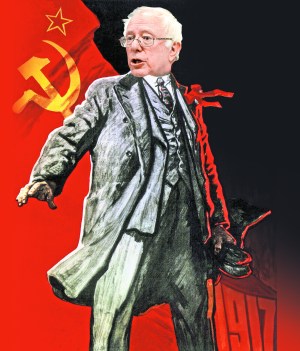
 What reasons? Let’s assume for the moment that there is no legitimate scandal in Bernie’s past, nothing that would give pause to an objective, well-informed voter. Let’s go further and assume that he hasn’t had allies or acquaintances who can be demonized, like
  Going back a little further,
  Looking at the weakness of the case, you might be tempted to laugh it off. But swift-boating John Kerry was absurd too, and it worked. With money, media power, and a significant slice of the population ready to repeat whatever nonsense they’re told, the Right can go places with a narrative like this — especially against a candidate most of the country doesn’t know.
 That may sound crazy, but the campaign you get is often not the one you thought you were signing up for. Mike Dukakis knew he’d have to defend his ideas about creating jobs, but he never expected to become the Guy Who Hates the Pledge of Allegiance or the


 TPM has announced the

 The Weekly Sift