The Apple/FBI question is harder than it looks

Nothing about the Apple vs. the FBI showdown is as clear-cut as it initially appears.

There’s a way of telling the story that makes Apple sound completely unreasonable, and could even justify Donald Trump’s call to boycott the company: The FBI needs to get information off the iPhone of one of the San Bernardino terrorists (Syed Rizwan Farook), so that it can check whether there are additional conspirators or direct operational links to ISIS. The only damage in the FBI having that information is to the privacy of a dead terrorist. But Apple is fighting a court order that instructs the company to help the FBI, in a case that could well wind up at the Supreme Court. Senator Tom Cotton draws this conclusion:

Apple chose to protect a dead ISIS terrorist’s p‎rivacy over the security of the American people.

Sounds pretty bad. But that story falls apart in a bunch of ways. First, CNN’s national security analyst Peter Bergen argues that the information on that particular phone is probably not all that important.

What might be learned from Farook’s iPhone? Of course, we don’t know, but it’s likely that it wouldn’t be much beyond what we already know from the couple’s Facebook postings, their Verizon phone account, their computers seized by police, the evidence found at their apartment complex and the fulsome confession of their friend Enrique Marquez, who allegedly provided them with the rifles used in their massacre and also allegedly knew of their plans to commit a terrorist attack as early as 2012.

No evidence has emerged that Farook and his wife had any formal connection to a terrorist organization, and the plot involved only the couple and the alleged connivance of Marquez. What might be found on Farook’s iPhone therefore is more than likely simply only some additional details to buttress the overall account of what we know already.

Bergen thinks the FBI is pushing this case purely to establish a precedent for future cases. In public-relations terms, Farook is the least sympathetic target the FBI is likely to get, so why not have the public battle here?

He notes that Apple’s side of the argument is not so clear-cut either: Apple has cracked iPhones for the government many times in the past, and responds to court orders concerning iPhone data that has been backed up to iCloud. So what great principle are they standing on?

These revelations suggest the possibility that the facts of this particular case aren’t as important as the larger principles at stake and that both Apple and the U.S. government are using the San Bernardino case as something of a test of the question: Should tech companies give the FBI any kind of permanent backdoor?

And then things get technical: What’s different about this iPhone (as opposed to the ones Apple has previously made available to the government) is that it’s a more recent version, the 5C, whose security features Apple touted. So Douglas Rushkoff sums up what the FBI wants of Apple:

They’re saying, “We want you to reveal that the promise you made about this phone turns out not to be true.”

In an open letter to its customers, Apple emphasizes that it isn’t breaking faith with them:

For many years, we have used encryption to protect our customers’ personal data because we believe it’s the only way to keep their information safe. We have even put that data out of our own reach, because we believe the contents of your iPhone are none of our business.

Summing up a few of the technical details: Apple doesn’t have the information on Farook’s iPhone, doesn’t have his passcode, and doesn’t have a software tool that recovers the data without the passcode. What, then, could Apple do for the FBI? One security feature of recent iPhones is that the data on an encrypted phone is wiped if an incorrect passcode is entered 10 times in a row. This prevents breaking into a phone by what is called a “brute force” approach, where you connect the phone to another computer that just runs through all possible passcodes. (If we’re talking about the typical 4-digit iPhone passcode, that’s only 10,000 possibilities, which wouldn’t take very long. I’ve seen estimates varying from half an hour to an hour.)

What the court has ordered Apple to do is provide the FBI with what is basically a software patch to circumvent that auto-erase feature. Once they have that, the FBI can crack the phone.

Apple’s response is that it has never written such software, and it doesn’t want to.

The FBI may use different words to describe this tool, but make no mistake: Building a version of iOS that bypasses security in this way would undeniably create a backdoor. And while the government may argue that its use would be limited to this case, there is no way to guarantee such control.

In other words, there won’t be any way to un-ring that bell: Once Apple has software that circumvents its security features, what happens to that software after the FBI has Farook’s data? At a minimum, it’s available to court orders in future cases. And if it’s available to American court orders, why couldn’t it be available to Chinese court orders? Or Iranian court orders? The principle that protects a terrorist today could protect a dissident tomorrow. And if Apple doesn’t stand on a principle, it becomes a kind of court itself, deciding case-by-case which governments deserve its help in which situations.

Worse yet, what happens to the security-circumventing software after this case? What if Apple’s internal security fails, and the software (or enough hints to allow some hacker to reproduce the software) gets out? It could even wind up in the hands of terrorists who decrypt information that helps them plan some future attack.

That’s how you wind up with a story where Apple is the hero: They’re bravely fighting to maintain our privacy. That’s how Edward Snowden put it in a tweet:

The is creating a world where citizens rely on to defend their rights, rather than the other way around.

But Douglas Rushkoff is skeptical of that story too.

It would be a mistake for people to think of this as “The People” against government security. That’s a ruse. Really, it’s the world’s biggest corporation versus the world’s most powerful military. That’s what we’re looking at.

And while I do believe that we people should defend our right to privacy, I don’t see the individual’s right to military-grade encryption. I see Visa companies, or Bank of America’s need to use it on my behalf, if Chinese hackers are using it to buy condoms on my Visa card…

For me to have something that the full focused attention of the Pentagon – which I’m sure is involved – and the FBI… To have something that they can’t break into… Imagine a real-world metaphor for that. “Oh, you’ve got a lock in your house that’s so powerful that if they brought the freakin’ army, and tanks, they couldn’t get in?”

There is certainly an economic angle here: The big tech companies — Apple, Google, Microsoft, etc. — were deeply embarrassed when Snowden revealed how complicit they all were in the NSA’s legally and morally dubious snooping on people who had done nothing to draw suspicion to themselves.

In that sense, Apple’s position (supported by Google and some other tech companies) is a sort of repentance: We have sinned in the past, but we have seen the light now and will sin no more. But the issue isn’t moral, it’s market-based: We need customers to believe we’re on their side, rather than the side of the government that wants to spy on them.

And finally, there’s a technological-inevitability angle on this: If more-or-less unbreakable encryption is possible at a price people are willing to pay, someone will provide it. (In response to Rushkoff: I don’t really need a lock and a door that tanks couldn’t break through, but if I could cheaply get one, it might be tempting.) If the U.S. government won’t let American companies provide those secure products, then they’ll be made in other countries.

So the United States can’t really stop that industry, it can just give it to some other country.

So that’s where I end up: siding with Apple in this specific case, but not making a hero out of Apple CEO Tim Cook. Right now, market forces put Apple on the side of personal privacy. Meanwhile, the FBI is trying to order the tide back out to sea. Law enforcement would do better to start adjusting to the future now.


DISCLAIMER: I don’t think this is affecting my view — I believe I’d feel the same way if Microsoft were taking a similar stand — but I should mention that I own Apple stock, as well as various i-gadgets. However, I am not currently using my iPhone’s encryption capabilities to hide any illegal activities.

Replacing Scalia (or not)

As I pointed out last week, the Constitution is pretty clear about what should happen now: President Obama should nominate a replacement and the Senate should either approve or disapprove of the nominee’s ability to handle the job. (Article II, Section 2 says “he shall nominate”. The shall indicates a duty, rather than may, which would offer an option.)

Retired Justice Sandra Day O’Connor (appointed by President Reagan) sees it that way. Asked whether the process should wait until we have a new president, she said: “I don’t agree. I think we need somebody there now to do the job, and let’s get on with it.”

When Alexander Hamilton defended the Constitution’s appointment process in Federalist #76, he expected the Senate to examine an individual nominee’s character and ability, but never considered the possibility that the Senate might engage in the kind of blanket obstruction Republicans are proposing.

But might not [the president’s] nomination be overruled? I grant it might, yet this could only be to make place for another nomination by himself. The person ultimately appointed must be the object of his preference, though perhaps not in the first degree. It is also not very probable that his nomination would often be overruled. The Senate could not be tempted, by the preference they might feel to another, to reject the one proposed; because they could not assure themselves, that the person they might wish would be brought forward by a second or by any subsequent nomination. They could not even be certain, that a future nomination would present a candidate in any degree more acceptable to them; and as their dissent might cast a kind of stigma upon the individual rejected, and might have the appearance of a reflection upon the judgment of the chief magistrate, it is not likely that their sanction would often be refused, where there were not special and strong reasons for the refusal.

But, as I have often pointed out before, republics don’t run just on their rules, but also on their norms and mores. So it’s legitimate to wonder whether there might be some long-standing gentlemen’s agreement or common courtesy that would prevent Obama from nominating Scalia’s replacement. The answer is pretty clearly no. Republicans have been claiming all sorts of unwritten rules to that effect, all of which resemble the rules of Calvinball.

It is true that there have not been a lot of election-year Supreme Court vacancies. (I assume justices see an election year as an inconvenient time to retire, though I don’t really know.) The closest recent example is the vacancy filled by Justice Kennedy: Justice Lewis Powell retired in June, 1987, and Kennedy was not confirmed until February, 1988 — President Reagan’s last year in office. (The delay was caused by the Senate’s refusal to confirm Robert Bork, and then by the withdrawal of Reagan’s second nominee.)

If you go further back, you get clearer parallels: Presidents Taft, Hoover, and Franklin Roosevelt nominated justices in election years and got them confirmed. Wilson got two justices confirmed in 1916. Eisenhower (1956) and Johnson (1968) failed to get their election-year picks confirmed but (according to Amy Howe of SCOTUSblog) “neither reflects a practice of leaving a seat open on the Supreme Court until after the election.” In Eisenhower’s case, the Senate was already adjourned for the fall campaign (so he made a recess appointment). Johnson’s pick was the target of a bipartisan filibuster, having to do with the nominee’s ethical issues.

No one has come up with an example that supports the Republican position: a Supreme Court seat that was left open for a year to allow the next president to fill it. That would be unprecedented in the last 150 years.

There is also no unwritten rule saying that a new justice should fill the same ideological role as the justice s/he replaces. Arch-conservative Clarence Thomas, for example, replaced one of the Court’s most liberal judges, Thurgood Marshall.

It’s worth pointing out that even if any of these unwritten rules really existed, Senate Republicans are in a poor position to claim them. Throughout the Obama administration, they have blasted through the previous norms and mores of Senate behavior: making the filibuster routine; blocking nominees not for individual reasons, but in order to screw up the organizations they were supposed to head; brinksmanship with the debt ceiling; and many other examples. They have consistently refused to be bound by any unwritten rules of courtesy, so why should they get the advantage of one now?


There have been several attempts to claim hypocrisy on the part of Democrats who want to follow the constitutional process. One frequently cited example is a 2007 quote from Chuck Schumer to the effect that the Democratic Senate “should not confirm any Bush nominee to the Supreme Court except in extraordinary circumstances.”

Two things stand out about that: First, no more vacancies came up during Bush’s term, so we don’t know to what extent Schumer (who was just an ordinary senator at that time, and spoke only for himself) was just posturing in front of a liberal audience. (If today’s Republicans posture about blocking all nominees, but then go ahead and do their constitutional duty anyway, that would be fine.) Second, the quote is plucked out of its context, as Josh Marshall explains (with video of Schumer’s remarks):

What Schumer actually said was that Senate Democrats had been hoodwinked by President Bush’s first two Supreme Court picks – Roberts and Alito. They’d accepted assurances that they were mainstream conservative judges who would operate within the precedents and decisions of the Rehnquist Court but hadn’t. (Certainly, the experience since 2007 has more than ratified this perception.) Schumer said Democrats should try to block any future Bush nominees unless they could prove that they were ‘in the mainstream’ and would abide by precedent. …

Schumer quite explicitly never said that the Bush shouldn’t get any more nominations. He also didn’t say that any nominee should be rejected. He said they should insist on proof based on judicial history, rather than just promises that they were mainstream conservatives rather than conservative activists, which both have proven to be. But again, set all this aside. He clearly spoke of holding hearings and being willing to confirm Bush nominees if they met reasonable criteria.

Another attempt is to cite a 1960 sense-of-the-Senate resolution which the conservative American Thinker blog characterizes as “against election-year Supreme Court appointments”.

Except that’s not what it says. The resolution opposed recess appointments to the Supreme Court, which put a justice on the Court temporarily without Senate approval, not election-year appointments. Since Obama is not making a recess appointment — Republicans having fought tooth-and-nail to limit Obama’s recess-appointment power — the 1960 resolution has no connection to the current situation.


A tweet from Ken Wissonker puts a different slant on the wait-for-the-next-president idea:

As a friend put it: “Apparently, the GOP thinks that Black Presidents only get 3/5ths a term.”

The attempt to imply that Obama’s nominee will somehow be illegitimate is part of the larger effort to de-legitimize Obama’s entire presidency. And it’s hard to escape the conclusion that race has played a role in this project.

From the beginning, his opponents have never granted Obama the respect due a president of the United States. Whether it’s shouting “You lie!” during the State of the Union, or encouraging members of military to refuse orders, or spreading baseless rumors about his birth or religion, or complaining whenever he does things all presidents do, or expressing frustration that impeachment requires evidence, or warning foreign leaders not to make agreements with him — the consistent message has been that Barack Obama is not a legitimate president of the United States.

So we elect our first black president, and he’s treated with less respect than all previous presidents. Who could have guessed?

The Monday Morning Teaser

This week it became clear that President Obama will nominate a Supreme Court justice to replace the late Anton Scalia, but we don’t yet know who. Meanwhile on the Republican side, a number of reasons/excuses for not considering that nomination were raised. I’ll discuss them, along with the history of election-year Court nominations, in the first featured post “Replacing Scalia (or not)”. It should be out by 8 EST.

Another topic of discussion this week was Apple’s decision to fight a court order instructing it to help the FBI crack the iPhone of one of the San Bernardino terrorists. To some, Apple is siding with terrorists over public safety, leading Donald Trump to call for a boycott of Apple products. To others, Apple is championing the individual right to privacy against a snooping government. My intuition puts me on Apple’s side of this question, but the deeper I looked, the more I realized that neither position is as clear-cut as a first glance makes it appear. I’ll sum up what I found in “The Apple/FBI question is harder than it looks”. That should be out by 9.

In the weekly summary, there are election results to consider: the Democratic Nevada caucuses and the Republican South Carolina primary. Digging into the entrance/exit polls reveals stuff with implications beyond the simple vote totals. The falling price of oil has led to speculation about the long-term stability of oil-dependent dictatorships like Russia and Saudi Arabia. Right-wing groups are experimenting to see which burn-Bernie attacks work, just in case. And we’ll close with a pitch for making Canada the next president of the United States.

Bells

Any mans death diminishes me, because I am involved in Mankinde;
And therefore never send to know for whom the bell tolls; It tolls for thee.

— John Donne
Devotions Upon Emergent Occasions (1624)

Ding-dong, the witch is dead. — The Wizard of Oz (1939)

This week’s featured post is “Back to Ferguson“, which I’ll explain below.

In the aftermath of the New Hampshire primary, I’m taking a week off from presidential politics. Next week we’ll have the Democratic caucuses in Nevada and the Republican primary in South Carolina to talk about. Both happen Saturday.

This week everybody was talking about Justice Scalia’s death

Supreme Court Justice Antonin Scalia’s final act, as far as I was concerned, was to posthumously remind me that I am not as good a person as I like to think.

Good People, as I picture them, see death as the great leveler, the ultimate reminder of our common humanity. Like John Donne, they believe the bell tolls for them. Every death — even necessary ones like casualties in a just war or criminals killed in the act of trying to kill somebody else — is tragic: How sad it is that a situation might make a person’s death the lesser evil.

Under no circumstances would news of someone’s death cause a Good Person’s heart to take an involuntary leap of joy. Or inspire a Good Person to say, “I wonder if Justice Thomas will follow his lead this time too?”

Bad. Bad, bad, bad.

But at least my badness puts me in some good company. As Clarence Darrow wrote, “I have never killed anyone, but I have read some obituary notices with great satisfaction.”

Scalia’s career. You can read more complete obituaries of Scalia elsewhere. Here’s how I remember him: When President Reagan appointed him in 1986, he was alone on the Court’s far right wing. Outnumbered, he became famous for his thought-provoking dissenting opinions, which were principled, but based on principles different from the ones that motivated the rest of the Court. Liberals developed a kind of grudging admiration for him; you knew in your heart he had to be wrong, but it was often very hard to explain why. Anticipating his criticisms made us sharper — like iron sharpens iron, as the Bible says.

But late in his career, as part of a conservative majority, he became the Court’s most openly partisan judge. His opinions became elaborate rationalizations of why his side should win, regardless of principle. And so, he had a sweeping view of the Constitution’s commerce clause when that was necessary to keep marijuana illegal, but an unprecedently narrow view of the same text when he needed a reason to strike down ObamaCare. He waxed eloquent about legislator’s original intent when that was convenient, but violated it outrageously by finding corporate rights in places the authors of the Constitution clearly never intended. He was part of the nakedly political 5-4 majority that made George W. Bush president, a decision so unabashedly partisan that it explicitly warned future Courts not to use it as a precedent. He attended secretive meetings of the Koch Brothers’ donor network, as (enabled by Scalia’s vote in the 5-4 Citizens United decision) it raised vast sums of money to elect Republicans.

Beyond his unprincipled partisanship, Scalia will be remembered for undermining the traditional decorum of the Court. As he aged, he seemed less and less able to imagine that an intelligent, well-intentioned colleague might disagree with him, and showed less and less restraint in flinging oddly Victorian insults (like “argle-bargle” and “jiggery-pokery”) at their arguments.

Replacement? Mitch McConnell wasted no time in warning President Obama not to bother appointing a replacement.

The American people should have a voice in the selection of their next Supreme Court Justice. Therefore, this vacancy should not be filled until we have a new President.

Elizabeth Warren fired back:

Senator McConnell is right that the American people should have a voice in the selection of the next Supreme Court justice. In fact, they did — when President Obama won the 2012 election by five million votes.

She goes on to remind McConnell of the constitutional duties of the President and the Senate. I think that’s the right line here: Let’s follow the Constitution, which is pretty clear:

[The President] shall nominate, and by and with the Advice and Consent of the Senate, shall appoint Ambassadors, other public Ministers and Consuls, Judges of the supreme Court, and all other Officers of the United States.

So it’s simple: Obama should do his job by appointing someone and the Senate should do its job by voting on that nomination.

As much as the Republicans may hope for a Republican president whose appointments will cement the Court’s conservative majority for decades to come, I think that position is suicidal when it comes to holding the Senate. Take the NH seat: Senator Kelly Ayotte has been running not as a down-the-line Republican, but as an exemplar of New Hampshire’s traditionally independent common sense. (Along with another endangered Republican incumbent, Mark Kirk of Illinois, she is a founding member of a small group of Republican senators who recognize global warming.) If Mitch McConnell were running here, he would lose. Turning the race into a simple red/blue contest for control of the Senate, and hence the Court, helps Ayotte’s challenger, Gov. Maggie Hassan.

It also probably helps the eventual Democratic presidential nominee to have a court appointment riding on the outcome. Control of the Supreme Court — not just possibly someday, but immediately — would give either Hillary or Bernie a powerful uniting message after a divisive primary campaign.

Who, then? Various short lists of possible Obama appointees are floating around. At the top of most of them is Sri Srinivasin, who was approved by the Senate unanimously for his current job as a federal appellate judge.

If I were Obama, I would take McConnell’s obstruction threat seriously, and appoint whoever I thought would work best in a why-don’t-they-do-their-jobs attack ad. I’d be looking for a Mr. Rogers type: Somebody who exudes a sense of basic decency, who wouldn’t ring any alarm bells about affirmative action or political correctness.

Recess appointment. Unofficial reports say that Obama will not make a temporary recess appointment, which he could attempt since the Senate is currently not in session. But that path is filled with technicalities and possible disputes. SCOTUS blog summarizes:

The bottom line is that, if President Obama is to successfully name a new Supreme Court Justice, he will have to run the gauntlet of the Republican-controlled Senate, and prevail there.  The only real chance of that: if he picks a nominee so universally admired that it would be too embarrassing for the Senate not to respond.

My suggestion for a recess appointment: Sandra Day O’Connor. She retired to spend more time with her husband, who has since died, and she’s still active as a part-time substitute judge at the appellate level. As a replacement for Scalia, she would move the Court somewhat to the left. But it would be hard for Republicans to justify blocking a judge originally appointed by the sainted President Reagan.


Interesting sidebar here: The Court recently issued a stay blocking President Obama’s plan to limit the carbon emissions of power plants. That indicated that, when the case reaches them from its current location in an appellate court, the Supremes might be inclines to strike it down, almost certainly by the 5-4 ideological split it then had.

Without Scalia, though, and assuming a decision has to be made before he can be replaced, the Court will reach a 4-4 non-decision, and the lower court ruling will stand. The appellate court seems likely to uphold Obama’s action.

and the budget

Another example of the Republicans’ refusal to recognize Obama’s legitimacy as president is that the House is not planning to hold hearings on his budget proposal.

The Republican chairmen of the Senate and House budget committees said last week they were forgoing the decades-long tradition of hearing testimony from the director of the Office of Management and Budget, claiming they expected Obama’s budget to offer little in debt reduction.

and Oregon

The occupation of the Malheur Wildlife Refuge ended Thursday morning after 41 days, when the last four guys surrendered to the FBI. The occupiers got no concessions: The two ranchers whose re-imprisonment sparked the occupation remain in prison. No changes in federal land use policy have been announced. The leaders of the occupation have been arrested and charged.

A bonus was that Cliven Bundy, father of occupation leader Ammon Bundy and the center of a previous armed stand-off in 2014, has also been arrested and charged.

In a 32-page criminal complaint, prosecutors allege Bundy and his co-conspirators led a massive, armed assault against federal officers in April 2014 near the town of Bunkerville, Nev.

According to the U.S. attorney for Nevada, Bundy and his armed supporters on horseback effectively ambushed federal Bureau of Land Management officials as they were trying to round up 400 of Bundy’s cows illegally grazing on federal land.

The way the government backed down from that confrontation undoubtedly emboldened the Malheur occupiers. Bundy and his allies considered the 2014 showdown a victory. If the Malheur occupiers had walked away with concessions, that also would have been a victory, and quite likely would have led to an even more aggressive move in the future.

So far, it looks like the government has played this right: No police or government agents were killed. One occupier died in a confrontation that appears to have been largely of his own making. The government wanted a middle path between the 2014 Bundy showdown and Ruby Ridge; it seems to have found one.


Apparently the evangelist Franklin Graham (Billy’s son) played a role in the surrender of the final occupiers. I’ll be interested to see if he becomes a spokesman for the militiamen.

but more people should be paying attention to Ferguson

That’s covered in this week’s featured post “Back to Ferguson“. The Justice Department says policing in Ferguson has to change to uphold its citizens’ constitutional rights. Ferguson replies: We can’t afford it. So where does the buck stop?

and Darwin

Friday was Charles Darwin’s 207th birthday. That’s my annual reminder to review the evolution/creation discussion.

I said most of what I want to say about it three years ago in “Evolution/Creation for Non-Eggheads“. One thing to add since then: My friend (and occasional Sift commenter) Abby Hafer has published The Not-So-Intelligent Designer: Why evolution explains the human body and intelligent design does not. Her introduction says:

A few years ago, I realized that the whole intelligent design (ID) controversy is not a scientific issue, but a political one. … ID is not a theory, it is a political pressure group. …

Political issues require political arguments, and political arguments are different [from scientific arguments]. Political arguments must be short, easy to understand, memorable, and preferably entertaining.

In my case, I also want them to be true.

One point from the “Non-Eggheads” post I’d like to hit a little harder: If you ever listen to a Creationism/ID talk, you won’t actually hear an alternative scientific theory. Instead, such talks invariably focus on criticisms of evolution (most of which were made and answered in the 1800s). Why? Because they have no alternative scientific theory to present.

Let me give an example to flesh that out a little. According to current evolutionary theory, life on Earth has a single family tree. In other words, any two living things have a common ancestor if you go back far enough. A lot of work has gone into figuring out how that tree branches, what is more closely related to what, and when the common ancestors lived. That work is ongoing, and every now and then our picture of the tree shifts a little as new evidence emerges.

It’s fine to criticize that single-family-tree idea, but a real Creationist alternative theory would answer this very basic question: How many separate family trees are there, even approximately? And that leads to other questions: Did they all begin at the same time? What markers tell us that two living things are from different trees? Then you get to a bunch of more specific research topics: Do lions and house cats have a common ancestor? Collies and poodles? Polar bears and grizzlies? What about the 400,000 species of beetles biologists have postulated? Did 400,000 separate acts of creation lead to 400,000 family trees of beetles, or do some beetle species share a common ancestor?

That’s the kind of stuff a real “creation science” would be researching. You never hear about it, though, because there is no such research and no such theory. Creationist “scientific” organizations spend their money, as Abby says, constructing and popularizing political arguments rather than doing science.


Tax money is still supporting teaching Creationism in Louisiana, and probably other states as well.

and you might also be interested in

When Franklin Graham isn’t mediating between the FBI and crazy people, he’s touring America to rally religious conservatives to be more politically active.

I don’t think we’re going to make it another election cycle if we don’t get God’s voice back in the political arena. … I feel that we are going to have to meet our political obligations as Christians and make our voice known if America is to be preserved with the type of Christian heritage which has given us the liberties we now enjoy. For unless America turns back to God, repents of its sin, and experiences a spiritual revival, we will fail as a nation.

According to Graham, one “great sin that has been flaunted and celebrated” is same-sex marriage.

Here’s what continually amazes me about all the God-will-punish-us-if-we-don’t-turn-back prophecies: When was that God-fearing era we need to “turn back” to? When we were committing genocide against the Native Americans and holding millions of Africans in slavery? Or was it later, during the era of Jim Crow and lynchings? Or when we dropped atomic bombs on cities full of Japanese civilians?

I have a hard time picturing — much less respecting — a God who would shower us with blessings while we were doing all that stuff, but is going to drop us flat now that we’re letting same-sex couples live together in loving relationships.


This week’s guns-make-us-safer story: A guy in Texas opened fire on his neighbor’s puppy, who was trespassing on his lawn. A friend of the puppy’s owner shot back. The dog died. Neither human was wounded, but both are facing felony charges.

Guns don’t kill puppies. Crazy Texans with guns kill puppies.


One of David Wong’s “5 Ways to Spot a B.S. Political Story” is that it’s about “a lawmaker saying something stupid”. He points out that there are so many state legislators that on any given day one of them is bound to have said or done something ignorant or offensive. For that reason, I don’t call your attention to bad laws just because they get proposed in some legislature; I wait to see if they have any real support.

Well, this one does: Senate Bill 1556 made it out of a committee in the Tennessee Senate on 7-1 party-line vote. (That tells you something about the Tennessee Senate right there; there are barely enough Democrats to get one on every committee.) It allows counselors and therapists to refuse to counsel clients “as to goals, outcomes, or behaviors that conflict with a sincerely held religious belief of the counselor or therapist”. The counselor’s only obligation is to provide a referral.

According to the Chattanooga Times Free Press, the bill “seeks to protect conservative therapists from 2014 changes in the American Counseling Association’s code of ethics“, which states:

Counselors refrain from referring prospective and current clients based solely on the counselor’s personally held values, attitudes, beliefs, and behaviors. Counselors respect the diversity of clients and seek training in areas in which they are at risk of imposing their values onto clients, especially when the counselor’s values are inconsistent with the client’s goals or are discriminatory in nature.

This is yet another example of conservatives abandoning their ideal of “small government” when it proves inconvenient. In short, the counseling profession is not allowed to establish its own code of ethics free from government meddling.

and let’s close with something crazy

A huge controversy erupted after Beyonce sang “Formation” at the Super Bowl, while dressed to honor the Black Panthers. But there’s a background level of crazy here that I previously had not noticed: More than 800K viewers have seen a video detailing all the Illuminati symbolism in previous Super Bowl halftime shows. I mean, we all knew about Madonna (right?), but who suspected Katy Perry of being “a high-level Illuminati witch”? I’ll have to go back and look at her videos again.

Back to Ferguson

If Ferguson can’t justify its behavior, but can avoid change by pleading poverty, then what do we say to the guy who can’t figure out how to support his family without dealing drugs or robbing liquor stores?


In the aftermath of Michael Brown’s death in August 2014, the eyes of the country were on Ferguson, a city of 21,000 that is part of the St. Louis metropolitan area. Through the subsequent fall and winter, I discussed Ferguson several times on this blog, including “What your Fox-watching uncle doesn’t get about Ferguson” about the protests, and “Justice in Ferguson“, which covered the two reports the Justice Department issued last March.

The gist of what the Justice Department found was that in the specific case of Michael Brown, the evidence matched the account of the shooter, a white police officer, well enough that no charges were called for. (I felt good about my coverage here: I hadn’t claimed the officer was guilty of murder, but only that local authorities hadn’t performed a fair and credible investigation. The Justice Department’s investigation satisfied me.)

But Justice Department found that the more general complaints of Ferguson’s black community were justified: Policing in general was racially biased, and excessive force was commonly used, including inappropriate use of tasers and dogs. Complaints of excessive force were largely ignored, and officers were not disciplined. (As the Justice Department’s lawsuit — which we’ll get to in a few paragraphs — charges: “The supervisory review typically starts and ends with the presumption that the officer’s version of events is truthful and that the force was reasonable.”)

The Department’s report found that the root of the problem was even bigger than the police: Ferguson used its municipal court system to wring revenue out of the poor, creating an adversarial relationship between the police and the community. In short, the primary mission of the police was not to maintain order, but to find violations for which people could be fined. The city budget called for and depended on regular increases in revenue from fines.

Last month, Ferguson and the Justice Department worked out an agreement to reform Ferguson’s police and court practices without taking a lawsuit through the courts. But Tuesday, Ferguson’s City Council unanimously “approved” that agreement with seven unilateral amendments.

Those seven conditions on acceptance are that (i) the agreement contain no mandate for the payment of additional salary to police department or other city employees; (ii) the agreement contain no mandate for staffing in the Ferguson Jail; (iii) deadlines set forth in the agreement are extended; and (iv) the terms of the agreement shall not apply to other governmental entities or agencies who, in the future, take over services or operations currently being provided by the City of Ferguson; (v) a provision for local preference in contracting with consultants, contractors and third parties providing services under the agreement shall be included; (vi) project goals for minority and women participation in consulting, oversight and third party services shall be included; and (vii) the monitoring fee caps in the Side Agreement are changed to $1 million over the first five years with no more than $250,000 in any single year.

The arguments for these changes amount to: We can’t afford it. Ferguson can’t afford to raise police pay to attract better officers, particularly if the other reforms are going to reduce the city’s revenue. It can’t afford to monitor compliance with the agreement. It can’t afford to change as quickly as the Justice Department would like (and maybe stalling will allow it to strike a better deal with a Trump or Cruz administration). Revision (iv) gives the city an additional card to play: It could nullify the agreement by disbanding its police department and contracting out to some neighboring town or to St. Louis County. (Other nearby towns — a report by Arch City Defenders named Bel Ridge and Florissant in addition to Ferguson — also misuse their municipal court systems, and probably don’t like the precedent the Justice Department is setting in Ferguson. )

The Justice Department responded the next day by filing a lawsuit in federal court. The suit does not ask for specific remedies, but that the Court “Order the Defendant, its officers, agents, and employees to adopt and implement policies, procedures, and mechanisms that identify, correct, and prevent the unlawful conduct”. Presumably, the government has a court order in mind and thinks it has a good chance of getting it.

It’s possible to tell this story in a way that creates sympathy for Ferguson’s officials: Even if they now have the best of intentions, their budget is already in deficit, and that deficit will only get worse if the police and courts stop shaking down poor blacks for money. And if change also requires additional expenditure … well, where is that money going to come from?

On an abstract level, Ferguson raises issues similar to the ones in Flint: Once we segregate poor people into their own city or town, how does that municipality raise enough money to provide the basic services civilization demands? Where does the money come from to pump in clean water and truck out garbage? How are roads paved and buses run, so that people can get to their jobs? Who puts out fires? Who drives the ambulances and where do they take people for care? Who educates children and protects the innocent from crime?

If no external help is available, the answer is often to victimize the poor and voiceless. If somebody has to suffer, why not somebody the larger public doesn’t care about?

But we need to recognize where this financial-necessity logic leads: If Ferguson can’t justify its behavior, but can avoid change by pleading poverty, then what do we say to the guy who can’t figure out how to support his family without dealing drugs or robbing liquor stores?

The Justice Department may have no practical answer to the question of how Ferguson can afford to start policing its citizens fairly, with due regard to their rights as Americans. But nonetheless it must insist that the buck not stop there. If a Ferguson that respects the rights of its citizens is not financially viable and is doomed to bankruptcy, then the county and the state and even the nation have a problem. In truth, that problem already exists. The question is whether the rest of us will be allowed to hide it inside the borders of Ferguson and then look away.

The Monday Morning Teaser

So Judge Scalia is dead. I’m titling this week’s summary “Bells” in honor of my two conflicting impulses: John Donne’s “it tolls for thee” and the Munchkins’ “Ding-dong, the witch is dead.”

The featured article this week is “Back to Ferguson”, discussing the inability of Ferguson and the Justice Department to reach an agreement about police reforms, which caused Justice to take the case to court this week. That may sound like a local issue, but the larger implications of herding poor people into financially shaky municipalities — and then cutting corners to try to make it work — apply to Flint and lots of other American communities.

My discussion of Scalia’s death and its political implications is long enough that I probably ought to break it out into a separate article, but it has the chatty this-and-that style more typical of the summaries, so I’m leaving it there. Also in the summary: the Malheur occupation is finally over, with a complete government victory; Darwin’s birthday has me doing my annual look at the Creation/Evolution argument; Billy Graham’s son is touring the country to motivate evangelical political engagement — apparently he thinks the “great sin” of same-sex marriage threatens America’s place in God’s favor, while slavery and genocide didn’t; and I’ll close with an apparently serious discussion of the role of the Illuminati in past Super Bowl halftime shows. How did I miss the Luciferian implications of Katy Perry?

Imperfections

While American democracy is imperfect, few outside the majority of this Court would have thought its flaws included a dearth of corporate money in politics.

— Justice John Paul Stevens,
dissenting opinion in Citizens United (2010)

This week’s featured post is “Say — you want a revolution?

This week I finally decided to vote for Bernie

You’ve seen me wrestle with this the last two weeks. On most issues, I agree with Bernie more than Hillary. But I also think the difference between the two is tiny compared to the difference between any Democratic candidate and any Republican candidate. (We can, for example, argue about whether Bernie’s ideas for breaking up the big banks are better or worse than Clinton’s plans to strengthen the Dodd-Frank regulations of Wall Street. But Republican candidates want to repeal Dodd-Frank, and go back to the system we had in 2008.) And I believe Clinton is the stronger general-election candidate for a number of reasons.

But for me the decisive factor comes back to what I wrote when I covered Sanders’ announcement statement back in May:

I think it’s way too early to make the unite-behind-a-winner argument. There has to be some point in the electoral process where people express their consciences and vote their ideals. Otherwise, the horse-race mentality becomes self-stoking: People won’t support a candidate they agree with because he can’t win, and he can’t win because the people who agree with him won’t support him.

It’s still too early. I want everyone to know that there is substantial support for more radical solutions than we’ve been offered in past election cycles. I want Clinton to know that if she’s the nominee in the fall. I want the media to know that, so they won’t take seriously Republican claims that Hillary is some kind of left-wing extremist, or that her positions are as far left as public discussion ever needs to go. I want the next set of Democratic presidential candidates to know that, so liberals will be emboldened to run and moderates will take their left flank into account.

My decision was made easier by Hillary’s narrow win in Iowa (which was not decided by coin flips — how do these things get started?). If she had suffered a surprising loss, especially a large loss, then another large loss in New Hampshire (which the polls are predicting) might send her campaign into a death spiral. I wouldn’t want to feel responsible for that.

As for those of you who vote later in the process, I don’t think my decision tells you much. I think pragmatism should be an increasingly important factor as the campaign goes on. Which way that pushes you and how that weighs against your idealism is something we all have to decide for ourselves.

but I wasn’t the only Democrat talking politics this week

The one thing that makes me nostalgic for the days when Hillary was supposed to coast to the nomination is the level of Democrat-on-Democrat belligerence I’m seeing. Given the people I hang with, I’m seeing it mostly as attacks on Hillary by Bernie supporters, but I’m told it goes both ways.

If I had the power to make a rule for the rest of the Democratic nomination process it would be this: Don’t repeat Republican rhetoric.

So Sanders supporters should not be gleefully finishing the character assassination that Richard Mellon Scaife’s right-wing Arkansas Project started against the Clintons in the 1990s. If you don’t trust Hillary, fine. But recognize that the Hillary-can’t-be-trusted meme dates back to a series of crap scandals that fell apart when their details came out, which nonetheless have left a grungy film on her image. (In last week’s episode of the TV show Billions, a lawyer explains the ineffectiveness of refuting a false charge after it makes headlines: “If someone says Charlie fucked a goat, even if the goat denies it, he goes to the grave as Charlie the Goat Fucker.”) If you refer vaguely to that untrustworthy image, rather than to specific Clinton statements you have specific reasons not to believe, you’re making use of Scaife’s propaganda.

The emails, BTW, are just the latest crap scandal. Last week I wondered whether similar security violations would show up in the emails of past secretaries of state, if anybody examined them through the same magnifying glass. Apparently, somebody else wondered that too, and it turns out they do.


Similarly, it’s fine for Clinton supporters to wish for more details about how Sanders would pay for his programs. But the notion that they can’t be paid for buys into the taxes-are-already-as-high-as-they-could-possibly-go message that Republicans have been trying to convince of us for decades.

Likewise, any kind of red-baiting should be off the table: Sanders’ policies are what they are and if  you want to criticize them on their merits, fine. But criticizing them because you have managed to attach a socialist or communist label to them … leave that to the Republicans. And if his defense policies don’t seem muscular enough for you, that’s a legitimate thing to discuss. But don’t imply that Sanders is somehow disloyal or doesn’t want to defend America. That’s Ted Cruz rhetoric.


I’m similarly disturbed by the Hillary-is-a-warmonger charge that gets thrown around. (That’s not Republican rhetoric, but the more it catches on, the harder it’s going to be to unite Democrats in the fall.) Admittedly, there is a policy difference between Hillary and Bernie: Hillary is likely to spend more on defense than Bernie, and to use American power more forcefully. And it’s worth taking into account that Hillary voted to authorize the Iraq War while Bernie opposed it.

But if you listen to the speech she gave in 2002 during the Senate debate on the authorization resolution, it’s not a rah-rah war speech.

This course if fraught with danger. … If we were to attack Iraq now, alone or with few allies, it would set a precedent that would come back to haunt us. In recent days, Russia has talked of an invasion of Georgia to attack Chechen rebels, India has mentioned the possibility of a preemptive strike on Pakistan, and what if China were to perceive a threat from Taiwan?

So, Mr. President, for all its appeal, a unilateral attack (while it cannot be ruled out) on the present facts is not a good option.

She supports the resolution in order to give President Bush all possible tools to pressure Saddam Hussein into compliance with UN inspections. So her 2002 position reflects the same approach to conflict that as Secretary of State she initiated (and Secretary Kerry completed) with regard to Iran: increasing pressure of all sorts to get the desired outcome without fighting. “I take the President at his word,” she says — that word being that Bush would do everything possible to disarm Saddam without war. That was her mistake.

Also, look at her husband’s administration: We didn’t fight a major land war during those eight years. (As The Onion put it after Bush replaced Clinton: “Our long national nightmare of peace and prosperity is finally over.”) Bombing was part of a ring-of-pressure that ended Serbia’s genocide against Bosnia and Kosovo, and forced the fall (and eventual war-crimes trial) of President Milosevic without a U.S. invasion. Actually, Bill Clinton’s most suspect military decision was the war he didn’t fight: He didn’t try to stop the Rwandan genocide.

So is a vote for Clinton a vote for war? I really don’t think so.

and New Hampshire is inundated with politicians

The Onion reports: “Plows Working Around Clock To Keep New Hampshire Roads Clear Of Campaign Signs”. It’s a joke, but that’s really what it feels like. I’m ready to unplug my phone.

Blogger Chuck Fager reflects on what the great New Hampshire poet Robert Frost might have said about all this.

Polls are predicting a large Sanders win in New Hampshire. But after that things really get interesting. So far, Sanders hasn’t shown much support from non-whites, who aren’t much of a factor in either Iowa or New Hampshire. But Hispanics are a large percentage of the Democrats in Nevada (caucus February 20) and blacks are the majority among Democrats in South Carolina (February 27 primary).

Even though those states currently look good for Clinton, it’s not unreasonable to expect Sanders to start picking up non-white support. Blacks were slow to warm to Barack Obama’s candidacy in 2008, but they did eventually come through for him. Sanders has already been endorsed by a few prominent blacks like Ben Jealous and Cornell West. Bill Clinton’s role in creating the mass-incarceration problem might start working against Hillary, even though her current positions on the issue are pretty good.

For what my opinion is worth — after all, I’m a white guy with a mostly white circle of friends, and so far I’ve refused to put my black and Hispanic acquaintances on the spot to represent their people — I suspect that belonging to an discriminated-against minority tends to make a voter cautious. Feeling like you have the freedom to fall in love with an idealistic-but-impractical candidate might be a symptom of privilege, comparable to a college student majoring in art history rather than business or engineering. If that’s the case, then Bernie can hope for a snowball effect with non-white voters: The more support he gets, the more viable he looks to people who will only support a viable candidate.

Or maybe the snowball will melt in Nevada and South Carolina, as snowballs tend to do.


As for the Republicans, Trump is expected to win, but beyond that things are unpredictable. As I predicted last week, the media decided that Rubio’s third-place finish in Iowa gave him momentum. But he had a truly embarrassing debate Saturday night, suffering mostly at the hands of Chris Christie, who was supposed to be fading. Some polls have John Kasich gaining.


A neurologist takes a whack at explaining why Ted Cruz creeps people out. He has “atypical” facial expressions: “Senator Cruz’s countenance doesn’t shift the way I expect typical faces to move.”

That doesn’t necessarily mean he’s insincere or psychopathic, but if watching him just makes you feel uneasy, that’s probably why. Tech-savvy people have joked that Cruz falls into the “uncanny valley” — that region of animation where human characters are accurate enough to seem like they ought to be human, but instead are just unnerving.

but there are advantages

So many important political people show up in New Hampshire just before the primary that you can have some really interesting encounters. (On election night in 2008, for example, I realized that the guy standing behind me at the bar was Senator Durbin.)

Last weekend, the local get-money-out-of-politics group, NH Rebellion, held a conference in Manchester. Both Hillary and Bernie were there, along with Kasich. (Trump was on the schedule, but I never heard whether he showed up or what he said.)

Somehow, maybe because hardly anybody else who got the email realized what a unique opportunity it was, or were just distracted by all their other opportunities, I wound at a table in a coffee shop with Rep. John Sarbanes, my own congressional representative (Annie Kuster), and half a dozen other people. Sarbanes — if the name rings a bell, you might be remembering his father the senator — is the guy in Congress leading the fight for the Government By the People Act, which is a way to do public financing of campaigns without a constitutional amendment and without running afoul of the Supreme Court. (It reflects a lot of the ideas Lawrence Lessig has been pushing.)

I’ll be talking about the merits of that proposal in future weeks, but for now I just want you to bookmark John Sarbanes, because he looks a lot like a future presidential candidate. He’s handsome, personable, smart, and relates well to small groups. He’s also on the right side of a major issue, and got there early.

One of the things Sarbannes described over coffee was how he’s been getting more congresspeople to talk about campaign finance reform (which the conventional wisdom has said for years that voters don’t care about; it’s an inside-baseball topic). He says he tells his colleagues not to talk about campaign finance instead of their usual issues, but to use it to “caffeinate” their usual issues: Instead of saying “we need to do something about climate change”, say “we need to do something about climate change and what’s stopping us is all the special-interest money lined up on the other side“. [The quotes are approximate; I wasn’t taking notes.]

and you might also be interested in

A federal grand jury has indicted 16 people in the Malheur Wildlife Refuge occupation. LaVoy Finicum, the only occupier who has died, is being hailed as a martyr by the kind of people who need that to be true. Cartoonist Matt Bohrs points out the difference between Finicum and the various young black men who have been gunned down by the authorities.

and let’s close with some north-of-the-border mischief

The Bank of Canada wants local Star Trek fans to stop Spocking their fives.

Say — you want a revolution?

Changing presidents or even changing minds isn’t enough. A real revolution has to change a lot of people’s political identities.


Some years ago, I was at a restaurant a couple blocks from my apartment when that cycle’s Democratic congressional candidate (Katrina Swett, which would make the year 2002) came in to campaign. It was late enough that most of the lunch traffic had left already, so shaking every hand in the room didn’t take her very long.

After the candidate left, our waitress — a pleasant young woman who had been doing a perfectly fine job as far as I and my friend were concerned — came over with an inquisitive look on her face. I thought she was going to ask us whether we knew anything about Swett, and whether she would be a good person to represent us in Washington. Instead, she asked whether we knew anything about Congress. “Is it, like, important or something?”

I’m not particularly good at answering a fundamental question when I was expecting a specific one, so let’s just say that I doubt my pearls of wisdom changed her life, or even that she remembers me at all. But I’ve remembered her ever since.

By telling this story, I don’t mean to denigrate the political sophistication of young adults or the working class or women or any other category that this waitress coincidentally belonged to. But to me, she represents a group that pundits and armchair political strategists often forget: people who just don’t care about politics. They aren’t stupid or any more self-centered than the rest of us, and they aren’t discouraged or embittered or angry. They just look at politics the way other people might look at football or fashion or Game of Thrones: They have never bothered to pay attention to it, and they don’t see that they’re missing out on anything.

It’s hard to say exactly how many such people there are. But certainly they could constitute a significant voting bloc, if they saw any point in it.

The truly silent majority. In a typical presidential election, voter turnout is somewhere between half and two-thirds of the voting-age population. Mid-term congressional elections usually draw less than half of the electorate, and less than a third bother to participate in some state and local elections. (A shade over 30% voted in Kentucky’s recent gubernatorial election, yielding a surprise Republican win.) As you can see from this graph of the turnout in every presidential election since 1824, this phenomenon is nothing new; to see significantly larger turnout, you have to go back to 1900.
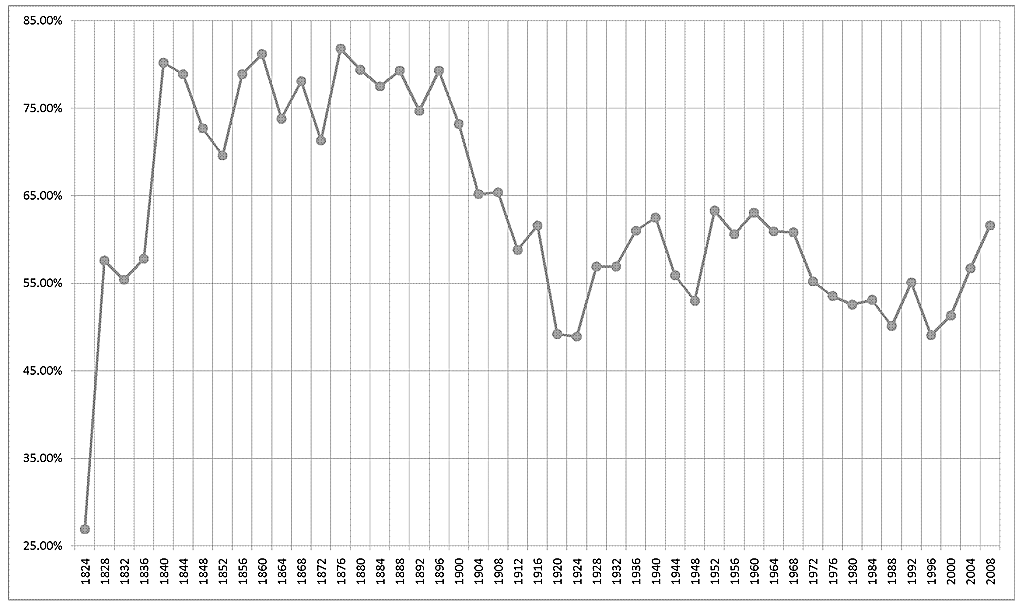
So in virtually every contested election in the entire country for the last century, the margin of victory has been less than the number of people who didn’t vote. That massive lack of participation provides a blank wall onto which many people can project their conflicting fantasies.

Like Ted Cruz:

The last election, 2012, 54 million evangelicals stayed home. Fifty-four million. Is it any wonder the federal government is waging a war on life, on marriage, on religious liberty, when Christians are staying home and our leaders are being elected by nonbelievers?

“Imagine instead,” he told the students at Liberty University, “millions of people of faith all across America coming out to the polls and voting our values.”

Real Clear Politics’ election analyst Sean Trende attributed Mitt Romney’s 2012 loss to “the missing white voters“, and argued that the GOP wouldn’t have to work so hard at appealing to Hispanics if it could just raise white turnout.

Wherever you stand on the political spectrum, you can imagine that the apathetic masses only appear not to care about public affairs. Actually, they just haven’t heard the right motivating message: your message. As soon as they do, then everything will start to change.

Heck, some version of this thought pattern occurs even in the fringiest, most radical circles. The armed yahoos who took over that wildlife refuge in Oregon didn’t figure on overpowering the federal government by themselves. They imagined a nation full of anti-government patriots, ready to take up arms as soon as someone was brave enough to sound the clarion call.

When they sounded that call and only a few dozen wackos showed up, I imagine they were pretty surprised.

The discouraged liberal majority. In spite of the daydreams of militiamen and social conservatives, the statistics say that marginal voters trend Democratic. That’s why relatively high-turnout elections like Obama’s first presidential race in 2008 (57.1% of voting-age citizens participated; that would be a low turnout in a lot of other democracies) are good for Democrats, while low-turnout elections, like the midterms in 2010 (41%) and 2014 (36%), strongly favor Republicans. That’s also why Republicans like to make voters jump through hoops: They believe the ones who won’t bother will mostly be Democrats.

Those numbers justify the Great Democratic Turnout Fantasy: If everybody voted, Democrats would win every election, everywhere. The Democratic advantage would be so insurmountable that the Party wouldn’t have to compromise on wedge issues like abortion or gay rights or gun control. Democrats wouldn’t have to pander to powerful interests or rich individuals. They could put the unalloyed New Deal/Great Society message out there and wait for the votes to roll in.

In particular, what if all the young people voted? What if all the women voted? What if all the low-wage workers voted? But we’re zeroing in on my waitress, and that should make us all stop and think: Who are the people who don’t vote, and what level of participation can we reasonably expect out of them?

Levels of engagement. People relate to politics in all sorts of different ways, and devote different levels of energy to it. Here’s a rough categorization, varying according to the depth and quantity of the thought and effort involved.

  • Apostles. These are people who have a political worldview and can lay out their political philosophy — liberal, conservative, anarchist, communist, white supremacist, or whatever. They can state their principles and apply them to whatever issues come up, without any outside guidance.
  • Activists. Some cause — anything from the environment or abortion to something as local as establishing a new park or putting a stoplight on a dangerous corner — got them interested in politics. Their interest in that issue placed them on one side or the other of our deep political polarization, so they have come to identify with other activists on a wide range of issues.
  • Players. Like a sports team, a political party can be part of a personal identity; issues are just opportunities to argue that your team should win. For example: From the end of Reconstruction to the New Deal, the South was solidly Democratic. That wasn’t because the Democratic Party represented a philosophy universally accepted by Southerners. Rather, the Republicans were the party of Yankee invaders (and disenfranchised Negroes), so the Democrats were the home team.
  • Fans. Left to their own devices, many people wouldn’t care about elections. But personal identity connects them to people who do care. When election day gets close, they look to a family member, a minister, a union leader, or some admired public figure to tell them who the good guys are.
  • Impulse voters. These citizens have only a tangential connection to politics. They might not vote, or they might vote for some whimsical reason: They like or dislike a candidate’s face (or, more ominously, race or gender). Or they heard a story that made him/her look good or bad. Or a slogan appealed to them; maybe “Yes We Can” in one election and “Taxed Enough Already” in the next.
  • The alienated. Disinterest in politics can also be part of a personal identity. Politics is some stupid thing that people yell at each other about. Politicians are like televangelists or get-rich-quick swindlers: They’re in it for themselves, and if you pay any attention to them at all you’re just being a sucker.

Most public discussion of politics comes from apostles or activists, and tends to project that level of interest onto non-voters: People don’t vote because the major parties aren’t addressing their issues or speaking to their philosophy. If only we changed our platform or the emphasis of our rhetoric, they’d flock to us.

But I don’t think my waitress had a political agenda in mind, or was turned off when Candidate Swett didn’t speak to it. I believe she was in the low-engagement impulse/alienated region, and honestly had no idea why she should care who went to Congress.

Paradoxes. When you picture non-voters as disgruntled apostles and activists, the world seems full of mysteries: What’s the matter with Kansas? Why do so many working-class whites vote against their economic interests? Why do so many Catholic Hispanics vote for pro-choice Democrats? How can the country whipsaw from a Democratic landslide in 2008 to a Republican landslide in 2010, and then re-elect Obama in 2012?

But while some apostles and activists don’t vote (holding out for a candidate with the proper Chomskyan or Hayekian analysis, I suppose), I believe that the vast majority of non-voters are in the low-engagement categories. You can’t understand turnout without accounting for them.

What’s the matter with the working-class whites? Thomas Frank’s book tells you, if you read carefully: As union membership declined, players and fans who used to identify with their unions (and vote that way) started identifying with their fundamentalist churches (and voting the other way).

Why does the immigration issue worry the Republican establishment so much that they want to pull against their base? Because they see Hispanics developing a team identity and deciding that the Democrats are on their side. If that happens, a lot of impulse and alienated Hispanics (and Asians and Muslims, for similar reasons) will become reliable Democratic players and fans, regardless of other issues.

What happened between 2008 and 2010? Liberal apostles and activists will tell you that Obama betrayed their high ideals. He failed to be the transformational FDR-like leader they had hoped for, and so the excitement they generated in 2008 was gone by 2010. But that should lead to another question: Why didn’t 2010 see a progressive wave similar to the Trump/Cruz/Carson rebellion we’re seeing on the right this year? Why didn’t all the disappointed liberals of 2008 send a more liberal Congress to Washington in 2010, one that would force Obama to come through on the hopes he had raised in 2008?

My answer is that the 2008 wave wasn’t primarily ideological or issue-based. While he presented well-defined positions on major issues and had the support of many thoughtful people, Obama also brought a lot of impulse and alienated voters to the polls on the strength of his personal charm, the Bush administration’s failures, and a message that resonated at a level not much deeper than “Hope and Change”. In 2008, Obama represented not just national health care and ending the Iraq War, but something he could not possibly have delivered: a “new tone in Washington” where politicians would start working together rather than yelling at each other.

Do I wish Obama had pushed harder on progressive issues (the way he started doing after 2014, when he had no more elections to face)? Yes, I do. But do I think he could have turned the 2008 coalition into a permanent electoral force that would have transformed American politics the way FDR did? No. I think that reading of recent political history is unrealistic, because the transformation Obama was supposed to catalyze depended on alienated and impulse voters suddenly deciding to change their personal identities and see themselves progressive activists and apostles.

Why would they have done that?

The kind of political revolution we won’t have. My rough categorization has fluid boundaries. At any given moment, people are migrating in both directions across the border between the alienated and impulse voters. Fans are getting energized and becoming players, while players are getting burned by their experiences and retreating back into fandom. Disengaged people are running into some issue that hits them on a deep level and makes them dig into politics in a way they never thought they would.

But (absent some huge crisis I don’t want to wish for) big changes in the personal identities of large groups of people don’t happen overnight. In particular, they don’t happen in one election cycle. So the vision of “political revolution” that I’m hearing from a lot of Sanders supporters (though Bernie’s own use of the phrase seems a little more cautious, if a bit vague) is not going to happen: We’re not going to sweep Bernie into office and then hold that majority together as a pressure group that will either make Congress pass his agenda, or toss them out of office in 2018 if they don’t. If we get a 2008-like progressive vote in 2016, a lot of that total will be low-engagement voters who will already have lost interest by Inauguration Day.

Change in America has never happened in a single election, through the election of a radical leader. The abolition movement, for example, didn’t start by sweeping Abraham Lincoln into office. It was a long, hard grind that began decades before Lincoln’s campaign. [1]

How big changes happen. When you look at American politics on a larger timescale, though, it does include a few big changes and re-alignments: the 1776 Revolution, abolition, the turn-of-the-century Progressive movement, the New Deal, civil rights, and the conservative counter-revolution we’ve been living in since the Reagan administration.

But none of those turnarounds happened quickly. Take civil rights: The Democratic Convention of 1948 split over civil rights, and Truman won without the break-away Dixiecrats. But the Voting Rights Act didn’t pass until 1965.

Ronald Reagan made it to the White House in 1980 on his third attempt, after failing to get the Republican nomination in 1968 and 1976. Republicans didn’t get control of the House until the Gingrich wave of 1994.

Between 1968 and 1994, a lot happened outside of electoral politics: Starting in the 1970s, billionaires and big corporations pooled their resources to create the intellectual infrastructure to make conservatism respectable. [2] Economic conservatives made common cause with religious fundamentalists; combined with union-busting, that instituted a shift in the way Americans found their political teams. Spin doctors developed ways to appeal to white racism covertly, without setting off a backlash. [3] Conservatives developed talk radio, then Fox News and a whole media counter-culture, with its own celebrities and cult identity. [4]

The next turning point. By now, the Reagan counter-revolution has gotten long in the tooth, and its plutocratic nature gets harder and harder to deny. If you look at inequality graphs, things started going wrong for the middle class after the Democrats lost seats in the midterm elections of 1978, which pushed them towards deregulation and letting unions fend for themselves. [5] Reagan’s tax cuts accelerated that process, and by now the ascendancy of the rich — and the plight of the average American — should be obvious to everyone.

The outsized influence of money on our political process has also become obvious, to the point that majority opinion influences government action only when it happens to coincide with the opinion of the wealthy. To a large extent even before Citizens United, and much more boldly and obviously after, large corporations and wealthy individuals buy the laws they want.

It’s not hard to make the connection between these odious results and the conservative principles that have dominated our politics since Reagan: low taxes on the rich, loose regulations on corporations and banks, and a Supreme Court that believes money is speech and corporations are people.

So the Reagan paradigm should be vulnerable.

What is success? In The Democracy Project, David Graeber measures the success of a revolution not by whether it seizes and holds power, but by whether it changes “political common sense”. By that measure, he judges the French Revolution a success: It may have ended up giving power to Napoleon rather than the People, but afterwards the divine right of kings was dead as a political principle, while “Liberty, Equality, Fraternity” lived on.

Conversely in America, changing the party in power does not always (or even usually) start a new era. The Republican presidencies of Dwight Eisenhower and Richard Nixon did not end the New Deal/Great Society era of liberalism, and the Democratic presidencies of Bill Clinton and Barack Obama did not end the conservative Reagan era. Here at the end of the Obama administration, political common sense has not changed much in decades: The basic assumptions of what government does, what problems it should and shouldn’t address, and the range of possible solutions that can be debated are more or less what they were in 1995 or 1982. To the extent those things have shifted, they’ve flowed ever further to the right.

So a real political revolution will not happen just because we elect a new president, not even one whose agenda is as transformational as Bernie Sanders’. It’s not hard to imagine conservatives repeating against President Sanders the game plan that worked against Obama: Obstruct everything he tries to do, then present him as a failure and a disappointment in the 2018 midterm elections. If Sanders’ 2016 victory has depended on impulse voters liking the sound of him (but not changing their political identities), that plan should work again. By 2018 they will have lost interest, and Republicans will sweep a low-turnout midterm.

What would a real political revolution look like? We can’t start a new progressive era in American politics by getting low-engagement voters to show up once. The revolution does have to have an electoral component, but it also needs to proceed on two other levels.

Most simply, our appeal to impulse and alienated voters needs to be more sustainable. [6] 2008’s “Hope and Change” and “Yes We Can” were inherently single-use slogans. In 2010, it was impossible to pivot from “Yes We Can” to “We Would Have If Those Bastards Hadn’t Stopped Us”. (Contrast those single-use slogans with Reagan-era memes that are still with us: small government, strong defense, family values.) Here, things are improving: Bernie Sanders’ focus on “the rigged economy” is something that progressives can keep coming back to until we get it fixed. We need more such phrases.

At an even more fundamental level, though, we need to change the ways that people identify with politics. We need more Democratic players and fans, who stay loyal from one cycle to the next, so that we aren’t depending on unreliable impulse voters to put us over the top.

This level of social engineering is beyond my competence, but it’s not impossible.

The old-school method, which I believe still works, is to build on our initial success by connecting the changes we’ve achieved to positive change in people’s lives. My own family is an example: I don’t know what political identity the Muders had in the 1920s, but a story I heard again and again growing up was how in the 1930s my grandfather managed to stall the bank from repossessing the family farm until the New Deal’s farm loan program started. That saved the farm and we’ve been Democrats for four generations now.

But that snowballing sense of progress is exactly what Republican obstruction has tried to deny us these last seven years, with considerable success. The only major advance we’ve seen recently is ObamaCare, which is why — even as we push for a single-payer system — we need to stop running it down. It’s saving lives. If the saved people realize that and tell their family and friends, we’ll have a lot more reliable votes. Maybe soon all the minimum-wage workers who get a raise will join them.

But while snowballing progress is the fastest way to change political identities, it’s not the only way. An alternative is to create and support and grow local institutions that create liberal community, as the Reagan conservatives did with fundamentalist churches. Unions would be ideal, but if that clock can’t be turned back, there are other possibilities: What if instead of relating to politics through her fundamentalist church, a housewife started getting her political identity from her co-op grocery or a local environmental group? Even something that isn’t overtly political — say, a folk music cafe — can liberalize the identities of the people who feel part of a community there.

The wild card in this process — which I hesitate to speculate on because I’m such a novice myself — is social media and the various forms on online community. What can we create that people can belong to, that will reinforce their identities as progressives?

When people decide to vote or not vote, or when they stand in the voting booth deciding which oval to darken or which lever to pull, they shouldn’t feel alone. They should feel part of a community that is interested in what they are doing and why. Which community that is will determine elections for decades to come.

When you change that, you’ve made a revolution.

What about that waitress? I never became a regular at that restaurant, and young waitresses switch jobs often anyway, so I didn’t keep track of her. For all I know, by now she might have changed and become deeply political. Who can say what might have caused it? Maybe she had children and started wondering who regulates the corporations who make the processed food she’d been feeding them. Maybe she got to know the Hispanic workers in the kitchen, and realized they can’t be what’s wrong with America. Maybe she found Jesus and became an anti-abortion crusader. When you’re talking about individuals, anything can happen.

But whether she has changed or not, America still has lots of impulse voters and citizens alienated from the political process completely. You can win a single election by convincing a bunch of them that you are sufficiently different that they should take a chunk out of a single day to come vote for you. But you can’t make a revolution that way.

To make a revolution, you need to get a large number of them to change their political identities and become players or fans of your team. You need to inspire fans of the other team to get their political identities from a different part of their lives, some part that will connect them to your team instead.

That’s a lot more complicated than just getting out the vote, and it takes a lot longer. But that’s what needs to happen, if you want a revolution.


[1] Lincoln’s success, in fact, depended on finding the right compromise position on slavery — one a bit less radical than that of Seward, the early Republican front-runner.

[2] That story is told in Jane Mayer’s recent book Dark Money.

[3] See Ian Haney Lopez’ book Dog Whistle Politics, which I summarized in “What Should Racism Mean?“.

[4] Part of the credit for the Ted Cruz victory in the Iowa Caucuses has to go to the endorsement of Duck Dynasty‘s Phil Robertson, who appeared with Cruz in an ad.

[5] That interpretation was already apparent by 1984 when Thomas Edsall wrote The New Politics of Inequality.

[6] At an even more basic level, we need to recognize the existence of low-engagement voters, and stop being ashamed of appealing to them. Idealistic liberals look askance at Madison Avenue tactics. But phrases that speak to low-engagement voters — like Sanders’ “rigged economy” — need not be empty. If we’re communicating something real to voters — something we can back up with data and policy for anyone inspired to dive into the details — rather than just trying to trick them into voting for our candidates by taking advantage of their ignorance, we have nothing to be ashamed of.

The Monday Morning Teaser

OK, the primary’s tomorrow, so I really have to decide who I’m voting for. In spite of all the trepidation I’ve been expressing the last two weeks, it’s Bernie, for reasons I’ll explain in the weekly summary.

This week’s featured post is another one of those long history-and-theory rambles that I’m sure any blogging coach would tell me to stop writing — if not for the fact that Not a Tea Party, a Confederate Party and The Distress of the Privileged are my two most popular articles. It’s called “Say — you want a revolution?”, and it’s about what’s really involved in the kind of “political revolution” Bernie keeps calling for. I think it’s a bigger job than a lot of Sanders supporters imagine. The problem isn’t just getting people out to vote once — Obama did that — but creating a reliable new voting majority that will keep coming back election after election. And that means understanding a lot more about why people do or don’t vote.

Even the parts of the summary that aren’t about my own decision are largely going to be about the campaign. Living in New Hampshire right now, it’s hard to think about much else. But I’ll also mention my cup of coffee with Rep. John Sarbanes of Maryland, who is leading the fight in Congress against money in politics. (A lot more about that in coming weeks. If Sarbanes isn’t a future presidential candidate, I’ve never seen one.) I’ll try to keep a sense of humor, even about tomorrow’s primary, and I’ll look for a much less serious closing.

Eyes and Feet

Keep your eyes on the stars, but remember to keep your feet on the ground.

Theodore Roosevelt (1904)

This week’s featured post is “Undecided With 8 Days To Go“.

This week everybody was talking about the presidential race

The Iowa Caucuses start this evening. Most recent polls show a close race with a small advantage to Clinton. But Iowa has such a weird process that polling often gets it wrong.

On the Republican side, polls show that Cruz peaked about three weeks ago, and that Trump has regained a medium-sized lead, even though his numbers have been falling too for the last week. But since he never developed a ground game, nobody can say how many Trump supporters will get to the caucuses and stay long enough to make their votes count. Cruz is still running second, but fading. Rubio is third and rising, so it’s not impossible that he could finish second, or even first if Trump’s voters don’t show up.

Tomorrow, I expect the media to be saying that Rubio’s showing was the most surprising, and that he has momentum going into New Hampshire. But I don’t think I’ll be buying that interpretation if he doesn’t actually win. I think Obama/Clinton in 2008 showed that there is no “momentum”. Only votes and delegates are real.


Friday morning I tried to see Donald Trump in Nashua, but it turns out that having a ticket and being 45 minutes early wasn’t good enough; I was third in line when they announced that the room had reached its fire-safety capacity. Hundreds of people were still in line behind me, so I’m not sure what the point of having a ticket was.

But most of what I wanted to do was observe the crowd, so I got to do a little of that while standing in line. Everybody I saw was white, which isn’t that big a surprise in New Hampshire. Men outnumbered women, maybe three to one. Nobody was wearing or saying anything overtly racist or anti-Muslim. People didn’t bring signs and I didn’t see any protesters. We didn’t chant slogans or get rowdy. For a group of supposedly angry voters, we were all surprisingly docile as we waited in the sort-of-cold until we were told to go home.

The guys in front of me hadn’t definitely committed to Trump yet, but they thought Cruz had looked bad in the previous night’s debate, the one Trump boycotted. They agreed that Hillary Clinton has “no chance” and speculated about whether she’d be indicted for the email thing. They were sure she deserved to be indicted, but disagreed about whether Obama would allow it.


Speaking of Cruz, I loved Josh Marshall’s take on why he looked bad in the debate. (Josh was in Cruz’ residential college at Princeton, but in 2013 claimed not to recall him until his wife jogged his memory.)

My general sense is that it wasn’t that Cruz got attacked or that the attacks on him did any particular damage. It was that the spotlight was inherently bad for him. … This whole portion of the debate – which lasted for maybe the first 45 minutes or so – had the feeling of walking into a conversation at a party that’s just very awkward and uncomfortable – because it’s Ted Cruz holding court and pontificating. And you want to leave. Again, it’s not that the attacks were particularly biting or damaging. It’s just that you saw Cruz up close. And he’s not pleasant to be around.


I also don’t think Trump’s event competing with the debate did him any good. (I can’t imagine it playing well in Iowa when Trump called another rich New York developer up to the stage with his young trophy wife. I suspect Trump’s own marriage is not something middle-aged Iowa housewives want to dwell on too long.) So Trump and Cruz both looking bad recently is another reason Rubio could do better than expected.


We now have Trump’s plan for replacing ObamaCare: “We’ll work something out” with the doctors and hospitals, he says. I don’t know why no one had thought of that before.


A questioner told Ted Cruz about his brother-in-law, who didn’t have health insurance until ObamaCare, but started seeing a doctor too late and died of cancer. “What are you going to replace [ObamaCare] with?” he asked.

Cruz responded like this:

there are millions who had health insurance, who liked their health insurance and who had it cancelled because of Obamacare … millions are losing their insurance now and if we allow people to purchase across state lines, it will drive down the cost where they can afford it and get it earlier. [Your brother-in-law] would have gotten [health insurance] earlier if he could have afforded it earlier, but because of government regulations he couldn’t.

It’s worth pointing out that the regulation that raises costs the most is the government’s perverse insistence that health insurance actually cover you if you get sick. Policies that include ways for the insurance company to weasel out of covering sick people can be amazingly cheap. And if you never get sick, you never know.

and Flint

Exposé news stories have a stereotypical trajectory: There’s a problem that officials are sweeping under the rug, but journalists or whistleblowers uncover it. And then things get taken care of. The problem is fixed, victims get the help they need (better late than never), and the irresponsible officials are disgraced. Happy ending.

That doesn’t seem to be happening in Flint. The first part — problem, rug, uncovering — follows the script. And while Governor Rick Snyder hasn’t been forced to resign (yet), some lower-level people have, and I think Snyder’s political career is pretty much over. But the problem is a long way from fixed.

Here’s the gist: The emergency manager Snyder appointed to run Flint, supplanting the elected government,  decided to change the city’s water source. Rather than buy Lake Huron water from Detroit, they’d pump it out of the Flint River. Lots of towns use river water and it’s not a big deal, but you need to account for the fact that river water can be more corrosive. If you don’t treat the water somehow, it can leach lead out of pipes and slowly poison the people who drink it. (Flint’s water mains are iron, but many of the pipes that connect houses to the mains are lead.)

So now Flint is back to using Detroit’s water, and the long-term plan to have its own pipeline to Lake Huron is on track for completion in June. But that hasn’t solved the problem, because the lead didn’t come from the river, it came from the pipes. A lot of faucets in a lot of homes still have elevated lead — some many times higher than the recommended filters can handle — and nobody knows how long that will continue.

The sure solution is to find all the lead pipes and replace them, but that could cost hundreds of millions of dollars, which nobody is volunteering to pay. But waiting for the lead levels to come down on their own — drinking, cooking, and bathing with bottled water in the meantime — gets old in a hurry.

And then there are the long-term effects of lead exposure on children’s brains. Is the state going to take responsibility for that? How?

In the background of this whole story are issues of race and class. Flint is poor and mostly black. Poverty is why the city was in the financial trouble that got an emergency manager appointed in the first place. And whether the suffering of poor blacks registers with state officials the way wealthier white suffering would, well …

Wednesday, Rachel Maddow devoted her whole show to a townhall meeting in Flint, talking to local residents and various experts on water and plumbing and lead poisoning. That series of videos starts here.

and the arrest of Ammon Bundy

Tuesday night, the authorities finally did something about the militia occupation of the Malheur Wildlife Refuge near Burns, Oregon. The leaders of the occupation were arrested on their way to a community meeting set up by supporters in the nearby town of John Day. Unofficial spokesman Lavoy Finicum was killed.

Supporters have tried to make a martyr out of Finicum and claim that the government intentionally murdered him, but the FBI eventually released aerial video of the confrontation: Finicum’s truck stops for several minutes on the highway as police cars flash their lights behind it. Then the truck races forward until it gets to a police roadblock. At that point it tries to drive around the roadblock and gets stuck in the snow. Finicum gets out of the truck with his hands up (his passengers stay inside), but doesn’t appear to be surrendering as he sidles further off the road, away from police. When he reaches into his coat he gets shot. Police claim they found a handgun in his coat.

Ammon Bundy and his brother Ryan are among the arrested. They have been charged with a felony that seems designed for this situation (actually it was designed for Confederates seizing federal outposts in the Civil War): conspiracy to impede officers of the United States from discharging their official duties through the use of force, intimidation, or threats.

A handful of holdouts (maybe five) are still occupying the refuge. Like Bundy, they seem to grossly overestimate their negotiating position: They want to leave without charges, or maybe to be guaranteed a pardon. But the FBI is only interested in talking about how they’re going to surrender. The authorities seem to be tightening up a little more all the time; they’ve now cut off internet and cellphone access.

Bundy, meanwhile, has asked the remaining occupiers to go home, possibly because the judge in Portland can’t see offering him bail while there’s an armed camp he could try to run to.

This fight is ours for now in the courts. Please go home. Being in the system, we are going to take this opportunity to answer the questions on Art. 1, Section 8, Clause 17 of the United States Constitution regarding rights of statehood and the limits on federal property ownership.

Once again, he’s picturing himself as a sovereign citizen meeting the government on equal terms. But I predict his trial will concern the crimes the government has charged him with, not the crimes he charges the government with. (Regarding “the limits of federal property ownership”, I suspect that the State of Oregon might have standing to pursue this in a different court, but Bundy himself does not, and it certainly isn’t relevant here. Even in the appropriate venue, I think Oregon would lose that case.)

and you might also be interested in

Once again, headlines indicate that something maybe-sorta might come of the Clinton emails. But Dianne Feinstein still doesn’t think so.

The latest revelations that Secretary Clinton’s emails include classified information lack the same key information as previous reports. First, the 22 emails the State Department has labeled classified are part of seven separate back-and-forth email chains, and none of those emails chains originated with Secretary Clinton.

So: Seven times during her Secretary of State years, somebody sent her an email containing information that wasn’t marked classified at the time, but in hindsight should have been.

Reuters claims the info was “foreign government information”

The U.S. government defines this as any information, written or spoken, provided in confidence to U.S. officials by their foreign counterparts.

I wish we had a control on this experiment: If we looked at all the emails of some other State or Defense secretary chosen at random, how many similar examples would we find?


The best thing since President Bush’s “Is our children learning?


This white giraffe ought to be the center of a cult.
null

and let’s close with something timeless

It’s amazing how well the climactic speech of Charlie Chaplin’s “The Great Dictator” stands up after 75 years.