No Sift This Week

I forgot to mention this in the first version of last week’s summary, so some of you may have missed it. I’m on a planned vacation and will have new articles up next week on July 17.

Accumulated Issues

No Sift next week. The next new posts will appear on July 17.

Conservatives often take a narrow view of the value of health insurance: they focus on catastrophic events such as emergencies and sudden, high-cost illnesses. But the path of life isn’t one of steady health punctuated by brief crises. Most of us accumulate costly, often chronic health issues as we age. These issues can often be delayed, managed, and controlled if we have good health care — and can’t be if we don’t.

– Atul Gawande, “How the Senate’s Healthcare Bill Threatens the Nation’s Health
The New Yorker (6-26-2017)

This week’s featured post is “Yes, TrumpCare Will Kill People“. And I’m trying out a new format with “Three Misunderstood Things“. This week’s three things are the Masterpiece Cakeshop case, Mitch McConnell’s agenda, and the impact of minimum-wage increases on employment.

This week everybody was talking about the Senate’s failure to pass TrumpCare


Mitch McConnell’s announced plan had been to pass the bill Thursday, but instead the Senate adjourned for the 4th of July holiday without voting. Why? Widespread uneasiness about the bill got suddenly worse on Monday when the CBO analysis came out: TrumpCare would result in 15 million more people without health insurance 2018, and 22 million more by the end of 2026. (28 million uninsured under current law; 49 million under TrumpCare. The extra million is due to round-off error.) A subsequent CBO report on Thursday analyzed Medicaid spending after 2026: Under the Senate bill, Medicaid spending would be 26% less (than current-law projections) in 2026, and would continue losing ground afterward, to be 35% less by 2036. The CBO didn’t estimate what this would do to the number of people Medicaid covers.

In short, the CBO verified critics’ description of the bill’s effects: Over the next decade, it takes more than a trillion dollars out of the healthcare system (Medicaid and ObamaCare insurance subsidies) and uses about half that money to cut taxes (that mainly affect the rich). In other words, it’s a net redistribution of wealth from poorer, sicker people to richer, healthier people.

This reverse-Robin-Hood framing of the bill has been hard for Republicans to counter, because they haven’t identified any other purpose bill serves. Pro-TrumpCare arguments within the Republican caucus seem to revolve around the idea that they have to repeal ObamaCare because they said they would and big donors will be angry if they don’t.

No wonder voters aren’t responding well: A Quinnipiac poll finds that 6% of Americans approve of the Republican bill strongly; 9% approve somewhat; 10% disapprove somewhat; and 48% disapprove strongly. An NPR/PBS/Marist poll got a similar result: 17% approve of the Senate bill while 55% disapprove.

Could it still pass? Sure. The House version looked dead in March before passing in May. Something similar could happen in the Senate. 538 and TPM go through Republican holdouts one-by-one and discuss which ones are most likely to come around eventually. It takes three Republican senators to kill the bill; the three most likely to do it are Dean Heller, Susan Collins, and Rand Paul.

What makes McConnell’s job difficult is that any conservative concessions big enough to win over Paul are likely to lose moderates like Lisa Murkowski and Shelley Moore Capito, while moderating concessions to Heller and Collins are likely to lose Mike Lee and Ted Cruz. But McConnell is good at this kind of thing, and it’s not impossible. If you’re actively resisting this bill in some way, don’t let up.

Why McConnell can’t just skip ahead to his next agenda items (the FY2018 budget and tax reform) and come back to TrumpCare later is discussed in this week’s “Three Misunderstood Things“.


Senator Sasse has suggested (and Trump has endorsed) an idea that Republicans abandoned some while ago: Just go ahead and repeal ObamaCare, promising to replace it with something before the repeal takes effect in a year. But Republicans have had seven years to come up with their ObamaCare alternative. If they haven’t agreed on one yet, why would anybody bet the farm on them coming up with one in a year?

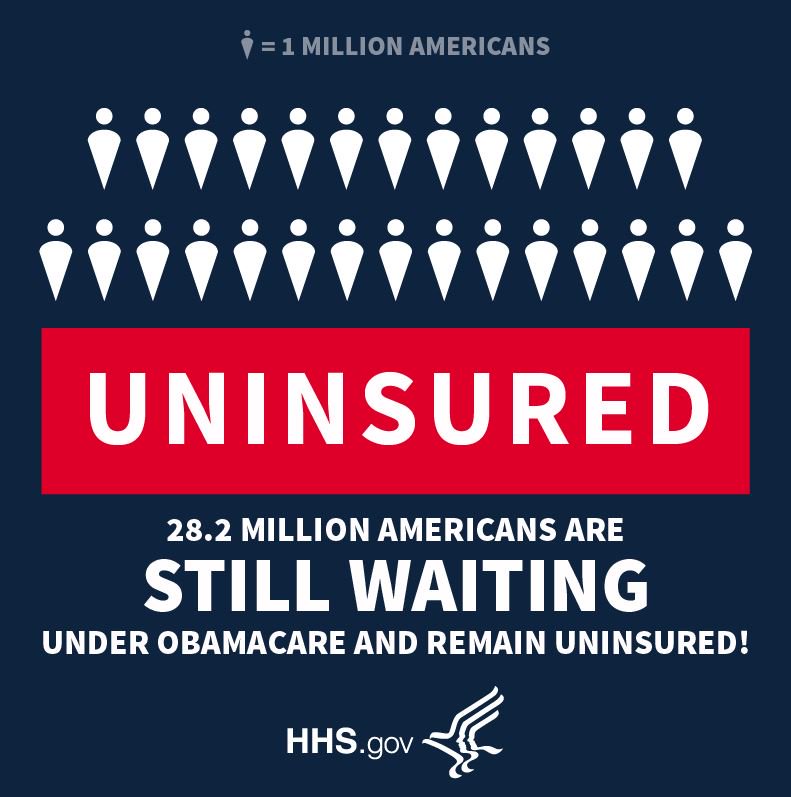
Department of Shamelessness. Senators may not know how to defend TrumpCare, but the White House does: with total BS. Sean Spicer tweeted this graphic from Trump’s Department of Health and Human Services:

All I can figure is that Spicer thinks those 28.2 million people’s main problem is loneliness: That’s why his boss’s bill would send 22 million more Americans to keep them company.


David Frum represents the Eisenhower-Ford type of conservative who used to be in the Republican mainstream, but now has no political home: He wants to pursue the public good through conservative methods, and is not opposed to government on principle, but is skeptical of ambitious programs and wants to make sure that every taxpayer penny is well spent. His article on reforming ObamaCare is part of the intelligent debate that America is probably having in some alternate universe.

The other side of that intelligent debate would be this fix-ObamaCare program from the Center for American Progress.


Public health policy actually matters: American women die during childbirth at about three times the rate of women in many other countries — except in California.

and the first public evidence of collusion between the Trump campaign and Russian hackers

The Wall Street Journal published two scoops by Shane Harris, which are behind the WSJ paywall (I’m not a subscriber), but have been discussed in detail many other places, like Washington Monthly and Vox.

The central figure in the report is Peter Smith, described by Washington Monthly as “a recently deceased long-time adversary of the Clintons who helped finance the Arkansas Project back in the 1990s”. Smith believed that Hillary Clinton’s deleted emails (the ones Trump “joked” about asking the Russians to hack and release) would contain damaging information, and that Russian hackers might have them. So he tried to make contact with Russian hackers so that he could obtain and release those emails. Smith represented himself as being in contact with several major Trump campaign people, including Michael Flynn, Steve Bannon, and Kellyanne Conway.

The most extensive available-for-free account is a 33-minute discussion between Harris and Benjamin Wittes on the Lawfare podcast.

Also on Lawfare is a corroborating account from computer-security CEO Matt Tait, “The Time I Got Recruited to Collude With the Russians“. Tait was known to be investigating the Russian hack into the DNC when Smith tried to recruit him.

Over the course of our conversations, one thing struck me as particularly disturbing. Smith and I talked several times about the DNC hack, and I expressed my view that the hack had likely been orchestrated by Russia and that the Kremlin was using the stolen documents as part of an influence campaign against the United States. I explained that if someone had contacted him via the “Dark Web” with Clinton’s personal emails, he should take very seriously the possibility that this may have been part of a wider Russian campaign against the United States. And I said he need not take my word for it, pointing to a number of occasions where US officials had made it clear that this was the view of the U.S. intelligence community as well.

Smith, however, didn’t seem to care. From his perspective it didn’t matter who had taken the emails, or their motives for doing so. He never expressed to me any discomfort with the possibility that the emails he was seeking were potentially from a Russian front, a likelihood he was happy to acknowledge. If they were genuine, they would hurt Clinton’s chances, and therefore help Trump.

… Smith and his associates’ knowledge of the inner workings of the campaign were insightful beyond what could be obtained by merely attending Republican events or watching large amounts of news coverage. But one thing I could not place, at least initially, was whether Smith was working on behalf of the campaign, or whether he was acting independently to help the campaign in his personal capacity.

Tait still has no direct proof, but eventually became convinced that Smith’s group “was formed with the blessing of the Trump campaign.” Documents he saw mentioned the same people Harris identified — Flynn, Bannon, Conway — plus some other lesser-known Trump-campaign people.

it’s certainly possible that he was a big name-dropper and never really represented anyone other than himself. If that’s the case, Smith talked a very good game.

None of this is Trump holding a smoking gun. But it does demonstrate why the investigation needs to continue.


One reason to believe this story is that the case put forward by Trump’s defenders has changed in recent weeks: They used to claim that talk of collusion was just fantasy, and that the whole investigation is a “witch hunt”. (Why congressional committees chaired by Republicans would participate in such a witch hunt has never been explained.) But lately they’ve added another line of defense: So what if Trump did collude? If that message change is being coordinated by the White House, it could indicate that they expect other shoes to drop.

and Trump’s Muslim ban

Just before going on summer break, the Supreme Court narrowed the injunction against the Trump executive order “which bars the issuance of visas from six majority-Muslim countries for 90 days and halts refugee resettlement for 120 days”. They won’t decide whether it’s constitutional until the fall, when the whole question might be moot, but in the meantime the injunction only applies to “anyone with a ‘bona fide relationship’ to an American or an American organization.” In other words, if you have a job offer from an American company or have been accepted to a U.S. university, or if you’re visiting a very close American relative, you can still come, but otherwise not.

The implementation of this order began Thursday, and it’s already kind of a mess. The administration decided to define “close family” so narrowly that grandparents didn’t count, and to deny that fiance is a bona fide relationship. So it’s all going back to court anyway.

To me, it looks like the Court has done something crafty: I always thought the order was a trial balloon. Trump doesn’t really care all that much about those specific countries for that length of time, but if that order is constitutionally OK, then we’ll see much more draconian orders later. The goal is to fulfill Trump’s campaign pledge of a Muslim immigration ban. If that’s the case, then the issue won’t be moot by the fall, but the administration will have to have shown more of its hand.

but we need to watch the Election Integrity Commission

Since November, Trump has been very sensitive about the fact that 2.8 million more voters chose Hillary Clinton than him, which is why he has pushed the fantasy that 3-5 million votes were illegal. Or, as Politifact pointed out:

Trump has made repeated claims about massive voter fraud and election rigging, which we’ve debunked again and again and again and again and again and again and again (and we debunked a claim by his spokesman Sean Spicer).

As long as this is just Trump and his fans choosing to believe whatever makes them happy, you just have to shrug. Why should this issue be different from all the others? But unfortunately, this particular bit of ego-defense ties in with a long-term Republican effort to push marginal voters away from the polls by requiring IDs not everyone has, purging voter-registration rolls, and trying to intimidate voters who don’t understand their rights.

Leaders in that effort are now on the Election Integrity Commission, which is technically headed by Vice President Pence, but is managed day-to-day by vice-chair Kris Kobach. Wednesday, Kobach sent a letter to the secretaries of state in all 50 states, asking for a huge amount of voter information, most of which is not available to the public. The goal is probably to do a national version of something Kobach has already been doing on a state-by-state level.

From his perch in Kansas, Kobach presides over the Interstate Crosscheck System, a fatally—and some would say, deliberately—flawed data-sharing system notable for its ability to knock eligible voters off the rolls without their knowledge.

Another problem is that a federal aggregation of such information would be “a gold mine for hackers“.

Technical experts say the voter data that the commission wants to assemble would quickly become a single treasure trove for cyber criminals and foreign intelligence services. Identity thieves could use information such as addresses, birth dates and the last four digits of Social Security numbers for digital impersonations, and foreign spies could use it to fill out dossiers on Americans they hope to blackmail.

Fortunately, a large number of states are refusing to respond. Oddly, one of the secretaries of state who is dragging his feet is the one from Kansas — Kobach himself.

and you also might be interested in …

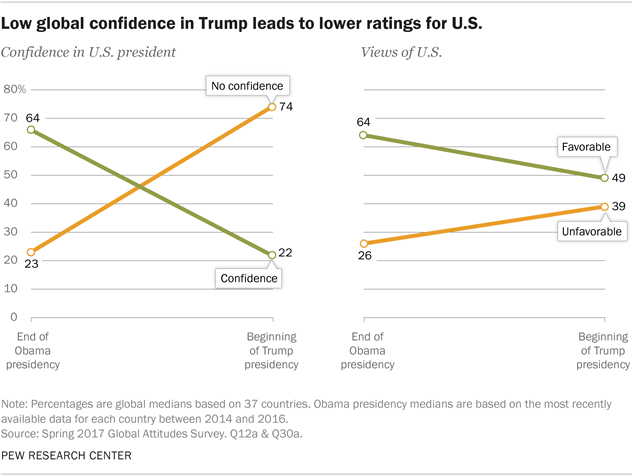
Pew Research Center regularly polls opinions about America in other countries. Here’s the recent trend.

The results broken down by country are also interesting. Asked about “confidence in the U.S. president to do the right thing regarding world affairs”, European confidence crashed when Trump replaced Obama. In Germany, for example, 86% had confidence in Obama, but only 11% have confidence in Trump. Canada (83%/22%) and Australia (84%/29%) showed smaller, but still quite large, losses of confidence. Jordanians (14%/9%) don’t put much stock in either of them, but slightly prefer Obama. In all, 35 of the 37 countries surveyed have less confidence in Trump than they had in Obama.

But then there’s an obvious question: Which two trust Trump more? By a small margin, Israel (56% Trump, 49% Obama). But the sole country where confidence in the U.S. president has skyrocketed is — wait for it — Russia (53% Trump, 11% Obama). Mordor was not surveyed.


The science division of the White House’s Office of Science and Technology Policy is now empty. The last of the Obama administration’s nine staffers are now gone and have not been replaced.


Am I crazy, or is Nebraska Senator Ben Sasse positioning himself for a primary challenge against Trump?


My favorite line in the Hamilton soundtrack is when Hamilton and Lafayette meet again at Yorktown and simultaneously say, “Immigrants — we get the job done.” That turned into a whole song on the Hamilton Mix Tape, and now there’s a video.


I’m trying not to pay too much attention to Trump’s gratuitously offensive antics, because, well, we’ve known for a long time that our president is a bullying sexist asshole. (I use asshole in the technical sense defined by philosopher Aaron James.) But if somehow you haven’t already heard about this week’s acting out, you probably should.

First there were his tweets about MSNBC morning host Mika Brzezinski — CNN wanted to talk about virtually nothing else Thursday evening. Various people, including Republicans in Congress, criticized him for it, and Mika and cohost-and-husband-to-be Joe Scarborough wrote a response in The Washington Post, for all the good that does. I’m reminded of a quote frequently attributed to George Bernard Shaw, but apparently said by Cyrus Ching: “Never wrestle with a pig. You both get dirty, and the pig likes it.”

Then he retweeted a video some supporter had edited (from a wrestling broadcast before he was president) of Trump tackling a guy outside a wrestling ring and punching him. The guy’s head has been replaced with a CNN logo. CNN referred to it as “juvenile“, and the White House denied that the President was encouraging violence against reporters, using the typical bully’s excuse that he was being “funny”.

I’m kind of in the same place as Seth Meyers.

Rachel Maddow’s POV also has merit: Why let Trump distract us from his bad news, like all the stuff listed above?

and let’s close with something peaceful

If you’re feeling stressed, spend some time contemplating these images of cats resting on Buddha statues. (Don’t miss the tiger.)

Three Misunderstood Things

This week: the anti-gay baker, why the Senate can’t move on, and whether raising the minimum wage kills jobs.


I. The Masterpiece Cakeshop case (which the Supreme Court will hear in the fall).

What’s misunderstood about it: People think it has free-speech implications.

What more people should know: The baker objected to the whole idea of making a wedding cake for two men, and cut off the conversation before the design of the cake was ever discussed. That makes it a discrimination case, not a freedom-of-speech case.

*

Defenders of Masterpiece Cakeshop owner Jack Phillips frequently portray him as a martyr not just to so-called “traditional marriage”, but to the freedom of tradespeople not to say things they object to. For example, one conservative Christian tried to demonstrate a double standard like this:

Marjorie Silva, owner of Azucar Bakery in Denver, said she told the man, Bill Jack of the Denver suburb of Castle Rock, that she wouldn’t fill his order last March for two cakes in the shape of the Bible, to be decorated with phrases like “God hates gays” and an image of two men holding hands with an “X” on top.

Is this cake gay or straight?

But the Colorado Civil Rights Commission ruled against Jack, because the two cases are very different: Silva objected to the message Jack wanted on the cake, not to anything about Jack himself or the situation in which the cake would be served. If the government had demanded that Silva make that cake, it would have been an example of forced speech, which there is already a long legal history against.

Do conservatives also have a right to refuse forced speech? Yes. A Kentucky court recently ruled in favor of a print-shop that refused to make t-shirts for a gay-pride festival.

So liberals must have howled in rage, right? Not me, and not philosopher John Corvino, who defended the Kentucky decision on the liberal news site Slate:

the print shop owners are not merely being asked to provide something that they normally sell (T-shirts; cakes), but also to write a message that they reject. We should defend their right to refuse on free-speech grounds, even while we support anti-discrimination laws as applied to cases like Masterpiece Cakeshop. … Free speech includes the freedom to express wrong and even morally repugnant beliefs; it also includes the freedom for the rest of us not to assist with such expression.

The reason the baker has lost at every stage so far — the administrative court and state appeals court ruled against him, and the Colorado Supreme Court refused to hear his appeal, letting the lower court ruling stand — is that he wasn’t objecting to putting some particular message or symbol on the cake, like a marriage-equality slogan or a rainbow flag. For all he knew when he refused, the men might have wanted a cake identical to one he had already made for some opposite-sex couple. In short, he objected to them, not to the cake they wanted.

Corvino explains:

One might object that Masterpiece Cakeshop is similar: “Same-sex wedding cakes” are simply not something they sell. But wedding cakes are not differentiated that way; a “gay wedding cake” is not a thing. Same-sex wedding cakes are generally chosen from the same catalogs as “straight” wedding cakes, with the same options for designs, frosting, fillings and so forth. It might be different if Masterpiece had said “We won’t provide a cake with two brides or two grooms on top; we don’t sell those to anyone.” But what they said, in fact, was that they wouldn’t sell any cakes for same-sex weddings. That’s sexual orientation discrimination.

II. Mitch McConnell’s agenda.

What’s misunderstand about it: If the Senate is stuck on its ObamaCare replacement, why can’t it move on to the next items on the Republican agenda: tax reform and the budget?

What more people should know: McConnell is trying to exploit a loophole in Senate rules. As soon as a new budget resolution passes, his ability to pass both TrumpCare and tax reform goes away — unless he changes the proposals to get Democratic votes.

*

During the Obama years, we often heard that “it takes 60 votes to get anything done in the Senate”, as if filibusters that can only be broken with 60-vote cloture motions were in the Constitution somewhere, and the minority party had always filibustered everything. (That’s why even the weakest gun-control bills failed, despite 54-46 votes in their favor.) But the Senate recognized a long time ago that budgets have to get passed somehow, and so the Budget Control Act of 1974 established an arcane process called “reconciliation” that circumvents the filibuster in very limited circumstances.

That’s how the Senate’s 52 Republicans can hope to pass bills without talking to the Democrats at all. But there’s a problem: Reconciliation is a once-a-year silver bullet. Fox Business explains:

Reconciliation allows Congress to consider just three items per fiscal year, whether they pertain to one bill or multiple. Those items are spending, revenue and debt limit. Since the GOP also wants to pass its tax reform agenda using reconciliation, it cannot statutorily do that under this budget blueprint because the two policy measures overlap.

And NPR elaborates:

The budget resolution for the current fiscal year dictates that any reconciliation measure must reduce the deficit, which the GOP’s Obamacare repeal was designed to do. Republicans then could draft a new budget resolution for the upcoming fiscal year with easier deficit targets, allowing for more aggressive tax cuts.

Under the most commonly accepted interpretation of the reconciliation rules, as soon as Congress passes a budget resolution for Fiscal Year 2018 (which begins this October), the window for passing TrumpCare under the FY 2017 resolution closes. So the only way to get them both done before facing another election campaign is to do them in the right order: first TrumpCare, then a new budget resolution, then tax reform.

Otherwise, McConnell’s options become less appealing: He can get rid of the filibuster completely, which several Republican senators don’t support. He can scrap either TrumpCare or tax reform for the foreseeable future. Or he can start envisioning the kinds of proposals that might get eight Democratic votes, plus a few to make up for Republican defections.

III. The minimum wage.

What’s misunderstood about it: Both supporters and critics of an much-higher minimum wage think they know what effect it will have on jobs.

What more people should understand: The effect of a minimum-wage increase on jobs is an empirical issue, not something you can deduce from first principles. And the data we have only covers small increases.

*

There is a certain kind of conservative who thinks he learned everything he needs to know about this issue in Econ 101: Every commodity, including unskilled labor, has a demand curve; if you raise its price, demand for it falls.

The right response to that analysis is maybe. Imagine that you own a shop with one machine, run by your sole employee. The machine produces some high-profit item. To make things simple, let’s ignore counterfeiting laws and imagine that the machine prints money. Cheap paper and ink go in, $100 bills come out.

Obviously, you could afford to pay your employee a lot more than the $7.25-per-hour federal minimum wage. But you don’t, because the machine is simple to operate and you could easily replace him, so he doesn’t have any bargaining leverage.

Now what happens if the minimum wage goes up to $15? Do you fire your guy and shut the machine down? Do you abandon your plan to buy another machine and hire a second worker? No, of course not.

Admittedly, that’s an extreme example, but it points out the right issues: Whether an increase in the minimum wage causes you to employ fewer people depends on how much you’re making off those people’s work. If you have a razor-thin profit margin, maybe a higher wage makes the whole operation unprofitable and you lay workers off. But if you could actually afford the higher wage, and the only reason you don’t pay it already is that your workers lack bargaining leverage, then you don’t.

In fact, if a minimum-wage increase gives your customers more money to spend on whatever you make, then you might have to hire more people to meet the demand.

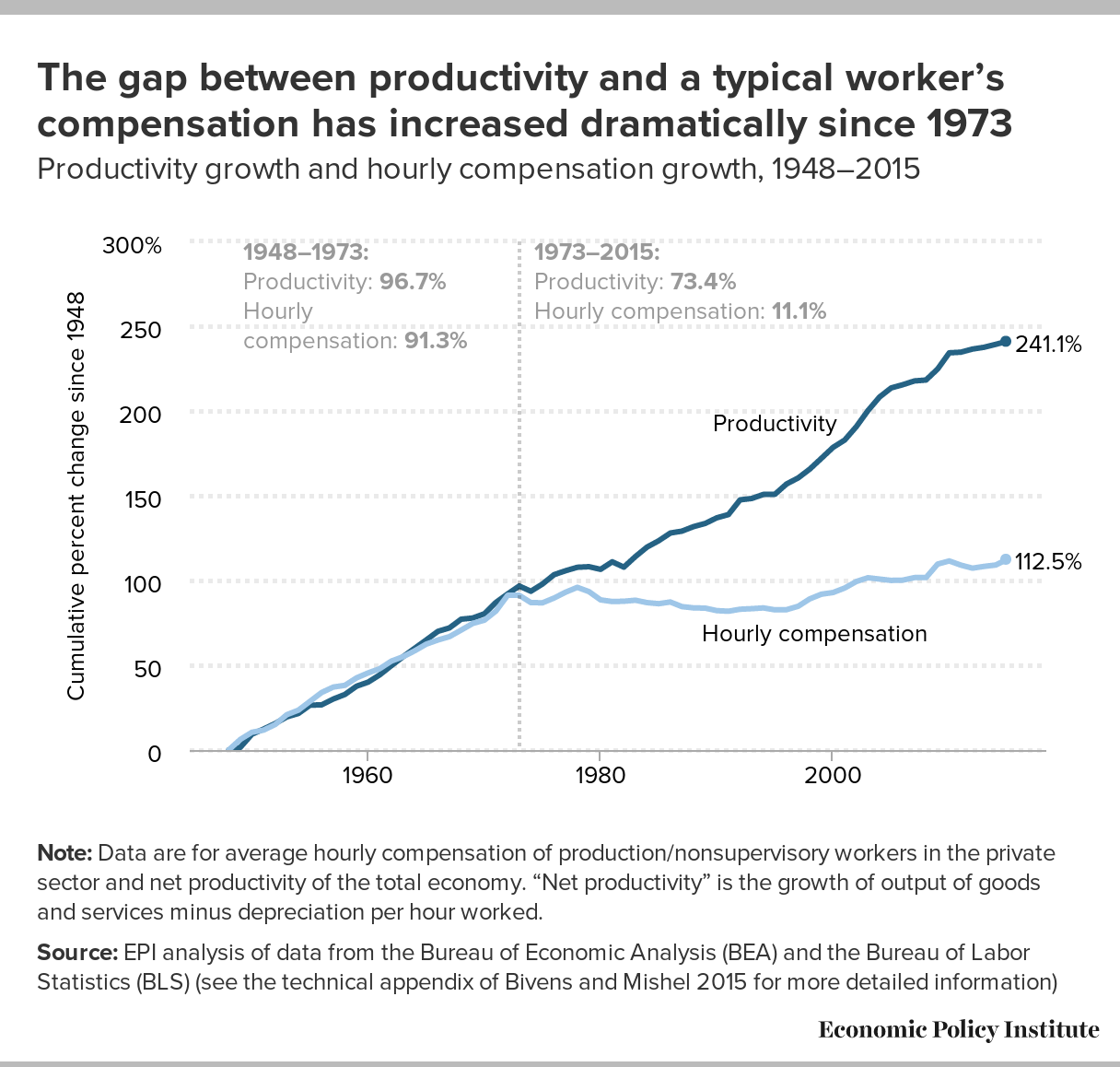
Which situation is more typical? One reason to think the second situation is, is that sometime in the 1970s wages stopped tracking productivity: Workers have been producing more, but not getting comparable pay raises, presumably because they lack the bargaining power to demand them.

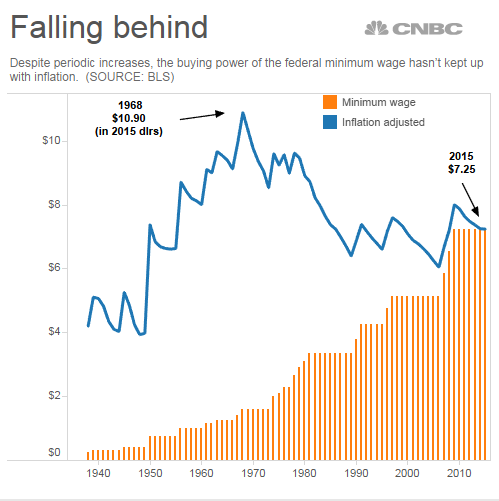
During the same era, the minimum wage has not kept pace with inflation. An increase to around $11 would just get it back to where it was in 1968. If it wasn’t causing massive unemployment then, why would it now?

Supporters of a higher minimum wage also point to studies of past increases, which don’t show big job losses.

But there’s a problem on that side, too: Past hikes haven’t been nearly as big as the proposal to go from $7.25 to $15. I was a minimum-wage worker myself in the 1970s when it increased from $1.60 to $1.80. I suspect my employer was not greatly inconvenienced. But larger increases might have a shock value that makes an employer say, “We can’t afford all these workers.”

That’s why the new data coming in from Seattle is so important: Seattle was one of the first cities to adopt a much-higher minimum wage, so we’re just beginning to see the results of that. The headlines on that initial study were that the higher wage is costing jobs, but that early conclusion is still debatable.

So in spite of my own preference for a higher minimum wage, I find myself in agreement with minimum-wage skeptic economist Adam Ozimek: This is an empirical question, and both sides should maintain more humility until we see more definitive data.

Yes, TrumpCare Will Kill People

Up until now I’ve been unwilling to make this claim,
but not because I didn’t believe it.


From the beginning, it seemed like common sense to me: Losing health insurance increases your risk of dying. Uninsured people get less care, and medical care saves lives, so lack of care logically would cost lives.

Big-picture statistics backed up that intution: Other industrialized English-speaking countries provide universal healthcare, and people live longer there. (Life-expectancy-at-birth: Australia 82.15 years, Canada 81.76, United Kingdom 80.54, United States 79.68.) None of those countries is an exact duplicate of the US, but is Canada so different that its people should live two years longer, or is their healthcare system just better than ours?

I knew that people have denied this. Back in May, Republican Congressman Raul Labrador bluntly stated “Nobody dies because they don’t have access to health care.” During his 2012 campaign, Mitt Romney pointed to emergency rooms and asserted that everyone gets life-saving care when they really need it. “If someone has a heart attack, they don’t sit in their apartment and die.”

But that argument didn’t impress me: Yes, the uninsured get life-saving care when they’re in car accidents or having heart attacks, but a lot of the treatable things that kill people more slowly, like high blood pressure or diabetes, aren’t emergencies. And while an ER might take out the tumor that’s blocking your intestine and threatening to kill you in a matter of hours, it won’t provide the follow-up chemotherapy or radiation that you’ll need if you plan to keep on living for more than a few months.

So I kept being tempted to say that TrumpCare would kill people. Other people have: Democratic politicians like Senator Bernie Sanders and Congressman Ruben Gallego, journalists like ThinkProgressIan Millhiser, and doctors like Christy Duan and Andrew Goldstein. They based their claims on solid scientific studies like this one and this one.

But every time I got ready to repeat that claim, I’d google “lack of health insurance kills people” and run into articles claiming to prove the opposite or just debunk the idea that we know one way or the other. Chasing the links in those articles always led me to different scientific studies, like this one or this one.

In other words, it looked like one of those my-bubble-versus-your-bubble arguments that I try to stay out of. Liberals cherry-pick the studies they want to believe, conservatives do the same, and we all talk past each other. Yes, I think of myself as a liberal, but my true allegiance is to the reality-based community. Like Fox Mulder, I believe that the truth is out there, and I would rather find it than just go on believing whatever I’m inclined to believe anyway.

So it’s been on my to-do list for months to devote some serious time to this issue, until I could feel confident that I really understood what is actually known. But given how much hard work would be involved and the possibility that I still might not arrive at a clear conclusion, that project never rose to the top of my stack. So I never boldly wrote, “TrumpCare will kill people.”

Fortunately, people better equipped than myself have taken the challenge on. Benjamin Sommers, Atul Gawande, and Katherine Baicker recently published an article in The New England Journal of Medicine acknowledging the controversy and comparing the studies quoted by each side. Weighing it all, they came to this conclusion:

The body of evidence summarized here indicates that coverage expansions significantly increase patients’ access to care and use of preventive care, primary care, chronic illness treatment, medications, and surgery. These increases appear to produce significant, multifaceted, and nuanced benefits to health. Some benefits may manifest in earlier detection of disease, some in better medication adherence and management of chronic conditions, and some in the psychological well-being born of knowing one can afford care when one gets sick. Such modest but cumulative changes — which one of us has called “the heroism of incremental care” — may not occur for everyone and may not happen quickly. But the evidence suggests that they do occur, and that some of these changes will ultimately help tens of thousands of people live longer lives. Conversely, the data suggest that policies that reduce coverage will produce significant harms to health, particularly among people with lower incomes and chronic conditions.

If the name Atul Gawande rings a bell, it’s probably because (in addition to being a doctor and public health researcher) he’s the author of popular books like Complications, Better, and Being Mortal. He also writes about health issues for The New Yorker, making him that rare researcher who’s able to popularize his own work, as he did this week in “How the Senate’s Health-Care Bill Threatens the Nation’s Health“.

To understand how the Senate Republicans’ health-care bill would affect people’s actual health, the first thing you have to understand is that incremental care — regular, ongoing care as opposed to heroic, emergency care — is the greatest source of value in modern medicine. There is clear evidence that people who get sufficient incremental care enjoy better prevention, earlier diagnosis and management of urgent conditions, better control of chronic illnesses, and longer life spans.

… Insurance expansions have made people more likely to get primary and preventive care, chronic-illness care, and needed medications — including cancer screenings, diabetes and blood-pressure medicines, depression treatment, and surgery for cancer before it is too late.

These improvements in care help explain why people who have health insurance are twenty-five per cent more likely to report being in good or excellent health. It also explains why they become less likely to die. Proper health care saves lives, and the magnitude of the reduction in deaths increases over time.

… Conservatives often take a narrow view of the value of health insurance: they focus on catastrophic events such as emergencies and sudden, high-cost illnesses. But the path of life isn’t one of steady health punctuated by brief crises. Most of us accumulate costly, often chronic health issues as we age. These issues can often be delayed, managed, and controlled if we have good health care — and can’t be if we don’t.

The incremental nature of most medical interventions — the drugs I take to keep my cholesterol low might or might not prevent a heart attack in 2030 — explains why the life-saving effect of insurance is hard to find in many studies, especially ones that only examine a few years. (Sometimes a decrease in mortality is noticed, but isn’t reported as a conclusion because the difference detectable within the time frame of the study isn’t statistically significant yet.) For the health crises that threaten to kill you in short order, Mitt Romney is right: The ER will help you whether you are insured or not. (You may have to go bankrupt when their bill comes, but that’s a different issue.)

But emergency care is far from the only way that medical care saves lives. Having watched both my parents grow old and die, I understand that many — perhaps most — deaths in this era aren’t caused by a sudden crisis out of the blue. Instead, dozens of problems that are not immediately life-threatening have a way of building on each other until people get encircled by them. A sudden crisis may kill you, but only because you have gradually lost all your room to maneuver. One problem limits your mobility, another makes it hard to sleep or enjoy food, your long-time interests and activities become hard to maintain, you become feeble, and then you get depressed and stop even trying to regain your lost abilities. Whether that encirclement happens to you at 50 or at 90 depends largely on what kind of care you get.

The difficulty of measuring these kinds of outcomes and attributing them to specific causes means that precise estimates of the number of such deaths should be taken with a grain of salt. An article in Vox on Wednesday claimed that 208,500 additional people might die over the next ten years if the Senate TrumpCare bill passes. That’s speculative, as the authors acknowledge. Maybe it will only be 50,000 people, maybe 400,000. Current research isn’t sharp enough to be precise.

But people will die, probably quite a large number of them.

The Monday Morning Teaser

This week I’m introducing something that might become a regular feature, called “Three Misunderstood Things”. The idea is to take three stories in the news, and to explain as concisely as I can some aspect of the story that is widely misunderstood. I’m testing it out this week by discussing misunderstandings of (1) the case (which goes to the Supreme Court in the fall) of the baker who wouldn’t make a wedding cake for a same-sex couple, (2) why Mitch McConnell can’t just skip over ObamaCare repeal and move on to tax reform, and (3) how much we know about the minimum wage’s effect on jobs. I’m thinking that should be out around 10 EDT.

Before that, say 9, I’ll have the featured post out: “Yes, TrumpCare Will Kill People”. I’ve believed this for a long time, but haven’t been saying it because I didn’t feel like I could defend the link between being uninsured and dying: Some studies seemed to establish such a link, while others denied it. But recently a study-of-studies came out and removed my doubt.

The weekly summary has a lot to cover: the Senate going home for the holiday without voting on TrumpCare, the first clear link between Russian hackers and the Trump campaign, parts of the Muslim Ban going into effect, Trump’s voter suppression commission starting its work, and Trump’s attempt to distract us all from that news with outrageously offensive tweets. I’ll try to get that out around 11.

Favored Few

There are two ways of viewing the Government’s duty in matters affecting economic and social life. The first sees to it that a favored few are helped and hopes that some of their prosperity will leak through, sift through, to labor, to the farmer, to the small business man. That theory belongs to the party of Toryism, and I had hoped that most of the Tories left this country in 1776.

– Franklin Roosevelt, “Address Accepting the Presidential Nomination” (1932)

This week’s featured post is “Turn the Page“. It’s my suggestion for Democratic messaging in 2018.

This week everybody was talking about the unveiling of McConnell’s secret ObamaCare repeal bill

There are several good summaries of what’s in the bill, but the two main facts you need to know are:

As the husband of a cancer survivor, I worry about pre-existing conditions. Atlantic‘s summary:

Simply put, the Senate bill will open the door to states forcing people with pre-existing conditions into segregated markets that will lead them to pay far, far higher costs than everyone else.

The bill doesn’t allow insurers to discriminate against people with pre-existing conditions directly, a point you’ll hear a lot from its defenders. However, an insurance company can structure its offerings to herd healthy people into bare-bones plans that cost little, but don’t cover the kinds of things people with pre-existing conditions are likely to need, like prescription drugs. (To keep her cancer from coming back, my wife takes a drug that costs thousands per month. So far insurance has covered almost all of that.) Plans that offer more complete coverage will then appeal mainly to the very sick, and their premiums will sky-rocket accordingly.

This is the flip side of a Republican claim that sounds sensible on the surface: Rather than mandate the same coverage for everybody, their bill lets people choose the coverage that makes sense for them. As a result, though, healthy people leave the insurance pool that pays for more extensive coverage, leaving only sick people.


On the question of whether it has the votes to pass, no one is even asking the 48 Democratic senators to vote for it; Democrats were completely shut out of the drafting process and the bill is going straight to the floor with no committee hearings. So far five Republicans have said they’ll vote against it “in its current form“, which could mean their votes are available if they can get a concession or two to assuage their angry voters. Several others have expressed concerns which James Fallows interprets with some cynicism:

So far in 2017, “concerns” from GOP Sens has always meant, “I’ll make sure the bill/nominee winds up with 50 votes.” Any diff this time?

Norm Ornstein believes that McConnell designed the bill with intentional problems that various recalcitrant senators can take credit for fixing, thus justifying their “reluctant” vote.

FWIW, the betting markets are split on the repeal of various ObamaCare provisions.


I have thought all along that smart Republicans wouldn’t want the bill to pass, because then they’ll own the ensuing disaster. You can keep voters from knowing what’s in a bill before you vote on it, but once it becomes law they’re going to find out. As Ross Douthat put it:

The Obamacare replacement that the House sent to the Senate might as well have had a note scrawled across its pages: Save us from ourselves.

But neither would any individual politician want to be seen as the reason the GOP’s highest-profile promise gets broken. So the smart move is to make someone else the fall guy for killing ObamaCare repeal.

First the House Freedom Caucus was on the hook. Then they renegotiated the bill in a way that passed the buck to House Republican moderates, who caved, passing the buck to the Senate. Now Senate conservatives and moderates are maneuvering against each other. If neither blocks the bill, then the onus will fall on the House again to accept the Senate’s changes. This game of chicken will be lost either by some handful of Republican congresspeople, or by millions of Americans who won’t be able to afford the insurance they need.

Probably the best outcome for Republicans politically is for the House and Senate each to pass a bill, and then blame each other for why no bill makes it through both houses. Then their candidates can tell the voters: “I voted to keep my promise, but those jokers in the other house screwed us up.”


Medicaid: Democrats need to remember that the very poor have been successfully demonized as lazy bums looking for handouts, but the working poor — the couples struggling to raise kids on some combination of just-above-minimum-wage jobs — still have a lot of public sympathy. Those are the people Medicaid expansion has helped, and they’re the ones the Republican bill will hurt.


I don’t know if he thought it up himself, but I just saw somebody comment on Facebook: “Hail Mary, full of grace, please leave Medicaid in place.”


Meanwhile, ObamaCare itself is more popular than it has been since 2010.


and the Georgia special election

Democrat Jon Ossoff lost 52%-48%. You can make the same excuse Democrats have made in the other special election: It’s a Republican district; Tom Price won it in 2016 by over 20 points. Still, Ossoff had gotten 49% in the jungle primary, and netting that extra 1% didn’t seem like it should have been that big a lift. But it was. (BTW, his 48% Tuesday doesn’t necessarily mean that he lost support; turnout was higher. Ossoff got 124K votes Tuesday, versus 92K in the primary.)

Georgia-6 is a well-educated suburban district where Trump won by only 1%. So the Ossoff-wins theory was based on two ideas: (1) Republicans who voted for Trump reluctantly are ready to turn against him. (2) Voters who have turned against Trump are willing to take it out on the whole GOP (or possibly they’re just too dispirited to show up to vote). But that didn’t happen, at least not in sufficient numbers.

Nate Silver’s crew “plays the Democratic blame game“.

natesilver: For me, there are basically three prototypes of campaigns that Democrats will need to run in 2018: (i) anti-Trump; (ii) anti-Republican; (iii) anti-incumbent.

I think Georgia 6 ought to have been an anti-Trump campaign, given that Trump is a much bigger liability in Georgia 6 than the GOP overall is and that people are doing pretty well there economically.

For me, there’s lots of room for populist progressives to do well as anti-Republican and anti-incumbent messengers. I actually don’t think they’re ideal as anti-Trump messengers, however, which is what you needed in this district.

The New Yorker‘s John Cassidy more-or-less agrees:

In a district as red as Georgia’s Sixth, the disheartening truth is that Ossoff probably wouldn’t have done better had he run to the left. While many Republicans have some misgivings about Trump, they have even more serious misgivings about voting for a Democrat. According to that same opinion poll in the Journal-Constitution, just one in three Republican voters said that they were supporting Handel to express support for Trump. What motivated them, they said, were traditional Republican issues: taxes, government spending, and illegal immigration.

but I’ve also been thinking about the role of religion in politics

In Friday’s NYT, Daniel Williams published an op-ed that drew a lot of comment, “The Democrats’ Religion Problem“, which concludes:

Only through a willingness to ground their policy proposals in the religious values of prospective voters will they be able to convince people of faith that they are not a threat to their values but are instead an ally in a common cause.

I’m debating whether to write a more complete discussion of this next week, but I think this article drew attention because it simultaneously points to an important issue and gets it wrong.

The bigger problem, which hits Republicans in exactly the same way when they talk about science, is establishing authenticity. Voters want to know that what you’re saying is not just a talking point that you could reverse tomorrow, but is rooted in values that come from a part of your identity that has some staying power. (Fleshing out the science analogy: When I hear a politician dissemble on global warming, it makes me wonder what evidence he wouldn’t be able to rationalize his way around. Does truth actually mean anything to him?)

The point shouldn’t be that all politicians need to learn how to talk about God, even if they don’t really believe. It’s that if you can’t use the language of the old-time religion, which is the traditional way to express deep-rooted values, how are you going to communicate that depth?


In other religion-and-politics news, the Southern Baptists condemned white supremacy.

and you might also be interested to know …

The Washington Post had a big Trump-and-Russia story Friday, outlining what the Obama administration knew about Russian interference in the election and when it knew it. The general theme is that Obama could and should have done more in response, but was worried what else Putin might have up his sleeve and believed that Clinton would win anyway.

The most interesting new fact:

The intelligence captured Putin’s specific instructions on the operation’s audacious objectives — defeat or at least damage the Democratic nominee, Hillary Clinton, and help elect her opponent, Donald Trump.

So the plan came all the way from the top, and had Putin’s personal attention. And somehow our side knew that.


California failed to move forward on a statewide single-payer healthcare plan. Nevada’s governor vetoed a buy-into-Medicaid plan that basically would have given everyone in the state a public healthcare option. Vermont made an earlier unsuccessful attempt at single-payer.

In an economy so dominated by interstate or international corporations, I have a lot of doubt about whether single-payer can be made to work at the state level. I’m rooting for somebody to prove me wrong.


Another place where I hope to be proved wrong: I’m generally skeptical of technological solutions to environmental problems — clean coal, geo-engineering, and so forth. But a carbon-capture plant just opened in Switzerland.


That Carrier plant in Indianapolis that Trump “saved” just before he took office? They’ll be laying off 338 workers in July, and another 290 just before Christmas. And the $16 million Carrier pledged to invest in the plant? That’s paying for job-killing automation, not for new production that creates new jobs.


Important story in yesterday’s NYT about the collapse of retail in rural areas. My hometown (Quincy, Illinois) is exactly the kind of place the article is talking about: Once a manufacturing town, it remade itself as a regional center. Its new economy is largely based on the regional hospital, the area’s biggest community college, and a cluster of big chain stores that draw customers from a 30-40 mile radius. (Many of the even smaller towns within that radius have seen their retail completely dry up. It’s hard even to keep a local convenience store going.) That base then supports other commerce (like restaurants and small boutiques) that maybe you wouldn’t drive 40 miles for, but you will visit because you’re in town anyway.

That new economy isn’t collapsing yet, but you can see the strain as people get more and more stuff from Amazon and other online retailers that have no local presence. Home Depot and Old Navy may not hire as many people or pay them as well as the old factories did, but working there beats being unemployed.


Chris Mooney writes in the WaPo about the effects of climate change on the coral reefs of the Florida Keys.

Ecologists describe the 360-mile-long Florida Reef Tract as a global treasure. It is the world’s third-largest barrier reef, although much less famous than Australia’s Great Barrier Reef.

But less than 10 percent of the reef system is now covered with living coral. Scientists anticipate that as early as 2020, it could be in line for almost yearly bleaching events, in which heat stresses upend the metabolism of corals, in some cases killing them. The reefs experienced back-to-back major bleaching events in 2014 and 2015.

… “When I was a child in the ’60s, the water was so clear I used to think of it as being Coke bottle blue,” said Stafford, citing the colored glass some Coke bottlers used. “And the reef was so healthy, all the coral was very alive. I don’t recall even thinking about bleaching or coral death or coral diseases back then.”

Killing the reef habitat is not just a moral catastrophe, it’s an economic problem for an economy based on tourism. Fighting global warming might cost jobs in West Virginia, but not fighting it costs jobs in Florida.


Jared is back from the Middle East and it turns out that Israeli/Palestinian peace is actually a hard problem. Who knew?


Murray Energy founder Bob Murray wasn’t going to be the focus of John Oliver’s piece on coal mining, but then his lawyers sent a cease-and-desist letter to try to intimidate Oliver. This was the result. (The Murray segment starts around 12:45. Be sure you don’t miss the closing.) And yes, Murray is suing.


After the Knicks drafted Frank Ntilinkina Thursday, Nate Silver fantasized about them re-acquiring Thanasis Antetokounmpo. Then they could

play a lineup of Ntilinkina, Antetokounmpo, Kuzminskas, Porzingis, and Hernangomez and lead the league in Scrabble points for the foreseeable future.

and let’s close with a lesson in bad writing

The humor site McSweeney’s gives step-by-step instructions for getting from a simple, active sentence like “The quick brown fox jumps over the lazy dog.” to the more obscure “Speed was involved in a jumping-related incident while a fox was brown.”

In a similar way, the article points out at the end, “A police officer shot a black person.” can turn into “The St. Louis County Police Department was involved in an officer-involved shooting after officers came under heavy gunfire.”

Turn the Page

Since Ronald Reagan, America has lived under a regime of conservative ideas that Democrats have sometimes been able to resist, but not to overcome or replace. That aging regime is ready to fall, but Bastilles never storm themselves. The Democrats’ 2018 campaign needs to be negative, but not personal: Bad as he is, Trump is just one example of the larger problem.


I keep hearing two theories about how Democrats can retake Congress in 2018 and start retaking the country. The first is to run against Donald Trump, who is an embarrassment to the nation, is historically unpopular, and may turn out to have committed impeachable offenses. The second is to run on a clear, positive agenda that can win back the working-class voters who have wandered away from the party of FDR and into the hands of the current huckster-in-chief.

Each approach has its virtues, and either would probably produce some gains in 2018, as mid-term elections usually do for the party out of power. But neither is quite right. Neither reflects the way that major change happens in America.

Beyond anti-Trump. The pure anti-Trump message is the easiest one to see through. The reason it’s not enough to run against Trump is that Trump isn’t the whole problem, not by a long shot. Yes, he’s corrupt. And yes, it’s dangerous for the country to have a president who understands so little about what presidents do. But think about the worst of what’s going on right now: trying to pay for a major tax cut for the rich by kicking millions of the working poor off Medicaid, undoing what little President Obama accomplished on climate change, and (though this isn’t getting nearly as much attention) sinking ever deeper into the quagmire conflicts of Syria and Afghanistan.

Just about any Republican president would be up to more-or-less the same stuff. A generic Republican president — picture President Pence, if you need a specific face — would also be favoring employers over their workers, letting big corporations manipulate the marketplace, looking for ways to make it harder to vote, insisting that God created exactly two totally distinct genders (and that only opposite-gender couples can form a real family), favoring Christianity over all other religions, and portraying the inner city as a war zone that needs an occupying force of militarized police (collateral damage be damned).

“Trump is bad” is not an argument against any of that stuff. If you’re an anti-Trump Republican, “Trump is bad” becomes an argument for keeping Speaker Ryan in place as adult supervision.

We saw in Tuesday’s disappointing special election in Georgia that Trump’s unpopularity isn’t necessarily contagious. In a historically Republican suburban district that nonetheless nearly went for Hillary Clinton in 2016, Jon Ossoff was a fresh young face with none of Hillary’s baggage. And yet, running against Karen Handel rather than Donald Trump, he couldn’t do quite was well as Clinton did (partly because Handel managed to reverse the demon-association playbook on him and run against Nancy Pelosi).

Major change doesn’t happen in America because the voters dislike one guy, even if that guy is the president. The root problem is the conservative worldview, the one that has been ascendant since Ronald Reagan. It won’t stop being ascendant just because Trump doesn’t know what he’s doing and can’t control himself.

Beyond our-policies-are-prettier-than-your-policies. But that raises an interesting question: How does major change happen? If you look at American history, a new national direction is never the result of a beauty contest.

If voters still more-or-less approve of the governing worldview, they never abandon it just because somebody else’s new ideas sound better. If they believe that the basic philosophy of the recent past still has promise for addressing the nation’s problems, they may occasionally choose a new face or opt for a pause while the country consolidates recent advances [1], but they won’t respond to calls for fundamental change. [2]

Big change, the kind we associate with names like Lincoln and FDR, happens because the public decisively rejects the ideas that have come before. Only then does a new way of looking at government have a chance to catch on. [3]

It’s important to understand what decisively reject really means. It doesn’t just mean that public stops buying the arguments in favor of those ideas. It means that the public loses patience with the very attempt to justify them. When a set of ideas has been decisively rejected, you don’t have argue against them any more; simply pointing out that these are the old, rejected ideas is enough.

FDR. So in 1932, the Great Depression was raging and Herbert Hoover was unpopular. Franklin Roosevelt probably could have won just on that. But if you look at Roosevelt’s speech accepting his nomination, he doesn’t mention Hoover’s name, or refer to him individually at all. He talks instead about “Republican leaders”, once mentions “the present administration in Washington” and twice more refers to “Washington” as short-hand. The case he makes is not against Hoover personally, but against the larger Republican worldview that had shaped the country since 1921, and whose roots went further back into the late 19th century.

There are two ways of viewing the Government’s duty in matters affecting economic and social life. The first sees to it that a favored few are helped and hopes that some of their prosperity will leak through, sift through, to labor, to the farmer, to the small business man. That theory belongs to the party of Toryism, and I had hoped that most of the Tories left this country in 1776.

Once elected, he didn’t reach out to the Republican Party, he destroyed it for a generation. They represented the “malefactors of great wealth” who had driven the nation into the Depression in the first place, and their worldview prevented the government from helping ordinary people.

For twelve years this Nation was afflicted with hear-nothing, see-nothing, do-nothing Government. The Nation looked to Government but the Government looked away. Nine mocking years with the golden calf and three long years of the scourge! Nine crazy years at the ticker and three long years in the breadlines! Nine mad years of mirage and three long years of despair! Powerful influences strive today to restore that kind of government with its doctrine that that Government is best which is most indifferent. …

We know now that Government by organized money is just as dangerous as Government by organized mob. Never before in all our history have these forces been so united against one candidate as they stand today. They are unanimous in their hate for me — and I welcome their hatred.

What Reagan did to Great Society liberalism. The last major paradigm shift in American politics was the transition from Carter to Reagan. It was Reagan who established the defining principles of the Republican Party we know today: low taxes (especially on the wealthy), strong defense, alliance with the Religious Right (under the label “family values”), and less regulation of business. [4]

In 1980, as in 1932, the sitting president was unpopular: Inflation and unemployment were both high. (Traditional economics had said that was impossible, creating a national uneasiness that maybe nobody knew what to do.) Americans had been held hostage in Iran for a year, and Carter could neither negotiate their release nor rescue them militarily. Japan was winning the battle of international trade.

Like Roosevelt, Reagan did not just run against Jimmy Carter, but against the liberal orthodoxy of the previous decades. In his First Inaugural Address he laid out the story that conservatives are still telling: The boundless energy and creativity of American business will produce abundance for all if only government would get out of the way.

In this present crisis, government is not the solution to our problem; government is the problem. …  If we look to the answer as to why for so many years we achieved so much, prospered as no other people on Earth, it was because here in this land we unleashed the energy and individual genius of man to a greater extent than has ever been done before. Freedom and the dignity of the individual have been more available and assured here than in any other place on Earth. The price for this freedom at times has been high, but we have never been unwilling to pay that price. It is no coincidence that our present troubles parallel and are proportionate to the intervention and intrusion in our lives that result from unnecessary and excessive growth of government.

After Reagan, Democrats couldn’t just be liberals. Suddenly they were tax-and-spend liberals, big-government liberals, or some other discredited species. The first and best argument against a new government program was simply that it was a new government program: Of course it wouldn’t achieve its objectives, would cost more than the wildest estimates, and would entrench yet another bloated bureaucracy. Conservatives didn’t have to make that argument; after Reagan, it made itself.

You could still hear the Reaganite echoes when ObamaCare was labeled “a government takeover of healthcare“. No evidence was needed to show that such a “takeover” would be bad. That went without saying.

Where Obama failed. In 2008, President Bush was unpopular. But more than that, his failures were deeply bound up in the failure of Reagan-era conservatism: Bush’s tax cuts built a deficit without unleashing growth. When government regulators got out of the way, Wall Street bankers turned mortgages that should never have been approved into a multi-trillion-dollar tower of worthless securities (whose AAA ratings fooled the market just long enough to crash the economy, make the banking system insolvent, and endanger the retirement savings of middle-class Americans). Our strong-but-fabulously-expensive military proved to be good at breaking countries, but not so good at putting them back together or preventing the resulting failed states from exporting terrorism.

Obama won a landslide victory and brought big majorities in Congress along with him. But he failed to charge Bush’s personal unpopularity or the crisis Bush left behind to the massively overdrawn account of the conservative worldview. He did not proclaim the end of the Reagan Era and made no attempt to chase the old orthodoxy’s defenders off the public stage, as Roosevelt and Reagan did in their day. If he had succeeded in doing so, there would be a new set of epithets that every conservative candidate or proposal would have to struggle out from under, terms like Iraq invader or bomb-everywhere Republican or sub-prime conservatism or free-the-wolves deregulation or middle-class-destroying cuts. (Those are just off the top of my head; no doubt professionals could do better.) Those labels would be as instantly disqualifying as tax-and-spend liberal was in the 1980s.

Obama’s failure to turn the page is why conservative nostrums (that events have disproved again and again) are still popping up in the ObamaCare-repeal debate: Getting government out of healthcare will unleash the creativity of the marketplace to yield better coverage and care for consumers; yet another big tax cut for the rich will create the good-paying jobs that none of the previous tax cuts did; the millions who will be thrown off of Medicaid — mostly working-poor families who are struggling to get by on minimum wage or slightly more — are Takers who are about to get a much-needed lesson in personal responsibility, giving a break to the massively overtaxed and overburdened Makers who support them.

After the horror of Bush’s Great Recession, the tax-cut-and-deregulation Great Recession, no one should be able to say such things with a straight face and without shame.

Turn the page. After nearly 40 years, American political discourse still takes place in the rhetorical universe created by Ronald Reagan. Our world is still haunted by the ghosts of Cadillac-driving welfare queens, job-killing regulations, initiative-crushing taxes, and poor people whose will to succeed has been sapped away by their dependence on government. The heroic entrepreneur still fights his eternal battle against the villainous bureaucrat. Private-sector spending on Mar-a-lago memberships and gas-guzzling jet-skis and AK-47s is productive, while public-sector spending on parks and roads and libraries is wasteful. A private-school teacher is a hard-working professional, while a public-school teacher is a blood-sucking parasite.

This rhetoric is aging badly and losing its hold. Republicans at some level know this; that’s why their ObamaCare-repeal bills in both houses have had to be jammed through quickly with as little national attention as possible. You don’t do that if you believe in what you’re doing. If you think you have a compelling argument, you make that argument in the brightest spotlight you can find.

But aging regimes don’t fall of their own weight. Somebody has to push them down. The Bastille never storms itself.

The 2018 campaign needs to be negative, but not personal. You can propose Medicare-for-everyone into this environment if you want, and if you can manage to control the narrative well enough to keep everyone calling it that — even after you get outspent 5-1 or 10-1 — you’ll probably win. But if instead your proposal gets transmuted into a bureaucracy-bloating, tax-increasing, debt-busting, big-government takeover of the economy, you’ll probably lose.

Democrats can’t shy away from conservative rhetoric, and we can’t hope that it will just slip people’s minds if we change the subject by presenting our own solutions. We have to confront it directly: We’ve been living in a conservative era for nearly 40 years, and that is what has destroyed the middle class.

That central point needs to be backed up with direct rejections of conservative nostrums: You can’t cut your way to prosperity. Nobody succeeds in a failing community. Money isn’t speech. Fear creates violence, and cruelty will always rebound; more prisons won’t make you safe, and more invasions will just cause more terrorism. More freedom for the rich and strong means more servitude for the poor and weak. The free market destroys the middle class. The environment is economic; we are part of Nature, and if we destroy Nature we destroy ourselves. (Again, these are off the top of my head and professionals could do better. The important thing is to express similar ideas in a uniform way, so that voters will know they’re hearing the same point from many voices.)

Trump’s individual outrages and the specific problems of this or that policy should always be interpreted expansively: Specifics should be presented not because they are important in themselves, but because they anchor the larger critique. Trump isn’t an aberration, he’s typical. The ObamaCare-repeal bill isn’t just a bad policy, it’s the logical product of a bad philosophy.

Party unity. A handful of Democrats will feel left out by this message, because they hope to appeal not just to people who have been voting Republican, but to people who still believe in the Reaganite worldview. That seems like a fool’s errand to me.

But the vast majority of candidates, progressive and centrist alike, should be able to work with this national message. The positive proposals they present can be tailored to their own philosophies and their own districts. (Bernie Sanders, for example, knew better than to run on gun control in Vermont. Similarly, a rural district in Kansas, full of towns where there’s one convenience store and one gas station, both struggling, is not the place to run on a $15 minimum wage. Higher, yes; $15 no.) Some will vaguely want to increase access to healthcare while others will post a detailed 50-page plan on their web sites. As candidates succeed or fail with these specifics, other candidates will or won’t imitate them.

Some candidates will want to appear with Sanders or Elizabeth Warren, while others will invite Joe Biden or Cory Booker. But very few candidates will find themselves forced to run against the national message, or to choose between the national party and the voters they hope to represent.

Old and new. It’s hard now to remember how fresh Reaganite conservatism sounded in 1980. Whether you agreed with it or not, it started new discussions and opened new possibilities for experimentation. But what was once young and supple has become old and rigid. Discussions shut down now, because powerful organizations have staked out positions that brook no debate: There can be no new taxes. Nothing can be done about gun violence. We can’t talk to Iran. Defense spending can only go up.

That’s what old regimes look like. They’re brittle and have no room to maneuver when new problems appear. New voters come of age looking for insight, and hear only dogma. It may be hard to say exactly what should come next, but it’s easy to see when it’s time for an old worldview to go.

It’s time.


[1] The new faces I have in mind are Dwight Eisenhower and Bill Clinton, both of whom represented their party’s acknowledgement that the game had changed, and did not reverse the country’s course. Eisenhower let New Deal programs like Social Security stand, and Clinton yielded to a key point of Reaganism by announcing that “The era of big government is over.” A “New Democrat”, as Clinton sometimes called himself, was a Democrat who had learned the lessons of the Reagan Era.

[2] This a political analogy to the process Thomas Kuhn described in The Structure of Scientific Revolutions: As long as researchers believe that the old paradigm is still fruitful and can still lead to new solutions to important problems, new paradigms don’t get a fair hearing.

The political scientist most connected with this idea is Stephen Skowronek, who introduced the concept of “political time“. Basically, he breaks American history down into a series of multi-decade eras, each dominated by its own widely accepted view of what government is about. Each president grapples with problems within that era’s political orthodoxy, which he either promotes or resists. As the era proceeds, the ruling ideology becomes more rigid and unwieldy, until it collapses under an attack by a repudiating leader, who then “resets the political clock” and begins a new era.

[3] Lincoln is a particularly good example here, because the change he is remembered for — ending slavery — isn’t what he campaigned on. Point 4 of the 1860 Republican platform explicitly denies any intention to roll back slavery in the existing slave states, and rejects military force as a means to do so:

That the maintenance inviolate of the rights of the states, and especially the right of each state to order and control its own domestic institutions according to its own judgment exclusively, is essential to that balance of powers on which the perfection and endurance of our political fabric depends; and we denounce the lawless invasion by armed force of the soil of any state or territory, no matter under what pretext, as among the gravest of crimes.

What the election of 1860 represented was not an endorsement of abolitionism, much less of a future where free blacks could vote and be assured the due process of law. Instead, it represented a rejection (on both sides) of the political climate that had endured since the Missouri Compromise of 1820: The country could no longer lurch from crisis to crisis as moderates like Henry Clay or Daniel Webster or Stephen Douglas worked out complicated deals to maintain the North/South balance of power.

So the America that came out of the Civil War was fundamentally different than the America of 1859, but not because Lincoln designed a new set of policies and sold them to the electorate.

[4] These ideas are so entrenched inside the GOP that even when Marco Rubio campaigned on the need for “new ideas”, he simply repeated Reaganite orthodoxy.

The Monday Morning Teaser

For a month or two I’ve been expressing skepticism about the different messages Democrats might adopt in 2018, without offering an alternative I believe in. (Last week, I was skeptical about the progressive message.) This week I’m finally going to stick my neck out.

The two main message proposals I’ve been hearing are (1) to go hard against Trump as an individual, all but making the election a referendum on impeachment, and (2) to push a positive progressive agenda full of very specific proposals: single-payer health care, $15 minimum wage, and so on.

The strategy I’m going to promote later this morning is that the 2018 campaign has to be negative and has to make use of Trump’s personal unpopularity, but the target has to be the whole conservative movement, not Trump personally. Through both Republican and Democratic administrations, we’ve been in the Reagan Era for nearly 40 years, and the result has been to destroy the American middle class. Trump may be a uniquely annoying individual, but his policies have been doctrinaire conservatism. The healthcare proposal, which would throw millions of the working poor off of Medicaid to give yet another tax cut to the very wealthy, is typical.

Individual candidates will want to supplement that denunciation with specific positive proposals tailored to their own districts, but the national message has to be negative: It’s time for the conservative era to be over.

The article will be called “Turn the Page”, and it builds on the “political time” theory of how change happens in America: You have to destroy the old regime and delegitimize its dominant ideas before you can start a new era. I’ll project it posting around 10 EDT.

The weekly summary discusses the Senate healthcare bill (which finally de-cloaked like a Klingon warbird ready to attack the working poor), the Georgia special election, the latest on the Russia investigation, and a number of recent articles worth looking at: the Democrats’ “religion problem”, climate change’s effect on Florida’s coral reefs and the tourism industry of the Keys, and the collapse of small-town retail. It should be out by noon.

From Words to Bullets

Every thought burns into substance
Every dream turns into something on a t-shirt
Every glance becomes a romance
(One little word and you can’t keep it in your pants)
They float above us like a cloud
And no one knows where the rain will end up falling
Every force evolves a form
Every urge leads to something you can sit on
Every force evolves a form
Every impulse ends up as something you can hang your hat on

– Shriekback, “Every Force Evolves a Form” (1992)

This week’s featured posts are “Political Violence is Our Issue Too” and “Why I’m Still Skeptical about the Progressive Revolution“.

This week everybody was talking about the Scalise shooting

House Majority Whip Steve Scalise has never been my favorite congressman, for what I still think are good reasons. But I wish him a full recovery. If democracy is about anything, it’s about resolving our differences without shooting at each other.

The larger issues that come out of this shooting — how fake news and wild rhetoric contributes to violence — are covered in a featured post.

and obstruction of justice

Wednesday The Washington Post reported that the special counsel is investigating Trump for obstruction of justice. Trump took it well, going on a Twitter tirade against his own assistant attorney general: “I am being investigated for firing the FBI Director by the man who told me to fire the FBI Director! Witch Hunt”


Humorist Andy Borowitz nailed Jeff Sessions’ testimony to the Senate Intelligence Committee: “Man Ravaged by Amnesia Somehow Able to Hold Down Demanding Legal Job“. Sessions’ testimony boiled down to three assertions: (1) He didn’t do anything wrong. (2) If he did do something wrong, he has no memory of it. (3) He’s not going to answer any questions about conversations he had with Trump, but he refuses to state any legal grounds for not answering.


Mike Huckabee proved a couple years ago that he must have flunked high school civics. More evidence this week is his defense of Sessions’ non-answers:

Dems act like they never heard of atty/client privilege; AG is top atty in Exec branch; serves and not stooge of Congress.

The attorney general is not the president’s lawyer. He is managed by the president, but he works for the United States. What worries me most about Trump is his third-world-dictator tendency to personalize authority that is supposed to be institutional. As president, Trump leads the executive branch, but he doesn’t own it. Commentators like Huckabee do a disservice to the country when they encourage that delusion.


More legal misinformation came from Newt Gingrich, who seems to have forgotten that he supported an obstruction of justice charge against President Clinton.

Technically, the president of the United States cannot obstruct justice. If he wants to fire the FBI director, all he has to do is fire him.

That’s nonsense, and the correct principle is not hard to understand: Even when an official is exercising legal powers, motives matter. Legally, the highway cop who pulls you over for speeding has the discretion either to ticket you or to let you go. But the why matters: If he lets you go because you gave him $100, that’s illegal.

Same thing here. Trump has the legal power to fire the FBI director. He doesn’t need a good reason; if he’s just grumpy that day and wants to take it out on somebody, that’s enough. But if he has a bad reason, it might be illegal. In particular, if he did it to shut down an investigation into possible crimes committed by himself, his friends, or his administration, he has obstructed justice.

and Philando Castile

Last July, Castile was driving with his girl friend in a suburb of St. Paul when a policeman in Minnesota stopped them, believing they “just look like people that were involved in a robbery.” (Castile had been stopped at least 46 times in the previous 14 years.) Castile had a license to carry a gun, and had a gun with him. According to the girl friend, the policeman asked for Castile’s driver’s license, Castile told him there was a gun in the car, and when he reached for his wallet to get his license the policeman started shooting. Friday, a jury found the officer not guilty of manslaughter.

Vox has a good summary of the case and the larger issues it raises. It includes this graphic:

I hate to second-guess juries, since I didn’t hear all the evidence and they did. But Castile really seems to illustrate the problem of police and black people, especially young black men. Castile, in fact, wasn’t the burglar they were looking for. Nobody can pinpoint exactly what he did wrong, but now he’s dead. This kind of thing happens a lot. If you’re parenting a young black man, what can you tell him that will keep him safe?

I was surprised to discover that David French of the conservative National Review also has problems with the verdict. (His colleague Robert Verbruggen doesn’t. Castile’s death is “a tragedy”, but what can you do?)

I understand the inherent danger of police work. I also understand the legal responsibilities of men and women who volunteer to put on that uniform, and the legal rights of the citizens they’ve sworn to protect and serve. I’m aware of no evidence that Yanez panicked because Castile was black. But whether he panicked because of race, simply because of the gun, or because of both, he still panicked, and he should have been held accountable. The jury’s verdict was a miscarriage of justice.

The Castile case also illustrates what I’ve called “the asterisk in the Bill of Rights“: Constitutional rights don’t apply to blacks in the same ways as they do to whites.

The NRA, for example, seems reluctant to comment on this apparent disregard for Castile’s 2nd Amendment rights. Slate‘s Leon Neyfahk puts it bluntly:

On its face, the Castile case would seem to have all the trappings of a cause célèbre for the NRA. The group’s most fiercely held belief is supposed to be that law-abiding citizens shouldn’t be burdened—let alone killed in cold blood—by repressive agents of the government just because they want to protect themselves and exercise their Second Amendment rights. … If Castile had been white instead of black, the NRA would have been rallying behind him and his family since the moment of his death, and fundraising off his memory for the rest of time.


The Castille verdict contrasts with a guilty verdict in what seems to me to be a much more nebulous case: Michelle Carter and Conrad Roy were two depressed teens who only met a handful of times, but texted back and forth constantly over a two-year period. Roy repeatedly talked about killing himself, and while Carter initially encouraged him to seek treatment, eventually she accepted his claim that what he really wanted was to be dead. They discussed suicide techniques together, and when Roy texted that he was backing out of his planned attempt (he got out of a truck filling with carbon monoxide), Carter called and urged him to go through with it, which he did. Friday, a Massachusetts judge found her guilty of involuntary manslaughter. This seems weird to me in lots and lots of ways.

and the Virginia primary

The Democratic side of the primary was supposed to be the story: It was billed as a “battle for the soul of the party” between the establishment-supported Ralph Northam and the Sanders-and-Warren upstart candidate Tom Perriello. (More about that in the other featured post.) But that turned out to be a surprisingly easy Northam victory.

The real story turned out to be on the Republican side.

What shocked observers instead was the Republican primary, where Corey Stewart — a Confederate sympathizer and onetime campaign official for Donald Trump — came within just 1.2 points of beating former Republican National Committee Chair Ed Gillespie.

Vox interviewed political scientist Quentin Kidd:

A lot of us, in our analyses, made a fundamental mistake. We assumed that because Trump’s approval ratings were so low in the state, there was no way someone like Stewart could have a chance at winning the primary. But what happened tonight is that the 37 percent of Virginia voters who said Trump is doing a good job came out and voted for Cory Stewart in a Republican primary. They’re still a potent force.

The other conservatives — the Republicans who don’t think Trump is doing such a good job — they didn’t come out as much and vote for Ed Gillespie. In the end, it’s partly an enthusiasm thing. There’s far more enthusiasm on the “populist,” “rebellious” side of the party right now then there is among the middle of the party.

And that suggests that congressional Republicans might be in trouble in their primaries if they break with Trump. The Republicans disillusioned with Trump might be too depressed to vote.

and you might also be interested in …

A few Senate Republicans are grousing about the secret process Mitch McConnell is using to push ObamaCare repeal forward, but they’re going along with it anyway. Here’s how McConnell plans to get the proposal passed.

People looking for a precedent for this no-hearings no-debate approach to a major bill have reached back to a Wilson-administration tariff bill. That’s how unusual this is.


Oh, that stuff during the campaign about Trump doing some hard negotiating with the drug industry and getting prices down? Never mind.


He’s rolling back some of Obama’s opening to Cuba, and he’s doing it in a way that hurts his business competitors. Coincidence?


Stuff at Whole Foods is already priced high enough; imagine offering 27% above market price for the whole company. That’s what Amazon did Friday, making a $13.7 billion offer.

Paul La Monica at CNN Money thinks it’s a brilliant move.

The key to this deal is that it shows the genius of [Amazon founder] Jeff Bezos. Of course, it’s too soon to say whether buying Whole Foods for this amount of money will be a success, but keep in mind: No one was even speculating that this deal was going to happen. … This just goes to show that Bezos is thinking about things that no one else on the planet is even considering.

Maybe there is some amazing plan here — the NYT speculates about what it might be — but it’s also possible that Bezos has too much money to play with and too much time to think about bizarre things to do with it. (You know who else does things that no one else on the planet even considers? Darwin Award winners.)

One problem springs to mind immediately: Amazon is all about undercutting on price, while Whole Foods is about charging top dollar for something presumed to be better. I’m not sure how that mixes.

In some sense, though, even Amazon’s $42-per-share offer represents a mark-down: Whole Foods stock peaked around $65 in 2013. The high-end grocery market has gotten much more crowded and competitive  since then. (Wegmans, Sprouts, Trader Joe’s, and other similar chains have all expanded, plus farmer’s markets and other boutique food sources.) And publicity like this John Oliver segment in 2015 didn’t help.

but we should be paying more attention to Trump’s appointments

The people he has nominated to the National Labor Relations Board might make nearly impossible to unionize.

and let’s close with something prescient

That cabinet meeting where all the secretaries took turns praising Trump reminded me of something out of the Third World. And it underlined just how well Trevor Noah had Trump pegged in 2015.

Why I’m Still Skeptical About the Progressive Revolution

My social media bubble has drifted well to the left of center, so I hear a lot of frustration with the Democratic Party — particularly with the centrist Clintonite wing that has dominated the DNC in recent years, during which the party has lost the White House, both houses of Congress, and vast numbers of seats in state legislatures. The solution is supposed to be for all those people to get out of the way and let the progressive Bernie-supporting wing of the party take over. Hillary Clinton in particular should just go away, and anybody involved in the DNC in 2016 should follow her. The Left is where the youth and energy of the party are, and it has the kind of bold proposals that might get disaffected voters to the polls. Look what Jeremy Corbyn just did in the UK.

I’m almost there. The critique — lost elections at all levels — is inarguable. And I long for a more visionary approach to the future. Take gun control as a neutral example that cuts across the Clinton/Sanders line: All Democrats — and most of the rest of the country — can agree that our current gun laws are stupid. The fact that we don’t even do universal background checks on gun purchasers is insane (and so are some of the people who exploit the loopholes in the system and buy guns). But in the Ideal Democratic Future, what is the relationship between American citizens and guns? Does anybody have an answer for that?

But I have to admit, on almost every other issue progressives have a clear advantage on the vision-of-the-future front. Again and again, the centrists get lost in the next-small-step argument and never get around to saying where they want to go. But conversely, while progressives are clear on the Big Idea, they’re often vague about what the next step is. (After Congress rejects his single-payer healthcare plan, does President Sanders have a Plan B, or does he just wait for the next Congress?)

So while I’m rooting for the progressives, let me tell you exactly where I get stuck. All my political life, the left wing of the Democratic Party (and the non-Democrats who reject the party for not being liberal enough) has been suffering from the delusion that it’s more popular than it actually is. Again and again, I have heard that somebody like Ralph Nader or Dennis Kucinich represented what the American people really want, and then seen them get something like 2% of the vote. And then, in the next election the same people would come back and tell me the same thing, as if the last election never happened.

Polls. Why do they think this? It’s not purely wishful thinking; there are polls that say the same thing. If you ask about specific issues, and phrase your questions right, you can get sizeable majorities of the American people to agree with liberal positions.

In early 2015, for example, 68% of Americans told pollsters that the rich don’t pay enough tax; only 11% thought the rich pay too much. This February, a 60%-38% majority said the government should “make sure that all Americans have healthcare coverage”. Last year, 63% described their response to “Medicare for all” as either “very positive” (36%) or “somewhat positive” (27%). In 2013, Gallup found 72% support for “a federal government program that would spend government money to put people to work on urgent infrastructure repairs”.

Early in 2015, the Progressive Change Institute polled a wide range of issues: 71% supported letting anyone buy in to Medicare. 70% were for a “Green New Deal” to create millions of clean-energy jobs. 63% favored free community college. 70% would expand Social Security benefits. 61% wanted a special prosecutor to investigate all police killings. And more.

However, you can also get different results if you ask different questions. In 2013, a WaPo/ABC poll found 61% support for an across-the-board 5% cut in federal spending. That’s a fairly consistent pattern: As an abstract concept, government spending is unpopular, even while spending on particular programs has broad support. And while majorities always think the rich should pay more tax, nobody thinks that they themselves are rich — and hardly anybody thinks people like them should pay more tax.

So it’s naive to think that you can get those 60% or 70% majorities by running on a progressive platform. You’d get those majorities if you ran on a progressive platform, and then managed to control the narrative of the campaign so that the eventual vote turned on the issues where you have large majorities behind you.

But that never happens. Just ask Hillary; I don’t think she expected to spend the last week of the campaign answering questions about the FBI. In 1988, Dukakis had Bush nailed on the issues — so the Bush campaign invented an issue out of nothing: They were for the pledge of allegiance and Dukakis (they claimed) was against it. They won.

The 2016 primaries. Bearing that history in mind, what did 2016 really tell us? On my social media feed, I often hear the story told this way: Bernie was the people’s choice, but the Democratic establishment pushed Hillary through in spite of her unpopularity.

And here’s my problem with that story: If the people had really wanted Bernie, they could have voted for him. That’s what happened where I live in New Hampshire (where I dithered, and then voted for Bernie myself). If the power of the establishment works anywhere, it should work in the early primaries, when the upstart candidate seems most unlikely. But Hillary’s initial advantages in name recognition and money and endorsements got her only a tiny victory margin in Iowa, and then got her clobbered in New Hampshire, where Bernie got 60% of the vote and won every county.

From that point on, the race was a free-for-all. And Bernie lost that free-for-all: His total primary vote was 13.2 million, compared to Clinton’s 16.9 million. That loss can’t be attributed to some fluke of the process: He also never caught Clinton in the national polls. For a couple weeks in mid-April he got within a point or two, but then Clinton started to pull away. The late-breaking trend was entirely towards Clinton, climaxing with her 7-point win in California, a state which fits the Sanders profile as well as any.

Sanders supporters who don’t go in for a DNC-stole-the-election conspiracy theory often blame the media: Sanders couldn’t get his message out. The articles about him didn’t focus on how great his proposals were, and instead drew too much attention to stereotypes like “Bernie bros”.

But a campaign never gets the media coverage it wants. Clinton certainly didn’t. The same Harvard study that pointed out how little serious media attention Sanders got in 2015 also showed that the attention to Clinton was almost entirely negative.

Whereas media coverage helped build up Trump, it helped tear down Clinton. Trump’s positive coverage was the equivalent of millions of dollars in ad-buys in his favor, whereas Clinton’s negative coverage can be equated to millions of dollars in attack ads, with her on the receiving end.

The 2016 general election. Yes, I often hear, but Clinton lost to Trump and Sanders would have won.

I don’t think that’s clear at all. Yes, Hillary would have beaten Trump if she’d gotten Jill Stein’s votes, which almost certainly would have gone to Bernie if he’d been the nominee.

But there’s another third-party possibility everybody forgets: When Bernie was surging after New Hampshire, Michael Bloomberg considered running, perhaps because he saw a big hole in the center if it came down to Trump vs. Sanders. But by early March, after the Southern primaries had given Clinton a significant delegate lead (and the day before Sanders’ surprise win in Michigan put him back in the race for a few weeks), Bloomberg backed out. So don’t compare Trump/Clinton/Stein to a Trump/Sanders race where Sanders gets all the Stein votes. Instead picture the Trump/Bloomberg/Sanders race. How many votes does Bernie lose in the center that Hillary got? More than Stein took, I’ll bet.

After a defeat, everyone sees what went wrong, so there have been a lot of articles about what a bad candidate Clinton was. But you also can’t forget this: Hillary was the only candidate in 2016 who beat Trump in a debate, and she did it all three times. That’s not a judgment call: She actually got a bump in the polls after each one. I don’t think we can just assume Sanders would have done as well.

The Tea Party parallel. When the Tea Party popped into existence in the spring of 2009, it was largely an astroturf phenomenon. Yes, there was public anger on the Right, animated by fear of what the new Obama administration might do (and also by some fairly thinly veiled racism). But the message was spread with Koch money and the early rallies given unlimited free publicity by Fox News.

But eventually it turned into a Frankenstein monster that got away from the people who hoped to control it. Rather than a simple Republican rebranding operation — it’s hard to remember now just how defeated the Republicans were after 2008 — it turned into a faction that took the Party away from its previous establishment. John Boehner rode the movement to the speakership, but then was forced out by it. Jeb Bush had all the same advantages going into 2016 that Clinton did, but got nowhere with them. The Trump presidency is the ultimate result: The Tea Party is his base.

So the Tea Party demonstrates the vulnerability of party establishments, and it also gives a road map for an insurgency to take control: win elections. In 2010, Marco Rubio was an insurgent candidate aligned with the Tea Party. He beat Florida’s sitting governor (Charlie Crist) in a primary for the Senate nomination, then won a three-way race in the fall against Crist and a Democrat. Ted Cruz had a similar path to the Senate in 2012, upsetting the sitting Republican Lieutenant Governor in a primary. In 2014, a Tea Party candidate beat House Majority Leader Eric Cantor in a primary.

In short, after their horrible 2008 defeat, the Republican establishment did not just step aside and surrender the party to the upstarts. The Bush dynasty, for example, did not just go away. Tea Party candidates had to win the GOP at the ballot box. Can progressives do something similar on the Democratic side?

Prove it to me. I keep hearing that the Democratic establishment is completely out of touch with the voters. It raises no enthusiasm. It has no vision for how to regain power. The progressive agenda, on the other hand — Medicare for everybody, free college, $15 minimum wage, taxing the rich, breaking up the big banks, and so forth — is where the people are. Bernie is the most popular politician in the country.* The progressives have all the energy and momentum.

If that’s all true, then it shouldn’t be hard for candidates to run on that progressive agenda, with the support of progressive heroes like Sanders and Elizabeth Warren, and win elections. In particular, primary elections against those tired old DNC-supported candidates should be easy victories.

So far that’s not happening. Why not?

We just had a test in Virginia, a swing state that Clinton won in 2016 by a surprisingly large 5.3%. The two candidates in the Democratic primary for governor were probably not that far apart in reality, but the race got framed as a progressive-vs-establishment contest. Lieutenant Governor Ralph Northam lined up the all the big-name Virginia Democratic endorsements, while former Congressman Tom Perriello ran as an outsider with a populist message. Sanders campaigned with Perriello, and Elizabeth Warren endorsed him.

It was supposed to be close, and then it wasn’t: Northam won by 14%.

I’m still waiting for a breakthrough progressive win. So far I’m getting claims of moral victory and excuses about establishment power. A progressive candidate for Congress lost the Montana special election — but he did well in a red district and the DNC should have done more for him. (Tomorrow we’ll see an opposite test: John Ossoff is running as a centrist in a red district outside Atlanta.)

Maybe revolution is the wrong metaphor. Northam won in Virginia by adopting a lot of the progressive platform and some of its rhetoric, as politicians will do when the national mood shifts. That’s an evolution, not a revolution.

The real test will be the 2018 primaries. I hope progressives give those primaries a real Tea Party effort: Don’t just stand on the sidelines and complain that the establishment didn’t give you good candidates. Run your own candidates, and put all that youth and energy behind them.

If you do that, you might win, but you also might lose, because the Left always believes it’s more popular than it actually is. If it turns out that’s still true, then the only way to get to a majority is to find allies that you can pull partway towards your agenda. That would be evolution rather than revolution. But it would still be change.


* Getting back to my control-the-narrative theme, I wonder how Bernie’s national popularity is holding up this week, when his name keeps getting mentioned in the context of the Scalise shooting. I think it’s completely unfair to blame Bernie for something done by an obscure volunteer for his campaign, and the Scalise shooting has nothing to do with the Sanders agenda, but political narratives are unfair.