
A special kind of panic results when fear mixes with helplessness.
Big plane crashes are like that. You hear about one and you can’t help thinking about the last time you flew or the reservations you already have. You wonder what you would do if your airliner started going down.
In my imagination, I do nothing of any practical use: Scream. Pray. Tell myself it’s not happening. Maybe hold hands with my wife (if we happen to be traveling together) and wait to die.
Panic like that isn’t put aside by statistics. Either it fades with time, or you raise enough courage to overcome it and get on with life. Or you do something that lets you tell yourself (maybe falsely) that the world is different now, so the possibility that panicked you can’t happen any more.
Very often, the something is stupid, like canceling a plane trip and driving instead. Never mind that driving is more dangerous than flying. You’ll die with a steering wheel in your hands rather than falling helplessly out of the sky. The horrible fantasy is calmed.
Because that’s what the something is really about. If you can also make the world safer for yourself or your loved ones, great. But if you can’t, you still need to quiet the horror in your mind.
School shootings are like that. Every day, you drop your kids off at school — knowing, at some level, that you’re surrendering your ability to protect them. But you put that aside: It’s OK. They’re safe. Nothing will happen.
Until something happens. Probably it happens to somebody else and you see it on TV, but it happens. And you can’t get the horrible image out of your head: your precious little son or daughter crouched behind a desk, hearing the gunfire, waiting to die.
To a lesser extent, any public shooting is like that. It could be you, huddling behind a table at Food Court at the Mall, while a gunman walks your way, shooting one person after another. Or maybe you’re huddling behind your seat at the theater or behind your shopping cart at the supermarket. Then, there will be nothing you can do.
And that’s why it feels so important to do something now. Something. Anything. Even if it’s stupid.
Any rational discussion of the Sandy Hook shooting needs to start by acknowledging that psychological reality: We are, at every moment of our lives, helpless against the full range of bad things that could happen. The next person you see could pull out a gun and start blasting, or set off a suicide-bomber vest, or breathe some killer microbe into your airspace. The food you buy could be poison. A chemical spill could send a toxic cloud blowing your way. Nuclear war could start. A meteor could fall out of the blue sky. Even if the environment around you is perfectly safe, your heart (at any moment) could find reasons of its own to stop beating.
To a certain extent, you are never safe and you are always helpless. That’s the human condition.
Other than saints, bodhisattvas, and stoic philosophers, we spend about 99% of our lives in denial of that basic fact. Big public disasters — Sandy Hook, Aurora, 9-11 — break through our denial and cause panic. Panic makes us want to do something. Anything.
Sometimes there’s something sensible to do. Our air safety regulations, for example, have done a lot of good. You know how many people in the United States died in commercial air crashes in 2012? Two. Air bags, antilock brakes, and other car safety changes (plus better emergency response) have dropped the number of automobile-accident deaths in the U.S. from 54,000 in 1972 to 32,000 in 2011, despite having more people, cars, and passenger miles.
But sometimes we’re just making ourselves feel better without improving our safety at all. That’s the question to keep in mind as you think about responses to Sandy Hook: Are we actually improving safety, or are we just banishing a horrible fantasy?
The “solutions” put forward by the NRA and other gun advocates are almost entirely about banishing horrible fantasy. NRA President Wayne LaPierre:
when you hear the glass breaking in your living room at 3 a.m. and call 911, you won’t be able to pray hard enough for a gun in the hands of a good guy to get there fast enough to protect you.
Yep. You’ll be helpless, waiting to die. Then you’ll wish you had a gun. Just like when your airliner is crashing, you’ll wish you had driven instead. You’ll wish you had a steering wheel to twist and a brake pedal to stomp on.
Owning a gun is exactly the same kind of “solution” as driving instead of flying. Statistically, a household with a gun is far more likely to experience a violent death than a household without a gun. Maybe you’ll worry less about the sound of breaking glass at night — or maybe you’ll lose just as much sleep worrying about how fast you can get to your gun and whether you’ll win the shootout with the intruder — but a gun won’t make your family safer.

Thinking of you, sis.
I don’t know of any statistical study, but I’ll place my bet that arming teachers or deploying armed guards in schools won’t make kids safer either. Picture the elementary school teachers you know personally. I’m picturing my sister. She’s going to shoot it out with a guy in body armor wielding a Bushmaster? Seriously?
Once you put a gun in a classroom — or a home or a supermarket — all kinds of things can go wrong. This is a big country with a lot of classrooms. Some of those things will go wrong somewhere.
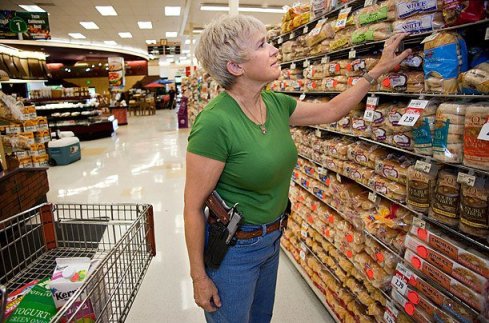
Open carry is now legal in Oklahoma. Feel safer?
And what have we solved? We have banished the particular fantasy of a gunman shooting up a school (unless an armed guard or teacher goes nuts). But have we made it significantly harder to kill large numbers of children, if somebody is determined to do that? Or are we going to have to put armed guards everywhere that children gather? Or are we all going to carry guns to protect ourselves against all the other gunmen?
Is that the society you want your child to grow up in?
There’s been a lot of bad writing on both sides of this issue, but a few pieces here and there have been worth recommending. The best stuff gets past the horrible-fantasy stage and gives you something serious to think about.
 Firmin DeBrabander goes directly at the what-kind-of-society question, and argues that guns do exactly the opposite of what the NRA contends: They decrease freedom, diminish democracy, and make dictatorship that much easier. Our front line of defense against violence is that we live in a civil society. If arming everyone undoes civility, then we are much less safe, no matter how well armed we are.
Private gun ownership … nourishes the illusion that I can be my own police, or military … Our gun culture promotes a fatal slide into extreme individualism. It fosters a society of atomistic individuals, isolated before power — and one another — and in the aftermath of shootings such as at Newtown, paralyzed with fear. That is not freedom, but quite its opposite.
Bad anti-gun writing usually comes from people who have never touched a gun in their lives. (Personally, I’ve shot a variety of guns, but not often, and I’m no kind of expert.) Dan Baum is not that guy. His 2010 article Happiness is a Worn Gun describes his experience training for a concealed-carry permit and then carrying his gun for several months.
The big thing that comes through is that concealed-carry isn’t just a plan, it’s a worldview. His training classes “were less about self-defense than about recruiting us into a culture animated by fear of violent crime.” Baum eventually stops carrying his gun, because he doesn’t like the way it changes his experience from Condition White (everyday awareness) to Condition Yellow (constant threat-monitoring).
Condition White may make us sheep, but it’s also where art happens. It’s where we daydream, reminisce, and hear music in our heads. Hard-core gun carriers want no part of that, and the zeal for getting everybody to carry a gun may be as much an anti-Condition White movement as anything else — resentment toward the airy-fairy elites who can enjoy the luxury of musing, sipping tea, and nibbling biscuits while the good people of the world have to work for a living and keep their guard up.
The best thing I read was Ta-Nehisi Coates’ On Living Armed. As a person who grew up in a violent neighborhood, Coates directly confronts the what-if-you-faced-a-shooter fantasy and expands it.
one does not simply do violence – or live prepared for violence – and remain the same. I carry all of West Baltimore with me, and I am in constant conversation over the fact that that part of me is wholly inappropriate for this world. That part – the part that is analyzing every person who walks up on me, who is trying to figure out every angle, who sees a crowd and walks the other way – is fit for a world of violence. That pose is totally draining. (It has no time to go off and learn French.)
So if you ask me if I wished to have a gun when an active shooter is present, then I will tell you that guns don’t magically appear in the holster, that the capacity to do lethal violence requires an expense of time, energy, and responsibility, which I would rather not make. I would tell you that I have, already, spent too much of my life preparing for violence. I would say that the person who should wish to have a gun in that situation, should be a person capable of shooting a gun, and a person comfortable with the responsibility of carrying a gun during the 99.9 percent of the time when violence – much less lethal violence – is wholly inappropriate.
A gun is power. And power demands responsibility. I don’t want to spend my time that way.


 You’ll see an early sign of who’s going to win in how the mainstream media identifies the hostage in this crisis. If the hostage is “government” — a separate entity unrelated to the rest of us — then the Tea Party will win. If the hostage is “the country” or “the economy”, then Obama will win.




 The surveillance state is eating its own. In the post-privacy era of the Internet and the Patriot Act, the FBI has become the Eye of Sauron: Once its attention has been drawn to you, it will soon know your secrets and the secrets of all your associates, whether or not anyone has committed a crime.


 I just watched ESPN’s
  When the governor won’t negotiate James Meredith’s admission to Ole Miss, President Kennedy sends U.S. marshals to take over the Lyceum, the building at the center of campus where students are registered. The students riot, rowdies join in from far and wide, people are killed, and the marshals can’t contain it. So the 82nd Airborne (“Union troops”) has to finish what Thompson describes as the last battle of the Civil War. (The riot was covered, coincidentally, by a very young Dan Rather.)
 Thompson pulls a timeless, universal theme out of his subject: If you can’t deal with the bad things in the past, the good things — like the 1962 Rebels — get lost too. And he makes personal the process of sorting the past’s relics, culling what is too ugly to be preserved from what is too beautiful to lose. The stars-and-bars, he concludes, has to go — both at Ole Miss and as the
  The Weekly Sift
