Category Archives: Articles

The Sifted Bookshelf: Angry White Men

They may not feel powerful, but they do feel entitled to feel powerful.


One of the privileges that still comes with being white or male is that you get to be an individual. When you do something unusually good or bad, the media doesn’t take you as a representative of all whites or all men. You’re just you; you did something; it’s news.

So nobody remarked on George W. Bush being the United States’ 43rd consecutive white male president, but 2008 buzzed with speculation that the 44th might be black or female. For example, pundits questioned whether a woman could be tough enough to be commander-in-chief of the military, but nobody has ever successfully made an issue of whether a man can be compassionate enough to be nurse-in-chief of Medicare, or understand small children well enough to be teacher-in-chief of Head Start.

Nobody ever asked why a white man had killed President Kennedy or tried to kill President Reagan. The gunmen had names; their stories were presumed to be personal. When Bernie Madoff conned his investors out of billions, nobody asked “What makes a white man do something like that?” or “What should be done about the white male swindler problem?”

Sikh temple shooter.

Even when the perpetrators themselves frame whiteness or masculinity as an issue, the media tends not to pick it up. Anders Behring Breivik, who killed 69 people at a camp for liberal youth in Norway, saw himself as a crusader against a Muslim takeover of Europe. His manifesto advocated a restoration of European “monoculturalism” and “patriarchy”. Wade Michael Page, killer of six in the Sikh Temple shooting in Wisconsin, was acting on his long-held white supremacist views. In each case, this motivation was spun mostly as a symptom of personal instability, and not of a dangerous cancer in the white community.

Mad as hell.

The upshot is that although we are surrounded by angry white men — on talk radio, on the internet, on the highways, in the workplace, in the NRA and the Tea Party, in the “men’s rights” movement, and in countless acts of domestic violence or public mayhem from Columbine to Sandy Hook — we aren’t having a national discussion about the anger problem of whites or men or white men. That’s because we don’t see them as “white men”; we see them as individuals whose stories reflect unique psychological, political, or social issues. (By contrast, consider how little Michelle Obama has to do to evoke the angry-black-woman stereotype.)

Enter Michael Kimmel and his book Angry White Men.

Chapter by chapter, Kimmel calls attention to angry white men wherever they are found: the loudest voices on the radio, the school shooters, the anti-feminist men’s-rights movement and its Dad’s-rights subculture, the wife beaters, the workers who go postal, and the white supremacists. He asks and answers the question you seldom hear: What makes white men so angry?

What links all these different groups … is a single core experience: what I call aggrieved entitlement.

Aggrieved entitlement is the belief that you have been cheated out of status and power that should have been part of your birthright. (It’s a close relative of what I have called privileged distress: the feeling that advantages you never consciously acknowledged are slipping away from you.) White men are angry, Kimmel claims, because

They may not feel powerful, but they do feel entitled to feel powerful.

How it was supposed to be.

High standards and failure. White men also feel judged (and judge themselves) according to the standards of fathers and grandfathers who received the full white-male birthright, who didn’t have to compete with other races on an almost-level playing field, and who could count on subservient wives, mothers, daughters, and Girls Friday at the office to rally behind their leadership rather than outshine them or make demands.

You want a recipe for anger? Here it is: I’m a failure and it’s not my fault.

The seldom-examined setting for white male anger is failure, or at least failure according to the standards of another era. Dad and/or Grandpa supported a family on one job, and when he got home he commanded respect from his family. His marriage lasted, and his kids were not being raised by a resentful ex-wife on the other side of the country. When Dad or Grandpa was young, he was comfortable in his masculinity. He hunted deer and lettered in football. Girls waited by the phone for him to call, and when he paid for dinner they knew they owed him something.

It’s not that way any more, and it’s not my fault. Don’t look at me like that.

The rich and powerful speak for me.

The visible spokesmen for angry white men may be millionaires like Rush Limbaugh or Donald Trump. But such success is what their listeners wish they had, not what they do have or will ever have. Kimmel observes:

It’s largely the downwardly mobile middle and lower middle classes who form the backbone of the Tea Party, of the listeners of outrage radio, of the neo-Nazis and white supremacists— in many cases literally the sons of those very farmers and workers who’ve lost the family farms or shuttered for good the businesses that had been family owned and operated for generations.

Violence. This sense of being cheated out of what was promised — and being judged as if it had been delivered — interacts badly with another part of the traditional male identity: Men have the privilege/right/duty to make things right by violence.

I don’t want to be violent, but I can be.

That is the plot of just about every action movie with a male hero: A man who would rather be left alone to live his life and take care of his family is confronted with an injustice that can only end if he becomes violent and defeats it. If he successfully wields violence he is a hero. If he remains peaceful he is a wimp.

And so, while many women also feel cheated and judged unfairly, they tend not to snap in a violent way. Kimmel observes that all the recent rampage school shooters (other than the Korean Virginia Tech shooter, whose race evoked a discussion, and another Korean shooter since Kimmel finished writing) have been white males, mostly from rural and suburban areas. Kimmel imagines what would happen if they’d all been, say, inner-city black girls

Can you picture the national debate, the headlines, the hand-wringing? There is no doubt we’d be having a national debate about inner-city poor black girls. The entire focus would be on race, class, and gender. The media would doubtless invent a new term for their behavior, as with wilding two decades ago.

Likewise,

In my research, I could find no cases of working women coming into their workplaces, packing assault weapons, and opening fire, seemingly indiscriminately.

The explanation is simple: When a man feels disrespected — on the job, in his school, in his family — the disrespect threatens not just his personal identity, but his identity as a man. (The archetypal Man is entitled to respect; if you are not being respected, you are failing as a man.) The obvious response is to re-assert manhood through violence, simultaneously righting the scales both socially and psychologically.

The Real and the True. One point I made in “The Distress of the Privileged” was that the “distress” part of privileged distress is very real: If you have convinced yourself that you don’t have any unfair advantages, and then those advantages start to go away, it feels like persecution. You’re not making it up; there are real events you can point to.

Kimmel covers this ground by distinguishing between what is “real” and what is “true”.

White men’s anger is “real”— that is, it is experienced deeply and sincerely. But it is not “true”— that is, it doesn’t provide an accurate analysis of their situation.

And what is most likely to be untrue is the object of the anger. When your well-paid factory job is shipped overseas and you can’t find another one, the villain isn’t the teen-age Chinese girl who does your old job for fifty cents an hour. If you can’t support a family on your income, the villain isn’t your working wife or her reasonable demand that you share the housewife duties she doesn’t have time for any more. If the value of your house crashes, the villain isn’t the black family that got talked into a sub-prime mortgage it couldn’t afford. If you judge yourself by the standards of another era, the villains are not the people whose fair competition keeps you from meeting those standards.

The collapsing pyramid. Patriarchy and racism are both systems of dominance that are coming apart. The white men who feel the change first are the ones just one step up from the bottom: Their step collapses, throwing them in with the “lesser” blacks and women, and the pyramid resettles on top of them. The white men higher up the pyramid want the victims of this collapse to identify with them and with the pyramid that gives them their status: What’s wrong isn’t that the pyramid itself is unfair — as you now can clearly see, being at the bottom of it. What’s wrong, they want you to believe, is that the pyramid is collapsing. You should defend the pyramid, blame the other bottom-dwellers for your loss of status, and maybe one day your one-step-up can be restored.

They know that’s not going to happen; they’re just counting on you not figuring it out. The Masters of the Universe are not going to bring your job back from China. Wal-Mart is not going to make room for your family shop to re-open. Bank of America is not going to forgive your underwater mortgage. Agri-business is not going to rescue your family farm.

The rich white men are not going to rebuild the lower step of the pyramid, no matter how much power they get. And nobody is making room for you on the upper levels.

If you have to blame someone, blame the people who promised you something they couldn’t (or decided not to) deliver. They sold you a bill of goods. Don’t buy another bill of goods from them.

But the best solution of all would be to get past the anger, forget about how things were supposed to be, and just start dealing with the situation as it is. Like a lot of people you never expected to have anything in common with, you find yourself at the bottom of the pyramid. It’s an unfair pyramid.

Let’s bring it down.

Themes of 2013: Minority Rule

It’s hard to remember now how 2013 began: with the Republicans (having believed their own skewed-polls rhetoric) in shock at having lost the 2012 presidential election by five million votes, and having lost even the aggregate House of Representative tally by 1.3 million (even if gerrymandering gave them a majority of seats). But … but … but … the deficit … unemployment … Benghazi … Obama is the worst president ever … real Americans are conservatives …

How could it have happened?

Demographics. The closer they looked at the exit polls, the worse it got. Sure, Obama got 93% of the black vote; everybody expected that. But also 71% of Latinos and 72% of Asians. (Asians? Aren’t they supposed to be the model minority? Don’t they have more makers than takers? How could they side with the Kenyan usurper?) 60% of 20-somethings and 55% of 30-somethings. 70% of folks who list their religion as “none”.

All those groups are growing. The groups that kept the election from being a complete blow-out are the ones that seem to be shuffling off center stage: Over-65s went for Romney 56%-44%. White men voted Republican 62%-35%. (In Teddy Roosevelt’s day, white men were the electorate. How can you get 62% of white men and lose?)

So 2012 wasn’t just a loss for Republicans, it was a loss that augured bigger losses in the future. All the predictions Jonathan Chait had made the previous February in “2012 or Never” seemed to be coming true, and it was looking like Never. As the balls fell and the corks popped to welcome 2013, Republicans were asking: What do we have to do to become the majority again?

Change? Some answers seemed obvious. (The best collection of these answers was put together by College Republicans.) Stop talking about Hispanic immigration as if it were the barbarian invasion of Rome. Tone down the anti-gay rhetoric (not because the gay vote is so pivotal, but because homophobic hate-mongering turns off young straights). Stop pandering to the radical fringe on abortion and other social issues. Come up with competing conservative answers to questions that loom ever larger to middle-class Americans: Where are the jobs going to come from? How are the kids going to pay for college? What will happen to me and my family if I get sick?

The new year brought an obvious issue to focus on first: gun violence. (The first Sift of 2013 started: “This week everybody was talking about guns again.”) Sandy Hook was still fresh when the new Congress was sworn in, and (unlike the response to previous mass shootings), the furor didn’t seem to be dying down.

By wide margins, the public supported universal background checks for gun buyers, re-instituting the assault-weapon ban that President Bush let lapse, and banning the high-capacity magazines that had played such a key role in the Tucson shooting. For a time, some kind of bipartisan gun bill looked to be a no-brainer.
Then we saw the pattern that would repeat itself again and again all year: Some well-funded extremist group (in this case the NRA) rallied the conservative base with scare tactics (Obama was planning to confiscate guns by executive order!), threatened primary challenges against wavering Republicans, and whipped the Republican leadership into line.

In the end, a Republican-led filibuster blocked even a weak-tea gun bill that 54 senators supported.

Something similar happened to immigration reform: In this case a bipartisan bill made it through the Senate only to be refused a vote by the Republican House leadership, which offered no alternative.

Take that, Hispanics! Screw you and your fastest-growing-voter-bloc BS. Think we care? Think again!

Ditto for women, who are already a voting majority. Again and again, Republicans pandered to the an extreme anti-abortion or anti-birth-control minority with the most outrageous proposals and rhetoric. The most extreme recent example is Michigan’s “rape insurance” law, which won’t allow insurance companies to cover abortion (even in cases of rape) in any general-purpose health plan. Unless you planned on being raped and paid in advance for a special abortion rider on your healthcare policy, you’re out of luck.

Did anybody notice a post-2012 let-up in Republican anti-gay rhetoric or an olive branch to people who don’t go to church? Or a Republican jobs plan? Or any healthcare plan beyond “repeal ObamaCare”? Nope.

In the fall, poll after poll showed large majorities against a government shutdown or a threat to the debt ceiling. Did that matter? No.

This isn’t how we’re used to seeing political parties behave. So what’s going on here? How do Republicans plan to persuade a majority of Americans to support them?

It’s simple: They don’t.

Minority rule. That is the single biggest development of 2013: Republicans have given up on the idea of persuading a majority to agree with them. Instead, conservatives plan to rule from the minority.

In the old days that might have meant a military coup or something, but modern minority-rule techniques are much more imaginative. The strategy is simple: take advantage of all the hurdles that exist between the will of the majority and the enforcement of a law. If you can knock that majority down just a little at each stage, what looked like a tidal wave can become just a little ripple.

Defense in depth. Consider all of the structural things Republicans have been pushing. Stop looking at them one-by-one and think about them as a system.

  • Voter suppression. You don’t have to ban people from voting, just make it difficult. Limit the days and hours and number of voting machines so that you create long lines. Find excuses to remove legitimate voters from the roles. Require IDs they don’t have, and don’t accept the IDs they do have. Change the rules late in the game. Plenty of determined people will manage to vote anyway, but all you’re trying to do is knock the numbers down.
  • Unlimited money. You don’t have to buy elections outright, you just want to control them a little. With unlimited money, you can keep incumbents in line by threatening a primary challenge based on fringe issues. You can eliminate the need for volunteers by hiring professionals. You can keep candidates in the race longer or knock them out earlier. You can create issues out of nothing, de-legitimize real issues, or just confuse the voters. You can make the campaign obnoxious and ugly, so that voters don’t want to participate.
  • Gerrymandering. If you concentrate the other party’s voters in a few districts, you can give your party an advantage in a majority of districts, even if you have fewer voters. The paradigm here is Pennsylvania, where a slim Democratic voting majority led to a 13-5 Republican advantage in members of Congress. The Senate itself is a form of gerrymandering: It took 7.7 million Democratic votes to elect Dianne Feinstein to the Senate, but only 102 thousand votes put Republican Lisa Murkowski in. Their Senate votes count the same. (The conservative pipe dream of repealing the 17th Amendment would make this situation worse.)
  • Shadow government. You may think your state laws come from the legislators you elected. Wrong! If your legislature has a Republican majority, chances are your state laws are being written by the American Legislative Executive Council (ALEC), a national pseudo-legislature whose controlling members are corporations rather than people.
  • Emergency managers. Here’s a neat trick: Cut state aid to cities and their school districts, then when they get into financial trouble replace their elected governments with “emergency managers“, i.e., dictators appointed by the governor, who can void union contracts and refuse to fund pensions already earned. More than half of the black citizens of Michigan have lost their right to local government. If the voters don’t like it and vote for repeal, pass the law again and make it referendum-proof. Think that can’t happen in your state or your town? Why not?
  • The Hastert Rule. Immigration reform is one of a number of ideas that are believed to be supported by a majority of House members, but never come up for a vote. Shutting down the government, on the other hand, had only minority support, but it happened. How does that work? The House operates by the majority-of-the-majority principle, a.k.a. the Hastert Rule. Speaker Boehner won’t bring bills up for a vote unless a majority of the House Republican caucus supports them. So instead of needing 218 votes (a majority) to block something, you can do it with only 117 (a majority of the 233-member Republican majority). The logic of primary challenges is similar: It doesn’t matter what the majority of voters in a Republican congressman’s district think, if a majority-of-the-majority (i.e., a majority of voters in his Republican primary) want to throw him out.
  • The filibuster. In the Senate, 41 votes can block legislation. Until recently, 41 votes could also block presidential appointments, which Republicans were using to prevent President Obama from altering the current conservative bias in the judiciary. So the senators representing the 21 smallest states — total population 35.4 million, or about 11% of the country — can block any law.
  • Hostage-taking. Sure a minority can block things, but how can they pass laws of their own? Simple: take hostages. That’s what the 2013 government shutdown and debt-ceiling crisis was about. An extremist minority could block the government from taking necessary actions, and what it wanted in return for not burning down the house was to repeal ObamaCare. Ordinarily that would take a majority, but not if you have a gun to the economy’s head.
  • Nullification. A similar tactic was implicit in a new use of the filibuster to nullify existing laws. Refuse to approve anybody to certain enforcement positions. So, you would need a majority to scrap all the nation’s labor laws, but they can’t be enforced if the National Labor Relations Board doesn’t have a quorum, and you can block appointments via the filibuster. Voila! No labor laws! (Nullification is what caused Democrats to eliminate the filibuster on presidential appointments.)
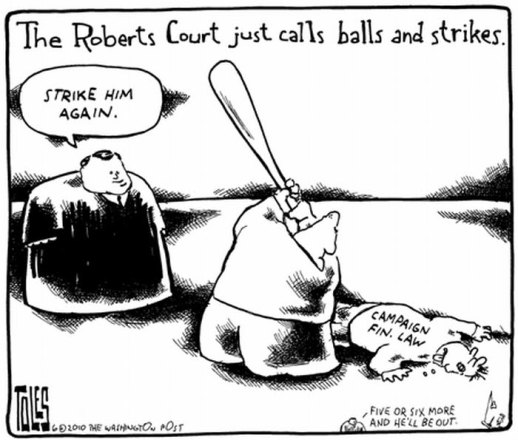
  • Judicial activism. Even if a law makes it past all those hurdles, it just takes five Supreme Court justices to declare it unconstitutional. The integrity of the system depends on judges not abusing their power, but sometimes they do. During the Warren Court of the 1960s, judicial activism was a liberal thing. That’s ancient history now, as we saw most clearly in the ObamaCare decision. At the time the Affordable Care Act was passed, there was no legal precedent to justify invalidating it, and few legal analysts were concerned about the possibility. (Salon’s Andrew Koppelman: “The constitutional limits that the bill supposedly disregarded could not have been anticipated because they did not exist while the bill was being written.”) But in a matter of months, a new interpretation of the Commerce Clause was invented and gained the support of the Court’s five conservative justices. (Justice Roberts narrowly saved the law by re-interpreting the individual mandate as a tax rather than a penalty, but the new narrowing of the Commerce Clause stands and could skewer any number of government programs in the future.) Conservative judicial activism has been key in the whole minority-rule enterprise, by unleashing the unlimited money and opening the door to voter suppression, which red states have been happy to walk through.

Across the board, Republicans are defending and in some cases sharpening the tools of minority rule. So if they annoy a majority of Americans with their extremist agenda, who cares? Democrats would need a really large majority, say 5-7%, just to overcome gerrymandering and get even in the House, not to mention getting 60 votes in the Senate. And even then, unlimited money can usually buy a handful of Democrats with a local special interest, and the Supreme Court can invent new kinds of “religious freedom” or “corporate rights” to keep any real change from happening.

The long term threat. In the long run, a dedicated majority can get its way. If Democrats can win the state legislatures in 2020, they can de-gerrymander both the congressional districts and the legislative districts within the states. If Democrats can hold the presidency long enough, they can end conservative judicial activism. Then, if that same dedicated majority will keep those Democrats honest, there’s a chance America can start controlling money in politics and make progress towards real democracy that serves the public interest.

But that’s the question: Will a majority stay dedicated, through years of watching politics amount to nothing? Those young people who believed Candidate Obama when he said, “Yes we can” — what will become of them? What if they conclude “No we can’t” and just stop bothering?

That’s the ultimate goal of minority rule: a discouraged majority that stops looking to political action as a way to solve its problems.

Mandela’s Memorial Was All About Us

How do you pitch a foreign funeral to a nation of Homer Simpsons?
Manufacture America-centered controversy.


Nelson Mandela’s public memorial service was held Tuesday in a vast stadium in Johannesburg. Leaders from all over the globe attended, and several of them spoke about Mandela, his significance in history, and how his life inspired people around the world.

The mood was generally upbeat, more like a New Orleans jazz funeral or an Irish wake than the somber kind of remembrance. But still you can imagine Homer Simpson pointing his remote at the TV and announcing his judgment: “BOR-ing.” A day devoted to some dead guy on the other side of the world and the stuff he did in some other century? Where’s the drama?

Khrushchev and Kennedy

So instead American news networks made the story all about us: The big news out of Johannesburg wasn’t anything about Mandela, it was President Obama shaking hands with Raul Castro.

To me, it looked like one of those awkward running-into-your-ex’s-new-boyfriend moments you might have at a wedding reception, and Obama handled it graciously. He’s shaking hands as he makes his way to the podium and suddenly there’s Castro, so Obama just keeps shaking hands like it’s no big deal.

Nice save, Mr. O.

Except — OMG!!!! — he’s shaking hands with Raul Castro! Rev up the outrage machine. It’s, like, Chamberlain shaking hands with Hitler or something!

Mao and Nixon

For the everything-Obama-does-is-an-outrage crowd, two bizarre ideas are at work: First, that Cuba’s government is something special among dictatorships, and second, that until now American presidents have maintained a hands-that-hold-whips-shall-never-hold-mine purity standard when it comes to tyrants.

The first point is best left to comedians like Jon Stewart:

[singing] Raul Castro is not Adolf Hitler. [/singing] … Raul Castro is not even Fidel. He’s like Cuba’s Jim Belusi. … And by the way, Cuba’s not the only country with a spotty record of imprisoning people in Cuba.

Second, not only is there a long history of American leaders meeting and greeting Communist dictators — Nixon and Mao, Kennedy and Khrushchev, and Nixon even gave Brezhnev a Lincoln Town Car — but we also have a long history of supporting some of the world’s most brutal dictators: Stalin was our ally in World War II, and who can forget such friends-of-America as the Shah of Iran, the Somoza dynasty in Nicaragua, General Pinochet in Chile, Saddam Hussein, or even the current regime in Turkmenistan?

So the only thing outrageous here is the outrage. When it comes to tyrants, America’s hands haven’t been clean for at least a century.


The other Obama-outrage from the funeral was this picture:

So here’s Obama and British Prime Minister Cameron taking a selfie with some red-hot blonde described by The Daily Mail as “flirty” and by the New York Post as a “Danish tart”. Fox News couldn’t stop chortling. The Post decided Obama-and-the-white-chick was a front-page scandal.

Who’s the mystery vixen? Prime Minister Helle Thorning-Schmidt of Denmark, a country where neither blondes nor powerful women are so rare as to make headlines. The selfie is of three world leaders, not Obama and some blonde.

I’m not sure what’s worse: The racist where-the-white-women-at angle or the sexist who’s-that-slut angle. What’s a girl gotta do to get some respect?


On Michelle’s apparently disapproving expression, Atlantic’s Garance Franke-Ruta offered a more mundane explanation:

[It’s] the look of a person with jetlag who flew halfway around the world overnight, spent four hours at a hotel early in the morning, and then had to go to a memorial service.”

Maybe that explains Laura Bush’s similarly sour expression when her man had a similarly animated conversation with an attractive female world leader, Jordan’s Queen Rania. (Oddly, that triangle drew virtually no international media attention.)

Salon’s Roxane Gay finds a race/gender issue in the media’s focus on and interpretation of that one image of Michelle (as opposed to others where she seems to be having a good time):

More than anything, the response to these latest images of Michelle Obama speaks volumes about the expectations placed on black women in the public eye and how a black women’s default emotional state is perceived as angry. The black woman is ever at the ready to aggressively defend her territory. She is making her disapproval known. She never gets to simply be.


Ted Cruz walked a fine line in Johannesburg. On the one hand, he wanted to appear statesmanlike on the world stage. But earlier in the week he got stung by his supporters when he tried to be gracious to Mandela on his Facebook page. So Cruz made his own Cuba moment Tuesday by walking out during Castro’s speech. Because that’s what the memorial services of great peacemakers are for: expressing your disapproval of the other mourners.


PolicyMic points out how differently the memorial might have been covered, even if you wanted an America-centric angle. The Bushes, Clintons, and Obamas all traveled together on Air Force One. Pictures suggest they got along and were even chummy. But again, where’s the drama in that? BOR-ing.

White Santa, White Jesus, White Christmas

Santa’s not alienating, but white supremacy is.


It all started Tuesday, when Slate’s Aisha Harris suggested replacing the fat-old-white-man version of Santa Claus with a penguin.

Why? Well, she found it confusing to grow up with a black Santa at home and a white Santa everywhere else. Her Dad’s ingenious explanation (that Santa magically changes race to match each household he visits) sounded phony.

I didn’t buy it. I remember feeling slightly ashamed that our black Santa wasn’t the “real thing.” … That this genial, jolly man can only be seen as white—and consequently, that a Santa of any other hue is merely a “joke” or a chance to trudge out racist stereotypes—helps perpetuate the whole “white-as-default” notion endemic to American culture

But since Santa is a cultural invention anyway

we can certainly change him however we’d like—and we have, many times over. … Isn’t it time that our image of Santa better serve all the children he delights each Christmas?

You may be charmed by this idea or just find it harmlessly goofy — unless you watch  a lot of Fox News. Then you’d realize that this change-Santa nonsense is a symptom of the political correctness and everything-is-up-for-grabs attitude that’s ruining America. Megyn Kelly laid it out:

For all you kids watching at home, Santa just is white.

And then she very sympathetically gave black people the bad news.

Just because it makes you feel uncomfortable doesn’t mean it has to change. You know, I mean, Jesus was a white man too. … He was a historical figure. That was a verifiable fact.

Forensic reconstruction of Saint Nicholas

These things are facts, people. In Fox Nation, they’re not up for discussion.

Historical Saint Nicholas. Monica Crowley, a member of Kelly’s all-white panel, elaborated:

Santa Claus is based on Saint Nicholas, who was an actual person, a Greek bishop, and was a white man. … You can’t take facts and then try to change them to try to fit some sort of a political agenda or a sensitivity agenda.

But on Chris Hayes’ MSNBC show, Harris pushed back:

Santa now looks nothing like that Santa [i.e. the historical Saint Nicholas]

So how white was Saint Nicholas, anyway? Kathleen Manning blogged for U.S. Catholic:

15th-century Saint Nicholas icon

In 2008, British anthropologists did a facial reconstruction of Saint Nicholas of Myra, based on his remains. The fourth-century Turkish bishop who signed the Nicene Creed looks less like Clement Clarke Moore’s description and more like the cabbie who drove you to the airport to catch your Christmas flight home.

And unlike Coca-Cola ads, religious icons often portray Saint Nicholas as a dark-skinned man whose race is hard to determine. He’s also skinny. And as I study those smaller panels on the pictured icon, I can’t find reindeer anywhere.

So if we want to stick to the historical facts, rather than “change them to try to fit some sort of a political agenda”, that’s what we get: a skinny, racially ambiguous Santa whose Turkish workshop is far from the land of reindeer.

If not reindeer …

Maybe he could drive a wagon instead of a sleigh, and borrow Thor’s flying goats to pull it.

Yeah, but Jesus was white. Wasn’t he? It depends on your definition of white. Jesus was a first-century Middle Eastern Jew. How white were they?

Probably not very. Religion News Service’s Jeffrey Weiss suggests Yasser Arafat or Osama bin Laden as comparable. Atlantic’s Jonathan Merritt says: “If he were taking the red-eye flight from San Francisco to New York today, Jesus might be profiled for additional security screening by TSA.”

Maybe. As a brownish, outspoken social activist from the Middle East with a Jerusalem police record of assault against money-lenders, I think he’d go straight to the no-fly list.

Would you sit next to this guy on an airplane?

What is “white” anyway? It’s easy to poke fun at people who believe their cultural happenstance represents eternal truth, the kind who will tell you “Where I come from people don’t have an accent.” But Chris Hayes got to the deeper issue:

Jesus wasn’t white because the category white didn’t exist when Jesus was around in the Roman Empire. That is a construction that was made later on for very intense social reasons.

The Romans had a word for white, albus, but it was a color, not a race. The same was probably true in Aramaic. First-century folks were Jews, Romans, Gauls, Egyptians, and so forth. Gauls tended towards blonde and some Egyptians could be very dark. But I believe first-century rabbis would have been quite perplexed by the idea that they belonged to a “white race”. True, a sub-Saharan African would have seemed like someone from another world, but so would a Pict from north of (what would soon become) Hadrian’s wall, and what the rabbis might have made of the central-Asian ancestors of the Rus is anybody’s guess.

Much later, Shakespeare pictured dark-skinned Othello as an outsider in Venice society, but no more so than the Jewish Shylock.

In Learning to be White, Thandeka traces the beginnings of the white-race concept to the late 1600s, when the founders of Virginia’s plantation system needed to discourage their English and Irish indentured servants from making common cause with their African and Native American slaves, as happened during Bacon’s Rebellion of 1676. So they divided the underclass by giving a few small rights and privileges to the European servants.

A new multiclass “white race” would emerge from the Virginia laws as one not biologically engineered but socially constructed. … The laws and the racial contempt they generated would sever ties of previous mutual interest and goodwill between European and African servants and workers, provide the ruling elite with a “buffer” of poor whites between themselves and the slaves to keep blacks down, and prevent either group from separately challenging the class interests of the elite.

In the North in the 1800s, the construction of the “white race” became the key to socializing America’s non-English-speaking European immigrants. They arrived identifying themselves as Polish, Russian, Irish, Italian, or some other ethnicity with its own distinctive language, history, and practices. In America they were homogenized as “whites” and their native xenophobia channeled against Africans and other people of color.

So Hayes is absolutely correct. Jesus would have been puzzled by any Roman who welcomed him as a member of the gens alba. He was a Jew, not a Roman, and being “white” didn’t mean anything at all until many centuries later.

Who’s a racist? In a follow-up segment, Megyn Kelly realized she needed a black on the panel, so she invited frequent Fox News contributor Zerlina Maxwell. Maxwell more-or-less agreed with Harris, which led Kelly to challenge her:

Why is white skin alienating? And why is that not racist?

This is the color-blind, flat-playing-field view of race currently popular among white conservatives: Since white supremacy is built into the cultural infrastructure, I (as a white) can live without thinking about race. If non-whites try to make me think about race, well then, that’s them being racist.

I mean, Santa and Jesus and Batman and all the other cultural icons just are white, so I don’t have to think about their race at all. When I look at pictures of Santa, I don’t see white Santa, I just see Santa. If it bothers you that all the cultural icons are white … whatta you, racist or something? What’s wrong with being white?

It comes down to two very different views of what American culture is. Is it the culture of all the people who live here? Or is it a historically white culture that some non-whites have been allowed to join, on the condition that they accept it the way it is and change themselves rather than seek to change the culture? Post-Martin-Luther-King, the public position of white conservatives (never mind what they say behind closed doors) is to treat people of all races as honorary whites. Isn’t that good enough? Or are you saying there’s something wrong with being white?

So Megyn Kelly is perfectly content to let your black children imagine that her white Santa is bringing presents to your black home. Isn’t that good enough? Or are you hostile to Santa because he’s white? “And why is that not racist?”

Untwisting Kelly’s pretzel takes more time than TV’s sound-bite culture allows, so Maxwell just had to dodge the reverse-racism charge. You can’t have a discussion about the particulars until you challenge several background assumptions.

First, there is no flat playing field. The privilege of ignoring race in America belongs to whites. Non-whites are confronted with race every day, no matter how much they might want to ignore it. The let’s-just-ignore-race notion really means: Let’s ignore the white supremacy built into everything.

Second, focusing on the whiteness of just Santa (or any other individual icon) misses the point. Because there is nothing wrong with Santa being white in isolation. By changing Santa, Harris was addressing her sense of encirclement, of growing up in a culture where all the major icons are white, and blackness seems like an aberration, even when you see it in the mirror.

To make a gender analogy: There’s nothing wrong with Barack Obama being a man. What’s wrong is that the 44 presidents have all been men. If a girl examines that line of portraits and feels alienated from the presidency, she’s not being sexist; she’s recognizing her country’s built-in male supremacy.

Life in the Garden of Sweden

And finally, Santa and Jesus and all the other icons aren’t white because of historical facts. They became white through a long social process. Coca-Cola’s Santa is considerably whiter than Saint Nicholas. The portrait of Jesus on the wall of my Lutheran grade school was much whiter than any first-century Palestinian Jew. In White Like Me, Tim Wise recalls growing up with picture-books — I had them too — that presented a white Adam and Eve, who frolicked in what Wise now calls “the Garden of Sweden”.

To say that this process is now at an end, that whiteness is now baked into our cultural icons and can’t be changed, is to say that white supremacy is baked into American culture and can’t be changed.

That’s what’s alienating, Megyn Kelly. And no, feeling alienated by white supremacy is not racist.

Rooting for Your Country to Fail is Unpatriotic

America has decided to implement ObamaCare. Are you with your country or against it?


In America, we argue about everything. Just because the Leader proposes something, we don’t all have to get in line behind it.

We argue about whether to go to war in places like Syria, Libya, or Iraq. We argue about taxes. We argue about how much money our government should spend and what it should be spent on. We argue about which drugs and medical procedures should be legal.

We argue; it’s what we do. If you didn’t argue for your beliefs, if you just knuckled under as soon as the Powers That Be made their will known, you wouldn’t be a real American.

But we also come to decisions. We have a Congress that is empowered to pass laws. We have a president who is obliged to either veto those laws or enforce them. We have courts you can appeal to if you think those laws exceed the powers the Constitution delegates to the federal government.

In short, there are lots and lots of ways you can register your objection to a proposed public policy. Our Constitution creates many pressure points where the flow of an idea into law can be blocked.

But we do eventually make decisions.

Even after a decision is made, you can still argue that it was wrong. You can argue that we shouldn’t have invaded Iraq. You can argue that we shouldn’t have bailed out General Motors or Bank of America. You can argue that the CIA shouldn’t be launching drone attacks into countries we aren’t at war with or that the NSA shouldn’t be tracking your cell phone.

That’s not just a technicality of freedom of speech. You can make those arguments as a patriotic American, because the country has a process for reversing course. If you can convince enough people agree with you, maybe the power of public opinion will change the minds of our office-holders. And if not, elections can turn those offices over to new office-holders who can make new policies and pass new laws.

That’s not working against America, it’s part of how America works.

But there’s a line between legitimate partisanship and lack of patriotism, and this is where it runs: After a decision is made, after it is upheld as constitutional, after America has decided to do something, you don’t root for your country to fail — and you certainly don’t take action to make your country fail.

That’s unpatriotic.

Democrats respected that line when a Republican administration did something we thought was wrong: invading Iraq. We never stopped arguing against it. We never stopped trying to elect people who would get us out Iraq. And eventually we succeeded. The fighting in Iraq continues, but American troops are out of it.

You know what we didn’t do? We didn’t try to sabotage the war effort. Democratic leaders weren’t out there publicly rooting for failure. We didn’t aid the Iraqi resistance or gloat over defeats. And we certainly didn’t cheer when American troops came home in body bags. If a stray voice on a blog or in a public forum started rooting for defeat or gloating over American corpses, we jumped all over him. No external force had to police us on that; we policed ourselves.

We were Americans. We opposed what our government was doing in Iraq, but we stayed patriotic.

But on ObamaCare, Republicans have crossed that line between patriotic and unpatriotic. Let’s review a few of the ways.

McConnell and the NFL. In June, Republican Senate Leaders Mitch McConnell and John Cornyn sent a letter to the National Football League, warning it not to cooperate in efforts to publicize the law and tell the public how to get the benefits it offers. (They were successful; the NFL did not cooperate.)

This is unprecedented. Private organizations, including sports leagues, frequently take part in public information programs. When Massachusetts passed RomneyCare, the Boston Red Sox helped publicize it. Private companies like CVS, Shaw’s supermarkets, and H&R Block pitched in. This wasn’t controversial, because it wasn’t taking a position on a proposal, it was educating the public about the law.

The Bush administration organized a similar public-information campaign to introduce the Medicare prescription drug benefit. Democrats had opposed the bill in Congress (because it was written to benefit drug companies more than seniors), and we objected to the tactics used to pass the bill. But Democrats did not interfere with educating the public about how to get the new law’s benefits.

McConnell’s logic is revealing. The NFL should refuse to participate because ObamaCare “is one of the most divisive and polarizing political issues of the day.” Actually, no, it had been a political issue, but it was now a law. McConnell admitted as much, but discounted that fact because “this law was enacted … on a strictly partisan basis”. In other words, the constitutional process is insufficient as long as Republicans disapprove.

The Koch Brothers’ creepy Uncle Sam. The Koch brothers have funneled millions of dollars into ads that aim to sabotage ObamaCare by getting young people not to sign up. Not only are these ads misleading — amounting to an anti-public-education campaign against the law — they also turn a symbol of America, Uncle Sam, into something sinister and threatening.

This is well within the Kochs’ legal freedom of speech — just as it would have been within the freedom of speech of anti–Iraq-War billionaires to run creepy and misleading ads telling young Americans not to sign up for the military. (No such ads ran.) But it is similarly unpatriotic.

The fake Cover California web site. Republicans around the country crowed over the problems of the HealthCare.gov web site. Crowing over your country’s failures is unseemly enough, but California Republicans took it one step further: They set up a fake web site to actively confuse Californians looking for health insurance.

California is one of the states that set up its own ObamaCare exchange with its own web site, Covered California. The state web site was working much better than the national one, so naturally something had to be done to monkey-wrench it. Republicans put up their own fake site, Covering Health Care California, where you can’t sign up for health insurance, but you can access anti-ObamaCare propaganda and misinformation. Republican state representatives then distributed a mailer publicizing the bogus web site.

This is not normal. You want to argue that ObamaCare is a mistake and should be repealed? Fine. You want to run on a repeal platform? Fine.

But America has made a decision to do something about its 50 million uninsured. That decision, made through our constitutional process, is to implement ObamaCare. When you take action to screw that implementation up, you are working against your country.

It’s that simple.

The Procrustean Sainthood of Nelson Mandela

A strange thing happens when a political leader ascends to secular sainthood, as Nelson Mandela did in his old age and Martin Luther King and John F. Kennedy did after their assassinations: The popular notion of sainthood starts to overwhelm their personal reputations. Whatever they stood for in their active careers, as saints they represent whatever saints represent. Saints speak divine truth; so whatever you think the divine truth is, that’s what you’ll imagine the saint said.

So, for example, one the most widely recognized Mandela quotes — “Our deepest fear is not that we are inadequate. Our deepest fear is that we are powerful beyond measure.” — is something he didn’t say at all. But it sounds very generically saintlike, doesn’t it? That’s the kind of thing God should be trying to tell us, so it just stands to reason He would have said it through Nelson Mandela.

Except He didn’t.

Partisanship. The archetypal Saint is not divisive or partisan, so anything a particular saint stood for that isn’t universally accepted needs to be swept under the rug. So Martin Luther King is remembered for one sentence:

I have a dream that my four little children will one day live in a nation where they will not be judged by the color of their skin but by the content of their character.

And not for the more radical statements he made with some regularity, like:

These are revolutionary times. All over the globe men are revolting against old systems of exploitation and oppression, and out of the wounds of a frail world, new systems of justice and equality are being born. The shirtless and barefoot people of the land are rising up as never before.

and:

We know through painful experience that freedom is never voluntarily given by the oppressor; it must be demanded by the oppressed.

and especially not something really divisive, like:

All of America’s wealth today could not adequately compensate its Negroes for his centuries of exploitation and humiliation.

Quotes like that put King on one side and not the other. If we remembered King that way, only liberals could invoke his name, and conservatives would be stuck with the view of King they held when he was alive: that he was a dangerous left-wing radical. What kind of saint is that?

Ditto JFK. Because the memory of his real life has been overwhelmed by his post-assassination sainthood, he can be claimed by conservatives. Forget that the Great Society programs conservatives love to hate were proposals Kennedy couldn’t get Congress to pass (but that LBJ could after Kennedy’s death). He’s a saint, so he has to belong to everybody, no matter what he actually stood for.

Mandela’s real claim to sainthood. Nelson Mandela deserves our admiration for three simple reasons:

  • He was on the right side of history. In retrospect, it is clear to almost everyone that apartheid was wrong, just as it is clear that slavery was wrong and Jim Crow was wrong. (In their day, though, all these points were hotly debated. Those American conservatives who didn’t actively support apartheid usually held that it wasn’t our problem and viewed the South African government as our ally in the Cold War.) Mandela is the historical symbol of the battle against apartheid. No doubt various people did brave and noble things for apartheid at one time or another, but those people were on the wrong side of history so they will never be saints, just as Jefferson Davis is not seen as the equal of Abraham Lincoln.
  • He didn’t give up, no matter what they did to him. He approached his trial with an attitude he later described like this: “I felt we were likely to hang no matter what we said, so we might as well say what we truly believed.” Fearing Mandela’s martyrdom, the South African government did not hang him, but 27 years in prison didn’t break him. When the government gave in to the pressure to release him, he went back to leading the same movement he’d led when they arrested him.
  • When the pendulum swung his way, he used his power to seek peace rather than vengeance. One of the saintlike things Mandela really did say was: “Courageous people do not fear forgiving, for the sake of peace.” Post-apartheid South Africa opted for a Truth and Reconciliation Commission focused on finding and documenting the truth about the abuses of the apartheid government, rather than a set of show trials to settle scores.

So my point isn’t that he doesn’t deserve that level of admiration he is receiving. Rather, he deserves to be admired as the person he really was, not as some generic nice guy who was really brave and stuff.

The conservative attempt to claim Mandela. Basically, the logic goes like this: Mandela fought for freedom for his people. We have definitions of the words freedom and people that makes us freedom-fighters too. (We mean the people who own stuff, and their freedom to keep it, no matter how many hungry people have their noses pressed against the window. This definition may not look terribly different from the kind of freedom the apartheid regime recognized, but let’s not sweat the details.) So Mandela is one of us.

The dumbest and most outrageous invocation of Mandela this week came from Rick Santorum:

Nelson Mandela stood up against a great injustice and was willing to pay a huge price for that, and that’s the reason he is mourned today, because of that struggle that he performed…and I would make the argument that we have a great injustice going on right now in this country with an ever increasing size of government that is taking over and controlling people’s lives, and Obamacare is front and center in that.

So let’s completely forget Mandela’s real beliefs about health care, as expressed in section 27.1.a of the Bill of Rights in the South African constitution he campaigned for:

Everyone has the right to have access to ­health care services, including reproductive health care

In other words: Mandela’s beliefs about health care were the exact opposite of the position Santorum is invoking Mandela’s name to support.

What Mandela was. Nelson Mandela was a democratic socialist. In other words, he believed in the right of the people, through democratic elections and representative government, to correct the injustices of the existing property system and to regulate the workings of the market to achieve a more equitable outcome. At his trial, he said:

I am an admirer of such a [parliamentary] system. … [I]n my search for a political formula, I should be absolutely impartial and objective. I should tie myself to no particular system of society other than that of socialism.

When governments thwart lawful democratic methods for achieving justice, Mandela believed in breaking the law, even violently if necessary. At his trial he said:

We felt that without sabotage there would be no way open to the African people to succeed in their struggle against the principle of white supremacy. All lawful modes of expressing opposition to this principle had been closed by legislation, and we were placed in a position in which we had either to accept a permanent state of inferiority, or to defy the Government. We chose to defy the Government. We first broke the law in a way which avoided any recourse to violence; when this form was legislated against, and when the Government resorted to a show of force to crush opposition to its policies, only then did we decide to answer violence with violence.

He also was against racism, whether it was white-over-black or black-over-white.

[W]e want equal political rights, because without them our disabilities will be permanent. I know this sounds revolutionary to the whites in this country, because the majority of voters will be Africans. This makes the white man fear democracy. But this fear cannot be allowed to stand in the way of the only solution which will guarantee racial harmony and freedom for all. It is not true that the enfranchisement of all will result in racial domination. Political division, based on color, is entirely artificial and, when it disappears, so will the domination of one color group by another.

There’s a lot to admire here, but it is a particular point of view. It doesn’t capture all the wisdom and virtue that is contained in any point of view.

Mourning admirable people you disagree with. Death is a time to let by-gones be by-gones. The deceased can’t hurt you any more, so there’s no need to tear him down. His allies and admirers are sad, so it’s gracious not to salt their wounds*

But while there’s no need to dwell on past disagreements or re-fight old battles, it’s also gracious to let the deceased be the person he was, and let his reputation accrue to the side that he actually belonged to.

Nelson Mandela was a real person who lived and has now died. He did some admirable things and (in regard to the main issue of his career, the fight against apartheid) came out on the right side of the history. He had particular opinions and said some wise things.

But there is no need to recast him a generic saint who was all things to all people and a source of all wisdom. We respect him best by letting him be in death what he was in life.


*Ted Cruz, to his credit, took the high road in a Facebook post that praised Mandela without claiming him for the Tea Party. (Cruz’s followers were incensed.)

What to Make of Pope Francis?

Is Pope Francis’ denunciation of “unfettered capitalism” new? or long-standing Catholic doctrine most Americans have ignored and forgotten? Either way, does it matter?


The Catholic Church has always been torn: Is it the church of Jesus, who told a rich man, “Go, sell all that you own and give to the poor”? Or is it the church of the Emperor Constantine, who put the Rome in Roman Catholicism? Is it the church of Saint Francis or of the Borgia popes? Of liberation theology or of Franco’s fascist collaborators?

The church in recent American politics. In recent years the public face of the American church has been turned primarily towards sexual issues: abortion, contraception, and homosexuality. And so the bishops have become allies of the Republican Party; the American politician most publicly identified as Catholic has been Rick Santorum. American cardinals have denied communion to pro-choice Catholic politicians like John Kerry and Kathleen Sebelius, but when a Catholic conservative like Paul Ryan proposes slashing programs that help the poor, a letter of protest is deemed sufficient. (Cardinal Dolan, then president of the U.S. Council of Catholic Bishops, subsequently described Ryan as “a great public servant”.)

On ObamaCare, the American bishops have manufactured great outrage against the fairly minor point* of the contraception mandate, while saying relatively little about Medicaid expansion, which will provide health insurance to millions of the working poor.

Liberal Catholic tradition. Unknown to much of the American public, though, the Catholic Church has a long history of liberal economic positions, going back at least to the 1891 encyclical Rerum Novarum by Pope Leo XIII.

I encountered this tradition myself in 2005 after the death of Pope John Paul II, when I went back and read his 1981 encyclical Laborem Exercens. In that encyclical, the Pope re-examined the relationship between capital and labor, and rejected a point of view he called economism (that workers are just another factor of production, like tools or raw materials, rather than divinely created beings with souls), which he saw underlying both capitalism and communism. He also assigned a secondary and functional role to the institution of private property: If a system of private property leads to a better society, fine, but it’s not an end in itself.

So (unlike Rush Limbaugh) I was not shocked this week when I read headlines like Pope Francis attacks ‘tyranny’ of unfettered capitalism, ‘idolatory of money’. Is this actually something new, I wondered, or does it just look new from within the sex-obsessed bubble constructed by the American bishops and their Republican allies?

Symbols and gestures. Pope Francis made a strong first impression on the world when he rejected many of the regal trappings of the papacy and chose the name Francis, which harkens back to the voluntary poverty and simplicity of Saint Francis of Assisi.

He then made a series of conciliatory statements. About gays:

When I meet a gay person, I have to distinguish between their being gay and being part of a lobby. If they accept the Lord and have goodwill, who am I to judge them? They shouldn’t be marginalized. The tendency [to homosexuality] is not the problem … they’re our brothers.

And atheists:

We must meet one another doing good. ‘But I don’t believe, Father, I am an atheist!’ But do good: we will meet one another there.

Where Pope Benedict had enraged Muslims, Francis reached out them, sending a personal message to a leading imam in Cairo, calling for “understanding among Christians and Muslims in the world, to build peace and justice.”

And running through all of his statements was an awareness of the poor, those who have been cut off from the abundant produce of the planet God created to sustain all people.

So far, so good. But would he actually change anything?

Evangelii Gaudium. A week ago yesterday, the Vatican published an “apostolic exhortation” from Pope Francis. Apostolic exhortations are what the name implies: They’re meant to nudge people into action, not announce new doctrine.

Evangelii Gaudium (“the joy of the gospel”) is no different. Its purpose is to “encourage and guide the whole Church in a new phase of evangelization, one marked by enthusiasm and vitality”. Most of the text has nothing to do with politics or economics; it ranges through subjects as diverse as how the faithful should motivate themselves and advice to priests on preparing good homilies.

[In a couple of subjects — abortion and women priests — he announces that there will be no new doctrine, though he does make this interesting and enigmatic statement:

The reservation of the priesthood to males … is not a question open to discussion, but it can prove especially divisive if sacramental power is too closely identified with power in general.

Time will tell whether that is a fig leaf for continued patriarchy or an indication that women could come to have more power in the Church, even if they aren’t serving mass.]

But a document encouraging Catholics to make their faith felt in the world has to say something about what, specifically, the world should be made to feel. And here he did not focus on sexual issues, but on economic ones.

Each individual Christian and every community is called to be an instrument of God for the liberation and promotion of the poor, and for enabling them to be fully a part of society.

Each individual and every community. Not “the poor — that’s somebody else’s gig — I’m fighting against same-sex marriage”.

Catholic economics. Consistently through the years, Catholic economics has revolved around two ideas:

  • God created the world for everybody. Pope Francis is not staking out any new territory when he writes: “we must never forget that the planet belongs to all mankind and is meant for all mankind; the mere fact that some people are born in places with fewer resources or less development does not justify the fact that they are living with less dignity.”
  • God did not institute any particular economic system. Economic systems are human constructions, so they are not proper objects of veneration. God is not a capitalist, a communist, or anything else. So economic arrangements have to be justified in practical terms, by their results.

So even something as basic as private property or the freedom to buy and sell has only a functional justification. Protecting property or upholding economic freedom has no value in itself. Rather

The private ownership of goods is justified by the need to protect and increase them, so that they can better serve the common good. … Sadly, even human rights can be used as a justification for an inordinate defense of individual rights or the rights of the richer peoples.

This position puts the Church fundamentally at odds with Rand-style (or Ryan-style) libertarianism, in which property rights and economic freedom are moral values, not just useful tricks for increasing production. In Randism, the produce of the world rightfully belongs to the people who own the world; if those who own nothing are to survive, they must appeal to the charity of the owners. The owners are the Makers, the poor are the Takers.

Francis observes this position with horror:

We have created new idols. The worship of the ancient golden calf (cf. Ex 32:1-35) has returned in a new and ruthless guise in the idolatry of money and the dictatorship of an impersonal economy lacking a truly human purpose. The worldwide crisis affecting finance and the economy lays bare their imbalances and, above all, their lack of real concern for human beings; man is reduced to one of his needs alone: consumption.

He calls on Catholics not just to give alms, but

to eliminate the structural causes of poverty and to promote the integral development of the poor … We are not simply talking about ensuring nourishment or a “dignified sustenance” for all people, but also their “general temporal welfare and prosperity”. This means education, access to health care, and above all employment, for it is through free, creative, participatory and mutually supportive labour that human beings express and enhance the dignity of their lives. A just wage enables them to have adequate access to all the other goods which are destined for our common use. [quotes from Pope John XXIII]

This can’t happen without political action that leads to structural change. The market won’t do it.

We can no longer trust in the unseen forces and the invisible hand of the market. Growth in justice requires more than economic growth, while presupposing such growth: it requires decisions, programmes, mechanisms and processes specifically geared to a better distribution of income, the creation of sources of employment and an integral promotion of the poor which goes beyond a simple welfare mentality.

A mind that worships the Market can only see God as dangerous.

[E]thics leads to a God who calls for a committed response which is outside of the categories of the marketplace. When these latter are absolutized, God can only be seen as uncontrollable, unmanageable, even dangerous, since he calls human beings to their full realization and to freedom from all forms of enslavement.

And a society that writes off the poor can never know peace or be safe from revolution.

Peace in society cannot be understood as pacification or the mere absence of violence resulting from the domination of one part of society over others. … When a society – whether local, national or global – is willing to leave a part of itself on the fringes, no political programmes or resources spent on law enforcement or surveillance systems can indefinitely guarantee tranquility. This is not the case simply because inequality provokes a violent reaction from those excluded from the system, but because the socioeconomic system is unjust at its root. Just as goodness tends to spread, the toleration of evil, which is injustice, tends to expand its baneful influence and quietly to undermine any political and social system, no matter how solid it may appear.

Is this new? No, this is Catholic economics as it has stood for more than a century, with roots going back even further. What’s new is a pope who seems willing to make this the center of his papacy. He has not changed any doctrine — at least not yet — but he has announced a new emphasis away from sex and towards economic justice. As he said in an interview shortly after taking office:

We cannot insist only on issues related to abortion, gay marriage and the use of contraceptive methods. This is not possible. I have not spoken much about these things, and I was reprimanded for that. But when we speak about these issues, we have to talk about them in a context. … The dogmatic and moral teachings of the church are not all equivalent. The church’s pastoral ministry cannot be obsessed with the transmission of a disjointed multitude of doctrines to be imposed insistently.

But the Pope’s re-prioritization of doctrine is going to be a problem for a lot of American bishops. As Jesuit Priest Thomas Reese wrote:

the bishops as a conference have been embarrassingly silent on economic justice during the worst economic crisis since the Great Depression. … Many bishops fear that speaking loudly about economic issues would help Democrats and undermine their alliance with the Republican Party on issues like gay marriage, abortion, and religious liberty. Some even think that the conference’s earlier letters, “Economic Justice for All” and “The Challenge of Peace,” were mistakes because they hurt their friends.

Conservative Catholic response. I recommend reading a thoughtful article by the conservative Catholic NYT columnist Ross Douthat. Douthat observes that the shoe is now on the other foot: For years liberal Catholics have had a yes-but relationship with the Vatican, remaining faithful by their own lights while refusing to get in line with official pronouncements on sexual issues. Now it’s conservatives who want to pick and choose which doctrines they support:

for Catholics who pride themselves on fidelity to Rome, the burden is on them — on us — to explain why a worldview that inspires left-leaning papal rhetoric also allows for right-of-center conclusions.

He attempts to do so, resting his case primarily on the practical effects of capitalism’s increased production, but then concludes:

This Catholic case for limited government, however, is not a case for the Ayn Randian temptation inherent to a capitalism-friendly politics. There is no Catholic warrant for valorizing entrepreneurs at the expense of ordinary workers, or for dismissing all regulation as unnecessary and all redistribution as immoral.

Let me state that conclusion more boldly: If capitalism is going to be justified by its practical ability to create prosperity even for the underclass, then that’s how it must be judged. You can’t talk about the wonders of increasing GDP in the abstract and then ignore the suffering of real people, or worse, blame them for their own suffering and label them as “takers” for wanting to share in the productivity of the planet God made for everyone.

Are you listening, Paul Ryan?


* They’ve been so successful at voicing their manufactured outrage that I need to explain this: Catholic institutions are not required to buy contraceptives for their employees or promote their use. The institutions in question are just required to provide health insurance (or pay a fine). Employees can use their health insurance for contraception if they decide to, just as they can use their wages to buy all sorts of things the Catholic Church disapproves of. The moral onus of choosing contraception (or not) falls on the employee, as it should.

As I have said at length elsewhere, construing this situation as some kind of moral issue for the employer is just passive aggression. They are hyper-extending the sensitivity of their consciences in order to control other people.

6 American Problems Republicans Aren’t Trying to Solve

You can’t compromise with people who aren’t working on the problem.


Compromise is great when it works, but it only works in a certain setting.

You can compromise with people who want to solve the same problem through different means. American households do this all the time. You can compromise with your spouse on what car to buy, because ultimately you both want to drive something. Similarly, the kids need a school, we have to live somewhere, we all want to eat something for dinner … so the details will work out somehow.

But without that sense of a common challenge, negotiations have nowhere to start. If I don’t think my drinking is a problem, if one of us wants children and the other is happy without them, if we disagree about whether monogamy is a good idea — those are the kinds of things marriages founder on, because without recognition of a common problem, you can’t both win.

The same thing is true in politics. Mainstream pundits never tire of writing pox-on-both-your-houses columns that praise bipartisanship and compromise, but compromise is impossible when only one side wants to solve the problem, or admits there’s a problem at all.

Historically, slavery was like that. Skillful politicians managed to work around the edges of the conflict and so delay the confrontation for almost a century, but ultimately Northern abolitionists thought slavery was a problem and Southern slaveowners didn’t, so there was nothing to talk about. One side or the other had to lose.

Once you recognize that pattern, the current stalemate in American politics makes sense. Because increasingly, the United States faces problems that Republicans either deny or would rather not solve.

1. Americans without health insurance. Prior to the Affordable Care Act, 47 million Americans had no health insurance, and perhaps has many as 30 million had “junk insurance” that would be useless in the face of a major illness. So if they got seriously ill, maybe as many as 1 out of every 4 Americans would have had to choose between not getting treatment and going bankrupt.

A Medicare-for-everybody system would have been the simplest way to solve that problem, but the conventional wisdom said that was too “socialist” for this country to swallow. So we wound up with ObamaCare, which isn’t a complete solution but will cut the numbers down considerably.

The Republican slogan about ObamaCare is “repeal and replace”. Since they took control of the House in 2011, Republicans have voted dozens times to repeal ObamaCare. But no Republican replacement plan has even come to a vote.

As for the repeal-and-then-we’ll-think-of-something option, remember that the Republicans had an alternative proposal to HillaryCare in the 90s. (That proposal is actually an ancestor of ObamaCare.) But as soon as they had disposed of the Democrats’ plan, they lost interest in any alternative. Expect the same thing this time, if Republicans ever succeed in repeal.

2. Climate change. Republicans don’t all agree on global warming. Some ignore the issue while others ridicule it. Some think it’s a conspiracy to establish global tyranny while others just think that all proposed actions are too expensive. But they all agree on this: Do nothing.

The exception that proves the rule is an NYT op-ed written by former EPA heads from past Republican administrations — back in the days when Republicans did occasionally try to solve problems. As you can see in the comments, they were quickly denounced as RINOs.  So was Jon Huntsman, the only Republican presidential candidate to take climate change seriously.

3. Decaying infrastructure. The occasional bridge collapse makes headlines, but every day Americans face delays and disruptions caused by worn-out or obsolete infrastructure.

We sit in traffic. When it rains, we lose power. Our cars wear out faster. Our internet is slower. And as for new technologies like bullet trains, smart bridges, or smart grids — who do you think we are, China?

The current situation is perfect for dealing with this problem: Real interest rates are negative, people are unemployed, and inflation is low. So borrow money to invest in the upgrades we need to grow our economy, hire people to fix stuff, and pay back (in inflation-adjusted terms) less than you borrowed. What’s not to like?

President Obama has made repeated proposals along these lines. The most recent was full of plums Republicans should like, like lower corporate tax rates. Its price tag was far lower than the $134-$262 billion per year that a bipartisan commission estimated we need. Republicans panned it as “tax-and-spend”; they made no counter-proposal.

Instead, the Ryan budget calls for cuts in all forms of discretionary spending, including infrastructure. When it came time to fill in the details, House Republicans were unable to do it.

4. Undocumented immigrants. Something like 11-12 million undocumented immigrants are currently in the United States. The existence of such a large class of people off the grid creates a wide range of problems, from security to public health. (Someday there will be another major epidemic, and undocumented disease carriers will be afraid to show up at hospitals.) Most of all, undocumented workers can’t avail themselves of the protection of police or the courts, so employers can exploit them at will. That atmosphere of exploitation makes it harder for documented American workers to claim their rights.

Some Senate Republicans, to their credit, took this problem seriously enough to join Democrats in passing an immigration reform bill. That was five months ago. In the meantime, the Tea Party dominated House has done nothing, and has no plans to do anything. Not only won’t Speaker Boehner bring the Senate bill up for a vote, in the unlikely event that the House passes an immigration bill of its own, he says “Frankly, I’ll make clear we have no intention of ever going to conference on the Senate bill.”

Once again, Boehner is not holding out for some alternate solution, so there is no deal he could be offered.

5. Gun violence. A Reddit subgroup is keeping a list of all incidents in which four or more people are shot. So far in 2013, it’s up to #320. So this year we’re averaging somewhere in the neighborhood of one mass shooting a day.

Sandy Hook was almost a year ago.  At the time, it seemed inevitable that at least some changes would result. Maybe renewing the assault weapon ban that lapsed during the Bush administration. Maybe mandating smaller-capacity magazines, which would have saved lives at Sandy Hook and probably Tucson as well.

Maybe universal background checks for gun buyers, a policy that polls around 90%. (Huffington Post tried to find anything that would poll that high. Only ice cream met that standard. Kittens, apple pie … nothing else was as popular as universal background checks.)

What did we actually get out of Congress? Nothing. Even background checks died in a Republican Senate filibuster.

But maybe there’s a different Republican approach to limiting gun violence, one that ignores the gun-control approach that has worked so well in Australia. Nope. Nothing.

6. The shrinking middle class. The American middle class used to be the envy of the world. It didn’t just happen, it was the result of policies that started with the Homestead Act and really took off with the New Deal: minimum wage laws, protection for workers forming unions, a social safety net, anti-trust laws, and tax policies that limited the accumulation of wealth.

The result was that median family income roughly tracked productivity growth … until the end of the Carter administration, when a new consensus started forming around de-regulation and supply-side economics.

That consensus was cemented by the Reagan administration and Bill Clinton ratified it. So now we have a situation where the median household income is declining (down 6.6% since 2000), monopolies and monopsonies are increasing, and almost all the growth in the economy is being captured by the very rich.

You can’t even get Republicans to talk about this long-term problem, or to acknowledge that income inequality is a problem at all. Their proposed solutions to the economic problems they do recognize are to do more of what got us into this situation: lower taxes on the rich and on corporations, end the estate tax, more union busting, weaken the safety net, and so on.

Post-policy nihilism. Greg Sergeant and a few others have been referring to the current GOP mindset as “post-policy nihilism“. Making policy — having actual ideas and proposals about governing — is so old-fashioned. Just say no, propose nothing, and criticize the other party for refusing to compromise with you.

So the next time you read one of those both-sides-are-at-fault columns, ask yourself whether both sides have actual proposals. If one side does and the other doesn’t, then the two sides are not equally to blame. Before you can expect people to compromise with you, you have to tell them what you want.

That’s how it works in marriage. That’s how it works in government.

The ObamaCare Panic

Here’s what I like least about being a Democrat: Way too often, when the conservative media machine either exaggerates or completely invents an issue, our leaders — in the media, in Congress, and even the administration — wilt under the pressure. Rather than rather than defend good policy (or even defend reality sometimes), they start legitimizing the phony issue created by their enemies.

Remember the bogus ACORN pimp video? It was a fraud perpetrated by conservative “journalist” James O’Keefe, for which he and his partner ultimately paid an ACORN employee $150,000 in damages. But the truth came out only after Congress had been stampeded into passing a law  banning ACORN from applying for federal contracts. (Ultimately, a GAO investigation found no evidence that ACORN had mishandled federal funds.) ACORN was forced into bankruptcy and no longer exists. So Democrats in Congress assisted in destroying an organization whose main sins were registering poor people to vote and trying to raise the minimum wage.

Good job, guys.

Over the years panicked Democrats have authorized the Iraq invasion without looking too hard at the “intelligence” the Bush administration supplied, supported torture, abandoned a public option in ObamaCare even though the public wanted it, and given in to the idea that the deficit — and not creating jobs — is the top economic problem.

Remember when the Obama administration fired Shirley Sherrod? On the basis of yet another video doctored by conservative activists? Even Bill O’Reilly apologized for that one.

Just last spring, Democratic Senate Finance Chair Max Baucus proclaimed the IRS scandal an “outrageous abuse of power and a breach of the public’s trust” while Senator Joe Manchin railed: “The actions of the IRS are unacceptable and un-American. … The president must immediately condemn this attack on our values, find those individuals in his administration who are responsible and fire them.”

Yeah, that one was bogus too.

So now we get to ObamaCare. The HealthCare.gov* web site has been a problem and first month sign-ups were below expectations. That has created an atmosphere of trouble around the program, which the conservative media exploited by drumming up a bunch of ObamaCare-killed-my-dog stories. A lot of them have been fabricated from nothing, and most of the rest are exaggerations.

Small business. Sean Hannity devoted a whole show to “victims” of ObamaCare. A tiny amount of follow-up by Salon’s Eric Stern showed that none of Hannity’s guests were actually victimized.

First I spoke with Paul Cox of Leicester, N.C.  He and his wife Michelle had lamented to Hannity that because of Obamacare, they can’t grow their construction business and they have kept their employees below a certain number of hours, so that they are part-timers.

Obamacare has no effect on businesses with 49 employees or less. But in our brief conversation on the phone, Paul revealed that he has only four employees. Why the cutback on his workforce? “Well,” he said, “I haven’t been forced to do so, it’s just that I’ve chosen to do so. I have to deal with increased costs.” What costs? And how, I asked him, is any of it due to Obamacare? There was a long pause, after which he said he’d call me back. He never did.

There is only one Obamacare requirement that applies to a company of this size: workers must be notified of the existence of the “healthcare.gov” website, the insurance exchange. That’s all.

Fox’ Megyn Kelly did a similar segment on a car-wash-chain owner who claimed he sold his business because of ObamaCare. Stern again followed up. It turns out Kelly had asked for no information to verify the impact of ObamaCare on the business. Stern’s interview paints a more complete portrait: The guy had been thinking about selling out for several years, he didn’t like Obama anyway, and the prospect of figuring out how ObamaCare would affect his business gave him an aw-fuck-it moment. In short, not exactly a horror story.

Hannity claimed, “These are the stories that the media refuses to cover.” But in fact the stories that aren’t getting covered are the positive ones. TPM’s Josh Marshall is in the perfect position to cover ObamaCare’s effect on small business, because TPM is itself a 20-employee business. He sums up:

[A]t least on year one in New York State, Obamacare seems to basically be a wash for us in terms of premiums versus last year. However, it’s arguably saving us money since this will be the smallest year over year premium increase since we bought our first group policy back in 2005.

I’m sure Megyn Kelly will be featuring Josh on her show any day now.

Canceled policies. The whole point of ObamaCare was to solve two problems: Nearly 50 million Americans had no health insurance at all, and about another 30 million had bad insurance; they might be insured against a broken arm or something similarly minor and fixable, but their policies either

  • didn’t cover the health problems they were most likely to have (i.e., complications from pre-existing conditions)
  • or had benefit caps that made the policy useless in the face of a major health issue,
  • or the insurance company could cancel the policy if they had the audacity to get sick.

Consumer Reports tells this story:

Judith Goss, 48, of Macomb, Mich., believed that the Cigna plan she obtained through her job at the Talbots retail chain was “some type of insurance that would cover something.” When the store she worked at closed in January 2011, she even paid $65 a month to keep the coverage through COBRA.

“I was aware that it wasn’t a great plan, but I wasn’t concerned because I wasn’t sick,” she says. But in July 2011 she was diagnosed with breast cancer, at which point the policy’s annual limits of $1,000 a year for outpatient treatment and $2,000 for hospitalization became a huge problem. Facing a $30,000 hospital bill, she delayed treatment. “Finally my surgeon said, ‘Judy, you can’t wait anymore.’ While I was waiting my tumor became larger. It was 3 centimeters when they found it and 9 centimeters when they took it out.”

That’s what you should picture when you hear about canceled policies. Replacing junk insurance with real insurance is part of the good news of ObamaCare.

Of course if you don’t get sick, you don’t notice that your insurance sucks. Such was the case of Dianne Barrette, a Florida woman CBS found whose inexpensive policy is being cancelled. Her story went viral, so Consumer Reports looked into it:

“She’s paying $650 a year to be uninsured,” Karen Pollitz, an insurance expert at the nonprofit Kaiser Family Foundation, said. “I have to assume that she never really had to make much of a claim under this policy. She would have lost the house she’s sitting in if something serious had happened. I don’t know if she knows that.”

Yes, President Obama did say “If you like your health plan, you can keep it” in response to the liars who claimed that ObamaCare was a government takeover that would totally disrupt everyone’s health insurance. (Herman Cain, a cancer survivor whose coverage as a millionaire CEO would have been completely unaffected, claimed ObamaCare would have killed him.) Clearly Obama overlooked the possibility that you might like your junk insurance because you’re an effing idiot.

The media is also overlooking the possibility that when insurance companies say they have to cancel your plan and your new plan will cost more because of ObamaCare, they might be lying. TPM reports:

Across the country, insurance companies have sent misleading letters to consumers, trying to lock them into the companies’ own, sometimes more expensive health insurance plans rather than let them shop for insurance and tax credits on the Obamacare marketplaces — which could lead to people like Donna spending thousands more for insurance than the law intended.

Real ObamaCare “losers”. The exception are these folks, a couple found by Pro Publica. Because they were in a risk group cherry-picked by the insurance company to be people who never got sick, their premiums were lower than any policy for the general public can be. Since there’s no way to solve the overall health insurance problem while cherry-picking the healthy for special rates, they end up being ObamaCare “losers”.

But a TPM reader who shares their “plight” puts his situation in perspective:

Having insurance, even crappy insurance, in the individual market means we are almost by definition, healthy and relatively young. If we were not, we wouldn’t be able to get coverage of any kind in the non-group market. If our ACA-compliant replacement policy costs us more, it’s likely because we’re too affluent to qualify for subsidies.

It takes a remarkable degree of self-absorption and sense of self-entitlement to be healthy, young(ish) and affluent—and yet consider oneself a “loser.” It’s a label I reject out of shame (no matter how much the lazy, superficial MSM want to fixate on me and my “plight”) NOT because there’s anything shameful about being a loser; the shame is in thinking oneself a loser when one is actually fortunate.

Again, the positive cancelation stories aren’t getting covered. This week, one of my FaceBook friends posted his experience:

I got the notice yesterday from Anthem Blue Cross that my insurance isn’t ACA compatible and will be cancelled. I’m one of the million or so Californians to have their insurance cancelled.

If I do nothing, Anthem will automatically switch me to a comparable (slightly better) plan. The good news – it will cost $265/month LESS than the old plan! Woo-hoo! I think that the difference is because I no longer have to pay the higher HIPAA premium rate because of my pre-existing conditions. Thank you, Obamacare.

Wilting Democrats. If you believe that the major news properties are liberal, you might expect a lot of front-page stories debunking the ObamaCare panic stories. Guess again.

The so-called liberal media has piled on to the anti-ObamaCare memes promoted by Fox News, like a front-page NYT story comparing ObamaCare to Hurricane Katrina. The best response I found was this chart:

But what about Democratic politicians? Surely they are outraged at the unfair coverage and are jumping up and down to defend good policy and debunk BS.

You don’t know many Democratic politicians, do you?

The drumbeat of (largely bogus) negative media is having an effect on public opinion. President Obama’s approval rating is down to 39% in one poll. So of course the Democratic response is to deflect the short-term public ire by undermining the long-term viability of the program.

So when House Republicans put forward a bill that would give insurance companies the option to keep offering junk insurance plans — because it’s all about the rights of big corporations, not people — 39 Democrats voted for it.

Democratic Senator Mary Landrieu’s bill to let individuals decide to keep their non-compliant plans is just slightly better, but Ezra Klein points out the problem

Put simply, the Landrieu bill solves one of Obamacare’s political problems at the cost of worsening its most serious policy problem: Adverse selection. Right now, the difficulty of signing up is deterring all but the most grimly determined enrollees. The most determined enrollees are, by and large, sicker and older. So the Web site’s problems are leading to a sicker, older risk pool. Landrieu’s bill will lead to a sicker, older risk pool.

And that means premiums will go up. Similarly, President Obama’s “fix” will let insurers keep offering non-compliant plans for another year. It’s hard to tell how many insurance companies will “uncancel” canceled plans or what this will do to the risk pool. But the general effect is also to address a short-term political problem by making the long-term policy problems worse.

The most annoying thing from my point of view is that this short-term-politics/long-term-policy tradeoff probably won’t even work. It never does. Instead, it will just add to the vague public sense that ObamaCare is a bad law, rather than the huge improvement on the status quo that it is.

I’m with Chris Hayes on this one: The only way out is through. For the Democrats, the best thing to do politically is to do the best thing policy-wise. Going wobbly on ObamaCare is not going to get you any conservative votes in the next election. What’s going to get votes for all Democrats is to make this thing work.

After all, Democrats in Congress, you’ve gone squishy before in the face of short-term bad publicity. Iraq. Torture. ACORN. How has that worked out for you?


* By the way, I finally decided to try out HealthCare.gov Saturday morning, and it worked way better than press reports had led me to believe. The response time was good. Without creating an account, I was quickly able to see sample plans and rates in my area. It was easy to create an account and input information about myself and my wife.

I stopped short of applying for insurance, because we like the insurance we get through my wife’s job. (And like the man said, we can keep it.) So I can’t vouch for the end-to-end process, which apparently was still having problems as of Friday. But if you need or want health insurance and the horror stories have been keeping you from trying to get it, you should definitely make an attempt and see what happens. Probably, you’ll at worst get to a point where you’re one click from success. And then at some point the back end will be fixed and you can go do that click.

Bullies, Victims, and Masculinity

The Richie Incognito story is about more than just locker-room culture. It’s about how traditional masculinity sets poor men up for victimization by rich men.


Maybe I should eavesdrop more, but I seldom hear people in bars and restaurants talking about news stories … unless those stories have something to do with sports. A few weeks ago, I heard three guys at a bar talking about how silly it would be to change the name of the Washington Redskins. And Thursday night, a couple in a Thai restaurant were talking about the Richie Incognito bullying story.

We have a lot more speculation than facts about Incognito, but this much seems to be true: Miami Dolphins’ offensive tackle Jonathan Martin left the team October 28 for “emotional” reasons, and briefly checked into a hospital before going to California to stay with his parents. A few days later, fellow Dolphin lineman Richie Incognito was identified as the center of an ongoing harassment of Martin. Apparently it started last year, when Martin joined the team, as ordinary hazing of a rookie. But unlike most NFL rookies, Martin also appears to be a loner and a misfit in jock society. Perhaps his relatively upscale, intellectual childhood (both Martin’s parents are lawyers) was part of why teammates called him “Big Weirdo“. Incognito was suspended indefinitely after ESPN learned about a voicemail in which Incognito called the mixed-race Martin “a half-nigger piece of shit”.

Incognito claims that he had a good relationship with Martin, and that Martin knew the voicemail was a joke. His teammates more-or-less back him up, but The Nation’s Dave Zirin discounts that as “bully solidarity“. ESPN’s Adam Schefter (a former player) commented:

This is not about a football locker room mentality. This is about the right behavior in a workplace environment where people feel safe.

Whatever the facts turn out to be, the story has stirred up a wide-ranging discussion about the N-word (which I’m going to pass over) and about masculinity. To some people (like Hall of Fame linebacker Lawrence Taylor) it’s obvious that Martin should have punched Incognito in the face, and that would have been the end of it. Martin is 6’5″ and over 300 pounds, so (according to this point of view) he should be able to take care of himself. By instead making this issue public, he has violated the code of the locker room and hurt his team and teammates.

The resemblance to the keep-it-in-the-family view of child abuse or domestic violence (in my opinion) is more than coincidental.

Implicit in the criticism of Martin is the idea that there’s only one acceptable way to be a man, and being shy or non-confrontational is not part of it. Also, that a professional sports team is not just a workplace, it is a culture that only certain kinds of people can join. That seems to be the point of view of a rather disjointed defense of Incognito by former player Nate Jackson.

Richie Incognito lives in the world that our rabid consumption of the game has created. It’s a place for tough guys, where the mentally and physically weak are weeded out quickly. For those who show themselves to be affected by taunting and teasing, the taunting and teasing get louder, until they either break or develop a good defense. If you can’t handle a joke from your teammates, how are you going to handle the fourth quarter when we need you?—that, at least, is the conventional wisdom. Jonathan Martin’s defense was to walk out. Maybe that was a good thing. Maybe we need to get more sensitive about this stuff. But let’s also try to understand it. Richie Incognito acted like an animal because he lives in the jungle.

A particularly insightful discussion of the issue was on Melissa Harris-Perry’s MSNBC show yesterday. Perry connected the issue to larger notions of hazing (talking to documentary filmmaker Byron Hurt whose “Hazing: How badly do you want in?” will be released soon), and to the ways that traditional masculinity opens lower-class men to exploitation by those whose power comes from money rather than brawn.

In particular, Harris-Perry connected the Martin/Incognito story to the NFL’s concussion issue, which got that much hotter this week with the revelation that all-time-great Cowboy running back Tony Dorsett suffers from chronic trauma encephalopathy, a mood-and-memory disorder associated with repeated concussions. Harris-Perry talked to former NFL player Don McPherson, who said:

You hear all these men talking now about this “suck it up, take it like a man”. Well, should we therefore then take our concussions like a man? Should we stop complaining about the fact that we can’t remember our last Super Bowl, like Tony Dorsett was saying this last weekend? Should we take that like a man? Or should we understand that even though he’s a tough guy who plays football, he’s still a human being?

Hazing and bullying is often about group solidarity. And often the ultimate beneficiary of a solid group isn’t a team or teammate, or even the bully himself, it’s a boss or owner.

Ta-Nehisi Coates also made the Incognito/Dorsett connection:

I grew up in a time and place where you really did have to fight if you expected to be able to live. … when I was young our bodies were all we had. Imposing those bodies on other bodies was the height of our power. It was also the limits of it. All the while we knew that were other people with greater power, who imposed with force so great that it seemed mystical to us. To see football players—arguably the most exploited athletes in major sports—bragging about manly power, along the same codes that once ruled my youth, is saddening.

and in a different post, Coates says:

We all believe in the right to defend one’s own body. But the ability to kick someone’s ass is oft-stated and overrated. Jerry Jones doesn’t want to fight DeAngelo Hall. He won’t ever need to, because such is his power that he can erect a Wonderland of a stadium, reduce men to toy soldiers, and toss their battered bodies out onto the street when he’s done. Pimping ain’t easy, but it sure is fun.

If you squint hard enough you might dimly perceive the outlines of some phantasm, some illusion. You might see power back there behind the scrum. You might see how a national valorization of violence attaches itself to profit.