
The wealth gap between blacks and whites is the direct result of centuries of policy. Why should using policy to fix it be unthinkable?

Wealth is off limits.
For as long as I can remember, the idea of paying reparations to African Americans has been the boogyman in any discussion of race. Just say the word reparations in any room with more than one white person, and rational discussion ends. And if you can tie any other program to reparations — affirmative action, food stamps, whatever — rational discussion of that ends too. That’s what Rush Limbaugh meant to do when he invoked reparations in an attack on ObamaCare:
This is income redistribution. This is returning the nation’s wealth to its quote/unquote “rightful owners”. This is a civil rights bill, this is reparations — whatever you want to call it.
He didn’t go on to explain why that would be bad, or even why blacks aren’t really the “rightful owners” of more than they own now. He didn’t have to explain, because reparations are literally unthinkable: Just say the word and whites stop thinking.
So The Atlantic‘s senior editor Ta-Nehisi Coates was throwing down a gauntlet this week when he wrote the current cover article “The Case for Reparations“: Approve of them or not, reparations are not unthinkable. Here’s the argument. Think about it.
Coates’ article is very good and very long, and you should absolutely read it rather than just my summary of it. (Second best: Watch Bill Moyers interview Coates.) But judging from the comment thread on even a relatively liberal site like The New Republic (not to mention Free Republic , where the most popular reparations offer is “25 grand and a plane ticket back to Africa”) a lot of people are struggling very hard to continue not thinking about it. Rather than engage any of Coates’ arguments, they are going off in response to that one offending word.
In “How to tell who hasn’t read the new Atlantic cover story” NPR’s Gene Demby quoted this Adam Serwer tweet:
How to Read TNC’s piece on reparations: 1. Read the title. 2. Stop reading. Do not read past the title. 3. Explain that racism is over.
So before you react, at least understand these two things about Coates’ article:
- It’s not just about slavery.
- He’s not saying, “All you white people need to send me a check.”
What it’s about. Coates’ argument is that the wealth gap between whites and blacks in America has a simple cause: Throughout American history, blacks have been systematically cut off from the sources of wealth. It started (but didn’t end) with slavery: Black labor cleared the forests and drained the swamps to create those southern plantations, and black labor built the planters’ mansions, but after the Civil War all that black-created wealth stayed with the whites. The first reparations proposal — forty acres and a mule — would have been simple justice for the people who built the South, but it never happened.
Instead of restoring some of the Confederacy’s wealth to the people whose labor had created it, or even just starting blacks at the bottom and letting them work their way up, it wasn’t long before whites instituted a new system for building their wealth with black labor. In a story told at length by Douglas Blackmon in Slavery By Another Name, blacks in the post-Reconstruction South were blocked from owning land, preventing from leaving, forced back into exploitative relationships with whites, and denied access to the courts when they were cheated. Tens of thousands were literally re-enslaved: convicted of bogus crimes and sentenced to hard labor for a white employer. This lasted well into the 20th century.
Blacks who managed to succeed in spite of the system were often the targets of white violence. Today the words race riot evoke thoughts of black uprisings in the 1960s — Watts, Detroit, etc. — but white race riots against blacks had been going on for a long time: New York in 1863, Louisiana in 1873, Atlanta in 1906, Chicago in 1919, and many others. (Add to that the 3,446 blacks who died in lynchings between 1882 and 1968.) Two riots in particular — Greenwood, OK in 1921 and Rosewood, FL in 1923 — destroyed entire black communities that were thriving and building wealth for their citizens.
In a story told at length by Ira Katznelson in When Affirmative Action Was White, blacks were largely cut out of the mid-20th-century New Deal and Fair Deal programs that created the white middle class. Even the benefits of the G. I. Bill were constructed in such a way that blacks had difficulty taking full advantage.
Coates talks at some length about real estate discrimination. Legally until the mid-1960s and practically for some time afterward, blacks were allowed to buy homes only in certain neighborhoods. The Federal Housing Administration considered those neighborhoods high-risk and refused to insure mortgages in them. Banks followed that lead with red-lining, refusing to issues mortgages at all on those houses. Blacks who wanted to own their own homes were forced to buy on contract from brokers who frequently cheated them.
For most middle-class American families in the post-World-War-II era, home ownership was a wealth-building tool that the government subsidized through mortgage insurance and mortgage-interest tax deductions. But that tool was not available to many black families.
Red-lining concentrated urban blacks in a few neighborhoods. And — surprise! — those neighborhoods often had poor infrastructure and bad schools, a pattern that continues to this day. They are also over-policed, resulting in blacks being far more likely to go to jail for minor crimes (like smoking pot) that whites commit equally often. This story is told at length in Michelle Alexander’s The New Jim Crow.
Taking it personally. On the surface, I have a good case for claiming that this all has nothing to do with me: My family never owned slaves, hired convict labor, or profited from real-estate scams targeting urban blacks. I was a working-class kid who entered the professional class on his own merit, by getting an education that led to a high-paying job.
But look again. My town’s public high school did well by me. I went to a state university in an era when tuition covered only a fraction of the cost. My Ph.D. was paid for by the National Science Foundation. So, sure, I worked for what I have. But I also had help every step of the way.
Now consider: What if my family had been red-lined into a neighborhood with crummy schools? Maybe I never step on that educational escalator to begin with. And what if generations of hard knocks had hammered home the point that even when people like me work hard and play by the rules, somebody just invents a new rule to take it all away from us? Under those circumstances, do I really stick it out all the way to a Ph.D? Or do I grab the first shiny career-bauble that shows up?
Finally: My sister and I just sold the small farm that our grandfather bought in the 1920s. For each of us, that sale put the capstone on a retirement plan. And why shouldn’t it? Grandpa took a risk and worked hard, and my father worked hard after him. Why shouldn’t we benefit?
But family lore tells of a crisis during the Depression. Failing crops weren’t paying the bills, and new bank loans were out of the question now that Grandpa’s $22K farm was appraising at $8K. Fancy footwork by a friendly lawyer stalled foreclosure long enough for a New Deal farm-loan program to become available. Would those breaks have gone in our favor if we were black? Or would the white lawyer have shrugged and the white federal bureaucrat have moved our application to the bottom of the stack? Maybe. And then our family would have lost the farm — totally legally and by the rules — and had to start over in our attempt to accumulate wealth. If I complained about that circumstance now, what would people tell me? “Well, you gotta pay your debts. Your grandfather should have known that.”
As I’ve describe at length elsewhere, the point of that what-if fantasy isn’t to make me feel guilty, and in fact it doesn’t make me feel guilty; it makes me feel lucky. It gives me a more accurate assessment of my success. The Week‘s Ryan Cooper elaborates:
I think what motivates the worst responses to Coates’ piece is … a resistance to being labeled a racist. And that is missing the point. His article is not a personal critique; it is a structural one, which ought to minimize some of its personal sting. Structural racist outcomes (mostly) aren’t the fault of white people alive today; they’re about the foundations of society and the legacy of history. Such analysis isn’t about making white people feel guilty, it’s about providing countervailing structural pressure to right past wrongs.
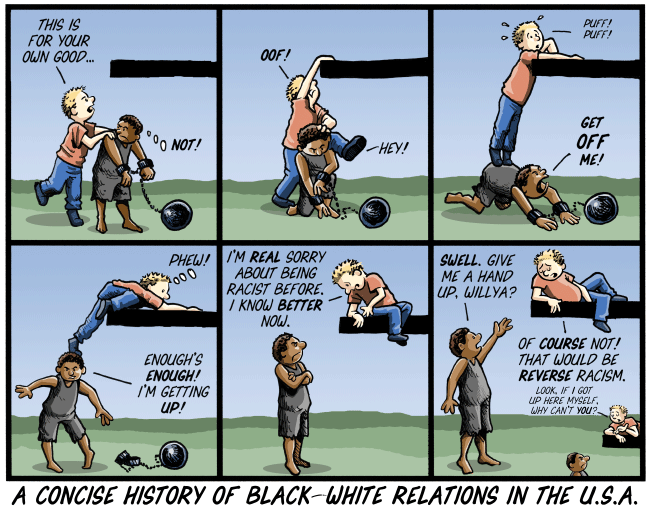
Why we’re not fixing it. In order to understand where Coates is coming from, you need to appreciate where we are: The Supreme Court believes that any government action for the specific purpose of benefiting blacks (or any racial group) is unconstitutional. To the extent that affirmative action still exists, it has to claim other justifications. (A racially diverse classroom provides a better educational experience, a racially diverse police force can relate to the community better, and so on.) Legally, reparations are the dirty secret of affirmative action. If a program is caught trying to fix the racial injustice of American history, it is thought to violate the equal protection clause of the 14th amendment.
That legal situation is reinforced by the political situation: Even colorblind attempts to deal with America’s underclass, or to make life easier for the poor (even the working poor), are undercut by the politics of white racial resentment. If you want to campaign against food stamps or the minimum wage or Medicaid, all you have to do is suggest that this is really a racial transfer from white makers to black takers. It’s no coincidence that Arkansas is the only state of the Confederacy to accept Medicaid expansion under ObamaCare, while all but four Union states have. (And two of those are still on the fence.)
If you ask, whites will explain that if black oppression happened at all, it is ancient history. We have said this in every era. In 1837, Senator John Calhoun argued that slavery was a benefit to blacks:
Never before has the black race of Central Africa, from the dawn of history to the present day, attained a condition so civilized and so improved, not only physically, but morally and intellectually. It came among us in a low, degraded, and savage condition, and in the course of a few generations it has grown up under the fostering care of our institutions, reviled as they have been, to its present comparatively civilized condition.
In 1883, the Supreme Court explained why further civil rights laws were unnecessary, now that whites had ended slavery through “beneficent legislation”.
When a man has emerged from slavery, and, by the aid of beneficent legislation, has shaken off the inseparable concomitants of that state, there must be some stage in the progress of his elevation when he takes the rank of a mere citizen and ceases to be the special favorite of the laws, and when his rights as a citizen or a man are to be protected in the ordinary modes by which other men’s rights are protected.
And in 1896, the Court saw the problem of segregation as existing mainly in black psychology.
We consider the underlying fallacy of the plaintiff’s argument to consist in the assumption that the enforced separation of the two races stamps the colored race with a badge of inferiority. If this be so, it is not by reason of anything found in the act, but solely because the colored race chooses to put that construction upon it.
I could go on. The Brown decision leveled the playing field in 1954. Or maybe the civil rights legislation of the 1960s leveled it. The election of Obama proved it was level. And so on down to John Roberts gutting the Voting Rights Act last summer by simply saying “Things have changed.”
In every era, whites claim that we have done everything justice demands, and that any remaining problem is due to some inherent black inferiority of either biology or culture. And then a few decades later we realize that wasn’t true then, but it certainly is now.
What Coates wants. In his Atlantic article, Coates doesn’t put forward any specific plan, beyond endorsing a perennial bill by John Conyers to study reparations.
the crime with which reparations activists charge the country implicates more than just a few towns or corporations. The crime indicts the American people themselves, at every level, and in nearly every configuration. A crime that implicates the entire American people deserves its hearing in the legislative body that represents them.
John Conyers’s HR 40 is the vehicle for that hearing. No one can know what would come out of such a debate. Perhaps no number can fully capture the multi-century plunder of black people in America. Perhaps the number is so large that it can’t be imagined, let alone calculated and dispensed. But I believe that wrestling publicly with these questions matters as much as—if not more than—the specific answers that might be produced.
Coates fears that the details any specific reparations proposal will become the issue, and allow whites to jump right past the question of whether reparations are justified in principle. And so the history of “multi-century plunder” will continue to be ignored.
But he also wants more than just a hearing or an apology, as he makes clearer in his Moyers interview. What he proposes is not personal reparations — trying to figure out what each individual is owed and cutting them a check — but a reorientation of public policy that holds the history of white supremacy in mind. (As a successful American, Coates expects that any tax increase to pay for this would hit him as well; quite the opposite of expecting me to send him money.) Rather than run away from policies that disproportionately benefit blacks, if we were looking for a way to make reparations we would consciously embrace such policies. We would recognize that black poverty and other social dysfunctions in the black community are not just specific examples of the general problem of poverty or social dysfunction. They are unique problems with a unique history, and they exist because they were created by public policy.
[W]e would not have to retreat to other language like quote unquote class. We would say, no, no, no, this is about white supremacy. And we have a problem with this. And we have had a problem with this for a long time. And we need to be conscious of that in our policy. When we pass a stimulus budget, for instance, we need to specifically think about helping people who have been injured in our past, because they’ve occupied a certain place in our country.
And when the Limbaughs charge that ObamaCare amounts to reparations, there could be simple response: Good.



 Something I’m just beginning to appreciate is how influential the Southern anti-Reconstruction movement that birthed the KKK has been in forming the ideas that are still running around on the extreme Right. If you want initiate yourself into this mindset, I recommend reading Thomas Dixon’s 1905 best-seller


 The Weekly Sift