
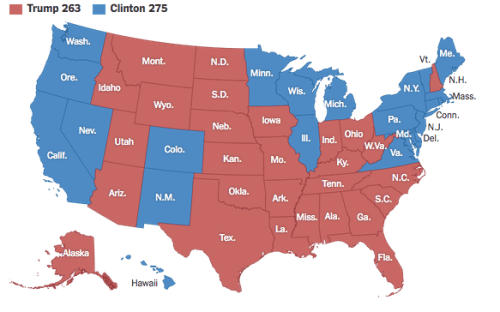
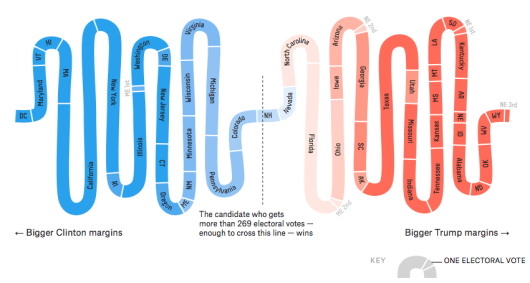
So far, I haven’t been tempted to protest against President-elect Donald Trump, at least not yet. If I am angry at all right now, it is at the swing-state voters who put him in office, not at him for taking advantage of our ridiculous Electoral College system, which allowed him to win when Hillary Clinton got more votes (about 1.7 million more, at last count). But demonstrating support for immigrants, Muslims, gays, and others who feel threatened by a Trump administration is a different matter.
Mostly for the sake of my own sanity, I have resolved not to react to things Trump hasn’t done yet. So, for example, in this week’s summary post I will comment on the appointments he has made, but not on the people he is rumored to be considering. During the next four years, I expect to see plenty of actions worth objecting to. But this will be a marathon, not a sprint, so I see no reason to jump the gun.
That said, I am also not naively hoping for the best. I am watching the Trump administration closely, and will be quick to object as soon as there are actions worth objecting to. Here is a list of the primary things I’m watching for, starting with the most mundane:
Taking credit for Obama’s accomplishments. President Obama has left his successor a country in much better shape than the one he inherited from President Bush. Republicans in general and Trump in particular have refused to give Obama credit for his accomplishments, or even to recognize good news when it appeared. Now Trump is in a position to acknowledge American success and take credit for it.
So, for example, ISIS has been losing territory for some while now. Mosul, its last stronghold in Iraq, is cut off and likely to fall in the next few months. Its de facto capital of Raqqa is under attack in Syria. If events continue on their current path, sometime in 2017 President Trump will be able to declare victory in the territorial struggle, though ISIS will continue to be a significant underground movement. That victory will be the result of Obama’s strategy, but I expect Trump to crow about how “America is winning again.”
 Similarly, expect Republicans to suddenly notice that the number of undocumented immigrants is dropping, gas prices are down, unemployment is low, and that rates of murder and other major crimes are at their lowest levels in decades. Already, Gallup reports that Republicans have drastically changed their opinion about how well the economy is doing: “Just 16% of Republicans said the economy was getting better in the week before the election, while 81% said it was getting worse. Since the election, 49% say it is getting better and 44% worse.”
The beauty of this (from Trump’s point of view) is that no lying is necessary. On the contrary, all he has to do is stop lying about the state of country, and bask in the glow of instant success.
Taking credit for averting dangers that never existed. This has already started. Trump is taking credit for keeping a Kentucky Ford plant from moving to Mexico, when Ford never had a plan to move it. Who knows what he’ll prevent next? War with Belgium, maybe. By May, he will have decisively beaten winter.
In the conspiracy-theory swamps where many Trump supporters live, this will be incredibly easy: All they have to do is celebrate the end of things that never existed to begin with: You know those FEMA detention camps where anti-Obama dissidents were going to be sent? Trump closed them! They’re gone.
I’m reminded of a joke about a political leader answering charges of nepotism. Asked why his mother was on the public payroll, he explained that she oversaw the government’s anti-tiger policy. “But there are no tigers for a thousand miles,” the interviewer objected. “Don’t thank me,” the leader responded. “Thank Mom.”
Profiteering. This picture is worth a thousand words:
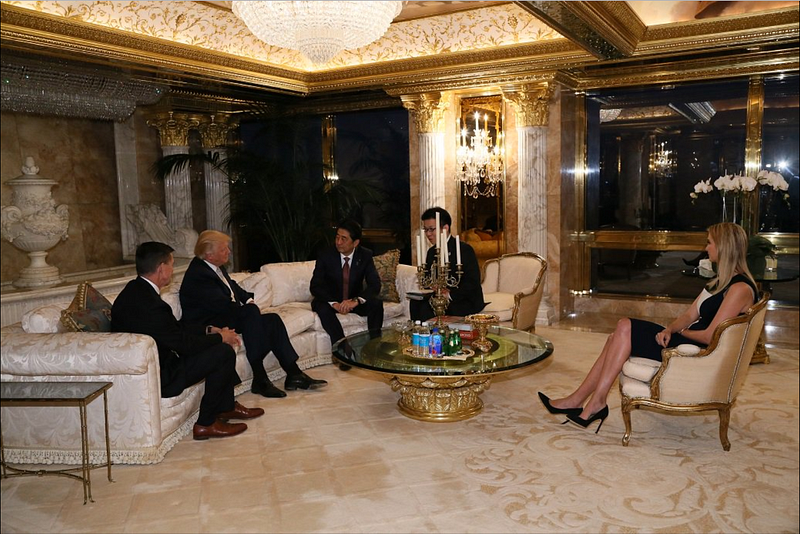
It’s President-elect Trump’s first meeting with a foreign head of state: Japanese Prime Minister Shinzo Abe. And who is that in the chair on the right? Ivanka Trump, the daughter who is expected to take control of Trump’s business interests.
It’s a staged photo, and the message it sends is unmistakable: There will be no distance between Trump’s government and Trump’s profit-making enterprises. The Trump children have all played significant roles in the transition, so many officials in the new administration will be in their debt. And presumably they will continue to have their father’s ear after the inauguration, even as they negotiate deals in foreign countries.
This week, Trump also met with three businessmen who are building Trump-branded properties in India. Two are sons of a member of India’s Parliament.
What this means is that there is a wide-open door for foreign governments to bribe President Trump: Go to Ivanka (or maybe even directly to Donald) and cut a lucrative deal to build a new Trump Tower in your capital city. Or if you are afraid the President is going to do something you don’t like, threaten to cancel such a deal.
This kind of thinking is toxic:
In interviews with a dozen diplomats … some said spending money at Trump’s hotel is an easy, friendly gesture to the new president.
“Why wouldn’t I stay at his hotel blocks from the White House, so I can tell the new president, ‘I love your new hotel!’ Isn’t it rude to come to his city and say, ‘I am staying at your competitor?’ ” said one Asian diplomat.
So if you’re competing against a Trump business, you’re competing against the Trump administration. It’s one enterprise now.
All this runs afoul of the Emoluments Clause of the Constitution, which conservatives were inclined to interpret strictly when imagining President Hillary Clinton. Unless Trump has some amazing plan he hasn’t announced yet, his violation of the Clause looks likely to be far more blatant than anything Clinton did or was even accused of doing. So we’ll soon see which conservatives have actually been serious about that uphold-the-Constitution rhetoric.
Changing the electorate. All through the campaign, conservative voices like Laura Ingraham have been referring to the Trump campaign as “the last chance, last stand for America as we know it”. The racial dog whistle there is pretty obvious: “America as we know it” is White America, and the electorate becomes a little less white every year.
To a certain extent that process can be slowed down by preventing non-white immigrants from becoming citizens. But that won’t change the demographics, because the non-white population is younger and more inclined towards large families. So if you really want to preserve the United States as a white-majority nation, you have to prevent non-whites from voting.
That has been the Republican strategy for several years now. As soon as the Supreme Court opened the door, states governed by Republicans began changing election rules to make it harder to vote, especially for blacks, Hispanics, poor people, and college students. Fortunately, this year courts struck down the most outrageous attempts to rig the electorate, like North Carolina’s.
The court said that in crafting the law, the Republican-controlled general assembly requested and received data on voters’ use of various voting practices by race. It found that African American voters in North Carolina are more likely to vote early, use same-day voter registration and straight-ticket voting. They were also disproportionately less likely to have an ID, more likely to cast a provisional ballot and take advantage of pre-registration.
Then, the court, said, lawmakers restricted all of these voting options, and further narrowed the list of acceptable voter IDs. “… [W]ith race data in hand, the legislature amended the bill to exclude many of the alternative photo IDs used by African Americans. As amended, the bill retained only the kinds of IDs that white North Carolinians were more likely to possess.”
Unfortunately, the federal Justice Department plays a big role in bringing such cases to court, and under Attorney General Sessions it’s likely to get out of that business. (Sessions’ home state of Alabama has been one of the worst offenders, and he has not raised a word of protest.) Then there’s the question of how President Trump’s appointees will stack the courts.
Winking at right-wing paramilitary groups. To be honest, I’ll be relieved if we make it through the next four years with nothing worse than financial chicanery. Much darker stuff is possible.
When we think of fascist governments, we usually picture the police doing things like destroying the printing presses of critical newspapers and dragging their editors off to jail. But that kind of thing only happens at a much later stage. Early on, fascist violence is unofficial: Organized thugs destroy the printing press and send the editor to a hospital, not a jail. Police are not involved, but they show no interest in catching the people who are.
Right-wing violence in America was already a problem before Trump: There are groups that support firebombing abortion clinics and murdering doctors. Hate crimes against blacks, immigrants, or Muslims are usually portrayed as the work of isolated maniacs, but in fact killers like Dylann Roof and Wade Michael Page have had far stronger relationships with organized hate groups than, say, Omar Mateen had with ISIS. The Bundy gang in Nevada has openly challenged the federal government with armed resistance.

An Oathkeeper “protecting” Ferguson
During the campaign, Trump frequently praised violence and valorized violent responses from his followers. My question is whether this will continue after inauguration and if violent Trump supporters will organize in a brownshirt fashion. Or perhaps already existing groups — Oathkeepers, for example — will shift into this role. Militia groups that organized to resist imaginary “tyranny” from Obama might welcome the opportunity to support an actual tyranny of their own.
And if this happens, how will Trump react? He could condemn such a development, or he could suggest targets to his paramilitary supporters by labeling people as “traitors” or using some similar language.
Richard Engel drew on his observations of other countries to describe the signs of creeping authoritarianism to Rachel Maddow.
If you start to hear the word “traitor” being used a lot about the opposition, that’s a red flag. If those criticisms escalate to “cancer”, that’s an even worse sign. So I think we should be listening for things like that. After that, the next stage would be mass rallies by his supporters that look potentially intimidating. And after that, to see if there’s any kind of call for a referendum to go right to the people to get around the constitutional system.
Subverting government agencies for political advantage. If Trump does intend to push America in an authoritarian direction, institutional forces within the government might resist — or not.
I don’t expect Trump to carry through on his promise to appoint a special prosecutor to go after the Clintons. The whole point of the accusations against Hillary was to defeat her politically and neutralize the Clintons as a political force — not to pursue justice or enforce the law. That political mission has been accomplished now, and attempting to prosecute her would only demonstrate how baseless the charges were.
But the mere fact that he would suggest such a thing is gravely troubling. In America, prosecutions bubble up from investigators, they don’t come down from the President. He has also threatened antitrust action against Amazon because its founder (Jeff Bezos) also owns The Washington Post, which Trump found too critical.
FBI Director Comey’s highly unusual commentary on the Clinton email server problem — ordinarily, an investigation that didn’t produce prosecutions would not be revealed to the public, and certainly not late in an election campaign — as well as the leaks from inside the FBI about some nebulous Clinton Foundation investigation, suggests that there has been considerable political corruption of the FBI already.
The FBI, CIA, NSA, SEC, IRS, and other agencies all have considerable power to make Trump’s critics miserable, as well as to provide valuable information to his business interests. Will they be asked to do so, and will they give in?
Paying Putin back. Trump and Vladimir Putin both know that Trump could not have won without Putin’s help. The Russian hack of DNC and Clinton campaign emails was a major factor in the campaign. We have since found out that the Trump campaign was in regular contact with Russian officials. This should come as no surprise, since former Trump campaign manager Paul Manafort had previously received millions of dollars from pro-Russian organizations in Ukraine.
Two questions immediately come to mind: Will the Russian government continue committing crimes for Trump’s benefit? And what do they want in return?
Obvious ways to pay Putin back include: supporting the Russian-allied Assad regime in Syria, turning a blind eye to further encroachments in Ukraine, or letting Putin dominate our NATO allies in Estonia, Latvia, and Lithuania.
Did I miss anything important? What else should we be on the lookout for?








 The Weekly Sift