Category Archives: Articles

Trump’s Evangelical toadies are destroying the Christian brand

From John the Baptist and Herod to Jerry Falwell Jr. and Trump is a very long fall.


In general, it’s been hard to raise much excitement over the Stormy Daniels story. OK, Trump had an affair with a porn star while his wife was home with a new baby. Ten years later, as the election approached, his lawyer paid six figures to hush her up. (And if you believe a Steve Bannon quote in Fire and Fury, she’s not the only one.) Assume all that is true: Does it change your opinion of Donald Trump?

I didn’t think so. As Shakespeare’s fool Touchstone says:

If you swear by that that is not, you are not forsworn: no more was this knight swearing by his honour, for he never had any.

Trump can’t lose his reputation for moral uprightness or even basic decency, because he never had one. The American public is well beyond being shocked by any new revelation about his character. A similar scandal about Obama would have been earth-shaking. But Trump? Not so much.

So if you want to get a story out of the Daniels incident, you need to widen your scope somehow, like ask where the money to pay her off came from, or look at somebody who still has a reputation to lose.

I think that’s why so much of the public outrage has shifted its focus from Trump himself to the self-styled moral leaders who defend him and the pitiful defenses they have mustered. The truly shocking thing about the Daniels story is the way that so many Christian leaders have been willing not just to debase themselves, but to spend down the moral capital of Christianity itself in order to protect the man they put in the White House.

Pious enablers. For Tony Perkins of the Family Research Council, illicit sex is no more serious than golf — at least when Trump does it. “You get a mulligan,” he says. Presumably, this follows the mulligans he had already given Trump for all the women who accused him of sexual assault, or for his own bragging about assaulting them.

Franklin Graham, in a single interview, said both that “our country has a sin problem” and that Trump buying the silence of a porn star is not a big deal because the president isn’t expected to be “the pastor of this nation”. Robert Jeffress has been notably silent about the Daniels payoff, after defending Trump’s “shithole countries” comment two weeks ago: “I’m grateful we have a president like Donald Trump who … has the courage to protect the well-being of our nation.”

But the prize goes to Jerry Falwell Jr., who defended Trump by debasing the words of Jesus himself. CNN’s Erin Burnett had connected Stormy Daniels to the many women whose stories flesh out Trump’s boastful confession on the Access Hollywood tape, and then asked Falwell how many times Trump has to offend

before you say “This is a person who lacks character”?

In response, Falwell falsely claimed that Trump had “apologized” and “asked forgiveness” for his past wrongdoing. (If you’ve repented, you stop calling your accusers liars.) Then he asserted  that Trump is “not the same person now that he was back then”. (The Daniels payoff happened in 2016.) Then he capped his defense with this argument, which I’m sure Christian philanderers all over America are filing for future use:

Jesus said that if you lust after a woman in your heart, it’s the same as committing adultery. You’re just as bad as the person who has, and that’s why our whole faith is based around the idea that we’re all equally bad, we’re all sinners.

As I’m sure Falwell must know, the context of the Jesus quote was to call his followers to a higher standard, not the lower one Falwell is offering. What Jesus is saying in this part of the Sermon on the Mount is: Don’t just restrain yourself from murder, root out the anger and hatred in your heart. Don’t just avoid adultery, stop indulging your adulterous fantasies. Don’t just love your friends, love your enemies too.

But Falwell has turned Jesus’ message upside-down. Now it’s a blanket excuse for anybody to do anything, because everybody else is just as bad. If the thought of cheating on your wife with a porn star is already as bad as the deed, then why not just go ahead and do it? And if we’re all equally guilty anyway, then what basis does any pastor have to tell his flock to do or not do anything?

I’ve never been to Falwell’s church, but I guarantee you this is not a message he has ever preached from a pulpit. This is a special gospel that applies only to powerful men he has allied himself with, and whose approval he desires.

The truth-to-power tradition. But the Bible doesn’t offer a special gospel for the powerful; it points in the opposite direction. Moses doesn’t approach Pharaoh with praise and flattery, he announces plainly: “Let my people go.” The Prophet Nathan doesn’t offer King David a mulligan, he accuses David to his face and proclaims God’s judgment:

You had Uriah the Hittite killed in battle. You took his wife as your wife. You used the Ammonites to kill him. So warfare will never leave your house.

Elijah doesn’t go to King Ahab and say, “Hey, don’t sweat it, everybody worships a false god now and then.” His message was unequivocal.

I have not troubled Israel, but you have, and your father’s house, because you have abandoned the commandments of the Lord and followed the Baals.

And finally, John the Baptist, at the cost of his own head, tells King Herod that it was wrong to take his brother’s wife. Like Falwell, he could have said, “You know, everybody has imagined doing the same thing, and that’s just as bad.” Maybe that would have gotten him an appointment to Herod’s But he didn’t.

Nowhere in the Bible does a prophet say: “Maybe if I soft-pedal God’s message so that it fits what the King wants to hear, he’ll keep me around and I’ll be able to get godly judges appointed. Wouldn’t that do more good in the long run?”

But that’s precisely what today’s Christian leaders do, or at least the white evangelical ones.

“Just shut up.” I’m not the only one who has noticed this. I think former RNC Chair Michael Steele spoke for a lot of people when he requested that leaders like Perkins and Falwell “shut the hell up”.

I have very simple admonition: just shut the hell up and don’t preach to me about anything ever again. After telling me who to love, what to believe, what to do and what not to do, and now you sit back and the prostitutes don’t matter, the grabbing the you-know-what doesn’t matter, the outright behavior and lies don’t matter — just shut up! They have no voice of authority anymore for me.

Steele is coming out of a political worldview, but you can also hear the sorrow in his voice. This isn’t just about Republicans and Democrats any more, it’s about Christianity, a religion that he cares about.
Remonstrance. It’s also about Christianity for John Pavlovitz, the former youth pastor of a conservative megachurch in Charlotte and current youth pastor of the more liberal North Raleigh Community Church (whose web site says “We believe Christianity is worth saving“). On his blog Stuff That Needs To Be Said Pavlovitz posted “White Evangelicals, This Is Why People Are Through With You“. He argues that worldly power and white identity politics have replaced Jesus as the center of the white evangelical message:

They see your hypocrisy, your inconsistency, your incredibly selective mercy, and your thinly veiled supremacy.

He points to evangelical leaders’ demonization of President Obama, “a man faithfully married for 26 years; a doting father and husband without a hint of moral scandal or the slightest whiff of infidelity”.

They watched you deny his personal faith convictions, argue his birthplace, and assail his character—all without cause or evidence. They saw you brandish Scriptures to malign him and use the laziest of racial stereotypes in criticizing him.

But with Trump, everything is different.

With him, you suddenly find religion.
With him, you’re now willing to offer full absolution.
With him, all is forgiven without repentance or admission.
With him you’re suddenly able to see some invisible, deeply buried heart.
With him, sin has become unimportant, compassion no longer a requirement.
With him, you see only Providence.

And why?

They see that all you’re really interested in doing, is making a God in your own ivory image and demanding that the world bow down to it. They recognize this all about white, Republican Jesus—not dark-skinned Jesus of Nazareth.
Not just one incident. Christians who want to hang on to Jesus and his message have been writing similar remonstrances to their white evangelical brethren for some while now. In November, when white Evangelicals stood by Roy Moore in spite of multiple credible accusations of his predatory behavior, and in spite of (or maybe because of) his long history of anti-gay bigotry and putting Christian partisanship above the rule of law, Miguel De La Torre responded with “The death of Christianity in the U.S.“.

To save Jesus from those claiming to be his heirs, we must wrench him from the hands of those who use him as a façade from which to hide their phobias — their fear of blacks, their fear of the undocumented, their fear of Muslims, their fear of everything queer.

Evangelicalism has ceased to be a faith perspective rooted on Jesus the Christ and has become a political movement whose beliefs repudiate all Jesus advocated.
De La Torre’s article looks further back, to “Evangelicalism’s unholy marriage to the Prosperity Gospel” and those who “remained silent or actually supported Charlottesville goose steppers because they protect their white privilege with the doublespeak of preserving heritage”, as well as Christian leaders’ support for Trump in the 2016 election. “The Evangelicals’ Jesus is Satanic” he writes, and concludes by urging the followers of this perversion of Christianity to “get saved”.

Trump’s election was the occasion for mournful remonstrances like “Life After Evangelicalism” by Rachel Held Evans. Evans, who has taken refuge in the Episcopal Church after finding the conservative Christianity of her youth unsustainable, wrote to those Evangelicals for whom the election was a wake-up call.

There’s an op-ed out every minute urging the bewildered to get out of their bubbles and get to know some Trump supporters, but you don’t need to do that, do you?

These are the people you worship with each week, the people whose kids hang out with your kids, the people who brought you a chicken casserole when you had surgery, the people you call with good news, the people you’re now wishing you’d spoken with more bluntly, more honestly.

They aren’t strangers to you, are they? But suddenly, you are a stranger among them.

And she offers them hope that Christianity itself isn’t dead yet, even if their own Christian community has abandoned or marginalized them.

The good news is that Jesus is already on the margins. Jesus is already present among the very people and places our president-elect despises as weak. When we stand in solidarity with the despised and the suffering, Jesus stands with us.  We don’t have to abandon Jesus to abandon the unholy marriage between Donald Trump and the white American Church. In these troubled times, a prophetic resistance will certainly emerge, made up of clergy, activists, artists, humorists, liturgists, parents, teachers, and volunteers committed to partnering with and defending “the least of these.” I found my faith again in the margins—through the Gay Christian Network, for example, and among fellow doubters and dreamers who limp from their wrestling with God

A long time coming. A great religion can’t be corrupted overnight. To those who have been following more closely, evangelical abandonment of the Sermon on the Mount in favor of white identity politics is old news. Michele Goldberg relates some of the history, beginning with Jerry Falwell Sr.’s pro-segregation sermons in the 1950s. (I would have gone back further, to the Christian defense of slavery. That’s what put the “Southern” in Southern Baptists.)

“When God has drawn a line of distinction, we should not attempt to cross that line,” he wrote, warning that integration “will destroy our race eventually.” In 1967, Falwell founded the Lynchburg Christian Academy — later Liberty Christian Academy — as a private school for white students.

What galvanized Falwell’s commitment to politics — and that of 1970s Evangelicals in general — wasn’t abortion, the cause usually cited, but the IRS’ denial of tax-exempt status to segregated schools. [1]

In the 1980 election, Falwell’s Moral Majority supported America’s first divorced president, Ronald Reagan, largely erasing the previous stigma of divorce. [2] Goldberg quotes historian Randall Balmer:

Up until 1980, anybody who was divorced, let alone divorced and remarried, very likely would have been kicked out of evangelical congregations.

Bending its “family values” to accommodate Trump, she says, is nothing new.

Trump has simply revealed the movement’s priorities. It values the preservation of traditional racial and sexual hierarchies over fuzzier notions of wholesomeness.

“I’ve resisted throughout my career the notion that evangelicals are racist, I really have,” Balmer told me. “But I think the 2016 election demonstrated that the religious right was circling back to the founding principles of the movement. What happened in 2016 is that the religious right dropped all pretense that theirs was a movement about family values.”

She concludes:

it seems absurd to ask secular people to respect the religious right’s beliefs about sex and marriage — and thus tolerate a degree of anti-gay discrimination — while the movement’s leaders treat their own sexual standards as flexible and conditional. Christian conservatives may believe strongly in their own righteousness. But from the outside, it looks as if their movement was never really about morality at all.

The price. For Americans who grew up before the advent of the Moral Majority, or before evangelical leaders became so nakedly partisan, Christianity largely retains an aura of wholesomeness and goodwill. But for younger Americans, this is vanishing. The 538 blog produced this graphic from data collected by the Public Religion Research Institute. Among Americans above 65, 26% consider themselves white Evangelical Protestants, nearly 80% identify with some form of Christianity, and only 12% say they are unaffiliated with any religion. But for those 18-29, 38% are unaffiliated, 53% are Christians of some sort, and only 8% are white Evangelical Protestants.

In 1987, 23% of white Evangelical Protestants were over 65, while almost as many, 20%, were 18-29. But by 2016, the 65-and-older cohort was dominating the 18-29s, 30%-11%. The Barna Group finds that among those born since 1999, 13% identify as atheists, compared to 6% in the general population.

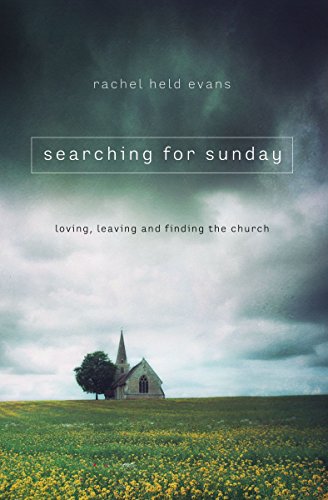
In the prologue of her latest book, Rachel Held Evans recalls an attempt to explain younger people’s disenchantment:

Millennials aren’t looking for a hipper Christianity, I said. We’re looking for a truer Christianity, a more authentic Christianity.

Authentic can be a hard word to define, but I can tell you very quickly what authentic Christianity isn’t: a set of soundbites that prop up a morally bankrupt president because of the favors he promises to Christian leaders and institutions.

The price of the corrupt bargain made by Perkins, Graham, Jeffress, and Falwell — what they have traded for their White House access and Neil Gorsuch’s Supreme Court seat — is the destruction of the Christian brand. Say “Christian” to a young adult, and the word-association you’re likely to get back is “hypocritical” or “judgmental”.

Columnist Michael Gerson (a never-Trump Republican) sums up:

When presented with the binary choice of Hillary Clinton or Donald Trump, I can understand a certain amount of anguish. But that is not a reason to become sycophants, cheerleaders and enablers. Politics sometimes presents difficult choices. But that is not an excuse to be the most easily manipulated group in American politics.

The problem, however, runs deeper. Trump’s court evangelicals have become active participants in the moral deregulation of our political life. Never mind whatever is true, whatever is honorable, whatever is right, whatever is of good repute. Some evangelicals are busy erasing bright lines and destroying moral landmarks. In the process, they are associating evangelicalism with bigotry, selfishness and deception. They are playing a grubby political game for the highest of stakes: the reputation of their faith.

Christians like Evans, De La Torre, and Pavlovitz may be working hard to undo the damage the Trump toadies have done to the Christian brand. But it will be an uphill battle. For more and more Americans — especially young Americans — the word Christian itself is stained. Describing an idea, an institution, a speaker, or a political position as Christian no longer evokes a open, accepting attitude in American listeners. Quite the opposite, it puts more and more of us on edge; it signals that something dodgy is about to be presented, something that justifies existing oppressions, something self-serving, self-righteous, and quite likely hateful.

White Evangelicals would like to attribute this stain to the slanders of a hostile secular culture. But outsiders could never manage such a feat. The stain comes from the leaders that so many Christians have chosen to follow.


[1] At the time of Rowe v Wade, abortion was actually a debatable issue among evangelical theologians. Only after a political anti-abortion movement started to take off did opposition to abortion become a cornerstone of Evangelicalism. The religion did not lead the politics, it followed.

[2] Those who claim that the Religious Right holds true to traditional Christian principles will often cite its opposition to abortion and gay rights, as if these issues had been central to Christianity in any other era. Both abortion and homosexuality existed in Jesus’ time, and yet you will search the gospels in vain to find any mention of them; he appears not to have been all that concerned about them. Certainly he does not condemn either in terms that are nearly so direct and unequivocal as what he says about divorce in Matthew 19:

Whoever divorces his wife, except for sexual immorality, and marries another, commits adultery.

It is currently beyond the pale for Evangelical churches to accept non-celibate gays and lesbians, ostensibly because they persist in their sin without repentance. But divorced-and-remarried couples are equally persistent in what Jesus described as adultery, and they are welcome.

As with Trump and Reagan, standards are infinitely flexible if a church likes you, but strict and literal if it doesn’t. The Bible has nothing to do with this.
Lies, Damned Lies, and Trump-Administration Terrorism Statistics

If you define your categories just right, you can create the illusion that Trump’s Muslim ban has something to do with terrorism, and justify an irrational fear of immigrants.


Last February, President Trump told a lie to a joint session of Congress:

According to data provided by the Department of Justice, the vast majority of individuals convicted of terrorism and terrorism-related offenses since 9/11 came here from outside of our country.

He used this claim to justify his executive order to keep people from seven (later reduced to six) Muslim countries out the United States.

Tuesday, the Departments of Homeland Security and Justice published a report to back up Trump’s lie. The Lawfare blog explains how you have to manipulate the data to support Trump’s claim and his executive order:

  • Substitute “international terrorism” for “terrorism”, so that you can ignore all the instances of domestic terrorism, where most of the perpetrators are native-born. When Wade Michael Page killed six people at a Sikh Temple in Wisconsin, for example, that would probably have been classified as domestic terrorism (if Page hadn’t short-circuited the legal process by killing himself). Dylann Roof’s shooting of nine at a black church in Charleston wasn’t classified as terrorism at all; it was a hate crime. Nobody knows what to call the Las Vegas shooting, but if shooter had been from Yemen it would of course count as “international terrorism”. The report considered only federal convictions, but according to another Lawfare analysis: “Other crimes that could easily fall under the domestic-terrorism umbrella are charged at the state level, making them even more difficult to track.”
  • Include nearly 100 foreign-born terrorists who didn’t come here, but were extradited here so that we could prosecute them. Imagine that we hadn’t killed Osama Bin Laden, but instead had brought him to New York and convicted him of conspiring in the 9-11 attacks. The HS/DoJ report would then count him as a foreign-born convicted terrorist. In addition to such foreign conspirators whose role in terrorism didn’t involve entering the U.S., our terrorism laws also cover attacks against American citizens on foreign soil, where American border security isn’t relevant in any way at all. So if Ahmed Abu Khattala is convicted of participating in the Benghazi attack, he will count as a foreign-born convicted terrorist also.
  • Fudge the difference between foreign countries in general and the ones mentioned in the travel ban. Even if you accept HS/DoJ’s skewed set of categories, the resulting analysis doesn’t support Trump’s executive order. Lawfare says: “The six listed countries are not among those with the greatest representation on the list of terrorism-related convictions from 2001 to 2015. Only one — Somalia — is even in the top five, and it ranks fifth.” For example, Saudi Arabia (not on Trump’s list) accounted for 15 of the 19 9-11 hijackers. None of the other four came from listed countries.

So what would happen if you did an honest analysis of the foreign-born role in American terrorism? Lawfare’s Nora Ellingsen and Lisa Daniels  found some of the flaws in the data too difficult to overcome (like the domestic terrorists charged under hate-crime and other non-terrorism laws), but ignoring those problems (which they admitted would still make their numbers too high), they made an attempt back in April.

So what would the numbers look like if we excluded extradited subjects while including all of these domestic terrorists—the approach that seems to us the unbiased way to express the real rate at which foreign-born, as opposed to domestic-born, people are committing terrorist or terrorism-related crimes?

If we clean up the data to account for the issues described above, instead of accounting for between 63 and 71 percent of terrorism convictions, foreign-born persons would likely account for only 18 to 21 percent of terrorism convictions.

Quartz pointed to another problem: Both the HS/DoJ report and its clean-up by Lawfare count not just acts of terrorist violence, but also “terrorism-related” crimes that could be just about anything.

[T]he vague term “terrorism-related charges” inflates numbers by including not just people who broke laws “directly related to international terrorism,” but others who were convicted of totally unrelated offenses, such as fraud or illegal immigration in the course of a terrorism-related investigation. … One example of how this can happen is the case of three Middle-Eastern grocers who were convicted for stealing boxes of Kellogg’s cereal in 2000 — but remained on the list of terrorism-related cases because the Federal Bureau of Investigation questioned them after a source inaccurately tipped agents that the three men had tried to buy a rocket-propelled grenade.

Another problem in the data: Maybe the Feds find so many “terrorism-related offenses” among people born in Muslim-majority countries because that’s where they’re looking. For example, the HS/DoJ report tells about Uzair Paracha, a Pakistani convicted of “providing material support to al Qaeda”. He was never connected to any actual act of terrorism, but was convicted of helping somebody whose hazy plans “to attack gasoline stations” never got specific enough to carry out. (The plot to bring him back into the U.S. failed, but exactly what he would have done if he got here is unclear.) The somebody “discussed” giving Paracha and his father $200K in exchange for their help, but the money never actually changed hands, and maybe never existed in the first place.

I have to wonder: If the Feds went after domestic terrorist groups with equal vigor, if they put all known white supremacists under constant surveillance and interpreted every big-talker’s violent fantasy as a “plot” that turned all his listeners into “conspirators”, how many additional terrorism-related convictions could they add to their total? (Dear FBI: In bars, I have materially aided plots against the Koch brothers by buying the next round. None of us had any weapons or knew exactly where the Kochs live, but if stuff like doesn’t matter, we’re guilty.)

In short, the numbers in the report really have nothing to do with the terrorist tendencies of immigrants or refugees, and say nothing about whether we need to change the way we let foreigners enter the United States. They’re just artifacts of the way the terms are defined. They do not at all support the White House’s subsequent claim that “Our current immigration system jeopardizes American security.”

And finally, the Cato Institute’s Alex Nowrasteh puts the whole foreign-born terrorism problem in context:

[Between 1975 and 2015], the chance of an American being murdered by a foreign-born terrorist was 1 in 3,609,709 a year. The chance of an American being killed in a terrorist attack committed by a refugee was 1 in 3.64 billion a year. The annual chance of being murdered by somebody other than a foreign-born terrorist was 252.9 times greater than the chance of dying in a terrorist attack committed by a foreign-born terrorist.

So if the Trump travel ban isn’t about terrorism, what is it about? Nativism.

What picks those countries out is that their residents are largely non-white Muslims, and (unlike Saudi Arabia, which is a much larger source of both terrorists and material support for terrorism) the Trump Organization has no business interests there. If you think of America as a white Christian nation, and worry that it’s losing that identity, then you don’t want people coming here from Iran, Libya, Somalia, Sudan, Syria or Yemen.

If you’re also against letting in brown-skinned Spanish-speakers from Mexico or Central America, you’re happy to lump them in with the “foreign-born” as well. That’s all that’s going on here.

The Real Immigration Issue

“Illegal” immigration has always been a red herring. The more fundamental question is whether the United States will continue to be a country dominated by English-speaking white Christians.


When an issue sharply divides America, we tend to avoid discussing our real division, and instead fight proxy wars about side issues. So, for example, our legislatures and our election campaigns seldom engage the real debate about abortion: A large chunk of the country strongly believes that abortion is a difficult decision that a pregnant woman needs to make for herself, possibly in consultation with her husband, parents, friends, and doctors. Another large chunk believes that abortion is a form of murder and so the government should forbid it, possibly punishing the people involved.

But day-to-day, neither of those positions is discussed by our pundits or politicians. Instead, they raise smaller, related issues that they hope will push the battle lines in the direction they want: Should late-term “partial birth” abortions be legal? Should abortion be legal after a fetus has a detectable heartbeat or can experience pain? (And when is that?) Should abortion (or forms of birth control that could result in the loss of a newly-fertilized ovum) be covered under Medicaid or ObamaCare? Such debates are like the occasional shooting wars that erupted out of the Cold War. The underlying struggle — the U.S. vs. the U.S.S.R. — always stayed under wraps, while the actual battles were fought in Korea or Vietnam or Angola.

For a long time, something similar has been going on with regard to immigration. Anti-immigration politicians and pundits want to talk about “illegal” immigration: the people (usually estimated to number around 11 million) who live in the U.S. without official permission. Some sneaked across one of our borders and have never had any legal status, while an almost equal number came through our ports-of-entry legally as tourists and then overstayed their visas. But however they got here, the anti-immigration folks say, they should leave. It’s nothing personal or racial; it’s just about the rule of law and maintaining border security. And even more than the generic undocumented immigrant, they want to talk about criminals like the M-13 gang, the people President Trump primarily blames for the “American carnage” he made the centerpiece of his inaugural speech.

Meanwhile, pro-immigration politicians and pundits want to talk about the Dreamers: undocumented residents who were brought here as children and know no other country. Or about refugees who came (or want to come) from Syria or Haiti or some other country stricken by natural disaster or war. Or Latin American children whose parents sent them away to America rather than see them forced to become either soldiers or prostitutes for local drug gangsters. Whatever your views on immigration in general, pro-immigration voices say, these are human beings in trouble who deserve our compassion.

It’s easy to get drawn into the details of any of these issues, and find yourself listing victims of illegal-immigrant crime, or correcting misconceptions about DACA or the refugee-screening process. But it’s always worthwhile to remember that these aren’t the fundamental issues; these are proxy wars, and the energy behind them comes from somewhere else.

The more important groupings, the U.S/U.S.S.R. of this struggle, look more like this:

  • One side likes living in a multi-cultural society, and believes that America is stronger because it draws ambitious, freedom-loving people from all over the world.
  • The other side sees the U.S. as a white, Christian, English-speaking country. They believe we can tolerate and assimilate a certain number of people who don’t fit that description, but beyond a certain point (and we’re getting well beyond it now) we will lose our national identity.

Occasionally, some comparatively trivial comment draws the line between these two groups very sharply. For example, when the founder of Latinos for Trump said: “My culture is a very dominant culture. It is imposing and it’s causing problems. If you don’t do something about it, you’re going to have taco trucks on every corner.”

The second group knew exactly what he was talking about: The America they grew up in is in danger of being overrun by people who eat differently, speak differently, and probably live totally different lives than they do. “I’m losing my country,” they believe. But the first group responded to the taco-truck vision with something like: “That would be fabulous. I can never find taco truck when I want one.” Or a truck that sells falafels or sushi or samosas.

Unsurprisingly, this is largely a rural/urban split. If you grew up someplace like San Francisco or New York City, being surrounded by people of all colors chattering in all sorts of languages feels normal, and the idea that this represents a threat to the essential identity of America seems absurd. (Whites are already a minority in California. But when I’ve been there, it still feels like America to me.) But if you’re accustomed to living in a small town that has only recently begun to have a sizeable non-white minority, that not-like-us presence can seem dangerous. Who knows what is going on inside those mosques and temples, or what is being discussed in those foreign languages? Maybe they’re insulting us, making fun of us, or plotting some violence against us. How would we know?

The result is a bit perverse: The native-born English-speaking whites who seem to be in the most danger of being overrun by immigrants — the ones in the polyglot cities — are precisely the ones most comfortable with a vision of a multi-cultural future. But those in the least danger are the ones easiest to rile up against Sharia law or M-13 gangsters or taco trucks on every corner.

The Trump administration has consistently put forward policies that reflect the nativist, keep-America-white position. But they  haven’t promoted it openly, hiding instead behind rhetoric about illegal or criminal immigrants. However, look at what they’ve done:

All of these actions are directed at legal immigrants and visitors. They submit (or have submitted) to a legal process, we know who they are, we have a chance to investigate them. We just don’t want them here.

Even with regard to undocumented immigrants, the Trump administration’s actions belie its rhetoric. The rhetoric is all about criminals, “really bad dudes” as Trump has said many times. The reality is quite different. ICE frequently targets undocumented people living otherwise normal lives, supporting families by working exhausting low-wage jobs. This week, ICE launched a nationwide campaign of raids not on drug dens or underworld hangouts, but on 7-Elevens — 98 stores in 17 states. That brown-skinned girl making your Slushie is the threat Trump wants to protect you from.

Unless some deal is reached — and Trump insists on getting a price for this “concession” — the government is going to start deporting Dreamers in March. (Or at least it was, until a court ordered the administration to keep taking renewal applications. “These allegations raise a plausible inference that racial animus towards Mexicans and Latinos was a motivating factor in the decision to end DACA,” the judge wrote. The administration is obeying the order while it seeks to reverse it on appeal.) There is nothing criminal about Dreamers; the decision ignore the legal immigration process was their parents’, and a felony or significant misdemeanor would make them ineligible. They are no threat to national security or public order. The only reason to expel them is that Americans don’t want them. Or at least some Americans don’t.

We can only hope that Trump’s recent comment about “shithole countries” will shift the immigration debate onto the fundamental issue that is really at its core: Is America a set of ideals that anyone can adopt, or is it an ethnic tribe you need to be born into? Is it about a democratic form of government pledged to defend individual rights? Or is it about being white, speaking English, and loving Jesus?

Because what Trump was questioning at the time were plans for legal immigration from Africa, from Haiti, and from El Salvador. “Why are we having all these people from shithole countries come here? … Why do we need more Haitians?” He then asked why we couldn’t have more immigrants from countries like Norway instead. [1]

It’s not that we have no room left for immigrants, it’s that they’re wrong color. They don’t fit the “ideal American” stereotype many of us carry around in our heads. They make white English-speaking Christians feel like they’re losing their country.

That’s the real issue. It’s the issue Trump’s immigration policy is based on, why his base stands by him. It’s an issue we need to debate, without getting distracted by the red-herring issues of documentation.


[1] In general, people don’t leave their home countries if life is going well there. That applies to most white Americans also. (Consider, for example, the Irish Potato Famine or the pogroms that brought many Eastern European Jews to this country.) It’s also the answer to Trump’s question about bringing in more Norwegians: Life is good in Norway, so few of them want to come here.

Visions of a Future Gift Economy

Cory Doctorow’s recent novel Walkaway imagines a world where scarcity is unnecessary and generosity is a feasible way of life.


When you take a mountaintop view that lets all the gritty details blur into insignificance, most of our political arguments come down to two visions of how an economy might function. We might have a capitalist market economy, where good things are scarce and people compete to obtain them (and possibly fail to obtain necessities like food or medical care). Or we might have a socialist command economy, where central planners figure out how the work all of us do is going to produce the goods and services all of us need.

Our current economy is a blend of the two — a mostly capitalist economy sitting over a socialist safety net that is maintained by a tax-supported central government — and our endless political debates are about where the capitalist/socialist boundary should be. Do we want higher taxes and a sturdier safety net, or lower taxes and a flimsier safety net?

There is, however, a completely different third vision, which for most of human history has sounded kind of crazy: an anarchist gift economy, in which people compete not to obtain scarce goods, but to give the most impressive gifts.

Christmas dinner. Gift economies already exist in little niches, on very small scales. For example: the pot-luck family Christmas dinners I remember from when I was growing up. If you approached the dinner like the homo economicus of capitalist theory, you’d bring the minimal dish to get yourself in the door, and then pig out on what everybody else brought. The obvious result, as any economist could predict, would be a tragedy of the commons: Everybody would bring less and less as the years went by, until Christmas became a celebration of scarcity rather than abundance.

If such an outcome didn’t kill Christmas entirely, it would probably lead to a socialist revolution: A central planning committee would make sure we all got enough to eat by telling everyone exactly what to bring, specifying quantity and quality very precisely, and checking that no one cheated. So food would be plentiful again, but even so, the joy of the season might get lost.

In fact, though, neither of those things ever happened. Instead, my aunts competed with each other to bring the most appealing dishes, probably secretly hoping that everybody would eat their food first and only eventually get around to sampling what the other aunts brought. The way you won Christmas wasn’t to get the best deal for your household, it was to give the best gift. As a result, the common table was anything but tragic; we all stuffed ourselves and there was plenty left over.

Sweat and scale. Critics will ask how that example scales up, and they’ll have a point. The general human condition was laid out thousands of years ago in Genesis: “In the sweat of thy face shalt thou eat bread.” Ever since we got kicked out of Eden, good things have required work, and work has been disagreeable. Christmas dinners are one thing, but in general nobody’s going to do the world’s work voluntarily, just so other people can have nice stuff.

Imagine, for example, being a New York gentleman shopping for a shirt around 1850 or so: The raw cotton has come from slaves working under the lash, and has been turned into thread and cloth and finally a shirt in factories where teen-age Irish immigrant girls get respiratory diseases from breathing the lint spewed out by the big machines. None of them would have put themselves through that just to give you a shirt.

And yet, as technology hands more and more of the economy’s grunt work off to machines, gift-economy niches are expanding, especially in any area that involves information or the internet. Wikipedia is a darn good encyclopedia. Linux is a top-notch operating system. They both required huge amounts of human effort to create, but they’re gifts; they exist (and are continuously updated) because people want to make themselves useful, even if they’re not paid for it. [1]

Facebook and other social-media platforms are a fascinating hybrid of economic models: Mark Zuckerberg got fabulously wealthy by putting a capitalist interface around a gift economy. Nobody (other than maybe a few of his personal friends) uses Facebook because they want to interact with Zuckerberg. We use it to see the interesting, clever, and entertaining things other people post for free. Like my aunts at Christmas, we compete with each other to provide more and better free content. The ads that have made Mark a zillionaire are the friction that we tolerate for the chance to give and receive each other’s gifts.

Goods and services. Still, Linux-programming nerds are a special case, and a real economy is more than just clever tweets or cute cat videos. What about services that require time and effort here and now? Will people provide that for free?

Yeah, they will. Look at retired people, especially professionals who did something more interesting than purely physical labor. Often they keep doing similar work on a smaller scale for nothing. Retired public school teachers teach art classes at the community center, or mentor at-risk students one-on-one. Retired business executives give free advice to small start-ups. Retired doctors and nurses help out at free neighborhood clinics, or go off to disaster areas like Haiti after the earthquake or Puerto Rico after the hurricane.

When you ask such people why they stopped working for pay, the answer usually isn’t that they wanted to do nothing; it’s that the jobs available were too exhausting and constraining. The workplace wanted too much out of them, or left too little room for the parts of the job they most enjoyed. Young people describe the same situation from the opposite side: It’s not hard for them to think of ways to use their talents to help people and make stuff, or even for them to get excited about doing so. What’s difficult is figuring out how to get paid for it.

Anyone involved with a volunteer organization knows that people will even step up to do physical labor as long as there’s not too much of it. If you require long hours of drudgery day after day, you’ll have to pay somebody. But if you want a bunch of people to paint the new school or clean out the church basement, you can usually get that done by volunteers. If not for the thought that some big corporation would be making money off of us, I could imagine people volunteering to help at UPS during the holidays, as long as we could do it on our own terms. “Hey, I’m not doing anything Tuesday. You want to go deliver some Christmas presents?”

Material goods. OK, but what about real stuff? Physical things are different from information or services.

But not as different as they used to be. 3D printing is still in its infancy, but it looks like a bridge between the information-wants-to-be-free world of the internet and the sweat-of-thy-face world of physical objects. Most of what you can make now falls under the broad heading of “cheap plastic crap“, but you only have to squint a little bit to see future printers that are more like general fabricators: They’ll use a greater variety of materials, and weave them together on smaller and smaller scales, until we have something approaching the replicators of Star Trek.

In the future, you might acquire a shirt by getting your torso scanned, choosing from a set of designs somebody posted free to the internet, and having your general-purpose home fabricator assemble the shirt molecule-by-molecule, using one or two of your worn-out shirts as raw material. No slaves. No wheezing red-haired girls. Just energy (which you might have gotten free from the wind or sun), computing power (so cheap that it’s barely worth accounting for), and gifts from other people.

It’s a stretch, but you can imagine even food working that way eventually: Get some organic molecules by throwing your grass clippings into the fabricator, and take out a beef stroganoff — or maybe at least some edible substance that is tasty and nutritious. In the meantime, people love to garden or raise chickens or tend bees. A lot of them happily give their surplus away. At the moment, that’s not nearly enough to feed the world. But such small-scale producers might come a lot closer if they didn’t need to have jobs or sell their produce for money. If you needed traditional food merely as a garnish, and got your basic nutrition elsewhere, the gift culture might provide it.

In short, some desirable things — beachfront homes, original copies of Action #1 — might always be scarce and remain part of a market economy. But it’s possible to imagine the market and gift economies switching places: Markets might become niches, as gift economies are now.

Capitalism and the surplus population. Compare the gift economy’s trends to what technology is doing to the capitalist economy. Picture a capitalist economy as a set of concentric circles: The innermost one consists of the relatively small number of people who increasingly own everything. They can afford to get whatever they want, so there has to be a next circle out, consisting of the people who produce goods and services for the rich: food and clothing, obviously, but also yacht designers, heart specialists, estate planners, physical trainers, teachers for their kids, bodyguards, and so on.

It takes a lot of people to provision a single oligarch, but if the central circle is small enough, the next one out will still be just a fraction of the general population. Those second-circle people may not be rich like the central circle, but they will need to be paid enough to buy a number of the things they want. So a third, even larger circle of people becomes necessary to produce goods and services for them.

And so on.

It would be pleasant to imagine that these circles expand forever, each new circle spreading the wealth to the next circle out, until everybody can be paid to do some useful work. But as the inner circle gets smaller and smaller, and as more and more work is done by machines, probably the process ends long before it includes everybody. So you wind up with a final outer circle of surplus population: people the economy has no real use for. It’s not that they have no skills or don’t want to work or have some moral failing that makes them unemployable. It’s just math. The people with money can get everything they want without employing everybody, so a lot of other people wind up as ballast. [2]

If you’re a bleeding-heart type, you might get sentimental about those surplus people. But put yourself in the shoes of an oligarch: The prevailing moral code won’t tolerate just letting the extra people starve, so somebody has to maintain them through either charity or taxes, even though they’re entirely useless. Imagine how you must resent all those parasites, who have no connection to your productive economy, but still want to be supported by it! [3]

Now we’re in the world of Cory Doctorow’s Walkaway.

Walkaway. The novel takes place in the late 21st and early 22nd centuries, by which time several of the trends we can see now have gone much further. Large numbers of people compete for a relatively small number of jobs, and the people who get those jobs are increasingly desperate to keep them. If you weren’t born rich, getting enough training to compete for the good jobs involves taking on debts that you may never get a good enough job to pay off. The economy has contracted around a few major economic centers, leaving large sections of the U.S. and Canada virtually empty.

Increasing numbers of people who get fed up with this situation “go walkaway”: They set out for the empty areas, hoping to find a way to make a life for themselves outside the “default culture”, which the Walkaways come to call Default. Fortuitously, the UN has responded to a variety of refugee crises over the decades by developing technologies that make it easy to establish settlements quickly: cheap wind and solar generators, small fabricators you can use to make bigger fabricators, shelter designs that don’t require skilled construction, and so on. Computing power and internet connectivity are easy to set up, and from there you can get whatever expert advice you need from professionals who find their Default jobs unfulfilling.

Walkaway settlements display that unique combination of order and anarchy you may recognize if you’ve spent any time at Burning Man or an Occupy encampment or working on an open-source project. There are elaborate social processes aiming at consensus, but if you can’t resolve a conflict you walk away from it: Take a copy of the source code and go create your own version of Linux if you want; maybe other programmers and users will come to like your vision better, or maybe not.

The Walkaway lifestyle is a mixture of hardship and abundance. The prevailing aesthetic is minimalistic, but everything you actually need is freely available. If somebody really wants your stuff, let them have it and go fabricate new stuff. If a group of assholes shows up and wants to take over the settlement, walk away and build a new settlement.

Doctorow’s most interesting insights involve the values implied by Default and Walkaway. Default is based on scarcity, and a person’s claim on scarce goods revolves around having special merit. [4] So everyone in Default is constantly striving to be special, to convince themselves that they’re special, and to prove their specialness to others. The hardest thing to adjust to in Walkaway is that you’re not special; you’re like everybody else. But that’s OK, because everybody deserves a chance to live and be happy.

Without spoiling anything, I can tell you that three things drive the plot:

  • An oligarch’s daughter goes walkaway, and he wants to reclaim and deprogram her.
  • Researchers at “Walkaway U” (a loose collection of scientists who mainly need computing power and don’t want their research controlled by oligarchs) solve the problem of simulating brains and uploading a person’s consciousness into software, thereby creating a version of immortality. Not only do the oligarchs want this technology — that would be easy, since nobody is keeping it from them — they want it to be expensive intellectual property that only they can afford to use.
  • Default culture is starting to fall apart, as more and more of the people it relies on stop believing in it. [5]

Default had tried to ignore Walkaway, and then to smear it as a dangerous place full of rejects and criminals. [6] But the plot-drivers cause Default to start seeing Walkaway as a threat.

Reflections on scarcity. One thing I take away from the novel is to be more skeptical of scarcity. Systems tend to justify themselves, so it’s not surprising that a system based on managing scarcity would concoct ways to create unnecessary scarcity. Much of our current culture, I think, revolves around making us want things that only a few people can have. [7] The vast majority that fails to acquire these things are defined as losers, and they/we deserve whatever bitter result they/we get.

Ditto for the idea that work is disagreeable. Maybe we’re making work disagreeable. Because good jobs are scarce, employers can demand a lot and treat workers badly. If, instead, we could fully engage everybody’s talents and energies, maybe the work we each needed to do wouldn’t be that demanding. We might even enjoy it.

So I’m left with a series of provocative questions: What if scarcity isn’t the fundamental principle of economics any more, or won’t be at some point in the near-to-middle future? What if God’s post-Eden curse — “In the sweat of thy face shalt thou eat bread” — came with a time limit? What if our sentence is up?


[1] This blog is a gift: no subscriptions, no ads, no click-here-to-donate buttons, not even a means to collect and sell your data. It’s really this simple: I want to write it and I hope you enjoy reading it. If you want to do me a favor in return, spread my gift to your friends.

[2] Once this process gets started, a vicious cycle makes it worse: The larger the surplus population, and the more capable people it contains, the more competition there is for the available jobs. This drives down wages, and shrinks all the circles further. For example: The less the second circle gets paid, the fewer goods and services it can command. Consequently, the third circle doesn’t have to be as big. And so on.

[3] In case you’re struggling to put words around the flaw in this way of thinking, I already did: The mistake is the assumption that the oligarchs own the world, and that a baby born into poverty has no claim on either the natural productivity of the planet or the human heritage that created technological society. The oligarchs assume they are the sole rightful heirs both of the Creator and of all previous generations of inventors.

[4] Characters in the novel dispose of the “meritocracy” view of capitalist society very quickly: The view is based on circular logic, because “merit” is defined by whatever the system rewards. So Donald Trump is on top because he has merit, but the only observable evidence of his merit is the fact that he’s on top.

[5] The collapse of Soviet Communism is probably a model here. The Soviet system maintained the appearance of vast power right up to the last minute. When people respect you mainly for your power, the first signs of weakness quickly snowball.

[6] Recall the mainstream reaction to Occupy Wall Street.

[7] The archetypal example of this is the the Prize in Highlander: “In the end there can be only one.” Reality TV tells us this story over and over: The Bachelor will pick only one woman. Only one performer will become the next American Idol. And so on.

Should We Care What Happens to the GOP’s Soul?

A healthy democracy needs a reality-based conservative party. We haven’t had one for a very long time.


For more than a year, thoughtful Republicans have been posting warnings about the state of their party’s soul. A few days before the recent Alabama Senate election, David Brooks was particularly eloquent:

“What shall it profit a man,” Jesus asked, “if he gain the whole world and suffer the loss of his own soul?” The current Republican Party seems to not understand that question. Donald Trump seems to have made gaining the world at the cost of his soul his entire life’s motto.

The question came up during the 2016 Republican primaries, when Trump began pulling away from the crowded field, in spite of — or maybe because of — his blatant racism, sexism, xenophobia, and disregard for truth. It came up again at the Convention, when Ted Cruz briefly took a principled stand before eventually slinking back into line. Evan McMullin’s and Gary Johnson’s third-party campaigns attempted to appeal to a more upright form of conservatism, and managed to shave off a few votes here and there, but had little effect on the election’s outcome.

And then, in the campaign’s final month, the Access Hollywood video came out; it showed the inheritor of the mantle of Lincoln bragging about sexual assault and infidelity. More than a dozen women soon came forward to give the specifics of the assaults Trump had only alluded to. Briefly, party stalwarts like Paul Ryan tried to distance themselves from Trump, without actually denouncing him. Behind the scenes, religious-right heartthrob Mike Pence offered himself as a last-minute alternative. But Trump held firm: Both he himself and the women who accused him had been lying. (“Locker room talk“, he called it — an innocent variety of fib similar to fishermen’s stories.) In spite of his own words, no pussies had actually been grabbed.

Across the country, Republicans — especially the white Evangelical Christians who had denounced Bill Clinton with such vigor two decades before — stood firm behind their man. Despite losing the popular vote by  larger margin than any victor in U.S. history, Donald Trump was President of the United States.

But even that was just the beginning, as Brooks acknowledged.

There is no end to what Trump will ask of his party. He is defined by shamelessness, and so there is no bottom. And apparently there is no end to what regular Republicans are willing to give him. … That’s the way these corrupt bargains always work. You think you’re only giving your tormentor a little piece of yourself, but he keeps asking and asking, and before long he owns your entire soul.

And so congressional Republicans completed the theft of a Supreme Court seat by approving Neil Gorsuch. They went along with Trump’s appointment of cabinet secretaries who were either unqualified — like Rick Perry (who didn’t even know what the Energy Department does), Ben Carson (whose main qualification to run HUD seemed to be his race), and Betsy DeVos — or conflicted, like Putin-approved Rex Tillerson, whose company (Exxon) stood to profit massively from his intention to relax sanctions on Russia. They showed no interest in Trump’s unprecedented conflicts of interest and lack of transparency, slow-rolled both the House and Senate investigations into the Trump campaign’s collusion with Russia, and have increasingly cooperated with Trump’s craven effort to discredit the Mueller investigation. Brooks comments:

Trump may soon ask them to accept his firing of Robert Mueller, and yes, after some sighing, they will accept that, too.

But ultimately, what shall it profit them?

Roy Moore. Fundamentally, there are two kinds of moral codes. One insists that you do the right thing, but the other has a lesser demand: Before you do the wrong thing, you have to agonize about it. Again and again, Republicans have demonstrated the second kind of morality.

I had expected the pattern to play out once again with regard to Roy Moore. Faced with a financially corrupt pedophile who has no respect for the rule of law and pines for the days of slavery, both national and Alabama Republicans would agonize greatly, but ultimately they would come through for their party. Alabamans would elect him and the Senate would seat him.

I was wrong, sort of. Apparently, some Republicans finally reached their limit with Roy Moore. Not many, but just enough that a big turnout in the black community could push Doug Jones over the top: According to the exit polls, Moore got 91% of the Republican vote and 80% of white born-again Christians. Statewide, he lost by a mere 21K votes out of a little more than 1.3 million. 649K Alabamans voted for him.

Turning point? So it’s possible that future historians will look back on the Moore debacle as a turning point, when Republicans began to reclaim their party’s soul, as inside-the-tent critics like Charlie Sykes and Jeff Flake have been pleading for them to do.

Or maybe not. Maybe there’s no soul to go back to, or if there is, it’s been lost much longer than the GOP’s internal critics realize. As Ezra Klein observed, the problem didn’t start with Trump and Moore:

It is tempting to split today’s Republican Party into factions, to see Trump as a bizarre aberration, to see his voters as alienated and marginal, to see Roy Moore as an inexplicably Alabaman phenomenon, and to frame establishment Republicans as fundamentally normal politicians suffering through an abnormal moment. This is wrong.

Trump could flourish in the Republican Party precisely because “normal” Republicans like McConnell and Ryan spent years dismissing the facts they didn’t like, undermining the institutions and information sources that contradicted them, indulging the conspiracies and falsehoods they found convenient.

No reputable economic analysis predicts that the cuts in the current tax reform proposal will pay for themselves through growth, but virtually all Republicans voting for the bill say otherwise. They also say that global warming isn’t happening, or that fossil fuels can’t be blamed for it, or that nothing can be done about it anyway. They blame poverty on the poor’s lack of motivation, promote the myth of voter fraud, and insist that guns have nothing to do with mass killings. And racism? What racism? We don’t see any racism.

No major faction in today’s GOP is taking a firm stand on the side of reality, or proposing realistic conservative solutions to problems that actually exist. The intra-party debate is entirely about which fantasies and falsehoods they will run on. In such an environment, best and most brazen liar — Trump, in this case — always wins.

Should we care? For a liberal Democrat like myself, it can be tempting to take a pass-the-popcorn attitude when a kook like Moore wages a primary battle against a swamp creature like Luther Strange, or Mitch McConnell faces a Bannonite revolt.

Maybe, from our point of view, crazier is better. Doug Jones probably wouldn’t have beaten Strange, no matter how corrupt the deal that put him in the Senate. Claire McCaskill might have lost to someone saner than Todd Legitimate-Rape Akin. Harry Reid might have gone down, had the Nevada GOP not gone off the deep end with Sharron Second-Amendment-Remedies Angle. And who knows? An establishment figure like John Kasich or Marco Rubio might have beaten Clinton cleanly, without the distortions of the Electoral College or James Comey or Russia.

In any particular election, Democrats probably do better against off-the-wall crazy candidates than against mainstream Republicans. And yet, after each such race, the national conversation seems a little crazier. Even in defeat, I’ve come to believe, such candidates pollute our political discourse. After Roy Moore’s loss, will it be easier or harder for Republicans to nominate the next Roy Moore, and maybe even to elect him? I suspect the answer is easier. Crazy ideas seem less crazy the second and third and fourth times you’re asked to take them seriously.

That’s why lately, in spite of the prospects in this election or that one, I’ve been rooting for Republicans to get their act together. The Republic needs a reality-based conservative party, and we haven’t had one for a very long time.

Disraeli or Hitler? For historical perspective, it’s worth looking at the recent book Conservative Parties and the Birth of Democracy by Daniel Ziblatt. In it, Ziblatt examines the very different paths that various European countries took towards democracy between 1848 and the 1950s. Some nations evolved gradually but steadily, with an ever-larger electorate and the ever-increasing power of elected officials over aristocrats and generals. But other countries spent that century ping-ponging from revolution to counter-revolution and back again.

What was the difference? All the countries went through economic ups and downs. All of them experienced the internal tensions of capitalists out-pacing landed elites, and labor organizing itself against capital. All of them endured foreign-policy disasters, deaths of important leaders, and corruption scandals. Why was the path to democracy so much rockier in Portugal or France than in Sweden or the Netherlands? And why, for that matter, has the Arab Spring turned out so much better in Tunisia than in Egypt?

The book retells the political history of Europe during that key century to argue for a counter-intuitive thesis: The difference between the easy-path countries and the zig-zag countries was whether or not the old-regime aristocrats and rising capitalists organized themselves into a politically viable conservative party. Where they did, that party might win or lose as circumstances changed. But where they didn’t, eventually the privileged classes would try to protect their interests through extra-constitutional means.

After a wide-ranging defense of his thesis, Ziblatt then zeroes in on two cases to examine in detail: Britain and Germany.

The aristocratic dilemma and its obvious-in-retrospect solution. By definition, an aristocracy is a small class that wields a lot of power. By its nature, it will fear “mob rule” and try to block or delay democratic evolution. But what happens when it can’t avoid yielding power to democratic institutions like a Parliament chosen by a broad-based electorate? Is its goose cooked, or will it find some acceptable (to itself) way to change with the times?

In every country that transitioned to democracy, some kind of conservative political party developed to represent upper-class interests. And that worked fine as long as the electorate was only a little bit larger than the aristocracy itself. The various upper-class and professional-class people who owed loyalty to a local lord would vote that lord (or his chosen representative) into Parliament. But the continuing pressure for democracy resulted in ever-larger expansions of the electorate, each of which required the conservative party to form a larger coalition if it hoped to stay viable.

First they welcomed in the capitalists, but there aren’t very many of them either. Then respectable shop-keepers, small farmers who owned their land, and so on. But eventually working-class people got the vote and became the majority, which led to a dilemma: How do you convince factory workers to vote to preserve upper-class privileges?

The obvious-in-retrospect answer, which you can see very clearly in the development of the British Tories, and which still echoes in America’s religious right today, is to ally with the established church in a coalition to preserve “traditional values”. The conservative party, then, will rally around symbols of patriotism and faith, make a God-and-Country pitch, and hope to appeal to enough workers to keep itself competitive. [1]

Particularly as workers move into the middle class, the conservative party can make a persuasive argument to defend the status quo: If you want to preserve what you have, help everybody else (including the rich) preserve what they have.

How conservative parties fail. In the zig-zag countries, though, the conservative parties failed to make this transition. Rather than put forward a broad traditional-values-and-the-status-quo appeal, they stayed more insular, and relied instead on the unfair advantages their legacy position gave them (like the ability to rig elections or block reform through an anti-democratic upper house). Landed aristocrats didn’t play well with industrialists, and churches developed their own parties. [2] Rather than accept democracy gracefully, the German Conservative Party (DKP) was known to be “more monarchist than the Kaiser”.

What’s fascinating in Ziblatt’s narrative is that he makes heroes out of a class we often think of as villains: the professional politicians and party organizers. Those larger coalitions came about precisely in the countries where a conservative party establishment developed organizational power that allowed it to keep the grass-roots forces (like anti-Irish or anti-Jewish racism) in check, and to resist being dominated by single-issue pressure groups and individual donors. But in Germany, a weak party establishment at the DKP (and its Weimar successor, the DNVP, German National People’s Party) was unable to keep candidates focused on “serious” issues like economics and foreign policy when anti-Semitism could raise more energy, particularly in the rural areas.

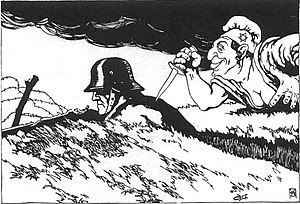
The decision that ultimately proved suicidal for the DNVP, though, was to let its own hold on reality slip and instead embrace a comforting popular mythology: Dolchstosslegende,  the theory that Germany only lost World War I because its valiant army was stabbed in the back by traitors on the home front, who were often portrayed as Jewish.

Once the competition shifted to who could tell the most compelling and energizing myth, Germany’s aristocrats and conservative intellectuals were lost. They had hoped to harness popular grass-roots mythology and prejudices against Weimar’s Social Democrats and Communists. But Hitler and his Nazis were much better equipped for that job. What DNVP politicians indulged in as a vice, Hitler saw as a virtue. Freed to tell whatever story he and his public wanted to hear, he was far more convincing.

Sunrise, sunset. Ziblatt is focused on why democracy might fail to take hold in a country, not how it might decay, so he says nothing about contemporary America. But I find the parallels to Trump and Trumpism unavoidable: The conservative role that Ziblatt sees as necessary for a healthy democracy needs a sane and sensible conservative party to fill it. We don’t have one.

In any democracy, some people are going to believe that change is happening too fast, and that old ways that have worked well enough for a long time should not be cast aside lightly. Some sizeable slice of the electorate is going to feel that the reality of what they are being asked to give up is more valuable than the gains they are being promised. Some voters will be skeptical of government programs, or will want to use the power of government to keep what they have rather than right ancient wrongs that seem intractable anyway. Others will grow tired of the governing coalition, whatever it is, and want a change of faces, but not a revolution.

Those people need a place to go, a party that represents them without raising their deepest fears and exploiting their darkest passions. The Republican Party, the party of people like Dwight Eisenhower and Gerald Ford, used to be such a place.  It no longer is.

Two generations of leaders — from Richard Nixon and Ronald Reagan, through the two Presidents Bush, and up to Mitch McConnell and Paul Ryan — thought they could harness the electorate’s darker, more virulent impulses without being tainted by them. During elections, they could dog-whistle to racists, delegitimize journalism and science, and wink at myths from the Trilateral Commission to global-warming-is-a-hoax to Birtherism — and then govern like rational men.

They never saw Trump coming. The vices they indulged in during campaign season are the virtues he practices every day. He leads the rabble they merely exploited, and glories in the adulation of those they were ashamed to be seen with.

Germany only made it to a stable democracy after it crashed and burned; and for decades democracy only took hold in the part occupied by the armies of foreign democracies. Spain, Portugal, France, and Greece had to endure periods of autocracy, sometimes multiple periods. I don’t know any examples of corrupted conservative parties that reformed themselves without disaster.

I may not be optimistic, but still I have to hope that our Republicans can be the first. If they’re going to reform, though, they need to understand where they are: A simple return to the pre-Trump status quo will just lead to another Trump. They need to go back much further. A less virulent strain of mythology won’t do the trick. For the sake of America, the party needs to return to solid standards of truth and fact. It needs to confront real issues rather than manufactured ones, and propose plausible conservative solutions.


[1] Somehow, I had let What’s the Matter With Kansas? convince me that this kind of coalition was unusual.

[2] One disadvantage Germany had was its more-nearly-even Catholic/Protestant split. British Tories could ally with “the Church”; German conservatives had to choose one church or the other.

The Brazen Cynicism of the Tax-Reform Vote


Without even the appearance of doing something good for the country, the Senate plunged ahead.


I admit it: Senate Republicans surprised me this week.

I know, it shouldn’t be shocking that Republicans would give a big windfall to corporations and the very rich. It’s what they do. Just last summer, they came within one vote of taking healthcare away from 20-some million Americans so that the wealthy could pay less tax.

Usually, though, they do a better job of giving themselves cover. The fringe of the party includes people like Susan Collins and John McCain, who try to retain at least the appearance of a conscience. It also includes clever apologists, whose arguments often obscure what’s really going on and make it possible to claim some noble purpose.

But by early Saturday morning, when the Senate passed its tax reform proposal on a nearly party-line vote, those justifications were all gone. This bill was about paying off the big donors and enriching the Trump family, and everybody knew it. Some senators continued mouthing words like growth and middle-class families, but they weren’t arguing any more, they were just lying. They weren’t fooling anybody, and they didn’t seem to care.

In the end, 51 Republicans voted for the bill, with only Bob Corker opposed. All 48 Democrats voted against it. (Remember that, the next time someone claims there’s no difference between the parties.) One by one, the last holdouts had tossed away their fig leaves and jumped into the mire.

  • John McCain, who gave such a moving speech about returning to regular order before he cast the deciding vote against ObamaCare repeal in July, was unperturbed by a very similar process this time, in which the 479-page bill was not available for inspection until a few hours before the vote.
  • Susan Collins, who in the summer seemed to worry deeply about people losing their health insurance, stopped worrying and accepted the Senate leadership’s promises about future legislation that I will be very surprised to see pass the House (unless it’s paired with a whole bunch of really bad things).
  • Jeff Flake, who (like just about all Republicans) seemed to believe during the Obama years that the deficit was a looming catastrophe, and who supposedly had achieved his independence by choosing not to run for re-election, decided that an extra trillion or two of debt really wasn’t worth getting excited about.

So this is where we are: A similar-but-not-identical bill passed the House in mid-November, so a conference committee will have to work out a compromise bill that both houses can pass. In other words, there is still room for something to go wrong, but some bill of this form is increasingly likely to become law by the end of the year.

The numbers. All along, independent analyses from the Tax Policy Center, the Penn-Wharton Budget Model, and even Congress’ own CBO had been telling a very consistent story: The bill would lead to major increases in the deficit with little-to-no long-term benefits for anybody but the wealthy.

This conclusion was supported by anecdotal evidence. The centerpiece of the bill — lowering the corporate tax rate from 35% to 20% — was supposed to generate massive new investments in production, creating so many jobs that workers would have bargaining power again, raising wages for everybody. But whenever actual corporate CEOs were consulted, they said they would pass the money on to shareholders through dividends or stock buy-backs rather than build new factories or pay workers more. Bloomberg reported:

That money is also unlikely to spur hiring because companies are already well-capitalized and can bring on as many employees as they need, said John Shin, a foreign-exchange strategist at Bank of America Merrill Lynch.

“Companies are sitting on large amounts of cash. They’re not really financially constrained,” Shin, who conducted a survey of more than 300 companies asking their plans for a tax overhaul, said in an interview. “They’re still working for their shareholders, primarily.”

Right up until Thursday, though, Republicans were hoping more favorable numbers would appear. Congress’ Joint Committee on Taxation hadn’t weighed in yet, and they were known to use the dynamic-scoring model conservatives favor, the one that figures in the effects of tax-cut-induced growth. The Treasury Department supposedly had over 100 people churning out analyses; presumably Secretary Mnuchin had seen their preliminary results when he claimed that the proposal wouldn’t just be deficit neutral, it would “pay down debt” by generating more new revenue than the tax cuts gave up.

The JCT analysis came out Thursday, just hours before the Senate was scheduled to vote. Its most favorable dynamic scoring said that increased economic growth would restore about 1/3 of the revenue lost, so that the deficit would only increase by $1 trillion rather than the nominal $1.5 trillion. A third is better than nothing, but even if you allowed for growth, the deficit was going up.

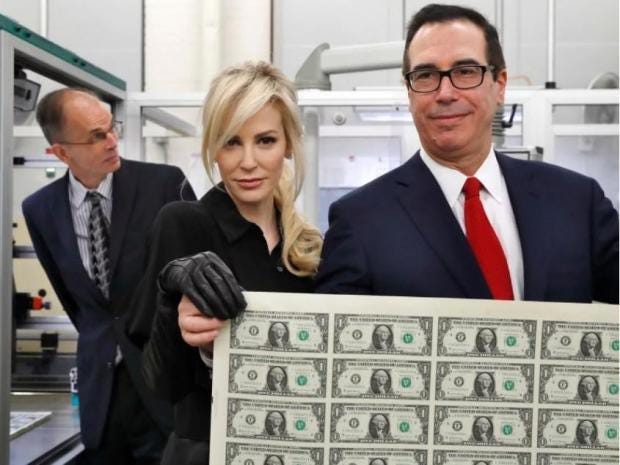
Would this guy lie to you?

But what about Mnuchin and the Treasury? It turned out that they had no analysis, or at least none they were willing to make public.

Those inside Treasury’s Office of Tax Policy, which Mr. Mnuchin has credited with running the models, say they have been largely shut out of the process and are not working on the type of detailed analysis that he has mentioned. An economist at the Office of Tax Analysis, who spoke on the condition of anonymity so as not to jeopardize his job, said Treasury had not released a “dynamic” analysis showing that the tax plan would be paid for with economic growth because one did not exist.

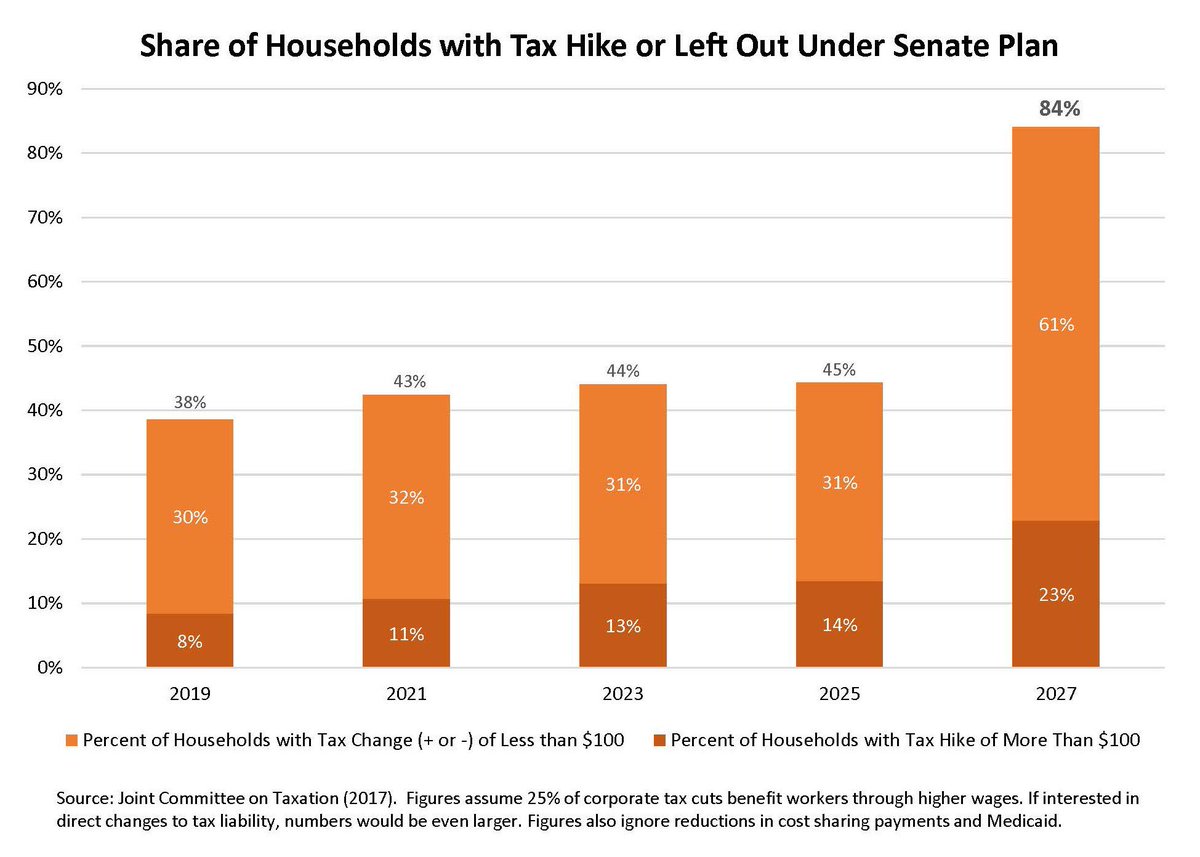
So Mnuchin’s many public statements about tax reform had been airy nonsense, grounded in nothing. Meanwhile, here’s what the JCT projected for American families:

(Here’s the same information as a series of charts.) In other words: More than 1/3 of U.S. households will never get anything out of this bill, not even in the first few years. That situation gets progressively worse until nearly all the individual cuts expire in 2027, at which point about 1 in 4 are paying higher taxes, while only 16% still see a tax cut of more than $100.

Senate Republican Whip John Cornyn dealt with this convergence of expert analysis by saying, “I think it’s pretty clear they’re wrong.” Just because.

Full speed ahead. The original plan had been for the Senate to vote on Thursday. But the surprising (to some) revelation that the JCT analysis agreed in principle with all the other analyses, that nothing to the contrary would being coming out of the Treasury, and so the claims they were making had literally no basis — it threw a wrench into the process.

Many options were possible at that point. The bill could have gone back to committee to be scaled down into a defensible form. Maybe 20% was a bridge too far, and corporations would have to be satisfied with a 25% tax rate. That would create some room to fulfill the original stated purpose of the bill: cutting middle-class taxes for real this time.

Maybe the deficit didn’t have to go up, either. Back in 2012, President Obama had proposed a 28% rate that he claimed would produce more revenue than the 35% rate, without any analytic sleight-of-hand. Both parties have acknowledged for years that our high-rates-with-many-loopholes corporate tax system is inefficient. With a little genuine give-and-take, leaders on both sides might assemble a bipartisan coalition of  60 votes or more, avoiding the reconciliation process entirely.

Or, Mitch McConnell could scrawl a few last-minute changes in the margins to assuage the doubts the last few Republican hold-outs, and the Senate could shamelessly go forward with a bill to borrow an extra trillion dollars or more so that the GOP could give a big Christmas present to the very rich. But if they were going to do it, they’d better do it fast, before the public was able to organize against this already very unpopular bill.

By now, you know which choice they made.

The people they betrayed. One way the Senate got its bill to fit onto the procrustean bed of the $1.5 trillion-over-ten-years price tag authorized by the FY2018 budget resolution was to make of a now-you-see-it, now-you-don’t gimmick Paul Krugman refers to as Schroedinger’s tax hike. The budget numbers work because only the corporate tax cuts are permanent; the individual cuts mostly phase out, resulting in this graph from the JCT.

(These numbers refer to an earlier version of the bill, but I believe a similar graph could be drawn for the current version.)

Republicans are arguing that those tax breaks [for individuals] won’t actually be temporary, that future Congresses will extend them. But they also need to assume that those tax breaks really will expire in order to meet their budget numbers. So the temporary tax breaks need, for political purposes, to be both alive and dead.

So either individual taxes will turn sharply upwards in 2025, or the tax-reform bill costs a whole lot more than $1.5 trillion. It’s one or the other. Ezra Klein points out the “pure fraud” in the deficit arguments Republicans have been making for years.

The GOP spent the Obama years in a frenzy over debt and deficits. Now they are passing a tax bill that will add trillions to the national debt, complete with budget gimmicks that, if they play out the way Republicans are publicly hoping they will play out, will lead to an even higher price tag.

When a Democrat is in the White House, the national debt is an existential crisis that threatens to bring down the Republic. But that threat magically vanishes when a Republican takes office.

So if you believed what Republicans told you about the deficit then, they’ve betrayed you now. But they’ve also betrayed you if you believed the populist side of Trump’s 2016 message. Because here’s where we are, prior to this bill becoming law: The national debt is around $20 trillion, and is already projected to increase to $30 trillion over the next ten years. Rather than do anything about that, Congress is in the act of tossing another trillion or two on top it. (BTW: In the speech where he announced his candidacy, Trump said: “$24 trillion— we’re very close— that’s the point of no return. $24 trillion. We will be there soon. That’s when we become Greece. That’s when we become a country that’s unsalvageable. And we’re gonna be there very soon.”)

So what about that big infrastructure project Trump talked about? (“So we have to rebuild our infrastructure, our bridges, our roadways, our airports. You come into La Guardia Airport, it’s like we’re in a third world country.”) Where’s the money for that going to come from? How’s he going to keep his promise not to cut Medicare, Medicaid, and Social Security, once the trillion-a-year deficits start happening? (“Save Medicare, Medicaid and Social Security without cuts. Have to do it.”)

He won’t keep that promise. He’s already breaking it.

If this passes, there will be no money left for populism, and no money left to save the programs the middle class depends on. They’ll have given it all to the rich.

They’re doing it as you read this, and they’re being totally brazen about it.

The Looming End of Net Neutrality (and why you should care)

Should the economy be organized to benefit producers and consumers, or a few big middlemen? We’ve been answering that question wrong since Ronald Reagan, and we’re about to do it again.


The FCC, with its new Republican majority, is proposing to end the era of net neutrality. If you’re some kind of internet nerd, you probably already know exactly what that means and have had a strong opinion about it for a long time. If not, though, it probably sounds like one of those intense debates nerds often have about mysterious topics like databases or user interfaces: You have no idea what they’re talking about, you don’t bother to find out, and whatever results from the argument, it never seems to bite you.

This one is going to bite you. When the bite comes, it might arrive in a form you won’t easily connect back to this decision. But it is going to bite you. It’s going to bite the whole economy.

To explain how and why, let me detour through a subject you probably do care about: economic inequality. Here’s a graph I keep posting in one form or another, because I think it points to the most significant fact in American politics: Up until around 1980, median income closely tracked productivity. And then something happened to disconnect them. Productivity kept increasing, but median income stagnated.

Unsurprisingly, this has led to a concentration of income at the top: The people who make wages have lost ground, while the people who pay wages have gained.

And the greatest concentration has been at the very tip-top: The share of wealth held by the top tenth of a percent has reached levels not seen since the Great Depression.

So what happened in 1980? The facile answer is that Ronald Reagan was elected president. But that explanation is too simple, because a president doesn’t deal out national wealth like a deck of cards. What did Reagan do, if anything, that touched off this new Gilded Age of concentrated wealth?

Again, there’s a too-simple answer: He cut taxes on the rich, and he broke unions. Those actions certainly did help the wealthy and harm the middle class, but they’re not enough to explain what happened. If that were all he did, subsequent presidents should have been able to undo it.

To really understand the Reagan impact, you need to apply David Graeber’s definition of a successful revolution: Reagan changed the political common sense of his era in a way that has stuck ever since. Since Reagan, one of the basic debates in American politics has been framed as Freedom vs. Regulation, with a corollary debate of Productivity vs. Regulation. In each case, Regulation was framed as the wrong side to be on: It limits our freedom and strangles our productivity.

The result has been a completely reshuffled economy, which I first started discussing in a 2012 post “Monopoly’s Role in Inequality“.

[M]arkets are created by rules, and the rules can be structured to favor either the ends (producers and consumers) or the middle. Producers and consumers benefit from transparent markets, where the rules force middlemen to treat everyone more-or-less the same.

But markets can also be structured to give middlemen as much freedom as possible. The most profitable way to use that freedom is to create choke-points where a toll can be extracted or one producer can be played off against another. In an opaque market, the way to get rich is not to produce things, but to build middleman power that allows you to dictate terms up and down the supply chain.

What we have today, after nearly 40 years of freedom-for-the-middleman de-regulation, is an economy full of choke points. The path to vast wealth is not to make something people want (as Henry Ford made cheap automobiles) or to discover something people need (as J. Paul Getty and H. L. Hunt found oil), but to insinuate yourself between producers and consumers, create a monopolistic choke point, and charge tolls.

WalMart and Amazon, for example, are choke points; if you want to sell a product to the general public, you have to deal with them on their terms. Visa and MasterCard are choke points; retailers need them, and have to pay whatever fees they set. Cable companies are choke points; creators of TV shows can’t reach viewers without them. Google is a choke point; if you’re hoping to get around WalMart and Amazon by selling over the internet, your website needs to show up when people search for your type of product. [1]

The upshot is that post-Reagan America is no longer a place where you can build a better mousetrap and expect the world to beat a path to your door. Instead, you build the mousetrap, and then you pay off the owners of the choke points between yourself and the mousetrap-buying public. Maybe some small profit will be left for you and maybe it won’t, but the choke-point owners will do well. [2]

There are a few things worth noticing about this situation:

  • In the short run, the choke-point owners often look like the good guys. Amazon has low prices; Visa gives you cash back. Middlemen often temporarily align with consumers in order to gain more power over producers. But the pattern of all monopolists remains: Once power is consolidated, it will encroach in both directions.
  • We all need producers. You’re not just a consumer who spends money, you need to make money too. And since ordinary people have no chance of owning their own choke points, most of us have to make money by finding a place on the productive side of the economy, by participating in the delivery of some good or service. Choke points stop middle-class people from moving up by starting their own businesses, and they siphon money away from the kinds of productive businesses that hire people.
  • “Freedom” can be anti-productivity. Given the prevailing post-Reagan political common sense, that sounds like a contradiction, but it really isn’t. If middlemen have freedom to play producers off against each other and keep the lion’s share of profits for themselves, then more of the economy’s investment will be in middlemen, and less in producers. Conversely, regulations that limit the power of middlemen are pro-productivity.

Now let’s get back to net neutrality: The point of net neutrality regulations is to control middlemen who own a major chunk of our economic infrastructure: the internet service providers like Comcast, Verizon, and AT&T. Once they’re freed from regulation, you can expect them to set up choke points and charge tolls. (This is how it works in Portugal.)

If you provide some service over the internet, for example, you will find yourself competing for the favor of ISPs rather than consumers. Maybe Netflix will pay Verizon so that its streaming service comes in faster and with higher quality than Amazon Prime; or maybe Amazon will outbid it. [3] In either case, the new revenue stream for Verizon either means higher prices for consumers or less spent by Amazon or Netflix on new content. It’s basically just a wound through which Verizon can suck blood out of the productive economy.

Wired suggests that we guess how the ISPs will use this power by looking at what they already do in data-limited plans:

When AT&T customers access its DirecTV Now video-streaming service, the data doesn’t count against their plan’s data limits. Verizon, likewise, exempts its Go90 service from its customers’ data plans. T-Mobile allows multiple video and music streaming services to bypass its data limits, essentially allowing it to pick winners and losers in those categories.

Consumers will likely see more arrangements like these, granting or blocking access to specific content … Net neutrality advocates have long worried that these sorts of preferential offerings harm competition, and by extension, consumers, by making it harder for smaller providers to compete. A company like Netflix or Amazon can likely shell out to sponsor data, but smaller companies don’t necessarily have the budget. … the future internet, then, could look a more extreme version of today’s mobile plans, with different pricing tiers for different levels of video quality for different apps. That means more customer choice, but perhaps not in the way anyone actually wants.

In the conservative fantasy world, the toll collectors will use some fraction of their windfall profits to improve their broadband networks (just as corporations in general will generously use their Trump tax cuts to hire more workers and pay them higher wages). In reality, though, it will be one more opportunity for parasites to latch on to the productive economy. The parasites will do well; ordinary people, not so much.


[1] Apple is an interesting hybrid. It makes things people want, like iPhones. But it too sees how the post-Reagan economy works and wants to evolve into a choke-point company. Already, its App Store is a choke point for software builders, iTunes is a choke point for music producers, and it would like ApplePay to become a choke point upstream from Visa and MasterCard.

[2] A choke point I face on this blog is Facebook. Three years ago, Facebook’s algorithms allowed posts on no-name blogs to go viral. (2014’s “Not a Tea Party, a Confederate Party” got more than half a million hits.) Now that’s much harder. (2017’s most popular Sift post has less than 4,000 hits.) Meanwhile, I’m constantly bombarded with suggestions that I should pay Facebook to get more visibility. I suspect Google does something similar to video bloggers on YouTube.

The analogy isn’t quite perfect, because I’m not trying to make money off my readers. But Josh Marshall at TPM is trying to make money, in an environment he described recently as a “digital media crash“. The situation was tough to begin with, and then …

Then came the platform monopolies: Google, Facebook and a few others. Over the last five years or so but accelerating rapidly in the last 24 months, they’ve gobbled up almost all of the growth in advertising revenue and begun to engross a substantial amount of the existing advertising revenue as well.

That increased flow of money to the platform monopolies takes it away from the actual journalists who find out things and explain them to you.

[3] One article endorsing the FCC proposal points to the ambiguous role of choke-point giants like Amazon and Google.

Net neutrality’s dubious value is made obvious by the misleading way Democrats and many news outlets reported the decision. “F.C.C. plans net neutrality repeal in a victory for telecoms,” wrote the New York Times. Missing from the headline or lede was that the decision was a loss for Netflix, Amazon, Google, and other corporate giants that provide content.

The logic of this should be obvious: Amazon and Google are on the side of the general public on this issue, but for their own reasons: They don’t want new choke points to be constructed upstream from their choke points.

Roy Moore: Are we really having this conversation?

By now you know the basics: Thursday, the Republican senate candidate in Alabama got accused of drawing a 14-year-old girl into a sexual encounter when he was 32, back in 1979. As Josh Moon of Alabama Political Reporter put it:

For nearly 40-year-old allegations, the Post’s story was about as solid as it could be.

In other words: We’re not talking about rumors-backed-by-anonymous-sources. The Washington Post article that broke the story names and quotes the 14-year-old (Leigh Corfman, now 53). Three other women (also named) tell similar, if less extreme, stories about Moore:

Moore pursued them when they were between the ages of 16 and 18 and he was in his early 30s, episodes they say they found flattering at the time, but troubling as they got older.

The Post found these women; they didn’t come forward on their own. (The one detail I’d still like to hear is how the reporters found the women.)

Neither Corfman nor any of the other women sought out The Post. While reporting a story in Alabama about supporters of Moore’s Senate campaign, a Post reporter heard that Moore allegedly had sought relationships with teenage girls. Over the ensuing three weeks, two Post reporters contacted and interviewed the four women. All were initially reluctant to speak publicly but chose to do so after multiple interviews, saying they thought it was important for people to know about their interactions with Moore. The women say they don’t know one another.

Other details are corroborated: Corfman’s mother remembers the incident where her daughter met Moore, and recalls Corfman telling her about Moore’s advances in the 1990s, when they saw his picture in a newspaper. (Moore says he never met her.) Two of Corfman’s childhood friends (one of them named, the other anonymous) remember her talking about an older man at the time, and the named one recalls Corfman saying Moore’s name.

After the story came out, CNN found more corroboration from Teresa Jones, who was a deputy district attorney working in the same office as Moore at the time:

It was common knowledge that Roy dated high-school girls. Everyone we knew thought it was weird. We wondered why anyone his age would hang out at high school football games and the mall.

In other words, if the story is a smear, it would have to be a fairly large conspiracy, and there’s no way the Post’s reporters aren’t in on it. Is that really the most likely explanation?

Moore has called the accusations “outlandish“, “garbage”, and “politically motivated”, and he says he’ll sue the Post. (I’ll bet we never see that suit.) But there’s something a little off in his denials. In an interview with Sean Hannity, who surely was not trying to trip him up, he claims not to remember Corfman (“I never knew this woman.”), though he does remember two of the women who claimed he approached them when they were teens. (He “generally” didn’t date teen girls, he says.) He doesn’t remember going out on dates with them, or giving one of them alcohol even though she was under the drinking age (as she reports). He did date “a lot of young ladies” at that point in his life, but he doesn’t remember having a girlfriend in her late teens, and “I don’t remember ever dating any girl without the permission of her mother”.

I would guess that most 30-something men don’t remember dating any girl who needed the permission of her mother. But that phrase is suggestive of something else, as I’ll discuss in a few paragraphs.

The political situation. Moore is running in a special election for the remainder of Jeff Sessions’ term in the Senate, which lasts until 2020. The election will be held December 12. It’s already too late to replace Moore’s name on the ballot, though write-ins are possible. However, it’s hard to imagine a Republican write-in candidate succeeding without Moore stepping aside.

Other options are described in the NYT: The governor could delay the special election, which she says she won’t do. If Moore wins, the Senate could refuse to seat him. The Constitution addresses this possibility:

Each House shall be the Judge of the Elections, Returns and Qualifications of its own Members … Each House may determine the Rules of its Proceedings, punish its Members for disorderly Behaviour, and, with the Concurrence of two thirds, expel a Member.

Ironically, Moore quoted this same passage in 2006 as part of an argument that the House should not seat Rep. Keith Ellison because he’s a Muslim. In Moore’s case, two-thirds would mean all 48 Democratic senators and 19 of the 52 Republicans. Expulsion would set up another special-election situation.

Before the story broke, the RCP polling average on this race had Moore ahead of Democrat Doug Jones by 6 points, with one poll putting the margin at 11. I had been thinking that the polls understated Moore’s lead, because the Raven Republicans (“never Moore”) probably would have come around the same way most never-Trump Republicans did.

Maybe they still will, but there appears to be an initial reaction to the story: A Thursday-to-Saturday poll had Democrat Doug Jones ahead of Moore 46%-42%, or 48%-44% when Undecideds were pushed to make a choice. Another poll, however, shows Moore’s lead shrinking, but still at 10%.

Defense in depth. National Republicans are either partially or totally against Moore. The safe line is Mitch McConnell’s: Moore should get out of the race “if these allegations are true”. But a few national figures have gone further: John McCain left out the “if” and just said “He should immediately step aside.” Mitt Romney was even blunter:

Innocent until proven guilty is for criminal convictions, not elections. I believe Leigh Corfman. Her account is too serious to ignore. Moore is unfit for office and should step aside.

Pennsylvania Senator Pat Toomey said on “Meet the Press” Sunday that the accusations are more credible than the denials, and Moore should drop out.

But a number of Alabama Republicans have rallied around Moore. Many are simply repeating his charge that the whole thing is a political smear. A number of them, though, have gone further: Even if the allegations are true, they’re just not that bad, or at least not bad enough to allow another Democrat into the Senate.

State Auditor Jim Ziegler offered this as evidence that Moore’s intentions were honorable: He eventually married “one of the younger women”. Moore’s wife was 24 when he married her at age 38. (I had a similar thought — that Moore’s choice of wife proves that he has an eye for younger women — but I wasn’t planning to go there until I heard Ziegler do it.) Also, Joseph was much older than Mary when they married and raised Jesus. (If the sheer absurdity of this doesn’t faze him, I wonder why he doesn’t make an even stronger claim: Think how much older God was when He got Mary pregnant.)

The religious divide is bigger than you think. In general, American Christians tend to picture extreme Christians as like themselves, only moreso: They attend church more often, take the Bible more literally, are more offended by sinful behavior, and so forth. But the Moore controversy is uncovering a conservative Christian subculture that is totally outside the mainstream.

In particular, the claim that there’s nothing wrong with 30-something men pursuing just-out-of-puberty girls is related to a “traditional” view of marriage that most American Christians would find repellent: A 14-year-old girl isn’t going to be an equal partner with a 32-year-old man; but if a wife’s only purpose is to obey her husband and have a lot of babies, she can do that as well an adult woman. Maybe better.

That’s not middle-of-the-road Christianity only moreso, it’s a whole other worldview. Writing for The L.A. Times, Kathryn Brightbill describes growing up within that world, where Duck Dynasty star Phil Robertson (whose son Willie spoke at the Republican Convention) advocates marrying 15-year-old girls. (His own wife was 16, and he started dating her when she was 14.) And speakers at conventions for Christian home-schoolers both advocated an exemplified such marriages.

We need to talk about the segment of American culture that probably doesn’t think the allegations against Republican Senate candidate Roy Moore are particularly damning, the segment that will blanch at only two accusations in the Washington Post expose: He pursued a 14-year-old-girl without first getting her parents’ permission, and he initiated sexual contact outside of marriage.

If anything bad happens, of course, it is the girl’s own fault.

Much of the sexual abuse that takes place in Independent Fundamentalist Baptist, or IFB, churches involves adult men targeting 14- to 16-year-old girls. If caught, the teenage victim may be forced to repent the “sin” of having seduced an adult man. Former IFB megachurch pastor Jack Schaap argued that he should be released from prison after being convicted of molesting a 16-year-old girl, asserting that the “aggressiveness” of his victim “inhibited [his] impulse control.”

Nancy French relates similar experiences in The Washington Post.

I was delighted when the preacher volunteered to drop me off. As we drove, I chatted incessantly, happy to have him all to myself without people trying to get his attention in the church parking lot. When we got to my house, I was shocked that he walked me inside my dark house, even more surprised when he lingered in conversation, and thunderstruck when he kissed me right on the lips.

At 12 years old, I swooned over my good luck. He picked me out of all the girls at church. But the relationship, especially after he moved on, reset my moral compass. If all the church conversation about morality and sexual purity was a lie, what else was fake? Now that the “family of God” felt incestuous, I rejected the church and myself. Didn’t I want the preacher’s attention? Didn’t I cause this?

What this is all going to turn on is whether Alabama’s Christians, even those inclined to vote Republican, take a hard look at Roy Moore’s version of Christianity, and realize that they have very little in common with it. Ross Douthat might be a model:

One lesson is that any social order that vests particular forms of power in men needs to do more, not less, to hold the male of the species accountable.

Some cultural conservatives, in evangelical Christianity especially, combine a belief in male headship in churches and families with a “boys will be boys and girls shouldn’t tempt them” attitude toward sex. It’s a combination that’s self-contradictory and deeply toxic, handing men not just power but a permission slip to abuse it — which, predictably, they do.

What Did Virginia Teach Us?

For weeks on this blog, I’d been fretting about the Virginia governor’s race. If we were really in the midst of a Democratic surge that might turn 2018 into a wave election, Virginia shouldn’t have been this tense. Hillary had won there last year (by 5%, aided by a Virginian VP) and Democrats already held the governorship (thanks to Terry McAuliffe’s 2.6% win in 2013). Maybe that didn’t point to a landslide, but surely we couldn’t lose.

Or maybe we could, or at least it looked that way for a while. Polls were averaging out to a 3% Northam advantage, with some showing Gillespie ahead. And Gillespie had been closing with a disturbingly Trumpish message: Northam was going to let Hispanic criminal gangs run wild in Virginia, while Gillespie would protect the monuments celebrating all those heroic Confederate defenders of slavery. And kneeling athletes were relevant somehow.

If he pulled off the upset, Gillespie’s campaign seemed likely to become a model for Republican candidates to keep on Trumping in 2018: Count on fear and race-baiting to bring the base out to vote, and hope Democrats stay home.

It didn’t work out that way. Northam won by 9%. That’s a big enough win to keep the 2018-wave narrative intact: Northam didn’t just repeat Hillary’s showing, he nearly doubled her margin, and more than tripled McAuliffe’s.

But beyond the horse-race aspect, what did we learn?

White identity politics isn’t enough. The clearest lesson is for Republicans: In 2016, Trumpism had two pieces, not just one. Yes, white Christian identity politics was a big chunk of it, but economic populism was another big chunk.

It wasn’t all just building a wall and banning Muslims and winking at the alt-Right. Trump was also going to bring factory and mining jobs back to America’s small towns. He had a healthcare plan that was going to “take care of everybody … the government’s going to pay for it”. He was going to protect Social Security, Medicare, and Medicaid. He would get tough with China and Mexico — not because the Chinese and Mexicans aren’t white, but because they had perpetrated “the greatest jobs theft in the history of the world“.

Trump voters who were attracted to his white Christian identity politics should still be happy with him. He put Gorsuch on the Supreme Court, he’s got ICE out terrorizing Hispanic immigrants, and he never misses a chance to stand up to ungrateful blacks, defend the Confederacy, or blame Muslims or immigrants (or best of all, Muslim immigrants) for America’s problems.

But the economic-populist side of Trumpism hasn’t been seen since the election.

Health care bills he endorsed would cut billions in Medicaid funding over the years, his tax plan is a bonanza for the wealthy, the budget the GOP passed to facilitate that tax plan cuts Medicare by billions, and Trump’s own budget proposal included billions in Social Security cuts.

Buy American, hire American” has proven to be an empty slogan, and the executive order that supposedly implements it has no real substance. (Not even Trump’s own companies live by it.) Tough on China? Not so much. In April he broke his promise to label China a currency manipulator, and when he went there this week.

Mr. Trump projected an air of deference to China that was almost unheard-of for a visiting American president. Far from attacking Mr. Xi on trade, Mr. Trump saluted him for leading a country that he said had left the United States “so far behind.” He said he could not blame the Chinese for taking advantage of weak American trade policy.

This is, in part, a consequence of his saber-rattling against North Korea: He needs China’s cooperation there, so he’ll have to give in to them on trade.

And Mexico? Let’s just say that they’re not paying for the Wall. Renegotiating NAFTA is proving to be a lot more difficult than just “getting tough” and making bigger demands. If the agreement winds up getting scrapped, the big loser will be American farmers and precisely those rural communities that were counting on Trump for help.

Given that Trump himself has abandoned economic populism, the only “Trumpism” left for Gillespie to adopt was the white Christian identity part. And while that stuff is really powerful for some Americans, those people aren’t a majority. Not in Virginia and not in America as a whole.

I’m not sure how Republicans running in 2018 can deal with this problem. What the Republican majority in Congress has been all about (with Trump’s blessing, for the most part) is traditional Republican trickle-down economics. 2016 Trumpism was unified by an I’m-going-to-protect-you theme, protecting his voters on the one hand from a future where white Christians are a minority, and on the other from a convergence of foreign competition, corporations who have no loyalty to their workers, and economic trends moving against them. A 2018 of message of “I protected you from Mexicans and Muslims and transgender people in your bathroom, but I tried to take away your health insurance and gave your boss a big tax cut” doesn’t hang together nearly as well.

Unity, calmness, confidence. On the Democratic side, the lesson is fuzzier, but I think there’s still something to learn.

The progressive/centrist split in the national party tried to project itself onto the primary, but it never really took. Superficially, the Bernie-backed progressive (Tom Perrillo) lost to the establishment candidate (Northam), but the divide between them was never that large, and Perrillo supported Northam in the general election seemingly without reservations. Northam, in turn, endorsed a number of progressive causes: $15 minimum wage, free community college, restoring voting rights to felons who have served their time, and Medicaid expansion.

Northam took advantage of his comforting image as a pediatrician, and talked calmly about jobs, healthcare, and education. He appealed to traditional Virginia gentility, saying of Trump “We’re not letting him bring his hate into Virginia.”, and (on just about every issue) talking about all Virginians working together to find solutions. That, of course, is a traditional political bromide, but it contrasts nicely with scare-mongering about immigrants.

In part, Northam did that because he had to — it’s hard to picture him shouting and rabble-rousing. But I wonder if that isn’t the right approach: progressive positions on issues, expressed calmly in terms of traditional American values like justice and fairness, rather than in a way that makes them sound radical. Northam’s manner projected confidence that our problems are solvable if we work together — and not solvable if we let people take advantage of our worst instincts and turn us against each other.

Whatever approach Democratic candidates take in 2018, it needs to take advantage of the hole in the Republican message: The vague economic populism of 2016 was a mirage. Republicans have been telling white Christians who to blame for their problems, but not offering viable solutions.

Where it shows up, and where it doesn’t. The exit polls can be sliced and diced all sorts of ways, but here’s what jumped out at me: Gillespie slightly exceeded Trump’s totals among low-income households (under $50K annually) and high-income households (over $100K), but Northam clobbered him among middle-income households. In the $50-$100K bracket, Trump edged Clinton 49%-47% in 2016, but Northam beat Gillespie 57%-41% Tuesday. That’s what turned an overall 5% Clinton margin into a 9% Northam margin.

So I went back and looked at the 2013 exit polls: The Republican candidate won the $50K-$99K households 51%-43%, almost the exact mirror image of the 2017 result. So maybe this is a trend.

I could imagine a lot of reasons: Maybe the middle-income people who changed their minds have health insurance, but aren’t sure they can keep it. They value education, but have to depend on the public schools. They plan to send their kids to college, but aren’t sure they’ll be able afford it. They’re not angry and looking for someone to blame, but they are worried and looking for a reason to hope.

I don’t have a good explanation for why the low-income households haven’t shifted. Clinton carried them 53%-41%, and Northam’s margin was about the same: 56%-43%. Maybe a more dramatic message would have helped Northam here; I don’t know.

RCP’s Ross Baird found another interesting way to look at the results: He examined Virginia’s five “pivot counties”, counties that went Obama-Obama-Trump in the last three presidential elections: They were dead heats Tuesday. What most pivot counties have in common, he says, is that “more businesses have died there than have been born … despite a net increase in entrepreneurial activity across the country since the end of the Great Recession.”

That suggests that Democrats still haven’t completed the sale. Trump may have lost his shine, but there are still Obama voters Democrats aren’t reaching.

Rigged?

The relationship between the Clinton campaign and the DNC was more incestuous than we thought. Does it follow that the primaries were rigged and the nomination was stolen?


Thursday, former Democratic National Committee chair Donna Brazile rocked the Democratic Party when an excerpt from her upcoming book was released by Politico. It begins shortly after the 2016 Convention, with Brazile taking the DNC’s acting chairmanship and promising Bernie Sanders that she’ll “get to the bottom of whether Hillary Clinton’s team had rigged the nomination process”. Though the excerpt never again uses the word rigged (and Brazile herself denied Sunday that the primaries were rigged), her strong implication is that the answer is Yes:

By September 7, the day I called Bernie, I had found my proof and it broke my heart.

The basic story she tells is that in 2015 the DNC was deep in debt, the Clinton campaign bailed it out, and in return it got control over many DNC decisions, like who the communications director would be, and veto power over a few other appointments. The memo outlining this agreement has since come out. As Brazile says, it outlines a surprising and ethically questionable degree of incest between the DNC and the Clinton campaign. However, it also includes this paragraph, which Brazile didn’t mention:

Nothing in this agreement shall be construed to violate the DNC’s obligation of impartiality and neutrality through the Nominating process. All activities performed under this agreement will be focused exclusively on preparations for the General Election and not the Democratic Primary.

So the big questions are: In spite of that paragraph, did the DNC violate its obligation of impartiality and neutrality? If so, did it do so in ways that made a material difference? And does this validate the claims Sanders supporters have been making all along, that the nomination was stolen away from Bernie?

How it looked at the time. During the campaign, claims from Sanders supporters that Clinton was rigging the primaries would periodically show up in my social-media feeds, and I’d check them out as well as an ordinary person with access to the internet reasonably could. I never found anything that held up, or that went beyond what I considered normal politics, where candidates are always jockeying for some kind of advantage.

It was clear to me that people at the DNC were rooting for Hillary to win, but I didn’t consider that shocking. If you’re in politics, you have political opinions; nobody is neutral in their hearts. Folks at the RNC were obviously rooting against Trump, too, and would have been much happier nominating Bush or Rubio. (I’m sure if you bugged the umpire’s locker room at a baseball stadium, you’d occasionally hear them talking about players they like and don’t like, because they were all baseball fans before they became umpires.) The question isn’t what DNC officials thought, or even the opinions that they traded with each other in emails they didn’t expect anyone else to see. The question what they did.

Brazile comments on that:

I had tried to search out any other evidence of internal corruption that would show that the DNC was rigging the system to throw the primary to Hillary, but I could not find any in party affairs or among the staff. I had gone department by department, investigating individual conduct for evidence of skewed decisions, and I was happy to see that I had found none.

Most of the theories I kept seeing went far beyond what the DNC would be able to do, even if it was completely suborned. Anything to do with polling places and vote-counting, for example, was way outside their capabilities. State and local election boards run primaries, not party national committees. But any voting irregularity in the Democratic primaries — even if it seemed just as likely to target Clinton voters — became part of the Clinton-is-stealing-Bernie’s-votes lore.

The mainstream press went through the same process I did, which is why only two specific DNC-related actions are getting mentioned in the articles about Brazile’s book:

  • the schedule of Democratic debates seemed tilted toward the candidate who didn’t need debates to get voters’ attention,
  • Hillary’s campaign pushed the legal limits of its DNC  joint-fund-raising agreement, while Bernie’s campaign ignored theirs.

What’s new? Apparently, the Clinton campaign had more control over the DNC’s side of the joint-fund-raising money than we previously knew. That money was supposed to benefit the eventual nominee and the Party’s general-election effort as a whole. For the Clinton campaign to be in control of it was not right, but there are two very different possible levels of not-rightness here.

One possibility, the less toxic one, is that Clinton wanted the general-election machinery (data collection, polling, etc.) set up in a particular way, and didn’t want to wait until September to start doing it. This would be presumptuous, treating the nomination process as a foregone conclusion. But it would not have compromised the primary campaign. If Bernie had won, he would have found general-election machinery in place, ready for his use, but designed according to Hillary’s specifications.

The more toxic possibility is that the DNC’s money got funneled back into Clinton’s primary campaign, and was used against Bernie. If that’s true, that’s a very serious thing and heads should roll. Investigators should start looking for broken laws and start prosecuting people if they find any.

However, there was no evidence at the time that the second possibility was happening, and as far as I know there still isn’t. Brazile does not make that claim, and the documents she points to would seem to ban that, if they were followed. Anyone who wants to investigate that claim should have at it, and I’m willing to be convinced if any actual evidence shows up. But so far I haven’t seen any.

A spark in the gunpowder factory. People who write books often lead with something provocative and maybe a little overstated. It gets people talking about the book and makes it a must-read for anybody who wants to stay on top of the controversy. What Brazile has done in this excerpt, then, is not that unusual. (She does something similar elsewhere, telling a very unlikely story about the possibility of replacing Clinton with Biden after the convention. Throughout, Brazile portrays herself as being uniquely prescient about the coming debacle, despite the times when Clinton had double-digit leads in the polls.)

The problem is that her book isn’t coming out in a vacuum. In addition to debate schedules and other relatively minor things that appear to have actually happened, the pro-Bernie silo on the internet is still passing around charges of pro-Clinton vote-rigging and voter suppression that the evidence just does not support. It is an article of faith in certain circles that Bernie was the true choice of the voters, who had Clinton imposed on them by nefarious means.

It’s worth remembering the official vote totals. In the Democratic primaries as a whole, Clinton got 16.9 million votes, more than 55%. Her margin over Sanders was 3.7 million votes. Claiming that Sanders actually won requires believing in a fraud of the same scale as Trump’s claim that he actually won the popular vote in the general election.

In this environment, using the word rigged tells the conspiracy theorists that they were right all along. The claims Brazile is actually making may be fairly narrow, but the conclusions that people with prior opinions will draw from it are much broader.

The Trump parallel. It’s useful to compare Sanders’ situation on the Democratic side with Trump’s on the Republican side. Both were outsider candidates running against the party establishment, harnessing grass-roots discontent and anger. In each case, the party establishment believed it would be suicidal to nominate the outsider.

Going into the 2016 cycle, I think most observers would have claimed that the Republican establishment had more power than the Democratic. Democrats had a history of previously little-known candidates sweeping in: McGovern, Carter, Dukakis, Obama. On the Republican side, nominations more typically went to the next guy in line. The power brokers of the GOP are more obvious and more powerful. No Democratic donor, for example, plays as large a role as the Koch brothers do on the Republican side.

And yet, Trump got nominated and Sanders didn’t. Trump’s path, I think, shows the overall weakness of party establishments in this era. Nobody at the RNC was able to marginalize Trump, or to force out minor candidates who were splitting the establishment vote. Throughout Trump’s rise, we kept hearing about the theory from The Party Decides, in which “invisible primaries” of insiders pick the nominee, and then insiders signal the voters, who ratify the insiders’ choice in primaries.

In 2016 that theory held on the Democratic side but not on the Republican, for the simple reason, I think, that Trump got the votes and Sanders didn’t. You may or may not like the fact that Democratic voters ratified Clinton as the nominee, but they did.

What should happen? To start with, Hillary Clinton has already told us that she’s not running for anything again, so unless laws were broken — and not even Brazile claims that — there’s really nothing to be done regarding her personally.

Obviously, the DNC will need to be extra transparent in the next cycle, and hopefully beyond. No one enters the 2020 cycle in the same commanding position Clinton had four years ago, though, so it’s hard to see how the same mistakes would be made anyway. But there needs to be some process by which we can all assure ourselves that no candidate is getting an unfair advantage from the Party.

Beyond that, there’s a bigger problem that affects the Republicans as well as the Democrats: Parties are open to being dominated by candidates like Clinton, or bullied by large donors like the Kochs, because they are inherently weak in this era. Bernie Sanders represents a different side of this problem: The Democratic Party isn’t something he belongs to (he doesn’t), it’s just a structure for seeking office.

Democrats suffer for this at the local level more than Republicans, because Republicans are more likely to be funded by state-level power brokers like North Carolina’s Art Pope, or by corporations who understand the power state government has to dole out favors. Democrats are more reliant on the star-power of national candidates like Obama or Clinton or Sanders, and the local parties correspondingly get short-changed.

It could be that we are in a transitional period, and parties will eventually go away, or come to mean something completely different. I wish I had something more to say about the coming structure, and whether it will be better or worse.