Category Archives: Articles

Is Epstein what will finally break through?

For years, Democrats have imagined that someday Trump’s dupes might return to reality and turn against him. But what if they could turn against him without returning to reality?


If you were a 2024 Trump voter, the last half-year has given you all kinds of good reasons to reassess your decision.

  • He didn’t reverse inflation like he said he would.
  • He didn’t end the Ukraine War “in 24 hours” like he said he would.
  • His Big Beautiful Bill increases the deficit he said he’d reduce.
  • He never found the millions of dangerous migrant criminals he said existed, so instead ICE is rounding up gardeners and dishwashers and moms.
  • Thanks to his Medicaid cuts, your rural hospital might close soon.
  • His on-again-off-again tariffs make it impossible for you to manage your small business.
  • Even though you worked hard and thought your office was doing something worthwhile, you lost your government job.
  • He fired the people you need to process your application for veterans benefits or Social Security.

And so on. As far as we can tell, though, hardly anybody in MAGA World cares about this kind of stuff. To the extent that Trump has lost support, it’s mainly among independents. Against all evidence, his base voters continue to believe he’s on their side, and everything that indicates otherwise is fake news.

What seems to be breaking through to them, though, is the Trump administration’s handling of information about Jeffrey Epstein, the rich pedophile who died in his prison cell in 2019. The case has exactly zero effect on their lives, but this is what they care about.

What upset them? Last week, Attorney General Pam Bondi released a memo claiming there is nothing to see: The famous Epstein “client list” that she said was “on my desk” a few months ago … well, it never existed. (Does her desk still exist? Was she ever really attorney general?) So there is no “evidence that could predicate an investigation against uncharged third parties”. And Epstein’s death was a jailhouse suicide, just like the official report said at the time.

The DOJ and FBI say in the memo that no “further disclosure” of Epstein-related material “would be appropriate or warranted.”

So: case closed. If you’ve been obsessed with Epstein, find something else to think about.

Worse, Trump himself has backed up Bondi on Truth Social.

What’s going on with my “boys” and, in some cases, “gals?” They’re all going after Attorney General Pam Bondi, who is doing a FANTASTIC JOB! We’re on one Team, MAGA, and I don’t like what’s happening. We have a PERFECT Administration, THE TALK OF THE WORLD, and “selfish people” are trying to hurt it, all over a guy who never dies, Jeffrey Epstein. … Kash Patel, and the FBI, must be focused on investigating Voter Fraud, Political Corruption, ActBlue, The Rigged and Stolen Election of 2020, and arresting Thugs and Criminals, instead of spending month after month looking at nothing but the same old, Radical Left inspired Documents on Jeffrey Epstein. LET PAM BONDI DO HER JOB — SHE’S GREAT! The 2020 Election was Rigged and Stolen, and they tried to do the same thing in 2024 — That’s what she is looking into as AG, and much more. One year ago our Country was DEAD, now it’s the “HOTTEST” Country anywhere in the World. Let’s keep it that way, and not waste Time and Energy on Jeffrey Epstein, somebody that nobody cares about.

But if we shouldn’t “waste Time and Energy” on Epstein, who “nobody cares about”, why have Trump and his people kept talking about Epstein for years?

I feel silly writing about this, because I have never cared about Jeffrey Epstein or the various conspiracy theories about his activities. Apparently, he was a rich man with a lot of rich and powerful friends. He induced a number of underage girls to have sex with him, and perhaps also with his friends. Some believe that he kept evidence of these statutory rapes to blackmail his one-time “friends”, and that their influence is what kept him out of prison so long. He was arrested in 2005 and convicted in 2008, but served an embarrassingly trivial sentence. He was arrested again in 2019 and died in his jail cell a month later. The official report on his death says that he committed suicide, but rampant speculation says that he was murdered to keep him from implicating the people he procured underage girls for.

Honestly, I’ve never cared. I feel sorry for the girls he abused. I’m glad he was arrested and I’m glad his girl-friend and co-conspirator Ghislaine Maxwell is in jail. If anybody has solid evidence that he had “clients” who also abused the girls, I’d like to see them punished too. If that group includes prominent Democrats or Hollywood bigwigs, so be it. (That’s an attitude I have towards a lot of alleged crimes: If there’s some kind of evidence, have at it.) But there’s a lot of injustice in the world, and for me this case does not stand high above many others. I have no theory about what “really” happened to Epstein, and no interest in forming one.

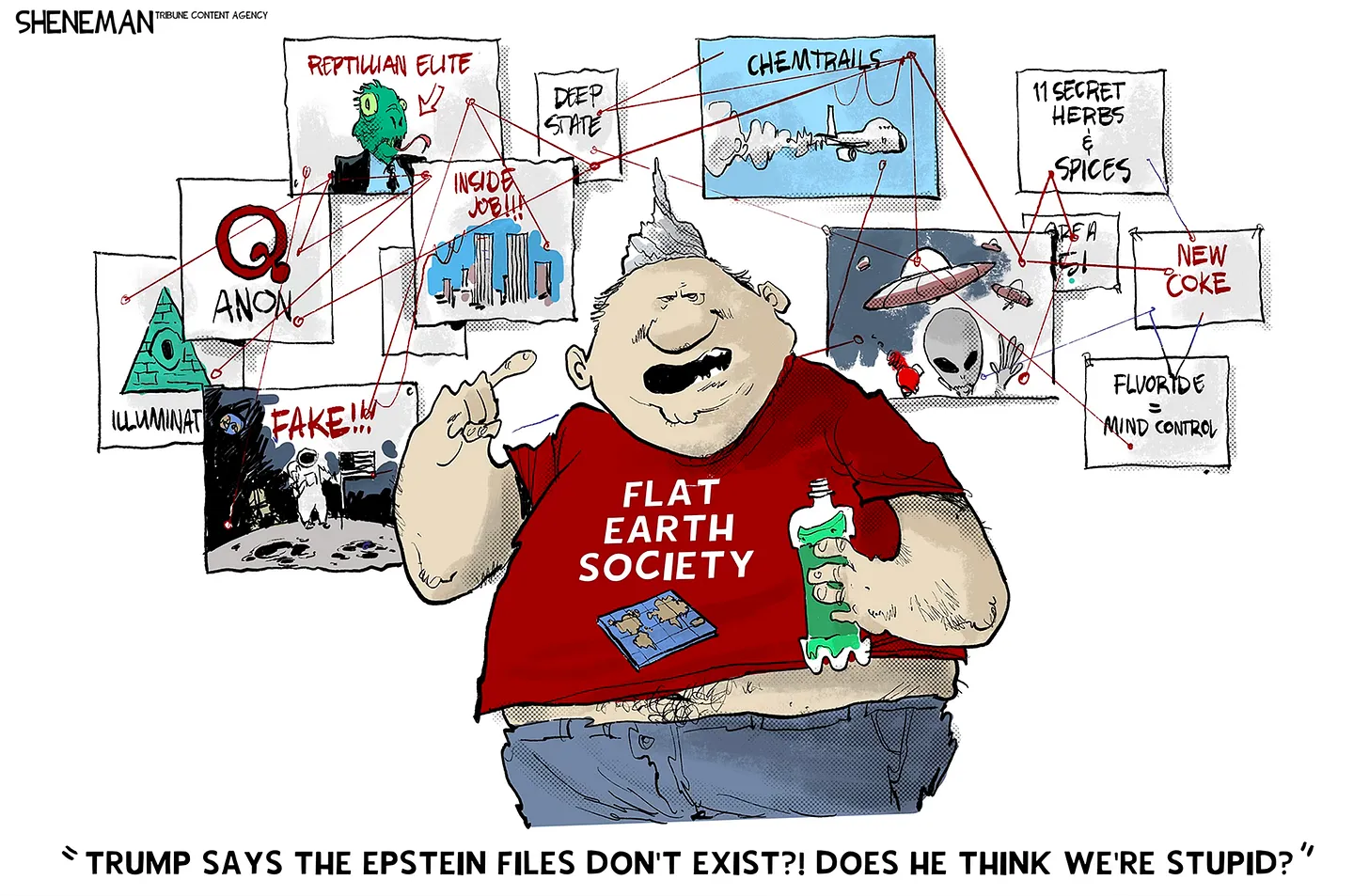
But not so in the fever swamps of MAGA. For these folks, Epstein was a real-life case that validated the wild and otherwise baseless conspiracy theories of Q-Anon.

Their core belief is that a cabal of Satanic, cannibalistic child molesters in league with the deep state is operating a global child sex trafficking ring and that Donald Trump is secretly leading the fight against them.

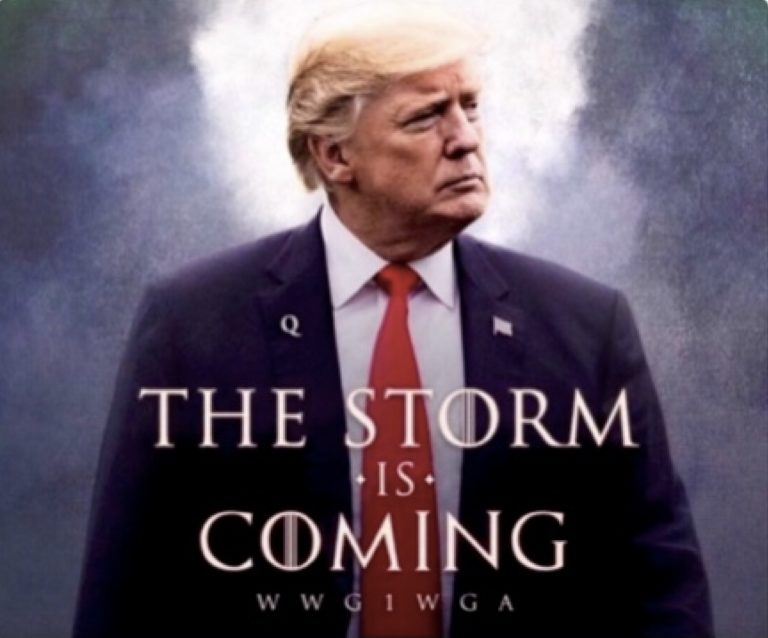
The Satanic cabal supposedly included the Clintons and all sorts of other people. And someday soon, Trump would bring them down by unleashing “the Storm”

when thousands of people will be arrested and possibly sent to Guantanamo Bay prison or face military tribunals. The U.S. military will then take over the country, and the result will be salvation and utopia.

This theory was always nutty, going back to the gun-toting guy in 2016 who showed up at a DC pizza place thinking he was going to liberate the children being held captive in the basement the building didn’t have. And Trump — a known friend of Epstein and a sex offender in his own right — was maybe the least likely person in the world to be cast in the savior role.

But being in a cult means never having to say you’re sorry. Over the years, the repeated failure of Q’s predictions disillusioned a lot of his followers. However, Mike Rothschild, who wrote the book on Q-Anon, says:

QAnon as a movement based around secret codes and clues and riddles doesn’t so much exist anymore. But it doesn’t need to exist anymore because its tenets have become such a major part of mainstream conservatism and such a big part of the base of people that reelected Donald Trump.

For years, Trump has been happy to let these crazies anoint him as their messiah. He “re-truthed” their memes.

More recently, though, the conspiracy theory seemed to be coming back to bite him. Elon Musk claimed to have seen the “Epstein Files” — though what that had to do with the job he was supposedly doing to cut government spending isn’t clear — and said that Trump was in them. “That is the real reason they have not been made public.” Musk deleted that post after Trump threatened his government contracts.

Plus, the MAGA natives were getting increasingly restless. Trump had said he would release whatever files the government had on the Epstein case. His nominees talked about them in their confirmation hearings. So where were they? It was time to produce the evidence that would prove those Q-Anon claims once and for all.

And the answer is … oh, never mind. Nothing to see here. Let’s all go back to some other fantasy, like voter fraud or the migrant crime wave.

Trump has told his base to turn on a dime before, and they have. Appointees like Bill Barr or Jim Mattis are “the best people” until they say something Trump doesn’t like, and then they were always suspect. Elon was a “genius” until he became “crazy”. Deficits are a problem until they aren’t. Any hint of Joe Biden or his family profiting off their government service is “the Swamp”, but Trump and his family making billions from foreigners investing in their crypto schemes is just good business. And so on.

But this time seems like a bridge too far. Tucker Carlson and Steve Bannon can’t go there. Dan Bongino is unhappy.

In order to restore peace in MAGA World, Trump will probably have to throw Pam Bondi under the bus, despite the FANTASTIC JOB she’s been doing. It wasn’t him, Trump’s cultists will say to comfort each other, it was her.

But then what? A new AG, one untainted by Bondi’s nothing-to-see-here blunder, does what exactly? Releases something, obviously. But what?

Soviet Premier Nikita Khrushchev is said to have given this advice to then-Vice-President Richard Nixon: If the people believe in an imaginary river, don’t tell them there isn’t one. Promise to build them an imaginary bridge.

It’s time for Trump to deliver his imaginary bridge over the Epstein controversy. How will he do it?

Meanwhile, what should the rest of us do? The worst thing we can do, I think, is get drawn into the argument. The real issues in America today are

  • the continuing march of fascism, and the complicity of Congress and the Supreme Court in subverting American democracy
  • the vast economic inequality in our country, and government policies that keep making it worse
  • climate change

In the face of all that, I have no theory about Epstein and no interest in forming one. Anybody who has evidence of some unprosecuted crime should feel free to pursue their investigation, but I have other stuff to do.

If the MAGA movement wants to tear itself to pieces over this, that’s all to the good. Make popcorn and enjoy the show. But they’ll eventually put their movement back together, and they’ll do it with an explanation that makes as little sense as everything else they do. We can hope that the friction will scrape away a few cultists, who finally realize that Trump has been playing them for fools all along. A few. Probably not that many.

Meanwhile, there are real issues to worry about. I have no time to waste on imaginary rivers or the bridges that might cross them.

Trump only has ICE for you

The most dangerous feature of Trump’s Big Beautiful Bill is one of its least publicized: ICE becomes a massive federal police force, overseeing a system of “detention” centers that could easily become concentration camps.


Despite all the side deals necessary to get it passed, the basic structure of Trump’s Big Beautiful Bill never changed from proposal to signing: It cuts rich people’s taxes (with a few crumbs like no-tax-on-tips thrown in for working people), and partially pays for those cuts by also cutting safety-net benefits like Medicaid and SNAP (i.e., food stamps). What those cuts don’t cover gets added to the deficit. So:

  • benefits for rich people
  • cuts for poor people
  • more debt for everyone.

Probably you knew that, and maybe you also heard that there was money for immigration enforcement. But the sheer size of the new anti-immigrant money hasn’t gotten the attention it deserves. NPR estimates the total immigration enforcement appropriation as “about $170 billion“. That’s larger than the defense budget of Russia.

The bill includes $45 billion to build Trump’s border wall. (So much for claims that he nearly completed it during his first term or that Mexico would pay for it. He didn’t build much of it and Mexico isn’t contributing a dime.) But the scarier piece of this is the additional $45 billion to build more ICE detention camps. The WaPo reports:

U.S. Immigration and Customs Enforcement officials say they plan to use the [$45 billion] to roughly double the nation’s detention capacity to 100,000 beds, giving them more capacity to arrest undocumented immigrants targeted for deportation.

Lincoln Square’s Don Moynihan puts this in perspective.

For context, this is more than the combined budget for all 50 state prison systems. The current budget for the federal Bureau of Prisons is just over $8.3 billion.

There is also money to hire many more ICE agents.

The agency, which currently has about 6,000 deportation officers, would also receive billions of dollars more to hire an additional 10,000 new agents by 2029.

Masked ICE agents kidnapping people off the streets and making them disappear is already a cause for concern. So is the Trump administration’s claim that ICE’s victims should not have due process rights. Now consider the possibility that the majority of these new agents will have less loyalty to the Constitution than to Trump personally. They will be Trump hires empowered to carry out a Trump mission (with the perk that they get to beat up a lot of brown people).

Harvard political scientist Theda Skocpol comments:

Last spring, when Dan Ziblatt and I taught a comparative course on democratic backsliding, our study of the Hungarian and German (1920s-30s) cases left me slightly reassured about the United States today.  Hungary is highly centralized, and in Germany the most important state transformation happened just before Hitler was appointed Chancellor, when the previous government nationalized the Prussian police and bureaucracy, removing it from Social Democratic control in federated Germany’s largest state.  Not long after, unexpectedly, Hitler could easily turn the centralized agencies into his Gestapo core.  I thought last year that the USA was somewhat protected against any similar coerceive authoritarian takeover by its federal structure, given state and local government rights to control most U.S. police powers (I presented this argument in my Madison lecture for the Sept 2024 American Political Science Association). 

But now I see that the Miller-Trump ethno-authoritarians have figured out a devilishly clever workaround.   Immigration is an area where a U.S. President can exercise virtually unchecked legal coercive power, especially if backed by a Supreme Court majority and corrupted Department of Justice.  Now Congress has given ICE unprecedented resources – much of this windfall to be used for graft with private contractors Trump patronizes, but lots of to hire street agents willing to mask themselves and do whatever they are told against residents and fellow American citizens.  The Miller-Trumpites are not interested only in rounding up undocumented immigrants.  They will step up using ICE and DOJ enforcements use to harass Democrats, citizen critics, and subvert future elections if they can. 

Jay Kuo draws a worrisome conclusion that I share:

Once you spend that much on internal security, the system—which is profit-driven by the companies providing the apparatus—begins to feed on itself. It will demand ever more bodies in a supercharged prison/industrial complex.

And fascism expert Timothy Snyder is using the C-word:

With the passage of Trump’s death bill, we face the prospect of many great harms, including an archipelago of concentration camps across the United States.

In particular, Snyder worries that the detainees might become slave labor, which makes a perverted kind of sense: As Trump causes a labor shortage by rounding up immigrants, the detained immigrants might be rented out to do things like pick crops.

If these fears seem over-the-top, consider a little history. The Nazi concentration camps were not originally conceived as death mills. Hitler used the Reichstag Fire (in February, 1933) as evidence that a Communist revolution was at hand, and began rounding up his political enemies as Communist co-conspirators. Needing a place to put them, he opened the Dachau concentration camp in March.

At the time, Dachau was just a place political opponents could be kept outside the ordinary legal process. But as time went by, the convenience of having a black hole they could drop people into was just too tempting for the Nazi government. The mission of Dachau and the subsequent camps kept expanding, until they became the horror we now associate with concentration camps.

I find it too easy to imagine history repeating itself. ICE already sees itself as unencumbered by law, and its targets as undeserving of human rights. ICE may not, at the moment, be a Gestapo, and places like the new Alligator Alcatraz in Florida may not yet deserve the Alligator Auschwitz label critics have given it. But what prevents that progression from taking place?

All the visible forces push that way. We have already seen reality drift from the Trump administration’s rhetoric. Supposedly ICE was “making us safer” by rounding up violent criminals. But now they’re grabbing harmless people who are simply raising their children and doing their jobs, like the wife of this Marine Corps veteran and the father of three Marine sons. TracReports estimates that 71.7% of ICE detainees have no criminal record. CBS discovered that a similar percentage of the Venezuelans flown to El Salvador’s notorious CECOT prison had no criminal record.

Here’s a simple example of ICE’s sense of license: Florida law gives members of the legislature the right to make unannounced inspections of any state-run facility. Five Democratic legislators showed up to inspect Alligator Alcatraz and were denied access. Law? What law?

Imagine that someday you get scooped by ICE, maybe because you have brown skin and Spanish surname, or maybe because some AI has determined that your blog is too critical of Trump. There you are in Alligator Alcatraz or some other camp designed to hold undesirables. The letter of the law favors you, but the lawyers your family hires get the kind of run-around Kilmar Abrego Garcia has gotten. Where does your story go from there?

The Rot Goes Deeper Than Trump

Just winning the next set of elections won’t fix the underlying problems.


Zohran Mamdani’s surprise victory in New York City’s mayoral primary, and his probable ascension to the office itself, sent shock waves through the Democratic Party and reopened many longstanding debates. Maybe the word “socialist” isn’t as toxic as many think it is. Maybe the party needs younger, newer faces. Maybe a positive vision is at least as important as standing against Trump. Maybe being Muslim or pro-Palestine does not alienate potential Democratic voters. And so on.

Those are all worthwhile points to discuss, but I worry that they all revolve around a goal — taking power back from Trump and the MAGA congressmen who hold it now — that is necessary but not sufficient to save American democracy. Too easily, we get lost in the search for a new face or a new slogan or even new policies, but lose sight of the deeper problems that allowed Trump to come to power in the first place.

Remember, we beat Trump soundly in 2020. His ego will never let him admit it, but Trump got his butt kicked by Joe Biden, to the tune of more than 7 million votes. Beating Trump is not an unsolvable problem, and we don’t have to convert the MAGA cultists to do it. All we have to do is win back the voters who already voted against Trump in 2020.

But beating Trump did not end the threat then, and it won’t do it now either. We need to understand why.

Donald Trump, in my opinion, is not some history-altering mutant, like the Mule in Asimov’s Foundation trilogy. I think of him as an opportunist who exploited rifts in American society and weak spots in American culture. He did not create those rifts and weak spots, and if all we do is get rid of Trump, they will still be there waiting for their next exploiter.

I do not have solutions for the problems I’m pointing to, but I think we need to keep them in our sights, even as we look for the next face and slogan and message.

The Rift Between Working and Professional Classes. All through Elon Musk’s political ascendancy, I kept wondering: How can working people possibly believe that the richest man in the world is on their side? Similarly, how can people who unload trucks or operate cash registers imagine that Donald Trump, who was born rich and probably never did a day of physical labor in his life, is their voice in government?

The answer to that question is simple: The people who shower after work have gotten so alienated from the people who shower before work that anyone who takes on “the educated elite” seems to be their ally. In the minds of many low-wage workers, the enemy is not the very rich, but rather the merely well-to-do — people with salaries and benefits and the ability to speak the language of bureaucracy and science.

Actual billionaires like Musk or Trump or Jeff Bezos or Mark Zuckerberg are so distant that it’s hard to feel personally threatened by them. But your brother-in-law the psychologist or your cousin who got an engineering degree — you know they look down on you. Whenever they deign to discuss national affairs with you at all, it’s in that parent-to-child you-don’t-really-understand tone of voice. And let’s not even mention your daughter who comes home from college with a social justice agenda. Everything you think is wrong, and she can’t even explain why without using long words you’ve never heard before. Somebody with a college degree is telling you what to do every minute of your day, and yet you’re supposed to be the one who has “privilege”.

The tension has been building for a long time, but it really boiled over for you during the pandemic. You couldn’t go to work, your kids couldn’t go to school, you couldn’t go to football games or even to church — and why exactly? Because “experts” like Anthony Fauci were “protecting” you from viruses too small to see. (They could see them, but you couldn’t. Nothing you could see interested anybody.) Then there were masks you had to wear and shots you had to get, but nobody could explain exactly what they did. Would they keep you from getting the disease or transmitting it to other people? Not exactly. If you questioned why you had to do all this, all they could do was trot out statistics and point to numbers. And if you’ve learned anything from your lifetime of experience dealing with educated people, it’s that they can make numbers say whatever they want. The “experts” speak Math and you don’t, so you just have to do what they say.

Here’s why this is such a big problem for democracy, and how it turns into a liberal/conservative issue: Ever since the progressive era and the New Deal, the liberal project has been for government to take on issues that are too big and too complex for individuals to handle on their own. When you buy a bag of lettuce at the grocery store, how do you know it isn’t full of E coli? Some corporation has a dump somewhere upstream from you, so how can you tell what dangerous chemicals might be leeching into your water supply? How do you know your workplace is won’t kill you or your money is safe in a bank? What interest rates and tax/spending policies will keep the economy humming without causing inflation? Stuff like that.

The conservative answer to those questions is to trust corporations to police themselves subject to the discipline of the market. (So if the lettuce producers keep selling E-coli-spreading produce, eventually people will catch on and stop buying from them and they’ll go out of business.) Historically, that solution has never worked very well. Corporations are too rich and too clever and too chameleon-like for market discipline to keep them in line. But we’ve had regulations for over a century now, so most of the bad-example history happened a long time ago. (We wouldn’t have OSHA today without the Triangle Shirtwaist Factory fire.) The only people who still remember it are themselves experts of some sort.

The liberal alternative is to have what has come to be called an “administrative state”. The government runs a bunch of three-letter agencies — FDA, EPA, SEC, CDC, FCC, and so on, with an occasional four-letter agency like OSHA or FDIC thrown in. These agencies keep track of things no individual has the resources to keep track of, and they hire experts who spend their lives studying things most of us only think about once in a while, like food safety or how much cash banks should keep on hand to avoid runs or what kind of resources need to be stockpiled to deal with hurricanes.

And the liberal administrative state works like a charm as long as two conditions hold:

  • The experts are trustworthy.
  • The public trusts them.

It’s not hard to see that there are problems with both of those propositions. In his 2012 book The Twilight of the Elites, Chris Hayes outlined the ways that the expert class has become self-serving. In theory, the expert class is comprised of winners in a competitive meritocracy. But in practice, educated professionals have found ways to tip the balance in their children’s favor. Also, the experts did not do a good job running the Iraq or Afghanistan wars, and they failed to foresee the economic crisis of 2008. When they did notice it, they responded badly: Bankers got bailed out while many ordinary people lost their homes.

And then there’s the challenge of globalism: It was supposed to benefit everybody, but in practice, working-class people lost good jobs while professional-class people got cheap products made overseas.

On the public-trust side, people have been too willing to believe conspiracy theories about perfectly legitimate things like the Covid vaccine. Trump’s slashing of funding for science and research is a long-term disaster for America, and his war against top universities like Harvard and Columbia destroys one of the major advantages the US has on the rest of the world. But many cheer when revenge is taken on the so-called experts they think look down on them.

In a series of books, most recently End Times, Peter Turchin describes two conditions that historically have led to social unrest, revolution, or civil war: popular immiseration and elite overproduction. In other words: Ordinary people see their fortunes declining, and the elite classes expand beyond the number of elite roles for them to fill. (Think about how hard it is for recent college graduates to find jobs.) So there are mobs to lead, and dissatisfied members of the would-be ruling class trained and ready to lead them.

“Remember objective truth?”

Truth Decay. Democracy is supposed to work through what is sometimes called “the marketplace of ideas”. Different interest groups have their own self-interested spin, but when people with a variety of viewpoints look at the facts, truth is supposed to win out.

If you are younger than, say, 40, you may be surprised to realize how recently that actually worked. There have always been fringe groups and conspiracy theorists, but there were also powerful institutions dedicated to sorting out what really happened and how things really happen. The two most important of those institutions were the press and the scientific community.

Those two institutions still exist, and (with some exceptions) still pursue capital-T Truth. But they have lost their reality-defining power. (Part of the problem is that journalists and scientists are part of the expert class that working people no longer trust.) No current news anchor would dare end a broadcast with “And that’s the way it is”, as Walter Cronkite did every day for decades. And no scientific study, no matter how large it is or where it was done, can settle the questions our society endlessly debates.

So: Is global warming really happening, and do we cause it by burning fossil fuels? The scientific community says yes, and the experts whose livelihoods depend on the answer (like the ones in the insurance industry) accept that judgment. But the general public? Not so much, or at least not enough to commit our country to the kind of changes that need to happen.

Was the Covid vaccine safe, and did it save millions of lives worldwide? Do other vaccines (like the ones that all but wiped out measles and smallpox) bring huge benefits to our society? Again, the scientific community says yes. But that answer is considered sufficiently untrustworthy that a crank like RFK Jr. can get control of our government’s health services and put millions of lives at risk.

Did Trump lose in 2020? By the standards of objective journalism, yes he did. He lost soundly, by a wide margin. The diverse institutions of vote-counting, spread through both blue states and red ones like Georgia and (then) Arizona, support that conclusion. Every court case that has hung on the question of voter fraud or computer tampering has come out the same way: There is no evidence to support those claims. Fox News paid Dominion Voting Systems $787 million rather than argue that it could have reasonably believed Dominion’s vote-counting machines were rigged. (Not that they were rigged, but that there was any reasonable doubt about their accuracy.)

But none of that matters. No institution — not even one Trump cultists establish themselves, like the audit of Arizona’s votes — can declare once and for all that Trump lost.

Loss of Depth. Along with the lost of trust in experts and the inability of American society to agree on a basic set of facts, we are plagued by a loss of depth in our public discussions. It’s not just that Americans don’t know or understand things, it’s that they’ve lost the sense that there are things to know or understand. College professors report that students don’t know how to read entire books any more. And we all have run into people who think they are experts on a complex subject (like climate change or MRNA vaccines) because they watched a YouTube video.

Levels of superficiality that once would have gotten someone drummed out of politics — Marjorie Taylor Greene confusing “gazpacho” with “Gestapo” comes to mind — are now everyday events.

Empathy is out. Assholery is in. Remember George W. Bush’s “compassionate conservatism“? The idea in a nutshell was that if conservative policies produced a more prosperous society, the rising tide might lift more people out of poverty than liberal attempts to help people through government programs. Things never actually worked out that way, but the intention behind the phrase was clear: Conservatives didn’t want to be seen as selfish or heartless bad guys. They also want a better world, they just have a different vision of how to get there.

Later Republican candidates like John McCain and Mitt Romney worked hard to build images as good, decent men, reasonable and courteous to a fault. If the policies they supported might lead to more poverty, more suffering, or even more death, that was lamentable and surely not what they intended.

But in 2018, The Atlantic’s Adam Serwer made a shocking observation about the first Trump administration: The Cruelty is the Point. MAGA means never having to say you’re sorry. If people you don’t like are made poorer, weaker, or sicker — well, good! Nothing tastes sweeter than liberal tears.

We can hear the spectacle of cruel laughter throughout the Trump era. There were the border-patrol agents cracking up at the crying immigrant children separated from their families, and the Trump adviser who delighted white supremacists when he mocked a child with Down syndrome who was separated from her mother. There were the police who laughed uproariously when the president encouraged them to abuse suspects, and the Fox News hosts mocking a survivor of the Pulse Nightclub massacre (and in the process inundating him with threats), the survivors of sexual assault protesting to Senator Jeff Flake, the women who said the president had sexually assaulted them, and the teen survivors of the Parkland school shooting. There was the president mocking Puerto Rican accents shortly after thousands were killed and tens of thousands displaced by Hurricane Maria, the black athletes protesting unjustified killings by the police, the women of the #MeToo movement who have come forward with stories of sexual abuse, and the disabled reporter whose crime was reporting on Trump truthfully. It is not just that the perpetrators of this cruelty enjoy it; it is that they enjoy it with one another. Their shared laughter at the suffering of others is an adhesive that binds them to one another, and to Trump.

In the second Trump administration, this tendency has become even more blatant. Consider:

I could go on. It’s hard to look at any list of recent Trump administration actions without concluding that these people are trying to be assholes. It’s not an accident. It’s not a side effect of something else. The assholery is the point.

You might think this intentional assholery would get Trump in trouble with his Evangelical Christian base, because — I can’t believe I have to write this — Jesus was not an asshole. Jesus preached compassion and empathy.

But Evangelicals are making this work out by turning their backs on the teachings of Jesus. Recent books like The Sin of Empathy and Toxic Empathy explain how empathy is a bad thing — precisely because it might cause you to regret the pain that the policies you support inflict on other people.


Where does a recognition of these issues leave us? Don’t get me wrong. I would like nothing better than for a Democratic wave to sweep the 2026 midterms and then give us a non-MAGA president in 2028. But that is the beginning of the change we need, not the end.

What America needs runs far deeper than a new set of political leaders. We need some sort of spiritual or cultural reformation, one that rededicates Americans to the pursuit of truth and the responsibility to be trustworthy. It would cause us to care about each other rather than rejoice in each other’s pain. It would start us looking for leaders who bring out the best in us rather than the worst.

How do we get that reformation started? I really have no idea. I just see the need.

Questions to ask as a war begins

Saturday night, the United States joined Israel’s air war against Iran. The most significant piece of the US intervention was to do what Israel could not: drop giant bunker-buster bombs on the underground Iranian nuclear research facility at Fordow. The US dropped 14 GBU-57 bombs, the largest non-nuclear bomb in our arsenal. (They are also sometimes referred to as MOPs, massive ordinance penetrators.)

The attack came a week after Israel began bombing Iran, and ended several days of what had appeared to be indecision on Trump’s part. Wednesday, he said: “I may do it, I may not do it. I mean, nobody knows what I’m going to do.” He suggested a two-week window for negotiations, then attacked in two days. (As several people have pointed out, “two weeks” is Trumpspeak for “I have no idea”. He seems to believe that two weeks is long enough for the news cycle to forget about an issue.) Like so many of Trump’s actions, this has been justified after the fact as intentional misdirection rather than indecision.

In response, the Iranian Parliament has authorized closing the Strait of Hormuz, but has left the final decision up to Iran’s Supreme National Security Council. One-fifth of the world’s oil goes through that strait, which sits at the mouth of the Persian Gulf. Closing it would raise world oil prices substantially, at least in the short term. So far, markets seem not to be taking the threat seriously.

As I’ve often said, a one-person weekly blog can’t do a good job of covering breaking news, particularly if it breaks on the other side of the world. So you should look to other sources for minute-to-minute or day-to-day coverage.

I also frequently warn about the pointlessness of most news-channel speculation. The vast majority of pundits have no idea what’s going to happen next, so taking their scenarios seriously is at best a waste of time and at worst a way to make yourself crazy.

So if I can’t reliably tell you what’s happening or what’s going to happen, what can I do? At the moment, I think the most useful discussion to have on this blog is to ask the right questions.

What are we trying to accomplish in this war? Failure to get this right has been the major failing in America’s recent wars. Our government has frequently marshaled public support by invoking a wide variety of motives, with the result that we never quite know when we’re done. Our involvement in Afghanistan started out as a hunt for Osama bin Laden and the Al Qaeda leadership behind 9-11. But it quickly evolved into an attempt to establish a friendly regime in Kabul, combat Muslim extremism in general, test counter-insurgency theories, and prove that liberal democracy could work in the Muslim world. So our apparent early success turned into a two-decade failure.

Similarly in Iraq. Were we trying to depose Saddam Hussein? Chase down the (apparently false) rumors of his nuclear program? Control Iraq’s oil? Try yet again to build liberal democracy in the Muslim world? If all we had wanted to do was replace Saddam with a friendlier dictator, that’s not a very inspiring ambition, but we might have been in-and-out quickly. Instead, the failure to find Saddam’s mythical weapons of mass destruction left the Bush administration grasping after some other definition of victory, and getting stuck in another long-term war with dubious goals.

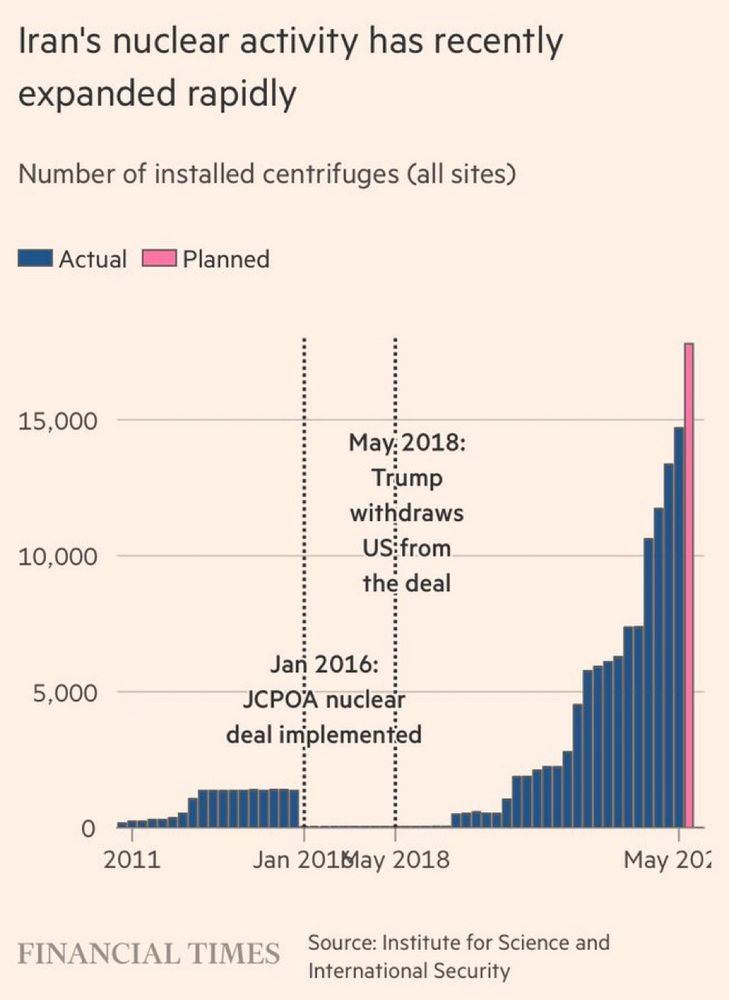
The early indications about this war are not encouraging. Maybe we’re just trying to make sure Iran doesn’t get nuclear weapons. Of course, Obama had a treaty in place that did just that, which Trump ditched, claiming he could get a “better deal”. This war, apparently, is that “better” deal.

But maybe we want to topple the Islamic Republic. Maybe we once again want to control the oil. Those kind of goals bring back Colin Powell’s “Pottery Barn rule“: If we break the country’s government, we own own the ensuing problems until we can fix them. That implies the same kind of long-term commitment we had in Iraq.

Of course, Trump might walk away from such a moral obligation, since he has little notion of morality in any sphere. Then we wind up with a failed state three times the size of Afghanistan, and who knows what kind of mischief might germinate there?

Did our attack work? The answer to this question depends on the answer to the previous question: What does “work” mean?

If the goal was simply to destroy Iran’s current nuclear program, maybe it did work, or can be made to work soon. Trump announced that the attacks were “a spectacular military success” which “completely and totally obliterated” the target sites. But then, he would say that no matter what happened, wouldn’t he? Without someone on the ground, it’s impossible to know.

And without regime change, or without some kind of verifiable agreement in which the current regime renounces nuclear weapons, any such damage is just temporary. Any nation with sufficient money and will can develop nuclear weapons. If Iran comes out of this war with money and will, it can start over.

If the goal is regime change or “unconditional surrender”, the attack hasn’t worked yet and may never. Air war is a poor tool for establishing a new government. I would hope we learned our lesson from Dick Cheney’s famous “we will, in fact, be greeted as liberators” comment, but maybe not. I’ve heard commentators cite internal political opposition to the Iranian theocracy as some kind of ally, but It’s hard for me to picture how that works.

Apply the same logic to the United States: I am deeply opposed to the Trump administration and regard it as a threat to the tradition of American constitutional government. But would I favor some Chinese operation to overthrow Trump? No. What if the internal opposition in Iran is like me? Might they have to unite behind their government to avoid foreign domination?

What could Iran do in response? It’s always tempting to imagine that I will take some extreme action and that will be the end of the matter. Probably you’ve seen this yourself in online discussions. Somebody says something stupid, and you come up with some devastating comment, figuring that the other person will slink off in disgrace.

It doesn’t usually work out that way, does it? The other person will strike back at least as hard as you did, and the exchange might go on for days. You never planned on a flame war eating up hours of your time, but there you are.

Same thing here. Iran might close the Strait of Hormuz to oil tankers, sending the price of gas shooting up and the world economy reeling. It might attack American troops stationed in various places around the Middle East. It might launch terrorist attacks in the US itself. (Do you trust this 22-year-old to protect you?)

Even worse is the possibility of the unexpected. We seem to be at a hinge point in the history of warfare, where drones and various other new technologies change the battlefield in ways that are hard to imagine. Ukraine’s attack on Russia’s Siberian bomber bases is a case in point, but there are others.

Traditional symbols of power may be vulnerable, the way that the American battleships at Pearl Harbor were vulnerable to the new technology of air power. Are we prepared for, say, a massive drone attack sinking an aircraft carrier? What about a cyberattack blacking out some major city? If we suffer such an unexpected blow to our prestige and power, will we be able to respond in a rational way?

What will this war do to the United States itself? The War on Terror undermined the consensus against torture, and authorized previously unprecedented levels of government spying on ordinary Americans.

So far, this war looks like another few steps down the road to autocracy. We attacked Iran because Trump decided to. Bush’s invasion of Iraq, by contrast, was authorized by a bipartisan vote in Congress (to the shame of opportunistic Democrats who should have stood against it). That vote was preceded by a spirited public debate and mass protests.

This time, Congress was not consulted in any formal way. And even informally, a few congressional Republicans were informed ahead of time, but played no part in the decision. Democrats were not consulted at all. No effort at all has been made to convince the American public that this war is in our interests.

So far we’ve been treating this war as if it were a reality show involving Trump, Netanyahu, and the Iranian leadership. We’re just spectators. Until, that is, our city blacks out or we can’t afford gas.

The Court fails transgender youth

Equal protection of the laws isn’t what it used to be.


After the 13th Amendment freed the slaves, the nation passed a 14th Amendment to make sure the freed slaves would have rights under the law. It promised every person “the equal protection of the laws”.

It didn’t work, at least not at first. The Supreme Court interpreted that Equal Protection Clause narrowly, and so states were able to pass Jim Crow laws that forced Black Americans to live under a different legal regime entirely. Plessy v Ferguson established the principle of “separate but equal” treatment, where “separate” rules and facilities for Blacks and Whites were very real, but “equal” could be winked at.

In the 20th century, though, the Equal Protection Clause was gradually reinterpreted to mean something very important. There are a number of complicated doctrines that implement this idea, but the underlying concept is simple: If the law treats you differently than it treats someone else, there has to be a reason for it. And the reason can’t just be that the people who make the laws don’t like you.

There has seldom been a more obvious violation of this principle than the recent run of state laws that ban gender-affirming care for trans youth. One such law is Tennessee’s “Prohibition on Medical Procedures Performed on Minors Related to Sexual Identity, Senate Bill 1 (SB1)“. Ostensibly, the law intends “to protect the health and welfare of minors”. The law bans a number of treatments that major medical organizations (“American Academy of Pediatrics, American Medical Association, American Psychiatric Association, American Psychological Association, and American Academy of Child Adolescent Psychiatry” according to Justice Sotomayor’s dissent) recommend for young people experiencing gender dysphoria, i.e., the feeling that the sexual characteristics of their physical body are at odds with their inner sense of who they are.

Legislatures typically have wide latitude to permit or ban medical procedures according to their assessment of patient safety. But the smoking gun here is that the procedures are banned only when used to treat trans youth, only

when these medical procedures are performed for the purpose of enabling a minor to identify with, or live as, a purported identity inconsistent with the minor’s sex or treating purported discomfort or distress from a discordance between the minor’s sex and asserted identity.

Using say, puberty-blocking drugs or gender-related hormones like testosterone or estrogen, is perfectly fine and safe for any other purpose parents and physicians might have in mind. But not that one.

Keep in mind here that the affected population — families of trans youth — did not ask for this “protection”. To the best of my knowledge, none of them came to the legislature and said “I want the state to make my child’s medical decisions.” To the contrary, three such families sued to block the law, and countless others are leaving Tennessee (and other states with similar laws) so that they will be free to decide for themselves how to handle what everyone recognizes is a difficult situation.

The push for SB1 came instead from people opposed on principle to the existence of trans people, usually for religious reasons. The purpose is to act on trans youth and their families, not for them. The law itself says:

This state has a legitimate, substantial, and compelling interest in encouraging minors to appreciate their sex, particularly as they undergo puberty.

In other words, Tennessee claims a “compelling interest” in convincing trans youth that they are wrong. Their sex is their sex, and they just need to get used to it.

Anyone who has listened to the public debate over such laws has to realize that the laws are motivated by a desire to make life harder for families of trans youth. If the families choose to remove their children from the state by moving, or the children decide to remove themselves from life by committing suicide, this is not necessarily considered a bad outcome. Obviously, the Tennessee legislature does not intend to offer trans youth “the equal protection of the laws”. SB1’s intention is to bludgeon trans youth, not protect them.

The question for the courts, then, should be how to extend equal protection in a coherent way. Precedents offer clear paths. Typically, these precedents involve the most obvious instances of laws being used against disadvantaged groups: race and sex. Laws that turn on issues of race or sex are given “heightened scrutiny” by the courts, because apparent justifications for the laws have so often turned out to be pretexts for hostile discrimination.

Justice Sotomayor’s dissent in this week’s case (US v Skrmetti, decided Wednesday) outlines how to use the precedents involving sex.

What does [application of SB1] mean in practice? Simply that sex determines access to the covered medication. Physicians in Tennessee can prescribe hormones and puberty blockers to help a male child, but not a female child, look more like a boy; and to help a female child, but not a male child, look more like a girl. Put in the statute’s own terms, doctors can facilitate consistency between an adolescent’s physical appearance and the “normal development” of her sex identified at birth, but they may not use the same medications to facilitate “inconsisten[cy]” with sex . All this, the State openly admits, in service of “encouraging minors to appreciate their sex.”

But the conservative justices (Roberts writing the majority opinion, plus concurrences by Thomas, Alito, and Barrett) resist not just the characterization of this case as hinging on sex, but also the idea that any injustice is occurring at all: There is nothing about discrimination against trans people that makes laws about them suspect, and so the Court has no excuse to go probing into the motives of the legislature. Courts should apply only “rational basis” review of SB1, requiring only that the legislature offer some rational connection between its actions and some legitimate government purpose. Protecting minors from a possibly dangerous medical procedure is a rational purpose, and so the Court need not look more closely at whether that explanation is a pretext for hostile discrimination. (In fact, the conservative justices dare not look closer, because the proffered explanation is obviously a pretext.)

There is a standard argument for justifying this kind of discrimination, and it has been used many times in the past: You examine previous suspect classes and draw your lines so that those issues appear not to apply. So, for example, laws banning interracial marriage were once not seen as racially discriminatory, because neither Blacks nor Whites could marry a person of a different race. Laws against same-sex marriage didn’t discriminate on the basis of sex, because neither men nor women could marry a person of the same sex. And so on. In retrospect, such arguments are transparent rationalizations for hostile discrimination, but that doesn’t stop judges from continuing to use them. Justice Roberts writes for the majority:

Neither of the above classifications [in SB1] turns on sex. Rather, SB1 prohibits healthcare providers from administering puberty blockers and hormones to minors for certain medical uses, regardless of a minor’s sex. … SB1 does not mask sex-based classifications. For reasons we have explained, the law does not prohibit conduct for one sex that it permits for the other. Under SB1, no minor may be administered puberty blockers or hormones to treat gender dysphoria, gender identity disorder, or gender incongruence; minors of any sex may be administered puberty blockers or hormones for other purposes.

So the law doesn’t discriminate against transgender youth, it just separates out the medical conditions that define transgender youth. It protects youth against the risks of such treatments, but only if they seek those treatments for a purpose unique to trans people.

When the Equal Protection Clause was being explained to me years ago, the following example was given: What if a law banned yarmulkes, the skull caps typically worn by Jewish men? You could argue that such a law isn’t religious discrimination, because it applies universally: Neither Jews nor Gentiles can wear yarmulkes. But of course, only Jews want to wear yarmulkes. So a law against yarmulkes is religious discrimination against Jews.

Sotomayor observes:

nearly every discriminatory law is susceptible to a similarly race- or sex- neutral characterization. A prohibition on interracial marriage, for example, allows no person to marry someone outside of her race, while allowing persons of any race to marry within their races.

The religious right is targeting other applications of the Equal Protection Clause, beginning with same-sex marriage. So it seems likely we will be hearing the same rationalizations again soon.

Trump Invades Los Angeles

It started with ICE raids at Home Depots and other places undocumented immigrants might congregate to look for work.

Xochitl, a Guatemalan mother of two, was inside a McDonald’s that shares the parking lot with the Home Depot when she said she saw numerous agents running after men she sees every day but knows only by their nicknames. She said she momentarily froze but then began walking in the opposite direction of agents who were detaining food vendors on sidewalks.

“They were just grabbing people,” she said. “They don’t ask questions. They didn’t know if any of us were in any kind of immigration process.”

Anti-ICE protesters gathered, as they do in towns and cities all over America. (There’s a weekly protest outside a Massachusetts ICE facility one town over from mine. I haven’t attended yet, but I feel like I should.) Increasingly, ICE is targeting not the violent criminals Trump campaigned against (who never existed in the numbers he claimed), but the neighbors, friends, and co-workers of ordinary Americans.

By Friday, the situation had devolved into law enforcement officers using tear gas and protesters shooting fireworks at ICE. Who started the violence? Hard to say. In this video, a man describes an ICE raid causing a traffic jam. When agents began dragging people out of a local business, people stuck in the jam began taking videos on their phones. “We’re not there to protest. We were stuck at the light.” The tear gas, the man claims, was aimed at the people taking videos on their phones. “One of the agents, I hear them: ‘Go for the people with the phones’.”

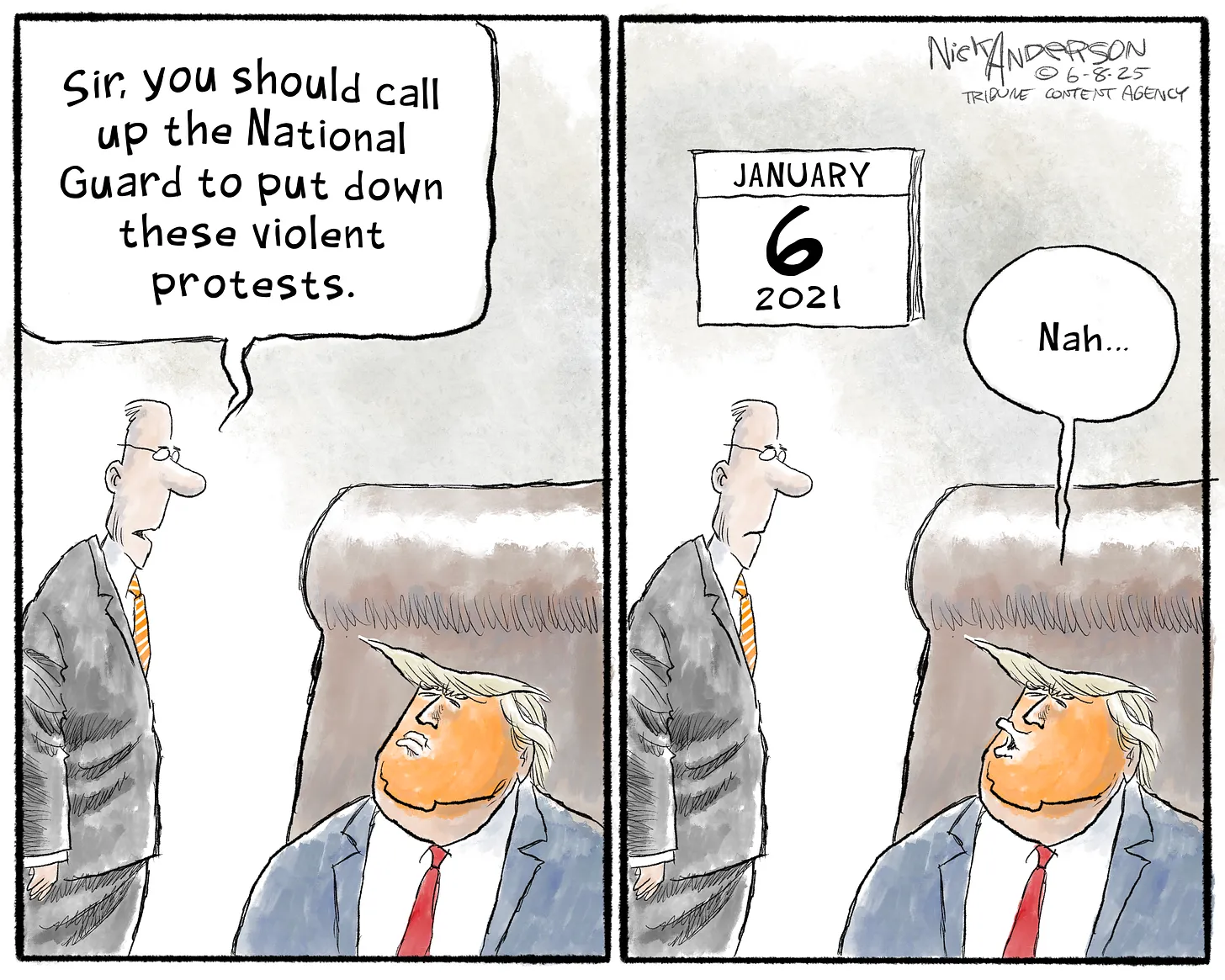
Local officials thought the police response was appropriate to the size of the disturbance, but Trump evidently disagreed. Saturday, he federalized 2000 troops from the California National Guard and placed them under the command of Defense Secretary Pete Hegseth.

Using National Guard troops to control unrest is a well established practice, but usually the troops are requested by the governor. Here, Governor Newsom (and LA Mayor Karen Bass) opposed using the troops, but Trump sent them in anyway — something that hasn’t been done since 1965, when LBJ sent troops to Alabama to protect civil rights workers.

Trump’s over-the-top response has created an additional reason to protest: the appearance of a military takeover as federalized troops are used against the citizens of a major American city. A weekly blog can’t cover breaking news, so I’ll just have to wait and see how this plays out.

The legal authority here is tricky. Jay Kuo breaks it down: Trump is invoking his authority under Title 10, which allows him to use National Guard troops to respond to “a rebellion against the authority of the Government of the United States”. Characterizing spontaneous demonstrations as “rebellion” against the US government is a bit of a stretch, but it’s the kind of stretch the Trump administration has made before, like when it claimed illegal immigration is an “invasion” that justifies invoking the Alien Enemies Act.

But Title 10 doesn’t allow martial law.

So here’s the part that’s a bit hard to grasp at first. Title 10 permits the President to federalize the troops and put them under his command. But what they are permitted to do as military troops operating on domestic soil is still governed by other laws.

And one of those laws is the Posse Comitatus Act.

The PCA doesn’t allow federal troops to play the role of local law enforcement. All they can do is protect federal buildings and federal agents carrying out their duties.

The Insurrection Act makes an exception to the Posse Comitatus Act, and so would be a step towards martial law. But so far Trump has not invoked the Insurrection Act.

Now I’ll begin to speculate: It looks like Trump wants this confrontation, and is hoping the situation escalates. This will provide lots of violent video to show on Fox News, of blue-state citizens battling US troops. After a few days of that, he can justify invoking the Insurrection Act, turning LA into a military occupation zone.

It’s hard not to connect this directly provoked confrontation with the events scheduled for next Saturday. Trump has planned a North-Korea-style military parade in Washington. Ostensibly, the parade is to celebrate the 250th birthday of the US Army. But coincidentally, Saturday is also Trump’s own birthday.

Trump’s $45 million birthday party has incited plans for thousands of counter-protests around the country, under the theme “No Kings“. Whether he intends to meet these protests with state violence remains to be seen.

Are Trump’s Tariffs Legal?

Can Trump decide for himself the extent of his own power?


Many of the Trump administration’s most controversial actions are based on novel (and perhaps far-fetched) interpretations of existing laws. The most objectionable deportations are based on a bizarre reading of the 1798 Alien Enemies Act, and soon the Supreme Court will have to rule on whether it really does give Trump he power he claims. Similarly, many of the tariffs he has declared are based on the International Emergency Economic Powers Act of 1977.

But the same question arises: In the IEEPA, Congress delegated certain powers to the President. But did it delegate these powers, to be used in this situation.

Wednesday, the United States Court of International Trade said no.

The argument. Simplifying somewhat, the Trump administration argues that the IEEPA gives Trump essentially unlimited powers over tariffs. He can invoke the IEEPA by declaring a national emergency of his choosing, and once he does, the emergency powers Congress has delegated to the President allow him to do just about whatever he wants. Courts have no power to intervene, because the existence of an emergency and the measures necessary to deal with it are “political questions” that unelected judges have no business resolving.

The counter-argument is that emergency laws like the IEEPA delegate specific powers with limitations, not dictatorial powers for the President to use however he likes. Even if you could interpret the language of the law to grant unlimited power, that would itself be unconstitutional: Congress can only delegate its power up to a point.

Moreover, the courts have a necessary role in interpreting whether a President’s use of an emergency power is within the limitations of the statute. Otherwise we’re back in the dictatorial situation: The President has as much power as he says he has, and no one can say otherwise.

Ordinary tariffs. Some background: Presidents don’t ordinarily make tariffs. Tariffs are taxes, and the Constitution assigns Congress “Power To lay and collect Taxes, Duties, Imposts and Excises”. Congress is also empowered to “regulate Commerce with foreign Nations”. So that’s typically how tariffs get done: Congress passes a law establishing them, like the ill-fated Smoot-Hawley Tariff Act of 1930.

This Congress has not passed a tariff bill, and Trump has not asked it to. Instead he has invoked the IEEPA, which Wikipedia describes like this:

The IEEPA authorizes the president to declare the existence of an “unusual and extraordinary threat … to the national security, foreign policy, or economy of the United States” that originates “in whole or substantial part outside the United States.” It further authorizes the president, after such a declaration, to block transactions and freeze assets to deal with the threat and requires the president to report to Congress every 6 months on the circumstances, threats and actions taken. In the event of an actual attack on the United States, the president can also confiscate property connected with a country, group, or person that aided in the attack.

IEEPA falls under the provisions of the National Emergencies Act (NEA), which means that an emergency declared under the act must be renewed annually to remain in effect.

A textbook example of the IEEPA in action was what President Bush II did after 9-11: He declared an emergency and blocked the assets of organizations identified as terrorist.

Emergency tariffs. Tariffs come into the picture because President Nixon used a predecessor of IEEPA (the Trading With the Enemy Act of 1917, or TWEA) to raise tariffs across the board. That action was contested in court, and an appeals court reversed a lower-court finding that the tariffs exceeded the power Nixon was delegated under TWEA. In reversing that decision, the higher court emphasized that the President’s power was not unlimited. Nixon had

imposed a limited surcharge, as a temporary measure calculated to help meet a particular national emergency, which is quite different from imposing whatever tariff rates he deems desirable

After that ruling, Congress passed IEEPA to pull back some of the power it had delegated to the President. The TWEA powers were now reserved for wartime, while IEEPA covered “national emergencies” short of war. These powers

may only be exercised to deal with an unusual and extraordinary threat with respect to which a national emergency has been declared for purposes of this chapter and may not be exercised for any other purpose.

Questions related to the balance of trade are dealt with in a separate piece of legislation: Section 122 of the Trade Act, where the President’s powers are still more restricted: Tariff surcharges are limited to 15% and 150 days.

But the Trump administration’s position in court is that the IEEPA’s delegation of power is essentially unlimited: It’s up to the President to decide what a national emergency is and what measures are necessary to “deal with” it. Courts can’t second-guess him, because that’s a “political question” off limits to the unelected judiciary. (So if the President declares that vaping constitutes a national emergency and banning pogo sticks is necessary to deal with it, courts have no power to intervene.)

The court didn’t buy any of that. The language of the statute is not the President’s to interpret.

This language, importantly, does not commit the question of whether IEEPA authority “deal[s] with an unusual and extraordinary threat” to the President’s judgment. It does not grant IEEPA authority to the
President simply when he “finds” or “determines” that an unusual and extraordinary threat exists. … Indeed, “[t]he question here is not whether something should be done; it is who has the authority to do it.” [Biden v. Nebraska, 600 U.S. at 501]. The court simply asks whether the President’s action “deal[s] with an unusual and extraordinary threat.” Congress provided the necessary standards for resolving this inquiry when it enacted IEEPA, and the court’s task is to apply them.

Which tariffs are at issue? Trump used IEEPA authority to impose tariffs of three types

  • worldwide tariffs. The 10% tariff on all imports.
  • retaliatory tariffs. The country-by-country tariffs Trump announced on “liberation day”.
  • trafficking tariffs. Tariffs against Canada, Mexico, and China to pressure them to prevent fentanyl smuggling into the US.

The court rejects all of them. There are other tariffs, including tariffs on metals and car parts, that Trump invoked on other authorities. Those were not questioned.

Nondelegation and Major Questions. During the Biden administration, the Supreme Court created new legal principles to restrain executive power. Nondelegation is essentially the idea that certain powers are so central to Congress’ role that they can’t be delegated. So legislation that delegates those powers broadly, rather than in very specifically defined circumstances, is unconstitutional.

The major questions doctrine says that large-scale grants of power to the executive branch must be made explicitly in the authorizing legislation. For example, the Court used this doctrine to knock down President Biden’s cancellation of student debt. The authorizing legislation allowed the executive branch to tinker with student loan repayments. But if Congress had intended to allow the President to cancel over a trillion dollars of debt, it would have said so explicitly.

Findings. The Court of International Trade found that Trump’s worldwide and retaliatory tariffs were balance-of-trade remedies that belonged under the restrictions of Section 122, not the IEEPA. A trade deficit by itself is not an “unusual and extraordinary threat” that invokes IEEPA emergency powers.

The President’s assertion of tariff-making authority in the instant case, unbounded as it is by any limitation in duration or scope, exceeds any tariff authority delegated to the President under IEEPA. The Worldwide and Retaliatory tariffs are thus ultra vires and contrary to law

The trafficking tariffs fail because they do not “deal with” the emergency that the President has declared. Fentanyl smuggling may well be a national emergency, but the connection to tariffs on Mexico, Canada, and China is too indirect and tenuous.

“Deal with” connotes a direct link between an act and the problem it purports to address. A tax deals with a budget deficit by raising revenue. A dam deals with flooding by holding back a river. But there is no such association between the act of imposing a tariff and the “unusual and extraordinary threat[s]” that the Trafficking Orders purport to combat.

Trump argues that the tariffs are necessary to put pressure on the targeted nations, so that they will crack down on fentanyl smuggling.

The Government’s “pressure” argument effectively concedes that the direct effect of the country-specific tariffs is simply to burden the countries they target. It is the prospect of mitigating this burden, the Government explains, that will induce the target countries to crack down on trafficking within their jurisdictions. See Gov’t Resp. to Oregon Mots. at 39. But however sound this might be as a diplomatic strategy, it does not comfortably meet the statutory definition of “deal[ing] with” the cited emergency. It is hard to conceive of any IEEPA power that could not be justified on the same ground of “pressure.”

The Government’s reading would cause the meaning of “deal with an unusual and extraordinary threat” to permit any infliction of a burden on a counterparty to exact concessions, regardless of the relationship between the burden inflicted and the concessions exacted. If “deal with” can mean “impose a burden until someone else deals with,” then everything is permitted. It means a President may use IEEPA to take whatever actions he chooses simply by declaring them “pressure” or “leverage” tactics that will elicit a third party’s response to an unconnected “threat.” Surely this is not what Congress meant when it clarified that IEEPA powers “may not be exercised for any other purpose” than to “deal with” a threat.

The ruling concludes:

In so holding, the court does not pass upon the wisdom or likely effectiveness of the President’s use of tariffs as leverage. That use is impermissible not because it is unwise or ineffective, but because [the law] does not allow it.

What happens now. The International Trade Court is not the final authority, and the administration has already appealed to the appellate court for the Federal Circuit. That court has put a stay on the ITC’s ruling until it has time to consider the case. Ultimately, this is probably headed to the Supreme Court.

That will be an interesting test for this Supreme Court, which expanded its own power to overrule presidential orders during the Biden administration. But do the same limitations apply to Democratic and Republican presidents? Or has the law become partisan, so that what was done matters less than who did it?

The politics. The Trump administration interprets all its losses in court as judges making their own policy decisions and trying to impose them on the executive branch. Stephen Miller, for example, decried how “15 Communist judges” spread through the courts can “block and freeze each executive action”.

That framing allows Trump’s people to describe the issues the way they want, and then say that judges are against what the administration is for. Trump wants to deport dangerous criminals, while judges want to stop him. Trump wants to defend our economy from predatory foreign countries, but judges want to stop him, and so on.

But that framing sidesteps whether the United States will continue to be a country of laws, or whether it will become a Trump dictatorship. The Constitution defines the powers of our government, and assigns them to different branches. When Trump gathers all those powers to himself — and more powers that the Constitution does not assign to anyone — our way of life is endangered.

Whatever legitimate goals Trump may have — deporting criminals or protecting American jobs or whatever — can be accomplished in legal ways. (For example, Trump could ask Congress for a new tariff law. He could deport criminals through the immigration courts.) When he ignores legal pathways in favor of illegal ones, he needs to be stopped.

The Greatness Paradox

Trump’s notion of national greatness is stuck in the Napoleonic Era.
That’s causing him to destroy everything that makes America great today.


Nothing is more central to the positive version of Trump’s image or to the aspirations of his followers than the idea of greatness. Throughout his political career, policies come and go, allies are cast out as enemies and then welcomed back into his good graces, and whether he wants more or less of something may change from the beginning of a speech to the end. But the slogan never changes: Make America Great Again. It’s been so steady that everyone knows it just by its initials, MAGA. You talk about MAGA followers or the MAGA Party, and everyone knows what you mean.

And who can argue with that goal? Don’t all loyal Americans want their country to be greater rather than lesser? The “again” may be controversial — when exactly are we talking about? — but “greatness”, who doesn’t aspire to greatness?

And yet, every day we see Trump tear down the things that have made America great: scientific excellence, the rule of law, trade, alliances, our open society, and the soft power that comes from the attractiveness of our vision. How does that make any sense? Is it just hypocrisy? Is “greatness” just a buzzword to exploit? A false banner for the gullible to flock behind?

I want to propose a different explanation. When we asked what era “again” referred to, we were on the right track, but we didn’t take it far enough. What era does “greatness” refer to?

Look at some of the things Trump thinks will make America “great again” and ask yourself what era they belong to. Invariably, they fit a Napoleonic view of greatness, not a 21st-century view.

  • Territorial expansion. Great nations gain territory while lesser nations lose territory. Taking over Greenland, regaining the Panama Canal, and annexing Canada, would be a sure sign of our renewed greatness.
  • Mercantile dominance. A great nation exports more goods than it imports, drawing in gold and silver. This was the dominant theory of economics at least until Adam Smith’s Wealth of Nations came out in 1776 and for some while thereafter. Such mercantilism is the primary motive behind Trump’s tariff policy.
  • Manliness. In the Napoleonic years, Frenchmen were confident of their ultimate victory over England, because the English were “a nation of shopkeepers” that did not properly center martial valor in their national identity. This attitude resonates with Defense Secretary Pete Hegseth’s prioritization of “restoring the warrior ethos” in our military, and getting rid of efforts to promote diversity and inclusion. “We are leaving wokeness and weakness behind. And refocusing on lethality”. As if armies still relied on glorious cavalry charges rather than drone pilots who might have any sex, sexual preference, or gender identity.
  • A Great Leader. A primary knock on democracy centuries ago was that it could not produce great leaders like Louis XIV or Peter the Great. Democratic leaders were barely larger than their voters and changed every few years. How could a comparative nonentity like Prime Minister William Pitt compete with a world-bestriding figure like the Emperor Napoleon? Similarly, how could a Kamala Harris or Tim Walz stand up to a contemporary czar like Vladimir Putin? Centuries ago, the pettiness and towering rages of absolute rulers were signs of greatness, while the self-control of a democratic leader seemed weak.

But think for a minute about what has made America great these last hundred years:

  • Science. Yes, the United States fielded valiant soldiers during World War II. But so did our enemies. Our margin of victory came from developments like radar, code-breaking, and the atomic bomb. As we enter into an era of war-fighting AI, global pandemics, and drones, scientific leadership is more important than ever.
  • Trustworthy institutions. The primacy of the US in the postwar era has less to do with being a military hegemon than with being at the heart of a global order. The dollar is the global currency. The US banking system is the nerve center of the world economy. US Treasury bills have been the default investment of all other nations’ central banks. Wall Street is the world’s stock market. Other countries tolerate this because (until recently) they have trusted US institutions to be reliable partners.
  • The rule of law. Why have so many entrepreneurs come to America to found their businesses? Because a fortune made in America was protected by law and safe from predatory rulers like Putin or Viktor Orban. Contracts were enforceable in America, rather than subject to reinterpretation every time an autocrat changed his mind.
  • Education. Around the world, families aspire to send their most promising children to top American universities like Harvard or Columbia. Much of that talent has stayed in America, and even the graduates who returned home brought with them American ideals and an appreciation of American culture.
  • Alliances and treaties. US power has been multiplied by the NATO alliance America leads. American support for international law and international standards has enabled global trade that produced much wealth.
  • Immigration. Immigrants have never been welcomed in America with open arms. But throughout our history, oppressed people around the world have seen America as a refuge, and have hoped their descendants could be fully integrated into our “melting pot”. This influx of energy and talent has kept our society young and vibrant. The freshness and openness of American culture has made the US a place of aspiration.
  • Moral leadership. No great power has ever been mistaken for a saint, and the US won’t be the first. But when disaster strikes anywhere in the world, the US has been among the first nations to help. This generosity has paid dividends for us, both in terms of influence and in our ability to fight epidemics overseas before they can arrive here.
  • Freedom. Much of the mystique of America has revolved around freedom: If you come here, you are free. You can say what you want and believe what you want without fear of government retribution.

Now look at what the Trump administration has been doing.

So is Trump pursuing national greatness? Yes, but according to a notion of greatness that passed its sell-by date centuries ago. He aspires to a Napoleonic greatness and is oblivious to everything that makes a 21st-century nation great. That’s why his policies have America on its way to the dustbin of history, not to a new “golden age“.

The Big Beautiful Bill

Since the Republicans took it over in January, one of our three branches of government has been AWOL: Congress. The Executive branch has been all too active, as President Trump has sought to exercise powers the Constitution does not grant him. That has kept the judicial branch busy as well, processing lawsuits that try to block Trump’s illegal actions.

But where has Congress been? Not only has it passed almost no laws, but it has watched mutely as the Trump administration refuses to spend money it appropriated and closes down agencies it established. The Senate shrugged as Trump nominated one absurdly unfit and unqualified character after another to the most important positions in our government. And as one scandal after another unfolded, Congress has not even held any noteworthy investigative hearings.

However, there is one congressional power that neither the President nor the Supreme Court has yet figured out how to usurp in any major way: authorizing the government to collect taxes and spend money.

So we saw Congress act back in March, when the government was about to run out of money. It did just about the minimum possible: passed a continuing resolution that kept fiscal 2025 spending at more-or-less the same level as fiscal 2024. But the money runs out again when FY2026 starts on October 1.

From the beginning, there’s been pressure on Congress’ Republican leadership to put its mark on the new budget. After all, if the government keeps spending the same amounts of money on the same things, what was the point of giving the GOP control? The Party needs a budget it can take back to its voters and say, “See? This is what you sent us to Washington to do.”

Or, to put it another way: Republicans own the FY 2026 budget. They can’t blame Biden or Nancy Pelosi or any of their usual scapegoats. So what are they going to do?

If you’ve ever managed anything — a household, a church, a business, or whatever — you know that budgets are where the rubber meets the road. You can say lofty things about your values, your principles, or who you care about, but it’s all just words until you have to put numbers on paper. When real dollars start coming in and going out, your rhetoric doesn’t matter any more.

That’s a particular problem for MAGA Republicans this year, because much of what they’ve been telling their voters isn’t true. In particular, they’ve been claiming for years that government spending is full of waste and fraud that serves no legitimate public purpose. So spending can be drastically cut without hurting anybody other than the bureaucrats and the fraudsters. They can spend even more on Trump priorities like border security and missile defense, and still find enough waste and fraud to give big tax cuts to the Dear Leader’s wealthy friends — all without increasing the national debt that they claim is destroying the nation.

But then there are those pesky numbers, and disciplines like arithmetic that they still haven’t managed to write out of the national curriculum. So as of yesterday, when the budget bill squeaked through the House Budget Committee on its second try, it can be summed up in three points:

In theory, this combination — transferring wealth from the working poor to the very rich, while worsening the debt problem Republicans claim is an existential threat to the Republic — should repel the White working-class voters who provided Trump’s margin of victory. But we’ll see. Whatever comes out of this process, Trump will claim that it’s wonderful. Perhaps his MAGA base will be loyal enough and gullible enough to believe him, as they so often do.

What Democrats need to do during this process is keep the discussion focused on things that are real, and cut through Republican attempts to cloud the real issues.

Work requirements. The biggest attempt to cloud the reality of the Medicaid and food stamp cuts is the imposition of work requirements on recipients. This sounds great to the typical MAGA voter, who has been fed story after story of able-bodied young men taking advantage of the system. These moochers, Speaker Mike Johnson says, “need to be out working instead of playing videogames all day.”

Johnson hopes you don’t know that numerous states have imposed work requirements, and it has never worked the way he wants you to believe it will.

When Arkansas applied this policy in 2018, it failed disastrously. Even though nearly all enrollees should have met the work requirement or qualified for an exemption, a large share tripped over the red tape and lost their health care coverage anyway. About 1 in 4 people in Arkansas subject to the requirements—about 18,000 people—lost coverage in just the first seven months of the new policy, before a federal judge determined that the policy violated the purpose of the Medicaid program and put a stop to it.

New Hampshire followed Arkansas’ lead in 2019, and similarly found that about 2 out of 3 enrollees subject to the new policy would have lost their health care coverage in the first two months—so the state suspended the program. Shortly after, it was halted permanently by a federal court.

And in Georgia, the only state allowed to continue a work requirement policy, which applied to a narrow eligibility expansion, the administrative costs to run the program were astronomical—nearly $60 million in the first year to cover just 4,200 people.

Think it through: If you’re going to require recipients to work (or engage in some other worthwhile behavior like school), they’re going to have to provide proof that they’re working, and do it on a regular basis. And you’ll have to hire more bureaucrats to check up on that paperwork.

Now picture the life of typical Medicaid or SNAP recipients, who are not playing video games all day. They’re working 30 hours or more a week at something close to minimum wage, dealing with inefficient public transportation or unreliable car pools because they don’t have a car, and probably juggling child care at the same time. Many of them are not well educated, so they have trouble navigating complex systems. Completing a new set of forms (with supporting documentation) every 90 days or so has a way of slipping through the cracks.

Now think about health insurance. If you’re healthy, nothing happens when you lose health insurance, at least not right away. Your kids will complain if you don’t get dinner on the table, and your boss may fire you if you’re late for work, but if your Medicaid paperwork slides a day or two, that doesn’t seem like an emergency. How are you going to allocate your time?

So yes, the government can save money by imposing work requirements. But those savings come from denying care to people who are actually eligible. (The people who are working the most hours are the ones who will have the hardest time keeping their paperwork up to date.) And much of the savings is eaten up by the increased bureaucracy.

Similar “savings”. The Contrarian reports:

The bill includes a range of other cruel Medicaid policies that should also come out. In yet another play to harass people off of their Medicaid coverage, it would roll back a rule finalized by the Biden administration to modernize and simplify how people enroll and stay enrolled in coverage. Repealing this rule will save the government $162 billion over the next 10 years— largely because rolling back the rule reinstates a lot of unnecessary red tape, which reduces the total number of people enrolled.

ObamaCare. For years Republicans tried to repeal ObamaCare, but now they’re taking refuge in it. Specifically, they argue that people who get kicked out of Medicaid can still get subsidized policies on the ObamaCare marketplaces.

Subsidized, but not free. And that brings up a public-policy aspect of healthcare: We don’t want people to gamble with their health insurance.

I know how this works because decades ago I did it myself: In the two or three months between the end of my final school year and the beginning of my first job-with-benefits, I went without health coverage. It would have cost me hundreds of dollars a month to fill the gap, which seemed like a lot of money to me at the time. I was healthy, so why not risk it?

I got away with it. Lots of people do. But the ones who don’t end up costing our healthcare system a lot of money, because emergency rooms are the least efficient way to take care of people.

Again, if you’re healthy, nothing immediately goes wrong when your health insurance lapses. The kids will suffer if you stop buying groceries, and they’ll complain if they have to keep wearing clothes they’ve outgrown. The landlord may throw you out if you stop paying rent. But if you don’t have health insurance for a month or two, maybe you get away with it. Doing without can look like the easiest way to fill the hole in your budget. And then months stretch into years, until something happens.

We don’t want to tempt people to make that trade-off.

Values. Finally, think about what we’re giving away here: health care and food. We’re not giving poor people sports cars and Super Bowl tickets. If someone “takes advantage” of you to get the medicine and treatment they need, or food for themselves or their families, are you really that upset? How many needy people are you willing to cut off to make sure that some handful of young men aren’t playing video games all day?

If your answer to that question isn’t tiny, you might want to take another look at your moral values.

What’s up with the Supreme Court?

Consider this a follow-up to last week’s post of qualified optimism about the prospects for American democracy to outlive the Trump administration. We continue to be steaming towards a direct clash between Trump and the Supreme Court. How that plays out will be a big factor in whether our way of government survives.

A lot of the pessimists I talk with say this clash has already happened and the bad guys won. Specifically, the Court told the Trump administration to bring Kilmar Abrego Garcia back from the concentration camp Trump has established in El Salvador. Trump has ignored that order and gotten away with it. So: courts and laws are powerless and Trump will do as he pleases. For all practical purposes, American democracy is already dead.

I read the situation somewhat differently. To me, the Supreme Court and the Trump administration look like two fighters circling each other warily, each waiting to see if the other really wants to do this.

It already seems clear that the Court will not endorse Trump’s most obviously illegal acts. It will not deny that the 14th Amendment guarantees birthright citizenship, no matter how badly Trump wants that denial. It won’t agree that he can invoke wartime powers (like the Alien Enemies Act) when there is no war. It won’t endorse him unilaterally unmaking agencies made and funded by Congress. The administration seems to understand this, which is why it hasn’t pushed for the Court to resolve those issues quickly.

Instead, Trump’s lawyers keep offering the Court ways to surrender quietly, by writing itself out of the picture. For example, the portion of the birthright citizenship case that the administration argued in front of the Court this week did not seek an answer to the central question. Instead, it focused on whether lower court injunctions could cover the entire country. The acting Solicitor General argued for a system in which each loss in a lower court only affected the specific plaintiffs involved, leaving the administration free to ignore the birthright citizenship of any other Americans until they sued too. Only a Supreme Court ruling could shut the administration down completely.

This leaves an enormous loophole: If the administration simply refused to appeal a series of lower-court losses, none of the cases would make it to the Supreme Court, so there could be no national ruling against them.

In other words: You don’t have to endorse our position, Supremes, just write yourself out of the picture and let us proceed.

For its part, the Court has so far treated the Trump administration as if it were a good-faith actor, which it clearly is not. In the Garcia case, the Supremes supported a lower-court order to “facilitate” Garcia’s release, leaving the details to the executive branch. (That’s appropriate if the executive branch is acting in good faith, because the executive is presumed to be better equipped to deal with foreign governments.) In essence, it was offering Trump the opportunity to stop all this nonsense and start behaving like the kind of American president the Constitution envisions.

But of course he did not. The Trump administration interpreted “facilitate” in a ridiculously narrow way, and — surprise! — the details of Garcia’s release haven’t worked out. The government continues to give the lower-court judge a run-around as to what it is or is not doing to get Garcia back.

Sooner or later, Judge Xinis is going to tire of this and order the administration to present Garcia in his court on a particular date. That order will also get appealed up to the Supreme Court, which will then have to decide whether it is ready to confront Trump or surrender to him. If it isn’t ready to surrender, then Trump will have to decide whether he recognizes the authority of the Court. If he doesn’t, that’s the crisis point.

I don’t think anyone knows whether we’ll get there, or what will happen then. Trump himself may not know, and the answer may turn on how popular Trump is at the time, how the economy is going, how vigorously Republicans in Congress are standing up for him, how well organized anti-Trump protesters are, and a lot of other factors that have nothing to do with the case at hand.

It’s worth noting that so far the Trump administration is not acting as if it had thrown off the burden of judicial oversight. For example, on Friday the Supreme Court extended its previous ban on deporting any more people under the authority of the Alien Enemies Act until the administration’s invocation of the AEA’s wartime powers can be fully adjudicated. As best we can tell, the administration is obeying the order.

At least for now.