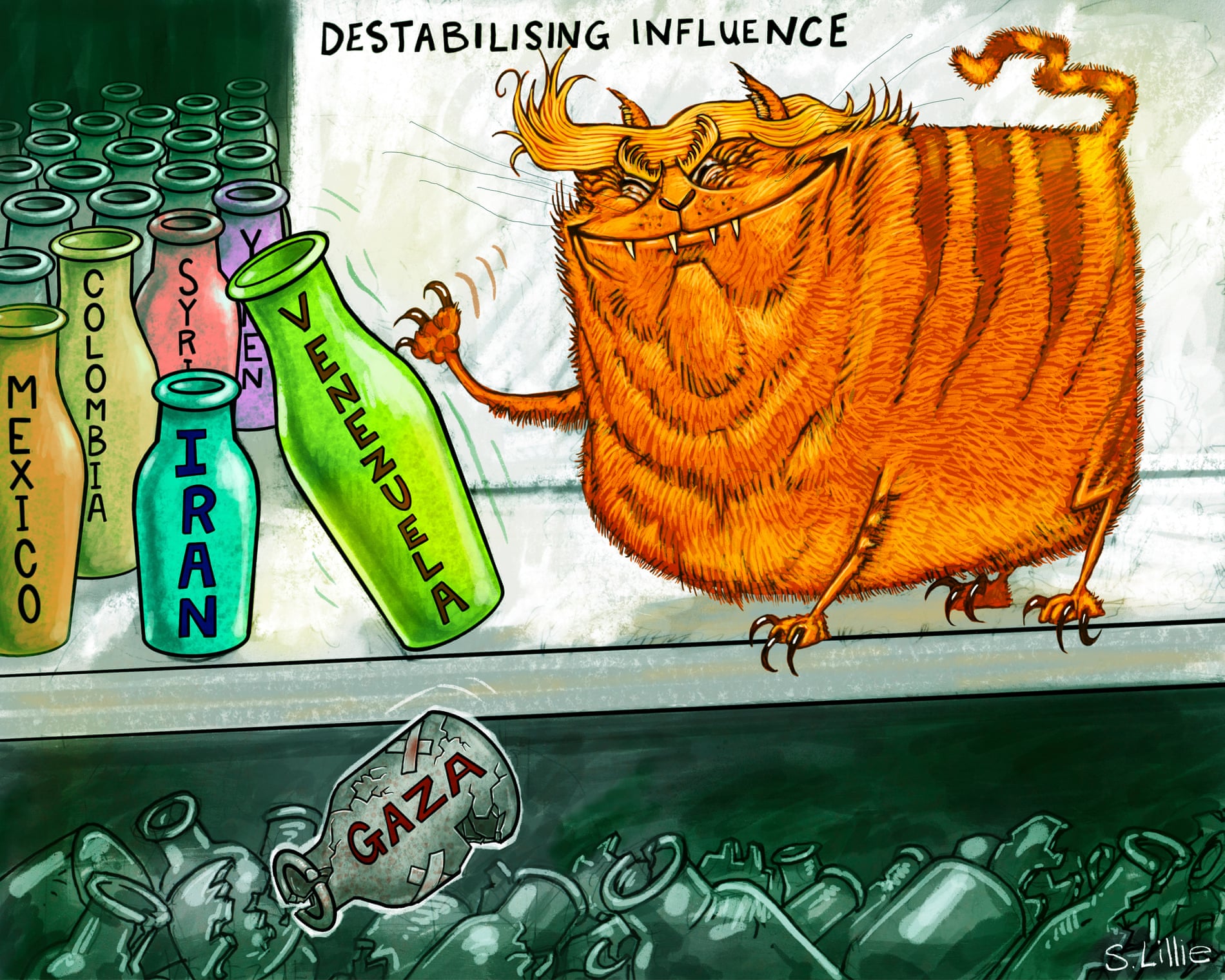
Iran is not the only war Trump started, but appears to be losing.
Virginia became the latest state to gerrymander its congressional districts ahead of the midterm elections. Tuesday, a referendum to redraw the state’s maps passed by 3%, 51.5%-48.5%. The likely effect is to turn the current 6-5 Democratic majority in Virginia’s US House delegation into a 10-1 advantage.
Vox estimates that this result puts the Democrats one seat ahead in the redistricting battle that Trump started in Texas. Florida could still tip the balance in the GOP’s favor, but probably not by much. [1]
Prior to the current round, partisan gerrymandering had more or less balanced out: In 2024, Republican House candidates got a small majority of the votes and their party wound up with a small majority of the seats, as they should have.
Republicans have gone to court to prevent Virginia’s new map from taking effect. A circuit-court judge blocked implementation, but was overturned by an appeals court. The case goes to the Virginia Supreme Court today. The deadline for candidates to file to be on the ballot is May 26, so this process can’t take long.
Republicans are asking the courts to throw out 3 million votes in an election that they lost.
For Republicans, democracy is nothing more than a word.
They are content if every person who waited in line to vote or took time off from work to cast their ballot did it for naught. They seek a result that would mean that every election worker who worked the polls wasted their time. They want the people who knocked doors or canvassed on either side of this question to feel as though they have accomplished nothing.
Meanwhile, here’s how the so-called “liberal media” has covered this story.
When Trump started this battle by pushing Texas to redraw it already-gerrymandered maps, hoping to gain five Republican House seats, The Washington Post characterized Democratic opposition as a “freakout”, and reassured its readers that “What’s happening in the Lone Star State is not a threat to democracy.”
But there’s no mystery here, and no hypocrisy to expose. AOC summed up the Republican reaction to the vote as “Wah, wah, wah” and explained the larger context:
Listen, Democrats have attempted and asked Republicans for 10 years to ban partisan gerrymandering. And for 10 years, Republicans have said no. Republicans have fought for partisan gerrymanders across the United States of America, and these are the rules that they have set.
One notable attempt to end gerrymandering was the For the People Act, which Nancy Pelosi pushed through the House, but Republicans filibustered in the Senate. AOC says that deal is still available. [2]
If Republicans decide that they would like to revisit a ban on partisan gerrymandering, I welcome them. We have the bill right here to end this all today. But they don’t want to, because they like pursuing and continuing to enact an unfair electoral landscape, and so we have an obligation to defend ourselves.
This obligation to “defend ourselves” represents a major change in Democratic tactics, beginning with Gavin Newsom’s aggressive response to the Texas gerrymander. Previously, Democrats had tried to cast themselves as the good-government party, avoiding the bad-faith tactics that Republicans have used to seek power. [3]
But perversely, joining Republicans in the gutter may ultimately work a good-government purpose. Now that Republicans realize they could lose too, perhaps a bipartisan consensus against gerrymandering will finally develop.
[1] All such estimates are iffy, because voters may not vote the same way they have in recent elections.
Gerrymandering works by spreading a party’s majority thin to stretch it over more districts. So a miscalculation could result in a previously safe seat flipping.
For example: Suppose a state has a 51-49 partisan majority. The majority party could gerrymander its congressional districts so that each district gives it the same 51-49 advantage, setting up the possibility that it could win all the House seats. However, even a small shift in the political winds could turn the situation around and give the other party all the seats.
This question arises particularly in Texas, where the new maps are based on the 2024 results. However, polls indicate that many Hispanics who voted for Trump in 2024 may regret their vote, or may not see themselves as Republican voters generally. So trying to gain five seats conceivably could result in losing a few seats the GOP had thought were safe.
[2] AOC might have added that liberal Supreme Court judges have tried to find gerrymandering unconstitutional, but conservative justices have supported it, arguing that district maps are a “political question” to be decided perhaps by the very legislatures that have been gerrymandered to lock in one-party rule.
A related court case should be decided soon: In Louisiana v Callais, the Court appears to be ready to drive the final nail into the coffin of the Voting Rights Act. Current interpretations of the VRA require states to draw a certain number of minority-majority districts, so that Black or Hispanic voters have a chance to elect congresspeople to represent their interests. Without this stipulation, a state could spread its minority populations across multiple districts and elect White-only congressional delegations. While this change would likely not take effect until the 2028 elections, it could result in as many as 15 Black House members in the South losing their seats.
[3] For example, Biden re-established the wall between the White House and the Justice Department that Trump had torn down in his first term. Arguably, Merrick Garland’s desire to end DOJ’s politicization is the reason that the Trump indictments appeared so slowly, which allowed him and the partisan Supreme Court to run out the clock.
Trump voters are beginning to regret their decisions. But that doesn’t automatically mean they’ll turn around. What Hungary can teach us about the full process.
I could list a dozen articles making these points, and you’ve probably seen a number without my pointing them out. But the most interesting to me was Patrice Mersault’s “I Lied My Way into a MAGA Focus Group” (parts 1 and 2).
In a nutshell, Mersault (a pseudonym taken from a Camus novel) kept getting rejected for focus groups when he (the Camus character is male, so I’ll use male pronouns) answered questionnaires honestly, so he created an imaginary MAGAt in his mind and answered as that character. He got in, with the idea that he would pretend to turn against Trump and see how many members of the focus group he could take with him.
Not a good plan, exactly. More of a concept of a plan. The idea was to blend in, say the right things, earn a little credibility, and then, at the right moment, turn. Say what I actually think. Disrupt the room.
But once the conversation moved past why everyone in the room voted for Trump—the familiar grievances: the immigrants, the stolen elections, the belief that cruelty is somehow a form of patriotism—the room didn’t behave the way I expected it to.
It turned out that the other 11 members of the group were fed up with Trump too, even though they had all voted for him three times. (I suppose we have to consider the possibility that Mersault’s entire account is a fiction, but I’ve decided to take it seriously.) Asked to give Trump a letter grade, the participants gave him six D’s and six F’s.
Why? Food and gas prices. The war. Worries about maintaining Social Security and Medicare. Lack of jobs. Epstein.
Who knows how they felt about Trump’s outrageous tweets and behaviors a year ago? But now that they were criticizing him, they didn’t like his manner either. The rudeness, the divisiveness, seeing everyone who doesn’t agree as an enemy. The sense that everything is about him. They didn’t try to defend it; instead, they brought up those criticisms themselves.
So far, so good. But Mersault points out that the voters themselves don’t seem to have changed. He characterized them at the beginning as having a vague and inchoate sense of grievance:
The sense that something had been taken from them. Or was being taken. Or was about to be taken any minute now, unless someone stepped in and stopped it.
The grievances manifested as discontent with a familiar set of issues:
The pandemic. The border. The economy. Woke culture. The various Democratic alternatives, all described with varying degrees of contempt.
None of that has reversed. Nobody had seen the light of liberal wokeness and was saying, “I see now that Black and brown immigrants really don’t do me harm” or “I guess transgender folks aren’t as different as I thought they were” or “Women and minorities do need some government protection”.
They had looked at Trump as “a tool”, someone who would fight back against the forces that they think are taking away their country and their future. They still have that sense of grievance, and they are still looking for a tool to break a system that they see working against them.
The question is: What will they do now? The focus group showed no enthusiasm for a Trump successor like Vance or Rubio. But what are their alternatives? Find some new hero? Stay home? Switch parties?
The Hungarian example. For years, the Orbán regime in Hungary has been a model for the American Right: Get into office and start changing the rules. Get control of the media. Corrupt the courts. Destroy the independence of the universities. Use government favors and regulations as carrots and sticks to make businesses line up with you. Gerrymander. Make voting easy for your voters but hard for opposition voters.
For a long time the Orbán program worked. But then it stopped. On April 12, Hungarian voters decisively rejected Orbán’s party, in such numbers that the tilted playing field couldn’t save him.
The opposition leader Peter Magyar did something American Democrats would like to do: He didn’t just raise dissatisfaction with the Orbán regime. (In fact, he didn’t have to, it was already there.) And he didn’t just get dissatisfied Orbán voters to stay home. He got some large number of those voters to vote for him.
Americans have been trying to read that election for clues about strategy. Maybe, after years of being a model of how a right-wing authoritarian regime rises, Hungary could provide an example of how a right-wing authoritarian regime falls.
She makes a few salient points about how Orbán came to power and stayed there: Hungarians were really fed up with the previous government, so Orbán represented a genuine uprising. And once he got into power and controlled the media, he made sure that every potential opposition leader was “pre-smeared”. Simply proposing to run so-and-so evoked a reaction of “Oh, not him again.”
But Magyar came from nowhere and represented no previous political movement.
Magyar Péter broke this because there was nothing to work with. He was, until early 2024, essentially unknown — a private citizen with no political career, no failed government, no scandal that could be weaponized. When the attacks came, as they did immediately and ferociously, they simply didn’t stick. Not because he was beyond criticism, but because what was said about him was, from the beginning, simply false. Without a kernel of truth at the center, the whole construction kept collapsing. Voters could feel the difference, even when they couldn’t articulate it. …
He also did something that sounds simple and is extraordinarily hard: he showed up. Over two years, he visited more than 700 settlements, some of them six times. Exhausting just to watch: the energy he put into it was extraordinary. He went to places the opposition had never reached, and talked to people who had never heard an alternative from someone standing in front of them, looking them in the eye. You cannot fact-check someone out of a worldview. But presence, over time, creates the conditions where doubt becomes possible. That is slower and less satisfying than a viral moment. It is also what actually works.
She identifies two deadly ideas: that the regime is inevitable, and that society is irreparably broken into two enemy camps.
The [authoritarian] method is consistent everywhere it has been deployed. Find the genuine fault lines in a society: urban versus rural, educated versus working class, the people who feel left behind versus the people who seem not to notice. Pry those lines open. Make sure every election is a referendum on identity and culture rather than on whether the pension is adequate or the hospital is functional. Keep the two halves of society furious at each other, convinced the other half is the enemy, and make sure your coalition is always the slightly larger half. The culture war is not a byproduct of this politics. It is the mechanism.
Like Trump, Orbán had no authentic convictions.
This is worth understanding, because it changes what you’re actually fighting. You are not fighting a true believer. You are fighting a machine that is very good at finding the line that divides society just enough – and parking itself on the larger side of it.
And this seems like the key point:
The grievances that get exploited are real – that is what makes it work. The sense of being left behind, of being looked down on, of watching your children leave and not come back – that is not manufactured resentment. It is legitimate. The autocrat does not invent it. He finds it, names it, and then aims it in a direction that serves him rather than the people experiencing it. … You cannot say that grievance doesn’t exist because it doesn’t affect you. The autocrat has a ready-made answer for it – simple, emotionally satisfying, and wrong. The alternative is to have a better answer, not to pretend the question isn’t being asked.
The opposition also has to avoid “the performance of contempt”.
The moment you hate your fellow citizen more than you hate the system that is robbing you both, the system has already half-won. … The lesson, though, is not simply that these systems can be beaten. It is about how. You cannot win by playing from their script. The moment you accept their frame – that your society is divided into two enemy camps, one good and one irredeemably wrong – you have lost something you won’t easily recover. The autocrat wins not just when he stays in power, but when he gets you to see your neighbor as your enemy. When the hatred flows horizontally, between citizens, rather than upward, toward the people actually responsible.
The alternative is simpler and harder to hold onto: we belong to each other. We love the same country. We want it to be better. We disagree -sometimes bitterly, sometimes irreconcilably- about how. That disagreement is not a war: it is politics, it is normal and it is supposed to happen.
What I learned in Europe. I spent the first week or so of April on a Viking Danube cruise. I went to Prague, Nuremberg, Vienna, Budapest, and a few other places. I walked through a lot of museums and talked to a lot of tour guides, but I’m going to resist the temptation to claim that I’ve become some kind of expert on Central Europe. I speak only a smattering of German, and no Czech or Hungarian at all. Most of the locals I spoke to (in English) probably aren’t typical or representative. So don’t interpret my trip as some kind of research project. I certainly don’t.
But the Danube trip did give me a good opportunity to meditate on America, and to see patterns in other societies that I should have recognized in my own.
On a walking tour of Prague, we eventually wound up at the castle that had been the seat of the German-speaking Habsburg emperor for a number of years around 1600 or so. The castle itself goes back well into the Middle Ages. While recounting some medieval transfer of power, the guide said, “And that was the last of our kings who spoke Czech.”
That sentence stuck in my mind. One perpetual theme of MAGA influencers is that the ruling elite (whoever you might imagine them to be) don’t understand ordinary Americans. That, they claim, is how you wind up with affirmative action programs and men playing women’s sports and vaccine mandates.
But in Czech history, that sentiment is literal: The kings can’t understand the ordinary people, because they don’t speak Czech. After the Habsburgs fell in 1918, there was briefly a Czechoslovakian democracy. But that fell into dictatorship, and then the Germans took over, and then the Russians. Today, the Czech Republic governs itself, but the transnational European Union is always looking over its shoulder. Czechs are probably fairly suspicious of this, and maybe that’s why they’re one of the few EU nations that don’t use the euro.
When I tried to imagine myself as a small-town Czech nationalist, I looked at Prague with great suspicion. The whole city is subtitled in English for the benefit of travelers. Lots of shops and other businesses seem not to have a Czech name at all. Places that ought to be sacred to Czechs (like that castle complex) are barely accessible, because they’re overrun with tourists speaking every known language. I might question whether Prague is Czech at all any more; it seems a lot like Czech territory occupied by some globalist empire.
That vision gave me a new appreciation of MAGA in America. There is real grievance in rural and small-town America, something I’ve written about before. It’s a sense that the place you live, which is maybe the place you grew up, has no obvious path into the future. The jobs are leaving, the talented young people are leaving, and there seems to be no end to it.
If that were the whole grievance, though, rural and small-town anger might focus where it really belongs: on the big corporations who rig the system in their favor and don’t care where they build things; and on the billionaires who get big tax breaks and leave no money behind for schools and roads and local investment. But laid over the economic grievance is a sense of dislocation: The America I grew up in isn’t just endangered, it’s already gone in lots of places. This gets you to the demonization of immigrants and people whose lifestyles diverge from what was socially acceptable in the past.
So often, when I run into conservatives obsessed with culture-war issues, I want to ask “Why do you care?” If someone with a penis wants to wear skirts and makeup and start using a name like Susan, what’s it to you that you should feel so incensed about it? If two men or two women want to marry, and to live a life not all that different from the one you live with your opposite-sex spouse, how are you harmed?
The dislocation theory makes sense of this. They aren’t harmed in any material sense, but the culture-war issues are symbols of their grievance: This is not their world any more. They used to know how they (and their children and their communities) could thrive, but now they don’t. The culture-war issue isn’t itself a grievance, but they’ve been trained to see it as a signpost pointing to grievances.
It also explains the hostility to cities. The new world, the world where they don’t belong and can’t succeed, has already taken the cities. The cities are territory occupied by a globalist empire.
It also explains the conspiracy theories. When you feel something, any story that explains and justifies the feeling seems plausible. Fact-checking the narrative doesn’t affect that sense of plausibility.
Progressive vs. centrist. At least since the Clinton administration, conflict has been raging between two theories of why Democrats lose and how they can win. The centrist theory says that Democrats lose when they become too liberal and alienate moderate swing voters. The progressive theory says that Democrats lose when they seem inauthentic and fail to give voters a clear new vision of where the country should go.
When they actually get into office, though, the two kinds of Democrats agree on a great deal. Centrists want to focus on proposals that are immediately achievable, while progressives see those same proposals as first steps on their path into the future.
Both factions want to spin current events in their favor. But if I take the lessons of Mersault and Zsofi to heart, I think both framings miss the point: what the reachable voters are looking for is not fundamentally a more liberal or conservative policy. They’re looking for authenticity and for someone they can trust. They want candidates who care about them enough to show up, to learn what they care about, and to speak to them as if they were intelligent people with real concerns. If you do that, you can get away with taking some principled stands they disagree with.
Look at candidates who are surviving or even thriving in what should be hostile environments. Andy Beshear is popular in Kentucky, but he still gets away with vetoing an anti-trans-rights bill. (“My faith teaches me that all children are children of God and Senate Bill 150 will endanger the children of Kentucky. … I heard from children that believe this bill is picking on them, and asking — in many ways — why? I told them that I was going to show them that there is at least one person in Frankfort that cares for all of our children in the commonwealth, no matter what.”) In Texas, James Talarico’s Christianity takes him different places than MAGA Christianity does, but so far he hasn’t compromised his vision. Jon Ossoff is doing well in Georgia, largely because of his way of speaking in terms voters identify with. (Listen to him make the case against Trump’s corruption.) Pete Buttigieg isn’t currently running for anything, but he goes into enemy territory (like Fox News) and holds his own — and not by throwing unpopular Democrats or Democratic constituencies to the wolves.
Of course Democrats, like all politicians, should focus on their popular positions. But they should put themselves in positions to be challenged on unpopular positions, and they should be ready to defend those positions in easily understandable terms, tracing them back to core values that are widely shared, or at least widely appreciated. They need to answer criticism without denigrating the critic.
Most of all, Democrats need to send the message that they will look out for the country, and not just for their own voters.
The moment you hate your fellow citizen more than you hate the system that is robbing you both, the system has already half-won.
But the right path is not to pander to those you disagree with, but to address them honestly, intelligently, and respectfully
Disagreement is not a war: it is politics, it is normal and it is supposed to happen.
With no goal to achieve, it’s hard to see how this ends.
Two weeks ago, I opened the weekly summary with a quote from the Roman philosopher Seneca: “If one does not know to which port one is sailing, no wind is favorable.” That continues to be the story of the Iran War. When reporting on the “success” of the war so far, SecDef Pete Hegseth talks about destruction:
During the briefing, Hegseth said the U.S. has struck more than 7,000 targets in Iran, wiped out its submarines and has “crippled” the nation’s military ports. “We are hunting them down methodically, ruthlessly and overwhelmingly like no other military in the world can do,” Hegseth said. “Today will be the largest strike package yet.”
The mission of Operation Epic Fury is laser-focused: Destroy Iranian offensive missiles, destroy Iranian missile production, destroy their navy and other security infrastructure – and they will never have nuclear weapons.
But only that last point “they will never have nuclear weapons” is a strategic goal, and the destruction Hegseth glories in does not lead to that goal in any clear way. The ayatollahs remain in power. Iran continues to have uranium it could enrich and oil it can sell to raise money. Given all that, a nuclear program could resume whenever the bombing stops, no matter how much rubble Iran will need to clear away.
In The Big Picture, Jay Kuo references another classic strategist, Carl von Clausewitz.
Clausewitz’s seminal work, On War … instructs that military force should never be an end in itself. War is the “continuation of politics by other means.” Military aggression, in Clausewitz’s view, must therefore always be in service of a political objective. Once a military campaign loses sight of that goal and focuses only on battlefield success, the real war is already lost.
Modern American military failure is largely a study in ignoring that warning.
Kuo recalls Vietnam, which I have also been thinking about. (Yes, I’m that old.) Hegseth’s predecessor Bob McNamara convinced himself that we were winning the war using statistics like body counts. Even if you believed the counts were accurate, McNamara didn’t seem to realize that we couldn’t win the war by killing more of their soldiers than they killed of ours. Killing the enemy is never an end in itself.
Same thing here. Iran’s regime doesn’t need to shoot down our planes or sink our ships to win this war. It just needs to survive, and so far, it’s surviving. By closing the Strait of Hormuz and raising the world price of oil, Iran is inflicting pain on the American consumer. Yes, our aerial bombardment is inflicting far worse pain on Iranians. But Iranians know what they’re suffering for and we don’t. It’s not at all obvious that they will demand an end to this war before we do.
This week, the Trump regime continued the pattern of saying many contradictory things at once. They seem confident that the MAGA faithful will decide to believe whichever one they want and be encouraged accordingly.
Oil prices dropped and stock prices rose this morning, because traders still take Trump’s statements seriously, no matter how many times they amount to nothing.
Regardless of what any of the parties say about their intentions, the war is escalating. The early strikes were aimed primarily at Iran’s leadership, and they succeeded in killing not only the supreme leader, but many of his top deputies. Military targets came next (with an occasional misfire producing civilian casualties). But those strikes left open the possibility that new leadership could command a viable country with a viable economy.
Iran attacked the world’s biggest liquefied natural gas complex in Qatar, targeted a gas field and facility in the United Arab Emirates, fired missiles and launched drones on a Saudi Arabian oil refinery and on two Kuwaiti gas units on Thursday, following Israel’s bombing of Iran’s South Pars gas field a day earlier.
Now Trump is threatening Iran’s power plants, which is a direct attack on the civilian economy.
In any conflict, Trump only knows two moves: escalate or walk away. His reputation as a deal-maker is a bad joke; he has no idea how to make deals. As I have predicted before, Trump will keep escalating until Iran surrenders, and Iran won’t surrender. So I see no limit on how far this goes. But Paul Krugman confesses that at this point, he doesn’t know what to do either:
I have no idea how this ends. I don’t even know what I would do at this point. I mean, take a time machine and go back and not do this, but now it’s going to be really, really ugly.
So having started this note with one quote from and ancient Roman, let’s close it with another. In The Histories, Tacitus wrote:
As so often happens in these disasters, the best course always seemed to be the one for which it was now too late.
The Iran War is turning out to have significance for military theory.
Back in 1936, the Spanish Civil War was far more than just a competition between fascist/catholic forces and democratic/communist forces. It was also a preview of the new warfare that would come into its own in World War II.
Ukraine is playing the role of Spain this time around. Russia began the war by attempting a World-War-II style blitzkrieg that aimed to put tanks in Kiev in a few days. It failed, and now, four years later, the war has turned into a drone-vs-drone battle in the near-ground air.
The current Iran War is a second chapter in this story. At the heart of the new warfare is a battle of resource attrition: Drones that cost thousands of dollars can destroy tanks and ships worth millions, and the Iron-Dome-style missiles that intercept drones also cost millions.
The reason we are getting fertilizer, mostly from Qatar, is that the fertilizer is made … from natural gas. Natural gas can be exported, is exported, in large quantities from the Persian Gulf, or was until this war began. That’s expensive. You have to super cool it and liquefy it and ship it out through special terminals and special ships.
And, you know, it can be done and it’s become really critical to a large part of the world. But the other thing you can do with the natural gas that’s available in the Persian Gulf area is convert it into fertilizer, which is a lot easier to ship. And so a lot of the world’s fertilizer turns out to come from that area and normally get shipped through the strait.
You can already notice the price of gas rising. But it might not be until fall that you notice the price of food rising.
Ever find yourself watching Trump officials and thinking “What’s wrong with those people?” Three writers offer their answers.
We’ve known for a long time that the Trump administration works on a flood-the-zone theory: Do so many outrageous things simultaneously that the American People have a hard time comprehending them all, much less organizing a response. Are they disenfranchising large numbers of voters? Never mind that, ICE is murdering US citizens on the streets of Minneapolis. Want to do something about that? That’s yesterday’s news; the Epstein files are hiding evidence of billionaire pedophilia. Concerned about that? Never mind, we’re in a war now. On and on.
Further impairing our comprehension is the barely explicable attitudes central figures in the administration take. Again and again, before I can even get to the policy content of some statement, I have to deal with my first response: What is wrong with these people?
Trump said he was “surprised” that Iran decided to attack other Middle Eastern countries in response to the U.S.-Israeli operation, and that U.S. strikes on Kharg Island on Saturday “totally demolished” most of the island but that “we may hit it a few more times just for fun.”
Just about any appearance by Secretary of War Defense Pete Hegseth includes a what’s-wrong-with-him moment. Friday during a press briefing about the Iran War, he said there would be “no quarter, no mercy for our enemies“. [Note the web site that link is on: war.gov] Just Security posted an article by Danial Maurer, a former Army JAG who has taught at West Point. Maurer imagined the memo a Pentagon legal counsel should have sent to Hegseth in response: It points out that “no quarter” is a war crime. The phrase refers to the ancient practice of killing opponents even if they try to surrender.
Maybe Hegseth intended to threaten war crimes and encourage his underlings to commit them. Or maybe he was just blabbing — saying a bunch of tough-sounding words without knowing what they mean. Either way: What’s wrong with that guy?
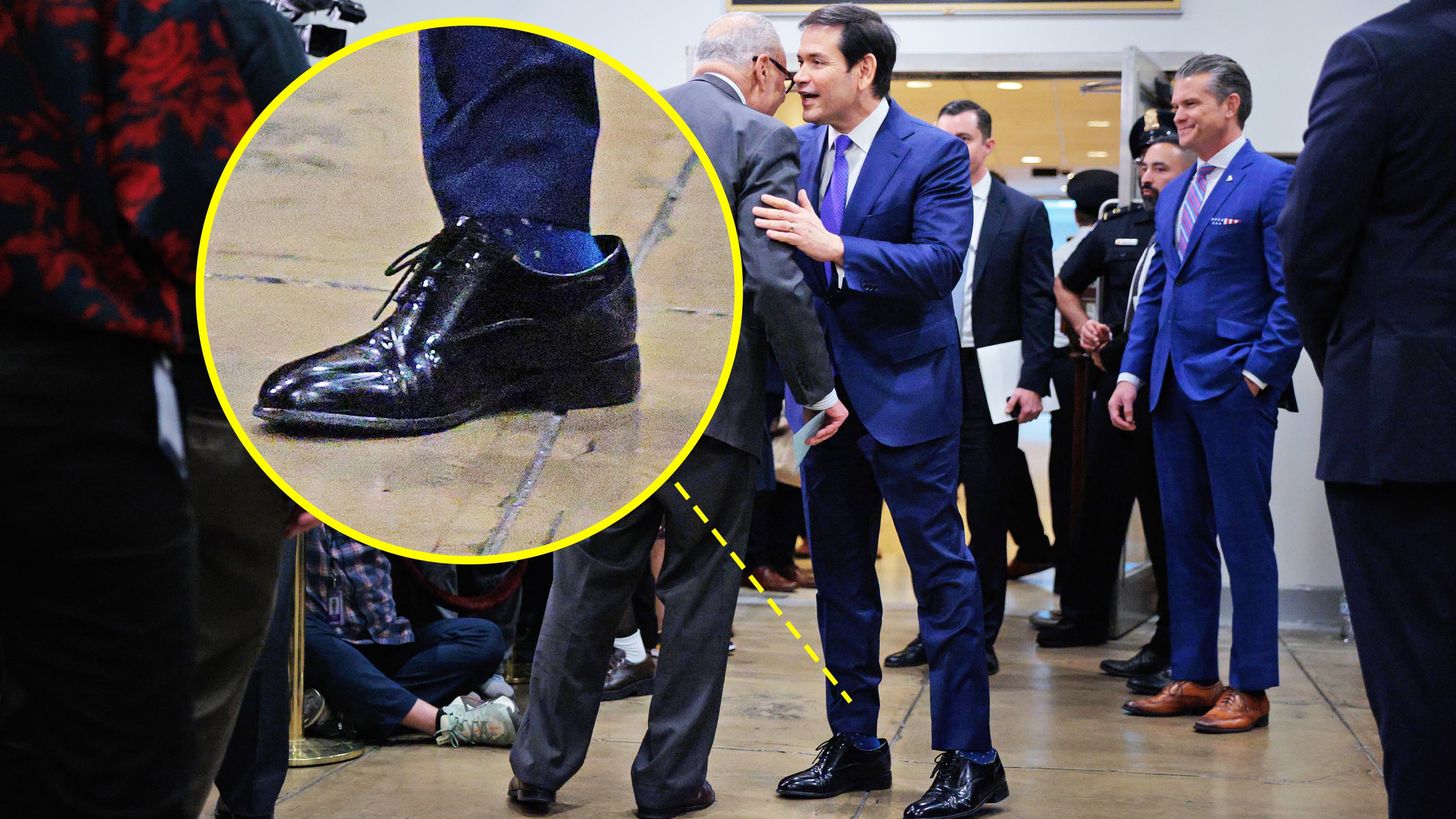
Trump gave his whole cabinet shoes identical to his own favorites, and “everybody’s afraid not to wear them.” For some reason he made Marco Rubio’s way too big. And Rubio wears them. Our Secretary of State attends important gatherings in clown shoes. What’s wrong with him?
Pam Bondi blew off questions from Congress about DoJ’s failure to interview survivors of Jeffrey Epstein’s crimes by pointing to the stock market:
The Dow is over 50,000 right now. … That’s what we should be talking about.
I was listening to that hearing live, and I had trouble even getting to the policy implications of her statement. Because all I could think was: “What’s wrong with her? What kind of human being thinks like that?”
Why are all these people so cruel, insensitive, self-centered? so devoid of qualities that we expect not just from leaders but from ordinary people?
Most of us don’t have the time or the presence of mind to step back and try to answer that question. But a few recent articles have been written by people who do.
The most interesting to me is “The Problem of Pathocracy” by Dr. Steve Taylor, which was published by The Psychologist, a journal of the British Psychological Society. It’s a recent article, but the theory it presents goes back to the pre-Trump era. Polish psychologist Andrzej Lobaczewski, who experienced both Nazi and Communist regimes, coined the term pathocracy decades ago.
As he put it, pathocracy is a system of government ‘wherein a small pathological minority takes control over a society of normal people’. Since he was living under a ‘pathocratic’ regime himself, Lobaczewski took great risks studying this topic. He was arrested and tortured by the Polish authorities, and unable to publish his life’s work, the book Political Ponerology, until he escaped to the United States during the 1980s.
According to Lobaczewski, the transition to pathocracy begins when a disordered individual emerges as a leader figure. While some members of the ruling class are appalled by the brutality and irresponsibility of the leader and his acolytes, his disordered personality appeals to some psychologically normal individuals. They find him charismatic. His impulsiveness is mistaken for decisiveness; his narcissism for confidence; his recklessness for fearlessness.
Soon other people with psychopathic traits emerge and attach themselves to the pathocracy, sensing the opportunity to gain power and influence. At the same time, responsible and moral people gradually leave the government, either resigning or being ruthlessly ejected. In an inevitable process, soon the entire government is filled with people with a pathological lack of empathy and conscience.
The first Trump administration included a large number of relatively “responsible and moral” people with conservative political views: Mike Pence, Rex Tillerson, Jim Mattis, John Kelly, and so on. But by the end of that term, all but Pence had been fired or resigned under pressure, and Pence was persona non grata after he failed to join Trump’s coup attempt in 2021. And so, as Lobaczewski predicted, we are left with a government “filled with people with a pathological lack of empathy and conscience”.
Not only is Trump’s sociopathy enabled by such people, they are drawn to him. He gives them permission to be what they always wanted to be. We can see the same process working on a larger scale: Across the country, people don the red hat because it lets them insult and abuse the kind of people they have always hated.
That leads to a second article: “Polarization and Strife” by A. R. Moxon on his blog The Reframe. That article was originally written in 2022, but Moxon reposted it this week because of its relevance to recent events.
This article flips the script on the word polarization. People complain about how polarized our society has gotten: Friendships are ending and relatives become estranged because of political disagreements.
But Moxon calls attention to a different kind of polarization, one that has always been with us: polarization between the comfortable and the marginalized, “gay or bi or trans or nonbinary, Black or brown, Muslim or Jewish or Sikh or Hindu, or undocumented, or disabled, ill, neuroatypical, impoverished, or unhoused people, and many others, too”.
The “unpolarized” world so many people are nostalgic for is one where the marginalized could be safely ignored. You could say words like bitch and faggot and nigger and retard, because all the comfortable people agreed that those marginalized groups don’t matter, and members of the groups themselves had been intimidated into silence. So you could insult or abuse marginalized groups openly, and no one would call you on it. But today you can’t even do it if you’re just joking, because nobody has a sense of humor any more.
Moxon looks at this not as polarization, but as solidarity: More and more comfortable people are feeling empathy for the marginalized and refusing to watch passively as they’re abused.
Consider the idea that treating certain people as if they don’t matter enough to care about their dignity and their lives—and doing this so thoroughly and effectively that society treats them as if they are nonexistent and disposable—creates a much deeper polarization than any fight over the holiday dinner table or on the airwaves over whether or not it’s good to do so.
And: the more peaceful that subjugation, the greater the polarization.
Consider a corollary, that as people stop going along with this unnatural injustice, it will decrease the peace of that subjugation; will increase resentment and strife, for as long as there are people still willing to fight to subjugate others.
But the strife isn’t polarization. It’s distressing, but it’s not polarization. The strife is the first early sign that we might be willing to stop being polarized by bigotry and injustice.
The third article I want to call your attention to is “The Most Divorced Men in History” by Andrea Pitzer, published on her blog Degenerate Art. Pitzer focuses on the weird affect of so many people in the Trump administration. Past administrations have at times had cruel policies, but they usually seemed apologetic about it: We don’t want to hurt anybody, but there’s this greater good to weigh the suffering against.
Trump’s people, by contrast, seem genuinely gleeful about the harm they can do. Stephen Miller, for example, appears to glory in the distress he causes immigrant gardeners and farm workers and healthcare aides. Greg Bovino gave a swaggering style to the ICE thugs who terrorized Minneapolis. Elon Musk seemed joyful and pleased with himself as he slashed programs to feed hungry people and inoculate children against infectious diseases. In the end, he caused vast numbers of deaths and didn’t even save the government money, but he appears untouched by the kind of regret the rest of us feel when we tap a stranger’s bumper in a parking lot.
Pitzer goes out on a limb and associates this kind of high-level viciousness with a phenomenon she sees in everyday life: divorced-guy energy.
What do I mean by “divorced guys”? I mean that they all have the energy of the man who won’t stop talking about the woman who left him and what a monster she is, with the clear implication that her mistreatment of him was entirely undeserved.
Several examples of this personality type exist in the right-wing influencer universe. In some cases, as with incels, the guys haven’t even been left by a partner yet, but they already speak about punishing women or restricting their rights as if the other sex has already betrayed them. In other cases, as represented by Andrew Tate, the men advocate the active physical and psychological abuse of women as a group as a means to power in a physical hierarchy in which men are supposed to dominate by default.
But the heart of divorced-guy syndrome in the U.S. today is the Trump administration. I mean that metaphorically, in which we see variations on the “divorced guy” energy of the podcasters, blaming women or assigning them very subservient roles. But I also mean it literally. The administration is filled with people who’ve had literal and often bitter divorces, and who seem to be tapping into some kind of primordial hatred of women that fuels their current work. Think Donald Trump. Or Russell Vought. Or RFK Jr. Or Pete Hegseth. I have no idea whether their issues actually rose out of their relationships with their moms, but they have played out through adult relations with women that have often ended in divorce.
Like Lobaczewski, Pitzer is pointing to the prevailing spirit in an administration, not something that affects each member individually. A few Trump officials, like Miller and Bovino, seem not to have experienced a literal divorce. And Pam Bondi and Kristi Noem are not even guys. But the administration as a whole accounts for a fairly large number of divorces, starting with Trump’s two-and-counting.
I would like to propose that the seething root of resentment that typically fuels these men is hatred of women. We are also witnessing tidal waves of racism and homophobia and disdain for the poor, but I have come to wonder if misogyny might not only sit alongside the rest but might even undergird the whole thing.
Patient zero in their hate, more often than not, is a woman each resents. The later targets might well be people who want simply to be treated as human that they refuse to treat as human because they need more targets for their fury. So instead, they come to feel they have been attacked by the actions or even the existence of minority groups. They direct their same kind of fury against those groups as they do the women they’re mad at.
She mentions Hillary Clinton as an example of a woman MAGA can’t stop hating, no matter how long she has been out of the public eye. More recent examples include AOC and the other members of “the Squad”.
Pitzer references an article by Maleah Fekete in the journal Rural Sociology, about risk-taking behaviors among rural working-class men — the heart of MAGA. Male recklessness is a major factor in the rise in “deaths of despair”. And periods of extreme recklessness often start with some triggering event.
Two-thirds of the triggering events involved relationship dissolution, which respondents frequently framed as a woman leaving. Importantly, these accounts reflect respondents’ interpretations of relationship dissolution rather than objective accounts of responsibility or causality.
Republicans have left an opening. Can Democrats like James Talarico take advantage?
Ever since Jerry Falwell launched the Moral Majority and got credit for electing Ronald Reagan in 1980, conservative Republicans have seemed to own Christianity.
Not really, of course. There was always a Christian Left, going back to Dorothy Day in the 1930s, and even further back to St. Francis or even that ultimate bleeding heart, Jesus. Both the civil rights movement and the anti-Vietnam War movement had strong liberal religious components.
But from the 1980s on, in the media and the public mind, Christianity in politics somehow came to mean conservative politics. “Moral” issues were defined as the issues religious conservatives cared about: abortion, gay rights, and so on. When Supreme Court decisions purport to defend “conscience”, or people’s right to act on their “sincerely held religious beliefs”, you can bet that those beliefs are conservative. Only rarely have treating women like people, fighting oligarchy, refusing to racially discriminate, opposing cruelty towards immigrants, preserving the environment, or allowing LGBTQ people to lead full lives been framed as “moral” issues.
Texas has gone as far as to legally prohibit its [mortality review] committee from reviewing deaths that are considered abortion-related. This could include some miscarriage care, health officials told ProPublica.
In times past, the choice between Democrat and Republican wasn’t always so clear, and Christians tended to split down the middle. A shared worldview across the aisle led to more options in the voting booth. As things stand now, no such options remain. The Democratic Party has so situated itself against the God of heaven and against His Word that no Christian can justly, nor obediently cast a vote for anyone who claims the Democratic platform. … For these reasons, Christians cannot vote for any member of the Democratic party while also saying “I believe and follow the teachings of King Jesus.” From Vice President Harris all the way down to local City Councils and school boards.
The “reasons” given are abortion [1], LGBTQI+ rights, and DEI (which doesn’t even rate an explanation).
Democrats, for the most part, have dodged this challenge. Conservative Catholics like J. D. Vance can claim to know better than the Pope, but liberal Catholics like Joe Biden or John Kerry have had to strike nuanced positions (like disapproving personally of abortion while defending a public right to choose it) while trying to change the subject. Barack Obama’s liberal Christian religion was seen as a political problem, not a strength.
Enter Trump. During the Trump era, Republicans have leaned even more heavily on the conservative Christian vote while putting their Christian supporters in an ever-more-difficult position. Trump, after all, represents the virtual antithesis of Christianity.
He has been accused of sexually assaulting a minor. And even if that turns out not to be true, he’s been suppressing the Epstein files to hide something.
He lies so constantly that he has worn out the fact-checkers. Anything short of an outrage-producing howler gets ignored now.
When you get down to cases, it’s actually harder to see how a Christian can support Trump rather than a typical Democrat.
Pastors who are committed to Trump politically have twisted themselves into all kinds of contorted positions. Bible verses get re-interpreted to circumvent what they obviously say. The importance of morality and character in public leaders (something we heard a lot about when Bill Clinton was president) is discounted, because “God uses flawed people“. When Republicans have scandals, we hear about God’s mercy and forgiveness — even if the offender denies the sin and refuses to make things right with the victim. But Democratic sin is unforgivable.
This can’t go on forever. At some point, the gulf between Trump and Christ grows so large as to be unbridgeable. And that raises the question: Can Democrats make an explicitly Christian play for the Christian vote?
Talarico. That’s going to be tested in Texas, where Presbyterian seminarian James Talarico won the Democratic senate primary Tuesday. Guthrie Graves-Fitzsimmons comments:
Talarico’s message is not about moderating progressive commitments to win over religious conservatives. It is about courage. It is about saying plainly that support for LGBTQ+ equality, reproductive freedom, public education and church-state separation can flow directly from Christian faith. He’s openly Christian and firmly pluralistic.
That does more than close a messaging gap: Talarico and those like him can change the terrain. When leaders speak about faith with confidence instead of defensiveness, they show that democracy and devotion are not in conflict.
His Republican opponent — whether it will be the incumbent John Cornyn or challenger Ken Paxton (who presents about as many moral issues as Donald Trump) — is bound to double down on the Christians-can’t-vote-for-Democrats message. Texans can expect to hear a lot about Talarico’s support for reproductive freedom and trans rights. We’ll see whether such attack ads can drown out the voice of an authentic liberal Christian whose worldview is rooted in what Jesus actually said rather than the conservative positions that have attached to him like barnacles.
But what about church-and-state? A second question Talarico raises is whether Democrats should compete explicitly for the Christian vote. One popular liberal viewpoint is an interpretation of church-and-state separation that extends to political argument rather than just government: Our government needs to remain secular and not favor any particular religion, so our candidates should campaign in a purely secular way.
I think this view misses an important point: People come to their political positions through their values, and many people’s values are grounded in their religion. If you can’t use religious language, you end up arguing against opinions already set; you can’t get into the mill where those opinions were forged and might be re-forged.
And finally, purely secular politics runs into a widespread American belief: that religious convictions are more serious and solid than secular ones. One reason Democrats are always under more pressure to compromise than Republicans is that the public sees conservative positions as religion-based and therefore immovable. Democratic positions seem more political than principled, because we so rarely seem to “speak from the heart”.
Many, many liberal positions rise out of deeply held moral values that are as serious as any religion, and many of those values are in fact religious. In the privacy of their own minds, many Democrats think in religious terms. If those terms have to be edited out before we speak in public, we will sound inauthentic.
[1] I’ve said it before, but it’s worth repeating that the anti-abortion position is entirely un-Biblical. Nothing in the Bible indicates that fetuses have souls, and Genesis 2:7 shows the soul entering the body not at conception, but with the first breath (which is a common Jewish belief).
Occasionally someone argues that Jesus or the prophets would have denounced abortion had they known about it, but this is nonsense. Surgical abortion may be a recent development, but from the beginning of time women who didn’t want to be pregnant have tried to induce miscarriages. If you see some spiritual difference between mifepristone and pennyroyal, you are more perceptive than I am.
Jesus and the prophets had to know about this practice, but for some reason they didn’t find it worth commenting on.
This lack of Biblical support is not so important for Catholics who oppose abortion, because the institution of the Catholic Church reserves the right to create new doctrine. But Protestant denominations — especially conservative ones — explicitly reject this view: Churches are not supposed to add or subtract from the message of the Bible.
Anti-abortion has been grafted onto the Bible. It wasn’t there originally.
Two decades ago, George W. Bush and his cabinet spent months raising support for an invasion of Iraq. Two days ago, the Trump regime attacked Iran without giving us any coherent explanation.
Saturday, the US and Israel began an air war against Iran. The widespread attacks had a variety of goals, but decapitating the government was clearly one of them: One early death was that of Supreme Leader Ali Khamenei, an ayatollah who has been in power since the death of the founder of the current theocracy, Ayatollah Ruhollah Khomeini, in 1989.
The first American deaths were reported yesterday: three service members who had not yet been named. Five more have been seriously wounded.
It’s hard to know what to write about this, because we have been told so little. Comparisons to George W. Bush’s Iraq fiasco are everywhere, but this attack differs in one important respect: Bush spent months trying to raise public and congressional support for his invasion. Trump, on the other hand, has given no credible explanation. In retrospect, many Americans resented Bush’s deceptive propaganda, but at least he acted like our opinions mattered. Trump seems not to need either our approval or that of Congress. (The Constitution and the War Powers Act say he does need Congress’ approval, if things like that still matter.)
I remember where I was when Bush came on every TV network to announce we were going to war. Trump hasn’t bothered. He posted to social media an 8-minute video full of rhetoric and falsehoods, and never answered the questions “Why this? Why now?” Stylistically, he talked at us rather than to us — standing behind an official podium and hiding his eyes in the shadow of the visor of a USA cap.
No senior Trump administration officials or cabinet members appeared on the Sunday show television circuit a day after the US and Israel began a major military operation in Iran, killing Iran’s Supreme Leader Ayatollah Ali Khamenei. … The White House’s communications operation indicated that it would let allies on Capitol Hill do the talking, three people familiar with the discussions said.
Why would Trump want Lindsey Graham and Tom Cotton to make the case rather than Marco Rubio or Pete Hegseth or J. D. Vance? To me, the answer seems obvious: Republican senators aren’t official representatives of the Trump regime, so anything they say is deniable.
Trump has sent them out to lie to us, and doesn’t want to be answerable when those lies collapse.
Every hint of an explanation that we’ve been given so far is full of holes. We were told in June that the bombing raids then had “totally obliterated” Iran’s nuclear capability. But only months later we have to attack again because Iran “can never have a nuclear weapon.”
As they made their public case this week for another American military campaign against Iran, President Trump and his aides asserted that Iran has restarted its nuclear program, has enough available nuclear material to build a bomb within days, and is developing long-range missiles that will soon be capable of hitting the United States. All three of these claims are either false or unproven.
Lay down your arms. You will be treated fairly with total immunity. Or you will face certain death.
But there’s no way an air campaign can back that up. The Iranian forces would have to surrender to somebody on the ground, somebody with the institutional power to hold tribunals for some people but not others. Who is that?
Trump also claimed to be doing this for the Iranian people:
When we are done, take over your government. It will be yours to take. This will be probably your only chance for generations. … America is backing you with overwhelming strength and devastating force.
What we did in Venezuela, I think, is the perfect, the perfect scenario.
In Venezuela after Maduro was captured, his vice president took power and the entire regime remained intact. All they did was let Trump control their oil.
So much for the Iranian people.
In the absence of any plausible explanation from Trump, we’re left to imagine some other motive. Here’s the opinion of Phillips P. OBrien, professor of strategic studies at the University of St. Andrews in Scotland:
Boil it all down and what do we have? We have a military operation with no clear ends at all. Stop asking what the US government’s intentions are, they do not exist outside of the personal interests of Donald Trump. They can and will therefore change in a heartbeat as he searches desperately for whatever end gives him the best chance to declare victory. He has made the national interest entirely personal.
Trump attacked Iran to change the media narrative in the US. The testimony of the Clintons to the House Oversight Committee has raised the question of why Trump doesn’t testify. And polls show Trump’s party headed for a historic defeat in November, losing the House and possibly even the Senate.
This bombing campaign is what Iran’s regional rivals get in exchange for a series of bribes to Trump and his family: the UAE’s half-billion-dollar investment in Trump’s crypto company; a $400 million luxury jet from Qatar; Jared Kushner’s firm getting $2 billion in Saudi money to invest despite their high management fees and lack of experience; an Abu Dhabi firm using $2 billion in Trump meme coins to complete a business transaction; and perhaps countless others that are still hidden behind the veil of Trump’s real estate and crypto-currency operations. Rachel Maddow says: “And now for that low, low price, they appear to have rented the services of the United States military to start a war that they want, but that the American people do not, and that our American government hasn’t bothered to explain in terms that are even internally consistent, let alone rational and sound.”
A big, expensive distraction? A quid for the sheikhs’ quo? Trump may not like those theories. But if he doesn’t want them settling into the public mind, he needs to give us something better.
When does cooperation become complicity? And what other choice is there?
This morning I want to introduce you to a blogger a bit more radical than I am: A. R. Moxon, who writes a payment-optional Substack blog called The Reframe. I often have reservations about what he’s saying, but I find myself consistently challenged (in a good way). Maybe you will too.
Right now there’s a debate going on in Congress about funding DHS, and before that about funding a fairly large swath of the government. Democrats have tried to hone the issue down as small as possible, and to make only the most obvious common-sense demands in exchange for their support: ICE agents don’t wear masks, have to get judicial warrants, can be held accountable when they use excessive force, and so on. Even this is too much for Republicans, apparently. So Democrats will probably eventually water their position down even further to reach some kind of agreement.
This is usually explained as follows: Democrats want to appeal to a reasonable middle of the country, so that they can build a majority and regain power. Making more extreme demands might alienate the center and leave Republicans in power. That makes sense in its way, but more radical voices reject abandoning principle. When ICE may be building massive concentration camps, compromise makes no sense: Would you feel victorious if you got them to agree to fewer or smaller concentration camps? (“I’ll support Dachau if you agree not to build Auschwitz.”)
That’s the view that animates this week’s Reframe post “Hating the Game“. He starts small, with the MAGA meltdown over Bad Bunny headlining the Super Bowl halftime show. Bad Bunny is Puerto Rican, which makes him a native-born American citizen — unlike previous Super Bowl headliners like Paul McCartney, Sting, Phil Collins, and other English-speaking White males whose selection raised no controversy at all.
Even if Bad Bunny doesn’t use the stage to explicitly condemn Trump’s deportation campaign, the dueling shows will highlight the nation’s deep divide over immigration, and his performance is likely to be viewed through that lens.
This kind of even-handed framing is so common that it may not even raise your hackles. But it raises Moxon’s:
The Post’s framing only makes sense if, as is often the case, the demand of white bigotry is being accommodated. You can be one of the most popular figures on the cultural landscape and it won’t matter; if white racists don’t like you, you’re controversial and polarizing. White racists, meanwhile, are never framed as divisive or polarizing, no, they’re always “concerned” or “anxious,” and the problem to be solved is never their racism, but always how best to assuage it.
From there, he describes three models of political engagement, which he calls the cooperation game, the murder game, and the non-cooperation game. MAGA, he says, is playing the murder game: They are using the machinery of government to dominate opponents and seize loot for themselves. Democrats are trying to play the cooperation game, where you are seeking common ground on which you can assemble a democratically governing majority. Moxon’s observation is that this doesn’t work.
It’s not just a bad idea to play the cooperation game with people playing the murder game—it’s an impossibility. When you act in good faith with those who have proved themselves capable of limitless bad faith, then you are no longer playing the cooperation game: you are merely cooperating with the murder game, and are, therefore, a participant not in the cooperation game, but the murder game.
He suggests playing the non-cooperation game: Stop giving the benefits of cooperation to those who have dedicated themselves to murder.
For the Super Bowl halftime show, non-cooperation looks like this:
Our response should not be “This response to Bad Bunny’s inclusion shows how divided we are, how can we stop this polarization?” Our response should be uncooperative: “The response to Bad Bunny’s inclusion shows just how racist our society is. Racists are angry about the halftime show? Good! Everything about our society should make racists feel alienated. How do we make racists feel even more alienated from even more of society??
More generally:
[Non-cooperation] can be strategic; refusing to grant even one vote toward the funding of a murderous government, until the death squads have been utterly abolished, and the vile white supremacist serial child rapist of a president who controls them has resigned, along with all of his cabinet, and submitted to prosecution. It can be legislative; refusing to allow voice votes, in order to grind down the apparatus of government. It can be social; refusing to fraternize with Republican colleagues, or refusing to serve members of Republican governments or their death squad in restaurants and businesses. It can be tactical: following the death squads and impeding their work; playing loud music to keep them awake; making them and their abuses known and shaming and shunning and excluding them for daring to murder their neighbors. It can be losing paperwork. It can be deliberately misunderstanding instructions. It can be purposefully dawdling. It can be tripping somebody up, getting them lost and turned around, obstructing the gears of brutality, sabotaging the engines of murder.
It’s not murder, and it’s not retributive; it’s removing all the benefits of human cooperation from all humans who play the murder game—not because we hate the humans (though it’s difficult not to hate people who would murder their neighbors, and I don’t shame those who can’t manage it), but because we hate their vile murderous game.
If you’re like me, you read The Reframe and think: “I don’t know if I’m ready for that.” (Example: Do we have to call it “the murder game”? Isn’t that needlessly off-putting?) But why not, exactly?
I’m calling attention to non-cooperation this week for a very specific reason: If the guardrails completely fail and Trump manages to cancel, steal, or ignore the midterm elections, then the only response short of violent revolution is the ultimate form of non-cooperation: the general strike. We need to start talking about it as a real possibility right now. We need to get the general public thinking about it and deciding how they will respond to it. Otherwise, if and when the need arises, most people will brush it off as impossible. But it’s not impossible. It’s an effective tactic whose roots go back to ancient Rome.
There are many possible layers of resistance to a fascist takeover. Currently, I’m counting on the courts and the elections. But if those fail, we’ll need to fall back to more radical tactics. The people who are too radical for us now may someday be our best friends.
While we’re talking about Bad Bunny, Trump hated his show: “Nobody understands a word this guy is saying.” Because, you know, Spanish. Nobody speaks it.
What started as a punch line is turning into a trade war with our allies.
When President Trump began fantasizing about annexing Greenland back in 2019, the suggestion was hard to take seriously. Maybe he’d been playing Risk, where Greenland-to-Iceland is the sole invasion path between North America and Europe. Or he’d been fooled by the Mercator projection map of the world, which exaggerates land masses near the poles and makes Greenland appear to be about the size of South America.
However he got to this strange idea, it had to be a joke. Governments buying and selling inhabited lands was commonplace in the age of monarchies. But slavery ended, and the idea of selling people wholesale vanished soon after.
Unsurprisingly, Denmark refused to consider the offer.
Danish PM Mette Frederiksen described the suggestion as “absurd” and said she hoped Mr Trump was not being serious.
He was serious enough to cancel a planned trip to Denmark in response. But nothing happened right away, and the next year Trump lost the 2020 election and had to leave office.
Most of us forgot, so when he began talking about Greenland again last year, it seemed to come out of nowhere. But he hadn’t even taken office yet when Don Jr. went to Greenland to drum up support. One Danish broadcaster claimed Trump bribed poor people to express their desire to join America.
Several sources said a portion of the people who appeared in a video by Trump’s campaign team that was recorded at a restaurant in the capital city of Nuuk, and pictures on social media, are homeless and socially disadvantaged, according to DR.
By March, J.D. Vance and his wife were scoping out Greenlanders’ support for becoming part of the US. Greenland’s prime minister described the trip as “aggressive“.
Last week, Stephen Miller brushed off a question about whether the US might take Greenland by force, saying “Nobody’s going to fight the United States militarily over the future of Greenland.” But if Trump thought he could bluff his way into Greenland, European powers have called that bluff.
The White House has been describing talks between the US, Greenland, and Denmark as “technical talks on the acquisition of Greenland” — as if the sale were a done deal, pending a little haggling about price. But Denmark and Greenland think they have agreed to no such thing.
Denmark’s foreign minister, Lars Lokke Rasmussen, said the agreement at Wednesday’s meeting had in fact been “to launch a high-level working group to explore if a common way forward can be found to address the American security concerns in relation to Greenland.”
Before the talks began Wednesday, Denmark announced it would increase its military presence in Greenland. Several European partners — including France, Germany, the U.K., Norway, Sweden and the Netherlands — started sending symbolic numbers of troops or promised to do so in the following days.
Ostensibly, the European troops are there to address Trump’s stated concern about defending Greenland against Russia and China. But they also make another point: Maybe somebody will fight the US over the future of Greenland.
The idea isn’t that a dozen or two French or German soldiers can fend off a concerted US attack. But they draw a line in the snow: Trump isn’t going to take Greenland without killing some of America’s most loyal allies.
The US did something similar during the Cold War, when it stationed troops in West Berlin. Berlin was entirely surrounded by Soviet-occupied East Germany, so it could not be defended by the troops we had stationed there. But their presence meant that the Soviet Union could not take Berlin without starting a war with the United States.
Having been denied his fantasy of a bloodless Anschluss, Trump upped the ante, saying on Truth Social that the European countries “are playing this very dangerous game”, and “have put a level of risk in play that is not tenable or sustainable”.
So he announced 10% tariffs on Denmark, Norway, Sweden, France, Germany, The United Kingdom, The Netherlands, and Finland, rising to 25% on June 1, and “payable until such time as a Deal is reached for the Complete and Total purchase of Greenland”.
Presumably that’s an additional tariff, because Americans already pay 15% tariffs on goods from the EU.
The tariff move seems to have goaded European leaders into action. For some while, they have been trying to humor Trump, flattering him rather than criticizing him, and making relatively small concessions in hopes that some other shiny object would draw his attention. The EU signed a trade deal with the US in August that allowed the US to impose 15% tariffs on most European imports while having no tariffs in the other direction. But having seen how long that arrangement has lasted, they are discussing retaliation rather than further appeasement.
It’s hard to see how they could do anything else. Trump’s trade demands last summer were about money, but this crosses over into principle.
A second EU diplomat said the situation was seen as very serious: “There was a clear and broad understanding that Europe and the EU cannot start reneging on key principles in the international order, such as territorial integrity.”
Making the conflict even more mysterious is that Trump’s stated rationales for wanting Greenland don’t add up. He claims that Russia and/or China want Greenland, and that only the US (not Denmark) is able to defend the island.
But of course, the US is already obligated to defend Greenland through the NATO treaty. We already have bases in Greenland. Greenland and Denmark have expressed willingness to allow a greater US military presence, as well as openness to deals for exploiting Greenland’s mineral resources. So what do we gain by making Greenland a US territory?
I hope the Supreme Court is watching. If anyone needs more evidence that Trump’s use of tariffs has nothing to do with the intention behind the law he is using — the International Emergency Economic Powers Act — this is it. Paul Krugman writes:
A tariff to promote territorial expansion is clearly illegal, under any sane interpretation of U.S. trade law. This is on the Supreme Court, which is obviously dithering while the world burns
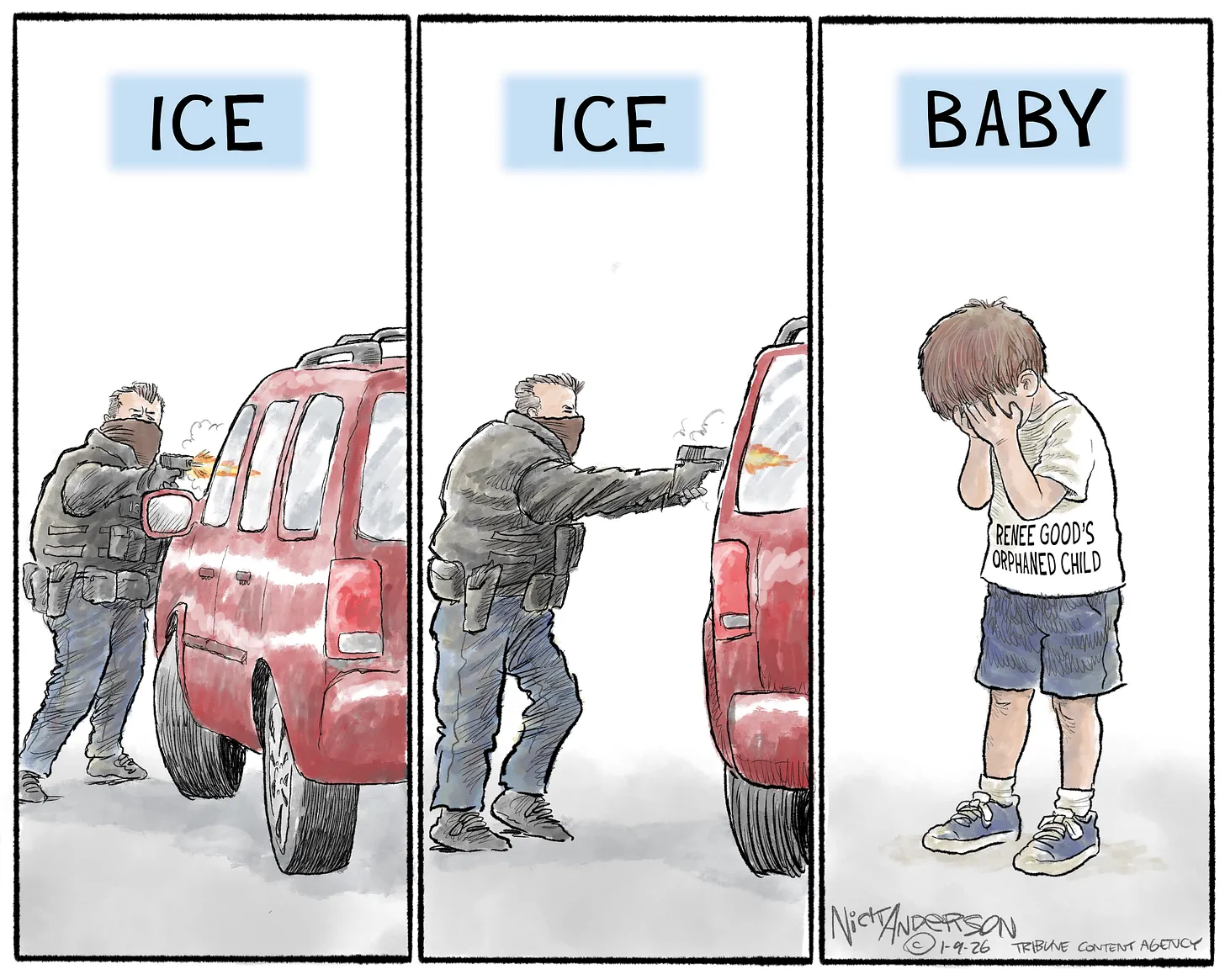
Wednesday in Minneapolis, ICE agent Jonathan Ross shot American mother Renee Good three times, killing her. There is so much to be upset about here, it’s hard to pick a focus. So I’ll start by listing a few and justify them later.
The shooting was senseless and had no legitimate justification. (See below.)
Despite the presence of numerous law enforcement officers, Ross was not taken into custody and was allowed to drive away with his weapon.
DHS Secretary Kristi Noem immediately lied about the incident, pushing a narrative that painted Good as a “domestic terrorist” and made Ross the victim of her attack. President Trump and Vice President Vance quickly reinforced this lie. Noem repeated her gaslighting in an interview with Jake Tapper Sunday.
ICE agents have subsequently shown extreme disrespect for Good and those mourning her. One agent (possibly Ross) can be heard to say “fucking bitch” immediately after the shooting, while another later kicked over candles mourners had set up to honor Good. (What kind of asshole does that?)
Those things are all true and objectionable, but most of them are being well discussed elsewhere. This morning, I want to take a step back and look at something else: the ability of right-wing media to keep telling a story conflicting with widely available evidence, and the apparent belief inside the MAGA news bubble that objective reality does not exist; what you think happened is simply a matter of who you choose to believe and what evidence you choose to examine.
To me, analyzing the videos of this shooting should resemble what happens in instant-replay review during a sporting event. A questionable play has happened, and then the refs examine the available video. Typically, one or two camera angles aren’t definitive: Looking at them, you can still imagine outcomes favorable to either team. But then you get the angle that makes everything clear. (Here’s the ball, here’s the goal line. It either did or didn’t cross. Or: Here’s the shooter when the clock hits zero. The ball either is or isn’t out of his hand.) Once you’ve seen the definitive angle, the other angles don’t matter any more. You don’t go back to a previous shot and say, “Sure, but in this one the other conclusion still seems possible.”
In this case, there are several decisive moments and angles, all consistent with each other. Like this one, which is a still from a bystander video analyzed in detail by the New York Times:
Ross is the agent behind the agent by Good’s door. His feet are clearly visible to the left of the vehicle, while the front wheels are steering right. (The orientation of the wheels is hard to see in this shot, but clearer when you see the continuous video.) So two conclusions are obvious: (1) Good was not trying to run Ross over, as Noem claimed. Her wheels were pointed away from him. (2) Ross was not in any danger of being run over.
Trump posted a different video along with his claim that “Based on the attached clip, it is hard to believe he is alive, but is now recovering in the hospital.” It is a distant video that lets you imagine that anything could have happened — exactly the kind that the football refs would ignore. And in fact, Ross was not harmed, something that is obvious from video of him walking up and down the street seconds later. (It’s possible he was brushed as the car went by, but nothing more.)
Still, you might imagine that Ross believed he was in danger, even though he wasn’t. That conceivably might justify a self-defense claim for his first shot. (The bullet hole is on the left side of the windshield, consistent with him standing close to the left front wheel, and not directly in front.)
But there are two problems with that justification: First, he’s in front of the car because he moved there. Moving into danger so that you can use that danger as an excuse to kill someone does not usually fly in court.
But even more damning: He shoots twice more. His second shot is through the open window in the driver’s door, and his third comes from behind as Good is trying to drive away. In other words: the SUV has already missed him. Shooting as your alleged assailant runs away is not self defense.
You could also imagine that Ross got scared, panicked, and fired three times before he realized he was safe. Even if true, that’s not much of an excuse. At the very least, a guy with responses this bad should never again have a job where he carries a gun. And if I were a prosecutor, I would see what degree of murder I could make stick.
So far I’ve just been drawing clear conclusions from objective evidence. But now I’ll say what I believe in my heart really happened: ICE’s stated mission is to round up deportable immigrants, but that’s not the whole story. Another part of its mission is to intimidate American citizens, particularly citizens in majority-Democratic cities who might be inclined to protest against Trump’s policies. Intimidation is why they wear masks. (They claim it’s to avoid reprisals, but that excuse doesn’t hold water. Local police and FBI agents also investigate dangerous gangs, but they don’t wear masks. Why are ICE agents more cowardly?) And if you watch ICE behavior, it’s clear what rules of engagement the agents been given: If somebody isn’t sufficiently intimidated, escalate the confrontation until they are.
Renee Good’s primary offense was not being intimidated. When agents gave her conflicting orders, she didn’t freeze, she started to drive away. This made Ross angry, and so he killed her, with “fucking bitch” as her epitaph.
Other ICE agents know this. That’s why they are using Good’s death to further intimidate potential protesters. Here, an agent warns a woman sitting in her car not to “make a bad decision and ruin your life”. Nice life you’ve got there; be a shame if anything happened to it.
What has truly amazed me, though, is not that liars will lie. I never trusted Noem or Vance or Trump or ICE, so seeing them gaslight the country is not the least bit shocking. (A columnist for National Catholic Reporter had a different reaction to Vance: “The vice president’s comments justifying the death of Renee Good are a moral stain on the collective witness of our Catholic faith.”)
What amazes me is the number of people who simply repeat what the regime tells them, either not looking at the evidence or (even worse) looking at it and seeing what they have been told to see.
Friday evening, my church organized a vigil for Good. We stood on our town common and quietly held candles with a few signs. According to a reporter for the local online news, 77 people (some church members and some not) attended, which is not bad for a hastily organized event in a small town.
When I came home from the vigil, I saw the Facebook comments on an article that announced it. (122 at last count.) Many of the commenters repeated the regime gaslighting: Why were we holding a vigil for a woman who tried to kill a federal officer? When others disputed this characterization and pointed to the videos proving otherwise, they were answered by vague references to other videos that supposedly support the regime gaslighting. (Like this one: It does not support the regime, but apparently they looked at it and thought it did.)
I wonder what DHS expects its sheep to see in a video it posted yesterday. It shows the street the shooting happened on, during the three minutes before the shooting. There’s a snowy middle-class residential neighborhood, a lot of honking cars moving slowly, pretty much what you’d expect from the videos already out. Absolutely none of the “violent rioters” a DHS official had mentioned.
Maybe the point of such a video is just that it exists. I could point to a brick and claim that it proves I’m right about something. And if you’re sufficiently sheeplike, you might say, “It must be true. He showed me proof.”
I find all this disturbing on a deep level. Apparently, many of our fellow citizens are living in a world where there is no objective reality. There is just disagreement, and some people are powerful enough to make their version of events stick.
A second disturbing feature in the comments I saw was the claim that Good was responsible for her own death, because she didn’t obey ICE agents’ commands. First off, I’m not sure what authority ICE agents have to give commands to US citizens. But suppose they can. The penalty for civil disobedience is not summary execution. Apparently, a number of Americans think it should be.
As I often point out: A one-person weekly blog is a bad place to cover breaking news. This morning, the attack on Venezuela is in that nebulous zone between breaking news and an ongoing story: US forces attacked Caracas early Saturday morning, seized President Nicolás Maduro, and apparently left. We can see the general outline of what happened, but what it all means and where it’s all going is still very cloudy.
At the same time, we can’t just wait for the dust to settle, because this is an emergency moment not just for Venezuela, but for America.
For almost a year now, Trump has been pushing Congress into irrelevancy, and the Republican majorities in both houses and in the Supreme Court have been letting him do it: Congress no longer controls government spending. Agencies set up by Congress to be independent of the President have been taken over. The deadlines laid out in the Epstein Files Transparency Act have been ignored. The Education Department established by Congress has been all but eliminated.
And now, Congress has been shoved out of any role in making decisions of war and peace.
Apologists for the administration will tell you that this is nothing new. Ever since World War II (the last war officially declared by Congress), Congress’ constitutional power to declare war has been in tension with the President’s constitutional power as commander in chief. [1] Exactly where the boundary lies — what the President can do on his own and what requires congressional authorization — has been a topic of legitimate debate. A rule of thumb has been that decisions that need to be made quickly belong to the President, while longer commitments require Congress.
Congress asserted its power in the War Powers Act of 1973, which set clear limits on presidential discretion. Subsequent presidents have refused to recognize the constitutionality of the WPA, but have generally respected its boundaries as a matter of good form and sound politics. [2] So, for example, President Bush II sought congressional approval before invading both Iraq and Afghanistan. Lesser military actions have sometimes been initiated without Congress.
But the Venezuela attack is completely outside the bounds of previous constitutional debates. Not only did Trump not seek authorization from Congress, but the congressional “Gang of 8” — leaders of both parties in both houses, who by law are required to be kept informed — did not know about the attack until it was underway. Worse, briefings by Marco Rubio and Pete Hegseth actively misinformed congresspeople about the administration’s intentions. [3] In short, Trump has given Congress no role whatsoever in this decision to go to war.
If Congress were taking seriously its constitutional obligation to preserve our system of checks and balances, it would immediately launch an impeachment. But unfortunately, Republicans in Congress are mostly taking an all’s-well-that-ends-well view: Maduro was bad and he is out now. The mission itself was a stunning display of tactical brilliance. So we should all just be happy with our military success.
The problem with that view is that nothing has ended yet. Immediately, power has not passed to the opposition leaders whose election victory Maduro stole. Instead, Maduro’s vice president Delcy Rodríguez has taken charge of a governing structure that is very much intact. So far, she has sent signals in both directions, denouncing the US attack as “an atrocity that violates international law”, but also saying she want the US government to “collaborate with us on an agenda of cooperation”.
Trump, meanwhile, has said several times that the US is going to “run” Venezuela now and “fix” it. No one in the administration seems to know exactly what that means, or whether American troops will have to occupy the country and take casualties. He seems to imagine that he can manage Rodriguez with threats. But even if he can, will Rodriguez’ people let her stay in power as an American puppet?
Rep. Jim Hines, the ranking Democrat on the House Intelligence Committee (which makes him one of the uninformed Gang of 8) summed up pretty well:
We’re in the euphoria period of acknowledging across the board that Maduro was a bad guy and that our military is absolutely incredible. This is exactly the euphoria we felt in 2002 when our military took down the Taliban in Afghanistan, in 2003 when our military took out Saddam Hussein, and in 2011 when we helped remove Muammar Gaddafi from power in Libya. … Let’s let my Republican colleagues enjoy their day of euphoria, but they’re going to wake up tomorrow morning, knowing, oh my God, there is no plan here any more than there was in Afghanistan, Iraq, or in Libya.
[1] This is one of many situations where the Founders lived in a different world than we do now. The early United States had only a minuscule standing army. So any president who wanted to go to war first had to convince Congress to raise and supply a larger force. But World War II made the US a global superpower, so recent presidents have always had large military forces to command.
[2] One of the lessons of Vietnam was that it’s hard to sustain a war without popular support. Getting Congress to buy in is usually part of a larger effort to sell a war to the general public.
[3] Senator Chris Murphy (D-CT) told CNN’s “State of the Union” yesterday:
I can certainly tell you that the message that [Rubio and Hegseth] sent was that this wasn’t about regime change. When they came to Congress — and they literally lied to our face — they said, “This is just a counternarcotics operation. This is about trying to interrupt the drug flow to the United States.” Right around that same time, the White House Chief of Staff [Susie Wiles] said publicly if we ever had boots on the ground in Venezuela, of course, we would have to come to Congress.