Trump’s security memorandum projects his friends’ behavior onto his enemies.
Executive Order NPSM-7 got past my attention when it was first released on September 25. Seeking to exploit MAGA’s horror at Charlie Kirk’s assassination, the memo paints rising political violence as purely a problem for the Left (when the vast majority of political violence for years has been on the Right). And it sees this left-wing violence as the result of a vast, well-funded conspiracy.
This political violence is not a series of isolated incidents and does not emerge organically. Instead, it is a culmination of sophisticated, organized campaigns of targeted intimidation, radicalization, threats, and violence designed to silence opposing speech, limit political activity, change or direct policy outcomes, and prevent the functioning of a democratic society.
The sad thing here is that while there are occasional large-scale acts of political violence (like January 6), most examples of political violence against either Republicans (like Charlie Kirk) or Democrats (like Melissa Hortman) don’t require funding or manpower. The country is awash in guns, and you can train yourself to be a sniper without drawing much attention. But Republicans don’t want to do anything to curb guns, so they need another explanation.
Fortunately, they have one: NPSM-7’s conspiratorial vision builds on the longstanding right-wing fantasy that somebody (George Soros?) is paying people to protest against Trump. It makes perfect sense: Since everyone loves Trump, the large crowds that protest against him must be artificially generated. (For the record: Neither I nor anybody I know has ever received a payment for participating in anti-Trump protests. Even more telling: Nobody ever sends me emails trying to raise money to pay other protesters.) And once you have such a covert funding network, using it to promote violence — at least to a certain kind of mind — is an obvious next step.
The memo calls for federal law enforcement agencies to investigate these conspiracies and disrupt their plots before they result in violent acts. (So far, so good. If somebody had spotted Tyler Robinson sooner and taken his guns away, Kirk might still be alive. Ditto for Vance Luther Boelter and Hortman.) But it also calls to investigate
institutional and individual funders, and officers and employees of organizations, that are responsible for, sponsor, or otherwise aid and abet the principal actors engaging in the criminal conduct described in subsections (a) and (b) of this section.
Since there are no such institutions and individuals, this section’s only conceivable result would be harassing investigations and show-trial indictments like the ones against James Comey and Letitia James. The IRS is also instructed to get involved in the harassment of Trump’s political opponents:
The Commissioner of the Internal Revenue Service (Commissioner) shall take action to ensure that no tax-exempt entities are directly or indirectly financing political violence or domestic terrorism. In addition, where applicable, the Commissioner shall ensure that the Internal Revenue Service refers such organizations, and the employees and officers of such organizations, to the Department of Justice for investigation and possible prosecution.
I have to wonder how “indirect” such financing can be and still trigger an investigation or indictment. Suppose there is one violent act during an otherwise peaceful protest, but 100 protesters get arrested. If the ACLU steps in to defend them in court, are they “indirectly” funding the single act of violence?
But even more interesting (to me, at least) is this section, which is clear projection. Trump knows his people are doing these things, so he imagines his enemies are too. (I have added links to make the projection clearer.)
These campaigns often begin by isolating and dehumanizing specific targets to justify murder or other violent action against them. They do so through a variety of fora, including anonymous chat forums, in-person meetings, social media, and even educational institutions. These campaigns then escalate to organized doxing, where the private or identifying information of their targets (such as home addresses, phone numbers, or other personal information) is exposed to the public with the explicit intent of encouraging others to harass, intimidate, or violently assault them. As in the case of several ICE agents in Los Angeles being doxed, the goal of these campaigns can be to obstruct the operations of the Federal Government as well as aid and abet criminal activity the Federal Government is lawfully pursuing. These campaigns are coordinated and perpetrated by actors who have developed a comprehensive strategy to achieve specific policy goals through radicalization and violent intimidation.
I can only chuckle as I imagine a left-wing network with a “comprehensive strategy to achieve specific policy goals”. If only there were one!
In the meantime, Trump will continue to be frightened by his reflection in the mirror. I wish I could think of some way to use that against him.
I went to graduate school in Chicago during the 80s and lived there for six years. I’ve been back many times since and marveled at how much safer the city is today than 40-50 years ago. Then, I had a car stolen and two bicycles. My future wife was accosted on a sidewalk, and managed to push her attacker away. But in recent years, I have walked anywhere I wanted, including a number of places I would not have dared in the 80s, despite being younger, fitter, and less cautious then.
One neighborhood I stayed away from then, perhaps foolishly, was the Hispanic area on the near South Side. But a few years ago, I went to the National Museum of Mexican Art on 19th Street. A lovely middle-class neighborhood has grown up in that area, and the museum itself is wonderful. These days, Mexican-American can be just another Chicago ethnicity, like Italian-American or Irish-American.
There is, of course, still crime in Chicago (as there is not just in every city, but in small towns as well), and places I would not want to go at night. But in every measurable way, the city is much safer now. You can see that if you take the famous Architecture Boat Tour on the Chicago River. The gentrification of downtown began in the 1970s with the Marina Towers, which were built to be a fortress against the rest of Chicago: You could park your car and even moor your boat without exposing yourself to the public. But as the decades went by, the buildings became more and more open to the city, built to highlight the public riverwalk. From the river, you can see the record of the gradual unfolding of Chicagoans’ confidence.
So I have taken it personally when Trump has repeatedly smeared Chicago as a crime-ridden hellhole. And in particular, I object to his scapegoating of Hispanic immigrants as some kind of vermin to be eliminated.
I have to wonder what troops can do that other federal agents aren’t already doing. Agents from ICE, the Border Patrol, the FBI, BATF, and DHS have been wearing military fatigues, sporting heavy weapons, and conducting military-style attacks.
Federal agents rappelled from Black Hawk helicopters. Dozens of others, their faces hidden behind masks, arrived in moving trucks. In total, 300 officers stormed a South Side apartment building that Department of Homeland Security officials say harbored criminals.
Maybe, maybe not. But the building also contained US citizens and families with children.
Armed federal agents in military fatigues busted down their doors overnight, pulling men, women and children from their apartments, some of them naked, residents and witnesses said. Agents approached or entered nearly every apartment in the five-story building, and U.S. citizens were among those detained for hours.
… The feds also claimed the South Shore neighborhood was “a location known to be frequented by Tren de Aragua members and their associates,” but DHS gave no evidence to support the assertion, and authorities did not confirm that any of the people arrested were members of the Venezuelan gang.
Rodrick Johnson, 67, is one of many residents who were detained by federal agents during the South Shore raid. A U.S. citizen, he said agents broke through his door and dragged him out in zip ties.
Johnson said he was left tied up outside the building for nearly three hours before agents finally let him go.
Many of the residents were said to be Venezuelan. I wonder if the regime would be similarly brutal in a White neighborhood.
Last Sunday, though, masked agents in military style dress marched through some of the most upscale and touristy parts of the city, not far from where you’d board that boat tour I mentioned.
Agents, some masked, walked north on Michigan Avenue from Millennium Park toward the Wrigley Building. They then walked down Wacker Drive near Trump Tower, while some headed to the Riverwalk. They then made their way to River North.
The point here could only have been intimidation. They were not pursuing criminals or making arrests. Governor Pritzker has it right:
One thing is clear: none of what Trump is doing is making Illinois safer. This is not about fighting crime or about public safety. This is about sowing fear and intimidation and division among Americans.
Portland. Yesterday’s announcement sounded like a classic good-news/bad-news joke: Trump was pulling the last 300 federalized California National Guard troops out of Los Angeles … so that he could send them to Portland. He had previously tried to federalize Oregon National Guard troops to invade Portland, but a federal judge he appointed himselfblocked that plan with a temporary restraining order in response to a lawsuit from Oregon Governor Tina Kotek, the mayor of Portland, and numerous other state and local officials.
Judge Karin Immergut observed that in an earlier case (concerning Los Angeles) the Ninth Circuit Court of Appeals had overturned a similar restraining order because courts owe “a great deal of deference” to a president’s judgment that conditions on the ground justify his decision to deploy National Guard troops. Specifically, that the federal government is unable to execute the laws with less extraordinary forces.
But Immergut contrasted the relatively peaceful situation of Portland (where the most serious protests had happened in June, but by September had faded to predominantly nonviolent protests drawing 20-50 people per day) with the more serious situation in LA prior to the president’s declaration.
Here, this Court concludes that the President did not have a “colorable basis” to invoke § 12406(3) to federalize the National Guard because the situation on the ground belied an inability of federal law enforcement officers to execute federal law. The President’s determination was simply untethered to the facts.
In a hearing Sunday night, Judge Immergut asked a Trump administration attorney: “How could bringing in federalised national guard from California not be in direct contravention of the [decision] I issued yesterday?”
She extended her order to block the Trump regime from deploying any National Guard troops to Portland.
I’m encouraged by the fact that an appointee from Trump’s first term sees the law this way. I hope some similarly-minded judge gets the Chicago case.
Lack of response leaves a lot of room for projection.
Tuesday, Defense Secretary Pete Hegseth hosted an unusual meeting: America’s top generals and admirals, 800 or so of them, were called to Quantico from around the world to listen to Hegseth in person. And once the meeting was on the calendar, President Trump decided he should speak too.
DoD rules prohibit uniformed members of the military from participating in political events. Directive 1344.10 allows attendance at a political rally
provided the member is not in uniform and does not otherwise act in a manner that could reasonably give rise to the inference or appearance of official sponsorship, approval, or endorsement.
So for generals and admirals to show up in uniform at Hegseth’s meeting at all, they couldn’t view it as “partisan political activity”. In particular, it was not a Trump rally. They were attending to receive instructions from their civilian leadership, so that they could interpret that top-level guidance to their subordinates.
Typically, when you are receiving instructions from those above you in the chain of command, you don’t cheer or boo or heckle or stomp your feet. You listen, take notes, and think about what this means for your particular command. And if something you hear sounds political, you avoid “the inference or appearance of … endorsement”.
So that’s what the generals did.
One thing we know about Donald Trump is that he does not compartmentalize. For most of us, compartmentalization is such an integral part of being an adult that it’s hard to imagine someone going through life without it. Sometimes you speak as friend, as a colleague, as a parent, as a polite stranger, or in some other role. Depending on what role you are in, you may seem like a completely different person. You would no more confuse those roles than you would show up at work in your pajamas or wear a tuxedo to the beach.
But Donald Trump is, at every moment, Donald Trump acting in the interests of Donald Trump. The particular role the situation seems to call for makes no difference. So at the Quantico meeting he was not playing the role of President of the United States, or Commander in Chief of the Armed Forces, or any other role. He was Donald Trump being Donald Trump.
Trump loves crowds, loves to rouse them, and loves to hear them cheer. He is used to the crowds that show up at his political rallies, so that’s how he spoke to the generals. He rambled, baited his enemies, threw red meat to his fans, and voiced weird sentiments that any other president would have restrained himself from saying out loud.
The generals took it all in without response. This left a lot of room for interpretation.
That’s a lot to sort out. But I present that range of reactions to emphasize that you should take everybody’s interpretation (including mine) with a grain of salt. Some reporters may have spoken to a few of the generals themselves — none of whom talk to me — but I doubt that anybody has interviewed a representative sample of them. So we’re all just applying what we think we know about the military mindset and speculating from there.
The speculation began before the meeting started. From the first announcement, it was an odd event. Gathering all our military leaders together in one room is a huge security risk; one well-placed bomb and the greatest military force in the world would be led by J. D. Vance and a bunch of colonels. It was also expensive. The generals came from all over the world, and many probably traveled with their staffs. It was also expensive in another sense: Probably these guys all had things they were supposed to be doing, and many of those things probably went undone for a few days.
So the before-the-fact speculation revolved around one question: What could Hegseth and Trump have in mind that would be worth all this? Retired Lieutenant General Ben Hodges made an alarming guess:
July 1935 German generals were called to a surprise assembly in Berlin and informed that their previous oath to the Weimar constitution was void and that they would be required to swear a personal oath to the Führer. Most generals took the new oath to keep their positions.
Fortunately, it wasn’t that bad. Hegseth’s speech is here and Trump’s is here. Neither was worth flying around the world to hear in person, but they weren’t sign-or-else demands for a loyalty pledge. So we’re still just guessing about what the meeting was supposed to accomplish.
And as so often happens in the Trump administration, at times the absurdity overwhelmed the content. One way to watch the event is to view Hegseth as the comedian who warms up the crowd before the song-and-dance act comes on. The reaction that the generals might have had the hardest time suppressing was laughing out loud.
I mean, think about it: Pete Hegseth, the most unqualified Secretary of Defense in America’s history, declared that “promotions across the joint force will be based on one thing: merit; colorblind, gender-neutral, merit based”. There is no definition of merit under which Hegseth becomes Secretary of Defense. No one with Hegseth’s resume could rise this high without being a White man, but we’re supposed to believe that everything in the Trump administration is colorblind and gender-neutral.
The Trump military, Hegseth said, would promote top performers and “get rid of poor performers more quickly”. But of course, Hegseth himself is a poor performer. He endangered the security of a combat mission by discussing its details over an unclassified nonmilitary channel with uncleared civilians present, a blunder that would have gotten him fired in any previous administration. But he suffered no consequences, because standards are only for the lower ranks, not Trump’s inner circle.
The gist of Hegseth’s speech called for the military to better match the John-Wayne-movie image of the military Trump sees in his mind: more manly, more fit, clean-shaven. (Talk to Generals Grant and Lee about the military importance of shaving.) If servicemen don’t want to shave their beards, “it’s time for a new position or a new profession”. But the past administration was wrong “to kick out Americans who refused an emergency vaccine” — as if a beard were a bigger threat to combat readiness than being unvaccinated during a pandemic.
And then, just before yielding the stage to the grossly obese Trump, he derided “fat generals and admirals in the halls of the Pentagon”.
Hilarious.
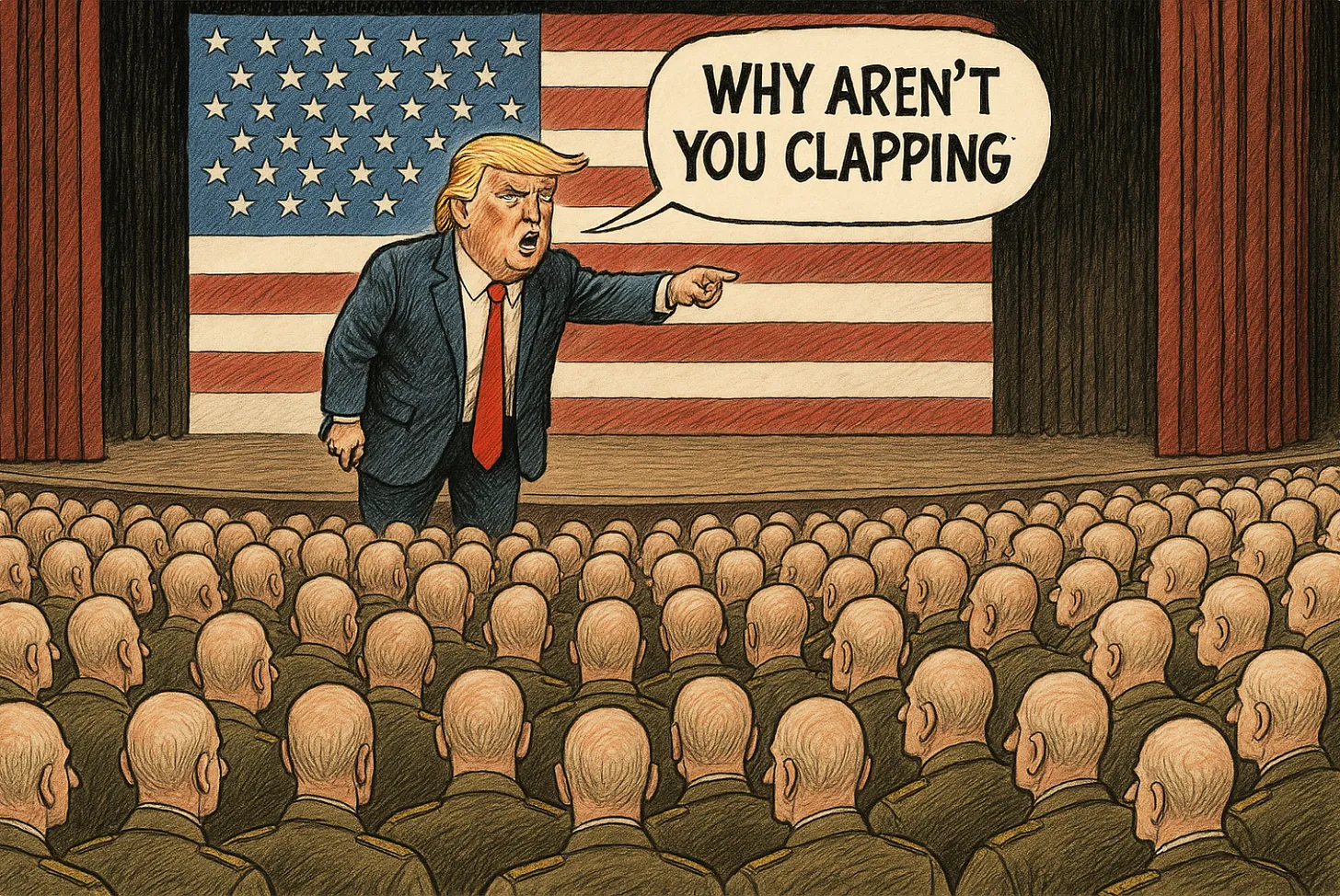
Note: This image is AI-generated.
Of course, this image of manliness is going to have real consequences for military people who are transgender or female or perhaps even non-White or non-Christian. Each of the leaders in the audience has a decision to make: Are they going to stay loyal to their people and try to shield them from those consequences, or will they offer them up as sacrifices to the new regime?
Now we get to Trump. It’s hard to know what to make of Trump’s speech, because he blathered for 70 minutes. Much of Trump’s stream-of-consciousness consists of random thoughts that have no consequences. For example, he mused about bringing back battleships, which were already mostly obsolete when Pearl Harbor was attacked.
I think we should maybe start thinking about battleships, by the way. You know, we have — Secretary of the Navy came to me — because I look at the Iowa out in California and I look at different ships in the old pictures. I used to watch Victory at Sea. I love Victory at Sea. Look at these admirals. It’s got to be your all time — in black and white. And I look at those ships, they came with the destroyers alongside of them and man, nothing was going to stop. There were 20 deep and they were in a straight line and there was nothing going to stop them. And we actually talk about, you know, those ships. Some people would say, no, that’s old technology. I don’t know. I don’t think it’s old technology when you look at those guns, but it’s something we’re actually considering, the concept of battleship, nice six-inch size, solid steel, not aluminum, aluminum that melts if it looks at a missile coming at it. It starts melting as the missile is about two miles away. Now those ships, they don’t make them that way anymore. But you look at it, and — your secretary likes it and I’m sort of open to it. And bullets are a lot less expensive than missiles, a lot of — a lot of reasons. I should take a vote, but I’m afraid to take that vote because I may get voted out on that one. But I tell you, it’s something we’re seriously considering. They were powers. They were big powers. They were just about as mean and scary as you could be, and so we’re looking at that.
That’s the kind of thing you nod your head to and then say, “Sure, Grandpa. Can I get you a glass of water? Do you need to go to the bathroom?”
Other parts of the speech seem more serious, and maybe they were, but who can say? Much has been made of Trump saying that “America is under invasion from within”, which doesn’t actually make any sense. He blathered about removing “1700 career criminals” from Washington DC, which seems to be all the people arrested for immigration offenses during his military crackdown, many of whom either had no non-immigration criminal record or minor offenses like traffic violations.
It’s hard to know what to think about this. During the campaign, he painted a picture of major cities afflicted by an “immigrant crime wave” that no one else could find in the statistics. (Cities with lots of immigrants had no worse crime that cities with few.) Maybe no one has told him that this was nonsense, so he honestly imagines that his military sweeps are achieving long-term results. (Violent crime indeed was cut in half during his occupation of DC. But was the cause really “1700 career criminals” who are now off the streets permanently? Or did the native-born muggers and carjackers just stay home during the occupation, and will return as soon as the troops go away?)
Reading the transcript, again and again I found myself wondering: Does he really believe all this? Maybe he’s surrounded by people who feed his delusions so that he can live in a pleasant fantasy world where his inspired leadership has made America “the hottest country anywhere in the world”, and he’s stopping wars right and left.
So I wonder: Is that what the generals heard?
Military people, in my experience, are practical fact-based people. They are surrounded by bullshitters (like contractors who make extreme promises about the latest whiz-bang they’re building), and they can be bullshitters themselves sometimes, so they develop a good ear for claims that can’t be verified.
If that’s an accurate picture, then they were well aware that Trump was describing a fantasy world. And they wondered, as I did, whether or not he believed in it. If they concluded that he did, then I imagine that they are very afraid right now. Not just their careers, but possibly their lives and the lives of their troops as well, depend on surviving under the Mad King for another three years.
Collections of quotes that paint Kirk as a hate-monger promoting bigotry of all sorts: racism, sexism, Islamophobia, anti-LGBTQ, and so on.
Neither struck me as the whole story, so I challenged myself to form an independent opinion about Kirk. I listened to his wife’s eulogy for him, I watched most of his conversation with Gavin Newsom, I read as much of his book The MAGA Doctrine as Amazon would show me for free, and I looked for anybody else who had a view of him deeper than a partisan knee-jerk.
This is where I’ve gotten to. Unsurprisingly, I wind up mostly on the cynical side.
In Erika Kirk’s speech, I mainly heard standard Christian evangelism not all that different from what Billy Graham was saying half a century ago: Americans are in a spiritual crisis that can only be solved by turning their lives over to Jesus and living according to traditional gender roles that I don’t recall Jesus ever advocating. Kirk’s brand of Christianity was mostly Christian Nationalism, which I (and many others) believe is a perversion of Jesus’ message.
(For those of you without a Christian education, Jesus had a lot to say about feeding the poor, healing the sick, and living your life according to compassion rather than rules. The gospels paint his opponents the Pharisees as the strict rule-followers. A few years ago, I wrote a post about where I think Christianity went wrong. Later I turned it into a sermon at a Unitarian Universalist church. The sermon is a little better, in my opinion.)
Kirk and Newsom talked amicably (to the point that I was getting angry with Newsom for not challenging some very questionable assertions). Here, the evangelism played a very small role: This was two political operators comparing notes. Still, I heard Kirk’s voice and heard him speak for himself; we should all do that before we pass judgment on people.
The MAGA Doctrine is Kirk’s 2020 take on Trumpism, though I’ve seen no sign that he ever revised his the worshipful view it presents. His political worldview, to me, feels based in resentment: Both political parties are presented as uncaring, and Trump is the revenge of the neglected voter. There is a whiff of traditional conservative rhetoric: small government, individual freedom, and so on. But it’s hard to take seriously given that Kirk stuck by Trump even as Trump was expanding government power and concentrating it in an autocratic presidency. As with so many conservatives, Kirk’s idea of “freedom” was freedom for people like himself, not freedom for everybody.
One thing Kirk was very good at — and this is where all those objectionable quotes come from — was trolling people like me. He played the game of making people angry, then painting himself as the victim of that anger. (And ultimately, he did become the victim of someone who felt trolled. “I had enough of his hatred,” the accused shooter texted to a friend.)
Another thing Kirk was good at was getting funding from the very rich. Erika made a point of how little he had when he started his crusade to win young Americans for Christ (and later Trump), but Turning Point has never lacked for funding. Charlie got his first $50K at age 20 from the multimillionaire Dunn family. He soon attracted the attention of billionaire Foster Friess, and he was on his way. The Dunns eventually contributed millions. The Bradley Impact Fund gave TPUSA $8 million in 2023, and millions more came from a fund connected to Home Depot founder Bernie Marcus.
The ValueWalk website recently estimated Kirk’s net worth at $12 million, including a $4.5 million mansion in Scottsdale.
People sometimes wonder why there’s no Charlie Kirk of the Left. Well, money is one big reason: It’s hard to picture an 20-year-old liberal or socialist running into somebody at a conference and walking away with the funding to start a national organization, much less get rich in the process.
The Voice of Reason blog had an even more cynical take on Kirk’s entrepreneurial nature, painting him as a front for older, richer men.
Here is what really happened. In 2012, a 72-year-old Tea Party activist named Bill Montgomery heard Kirk give a talk at a small local event. Montgomery took one look at this kid with ambition in his eyes and told him to skip college and start an organization. Within weeks, Turning Point USA was born. Montgomery wasn’t just a mentor. He was the co-founder, treasurer, and strategist. In plain English: Kirk didn’t invent Turning Point USA. He was recruited into it by an older political operative who saw in him a useful mouthpiece.
Then came the money. Kirk didn’t scrape together pennies from bake sales. He stalked the Republican National Convention in Tampa in 2012 memorizing donor faces. That’s how he buttonholed multimillionaire Foster Friess, pitched him, and walked away with a five-figure check. Add in Bruce Rauner, the future governor of Illinois, and the DeVos family, and suddenly this “teenage entrepreneur” had more capital than most actual start-ups. By 2016, Turning Point’s budget had ballooned from $50,000 to over $5 million. That doesn’t happen because of hustle. That happens because deep-pocketed billionaires decide you are worth buying.
Amanda Marcotte doubts that Erika can keep TPUSA rolling, because so much of Charlie’s following was based on misogyny.
Charlie Kirk was an aspirational figure for his male audience. They wished they could go on campuses and condescend to cute girls, but they knew — they continue to know — that wouldn’t go well for them. They’d get ignored, mocked or worse, have campus security called on them. Charlie Kirk, though, had the charisma, money and organization to tilt the field so that he “won” every encounter — even though the kids that approached him usually had better arguments. He offered a fantasy of male domination. His audience will never accept a woman in this fake “alpha male” role.
For the first time, Trump used autocratic power in a way that the public couldn’t ignore, and a popular pushback forced a big corporation to stand up to him. Is that an anomaly or the start of a turn-around?
We hit some new lows over the weekend with the MAGA gang desperately trying to characterize this kid who murdered Charlie Kirk as anything other than one of them, and doing everything they can to score political points from it.
Four things are worth noting:
Kirk’s assassin was brought up in a conservative family, but later developments showed that Kimmel was wrong to imply that he was MAGA himself.
Kimmel was right that MAGA pundits did everything they could to score political points from the assassination.
Kimmel did not insult Kirk, or in any way make light of his assassination.
But he did make fun of Trump’s response to the assassination. He played a clip of Trump being asked about Kirk and then seguing to the new White House ballroom he wants to build. “That’s not how an adult grieves the murder of someone he called a friend,” Kimmel said. “This is how a 4-year-old mourns a goldfish.”
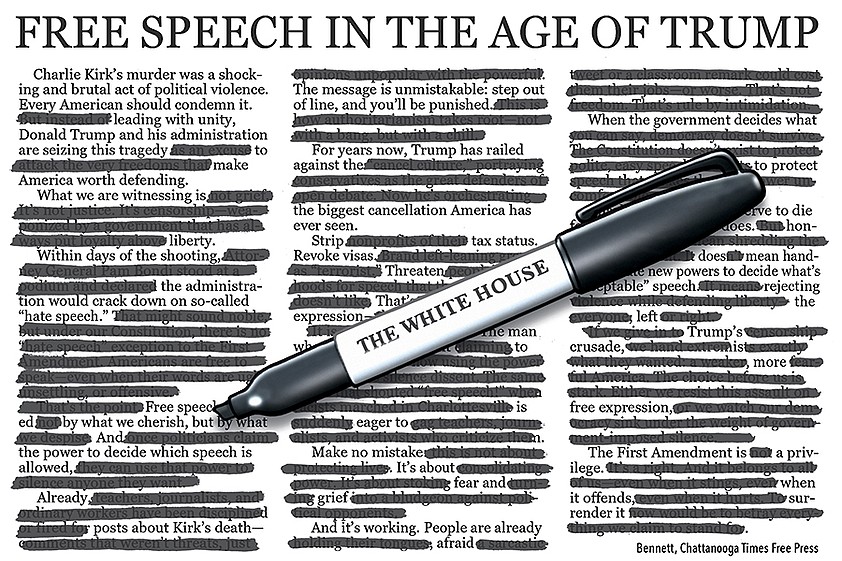
Appearing on Benny Johnson’s podcast on Wednesday, the Trump-appointed chairman said, “We can do this the easy way or the hard way. These companies can find ways to change conduct and take action, frankly, on Kimmel, or there’s going to be additional work for the FCC ahead.” Hours later, a spokesperson for Disney’s ABC confirmed to PEOPLE that Jimmy Kimmel Live! would be put on an indefinite hiatus.
Be sure to watch to the end of the 28-minute clip so you can see Robert De Niro play the new head of the FCC. Nobody can deliver a mafioso threat like De Niro, who clarified the new meaning of “free speech”.
“You want to say something nice about the president’s beautiful thick yellow hair and how he can do his make-up better than any broad, that’s free,” De Niro said. “But if you want to do a joke like, ‘He’s so fat he needs two seats on the Epstein jet’, that’s going to cost you.” The actor struggled to suppress a smile.
Kimmel asked: “For clarity, because it’s a pretty good joke, how much would that one cost me?”
“A couple of fingers, maybe a tooth,” came the reply.
I can’t believe ABC Fake News gave Jimmy Kimmel his job back. The White House was told by ABC that his Show was cancelled! Something happened between then and now because his audience is GONE, and his “talent” was never there. Why would they want someone back who does so poorly, who’s not funny, and who puts the Network in jeopardy by playing 99% positive Democrat GARBAGE. He is yet another arm of the DNC and, to the best of my knowledge, that would be a major Illegal Campaign Contribution. I think we’re going to test ABC out on this. Let’s see how we do. Last time I went after them, they gave me $16 Million Dollars. This one sounds even more lucrative. A true bunch of losers! Let Jimmy Kimmel rot in his bad Ratings.
His post should settle a few previously contentious points:
Trump was deeply involved in Kimmel’s suspension. Why else would ABC have told the White House that the show was cancelled? All the MAGA attempts to attribute the suspension to bad ratings or other legitimate causes were bogus.
Trump reiterated his threats of censorship. Kimmel’s criticism of Trump “puts the Network in jeopardy”. Nice network you got there; be a shame if something happened to it.
In Trump’s mind, the issue is criticism of him, and has nothing to do with Charlie Kirk. That was already apparent from Trump’s tweet of September 17, shortly after Kimmel was taken off the air: “That leaves Jimmy and Seth, two total losers, on Fake News NBC. Their ratings are also horrible. Do it NBC!!!” Late-night hosts Jimmy Fallon and Seth Meyers didn’t have a Kirk problem, they’re just Trump critics.
Trump has not won any of his media lawsuits in court. Instead, he has used his government power to extort settlements out of parent companies that need favors. (These settlements are essentially bribes, as Stephen Colbert was cancelled for pointing out.) If ABC-owner Disney stands firm, Trump’s proposed lawsuit will fail.
And yet, that howl has not produced any action so far. David Frum and Paul Krugman each suggest that Trump is in a race against time: His bid for authoritarian power is racing against his plunging popularity. At some point, he will have so much autocratic power that politics barely matters any more, but he’s not there yet. And if his targets begin to believe they can stand up to him and win, while his Republican allies begin to worry that he will drag them down with him, that autocratic creep might stop or even reverse.
Krugman summarizes the situation:
It’s clear that if Trump were subject to normal political constraints, obliged to follow the rule of law and accept election results, he would already be a political lame duck. His future influence and those of his minions would be greatly reduced by his unpopularity. But at this juncture he is a quasi-autocrat. He is the leader of a party that accommodates his every whim, backed by a corrupt Supreme Court prepared to validate whatever he does, no matter how clearly it violates the law. As a result, Trump has been able to use the vast power of the federal government to deliver punishments and rewards in a completely unprecedented way. … This has created a climate of intimidation, with many institutions preemptively capitulating to Trump’s demands as if he already had total power.
… It’s important to understand that Trump’s push to destroy democracy depends largely on creating a self-fulfilling prophecy. Behind closed doors, business leaders bemoan the destruction that Trump is wreaking on the economy. But they capitulate to his demands because they expect him to consolidate autocratic power — which, given his unpopularity, he can only do if businesses and other institutions continue to capitulate.
If this smoke-and-mirrors juggernaut starts to falter, the perception of inevitability will collapse and Trump’s autocracy putsch may very well fall apart.
Jay Kuo lists a number of areas in which Trump’s autocratic push is meeting resistance. But a key source of Kuo’s optimism is that there is a limit to how far the Supreme Court will let Trump go. So far, they have largely delayed ruling on the legality of his actions while allowing those actions to continue temporarily. One big question still to be resolved is which way they will ultimately go: Will they defend the Constitution, or will they usher in the new fascist state?
In large part that may depend on how Trump’s self-fulfilling prophecy plays out in John Roberts’ mind.
A federal judge on Wednesday ruled Donald Trump’s administration unlawfully terminated about $2.2bn in grants awarded to Harvard University and can no longer cut off research funding to the Ivy League school.
The judges in these cases have been sending a clear message: The law still counts for something, and it doesn’t change just because Trump says so.
But for that message to stick, two things have to happen: The Supreme Court has to back up the lower-court decisions, and the Trump administration has to obey the court orders once they become final. Will those things happen? I’ve seen both optimistic and pessimistic views.
There’s an understandable tendency to hear about a big court victory for the good guys but then cynically dismiss it, claiming either that the Supreme Court will overturn it, or that the Trump White House will simply ignore the courts’ orders.
I want to encourage readers to not fall into this trap. True, the Supreme Court has intervened in a few cases to lift a few injunctions imposed by lower courts, and that admittedly has been awful to see. But it hasn’t ruled substantively on much of anything yet. And that has allowed court victories by the good guys to produce some real progress.
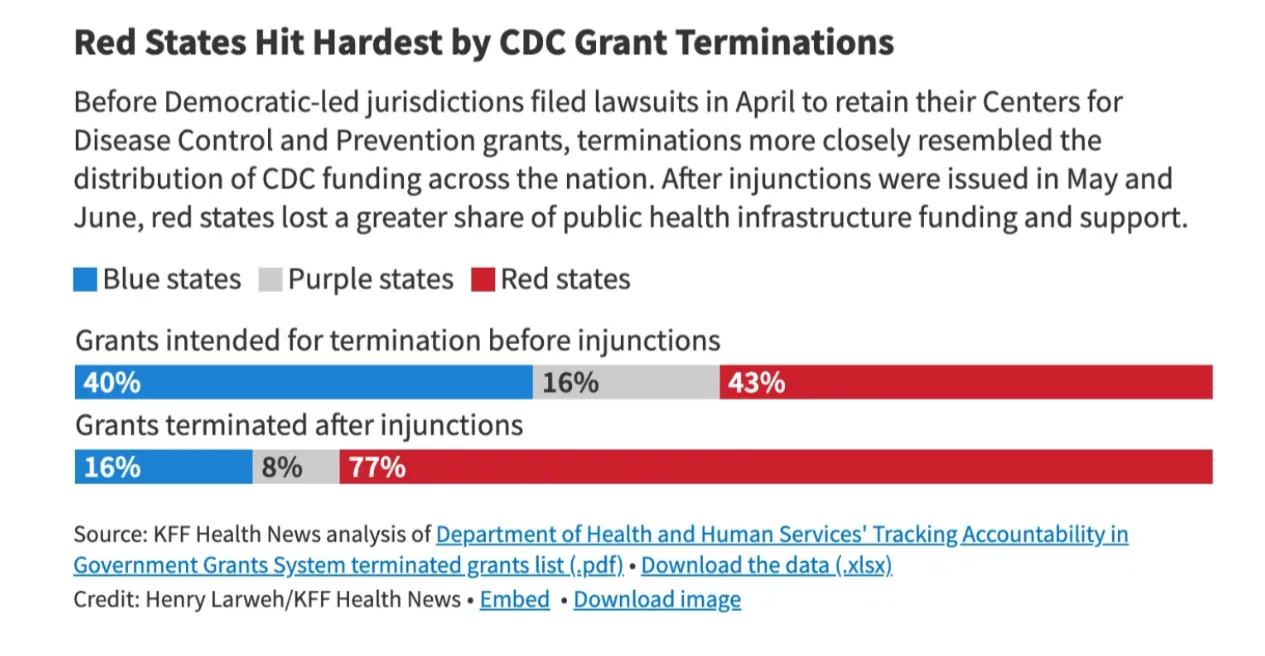
He points to blue-state attorneys general suing to claw back CDC grants the Trump administration had frozen. Red states, with their Trump-worshipping AGs, have taken the loss.
The Department of Justice wants the American public to assume that none of the orders granted by federal judges are being heeded. They want us to believe that they, and not the judiciary, are in control. But this is simply not the case.
Kuo points to the Guatemalan-children case, where (unlike in an earlier case with adults) planes in the air really did turn around, because “this time the government wasn’t up to playing more games with the courts”.
Nor is Trump the only litigant who receives this Court’s special treatment. The Republican justices favor religious conservatives so much that they will make up fake facts to bolster Christian conservative litigants. Meanwhile, they hate abortion providers so much that they once handed down an anti-abortion decision that, if taken seriously, would permit every state to neutralize any constitutional right.
If any other government official behaved this way, it would be obvious they were placing partisanship ahead of the law. It is no less obvious when these six specific government officials do so. The most reasonable explanation for the Republican justices’ behavior is that they are acting in bad faith.
It’s possible that even the most well-reasoned lower-court decisions against Trump will be reversed based on some gobbly-gook reasoning that we can expect to conveniently vanish should a Democrat ever again assume the presidency. That’s certainly what happened in the Trump immunity ruling.
But it’s worth noting that although the Court has thrown procedural hurdles in the way of those who would stop Trump’s lawlessness, and has sometimes reversed injunctions without much explanation, so far it has given Trump very few outright victories on the underlying merits of the cases. Birthright citizenship, for example, still stands.
The people caught in the middle are the lower-court judges themselves, ten of whom took the unusual step of talking anonymously to NBC News. Their problem is simple: When you do your best to apply the law as it was written and has always been interpreted, and then the Supreme Court reverses your decision in a shadow-docket ruling with little or no explanation, what do you do with the next case? You can’t apply the Court’s new reasoning, because that reasoning was never published.
In late July, the Constitution Daily Blog listed five Trump executive orders that are likely to hit the Supreme Court soon:
reversing birthright citizenship.
invoking the Alien Enemies Act to deport immigrants
using emergency powers to impose tariffs
firing heads of agencies protected by Congress
banning transgender people from serving in the military
I could imagine (but not agree with) the Court siding with Trump on the last two. But if any of the first three get the Court’s blessing, something is seriously wrong.
The government runs out of money again on October 1. That gives the Democratic minorities in Congress some rare leverage. What should they do with it?
The 2026 fiscal year starts in less than a month, and nobody yet knows what the FY2026 federal budget will have in it.
In the House, Republicans currently hold a 219-212 majority, so they can pass whatever budget they want if they have fewer than four defectors. In the Senate they have a 53-47 majority, but they need 60 votes to overcome a filibuster. So Democrats have leverage in the House only if the Republicans can’t stay unified, but Republicans need seven Democratic votes in the Senate unless they’re willing to nuke the filibuster. (Don’t count that out. Trump will almost certainly ask for it before conceding anything he cares about.)
This raises two questions: Are Democrats willing to shut down the government if Republicans don’t negotiate with them in good faith? And if they are willing to take such a stand, what concessions should they ask for?
Ezra Klein discussed the first question in yesterday’s NYT. He notes that Democrats faced a similar decision in March when the previous continuing resolution ran out. Hakeem Jeffries in the House wanted to go for a shutdown, but Chuck Schumer in the Senate didn’t. Schumer won out, and Democrats got nothing for their cooperation.
This looked really bad at the time, and demoralized Democrats around the country. But Klein notes that in the moment it actually was a close call. Schumer argued:
The courts were already reining in Trump’s excesses.
Markets were reeling from Trump’s tariff announcements; a shutdown would just give him a chance to blame Democrats for the economic chaos.
A shutdown would help DOGE eliminate government jobs and departments.
In addition, Klein notes that the Democrats weren’t ready for that battle. They hadn’t agreed on a message worth shutting down the government for.
But now, he claims, none of those arguments hold. The Supreme Court hasn’t held the line, markets have stabilized without a tariff-fueled economic catastrophe, and Elon Musk is gone.
Even more, Trump’s autocratic project is up and running now.
I want to be very clear about what I am saying here. Donald Trump is corrupting the government — he is using it to hound his enemies, to line his pockets and to entrench his own power. He is corrupting it the way the Mafia would corrupt the industries it controlled. You could still, under Mafia rule, get the trash picked up or buy construction materials. But the point of those industries had become the preservation and expansion of the Mafia’s power and wealth. This is what Trump is doing to the government. This is what Democrats cannot fund. This is what they have to try to stop.
… The case for a shutdown is this: A shutdown is an attentional event. It’s an effort to turn the diffuse crisis of Trump’s corrupting of the government into an acute crisis that the media, that the public, will actually pay attention to.
So when they get public attention, what exactly should Democrats demand? Jen Rubin makes these five suggestions:
Defend Congress’ power of the purse by undoing FY2025’s rescissions.
Reverse the Medicaid cuts that take effect after the 2026 elections.
Restrictions on DHS’ most outrageous practices: No rendition to third countries. No masks. Reports on how many people without criminal records are being rounded up.
New sanctions to pressure Russia into peace talks.
Ban stock trading for members of Congress, as well as the president and vice president.
The key test for demands is that Republicans should sound ridiculous defending what the Democrats want to put a stop to. (This is a lesson taught by the Epstein files.) Do Republicans want to shut the government down to defend Trump’s right to trade stocks? They should go right ahead.
If I had to sum up in one word the reason Democrats should give for their stand, it would be “corruption”. I think both Rubin and Klein would agree with that, and it’s also in line with what the Epstein phenomenon should be teaching Democrats.
President Donald Trump said Friday that the U.S. will host next year’s Group of 20 summit at his golf club in Doral, Florida, arguing it was “the best location” for the high-stakes international gathering but insisting his family’s business “will not make any money on it.”
Of course it won’t. Trump would never lie about something like that, and no doubt his independent Justice Department would watch like a hawk to make sure nothing corrupt happened.
As RFK Jr. purges the CDC and cancels billions in research grants, Americans need a refresher course on what happened to Soviet biological research during the Stalin years.
In many ways, Trofim Lysenko was just the man Stalin had been looking for. He grew up in the peasantry rather than the elitist intelligentsia. He promised new techniques for growing crops that might solve the Soviet Union’s difficulty producing food in the same quantities the Czars had. And he represented a rebellion against Mendelian genetics, whose vision of evolution relied more on the individual’s struggle for survival than on the collective class struggle more in line with Marxist ideology.
From our 21st century point of view, as well as from the perspective of 20th-century geneticists, Lysenko was a crank. He espoused “vernalization”, a process by which winter wheat could be converted to spring wheat and then pass its new abilities on to its descendants. Following LeMarck rather than Mendel, he believed that acquired characteristics could be inherited — a possibility that appealed to a regime dedicated to producing the “new Soviet man”.
Lysenko’s political success was mostly due to his appeal to the Communist Party and Soviet ideology. His attack on the “bourgeois pseudoscience” of modern genetics and the proposal that plants can rapidly adjust to a changed environment suited the ideological battle in both agriculture and Soviet society. Following the disastrous collectivization efforts of the late 1920s, Lysenko’s new methods were seen by Soviet officials as paving the way to an “agricultural revolution.” Lysenko himself was from a peasant family and was an enthusiastic advocate of Leninism. The Party-controlled newspapers applauded Lysenko’s practical “success” and questioned the motives of his critics, ridiculing the timidity of academics who urged the patient, impartial observation required for science. Lysenko was admitted into the hierarchy of the Communist Party, and was put in charge of agricultural affairs.
He used his position to denounce biologists as “fly-lovers and people haters”, and to decry traditional biologists as “wreckers” working to sabotage the Soviet economy. He denied the distinction between theoretical and applied biology, and rejected general methods such as control groups and statistics:
“We biologists do not take the slightest interest in mathematical calculations, which confirm the useless statistical formulae of the Mendelists … We do not want to submit to blind chance … We maintain that biological regularities do not resemble mathematical laws.”
By 1940, Lysenko had become the director of the Institute of Genetics of the Soviet Academy of Sciences. Those who opposed him or criticized his theories did not fare well.
From 1934 to 1940, under Lysenko’s admonitions and with Stalin’s approval, many geneticists were executed (including Izrail Agol, Solomon Levit, Grigorii Levitskii, Georgii Karpechenko and Georgii Nadson) or sent to labor camps. The famous Soviet geneticist and president of the Agriculture Academy, Nikolai Vavilov, was arrested in 1940 and died in prison in 1943. In 1936, the American geneticistHermann Joseph Muller, who had moved to the Leningrad Institute of Genetics with his Drosophila fruit flies, was criticized as bourgeois, capitalist, imperialist, and a promoter of fascism, and he returned to America via Republican Spain. Iosif Rapoport, who worked on mutagens, refused to publicly repudiate chromosome theory of heredity, and suffered several years as a geological lab assistant. Dmitry Sabinin’s book on plant physiology was abruptly withdrawn from publication in 1948. He died by suicide in 1951.
His hold on power began to waver after Stalin’s death in 1953, but he remained influential far into the Krushchev years. The results were predictable:
Lysenko’s ideas and practices contributed to the famines that killed millions of Soviet people; the adoption of his methods from 1958 in the People’s Republic of China had similarly calamitous results, contributing to the Great Chinese Famine of 1959 to 1961.
Historians regard the Lysenko Era as a prime example of what can happen when ideology triumphs over science. During the same period, Soviet rocket scientists led the world in space exploration, and Soviet nuclear physicists nearly caught up with the far-better-funded Americans. But Soviet biology and agronomy could not free themselves from the ideological mud.
RFK Jr. Today, we are seeing history beginning repeat itself, with RFK Jr. as the new Lysenko. Like Lysenko, he has gained the backing of an autocratic regime; criticizing RFK Jr. or his Make America Healthy Again (MAHA) movement marks someone as anti-MAGA, exposing them to the retribution of the US government. At the moment, that just means firing from government jobs or the cancellation of research grants; it doesn’t yet send you to a labor camp. But the regime is young.
Unlike Lysenko, RFK Jr. is a child of wealth and privilege; he undoubtedly would not be where he is if his name were Smith. But he has tapped into a similar anger against elites and a distrust of expertise. He favors explanations that are sweeping and easily explained, while distrusting results that depend on careful procedures and statistical analysis.
Research. Also like Lysenko, Kennedy is a crank. His anti-vaccine ideas (which are his most prominent, but not his only departure from scientific orthodoxy) are fixed, baseless, and impervious to data. Control groups and statistics may “confirm the useless statistical formulae” of MRNA vaccines, or refute Kennedy’s hobby-horse belief that vaccines cause autism, but no matter. Henceforth, the US government will not fund MRNA research, and a report claiming that autism is caused by vaccines or other environmental factors should be out this month:
We will have announcements as promised in September, finding interventions, certain interventions, now that are clearly almost certainly causing autism. And we’re going to be able to address those in September.
Kennedy has long claimed that environmental factors like vaccines, toxins, or food additives are likely culprits behind the rising rate of autism diagnoses, arguing research to back this up has been blocked by federal authorities. In fact, research on the environmental factors related to autism had been proceeding for years at the National Institute for Occupational Safety and Health. Kennedy cancelled its funding, along with more than 50 other autism-related studies.
What is wrong with that research? It keeps coming to inconvenient conclusions. Autism, it seems, is a more complicated problem than Kennedy wants to acknowledge.
Genetic factors account for a significant portion of autism cases. Research like the kind McCanlies and other government-funded scientists have conducted over the past two decades has established that environmental factors have a role, too, and can combine with genetics. Multiple factors can even converge within the same individual. Some of those environmental risks could be reduced by the very measures the Trump administration is rolling back.
But “genetic factors” are anti-MAHA, just as they were anti-Soviet. All our ills must be traceable to human deeds in the food industry, Big Pharma, or our own lifestyle choices.
Ideology over science. This week, the Center for Disease Control was decapitated: RFK fired Director Susan Monarez, a Senate-confirmed Trump appointment who had only served for three weeks. Her attorneys said that she had “refused to rubber-stamp unscientific, reckless directives and fire dedicated health experts.”
was an early supporter of Kennedy’s Make America Healthy Again movement and a vocal critic on social media of the CDC’s role during the pandemic.
The double-tap of firing Monarez and backing new vaccine recommendations motivated more by ideology than science led to the resignations of three other top CDC officials: Chief Medical Officer Deb Houry, Daskalakis, and Dan Jernigan, who led the National Center for Emerging and Zoonotic Infectious Disease.
A key issue for Houry, Daskalakis and Jernigan are the actions Kennedy has taken that align with the views of anti-science activists. Houry told NPR that ethically they couldn’t abide the direction the agency is taking, and she said they wanted to time their departures for impact after the news broke that Monarez was being fired.
I am unable to serve in an environment that treats CDC as a tool to generate policies and materials that do not reflect scientific reality and are designed to hurt rather than to improve the public’s health. … The data analyses that supported this decision have never been shared with CDC despite my respectful requests to HHS and other leadership. This lack of meaningful engagement was further compounded by a “frequently asked questions” document written to support the Secretary’s directive that was circulated by HHS without input from CDC subject matter experts and that cited studies that did not support the conclusions that were attributed to these authors. … We are seven months into the new administration, and no CDC subject matter expert from my Center has ever briefed the Secretary. I am not sure who the Secretary is listening to, but it is quite certainly not to us. Unvetted and conflicted outside organizations seem to be the sources HHS use over the gold standard science of CDC and other reputable sources.
Thursday, CDC employees staged a brief walkout to protest the agency’s turn away from science, and to support Monarez and the resigning officials.
The medical community is beginning to adjust to a CDC that can no longer be trusted. For example, numerous non-government medical groups are preparing their own vaccine advice.
Political Pandering. Kennedy owes his position to Donald Trump, so MAHA will always serve MAGA. Trump’s EPA has been working entirely counter to Kennedy’s long-espoused views, but he has had nothing to say about that.
The Environmental Protection Agency, under Administrator Lee Zeldin, is rolling back rules and regulations that will result in an increase in air pollution, which multiplestudies have linked toautism. The agency is in the process of reversing bans on several chemicals, including TCE, one of the solvents associated with the disorder, and has told a federal court it won’t legally defend certain aspects of a ban on methylene chloride, another of the solvents linked to autism. It also began dismantling its Office of Research and Development, which has funded research into the environmental conditionscontributing to autism.
It is hard to escape the conclusion that RFK Jr. does not actually care about the things he says he cares about, but simply wants the spotlight and a position of power.
This is where we find ourselves: with current public health practices and future medical research controlled by one man who is as opinionated as he is ignorant: the American Lysenko.
You may think that Trump’s policies are just indifferent to climate change. You would be wrong.
Not so long ago, conventional wisdom said that an administration should focus on one goal at a time. In order to get significant changes through Congress, it was necessary to shepherd public opinion, which would fail to coalesce if you pursued too many initiatives at once.
So if you had wanted the Obama administration to pursue green taxes or a cap-and-trade plan for CO2 emissions, you were out of luck: His priority was ObamaCare, and by the time he got around to climate change, he had lost his majority in Congress.
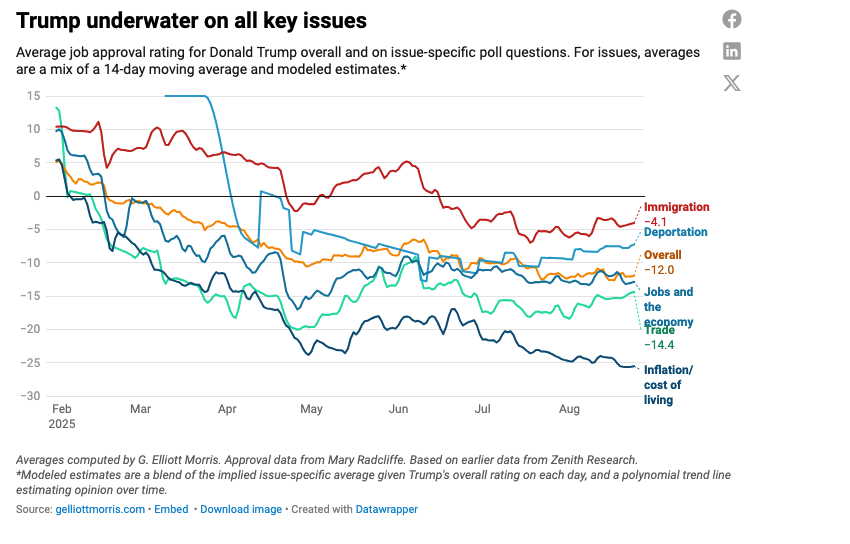
But things don’t work that way any more, largely because Trump barely needs Congress. If you rule by executive order rather than legislation, use the full power the Supreme Court has granted the unitary executive, don’t worry too much about the letter of the law, and dare the courts to stop you, you don’t need public support. And across the board, Trump doesn’t have it.
In fact, the shoe is on the other foot: It’s the opposition that needs public support to try to stop what Trump is doing. The more things he does at once, the more scattered the opposition gets. And our news cycle tends to fragment issues, making the larger picture harder to grasp.
Nowhere is this more apparent than with regard to climate change and CO2 emissions. You may have heard individual reports about how this offshore wind project was cancelled or those EV subsidies phased out. If you have heard enough such stories, you may have pieced together a general impression that the Trump administration is indifferent to climate change.
But the actual situation is far worse. Across the board, the administration has targeted any effort to take action to reduce CO2 emissions. Worse, the US government is now actively promoting fossil fuels, even in situations where the free market would make a more sustainable choice.
The Trump administration is not indifferent to climate change. It is working hard to make it worse.
Electrification
Fundamentally, the strategy for dealing with climate change has two pieces: electrify everything, and then produce electricity without burning fossil fuels. The Trump administration has attacked both sides of this plan.
Electric vehicles. The so-called “Big Beautiful Bill” cuts off virtually all subsidies for electric vehicles by the end of this fiscal year, September 30. That’s not just the tax credit for purchasing an EV, but also subsidies for electrifying commercial fleets and installing charging stations.
EVs are a natural fit for fleets of vehicles that have a defined territory and return to base every night, like postal delivery trucks. The Biden administration planned to use such government fleets to jump-start the larger EV market.
But under Trump, EVs have become no-nos within the federal government. Not only are federal agencies not installing any charging stations or buying new EVs, they’re ripping out brand-new charging stations and selling off EVs at a loss. All-in-all, de-electrifying the federal vehicle fleet could cost as much as $1 billion.
Think about that: The government is not just reassessing future EV purchases and deciding they are too expensive. That would be a suspicious calculation, but at least a plausible one. In fact, though, it is spending money to get rid of the EVs and EV infrastructure it has.
Sustainable electrical generation. Trump has long had an animus against wind power, going back at least to 2012, when he thought offshore wind turbines marred the view from his Aberdeenshire golf course. Since then, he has been a font of anti-wind disinformation, charging that wind turbines not only kill large numbers of birds, but that offshore wind farms are driving whales crazy and causing them to beach themselves and die. (The birds claim is exaggerated — birds do run into turbine blades occasionally, but a 2009 study concluded that wind farms kill far fewer birds per kilowatt hour than fossil fuel plants. The connection to whale deaths is entirely imaginary.)
Trump’s Big Beautiful Bill terminated a variety of subsidies for sustainable energy, wind and solar alike. But his administration is actively anti-sustainable-power. The Interior Department has created new bureaucratic requirements for wind or solar projects on federal land, and just this week halted work on a wind farm offshore from Rhode Island. The project was scheduled to begin delivering power to Rhode Island and Connecticut homes in 2026.
The order to stop work on the Revolution Wind project is the latest move by the Trump administration targeting the country’s renewable energy industry. President Trump, a longtime critic of the wind industry, in January issued a moratorium on new development of offshore wind projects. The Internal Revenue Service recently put out new guidance that makes it harder for companies building wind and solar projects to qualify for federal tax incentives. And the Commerce Department is investigating whether imports of wind turbines and their components threaten national security.
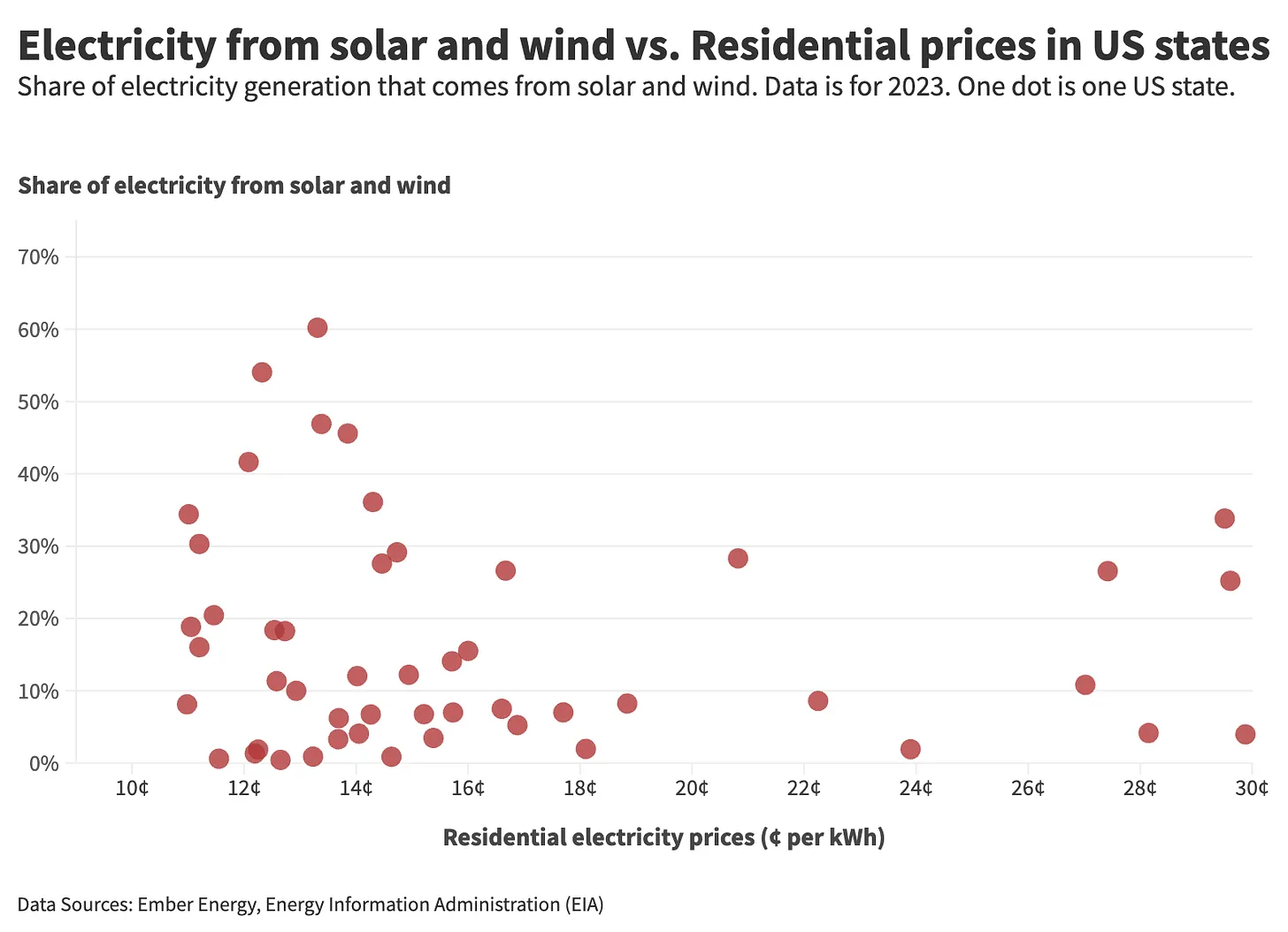
Any State that has built and relied on WINDMILLS and SOLAR for power are seeing RECORD BREAKING INCREASES IN ELECTRICITY AND ENERGY COSTS. THE SCAM OF THE CENTURY! We will not approve wind or farmer destroying Solar. The days of stupidity are over in the USA!!! MAGA
End-to-end, this post is nutty. Electricity costs are rising because of demand, especially demand for computation related to AI and cryptocurrency mining. The Sustainability By Numbers blog ran the state-by-state numbers and found no correlation, positive or negative, between sustainable energy and prices.
Besides, just take a step back and think this through from economic first principles: Adding supply is not going to raise costs.
Equally nutty is a Trump post that “STUPID AND UGLY WINDMILLS ARE KILLING NEW JERSEY”. NJ.com fact-checks: New Jersey’s offshore wind project has already been cancelled before coming online, and the state barely has any windmills.
Even worse than the specific projects being cancelled is the chill this sends across the industry. If you are a utility looking for additional generating capacity, wind and solar now entail a political risk that is hard to work into your calculations. If you make a success out of sustainable energy, you are making Trump look bad. He may come after you.
Conservation. One way to partially mitigate the increased demand from AI and crypto — both of which Trump favors — is to use less electricity to power our household appliances. This effort has been going on since the days of Bush Sr., and its flagship has been the Energy Star program. Energy Star certification has helped consumers identify appliances that use less electricity, saving them $500 billion in their utility bills.
Funding for Energy Star was zeroed out in Trump’s original Big Beautiful Bill proposal, but Congress seems to have put it back. Whether or not this money will actually be spent is another question, one that probably depends on what the Supreme Court says about Trump’s previous attempts to impound funds.
Drill, Baby, Drill
While the Big Beautiful Bill was zeroing out subsidies for EVs and sustainable energy, it was increasing subsidies for fossil fuel production. The Union of Concerned Scientists’ Equation blog lists the benefits and estimates the cost to the taxpayers at $80 billion over the next ten years.
But this week’s most outrageous energy story concerned a coal-fired utility plant in Michigan. Coal is probably the dirtiest form of energy in common use, but the Trump administration loves it.
Donald Trump has made several unusual moves to elongate the era of coal, such as giving the industry exemptions from pollution rules. But the gambit to keep one Michigan coal-fired power station running has been extraordinary – by forcing it to remain open even against the wishes of its operator.
The hulking JH Campbell power plant, which since 1962 has sat a few hundred yards from the sand dunes at the edge of Lake Michigan, was just eight days away from a long-planned closure in May when Trump’s Department of Energy issued an emergency order that it remain open for a further 90 days.
On Wednesday, the administration intervened again to extend this order even further, prolonging the lifetime of the coal plant another 90 days, meaning it will keep running until November – six months after it was due to close.
This order, like so many of the questionable things Trump has done, is justified by a mythical “state of emergency” that he can see but no one else can. The Energy Department says the local electrical grid will be strained by the loss of this plant, but the operating utility doesn’t think so. While it’s not unusual for a utility to seek permission to extend the life of a coal plant that violates pollution standards, extending the life of a plant the operator wants to close is virtually unheard of.
So far, 71 coal plants, along with dozens of other chemical, copper smelting and other polluting facilities, have received “pollution passes” from the Trump administration according to a tally by the Environmental Defense Fund, allowing greater emissions of airborne toxins linked to an array of health problems. Coal is, despite Trump’s claims, the dirtiest of all fossil fuels and the leading source of planet-heating pollution.
Information
If you want to assess the current state of the planet and its climate, the federal government does not want to help you.
In accordance with the Global Change Research Act of 1990, the federal government has produced a National Climate Assessment every four years.
The sprawling report is the most influential source of information about how climate change affects the United States.
The National Climate Assessment is widely used by teachers, city planners, farmers, judges and regular citizens looking for answers to common questions such as how quickly sea levels are rising near American cities and how to deal with wildfire smoke exposure. The most recent edition had a searchable atlas that allowed anyone to learn about the current and future effects of global warming in their specific town or state.
Sadly, though, the federal web site that hosts the report has been taken offline. Work on the next report has been halted and the contract to produce it cancelled. It’s up in the air whether any report at all will appear when the next one is due in 2027. Perhaps some fossil-fuel industry think tank will produce one. DoE recently published a climate-change-denying report by five fringe scientists.
The attack on the USGCRP and national climate assessment did not come as a surprise. In the Heritage Foundation’s far-right policy blueprint Project 2025, Russ Vought – now Trump’s head of the office and management and budget – called to end the USGCRP or fill it with pro-oil industry members.
“We’re reviewing them, and we will come out with updated reports on those and with comments on those reports,” [Energy Secretary Chris] Wright told CNN’s Kaitlan Collins in an interview on “The Source.”
Wright dismissed the past reports, saying “they weren’t fair in broad-based assessments of climate change.”
President Donald Trump’s budget request for fiscal year 2026 includes no money for the Orbiting Carbon Observatories, which can precisely show where carbon dioxide is being emitted and absorbed and how well crops are growing.
One of the observatories is a satellite launched in 2014, and the other was attached to the International Space Station in 2019. The two systems are
more sensitive and accurate than any other systems in the world, operating or planned, and a “national asset” that should be saved, said David Crisp, a retired NASA scientist who led their development. They helped scientists discover, for example, that the Amazon rain forest emits more carbon dioxide than it absorbs, while boreal forests in Canada, Russia and places where permafrost is melting absorb more than they emit, Crisp said. They also can detect the “glow” of photosynthesis in plants, which helps monitor drought and predict food shortages that can lead to civil unrest and famine, he said.
The OCO instruments in the space station might just be turned off, while the satellite could be “brought down”, i.e., allowed to burn up in the atmosphere. Needless to say, launching a replacement satellite (assuming the US government ever cares about climate again) will be far more expensive than just maintaining the one already in orbit.
Why make this very wasteful decision?
NASA said in an emailed statement Wednesday that the missions were “beyond their prime mission” and being terminated “to align with the President’s agenda and budget priorities.”
Now, the Trump EPA is arguing that the endangerment finding was a mistake and overstepped the EPA’s statutory power. Daren Bakst, director of the Center for Energy and Environment at the Competitive Enterprise Institute, comments:
If the EPA finds the 2009 endangerment finding is no longer applicable, Bakst says that “would preclude future greenhouse gas regulations.” And he says “it should be easy to repeal existing rules that are predicated on the 2009 finding.”
Foreign policy
The administration is not just seeking to burn more fossil fuels at home, it’s also pushing fossil-fuel exports overseas. For example, the recent trade deal announced between the US and the EU stipulated that the EU buy $750 billion of US energy exports — primarily fossil fuels — over the next three years. Trump got this benefit for US energy companies by threatening Europe with crippling tariffs.
While China is dominating clean energy industries, from patented technologies to essential raw materials, the Trump administration is using the formidable clout of the world’s biggest economy to keep American oil and gas flowing.
In a full reversal from the Biden administration’s effort to pivot the American economy away from fossil fuels, the Trump White House is opening up public lands and federal waters for new drilling, fast-tracking permits for pipelines and pressuring other countries tobuy American fuels as a way of avoiding tariffs.
Washington is essentially pursuing a strong-arm energy strategy, both at home and abroad with allies and friends. It’s premised on the idea that the modern world is already designed around these fuels, and the United States has them in abundance, so exporting them benefits the American economy even if solar energy is cleaner and often cheaper.
Lately, the I.E.A.’s influential forecasts have suggested that global demand for oil and gas could peak by the end of the decade as electric-vehicle sales grow and the cost of solar panels and battery storage plummets.
The US responded in a typical Trumpian fashion, by threatening the messenger.
Chris Wright, Mr. Trump’s energy secretary and a former fracking executive, has called the agency’s projections of peak oil demand “nonsensical” and has said the United States could withdraw from the global organization if it doesn’t change the way it operates. House Republicans have said the agency is publishing “politicized information to support climate policy advocacy” and have threatened to withhold U.S. funding.
In short, I don’t know what other conclusion to draw: The Trump administration is trying to make climate change worse. I could speculate about why, but that seems like a distraction. The What is more important than the Why. The Trump administration is trying to make climate change worse.
Or: Why the Sift’s weekly summary has a new format
Like the fictionalized and hybridized T-Rex of Jurassic Park, our news media can only see motion. No matter how significant a situation is, it will vanish from our news feeds if it stands still or just moves very slowly.
This may sometimes look like a conspiracy to suppress certain ideas, but it happens for a reason: In our culture, “news” is what has happened since the last time you talked to somebody. So at your high school’s 10-year reunion, “I had a kid two years ago” might be news. But when you and your office mate take your daily coffee break, it isn’t.
Same thing with news organizations. If a publication thinks of itself as a daily, its timescale is a day. “News” is something that is true today, but wasn’t true yesterday. The timescale of a weekly is a week, and so on. Something that doesn’t fit in that timescale just isn’t news, no matter how important it is.
The best example of this is climate change. On most days, probably the most important thing that happens is that the amount of CO2 in the atmosphere is higher than it was a year ago. But that will never be a headline, because it could be a headline every day. So it’s not news.
Something similar has been happening in American politics. Almost every day, the most significant story, the one that people most need to understand, is Trump’s attempt to transform our democracy into a Putin-style authoritarian government. But again, a story you could write every day is not news, so it will never be covered quite so explicitly.
So how will it affect news coverage?
Dressing it up. Now go back to the example of a daily coffee break. “I had a kid two years ago” isn’t news. But “Bobby had his second birthday Tuesday” is. It’s mostly the same information, but it’s packaged as a more current event.
Journalists do this all the time. They get around the media’s blindness about slow-moving stories by covering related events that change fast enough to be news-visible. So while climate change itself is not news, a storm that rapidly intensifies to a category 5 hurricane (as Erin did on Saturday) is news. And if you cover that story, you can mention climate change as the context of that intensification (though the CNN article I linked to doesn’t). Other news-visible developments that relate to climate change might be when a new report comes out or CO2 measurements pass some round number.
The problem with this trick is that it’s largely up to the reader to connect the dots. The heat waves, the hurricanes, the wildfires — those news events form a picture, but the picture itself is not news. It changes so gradually that daily news reports can’t see it. “Planet Earth is warming” is never breaking news. Climate change is a forest, but journalists can only cover trees.
Each of those stories also becomes news from time to time, when some noteworthy development has happened in the last 24 hours. But the larger picture they paint when you consider them together, of a democracy little by little turning into an autocratic state, isn’t news. In the news business, that larger picture is “context” — which means that it’s optional, like the extra credit questions that your term paper might also address. And if the overall slant of a news organization finds that context inconvenient, its readers and viewers will never hear about it. Maybe individuals will put it together for themselves, or maybe they won’t.
In fact, that’s the best way to judge the slant of a news organization: What context do they consider relevant? For example, The Guardian makes a climate-change connection in the final paragraph of its story on Erin this morning, but The Washington Post does not.
Think about how this news-and-context distinction influences a responsible journalist. The larger, longer-term, slower-moving story is what your readers really need to know. But it’s not news, at least not as your organization understands news. The larger story is a forest, but forests aren’t news. Trees are news.
So you find yourself trying to communicate the bigger stories to your readers through the filter that your organization’s definition of news imposes on you. You can only report news-visible stories, but if you do it artfully, you can find traces of the too-large-to-see stories in that visible news.
If you’re not artful enough, though, the readers will see what you’re doing: You’re writing the same story over and over, but dressing it up with different details to make it current. It will seem dishonest, like you’re trying to put something over on them.
What’s this have to do with me? Every week, I try to sift out what happened this week that you really ought to know and understand. A big part of that mission is taking a step back from the minute-to-minute news cycle and filtering out the hype.
In essence, I’m making a virtue out of necessity. Not having the focus and energy of bloggers like Heather Cox Richardson, I can’t put out a high-quality post every day. That forces me to take a week-by-week approach to the news. But for many stories, I believe, that’s a healthier vantage point. Following a news story too closely just gets people over-stimulated, and causes them to think the same shallow thoughts over and over again. And if a story comes and goes before a week is out, probably it wasn’t worth your attention to begin with.
Lately, though, I’ve begun to feel that even a weekly approach puts me on the wrong timescale. I largely cover American politics, and what you need to understand about American politics right now is that single big story: Trump wants to be like his hero, Vladimir Putin. Turning a democracy into a strongman autocracy is a well-known process now. And Trump is trying, day-in day-out, to follow the path that has been worn by Putin in Russia, Orban in Hungary, Erdogan in Turkey, Modi in India, and many others.
So I find myself writing the same story every week, but trying to make it sound fresh by dressing it up in the particular developments of the last seven days. It doesn’t feel right. It feels like I’m trying to fool you, even though I’m convinced most of you see what I’m doing.
At the same time, it also feels like the thing that needs doing: People need to see both the macrocosm and the microcosm, and to understand how they fit together.
So I want to keep doing what I’ve been doing, but express it in a format that is more direct and honest.
The new weekly summaries. This week I’ll be trying out a new format for the weekly summaries. This week’s summary, which should appear maybe around noon EDT, will start with a “Significant Ongoing Stories” section. This is where I name the forests, and explain very briefly which events of the week constitute trees in each forest. When somebody writes a good where-we-stand article on that big topic, I’ll reference it there.
I don’t expect the list of ongoing stories to change much from week to week. To that extent, I will explicitly be writing the same story every week.
Then will come a “This Week’s Developments” section, which is basically the old form of the weekly summary, but without the stretching to bring in “context”.
My hope is that this will be more satisfying for me to write and for you to read. The repetitive stuff will be repeated explicitly, without trying to make it sound fresh. And the new stuff will be covered for itself, and not as a stalking horse for a story too big to be weekly news.