Category Archives: Articles

Trump Despises His Supporters Too

By privately insulting veterans and servicemen killed in the line of duty, Trump has raised a suspicion many of his supporters try not to think about: What does he say about them behind their backs?


He says what he thinks. When his supporters try to explain what is so appealing about Donald Trump, one point that almost always comes up is: “He says what he thinks.”

If you don’t like Trump, that line has probably never made sense to you, because a lot of what he says seems so nonsensical that he can’t possibly believe it. Surely he doesn’t really think he’s been treated “worse than Lincoln“, when Lincoln was assassinated in office, or that he has “done more for Black Americans than anybody with the possible exception of Abraham Lincoln — nobody has even been close”. He was already an adult when President Johnson passed the Voting Rights Act and the Civil Rights Act, laws that made it possible for millions of Black Americans to vote and to begin living something that at least resembled a normal American life. Surely he doesn’t imagine that a few months of low Black unemployment compares to that, does he? Or that it balances his decades-long history of racism.

He doesn’t say those things because he believes them. He says them because he wants us to believe them.

But “He says what he thinks” is actually code for something else: “He says what I think.” People in Trump’s base, particularly older conservative Christian white men, have lived for decades under constant social disapproval for the little things they habitually do and the words that come out of their mouths. Put yourself in their shoes: Maybe you grew up saying the N-word — you didn’t mean anything by it, it’s just what Black people were called in your neighborhood. (I missed out on the N-word: I grew up in a time and place where good little children weren’t supposed to say it, and by the time I was an adult, no one was.) Maybe you said “fag” instead of “gay”, or referred to women in the workplace as “girls”.

Comments or pats on the butt that would once have been accepted as compliments suddenly because “harassment”. Overnight, jokes that everyone used to laugh at became offensive — racist or sexist or some other ist-word you’d never heard before. Affirmations of good Christian values became “homophobia”, and who knows what the heck “intersectionality” means? Every day there was a new set of toes you supposedly had been tromping on for years — so you’d better watch your step from now on. And it never stops: You can’t even make fun of transsexuals these days. Who knows what it will be next? You’ll never be free to just speak your mind.

And there was Trump, ignoring all those rules and not censoring himself. Mexican immigrants are rapists and criminals and drug smugglers. America accepts too many people from “shithole countries” like Haiti or those places in Africa that were better off when the British or French ran things. When you thought stuff like that, you didn’t dare say so — but he did. That crippled reporter wrote bad things about him, so Trump just mocked him and his disability right out in front of everybody, with the TV cameras running. The Disability Police came after him with guns blazing, but did he apologize? No way. Women came out of the woodwork to say he harassed, abused, or even raped them. Did he let that intimidate him? Not on your life. He insulted them right back, said they were too ugly to be worth it. “Believe me, she would not be my first choice. That I can tell you.”

What’s more, you would also love to deny that you ever make mistakes, to blame everything that goes wrong on somebody else, and to claim that everything you do or say or own is the biggest and best and most wonderful thing ever. But you don’t, because people would laugh at you. Well, Trump does that, and people do laugh at him, but he just doesn’t care. How can you not love that?

The liberal media and all the people who have been pushing the new standards, they keep trying to bring him down. But they can’t. They try to make him a villain, but he beats them.

And that’s why he’s a hero.

Mean girls. One stereotypic character of high school dramas is the Mean Girl: From her perch at the top of the social pyramid, she can say whatever she wants about anybody — and what she wants to say is nasty. The more cruel or unjust it is, the more it proves her power. She can say anything, and everybody else has to accept it, because if you object, she’ll turn her fire on you. And if you want to be popular like she is, you can’t just silently go along, you have to praise her cleverness and insight. If you want to stay in the Queen’s court, you have to repeat her insults and push the party line. She tells you who’s in and who’s out, and then sends you off to work her will.

Being close to the Mean Girl can be exhilarating. All your life you’ve had to repress your own cruelty, and now it’s an asset — as long as she approves. If you come up with a particularly biting nickname for some rival queen-wannabee or for some kid who thinks he or she can get along outside the social structure, maybe the Mean Girl will start using it too. You’ll never get credit for it directly, but maybe you’ll rise in her esteem, until you’re almost a Mean Girl yourself.

But no matter how close you get to the throne, you never stop wondering: What does that cruel tongue say about you when you’re not there to hear?

In their heart-of-hearts, even Trump’s biggest fans must recognize how much Mean Girl he has in him. That champion-of-the-common-man mantle has always fit badly on someone who lives in a gilded penthouse. Do you think anyone who isn’t rich or famous has ever set foot in his Trump Tower residence except as a servant, a workman, or for sex?

He didn’t make that money by working his way up from the bottom; he inherited hundreds of millions from his father. He’s always been rich, he’s always been on top, and he’s always been a bully. Those famous Twitter insults — Pocahontas, pencil-neck Adam Schiff, Crooked Hillary — that’s not the language of presidents. It’s the language of the Mean Girl.

So even if you’re the most rabid MAGA-hatter in the world, deep down you have to wonder: When he’s with his real buddies — the billionaires or reality TV stars or whoever he likes to hang with — what does he say about you? Does he make fun of how gullible you are, that you think he cares about you and you believe all the crap he tells you?

No matter how much you may try to deny that possibility, silently in your own mind you know he does.

Trump U. Before Donald Trump ever ran for president, he was the founder of Trump University. The target market for Trump U was all the people who admired the great businessman they saw on The Apprentice, people who bought The Art of the Deal and wanted to be like the guy it described. And they didn’t just admire Trump, they trusted him. If he was ready to tell people how to get rich the way he did — which wasn’t to inherit a real estate empire from your Dad — they were ready to pay money to hear it.

They weren’t the Enemy. They weren’t what’s wrong with America. They were his biggest fans.

And he scammed them.
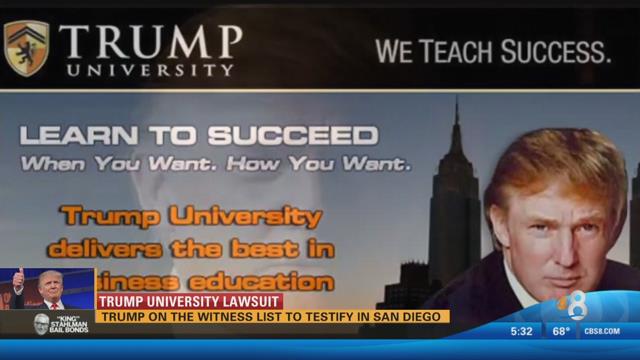
Trump U wasn’t a good idea that got out of hand. It wasn’t a generous impulse that turned bad after he handed it off to a corrupt subordinate. Trump U was a scam from Day 1.

One of the company’s ads said of Trump, “He’s the most celebrated entrepreneur on earth. . . . And now he’s ready to share—with Americans like you—the Trump process for investing in today’s once-in-a-lifetime real estate market.” The ad said that Trump had “hand-picked” Trump University’s instructors, and it ended with a quote from him: “I can turn anyone into a successful real estate investor, including you.”

In fact, Trump hadn’t handpicked the instructors, and he didn’t attend the three-day seminars. Moreover, the complaint said, “no specific Donald Trump techniques or strategies were taught during the seminars, Donald Trump ‘never’ reviewed any of Trump University’s curricula or programming materials, nor did he review any of the content for the free seminars or the three day seminars.” So what were the attendees taught? According to the complaint, “the contents and material presented by Trump University were developed in large part by a third-party company that creates and develops materials for an array of motivational speakers and Seminar and timeshare rental companies.” The closest that the attendees at the seminars got to Trump was when they were encouraged to have their picture taken with a life-size photo of him.

Trump U’s business plan was to constantly up-sell its marks. Drawn in by a free presentation, they’d be given a glowing description of everything they’d learn if they ponied up $1,500 for the three-day seminar. At the three-day seminar, they’d hear about the even more expensive “mentorship” program where they’d learn Trump’s real secrets.

There never were any Trump secrets in the program. He couldn’t tell them how to be born rich, he wasn’t going to tell them how to launder money for Russian oligarchs, and nobody wants to know how to go bankrupt running Atlantic City casinos — so there was really nothing to teach. Trump admirers paid upwards of $30,000 for that lesson, and Trump eventually had to give back $25 million to settle their fraud lawsuit.

Most of the victims of Trump U were people who couldn’t afford to lose that amount of money. But there was a hole in their lives that they thought they could fill by becoming real estate moguls like their hero Donald Trump. In other words, they were losers. And Trump was able to take advantage of their loser-ness (and their admiration of him) to turn them into suckers.

And if you think he’s only done that once, you’re wrong.

The Atlantic article. Thursday, The Atlantic published an article by its editor-in-chief Jeffrey Goldberg: “Trump: Americans Who Died in War Are ‘Losers’ and ‘Suckers’“. The article made a number of startling accusations:

  • In 2018, while he was in France to mark the 100th anniversary of the end of World War I, he cancelled a planned visit to the Aisne-Marne American Cemetery near Paris, the grave site of 1,800 American Marines who died at Belleau Wood, because “It’s filled with losers.” He also described the Marines as “suckers” for getting killed.
  • When tortured Vietnam POW John McCain had died a few months earlier, he said, “We’re not going to support that loser’s funeral.”
  • When he accompanied his Chief of Staff John Kelly on a visit to the grave of Kelly’s son, a Marine who died in 2010 in Afghanistan, he said to Kelly “I don’t get it. What was in it for them?” A retired four-star general who is a friend of Kelly later told Goldberg, “He can’t fathom the idea of doing something for someone other than himself,. He just thinks that anyone who does anything when there’s no direct personal gain to be had is a sucker. There’s no money in serving the nation.”
  • After hearing Joint Chiefs Chairman Joe Dunford give a briefing, Trump said, “That guy is smart. Why did he join the military?”
  • When planning a military parade, Trump told his aides not to include amputees. “Nobody wants to see that,” he said.

Immediately, the White House tried its standard defense: Fake news, put out by a failing magazine. The story is “totally false”, and the anonymous sources Goldberg quotes are made up.

That explanation broke down almost immediately when other news organizations — AP , The New York Times, Fox News, CNN, and The Washington Post — had little trouble finding their own sources, who may or may not have been the same ones Goldberg found. If someone is making these stories up, it’s not Jeffrey Goldberg.

Worse, there was one obvious person who could have blown the whole thing up: John Kelly. If his son’s memory is being used to smear his former boss, you’d think he might try to put a stop to it. He hasn’t said a word. Trump knows what that means. So he attacked Kelly Friday at the White House:

I know John Kelly. He was with me, didn’t do a good job, had no temperament, and ultimately he was petered out. He got — he was exhausted. This man was totally exhausted.

He wasn’t even able to function in the last number of months. He was not able to function. He was sort of a tough guy. By the time he got eaten up in this world, it’s a different world than he was used to, he was unable to function. And I told him, John, you’re going to have to go. Please give me a letter of resignation. And we did that, and now he goes out and badmouths.

He has also lashed out at Fox News reporter Jennifer Griffin, who corroborated some of Goldberg’s accounts via her own sources, and added this anecdote:

According to one former senior Trump administration official: “When the President spoke about the Vietnam War, he said, ‘It was a stupid war. Anyone who went was a sucker’.”

Griffin, Trump tweeted, “should be fired for this kind of reporting” and added “FoxNews is gone.”

Other pundits and talking heads have pointed out the obvious: The quotes in the Atlantic article may be new and more extreme, but they sound like Trump quotes we already know. Early in his term, he called the military brass “a bunch of dopes and babies“. One of Candidate Trump’s first political flaps came when he bad-mouthed John McCain’s service: “I like people who weren’t captured.” He publicly contradicted the widow of a soldier killed in Niger.  He attacked the Gold Star parents of slain Captain Humayun Khan. He dodged the Vietnam draft by claiming bone spurs, a diagnosis provided by a doctor who owed his father a favor. Michael Cohen quotes Trump saying, “You think I’m stupid? I wasn’t going to Vietnam.” The only person in Trump’a family who did any military service was his black-sheep brother Fred Jr., who was in the Air National Guard. As President, Trump won’t even challenge Vladimir Putin for paying bounties to kill American soldiers. Putin counts; soldiers don’t.

So yes, it fits perfectly: He said these things. Trump and his flunkies can deny as vehemently as they want, but they’re not fooling anybody.

Why this story hit a nerve. Ever since he came down the escalator in 2015 talking about Mexican rapists, barely a week has gone by without some Trump-said-a-bad-thing story. They arise, people who never liked Trump anyway get upset about them, and they fade away in a day or two. Some political observers believe Trump uses or even engineers this process in order to distract the public from more damaging stories. For example, 1080 Americans died of coronavirus on the day the Atlantic article came out. What’s more important: a few quotes from 2018 or the equivalent of three simultaneous jumbo-jet crashes?

And yet, this time the story doesn’t seem to be going away. I think I know why.

Trump’s usual escape from he-said-a-bad-thing stories is to invoke tribalism. Both the people he insulted and the media that reported the insult are from the Other Side. Who are you going to believe: Trump or the New York Times? Whose side are you one: Trump’s or the Squad? Trump or some Muslim?

But the people he has insulted this time are in his own tribe, and even Fox News is reporting it. John Kelly was a good guy not that long ago, and he went away without making a fuss.

A key part of the Trump base are veterans, especially white veterans from the South or rural areas whose families have a tradition of military service. The kind of guy who goes to the cemetery on Memorial Day to put flowers on the grave of a father who died on D-Day or a grandfather who barely escaped from Belleau Wood — lots and lots of them are Trump voters. And he thinks they’re losers and suckers, just like the people he scammed at Trump U. Then he got his marks’ money, now he gets their votes. But does he respect them? Not at all.

And even if you’re not a veteran, or a veteran’s spouse or son or daughter, you have to know that your position in the Trump base is no more secure than theirs. If he talks that way about them, you know he’s talking that way about you too.

He’s not the hero you want to believe he is. He’s the Mean Girl who finds you useful as long as you do what she wants. He bears you no affection or loyalty, and the more you do for him, the more you convince him that you’re a sucker too.

The Four Big Lies of the Republican Convention

Creationism defender Duane Gish became famous for a debating technique now known as the Gish Gallop: tossing out so many lies, exaggerations, mischaracterizations, and other deceptions so quickly that your opponent simply can’t respond to them all. Debaters who try will just exhaust their own time (and the audience’s patience) on factual details without ever getting around to addressing the galloper’s main points, much less making their own case.

The trap of fact-checking. This week’s Republican Convention was essentially a four-day Gish gallop. Speaker after speaker gave fact-checkers a workout. CNN’s Daniel Dale listed 20 “false or misleading claims” in Trump’s speech from the White House lawn. FactCheck.org “didn’t find anything to fact-check from Sen. Kamala Harris’ speech accepting the Democratic nomination for vice president”, but made six corrections to Mike Pence’s speech. For example, he blamed Joe Biden for not denouncing “the riots in Oakland” that killed a federal officer.

But he didn’t explain that the death was unrelated to demonstrators protesting in the wake of George Floyd’s death. Federal prosecutors have charged a right-wing extremist with the killing.

Both Pence and Trump claimed Biden wants to “defund the police”, a position Biden has explicitly denied. The Washington Post’s Phillip Bump assessed that “Nearly every claim Trump made about Biden’s positions was false“.

The non-headline speakers were just as dishonest. Rudy Giuliani blamed the violence that coincided with some George Floyd protests on Antifa, a claim unsupported by evidence.

According to multiple reports, including a Washington Post fact check, there were no signs that that antifa was behind violence at these protests. As of earlier this month, federal prosecutors had not been able to link dozens of people arrested in protests in Portland, Ore., to antifa.

Nikki Haley falsely said that Biden wanted to “ban fracking”, while Eric Trump falsely claimed that “Biden has pledged to … take away your cherished Second Amendment.” In addition to dishonesty, speakers displayed appalling ignorance and sloppiness. Lara Trump used a fake Lincoln quote. And Trump Jr.’s girl friend Kimberley Guilfoyle said:

As a first-generation American, I know how dangerous their Socialist agenda is. My mother, Mercedes, was a special education teacher from Aguadilla, Puerto Rico. My father, also an immigrant, came to this nation in pursuit of the American Dream.

Guilfoyle, who introduced herself as a “proud Latina”, ought to know that Puerto Ricans are American citizens. So she’s not “a first-generation American” and her mother was not “an immigrant”.

So you can imagine how easy it would be to take the Gish-gallop bait: I could go on for screens and screens listing specific errors of fact and logic. And if you dislike the Republican Party anyway, you might read that list with a certain I-was-right-all-along satisfaction. [1]

The four big lies. However, that’s not the case that needs to be made right now. The RNC wasn’t like a Liar’s Convention or a Festival of Tall Tales. The week’s disinformation wasn’t a random scattering of fanciful notions. The point of the lesser lies was to support bigger lies, which often stayed in the background. So even if an undecided voter who watched the convention also read all the fact-checks, and came to understand that Puerto Ricans are citizens and Biden isn’t planning to defund the police, he or she might still come away believing one or more of these four falsehoods:

  1. Trump had an extraordinary economic record before the coronavirus hit.
  2. Trump is not responsible for consequences of the Covid-19 epidemic. The 200,000 excess deaths this year are not his fault, since he did everything that could have been done to control the epidemic. And since the epidemic is not his fault, he should get a mulligan for it. He should be judged by February’s economy rather than today’s, as if the last six months never happened.
  3. The unrest in America’s cities this summer is not a response to excessive police violence and a long history of racial injustice, but is due to a dark conspiracy of liberal anarchists. The way to control violence in our cities is with an overwhelming show of force, which Trump is willing to order and Biden is not.
  4. If Covid-19 was ever a serious threat, it no longer is. America should get back to normal as fast as possible; any additional sickness or death this causes is a price worth paying.

None of this is true. The convention’s little lies about who-did-what-when pale in comparison; they’re only relevant to the extent that they prop up these four big lies.

Correcting the first big lie: Even pre-Covid, Trump’s economic performance was nothing special. In 2016, Trump supporters argued that his amazing business acumen would translate from the private sector to government: Rather than creating wealth for himself, Trump as president would create wealth for all of us.

We now understand that the myth of Trump’s financial genius was false from the beginning. Far from the self-made man he purported to be, Trump became wealthy through inheritance from his father and tax fraud (including allegedly defrauding some of his relatives). After losing the money his father left him, he became rich again via money laundering for Russians and other former Soviet nationals, as well as profiting from schemes that created losses for people who trusted him.

But one thing has carried over: The same myth-making genius that created the image of Trump the Great Businessman has created a new myth of the Great Trump Economy. At the Convention, Larry Kudlow told this tall tale:

Donald Trump’s economic plan … was a roaring success. Inheriting a stagnant economy on the front end of recession, the program of tax cuts, historic rollback of onerous regulations that crippled small business, unleashing energy to become the world’s number one producer, and free, fair and reciprocal trade deals to bolster manufacturing, agriculture, technology, and other sectors. The economy was rebuilt in three years.

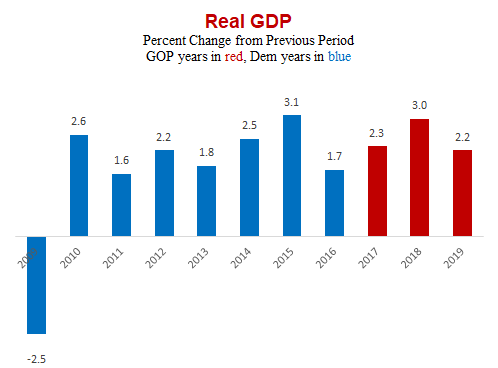
This is its own little Gish gallop that could be debunked phrase by phrase — for example, the US became the world’s top oil producer in 2013 under Obama — but it’s more important to look at the big picture: A graph of US GDP growth by year shows that from 2010 to the beginning of the Covid pandemic, growth was slow but steady, bouncing in a range between 1.6% and 3.1%. (Compare to 1966 or 1955, when GDP grew 6.6% and 7.1%.)The peak growth rate of that period came in 2015 under Obama. There was never a Trump boom, just the same kind of economic growth we had under Obama.

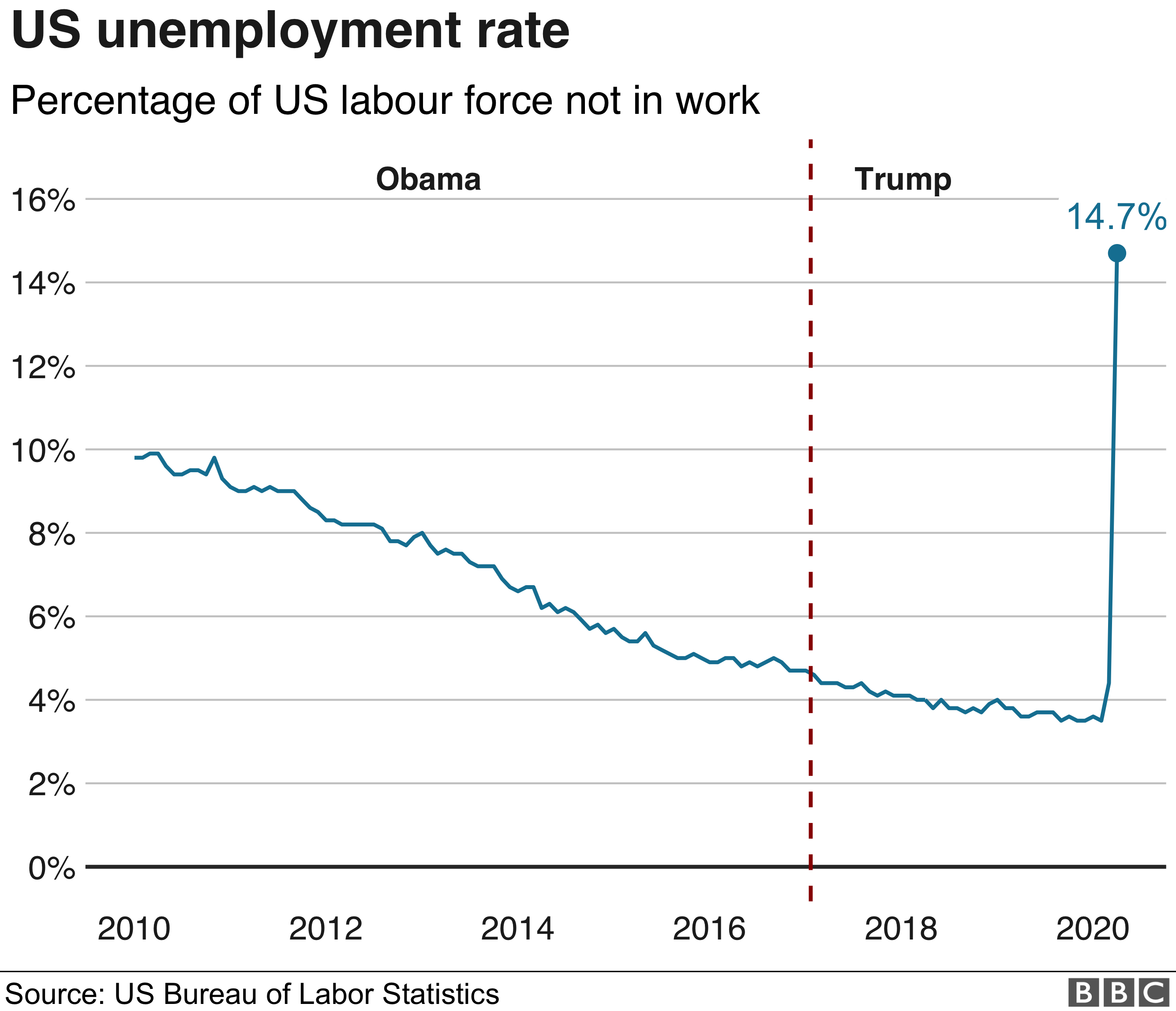
If the pre-Covid Trump economy felt different from Obama’s, that was because periods near the end of economic expansions have strikingly low unemployment rates. So in the Trump years the unemployment rate got very low, reaching 3.6% by November of 2018 and staying at about that level for more than a year. In February, it was 3.5%. [2]

However, if you look at a graph of the unemployment rate, you’ll see the same pattern as GDP: Trump inherited positive trends from Obama. The slow-but-steady growth that started in 2010 gradually knocked down the unemployment rate. That positive trend continued — without any acceleration at all after Trump became president — until the epidemic disrupted it. [3]

In some ways it’s surprising that growth didn’t improve under Trump, because Mitch McConnell loosened the purse strings once he had a Republican president. Even though it was late in the economic cycle — a time when conventional economic theory calls for government to run surpluses — Congress allowed Trump to stimulate the economy with deficits far larger than it had allowed Obama after his first term. [4]

So the gist of the pre-Covid Trump economic record is this: Until Covid, Trump managed to maintain the positive trends Obama had set in motion. And even this steady-as-she-goes result did not come about through an ingenious trade policy or business-friendly tax policy or cuts in regulation; he simply got to spend more money than Obama did.

Correcting the second big lie: Trump didn’t start the Covid-19 epidemic, but the length and depth of it is his fault. It is fairly typical for presidents to face unexpected and undeserved challenges during a four-year term. Obama didn’t create the Great Recession, but it dominated his first term and got in the way of all his plans. George W. Bush didn’t blow up the Twin Towers on 9-11. His father didn’t force Saddam Hussein to invade Kuwait. Jimmy Carter didn’t invite the Iranians to hold our embassy staff hostage. JFK didn’t ship Russian nuclear missiles to Cuba. FDR didn’t attack Pearl Harbor. And so on. Unexpected things happen in the course of four years, and presidents are judged by how they respond to those challenges. We don’t give them mulligans for bad luck.

Covid-19 is the defining crisis of Trump’s term, and by any measure he has handled it very badly. The most obvious evidence for that is in this chart of Covid-19 cases per million people. (Enlarged version here.)

Not only does the US curve outrun all the others by a wide margin, it also has a different shape: The initial outbreak here was only slightly worse than in the European Union and Canada, which were also hard-hit. But only the US goes on to have a second hump bigger than the first. There are two simple reasons for that:

  • The Trump administration wasted the time bought by the March-May shutdown. While other countries developed national test/quarantine/contact-trace strategies, the Trump administration still has no plan other than to wait for a “miracle” vaccine. [5]
  • Trump himself pushed the states to reopen too soon, and undercut governors who tried to implement a more cautious policy based on science and standards. That second hump in our graph is a direct result of that too-soon reopening, and the June/July outbreak was centered in states like Florida and Texas, where Trumpist governors ignored the medical experts and re-opened too soon.

It is probably unfair to have expected the United States’ Covid-19 response to lead the world: Small island nations like New Zealand and Iceland are easier to protect and mobilize than a sprawling place like the US or the EU. So Trump should not get all the blame for the fact that our 565 (and counting) deaths per million is shamed by New Zealand’s 4 or South Korea’s 6 or even Japan’s 10.

But we still had less than 100,000 deaths on June 1, when it was first becoming clear that our curve was not collapsing the way that other nation’s curves were. It may be unreasonable to hold Trump responsible for all our Covid-19 deaths, which are now up to a world-leading 187,000. But certainly tens of thousands of those deaths are his fault, and I personally blame him for every death over 100,000.

Correcting the third big lie: The violence in our cities is happening because Trump has sharpened racial divisions and encouraged police brutality. It will only get worse if he is given a second term. After the racial violence that followed Michael Brown’s death in Ferguson, Missouri in 2014, the Obama Justice Department issued two reports: One examined the details of the shooting and determined that police officer Darren Wilson should not have been charged with murder. To that extent, it affirmed that justice had been done.

The other report, however, painted a very dark picture of policing in Ferguson: The city budget depended on squeezing fines out of poor Blacks, and the police department was tasked with making that happen. Ferguson police did not “serve and protect” its Black citizens. Instead, police and the Black community had a predator/prey relationship in which police were constantly on the lookout for violations to cite in order to raise revenue. The report also revealed widespread and blatant racism among Ferguson officers, who routinely mistreated Blacks they came into contact with.

In short, the Fox News portrait of Ferguson was wrong: The problem wasn’t the Black community’s short-term emotional reaction to its misperception of Brown’s death. Instead, the long-term racial injustice in Ferguson, and citizens’ inability to address that injustice through the system, created a situation in which some kind of violent outbreak was inevitable. Michael Brown was the spark, not the cause.

In combination, the two reports provided a ray of hope and a path forward: Incidents like Michael Brown’s death need not lead either to individual policemen being railroaded or to purely local investigations that sweep police violence under the rug. But at the same time, the long-term injustice at the heart of the problem can be addressed. The Justice Department soon worked out a consent decree with Ferguson and its police department to reform local practices. Similar decrees were negotiated in other sites of racial violence, such as Baltimore.

But when Jeff Sessions became Trump’s first attorney general, he quickly got to work closing off that path forward. And one of his final acts before leaving was to undercut the whole process.

Sessions’ memo will make it challenging to negotiate any effective police reform agreement going forward. It also makes it more difficult for the Justice Department’s civil rights lawyers to enforce agreements already in place.

Today, Black people oppressed by abusive police departments know that the Justice Department is not their ally. No one is coming to help them.

Police, on the other hand, know that no matter how they misbehave, Trump has their backs. He has famously encouraged police officers not to be “too nice” when they apprehend suspects. He told border patrol officers to break the law, and promised their chief a pardon if he were prosecuted. When Buffalo police assaulted an elderly protester in Buffalo, Trump falsely attacked the protester as an “ANTIFA provocateur”.

Meanwhile, Trump has been encouraging white supremacists. He defended the Nazi rally in Charlottesville. He stands up to support the Confederate flag and Confederate statues.

And now, Trump is openly encouraging right-wing violence. The Kenosha vigilante was in the front row of a Trump rally in January. Yesterday, Trump tweeted “GREAT PATRIOTS” about a caravan of trucks that pepper-sprayed demonstrators in Portland.

What in all of this is going to get better if Trump is re-elected? Has Trump ever been a peace-maker? Will he improve race relations? Will police stop murdering Black men and women, or stop shooting them in the back? Will Blacks trust that they can get justice through the system, without taking to the streets?

Obviously not. If Trump is re-elected, everything that has caused this summer’s violence will only get worse.

Correcting the fourth big lie: The Covid epidemic is still raging and is still killing Americans in large numbers. But Trump has learned nothing from his blunders in May. If he gets the responses he wants, we’ll see a third big hump in the case graph. During the Republican Convention, speakers often talked about the coronavirus in the past tense. “It was awful,” Larry Kudlow recalled. “Health and economic impacts were tragic. Hardship and heartbreak were everywhere.”

But in the real world, more Americans died of Covid-19 during the Convention’s four days than died in the 9-11 attacks. We are nowhere near herd immunity, and a vaccine probably won’t be widely available until spring — unless Trump once again follows Putin’s lead and ignores the usual safety rules to release a vaccine that hasn’t been properly tested.

Meanwhile, Trump is once again pushing states and cities to ignore medical guidelines and take big risks. In the same way that he applauded as states catastrophically opened bars and restaurants in May, he’s pushing for schools to open now, and threatening communities that want to be more careful. He has repeatedly promoted the myth that kids don’t get the virus or can’t spread it.

But now we are seeing virus outbreaks on college campuses, causing some schools to reverse their plans (including my alma mater, Michigan State). More than 1,000 University of Alabama students tested positive in the first two weeks of classes.

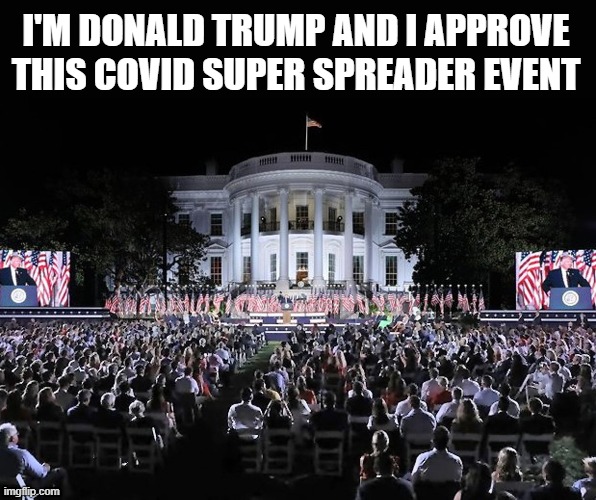
Trump’s speech Thursday night was not just an illegal use of the White House lawn, it was a public health hazard, as 1,500 or more people packed into a small area and mostly did not wear masks.

He encourages a return of large-crowd gatherings of all sorts: churches, movie theaters, and even football games, which he would like to see played in front of full stadiums. (“We want big big stadiums loaded with people. We don’t want to have 15,000 people watching Alabama-LSU.”) Inside the White House, masks are seldom worn, even when people work in close quarters.

We saw this movie in May, and we know how it ends: If the nation’s children return to in-person classes (which Barron Trump is not doing), if college campuses reopen, and if crowds return to major sporting events, we’ll have a third wave of Covid outbreaks — and more tens of thousands of deaths that will be Trump’s fault.


[1] I might also list all the RNC activities that were illegal, unethical, or based on trickery. That too would be satisfying. And while such examples should not go by without notice or objection, what really deserves notice is that Republicans in Congress are unwilling to condemn blatant law-breaking.

At the beginning of his term, when Trump saw no Republican pushback for ignoring the norms of our democracy (like refusing to divest his business holdings or take any action to avoid the resulting conflicts of interest), many imagined that there was a line beyond which Trump would lose his party’s support. We still haven’t found it. So it’s still an open question whether Susan Collins, Mitch McConnell, Joni Ernst, Thom Tillis, or any of the other Republican senators would lift a finger to stop a straight-out military coup to keep Trump in power.

[2] But even focusing only on unemployment, Trump did not oversee “the greatest economy in the history of our country“, as he often claims. Unemployment was 2.5% in 1953.

[3] This unemployment graph is not current — I couldn’t find one that was. There has been some recovery since. By the end of July, the 14.7% unemployment rate had come down to 10.2%, which is still alarmingly high.

[4] The 2020 deficit looks likely to top $3 trillion, and is already well past the $1.4 trillion record set by Bush and Obama in fiscal 2009.

[5] For a more complete play-by-play explanation of how Trump bungled even the initial reaction to the virus, see James Fallows’ article “The 3 Weeks that Changed Everything“. Just to give you a taste: Obama had an agreement with China that allowed us to have observers in Wuhan, where the virus first appeared. But Trump never bothered to appoint anybody to fill those roles.

The Underlying Differences Between Liberals and Conservatives

It’s policy, but it’s more than that.


Everyone knows that liberals and conservatives differ on policy: Liberals support abortion rights, gay rights, and gun control, while conservatives oppose all three. Conservatives want to deport undocumented immigrants and build a wall to keep more from coming, while liberals want to provide a path to citizenship for people who have been living and working here for years without incident. Liberals believe climate change is a real problem that requires serious action, while conservatives don’t. And so on.

But underneath all that are much broader and vaguer differences.

Conventions are designed to be popular TV, so they don’t go that deeply into policy. Instead, they focus on identity and present values rather than five-point plans. Consequently, watching the two conventions back-to-back is a good way to get a handle on the underlying differences. The following questions are intended to help focus your thinking as you watch.

1. Is your ideal America in the past or the future? One of President Trump’s major complaints against the Democratic Convention was that its speakers ran America down.

“Over the last week, the Democrats held the darkest and angriest and gloomiest convention in American history,” President Trump said in remarks to members of a conservative group in Arlington, Va. He accused Democrats of “attacking America as racist and a horrible country that must be redeemed.”

If you’re a liberal (as I am), you probably don’t remember the convention that way. What sticks in my mind are all the expressions of hope: We are a great people. We have it in us to overcome the current challenges and “build back better”. I saw a celebration of decency, of families that stick together through tough times, and of people’s simple desire to help each other.

This perception gap arises largely because of one of the major liberal/conservative splits: Conservatives see their ideal America in the past, while liberals see it in the future.“Make America Great Again” only makes sense if you believe that at some point in the past America was greater than it is now. Trump has always been vague about what era his “again” points to, but different segments of the MAGA community have their own favorites:

  • The Founding. Many Evangelicals (and Mormons) go so far as to claim that the Constitution is divinely inspired, putting the Founding Fathers on a level very near the Biblical prophets.
  • The Confederacy. Republicans tend to minimize the role that white supremacy plays for their base, but all those Confederate flags and rallies around statues of Robert E. Lee point to something else: nostalgia for the noble Lost Cause of the slave empire.
  • The Wild West. There was a magic moment just after the Native Americans had been driven away, but before civilization arrived. The land was too vast and empty for anything you did to pollute it. And you could shoot all the buffalo you wanted, because there was nobody to tell you not to.
  • The Gilded Age. Libertarians and Ayn Rand followers idealize the late 1800s, before antitrust laws and other progressive reforms involved government so deeply in the economy.
  • The Greatest Generation. According to the myth, we single-handedly saved the World from fascism and never got the gratitude we deserved.
  • The Happy Days. The idealized 1950s, when a white man could support his family on a single income, women knew their place was in the home, gay sex was a crime, and Negroes were invisible.

Democrats, on the other hand, have an annoying habit of throwing dirt on these beautiful images by talking about slavery, Jim Crow, the Native American genocide, or the indiscriminate massacre of civilians at Hiroshima and Nagasaki. When we honor the Founders, it’s not because their era was so great, but because they left us a vision of a government where authority bubbles up from the People rather than streams down from Heaven, and of a world where “all men are created equal”. They never achieved that vision, but they wrote a Constitution flexible enough that we could evolve towards it, and a Declaration we could edit to say “all people are created equal”. Yes, they were hypocrites to wax eloquent about their own freedom while enslaving others. But in the long run, their visionary hypocrisy has served us better than realistic cynicism would have.

Liberal patriotism revolves around the Future America, the one we could build that will finally live up to that never-achieved vision. That’s why Kamala Harris talked “the beloved community … a country where we look out for one another, where we rise and fall as one, where we face our challenges, and celebrate our triumphs—together.” But then she admitted: “Today, that country feels distant.”

Trumpists hear negativity and gloom there, while liberals find it inspiring: Even in moments as dark as this one, the American ideal is still out there, still beckoning for us to achieve it.

In contrast, the theme President Trump has chosen for the Republican Convention is “Honoring the Great American Story“. Taking a wild guess, I suspect we’ll hear a lot about “left-wing mobs” who have been tearing down or defacing statues that honor major players in that great story: mostly Confederate leaders, but occasionally non-Confederates like Columbus or even George Washington. We might also hear denunciations of the 1619 Project, an American history curriculum that emphasizes the central role slavery played the Great American Story. (Senator Cotton wants to deny federal funds to schools that teach this curriculum. Remember when conservatives opposed federal control of education?)

This next week, expect to hear a lot of reverence for the America of days gone by. But the only vision you’ll hear for our future is to return to that past greatness.

2. Do you think mainly about We or I? There’s a reason masks have proven to be such a divisive left/right issue, in spite of the overwhelming evidence that they are great tools for controlling the Covid epidemic: Masks are a we-solution, not an I-solution.

Does wearing a mask guarantee that you won’t catch the virus? No. If you walk into a crowded room and you’re the only person wearing a mask, it’s going to improve your odds of escaping infection a little, but not really that much.

So if your demand is “Give me something I can do that will keep me safe”, telling you to wear a mask is not a great answer. But if you revise that to “Give me something my community can do that will help us get the virus under control faster”, masks are a great answer. If everyone starts wearing masks when they leave the house, instead of each infected person passing the virus on to three other people, you might have three infected people passing it on to just one new person. Instead of exponential growth, you’ll have exponential decay. And in a struggle like this, that’s what victory looks like.

But conservatives hate we-solutions. They would much rather hear about snake-oil cures like hydroxychloroquine or oleandrin, because those are I-solutions: If I get sick, I take oleandrin, and I get better — if it works.

This shows up across the board. Why should I give up my AR-15, when I was never going to do anything illegal with it anyway? Well, because if we all give up our AR-15s, the next mass shooting might not have quite so much “mass” to it. If you think taxes are too low, why don’t you just make a voluntary contribution to the Treasury? Because changing my tax rate doesn’t solve any national problem, while changing the rate we all pay does. And so on.

3. Are problems solved best by punishing individuals or reforming systems? Related to the focus on I rather than We is the conservative belief that problems are caused by individuals: The crime problem is caused by the individuals who commit crimes. The drug problem is caused by smugglers and pushers. Terrorism is caused by terrorists. And so on. This leads to a belief that the way to solve a problem is to figure out who is causing it and punish them until they stop doing whatever it is they’re doing.

That’s why the conservative reaction to immigrants and asylum seekers is so harsh: Border-crossers cause our immigration problem by coming to our country, and so they need to be punished until they stop. Herd them into detention centers and let people debate whether those centers qualify as “concentration camps”. Take their kids away and lose them in your system. Just make them stop coming.

Liberals are more apt to ask why they are coming and if there’s some way to unplug whatever process is pushing them here. Maybe we could promote reform in the hellish places they come from, or reform the trade practices that make those countries so poor. Maybe we could fund programs there that give them reasons to stay. But no, conservatives say, that would be rewarding the behavior we want to stop. And it wouldn’t work anyway, because … well, it just wouldn’t. If you’re not punishing anybody, you’re not solving anything.

Ditto for the violence that has sometimes accompanied the protests against police brutality after George Floyd’s murder. People are making trouble, so they need to be punished. So fire the tear gas, pepper-spray the peaceful and violent protesters indiscriminately, and send police into crowds swinging their nightsticks. Systemically, it makes no sense to answer a protest against police brutality with more police brutality. But those individuals are wrong and they need to be punished.

The flip side of this way of thinking is that whenever liberal tinkering with a dysfunctional system inconveniences conservatives, they interpret it as punishment. Raising taxes on the wealthy isn’t a sound fiscal plan to raise revenue, it’s punishing success. Affirmative action isn’t a way to compensate for the old-boy networks disadvantaged groups lack, it’s punishing white men. Green taxes punish coal miners and people who drive a lot. Laws preventing discrimination against gays punish Evangelical Christians. And so on.

From a liberal perspective, the weirdest thing in this mindset is the joy they imagine we feel as we punish them. Spend much time inside the conservative bubble, and you will hear a lot about how much we liberals hate the rich, and the coal miners, and the Evangelicals, and anybody else who will be disadvantaged by a liberal policy. We’re just rubbing our hands in sadistic glee whenever Harvard turns down some deserving white male.

My only explanation is projection. They know how they feel when a policeman clubs a BLM protester, so they imagine we must feel the same way.

4. When do you trust systems, and when do you trust people? Dr. Anthony Fauci had such a long and distinguished career before Covid-19 that I must have seen him somewhere — maybe during the Ebola scare or during the height of the AIDS epidemic. But I didn’t remember him. Certainly I had no reason to either trust or distrust him as a person. However, when Covid-19 started spreading, I recognized him as the spokesman for a system of medical science that I do trust. I don’t trust it absolutely or blindly, but when there’s a new disease and I have to make decisions about how to avoid it or seek treatment for it, that’s where I look for answers.

I trust a lot of other systems within certain bounds. I trust academic climate scientists to tell me how we’re doing on climate change. (And I don’t trust scientists employed by energy companies.) Their models may or may not make perfect predictions, but like the weather service’s forecasts, they’re the best we have. I trust geologists and astrophysicists to tell me the age of the Earth, and biologists to tell me how long ago various animals evolved. I trust the Bureau of Labor Statistics to tell me the unemployment rate and the Treasury to report the deficit. I read major newspapers with a mix of trust and distrust: They don’t always characterize events properly, and they sometimes misjudge which stories are or aren’t important, but if they put quotation marks around something, I’m pretty sure somebody really said it. If there’s a publicly checkable fact, I trust that somebody has checked it. The New York Times may not be perfect, and I may or may not agree with its opinion columnists, but it is not fake news.

Those attitudes don’t have anything to do with the issues we normally think of as defining liberalism or conservatism. That last paragraph didn’t state any position on abortion or gun control or tax rates or immigration. But all the same, it marks me as a liberal. There are systems for gathering knowledge, and I believe that (with occasional but fairly rare exceptions) they work.

Conservatives, by and large, don’t share my faith in systems, and would rather trust people. Many of them (God help them) trust Trump. Some trust their religious leaders, even on topics that have little to do with religion. Some trust media personalities like Rush Limbaugh or Sean Hannity. Some trust people who share their religion or their economic class or their DNA. Or they look at a TV talking head and make their own judgment: That guy wouldn’t lie to me.

So they look at Dr. Fauci and don’t see the mouthpiece of medical science. They see a guy like any other guy — and what did he ever do for them? But that My Pillow guy, he speaks the same religious language they do, and his pillow was pretty good, and Trump likes him, so maybe he knows what he’s talking about. Maybe he’s right and Dr. Fauci is wrong.

5. Is the United States a member of the world community that leads by example? Or are we “exceptional”? Trump appears not to recognize the existence of a “world community” at all. He has been relentless about blowing up agreements that involve the US submitting to rules that bind large groups of nations. He pulled us out of the Trans-Pacific Partnership and the Paris Climate Accord and the multi-nation agreement to stop Iran from getting nuclear weapons. He supported Brexit, and chafes at the idea that he can’t have one-on-one trade agreements with the EU countries. He keeps making noises about undercutting NATO, even at one point questioning whether we would really defend some small NATO country like Montenegro.

At this point, the Republican view seems to be that the US is entirely exceptional: No rules should apply to us at all. We should be able to torture people if we want to, we can violate other nation’s sovereignty with impunity, and above all we should not get out in front of other countries to set an example. If somebody needs to be virtuous, let some other nation go first.

Liberals want our vision of the Future America to eventually spread to the Future World. Not that we will conquer the world, but that our ideals of equality and human rights will take hold everywhere once people see how they work here. In his convention speech, President Obama put it this way:

Joe knows the world, and the world knows him. He knows that our true strength comes from setting an example the world wants to follow. A nation that stands with democracy, not dictators. A nation that can inspire and mobilize others to overcome threats like climate change, terrorism, poverty, and disease.

6. Are some Americans more “real” than others? I don’t think Sarah Palin invented the phrase “real Americans”, but her 2008 vice-presidential campaign popularized it. “Real America”, she explained, is in the rural areas and small towns that just happened to support the McCain-Palin ticket rather than Obama-Biden. Since then, Republicans haven’t liked to define the term precisely, but the usage of “real Americans” favors white, native-born, English-speaking conservative Christians.

You can see the current emphasis on “real” Americans in the revived Birtherism that questions Kamala Harris’ eligibility for the vice presidency. Her parents were not citizens at the time of her birth; her mother was an immigrant from India, her father from Jamaica. But she was born in Oakland, and the 14th Amendment declares that “All persons born or naturalized in the United States, and subject to the jurisdiction thereof, are citizens of the United States and of the state wherein they reside.” So she is a citizen by birth rather than by naturalization, making her a “natural born Citizen” as demanded by the Constitution’s Article II.

While any challenge to Kamala’s 14th Amendment rights would be doomed in court — at least until Trump gets to appoint another Supreme Court justice or two — conservatives don’t like the birthright citizenship the 14th guarantees, or the “anchor babies” it makes citizens. Trump has described birthright citizenship as “frankly ridiculous” and has suggested that he might do away with it in some unspecified way. Hans von Spakovsky of the Heritage Foundation then tried to put meat on those bones by finding a loophole in “subject to the jurisdiction thereof”.

Consistent with the liberal notion that the ideal America is in the future, liberals view America as a project that anyone can join, while conservatives have a more blood-and-soil definition. They see an important difference between people who are citizens due to some legal technicality and “real” Americans.


So those are the things I recommend you listen for this week, if you decide to watch the Republican Convention: real Americans, American exceptionalism, suspicion of systems contrasted with trust in particular people, the importance of punishment, We vs. I, and whether we should be trying to move back towards an idealized past or forward to an idealized future.

What Makes Trump an Autocrat?

The most dangerous thing about Trump is that he doesn’t see his power as belonging to the Office of the Presidency. It belongs to Donald J. Trump.


When used sloppily, the word autocrat is little more than an insult. An “autocrat” may simply be an executive who makes decisions you don’t like, one who acts on his own judgment rather than factoring in your point of view. The baseball GM who trades your team’s best pitcher is an autocrat. The boss who rejects all your suggestions is an autocrat.

But the sloppiness isn’t in the word itself; autocrat and autocracy really do have meanings that can be applied precisely. Calling a government an autocracy distinguishes it from a republic under the rule of law. Under the rule of law, powers belong to offices rather than individuals. The people who occupy those offices hold those powers in trust for the republic, and are constrained to use them to fulfill the missions the law assigns.

But in an autocracy, the distinction between person and office vanishes. The powers of an office belong to the person holding it, to use as that individual sees fit, including for financial or political benefit. Lower officials may or may not be disciplined by higher officials, but the law itself does not constrain them, and the highest official is accountable to no one.

Applying that word to the current administration has seemed like a stretch for most of the last 3 1/2 years. Sure, Trump has been cutting corners, subverting democratic norms, and fairly often even breaking laws, but life in the US just hasn’t felt like North Korea or Russia or Saudi Arabia. For the most part, it still doesn’t.

However, it’s becoming increasingly clear that the non-autocratic feel of the United States has been due to Trump not getting everything he wants. He is, at heart, an autocrat. Those are the leaders he admires and the club he wants to join.

I am the State. In his heart, Trump has been an autocrat from the beginning. He has never understood or recognized the difference between his office and his person. That has been clear, for example, in the way he speaks and tweets. To him, speaking as President is no different than speaking as Donald Trump. His monologues flow easily from announcements of policy to expressions of petty resentments to grade-school insults against those who challenge him. While often hidden in the beginning, this attitude also has shown up in his behavior: Recently the public discovered that early in 2018, he tasked the Ambassador to the United Kingdom with bringing the British Open to the Trump Turnberry golf course. After all, why shouldn’t his ambassador drum up business for his golf course? He often has used his power as president to draw business to his hotels or his resorts.

His rhetoric equates threats to his personal future in politics with threats to the United States, in an I-am-the-State fashion. He has often described the Russia investigation — the attempt to discover just how involved the Trump campaign was in Russia’s effort to get him elected — as “treason” or a “coup“. His well-deserved impeachment, which flawlessly followed a process laid out in the Constitution, was likewise “treason” and a “coup“. The whistleblower who made Congress aware of his illegal attempt to extort political favors from Ukraine is “a spy”, and Trump strongly implied that he should be executed: “You know what we used to do in the old days when we were smart? Right? The spies and treason, we used to handle it a little differently than we do now.” Removing Trump from office, no matter how lawfully or justifiably, is equivalent to overthrowing the government of the United States.

In his book, James Comey tells the story of President Obama inviting him to have a conversation before nominating him to be FBI director. After the nomination, Obama tells him, they won’t be able to do this any more, because the President and the FBI director conversing outside of official channels would be improper. But Trump recognizes no such propriety. He regularly tweets out instructions for the Justice Department to investigate or lay off of people he either likes or doesn’t like. He has opinions as an individual, so why shouldn’t he express them as President?

The presidential power to pardon, more than any other power of the presidency, has been treated as a personal power to be used according to Trump’s whims and interests. All other recent administrations have made the pardoning power into a process centered on the Justice Department’s Office of the Pardon Attorney, usually with a few additional special cases (some of which were regrettable). But Trump has abandoned that process entirely; his pardons and commutations are pure expressions of personal favor granted to political allies, co-conspirators who might otherwise rat him out, criminals popular with his base, former contestants on his TV show, and friends of celebrities he wants to impress.

The original purpose of the pardoning power in a lawful republic, according to Alexander Hamilton, was to temper the justice system with mercy, so that it would not “wear a countenance too sanguinary and cruel”. (Obama used his power this way, for example, when he commuted the excessively harsh sentences in hundreds of nonviolent drug cases.) But under Trump, the pardon has reverted to its royal roots: It is an expression of the sovereign’s personal beneficence, and puts the recipient in his debt, as Dinesh D’Souza clearly understands, as does Rod Blogojevich.

Adults in the room. The primary reason America hasn’t felt like an autocracy these last few years is that Trump’s efforts have not gone unopposed. The fundamental drama of the last 3 1/2 years has been the battle between Trump’s autocratic impulses and the republican values embedded in the United States government. (From the point of view of his supporters, who are rooting for the autocrat, this has been cast as a struggle against the “Deep State”.) Trump’s initial set of appointees had reputations and careers before they entered his administration, and many of them imagined that they were taking positions in a merely eccentric version of a typical Republican government. As a result, they frequently frustrated their boss’s desires.

  • Jeff Sessions may have been a racist and a xenophobe, but he also believed he was Attorney General of the United States. Power over the Justice Department belonged to Sessions’ office, not to him personally. And although the President had appointed him, his power did not derive from the person of Donald Trump. Sessions infuriated Trump by following Justice Department rules and recusing himself from the Russia investigation. He also ignored Trump’s repeated demands to launch investigations into “the other side”, i.e, Trump’s political opponents.
  • John Kelly and his deputy (and eventual replacement) Kirstjen Nielsen were anti-immigrant and went along with the cruel policy of family separations, but both saw the Department of Homeland Security as being defined by law. Nielsen was forced out after she refused to do “things that were clearly illegal, such as blocking all migrants from seeking asylum”.
  • Rex Tillerson shared Trump’s pro-Russia views, had a basic hostility to the institutional culture of the State Department, and signed off on the second and third Muslim bans. But he believed he represented the United States rather than Trump, whom he regarded as a “moron“. Trump, Tillerson said later, hated to be reminded that his foreign policy was bound by laws and treaties. He “grew tired of me being the guy every day that told him, ‘You can’t do that, and let’s talk about what we can do’.”
  • Jim Mattis and H. R. McMaster enjoyed the large budgets Trump gave the Pentagon, but held traditional conservative views about America’s special role in global security. Their primary loyalty was to the longstanding mission of the Defense Department, not to Donald Trump. Consequently, they supported NATO and resisted abandoning allies like the Kurds.
  • Don McGahn was the primary lawyer for Trump’s 2016 campaign. But as White House Counsel, he repeatedly ignored Trump’s orders to obstruct justice.
  • Dan Coats was an early opponent of President Obama’s nuclear deal with Iran, and shared a number of Trump’s other views. But as Director of National Intelligence he believed in the mission of the intelligence services: to figure out what is going on in the world and report it as accurately as possible. After Trump sided with Putin against the intelligence services in Helsinki, Coats was not cowed: “We have been clear in our assessments of Russian meddling in the 2016 election and their ongoing, pervasive efforts to undermine our democracy, and we will continue to provide unvarnished and objective intelligence in support of our national security.”

I’m not sure who started using this phrase, but early on these people (plus a few others) came to be known (behind Trump’s back) as “the adults in the room“. Any kind of crazy idea might pass through Trump’s head, but the “adults” would keep him from doing too much harm. Republican Senator Bob Corker even tweeted about it: “It’s a shame the White House has become an adult day care center. Someone obviously missed their shift this morning.”

It’s not my intention to idealize the “adults”, because (as I indicated above) a lot of nasty stuff happened on their watch. I also don’t want to paper over the widespread corruption in the early Trump years. In addition to the “adults”, Trump’s Class of 2017 included Scott Pruitt, Michael Flynn, Tom Price, Ryan Zinke, and many others who left in well-deserved disgrace. Wilbur Ross belongs in that group as well, but is somehow still running the Commerce Department.

In spite of their flaws, though, each “adult” in his or her own way believed in the United States as a republic under the rule of law. They believed that there were things Trump could not do, and could not order them to do.

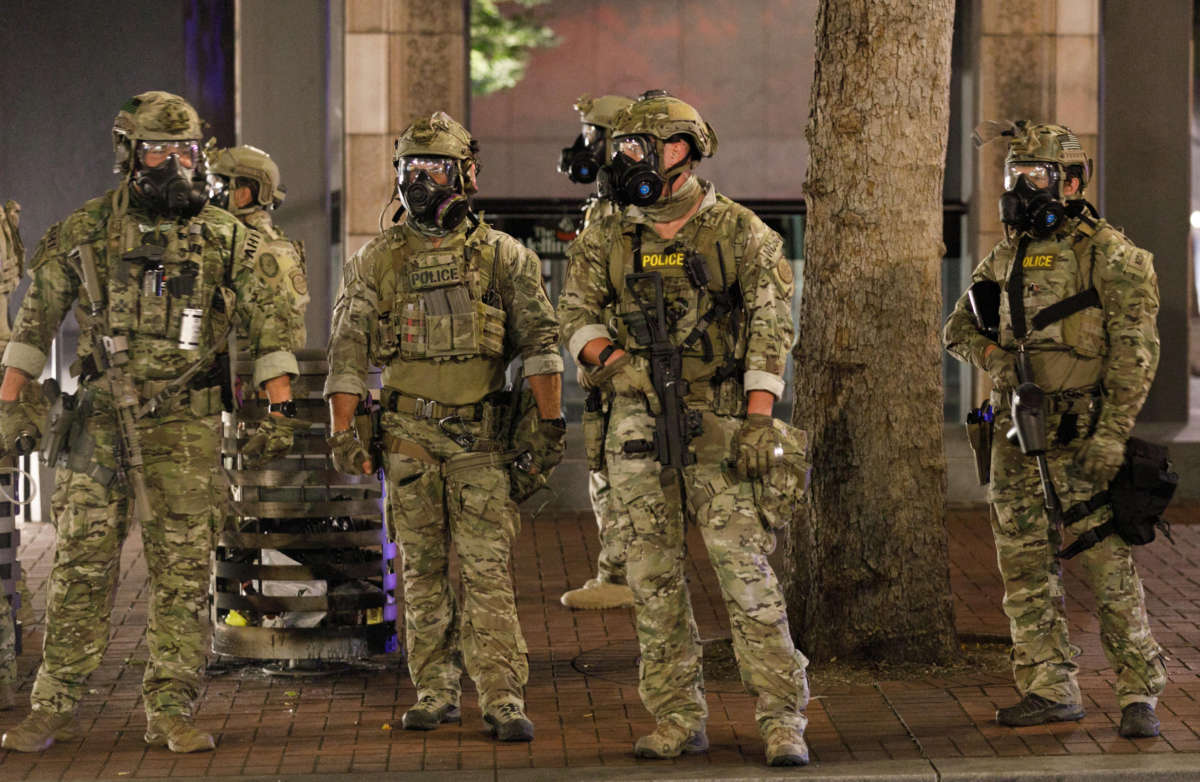
They’re all gone now. Jeff Sessions was replaced by Bill Barr, who has no trouble using the Justice Department to protect Trump’s friends and attack his enemies. The roles Kelly and Nielsen had at DHS are now filled (illegally, it seems) by Chad Wolf and Ken Cuccinelli, who created and managed the masked federal police who invaded Portland against the will of all local officials. Dan Coats’ job is now held by Trump loyalist John Ratcliffe, who has shown little interest in telling Trump anything he doesn’t want to hear, or keeping the public informed about Russia’s continuing efforts to aid Trump’s re-election. In place of Jim Mattis, we have Mark Esper, who was slow to oppose Trump’s impulse to use active-duty troops to put down peaceful protesters, but still not docile enough to make his job secure. McGahn’s replacement Pat Cipollone was in the room when Trump discussed pressuring Ukraine for dirt on Democrats, and said nothing.

Autocratic achievement unlocked. At this point, Trump’s conquest of the executive branch of government is virtually complete. The Pentagon is still holding out, but most of the rest has become his personal instrument, to do with as he will. Two recent examples stand out: the abuse of the Justice Department to suppress Michael Cohen’s book, and the sabotage of the Postal Service to undermine voting by mail.

Trump’s former personal attorney Michael Cohen is serving a prison sentence, part of which results from him following Trump’s instructions to break the law. Like many non-violent criminals (Paul Manafort was another), Cohen was furloughed from prison to reduce crowding during the Covid-19 pandemic. But the Justice Department tried to use that situation as leverage to eliminate a problem for Trump’s reelection campaign:

But to remain at home, he was asked to sign a document that would have barred him from publishing a book during the rest of his sentence. Mr. Cohen balked because he was, in fact, writing a book — a tell-all memoir about his former boss, the president. The officers sent him back to prison. On Thursday, a federal judge ruled that the decision to return Mr. Cohen to custody amounted to retaliation by the government and ordered him to be released again into home confinement.

In America as we have known it, no one connected with overseeing a federal convict should know or care how that person’s writings will affect the presidential race. But in Trump’s autocracy, things are different. If you work for the Justice Department, you work for Trump.

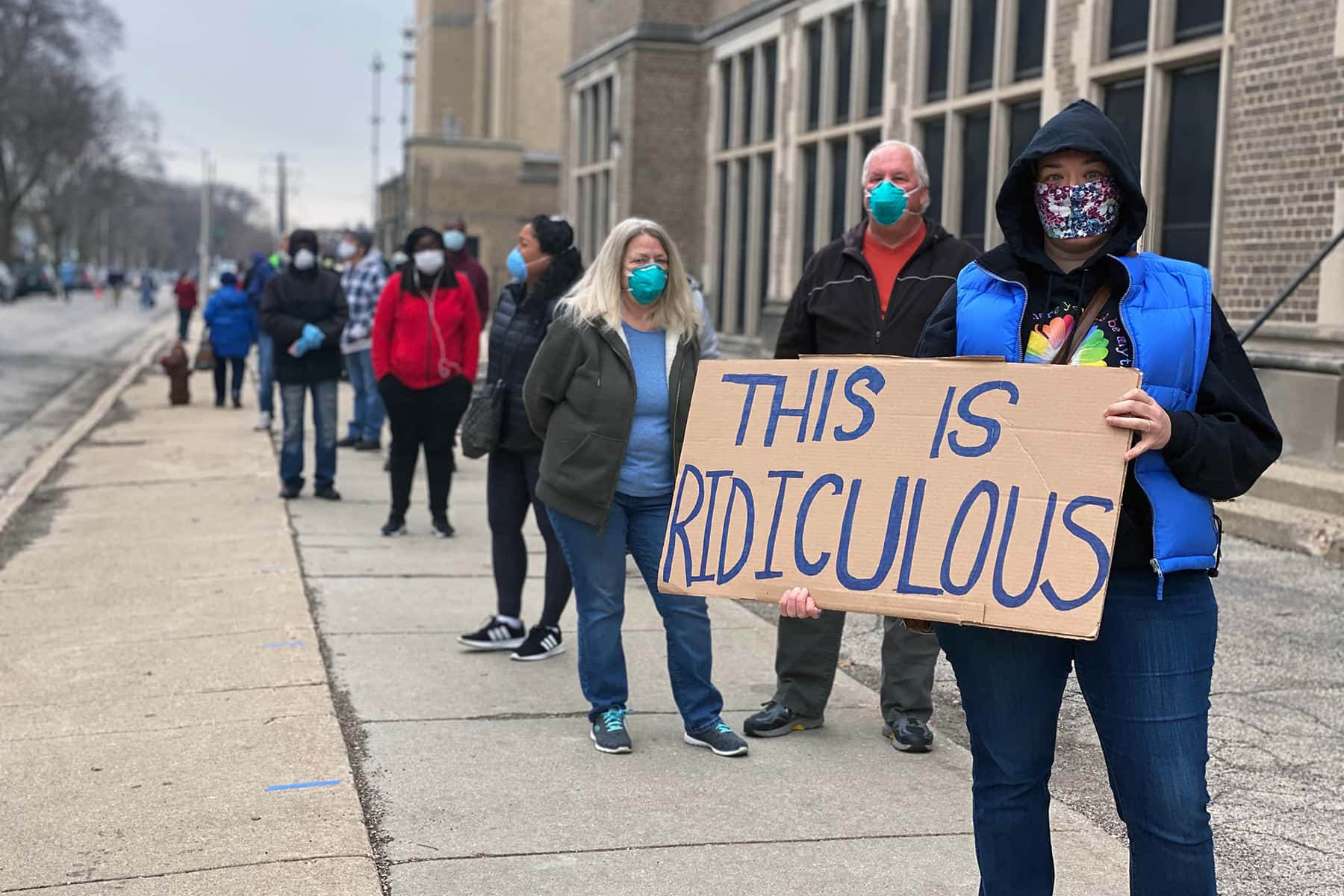
Trump’s continuing failure to mobilize the country against Covid-19, a failure unparalleled in any other first-world nation, has made the prospect of voting in person in November risky. (It is still unclear how many infections resulted in Wisconsin after the Republican legislature forced voters to wait in long lines to vote in the state’s primary.) Certainly the prospect of voting in person has become less attractive, particularly to citizens with prior conditions that make them especially vulnerable.

Voting by mail, which states like Washington have been doing for years anyway, is the obvious solution. But that’s only if you want people to vote and to have their votes counted. If you’re trailing badly in the polls, as Trump is, and might be looking for an excuse to influence or challenge or ignore the election results, raising uncertainty about voting by mail is one possible strategy. And the best way to cast doubt on the viability of voting by mail is to cast doubt on the Post Office’s ability to deliver ballots in a timely way, particularly if those ballots are mailed from zip codes known to include many Democrats.

“If carriers are being told that, at the end of your shift, you need to be back at the office even if you haven’t collected all the mail that day, there could be ballots in those mailboxes,” says Tammy Patrick, a senior adviser at the nonprofit Democracy Fund Voice and a former Obama appointee to the Commission on Election Administration, a panel created in 2013 to identify best practices in running elections. “If the truck drivers are being told, ‘You leave the post office to take that day’s mail to the processing plant at your scheduled time to leave, even if all the carriers aren’t back in yet with that day’s mail,’ that can have an impact.”

And so the Trump donor newly installed as Postmaster General is intentionally slowing down the mail: eliminating overtime, getting rid of sorting machines, and in general gumming up the works. Trump has been quite open about what he’s doing. Commenting on negotiations on a new Covid-response package, Trump told Fox News:

If we don’t make a deal, that means they don’t get the money [for the Post Office]. That means they can’t have universal mail-in voting; they just can’t have it.

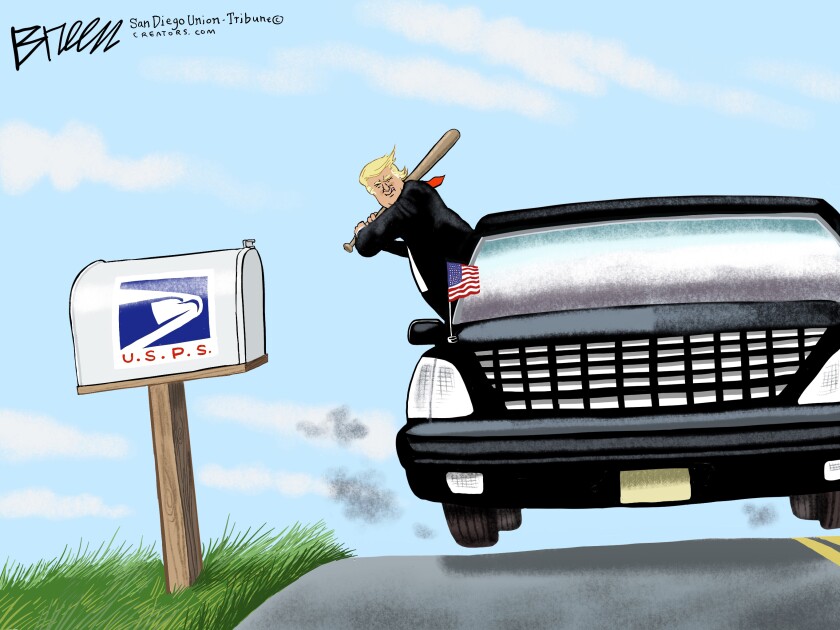
In any past election, it would be inconceivable that the President would be manipulating the Post Office in an effort to stay in power. But something has changed during the Trump administration: It’s not your Post Office any more, it’s his Post Office.

That’s how autocracy works.

Those Executive Orders

Like everything Trump does, they don’t match what he’s says he’s doing.


Remember the government shutdown that lasted from December 22, 2018 to January 25, 2019? Congress was refusing to fund Trump’s border wall, so he pulled out of a previously settled deal to fund the government. When public opinion didn’t rally behind his position, he relented on funding the government, but declared a state of emergency and used it to seize money Congress had appropriated for other purposes and redirect it to his wall. The Supreme Court has not yet ruled on the legality of this move, which seems to usurp Congress’ constitutional power of the purse, but it has allowed construction to continue so long that the case may become moot because the money is already spent.

Cases like these are never one-offs. Having gotten away with something once, Trump is bound to try it again.

So here we are: The CARES Act was passed in March as an emergency appropriation intended to see the country through the economic impact of the Covid-19 epidemic. At the time, no one imagined that the US would botch its response to the epidemic so badly that a thousand people a day would still be dying in August, so most of the CARES provisions ran out on July 31, including a moratorium on evictions and the $600-per-week enhanced unemployment payments.

Nancy Pelosi’s House had the foresight to pass a follow-up, the HEROES Act in May. But Mitch McConnell refused to bring it to the floor of the Senate, and did not start negotiating any CARES extensions at all until late July. With much of the Republican Senate caucus already plotting their resistance to the Biden administration, McConnell doesn’t have the votes to pass any CARES-extension bill without Democratic buy-in. So he left the negotiations to the White House team of Steve Mnuchin and Mark Meadows.

The White House refused to budge from its plan, which is about 1/3 the size of the HEROES plan, and contains no money to fill the budget gaps of state and local governments. Politically, Trump looks like the one with the most to lose if nothing gets done and the economy crashes, so Pelosi is not inclined to cave in to his demands without getting some concessions in return. So no deal has gotten done. (Has anybody noticed that our Art-of-the-Deal President never seems to get to Yes on a deal?)

So we’re back to the emergency-executive-powers trick. Or something. Maybe.

Saturday Trump signed three memos and an executive order which, in typical Trumpian fashion, don’t actually do what he claims. Here’s what is kinda/sorta in them.

  • A $400 unemployment enhancement to replace the CARES $600 replacement. Except that $100 has to come from the states, which may not have any money to cover it. The $300 federal contribution comes from a $44 billion pot of money that FEMA has, and of course won’t need during this record-threatening hurricane season. (This is literally an idea out of House of Cards, which FEMA officials rejected as unrealistic at the time.) Since we’re talking about 30 million unemployed people, the money will run out in about five weeks, assuming that they actually receive it and that it’s legal for Trump to spend it this way at all.
  • Eviction protection. Except, not really. The executive order asks relevant government officers to “consider” doing something to stop evictions, and to “identify” existing federal appropriations that might help stressed renters and homeowners, assuming that there are any such appropriations. If your landlord has a court date for your eviction, nothing in this order interferes with that proceeding.
  • Cuts in payroll tax deductions. The order doesn’t actually cut what you or your employer owe in Social Security and Medicare taxes. It just stops collecting those taxes for a while. So temporarily you might see more money in your paycheck, assuming you’re still getting one from somewhere, but your arrears will be building up, and will come due after the election. If he’s re-elected, Trump wants to cancel that debt too, but that just raises a new question: How do Social Security and Medicare get funded?

So basically what we have is flim-flam put together with a constitutionally questionable claim on FEMA money. In the context of the border-wall emergency, Trump is pushing us closer and closer to a model where the President can take any money Congress appropriates and spend it however he wants. It should go without saying that this is very, very far from the process the Founders thought they were establishing.

James Fallows raises the question we should all be asking:

I am not aware of any of the “strict constructionists” who blasted Obama for executive-order overreach, who have weighed in about Trump’s l’etat-c’est-moi wave of appropriation-by-exec-order. Are there any?

To be fair, a handful of Republican lawmakers have said something that expressed concern of some sort. But most of the hand-wringing was of the “Now look what the Democrats made him do” variety. If you’re looking for a flat-out “This is unconstitutional”, you won’t find it. Apparently respect for the Constitution is like fiscal responsibility or free trade or freedom or any of the other high-minded principles Republicans have put forward over the years. All such principled expressions are made in bad faith, and go out the window as soon as they become inconvenient.

The NRA and the Long Con

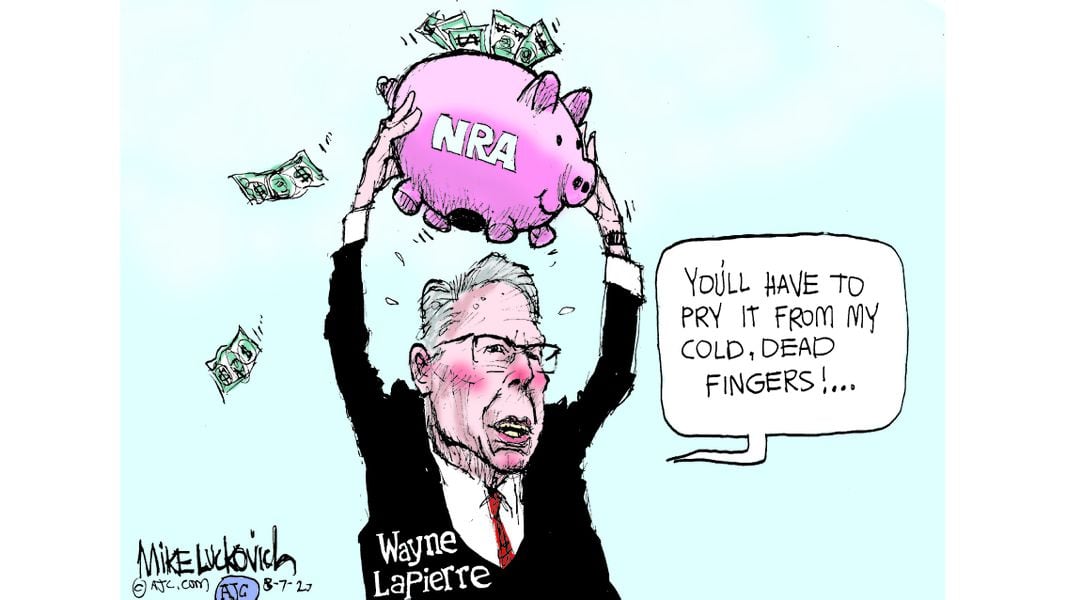
The New York and D.C. attorneys general have uncovered self-dealing, lavish spending on executive luxuries, and outright fraud at the National Rifle Association. Why is the conservative movement such fertile ground for this kind of thing?

Alarm bells. In 1973 I was a junior in high school, and a friend who had recently discovered the John Birch Society gave me a copy of their 1971 best-seller None Dare Call It Conspiracy. Thus was I introduced to the conspiracy theory of history: Forget all this talk of deep social forces evolving in unpredictable ways; in reality a cabal of powerful people has (for decades, or maybe centuries) been steering the planet towards a one-world dictatorship.

I was open to stuff like that in those days. Being 16, I wasn’t exactly invested in any other theory of history, or in established worldviews of any sort. In addition to conspiracies, I also had an open mind about ancient astronauts, lost continents, and the Velikovsky theory of the solar system. I had recently broken away from the literal-truth-of-the-Bible religion I had learned in a Christian elementary school, so the idea that authority figures of all sorts had been telling me tall tales seemed pretty credible. Why shouldn’t the world be explained by a sweeping hidden truth that the Powers That Be didn’t want me to know?

So I was undecided about NDCiC until I got to the last chapter, the one explaining what You the Reader could do to save America and the World from these sinister forces: Buy a lot of copies of None Dare Call It Conspiracy and pass them out to people in your neighborhood.

To summarize: You do not necessarily have to be an articulate salesman to make this “end run” [around what we now call “the mainstream media”]. You do not necessarily have to know all the in’s and out’s of the total conspiracy – the book is intended to do this for you. All you have to do is find the wherewithal to purchase the books and one way or another see that you blanket your precinct with them.

If 30 million copies got bought and distributed before the 1972 election, the conspiracy would be exposed beyond the conspirators ability to cover it back up again. (Apparently they fell short, because the cover of the 2014 edition claimed only 5 million copies sold. And so the Great Conspiracy rolls on.)

In short, an author was telling me that in order to save the world, I needed to “find the wherewithal” to “one way or another” make him rich. That set off alarm bells in my head, and caused me to re-evaluate the book’s whole argument.

Looking back, I now think those alarm bells are why I eventually became a liberal. Conservatives might have their internal alarm bells tuned to a variety of other threats — and perhaps are often appalled that mine stay silent when theirs start clanging — but apparently not to scams.

Grifters and their marks. As many writers have observed, entering the conservative information bubble puts you in a high-grift zone. Amanda Marcotte put it like this:

Look at the ads in conservative publications or on right-wing sites: It’s a chaotic dogpile of snake oil pitches, predatory gold-bug scams, and “survivalist” supplies that are drastically overpriced or worthless. Most of the familiar characters in the Fox News pundit universe — as well as Donald Trump’s Cabinet — have their own email newsletters, and subscribing to one means a nonstop onslaught of email pitches for “miracle” cures and get-rich-quick scams. There are countless shady conservative political action committees that promise to help elect Republican candidates, but whose real purpose is to enrich the folks who run them. Onetime GOP vice-presidential nominee Sarah Palin ran one such PAC that drew lots of incoming donations and spent very little of it on real-world political campaigns. To a significant degree, the conservative movement exists as a way to compile lists of gullible marks used by scammers and con artists.

Liberal media personalities like Rachel Maddow or Chris Hayes may occasionally also have a book to sell you, but Sean Hannity endorses the Homearly Real Estate Group, which claims to donate $500 to the Wounded Warrior Project every time it sells a home. In daisy-chain fashion, Wounded Warrior has at times been a scam itself; its top executives were fired in 2016 after CBS News discovered that the “charity” was spending tens of millions of dollars a year on lavish parties at five-star resorts.

This kind of thing has been going on a long time. In his 2012 article “The Long Con“, Rick Perlstein traced it back as far as the 1970s (my high school days), and gave 2012 examples like Ann Coulter’s endorsement of a skeezy investment newsletter. (For contrast, I admire Nobel-prize winning liberal economist Paul Krugman, but it never occurs to me to wonder where he gets investment advice.)

Liberal and conservative pundits, it seems, are doing something subtly different. Liberals are telling you what is happening; conservatives are telling you who to trust. Liberals divide the world into True and False; conservatives into Good People and Bad People. Good People can introduce you to other Good People, and those introductions are worth serious money.

Foundational myths. If you wonder why conservatives are such easy prey for con-men, the answer is pretty simple. The conservative movement’s whole ideology is based on a series of easily disprovable myths: tax cuts pay for themselves, the American healthcare system is the best in the world, racism ended with Jim Crow in the 1960s, more guns make us all safer, and so on. The movement’s movers and shakers expected Obama’s decreasing deficits to enrage their people to the point of violence, but Trump’s increasing deficits to pass without comment. Obama’s executive orders (like DACA) were outrageous steps towards dictatorship, but Trump’s far more sweeping decrees (like this week’s unilateral extension of unemployment benefits without the consent of Congress) are legitimate expressions of Article II power. And so on.

The people Rush Limbaugh refers to as “dittoheads” don’t just mouth these absurdities, they actually believe them. They are, in short, easy marks. If you can collect a lot of them in one room, or on one mailing list, you have created an ideal fishing pond for hucksters.

In “The Long Con” Perlstein began with the pervasive mendacity of Mitt Romney’s 2012 presidential campaign. (I believe Romney was the first major-party nominee to continue repeating a lie after the media had fact-checked him on it; that may seem like par for the course now, but as recently as 2012 it was flabbergasting.) Then he pulled back to examine the central role con-men and scams have played in the conservative movement.

The strategic alliance of snake-oil vendors and conservative true believers points up evidence of another successful long march, of tactics designed to corral fleeceable multitudes all in one place—and the formation of a cast of mind that makes it hard for either them or us to discern where the ideological con ended and the money con began.

To adapt another bit of Perlstein imagery: Once the politicians have you worrying about an invisible river, the grifters will happily sell you an invisible bridge.

The NRA. Here’s what brings this topic to mind this week: Thursday, New York Attorney General Letitia James laid out in a lawsuit an explicit account of one of the conservative movement’s longest-running cons: the National Rifle Association. According to the NYAG’s press release:

four individual defendants [Executive Vice President Wayne LaPierre and three other top executives] failed to fulfill their fiduciary duty to the NRA and used millions upon millions from NRA reserves for personal use, including trips for them and their families to the Bahamas, private jets, expensive meals, and other private travel.

These actions contributed “to the loss of more than $64 million in just three years for the NRA”. The corruption is so pervasive that James is asking a New York court to dissolve the NRA, which it can do because the NRA has been incorporated there since 1871.

The same day, D. C. Attorney General Karl Racine sued the National Rifle Association Foundation, a charitable foundation incorporated in the District of Columbia. Donations to the NRA Foundation are tax-exempt, while donations to the NRA are not. Consequently, there are more restrictions on what the Foundation can do. (This arrangement may look suspicious, but in itself is not uncommon or necessarily corrupt. For example, the ACLU has an associated Foundation, which can pay legal fees for the ACLU’s clients, but can’t lobby for legislation. As long as the laws are followed, there shouldn’t be a problem.)

Just as James accuses executives like LaPierre of using the NRA as a “personal piggy-bank”, Racine charges that the officers of the NRA Foundation were allowing the NRA to abuse Foundation funds by making sweetheart loans to the NRA, letting the NRA overcharge it for management fees, and in general placing the interests of the NRA above the interests of the Foundation. In short, the Foundation was just a pass-through that allowed the NRA to use tax-exempt donations.

The D.C. lawsuit is not seeking to dissolve the NRA Foundation, but to force the NRA to repay the money it took from the Foundation, and to reorganize the Foundation to restore its integrity as a charitable institution.

Marcotte comments on how the con has worked:

The NRA’s grift has been almost comical in its bluntness. The group traffics in over-the-top rhetoric designed to play on some of the darkest and most irrational emotions of American conservatives, including racist fears over the nation’s changing demographics, overblown fears of crime and paranoid fantasies that liberals are trying to “take over” the country in illegitimate ways. So much of the hyperventilating conspiracy-theory discourse found on the right, especially the wild fever-dreams about progressive “violence,” starts with the NRA, which sought to convince conservatives that they needed to spend ungodly amounts of money on buying guns and on supporting the NRA itself, in order to protect themselves from the imaginary threat of gun-grabbing libtards and antifa terrorists.

Misdirected outrage. The two lawsuits led to howls of rage from conservatives pundits. You might think the howls would be directed at LaPierre and his crooked cronies, for ripping off the millions of NRA members and contributors, and for spending the conservative movement’s money on themselves. But no: The outrage is at the two attorneys general for catching them. Marcotte summarizes:

Far from thanking James for trying to shut down an organization that spreads shameless lies in order to separate conservatives from their money, Republican leaders and right-wing pundits are crying foul. Some of the defenses have been, uh, interesting.

“I prosecuted organizations or individuals who cheated their organizations, OK,” said Jeanine Pirro, the former New York prosecutor turned histrionic Fox News commentator on Friday morning. “It happens all the time. It’s no big deal, all right?”

The previous night, Fox News host Laura Ingraham warned that this was a sign of things to come and Democrats will soon “go after pro-life groups, conservative think tanks, conservative radio shows, cable networks, even churches.”

And well they might, if executives of “pro-life groups, conservative think tanks, conservative radio shows, cable networks, even churches” have been ripping off their organizations and spending the donors’ money on their own lavish perks. Ingraham seems to be taking for granted that they are. (I’m particularly amused by the “even churches” in that quote, because mega-church and televangelist ministries have been famous for spending money collected for “the Lord’s work” on the lavish lifestyles of their ministers. The worst offenders are preachers you have probably never heard of if you don’t watch Christian cable channels, but Jerry Falwell Jr., who finally lost his job this week for a fairly silly reason, had previously been accused in Politico of self-dealing with Liberty University’s money.)

And of course our Law & Order President is perfectly fine with thieves running the NRA. New York’s lawsuit is “a terrible thing”, Trump says, and he suggests that the organization dodge the law by moving the Texas. (He should know that wouldn’t work, because it wasn’t an option when New York dissolved the fraudulent Trump Foundation, or when he had to pay $25 million to settle the Trump University fraud.)

Marcotte sums up:

It’s not just that the NRA has been a major player in helping Republican politicians over the years, both in terms of funding and in keeping the right-wing base riled up over imaginary threats. It’s that grifting and con artistry are the backbone of the conservative movement.

If New York is actually successful in dissolving the NRA, it’s quite true that, as Ingraham suggested, similar efforts could follow against right-wing activist groups. But that won’t happen because of their ideology, but because so many of them rely on the same kinds of grifting and fraud the NRA has thrived on for years. The entire right-wing movement is awash in this kind of corruption.

Will they learn? It would be pleasant to imagine conservatives all over the country finally hearing the kinds of alarm bells I heard in 1973, and realizing that they need to be more careful about what ideas they accept and who they send their money to. But that’s almost certainly not going to happen.

When a series of televangelists had scandals in the 1980s, the effect on televangelism as a whole was small and short-lived. Believers disillusioned by one preacher mostly just changed channels and watched another. And when Jim Bakker got out of prison, he made a comeback. After all, why shouldn’t you send your money to a convicted fraudster, if he sounds good on television?

There is still considerable attraction in conservatism’s Manichean worldview, in which Good People struggle against Bad People, and you don’t need to do the work to figure out what’s true, you just need to know who to trust. It is in some perverse way comforting to believe that our problems do not arise from the fact that life is difficult, or that substantial effort is required to find solutions to hard problems. There is no need to spend your life looking for cures and treatments, like Dr. Fauci has; miracle cures like hydroxycholaquine are everywhere, and we just need to listen to the Good People like Donald Trump who tell us about them. There are simple secrets to getting rich, and we could all be rich if only we could put aside our doubts and trust the Good People who want to let us in on the ground floor. No one needs to work out the details of complex programs like Medicare for All, we just need a Good Leader with the courage to tell the healthcare system to work better.

And so, as the NRA faces a possibly fatal legal storm, Q-Anon is rising. They have a conspiracy theory that swallows all the others like the plot of Illuminatus! made real. And their founder can never be discredited, because we don’t know who it is.

And guess what? There’s plenty of merchandise you can buy.

The Election: Worry or Don’t Worry?

Biden’s lead in the polls has Democrats searching for what could possibly go wrong. But some worries should be taken less seriously than others.


Just about every Democrat I know wants to punish him/herself for being overconfident in 2016. Some of us have practical regrets, and wish we’d done more to put Hillary over the top, while others less rationally feel like we jinxed her by saying too loudly that she was going to win. But whatever we did or didn’t do then, we’re now determined to make ourselves suffer by refusing to accept any good news about Joe Biden’s chances. No matter what the polls say, something is going to go horribly wrong.

For what it’s worth, I think we’re going to win this. Not that there’s nothing to worry about, but some of our worries are less serious than others. Let’s assess them one by one.

Worry #1. The polls are wrong.

Biden’s average margin in national polls is somewhere in the 8-9% range, and has been there since mid-June. More importantly, he has solid leads in the swing states he needs to win: Pennsylvania, Michigan, and Wisconsin. If he fails in one of those states, polls also give him a good shot at flipping Florida, Arizona, or North Carolina. And even Republican strongholds like Texas and Georgia are not completely out of reach.

But Democrats remember how confident we felt in 2016, and look for reasons to doubt the polls. Republicans, on the other hand, live in constant denial of reality, and doubt the polls because they don’t want them to be true. Poll-skeptics make two related arguments.

  • The polls were wrong in 2016, so why should we trust them now?
  • There is a “hidden” Trump voter that the polls either can’t count or don’t want to count.

Neither really holds water, as long as you remember that polls are snapshots of public opinion at a moment in time, and not predictions of what people will think or do months from now.

The first thing to understand is that the final polls in 2016 were not far off from the vote totals, and to the extent they were, the more likely explanation is that Comey’s reopening of the Clinton email investigation gave Trump late momentum. The polls probably weren’t wrong at the moment they were taken; but a small shift in public opinion at the last minute put Trump over the top.

Nationally, the final 2016 RCP polling average had Clinton up by 3.3%. Her actual margin in the national popular vote was 2.1%. In Pennsylvania and Michigan the polls were off by a bit more — but still not that much. And in both cases, Trump had been gaining in the final week. The only real surprise was Wisconsin, where Clinton led by 6.5% in the final polls and lost by 0.7%.

But in 2018, the reverse happened: The final general congressional ballot polls had the Democrats up by 7.3%, and their margin in the vote totals was larger: 8.4%.

So if there were “hidden Trump voters” in 2016, were their “hidden Democrats” in 2018? Or is there always a small shift in the final days and hours of a campaign?

For what my opinion is worth, I expect the 2020 last-minute shift to be in Biden’s favor. Late in a campaign, a certain number of voters are just sick of all the noise. This year in particular, those voters will be sick of four years of noise; the thought that the loud, obnoxious Trump Era could be over will just be irresistible.

Assessment: Don’t worry about this. Things could change before Election Day, but Biden really is ahead right now.

Worry #2. Trump will stage a remarkable comeback.

In the Trump Era, when every day brings a a few week’s worth of news, three months is a very long time. A month ago, who was predicting that Portland would be invaded by DHS secret police? So all kinds of things can happen before Election Day, and you can expect Trump to push all the buttons and turn all the knobs as he tries to change the public’s opinion of him.

However, nothing he’s trying right now is working at all, or is likely to work if he just keeps at it and pushes harder. Unleashing his goons on Portland was supposed to produce a wave of support for the “law-and-order President” (who is strangely indifferent when people in his administration break the law). But in the latest Ipsos poll, 52% of Americans say the federal response to protests made things worse, with only 30% saying it made them better.

The not-all-that-veiled racism of his “Suburban Lifestyle Dream” tweet doesn’t seem to be going over all that well either. Suburbs aren’t what they were in the 1950s. Black people already live there (though still not in proportionate numbers), so they aren’t as easy to demonize. And a suburb anywhere near high-tech industries (like Bedford, Massachusetts, where I live) is going to include lots of residents of East Asian or South Asian ancestry. If you’re looking for the lily-white experience, you have to go to ex-urbs or rural small towns.

A second factor: His ability to change tactics is limited by his inability to admit mistakes or take responsibility for bad outcomes. So he has to keep doubling down on points that the public already knows are false. Like: the virus really is spreading, it’s not just that we’re testing more. That stopped fooling anyone other than Trump diehards weeks ago, but he can’t stop saying it.

And it’s not just him. The Trumpists who picture a comeback have to engage in such flights of fancy that reading their scenarios makes me more confident, not less. For example, Grady Means published an op-ed Wednesday in The Hill: “Buy the Dip: Bet on Trump“. In Means’ fantasy world, Trump has done a great job and had a great strategy going into this year, but after Covid-19 got rolling “the president has been a complete failure at playing his winning hand.”

The mainstream media and social networks stepped up their withering and relentless Trump-attacks. Statistically meaningless (increased testing and obvious selection bias) COVID-19 “cases” data were weaponized into a strategy of continued lockdowns and sustained school closures.

That’s Trump’s problem — not that America on his watch has objectively screwed up its pandemic response worse than any other rich country, or that people are genuinely hurting economically with no relief in sight. No, it’s that the media has made something out of nothing, and convinced the public to shut down businesses and schools when the virus isn’t really out of control at all. As soon as Americans realize the virus is already beaten, learn to ignore the hundreds of thousands of bodies piling up in the corner, and recognize what a great job Trump has done on the pandemic and everything else, he’ll surge again.

I just can’t picture that plan succeeding.

If Trump is going to stage a comeback, it’s going to have to be through an October surprise: either foreign help (like he got from Russia in 2016 and tried to extort from Ukraine this time around) or some headline-making indictments from the Barr/Durham investigation of the investigators. In either case, whatever anti-Biden “scandal” Trump manages to puff up will probably have little substance, and the public will have been well warned.

Assessment: Worry a little. In particular, worry enough to keep doing whatever you can to ensure a Biden victory. (If we overshoot and wind up with a landslide, that might teach Republicans to give up not just on Trump, but on Trumpist fascism in general — no Tucker Carlson or Tom Cotton in 2024.) But if anxiety about a Trump comeback is causing you to lose sleep or plunge into depression, feel free to put it out of your mind.

3. Trump might lose the election, but refuse to leave office.

It’s important to keep two things in mind:

  • The power of the president functions almost entirely through other people.
  • The White House is a symbolic place, but has no legal or institutional significance.

So while it’s very easy to imagine Trump barricading himself in the Oval Office on January 20 and tweeting endlessly about voter fraud and how he’s still president, if the people who make up the government stop taking his orders, he’s not president any more. Removing him from the White House would become a problem for the Secret Service, aided by mental health professionals.

The transition-of-power process defined by the Constitution and implemented in various state and federal laws goes like this:

  • On November 3, an election is held — or rather 51 separate elections are held in the states and the District of Columbia. This date could be changed, but only by Congress. The Constitution says: “The Congress may determine the Time of chusing the Electors”. Votes are counted by local officials, until at some point a state official verifies the names of the electors who will represent that state in the Electoral College.
  • On December 14 (the first Monday after the second Wednesday in December), the electors cast their votes. Like Election Day, this date was set by Congress and can only be changed by Congress. (The same sentence in the Constitution continues: “The Congress may determine … the Day on which [the Electors] shall give their Votes; which Day shall be the same throughout the United States.”) The electors meet in their own states, vote, and send the vote totals to Congress.
  • On January 6, a joint session of Congress meets and the electoral votes are officially counted. (This is the new Congress, with the new representatives and senators elected in November. The new terms start on January 3.) Whatever disputes there might be — rival slates of electors and so on — Congress has the authority to resolve them. The new president will be who the new Congress says it is.
  • On January 20, the new president is inaugurated, swearing an oath specified in the Constitution. There are lots of traditions around the inauguration — it happens just outside the Capitol, the Chief Justice administers the oath, the oath is sworn on a Bible or whatever book the new president holds sacred — but none of that is required.

Here’s something I have great faith in: If the joint session of Congress on January 6 recognizes that Joe Biden has received the majority of electoral votes, he will become president at noon on January 20 and the government will obey his orders. Where Donald Trump is at the time, and whatever he is claiming or tweeting, will be of no consequence.

If Trump’s tweets bring a bunch of right-wing militiamen into the streets with their AR-15s, they can cause a lot of bloodshed, but they can’t keep Trump in office. They are no match for the Army, whose Commander-in-Chief will be Joe Biden.

So if Trump wants to stay on as president, he has to screw the process up sooner; by January 6, it’s all in the bag, and probably it’s all in the bag by December 14. Even stretching out the process with legal proceedings won’t help him: The Constitution specifies that his term ends on January 20. If at that time there is no new president or vice president to take over, the job devolves to the Speaker of the House, who I believe will be Nancy Pelosi.

Assessment: Worry about the ways that Trump might screw with the electoral process (which we’ll get to), but not that he will just refuse to leave the White House.

4. Republican state legislators will overrule the voters and give their state’s electoral votes to Trump.

Awarding a state’s electoral votes to the candidate who wins that state’s popular vote is so traditional that most people think it must be in the Constitution, but it isn’t. The sum total of the Constitution‘s instructions are:

Each State shall appoint, in such Manner as the Legislature thereof may direct, a Number of Electors, equal to the whole Number of Senators and Representatives to which the State may be entitled in the Congress

So, at least in theory, a legislature could ignore the popular vote and appoint anybody it wants to the Electoral College. However, states have codified their current processes in law, and a new law would have to be passed to circumvent that process. The swing states people are most worried about — Michigan, Pennsylvania, and Wisconsin — have been gerrymandered to lock in Republican majorities in the legislatures, but they have Democratic governors who would veto a law to hand Trump the state’s electoral votes. Republicans don’t have enough votes to override a veto.

Assuming Trump wins at least one of those states legitimately, though — or manages to suppress enough Democratic votes to get a majority — Biden could still win if he carries Florida, Arizona, or North Carolina. North Carolina, like Michigan, Pennsylvania, and Wisconsin, has a Democratic governor and enough Democrats in the legislature to sustain a veto. So Trump needs to win the popular vote there, too.

That leaves Florida and Arizona, where Republicans have unified control of state government. (You could also talk about Texas and Georgia, but if Biden wins the popular vote in either of those states, he’ll have such a landslide that no amount of backroom finagling could undo it.) Would they dare reverse the decision of their state’s voters? This would be a truly outrageous thing to do — even some people who vote for Trump aren’t going to like the idea that their votes don’t count — and the people who do it would risk being villainized for life. So I can only imagine it happening under two conditions:

  • They’re sure it will work. This scheme only makes sense if it gives Trump a second term, where he can reward the people who put him in office. So they need to be sure their law will pass and their electoral votes will make Trump president again.
  • Something taints the vote-count that says Biden won. You could imagine a legislature legitimately awarding its electoral votes by special law, if it were clear that the popular vote was fraudulent in some way. (Imagine a surprise win by the previously unknown owner of the company that makes vote-counting machines. Wouldn’t you want your legislature to stop that?) Republicans would need to be able to argue that they were following the real will of the voters, which had been undone by fraud.

That, I think, is the point of Trump’s bogus assertions that voting-by-mail-is-unsafe and the polls are skewed. He’s setting up the argument Republican legislators will need if they want to throw the election his way.

There are a bunch of scenarios where Biden is safe from this:

  • He wins the popular vote in enough states that no single state flipping to Trump would reverse the outcome.
  • He wins three of these four states: Michigan, Wisconsin, Pennsylvania, and North Carolina.
  • He wins Florida and/or Arizona by enough votes that the fraud-made-the-difference argument loses credibility.

There’s also a wild card: If Democrats control both houses of the new Congress, they might decide to not to count the switched electoral votes. It would be an illegitimate, unconstitutional move, but hardball begets hardball. Trump might try to get the Supreme Court to rule against Congress, but it’s not clear they have jurisdiction. And if Congress simply refuses to declare a winner, Pelosi becomes president. (All this would do horrible damage to our political system, but if Republicans don’t care about that, why should Democrats?)

Assessment: Worry moderately. Probably we won’t wind up in a scenario where this is a possibility, and even if we did, it would only take a handful of Republicans with consciences to save democracy. Who knows? There might actually be enough of them.

4. A majority of Americans try to vote Trump out, but between voter suppression and the Electoral College, we fail.

During the impeachment process, Republicans liked to orate on the awesome standards necessary to reverse the choice of the American voters. But of course, the voters did not choose Trump — the Electoral College did. Trump got only 46% of the vote: 66 million votes to Hillary Clinton’s 69 million. His approval has never gone much above that 46% — largely because he has governed as if the other 54% doesn’t count — and is now hovering somewhere around 41%. Quite possibly, there has never been a moment when a majority of the American people supported Trump.

It’s easy to imagine the same thing happening again: Biden piling up millions more votes than Trump in California and New York, while losing by a few thousand in Florida and Wisconsin. With the usual Republican margin in Texas shrinking, the effect could be even more extreme in 2020 than it was in 2016: Biden might get as many as 5 million more votes than Trump, and still not become president.

What’s more, Republican voter suppression efforts are in high gear, and have already shown some success: By a wide margin, the voters of Florida voted in 2018 to re-enfranchise felons who have served their time — nearly 1.4 million Floridians. But yielding to the will of the people is not what the Republican Party is about.

The GOP-controlled Legislature, however, sought to limit the effects of the amendment by passing a law that conditioned the right to vote on payment of all fees, fines and restitution that were part of the sentence in each felon’s case. The state, however, had no central listing of this information, and the Legislature created no system to help felons ascertain how much, if anything, they owed. Even the state ultimately agreed that it would take six years to create such a system. … The estimated 85,000 who are already registered could be prosecuted if they vote and it turns out they have not paid the fees or fines owed.

The Supreme Court, which has consistently favored Republican voter-suppression efforts sincre John Roberts’ evisceration of the Voting Rights Act in 2013, thought this was a fine law.

Covid-19 has created new opportunities for mischief, as we saw in Wisconsin in April. The Republican-through-gerrymandering legislature insisted on few polling places and long lines, and resisted the Democratic governor’s attempt to institute vote-by-mail, or even to extend the deadline for submitting an absentee ballot to allow for the fact that many ballots were not mailed out on time. Research indicates that the brave Wisconsinites who came out to vote anyway could not fully avoid spreading the virus.

Nationally, Republicans are doubling down on this yield-or-die strategy for the fall. They are fighting vote-by-mail in states all over the country, trying to force people to brave the virus-spreading crowds if they want to vote. Worse, Trump is intentionally slowing down the mail, which could well result in a Wisconsin-like situation for the whole country: People can’t receive their mail-in ballots and return them soon enough to count. Some of the more obvious suppression tactics include not counting Michigan ballots that arrive late, even if they were postmarked before Election Day (“inherent variations in mail delivery schedules could result in one person having the ballot counted and another not, even if they send them back on the same day”), and trying to stop Pennsylvania from providing drop-off boxes for people who are afraid their mail-in ballots won’t arrive in time. These attempts come wrapped in rhetoric about “election security”, but they’re transparent attempts to keep legal voters from successfully submitting their votes.

I think there’s reason to hope that these efforts will boomerang, and that the more Trump tries to keep Americans from voting, the more determined we will be. In Wisconsin, the people who did risk their lives to vote were pretty pissed off by the time they got to the booth. The Republican Supreme Court candidate this tactic was supposed to save got defeated anyway.

All over the country, people have to be asking themselves: “Why don’t Republicans want me to vote?” Trump is giving Democrats an issue, and we need to run with it. He wants to paint liberals as people who hate America, but this part of Barack Obama’s eulogy for John Lewis sounds pretty fundamental to what America is supposed to mean:

Once we pass the John Lewis Voting Rights Act, we should keep marching to make it even better by making sure every American is automatically registered to vote, including former inmates who’ve earned their second chance. By adding polling places and expanding early voting and making Election Day a national holiday, so if you are somebody who’s working in a factory or you’re a single mom, who’s got to go to her job and doesn’t get time off, you can still cast your ballot. By guaranteeing that every American citizen has equal representation in our government, including the American citizens who live in Washington, D.C., and in Puerto Rico. They’re Americans. By ending some of the partisan gerrymandering, so that all voters have the power to choose their politicians, not the other way around. And if all this takes eliminating the filibuster, another Jim Crow relic, in order to secure the God-given rights of every American, then that’s what we should do.

Who hates America now, Mr. Trump? Not LeBron James, who together with other NBA stars is donating $100K to pay the fees of Florida felons, so that they can vote. We all need to be looking for ways that we can help our fellow Americans vote, and for ways to call out the anti-American politicians who are trying to stop them.

The ultimate voter suppression would be for Trump to deploy his storm troopers Portland-style in swing-state Democratic strongholds like Philadelphia and Milwaukee, harassing people in front of polling places. We can hope that mayors and governors will not stand for that, and that the police will obey their local orders rather than side with the feds. It could get ugly, and again, could boomerang against Trump. Hopefully his advisors will convince him that it will.

Assessment: Trump can put his thumb on the scale, but only up to a point. It shouldn’t have to be this hard to get rid of him, but it is. I think we’re up to the challenge. So worry enough to take action, but not so much that you paralyze yourself.

5. Trump will lose and leave office, but he’ll trash the country on his way out the door.

Of course he will. This isn’t even something to worry about, just start getting ready for it. It’s going to happen.

Look for a flurry of pardons for all his henchmen (and probably himself, leading to an interesting legal battle), abrupt closures of American bases in any country that hasn’t treated him as well as he thinks he deserves, and at least one more big favor to pay off his debt to Vladimir Putin. (Putin would be crazy not to invade Estonia or something as soon as Trump loses.) And what’s more important: Taiwan’s independence, or a new Trump Tower in Shanghai?

Biden is going to have a historic mess to clean up when he takes office. But I believe he will take office.

The Cancel Culture Debate

Expressing views out of step with the common sense of your era has always been risky. But now, as cultural power shifts and common sense changes, it’s harder to know what’s safe.


It has long been a staple of conservative thought that good people should have nothing to do with bad people. The very first verse in the Book of Psalms says: “Blessed is the man who walks not in the counsel of the wicked, nor stands in the way of sinners, nor sits in the seat of scoffers.” And in 2 Corinthians 6:14 the New Testament echoes: “Do not be unequally yoked with unbelievers. For what partnership has righteousness with lawlessness? Or what fellowship has light with darkness?”

This conservative idealization of purity is currently playing out in the treatment of the Never-Trump Republicans, who are seen as heretics rather than wayward brethren. Justin Amash had to leave the Republican Party. Mitt Romney was dis-invited from CPAC. Even Dick Cheney’s daughter Liz is under fire for her occasional criticisms of the Great Leader.

But those incidents are dogs biting men. What really has drawn public attention is the man-bites-dog phenomenon of liberals casting people out. Liberals define themselves as open-minded and tolerant, and yet now they are often the ones who get people expelled from social media or dis-invited from speaking engagements or even fired from their jobs.

Such incidents have led to much bad-faith criticism from conservatives, and the popularization of the label “cancel culture”. But it has also resulted in introspection among liberals, most recently and publicly in “A Letter on Justice and Open Debate” signed by around 150 intellectual heavyweights and published in Harper’s.

The forces of illiberalism are gaining strength throughout the world and have a powerful ally in Donald Trump, who represents a real threat to democracy. But resistance must not be allowed to harden into its own brand of dogma or coercion—which right-wing demagogues are already exploiting. The democratic inclusion we want can be achieved only if we speak out against the intolerant climate that has set in on all sides.

This intolerant-climate rhetoric has predictably played into the both-sides-do-it narrative that mainstream media uses to establish its objectivity. But what exactly is the “it” that both sides do? The Harper’s letter is vague and sloppy about this, and the coverage the letter generated has often talked about “free speech”, when that is not the issue at all.

So let’s start at the beginning and try to get this right: What exactly is “cancellation”, and why might people of good faith want to do it?

When cancellation is merited. Judy Mikovits has a theory: She thinks Covid-19 was created in the United States by public health officials led by Dr. Anthony Fauci. They shipped it to Wuhan where it was either released or escaped, starting the current pandemic. Mikovits also holds Fauci personally responsible for destroying her career in science; she says he distributed millions of dollars to cover up the conspiracy that persecuted her. She has also made several other bizarre claims about Covid-19 in the video Plandemic, which went viral in right-wing circles until it was removed from most social media platforms: Flu vaccines have distributed coronavirus, which is activated when you wear a mask. Bill Gates was part of the plan to spread Covid-19, so that he can profit off the eventual vaccine. And so on.

Actual evidence for these claims is virtually non-existent.

So what should happen to Mikovits and her theories? In my ideal world, not much. She would be free to run around making whatever claims she believes, but no one would take her seriously, either. Groups would not invite her to speak. People who stumbled across her video online would say “Really?” and do some checking before deciding not to pass it on to anyone else. If Facebook, Twitter, et al. discovered “Plandemic” gaining popularity on their platforms, they would remove it, exactly as they did in the real world, but maybe sooner. And of course, being a distributor of wild misinformation about science would make Mikovits unemployable by legitimate scientific institutions.

In short, I think Mikovits deserves to be canceled — not imprisoned, not fined, not punished in any discernible way, just removed from the national conversation — not by government edict, but by the shared standards and good judgment of society in general.

Instead, Sinclair Broadcasting, the Trumpist network of local TV stations, decided to give her a platform. [1] Eric Bolling (who you may remember from his time as a Fox News host, until he left under a cloud of sexual harassment accusations) has a TV show America This Week, which Sinclair distributes to its stations. This week’s episode includes interviews with Mikovits and with her lawyer Larry Klayman.

For balance, Bolling also interviewed a Fox News medical contributor who describes Mikovits’ claims about Covid and Fauci as “unlikely”. But for much of the episode, the chyron asks the question: “DID DR. FAUCI CREATE COVID-19?” Many of Bolling’s viewers — especially the ones who might be cooking dinner or paying bills and only looking up at the TV occasionally — will probably come away thinking that “yes” is a plausible opinion, one that reasonable people should consider.

Is Sinclair’s decision to air Mikovits’ views a defense of free speech? I don’t think so. I believe it’s irresponsible and does a disservice to viewers who trust their local news stations.

Legal vs. acceptable. I bring Mikovits up not because I want to spend significant time debunking her, but for the sake of her example: Widespread rhetoric about “cancel culture” professes to be about “free speech” or censorship, but it really isn’t. [2] We’re not discussing what speech should be legal. We’re discussing what speech should be acceptable in various forums. And the answer to that question should not be “whatever anyone wants to say”. Failing to cancel someone can be irresponsible management of an information forum. [3]

The acceptability question is not absolute; it is forum-dependent. Suppose I agree with Mikovits and say so. What should happen depends on where I say it or try to say it.

  • If I’m talking to my friends at a bar (assuming it’s ever safe to go back to bars), they should scoff at me, but the conversation should move on with no further consequence.
  • If I submit an article to a general-interest newspaper or magazine, they should reject it; but maybe I could get away with raising the question of whether the virus was created in a lab, and suggesting that maybe it was.
  • If I’m writing for Scientific American or some other popular magazine with scientific respectability, I should only be able to make claims that I can support with significant scientific evidence. The created-in-a-lab theory probably couldn’t pass muster.
  • A scientific journal like Nature should require not just evidence, but proof. Otherwise, my opinion should not be heard.

If I am employed by Scientific American or a scientific journal, and I develop a reputation as a promoter of the Fauci-created-Covid conspiracy theory, they should fire me, because my reputation would conflict with the reputation the magazine wants to maintain.

None of this would constitute a violation of my free speech. I can say whatever I want, but other people are also free to react to what I say. No one has to offer me a platform or lend me their respectability.

Zack Beauchamp makes this point in more detail.

Contrary to the original letter signers’ claims, what’s actually happening here is more subtle than a war between free speech’s defenders and its opponents. It is, as the University of Illinois’s Nicholas Grossman writes, an argument over “drawing the lines of socially acceptable expression and determining appropriate responses to transgressing those norms.” That’s not a conflict over the principles of a free society but the rules that govern its operation in practice.

Before we called it “canceling”. If there ever was a moment in American history when all speech was acceptable and any idea could be advocated in any forum, it hasn’t been in my lifetime. I grew up during the Cold War, an era when it went without saying that no major newspaper or magazine would have an openly Communist columnist. [4] Slightly before my time, the Hollywood blacklist banned movie people suspected of Communist sympathies. One famous victim was the black singer/actor Paul Robeson, who you may have heard sing “Ol’ Man River“.

The range of opinions acceptable on major-network TV may have expanded somewhat in the 21st century, but is still quite narrow. Bill Maher ran into the limits shortly after 9-11. At the time, he hosted ABC’s Politically Incorrect, a comic-but-serious discussion of the news similar to his current Real Time show on HBO. But Maher made the mistake of responding to President Bush’s characterization of the 9-11 hijackers as cowards by saying something fairly obvious:

We have been the cowards, lobbing cruise missiles from 2,000 miles away. That’s cowardly. Staying in the airplane when it hits the building, say what you want about it, it’s not cowardly.

Soon, local ABC affiliates were refusing to air Maher’s show and sponsors were dropping it. It was not renewed for another season, after having been on ABC for five years.

In 2003, the Dixie Chicks (now just “The Chicks”) faced retribution after singer Natalie Maines told a London audience that the band opposed the upcoming invasion of Iraq: “We do not want this war, this violence, and we’re ashamed that the President of the United States is from Texas.” In response

The Dixie Chicks were blacklisted by thousands of country radio stations. On May 6, Colorado radio station KKCS suspended two DJs for playing their music.

So “cancel culture” may be a relatively recent term, but the phenomenon is not at all new.

Moving the boundaries. If cancel culture isn’t new, why is it suddenly getting so much attention? It’s hard to argue with the assertion that something feels different now. But what and why?

For one thing, more and more people are unsure about where the boundaries are, and so they withhold opinions they might previously have expressed. In a poll by Cato Institute — not an unbiased source, but faking a poll is not their style — 62% of Americans agree with the statement: “The political climate these days prevents me from saying things I believe, because others might find them offensive.” That’s up slightly from 58% in 2017.

The question is why. I think Beauchamp has this right: It’s not that the bounds of acceptable speech are getting narrower, it’s that the range is shifting. Activists on the left are succeeding in moving the range leftward, and some would like to shift it further.

That may sound partisan and even nefarious in the abstract, but there is justification for it: The range of acceptable speech has never been natural or God-given; it arises out of a society’s power dynamics. [5] We are emerging from a centuries-long era when power belonged exclusively to upper-class straight white Christian men. So the bounds we are used to — ones that seem “normal” to us — unfairly favor upper-class straight white Christian men.

Social justice advocates think the bands of acceptable opinion and arguments shouldn’t be narrowed, precisely, but rather pushed to the left — shifted to include formerly excluded voices from oppressed communities and to sideline voices that seek to continue their exclusion. Their critics think the traditional bands of debate are, broadly speaking, correct, and that we’d all be worse off if the social justice advocates succeed in moving speech norms in their direction.

Consider, for example, the Me-Too movement. Abusive men like Harvey Weinstein or Bill Cosby used to be confident that their female victims would not be listened to or taken seriously, but now at least some of those voices are being heard. And if uncertainty about the new boundaries prevents men “from saying things I believe, because others might find them offensive”, that isn’t always a bad thing. I don’t doubt for a minute that Rep. Ted Yoho of Florida was saying what he believes when he called Rep. Alexandria Ocasio-Cortes a “fucking bitch”. But if he restrains himself in the future (because he doesn’t want to be eviscerated again on the floor of the House), I don’t see the loss.

As a professional-class straight white brought-up-Christian man myself, I have often been corrected for running afoul of the new boundaries — by  commenters on this blog, for example. I have been called out for using the verb “bitch” for a certain style of complaining (done by men and women alike), or for referring to someone as “transgendered” (as if it were something that happened to them) rather than “transgender” (something they are). Occasionally someone observes that my attempts to write about privilege are themselves tainted by a privileged viewpoint. Of course it stings to be criticized for something I did without conscious malice, and that no one would have mentioned ten or twenty years ago. But I also recognize that a world where people like me get criticized for giving offense is better than one where the people we offend are not heard.

Who decides? A glance at the list of signers of the Harper’s letter reveals that they aren’t all upper-class straight white Christian men: Margaret Atwood, Atul Gawande, Michelle Goldberg, Khaled Khalifa, Dahlia Lithwick, John McWhorter, Gloria Steinem, Fahreed Zakaria, and many others. So why is this their issue?

For some, the motivation is obvious: Salman Rushdie had to spend years in hiding because his writings offended a powerful Muslim cleric. J. K. Rowling has faced a huge backlash to her opinion that transwomen are not “real” women. But not all the signers have some clear personal ax to grind. What’s up with them?

Let’s go back to Beauchamp:

What’s new in the modern era, according to [York University philosopher Regina] Rini, is that the mass public has gained an unprecedented ability to influence and reshape those rules [defining acceptable speech] — a process that used to be the province of the elite. … [Intellectual elites] believe that social media, and Twitter in particular, is starting to exercise a kind of veto over editorial judgment — running roughshod over editors and forcing journalists to be subject to the new activist rules of political discourse. The objection here is not just that activist speech norms are bad, but that those speech norms are being imposed on the intellectual elite by the loudest voices on social media — that a silent majority of conventionally liberal journalists are being silenced by radicals.

Here’s what the Harper’s letter says:

We uphold the value of robust and even caustic counter-speech from all quarters. But it is now all too common to hear calls for swift and severe retribution in response to perceived transgressions of speech and thought. More troubling still, institutional leaders, in a spirit of panicked damage control, are delivering hasty and disproportionate punishments instead of considered reforms. Editors are fired for running controversial pieces; books are withdrawn for alleged inauthenticity; journalists are barred from writing on certain topics; professors are investigated for quoting works of literature in class; a researcher is fired for circulating a peer-reviewed academic study; and the heads of organizations are ousted for what are sometimes just clumsy mistakes. Whatever the arguments around each particular incident, the result has been to steadily narrow the boundaries of what can be said without the threat of reprisal. We are already paying the price in greater risk aversion among writers, artists, and journalists who fear for their livelihoods if they depart from the consensus, or even lack sufficient zeal in agreement.

A response letter from a collection of generally less famous intellectuals points out that the examples vaguely alluded to in the paragraph above are both less unjust and less representative than they appear.

The content of the letter also does not deal with the problem of power: who has it and who does not. Harper’s is a prestigious institution, backed by money and influence. Harper’s has decided to bestow its platform not to marginalized people but to people who already have large followings and plenty of opportunities to make their views heard. Ironically, these influential people then use that platform to complain that they’re being silenced. … Their words reflect a stubbornness to let go of the elitism that still pervades the media industry, an unwillingness to dismantle systems that keep people like them in and the rest of us out.

For years, the people at the top of the intellectual pyramid have been insulated from the disapproval of the lower orders. [6] Now they are less insulated. Some problems may result from that trend, but it’s not obvious that the trend itself is a problem.

What is common sense? In David Graeber’s The Democracy Project, he defined the success of revolutions not by the the new governments they establish, but by “planetwide transformations of political common sense”. [7] We seem to be in such a revolutionary period now. Just a few months ago, for example, defunding or abolishing the police were ideas outside the bounds of acceptable discussion in most popular forums. Now the idea is openly discussed in The New York Times and other establishment forums. On the other side of the spectrum, the President is floating the possibility that he might refuse to accept an election that he loses.

No one can really say what “political common sense” means right now; it’s in flux. Similarly, “acceptable speech” is in flux. That is not the fault of anybody in particular. It’s just an uncomfortable feature of this historical moment.

In this situation, mistakes are going to be made. We’re all going to say things that we’ll regret after standards settle down. And some of our responses to other people’s transgressions will turn out to be inappropriate — sometimes too harsh, sometimes too lenient. It will be so obvious in hindsight.

What can we say? Recognizing that our current sight suffers fog-of-war-type limitations, how much can we say? Here are a few incomplete conclusions I’ve come to.

Disagreement is not censorship. Back on May 26, when Twitter attached a fact-check link to one of Trump’s lying tweets, the President tweeted back:

Twitter is completely stifling FREE SPEECH, and I, as President, will not allow it to happen!

Trump was so stifled that a week or so later (June 5) he tweeted 200 times. But this complaint has a long pedigree in conservative circles. When she was John McCain’s running mate in 2008, Sarah Palin claimed that her rights had been violated by media accounts labeling her paling-round-with-terrorists rhetoric as “negative campaigning”.

If (the media) convince enough voters that that is negative campaigning, for me to call Barack Obama out on his associations, then I don’t know what the future of our country would be in terms of First Amendment rights and our ability to ask questions without fear of attacks by the mainstream media.

The same observation holds for liberals, moderates, or anybody else: If you say something and somebody disagrees with you, your rights have not been violated. If they label what you say as racist or sexist or some other ist-word, that’s their opinion and they have as much right to it as you have to your opinion.

Reserve your sympathy for people suffering real consequences. Someone surprised to be criticized for what he says or does should never be lumped together with others who have lost something real, like a job. If your house is getting vandalized and your inbox is full of death threats, that’s different that just “somebody called me a homophobe”. Hannah Giorgis made the point like this:

Facing widespread criticism on Twitter, undergoing an internal workplace review, or having one’s book panned does not, in fact, erode one’s constitutional rights or endanger a liberal society.

Michelle Goldberg objected:

This sentence brought me up short; one of these things is not like the others. Anyone venturing ideas in public should be prepared to endure negative reviews and pushback on social media. Internal workplace reviews are something else. If people fear for their livelihoods for relatively minor ideological transgressions, it may not violate the Constitution — the workplace is not the state — but it does create a climate of self-censorship and grudging conformity.

However, a review is not a firing. And that leads to the next point.

Responsibility belongs to the decision-makers. If you say something innocent that unfairly provokes (in the words of the Harper’s letter) “calls for swift and severe retribution” on Twitter, and then your boss fires you, the problem is with your boss, not with Twitter or the people who complained. Storms of public opinion are going to be a regular feature of public life, and institutions are going to have to learn how to weather them. People in positions of responsibility are going to need to have the courage of their convictions.

Universities are a good example: Students can ask for whatever they want; the university doesn’t have to give it to them. If some student group calls for the scalp of a professor who offended them by doing something that is well within the terms of ordinary academic freedom, and the university gives in, that’s on the university. Universities who make a habit of this kind of cowardice should be shunned by the kind of intellectuals they would otherwise try to recruit.

Saying anything substantive requires courage. This much has always and everywhere been true: It’s risky to express opinions that are out of step with the common sense of your time and place. [8] The problem now is that, since common sense itself is in flux, nobody can be sure what opinions are safe, or will continue to be safe when people a few years hence look back with new eyes.

This situation is regrettable. But at the same time, I have limited sympathy for intellectuals who are trying to be inoffensive and failing. The point of intellectual life should be to state your truth. If your truth turns out to be popular and make everybody happy, how fortunate for you. But nobody should go into intellectual life expecting that.

What goes around comes around. Everybody needs to remember that revolutions eat their young. Robespierre died on the same guillotine that he had sent many other people to. The more harsh judgment we build into the system, the more likely we are to be judged harshly when our time comes.

We need to always keep in mind the point of shifting the boundaries of acceptable thought: to bring in new voices, ones that the old distribution of power had shut out. Bringing in those new voices sometimes requires squelching old voices who are telling the new voices to shut up, or intimidating them out of speaking at all. Making new space on the platform may require asking some people to step aside. Creating a safe workplace or discussion space for a wider group of people may require that previously acceptable speech become unacceptable. [9]

But squelching old voices should never become an end in itself, even if they are obnoxious voices.


It would be nice to have a big finish for this post, but for all the reasons explained above, I don’t have one. As I said, someday (in hindsight) how we should have handled this will all be obvious. But right now, it isn’t.


[1] This description is based on the version of the episode that was posted online. After it caused an uproar, Sinclair decided to pull the episode back for re-editing to give it more “context. Presumably, however, its distribution to Sinclair’s stations has only been delayed.

[2] In the current news, I know of only one example of actual censorship: When Michael Cohen was furloughed from prison due to the risk of coronavirus, the Federal Bureau of Prisons conditioned the continuation of his furlough on an agreement not to write a book critical of President Trump. Cohen refused to sign and was sent back to prison, but was soon released by a federal judge. The judge said, “Why would the Bureau of Prisons ask for something like this … unless there was a retaliatory purpose?”

Telling someone: “If you write a book you’ll go to jail” — that’s censorship.

[3] Another good example of a viewpoint deservedly canceled is Q-Anon.

[4] That’s still true today. For all the charges of “socialism” that get flung at pundits and politicians these days, when was the last time you heard somebody advocate public ownership of the means of production? That idea hasn’t gone away; you just don’t hear it.

[5] That’s the 21st-century version of Karl Marx’ dictum: “The ideas of the ruling class are in every epoch the ruling ideas.”

[6] However, even world-famous philosophers have occasionally lost jobs because they were too liberal. In 1940, City College of New York tried to hire Bertrand Russell to teach classes on logic, mathematics, and the metaphysics of science — three areas in which he was among the world’s foremost authorities at the time. That appointment was challenged in court because of his criticism of religion and advocacy of unpopular sexual practices. (Wikipedia lists “sex before marriage, homosexuality, temporary marriages, and the privatization of marriage”.) Ultimately the New York Supreme Court ruled against his appointment, claiming that Russell was morally unfit to teach at CCNY.

[7] The French Revolution is a good example. The government it established was a disaster, but afterwards monarchy became hard to justify.

[8] Even if you were white, being an abolitionist in the Old South could get you horsewhipped.

[9] Sara Robinson pushed back against Cato’s implication that it was political bigotry to be skeptical of hiring Trump supporters.

As an employer, I have a legal obligation to provide my workers with a safe workplace where they can do their jobs free of harassment and bigotry. If I fail, I can be sued, so there’s serious liability attached here.

If I hire a Trump follower, that liability goes straight to 11. How can I convince my female employees that they’ll be safe if I hire someone who thinks it’s fine for a man to grab a woman by the pussy? How do I look my Iranian clients in the eye after I bring in an employee who approved of the Muslim ban? What can I say to reassure my Jewish staffers when I’ve put their futures in the hands of a supervisor who agrees that the Charlottesville mob included “some very fine people”? What do I tell our Mexican-American vendors when they have to deal with someone who’s cool with seizing their nieces and nephews and sticking them in baby cages? … You don’t need to be a bigot to steer clear of these people.

Who Are Those Guys?

Customs and Border Protection has finally claimed the anonymous federal law enforcement agents who have been abducting people off the streets in Portland. But it still won’t say who they are or exactly what they’re doing.


Often, when the Trump administration is described in totalitarian terms, it’s hyperbole, or at least debatable.

So, for example, describing ICE as a “Gestapo” is hyperbole. They violate civil rights and are out of control in a lot of ways, but comparisons to the Gestapo are overblown. Similarly, there has been debate (yes and no) about whether the detention facilities that hold legal asylum seekers and unauthorized border-crossers qualify as “concentration camps”. (My opinion: Yes, as long as we remember that concentration camps are not always death camps. Concentration camps isolate unpopular and dehumanized groups in harsh conditions outside of public view; death camps target them for extermination. Dachau was a concentration camp when it opened in 1933, but it didn’t become a death camp until much later.)

However, the federal law enforcement agents who have been roaming around Portland this last week are literally “secret police” — no hyperbole, no exaggeration. Their uniforms say POLICE, but do not identify what federal agency they are from or who the individual officers are. They cover their faces, drive unmarked vehicles, and grab people off the street without identifying themselves, their unit, the reason for the arrest, or where they are taking their victims. If right-wing militia groups start putting POLICE patches on their camo uniforms and kidnapping protest leaders, no one will know the difference; neither their appearance nor their behavior will give them away.

So that’s where we are: We’ve crossed one more bridge on the road to fascism, and it’s arguable that we’ve already arrived. Let’s think about how we got here.

Lafayette Square. On June 1, after the peaceful protests of George Floyd’s murder had also spawned looting and property damage in cities across the nation, President Trump called for law enforcement to “dominate the streets“. He urged governors to call in the National Guard, and made the following threat:

“If a city or state refuses to take the actions necessary to defend the life and property of their residents, then I will deploy the United States military and quickly solve the problem for them,” Trump said, referring to himself as “your president of law and order and an ally of all peaceful protesters.”

He said he was already dispatching “thousands and thousands of heavily armed soldiers, military personnel and law enforcement officers” to Washington to stop the violence that has been a feature of the protests here.

While he was speaking, federal law enforcement agents of various stripes attacked peaceful protesters near the White House, pushing them out of Lafayette Square so that Trump could have his infamous hold-up-the-Bible photo op at historic St. John’s Episcopal Church.

Meanwhile, active-duty troops were being deployed to the DC area. Unnamed sources claimed Trump wanted to deploy 10,000 troops. Fortunately, generals and Pentagon civilians all the way up to Defense Secretary Esper pushed back, arguing that suppressing domestic dissent is not the military’s role. (I’m guessing the 10,000-troop story was leaked by a military person who wanted the plan stopped.) In the end, active-duty troops were never used against protesters and were withdrawn, but not before the incident “badly strained relations between Mr. Trump and the military”.

From Trump’s point of view, though, the week had one bright spot. The regular military might be reluctant to take the field against American protesters, but he did identify a force he could use: a motley assortment of armed federal law enforcement agents temporarily commanded by Attorney General Bill Barr.

Few sights from the nation’s protests in recent days have seemed more dystopian than the appearance of rows of heavily-armed riot police around Washington in drab military-style uniforms with no insignia, identifying emblems or name badges. Many of the apparently federal agents have refused to identify which agency they work for.

In the words of Butch Cassidy: “Who are those guys?”

It turns out that the federal government has something like 132,000 law enforcement officers spread out over dozens of agencies in multiple departments. Yahoo News called the roll:

The show of force outside the White House is a task force operation that includes U.S. Secret Service, National Guard, Customs and Border Protection, and U.S. Park Police, … Federal Protective Service, … elite SWAT teams from the Border Patrol and sniper-trained units from ICE have also descended upon Washington. TSA’s air marshals arrived too, and three of the agency’s “VIPR teams,” which have previously faced criticism for not coordinating well with local law enforcement. Eight Coast Guard investigators were deputized by the Department of Justice upon arrival in Washington, though it remains unclear how they are being deployed.

Which raises an obvious question: What kind of rules apply to people from one agency deputized by another? The rules of their home agency? Their temporary commander’s? None? There are all kinds of restrictions, both legal and institutional, on what the President can or can’t do with the military inside our borders. But these guys, apparently, not so much. Through the years, whenever Congress increased the budgets of the Bureau of Prisons or ATF or one of the dozens of other armed law enforcement agencies, who realized they were helping build a 132,000-man Praetorian Guard?

As democracy-threatening as this seemed in June, though, comforting speculation held that DC’s special relationship with the federal government made it unique. (That even became an argument for DC statehood.) Surely these little green men could never be deployed in a state over the objection of its governor.

After all, this is America.

The Portland protests. The George Floyd protests have had remarkable longevity, challenging the conventional wisdom that the Powers That Be can always wait these things out. But nothing lasts forever, and by July 1, even Seattle’s famous CHOP autonomous zone had been reclaimed by local authorities.

In Portland, however, the spirit of resistance is still very much alive. Friday marked the 50th day of protest. OregonLive describes the situation like this:

Portland has experienced weeks of daily protests since the death of George Floyd at the hands of Minnesota police. The largest of them, involving thousands of people chanting and marching for racial justice and police non-violence, have been peaceful.

But almost like clockwork, tensions flare late at night between law enforcement officers stationed at the Justice Center and courthouse and a crowd of 20- and 30-something demonstrators, a small number of whom toss projectiles at police, shine lasers in their eyes or otherwise poke and prod officers to engage.

… Although the Justice Center and federal courthouse are covered with angry graffiti decrying police, evidence of other demonstrations in the city are scarce.

But you get a different sense from local journalist Robert Evans, who has been covering the nightly clashes, which he describes as “as close up to the line as you can get to actual war without live rounds”.

The craziest night so far was July 4, where kids stockpiled thousands of dollars in illegal fireworks. They were in the center of downtown where the bulk of the protests happened around the Justice Center.

It started as drunken party, more or less. At random, cops began shooting into the crowd. Protesters coalesced around the idea of firing commercial-grade fireworks into the Justice Center and Federal Courthouse. You had law enforcement firing rubber bullets, foam bullets, pepper balls and tear gas as crowds circled in around the courthouse firing rockets into the side of the building. That went on for a shocking length of time — there was this running three-hour street battle. I couldn’t tell whose explosions were whose.

Trumpist media and administration spokespeople have been desperate for something to talk about other than Trump’s failure to control the coronavirus pandemic, and so they have seized on “mob rule” as a theme, with Portland as a prime example of a city “under siege”. But OregonLive pushes back against that narrative: “A tour of the town shows otherwise.”

The images that populate national media feeds, however, come almost exclusively from a tiny point of the city: a 12-block area surrounding the Justice Center and federal courthouse. And they occur exclusively during late-night hours in which only a couple hundred or fewer protesters and scores of police officers are out in the city’s coronavirus-hollowed downtown.

Daily life in Portland is greatly restricted by the virus, but is barely affected by the demonstrations. Evans agrees:

One of the things I think people get wrong about this place, though, is that they see the protests and the right-wing coverage and the city is depicted as convulsed and collapsing. It’s just not true. You go three blocks from the center of downtown and life goes on as normal. Where I live, you could go every day and see no real signs of the protests.

Having totally given up on doing anything to combat the virus, though, Trump had to be seen doing something about something. And so he intervened in Portland.

DHS’ little green men. If you get your view of the world through Fox News, you understand that the biggest current threat to the United States and the American way of life is not the virus that has killed nearly 140,000 of us with no end in sight. No, it is the wanton destruction of our historical statues and monuments. Any time I have channel-scanned through the Fox News evening line-up in the last month, that’s what they’ve been talking about.

To combat this scourge, on June 26 President Trump heroically signed the “Executive Order on Protecting American Monuments, Memorials, and Statues and Combating Recent Criminal Violence“. If you read past the polemics all the way to the end, you’ll find this authorization:

Upon the request of the Secretary of the Interior, the Secretary of Homeland Security, or the Administrator of General Services, the Secretary of Defense, the Attorney General, and the Secretary of Homeland Security shall provide, as appropriate and consistent with applicable law, personnel to assist with the protection of Federal monuments, memorials, statues, or property.

He’s talking about the 132,000 federal law enforcement agents, the Little Green Men. And unlike in a riot or a natural disaster where a governor might ask for the help of the National Guard, here one part of the federal government asks another part to send the Little Green Men. The Secretary of Homeland Security, you might notice, is authorized to ask himself for assistance.

As it happens, we don’t have a Secretary of Homeland Security, and haven’t since Trump forced Kirstjen Nielsen to resign in April, 2019 because she “pushed back on his demands to break the law“. Since then we’ve had acting DHS secretaries, because Trump says “I like acting. It gives me more flexibility.” (In fact, Josh Marshall observes that every DHS official who figures in this story is acting: “acting secretary, acting deputy secretary and acting head of CBP. Not one of these men has been confirmed by the Senate to act in this role.” Having avoided confirmation hearings where senators might demand promises or commitments, all three get their authority from and owe their allegiance to no one but Trump.)

So Acting DHS Secretary Chad Wolf responded to Trump’s executive order by creating the Protecting American Communities Task Force (PACT) “a special task force to coordinate Departmental law enforcement agency assets in protecting our nation’s historic monuments, memorials, statues, and federal facilities”. The PACT announcement quotes Wolf: “We won’t stand idly by while violent anarchists and rioters seek not only to vandalize and destroy the symbols of our nation, but to disrupt law and order and sow chaos in our communities.” (“Violent anarchist” is a phrase you’ll hear again. It is to the Trump administration what “terrorist” was to the Bush administration: a term stripped of all its original meanings until it is simply an insult, i.e., “someone we don’t like”.)

Notice the subtle shift: We’re not talking about statues of Andrew Jackson any more, as Trump was when he signed the executive order. We’re talking about “federal facilities” like the Mark Hatfield Courthouse in Portland, the courthouse mentioned above. PACT’s mission also extends beyond “protecting” those facilities to the much more nebulous goal of maintaining “law and order” and fighting “chaos in our communities”. But the Hatfield Courthouse is more than just a center of “chaos”, it is also the scene of a heinous crime: graffiti.

Maybe the Trump administration will stand idly by while American coronavirus deaths once again approach a thousand a day, and maybe it will do nothing when Putin puts bounties on the lives of our soldiers in Afghanistan, but graffiti on a federal courthouse is an affront up with which it will not put.

Send in the Little Green Men.

The federal invasion of Portland. Sometime after the Fourth of July — no one seems to know exactly when, because there wasn’t an announcement — unidentified federal law enforcement agents from no particular agency began battling protesters alongside the Portland police. And they did not just support the local officials, they significantly escalated the violence. Here’s Robert Evans again:

Since the feds got involved with police it’s gotten really brutal. I’d argue we’ve seen more police brutality in the last 50 days from Portland Police Department than anywhere else in the country. It’s brutal but it’s also predictable. There are rhythms to the way police work. It’s become an orchestrated dance with both sides.

There are warnings and kicking people out of the demonstration area. But the feds have deliberately defied the rhythms. Last Saturday [July 11], the crowd was 100 or so. It was very chill — nothing going on beyond the now-normal occupation of the Justice Center. And feds came out grabbing people seemingly at random and beating people with sticks. There was the kid who got shot in the head and his skull was fractured. The federal law enforcement violence is unpredictable violence.

The “kid shot in the head” was Donovan LaBella, and we have the shooting on video. The Oregonian summarized in a tweet:

Video shows nothing suggesting that La Bella, 26, who was standing across the street from the federal courthouse holding a speaker over his head, was a threat to anyone.

What appears to be a tear gas canister bounces in front of him. He kicks at it, bends down to toss it underhanded into the street, and lifts up his speaker again. Then he goes down, apparently struck by a sponge grenade or some other “less lethal” projectile that is never supposed to be aimed at someone’s head. (LaBella’s sister says he’s making a “remarkable recovery“, but the photo of his stitched-up forehead looks pretty gruesome.)

Who shot LaBella? Hard to say. Some unmarked federal agent in camo with a mask on, from some unnamed federal law enforcement agency.

How actions like this protect federal facilities is hard to figure. And then the abductions started.

Unmarked vans. NPR reports:

Federal law enforcement officers have been using unmarked vehicles to drive around downtown Portland and detain protesters since at least Tuesday. Personal accounts and multiple videos posted online show the officers driving up to people, detaining individuals with no explanation about why they are being arrested, and driving off.

To the people being kidnapped arrested, it’s not obvious that their abductors the officers are police at all.

“I see guys in camo,” O’Shea said. “Four or five of them pop out, open the door and it was just like, ‘Oh s**t. I don’t know who you are or what you want with us.'”

See any identifying marks?

And again the question: Who are these guys? As this widely shared video shows, two agents in camo with no label other than POLICE grab somebody off an empty street and throw him into a van. They are repeatedly asked who they are and what they’re doing, but they do not respond.

For hours no one knew who the masked kidnappers were working for. But eventually, Customs and Border Protection took responsibility for that particular “arrest”. (In an interview, though, Acting Deputy Secretary Ken Cuccinelli identified Federal Protective Services as the lead agency; CBP is assisting them.) Their statement is a series of lies wildly inconsistent with the video, or with numerous accounts of similar abductions.

CBP agents had information indicating the person in the video was suspected of assaults against federal agents or destruction of federal property.  Once CBP agents approached the suspect, a large and violent mob moved towards their location.  For everyone’s safety, CBP agents quickly moved the suspect to a safer location for further questioning.  The CBP agents identified themselves and were wearing CBP insignia during the encounter. The names of the agents were not displayed due to recent doxing incidents against law enforcement personnel who serve and protect our country.

In fact, the street is virtually empty. The officers do not identify themselves, and if you can spot any insignia other than POLICE on their uniforms, you’re sharper than I am. I’m also struck by the “suspected of assaults against federal agents OR destruction of federal property”. The “or” suggests that this is a generic explanation rather than the specific reason for this particular arrest. Whoever wrote the statement probably has no more idea why the suspect was arrested than we do.

Robert Evans reports:

I’ve seen them rolling around in the vans and tackling people. My partner has watched them do a few snatch and grabs. The difference is they’re not cops. They go after people like soldiers, where the goal is to be unpredictable.

Acting Secretary Wolf’s justification of the entire operation, which didn’t appear until Thursday, is ridiculous. The phrase “violent anarchists” appears 72 times, along with a list of their “violent” crimes, which mostly consist of tagging the Hatfield Courthouse with graffiti. One “violent anarchist” was caught with a loaded weapon, but there is no report of the weapon being brandished or fired. (Compare to the AR-15 toting conservative protesters at the Michigan State House in May, whom Trump supported by tweeting “LIBERATE MICHIGAN”.)

OregonLive responded:

It’s telling that in Wolf’s extensive listing of incidents over the past several weeks, he neglects to mention the most violent act of these protests – a deputy U.S. marshal’s shooting of Donavan La Bella in the face with an impact munition. … That Wolf would fail to even acknowledge such a severe injury exposes how suspect his definition of “violence” is.

(OL appears to just be guessing who the shooter works for; I don’t believe the Marshals have claimed responsibility.) To repeat: “violent anarchist” has no meaning. It’s just an insult; it tags someone as an enemy.

Remember federalism? One hallmark of the Trump Era is that any principles conservatives used to claim — free trade, standing by allies, fiscal responsibility, the importance of character — have been exposed as hollow. One such relic of the age of principled conservatism is federalism: the doctrine that states share sovereignty with the federal government, and are not just subjects of federal rule.

Under federalism, policing is a state responsibility. In this case, it’s important to bear in mind that no local official asked for the federal government’s help in dealing with the protests. Acting Secretary Wolf did not even make a courtesy call to tell Oregon Governor Kate Brown or Portland Mayor Ted Wheeler what he was planning to do. This whole episode began not with an offer of help, but with Trump’s threat: “If a city or state refuses to take the actions necessary to defend the life and property of their residents, then I will deploy the United States military and quickly solve the problem for them.

That’s how this all came about: Trump and/or Wolf came to the conclusion that Portland was not treating protesters harshly enough, so Wolf asked himself to intervene.

Now that they have had a chance to see what DHS is doing, local officials at all levels have asked the federal agents to leave. Governor Brown tweeted:

This political theater from President Trump has nothing to do with public safety. The President is failing to lead this nation. Now he is deploying federal officers to patrol the streets of Portland in a blatant abuse of power by the federal government. I told Acting Secretary Wolf that the federal government should remove all federal officers from our streets. His response showed me he is on a mission to provoke confrontation for political purposes. He is putting both Oregonians and local law enforcement officers in harm’s way.

And Mayor Wheeler acknowledged the government’s right to protect its buildings, but called for it to pull its agents off the streets:

I have no problem with the federal government and federal officers inside their facilities protecting their facilities. That’s what they do. That’s what they always do. What I have a problem with is them leaving the facilities and going out onto the streets of this community and then escalating an already tense situation like they did the other night.

Subsequently he made a stronger plea:

Their presence is neither wanted nor is it helpful and we’re asking them to leave. In fact, we’re demanding that they leave.

To which Acting Deputy Secretary Cuccinelli responded:

We don’t have any plans to do that. When the violence recedes, then that is when we would look at that. This isn’t intended to be a permanent arrangement, but it will last as long as the violence demands additional support to contend with.

Also:

Oregon Attorney General Ellen Rosenblum filed a federal lawsuit against Homeland Security and its subagencies Friday alleging the federal government had violated Oregonians’ civil rights by seizing and detaining them without probable cause during protests against police brutality in the past week.

Oregon’s senior Senator Ron Wyden:

The Trump administration’s claim that DHS police are needed to enforce the president’s executive order to protect statues is laughable. Terrorizing peaceful protesters and arresting people for graffiti and other nonviolent offenses has nothing to do with securing federal property. My colleagues and I in the Oregon delegation have demanded that these occupying troops leave Portland, demanded answers from the administration and called for an independent investigation. And this week, my fellow senator from Oregon, Jeff Merkley, and I will introduce a measure to require Trump to remove these unwanted forces from our city.

Senator Merkley made his own comment:

Authoritarian governments, not democratic republics, send unmarked authorities after protesters. These Trump/Barr tactics designed to eliminate any accountability are absolutely unacceptable in America, and must end.

As Governor Brown’s tweet indicates, Acting Secretary Wolf has refused to withdraw his Little Green Men. Acting Deputy Secretary Cuccinelli also refused to pull the LGM back to the federal facilities whose protection is the pretext for their presence.

And I fully expect that as long as people continue to be violent and to destroy property that we will attempt to identify those folks. We will pick them up in front of the courthouse. If we spot them elsewhere, we will pick them up elsewhere. And if we have a question about somebody’s identity – like the first example I noted to you – after questioning determine it isn’t someone of interest, then they get released. And that’s standard law enforcement procedure, and it’s going to continue as long as the violence continues.

Results 1. Sometimes when you break the rules, the results will give you an after-the-fact justification: The problem is solved now, so who’s going to complain? But that’s not the case in Portland. Instead, DHS’ authoritarian overreach has drawn increased local attention to the protests and raised local sympathy for the protesters.

While President Trump on Sunday described the unrest in Portland as a national threat involving “anarchists and agitators,” the protests have featured a wide array of demonstrators, many now galvanized by federal officers exemplifying the militarized enforcement that protesters have long denounced. Gatherings over the weekend grew to upward of 1,000 people — the largest crowds in weeks.

Saturday, mothers (some wearing bicycle helmets in case federal agents would decide to club them) formed a human chain between police and demonstrators and chanted: “Feds stay clear. Moms are here.” Sunday night, a similar group of mothers was in fact dispersed with clubs and gas. In the wee hours of Saturday morning, one woman had a creative response to the threat of police violence.

In one extraordinary moment, a woman, completely naked except for a face mask and a hat, strode through the protests and squared up to federal agents and did a series of ballet and yoga moves. The striking moment was captured on social media and the unidentified woman has been dubbed “Naked Athena.”

Police apparently didn’t know what to do next. OregonLive reported:

About 10 minutes after she arrived, the officers left. The woman left soon after without any additional fanfare. “She was incredibly vulnerable,” [Oregonian/OregonLive photographer Dave] Killen said. “It would have been incredibly painful to be shot with any of those munitions with no clothes on.”

One good place to get a play-by-play of the weekend demonstrations is the Twitter feed of journalist Donovan Farley.

On the whole, it’s hard to argue with Governor Brown’s assessment:

It’s simply like adding gasoline to a fire. What’s needed is de-escalation and dialogue. That’s how we solve problems here in the state of Oregon.

Results 2. How you judge results depends on what your goal is. If the goal is to end the nightly conflicts between police and protesters, and to restore “law and order”, then the federal intervention has been an abject failure.

But when has Trump ever tried to end conflict? Trump thrives on conflict. Arguably, it’s in his political interest to make things worse. The violent federal escalation and abuse of civil rights may annoy Oregonians, but Trump was never going to carry Oregon in November anyway. The more interesting question to him is: How is this playing in swing states? Governor Brown has it right:

Trump is looking for a confrontation in Oregon in the hopes of winning political points in Ohio or Iowa.

If Fox News can spin this as the President taking strong action to preserve law and order in a city where Democratic officials are unwilling to get tough with the violent anarchists, that’s all he wants. Even better if his “toughness” takes headlines away from his Covid-19 failure. And the more violence, the more headlines.

In short, he’s doing on the ground what he often does on Twitter: provoking a conflict with somebody his base doesn’t like in order to change the narrative from a story where he’s failing. Violent anarchists and feckless Democratic officials are playing the role usually reserved for black athletes like Colin Kaepernick or LeBron James, or charismatic women of color like AOC or Ilhan Omar.

Judged by that standard, Trump may think his intervention in Portland is going quite well.

Where it goes from here. PACT was not created to be a one-off, so Portland can be thought of as a test, a “dress rehearsal” (as Esquire’s Charles Pierce puts it) for a show that might be taken on the road all over the country. The groundwork is being laid to intervene in Chicago, whose black lesbian mayor has already been tagged a “derelict” by press secretary Kayleigh McEnany. A famously liberal city like San Francisco would also make a good target for Trumpist media. A Reichstag fire won’t be necessary; a few lines of graffiti on some federal building will suffice.

Three things are being tested in Portland:

  • Will the PACT agents do whatever they’re told, heedless of the rights of American citizens?
  • Will Trump get away with this legally, or will federal courts put his secret police under injunction? Will Congress intervene in some way?
  • Will Trump pay a political price, either in the media or by losing the support of the congressional Republicans who kept him in office in spite of the crimes he was impeached for?

The first test is clearly a success: Federal agents are acting like secret police in a classic banana republic, and there have been no signs of defections. No leaks, no scandalous stories attributed to anonymous sources.

Remarkably, Portland is a second-layer headline in both the New York Times and Washington Post this morning. You’ll find a Portland story if you scroll down, but they’re not calling your attention to it. I’ve also looked for a biting editorial cartoon on the subject and haven’t found one yet. So at the moment Trump is not paying a price in the mainstream media.

Elected Republicans are also ignoring the story, in spite of the traditional conservative principles being violated. (A satire article published after the first appearance of the Little Green Men in DC is being recirculated: “NRA Accidentally Forgets to Rise Up Against Tyrannical Government“.) It remains to be seen whether Democrats in Congress will insert some anti-LGM language into some must-pass appropriations bill, and whether Mitch McConnell will allow it.

Our best hope at the moment is the courts, where I don’t know what to expect. Neither do the folks at the LawFare blog, which is where I’m hoping to find insight before long. LF’s Steve Vladeck closes that article by wondering which would be worse: that the PACT agents are abusing their authority, or that all this is actually legal somehow?

The ultimate threat. As Trump continues to sink in the polls, more and more pundits raise the question: How will he try to cheat in the election? (The question “Will he try to cheat?” has already been answered. That’s what he was impeached for.) Various voter suppression schemes are brewing, and some are already working. Many of us are hard at work imagining scenarios where some combination of Covid-19 and voting by mail create new vote-stealing or vote-suppressing opportunities.

The true nightmare scenario is if he loses the election but refuses to leave office. Or perhaps he constructs some elaborate conspiracy theory in which the outcome of the election is doubtful, and decides to hang on until the doubt can be resolved to his satisfaction, which it never will be. Obviously, he can’t succeed in that plan entirely on his own, and different scenarios require different accomplices: Republicans in Congress, the Supreme Court, and so on.

If any of those play out (and I’m far from convinced they would) we could find ourselves in a true third-world-country situation, where the last line of defense is that the People refuse to accept a stolen election and take to the streets. In a typical third-world situation, the next question is: What does the Army do? An election-stealing President can often survive if the Army is willing to sweep into the major cities and put down protests.

One reason I have not worried too much about these scenarios is that I don’t think our Army would do that. The traditions of non-interference in the political process go all the way back to George Washington, and are very strong.

But Portland raises an additional question: What do the Little Green Men do? Could Trump really call his Praetorian Guard into the streets against the American people?

That too is being tested in Portland.

Back to School

When schools began closing in March, everyone said it was just for a few weeks. The logic was simple: The virus’ incubation time was two weeks or so; if we all just stayed home through one incubation cycle, everyone already infected would show symptoms, they’d go into quarantine, and the rest of us could get back to our normal lives. When things didn’t go that way, schools were closed for a little longer, and then for the rest of the year. Still, few imagined that it wouldn’t be safe to go back in the fall.

Now it’s mid-July, time (or maybe past time) to start making commitments for the 2020-2021 school year. The virus’ widely anticipated summer lull never arrived. And although the world’s well-governed countries have been getting their epidemics under control, the United States has not been well governed for some while. The experts at the CDC established sensible standards for restarting normal life in stages, but our president pushed the states to ignore them, encouraging lawsuits and even armed protests against governors who tried to follow them. As a result, Covid-19 is still spreading like wildfire in all but a handful of states.

So what do we do with schools in the fall? Several fundamental facts about schools, children, and the virus point in different directions.

  • As a group, compared to the general population, children are less vulnerable to the most serious consequences of Covid-19. The odds that your child will die from catching it at school may not be zero, but they are very low. At the same time, the long-term consequences of a “mild” case are still not well understood.
  • Leaving schools closed also has risks and costs, especially for children whose home life is stressed in some way. Some children live in homes with large indoor and outdoor play spaces, robust internet connections, and extensive book collections; their parents may also work at home and may be well equipped to supervise online learning. Some other children not only lack those advantages, but live in dangerous or abusive homes; before Covid, school was the safest part of their day.
  • Traditional classrooms share a feature that has made meat-processing plants and prisons such fertile ground for Covid-19 to spread: “prolonged close proximity to other[s]”. Worse, strict protocols of masking and social distancing will be hard to enforce in schools; violating them provides an easy way for difficult students to disrupt the classroom.
  • Schools link households that would otherwise have little contact. With schools open, the community becomes a denser network that is easier for the virus to traverse. (For some reason, elementary schools have not been implicated in major outbreaks, but schools for older children have.)
  • Children are not the only ones in the classroom. Many teachers are near retirement age, or have other Covid-19 risk factors. Is it age discrimination, or a violation of the Americans With Disabilities Act, to require teachers in high-risk categories to either endanger themselves or quit? Will teachers unions agree to open schools under conditions that are unsafe for many of their members?

And we are once again going through the familiar pattern: The CDC has established guidelines for opening schools safely, but the president and his education secretary are pushing communities not to follow them, to the point of threatening their federal funding. [1]

we’re very much going to put pressure on governors and everybody else to open the schools, to get them open. And it’s very important. It’s very important for our country. It’s very important for the well-being of the student and the parents. So we’re going to be putting a lot of pressure on: Open your schools in the fall.

The CDC’s advice includes closing schools for extended periods if there is “substantial community transmission” of the virus, and making major adjustments (no field trips, desks six feet apart, students wear masks, staggered scheduling, …) when there is “minimal to moderate community transmission”. The President has pronounced those measures “impractical“, but has offered no alternative plan beyond just opening the school doors and letting the epidemic run its course.

Worse, he has turned school reopening into a test of loyalty. If you’re on his side, you support his alternate reality, where the virus surge is just an artifact of overtesting, 99% of cases are “totally harmless“, and there’s no reason not to fully open all parts of the economy, including the schools — unless, of course, you’re a Democrat trying to hurt his re-election chances.

Corrupt Joe Biden and the Democrats don’t want to open schools in the Fall for political reasons, not for health reasons! They think it will help them in November. Wrong, the people get it! [2]

New York City. A number of school districts have already announced their own plans for the fall. New York City, for example, intends to have students physically present only two or three days a week, cutting the number present on any given day in half. The school-system chancellor said:

We know that we cannot maintain proper physical distancing and have 100% of our students in school buildings five days a week. It’s just geographically, physically not possible. Health and safety requires us to have fewer students in the building at the same time.

This is not nearly good enough for the Trump administration, which wants five full days a week. NYT columnist Michelle Goldberg offers a liberal parent’s view: She agrees, up to a point.

I want schools to open full-time at least as much as Trump does. On Wednesday, New York City announced its plan to send kids back to school part time, and it is a calamity. To accommodate C.D.C. guidelines calling for six feet of distance between desks, students will be able to go to school only one to three days a week. It is not yet clear if schools will be able to ensure that siblings will attend on the same days. Working parents could end up needing full-time child care indefinitely, and there are, as yet, no plans to provide it publicly. …

So far, the results of so-called “remote learning” — a term I dislike, since it presumes that learning is happening — have been terrible for students, especially disadvantaged ones. The fallout for many parents’ financial prospects and mental health is catastrophic. And part-time schooling is likely to significantly amplify educational inequalities that are already enormous. As those who can afford it hire private teachers and tutors, we are rapidly heading toward a system of neo-governesses in which basic schooling becomes a luxury good unattainable for many people outside the 1 percent.

But she also recognizes that Trump’s politicization of the argument has made any rational discussion of reopening plans much harder:

Trump’s interference means that now no departure from the current C.D.C. guidelines will be seen as credible outside of MAGAland. “The recklessness has made people distrust anything that they say because they have downplayed the virus from the beginning,” said [American Federation of Teachers President Randi] Weingarten. … This is a president with negative credibility. The more Trump demands that schools open, the more people who’ve paid close attention to him will fear they all must remain closed.

Florida. As if to prove the point that we should do the opposite of whatever Trump urges, there’s Florida. New York was once the worst-hit state in the nation, but has been doing comparatively well lately. Florida is one of the states currently experiencing the worst outbreaks, but Education Commissioner Richard Corcora is insisting on a full reopening of the state’s schools.

Under the emergency order, all public schools will be required to reopen in August for at least five days a week and to provide the full array of services required by law, including in-person instruction and services for students with special needs.

Governor Ron DeSantis, who got the state into its current mess by following Trump’s advice on early reopening of businesses and bars, compares schools to big box stores.

I’m confident if you can do Home Depot, if you can do Walmart, if you can do these things, we absolutely can do the schools.

This silly pronouncement has received the widespread disrespect it so richly deserves. California Congressman Ted Lieu’s response was one of many:

Did I somehow miss the true Home Depot experience? I didn’t realize Home Depot packed 35 people together in a room for 6 hours a day.

Similarly silly was this Trump tweet:

In Germany, Denmark, Norway, Sweden and many other countries, SCHOOLS ARE OPEN WITH NO PROBLEMS. The Dems think it would be bad for them politically if U.S. schools open before the November Election, but is important for the children & families. May cut off funding if not open!

Yes, let’s compare Florida and Denmark. Florida has a little less than four times the population of Denmark. But in Covid-19’s entire history, Denmark has had 13,000 cases. Florida found 15,000 new cases yesterday. Denmark had 159 new cases in the last week; Florida over 69,000. Safely opening schools in Denmark is a completely different problem than opening them in Florida.

It is absolutely insane for Florida schools to be planning to open five days a week. If this hadn’t become a Trump-loyalty issue, no one would support doing it.

What at least one teacher thinks. If there’s one blog you ought to be reading right now that you’re probably not, I’d say it’s Teacher Life, written by Mrs. Teacher Life. Start with “Nobody Asked Me: A Teacher’s Opinion on School Reopening“, where you’ll find this kind of insight:

Let’s discuss hand washing. If an average class size of kindergartners is 25, then it would take 8.3 minutes for them each to wash their hands for 20 seconds- not too bad you might think. That’s doable- let’s reopen! Unfortunately that does not account for transition time between students at the sink, the student who plays in the bubbles, or splashes another student, or cuts in line, or has to be provided moral support to flush the toilet, because they are scared. It doesn’t account for the fact that only a few students will be allowed in the bathroom at a time and the teacher must monitor whose turn it is to enter and exit the bathroom, and control the hallway behavior, and send the student who just coughed to the “quarantine room” that doesn’t exist BECAUSE THERE ARE NO EXTRA ROOMS. Where are the students in hallway waiting? In line? All together? Six feet apart? No wait, three feet is okay now. Either way, 25 children standing three feet apart is a line over 75 feet long. Who is monitoring this line? Keeping them quiet, reminding them to keep their hands to themselves?

When you take a classroom-level view, you start to see a strange disconnect: Getting schools open is somehow both a top priority and barely an afterthought. On the one hand, it’s absolutely essential, because the economy can’t get back to normal (and the President can’t get re-elected) until parents can go back to work without leaving unsupervised children at home. But on the other hand, if it were actually that important, you’d think some roomful of geniuses would have been convened long ago to work out

  • exactly what conditions need to hold in our communities for it to be safe to reopen schools
  • how we’re going to achieve those conditions (i.e., do we really need to re-open the bars?)
  • how schools are going to function when they do reopen
  • what additional resources they need to function that way.

So, for example, what about that quarantine room Mrs. Teacher Life doesn’t have? Or the bigger classrooms that allow socially distanced desks? Or the extra assistants who supervise those 75-foot lines at the bathroom? Or new desks to replace the tables where children can no longer sit together? Or the extra crayons and scissors and whatnot, now that it’s unsafe for kids to share? Who is going to sub for all the teachers who are quarantined, or who ordinarily would come to work even when they feel sick, but shouldn’t do that now?

If we do find a sub- what germs are they bringing in? Where have they been? If they test positive do all schools they have been subbing at have to quarantine?

If school reopening were really a priority, there would be a plan and there would be money to implement that plan. There isn’t. That’s got to tell you something.


[1] For what it’s worth: I would not take these threats seriously. Trump does not understand how the government works, so he often makes threats he has no idea how to carry out. In this case, attempts to redirect funding approved by Congress would be blocked by the courts, at least until the next presidential term begins in January. If we can vote Trump out, those cuts will never happen.

What he and Education Secretary Betsy DeVos seem to be hinting at is turning federal aid into a voucher that students can use for private schools in areas where public schools are not physically open. (This is what DeVos wanted to do even before the pandemic.) But neither DeVos nor the White House press secretary have been able to explain what legal authority would allow them to do this.

And I know it’s petty, but comparisons between DeVos and Harry Potter’s Delores Umbridge never get old.

[2] I think Trump is the one who doesn’t get it here, probably because he doesn’t understand people who live for others. Parents will accept risks to themselves — going to an unsafe job, for example — if the family needs it. But they have a far lower tolerance for risks to their children. Statistics don’t help here. Once you’ve told parents that their child could die, they’re not going to pay much attention to the exact probabilities.