Category Archives: Articles

Sedition and Free Speech

Conservatives are claiming that companies like Amazon and Twitter are violating their First Amendment rights. They’re wrong, but their situation points to a deeper problem in our public discourse.


The First Amendment says that the government can’t punish you for speaking your mind. It doesn’t say that anyone in the private sector has to maintain their relationships with you if you say something they don’t want to be associated with. I find this analogy useful: Free speech is like a bar you can drink at. But no one has to sit next to you, listen to what you say, or join in when you start singing.

In particular, a number of US corporations have decided that their brands would be damaged by association with the invasion of the US Capitol and the attempt to maintain Trump in office by force.

And so Josh Hawley, the Fascist senator from Missouri (F-MO), lost his book contract with Simon & Schuster after he raised his fist in support of the violent mob that was about to invade his workplace. His Twitter bio describes him as a “constitutional lawyer”, so he must understand that what he tweets here to “the woke mob at @SimonSchuster” — a metaphoric mob as opposed to the literal mob Hawley encouraged — is nonsense:

This could not be more Orwellian. Simon & Schuster is canceling my contract because I was representing my constituents, leading a debate on the Senate floor on voter integrity, which they have now decided to redefine as sedition. Let me be clear, this is not just a contract dispute. It’s a direct assault on the First Amendment. Only approved speech can now be published. This is the Left looking to cancel everyone they don’t approve of. I will fight this cancel culture with everything I have. We’ll see you in court.

The libertarian site Reason points out what should be obvious:

Hawley has no right to publish a book with Simon & Schuster, using Simon & Schuster’s resources, without Simon & Schuster’s consent. … In light of this, there is nothing Orwellian about any part of this episode. We all have a right to refuse to associate with those who are repugnant to us, and none of us have a right to associate with those who don’t want to associate with us.

In a similar but more significant case, Twitter decided it didn’t like seeing its platform used to foment insurrection against the United States, and so it removed Donald Trump’s account “due to the risk of further incitement of violence”.

Trump tried to get his tweets out through other accounts, which Twitter shut down in whack-a-mole fashion. “If it is clear that another account is being used for the purposes of evading a ban, it is also subject to suspension.”

After Facebook decided that some conservative users were consistently violating its “community standards” (which I also occasionally run afoul of, for reasons that escape me), many of them emigrated to Parler, a social media platform more accepting of racism and incitement of violence. Much of the planning for the Capitol riot apparently happened over Parler, though much of the really violent stuff was discussed on sites like TheDonald.win, where people are still calling for Trump to declare martial law and stay in power by force. In a visit of less than a minute, I noticed this:

State legislatures failed, governors failed, secretary of states failed, judges failed, congress failed and the highest court in the land failed. If there was ever a time to use the Insurrection Act right now would be arguably the reason why we have it.

Again, major corporations don’t like being associated with fascist insurrection. So Google and Apple removed the Parler app from their app stores, making it hard for new users to join. But the big blow came when Amazon Web Services (AWS) decided to stop hosting Parler’s site.

AWS provides technology and services to customers across the political spectrum, and we continue to respect Parler’s right to determine for itself what content it will allow on its site. However, we cannot provide services to a customer that is unable to effectively identify and remove content that encourages or incites violence against others. Because Parler cannot comply with our terms of service and poses a very real risk to public safety, we plan to suspend Parler’s account.

As a result, Parler CEO John Matze estimates that the site could be offline for about a week, while it rebuilds its infrastructure. Like Hawley, he protests against censorship.

Concentration, not censorship. There actually is an issue here, but has nothing to do with the First Amendment. It’s antitrust and monopoly, a topic that fits badly inside a conservative worldview that makes a fetish of the “free” market.

The national discourse now depends on a fairly small number of corporations like Apple, Google, Amazon, Facebook, and Twitter. If you look beyond the internet and social media, the number doesn’t get much bigger: Disney, Time-Warner, AT&T, Comcast, ViacomCBS, and a few others control the major TV networks and most of the major magazines. Local newspapers and TV stations have been gobbled up by chains like Gannett and Sinclair, and few newspapers beyond The New York Times, The Washington Post, and The Wall Street Journal have national scope or a national readership.

The problem isn’t “censorship” or “media bias” however you interpret those terms. And it’s not targeted at conservatives, in spite of all their whining and howling. (I believe that if Biden ends his term by attempting a violent coup, Twitter will probably shut him off as well.) The problem is that we have allowed our media infrastructure to develop choke points, which are controlled by corporations or individuals whose interests are not necessarily the public interest, and whose decisions are beyond public appeal.

That’s a complex problem that can’t be solved by a lawsuit or a new interpretation of the First Amendment. It’s going to require some real thought and some wise public policy.

Democracy and free speech. The essence of the problem is that the relationship between democracy and free speech has changed in recent years. Rather than Orwell’s totalitarian nightmare of too little speech, where no one is in a position to contest the government’s narrative, we now arguably face too much speech. “The Truth is Out There” according to the poster in Fox Mulder’s office, but how will you find it, or recognize it when you do? Disinformation has replaced ignorance as the primary threat to democratic public discourse. Truth is not kept secret so much as buried under mountains of bullshit.

Thomas Edsall discusses the problems (but offers little in the way of solutions) in “Have Trump’s Lies Wrecked Free Speech?” My own view, which still needs a lot of work to flesh out, is that we are experiencing a market failure in the marketplace of ideas. (I believe this novel application of the term “market failure” comes from Richard Hasen, whose book Cheap Speech should be worth reading when it comes out.)

The original theory of free speech and its role in a democracy is that Truth eventually wins out in the marketplace of ideas, if it is allowed to compete. That seems to be in doubt now.

But the marketplace of ideas, like all markets, is a human construction, not something that occurs naturally. Markets work or don’t work depending on how they’re set up. The marketplace of ideas, as currently constituted, is not working. Edsall quotes Lawrence Lessig:

There’s a very particular reason why this more recent change in technology has become so particularly destructive: it is not just the technology, but also the changes in the business model of media that those changes have inspired. The essence is that the business model of advertising added to the editor-free world of the internet, means that it pays for them to make us crazy. Think about the comparison to the processed food industry: they, like the internet platforms, have a business that exploits a human weakness, they profit the more they exploit, the more they exploit, the sicker we are.

It’s still possible to imagine a world where Truth rises to the top and disinformation sinks out of sight — maybe by some crowdsourced method rather than by the decision of either a government bureaucrat or an officer of some corporate monopoly. It’s possible to imagine a world where people are encouraged to feed their minds a healthy diet of information with some relationship to facts and logic, rather than violence-inducing conspiracy theories. But such a model will need to be constructed, promoted, and consciously chosen. Simply wishing we had one will not be enough.

The Yearly Sift 2020: Themes of the Year

The Primary Theme of 2020: Survival

2020 was a year of too much news. Frequently in the Monday morning teasers, I’d complain that there was too much to cover; I could barely find space to mention important developments that ordinarily would be the most important things happening in a week.

But how could they make it to the top of the stack when we were impeaching the president, or choosing who would run against him, or wondering if we could trust the polls saying he would lose, or preparing for his predictable outside-the-law attempt to hang onto power even though he did lose? Sometimes even those stories couldn’t make it to the top, because day after day, thousands of Americans were dying of a plague, most the rest of us were huddled in our homes trying to figure out how not to catch it, and as a result, the economy was collapsing.

The news in re-runs

It was all terribly serious, and yet somehow it was also just more of the same, week after week. In the April 27 teaser I complained:

[N]ews keeps going into reruns: more people are dead, Trump said something stupid, yada yada yada. It would be easy to put out the same weekly summary week after week, just updating the links to the current instances of the continuing narratives.

Looking back, it is striking how early the patterns emerged. On March 9 I commented on the administration’s lack of interest in stopping the carnage:

Complicating matters, our President shows more concern about the short-term effect on his popularity than about the lives of the people he leads.

And this observation came on April 13:

Trump’s announcements are meant to sound good in the moment, not to stand up to a month of scrutiny. So it’s practically cheating that NPR took a one-month-later look at the promises made when Trump declared a national emergency. He followed through on a few things, but most of the promises are still hanging. Remember all the big retail chains that were going to offer drive-through testing? And test-yourself-at-home kits? And the Google website that was going to coordinate everything?

The eventual course of the election campaign (and its aftermath) was already clear by May 18:

The impatient spoiled child you see trying to make the virus go away by shutting his eyes and holding his breath until he turns blue — that’s the only Trump there is. He doesn’t turn into Lex Luthor or Victor von Doom as soon as the subject changes to his re-election. That doesn’t mean we don’t have to worry about weird things happening later on, when he finally realizes that the electorate is going to vote (or already has voted) to throw him out. We have to be ready for the poorly planned tantrum he’ll throw then. But his screw-ups in the meantime are real screw-ups; they aren’t steps leading up to some final fiendish maneuver.

Eventually I realized that the two stories were really one big theme, which was survival: Would we, as individuals, survive the pandemic? Would our personal sanity survive it? And would American democracy survive Trump’s attempt to subvert it? When that thought came to me, and I started becoming confident that survival was in the cards both for me and for my country, I asked Jennifer Sheridan over at Democracy Tees to make me a “Democracy & I Survived 2020” t-shirt. (You can get one too. I don’t get any kickback from your order, but the ACLU does.)

Democracy‘s survival

I don’t think it’s an overstatement to say that democracy was at risk this year. Trump was impeached because he abused his power to cheat in the campaign, threatening to withhold aid from Ukraine unless it manufactured an investigation to justify Trump’s claims of wrongdoing against Biden.

The Senate’s acquittal of Trump along party lines (but for Mitt Romney), and its party-line refusal (but for Romney and Susan Collins) to investigate the charges, gave Trump a blank check to continue abusing power for political gain, which he did. Witnesses who told the truth to Congress were removed from their positions. Attorney General Barr stymied all attempts to investigate Trump for corruption, and interfered with the prosecutions of Trump conspirators Michael Flynn and Roger Stone, both of whom Trump eventually pardoned. A phony investigation-of-the-investigators sent a message to the FBI to stay away from Trump and his allies, lest they find themselves in the crosshairs. As the election approached, Trump made a long series of false claims about mail-in voting, in preparation for claiming the election was invalid. He even sabotaged the Post Office to keep ballots from arriving on time.

https://www.cagle.com/author/dave-whamond/

The extent of his disdain for democracy became even more apparent after the election, when he has falsely claimed victory, falsely sown doubt about the vote-counting process, pressured election officials at all levels to keep him in power in spite of the voters, tried to get the Supreme Court and Republican state legislatures to install him for a second term, floated the idea of declaring martial law, and encouraged (or at least has not discouraged) threats of violence against officials who insist on doing their jobs with integrity rather than giving him what he wants. Whether violence will result from his invitation for his supporters to descend on Washington as Congress counts the electoral votes on January 6 is still an open question.

Imagine if these efforts to disregard his defeat had actually worked — as they might have if Biden had won by a smaller margin. All future elections would be in doubt. Political speculation wouldn’t stop at whether the incumbent would lose, but would also have to consider whether he would allow himself to lose. Voters would no longer wield the power to remove a president from office; instead, we could only request that the president please leave.

https://jensorensen.com/2020/01/28/cartoon-impeachment-trump-show-trial/

In this context, it’s worth recalling the final featured post of 2019, “The Decade of Democracy’s Decline“, which puts Trump’s assault on the election in a larger context: For years, Republicans have been drifting away from democracy and embracing tricks for staying in power despite getting fewer votes than their opponents. In the most recent election cycles before 2020, Democrats got more votes than Republicans for the presidency, the House, and the Senate — but they only gained control of the House. (Republican control of the presidency and the Senate has also given them control of the Supreme Court.) Gerrymandering has made Republican majorities in some state legislatures (including Wisconsin and Pennsylvania, where Trump tried to get the legislature to appoint his electors rather than the ones the voters chose) all but impervious to the public’s will.

That post also noted the GOP’s increasing tolerance for authoritarian measures, like Trump funding his wall by using emergency powers in defiance of Congress’ power of the purse. His unleashing masked federal police on Portland was still in the future, but would fit right in. “The Decade of Democracy’s Decline” warned:

It’s a mistake to brush off what Trump clearly says he wants to do. … What Trump tells us every day in his tweets and at his rallies is that people who oppose him should be punished. Hillary should be in jail; Adam Schiff should be handled the way they do in Guatemala; Rep. Omar should be sent back where she came from; the [Ukraine phone call] whistleblower and his sources are “spies” who should be subject to the death penalty.

2020 posts raising some of the same themes were “The Illegitimacy of a Conservative Supreme Court“, “Accelerating Corruption and Autocracy“, and “What Makes Trump an Autocrat?“.

Survival with Sanity

Almost as important as staying alive and healthy during 2020 was staying sane. Trump was doing his best to make us crazy, and sometimes speculation from his opponents also raised unnecessary panic. The trickiest thing about being a citizen this year was maintaining the appropriate level of anxiety: alert and ready to act, but neither shivering in fear nor running around like a headless chicken.

Trump’s acquittal by the Senate was a moment that lent itself to panic, so I wrote “Let’s Talk Each Other Down“.

There’s been no lack of stuff to freak out about, if that’s what you feel inclined to do. You’re not wrong. I can’t tell you that all those horrors aren’t happening. But let me try to talk you down in a different way.

In general, people freak out for a very simple reason: They’ve been telling themselves “It’s all going to be OK” when they don’t really know that. When events start to crack that false sense of certainty, one natural reaction is to flip over completely to: “We’re all doomed.”

Allow me to point something out: You don’t really know that either.

… [T]ry to accept something: You don’t need to know that it’s going to be OK. … If you’re waiting for a guarantee, for a political almanac that will tell you exactly when the sun will rise and the tide will turn, you’ll keep waiting and you’ll do nothing. Don’t go that way.

Be hopeful. Throw your effort out there and see what happens. Because you never know.

I reprised those themes in September’s “Staying Sane in Anxious Time (without being useless)“, where I warned of the twin mistakes we could make in the election’s home stretch: burying our heads in the sand, or getting stuck in a high state of anxiety all the way to the election. My advice was to figure out what you were going to do about the election and then go do it. But when you weren’t in the middle of action, try to put the whole situation out of your mind. I also encouraged you not to enlarge Trump into a supervillain mastermind in May’s “Trump Has No Endgame“. In August, I evaluated disaster scenarios in “The Election: Worry or Don’t Worry?“. I think this quote holds up well:

Here’s something I have great faith in: If the joint session of Congress on January 6 recognizes that Joe Biden has received the majority of electoral votes, he will become president at noon on January 20 and the government will obey his orders. Where Donald Trump is at the time, and whatever he is claiming or tweeting, will be of no consequence. If Trump’s tweets bring a bunch of right-wing militiamen into the streets with their AR-15s, they can cause a lot of bloodshed, but they can’t keep Trump in office. They are no match for the Army, whose Commander-in-Chief will be Joe Biden. So if Trump wants to stay on as president, he has to screw the process up sooner; by January 6, it’s all in the bag, and probably it’s all in the bag by December 14.

My election-eve commentary was confident but apprehensive:

Since Democrats have promoted early voting and voting-by-mail more than Republicans — in part because they take the pandemic seriously and Republicans do not — most likely the election-night totals will favor Trump, who will then try to declare victory and prevent further vote-counting.

I don’t expect that strategy to work, because Biden’s ultimate margin will be too big, and neither election officials nor judges are as corrupt as the GOP’s plan requires.

Post-election, I recognized the psychological adjustment I still need to make in “Can I Get Over Donald Trump?

Surviving Covid

For the most part I covered the pandemic in the weekly summaries, tracking case numbers and deaths, rebutting Trump’s false claims, commenting on the strains of staying home, and so on.

https://www.kentucky.com/opinion/editorial-cartoons/joel-pett/article241799911.html

Occasionally, I devoted a featured post to taking apart the details of something, like pointing out that “Trump’s Guidelines Aren’t What He Says They Are“. The actual administration guidelines for reopening a state’s economy (that came out in April) were fairly sensible, but didn’t match the President’s rhetoric at all. As I noted in the April 20 teaser:

If you want to be catty about this (and I guess I do) the guidelines are for people who read, and the rhetoric is for people who watch Fox News.

I also collected good information to try to separate it from the bad information, as in “Things We’re Finding Out About the Pandemic“. And I talked about the pandemic/economy interaction in “Economies Aren’t Built to Stop and Restart” and “What’s Up With the Stock Market?

Secondary Theme: Democratic Identity

The year’s most popular posts all had something to do with Democratic identity. In the Trump Era, it has been easy to be against Trump, and during the Democratic primaries it was easy to focus on the differences between candidates and miss the similarities. But I think we all had a yearning to be for something, and to enunciate just what that was. That accounted for “Ten Principles that Unify Democrats (and most of the country)” being the new post with the most hits this year (6.6K), and also for the second-most-popular “The Underlying Differences Between Liberals and Conservatives” (5.9K).

I think part of what made these posts appealing was the combination of positivity, generality, and down-to-earthness. Democratic candidates tend to get lost in their detailed proposals and not get around to simple principles like “If you’re willing to work hard, you should be able to find a job that pays a decent wage.” and “If you get sick, you should get the care you need, and your family shouldn’t have to go bankrupt paying for it.”

Statements like that are meaningless without some detailed plan to implement them. But at the same time, people need to understand what your fourteen-point-plan is trying to accomplish.

Identity issues were also key to the popularity of “In the Land of No We Can’t” and my attempt to understand the other side in “Opening Thoughts about the Trump Voter“.

As I look forward to the post-Trump era, I think we’re going to need to do a lot more of this kind of thinking, both about who we are and who the people on the other side are.

Beware of Bad Faith

Good-faith opposition has goals of its own, and is willing to give something up to achieve them. Bad-faith opposition has pretexts for saying No.


Back in 2009 … Twelve years ago, Americans unhappy with the recent election would soon begin organizing themselves to oppose the new Obama administration.

One of those organizations was a loose coalition of groups that eventually would call itself the Tea Party. It described itself as principled and politically independent: Neither Republicans nor Democrats, Tea Partiers were as upset with the excesses of the Bush administration as with Obama’s proposals. They opposed government spending and debt, supported liberty, revered the vision of the Founding Fathers, and wanted government to observe more strictly the limits on its power inherent in the Constitution. They viewed social-conservative wedge issues like abortion and gay marriage as distractions from their core mission: Stop the deficit spending that economists of the left and right alike said was necessary to get out of the Great Recession. Prevent the government takeover of healthcare Obama was proposing.

Another opposition group was the Oath Keepers. Ex-military folks, particularly those in law enforcement, recalled their oath to protect America “from all enemies foreign and domestic”. The new president, they implied (or sometimes said openly), was such an enemy, and they encouraged each other to resist gun confiscation and other unconstitutional orders that they were sure he would soon issue.

The media took groups like these at face value, but we now know their self-descriptions were bullshit. Some of the rank-and-file might have believed the hype, but at the top the Tea Party was a Republican rebranding effort coordinated nationally through FreedomWorks and funded by the Koch brothers. Once in office, the Tea Party Republicans (Ted Cruz and Mark Meadows, for example) became staunch culture warriors.

Eventually the movement morphed into the Trump campaign, and all its so-called “principles” were forgotten. If Trump wanted to keep the Obama economic expansion going by running a massive deficit, that was just dandy. When his masked federal police started scooping people up off the streets in Portland, the self-proclaimed defenders of liberty cheered. None of them, it turned out, really cared about the Emoluments Clause, or what the Founders would think about a President channeling millions of taxpayer dollars into his own businesses. If Trump wanted to usurp Congress’ power of the purse to build his wall, so be it.

Oath Keepers followed a similar trajectory. They continued to oppose Obama, even though the unconstitutional orders never came. And when Trump began to disregard laws of all sorts, they shrugged. If his effort to stay in office in defiance of the voters comes to armed revolt against the constitutional order, we know which side they’ll be on. Fundamentally, they’re not freedom fighters, they’re brownshirts.

Meanwhile in Congress, Republican leaders were already plotting their scorched-earth resistance to Obama on the night of his inauguration. Recall the situation: The economy was losing 800,000 jobs a month. The banks were insolvent. The auto industry was one of many headed for bankruptcy. No one could be sure whether this economic freefall would eventually turn out better or worse than the Great Depression. And in the midst of this unfolding disaster, their top priority was to prevent the new president from accomplishing anything. Talk-radio giant Rush Limbaugh said in public what Paul Ryan and Kevin McCarthy were saying behind closed doors: “I want him to fail.

As his administration unfolded, no compromise Obama could offer would ever be good enough. He based his healthcare plan on the one Mitt Romney passed when he was governor of Massachusetts — and Romney denounced it. John McCain voted against the McCain-Liebermann climate change bill. Obama offended large chunks of his own party by offering Social Security and Medicare cuts as part of a “grand bargain” to control the deficit Republicans were so worried about: They not only rejected it, but got rid of John Boehner for considering it.

Did we learn anything? So now here we are, 12 years later, nearing the start of a new Democratic administration. What should Joe Biden learn from this history? Josh Marshall suggests this:

This to me is the greatest negative lesson of the Obama era: the willing engagement of good faith with bad faith in which bad faith is, by definition, always the winner.

He points to ObamaCare, where

the White House spent about a year in a vain effort to convince some bipartisan senate “gang” to agree on a bipartisan plan. It was all one laborious, pitiful game of Lucy and her yanked away football, only played out with 60 and 70 and 80-something men. The actual bill was significantly watered down and enough time was wasted that Ted Kennedy’s illness, death and the subsequent special election to replace him in the Senate almost derailed the whole thing.

Republicans pocketed the time wasted and the concessions granted, walked away without providing any votes in support and then ran against Democrats for passing legislation on party line votes.

It’s already clear that Republicans are gearing up to run the same play again, this time against a smaller Democratic House majority and with either a Republican Senate majority or a 50/50 Senate. Suddenly, after a four-year bout of amnesia, Republicans have remembered that the national debt will bring down the Republic. After years of claiming that they hadn’t read the latest racist or fascist Trump tweet, they proclaim that Neera Tanden’s tweets disqualify her from being OMB director. Unmoved by video of Trump bragging about grabbing women by the pussy — and testimony from two dozen women that this was more than just talk — they are horrified that Biden’s Deputy Chief of Staff would say this:

The president-elect was able to connect with people over this sense of unity. In the primary, people would mock him, like, “You think you can work with Republicans?” I’m not saying they’re not a bunch of fuckers. Mitch McConnell is terrible. But this sense that you couldn’t wish for that, you couldn’t wish for this bipartisan ideal? He rejected that. From start to finish, he set out with this idea that unity was possible, that together we are stronger, that we, as a country, need healing, and our politics needs that too.

Jen O’Malley Dillon’s realistic assessment of what Biden faces met with this response:

“Biden Campaign Manager called us “Fers” !!!” wrote White House Press Secretary Kayleigh McEnany on Twitter. “She can try to walk back, but this says volumes about her boss who calls for “unity” while shouting that we are “assaulting democracy:” They think we are deplorable, irredeemable “Fers”. SICK!!”

Meanwhile, they’ve already started going after Biden’s family. Not just his son Hunter — that was predictable — but also his wife Jill, who has the audacity to be proud of the doctorate she earned. Not only did The Wall Street Journal attack her, but National Review followed up by calling her dissertation “garbage” — undoubtedly the first time NR has assessed an education dissertation. [1]

What passes as a “concession” from Republicans these days is when they choose to recognize reality. Mitch McConnell, for example, has finally conceded — after five weeks — that Joe Biden is the president-elect. Much of the GOP congressional delegation — including both senators facing runoffs in Georgia — isn’t willing to go that far yet. They are continuing to coddle Trump’s delusions of victory, even as he talks about holding onto power by declaring martial law and his supporters turn violent.

To sum up: Biden violates the “unity” he calls for if any of his people point out that Republicans have consistently operated in bad faith, or that Trump’s attempted coup is indeed an attack on democracy. The GOP’s side of the bargain seems to be that Republican congressional leaders have not personally committed any acts of violence yet. If sufficiently placated, they may eventually recognize that Biden is indeed president. It’s questionable whether they will provide the slightest help in digging the country out of the hole Trump has left it in.

Responses. How should Biden respond to this situation? On the one hand he is right when he says that the country needs to heal its partisan division and move forward together. On the other, if he accepts responsibility for Republicans’ refusal to play any part in that vision, they will keep moving the goalposts away as he approaches them.

As I wrote last week, Democrats should continue trying to understand the legitimate grievances and goals of Trump voters. There are 74 million of them, and many of them are having a tough time these days. In spite of what we’ve seen these last four years, Biden’s pledge to be the president of all the people is the minimum Americans should expect from their leader.

At the same time, he should not wait for GOP leaders to get on board, because they will keep him waiting merely for the sake of delay. David Roberts is right: Biden should do everything he can as fast as he can do it.

Biden’s best chance is to try to overwhelm the system the way Trump did, by doing so much that it’s impossible to make any one thing into a lasting story. He should launch so many simultaneous reforms that there’s no time for right-wing media to make up lies about all of them or for the Supreme Court to hear them all. He should ignore bad-faith attacks and stay relentlessly on message about what’s gotten done and what’s getting done next. He should, at every juncture, get caught trying to make government work better for ordinary people.

As Josh Marshall sums up:

Should Biden be open to bipartisan compromise? Absolutely. The door should be open. But it would be a grave mistake to spend any time coaxing anyone to come through it. We’ve played that game enough. Biden should always be willing to talk but not to delay. … The answer is for Democrats to use the political power they gain to make as much positive change as possible, using every legitimate lever at their disposal. Getting sucked into Republican mind games is time wasting and destructive.

Marshall asks the rest of us to “take the pledge” not to engage Republicans in bad-faith discussions or “treat them as meaningful or serious”. If John Cornyn wants to claim “transparency” as a non-negotiable ideal — after four years of backing Trump’s total obfuscation — let him. But in no way should anyone else treat this as a serious statement of principle.

What is good faith? This raises a significant question: How can we tell the difference between good-faith opposition and bad-faith opposition?

There’s a simple answer to that question: Good-faith opposition has policy goals of its own and makes credible counter-proposals. Bad-faith opposition tells you what it can’t support, but not what it can. When you drop something they can’t support, they shift their opposition to something else.

We should have seen that in the ObamaCare debate back in 2009-2010. Republicans frequently objected to something-or-other in the then-current version of the bill: They couldn’t support a public option, for example, or they wanted reform of malpractice torts to be part of the package. But through it all, no major Republican, not even the supposedly “moderate” senators like Susan Collins, ever said, “If you add this and take out that, I’ll vote for it.”

For years afterwards, pundits would claim that a deal was available if Obama had been willing to budge on tort reform or death panels or something else. But no one has ever been able to point to an actual Republican who made such an offer. The Republican “alternative” bill simply did not take the problem of the uninsured seriously: A CBO analysis of their plan predicted the number of uninsured Americans would continue to rise, to 52 million by 2019.

When Republicans did finally control all the levers of power, they never assembled a healthcare plan. Or a climate plan or an infrastructure plan or an immigration plan or much of anything else.

Something similar happened with Covid relief: The Democratic House passed the HEROES Act in May. Mitch McConnell not only didn’t bring that bill to the Senate floor, he didn’t bring any other bill either. If he had passed something, the differences might have been worked out months ago in a House/Senate conference committee, the way Congresses had dealt with disagreements for generations (until recent years). Instead, we have another last-minute deal that has to pass on an emergency basis.

As Steve Benen noted in his book The Imposters, Republicans are in a post-policy era. They want to hold power, and they want to do things that will help them hold power. But beyond that, there really is nothing they want. Biden can’t compromise with them on policy, because Republican policy positions are just placeholders that allow them to fight battles against liberal goals.

Republican voters, on the other hand, are living actual lives. They want to find jobs that pay a decent wage, survive temporary periods of joblessness, educate their children, retire when they get old, be cared for when they get sick, drive on roads, eat safe food, be protected from violence, and so on. Biden should absolutely reach out to them, because they’re Americans and he’ll be the American president.

As for Republican leaders, though, he should tell them what he wants to do, and see if they have a counter-proposal. If they don’t, to hell with them.


[1] As a Ph.D. myself, I have an opinion about this: The issue shouldn’t be whether or not you call yourself “doctor”, but when you do it. As a pure honorific title, as Dr. Jill Biden uses it, I have no objection. And in the context of the community college where she teaches, she has every right to distinguish herself from instructors who don’t have doctorates.

A far more important issue arises when people use their doctorates to claim expertise they don’t have, which I have never heard Dr. Biden do. I don’t call myself “Dr. Muder” on this blog, for example, because my doctorate in mathematics should not lend authority to my political views. I also don’t use my title when I speak in churches, because my religious opinions are not rooted in mathematics. (This practice annoyed my Dad, who was proud to have a doctor in the family and wanted everybody to know it.)

You know who has violated this principle most egregiously in recent months? Scott Atlas, when he abused his M.D. to claim authority for his crazy notions about the pandemic. His specialty is radiology, which has nothing to do with viruses or public health. So if you saw “Dr. Scott Atlas” and imagined that his opinions about the pandemic deserved more respect than any other interested citizen’s — he fooled you.

As far as I know, the WSJ and National Review have not objected to that example of credential abuse.

Shared Understanding

He leaves behind a society in which the bonds of trust are degraded, in which his example licenses everyone to cheat on taxes and mock affliction. Many of his policies can be reversed or mitigated. It will be much harder to clear our minds of his lies and restore the shared understanding of reality—the agreement, however inconvenient, that A is A and not B—on which a democracy depends.

– George Packer “A Political Obituary for Donald Trump

This week’s featured posts are “Opening Thoughts About the Trump Voter” and “This Week in the Trump Coup“.

This week everybody was talking about the virus and the vaccines

The Pfizer vaccine got approval and is being administered starting today.

Meanwhile, we’re seeing the predicted effects of the traveling and gathering Americans did over Thanksgiving. Friday, we set a record with 237,000 new cases. More than 17,000 Americans died in the last week. That’s like a Vietnam War every month.

The new worry is that people won’t take the vaccine. It isn’t just the usual anti-vax folks, it’s also a Catholic thing and anti-abortion Protestant thing, because the vaccines were developed using stem cells retrieved from aborted fetuses in the 1960s. The Pope doesn’t seem to have this scruple, but he’s not Catholic enough for some folks.

And then there are the wackos, like this Florida megachurch pastor, who

has advised his congregants not to receive a COVID-19 vaccine, urging them to “believe in divine immunity” instead.

After all, divine immunity worked so well during the Black Death.

and the GOP becoming the Autocratic Party

This got covered in one of the featured posts. One thing I left out of that post: the racist nature of much of this weekend’s violence. Black churches were targets, including a historic D.C. church whose Black Lives Matter banner was torn down and burned.

and you also might be interested in …

One thing Trump’s effort to overturn the election he lost (by over seven million votes) has pointed out is how the minority-rule bugs in our democracy can cascade.

  • The Electoral College allows a candidate to lose by millions of votes and still become president, as Trump did in 2016. If Biden’s win in 2020 had been only 1% narrower across the board — if he’d won by 5.5 million votes rather than 7 million — the Electoral College would have flipped the victory to Trump.
  • Gerrymandering allows a party to control the state legislature even if a majority of the voters supports the other party. This is the case in Wisconsin, Michigan, and Pennsylvania.
  • If the state legislature can ignore the vote totals and choose electors on its own — as Trump is trying to get them to do — then a candidate can lose the popular vote not just nationally, but also in states that represent a majority of electors, and still become president.
  • If no candidate gets a majority of electoral votes, the election is decided by the House, with each state delegation getting one vote. If the minority-rule party controls — or manages to gerrymander majorities in — 26 state delegations, its candidate wins.

Currently, all these factors favor Republicans. So if they are put together, Republicans could hold the presidency with considerably less than the 46% of the vote Trump got in 2016. A Democrat could win a resounding landslide of votes, but lose the presidency.


John Le Carré, the author who rescued the spy genre from James Bond, died this weekend at 89. Critics are arguing over his greatest novel, and I admit to never having read A Perfect Spy, which tops many lists. But The Spy Who Came in From the Cold is a novel writers (of fiction and nonfiction alike) should study as they learn their craft, because it is so perfectly tight. You couldn’t edit out a single sentence without losing something.

Le Carré’s most influential insight was that intelligence work requires intelligence more than derring-do, and is more about organizations than lone-wolf operatives. First and foremost, George Smiley was a guy who read the files better than you would.

The opening chapters of The Honorable Schoolboy are about picking up the pieces after catching the mole in Tinker, Tailor, Soldier, Spy. The process involves finding patterns in what the mole had prevented British intelligence from doing or discovering — assembling the gaps in the Circus’ knowledge into a story of its own. James Bond would have been useless.

and let’s close with something awesome

Prize-winning photos of the aurora.

This Week in the Trump Coup

The big thing to note is that the Electoral College is voting today, and that none of the 306 electoral votes Biden won in the election has been taken away by Trump’s 50+ lawsuits.

During impeachment, Republicans argued that Congress would overstep if it removed Trump so close to an election, because that was for the voters to decide. But of course, now that the voters have decided by a wide margin to remove Trump themselves, Republicans hold that decision to be invalid too.

Remember how this started: Biden’s victory became clear the Saturday after the election. When Trump didn’t concede right away, as all other losing candidates in living memory have, Republicans said we should give him time to adjust to his loss. Then they argued that he had a right to pursue all his legal options until the states certified their votes. Then they pushed back the date until the electoral votes were cast.

But of course this isn’t the end of it either. Now they’re talking about challenging the electoral votes when Congress meets to count them on January 6. That challenge will fail too, and then we’ll see what else they come up with, and how long they can keep this going.

In the meantime, it’s turning into a good scam for our conman-president. He has collected nearly a quarter billion dollars from his sheep to “fund” this challenge process, which costs only a fraction of that total. The longer he can tell supporters that he has a chance to win, the longer the cash keeps rolling in.


The downside, of course, is that people believe him. They believe Biden is stealing the election, but that Trump will still prevail. And as they catch on to the fact that Trump isn’t going to prevail, they’re going to become increasingly violent.

We saw that beginning to happen this weekend, with the Proud Boys and other Trump supporters rioting in D.C. and various other cities.

Police in Olympia, Wash., arrested an armed right-wing protester and charged him with shooting a counterdemonstrator during protests on Saturday night.

In the nation’s capital, at least four people were stabbed, including someone who is now in critical condition, and 33 more were arrested, after rallies supporting President Trump descended into chaos fueled by white nationalists. D.C. Police Chief Peter Newsham estimates that as many as 700 Proud Boys and their confederates roamed downtown streets looking to start fights, clashing with about 200 anti-Trump protesters.

In Michigan

Michigan’s 16 electors will convene at 2 p.m. Eastern inside a heavily guarded state capitol in Lansing to cast their ballots for Joe Biden to become president and Kamala Harris to become vice president.

A spokeswoman for Senate Majority Leader Mike Shirkey (R) said in a statement overnight that the entire capitol complex will be closed to the public based on “recommendations from law enforcement” amid “credible threats of violence.” Police will escort each of the electors from their cars amid what’s expected to be a large “Stop the Steal” protest outside.


The week’s most horrifying story was also one of its most absurd: The lawsuit Texas filed asking the Supreme Court to overturn the presidential election results in Georgia, Michigan, Pennsylvania, and Wisconsin. The suit itself was ridiculous, because how one state chooses its electors is not any other’s state’s business — which is what the Supreme Court said when it tossed the suit for lack of standing. The absurdity and insubstantiality of it didn’t stop 17 other state attorneys general from joining the suit or 126 Republican members of Congress from signing an amicus brief supporting it.

Let’s be clear about what would have happened if Texas had won: American democracy would be over. The voters could cast 81 million votes against a sitting president, defeat him by seven million votes, and even jump the hurdles of the archaic Electoral College — and he could hang onto power anyway. It is hard to imagine how future elections could proceed, once the Supreme Court had reduced them to an empty exercise. It’s also hard to imagine the Union hanging together. Why should blue states stay in a Union where their votes don’t count?

A barrage of other Trump suits got tossed in various state and federal courts, and I’m not going to go into them all. What it comes down to is that there is no court in any state that endorses Trump’s claim that Biden’s win is fraudulent. In most of the suits, Trump’s lawyers didn’t even really make that claim; the “evidence” they kept crowing about in public and social media wasn’t anything a court would recognize.

I agree with Amanda Marcotte’s interpretation: 2/3rds of Republicans don’t “believe” Trump really won the election any more than they believed President Obama was born in Kenya. The election-fraud conspiracy theory simply justifies a position they don’t want to state in so many words: To hell with democracy. Their side should be in power no matter what the majority of Americans want.

it’s important to see those who support Trump’s coup for who they are: People who have been radicalized, through racism, hateful propaganda, and a sense of perpetual grievance, against democracy. They aren’t going to change their minds because of new facts, because the underlying belief — which is that they deserve to be in power, no matter what — is the problem here. It’s a rising American authoritarianism, and we underestimate it at our peril.


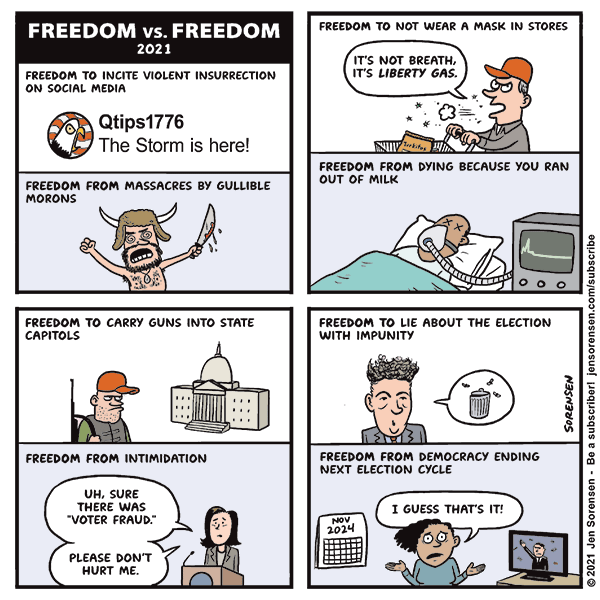
This is a good time to revisit one of my favorite Jen Sorensen cartoons, which she drew in 2015.


Arguably the most disturbing thing about the Texas lawsuit was the 126 Republicans in Congress signed an amicus brief supporting the suit. New Jersey Rep. Bill Pascrell has proposed a hardball way to punish them:

Pascrell cites Article 1, Section 5 of the Constitution in the letter, which “gives each chamber of Congress the ultimate authority to decide their membership.”

“Stated simply, men and women who would act to tear the United States government apart cannot serve as members of Congress,” Pascrell writes, adding that they were attempting to make President Trump “an unelected dictator” by endorsing the lawsuit.

Most Democrats don’t want to go that far, preferring to keep the moral high ground as the Party of Fair Play as opposed to the Party of Power At All Costs. And as a practical matter, the worst possible outcome would be for Speaker Pelosi to attempt something like this and fail for lack of a Democratic consensus.

However, I could get behind a halfway measure, which I would view as a shot across the Fascist bow: Make an example out of the 19 of those 126 Republicans who were elected from Wisconsin (1), Pennsylvania (7), Michigan (4), and Georgia (7). After all, they were on the same ballot as Biden and Trump, so the brief they signed alleges that the very election that qualifies them to sit in Congress was tainted by what the brief calls “unconstitutional ballots”. It would make perfect sense for the House to investigate this allegation before seating them. Coincidentally, this investigation should last until the Inauguration, at which point Speaker Pelosi could report that allegations of fraud were unsupported by evidence.

Opening Thoughts about the Trump Voter

Whenever I come across an idea that seems promising, I face a dilemma: Do I tell you all as soon as I start thinking about it, or do I wait until I’ve done the research to flesh it out properly? This blog’s most successful posts are the ones where I’ve taken time, done a bunch of background reading, and thought things through carefully. Not a Tea Party, a Confederate Party is a prime example. I thought about it for months, and it has gotten more than half a million hits in the last six years. Around 200 people looked at it last week.

But at the same time, there’s the question of topicality: If I know a lot of you are thinking about a question right now, shouldn’t I let you know that I’m thinking about it too? And if I have some preliminary conclusions that you might find useful, maybe I should pass them on, even if I don’t have all the i’s dotted and t’s crossed yet. So that’s what I’m doing in this post.

The 74 million. As has been clear on this blog since Election Day, I was deeply disturbed to see 74 million Americans vote for a Trump second term. After everything he’s done these last four years, 74 million Americans — millions of whom didn’t vote for him in 2016 — said, “Stay. Get some more of us killed. Finish the job of destroying American democracy.”

Blessedly, 81 million Americans said, “No. Get the hell out of here.” And despite Trump pulling every lever of presidential power to defy the People and stay in office, the institutions of democracy have held. The Electoral College is voting today, and 306 electors are pledged to Joe Biden. On January 20, Trump will become an ex-president.

And yet, those 74 million Trump voters are still with us, and many of them are still believing every ridiculous thing he says, like that he really won in a landslide, but that Biden managed to manufacture vast numbers of fake votes — under the nose of a sitting president, whose Justice Department noticed nothing. In Georgia and Arizona, this vast fraud supposedly happened under the noses of Republican governors and secretaries of state, who also noticed nothing. Trump’s claims of fraud have failed to convince judges in over fifty lawsuits, including judges Trump appointed himself.

And still they believe him. Largely because of his influence over the base voters, droves of Republican elected officials have abandoned their integrity: Eighteen state attorneys general and 126 members of Congress signed on to an insane lawsuit asking the Supreme Court to throw out the 2020 election and hand Trump a second term in spite of the voters. (All three of his Supreme Court appointees refused.) If this suit had succeeded, if defeating Trump by seven million votes (in an election that Trump appointee Christopher Krebs called “the most secure in American history“) isn’t enough to take power away from him, then all future presidential elections would be meaningless. Democracy would be over in America, and quite possibly the Union would break up.

And that’s what the Republican Party supports these days.

So what do we do? How should we understand Trump voters? How should we talk to them? How do we manage to hang on to our constitutional republic in spite of them?

I’ve been thinking about those questions a lot this last month.

The too-easy answers. There are lots of explanations of the Trump voters that strike me as too easy and too satisfying to the liberal self-image. Like:

  • They’re just stupid.
  • They’re insane.
  • They’re in thrall to a mind-numbing, reality-rejecting version of Christianity.
  • They’re in Hillary Clinton’s “basket of deplorables”: racists, sexists, homophobes, xenophobes, and Islamophobes.

I admit, none of these explanations is entirely baseless. Trump’s support is concentrated in the less-educated portion of the population, and his supporters regularly swallow his incredible (and often self-contradictory) lies. Increasingly, they are taken in by Q-Anon or similar conspiracy theories that ought to sound crazy. White supremacists are front-and-center at Trump rallies, and Trump supporters in general love to demonize Black Lives Matter or leading women of color (like AOC). The Christian leaders who back Trump (in spite of his complete ignorance of Christianity and lack of any Christian virtue) are also likely to deny evolution, climate change, the Covid-19 pandemic, and other well established aspects of reality.

Perhaps the best reason to believe these pejorative theories of Trump support is that Trump himself seems to believe them. Like conmen everywhere, he does not admire his marks. For example, whenever he needs a distraction from something he has bungled, he picks a fight with some prominent Black person, like LeBron James or Don Lemon, or he tells the Squad to “go back” where they came from. He knows that playing a racist or sexist is a good look for him.

Restoring democracy. I resist these theories, though, because they seem self-defeating to me. If 74 million voters are just stupid or crazy or incurably bigoted, then why exactly do we want to save democracy? Shouldn’t we just disenfranchise them before they disenfranchise us? If Biden could stage a coup of his own, ignore the anti-democratic Senate, and start dictating sensible policies to mitigate climate change, guarantee health care, and reduce economic inequality, wouldn’t that be a good thing?

I reject that scenario. Messy and inefficient as democracy can be, I want to find a way back to it. I believe that when you start cutting large numbers of people out of the process, it doesn’t turn out well, even if you get some good things done in the short term.

Restoring democracy in such a way that it survives into the distant future involves reversing the polarization of recent years and shaping some kind of national consensus about who we are and what we’re trying to do. (It also involves recognizing that we have to do more than just “restore” democracy, because large swathes of the citizenry were cut out of the governing process in whatever era we might imagine going back to.) We can’t do that if we begin by writing off 74 million voters.

The answer I want. So before I even start, I have to confess that I’m looking for an answer of a certain shape: I want to find something in the Trump voter (or at least in a large number of Trump voters) that I can sympathize with and imagine making common cause around. If the core of what they want is to lock immigrant kids in cages, then I can’t go there. If the essence of Trumpism is restoring the patriarchy and sending gays back to the closet, there’s no deal to be made. But what if that’s not it?

Trump’s appeal. I view Trump’s appeal as being rooted in resentment and wounded pride, which Trump has exploited in destructive ways. Trump has turned that resentment against precisely the groups Hillary’s basket-of-deplorables quote describes: against Blacks, women, gays, immigrants, and non-Christians (especially Muslims). And Trump has offered his followers a restored pride in their race, their religion, and the power of their nation to bully other nations.

But what is that resentment and that wound really about? As I see it, Blacks, women, and the rest didn’t really do anything to the MAGA-hatters; they’ve just been offered as scapegoats. Same-sex couples haven’t harmed opposite-sex couples. Trans folk haven’t stopped the rest of us from identifying as men or women, if that’s what we want to do. Every American-Christians-are-persecuted story I’ve ever looked at has fallen apart under examination.

The key to bridging the gap — not all the way to the neo-Nazis, but to a lot of ordinary Americans who voted for Trump — ought to be finding an interpretation of that wound and that resentment that doesn’t demonize the people who feel it.

The progressive account. The progressive movement offers such an explanation, but I’m not satisfied with it. Bernie Sanders and his allies will tell you that the wound is economic: Trump supporters — particularly non-college-educated white people in rural areas — feel themselves slipping out of the middle class through no fault of their own.

The best description of that economic anxiety comes from Arlie Russell Hochschild’s book Strangers in Their Own Land.

You are patiently standing in the middle of a long line stretching toward the horizon, where the American Dream awaits. But as you wait, you see people cutting in line ahead of you. Many of these line-cutters are black — beneficiaries of affirmative action or welfare. Some are career-driven women pushing into jobs they never had before. Then you see immigrants, Mexicans, Somalis, the Syrian refugees yet to come. As you wait in this unmoving line, you’re being asked to feel sorry for them all. You have a good heart. But who is deciding who you should feel compassion for? Then you see President Barack Hussein Obama waving the line-cutters forward. He’s on their side. In fact, isn’t he a line-cutter too? How did this fatherless black guy pay for Harvard? As you wait your turn, Obama is using the money in your pocket to help the line-cutters. He and his liberal backers have removed the shame from taking. The government has become an instrument for redistributing your money to the undeserving. It’s not your government anymore; it’s theirs.

There’s a long discussion about white male privilege to be had here. (The implicit assumption is that “you” deserved the spot you had in line, and so the Blacks and women and immigrants who got moved ahead of you are interlopers.) But the essence of the problem is the unmoving line. If you’re making good progress towards the Dream, and you know you’ll get there soon enough, then who really cares if somebody else gets there a little ahead of you?

So the progressive solution is to get the line moving again by taxing the wealthy and using the money to relieve the stresses of working-class life (through government-financed health care, a higher minimum wage, and a strong safety net) and to open more avenues for upward mobility (free college and revitalized infrastructure).

Do all that, the progressives say, and working-class people will realize that Democrats are back on their side, so the Trump movement will fade away.

That seems plausible, but I don’t see much supporting evidence. I think progressives were fooled by the support Bernie got in the 2016 primaries from working-class white voters in rural areas of, say, Michigan and Wisconsin. But in 2020, when Bernie was running against a man rather than a woman, those counties flipped to Biden. It was never about the progressive economic agenda.

Depleted social capital. Timothy Carney’s book Alienated America (which I did a mini-review of in a weekly summary in 2019) is a conservative look at the Trump phenomenon. Carney argues (with data to back him up) that the core Trump voters — the people who supported him in the 2016 Republican primaries over more traditional Republican candidates like Jeb Bush, John Kasich, Ted Cruz, and Marco Rubio — were not the people struggling economically. Instead, they tended to be successful people in failing communities. Not the guy who lost his job when the factory moved to Indonesia, but the guy who runs the Chevy dealership that sold trucks to guys who lost their jobs when the factory moved to Indonesia, or the guy whose plumbing-and-heating-contractor business is surviving, but hasn’t been nearly as prosperous since the local factory moved to Indonesia.

So Carney’s solution to the Trump-voter problem is to shore up the social capital of the small towns and rural areas in America’s heartland. This seems a little closer to the mark, though exactly how to do it is a little trickier. (James and Deborah Fallows’ book Our Towns, which highlights successful small towns, might be a place to start thinking about that.)

When I picture the view from my Midwestern hometown (Quincy, Illinois), Medicare for All and free college are nice, but they don’t really solve the problem. They make it easier for people to survive as individuals, and to educate their kids so they can move away and succeed in places that still have opportunity. But they don’t provide a vision of how Quincy itself thrives into the future and makes opportunities for its children to put down roots without moving away.

What all of this leaves out, though, is the kind of resentment we’re seeing right now, directed at doctors and the government officials who listen to them. The people who make a scene at Target because they don’t want to wear masks — that’s not economic anxiety or even community-social-capital anxiety. That’s something else.

It’s related to the own-the-libs anger that shows up on social media. These are the people who positively rejoice when Trump makes fun of the disabled or claims that he couldn’t possibly have molested all the women who accuse him, because they’re just too ugly. That’s not about fear that immigrants will take your job, or concern that you won’t be taken care of if you get sick, or worry that your grand-kids will have to grow up in San Francisco.

Caste. So there are two other pieces of the puzzle I’m trying to integrate in, and this is where I’m going to need some time to get the fit right. Both are related to books I finished reading this week. One is Isabel Wilkerson’s Caste, which makes the observation that a caste system provides a sense of security to people who aren’t in the bottom caste, because they know someone will always be below them. That isn’t just (or even primarily) an economic security, it’s a social and psychological security.

So the guy who believes that he’s white trash takes comfort in the idea that he’s at least white trash. As long as whites are on top, he has some claim to self-worth.

Wilkerson raises the idea that poor and working-class whites whose votes for Trump seem to run against their economic interests (because Trump’s policies may take away their health insurance and won’t raise their minimum wage) may have a broader view of their interests than just economics. They may see their whiteness as a birthright they aren’t willing to sell.

Something similar might be going on with the Christians who refuse to sell cakes or do floral arrangements for same-sex marriages. It’s absurd to believe that God cares about these lines in the sand. (Neither cakes nor flowers play any sacramental role in Christian marriage rituals.) But if these people’s self-worth comes from the social supremacy of Christianity, then making a stand that says “We’re still on top” will be important to them.

This isn’t bigotry in the hating sense. The person who feels an attachment to everybody staying in “their place” may not have any conscious animosity towards people who are assigned to different places. But the current system gives that person a “place” somewhere that isn’t the bottom, and if the system falls apart, he doesn’t know where he’ll be.

So now the question becomes: What alternative self-worth do we have to offer such a person? And how can we communicate this offer to him or her?

Defining reality. One of the hardest things for me to accept about Trump supporters is their willing acceptance of all sorts of absurdities. As various Facebook memes have been putting it lately: The pandemic is a hoax, but Trump deserves credit for producing the vaccine that I’m going to refuse to take.

Bill Barr was wonderful until he refused to go along with the Biden-stole-the-election lie, and now he’s part of the Deep State. Amy Coney Barrett has gone from savior to villain in just a few weeks. The only way to know what’s real these days is to follow Trump’s tweets, and be prepared to change your mind as he does, from one moment to the next.

The 2019 book Democracy and Truth by Sophia Rosenfeld has some clues about what’s going on here.

Every society has some process for reaching consensus on what is real, what is possible, what categories people need to keep track of, and so on. (One key element of “wokeness” is recognizing the social construction of both race and gender. Yes, there is an underlying physical reality: Some people’s skin is darker than other’s, and some people have organs that other people lack. But the exact boundaries of these categories and what — if any — significance they have varies from one society to another.) Different people play different roles in this process, with some being more empowered than others. One of the not-well-understood aspects of Trumpism is that Trumpists feel alienated from the reality-defining class.

This has been an issue for years when it comes to Christianity and evolution. The scientific community had a debate in the 1800s, and settled on the consensus that Darwinian evolution really happened, while the young-Earth account of Genesis is just a myth. Lots of Christians don’t like that conclusion, and have tried for years to argue that their definition of reality deserves as much or more deference than the scientists’ definition.

The same thing happens with climate change and all sorts of other ideas that get less attention: There’s an expert class that defines the social consensus about reality, but lots of people are in rebellion against its conclusions. At a mundane level, this plays out on the front page of The New York Times every day: Some things are really happening while others aren’t. And some things are happening but aren’t worth noting.

In general, different people are involved in different reality-defining processes. And even if you’re not involved in any of them, you might feel some connection to the people who are. For example, I play no role in deciding whether the various Covid-19 vaccines are safe. But I have friends who are biologists, and they have friends are are involved. I’ve also participated in a different research community (mathematics), so I have a general grasp of the peer-review process, and so forth. In addition, there was a point in my life when I was deciding what field to specialize in, and if I had made a different choice, I might be working with Dr. Fauci today. (Or at least I believe that.)

But many people in society feel completely separated from that process. They have opinions on the subject, but nobody cares. In fact, nobody cares about any of their opinions about what’s real and what isn’t. They don’t know anybody who decides what’s real, and they aren’t aware of ever having had a chance to enter the reality-defining class. People like them don’t define reality. Somebody else does.

That’s the kind of alienation that makes you throw a fit in Target. This mask isn’t a moon rocket, it’s a piece of cloth. Why is your opinion about it better than mine?

That alienation will also lead you to conspiracy theories, where reality gets defined by an alternative community in alternative ways. The folks in Q-Anon care what you think. Dr. Fauci doesn’t. He thinks he’s better than you are.

Trump consistently stands up for these alienated folks by thumbing his nose at the reality-defining class as a whole. There’s a pandemic? Maybe, maybe not. Doctors say masks help, but I think hydroxychloroquine is better. My friend the My Pillow Guy has a theory; why don’t we listen to him?

So here’s a thought I’m still wrestling with: How do we make the reality-defining class more accessible? Or more transparent? Or at least less off-putting?

Pardons and Their Limits

Throughout his administration, Donald Trump has tested the limits of presidential power. On his way out the door, he is testing the limits of the pardon power.


This week the Covid pandemic reached new heights and threatened to break America’s hospital system. The total number of American deaths will soon pass the number of combat deaths in World War II.

So of course the White House had not a word to say about any of that. Instead, the President’s attention was absorbed by more pressing problems: the continuing failure of his attempts to overturn the election he lost by seven million votes, and the criminal exposure he and various members of his family and his administration might face come January 21, when he no longer has the power to restrain the career investigators and prosecutors in the Department of Justice.

The first of the expected rush of lame-duck pardons was given to former national security advisor Michael Flynn. Signed the day before Thanksgiving, the text was only released last Monday. [1] Since then, Trump is reported to be discussing pardons for his children, up to 20 members and allies of his administration, and himself. [2]

All of that may yet come to nothing; Trump frequently is said to be thinking about some action that never happens (like releasing a healthcare plan). But given the approaching deadline, it’s worth considering what he can actually do.

Article II. The President’s power to pardon is established in Article II, Section 2 of the Constitution:

The President … shall have Power to grant Reprieves and Pardons for Offenses against the United States, except in Cases of Impeachment.

That sounds pretty sweeping, but as so often is the case in constitutional law, nearly every word inspires entire articles of analysis. That said, there is one clear limit that just about everyone agrees on: “Offenses against the United States” means federal crimes only. So a presidential pardon won’t protect against prosecutions for violating state laws, or against civil lawsuits.

That’s relevant, because a lot of the post-presidency legal exposure faced by Trump and his family falls outside of his pardon power. He could, for example, try to pardon himself for the seven instances of obstruction of justice that the Mueller report found to be indictable. But if he is guilty of bank and tax fraud (as Michael Cohen has claimed), New York state laws have been violated, and the alleged misappropriation of funds contributed to the Trump Inaugural Committee is a civil suit.

Self-pardons. But that brings up the issue of a self-pardon, which is untested in American law because no previous president has ever tried such a thing. Examined naively, the Article II text would seem to support the idea; it just says “power to grant pardons” with no exceptions other than impeachment.

But North Carolina Law Professor Eric Muller has an interesting interpretation, which ought to appeal to the conservatives on the Supreme Court who claim [3] to believe in Originalism: He can’t find 18th-century usages of grant as a reflexive verb. In other words, one party “grants” something to another; but nobody ever “grants” something to himself.

in the time period from 1750 to 1800 … [t]ransitive uses of the verb—“grant me,” “grant him,” “grant her,” “grant us,” “grant you,” and the like, where the person receiving the grant is different from the person doing the granting—are all common. But reflexive uses, where the person doing the granting is also the person on the receiving end? All but nonexistent.

Leading to the conclusion:

Can Donald Trump pardon himself? Perhaps, but that’s not the question the Constitution requires us to ask. Can Donald Trump grant himself a pardon? The evidence, at least according to the text of the Constitution and its original meaning, says no.

Harvard Law Professor Lawrence Tribe made a similar point to MSNBC’s Lawrence O’Donnell, and added that Article II also stipulates that the President “shall take care that the laws be faithfully executed”. If presidents could pardon themselves, they would instead be exempt from all federal laws — something the Framers clearly did not intend. The King of England might be above the law, but the President of the United States should not be.

We know that the Framers did not bother saying that the president cannot grant himself a pardon, because no one in their right mind would have imagined otherwise.

Specificity. Another problem of constitutional interpretation involves the word pardon itself. What did the Framers think it meant? University of California Law Professor Alan Rappaport argues that the Framers would have seen a pardon as a very specific reprieve from a specific violation of the law.

Most importantly, the Framers would have understood that pardons must be issued for specific crimes. They were not intended to be broad grants of immunity, get-out-of-jail-free cards bestowed by presidential grace.

This would call into question the Flynn pardon, which mentions the specific crime he pled guilty to (lying to the FBI), but also claims to cover

any and all possible offenses arising out of facts and circumstances known to, identified by, or in any manner related to the investigation of the Special Counsel, including, but not limited to, any grand jury proceedings in the United States District Court for the District of Columbia or the United States District Court for the Eastern District of Virginia.

Can such a “broad grant of immunity” really be valid, when President Trump himself may not know exactly what crimes he has put beyond the reach of legal accountability?

The model for this pardon, and for similar pardons Trump is said to be planning for his family and associates, is President Ford’s pardon of former President Nixon, which granted

a full, free, and absolute pardon unto Richard Nixon for all offenses against the United States which he, Richard Nixon, has committed or may have committed or taken part in during the period from January 20, 1969 through August 9,1974.

Well OK, then: If Nixon’s pardon is valid, then Flynn’s should be also. But is Nixon’s pardon valid? It was respected, in the sense that nobody put Nixon on trial. But precisely because Nixon’s pardon was never challenged, no judge has ever ruled on its validity.

So if Flynn has committed some crime “related to the investigation of the Special Counsel”, but not specifically identified in his pardon, the next Attorney General will have the option to indict him for it. During the subsequent trial, Flynn could ask the judge to throw out the indictment, because he had already been pardoned. But that motion would have to make its way up to the Supreme Court, because there is no compelling legal precedent for a lower-court judge to cite.

Trump family members might find themselves involved in some similar proceeding. If, say, Don Jr. gets a pardon vaguely immunizing him from anything he may or may not have done, what happens if he is prosecuted for lying to the Senate Intelligence Committee?

If vague, sweeping pardons aren’t valid, Trump’s other option is to list the crimes his children and close associates might be prosecuted for. While this would quite likely be legally valid, it would essentially be an admission of guilt. Such pardons would start to resemble the truth-and-reconciliation model, where crimes committed by an outgoing regime are excused in exchange for a full accounting of them.

Can a pardon itself be a crime? Yes. In his Senate confirmation hearing, Bill Barr admitted that offering a pardon in exchange for false testimony, or for refusing to testify, would be obstruction of justice.

So while the pardon itself might be valid, the President might commit a new crime by granting it.

In his recent book Where Law Ends, Mueller investigation veteran Andrew Weissmann says that Trump’s public praise of Paul Manafort (in particular for refusing to “break” by cooperating with the Mueller investigation, in contrast to Michael Cohen, whom Trump characterized as a “rat“) amounted to dangling a pardon in exchange for his silence. George Packer’s review of Weissman’s book summarizes:

[Manafort’s] lies were encouraged by the president, who made sympathetic noises about Manafort with the suggestion that stonewalling might earn him a pardon. Trump’s pardon power was an obstacle that the prosecutors didn’t anticipate and could never overcome. It kept them from being able to push uncooperative targets as hard as in an ordinary criminal case.

Similarly, the Flynn pardon and the commutation of Roger Stone’s sentence could be interpreted as obstruction.

Side-effects of pardons. Even if Trump’s family and associates have valid pardons, Congress may decide that it wants to know what happened during the various events they might have been prosecuted for. (What exactly was Rudy doing in Ukraine, anyway? When Flynn talked to the Russian ambassador, what instructions, if any, had Trump given him?) So the pardon recipients might be called to testify before congressional committees.

If they are called, they will have no Fifth-Amendment rights to invoke, because they can’t be prosecuted for crimes that have already been pardoned. If they refuse to testify without invoking a valid privilege, they can be cited for contempt of Congress (which a Biden-appointed US attorney might see fit to prosecute). If they testify and lie, that would be a new crime not covered by their pardons.

Not the end of the story. Ordinarily, a pardon is the end of the story: You did something; you were accused and possibly convicted of it; but a pardon wiped the slate clean and the credits roll.

The pardons Trump is considering, on the other hand, might just be another link in the chain of events. Depending on what Biden’s appointments at the Department of Justice decide [4], investigations and prosecutions could still happen, and the Supreme Court would have some important decisions to make.

And whatever the courts decide, Congress could still investigate, and Trump’s various obstructions of justice could still unravel.


[1] Combined with the previous commutation of Roger Stone’s sentence, the Flynn pardon ties up one of the few remaining loose ends in Trump’s obstruction of the Mueller investigation. The only remaining loose end is Paul Manafort, who quite likely will get his own pardon soon. The 2016 Trump campaign connected to Russia in three main ways, and the Mueller investigation ran aground when it couldn’t get the cooperation of Manafort, Stone, and Flynn.

Paul Manafort was the head of the 2016 Trump campaign until he resigned under fire that August. His associate Konstantin Kilimnik turned out to be a Russian agent. Manafort passed campaign polling data to Kilimnik, for reasons that have never been explained.

The emails that Russia hacked from the Democratic National Committee were given to WikiLeaks. Trump associate Roger Stone appeared to have advance knowledge of what was in them and when they would be released. How the Russia-WikiLeaks-Stone-Trump pipeline worked has never been explained.

Michael Flynn was convicted of lying to the FBI about his conversations with the Russian ambassador during the Obama-to-Trump transition. Flynn and Jared Kushner reportedly were trying to set up a “back channel” to Russia that would circumvent US intelligence agencies. What that was for and what Trump knew about it has never been explained.

[2] Just a suggestion: Don’t forget Melania, Don. You do not want her flipping on you.

[3] I think Originalism is a rhetorical device they use when it’s convenient, not set of principles they actually believe. One key example: There is no way the Framers intended the Bill of Rights to apply to corporations.

[4] So far, Biden and Harris have been saying exactly the right things: Whether or not to prosecute Trump-administration crimes will be decided by the Justice Department, which will regain its independence from political meddling.

Our Justice Department is going to operate independently on those issues, how to respond to any of that. I am not going to be telling them what they have to do and don’t have to do. I am not going to be saying, go prosecute, A, B, or C.

Biden is even said to be planning to keep Christoper Wray as head of the FBI. If Wray’s FBI finds evidence of Trump-era crimes, Biden will not have his fingerprints on those reports.

The Electoral College, the Trump Coup Attempt, the Georgia run-offs, and Other Post-Election Reflections

The results. Georgia and Arizona finally got called, completing the map of the 2020 presidential election. Joe Biden is the winner, 306-232, the exact same margin Trump won by in 2016.

All the Senate races have also been called, with the two Georgia races resulting in run-offs. The make-up of the new Senate is 50-48, pending those two Georgia races.

A few House races are still being determined, but the shape of the outcome is clear: Democrats will retain control, but with a slightly smaller majority.

Measuring the bias built in to the Electoral College. Since 2016 and 2020 resulted in exactly the same 306-232 split in the Electoral College, we can see just how big a Republican bias that system has compared to the popular vote. Trump was able to get his 306 electoral votes while losing the popular vote by 2.8 million. In order to get his 306 EVs, Biden had to win by a margin that so far is 5.6 million and continues to grow as the final votes are tallied.

In each case, a relatively small number of votes in a few states determined the outcome. Hillary Clinton would have won in 2016 if she had gotten 10,705 more votes in Michigan, 44,293 in Pennsylvania, and 22,749 in Wisconsin, for a total of 77,747.

Using the currently available returns, Trump would have won this year if he had gotten 10,378 more votes in Arizona, 14,173 in Georgia, and 20,547 in Wisconsin, a total of 45,098. (That would have resulted in a 269-269 Electoral College tie, which would have thrown the decision into the House. Each state gets one vote in the House, and Republicans control 26 House delegations, so Trump would have been chosen.)

Think about that: If Trump had gotten those 45K votes, he still would have lost nationally by at least 5.5 million, and probably quite a bit more. But he would be president for four more years.

Admittedly, though, a scenario where a candidate gets exactly the votes he needs in exactly the states where he needs them is far-fetched. So here’s a more plausible variation: What if Biden’s margin were just 3/4% smaller across the board?

Biden won nationally 50.9%-47.3%, a 3.6% margin. But he won Wisconsin by .7%, Arizona by .3%, and Georgia by .3%. So in my 3/4%-less scenario, Biden carries the country 50.525%-47.675%, a margin of 2.85% or 4.4-million votes. He still has a popular-vote majority — not just a plurality — but he loses all three of the closest states, so Trump gets a second term.

I don’t see any way to justify that outcome. The Electoral College has to go.


Trump’s coup attempt. Just because it isn’t working doesn’t mean that it isn’t a coup. This week, Trump has been trying to create the conditions for him to hang onto power in spite of being rejected by the voters. For the most part, the Republican Party has been cooperating with his effort to overthrow American democracy.

Going into the election, various observers were laying out what Trump might do to subvert an election defeat. Here’s Barton Gellman in The Atlantic from September:

The worst case, however, is not that Trump rejects the election outcome. The worst case is that he uses his power to prevent a decisive outcome against him. If Trump sheds all restraint, and if his Republican allies play the parts he assigns them, he could obstruct the emergence of a legally unambiguous victory for Biden in the Electoral College and then in Congress. He could prevent the formation of consensus about whether there is any outcome at all. He could seize on that un­certainty to hold on to power.

Gellman detailed the plan: deny the validity of mail-in ballots, tie the vote-count up in litigation, delay resolution until Republican state legislatures in Pennsylvania or Wisconsin feel justified in appointing their own pro-Trump electors. Make Congress or the Supreme Court — not the voters — decide who the real electors are. (Vox’ Andrew Prokop points out all the obstacles in the way of this scenario.)

So far, Trump has been carrying out that plan, and the majority of elected Republicans have been playing along with him. Fortunately for American democracy, Election Day went relatively smoothly and Biden’s win is not that close, so Trump’s litigation strategy has little to work with and a lot to accomplish: He needs to overturn — or at least cast doubt on — margins in the tens of thousands in at least three states.

He also needs to reverse the public perception that Biden won. This is why Fox News projecting a Biden victory and referring to him as the President-elect has so outraged Trump. He needs his followers to believe that the election is still undetermined.

It’s not working, and it’s not going to work — judges need to see some kind of evidence before they block certification of the election results, and Trump has none — but Trump and the Republicans should get no credit for that. They’ve been trying to overthrow American democracy; they just haven’t succeeded.

The non-transition. No one really expected Trump to make a gracious concession speech, as all previous losing candidates have done for the last century or so. Fundamentally, Trump is still that fragile-ego kid you knew in first grade: the one who never admitted a mistake and couldn’t lose at anything without claiming that the winner cheated.

(John McCain not only gave a very gracious speech in 2008, he joked about his loss later, claiming that after his election-night concession, he went to bed “and I slept like a baby. I woke up screaming every two hours.”)

But Trump has pushed his innate immaturity several steps down the road to assholery: He’s refusing to let his administration face the reality that Biden won the election and needs to get ready to take control of the government. This would be a problem in the best of times, but given that Trump is leaving Biden a broken economy and a plague running out of control, his petulance is becoming unpatriotic.

And so, the General Services Administration has not yet issued the ascertainment memo that releases funds for the transition process, providing office space and government resources like computers and email accounts. For comparison, the Obama White House issued a detailed transition memo on November 10, 2016, two days after the election.

Meanwhile, the rest of the Trump administration is refusing to meet with Biden’s people until GSA gives its OK. Biden is also not getting access to current intelligence reports like the Presidential Daily Brief. CNN reports:

Less than 10 weeks before Biden will take office, his team is locked out of crucial Covid-19 pandemic data and government agency contacts, which threatens to hamper the federal response amid peaking coronavirus cases and the expected mass distribution of a vaccine.

Again comparisons are in order: Bill Clinton began sharing PDBs with George W. Bush while the Florida recount was ongoing, “just in case” he happened to win. There is no downside to this, unless you suspect the possible next president of being a security risk.

Promoting unrest. Saturday, pro-Trump demonstrators came to Washington to join in the fantasy that Biden is stealing the election. Journalism Professor Jay Rosen used the WaPo’s coverage as an example of what not to do:

On stark display in the nation’s capital were two irreconcilable versions of America, each refusing to accept what the other considered to be undeniable fact.

What’s wrong here? The Post is acting as if actual reality is unknowable; we just have different groups saying different things. Rosen suggests saying this instead:

A militant faction had come to the nation’s capital to march for a fantasy, and to reject any institution that disallowed it, including for now Fox News.

The ongoing scam. Meanwhile, convincing the Trump personality cult that he still has a chance opens a new opportunity to scam them.

I’ve been on the Trump/Pence email list since 2016, but I’d never clicked one of the “Contribute” buttons until Thursday. That got me to a page with the following disclaimer in the fine print at the bottom:

Contributions to TMAGAC made by an Individual/Federal Multicandidate Political Committee will be allocated according to the following formula: 60% of each contribution first to Save America, up to $5,000/$5,000, then to DJTP’s Recount Account, up to a maximum of $2,800/$5,000. 40% of each contribution to the RNC’s Operating account, up to a maximum of $35,500/$15,000. Any additional funds will go to the RNC for deposit in the RNC’s Legal Proceedings account or Headquarters account, up to a maximum of $213,000/$90,000.

The marketing is all about election fraud; the email was asking me to contribute to Trump’s “Official Election Defense Fund”. But that’s not where the money would go until after $5,000 had gone to Save America and another big sum to the RNC. If I’m giving less than $8,000, none of my money would go towards funding recounts and/or lawsuits.

So what is Save America? It’s a “leadership PAC”, which means Trump has wide latitude on how to spend it. Open Secrets says:

Leadership PACs are used to fund expenses that are ineligible to be paid by campaign committees or congressional offices. Those costs can include travel to raise a politician’s profile, for instance. … Politicians often use their PACs to donate to other candidates because they are considering seeking a leadership position in Congress, a higher office, or leverage within their own party as they show off their fundraising ability.

So basically Trump is using his “election fraud” scam as a way to raise money so that he can continue to fly around the country having rallies, while continuing to skim large chunks of cash into Trump Organization properties.

BTW: Trump’s “voter fraud hotline” has shut down due to prank calls.

Georgia and the Senate. Georgia election law requires a Senate race to be decided by a majority: If nobody gets a majority, the top two candidates meet in a run-off. So both of this year’s races are going to a run-off on January 5. Incumbent Senator David Perdue will face Democratic challenger Jon Ossoff in one race, and Republican Kelly Loeffler (who was appointed to fill out the term of Republican Senator Johnny Isakson, who retired for health reasons) and Democrat Raphael Warnock are running in the other.

If Democrats win both races, the Senate is split 50-50, leaving new Vice President Kamala Harris to break the tie in the Democrats’ favor. That would mean that Chuck Schumer becomes majority leader. But if either Republican wins, Mitch McConnell stays in power.

Predicting what will happen here is beyond me. Biden narrowly won Georgia, while Perdue narrowly outpolled Ossoff. Warnock got more votes than Loeffler, but was far away from a majority (33%) in a multi-candidate race, and the third-place candidate was a Republican.

Given what we’ve just seen, it’s hard to trust polls. The contests will come down to turnout, which is also hard to guess: Will voters motivated by love or hate of Trump turn out when Trump isn’t on the ballot? With Biden headed to the White House, will voters want a Republican Senate to block him? Or will they vote against gridlock and give Biden a chance to govern? As reality dawns on the Trump personality cult, will they be angry and vote or depressed and stay home?

In Democrats’ favor, I think the Ossoff/Warnock combination works well: Warnock should get Black voters in Atlanta to turn out, while Ossoff should attract suburban women. But the temptation to be “independent” by voting for one Republican and one Democrat works against them.

What’s at stake in Georgia. It’s important to get the significance of the Georgia run-offs right, because the the Right will try to distort it.

A Mitch McConnell Senate will block virtually everything the Biden administration tries to do, including cabinet nominations. No new judges will get appointed. Every budget will be a brinksmanship drama, with a countdown to a government shutdown. Worse, McConnell will sabotage the Biden economy the same way he sabotaged the Obama economy, by forcing an inappropriately restrictive austerity. You can already see this happening in McConnell’s unwillingness to back any kind of pandemic stimulus.

But a 50-50 Senate will not be a nest incubating liberal overreach. VP Harris will break ties, but in practice the swing vote will be the 50th Democrat, who will usually be West Virginia’s Joe Manchin. If Manchin’s not for it, it’s not passing. So: no defunding the police, no government takeover of healthcare, no amnesty for illegal immigrants, no packing the Supreme Court, and no whatever else Fox News is rattling its viewers’ chains about.

In particular, a Manchin-centered Senate probably doesn’t end the filibuster, which means McConnell will retain a lot of blocking power. So the choice is whether the Senate will be mildly dysfunctional or totally dysfunctional.

Choose well, Georgia.

What Happens Tomorrow?

This year, Election Night is a lot more complicated than just watching the returns come in.


Ordinarily, on the day before an election I write about poll-closing times and what the experts expect in various states. When does it makes sense to start watching returns? What are some early indications to look for? How late will you have to stay up to see the race decided? Stuff like that.

But as in everything else, 2020 is different. This year, we have to think not just about when the polls close, but how the votes are counted. When do election officials start processing early and mail-in ballots? How long will various states wait for mail-in ballots to arrive? Will courts intervene?

And then there are the possibilities that often occur in third-world countries, but we never used to have to think about in America: Will there be violence? Will the President let the ballots be counted? Will either foreign or domestic agents launch cyberattacks, or use disinformation to create chaos?

Let’s look at the ordinary stuff first, then work our way out to the unusual.

What the national polls say. As of this morning, 538’s model says Biden has a 90% chance of victory. That’s far from a sure thing, but it means that unusual (but not impossible) things will have to happen for Trump to win.

Nationally, 538’s polling average has Biden ahead 51.9% to Trump’s 43.5%. Not only is that a much bigger lead than Hillary Clinton’s 45.7%- 41.8% in 2016, but there are fewer undecided voters, and Biden’s lead has been much steadier, staying in the 8%-10% range for the last month. (In late September, Clinton led by less than the 2% she ultimately won the popular vote by.)

The conventional wisdom has been telling us that the race would tighten down the stretch, as it did in 2016, but so far there is no sign of it. In addition, the large number of votes already cast leaves less room for last-minute shifts in the public mood.

Does that mean Trump can’t win? Of course not. But it does tell us what kind of unlikely event would be required: A late-breaking shift of undecided voters wouldn’t do it. “Shy” voters afraid to tell pollsters they’re for Trump wouldn’t do it. (It’s hard to believe many of them would claim to be for Biden. Wouldn’t they just say they’re undecided?) One or two “unlucky” polls choosing an unrepresentative sample of voters wouldn’t do it.

In order for Trump to win, there has to be a large structural failure in how polls are constructed across the entire industry.

BTW. On the shy-voter theory: If there were something uniquely embarrassing about supporting Trump, I would expect to see a gap between Trump’s performance in the polls and Republican candidates lower down the ballot. Voters afraid to say they’re for Trump would be telling pollsters they’re for Thom Tillis in North Carolina or David Perdue in Georgia or Martha McSally in Arizona. But they’re not.

State polls. Of course, we don’t vote nationally, we use the archaic, Republican-biased Electoral College. That’s what the 538 model is based on. (They give Biden a 97% chance of winning the national popular vote, but only a 90% chance of becoming president. No other advanced country would tolerate a system like this.)

Looking at each state individually produces 538’s snake chart, the key section of which looks like this:

The easiest path for Biden to get to 270 electoral votes is to win all the states Clinton won in 2016 (the most difficult will be Minnesota and Nevada), and recapture Michigan, Wisconsin, and Pennsylvania.

The least likely state on this list for Biden is Pennsylvania, where 538’s model shows him with an 86% chance of winning, and predicts a 5.1% margin. That makes Pennsylvania the tipping-point state: the one most likely to make the difference.

If Biden should lose Pennsylvania, though, he still might win, because he also has smaller leads in Arizona, Florida, North Carolina, and Georgia. Ohio is a toss-up and Biden trails narrowly in Texas (not pictured).

This again tells us what kind of unlikely event would re-elect Trump: Polls have to be off by around 5% across the board, in states as different as Pennsylvania, Florida, and Arizona.

Election night. Ordinarily then, I’d be telling you that polls close in Pennsylvania at 8 p.m. EST, so if Biden really has that 5.1% lead, we should expect to know that he’s won by 9 or 10 o’clock. He couldn’t pass 270 until California came in at 11, but we could go to bed early and still be pretty sure we’d wake up to a Biden victory.

Not this year. Nationally, more than half the expected number of ballots have already been cast. Naively, you might expect that to make the vote-count go faster, since states could already have half or more of the votes counted when the polls close. But you would be ignoring how Republicans intend to steal this election for Trump:

Behind in the polls, Republicans are becoming increasingly blunt about their plan to win the election: don’t let everyone’s votes be counted.

As Astead Herndon and Annie Karni reported for the New York Times Saturday evening: “Trump advisers said their best hope was if the president wins Ohio and Florida is too close to call early in the night, depriving Mr. Biden a swift victory and giving Mr. Trump the room to undermine the validity of uncounted mail-in ballots in the days after.”

Matt Yglesias sums up:

Republicans — not Trump, dozens and dozens of individual state legislators across multiple states — have acted to deliberately ensure slow counting of mail-in ballots so they can later complain that the slow dribbling in of mail votes looks suspicious.

Wisconsin, Michigan, and Pennsylvania are all states where Republican majorities in the legislature have gerrymandered themselves into power. (A majority of voters in 2018 tried to give power to Democrats, but failed.) And they have prevented early vote-counting in each state. So Biden will not win Pennsylvania by 9 or 10, and probably not until Wednesday or Thursday — or later if the state is closer than polls predict.

Since Democrats have promoted early voting and voting-by-mail more than Republicans — in part because they take the pandemic seriously and Republicans do not — most likely the election-night totals will favor Trump, who will then try to declare victory and prevent further vote-counting.

I don’t expect that strategy to work, because Biden’s ultimate margin will be too big, and neither election officials nor judges are as corrupt as the GOP’s plan requires. But it does mean that you won’t learn much by watching Pennsylvania’s returns come in tomorrow night.

Instead, the first state to watch tomorrow night is Florida. Polls close at 8 eastern, and the early votes should be reported almost immediately. So Biden should have an early lead there, which will shrink over the next hour or two as the election-day votes come in. It’s possible there could be a result by 10.

Florida is a state where Biden has a small polling lead — 2.3% in 538’s analysis. As you see in the snake chart above, Biden can win the election without Florida. But winning Florida would be an early knock-out blow. If Biden holds the Clinton states and adds Florida, that’s 262 electoral votes. Trump would have to sweep all the other battleground states, including places like Michigan, where Biden has an 8.1% lead in the polls.

So Biden-wins-Florida is the go-to-bed-early scenario.

That said, Florida has been problematic for Democrats in recent elections. Clinton was favored there and lost. Ditto for Andrew Gillum in the 2018 governor’s race. Maybe pollsters have figured out what they did wrong in those races, but maybe not.

Polling errors have been running the other way in the Southwest: Kyrsten Sinema was projected to win her Senate race in Arizona by .7% and actually won by 2.4%. Ted Cruz was supposed to beat Beto O’Rourke by 4.9% and actually only won by 2.6%.

Other possible early knock-outs for Biden are North Carolina, Georgia, and (a little bit later in the evening) Arizona. Also worth watching is New Hampshire, a Clinton state Trump has campaigned in. Trump doesn’t need to win it and probably won’t. But the returns in New Hampshire could be an early clue as to whether he is getting the white-working-class surge he will need in Pennsylvania and Wisconsin.

Ohio and Texas are stretches for Biden, but if they come in, the race is a landslide. Given the similar demographics, there is no way Biden loses Pennsylvania or Michigan after winning Ohio, or fails to take Arizona after winning Texas.

That said, Republican machinations have held open the most tense scenario: Trump takes Texas, Ohio, Florida, Georgia, North Carolina, and Arizona on Tuesday, forcing Biden to count on the Michigan-Wisconsin-Pennsylvania path, which Republicans have intentionally delayed, and will now argue are taking too long.

Congress. Democrats expect to expand their House majority and have a good chance to take control of the Senate.

The current Senate is 53-47 Republican. Democrats expect to lose Doug Jones’ race in Alabama, so they need to pick up four seats elsewhere to get to 50-50. If Biden wins the presidency, Kamala Harris will hold the tie-breaking vote in the Senate.

Cook lists only one other Democratic seat in danger, Gary Peters’ in Michigan. But even that race it rates as “lean Democrat”.

Meanwhile, it rates two Republican seats — Martha McSally’s in Arizona and Cory Gardner’s in Colorado — as lean Democrat. Seven other Republican seats are toss-ups: Susan Collins in Maine, Joni Erst in Iowa, Thom Tillis in North Carolina, David Perdue and Kelly Loeffler in Georgia, Steve Danes in Montana, and Lindsey Graham in South Carolina.

538 gives the Democrats a 76% chance of gaining control of the Senate, with a 51.6 seat projection.

The same Election-Night considerations apply as in the presidential race. The early indicator is probably the North Carolina race.

Out of the ordinary. Over the weekend we started seeing our first hints of disruption or violence. “Trump Trains” of flag-flying pick-up trucks slowed or blocked traffic in a number of places like the Garden State Parkway in New Jersey, the Mario Cuomo Bridge in New York, and the Capitol Beltway in D. C.

The Garden State Parkway on Sunday.

The most ominous such event was when a Trump Train surrounded and harassed a Biden campaign bus in Texas, resulting in one minor collision.

People in vehicles that were part of a “Trump Train” began yelling profanities and obscenities and then blockaded the entire Biden entourage, according to a source familiar with the incident. At one point they slowed the tour bus to roughly 20 mph on Interstate 35, the campaign official said. The vehicles slowed down to try to stop the bus in the middle of the highway. The source said there were nearly 100 vehicles around the campaign bus. Biden staffers were rattled by the event, the source said, though no one was hurt.

When Trump heard about this incident, he tweeted “I LOVE TEXAS!”. And the Texas Republican Party was similarly unapologetic. Its statement dismissed the incident as “fake news and propaganda”, and attempted to shift focus to “the real violence” on the left.

In all these incidents, the point seemed to be to cause trouble, not just to express enthusiasm. Will they escalate?

Ron Suskind explored that possibility in “The Day After Election Day“. What if, he wonders, the Proud Boys or the army of Trump volunteers out looking for non-existent voter fraud block or violently disrupt polling places?

Disruption would most likely begin on Election Day morning somewhere on the East Coast, where polls open first. Miami and Philadelphia (already convulsed this week after another police shooting), in big swing states, would be likely locations. It could be anything, maybe violent, maybe not, started by anyone, or something planned and executed by any number of organizations, almost all of them on the right fringe, many adoring of Mr. Trump. … If something goes wrong, the media will pick this up in early morning reports and it will spread quickly, increasing tension at polling places across the country, where the setup is ripe for conflict.

Conservative media could then say the election was being stolen, summoning others to activate, maybe violently. This is the place where cybersecurity experts are on the lookout for foreign actors to amplify polling location incidents many times over, with bots and algorithms and stories written overseas that slip into the U.S. digital diet. News of even a few incidents could summon a violent segment of Mr. Trump’s supporters into action, giving foreign actors even more to amplify and distribute, spreading what is, after all, news of mayhem to the wider concentric circles of Mr. Trump’s loyalists. Groups from the left may engage as well, most likely as a counterpoint to those on the right. … Violence and conflict throughout that day at the polls would surely affect turnout, allowing Mr. Trump to claim that the in-person vote had been corrupted, if that suits his purposes.

That violence could be Trump’s Reichstag Fire.

If the streets then fill with outraged people, he can easily summon, or prompt, or encourage troublemakers among his loyalists to turn a peaceful crowd into a sea of mayhem. They might improvise on their own in sparking violence, presuming it pleases their leader.

If the crowds are sufficiently large and volatile, he can claim to be justified in responding with federal powers to bring order.

The spark for all this might be, literally, nothing at all. In 2014, an organized disinformation campaign created a fake ISIS attack on a chemical plant in Louisiana. What if some foreign actor like Russia invents an Antifa election-day atrocity? Might the fake attack create real reprisals that then spiral out of control?

I don’t even know how to evaluate scenarios like that. Are they likely? Crazy? Will we all laugh about this stuff by Friday? I have no idea.

This I do know: We’ve never had to think this way before, and the difference this time around is Trump. All previous presidents have done their best to reassure the public. He is the first to actively try to destabilize the national mood, and push us all towards panic. No matter how this comes out, I will not forgive him for that.

Finally, I want to repeat what an anonymous national security expert tells Ron Suskind: “Just understand that you’re being manipulated.” Respond accordingly. No matter what you think is happening, stay non-violent as long as you possibly can. Check your sources before you pass on rumors, so that you don’t amplify disinformation.

And keep hoping that, like kids back from a horror movie, we all eventually have a good laugh about how scared we were.

I Want To Believe

Eight days from the end of voting, the signs are good. I know you’re still worried.


Politico sums up how this race might look to a dispassionate observer:

Trump is an unpopular incumbent saddled with a recession and an out-of-control coronavirus pandemic that has killed more than 220,000 Americans. Meanwhile Biden has only seen his favorability ratings increase over time, emerging largely unscathed from Trump’s attacks on him and his son Hunter Biden. And Biden is outspending Trump down the homestretch almost everywhere

Those strategic observations are reflected in the polls: 538’s polling average has Biden up by 9.1% nationally, with few undecided voters: 52.0%-42.9%. And yes, the Electoral College rigs the system in Trump’s favor — the only reason he’s president now is that the electors overruled the voters in 2016 — but even that looks good: For some while 538’s tipping-point state has been Pennsylvania, where they project a 5.5% Biden advantage: 52.4%-46.9%. (That’s the margin in a model that projects ahead to election day. Their who’s-leading-now polling average is a bit bigger: 50.4%-44.7% or a 5.7% margin.)

If something goes wrong in Pennsylvania, Biden has other paths to victory. He’s also currently leading in North Carolina (2.5%), Florida (2.4%), Arizona (3.0%), Iowa (1.3%), and Georgia (.9%). (The model expects his leads to go away in Iowa and Georgia, but not in the other states.) And Trump’s leads are narrow in a number of states once thought to be safe for him: Ohio (1.4%) and Texas (tied).

That’s right: If you’re being all quantitative and wonky about it (like 538 always is), Biden currently looks way more likely to win Texas than Trump does to win Pennsylvania.

Feel better now? I didn’t think so.

https://www.pbs.org/video/dewey-defeats-truman-iypfom/

Ghosts of 2016. Election Night 2016 was a trauma that Democrats may not recover from for a very long time. (I wonder if Republicans fretted this much about Eisenhower’s chances in 1952 after the Dewey debacle in 1948.) The Saturday before the election, the Princeton Election Consortium said Clinton had a 99% chance of winning. While other people’s speculations were less extreme — and Nate Silver’s election-eve estimate that Trump stood a 28% chance was probably about right; some unlikely things still had to happen, but everybody has gotten wet when there was a 28% chance of rain — few of us expected to see a President Trump.

And then it all fell apart: Florida and North Carolina early, and then Pennsylvania, Wisconsin, and Michigan.

So why couldn’t that happen again?

If you insist on a strict interpretation of could, then sure: Everything could still go wrong. But this isn’t like the horror-movie sequel where only one character remembers what happened in the original. Everyone is out there looking for signs that the polls are wrong, or that subterranean forces are shifting the election under our feet. Nobody’s finding them.

What’s different now: non-college voters. 538’s Dhrumil Mehta explains the extent to which the polls were wrong in 2016 and what has been done to correct them in 2020. Nationally, the 2016 polls were pretty accurate; they only mildly overestimated Clinton’s 2% popular vote win. Late polls in Michigan and Pennsylvania showed Trump momentum, even if they still had a small Clinton lead. Only Wisconsin was a true polling failure.

Mehta explains a mistake that has since been corrected by many pollsters: They didn’t rebalance their samples for education levels.

What is rebalancing? When you already know the demographics of the population you’re sampling, you may notice that your sample is off in some way. Suppose, for example, that the electorate in some state is 14% black, but your sample is only 10% black. So you might adjust for that by counting each sampled Black person as 1.4 people.

In 2016, polls in the upper Midwest regularly undersampled people without college degrees. They didn’t intend to do that, it just happened. But it didn’t occur to them to rebalance for education, and the result was that more non-college people — and especially non-college whites — voted than anyone expected. That was Trump’s margin of victory.

Pollsters know about that mistake now, and are taking various steps to avoid it this time around.

So Trump doesn’t have some magical ability to conjure voters out of nowhere. We know where his 2016 margin came from, and we’re looking for it but not finding it this time.

What’s different: margins. Biden’s polling leads are bigger and broader than Clinton’s were. Clinton went into the election leading in the polls by 3 or 4%. Biden’s lead is running 8-10%.

What’s different: favorability. One reason the 2016 race went south at the end was that Hillary Clinton had very high unfavorable ratings. Many of 2016’s “undecided” voters were actually people searching for an excuse to vote against her, which the last-minute Comey announcement provided. (Trump’s negatives were also high, but that’s where we see the effect of sexism: A male president you dislike is unfortunate, but we’ve all disliked a male president at one time or another. A female president you dislike, on the other hand, may seem like an unimaginable horror.)

The same thing does not seem to be happening to Joe Biden.

He has emerged with more Americans viewing him favorably now than at this time last year, the opposite of the usual trajectory of a campaign and far different from the circumstances that faced Hillary Clinton in 2016.

Biden may not inspire dreams of a utopian future, but he’s hard to dislike. That’s why Trump keeps trying to run against somebody else, preferably some woman: Kamala Harris or AOC or Nancy Pelosi or Clinton again.

What’s different: the news. In 2016, Clinton’s weak spot was the suspicion of corruption. Largely that was the result of a decades-long Republican smear, and none of the so-called Clinton scandals subsequently amounted to anything. (Not even Bill Barr can find an excuse to “Lock her up!”)

But nonetheless, the final-week announcement that the FBI had found more Clinton emails and needed to examine them brought that weak spot to the fore.

The news cycle this time around is playing out very differently. The Trump tactic of insinuation-with-little-basis worked in 2016 largely because the country was doing pretty well. No urgent crises loomed that we had to picture Trump or Clinton trying to handle. “What have you got to lose?” Trump asked, and a lot of people had no compelling answer.

Right now, the country is in terrible shape, and the problems hit home every day. People worry about getting sick, they worry about their vulnerable relatives, they worry about their jobs. Nobody would ask “What have you got to lose?” now.

Trump’s weak spot is that he has completely bungled the only real crisis he’s faced: the pandemic. More than 220,000 Americans are dead on his watch, and he doesn’t seem to care. “It is what it is,” he says. We’ll have to “learn to live with it”. We should thank him because millions haven’t died.

And the news cycle is bringing that to the fore: The virus is surging precisely at the moment people are voting. There’s no way to put that out of the voters’ minds.

Election night. One more consideration that’s on everybody’s mind is what will happen on November 3. Will we actually know anything that night? Or will we be in painful suspense for days or weeks?

538 has a video where Galen Druke talks through what election night might look like, and in particular the question of whether we’ll know a winner. The upshot: Florida, North Carolina, and Arizona should count ballots fairly quickly, so we probably will know who wins those states (unless they’re very close). If Biden takes any of them, he’s going to win. If Trump takes all of them, it’s still a race, but the odds tip in Trump’s favor.

You can also play with the interactive tool Druke is using. When I do that, and give Trump FL, NC, AZ, but give the other states where Biden has sizeable leads to him, leaving only Wisconsin and Pennsylvania undecided, Biden is again favored.

So there’s a chance next Tuesday won’t be an ordeal. Or maybe it will.

Feel better yet? Yeah, I know.