So when will it be the right moment to leave? One more year, two more years, ten more years? Ten, twenty, thirty billion dollars more above the trillion we’ve already spent?
Between the police shootings and the mass shootings, it’s been hard to keep up.
Closing arguments in the Chauvin trial are happening today, and the case should go to the jury this week. By next Monday, we might have a verdict.
The nearby Daunte Wright shooting, and claim that the police officer mistook her gun for a taser, provoked a great deal of protest and skepticism. The officer has been charged with second-degree manslaughter. Chicago police released video of the shooting of 13-year-old Adam Toledo, who appeared to be unarmed and have his hands up. The NYT reports:
Since testimony [in the Chauvin trial] began on March 29, at least 64 people have died at the hands of law enforcement nationwide, with Black and Latino people representing more than half of the dead. As of Saturday, the average was more than three killings a day.
Three people are dead after someone opened fire inside a tavern in Kenosha, Wisconsin. Another three people were killed in a shooting that police said appeared to be related to a domestic incident in Texas. Authorities said a potential mass shooting was averted at San Antonio airport when a parks officer stopped a man with a box full of ammunition and a .45 caliber handgun.
Such events underscore the easy availability of deadly weapons. The 19-year-old who killed eight people in a massacre at a FedEx facility in Indianapolis late on Thursday bought his two assault rifles legally, police said over the weekend.
According to a CNN analysis, the United States has suffered at least 50 mass shootings since March 16, when eight people were killed at three Atlanta-area spas. Six of the victims were women of Asian descent.
and the virus
We’re starting to hit the vaccine-resistance wall, particularly in areas with a lot of Trump voters. The 7-day average on vaccinations peaked at 3.3 million per day a few days ago, and has dropped slightly to 3.2 million since. 131 million Americans (including me, as of Tuesday) have gotten at least one shot, and 84.3 are fully vaccinated.
The number of new cases might be starting to head back down, after briefly going about 70K per day, but it’s too soon to declare a new trend. Deaths are down to about 750 per day.
and Russia
The Treasury Department announced sanctions against a list of Russian individuals and organizations Thursday. Well down the list was Paul Manafort’s associate Konstantin Kilimnik. The write-up revealed more about Kilimnik than had been previously known to the public:
Konstantin Kilimnik (Kilimnik) is a Russian and Ukrainian political consultant and known Russian Intelligence Services agent implementing influence operations on their behalf. During the 2016 U.S. presidential election campaign, Kilimnik provided the Russian Intelligence Services with sensitive information on polling and campaign strategy. Additionally, Kilimnik sought to promote the narrative that Ukraine, not Russia, had interfered in the 2016 U.S. presidential election.
He got that “sensitive information” from Rick Gates, working under the instructions of Manafort. This completes the collusion cycle: Russia launched a social media campaign to help Trump beat Clinton in 2016, and the Trump campaign made sure they had good data to target their efforts.
BTW, “the narrative that Ukraine, not Russia, had interfered in the 2016 U.S. presidential election” wasn’t just Russian propaganda, it was a main feature of the Trump defense in his first impeachment trial.
The US and EU have the means to do what Navalny has done so well: relentlessly detail and publicize the breadth and depths of the corruption of Putin and his people.
I am puzzled why we don’t do this. I think the Russian people deserve to know just how many billions Putin has stolen and where it all is.
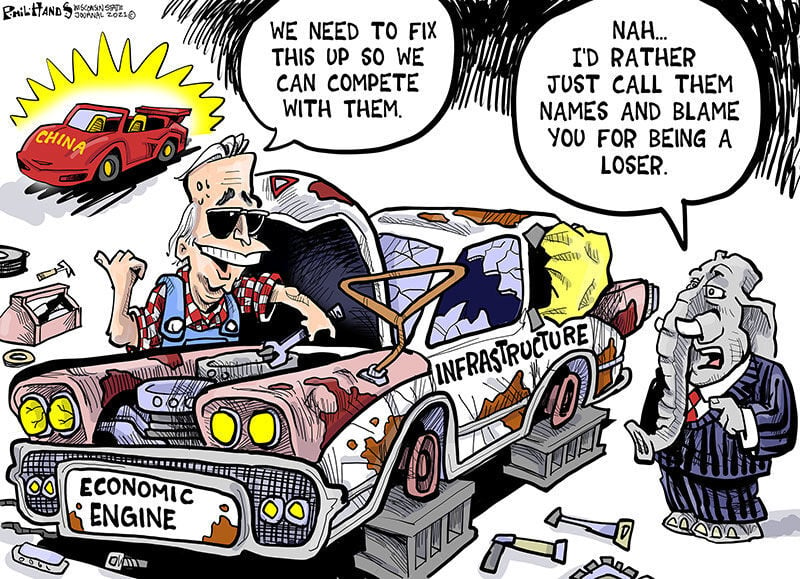
To the surprise of few, it looks like there isn’t going to be a Republican alternative to Biden’s infrastructure proposal. They’re just going to say no. More about this in one of the featured posts.
Senator Ed Markey and Rep. Jerry Nadler have introduced a bill to expand the Supreme Court, but Nancy Pelosi says she’s not going to bring it up for a vote.
The Falcon and the Winter Soldier series on Disney Plus is examining race in a way I didn’t expect from the Marvel Universe, even after Black Panther.
At the end of Avengers: Endgame, Steve Rogers returned to the 1940s and left the shield of Captain America to Sam Wilson, the Falcon. What to do with that shield, and with the Captain America identity it represents, is the central issue of F&WS. And that issue ends up hinging on the question: What can or should American patriotism mean to a Black man? In this week’s episode (#5) a bitter Black super-soldier from the 1950s (Isaiah Bradley) tells Sam: “They will never let a Black man be Captain America, and no self-respecting Black man would want to be.”
Sam is becoming the Barack Obama to Bradley’s Jeremiah Wright. (“For the men and women of Reverend Wright’s generation, the memories of humiliation and doubt and fear have not gone away; nor has the anger and the bitterness of those years. … That anger is not always productive … but the anger is real; it is powerful. And to simply wish it away, to condemn it without understanding its roots, only serves to widen the chasm of misunderstanding that exists between the races.”) He’s looking for a way forward that acknowledges and respects the experience of the people who came before him.
After decades of TV series that either made Black people invisible, stereotyped them, or cast them in roles where their race really didn’t matter, lately we’ve gotten a bumper crop of high-quality race-examining major-studio TV: Lovecraft Country, Watchmen, and many others.
Paul Krugman did a responsible thing Friday: He committed his thoughts about inflation to print before actual inflation heats up.
There are indeed reasons to be worried about inflationary overheating. In fact, even those of us who think it will be OK expect to see above-normal inflation this year. We just think it will be a blip. … [I]t seems to me that we should make that argument now, so as not to be accused of making excuses after the fact. This is a good time to identify which aspects of inflation might worry us, and which shouldn’t.
In short: He expects the economy to boom in the coming year, for two reasons:
vaccinated people who have been working from home and saving their money start to get out and spend that money
the government’s emergency anti-Covid spending.
Inflation will be part of that boom, as oil prices go back up and some parts of the economy grow faster than others, creating bottlenecks.
But history shows us two very different kinds of inflation: temporary blips, like during wars, and “embedded” inflation, like in the 1970s. The first kind of inflation goes away on its own as soon as the situation that caused it abates. The second won’t end without some kind of drastic intervention, like when the Fed shut down the 1970s inflation by raising interest rates over 20% and causing a major recession.
So the tricky thing going forward will be how to interpret inflation numbers: There’s nothing to worry about when depressed prices return to normal, or when a bottleneck sends prices of some particular commodity soaring temporarily. But a general inflation, where prices go up because prices are going up, is more serious.
and let’s close with an overdose of cuteness
A boy romps with golden retriever puppies, and is mobbed by them when he falls down. One of the commenters says: “This should be prescribed as a cure for depression.”
When a political party has no solutions to real problems, it has to make up fake problems.
As I discussed in the previous post, and have covered in more detail before, the GOP is not a governing party any more. If you are concerned with any real problem facing America today, they have no plan for dealing with it.
When a party is in that situation, it needs to distract the public with phony issues and phony solutions. And so, Republican majorities in legislatures around the country are passing voter-suppression laws under the guise of solving an “election integrity” problem that doesn’t exist, and is based on the Big Lie that Trump had the 2020 election stolen from him.
Those laws are a serious threat to our democracy, but at least the threat is obvious to the general public, which can then organize against it. You don’t need any special experiences or insight to understand that Georgia Republicans did something underhanded when they made it illegal to give water to people waiting in line to vote.
But the second distraction is easier for most of the electorate to overlook, because it only affects a minority that is reviled by the conservative base and misunderstood by much of the rest of the public: transgender people.
Gender-affirming care. Two kinds of anti-trans bills are working their way through red-state legislatures, and some have already become law. One bans what is called “gender-affirming care”: medical interventions (like puberty-blocking drugs) that suppress the development of characteristics related to the gender the child wants to transition from or (like estrogen or testosterone) encourage the development of characteristics related to the gender the child wants to transition to. So even if a child, the child’s parents, and their doctors all agree on a course of treatment, the state makes it illegal.
As the HR article points out, anti-trans activists have changed their tactics, but not their goals. A few years ago, anti-trans “bathroom bills” were justified by painting trans youth as predators: They would invade your child’s gender-appropriate bathroom for nefarious purposes. The current wave of anti-trans bills paints them as victims: They need “protection” from the gender-transition “fad” sweeping their generation, and the predatory doctors who profit from it. But these contradictory messages are being pushed by exactly the same people.
Trans athletes. The second kind of bill bans trans girls from sports. The Guardian summarizes:
The youth sports bills, which claim to “promote fairness in women’s sports”, are based on a simple claim: that boys will be allowed to compete against girls and have an unfair advantage.
“They’re telling parents of cisgender children that you’re losing something by allowing transgender youth to play in sports,” said Alphonso David, president of the Human Rights Campaign (HRC), an LGBTQ+ rights group. “We’ve seen this playbook before – you’re losing something if you allow same-sex couples to marry, if you protect racial minorities in the workplace, if immigration laws are respected. It’s us v them.”
In the same way that the bills to “protect” gender dysphoric youth are promoted by groups that were never interested in them before, these bills to protect girls sports are championed mostly by legislators who have shown little interest in girls sports until now. (Like the bathroom bills and the bills banning gender-affirming care, many of the girls-sports bills have been written by the Alliance Defending Freedom, a group motivated by conservative Christian religious views.)
It is the intent of the Legislature to maintain opportunities for female athletes to demonstrate their skill, strength, and athletic abilities while also providing them with opportunities to obtain recognition and accolades, college scholarships, and the numerous other long-term benefits that result from success in athletic endeavors and to promote sex equality by requiring the designation of separate sex-specific athletic teams or sports.
And that sounds marvelous, but for one fact: There’s no reason to believe that any of those opportunities for female athletes are at risk. As an ACLU report observes “transgender women and girls have been competing in sports at all levels for years”. In no state are girls sports events or teams dominated by trans athletes. Similarly, the WNBA, LPGA, and other professional women’s sports leagues have not been not overrun with trans women.
Across the country, girls participate in sports if they want to. They are not running into problems that a trans-ban will solve.
Running on the boys’ team as a ninth-grader in suburban Hartford, Terry Miller was an average track athlete, online records show, failing to qualify for any postseason events. But in 2018, Miller came out as a transgender girl. In her first season running against other girls, as a sophomore, Miller dominated. She won five state championships and two titles at the New England championships, beating the fastest girls from six states.
The next fall, as a junior, Miller won another four state titles and two more all-New England titles. In several races, she was followed closely by Andraya Yearwood, another transgender girl who had also won three state titles. … Girls who lost to [Miller] and their coaches complained that she had an unfair advantage. Parents of other girls started online petitions demanding state high school officials add a testosterone suppression requirement for transgender girls.
One measure of how rare such a situation is, though, is the number of articles that use this same example. (Anybody got a second one?) Retired high school coach Larry Strauss called competition from trans athletes a “non-controversy”.
Competitive equity is a beautiful and elusive objective for those of us who coach or oversee high school athletics. It is why we have junior varsity teams and freshmen and sophomore teams and why we try to match up teams that won’t slaughter one another. It often does not work out that way and we have all seen and heard about lopsided scores in high school football and basketball and pretty much every other sport.
There are athletes whose physical gifts and athletic talent make them so dominant that it really doesn’t seem fair (I know firsthand, having coached against some of them). And does anyone believe there is any justice in the so-called “genetic lottery”?
Scientifically, the jury is still out on when or whether trans girl athletes — particularly the ones who transitioned without going through puberty, or have received hormone treatments — have an advantage over cis girl athletes, and if so, how big that advantage is.
But what we do know is that girls sports are doing fine. To me, the right question isn’t whether trans athletes occasionally win, or even whether those victories violate some abstract ideal of fairness. The right question is whether including trans athletes ruins female sports programs for everybody else. That seems not to be happening.
In the absence of an identifiable problem, the point of these bills seems to be to harm and stigmatize transgender folk, not to protect impressionable teens or girls sports programs.
Republicans agree on one thing: They don’t like Biden’s proposal. But that’s about all.
[WV Senator Shelley Moore] Capito, who, as the top Republican on the Environment and Public Works Committee, is stuck in the middle of the struggle, said she’s crafting a “conceptual Republican bill” that includes investments in roads and bridges.
“We’re working on that right now. We haven’t made consensus on it,” she said.
Good luck with that, because Republicans still haven’t produced an alternative to ObamaCare, after more than a decade of railing against it. They have hated it to the point of shutting down the government, but an alternative? That’s too much to ask. Formal announcement of the “terrific” plan that Trump claimed to have in 2015 was always just two weeks away, but we still haven’t seen it. In 2017, he let the GOP majorities in Congress create their own “repeal and replace” bill, but the “replace” part remained empty until John McCain’s famous thumbs-down put the kibosh on the whole effort.
Similarly, when Trump really needed a Covid relief bill for his re-election campaign, Republicans couldn’t unite on one. There is no GOP plan for climate change or entitlement reform or competing with China or preventing mass shootings or solving any other American problem. They hate what Democrats want to do, and that’s as far as they go.
If the GOP was going to have a policy on anything, though, you would think it would be infrastructure. From the early Trump campaign to the American First Caucus platform that leaked this week (the one that honors America’s “uniquely Anglo-Saxon political traditions”), infrastructure has been a key pillar:
Infrastructure is one of the few areas where the federal government should exercise its constitutional authority. For decades, America has been sending trillions of dollars out the door to support the infrastructure of other nations — even to countries that hate the United [States] — with nothing to show for it. Simultaneously, our domestic infrastructure is failing, crumbling and decaying from within. This Caucus will work to direct as much money as possible to our domestic infrastructure needs.
OK, maybe we shouldn’t expect “direct as much money as possible” to include voting for a Biden proposal. But if something is that important, you’d think there would be a plan for doing it.
When I see the crumbling roads and bridges, or the dilapidated airports or the factories moving overseas to Mexico, or to other countries for that matter, I know these problems can all be fixed, but not by Hillary Clinton. Only by me.
But for before long, “infrastructure week” became a running joke. The “framework” Trump presented in 2018 never drew backing from the Republican majorities in Congress, and after the GOP lost the House, Trump walked away from negotiating with Nancy Pelosi about infrastructure until Democrats “get these phony investigations over with”. As re-election loomed, he floated price tags of $1 trillion or $2 trillion for unspecified infrastructure, but Congressional Republicans once again refused to line up behind it.
So if you ask leading Republicans whether they want to rebuild American roads and bridges, they’ll say they do. But they don’t want to raise taxes for it, and they don’t want to borrow money either. Some may talk vaguely about cutting other spending to compensate, but the those specifics also never appear. (Ten years ago, Paul Krugman was already making fun of Speaker Paul Ryan’s “magic asterisk” of unspecified spending cuts.)
That’s why this week’s headline was so predictable: Republicans are unanimously against Biden’s proposal to do what Trump said he wanted to do but never got done. It’s too big, it’s not really infrastructure, and so on. So what’s their alternative plan for solving this problem?
A counteroffer is key to beginning any process that might resemble negotiations.
One lesson President Biden seems to have learned from his Obama-administration experience is not to make concessions in exchange for nothing. If there is nothing that Republicans support, then their votes aren’t winnable. End of story.
The obstacle is that he can’t offer them what they really want: roads and bridges that appear by magic, without anyone needing to pay taxes or take on debt, and without Biden getting credit for them.
In January, after Biden announced his Covid relief proposal, Republicans pretended to make a counteroffer. Of course, it didn’t come from Mitch McConnell or anyone else authorized to speak for the whole caucus. It came from ten “moderate” GOP senators — coincidentally, the exact number needed to overcome a filibuster. That meant that if Biden gave up on the filibuster-avoiding reconciliation process, each of the ten Republicans would have veto power over the final bill. And their offer was a $600 billion package that was not even one-third of Biden’s $1.9 trillion proposal, which the American people supported.
So: give up the great majority of what you think is needed, trust that McConnell won’t turn any of us, give all ten of us the power to scupper the whole deal if any of the final details aren’t to our liking, and then maybe we’ll vote with you and with the American people.
Such a deal. Biden ignored them, got the package he wanted through reconciliation (with zero Republican votes in either house), and did something popular besides.
This time, even a phony counteroffer doesn’t seem to be in the cards. Senator Manchin may pine for the days of bipartisanship and lament the resort to reconciliation. But he does want an infrastructure bill to get done, and even he has to realize that you can’t work out a compromise with people who can’t say yes.
So that’s the choice: Vice President Harris breaking the tie on an all-Democratic reconciliation bill, or nothing.
Biden’s announcement ends not just to our war in Afghanistan, but 20 years of fantasies about what “six more months” can accomplish there.
Wednesday, President Biden announced that our troops (and those of our NATO allies) will leave Afghanistan by September 11. Unlike previous dates for withdrawal, this one isn’t based on achieving some kind of stability or other goals first; we’re just getting out.
That announcement touched off a lot of comment, both pro and con. Pro: Leaving saves American lives and resources, and gives our military more flexibility to confront challenges more central to our well-being, as may come from Russia (in Ukraine) or China (in Taiwan). Con: Without us, the Afghan government will probably fall to the Taliban. That will definitely be bad for the Afghan people, and could also harm us if the Taliban starts sheltering terrorist groups like Al Qaeda again.
But one argument has been conspicuous by its absence: If we stay for six more months, or a year, or three years, Afghan democracy will stabilize, the Afghan Army will finally have enough training, and the government we leave behind in Kabul will be able to sustain itself.
The generals and their media allies have been making that argument for almost 20 years, and I was pleased to hear Biden blow it up:
So when will it be the right moment to leave? One more year, two more years, ten more years? Ten, twenty, thirty billion dollars more above the trillion we’ve already spent? …
“Not now” — that’s how we got here. And in this moment, there’s a significant downside risk to staying beyond May 1st without a clear timetable for departure.
If we instead pursue the approach where [the US] exit is tied to conditions on the ground, we have to have clear answers to the following questions: Just what conditions [will] be required to allow us to depart? By what means and how long would it take to achieve them, if they could be achieved at all? And at what additional cost in lives and treasure?
I’m not hearing any good answers to these questions. And if you can’t answer them, in my view, we should not stay.
Biden acknowledges the possibility of a terrorist resurgence in Afghanistan, but plans to deal with that if and when it happens.
We’ll not take our eye off the terrorist threat. We’ll reorganize our counterterrorism capabilities and the substantial assets in the region to prevent reemergence of terrorists — of the threat to our homeland from over the horizon. We’ll hold the Taliban accountable for its commitment not to allow any terrorists to threaten the United States or its allies from Afghan soil.
I think of The Washington Post as the hometown paper of the defense and foreign-policy establishment, and it has been playing that role this week. The Post’s editorial board responded to Biden’s plan by predicting that “the likely result will be disaster”. But even they acknowledged that their alternative path offers no exit.
A strategy of leaving troops in the country in an effort to force the Taliban to compromise could extend the U.S. commitment for years without achieving a durable peace.
And WaPo columnist Max Boot offered a much-scaled-down version of the usual rosy scenario:
To avert such a dire contingency, Biden would not have to wage a “forever war.” He would merely have to keep a relatively small number of U.S. forces to advise and assist the Afghans who already undertake almost all of the fighting.
So: a forever skirmish, not a forever war. We’ve recently gone a whole year without a combat death in Afghanistan. Maybe that happy circumstance will continue, and the price of freezing the status quo will be low enough to tolerate indefinitely.
Or maybe not. Maybe the Taliban will tire of trying to wait us out, and will go back to trying to drive us out. And if combat deaths go back up, that will be its own reason to stay, so that the troops we are losing will not have died in vain.
But notice: This disagreement is between two sides that each have at least one foot in reality. Maybe the cost of staying in Afghanistan forever will be tolerable, or maybe we’ll find some better way of dealing with the increased terrorism threat of a Taliban-ruled Afghanistan. But nobody is counting on the Freedom Fairy to sprinkle her dust over Kandahar.
So whether you agree with Biden on this or not, you should at least thank him for bringing some honesty into the conversation.
Having written more-or-less even-handedly up to this point, I’ll take a side: I’m with Biden on this.
Way back in 2005, I expressed very similar ideas (about Iraq) in a 2005 essay I provocatively titled “Cut and Run“. At the time, “serious” foreign-policy experts were finally admitting that the 2003 Iraq invasion had been a mistake and we needed to get our troops out. But they always paired that concession with some sort of “after we fix what we’ve broken” caveat. (This became known as the Pottery Barn rule.) Typically, the sages thought our troops needed six more months to “stabilize the country” or “establish democracy” or achieve some other worthy but nebulous goal. (NYT columnist Thomas Friedman rolled his six-more-months projections forward with such regularity that six months became known as a Friedman unit.)
In “Cut and Run” I demanded a measurable answer to the question “What are we fixing?” Because in my opinion our military presence wasn’t fixing anything. After six more months, Iraq would still need “stabilizing”, and our troops would have to stay longer.
We can leave Iraq now, or we can leave after our losses have grown. That is the only choice we have.
I feel the same about Afghanistan today, after nearly 20 years of war. Whatever our original intentions might have been, by now it’s clear that we’re not building a secular, democratic, pro-Western government that will someday be strong enough to stand on its own.
There’s a lesson here, and it’s the same lesson we should have learned from Vietnam: In order to install a new form of government in a country, people on the ground have to be buying what you’re selling. As The Boston Globe’s H. D. S. Greenway puts it: In both Vietnam and Afghanistan
our clients could never shake the impression that they were puppets fighting for foreigners, while the Viet Cong and the Taliban were able to present themselves as the true patriots fighting to rid their country of colonialism.
In South Vietnam, all we had to work with was the remnant of the old French colonial administration, which local people joined for the sake of power and profit, not because they believed in the French Empire or anti-Communism or some other idealistic notion. In Afghanistan, we have a corrupt government in Kabul supported (up to a point) by a patchwork of warlords in the countryside. The Afghan people don’t believe in it, because they shouldn’t believe in it.
Over the last two decades, hundreds of thousands of American troops have served in Afghanistan — most of them honorably and some heroically. It is a shame that their effort and sacrifice has not produced a lasting result that our nation can point to with pride. But more effort and sacrifice will not redeem what bad policy has already wasted. We need to leave.
Wednesday, Rachel Maddow brought up another good point about this war, illustrated by the experience of Taliban hostage David Rhode, the Pulitzer-winning NYT journalist who was held for seven months in 2008-2009. Rhode was actually only a prisoner in Afghanistan for a week; for the half-year beyond that, the Taliban kept him in parts of Pakistan where they had free rein.
Knocking the Taliban out of power in Afghanistan was one thing. Defeating them in some kind of larger war, preventing them from ever rising again in Afghanistan, that was something that a US military conflict in Afghanistan was never going to be able to do. Not when the Taliban wasn’t confined to Afghanistan and wasn’t really based there.
In August 2010, a former Pakistani intelligence officer approached the U.S. embassy station chief in Islamabad and offered to reveal bin Laden’s location, in return for the $25 million reward, according to a retired senior U.S. intelligence official.This story was corroborated by two U.S. intelligence officials speaking to NBC News, and had been previously reported by intelligence analyst Raelynn Hillhouse. The Pakistani official informed U.S. intelligence that bin Laden had been located by the Pakistani intelligence service ISI in 2006, and held under house arrest near Pakistani intelligence and military centers ever since.
According to the retired senior U.S. intelligence official speaking to [journalist Seymour] Hersh, bin Laden was ill at this point, financially supported by some within Saudi Arabia, and kept by the ISI to better manage their complex relationship with Pakistani and Afghan Islamist groups.
So a fully military solution to the Afghan problem would mean, at a minimum, expanding the war into Pakistan, and taking down factions within the Pakistani government. Pakistan, you may recall, is a nuclear power.
I don’t think anybody wants to open that can of worms.
Last week I couldn’t come up with a featured post, so this week there are three.
The first one discusses President Biden’s decision to pull our combat troops out of Afghanistan by September 11. Unlike any announcements by previous presidents, this isn’t a goal that assumes we’ll produce some good outcome by then, and that will be reversed when we don’t. We’re just leaving.
The thing I like best about this announcement is that it has finally provoked the kind of honest discussion we should have had many years ago: Our troops are not fixing Afghanistan, so there is no point in the future when they will be done fixing it. The choices are (1) stay forever, and (2) pull out and let the Taliban take over. There are arguments for and against each path, but those are the choices. I’ll discuss that in “Finally, some honesty about Afghanistan”, which should be out shortly.
The second featured post discusses what I call “the most predictable headline of the week”: Republicans haven’t been able to unite behind an alternative to Biden’s infrastructure plan. The GOP doesn’t have a healthcare plan, a climate-change plan, or a plan to address any other real American problem. Why would anyone expect them to have an infrastructure plan? That post “The GOP: Still not a governing party” should be out around 10 EST.
The third post was supposed to be a note in the weekly summary, but there was too much to cover. When you’re a political party with no solutions to real problems, but you have power, you have to talk about something. So Republican state governments are passing anti-trans laws to address problems that aren’t problems, like confused youth being talked into gender transition by the media and predatory doctors, or cis girls being chased out of girls sports programs by boys claiming to be girls. I don’t have a title for that yet, but I’ll try to get it out by 11.
Finally, the weekly summary has new shootings to discuss, both mass shootings and police shootings. The Chauvin trail is heading into closing statements. Apparently there really was collusion between Russia and the Trump campaign. Marjorie Taylor Greene briefly tried to assemble a American First Caucus in the House to protect our “uniquely Anglo-Saxon political traditions”. And a few other things happened. I’ll try to get that out by noon.
When I look into that officer’s eyes, they’re not looking at me like I’m another human being. At best, I’m a threat. At worst, I’m an animal. That is unacceptable.
– Delegate C.T. Wilson of the Maryland House describing his experience dealing with police as a large Black man
There is no featured post this week.
This week everybody was talking about the Chauvin trial, and policing in general
The prosecution is getting close to wrapping up its case against Derek Chauvin. The defense should start this week.
I’ve found the defense attorney’s cross-examination of prosecution witnesses hard to watch, so I suspect the case they present will be even harder. In the words of The New Yorker’s Jeannie Suk Gersen, “The defense’s best hope is to instill doubt about what jurors can plainly see.”
The argument will probably be a kind of rhetorical sleight-of-hand that shows up fairly often, but doesn’t get nearly enough attention: Reduce the scene to a verbal description, then weave a new scene from that description. (I first noticed this technique during the Clinton impeachment trial. The public wasn’t buying that Clinton should be removed for having an affair and covering it up. So Republicans didn’t talk about that directly. Instead, they reduced Clinton’s actions to the legal categories of perjury and obstruction, then argued that perjury and obstruction were impeachable offenses, as they might be in other circumstances.)
So this week the horrified bystanders to Chauvin’s crime will become a potentially dangerous mob. The struggles George Floyd made while he was upright will be painted as plausible threats from his prone, handcuffed, unconscious, and dying body. Floyd’s death will be attributed to drugs and pre-existing health problems, with Chauvin’s knee on his neck merely incidental.
Reassemble that, and the defense’s question becomes: If an officer under threat from a dangerous mob is using force to subdue a resisting suspect, and the suspect happens to die for other reasons, is the officer really guilty of anything? Jurors will be invited to imagine other possible scenes that fit this description, and the blameless officers who might be convicted by the standard they set here.
Such a scene isn’t at all what the videos of Floyd’s death show, but if one juror can be induced to forget or ignore what he saw, Chauvin goes free. As the prosecutor said in his opening remarks: “Trust your eyes.”
Here’s why I expect: Chauvin won’t go free, but he won’t be convicted of the highest charge, second-degree murder. (IMO, that charge is already too low.) Consequently, he’ll face a sentence that will appear to devalue George Floyd’s life. Riots will erupt in Minneapolis and possibly elsewhere. The legal decision will be a done deal at that point, so the question will be whether Black Lives Matter activists can craft some demand that can still be met.
However the trial comes out, it’s worth appreciating that Chauvin was only charged because bystander videos went viral. If not for video, police would have circled the wagons around him and nothing would have happened. I have to wonder how many murders by police haven’t been prosecuted because the only surviving witnesses were other police.
If Chauvin goes free in spite of the video, I don’t know what comes next. Any conservatives who express horror at riots should have to answer this question: What is a community’s appropriate response when police can murder its members, the murder can be posted on YouTube, and they get away with it? What should people do when this happens over and over?
Chief Tim Gannon of the Brooklyn Center Police Department said an officer had shot the man on Sunday afternoon after pulling his car over for a traffic violation and discovering that the driver had a warrant out for his arrest. As the police tried to detain the man, he stepped back into his car, at which point an officer shot him, Chief Gannon said.
To me, it matters what the warrant was for. Was 20-year-old Daunte Wright a dangerous criminal whose immediate apprehension was necessary for public safety? Or might police have simply followed until Wright realized he wasn’t going to get away? Or did the officer decide that Wright’s failure to obey carried a death sentence, independent of whatever his original crime might have been?
The shooting touched off a riot Sunday night, and the National Guard was called out.
Nobody died in this incident, but it’s still not right: Two Virginia police approached an Army lieutenant at gunpoint, then pepper-sprayed him when he refused to get out of the car until they explained why they had stopped him. The lieutenant has filed a lawsuit against the officers.
Why are you like this?—when someone asks a police officer why he’s being asked to exit his vehicle or why he’s being stopped in the first place, why the hell can’t cops respond by…oh, I don’t know…answering the fucking question? Instead, the officers in this instance appear to have responded by typical aggression and equally typical police brutality.
Incidents like this give me sympathy for the “Abolish the Police” movement. I understand that laws need to be enforced somehow, but are men who behave like this really making us safer? Sometimes I think we should just fire everyone and start over (like the former Soviet republic of Georgia did). Maybe we should contract our policing out to civilized countries like New Zealand or Iceland.
I’m going to keep repeating this point until it’s widely acknowledged. Whenever you compare US policing to other countries, somebody raises the point that US criminals are more dangerous, because so many of them have guns. (“I’d rather be judged by 12 than carried by 6” police tell each other.) So: Trigger-happy police is a price we pay for not controlling guns.
Tom Nolan, a 27-year veteran of the Boston Police Department who’s now an associate professor of criminology and criminal justice at Merrimack College, said, “Certainly it’s not in compliance with standard police training and protocol to shoot at individuals who are fleeing the police. The police are not trained to do that unless there is a threat to an officer or innocent bystander or an imminent danger of serious bodily injury or death. Absent that there’s no justification.”
The changes do not go as far as some social justice advocates had hoped: Discipline will now largely be decided by civilian panels, for example, but police chiefs maintain a role. Some activists wanted the panels to act independently of police.
Still, the legislation imposes one of the strictest police use-of-force standards in the nation, according to experts; requires officers to prioritize de-escalation tactics; and imposes a criminal penalty for those found to have used excessive force.
A Democratic legislator described the danger he faces from police simply because he is a large Black man.
When I look into that officer’s eyes, they’re not looking at me like I’m another human being. At best, I’m a threat. At worst, I’m an animal. That is unacceptable.
Saturday Night Live’s opening skit featured a disagreement between White and Black Minneapolis news anchors: White anchors are confident that justice will be done in the Chauvin trial, while Black anchors say “We’ve seen this movie before.”
and the virus
Today should pass 120 million people at least partially vaccinated. (I get my first shot tomorrow.) The number of new cases continues to edge upward, running just below 70K per day. Deaths continue to slowly decline.
Anecdotally, I’ve been hearing for weeks that vaccination appointments were easier to get in red states, where more people are skeptical of the vaccines and even of the seriousness of Covid-19. Now there are numbers to back that up.
Russians understand that the government is lying to them about Covid deaths, and that produces a nasty result: They don’t trust the government about vaccines either. (Russia produces its own vaccine, which apparently is pretty good.)
One conclusion to draw is that of all forms of government, the one that has handled Covid the worst is authoritarian populism. Of all large countries, possibly the most inexcusably bad responses to the pandemic are the US (Trump), Russia (Trump’s role model Putin), and Brazil (led by Jair Bolsonaro, “the Tropical Trump“).
Analysis of a sample of anti-vaccine content that was shared or posted on Facebook and Twitter a total of 812,000 times between 1 February and 16 March 2021 shows that 65 percent of anti-vaccine content is attributable to the Disinformation Dozen.
I should have linked to this last week: The Trump campaign solved a cash crunch late in the 2020 campaign by scamming its own donors. Recurring donations were the default, which you had to read carefully to opt out of.
The sheer magnitude of the money involved is staggering for politics. In the final two and a half months of 2020, the Trump campaign, the Republican National Committee and their shared accounts issued more than 530,000 refunds worth $64.3 million to online donors.
I keep hearing that Republicans are bound to win back the House in 2022, because midterm elections usually favor the party that’s out of power. But I think the GOP faces an unusual number of problems this cycle, like explaining why they’re voting against things their voters like, and whether or not the party should continue to be a Trump personality cult now that he’s literally one of those crazy old men ranting about socialism.
An RNC donor retreat went to Mar-a-Lago Saturday for a Trump speech. (The Great Man could not come to them.) The speech made headlines for attacking his own party’s Senate leader. (He called Mitch McConnell a “dumb son of a bitch” and a “stone cold loser”.)
As Playbook and the New York Times have reported, Trump has become a complication for donors. They don’t want their money going toward his retribution efforts. Remember: These are exorbitantly wealthy people — some with egos as big as Trump’s — and they are not interested in hearing about how another rich guy had his ego bruised.
The 2022 GOP primaries are going to be nasty affairs, and many of them will be won by QAnon crazies or outright fascists. Republicans proved in Alabama in 2017 and Missouri in 2012 that a bad enough candidate can blow a race anywhere, and 2022 will feature some historically bad GOP candidates.
Fascist/supremacist rhetoric is getting increasingly explicit in Republican circles. Last week I quoted from an article from the Claremont Institute calling for a “counter-revolution” because “most people living in the United States today—certainly more than half—are not Americans in any meaningful sense of the term.”
I know that the left and all the little gatekeepers on Twitter become literally hysterical if you use the term “replacement,” if you suggest that the Democratic Party is trying to replace the current electorate — the voters now casting ballots — with new people, more obedient voters from the Third World. But they become hysterical because that’s what happening, actually. Let’s just say it. That’s true. …
It’s a voting-rights question. In a democracy, one person equals one vote. If you change the population, you dilute the political power of the people who live there. So every time they import a new voter, I become disenfranchised as a current voter.
In the link, Jonathan Chait points out how weird this framing is: The ordinary use of “replacement” would imply that current US citizens are being kicked out as new immigrants come in, which no one thinks is happening.
My employer hires new writers pretty often. If they fired me and gave my job to a new writer, that would be replacement. If they just created a new job, and assigned the writers to work alongside me, that would not be replacement.
If we take Carlson’s “voting-rights” view seriously — which I don’t believe he does, because he only pays attention to its anti-immigrant conclusions, rather than its full implications — then when my white ancestors arrived in the 1840s, they disenfranchised the previously established Americans; every American who turns 18 disenfranchises the rest of us; and our votes gain power whenever any other American voter dies. (Go, coronavirus!)
And let’s not ignore the racism of assuming that immigrants from the largely non-white Third World are “more obedient voters”, rather than human beings who can think for themselves. Also: No one is importing “new voters”. When immigrants arrive here (by their own choice rather because some sinister cabal “imports” them) the road to citizenship is long and full of obstacles. This is especially true for those who circumvent the legal immigration process.
Replacement Theory also comes with a lot of baggage Carlson didn’t mention, but that his white-supremacist fans are well aware of. Chait summarizes:
When Nazis marched in Charlottesville in 2017, they chanted “You will not replace us!” and, somewhat more clarifying, “Jews will not replace us!” The terrorist who gunned down 51 people in Christchurch, New Zealand, used this slogan (“The Great Replacement”) in his manifesto. …
“Replacement theory” imagines that an elite cabal, frequently described as Jewish, is plotting to “replace” the native white population with non-white immigrants, who will pollute and destroy the white Christian culture.
So why would a TV host mangle the English language in order to get the word “replacement” into his screed? Because he wanted to invoke the baggage. Tucker was giving a shout-out to the Nazis in his audience.
John Boehner has written a book in which he breaks with the Republican Party in its current form. I feel like I ought to read it, but I don’t want to, and I certainly don’t want to pay for it. I anticipate feeling the same frustration with it as the NYT’s reviewer.
Boehner doesn’t acknowledge the role that his generation of Republicans played in building the bridge from Ronald Reagan’s era to our current times. … Boehner’s memoirs are an X-ray into the mind of Reagan-era Republicans who did whatever was necessary to win and who today are seeing the high costs of their decisions.
Boehner’s generation thought they could pander to the reality-denying right-wingers while keeping them under control — basically the same mistake German industrialists and aristocrats made with Hitler. And their heirs are still doing it: Kevin McCarthy knows that Trump is an idiot and QAnon is insane, but he won’t say so. I don’t have a lot of patience with their self-justifications.
On the other hand, the way Trumpism ends is that everybody who’s not a Trumpist leaves the Republican Party, which then goes down to historic defeats until it reorganizes, once again becoming a political party with a message for the political center, rather than an authoritarian cult that sponsors political violence. Max Boot acknowledges that necessity:
those of us on the center-right can’t afford a third-party flirtation. We need to become Biden Republicans.
So I welcome Boehner’s book as a harbinger of a GOP crash-and-burn. But I’m not looking forward to reading it.
and you also might be interested in …
Matt Gaetz’ troubles aren’t getting any better. CNN reports that Trump has refused to meet with him, and Trump certainly failed to mention Gaetz during his Saturday-night ramble in front of GOP donors. Meanwhile, the attorney of his associate Joel Greenberg is hinting at a plea deal.
As I said last week, I’m waiting for some official documentation (like an indictment) before I follow this for any reason other than entertainment. But it is entertaining. The NYT told more of the Greenberg story yesterday.
While I was looking for the SNL video above, YouTube recommended I look at this Jen Psaki press briefing from March 10, where a Fox reporter peppered her with hostile questions about the situation at the Mexican border and school reopenings. This is why I love Psaki: no insults to the reporter, no rants about his network’s obvious bias or falling ratings, no threats to have his White House pass revoked. She fields the questions calmly and answers with facts.
The new Ken Burns series has people talking about Ernest Hemingway again. I’m reminded of a pattern I usually illustrate with Don Henley’s song “The Boys of Summer” (an old-guy reference that readers can update for themselves): A 15-year-old hears it and thinks, “That’s how it feels to be in love.” Ten years later he hears it and thinks, “That’s so immature. I can’t believe I ever liked that song.” Then another ten years pass and he thinks, “That’s how it felt to be in love when I was 15.”
In other words: First you’re captured by a point of view. Then you’re trying to get distance from it. But eventually you feel secure in your distance and can look back more fondly.
I think we might be ready for that third stage of reading Hemingway. First, people read his books and thought: “That’s what it means to be a man.” Then “His books are full of toxic masculinity.” Now maybe we can read him and think: “That’s what it’s like to wrestle with toxic masculinity.”
After all, Hemingway heroes are not John Wayne or James Bond. Their masculine virtues don’t lead to triumphs that right all the wrongs and let them live happily ever after with either the girl of their dreams or an endless parade of Pussy Galores. Hemingway stories center on lonely men struggling to get by in a world that is either godless or ruled by a God who is the Father in all the wrong ways. Maybe they’re a pretty accurate picture of where excessive masculinity leads.
As a writer, I feel indebted to Hemingway as a pivotal figure in American prose. 19th century novels still reflect old-time oral story-telling, where long florid descriptions help pass the endless winter nights. Hemingway changed everything by writing novels in the style of a newspaper, where each column-inch is valuable and needs to accomplish something.
We’re still influenced by him, whether we know it or not. If you’ve ever gotten impatient with an author and thought, “Can we just get on with this?”, or if you’ve had a writing teacher tell you, “Show, don’t tell” — you’ve been influenced by Hemingway.
I haven’t watched Burns’ Hemingway series yet, but I did watch HBO’s “Q: Into the Storm“, in which filmmaker Cullen Hoback tries to identify Q, and ultimately decides it’s Ron Watkins — “CodeMonkey” of the 8kun site that hosts most QAnon discussion.
I recommend watching this as entertainment, but not taking it too seriously. It is entertaining, though, and it’s fascinating/horrifying to see the people Hoback has been following for years show up at the Capitol on January 6.
and let’s close with something musical
Lubalin is a musician who turns “random internet drama” into songs. They show up on his Twitter feed, which is strangely engaging.
The news that caught my attention this week was the Chauvin trial, and related stories of policing in America. But I don’t have much insight to add to what you can easily find elsewhere, so I’m going to let my observations remain a series of short notes rather than assemble them into a featured post.
So there won’t be a featured post this week, and correspondingly, the weekly summary will be longer than usual. I expect it to post around 11 EST.
Other stuff in the summary: the Biden administration is beginning its fight for a big infrastructure bill, which looks like it will have to pass the Senate through reconciliation, without Republican help. Joe Manchin has reiterated his opposition to reforming the filibuster, as well as his nostalgic fantasy of bipartisan cooperation. So voting-rights protection and gun control look dead, and it’s not clear how big an infrastructure package Manchin will allow.
Red states are starting to hit the wall of vaccine resistance already, while allowing large crowds for sporting events. Texas is moving forward with a Georgia-style anti-voting law. Fox News’ Tucker Carlson openly endorsed the white-supremacist “Great Replacement” theory, while John Boehner’s book raises the question of how many establishment Republicans will leave the Trump personality cult that the GOP has become. Ken Burns has got me thinking about Hemingway again, while HBO led me down the QAnon rabbit-hole.
This week everybody was talking about the Chauvin trial
CSPAN is carrying the trial live, and large chunks of it have been on MSNBC. The Minneapolis Star Tribune is livestreaming it. The Washington Post has put entire days of testimony on YouTube. I’ll let other sites do the legal analysis.
The thing that has struck me (and others) is the emotional tenor of the prosecution’s witnesses. Virtually all the bystanders seem traumatized by their experience. Again and again, witnesses have expressed regret or shame that they didn’t or couldn’t do more to help George Floyd, even though they knew he was being murdered right in front of them. The cashier who made the original call to the police (after Floyd passed him a counterfeit $20 bill) testified: “If I would have just not taken the bill, this could have been avoided.”
I’ve lost track of the number of witnesses who have cried on the stand. CNN’s Don Lemon broke down on his TV show just from listening to Cornell West imagine trying to save Floyd. “Some of us black men, we’re not gonna stand there. We have to intervene in some way. They ain’t gonna kill us like that, and we remain spectators.”
The only people who don’t seem to feel remorse are the cops.
I think it’s important that so much of the trial is being seen live by large numbers of people. When a trial happens far away and the verdict seems strange, it’s easy to yield to the deeper immersion of the jury: I wasn’t there. Maybe the jury came to a different understanding of the case from the one I picked up from the media. Or maybe the evidence I found so convincing wasn’t admissible for some reason.
Not this time. It’s obvious to anybody who’s watching that Chauvin murdered Floyd. If he gets off, the whole country will know that cops are above the law. Financial Times sets the legal stage:
Prosecutors have hedged their bets by pursuing three charges: second- and third-degree murder and manslaughter. The most serious, second-degree murder, requires that prosecutors prove Chauvin unintentionally killed Floyd while committing a felony. Manslaughter only requires proving Chauvin took an unreasonable risk of causing death. Manslaughter carries a maximum prison sentence of 10 years, compared to 40 years for second-degree murder.
The fact that he’s only charged with second-degree murder is already an injustice. Chauvin continued kneeling on Floyd’s neck for nearly ten minutes, while people all around told him that Floyd was dying. How is that not an intentional killing? Houston’s Channel 11 says that the recommended sentence for manslaughter with no prior convictions is four years. Actual time served might be less. Would that feel like justice?
The two most likely scenarios, in my opinion, are either a mistrial (because of one holdout juror), or a conviction resulting in a light sentence (sending the message that a cop killing a black man just isn’t that big a deal). In either case, violent protest is the likely result.
and infrastructure
President Biden came out with his infrastructure plan, the $2 trillion American Jobs Plan. The Washington Post summarizes it in this graphic.
Employing people to build or rebuild the stuff we all use is a fairly popular idea with Americans of both parties. It was implicit in both recent winning presidential slogans: Biden’s “Build Back Better” in 2020 and Trump’s “Make America Great Again” in 2016.
He said as much as Republicans would like to address infrastructure, “I think the last thing the economy needs right now is a big, whopping tax increase,” according to Politico. The Kentucky Republican specifically criticized the plan’s proposed corporate tax rate hike, which he said would hurt America’s ability to compete in a global economy, and the subsequent increase to the national debt.
In other words, McConnell wants to address infrastructure, but without raising taxes or increasing debt. (This is like my desire to lose ten pounds without dieting or exercising.) With those principles in mind, I doubt he’ll be making a counter-proposal. Maybe Republican thoughts and prayers will build bridges the same way they prevent school shootings.
The one upside of McConnell’s position is that he won’t keep us guessing about whether a bipartisan deal is possible: It’s not. You might imagine pealing off two or three Republican senators in spite of McConnell’s opposition, but getting the 10 necessary to survive a filibuster is out of the question.
The only alternative is the same reconciliation path that Biden’s Covid relief plan took, and that depends on keeping all 50 Senate Democrats united. In particular, Joe Manchin has to stay in line. Manchin has previously stated that any infrastructure plan should be bipartisan. But he’s also said he’s for a big infrastructure plan. He’s going to have to choose which of those positions is more important to him.
The fact that they’re already pledged not to support the bill won’t keep Republicans from opining about what should be in it. CNN quotes numerous Republicans musing about what “infrastructure” is, and deciding that it’s only roads and bridges.
Some items in the Biden plan, like support for keeping elderly people in their homes (which might end up being one of the most popular parts), does stretch the traditional meaning of infrastructure. (Bernie Sanders describes them as “human infrastructure”.) But replacing all the nation’s lead water pipes (the ultimate culprits in the Flint water crisis) would be infrastructure under any reasonable definition. Rural broadband hasn’t been in previous infrastructure bills, but there was also a time when interstate highways were a new idea. Modernizing the electrical grid and public transportation systems are likewise infrastructure.
Unlike Covid Relief, this isn’t an emergency bill, so I suspect we’ll have many weeks to discuss the details.
The featured post examines the Georgia election law.
and Matt Gaetz
By now you’ve undoubtedly heard the gist of this story. Super-Trumper and insurrection defender Congressman Matt Gaetz is being investigated for some lurid stuff: sex with a 17-year-old, possibly involving money or interstate travel; sex in exchange for gifts with other women recruited online; and illegal drug use while on these “dates”. Reporters from The New York Times claim to have seen text messages and receipts related to these allegations. All of this is connected with Gaetz associate Joel Greenberg, a former Orlando tax collector who is himself under multiple indictments.
Those accusations have brought out other stories that are unseemly but not illegal in themselves.
Gaetz allegedly showed off to other lawmakers photos and videos of nude women he said he had slept with, the sources told CNN, including while on the House floor. [I assume CNN means the showing was on the House floor, not the sex.] The sources, including two people directly shown the material, said Gaetz displayed the images of women on his phone and talked about having sex with them. One of the videos showed a naked woman with a hula hoop, according to one source.
The fact that his colleagues are telling the press such stories rather than rushing to Gaetz’s defense demonstrates that “His antics have also aggravated a sizable number of his own GOP colleagues, leaving him now with few allies outside of the far-right faction of the party.” (One of those “antics” was going to Wyoming to speak out against Liz Cheney after she voted to impeach Trump.) As far as I know, the only Congresspeople who have defended Gaetz are Jim Jordan and Marjorie Taylor Greene.
Mr. Gaetz’s behavior also came into question during his service in Florida’s state legislature from 2010 to 2016, according to a person familiar with the matter. While in Tallahassee, he and others competed against each other in a contest over having sexual relationships with women, operating under a point system in which participants were awarded one point for sleeping with a lobbyist and two points if the lobbyist was married, this person said.
Also, photos of Gaetz with teen-age girls have been all over Twitter this week. Maybe they were harmless selfies-with-a-celebrity at the time, but events now have cast them in a much creepier light.
I’m of two minds about all this. On the one hand, I already thought Gaetz was a slimeball, so I’m not going to hide my schadenfreude. Picturing Matt Gaetz in an orange jumpsuit makes me smile.
On the other hand: We shouldn’t know any of this yet. Gaetz hasn’t been charged or convicted of anything, and it doesn’t look like The New York Times dug this up through independent reporting. Somebody in the Justice Department must have leaked the investigation (and maybe the receipts and text messages).
That’s not good. The government has enormous investigative powers, and that power should not be abused.
Remember: The heart of the first Trump impeachment was his illegal attempt to pressure Ukraine into investigating the Bidens. The point wasn’t to expose any Biden crimes in Ukraine, since Trump probably knew that there weren’t any. But his goal was to produce a regular stream of “Biden Under Investigation for Ukraine Corruption” headlines, similar to the Hillary-email stories that worked so well for him in 2016 (“Lock her up!”), but ultimately fizzled as investigators found nothing worth prosecuting.
I’m not claiming the Gaetz story is similarly insubstantial, or that the Department of Justice investigation (which apparently began under Bill Barr) is politically motivated. But it’s a bad practice to run people out of town because they’re “being investigated” for something lurid. Anybody could be investigated for anything. And while leaks about investigations can be legitimate if those investigations are being interfered with (so that the normal course of justice is blocked), that also doesn’t seem to be happening here.
So if and when the Gaetz investigation culminates in an indictment, as I’m confident it will if everything we’re reading is true, then that information will legitimately wind up in the public domain. But until then, I’m going to treat this like a National Enquirer story: I’ll follow it for my own entertainment, but I’m not going to demand that it result in any negative consequences for Gaetz, even though I still don’t like him.
McSweeney’s explains how Gaetz fits inside the “party of family values”
We are very much still the party of family values. We’re simply redefining “family values” to reflect what the term actually meant in the first place. Would it be helpful to spell it out? Here you go:
GOP family values noun values that mandate that a woman should marry a man and provide him with sex and free domestic labor
For weeks, new Covid cases had been stuck in a range around 55-60K per day. It seems to have broken out on the upside, and is now around 64K. Typically, this has been interpreted as a battle between vaccination pushing the numbers down and the new variants pushing them up. But I wonder if there might be a different dynamic in play: Maybe what’s been making younger, less vulnerable people take care has been the thought “I don’t want to be the one who gets Grandma killed.” But now Grandma is vaccinated, so they’re taking more risks.
Ultimately, though, the vaccines should win, if we can get enough people to take them. At last count, 106.2 million Americans had received at least one shot, with 61.4 million fully vaccinated. Saturday more than 4 million people were vaccinated. (I’m scheduled to get my first shot a week from tomorrow.)
The March jobs report was really good: The economy added 916K jobs in March, and the January and February estimates were revised upward, accounting for another 156K jobs. The unemployment rate is back down to 6%, which is still way higher than the 3.5% before the pandemic, but well below the April, 2020 peak of 14.7%.
I have no idea how to interpret any of that. I mean, we all knew that jobs would collapse during the lockdown and rebound after reopening. But lots of things are reopening that shouldn’t reopen yet, and new Covid cases are headed back up, so I wonder how sustainable this is.
The big question is where we’ll be when the jobs market starts behaving normally again, assuming that happens. And I think it’s too soon to tell.
To the surprise of nobody who’s been paying attention, Brexit is causing problems in Northern Ireland. The Good Friday Agreement that ended the “the Troubles” in 1998 led to a nearly invisible border between Ireland and Northern Ireland, which remained in the United Kingdom. But Brexit is all about putting a significant border between the UK and the EU, which Ireland still belongs to.
That contradiction was resolved by giving Northern Ireland an in-between status: It stays in the UK, but there now are trade barriers between it and the rest of the UK, so that the border with Ireland can stay open. The pro-British side in Northern Ireland doesn’t like that, and has been rioting this weekend. If they would happen to get their way, the pro-Irish side would probably start rioting.
Trump issued some kind of a statement this week that, like all his statements, was full of lies and got some people upset. But really, who cares? If you need somebody’s permission to ignore him, take mine.
A reminder that the meaning of your religious symbols might not be obvious to others.
The new law really is bad, but not every bad thing said about it is true.
A lot of hot air about this law is being blown in both directions. There are good reasons to oppose it, and I believe Georgia Republicans had bad motives for passing it. But it’s easy (and counterproductive, I think) to overstate the case against it.
So let’s back up and start at the beginning.
After 2020, are there good reasons to pass new election laws?
Actually, yes, but not the reasons that Republicans are giving.
Around the country, states adjusted to the pandemic by improvising new practices for the 2020 elections. State after state made it easier to vote by mail, vote early, vote at the curb of a polling place, or get a ballot by mail and cast it in a drop box. Some states made those changes by an act of the legislature, some by court order, and some by executive decision at either the state or local level.
Wherever the decision was made, it was extensively litigated before the election, which is the appropriate time to do it. [1] Across the board, the two parties followed the conventional wisdom that Democrats do better when more people vote. [2]
So in jurisdictions controlled by Democrats, officials aggressively responded to the pandemic by making voting easier, and were challenged in court by Republicans (who claimed the Democrats exceeded their authority or promoted fraud). In jurisdictions controlled by Republicans, voting rules were changed reluctantly or not at all, and were challenged in court by Democrats (who argued that making people stand in line during a pandemic infringed on their right to vote). I think it’s fair to say that even before Election Day, the 2020 elections were already the most litigated elections in American history, with the possible exception of Bush v Gore in 2000.
But whoever made the pandemic election rules, they were largely made on the fly and under time pressure. So it would be entirely reasonable for a legislature to review their pandemic election procedures now, when they can do the research, look at lessons learned, and hold the extensive debate there wasn’t time for in 2020.
In part that increase is due to population growth, and some may be evidence of highly motivated voters on both sides. But to a large extent this is an if-you-build-it-they-will-come effect: When voting gets easier, more people vote.
One thing we can be very sure of (in spite of Trump’s claims otherwise) is that the votes were counted accurately, particularly in Georgia. Because the race was so close, Georgia’s voting-machine results were re-tallied, followed by a hand recount of paper ballots. There were minor differences in the three counts (as there always are), but nothing approaching the scale of Biden’s 11K-vote victory.
A second Trump claim was that substantial numbers of mail-in ballots were fraudulent. Again, the evidence says otherwise. The Republican secretary of state conducted a review of signatures on mail-in ballots in one large county, finding that the Cobb County Elections Department had “a 99.99% accuracy rate in performing correct signature verification procedures.”
One Georgia election official — also a Republican — characterized Trump’s subsequent fraud claims as “whack-a-mole“. As soon as one was disproved, another would pop up. What Trump really had was a desired conclusion — that he really won — and his people kept manufacturing baseless arguments to reach that conclusion.
What lessons should legislators learn from the 2020 results?
If you believe in democracy, the two outcomes above — high turnout, accurate results — are entirely good. So the obvious and simple lesson of 2020 is that many of the irregular procedures motivated by the pandemic ought to be regularized.
In particular, mail-in ballots work. This should not surprise anyone, since vote-by-mail was already the default system in five states (Washington, Oregon, Hawaii, Colorado, and Utah) plus the District of Columbia. Fraud has not been a major issue in any of these states. There is still no credible evidence that it was a problem in any state that expanded vote-by-mail in 2020. [3]
It would be entirely legitimate, though, for legislatures (in those extensive hearings that Georgia did not hold) to examine their systems to eliminate fraud possibilities that were not exploited in 2020. Republicans undoubtedly would do this in bad faith, but a good-faith effort would be possible.
What lessons did Republicans learn?
The lesson Republicans appear to have learned from 2020 is “We lost because too many people voted.”
The most disturbing post-election change is that many in the GOP are now openly speaking out against democracy. In Arizona, for example, a state legislator said “Everybody shouldn’t be voting. … Quantity is important, but we have to look at the quality of votes, as well.” And Utah Senator Mike Lee tweeted: “We want the human condition to flourish. Rank democracy can thwart that.”
Some conservative intellectuals are making arguments that are simply fascist: America has been contaminated by citizens who are not “true” Americans. They should not be allowed to elect the officials that govern the country.
Most people living in the United States today — certainly more than half — are not Americans in any meaningful sense of the term. They do not believe in, live by, or even like the principles, traditions, and ideals that until recently defined America as a nation and as a people. It is not obvious what we should call these citizen-aliens, these non-American Americans; but they are something else. …
The US Constitution no longer works. What is actually required now is a recovery, or even a refounding, of America as it was long and originally understood but which now exists only in the hearts and minds of a minority of citizens. … Overturning the existing post-American order, and re-establishing America’s ancient principles in practice, is a sort of counter-revolution, and the only road forward.
In other words, rule by the minority that remains true to “America’s ancient principles” is justified and good. That fascist viewpoint may not represent the majority of Republicans (yet). But more and more it is tolerated, and even pandered to, as a legitimate voice in the intra-party debate.
What does the Georgia law do?
Good summaries have been published by The Washington Post and The New York Times. Oversimplifying slightly the law (1) changes the rules, and (2) changes who implements the rules. The significance of (1) has been overblown somewhat, but (2) hasn’t gotten as much attention as it deserves.
The rule-changes almost all go in the wrong direction (making voting harder and less likely), but mostly are not out of line with what goes on in other states. For example: Absentee ballots will be harder to get, but the new standards are not draconian in themselves. Rather than being able to request an absentee ballot six months in advance of the election, you now have to do it within 78 days. Absentee ballots will be harder to fill out and probably more mistakes will be made that allow the ballots to be tossed. For example, you can’t just sign the ballot any more, you also have to copy your driver’s license number (or some other number from a list of acceptable IDs) onto the ballot. (Georgia already had a voter-ID law for in-person voting.) If you’ve ever tried to copy a long meaningless number, you can imagine that a lot of people — especially old, sick, or poorly educated people — will screw that up. So their votes won’t count.
Small counties (which mostly vote Republican) will get more ballot drop-boxes, but large counties (mostly Democratic) will get fewer. The boxes have to be taken indoors in off-hours, an inconvenience that hits people who work during the day and can’t easily take unsupervised breaks. Small counties will extend their early-voting periods, but large counties were already at the maximum. Even granting that, though, there are many parts of the country that have even less early voting and/or ballot drop-boxes.
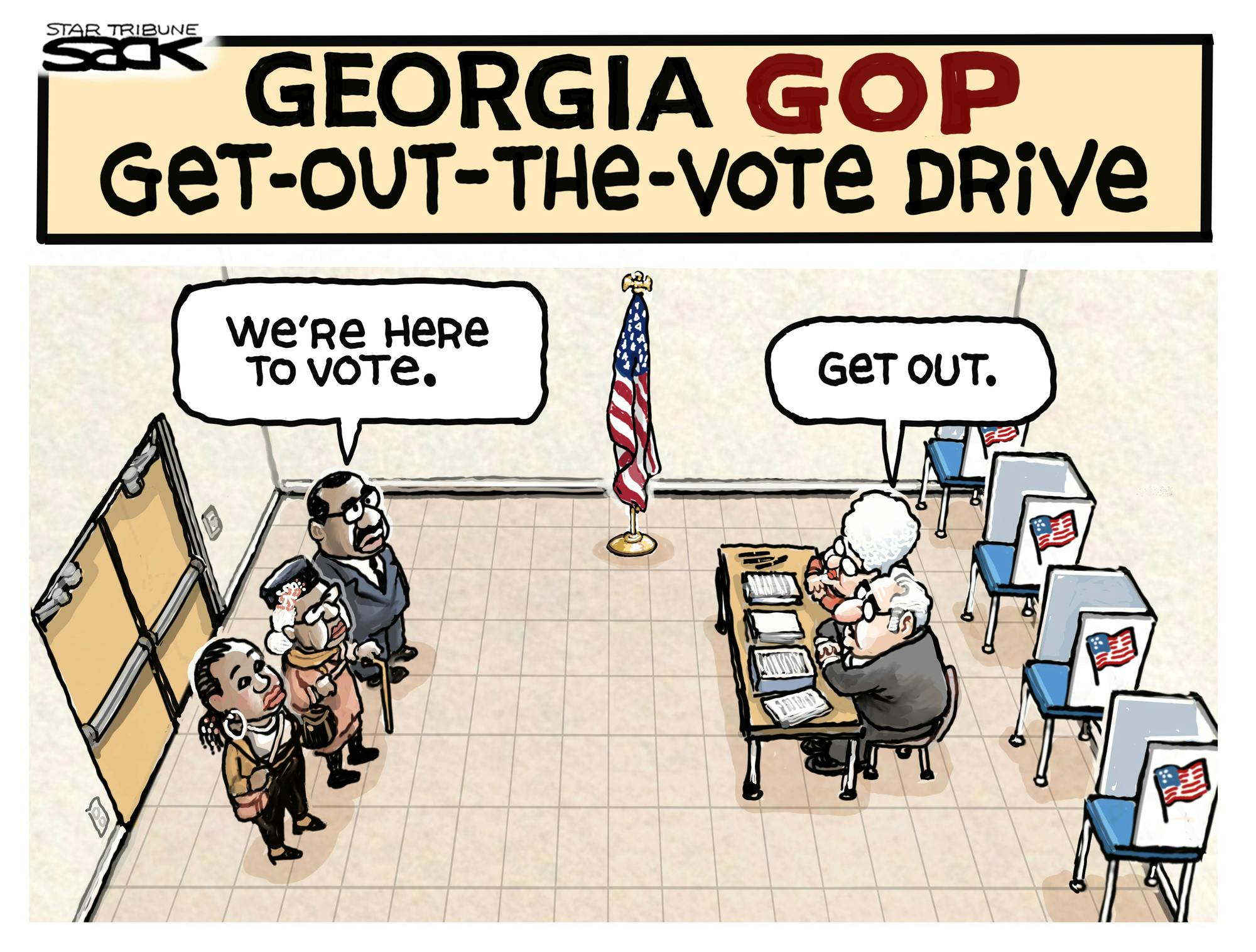
The change that gives the game away, though, is that distributing food or water to people waiting in line to vote is now considered electioneering at a polling place and is a misdemeanor. [4] So while many of the other changes will result in more people voting on Election Day, with correspondingly longer lines in areas with large populations (i.e. Democratic Atlanta), this change will make waiting in line an endurance test.
None of that is as blatant as the cartoon below, but all of it raises the question: Why? Did something bad happen in 2020 that makes all this necessary? The only real answer to that is: Too many people voted and Republicans lost. That’s the problem this law is trying to solve.
To me, this is the part that is most sinister. Again and again in 2020, Trump pressured Republican officials to overturn the election results. (The best known case is the Raffensperger phone call, when he pushed the Georgia secretary of state to “find” enough votes for him to win, and threatened him with prosecution if he didn’t. But Trump also pressured the US attorney in Georgia, a Georgia elections investigator, state legislators in Michigan, and probably many others we don’t know about.)
What Ted Cruz et al were hoping to accomplish on January 6 was to make an opening for Republican legislatures in Pennsylvania, Arizona, Georgia, and Michigan to overrule the voters and install their own slate of pro-Trump electors. Fortunately, most Republicans in Congress did not go along with this anti-democracy scheme.
Trump failed in his attempt to hang onto power in spite of the voters, largely because Republican officials refused to commit crimes or exceed their authority to reverse the election that he lost so decisively. But many of those officials have subsequently been punished. The Michigan election-board member who noted that his board had no authority to throw out the county-level certifications — he was not renominated. Raffensperger is going to be primaried by a Trumpist, and is expected to lose.
Similarly, most of the Republicans who voted to uphold democracy by impeaching Trump for inciting a riot against Congress — they’ve been censured by their local Republican parties.
The message from the Trump base is clear: Republican officials should not have integrity. They should be partisans first, and cheat if necessary to make sure elections come out “right”. (This makes perfect sense if you believe that “Most people living in the United States today — certainly more than half — are not Americans in any meaningful sense of the term.”)
This context makes the implementation changes in the Georgia bill ominous. The Secretary of State (i.e., Raffensperger) is removed from the State Election Board, which is now more completely under the control of the legislature. And the State Election Board is given power to remove and replace county election officials. It’s easy to see the target here: Fulton County, where Atlanta is.
So the next time a Trump wants to throw out a bunch of ballots in inner-city Atlanta, the state mechanisms are in place to make that happen.
What is being done to protest this law?
One purpose of rushing the law through so quickly was to prevent an effective response, which takes time to organize. (Think about it: If there were good reasons for this law and it enjoyed wide support, Republicans should have played it for all it was worth: Hold extensive public hearings about all the election fraud it would prevent. Explain in detail the destructive effects of handing out bottles of water to people waiting in hours-long lines. Lay out the case for why Atlanta shouldn’t be allowed to manage its own elections. And so on.)
As a result, big Georgia corporations like Coke and Delta didn’t oppose the law until after it passed, and they faced the threat of boycotts. (Home Depot and Aflac still haven’t commented.) The owner of the Atlanta Falcons football franchise did not mention the law specifically, but issued a statement saying “The right to vote is simply sacred. We should be working to make voting easier, not harder for every eligible citizen.” Major League Baseball pulled the All Star Game, which had been scheduled to happen in suburban Atlanta on July 13. (In addition to its fans, MLB also needs to consider its players, particularly the big-name players whose voluntary participation makes the All Star Game worth watching.) It’s not clear how far this movement will spread.
Guess what I am doing today? Not watching baseball!!!!
And the WaPo conservative columnist Hugh Hewitt proclaimed MLB “an arm of the Democratic Party … with values opposed to the Constitution and representative government.”
It’s the conservative version of cancel culture.
One thing Republicans are adamant about is that this is not racist, so all the comparisons to Jim Crow are over the top. But some of the comments they make clearly are racist, like this tweet from Mike Huckabee.
I’ve decided to “identify” as Chinese. Coke will like me, Delta will agree with my “values” and I’ll probably get shoes from Nike & tickets to @MLB games. Ain’t America great?
Hey Mike Huckabee, I asked around and Coke likes me, Delta agrees with my values, I wear Nikes and my hometown Dodgers won the World Series. But it’s not because of my ethnicity. It’s because I’m not a sh*thead like you who is adding fuel to anti-Asian hate.
[1] That’s one reason why many of Trump’s post-election lawsuits were thrown out without hearing evidence: Although Trump’s lawyers were claiming fraud in the press, when they went to court they often didn’t mention fraud, but focused on voting or vote-counting procedures that should have been — and often had been — litigated before the election. American courts look skeptically at parties that participate in an election, lose, and only then complain about the rules.
Before an election, courts can remedy a situation by ordering that bad rules be changed. Afterwards, the only possible remedy is to throw out ballots that legitimate voters cast in good faith. Judges are understandably reluctant to do this.
[2] It’s not completely obvious this is in fact true, and if it is, nobody knows exactly how big that high-turnout advantage is for Democrats. But it’s fair to say that both parties have acted as if they believe high turnout favors Democrats.
A lawyer for the Arizona Republican Party admitted as much to the Supreme Court. One issue in that case concerned voters who go to a polling place in the wrong precinct. Democrats want to handle this situation by counting their votes, but only for the offices they would have been entitled to vote on had they gone to the correct precinct. Republicans want to throw their ballots out. Remember: these are legal voters casting ballots in elections they are legally entitled to vote on, but getting confused and doing it in the wrong place — and so possibly giving officials an excuse not to count their votes.
“What’s the interest of the Arizona RNC in keeping, say, the out-of-precinct ballot disqualification rules on the books?” Justice Amy Coney Barrett asked, referencing legal standing.
“Because it puts us at a competitive disadvantage relative to Democrats,” said Michael Carvin, the lawyer defending the state’s restrictions. “Politics is a zero-sum game. And every extra vote they get through unlawful interpretation of Section 2 hurts us”
In theory, the extra votes the Democrats’ interpretation would allow might benefit Republicans, but the ARNC lawyer seemed to discount that possibility.
[3] Again and again, the apparently credible evidence you may have heard about in November or December collapsed under scrutiny.
[4] The only time I’ve ever seen snacks used as electioneering was in 2004, when I was given a Clark bar at a Wesley Clark rally. Doing something like that a polling place (which I don’t think Clark did) should be illegal.
[5] I’m struck by the lack of any justifying connection. Both seem to be pure power moves: We don’t like what you did, so we’re going to hurt you.
There is no legitimate tit-for-tat here. Like individuals, private-sector businesses have every right to comment on the actions of government and take whatever actions they deem appropriate. There is no comparable right in the other direction. Individual government officials are free to express their opinions, but governments are obligated to pursue the public good. Delta’s political views are not relevant to whether or not a tax break on jet fuel is in the public interest. For contrast, I don’t believe that Hobby Lobby suffered any official reprisals for challenging ObamaCare.
It’s hard to know where to start this week. President Biden began the push for an infrastructure package. It’s over $2 trillion and fits the FDR mold that progressives want the Biden presidency to fill out. To reprise Biden’s own characterization of ObamaCare, it’s a BFD.
But there’s also the Chauvin trial. It’s hard to escape the view that it’s really America and American justice that are on trial. We’ve had a week of moving testimony that communicated just how disturbing it still is, nearly a year later, to have witnessed a murder and not have been able to do anything about it, because the police are the murderers.
And then there’s Matt Gaetz. I think the world will little note nor long remember him after his political career goes down the tubes, but it’s hard to look away.
And the debate over the Georgia vote-suppression law heated up, as big corporations and institutions like Major League Baseball got involved.
And we’re still in a pandemic. The new-case numbers have turned upward, even as vaccinations set new records. Wisely or unwisely, the economy continues to open up; nearly a million new jobs were added in March.
After some internal debate, I decided I have the most to offer on the voting-rights/vote-suppression story, which has been plagued by misinformation and bogus arguments from both sides. (I am definitely opposed to the Georgia law, but I want to oppose it for the right reasons.) So that’s the featured post, which I’m guessing will be out between 10 and 11 EST. Everything else goes into the weekly summary, which includes a way-too-long Matt Gaetz note that I refuse to promote to a featured post. Let’s say that goes out between noon and 1.