Yesterday he came out against the For the People Act and for the filibuster, which dooms the John Lewis Voting Rights Act as well.
At the state level, Republicans have been assaulting democracy in every state where they have power. They have been restricting opportunities to vote, taking special aim at those methods frequently used by non-Whites (like ending Sunday early voting, around which Black churches have traditionally organized souls-to-the-polls drives). They support partisan gerrymandering, and hope to construct districts in ways that will give them majorities in legislative bodies, even if their voter-suppression tactics don’t deliver them a majority of votes cast. (See Max Boot’s column for details.)
Democrats have two bills aimed at protecting democracy: the For the People Act and the John Lewis Voting Rights Act. Both have passed the House, but will likely face a Republican filibuster in the Senate. This has been widely seen as Democrats’ most justifiable reason to eliminate or significantly alter the filibuster: When anti-majority tactics are used to strengthen minority rule, we are on a slippery slope towards some new form of government that does not answer to the People. (Boot concludes: “Senate Democrats have to choose between saving the filibuster and saving democracy. They can’t do both.”)
Unfortunately, we now are witnessing that the fundamental right to vote has itself become overtly politicized. Today’s debate about how to best protect our right to vote and to hold elections, however, is not about finding common ground, but seeking partisan advantage. Whether it is state laws that seek to needlessly restrict voting or politicians who ignore the need to secure our elections, partisan policymaking won’t instill confidence in our democracy — it will destroy it.
As such, congressional action on federal voting rights legislation must be the result of both Democrats and Republicans coming together to find a pathway forward or we risk further dividing and destroying the republic we swore to protect and defend as elected officials.
It’s true that passing the For the People Act will give Democrats a partisan advantage, compared to not passing it: More people voting tends to be good for Democrats. Creating a mechanism for candidates to depend on many small donors rather than a few big ones is good for Democrats. But both of those features are good for democracy, not just for Democrats. They only work against Republicans because the GOP has stopped trying to appeal to the majority of Americans.
Republicans have attacked democracy, so I suppose that makes defending democracy “partisan”. But what is the alternative?
Our founders were wise to see the temptation of absolute power and built in specific checks and balances to force compromise that serves to preserve our fragile democracy. … Do we really want to live in an America where one party can dictate and demand everything and anything it wants, whenever it wants?
I would edit Manchin’s question by replacing “one party” with “the People”. And then I would answer: “Yes, subject to the limitations of the Constitution.” The People elect representatives to the House and Senate, who then carry out the People’s will by passing laws under the umbrella of the Constitution, which mentions neither parties nor the filibuster. “Party” is a red herring, particularly when we are talking about the vision of the Founders, who hoped parties would not develop.
Manchin holds out hope that the John Lewis Voting Rights Act will be sufficient to protect democracy, and that it can pass.
The John Lewis Voting Rights Advancement Act would update the formula states and localities must use to ensure proposed voting laws do not restrict the rights of any particular group or population. My Republican colleague, Sen. Lisa Murkowski, has joined me in urging Senate leadership to update and pass this bill through regular order. I continue to engage with my Republican and Democratic colleagues about the value of the John Lewis Voting Rights Advancement Act and I am encouraged by the desire from both sides to transcend partisan politics and strengthen our democracy by protecting voting rights.
It will be wonderful if a Republican like Murkowski can find a way to vote for the Lewis Act without gutting it first. Maybe Mitt Romney or Susan Collins could vote for it too. But Mitch McConnell will not support it and there will not be 10 Republican votes to override a filibuster, which Manchin continues to support. (“I will not vote to weaken or eliminate the filibuster.”)
So despite his intention to vote for the Lewis Act, Manchin’s support of the filibuster guarantees its demise as well. Democrats control both houses of Congress, but they will do nothing to protect their voters.
At this point we have to wonder if he will ever face reality.
The two-votes-per-state structure of the Senate already penalizes large cities and gives Republicans more power than their rural voters should be able to command. If we further empower them with the filibuster, then any progressive change becomes impossible, unless something like 70% of the country supports it. (Gun control shows that even larger majorities aren’t enough sometimes.)
When a party wins the presidency and both houses of Congress, it should be able to implement its agenda, as long as it leaves voters the option to change their minds at the next election. Otherwise, Emma Goldman‘s observation applies: “If voting changed anything, they’d make it illegal.”
As in January, Trump is encouraging his followers to expect an outcome no constitutional process can deliver.
The Trumpist underground has been discussing another coup attempt for some while, but that prospect didn’t draw the attention of the larger public until Memorial Day weekend. General Mike Flynn, a convicted felon who is out of jail thanks to a Trump pardon, was a headline speaker at the “For God and Country Patriot Roundup”, a convention of QAnon cultists in Dallas.
when he was asked why can’t a Myanmar-style coup happen here to get Trump back in the White House. Flynn replied, “It should happen here.”
There is NO reason whatsoever for any coup in America, and I do not and have not at any time called for any action of that sort. Any reporting of any other belief by me is a boldface fabrication based on twisted reporting at a lively panel at a conference of Patriotic Americans who love this country, just as I do. I am no stranger to media manipulating my words and therefore let me repeat my response to a question asked at the conference: There is no reason it (a coup) should happen here (in America).
Something else you can notice in the video: When the questioner asks about a Myanmar-style coup happening in the US, the crowd cheers. They know what he is talking about and why he would suggest it: The plotters in Myanmar ran the same play Trump tried (and failed) to pull off here: They made phony claims of election fraud to justify overthrowing their elected leaders.
Myanmar-as-model has been a popular trope for some while among the QAnoners and other Trump cultists, who (like a millennial sect repeatedly predicting the Day of Judgment) have been telling each other since November that President Biden’s election would soon be overturned. At first, Republican election officials were going to undo Biden’s victory. Then the courts were. Then Congress. After the January 6 insurrection failed, Trump was supposed to declare martial law and initiate “the Storm” in time to avoid Biden’s inauguration on January 20. After that prediction also came to nothing, one widespread narrative picked March 4 as the day for Trump’s restoration, because that had been Inauguration Day prior to the 20th Amendment, which the conspiracy theory says is invalid for some reason.
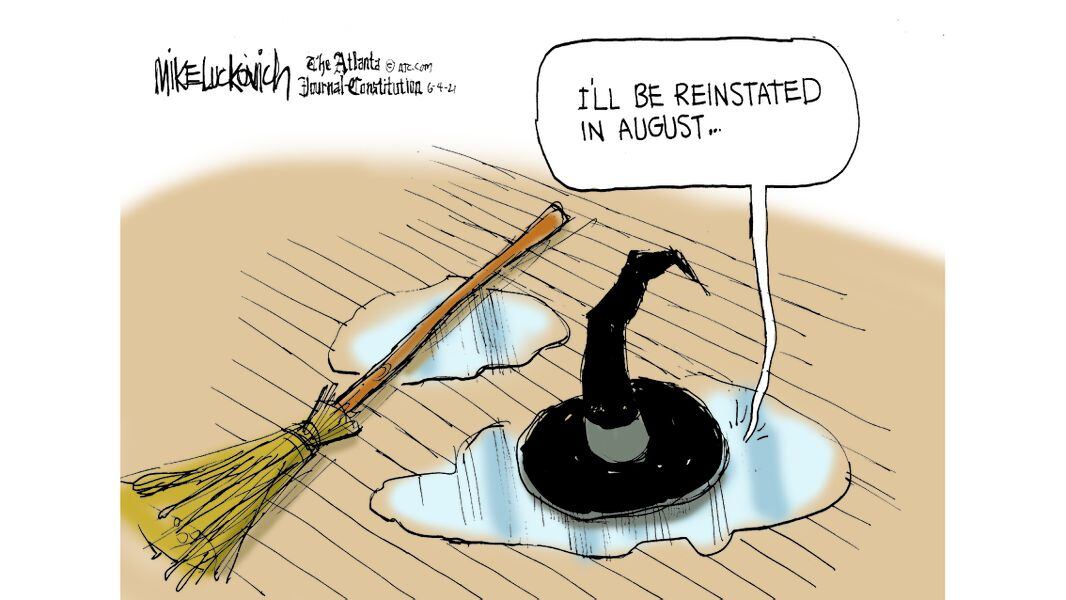
And now it’s supposed to happen in August.
At the same Dallas conference, former Trump lawyer Sidney Powell said Trump could just be “reinstated“.
A new inauguration date is set, and Biden is told to move out of the White House, and President Trump should be moved back in. I’m sure there’s not going to be credit for time lost, unfortunately, because the Constitution itself sets the date for inauguration, but he should definitely get the remainder of his term and make the best of it.
No provision in the Constitution allows for such a scenario. Even if Trump’s fanciful claims about a “stolen election” turned out to be true, the only remedy the Constitution offers is impeachment. And even after Biden and Harris were removed from office, the presidency would pass to Speaker of the House Nancy Pelosi, not a private citizen like Trump.
Powell — who is a lawyer, after all — must realize that. So she could only be assuming some outside-the-Constitution means for changing leaders, i.e., a coup. It wouldn’t be the first time Flynn and Powell have proposed political violence: Last December, they tried to convince Trump to declare martial law in order to “rerun” the election under military supervision — another path disconnected from the Constitution.
You might be imagining that Flynn, Powell, and the other QAnon celebrities are just hucksters exploiting crazy people, and maybe they are. But this talk is dangerous because Trump is playing along. Tuesday, the NYT’s Maggie Haberman responded to reports of Flynn’s coup suggestion with this report:
Trump has been telling a number of people he’s in contact with that he expects he will get reinstated by August (no that isn’t how it works but simply sharing the information).
If you don’t trust a New York Times reporter’s account, National Review’s Charles W. Cooke has corroborated it:
Haberman’s reporting was correct. I can attest, from speaking to an array of different sources, that Donald Trump does indeed believe quite genuinely that he — along with former senators David Perdue and Martha McSally — will be “reinstated” to office this summer, after audits of the 2020 elections in Arizona, Georgia, and a handful of other states have been completed.
I can attest that Trump is trying hard to recruit journalists, politicians, and other influential figures to promulgate this belief — not as a fund-raising tool or an infantile bit of trolling or a trial balloon, but as a fact.
The media and the general public have gotten used to applying different standards to Trump than to anyone else, so it’s usually worth taking a moment to back up and ask how any other public figure would be expected to respond to such reports. Imagine, for example, that it’s 2017, and various people loosely associated with Hillary Clinton are predicting that she will somehow take power, possibly by violence. (After all, she did win the popular vote by 2.9 million in 2016, rather than getting stomped by more than 7 million, as Trump did in 2020. There would have been a lot more justification for a 2017 Clinton coup than a 2021 Trump coup.)
The answer’s obvious, right? There would be a national outcry for her to make a definitive statement: “Are you encouraging your followers to overthrow the government or not?”
As anyone who has ever read a book or watched a movie or taken a history course knows, the most important element of a coup is the agreement of the individual who’ll be installed as a nation’s new president to participate in the installation. Without that there can be no coup. …
By confirming his willingness to participate in a coup, Trump allows the coup plotters to continue in their activities—but it’s much more than that. If/when the plotters reach out to individuals in the military, any soldier’s first question will be, “Is Donald Trump on board?” … No one plotting to participate in the first attempted U.S. coup since the Civil War is going to accept Powell’s word on what Trump is willing to do. Or Lindell’s. Or perhaps even Flynn’s. People in a position to aid the coup are *going to need to hear from Trump themselves*.
It’s in this context—having already achieved a meeting of the minds with the coup plotters—that Trump picks up a phone and makes a phone call to DC people who are well-connected and tells them that he’s willing to accept the U.S. presidency again if it can be secured for him.
If you find this confusing, as clearly Haberman does, consider an alternative scenario: Trump learns that his top advisers are planning and advocating for a coup and he immediately goes to his blog and declares that he’ll under no circumstances accept the presidency pre-2025. If Trump does that—I literally mean if he types about 10 words on his blog, which he could do in the next 5 minutes—the coup plot is officially dead. Over. Impossible. Irrelevant. A non-starter. There’s literally no longer a fear of a coup in the United States in that moment.
Instead, Trump is allowed to equivocate: He’s not actually saying the word “coup”, but how else does he get “reinstated”?
Compare to his January 6 speech that incited the takeover of the Capitol and delayed the counting of electoral votes. He never explicitly instructed his followers to do anything illegal. But he also clearly expected them to “stop the steal”, which they had no legal power to do.
As we know from Michael Cohen, this is how Trump operates. “He doesn’t give you orders, he speaks in a code.” Like a Mafia Don, that’s how he avoids conspiracy charges.
We saw in January how this code works when it comes to violent insurrection: He doesn’t tell people what to do, he just raises their expectations about what will happen. Then, at some point along the line, his followers come to understand that it’s not up to him to make his predictions come true, it’s up to them. It’s up to Brad Raffensperger to “find” enough votes for Trump to win Georgia. It’s up to the Cyber Ninjas to invent a reason to believe he really won Arizona. It’s up to Republican legislators in Pennsylvania to set up a similarly biased “audit” in their state. And then, after he has “audited” enough states to flip the Electoral College (which has already voted for 2020 and gone out of existence until 2024), somebody has to restore him to office.
Who? The people that he’s sold the dream to. If you’re counting on Trump being president again soon, nobody but you is going to make that happen.
He’s not telling you to upend the Constitution. But he’s also not giving you any other way to do it.
I’m still deciding which of the weekly summary notes will get spun off into their own posts. There will definitely be at least one featured post, “Trump’s Next Coup”, which looks at the Trumpist chatter about him being “reinstated” in August. Trump incited the January 6 riot by encouraging his followers to believe the election could be reversed on that day, and then giving them the assignment to go do it. He never specifically told them to do anything illegal, but there was no legal method to do what he wanted. The same thing is happening now: There is no legal way to reinstate Trump in August, but he’s raising that expectation.
The other notes that are straining for more space concern Manchin’s announcement that he won’t support the For the People Act, and the implication — which I believe but he doesn’t — that there will be no federal defense of voting rights at all. Also, Biden’s Tulsa speech, and the general significance of recognizing how White violence has been erased from the history taught in schools, as well as the impact of such violence on the Black community’s ability to generate and sustain wealth.
With that much in flux, it’s hard to make predictions about what will appear when. The coup article should appear between 10 and 11 EST. Beyond that, I can’t say.
This week everybody was talking about the Trump grand jury
Tuesday, The Washington Post reported that Manhattan District Attorney Cyrus R. Vance Jr. had “convened the grand jury that is expected to decide whether to indict former president Donald Trump, other executives at his company or the business itself”.
a broad examination of the possibility that Trump and his company engaged in tax, banking, and insurance fraud. Investigators are questioning whether Trump profited illegally by deliberately misleading authorities about the value of his real-estate assets. [Former Trump lawyer Michael] Cohen has alleged that Trump inflated property valuations in order to get favorable bank loans and insurance policies, while simultaneously lowballing the value of the same assets in order to reduce his tax burden.
The vision of Trump in an orange jumpsuit is so compelling that Democrats are easily tempted to waste time speculating about how or when it might happen. But we just don’t know. When Republicans investigate Democrats — like the Starr investigation of Bill Clinton or the FBI probe into Hillary’s emails — those investigations leak, because politics was the point from the beginning; the investigation was never about finding a serious crime and taking it to court. But from Mueller and Comey through to Vance, the various investigations into Trump have not leaked.
So despite the many hours of coverage this topic has attracted this week, the legitimate tea-leaf reading can be summed up fairly quickly: Vance must believe he can prove that somebody committed a crime. Maybe it’s Trump. Or maybe it’s somebody Vance hopes to flip against Trump, like Trump Organization CFO Allen Weisselberg or one of Trump’s children.
But financial charges against rich men are hard to make stick, both because plutocrats hire good lawyers, and because they can always hide behind underlings. (“I just the sign the documents my staff tells me to sign. I couldn’t possibly read them all.”) Convicting Trump will require getting some of those underlings to flip. Somebody needs to tell a jury, “I explained this to him and he told me to break the law.”
With regard to George Floyd, the big question raised by the one-year mark is: How much has changed? And the answer is: some things, but not nearly enough.
The biggest change, in my opinion, is the precedent set by the Chauvin trial itself: George Floyd’s killer was convicted of murder, and other Minneapolis police officers testified against him. It’s still possible to argue that Chauvin should have been convicted of first-degree murder rather than second, but “Police always get away with it” isn’t true any more.
Colorado now bans the use of deadly force to apprehend or arrest a person suspected only of minor or nonviolent offenses. Also, though many states permit the use of deadly force to prevent “escape,” five states enacted restrictions or prohibitions on shooting at fleeing vehicles or suspects, a policy aimed at preventing deaths like that of Adam Toledo, a 13-year old shot by Chicago police during a foot chase. Additionally, 9 states and DC enacted complete bans on chokeholds and other neck restraints while 8 states enacted legislation restricting their use to instances in which officers are legally justified to use deadly force.
But the national shock of the Floyd murder, the millions of Americans who demonstrated against it, and the many white people who finally seemed to recognize the problem, appeared (just for a moment) to promise much more. Perhaps the nation would fundamentally rethink public safety and the role of police. “Defund the Police” may have inspired more backlash than reform, but nonetheless the idea was getting out there: Not every kind of disorder is best handled by people with guns. Maybe some of the money that now passes through police departments should instead go to unarmed first responders trained in mental health or social work. Maybe traffic tickets could be written by civil servants who can’t shoot people.
Despite a few tentative steps, that promise has gone unfulfilled. The symbol here is the Minneapolis City Council’s pledge to “end policing as we know it”, which came to nothing.
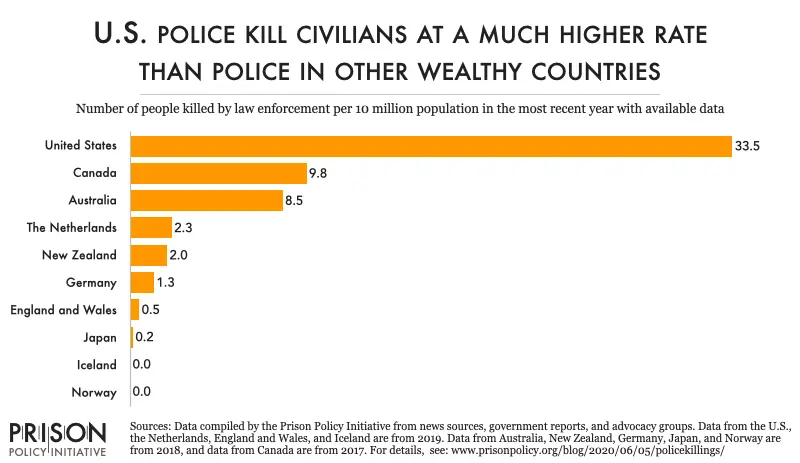
If we were rational about this problem, US police departments would be flying folks in from Norway or England to explain how they police modern cities without killing people. But instead, American cops have been paying “experts” like Dave Grossman of the Killology Research Group to tell them how to be better “warriors” on the “battleground” of American cities.
The 100-year anniversary of Tulsa raises a different set of issues: how we teach and commemorate US history. When I was growing up in the 1960s, “race riot” meant outbreaks of violence in Black sections of Los Angeles or Detroit. Race riots were yet another reason for Whites to fear Blacks, and to vote for “law and order” candidates like Richard Nixon or George Wallace.
Only decades later did I discover that often Whites have been the rioters. I’m not sure when exactly I first learned about the destruction of the prosperous Greenwood district in Tulsa, but it has definitely been in the last ten years.
When it was over on June 1, 1921, 35 square blocks of what was nicknamed Black Wall Street lay in smoldering ruins. There were reports that bodies were thrown into the Arkansas River or buried in mass graves. Hundreds of survivors were rounded up at gunpoint and held for weeks at camps.
No one was ever held accountable for the lives lost or the property destroyed. Insurance claims filed by homeowners and business owners were rejected
Except for Booker T. Washington and George Washington Carver, [the Black people Lincoln emancipated] vanished like the Lost Tribes of Israel. They wouldn’t re-enter history until the 1950s, when for some reason they still weren’t free.
So: Black people in Tulsa in 1921? What Black people?
Fortunately, ignorance about the Tulsa riot is declining. Recently, Tulsa has become a touchstone in popular culture’s re-examination of America’s racial history. It plays a key role, for example, in both the Watchmen and Lovecraft Country series on HBO.
Similarly, I first heard of Ida B. Wells and her anti-lynching campaign when I went to the National Museum of African American History in 2018. Ditto for the Harlem Renaissance. I mean, are you sure Black culture bloomed in the 1920s? Did we even have Black people then?
So as Republican legislatures ban “critical race theory” from schools and protect Confederate statues against liberals who want to “erase history“, it’s worth remembering Tulsa. The history of white supremacy in America, and the racist violence that has maintained it, was erased from public consciousness long ago. We need efforts like the 1619 Project to recover the national memories that white racist propaganda has made us forget.
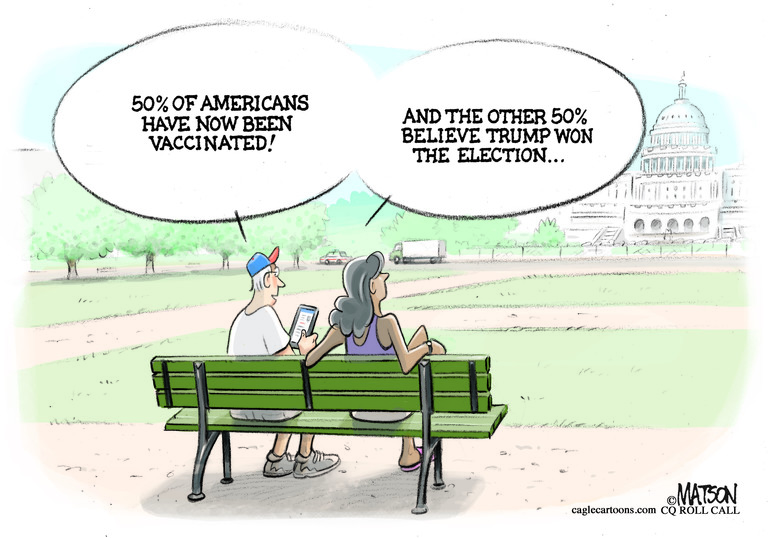
Recent trends continue: Vaccinations continue to rise while new cases and deaths fall. The 7-day average for daily new cases is down to 21K, after peaking over 250K in mid-January. The number of people with at least one dose of the vaccine has crossed 50%.
A new poll by the Kaiser Family Foundation suggests that we might get to the 70% vaccinated level that some experts say would give American society herd immunity. In particular, some holdout groups are starting to come around, particularly Latinos and people without college degrees.
Sometimes trends advance because nobody wants to be on the fringe. As long as some friend you think of as more sensible is holding out, joining the trend doesn’t seem urgent. But at some point, it’s just you and people you think of as wackos.
I kinda-sorta get how a person might mistrust the government and the medical establishment so much that they avoid vaccination. Last summer, when it looked like Trump might push the FDA to approve a vaccine prematurely so that he could tout it as a campaign issue, I was skeptical myself. But that didn’t happen, millions of people have been vaccinated with few side-effects, and the case-counts and deaths have been dropping. So I got vaccinated.
But even in the Trump-corrupts-the-FDA scenario, it never occurred to me that I might protest against other people taking the vaccine, just like it never occurs to me to hassle people who wear masks in situations where I don’t think they’re necessary. (If you want to wear a mask when you’re alone in your own home, go for it. Why should I care?) After all, the point of not taking the vaccine would have been to make my own risk assessment, which I should be free to do in all but the most dire circumstances. But using my judgment to overrule other people’s risk assessments is something else entirely.
Well, I’m clearly not thinking like a true right-wing loony. In fact, people are protesting against the vaccine, including a Tennessee woman — what got into Tennessee this week? — who shouted “No vaccine!” as she drove her SUV through a vaccination tent “at a high rate of speed”, threatening both the medical staff and ordinary people who came to be vaccinated. She’s been arrested and charged with seven counts of reckless endangerment.
Demonstrations have popped up in vaccination sites such as high schools and racing tracks in recent months, and anti-vaccine protesters temporarily shut down Dodger Stadium after maskless people blocked the entrance to one of the country’s largest sites.
I also can’t explain why hitting people with a car has become such a popular tactic on the right, to the point that Republican legislatures are starting to write it into law.
A lady just came up to me and said “Speak English, we are in San Diego.” So I politely responded by asking her “how do I say ‘San Diego’ in English?” The look of bewilderment on her face made it feel like a Friday.
Apparently by coincidence, two once-crazy ideas are now being treated more respectfully: the lab-leak theory of Covid, and the existence of UFOs.
I’m not really in a position to say anything definitive on either theory, but I do think it’s important not to jump too far: Even if Covid leaked out of a Chinese lab, that doesn’t mean it was engineered by humans or released as a bioweapon attack. More likely, the lab collected a bunch of viruses to study, and one got loose.
Wired’s Adam Rogers does a good job of separating ordinary scientific uncertainty from what he calls “weaponized uncertainty”.
When scientists say “We’re not totally sure,” they mean their analysis of some event or outcome includes a statistical possibility that they’re wrong. They never go 100 percent. Sometimes they think they might possibly be wronger than others. This is the world of confidence intervals, of mathematical models and curves, of uncertainty principles. But non-scientists hear “We’re not totally sure” as “So you mean there’s a chance?” It’s the mad interstitial space between scientific—let’s say, statistical—uncertainty and the meaning of normal human uncertainty. This is where “just asking questions [wink]” lives.
It’s a subtle difference. When Tony Fauci says he’d like to get more certainty, for example, he most likely means that, yeah, all things being equal, it’s better to know than not know—especially if that’s the way the political winds are blowing.
But when political actors like senators and right-wing TV commentators talk about this uncertainty, this doubt, they’re trying to jam a crowbar into this gap in understanding and lever it open. They’re still hinting that the Chinese government is doing something sneaky here, something warlike—and that even the scientists think it’s possible. Because if they can seem to have the backing of science, they can use that power elsewhere. They can bang shoes on tables about Biden administration inaction and Chinese skullduggery to distract from their lies about the election, about attempts to curtail voting rights, about the January 6 insurrection, about efforts to get the world vaccinated against the disease they claim to want to understand better.
FWIW, I live next door to a biologist, who tells me that Mother Nature is still much better at constructing nasty viruses than we are. Apparently, engineering the Andromeda Strain is more difficult than the movies would have you believe.
Richard Pape from the University of Chicago’s Project on Security and Threats, on what he’s learned from studying the people arrested for the Trump Insurrection:
One overriding driver across all the three studies that we’ve now conducted is the fear of the Great Replacement. The Great Replacement is the idea that the rights of Hispanics and Blacks — that is, the rights of minorities — are outpacing the rights of whites. … The number one risk factor [in whether a county sent an insurrectionist to Washington] is the percent decline of the non-Hispanic white population.
The whole interview is worth watching. The insurrectionists are overwhelmingly white and male. We ordinarily think of violent revolutionaries as young and desperate, but these folks are mostly middle-aged and well-to-do, with some of them owning their own businesses. What unites them is racial anxiety, their fear that whites are losing their superior place in American society.
Sean Hannity, who is worth $250 million and makes $40 million a year, advises his listeners to “work two jobs” rather than “rely on the government for anything”. Better that you should never have time to see your kids than that he should have to pay taxes.
“One of the craziest, little-league type plays you’ll ever see.” Batting with a runner on second and two outs Thursday afternoon, Cub shortstop Javier Baez apparently grounds out to end the inning. When the throw from third pulls the first baseman Will Craig off the base, he moves to tag Baez, who starts retreating back towards home. Craig forgets he could just go back to tag first and end the inning, and things just get wilder from there.
If only six Republican senators will support a bipartisan January 6 commission, while one Republican Congressperson openly calls for new violence and another trivializes the Holocaust, what hope is there for reasonable compromise on anything?
Friday, the Senate voted on the filibuster of a bill (already passed by the House) that would authorize a bipartisan commission to investigate the January 6 riot. Thirty-five senators voted to continue the filibuster, while 54 voted to end it.
That means it continued and the bill was blocked. By the rules of the Senate, the 35 outvoted the 54.
That’s how the Senate works, or rather, doesn’t work. If some senator wants to prevent a bill to come to a vote, it takes 60 senators to break that filibuster. Even though 54 is 61% of the 89 senators voting; 54 isn’t 60, so the 1-6 commission is blocked indefinitely.
That raises the whole end-the-filibuster discussion, which we’ll get to further down the page. But it’s important not to jump over the even more outrageous part of this story: Given that both American democracy and their own safety was endangered, how could 35 Republican senators possibly oppose an investigation of the storming of the Capitol?
What happened. On January 6, rioters tore down barricades, assaulted police, broke into the Capitol itself, and forced the temporary adjournment of a joint session of Congress that is mandated by the Constitution: Once every four years, the House and Senate meet together to count the electoral votes and officially announce the winner of the presidential election.
That joint session is arguably the most sacred, most essential ceremony of American democracy. It lies at the heart of our most prized tradition: the peaceful transfer of power from one leader to the next, in accordance with the will of the People, as expressed (imperfectly) by the Electoral College. Congress has carried out this duty in an uninterrupted sequence going back to the certification of George Washington’s election on April 6, 1789.
That’s what the rioters were trying to stop. They chanted “Hang Mike Pence”, invaded the chambers of the Senate, and broke into offices looking for members of Congress, hoping to disrupt the transfer of power so that the loser of the election, Donald Trump, could remain president.
They failed. In the end, the certification process was delayed by about six hours, but it reached a conclusion and Joe Biden’s victory was officially recognized.
What could have happened. Despite all the things that went wrong on that day, it’s easy to imagine how January 6 could have gone worse if the rioters had been luckier or better organized, or if Congress had been slower to react. Rioters (some of whom brought zip-ties) might have captured Vice President Pence, Speaker Pelosi, or other key figures, leading to a hostage situation. Who can say how President Trump might have responded to that chaos? If the stand-off had continued past January 20, when Trump’s term expired, the United States would have reached a constitutional crisis unforeseen by the Founders.
Questions that need answers. The rioters themselves are being handled by the justice system, as is appropriate. Courts and juries will decide who broke in and what laws they violated. But the crimes of rioters are not the only things that need investigation. We also need to answer questions like these:
Why was the Capitol so poorly defended? What needs to be changed to prevent similar security failures in the future?
Did the riot have a larger structure? In other words, did a mob simply get out of hand? Or was there a plan? If it was planned, who planned it?
Were the rioters simply the Trump supporters they appeared to be? Or were they egged on by anti-Trump provocateurs, as many Republicans believe?
How well did the various security forces — Capitol police, D.C. police, National Guard — perform? Are the procedures for coordinating their efforts adequate?
Did members of Congress help the rioters prepare, say, by giving them “reconnaissance tours” of the Capitol, as many Democrats believe?
What was President Trump’s role? Did he intend the protests to turn violent? Did he respond appropriately once the violence started?
Some of these questions will come up in investigations that lead to prosecutions, but a court is not the right place to answer them. Maybe, for example, the larger plan behind the riot will never be nailed down well enough that particular people can be prosecuted for it. If that turns out to be the case, no one will be indicted and the public might never learn — at least not through the justice system — whatever evidence points in that direction.
Ditto for Trump’s culpability. It’s possible that prosecutors will decide they can’t make incitement-to-riot or conspiracy charges stick, so his behavior will never be described in an indictment. But he seems to be angling to run for president again, so shouldn’t the public learn as much as possible about whether he tried to overthrow democracy during his first term?
In short, somebody should write a report that tells the whole story, from beginning to end, and from all points of view. Ideally, that report would be trusted by the great majority of Americans, rather than leaving the whole affair in a he-said/she-said state.
The commission proposal. With that in mind, the investigating body should be widely respected, have full investigatory powers, and rise above partisan bias. No way of setting up such an investigation is perfect, but the bipartisan commission is the best model we have. That’s how we handled 9-11, and it seemed to work pretty well.
This particular implementation of the 9-11 model was negotiated between the leading members of each party in the House Homeland Security Committee, Bennie Thompson for the Democrats and John Katko for the Republicans. Democrats did not use their majority-party status to drive a hard bargain: Each party appoints five members of the 10-person commission. Speaker Pelosi appoints the chair and Minority Leader McCarthy the vice-chair, but there is little the chair can do unilaterally.
Rep. Katko thought he had done a good job of achieving McCarthy’s goals. “I encourage all members, Republicans and Democrats alike,” he said, “to put down their swords for once, just for once, and support this bill.”
Trump’s motive. It’s important to understand what Trump gains by blocking the commission. He isn’t preventing an investigation, because Democrats can set up a select committee in the same way that Republicans did after the first nine investigations of Benghazi failed to find evidence for their conspiracy theories. That’s just one of the options, but Democrats will certainly investigate somehow.
So all that Trump is preventing is a bipartisan investigation. Whatever the select committee comes up with, he can brand a “partisan witch hunt”. The Trump Insurrection will continue to be a he-said/she-said thing, without any common truth both parties agree on.
That’s bad for democracy and for America, but apparently it’s good for Trump.
One thing this tells us, though, is that neither Trump nor any other Republican in Congress really believes the antifa-did-it theory that they occasionally promote, and that nearly 3/4ths of Republicans claim to believe. If there were any chance of uncovering an antifa conspiracy, Republicans would begging for a bipartisan commission to expose it.
Bipartisanship? Let’s sum up: A proposal that should be a slam dunk, that should get 35-40 Republican votes in the Senate, instead got only six. One of the Republicans who left town early to start his Memorial Day weekend, Pat Toomey of Pennsylvania, says he would have voted for it, bringing the total to seven. So if all 100 senators had stayed in town and all 50 Democrats voted to establish the commission, it would still have been three votes short of breaking the filibuster.
We just can’t pretend that nothing bad happened or that people just got too excited. Something bad happened. And it’s important to lay that out. I think there’s more to be learned. I want to know and I don’t want to know … but I need to. And I think it’s important to the country that there be an independent evaluation.
The commission filibuster is ominous for two reasons:
A lot of important legislation has been working through the legislative process and is due for a Senate vote soon.
The GOP is tolerating (and sometimes promoting) increasingly crazy rhetoric.
The Joe Manchin theory that Republicans can be sane negotiating partners, and that compromises can be reached that will be good for the country, is looking increasingly unlikely.
The wave of executive orders that he issued shortly after he took office.
The $1.9 trillion American Rescue Plan Act (i.e., Covid relief) that Congress passed and Biden signed on March 11.
Together with his administration’s good management of the vaccination effort, and the optimism about the end of the pandemic that has accompanied that success, Biden has successfully projected an image of a president who takes action and does the things he says he will do.
But time is running out on those trends. The executive orders were a one-time thing: Presidents do not typically get fresh supplies of executive power (which is a good thing; otherwise we’d drift towards autocracy). So almost everything Biden can do without Congress is already done. And Covid relief was an example of the Democrats going it alone: In spite of their subsequent attempts to take credit for its good features, not a single Republican voted to pass it.
A lot of stuff Biden has said he will do is now sitting in the Senate’s queue:
protecting voting rights and fair elections. This includes the John Lewis Voting Rights Act, which repairs the hole John Roberts tore in the Voting Rights Act in 2013, and the For the People Act, which outlaws partisan gerrymandering, reforms campaign finance, ends a variety of forms of voter suppression, and sets a national standard that no one should wait more than 30 minutes to vote.
rebuilding America’s infrastructure. Biden’s American Jobs Plan devotes $2 trillion over ten years to fixing our roads and bridges, replacing the lead water pipes that have poisoned American children in places like Flint, and reorienting the economy for a post-fossil-fuel future.
police reform. The George Floyd Justice in Policing Act, which creates national standards for police use of force and gives the Justice Department tools to enforce those standards.
If none of that passes, or if the bills get watered down to the point that nothing really changes, Biden becomes a nice guy who talks a good game, but doesn’t accomplish much. And Democrats go into the 2022 midterms not having delivered the change they promised, while facing increasing Republican efforts to restrict voting in states around the country. It will be harder to voter, and the voters Democrats need to target will be discouraged.
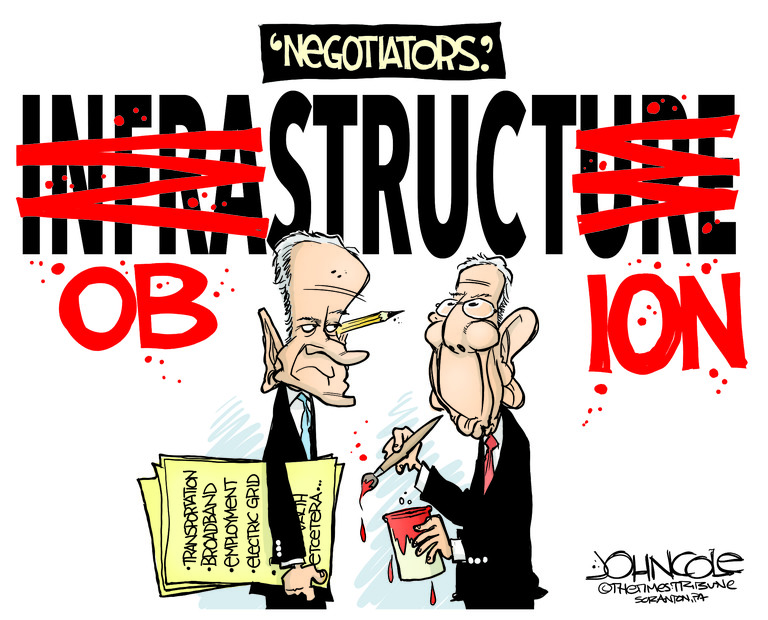
So far, Biden and the Democrats are trying to use that popularity with the voters to move Republicans in Congress. Negotiations are underway, but the infrastructure negotiations are typical. Grist sums up the Republican counterproposal as “all bridges, no climate” and observes:
It certainly looks like Republicans and Democrats are engaging in some honest-to-god political compromise: Biden started out with a big number and made it smaller, Republicans started with a small number and made it bigger. But closer investigation reveals that Republicans haven’t compromised very much at all.
Nearly $1 trillion in spending sounds like a lot, but the lion’s share of the money Republicans want to spend on infrastructure isn’t new — it’s money that already gets budgeted out by Congress for infrastructure improvements every year and “leftover” money from previous COVID-19 relief bills. The assumption that there are wads of coronavirus money languishing in federal and state coffers is flawed, experts say. There is a lot of relief money that hasn’t been spent, but much of it will be spent in the coming years on Medicaid, federal lending programs, and state and local relief programs.
Without robbing Peter to pay Paul “[Senator Shelley Moore] Capito and company are proposing just $257 billion in new federal spending.” That’s over ten years. In particular, the GOP wants nothing to do with electric vehicles, reducing Biden’s $174 billion proposal to $4 billion.
Worse, as we just saw with John Katko and the 1-6 Commission fiasco, getting Capito to agree to something doesn’t mean the GOP caucus will support it. Biden could reach an agreement with Capito and still see the bill blocked by a filibuster when Capito brings less than ten colleagues with her. Ditto for Tim Scott and police reform.
This is a pattern we should all remember from the Obama years. Repeatedly, President Obama would seem to reach a “grand bargain” with Speaker Boehner, only to discover that Boehner could not deliver his caucus’ support.
The GOP’s ever-expanding grass-roots lunacy. While Tim Scott and Shelley Moore Capito play the role of reasonable Republicans in D.C., something else is happening out in the Trumpist countryside, where Matt Gaetz and Marjorie Taylor Greene are on an America First tour.
The Internet’s hall monitors out in Silicon Valley, they think they can suppress us, discourage us. Maybe if you’re just a little less patriotic, maybe if you just conform to their way of thinking a little more, then you’ll be allowed to participate in the digital world. Well you know what? Silicon Valley can’t cancel this movement, or this rally, or this congressman. We have a Second Amendment in this country, and I think we have an obligation to use it.
In case there’s any doubt about what he means by that, here’s another clip from the same speech:
The Second Amendment is not about hunting, it’s not about recreation, it’s not about sports. The Second Amendment is about maintaining within the citizenry the ability to maintain an armed rebellion against the government, if that becomes necessary.
As far as I know, Gaetz did not identify by name anyone his audience should shoot. So I’m sure Mark Zuckerberg will be fine. It’s not like anybody ever listens to Trumpist rhetoric and then literally guns people down or mails bombs to them.
Meanwhile, Marjorie Taylor Greene has been trivializing the Holocaust. On several occasions, she has compared the public-health guideline that unvaccinated people continue to wear masks — and in particular, Speaker Pelosi’s insistence on maintaining the House’s mask mandate until all members are vaccinated — to the yellow stars that the Nazis required Jews to wear.
You know, we can look back at a time in history where people were told to wear a gold star, and they were definitely treated like second-class citizens, so much so that they were put on trains and taken to gas chambers in Nazi Germany, and this is exactly the type of abuse that Nancy Pelosi is talking about.
The House GOP leadership has been unwilling to exert any real pressure to control Gaetz or Greene. Minority Leader Kevin McCarthy has not commented on Gaetz’ call for violence, and his response to Greene was late and weak. Tuesday, he released a statement that did not even hint at consequences for Greene, should she not back down. (She hasn’t.) McCarthy tacitly excused Greene’s anti-Semitism by invoking both-sides-ism, saying Greene’s comments come “At a time when the Jewish people face increased violence and threats, anti-Semitism is on the rise in the Democrat Party and is completely ignored by Speaker Nancy Pelosi.”
The analogy between the unvaccinated and Jews in Nazi Germany makes perfect sense if you believe the following:
Jews in the Third Reich were spreading diseases that endangered other Germans.
The Nazis were trying to save Jewish lives.
Jews could have opted out of Nazi oppression at any time by taking a shot that would improve their health and make them less dangerous to others.
Over the next few years, the rest of us are planning to herd the unvaccinated into camps and exterminate them.
If you do believe those things, you and your family have my sympathies, and I hope you reestablish contact with reality soon. But if you don’t, and you wear the yellow star anyway, you’re just being an asshole.
Finally, there’s the continued unwillingness of Trump or his cultists to admit that he lost the election. (Mitch McConnell may say he wants to “move on” from January 6, but his party is unwilling to move on from November 3.) The bizarre Maricopa County “audit” continues, and just in case the Trump-biased auditors can’t find the fraud they are looking for, the Arizona Senate is already looking ahead to another audit. It’s like Benghazi: If one investigation can’t find the evidence you are looking for, just start another one.
Bringing all this back to Congress: There’s no one Democrats can negotiate with in good faith. If Biden should happen to reach an acceptable compromise with some Republican, we know what will happen: Trump will denounce the agreement, and before long any Republican who stands by it will be accused of being in league with the Rothschilds and their space lasers. Any compromising Republican who resists Trump’s pressure will have to keep looking over his shoulder for people “exercising their Second Amendment rights”.
The filibuster. Which brings us back to the filibuster. I already made my case for ending the filibuster back in January, so I won’t repeat it. The Democrats have the power to end the filibuster, but only if they all agree. So far, Joe Manchin and Kyrsten Sinema are holding out.
Manchin in particular has been vocal about the importance of bipartisanship, and nostalgia for a time when relationships across party lines were more cordial.
Generations of senators who came before us put their heads down and their pride aside to solve the complex issues facing our country. We must do the same. The issues facing our democracy today are not insurmountable if we choose to tackle them together.
One point he makes in that op-ed is legitimate: If Congress could pass legislation through bipartisan compromise, the United States would have more stable laws and policies; flipping a couple seats in the Senate wouldn’t completely reverse the direction of country.
The problem is in the “if”. The reality is that the Senate can’t pass legislation through bipartisan compromise, and when Republicans have control, they have no reservations about pushing controversial proposals through without Democrats, as they pushed through Trump’s tax cuts and Supreme Court nominees. They would have repealed ObamaCare that way, but a handful of Republicans realized that the party had no replacement plan. None of the defecting Republicans seemed to be worrying about leaving Democrats out of the process.
So far, Biden and Chuck Schumer have been giving Manchin a chance to prove his case. He and Sinema worked hard to find 10 Republicans willing to back a 1-6 commission, and they came up short. He’s trying to put together an infrastructure compromise, which is also looking like a failure. In his op-ed, Manchin also cited voting rights as an issue that “should” have bipartisan support.
But it doesn’t.
Increasingly, it feels like these hopeless negotiations are intended to prove a point rather than reach a solution. But who is the demonstration for? Is it for Manchin, so that he can see that his vision of bipartisanship doesn’t work? Is if for the voters of West Virginia, so that they see that Manchin tried everything before giving in to reconciliation and filibuster reform? Is it for the American people, who are supposed to give Democrats credit for trying hard to make life better, even if they didn’t actually accomplish much?
I can’t figure it out.
But whoever the demonstration is for, it has to be coming to a conclusion. The Biden presidency and the Democratic control of Congress will succeed or fail in the next few months. Either Democrats will rig a way to pass popular high-priority bills without Republicans (either by creative use of reconciliation or by changing the filibuster), or they will throw up their hands and admit that America is ungovernable; it doesn’t matter what the People want, Congress can’t give it to them.
The big development this week was the Senate’s unwillingness to establish a bipartisan commission to investigate the January 6 riot at the Capitol. Beyond the issue of the insurrection itself, the fact that only six Republicans would vote to end this filibuster exposed the hopelessness of bipartisanship. They won’t even support investigating an attack on their own workplace that endangered their own lives. What are the odds that they will support anything else the country needs?
I’ll discuss all that, plus the grassroots GOP craziness being promoted by Matt Gaetz and Marjorie Taylor Greene, in “The Bipartisanship Charade is Almost Over”, which I’ll try to get out by 9:30 EST.
The weekly summary will discuss the Manhattan grand jury deciding on Trump indictments, what the disheartening anniversaries of George Floyd’s murder and the Tulsa race riot mean for police reform and teaching racial history, the continuing good trends for the pandemic, second looks at the lab-leak theory and UFOs, and a revealing study of what motivated the Capitol insurrectionists, before closing with one of the wildest plays in baseball history.
What more is there to say about the Republican refusal to support a bipartisan commission to investigate Trump’s insurrection? Kevin McCarthy gave Rep. John Katko a list of demands before he negotiated an agreement with House Homeland Security Chair Benny Thompson, and Katko achieved them: Republicans and Democrats name an equal number of members of the commission, and have equal influence on subpoenas and staff. And yet McCarthy refused to take Yes for an answer: He opposed the commission anyway, though he couldn’t stop 35 Republicans in the House from voting for it.
In the Senate, Mitch McConnell is against the commission, and there appears to be slight chance of getting 10 Republicans to break a filibuster. So: no bipartisan commission.
A congressional investigation will still happen, but it will have to take place in committees with Democratic leadership, which Republicans will doubtless label a “partisan witch hunt”. So the Trump Insurrection will remain a he-said/she-said issue.
That seems to be what Republicans want. They had their chance to seek truth, and they said no.
Meanwhile, many Republicans are simply lying about January 6. Like Senator Ron Johnson of Wisconsin:
I’ve talked to people that were there. By and large, it was peaceful protest except for, you know, there were a number of people, basically agitators, that with the crowd and breached the Capitol.
And, you know, that’s really the truth of what’s happening here. But they like to paint that narrative, so they can paint a broad brush, and basically impugn 75 million Americans, call them potentially domestic terrorists and potential armed insurrectionists as well if they get another chance. So this is all about a narrative that the left wants to continue to push, and Republicans should not cooperate with them at all.
Those largely “peaceful” protesters beat Capitol police with flagpoles. I think Johnson would not enjoy seeing some similarly “peaceful” protesters show up at his office.
I assume Johnson’s 75 million is supposed to refer to Trump voters. Actually there were 74.2 million, which would round to 74 million. I don’t know why it’s necessary to constantly exaggerate Trump’s support. But more importantly, I don’t know anyone whose narrative says that Trump voters are to blame for the insurrection. Literally no one.
For the record, if you merely voted for Trump, I profoundly disagree with you, but I don’t question your loyalty to America, to democracy, or to the Constitution simply because you voted differently than I did. If you listened to President Trump’s “Save America” speech, but then went home without breaking any laws, I think you exercised your rights as an American. But if you broke into the Capitol in order to stop the constitutionally mandated counting of the electoral votes, if you roamed the halls of Congress chanting “Hang Mike Pence” or calling out “Naaancy” while the Speaker of the House hid from you, I think you’re a traitor, and I hope you go to jail for a long, long time.
and Bitcoin
The 30% crash on Wednesday was the trigger to get out ideas I’ve been thinking for a while. They’re in the featured post.
Both sides claim victory in the recent fighting, which underlines the point I was making last week: Neither side is motivated to seek a lasting peace. Israel can point to all the Hamas infrastructure it destroyed in Gaza. Hamas can point to the destabilization of Israeli society, and the increasing radicalization of Arab Israelis.
Whenever I’m tempted to stereotype American Christians as fundamentalist Trumpists, I go back to John Pavlovitz, a pastor and blogger from North Carolina.
In moments like these, people want you to pick a side because that’s how most people’s minds work. They need a hard and fast litmus test position so that can sum you up and decide whether they are for you or against you, whether you are good or evil. But that kind of all-or-nothing extremism seems to be what has fueled and perpetuated the conflicts were watching right now.
So, with all that I don’t know and all I can’t understand and with all the nuances that escape me, here’s the side I’m on:
I’m on the side of ten-year old girls and boys wherever they live and whoever they’ve been raised by and whatever God they pray to and whatever pigmentation their faces carry. I am for disparate humanity being treated with equal reverence without caveat or condition and I am against powerful people who dehumanize the powerless for political gain.
As long as any children have to contend with nightmares that they were born into and cannot escape and do not deserve—I’m going to declare how grievous that is.
Until there is no longer terror in any young child’s eyes, that will be the side I’m on.
You don’t have to be a fan of Bibi Netanyahu to deplore the recent outbreaks of anti-Semitism in the US. It would be bad enough to persecute random Israelis because you dislike what their government has been doing. (Ditto for the citizens of any other country. I wouldn’t have wanted foreigners mad at Trump to take their revenge on me if I had happened to be in their country during his administration.)
But American Jews are Americans. Full stop. They’re not Israelis, and Netanyahu is not their leader.
I resent it when supporters of the Israeli government blur the boundary between criticizing Israel and anti-Semitism (as Ben Shapiro is doing now). But that puts a responsibility on me to guard that boundary. I can’t object to Shapiro, and then wink and nod at people harassing Jews.
We’re getting close to having vaccinated half the population with at least one dose. If you’re only looking at the eligible population — people over 12 — we’ve at least partially vaccinated 58%. New vaccinations are well below their peak, but still close to 2 million a day.
New England is leading the parade: New Hampshire’s fully vaccinated percentage is 41%, just slightly above the national average of 39%. But Rhode Island is at 49.7%, and all the other New England states are over 50% fully vaccinated.
The South is trailing. Mississippi is at the bottom with 26.5% fully vaccinated. Then come Alabama, Arkansas, Louisiana, Georgia, and Tennessee — all below 31%.
So far, that difference is not showing up in the new-case numbers: Vermont and Mississippi are both averaging 5 new cases per 100K people, while Rhode Island and Wyoming (31% fully vaccinated) both have 14.
New cases are down to a daily average around 25,000 nationally, down tenfold from the January peak. Average daily deaths are below 600, lower than they’ve been since July. In January, that average was over 3,000.
The Supreme Court will consider an appeal from Mississippi concerning its ban on abortions after 15 weeks, which was struck down by lower courts in accordance with Roe v Wade and subsequent Supreme Court cases. The only reason to take up the case is if the Court wants to alter those precedents in some way. This will be the first abortion ruling since Amy Coney Barrett replaced Ruth Bader Ginsburg on the Court.
Yesterday, the NYT published an article about the problems population decline might cause. Some projections have the world population peaking around 2070, and then heading downward. In most first-world countries, fertility is already well below the replacement rate.
Given the strain that increased population puts on the environment, it’s hard to get worried about this. But it will require some adjustment.
A point worth making: The US will be one of the last first-world countries to feel the negative effects of population decline, if it preserves its ability to integrate immigrants into its society.
Another NYT article makes a point I rarely hear: The doubling of life expectancy during the 20th century wasn’t just due to scientific advances like antibiotics. Without social and political change, the benefits of the new science would never have reached the masses.
Nikole Hannah-Jones will not get the tenured position that typically goes with the Knight Chair in Race and Investigative Journalism at the University of North Carolina’s Hussman School of Journalism and Media.
Hannah-Jones won a Pulitzer Prize for creating the 1619 Project that emphasizes the role of racism and slavery in American history. She has received a MacArthur Genius Grant. NC Policy Watch quotes Hussman School Dean Susan King:
Hannah-Jones was on the school’s radar as a potential faculty member before the publication of “The 1619 Project,” King said. But the project is part of Hannah-Jones’s long career of reporting powerfully on race. …
Last summer, Hannah-Jones went through the rigorous tenure process at UNC, King said. Hannah-Jones submitted a package King said was as well reviewed as any King had ever seen. Hannah-Jones had enthusiastic support from faculty and the tenure committee, with the process going smoothly every step of the way — until it reached the UNC-Chapel Hill Board of Trustees.
[A board member] who had direct knowledge of the board’s conversations about Hannah-Jones … had one word for the roadblock to Hannah-Jones gaining tenure. “Politics.”
Hannah-Jones appears to be a victim of conservative financier Art Pope, who funds a network of groups that dominate Republican politics in North Carolina. One of those organizations is the James G. Martin Center for Academic Renewal.
Last week, a columnist for the James G. Martin Center for Academic Renewal (formerly known as the Pope Center for Higher Education) wrote that UNC-Chapel Hill’s board of trustees must prevent Hannah-Jones’s hiring. If they were not willing to do so, the column said, the UNC Board of Governors should amend system policies to require every faculty hire to be vetted by each school’s board of trustees.
The upshot is that conservatives are doing exactly what they accuse liberals of: violating academic freedom to suppress points of view they don’t like.
In the post-Trump era, no scandal sidelines a Republican candidate. You just brazen it out, the way he did.
In Wyoming, State Senator Anthony Bouchard, one of the Trumpist candidates challenging Liz Cheney for the Republican nomination to Congress, admitted (ahead of it coming out elsewhere) that when he was 18 he got a 14-year-old girl pregnant. They married at 19 and 15, and got divorced three years later. She committed suicide at 20. Bouchard is “almost” estranged from the son, who has “made some wrong choices in his life”. (The linked article quotes another source claiming the son faces “multiple sexual offense charges” in California.)
There’s always the question: Aren’t teen-age mistakes forgivable? After all, who among us wants to be judged for who we were at 18? For me, the answer to the forgiveness question hinges on three other questions: Does the person who made the mistake understand and take responsibility for it? Has he or she learned? Are they wiser now?
Bouchard expresses no shame about his sexual abuse of an underage girl, describing himself and his victim as “two teen-agers”. He says: “It’s like the Romeo and Juliet story.” So the answers to those questions are No.
Like Trump, Bouchard may seem an unlikely choice to represent the party of “family values”. But also like Trump, Bouchard is the real victim here. “This is really a message about how dirty politics is. They’ll stop at nothing, man, when you get in the lead and when you’re somebody that can’t be controlled, you’re somebody who works for the people. They’ll come after you.”
The video is part of a series titled “The Calling,” which features a diverse group of soldiers, several who are people of color or from immigrant families, and one who overcame learning issues. The entry that really roused Cruz’s ire tells the story of Cpl. Emma Malonelord, a white woman brought up by two moms in California.
Cruz retweeted a TikTok video that juxtaposes the recruitment video with Russian propaganda featuring he-man paratroopers, and added the comment.
Holy crap. Perhaps a woke, emasculated military is not the best idea….
When critics — particularly fellow senator Tammy Duckworth, who lost her legs piloting a helicopter in Iraq — pointed out that he was glorifying the Russian military at the expense of our own troops. Cruz doubled down with an anti-gay slur.
I’m enjoying lefty blue checkmarks losing their minds over this tweet, dishonestly claiming that I’m “attacking the military.” Uh, no. We have the greatest military on earth, but Dem politicians & woke media are trying to turn them into pansies.
In view of Ted’s own lack of masculine virtues — he bowed down to Trump after Trump viciously ridiculed his wife and accused his father of being involved in the JFK assassination — the hashtag #emasculaTed went viral.
Sure, it doesn’t make sense, but no form of money does. The more serious problem is that it’s an environmental disaster.
The value of the digital currency Bitcoin, which has skyrocketed since its introduction in 2009, fell 30% in one day on Wednesday. Should that worry anybody?
The mystery of money. I’ve barely said a word about Bitcoin and its rival cryptocurrencies on this blog, mostly because I know I don’t completely understand them. In some sense, though, that’s neither their fault nor mine. Money in general is mysterious: Dollars only have value because we all think they do. If everyone else in the world decided your dollars were worthless, you’d have a tough time convincing them otherwise.
The reasons dollars should continue to have value are a bit circular: All over the world, people owe dollars, so they’re going to have to obtain them to pay their debts. Also, the US government wants you to pay your taxes in dollars, so you’re going to need a few at some point. (Though, if you lived entirely by barter or by trading some untraceable currency like Bitcoin, what would the government tax?)
The Federal Reserve can create dollars at will just by entering a credit on its balance sheet, and that’s hard to square with the idea of intrinsic value. After all, farmers can’t increase the grain supply by manipulating their accounting. If GM wants to produce more cars, it has to buy components, pay workers, and build them in physical reality; it can’t just change some numbers on a spreadsheet and announce a million new Chevy Malibus. Stuff of actual, usable value can’t be magicked into existence, but money can.
That mystery has been highlighted during the pandemic, when the government kept the economy going by giving people dollars, which it mostly borrowed from the Federal Reserve, which conjured those dollars out of nothing. But the food and whatnot people bought with that money couldn’t be conjured out of nothing, so common sense tells us there’s a piper to be paid somewhere. In response, the smartest economists in the world say, “Well, yeah. Maybe eventually.” (If they sound more like priests of the Money goddess than practitioners of a hard science, that makes historical sense: The word money derives from an aspect of the queen of the Roman gods. Roman money could only be coined in the Temple of Juno Moneta.)
Libertarians are quick to tell you that such government-conjured “fiat money” is all a bubble that will pop someday: Real money is gold, and any paper money not redeemable for gold is a sham. But gold is mysterious in its own way. We dig gold out of the ground, smelt it into purified ingots, and then bury those ingots again in bank vaults. Somehow this strange digging-up-and-reburying process is supposed to be the basis of the world economy.
I mean, gold actually does have a few uses in jewelry-making and dentistry and electronics. But every year the world produces about twice as much gold as it uses for any practical purpose, so there’s little prospect that we’ll need our vast accumulated hoards of gold anytime soon.
Alchemists used to dream of transmuting more common metals into gold, which, if you think about it, would be exactly like the Fed conjuring dollars. The quantity of usable goods in the world would not change at all, so how would this new gold represent new wealth? A similar precious-metal illusion is sometimes mentioned as a cause of the fall of the Spanish Empire. Spain’s economy came to revolve around extracting gold and silver from the New World, while England was leading the Industrial Revolution. So Spain acquired the appearance of wealth, while England built a modern economy.
Anyway, the purpose of this long preamble is to make sure you have the right context for thinking about Bitcoin. If you only know two things about Bitcoin, this is what you should know:
There is absolutely no reason why a bitcoin should be worth anything.
It shares that characteristic with all other forms of money.
The history of Bitcoin emphasizes both the potential and the insubstantiality of its value. Wired says that the first recorded Bitcoin transaction happened in 2009, when someone traded 10,000 bitcoins for two Papa John’s pizzas. Bitcoins peaked at over $64,000 each in April, and crashed down below $40,000 on Wednesday. But in spite of the crash, whoever sold the pizzas is still doing pretty well.
What a cryptocurrency does. Understanding what a bitcoin is involves you in all kinds of complicated cryptological mathematics, and is mostly unnecessary. (It’s like computers: You don’t have to know how they work to use one confidently.) As Paul Krugman put it Friday, “Money is a role, not a thing.” So we should start by thinking about what Bitcoin does rather than what it is.
In general, a currency is a means of exchange, and its purpose is to facilitate trade, so that you aren’t constantly negotiating how many chickens to give the dentist for Jennifer’s braces. Traditionally, currencies have involved some kind of physical token, like a coin or a bill. You spend the currency by giving someone the token, which allows them to spend it somewhere else. (That description itself represents a change that has happened in my lifetime. Decades ago, people would have said that the coin or bill is money. Now we realize that it’s a token representing money, which is inherently intangible.)
These days, most transactions are done digitally, through credit cards or interbank transfers. This allows you to order stuff from Taiwan without shipping coins or bills around the world. So I might buy an app from a game designer in Bangalore or a song from a K-pop band in Seoul without any tangible objects moving in either direction. That makes the transaction faster, cheaper, and more reliable.
This system works because there are parties we all trust who can vouch for us. The game designer has no reason to trust me, but he trusts Visa, which trusts me. Ultimately, stuff like Visa and PayPal and Venmo work because banks trust other banks, all the way up to the central repository of trust, the Federal Reserve.
The point of a cryptocurrency is to get the advantages of digital transactions, but to avoid trusting the Fed, some equivalent government entity like the Bank of Japan, or a giant corporation like Citibank or Apple. Corporations shouldn’t be trusted because they don’t even pretend to have a purpose higher than profit, and a government might have all kinds of reasons to debase its currency — arguably, the US has been doing that with these recent trillion-dollar deficits — so why not create a system that isn’t subject to such temptations?
Also, the Fed (or whoever) can keep track of transactions that go through its systems, which you might not like because you’re a drug dealer or a tax evader or just somebody who puts a high value on privacy. (Right now, Matt Gaetz is probably wishing he hadn’t used Venmo.) Central-bank-based digital transactions may be fast, cheap, and reliable, but you have to give up the anonymity of cash.
So that’s the hole a cryptocurrency is trying to fill: fast, cheap, and reliable transactions that are as anonymous as cash, and denominated in a medium not vulnerable to political debasement.
Disintegrating the Fed. Essentially, the banking system that centers on the Fed is a big ledger that keeps track of how much money each person has; dollars are just the units it uses. When I pay my electric bill (whether by check or electronically), I send a message to deduct dollars from my account and add them to the electric company’s. If we use the same bank, that bank changes the numbers on its ledger. If not, ultimately the Fed changes its ledger to deduct dollars from my bank and add them to the electric company’s bank; the two banks then figure it out from there.
Again, this involves trust. We all just assume that the ledger will be kept accurately. If the ledger couldn’t be trusted, we’d soon be back to exchanging physical tokens, or maybe even swapping chickens.
Similarly, Bitcoin has to function like a big ledger that keeps track of how many bitcoins people have. If I’m going to buy something with Bitcoin, the system has to verify
that I own the bitcoins I’m trying to spend
that after the transaction, I have fewer bitcoins and the seller I bought from has more.
Further, I need to have confidence that if I don’t spend my bitcoins, I will continue to own them. Also, that the system won’t suddenly create massive numbers of new bitcoins in other people’s accounts, which could flood the market and lower the value of my bitcoins.
Now, if that ledger were just a file somewhere, like a spreadsheet, it wouldn’t offer either of the advantages a cryptocurrency is supposed to provide: We’d still have to trust somebody to maintain and update the spreadsheet, and investigators could subpoena it to see what we’ve been buying and selling. So why not just let the Fed keep doing that?
Instead, the list of Bitcoin transactions is encrypted and public. You could download the data yourself, but you couldn’t make sense out of it. The list of transactions is constantly being updated and verified by thousands of independent “miners”, who earn bitcoins for their effort. Any one of them could try to insert a fake transaction, but the others would catch the discrepancy. So we’re not trusting them as individuals, we’re trusting the collective entity they form.
Advanced mathematics gets into the picture to guarantee anonymity. The algorithms that define the Bitcoin system are constructed in such a way that even the miners who verify the list of transactions don’t know what they mean. (A more complete — but still not really complete — explanation is at Investopedia.) The important thing is
With your key — like a password — you can prove that you own a bitcoin you want to spend.
Without your key, no one can generate a “balance” that says how many bitcoins you own.
The situation is summed up by a rhyme Neal Stephenson put into his futuristic fairy tale The Diamond Age in 1995.
Castles, gardens, gold, and jewels contentment signify for fools like Princess Nell. But those who cultivate their wit, like King Coyote and his crows, compile their power bit by bit, and hide it places no one knows.
What’s a bitcoin worth really? The reason the value of Bitcoin can fluctuate so much is precisely the fact that it’s untethered from physical reality. Other kinds of money are too, but there’s a difference: None of them were ever really new.
Think about it. Trading in precious metals evolved “naturally”. There was never a moment when some chieftain or pharaoh announced for the first time “OK, from now on, gold is going to be our means of exchange”.
Coins derived their value from the metals they were made of. Originally, a coin was just a standard unit of metal whose purity and weight was validated by the government that minted it. So when King Croessus minted his gold coins 2600 years ago, he didn’t have to tell people what they were worth; they were worth whatever that amount of gold was worth. If you didn’t believe that, you could melt it down.
Paper money piggybacked onto the coin system. A bank note signified that some bank had precious-metal coins in its vault, and they’d give them to you if you turned the note in. So (as long as everybody believed that promise) nobody had to answer the question “What’s a ten-pound note worth?”
By the time paper money stopped being redeemable for gold or silver — 90 years ago for the British pound — its value had a long tradition behind it. So while the currency of a stable government might inflate or deflate a few percent each year, it won’t swing up and down week by week the way Bitcoin does. (When I was growing up, before the inflation of the 1970s, the way to say that a person was financially sensible was that he or she “knows the value of a dollar.” Today, somebody who truly knew the value of a bitcoin would be a savant.)
Digital dollars, euros, and yen are still convertible to paper currency. That’s what ATMs do.
So the units in the Fed’s database (i.e., dollars) may be just as theoretically meaningless as Bitcoin, but they have continuity of value that stretches back into prehistory.
Bitcoin doesn’t. That’s why 10,000 bitcoins might buy two pizzas, or a 600-foot luxury yacht, depending on what people happen to think that day.
A yacht worth slightly less than 10,000 pre-crash bitcoins.
What caused this week’s crash? Anything that booms is likely to bust at some point, so the search for a “cause” never has a clear answer. But one precipitating event was that Tesla announced it will no longer trade cars for bitcoins. This disrupted the story behind Bitcoin in two ways:
According to its boosters, Bitcoin is supposed to become more and more accepted with time, until it becomes the premier means of exchange.
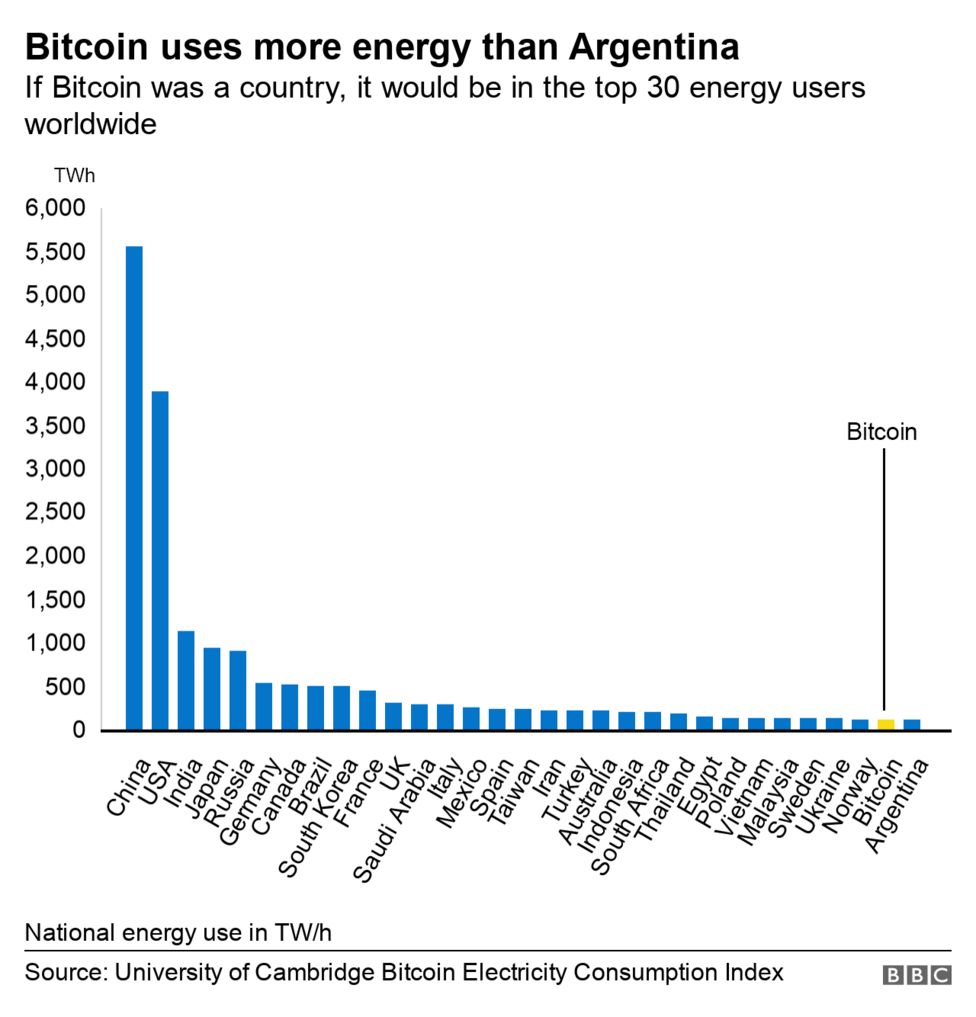
The reason Elon Musk gave for Tesla’s decision: Bitcoin mining soaks up a lot of electric power, much of which comes from fossil fuels, including coal. If Tesla is promoting Bitcoin, it’s undoing the positive environmental effect of its cars.
And nowadays we use Bitcoin to buy houses and cars, pay our bills, make business investments, and more.
Oh, wait. We don’t do any of those things. Twelve years on, cryptocurrencies play almost no role in normal economic activity. Almost the only time we hear about them being used as a means of payment — as opposed to speculative trading — is in association with illegal activity, like money laundering or the Bitcoin ransom Colonial Pipeline paid to hackers who shut it down.
He goes on to point out that 12 years is a long time in tech: Bitcoin is the same age as Venmo, and older than the iPad or Zoom. The fact that it hasn’t caught on yet is a really bad sign.
One reason for that failure to catch on is habit, and the fact that most people are not nearly so desperate to get out of “fiat currencies” as Libertarians think they should be. (That might change if the current burst of inflation turns into more than the temporary blip economists like Krugman are predicting.) But a second good reason is the fluctuation in the dollar-value of Bitcoin itself.
Imagine, for example, that you’re a contractor negotiating a deal to spend the next two years building a bridge. You’d be crazy to take your payment in Bitcoin, because no one has any idea what Bitcoin will be worth in two years. Similarly, imagine if you’d taken out a mortgage in Bitcoin at the beginning of 2020, when a bitcoin was worth about $10,000. By this April, you’d have owed six times as much (in dollar terms). If your salary were denominated in Bitcoin, you’d have taken a 30% pay cut Wednesday.
The only way this makes sense is if you are living in a complete Bitcoin system, where you can pay your workers (or your rent) in the same currency that you’re earning, so that your income and expenses rise and fall together. Otherwise you’re gambling, not participating in a productive economy.
Now, it’s not unusual for new technology to face this kind of chicken-and-egg problem. (It made little sense to be an early adopter of the telephone, for example, because there were so few people you could call.) Tech that succeeds is compelling enough to overcome that problem.
But Bitcoin doesn’t seem to be that compelling. Maybe you weren’t planning to buy a Tesla with your bitcoins anyway. The fact that you can’t, though, is symbolic.
Bitcoin and global warming. The deeper problem is that Bitcoin mining eats up an enormous amount of computer power, which in turns eats up an enormous amount of electrical power. The Guardian reports:
Cambridge’s Centre for Alternative Finances estimates that bitcoin’s annualised electricity consumption hovers just above 115 terawatt-hours (TWh) while Digiconomist’s closely tracked index puts it closer to 80 TWh.
A single transaction of bitcoin has the same carbon footprint as 680,000 Visa transactions or 51,210 hours of watching YouTube, according to the site.
As more people learn about bitcoin and mining—and as the price of bitcoin increases—more are using their computers to mine bitcoins. As more people join the network and try to solve these math puzzles, you might expect each puzzle to be solved sooner, but bitcoin is not designed that way.
The software that mines bitcoin is designed so that it always will take 10 minutes for everyone on the network to solve the puzzle. It does that by scaling the difficulty of the puzzle, depending on how many people are trying to solve it.
Of course, the carbon footprint depends on how the electricity is being generated. And that brings up a different problem: No one knows exactly where the mining computers are, or how their electricity is generated. And because there is no central authority controlling Bitcoin — that’s part of the point, after all — no one can enforce environmental standards on the miners.
It seems likely, though, that miners are setting up in places where electricity is cheap. And at the moment, that is likely to be where it’s easy to burn coal.
Now, you could imagine setting up Bitcoin-mining supercomputers on the vast plains of Oklahoma, and powering them with fields of windmills. But even that plan is environmentally questionable. The growth in sustainable energy is supposed to replace fossil-fuel energy, not power some new need that didn’t exist 12 years ago.
Fatal wounds? For what it’s worth — notice that I’m putting it out for free — I think the environmental problem is a fatal wound for Bitcoin. Maybe in a not-too-distant future, computation requires much less electricity, which is generated by solar arrays in orbit, so nobody cares about the computational burden of their digital currencies. But maybe not.
In the meantime, we’re not there.
Right now, for Bitcoin to catch on and rival the dollar, the yen, and the euro, it needs the kind of early-adopter enthusiasm that comes from people believing that they’re doing something cool. Twelve years ago, those two Bitcoin-purchased Papa Johns were the coolest pizzas in the world.
Now they’re not, and even Elon Musk realizes it. Maybe at some point, your friends would have been awed if you’d said, “Like my new Tesla? I bought it with Bitcoin.”
But with every day that goes by, you’re less and less likely to get that reaction, and more and more likely to convince people that you’re willing to destroy the planet for your own vanity. “Oh, you’re that kind of asshole.” (At the moment, the world’s most famous Bitcoin miner is Joel Greenberg. That kind of asshole.)
That’s fatal. Maybe not today or tomorrow, but soon.
This all says nothing about the underlying argument for some kind of cryptocurrency. Maybe trillion-dollar deficits really are evidence that the world’s governments and central banks can’t be trusted to maintain our money. Maybe there is room in the world for — or even a need for — a crowd-sourced money based on cryptographic algorithms.
But that currency is going to need a high level of coolness to beat the chicken-and-egg problem and catch on. And eating up a nation-sized chunk of the world’s energy output is not cool.
One thing I appreciate about the Biden administration is that the rate of news has slowed a little. That gives me time to think about longer-term issues once in a while rather than constantly react to the most recent threat to democracy.
This week I take advantage of that freedom to reflect on Bitcoin, which crashed 30% against the dollar on Wednesday. I can’t guess what the market will do day-to-day or even month-to-month, but long-term, I’m bearish on Bitcoin. In order to catch on as a currency for everyday use, it’s going to need a aura of coolness; using it should impress your friends. But the environmental disaster of Bitcoin mining is anything but cool. I’ll develop that point — and make some rude observations about the paradoxes of money in general — the in the featured post “The Problem with Bitcoin”. That should be out shortly.
The weekly summary does have stuff to cover: Congress’ looming failure to authorize a bipartisan commission to investigate the Trump Insurrection, the Israel/Palestine ceasefire, the usual run of Republican scandals, and a few other articles that are taking advantage of breathing space in the news to reflect on the possibility of global population decline, or the reasons life expectancy doubled in the 20th century.
Since the election, Republicans, driven by the lie that is now their party’s central ideology, have systematically attacked the safeguards that protected the last election. They have sent the message that vigorous defense of democracy is incompatible with a career in Republican politics.
This week everybody was talking about getting back to (sort of) normal
Tomorrow marks two weeks since my second Pfizer shot, so according to the new CDC guidance I should be able to more-or-less resume normal life.
If you’ve been fully vaccinated: You can resume activities that you did prior to the pandemic. You can resume activities without wearing a mask or staying 6 feet apart, except where required by federal, state, local, tribal, or territorial laws, rules, and regulations, including local business and workplace guidance.
Now, breakthrough infections were expected, and don’t cast doubt on the effectiveness of the vaccines. Epidemiology is a numbers game; the vaccines substantially reduce the odds of catching, transmitting, or dying from Covid, but they’re not guarantees.
Personally, I regard mask-wearing as a fairly trivial hardship, so I think I’ll still do it when I’m in stores or crowds. I may wear masks in movie theaters for the rest of my life (unless I get popcorn). And I plan to keep avoiding indoor dining until the new-case numbers drop much further. Some people are being even more cautious.
There are at least a few reports of people being harassed for wearing masks, which apparently anti-maskers regard as turnabout-is-fair-play. But it’s not: People who refused to wear masks when they were necessary were endangering everyone else. People who continue to wear masks when they’re not necessary are only inconveniencing themselves. Why should anyone else care?
Since CDC announced the new COVID-19 mask guidance for vaccinated Americans, a flurry of right-wing accounts — seemingly belonging to unvaccinated people — have tweeted saying they “identify as vaccinated” and won’t be wearing a mask. It’s the new anti-vaccine talking point.
“Identifying as vaccinated” is a twofer in conservative circles: It parodies the rhetoric of trans people in order to undermine the public health system’s battle against Covid. This is what passes for cleverness on the Right. As my junior high English teacher told us, “Some people are so stupid they think they’re intelligent.”
Long but worth it: Wired has a medical whodunnit: How did the medical establishment become so convinced (wrongly) that Covid could only travel short distances in droplets, rather than hanging in the air and covering longer distances? The problem goes back to a misinterpretation of a tuberculosis study in 1962, and it was fixed this year by a small group of scientists who wouldn’t let rejection slow them down. Their work not only helped control Covid (much later than it should have been controlled), but should prevent flu deaths for years to come.
If your relationships, work, and life have been disrupted by the pandemic, the weeks and months before you fully reenter the world should not be wasted. They are a once-in-a-lifetime opportunity to come clean with yourself—to admit that all was not perfectly well before.
… Many of us have taken to asking each other, over the past year or so, what we miss from before the pandemic and hate about living through it. But for your happiness, the more germane questions are “What did I dislike from before the pandemic and don’t miss?” and “What do I like from the pandemic times that I will miss?”
Brooks recommends that you take inventory of your pre-pandemic life and make a plan for not returning to normal.
I saw Brooks interviewed on CNBC, where he made another interesting point: The pandemic may be a once-in-a-lifetime event, but something turns the world upside-down about every ten years: the financial crisis of 2008, 9-11, the fall of the Soviet Union.
and Israel/Palestine
A featured post discusses two articles outlining very different ways to look at the situation.
Matt Yglesias makes an interesting point that doesn’t fit in that article:
I’m not saying you or your favorite politician should have a strong take on the Tigray conflict in Ethiopia — it is every American’s right to ignore foreign events! — but it’s worth asking why some things get on the news agenda and others don’t.
and Republicans behaving badly
I cover Liz Cheney’s ouster from House Republican leadership, and what it means for the GOP, in a featured post. But that was far from the only story illustrating the ongoing decline of the Republican Party.
But before leaving the Cheney story, I want to point out an irony: The GOP’s acceptance of Trump’s Big Lie is an example of what “political correctness” originally meant, before it became a meaningless insult.
In Stalinist circles, everybody understood that he Party told lies. So in order to function, you had to stay aware of two realities: the real world, but also the alternative reality described by the Party’s propaganda. To get things done, you had to appreciate what was factually correct. But often you couldn’t say the truth out loud, because those factually correct statements weren’t politically correct.
Same thing here: Kevin McCarthy and the rest of the House Republican leadership understand that Trump lost the election. But in an authoritarian party, you can’t contradict the Leader. “Biden won fair and square” may be factually correct, but it’s not politically correct.
Tom the Dancing Bug portrays the insurrectionists as a comic character. It had to be either Snoopy’s air ace or Calvin as Spaceman Spiff.
This is the kind of craziness the insurrectionists are still spreading: Trump lawyer Lin Wood in Myrtle Beach on May 11: Trump is still president, because he won the election. The military is still looking to him for leadership. “This isn’t about Trump. This isn’t about flesh. This is about God. This is about Powers and Principalities. God’s getting ready to clean up this world.”
Rep. Louie Gohmert of Texas took to the House floor on Friday to downplay the January 6 Capitol riot, describing the insurrections as “political prisoners held hostage by their own government.”
“Joe Biden’s Justice Department is criminalizing political protest, but only political protest by Republicans or conservatives,” Gohmert said in his lengthy speech in which he cited several conservative news outlets, according to CNN. “They’re destroying the lives of American families, they’re weaponizing the events of January 6 to silence Trump-supporting Americans.”
Lest we forget: Trump had masked federal police abducting people off the streets in Portland because protesters were defacing a federal court house with graffiti. But folks who broke windows and beat policemen with flagpoles in an attempt to stop Congress from certifying the peaceful transfer of power are “political prisoners”.
A lot of news stories this week told us about Republicans who might get indicted, but haven’t been yet. I’m keeping track of these developments, but trying not to get too excited about them until there’s something definite in the public record.
Friday, Joel Greenberg, often described as Congressman Matt Gaetz’ “wingman” (though I haven’t been able to track down how that started), pleaded guilty to six federal charges, including sex trafficking women, one of whom was a minor at the time.
As part of his plea deal, Greenberg plans to admit in court that he introduced a child “to other adult men, who engaged in commercial sex acts with the Minor in the Middle District of Florida,” according to the document filed Friday.
It’s widely suggested that one of those men was Gaetz, though the plea deal doesn’t name him, and Gaetz denies any wrongdoing. In the deal, Greenberg promises to “cooperate fully with the United States in the investigation and prosecution of other persons”. Who those persons are is not specified, but it’s reasonable to assume one of them is a bigger fish than Greenberg himself. If not Gaetz, then who?
The Daily Beast has been the leading news source on the Gaetz scandals. My impression of DB is middling: I don’t think they’d invent a story out of nothing, but I also don’t trust them to be as scrupulous as The New York Times or Washington Post. It bothers me that top-line news organizations haven’t been able to verify many of DB’s claims through their own reporting. (When MSNBC’s Chris Hayes interviewed DB’s reporter, he said: “I want to stress here that we at NBC have not confirmed this reporting.”)
Friday DB posted this claim: After Gaetz was the lead speaker at the Trump Defender Gala at a resort in Orlando on October 26, 2019, his hotel room was the site of cocaine party that Gaetz participated in. The drugs were provided by a woman who had an ongoing money-for-sex relationship with Gaetz and a no-show government job provided by Greenberg.
The woman is identified, but not the witnesses the story relies on.
Elsewhere, Manhattan District Attorney Cy Vance is still working on his investigation of Donald Trump’s finances. The investigations appears to be trying to get something on Trump accountant Allen Weisselberg in an effort to flip him against Trump.
Vance already has millions of pages of Trump financial documents, but (according to numerous lawyers speculating in the media) doesn’t want to make a purely document-based case against Trump. Documents are far more persuasive with an inside witness who can lead the jury through them.
Still no word on what might have been found in the raid on Rudy Giuliani’s home and office.
It looks like Trump’s former White House Counsel, Don McGahn, will finally testify to Congress. The interview will not be public, but a transcript will be released a week later.
The interview will be limited to information attributed to McGahn in the publicly available portions of the Mueller Report, as well as events that involved him personally. He can decline to answer questions that go beyond that scope.
That should include instances that the Mueller Report analyzed as possible obstructions of justice by Trump, like when Trump allegedly instructed McGahn to tell Rod Rosenstein to fire Mueller, and then instructed McGahn to publicly deny that Trump gave any such order.
And while McGahn “can” decline to answer other questions, it will be interesting to see what he chooses to answer.
Marjorie Taylor Greene appears to have cheated on her state taxes. She and her husband have claimed homestead exemptions on two houses. You’re only allowed one.
Greene apologists would like to say this is just ordinary politics, but it isn’t. This is deeply disturbing behavior that could get somebody killed. No member of Congress has ever had to take out a restraining order against another, but AOC should.
If Trump is indicted in New York, both the U.S. Constitution and a federal statute dating to 1793 require DeSantis (or the governor of whatever state Trump is in at the time) to hand him over. And if DeSantis still refuses, a 1987 Supreme Court decision makes clear that federal courts can order him to comply.
A ransomware attack, apparently by the Russian criminal group Darkside, shut down a major pipeline supplying gasoline to the east coast for a little over a week. The pipeline is now back in operation. The C|Net article on this is pretty good.
Back in the 1800s, someone described various cabals’ attempts to corner the wheat market as “like watching men wrestling under a blanket”. In other words, you can see that something is happening, but it’s hard to tell what it means. Ditto here.
Colonial Pipeline appears to have paid a $5 million ransom, so that looks like a win for Darkside. But the criminal group also appears to have suffered consequences.
As of Friday, the group appeared to have disbanded, according to the Journal, which reported Darkside had told associates that it had lost access to the infrastructure it needs for its activities. The group said law enforcement actions had prompted its decision, according to the paper.
Those responsible for DarkSide are very organized, and they have a mature Ransomware as a Service (RaaS) business model and affiliate program. The group has a phone number and even a help desk to facilitate negotiations with and collect information about its victims—not just technical information regarding their environment but also more general details relating to the company itself like the organization’s size and estimated revenue.
This is bound to be merely the first example of a larger problem. All kinds of vital infrastructure is controlled by computers, or related to computer systems in some other way. (One account I’ve seen of the Colonial Pipeline hack speculated that Darkside had hacked the billing software, not the software that runs the pipeline itself. So Colonial could still deliver gasoline, but wouldn’t know how to get paid. I don’t know if that’s true, but it points out the breadth of the vulnerability.) Software is notoriously full of bugs, and much of it is developed on platforms that are themselves full of bugs, like Windows.
Georgia Tech media studies Professor Ian Bogost commented on the general state of computer security:
You need a license to go fishing but not to deploy software at global scale.
The root issue is the extreme level of corruption in the organization, centering on Executive Vice President Wayne LaPierre. (Even GQ is horrified by LaPierre spending a quarter million of the NRA’s money on suits.) Escaping state regulatory enforcement, a federal judge in Texas ruled, is not “a purpose intended or sanctioned by the Bankruptcy Code”.
This week I noticed Hi/Storia, a Facebook page devoted to amusing memes and cartoons about history. For example:
I’m always amused by Trae Crowder’s “Liberal Redneck” rants. But his “Confederate Memorial Day” is laugh-out-loud funny.
in order to grasp the full nuance of his views, though, you should also watch his “In Defense of Dixie” from 2016.
While we’re talking about Confederate remembrance, Clint Smith is a Black man who tours some iconic Confederate shrines and writes “Why Confederate Lies Live On” for The Atlantic.
Confederate history is family history, history as eulogy, in which loyalty takes precedence over truth.
Among other myths, Smith debunks the frequently heard claim that
“From the perspective of my ancestors, [the Civil War] was not [about] slavery. My ancestors were not slaveholders. But my great-great-grandfather fought.”
Even if you didn’t own slaves — and large numbers of Confederate soldiers’ families did — you probably liked the idea that you weren’t at the bottom of society.
The proposition of equality with Black people was one that millions of southern white people were unwilling to accept. The existence of slavery meant that, no matter your socioeconomic status, there were always millions of people beneath you. As the historian Charles Dew put it, “You don’t have to be actively involved in the system to derive at least the psychological benefits of the system.”
and let’s close with something you can dance to
The genius of Lin-Manuel Miranda’s Hamilton was in translating a WASPy bit of American history into a modern ethnic musical genre, hip-hop. Well, what if somebody from a different American ethnicity had gotten a similar idea, and told Alexander Hamilton’s story through polkas?
Of course, this is a Weird Al Yankovic question, and he provides this answer.