Ultimately it was hoped to make articulate speech issue from the larynx without involving the higher brain centers at all. This aim was frankly admitted in the Newspeak word duckspeak, meaning ‘to quack like a duck’. Like various other words in the B vocabulary, duckspeak was ambivalent in meaning. Provided that the opinions which were quacked out were orthodox ones, it implied nothing but praise, and when The Times referred to one of the orators of the Party as a doubleplusgood duckspeaker it was paying a warm and valued compliment.
— George Orwell, “The Principles of Newspeak“
This week’s featured posts: “A State-by-State Update on Voter Suppression” and “The Method of Madness“.
Everybody has been talking about the shutdown aftermath
There’s no question that President Obama won this showdown, though it was mainly a defensive victory: Republicans failed to destroy his main achievement, the Affordable Care Act. (More about this in “The Method of Madness“.)
Along the way, Republicans also trashed their public image and tanked their poll numbers. Control of the House may be up for grabs in 2014.
So why did they do it? Everyone — even conservatives like Charles Krauthammer — told the Tea Party radicals exactly what would happen, so it couldn’t have been a surprise or a miscalculation. Why, then?
Part of the answer is the usual right-wing hucksterism. The shutdown was a great fund-raising tactic in general, and Ted Cruz specifically vaulted himself into being the early front-runner for the GOP presidential nomination in 2016.
But the deeper reason may have been to complete the radicalization of the Republican Party. Erick Erickson explained this clearly:
those of us who were in this fight against Obamacare, have been quite open that we knew there were side benefits. This fight would expose conservative activists to the frauds they have funded.
Men like Mitch McConnell, John Cornyn, Eric Cantor, Kevin McCarthy, and others have preached a great sermon against Obamacare, but now conservatives who supported them see that these men have refused to actually practice what they’ve been preaching. They’ve refused to stand and fight with the rest of us.
… So we must advance. Two Republicans in the Senate caused this fight that their colleagues would have surrendered on more quickly but for them. Imagine a Senate filled with more. We have an opportunity to replace Mitch McConnell in Kentucky with a better conservative. We should do that. We have the opportunity to send a strong conservative from North Carolina and we should do that. Same in Colorado. Kansas looks to be in play. Chris McDaniel will declare his candidacy for the Senate in Mississippi. Conservatives will rally to him quickly. Tennessee could be in play too.
Imagine a Senate where far-right Republicans like Mississippi’s Thad Cochran were replaced — not by people who are more conservative philosophically, that’s barely possible — but by Republicans willing to take the government hostage and blow up the economy if they don’t get what they want. Most of the senators on Erickson’s hit list — McConnell, Cochran, Tennessee’s Lamar Alexander, and Kansas’ Pat Roberts — are Republicans whose conservativism was not in question only a few years ago.
The game here appears to be longer than 2014 or even 2016. And increasingly, it looks to me like the point is not to win a majority. It’s to make the country ungovernable, so that some kind of right-wing minority rule starts to seem like a reasonable alternative.
The real question, as we look forward to the extended deadline for a budget/debt-ceiling deal, is what non-Tea-Party Republicans learned from this last crisis. Until now, most of the Republican establishment has been trying to appease the Tea Party revolutionaries; just don’t set them off, and hope they go after somebody else. I hope they’ve learned now that appeasement is impossible if you retain any loyalty to democracy and the government of the United States of America.
You will be targeted. You will have to fight. Better you should fight sooner than later.
About that guy waving a confederate flag in front of the White House during that bizarre Cruz/Palin rally protesting their own government shutdown. The Atlantic’s Ta-Nehisi Coates has it exactly right: The problem isn’t that one guy. “Lone idiots are often drawn to protest actions.”
The problem is the crowd that treated him like a normal person. The problem is when leaders like Ted Cruz get hold of the microphone and don’t say something like, “You need to put that away; you’re not helping us.”
That’s the Tea Party/racism problem in a nutshell. Tea Partiers get apoplectic when they’re accused of racism. But since the Goldwater/Nixon years, the Republican Party has made itself a place where racists can be comfortable. You don’t have to be racist to be a Republican. But if you are, that’s OK.

and HealthCare.gov
There’s been a lot of spin and sloppy coverage here: What’s being presented as “problems with ObamaCare” are usually just problems with HealthCare.gov, the web site that is one of the ways you can sign up for some of the new health-insurance options created by the Affordable Care Act. (An exception is Ezra Klein, who explains how problems with HealthCare.gov could eventually create problems with the insurance risk pool if they persist.)
An analogy might help put this in perspective: If something went wrong with the ticket-selling page on Denver Broncos’ web site, that would be a nuisance for ticket-seeking Broncos fans, who might have to call the box office or show up in person. But the Broncos’ season-ticket holders would be completely unaffected by the online difficulties, just as people who already have health insurance through their employers or Medicare or some other government program are unaffected by the problems at HealthCare.gov.
None of that would constitute “problems with the Denver Broncos”. Peyton Manning is doing fine.

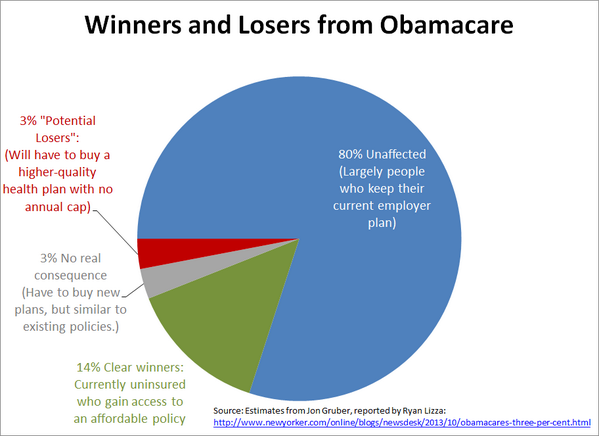
ObamaCare is not just the health-insurance exchanges, and the exchanges are not just HealthCare.gov. ObamaCare is a system for achieving near-universal healthcare coverage. It works like this:
- The majority of Americans already had adequate coverage through their employers, or through the government via Medicare, Medicaid, or the Veterans Administration. They would keep their coverage, with the additional security that they couldn’t lose coverage through pre-existing conditions or exceeding some lifetime cap.
- Lower-income working people who aren’t covered some other way and previously made too much money to qualify for Medicaid would be covered by expanded Medicaid. (This is the part the Supreme Court messed up by allowing states to opt out. States like Texas are opting out so that their governors can win Republican primaries. The Corpus Christi Caller writes: “According to one esteemed estimate, the annual unnecessary death toll for continuing to leave a fourth of Texans uninsured is 9,000.”)
- Middle-class people who aren’t covered some other way and don’t qualify for expanded Medicaid could buy health insurance from private insurance companies (not the government) through their state’s health-insurance exchange. The law encouraged states to set up and run their own exchanges, which most states controlled by Democrats have done. (Many of those seem to be working fine.) But in states that refused to set up their own exchanges (i.e., red states) the federal government would do so. Depending on your income, your insurance premiums might be partially subsidized by the federal government through a tax credit. (Unless another Republican court challenge gets rid of the subsidies for states that didn’t open their own exchanges.)
- Rich people can do whatever, as always. No “government takeover of healthcare” or “death panels” prevent them from buying whatever services they want.
So if your job doesn’t already provide health insurance, and if you want to purchase it through your state health insurance exchange, and if your state didn’t set up its own program with its own web site, then you are inconvenienced by the problems at HealthCare.gov. If the federal government can’t fix the site, you might have to apply for health insurance over the phone or by showing up in person somewhere.
As for what kind of health insurance you will get if you do and what it will cost you, that’s looking pretty good. It’s looking so good that when Sean Hannity wanted to show his audience real-life examples of people harmed by ObamaCare, he had to deceive them. Salon’s Eric Stern fact-checked Hannity by tracking down the people he showcased, and discovered that none of them had actually been harmed by anything other than their own stubbornness.
Had they shopped on the exchange yet, I asked? No, Tina said, nor would they. They oppose Obamacare and want nothing to do with it. Fair enough, but they should know that I found a plan for them for, at most, $3,700 a year, 63 percent less than their current bill.
One of the ways you might buy tickets isn’t working very well, but the team is winning on the field.
The HealthCare.gov problem is yet another episode in the endless Republican search for “Obama’s Katrina”. The BP oil spill was supposed to be Obama’s Katrina, Hurricane Sandy was supposed to be Obama’s Katrina, and in general the phrase has been bandied about so much that 29% of Louisiana Republicans believe Katrina was Obama’s Katrina.
Esquire’s Charles Pierce points out why this is an over-the-top comparison:
Almost 2,000 people died so that, eight years later, Rich Lowry could have a cheap punchline.
HealthCare.gov still hasn’t killed anybody.
You may have heard that the government spent $600 million building the HealthCare.gov web site, with Fox News claiming the ultimate cost could go over $1 billion.
Media Matters explains where the first number came from. (Fox hasn’t said where they got the second one.) As so often happens inside the conservative media bubble, the figure $600 million appeared in a story about the web site — it’s the total value of all healthcare-related contracts the software company has received — and became the cost of the web site by daisy-chaining references.
Single-payer advocates have been passing around variations on this joke: The Canadian version of HealthCare.gov just says: “This is Canada. You have health care.”
and voter suppression
If you’re the minority party and you don’t want to change your policies to become more popular, you can still win if your voters are very motivated and you make it hard for the majority party’s voters to vote. The Supreme Court’s recent ruling on the Voting Rights Act might as well have been an announcement of open season on voting rights at the state level. I review what’s been happening lately in “A State-by-state Update on Voter Suppression“.
Even if you don’t click through to read that link, you really should see The Daily Show’s Aasif Mandvi interviewing North Carolina Republican official Don Yelton.
and you also might be interested in …
Don’t miss the dialog about journalism between the NYT’s Bill Keller and Glenn Greenwald.
In general, I’m Greenwald’s side in this debate. (Though I have criticisms of him as well: I like that he is open about the worldview that shapes his reporting, rather than hiding behind a pretense of objectivity. But too much of his personality makes it into his writing, and I find his personality abrasive and thin-skinned.) I think Keller comes into the discussion determined to fit Greenwald into a box, with the result that he never really listens to what Greenwald says.
Keller never acknowledges Greenwald’s criticism that the Times’ desire to maintain an appearance of impartiality conflicts with a deeper objectivity. Greenwald mentions how the Times changed its usage of the word torture when the Bush administration began claiming (against all prior usage) that waterboarding was not torture. A truly objective newspaper would apply definitions of controversial words impartially, regardless of whether powerful interests object.
To understand what Greenwald means when he describes NYT-like journalism as “nationalistic”, look at Joshua Keating’s “If It Happened There … the Government Shutdown“. How would the American press cover the shutdown if it were happening in another country?
If you think conservatives believe in small government and personal freedom, you must be male. Consider the bizarre case of Alicia Beltran, a 28-year-old woman who has the misfortune to be pregnant in Wisconsin, where “pro-family” fetal-protection laws give the government Orwellian powers over pregnant women.
Because of a prescription-drug problem that she had already overcome (and that no one would have known about if she hadn’t mentioned it to doctors herself), Beltran was prescribed an anti-addiction drug that she couldn’t afford. When she refused, she was arrested and forced to stay in an in-patient facility. During that involuntary absence, she lost her job.
The baby is due in January. You’re welcome, kid.
Birtherism is so hilarious. Funny, I don’t recall Democratic officials making years and years worth of 9-11 Truther jokes about W (rather than jokes about Truthers). Is that just my bad memory?
Even if you’re not usually a football fan, you should watch ESPN’s “The Book of Manning“, which may still be available on demand on some cable systems and is out on DVD. The story of Archie, Peyton, and Eli turns out to be more about family than about football. The Mannings totally cooperated, and Archie made his extensive (and, at times, incredibly cute) home videos available to the film-makers.
Two retired Canadian tourists decide to see the Alamo, and blunder into a protest rally of people carrying loaded assault rifles. “This is totally beyond our comprehension,” Mabel says.

Finally, if you’re wondering what I was doing that kept me from putting a Sift out last week, I was working on this talk.