Monthly Archives: October 2015

The Right Men for the Job

Leo, we need to be investigated by someone who wants to kill us just to watch us die. We need someone perceived by the American people to be irresponsible, untrustworthy, partisan, ambitious, and thirsty for the limelight. Am I crazy, or is this not a job for the U. S. House of Representatives?

— C. J. Cregg, The West Wing (2001)

This week’s featured post is “Notes From Hillary’s Benghazi Showdown“.

This week everybody was talking about Hillary and the Benghazi Committee

By the time the hearings started Thursday morning, everybody not inside the conservative news bubble was expecting a complete disaster for the House Republicans. But they just couldn’t stop themselves from charging in like the Light Brigade. Full coverage of the fallout is in this week’s featured post.
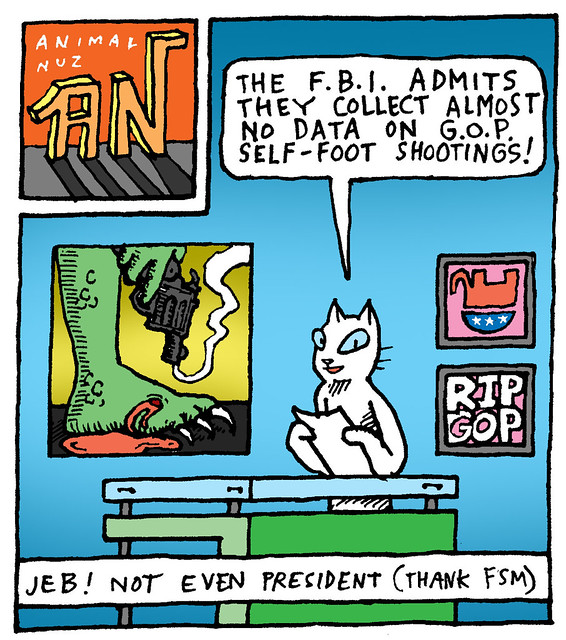
and Joe Biden

I was glad to see Vice President Biden decide not to run. Like Greg Sargent, I just don’t see what Biden would add to the race. If you believe Hillary’s about to crash and burn, then the Democratic establishment needs a back-up candidate. But if not, then what’s the point?

Somebody should total up the amount of air time that pundits who had no real information to share wasted speculating about Biden’s candidacy. None of their viewers or listeners or readers are ever going to get that time back. Nate Silver distills the moral of the story:

As is often the case, sketchily sourced “inside information” proved no more reliable than other types of gossip.

and Canada

After ten years of the conservative government of Stephen Harper, Canadian voters gave the Liberal Party 55% of the seats in Parliament. Another 13% went to the New Democrats, who are to the Liberal Party’s left. Between them, the two left-of-center parties got 60% of the vote.

Harper’s government was strongly anti-Muslim. Trudeau campaigned on raising the budget deficit to stimulate the economy.

and Congress

It looks like Paul Ryan will be speaker, though the Freedom Caucus didn’t formally endorse him or support the rule changes he wants. I still believe that Tea Partiers wants a confrontation with Obama over the debt ceiling in early November and/or a government shutdown in December, and I don’t think Ryan will give it to them. We’ll see what happens then.

Reihan Salam thinks Ryan’s rep as a true conservative will placate the Far Right.

Members of the Freedom Caucus might believe that they’re doing the White House a favor by agreeing to increase the debt limit, but almost no one else in the country sees it that way. Another drawn-out debt limit fight can only end in tears for the GOP.

Why does Ryan have a better shot at selling Republicans on pragmatism than Boehner or Kevin McCarthy? It’s simple. While it’s never been clear exactly what Boehner or McCarthy stand for, most conservatives, including diehard Freedom Caucus Republicans, recognize that Ryan is a conservative true believer and that every pragmatic accommodation he makes is with an eye toward moving government in a more conservative direction. Ryan’s critics might not agree with him on every tactical decision, but they recognize his sincerity and his commitment.

I don’t think the Freedom Caucus — or the Republican base voters they represent — care a fig about “sincerity and commitment”. I think they want to stand over a beaten-down Obama and watch him beg for mercy. The base voters believe — because Tea Party politicians have been telling them — that Boehner has been losing to Obama because he hasn’t had the will to push the confrontation all the way. They’re not going to accept compromise from Ryan either.


The Weekly Sift has covered Paul Ryan in some detail over the years. My 2012 Ryan-as-VP-candidate triology is: “I Read Everything About Paul Ryan So You Don’t Have To“, “Paul Ryan: Veteran of the War on Women“, and “Ayn, Paul, and Me“. More recently, I discussed his attempt to redesign the War on Poverty in “Does Paul Ryan Care About Poverty Now?” and “Can Conservatives Solve Poverty?“.

Probably the best of that group is “Ayn, Paul, and Me“.

and Obama’s veto

The first shot of the next round of budget wars was fired when President Obama vetoed the $612-billion National Defense Authorization Bill.

Here’s what that’s about: The 2011 debt-ceiling crisis resulted in the Budget Control Act. The BCA set up something that was never supposed to happen: automatic budget cuts known as “the sequester”. The idea was that the sequester was such a ridiculous way to cut spending that of course Congress would work out something else before it went into effect.

I know, that sounds so naive today. The sequester actually did take effect. In order to make it sting on both sides, the agreement stipulated that defense and non-defense spending would both face limitations.

Well, Republicans want to undo the defense-spending limits, but leave the domestic-spending limits in place. So they put $38 billion of ordinary defense spending into a war-fighting account that’s exempt from the sequester. Obama thinks this is an accounting gimmick, and he’s right. If the sequester was a bad idea — and it was — Congress should undo it, not finesse around it.

and Jerusalem

A longer article about the current wave of Israel/Palestine violence is sitting in my perfectionist Limbo, while I decide how to summarize the recent book The Two-State Delusion by Padraig O’Malley.

In the meantime, you should definitely read Vox’s account of a recent speech by Danny Seidemann, executive director of the Israeli organization Terrestrial Jerusalem.

while Republican candidates advocated violating the Constitution

A Fox Business interviewer asked Donald Trump about a British anti-terrorism proposal to “close some mosques”. Trump replied “I would do that. Absolutely. I think it’s great.”


Ben Carson’s soft-spokenness doesn’t make him any less scary. Listen to this rapid-fire yes-or-no Q&A with Glenn Beck.

This sequence is near the end of that clip.

BECK: Shut down the Department of Education?

CARSON: I actually have something I would use the Department of Education to do.

BECK: Would it be … pack boxes for the State Department? [LAUGHTER] IRS?

CARSON: No, it would be to monitor our institutions of higher education for extreme political bias and deny federal funding if it exists.

In other words, colleges should have political commissars to tell them when they’re getting too liberal for the Carson administration’s taste.

Carson followed up on this idea in an interview with conservative talk-radio host Dana Loesch, justifying the need for his commissars by telling about a student whose professor instructed him to write “Jesus” on a piece and then stomp on it as part of a classroom exercise. (The source of this story is Fox Radio’s Todd Starnes, a frequent fabricator of Christian “persecution” stories. The author of the exercise describes it very differently.)

Loesch then asked the question any sensible conservative would ask: Couldn’t the next liberal administration use this machinery against conservatives? Of course not, Carson assures her, because only liberal professors demonstrate “extreme” political bias.

I think we would have to put in very strict guidelines for the way that that was done. And that’s why I used the word “extreme”. I didn’t just say “political bias”, I said “extreme political biases”. For instance, the example that I gave.

In reality, I think you’d be hard pressed to find a college as bent on liberal “indoctrination” (which is what Carson says he’s trying to prevent) as, say, Liberty University is on conservative Christian indoctrination. (Liberty’s motto is “Training Champions for Christ”.) And that should make obvious the biggest problem with Carson’s plan: It’s an attack on student freedom. Students go to Liberty because they want to be indoctrinated in an extreme conservative Christian worldview. And that should be their choice, not the government’s. Ditto for students who seek an education rooted in progressive values.

So this is what we can expect from Carson: On the basis of horror stories invented by the right-wing media, he will implement policies that restrict the freedom of people who disagree with him.

BTW: According to one poll, Carson has moved into the lead in Iowa. His 28%-20% margin over Trump comes from Tea Partiers (32%-20%), born-again Christians (36%-17%), women (33%-13%), and the 50-64 age bracket (34%-17%).


Here’s what bothers me most about those Trump and Carson interviews: It’s not that some candidates are willing to violate the Constitution or borrow tactics from totalitarian states — when you have political amateurs in the race, sometimes they’re going to say outrageous things. It’s that none of the other candidates jump up and protest. Where are the supposed “mainstream” candidates like Bush, Rubio, and Kasich?

Why aren’t any of them making the point that even Dana Loesch can see: A government with the power to close mosques has the power to close Christian churches too. If it can target liberal colleges, it can target conservative colleges.

and you also might be interested in …

This week’s guns-make-us-safer story comes from an outpatient clinic in Beaumont, Texas on Monday.

A witness told KCEN’s sister station 12News that a woman was in the waiting room of a medical office. When she reached into her purse to pull out some paperwork, a gun fell out of her purse causing it to discharge. The round went through a wall and hit another patient in the hip.

I guess if you have to be shot, it’s good to already be in a doctor’s office.


The pendulum may finally be turning on high-stakes standardized tests.


Politics That Work is a data-driven web site. Here, they take apart Mitt Romney’s famous “47%“. It’s worth noting that even that orange sliver of able-bodied working-age people not working and not looking for work isn’t all lazy moochers: Some of them intentionally saved money while they were working so that they can do whatever they’re doing now: traveling the world, writing a novel, working on an idea for a new business, or producing a weekly news-and-politics blog.


The IRS pseudo-scandal ends with a whimper, not a bang.

“We found no evidence that any IRS official acted based on political, discriminatory, corrupt, or other inappropriate motives that would support a criminal prosecution,” Assistant Attorney General Peter Kadzik said in a letter to Congress on Friday.

“Based on the evidence developed in this investigation and the recommendation of experienced career prosecutors and supervising attorneys at the Department, we are closing our investigation and will not seek any criminal charges,” he continued.

Kadzik said the investigation found “substantial evidence of mismanagement, poor judgment, and institutional inertia, leading to the belief by many tax-exempt applicants that the IRS targeted them based on their political viewpoints” but concluded that “poor management is not a crime.”


Matt Yglesias points out the resemblance between the Ben Carson campaign, a Ponzi scheme, and a multi-level marketing scam.

Carson is currently in second place in national polls and leading in Iowa. His campaign is raising tons of money from small donors and is spending most of that money on fundraising. People are giving Carson money so that he’ll have the money to ask more people for money. It’s a form of pyramid scheme. There’s no real field operation, policy staff, or any other manifestation of the kind of campaign apparatus that could plausibly result in victory.

It’s an example of the larger phenomenon Rick Perlstein laid out three years ago in “The Long Con” and I covered in “Keeping the Con in Conservatism“. Chris Hayes summed it up in a tweet:

much of movement conservatism is a con and the base are the marks.


Conservatives are annoyed by the new Captain America comics, because Cap is a liberal now. But as Amanda Marcotte points out, anybody who has kept track of the character through the years knows that Captain America has been a liberal since his Depression-era childhood in New York City.


Some people are anti-abortion, while others are more generally anti-sex. Here, an angry mob invades a discussion of Omaha’s sex-education program.


MTV’s Decoded educates us on the racist origins of six common words and phrases: the peanut gallery, no can do, long time no see, sold down the river, and gypped.

That’s only five, you say. I left out hip-hip horray, where MTV’s story didn’t convince me.


Tell me you’re not really going to wear that Indian costume for Halloween. Here’s how actual Native Americans view them.

and let’s close with something amusing
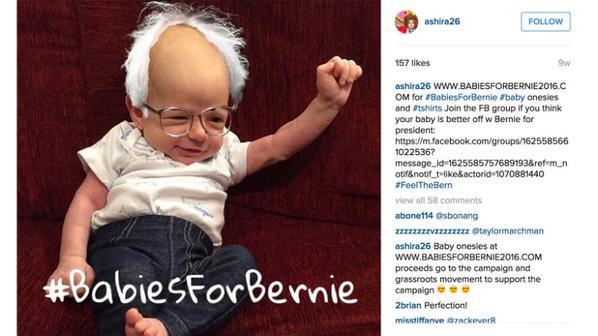
#BabiesForBernie

Notes From Hillary’s Benghazi Show-Down

In the full sunlight of public attention, one very smart, very well prepared Democrat is more than a match for a roomful of Republicans who have been breathing the stale air inside the conservative news bubble.


Unlike so many of the stories that Republicans use to rally their base — Obama’s plot to persecute conservative political organizations through the IRS, Planned Parenthood’s attempt to make big money through the baby-body-parts market, or the conspiracy of the international scientific community to establish a world socialist government by trumping up a global warming crisis — the attack on the American outpost in Benghazi on September 11, 2012 really happened. Four Americans died, including our ambassador to Libya, Chris Stevens.

It was a bad day for America. Not nearly as bad as, say, October 23, 1983, when a Marine barracks in Beirut was bombed, killing 299 American and French servicemen, but a bad day nonetheless.

In hindsight, a lot of people might have done something differently. For instance, Republicans in Congress might have funded the State Department’s security program at the level requested, rather than repeatedly cutting it. Or the State Department might have allocated more of that scarce funding to the Benghazi compound. Or, simplest of all, Ambassador Stevens might have chosen to spend the anniversary of 9-11 in a more secure location.

Hindsight is like that. You can always find something. What’s harder — but far more important — is to find actual lessons for keeping our diplomats safer in the future. That’s the legitimate point of having Congress investigate Benghazi.

As The New Yorker‘s Jane Mayer observed a year-and-a-half ago, a good model for that investigation would have been the one the Democratically controlled House did in 1983: It respected the human tragedy of the Beirut bombing, didn’t use the lives of American servicemen as political poker chips, produced a genuinely bipartisan report, put rumors to rest rather than fanning them, and completed its job in a timely fashion rather than spawning second, third, and fourth House investigations that might have gone on for years. The bombing did not become a major issue to use against President Reagan’s 1984 re-election campaign.

As we know, Republicans in Congress decided not to follow that model. Investigating Benghazi has turned into an industry and the investigation never ends. Depending on how you count, the House Select Committee chaired by Rep. Trey Gowdy is maybe the ninth Benghazi investigation. Mayer’s article concluded:

If you compare the costs of the Reagan Administration’s serial security lapses in Beirut to the costs of Benghazi, it’s clear what has really deteriorated in the intervening three decades. It’s not the security of American government personnel working abroad. It’s the behavior of American congressmen at home.

What went wrong with the previous eight investigations — from the Republican point of view — is that they didn’t decisively nail either President Obama or then-Secretary of State Clinton. They didn’t result in grounds for impeachment, or justify fantasies of putting Hillary in jail. They didn’t substantiate rumors of a rescue mission that was ready to roll until either Obama or Clinton pulled the plug and let our people die. They didn’t justify crowd-pleasing lines like Lindsey Graham’s, “Hillary Clinton got away with murder.

For three years now, Republican politicians have been like the guy who tells his wife he’s working to launch a new business that will make them rich, when really he’s been spending his afternoons at the bar. (“Someday soon it’s all going to come together, honey, and then you’ll see.”) They’ve been telling their base that they have the goods on Secretary Clinton. They’ve been winking and nodding at every scurrilous rumor right-wing talk radio can manufacture, implying that when they finally get Hillary under oath, they’ll confront her with the hard evidence and expose her for the whole country to see.

Unfortunately, they missed the lesson that every tale-spinning husband should know: You never actually schedule that demonstration. The fantasy that your ship is coming in can’t survive if you circle a date on the calendar and invite all your friends and relatives down to the docks.

Well, Thursday the circled date on the calendar arrived. There was Hillary Clinton, under oath, on national TV, outnumbered, in a setting designed and controlled by the House Select Committee’s Republican Chairman Trey Gowdy. But for a one-hour lunch break, they kept her answering hostile questions from 10 a.m. to 9 p.m.

I’m sure the Republicans thought they had a chance. They had ten hours, and they only needed a ten-second lapse. If Clinton stumbled once, if she contradicted herself, if she looked guilty or flustered, if she lost her cool, if she had a Freudian slip … then Fox News would have its lead story and the eventual Republican nominee would have his attack ad. It would all be worth it.

What actually happened is pretty well summed up by the cartoon at the top of the page. (Hillary didn’t really say that line. In Watchmen, Rorschach says it to his fellow prison inmates.) The Republicans didn’t have Hillary where they wanted her, she had them. For 11 hours on national TV on multiple networks, she demonstrated her most presidential qualities: She’s smart, she knows her stuff, she’s unflappable, and she has amazing stamina. Not only did she defuse Benghazi and her email server as issues — if you’ve really got something on her, why couldn’t you produce it? — but she also shut down the argument that she’s too old to be president.

I mean, young Marco Rubio (currently the betting favorite to win the GOP nomination) couldn’t stay presidential for 15 minutes when he gave the Republicans’ State of the Union response in 2013. Josh Marshall had the same thought:

Seriously, can you imagine Marco Rubio in the same chair under the same sort of questioning? Not to mention Donald Trump or – God forbid – the increasingly Chauncey Gardner-esque Ben Carson?

Meanwhile, Chairman Gowdy came out shining with sweat and looking like he’d been through the mill. (I can sympathize. When I saw Clinton this summer inside an oven — I mean, a school gym — in Nashua, I came out soaked and she still looked fresh.)

In short, it was a put-up-or-shut-up moment for the Republicans, and they had nothing to put up.

I would compare Clinton’s testimony to the time in 2010 when President Obama submitted to a Q&A at the retreat of the House Republican Caucus. He ran rings around them that day, and so they never invited him back. Needing to conform to the bizarre fantasies popular among the conservative base is a severe disadvantage when Republicans venture into the view of the general public.

I’ll conclude with some short observations.


You need a comedian to cover the Benghazi hearing properly. Trevor Noah, say.


One way you can tell how an all-day spectacle like this is going is to check which news network cuts away first: that’s the side that thinks it’s losing. Liberal MSNBC stuck with Hillary’s testimony all the way to 9 p.m., while conservative Fox News abandoned ship in mid-afternoon. MSNBC’s Steve Benen sums up

that’s how awful yesterday’s hearing was for Republicans: even conservatives who desperately wanted it to go well for the right had to concede that the gambit was a failure.


As so often happens, right-wingers are annoyed that their people let them down (if you click that link, be sure to read the comments), but won’t consider the idea that there is no Benghazi scandal to ferret out. The clamor for yet another investigation is bound to start soon.

The Republican base views investigations like fortune cookies in a big box. They think that if they open enough of them, they’re bound to find one that says what they want.


I can’t find the link, but I recall TPM’s Josh Marshall complaining a month or two ago that Clinton-haters are so rabid and unfair in their attempts to bring Bill & Hillary down that he ends up rooting for the Clintons, even though he’d rather support more liberal candidates. That effect, combined with Hillary’s strong performance in the first debate, seems to be working.

Recently, Bernie Sanders held a lead in several New Hampshire polls and had even edged ahead in Iowa, but his advantage seems to have evaporated. Two new polls in Iowa show Clinton with a commanding lead. She has a smaller 38%-34% lead in a recent New Hampshire poll.

The articles on those polls attribute her bounce to the debate, but I imagine that the growing focus on the partisan nature of the Benghazi hearings has helped her too. I expect another bounce now that she has sailed through that grueling interrogation on national TV.

You might wonder why Clinton got the debate bounce when Sanders seemed to have all the good lines. I explain it like this: Clinton came into the campaign as the presumed nominee, much as an incumbent president would. In such cases, most voters make a two-part decision: First, a yes-or-no decision on the front-runner — am I satisfied with her or am I looking for an alternative? — and only if the first decision is negative do they proceed to a him-or-her decision between the presumptive nominee and a challenger.

To a lot of Democrats, Clinton looked good enough in the debate to win the first decision. After they said “I’m OK with her as the nominee”, Sanders’ performance really didn’t matter.

If the Benghazi hearings are working in her favor, I’d expect to see the effect most strongly among women, who would be quicker to identify with a woman being picked on unfairly, and especially with a woman who faces down her critics with poise and intelligence. The Quinnipiac poll in Iowa shows Clinton with a 59%-33% advantage with women, overcoming Sanders’ 51%-39% lead among men. We’ll see if that gap grows after the Benghazi hearings.


The Week‘s Paul Waldman sums up the most damning things we’ve discovered about Benghazi:

in May of last year, we learned of a memo that a White House communication official wrote at the time, encouraging staffers not to say Benghazi represented a failure of administration policy. In other words, a guy whose job it is to craft spin crafted some spin. … At another point in the hearing, a Republican congressman spent nearly 15 minutes aggressively interrogating Clinton over whether — brace yourself — her press secretary tried to make her look good to reporters.

The bait-and-switch pattern of Republican rhetoric has been the same from the beginning: They start out talking about four dead Americans and whether Obama/Clinton could have saved them. But when it comes time to detail what the administration might have done wrong, they focus on whether the post-attack talking points contained too much spin.

I want to hear a clear acknowledgment of this obvious fact: Nothing that could have been said on the next Sunday’s talk shows would have retroactively saved Ambassador Stevens. If we’re talking about talking points, we’re not talking about saving lives.


Maybe the most bizarre aspect of Thursday’s hearing was the repeated focus on Hillary’s communication with Sidney Blumenthal. It’s an example of one of those aspects of conservative discourse that has no liberal parallel: demonizing otherwise obscure people and then associating them with anybody else you want to bring down.

That’s what’s going on when conservatives talk about Saul Alinsky, for example, ignoring the fact that he died decades ago and his books go largely unread. (If your local library owns an Alinsky book — it may not — go look for it; I guarantee it won’t be checked out. Most of the Amazon reviews on Rules for Radicals are written by conservatives who think they’ve found the Rosetta Stone of the Obama presidency.) Bill Ayers is another one; if anybody can show me some major decision that turned on Bill Ayers’ opinion, I’d love to see it. Glenn Beck went so far as to put an octogenarian college professor most liberals have never heard of — Frances Fox Piven — at the center of the vast left-wing conspiracy. His web site did at least 24 stories about her in 2011-2012. If not for Beck, I still wouldn’t know who she is.

The dystopian fantasy of a hidden left-wing power structure (that will only be revealed after the Revolution) goes back to the McCarthy Red Scare, or maybe even further to ravings about the Illuminati or the Elders of Zion. Right-wing ideas like that never die.

Here’s the closest comparison I can find: Liberals demonize billionaires who contribute hundreds of millions to conservative causes — the Koch brothers, say — and we’ll connect you to them if you get lots of their money. That’s the best I can do.

The Monday Morning Teaser

Again this week, it’s obvious what to write about: The Benghazi Committee’s attempt to break down Hillary Clinton in a marathon session of hostile questioning. The results were predictable, but somehow Chairman Trey Gowdy couldn’t stop himself or his committee from playing right into Clinton’s hands: The hearing turned into a free 11-hour commercial about how presidential she is. I’ll cover all that in the featured article, “Notes from Hillary’s Benghazi Showdown”. That should be out around 9 EDT.

That’s far from the only thing that happened this week: Joe Biden announced he’s not running, Canada went liberal, Paul Ryan announced his candidacy for Speaker, Obama vetoed a major defense bill, and a bunch of other stuff. That will be in the weekly summary, which I hope to get out around 11.

No Responsibility

If your brother and his administration bear no responsibility at all [for 9/11], how do you then make the jump that President Obama and Secretary Clinton are responsible for what happened at Benghazi?”

— CNN reporter Jake Tapper,
interviewing Jeb Bush on Sunday’s State of the Union

This week’s featured post is a book review: “How Propaganda Works by Jason Stanley”.

BTW, I noticed this cartoon just a little too late include it in the propaganda article:

This week everybody was talking about the Democratic debate

I agree with the media consensus on Tuesday night’s debate (transcript, video — you can skip the first 5 minutes): Sanders and Clinton both did well, while the other three candidates’ performances didn’t launch them into contention. (O’Malley looked wooden and at times seemed to be struggling to recall a memorized line. Webb has too many positions that are out of the Democratic mainstream. Chafee didn’t seem ready for prime time.)

In general, focus groups and online polls said Sanders won while pundits thought Hillary did. I think it comes down to the different goals of a front-runner and a challenger: Sanders produced the most memorable moments and put forward Democratic ideals with the most passion. But strategically, Clinton did what she needed to do. (Similarly in the 2012 cycle, Mitt Romney’s debates never wowwed anybody, but he consistently stayed on track to win the nomination.) However they reacted to Sanders, I think most Democratic viewers came out of the debate with fewer doubts about Clinton as a candidate.

(Better designed polls have just started coming out. In CNN’s, most people say Hillary won, and her support remains stable at 45%.)


I also agree with the upbeat response liberal pundits had to the debate as a whole: It contrasted well with the two Republican clown shows. The candidates were thoughtful and made substantive responses; they talked about issues — affordable college, an increased minimum wage, family leave, rebuilding the nation’s infrastructure, shifting the country away from fossil fuels — that mean something in voters’ lives, rather than manufactured issues like Planned Parenthood; nobody had to pretend to take seriously ridiculous proposals like Trump’s Great Wall of Mexico or the long-debunked theory that vaccines cause autism; Democrats treated each other with respect, while Republicans insulted each other and then argued about whose insults went over the line.

The highlight, which you’ve probably seen by now, was Bernie Sanders’ backhanding of Anderson Cooper’s question on the Clinton emails. The question was directed to Clinton, and after her answer the discussion went like this:

SANDERS: Let me say something that may not be great politics, but I think the Secretary is right. And that is, that the American people are sick and tired of hearing about your damn emails.

CLINTON: Thank you. Me too. Me too.

SANDERS: The middle class — Anderson, and let me say something about the media as well. I go around the country, talk to a whole lot of people — the middle class of this country is collapsing. We have 27 million people living in poverty. We have massive wealth and income inequality. Our trade policies have cost us millions of decent jobs. The American people want to know whether we’re going to have a democracy or an oligarchy as a result of Citizens United. Enough of the emails. Let’s talk about the real issues facing America.

CLINTON (offering a handshake which Sanders accepts): Thank you, Bernie. Thank you.

I think that exchange helped them both, and helped the Party. Sanders established that he cares more about his message than just gaining advantage wherever he can find it. Clinton accepted his support graciously and didn’t look for a sinister underside. And Sanders’ list of “the real issues facing America” was a good summary of what Democrats around the country hope to run on.


Saturday afternoon, Martin O’Malley was speaking at an Irish bar a few blocks from my apartment. He’s much better in front of small groups. In the Q&A he displayed a kind of joyful wonkiness that is hard to imagine in a Republican candidate. The more technical the questions got — FISA courts, sustainable building design, the nitty-gritty of gun control proposals — the happier he seemed. In response to a question on software patents, he said: “You have played ‘Stump the Presidential Candidate’, and you have won.” (O’Malley won all the other rounds.)

I think if you put him alone in a room with Hillary Clinton, they would have the most fascinating conversation and come away totally charmed with each other.


Speaking of “the real issues facing America”, the NYT’s Patrick Healy made a great point: The two parties aren’t proposing different solutions to our country’s problems, they disagree about what the problems are.

Climate change, racism, gun violence, student debt, the concentration of wealth, and the domination of our political process by super-rich donors — Republicans just don’t consider those to be problems, and instead worry that we’re being invaded by Mexicans, Planned Parenthood is selling baby organs, the government is on the verge of bankruptcy, rich job-creators are hogtied by taxes and regulations, and welfare is sapping the will of poor people to make it on their own.

The only problem both recognize is the instability in the Middle East. But even there, Republicans are afraid ISIS will take over the world, while Democrats dread being sucked into another military quagmire.

I find Healy’s observation discouraging. People who care about the same problem can usually find a little common ground and build a compromise around it. But it’s hard to work out anything with people who don’t recognize the problem you want to solve.


One consistent Republican criticism of the debate has been that the Democratic candidates object to the status quo (inequality, etc.) as if their party hadn’t been in power these last seven years. Two answers:

  • To a large extent, Republicans own the status quo. Other than ObamaCare, President Obama hasn’t been able to get his programs through Congress. Most of the big battles have been about Republican attempts to roll back New Deal and Great Society programs like Social Security and Food Stamps.
  • Democratic complaints about income inequality and the destruction of the middle class aren’t protests against Obama’s policies, they’re protests against the wealth-favoring consensus that has dominated American politics since Reagan. That’s when the middle class began shrinking.

Bill O’Reilly and Donald Trump proposed their own theory about why the Democrats had a civil debate: It was a conspiracy orchestrated by CNN and the Democratic National Committee. “CNN did not hit them like they hit us,” Trump complained. “They didn’t make them fight.”

I’m bemused by the idea that somebody “makes” Trump fight. People with self-control issues often put forward such now-look-what-you-made-me-do excuses. Personal responsibility comes up a lot in conservative rhetoric. But actually taking responsibility for your actions … that’s even tougher than running for president.


It’s crazy that Chafee and Webb were in the debate and Lawrence Lessig wasn’t. One reason Lessig didn’t get over the poll threshold is that many polls didn’t list him as an option. Lessig is the leading voice addressing a serious issue — campaign finance — and he should be on the stage next time.


I had the same thought as the 538 round table: Hillary’s debate performance lowers the likelihood that Biden gets into the race. As Farai Chideya put it:

It’s awfully hard to ride in to save the day when the day doesn’t seem to need saving.

And Nate Silver added this thought:

the debate did real damage to another bullshit meme, which is linking the Democratic and Republican races together under the same narrative umbrella. The Democrats are quite … arrayed right now. The Republicans aren’t.

and new attacks on Bernie Sanders

You’ll know that Bernie has a real chance to win when Fox News gives him his own Benghazi. I don’t watch a lot of Fox, but I do channel-scan through it regularly. It has looked to me like Fox has been rooting for Sanders because his success undermines Clinton, who they expect to be the nominee. Tearing down Clinton has been Priority #1 on Fox, and still is.

But Republicans might be starting to hedge their bets. Until recently, in my limited sampling, Fox has been giving Sanders credit for being authentic and honest, and hasn’t been ridiculing him the way they would if they took him seriously. But Wednesday night I saw Bill O’Reilly talking to frequent Fox contributor Bernie Goldberg about Sanders’ socialism. O’Reilly offered that if Sanders thinks socialism is so great, he should take a look at Venezuela. (In the debate, Sanders offered Denmark as an example the U.S. could learn from. The difference between Denmark and Venezuela seems lost on O’Reilly.) Goldberg wondered “if his middle name is Che”.

In a radio interview, Rand Paul couldn’t tell the difference between Denmark and the Soviet Union. “Most of the times when socialism has been tried that, uh, attendant with that has been mass genocide of people or any of those who object to it. Stalin killed tens of millions of people. Mao killed tens of millions of people. Pol Pot killed tens of millions of people.”

AFAIK, neither Bernie nor the Danes have killed anybody for their policy objections … yet. But the thought of Danish gulags reminds me of Eddie Izzard’s cake-or-death routine about militant Anglicans.


In the middle of his how-can-you-be-elected question to Sanders, Anderson Cooper said: “You honeymooned in the Soviet Union.” (At home, I said “Whaaaa?”) Turns out, it’s not like it sounds.

In 1956, that noted Communist sympathizer Dwight Eisenhower tried to cool down the Cold War by negotiating an American/Soviet sister-cities program. In 1988, when Sanders was mayor of Burlington, a 12-person trip to its sister (Yaroslavl) was scheduled right after Sanders’ wedding.

So the real story is that Sanders took his wife along on a mayoral business trip in lieu of an actual honeymoon. Not very romantic, maybe, but not scandalous either.


I love Bill Maher’s bit on what Republicans hear when Bernie says something.


This kind of nonsense begins to test what worries me most about Sanders: his prickly temperament. I’m not sure how he will react if/when he faces relentless unfair criticism like the pseudo-scandals Hillary has been dealing with since 1992. Just because Sanders doesn’t have a Benghazi yet doesn’t mean Fox can’t manufacture one any time it wants. (When Lincoln Chafee bragged that he has never had a scandal in his long political career, I thought: “The Far Right must never have felt threatened by you.”) How he responds will tell us if he has what it takes to win a general election.

and Benghazi

While we’re talking about Hillary’s emails, the House Benghazi Committee continues to lose whatever credibility it may once have had. What House Majority Leader Kevin McCarthy had previously implied, New York Republican Congressman Richard Hanna admitted directly:

I think that there was a big part of this investigation that was designed to go after people and an individual, Hillary Clinton.

And a former committee staff member has blown the whistle:

Maj. Bradley Podliska, an intelligence officer in the Air Force Reserve who describes himself as a conservative Republican, told CNN that the committee trained its sights almost exclusively on Clinton after the revelation last March that she used a private email server during her tenure as secretary of state. … Podliska, who as fired after nearly ten months as an investigator for the Republican majority, is now preparing to file a lawsuit against the select committee next month, alleging that he lost his job in part because he resisted pressure to focus his investigative efforts solely on the State Department and Clinton’s role surrounding the Benghazi attack.

In all the attempted defenses of the committee, I have yet to hear a clear statement of what the previous seven Benghazi investigations failed to cover, and what this investigation is doing differently to get to the bottom of whatever-it-is.


Hillary testifies before the Benghazi committee Thursday. I suspect the event will resemble the recent testimony of Planned Parenthood President Cecile Richards to a different committee: Republicans will browbeat her in order to look tough for their base, but Clinton will maintain her composure and look like the winner to most of the country.

and Russian intervention in Syria

An article in Thursday’s NYT portrays Russia’s air base in Latakia and its cruise-missile strikes from the Caspian Sea as testing and showcasing Russia’s recently upgraded military hardware. In other words, it makes Putin in Syria sound like Hitler in Spain.

and Congress

Still no apparent progress towards choosing a speaker. The idea that Paul Ryan would satisfy the right-wingers is falling apart. I’m standing by my analysis from last week.

Mopshell on Daily Kos provides a complete census of the various overlapping far-right groups in the House.


Rumor has it that John Boehner will get the debt ceiling raised before he rides into the sunset. But now CNN says Mitch McConnell is making ransom demands:

McConnell is seeking a reduction in cost-of-living adjustments to Social Security recipients and new restrictions on Medicare, including limiting benefits to the rich and raising the eligibility age, several sources said. In addition, the Kentucky Republican is eager to see new policy riders enacted, including reining in the Environmental Protection Agency’s clean water regulations.

This has to be a bluff. I mean, seriously: Crashing into the debt ceiling is unpopular. Cutting Social Security and Medicare is unpopular. Water pollution is unpopular. Pulling them all together isn’t a political proposal, it’s a Bond supervillain plot.

And the justification is that the deficit is out of control? Keep reading.

but nobody was talking about the incredible shrinking federal deficit

Fiscal Year 2015 ended on September 30, so we can total up. The annual deficit is back where it was before the financial collapse that began at the very end of FY 2008 when Lehman Brothers went broke.

Steve Benen comments:

I don’t necessarily consider this sharp reduction in the deficit to be good news. If it were up to me, federal officials would be borrowing more, not less, taking advantage of low interest rates, investing heavily in infrastructure and economic development, creating millions of jobs, and leaving deficit reduction for another day.

That said, if we’re going to have a fiscal debate, it should at least be rooted in reality, not silly misconceptions. And the reality is, we’re witnessing deficit reduction at a truly remarkable clip. Every conservative complaint about fiscal recklessness and irresponsibility in the Obama era is quantifiably ridiculous.


BTW: Republicans who want to enlarge Obama’s deficit total usually charge him with the record FY 2009 deficit, which rightfully belongs more to President Bush. (That’s why it’s in red in the graph.) Bush wrote the original FY 2009 budget; his early projections were of a $400 billion deficit, but due to the financial collapse, CBO estimates had risen to $1.2 trillion by the time Obama was inaugurated in January, 2009, eventually finishing over $1.4 trillion. So at worst you can blame Obama for that last $200 billion.

and you also might be interested in …

Yet another good-guy-with-a-gun opened fire on escaping shoplifters in a store parking lot. This time in Indiana. (Last week’s parking-lot shooting was in Michigan.) One more example of guns making us all safer.


One thing Trump brings to the Republican race is an occasional voice from outside the bubble. For example, his common-sense observation that Jeb Bush’s claim that his brother “kept us safe” is ridiculous.

When you talk about George Bush, I mean, say what you want, the World Trade Center came down during his time. He was president, O.K.?

Not OK, if you’re inside the Republican bubble. Jeb tweeted his response:

How pathetic for to criticize the president for 9/11. We were attacked & my brother kept us safe.

Which is what you do inside the bubble: If challenged, you just repeat the challenged claim and insult the challenger.

ThinkProgress then posted a wonderful satire “Was George W. Bush President On 9/11? An Investigation Into The Controversy Tearing The GOP Apart“. They review and refute the evidence against: Yes, Bush did get fewer votes in 2000 than Al Gore, but we have pictures of him taking the oath of office on January 20, 2001. A calendar proves that January 20 is before September 11. And even though Bush spent the entire month of August on vacation, memoranda — like the “Bin Laden determined to strike in US” presidential brief presented to him — indicate he did continue to be president.

Weighing it all together, TP concludes:

It seems more likely than not that George W. Bush was president on September 11, 2001.


When Trump started running for president in July, claiming he would finance everything out of his own pocket, I was unconvinced about his willingness to spend money on the scale that a competitive campaign requires:

The kind of money Trump has spent so far — and foregone as business partners run away from him — is a recoverable investment. He’s building the Trump brand, which will net him future earnings in book sales and TV ratings. The campaign — at least the way he’s run it so far — will keep his act fresh for years to come.

By November, though, a serious candidate will have to start putting serious money into Iowa and New Hampshire. Not thousands, millions. TV time on the Boston stations that cover southern New Hampshire is not cheap. The idiosyncratic process of the Iowa caucuses requires a ground game. And if you survive the Iowa/NH/South Carolina winnowing in January and February, you just need more money to compete nationwide in March.

As November approaches, I’m still unconvinced. Politico reports that in the July-September quarter, the Trump campaign had spent just $4 million nationwide, most of it not self-financed by Trump, and much of it spent within the Trump empire.

By contrast Jeb Bush has made a $4.8 million ad buy in New Hampshire. (Believe me, if you watch TV here, you can’t escape him.) It’s not gaining him any ground in the polls, but his outlay marks the start of the big-spending period of the campaign. We’ll soon know whether Trump is serious or just running as a publicity stunt.


When conservatives make up a charge that liberals are doing something sinister, probably the claim will eventually justify conservatives doing that very thing. Here’s an example from Ben Carson: Based on the bogus charge that under Obama “the IRS has systematically targeted conservative nonprofit groups for politically motivated audits and harassment,” Carson calls for revoking the tax exemption of the Council on American-Islamic Relations, which has criticized his anti-Muslim rhetoric.


My friend Abby Hafer did a wonderful half-hour explanation of why intelligent design doesn’t explain the human body, but evolution does. (Quick summary: The body is kludgy the way evolved things are, not optimized like designed things.) She has a book on the same subject coming out soon, The Not-So-Intelligent Designer.


All the people worrying about Sharia in America might do better to worry about the Christians who want to impose Old Testament law. You’ve probably heard about the folks who want to stone gays to death. But did you know about the ones who want to bring back slavery? On a radio show in Iowa, the host proposed to Mike Huckabee the Old Testament solution for theft:

It says [in Exodus], if a person steals, they have to pay it back two-fold, four-fold. If they don’t have anything, we’re supposed to take them down and sell them. … We indenture them and they have to spend their time not sitting on their stump in a jail cell, they’re supposed to be working off the debt. Wouldn’t that be a better choice?

To his credit, Huckabee’s first reaction was to chuckle at that suggestion. But people on the Right never say “That’s just effing crazy” to each other, so Huckabee answered: “Well, it really would be. … Sometimes the best way to deal with a nonviolent criminal behavior is what you just suggested.”

Offering non-violent offenders a chance to make restitution rather than be punished is actually a progressive idea, known as restorative justice. But forcing convicts to work in jobs mandated by the state has a long, sad history in the United States, as told by Douglas Blackmon in Slavery By Another Name.

and let’s close with a comment on the season(s)

Maybe it’s a little too soon to start seeing Christmas stuff in the stores.

How Propaganda Works

Jason Stanley has written an insightful book in the language of philosophers. Let me try to translate.


The popular view of propaganda is that it’s nothing more complicated than repeating the same lie over and over: Just keep telling people that voter fraud is a serious problem, Mexican immigrants are disease-carrying criminals, and more guns will solve the gun-violence problem; eventually they’ll start believing such things and repeating them to their friends. You pound a lie into people’s ears until it starts coming out their mouths.

But why do some falsehoods and misdirections catch on while others don’t? Why are some notions impervious to contrary evidence? How do they win out over truths whose perception ought to be in people’s best interest? Why, for example, will a person be unmoved by a hundred accounts of climate change from qualified experts, then listen to one crank claiming it’s a conspiracy to establish world socialism and think, “I knew it!”

In the marketplace of ideas, not all products are created equal. Some are born with inherent advantages that don’t depend on logic or evidence. How does that work?

In order to explain in an intellectually rigorous way, Yale Philosophy Professor Jason Stanley has to define or redefine a bunch of terms, and then argue that these concepts will survive the slings and arrows that other philosophers are likely to launch at them. For a layman like me, that makes for a slow and repetitive book (though not a tremendously long one: a little less than 300 pages). But while some of the basic ideas are familiar — motivated reasoning, confirmation bias, echo chambers, dog whistles, and so on — it’s rare to see them assembled in such a complete package.

Defining propaganda. Stanley proposes a broader definition of propaganda than just lies; it’s “manipulation of the rational will to close off debate”. In less technical terms, it’s the use of deception, emotion, misdirection, intimidation, or stereotype to eliminate certain facts or points of view from the discussion.

A specific use of a slur, for example, may not contain any false information, but instead pushes out of mind the humanity of the slurred person or group. Having police pay special attention to “thugs” doesn’t sound as bad as racially profiling young black men. Undermining “that bitch at the office” is easier to justify than driving women out of the workplace. The point of view of “thugs” or “bitches” doesn’t seem worthy of consideration.

Democratic propaganda. The canonical examples of propaganda come from totalitarian states like Nazi Germany or Soviet Russia, which had ministries of propaganda and officially sanctioned media like Pravda. But Stanley is more interested in the special problem of propaganda in countries that style themselves as liberal democracies, where ideas are supposed to be debated freely in an independent press in front of a autonomous electorate. In America, the echo chambers have unguarded exits. Why do so many citizens choose to remain inside?

Stanley points up a key difference: In a totalitarian state, you can easily recognize propaganda, but don’t know whether to take it seriously. (When Hitler cast the Jews as vermin he wanted to exterminate, a man in the street might have shrugged and said, “That’s just propaganda.”) In a liberal democracy, we take the news media more seriously, but have a harder time recognizing when it contains propaganda. (Example: Judith Miller’s NYT articles about Saddam’s WMD program.)

Another difference is that while propaganda fits perfectly into totalitarianism, it strikes at the heart of democracy: If citizens are not rational actors who use the democratic system to defend their interests and values, but instead are manipulated into some other kind of public discussion, then what’s the justification for giving them a say at all?

Two kinds of propaganda. Stanley breaks propaganda down into two types: supporting and undermining. Supporting propaganda is in some sense straightforward: It promotes what it appears to be promoting. For example, a government might raise support for its war effort by publicizing real or imagined atrocities committed by the enemy.

What’s more dangerous for a democracy, though, is undermining propaganda: appeals to public values to promote goals that in fact undermine those very values. For example, by popularizing the false belief that America has a significant voter-fraud problem, voter-suppression tactics can be put forward as necessary to defend the integrity of our elections. A laudable democratic value — integrity of elections — is used to undermine the integrity of elections.

Similarly, the false belief that Christians are discriminated against in America justified Kim Davis in denying marriage licenses to gay couples. The democratic values of equality and fairness were invoked to undermine equality and fairness.

Flawed ideology. Those examples raise another key concept in Stanley’s system: flawed ideology. A flawed ideology is a set of false or misleading ideas that are impervious to evidence. If your target audience has a flawed ideology, then your propaganda doesn’t have to lie to them. The lie, in some sense, has already been embedded and only needs to be activated.

For example, suppose you are addressing people who believe (or at least take seriously the possibility) that President Obama’s anti-ISIS policy is intentionally inept, because he’s a secret Muslim. Instead of making that claim explicitly, all you have to do is activate the flawed ideology by calling the President “Barack Hussein Obama”. Your audience will add the secret-Muslim point to whatever other criticisms you make of Obama’s moves in the Middle East.

What’s more, content that is evoked like this (and not explicitly stated) is harder for the listener to filter out. Stanley gives the non-political example: “My wife is from Chicago.” If the speaker says, “I am married”, the listener might consciously consider whether or not that is true. But “My wife is from Chicago” calls attention to the claim about Chicago, sneaking in the idea that the speaker is married.

In mid-conversation, it may be hard for the listener to specify exactly what content has been evoked by “Barack Hussein Obama”, much less consider whether it is true. Similarly, when Newt Gingrich referred to Obama as “the Food Stamp President”, he evoked all the content that had been previously associated with food stamps: that undeserving people get them because they’re too lazy to work, that most of those lazy people are black, that (because he is black himself) Obama is on their side rather than the side of hard-working white people, and so on. Challenging the explicit claim — that food stamp usage increased during the Obama administration — misses the point, because that part is true. In fact, challenging it and letting supporters defend its accuracy only reinforces their impression that the unspoken content must be true as well.

Flawed ideology is social. Once a flawed ideology exists, it gets reinforced by each use. So American Christians who believe they are persecuted closely followed the Kim Davis story, and came away more convinced than ever that they are persecuted.

But where does flawed ideology come from in the first place? Stanley roots flawed ideology in self-interest, particularly our unconscious attraction to comfortable ideas that tell us we are good and justified in what we hope to do. But the ideas most impervious to evidence aren’t just the ones that further our personal interest, but the ones that support our social identity.

Stanley gives the example of the near-universal belief among pre-Civil-War Southern slave-owners that slavery was justified, and that blacks were too lazy, stupid, and childlike to benefit from freedom. To turn away from that complex of beliefs, you would not only have to realize that your own standard of living is based on a great wrong, but you would also have to indict your parents, your church, your teachers, your friends, and your entire community for conspiring to commit that injustice. Literally everyone you had believed to be good might have to be reclassified as evil. So the stakes are far higher than just increasing the labor expense of your plantation or learning to make your own bed. Changing your ideas about blacks and slavery could change everything for you.

No wonder so few people did. Ideas like slavery could not be examined dispassionately, carefully weighing evidence for and against. Hearing persuasive criticisms of slavery would naturally evoke fear of losing your whole sense of self, so you might seize pro-slavery rationalizations like an overboard sailor grabbing a life preserver.

Today, the reason so few Americans leave their unguarded echo chambers is that those echo chambers are communities that define their social identity. As our politics becomes more polarized and entire states see themselves as blue or red, changing your ideas about abortion or race or Islam or guns or capitalism could mean becoming a whole new person with new friends and memberships, maybe living in a new town or neighborhood. Even your family relationships could be shaken.

Some ideologies threaten democracy more than others. As far back as Plato and Aristotle, philosophers have recognized that different forms of government are based on different values. A dictatorship values decisiveness and loyalty, an aristocracy refinement and breeding, a plutocracy wealth. A corporate state reveres efficiency and orderly procedures. Democracies are based on competing values of freedom, fairness, and equality; and a properly functioning democracy fosters a constant debate about how to balance those values and compromise each with the others.

So the propaganda that most threatens democracy isn’t the kind that argues directly for the values of another system — if people really want more efficiency, we should talk about that — but the undermining propaganda that invokes freedom, fairness, and equality to justify actions that diminish freedom, fairness, and equality.

Consequently, the flawed ideology that most threatens democracy is the self-justifying ideology of privileged groups, like the Confederate slave-owners. If our group has some unfair advantage that is based on foreclosing the options of other people, we will naturally want to believe that our advantage doesn’t really exist (there is no inequality), or that it’s actually fair because of the comparative virtues of our people and those who lack our privileges, or that the un-privileged folks are freely choosing not to do the things that (in reality) the system discourages them from doing.

Complexes of ideas that tell us such things — that freedom, fairness, and equality demand that my people keep their privileges — are so welcome that they seem obvious and natural. “Of course,” you say, “I should have seen that myself.” That nagging sense that our way of life is unjust and unsustainable vanishes. We are the good guys, and those who want to take away our advantages are the bad guys.

Former Republican Congressman Bob Inglis frames climate-change denial just that way in this clip from the movie Merchants of Doubt.

It’s not just a head thing. This is very much a heart issue. It’s not the science that’s affecting us. I mean, the science is pretty clear. It’s something else that’s causing this rejection. Many conservatives, I think, see that action on climate change is really an attack on a way of life.

The reason that we need the science to be wrong is otherwise we realize that we need to change. That’s really a hard pill to swallow, that the whole way I’ve created my life is wrong, you’re saying? That I shouldn’t have this house in the suburb? I shouldn’t be driving this car? That I take my kids to soccer? And you’re not going to tell me to live the way that you want me to live.

And along come some people sowing some doubt, and it’s pretty effective, because I’m looking for that answer. I want it to be that the science is not real.

So: personal interest leads to social identification with the people who share those interests; maintaining social identity prevents the examination of notions that would threaten our way of life, leading to flawed ideology; the false information contained in that ideology can be activated and reinforced by propaganda that may contain no false information of its own; with the result that freedom, fairness, and equality seem to demand the maintenance of our unfair and unequal advantages — “You’re not going to tell me to live the way you want me to live.” — even if it ultimately means that others will have their freedom diminished. The resulting beliefs are then almost impossible to refute with evidence, because such an argument is tied to a threat to the believer’s community and social identity.

[Propaganda is a topic the Sift returns to every now and then. My favorite previous articles in this series are “Liberal Media, Conservative Manipulation” and “How Lies Work“.]

The Monday Morning Teaser

The Democrats finally debated this week, and from my point of view it went well. The candidates as a group looked thoughtful and civil, and the debate highlighted the issues Democrats around the country want to run on, rather than focusing on who insulted who and whether that was over the line. Observations spinning out of the debate will take up most of the weekly summary — along with the continuing chaos in Congress, the Russians in Syria, the continuing good news about the deficit (which nobody seems to know), and a few other things, concluding with a cartoon illustrating the problems when Christmas starts in encroach on Halloween.

The featured post this week is a book review of Jason Stanley’s How Propaganda Works. The book makes at least two really important points: It explains why some beliefs are impervious to evidence, and observes that your propaganda doesn’t have to lie if your audience already believes something false.

Concessions to Reality

The GOP’s increasing preference for callow, reckless candidates represents a culmination of the anti-government, anti-politics, anti-intellectual direction of the conservative movement. Although it overlaps with the GOP’s rightward shift, it presents a unique threat to American democracy because it espouses not mere preference for smaller government, but a visceral hatred of functioning government and the practice of politics. This mindset abhors concessions to objective reality, expertise, or political adversaries domestic and foreign.

Ben Adler

Half the republicans in congress want to continue using their position to benefit the wealthy, while the other half of the republicans in congress just want to burn the country down out of spite. Together they have a majority in the House, so they get to pick the Speaker.

Bill Palmer

This week’s featured post is “What the Speakership Battle is About“.

This week everybody was talking about the chaos in the House Republican caucus

Most of what I think is covered in “What the Speakership Battle is About“. But there is one more angle to consider: Who does this help in the Republican presidential race?

I think there’s a clear answer: Ted Cruz. Ultimately what’s going to come out of this is a Speaker who is still committed to keeping the government open and not breaching the debt ceiling. This result will aggravate the Republican base’s sense of persecution and alienation from the party establishment, which is Ted Cruz’ issue.

In general, I agree with Steve Benen at Maddowblog: Cruz is right where he wants to be.

and the Trans-Pacific Partnership

I’ve been avoiding making much comment on the TPP, because I’m neither for or against trade deals on principle. Some deals might be good, some might be bad. We need to see the details.

So far, we can’t. For a long time the agreement hadn’t been finalized and the text wasn’t available, so everybody was just speculating based on leaks. Well, the agreement is set now, but it will still be 30 days or so before the text is public. So rather than give a definitive up-or-down opinion on it, I’ll outline the different points of view from which the agreement should be judged.

The foreign-policy perspective. This comes through if you read Hillary Clinton’s Hard Choices, which covers her Secretary of State years, when the TPP negotiations got going. From this perspective, the point is to keep China from controlling Pacific trade.

Other than the United States and maybe Japan, none of the other countries in the TPP is big enough to negotiate evenly with China. So China was trying to put in place one-on-one agreements with each country that more or less let it define the terms of trade. By pulling many Pacific countries (other than China) into a trade union with the U.S. and Japan, we create international standards — for intellectual property, the rule of law, environmental and labor protection, as well as market openness — that we can then ask China to live up to if it wants to join.

The labor perspective. Relaxing trade barriers has two contradictory effects: It opens our economy to more imports, which could cost jobs. But it also opens up markets for our exports, which could create jobs. In general, I believe past deals have worked against the American worker, but you have to wonder whether all the exportable jobs are gone already.

Another issue is labor standards. If the other countries in the TPP have to treat their workers better, that’s both good in itself and removes an unfair advantage foreign manufacturers have over American manufacturers.

The environmental perspective. Again, it’s potentially two-sided. The treaty will presumably include some environmental standards that, again, should be both good in themselves and will remove a source of unfair competition. But a country’s environmental standards can also portrayed as unfairly favoring local industries over foreign ones, and the treaty will give foreign corporations standing to challenge them in court. I suspect the balance will turn out to be negative, but, again, we need to see details.

and still talking about guns

I’m coming to think that the value of continuing to talk about gun control is that it draws gun-rights cockroaches into the light, where the sheer ugliness of their worldview can repel the general public. Like Erick Erickson: denouncing “beta male gun control policies”:

Instead of mimicking Australia and Great Britain with their gun confiscation programs, our leaders should think differently. The best gun control in this country is an armed, honest citizenry who can shoot straight. Instead of gun free zones, we should allow law abiding, concealed carry permit holders to go where they wish with their guns.

Like, say, the law-abiding permit-holding woman who started shooting in a Home Depot parking lot Tuesday because a shoplifter was getting away. I feel safer already, just knowing that people like her are out there defending law and order. But I think I won’t dawdle in Home Depot parking lots.

Here’s what Ted Nugent says to the “losers” who “get cut down by murderous maniacs like blind sheep to slaughter”:

Here’s the answer. Quit acting like helpless sheep afraid of a simple tool. Get a damn handgun. Practice with it. Train with it. Learn to carry it hidden and discreetly. And when attacked by a bear or cougar, don’t “try to look big” – just shoot the damn thing.

If someone is approaching you with the intent to do grave bodily harm, and you will know it when it happens, try to escape to the best of your ability, but if there is no escape, pull out your weapon and aim for center mass and start shooting. Keep on shooting until you believe the threat to be over.

That “you will know it” idea is central to a lot of right-wing fantasies — like Ben Carson’s rush-the-shooter fantasy — where the complexity of real life vanishes. In fact, shooting situations are chaotic, and if you find yourself in one, you’ll probably have no idea what’s going to happen next. In this respect, it’s similar to the ticking-bomb torture fantasy, where you know there’s a bomb, you know this guy knows where it is, and you know he’ll tell you if you torture him. In real life, you never have that kind of certainty.

And if Carson hadn’t made the common NRA talking point (about disarming the public being the first step towards Nazi tyranny), we wouldn’t have the opportunity to point out that it’s completely false. Hitler actually relaxed Germany’s gun laws.

And while Carson was only implying that Germany’s Jews were responsible for their own deaths, Fox News’ Keith Ablow went all the way there:

If Jews in Germany had more actively resisted the Nazi party or the Nazi regime and had diagnosed it as a malignant and deadly cancer from the start, there would, indeed, have been a chance for the people of that country and the world to be moved to action by their bold refusal to be enslaved.

In other words: We didn’t fail Europe’s Jews in the Holocaust, the Jews failed us. Good to know.

So keep talking, gun defenders. You’re impressing the public, but probably not in the way you think.

and you also might be interested in …

Televangelist Jim Bakker — who has managed to stay out of jail these last 20 years — still has a TV show. On this episode, he promoted the idea that Satanic baby-sacrifice rituals are taking place in Planned Parenthood clinics.


Trevor Noah fantasized about pro-life politicians bringing the same level of passion to preventing deaths by gun violence, and then made this amazing comparison: Pro-lifers are “like comic book collectors. Human life only matters until you take it out of the package.”


Kevin McCarthy’s Benghazi gaffe has given Hillary Clinton an opportunity to mount a counter-attack against the efforts to tar her with scandal. You know the jig is up when even Bill O’Reilly won’t play any more. Appearing on Fox News’ afternoon show The Five, O’Reilly laughed at the Benghazi Committee’s claims to be non-partisan:

If you think those guys, those Republicans on that panel, don’t want to bring down Hillary Clinton, you’re six years old. Of course, they do.

Some of the best defenses of Clinton are written by Peter Daou and Tom Watson on the blog Hillary Men. They completely demolished that headline from August claiming that the word voters most often associate with Hillary is liar.

According to Quinnipiac, 178 respondents answered “liar” in a poll that – wait for it – had 666 registered Republicans taking part. Other popular negative answers included “bitch,” “Benghazi,” and “criminal.”

So what the poll showed is not that “voters” think Clinton is a liar, but that Republicans reliably repeat widely distributed Republican talking points.


In case you’ve lost track of what we know and don’t know about Benghazi, Vox has it covered.

but I want to highlight a blast from the past

The Weekly Sift‘s readership has nearly quadrupled in the last two years, so I’m realizing that most of my readers have never seen some of the better posts from years past. If you want to understand how liberal reporters end up producing conservatively slanted coverage, take a look at 2011’s “Liberal Media, Conservative Manipulation“.

and then close with something hilarious

The Danish travel firm Spies Rejser has a solution for Denmark’s low birth rate, targeted at the Danish mothers who are waiting impatiently to be grandmothers: Send your son or daughter on a sunny, active vacation where they’ll be likely to get it on. “Do it for Mom. Do it for Denmark.”

What the Speakership Battle is About

The Freedom Caucus wants a speaker who will back its next blackmail play.


Anybody who writes about the chaos in the House Republican caucus should start by admitting how much we in the general public don’t know. The 247 Republicans in the House form a group about the size of a medium-sized church or high school, so decisions can easily turn on the secret meetings of small cliques, phone conversations between leaders of factions, or even the private decisions of individuals. We don’t really know, for example, why Kevin McCarthy pulled out of the race for speaker. [1] We don’t know just how badly John Boehner wants to be done with it all. We don’t know what kinds of pressure can be brought on Paul Ryan to take the job, or whether it will succeed. (For all I know, it may already have succeeded or failed by the time you read this.)

So predicting exactly how events will play out, who’s going to wind up as speaker, how long the process will take, and so on — that’s for Beltway reporters who have inside information, and even they probably won’t know until just a few hours before the public announcements. (That ignorance won’t stop them from speculating, though.)

But in addition to the “inside baseball” of the House Republicans, there is also what stats geek Bill James once dubbed “outside baseball” — the kinds of deductions you can make from publicly available information. Outside baseball can’t tell you what the major players are thinking, but it can describe the external reality they have to deal with.

Getting to 218. Keeping with the Bill James theme, let’s start with numbers: The House has 435 members. The speaker is elected by the whole House, so the winner needs 218 votes. The way that has worked since time-out-of-mind is that the majority party has a private meeting beforehand, decides on its candidate, and then votes for him or her as a bloc on the House floor. (That majority-party meeting is what blew up Thursday, when McCarthy suddenly dropped out.)

But now we run into the Republican Party’s internal friction. The House Freedom Caucus is essentially the Tea Party faction within the Republican caucus. The HFC is generally described as having around 40 members, 36 of whom are listed in the Wikipedia article. So any Republican nominee they decide not to support falls short of 218.

In theory, Democrats could provide the handful of votes necessary to put a less-conservative candidate over the top, but why should they? Why not let the GOP’s squabbles fester and keep making embarrassing headlines? So the prospective speaker would have to offer Democrats some concession in exchange, and that would create an issue that could reverberate through a series of Republican primary challenges across the country: The “establishment Republicans” would rather make a deal with Democrats than with their “true conservative” base.

But the House needs a speaker to function, so at some point in a hung-up process, Democrats might help out just to get the House running again and avoid the bad things — government shutdowns, debt-ceiling crises — that happen when no laws are being passed. Similarly, at some point the non-HFC Republicans might fear the wrath of the country even more than primary challenges, so they’d be willing to deal with Democrats. Up to that point, though — and I think it’s still a long way off — the HFC is in a position to block any speaker it doesn’t like; except Boehner, who is already speaker and doesn’t need to win a new election.

O tempora! O mores! When you realize how easy it is for a small group to disrupt the election of a speaker, you start to wonder why this doesn’t happen all the time. For example, Democrats had only 233 seats in 2007, so any 16 renegade Democrats could have blocked Nancy Pelosi’s election. Democrats also have factions, and radical members from districts so safe they don’t have to fear bad publicity, so why didn’t a couple dozen far-left Democrats hold up Pelosi until she committed to defunding the Iraq War or passing single-payer health care or something?

The answer isn’t anything in the rules, it’s embodied in our political mores and taboos: You just don’t do that. When the party picks its candidate, you back him or her. That’s what it means for a member of Congress to belong to a party.

Or at least, that’s what it used to mean. One long-term issue hardly anybody talks about is the ongoing breakdown in our political systems’ mores and taboos. (I’ve written about it here and here.) In practice, no republic — especially not one with all the checks and balances our system has — can survive for long on its rules alone. It also needs a broad unwritten consensus on the bounds of reasonable behavior. Every year, our political mores and taboos unravel just a little bit more. [2] As a result, Congress gets more unwieldy, and the President [3] and the Supreme Court [4] keep expanding their reach so that the country continues to function.

People argue about this, but to me it’s obvious who’s unraveling the unwritten consensus: the Far Right. Combining a sense of entitlement with apocalyptic exaggeration, Tea Party rhetoric justifies its members in doing whatever it takes to get their way. Same-sex marriage, the national debt, ObamaCare, abortion — they’re all end-of-the-world issues, and God is on the Tea Party’s side. So if getting your way means refusing to do your job, telling outrageous lies, shutting down the government, or threatening to crash the economy, well, that’s just what you have to do.

The Blackmail Caucus. After Republicans took over the House in the wave election of 2010, the newly ascendant Tea Partiers began pushing a new legislative tactic: blackmail.

It’s important to understand the difference between ordinary political bargaining and blackmail. In ordinary bargaining, I push for what I want and you push for what you want; eventually we compromise on something that contains a little of each, balanced according to our relative strengths. But in blackmail, you push for what you want and I push something nobody wants, because I’m counting on you to surrender rather than let it happen.

So, for example, suppose I’ve kidnapped your daughter. I don’t want to shoot her; that wouldn’t accomplish anything for me and could expose me to a death sentence someday. In fact nobody wants me to shoot her; shooting her serves no useful purpose for anybody. But I’m counting on the fact that your distaste for seeing her dead is much stronger than mine, so you’ll do what I want.

That pretty well describes the debt ceiling crises of 2011 (when Obama paid the ransom) and 2013 (when he didn’t and John Boehner made the House back down). If the federal government ever hits the debt limit, checks will start bouncing and world markets will lose faith in U.S. bonds, with catastrophic effects for the global economy. (As Henry Blodgett summarized, “In relatively short order, therefore, the United States will stiff about 40% of the people and companies it owes money to.”) Nobody wants that, but Ted Cruz and his allies in the Freedom Caucus believed in 2013 that President Obama wanted it even less than they did, so he’d have to give in and defund ObamaCare. [5]

That was all perfectly legal. Nothing in the Constitution says that a faction in Congress can’t blackmail the rest of the country, but it used to be taboo. Now the Tea Party considers it an acceptable tactic. [6]

The Boehner problem. From the Tea Party point of view, the problem with John Boehner is that he doesn’t have enough backbone to shoot the hostages. So when Obama refused to blink in 2013, Boehner gave in and let a clean debt-ceiling resolution pass the House. Again just last month, when the Freedom Caucus was pushing to shut down the government over Planned Parenthood funding (funding that most of the country supports), Boehner again let a clean continuing resolution come to the floor, which passed with mostly Democratic votes. So the government is funded through December 11, and the current debt ceiling should last until November 5.

After Boehner blinked in the 2013 stare-down, conservatives started rumbling about ousting him as speaker. Part of the reason for announcing his resignation last month was to allow him to keep the government open without fear of retribution: You can’t fire me, I’ve already announced I’m quitting.

The open question is whether Boehner will take advantage of the Party’s inability to replace him, and just ignore the Freedom Caucus going forward. [7] He could, for example, let a clean debt-ceiling bill come to the floor and negotiate a longer-term budget deal with the Democrats.

What the Tea Party wants from the next speaker. Now we’re in a position to understand why I think the contest for the speakership is being completely mis-covered by the mainstream press. Their focus has been entirely on who. Initially, would Kevin McCarthy be more acceptable to the Freedom Caucus than Boehner? And then later, could Paul Ryan or somebody else satisfy them?

All that talk ignores the Freedom Caucus’ published desires: not a who, a what. They want the next speaker committed to backing their next blackmail play, when the debt ceiling comes up again in a few weeks or the government runs out of money in December.

That comes through clearly when you read the questionnaire the Freedom Caucus prepared for speaker candidates. Question #15 seeks a commitment from the new speaker not to allow another continuing resolution and not to allow appropriation bills to pass if they fund “Planned Parenthood, unconstitutional amnesty, the Iran deal, and Obamacare.” Question #13 lists provisions that should be attached to any debt-ceiling increase, including “significant structural entitlement reforms” (i.e., Social Security and Medicare cuts), and seeks a commitment to “not schedule the consideration of another vehicle that contains a debt limit increase”.

A number of the questions concern the process by which bills come to the floor, but the gist of them is that Freedom Caucus members should have an easier time attaching amendments (i.e., ransom demands) to debt-ceiling or government-funding resolutions.

So it’s not about personalities or trust or being “one of us”. The next time the Tea Party tries to hold the country hostage, they don’t want the Speaker to tell them no. It doesn’t matter whether the “no” comes from John Boehner or Paul Ryan or even Freedom Caucus Chair Jim Jordan. Who doesn’t matter. They want a commitment that the next speaker will shoot the hostages.

I don’t think they’ll get it. (I think that’s what Kevin McCarthy meant when he told National Review that HFC members “wanted things I couldn’t deliver”.) If they stick to their guns — and so far I don’t see any reason to think they won’t — then I don’t see anything moving until we get close to November 5, when Democrats and the Republican establishment will have to unite against them, either to elect a new speaker or to back Boehner’s debt-ceiling resolution.

That will energize a string of Tea Party primary challenges against establishment Republicans, which may have been the point all along. The ultimate goal of the Tea Party isn’t to defund Planned Parenthood or even ObamaCare, it’s to complete their takeover of the Republican Party. They’re playing a long game, and even a defeat in the speakership battle could work to their advantage.


[1] In addition to the surface explanation (that McCarthy didn’t think he could put together the 218 votes to win), there’s a conspiracy theory going around. So far it has zero direct evidence behind it, but at least makes some kind of narrative sense (i.e., it would fit right into a political novel like Advise and Consent).

On Tuesday, North Carolina Congressman Walter Jones sent an odd letter to the caucus chair, Cathy McMorris Rodgers:

With all the voter distrust of Washington felt around the country, I’m asking that any candidate for Speaker of the House, majority leader, and majority whip withdraw himself from the leadership election if there are any misdeeds he has committed since joining Congress that will embarrass himself, the Republican Conference, and the House of Representatives if they become public.

The letter has a weird I-know-something vibe to it, but doesn’t even hint at what Jones thinks he knows. The Week‘s columnist Matt Lewis tentatively suggests what it might be:

Many conservatives are buzzing over rumors — and let’s be clear, they are unsubstantiated rumors that both parties deny — that McCarthy had carried on an affair with Rep. Renee Ellmers (R-N.C.).

The Hill reports that congressmen were receiving emails from activists threatening to expose the affair, and that McCarthy was asked about the rumors Tuesday in a meeting with Texas Republicans.

[2] For example, the filibuster has been around just about forever, but generations of senators held a consensus that a filibuster was only appropriate on the one or two occasions in his life when a senator was willing to stake his career on an issue. So, for example, nobody filibustered Medicare.

Today, filibusters are routine, leading journalists to cover them as if the Constitution said that it takes 60 votes to pass anything through the Senate.

[3] If we wind up in a dictatorship, it won’t be because the public is disarmed or the government takes over the health care system, but because the President and the electorate simultaneously lose patience with the logjam in Congress. Imagine President Trump facing the collapse of the economy due to a debt-ceiling crisis and saying, “I’m sorry, you guys, but this is over.”

[4] The connection between congressional dysfunction and the Supreme Court’s expanded role is more subtle, but equally clear. Take Chief Justice Roberts’ decision saving ObamaCare in 2012: He ruled against the individual mandate penalty as a fine, but said it would be constitutional as a tax. In the old days, a judge would then count on Congress to fix the law. But that’s impossible now, so Roberts had a choice between killing ObamaCare and reinterpreting the text as if it had been fixed.

This kind of thing is happening more and more: Rather than give Congress instructions on how to make a law constitutional (knowing that such amendments can’t possibly pass in the current environment), the Court just fixes laws through interpretation.

[5] The other important thing to keep in mind is how against democracy this whole plan was. ObamaCare had been a major issue in the election of 2012, and President Obama had been re-elected handily. (In fact, Democratic candidates for the House also got more votes than Republican candidates, but gerrymandering maintained the Republican House majority.) So Republicans had taken their anti-ObamaCare message to the voters and lost.

[6] President Obama recently made a statement that emphasized just how one-sided blackmail tactics are:

I know, for example, that there are many Republicans who are exercised about Planned Parenthood. … But you can’t have an issue like that potentially wreck the entire U.S. economy, anymore than I should hold the entire budget hostage to my desire to do something about gun violence. I feel just as strongly about that. And I think I’ve got better evidence for it. But the notion that I would threaten the Republicans, that unless they passed gun safety measures that would stop mass shootings, I’m going to shut down the government and not sign an increase in the debt ceiling, would be irresponsible of me and the American people rightly would reject that.

Nothing in the Constitution prevents a president from making a demand like that, but Democrats still believe blackmail tactics should be taboo.

[7] President Obama has gotten much bolder after the 2014 elections, entering what I’ve been calling the aw-fukkit phase of his presidency. Boehner could join him there.

The Monday Morning Teaser

It’s another week where it’s obvious what to cover: The chaos in the effort to replace John Boehner as speaker. Ever since Boehner announced his resignation, everyone I talk politics with has been asking me what’s going on (as if I know), and that only intensified after Kevin McCarthy’s surprise withdrawal from the race.

Naturally, I don’t have any inside information about what Paul Ryan is going to do or how quickly the speaker-selection process will play out, but after taking a step back and looking at the broader context, I think the story is being mis-covered in the mainstream media: For the Far Right, I don’t think the issue is who the Speaker will be, it’s whether they can get a commitment to back their next attempt to blackmail Obama with a government shutdown or debt-ceiling crisis.

“What the Speakership Battle is About” probably will post around 9 EDT.

In the weekly summary, there’s the Trans-Pacific Partnership, the continuing arguments about guns, anticipating tomorrow’s Democratic debate, and a few other things. I’m running a little late on that, so it probably won’t post before noon.


Political Choices

Somebody, somewhere will comment and say, Obama politicized this issue. Well, this is something we should politicize. … This is a political choice that we make, to allow this to happen every few months in America.

President Obama, responding to the Umpqua Community College shooting

Maybe gun purchasers should have to undergo an invasive ultrasound & be informed by a doctor of the possible consequences of their actions.

Anna Marie Cox

This week’s featured post is “Bernie’s Epistle to the Falwellites“. (It includes how I think the pro-choice position should be explained to conservative Christians. Probably I should break that out into a separate article sometime.) The talk I gave last week at the Unitarian Church of Quincy, Illinois — addressing the question of how I follow the news so closely without getting depressed — is here.

These last two weeks, everybody has been talking about John Boehner’s resignation

He’ll leave Congress at the end of October. In the short term, resigning made it easier to avoid a government shutdown: Boehner allowed a clean continuing resolution to reach the floor, where it passed even though most Republicans voted against it. The new deadline is December 11, on the new speaker’s watch, and I expect a shutdown then.

The process for electing a new speaker begins Thursday. The Atlantic explains.

The race for speaker is a two-part process. On October 8, Republicans will gather behind closed doors to elect their leader by secret ballot. To win, McCarthy needs just a majority of the conference, or 124 votes. The formal election for speaker, however, occurs at the end of the month on the House floor, in public. McCarthy’s bigger problem would come if a faction of more than 29 Republicans refuses to vote for him on the floor, which would cause the House to be deadlocked. That’s how Boehner’s conservative opponents had tried to oust him in January, when 25 Republicans voted for someone else.

The leading candidate is Boehner’s second-in-command, Kevin McCarthy of California.

and the Pope’s visit

Pope Francis gave a speech to Congress. It would not have been appropriate for him to make a ringing call to political action, and he didn’t. But the four Americans whose examples he praised — Abraham Lincoln, Martin Luther King, Dorothy Day, and Thomas Merton — gave the speech a liberal tone. He called for abolition of the death penalty, and warned against “every type of fundamentalism, whether religious or of any other kind”. He connected Europe’s Syrian refugee problem with our own Hispanic immigrant situation:

We must not be taken aback by their numbers, but rather view them as persons, seeing their faces and listening to their stories, trying to respond as best we can to their situation. To respond in a way which is always humane, just and fraternal. We need to avoid a common temptation nowadays: to discard whatever proves troublesome.

He quoted from his anti-global-warming encyclical Laudato Si, without saying the words global warming or climate change, but talking about “environmental deterioration caused by human activity”. He also expressed worries about the institution of marriage, but without referring to same-sex unions:

Yet I cannot hide my concern for the family, which is threatened, perhaps as never before, from within and without. Fundamental relationships are being called into question, as is the very basis of marriage and the family. I can only reiterate the importance and, above all, the richness and the beauty of family life.


A sideshow of the Pope’s visit was his meeting with Kim Davis, which her lawyers tried to spin into an expression of support. An official statement from the Vatican says otherwise:

Pope Francis met with several dozen persons who had been invited by the Nunciature to greet him as he prepared to leave Washington for New York City. Such brief greetings occur on all papal visits and are due to the Pope’s characteristic kindness and availability. The only real audience granted by the Pope at the Nunciature was with one of his former students and his family. The Pope did not enter into the details of the situation of Mrs. Davis and his meeting with her should not be considered a form of support of her position in all of its particular and complex aspects.

Esquire‘s Charles Pierce suspects the episode was engineered by conservative American clergy who resent Pope Francis’ change in emphasis away from issues like abortion and same-sex marriage. (CBS Chicago agrees.) It’s a conspiracy theory, but a plausible one.

and guns

The shooting at Umpqua Community College in Roseburg, Oregon left ten people dead, including the shooter.

In his remarks afterwards, President Obama seemed to lose patience with the political logjam that prevents even the slightest increase in gun regulation. Possibly as a result, there has been more media discussion of guns than any time since the Sandy Hook shooting.

A few articles worth your attention: Vox has an insightful collection of charts about gun violence. Jeffrey Toobin explains the history of the Second Amendment, and why the idea that it protects an individual right to own guns is a recent development. The Armed With Reason blog takes on the notion that we need guns to defend against central-government tyranny, which it describes as “a fundamental misreading of how authoritarian regimes actually come to power”. (To which I’ll add: The Dutch have only about 4 guns per hundred people, compared to our 89, but somehow Dutch democracy survives.)

and the Planned Parenthood witch hunt

As is so often the case, it takes a comedian to do justice to this story. Here’s Seth Meyers:

Planned Parenthood President Cecile Richards “testified” to a House committee Tuesday, though as Slate summarized:

Richards didn’t end up testifying so much as simply absorbing a barrage of questions that she would begin to answer only to be interrupted, criticized, and/or talked over by Republican congressmen

Slate compiled a video of all the times Richards got interrupted. In some sense the hearings worked for both sides: Republican congressmen got to show their base how tough they are, while the rest of the country saw them ask a well-composed woman difficult questions, then badger her rather than let her answer.

In what was supposed to be one of the gotcha moments of the hearing, Rep. Jason Chaffetz (R-UT) confronted Richards with this graph (minus the attribution to an anti-abortion group, which one of Richards’ assistants was sharp enough to recognize and whisper in her ear in time for her to point it out).

If you look at the right-hand side for more than a second or two, you might wonder why 327,000 seems much larger than 935,573. Vox studied the source numbers a little longer, and came up with this more complete and accurate chart.

So, like most organizations, Planned Parenthood’s mix of services changes over time. But the impression that abortions are soaring while non-abortion services are falling is not accurate.


There’s a larger a framing problem in the way the defund-Planned-Parenthood campaign is discussed. Republicans talk about the $500 million of federal funds the organization receives as if there were a “Planned Parenthood” line in the federal budget, and they were just trying to cut that line or redistribute those funds to other women’s-health organizations.

In fact, the government doesn’t fund Planned Parenthood, it funds some of the non-abortion services Planned Parenthood provides. FactCheck.org explains:

Planned Parenthood’s government funding comes from two sources: the Title X Family Planning Program and Medicaid. About $70 million is Title X funding, Planned Parenthood spokesman Tait Sye told us. The rest — about $293 million — is Medicaid funding, which includes both federal and state money.

So if you’re a Medicaid patient and you think you might have an STD, you can get tested and treated at a Planned Parenthood clinic and PP will get reimbursed by Medicaid. In order to “defund” Planned Parenthood, the government would have to specify that it reimburses clinics for those services except for Planned Parenthood. Such a provision can be phrased in ways that circumvent the constitutional ban on bills of attainder — ACORN ultimately lost its claim in a similar case — but the spirit of Constitution is clearly being violated.


Missouri has completed its investigation of charges that Planned Parenthood is illegally trafficking in fetal body parts, and found no wrong-doing. This tracks with previous results in four other states.


Carly Fiorina continues to insist she wasn’t lying about the grisly body-parts-harvesting video she claims she saw. She could instantly resolve this controversy in her favor just by posting a link to the video. From the fact that she hasn’t, you have assume that she can’t. Nobody else has been able to find it either, including the people who supposedly made it.


Interestingly, the witch hunt doesn’t seem to be working with the American people. Polls consistently show a majority in favor of Planned Parenthood continuing to receive federal reimbursements for the work it does.

and greedy corporate behavior

Two examples got a lot of attention: Volkswagen’s cheating on the emission tests on its diesels, and Turing Pharmaceuticals’ price-gouging on drugs.

According to the EPA:

a sophisticated software algorithm on certain Volkswagen vehicles detects when the car is undergoing official emissions testing, and turns full emissions controls on only during the test. The effectiveness of these vehicles’ pollution emissions control devices is greatly reduced during all normal driving situations. This results in cars that meet emissions standards in the laboratory or testing station, but during normal operation, emit nitrogen oxides, or NOx, at up to 40 times the standard.

So this isn’t just fudging a number somewhere, it was a systematic attempt to fool the EPA. The result of the cheating is that VW was able to avoid the trade-off between fuel economy and smog, allowing VW’s diesels to post MPG ratings far beyond other cars in their class. Apparently, VW was also cheating in Europe, and other car companies (like BMW) may be implicated in similar schemes.

The victim here was not some nebulous concept like “the environment”. Chances are, some people died because of it, and health care costs increased.

The gouging on drug prices, by contrast, was perfectly legal, and pointed out flaws in the system rather than criminality. Turing acquired Daraprim, a drug used to fight parasitic infections that can be fatal to AIDS patients, and jacked up the price from $13.50 a tablet to $750.

Turing’s founder Martin Shkreli instantly became what Mother Jones called “the poster child for evil scum”.

That’s because he was perfect for the role. He’s a Wall Street hedge fund guy. He was fired by a firm he founded when the board accused him of using the company as a “personal piggy bank to pay back angry investors in his hedge fund.” He looks like a callous young punk. And instead of hiding behind a PR flack, he happily gave interviews where he all but told the world to fuck off and pay his price if they wanted Daraprim.

MoJo’s explanation of Shkreli’s strategy — they call it “regulatory arbitrage” — is fascinating: The drug has been around forever and isn’t protected by patent, so theoretically anybody could compete with Turing. In order to do so, though, you’d have to prove to the FDA that your manufacturing process produced a version that was safe and effective. That would require testing, which would take time and money. And when you finally got your approval, Turing could sandbag you by cutting its price again. So what sane company would bother?

This kind of thing is happening all over: There are lots of well-established needed-but-low-volume drugs that have only one approved manufacturer. For a big drug company like Merck or Johnson & Johnson, jacking up the price isn’t worth the bad publicity. But a small company can buy the rights, charge more-or-less whatever it wants, and make a huge profit.

So, for example, you’ve probably taken the antibiotic doxycycline at some point in your life. (I know I have.) In the last 18 months, its price has gone from about 3 cents a pill to over $5 a pill. There has been no change in the drug’s legal status or cost of production.

The attention these recent cases have drawn has renewed interest in letting Medicare and Medicaid bargain directly with drug manufacturers — because it makes no sense to pay the market rate when that rate is being set by a monopoly. In a larger sense, it points out the fundamental absurdity of establishing a “market price” for saving someone’s life.

Considering VW and Turing together just re-emphasizes a point I made several years ago: Corporations are sociopaths. When the system is set up to reward good behavior and catch and punish malefactors, they’ll behave well. But if they could make more money by kidnapping toddlers and selling them into slavery, they would. According to the prevailing understanding of corporate ethics, CEOs would be remiss in their fiduciary duty to their stockholders if they ignored the growth opportunities in the toddler slave market.

and you also might be interested in …

No matter what kinds of crowds he draws or how high his poll numbers go, Bernie Sanders can’t get the mainstream media to acknowledge that lots of people like what he’s saying. A recent poll showed that Clinton’s lead over Sanders had shrunk from an astronomical 60 points in June to seven points. CNBC headlined this not as “Sanders surges” but as “Clinton loses ground”.

When the story is “Clinton loses ground” you can segue into the bogus email scandal, whereas if the story were “Sanders surges”, you might have to talk about something real, like single-payer healthcare, free college, and a job-creating push to rebuild America’s infrastructure. Can’t have that, can we?


Trevor Noah’s first week as host of The Daily Show demonstrated that he has his own style, which will take some getting used to if you were expecting a Jon Stewart clone. But his take-down of Donald Trump was amazing.


Whenever you point out that voter-ID laws are really voter-suppression laws, somebody who already has a driver’s license is bound to ask: “How hard is it to get an ID?”

Well, in Alabama it just got harder.

Due to budget cuts, Alabama Law Enforcement Agency said that 31 satellite DMV offices would no longer have access to driver’s licenses examiners, meaning that residents will need to travel to other counties to apply for licenses.

Coincidentally, 8 of the 10 counties with the highest percentage of black voters will be affected, including every county where blacks make up at least 75% of the electorate. But going to another county to get a license isn’t that high a hurdle … if you can drive there.


Jeb Bush gave the usual excuse for why his tax plan favors the rich: Since they pay the most in taxes, any cut is going to benefit them disproportionately.

Tax cuts for everybody is going to generate a lot more for people who are paying more. I mean, that’s just the way it is.

Matt Yglesias points out why that isn’t true, and gives an example where everyone gets a tax cut, but the very rich don’t get a bigger cut than anybody with a taxable income of at least $9225.

In general, the reason Republican tax cuts favor the rich is that they always cut the rates. But if you leave the rates alone and stretch the brackets, that effectively caps the cut for any individual. Yglesias’ example (which stretches the 0% bracket) is one of many such possibilities.


Donald Trump’s tax plan also is a bonanza for the rich. Are you surprised?


You might think that an MD like Ben Carson would be less anti-science than the other Republican candidates. You’d be wrong. Recently an anti-evolution talk he gave to a Seventh Day Adventist group in 2012 began getting attention. It was full of amazing misrepresentations of the big bang and evolutionary theory.

There is, for example a well-worked out theory of the evolution of the eye, and has been for decades. But Carson sums it up like this: “according to the theory [of evolution] it [the eye] had to go pukh! and there was an eyeball, overnight, just like that, because it wouldn’t work in any other way.”

It’s one thing when somebody decides they don’t believe current science. It’s something else when they authoritatively misrepresent it to an audience.


WaPo’s fact-checker goes after the frequently repeated idea that the Muslim doctrine of taqiyya allows Muslims to lie about their faith to gain political advantage. (They nail Ben Carson for this, but they could have picked any number of people.) The reality is much less sweeping:

the Koran suggests that a person who faces religious persecution can withhold the identity of their faith in order to avoid bodily harm or death.

Carson mentioned taqiyya as a reason not to support Muslim candidates, even if they appeared to reject imposing Sharia on Americans. WaPo awarded him four Pinocchios, its lowest rating for truthfulness.

and let’s close with something fascinating

If you’re old enough, you remember when crayon boxes had colors like Flesh, that tacitly assumed all children were white. And of course, the original color of band-aids was based on assumptions about the skin it was supposed to blend in with. But I had never understood the racial assumptions behind color photography until Vox explained it.

Early color film didn’t have the dynamic range of today’s film (or digital sensors), so not all parts of the spectrum got equal coverage. Kodak knew that people mostly wanted to photograph other people, so they tuned their system for “skin” tones — white people’s skin tones. Photography’s implicit racial bias didn’t start changing until the 1970s, and then not necessarily to accommodate darker-skinned people: The makers of chocolates and wood furniture complained that the differences between their dark-brown and light-brown products weren’t showing up in pictures. Even today, your camera’s facial-recognition software may work better for white faces.

To me, this is a great example of how racial privilege works, and why it doesn’t require the kind of conscious hatred most whites imagine when they hear the word racism. In a situation where it is difficult to serve everybody, of course the privileged classes — whites in this case, but men, straights, Christians, and so on in others — will get served first. And they won’t even have to notice: If you were a white family in the 1960s and didn’t have any black friends you wanted to photograph, your “photographic privilege” was invisible to you. You just took pictures, and when they turned out well you assumed everybody else’s did too.