Legally, Jack Smith has Trump dead to rights.
Now we get to see whether facts and the law still matter.
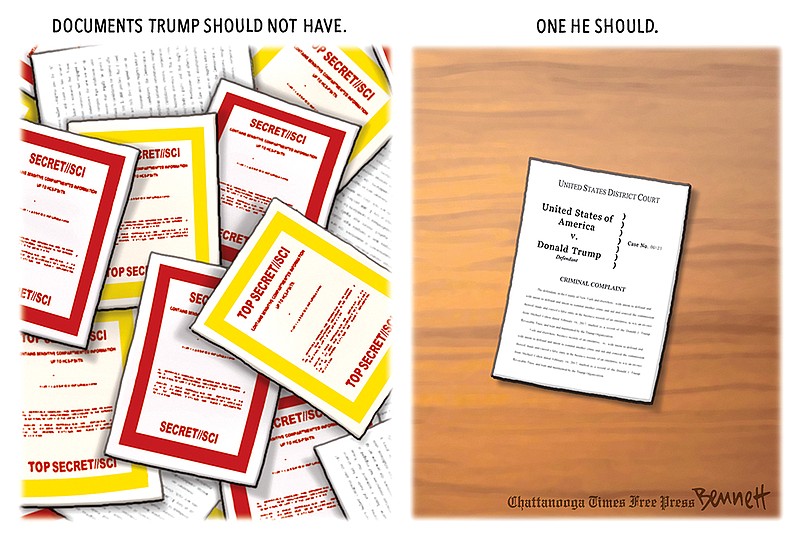
Thursday night, we heard (at first via Trump himself) that a Florida grand jury convened by Special Counsel Jack Smith had returned an indictment in the Mar-a-Lago documents case. At first, most observers expected that we wouldn’t see the indictment itself until tomorrow, when Trump will be officially processed. But Friday the indictment was unsealed. In all there are 37 charges against Trump:
- 31 counts of “willful retention of national security information”. This is one fundamental crime applied to 31 documents, some classified at the very highest levels.
- one count of “conspiracy to obstruct justice”
- one count of “withholding a document or record”
- one count of “corruptly concealing a document or record”
- one count of “concealing a document in a federal investigation”
- one count of “scheme to conceal”
- one count of “false statements and representations”
Trump’s valet Walt Nauta is also named as a co-conspirator in counts 32-36, plus has his own count of “false statements and representations”.
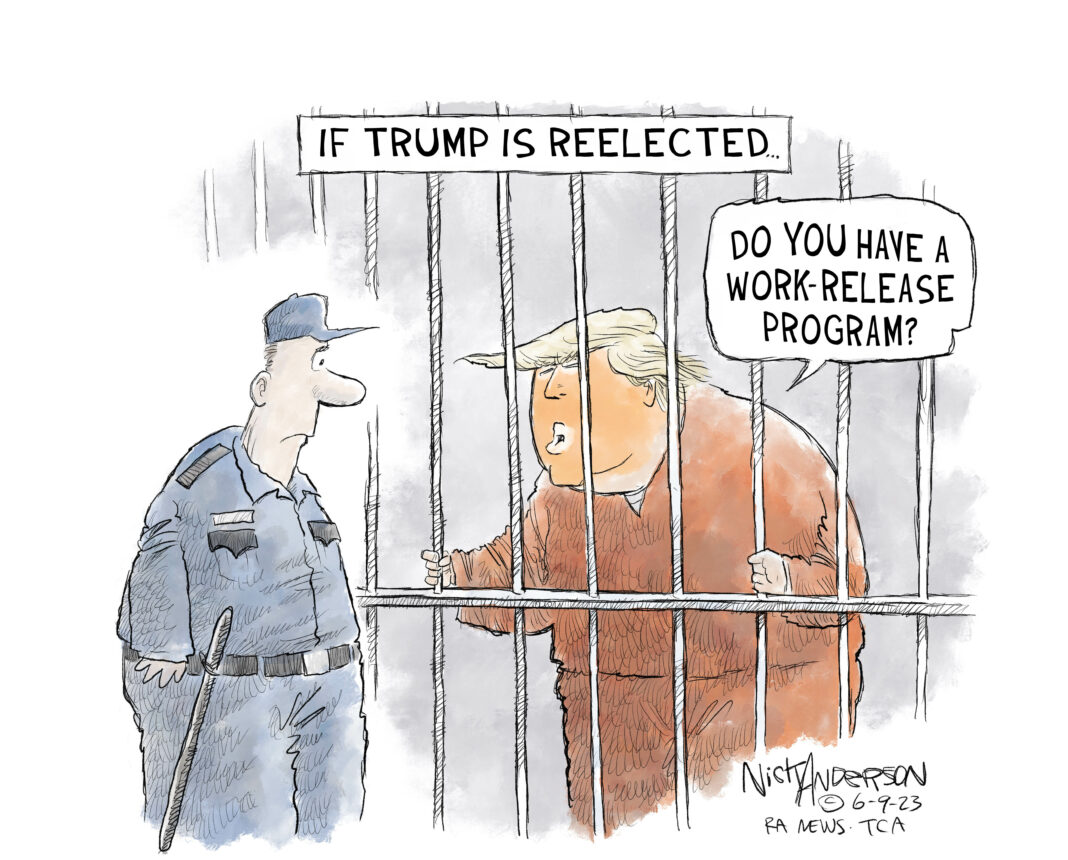
If you add up the maximum sentences of all the charges, Trump could theoretically be sentenced to hundreds of years. By that’s a pointless exercise, because sentencing seldom works that way. It’s enough to point out that (if convicted and jailed) Trump, who will turn 77 on Wednesday, faces a strong likelihood of dying in prison.
Special Counsel Jack Smith made his first public appearance Friday. His statement was short and made a few simple points:
- Trump was indicted “by a grand jury of citizens in the Southern District of Florida”. In other words, while Trump may rail against Smith himself or Merrick Garland or President Biden, the ultimate decision was made by ordinary American citizens with no political ax to grind. Given that Trump carried Florida in 2016 and 2020, and that Republicans swept the state in 2022, it’s quite likely that many of the jurors are Republicans who have voted for Trump in the past. [1]
- If you want to “understand the scope and the gravity of the crimes charged”, you should read the indictment.
- “Our laws that protect national defense information are critical to the safety and security of the United States and they must be enforced. Violations of those laws put our country at risk.”
- “Adherence to the rule of law is a bedrock principle of the Department of Justice. And our nation’s commitment to the rule of law sets an example for the world. We have one set of laws in this country, and they apply to everyone.”
The narrative. Smith has written an indictment that is more revealing and readable than the 34-count indictment Manhattan DA Alvin Bragg produced for the hush-money case in April. It tells the following story:
While he was president, Trump collected souvenirs (“newspapers, press clippings, letters, notes, cards, photographs, official documents, and other materials”) that he jumbled together in cardboard bankers’ boxes (like the ones in my storage space). When he left the presidency, he had “scores” of those boxes transported from the White House to Mar-a-Lago.
Beginning in May, 2021, the National Archives and Records Administration (NARA) made a series of fruitless requests that Trump turn over the official documents, which belong to the US government. [2]
Meanwhile, stacks of Trump’s boxes were being shuttled from place to place inside Mar-a-Lago. In addition to being Trump’s residence, Mar-a-Lago was a club which (during the period in question) had more than 100 employees and tens of thousands of guests who were not cleared to see classified documents. Many of these locations (a ballroom, a bathroom) were highly insecure. On one occasion a stack of boxes tipped over, spilling the contents — including classified documents — onto the floor of a storage area.
In January of 2022, 15 boxes were shipped to NARA. These boxes included 197 classified documents, including 30 top secret documents, some of which had the additional markings of SCI (special compartmented information) and SAP (special access program), indicating that they were particularly sensitive, even compared to other top-secret documents. [3]
The indictment notes two occasions when Trump showed classified documents to someone without clearance to see them. In one conversation, which was taped, Trump showed a plan to invade “Country A” to an author, saying “When I was president I could have declassified it. … Now I can’t.”
NARA told the Department of Justice about these documents in February, 2022, and a criminal investigation was opened in March. A federal grand jury began investigating in April. On May 11, the grand jury subpoenaed “all documents with classification markings in the possession, custody, or control of TRUMP or The Office of Donald J. Trump”.
In conversations with two of his lawyers (one of whom appears to be Evan Corcoran), Trump suggested a variety of illegal strategies: simply not responding to the subpoena, saying there were no documents, or getting rid of the documents. He hinted that Corcoran should dispose of the documents for him, so that he could deny doing it. (These conversations are reminiscent of Michael Cohen’s descriptions of his conversations as Trump’s lawyer. “He doesn’t give you orders. He speaks in a code … much like a mobster would do.”)
When it became clear that Corcoran would not commit one of the crimes Trump was suggesting, Trump schemed with Nauta to circumvent Corcoran: He knew when and where Corcoran would search for documents subject to the subpoena, and he had Nauta move boxes around so that Corcoran wouldn’t find them.
After Corcoran found 35 classified documents, Trump made a nonverbal suggestion that Corcoran not turn them all over to the government.
He made a funny motion as though – well okay why don’t you take them with you to your hotel room and if there’s anything really bad in there, like, you know, pluck it out. And that was the motion that he made. He didn’t say that.
Corcoran had the 35 documents turned over, and drafted a certification (which he had another lawyer sign) saying that a diligent search had been done and these were all the documents the subpoena sought.
In July, the FBI acquired Mar-a-Lago surveillance video showing the boxes being moved. In August, they returned with a search warrant and found 102 classified documents Corcoran had missed — 27 from Trump’s office and 75 from the storage room Corcoran had searched. 17 of the documents were top secret.
The 31 documents in the indictment. In his public statements, Trump has made fanciful claims that he could declassify documents by thinking about them, or that there was a standing order declassifying any documents he took up to the White House residence. [4] As anyone who has ever had a security clearance should understand, these claims are not just false, they are absurd; the system couldn’t work that way. [5]
The indictment faces a problem that shows up whenever someone is prosecuted under the Espionage Act: It can’t just tell us what information the defendant revealed or risked, because then the indictment itself would reveal that information. (It’s a problem similar to one in the stoning scene from Life of Brian, where the priest can’t specify the accused’s blasphemy without himself saying the forbidden name of God.)
This problem will only get worse when the case goes to trial: The judge will need access to the 31 documents, and large parts of them (possibly redacted, with the judge’s approval) will have to be made available to Trump’s lawyers.
But the indictment includes only terse summaries. Document 17, for example, is top secret with something about its special markings redacted. (I’d guess the markings included a code word.) The summary says only: “Document dated January, 2020 concerning military capabilities of a foreign country.”
The indictment also lists the intelligence services that classified the documents, which includes all the major ones: CIA, NSA, DoD, NRO, and several others.
From the list, and the fact that the totals in the indictment indicate that not all the top-secret documents are listed, we can make two deductions:
- The most sensitive documents Trump compromised are not listed at all. So whatever you think after reading the listed summaries, the real security breach is worse than that.
- All the intelligence agencies would have liked to leave their documents off the list and out of the trial, but they must have gotten together and agreed that they would each pony up something.
Assessing the damage. From the early days of the Trump administration, it was clear that Mar-a-Lago posed a security problem. He had not even been in office for a month when North Korea launched a missile test while Trump was entertaining Japanese Prime Minister Shinzo Abe at Mar-a-Lago (and making a profit off the entourages of both leaders).
In previous administrations, the leaders would be ushered away into the White House situation room or the nearest secure location by their aides. The documents and advice they receive at such moments are often some of the nation’s most closely guarded secrets. … As CNN reported and the Facebook photos later illustrated, Abe, Trump and their parties stayed at their tables as their aides passed them bits of paper, lighting them up with their mobile phones so they could be read, while the keyboard vocalist hired for the night sang on and Mar-a-Lago guests huddled around to get a better view.
So foreign intelligence services have had years to place agents at the club, as members, guests, employees, or even gate-crashers. It seems likely that some have succeeded. (Picture this cover story for a spy: Some foreign friend or business associate of Jared Kushner has a nephew who just flunked out of Florida Atlantic and needs a job.)
Friday night, MSNBC’s Alex Wagner and Chris Hayes interviewed former CIA Director John Brennan. Brennan made a few of the same points I just made, and then said this:
WAGNER: Republicans in Congress have sort of been hiding behind the fact that the intelligence community assessment regarding the implications, the fallout from the retention of these documents — that assessment is not complete. And they’re saying “We don’t know yet what damage, if any, has been done to national security.” You’re suggesting that that assessment is quite complicated. Is your outside guess that this is going to take quite some time longer? …
BRENNAN: Quite frankly, I don’t think that the intelligence community will ever be able to determine conclusively what might have been compromised.
In addition to whatever our enemies may have found out, Trump has done incalculable damage to our relationships with our allies. Allied intelligence services (say, Israel’s Mossad or the UK’s GCHQ) risk revealing their own spies and capabilities when they share secrets with the US. What might they start holding back, now that they have seen how badly the US protects such information?
Likely defenses. Normally, when we talk about an indicted person’s possible defenses, we mean legal defenses — arguments or testimony or evidence that can be presented in court to undermine the prosecution’s case and convince either the judge or the jury to let the defendant off.
That’s not what we’re going to see from Trump, though, because he’s just guilty. Smith has him dead to rights. If this were an ordinary trial, any competent lawyer would be negotiating a deal to minimize his jail time.
But Trump’s hopes lie outside the courtroom. If he can stall long enough, the 2024 election might happen before he’s convicted. And if the economy is in bad enough shape — say, because Trump’s friends in Russia and Saudi Arabia engineer a huge run-up in gas prices — he could win it. Then he could fire Smith and pull the plug on any federal prosecution. And if New York or Georgia find him guilty of something, he can hole up in the White House and dare them to come get him.
Trump’s previous run-ins with the legal system have proceeded on two tracks: an in-court track where his lawyers present theories that are bizarre but are at least coherent, and an in-public track where Trump presents wild, baseless, contradictory arguments that are persuasive to his followers, but would get his lawyers sanctioned if they brought them into court.
That split was clearest in the 55 lawsuits he filed (and lost all but one inconsequential one) to overturn his defeat in the 2020 election. In public, Trump and his lawyer Rudy Giuliani were alleging all kinds of fraud for which they had no evidence. In front of judges, however, Trump’s lawyers said nothing of the kind, instead arguing that technical details about how small numbers of ballots were handled should invalidate elections in entire states.
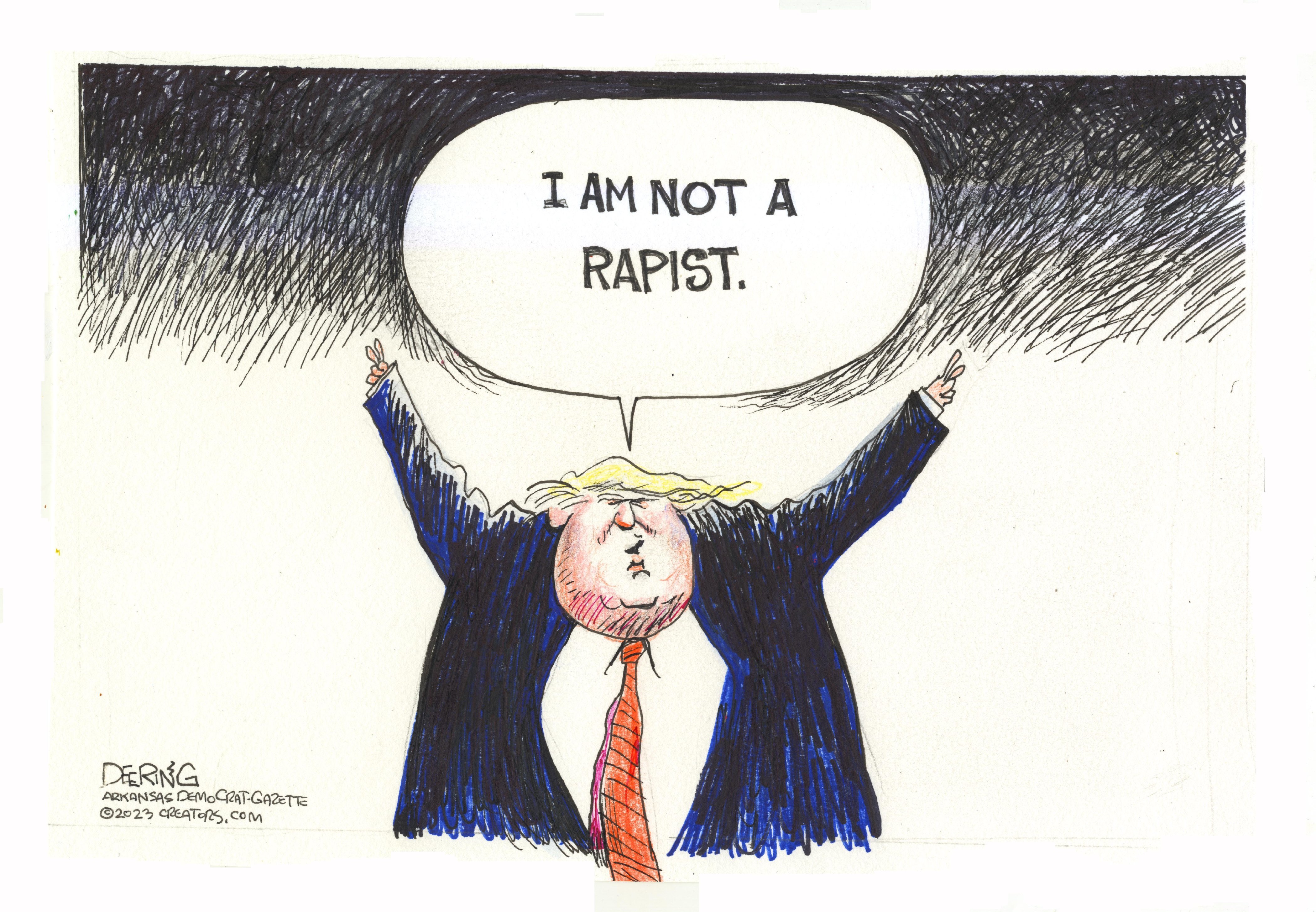
We are already seeing the same kind of split in this case. Trump and his followers howled with rage after the indictment came out, but none of what they’ve said challenges the evidence in the indictment or the laws he is accused of violating. Instead, Trump issues blanket denials (“I am an innocent man“), attacks Jack Smith (“deranged”, “lunatic”, and most bizarrely suggesting that Jack Smith is not his real name, whatever that is supposed to imply), engages in whataboutism regarding the Bidens or the Clintons, and says that indicting a leading presidential contender makes the US a “banana republic“. [6]

None of that can be brought into court, where his lawyers will have to stick to this case and the evidence against him.
Worst of all, Trump and many of his allies are broadly hinting at violence. On stage at Trump’s Saturday rally in Georgia, election-denier Kari Lake said:
I have a message tonight for Merrick Garland and Jack Smith and Joe Biden — and the guys back there in the fake news media, you should listen up as well, this one is for you. If you want to get to President Trump, you are going to have go through me, and you are going to have to go through 75 million Americans just like me. And I’m going to tell you, most of us are card-carrying members of the N.R.A. [7]
Needless to say, Trump’s lawyers would be disbarred if they went into court and threatened violence. They probably also will not mention obviously false interpretations of law, like the notion that the Presidential Records Act gives Trump the right to do “whatever I want” with highly classified documents [see endnote 2 again], or that he could declassify documents with his mind.
Trump also will not testify in his own defense, because Donald Trump is a terrible witness. He can lie proficiently when he monologues to a sympathetic crowd or is interviewed by a journalist he can talk over. But when he faces cross-examination, the penalty of perjury, and a judge with authority to hold him in contempt, he is unconvincing and likely to reveal (or even brag about) facts that hurt his defense.
A recent case in point is his deposition in the E. Jean Carroll lawsuit. (There is no Fifth Amendment right in civil lawsuits, so he had to submit to an interview.) Trump’s lawyers did not put him on the stand in his own defense, and his taped deposition was cited by Carroll’s lawyers, not Trump’s.
That will leave Trump’s legal team without much to argue, which is what happens when the evidence clearly says that a defendant is guilty.

The judge. Given that Trump’s main hope is to stall and hope that he (or some sympathetic Republican) wins the presidency in 2025, it was very disturbing to hear the case assigned to Judge Aileen Cannon, who was clearly in the tank for Trump when she oversaw his lawsuit challenging the FBI’s search of Mar-a-Lago and trying to get the seized documents back.
In issuing a series of rulings favorable to him, Judge Cannon, a Trump appointee, effectively disrupted the investigation until a conservative appeals court ruled she never had legitimate legal authority to intervene.
Her rulings were not just bad, they were outrageous. A three-judge panel of appeals court judges (two appointed by Trump) reversed her decisions unanimously.
The NYT went on to explain that the choice of Cannon was random, but weighted by various factors that made her a more likely choice than any of the six other eligible judges.
Cannon may be shy about showing such blatant favoritism again, but she doesn’t have to. She can just slow-walk the trial until after the 2024 election. If Republicans win, the case will likely go away.
People who are not worried about this possibility give two reasons for their calm:
- The same appeals court that reversed Cannon the first time might keep Cannon in line or sympathize with a DoJ motion to assign the case to a different judge.
- Jack Smith had to know Cannon was a possibility when he sought the indictment in Florida rather than DC. He must have had some reason to accept that risk.
We’ll see. The first hints will come tomorrow.
Endgame. But assume for a minute that a trial (either here or somewhere else) actually takes place and results in a prison sentence. Several people have remarked on the logistical difficulties of imprisoning an ex-president — like, does his secret service detail go to prison too?
But I don’t see Trump voluntarily submitting to demeaning restrictions, even if it’s just long-term house arrest. My opinion, based on very little, is that he’ll wind up in either Russia or Saudi Arabia.
People I’ve raised this possibility to are way too confident in the government’s ability to prevent it. “Take away his passport,” they say. But suppose Trump sees the writing on the wall while he’s still campaigning. He schedules a rally in Alaska, but his campaign plane passes the airport and just keeps flying towards Russia. What’s the government going to do, shoot it down?
[1] I wasn’t able to find the number of jurors on this specific grand jury, but by law a federal grand jury has 16-23 members, and 12 votes are required to approve an indictment. The exact number of votes for the Trump indictment is unknown, which is typical.
[2] Trump has tried to muddy up people’s understanding of the PRA, but it’s actually quite clear.
Upon the conclusion of a President’s term of office, or if a President serves consecutive terms upon the conclusion of the last term, the Archivist of the United States shall assume responsibility for the custody, control, and preservation of, and access to, the Presidential records of that President.
While he is still in office, a president can go back-and-forth with the Archives over what is a presidential or a personal record. But that negotiation ends when he leaves office. And much as I hate to agree with Bill Barr, he’s right about this:
Battle plans for an attack on another country or Defense Department documents about our capabilities are in no universe Donald J. Trump’s personal documents.
[3] I used to have a top-secret clearance, but never saw an SCI or SAP document. I know someone who was additionally cleared into at least one SCI compartment, but never saw an SAP document. I am personally appalled by the idea of such documents sitting in cardboard boxes in a Mar-a-Lago bathroom, and being moved about by Mar-a-Lago employees with no clearances whatsoever.
People with clearances — there are millions of us — routinely endure all sorts of hassles to secure their documents. For example, I used to have a safe in my office where the classified documents in my possession were supposed to be kept whenever I wasn’t using them. If I was reading a classified document, I couldn’t go to the bathroom without either taking a document with me, finding some other cleared person to babysit it, or putting it back in the safe. And I couldn’t write down the safe’s combination, because if I did, that note would become a classified document and belong inside the safe.
If you’ve jumped through such hoops for years, it is deeply offensive to read about Trump’s cavalier treatment of documents far more sensitive than anything I came into contact with.
[4] These defense are not just absurd (see next note), but they’re also largely irrelevant, because the Espionage Act is older than the classification system.
The World War One era law predates classification of documents but makes it a crime to willfully retain national defense information that could be useful to foreign adversaries.
A document’s classification is an indication of how useful it could be to foreign adversaries. But under the Espionage Act, the utility is the legal standard, not the classification.
[5] Trump talks as if pieces of paper are classified, and so their status can be changed by moving them from here to there. Actually, information is classified. So if a document is classified or declassified, all copies of it share the same status.
Suppose that a dozen people have copies of the same top-secret document. When Trump (while still president) looks at his copy and thinks “declassified” or takes it up to the White House residence, invoking his fantasized automatic declassification order, the other 11 copies would be instantaneously declassified as well, without their possessors being notified in any way. If any of them should happen to choose that moment to send a copy to The New York Times or the Russian embassy, that presumably would be OK.
It’s appalling that Trump would even imagine such a system. Documents are classified for reasons, which might include sources (i.e., protecting the lives of spies) or methods (i.e., not letting our enemies know how much our surveillance systems can see or what our analysts can deduce from that information). It would be ridiculously irresponsible to declassify a document without knowing those reasons and weighing the costs and benefits.
So the idea that anyone would declassify a document purely for personal convenience — because I want to read it here rather than there — should strike horror into the heart of any loyal American citizen.
[6] Apparently Scotland is a banana republic too, since Nicola Sturgeon, who was First Minister as recently as March, was arrested for questioning in a corruption investigation Sunday.
Current or former political leaders facing legal troubles is not not uncommon in countries that bear no resemblance to the stereotypical “banana republic” — a term which Latin Americans understandably find offensive. Israeli Prime Minister Netanyahu has been charged. Former Italian Prime Minister Silvio Berlusconi (who died this morning at 86) was convicted of several crimes. Former French Presidents Nicolas Sarkozy and Jacques Chirac have been convicted. Former German President Christian Wulff faced trial for corruption, but was acquitted.
Healthy democracies recognize that their laws apply even to leaders and former leaders.
[7] Lake’s numbers don’t work. The NRA has only 4.3 million members, so they can’t constitute “most” of the 74.2 million who voted for Trump in 2020.