Tag Archives: Trump administration

Three days in the life of a pathetic man

Everything Trump does to aggrandize himself just makes him smaller.


From the time he came down the escalator in 2015, Donald Trump has gloried in his ability to get a rise out of people like me. All our howls of outrage, all the shocked shouts of “He can’t say that!”, have been music to his ears. But lately he’s been losing his touch. Donald J. Trump, once the greatest troll of the social-media era, has jumped the shark. The realization that he is past his sell-by date seems to be driving him ever further off the deep end.

I catch on slowly, so I didn’t notice until his Rob Reiner tweet.

I don’t know if Gen Z even knows who Reiner was, but several of his movies — The Princess Bride comes to mind — became cultural touchstones for my generation. They didn’t often make the critics’ lists of all-time greats, but you could quote them decades later and people would know what you meant.

So Monday, Reiner and his wife were found dead in their home, apparently murdered by their troubled son in the kind of tragedy that touches every parent somewhere deep: What if my kid had inner demons that all my attention, all my love, all the resources I could bring to bear, were helpless to exorcise?

And Trump’s response Tuesday morning was to make this tragic murder all about himself: Reiner died because his Trump Derangement Syndrome made the people around him crazy. The President of the United States went on at some length in that vein.

When I read that post, I was surprised to realize that it didn’t make me angry. No “How can he say that?”. No desire to strike back with some cutting insult.

His tweet wasn’t outrageous. It was pathetic. What a sick, sad little man.

The next two days backed up that assessment. Wednesday we found out about the presidential plaques now lining the colonnade connecting the White House residence to the Oval Office. It’s a newly installed “walk of fame” with plaques for Trump (twice, since he’s both the 45th and 47th president) and his predecessors.

But of course, the plaques for past presidents are not really about them, they’re about him. Andrew Jackson, for example, was “unjustifiably treated unfairly by the Press, but not as viciously and unfairly as President Abraham Lincoln and President Donald J. Trump would, in the future, be.” Ronald Reagan “was a fan of President Donald J. Trump long before President Trump’s Historic run for the White House.”

Joe Biden — who committed the unpardonable sin of kicking Trump’s ass by seven million votes in 2020 — got the nastiest treatment, with the plaque proclaiming him “by far, the worst president in American history”, and representing him not with a portrait, but with a picture of an autopen. The plaque declares that Biden became president “as a result of the most corrupt election ever” and “brought our nation to the brink of destruction”. Barack Obama is characterized as “one of the most divisive political figures in American history” who presided over “a stagnant economy” until his handpicked successor was defeated by Trump. Bill Clinton’s plaque also ends with the defeat of his wife by Trump.

Am I angered? No, I’m embarrassed for my country. Trump probably pictures himself impressing foreign dignitaries by leading them along this walk. In fact, they also will be embarrassed, like your friends are when your senile grandpa starts bragging about things they all know he never did. By casting his plaques in brass, Trump probably imagines them being read decades or even centuries from now. But of course they will vanish the instant he is gone, because they are sad and pathetic. They reflect badly on the White House and whomever its future occupants might be.

Wednesday night, Trump gave a nationally televised address. Typically, presidents demand time from the major networks either when there is something of substance to announce (like a the raid that killed Bin Laden) or some tragedy that calls for a presidential response (like like the Challenger disaster). Prior to Trump, addresses like this were non-partisan: The President was acting as president, speaking to or for all of us, and not as a politician revving up his base.

But that kind of compartmentalization is foreign to Trump’s nature. He demanded national attention Wednesday not because Americans needed to know something, but because his ego was hurting: The economy is doing badly and the American people are increasingly blaming him for it.

His 18-minute address (about the same length as JFK’s Cuban missile crisis speech) contained no news worth mentioning — no major developments, no policy initiatives. (The one apparent announcement turned out to be flim-flam: His $1776 “warrior dividend” to members of our military isn’t new money; it comes out of funds already appropriated for housing allowances.) The self-justification started in his first line: “Good evening America. 11 months ago I inherited a mess, and I’m fixing it.” From there he launched into the kind of self-contradictory excuses you might hear from an 8-year-old: I wasn’t fighting, and besides, he started it.

Everything is wonderful, and the fact that it’s not wonderful is Joe Biden’s fault.

Most presidential addresses call for a fact-check, but that would not do this speech justice. A reverse fact-check would be more appropriate: Try to pick out some statements that are true. It’s a challenge. Sentence after sentence, clause after clause, is a travelogue from a fantasy world where Trump is a world-defining super-president.

What a sick, sad little man.

Thursday, his handpicked board at the Kennedy Center for the Performing Arts attached his name to this once-iconic institution. It’s now supposed to be known as the Trump-Kennedy Center for the Performing Arts. But like the Department of Defense, the Kennedy Center was named in the statute that Congress passed to establish it, so Trump and his board of puppets have no power to rename it. The Washingtonian reports:

While the board’s “change” is basically just another flashy marquee that Trump has hung up in service of his inner real-estate developer, it’s likely to accelerate the tangible decline of the Kennedy Center’s reputation. Ticket sales have nosedived since the president took over in February, which has taken a palpable toll on the performers who work there—including the National Symphony Orchestra’s principal violist, who recently spoke to Washingtonian about his experience serenading half-empty audiences.

Maddening? No, pitiable.

One frequent discussion topic among my friends is how long it will take to undo the damage Trump has done to this country. Some of it, of course, can never be undone. The children who died of hunger or disease after he gutted USAID are beyond the help of future administrations. And we’ll never get back the four wasted years in the battle against climate change (plus a little from his undoing the small progress Biden had made).

I can’t guess how many responsible presidents will have to come and go before our allies trust us again. Or how long the CDC or the Kennedy Center will need to rebuild their reputations. How long before the Presidential Medal of Freedom becomes an honor again? Or until all the demons of bigotry he unleashed can be put back in their bottles? And what about our national sense of decency? Our respect for one another? To rebuild them will require decades of nurturing.

But Trump has never really cared about that kind of thing. He cares about promoting his name and about dictating the names others use. He cares about buildings and decor and gaudy gilding.

And I think he’s starting to realize that all those things will begin vanishing the instant he loses power. No one will ever again talk about the Gulf of America, or the Department of War, or the Trump-Kennedy Center. (JFK’s niece wants to wield a pickaxe to remove Trump’s name herself.) If he leaves before his term is up — this is precisely the situation Section 4 of the 25th Amendment was written for — not even Vance will want anyone to see those ridiculous plaques. The tasteless gilding of the White House will go away, and even his over-priced ballroom will be used for some other purpose and carry some other name.

As soon as he’s gone, the whole country (even most of the people who voted for him) will start pretending he was never there.

I think he’s starting to realize that, and so he’s been turning his Trumpiness up to 11. Every effort to aggrandize himself just makes him shrink faster, but he can’t help himself. It’s like he’s constantly screaming: “You can’t forget me!”

But we will, Donald. We will.

Maybe a small reminder will survive here or there. Perhaps, as in Shelley’s Ozymandias, somewhere the ruins of a statue will survey the wasteland of his legacy.

Look on his works, ye mighty, and despair.

A MAGA National Security Strategy

America used to frame its self-image around freedom and democracy. Now it’s about making money and preserving whiteness.


Back in July, J. D. Vance tried his hand at answering the question “What is an American?” But first he had to say what an American wasn’t, namely, someone who agrees with the principles of the Declaration of Independence.

If you think about it, identifying America just with agreeing with the principles, let’s say, of the Declaration of Independence, that’s a definition that is way over-inclusive and under-inclusive at the same time.

I don’t think many people would argue with the over-inclusive part. As Vance observed, there are probably billions of people who agree with the founding principles of the United States. They may even identify with America the way JFK was identifying with Germany when he said “Ich bin ein Berliner.” But that doesn’t make them Americans in any real sense. Now, if they come here, work, pay taxes, and pledge their allegiance to the government defined in the Constitution, we can start to have a discussion. But until then, hardly anyone would claim they’re Americans.

Where Vance caused controversy, though, was with “underinclusive”. If your ancestors fought in the Civil War, then you “have a hell of a lot more claim over America than the people who say [you] don’t belong”, even if you don’t believe in the founding principles. Vance seemed to be saying that you could be, say, a Nazi. But if your ancestors fought for the fascist empire of its day, the Confederacy, maybe because they wanted to defend and preserve slavery, then you’re one of us.

In short, Vance’s America isn’t fundamentally about freedom or democracy or any other grand principle.

America is not just an idea. We’re a particular place, with a particular people, and a particular set of beliefs and way of life.

This is sometimes described as the “blood and soil” vision of a nation, and it quickly lends itself to what the far right calls “heritage Americans”, who are English-speaking and Christian and (predominantly) White and have a “way of life” that puts men (and not women) at the top of the pyramid. As one author explains:

Non-Christians can be tolerated, as long as they acquiesce to living in an unashamedly Christian America (i.e., submitting to Christian civil law, government support for Christianity, Christian moral, civil, and religious norms and customs, etc.). At the same time, both public and private citizens should be concerned to help the Christian Church flourish in our nation, since a collapse of Christian conversions, church plants, and influence will mark the end of America.

Like so much of Trumpism, this is deniable if you find it embarrassing (as I hope many Trumpists do). Vance didn’t actually spell all that out, and besides, it’s Vance, not Trump. Who takes what J. D. Vance says all that seriously anyway? And since Trump isn’t coherent enough to enunciate such a grand vision, MAGAts don’t have to own up to the full implications of redefining America in blood-and-soil terms.

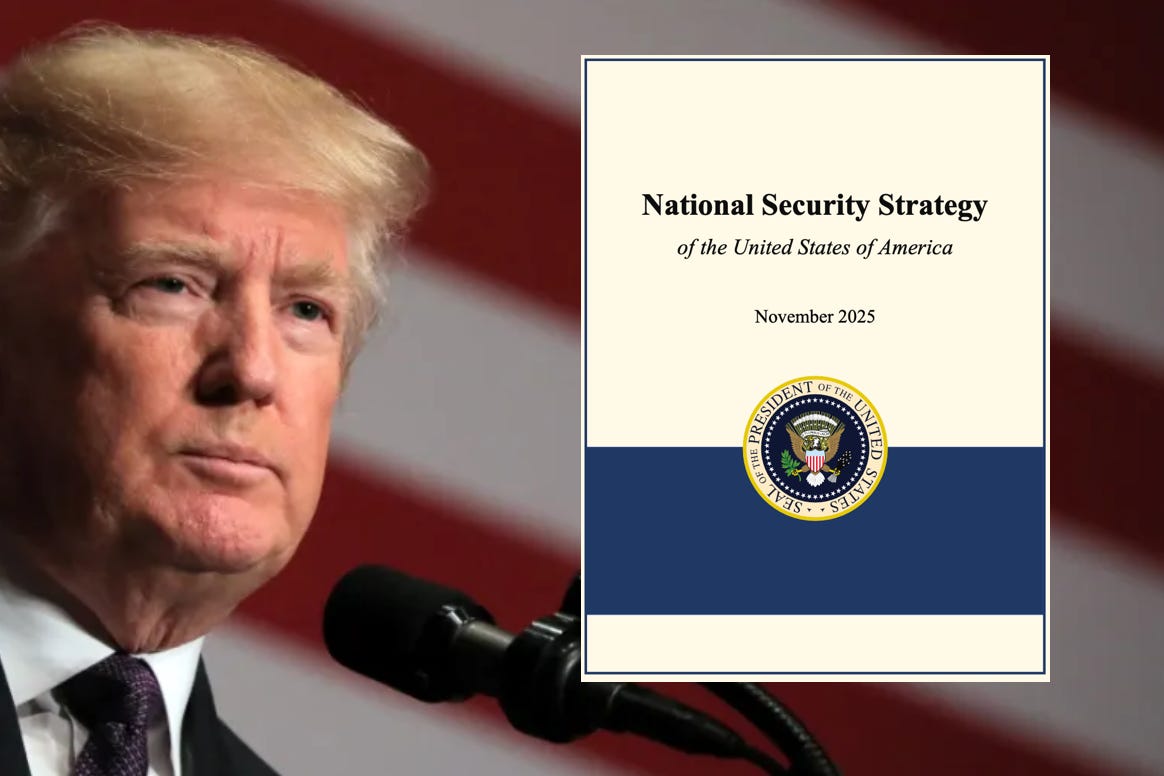
NSS-USA. Last month, though, the regime put out a document that is harder to deny: National Security Strategy for the United States of America. The text part of it is only 29 pages, but I can’t recommend you read the whole thing, because (like nearly all regime publications) it’s full of praise for how Donald J. Trump rescued America from the pit of despair Joe Biden had left it in. Now is the winter of our discontent made glorious summer by this son of New York, and yadda, yadda, yadda.

But beyond the huckstering, the NSS-USA does have some real content. In particular, it declares an end to the era in which the US tried to be the linchpin of a rules-based global order, and tried (at least some of the time) to promote freedom and democracy. The NSS-USA characterizes this past policy both as “permanent American domination of the entire world” and as “lash[ing] American policy to a network of international institutions, some of which are driven by outright anti-Americanism and many by a transnationalism that explicitly seeks to dissolve individual state sovereignty”.

But we’re done with all that now. Instead, we’re going to control immigration, make money, and launch a “restoration and reinvigoration of American spiritual and cultural health”. And we’re not going to try to export American values like human rights that disrespect “other countries’ differing religions, cultures, and governing systems.” (So if MBS wants to lure an Washington Post journalist into a foreign embassy, kill him, and saw his body into little pieces, that’s just how they do things in Saudi Arabia, and we want to do profitable business with them. As the Emperor Vespasian supposedly said about raising funds by taxing public toilets, “Pecunia non olet“, meaning “Money doesn’t stink”, no matter where it comes from.)

Here’s what that “reinvigoration of American spiritual and cultural health” means:

We want an America that cherishes its past glories and its heroes, and that looks forward to a new golden age. We want a people who are proud, happy, and optimistic that they will leave their country to the next generation better than they found it. We want a gainfully employed citizenry—with no one sitting on the sidelines—who take satisfaction from knowing that their work is essential to the prosperity of our nation and to the well-being of individuals and families. This cannot be accomplished without growing numbers of strong, traditional families that raise healthy children.

That’s why we have to turn our schools into propaganda mills that expunge any real discussion of slavery, genocide against the Native Americans, or the ongoing effects of racism and sexism. The American past must have nothing but “glories”, and we must ignore discouraging trends like climate change, the increasing concentration of wealth, or anything else that might cause our people to expect something other than the Golden Age of Trump. The NSS-USA doesn’t define “strong traditional families” or “healthy children”, but I hear a lot of ominous subtext there.

The document then goes region by region. Some of its goals are the same as previous administrations. We don’t want a hostile power to control the oil of the Middle East, and we want to maintain our access to other critical resources. We want to avoid seeing some rival power dominate the world.

But then it starts to diverge. It defines what is basically an American sphere of influence in the Western hemisphere. We want countries that are “reasonably stable and well-governed enough to prevent and discourage mass migration to the United States”. Beyond that, we don’t care what they do to their people.

The one place where we do want to interfere in other countries’ business is with our allies.

We will oppose elite-driven, anti-democratic restrictions on core liberties in Europe, the Anglosphere, and the rest of the democratic world, especially among our allies.

However, it looks like the regime sees those “elite-driven, anti-democratic restrictions” mainly in our allies’ attempts to suppress right-wing radicalism. It promotes a view of Europe’s future that sounds a lot like proto-fascist parties such as Germany’s AfD (which Vance endorses). Due to immigration and falling native birth rates, Europe faces “civilizational erasure”. But the US wants Europe to “remain European” and to “regain its civilizational self-confidence”.

Europe’s support for Ukraine against Russia (i.e., its “unrealistic expectations for the war”) is due to its “anti-democratic” aspects.

A large European majority wants peace, yet that desire is not translated into policy, in large measure because of those governments’ subversion of democratic processes. This is strategically important to the United States precisely because European states cannot reform themselves if they are trapped in political crisis.

Again, what this “reform” consists of is not spelled out, but I suspect the model is fascist Hungary.

American diplomacy should continue to stand up for genuine democracy, freedom of expression, and unapologetic celebrations of European nations’ individual character and history. America encourages its political allies in Europe to promote this revival of spirit, and the growing influence of patriotic European parties indeed gives cause for great optimism. … We want to work with aligned countries that want to restore their former greatness.

But that’s not where NSS-USA sees Europe heading, so it wants to “cultivat[e] resistance to Europe’s current trajectory within European nations”, I suppose this means supporting blood-and-soil European parties like France’s National Rally.

If Europe refuses to defend its white cultural heritage, though, it sounds like the Trump regime wants to cut them loose.

Over the long term, it is more than plausible that within a few decades at the latest, certain NATO members will become majority non-European. As such, it is an open question whether they will view their place in the world, or their alliance with the United States, in the same way as those who signed the NATO charter

I mean, we signed a treaty with white countries. We can’t be expected to honor it if Whites become a minority.

Other than Europe, where we want political change to preserve a native-European racial mix, we care about other countries only as potential business partners. Nothing in the document suggests that Russia is an enemy, a rival, or a threat to anyone in particular. China is a frenemy, a rival we can do business with. I would really worry if I were Taiwan, because this is how NSS-USA views it:

There is, rightly, much focus on Taiwan, partly because of Taiwan’s dominance of semiconductor production, but mostly because Taiwan provides direct access to the Second Island Chain and splits Northeast and Southeast Asia into two distinct theaters

Taiwan is a fellow democracy and a long-standing ally, but who cares? It produces semiconductors and has a strategic location. China would have to cough up some serious bucks to induce us to turn our backs on that.

The Kagan interview. Robert Kagan is a historian of US foreign policy with whom I have often disagreed. Recently he was interviewed by Bill Kristol, who I also differ with on many things. But despite past differences, I’m fascinated by this interview [video, transcript], which takes a view-from-orbit perspective on American foreign policy. It happened before the NSS-USA came out, but anticipates much of it.

Kagan’s view, basically, is that the American-dominated post-World-War-II world order is a pleasant aberration in history, because for 3/4 of a century other potential great powers like Britain, France, Germany, and Japan have been content to live inside the American orbit. The unspoken contract was that America would take the lead in international affairs, the dollar would be the world’s reserve currency, and so on; and in return, the US would guarantee its allies’ security and wouldn’t use its preeminent position to take advantage of them.

Ordinarily, sovereign nations wouldn’t trust each other to keep a deal like that. (One cautionary historical example is the Delian League, an anti-Persia alliance that got coopted into an Athenian Empire.) But this one has held largely because of the faith all the nations had in shared liberal values like democracy and human rights.

Kagan sees that deal unraveling, largely because Trump doesn’t share liberal values and wants to take advantage.

[T]hat bargain has been exploded. And that’s why we are entering a new era, because if these countries, as is now the case, cannot rely on the American security guarantee, and I think the Trump administration has made it very clear that they can’t, that it’s sort of the intention of the Trump administration to make it clear that they can’t really rely on the United States, on the one hand.

While on the other hand, the United States now is using its superior power to demand, what is in effect, tribute from its allies in the form of these high tariffs. And so the United States is taking advantage of its overwhelming power and abusing it with its own allies. I don’t see how the alliance structure can continue under those circumstances. And now all these countries that have relied on the United States for their security are now going to have to go back to the world that existed before this unusual era in which they can only rely on themselves for security. And that has vast implications for regional geopolitics and global geopolitics that I think, again, Americans have not really begun to contemplate.

(Kagan doesn’t mention this, but from my point of view the contract has been slowly eroding for several years, as the US has used the dollar’s central role to finance enormous budget and trade deficits. In essence, the world sends us goods and we send them dollar-denominated bonds that we could devalue at any time. The Fed could, for example, create enough dollars out of nothing to redeem all the bonds.)

Needing to be able to go it alone, without the US, will probably change the nature of those countries and their governments. Kagan gives the example of Japan, which he says came out of World War I with a largely democratic pro-American government. But in the 1920s, America instituted high tariffs and strong barriers to immigration.

[P]olitics in Japan completely shifts, and then you get the Japan that invades Manchuria in 1931.

For now, our NATO allies may cut deals with Trump and pay his tariffs, while grasping that he no longer guarantees their security against, say, Russia. Short-term, they have little choice. But that’s not a stable situation.

Germany having to re-arm to the point where it can actually meet Soviet power means a completely new Germany again. Now, maybe a heavily armed Germany will still be a liberal Germany, that’s possible. But it’s clear that Germany’s neighbors are going to have the same reaction to that level of German power that they’ve always had in the past. If Japan can’t rely on the United States, it’s going to go become a nuclear weapon state. It’s going to build up its capabilities, and tensions between Japan and China are going to increase exponentially. And if there’s one thing Americans have learned over the past century is that when other great powers get into wars, the United States is immediately implicated in that. That’s the great lesson of World War II. And that’s why we created this liberal world order in the first place.

And again, that’s another thing that I think Americans just are not conscious of. A lot of Americans think we created this liberal order to fight the Soviet Union, which was not true. It was created without regard, even without anticipation that the Soviets were going to be the big problem. It was to prevent a return to effectively a multipolar world.

Trump may think the US can just collect its tribute and live happily ever after. But history has never worked that way before. Picture, for example, a re-militarized Germany led by a xenophobic far-right party like the AfD. What could possibly go wrong?

Crime in the Cabinet

Most administrations come and go
without credible evidence of a crime by a cabinet official.
There were two this week alone.


In January of 2017, as Barack Obama was getting ready to hand the presidency over to Donald Trump after eight years in office, the Heritage Foundation’s Hans von Spakovsky pushed back on the “myth” that Obama had presided over a “scandal-free administration”. Von Spakovsky listed six of what he described as “some of the worst scandals of any president in recent decades”.

One — using the IRS to “target political opponents” — was nothing more than a canard that circulated inside the conservative information bubble. (The IRS was skeptical of the tax-exempt status of new political organizations founded to take advantage of the Supreme Court’s Citizens United ruling. Most of the investigated organizations were conservative, but that was due to the flow of money rather than specific targeting of conservative organizations. In the end, nearly all of them were recognized as tax-exempt. More importantly: No link back to the White House was ever established.)

Others — Benghazi, government personnel records getting hacked, losing track of guns allowed into Mexico as part of a smuggling investigation, veterans dying while waiting for appointments at the VA — were screw-ups not rooted in any nefarious intentions.

Only one — the Hillary Clinton email controversy — involved any credible accusation of a crime. That was investigated by the State Department during the first Trump administration, and the report found “no persuasive evidence of systemic, deliberate mishandling of classified information.” No one was ever charged with a crime, much less convicted.

That’s not unusual. Crime in the cabinet is exceedingly rare. In the history of the United States, no cabinet official was convicted of a crime until 1929, when former Interior Secretary Albert Fall was found guilty of taking bribes in the Teapot Dome scandal. Three Nixon cabinet members and his vice president were convicted of crimes, which is one reason why the Nixon administration is remembered for its corruption.

But the Trump administration has a way of wearing down our standards and making us forget that lawlessness high in the executive branch used to be exceptional. For example, Trump officials violate the Hatch Act (banning government officials from using their offices for political activity) just about every day. Such violations went unpunished in the first Trump administration, so hardly anyone notices any more.

Even so, it was striking to hear two independent credible accusations of crimes by Trump cabinet officials in the same week.

  • DHS Secretary Kristi Noem all but confessed to contempt of court yesterday when she admitted she knew a federal judge had ordered a plane carrying detainees to El Salvador to turn around, but she ordered it to continue.
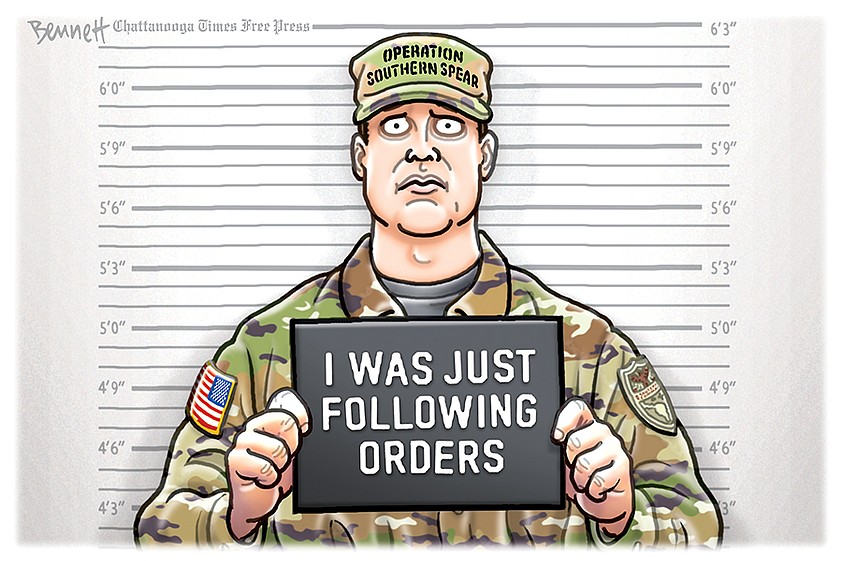
  • Department of War Defense Secretary Pete Hegseth reportedly gave an order to “kill everybody” in an attack on an alleged drug-smuggling boat in the Caribbean. Two survivors clinging to wreckage were then killed in a second attack. Even if the initial attack were legitimate (which it wasn’t), killing defenseless survivors is a war crime.

The second crime is more serious than the first, so let’s start there.

Kill everybody”. Since September 2, the Trump regime has launched at least 21 attacks against boats on the high seas that it claimed were smuggling drugs, killing at least 83 people. Friday, that story got even worse, when the Washington Post published a report that Defense Secretary Hegseth had given a “kill everybody” order for the first attack. Two people survived the initial attack and were clinging to the wreckage when a second attack was ordered. It blew the survivors to bits.

If true, that incident is a clear war crime attributed to a specific person, Hegseth.

Horrifying as that is, I think it would be a mistake to lose sight of the larger picture: If we frame this wrong, it might seem as if the air campaign against the boats was fine until helpless survivors were targeted. It wasn’t. Whether Hegseth ever said “Kill everybody” or not, under his command the Department of Defense has committed 83 murders.

No operational consideration justifies the attacks. They are not like the drone attacks that have assassinated terrorist leaders, controversial and morally dubious as those might have been. In those cases, the targets might not have stayed in known locations long enough for a strike team to get there. Or the host country might not have allowed our strike team in. Often, the choice was either to send a drone or let the terrorists go on about their business.

That’s not the case here. These boats were in open seas dominated by our Navy. They could have been seized and could not have gotten away. Whatever drugs they might have been carrying would never have reached American consumers. The crews could have been captured alive, and might have given us valuable information about their suppliers or distributors.

So attacking the boats achieved nothing that couldn’t have been achieved without killing people. Instead, the Trump regime chose to kill 83 people.

Remember: Smuggling drugs is not a capital crime. Even if the alleged smugglers had been captured and given due process, they could not have legally been sentenced to death.

It’s worthwhile to put this in a more familiar context. In Clint Eastwood’s Dirty Harry movies, Harry Callahan is a cop who chafes under the legal restrictions that bind him, and that allow criminals to eventually go free. In the first movie, Harry dares a suspect to go for a gun so that he can legally kill him.

But the second movie, Magnum Force, pits Harry against a death squad of rogue cops who start a campaign of assassinations against the city’s underworld kingpins. The squad expects Harry to join them, but rogue assassinations are too much even for him. “A man’s got to know his limitations,” Harry says.

That’s what we’re seeing now: Trump and Hegseth have turned the US Navy into a rogue assassination squad. They see enough evidence to convince themselves boats are smuggling drugs, show that evidence to no one, and kill the alleged smugglers on their own authority.

Even if you’re as tough on crime as Dirty Harry, you shouldn’t approve. A government has got to know its limitations.

The Trump regime gives two justifications: First, the end justifies the means (which is precisely what Dirty Harry’s rogue cops argued). On October 23rd, Trump made the ridiculous claim that each boat blown up saves the lives of 25,000 Americans. (This is the same kind of math that caused Pam Bondi to claim that drug seizures during Trump’s first 100 days had saved 119-258 million lives.) He postulated that if he told the Congress about the operation (not to seek their authorization, which he says he doesn’t need) “I can’t imagine they’d have any problem with it. … What are they going to do, say ‘We don’t want to stop drugs pouring in’?”

Again, those boats could be stopped without blowing them up or killing anybody.

Second, the regime stretches the definition of “war” to cover this operation. The drug cartels, say Hegseth and Trump, are like ISIS or Al Qaeda. This is typical of the way the regime perverts language, so that reminding soldiers of their legal responsibility not to follow unlawful orders is “sedition”, or individuals deciding to cross our border is an “invasion”.

Smuggling has been part of the American economy since before the Revolution, from British tea to Prohibition whiskey to Colombian cocaine. It has never been considered an act of war. Those 83 people on those fishing boats were not soldiers and were not at war with the United States. They’re murder victims.

But just for a moment, grant the claim that these attacks are part of a war. That’s where the Post’s new revelations come in: Once your enemies are disarmed and helpless, it’s a war crime to kill them. If the report is true, Pete Hegseth and those down the chain who carried out his orders are guilty of war crimes.

It appears, at least for the moment, that Republicans in Congress are not going to cover this up.

Republican Sen. Roger Wicker of Mississippi, chairman of the Senate Armed Services Committee, and its top Democrat, Rhode Island Sen. Jack Reed, said in a joint statement late Friday that the committee “will be conducting vigorous oversight to determine the facts related to these circumstances.”

That was followed Saturday with the chairman of the House Armed Services Committee, Republican Rep. Mike Rogers of Alabama, and the ranking Democratic member, Washington Rep. Adam Smith, issuing a joint statement saying the panel was committed to “providing rigorous oversight of the Department of Defense’s military operations in the Caribbean.”

Hegseth denies giving the order and calls the Post’s report “fake news”.

And before I leave this topic, there is one more dot worth connecting: Military judge advocate generals (JAGs) are supposed to vet these legal issues for the armed forces. But Hegseth purged the JAGs back in February, about a month into his term:

Hegseth told reporters Monday that the removals were necessary because he didn’t want [the JAGs] to pose any “roadblocks to orders that are given by a commander in chief.”

The plan from the beginning was to give illegal orders and remove all obstacles to carrying them out.

Kristi Noem’s contempt of court. Remember back in March, when a judge ordered DHS not to deport a bunch of Venezuelans to the CECOT concentration camp in El Salvador, including turning around planes already in the air? And DHS in fact did not turn those planes around, defying the judge’s order?

The judge, James Boasberg, has kept pursuing the question of who is responsible and whether they should be charged with criminal contempt of court. Tuesday, government lawyers answered the first question: DHS Secretary Kristi Noem made the call, after consulting with Deputy Attorney General Todd Blanche, Principal Associate Deputy Attorney General (now federal appellate judge) Emil Bove, and DHS acting general counsel Joseph Mazzara.

Dean Blundell cuts through the spin and legalese to draw this conclusion: The regime just threw Noem under the bus. Government lawyers say they’ll be happy to answer any further questions in writing, but that “No live testimony is warranted at this time.” In other words: We’ll answer the questions we want to answer with very carefully crafted spin, and we don’t want to give the court or anybody else the ability to frame their own questions or insist on clear answers.

Blundell summarizes:

  • They’re naming Noem now.
  • They’re trying to keep her off the stand.
  • And they’re trying to keep other insiders and whistleblowers from testifying live

Noem responded yesterday in an interview with ABC’s Jonathan Karl:

KARL: So, I have two questions on that. First of all, is that right? Does the — does the buck effectively stop with you on this? Was this your responsibility? And had you known the judge had ordered those planes to be turned around when that order was issued?

NOEM: Yes, I made that decision. And that decision was under my complete authority and following the law and the Constitution and the leadership of this president, who is dedicated to getting dangerous criminal terrorists and gangs and cartels out of our country. And I’m so grateful that we get the opportunity every day to do that and to make decisions that will keep America safe.

KARL: Did you know about — did you know about the judge’s order when you issued your order for the planes to go (ph)?

NOEM: You know, this is an activist judge. And I understand, you know, we’re still in litigation with this against this activist judge who’s continuously tried to stop us from protecting the American people.

We continue to win. His ridiculous claims are not in good standing with the law or the Constitution. We’ll win this one as well. And we comply with all federal orders that are lawful and binding and we will continue to do that.

But I’m proud of the decision that I’ve made. Proud to work for this president each and every day to keep America safe.

So there you have it: It’s up to the regime, and not the courts, to decide what is “lawful and binding”. She disagreed with the judge, so she ignored his order. If that’s not contempt of court, I don’t know what is.

The Shutdown Gets Serious

If you’re poor in America, food and healthcare just got way more expensive.


Up until Saturday, most Americans had been able ignore the government shutdown. If you didn’t work for the federal government, weren’t visiting the national parks, and weren’t waiting for a government office to process your application for some kind of benefit, the shutdown seemed like one of those inside-the-beltway issues. Politicians were arguing with other politicians about the kinds of things politicians argue about. Trump wanted you to blame Democrats for something. Democrats wanted you to blame Trump. Blah, blah, blah.

Then on November 1, two things happened:

  • SNAP (food stamp) payments ended for 42 million Americans.
  • The ObamaCare open enrollment period began without the subsidies that have kept premiums affordable for 22 million Americans.

Both of these are important, but the loss of SNAP benefits is more immediate. The ObamaCare plans are for 2026, so we’re still a couple months away from people skipping needed medical care. But the SNAP lapse is already causing suffering: Americans who otherwise might have used their SNAP cards to buy food for their families Saturday were unable to do so. State and local governments, as well as private charities, are trying to step into the breach, but many people are still falling through the cracks.

The mind-boggling thing about the SNAP snafu is how avoidable it was: The Department of Agriculture has $6 billion in contingency funds that it could use, but it initially refused to do so. Friday, a federal judge ordered USDA to allocate the funds “as soon as possible”, and to report back by noon today. A second federal judge stopped short of issuing an order, but explained why such an order might come soon.

At core, [the Trump administration’s] conclusion that USDA is statutorily prohibited from funding SNAP because Congress has not enacted new appropriations for the current fiscal year is erroneous. To the contrary, Defendants are statutorily mandated to use the previously appropriated SNAP contingency reserve when necessary and also have discretion to use other previously appropriated funds as detailed below.

Other funds would clearly be necessary to pay full benefits, because SNAP costs $8.6 billion every month.

As of this morning, it was not clear what the Trump regime would do: Trump himself claims to be confused about what the government can do, is asking for more specific guidance from the judges, and warned that payments would be “delayed” in any case. Up until now, Trump has been cavalier about spending any money that isn’t nailed down; but now suddenly he is worried about the legal details.

All in all, his Truth Social post seemed more concerned with scoring political points than with human suffering.

I do NOT want Americans to go hungry just because the Radical Democrats refuse to do the right thing and REOPEN THE GOVERNMENT. … The Democrats should quit this charade where they hurt people for their own political reasons, and immediately REOPEN THE GOVERNMENT. If you use SNAP benefits, call the Senate Democrats, and tell them to reopen the Government, NOW! Here is Cryin’ Chuck Schumer’s Office Number: (202) 224-6542

We should know more this afternoon.


Unlike the lapse in SNAP benefits, the ObamaCare premium subsidies are not a consequence of the shutdown. They are, instead, what the shutdown has come to be about: The “clean” continuing resolution that Republicans want has no money to fund them; Senate Democrats are withholding their votes until an extension happens.

In other words: If Democrats cave, the government will open but the ObamaCare policies will still cost much more.

Republicans claim to be concerned about the price increase — which probably affects more of their constituents than Democrats’ — but they have no plan for dealing with it. Similarly, the Big Beautiful Bill they passed will cause millions of Americans to lose health coverage under Medicaid. Senator Hawley is so concerned about this that he has introduced legislation to reverse the Medicaid cuts he voted for.

Majority Leader Thune has offered Democrats a vote on extending the ObamaCare subsidies, if they first pass his resolution to open the government. But forcing a vote is only a way to score political points; it doesn’t help anyone pay for their health insurance.

Speaker Johnson continues to call ObamaCare unworkable, but again, Republicans have no alternative plan. We have been waiting for Trump’s healthcare plan since 2015.


To me, Trump’s finger-pointing raises an explanation for this mess: He believes his own propaganda, and believes the American people believe his propaganda.

If it were true that the American people broadly blame Democrats for the shutdown, then every new example of suffering caused by the shutdown would put more pressure on them to cave. So it would make political sense for the regime to engineer as much suffering as possible.

That seems to be what it has done.

But the public hasn’t been blaming the Democrats for the shutdown, and these two issues — hunger and health care — are where Democrats have their most credibility. So it doesn’t help Trump’s cause that a judge has to order him to feed the hungry. And since extending ObamaCare subsidies is exactly what Democrats have been demanding, letting them lapse is clearly Trump’s fault.

Finally, we get to Mike Johnson’s posturing: He has kept the House in recess since September 19. He claims there is no need to meet, because the House did its job then by passing a continuing resolution. By keeping the House in recess, he has made an excuse not to seat Democrat Adelita Grijalva of Arizona, who won a special election September 23. Grijalva would be the 218th signature on the discharge petition to force a vote on subpoenaing the Epstein files.

Johnson denies that protecting Trump from Epstein revelations is his motive. But all his rationalizations are starting to run thin. The continuing resolution the House passed only funds the government until November 21, which probably isn’t enough time to pass the appropriation bills needed to fund the government for all of FY 2026. So the House will be needed again soon, one way or another.

Could a Third Term Happen?

It’s far-fetched but not impossible.


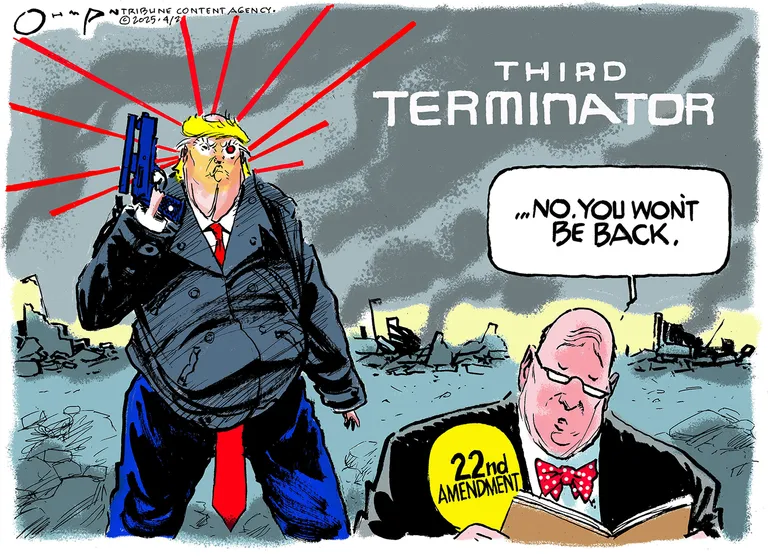
For months Trump has alternately encouraged and then tamped down speculation that he might seek a third term. Wednesday, he acknowledged the constitutional reality that “it’s pretty clear I’m not allowed to run”. But since it’s always a mistake to assume that any Trump statement is his final word, the third term idea will likely surface again at some point.

So how seriously should we take this? My conclusion: moderately seriously. Pay attention, but don’t lose your mind about it. That’s an attitude I’m trying to model this post.

The main reason to take it somewhat seriously is this: If Trump floated an idea like this and nobody pushed back, before long he’d be doing it. As you may remember from junior high, that’s how bullies operate. Every abuse, from pulling your pony tail to rape, starts as a joke. “Why do you have to be like that? I was just kidding around.” But if your response to the joke indicates that he might get away with it, it’s game on.

The main reason not to take it seriously is the 22nd Amendment, which seems pretty clear:

No person shall be elected to the office of the President more than twice, and no person who has held the office of President, or acted as President, for more than two years of a term to which some other person was elected President shall be elected to the office of the President more than once.

And yet, Steve Bannon believes he has a way to get around that prohibition.

“There’s many different alternatives,” Bannon said when asked about the 22nd Amendment. “At the appropriate time, we’ll lay out what the plan is.”

And Trump himself said back in March “There are methods which you could do it.”

So let’s think about what those methods might be.

Is there a loophole? Sort of. In a New Yorker conversation with Michael Luo, Ruth Marcus explains:

Note that it says “elected . . . more than twice,” not “serve as President for more than two terms.” The way—maybe—to get around that would be to have Trump elected Vice-President, and then to have whoever is the incumbent President resign to make way for a third Trump term. (Trump himself, by the way, said that this approach was “too cute,” and that “the people wouldn’t like that.”)

Alternatively, and even more fancifully, Trump could be elected Speaker of the House (you don’t have to be a House member to be Speaker), putting him in line for the Presidency, and both the elected President and Vice-President would clear the decks for him.

Marcus’ “maybe” depends on how the Supreme Court interprets the 12th Amendment, which says:

But no person constitutionally ineligible to the office of President shall be eligible to that of Vice-President of the United States.

Again, though, Trump could argue that he’s not ineligible to be president, he’s just ineligible to be elected president. So maybe the same loophole covers the 12th Amendment too. An honest Supreme Court — especially one that puts so much emphasis on the original intent of the laws — would not allow this, but we don’t have an honest Supreme Court. So maybe it flies.

Could it work? Not if the 2028 election has anything to do with the will of the American people. Remember a few things:

Not to mention the fact that Trump is right: The plan to run a stooge (or two stooges) who then resign is too cute for the public to back. And then there’s the execution problem: Would you trust J. D. Vance to resign once he had been sworn in as President? Trump doesn’t seem like the trusting type.

Summing up: In any free and fair election, a Stooge/Trump or Stooge/Stooge ticket would lose in a landslide. Anybody who seriously proposes the plan, i.e., Steve Bannon, must also be planning to rig the election in a significant way. A small amount of corner-cutting wouldn’t do the job.

Whether that can happen or not is a different topic.

Does Trump understand that it won’t work? Hard to say. He seemed to understand it Wednesday, but I have long subscribed to the theory of Trump’s mind that David Roberts enunciated in 2016:

When he utters words, his primary intent is not to say something, to describe a set of facts in the world; his primary intent is to do something, i.e., to position himself in a social hierarchy. … Even to call him dishonest, to say he “lies,” doesn’t quite seem to capture it. The whole notion of lying presumes beliefs — to lie is to say something that one believes to be false, to knowingly assert something that does not correspond to the facts.

It’s not that Trump is saying things he believes to be false. It’s that he doesn’t seem to have beliefs at all, not in the way people typically talk about beliefs — as mental constructs stable across time and context. Rather, his opinions dissolve and coalesce fluidly, as he’s talking, like oil on shallow water. That’s why he gives every indication of conviction, even when, say, denying that he has said something that is still posted on his Twitter feed.

Wednesday, Trump found it useful to agree with people like Mike Johnson that he can’t run. (Of course, he also said this was “sad”, because “I have my highest numbers that I’ve ever had”, which is completely delusional. So Wednesday’s comment did not come at some moment of peak lucidity.) Tomorrow, he may find it useful to agree with Steve Bannon.

What makes this problematic for Republicans in general, even the fascist ones, is the Mad King problem: No one can tell Trump he is wrong. So if he starts asserting that one of the third-term scheme works, and in fact works easily because he’s so popular, who’s going to tell him that some serious election-rigging is needed?

Meanwhile, no Republican legally entitled to compete for the presidency can start organizing a campaign, for fear of antagonizing the Mad King. Typically, the primary field starts to assemble in earnest after the midterm elections, so there’s still time. But Democrats like Governors Newsom and Pritzker are already starting to position themselves. Republican candidates would too if the field were clear.

What does the third-term talk accomplish for Trump? At least for his followers (or for Republicans intimidated by his followers), talk of a third term pushes back the moment when he becomes a lame duck. No one is going to risk breaking the law for him if they anticipate someone else holding the presidency soon. But the fantasy of Trump remaining in office indefinitely keeps that realization at bay.

The Resistance Stiffens

Chicago on Saturday.

The No Kings rallies were the most obvious signs of resistance to Trump’s authoritarian rule, but congressional Democrats, Pentagon reporters, major universities, and an appeals court also refused to cave to him.


Saturday I had a choice to make: attend the No Kings rally where I live in Bedford, Mass., or go to the much bigger rally in Boston, which stood a chance of making national news. I opted for the local rally. At one point I counted over 500 people in attendance before I lost count. I would guess there were 600 or more. That’s in a town of about 14,000, at a rally that probably didn’t draw a lot of out-of-town people because all the surrounding towns had their own No Kings rallies.

The independent Strength In Numbers website estimated that 5.2 million people participated nationwide, and possibly as many as 8.2 million.

Our estimate is based on reports from local officials, local organizers, and attendees, and suggests the count from organizers — who report 7 million participants nationwide — may be a bit optimistic (but is not impossible). Still, regardless of whether the precise number is 5, 6, 7, or 8 million, Saturday’s events are very likely the biggest single-day protest event since 1970, surpassing even the 2017 Women’s March demonstrations against Trump.

The largest rallies were in blue states, with 320K in New York City and 225K in Chicago, but 20K came out in Austin, Texas and 10K in Boise, Idaho. No Kings was truly a national event.

The regime’s response. The organizers could hardly have asked for a better response from the Trump administration, because the regime’s disdain and even hatred for these millions of Americans only served to underline everything the rally speakers were saying.

Trump himself posted an AI-generated video on his Truth Social account, in which a crowned Trump flies a fighter jet labeled “King Trump” and drops sewage onto protesters in what appears to be New York. VP Vance posted a video to BlueSky in which Trump dons a crown and a robe, and brandishes a sword while Nancy Pelosi and Chuck Schumer kneel and bow to him. White House spokesman responded to the protests with “Who cares?

Leaders of democratic countries don’t act like this.

Presidents are, of course, within their rights to put their own spin on events. Trump might legitimately doubt whether these millions of people accurately represent the country, or even postulate a “silent majority” as Richard Nixon did a few years before he had to leave office in disgrace. Even if the majority of the country has turned against Trump — as the polls show — he is not obligated to agree with the People or change his unpopular policies.

But when large numbers of their citizens take to the streets in nonviolent protest — even Fox News had to admit that “there were no reports of violence or arrests at the afternoon rallies” — leaders of democracies don’t respond with a lordly “Who cares?” or publicize their fantasies of dropping shit on the dissenters. But would-be dictators might, because they don’t serve the People; the People are supposed to serve them.

It’s nearly impossible to imagine any Democratic president showing similar hostility to peaceful conservative protesters. (The January 6 protests, recall, included a violent takeover of the Capitol and sending over 100 police to the hospital. The subsequent arrests and trials were basic law enforcement, not persecution.) The moments conservatives point to as evidence of Democratic disdain — Hillary’s “basket of deplorables” and Obama’s “clinging to guns or religion” — don’t really hold up if you look at the full context, which included considerable empathy for Trump voters.

For example, Clinton put “half” of Trump voters in her basket of deplorables.

But the other basket, the other basket, and I know because I see friends from all over America here. I see friends from Florida and Georgia and South Carolina and Texas, as well as you know New York and California. But that other basket of people who are people who feel that government has let them down, nobody cares about them, nobody worries about what happens to their lives and their futures, and they are just desperate for change. It doesn’t really even matter where it comes from. They don’t buy everything he says but he seems to hold out some hope that their lives will be different. They won’t wake up and see their jobs disappear, lose a kid to heroine, feel like they’re in a dead-end. Those are people we have to understand and empathize with as well.

The closest genuine analogy from recent years is the Tea Party protests against President Obama, which were much smaller than No Kings. Paul Waldman has numbers:

The Tea Party’s biggest distributed event was on tax day 2009, with 750 modestly attended protests. No Kings had 2,600. Its biggest single gathering was on 9/12/09 in DC, with somewhere between 75K and a few 100K participants.

Nonetheless, Obama had a delicate response to the Tea Party: The protests represented a “noble” American tradition of “healthy skepticism about government” as well as a noble tradition of “saying that government should pay its way”. But he engaged the ideas of the Tea Party, challenging them to specify how they would close the deficit.

The challenge, I think, for the tea party movement is to identify specifically what would you do. It’s not enough just to say, get control of spending. I think it’s important for you to say, I’m willing to cut veterans’ benefits, or I’m willing to cut Medicare or Social Security benefits, or I’m willing to see these taxes go up.

It is impossible to imagine Trump or Vance or Speaker Johnson or just about any Republican leader showing that level of respect for Americans who disagree with what they’re doing. We are “terrorists” or “pro-Hamas” or some other ridiculous thing. They can’t even admit that Americans don’t like seeing soldiers patrolling their streets, or American citizens being harassed because of their accents or the color of their skin.

In their fascist worldview, Trump IS America, so any dissent against Trump is un-American.

Resistance from the Pentagon press corps. No Kings wasn’t the only example of Americans refusing to bend their knees to the Mad King.

Nearly the entire Pentagon press corps cleaned out their desks and turned in their access passes Wednesday rather than submit to Pete Hegseth’s new attempt to control their coverage of his department.

News outlets were nearly unanimous in rejecting new rules imposed by Defense Secretary Pete Hegseth that would leave journalists vulnerable to expulsion if they sought to report on information — classified or otherwise — that had not been approved by Hegseth for release.

Even several Trump-supporting outlets, like Fox News, Newsmax, and The Wall Street Journal, have given up their Pentagon access.

“What they’re really doing, they want to spoon-feed information to the journalist, and that would be their story. That’s not journalism,” said Jack Keane, a retired U.S. Army general and Fox News analyst, said on Hegseth’s former network.

Yahoo News reported that the “hundreds” of credentialed Pentagon reporters had been reduced to 15. The Washington Post identified who they represent:

The list of signatories included four reporters from right-wing outlets: one from the website the Federalist, one from the Epoch Times newspaper, and two from the cable network One America News.

“The rest,” the WaPo says, “are freelancers, independent or work for media outfits based overseas.”

(Even Epoch Times’ Pentagon reporter resigned after his bosses signed the agreement. “I can no longer reconcile my role with the direction the paper has chosen, including its increasing willingness to promote partisan materials, publish demonstrably false information, & manipulate the reporting of its ground staff to shape the worldview of our readers.”)

Resistance in Congress. The government shutdown is now in entering its fourth week, with no end in sight. Democrats are holding out for a popular concession: They want long-term funding for the subsidies that make policies on the ObamaCare exchanges affordable. If those subsidies lapse on November 1, as they are currently scheduled to do, millions of Americans — many of them represented in Congress by Republicans — will see their health insurance premiums skyrocket.

But Trump’s myth of invincibility will be damaged if he makes any concessions at all, so Republicans are refusing to negotiate. So far the only offer on the table is that the Senate will hold a vote on the ObamaCare subsidies after Democrats vote for a continuing resolution to reopen the government.

This vote, of course, will just be a gesture, a chance for Democrats to vote for something that ultimately fails. It will help no one pay for health insurance.

The House, meanwhile, is still out of session. This has the added plum for Speaker Johnson that he doesn’t have to swear in Adelita Grijalva who won a special election weeks ago. Grijalva would be the 218th signature on the petition to vote on releasing the Epstein files, which Johnson does not want to do. (You have to wonder what in the files could be so bad for Trump that he’s willing to go through this.)

Republicans are predicting Democrats are about to fold, but I see no sign of it. They have a popular position and the public is mostly agreeing with them. Rather than offer Democrats anything substantive, the regime is upping the threat level, as authoritarians are wont to do.

Resistance from universities. Today is the deadline for nine universities to sign a compact with the Trump administration, submitting to regime-dictated policy changes in exchange for favorable decisions on federal funding.

The Compact for Academic Excellence in Higher Education was sent on Oct. 1 to nine colleges — both private and public — and would require schools to bar transgender people from using restrooms or playing in sports that align with their gender identities, freeze tuition for five years, limit international student enrollment, and require standardized tests for admissions, among other things.

Of the original nine schools that received the document, as of Sunday night, six had indicated they are not planning on signing.

MIT was the first to refuse, followed by Brown University, the University of Pennsylvania and the University of Southern California.

On Friday, the White House held a virtual meeting with colleges that hadn’t yet sent rejection notices, including the University of Arizona, the University of Texas at Austin, Vanderbilt University, Dartmouth College and the University of Virginia. Three additional schools were also invited: Arizona State University, Washington University in St. Louis and the University of Kansas, according to The Wall Street Journal.

Subsequent to that meeting, Virginia and Dartmouth announced they wouldn’t be signing. No universities have signed.

Columbia was the first university to try to appease Trump, but although Trump claims every few weeks that Harvard is about to give in, its lawsuit is still in court.

Resistance in court. A three-judge panel from the Seventh Circuit Court of Appeals — including one Trump appointee — unanimously upheld a lower-court order blocking the regime from deploying National Guard troops in Illinois.

The case hinges on whether the regime’s claims of “rebellion” or of being “unable to execute the laws of the United States” are credible. The district court found that they were not credible, and the appeals court found no errors in that assessment that they needed to correct.

Political opposition is not rebellion. A protest does not become a rebellion merely because the protestors advocate for myriad legal or policy changes, are well organized, call for significant changes to the structure of the U.S. government, use civil disobedience as a form of protest, or exercise their Second Amendment right to carry firearms as the law currently allows. Nor does a protest become a rebellion merely because of sporadic and isolated incidents of unlawful activity or even violence committed by rogue participants in the protest.

Trump has appealed to the Supreme Court, which so far has shown itself to be corrupt and partisan in his favor. We’ll see if they’re willing to take this further step down the road to autocracy.

Only Trump represents the People

Pam Bondi’s disrespect of the Senate is only one example of a larger principle.


If you watched Pam Bondi’s testimony before the Senate Judiciary Committee Tuesday, you saw a number of things:

  • an embarrassing performance aimed at impressing Donald Trump rather than the Senate or the American people.
  • several damaging confessions implicit in her refusal to answer simple questions.
  • an unprecedented level of disrespect for elected officials, and for Congress’ constitutional duty to oversee the Executive branch.

But if you took a step back, there was also something larger to see: an example of one of the key principles of fascism.

Previous American administrations, and democratic governments elsewhere in the world, have sometimes had contentious relationships with opposition parties or with the press. But I can think of no other example where those relationships devolved into such open hostility and disrespect as Bondi showed to Democratic senators, or as Trump regularly shows to the press.

The reason for this is simple and goes to the heart of the democratic project: Each of the three — the President, Congress, and the press — represents the People in a different way. Yes, the People elect the President, but they also elect representatives to Congress. And by choosing who they read or watch or otherwise pay attention to, the People informally anoint journalists to raise questions they are unable to raise themselves.

Previous administrations have understood this. So while their officials and spokespeople might banter with Congress or the press, while they might dodge some questions, spin their way out of others, and sometimes launch into long filibustering answers that made questioners give up, there was always some minimum level of decorum. To berate the questioners or insult them also insulted the American People that they represent.

But fascist regimes work according to a different principle: The Leader exists in a state of mystical identity with the Nation and its People. Guardian columnist and Princeton professor Jan-Werner Müller saw the writing on the wall after Trump’s first inaugural in 2017:

All populists oppose “the people” to a corrupt, self-serving elite the way Trump did. But not everyone who criticizes the powerful is a populist. What really distinguishes the populist is his claim that he and only he represents the real people. As Trump explained, because he now controls the executive, the people control the government. By implication, all opposition is illegitimate – if you oppose Trump, you oppose the people.

In particular, no one can adversarially question the Leader on behalf of the People, because the Leader IS the People.

This mindset is very obvious when Trump holds a press conference, and nearly as obvious when his press secretary Karoline Leavitt does: In the regime’s mind, the reporters represent no one but themselves. Trump is doing them a favor to speak to them at all, and that privilege can be revoked for the most trivial of reasons (as when AP got thrown out of the Oval Office press pool for refusing to accede to Trump’s demand to change the name of the Gulf of Mexico).

The same principle was at work in Bondi’s testimony. Previous department heads have shown at least a nominal respect for the congressional committees tasked with overseeing them, for the simple reason that the senators and representatives are elected officials and the department heads are not.

But Bondi’s performance took place inside a very different frame. Democratic senators like Dick Durbin or Sheldon Whitehouse may have gone through the technical procedure we call “elections”, but they do not in any way represent the People. Bondi directly represents Donald Trump himself, and Trump IS the People. So respect should flow from the senators to her, and not the other way around. (The Republican senators in the room seemed to understand this.)

This attitude was unfortunate for the People, because Democrats on the Committee actually did a good job asking questions that I think a lot of Americans would like to hear answered:

Trump supporters may see those as “gotcha” questions, but that depends on what the answers are. If Bondi could simply say “No such pictures have been found and we have no reason to believe any exist”, or “Our office was ready to indict Comey before the Truth Social post”, or “The story about agents flagging Trump’s name in the Epstein files is false” — where’s the gotcha? She might have followed any of those answers with “Thank you for giving me the opportunity to clear that up.”

In other words: If Bondi had good answers to those questions, Republicans should have asked them. But she didn’t and they didn’t.

Instead of answers, Bondi came armed with a binder of opposition research, so that whenever a senator posed a difficult question, she could counterattack with an accusation. She attacked several Democratic senators for taking money from an Epstein associate, or of not caring about corruption when Biden was president; called Adam Schiff a “failed lawyer” who should apologize to Trump; accused Dick Durbin of not caring about the safety of Illinois, and so on.

Some of her attacks were taken from the fever-swamps of Fox News and may or may not have any basis in reality. But beyond that, they did nothing to answer those excellent questions.

Probably the only person who enjoyed this performance was Donald Trump, who always loves to see his people insult his enemies. (Rick Wilson compared Bondi’s testimony to a faked orgasm: “loud, theatrical, sweaty, and meant to trick just one man into keeping her around by flattering his ego.”) But any smart Republican had to realize that it did their cause no good: By dodging the questions, Bondi all but admitted that the only true answers are bad: Trump is in the Epstein files, the photos do exist, Comey’s prosecution was motivated by Trump’s malice rather than evidence of wrongdoing, Homan kept the money, and so on.

I mean, if somebody accuses you of something and you can say “no”, don’t you say “no”? You can get all offended and angry about it in your next sentence, but you do say “no”.

Bondi, who was under oath and subject to lying-to-Congress charges should the Department of Justice ever start enforcing the law again, did not say “no”.


Speaker Mike Johnson and other congressional Republicans have provided another example of the fascist identification of the Leader with the Nation. They refer to the No Kings protests planned for October 18 as “hate America” rallies. In their fascist worldview, Trump is America. You can’t protest against Trump unless you hate America.

Trump Comes for Chicago

Whatever this is about, it’s not public safety.


I went to graduate school in Chicago during the 80s and lived there for six years. I’ve been back many times since and marveled at how much safer the city is today than 40-50 years ago. Then, I had a car stolen and two bicycles. My future wife was accosted on a sidewalk, and managed to push her attacker away. But in recent years, I have walked anywhere I wanted, including a number of places I would not have dared in the 80s, despite being younger, fitter, and less cautious then.

One neighborhood I stayed away from then, perhaps foolishly, was the Hispanic area on the near South Side. But a few years ago, I went to the National Museum of Mexican Art on 19th Street. A lovely middle-class neighborhood has grown up in that area, and the museum itself is wonderful. These days, Mexican-American can be just another Chicago ethnicity, like Italian-American or Irish-American.

There is, of course, still crime in Chicago (as there is not just in every city, but in small towns as well), and places I would not want to go at night. But in every measurable way, the city is much safer now. You can see that if you take the famous Architecture Boat Tour on the Chicago River. The gentrification of downtown began in the 1970s with the Marina Towers, which were built to be a fortress against the rest of Chicago: You could park your car and even moor your boat without exposing yourself to the public. But as the decades went by, the buildings became more and more open to the city, built to highlight the public riverwalk. From the river, you can see the record of the gradual unfolding of Chicagoans’ confidence.

So I have taken it personally when Trump has repeatedly smeared Chicago as a crime-ridden hellhole. And in particular, I object to his scapegoating of Hispanic immigrants as some kind of vermin to be eliminated.

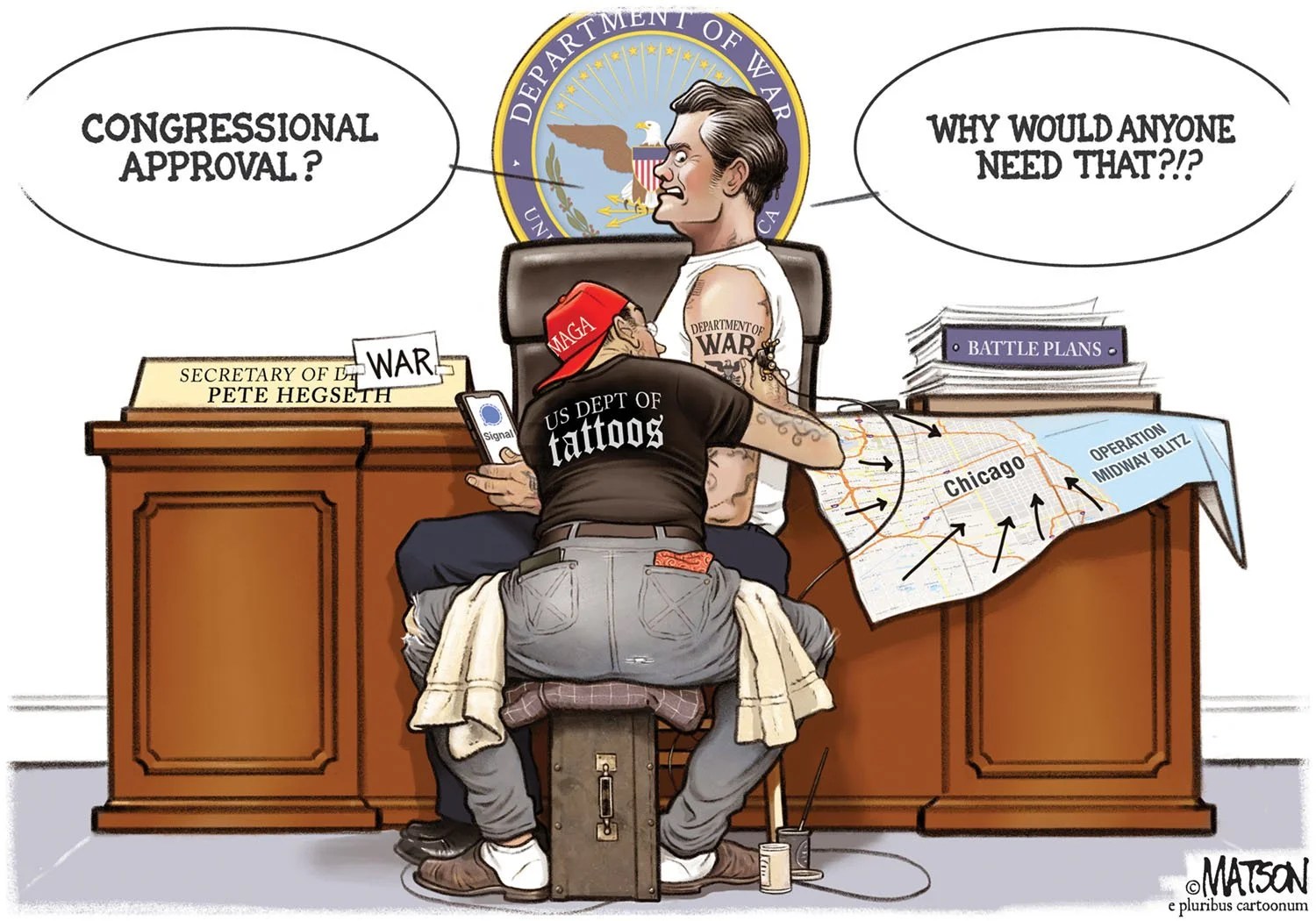
Saturday, the regime announced it was sending 300 federalized National Guard troops to Illinois. Governor Pritzker says the troops will come from Texas. The governor has sued to stop this invasion, making claims similar to the ones that have been successful in Portland. (More on Portland below.)

I have to wonder what troops can do that other federal agents aren’t already doing. Agents from ICE, the Border Patrol, the FBI, BATF, and DHS have been wearing military fatigues, sporting heavy weapons, and conducting military-style attacks.

Federal agents rappelled from Black Hawk helicopters. Dozens of others, their faces hidden behind masks, arrived in moving trucks. In total, 300 officers stormed a South Side apartment building that Department of Homeland Security officials say harbored criminals.

Maybe, maybe not. But the building also contained US citizens and families with children.

Armed federal agents in military fatigues busted down their doors overnight, pulling men, women and children from their apartments, some of them naked, residents and witnesses said. Agents approached or entered nearly every apartment in the five-story building, and U.S. citizens were among those detained for hours.

… The feds also claimed the South Shore neighborhood was “a location known to be frequented by Tren de Aragua members and their associates,” but DHS gave no evidence to support the assertion, and authorities did not confirm that any of the people arrested were members of the Venezuelan gang.

Alleged Tren de Aragua members have been charged and detained in the city as recently as August. But the Chicago Sun-Times has found little evidence tying them to violence in Chicago.

Rodrick Johnson, 67, is one of many residents who were detained by federal agents during the South Shore raid. A U.S. citizen, he said agents broke through his door and dragged him out in zip ties.

Johnson said he was left tied up outside the building for nearly three hours before agents finally let him go.

Many of the residents were said to be Venezuelan. I wonder if the regime would be similarly brutal in a White neighborhood.

Last Sunday, though, masked agents in military style dress marched through some of the most upscale and touristy parts of the city, not far from where you’d board that boat tour I mentioned.

Agents, some masked, walked north on Michigan Avenue from Millennium Park toward the Wrigley Building. They then walked down Wacker Drive near Trump Tower, while some headed to the Riverwalk. They then made their way to River North.

The point here could only have been intimidation. They were not pursuing criminals or making arrests. Governor Pritzker has it right:

One thing is clear: none of what Trump is doing is making Illinois safer. This is not about fighting crime or about public safety. This is about sowing fear and intimidation and division among Americans.

Portland. Yesterday’s announcement sounded like a classic good-news/bad-news joke: Trump was pulling the last 300 federalized California National Guard troops out of Los Angeles … so that he could send them to Portland. He had previously tried to federalize Oregon National Guard troops to invade Portland, but a federal judge he appointed himself blocked that plan with a temporary restraining order in response to a lawsuit from Oregon Governor Tina Kotek, the mayor of Portland, and numerous other state and local officials.

Judge Karin Immergut observed that in an earlier case (concerning Los Angeles) the Ninth Circuit Court of Appeals had overturned a similar restraining order because courts owe “a great deal of deference” to a president’s judgment that conditions on the ground justify his decision to deploy National Guard troops. Specifically, that the federal government is unable to execute the laws with less extraordinary forces.

But Immergut contrasted the relatively peaceful situation of Portland (where the most serious protests had happened in June, but by September had faded to predominantly nonviolent protests drawing 20-50 people per day) with the more serious situation in LA prior to the president’s declaration.

Here, this Court concludes that the President did not have a “colorable basis” to invoke § 12406(3) to federalize the National Guard because the situation on the ground belied an inability of federal law enforcement officers to execute federal law. The President’s determination was simply untethered to the facts.

In a hearing Sunday night, Judge Immergut asked a Trump administration attorney: “How could bringing in federalised national guard from California not be in direct contravention of the [decision] I issued yesterday?”

She extended her order to block the Trump regime from deploying any National Guard troops to Portland.

I’m encouraged by the fact that an appointee from Trump’s first term sees the law this way. I hope some similarly-minded judge gets the Chicago case.

The Silence of the Generals

Lack of response leaves a lot of room for projection.


Tuesday, Defense Secretary Pete Hegseth hosted an unusual meeting: America’s top generals and admirals, 800 or so of them, were called to Quantico from around the world to listen to Hegseth in person. And once the meeting was on the calendar, President Trump decided he should speak too.

DoD rules prohibit uniformed members of the military from participating in political events. Directive 1344.10 allows attendance at a political rally

provided the member is not in uniform and does not otherwise act in a manner that could reasonably give rise to the inference or appearance of official sponsorship, approval, or endorsement.

So for generals and admirals to show up in uniform at Hegseth’s meeting at all, they couldn’t view it as “partisan political activity”. In particular, it was not a Trump rally. They were attending to receive instructions from their civilian leadership, so that they could interpret that top-level guidance to their subordinates.

Typically, when you are receiving instructions from those above you in the chain of command, you don’t cheer or boo or heckle or stomp your feet. You listen, take notes, and think about what this means for your particular command. And if something you hear sounds political, you avoid “the inference or appearance of … endorsement”.

So that’s what the generals did.

One thing we know about Donald Trump is that he does not compartmentalize. For most of us, compartmentalization is such an integral part of being an adult that it’s hard to imagine someone going through life without it. Sometimes you speak as friend, as a colleague, as a parent, as a polite stranger, or in some other role. Depending on what role you are in, you may seem like a completely different person. You would no more confuse those roles than you would show up at work in your pajamas or wear a tuxedo to the beach.

But Donald Trump is, at every moment, Donald Trump acting in the interests of Donald Trump. The particular role the situation seems to call for makes no difference. So at the Quantico meeting he was not playing the role of President of the United States, or Commander in Chief of the Armed Forces, or any other role. He was Donald Trump being Donald Trump.

Trump loves crowds, loves to rouse them, and loves to hear them cheer. He is used to the crowds that show up at his political rallies, so that’s how he spoke to the generals. He rambled, baited his enemies, threw red meat to his fans, and voiced weird sentiments that any other president would have restrained himself from saying out loud.

The generals took it all in without response. This left a lot of room for interpretation.

In his blog, West Point History Professor, Terrence Goggin claimed to have seen “silent fury“. But Jack Hopkins, interpreting lack of protest as complicity, saw “silent surrender“. Retired Lieutenant General Mark Hertling saw leaders worrying about what to tell their troops. The Atlantic’s Tom Nichols saw men grasping, perhaps for the first time, that the Commander in Chief is not OK. Lev Parnas, a repentant Rudy Giuliani associate who may or may not be for real, attributed to his “sources” that the generals’ faces were being scanned by AI to determine who is and isn’t loyal to the Trump regime.

That’s a lot to sort out. But I present that range of reactions to emphasize that you should take everybody’s interpretation (including mine) with a grain of salt. Some reporters may have spoken to a few of the generals themselves — none of whom talk to me — but I doubt that anybody has interviewed a representative sample of them. So we’re all just applying what we think we know about the military mindset and speculating from there.

The speculation began before the meeting started. From the first announcement, it was an odd event. Gathering all our military leaders together in one room is a huge security risk; one well-placed bomb and the greatest military force in the world would be led by J. D. Vance and a bunch of colonels. It was also expensive. The generals came from all over the world, and many probably traveled with their staffs. It was also expensive in another sense: Probably these guys all had things they were supposed to be doing, and many of those things probably went undone for a few days.

So the before-the-fact speculation revolved around one question: What could Hegseth and Trump have in mind that would be worth all this? Retired Lieutenant General Ben Hodges made an alarming guess:

July 1935 German generals were called to a surprise assembly in Berlin and informed that their previous oath to the Weimar constitution was void and that they would be required to swear a personal oath to the Führer. Most generals took the new oath to keep their positions.

Fortunately, it wasn’t that bad. Hegseth’s speech is here and Trump’s is here. Neither was worth flying around the world to hear in person, but they weren’t sign-or-else demands for a loyalty pledge. So we’re still just guessing about what the meeting was supposed to accomplish.

And as so often happens in the Trump administration, at times the absurdity overwhelmed the content. One way to watch the event is to view Hegseth as the comedian who warms up the crowd before the song-and-dance act comes on. The reaction that the generals might have had the hardest time suppressing was laughing out loud.

I mean, think about it: Pete Hegseth, the most unqualified Secretary of Defense in America’s history, declared that “promotions across the joint force will be based on one thing: merit; colorblind, gender-neutral, merit based”. There is no definition of merit under which Hegseth becomes Secretary of Defense. No one with Hegseth’s resume could rise this high without being a White man, but we’re supposed to believe that everything in the Trump administration is colorblind and gender-neutral.

The Trump military, Hegseth said, would promote top performers and “get rid of poor performers more quickly”. But of course, Hegseth himself is a poor performer. He endangered the security of a combat mission by discussing its details over an unclassified nonmilitary channel with uncleared civilians present, a blunder that would have gotten him fired in any previous administration. But he suffered no consequences, because standards are only for the lower ranks, not Trump’s inner circle.

The gist of Hegseth’s speech called for the military to better match the John-Wayne-movie image of the military Trump sees in his mind: more manly, more fit, clean-shaven. (Talk to Generals Grant and Lee about the military importance of shaving.) If servicemen don’t want to shave their beards, “it’s time for a new position or a new profession”. But the past administration was wrong “to kick out Americans who refused an emergency vaccine” — as if a beard were a bigger threat to combat readiness than being unvaccinated during a pandemic.

And then, just before yielding the stage to the grossly obese Trump, he derided “fat generals and admirals in the halls of the Pentagon”.

Hilarious.

Note: This image is AI-generated.

Of course, this image of manliness is going to have real consequences for military people who are transgender or female or perhaps even non-White or non-Christian. Each of the leaders in the audience has a decision to make: Are they going to stay loyal to their people and try to shield them from those consequences, or will they offer them up as sacrifices to the new regime?

Now we get to Trump. It’s hard to know what to make of Trump’s speech, because he blathered for 70 minutes. Much of Trump’s stream-of-consciousness consists of random thoughts that have no consequences. For example, he mused about bringing back battleships, which were already mostly obsolete when Pearl Harbor was attacked.

I think we should maybe start thinking about battleships, by the way. You know, we have — Secretary of the Navy came to me — because I look at the Iowa out in California and I look at different ships in the old pictures. I used to watch Victory at Sea. I love Victory at Sea. Look at these admirals. It’s got to be your all time — in black and white. And I look at those ships, they came with the destroyers alongside of them and man, nothing was going to stop. There were 20 deep and they were in a straight line and there was nothing going to stop them. And we actually talk about, you know, those ships. Some people would say, no, that’s old technology. I don’t know. I don’t think it’s old technology when you look at those guns, but it’s something we’re actually considering, the concept of battleship, nice six-inch size, solid steel, not aluminum, aluminum that melts if it looks at a missile coming at it. It starts melting as the missile is about two miles away. Now those ships, they don’t make them that way anymore. But you look at it, and — your secretary likes it and I’m sort of open to it. And bullets are a lot less expensive than missiles, a lot of — a lot of reasons. I should take a vote, but I’m afraid to take that vote because I may get voted out on that one. But I tell you, it’s something we’re seriously considering. They were powers. They were big powers. They were just about as mean and scary as you could be, and so we’re looking at that.

That’s the kind of thing you nod your head to and then say, “Sure, Grandpa. Can I get you a glass of water? Do you need to go to the bathroom?”

Other parts of the speech seem more serious, and maybe they were, but who can say? Much has been made of Trump saying that “America is under invasion from within”, which doesn’t actually make any sense. He blathered about removing “1700 career criminals” from Washington DC, which seems to be all the people arrested for immigration offenses during his military crackdown, many of whom either had no non-immigration criminal record or minor offenses like traffic violations.

It’s hard to know what to think about this. During the campaign, he painted a picture of major cities afflicted by an “immigrant crime wave” that no one else could find in the statistics. (Cities with lots of immigrants had no worse crime that cities with few.) Maybe no one has told him that this was nonsense, so he honestly imagines that his military sweeps are achieving long-term results. (Violent crime indeed was cut in half during his occupation of DC. But was the cause really “1700 career criminals” who are now off the streets permanently? Or did the native-born muggers and carjackers just stay home during the occupation, and will return as soon as the troops go away?)

Reading the transcript, again and again I found myself wondering: Does he really believe all this? Maybe he’s surrounded by people who feed his delusions so that he can live in a pleasant fantasy world where his inspired leadership has made America “the hottest country anywhere in the world”, and he’s stopping wars right and left.

So I wonder: Is that what the generals heard?

Military people, in my experience, are practical fact-based people. They are surrounded by bullshitters (like contractors who make extreme promises about the latest whiz-bang they’re building), and they can be bullshitters themselves sometimes, so they develop a good ear for claims that can’t be verified.

If that’s an accurate picture, then they were well aware that Trump was describing a fantasy world. And they wondered, as I did, whether or not he believed in it. If they concluded that he did, then I imagine that they are very afraid right now. Not just their careers, but possibly their lives and the lives of their troops as well, depend on surviving under the Mad King for another three years.

Is Kimmel’s return a turning point?

For the first time, Trump used autocratic power in a way that the public couldn’t ignore, and a popular pushback forced a big corporation to stand up to him. Is that an anomaly or the start of a turn-around?

After Charlie Kirk’s murder, ABC’s latenight comedian Jimmy Kimmel said something Donald Trump didn’t like:

We hit some new lows over the weekend with the MAGA gang desperately trying to characterize this kid who murdered Charlie Kirk as anything other than one of them, and doing everything they can to score political points from it.

Four things are worth noting:

  • Kirk’s assassin was brought up in a conservative family, but later developments showed that Kimmel was wrong to imply that he was MAGA himself.
  • Kimmel was right that MAGA pundits did everything they could to score political points from the assassination.
  • Kimmel did not insult Kirk, or in any way make light of his assassination.
  • But he did make fun of Trump’s response to the assassination. He played a clip of Trump being asked about Kirk and then seguing to the new White House ballroom he wants to build. “That’s not how an adult grieves the murder of someone he called a friend,” Kimmel said. “This is how a 4-year-old mourns a goldfish.”

For these dubious sins, Trump’s FCC Commissioner Brendan Carr leaned on ABC to fire Kimmel, implying that ABC stations might lose their licenses otherwise.

Appearing on Benny Johnson’s podcast on Wednesday, the Trump-appointed chairman said, “We can do this the easy way or the hard way. These companies can find ways to change conduct and take action, frankly, on Kimmel, or there’s going to be additional work for the FCC ahead.” Hours later, a spokesperson for Disney’s ABC confirmed to PEOPLE that Jimmy Kimmel Live! would be put on an indefinite hiatus.

This is far from the first time that corporations who want future favors from the government (like approval of mergers) have given in to an autocratic demand from Trump. But this time the public pushed back. Even Republican senators like Ted Cruz and Rand Paul pushed back. Kimmel returned to ABC on Tuesday (to record ratings), and even conservative local affiliate owners like Sinclair have ended their boycott.

If you haven’t watched Kimmel’s return-to-the-air monologue, you should.

Be sure to watch to the end of the 28-minute clip so you can see Robert De Niro play the new head of the FCC. Nobody can deliver a mafioso threat like De Niro, who clarified the new meaning of “free speech”.

“You want to say something nice about the president’s beautiful thick yellow hair and how he can do his make-up better than any broad, that’s free,” De Niro said. “But if you want to do a joke like, ‘He’s so fat he needs two seats on the Epstein jet’, that’s going to cost you.” The actor struggled to suppress a smile.

Kimmel asked: “For clarity, because it’s a pretty good joke, how much would that one cost me?”

“A couple of fingers, maybe a tooth,” came the reply.

Trump howled with rage at Kimmel’s return.

I can’t believe ABC Fake News gave Jimmy Kimmel his job back. The White House was told by ABC that his Show was cancelled! Something happened between then and now because his audience is GONE, and his “talent” was never there. Why would they want someone back who does so poorly, who’s not funny, and who puts the Network in jeopardy by playing 99% positive Democrat GARBAGE. He is yet another arm of the DNC and, to the best of my knowledge, that would be a major Illegal Campaign Contribution. I think we’re going to test ABC out on this. Let’s see how we do. Last time I went after them, they gave me $16 Million Dollars. This one sounds even more lucrative. A true bunch of losers! Let Jimmy Kimmel rot in his bad Ratings.

His post should settle a few previously contentious points:

  • Trump was deeply involved in Kimmel’s suspension. Why else would ABC have told the White House that the show was cancelled? All the MAGA attempts to attribute the suspension to bad ratings or other legitimate causes were bogus.
  • Trump reiterated his threats of censorship. Kimmel’s criticism of Trump “puts the Network in jeopardy”. Nice network you got there; be a shame if something happened to it.
  • In Trump’s mind, the issue is criticism of him, and has nothing to do with Charlie Kirk. That was already apparent from Trump’s tweet of September 17, shortly after Kimmel was taken off the air: “That leaves Jimmy and Seth, two total losers, on Fake News NBC. Their ratings are also horrible. Do it NBC!!!” Late-night hosts Jimmy Fallon and Seth Meyers didn’t have a Kirk problem, they’re just Trump critics.
  • Trump has not won any of his media lawsuits in court. Instead, he has used his government power to extort settlements out of parent companies that need favors. (These settlements are essentially bribes, as Stephen Colbert was cancelled for pointing out.) If ABC-owner Disney stands firm, Trump’s proposed lawsuit will fail.

And yet, that howl has not produced any action so far. David Frum and Paul Krugman each suggest that Trump is in a race against time: His bid for authoritarian power is racing against his plunging popularity. At some point, he will have so much autocratic power that politics barely matters any more, but he’s not there yet. And if his targets begin to believe they can stand up to him and win, while his Republican allies begin to worry that he will drag them down with him, that autocratic creep might stop or even reverse.

Krugman summarizes the situation:

It’s clear that if Trump were subject to normal political constraints, obliged to follow the rule of law and accept election results, he would already be a political lame duck. His future influence and those of his minions would be greatly reduced by his unpopularity. But at this juncture he is a quasi-autocrat. He is the leader of a party that accommodates his every whim, backed by a corrupt Supreme Court prepared to validate whatever he does, no matter how clearly it violates the law. As a result, Trump has been able to use the vast power of the federal government to deliver punishments and rewards in a completely unprecedented way. … This has created a climate of intimidation, with many institutions preemptively capitulating to Trump’s demands as if he already had total power.

… It’s important to understand that Trump’s push to destroy democracy depends largely on creating a self-fulfilling prophecy. Behind closed doors, business leaders bemoan the destruction that Trump is wreaking on the economy. But they capitulate to his demands because they expect him to consolidate autocratic power — which, given his unpopularity, he can only do if businesses and other institutions continue to capitulate.

If this smoke-and-mirrors juggernaut starts to falter, the perception of inevitability will collapse and Trump’s autocracy putsch may very well fall apart.

Jay Kuo lists a number of areas in which Trump’s autocratic push is meeting resistance. But a key source of Kuo’s optimism is that there is a limit to how far the Supreme Court will let Trump go. So far, they have largely delayed ruling on the legality of his actions while allowing those actions to continue temporarily. One big question still to be resolved is which way they will ultimately go: Will they defend the Constitution, or will they usher in the new fascist state?

In large part that may depend on how Trump’s self-fulfilling prophecy plays out in John Roberts’ mind.