Tag Archives: law

This is What Judicial Activism Looks Like

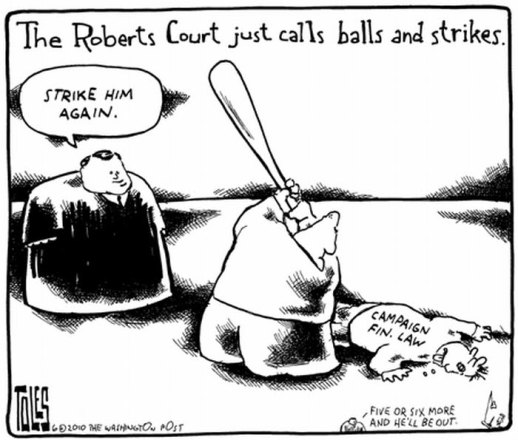
When John Roberts was being confirmed as Chief Justice in 2005, he likened his role to an umpire in a baseball game:

Judges are like umpires. Umpires don’t make the rules; they apply them. … I will remember that it’s my job to call balls and strikes and not to pitch or bat.

This was his way of invoking a common conservative trope: that “activist liberal judges” had “legislated from the bench” to create laws that were impervious to repeal through the political process. Roberts was pledging to be a different kind of judge, one who applied the law to the facts the way an umpire applies the rulebook’s definition of the strike zone to the pitch he just saw.

The umpire analogy was always suspect. As Justice David Souter pointed out in his 2010 Harvard commencement speech, cases that can be resolved just by reading the text and applying the facts usually don’t make it to the Supreme Court.

Even a moment’s thought is enough to show why it is so unrealistic. The Constitution has a good share of deliberately open-ended guarantees, like rights to due process of law, equal protection of the law, and freedom from unreasonable searches. These provisions cannot be applied like the requirement for 30-year-old senators; they call for more elaborate reasoning to show why very general language applies in some specific cases but not in others, and over time the various examples turn into rules that the Constitution does not mention.

Constitutional values, Souter recognized, often “exist in tension with each other, not in harmony.” Resolving those conflicts in a way that stays as true as possible to the spirit behind the Constitution as a whole … that requires a judge, not an umpire.

Souter was in many ways the model of what conservatives didn’t want to see in George W. Bush’s judicial appointments: Appointed by Bush’s father, Souter had drifted into the Court’s liberal wing, the wing that conservatives accused of making up laws. Roberts was promising not to do that. He would stay objective, rather than drifting into liberal activism.

When the Court’s McCutcheon v Federal Election Commission decision came out earlier this month, we saw just how ironically things have worked out. The decision, written by Roberts and building on the Roberts Court’s earlier decisions in Citizens United and McComish, is one more step in his completely original remaking (or rather, unmaking) of campaign finance law. John Roberts has become arguably the most activist Chief Justice in U.S. history.

When you read McCutcheon, the most striking thing is the way that Roberts is talking to himself. The precedents quoted are almost entirely those of the Roberts Court itself, many written by Chief Justice Roberts.

Moreover, the only type of corruption that Congress may target is quid pro quo corruption. Spending large sums of money in connection with elections, but not in connection with an effort to control the exercise of an officeholder’s official duties, does not give rise to quid pro quo corruption. Nor does the possibility that an individual who spends large sums may garner “influence over or access to” elected officials or political parties. Citizens United v. Federal Election Comm’n, 558 U. S. 310, 359. The line between quid pro quo corruption and general influence must be respected in order to safeguard basic First Amendment rights, and the Court must “err on the side of protecting political speech rather than suppressing it.” Federal Election Comm’n v. Wisconsin Right to Life, 551 U. S. 449, 457 (opinion of ROBERTS, C.J.). Pp. 18–21.

That bright line between quid pro quo corruption (direct bribery, where a campaign contribution is exchanged for a vote or other favor) and the more general buying of influence — and the idea that the Constitution limits Congress to legislate only on the quid pro quo side of that line — is a pure invention of John Roberts. It did not exist anywhere in law or legal tradition before he joined the Supreme Court.

Roberts also cites an older decision, Buckley v Valeo from 1976, but slides over the fact that he is reversing that decision. Buckley was the Court’s response to the post-Watergate rewriting of campaign finance laws. It upheld the part of the law that restricted campaign contributions, but threw out the law’s limits on campaign expenditures. The Court reached this conclusion via an interesting piece of reasoning that Roberts has completely written over: When a candidate spends money on his campaign, he is exercising his freedom of speech, and the government needs a very serious reason to stop him. But when a contributor gives money to a campaign, he is not himself speaking; contributors are exercising their right to free association, which is also a First Amendment right, but one that is not quite so sensitive as the freedom of speech.

In other words, in 1976 money was not speech.

The 1976 Court upheld the exact kind of restriction that McCutcheon throws out: an overall restriction on the amount of money an individual can give to federal campaigns during a two-year election cycle. So McCutcheon is a reversal, though you will struggle hard to find that fact acknowledged in the text. In Supreme Court tradition, reversals are not done lightly. A major reversal like Brown v Board of Education is a historical landmark, and typically happens only as a last resort. (See David Strauss’ book The Living Constitution for an account of all the ways the Court had tried for decades to make sense of “separate but equal” before recognizing in Brown that it just wasn’t going to work.)

If there is one cardinal symptom of judicial activism, reversal-on-a-whim is it. But Roberts does not struggle at all with reversing Buckley, he simply ignores that he’s doing it. And it’s not just Buckley. In Justice Breyer’s dissenting opinion, he quotes McConnell v FEC, the last major pre-Roberts campaign finance case, which upheld restrictions on soft money contributions:

Plaintiffs argue that without concrete evidence of an instance in which a federal officeholder has actually switched a vote [in exchange for soft money] . . . , Congress has not shown that there exists real or apparent corruption. . . . [P]laintiffs conceive of corruption too narrowly. Our cases have firmly estab­lished that Congress’ legitimate interest extends be­yond preventing simple cash-for-votes corruption to curbing ‘undue influence on an officeholder’s judg­ment, and the appearance of such influence.’

But as Breyer complains, Roberts now quotes Citizens United as if it had reversed McConnell.

Did the Court in Citizens United intend to overrule McConnell? I doubt it, for if it did, the Court or certainly the dissent would have said something about it.

Another major symptom of judicial activism is a judge valuing his own view of reality above that of the legislature. Judges are presumed to be experts in the law. But often a case hangs on not on the law alone, but on facts about the world. Congress can hold months of hearings and require reports from the full apparatus of government, and so is in general better situated to investigate the state of the world than a court is. Within the court system, a district court can spend weeks or months assembling a body of expert testimony, and so higher courts typically defer to a lower court’s findings of fact. In our entire system, no one is more poorly positioned to assess the state of the external world than the Supreme Court.

Non-activist judges realize that.

Lots of reality-based issues enter into campaign finance law: How does corruption really work? How corrupting are various kinds of contributions? How diligently will contributors and political parties look for loopholes in the law? What kinds of legal restrictions are practically enforceable, and which ones require the government to prove intentions that no one can really know? How does the appearance of corruption influence the behavior of voters and the overall health of democracy?

The Bipartisan Campaign Reform Act (BCRA) of 2002 was passed after Congress had assembled massive amounts of testimony and evidence. Moreover, congressmen themselves have direct experience with the temptations towards corruption, and significant interactions with the voters. When McCutcheon came before a district court, that court upheld the law in view of the Buckley precedent, before getting to the evidence-gathering part of the trial. Breyer summarizes:

The District Court in this case, holding that Buckley foreclosed McCutcheon’s constitutional challenge to the aggregate limits, granted the Government’s motion to dismiss the complaint prior to a full evidentiary hearing. … If the plu­rality now believes the District Court was wrong, then why does it not return the case for the further evidentiary development which has not yet taken place?

Why indeed? Is it that Chief Justice Roberts is afraid the facts would get in the way of what he wants to do? Or is he convinced that he already knows everything he needs to know?

Here’s the kind of thing I wish Justice Roberts knew: Last week I was in my home town, where I had dinner with my best friend from grade school. We have argued politics since we were seven, and he is quite conservative today. But we found one issue where we completely agree: No bank should be too big to fail. We agreed that Congress has done practically nothing to fix the financial system after the meltdown of 2008, and neither of us was optimistic that it would.

Why not? Not because the People want banks to be too big to fail. Between the two of us, I believe we represent a fairly broad public consensus on the issue. And not because bankers are delivering sacks of cash to congressmen in quid pro quo exchange for their votes. But the broader influence of big money in politics — the kind that Justice Roberts has placed beyond legal remedy — makes the too-big-to-fail issue unapproachable. Neither I nor my friend is actively pushing for Wall Street reform because … well, what’s the point?

That’s corruption of the political process undermining democracy. And Chief Justice Roberts has decreed that nothing can be done about it.

Catching Up With the Judges

While the Supreme Court has been relatively quiet lately, a lot has been going on in lower courts. This week I’ll tackle the recent net neutrality and same-sex marriage cases. In future articles I plan to address cases related to the NSA, voting rights, and drug-testing welfare recipients.

Net neutrality. The headlines about this decision said things like “Verizon Wins, Net Neutrality Loses“. But the overall impact of the D. C. Court of Appeals ruling is a little more ambiguous and complicated. Reading it was like watching the tape of a football game where my team gets way ahead, but I’ve already heard that they lost. On its way to ruling in Verizon’s favor, the court trashes one Verizon argument after another. “We lose this?” I kept asking myself.

Net neutrality is one of those important-but-somewhat-technical issues that it’s hard to get the public excited about. The issue will go months at a time without making headlines, so when it comes up again even people who have read about it before are likely to say, “Wait, I know this. What is it again?” Wikipedia defines it pretty well:

Net neutrality (also network neutrality or Internet neutrality) is the principle that Internet service providers and governments should treat all data on the Internet equally, not discriminating or charging differentially by user, content, site, platform, application, type of attached equipment, and modes of communication.

The practical problem is that you don’t have a lot of choices if you want fast broadband internet access in your home. The local cable monopoly may be the only option if you aren’t near a major city. If you are, you might have a choice between Comcast and Verizon FIOS — a Coke/Pepsi choice where competition is tightly confined to battlefields that don’t rock the corporate boat too much.

In short, broadband providers have a lot of market power. And the technology has shaken out in such a way that they have the power not just to impose a bad deal on you, but also on “edge providers” of services like Netflix or Google. Comcast has its own video-on-demand service, for example, so what if it decided to block its users from accessing Netflix? Or maybe Netflix connections could be inexplicably glitchy, unless Netflix paid Comcast a big fee. (Nice service you got there. It’d be a shame if something happened to it.)

Verizon could decide to compete with Comcast by charging smaller fee (or no fee at all) so that its users got Netflix cheaper. But why not just charge the same fee, give your own on-demand service the same advantage, and make money hand-over-fist? If there were five or six broadband providers, one of the smaller ones would probably break ranks. But with two or three, probably not. (BTW: That’s the same logic why none of the larger wireless companies should be allowed to take over T-Mobile.)

Until Tuesday, FCC rules made that illegal. Those are the rules that got thrown out by the D. C. Appeals Court. But along the way, the Court rejected almost all the arguments Verizon made for why it should be allowed to do whatever it wants with its network and charge whatever the market will bear.

The relevant law is Telecommunications Act of 1996, which gave the FCC the mission to promote the spread of broadband internet access. The main argument is over how to do that: Verizon thinks that making things as profitable as possible for broadband providers (like itself) encourages the providers to build out the broadband infrastructure. Net neutrality advocates argue that letting a few big corporations essentially “own the internet” discourages the real creativity in the system, which comes from edge providers trying to create the next gotta-have-it service like Netflix or YouTube. A Verizon-owned internet will be less interesting than a net-neutrality internet, and hence will inspire less consumer demand.

In short, it’s yet another version of the eternal supply-side vs. demand-side argument.

Anyway, the TCA classifies internet companies into two bins: telecommunications carriers and information-services providers. Telecommunications carriers are regulated like the wired phone companies: They have to offer their services to everyone on a more-or-less equal basis. Information-services companies have more leeway.

The gist of the court ruling is that the FCC has classified cable companies as information-services providers, but that its net-neutrality rules regulate them like telecommunications carriers. So the FCC’s net-neutrality rules can’t stand. But — and this is the observation that snatches victory from the jaws of defeat — it’s totally within the FCC’s current powers and mandate to just reclassify the cable companies.

So net neutrality is dead. But if the FCC wants to revive it, all they have to do is issue new rules. Judge Laurence Silberman dissented from the majority opinion that the FCC has this power, but since Verizon technically “won”, they can’t appeal the ruling to the Supreme Court unless and until the FCC tries to use the power that the Court says it has.

In short, this is all a long way from over.

Same-sex marriage. A month ago, if I had to guess which two states would be the last ones to legalize same-sex marriage, I might have picked Utah and Oklahoma. Since then, though, federal judges have struck down the amendments to both state constitutions that restrict marriage to opposite-sex couples. Both judges build on the Supreme Court’s Windsor decision that struck down parts of the Defense of Marriage Act last summer, but they do it in somewhat different ways.

You may remember that while I liked the outcome of Windsor, I was no fan of Justice Kennedy’s majority opinion, which I labeled “mush” and lumped together with Chief Justice Roberts’ voting-rights-act decision in a subtle, soft-spoken article I called “This Court Sucks“.

Here’s why Kennedy’s Windsor opinion sucked. Same-sex marriage cases all revolve around these three questions:

  • Does the right to marry (which the Court has often affirmed as a fundamental right protected by the Constitution) apply to same-sex couples?
  • Are laws targeting gays and lesbians (like laws targeting blacks or women) inherently suspicious as vehicles for irrational prejudice, and so subject to some form of heightened scrutiny from the courts?
  • Whatever standard of scrutiny you choose, do the laws serve legitimate purposes that outweigh the limitations they put on the couples’ rights?

Kennedy dodged all that. He waxed eloquent for a while on the plight of same-sex couples and the unreasonable prejudices against them, and then announced that DOMA was struck down.

That’s exactly the result I want, Justice Kennedy, but how did you get there? The purposes Congress imagined DOMA serving — whatever they were; you don’t list them or examine them — don’t “overcome”, but are they failing to overcome a high standard or a low standard?

The victims of Kennedy’s judicial malpractice are lower court judges like Terence Kern and Robert Shelby, who have been left to rule on similar-but-not-identical cases without any clear guidance. In his Oklahoma ruling, Kern avoids technical legal terms like sucks and mush, but makes more-or-less the same point I did:

The Windsor Court did not apply the familiar equal protection framework, which inquires as to the applicable level of scrutiny and then analyzes the law’s justifications. … Thus, Windsor does not answer whether a state may prohibit same-sex marriage in the first instance. Nor does Windsor declare homosexuals a suspect class or discuss whether DOMA impacted a fundamental right, which would have provided this Court with a clear test .

So Kern does his best to puzzle out the WWJKD question:

This Court has gleaned and will apply two principles from Windsor.

Ordinarily, a lower-court judge just “applies” principles from a higher-court ruling, rather than having to “glean” them first.

Lacking clear guidance, Kern avoids declaring either a fundamental right to same-sex marriage or that gays and lesbians are a protected class. That means that Oklahoma’s same-sex marriage ban only needs to have “rational relation to some legitimate end”.

Shelby took a somewhat different path to the same destination in the Utah case. He made an insightful observation about what exactly has changed in recent years: not the Constitution, but our understanding of what it means to be gay or lesbian.

The State accepts without contest the Plaintiffs’ testimony that they cannot develop the type of intimate bond necessary to sustain a marriage with a person of the opposite sex. … Forty years ago, these assertions would not have been accepted by a court without dispute. In 1973, the American Psychiatric Association still defined homosexuality as a mental disorder in the Diagnostic and Statistical Manual of Mental Disorders (DSM-II), and leading experts believed that homosexuality was simply a lifestyle choice. … The State presents no argument or evidence to suggest that the Plaintiffs could change their identity if they desired to do so. Given these undisputed facts, it is clear that if the Plaintiffs are not allowed to marry a partner of the same sex, the Plaintiffs will be forced to remain unmarried. The effect of Amendment 3 is therefore that it denies gay and lesbian citizens of Utah the ability to exercise one of their constitutionally protected rights.

So Shelby is in a position to demand a higher standard of the state, that their ban on same-sex marriage is “narrowly tailored to serve a compelling state interest.” But ultimately, both Kern and Shelby end up arguing that the ban does not satisfy even the lowest standard, the rational-basis test.

In each case, the state trotted out the same justifications: that the state has an interest in promoting “responsible procreation” among “naturally procreative” couples, and that opposite-sex couples provide the ideal setting for raising childrent.

Both judges make basically the same counter-argument, but Shelby says it best:

[T]he State poses the wrong question. The court’s focus is not on whether extending marriage benefits to heterosexual couples serves a legitimate governmental interest.  No one disputes that marriage benefits serve not just legitimate, but compelling governmental interests, which is why the Constitution provides such protection to an individual’s fundamental right to marry. Instead, courts are required to determine whether there is a rational connection between the challenged statute and a legitimate state interest. … The State of Utah has provided no evidence that opposite-sex marriage will be affected in any way by same-sex marriage. In the absence of such evidence, the State’s unsupported fears and speculations are insufficient to justify the State’s refusal to dignify the family relationships of its gay and lesbian citizens. …

Applying the law as it is required to do, the court holds that Utah’s prohibition on same-sex marriage conflicts with the United States Constitution’s guarantees of equal protection and due process under the law. The State’s current laws deny its gay and lesbian citizens their fundamental right to marry and, in so doing, demean the dignity of these same-sex couples for no rational reason. Accordingly, the court finds that these laws are unconstitutional.

Both cases are being appealed and will undoubtedly end up before the Supreme Court. But what’s clear from the rulings is that the opponents of same-sex marriage will have to come up with a new set of arguments if they hope to prevail: It’s not enough to argue that opposite-sex marriage is good; they’ll need to argue that same-sex marriage is bad, which they have not done and may not be able to do, particularly when the person they need to convince is the Supreme Court’s swing vote, Justice Kennedy.

The Filibuster and the War on Women

The abuse of the filibuster is a hard issue to get people excited about. It’s one of those technical political things that takes too long to explain and is hard to connect to problems voters care about.

This week, making those connections was a little easier. If you care about a woman’s right to decide whether she gets pregnant or has a baby, the connection to the filibuster was all too clear. Here are three of this week’s big stories:

  • Senator John Cornyn threatened to filibuster anyone President Obama nominates to the D. C. federal appeals court. He’s not making objections to the specific judges Obama has picked, he’s arguing that Obama shouldn’t be allowed to make any picks at all. The court’s current 4-4 conservative/liberal balance should be locked in, no matter how many elections Democrats win.
  • That same court issued a temporary injunction to suspend ObamaCare’s contraception mandate for certain firms, in anticipation of a permanent ruling that employers’ religious freedom gives them power over employees’ health decisions. The judge who wrote the majority opinion is a radical conservative that Democrats tried to block when President Bush nominated her, but they had to back down when Republicans threatened the “nuclear option” to eliminate the filibuster permanently.
  • Another judge from that same batch of Bush appointees lifted a lower-court injunction against a Texas anti-abortion law that (among other restrictions) instantly closes about 1/3 of Texas abortion clinics, leaving large areas of the state without abortion services, again in anticipation of the law’s ultimate approval.

Let’s take those one at a time.

Filibuster abuse and the D. C. court. Wikipedia describes the federal appeals court for the District of Columbia circuit like this:

While it has the smallest geographic jurisdiction of any of the United States courts of appeals, the D.C. Circuit, with eleven active judgeships, is arguably the most important inferior appellate court. The court is given the responsibility of directly reviewing the decisions and rulemaking of many federal independent agencies of the United States government based in the national capital, often without prior hearing by a district court. Aside from the agencies whose statutes explicitly direct review by the D.C. Circuit, the court typically hears cases from other agencies under the more general jurisdiction granted to the Courts of Appeals under the Administrative Procedure Act. Given the broad areas over which federal agencies have power, this often gives the judges of the D.C. Circuit a central role in affecting national U.S. policy and law.

A judgeship on the D.C. Circuit is often thought of as a stepping-stone for appointment to the Supreme Court.

The court has 11 active judgeSHIPs, but only 8 active judges. (It had only 7 — and a 4-3 conservative majority — until Obama finally got his first pick approved in May. It also has six semi-retired senior judges. If you count them, the court has a 9-5 conservative majority.) That’s because there are three vacancies. The Constitution (Article II, Section 2) specifies how those vacancies should be filled:

The President … shall nominate, and by and with the Advice and Consent of the Senate, shall appoint Ambassadors, other public Ministers and Consuls, Judges of the supreme Court, and all other Officers of the United States, whose Appointments are not herein otherwise provided for

The filibuster is a historical accident. The Founders didn’t envision it, and although an 1806 rule change made filibusters possible, the first one didn’t happen until 1837. They were rare until the 1970s, and truly skyrocketed when the Republicans became the Senate minority after the 2006 election.

Filibusters of presidential nominations were rare until the Clinton administration, and then Democrats retaliated during the Bush years. But even then, the justification for a filibuster was always some alleged problem with the individual nominee. (Bush nominee Janice Rogers Brown, for example, was filibustered for a history of inflammatory decisions, having once written of Social Security: “Today’s senior citizens blithely cannibalize their grandchildren because they have the right to get as much ‘free’ stuff as the political system will permit them to extract.”)

What’s new in the Obama years is the use of the filibuster to nullify a federal office by refusing to approve anyone to head it, regardless of character or qualifications. Until Senate Democrats threatened to invoke the so-called nuclear option in July, Republicans were on track to invalidate the entire National Labor Relations Board, essentially nullifying all laws protecting workers’ rights to organize unions and bargain collectively in good faith.

Cornyn proposes an extension of this unprecedented tactic: using the filibuster to nullify the three vacancies on the D. C. court, ostensibly because the court’s case load doesn’t require 11 judges. (He wasn’t bothered by an even lower case load when Bush appointed Rogers.)

If over-staffing of the D.C. court is indeed a problem (and not just a pretext to stave off a liberal majority), the Constitution provides a way to solve it in Article I, Section 8:

The Congress shall have Power … To constitute Tribunals inferior to the supreme Court

In other words, Congress could pass a law shrinking the D. C. court, if that were really a problem. But legislation requires a majority vote in both houses and the signature of the President, which Cornyn can’t get because his party can’t win national elections.

This is what the filibuster has become: not just a way to block new laws or objectionable appointments, but a way for a minority to repeal legislation already passed or to achieve its goals without passing laws at all.

Who needs to win elections?

The contraception mandate. Thursday, the previously mentioned Janice Rogers Brown (of Social-Security-is-cannibalism fame) was the deciding vote in a 2-1 decision by the D. C. appeals court to grant an injunction blocking enforcement of ObamaCare’s contraception mandate on a business owned by two Catholic brothers. The ruling isn’t a final decision in the case, but it reads like one, because one key consideration in granting such an injunction is a belief that the injunction-seeking side is likely to prevail.

Fortunately, Rogers stopped short of declaring that corporations are protected by the First Amendment’s free-exercise-of-religion clause, which would have produced true chaos. But the 400-employee company is owned by two brothers who claim to operate according to Catholic principles (i.e., having pro-life bumper stickers on their trucks), so the brothers’ religious freedom is violated by the requirement that they provide contraception coverage to their female employees.

I’ve stated my position on this issue at length before: I believe these claims of “religious freedom” are actually passive aggression, stretching claims of one’s own moral purity to ridiculous lengths in order to control the behavior of others. I was pleased to see many of my own favorite arguments show up in the dissenting opinion of  Senior Judge Harry Edwards (the only Democratic appointee among the senior judges) (I’m not claiming Edwards reads the Sift or that the arguments are original to me):

It has been well understood since the founding of our nation that legislative restrictions may trump religious exercise. Braunfeld v. Brown, 366 U.S. 599, 603 (1961). Were it otherwise, “professed doctrines of religious belief [would be] superior to the law of the land, and in effect permit every citizen to become a law unto himself.”

and illustrates the point with an example Sift readers will recognize:

A Christian Scientist, whose religion has historically opposed conventional medical treatment, might claim that his corporation is entitled to a religious exemption from covering all medical care except healers who treat medical ailments with prayer.

Edwards sees the conflict between the owners’ religious beliefs and the mandate, but does not find that it meets the legal standard of a “substantial burden”, using another analogy I’ve used here.

The Supreme Court has never applied the Free Exercise Clause to find a substantial burden on a plaintiff’s religious exercise where the plaintiff is not himself required to take or forgo action that violates his religious beliefs, but is merely required to take action that might enable other people to do things that are at odds with the plaintiff’s religious beliefs.

… The Gilardis do not contend that their religious exercise is violated when Freshway pays wages that employees might use to purchase contraception, and the Mandate does not require the Gilardis to facilitate the use of contraception any more directly than they already do by authorizing Freshway to pay wages.

Edwards quotes a 1982 Supreme Court decision:

Congress and the courts have been sensitive to the needs flowing from the Free Exercise Clause, but every person cannot be shielded from all the burdens incident to exercising every aspect of the right to practice religious beliefs. When followers of a particular sect enter into commercial activity as a matter of choice, the limits they accept on their own conduct as a matter of conscience and faith are not to be superimposed on the statutory schemes which are binding on others in that activity.

If not for the filibuster, that might be the majority opinion.

Texas abortion law. One of the other Bush judicial appointees who made it through the Senate under threat of the nuclear option was Priscilla Owen, whose appointment the Houston Chronicle opposed with these words:

The problem is not that Owen is “too conservative,” as some of her critics complain, but that she too often contorts rulings to conform to her particular conservative outlook. It’s saying something that Owen is a regular dissenter on a Texas Supreme Court made up mostly of other conservative Republicans.

No less a conservative than Alberto Gonzales once characterized Owen’s opinion in a Texas abortion case as “an unconscionable act of judicial activism”. In other words, even among conservative judges, she stood out as particularly radical.

The stipulation in the recent Texas abortion law (the one Wendy Davis delayed for a session with her famous state-legislature filibuster) that doctors who perform abortions have admitting privileges in local hospitals is one of a number of regulations designed to close clinics, and is largely devoid of any legitimate purpose. The lower-court judge found that the law was “without a rational basis and places a substantial obstacle in the path of a woman seeking an abortion.” Similar laws in Wisconsin and other states have been blocked by federal judges.

But thanks to Judge Owen, this one is allowed to take effect. Abortion clinics are already closing, and it is estimated the 1/3 of all abortion clinics in Texas — already not that common — will be unable to meet the requirement.

End the filibuster. Right now, conservatives are benefitting from the fact that Senate Republicans have been more willing to play hardball than Democrats. Democrats under Bush attempted to block only the most outrageous nominees, and for the most part they failed. Those judges are on the bench now, fighting the war on women.

That’s just one front of the struggle, the one whose dots were most easily connected this week. Ultra-conservative judges have brought us Citizens United, came close to constructing an entirely novel interpretation of the Commerce Clause specifically to torpedo ObamaCare, and across-the-board have extended the rights of corporations and the rich over workers, consumers, and the general public.

President Bush did not try to be “reasonable” in his appointments or seek uncontroversial nominees. He nominated the most activist conservative judges he could find, and Senate Republicans refused to let the Democrats filibuster even the worst of them.

Now that the tables have turned, the filibuster has been expanded into a general tool of minority rule. It’s time to end it, once and for all.

This Court Sucks

Whatever you think of the results, the majority opinions in both the Voting Rights Act and the DOMA cases are unworthy of the highest court in the land.


Sometimes I imagine that a judge is brilliant just because he or she agrees with me, or that judges are idiots when they don’t do what I want. That’s what made this week’s Supreme Court decisions so interesting for me.

On Tuesday the Court announced a decision whose result I thought was terrible (Voting Rights Act) and on Wednesday one I thought was great (Defense of Marriage Act). Reading the two back-to-back qualifies me to make the following non-partisan judgment: This Court sucks. Whether you love or hate the consequences, both decisions are awful pieces of legal reasoning.

Justice Kennedy’s DOMA decision. Let me start with the decision whose conclusion I like: DOMA. I’ve read all the major same-sex marriage decisions since 2003, and they are all structured the same way because they all hang on the same two issues:

  • Do laws discriminating against gays and lesbians deserve heightened scrutiny? Laws that single out a class of citizens for better or worse treatment can’t be arbitrary; some rational thought process needs to connect the discrimination to some legitimate goal of government. How good that reasoning needs to be depends on how likely it is that the law is based on simple bigotry. If a history of bigotry against the singled-out group makes that explanation seem very likely (as in race or gender cases), then the law faces some form of heightened scrutiny. At the lowest level of scrutiny, the law just needs to have some rational connection to some legitimate goal. At the highest level (strict scrutiny) the government has to have a very important goal, and the discrimination in the law has to be the minimal amount necessary to achieve it.So in a same-sex marriage case the first thing a judge needs to do is announce a standard of scrutiny: Does a history of bigotry against gays and lesbians make a law restricting their rights inherently suspect? How much so?
  • Do the justifications of the law in question meet that standard? If you want to uphold a law discriminating against same-sex couples, you announce a low standard of scrutiny and argue that the law’s justifications meet that standard. Conversely, a decision overturning a discriminatory law will announce a high standard and say that the law’s justifications don’t meet it. Really sweeping decisions, like the original 2003 Goodridge decision establishing same-sex marriage in Massachusetts, say that the law can’t even meet the lowest standard, because treating same-sex couples differently has no rational relationship at all to any legitimate government goal.

For ten years, lower courts have been practically begging the Supremes to settle the level-of-scrutiny issue with respect to gays and lesbians. With that in mind, Justice Kennedy’s majority opinion on DOMA reads like mush. When the decision was released, the initial commentary said he had defined a new standard, careful consideration. But that turned out to give him too much credit. Kennedy used the phrase, but when analysts had time to read more closely they saw that he must have meant it in its everyday sense, because he never defined it as a legal term. He just meant that he was considering carefully.

Gay-rights advocates (among whose ranks I count myself) love quoting from Kennedy’s opinion, because it is full of polemic sound-bites about “second-tier marriage” like:

The differentiation demeans the couple, whose moral and sexual choices the Constitution protects, see Lawrence, 539 U. S. 558, and whose relationship the State has sought to dignify. And it humiliates tens of thousands of children now being raised by same-sex couples.

Now that sounds really bad, but legally it amounts to nothing, because governments demean and humiliate people all the time. (I feel demeaned and humiliated when I have to take off my belt and shoes at the airport, and then let them blast me with radiation to make an image of my naked body.) The question is why they do it and how their reasons stack up against our rights.

Kennedy never lays that out. He lists many ways that DOMA disadvantages same-sex married couples, and then concludes:

The federal statute is invalid, for no legitimate purpose overcomes the purpose and effect to disparage and to injure those whom the State [of New York], by its marriage laws, sought to protect in personhood and dignity.

That’s exactly the result I want, Justice Kennedy, but how did you get there? The purposes Congress imagined DOMA serving — whatever they were; you don’t list them or examine them — don’t “overcome”, but are they failing to overcome a high standard or a low standard? Or are you saying that Congress didn’t have a legitimate purpose at all, or even that none can be imagined after the fact? That would be really sweeping … if that’s what you’re saying. But who can tell?

As my high school algebra teacher used to say: “Show your work.” You’re an effing Supreme Court justice! You can’t just list a bunch of facts and then state a conclusion, as if the logic connecting them must be obvious to everybody.

Justice Roberts’ VRA decision. I was primed to find fault with Kennedy’s decision because just the day before Justice Roberts had published a similarly mushy decision tossing out Section 4 of the Voting Rights Act, and so making Section 5 meaningless. Roberts’ failures jumped out at me, because I disagree with his conclusion and think his decision will lead to major injustices.

Some quick background: After the Civil War, black men’s right to vote was established by the 14th and 15th amendments. (Black women got the right to vote at the same time white women did, with the 19th amendment in 1920.) During Reconstruction, blacks were a majority in several southern states, and many were elected to office. But after federal troops left the South in 1877, white paramilitary groups like the KKK intimidated black voters sufficiently for whites to regain control of state governments. That led to a series of laws and practices that effectively disenfranchised blacks.

The Supreme Court initially upheld such laws (to the shame of otherwise great justices like Oliver Wendell Holmes Jr.), but started over-ruling them in 1915. The legislative process works faster than the judicial process, though, so for half a century new disenfranchising laws were passed faster than courts could throw them out. Justice Roberts notes that at the time the Voting Rights Act was passed in 1965, only 6.4% of the black population of Mississippi was registered to vote.

The VRA [text] has two key provisions: Section 2 concisely restates the rights implied by the 15th amendment:

No voting qualification or prerequisite to voting, or standard, practice, or procedure shall be imposed or applied by any State or political subdivision to deny or abridge the right of any citizen of the United States to vote on account of race or color.

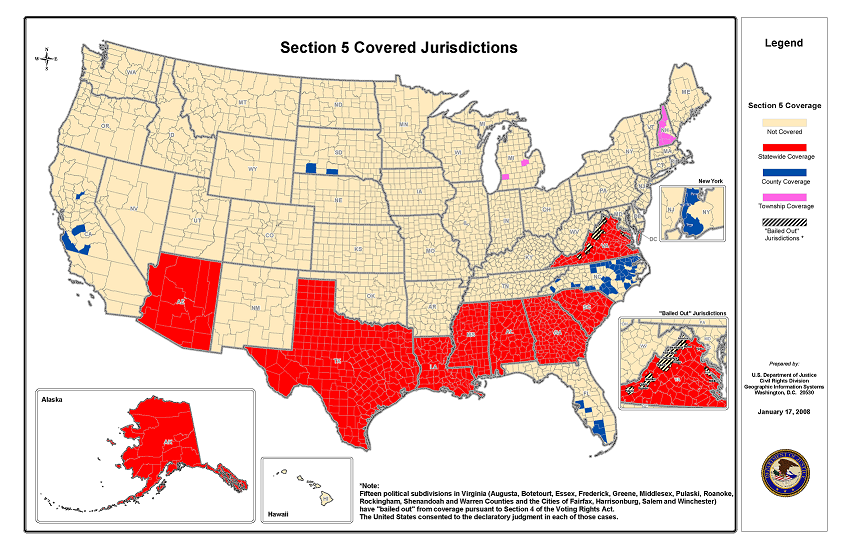
And Section 5 says that areas with a history of disenfranchisement have to  pre-clear any changes in their voting laws with the Justice Department. Section 4 spells out how those areas are defined. Mostly that turns out to be southern states, but a few other places (including parts of my state of New Hampshire) have had to endure the Justice Department looking over their shoulders whenever they change voting laws.

But in essence, the VRA puts the South on probation. Initially that was for 5 years, but the term keeps getting renewed; most recently it was renewed for another 25 years in 2006.

That’s what Roberts has a problem with. Section 4 is based on evidence that was current in 1965, and the basic formula has barely changed since. In the same way that laws need to have a reason to discriminate between citizens, they have to have really good reasons to discriminate between states, which are assumed to have “equal sovereignty”.

Past Supreme Courts have weighed the VRA’s justifications and found them sufficient. Jim Crow was an exceptional problem that required an exceptional solution. (My personal opinion: If you’re going to make an exception, voting rights is a good place to make it, because once voting gets screwed up all the non-judicial ways our system corrects itself are screwed up too.) But Roberts notes that:

Nearly 50 years later, things have changed dramatically.

This is a point you’ll hear often in conservative circles. Nobody wants to explicitly defend Jim Crow any more, but that’s all ancient history. The Age of Obama is post-racial. Things have changed.

Roberts goes on at some length about how things have changed. Minority voter-registration rates are close to parity with white Anglos, and in some elections minority turnout is above average. Minority candidates now get elected to Congress in section-5 states like Texas or South Carolina.

In 1965, the States could be divided into two groups: those with a recent history of voting tests and low voter registration and turnout, and those without those characteristics. Congress based its coverage formula on that distinction. Today the Nation is no longer divided along those lines, yet the Voting Rights Act continues to treat it as if it were. … Congress—if it is to divide the States—must identify those jurisdictions to be singled out on a basis that makes sense in light of current conditions.

Of course, Robert’s characterization of the VRA is not exactly true, because it has a bail-out provision: States and counties can permanently escape section 5 by convincing a court that they’ve stopped trying to discriminate. Parts of Virginia, North Carolina, and New Hampshire have all successfully used that procedure. So a state’s failure to bail out is itself a “current condition”. The plaintiff, Shelby County, could not meet that condition, because it continues to try to disenfranchise blacks. (During oral arguments, Justice Kagan summed it up: “You’re objecting to the formula, but under any formula Congress could devise, it would capture Alabama.”)

But never mind all that, because even making that point draws us down the rabbit hole Roberts has dug. Here’s what’s important: “Things have changed” is not a legal argument. It’s a fine point to make on a blog or at a dinner party, but a Supreme Court justice has to do better than that.

If Roberts were being a real judge here, he’d spell out what “equal sovereignty” has and hasn’t meant in American legal history. He’d enunciate an abstract standard by which Jim Crow was “exceptional” in 1965 and which justified the steps taken then. He’d explain how that standard was violated by the renewal of the VRA in 2006. And he’d lay down a set of conditions that Congress would need to satisfy to make the VRA acceptable today. (If you want to see what a real legal opinion looks like, read Justice Ginsburg’s dissent. Whether you agree with her or not, she is clearly doing something far more rigorous than what Roberts is doing.)

Roberts doesn’t do any of that. The VRA was vaguely justified in 1965 and is vaguely unjustified now, because “things have changed”. If I were a congressman, I would have no idea how to revise the VRA so that it passes constitutional muster. If Congress does revise it, lower court judges who rule on it will just be guessing about its constitutionality. It will have to go back to the Supreme Court before anyone knows whether it’s really a law again, because there are no standards in Roberts’ opinion by which a revision can be judged.

This isn’t law. It’s politics. It’s mush.

So after “careful consideration” of how “things have changed”, this is my judgment: Whether you agree with its conclusions or not, this Court sucks.

Secret Laws II: It’s just as bad when Obama does it

Perversely, I wish that the War on Terror would give us a poster child, some cute and innocent victim of government over-reach whose picture we could put on placards and wave as we march through the streets. But for nearly 12 years, under both Bush and Obama, the government has been either too smart or too lucky to provide us with one.

Bad posters. Jose Padilla was an American citizen arrested at O’Hare Airport. Before he was charged with any crime, he spent more than three years in solitary confinement, including sensory deprivation and sleep deprivation. Quite likely he had been driven insane by the time he faced trial. But he was a brown-skinned Chicago street thug who, even if he never actually did any acts of terror (and may never have done anything), was a big talker. And they did eventually manage to convict him on a vague conspiracy charge (after he was mentally unable to either defend himself or trust any lawyer), so he doesn’t generate a lot of public sympathy.

Maher Arar was a Canadian/Syrian dual citizen who didn’t officially enter the U.S. at all. We arrested him during a layover at JFK Airport, held him for two weeks, and then shipped him off to be tortured in Syria for nearly a year. Both Syria and Canada say he was innocent, and he was eventually released. Canada awarded him millions in damages, but the U.S. government so far has avoided avoided any legal repercussions by claiming that it can’t defend against Arar’s lawsuit without revealing state secrets. (The torture happened during the Bush years, but the Obama administration is continuing the state-secrets claim.) But Arar isn’t a good poster child either, because he looks foreign, isn’t an American citizen, and wants to forget his whole ordeal.

Anwar al-Awlaki was an American citizen who was targeted and killed by an American drone attack in 2011 in Yemen, a country where we are not officially at war. What label to put on his death — casualty, assassination, execution — is debatable. But it is not debatable that he was charged with nothing and never had a trial. He’s also a bad poster child, though, because he supported Al Qaeda and counseled people like the Fort Hood shooter. The government claims he planned terrorist attacks, but no evidence supporting that claim has ever been made public.

These cases show that something is deeply screwed up. But without a sympathetic face to put on a procedural abuse, it’s hard to get anybody excited. If the government could torture Jose Padilla or kill Anwar al-Awlaki without any legal process, it could do same to you or me. Since we refuse to identify with people like Padilla and Awlaki, though, we don’t feel personally threatened.

Martin Niemöller’s “First they came for …” is one of the most widely abused quotes in current American political discourse, but this is the setting where it makes sense: When you let the government violate the rights of people you don’t like or don’t care about, you lose the principle. Someday you may be unpopular too, and then how will you defend yourself?

Secret laws under Bush. One of the worst abuses of the Bush administration didn’t even produce bad poster children, because it was abstract: They used secret legal opinions to justify their other power grabs.

When it took office, the Obama administration seemed to be rejecting that course by releasing nine secret memos from the Office of Legal Counsel. The memos explained why it was legal for the President to violate treaties, wiretap without warrants, and do just about anything he thought national security required. Jack Balkin summed it up like this:

The President, because he is President, may do whatever he thinks is necessary, even in the domestic context, if he acts for military and national security reasons in his capacity as Commander in Chief.

To understand the power of these memos, you need understand the role of the OLC: It’s essentially the executive branch’s version of the Supreme Court. If you work for any department or agency of the federal government and you wonder whether something you’re doing is legal, you ask your office’s lawyers. If they kick the question upstairs, and then the upstairs lawyers kick it further upstairs, eventually it winds up at the Office of Legal Counsel in the Justice Department. Somebody at the OLC writes a memo, and that memo is then the official interpretation of the law for the whole federal government — at least until somebody sues and the judicial branch starts weighing in.

So if you as a government official believe that the policy you’re implementing is unconstitutional, that’s not for you to say. If the OLC has blessed it, they’re the experts.

That’s a fine system as long as the OLC does its job in good faith and is accountable for its mistakes. But the Bush OLC wrote opinions to justify whatever the administration wanted to do, regardless of the law or the Constitution; and it avoided accountability by keeping its most egregious memos secret, so that non-administration legal experts could not tell the public (or Congress) how absurd they were. I commented at the time:

You never need to classify the fact that 2+2=4. But if you want the government to operate under the assumption that 2+2=5, then you do have to classify it

There is a role for secrecy at the OLC, but only in so far as the facts of the situation are classified. So, for example, if the Pentagon wanted to know whether a proposed weapons system would violate a treaty, a memo answering that specific question might necessarily include classified facts about the system. But a purely abstract memo explaining how the OLC interprets the language of the treaty — there’s no excuse for classifying stuff like that.

In fact, this kind of secrecy violates the oldest, most basic principle of the rule of law: The law must be public. If, behind the scenes, you can interpret the law away or even reverse it completely, then we don’t have the rule of law.

Targeted killing. The hard questions of law happen when two constitutional principles conflict. For example: I have freedom of the press, but my right to publish can be limited by Congress’ power to establish copyrights. I have freedom of speech, but some speech is libel or treason or fraud or pornography. Questions about where the boundaries fall are why we need people on the Supreme Court rather than machines.

The Constitution gives lots of rights to American citizens accused of crimes. The Sixth Amendment says:

In all criminal prosecutions, the accused shall enjoy the right to a speedy and public trial, by an impartial jury of the State and district wherein the crime shall have been committed, which district shall have been previously ascertained by law, and to be informed of the nature and cause of the accusation; to be confronted with the witnesses against him; to have compulsory process for obtaining witnesses in his favor, and to have the Assistance of Counsel for his defence.

And the Fourteenth says that this is not a narrow right:

nor shall any State deprive any person of life, liberty, or property, without due process of law

This clause has been interpreted as applying to the federal government as well as the states.

On the other hand, the Constitution also gives the government the power to make war. It doesn’t define war, but it’s hard to imagine any definition that wouldn’t include the power to kill people without trials. When an American citizen enters a battlefield wearing enemy colors — as many did during the Civil War — the government’s power to make war trumps the citizen’s right to a trial or any other kind of due process. That’s never been controversial.

But the War on Terror has fuzzed everything up. The enemy isn’t a country or government. Its soldiers don’t wear uniforms. The conflict often does not take the form of “battles” fought on “battlefields”. No one knows when the war might be over or what conditions could end it.

So the boundary between war-making powers and Sixth-Amendment rights is not so clear any more. If the government thinks you might be a terrorist in league with Al Qaeda, when can it kill you as if you were an enemy soldier on a battlefield, and when does it have to prove its case to a jury?

This ties in with a bunch of your other constitutional rights. Are you free to hang around with people the government thinks are terrorists or to communicate with them frequently? Can you work with them on projects that you believe are unrelated to terrorism? Can you put forward ideas that are not themselves treason, but are congenial to people who might be enemies?

And finally: What’s your protection against being killed by a rogue government official who just doesn’t like you? Can he invent a charge of terrorism against you, or exaggerate your real-but-harmless connections to terrorists?

As unsympathetic as he was in many ways, Anwar al-Awlaki exemplified all those issues. He wasn’t on a traditional battlefield when we blew up his car, and while he undoubtedly had some relationship to Al Qaeda, the government never had to back up its claims that he had an operational role in terrorism. Here’s what I wrote at the time of his death:

Al-Awlaki is dead because the President signed a piece of paper saying that he was a bad man. I suspect he probably was a bad man, so it’s hard to be all that broken up about his death. But in theory, the President (or some future president) could sign a piece of paper saying that I’m a bad man too. Wouldn’t it be nice to have some due process about that?

Secret laws under Obama. You know what the answer to that question is? It’s a secret. There’s an OLC memo describing when the president can order a hit on an American citizen, but it hasn’t been released to the public, or even to Congress. The House and Senate Intelligence Committees just got it, after asking for years. 

So that’s the state of transparency on this issue: The boundary between the government’s war-making power and the citizen’s right to trial is secret.

In a letter to CIA-Director nominee John Brennan, Senator Ron Wyden (D-Oregon) says:

I believe that every American has the right to know when the government believes it has the right to kill them. 

The Obama administration disagrees. Wyden has raised another question I hadn’t even considered: Does the government owe a citizen the right to surrender?

Think about it. The process that puts names onto the kill list is secret, so you might not know you’re on it until you se the drones circling. What if you want to turn yourself in? What if you think this is all a big mistake and you want to clear your name? If you’re not actually pointing a weapon at someone at the moment, aren’t you due that much process?

These are not questions about weapons systems or the identities of secret agents. They are abstract questions of law, that could and should be debated in public. If the administration has any reason for dodging that discussion — beyond simple embarrassment at the flimsiness of its justifications — it isn’t telling anybody.

What the Court Decided About ObamaCare

Thursday, the Supreme Court announced its decision that the individual healthcare mandate, and hence the Affordable Care Act as a whole, is constitutional. It was a 5-4 decision, with Chief Justice Roberts siding with the Court’s four liberals and Justice Kennedy (the usual swing vote) joining the other three conservatives.

I was thrilled. Yes, Roberts got to that decision in an odd way (more on that later), and states were given the option to opt out of the Medicaid expansion. (I expect Republican governors to posture a lot about this, but I have a hard time believing they’ll actually refuse.) But the alternative was stark: We’d be back to square one on health care, stuck with 50 million uninsured Americans, spiraling healthcare costs that are already the highest in the world, and no plan on the table to fix any of it.

So we should all take a moment to do a happy dance.

Done? OK, now let’s look at this in a wider perspective.

History. Democrats have been trying to get some form of national health insurance since Truman. LBJ got Medicare and Medicaid passed in the 60s. Clinton tried and failed to get universal health care in the 90s.

Fear that Democrats might someday succeed in passing a Medicare-for-everybody plan that put private health insurance companies out of business caused the conservative Heritage Foundation to propose an individual mandate in the 1989 report Assuring Affordable Health Care for All Americans. The Republican alternatives to HillaryCare in the 90s usually claimed not to have mandates, but tax credits were jiggered to produce the same result: If you chose not to have insurance, you paid more to the federal government.

And of course, an individual mandate is a key and necessary provision of RomneyCare in Massachusetts, which Mitt explained here:

The interesting detail in all of this conservative campaigning for an individual mandate was that its constitutionality was never addressed as a problem. As long as it was a conservative alternative to Democratic proposals, no one challenged the mandate’s constitutionality.

In May, Salon’s Andrew Koppelman asked the question: When did the individual mandate become a constitutional issue?

The first exploration of Congress’s authority to enact a mandate was a paper by Mark Hall, which he posted on SSRN in February, 2009. (I have not been able to find even a hint of the constitutional objection before Obama’s election, even though mandates have been proposed, mainly by Republicans, since the early 1990s.) He concluded that the mandate easily followed from existing commerce clause jurisprudence. … The first published claim of unconstitutionality that I have been able to find is a July 10, 2009, Federalist Society paper by Peter Urbanowicz and Dennis G. Smith. They created the now notorious action/inaction distinction, declaring that “Congress would have to explain how not doing something – not buying insurance and not seeking health care services – implicated interstate commerce.”

Before that, nothing. Crickets.

What Roberts Said. So this is where we are: I did a happy dance because the Court’s partisan Republican majority only managed four votes to shoot down a Republican healthcare idea that Democrats finally managed to pass. Their constitutional objection was based on an ad hoc legal theory that simply did not exist until a few months before Congress passed the law.

Worse, in giving his OK to ObamaCare, Roberts still signed off on the ad hoc action/inaction theory and rejected the Commerce Clause justification that seemed obvious to everybody only two years ago. Instead, he re-interpreted the mandate as a tax and found justification for it in Congress’ constitutional power to tax:

The Federal Government does not have the power to order people to buy health insurance. Section 5000A  would therefore be unconstitutional if read as a command.  The Federal Government does have the power to impose a tax on those without health insurance. Section 5000A is therefore constitutional, because it can reasonably be read as a tax.

Now, I can’t complain too much about this, because I’ve been lamenting for months that the mandate would obviously be constitutional if Congress had just replaced the word penalty with tax. Of course, if they had done that, it’s possible that conservatives would have trumped up some novel legal theory that limited the Taxing Clause. Who knows? If you want to throw out a law badly enough, you can always come up with something.

The Ginsburg Dissent. If you want to see what would have been a 9-0 decision in the 1990s, and probably even an 8-1 or 7-2 decision two years ago, scroll past the 59 pages of Roberts’ decision and read the dissent by Justice Ginsburg. (She dissents from Roberts’ reasoning, but not his conclusion that ObamaCare is constitutional. So she is also technically part of the majority that Roberts is writing for.)

There is a very striking difference in tone between Ginsburg’s opinion and both Roberts’ opinion and the joint dissent by the four conservative justices. Ginsburg consistently talks about reality, giving examples and statistics about what is happening here and now in the healthcare market. Meanwhile, Roberts and the conservative bloc mainly discuss bizarre fantasies in which Congress might force everybody to buy broccoli.

At the root of the conservative rejection of the Commerce Clause justification is the idea that Congress’ power to regulate commerce does not include the ability to “create” commerce by forcing people to buy a product (health insurance) they otherwise would not. The objection rests on two points:

  • Individuals should be able to escape Congress’ commerce-regulating power by not participating in the regulated markets.
  • Individuals can choose not to participate in the healthcare market by not buying insurance, not going to the doctor, etc.

The first point sounds reasonable, but has no real basis in legal precedent. And Ginsburg correctly observes that because accident and illness strike even young and apparently healthy people without warning, and because emergency rooms are obligated to treat first and ask for payment later, the second point is just false. Individuals actually cannot avoid adding risk to the health-care system.

Insurance companies and health-care providers know that some percentage of healthy, uninsured people will suffer sickness or injury each year and will receive medical care despite their ina­bility to pay. In anticipation of this uncompensated care, health-care companies raise their prices, and insurers their premiums. In other words, because any uninsured person may need medical care at any moment and because health-care companies must account for that risk, every uninsured person impacts the market price of medical care and medical insurance.

This is also inherently a national problem, precisely the kind of thing that the Founders wanted Congress to have the power to solve.

States cannot resolve the problem of the uninsured on their own. Like Social Security benefits, a universal health-care system, if adopted by an individual State, would be “bait to the needy and dependent elsewhere, encouraging them to migrate and seek a haven of repose.” Helvering v. Davis, 301 U. S. 619, 644 (1937).

In normal times, that would be that. As a unanimous Court wrote in Katzenbach v. McClung (1964)

Where we find that the legislators, in the light of the testimony and facts before them, have a rational basis for finding a chosen regulatory scheme necessary to the protection of commerce, our investigation is at an end.

But these aren’t normal times, so Ginsburg has to attack Roberts’ examples directly.

An individual “is not ‘active in the car market,’” the Chief Justice observes, simply because he or she may someday buy a car. The analogy is inapt. The inevitable yet unpredictable need for medi­cal care and the guarantee that emergency care will be provided when required are conditions nonexistent in other markets. That is so of the market for cars, and of the market for broccoli as well. Although an individual might buy a car or a crown of broccoli one day, there is no certainty she will ever do so. And if she eventually wants a car or has a craving for broccoli, she will be obliged to pay at the counter before receiving the vehicle or nour­ishment. She will get no free ride or food, at the expense of another consumer forced to pay an inflated price.

So no, it doesn’t follow that Congress can make us eat broccoli if the Commerce Clause allows an individual mandate.

The Medicaid expansion. One of the ways ObamaCare increases the number of people with coverage is that it expands eligibility for Medicaid. Everybody under 65 with a household income less than 133% of the poverty line becomes eligible.

Medicaid is a federal/state partnership, so the expansion can only happen if the states go along. The ACA tries to make it painless for the states to cooperate by covering 100% of the cost of the expansion for the first two years, and 90% thereafter. It tries to make the expansion painful to turn down by saying that Medicaid is a take-it-or-leave-it deal. States can go along or lose the Medicaid funding they already get.

Roberts found that this was too coercive, though he didn’t specify what makes a non-cooperation penalty too high. Ginsburg finds that the Medicaid expansion is within the normal power of Congress to offer funding with conditions, and does not see the take-it-or-leave-it part as a penalty at all, since each year is a new appropriation, subject to its own conditions.

Future Congresses are not bound by their predecessors’ dispositions; they have authority to spend federal revenue as they see fit. The Federal Gov­ernment, therefore, is not, as the Chief Justice charges, threatening States with the loss of “existing” funds from one spending program in order to induce them to opt into another program. Congress is simply requiring States to do what States have long been required to do to receive Medicaid funding: comply with the conditions Congress prescribes for participation.

As I said above, I doubt the states will opt out anyway. If they do, then ObamaCare will cover somewhat less than 30 million new people, and the opting-out victims will be poor and near-poor people.

The conservative dissent. Justices Scalia, Thomas, Alito and Kennedy combine in a dissent that is both radical and polemic, full of scary quotes about the Commerce Clause turning into “a font of unlimited power” or “a general authority to direct the economy”.

Its conclusion is that the ACA must be thrown out in its entirety.

Think about that: Based on a legal theory that did not exist two years ago, and whose advocates are almost entirely in conservative think tanks, the Court came within one vote of striking down the biggest piece of social legislation in half a century.

Salon’s Paul Campo has an even scarier theory: Looking at internal evidence in the text, Campo speculates that the conservative dissent was originally written to be the majority opinion, and that Roberts changed his mind late in the game.

So we dodged a bullet, and the country gets to have RomneyCare. Unless it elects Romney. Then the Happy Dance will be over.

What the Court Decided About Immigration

Last Monday, the Supreme Court struck down three of the four challenged sections of Arizona’s anti-immigrant law, S.B. 1070. As usual, the media covered the event as if it were nothing but a pivotal game in a partisan play-off series, and went back and forth on whether this was victory or defeat for the Obama administration.

Don’t be distracted or confused. If you read the decision, the outcome is pretty clear: It’s a victory for people who want to see immigrants (documented or undocumented) treated fairly. It’s a defeat for anybody who wants the police to hound Hispanics out of Arizona.

S. B. 1070 was passed by the Arizona legislature and signed by Governor Jan Brewer in April, 2010. The Obama administration challenged the law in court before it could take effect, and a federal injunction has prevented Arizona from enforcing it until the case was settled.

Well, now it’s settled. Three of the four challenged provisions were struck down immediately:

  • Section 3 made it a state crime for a non-citizen to fail to carry documentation authorizing their presence in the country.
  • Section 5C made it a state crime for an undocumented alien to seek or accept employment.
  • Section 6 authorizes Arizona state police to arrest without a warrant any non-citizen who they have reason to believe has committed an offense that would make them deportable.

Justice Kennedy wrote the majority opinion, with Chief Justice Roberts and three justices from the Court’s liberal wing (Breyer, Ginsburg, and Sotomayor) concurring. Justice Kagan recused herself because she was in the Obama administration when the case was being prepared, and so might appear to have a conflict of interest. (Recusal decisions are up to the justices themselves. Liberal justices take these decisions seriously. Conservatives like Thomas and Scalia do not, even when money is involved.)

The reason Governor Brewer claimed victory and some liberals complained of defeat was that the Court did not strike down the fourth provision, 2B, which Justice Kennedy summarized like this:

Section 2(B) of S. B. 1070 requires state officers to make a “reasonable attempt . . . to determine the immigration status” of any person they stop, detain, or arrest on some other legitimate basis if “reasonable suspicion exists that the person is an alien and is unlawfully present in the United States.” Ariz. Rev. Stat. Ann. §11–1051(B) (West 2012). The law also provides that “[a]ny person who is arrested shall have the person’s immigration status de­termined before the person is released.”

This section is why S.B. 1070 became known as the “papers please” law. It conjures up visions of police harassing anybody with brown skin or an accent, and locking them up until they can prove they’re in the country legally. (You always go swimming with your passport, don’t you?) Such behavior is certainly in line with the expressed purpose of the law, which is to pressure undocumented immigrants until they “self-deport”. And I’m projecting here, but I’d guess that many S.B. 1070 supporters will consider it a bonus if legal Hispanic immigrants leave the state too.

So why didn’t the Court strike 2B down? Justice Kennedy’s reasoning shouldn’t give any comfort to the people who want to harass Mexicans. It all hangs on the timing of the case and on that phrase “reasonable attempt”.

The administration sued before the law went into effect, before Arizona police came up with enforcement guidelines, and before the state courts had a chance to rule on whether those guidelines follow the state constitution. Kennedy doesn’t want to assume that those people won’t do their jobs properly.

At this stage, without the benefit of a definitive interpretation from the state courts, it would be inappropriate to assume §2(B) will be construed in a way that creates a conflict with federal law.

Justice Kennedy could imagine state courts toning 2B’s interpretation down to something like this: As long as we’re holding you for something else already, we might as well check with ICE to see if you’re in the country legally, and if not, see what they want us to do with you.

However, Kennedy also envisioned an interpretation where police would hold brown-skinned jaywalkers (rather than just ticketing them as usual) or extend the detention of other suspects while waiting for immigration information, which (since the rest of the ruling established that immigration is federal territory) is none of their business anyway. Kennedy left little doubt that this would be seen as an unreasonable attempt to determine a person’s immigration status.

So the Court didn’t endorse 2B, it just let Arizona off with a warning. If 2B comes back to the Court as a racial profiling case with actual victims, it will get struck down then.

If you doubt that reading of the Court’s decision, think about this: None of the liberal justices felt the need to write a dissenting opinion. That should tell you who won.

Democracy in Michigan: What Rachel Got Right and Wrong

Thursday, Rachel Maddow devoted 15 minutes to a very important story that no other national news source was covering, so I made it the Link of the Day on Saturday. Unfortunately, she only got it mostly right. So rather than just link you to her video, I need to write a whole article.

Briefly, democracy in Michigan is in trouble for two reasons, one that Rachel has been covering for about a year, and one she just noticed Thursday.

Local Dictators. The year-old problem is the Emergency Manager law. As the Nation summarizes it:

Signed into law in March 2011, it granted unprecedented new powers to the state’s emergency managers (EMs), including breaking union contracts, taking over pension systems, setting school curriculums and even dissolving or disincorporating municipalities. Under PA 4, EMs, who are appointed by the governor, can “exercise any power or authority of any officer, employee, department, board, commission or other similar entity of the local government whether elected or appointed.”

Basically, when a city or town gets into bad enough financial trouble, the state appoints a dictator who replaces the entire local government.

In addition to the taxation-without-representation aspect of the law (local people continue to pay local taxes, but have lost the ability to elect the officials who spend their money), there’s an unfortunate racial outcome: The communities most likely to suffer the dire economic conditions that trigger the law — Pontiac, Benton Harbor, Detroit — are those where white flight has left behind a black underclass.

I doubt this represents a conspiracy to disenfranchise blacks, but a similarly large group of disenfranchised whites could probably get more public sympathy. So, Rachel points out,

If you are an African-American living in Michigan, there is a 50-50 chance that this year, the state of Michigan has considered scrapping … your right to elect local officials to represent you.

(I haven’t figured out yet what “considered” means in this context. It may refer to concessions Detroit’s local government made to the state in order to avoid being replaced.)

Fake supermajorities. Here’s the newly-revealed part: The Michigan Constitution delays laws going into effect until 90 days after the legislative sessions ends — which could be a year or more after they pass. But there’s an “emergency” provision that allows a 2/3 super-majority to give a law “immediate effect”.

But then something funny happens. Since Republicans took control of the state legislature and the governorship at the beginning of 2011, 546 of 566 bills — including the Emergency Manager law — have been passed with immediate effect. The funny business isn’t just that there haven’t been 546 authentic emergencies, but that Republicans don’t have a 2/3 majority in the House.

How did they do that? Well, you see an example beginning around the 12:30 mark of Rachel’s segment: The Republicans pass a bill, the floor leader asks for immediate effect, the chair ignores Democrats calling for a roll call, asks all those in favor to rise, and within four seconds gavels that it has passed. The House journal records a 2/3 super-majority that probably never existed.

Wait a minute. Rachel is incensed, and so was I when I first watched. But then I had the same reaction as Kevin Drum:

When I first heard this, my BS meter tingled pretty hard. Maddow characterized her story as a scoop, but that made no sense. I mean, Michigan still has a Democratic Party. If this were a huge abuse of power, they’d be yelling about it, right? So what’s really going on?

OK, this is outrageous stuff, but it’s outrageous stuff that’s been happening since January, 2011 and the Michigan Democrats only sued at the end of March. (Monday they got an injunction, which the Republicans are appealing on the grounds that courts have no right to interfere in the workings of the legislature.) What’s up with that?

The Detroit News reports that the Democrats had similar percentages of immediate-effect bills when they were in power in 2009-2010, even though they also were short of a 2/3 majority. Democratic legislator Jeff Irwin was asked about this and responded:

Has this been done before? Yes. Violating the clear terms of the Constitution has become commonplace in the Michigan House of Representatives. The big difference now is that since the Senate follows the Constitution, there was always one chamber where immediate effect votes would be counted and extremely divisive bills would not earn immediate effect in the Senate.

But the Republicans really do have 2/3s of the Senate, so miscounting in the House makes a real difference now. Anyway, Irwin says:

I’m new to the Michigan House and I’ve always thought this practice of declaring votes successful without any actual voting is bogus.

What I think it means. Anybody who looks at the numbers and the video has to conclude that the Michigan House is violating the Constitution. That’s a bad practice no matter who is doing it, so it has to be stopped.

But it isn’t a sudden Republican coup. The House let itself get into the habit of miscounting supermajorities and so violating the Michigan Constitution — probably because the delayed effect the Constitution calls for was viewed by both parties as a procedural nuisance. So the House has been operating illegally for a while, even when Democrats controlled it.

Republicans should have protested this when Democrats did it, but it was easier just to block stuff in the Senate, or to wrangle extra concessions there in exchange for allowing bills to take effect immediately.

After the 2010 Republican sweep, though, they haven’t had to negotiate with anybody or concede anything. (The Emergency Manager law is evidence of that.) So Democrats have started refusing to cooperate in the illegal procedures, and the Republicans have been illegally running over their non-cooperation.

So anyway: It’s bad and it needs to stop, so Rachel was right to call attention to it. But she should have done a little more homework before she went public with it.

Supreme Panic and other short notes

Should ObamaCare supporters panic? That was the big debate on the legal blogs after the Supreme Court’s five conservative judges asked a bunch of skeptical questions during oral arguments. Jeffrey Toobin says panic, Steve Kornacki says not to.

So far I’m siding with Kornacki. For years legal specialists have been writing that you can’t predict how judges will vote by listening to their questions, so I’m surprised so many of them think they can this time.

Asssuming that the pessimists are right, though, the Court could be headed for a Brown v Board of Education-scale ruling: If they limit the Commerce Clause, all kinds of previous rulings (including ones written by the five conservative judges) come up for review. If they decide that the Medicaid expansion is an illegal coercion of the states by the federal government, the whole federal/state relationship changes.

Two points are worth making here: First, a partisan Supreme Court is a dubious asset politically, and striking down ObamaCare would seal the impression that this Court is Republican. If ObamaCare is struck down, we’re back to worrying about the 50 million uninsured, and Republicans continue to have no plan for covering them.

Second, this is another reminder that institutions are neither good nor bad, liberal or conservative, they’re just institutional. For decades, liberals relied on the Supreme Court to limit the damage done by conservative state legislatures, and many of us got it into our heads that a powerful Supreme Court was good. On the flip side, many of us have it in our heads that global institutions like the WTO are bad because they are dominated by corporate interests. Well, maybe the WTO is also just an institution. We need to figure out how to make it work for us rather than against us, the way conservatives have done with the Court.


While we’re talking about the Court and ObamaCare, a number of liberals are making their usual mistake when they answer what has become known as the Broccoli Argument: If Congress can make us buy health insurance, can it make us buy broccoli?

There are literal legal answers to this question – BTW, the literal answer is “no” – involving the limitations of the Commerce Clause, but they miss the point. Don’t make them unless you’re trying to convince a lawyer. Politically, Akhil Reed Amar has the better answer:

The broccoli argument is like something they said when we were debating the income tax: If they can tax me, they can tax me at 100 percent! And yes, they can. But they won’t. Because you could vote them out of office. They have the power to do all sorts of ridiculous things that they won’t do because you’d vote them out of office.

I think that’s called “democracy”.


About that Santorum “bullshit” incident. I don’t really care what words the guy uses, but imagine the outcry if Obama lost his composure like that. Think of all the lies that have been told about Obama – about his citizenship, his religion, his loyalty to the United States, and a hundred other issues that Rick Santorum never has to worry about. And yet he never snaps.


While we’re on that theme: Imagine the outcry if it’s 2007 and Nancy Pelosi says the Bush generals are lying about what they need. But Paul Ryan apologizes and its all OK now.


In an April Fools’ Day op-ed, David Javerbaum introduces the “quantum theory of Mitt Romney“.

Before Mitt Romney, those seeking the presidency operated under the laws of so-called classical politics, laws still followed by traditional campaigners like Newt Gingrich. Under these Newtonian principles, a candidate’s position on an issue tends to stay at rest until an outside force — the Tea Party, say, or a six-figure credit line at Tiffany — compels him to alter his stance

But Mitt is the first “quantum candidate”, and is governed by different rules.

In much the same way that light is both a particle and a wave, Mitt Romney is both a moderate and a conservative … The act of observing cannot be separated from the outcome of the observation. By asking Mitt Romney how he feels about an issue, you unavoidably affect how he feels about it. More precisely, Mitt Romney will feel every possible way about an issue until the moment he is asked about it, at which point the many feelings decohere into the single answer most likely to please the asker.

There’s more.


Salon’s Michael Lind explains how the rich took over airport security, getting their own faster lines. He then makes this modest proposal:

Why don’t we just make the new class-based discrimination official? Instead of leaving it to airlines and other corporations to construct the new apartheid piecemeal and informally, let the government issue a Premium Elite Citizen Card, valid for multiple purposes. For the right price, a price carefully calculated to be unaffordable by the majority of Americans, those willing and able to pay would be allowed to cut in line, not only at airports, but everywhere: at taxi stands, movie theaters, restaurants. All they would have to do is flash their Premium Elite Citizen Card to force the rabble to step aside and make way.


David Wong of Cracked.com follows up his viral 6 Things Rich People Need to Stop Saying with an almost equally worthy 5 Ways Modern Men are Trained to Hate Women.


It amazes me how misunderstood hate crime laws are, even by people who ought to know better — like NYT editor Bill Keller:

In most cases, hate crime laws take offenses that would carry more modest sentences — assault, vandalism — and ratchet up the penalty two or three times because we know, or think we know, what evil disposition lurked in the offender’s mind. Then we pat ourselves on the back. As if none of us, pure and righteous citizens, ever entertained a racist thought or laughed at a homophobic slur.

Bill: It doesn’t take a genius to understand that painting “Bob loves Mary” on an underpass is a less serious crime than painting swastikas on a Jewish elementary school.


One additional point I left out of my summary of Glenn Greenwald’s With Liberty and Justice for Some: With all the discussion of ways to cut government spending, how come nobody ever proposes that we stop locking up non-violent criminals for long prison terms? Other countries don’t, and it seems to work for them.


Glenn Greenwald Lays Out the History of “Elite Immunity”

If you’ve been reading Glenn Greenwald’s columns at Salon (or reading a Greenwald-influenced blog like the Weekly Sift) you won’t be surprised by anything you find in his recent book With Liberty and Justice for Some: How the law is used to destroy equality and protect the powerful.

Still, I found it striking to see so many individual issues laid out together and presented as a progression. It’s easy to get outraged at any one of them — say, that banks are foreclosing homes illegally and yet no bankers are going to jail — and miss the overall point: We are losing the rule of law.

If you are rich enough or powerful enough, you can break American law — either with complete impunity (like, say, Dick Cheney) or maybe paying wrist-slap fines that are a reasonable cost-of-doing-business (like Bank of America). What’s more, if anybody thinks you should be punished the way ordinary people are when they break the law, media pundits from the Right and Left alike will set them straight: Leona Helmsley was right; like taxes, the law is for “little people”.

It’s tempting to think things were always this way, but they really weren’t. This has all happened in living memory. Yes, the rich and powerful have always had better lawyers than the rest of us, and they’ve always gotten a little extra benefit of the doubt from judges and police. But never before has American society so completely accepted in principle that different rules should apply to the elite.

Glenn Greenwald traces this back to a single epochal event: President Ford pardoning Richard Nixon after the Watergate scandal forced him to resign. Nixon had resigned before the Senate could hold an impeachment trial, so Ford’s pardon meant that no Nixon trial would ever be held.

At the time the pardon was hugely unpopular, and is probably why Ford lost his re-election bid to Jimmy Carter in 1976. But looking back, the whole affair is kind of quaint. People at every level of the administration below Nixon went to jail, including Chief of Staff H. R. Haldeman and Attorney General John Mitchell. What’s more, the pardon itself was completely above board: Ford announced it in a national speech, and the presidential power to pardon is explicitly listed in the Constitution. The political price Ford paid in 1976 is exactly how the Founders envisioned keeping the pardoning power under control.

It’s hard to imagine anything like that happening now. The Bush administration broke a long list of laws: torture, spying without warrants, lying to Congress, and many others. No one has even been charged with these crimes, much less tried or punished. Like President Ford, President Obama has covered for his predecessor. But he hasn’t issued explicit pardons on national TV. Instead, he has just quietly let the whole thing drop, and occasionally claimed some dubious version of the state-secrets privilege to shut down court cases. Beyond occasional statements that we must “look forward, not backward”, President Obama has never even attempted to justify this policy to the American people.

And the outcry from the mainstream media has been … non-existent, unless you count the mainstream pundits who periodically scoff at the idea that the law should be enforced.

This didn’t happen all at once, and the successive chapters of Greenwald’s book present the gradual drift away from the rule of law. Watergate was followed by Iran-Contra, where once again pardons were issued. This time, though, it wasn’t just the president (Reagan) who was protected. President Bush the First pardoned high-ranking officials a level or two down from the president (like Defense Secretary Caspar Weinberger). In this way, Bush guaranteed that the accusations would never reach the president (or himself, in his previous role as vice-president).

In the Bush II administration, the pardon was issued by the very president whose administration was under suspicion. Scooter Libby was convicted of perjury and obstruction of justice in the CIA leak scandal, but never served time — and so was never tempted to flip on his boss, Vice President Cheney. (Greenwald points out this important fact about the Plame Affair: It only reached the point it did because another powerful institution — the CIA — insisted on pursuing the matter.)

Today, President Obama’s justification for drone strikes like the one that killed American citizen Anwar Awlaki is still secret, but seems unlikely to stand up to scrutiny. (Read the Wikipedia article on targeted killing and see if the line separating it from assassination makes any sense to you.) Obama is undoubtedly counting on his successor to continue the tradition of letting things drop.

Elite immunity entered the private sector with the telecom immunity bill. Telecom giants like AT&T illegally cooperated with warrantless spying of the Bush administration. Lawsuits against the government had already been closed off by state-secrets claims, which denied victims standing to sue. (If you couldn’t prove you’d been tapped, you couldn’t file suit.) But customer lawsuits against the telecoms were still possible and could have cost the companies billions if they lost — which they would have, because they clearly broke the law. But in 2008 a Democratic Congress passed a bill granting them retroactive immunity.

From there, not prosecuting Wall Street for laws broken during the housing bubble or the banks for foreclosure fraud seemed almost reasonable.

During this whole progression, the arguments have built on the one President Ford made: Whatever has happened, it’s time to put it all behind us. (Greenwald suggests trying that argument the next time you’re pulled over for speeding.) Powerful people let other powerful people off the hook, not for their benefit, but for ours, so that we don’t have to go through the ordeal of watching them be tried and punished. (That would be a good argument to try if your spouse catches you in an affair. Uncovering the truth would be too much of an ordeal for her and the kids. Best to let it all drop.)

But since no one is punished, the problem never gets behind us: Elite disrespect for the law only grows, guaranteeing that more laws will be broken in the future.

By pulling all these issues together, Greenwald is making an important point: Each example by itself is a partisan issue, but elite immunity is bipartisan. The powerful in government, industry, and the media are all coming to see themselves as members of a single privileged class. More and more, they close ranks against any attempt to punish crimes committed by one of their own.