
Ever find yourself watching Trump officials and thinking “What’s wrong with those people?” Three writers offer their answers.
We’ve known for a long time that the Trump administration works on a flood-the-zone theory: Do so many outrageous things simultaneously that the American People have a hard time comprehending them all, much less organizing a response. Are they disenfranchising large numbers of voters? Never mind that, ICE is murdering US citizens on the streets of Minneapolis. Want to do something about that? That’s yesterday’s news; the Epstein files are hiding evidence of billionaire pedophilia. Concerned about that? Never mind, we’re in a war now. On and on.
Further impairing our comprehension is the barely explicable attitudes central figures in the administration take. Again and again, before I can even get to the policy content of some statement, I have to deal with my first response: What is wrong with these people?
Saturday NBC reported:
Trump said he was “surprised” that Iran decided to attack other Middle Eastern countries in response to the U.S.-Israeli operation, and that U.S. strikes on Kharg Island on Saturday “totally demolished” most of the island but that “we may hit it a few more times just for fun.”
Fun? Trump is having fun killing people and watching his own people die? What’s wrong with him?

Just about any appearance by Secretary of War Defense Pete Hegseth includes a what’s-wrong-with-him moment. Friday during a press briefing about the Iran War, he said there would be “no quarter, no mercy for our enemies“. [Note the web site that link is on: war.gov] Just Security posted an article by Danial Maurer, a former Army JAG who has taught at West Point. Maurer imagined the memo a Pentagon legal counsel should have sent to Hegseth in response: It points out that “no quarter” is a war crime. The phrase refers to the ancient practice of killing opponents even if they try to surrender.
Maybe Hegseth intended to threaten war crimes and encourage his underlings to commit them. Or maybe he was just blabbing — saying a bunch of tough-sounding words without knowing what they mean. Either way: What’s wrong with that guy?
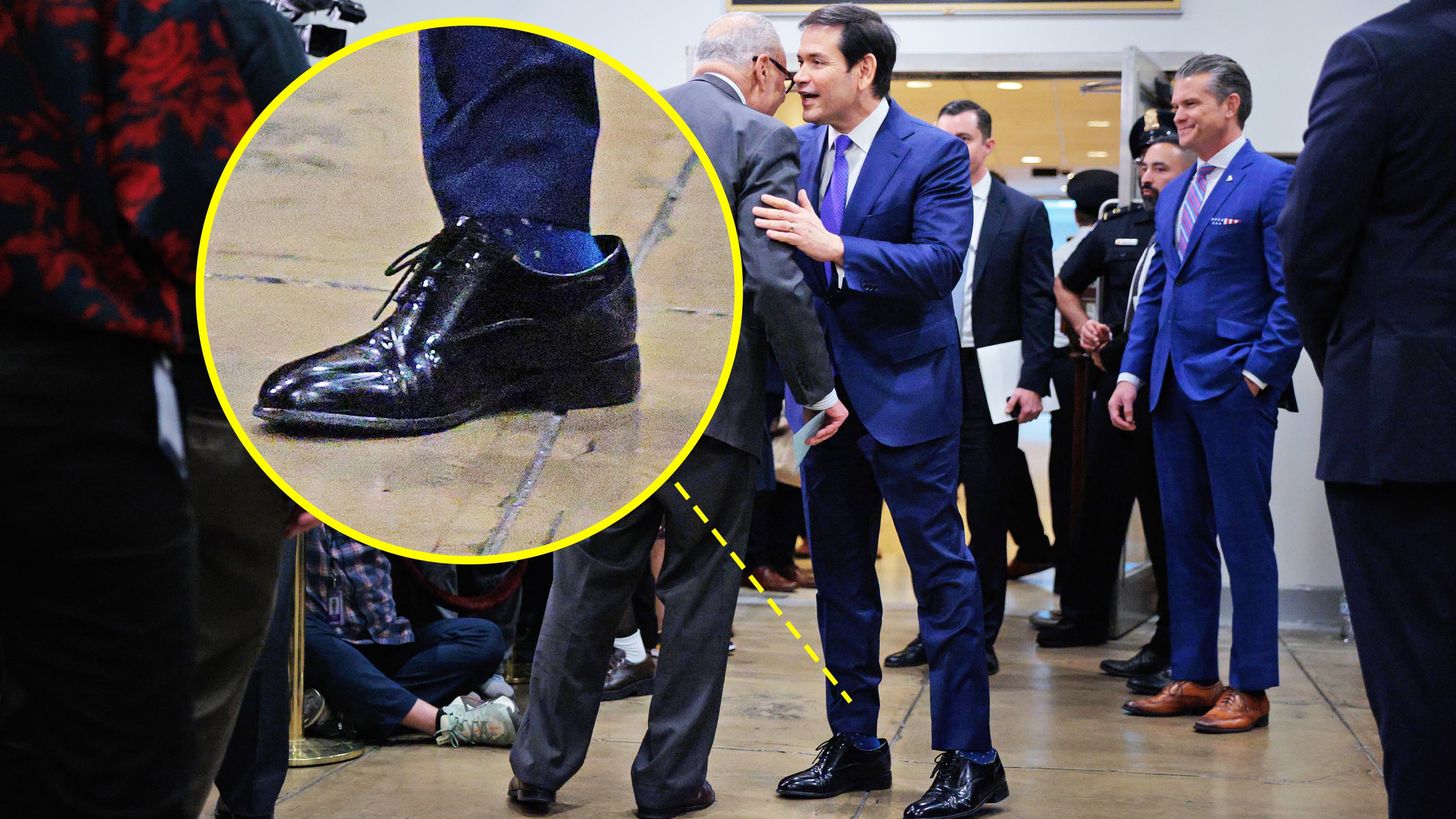
Trump gave his whole cabinet shoes identical to his own favorites, and “everybody’s afraid not to wear them.” For some reason he made Marco Rubio’s way too big. And Rubio wears them. Our Secretary of State attends important gatherings in clown shoes. What’s wrong with him?
Pam Bondi blew off questions from Congress about DoJ’s failure to interview survivors of Jeffrey Epstein’s crimes by pointing to the stock market:
The Dow is over 50,000 right now. … That’s what we should be talking about.
I was listening to that hearing live, and I had trouble even getting to the policy implications of her statement. Because all I could think was: “What’s wrong with her? What kind of human being thinks like that?”
Why are all these people so cruel, insensitive, self-centered? so devoid of qualities that we expect not just from leaders but from ordinary people?
Most of us don’t have the time or the presence of mind to step back and try to answer that question. But a few recent articles have been written by people who do.
The most interesting to me is “The Problem of Pathocracy” by Dr. Steve Taylor, which was published by The Psychologist, a journal of the British Psychological Society. It’s a recent article, but the theory it presents goes back to the pre-Trump era. Polish psychologist Andrzej Lobaczewski, who experienced both Nazi and Communist regimes, coined the term pathocracy decades ago.
As he put it, pathocracy is a system of government ‘wherein a small pathological minority takes control over a society of normal people’. Since he was living under a ‘pathocratic’ regime himself, Lobaczewski took great risks studying this topic. He was arrested and tortured by the Polish authorities, and unable to publish his life’s work, the book Political Ponerology, until he escaped to the United States during the 1980s.
According to Lobaczewski, the transition to pathocracy begins when a disordered individual emerges as a leader figure. While some members of the ruling class are appalled by the brutality and irresponsibility of the leader and his acolytes, his disordered personality appeals to some psychologically normal individuals. They find him charismatic. His impulsiveness is mistaken for decisiveness; his narcissism for confidence; his recklessness for fearlessness.
Soon other people with psychopathic traits emerge and attach themselves to the pathocracy, sensing the opportunity to gain power and influence. At the same time, responsible and moral people gradually leave the government, either resigning or being ruthlessly ejected. In an inevitable process, soon the entire government is filled with people with a pathological lack of empathy and conscience.
The first Trump administration included a large number of relatively “responsible and moral” people with conservative political views: Mike Pence, Rex Tillerson, Jim Mattis, John Kelly, and so on. But by the end of that term, all but Pence had been fired or resigned under pressure, and Pence was persona non grata after he failed to join Trump’s coup attempt in 2021. And so, as Lobaczewski predicted, we are left with a government “filled with people with a pathological lack of empathy and conscience”.
Not only is Trump’s sociopathy enabled by such people, they are drawn to him. He gives them permission to be what they always wanted to be. We can see the same process working on a larger scale: Across the country, people don the red hat because it lets them insult and abuse the kind of people they have always hated.
That leads to a second article: “Polarization and Strife” by A. R. Moxon on his blog The Reframe. That article was originally written in 2022, but Moxon reposted it this week because of its relevance to recent events.
This article flips the script on the word polarization. People complain about how polarized our society has gotten: Friendships are ending and relatives become estranged because of political disagreements.
But Moxon calls attention to a different kind of polarization, one that has always been with us: polarization between the comfortable and the marginalized, “gay or bi or trans or nonbinary, Black or brown, Muslim or Jewish or Sikh or Hindu, or undocumented, or disabled, ill, neuroatypical, impoverished, or unhoused people, and many others, too”.
The “unpolarized” world so many people are nostalgic for is one where the marginalized could be safely ignored. You could say words like bitch and faggot and nigger and retard, because all the comfortable people agreed that those marginalized groups don’t matter, and members of the groups themselves had been intimidated into silence. So you could insult or abuse marginalized groups openly, and no one would call you on it. But today you can’t even do it if you’re just joking, because nobody has a sense of humor any more.
Moxon looks at this not as polarization, but as solidarity: More and more comfortable people are feeling empathy for the marginalized and refusing to watch passively as they’re abused.
Consider the idea that treating certain people as if they don’t matter enough to care about their dignity and their lives—and doing this so thoroughly and effectively that society treats them as if they are nonexistent and disposable—creates a much deeper polarization than any fight over the holiday dinner table or on the airwaves over whether or not it’s good to do so.
And: the more peaceful that subjugation, the greater the polarization.
Consider a corollary, that as people stop going along with this unnatural injustice, it will decrease the peace of that subjugation; will increase resentment and strife, for as long as there are people still willing to fight to subjugate others.
But the strife isn’t polarization. It’s distressing, but it’s not polarization. The strife is the first early sign that we might be willing to stop being polarized by bigotry and injustice.
The third article I want to call your attention to is “The Most Divorced Men in History” by Andrea Pitzer, published on her blog Degenerate Art. Pitzer focuses on the weird affect of so many people in the Trump administration. Past administrations have at times had cruel policies, but they usually seemed apologetic about it: We don’t want to hurt anybody, but there’s this greater good to weigh the suffering against.
Trump’s people, by contrast, seem genuinely gleeful about the harm they can do. Stephen Miller, for example, appears to glory in the distress he causes immigrant gardeners and farm workers and healthcare aides. Greg Bovino gave a swaggering style to the ICE thugs who terrorized Minneapolis. Elon Musk seemed joyful and pleased with himself as he slashed programs to feed hungry people and inoculate children against infectious diseases. In the end, he caused vast numbers of deaths and didn’t even save the government money, but he appears untouched by the kind of regret the rest of us feel when we tap a stranger’s bumper in a parking lot.
Pitzer goes out on a limb and associates this kind of high-level viciousness with a phenomenon she sees in everyday life: divorced-guy energy.
What do I mean by “divorced guys”? I mean that they all have the energy of the man who won’t stop talking about the woman who left him and what a monster she is, with the clear implication that her mistreatment of him was entirely undeserved.
Several examples of this personality type exist in the right-wing influencer universe. In some cases, as with incels, the guys haven’t even been left by a partner yet, but they already speak about punishing women or restricting their rights as if the other sex has already betrayed them. In other cases, as represented by Andrew Tate, the men advocate the active physical and psychological abuse of women as a group as a means to power in a physical hierarchy in which men are supposed to dominate by default.
But the heart of divorced-guy syndrome in the U.S. today is the Trump administration. I mean that metaphorically, in which we see variations on the “divorced guy” energy of the podcasters, blaming women or assigning them very subservient roles. But I also mean it literally. The administration is filled with people who’ve had literal and often bitter divorces, and who seem to be tapping into some kind of primordial hatred of women that fuels their current work. Think Donald Trump. Or Russell Vought. Or RFK Jr. Or Pete Hegseth. I have no idea whether their issues actually rose out of their relationships with their moms, but they have played out through adult relations with women that have often ended in divorce.
Like Lobaczewski, Pitzer is pointing to the prevailing spirit in an administration, not something that affects each member individually. A few Trump officials, like Miller and Bovino, seem not to have experienced a literal divorce. And Pam Bondi and Kristi Noem are not even guys. But the administration as a whole accounts for a fairly large number of divorces, starting with Trump’s two-and-counting.
I would like to propose that the seething root of resentment that typically fuels these men is hatred of women. We are also witnessing tidal waves of racism and homophobia and disdain for the poor, but I have come to wonder if misogyny might not only sit alongside the rest but might even undergird the whole thing.
Patient zero in their hate, more often than not, is a woman each resents. The later targets might well be people who want simply to be treated as human that they refuse to treat as human because they need more targets for their fury. So instead, they come to feel they have been attacked by the actions or even the existence of minority groups. They direct their same kind of fury against those groups as they do the women they’re mad at.
She mentions Hillary Clinton as an example of a woman MAGA can’t stop hating, no matter how long she has been out of the public eye. More recent examples include AOC and the other members of “the Squad”.
Pitzer references an article by Maleah Fekete in the journal Rural Sociology, about risk-taking behaviors among rural working-class men — the heart of MAGA. Male recklessness is a major factor in the rise in “deaths of despair”. And periods of extreme recklessness often start with some triggering event.
Two-thirds of the triggering events involved relationship dissolution, which respondents frequently framed as a woman leaving. Importantly, these accounts reflect respondents’ interpretations of relationship dissolution rather than objective accounts of responsibility or causality.
Recklessness, you say? Like starting a war with no plan to end it? Or cancelling programs you don’t understand? Or firing people before you know what they do?
I admit, it’s speculative. But maybe she’s onto something.










 The Weekly Sift