Tag Archives: culture wars

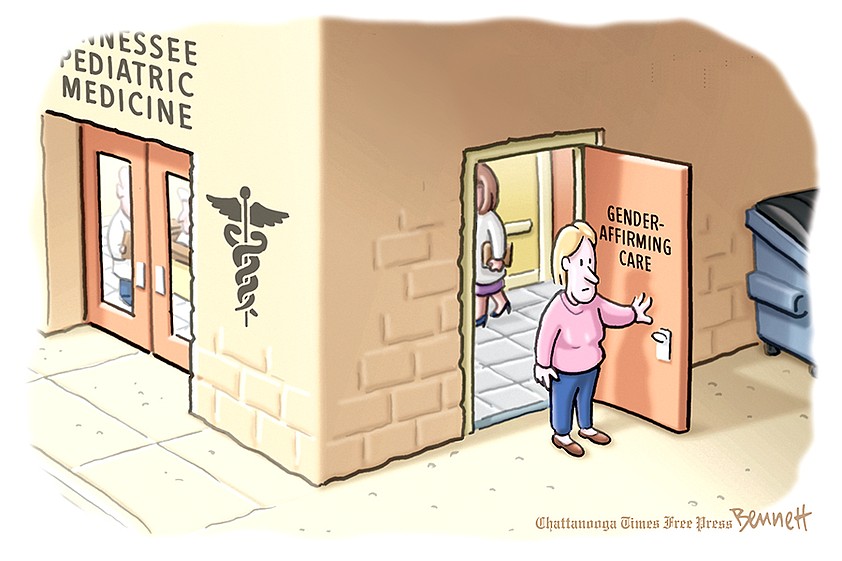
The Court fails transgender youth

Equal protection of the laws isn’t what it used to be.


After the 13th Amendment freed the slaves, the nation passed a 14th Amendment to make sure the freed slaves would have rights under the law. It promised every person “the equal protection of the laws”.

It didn’t work, at least not at first. The Supreme Court interpreted that Equal Protection Clause narrowly, and so states were able to pass Jim Crow laws that forced Black Americans to live under a different legal regime entirely. Plessy v Ferguson established the principle of “separate but equal” treatment, where “separate” rules and facilities for Blacks and Whites were very real, but “equal” could be winked at.

In the 20th century, though, the Equal Protection Clause was gradually reinterpreted to mean something very important. There are a number of complicated doctrines that implement this idea, but the underlying concept is simple: If the law treats you differently than it treats someone else, there has to be a reason for it. And the reason can’t just be that the people who make the laws don’t like you.

There has seldom been a more obvious violation of this principle than the recent run of state laws that ban gender-affirming care for trans youth. One such law is Tennessee’s “Prohibition on Medical Procedures Performed on Minors Related to Sexual Identity, Senate Bill 1 (SB1)“. Ostensibly, the law intends “to protect the health and welfare of minors”. The law bans a number of treatments that major medical organizations (“American Academy of Pediatrics, American Medical Association, American Psychiatric Association, American Psychological Association, and American Academy of Child Adolescent Psychiatry” according to Justice Sotomayor’s dissent) recommend for young people experiencing gender dysphoria, i.e., the feeling that the sexual characteristics of their physical body are at odds with their inner sense of who they are.

Legislatures typically have wide latitude to permit or ban medical procedures according to their assessment of patient safety. But the smoking gun here is that the procedures are banned only when used to treat trans youth, only

when these medical procedures are performed for the purpose of enabling a minor to identify with, or live as, a purported identity inconsistent with the minor’s sex or treating purported discomfort or distress from a discordance between the minor’s sex and asserted identity.

Using say, puberty-blocking drugs or gender-related hormones like testosterone or estrogen, is perfectly fine and safe for any other purpose parents and physicians might have in mind. But not that one.

Keep in mind here that the affected population — families of trans youth — did not ask for this “protection”. To the best of my knowledge, none of them came to the legislature and said “I want the state to make my child’s medical decisions.” To the contrary, three such families sued to block the law, and countless others are leaving Tennessee (and other states with similar laws) so that they will be free to decide for themselves how to handle what everyone recognizes is a difficult situation.

The push for SB1 came instead from people opposed on principle to the existence of trans people, usually for religious reasons. The purpose is to act on trans youth and their families, not for them. The law itself says:

This state has a legitimate, substantial, and compelling interest in encouraging minors to appreciate their sex, particularly as they undergo puberty.

In other words, Tennessee claims a “compelling interest” in convincing trans youth that they are wrong. Their sex is their sex, and they just need to get used to it.

Anyone who has listened to the public debate over such laws has to realize that the laws are motivated by a desire to make life harder for families of trans youth. If the families choose to remove their children from the state by moving, or the children decide to remove themselves from life by committing suicide, this is not necessarily considered a bad outcome. Obviously, the Tennessee legislature does not intend to offer trans youth “the equal protection of the laws”. SB1’s intention is to bludgeon trans youth, not protect them.

The question for the courts, then, should be how to extend equal protection in a coherent way. Precedents offer clear paths. Typically, these precedents involve the most obvious instances of laws being used against disadvantaged groups: race and sex. Laws that turn on issues of race or sex are given “heightened scrutiny” by the courts, because apparent justifications for the laws have so often turned out to be pretexts for hostile discrimination.

Justice Sotomayor’s dissent in this week’s case (US v Skrmetti, decided Wednesday) outlines how to use the precedents involving sex.

What does [application of SB1] mean in practice? Simply that sex determines access to the covered medication. Physicians in Tennessee can prescribe hormones and puberty blockers to help a male child, but not a female child, look more like a boy; and to help a female child, but not a male child, look more like a girl. Put in the statute’s own terms, doctors can facilitate consistency between an adolescent’s physical appearance and the “normal development” of her sex identified at birth, but they may not use the same medications to facilitate “inconsisten[cy]” with sex . All this, the State openly admits, in service of “encouraging minors to appreciate their sex.”

But the conservative justices (Roberts writing the majority opinion, plus concurrences by Thomas, Alito, and Barrett) resist not just the characterization of this case as hinging on sex, but also the idea that any injustice is occurring at all: There is nothing about discrimination against trans people that makes laws about them suspect, and so the Court has no excuse to go probing into the motives of the legislature. Courts should apply only “rational basis” review of SB1, requiring only that the legislature offer some rational connection between its actions and some legitimate government purpose. Protecting minors from a possibly dangerous medical procedure is a rational purpose, and so the Court need not look more closely at whether that explanation is a pretext for hostile discrimination. (In fact, the conservative justices dare not look closer, because the proffered explanation is obviously a pretext.)

There is a standard argument for justifying this kind of discrimination, and it has been used many times in the past: You examine previous suspect classes and draw your lines so that those issues appear not to apply. So, for example, laws banning interracial marriage were once not seen as racially discriminatory, because neither Blacks nor Whites could marry a person of a different race. Laws against same-sex marriage didn’t discriminate on the basis of sex, because neither men nor women could marry a person of the same sex. And so on. In retrospect, such arguments are transparent rationalizations for hostile discrimination, but that doesn’t stop judges from continuing to use them. Justice Roberts writes for the majority:

Neither of the above classifications [in SB1] turns on sex. Rather, SB1 prohibits healthcare providers from administering puberty blockers and hormones to minors for certain medical uses, regardless of a minor’s sex. … SB1 does not mask sex-based classifications. For reasons we have explained, the law does not prohibit conduct for one sex that it permits for the other. Under SB1, no minor may be administered puberty blockers or hormones to treat gender dysphoria, gender identity disorder, or gender incongruence; minors of any sex may be administered puberty blockers or hormones for other purposes.

So the law doesn’t discriminate against transgender youth, it just separates out the medical conditions that define transgender youth. It protects youth against the risks of such treatments, but only if they seek those treatments for a purpose unique to trans people.

When the Equal Protection Clause was being explained to me years ago, the following example was given: What if a law banned yarmulkes, the skull caps typically worn by Jewish men? You could argue that such a law isn’t religious discrimination, because it applies universally: Neither Jews nor Gentiles can wear yarmulkes. But of course, only Jews want to wear yarmulkes. So a law against yarmulkes is religious discrimination against Jews.

Sotomayor observes:

nearly every discriminatory law is susceptible to a similarly race- or sex- neutral characterization. A prohibition on interracial marriage, for example, allows no person to marry someone outside of her race, while allowing persons of any race to marry within their races.

The religious right is targeting other applications of the Equal Protection Clause, beginning with same-sex marriage. So it seems likely we will be hearing the same rationalizations again soon.

How Do Things Change?

a tentative start to a historical investigation


Last week I argued that mere election tactics — a more attractive candidate, some new slogans, a better framing of the issues — will not be enough to overcome the MAGA movement in the long run. (We defeated them soundly in the elections of 2018 and 2020, but MAGA showed amazing resilience.) MAGA itself is not just an unfortunate convergence of political forces, it is a cultural movement of some depth. Defeating it will require a counter-movement.

The 2024 campaign showed that the counter-movement can’t just be a reversion to some prior status quo. My assessment of how the Harris campaign failed is that Trump managed to tag Harris as the candidate of the status quo and present himself as the candidate who will shake things up. [1]

Harris’ problem was that (as a whole) the status quo is not working for many Americans. I listed a number of ways that things are not working, but fundamentally they boil down to this: It gets harder and harder to plan for a successful life with any confidence that your plan will succeed. Far too many Americans feel that the system is stacked against them, and that simply trying harder is not the answer.

Rather than present any coherent program, Trump has responded to the public’s justified anxiety with scapegoating and nostalgia: Immigrants, foreigners, minorities, and people who rebel against their assigned gender roles are the problem, and we should look to the greatness of America’s past — now, apparently, the high tariffs of the 1890s — for our salvation. To the extent that he has a plan — like ignoring climate change and reverting to the fossil-fuel economy of the 20th century — it is likely to be counterproductive.

But “don’t do that” has turned out to be an unpersuasive message for the Democrats. It worked when Trump was in office, actively doing unpopular things. But as soon as he was defeated, nostalgia renewed its charms. To a large extent, Trump’s 2024 message was that electing him would make it 2019 again, and all the disruption of the Covid pandemic (including the parts he brought on himself) would be behind us.

But realizing that we need a deeper movement is not the same as having one, or even knowing what it would be or how it might come together.

With that question in mind, I’ve been looking at history. Despite recently being idealized as the new “again” in Make America Great Again, the late 1800s were a low point in American history, dominated by the robber barons of the Gilded Age. Industry after industry was reorganizing as a monopolistic trust with the power to maximally exploit both workers and consumers. It was a hard time both for urban factory workers and rural small farmers.

Somehow, things got better: Antitrust laws got passed. Governments began to regulate working conditions, product safety, and child labor. Standard Oil was broken up. Unions began to win a few battles. And the gap between rich and poor narrowed. The New Deal was unthinkable in 1880, but by the 1930s it was popular. This was a profound change in what David Graeber referred to as “political common sense“. How did it happen?

A friend recommended a place to start: The Populist Moment by Lawrence Goodwyn. The book was published in 1978, so to the extent that it says something about the present day, either about MAGA or how a democratic movement might oppose it, that message arises naturally from the history, and not from some pro- or anti-Trump bias of the author. [2]

What was Populism? These days, MAGA and similar neo-fascist movements in other countries are often described as “populist”, but the version in the late 1800s was quite different. There is a surface similarity — in each case, large numbers of working class people found themselves resisting their era’s educated consensus — but from there things diverge fairly quickly.

In the 19th century, farming was still the largest American occupation, employing over half the labor force as late as 1880. But the system was stacked against small farmers in two ways: First, farmers with no capital beyond their land found themselves at the mercy of “furnishing merchants”, who would lend money for them to plant a crop (and survive through the growing season) in exchange for a contract on the harvest. Once he had contracted with a furnishing merchant, the farmer was stuck with that merchant, and would typically end up both paying high prices for his supplies and receiving a low price for his crop. [3]

But second, that long-term situation was made much worse by post-Civil-War monetary policy. The Civil War had been financed in part by printing paper currency, known as “greenbacks“. That had caused inflation during the war, and the prevailing economic wisdom of the time was that the dollar needed to be made “sound” again. In other words, the greenbacks had to be withdrawn from circulation, so that all US money could be redeemable for gold again. (Greenbacks became fully convertible to gold in 1878.)

In modern terms, the government’s policy was to shrink the money supply. If expanding the money supply had caused inflation, shrinking it could be counted on to achieve deflation; i.e., prices would come back down.

if you think like a consumer, deflation sound great. (Just last fall, that’s what Trump was promising his voters: “Prices will come down. You just watch: They’ll come down, and they’ll come down fast.”) But now imagine being a farmer who is counting on selling his wheat or cotton at the end of the season: You bought and borrowed when prices were high, and now you have to sell when prices are lower. The result was that large numbers of farmers were failing to clear their debts. Every year, many would lose their land and wind up as sharecroppers or worse.

The conventional wisdom of the time was that, sure, times were hard. But the “sound dollar” had to be restored, so farmers would just have to become more efficient. If some had to go broke in the process, well, that’s capitalism for you. Creative destruction and all that.

At some point, though, farmers began to realize that this wasn’t a story of individual failure, but of a badly structured system. And some postulated a solution: Farmers could cooperate rather than compete. They could form “farmer alliances” to pool their resources, negotiate for common supplies, and market their crops collectively.

Through the 1870s and 1880s, farmer alliances played a game of escalating pressure with the merchants and banks. Initial co-op successes would lead to new merchant strategies to freeze the co-ops out of the market, resulting in some larger co-op plan. The ultimate trump card was played by the system’s last line of defense, the bankers: Banks would take mortgages on individual farms (the old model), but they would loan nothing to a co-op backed by the land of its members.

Watching the more prosperous classes act in concert to thwart their plans radicalized the farmers and made them turn to politics. They created the People’s Party, whose presidential candidate carried four western states in the 1892 election. The party was organized around a platform, some of which was achieved decades later, but much of which might still be considered radical today. It wanted a revision of the banking system that would orient it toward the interests of “the producing classes” rather than “the money trust”. It wanted a flexible money supply (which we have today) rather than a gold standard. And it wanted government ownership of the railroads and other essential utilities that could be manipulated against working people by monopolies and trusts.

Ultimately, the People’s Party supported the Democratic candidate, William Jennings Bryan, in 1896, and then faded into insignificance.

So Populism was a failure in the sense that it never achieved power. But David Graeber once said that “one of the chief aims of revolutionary activity is to transform political common sense”. By that standard, Populism was more successful. [4]

Partisanship. The People’s Party ran into partisan loyalties that were left over from the Civil War and generally had more to do with identity than with life experience. If you were a White Southern Protestant or a Northern urban Catholic, then you were a Democrat. But if you were a Northern Protestant or a Southern Negro, you were Republican. Those loyalties were hard to break, and each party charged that the Populists were really agents of the other party. “Patriotism” meant faithfulness to the team your people played on during the War.

How movements happen. Goodwyn has a lot to say about this, and argues against the view that protest movements arise naturally during “hard times”. History, he says, does not support this.

“The masses” do not rebel in instinctive response to hard times and exploitation because they have been culturally organized by their societies not to rebel. They have, instead, been instructed in deference.

He points to parallel ways this worked in his own day on both sides of the Iron Curtain. (This is 1978, remember.)

The retreat of the Russian populace represents a simple acknowledgment of ruthless state power. Deference is an essential ingredient of personal survival. In America, on the other hand, mass resignation represents a public manifestation of a private loss, a decline in what people think they have a political right to aspire to — in essence, a decline of individual political self-respect on the part of millions of people.

He then asks the billion-dollar question:

How does mass protest happen at all then?

Which he then proceeds to answer: There are four stages:

  • forming: the creation of an autonomous institution where new interpretations can materialize that run counter to those of prevailing authority
  • recruiting: the creation of a tactical means to attract masses of people
  • educating: the achievement of a heretofore culturally unsanctioned level of social analysis
  • politicizing: the creation of an institutional means whereby the new ideas, shared now by the rank and file of the mass movement, can be expressed in an autonomous political way.

And he notes that “Imposing cultural roadblocks stand in the way of a democratic movement at every stage of this sequential project.”

For the populist movement, the first stage was the creation of farmers’ alliances. After years of experimenting, the farmers alliances came up with a mass recruitment model: large-scale cooperatives that farmers could join in hopes of getting cheaper supplies, better crop prices, and various other benefits. Then the co-ops themselves became educating institutions that taught farmers how the monetary system tilted the playing field against them, and how an alternative system might work. And finally the People’s Party itself provided an electoral outlet.

How well the People’s Party did in various states corresponded to how well the previous stages had taken hold.

In the 20th century, labor unions played a similar role to the co-ops: Masses of workers would join a union in hope of getting better pay and improved working conditions. And the union would then educate them in the issues relevant to their situation. [5]

MAGA. It’s worth considering how Goodwyn’s model applies to MAGA. You wouldn’t expect it to fit perfectly, because fundamentally MAGA isn’t a democratic movement. There has always been big money behind it, and the grassroots aspects, while genuine in some sense, also include quite a bit of astroturf. [6]

However, there are a number of parallels. The initial hurdle MAGA faced was getting its working-class foot-soldiers to believe in themselves rather than be intimidated by experts like economists, climate scientists, and medical researchers. The internet has undoubtedly made this easier, but the validation of “doing your own research” was also key.

And what was the recruiting institution that could attract masses of people and educate them in the new way of looking at the world? Evangelical churches. People came to them for the variety of reasons that always attract people to churches, and usually not for political indoctrination. But once there, they could be taught that elite scientists (like those promoting anti-Genesis ideas of evolution) were agents of the Devil. Their sense of grievance could be raised and sharpened, and the whole idea of a fact-based or reason-based worldview could be undermined. You might join because you enjoyed singing in the choir, but after a few years you were ready to believe that DEI was an anti-White conspiracy, or that economic malaise was God’s punishment for tolerating gay marriage and trans rights. You were ready to march for Trump.

Counter-movement. The lack of an obvious recruiting-and-educating institution is an obvious hole in the formation of an anti-MAGA counter-movement. Conservatives seem well aware of possible avenues — like the universities, a revitalized union movement, or even charitable activities like refugee resettlement or soup kitchens — and are committed to shutting them down.

Conversely, this is why a number of left-leaning voices (Perry Bacon, for one) are encouraging their listeners to connect with institutions where they can meet with like-minded folks.

I find the historical pattern evocative, even if I can’t immediately see how to implement it: The recruiting-and-educating institutions offer a very simple practical advantage: higher wages, say, or better crop prices. But by engaging in the institution’s core activity, people begin to see the oppressive forces arrayed against them, and begin to radicalize.


[1] And indeed, he is shaking things up. In my opinion, however, the parts of the status quo he is attacking are the best parts: the rule of law, the separation of powers, and the independence of federal institutions like the Department of Justice and the military, just to name a few.

Trump’s attacks on what he calls “the Deep State” are telling. If you know any federal employees, you probably understand that there is a Deep State, but it’s not the monster Trump paints it as.

The Deep State consists of federal workers who are more committed to the mission of their agencies than they are to the current administration. So career EPA officials will resist a president who wants to harm the environment, career prosecutors will drag their feet about harassing the current administration’s political enemies, career public health officials will do their best to support best practices against pressure from above, and so on. To the extent that the agencies are well set up and well motivated, their employees’ loyalty to the agency mission is a good thing, not a bad thing.

[2] Populism is literally just a place to start. I’m going to be delving into other aspects of the 1870-1941 period in future posts.

[3] Something similar happened to miners and factory workers who were paid in vouchers that could only be redeemed at company-approved merchants, who used that monopoly power to drive workers ever deeper into debt. As 16 tons puts it “I owe my soul to the company store.”

[4] Another movement that benefits from Graeber’s political-common-sense standard is the French Revolution. It is frequently judged a failure (especially by comparison to the American Revolution) because it didn’t achieve a lasting Republic, but instead devolved into the Reign of Terror and the dictatorship of Napoleon. However, the French Revolution changed political history. Before the revolution, absolute monarchy was still seen as a valid and plausible form of government. Afterwards, it wasn’t. The Czars of Russia might hang on for another century or so, but the writing was on the wall.

[5] It is unfortunate that farmers alliances and labor unions didn’t peak at the same time. Combined, they might have achieved significant political power.

[6] MAGA precursors, like the John Birch Society and the Tea Party, always had wealthy donors. You can see the pattern in present-day groups like Moms for Liberty. While there are indeed concerned moms in Moms For Liberty, the group’s expansion has been greased by professional consulting and seed money from wealthy establishment groups like the Heritage Foundation.

Should Democrats Abandon the Trans Community?

If we run away, how far will we have to go?


During the stretch run of the presidential campaign, $37 million worth of Trump ads connected Kamala Harris to trans people, especially transwomen and transwoman athletes. It’s hard to know whether those ads decided the election, but it’s not crazy to imagine that they did. This has started a debate among Democrats about how to handle trans-rights issues going forward.

Republicans sense an advantage, so they will make sure those issues don’t go away any time soon. Congresswoman Nancy Mace (R-SC) responded to Delaware electing transwoman Sarah McBride to Congress by proposing a bill to keep her out of women’s bathrooms and locker rooms in the Capitol. [1] WaPo’s Matt Bai laid out how this political trick works:

First, you single out someone transgender for unprompted cruelty. … Then you sit back and wait for Democrats to do the decent thing, which is to stand up for the right of any American to be left alone. At which point, Republican leaders step in to say, as House Speaker Mike Johnson did, that they’re “not going to engage in silly debates about this,” as if it were Democrats and not Republicans who are so obsessed with trans rights that they can’t stop thinking about who’s in the next stall.

Talk about obsessed: Of the current posts on Mace’s X-timeline, 76 of the first 79 are about her bathroom bill. All since November 20.

Bai’s model certainly captures how the issue played out in the recent campaign, as M. Gessen (who identifies as trans) observed:

In the wake of an election in which Donald Trump stoked fear about trans people — as in the much-discussed ad that warned “Kamala is for they/them. President Trump is for you” — Democrats are now debating how much the issue of trans rights hurt them and how fast they should retreat from it. Which is remarkable, because throughout her brief campaign, Kamala Harris was all but silent on the subject. It’s not clear how much further Democrats could actually retreat.

Unfortunately, the answer to that question is obvious: Democrats could get on board the anti-trans train and start their own fear-mongering about trans people. My Congressman, Seth Moulton [2], is showing the way:

I have two little girls, I don’t want them getting run over on a playing field by a male or formerly male athlete, but as a Democrat I’m supposed to be afraid to say that.

This is a tactic I remember well from junior high: If kids are picking on you for looking gay, find some kid who looks gayer and beat him up. Don’t stand up to cruelty, just make sure you’re on the inflicting side rather than the suffering side.

But while you’re doing that, make sure you don’t look cruel. So Moulton, who (like me) enjoys almost every kind of privilege American culture offers, is the victim here: People like him are “afraid” of the Big Bad Trans Community. But Seth himself is one of the few Democrats courageous enough to join in the smear against transathletes. He knows that the number of transathletes in women’s sports is vanishingly small [3], that identified-male-at-birth kids who have taken puberty blockers don’t have significant physical advantages over identified-female-at-birth kids, and that the only way Trump managed to find an example in the news that he could use to smear transathletes was to lie about a female Algerian boxer in the Olympics. But never mind that. His little girls are in danger and require his protection.

That’s how the game is played: Don’t attack. Just invent a “threat”, pin it on the target group, and then “defend” against that threat. You know: “They’re eating the dogs, they’re eating the cats.

So let’s not kid ourselves about what the choice is. Democrats can’t just “stop spending so much time talking about trans issues”, because we never did that. Whatever we say or do, Republicans are going to try to connect us to the trans community. The only way out of that box is to actively join the lynch mob.

Is that really what you want to do?

Josh Marshall offers a historical parallel: the 2004 election, when George W. Bush won reelection over John Kerry. Like 2024, 2004 was a very discouraging election for liberals. Bush had won in 2000 despite losing the popular vote, so it was easy to look on his administration — torture, war based on lies, etc. — as an aberration. America wasn’t really like that. But then he got over 50% of the vote in 2004 (the only Republican to do so in the 21st century), so Democrats had a lot of soul-searching to do.

There’s at least a decent argument that Democrats lost the 2004 election over gay marriage. It certainly wasn’t the biggest issue. But Republicans, cynically and shrewdly, got state ballot initiatives banning gay marriage on the ballot in a number of key states. Ohio seemed like the keyest. … Who knows whether it actually turned the election. But it’s not a far-fetched argument given how close the result was. There’s no question that substantial majorities of voters opposed same-sex marriage rights at the time, though of course support varied from more liberal to more conservative states. …

I don’t think you get to the Obergefell decision in 2015 without 2004 or the whole range of marriage equality activism in the first years of this century. In fact, I’m also certain you don’t. And I guarantee it was an albatross and super annoying to tons of Democratic elected officials. It’s possible it cost Democrats the 2004 election. It generated all sorts of agita and in many cases anger that LGBT activists were pushing the envelope so hard.

Marshall allows that the parallel isn’t perfect, but it’s also not totally off-base. Neither is the comparison to civil rights in the 1960s — Marshall didn’t go there — when there were literal race riots in cities all over the country. Nixon won in 1968 largely because he could pose as the law-and-order candidate who would stand up to Black activism.

Once in a while, there’s going to be a political price to pay for refusing to beat down on whatever group is unpopular at the moment. We can’t ignore that price, but going the other way has a price as well.

One thing the gay-marriage comparison suggests is that we have no idea how trans issues will play in 2028 and beyond. Most voters in 2004 based their same-sex marriage opinion on ignorance: They did not know any gay couples with a public long-term commitment, so they had no basis on which to judge claims that same-sex marriage would lead to “the fall of Western Civilization itself“. Same thing now: Most Americans don’t know any openly trans people, so they’re easy to demonize.

A few years down the road, most Americans probably will know at least one or two such people, plus a handful of trans celebrities. [4] The conversation may be very different by then.


[1] In the WaPo, Style (not Politics) columnist Monica Hesse wonders if Mace knows how women’s bathrooms work.

Just so we’re all on the same page, here’s how public bathrooms work for women: Each restroom is cordoned off into multiple private stalls. Each stall has its own door, which fully shuts and locks. Each door either goes all the way to the ground or — more commonly — stops approximately 12 inches from the floor. This is not an open-plan urinal situation, is what I’m saying. This is a situation in which the most flesh anyone typically sees is a scandalous, tawdry swath of … ankle.

If, somehow, a sex pest were to infiltrate a women’s room and do something creepy — like attempting to spy under a stall — then the women using the restroom would and should call security to have the sex pest removed. That would be true whether the culprit was a cis woman, a trans woman, a man or six koalas in a trench coat. Creepy behavior should be policed; mere existence should not.

If Mace’s bill passes, though, it becomes someone’s job to check up on the genitalia of restroom users. The government itself becomes the “sex pest”.

[2] If you’re a Democrat who believes in human rights, including trans rights, and you’re thinking of running against Moulton in MA-6, please put me on your mailing list. I’ve been a very reluctant Moulton voter ever since he challenged Nancy Pelosi for Speaker in 2018. Politico wrote that Moulton looked like “a mansplaining young punk taking down a vastly more experienced woman”, which is generally how I see him. (I understood why Pelosi faced criticism from the left, even though I disagreed with that criticism. But that’s not where Moulton was coming from. He just wanted to be important.)

Moulton’s anti-trans turn has to be about his larger ambitions, because it isn’t forced by any local political necessity. Republicans didn’t even bother to field a candidate in MA-06 this year, so Moulton won with 97% of the vote.

[3] Apparently, one of those rare transathletes is on the women’s volleyball team at San Jose State. The WaPo outlines the current controversy there, as some schools are refusing to play against the Spartans. The article notes that the player meets the NCAA requirements for transwomen athletes (one year of testosterone suppression treatment), and quotes a rival athletic director:

I do think it is important to note, we have played against this athlete for the past two seasons and our student-athletes felt safe in the previous matches. She is not the best or most dominant hitter on the Spartans team.

[4] Slowing this process down is the core reason Republicans want to ban books like Gender Queer, a memoir that I learned a lot from. If you read such books, or attend plays like Becoming a Man, you may begin to think of people with nontraditional gender identities primarily as people. That will make it harder for Republicans to use fear to manipulate you.

Harris lost the war of “ambient information”

The kinds of lessons Democrats are learning from the 2024 election may not matter any more.


A post-election article I found very challenging and important is “Republican Victory and the Ambience of Information” by Nathan Heller in The New Yorker.

Heller begins with an observation I keep banging my head against: All those accounts where Harris lost because she didn’t do something — almost invariably she did do the thing they’re claiming she didn’t do. She talked about kitchen-table issues, she had detailed policy proposals, she gave interviews, she reached out to every kind of voter, and so on. She raised money, she advertised, she had a great ground game. But for some reason the things she said and did didn’t register with some large chunk of the electorate.

This seems to me like the central problem for Democrats to wrestle with. Sure, work on the Party’s message, work on the outreach to Latino men, come up with more popular policies. But none of that is going to matter if your great message describing your great policies goes in one ear and out the other.

But why would it do that?

On the other hand, Trump seemed to do everything wrong. His campaign speeches were boring and largely unwatchable. He didn’t have a ground game to speak of. Any policy ideas — there weren’t many of them — were vague. (Does he want a 10% tariff or 20%? It seems like that should matter.)

Trump’s speeches at rallies, many people noticed, had a curious background-music quality: they went on forever, aimlessly, and people would come and go at will. The actual speeches didn’t seem to matter; they existed simply to set a vibe and keep certain broad suggestions (immigration big problem! Biden Administration so corrupt!) drifting into the ether. … Planting ideas this way isn’t argument, and it’s not emotional persuasion. It’s about seeding the ambience of information, throwing facts and fake facts alike into an environment of low attention, with the confidence that, like minnows released individually into a pond, they will eventually school and spawn. Notions must add up to a unified vision but also be able to travel on their own, because that’s how information moves in a viral age.

… The communications researcher Pablo Boczkowski has noted that people increasingly take in news by incidental encounter—they are “rubbed by the news”—rather than by seeking it out. Trump has maximized his influence over networks that people rub against, and has filled them with information that, true or not, seems all of a coherent piece. This is the opposite of micro-targeting. The goal is for voters to meet ideas coming and going so often that those notions seem like common sense.

So when Harris described policies (or even Biden administration accomplishments) that benefit the working class, it didn’t register, because people “know” (from having run into the notion over and over again) that Democrats are elitists who look down on the working class. They didn’t listen, because they “knew” that Harris wasn’t talking to people like them.

Conversely, when Trump said immigrants were “eating the dogs … eating the cats”, maybe people eventually heard that this story was false. (Or maybe they didn’t.) But the idea that immigrants are causing problems all over the country was seeded. When you heard it again, you’d heard it before.

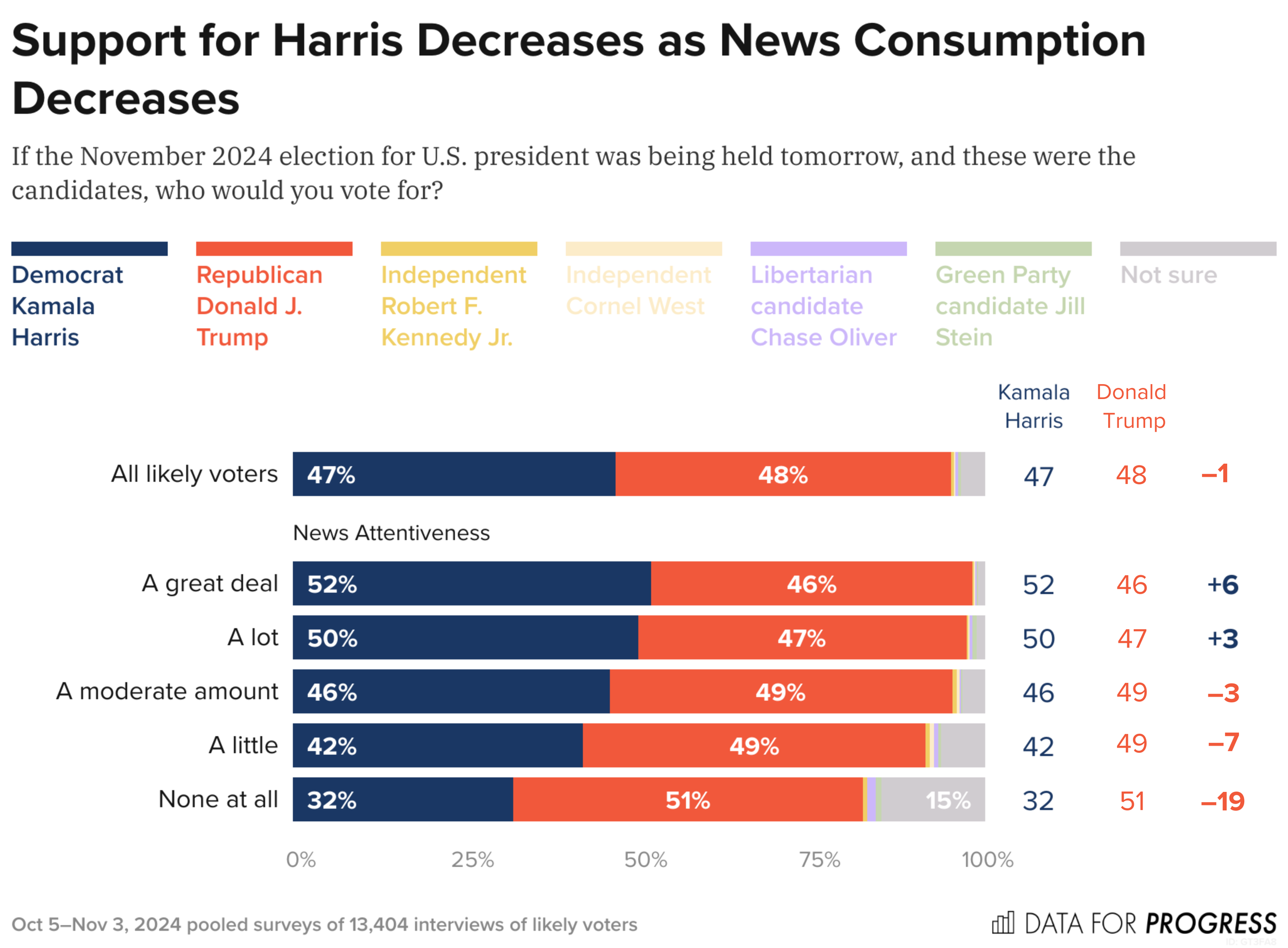
That’s how you wind up with a result like this: Harris won handily among people who were paying attention, but got clobbered among voters who just “knew things” without checking them out.

Heller points out that if you’re trying to seed the world with ambient information, it helps to have your own dedicated media organizations like Fox News, Truth Social, and ultimately X/Twitter, where your factoids can be repeated endlessly without contradiction. Democrats have the so-called “liberal” media, but the message discipline just isn’t there. As often as not, “liberal” outlets like the New York Times and Washington Post would pass along Trump-oriented ambience: Biden’s too old, the economy feels bad, Harris’ campaign doesn’t have enough substance, and so on.

In the old days, campaigns imagined that even fairly uninformed voters had an issue checklist: abortion, inflation, immigration, climate change, education, and so on. Just before the election, they’d find out which candidate agreed with them on those issues, and then vote for that candidate.

For a large (and probably growing) chunk of the electorate, that’s not what happens any more. This is how you wind up with results like we saw in Missouri: The same electorate that voted for Trump 59%-40% also passed ballot measures protecting abortion rights and raising the minimum wage.

What does happen is much harder to get your hands around. But we need to figure it out.

MAGA’s Closing Argument: Dad’s Coming Home

If you can’t see any sense in the pro-Trump case, you’re looking at the wrong level.


“How can this election be close?”

It’s a cry of frustration I hear almost every day in one way or another, not just from Substack bloggers and TV talking heads, but also on social media and from personal friends.

Sure, there are about as many Republicans as Democrats in the country, and as many conservatives as liberals. But one of the two candidates is Donald Trump. I could easily imagine someone like Nikki Haley winning. But the case against Trump should be both obvious and compelling.

We all saw him raise a mob and send it to attack the Capitol in an attempt to overturn an election his own people told him he lost fair and square. We lived through his mismanagement of Covid, which led to hundreds of thousands of unnecessary American deaths. We see him day after day, rambling incoherently through interviews and unable to answer questions about the few policies he has proposed. We see key members of his first administration — like Chief of Staff John Kelly and JCS Chair Mark Milley — warn us that he is a fascist and should never again hold an office of public trust. We hear him repeat the words of past fascist leaders, telling us that his chosen scapegoats — immigrants, in preference to Hitler’s Jews (most of the time) — are “poisoning the blood of our country” and need to be rounded up by the millions. We hear him recite the eternal tropes of racism, claiming that immigrants have “bad genes” that make them criminals, but that he himself has “great genes” that make him smart. We hear him lie, virtually with every breath, about a bad economy, soaring crime, and an immigrant crime wave — none of which exist anywhere outside his imagination.

How is this election close? How is it still possible that he could win? Is half the country as far gone as Ruben Bolling’s version of Snoopy?

If you feel this frustration, imagine what it’s like for bloggers like me. Day after day, I motivate myself with this myth: If I could only explain things clearly enough, people would understand; and once they understood, the great majority of them would do the right thing. So the prospect of another Trump presidency doesn’t just make me fear for my country, it undermines my identity.

More and more it becomes apparent that the problem isn’t that half the country doesn’t understand. Many of them actively want a fascist government that will implement the cruelty they feel in their hearts. Many who aren’t openly rooting for that cruelty refuse to understand what Trump is, and no one can make them understand against their will. They will accept any excuse for his behavior, even excuses that shift from month to month and contradict the previous excuses.

Thank you for letting me get that out of my system. Now I can try to go back to being calm and reasonable.

A few weeks ago I took a long, leisurely driving trip from my home in Massachusetts out to west-central Illinois, where I grew up. I led a church service there, and then took a long, leisurely drive back. Along the way, I saw the lawn signs in neighborhoods very different from mine, and I heard campaign ads not just for the national race, but for a variety of close Senate races.

I think I understand something now.

Fantasies of crime. In the northwest neck of Pennsylvania, road closures threw me off of I-90 and sent me through a small town that sits between Cleveland and Buffalo, but is outside the orbit of either city. In a peaceful middle-class neighborhood I saw numerous yard signs that said

Trump safety
Kamala crime

I doubt the people who live in those houses are recent victims of crime or live in any realistic state of fear. I also doubt that they have looked very deeply into the crime problem nationally. If they had, they would know that crime has been dropping for decades, and was no better under Trump than under Biden and Harris. Crime briefly blipped upward during both the Trump and Biden years of the Covid pandemic, but in recent years the long-term decline has resumed.

Unlike many of the fantasy problems Trump presents in his speeches, he at least has proposed fantasy solutions to this one: deport all those brown people with criminality in their DNA, and stop making the police follow rules.

The trans “threat”. Trans people figure prominently in several of the ads I saw. One purported to compare the Trump military to the “woke” Harris military. The scenes representing Trump were of a drill sergeant screaming abuse at recruits. The ones representing Harris showed dancers of indeterminate gender. We are supposed to draw the “obvious” conclusions that these images are typical of Trump and Harris military policies, and that the abused recruits will perform better on the battlefield than the gender-fluid recruits.

An attack ad directed at Sherrod Brown said that he voted to allow men to compete in women’s sports. An anti-Harris ad said she supported paying for the sex-change operations of criminals in prison. It concluded “Kamala is for they/them. Trump is for you.” During the Olympics, Trump falsely said that a gold-medal-winning female boxer was a man who had “transitioned”, and implied that women competing against her were in danger. Republicans often attack the inclusion of transwomen in women’s sports by invoking the image of men beating up on women.

Again, these ads seem directed at people whose lives are not affected by the issues being raised. The Algerian boxer Trump attacked was not trans. The actual number of transwomen athletes in school sports is tiny — about 40 out of 500,000 NCAA athletes, according to one report — and no women’s league in any sport in the country is dominated by trans stars. The real stars of women’s sports — Caitlin Clark, for example, or Serena Williams — were identified as female at birth. Transwomen who have taken puberty-blocking drugs have only minor advantages over other high-school or college-age women. The problem of transwomen beating down “real” women is itself not real.

Of course, there is a real men-beating-women problem in our society, but Republicans do not seem concerned about it. Whenever proposed legislation would protect women — say, by closing the “boyfriend loophole” in laws the prevent domestic abusers from owning guns — the opposition will be almost entirely Republican.

Similarly, the number of trans soldiers in our military or trans inmates in our prisons is tiny. Kicking out the one or making the other pay for their own surgery is not going to perceptibly improve the daily lives of MAGA voters.

Immigrants “destroying our country”. The third major argument, which I hear more from Trump himself than in TV ads, is that immigrants are “destroying our country“. The examples Trump offers are horrifying: In Springfield, Ohio “They’re eating the dogs. They’re eating the cats.” Aurora, Colorado is a “war zone”, occupied by “an army of illegal alien gang members and migrant criminals from the dungeons of the third world”.

But none of that is true, and even local Republican officials push back against Trump’s false claims. Such lies can’t be aimed at winning votes in the communities he’s talking about, because local people can simply open their eyes and see that the world he’s describing isn’t real.

So the target audience must be elsewhere.

Something similar is going on in Trump’s rhetoric about American cities, especially major cities in key swing states: Milwaukee is “horrible”. Philadelphia is “ravaged by bloodshed and crime”. If Harris is elected, he claims, “the whole country will end up being like Detroit.” (Harris and Detroit struck back with this ad, about how the city has rebuilt itself: America will be like Detroit? “He should be so god damn lucky.”)

“These cities,” Trump said in a 2020 town hall. “It’s like living in hell.”

Those comments aren’t intended to earn votes in Milwaukee, Philadelphia, and Detroit — Democratic strongholds where people can simply open their eyes and see that on the whole life is not particularly hellish. Rather, they’re aimed at suburban and rural voters who never go to the cities because they believe terrible things about them.

What’s going on? I set out to explain how this election can be close, and so far I haven’t. If you think of politics as being about problems and solutions, none of the arguments Trump and other MAGA Republicans are making add up. They are offering to solve problems their voters don’t have, and to protect them from people who do them no harm. (Trans people, for example, have issues with their own genders, not yours. Crime in Atlanta hurts Atlantans, not people in Marjorie Taylor Green’s district, where the largest city, Rome, has 37,000 people. If undocumented immigrants affect your life, it’s probably by picking the vegetables you eat or washing the dishes in your favorite restaurant.)

So how do all these arguments work? Why doesn’t it matter that so many of them are easily debunked? And how do they coalesce into a coherent whole? Fortunately, we don’t have to figure this out for ourselves, because we can call in a MAGA expert: Tucker Carlson. Speaking at a Trump rally in Georgia Wednesday, Tucker pulled it all together:

If you allow people to get away with things that are completely over the top and outrageous, if you allow your 2-year-old to smear the contents of his diapers on the wall of your living room and you do nothing about it, if you allow your 14-year-old to light a joint at the breakfast table, if you allow your hormone-addled 15-year-old daughter to, like, slam the door of her bedroom and give you the finger, you’re going to get more of it, and those kids are going to wind up in rehab. It’s not good for you and it’s not good for them.

No. There has to be a point at which Dad comes home. [loud cheering] Yeah, that’s right. Dad comes home, and he’s pissed. Dad is pissed. He’s not vengeful; he loves his children. Disobedient as they may be, he loves them, because they’re his children, they live in his house. But he’s very disappointed in their behavior, and he’s going to have to let them know: “Get to your room right now and think about what you did.”

And when Dad gets home, you know what he says? “You’ve been a bad girl. You’ve been a bad little girl and you’re getting a vigorous spanking, right now. And no, it’s not going to hurt me more than it hurts you. No, it’s not. I’m not going to lie. It’s going to hurt you a lot more than it hurts me. And you earned this. You’re getting a vigorous spanking because you’ve been a bad girl. And it has to be this way. It has to be this way, because it’s true. And you’re only going to get better when you take responsibility for what you did.”

That’s not said in the spirit of hate. It’s not said in the spirit of vengeance or bigotry. Far from it. It’s said in the spirit of justice, which is the purest and best thing there is. And without it, things fall apart. …

Not only do I think Donald Trump’s going to win, I think that the vibe shift has been so profound. … What you smell around you is the return of freedom, it’s the return of the country you grew up in. …

[The Democrats] need to lose. And at the end of all that, when they tell you they’ve won: No! You can look them straight in the face and say, “I’m sorry. Dad’s home. And he’s pissed.” [1]

How does that pull it all together? Most of us don’t parent teen-age girls we wish we could spank, so how does this little vignette capture why we should vote for Trump?

Let me explain: If you’re looking for the problems of ordinary American life, you’re looking in the wrong place. Trump is not talking about how you’re going to pay for college or find a job or afford a house or get healthcare or retire without starving. The problem his campaign is all about is on a different level altogether: You feel dislocated in today’s world.

That’s why his slogan is backward-looking: Make America Great Again. When is “again”? Back in July, the folks at Salon posed that question to people at the Republican Convention:

What we found is that, whether they’re 30 or 70 years old, the typical RNC attendee thinks America was “great” when they were kids. They believe America lost its way coincidentally right at the time they were maturing into adulthood.

For whatever reason, they now find themselves living in a world very different from “the country you grew up in”. Maybe it’s all the people chattering in languages they don’t understand. Maybe it’s being told that it’s racist or sexist to talk the way they’ve always talked. Maybe it’s having to deal with people who don’t look like either men or women to them, and being told that they’re the problem when they can’t keep track of which name or pronoun to use. Maybe it’s not being able to assume that everybody’s Christian or heterosexual, or not knowing what’s funny now, or hearing music that doesn’t sound like music. Maybe it’s not being able to get a real person on the phone, or receiving 100 pieces of junk mail for every letter they actually want, or dealing with women who earn more than men. Maybe it’s not recognizing half the countries on the globe or being reminded about George Washington’s slaves or hearing “land acknowledgements” about the Native Americans who once occupied the property where they live.

The core MAGA message is that all these problems are really one problem: The world feels wrong now, because people don’t know how to behave.

All the apparent problems Trump talks about are just symbols, just ways to get his hands around this larger, more ineffable problem. Illegal immigrants, terrorists, criminals, transsexuals, women who get abortions — they’re all just people who don’t know how to behave. And that’s why it doesn’t matter if he’s making up his facts or that some particular thing never really happened. People don’t know how to behave, and they make the whole world feel weird and scary That’s real.

Similarly, all the solutions he talks about are really just symbols of one solution: We need to put somebody in charge who will be strong enough to make people behave.

That’s what Tucker spelled out: Dad needs to come home, the old-fashioned kind of Dad who yells and judges and punishes. He’ll tell the bad kids they’re bad, and he’ll keep spanking them hard until they learn to be good.

And then America will be great again, like it was when all of us were children.


[1] This clip got a lot of play on social media and elsewhere, but most of the response focused on the spanking-little-girls aspect and ignored the fascist threat at the end: Even if Kamala Harris wins, MAGA will try to install its strongman.

Mifepristone, round 2

A previous lawsuit to ban the drug used in about half of all US abortions failed at the Supreme Court for technical reasons. But a new suit fixes those problems. It also introduces some truly weird and creepy arguments. Is it really a problem if a state’s teen pregnancy rate gets too low?


Back in June, a lawsuit asking federal courts to ban the abortion drug mifepristone was thrown out unanimously by the Supreme Court on technical grounds: The plaintiffs (mainly physicians who don’t prescribe the drug) were not sufficiently affected by mifepristone’s availability to have standing to sue. So the Court never got to the heart of the case: whether the FDA was right to declare the drug safe to use.

Naturally, that couldn’t be the end of the story, so the anti-abortion forces are back with a new suit. This time three states — Kansas, Missouri, and Idaho — are suing the FDA, attempting to reverse the FDA’s approval of mifepristone for pregnancies of 7-10 weeks. And of course the suit has been filed in Amarillo, Texas (which has no connection to either the FDA or the plaintiff states) because that’s where the plaintiffs can be guaranteed to get the most anti-abortion federal judge: Matthew Kacsmaryk, who somehow failed to see the problems with the first suit. (Anti-abortion radicals Sam Alito and Clarence Thomas could see the standing issue, but not Kacsmaryk.)

The current suit has a much better standing argument: Missouri and Idaho have “almost completely banned” abortion, but their residents sometimes get mifepristone from another state. (Abortion is legal up to 22 weeks in Kansas, so I’m not sure why it joined the suit.) They then return home to use the drug, and if there are complications they may wind up in some home-state emergency room, where Medicaid may wind up paying the bill. This costs the states money, so they have suffered an injury the courts can redress.

But in addition to that reasoning, the lawsuit also includes some weird and creepy stuff, if you read deep enough into it.

Defendants’ [i.e., the FDA’s] actions are causing a loss in potential population or potential population increase. Each abortion represents at least one lost potential or actual birth. … Defendants’ efforts enabling the remote dispensing of abortion drugs has caused abortions for women in Plaintiff States and decreased births in Plaintiff States. This is a sovereign injury to the State in itself [due to] “diminishment of political representation” and “loss of federal funds”.

OK, we get it: Missouri and Idaho have reasons to want to increase their populations, and the FDA is interfering with their power to force unwilling women be their brood mares. How dare the Feds violate states rights like that?

And then it gets even a little creepier: A study has shown that birth rates increase the further that a woman has to drive to get an abortion, and that teen-age women (15-19) should be especially affected by this. (I suspect that’s because the younger ones can’t drive and the older ones probably don’t have their own cars.) But the recent bans are not raising the teen birth rate the way they ought to.

When data is examined in a way that reflects sensitivity to expected birth rates, these estimates strikingly “do not show evidence of an increase in births to teenagers aged 15-19,” even in states with long driving distances despite the fact that “women aged 15-19 … are more responsive to driving distances to abortion facilities than older women.” The study thus concludes that “one explanation may be that younger women are more likely to navigate online abortion finders or websites ordering mail-order medication to self-manage abortions. This study thus suggests that remote dispensing of abortion drugs by mail, common carrier, and interactive computer service is depressing expected birth
rates for teenaged mothers in Plaintiff States, even if other overall birth rates may have been lower than otherwise was projected.

So in particular, the FDA is interfering with the states’ right to make teenage girls be their brood mares. I can’t emphasize this enough: One “injury” Missouri and Idaho complain about is that their teen birth rates are too low.

And there’s one set of girls the suit calls special attention to: those in the foster care system, who might be able to sneak out and get mifepristone somehow or have it mailed to them.

As a result of Defendants’ actions, Plaintiffs have suffered injury to their sovereign interests in enacting and enforcing their laws. Defendants … seek to displace and nullify the States’ state-law parental rights of notice and consent for abortions for teen girls in foster care.

Just picture this for a second: A girl for one reason or another has lost her birth parents. Maybe they died, or maybe they misparented in some way that caused the state to take the girl away. Either way, there’s bound to be some trauma involved.

Traumatized girls sometimes take foolish risks, and it’s also possible they might be sexually abused by a foster parent or by some other adult their foster parents didn’t watch closely enough. So unwanted pregnancies happen, and Missouri’s abortion ban has no rape or statutory rape exception. But the girl is so desperate and so determined to end the pregnancy that she might figure out how to do something about it. Being such a loving parent, however, the state wants to thwart that desire, make her carry a pregnancy for nine months, and then give birth to a child she doesn’t want.

I think if I had gone through something like that, I might be a serial killer.

What lovely, God-fearing states you’ve got there, Missouri and Idaho. (And I still can’t figure out what Kansas is doing.)

Lessons from the Haitian Fright

Many Americans are ready to believe and pass on any horrifying rumor they hear about non-White immigrants, without checking their sources or looking too hard at the evidence. Trump, Vance, and other Republican politicians have been eager to exploit this gullibility.


The Simpsons is set in Springfield because there are 35 Springfields in various states, including five in Wisconsin alone. So wherever you live, the Simpson house might be just down the road. Given this near-universality, it shouldn’t be surprising that the Trump/Vance lies about the Springfield in Ohio have grabbed public attention on both sides of our political divide. If immigrants really are stealing and eating pets in Springfield, your pets may be in danger too. Conversely, if Trump can tell such a baseless and vicious lie about Springfield, he could just as easily lie about your town, your neighbors, or even you.

It’s important to be clear from the beginning: He is lying. Everybody from the local police to the city manager to the Republican governor of Ohio has denied this pernicious internet rumor, which is a lesson in how easy it is to create “evidence” for anything. (Here’s a photo that purports to show a Haitian in Springfield carrying off two geese, presumably to eat. Actually it’s a non-Haitian in Columbus, removing two road-kill geese from the pavement.)

Lots of articles trace the rumor through right-wing sources that invented it, so I’ll cover that history only briefly: The influx of legal Haitian immigrants in recent years had created discomfort among some White Springfield citizens. During Covid, city services got stretched — as services did nearly everywhere — and some locals blamed the Haitians. In any large group, somebody will eventually do something wrong; last year, an unlicensed Haitian driver killed an 11-year-old boy (whose parents have begged the public not to use their son’s death to fan hatred). That created an exploitable opportunity for neo-Nazi groups like Blood Pride, which began targeting Springfield with negative disinformation about the immigrants. From there, stories multiplied until the eating-dogs-and-cats rumor got started. It spread mainly online, and not so much by word-of-mouth in Springfield itself. Then J. D. Vance picked it up, from which it got to Trump.

If you want more detail, I can recommend a post on Justin Ling’s blog Bug-Eyed and Shameless, which relates the story to the Irish Fright of 1688, when tens of thousands of panicked Englishmen barricaded bridges and crossroads to stop the advance of marauding Irish troops, who in fact did not exist.

The Irish Fright didn’t make it into my high-school history texts, but maybe it should have. There’s a lot to learn from what what 19th-century historian Charles Mackay famously dubbed “extraordinary popular delusions“.

How racism manifests. To begin with, the Haitian Fright of 2024 provides a teaching opportunity about racism. I am constantly seeing accounts from White people online and on television, who believe they are not racist because they don’t internally experience what they imagine racism to be: a blind and senseless hatred of other races. “I don’t hate anyone,” they claim, and believe that they are telling the truth.

But the Haitian Fright points out a more subtle and widespread kind of racism: a propensity to believe (and even pass on) negative stories about other races without requiring evidence. A sudden influx of Scots or Danes could have put just as big a strain Springfield’s schools and hospitals, but I doubt we’d be hearing stories about them eating cats.

A similar lesson can be drawn from the Birther controversy of the Obama years (where Trump also was a major player). Many Whites were eager to believe that Barack Obama wasn’t a legitimate president, so they credited any justification for that belief, no matter how flimsy. The birther story served to mediate their racism: They could deny that they disapproved of Obama’s presidency because he was Black, and instead disapprove because he wasn’t really an American. But they believed that evidence-free claim because he was Black.

Myths about immigration. Similarly, many Americans claim that they don’t object to immigrants per se, but only to illegal immigrants. If people would only come to America “the right way, like my ancestors did”, they would be welcomed.

Personally, my ancestors arrived in the United States from Germany in the mid-1800s. And yes, they did come “the right way”, but at the time there was no wrong way. Other than occasional quarantines for health reasons, the US had few restrictions on immigration prior to the openly racist Chinese Exclusion Act of 1882.

You know who else is here the right way? The Haitians in Springfield. They qualify for a program known as “temporary protected status“, which provides legal status to people from countries which (because of either natural disaster or political unrest) are not safe to return to. Others came “as part of a parole program that allows citizens and lawful residents to apply to have their family members from Haiti come to the United States”.

And Springfield is lucky to have them. Governor DeWine said yesterday:

Here’s what we do know, though. What we know is that the Haitians who are in Springfield are legal. They came to Springfield to work. Ohio is on the move, and Springfield has really made a great resurgence with a lot of companies coming in. The Haitians came in to work for these companies. What the companies tell us is that they are very good workers. They’re happy to have them there. And frankly, that has helped the economy.

This matches an observation Deborah and James Fallows made in their book Our Towns, about their travels across America, particularly in the section about Dodge City, Kansas: One key difference between small towns that are dying and those that are thriving is that the thriving towns are welcoming immigrants rather than discouraging them.

Governor DeWine had previously mentioned his own trips to Haiti and observed:

[I]n Haiti education is prized. So when you look at all of these things, people who want to work, people who value their kids, who value education, you know, these are positive influences on our community in Springfield, and any comment about that otherwise, I think, is hurtful and is not helpful to the city of Springfield and the people of Springfield.

In short, whatever you may think you want out of immigrants — legal status, work ethic, family values … anything other than white skin and speaking English since birth — the Haitians of Springfield have it.

Another complaint I’ve run into is that the Biden administration “sent” the Haitians to Springfield. Here’s J. D. Vance:

Kamala Harris dropped 20,000 Haitian migrants into a small Ohio town and chaos has ensued.

But like any person with legal status in the US, the Haitians can go where they like. They weren’t “sent” or “dropped”, they came to Springfield looking for work and a low cost of living.

Thousands of new jobs had been created [in Springfield], thanks to a successful effort by the city’s leadership and Chamber of Commerce to attract new business to Springfield, which sits between Columbus and Dayton. Once a manufacturing hub, Springfield saw its economy shrink after factories closed and jobs migrated overseas. By about 2015, its population had dwindled to under 60,000, from about 80,000 in the late 1960s and early 1970s.

Companies that set up shop, however, confronted a dire labor shortage.

Haitians in Florida, Haiti and South America heard from friends and family about Springfield and its need for workers. They began arriving to take jobs in warehouses, manufacturing and the service sector, and employers urged the new workers to encourage other Haitians to join them.

We often hear how jarring it must be for a town of 60,000 to accommodate 15,000-or-so new residents. But few note that the immigrants are simply restoring Springfield to its historic size. They are making Springfield great again.

Consequences. History teaches that lies can lead to violence, particularly when they make a group of people seem monstrous or subhuman. The pet-eating lie has been likened to the blood libel against Jews, which often circulated prior to pogroms. According to the libel, Jews needed the blood of Christian children to ritually prepare matzah for Passover. So any child who went missing prior to Passover could spark a bloody attack on a town’s Jews.

Often associated with the Middle Ages, a blood libel pogrom happened as recently as 1946 in Poland. Forty-two newly returned Holocaust survivors were killed.

The pet-eating lie has not yet led to any murders in Springfield. But a series of bomb threats followed Trump’s outburst at Tuesday’s debate. City hall had to be shut down on Thursday. Friday, a middle school closed and two elementary schools had to be evacuated. Saturday, two hospitals went into lockdown. Two local colleges have temporarily shut down in-person classes. I can only imagine the bullying that Haitian children are experiencing in schools all over the country.

Thank you, Mr. Trump.

Trump has expressed no remorse and repeated the lie Friday in California, long after it had been widely debunked. On talk shows Sunday, J. D. Vance simultaneously acknowledged that the stories are false while justifying his own role in continuing to spread them.

On Sunday, Ohio’s junior senator was pressed by journalists as to why the Trump campaign was spreading a claim it could provide no evidence for beyond the anecdotal “I heard it on television” excuse Trump himself gave during the debate.

On CNN, he seemingly admitted that his claims were lies, then continued by saying that he would keep spreading such tales, even knowing them to be untrue, if they resulted in the media talking about issues he claimed were still just as real despite the deception.

“If I have to create stories so that the American media actually pays attention to the suffering of the American people, then that’s what I’m going to do,” said the senator.

It is worth pointing out that even though non-citizens can’t vote, anyone legally in the State of Ohio is Vance’s constituent. (That’s why congressional districts are distributed according to total population rather than the number of citizens, a provision Republicans are trying to overturn.) He has a responsibility to them whether he recognizes it or not.

Vance’s interviews point out something else: He and Trump are often accused of “falling for” the pet-eating lie, as if the problem were simply their gullibility in the face of an internet conspiracy theory. But they haven’t fallen for anything. They looked for a hateful lie they could tell about immigrants, and they found one.

What is a joke? The internet is now full of cat-and-dog-eating memes, most of which are intended to be humorous. Both sides are spreading them with very different motives. For Democrats, the lie is so unbelievable that people who are taken in by it deserve to be laughed at. That’s why many of my liberal friends have shared The Kiffness’ musical version of Trump’s debate lines. The song doesn’t explicitly criticize Trump, but does make him seem ridiculous.

Meanwhile, Republicans are indulging in bully-humor, as they so often do. By posting a cat-eating meme with three laugh-till-I-cry emojis, Ted Cruz can promote cruelty towards immigrants while hiding behind a veneer of comedy. When challenged, he is undoubtedly saying, “It’s a joke! Doesn’t anybody have a sense of humor any more?”

The problem, of course, is that not everyone agrees that it’s a joke. Many on the internet still take the Haitian Fright seriously, and virtually no Republicans are condemning Trump for promoting it. (Even Governor DeWine has stopped short of faulting Trump or specifically asking him to stop.) And even if they did agree, jokes can still be cruel.

As for the liberal memes, I have changed my mind several times. Yes, Trump deserves to be ridiculed for this. And yet I find myself agreeing with media studies scholar Whitney Phillips:

While Phillips said she doesn’t begrudge people “having fun online,” she warned that liberals who think they’re cutting Trump down to size risk giving oxygen to a trope that ultimately plays into his hands — and endangers the Haitians who were its original targets.

“When you’re making a joke using the frame” of immigrants as cultural invaders, she said, even if you’re pushing back on it, “the frame is still amplified.”

This week’s legal decisions

A temporary victory for abortion pills, the effective legalization of machine guns, and lower court protection for families with trans children. Meanwhile, continued stalling to protect Donald Trump from prosecution.


We’re getting near the end of the Supreme Court’s term, so the rulings will come hot and heavy for the rest of the month. Several important cases are still pending, but a few decisions came in this week.

The abortion pill mifepristone got a reprieve. As I’ve explained in the past, there is a federal district around Amarillo where cases are wired to go in front of a Christian nationalist judge, Matthew Kacsmaryk, and go from there to the nation’s most conservative appeals court, the Fifth. In the spring of 2023, anti-abortion groups (established in Amarillo precisely to take advantage of this legal pipeline) targeted mifepristone, the drug used in more than half of abortions nationally.

Predictably, Kacsmaryk suspended the FDA’s approval of mifepristone, effectively banning it nationally. That decision was partially reversed by the Fifth Circuit, and then totally stayed by the Supreme Court, pending its own decision. (So far, no one has been prevented from using mifepristone in states where it would otherwise be permitted.)

There are many ways to reverse Kacsmaryk’s decision, because it is baseless both legally and scientifically. Vox described the scientific situation like this:

The case has virtually no scientific merit, and challenging the use of a drug that has been studied and safely used for over two decades is highly unusual. Jack Resneck Jr., the president of the American Medical Association, said in a statement Friday night that Kacsmaryk’s “disregard for well-established scientific facts in favor of speculative allegations and ideological assertions will cause harm to our patients and undermines the health of the nation.”

But the Court decided not to go there. Instead, it pointed to the legal ridiculousness of the lawsuit: The plaintiffs have no standing to sue. [1]

As was obvious from the beginning, these plaintiffs — primarily doctors who don’t prescribe mifepristone — have no standing. They made up, and two levels of federal courts accepted, a ridiculous explanation of how mifepristone harms them: On the rare occasions when mifepristone fails, a woman caught in the middle of a miscarriage might show up on their doorsteps or emergency rooms, and they might have to do a procedure they morally object to in order to save her life.

Putting aside the issue of how any principle requiring a doctor to do nothing while he watches a woman die can be considered “moral”, Justice Kavanaugh (writing for a rare 9-0 Court) noted that federal conscience protections already protect the doctors, so they are not injured. So the suit should never have been heard in the first place. Slate’s Dahlia Lithwich and Mark Joseph Stern comment:

A doctor who opposes abortion, the court affirmed, may stand by and watch a patient bleed out rather than treat her in contravention of his conscience. Ironically, then, an anti-abortion statute that protects anti-abortion doctors played a key role in defeating the plaintiffs’ claim. Their own lavish safeguards against terminating a pregnancy—or even just treating a patient who already terminated a pregnancy—helped defeat their attempt to pull mifepristone off the market.

They go on to observe:

Yet the decision was not a total defeat for anti-abortion activists. Among other things, Kavanaugh slipped language into his opinion that could expand protections for physicians who refuse to provide emergency abortions, potentially imperiling the lives of patients.

The Court’s ruling also left open the fundamental issue — whether the FDA was right (or within its legal authority) to approve mifepristone at all. The most likely course forward from here is that new plaintiffs with different explanations of why they are not busybodies will pick up the suit, and the whole circus will start again.

One path flows from a brief line near the end of the Alliance opinion: “[I]t is not clear that no one else would have standing to challenge FDA’s relaxed regulation of mifepristone.” Last January, Kacsmaryk ruled that three red states — Idaho, Missouri, and Kansas — could join this lawsuit and press the claim that mifepristone should be banned. 

It is far from clear how these states are injured by the mere fact that mifepristone is legal. But Kacsmaryk’s (and the Fifth Circuit’s) behavior in this case and others shows that he’s willing to bend the law into pretzels in order to rule against abortion rights. It is likely, in other words, that Kacsmaryk will simply make up some reason why the red states have standing to sue and then issue a new order attempting to ban mifepristone.

In other words, this isn’t over. Another path forward is that Trump could win the election and instruct the FDA to rescind its approval or impose new restrictions on mifepristone’s use, or reinterpret the Comstock Act of 1873 to prevent distribution of mifepristone by mail. Good luck getting a straight answer out of him on those questions.

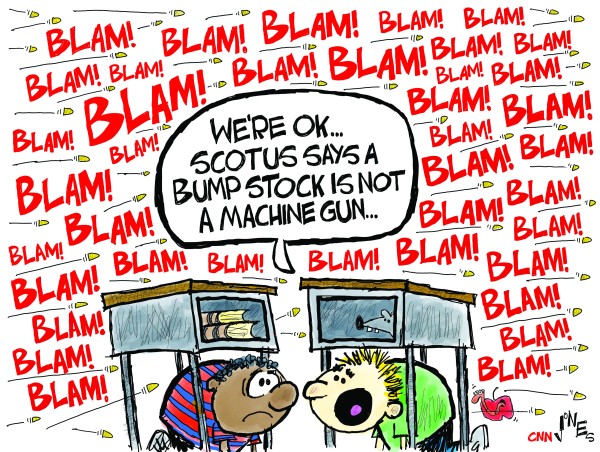
It’s now legal to alter your AR-15 to function as a machine gun. If you’ve ever watched a gangster movie set in the Al Capone era, you’ve seen the destructive power of that era’s submachine guns, the weapon of choice in the St. Valentine’s Day Massacre of 1929.

Responding to that problem, Congress made tommy guns and other fully automatic weapons illegal for civilian use in the National Firearms Act of 1934. By 2002, though, a new technology had inserted a loophole in that ban: the bump stock. A bump stock is an add-on piece of equipment that uses a semiautomatic rifle’s recoil to release and pull the trigger over and over again, so that the shooter’s experience resembles firing a machine gun.

Most explanations of bump stocks available on the internet are by pro- or anti-gun activists, and so should be taken with a grain of salt. However, this one comes from a general how-things-work channel, Zack Nelson’s JerryRigEverything. The video was made while bump stocks were legal.

Zack refuses to state an opinion on whether bump stocks should be legal or not, saying ambiguously: “Personally, I think guns are a great hobby, but not everyone in the world is sane.”

Most people had never heard of bump stocks until the Las Vegas massacre of 2017, when a gunman used one to fire more than 1,000 rounds down on a crowd gathered for a music festival. He killed 60 and wounded over 400, with an almost equal number injured in the stampede of people trying to get to safety. (Like tommy guns, bump-stocked AR-15s aren’t very accurate, making them poor sniper weapons. But if you’re firing at thousands of people, accuracy isn’t that important.) To the untrained ear, audio from the massacre certainly sounds like somebody is firing a fully automatic weapon. (For what it’s worth, real gun people claim otherwise, that a fully automatic machine gun fires even faster.)

Responding to public outrage, the Trump administration Bureau of Alcohol Tobacco and Firearms (ATF) changed its interpretation of the NFA’s machine gun ban, ruling that a bump stock converted a semiautomatic weapon into an automatic weapon, and so was illegal. That ruling was challenged in court, and the case has taken six years to make it to the Supreme Court.

Friday, the Court struck down the bump stock ban in a ruling that split 6-3 along the usual ideological divide. The majority opinion was written by the corrupt Justice Clarence Thomas [2]. It centers on the exact definition of “machinegun” in the NFA:

any weapon which shoots, is designed to shoot, or can be readily restored to shoot, automatically more than one shot, without manual reloading, by a single function of the trigger.

Thomas goes on to focus on the “function of the trigger” in its mechanical sense: As far as the gun is concerned, its trigger is being pulled once for each shot. In her dissent, Justice Sonya Sotomayor focuses on the experience of the shooter, who pulls the trigger once and keeps his finger stationary as the gun bucks back and forth against it. The Congress of 1934, I suspect, intended to focus on the experience of the victims, but they didn’t phrase the law that way, so here we are.

In an ideal world, it’s obvious what would happen next: Congress would say “oops” and would amend the NFA based on some other criteria, like perhaps the rate of fire. That’s what President Biden wants [3], and what Justice Alito’s concurrence suggests, perhaps disingenuously.

There is a simple remedy for the disparate treatment of bump stocks and machineguns. Congress can amend the law—and perhaps would have done so already if ATF had stuck with its earlier interpretation. Now that the situation is clear, Congress can act.

The reason I suggest Alito’s recommendation might not be completely serious is that he knows his right-wing allies won’t allow this to happen. I would be amazed if Speaker Johnson allowed even the narrowest possible bump-stock ban to make it to the House floor for a vote, and Republicans would almost certainly filibuster such a bill in the Senate.

Sunday, possible Trump VP Senator Tim Scott dodged taking any position on a bump stock ban, while another Trump VP hopeful from the House, Byron Donalds went full gaslight:

A bump stock does not cause anybody to be shot in the United States. That is the shooter that does that.

Donalds might want to explain that to the families of the Las victims, many of whom would probably be alive if the shooter had not been able to use a bump stock. It’s also worth pointing out that Donalds’ logic justifies legalizing any weapon, no matter how destructive. After all, nuclear weapons don’t destroy cities, people destroy cities.

Meanwhile, a spokesman for the Republican Party’s lord and savior, convicted felon Donald Trump, for once expressed faith in our justice system.

The court has spoken and their decision should be respected.

This pattern is not a coincidence: If you make Congress dysfunctional and unresponsive to the people, and then interpret the laws and the powers of agencies like the ATF strictly, the result is that when technology changes, old regulations lapse and can’t be updated. That’s not some unfortunate bit of happenstance; it’s two sides of the same strategy. Today it results in the effective legalization of machine guns. Tomorrow the loophole will be in the Clean Air Act or the antitrust rules. When the laws stand still, malefactors adapt.

Gender-affirming care. In an important lower-court case, a judge found a Florida law banning gender-affirming care for minors to be unconstitutional. This ruling differs from the case of a similar Alabama law, which was upheld by the 11th Circuit appeals court (where this case is headed) in that Judge Robert Hinkle found malice on the part of the legislature. That issue wasn’t raised in the Alabama case.

The plaintiffs have shown that animus motivated a sufficient number of statutory decisionmakers.

Judge Hinkle found that “gender identity is real” and is distinct from an individual’s “external sexual characteristics and chromosomes”. He also noted that the treatments at issue — puberty blockers and hormones like estrogen and testosterone [4] — are legal in Florida for other purposes.

[C]onsider a child that a physician wishes to treat with GnRH agonists to delay the onset of puberty. Is the treatment legal or illegal? To know the answer, one must know whether the child is cisgender or transgender. The treatment is legal if the child is cisgender but illegal if the child is transgender, because the statute prohibits GnRH agonists only for transgender children, not for anyone else.

If these treatments have risks, parents of non-trans kids (in consultation with doctors) are allowed to judge those risks for themselves. But in trans cases, the state’s judgment prevails.

Susan Doe, Gavin Goe, and Mr. Hamel have obtained appropriate medical care. Qualified professionals have properly evaluated their medical conditions and needs in accordance with the well-established standards of care. The minors, to the extent of their limited ability, and their parents, and Mr. Hamel, all in consultation with the treating professionals, have determined that the benefits of their gender-affirming care will outweigh the risks. The parents’ and Mr. Hamel’s ability to evaluate the benefits and risks of this treatment in their individual circumstances far exceeds the ability of the State of Florida to do so.

Judge Hinkle found a motive for the State of Florida assuming the power to overrule parental and medical judgment:

The defendants [i.e., the State of Florida] have explicitly admitted that prohibiting or impeding individuals from pursuing their transgender identities is not a legitimate state interest. But the record shows beyond any doubt that a significant number of legislators and others involved in the adoption of the statute and rules at issue pursued this admittedly illegitimate interest.

The ruling quotes numerous statements by legislators or Governor DeSantis that show animus, such as referring to transgender witnesses at hearings as “mutants” and “demons”, denying the reality of gender identity, or exaggerating gender-affirming care by talking about “castrating” young boys. The fact that no one supporting the anti-care bill contested these statements, according to the judge, was evidence that such sentiments were widespread in the legislature.

Trump’s immunity. The Court continues to sit on the apparently simple issue of Donald Trump’s absolute-immunity claim, which has been rejected by every lower-court judge who heard it. By taking the case and refusing to rule promptly, the Court has made it all-but-certain that no trial can be held prior to the election on Trump’s plot to stay in power after losing in 2020. Without the Court’s interference, the public would already have heard testimony under oath from key witnesses like Mike Pence and Mark Meadows.

Particularly given the apparent bias of Justices Alito (whose home and vacation home were the site for pro-insurrection flags) and Thomas (whose wife traded texts with Mark Meadows to encourage resistance to accepting the will of the voters), it’s hard to see the Court’s actions as anything other than an attempt to put its thumb on the scale to Trump’s benefit.

My prediction is that the immunity ruling will come out on the second-to-last day of the term. Putting it last would underline the Court’s intent to delay justice, so the conservative majority will probably sacrifice a day or two of delay to avoid that poor appearance.


[1] Standing is one of the basic concepts of civil lawsuits: A court can only rule on a situation if a suit is brought by someone actually affected. For example, I can’t sue for divorce on behalf of one of my friends, no matter how convinced I am that she needs to be out of that marriage. Requiring that a plaintiff have standing is basically a no-busybodies rule.

[2] I am going to use the word corrupt whenever Thomas’ name comes up until he is either removed from the Court or is called to account in some other way. This week we found out that Thomas has received even more billionaire gifts than the $4 million that were previously known.

Thomas claims these gifts are not bribes, but fall into a loophole for gifts from “friends”. However, Thomas’ rich friends are right-wing donors he had never met before joining the Court.

So as far as this blog is concerned, “corrupt Justice Clarence Thomas” is his full name.

[3] Biden would also like to see an assault weapon ban in that amended bill, but is likely to sign a smaller reform if he gets the chance.

[4] Gender-affirming surgeries on minors, according to the judge, “are extraordinarily rare and are not involved in this litigation.”

Wide Right: that kicker’s commencement speech

Let’s not do to Harrison Butker what Trump did to Colin Kaepernick.


As you’ve no doubt already heard, last Saturday a football player (Kansas City Chief kicker Harrison Butker) gave the commencement address at Benedictine College in Atchison, Kansas. Much has been said and written about this speech, and there’s a petition asking the Chiefs to “dismiss Harrison Butker immediately for his inappropriate conduct”. Last I heard, more than 200K people had signed.

I try to know what I’m talking about before I write, so I watched the full speech on YouTube. (You can also read a transcript.) It’s a very traditional Catholic talk, including a lengthy endorsement of the Latin mass, so if you feel wounded by a Catholic upbringing (as many people I know do), you shouldn’t torture yourself with it.

That said, I would not sign the petition, because taking away someone’s livelihood is a big deal and should be reserved for more serious offenses.

Here’s what I think should happen: People who disagree with Butker and find themselves at a game where he takes the field should feel free to boo loudly. If you have access to any public platform, from your own TV show to a window-facing whiteboard, it would also be appropriate to make fun of him mercilessly. (Here’s an example to get you started.) I don’t know if he endorses any products, but if he does you can boycott them. All those actions just exercise the same freedoms he claims for himself.

So far, the Chiefs have said nothing and the NFL has distanced itself from his message without threatening any sanctions. That, again, is their right.

Of course, this response is nothing like what happened to Colin Kaepernick, whose NFL career ended prematurely after he knelt during the national anthem to protest racism. (Kaepernick’s unofficial shunning by teams who needed quarterbacks accorded with then-President Trump’s demand to “get that son of a bitch off the field.“) That gross injustice should not be forgotten — and in fact this is a good time to remember it — but dealing out a similar injustice to Butker will not right that wrong.

Anyway, here’s why I think Butker should not be punished beyond verbal humiliation: Benedictine College is a Catholic college that in recent years has moved to embrace traditional Catholic teachings and values. Students presumably choose to go there at least partially for that reason (though not all the graduates approved of Butker’s speech, and neither did the Benedictine Sisters associated with the College who said: “We reject a narrow definition of what it means to be Catholic”). Butker told the graduates, in essence, that they should feel good about what their school stands for. Places like Benedictine, he said, “are showing the world how an ordered, Christ-centered existence is the recipe for success.”

I have a lot of tolerance for religious groups making their case positively, as in “This is what we’re doing and it works for us. You should try it.” For the most part, that’s what the Benedictine College leadership seemed to be looking for and what Butker provided. At the end, he got a standing ovation.

Of course, Butker’s speech also included a lot annoyed me, beginning with his fairly snide remarks about “bad policies and poor leadership” during “the Covid fiasco”, which he seemed (without naming names) to attribute to Anthony Fauci but not Donald Trump (whose negligence is implicated in the deaths of hundreds of thousands of Americans). He talked about the importance of Catholics “staying in their lane”, but did not seem to do so when he criticized unnamed bishops. He denounced the “tyranny of diversity, equity, and inclusion”, and referred to “the deadly sin sort of pride that has an entire month dedicated to it”, i.e. gay pride.

He also spoke for his wife, telling “the ladies” what she “would” say about her choice to embrace her vocation as a homemaker rather than pursue her dream of having a career. For all I know he may be totally right about her lack of regret, but couldn’t he have asked her directly and then quoted her exact words, rather than ask himself and imagine her response? I was left to wonder (perhaps unfairly) how many opinions Mrs. Butker is allowed to have.

Mainly, though, he did what defenders of tradition so often do: justify a system in which he himself is privileged. Billionaires extol the virtues of low taxes, white Supreme Court justices tell us why laws protecting non-Whites are no longer needed, and Butker explains that

As men, we set the tone of the culture, and when that is absent, disorder, dysfunction, and chaos set in.

Yes, we men are being totally selfless when we demand to set the tone of the culture. We only do it so that society will be spared the chaos that would inevitably ensue if our God-given authority were ever questioned.

You’re welcome, ladies.

Republicans Scramble to Contain Their Abortion Disaster

Trump’s let-the-states-decide statement looked clever until Arizona actually decided.


All across the country, the abortion issue has been helping Democrats and hurting Republicans.

For decades it worked the other way: Pro-choice women were confident the Supreme Court would protect their rights, so they mostly ignored the extreme positions Republican politicians took and based their votes on other issues. But since the Dobbs decision reversed Roe v Wade last year, the intentions of elected officials matter again.

After taking their lumps in the 2022 elections, Republican politicians have been trying to figure out how to finesse the issue. How do they avoid the ire of female voters without alienating their personhood-at-conception base? Last fall, Virginia Governor Glenn Youngkin thought he had the formula: a “compromise” abortion ban at 15 weeks. But that idea went down in flames as Republicans lost control of the Virginia legislature.

Trump also has been searching for an answer. For a while he also toyed with a 15-week ban, but then last week he stalled for time, saying he’d make a statement this week. I was skeptical about this, because Trump often says he’s going to do something and then doesn’t. But in fact he did make a statement on Monday.

I don’t usually post Trump videos, but I think you need to see this to appreciate just how far off-the-rails this guy has gone. To start with, his make-up is comical; he almost looks like he’s wearing blackface. Then there are the obvious, how-stupid-do-you-think-we-are lies about how “all legal scholars, both sides, wanted and in fact demanded” the end of Roe, and Democrats “support abortion up to and even beyond the ninth month”. (In fact, Biden supports restoring the pre-Dobbs status quo, which drew a line at viability, i.e. 24-28 weeks. More radical people, like me, want the government to butt out completely and let women decide how to handle their own problem pregnancies. But describing that view as “support” for abortion is dishonest. I, for one, am neutral on abortion; I have never tried to persuade a woman to get one.)

But the gist of the statement is that Trump is proud of engineering the conservative Supreme Court majority that decided Dobbs, and he doesn’t want to take any public position beyond letting the states (and not women together with their families and doctors) decide when abortion is permissible. He later said he wouldn’t sign a federal abortion ban if Congress presented him with one. (But then, Trump says a lot of things, and most of them turn out not to be true. When he was president, he claimed his tax plan wouldn’t help the rich. But when Paul Ryan gave him a plan that focused most of its benefits on the rich, he signed it. And we’re still waiting to see the “terrific” health care plan he promised in 2015. )

He’s also proud of being opportunistic on the issue.

You must follow your heart on this issue. But remember: You must also win elections.

That let-the-states-decide position looked clever for about a day. But then a state decided: Tuesday, Arizona’s Supreme Court reinstated an 1864 law banning all abortions that aren’t necessary to save a woman’s life. (In the previous post, I explain why I believe this is a correct reading of a horrible legal situation. It’s the legislature, not the court, that should never have allowed this to happen.)

Then Trump had to scramble: He said Arizona went too far, and predicted the situation would be “straightened out”. Arizona’s mini-Trump, Senate candidate Kari Lake, completely reversed her position. Previously, she had specifically endorsed the 1864 law (by its number in the legal code). But now she says

I oppose today’s ruling, and I am calling on Katie Hobbs and the State Legislature to come up with an immediate common sense solution that Arizonans can support.

So far as I know, this is the first time Lake has admitted that Katie Hobbs (who defeated Lake in 2022) is indeed governor. I also love the invocation of “common sense solution”, a conservative buzz phrase Sarah Palin popularized: It’s a placeholder. You’re supposed to insert whatever position you think makes sense, and then imagine Lake said that.

But Lake hasn’t said anything. As of this moment, neither Lake nor Trump (nor any other Republican who either has real power or is running to get it) has made an actual proposal to fix Arizona’s draconian abortion law. When it comes time to govern — and not just posture — that’s what you need to do: put a real proposal on paper and vote it up or down, knowing that you’ll make some people unhappy.

Are any Republicans, at either the state or national levels, ready to govern? That’s what the coming weeks will tell us.