Tag Archives: 2020 election

The Four Big Lies of the Republican Convention

Creationism defender Duane Gish became famous for a debating technique now known as the Gish Gallop: tossing out so many lies, exaggerations, mischaracterizations, and other deceptions so quickly that your opponent simply can’t respond to them all. Debaters who try will just exhaust their own time (and the audience’s patience) on factual details without ever getting around to addressing the galloper’s main points, much less making their own case.

The trap of fact-checking. This week’s Republican Convention was essentially a four-day Gish gallop. Speaker after speaker gave fact-checkers a workout. CNN’s Daniel Dale listed 20 “false or misleading claims” in Trump’s speech from the White House lawn. FactCheck.org “didn’t find anything to fact-check from Sen. Kamala Harris’ speech accepting the Democratic nomination for vice president”, but made six corrections to Mike Pence’s speech. For example, he blamed Joe Biden for not denouncing “the riots in Oakland” that killed a federal officer.

But he didn’t explain that the death was unrelated to demonstrators protesting in the wake of George Floyd’s death. Federal prosecutors have charged a right-wing extremist with the killing.

Both Pence and Trump claimed Biden wants to “defund the police”, a position Biden has explicitly denied. The Washington Post’s Phillip Bump assessed that “Nearly every claim Trump made about Biden’s positions was false“.

The non-headline speakers were just as dishonest. Rudy Giuliani blamed the violence that coincided with some George Floyd protests on Antifa, a claim unsupported by evidence.

According to multiple reports, including a Washington Post fact check, there were no signs that that antifa was behind violence at these protests. As of earlier this month, federal prosecutors had not been able to link dozens of people arrested in protests in Portland, Ore., to antifa.

Nikki Haley falsely said that Biden wanted to “ban fracking”, while Eric Trump falsely claimed that “Biden has pledged to … take away your cherished Second Amendment.” In addition to dishonesty, speakers displayed appalling ignorance and sloppiness. Lara Trump used a fake Lincoln quote. And Trump Jr.’s girl friend Kimberley Guilfoyle said:

As a first-generation American, I know how dangerous their Socialist agenda is. My mother, Mercedes, was a special education teacher from Aguadilla, Puerto Rico. My father, also an immigrant, came to this nation in pursuit of the American Dream.

Guilfoyle, who introduced herself as a “proud Latina”, ought to know that Puerto Ricans are American citizens. So she’s not “a first-generation American” and her mother was not “an immigrant”.

So you can imagine how easy it would be to take the Gish-gallop bait: I could go on for screens and screens listing specific errors of fact and logic. And if you dislike the Republican Party anyway, you might read that list with a certain I-was-right-all-along satisfaction. [1]

The four big lies. However, that’s not the case that needs to be made right now. The RNC wasn’t like a Liar’s Convention or a Festival of Tall Tales. The week’s disinformation wasn’t a random scattering of fanciful notions. The point of the lesser lies was to support bigger lies, which often stayed in the background. So even if an undecided voter who watched the convention also read all the fact-checks, and came to understand that Puerto Ricans are citizens and Biden isn’t planning to defund the police, he or she might still come away believing one or more of these four falsehoods:

  1. Trump had an extraordinary economic record before the coronavirus hit.
  2. Trump is not responsible for consequences of the Covid-19 epidemic. The 200,000 excess deaths this year are not his fault, since he did everything that could have been done to control the epidemic. And since the epidemic is not his fault, he should get a mulligan for it. He should be judged by February’s economy rather than today’s, as if the last six months never happened.
  3. The unrest in America’s cities this summer is not a response to excessive police violence and a long history of racial injustice, but is due to a dark conspiracy of liberal anarchists. The way to control violence in our cities is with an overwhelming show of force, which Trump is willing to order and Biden is not.
  4. If Covid-19 was ever a serious threat, it no longer is. America should get back to normal as fast as possible; any additional sickness or death this causes is a price worth paying.

None of this is true. The convention’s little lies about who-did-what-when pale in comparison; they’re only relevant to the extent that they prop up these four big lies.

Correcting the first big lie: Even pre-Covid, Trump’s economic performance was nothing special. In 2016, Trump supporters argued that his amazing business acumen would translate from the private sector to government: Rather than creating wealth for himself, Trump as president would create wealth for all of us.

We now understand that the myth of Trump’s financial genius was false from the beginning. Far from the self-made man he purported to be, Trump became wealthy through inheritance from his father and tax fraud (including allegedly defrauding some of his relatives). After losing the money his father left him, he became rich again via money laundering for Russians and other former Soviet nationals, as well as profiting from schemes that created losses for people who trusted him.

But one thing has carried over: The same myth-making genius that created the image of Trump the Great Businessman has created a new myth of the Great Trump Economy. At the Convention, Larry Kudlow told this tall tale:

Donald Trump’s economic plan … was a roaring success. Inheriting a stagnant economy on the front end of recession, the program of tax cuts, historic rollback of onerous regulations that crippled small business, unleashing energy to become the world’s number one producer, and free, fair and reciprocal trade deals to bolster manufacturing, agriculture, technology, and other sectors. The economy was rebuilt in three years.

This is its own little Gish gallop that could be debunked phrase by phrase — for example, the US became the world’s top oil producer in 2013 under Obama — but it’s more important to look at the big picture: A graph of US GDP growth by year shows that from 2010 to the beginning of the Covid pandemic, growth was slow but steady, bouncing in a range between 1.6% and 3.1%. (Compare to 1966 or 1955, when GDP grew 6.6% and 7.1%.)The peak growth rate of that period came in 2015 under Obama. There was never a Trump boom, just the same kind of economic growth we had under Obama.
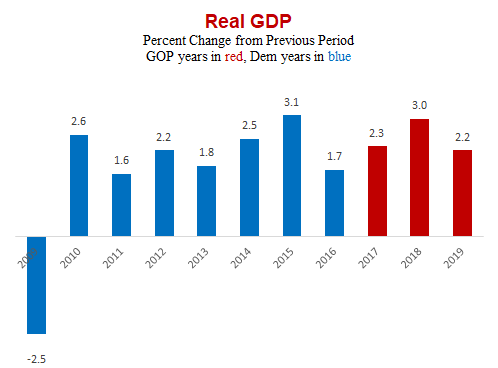
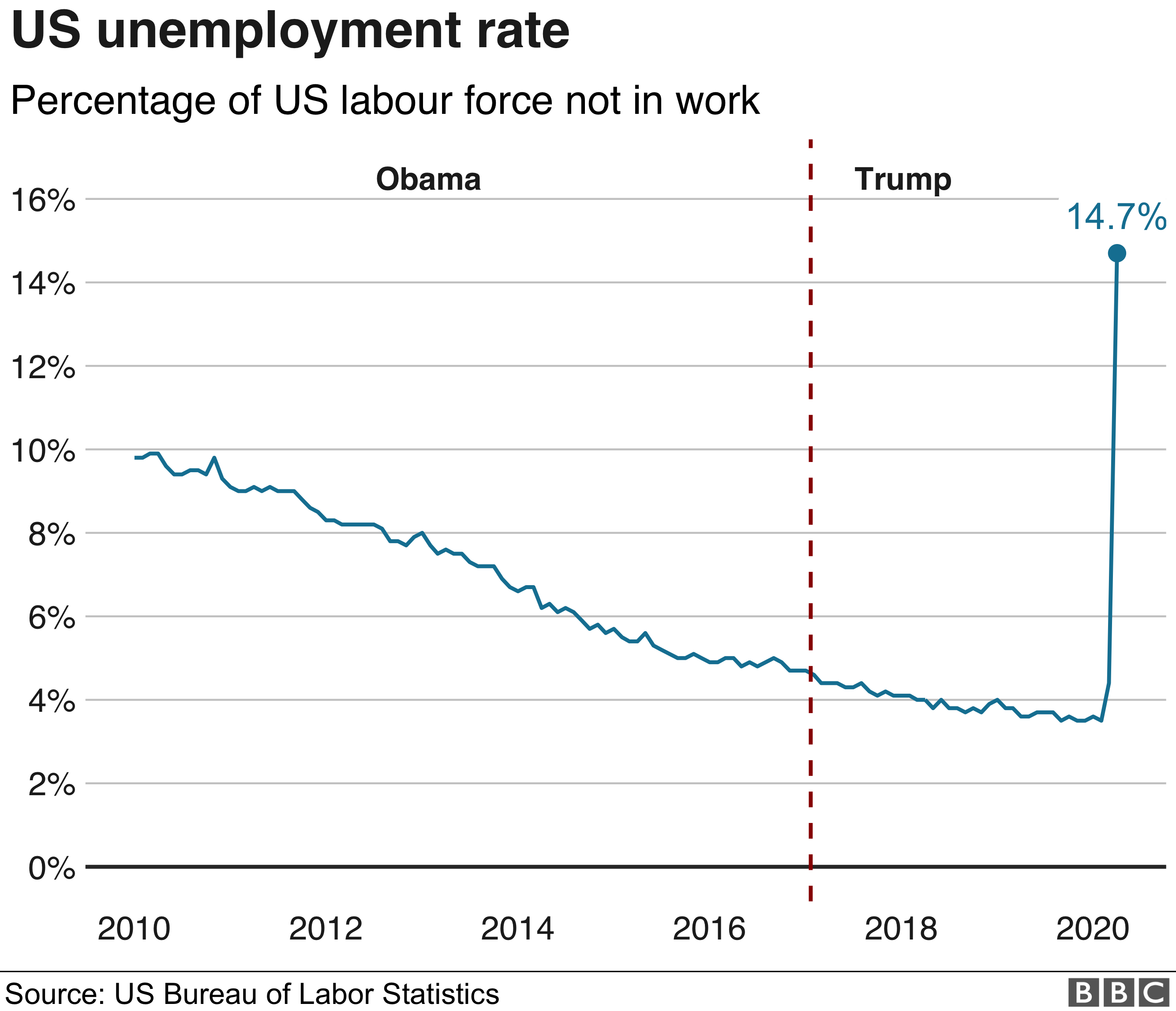
If the pre-Covid Trump economy felt different from Obama’s, that was because periods near the end of economic expansions have strikingly low unemployment rates. So in the Trump years the unemployment rate got very low, reaching 3.6% by November of 2018 and staying at about that level for more than a year. In February, it was 3.5%. [2]

However, if you look at a graph of the unemployment rate, you’ll see the same pattern as GDP: Trump inherited positive trends from Obama. The slow-but-steady growth that started in 2010 gradually knocked down the unemployment rate. That positive trend continued — without any acceleration at all after Trump became president — until the epidemic disrupted it. [3]
In some ways it’s surprising that growth didn’t improve under Trump, because Mitch McConnell loosened the purse strings once he had a Republican president. Even though it was late in the economic cycle — a time when conventional economic theory calls for government to run surpluses — Congress allowed Trump to stimulate the economy with deficits far larger than it had allowed Obama after his first term. [4]

So the gist of the pre-Covid Trump economic record is this: Until Covid, Trump managed to maintain the positive trends Obama had set in motion. And even this steady-as-she-goes result did not come about through an ingenious trade policy or business-friendly tax policy or cuts in regulation; he simply got to spend more money than Obama did.
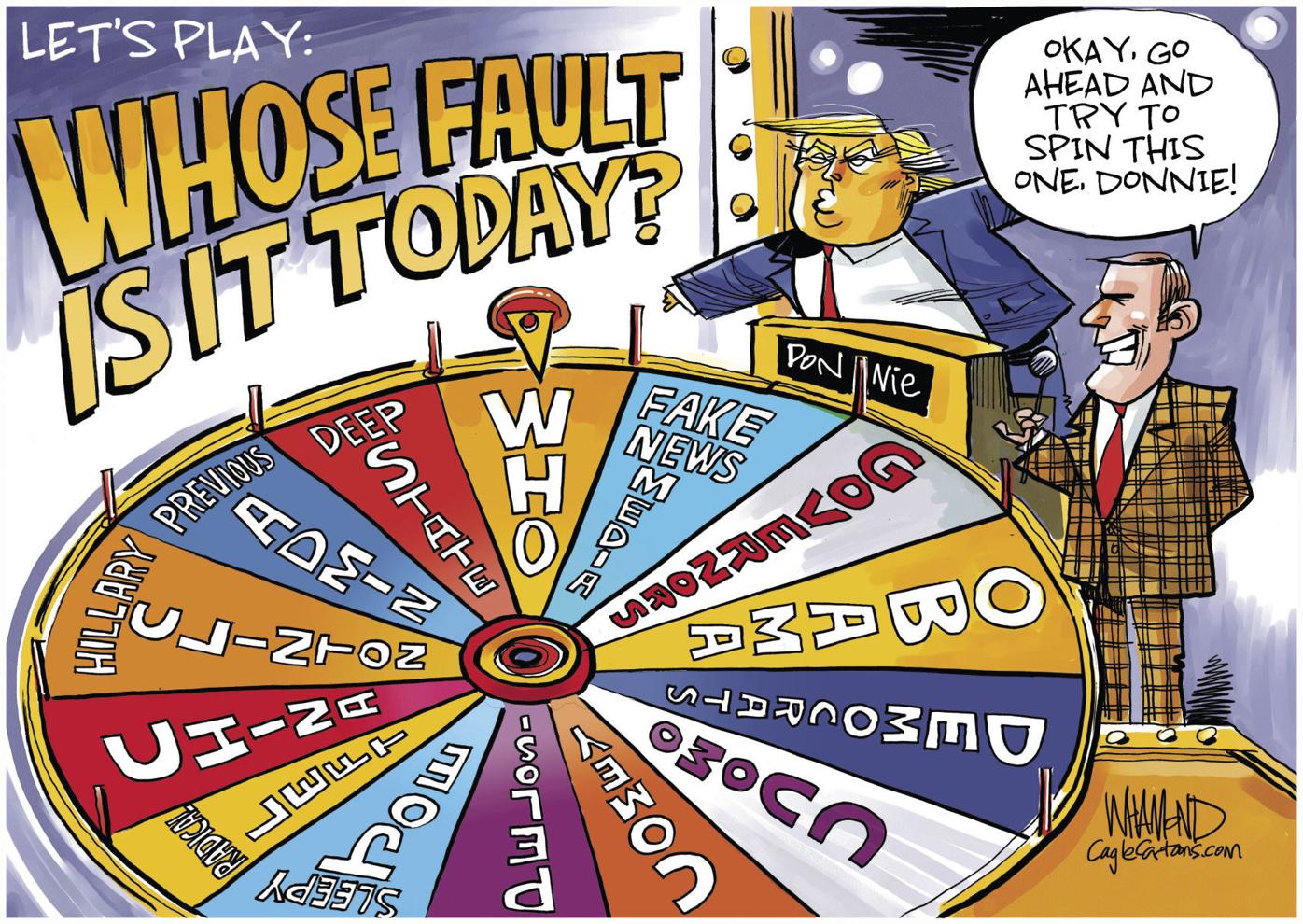
Correcting the second big lie: Trump didn’t start the Covid-19 epidemic, but the length and depth of it is his fault. It is fairly typical for presidents to face unexpected and undeserved challenges during a four-year term. Obama didn’t create the Great Recession, but it dominated his first term and got in the way of all his plans. George W. Bush didn’t blow up the Twin Towers on 9-11. His father didn’t force Saddam Hussein to invade Kuwait. Jimmy Carter didn’t invite the Iranians to hold our embassy staff hostage. JFK didn’t ship Russian nuclear missiles to Cuba. FDR didn’t attack Pearl Harbor. And so on. Unexpected things happen in the course of four years, and presidents are judged by how they respond to those challenges. We don’t give them mulligans for bad luck.

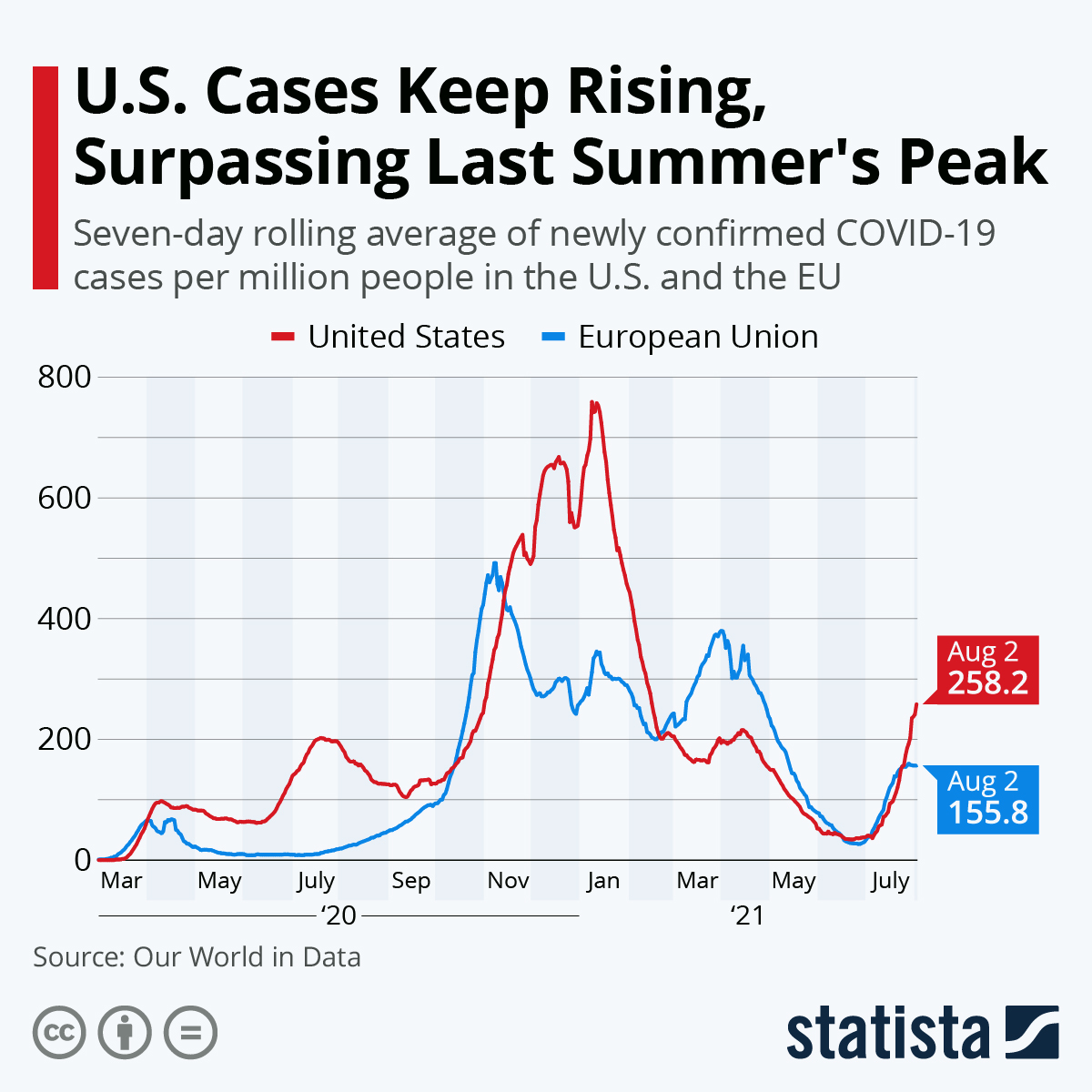
Covid-19 is the defining crisis of Trump’s term, and by any measure he has handled it very badly. The most obvious evidence for that is in this chart of Covid-19 cases per million people. (Enlarged version here.)

Not only does the US curve outrun all the others by a wide margin, it also has a different shape: The initial outbreak here was only slightly worse than in the European Union and Canada, which were also hard-hit. But only the US goes on to have a second hump bigger than the first. There are two simple reasons for that:

  • The Trump administration wasted the time bought by the March-May shutdown. While other countries developed national test/quarantine/contact-trace strategies, the Trump administration still has no plan other than to wait for a “miracle” vaccine. [5]
  • Trump himself pushed the states to reopen too soon, and undercut governors who tried to implement a more cautious policy based on science and standards. That second hump in our graph is a direct result of that too-soon reopening, and the June/July outbreak was centered in states like Florida and Texas, where Trumpist governors ignored the medical experts and re-opened too soon.

It is probably unfair to have expected the United States’ Covid-19 response to lead the world: Small island nations like New Zealand and Iceland are easier to protect and mobilize than a sprawling place like the US or the EU. So Trump should not get all the blame for the fact that our 565 (and counting) deaths per million is shamed by New Zealand’s 4 or South Korea’s 6 or even Japan’s 10.

But we still had less than 100,000 deaths on June 1, when it was first becoming clear that our curve was not collapsing the way that other nation’s curves were. It may be unreasonable to hold Trump responsible for all our Covid-19 deaths, which are now up to a world-leading 187,000. But certainly tens of thousands of those deaths are his fault, and I personally blame him for every death over 100,000.

Correcting the third big lie: The violence in our cities is happening because Trump has sharpened racial divisions and encouraged police brutality. It will only get worse if he is given a second term. After the racial violence that followed Michael Brown’s death in Ferguson, Missouri in 2014, the Obama Justice Department issued two reports: One examined the details of the shooting and determined that police officer Darren Wilson should not have been charged with murder. To that extent, it affirmed that justice had been done.

The other report, however, painted a very dark picture of policing in Ferguson: The city budget depended on squeezing fines out of poor Blacks, and the police department was tasked with making that happen. Ferguson police did not “serve and protect” its Black citizens. Instead, police and the Black community had a predator/prey relationship in which police were constantly on the lookout for violations to cite in order to raise revenue. The report also revealed widespread and blatant racism among Ferguson officers, who routinely mistreated Blacks they came into contact with.

In short, the Fox News portrait of Ferguson was wrong: The problem wasn’t the Black community’s short-term emotional reaction to its misperception of Brown’s death. Instead, the long-term racial injustice in Ferguson, and citizens’ inability to address that injustice through the system, created a situation in which some kind of violent outbreak was inevitable. Michael Brown was the spark, not the cause.

In combination, the two reports provided a ray of hope and a path forward: Incidents like Michael Brown’s death need not lead either to individual policemen being railroaded or to purely local investigations that sweep police violence under the rug. But at the same time, the long-term injustice at the heart of the problem can be addressed. The Justice Department soon worked out a consent decree with Ferguson and its police department to reform local practices. Similar decrees were negotiated in other sites of racial violence, such as Baltimore.

But when Jeff Sessions became Trump’s first attorney general, he quickly got to work closing off that path forward. And one of his final acts before leaving was to undercut the whole process.

Sessions’ memo will make it challenging to negotiate any effective police reform agreement going forward. It also makes it more difficult for the Justice Department’s civil rights lawyers to enforce agreements already in place.

Today, Black people oppressed by abusive police departments know that the Justice Department is not their ally. No one is coming to help them.

Police, on the other hand, know that no matter how they misbehave, Trump has their backs. He has famously encouraged police officers not to be “too nice” when they apprehend suspects. He told border patrol officers to break the law, and promised their chief a pardon if he were prosecuted. When Buffalo police assaulted an elderly protester in Buffalo, Trump falsely attacked the protester as an “ANTIFA provocateur”.

Meanwhile, Trump has been encouraging white supremacists. He defended the Nazi rally in Charlottesville. He stands up to support the Confederate flag and Confederate statues.

And now, Trump is openly encouraging right-wing violence. The Kenosha vigilante was in the front row of a Trump rally in January. Yesterday, Trump tweeted “GREAT PATRIOTS” about a caravan of trucks that pepper-sprayed demonstrators in Portland.

What in all of this is going to get better if Trump is re-elected? Has Trump ever been a peace-maker? Will he improve race relations? Will police stop murdering Black men and women, or stop shooting them in the back? Will Blacks trust that they can get justice through the system, without taking to the streets?

Obviously not. If Trump is re-elected, everything that has caused this summer’s violence will only get worse.

Correcting the fourth big lie: The Covid epidemic is still raging and is still killing Americans in large numbers. But Trump has learned nothing from his blunders in May. If he gets the responses he wants, we’ll see a third big hump in the case graph. During the Republican Convention, speakers often talked about the coronavirus in the past tense. “It was awful,” Larry Kudlow recalled. “Health and economic impacts were tragic. Hardship and heartbreak were everywhere.”

But in the real world, more Americans died of Covid-19 during the Convention’s four days than died in the 9-11 attacks. We are nowhere near herd immunity, and a vaccine probably won’t be widely available until spring — unless Trump once again follows Putin’s lead and ignores the usual safety rules to release a vaccine that hasn’t been properly tested.

Meanwhile, Trump is once again pushing states and cities to ignore medical guidelines and take big risks. In the same way that he applauded as states catastrophically opened bars and restaurants in May, he’s pushing for schools to open now, and threatening communities that want to be more careful. He has repeatedly promoted the myth that kids don’t get the virus or can’t spread it.

But now we are seeing virus outbreaks on college campuses, causing some schools to reverse their plans (including my alma mater, Michigan State). More than 1,000 University of Alabama students tested positive in the first two weeks of classes.

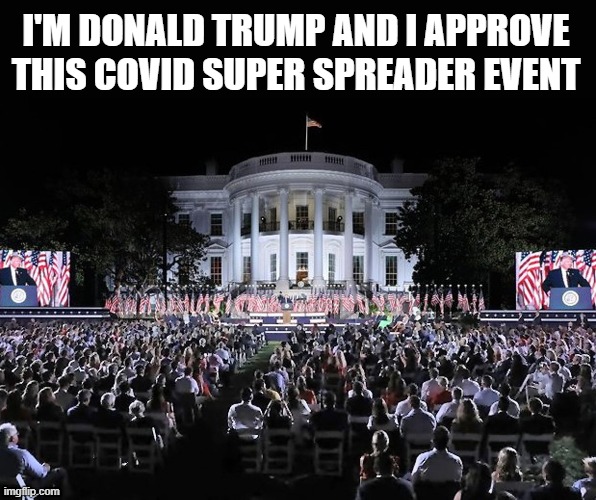
Trump’s speech Thursday night was not just an illegal use of the White House lawn, it was a public health hazard, as 1,500 or more people packed into a small area and mostly did not wear masks.
He encourages a return of large-crowd gatherings of all sorts: churches, movie theaters, and even football games, which he would like to see played in front of full stadiums. (“We want big big stadiums loaded with people. We don’t want to have 15,000 people watching Alabama-LSU.”) Inside the White House, masks are seldom worn, even when people work in close quarters.

We saw this movie in May, and we know how it ends: If the nation’s children return to in-person classes (which Barron Trump is not doing), if college campuses reopen, and if crowds return to major sporting events, we’ll have a third wave of Covid outbreaks — and more tens of thousands of deaths that will be Trump’s fault.


[1] I might also list all the RNC activities that were illegal, unethical, or based on trickery. That too would be satisfying. And while such examples should not go by without notice or objection, what really deserves notice is that Republicans in Congress are unwilling to condemn blatant law-breaking.

At the beginning of his term, when Trump saw no Republican pushback for ignoring the norms of our democracy (like refusing to divest his business holdings or take any action to avoid the resulting conflicts of interest), many imagined that there was a line beyond which Trump would lose his party’s support. We still haven’t found it. So it’s still an open question whether Susan Collins, Mitch McConnell, Joni Ernst, Thom Tillis, or any of the other Republican senators would lift a finger to stop a straight-out military coup to keep Trump in power.

[2] But even focusing only on unemployment, Trump did not oversee “the greatest economy in the history of our country“, as he often claims. Unemployment was 2.5% in 1953.

[3] This unemployment graph is not current — I couldn’t find one that was. There has been some recovery since. By the end of July, the 14.7% unemployment rate had come down to 10.2%, which is still alarmingly high.

[4] The 2020 deficit looks likely to top $3 trillion, and is already well past the $1.4 trillion record set by Bush and Obama in fiscal 2009.

[5] For a more complete play-by-play explanation of how Trump bungled even the initial reaction to the virus, see James Fallows’ article “The 3 Weeks that Changed Everything“. Just to give you a taste: Obama had an agreement with China that allowed us to have observers in Wuhan, where the virus first appeared. But Trump never bothered to appoint anybody to fill those roles.
The Underlying Differences Between Liberals and Conservatives

It’s policy, but it’s more than that.


Everyone knows that liberals and conservatives differ on policy: Liberals support abortion rights, gay rights, and gun control, while conservatives oppose all three. Conservatives want to deport undocumented immigrants and build a wall to keep more from coming, while liberals want to provide a path to citizenship for people who have been living and working here for years without incident. Liberals believe climate change is a real problem that requires serious action, while conservatives don’t. And so on.

But underneath all that are much broader and vaguer differences.

Conventions are designed to be popular TV, so they don’t go that deeply into policy. Instead, they focus on identity and present values rather than five-point plans. Consequently, watching the two conventions back-to-back is a good way to get a handle on the underlying differences. The following questions are intended to help focus your thinking as you watch.

1. Is your ideal America in the past or the future? One of President Trump’s major complaints against the Democratic Convention was that its speakers ran America down.

“Over the last week, the Democrats held the darkest and angriest and gloomiest convention in American history,” President Trump said in remarks to members of a conservative group in Arlington, Va. He accused Democrats of “attacking America as racist and a horrible country that must be redeemed.”

If you’re a liberal (as I am), you probably don’t remember the convention that way. What sticks in my mind are all the expressions of hope: We are a great people. We have it in us to overcome the current challenges and “build back better”. I saw a celebration of decency, of families that stick together through tough times, and of people’s simple desire to help each other.

This perception gap arises largely because of one of the major liberal/conservative splits: Conservatives see their ideal America in the past, while liberals see it in the future.“Make America Great Again” only makes sense if you believe that at some point in the past America was greater than it is now. Trump has always been vague about what era his “again” points to, but different segments of the MAGA community have their own favorites:

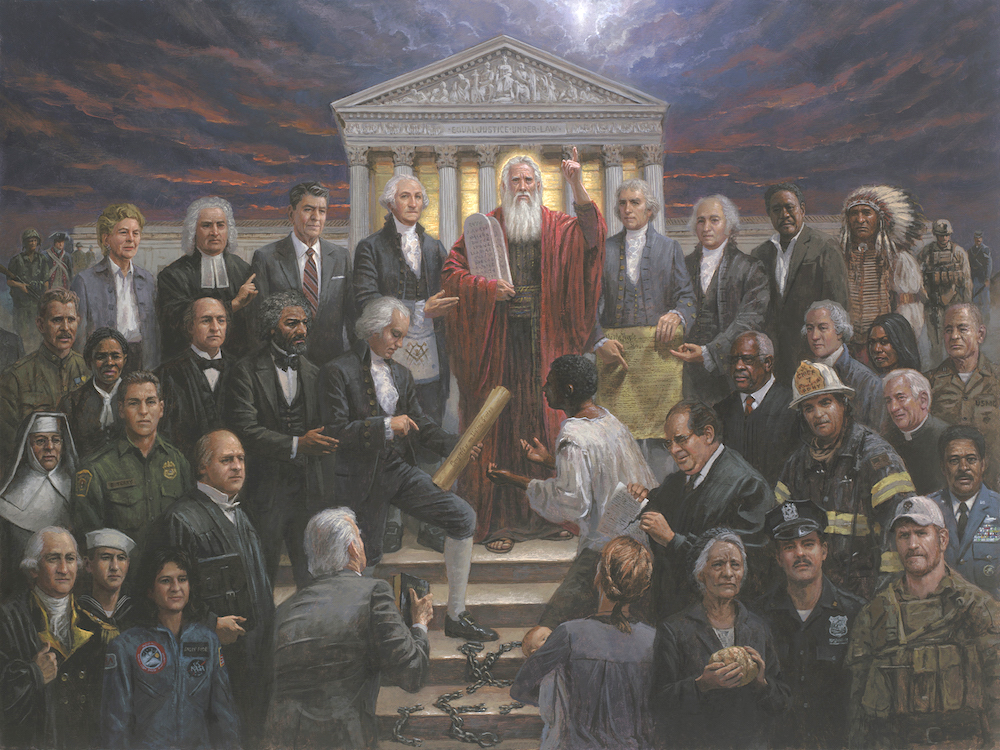
  • The Founding. Many Evangelicals (and Mormons) go so far as to claim that the Constitution is divinely inspired, putting the Founding Fathers on a level very near the Biblical prophets.
  • The Confederacy. Republicans tend to minimize the role that white supremacy plays for their base, but all those Confederate flags and rallies around statues of Robert E. Lee point to something else: nostalgia for the noble Lost Cause of the slave empire.
  • The Wild West. There was a magic moment just after the Native Americans had been driven away, but before civilization arrived. The land was too vast and empty for anything you did to pollute it. And you could shoot all the buffalo you wanted, because there was nobody to tell you not to.
  • The Gilded Age. Libertarians and Ayn Rand followers idealize the late 1800s, before antitrust laws and other progressive reforms involved government so deeply in the economy.
  • The Greatest Generation. According to the myth, we single-handedly saved the World from fascism and never got the gratitude we deserved.
  • The Happy Days. The idealized 1950s, when a white man could support his family on a single income, women knew their place was in the home, gay sex was a crime, and Negroes were invisible.

Democrats, on the other hand, have an annoying habit of throwing dirt on these beautiful images by talking about slavery, Jim Crow, the Native American genocide, or the indiscriminate massacre of civilians at Hiroshima and Nagasaki. When we honor the Founders, it’s not because their era was so great, but because they left us a vision of a government where authority bubbles up from the People rather than streams down from Heaven, and of a world where “all men are created equal”. They never achieved that vision, but they wrote a Constitution flexible enough that we could evolve towards it, and a Declaration we could edit to say “all people are created equal”. Yes, they were hypocrites to wax eloquent about their own freedom while enslaving others. But in the long run, their visionary hypocrisy has served us better than realistic cynicism would have.

Liberal patriotism revolves around the Future America, the one we could build that will finally live up to that never-achieved vision. That’s why Kamala Harris talked “the beloved community … a country where we look out for one another, where we rise and fall as one, where we face our challenges, and celebrate our triumphs—together.” But then she admitted: “Today, that country feels distant.”

Trumpists hear negativity and gloom there, while liberals find it inspiring: Even in moments as dark as this one, the American ideal is still out there, still beckoning for us to achieve it.

In contrast, the theme President Trump has chosen for the Republican Convention is “Honoring the Great American Story“. Taking a wild guess, I suspect we’ll hear a lot about “left-wing mobs” who have been tearing down or defacing statues that honor major players in that great story: mostly Confederate leaders, but occasionally non-Confederates like Columbus or even George Washington. We might also hear denunciations of the 1619 Project, an American history curriculum that emphasizes the central role slavery played the Great American Story. (Senator Cotton wants to deny federal funds to schools that teach this curriculum. Remember when conservatives opposed federal control of education?)

This next week, expect to hear a lot of reverence for the America of days gone by. But the only vision you’ll hear for our future is to return to that past greatness.

2. Do you think mainly about We or I? There’s a reason masks have proven to be such a divisive left/right issue, in spite of the overwhelming evidence that they are great tools for controlling the Covid epidemic: Masks are a we-solution, not an I-solution.

Does wearing a mask guarantee that you won’t catch the virus? No. If you walk into a crowded room and you’re the only person wearing a mask, it’s going to improve your odds of escaping infection a little, but not really that much.

So if your demand is “Give me something I can do that will keep me safe”, telling you to wear a mask is not a great answer. But if you revise that to “Give me something my community can do that will help us get the virus under control faster”, masks are a great answer. If everyone starts wearing masks when they leave the house, instead of each infected person passing the virus on to three other people, you might have three infected people passing it on to just one new person. Instead of exponential growth, you’ll have exponential decay. And in a struggle like this, that’s what victory looks like.

But conservatives hate we-solutions. They would much rather hear about snake-oil cures like hydroxychloroquine or oleandrin, because those are I-solutions: If I get sick, I take oleandrin, and I get better — if it works.

This shows up across the board. Why should I give up my AR-15, when I was never going to do anything illegal with it anyway? Well, because if we all give up our AR-15s, the next mass shooting might not have quite so much “mass” to it. If you think taxes are too low, why don’t you just make a voluntary contribution to the Treasury? Because changing my tax rate doesn’t solve any national problem, while changing the rate we all pay does. And so on.

3. Are problems solved best by punishing individuals or reforming systems? Related to the focus on I rather than We is the conservative belief that problems are caused by individuals: The crime problem is caused by the individuals who commit crimes. The drug problem is caused by smugglers and pushers. Terrorism is caused by terrorists. And so on. This leads to a belief that the way to solve a problem is to figure out who is causing it and punish them until they stop doing whatever it is they’re doing.

That’s why the conservative reaction to immigrants and asylum seekers is so harsh: Border-crossers cause our immigration problem by coming to our country, and so they need to be punished until they stop. Herd them into detention centers and let people debate whether those centers qualify as “concentration camps”. Take their kids away and lose them in your system. Just make them stop coming.

Liberals are more apt to ask why they are coming and if there’s some way to unplug whatever process is pushing them here. Maybe we could promote reform in the hellish places they come from, or reform the trade practices that make those countries so poor. Maybe we could fund programs there that give them reasons to stay. But no, conservatives say, that would be rewarding the behavior we want to stop. And it wouldn’t work anyway, because … well, it just wouldn’t. If you’re not punishing anybody, you’re not solving anything.

Ditto for the violence that has sometimes accompanied the protests against police brutality after George Floyd’s murder. People are making trouble, so they need to be punished. So fire the tear gas, pepper-spray the peaceful and violent protesters indiscriminately, and send police into crowds swinging their nightsticks. Systemically, it makes no sense to answer a protest against police brutality with more police brutality. But those individuals are wrong and they need to be punished.

The flip side of this way of thinking is that whenever liberal tinkering with a dysfunctional system inconveniences conservatives, they interpret it as punishment. Raising taxes on the wealthy isn’t a sound fiscal plan to raise revenue, it’s punishing success. Affirmative action isn’t a way to compensate for the old-boy networks disadvantaged groups lack, it’s punishing white men. Green taxes punish coal miners and people who drive a lot. Laws preventing discrimination against gays punish Evangelical Christians. And so on.

From a liberal perspective, the weirdest thing in this mindset is the joy they imagine we feel as we punish them. Spend much time inside the conservative bubble, and you will hear a lot about how much we liberals hate the rich, and the coal miners, and the Evangelicals, and anybody else who will be disadvantaged by a liberal policy. We’re just rubbing our hands in sadistic glee whenever Harvard turns down some deserving white male.

My only explanation is projection. They know how they feel when a policeman clubs a BLM protester, so they imagine we must feel the same way.

4. When do you trust systems, and when do you trust people? Dr. Anthony Fauci had such a long and distinguished career before Covid-19 that I must have seen him somewhere — maybe during the Ebola scare or during the height of the AIDS epidemic. But I didn’t remember him. Certainly I had no reason to either trust or distrust him as a person. However, when Covid-19 started spreading, I recognized him as the spokesman for a system of medical science that I do trust. I don’t trust it absolutely or blindly, but when there’s a new disease and I have to make decisions about how to avoid it or seek treatment for it, that’s where I look for answers.

I trust a lot of other systems within certain bounds. I trust academic climate scientists to tell me how we’re doing on climate change. (And I don’t trust scientists employed by energy companies.) Their models may or may not make perfect predictions, but like the weather service’s forecasts, they’re the best we have. I trust geologists and astrophysicists to tell me the age of the Earth, and biologists to tell me how long ago various animals evolved. I trust the Bureau of Labor Statistics to tell me the unemployment rate and the Treasury to report the deficit. I read major newspapers with a mix of trust and distrust: They don’t always characterize events properly, and they sometimes misjudge which stories are or aren’t important, but if they put quotation marks around something, I’m pretty sure somebody really said it. If there’s a publicly checkable fact, I trust that somebody has checked it. The New York Times may not be perfect, and I may or may not agree with its opinion columnists, but it is not fake news.

Those attitudes don’t have anything to do with the issues we normally think of as defining liberalism or conservatism. That last paragraph didn’t state any position on abortion or gun control or tax rates or immigration. But all the same, it marks me as a liberal. There are systems for gathering knowledge, and I believe that (with occasional but fairly rare exceptions) they work.

Conservatives, by and large, don’t share my faith in systems, and would rather trust people. Many of them (God help them) trust Trump. Some trust their religious leaders, even on topics that have little to do with religion. Some trust media personalities like Rush Limbaugh or Sean Hannity. Some trust people who share their religion or their economic class or their DNA. Or they look at a TV talking head and make their own judgment: That guy wouldn’t lie to me.

So they look at Dr. Fauci and don’t see the mouthpiece of medical science. They see a guy like any other guy — and what did he ever do for them? But that My Pillow guy, he speaks the same religious language they do, and his pillow was pretty good, and Trump likes him, so maybe he knows what he’s talking about. Maybe he’s right and Dr. Fauci is wrong.

5. Is the United States a member of the world community that leads by example? Or are we “exceptional”? Trump appears not to recognize the existence of a “world community” at all. He has been relentless about blowing up agreements that involve the US submitting to rules that bind large groups of nations. He pulled us out of the Trans-Pacific Partnership and the Paris Climate Accord and the multi-nation agreement to stop Iran from getting nuclear weapons. He supported Brexit, and chafes at the idea that he can’t have one-on-one trade agreements with the EU countries. He keeps making noises about undercutting NATO, even at one point questioning whether we would really defend some small NATO country like Montenegro.

At this point, the Republican view seems to be that the US is entirely exceptional: No rules should apply to us at all. We should be able to torture people if we want to, we can violate other nation’s sovereignty with impunity, and above all we should not get out in front of other countries to set an example. If somebody needs to be virtuous, let some other nation go first.

Liberals want our vision of the Future America to eventually spread to the Future World. Not that we will conquer the world, but that our ideals of equality and human rights will take hold everywhere once people see how they work here. In his convention speech, President Obama put it this way:

Joe knows the world, and the world knows him. He knows that our true strength comes from setting an example the world wants to follow. A nation that stands with democracy, not dictators. A nation that can inspire and mobilize others to overcome threats like climate change, terrorism, poverty, and disease.

6. Are some Americans more “real” than others? I don’t think Sarah Palin invented the phrase “real Americans”, but her 2008 vice-presidential campaign popularized it. “Real America”, she explained, is in the rural areas and small towns that just happened to support the McCain-Palin ticket rather than Obama-Biden. Since then, Republicans haven’t liked to define the term precisely, but the usage of “real Americans” favors white, native-born, English-speaking conservative Christians.

You can see the current emphasis on “real” Americans in the revived Birtherism that questions Kamala Harris’ eligibility for the vice presidency. Her parents were not citizens at the time of her birth; her mother was an immigrant from India, her father from Jamaica. But she was born in Oakland, and the 14th Amendment declares that “All persons born or naturalized in the United States, and subject to the jurisdiction thereof, are citizens of the United States and of the state wherein they reside.” So she is a citizen by birth rather than by naturalization, making her a “natural born Citizen” as demanded by the Constitution’s Article II.

While any challenge to Kamala’s 14th Amendment rights would be doomed in court — at least until Trump gets to appoint another Supreme Court justice or two — conservatives don’t like the birthright citizenship the 14th guarantees, or the “anchor babies” it makes citizens. Trump has described birthright citizenship as “frankly ridiculous” and has suggested that he might do away with it in some unspecified way. Hans von Spakovsky of the Heritage Foundation then tried to put meat on those bones by finding a loophole in “subject to the jurisdiction thereof”.

Consistent with the liberal notion that the ideal America is in the future, liberals view America as a project that anyone can join, while conservatives have a more blood-and-soil definition. They see an important difference between people who are citizens due to some legal technicality and “real” Americans.


So those are the things I recommend you listen for this week, if you decide to watch the Republican Convention: real Americans, American exceptionalism, suspicion of systems contrasted with trust in particular people, the importance of punishment, We vs. I, and whether we should be trying to move back towards an idealized past or forward to an idealized future.

What Makes Trump an Autocrat?

The most dangerous thing about Trump is that he doesn’t see his power as belonging to the Office of the Presidency. It belongs to Donald J. Trump.


When used sloppily, the word autocrat is little more than an insult. An “autocrat” may simply be an executive who makes decisions you don’t like, one who acts on his own judgment rather than factoring in your point of view. The baseball GM who trades your team’s best pitcher is an autocrat. The boss who rejects all your suggestions is an autocrat.

But the sloppiness isn’t in the word itself; autocrat and autocracy really do have meanings that can be applied precisely. Calling a government an autocracy distinguishes it from a republic under the rule of law. Under the rule of law, powers belong to offices rather than individuals. The people who occupy those offices hold those powers in trust for the republic, and are constrained to use them to fulfill the missions the law assigns.

But in an autocracy, the distinction between person and office vanishes. The powers of an office belong to the person holding it, to use as that individual sees fit, including for financial or political benefit. Lower officials may or may not be disciplined by higher officials, but the law itself does not constrain them, and the highest official is accountable to no one.

Applying that word to the current administration has seemed like a stretch for most of the last 3 1/2 years. Sure, Trump has been cutting corners, subverting democratic norms, and fairly often even breaking laws, but life in the US just hasn’t felt like North Korea or Russia or Saudi Arabia. For the most part, it still doesn’t.

However, it’s becoming increasingly clear that the non-autocratic feel of the United States has been due to Trump not getting everything he wants. He is, at heart, an autocrat. Those are the leaders he admires and the club he wants to join.

I am the State. In his heart, Trump has been an autocrat from the beginning. He has never understood or recognized the difference between his office and his person. That has been clear, for example, in the way he speaks and tweets. To him, speaking as President is no different than speaking as Donald Trump. His monologues flow easily from announcements of policy to expressions of petty resentments to grade-school insults against those who challenge him. While often hidden in the beginning, this attitude also has shown up in his behavior: Recently the public discovered that early in 2018, he tasked the Ambassador to the United Kingdom with bringing the British Open to the Trump Turnberry golf course. After all, why shouldn’t his ambassador drum up business for his golf course? He often has used his power as president to draw business to his hotels or his resorts.

His rhetoric equates threats to his personal future in politics with threats to the United States, in an I-am-the-State fashion. He has often described the Russia investigation — the attempt to discover just how involved the Trump campaign was in Russia’s effort to get him elected — as “treason” or a “coup“. His well-deserved impeachment, which flawlessly followed a process laid out in the Constitution, was likewise “treason” and a “coup“. The whistleblower who made Congress aware of his illegal attempt to extort political favors from Ukraine is “a spy”, and Trump strongly implied that he should be executed: “You know what we used to do in the old days when we were smart? Right? The spies and treason, we used to handle it a little differently than we do now.” Removing Trump from office, no matter how lawfully or justifiably, is equivalent to overthrowing the government of the United States.

In his book, James Comey tells the story of President Obama inviting him to have a conversation before nominating him to be FBI director. After the nomination, Obama tells him, they won’t be able to do this any more, because the President and the FBI director conversing outside of official channels would be improper. But Trump recognizes no such propriety. He regularly tweets out instructions for the Justice Department to investigate or lay off of people he either likes or doesn’t like. He has opinions as an individual, so why shouldn’t he express them as President?

The presidential power to pardon, more than any other power of the presidency, has been treated as a personal power to be used according to Trump’s whims and interests. All other recent administrations have made the pardoning power into a process centered on the Justice Department’s Office of the Pardon Attorney, usually with a few additional special cases (some of which were regrettable). But Trump has abandoned that process entirely; his pardons and commutations are pure expressions of personal favor granted to political allies, co-conspirators who might otherwise rat him out, criminals popular with his base, former contestants on his TV show, and friends of celebrities he wants to impress.

The original purpose of the pardoning power in a lawful republic, according to Alexander Hamilton, was to temper the justice system with mercy, so that it would not “wear a countenance too sanguinary and cruel”. (Obama used his power this way, for example, when he commuted the excessively harsh sentences in hundreds of nonviolent drug cases.) But under Trump, the pardon has reverted to its royal roots: It is an expression of the sovereign’s personal beneficence, and puts the recipient in his debt, as Dinesh D’Souza clearly understands, as does Rod Blogojevich.

Adults in the room. The primary reason America hasn’t felt like an autocracy these last few years is that Trump’s efforts have not gone unopposed. The fundamental drama of the last 3 1/2 years has been the battle between Trump’s autocratic impulses and the republican values embedded in the United States government. (From the point of view of his supporters, who are rooting for the autocrat, this has been cast as a struggle against the “Deep State”.) Trump’s initial set of appointees had reputations and careers before they entered his administration, and many of them imagined that they were taking positions in a merely eccentric version of a typical Republican government. As a result, they frequently frustrated their boss’s desires.

  • Jeff Sessions may have been a racist and a xenophobe, but he also believed he was Attorney General of the United States. Power over the Justice Department belonged to Sessions’ office, not to him personally. And although the President had appointed him, his power did not derive from the person of Donald Trump. Sessions infuriated Trump by following Justice Department rules and recusing himself from the Russia investigation. He also ignored Trump’s repeated demands to launch investigations into “the other side”, i.e, Trump’s political opponents.
  • John Kelly and his deputy (and eventual replacement) Kirstjen Nielsen were anti-immigrant and went along with the cruel policy of family separations, but both saw the Department of Homeland Security as being defined by law. Nielsen was forced out after she refused to do “things that were clearly illegal, such as blocking all migrants from seeking asylum”.
  • Rex Tillerson shared Trump’s pro-Russia views, had a basic hostility to the institutional culture of the State Department, and signed off on the second and third Muslim bans. But he believed he represented the United States rather than Trump, whom he regarded as a “moron“. Trump, Tillerson said later, hated to be reminded that his foreign policy was bound by laws and treaties. He “grew tired of me being the guy every day that told him, ‘You can’t do that, and let’s talk about what we can do’.”
  • Jim Mattis and H. R. McMaster enjoyed the large budgets Trump gave the Pentagon, but held traditional conservative views about America’s special role in global security. Their primary loyalty was to the longstanding mission of the Defense Department, not to Donald Trump. Consequently, they supported NATO and resisted abandoning allies like the Kurds.
  • Don McGahn was the primary lawyer for Trump’s 2016 campaign. But as White House Counsel, he repeatedly ignored Trump’s orders to obstruct justice.
  • Dan Coats was an early opponent of President Obama’s nuclear deal with Iran, and shared a number of Trump’s other views. But as Director of National Intelligence he believed in the mission of the intelligence services: to figure out what is going on in the world and report it as accurately as possible. After Trump sided with Putin against the intelligence services in Helsinki, Coats was not cowed: “We have been clear in our assessments of Russian meddling in the 2016 election and their ongoing, pervasive efforts to undermine our democracy, and we will continue to provide unvarnished and objective intelligence in support of our national security.”

I’m not sure who started using this phrase, but early on these people (plus a few others) came to be known (behind Trump’s back) as “the adults in the room“. Any kind of crazy idea might pass through Trump’s head, but the “adults” would keep him from doing too much harm. Republican Senator Bob Corker even tweeted about it: “It’s a shame the White House has become an adult day care center. Someone obviously missed their shift this morning.”

It’s not my intention to idealize the “adults”, because (as I indicated above) a lot of nasty stuff happened on their watch. I also don’t want to paper over the widespread corruption in the early Trump years. In addition to the “adults”, Trump’s Class of 2017 included Scott Pruitt, Michael Flynn, Tom Price, Ryan Zinke, and many others who left in well-deserved disgrace. Wilbur Ross belongs in that group as well, but is somehow still running the Commerce Department.

In spite of their flaws, though, each “adult” in his or her own way believed in the United States as a republic under the rule of law. They believed that there were things Trump could not do, and could not order them to do.

They’re all gone now. Jeff Sessions was replaced by Bill Barr, who has no trouble using the Justice Department to protect Trump’s friends and attack his enemies. The roles Kelly and Nielsen had at DHS are now filled (illegally, it seems) by Chad Wolf and Ken Cuccinelli, who created and managed the masked federal police who invaded Portland against the will of all local officials. Dan Coats’ job is now held by Trump loyalist John Ratcliffe, who has shown little interest in telling Trump anything he doesn’t want to hear, or keeping the public informed about Russia’s continuing efforts to aid Trump’s re-election. In place of Jim Mattis, we have Mark Esper, who was slow to oppose Trump’s impulse to use active-duty troops to put down peaceful protesters, but still not docile enough to make his job secure. McGahn’s replacement Pat Cipollone was in the room when Trump discussed pressuring Ukraine for dirt on Democrats, and said nothing.

Autocratic achievement unlocked. At this point, Trump’s conquest of the executive branch of government is virtually complete. The Pentagon is still holding out, but most of the rest has become his personal instrument, to do with as he will. Two recent examples stand out: the abuse of the Justice Department to suppress Michael Cohen’s book, and the sabotage of the Postal Service to undermine voting by mail.

Trump’s former personal attorney Michael Cohen is serving a prison sentence, part of which results from him following Trump’s instructions to break the law. Like many non-violent criminals (Paul Manafort was another), Cohen was furloughed from prison to reduce crowding during the Covid-19 pandemic. But the Justice Department tried to use that situation as leverage to eliminate a problem for Trump’s reelection campaign:

But to remain at home, he was asked to sign a document that would have barred him from publishing a book during the rest of his sentence. Mr. Cohen balked because he was, in fact, writing a book — a tell-all memoir about his former boss, the president. The officers sent him back to prison. On Thursday, a federal judge ruled that the decision to return Mr. Cohen to custody amounted to retaliation by the government and ordered him to be released again into home confinement.

In America as we have known it, no one connected with overseeing a federal convict should know or care how that person’s writings will affect the presidential race. But in Trump’s autocracy, things are different. If you work for the Justice Department, you work for Trump.

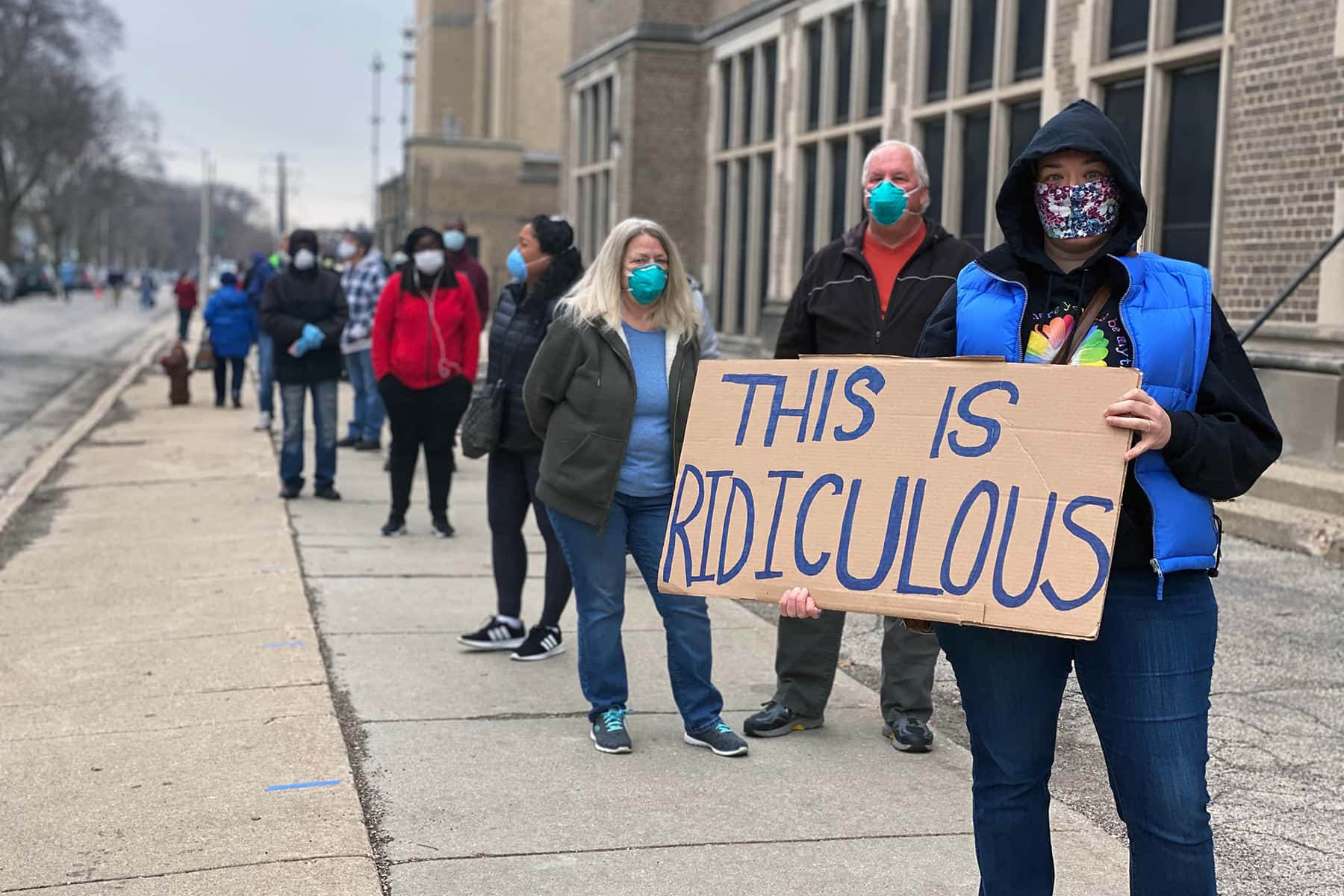
Trump’s continuing failure to mobilize the country against Covid-19, a failure unparalleled in any other first-world nation, has made the prospect of voting in person in November risky. (It is still unclear how many infections resulted in Wisconsin after the Republican legislature forced voters to wait in long lines to vote in the state’s primary.) Certainly the prospect of voting in person has become less attractive, particularly to citizens with prior conditions that make them especially vulnerable.

Voting by mail, which states like Washington have been doing for years anyway, is the obvious solution. But that’s only if you want people to vote and to have their votes counted. If you’re trailing badly in the polls, as Trump is, and might be looking for an excuse to influence or challenge or ignore the election results, raising uncertainty about voting by mail is one possible strategy. And the best way to cast doubt on the viability of voting by mail is to cast doubt on the Post Office’s ability to deliver ballots in a timely way, particularly if those ballots are mailed from zip codes known to include many Democrats.

“If carriers are being told that, at the end of your shift, you need to be back at the office even if you haven’t collected all the mail that day, there could be ballots in those mailboxes,” says Tammy Patrick, a senior adviser at the nonprofit Democracy Fund Voice and a former Obama appointee to the Commission on Election Administration, a panel created in 2013 to identify best practices in running elections. “If the truck drivers are being told, ‘You leave the post office to take that day’s mail to the processing plant at your scheduled time to leave, even if all the carriers aren’t back in yet with that day’s mail,’ that can have an impact.”

And so the Trump donor newly installed as Postmaster General is intentionally slowing down the mail: eliminating overtime, getting rid of sorting machines, and in general gumming up the works. Trump has been quite open about what he’s doing. Commenting on negotiations on a new Covid-response package, Trump told Fox News:

If we don’t make a deal, that means they don’t get the money [for the Post Office]. That means they can’t have universal mail-in voting; they just can’t have it.

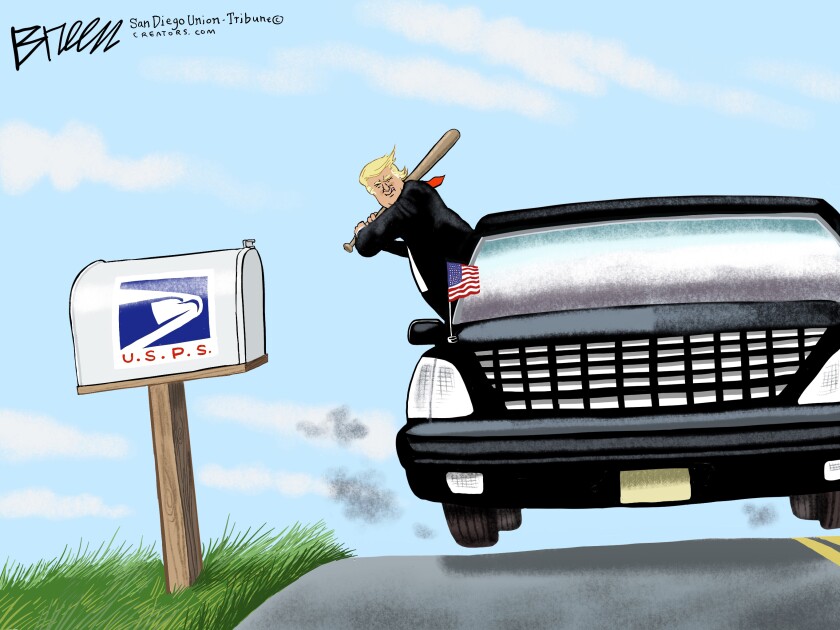
In any past election, it would be inconceivable that the President would be manipulating the Post Office in an effort to stay in power. But something has changed during the Trump administration: It’s not your Post Office any more, it’s his Post Office.

That’s how autocracy works.

The Election: Worry or Don’t Worry?

Biden’s lead in the polls has Democrats searching for what could possibly go wrong. But some worries should be taken less seriously than others.


Just about every Democrat I know wants to punish him/herself for being overconfident in 2016. Some of us have practical regrets, and wish we’d done more to put Hillary over the top, while others less rationally feel like we jinxed her by saying too loudly that she was going to win. But whatever we did or didn’t do then, we’re now determined to make ourselves suffer by refusing to accept any good news about Joe Biden’s chances. No matter what the polls say, something is going to go horribly wrong.

For what it’s worth, I think we’re going to win this. Not that there’s nothing to worry about, but some of our worries are less serious than others. Let’s assess them one by one.

Worry #1. The polls are wrong.

Biden’s average margin in national polls is somewhere in the 8-9% range, and has been there since mid-June. More importantly, he has solid leads in the swing states he needs to win: Pennsylvania, Michigan, and Wisconsin. If he fails in one of those states, polls also give him a good shot at flipping Florida, Arizona, or North Carolina. And even Republican strongholds like Texas and Georgia are not completely out of reach.

But Democrats remember how confident we felt in 2016, and look for reasons to doubt the polls. Republicans, on the other hand, live in constant denial of reality, and doubt the polls because they don’t want them to be true. Poll-skeptics make two related arguments.

  • The polls were wrong in 2016, so why should we trust them now?
  • There is a “hidden” Trump voter that the polls either can’t count or don’t want to count.

Neither really holds water, as long as you remember that polls are snapshots of public opinion at a moment in time, and not predictions of what people will think or do months from now.

The first thing to understand is that the final polls in 2016 were not far off from the vote totals, and to the extent they were, the more likely explanation is that Comey’s reopening of the Clinton email investigation gave Trump late momentum. The polls probably weren’t wrong at the moment they were taken; but a small shift in public opinion at the last minute put Trump over the top.

Nationally, the final 2016 RCP polling average had Clinton up by 3.3%. Her actual margin in the national popular vote was 2.1%. In Pennsylvania and Michigan the polls were off by a bit more — but still not that much. And in both cases, Trump had been gaining in the final week. The only real surprise was Wisconsin, where Clinton led by 6.5% in the final polls and lost by 0.7%.

But in 2018, the reverse happened: The final general congressional ballot polls had the Democrats up by 7.3%, and their margin in the vote totals was larger: 8.4%.

So if there were “hidden Trump voters” in 2016, were their “hidden Democrats” in 2018? Or is there always a small shift in the final days and hours of a campaign?

For what my opinion is worth, I expect the 2020 last-minute shift to be in Biden’s favor. Late in a campaign, a certain number of voters are just sick of all the noise. This year in particular, those voters will be sick of four years of noise; the thought that the loud, obnoxious Trump Era could be over will just be irresistible.

Assessment: Don’t worry about this. Things could change before Election Day, but Biden really is ahead right now.

Worry #2. Trump will stage a remarkable comeback.

In the Trump Era, when every day brings a a few week’s worth of news, three months is a very long time. A month ago, who was predicting that Portland would be invaded by DHS secret police? So all kinds of things can happen before Election Day, and you can expect Trump to push all the buttons and turn all the knobs as he tries to change the public’s opinion of him.

However, nothing he’s trying right now is working at all, or is likely to work if he just keeps at it and pushes harder. Unleashing his goons on Portland was supposed to produce a wave of support for the “law-and-order President” (who is strangely indifferent when people in his administration break the law). But in the latest Ipsos poll, 52% of Americans say the federal response to protests made things worse, with only 30% saying it made them better.

The not-all-that-veiled racism of his “Suburban Lifestyle Dream” tweet doesn’t seem to be going over all that well either. Suburbs aren’t what they were in the 1950s. Black people already live there (though still not in proportionate numbers), so they aren’t as easy to demonize. And a suburb anywhere near high-tech industries (like Bedford, Massachusetts, where I live) is going to include lots of residents of East Asian or South Asian ancestry. If you’re looking for the lily-white experience, you have to go to ex-urbs or rural small towns.

A second factor: His ability to change tactics is limited by his inability to admit mistakes or take responsibility for bad outcomes. So he has to keep doubling down on points that the public already knows are false. Like: the virus really is spreading, it’s not just that we’re testing more. That stopped fooling anyone other than Trump diehards weeks ago, but he can’t stop saying it.

And it’s not just him. The Trumpists who picture a comeback have to engage in such flights of fancy that reading their scenarios makes me more confident, not less. For example, Grady Means published an op-ed Wednesday in The Hill: “Buy the Dip: Bet on Trump“. In Means’ fantasy world, Trump has done a great job and had a great strategy going into this year, but after Covid-19 got rolling “the president has been a complete failure at playing his winning hand.”

The mainstream media and social networks stepped up their withering and relentless Trump-attacks. Statistically meaningless (increased testing and obvious selection bias) COVID-19 “cases” data were weaponized into a strategy of continued lockdowns and sustained school closures.

That’s Trump’s problem — not that America on his watch has objectively screwed up its pandemic response worse than any other rich country, or that people are genuinely hurting economically with no relief in sight. No, it’s that the media has made something out of nothing, and convinced the public to shut down businesses and schools when the virus isn’t really out of control at all. As soon as Americans realize the virus is already beaten, learn to ignore the hundreds of thousands of bodies piling up in the corner, and recognize what a great job Trump has done on the pandemic and everything else, he’ll surge again.

I just can’t picture that plan succeeding.

If Trump is going to stage a comeback, it’s going to have to be through an October surprise: either foreign help (like he got from Russia in 2016 and tried to extort from Ukraine this time around) or some headline-making indictments from the Barr/Durham investigation of the investigators. In either case, whatever anti-Biden “scandal” Trump manages to puff up will probably have little substance, and the public will have been well warned.

Assessment: Worry a little. In particular, worry enough to keep doing whatever you can to ensure a Biden victory. (If we overshoot and wind up with a landslide, that might teach Republicans to give up not just on Trump, but on Trumpist fascism in general — no Tucker Carlson or Tom Cotton in 2024.) But if anxiety about a Trump comeback is causing you to lose sleep or plunge into depression, feel free to put it out of your mind.

3. Trump might lose the election, but refuse to leave office.

It’s important to keep two things in mind:

  • The power of the president functions almost entirely through other people.
  • The White House is a symbolic place, but has no legal or institutional significance.

So while it’s very easy to imagine Trump barricading himself in the Oval Office on January 20 and tweeting endlessly about voter fraud and how he’s still president, if the people who make up the government stop taking his orders, he’s not president any more. Removing him from the White House would become a problem for the Secret Service, aided by mental health professionals.

The transition-of-power process defined by the Constitution and implemented in various state and federal laws goes like this:

  • On November 3, an election is held — or rather 51 separate elections are held in the states and the District of Columbia. This date could be changed, but only by Congress. The Constitution says: “The Congress may determine the Time of chusing the Electors”. Votes are counted by local officials, until at some point a state official verifies the names of the electors who will represent that state in the Electoral College.
  • On December 14 (the first Monday after the second Wednesday in December), the electors cast their votes. Like Election Day, this date was set by Congress and can only be changed by Congress. (The same sentence in the Constitution continues: “The Congress may determine … the Day on which [the Electors] shall give their Votes; which Day shall be the same throughout the United States.”) The electors meet in their own states, vote, and send the vote totals to Congress.
  • On January 6, a joint session of Congress meets and the electoral votes are officially counted. (This is the new Congress, with the new representatives and senators elected in November. The new terms start on January 3.) Whatever disputes there might be — rival slates of electors and so on — Congress has the authority to resolve them. The new president will be who the new Congress says it is.
  • On January 20, the new president is inaugurated, swearing an oath specified in the Constitution. There are lots of traditions around the inauguration — it happens just outside the Capitol, the Chief Justice administers the oath, the oath is sworn on a Bible or whatever book the new president holds sacred — but none of that is required.

Here’s something I have great faith in: If the joint session of Congress on January 6 recognizes that Joe Biden has received the majority of electoral votes, he will become president at noon on January 20 and the government will obey his orders. Where Donald Trump is at the time, and whatever he is claiming or tweeting, will be of no consequence.

If Trump’s tweets bring a bunch of right-wing militiamen into the streets with their AR-15s, they can cause a lot of bloodshed, but they can’t keep Trump in office. They are no match for the Army, whose Commander-in-Chief will be Joe Biden.

So if Trump wants to stay on as president, he has to screw the process up sooner; by January 6, it’s all in the bag, and probably it’s all in the bag by December 14. Even stretching out the process with legal proceedings won’t help him: The Constitution specifies that his term ends on January 20. If at that time there is no new president or vice president to take over, the job devolves to the Speaker of the House, who I believe will be Nancy Pelosi.

Assessment: Worry about the ways that Trump might screw with the electoral process (which we’ll get to), but not that he will just refuse to leave the White House.

4. Republican state legislators will overrule the voters and give their state’s electoral votes to Trump.

Awarding a state’s electoral votes to the candidate who wins that state’s popular vote is so traditional that most people think it must be in the Constitution, but it isn’t. The sum total of the Constitution‘s instructions are:

Each State shall appoint, in such Manner as the Legislature thereof may direct, a Number of Electors, equal to the whole Number of Senators and Representatives to which the State may be entitled in the Congress

So, at least in theory, a legislature could ignore the popular vote and appoint anybody it wants to the Electoral College. However, states have codified their current processes in law, and a new law would have to be passed to circumvent that process. The swing states people are most worried about — Michigan, Pennsylvania, and Wisconsin — have been gerrymandered to lock in Republican majorities in the legislatures, but they have Democratic governors who would veto a law to hand Trump the state’s electoral votes. Republicans don’t have enough votes to override a veto.

Assuming Trump wins at least one of those states legitimately, though — or manages to suppress enough Democratic votes to get a majority — Biden could still win if he carries Florida, Arizona, or North Carolina. North Carolina, like Michigan, Pennsylvania, and Wisconsin, has a Democratic governor and enough Democrats in the legislature to sustain a veto. So Trump needs to win the popular vote there, too.

That leaves Florida and Arizona, where Republicans have unified control of state government. (You could also talk about Texas and Georgia, but if Biden wins the popular vote in either of those states, he’ll have such a landslide that no amount of backroom finagling could undo it.) Would they dare reverse the decision of their state’s voters? This would be a truly outrageous thing to do — even some people who vote for Trump aren’t going to like the idea that their votes don’t count — and the people who do it would risk being villainized for life. So I can only imagine it happening under two conditions:

  • They’re sure it will work. This scheme only makes sense if it gives Trump a second term, where he can reward the people who put him in office. So they need to be sure their law will pass and their electoral votes will make Trump president again.
  • Something taints the vote-count that says Biden won. You could imagine a legislature legitimately awarding its electoral votes by special law, if it were clear that the popular vote was fraudulent in some way. (Imagine a surprise win by the previously unknown owner of the company that makes vote-counting machines. Wouldn’t you want your legislature to stop that?) Republicans would need to be able to argue that they were following the real will of the voters, which had been undone by fraud.

That, I think, is the point of Trump’s bogus assertions that voting-by-mail-is-unsafe and the polls are skewed. He’s setting up the argument Republican legislators will need if they want to throw the election his way.

There are a bunch of scenarios where Biden is safe from this:

  • He wins the popular vote in enough states that no single state flipping to Trump would reverse the outcome.
  • He wins three of these four states: Michigan, Wisconsin, Pennsylvania, and North Carolina.
  • He wins Florida and/or Arizona by enough votes that the fraud-made-the-difference argument loses credibility.

There’s also a wild card: If Democrats control both houses of the new Congress, they might decide to not to count the switched electoral votes. It would be an illegitimate, unconstitutional move, but hardball begets hardball. Trump might try to get the Supreme Court to rule against Congress, but it’s not clear they have jurisdiction. And if Congress simply refuses to declare a winner, Pelosi becomes president. (All this would do horrible damage to our political system, but if Republicans don’t care about that, why should Democrats?)

Assessment: Worry moderately. Probably we won’t wind up in a scenario where this is a possibility, and even if we did, it would only take a handful of Republicans with consciences to save democracy. Who knows? There might actually be enough of them.

4. A majority of Americans try to vote Trump out, but between voter suppression and the Electoral College, we fail.

During the impeachment process, Republicans liked to orate on the awesome standards necessary to reverse the choice of the American voters. But of course, the voters did not choose Trump — the Electoral College did. Trump got only 46% of the vote: 66 million votes to Hillary Clinton’s 69 million. His approval has never gone much above that 46% — largely because he has governed as if the other 54% doesn’t count — and is now hovering somewhere around 41%. Quite possibly, there has never been a moment when a majority of the American people supported Trump.

It’s easy to imagine the same thing happening again: Biden piling up millions more votes than Trump in California and New York, while losing by a few thousand in Florida and Wisconsin. With the usual Republican margin in Texas shrinking, the effect could be even more extreme in 2020 than it was in 2016: Biden might get as many as 5 million more votes than Trump, and still not become president.

What’s more, Republican voter suppression efforts are in high gear, and have already shown some success: By a wide margin, the voters of Florida voted in 2018 to re-enfranchise felons who have served their time — nearly 1.4 million Floridians. But yielding to the will of the people is not what the Republican Party is about.

The GOP-controlled Legislature, however, sought to limit the effects of the amendment by passing a law that conditioned the right to vote on payment of all fees, fines and restitution that were part of the sentence in each felon’s case. The state, however, had no central listing of this information, and the Legislature created no system to help felons ascertain how much, if anything, they owed. Even the state ultimately agreed that it would take six years to create such a system. … The estimated 85,000 who are already registered could be prosecuted if they vote and it turns out they have not paid the fees or fines owed.

The Supreme Court, which has consistently favored Republican voter-suppression efforts sincre John Roberts’ evisceration of the Voting Rights Act in 2013, thought this was a fine law.

Covid-19 has created new opportunities for mischief, as we saw in Wisconsin in April. The Republican-through-gerrymandering legislature insisted on few polling places and long lines, and resisted the Democratic governor’s attempt to institute vote-by-mail, or even to extend the deadline for submitting an absentee ballot to allow for the fact that many ballots were not mailed out on time. Research indicates that the brave Wisconsinites who came out to vote anyway could not fully avoid spreading the virus.

Nationally, Republicans are doubling down on this yield-or-die strategy for the fall. They are fighting vote-by-mail in states all over the country, trying to force people to brave the virus-spreading crowds if they want to vote. Worse, Trump is intentionally slowing down the mail, which could well result in a Wisconsin-like situation for the whole country: People can’t receive their mail-in ballots and return them soon enough to count. Some of the more obvious suppression tactics include not counting Michigan ballots that arrive late, even if they were postmarked before Election Day (“inherent variations in mail delivery schedules could result in one person having the ballot counted and another not, even if they send them back on the same day”), and trying to stop Pennsylvania from providing drop-off boxes for people who are afraid their mail-in ballots won’t arrive in time. These attempts come wrapped in rhetoric about “election security”, but they’re transparent attempts to keep legal voters from successfully submitting their votes.

I think there’s reason to hope that these efforts will boomerang, and that the more Trump tries to keep Americans from voting, the more determined we will be. In Wisconsin, the people who did risk their lives to vote were pretty pissed off by the time they got to the booth. The Republican Supreme Court candidate this tactic was supposed to save got defeated anyway.

All over the country, people have to be asking themselves: “Why don’t Republicans want me to vote?” Trump is giving Democrats an issue, and we need to run with it. He wants to paint liberals as people who hate America, but this part of Barack Obama’s eulogy for John Lewis sounds pretty fundamental to what America is supposed to mean:

Once we pass the John Lewis Voting Rights Act, we should keep marching to make it even better by making sure every American is automatically registered to vote, including former inmates who’ve earned their second chance. By adding polling places and expanding early voting and making Election Day a national holiday, so if you are somebody who’s working in a factory or you’re a single mom, who’s got to go to her job and doesn’t get time off, you can still cast your ballot. By guaranteeing that every American citizen has equal representation in our government, including the American citizens who live in Washington, D.C., and in Puerto Rico. They’re Americans. By ending some of the partisan gerrymandering, so that all voters have the power to choose their politicians, not the other way around. And if all this takes eliminating the filibuster, another Jim Crow relic, in order to secure the God-given rights of every American, then that’s what we should do.

Who hates America now, Mr. Trump? Not LeBron James, who together with other NBA stars is donating $100K to pay the fees of Florida felons, so that they can vote. We all need to be looking for ways that we can help our fellow Americans vote, and for ways to call out the anti-American politicians who are trying to stop them.

The ultimate voter suppression would be for Trump to deploy his storm troopers Portland-style in swing-state Democratic strongholds like Philadelphia and Milwaukee, harassing people in front of polling places. We can hope that mayors and governors will not stand for that, and that the police will obey their local orders rather than side with the feds. It could get ugly, and again, could boomerang against Trump. Hopefully his advisors will convince him that it will.

Assessment: Trump can put his thumb on the scale, but only up to a point. It shouldn’t have to be this hard to get rid of him, but it is. I think we’re up to the challenge. So worry enough to take action, but not so much that you paralyze yourself.

5. Trump will lose and leave office, but he’ll trash the country on his way out the door.

Of course he will. This isn’t even something to worry about, just start getting ready for it. It’s going to happen.

Look for a flurry of pardons for all his henchmen (and probably himself, leading to an interesting legal battle), abrupt closures of American bases in any country that hasn’t treated him as well as he thinks he deserves, and at least one more big favor to pay off his debt to Vladimir Putin. (Putin would be crazy not to invade Estonia or something as soon as Trump loses.) And what’s more important: Taiwan’s independence, or a new Trump Tower in Shanghai?

Biden is going to have a historic mess to clean up when he takes office. But I believe he will take office.

Who Are Those Guys?

Customs and Border Protection has finally claimed the anonymous federal law enforcement agents who have been abducting people off the streets in Portland. But it still won’t say who they are or exactly what they’re doing.


Often, when the Trump administration is described in totalitarian terms, it’s hyperbole, or at least debatable.

So, for example, describing ICE as a “Gestapo” is hyperbole. They violate civil rights and are out of control in a lot of ways, but comparisons to the Gestapo are overblown. Similarly, there has been debate (yes and no) about whether the detention facilities that hold legal asylum seekers and unauthorized border-crossers qualify as “concentration camps”. (My opinion: Yes, as long as we remember that concentration camps are not always death camps. Concentration camps isolate unpopular and dehumanized groups in harsh conditions outside of public view; death camps target them for extermination. Dachau was a concentration camp when it opened in 1933, but it didn’t become a death camp until much later.)

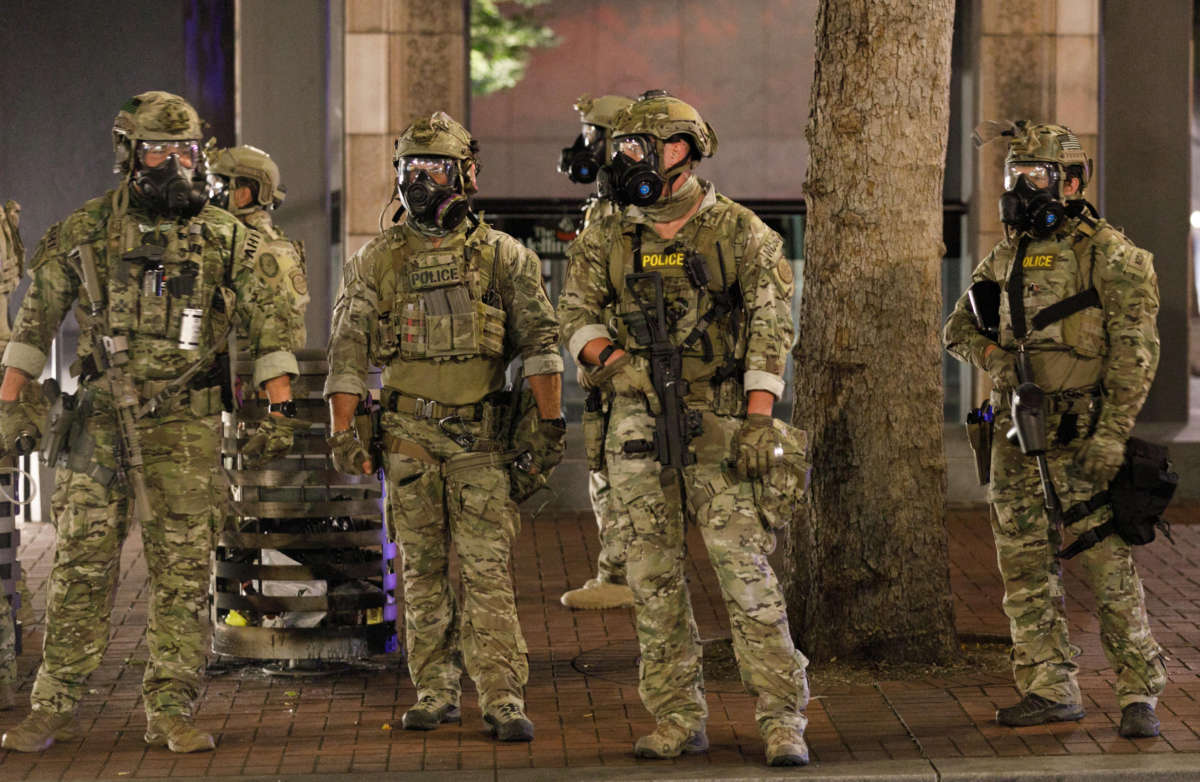
However, the federal law enforcement agents who have been roaming around Portland this last week are literally “secret police” — no hyperbole, no exaggeration. Their uniforms say POLICE, but do not identify what federal agency they are from or who the individual officers are. They cover their faces, drive unmarked vehicles, and grab people off the street without identifying themselves, their unit, the reason for the arrest, or where they are taking their victims. If right-wing militia groups start putting POLICE patches on their camo uniforms and kidnapping protest leaders, no one will know the difference; neither their appearance nor their behavior will give them away.

So that’s where we are: We’ve crossed one more bridge on the road to fascism, and it’s arguable that we’ve already arrived. Let’s think about how we got here.

Lafayette Square. On June 1, after the peaceful protests of George Floyd’s murder had also spawned looting and property damage in cities across the nation, President Trump called for law enforcement to “dominate the streets“. He urged governors to call in the National Guard, and made the following threat:

“If a city or state refuses to take the actions necessary to defend the life and property of their residents, then I will deploy the United States military and quickly solve the problem for them,” Trump said, referring to himself as “your president of law and order and an ally of all peaceful protesters.”

He said he was already dispatching “thousands and thousands of heavily armed soldiers, military personnel and law enforcement officers” to Washington to stop the violence that has been a feature of the protests here.

While he was speaking, federal law enforcement agents of various stripes attacked peaceful protesters near the White House, pushing them out of Lafayette Square so that Trump could have his infamous hold-up-the-Bible photo op at historic St. John’s Episcopal Church.

Meanwhile, active-duty troops were being deployed to the DC area. Unnamed sources claimed Trump wanted to deploy 10,000 troops. Fortunately, generals and Pentagon civilians all the way up to Defense Secretary Esper pushed back, arguing that suppressing domestic dissent is not the military’s role. (I’m guessing the 10,000-troop story was leaked by a military person who wanted the plan stopped.) In the end, active-duty troops were never used against protesters and were withdrawn, but not before the incident “badly strained relations between Mr. Trump and the military”.

From Trump’s point of view, though, the week had one bright spot. The regular military might be reluctant to take the field against American protesters, but he did identify a force he could use: a motley assortment of armed federal law enforcement agents temporarily commanded by Attorney General Bill Barr.

Few sights from the nation’s protests in recent days have seemed more dystopian than the appearance of rows of heavily-armed riot police around Washington in drab military-style uniforms with no insignia, identifying emblems or name badges. Many of the apparently federal agents have refused to identify which agency they work for.

In the words of Butch Cassidy: “Who are those guys?”

It turns out that the federal government has something like 132,000 law enforcement officers spread out over dozens of agencies in multiple departments. Yahoo News called the roll:

The show of force outside the White House is a task force operation that includes U.S. Secret Service, National Guard, Customs and Border Protection, and U.S. Park Police, … Federal Protective Service, … elite SWAT teams from the Border Patrol and sniper-trained units from ICE have also descended upon Washington. TSA’s air marshals arrived too, and three of the agency’s “VIPR teams,” which have previously faced criticism for not coordinating well with local law enforcement. Eight Coast Guard investigators were deputized by the Department of Justice upon arrival in Washington, though it remains unclear how they are being deployed.

Which raises an obvious question: What kind of rules apply to people from one agency deputized by another? The rules of their home agency? Their temporary commander’s? None? There are all kinds of restrictions, both legal and institutional, on what the President can or can’t do with the military inside our borders. But these guys, apparently, not so much. Through the years, whenever Congress increased the budgets of the Bureau of Prisons or ATF or one of the dozens of other armed law enforcement agencies, who realized they were helping build a 132,000-man Praetorian Guard?

As democracy-threatening as this seemed in June, though, comforting speculation held that DC’s special relationship with the federal government made it unique. (That even became an argument for DC statehood.) Surely these little green men could never be deployed in a state over the objection of its governor.

After all, this is America.

The Portland protests. The George Floyd protests have had remarkable longevity, challenging the conventional wisdom that the Powers That Be can always wait these things out. But nothing lasts forever, and by July 1, even Seattle’s famous CHOP autonomous zone had been reclaimed by local authorities.

In Portland, however, the spirit of resistance is still very much alive. Friday marked the 50th day of protest. OregonLive describes the situation like this:

Portland has experienced weeks of daily protests since the death of George Floyd at the hands of Minnesota police. The largest of them, involving thousands of people chanting and marching for racial justice and police non-violence, have been peaceful.

But almost like clockwork, tensions flare late at night between law enforcement officers stationed at the Justice Center and courthouse and a crowd of 20- and 30-something demonstrators, a small number of whom toss projectiles at police, shine lasers in their eyes or otherwise poke and prod officers to engage.

… Although the Justice Center and federal courthouse are covered with angry graffiti decrying police, evidence of other demonstrations in the city are scarce.

But you get a different sense from local journalist Robert Evans, who has been covering the nightly clashes, which he describes as “as close up to the line as you can get to actual war without live rounds”.

The craziest night so far was July 4, where kids stockpiled thousands of dollars in illegal fireworks. They were in the center of downtown where the bulk of the protests happened around the Justice Center.

It started as drunken party, more or less. At random, cops began shooting into the crowd. Protesters coalesced around the idea of firing commercial-grade fireworks into the Justice Center and Federal Courthouse. You had law enforcement firing rubber bullets, foam bullets, pepper balls and tear gas as crowds circled in around the courthouse firing rockets into the side of the building. That went on for a shocking length of time — there was this running three-hour street battle. I couldn’t tell whose explosions were whose.

Trumpist media and administration spokespeople have been desperate for something to talk about other than Trump’s failure to control the coronavirus pandemic, and so they have seized on “mob rule” as a theme, with Portland as a prime example of a city “under siege”. But OregonLive pushes back against that narrative: “A tour of the town shows otherwise.”

The images that populate national media feeds, however, come almost exclusively from a tiny point of the city: a 12-block area surrounding the Justice Center and federal courthouse. And they occur exclusively during late-night hours in which only a couple hundred or fewer protesters and scores of police officers are out in the city’s coronavirus-hollowed downtown.

Daily life in Portland is greatly restricted by the virus, but is barely affected by the demonstrations. Evans agrees:

One of the things I think people get wrong about this place, though, is that they see the protests and the right-wing coverage and the city is depicted as convulsed and collapsing. It’s just not true. You go three blocks from the center of downtown and life goes on as normal. Where I live, you could go every day and see no real signs of the protests.

Having totally given up on doing anything to combat the virus, though, Trump had to be seen doing something about something. And so he intervened in Portland.

DHS’ little green men. If you get your view of the world through Fox News, you understand that the biggest current threat to the United States and the American way of life is not the virus that has killed nearly 140,000 of us with no end in sight. No, it is the wanton destruction of our historical statues and monuments. Any time I have channel-scanned through the Fox News evening line-up in the last month, that’s what they’ve been talking about.

To combat this scourge, on June 26 President Trump heroically signed the “Executive Order on Protecting American Monuments, Memorials, and Statues and Combating Recent Criminal Violence“. If you read past the polemics all the way to the end, you’ll find this authorization:

Upon the request of the Secretary of the Interior, the Secretary of Homeland Security, or the Administrator of General Services, the Secretary of Defense, the Attorney General, and the Secretary of Homeland Security shall provide, as appropriate and consistent with applicable law, personnel to assist with the protection of Federal monuments, memorials, statues, or property.

He’s talking about the 132,000 federal law enforcement agents, the Little Green Men. And unlike in a riot or a natural disaster where a governor might ask for the help of the National Guard, here one part of the federal government asks another part to send the Little Green Men. The Secretary of Homeland Security, you might notice, is authorized to ask himself for assistance.

As it happens, we don’t have a Secretary of Homeland Security, and haven’t since Trump forced Kirstjen Nielsen to resign in April, 2019 because she “pushed back on his demands to break the law“. Since then we’ve had acting DHS secretaries, because Trump says “I like acting. It gives me more flexibility.” (In fact, Josh Marshall observes that every DHS official who figures in this story is acting: “acting secretary, acting deputy secretary and acting head of CBP. Not one of these men has been confirmed by the Senate to act in this role.” Having avoided confirmation hearings where senators might demand promises or commitments, all three get their authority from and owe their allegiance to no one but Trump.)

So Acting DHS Secretary Chad Wolf responded to Trump’s executive order by creating the Protecting American Communities Task Force (PACT) “a special task force to coordinate Departmental law enforcement agency assets in protecting our nation’s historic monuments, memorials, statues, and federal facilities”. The PACT announcement quotes Wolf: “We won’t stand idly by while violent anarchists and rioters seek not only to vandalize and destroy the symbols of our nation, but to disrupt law and order and sow chaos in our communities.” (“Violent anarchist” is a phrase you’ll hear again. It is to the Trump administration what “terrorist” was to the Bush administration: a term stripped of all its original meanings until it is simply an insult, i.e., “someone we don’t like”.)

Notice the subtle shift: We’re not talking about statues of Andrew Jackson any more, as Trump was when he signed the executive order. We’re talking about “federal facilities” like the Mark Hatfield Courthouse in Portland, the courthouse mentioned above. PACT’s mission also extends beyond “protecting” those facilities to the much more nebulous goal of maintaining “law and order” and fighting “chaos in our communities”. But the Hatfield Courthouse is more than just a center of “chaos”, it is also the scene of a heinous crime: graffiti.

Maybe the Trump administration will stand idly by while American coronavirus deaths once again approach a thousand a day, and maybe it will do nothing when Putin puts bounties on the lives of our soldiers in Afghanistan, but graffiti on a federal courthouse is an affront up with which it will not put.

Send in the Little Green Men.

The federal invasion of Portland. Sometime after the Fourth of July — no one seems to know exactly when, because there wasn’t an announcement — unidentified federal law enforcement agents from no particular agency began battling protesters alongside the Portland police. And they did not just support the local officials, they significantly escalated the violence. Here’s Robert Evans again:

Since the feds got involved with police it’s gotten really brutal. I’d argue we’ve seen more police brutality in the last 50 days from Portland Police Department than anywhere else in the country. It’s brutal but it’s also predictable. There are rhythms to the way police work. It’s become an orchestrated dance with both sides.

There are warnings and kicking people out of the demonstration area. But the feds have deliberately defied the rhythms. Last Saturday [July 11], the crowd was 100 or so. It was very chill — nothing going on beyond the now-normal occupation of the Justice Center. And feds came out grabbing people seemingly at random and beating people with sticks. There was the kid who got shot in the head and his skull was fractured. The federal law enforcement violence is unpredictable violence.

The “kid shot in the head” was Donovan LaBella, and we have the shooting on video. The Oregonian summarized in a tweet:

Video shows nothing suggesting that La Bella, 26, who was standing across the street from the federal courthouse holding a speaker over his head, was a threat to anyone.

What appears to be a tear gas canister bounces in front of him. He kicks at it, bends down to toss it underhanded into the street, and lifts up his speaker again. Then he goes down, apparently struck by a sponge grenade or some other “less lethal” projectile that is never supposed to be aimed at someone’s head. (LaBella’s sister says he’s making a “remarkable recovery“, but the photo of his stitched-up forehead looks pretty gruesome.)

Who shot LaBella? Hard to say. Some unmarked federal agent in camo with a mask on, from some unnamed federal law enforcement agency.

How actions like this protect federal facilities is hard to figure. And then the abductions started.

Unmarked vans. NPR reports:

Federal law enforcement officers have been using unmarked vehicles to drive around downtown Portland and detain protesters since at least Tuesday. Personal accounts and multiple videos posted online show the officers driving up to people, detaining individuals with no explanation about why they are being arrested, and driving off.

To the people being kidnapped arrested, it’s not obvious that their abductors the officers are police at all.

“I see guys in camo,” O’Shea said. “Four or five of them pop out, open the door and it was just like, ‘Oh s**t. I don’t know who you are or what you want with us.'”

See any identifying marks?

And again the question: Who are these guys? As this widely shared video shows, two agents in camo with no label other than POLICE grab somebody off an empty street and throw him into a van. They are repeatedly asked who they are and what they’re doing, but they do not respond.

For hours no one knew who the masked kidnappers were working for. But eventually, Customs and Border Protection took responsibility for that particular “arrest”. (In an interview, though, Acting Deputy Secretary Ken Cuccinelli identified Federal Protective Services as the lead agency; CBP is assisting them.) Their statement is a series of lies wildly inconsistent with the video, or with numerous accounts of similar abductions.

CBP agents had information indicating the person in the video was suspected of assaults against federal agents or destruction of federal property.  Once CBP agents approached the suspect, a large and violent mob moved towards their location.  For everyone’s safety, CBP agents quickly moved the suspect to a safer location for further questioning.  The CBP agents identified themselves and were wearing CBP insignia during the encounter. The names of the agents were not displayed due to recent doxing incidents against law enforcement personnel who serve and protect our country.

In fact, the street is virtually empty. The officers do not identify themselves, and if you can spot any insignia other than POLICE on their uniforms, you’re sharper than I am. I’m also struck by the “suspected of assaults against federal agents OR destruction of federal property”. The “or” suggests that this is a generic explanation rather than the specific reason for this particular arrest. Whoever wrote the statement probably has no more idea why the suspect was arrested than we do.

Robert Evans reports:

I’ve seen them rolling around in the vans and tackling people. My partner has watched them do a few snatch and grabs. The difference is they’re not cops. They go after people like soldiers, where the goal is to be unpredictable.

Acting Secretary Wolf’s justification of the entire operation, which didn’t appear until Thursday, is ridiculous. The phrase “violent anarchists” appears 72 times, along with a list of their “violent” crimes, which mostly consist of tagging the Hatfield Courthouse with graffiti. One “violent anarchist” was caught with a loaded weapon, but there is no report of the weapon being brandished or fired. (Compare to the AR-15 toting conservative protesters at the Michigan State House in May, whom Trump supported by tweeting “LIBERATE MICHIGAN”.)

OregonLive responded:

It’s telling that in Wolf’s extensive listing of incidents over the past several weeks, he neglects to mention the most violent act of these protests – a deputy U.S. marshal’s shooting of Donavan La Bella in the face with an impact munition. … That Wolf would fail to even acknowledge such a severe injury exposes how suspect his definition of “violence” is.

(OL appears to just be guessing who the shooter works for; I don’t believe the Marshals have claimed responsibility.) To repeat: “violent anarchist” has no meaning. It’s just an insult; it tags someone as an enemy.

Remember federalism? One hallmark of the Trump Era is that any principles conservatives used to claim — free trade, standing by allies, fiscal responsibility, the importance of character — have been exposed as hollow. One such relic of the age of principled conservatism is federalism: the doctrine that states share sovereignty with the federal government, and are not just subjects of federal rule.

Under federalism, policing is a state responsibility. In this case, it’s important to bear in mind that no local official asked for the federal government’s help in dealing with the protests. Acting Secretary Wolf did not even make a courtesy call to tell Oregon Governor Kate Brown or Portland Mayor Ted Wheeler what he was planning to do. This whole episode began not with an offer of help, but with Trump’s threat: “If a city or state refuses to take the actions necessary to defend the life and property of their residents, then I will deploy the United States military and quickly solve the problem for them.

That’s how this all came about: Trump and/or Wolf came to the conclusion that Portland was not treating protesters harshly enough, so Wolf asked himself to intervene.

Now that they have had a chance to see what DHS is doing, local officials at all levels have asked the federal agents to leave. Governor Brown tweeted:

This political theater from President Trump has nothing to do with public safety. The President is failing to lead this nation. Now he is deploying federal officers to patrol the streets of Portland in a blatant abuse of power by the federal government. I told Acting Secretary Wolf that the federal government should remove all federal officers from our streets. His response showed me he is on a mission to provoke confrontation for political purposes. He is putting both Oregonians and local law enforcement officers in harm’s way.

And Mayor Wheeler acknowledged the government’s right to protect its buildings, but called for it to pull its agents off the streets:

I have no problem with the federal government and federal officers inside their facilities protecting their facilities. That’s what they do. That’s what they always do. What I have a problem with is them leaving the facilities and going out onto the streets of this community and then escalating an already tense situation like they did the other night.

Subsequently he made a stronger plea:

Their presence is neither wanted nor is it helpful and we’re asking them to leave. In fact, we’re demanding that they leave.

To which Acting Deputy Secretary Cuccinelli responded:

We don’t have any plans to do that. When the violence recedes, then that is when we would look at that. This isn’t intended to be a permanent arrangement, but it will last as long as the violence demands additional support to contend with.

Also:

Oregon Attorney General Ellen Rosenblum filed a federal lawsuit against Homeland Security and its subagencies Friday alleging the federal government had violated Oregonians’ civil rights by seizing and detaining them without probable cause during protests against police brutality in the past week.

Oregon’s senior Senator Ron Wyden:

The Trump administration’s claim that DHS police are needed to enforce the president’s executive order to protect statues is laughable. Terrorizing peaceful protesters and arresting people for graffiti and other nonviolent offenses has nothing to do with securing federal property. My colleagues and I in the Oregon delegation have demanded that these occupying troops leave Portland, demanded answers from the administration and called for an independent investigation. And this week, my fellow senator from Oregon, Jeff Merkley, and I will introduce a measure to require Trump to remove these unwanted forces from our city.

Senator Merkley made his own comment:

Authoritarian governments, not democratic republics, send unmarked authorities after protesters. These Trump/Barr tactics designed to eliminate any accountability are absolutely unacceptable in America, and must end.

As Governor Brown’s tweet indicates, Acting Secretary Wolf has refused to withdraw his Little Green Men. Acting Deputy Secretary Cuccinelli also refused to pull the LGM back to the federal facilities whose protection is the pretext for their presence.

And I fully expect that as long as people continue to be violent and to destroy property that we will attempt to identify those folks. We will pick them up in front of the courthouse. If we spot them elsewhere, we will pick them up elsewhere. And if we have a question about somebody’s identity – like the first example I noted to you – after questioning determine it isn’t someone of interest, then they get released. And that’s standard law enforcement procedure, and it’s going to continue as long as the violence continues.

Results 1. Sometimes when you break the rules, the results will give you an after-the-fact justification: The problem is solved now, so who’s going to complain? But that’s not the case in Portland. Instead, DHS’ authoritarian overreach has drawn increased local attention to the protests and raised local sympathy for the protesters.

While President Trump on Sunday described the unrest in Portland as a national threat involving “anarchists and agitators,” the protests have featured a wide array of demonstrators, many now galvanized by federal officers exemplifying the militarized enforcement that protesters have long denounced. Gatherings over the weekend grew to upward of 1,000 people — the largest crowds in weeks.

Saturday, mothers (some wearing bicycle helmets in case federal agents would decide to club them) formed a human chain between police and demonstrators and chanted: “Feds stay clear. Moms are here.” Sunday night, a similar group of mothers was in fact dispersed with clubs and gas. In the wee hours of Saturday morning, one woman had a creative response to the threat of police violence.

In one extraordinary moment, a woman, completely naked except for a face mask and a hat, strode through the protests and squared up to federal agents and did a series of ballet and yoga moves. The striking moment was captured on social media and the unidentified woman has been dubbed “Naked Athena.”

Police apparently didn’t know what to do next. OregonLive reported:

About 10 minutes after she arrived, the officers left. The woman left soon after without any additional fanfare. “She was incredibly vulnerable,” [Oregonian/OregonLive photographer Dave] Killen said. “It would have been incredibly painful to be shot with any of those munitions with no clothes on.”

One good place to get a play-by-play of the weekend demonstrations is the Twitter feed of journalist Donovan Farley.

On the whole, it’s hard to argue with Governor Brown’s assessment:

It’s simply like adding gasoline to a fire. What’s needed is de-escalation and dialogue. That’s how we solve problems here in the state of Oregon.

Results 2. How you judge results depends on what your goal is. If the goal is to end the nightly conflicts between police and protesters, and to restore “law and order”, then the federal intervention has been an abject failure.

But when has Trump ever tried to end conflict? Trump thrives on conflict. Arguably, it’s in his political interest to make things worse. The violent federal escalation and abuse of civil rights may annoy Oregonians, but Trump was never going to carry Oregon in November anyway. The more interesting question to him is: How is this playing in swing states? Governor Brown has it right:

Trump is looking for a confrontation in Oregon in the hopes of winning political points in Ohio or Iowa.

If Fox News can spin this as the President taking strong action to preserve law and order in a city where Democratic officials are unwilling to get tough with the violent anarchists, that’s all he wants. Even better if his “toughness” takes headlines away from his Covid-19 failure. And the more violence, the more headlines.

In short, he’s doing on the ground what he often does on Twitter: provoking a conflict with somebody his base doesn’t like in order to change the narrative from a story where he’s failing. Violent anarchists and feckless Democratic officials are playing the role usually reserved for black athletes like Colin Kaepernick or LeBron James, or charismatic women of color like AOC or Ilhan Omar.

Judged by that standard, Trump may think his intervention in Portland is going quite well.

Where it goes from here. PACT was not created to be a one-off, so Portland can be thought of as a test, a “dress rehearsal” (as Esquire’s Charles Pierce puts it) for a show that might be taken on the road all over the country. The groundwork is being laid to intervene in Chicago, whose black lesbian mayor has already been tagged a “derelict” by press secretary Kayleigh McEnany. A famously liberal city like San Francisco would also make a good target for Trumpist media. A Reichstag fire won’t be necessary; a few lines of graffiti on some federal building will suffice.

Three things are being tested in Portland:

  • Will the PACT agents do whatever they’re told, heedless of the rights of American citizens?
  • Will Trump get away with this legally, or will federal courts put his secret police under injunction? Will Congress intervene in some way?
  • Will Trump pay a political price, either in the media or by losing the support of the congressional Republicans who kept him in office in spite of the crimes he was impeached for?

The first test is clearly a success: Federal agents are acting like secret police in a classic banana republic, and there have been no signs of defections. No leaks, no scandalous stories attributed to anonymous sources.

Remarkably, Portland is a second-layer headline in both the New York Times and Washington Post this morning. You’ll find a Portland story if you scroll down, but they’re not calling your attention to it. I’ve also looked for a biting editorial cartoon on the subject and haven’t found one yet. So at the moment Trump is not paying a price in the mainstream media.

Elected Republicans are also ignoring the story, in spite of the traditional conservative principles being violated. (A satire article published after the first appearance of the Little Green Men in DC is being recirculated: “NRA Accidentally Forgets to Rise Up Against Tyrannical Government“.) It remains to be seen whether Democrats in Congress will insert some anti-LGM language into some must-pass appropriations bill, and whether Mitch McConnell will allow it.

Our best hope at the moment is the courts, where I don’t know what to expect. Neither do the folks at the LawFare blog, which is where I’m hoping to find insight before long. LF’s Steve Vladeck closes that article by wondering which would be worse: that the PACT agents are abusing their authority, or that all this is actually legal somehow?

The ultimate threat. As Trump continues to sink in the polls, more and more pundits raise the question: How will he try to cheat in the election? (The question “Will he try to cheat?” has already been answered. That’s what he was impeached for.) Various voter suppression schemes are brewing, and some are already working. Many of us are hard at work imagining scenarios where some combination of Covid-19 and voting by mail create new vote-stealing or vote-suppressing opportunities.

The true nightmare scenario is if he loses the election but refuses to leave office. Or perhaps he constructs some elaborate conspiracy theory in which the outcome of the election is doubtful, and decides to hang on until the doubt can be resolved to his satisfaction, which it never will be. Obviously, he can’t succeed in that plan entirely on his own, and different scenarios require different accomplices: Republicans in Congress, the Supreme Court, and so on.

If any of those play out (and I’m far from convinced they would) we could find ourselves in a true third-world-country situation, where the last line of defense is that the People refuse to accept a stolen election and take to the streets. In a typical third-world situation, the next question is: What does the Army do? An election-stealing President can often survive if the Army is willing to sweep into the major cities and put down protests.

One reason I have not worried too much about these scenarios is that I don’t think our Army would do that. The traditions of non-interference in the political process go all the way back to George Washington, and are very strong.

But Portland raises an additional question: What do the Little Green Men do? Could Trump really call his Praetorian Guard into the streets against the American people?

That too is being tested in Portland.

In the Land of “No We Can’t”

The Trump administration’s surrender to Covid-19 is just a symptom of a larger dysfunction. Whenever a problem calls for collective action, whether that problem is a disease, mass shootings, climate change, economic inequality, out-of-control police, chaotic elections, or systemic racism, Republicans tell us nothing can be done; we just have to live with it. And until we can banish them from positions of power, we do.


In 2008, a young black senator with an odd-sounding name, facing a well-known and well-financed rival with the full backing of his party’s establishment, won the Democratic nomination for president. He went on to a landslide victory in the fall, with large majorities in both houses of Congress riding on his coattails. The slogan he ran on was “Yes We Can”.

Like most effective political slogans — “Make America Great Again” has the same quality — “Yes We Can” meant different things to different people. Most obviously, African Americans heard it as: “Yes we can elect one of our own. We don’t have to pick our leader from a list of white men drawn up by other white men.” But depending on what you were listening for, “Yes We Can” could also mean: “Yes we can reform our healthcare system” or “Yes we can rebuild our infrastructure” or “Yes we can overcome inequality” or “Yes we can do something about climate change” or “Yes we can offer all our children a 21st-century education” or “Yes we can create enough jobs for everybody” or “Yes we can get our troops out of Iraq”.

In all of its interpretations, “Yes We Can” meant that we weren’t stuck. We aren’t doomed to watch our country (or planet) decay — perhaps retaining the freedom to complain about it, but not the power to choose a new course. Instead, we can band together, elect a government that represents our real interests, and focus the power of America on shaping the future we want.

Obama himself put it like this:

When the American people are determined that something is going to happen, then it happens. And if they are disaffected and cynical and fearful, and told that it can’t be done, then it doesn’t. I’m running for president because I want to tell them: Yes We Can.

Yes vs. No. Opposing “Yes We Can” is the Republican belief that government is never the solution, it can only make problems worse. And so, if some nationwide problem keeps you up at night, all you can do is change your individual behavior or circumstances — assuming you can afford to.

If your town’s public schools are poorly funded and badly run, you can move somewhere richer with better schools, or find the money to send your kids to a private school, or quit your job and homeschool. Ditto for infrastructure and public services: If your town can’t afford to fix its potholes or keep the parks open, move somewhere that can. If you don’t want to die in some country you don’t care about, stay out of the Army. If climate change worries you, buy a Prius and recycle. If you can’t find a job, start your own business. Search out better health insurance and pay what it costs. Buy a gun to defend your family, and if you can’t stop imagining a mass shooting at your child’s school, pray.

It’s all up to you. You’re on your own. If you can’t solve it, don’t look at us, because No We Can’t.

Around the world. The dirty secret of “No We Can’t” is that lots of other countries do take collective action, and so they already enjoy the nice things Americans can’t have. Every other first-world country has universal health care; if you get sick, you get the care you need and your family doesn’t go bankrupt. And they provide that health security by spending less of their national wealth on it.

Thursday’s New York Times included a number of compelling graphs showing America’s unique dysfunction. Only in America does increased GDP not lead to increased life expectancy. A smaller share of our economy goes to worker pay. We imprison more people. Our “free market” system provides the most expensive cellphone service in the world.

Just about all the countries of Western Europe and Scandanavia have free college. Little Costa Rica can run itself on sustainable energy for months at a time. China, Japan, and Europe have extensive bullet-train networks. China is building enormous public-infrastructure projects. Finland is beating homelessness and has the best schools in the world. Fourteen other countries offer their residents faster internet than the US does; average download speed in Taiwan or Singapore is more than double ours.

And while we watch our public infrastructure and services decay, other countries give their citizens beautiful presents like the Hovenring bicycle interchange in the Netherlands,

or the Oodi Library in Helsinki, whose library director describes it as “book heaven”.

Imagine proposing marvelous things like that in an American city.

Covid. The most obvious current example of “No We Can’t” is the Trump administration’s surrender to Covid-19, which now we are told we just have to “live with” — unless we get unlucky and die of it. I often criticized George W. Bush’s response to 9-11, but at least he never told us we just had to live with mass terrorist attacks.

Public health is the original us problem. Throughout history, no matter how rich or powerful you might have been, you were in trouble if the people who prepared your feasts or changed your bed linens got the plague. At the margins, there were things you could do individually to try to save yourself, but ultimately the solutions had to come from the public sector: sanitation, pure water sources, untainted food supply chains, quarantines, and other treatment plans that contained diseases before they spread.

No matter how much medical technology advances, that aspect of it hasn’t changed: Public health is a public problem. Nothing you can do on your own is going to find a Covid-19 cure or vaccine. And you can try to be careful, but nobody is completely self-sufficient, so eventually you’re going to deal with other people. If they’re infected, you’ve got a problem. We’re all in this together.

Public-health problems are solved by government action, or they’re not solved at all. Early in the pandemic, we heard stories of governments that got ahead of the spread and took effective action to protect their populations. South Korea has gotten a lot of attention, partly because its first verified case of Covid-19 appeared on the same day ours did: January 20. The Koreans used the full public-health playbook: aggressive testing, quarantining, contact tracing, and public-information campaigns to encourage good hygiene.

It worked, and despite occasional flare-ups, it continues to work. As of yesterday, South Korea had 13,030 total cases of Covid-19 and 283 deaths. Adjusting for population, that would be like the US having around 85,000 cases and 1,800 deaths. Actually, we’ve had 2.9 million cases and 132,000 deaths.

Americans more-or-less sloughed that comparison off. Whatever the Koreans did couldn’t possibly have worked here, because No We Can’t. Through March and April, we ignored South Korea (and Taiwan and New Zealand and even Germany) and instead focused on what was happening in Italy and Spain. Looking down rather than up reassured us. We had it bad, but so did a lot of other places. We weren’t some special loser country.

But now we are.

Europe locked down harder than we did, and its people whined about it less. European political leaders united behind their public health officials, so basic hygiene measures like mask-wearing didn’t become political issues. It shows: Even including Italy and Spain, the EU as a whole, with about a third more people (446 million) than the US, now averages less than 4,000 new cases a day. This week, Arizona (population 7.5 million) has been averaging around 3,600 new cases each day, hitting a peak of 4,877 on Wednesday. The US as a whole hit 50,000 new cases for the first time on July 1, and stayed above that level for four days. (Yesterday was “down” to 43K, but I wonder how much of that was due to fewer tests being done over the holiday weekend.)

In the face of that horrifying comparison, the Trump administration has just decided to move on. His televised daily briefings ended in April, not long after his inject-bleach embarrassment. Since then Trump has talked about the virus only to minimize it, mock Joe Biden for wearing a mask, urge states to ignore the recommendations of his own CDC, and assemble his own supporters In rallies that have all the earmarks of super-spreader events. In highly promoted speeches on Friday and Saturday, Trump neither acknowledged our national failure to contain the virus, nor proposed any plan for the future beyond waiting for a vaccine — which we can’t even be sure is coming at all.

Other nations can beat this virus, but No We Can’t.

The post-policy GOP. The Washington Post columnist Catherine Rampell noticed the pattern, and connected its dots like this:

Much as they gave up on coronavirus containment, U.S. political leaders previously gave up on solving our epidemic of gun violence. And on our high numbers of police-perpetrated killings. Also our high rates of child poverty, uninsurance and carbon emissions. On these and other metrics, the United States fares worse than most if not all other industrialized countries. Yet U.S. officials — from one party in particular — treat these crises as imaginary or unsolvable.

New York Times columnist Paul Krugman had a similar epiphany:

Covid-19 is like climate change: It isn’t the kind of menace the [Republican] party wants to acknowledge.

It’s not that the right is averse to fearmongering. But it doesn’t want you to fear impersonal threats that require an effective policy response, not to mention inconveniences like wearing face masks; it wants you to be afraid of people you can hate — people of a different race or supercilious liberals.

So instead of dealing with Covid-19, Republican leaders and right-wing media figures have tried to make the pandemic into the kind of threat they want to talk about. It’s “kung flu,” foisted on us by villainous Chinese. Or it’s a hoax perpetrated by the “medical deep state,” which is just looking for a way to hurt Trump.

Steve Benen, who writes the companion blog to the Rachel Maddow Show, elaborated on this theme at book length in The Imposters: How Republicans Quit Governing and Seized American Politics. Benen coined the label “post-policy party” to describe the current GOP. His book goes issue by issue, and shows how Republicans have systematically ditched their policy-making apparatus in favor of marketing, with the result that they have plenty of good one-liners, but no programs they’re ready to implement once they take power.

The most obvious example is health care. Republicans have been running against ObamaCare since Obama proposed it in 2009, and Trump has been claiming since 2015 that ObamaCare “can be replaced with something much better for everybody. Let it be for everybody. But much better and much less expensive for people and for the government.” What would that “much better” replacement look like? We still have no idea. “Repeal and Replace” was a nice slogan, but once you’ve heard the slogan, you’ve heard all they have.

That’s true across the board. There are no Republican policies, just slogans.

You can see that in Congress, where the Democratic House passes bills that the Republican Senate never debates. Nothing comes back in the other direction. If the Democratic solutions seemed to liberal to Mitch McConnell, his Senate could amend those bills with Republican solutions and send them back. But there are no Republican solutions, so the bills just sit in Mitch’s in-box.

You can see it in the presidential campaign. Ordinarily, candidates for president are dying to tell you what they want to do in office. (For comparison, here’s the Biden policy page.) But here’s how Trump answered Sean Hannity’s question about the “top priority items” for his second term.

One of the things that will be really great — the word experience is still good, I always say talent is more important than experience, I’ve always said that — but the word experience is a very important word, a very important meaning.

I never did this before, never slept over in Washington. I was in Washington maybe 17 times and all of a sudden I’m the president of the United States, you know the story, riding down Pennsylvania Avenue with our first lady and I say this is great but I didn’t know very many people in Washington, it wasn’t my thing. I was from Manhattan, from New York, and now I know everybody. And I have great people in the administration. You make some mistakes, like an idiot like Bolton, you don’t have to drop bombs on everybody.

What American problems does he hope to address in the second term? None. He’ll grapple with imaginary enemies like Antifa, and “far-left fascism“. He’ll protect our endangered statues of Confederate generals, but not our soldiers in the field. He’ll continue tweeting and preening in front of crowds and playing at being president. But he won’t actually lead us in accomplishing anything, because No We Can’t.

The Republican Party must be removed from all positions of power. Much ink has been spilled lamenting the loss of bipartisanship, and waxing nostalgic about the deals cooked up by Newt Gingrich and Bill Clinton, or Tip O’Neil and Ronald Reagan. Usually this is presented in a pox-on-both-houses tone, as if the two sides were equally intransigent.

Here’s the point that is often lost: You can’t compromise with people who aren’t trying to do anything. If you and I both recognize a problem and each have our own approaches to solving it, chances are good we can work something out. But if I care about climate change and systemic racism but you claim both are hoaxes, or if I want universal health care and you don’t care about healthcare at all, or if you fake concern for the budget deficit when my party is in power, then forget about it the moment you take office, or if I want DACA dreamers to have a path to citizenship, and you won’t say what you want for them … where can we go from there? What can I offer you in exchange for your help with my agenda?

Steven Benen is right: Our two-party system only works when we have two governing parties, two parties that have directions they want to go and policies they think will take us there, two parties that have plans for dealing with the nation’s problems. At the moment we only have one such party, the Democrats. Our political system will be broken until Republicans get serious about governing again.

And they won’t until the electorate forces them to. That means voting them out, up and down the ballot. You don’t have to believe that the Democratic direction is ideal, just recognize that they have a direction. You may wish they would go much farther or faster, but at least they want to move. If we enter 2021 with Biden as president and two Democratic houses of Congress, we can at least try to address our national problems.

But if Republicans are left holding any lever of power at all, we’ll be stuck in the Land of No We Can’t.

What’s in a Slogan?

Democrats may reach consensus about the future of policing more easily than they reach consensus about what to call that vision.


If the demonstrations set off by the murder of George Floyd (and now possibly extended by the killing of Rayshard Brooks) are going to be more than just a way to blow off steam, they have to lead to substantive change in the ways America enforces its laws. As I laid out last week, some reforms are already happening. Cities and states across the nation are banning chokeholds, instituting new procedures for reporting incidents of excessive force, and making it easier to identify and prosecute police officers who step over the line.

Is that enough? While those reforms are welcome and overdue, it’s hard to be confident that they will solve the problem, which goes to the heart of how police function in America: They are heavily armed, are inclined to escalate conflicts rather than de-escalate them, and reflexively cover for each other when rules are broken. Making more rules may not help, as long as police are motivated to help other police get away with breaking those rules. The pseudonymous author Officer A. Cab of “Confessions of a Former Bastard Cop” testifies:

“All cops are bastards.” Even your uncle, even your cousin, even your mom, even your brother, even your best friend, even your spouse, even me. Because even if they wouldn’t Do The Thing themselves, they will almost never rat out another officer who Does The Thing, much less stop it from happening.

… I really want to hammer this home: every cop in your neighborhood is damaged by their training, emboldened by their immunity, and they have a gun and the ability to take your life with near-impunity. This does not make you safer, even if you’re white.

Police also cost a huge amount of money. Bloomberg estimates:

Over the past four decades, the cost of policing in the U.S. has almost tripled, from $42.3 billion in 1977 to $114.5 billion in 2017

The number of violent crimes peaked in 1993 and is down by more than 1/3 since then, but police budgets have continued to eat up about 3.7% of all state and local spending. That figure does not include the estimated $81 billion spent on prisons or the $29 billion spent processing people through the criminal courts. Some large cities spend considerably more than 3.7%: New York City budgets about $5.9 billion, which is more than 6% of its total spending.

Given all that, a surprisingly wide range of people are proposing a very simple idea: What if we just had fewer police?

The predictable backlash. That suggestion is easy to exaggerate and demonize.

Here’s an obvious attack ad to run against any politician who endorses it: Some white woman reenacts her totally true story of hiding in the closet with her toddler and calling 911 while strange men ravage her home. The invaders run away when they hear sirens approaching, and she and her boy emerge unharmed. She expresses her perfectly genuine gratitude to the helpful and reassuring officers who arrive on her doorstep. (I’d make one of the cops black, just to insulate against charges of race-baiting.)

Then a male narrator says: “Julie and Luke escaped their harrowing experience without a scratch, and the damage to their home was soon repaired. But if Senator Liberal Democrat had his way, no one would have answered her desperate call.” [A busy signal gets louder and louder as the camera slowly zooms in on the window the invaders broke to enter.] “Far-left politicians like Senator Democrat want to fire Officers Good and Noble, and slash the budgets of their departments. Let’s fire Senator Democrat instead, before the call that goes unanswered is yours.” [visual fade to the sound of an annoyingly loud busy signal]

It’s no wonder that people planning to have their names on ballots in the fall — people like Joe Biden and Jim Clyburn — have been running away from the “Abolish the Police” or “Defund the Police” slogans. A recent YouGov poll (scroll down to page 58) says that only 16% of the public favor cutting police budgets, while 65% oppose such cuts. So it’s also no wonder the Trump campaign is already running this ad:


But think about it. The fewer-police proposal isn’t just that we get rid of police and do nothing else. The point is that interrupting crimes in progress and arresting dangerous suspects is a very small part of what police do. If we let them concentrate on stuff like that, and didn’t load them down with every public problem that their cities don’t have covered some other way, we wouldn’t need nearly so many of them. Minneapolis Councilman Steve Fletcher explained the council’s pledge to “dismantle” the MPD.

What we’re trying to change is how we answer 911. So many of the calls that we currently send police officers with guns would actually be better served by mental health professionals, by social workers, by outreach workers, by conflict resolution specialists.

This already happens in certain cases: If you call 911 and say your house is on fire, they don’t send police, they send a fire engine. If you say somebody is having a heart attack, they send an ambulance with EMTs. If a bear is rummaging through your garbage or a rabid raccoon is in your driveway, you might get connected to an animal-control department. There’s no reason cities couldn’t also have specialized emergency responders for many situations they currently handle by dispatching police: drug overdoses, domestic arguments, loud parties, homeless people camping out someplace they shouldn’t, and so on.

Friday night’s shooting of Rayshard Brooks is a case in point: The original problem was that he fell asleep while his car was parked, partially blocking a Wendy’s drive-through. Did someone with a gun need to handle that? If someone without a gun had been sent — the kind of plan San Francisco is rolling out, and a few smaller cities are already trying — Brooks would probably still be alive.

Even most criminal investigation doesn’t really need a policeman, or at least not an armed one. Typically, police show up in the aftermath of a crime: Your car has been stolen, or you came home to find your house had been burglarized. The perpetrators are long gone. Armed police come, but what the situation really calls for is someone with the skills of an insurance adjuster — someone who can take your statement, shoot some photos, collect some evidence, and write a report. Guns shouldn’t be necessary until it’s time to make an arrest, and maybe not even then.

The Washington Post assembled this graphic summary of what police do in a major American city:

In short, the fewer-police proposal is also a more-people-to-handle-stuff-the-police-should-never-have-been-asked-to-do proposal. And police departments’ funding gets cut, not to punish them, but because the money for those other specialists has to come from somewhere.

Some of that work would be preventive rather than responsive. For example, if a city put real resources behind finding each homeless person a home (like they do in Finland), police (or whoever) wouldn’t have to answer so many calls about them. (The homeless are probably a large chunk of that “suspicious person” block in the graphic.)

And one final point from Georgetown law professor Christy Lopez:

Once we begin to undertake this inquiry [of rethinking public safety], we quickly see that there are some things that police are doing that nobody should be doing, such as enforcing laws that criminalize poverty and addiction, arresting people instead of issuing citations, writing tickets to raise revenue rather than protect the public, and using armored vehicles to evict women and children from a home they have occupied to protest homelessness.

Political activism vs. electoral politics. “Abolish the Police” is probably a great slogan if you want to raise energy for a protest, but across most of the country it would be a suicidal slogan for a political campaign.

A good issue-activist slogan is provocative in much the same way that online clickbait is. It draws your attention, maybe shocks you a little, and pulls you into the discussion if only to argue against it. Once drawn in, you may consider ideas you had never thought of before, and the activists may elaborate their proposals in ways that make them more reasonable than they originally sounded.

To a large extent, that’s working. I have lost count of the number of articles I’ve read explaining that “Abolish the Police” and “Defund the Police” don’t really mean “abolish the police” or “cut their funding to zero”: Somebody would still answer 911 calls, and if the needed response was for armed warriors to show up — say, in an active shooter situation — the city would still have some on the payroll. As Alex Vitale, author of The End of Policing told NPR:

I’m certainly not talking about any kind of scenario where tomorrow someone just flips a switch and there are no police.

(Then again, some people really do mean “Abolish the Police”.)

Would I have read those articles and considered those ideas if they had just been labeled “police reform” or something equally bland? Maybe not.

But while it makes sense for an issue activist to shock you with a slogan and then explain the nuances later, that’s an insane strategy for a politician trying to get elected. Ronald Reagan was right: If you’re explaining, you’re losing.

Issue-oriented activists tend to underestimate the importance of low-information voters in electoral politics. But those voters are why every campaign works hard to oversimplify its opponents’ positions to the point of absurdity, and then to get those simple absurdities into the minds of voters who can’t be bothered to consider the complicated details.

In 1988, for example, Mike Dukakis had a huge lead in the polls after the Democratic Convention. But George H. W. Bush caught up and won handily on the strength of two “issues”: Mike Dukakis hates the Pledge of Allegiance, and Mike Dukakis will let big black dudes rape your wife. Both were nonsense, but explaining why they were nonsense derailed Dukakis’ whole message. He had to keep explaining, and so he lost. Bush’s 53% of the vote is more than any presidential candidate has gotten since.

Trump and Biden. You can already see Trump pushing a similar oversimplification on immigration policy: Democrats want “open borders“. None of the Democrats running for president in this cycle endorsed “open borders”, and I can’t think of a single Democrat in Congress who has even said the phrase. But nonetheless it’s a staple of Trump rhetoric: If Democrats take over, the Mexican border will be left completely unmanned and unprotected.

He has been helped in this effort by liberal activists who pushed the slogan “Abolish ICE”. Now, “Abolish ICE” doesn’t mean “leave the border unprotected”, but it sounds like it does. If you tell low-information voters that Democrats want open borders, and illustrate with demonstrators waving “Abolish ICE” signs, they’ll be convinced.

Similarly here, “Abolish the Police” or “Defund the Police” doesn’t mean “You’re on your own if a criminal attacks you.” But it sounds like it does. If I tell a low-information voter that Joe Biden won’t protect him from criminals, and then cut to a video of Biden saying “Abolish the police”, he’ll be convinced.

And that’s why Biden will never say, “Abolish the police.”

Rep. Jim Clyburn elaborates:

If you’re talking about reallocating resources, say that. If you mean reimagining policing, say that. If you’re going to reform policing, say that. Don’t tell me you’re going to use a term that you know is charged — and tell me that it doesn’t mean what it says.

California Governor Gavin Newsom explored the limits of how far a mainstream politician can go:

California Governor Gavin Newsom [said] Wednesday that while he’s not interested in “eliminating police,” he’s open to considering how a police officer’s role in a community could change.

“If you’re talking about reimagining and taking the opportunity to look at the responsibility and role that we place on law enforcement to be social workers, mental health workers, get involved in disputes where a badge and a gun are unnecessary, then I think absolutely this is an opportunity to look at all of the above.”

Is there any good electoral slogan here? Personally, I’m frustrated that no simple English verb expresses the idea I want. No everyday verb means “Expand other things so that one particular thing gets crowded out.” I can’t even think of a good metaphor to express that notion.

I agree with the abolition supporters that “reform” is too tepid. We’ve been reforming police for a long time now, and yet we still have George Floyd and Rayshard Brooks. I can’t claim that nothing has changed, because Floyd’s killer is charged with murder when so many killer officers have previously gone uncharged. The Brooks incident has already pushed the Atlanta police chief to resign, and charges against the officer are expected soon. Stuff like that didn’t used to happen. But the unnecessary deaths continue, and (even assuming the reforms currently on the table become law) I can’t say when they’ll stop.

What is stronger than “reform”, but doesn’t have the unfortunate implications of “abolish”? I don’t have a good candidate. Some people are saying “dismantle”. “Reconstitute” might work. I’m tempted to steal a word from the business world, and talk about “downsizing” the police.

Another option might be to talk about “the police state” rather than just “the police”. Americans have ambivalent feelings about police, but nobody likes a police state. (Trump loves to defend the police, but defending the police state would be a gift to his enemies.) “Police state” would capture the idea that black neighborhoods are over-policed, and would also tie in to the idea of mass incarceration. It points to the observation that we currently deal with all kinds of social problems (like homelessness or addiction) through the police rather than through more appropriate institutions.

Downsize the police? Dismantle the police state? End policing as we know it? None of them strikes me as an election-winning slogan, but they’re the best I can do.

Do activists and politicians need to say the same words? Another way to look at this is to let activists advance issues and let politicians win elections. Activists could keep saying “Abolish the police”, and no electoral harm would be done as long as they understood that no national figure could say it with them. The redefinition of police and of public safety is going to have to happen locally anyway. Maybe the best thing the federal government can do is stay out of the way.

Maybe it could be enough for Biden and other major Democrats in the fall election to say things activists could interpret positively, while still holding back from “Abolish the police”, as Governor Newsom did. Maybe it would be enough if Biden could say something like “The beauty of our federal system is that cities and states are free to experiment and try new things. If some of them want to find creative ways to deliver public services, and if they want to develop a new vision of how to ensure public safety, then a Biden administration will try to work with them.”

But maybe it wouldn’t be enough. Trump won in 2016 by pounding two wedges: a “corruption” wedge between Hillary Clinton and the center-right, and a Bernie-was-robbed wedge between Clinton and left. He’s going to try the same thing again. “Abolish the Police” works for him either way: If Biden agrees with the slogan, that becomes a wedge separating him from the center. If he doesn’t, it’s a wedge separating him from the left.

So that’s the question activists will be left with: Is it enough for Biden to indicate a general sympathy with their movement (when Trump is steadfastly against it), or does he have to repeat their words?

Trump Has No Endgame

Stop stressing yourself trying to anticipate the masterstroke in his nefarious plan.


Both in the mainstream media and among my social-media friends, I see people who ought to know better switching back and forth between two divergent and contradictory images of Donald Trump: the Magical Thinker and the Master Planner. Recognizing that the president is a magical thinker makes them despair over how our country will deal with the current crisis. But at the same time they have nightmares about the master planner who will find a cunning way to stay in power.

In everything else, Trump is the Dunning-Kruger poster child. But when the subject changes to the election, or to everything that happens between the election and the inauguration of a new president, they suddenly see him as the genius he claims to be. An evil genius, perhaps — a Lex Luthor or a Victor von Doom — but a genius all the same.

Magical Thinker. When we’re talking about practical governing or attempting to solve the problems of the nation, it seems obvious that Trump indulges in magical thinking: He believes he can make the world be what he wants it to be just by insisting that it already is. What he wants to happen will happen, because he says so: The virus will go away “like a miracle”. It’s no worse than the ordinary flu. Anybody who wants a test gets a test. We lead the world in testing. There is no shortage of PPE for hospital workers. The country is ready to reopen, and when it does, the economy will come zooming back. Everyone should be grateful to him for the great job he’s been doing.

His magical thinking is made even worse by his childlike inability to consider the future. His entire focus is on looking good right now, even if it will hurt him in the long run. During February and early March, for example, his happy talk about the virus seemed to be aimed at keeping the stock market high, because that was the core of his re-election pitch: The market is high, unemployment is low; I promised a great economy and I delivered.

There was never any chance he could keep that scam going until November, but it didn’t seem to matter to him. If the market stayed high today, that gave him a talking point today, and improved his poll numbers today. November was November’s problem.

His daily coronavirus briefings (which he continued until wiser heads made him stop) were full of short-term image-building that could never hold up over time. The hospitals have plenty of masks and ventilators, no matter what they say. And Trump is a genius who has genius ideas nobody else thinks of: Hydroxychloroquine is a miracle drug. Bleach can kill virus inside the body.

It’s obvious now that it was always in Trump’s best interest to do a good job fighting the virus. Imagine if he had sounded the alarm early and started emergency preparations back in January and February (as the disease experts inside the government were pleading for him to do). The death total would be lower by tens of thousands and the economy really might be in a position to reopen. What if the US anti-virus efforts were one of the world’s success stories rather than the cautionary tale of neglect and incompetence it is now?

He could have benefited from the we’re-all-in-this-together wave that has boosted the approval numbers of Democratic and Republican governors alike, even in the states that have the highest death totals. If he had met the crisis head-on and given the American people straight talk combined with the steady reassurance of realistic hope (like Andrew Cuomo did in New York), Covid-19 might have been the tailwind that pushed an otherwise unpopular president across the finish line to re-election.

But that strategy would have required a months-long time horizon, which he doesn’t have. He’d have needed to sacrifice the immediate satisfaction of bragging about how wonderful he is and what a perfect economy he has made. He just couldn’t do it.

He still can’t. With another month or so of lockdown, combined with a well-funded, well-organized national test-and-trace program and some realistic guidelines for gradual reopening, the worst of the crisis might yet be in the rear-view mirror by Election Day. But pushing the states to relax restrictions while the virus is still spreading is the same short-term magical thinking all over again. It feels good right now to tell upbeat stories about restaurants and barber shops reopening, and to imagine schools and baseball stadiums opening soon. But how will that look in the fall, when people start voting?

By November, another few weeks of boredom and struggle in May and June would be long forgotten. But a pandemic that in November is still killing thousands of Americans (but not thousands of Germans or Koreans or Canadians) every week will be hard to wish away.

Master Planner. When it comes to politics, though, many people who otherwise see Trump’s cognitive, intellectual, and psychological shortcomings imagine the existence of a Master Plan that ultimately makes it all work in his favor. If he seems to be charging towards a cliff, that can only mean that he has a parachute, or that a military helicopter is waiting to pluck him out of the air.

I mean, he couldn’t just be stupid or delusional, could he? He couldn’t possibly imagine that the cliff will go away because he wants it to, or that he will sprout wings and fly when he gets there? That would be as crazy as … well, all the other stuff he’s done.

But from this point of view, he’s not blundering his way through the virus fight; he wants the virus to be raging in November so that he can use it to suppress the vote. Or maybe he plans to declare martial law and cancel the election. Even if he loses the election, he must have a plan for that too.

Heather Cox Richardson, who usually strikes me as very level-headed, sees an ominous portent in Trump’s “ObamaGate” maneuvers.

It suggests that the Trump administration really is contemplating legal action against F.B.I. officials who were investigating the attack on the 2016 election. This is unprecedented. More, though, it suggests that the Trump administration does not anticipate a Democratic presidency following this one, since it could expect any precedent it now sets to be used against its own people. That it is willing to weaponize intelligence information from a previous administration suggests it is not concerned that the next administration will weaponize intelligence information against Trump officials. That confidence concerns me.

Gee. Inventing a talking point that helps him today creates a scenario where it all backfires somewhere down the road. Who could imagine Trump doing such a thing?

Apply the model of Trump that we see validated every day in every other part of his administration: He doesn’t “anticipate a Democratic presidency” because he doesn’t anticipate anything. Imagine being a Trump aide and raising the question “What are we going to do if Biden beats you?” Do you think you’d get an answer? Would you expect him to tell you to assemble a team and construct a Biden-beats-me contingency plan? Or would he just take your head off and replace you with somebody who doesn’t ask questions like that?

We need a plan even if he doesn’t have one. Trump never looks ahead, but once he gets into a bad situation he looks around. He isn’t bound by moral scruples or political norms or even the law. All options are on the table.

So I expect him to keep denying his poor prospects for re-election until at least mid-October. In the same way that Hitler in 1945 kept promising “miracle weapons” — like the V-2 rocket or jet fighter planes — that would turn the war around, Trump will always have some reason to project success: a last-minute vaccine announcement, a surprise uptick in the economy (or maybe just forcing the Labor Department to publish fake numbers), war with Iran, or a final ad blitz that will destroy Biden once and for all.

As the election approaches, though, it will eventually dawn on him that he’s really losing. As in the Reagan/Carter race of 1980, the voters who make up their minds at the last minute will ask themselves whether this president deserves another term, and they’ll say no. At that point — and not a second before — he will ask, “How can I stop this?” How can I stop people from voting? How can I discredit the vote count? How can I steal votes in the Electoral College? Can the Senate or the Supreme Court declare me the winner even though I lost? Can I just refuse to leave?

At that point, he’ll thrash like a fish in a net. But whatever he does won’t be well prepared or well planned. A military coup is a bit more complicated than just calling the Pentagon and ordering them to keep you in power. Politicians and bureaucrats and judges who cooperated with you when you seemed invincible may decide they don’t want to go to jail for you now that you’re on your way out. And those bands of overweight yahoos with AR-15s may be willing to get violent on his say-so, but who will they shoot and what will they accomplish? All that would require a plan, and there is no plan.

Democrats should not get complacent going down the stretch, because at the last minute Trump will be ready to try anything. But he won’t suddenly become a master strategist.

He’ll thrash and he’ll bluster and he’ll try crazy things. But like most things he tries, they won’t be well thought out. And like most things he tries, they won’t work.

The Republican Shenanigans in Wisconsin

How much are Republicans willing to disrupt democracy to maintain their power? We’re starting to find out.


This week, partisan majorities in the Wisconsin legislature, Wisconsin Supreme Court, and US Supreme Court combined their power to rig Tuesday’s election, with the goal of safeguarding the Republican majority on the Wisconsin Supreme Court against possible interference by the voters. The cost of this exercise of raw power was both the disenfranchisement of large numbers of Wisconsin citizens and an increase in the spread of Covid-19 in the state. As a result, both votes and lives will be lost.

Wisconsin’s pre-existing condition: an ailing democracy. Before we get into the details of how Tuesday played out, it’s worth noting that Wisconsin’s claim to have a democratic form of government was already shaky. Elections are still held, but the state has been gerrymandered to the point that large Republican majorities in both houses of the legislature are just about impervious to the will of the People. Republicans have power because they have power, not because the voters of Wisconsin want them.

2018 election results in Wisconsin.

The election of 2018 proved that point: Democrats won all the statewide offices, including the governorship. Together, Democratic candidates for the lower house of the legislature — where all the seats were up for election — got 200,000 more votes than Republicans. And yet Republicans won not just a majority of the seats, but close to a supermajority: 63 out of 99.

That advantage comes on top of the unfair advantage Republicans get from voter suppression. They lost among the people who managed to vote by 200K. If voting were easier, they probably would have lost by much more.

How do they get away with that? Well, one reason is that the Wisconsin Supreme Court doesn’t protect the right of Wisconsin voters to control their government, at least not when that government is Republican.

But Supreme Court justices are elected in Wisconsin, so if Wisconsinites want their democracy back, they can vote out the Republican judges who stand in their way. At least in theory. That theory was being tested Tuesday.

What the election was going to be about. Outside of Wisconsin, Tuesday’s election mainly had been getting attention as a presidential primary. Joe Biden held a substantial delegate lead, but Bernie Sanders was still running, and Sanders had beaten Hillary Clinton soundly in Wisconsin in 2016. The recent polls weren’t looking good for Sanders this time, but if he could pull off a result similar to his 2016 victory, things might yet get interesting.

Inside the state, though, the election was about judgeships, particularly a seat on the state’s highest court. Politico explains:

The high court has played a pivotal role in upholding major pieces of GOP legislation including Act 10 in 2011, which limited public employee collective bargaining rights. The court, which now has a 5-to-2 conservative majority, also shut down a long-running investigation into the campaign of former Governor Scott Walker for campaign finance violations, and upheld the GOP Legislature’s move to limit the powers of incoming Democratic Governor Tony Evers after his defeat of Walker. The court will also play a decisive role in the upcoming fight over redistricting as well as a host of hot-button social issues such as abortion and religious liberty.

Also at stake: “three seats on the Wisconsin Court of Appeals, over 100 other judgeships, over 500 school board seats, and several thousand other positions”.

The judicial elections happening simultaneously with the primary seemed like a misfortune to Republicans, though, because (since Trump is running unopposed) more Democrats seemed likely to turn out than Republicans. If only there were some way to keep turnout down across the board …

The coronavirus election. Then coronavirus happened. Showing up to vote is a risky thing during an epidemic, especially if you have to wait in long lines with other people, some of whom are bound to be carrying the virus. Other states have recognized this problem and so a series of primaries have been postponed. In all 16 states have delayed their primaries.

Democratic Governor Tony Evers thought Wisconsin should do the same. He already had issued a stay-at-home order on March 24, and reasoned that it made little sense to tell people both to stay home and to go out and vote. On April 3 he called the legislature into special session to delay the primary. Evers wanted to convert the primary to a vote-by-mail format, and allow voters to return their ballots anytime until late May.

That, of course, would raise turnout, which is seen as a partisan issue in Wisconsin, and across the country. (If you want a lot of people to vote, you must be a Democrat.) But the gerrymandered Republican legislature could have proposed its own plan to postpone the primary, and Evers would have found himself under considerable pressure to go along with it.

Instead, the legislature came up with the best voter-suppression plan of all: Let’s make people risk their lives in order to vote! The leaders of both houses issued a joint statement: “Our Republic must continue to function.” The primary would go on as scheduled.

This looked like a trainwreck-in-the-making to Governor Evers, whose main job these days is to convince his citizens to stay home and not spread the virus. So the day before the primary — right after the legislature adjourned his special session without acting — he issued an order delaying the primary until June 9, noting the risk not just to the voters, but even moreso to the poll workers who “come into close proximity with dozens, if not hundreds, of voters”.

Wisconsin House Speaker Robin Vos and state Senate Majority Leader Scott Fitzgerald immediately challenged that order in the Wisconsin Supreme Court, which — surprise! — supported them 4-2. Vos and Fitzgerald rejoiced:

We continue to believe that citizens should be able to exercise their right to vote at the polls on Election Day, should they choose to do so … this election will proceed as planned.

What about voting absentee? OK, there’s an election. But that doesn’t mean you have to go to the polls to vote. The decision that the show must go on produced a predictable avalanche of absentee-ballot requests. Last year, when there was a spring election but not a presidential primary, 167,832 absentee ballots were requested. For the 2016 general election there were 595,914 requests. This year? 1,293,288. About 200,000 of those ballots were not returned in time to count, compared to just 30,000 in the 2016 general election.

The office that distributes absentee ballots wasn’t set up to deal with such a deluge of last-minute requests, so it soon became apparent that some number of legitimate Wisconsin voters wouldn’t get their ballots before election day.

A collection of (mostly Democratic) voters and groups sued to get an extension for absentee voters to return their ballots. A federal district court ruled in their favor, extending the deadline from election day to today, nearly a week later. The election commission was also enjoined from releasing results until then.

That ruling was overturned by the Supreme Court’s Republican* majority: Votes could continue to be counted until today, but they had to be postmarked by election day. That decision is unsigned. It mentions the problem that voters may not have received their ballots (which the lower court held was an unconstitutional burden on the right to vote), but then completely ignores it, comparing the situation to normal elections where people who request a ballot at the last minute may not have much time to fill it out and mail it. (It’s worth pointing out that the undelivered-ballot question is not just theoretical. “Three tubs of ballots for Oshkosh and Appleton have been discovered at a mail processing center in Milwaukee, according to the Wisconsin Elections Commission and a state senator.”)

Justice Ginsburg’s dissent asks a simple question:

If a voter already in line by the poll’s closing time can still vote, why should Wisconsin’s absentee voters, already in line to receive ballots, be denied the franchise?

The majority opinion doesn’t answer that question, because there is no answer.

Election day. The NYT’s Linda Greenhouse, in a column blasting the Supreme Court’s Republican majority, (and in particular skewering the majority’s use of the word “ordinarily”, as if anything about this situation were ordinary) summarized the election-day conditions.

Milwaukee voters are not ordinarily reduced to using only five polling places. Typically, 180 are open.

In a stunt that probably wasn’t as effective as he planned, Speaker Vos himself worked as an election inspector. Covered in protective equipment, he assured the public that “You are incredibly safe to go out.

Implications for future elections. In the back of everyone’s mind is the question: What if Covid-19 turns out to have a seasonal factor? It almost certainly won’t go away completely in the summer — it’s summer all year round in Florida, and they’ve had nearly 20,000 infections — but what if it diminishes, and then comes roaring back in the fall? Or what if we re-open the economy too quickly and get a fall resurgence that way?

In either case, it’s not impossible to imagine that the general election in November could take place under very similar conditions to the ones in Wisconsin on Tuesday. Wouldn’t it be nice to make a plan for that now, rather than go through last-minute drama and see large numbers of Americans disenfranchised?

You know who has a plan for that? Elizabeth Warren. Her plan calls for online voter registration, a vote-by-mail option, and at least 30 days of early voting. Radical stuff like that.

The problem with all those ideas, of course, is that they encourage people to vote. Or at least Republicans see that as a problem. They talk a lot about fraud, which is their usual excuse for voter suppression, but that’s not their real issue. (Washington state votes entirely by mail and has for years. Voting by mail is the standard thing for our overseas military. Fraud has not been a problem.) Their issue is that if you make voting easy, more people will vote. Marginal voters tend to vote Democratic, so it’s important to make voting as hard as possible.


* Typically, the media refers to the Court’s “conservative” majority, but that characterization has not been accurate for some while. More and more often, dating back to Bush v Gore, Citizens United, and John Roberts’ evisceration of the Voting Rights Act, the Court has been making decisions that can’t be explained by legal philosophy. The point is that Republicans should win, not that some theory of constitutional interpretation is better than another. So henceforth I’ll be refusing to play along with the ruse that their rulings have something to do with limited government or the Founders’ original intent.

The Speech a Great President Would Give Now

If we’re ever going to have great presidents again, we need to hold a space in our imaginations that a great president could occupy.


Ever since Donald Trump made his famous descent down the escalator to announce his candidacy (and assert that Mexicans crossing the border are rapists), we’ve been lowering our standards to his level. Once in a great while he does something so outrageous that his opponents try (and usually fail) to draw a line in the sand. But for the most part we’ve just accepted that he will do the kinds of things he does: ignore obvious facts, insult large swathes of people who have done nothing to deserve it, funnel public money into his own businesses, deny that he said what he said, respond to his critics with schoolyard taunts, and so on. We’ve come to expect him to politicize everything, admit no mistakes, fire anyone who reveals inconvenient truths, and confront everyone who comes into his presence with the choice to flatter him or face his wrath.

At times I’ve been as guilty of this normalization as anyone. Given a choice between letting a lie or injustice go unremarked, and distracting my readers from what I saw as more important issues, I’ve often just shrugged off norm-violations that would have been major scandals in any previous American administration.

Still, every now and then I think it’s worthwhile to ask ourselves: “What would a real leader do in this situation?” Not because I imagine Trump will listen to our answer, slap his forehead, and say, “That’s a good idea!”, but just to maintain our own sense of what is good and right. If we’re ever going to have great presidents again, we need to hold a space in our imaginations that a great president could occupy.

So I have written a speech for a great president to deliver in the midst of the current crisis. There’s no reason Trump couldn’t deliver it, and I hope he does. For obvious reasons, he won’t. I accept that, but I’m still going to put the vision out there.

My fellow Americans:

Every president faces crises and makes decisions that could either save or cost lives. I have already faced my share: military conflicts in various parts of the world; hurricanes in Texas, Florida and Puerto Rico, as well as floods and tornadoes and the full run of other natural disasters. An economic crisis may not take as many lives as war or disease, but it can ruin lives, as people lose their jobs and homes and dreams for the future.

The current crisis, the one brought on by the coronavirus pandemic, is on a scale most presidents never need to confront. Thousands of Americans are dead, and some estimate that the eventual toll could be in the hundreds of thousands, or even millions. Hundreds of thousands of Americans are already sick. Tens of thousands of businesses hang in the balance, and millions of Americans have lost their jobs. Tens of millions are sheltering in their homes.

This is not only the greatest crisis of the four-year term I was elected to in 2016, but most likely it will overshadow the crises of the next four years as well. So whether I serve four years or eight, I believe I have already met the defining challenge of my presidency, the one for which history will judge me.

Public-health experts I trust tell me that we will go through the peak of this crisis in the next month or two. No one can guarantee what will happen after that, but I think it is safe to say that the most important chapters in the story of this pandemic will be written between now and the inauguration in 2021.

It is desperately important that we get this right. The decisions that are made between now and November or January — here in the White House, in Congress, throughout government at every level, and in homes all over this country — could save or cost the lives of countless human beings, and save or cost the livelihoods of countless more. When the stakes are this high, we can’t let politics interfere with doing the right thing.

And yet, how can it not, as we move towards the 2020 election? Already, both my supporters and my critics interpret everything I do in the light of that election. I deserve credit for this, blame for that — no I don’t, yes I do — it goes on and on. But none of those arguments save anyone. They just make it harder for America to move forward in unity.

When this is all over, there will be plenty of time to distribute credit and blame. There are undoubtedly many lessons to learn — both good and bad — from what we have done so far. But trying to do that analysis in the middle of the crisis, and absorbing that discussion into what was already a poisonous partisan environment before Covid-19 emerged, does not serve this country. Partisanship can only decrease the likelihood that we will judge correctly, or learn the lessons that might save us from the next plague.

Right now, there are many things I wish I could do for this country, but they are beyond my powers. I can’t banish the disease by executive order. I can’t decree a vaccine or effective treatment into existence here and now. I can’t speed time up so that we jump past the peak of the crisis and skip all the suffering Americans will have to endure in the coming weeks and months.

But there is one thing I can do: To a large extent, I can take partisan politics out of this struggle, and I’m going to do that right now with this announcement: I will not be a candidate for re-election in November, nor will I endorse any candidate in that election. Instead, I will lead the battle against this disease until my term ends in January.

The election will still happen, and I’m sure the candidates who vie to replace me will debate their views and their plans with all the vigor we expect from a presidential campaign. But I will take no part in it. If any members of my administration want to participate in that election, God bless them, but I will ask them to step away from whatever active roles they might be playing in managing our country’s response to the virus.

I cannot insist that others follow my example. But I can ask political leaders at all levels to do what they can to take partisan politics out of this effort. Most of us tell ourselves that we entered politics to do something important. Let me suggest that nothing you might do in future years from future offices will be quite so important as what you do these next few months. Lives and livelihoods are at stake.

Going forward, there are many choices to make, and I expect to hear much argument about what should happen next. A healthy democracy always has room for disagreement. But let those discussions center on the health and well-being of our citizens, not on the November elections, and especially not on me. My political future is already set: I will finish my term and then return to the private sector to await history’s judgement on my actions. I pray history will be able to say that I rallied a unified nation to take decisive and successful action.

God bless you all, and God bless the United States of America.