The Timescale of News

Or: Why the Sift’s weekly summary has a new format


Like the fictionalized and hybridized T-Rex of Jurassic Park, our news media can only see motion. No matter how significant a situation is, it will vanish from our news feeds if it stands still or just moves very slowly.

This may sometimes look like a conspiracy to suppress certain ideas, but it happens for a reason: In our culture, “news” is what has happened since the last time you talked to somebody. So at your high school’s 10-year reunion, “I had a kid two years ago” might be news. But when you and your office mate take your daily coffee break, it isn’t.

Same thing with news organizations. If a publication thinks of itself as a daily, its timescale is a day. “News” is something that is true today, but wasn’t true yesterday. The timescale of a weekly is a week, and so on. Something that doesn’t fit in that timescale just isn’t news, no matter how important it is.

The best example of this is climate change. On most days, probably the most important thing that happens is that the amount of CO2 in the atmosphere is higher than it was a year ago. But that will never be a headline, because it could be a headline every day. So it’s not news.

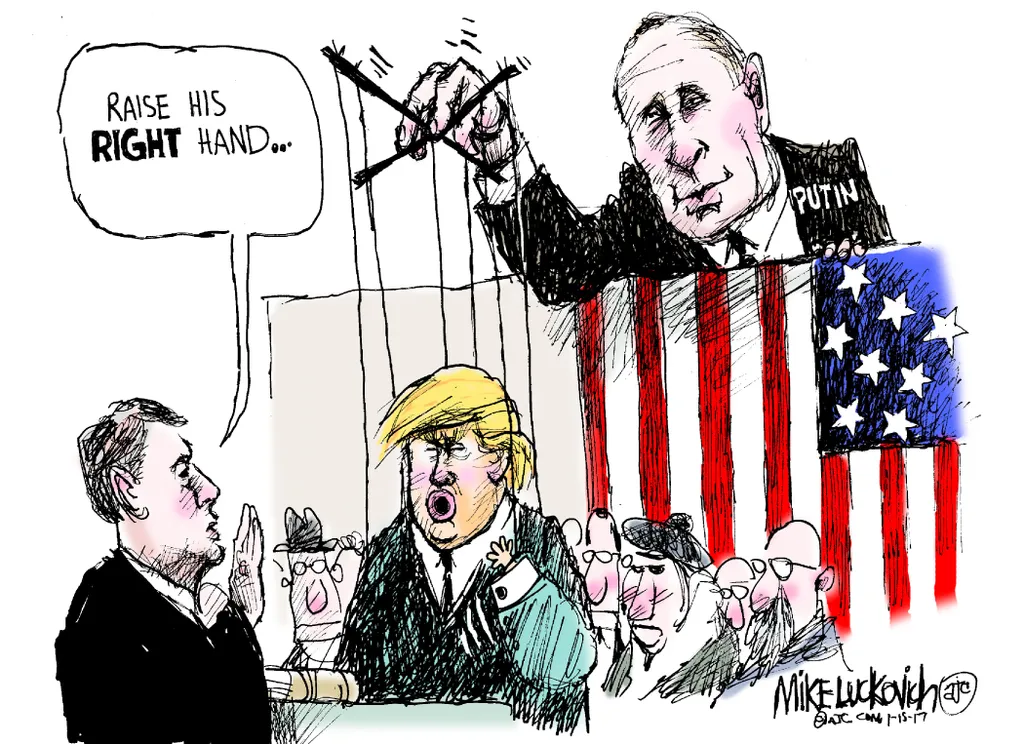
Something similar has been happening in American politics. Almost every day, the most significant story, the one that people most need to understand, is Trump’s attempt to transform our democracy into a Putin-style authoritarian government. But again, a story you could write every day is not news, so it will never be covered quite so explicitly.

So how will it affect news coverage?

Dressing it up. Now go back to the example of a daily coffee break. “I had a kid two years ago” isn’t news. But “Bobby had his second birthday Tuesday” is. It’s mostly the same information, but it’s packaged as a more current event.

Journalists do this all the time. They get around the media’s blindness about slow-moving stories by covering related events that change fast enough to be news-visible. So while climate change itself is not news, a storm that rapidly intensifies to a category 5 hurricane (as Erin did on Saturday) is news. And if you cover that story, you can mention climate change as the context of that intensification (though the CNN article I linked to doesn’t). Other news-visible developments that relate to climate change might be when a new report comes out or CO2 measurements pass some round number.

The problem with this trick is that it’s largely up to the reader to connect the dots. The heat waves, the hurricanes, the wildfires — those news events form a picture, but the picture itself is not news. It changes so gradually that daily news reports can’t see it. “Planet Earth is warming” is never breaking news. Climate change is a forest, but journalists can only cover trees.

Ditto for Trump. Individual aspects of his quest for unchecked power move fast enough to create news. This week he took over the DC police department and sent National Guard troops into the capital (ostensibly to fight the “emergency” of violent crime, which hit a 30-year low last year). That’s news. But it’s also part of a larger story that includes executive orders that are based on no constitutional or statutory presidential power, usurping Congress’ power of the purse, defying court orders, encroaching on the sovereignty of states or cities run by Democrats, ignoring the human rights of non-citizens (especially their right to due process), abusing government power to get political or economic concessions out of private institutions like corporations or universities, unleashing the Justice Department and other government agencies on Trump’s personal or political enemies, and much else.

Each of those stories also becomes news from time to time, when some noteworthy development has happened in the last 24 hours. But the larger picture they paint when you consider them together, of a democracy little by little turning into an autocratic state, isn’t news. In the news business, that larger picture is “context” — which means that it’s optional, like the extra credit questions that your term paper might also address. And if the overall slant of a news organization finds that context inconvenient, its readers and viewers will never hear about it. Maybe individuals will put it together for themselves, or maybe they won’t.

In fact, that’s the best way to judge the slant of a news organization: What context do they consider relevant? For example, The Guardian makes a climate-change connection in the final paragraph of its story on Erin this morning, but The Washington Post does not.

Think about how this news-and-context distinction influences a responsible journalist. The larger, longer-term, slower-moving story is what your readers really need to know. But it’s not news, at least not as your organization understands news. The larger story is a forest, but forests aren’t news. Trees are news.

So you find yourself trying to communicate the bigger stories to your readers through the filter that your organization’s definition of news imposes on you. You can only report news-visible stories, but if you do it artfully, you can find traces of the too-large-to-see stories in that visible news.

If you’re not artful enough, though, the readers will see what you’re doing: You’re writing the same story over and over, but dressing it up with different details to make it current. It will seem dishonest, like you’re trying to put something over on them.

What’s this have to do with me? Every week, I try to sift out what happened this week that you really ought to know and understand. A big part of that mission is taking a step back from the minute-to-minute news cycle and filtering out the hype.

In essence, I’m making a virtue out of necessity. Not having the focus and energy of bloggers like Heather Cox Richardson, I can’t put out a high-quality post every day. That forces me to take a week-by-week approach to the news. But for many stories, I believe, that’s a healthier vantage point. Following a news story too closely just gets people over-stimulated, and causes them to think the same shallow thoughts over and over again. And if a story comes and goes before a week is out, probably it wasn’t worth your attention to begin with.

Lately, though, I’ve begun to feel that even a weekly approach puts me on the wrong timescale. I largely cover American politics, and what you need to understand about American politics right now is that single big story: Trump wants to be like his hero, Vladimir Putin. Turning a democracy into a strongman autocracy is a well-known process now. And Trump is trying, day-in day-out, to follow the path that has been worn by Putin in Russia, Orban in Hungary, Erdogan in Turkey, Modi in India, and many others.

So I find myself writing the same story every week, but trying to make it sound fresh by dressing it up in the particular developments of the last seven days. It doesn’t feel right. It feels like I’m trying to fool you, even though I’m convinced most of you see what I’m doing.

At the same time, it also feels like the thing that needs doing: People need to see both the macrocosm and the microcosm, and to understand how they fit together.

So I want to keep doing what I’ve been doing, but express it in a format that is more direct and honest.

The new weekly summaries. This week I’ll be trying out a new format for the weekly summaries. This week’s summary, which should appear maybe around noon EDT, will start with a “Significant Ongoing Stories” section. This is where I name the forests, and explain very briefly which events of the week constitute trees in each forest. When somebody writes a good where-we-stand article on that big topic, I’ll reference it there.

I don’t expect the list of ongoing stories to change much from week to week. To that extent, I will explicitly be writing the same story every week.

Then will come a “This Week’s Developments” section, which is basically the old form of the weekly summary, but without the stretching to bring in “context”.

My hope is that this will be more satisfying for me to write and for you to read. The repetitive stuff will be repeated explicitly, without trying to make it sound fresh. And the new stuff will be covered for itself, and not as a stalking horse for a story too big to be weekly news.

This is all an experiment. Feedback is welcome.
The Monday Morning Teaser

Over the last few months, I’ve been feeling dissatisfied with this blog, so I’ve begun making some changes. Last week I branched out and started reposting on Substack. This week I’m changing the format of the weekly summaries.

Here’s why: Ever since Trump took office for his second term, there has really only been one political story worth telling: How Trump is trying to pervert American democracy into an autocracy, what resistance (if any) he’s been running into, and what the American people can do about it.

So, in essence, I’ve been writing the same story every week, but making it current by dressing it up in the details of that week’s particular news developments. This has been boring in some ways and frustrating in others. What I’m trying to communicate hasn’t seemed to match the format I’ve been writing in.

Thinking that through led me into a long meditation on the nature of news, which is the featured post this week.

In our culture, news has a particular timescale. News is what has changed since the last time we talked. When you meet an old buddy at a high school reunion, “I had a kid two years ago” is news. But when you take a coffee break with your officemate at work, it isn’t. If you want to talk about that in the office, you have to dress it up with a more current event, like “Bobby had his second birthday Tuesday.”

For the last seven months, then, I’ve been dressing up the Trump-wants-to-be-Putin story in the form of what happens each week. It’s a strange dance, in that you probably see what I’m doing, but I don’t actually tell you in so many words.

The point of the reformat is to make all that clear, so that the Sift will be more direct and honest. Each weekly summary will start with a “Significant Ongoing Stories” section, which will list the forest-level things I’m paying attention to, and how they connect to the trees in this week’s news. Then I’ll have a “This Week’s Developments” section, which will basically be what the old weekly summary was.

The featured post “The Timescale of News” should be out between 10 and 11 EDT. The revamped weekly summary I’ll try to get out by noon.

Consider this all a work in progress, so comment freely.

False Gods

Treating a state as a god is a very frightening endeavor. It confers upon mortals a level of veneration that we do not deserve and will always abuse.

– Peter Beinart, Being Jewish After the Destruction of Gaza

This week’s featured post is “An Authoritarian Economy is a Bad Economy“. As an experiment, I’ve cross-posted that article on Substack. If you’re on Substack, take a minute to comment. As on WordPress, subscription is free.

This week everybody was talking about Trump rigging the 2026 elections

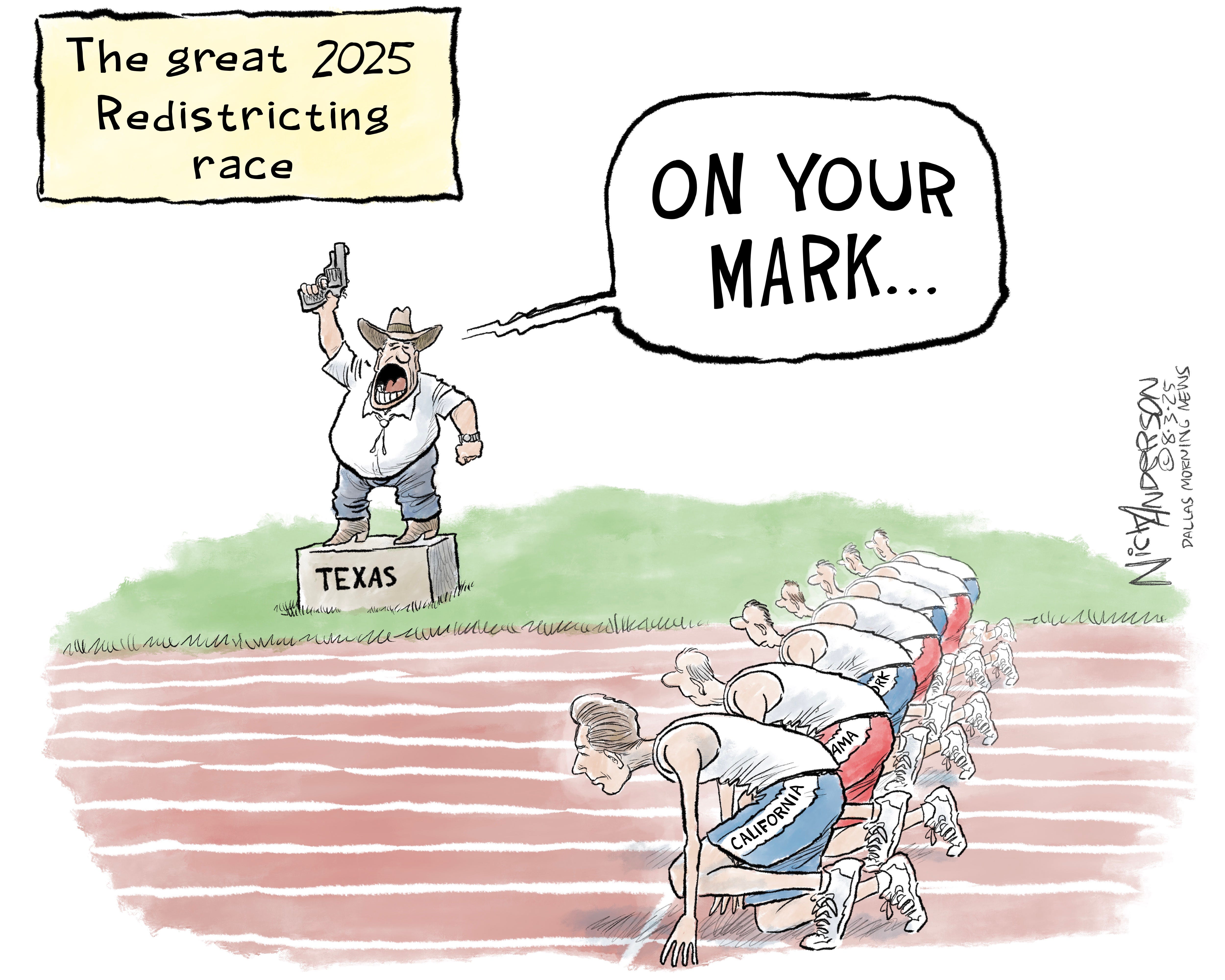
At the moment the standoff in Texas continues: Texas Republicans want to give Trump the five extra congressional seats he wants by redrawing the district boundaries. (I mean, why bother trying to convince voters to support you when you can just rearrange your supporters and get the same result?) Democrats can’t vote the proposal down, but do have enough seats to deny Republicans the quorum needed to hold a vote.

If Democratic legislators were in Texas, the state police could hunt them down and drag them to the Capitol. So they’ve left the state.

Like many observers, I suspect the Democrats can’t stay out of Texas forever. In Texas, the legislature is considered a part-time job, and paid accordingly. Most of the Democrats have other jobs that they will eventually lose, or businesses they can’t run from a distance. Many have children who will need to start school soon.

So eventually, Trump will get his new map and probably his five seats.

Because Democrats believe in democracy more than Republicans do, most Democratic states can’t be as easily gerrymandered or re-gerrymandered as Texas. Governor Newsom has come up with a somewhat bizarre plan to gerrymander California, but we’ll see if he can pull it off.


While I sympathize with the urge to fight fire with fire, the gerrymander wars are bad for democracy.

To see why, imagine a state that has 5 congressional districts, each with six voters. In the beginning, every district has 3 Orange voters and 3 Purple voters. Now imagine that we create a sixth district by plucking one Purple voter out of each of the original five.

We still have 30 voters, but now we have five districts with a 3-2 Orange majority and one district with a 5-0 Purple majority. The parties still have 15 voters each, but Orange now gets a 5-1 advantage in its congressional representation.

Now think about what that change does to the internal politics of each district. In the original configuration, each party has three voters. So the only way to get a majority is to get somebody from the other party to cross over. Both parties then are motivated to run candidates as close to the center as possible, or ones who have some other appeal to opposition voters. (Maybe they’re just well-known trustworthy folks.)

But in the gerrymandered configuration, Orange’s only motivation is to hang on to its base. If it gets all three of its voters to show up, it wins 5 out of 6 districts. Meanwhile, any Purple candidate in the sixth district is a sure winner, so there’s no reason not to run the most radical Purple they can find.

Here’s the lesson: The more balanced the districts are, the more likely it is that the winners will have cross-party appeal and feel motivated to work across the aisle when they get to Congress. The more gerrymandered districts there are, the more important party loyalty becomes.


Robert Hawks sees the gerrymandering wars as a step in the direction of civil war. Some states have always been redder or bluer than other states, but now states are self-identifying as members of the red or blue team.


In the meantime, Trump has another shortcut planned: Redoing the census so that red states can get more representatives and blue states less.

I have instructed our Department of Commerce to immediately begin work on a new and highly accurate CENSUS based on modern day facts and figures and, importantly, using the results and information gained from the Presidential Election of 2024. People who are in our Country illegally WILL NOT BE COUNTED IN THE CENSUS. Thank you for your attention to this matter!

As with so many of Trump’s executive orders, doing this legally would require a constitutional amendment, because the 14th Amendment says representatives “shall be apportioned among the several States according to their respective numbers, counting the whole number of persons in each State, excluding Indians not taxed.”

The word used is “persons”, not “citizens” or “legal residents”.


The point of all these shenanigans, and the ones undoubtedly still to come, is that Trump knows he’s unpopular and that his party will lose any honest election at this point.

and Gaza

The escalation continues:

Israeli Prime Minister Benjamin Netanyahu said Sunday that his plan to seize control of Gaza City and the remaining sliver of Gaza not already under Israeli control will involve displacing the population and taking control of the entire Gaza Strip.


In other news, Israel targeted and killed a well-known Al Jazeera journalist.

Anas al-Sharif … one of Al Jazeera’s most recognisable faces in Gaza, was killed while inside a tent for journalists outside al-Shifa hospital in Gaza City on Sunday night. Seven people in total were killed in the attack, including the Al Jazeera correspondent Mohammed Qreiqeh and the camera operators Ibrahim Zaher, Mohammed Noufal and Moamen Aliwa, according to the Qatar-based broadcaster. … The Israel Defense Forces admitted carrying out the attack, claiming the reporter was the leader of a Hamas cell – an allegation that Al Jazeera and Sharif had previously dismissed as baseless.


This week I read Peter Beinart’s new book Being Jewish After the Destruction of Gaza. I found it to be an excellent analysis of the folly of the policies of the Netanyahu government, as well as the political attitudes that make those policies possible.

The objection I always run into when I try to discuss the Palestine/Israel conflict is “You’re not Jewish, so you can’t possibly understand.” And while there is some truth to that — nothing in my personal or family background is comparable to the Holocaust — I can’t accept the idea that only Jewish opinions are valid.

Beinart, on the other hand, is Jewish, and is well educated in his religion and its culture. He criticizes Israel’s Gaza war, and the Jewish-over-Palestinian supremacy that this war is the culmination of, from the inside. He is aware of the Holocaust, he was deeply affected by the horror of Hamas’ October 7 attacks, and he wants to be able to raise his Jewish children in a world where antisemitism (in all its forms) endangers them as little as possible.

And yet he is horrified by what is happening in Gaza, and even more horrified that it is happening in the name of Judaism.

A central message of the book is that Jews need to change the story they tell about themselves. The self-image many Jews have of being history’s perpetual victims (and never the victimizers of someone else) has never been true, even within the Jewish tradition itself. He notes that even the Biblical Book of Esther, one of the classic stories of Jews surviving attempted genocide, ends with the Jews themselves killing 75,000 of their enemies. Joshua’s conquest of Canaan is quite bloody, with little indication that the Canaanites deserved their fate.

He cuts through many of the myths and fallacies that justify keeping the Palestinians subjugated. Israel’s “right to exist”, for example, does not imply a right to Jewish supremacy within the state of Israel.

He makes a distinction between Judaism (a religion) and Israel (a state), and argues that criticism of Israel need not imply antisemitism. Conversely, conflating Judaism and Israel makes an idol of the state of Israel. (That’s the source of the treating-a-state-as-a-god quote at the top.)

But most importantly, he argues that the current policies are a very bad way to keep Jews safe.

Ziad al-Nakhalah, who at the age of three saw Israel murder his father when it massacred Palestinians in Khan Younis in 1956, currently heads Palestinian Islamic Jihad. Israel has already killed more than one hundred times as many Palestinians in Gaza in this war as it killed back then. How many three-year-olds will still be seeking revenge sixty-nine years from now?

As I have argued in this blog before, Hamas is not an organization, it is an idea. It embodies Palestinians’ urge for revenge and distrust of any possible peace with Israel. No matter how many Hamas militants Israel kills in Gaza, its ranks will be refilled by those who survive when their friends and relatives did not.

Seeing this, Beinart argues that he and his children (and Jews everywhere) are less safe because of the current war. I fear, though, that as realistic as Beinart tries to be, he has missed the full horror of what’s going on in Gaza.

Yes, some of the Gazans who survive will hate Israel with an undying passion. But what if there are no survivors? That’s where Netanyahu’s logic leads.

and Ukraine

Trump is meeting with Putin in Alaska on Friday, with the goal of stopping the Ukraine War that Trump said he could end in 24 hours.

This is a bad idea for any number of reasons. First, the International Criminal Court issued an arrest warrant for Putin in 2023, accusing him of responsibility for the war crime of kidnapping Ukrainian children. If Putin comes to the US, we should arrest him, not hold a summit meeting with him.

Second, Ukraine is not part of these talks, raising the possibility that Trump and Putin will work out a deal that Trump will then demand Ukraine implement, despite having no role in negotiating it.

Putin comes to the meeting with a “peace” plan that is like all his previous proposals: If Ukraine gives up something real (sovereignty over Ukrainian provinces that Russia doesn’t fully occupy), Putin will agree to something ephemeral (a ceasefire he could break at any moment). People throw the Munich analogy around far too often, but this is a case where it really applies: In the Munich agreement of 1938, Czechoslovakia gave up territory to Hitler, only to be totally defenseless when Hitler decided to seize the rest of the country a few months later.

Ukraine’s European allies have already supported President Zelensky in rejecting such an agreement.

But the final reason this is a bad idea is that we know what will happen: Whenever Trump meets with Putin, he comes out repeating Putin’s talking points. Recently, Trump has made noises about being “disappointed” with Putin’s intransigence about Ukraine, but nothing ever comes of his disappointment. He recently let an ultimatum deadline go by without any action.

Putin is the alpha in this relationship and Trump is the beta. That’s been true ever since they met in Helsinki in 2018, and Trump came out saying that he trusted Putin’s account of events more than that of the US intelligence services. He will come out of Friday’s meeting saying that Ukraine needs to give Russia territory, without any guarantees from the US or anybody else that Putin can’t just start the war up again as soon as he thinks he can win.

Ukraine will rightly reject this proposal, and then Trump will once again paint Zelensky as the obstacle to peace, returning to where Trump feels most comfortable: by Putin’s side.

and you also might be interested in …

Jay Kuo looks at the cushy offers ICE is making to new recruits, and deduces that they must be having a hard time finding people who want to sign up.


NASA has two satellites specifically devoted to monitoring carbon dioxide in the atmosphere — the leading cause of climate change.

NASA staffers who work on these two carbon dioxide monitoring missions have been asked to draw up plans that NASA could use to terminate those missions, and that’s according to current and former NASA employees. And if NASA were to put those plans into action, which could happen as soon as early October, one of the missions would likely burn up in the atmosphere, so it would be completely destroyed permanently.

The satellite data also turns out to have other uses.

But these missions can also measure plant growth, which is totally unexpected and super powerful. NASA has turned that into maps that are used for agriculture, like, to predict crop yield. So farmers actually use this information as well, and they rely on it.

There’s nothing wrong with the satellites, and the missions they support cost about $15 million a year, a small fraction of what it cost to build the satellites and launch them. The motive to ignore (and in one case destroy) them seems to be that the Trump administration doesn’t want us to know how much CO2 is in the atmosphere.


mRNA technology is a huge recent advance in vaccine production. mRNA vaccines are quicker to invent and quicker to produce than standard vaccines. They saved millions of lives worldwide during the Covid pandemic.

But RFK Jr. has decided (for no apparent scientific reason) that they’re unsafe. So 22 federal contracts worth half a billion dollars just got cancelled. One of the cancelled contracts is for a bird flu vaccine. If that virus should happen to mutate in a way that spreads human-to-human, we could be in big trouble.

and let’s close with something above and beyond

I think I’ve mentioned the Smithsonian photo contest before, but this week I notice the drone category. This photo, titled “Dragon“, is an aerial view of badlands in Utah.

An Authoritarian Economy is a Bad Economy

Some Democrats want the party’s message to center on preserving democracy. Others say no, we should run against the Trump economy. What if we could do both at the same time?


When I talk to liberal activists, the issue that most scares them is Trump’s assault on democracy: denial of due process, flouting of court orders, siccing the Justice Department on his personal or political enemies, misusing the military by marching troops into Democratic cities like Los Angeles, usurping Congress’ power of the purse, sending masked thugs out to racially profile the population and whisk people off into what we might as well call concentration camps, extorting personal payments out of businesses by threatening them with government power, trying to keep power (even if the voters disapprove) by gerrymandering Congress, and so on.

But I also often hear another point of view: Maybe we ourselves care about democracy, but democracy issues are too abstract to run on in the 2026 midterms. At any given moment, most Americans aren’t using their due-process rights, and aren’t counting on court orders to protect them. If troops are turned loose on some far-off city they never visit, or if some politicians play an unfair game against other politicians, what’s it to them? Instead, Democrats should run on “kitchen table issues” that hit people in the pocketbook.

Right now what they’re feeling is the everyday things that are affecting them: the cost of groceries, gas prices, paying for rent. That is the number one issue; we need to be focused on that.

More and more, though, I’m becoming convinced that Democracy-or-Economy is a false choice, for a simple reason: An authoritarian economy is a bad economy.

Think about the countries that are further down the authoritarian road than we are, the ones often described as Trump’s models: Putin’s Russia, Orbán’s Hungary, Erdoğan’s Turkey, and so on. None of them are places you’d want to go to start a business or begin your career. Before long, Trump’s America won’t be such a place either.

Let’s think about why that is.

No checks and balances. We often talk about checks and balances as a procedural virtue, the kind of thing good-government types get excited about for reasons no one else understands. At times Americans even lament about all the checks and balances, because they make it hard to get things done.

But if we think about this purely economically, checks and balances serve a very practical purpose: error correction. When a leader gets a really bad idea in his head and begins to implement it, people who occupy other positions of power in the government can make him change course before things go too far. As the implications of the bad idea start showing up in the economy, the people who are suffering can appeal to other centers of power for relief.

In an autocratic system, on the other hand, no one can tell the autocrat he’s wrong. Policies that almost everyone else knows are destructive can nonetheless proceed all the way to disaster. Take Turkey for example:

A principal factor in Turkey’s poor economic performance over the past decade was President Erdogan’s misguided belief that interest rates were the cause of rather than the cure for inflation. This induced him to lean heavily on the Central Bank of Turkey to cut interest rates even at a time when inflation was rising. He did so by firing a succession of central bank presidents and by appointing a central bank board that totally complied with his desire for low interest rates.

It was only when inflation soared to 85 percent and when the Turkish lira was in free fall that Erdogan was forced to make an abrupt monetary policy U-turn.

Similarly, Putin’s war against Ukraine (whatever you think of it morally or even militarily) has done enormous damage to Russia’s economy. Mere weeks into the war, it became clear that expectations of a quick and easy victory had been delusional. At that point, Russia would have been much better off if someone else in the government — a leader in the parliament, perhaps — had been able to go to Putin and say, “This isn’t working. You’re going to have to figure a way to change course.”

Anyone who tried that, though, faced a serious risk of being dropped out of a high window. So more than three years later, a war that nearly everyone knows is a bad idea churns on.

We’re seeing something similar happen now with Trump’s tariffs. They’re doing precisely what nearly all economists said they would do: raise prices and slow growth. Pointedly, they’re not doing what Trump said they would do: bring manufacturing jobs back to the US. In fact, while manufacturing employment in the US surged during Biden’s administration, it has fallen during Trump’s.

Not only are the Trump tariffs a bad idea in general, they’ve been implemented in the worst possible way: erratically. Tariffs work by changing the market’s expectations. The only way a tariff might convince a company to go through a years-long process to move a factory to the US is if the company is convinced the tariff will still be there when the new factory opens. But when tariff rates seem to depend on what Trump had for breakfast, who knows what to expect two or three years from now?

As with Erdoğan and Putin, though, no one can tell Trump this simple fact. He has filled his administration with yes-men, and Republicans in Congress are afraid to challenge him. No independent agency or rival branch of government can stand in his way. And so we charge forward towards an economic disaster.

No single person is always right. So a country needs to have a way (or maybe many ways) to correct its leader when that leader is wrong. Checks and balances allow democratic governments to correct their errors, but autocratic governments can stay on the wrong path for a very long time.

Crony capitalism. If the foolishness of Trump’s tariffs is so obvious, you might wonder why he doesn’t see it himself. The answer is simple: Emergency laws passed by Congress under previous administrations (at least if you believe Trump’s interpretation of those laws, which is being tested in court) give the president the power to raise or lower tariffs at will, without any further input from Congress or anyone else.

In other words, tariffs are a place where Trump could seize autocratic power, so he has. His ability to raise tariffs or grant exceptions to them give him enormous power over some of our largest corporations. He can reward those who play ball with him and punish those who don’t.

In the textbooks, capitalism is supposed to work like this: The way to get rich is to come up with better and better ways to produce products and services that people want. Build a better mousetrap, the adage says, and the world will beat a path to your door.

In an autocratic system, though, the way to get rich is to get on the good side of the autocrat — maybe through flattery, through political support, or by cutting him in on the action. If you do, then you can expect lucrative government contracts, or maybe regulations you get to ignore will handicap your competitors, or maybe you’ll be allowed to cheat your customers without them having any recourse against you. On the other hand, if you displease the autocrat, your government contracts might suddenly disappear.

Think about all the times you’ve heard someone referred to as a “Russian oligarch”. Have these rich men invented anything? Developed anything? Marketed some new product? Of course not. They are rich because they are allies of Putin. And when Putin decides he doesn’t trust them any more, they fall — sometimes literally.

Again, ignore the morality for a minute and just focus on the economics. Whatever problems a textbook capitalist economy may produce, it does have one signature advantage: better mousetraps. Economic decisions are made for economic reasons, so they tend to turn out better economically.

Not so in an autocratic system, where economic decisions are made to bolster the autocrat’s power.

For example, one of the most important regulatory decisions governments face at the moment is what to do with crypto-currencies. Maybe they’re the future of finance, or maybe they’re a bubble waiting to pop. Maybe they will turn out to have benefits if they’re regulated properly, but huge downsides if they’re not.

But how can we expect wise regulations under these circumstances?

$TRUMP (stylized in all caps) is a meme coin associated with United States president Donald Trump, hosted on the Solana blockchain platform. One billion coins were originally created; 800 million remain owned by two Trump-owned companies, after 200 million were publicly released in an initial coin offering (ICO) on January 17, 2025. Less than a day later, the aggregate market value of all coins was more than $27 billion, valuing Trump’s holdings at more than $20 billion. A March 2025 Financial Times analysis found that the crypto project netted at least $350 million through sales of tokens and fees.

Here’s how things have worked out in Hungary:

Although Hungary’s GDP reaches roughly 77% of the EU average, lifting it above several low-income EU nations, its households nonetheless remain poorer in consumption terms. This discrepancy highlights the fact that economic output isn’t translating into real benefits for Hungarian families.

Behind the numbers lies a painful reality: under Viktor Orbán’s increasingly authoritarian and pro‑Russian Fidesz regime, Hungary has been systematically pillaged. State-owned industries have been hollowed out, public subsidies redirected to political allies, and EU funds commandeered by power networks close to the government. Meanwhile, ordinary Hungarians contend with low real wages, high inflation, brain drain, and a hollowed middle class—classic symptoms of wealth siphoning from citizens into elite pockets.

Bad information. Information is the lifeblood of a market economy; the more accurate and trustworthy a country’s economic information is, the better its economy will work.

Conversely, the less trustworthy economic information is, the more cautious economic decision-makers will be. If, say, a car company thinks that incomes are rising, it might be inclined to increase production, figuring that richer citizens will buy more cars.

But what if its executives suspect the government is just making up the numbers that show incomes rising? Then they’ll be slower to react, even if incomes actually are rising. That kind of sluggishness will percolate through the economy.

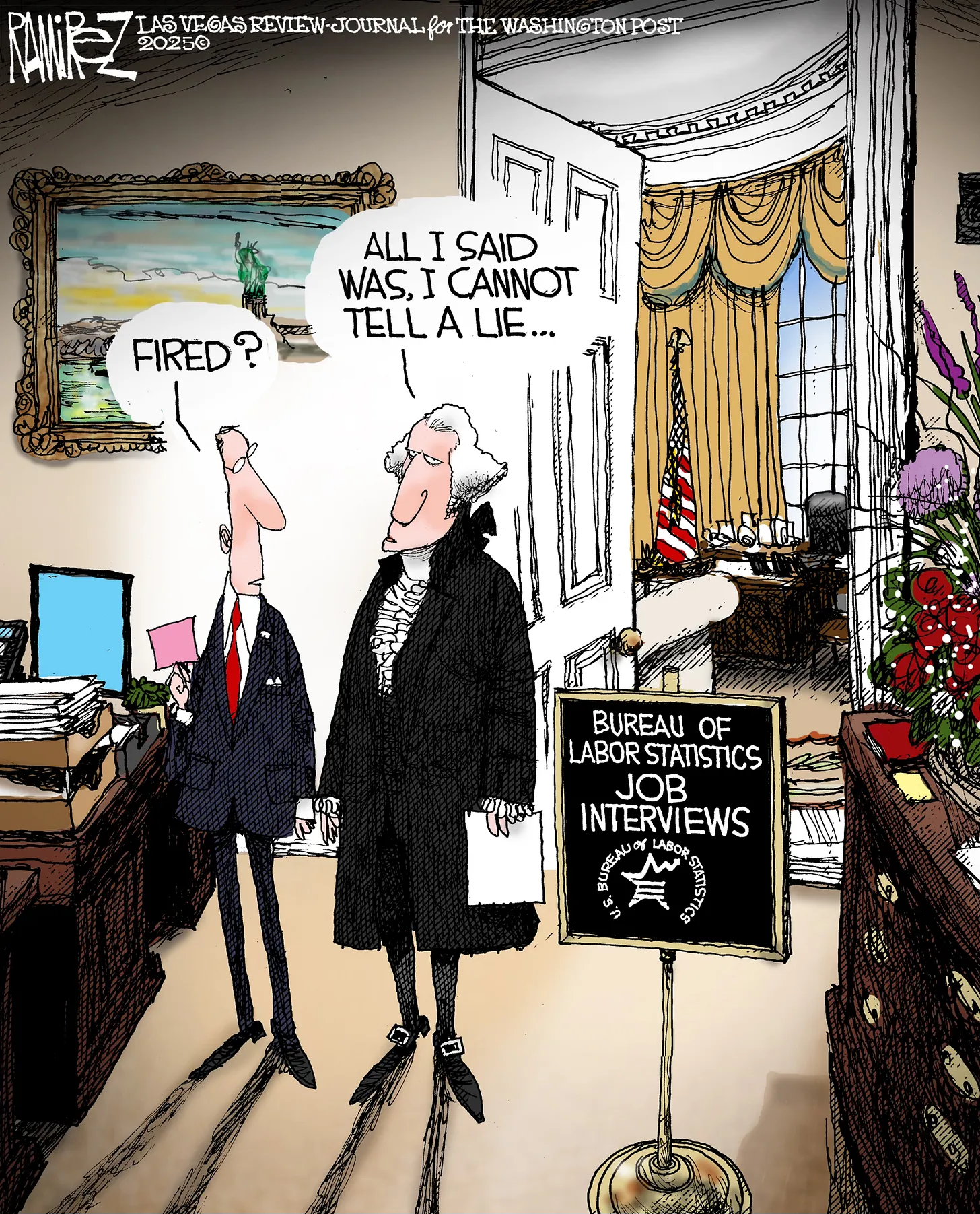
We already started down that road last week, when Trump fired the head of the Bureau of Labor Statistics because BLS’ June jobs report (accurately) made his economy look bad. Similarly, Trump doesn’t want to deal with climate change, so his Department of Energy is now issuing reports that say it’s not a big problem. Past National Climate Assessments have been taken off government web sites, and the Energy Secretary says they’re going to be revised — presumably to paint a picture Trump (and his political allies in the fossil fuel industry) finds more palatable.

It would be bad enough if bad information from the government caused unsuspecting people to make bad economic decisions out of ignorance. But within the government itself, decision-makers will be afraid to make good decisions, because those very decisions might communicate that they doubt what the autocrat is telling them.

The dystopian picture. If you want to see how the pieces might come together, look at a dystopian vision by the blogger Umair, “America’s Path Towards an Authoritarian Economy“.

There’s a vicious spiral that nations collapsing into autocracy tend to follow. It goes like this. Capital controls, price controls, informational vacuums, monetizing the debt, defaulting on it, and crashing the currency.

He paints a picture of what might come next: Trump’s tariffs increase companies’ costs, so they will want to raise prices. But then Trump will pressure them not to raise prices, because inflation makes him look bad.

So to stem this inflationary tsunami, autocrats tend to put in place price controls—autocrats tell CEOs you’d better not raise prices this much, on this or that. Often, they’re hard, dictated by an “economic board” or equivalent body. In America’s case, they’ll probably be softer: Trump dictating to boardrooms, threatening them, bullying them, coercing them into not raising prices.

If you can’t raise prices, you have to cut costs — in other words, lay off workers. But rising unemployment also makes the autocrat look bad, so he’ll lower interest rates in an attempt to increase economic activity. (That’s assuming Trump has taken control of the Federal Reserve, which he is trying to do.)

But when interest rates go lower than the inflation rate, nobody wants to own your currency. So the dollar falls. That starts investment capital fleeing the country, which the autocrat then tries to make illegal: No, you can’t invest your money in more stable countries.

What I’m trying to teach you is that autocratic collapse becomes a vicious spiral. It’s a very real one, which we’ve seen around the world, from Latin America to Asia and beyond. And it has a classic pattern, which goes like this. Tariffs beget price controls. Price controls beget unemployment. Inflation surges, the economy slows, and demand shrinks, usually dramatically. Autocrats cook the books to try and hide it all. Markets stop functioning, and crashes and crises erupt. … All of this is very real. This isn’t a far-off prediction: it’s an observation. This vicious spiral has already begun.

I’m not as fatalistic about this as Umair is: The tariffs are just getting rolling, the bad results are already becoming apparent, and there’s still time for the checks and balances we have left to function.

But the path he describes is in front of us, and we need to get off of it — not just for moral or idealistic reasons, but because it leads to an economic catastrophe.

So we don’t need to choose Democracy or Economy as the center of the anti-Trump message. We democracy to save us from the autocratic economic spiral Trump has started.

The Monday Morning Teaser

One of the debates I keep hearing Democrats have is where to center the party’s message: Are we all-in on stopping the rush towards fascism? Or should we focus on kitchen-table issues like jobs and inflation?

This week I want to argue that this is a false choice, because autocracy is in fact the biggest threat our economy faces. The one place in our economy where Trump is exercising autocratic power is over tariffs, and that is precisely where our economic problems are coming from. The tariffs themselves are causing inflation, and the uncertainty caused by Trump’s arbitrary decisions about tariffs has caused businesses to stop hiring.

That’s not a coincidence. If you look around the world, the kind of strongman governments Trump admires — in Russia, Hungary, Turkey, and elsewhere — are presiding over shrinking economies. So if you’re worried about your economic future, you should want to stop America’s slide into authoritarianism.

So the featured post this week is “An Authoritarian Economy is a Bad Economy”. It should be out shortly.

The weekly summary will discuss Gaza, Ukraine, RFK Jr.’s war on vaccines, the Texas redistricting standoff, and a few other things. It should be out before noon EDT.

By the way, I’m going to try an experiment this morning: I’m going to cross-post the featured post on Substack, just to see how it works. If you’re on Substack, check it out and comment.

Adapting to Decline

We can expect the governing class to adapt pragmatically to the electorate’s collective decline in rational capacity, for example, by retaining the rituals associated with mass democracy, while quietly shifting key policy areas beyond the reach of a capricious and easily manipulated citizenry.

– Mary Harrington “Thinking is Becoming a Luxury Good

This week’s featured post is “Shaping Ourselves“, which raises questions about the effect on democracy of a decline in literate culture.

This week everybody was talking about the Mad King’s reaction to a bad jobs report

Friday, the July jobs report validated many economists’ critiques of Trump’s tariff policies. Economists in general don’t like tariffs, but Trump’s chaotic implementation of them has looked particularly problematic. With so much uncertainty about the future, it seemed, decision-makers would freeze rather than invest in new businesses and new production. The result would be slower growth, if not outright recession.

But until Friday, it was hard to find solid evidence for that prediction. The unemployment rate remained low and GDP numbers looked acceptable. Friday, though, the Bureau of Labor Statistics — one of those vital-but-boring agencies whose name its workers’ mothers probably can’t always remember correctly — put out its monthly jobs report.

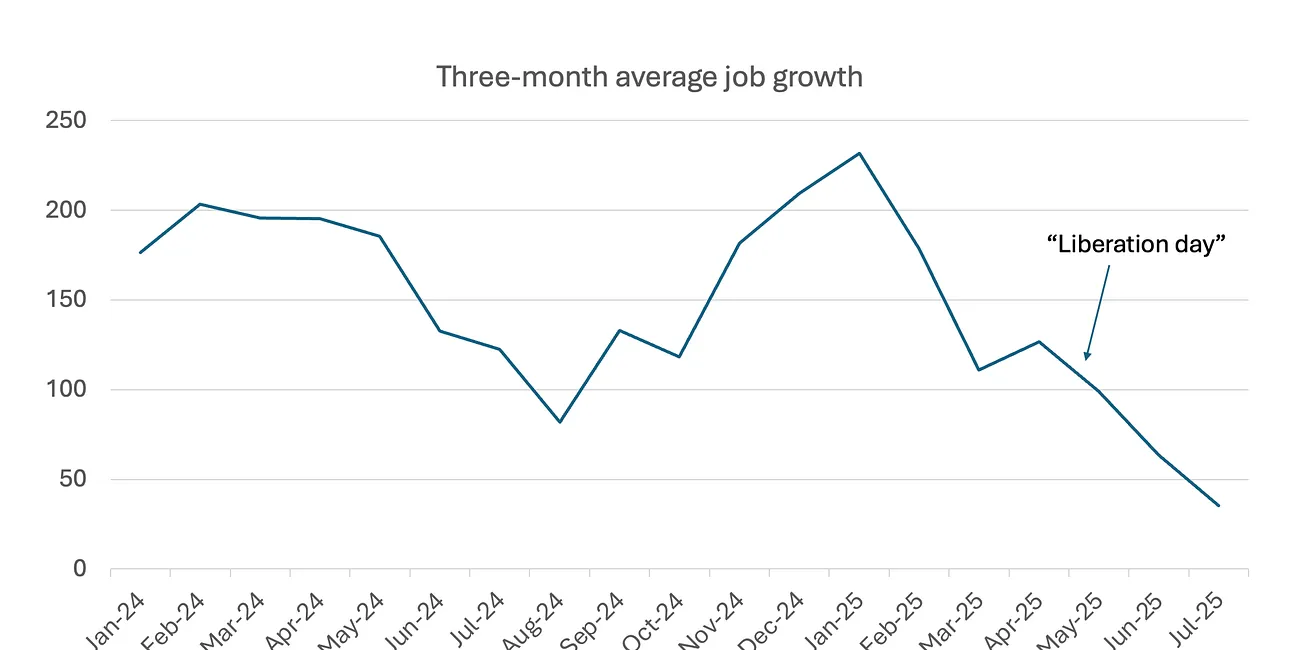
Not only was July’s job growth anemic — only 73K jobs, well below expectations — but the BLS also revised its job-growth estimates for May and June, virtually wiping out all the jobs previously reported. All in all, the total number of jobs was actually 250K less than previously thought. And the turning points were disturbingly close to two events: Trump’s election in November and the “liberation day” announcement of his tariff policy in April.

Couple that with recent reports that the inflation rate is climbing again — slowly maybe, but that’s how these things get started — and the whole Trump economy doesn’t look so good.

OK, then, bad news. Administrations get bad news all the time. I’m sure Biden didn’t like the inflation reports in 2023. So you send your press secretary out to spin: The numbers don’t mean what they appear to mean, you can’t read too much into one report, next month will be better, and so on.

But not Donald Trump. He responded by firing the head of the BLS. Don’t like the numbers? Fire the top number-cruncher. It’s like firing the weatherman because your picnic got rained out. That’ll fix it.

More accurately, it’s like something Trump did in his first term: Blame rising Covid rates on the availability of tests.

If we stop testing right now, we’d have very few cases, if any.

It’s hard to appreciate just how destructive this firing is. All previous administrations, including Trump’s first, shared a commitment to independent agencies producing accurate data to the best of their abilities. The rates of inflation and unemployment, the total national debt, current population, crime rates … they were what they were. Presidential spokespeople might spin those numbers, or critics might grouse about definitions by claiming that the “real” unemployment rate is U-6, rather than the much lower U-3 that gets the headlines.

But the numbers were what they were. Underneath it all was a core assumption that career bureaucrats were trying to get these numbers right. They held their jobs from one administration to the next and they had professional pride. No doubt each of them voted for somebody and had some individual political views, but when they went to the office none of that mattered.

Overall, the United States has benefited tremendously from having an honest and widely respected civil service. Investors, both foreign and domestic, don’t have to build an extra risk premium into their decisions to account for their distrust of the government statistics. (When dealing with many other countries — China, Russia, the third world, etc. — they do need that extra risk premium.) One reason the world has been content to let the dollar be the fundamental currency of international trade, or to route their own payment systems through our Federal Reserve, is that you could always count on the US to do honest bookkeeping.

Well, Trump threw that all away Friday. The National Association for Business Economics immediately denounced the move:

The National Association for Business Economics (NABE) strongly condemns the baseless removal of Bureau of Labor Statistics (BLS) Commissioner Erika McEntarfer and the unfounded accusations leveled against the work of the agency. This unprecedented attack on the U.S. statistical system threatens the long-standing credibility of our economic data infrastructure

Business leaders and policymakers depend on reliable, impartial economic data to guide decisions that affect investment, employment, and the health of the economy. The BLS produces these data using transparent, rigorously documented, and scientifically sound methodologies. U.S. economic statistics are regarded as the gold standard worldwide, setting the benchmark for accuracy, transparency, and independence.

Here was Trump’s justification:

In my opinion, today’s Jobs Numbers were RIGGED in order to make the Republicans, and ME, look bad. … We need accurate Jobs Numbers. I have directed my Team to fire this Biden Political Appointee, IMMEDIATELY. She will be replaced with someone much more competent and qualified.

In other words, the fired BLS head will be replaced by someone who will cook the books for Trump. Paul Krugman has been anticipating this since before the inauguration.

But why assume that the data will, in fact, remain objective? Imagine that we’re heading into an election and inflation numbers are running at, say, 4 or 5 percent. Do you have any doubts that Trump will insist that the inflation is fake news and pressure the B.L.S. to report better numbers?

To a lot of people, these kinds of worries sounded crazy six months ago. But here we are. Krugman sums up:

It’s one more step on our rapid descent into banana republic status.

and Gaza

It’s hard to know what to say about Gaza, because while it is one of the most important things happening in the world, the story is the same week after week: People are starving; Israel has the power to save them but chooses not to.

I sympathize with the Israelis who were traumatized by the October 7 attacks and feel that Hamas must be eliminated at all costs. But here’s the problem: Hamas isn’t a leader, a group of people, or even an organization. Anything bombs can destroy or soldiers can kill is not Hamas.

Fundamentally, Hamas is an idea: the belief that Israel can’t be negotiated with, and that no peaceful solution of the Palestine/Israel conflict is possible. As long as that belief persists among Palestinians, Hamas will always be able to rise from the ashes.

Now imagine the generation growing up in Gaza, watching their parents, siblings, and friends starve to death because Israel prevents them from getting food. Will they someday see Israel as a partner in peace, or imagine themselves living side-by-side with Israelis? Or might they think of Israelis the way that the author of Psalm 137 thought of his own oppressors:

Daughter Babylon, doomed to destruction, happy is the one who repays you according to what you have done to us. Happy is the one who seizes your infants and dashes them against the rocks.

I quote this not to incite violence against Israelis, or Jews in the US or elsewhere, but to point out that this kind of reaction is very human. Jews have felt it in the past and Palestinians no doubt are feeling it now.

The Israeli effort to wipe out Hamas is in fact guaranteeing its survival.

and the Smithsonian

Thursday brought an Orwellian moment, when the Washington Post revealed that the Smithsonian had removed mention of Trump’s impeachments from an exhibit about the presidency. A Smithsonian spokesperson explained like this:

In reviewing our legacy content recently, it became clear that the ‘Limits of Presidential Power’ section in The American Presidency: A Glorious Burden exhibition needed to be addressed. Because the other topics in this section had not been updated since 2008, the decision was made to restore the Impeachment case back to its 2008 appearance.

The 2008 version said that only three presidents had faced a serious threat of removal via impeachment: Andrew Johnson, Richard Nixon, and Bill Clinton.

The statement makes it sound like Trump had nothing to do with this “review of legacy content”, but in fact it is a direct response to an executive order Trump issued in March, which targeted the Smithsonian by name for “replacing objective facts with a distorted narrative driven by ideology rather than truth”.

Saturday, the Smithsonian was saying it would update the exhibit to re-include Trump’s impeachments “in the coming weeks”. We’ll see if they manage to do it without provoking another “off with his head” response.

and the Texas gerrymander

By 2024, we seemed to have reached a national balance in terms of congressional gerrymandering: The GOP won a slight victory in the national popular vote, and got a slight majority of House seats for it.

Trump wants to undo that balance. Knowing that his policies are unpopular, he wants to be able to hang onto the Republican House majority even if the voters want something else. So the Trump-enslaved Republican majority in the Texas legislature is trying to vote on a mid-decade redistricting that will give Republicans five more safe seats.

Democrats have responded by leaving the state, in hopes of denying the legislature the quorum necessary to pass laws. (A quorum is 2/3rds of members.) Governor Abbott is threatening to have absent legislators removed from office, which would certainly have to be decided in court. It’s not clear to me how long the Democrats would have to stay away to block the redistricting.

Democratic states like New York and California have threatened to retaliate, but considerable legal hurdles are in the way.

and the those trade deals

The NYT has been buying the claim that “Trump is winning his trade war“, but it ought to be more skeptical. Last week I told you about Paul Krugman’s analysis of the Japan deal, and said that the deal with the EU was too new to analyze. So let’s come back to the EU deal.

Krugman sees the deal as mostly nothing: The EU promised to do things it was doing anyway (invest money in the US, buy US products), and there is no enforcement mechanism to make sure it does. The investment, for example, is supposed to come from private companies, which the EU government has no power to coerce. Similarly,

A commitment to spend $250 billion per year on U.S. energy products would also require Europe to triple their annual American energy imports. “Question one is if they need that much, can afford that much,” [William] Reinsch [former president of the National Foreign Trade Council] said. “Question two is if we can even supply that much.”

What Trump got, though, was a headline: He “won”. That seems to be all he wants.

and ICE

Reports continue to mount up of masked ICE agents terrorizing people doing nothing wrong. Here, humanitarian aid workers on the border report being harassed. In this video, people videoing ICE are pushed around.

This video appears to be local police beating up anti-ICE protesters on a bridge connecting Cincinnati to Covington, Kentucky. A more detailed report was on CNN and local WLWT. The protest was against the arrest of a Muslim hospital chaplain who was here legally, but had his asylum revoked.

It’s hard not to notice the pro-police news slant: Police “clash” with protesters rather than attack them. I can appreciate why local police would want to clear a bridge and get traffic moving again, but once protesters have been moved to the sidewalk, the emergency is over. And continuing to punch people who have already been wrestled to the ground is assault, not law enforcement.

and you also might be interested in …

People are starting to notice how much damage MAGA Christians are doing to Christianity.


Why don’t examples of Trump’s loss of mental acuity get covered as intensely as Biden’s were?


We begin to see the first fallout from the rescission package Congress passed last week.

First, the direct fallout: The Corporation for Public Broadcasting announced it will shut down after 57 years.

Most CPB staff will be terminated by September’s end, with a small transition team remaining through January 2026 to wind down operations.

The rescission bill zeroed out funding for CPB, which previously had received about a half billion a year, which it distributed mostly to local public TV and radio stations. Most of those individual stations — especially the ones in big liberal cities like Boston or New York — will absorb the funding cuts and continue functioning. But CPB has been the main source of funding for many rural stations, which may have to close their doors as well, or sharply curtail their operations.

It’s another example of Trump victimizing his own voters.

Rural communities are already hard hit by a lack of community journalism, as one in three US counties do not have a full-time local journalist, according to a July report from Muck Rack and Rebuild Local News.

The second bit of fallout is more subtle: Senator Elizabeth Warren of Massachusetts is calling for Democrats not to participate in negotiations over the FY 2026 budget until Trump unfreezes money that Congress appropriated for FY2025.

Her demand makes sense, and I hope the rest of the Democratic Party backs her up on this. The budget process is a back-and-forth horse-trading between the two parties, with Democrats generally supplying the last few votes to get bills over the finish line in exchange for protecting programs that they consider important. But if Trump can simply refuse to spend the money, or if congressional Republicans can renege on their deal by passing a rescission on a party-line vote, then the whole process is a charade.


When Elon Musk’s DOGE was firing people and closing agencies in the first few months of the Trump administration, two criticisms were obvious:

  • Cuts to food and medical aid were hard-hearted and short-sighted, because feeding hungry kids and containing disease outbreaks is not “waste”, even if the immediate beneficiaries aren’t Americans.
  • Making workers suddenly disappear does not in any way promote “efficiency”.

The first criticism has gotten a lot of coverage, with estimates that the DOGE cuts will ultimately be responsible for 14 million deaths. But the Trump administration has largely skated around blame for the second.

This week Democrats on the Senate Permanent Subcommittee on Investigations released a 55-page report that totals up just how much federal money DOGE wasted in its campaign against “waste”: around $21.7 billion. Most of the wasted money comes from paying federal workers not to work, including $14.8 billion in the deferred resignation program, which invited federal employees to resign immediately, but get paid through the end of the fiscal year. About 200K feds took that offer. Another $6.1 billion was paid to 100K employees that were put on administrative leave, many of them in agencies like USAID and the Consumer Financial Protection Bureau.

Notice that these are just the easily totaled costs. We don’t know how much work didn’t get done or was done badly because the federal workers who remain were demoralized or terrorized. Some people imagine that fear of getting fired will scare lazy workers into action. But if you’ve ever worked in any kind of office, you know that very little gets done when everyone is trying to figure out where the ax will fall next.


The next cartoon requires some explanation: former football players who believe they are suffering from chronic traumatic encephalopathy (CTE) have been known to commit suicide by shooting themselves in the chest, so that their brains can be studied.

The cartoonist (Bill Bramhall) is suggesting that America’s gun laws can only be explained by some kind of national brain damage.

and let’s close with something foul-mouthed but tasty

Definitely NSFW, like most of Samuel L. Jackson’s most memorable stuff. Here, he’s advertising Windfarm Seaweed Snacks, made from seaweed cultivated at an offshore wind farm.

Shaping Ourselves

In a democracy, the people shape their government. But in the long run, the government also shapes its people. What kind of citizens does a democracy need to have, if it’s going to sustain itself?


Back in the auspicious year of 1984, conservative pundit George Will published a book out of step with his era: Statecraft as Soulcraft. In those days, a popular liberal backlash to the rise of Jerry Falwell’s Moral Majority and its influence on the Reagan administration argued that government “can’t legislate morality”. Will countered that government not only can shape public morality, but it inevitably does whether it intends to or not. The “first question” of government, he claimed, is “What kind of people do we want our citizens to be?”

At the time, “legislating morality” evoked thoughts of controlling sexuality. (The Devil’s greatest trick, I remember telling someone, was to convince Christians that morality is primarily about sex rather than caring for others.) Persecuting homosexuals, banning abortion, cracking down on female promiscuity — those were the issues “moral” politicians seemed most concerned with. Later generations of social conservatives have argued that “the family” is the cornerstone of society, and so the traditional family must be protected against innovations like same-sex marriage.

More broadly, “What kind of people do we want our citizens to be?” recalled Communist efforts to produce the “new Soviet man“, who would fit perfectly into the Soviet state, gladly foregoing personal fulfillment to help the dictatorship of the proletariat pursue the greater good. Similarly, an oligarchy might raise lower-class children to believe that they were better off being subjugated, or a Confederate-style slave republic might inculcate a sense of inferiority in Black people, so that they aspired to nothing higher than slavery. A North Korean-style cult of personality might raise children to hold the ruler in god-like awe.

Surely good Americans would want their government to stay far away from that kind of self-serving nurturance.

And yet, a democratic republic does require a certain kind of citizen. Government “of the people” assumes that the people have certain capabilities and virtues. In the long term, a democratic republic that doesn’t instill those capabilities and virtues will be unstable; it will preside over the destruction of its own foundation.

In the past, Americans have understood this. Universal public education became the law in one state after another precisely because of the fear that immigrant children would not understand democratic values, or learn to speak and read English, which was assumed to be the only possible medium for the public discourse democracy depends on.

This line of thinking came back to me this week when I read Mary Harrington’s “Thinking Is Becoming a Luxury Good” in the New York Times. The article had two main points:

  • Smart phones and services like Tik-Tok are changing the way people (especially children) think, creating an easily distracted consciousness that looks for quick and amusing input without regard to accuracy. As a people, we are losing a more literate consciousness capable of “concentration, linear reasoning, and deep thought”.
  • This tendency is more pronounced among poorer children, whose parents are less likely to insist on (and pay for) a more video-restrictive education.

Here’s the paragraph that brings the consequences home:

What will happen if this becomes fully realized? An electorate that has lost the capacity for long-form thought will be more tribal, less rational, largely uninterested in facts or even matters of historical record, moved more by vibes than cogent argument and open to fantastical ideas and bizarre conspiracy theories. If that sounds familiar, it may be a sign of how far down this path the West has already traveled.

Harrington compares Tik-Tok videos to junk food, and argues in favor of an “ascetic approach to cognitive fitness”. We used to say “you are what you eat”. Maybe the same thing works on the mental level: If you put garbage into your mind, garbage will come out.

As Cal Newport, a productivity expert, shows in his 2016 book, “Deep Work,” the digital environment is optimized for distraction, as various systems compete for our attention with notifications and other demands. Social media platforms are designed to be addictive, and the sheer volume of material incentivizes intense cognitive “bites” of discourse calibrated for maximum compulsiveness over nuance or thoughtful reasoning. The resulting patterns of content consumption form us neurologically for skimming, pattern recognition and distracted hopping from text to text

Like junk food, though, addictive-but-vacuous snippets of video are easier to obtain and harder to screen out than input that develops a deeper mind. More and more, it’s upper-class households that have the resources and the will to create an environment conducive to good cognitive development.

As Dr. [MaryAnne] Wolf points out, literacy and poverty have long been correlated. Now poor kids spend more time on screens each day than rich ones — in one 2019 study, about two hours more per day for U.S. tweens and teenagers whose families made less than $35,000 per year, compared with peers whose household incomes exceeded $100,000. Research indicates that kids who are exposed to more than two hours a day of recreational screen time have worse working memory, processing speed, attention levels, language skills and executive function than kids who are not.

Bluntly: Making healthy cognitive choices is hard. In a culture saturated with more accessible and engrossing forms of entertainment, long-form literacy may soon become the domain of elite subcultures.

Critics will argue that none of this is new. Older people (I’m 68) have always complained that younger people don’t think clearly, and have blamed new media and new technology for the change. Back in the early 1600s, Cervantes’ novel Don Quixote was in part a critique of what could happen to people who read too many of the cheap romances that Gutenberg’s printing press had made available: Their minds might fill up with fantastic notions disconnected from reality.

I grew up in a generation supposedly warped by comic books and (later) low-quality television. (I was exposed to a vast quantity of both. I can still sing the theme song of “My Mother the Car”.) Neal Postman’s 1985 book Amusing Ourselves to Death raised the specter of an electorate that chooses to be entertained rather than informed.

I also grew up in the working class (my father worked in a factory through most of my childhood, and neither of my parents went to college). So I have long been skeptical of studies supposedly proving that professional-class child-raising is superior to working-class child-raising. Too many well-born and well-educated sociologists have descended into working-class neighborhoods and seen the natives as a backward culture far inferior to themselves.

And yet … I came to literate culture with the enthusiasm of an immigrant. Arriving at a giant Big 10 university — an entire city about the size of my hometown, apparently devoted to discovering, recording, and passing down knowledge — was like entering the Emerald City of Oz. (I have never understood the ho-hum attitude that the children of my professional-class friends take towards college. Kids today approach Harvard with less awe than I had for Michigan State.)

Mathematics gave me an appreciation of truths that can’t be shaken by desire or popular opinion. Meditation taught me the virtues of a quiet mind, one that can let the waves of hype roll past until deeper thoughts emerge. (On the wall of my office is a painting of a young woman whose eyes are closed. She holds up one finger as a faint breeze begins to stir her hair. “Wait for it,” she seems to be saying.)

And so what particularly disturbs me about the present moment, beyond the rampant cruelty and the disregard of democratic traditions, is the impotence of rational thought, the inability of Truth to overtake Lie, and the lack of any deep engagement of mind with mind.

How can democracy survive this?

If the people are going to rule, then every child should be educated like an heir to the throne.

There has never been a democracy where the people were truly wise. But democracy rests on the belief that Truth has a persistence that eventually will win out. That’s why the Founders built so much delay into our system, particularly for fundamental changes like constitutional amendments. They recognized that momentary enthusiasms might sweep through the electorate. But over time, they believed, the cacophony of noises would cancel each other out, allowing the constant voice of reason to rise above the din.

But technology has raised the volume of noise. Somehow, we will have to produce a population that can think deeply anyway. That will require a new kind of soulcraft, one quite a bit deeper, I think, than George Will had in mind.

The Monday Morning Teaser

This week Trump’s autocratic tendencies reached an almost comical level, evoking a “He did what?” reaction even from people otherwise inclined support him: He responded to bad news in the June jobs report by firing the head of the Bureau of Labor Statistics. Don’t like the numbers? Fire the number-crunchers! That’ll fix it.

That firing resembled the moment in his first term when he suggested that the way to deal with accelerating rates of Covid infection was to stop testing. Fewer tests, fewer positive results — problem solved! Such out-of-the-box thinking is what makes Trump a stable genius.

So anyway, the entire federal data-gathering bureaucracy is now on notice that doing your job honestly can get you fired. We’ll see how the bureaucrats respond.

In the meantime, the jobs report actually is bad, and points to the possibility of stagflation, a combination of increasing unemployment and increasing inflation that was widely believed to be impossible until it started happening in the 1970s.

There’s been a lot else going on: The Smithsonian was caught dropping Trump’s impeachments down the memory hole. The Gaza horror continued. Trump encouraged Texas to help him cheat in the 2026 midterms.

But what caught my eye this week was a column in the NYT: “Thinking is Becoming a Luxury Good”. It raised the possibility that what we’ve been seeing lately is just the beginning of a trend: Maybe our culture is producing people fundamentally incapable of self-rule. What happens to democracy in that situation? That led to this week’s featured post “Shaping Ourselves”. That should be out shortly.

The weekly summary, which covers the aforementioned stories plus a few others, should be out by noon EDT.

Choices

It’s alright for you if you run with the pack.
It’s alright if you agree with all they do.
If fascism is slowly climbing back,
It’s not here yet, so what’s it got to do with you?


So close your eyes, stop your ears,
Shut your mouth and take it slow.
Let others take the lead, and you bring up the rear,
And later you can say you didn’t know
.

– “Song of Choice” by Peggy Seeger

This week’s featured post is “‘Unitary Executive’ is a Euphemism for Tyrant“.

The quote above deserves some curation. Peggy Seeger was Pete Seeger’s half-sister, and wrote many songs with her husband Ewan McColl. I’m a little sketchy on the exact provenance of “Song of Choice”. Some web sites claim McColl was a co-author, and I haven’t seen an exact date for it. It appears in a 1992 collection of Seeger’s songs, which includes songs that go back as far as 1955. One version included the line “In April they took away Greece”, which might refer to a Greek coup in 1967.

I heard the song for the first time Saturday at the Lowell Folk Festival, where it was sung by the Irish band Solas. Its contemporary relevance is obvious.

This week everybody was talking about …

Oh hell, they were talking about Jeffrey Epstein, but I can’t bear to lead with that again.

Let me tell you about a legal victory this week instead: Trump’s attempt to undo the 14th Amendment’s guarantee of birthright citizenship has lost again in court. This time the loss was in the 9th Circuit Court of Appeals, one step below the Supreme Court.

This case has wandered through a legal labyrinth, so let’s review: One of the first things Trump did after getting sworn in for his second term was to sign an executive order denying the citizenship of any child born in the US if the mother’s status within the US was either undocumented or temporary. He was attempting to stretch the one loophole in the 14th Amendment, that birthright citizenship requires that the child be “subject to the jurisdiction” of the United States, i.e., not born to a foreign diplomat or a sovereign Native American tribe.

No court that has heard this argument has found it credible. Two district courts have rejected it, and it was quickly blocked by a nationwide injunction. The administration appealed not the case itself, but the injunction, and got the Supreme Court to put limits on nationwide injunctions without addressing the citizenship issue itself.

A subsequent judge got around that ruling by declaring the children affected by the order to be a class and issuing an injunction in the class-action lawsuit. Another district judge ruled that only a nationwide injunction could provide relief to the states that filed the lawsuit in his court. The appeals court upheld that injunction Wednesday.

The Trump administration had hoped to sow chaos by limiting injunctions to the jurisdictions where cases had been filed and the states willing to file suit. In red states, then, children of undocumented immigrants could be treated as non-citizens at least until a full resolution of the case by the Supreme Court, and the Court could enable that abuse just by stalling a final decision. But so far that plan is not working.


More good news from the courts: One judge has ordered Kilmar Abrego Garcia released on bail pending his criminal case, while another is barring ICE from arresting and deporting him to some random country as soon as he goes free. He’s not out yet, but it could actually happen.

Abrego Garcia is the guy the Trump administration sent to their Salvadoran gulag by mistake. They’ve been trying ever since to avoid admitting that mistake or rectifying it.

and trade deals

Trump’s on-again-off-again tariffs are due to come back on Friday, as the 90-deals-in-90-days he envisioned weren’t happening. But this week the administration announced deals with both Japan (Wednesday) and the EU (yesterday).

The administration made upbeat claims for both deals, but the actual provisions may be disappointing in practice. It’s too soon to grasp what’s in the EU deal, but Paul Krugman has had time to look at the Japan deal and find quite a bit less than Trump has claimed.

But why are U.S. manufacturers so upset with the Japan deal? Because in combination with Trump’s other tariffs this deal actually leaves many U.S. manufacturers worse off than they were before Trump began his trade war.

This is clearest in the case of automobiles and automotive products. Trump has imposed a 25 percent tariff on all automotive imports, supposedly on national security grounds. This includes imports from Canada and Mexico. And here’s the thing: Canadian and Mexican auto products generally have substantial U.S. “content” — that is, they contain parts made in America. Japanese cars generally don’t.

But now cars from Japan will pay only a 15 percent tariff, that is, less than cars from Canada and Mexico.

OK, it’s not quite that straightforward, because imports from Canada and Mexico receive a partial exemption based on the share of their value that comes from the United States. Yes, it’s getting complicated. But we may nonetheless now be in a situation where cars whose production doesn’t create U.S. manufacturing jobs will pay a lower tariff rate than cars whose production does.

OK, this is an algebra problem, but not a very hard one: Any car imported from Canada or Mexico with less than 40% US content will face a higher tariff than a Japanese car with no US content. Example: Suppose a Canadian car is 1/5th US parts. That knocks its tariff down by 1/5th, from 25% to 20%. That’s higher than the 15% tariff on a Japanese car.

Wait, there’s more. Trump has also imposed 50 percent tariffs on steel and aluminum, which are of course important parts of the cost of a car. Japanese manufacturers don’t pay those tariffs.

Overall, the interaction between this Japan deal and Trump’s other tariffs probably tilts the playing field between U.S. and Japanese producers of cars, and perhaps other products, in Japan’s favor.


And remember reports of a $550 billion investment fund where Japan would supply the money but the US would get 90% of the profits? Not exactly.

and I can’t believe the Epstein story still hasn’t died

OK, I do have to mention it.

The individual pieces of this story are still getting plenty of coverage, so I won’t belabor them. But the big news is that the House of Representatives recessed early so that Republicans in Congress won’t have to vote on measures to demand the release of the Justice Department’s Epstein files. Individual Republicans are caught between Trump (who apparently has something to hide) and members of their base who have spent years focused on Epstein conspiracy theories.


The creators of the cartoon South Park appear not to be intimidated by Trump. The opening episode of the new season shows him sleeping with Satan, having a tiny penis, and it visits various other indignities on him. Jesus warns the population of South Park that if they don’t stop protesting against Trump, they’re all going to be cancelled like Colbert.

South Park represents a different comic audience than comedians like Jon Stewart or Seth Meyers. This is more the burn-it-all-down crowd that includes a number of 2024 Trump voters.


The most interesting article I read about the Epstein controversy this week was by Josh Marshall, in a members-only section of TPM. He addressed the question of why pedophilia is special to MAGA. Why do they care so much about bringing Jeffrey Epstein’s pedophile friends to justice, when they care not at all about the women Trump has abused, or just about any other victim of a sex crime? His answer is that it is

MAGA’s hyper-focus on pedophilia and sex trafficking conspiracy theories which needs to be emphasized. Because at a basic level, that obsession has nothing to do with pedophilia as a thing in itself — not as most of us might understand it.

The obsession isn’t about justice for the victims of pedophilia. In MAGA-world the victims figure barely at all. What matters is the perpetrators, who in the various theories are the elite conspirators running the world and indulging their every whim without consequence.

In the MAGA world, pedophilia isn’t a crime or abuse that needs to be stopped. It is more a legitimating tool which provides a license for cleansing acts of retributive violence and revenge. This is what’s at the end of the story in every far-right/MAGA conspiracy: a wave of eliminationist, cleansing violence led by someone like Trump in which the bad guys, the liberals, the Democrats, the globalist elites, etc etc are wiped out.

… Because pedophilia summons a level of disgust, anger and revulsion that makes the perpetrators seem uniquely inhuman, less than human, people against whom total violence is acceptable and necessary. In other words, these conspiracy theories are systems of thought that provide sanction and legitimation for what you want to do to your enemies. They’re about the enemies. The role of pedophilia in these stories is just a means to an end, making what you want to do with your enemies okay.

and Gaza

Yesterday the WHO reported:

Malnutrition is on a dangerous trajectory in the Gaza Strip, marked by a spike in deaths in July.

Of 74 malnutrition-related deaths in 2025, 63 occurred in July – including 24 children under five, a child over five, and 38 adults. Most of these people were declared dead on arrival at health facilities or died shortly after, their bodies showing clear signs of severe wasting.

The crisis remains entirely preventable. Deliberate blocking and delay of large-scale food, health, and humanitarian aid has cost many lives.

Meanwhile,

The Israel Defense Forces (IDF) said it would implement a humanitarian pause in several population centers across the Gaza Strip beginning Sunday morning and repeating each day until further notice. On Saturday night, the Israeli Air Force conducted air drops of food into Gaza. Jordan and the United Arab Emirates began air drops on Sunday, with more expected in the coming days.

100 aid trucks are reported to have entered Gaza Sunday. But CNN describes this as a “trickle” that is not adequate to resolve the food crisis.

I keep seeing arguments that Israel is not committing genocide in Gaza. The NYT’s Bret Stephens quotes the UN Convention on Genocide’s definition, and basically argues that if Israel intended to kill all the Palestinians, they’d be doing a much better job of it.

I want to point this much out to anybody thinking of making a similar case: When you start consulting the exact definition, you’ve lost the moral high ground. Let me make an analogy: Suppose you just got back from a business trip that also included some attractive colleague. Your spouse accuses you of being unfaithful, and you respond “Define unfaithful.”

You’re not helping yourself by making that case.

and you also might be interested in …

How far away does Trump have to go to run away from his troubles? Scotland wasn’t far enough.


Nashville is having its 27th straight day of 90-degree temperatures, with heat index predictions as high as 110 on Tuesday and Wednesday. But carry on; nothing to see here; global warming is a hoax.


During the anti-ICE protests in Los Angeles,

The justice department has charged at least 26 people with “assaulting” and “impeding” federal officers and other crimes during the protests over immigration raids. Prosecutors, however, have since been forced to dismiss at least eight of those felonies, many of them which relied on officers’ inaccurate reports, court records show.

The justice department has also dismissed at least three felony assault cases it brought against Angelenos accused of interfering with arrests during recent immigration raids, the documents show.

The problem seems to be that federal officers lied in their official reports.

One DHS agent accused a protester of shoving an officer, when footage appeared to show the opposite: the officer forcefully pushed the protester.

Here’s another example of that. But maybe the point of these arrests isn’t to get convictions.

“It seems this is a way to detain people, hold them in custody, instill fear and discourage people from exercising their first amendment rights,” [former state prosecutor Cristine Soto] DeBerry said.

and let’s close with something satirical

The great satirical songwriter Tom Lehrer died Saturday at the age of 97. Here’s a video of him performing in Norway, probably sometime in the 1960s.

“Unitary Executive” is a euphemism for Tyrant

How a conservative legal theory set us on a path to fascism.


If you clear your mind of preconceptions and read the Constitution end to end, I think you’ll see not just a list of rules and procedures, but a vision of the proper governance of a free people. [1] The newly established Government of the United States does not rule over its people in totality. Instead, the People have granted the government a specific list of powers to achieve specific goals.

Alexander Hamilton, for example, thought this structure made an explicit Bill of Rights unnecessary.

For why declare that things shall not be done which there is no power to do? Why, for instance, should it be said that the liberty of the press shall not be restrained, when no power is given by which restrictions may be imposed?

During the ensuing centuries, the power of the US government has grown, largely because social and economic change made the powers granted to it more significant. Interstate and international commerce, for example, was a comparatively small part of the average American’s life in 1787. Today, on the other hand, restricting your purchases to products wholly made within your home state would involve radical lifestyle choices. The power to regulate interstate commerce, consequently, opened the door to a much broader regulatory power.

Similarly, technological progress has opened up unforeseen new worlds of commerce and communication, requiring someone to define new ground rules. America’s ascension to world power likewise extended the powers of our government.

But those enhanced powers did not automatically flow to the President. The Constitution gave those expandable powers to Congress, including what has become known as the Elastic Clause, because it can be stretched in so many ways.

The Congress shall have Power… To make all Laws which shall be necessary and proper for carrying into Execution the foregoing Powers, and all other Powers vested by this Constitution in the Government of the United States, or in any Department or Officer thereof.

Other powers are split between Congress and the President. So, for example, the President can enforce the laws, but cannot make laws. The President is commander-in-chief, but cannot build an army or declare war. [2] The judiciary, in turn, defines what the laws mean.

The 20th century saw the growth of what has become known as the “administrative state”: The kind of detailed and fast-changing regulation that the government’s new powers required couldn’t be managed through a body as cumbersome as Congress. [3] And so Congress empowered a smorgasbord of agencies: FDA, SEC, EPA, Federal Reserve, and so on — each with its own power and purview.

In this manner, some of the spirit of Constitution was preserved, even as the executive branch expanded: Specific powers were granted for specific purposes. Each agency had its own mission, and while the agencies were part of the executive branch and overseen by presidential appointees, the rank-and-file employees belonged to the civil service and maintained a degree of independence. [4]

The norms of the presidency, in turn, required a President to compartmentalize, or at least to maintain the appearance of compartmentalization. So, for example, it was considered scandalous if President Obama was directing the IRS to give conservative organizations a hard time. [5] President Biden and Attorney General Merrick Garland kept their distance from Special Counsel Jack Smith’s investigation and subsequent indictment of Donald Trump.

A President is human and has enemies and resentments, but s/he is not supposed to use the government to exact personal vengeance. The person-with-enemies and the President-with-powers are intended to be kept separate.

But during the Reagan years, conservatives began to float the notion of a “unitary executive”. The theory is based on the first line of Article II of the Constitution, which says:

The executive Power shall be vested in a President of the United States of America.

For a long time this was interpreted loosely: Any grant of executive power had to pass through the President in some way, but did not come from him minute-to-minute. FBI directors, for example, were appointed by a President, but served 10-year terms that stretched well beyond the 4- or 8-year term of the appointing President, and were fired only for cause. [6] Similarly, chairs of the Federal Reserve are appointed by a President, but have never been replaced simply because a new President takes office.

But the Unitary Executive Theory says that any executive power is by definition a presidential power. The various agencies and officials of the executive branch are essentially fingers of the President’s hand. They do the detail work that is beneath the President’s notice, but have no real independence.

For a long time the unitary executive was a crank theory, but under the partisan Roberts Supreme Court it has increasingly become the law of the land. [7] In Trump’s second administration, the Court has allowed the firing of a series of people previously believed to be independent and protected by law.

“By means of such actions, this Court may facilitate the permanent transfer of authority, piece by piece by piece, from one branch of Government to another,” Justice Elena Kagan wrote for herself, as well as Justices Sonia Sotomayor and Ketanji Brown Jackson.

Most recently, Trump has attempted to reshape (and shrink by half) the Department of Education simply by firing its employees. [8]

Proponents of the unitary executive argue — as authoritarians often do — that government power will be wielded more efficiently by a single hand, and that government will be more responsive to the voters when elected officials are better able to implement the programs they ran on.

But the behavior of the Trump administration belies these claims. In a government of largely independent agencies, each wielding its own power to achieve a specific mission, American individuals and institutions have to worry about the laws and agencies as individual entities. So: You worry about the IRS at tax time, and try to make sure that your returns follow their rules. You worry about the Justice Department if you are contemplating some crime of theft or violence. A corporation worries about the SEC in its dealings with the market and their own stockholders, about the EPA when it considers what emissions its factories are putting into the environment, and about OSHA when it designs its work environment. And so on.

But under a unitary executive, when all these agencies are fingers of the same hand, everyone has to worry about being seen as enemies of the government. If we have displeased the executive in some way, any agency of government might be used to punish us or whip us back into line.

Take CBS. Does their news coverage displease Trump? Then the FCC balks at the corporate merger of CBS parent Paramount and cash-rich Skydance. It balks not until a specific public interest is satisfied, as would be the case under another administration’s FCC, but until Paramount has paid Trump $16 million to settle an otherwise baseless lawsuit, until Stephen Colbert’s show is cancelled, and until CBS agrees to have an ombudsman address complaints of anti-Trump “bias” in its news coverage.

Take Columbia University. Complaints that university wasn’t doing enough to protect Jewish students from harassment would ordinarily fall under the civil rights division of the Education Department, which might make a referral to the civil rights division of the Justice Department, with a narrow focus on the experience of the university’s Jewish students. But under a unitary executive, the offense is more general and the consequences far more sweeping: Columbia allowed pro-Palestinian demonstrations that expressed opinions contrary to Trump’s support of Israel’s government.

And so, the State Department revoked the green card and student visa of protest leader Mahmoud Khalil, allowing ICE (which is part of Homeland Security, not the the State Department) to arrest and detain Khalil for three and a half months without filing any criminal charges against him. Columbia’s research grants (primarily from the Health and Human Services Department) were frozen, and all of its federal grants were threatened. [9]

And the result? Not a specific set of adjustments to Columbia’s policies about antisemitism (antisemitism was always just a pretext), but a sweeping agreement to get Columbia right with the Trump administration, “including the re-organisation of its Middle Eastern studies department, and hiring a team of ‘special officers’ empowered to remove students from campus and make arrests”.

A similar administration assault on Harvard resulted in demands to

  • shift power from “faculty and administrators more committed to activism than scholarship” to “those most devoted to the scholarly mission of the University and committed to the changes indicated in this letter”, i.e., from Trump-hostile faculty to Trump-friendly faculty.
  • “reform its recruitment, screening, and admissions of international students to prevent admitting students hostile to the American values and institutions inscribed in the U.S. Constitution and Declaration of Independence” and “report to federal authorities … any foreign student … who commits a conduct violation”.
  • authorize an “external party” satisfactory to the government “to audit the student body, faculty, staff, and leadership for viewpoint diversity, such that each department, field, or teaching unit must be individually viewpoint diverse”. [10]

Again, the administration has mounted pressure by trying to freeze funds from a wide range of government departments. This is happening not at the end of a process in which Harvard has been found guilty of something and refused voluntary reforms, but as cudgel to beat the University into line with the administration. (Harvard is fighting this in court.)

The administration has also gone after law firms, getting concessions in exchange for release from a variety of threats that include

limiting the ability of attorneys to obtain access to government buildings, stopping any consideration for future employment with the government, canceling government contracts, and preventing any company that uses such a firm from obtaining federal contracts.

To sum up: Increasingly, we are in an environment where it is not enough to obey the laws. Instead, you need to maintain a friendly relationship with the government, and particularly not offend Trump himself. Otherwise, the full power of the government might come down on you.

The Germans have a word for this: gleichschaltung.

Gleichschaltung is a compound word that comes from the German words gleich (same) and Schaltung (circuit) and was derived from an electrical engineering term meaning that all switches are put on the same circuit allowing them all to be simultaneously activated by throwing a single master switch.

This unitary-executive metaphor goes back to the Nazis, because of course it does.

The Nazi term Gleichschaltung, meaning “synchronization” or “coordination“, was the process of Nazification by which Adolf Hitler—leader of the Nazi Party in Germany—established a system of totalitarian control and coordination over all aspects of German society “from the economy and trade associations to the media, culture and education”.

The unitary executive is precisely the person with his or her hand on that master switch. If American society retains any freedom, it will be due to the restraint of that executive, not to our inherent human rights.

So getting rid of Trump will not be enough to restore American freedom, as long as his successor — whether MAGA or some Democrat — continues to be a unitary executive holding the government’s master switch. Restoring freedom will require a sweeping change in the Supreme Court, as well as in re-establishing cultural expectations of the compartmentalization of presidential power.


[1] Recognizing, of course, that in 1787 not everyone was free. Much of our social progress in the last quarter-millennium has consisted of extending that vision of freedom more and more widely.

[2] The Founders never imagined the US achieving the kinds of world-spanning power it has today, or that it would need to maintain powerful armed forces in peacetime. Nor could they imagine a nuclear war, which could be lost before Congress could be convened.

[3] Imagine having to pass a new law each time a pharmaceutical company marketed a new drug or a food company began using a new preservative.

[4] This is the origin of the notion of a “Deep State”. President after president came into office with ideas for sweeping change, only to discover that the actual government had a great deal of bureaucratic inertia. The career employees of the various agencies had their own vision of their mission, which did not change just because they had a new boss.

You can see this today, for example, in the Justice Department, where many career employees — more than half in some offices — have quit rather than carry out orders that, by their lights, are corrupt. It’s impossible to know how many other civil servants have quietly sabotaged plans that violate what they see as their agency’s mission.

People join the EPA because they want to protect the environment, DoD because they want to defend the country, and so on. If asked to do something counter to those goals, they will do their best not to cooperate.

Properly understood, then, the Deep State is a culture, not a conspiracy.

[5] He wasn’t. IRS targeting of conservative groups for heightened scrutiny was never conclusively established, and no link to the Obama White House was ever found.

[6] Prior to Trump, only Bill Clinton had fired an FBI director — for ethical violations, in that case.

But President Trump fired FBI Director James Comey on a pretext in 2017, only four years into his term. During his transition period in 2024, Trump announced Kash Patel as his replacement for his own appointee Christopher Wray, seven years into Wray’s term. Wray might have challenged his apparent dismissal, but chose instead to resign.

[7] At least when Republicans are in the White House. The Roberts Court repeatedly found that President Biden had overstepped his legal authority. But now that Trump is president again, the bounds of presidential power have become increasingly vague and malleable.

[8] I have to wonder how well this would have worked for Biden. Would the Court have allowed him to eliminate student debt by firing all the people tasked with keeping track of it or collecting payments?

[9] Ordinarily, ending federal grants might be the conclusion of an anti-discrimination finding against a recalcitrant institution, not an opening salvo.

[10] “Viewpoint diversity” is a common MAGA euphemism for giving preference to MAGA-friendly students and professors. An economics department with no Marxists can be “viewpoint diverse”, but a biology department with no creationists might not be.