The world generally goes crazy when I take a week or two off. Trump threatened to “end” civilization in a nation of more than 90 million people, then announced a ceasefire to give Iran a chance to surrender, which it predictably did not do. Now Trump is threatening to blockade the Strait of Hormuz, a strategy no one really understands, least of all him. It’s a little like “You can’t burn down the house. I’ll burn down the house.”
Meanwhile, democracy had its best day in years: Sunday, Hungary decisively rejected the proto-Trump autocracy of Viktor Orbán. Orbán had rigged the system in such a way that only a landslide could unseat him — and the landslide came. I wasn’t sure how Orbán would respond to that, but he did the right thing and conceded.
I wish I could claim I had something to do with this. Purely coincidentally, I was on a tour that stopped in Budapest Thursday. So I was too late to see J. D. Vance campaign for Orbán, but too early for the opposition victory celebration. Still, I am getting satisfaction out of watching TV coverage and saying, “I know where they are.”
During my trip, I wandered through Czech, German, and Austrian history museums that gave me a little insight into nationalistic movements, which I’ll try to sum up in coming weeks. But I’m not yet sufficiently recovered from jet lag to do justice to the topic.
So this week the only post will be the weekly summary (unless the Iran note gets unreasonably long). I’ll try to get it out by noon.
No sifts for two weeks. The next new articles will appear April 13.
In the dramatic circumstances of war … the media must guard against the risk of becoming propaganda. … It is up to you to show the sufferings that war always brings to the people; to show the face of war and to relate it through the eyes of the victims, so as not to transform it into a videogame.
Errata: Last week I did a particularly bad job as my own editor: I was fooled by a post apparently by the Stryker Corp IT chief, which was actually satire. (The community notes on X now say so explicitly.) The satirist posts a lot of imaginary inner monologues of tech company officials. They’re entertaining and occasionally insightful, but they’re not real. I also misspelled James Talarico’s name (two weeks in a row). And there were assorted typos that commenters pointed out.
Ongoing stories
Trump’s assault on American democracy. The Varieties of Democracy (V-DEM) Institute in Sweden maintains a “Liberal Democracy Index” to measure the overall level of democracy in the countries of the world. The US LDI rating has dropped precipitously in the last year to 57, just behind Ghana (61), tied with Panama, and just ahead of Columbia (52). Most other NATO countries are somewhere in the 70s or 80s, where the US was in the Obama years. V-DEM’s annual report notes “The speed with which American democracy is currently dismantled is unprecedented in modern history.” Putin, Orban, and similar autocrats took much longer to unmake their democracies.
Climate change. If you worry about the impact of burning a tank of gasoline in your car, imagine how much damage is done by burning a whole tanker or a depot or setting a gas field on fire. In the long run, the Iran War raises the price of gas and points out the unreliability of fossil fuel supplies, which will push more people, corporations, and countries towards renewable energy. But the short-term impact is horrifying.
Israel/Palestine. The eyes of the world have mostly moved on, but NPR looks at Gaza during the Eid holiday. It observes that about 200 truckloads of aid get through Israeli checkpoints each day, when 600 are needed. Most of Gaza’s 2 million people “live in makeshift tents and rely on aid for survival”. Meanwhile, Israel is expanding its settlements in the West Bank “confining the Palestinian population to smaller and smaller patches of land”.
Ukraine. As winter ends, Russia is starting a new offensive and incurring large losses. The war in Iran works in Russia’s favor, as it is able to sell more oil at higher prices.
Epstein. The House Oversight Committee that is investigating the Epstein affair has subpoenaed AG Pam Bondi. Bondi announced a briefing for the lawmakers, but indicated she saw this as a replacement for testifying under oath. Democrats on the committee were having none of this and walked out. The deadline for the subpoena is April 14. So the cover-up continues.
This week’s developments
This week everybody was talking about Iran
The Iran War is the subject of the featured post. What didn’t get covered there is the $200 billion supplemental appropriation the Trump regime is seeking to fund the war. The official request hasn’t been made yet, and getting it through Congress can only happen if it is part of a reconciliation package that circumvents filibuster rules in the Senate. Given Republicans’ narrow margin in the House, it may not even pass there.
Politically, the best thing for Democrats would be the Republicans passing the appropriation on a party-line vote. At that point, they own the war, and every spending cut Republicans want can be compared to it. “Why was there no money to keep your local hospital open, when there was $200 billion to blow hospitals up in Iran? Why is there no money for cancer research when there is plenty to fight foreign wars?” And so on.
But for the nation, the best thing would be to get this thing stopped any way we can. Democrats can’t do that on their own, though. That’s what being in the minority means.
and the strange case of Joe Kent
Opponents of both the Gaza and Iran Wars have faced the same challenge: How do you denounce what the Israeli government does without making common cause with antisemites? For centuries, conspiracy theories have been tracing every unfortunate situation back to some nefarious plot by Jews. But sane people should not get involved in that project. While Netanyahu and his buddies are responsible for plenty of wrongdoing, they are not the cause of all the world’s problems.
This week delivered a case in point: Joe Kent. Kent is a twice-defeated Republican congressional candidate who failed up: Tulsi Gabbard got him a job as head of the National Counter-Terrorism Center. This week he became the first Trump insider to resign in protest over the Iran War. In the message that accompanied his resignation letter on X, Kent said
Iran posed no imminent threat to our nation,
So far so good, but the sentence didn’t stop there.
and it is clear that we started this war due to pressure from Israel and its powerful American lobby.
Vox’ Zack Beauchamp acknowledges that he ought to welcome defections within the Trump war machine, but …
Kent’s resignation should not be celebrated by principled critics of the Iran war, but rather serve as a cautionary tale for how a just cause could be hijacked by extremists to promote something awful.
Kent’s particular awful thing is to portray an American president as nothing more than the dupe of sinister Jews.
Trump and MAGA did not fail in Iran, in Kent’s view; they were betrayed by the same dark forces that have been corrupting American foreign policy for the entire 21st century. And given the corner of far-right politics Kent hails from, it should be fairly clear what religion those dark forces represent.
At the moment, most MAGA fascists are supporting the war whole-heartedly.
But if this war continues to go poorly, public opinion will turn — much in the same way as many Republicans now view President George W. Bush’s war in Iraq as an obvious mistake. In such a future, Republican voters will be looking for someone to tell them why their president led them astray. Kent’s letter is setting up an obvious scapegoat: the Jews. … Kent’s letter, then, is not really a sign of rising Republican resistance to the Iran war that could augur its premature end. Rather, it is an opening salvo in a future political war over how the war’s (likely) failure should be interpreted — and an extremely ugly one at that.
I’m going to repeat a message that I’ve posted many times before: Americans should not bring the troubles of the Middle East home. American Jews who support the idea of Israel because they believe there should be a Jewish refuge somewhere in the world are not the same as Netanyahu’s fascists. And American Palestinians, Arabs, and Muslims who believe Palestinians also deserve a homeland are not the same as Hamas. Americans should not be persecuting or even killing other Americans because of their resemblance to overseas villains.
and ICE
Trump claims that today he will start sending ICE agents to help TSA at airports. Mark Jacob points out the obvious: This has nothing to do with ICE’s stated mission.
Trump’s plan to send ICE to the airports makes it clear that ICE isn’t really an immigration enforcement force. It’s Trump’s personal Gestapo, his goon squad ready to act out the dictator’s fever dreams, no matter how reckless and stupid.
Ron Filipkowski asks another obvious question: Will ICE agents at the airports wear masks?
BBC doesn’t sanewash the president’s plan, describing it as a “threat”. When you quote him more completely, it does sound that way:
I will move our brilliant and patriotic ICE Agents to the Airports where they will do Security like no one has ever seen before.
ICE agents behaving “like no one has ever seen before” is exactly what travelers should fear.
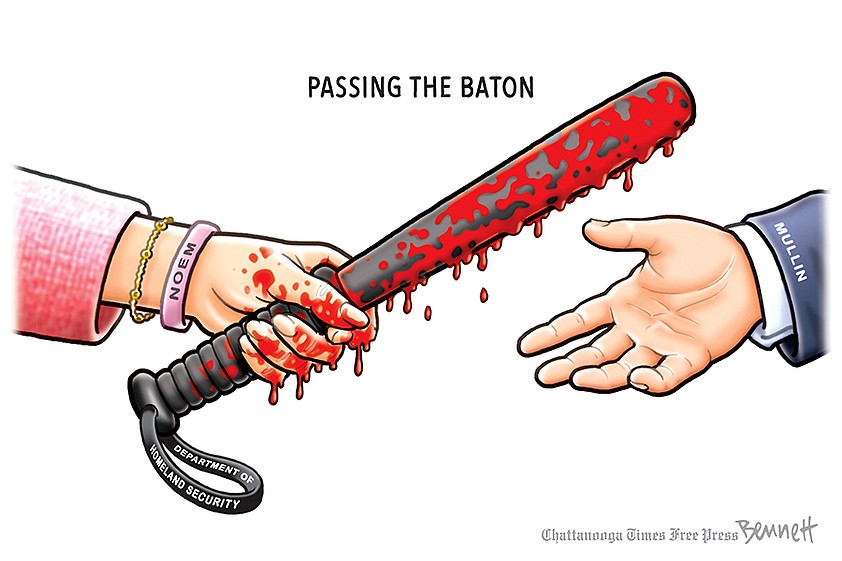
Republicans know that it looks bad for them when ICE agents murder American citizens in the streets and suffer no consequences. So they want to soften their rhetoric and present a more pleasant image. But the underlying thuggishness of ICE isn’t changing. Replacing Kristi Noem with Markwayne Mullin is just a change of figurehead at DHS. Stephen Miller still runs the show, and he likes the thugs.
If congressional Republicans really wanted a course correction at DHS, they have a straightforward opportunity without changing its leadership. The agency has been shutdown since Feb. 14, when Democrats refused to support legislation funding the agency because it lacked provisions reforming ICE. The list of demands in their counterproposal is straightforward. ICE agents would be required to wear identification badges and work without masks, and follow existing laws regarding warrants. They would also be banned from targeting people based on race. The GOP’s refusal to rein in the rogue agency even a little shows that the party does not want to “course correct” in any meaningful way.
Brian Beutler sees this as nothing more than an across-the-board plan to save Republicans in the midterms:
They now seem to be tacking back a subtler approach. Not just because they think they’ll get a second chance at authoritarian breakthrough, but because the nature of their conduct over the past 14 months has rendered the whole project politically toxic. What they want, therefore, is to freeze their progress in place, dialing back the braggadocio, in the hope that voters sense the atmospheric differences between March 2025 and March 2026 and assume the worst is behind them. In other words, they are hoping to salvage power through a change in rhetorical emphasis, without substantively backtracking.
Trump still calls the shots for the GOP in Congress, and he opposes “any deal with the Crazy, Country Destroying, Radical Left Democrats”. The deal apparently on the table would lead to no changes at ICE, but would make Republicans fully own ICE’s rogue behavior: Democrats would vote to fund all of DHS other than ICE, while ICE funding would be part of a reconciliation bill that would be immune to filibuster.
To me, even the Democrats’ demands aren’t enough. At the very minimum, I want to see charges filed against the agents who murdered Rene Good and Alex Pretti. Until that happens, ICE’s thugs will go on assuming they have a 007-like license to kill.
ICE has illegally been taking DNA samples from protesters it arrests. “It’s very concerning to me because what it looks like the government is doing is creating this catalog of political dissidents.” DHS hasn’t said what it does with this information.
and law
The Trump administration had another bad week in court.
They had surrendered those passes in October instead of signing the policy, which empowered the Pentagon to declare journalists “security risks” and revoke their press passes if they engaged in any conduct that the Pentagon believed threatened national security. In his 40-page ruling, Judge Friedman wrote that the Pentagon’s policy rewarded reporters who were “willing to publish only stories that are favorable to or spoon-fed by department leadership.”
Siding with an argument advanced by The Times, Judge Friedman added that the Pentagon had given itself too much power to enforce its new rules. The policy also violates journalists’ due process rights under the Fifth Amendment, he said, writing that it “provides no way for journalists to know how they may do their jobs without losing their credentials.”
According to Law Dork, third-country removals — deportations to someplace other than the deportee’s home country — is one of Trump regime’s “most dramatic anti-immigrant policies”. I invite you to think about what an extreme punishment this is: Imagine being dropped into a country you know nothing about, possibly a war-torn country like Sudan. You have no friends there and you may not speak the local language. You don’t know what rights (if any) the local system grants you. Even if you aren’t immediately imprisoned, you are in rough shape: You have no job and no prospect of getting one.
In its Wednesday post, LD gives a good summary of where the case to restrain these deportations stands: A district court has been trying to rein in this practice, and recently issued its final opinion — not an injunction or any similar temporary judgment.
[Judge Brian] Murphy has ordered the Trump administration to provide people with “meaningful“ due process before carrying out third country removals.
Trump’s DoJ took that ruling to the First Circuit appellate court, which put a stay on the lower court’s order while they consider the merits of the case. That stay allows third-country removals to continue temporarily, but LD interprets this as possibly a strategic move by one of the Biden appointees who might ultimately want to affirm the lower-court ruling.
Looking at this strategically, in light of the Supreme Court’s prior shadow docket order, the stay grant prevented the case from going to the Supreme Court now — allowing the First Circuit to fully consider these questions and issue a full merits ruling before this important case goes back up to the Supreme Court.
Instead, the First Circuit is going to hear this case quickly, with briefs and oral arguments finished in April.
RFK Jr.’s reign of error at Health and Human Services got bad news from the courts on two fronts.
Just about everything RFK Jr. has done to discourage vaccine use got thrown out by the same Judge Murphy.
A different federal judge set aside HHS’s declaration that gender-affirming care “is neither safe nor effective as a treatment modality for gender dysphoria, gender incongruence, or other related disorders in minors.”
Both rulings make similar arguments: There are legal ways to change HHS policy, but Kennedy circumvented them.
The vaccine ruling revolves around the role of the CDC’s Advisory Committee on Immunization Practices (ACIP), which is supposed to be a board of scientific experts on vaccines. Back in June, Kennedy fired the entire committee, which he subsequently replaced with hacks who agree with him. Judge Murphy noted that of ACIP’s 15 current members “only six appear to have any meaningful experience in vaccines”. This violates the legislation that established ACIP and numerous laws that refer to it.
HHS, sometimes with the advice of the new unqualified ACIP and sometimes without, changed childhood vaccination schedules and made other vaccine-related rulings — all pointing in the direction of Americans receiving fewer vaccinations. These moves also violated various laws, including the Administrative Procedures Act.
The ruling blocks these changes to HHS vaccine policy and bars ACIP from continuing to meet in its current form.
In the weeks after Mr. Kennedy issued his written declaration, the Department of Health and Human Services indicated that it would investigate institutions that continued to prescribe medication to minors for gender transitions and would potentially bar them from receiving federal Medicare and Medicaid funds. (As an aside, the declaration re-names “gender-affirming care” as “sex-rejecting procedures”. )
The court ruling prevents HHS from enforcing its new policy. HHS will undoubtedly appeal.
The National Trust for Historic Preservation is suing to stop construction of Trump’s massive White House ballroom until the project gets congressional approval and submits to the ordinary review process. Verbal comments by the judge in this case have observers speculating that he will side with NTHP when he rules later this month.
and Robert Mueller
The death of Robert Mueller at age 81 provides a news hook for renewed discussion of what Mueller investigated: Trump’s ties to Russia. Certainly Trump himself sees the connection:
Robert Mueller just died. Good, I’m glad he’s dead. He can no longer hurt innocent people!
(Remember all the handwringing about “civility” when liberals weren’t sufficiently deferential about Charlie Kirk’s death?) But certainly Trump is not one of those “innocent people”. Marcy Wheeler reviews the convictions Mueller’s Russia investigation led to, and points to the pardons of key figures that kept Mueller from fully uncovering the Trump/Russia conspiracy.
Mueller’s failure, solidified by Democrats’ failure to do anything with the impeachment referral, to thwart Trump’s betrayal of the United States is one of many aspects of a larger lesson that the US legal system was not built to hold a corrupt President accountable. Impeachment does not work, and even before John Roberts gave Trump a retrospective and prospective Get Out of Jail Free card, Presidents had too much power to tamper in investigations of their own crimes.
and the Illinois primary
Tuesday, Illinois held primaries for both parties. It’s a blue state, so the big news was on the Democratic side. Several races were interpreted in the media as progressive/moderate races, with moderates doing somewhat better. But there was not a clear trend. Illinois does not have a run-off rule, so several multi-candidate races were won with less than 50% of the vote.
The top of the ticket was the race to replace retiring Dick Durbin in the Senate. (Side note: I was living in New Hampshire during the 2008 primary campaign. The Obama victory party was supposed to be upstairs from my favorite brew-pub, but Obama was surprisingly defeated by Hillary Clinton. I was in the pub for dinner, went to the bar for some reason, and noticed I was standing next to Dick Durbin. I let him mourn in peace.) Lieutenant Governor Juliana Stratton won with 40%.
Another noteworthy race was for the 9th congressional district. I was rooting for Kat Abughazaleh, but Evanston Mayor David Biss performed well during the ICE focus on the Chicago area, so I was not sorry to see him win. The big loser in this race was AIPAC, which put a lot of money behind the third-place candidate.
The somewhat better showing of moderates touched off the usual debate about which direction the Democratic Party should go, with many voices pushing for what Matt Yglesias calls “popularism”: backing away from unpopular positions. Unfortunately, this is generally interpreted to mean throwing trans people under the bus. I have trouble seeing how this actually works in practice. Harris never mentioned trans issues during the 2024 fall campaign, but that didn’t save her because she had supported the trans community in the past.
About the only way this can work is to do what my congressman, Seth Moulton, did: repeat anti-trans talking points yourself. (He’s running for the Senate now, and I will not be voting for him in the primary against incumbent Ed Markey.) Even that probably won’t work, because your Republican opponent can always make a more extreme anti-trans attack and dare you to match him.
I’m struck by how seldom the same popularist point is made to Republicans about issues like abortion. At most, Republicans are told to soften their rhetoric, not change their position (that abortion should be illegal in nearly all situations, often including ones that endanger a pregnant woman’s health). Chair Richard Hudson of the National Republican Congressional Committee told Punchbowl News:
Republicans don’t have a policy problem. We have a branding problem.
Their policy is that a woman who is raped should be forced to bear her rapist’s child. In other words, rape should be a viable male reproductive strategy; if you’re having trouble attracting women, you can still propagate your genes by force.
Republicans think they can win the issue by painting Democrats as even more out-of-step with the public than Republicans are.
We need to point out that the Democrat position is abortion for any reason, up until the moment of birth, paid for by taxpayers.
But that’s hardly any Democrat’s real position. Not that the truth actually matters.
Here’s my take on where most voters are: They generally dislike abortions and wish the US had fewer of them. But if someone in their family needs one, they don’t want the government to tell them they can’t get one.
Coincidentally, I think most voters have exactly the same opinion about guns.
TPM collects what is known so far about the DHS contracting scandal. The gist: DHS funds big projects through dummy general contractors who then farm the work out to politically connected sub-contractors. This, plus a few other gimmicks, circumvents the usual government contracting process — which is cumbersome but designed to prevent exactly this kind of corruption.
Republican rhetoric about the SAVE Act started as painting the bill as common-sense, nothing-to-see-here. But as it looks increasingly unlikely to get through the Senate, they are revving up evidence-free conspiracy theories about noncitizen voting.
The accusation that there is rampant cheating in our election is dramatic, alarming, and oft-repeated. It is also totally false.
After years of audits, recounts, lawsuits, academic studies, and investigations across red states and blue states alike, there is absolutely no evidence—zero—that substantial, outcome-changing voter fraud is present in American elections. There simply isn’t proof.
It turns out that the real fraud is not at the ballot box; it’s claims like the one the president made as he addressed a joint session of Congress.
If I were a Democrat in a general-election debate with a Republican, I’d want to ask this question: “Do any of your proposals address a problem that actually exists?”
The Idaho House has passed another transgender persecution bill. This one makes it a misdemeanor to “knowingly and willfully enter a restroom or changing room … designated for use by the opposite biological sex”. First offense can get you a year in prison, while the second offense can get you five.
OK, I see how this makes life more difficult for transfolk. But how does it make life better for the rest of us? What problem do such bills solve?
Accept for the moment that transgender and nonbinary people exist. (Off the top of my head I can think of three that I’ve met personally. I wouldn’t be surprised if there are others that I haven’t noticed.) So picture a person with a female birth certificate who now presents as male, to the point that you really can’t tell unless you stare. Like all humans, that person may need a public bathroom from time to time. Which is more disruptive?
Going into the men’s bathroom and using a stall.
Going into the women’s bathroom looking like a man.
I think the answer is obvious. Idaho’s law is mandating the more disruptive outcome. So the point isn’t to make society work more smoothly. The point is to persecute trans people.
Trump’s concentration of lies seems to be rising. This post must be some kind of record:
FREE TINA PETERS, A 73-YEAR-OLD WOMAN, WITH CANCER, GIVEN A NINE YEAR DEATH SENTENCE IN A COLORADO PRISON BY DEMOCRAT GOVERNOR, JARED POLIS, AND A CORRUPT POLITICAL MACHINE, FOR EXPOSING FRAUD BY THE DEMOCRATS IN THE 2020 ELECTION.
Kyle Clark finds four false claims in those 40 words:
Peters is 70 (not 73), does not have cancer, was sentenced by a judge in Mesa County (not the Governor), and did not expose fraud in the 2020 presidential election.
With no goal to achieve, it’s hard to see how this ends.
Two weeks ago, I opened the weekly summary with a quote from the Roman philosopher Seneca: “If one does not know to which port one is sailing, no wind is favorable.” That continues to be the story of the Iran War. When reporting on the “success” of the war so far, SecDef Pete Hegseth talks about destruction:
During the briefing, Hegseth said the U.S. has struck more than 7,000 targets in Iran, wiped out its submarines and has “crippled” the nation’s military ports. “We are hunting them down methodically, ruthlessly and overwhelmingly like no other military in the world can do,” Hegseth said. “Today will be the largest strike package yet.”
The mission of Operation Epic Fury is laser-focused: Destroy Iranian offensive missiles, destroy Iranian missile production, destroy their navy and other security infrastructure – and they will never have nuclear weapons.
But only that last point “they will never have nuclear weapons” is a strategic goal, and the destruction Hegseth glories in does not lead to that goal in any clear way. The ayatollahs remain in power. Iran continues to have uranium it could enrich and oil it can sell to raise money. Given all that, a nuclear program could resume whenever the bombing stops, no matter how much rubble Iran will need to clear away.
In The Big Picture, Jay Kuo references another classic strategist, Carl von Clausewitz.
Clausewitz’s seminal work, On War … instructs that military force should never be an end in itself. War is the “continuation of politics by other means.” Military aggression, in Clausewitz’s view, must therefore always be in service of a political objective. Once a military campaign loses sight of that goal and focuses only on battlefield success, the real war is already lost.
Modern American military failure is largely a study in ignoring that warning.
Kuo recalls Vietnam, which I have also been thinking about. (Yes, I’m that old.) Hegseth’s predecessor Bob McNamara convinced himself that we were winning the war using statistics like body counts. Even if you believed the counts were accurate, McNamara didn’t seem to realize that we couldn’t win the war by killing more of their soldiers than they killed of ours. Killing the enemy is never an end in itself.
Same thing here. Iran’s regime doesn’t need to shoot down our planes or sink our ships to win this war. It just needs to survive, and so far, it’s surviving. By closing the Strait of Hormuz and raising the world price of oil, Iran is inflicting pain on the American consumer. Yes, our aerial bombardment is inflicting far worse pain on Iranians. But Iranians know what they’re suffering for and we don’t. It’s not at all obvious that they will demand an end to this war before we do.
This week, the Trump regime continued the pattern of saying many contradictory things at once. They seem confident that the MAGA faithful will decide to believe whichever one they want and be encouraged accordingly.
Oil prices dropped and stock prices rose this morning, because traders still take Trump’s statements seriously, no matter how many times they amount to nothing.
Regardless of what any of the parties say about their intentions, the war is escalating. The early strikes were aimed primarily at Iran’s leadership, and they succeeded in killing not only the supreme leader, but many of his top deputies. Military targets came next (with an occasional misfire producing civilian casualties). But those strikes left open the possibility that new leadership could command a viable country with a viable economy.
Iran attacked the world’s biggest liquefied natural gas complex in Qatar, targeted a gas field and facility in the United Arab Emirates, fired missiles and launched drones on a Saudi Arabian oil refinery and on two Kuwaiti gas units on Thursday, following Israel’s bombing of Iran’s South Pars gas field a day earlier.
Now Trump is threatening Iran’s power plants, which is a direct attack on the civilian economy.
In any conflict, Trump only knows two moves: escalate or walk away. His reputation as a deal-maker is a bad joke; he has no idea how to make deals. As I have predicted before, Trump will keep escalating until Iran surrenders, and Iran won’t surrender. So I see no limit on how far this goes. But Paul Krugman confesses that at this point, he doesn’t know what to do either:
I have no idea how this ends. I don’t even know what I would do at this point. I mean, take a time machine and go back and not do this, but now it’s going to be really, really ugly.
So having started this note with one quote from and ancient Roman, let’s close it with another. In The Histories, Tacitus wrote:
As so often happens in these disasters, the best course always seemed to be the one for which it was now too late.
The Iran War is turning out to have significance for military theory.
Back in 1936, the Spanish Civil War was far more than just a competition between fascist/catholic forces and democratic/communist forces. It was also a preview of the new warfare that would come into its own in World War II.
Ukraine is playing the role of Spain this time around. Russia began the war by attempting a World-War-II style blitzkrieg that aimed to put tanks in Kiev in a few days. It failed, and now, four years later, the war has turned into a drone-vs-drone battle in the near-ground air.
The current Iran War is a second chapter in this story. At the heart of the new warfare is a battle of resource attrition: Drones that cost thousands of dollars can destroy tanks and ships worth millions, and the Iron-Dome-style missiles that intercept drones also cost millions.
The reason we are getting fertilizer, mostly from Qatar, is that the fertilizer is made … from natural gas. Natural gas can be exported, is exported, in large quantities from the Persian Gulf, or was until this war began. That’s expensive. You have to super cool it and liquefy it and ship it out through special terminals and special ships.
And, you know, it can be done and it’s become really critical to a large part of the world. But the other thing you can do with the natural gas that’s available in the Persian Gulf area is convert it into fertilizer, which is a lot easier to ship. And so a lot of the world’s fertilizer turns out to come from that area and normally get shipped through the strait.
You can already notice the price of gas rising. But it might not be until fall that you notice the price of food rising.
I’m going to be taking the next two weeks off, this time for an actual vacation rather than because I’m putting together a talk somewhere. I’m hoping the world can behave itself while I finish moving and cruise the Danube.
Once again this week, the Iran War drowns out other news, though at least this time I’ll be updating the “ongoing stories” part of the weekly summary. Everything we’re finding out supports what the pessimists have been saying all along: Escalation will continue, because there is no other plan. The featured post this week will be a collection of notes on the war and its consequences. It should be out shortly.
The weekly summary will cover the latest news about ICE, the Trump regime’s continuing losses in court, the strange case of conspiracy-theorist-turned-MAGA-defector Joe Kent, the death of Robert Mueller, and a few other things. I’ll try to get it out around noon EDT.
The transition to pathocracy begins when a disordered individual emerges as a leader figure. While some members of the ruling class are appalled by the brutality and irresponsibility of the leader and his acolytes, his disordered personality appeals to some psychologically normal individuals. They find him charismatic. His impulsiveness is mistaken for decisiveness; his narcissism for confidence; his recklessness for fearlessness.
This week’s featured post is “The Longer View“, where three articles try to answer the question “What’s wrong with those people in the Trump administration?”
Ongoing stories
This week I didn’t have the time and energy to look at the ongoing stories I usually keep track of. I’ll try to do better next week.
This week’s developments
This week everybody was still talking about Iran
I don’t think I need to say a lot about the progress of the war: The US and Israel continue to blow things up in Iran and in Lebanon, and while Iranian casualties are far larger than ours, we’re still getting our own people killed. And they’re dying for some goal that seems to exist only in Trump’s inarticulate mind. He certainly hasn’t figured out a way to explain it to the rest of us.
As the cartoon indicates, even though everyday Americans are largely insulated from the killing (at least until the next big terrorist attack), the war has significant effects everyone can see: immediately, higher gas prices, and down the road, higher prices overall.
Trump appears to have thought through none of this. Articles about how the go-to-war decision got made are largely based on anonymous sources, so they’re not as reliable as I’d like. But they do all paint a similar picture: Trump imagined his Iran attack going like Venezuela: He’d take out the country’s leadership, and the next leaders would be so intimidated they’d cooperate with whatever plan he came up with. It would all be over in a few days.
No one else thought it would go that way, including a lot of folks inside the administration. What has happened since was easily predictable: Iran’s theocratic leadership would take a next-man-up approach. The next leader would face the prospect of martyrdom with the same dispassion the last leader did and would refuse to surrender. Iran would attack US allies in the region with missiles and drones, and they would shut the Strait of Hormuz, jacking up world oil prices.
But in his second administration, Trump has surrounded himself with opportunists, weaklings, and cowards. No one is willing to lose his job to save the country from some wrong-headed notion that gets into the Great Leader’s head. So: We’re at war, gas prices are high and rising, overall inflation will start rising soon, victory remains undefined, and the Iranian regime is as entrenched as ever. We face the prospect of either stopping our attack without any lasting accomplishment, or significantly escalating the war with either ground troops or nuclear weapons.
So far, I haven’t heard anyone in the administration talk specifically about nuclear weapons, so my mention of them in the previous paragraph may seem unwarranted.
But I worry about them anyway. As I’ve said before, Trump has only two ways of dealing with opposition: buy them off or intimidate them. If opponents refuse to be intimidated, he makes a series of ever more extreme threats — which he is then on the spot to carry out.
Wednesday, Iran flexed its cyber-terrorism muscle. The Iranian hacker group Handala somehow got high-level privileges on the network of medical device maker Stryker. At the very least, the attack will delay delivery of devices. But it raises the possibility of homocidal mischief in the future.
Chillingly, Stryker’s chief of IT emphasizes that nothing went wrong on the technical side:
I build the robots that perform your surgery. The defibrillators that restart your heart. The systems that let your nurse find your doctor at three in the morning when something goes wrong. Twenty-five billion dollars a year. Fifty-six thousand employees. Sixty-one countries. Every device in every country, managed from one console.
On March 11th, someone who was not me sat down at that console and erased everything. I should be precise. They did not hack us. They logged in. … My security tool did not fail. It performed exactly as designed. It wiped every device it was told to wipe, without error, on schedule. The architect of my destruction was my own IT budget line item. The command went out. The devices obeyed.
The man who rammed his vehicle into a synagogue in Michigan quite likely was motivated by learning that four of his family members had been killed in Lebanon by an Israel bombing raid. He was wrong to do what he did, and it is fortunate no one died but the perpetrator. But it’s not hard for me to imagine being in that situation and feeling like the only conceivable response is to kill someone.
In a post on his Truth Social platform, Trump called on the UK, China, France, Japan, South Korea and other countries to send ships to the waterway, the world’s busiest shipping route, which is being violently blockaded by Iran. In his post, Trump alleged that “many countries, especially those who are affected by Iran’s attempted closure of the Hormuz strait, will be sending war ships, in conjunction with the United States of America, to keep the strait open and safe”.
In a later post, Trump extended his call to all “the countries of the world that receive oil through the Hormuz strait” to send naval support.
German chancellor Friedrich Merz’s spokesperson, Stefan Kornelius, underlined that “it is not Nato’s war. Nato is an alliance to defend the alliance area.”
The time to look for allies is before you start a war, not after. Trump is like the guy who starts a bar fight nobody else wanted without giving his buddies any warning, but then expects them to come fight on his side.
Josh Marshall asked the same question I’ve been wondering about: Why do oil markets respond to what Trump says, when so much of what he says is nonsense?
Courts have been proving troublesome to the Trump administration.
Friday, a judge unsealed an opinion quashing subpoenas in the investigation of Fed chair Jerome Powell. The investigation appears to be nothing more than an effort to harass Powell into doing what Trump wants: lowering interest rates. The US attorney’s brief in support of the subpoenas vaguely asserts that cost overruns in renovations at the Fed might be due to fraud, and that testimony Powell gave to Congress might be false. No further specifics are given.
After the opinion was released, U.S. Attorney Jeanine Pirro went on a rant about “activist judges”. But
The striking thing about the brief, and about Pirro’s press conference, in fact, is that neither seems remotely concerned with establishing that there is a predicate for a criminal investigation at all. … [N]either shows any awareness that investigative agencies aren’t supposed to initiate criminal investigations at all without an appropriate evidentiary predicate.
In her rant, Pirro “said she was willing to see acquittals and willing to see grand juries reject her proposed indictments”. Grand juries used to almost never reject the government’s attempts to indict someone. But now they regularly do, because the government pursues so many indictments purely to harass Trump’s enemies.
Lawfare examines proposals circulating in administration circles for Trump to declare a national emergency to take control of the fall elections. Unsurprisingly, such an order would likely be illegal.
Under the new law, a voter registration applicant’s citizenship status must be verified by the Florida Department of Highway Safety and Motor Vehicles. Until that happens, an applicant will be registered as an unverified voter and must vote with a provisional ballot that will not be counted if his or her legal status as a citizen cannot be verified through the department’s records.
The law doesn’t just impact new registrations. It also requires the Florida Department of State to verify the citizenship status of all registered voters who have not already been verified as U.S. citizens. If the citizenship status of a registered voter cannot be established or the voter record does not indicate that the registered voter’s citizenship is verified, the department must notify local election officials, who then notify the registered voter.
Unless courts intervene, we can expect chaos in Florida in November.
Remember all those people claiming that ICE agents were randomly rounding up brown people because they had arrest quotas to meet? A wild, crazy accusation, right?
Well, now some ICE agents have been interviewed under oath, and it turns out they were supposed to make eight arrests a day. They found people to arrest using a custom AI-app that made a lot of mistakes. And this part is beyond parody:
JB said the team decided to follow the van once it departed, even though officers didn’t confirm whether the driver of the van was, in fact, the registered owner of the vehicle. JB found it suspicious that the driver was making multiple stops for passengers, saying: “You don’t know if it’s human trafficking or smuggling.” The fact that the occupants were “only speaking Spanish” during the stop seemed to “confirm” there was smuggling or “harboring people that are not supposed to be here in the United States”, JB said.
It was a car pool, taking farm workers to their worksite. But
JB’s team pulled over a van of farm workers heading to their job early in the morning, smashed the car windows and detained all seven occupants.
One of them, a plaintiff in the suit that resulted in this deposition, had entered the US legally. But she
was taken to a detention center in Washington state before ICE released her “without explanation and left her to find her own way back home to Oregon”.
Under the proposed rule, the attorney general could ask any independent disciplinary authority to suspend ethics proceedings against a Justice Department lawyer (on threat of unspecified enforcement action) and send the matter to the department’s Office of Professional Responsibility. But a review by that office is not a serious substitute for a state bar investigation. Even before Mr. Trump, the office, which answers to a political appointee, had a reputation for operating like a black hole, with the details of investigative findings almost never made public.
and trans people
The effort to demonize and dehumanize the trans community continues.
So, most but not all states allow you to change or choose the gender marker on your driver’s license. Blocking that is one level of discrimination, but the state of Kansas has taken it a step further: They retroactively cancelled any license where the gender had been changed while it was legal to do so: 1700 of them in all.
Hundreds of trans drivers already received letters from the state informing them their documents were “invalid immediately” and they “may be subject to additional penalties” if they continue to drive, unless they surrender the license to the Kansas Division of Vehicles and receive a new one with their birth sex.
Does forcing the gender on a drivers license to match the one on the corresponding birth certificate solve any problem? Let’s think about what drivers licenses are for and how they’re used. It makes perfect sense for states to want to keep track of who can drive on their roads and to impose standards to disqualify unsafe drivers. In addition, drivers licenses get used as an commonly available form of ID.
Why is gender on a license at all? Like height and eye color and the picture, it helps verify that you really are the licensed person. But if your appearance corresponds to a different gender than the one on your license, that actually makes the license less useful as ID. Worse, it sets you up for discrimination and abuse: Anyone who has a legitimate reason to ask for your license now knows that you’re trans.
Now think about situations where you might show your drivers license. Is there any reason why a policeman or a cashier or anybody else needs to know what gender is on your birth certificate? I can’t think of one. So this law solves absolutely zero problems.
All it does is harass trans people and expose them to discrimination and abuse. The only motive Kansas had to pass this law was to encourage such discrimination and abuse.
Last week, I talked about how the Supreme Court only takes “sincerely held religious beliefs” seriously if they are conservative religious beliefs about topics like abortion or gender.
Example: On March 2, the Court set aside a California law that prevents schools from telling parents about a student’s change in gender presentation without the student’s permission. The Court said the law prevents parents from implementing their sincerely held beliefs in the religious upbringing of their children.
It remains to be seen whether teachers and school districts who keep a child’s confidences will be held liable in some way. If a child ever confided some deep issue to me and asked me not to tell their parents, I would hope that my first response would not be to go rat them out. (I haven’t had that conversation about gender transition, but I have occasionally kept confidences about drugs or sex.) That practice comes from my sincerely held moral beliefs, which I fear the current Court would not recognize.
I also wonder when a student’s behavior might trip such a requirement. If Samantha tells her teachers she wants to be called Sam, and starts wearing gender-nonspecific jeans and t-shirts, are they supposed to call the parents?
It’s a telling point that the version of the SAVE Act (another law that solves no problems) that Trump is throwing his hissy fit about isn’t just about making it harder to vote, it’s also about attacking trans people. The version of SAVE passed by the House and held up in the Senate just focused on disenfranchising people who don’t have passports or easy access to their birth certificates or marriage licenses. But Trump wants to add:
NO MEN IN WOMEN’S SPORTS: NO TRANSGENDER MUTILIZATION FOR CHILDREN!
Translation: Ban transwomen from women’s sports and make gender-affirming care illegal for minors. Those provisions deserve their own argument, which maybe I’ll get to later. But the simpler question is: Why should they be part of a voter-suppression law?
The answer is simple: Transfolk are to Trump what Jews were to Hitler or Blacks have been to the KKK. His base has been trained to hate them, and he can sometimes transfer the energy of that hatred to some other issue, even a completely unrelated issue like voting.
Trump just declared that he’d ban trans women from the Olympics. Only one openly transgender woman has ever competed in the Olympic Games in its history. In 2020. She did not win a medal. This is fabricated controversy to fuel bigotry. Like banning trans women from owning nuclear weapons.
and you also might be interested in …
Courts near the border are clogged with misdemeanor trespass cases that serve little purpose and are usually thrown out by judges. By declaring the border area a military zone, the administration created a new crime that most people who commit it have never heard of.
More and more, the Bezos-owned Washington Post is becoming a mouthpiece for a billionaire agenda. Here’s what I saw in their opinion section on just one day (yesterday). This piece on Pittsburgh sets up a false dichotomy between city services and progressive politics, essentially blaming progressive Democrats for the state of the city, which is painted in the same gloomy colors MAGA uses to describe all Democrat-run big cities. Pittsburgh’s new centrist Democrat mayor is a “lesson” for the national party to shift away from its progressive wing.
Zohran Mamdani wants to tax New Yorkers “to death“, but
Of course, New York doesn’t need more revenue — the city could simply cut expenditures, starting with Mamdani’s $127 billion spending plan for fiscal year 2027.
which is described in the next paragraph as “a socialist laundry list”.
Chicago also is portrayed as on the brink of insolvency. And San Francisco’s BART is “headed for a financial death spiral”. What looks on the surface like a fluffy denunciation of fancy coffee drinks is some guy from the Hoover Institute quoting Edmund Burke about how our failure to control our appetites is ruining society. A fair point, maybe, but why is the example a type of excess associated with upscale liberals, rather than say Bezos’ half-billion-dollar yacht?
And James Talarico’s candidacy isn’t inviting Christians to return to the teachings of Jesus, it’s a return to the failed views of liberal Christians in general, which the religion market rejected in the 20th century in favor of right-wing Christianity.
None of these pieces is outright pro-fascist, and any one of them might have a place on the editorial page of a newspaper trying to present a balance of views. But the WaPo bombards readers with all of them on the same day, with no voices at all from left of center.
NPR has an article about Spartanburg County, South Carolina, which is experiencing “the biggest measles outbreak in the U.S. in more than three decades, with nearly 1,000 confirmed cases”. The reason? The vaccination rate has fallen to 89%, well below the 95% necessary to achieve herd immunity.
And why are parents so reluctant to vaccinate their kids? One of the reasons is “lingering resentment over COVID mandates”.
“I think it should have been a choice. It shouldn’t have been shoved down your throat like you have to do it.”
It’s amazing to me how quickly the popular culture has minimized the COVID pandemic. (Starting with Trump, who minimized it while it was happening.) 1.2 million Americans died of COVID. When the country has to deal with a disaster that big, you’re not going to keep all your freedom. I mean, think about 9-11, and how much disruption of daily life followed from that. But in terms of deaths, COVID was hundreds of times larger than 9-11. At the pandemic’s peak, it was like a 9-11 was happening every day or two.
So yes, once a vaccine existed, the government absolutely should have “shoved it down your throat”. And they should shove a lot of other vaccines down your throat too, so that the general population doesn’t have to worry about polio or smallpox.
A deposition under oath made it clear that a DOGE staffer tasked with flagging National Endowment for the Humanities grants to cancel due to DEI actually had no idea what DEI was and no education in the humanities. Having no knowledge himself, he used ChatGPT to
search programs and grants to cut using terms such as “Black,” “gender,” “LGBTQ+,” and “equality.” However, DOGE would not search for cuts from anything involving terms like “caucasian” and “heterosexual.”
That and similar clips went viral, but I can’t link to them because a judge has ordered them removed. Apparently, they exposed the DOGE tech bros to “widespread ridicule”.
Imagine that: Young idiots served as judge and jury over NEH grants they did not understand. And now they’re being ridiculed. How unfair!
I’ve been a fan of Kat Abughazaleh since days when she used to do quick summaries each week of what Fox News was covering. Now she’s running for Congress in Illinois’ 9th district. The Democratic primary is hotly contested, and Kat (a Palestinian-American who has been outspoken about the Gaza genocide) has been targeted by AIPAC.
Ever find yourself watching Trump officials and thinking “What’s wrong with those people?” Three writers offer their answers.
We’ve known for a long time that the Trump administration works on a flood-the-zone theory: Do so many outrageous things simultaneously that the American People have a hard time comprehending them all, much less organizing a response. Are they disenfranchising large numbers of voters? Never mind that, ICE is murdering US citizens on the streets of Minneapolis. Want to do something about that? That’s yesterday’s news; the Epstein files are hiding evidence of billionaire pedophilia. Concerned about that? Never mind, we’re in a war now. On and on.
Further impairing our comprehension is the barely explicable attitudes central figures in the administration take. Again and again, before I can even get to the policy content of some statement, I have to deal with my first response: What is wrong with these people?
Trump said he was “surprised” that Iran decided to attack other Middle Eastern countries in response to the U.S.-Israeli operation, and that U.S. strikes on Kharg Island on Saturday “totally demolished” most of the island but that “we may hit it a few more times just for fun.”
Just about any appearance by Secretary of War Defense Pete Hegseth includes a what’s-wrong-with-him moment. Friday during a press briefing about the Iran War, he said there would be “no quarter, no mercy for our enemies“. [Note the web site that link is on: war.gov] Just Security posted an article by Danial Maurer, a former Army JAG who has taught at West Point. Maurer imagined the memo a Pentagon legal counsel should have sent to Hegseth in response: It points out that “no quarter” is a war crime. The phrase refers to the ancient practice of killing opponents even if they try to surrender.
Maybe Hegseth intended to threaten war crimes and encourage his underlings to commit them. Or maybe he was just blabbing — saying a bunch of tough-sounding words without knowing what they mean. Either way: What’s wrong with that guy?
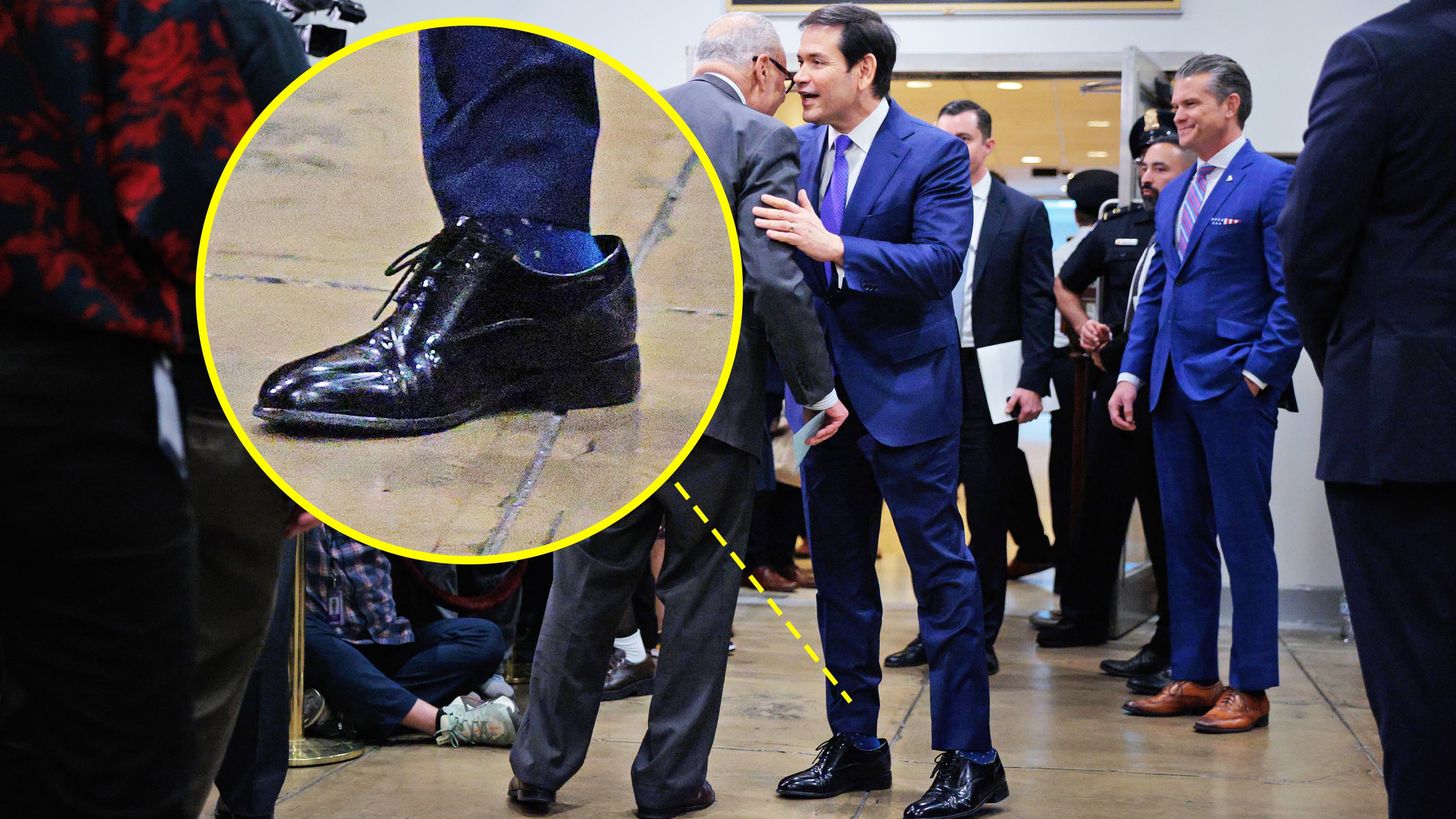
Trump gave his whole cabinet shoes identical to his own favorites, and “everybody’s afraid not to wear them.” For some reason he made Marco Rubio’s way too big. And Rubio wears them. Our Secretary of State attends important gatherings in clown shoes. What’s wrong with him?
Pam Bondi blew off questions from Congress about DoJ’s failure to interview survivors of Jeffrey Epstein’s crimes by pointing to the stock market:
The Dow is over 50,000 right now. … That’s what we should be talking about.
I was listening to that hearing live, and I had trouble even getting to the policy implications of her statement. Because all I could think was: “What’s wrong with her? What kind of human being thinks like that?”
Why are all these people so cruel, insensitive, self-centered? so devoid of qualities that we expect not just from leaders but from ordinary people?
Most of us don’t have the time or the presence of mind to step back and try to answer that question. But a few recent articles have been written by people who do.
The most interesting to me is “The Problem of Pathocracy” by Dr. Steve Taylor, which was published by The Psychologist, a journal of the British Psychological Society. It’s a recent article, but the theory it presents goes back to the pre-Trump era. Polish psychologist Andrzej Lobaczewski, who experienced both Nazi and Communist regimes, coined the term pathocracy decades ago.
As he put it, pathocracy is a system of government ‘wherein a small pathological minority takes control over a society of normal people’. Since he was living under a ‘pathocratic’ regime himself, Lobaczewski took great risks studying this topic. He was arrested and tortured by the Polish authorities, and unable to publish his life’s work, the book Political Ponerology, until he escaped to the United States during the 1980s.
According to Lobaczewski, the transition to pathocracy begins when a disordered individual emerges as a leader figure. While some members of the ruling class are appalled by the brutality and irresponsibility of the leader and his acolytes, his disordered personality appeals to some psychologically normal individuals. They find him charismatic. His impulsiveness is mistaken for decisiveness; his narcissism for confidence; his recklessness for fearlessness.
Soon other people with psychopathic traits emerge and attach themselves to the pathocracy, sensing the opportunity to gain power and influence. At the same time, responsible and moral people gradually leave the government, either resigning or being ruthlessly ejected. In an inevitable process, soon the entire government is filled with people with a pathological lack of empathy and conscience.
The first Trump administration included a large number of relatively “responsible and moral” people with conservative political views: Mike Pence, Rex Tillerson, Jim Mattis, John Kelly, and so on. But by the end of that term, all but Pence had been fired or resigned under pressure, and Pence was persona non grata after he failed to join Trump’s coup attempt in 2021. And so, as Lobaczewski predicted, we are left with a government “filled with people with a pathological lack of empathy and conscience”.
Not only is Trump’s sociopathy enabled by such people, they are drawn to him. He gives them permission to be what they always wanted to be. We can see the same process working on a larger scale: Across the country, people don the red hat because it lets them insult and abuse the kind of people they have always hated.
That leads to a second article: “Polarization and Strife” by A. R. Moxon on his blog The Reframe. That article was originally written in 2022, but Moxon reposted it this week because of its relevance to recent events.
This article flips the script on the word polarization. People complain about how polarized our society has gotten: Friendships are ending and relatives become estranged because of political disagreements.
But Moxon calls attention to a different kind of polarization, one that has always been with us: polarization between the comfortable and the marginalized, “gay or bi or trans or nonbinary, Black or brown, Muslim or Jewish or Sikh or Hindu, or undocumented, or disabled, ill, neuroatypical, impoverished, or unhoused people, and many others, too”.
The “unpolarized” world so many people are nostalgic for is one where the marginalized could be safely ignored. You could say words like bitch and faggot and nigger and retard, because all the comfortable people agreed that those marginalized groups don’t matter, and members of the groups themselves had been intimidated into silence. So you could insult or abuse marginalized groups openly, and no one would call you on it. But today you can’t even do it if you’re just joking, because nobody has a sense of humor any more.
Moxon looks at this not as polarization, but as solidarity: More and more comfortable people are feeling empathy for the marginalized and refusing to watch passively as they’re abused.
Consider the idea that treating certain people as if they don’t matter enough to care about their dignity and their lives—and doing this so thoroughly and effectively that society treats them as if they are nonexistent and disposable—creates a much deeper polarization than any fight over the holiday dinner table or on the airwaves over whether or not it’s good to do so.
And: the more peaceful that subjugation, the greater the polarization.
Consider a corollary, that as people stop going along with this unnatural injustice, it will decrease the peace of that subjugation; will increase resentment and strife, for as long as there are people still willing to fight to subjugate others.
But the strife isn’t polarization. It’s distressing, but it’s not polarization. The strife is the first early sign that we might be willing to stop being polarized by bigotry and injustice.
The third article I want to call your attention to is “The Most Divorced Men in History” by Andrea Pitzer, published on her blog Degenerate Art. Pitzer focuses on the weird affect of so many people in the Trump administration. Past administrations have at times had cruel policies, but they usually seemed apologetic about it: We don’t want to hurt anybody, but there’s this greater good to weigh the suffering against.
Trump’s people, by contrast, seem genuinely gleeful about the harm they can do. Stephen Miller, for example, appears to glory in the distress he causes immigrant gardeners and farm workers and healthcare aides. Greg Bovino gave a swaggering style to the ICE thugs who terrorized Minneapolis. Elon Musk seemed joyful and pleased with himself as he slashed programs to feed hungry people and inoculate children against infectious diseases. In the end, he caused vast numbers of deaths and didn’t even save the government money, but he appears untouched by the kind of regret the rest of us feel when we tap a stranger’s bumper in a parking lot.
Pitzer goes out on a limb and associates this kind of high-level viciousness with a phenomenon she sees in everyday life: divorced-guy energy.
What do I mean by “divorced guys”? I mean that they all have the energy of the man who won’t stop talking about the woman who left him and what a monster she is, with the clear implication that her mistreatment of him was entirely undeserved.
Several examples of this personality type exist in the right-wing influencer universe. In some cases, as with incels, the guys haven’t even been left by a partner yet, but they already speak about punishing women or restricting their rights as if the other sex has already betrayed them. In other cases, as represented by Andrew Tate, the men advocate the active physical and psychological abuse of women as a group as a means to power in a physical hierarchy in which men are supposed to dominate by default.
But the heart of divorced-guy syndrome in the U.S. today is the Trump administration. I mean that metaphorically, in which we see variations on the “divorced guy” energy of the podcasters, blaming women or assigning them very subservient roles. But I also mean it literally. The administration is filled with people who’ve had literal and often bitter divorces, and who seem to be tapping into some kind of primordial hatred of women that fuels their current work. Think Donald Trump. Or Russell Vought. Or RFK Jr. Or Pete Hegseth. I have no idea whether their issues actually rose out of their relationships with their moms, but they have played out through adult relations with women that have often ended in divorce.
Like Lobaczewski, Pitzer is pointing to the prevailing spirit in an administration, not something that affects each member individually. A few Trump officials, like Miller and Bovino, seem not to have experienced a literal divorce. And Pam Bondi and Kristi Noem are not even guys. But the administration as a whole accounts for a fairly large number of divorces, starting with Trump’s two-and-counting.
I would like to propose that the seething root of resentment that typically fuels these men is hatred of women. We are also witnessing tidal waves of racism and homophobia and disdain for the poor, but I have come to wonder if misogyny might not only sit alongside the rest but might even undergird the whole thing.
Patient zero in their hate, more often than not, is a woman each resents. The later targets might well be people who want simply to be treated as human that they refuse to treat as human because they need more targets for their fury. So instead, they come to feel they have been attacked by the actions or even the existence of minority groups. They direct their same kind of fury against those groups as they do the women they’re mad at.
She mentions Hillary Clinton as an example of a woman MAGA can’t stop hating, no matter how long she has been out of the public eye. More recent examples include AOC and the other members of “the Squad”.
Pitzer references an article by Maleah Fekete in the journal Rural Sociology, about risk-taking behaviors among rural working-class men — the heart of MAGA. Male recklessness is a major factor in the rise in “deaths of despair”. And periods of extreme recklessness often start with some triggering event.
Two-thirds of the triggering events involved relationship dissolution, which respondents frequently framed as a woman leaving. Importantly, these accounts reflect respondents’ interpretations of relationship dissolution rather than objective accounts of responsibility or causality.
Once again, the war in Iran dominates the news, and yet we know so little about it. Why did we attack? What are our goals? How will the tactics we are using achieve those goals? There’s not enough there for a featured post, but it seems silly to focus on something else.
So instead of being news-focused, the featured post will cover some general sociological and psychological analyses of the administration that have come out recently. Why are they the way they are? I’ll try to get that out between 10 and 11 EDT.
So the actual news will all be in the weekly summary: the war, the ongoing persecution of trans people, the administration’s continuing legal problems, the WaPo’s sudden change into the voice of the billionaire agenda, and a few other things. Expect to see that around noon.
Trump’s assault on American democracy. Trump continues to lose in court. I’ll try to do a round-up next week.
Climate change. Trump killed a report on the health of nature in the US, but the researchers released it anyway.
Ukraine. Ukraine is offering us anti-drone tech for our war with Iran. Russia is offering Iran targeting information on our forces. So Trump lowered sanctions on Russian oil. No wonder Adam Kinzinger wonders what Putin has on Trump.
Epstein.Miami Herald: “Three FBI interviews that contain graphic sexual and physical assault allegations against President Donald Trump were released Thursday by the Justice Department.” If the purpose of attacking Iran was to make Epstein go away, it’s not working.
This week’s developments
This week everybody was talking about the Iran War
When I wrote last week, the war had only just started and it was hard to know what was happening. So I focused on the Trump regime’s lack of preparation: The first lesson of our defeat in Vietnam was that a long-term war effort would fail without popular support. So any war but the briefest needs to be preceded by marshaling public opinion at home. George W. Bush did nearly everything else wrong in Iraq, but that part he understood. Conversely, Trump had done virtually nothing to explain why we needed to attack Iran.
At the time it was still plausible that there was a clear reason, but we weren’t being told what it was. This week it became apparent that there is no explanation for why we attacked Iran. Or at least there is no explanation that connects clear national goals with some likely outcome of this war. For several days Trump, Rubio, and Hegseth contradicted each other and sometimes themselves. It was about nuclear weapons or ballistic missiles or regime change or freedom for the Iranian people or punishing evil or making the world safe for Israel or remaking the Middle East or some other thing that you would hear about one day but not the next. The war would be short or maybe long or maybe something in between.
If the goal of your military action is clear, your exit strategies should be straightforward. Indeed, you shouldn’t need a ‘strategy’ at all. When your goals or met you’re done and you leave. … This war is probably just about Donald Trump being in charge. That’s not a clear or definable goal. It leaves the initiative in the hands of whoever currently controls the Iran state and military. It’s a recipe for unclarity.
Here are the most insightful takes on the war I’ve seen:
James Fallows’ “The Arrogance of Ignorance”. He’s been reporting on war and the military since the1980s, and boils the lessons we should have learned during that time, but haven’t, into five points.
“How does this end?” That’s the question to ask before you begin.
The importance of morale and moral factors. Your side needs to believe that you are right and your cause is just.
The memories a war creates will persistent for decades. Iranians still remember 1953, when the US engineered a coup to topple the elected government and install the tyrannical Shah.
What if the war comes home? Even a country that is dominant militarily can be vulnerable to terrorism.
Leadership matters. Fallows drives this point home with the following juxtaposition of photos: George Marshall and Pete Hegseth.
[T]hink of the clowns and posturers who now have the controls. They don’t know what they don’t know. They have no idea what they are unleashing. It took years for the United States to get into its quagmire in Vietnam. It took many months to prepare the groundwork for the disaster in Iraq. These people have changed the world, for the worse, in just nine days. And none of us knows how it will end.
One leader views the world as a transactional playground where everything is for sale, while the other views his own survival as a world-historic necessity, regardless of the ruin it brings to his people.
Trump really has only two methods of trying to influence people: He buys them off or he intimidates them. He does not understand people who act out of values deeper than greed or fear (which is why he gets so frustrated with “the Deep State”, i.e., government workers who believe in the mission of their agency). And he is fundamentally incapable of forming a shared understanding of the situation and arriving at a win/win solution.
Khamenei, on the other hand, did not want money and welcomed the prospect of martyrdom. So none of Trump’s levers could move him. Quite possibly, Trump won’t do any better moving Khamenei’s successor, his son.
Marcy Wheeler looks at how the NYT and other mainstream publications indulge Trump’s fantasies of omnipotence.
The most irksome reporting, however, is the response to Trump’s promise, on the fourth day of this war, that he will jerry-rig a program to ensure the “FREE FLOW of ENERGY to the WORLD … as soon as possible.”
His “program” is an order to the US Development Financing Corporation to offer risk insurance to ships passing through the Strait of Hormuz “at a very reasonable price. Wheeler points out that such a program would take time to set up and funding from Congress. Maybe it could work if somebody had thought of it months ago and had it ready to implement as soon as the first bomb dropped.
But Politico covers this as if Trump’s tweet had already created this program in a “Fiat lux!” sort of way. Clearly the world sees through this: That’s why the price of a barrel of oil has jumped from below $60 in January to over $100 today.
The Times has identified the weapon seen in the new video as a Tomahawk cruise missile, a weapon that neither the Israeli military nor the Iranian military has. Dozens of Tomahawks have been launched by U.S. Navy warships into Iran since Feb. 28, when the U.S.-Israeli attack on Iran began.
James Fallows commends the NYT for reporting this straight rather than watering it down to please Trump.
Not “appears to contradict” or “is at odds with” or “may give rise to suspicions that.” Flat out: “Contradicts.” “Video shows.” About the US blowing up a school full of little girls.
If your pastor is telling you that murdering Iranians will hasten the return of Jesus, you’re not a church member. You’re a cult member.
and the primaries
The flashy news from Tuesday’s primaries in Texas, Arkansas, and North Carolina was the Texas Senate race. (Complete primary calendar here.) James Talerico defeated Jasmine Crockett on the Democratic side, while Republican incumbent John Cornyn goes to a run-off with Ken Paxton.
Turning Texas blue is a longstanding dream of the Democrats. The hope is that Texas follows the California model: Republican hostility to the growing Hispanic population eventually makes the state unwinnable for them. So far it hasn’t happened. Beto O’Rourke got within three points of Ted Cruz in 2018, but so far that has been the high-water mark. (Cruz beat Colin Allred in 2024 by 6.5%.)
This race was interesting from both sides. Cornyn and Paxton have waged a nasty and expensive campaign, and unless Trump forces one of them to drop out — he’s been making noises — the run-off is likely to be even nastier and more expensive. Paxton is the more true-blue MAGA, but is a scandal machine. The Texas House passed 20 articles of impeachment against him in 2023, mostly focusing on misuse of his office and bribery, but the Senate didn’t convict him. Last year, his wife of 38 years filed for divorce “on biblical grounds”. His legal problems go back to 2008, and he appears to have never held an office he didn’t misuse for personal gain.
Talerico is a Presbyterian seminarian who speaks the language of religion comfortably without compromising progressive positions on the major issues. I discuss what this might mean for the nation in the featured post.
Give Crockett credit for offering a timely and complete concession to Talerico. The only way Democrats pull this off is if they stay united. Crockett showed the kind of class that used to be standard, but is rare these days.
One of the winners in Texas was Rep. Tony Gonzalez who, despite being married with six children, pressured a staffer into an affair; she later committed suicide by setting herself on fire. Fortunately for Republicans, party leadership is wiser than Gonazlez’ voters: They forced Gonzalez out on Thursday, but want him to serve out his term because they have such a small margin in the House. (Moral considerations only go so far. Power is more important.)
Prior to his withdrawal, Gonzalez provided a lesson in how Republican Christianity works. Here, Gonzalez admits to the affair, but assures the voters that it’s all fine now.
I have reconciled with my wife Angel, I’ve asked God to forgive me (which He has), and my faith is as strong as ever.
What the staffer’s family thinks is not worth mentioning.
I love the “which He has.” Not “I believe He has” or “I trust He has” or “My faith tells me He has.” Just “He has.”
How convenient a powerful man must find it, to believe in a God who lets you speak for Him. And once God had spoken (through Rep. Gonzalez), what voter would dare not to forgive him too? No wonder Gonzalez’ faith has remained strong, probably just as strong as it was when he was screwing his staff.
Republican Christianity is a very convenient religion. I recommend it to powerful-but-amoral people everywhere.
and Noem
Kristi Noem finally lost her job as Homeland Security Secretary, but not for of the reasons you might expect. It wasn’t that her agents murdered two people in Minneapolis, or that she blatantly lied about it. It wasn’t because DHS under her leadership routinely ignored court orders. It wasn’t that she had DHS buy a $70 million luxury jet under the guise of “deportations”, but really for her own use.
An executive jet the Department of Homeland Security has told the White House’s Office of Management and Budget it needs for immigrant deportation flights and Cabinet officials’ travel features a bedroom with a queen bed, showers, a kitchen, four large flat-screen TVs and even a bar, according to images of the aircraft obtained by NBC News.
I can’t quite imagine who we’d want to deport in that kind of luxury. But that is just corruption; you can’t get fired for that in this administration.
It also wasn’t because of her barely-hidden affair with underling Cory Lewandowski. (They’re both married.) And it wasn’t even because she wasted $220 million of DHS money on TV ads that seem aimed more at raising her name recognition and personal profile than any legitimate DHS purpose.
During a congressional hearing this week, Ms. Noem was asked if Mr. Trump had approved a $200 million-plus government ad campaign in which she was prominently featured. Ms. Noem said Mr. Trump had tasked her with “getting the message out to the country.” Asked if Mr. Trump had signed off on the campaign before the ads aired, Ms. Noem responded, “We had that conversation, yes, before I was put in this position and sworn in and confirmed. And since then as well.”
That’s Rule #1 in the Trump regime: Nothing is the Boss’ fault.
You can now add a third covered-up murder to Noem’s tally: We now have video showing that Ruben Ray Martinez was not trying to run over an ICE agent when he was shot nearly a year ago. Like Rene Good and Alex Pretti, Martinez was a US citizen.
and you also might be interested in …
The February jobs report was terrible: Nonfarm payrolls fell by 92K workers. It’s a mistake to read too much into any single month’s report, but the trend over the last year is not looking good. And things are not likely to improve now that oil prices are soaring.
Cutting-edge discoveries and clinical investigations—on subjects ranging from mRNA vaccines to diabetes and dementia—are denied crucial resources while junk science and fringe beliefs are elevated without justifiable explanation. … Kennedy has continued to spread misinformation and push politicised agendas at the expense of the country’s most vulnerable. When called to account for his decisions by Congress, he has been evasive and combative. The destruction that Kennedy has wrought in 1 year might take generations to repair, and there is little hope for US health and science while he remains at the helm.
This is discouraging. A 25-country survey by Pew Research asks whether your fellow citizens’ morals are very good, somewhat good, somewhat bad, or very bad. US citizens showed the least trust in each other, with only 47% rating fellow citizens as very or somewhat good. No other country was under 50%, and Canada was the most trusting at 92%.
With so many substantive reasons to denounce Trump, I don’t like to focus on his symbolic outrages. But when he attended the return of the coffins of the first six American troops to die in the Iran War — known to the military as the “dignified transfer” and considered a solemn ritual — he wore a white USA golf hat that he sells on his website.
Fox News apparently realized how bad this was, because they “inadvertently” deceived their viewers to cover for him. Instead of showing the actual footage, they replayed video from a dignified transfer in December when he wasn’t wearing a hat.
The next time someone asks why you don’t like Trump, show them this 6 1/2 minute video from Dean Withers. He goes through Trump’s character, domestic policies, and foreign policies in an amazing amount of detail.
Thursday, Alabama is scheduled to execute Sonny Burton. Burton was involved in a 1991 robbery in which someone got killed. He was not the shooter. The shooter has already died in prison. He’s 75, and the victim’s daughter has asked for clemency. Will Governor Ivey intervene?
and let’s close with something anachronistic
What if “Staying Alive” had been done in the 1500s as a four-part madrigal?
Republicans have left an opening. Can Democrats like James Talarico take advantage?
Ever since Jerry Falwell launched the Moral Majority and got credit for electing Ronald Reagan in 1980, conservative Republicans have seemed to own Christianity.
Not really, of course. There was always a Christian Left, going back to Dorothy Day in the 1930s, and even further back to St. Francis or even that ultimate bleeding heart, Jesus. Both the civil rights movement and the anti-Vietnam War movement had strong liberal religious components.
But from the 1980s on, in the media and the public mind, Christianity in politics somehow came to mean conservative politics. “Moral” issues were defined as the issues religious conservatives cared about: abortion, gay rights, and so on. When Supreme Court decisions purport to defend “conscience”, or people’s right to act on their “sincerely held religious beliefs”, you can bet that those beliefs are conservative. Only rarely have treating women like people, fighting oligarchy, refusing to racially discriminate, opposing cruelty towards immigrants, preserving the environment, or allowing LGBTQ people to lead full lives been framed as “moral” issues.
Texas has gone as far as to legally prohibit its [mortality review] committee from reviewing deaths that are considered abortion-related. This could include some miscarriage care, health officials told ProPublica.
In times past, the choice between Democrat and Republican wasn’t always so clear, and Christians tended to split down the middle. A shared worldview across the aisle led to more options in the voting booth. As things stand now, no such options remain. The Democratic Party has so situated itself against the God of heaven and against His Word that no Christian can justly, nor obediently cast a vote for anyone who claims the Democratic platform. … For these reasons, Christians cannot vote for any member of the Democratic party while also saying “I believe and follow the teachings of King Jesus.” From Vice President Harris all the way down to local City Councils and school boards.
The “reasons” given are abortion [1], LGBTQI+ rights, and DEI (which doesn’t even rate an explanation).
Democrats, for the most part, have dodged this challenge. Conservative Catholics like J. D. Vance can claim to know better than the Pope, but liberal Catholics like Joe Biden or John Kerry have had to strike nuanced positions (like disapproving personally of abortion while defending a public right to choose it) while trying to change the subject. Barack Obama’s liberal Christian religion was seen as a political problem, not a strength.
Enter Trump. During the Trump era, Republicans have leaned even more heavily on the conservative Christian vote while putting their Christian supporters in an ever-more-difficult position. Trump, after all, represents the virtual antithesis of Christianity.
He has been accused of sexually assaulting a minor. And even if that turns out not to be true, he’s been suppressing the Epstein files to hide something.
He lies so constantly that he has worn out the fact-checkers. Anything short of an outrage-producing howler gets ignored now.
When you get down to cases, it’s actually harder to see how a Christian can support Trump rather than a typical Democrat.
Pastors who are committed to Trump politically have twisted themselves into all kinds of contorted positions. Bible verses get re-interpreted to circumvent what they obviously say. The importance of morality and character in public leaders (something we heard a lot about when Bill Clinton was president) is discounted, because “God uses flawed people“. When Republicans have scandals, we hear about God’s mercy and forgiveness — even if the offender denies the sin and refuses to make things right with the victim. But Democratic sin is unforgivable.
This can’t go on forever. At some point, the gulf between Trump and Christ grows so large as to be unbridgeable. And that raises the question: Can Democrats make an explicitly Christian play for the Christian vote?
Talarico. That’s going to be tested in Texas, where Presbyterian seminarian James Talarico won the Democratic senate primary Tuesday. Guthrie Graves-Fitzsimmons comments:
Talarico’s message is not about moderating progressive commitments to win over religious conservatives. It is about courage. It is about saying plainly that support for LGBTQ+ equality, reproductive freedom, public education and church-state separation can flow directly from Christian faith. He’s openly Christian and firmly pluralistic.
That does more than close a messaging gap: Talarico and those like him can change the terrain. When leaders speak about faith with confidence instead of defensiveness, they show that democracy and devotion are not in conflict.
His Republican opponent — whether it will be the incumbent John Cornyn or challenger Ken Paxton (who presents about as many moral issues as Donald Trump) — is bound to double down on the Christians-can’t-vote-for-Democrats message. Texans can expect to hear a lot about Talarico’s support for reproductive freedom and trans rights. We’ll see whether such attack ads can drown out the voice of an authentic liberal Christian whose worldview is rooted in what Jesus actually said rather than the conservative positions that have attached to him like barnacles.
But what about church-and-state? A second question Talarico raises is whether Democrats should compete explicitly for the Christian vote. One popular liberal viewpoint is an interpretation of church-and-state separation that extends to political argument rather than just government: Our government needs to remain secular and not favor any particular religion, so our candidates should campaign in a purely secular way.
I think this view misses an important point: People come to their political positions through their values, and many people’s values are grounded in their religion. If you can’t use religious language, you end up arguing against opinions already set; you can’t get into the mill where those opinions were forged and might be re-forged.
And finally, purely secular politics runs into a widespread American belief: that religious convictions are more serious and solid than secular ones. One reason Democrats are always under more pressure to compromise than Republicans is that the public sees conservative positions as religion-based and therefore immovable. Democratic positions seem more political than principled, because we so rarely seem to “speak from the heart”.
Many, many liberal positions rise out of deeply held moral values that are as serious as any religion, and many of those values are in fact religious. In the privacy of their own minds, many Democrats think in religious terms. If those terms have to be edited out before we speak in public, we will sound inauthentic.
[1] I’ve said it before, but it’s worth repeating that the anti-abortion position is entirely un-Biblical. Nothing in the Bible indicates that fetuses have souls, and Genesis 2:7 shows the soul entering the body not at conception, but with the first breath (which is a common Jewish belief).
Occasionally someone argues that Jesus or the prophets would have denounced abortion had they known about it, but this is nonsense. Surgical abortion may be a recent development, but from the beginning of time women who didn’t want to be pregnant have tried to induce miscarriages. If you see some spiritual difference between mifepristone and pennyroyal, you are more perceptive than I am.
Jesus and the prophets had to know about this practice, but for some reason they didn’t find it worth commenting on.
This lack of Biblical support is not so important for Catholics who oppose abortion, because the institution of the Catholic Church reserves the right to create new doctrine. But Protestant denominations — especially conservative ones — explicitly reject this view: Churches are not supposed to add or subtract from the message of the Bible.
Anti-abortion has been grafted onto the Bible. It wasn’t there originally.
So we’re still at war and we still don’t know why. I’ll cover that in the weekly summary, but it’s hard to write at length about all the things I don’t know.
Instead, I want to look at an interesting question raised by James Talerico’s senate candidacy in Texas: After years of Trump’s blatant immorality and policies directly opposed by the Sermon on the Mount, can Democrats start competing for the explicitly Christian vote? And if so, should they? I’m not sure how long that article will take, but I hope to get it posted by 10 EDT.
That leaves the weekly summary to cover the war, last week’s primary elections, Kristi Noem’s departure, and a variety of other things. I’ll try to get that around noon.