Hard Looks

I think Biden will win. I also think the problem in this election is not the polling industry getting it wrong, it’s the fact that this many Americans took a hard look at Trump and determined “yeah, I want four more years of that”

Ben Rhodes, 8:30 a.m. Wednesday

This week’s featured post is “Sitting With the Weirdness“.

This week everybody was talking about the election

Most of what I have to say about the election is in the featured post: This was a genuinely weird election that doesn’t fit anybody’s model. I think if we force-fit it into our prior beliefs, we’ll miss a chance to learn something.

While I am relieved that Trump will be out in January (and he will be), I’m disappointed to learn that 70 million Americans would be happy to keep marching towards fascism. Paul Waldman made that point at more length:

If Biden becomes president, as it looks like he will, we can let out a sigh of relief. At least the daily horrors emanating from the Trump administration will cease, and at least we won’t have to care what Trump himself is thinking and tweeting from hour to hour.

But if you believed Biden when he so often responded to some new misdeed by pleading, “This is not who we are. We’re better than this,” you were wrong. This is who we are. We are not better than this. And we won’t be for a long time to come, if ever.


To no one’s surprise, Trump is not going gracefully. Rather than conceding, he has launched a barrage of baseless lawsuits, for the purpose of creating enough delay and fog to allow Republican legislatures in states like Pennsylvania to award him their electoral votes in defiance of the electorate.

Again and again, for example, Trump has been claiming that Republicans were not allowed to observe vote counting. This is just false.

There have been no reports of systematic irregularities with poll watchers anywhere in the US. There is no evidence supporting the President’s claims that GOP poll watchers were shut out of the process, and Trump’s campaign still hasn’t backed up this broad claim in court.

CNN has reporters across the country following developments at polling places on Election Day and the ongoing vote-counting process, and saw nothing resembling Trump’s allegations.

Ezra Klein points out that if this were happening in a third-world country, we’d have no trouble calling it an attempted coup.

That this coup probably will not work — that it is being carried out farcically, erratically, ineffectively — does not mean it is not happening, or that it will not have consequences. … This is, to borrow Hungarian sociologist Bálint Magyar’s framework, “an autocratic attempt.” That’s the stage in the transition toward autocracy in which the would-be autocrat is trying to sever his power from electoral check. If he’s successful, autocratic breakthrough follows, and then autocratic consolidation occurs. In this case, the would-be autocrat stands little chance of being successful. But he will not entirely fail, either. What Trump is trying to form is something akin to an autocracy-in-exile, an alternative America in which he is the rightful leader, and he — and the public he claims to represent — has been robbed of power by corrupt elites.

He will not keep Biden from taking office. But he will make it much harder for Republicans to cooperate with the new administration. To do so, they will have to leave the Trump alternate reality, and so be seen as disloyal by the Trump base.

So far, thank God, none of Trump’s inflammatory lies have led to violence.


Fox News has had a split personality this week: The daytime journalists are playing it fairly straight, reporting Trump’s accusations of vote-counting fraud while clearly stating they have seen no evidence to support those claims. Meanwhile, the nightshift propagandists have been all but called for an uprising.


Trump’s shenanigans are already monkey-wrenching the transition.

This week, all eyes are on the Trump-appointed General Services Administration administrator, Emily W. Murphy, to recognize Joe Biden as the president-elect and release funds to the Biden transition team through a process called ascertainment. This would mark the first formal acknowledgment from the Trump administration that Biden has in fact won the election, and would unlock access to national security tools to streamline background checks and additional funds to pay for training and incoming staff.But nearly 48 hours after the race was called by numerous news organizations, Murphy has not yet signed off. A GSA spokesperson declined to provide a specific timeline for when ascertainment would take place, a clear signal the agency won’t get ahead of the President.


Best meme I’ve seen:

and the virus is truly out of control now

Remember how everybody was going to quit talking about “Covid, Covid, Covid” after the election? I don’t think so.

Cases had been rising since a mid-September low of around 25K new infections per day. But this week showed an abrupt rise: We’ve now had five consecutive days over 100K. Deaths always lag cases by about a month, but we also had five consecutive days over 1,000 deaths, after getting down to about 700 per day in mid-October. It’s a reasonable guess that by next month we’ll be hitting 2,000 deaths in a day.

But there is good news on the vaccine front: Pfizer reports that its vaccine is 90% effective — far higher than previously expected. That’s from an interim analysis of its Phase 3 trials, which are not finished. The company plans to ask the FDA for emergency use authorization in about two weeks.

That doesn’t mean you can get vaccinated by Thanksgiving. Production and distribution is still a huge logistical problem. But it is good news.


The Onion captures the absurdity of anti-mask protests: “Anti-Jacketers Rally Outside Burlington Coat Factory To Protest Liberal Cold Weather Conspiracy“.

and we have to think about what happens next

One big decision that has to happen in the next few months: Should federal prosecutors enforce the laws that Trump and his minions have been violating? Or should the new administration declare bygones in hopes of bringing the country together?

I’m firmly in the enforce-the-law camp. It’s still debatable whether President Ford’s decision to pardon Nixon was correct, but that was a very different situation: Nixon had resigned after Republican senators told him they could no longer defend him. In other words, he was in disgrace and would never make a comeback. Also, he was seen as an anomaly. Post-pardon, we could implement reforms to keep his abuses from happening again, and otherwise stop thinking about him.

But Trump still has his party behind him and has admitted nothing. If the facts against him are never presented to a court, he will claim that all the accusations against him were political. And he’ll be back in 2024.


I’m also hearing a lot of talk about dialog with the 70 million Trump voters, to find out who they are and what they want. I’m not very optimistic about that dialog, though, because I don’t see any indication that they want to talk to or understand us.

After 2016, there was a small industry of books about rural whites and Southern Evangelicals. News organizations sent a steady stream of reporters to hang out in diners in Ohio and Indiana to find out how the locals viewed the world.

Does anybody expect Fox or NewsMax reporters to start hanging with black women in Atlanta? Is Barrio Elegy going to rise up the bestseller lists? Will Liberty University researchers study the folks who frequent public libraries and science museums? I don’t think so. They don’t want a dialog, and until they do, I don’t see much hope for one.

and you also might be interested in …

Puerto Rico passed a referendum in favor of statehood. There is no precedent in American history for governing this many people as a territory for this long. Statehood would be a no-brainer but for two considerations: Republicans don’t want to admit a state that will probably vote Democratic, and white supremacists don’t want a state full of brown people who speak Spanish.

If these were English-speaking white people with Republican sensibilities, they’d have been a state a long time ago.


With a Democrat in the White House, the budget deficit will be back on center stage. For four years, it was like the debt never existed, but now it will become an existential threat to the nation again.

and let’s close with something delightfully nasty

I usually keep politics out of the closings, but this one is hilarious. (And yes, I know they misspelled Führer.) A clip from the last-days-of-Hitler movie Downfall has had its German subtitles replaced by Trump-loses-the-election lines. I’ve seen this clip labeled Donfall.

Sitting With the Weirdness

If you want to learn something from this election,
don’t be too quick to explain it.


Every election is followed by a spate of what-it-all-means commentary, and usually what it means is that the commentator was right from the beginning: I saw this coming. I warned everybody. If people had just listened to me it all would have turned out better.

So I want to start this post out by saying clearly that I did not see this coming, I did not warn everybody, and I’m still not sure what we all could have done better. I think a lot of genuinely weird things happened in this election, and I don’t want to explain them away too quickly. Instead, I want to sit with the weirdness for a while and see if there’s something to learn.

Because I don’t have a this-explains-everything interpretation of this election, I’m going to wander a bit. So let me start with a quick list of the surprises I want to think about:

  • Donald Trump is not as unpopular as I thought, or as I think he ought to be.
  • The highest-turnout election in living memory did not result in a Democratic landslide.
  • Polling still had the problems that pollsters thought they had fixed since 2016.

Trump should be unpopular. My view coming in to this election was that Trump’s 2016 win was a fluke: He faced an unpopular opponent in a low-turnout election during a news cycle that was breaking against her. He got only 46% of the vote, but it was perfectly distributed to give him an Electoral College win, despite losing the popular vote by 2.8 million.

Since taking office, it seemed to me that he had done nothing to appeal to the 54% who hadn’t voted for him, and several things to alienate some of the 46% who had. His job-approval had stayed consistently low, though it never reached the depths that Richard Nixon or George W. Bush hit by the end of their presidencies.

The Trump administration has been marked by incidents and practices sharply at variance with what I saw as traditional American values: taking children away from parents who committed no crime other than coming to our border legally seeking asylum; siding with a hostile foreign dictator against our own intelligence services; lumping Nazi and anti-Nazi demonstrators together, even after the right-wingers killed someone; demanding that the attorney general arrest his political opponents, while protecting his own henchmen from the legal consequences of their actions; abusing his power to extort a personal political favor from Ukraine; showing zero empathy as nearly a quarter million Americans died of the pandemic.

His administration has been a failure not just by my standards, but by its own. Not much of his wall has been built, it’s costing more than he said it would, and Mexico has not paid a dime of it. ObamaCare has not been repealed or replaced; despite repeated promises, no replacement plan has even been announced. America’s international prestige has plummeted. Even before the pandemic, economic growth chugged along at the Obama-era pace, with no acceleration. Fewer people have jobs now than when he took office. GDP is at the same level as 2018. The trade deficit has gone up. The budget deficit Trump inherited from Obama had nearly doubled before the pandemic, and the 2020 deficit by itself is larger than the total deficit from Obama’s second term.

Trump had a disastrous performance in the first debate, and in general ran a terrible campaign. He never presented a second-term vision, to the point of not even bothering to produce a 2020 GOP platform. He mismanaged money, and wound up getting outspent down the stretch. His Hunter Biden conspiracy theories never got traction.

Going into the election, the news cycle was breaking against him. The third Covid wave was hitting, and his plan for dealing with it was for us all to go back to normal life, as if thousands of Americans weren’t dying week after week with no end in sight. Worse, he was going around the country actively spreading the disease by drawing his supporters together for big maskless rallies.

So the polls that showed him down by double digits seemed very credible to me. Sure, some of the people who supported him in 2016 will never admit they were wrong, but given all that has happened, why wouldn’t he lose in a historic rout?

Well, he didn’t.

Trump didn’t just increase his vote total (from 63 million to 71 million counted so far) he got more votes than Barack Obama did in his 2008 landslide. Wednesday, Ben Rhodes put his finger on something important:

I think Biden will win. I also think the problem in this election is not the polling industry getting it wrong, it’s the fact that this many Americans took a hard look at Trump and determined “yeah, I want four more years of that”

This is one of the mysteries I still need to wrap my head around. Trump attracted millions of millions of voters who didn’t vote for him in 2016. If you consider the number of votes still uncounted and how many of his older voters have died since 2016, he probably got 10 million or more new votes.

What did they see? What are they thinking?

I had hoped for a result that killed Trumpism forever. Instead, Republicans can attribute their loss to bad luck: If only the pandemic had waited until 2021 to show up, Trump might be set up for a second term.

Who killed the Blue Wave? Don’t get me wrong. Biden did fine. If you had promised me during the primaries that some Democratic candidate could hold all the Clinton states, win back Michigan, Wisconsin, and Pennsylvania, and add Arizona and Georgia, I’d have been been happy to see that person get the nomination. Biden got an outright majority of the popular vote, has a 4.4 million vote margin so far, and (with so much of California and New York still to be totaled) his ultimate margin is likely to be in the 5-6 million range. The turnout was historically high, so his vote total is the largest ever recorded.

But the October polls had me hoping for more: For Florida, North Carolina, and maybe Texas or Ohio. For a 10-point win that would demonstrate to Republicans that Trumpism is a dead end, and send them looking for a new paradigm. No Trump 2024. No passing the torch to Don Jr. or Jared or Ivanka. No Trump 2.0 like Tom Cotton or Tucker Carlson.

The polls had me hoping for a Senate majority that even had a little slack, so that we could fix the structural problems with our democracy: end the filibuster, admit D.C. and Puerto Rico as states, pass voting rights legislation, end gerrymandering, and perhaps even add justices to the Supreme Court.

Now, none of that is going to happen.

The final polls had a Biden margin of around 8%, and that gap had not been particularly volatile. Instead, Biden is winning by about 3% nationwide. In Wisconsin, where he had an 8.3% polling lead, he won by less than 1%. He had a 2.5% polling lead in Florida, and lost by 3.4%. (On the other hand, polls accurately predicted narrow Biden wins in Georgia and Arizona.)

In spite of efforts to fix the polling mistakes of 2016, the error in Trump’s favor grew, and showed up in precisely the same places.

I think we need to resist the temptation to read this as some kind of Biden failure or Democratic failure. The hoped-for Blue Wave didn’t collapse, it was never really there. Looking backwards, I think we have to reevaluate everything we thought we knew about public opinion. Those four years of Trump’s low approval ratings — why should we trust them? Maybe Trump was never as unpopular as we thought.

Ditto for those polls about the popularity of Medicare for All or any other policy. Why should we believe them?

I think Democrats need to resist the urge to point fingers at each other. Centrist and Progressive Democrats are like heirs who discover Grandpa’s estate isn’t nearly as big as they expected. The problem isn’t that one or the other of them took the money, it’s that the old guy wasn’t as rich as he appeared to be.

Sit with the weirdness, progressive version. My social-media universe skews left, so I’m seeing a lot of articles claiming that a candidate with a more progressive message would have done better than Biden. I’m skeptical. The post-2016 version of that argument was that Hillary’s centrist message failed to inspire the turnout Democrats needed to win. This year we got the big turnout, just not the landslide that was supposed to go with it. And I’m not buying that Medicare-for-All supporters showed up at the polls and voted for Trump because Biden would only propose adding a public option to ObamaCare.

I’m still waiting for progressive versions of Doug Jones and Joe Manchin and Claire McCaskill: candidates who have won elections in places where Democrats aren’t supposed to win. If the progressive theory of the electorate is true, such examples should be everywhere, but they’re not.

And I’m not satisfied with conspiracy theories about the DNC. The RNC didn’t like Trump either. But he turned out voters, so they had to accept him.

Progressives have proved that they can raise money, so lack of support from the big donors is not the problem either. If they can run candidates in purple-to-red districts and win, the Establishment will take notice. But if they can’t, it won’t.

Sit with the weirdness, centrist version. One big failure of this election was that Biden’s Republican endorsements didn’t turn into any sizeable number of Republican votes. I loved all those Lincoln Project ads, but who did they convince?

The biggest loser of this cycle is the old GOP Establishment. The huge Trump turnout indicates that there is no appetite for a Jeb Bush comeback, and no buyer’s remorse over Trump. If Trump is healthy and still not in jail in 2024, he’ll be on the ballot again. (My politically savvy nephew predicts that Don Jr. will be his VP. You heard it here first.)

In short, there is no pool of disaffected Republicans waiting for a conservative-enough Democrat to win them over. The 20th-century notion of a bell-curve electorate, which can be captured by shifting left or right to chase the peak, really seems obsolete. I don’t know what replaces it.

Just as I’m skeptical of Bernie-would-have-won-bigger articles, I’m also skeptical of articles that villainize progressives. Jill Stein and Bernie-or-Bust were just not a thing this year. Progressives came through for a candidate who wasn’t their first choice; they deserve some gratitude.

In short, the two wings of the Democratic Party both need to sit with the weirdness of these results, rather than repeat the same points they made in the primaries.

The problem with polling. The upshot of these persistent polling errors is that some segment of the population appears to be unpollable. We can’t know where they are or what they think until they show up to vote.

The assumption at the root of all polling is that you can assemble representative samples. If you ask 1500 people what they think, the differences between those people and everybody else are supposed to be random. 1500 other people might not give you exactly the same results, but the outcomes from different samples should follow the laws of statistics.

And so, if your sample doesn’t include enough Hispanics or non-college whites or people named Fred, you can adjust the weighting of that subsample. The Freds who responded, you assume, are like the Freds who didn’t; you just didn’t happen to find enough of them.

Instead, it appears that people who respond to polls are different from people who don’t. You can’t fix that with statistical weighting.

I think I know where this is going, and I don’t like it: If the issue that makes your polling sample unrepresentative is consent — consenting voters are fundamentally different than non-consenting voters — then you need to stop asking for consent. Rather than calling people up and saying, “I’m from Gallup, would you like to answer my questions?” you root through the involuntary data trove of Google or Twitter until you are confident you know how your chosen person will vote. Maybe Facebook plants stories in people’s news streams to see who likes them or comments on them, or maybe it does network analysis on Friend lists. Proprietary algorithms chug through that data until they spit out an accurate — but completely opaque — prediction of the vote.

The Monday Morning Teaser

This week I was optimistic and then terrified and then sort of relieved.

In the end, this election has been like a Christmas movie where Santa is eventually rescued, but he’s still not bringing me the pony I wanted: Trump will leave office, so the triumph of fascism will at least be delayed for another four years. At the same time, without the Senate, Democrats will not be able to fix the structural problems in American democracy. So the GOP’s minority-rule strategy looks viable for at least another two years. With McConnell blocking everything for the foreseeable future, more Americans will lose faith in the viability of government in general and our democratic system in particular.

In this week’s featured post, I urge everyone to appreciate just how strange and unexpected this week’s results have been. They don’t fit anybody’s theory, so we should all resist the urge to just repeat the points we were making in the spring. That post is called “Sitting With the Weirdness”, and I hope to get it out by 10 EST.

The weekly summary will also have election discussion, but also covers the alarming jump in Covid cases this week, and a few other stories that might have slipped under your radar. That should be out by 1.

Civic Faith

This is in fact the most powerful message to remember amid the worst year of my lifetime. It doesn’t have to be this way. Better things are possible. … That’s really what it’s about. We are masters of our own fate. We control our destiny collectively as a democracy and we can make things better than they are. And that’s the civic faith we all have to keep.

– Chris Hayes,
It Doesn’t Have To Be This Way

If Democrats win the fight to make America a democracy, the Republican Party will have to transform itself into a party capable of winning majorities in a country that is becoming more diverse and more secular. … But if Democrats lose the next few elections, they may lose democracy itself to a conservative Supreme Court and an anti-democratic Republican Party.

– Ezra Klein,
The Fight is for Democracy

This week’s featured post is “What Happens Tomorrow?“.

This week everybody was talking about the election

Most of what I have to say about that is in the featured post.

I wonder how many people share the glitch I noticed in my intuition about probability: Improbable events seem more likely if I break them up into pieces. So a whole long series of things needs to happen if Trump is going to win the election. If I think about them individually, they’re not that unlikely — like Trump winning Florida or Arizona or Texas. So I start to imagine that the whole series happening together isn’t that unlikely.

It’s like thinking that 1-1-1 is easier to roll if you throw the dice one at a time.

Mainly, I just want this to be over. I wish it were like a too-tense football game, where I can tape the rest and not watch until I know who won.

He did the early voting and then wanted to be cryogenically frozen until Inauguration Day.

I’ve done a bad job keeping track of the ballot initiatives around the country. But I voted for Ranked Choice Voting here in Massachusetts.

meanwhile the Trump corruption stories keep coming

In spite of right-wing-media’s attempt to gin up some kind of something about the Biden family, this week there really were impressive new corruption stories — about the Trump administration.

Wednesday, The New York Times had yet another Trump-corruption expose, the kind of story that would have been the #1 scandal in just about any previous administration: the bizarre story of the Justice Department’s treatment of the corrupt Turkish bank Halkbank.

That’s a long article, but Steve Benen summarizes it for people with short attention spans:

a foreign dictator asked Donald Trump to corrupt his own country’s justice system, and the Republican president gladly said yes.

Turkish President Tayyip Erdogan made similar requests of the Obama administration, and was turned down. I have to wonder if the difference is Trump Tower Istanbul and the millions of dollars Trump has made in Turkey. Or maybe it’s the hundreds of thousands Turkey paid in lobbying fees to Michael Flynn and Rudy Giuliani.


Commerce Secretary Wilbur Ross was on the board of a Chinese/American joint venture until 2019, two years after he became Commerce Secretary and began overseeing Trump’s trade war with China. Ross claims he resigned from the position in 2017, in a letter to his US company WL Ross.

But Chinese corporate law experts consulted by Foreign Policy say that under Chinese law, writing a private letter to a U.S. parent company does not remove one from Chinese corporate boards.

Did he know that, or not? That’s one of many questions it would be interesting to hear him answer under oath to Congress.

Ross has had a number of ethics violations during his term.

Ross only sold his shares in Invesco in December 2017—nearly a year into his tenure as commerce secretary. He was supposed to sell his shares, valued between $10 million and $50 million, before the end of May 2017. But the nonprofit Center for Public Integrity found that, because Invesco’s stock rose in the meantime, the delay netted Ross between $1.2 million and $6 million.


The attempt to smear Hunter Biden continues to be a comedy of errors. Thursday NBC revealed that a 64-page anti-Hunter document widely distributed on right-wing social media, including by “close associates of President Donald Trump” was written by a fake intelligence firm and was authored by a non-existent Swiss security researcher.

The author of the document, a self-identified Swiss security analyst named Martin Aspen, is a fabricated identity, according to analysis by disinformation researchers, who also concluded that Aspen’s profile picture was created with an artificial intelligence face generator. The intelligence firm that Aspen lists as his previous employer said that no one by that name had ever worked for the company and that no one by that name lives in Switzerland, according to public records and social media searches.

Try to imagine something similar happening to Democrats: discovering, say, that Christopher Steele never existed and was never employed by MI-6.

The Economist sums up the problem with the Hunter Biden conspiracy theories:

To work, dumps of hacked email need a juicy target and credulous institutions. This one had neither.

and the virus

Another week, another new record for Covid-19 cases. Different media outlets collect data differently, but everyone seems to agree that we got over 90K cases in a day last week. There’s no sign this is slowing down, so we’ll almost certainly top 100K later this week.

The numbers out of the Dakotas are becoming astronomical. Nationally, we are averaging about 20-21 new cases per day, which is bad enough. But North Dakota is up to 139 and South Dakota 134.


I’ve previously estimated (using Canada as a control country) that the Trump administration’s bungling of the government response to Covid is responsible for about 130K American deaths. But what about the deaths Trump is personally responsible for?

Researchers looked at 18 Trump rallies held between June 20 and Sept. 22 and analyzed Covid-19 data the weeks following each event. They compared the counties where the events were held to other counties that had a similar trajectory of confirmed Covid-19 cases prior to the rally date. Out of the 18 rallies analyzed, only three were indoors, according to the research.

The researchers found that the rallies ultimately resulted in more than 30,000 confirmed cases of Covid-19. They also concluded that the rallies likely led to more than 700 deaths, though not necessarily among attendees.


The White House Office of Science and Technology Policy released a report on the “significant investments, accomplishments, policies and other actions undertaken by President Trump to advance science and technology”. The associated press release quotes WHOSTP Director Dr. Kevin Droegemaier:

The highlights in this report represent just a fraction of the achievements made by the Trump administration on behalf of the American people. We have achieved a proud record of results, and under President Trump’s leadership, science and technology will continue to inspire us, unite us, and guide us to ever greater progress.

“What achievements?” you might ask. Well, the first highlight the press release mentions is “Ending the COVID-19 Pandemic”. Of course you didn’t know about that, because the fake news media continues to hide the fact that the pandemic has ended, pretending instead that nearly 100,000 Americans get infected in a single day, and often more than 1,000 die.

Every “highlight” gets a paragraph in the press release, and each one contains the word “Trump”. It’s like the old Soviet research journals, where even the driest most technical article would begin by explaining that none of this would be possible without the historic insights of Marx and Lenin.

and disenfranchising Americans

For years, Republicans have been doing their best to make it hard to vote. We see the evidence in every election, in those long lines that voters (usually Black voters, for some strange reason) have to endure if they want to cast a ballot. (In the mostly white neighborhoods where I’ve lived, voting seldom takes more than a few minutes.)

This year, the pandemic has made voting more dangerous, especially for seniors and younger people with complicating conditions like diabetes or asthma. Across the country, Democrats have put forward ways to make voting easier and safer, which Republicans have blocked wherever they hold power.

When they haven’t been able to block easier voting methods through the political process, Republicans have gone to court, taking advantage of the huge number of judges Trump and McConnell have managed to install in the last four years.

With election day approaching, the Republican legal strategy has shifted from making voting harder to disqualifying ballots already legally cast. Here are the most outrageous cases so far.

  • In Texas, conservative activists are suing to throw out 127,000 ballots cast in drive-through polling places in Houston. The Texas Supreme Court threw the suit out, but a federal court is considering it today.
  • In Minnesota, a federal appellate court ruled that mail-in ballots received after election day must be sequestered, in case they have to be declared invalid later. Instructions mailed with the ballots say they will be counted as long as they are postmarked by election day, in accordance with a consent decree issued in state court.

Imagine, just for a moment, an America where both parties believe that voting is a good thing, and that every ballot cast in good faith should be counted. Idyllic, isn’t it?

and what’s up with that dystopian version of the American flag?

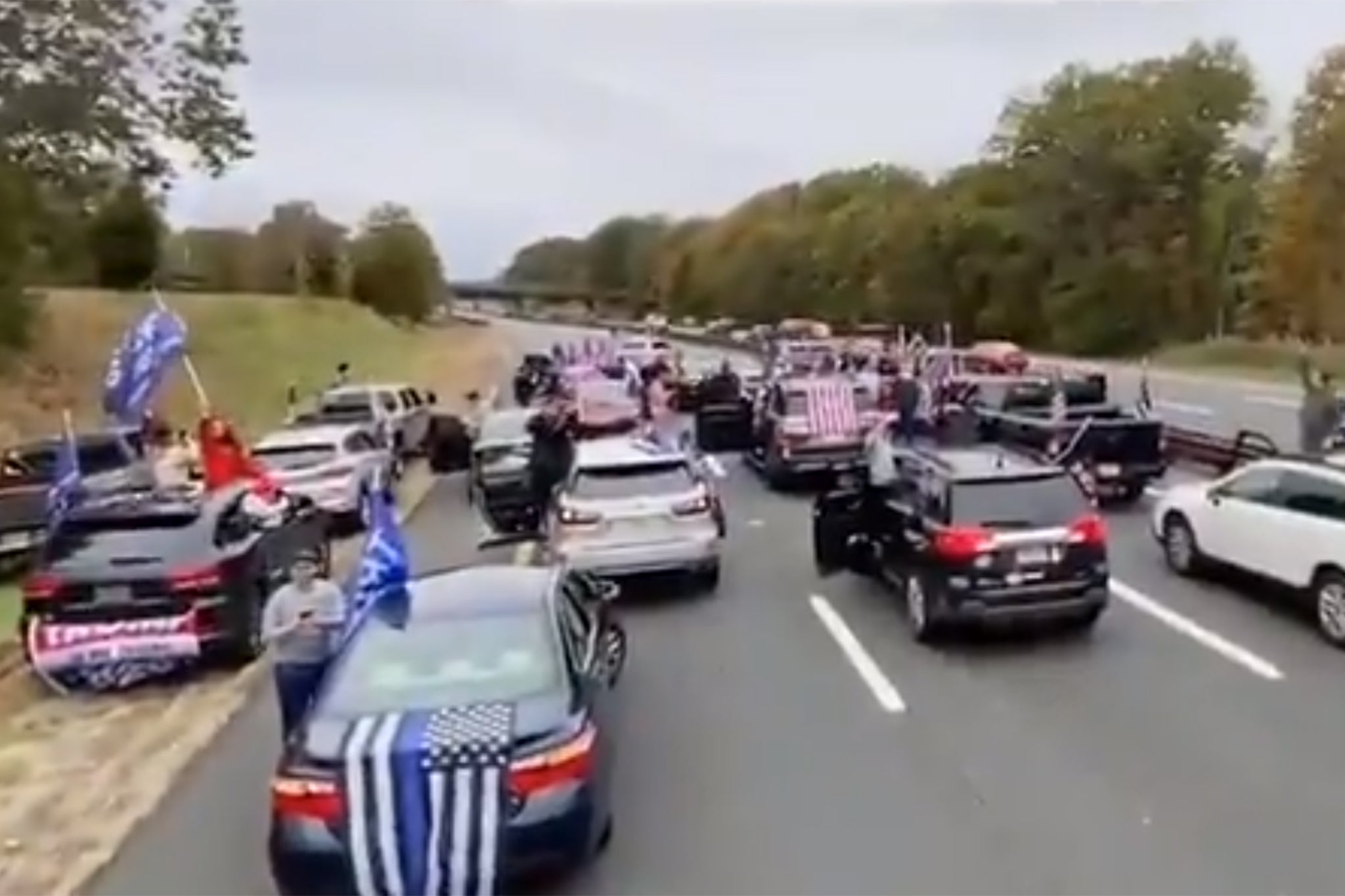
Right about the time that NASCAR and a bunch of other organizations banned Confederate flags, the popularity of a new flag started growing in the just-this-side-of-fascist segment of the citizenry: the thin-blue-line flag. Below, we see a Trump rally where it has essentially replaced the American flag.

I’m reminded of the color-shifted Superman costume in the dystopian graphic novel Kingdom Come; black replaced brighter colors.

This flag is supposed to be pro-police, building on the image that the police are the “thin blue line” between civilization and anarchy. It’s sometimes referred to as the Back the Blue or Blue Lives Matter or anti-Black-Lives-Matter flag.

In practice, and especially now that it has merged into Trump’s vision of “law and order”, the flag now stands for what Jeff Sharlet calls “police nationalism” and defines as “identity founded on fetishization of an explicitly brutal & implicitly racist idea of policing.”

Implicit in the slogan “Back the Blue” when used by police nationalists is the fantasy of a coming conflict (which aligns neatly with QAnon’s idea of a “storm”) in which “backing the Blue” will mean choosing a side in a civil war not so much feared as anticipated.

It would be one thing if Back the Blue was a spontaneous expression of support for public servants in a dangerous and difficult profession. But coming at this particular moment, as Blue Lives Matter, making support for police a response to Black Lives Matter, sends another message entirely: “Go ahead and kill all the Black people you want, officers. We’ve got your back.”

and you also might be interested in …

Remember when a hurricane striking Louisiana would have dominated the news for a week or more?


If the election goes well, I’m going to start focusing on ideas for fixing American democracy, which has come way too close to self-destructing.

The most interesting ideas, because they might actually happen, are the ones that don’t require changing the Constitution. Here’s one I never thought of before: Change the number of representatives in Congress. We got to 435 via the Reapportionment Act of 1929, but there’s nothing sacred about that number.

One proposal I find intesting: The state with the least population (currently Wyoming at around 579K) gets one representative, and then every other state would get representatives based on how many Wyomings they have, instead of making one representative for every 759K, as you’d have to in order to keep the House down to 435.

The effect is to take disproportionate power away from small states, both in Congress and in the Electoral College. The more representatives, the more electoral votes — which devalues the two the each state gets from its senators.


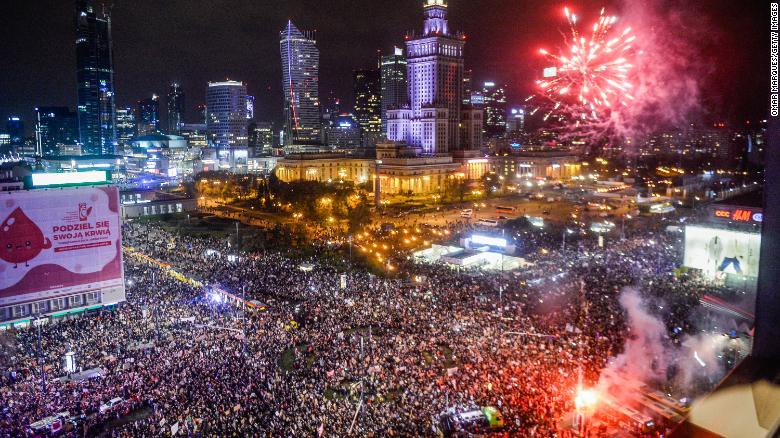
Poland has imposed one of the world’s most draconian abortion bans. This weekend a few people decided to protest.


It’s striking that the first thing Amy Coney Barrett did after being confirmed to the Supreme Court was to let Trump turn her swearing-in ceremony into a campaign event at the White House.

Compare this extravaganza with Sonia Sotomayor’s swearing-in, which happened in a private ceremony at the Supreme Court.

Only the chief justice, Justice Anthony M. Kennedy, Justice Sotomayor’s immediate family, Judge Robert Katzmann of the United States Court of Appeals for the Second Circuit, members of the chief justice’s staff and a court photographer attended this ceremony. Her mother, Celina Sotomayor, held a Bible for the ritual.

Similarly, only a “small gathering of Elena Kagan’s family and friends” witnessed her swearing-in. In each case, President Obama recognized that his role in the process had ended, and the new justice was now independent of his administration. Whether Barrett retains her independence, or even wants to, remains to be seen.

and let’s close with something astounding

What better way to Rocky the Vote than to get Elizabeth Warren, Pete Buttigieg, and a number of other notables to make cameo appearances in a “Time Warp” video?

What Happens Tomorrow?

This year, Election Night is a lot more complicated than just watching the returns come in.


Ordinarily, on the day before an election I write about poll-closing times and what the experts expect in various states. When does it makes sense to start watching returns? What are some early indications to look for? How late will you have to stay up to see the race decided? Stuff like that.

But as in everything else, 2020 is different. This year, we have to think not just about when the polls close, but how the votes are counted. When do election officials start processing early and mail-in ballots? How long will various states wait for mail-in ballots to arrive? Will courts intervene?

And then there are the possibilities that often occur in third-world countries, but we never used to have to think about in America: Will there be violence? Will the President let the ballots be counted? Will either foreign or domestic agents launch cyberattacks, or use disinformation to create chaos?

Let’s look at the ordinary stuff first, then work our way out to the unusual.

What the national polls say. As of this morning, 538’s model says Biden has a 90% chance of victory. That’s far from a sure thing, but it means that unusual (but not impossible) things will have to happen for Trump to win.

Nationally, 538’s polling average has Biden ahead 51.9% to Trump’s 43.5%. Not only is that a much bigger lead than Hillary Clinton’s 45.7%- 41.8% in 2016, but there are fewer undecided voters, and Biden’s lead has been much steadier, staying in the 8%-10% range for the last month. (In late September, Clinton led by less than the 2% she ultimately won the popular vote by.)

The conventional wisdom has been telling us that the race would tighten down the stretch, as it did in 2016, but so far there is no sign of it. In addition, the large number of votes already cast leaves less room for last-minute shifts in the public mood.

Does that mean Trump can’t win? Of course not. But it does tell us what kind of unlikely event would be required: A late-breaking shift of undecided voters wouldn’t do it. “Shy” voters afraid to tell pollsters they’re for Trump wouldn’t do it. (It’s hard to believe many of them would claim to be for Biden. Wouldn’t they just say they’re undecided?) One or two “unlucky” polls choosing an unrepresentative sample of voters wouldn’t do it.

In order for Trump to win, there has to be a large structural failure in how polls are constructed across the entire industry.

BTW. On the shy-voter theory: If there were something uniquely embarrassing about supporting Trump, I would expect to see a gap between Trump’s performance in the polls and Republican candidates lower down the ballot. Voters afraid to say they’re for Trump would be telling pollsters they’re for Thom Tillis in North Carolina or David Perdue in Georgia or Martha McSally in Arizona. But they’re not.

State polls. Of course, we don’t vote nationally, we use the archaic, Republican-biased Electoral College. That’s what the 538 model is based on. (They give Biden a 97% chance of winning the national popular vote, but only a 90% chance of becoming president. No other advanced country would tolerate a system like this.)

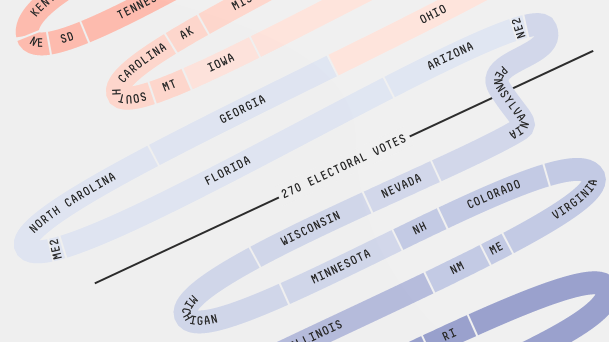
Looking at each state individually produces 538’s snake chart, the key section of which looks like this:

The easiest path for Biden to get to 270 electoral votes is to win all the states Clinton won in 2016 (the most difficult will be Minnesota and Nevada), and recapture Michigan, Wisconsin, and Pennsylvania.

The least likely state on this list for Biden is Pennsylvania, where 538’s model shows him with an 86% chance of winning, and predicts a 5.1% margin. That makes Pennsylvania the tipping-point state: the one most likely to make the difference.

If Biden should lose Pennsylvania, though, he still might win, because he also has smaller leads in Arizona, Florida, North Carolina, and Georgia. Ohio is a toss-up and Biden trails narrowly in Texas (not pictured).

This again tells us what kind of unlikely event would re-elect Trump: Polls have to be off by around 5% across the board, in states as different as Pennsylvania, Florida, and Arizona.

Election night. Ordinarily then, I’d be telling you that polls close in Pennsylvania at 8 p.m. EST, so if Biden really has that 5.1% lead, we should expect to know that he’s won by 9 or 10 o’clock. He couldn’t pass 270 until California came in at 11, but we could go to bed early and still be pretty sure we’d wake up to a Biden victory.

Not this year. Nationally, more than half the expected number of ballots have already been cast. Naively, you might expect that to make the vote-count go faster, since states could already have half or more of the votes counted when the polls close. But you would be ignoring how Republicans intend to steal this election for Trump:

Behind in the polls, Republicans are becoming increasingly blunt about their plan to win the election: don’t let everyone’s votes be counted.

As Astead Herndon and Annie Karni reported for the New York Times Saturday evening: “Trump advisers said their best hope was if the president wins Ohio and Florida is too close to call early in the night, depriving Mr. Biden a swift victory and giving Mr. Trump the room to undermine the validity of uncounted mail-in ballots in the days after.”

Matt Yglesias sums up:

Republicans — not Trump, dozens and dozens of individual state legislators across multiple states — have acted to deliberately ensure slow counting of mail-in ballots so they can later complain that the slow dribbling in of mail votes looks suspicious.

Wisconsin, Michigan, and Pennsylvania are all states where Republican majorities in the legislature have gerrymandered themselves into power. (A majority of voters in 2018 tried to give power to Democrats, but failed.) And they have prevented early vote-counting in each state. So Biden will not win Pennsylvania by 9 or 10, and probably not until Wednesday or Thursday — or later if the state is closer than polls predict.

Since Democrats have promoted early voting and voting-by-mail more than Republicans — in part because they take the pandemic seriously and Republicans do not — most likely the election-night totals will favor Trump, who will then try to declare victory and prevent further vote-counting.

I don’t expect that strategy to work, because Biden’s ultimate margin will be too big, and neither election officials nor judges are as corrupt as the GOP’s plan requires. But it does mean that you won’t learn much by watching Pennsylvania’s returns come in tomorrow night.

Instead, the first state to watch tomorrow night is Florida. Polls close at 8 eastern, and the early votes should be reported almost immediately. So Biden should have an early lead there, which will shrink over the next hour or two as the election-day votes come in. It’s possible there could be a result by 10.

Florida is a state where Biden has a small polling lead — 2.3% in 538’s analysis. As you see in the snake chart above, Biden can win the election without Florida. But winning Florida would be an early knock-out blow. If Biden holds the Clinton states and adds Florida, that’s 262 electoral votes. Trump would have to sweep all the other battleground states, including places like Michigan, where Biden has an 8.1% lead in the polls.

So Biden-wins-Florida is the go-to-bed-early scenario.

That said, Florida has been problematic for Democrats in recent elections. Clinton was favored there and lost. Ditto for Andrew Gillum in the 2018 governor’s race. Maybe pollsters have figured out what they did wrong in those races, but maybe not.

Polling errors have been running the other way in the Southwest: Kyrsten Sinema was projected to win her Senate race in Arizona by .7% and actually won by 2.4%. Ted Cruz was supposed to beat Beto O’Rourke by 4.9% and actually only won by 2.6%.

Other possible early knock-outs for Biden are North Carolina, Georgia, and (a little bit later in the evening) Arizona. Also worth watching is New Hampshire, a Clinton state Trump has campaigned in. Trump doesn’t need to win it and probably won’t. But the returns in New Hampshire could be an early clue as to whether he is getting the white-working-class surge he will need in Pennsylvania and Wisconsin.

Ohio and Texas are stretches for Biden, but if they come in, the race is a landslide. Given the similar demographics, there is no way Biden loses Pennsylvania or Michigan after winning Ohio, or fails to take Arizona after winning Texas.

That said, Republican machinations have held open the most tense scenario: Trump takes Texas, Ohio, Florida, Georgia, North Carolina, and Arizona on Tuesday, forcing Biden to count on the Michigan-Wisconsin-Pennsylvania path, which Republicans have intentionally delayed, and will now argue are taking too long.

Congress. Democrats expect to expand their House majority and have a good chance to take control of the Senate.

The current Senate is 53-47 Republican. Democrats expect to lose Doug Jones’ race in Alabama, so they need to pick up four seats elsewhere to get to 50-50. If Biden wins the presidency, Kamala Harris will hold the tie-breaking vote in the Senate.

Cook lists only one other Democratic seat in danger, Gary Peters’ in Michigan. But even that race it rates as “lean Democrat”.

Meanwhile, it rates two Republican seats — Martha McSally’s in Arizona and Cory Gardner’s in Colorado — as lean Democrat. Seven other Republican seats are toss-ups: Susan Collins in Maine, Joni Erst in Iowa, Thom Tillis in North Carolina, David Perdue and Kelly Loeffler in Georgia, Steve Danes in Montana, and Lindsey Graham in South Carolina.

538 gives the Democrats a 76% chance of gaining control of the Senate, with a 51.6 seat projection.

The same Election-Night considerations apply as in the presidential race. The early indicator is probably the North Carolina race.

Out of the ordinary. Over the weekend we started seeing our first hints of disruption or violence. “Trump Trains” of flag-flying pick-up trucks slowed or blocked traffic in a number of places like the Garden State Parkway in New Jersey, the Mario Cuomo Bridge in New York, and the Capitol Beltway in D. C.

The Garden State Parkway on Sunday.

The most ominous such event was when a Trump Train surrounded and harassed a Biden campaign bus in Texas, resulting in one minor collision.

People in vehicles that were part of a “Trump Train” began yelling profanities and obscenities and then blockaded the entire Biden entourage, according to a source familiar with the incident. At one point they slowed the tour bus to roughly 20 mph on Interstate 35, the campaign official said. The vehicles slowed down to try to stop the bus in the middle of the highway. The source said there were nearly 100 vehicles around the campaign bus. Biden staffers were rattled by the event, the source said, though no one was hurt.

When Trump heard about this incident, he tweeted “I LOVE TEXAS!”. And the Texas Republican Party was similarly unapologetic. Its statement dismissed the incident as “fake news and propaganda”, and attempted to shift focus to “the real violence” on the left.

In all these incidents, the point seemed to be to cause trouble, not just to express enthusiasm. Will they escalate?

Ron Suskind explored that possibility in “The Day After Election Day“. What if, he wonders, the Proud Boys or the army of Trump volunteers out looking for non-existent voter fraud block or violently disrupt polling places?

Disruption would most likely begin on Election Day morning somewhere on the East Coast, where polls open first. Miami and Philadelphia (already convulsed this week after another police shooting), in big swing states, would be likely locations. It could be anything, maybe violent, maybe not, started by anyone, or something planned and executed by any number of organizations, almost all of them on the right fringe, many adoring of Mr. Trump. … If something goes wrong, the media will pick this up in early morning reports and it will spread quickly, increasing tension at polling places across the country, where the setup is ripe for conflict.

Conservative media could then say the election was being stolen, summoning others to activate, maybe violently. This is the place where cybersecurity experts are on the lookout for foreign actors to amplify polling location incidents many times over, with bots and algorithms and stories written overseas that slip into the U.S. digital diet. News of even a few incidents could summon a violent segment of Mr. Trump’s supporters into action, giving foreign actors even more to amplify and distribute, spreading what is, after all, news of mayhem to the wider concentric circles of Mr. Trump’s loyalists. Groups from the left may engage as well, most likely as a counterpoint to those on the right. … Violence and conflict throughout that day at the polls would surely affect turnout, allowing Mr. Trump to claim that the in-person vote had been corrupted, if that suits his purposes.

That violence could be Trump’s Reichstag Fire.

If the streets then fill with outraged people, he can easily summon, or prompt, or encourage troublemakers among his loyalists to turn a peaceful crowd into a sea of mayhem. They might improvise on their own in sparking violence, presuming it pleases their leader.

If the crowds are sufficiently large and volatile, he can claim to be justified in responding with federal powers to bring order.

The spark for all this might be, literally, nothing at all. In 2014, an organized disinformation campaign created a fake ISIS attack on a chemical plant in Louisiana. What if some foreign actor like Russia invents an Antifa election-day atrocity? Might the fake attack create real reprisals that then spiral out of control?

I don’t even know how to evaluate scenarios like that. Are they likely? Crazy? Will we all laugh about this stuff by Friday? I have no idea.

This I do know: We’ve never had to think this way before, and the difference this time around is Trump. All previous presidents have done their best to reassure the public. He is the first to actively try to destabilize the national mood, and push us all towards panic. No matter how this comes out, I will not forgive him for that.

Finally, I want to repeat what an anonymous national security expert tells Ron Suskind: “Just understand that you’re being manipulated.” Respond accordingly. No matter what you think is happening, stay non-violent as long as you possibly can. Check your sources before you pass on rumors, so that you don’t amplify disinformation.

And keep hoping that, like kids back from a horror movie, we all eventually have a good laugh about how scared we were.

The Monday Morning Teaser

Tomorrow is going to be the most complicated Election Night of my lifetime, rivaled only by 2000. Bush/Gore was tightly contested, and we weren’t sure for weeks who the next president would be. But by early Wednesday morning we understood what the issue was: a razor-thin Florida margin that would shift as the votes were counted and recounted.

This election probably isn’t as close as that, but it’s complicated: It’s not just what the votes are, it’s how they’ll be counted and when we’ll find out. It’s whether right-wing militias or Russian cyber attacks will disrupt the process. When Trump declares victory Tuesday night based on sketchy results, will the system have the integrity to keep counting the votes accurately?

Also, there’s much more at stake than there seemed to be in 2000, when few suspected how conservative a president Bush would be. Trump is openly running against democracy, and promising to fire more officials who insist on doing their jobs with integrity, like Anthony Fauci or FBI Director Wray. In 2000, Ralph Nader could argue that it made no difference whether Bush or Gore won. Not this time.

So today’s featured post “What Happens Tomorrow?” has more to cover than my usual Election Night preview. It should be out by 11 EST.

The weekly summary will also have some election coverage, plus the recent Trump administration corruption scandals, the Republican effort to count as few votes as possible, that strange blue-line flag that has started appearing at Trump rallies, and — oh, by the way — we set records for Covid-19 cases this week, and Louisiana had another hurricane. Remember when a hurricane would dominate the news for a week or more?

I’ll try to get that out by 1.

Full Responsibility

I take full responsibility. It’s not my fault.

– Donald Trump, during this week’s debate

This week’s featured post is “I Want To Believe“.

This week everybody was talking about the election

The featured post discusses my hopes and fears for Election Night.


There was a debate Thursday (transcript), which I once again was unable to make myself watch. The upshot seems to be that not much changed: Polls say Biden did better, but by a margin not much bigger than he gets in polls about how people will vote. Mostly, people liked the performance of the candidate they’re voting for anyway.


I did not see this coming: The Manchester Union Leader endorsed Biden. Maybe you have to have lived in New Hampshire to know what this means, but for decades the Union Leader WAS conservatism. It’s still a conservative paper, but I think it recognizes that its worldview has no place in a world where conservatism means Trump.

Our policy disagreements with Joe Biden are significant. Despite our endorsement of his candidacy, we expect to spend a significant portion of the next four years disagreeing with the Biden administration on our editorial pages.

But the Union Leader has bigger fish to fry than the Green New Deal.

President Trump is not always 100 percent wrong, but he is 100 percent wrong for America.

They fault him for:

  • His pre-pandemic deficit spending, which added 3 trillion to the debt. “The layman would expect that the best economy in history would be a time to get the fiscal house in order, pay down debt and prepare for a rainy day (or perhaps a worldwide pandemic).”
  • His failure to deal with Covid-19. “Mr. Trump rightly points out that the COVID-19 crisis isn’t his fault, but a true leader must own any situation that happens on their watch. We may be turning a corner with this virus, but the corner we turned is down a dark alley of record infections and deaths.”
  • He can only cause division at a time when the country needs unity. “America faces many challenges and needs a president to build this country up. This appears to be outside of Mr. Trump’s skill set. Building this country up sits squarely within the skill set of Joseph Biden.”

and the virus

The daily new-case numbers hit a new high Friday. The exact numbers vary depending on things like when you change over to a new day, but The Washington Post claimed 82,920 cases Friday, while The New York Times recorded 85,085. In both systems, Thursday had just missed setting the record established in July, and Saturday’s total was either just above (WaPo) or just below (NYT) Friday’s.

Here’s what the WaPo graph currently looks like:

It’s worth noting that the first hump is probably understated, because tests were much harder to get in March/April. The weekly death totals have never again reached the April levels of around 15K. The second wave peaked in August at around 8K. Deaths tend to lag cases by about a month, and are now running a little over 6K per week. (That’s the tiny kernel of truth behind Rudy Giuliani’s outrageous statement that “People don’t die of this disease anymore.” Ignoring six thousand corpses is easier than ignoring 15 thousand corpses.)

But in addition to that time lag, it does look like fewer cases are leading to death now, as treatments gradually improve. There is still no cure, and the strategy is still to keep people alive until their own immune systems can win the battle, but doctors are getting better at it.


Meanwhile, there’s another White House outbreak, this time among Mike Pence’s staff.

and the new justice

Amy Coney Barrett will be voted on by the Senate tonight. Republicans have the votes to confirm her, and President Trump expects to have a ceremony swearing her in almost immediately.

Within days, she may start voting on cases that influence the election: Pennsylvania Republicans are still trying to get the state not to count mail-in votes that are postmarked by Election Day, but arrive later.

The Court will start hearing arguments about invalidating ObamaCare on November 10.

Senator Angus King of Maine and Heather Cox Richardson combine on an explanation of why Barrett’s “originalism” philosophy doesn’t make sense.

[T]his idea sounds simple and sensible: In determining what the Constitution permits, a judge must first look to the plain meaning of the text, and if that isn’t clear, then apply what was in the minds of the 55 men who wrote it in 1787. Period. Anything else is “judicial lawmaking.”

In some cases, interpreting the Constitution with an originalist lens is pretty easy; for example, the Constitution says that the president must be at least 35 years old (“35” means, well, 35), that each state has two senators (not three and not one), and that Congress is authorized to establish and support an Army and a Navy. But wait a minute. What about the Air Force? Is it mentioned in the text? Nope. Is there any ambiguity in the text? Again, no. It doesn’t say “armed forces”; it explicitly says “Army” and “Navy.” Did the Framers have in mind the Air Force 115 years before the Wright brothers? Not likely.

So is the Air Force unconstitutional, even though it clearly fails both prongs of the “originalist” test?

I gave another example — the impossibility of applying any originalist interpretation of the Second Amendment — last year.

They go on to explain what’s really going on with this nonsensical theory, which of course will never be applied to the Air Force or corporate free speech or any other non-original notion that serves the purposes of conservatives.

Originalism is an intellectual cloak drummed up (somewhat recently) to dignify a profoundly retrogressive view of the Constitution as a straitjacket on the ability of the federal government to act on behalf of the public. Its real purpose is to justify a return to the legal environment of the early 1930s, when the Court routinely struck down essential elements of the New Deal. Business regulation, Social Security, and Medicare? Not so fast. The Affordable Care Act, environmental protections, a woman’s right to choose? Forget it.

but the Court is just one of the things that will need to be fixed

Assume for a moment that the polls are right and Biden wins the presidency. (Then go back to whatever level of uncertainty causes you to put the most effort into influencing the outcome.) American democracy will have dodged a bullet, narrowly avoiding the fate of failed or failing democracies like Russia, Turkey, Hungary, and Poland.

But in some ways we’ll be like a middle-aged heart-attack survivor: There’s no reason we can’t go on to have a robust life, but we’ll also have to make changes if we don’t want the same thing to happen again. Trump has pointed out just how fragile our system is, and how much it has depended on all the players operating with a certain amount of good faith and good will.

For example: We have emergency laws so that the country can respond to crises that play out too quickly for Congress to act. We all took for granted that no president would declare a phony emergency just to circumvent the will of Congress, as Trump did to fund his border wall.

And the institutional structure of our government — what Trump derides as “the Deep State” — has resisted many of his worst impulses. But like a levee holding back a flooding river, it eroded, sometimes very badly. The Justice Department may have withstood pressure to arrest Trump’s political opponents, but it also distorted the findings of the Mueller Report and corruptly favored the President’s criminal friends. The CDC continues to battle Covid-19, but has lost the faith not just of the public, but of some states as well. The Director of National Intelligence has often sounded like someone who works for the Trump campaign, not the United States government.

The recent executive order extending the President’s power over government professionals (explained below) will only make this worse.

Electing Biden may stop the flood, but we will also need to repair the levees — and not just to their previous strength. This is one important area where we need to “build back better”. The next would-be autocrat might be cleverer and less buffoonish than Trump. We need a democracy that can survive that challenge too.

things like the media

One levee that badly needs repair is the press. For that issue, I recommend Vox’ recent interview with Jay Rosen. Rosen and interviewer Sean Illing discuss a propaganda tactic the Russians call the “firehose of falsehood” and Steve Bannon described as “flooding the zone with shit”: You say so many false and outrageous things that the media’s attempt to fact-check you drives the news cycle. Opposing views are pushed out of the conversation, and the argument becomes You vs. the Media.

The first Trump/Biden debate is a perfect example: No one remembers anything Biden tried to say. The whole post-debate conversation was about Trump’s outrageousness and the moderator’s inability to control him.

Trump is the first major politician to bring this tactic to the US.

[Previous presidents] would change the [fact-checked] claim to make it kind-of sort-of factual, or they would take it out of the stump speech, because they didn’t want to suffer the penalty of being described as untruthful. And this was true across parties.

Illing asks how a news outlet like The New York Times can deal with this tactic without being “seen as inherently biased by a lot of people”, and Rosen acknowledges this is impossible.

What’s actually achievable, however, is a newsroom that serves everyone in the country — Democrats and Republican — who shares with Times journalists a certain baseline reality and evidentiary standard. That’s all you can get. … If the perception of critics can shape rule-making in his newsroom, then [NYT editor Dean] Baquet has surrendered power to enemies of the Times, who will always perceive bias because it is basic to their interests to do so.

Rosen wants election coverage to become voter-centered rather than candidate-centered: What’s important isn’t the campaigns’ strategies and messages, it’s “the voters struggling to get their concerns addressed by the system”.

In the citizens agenda model, you “win” when you gain an accurate sense of what people want the campaign to be about, and when you successfully pressure the candidates to address those things people told you they want the campaign to be about.

He also wants the media to confront openly the difference between the parties, which are no longer mirror-images of each other, if they ever were.

The Republican Party has become a counter-majoritarian party. It can only win elections by making it harder to vote, and by making it harder to understand what the party is all about. The conflict with honest journalism is structural, not just a matter of broken practices or bad actors. And I believe the people who report on politics in the United States are going to have to confront that reality, whether Trump wins or loses.

If our journalists continue in the assumption that we have a normal system where there is a contest for power between roughly similar parties with different philosophies, then every day of operation they will be distorting the picture more and more.


Another example of how the political game has changed: The Atlantic’s Anne Applebaum ‘s article “You’re Not Supposed to Understand the Rumors About Biden“.

There is apparently a new cache of “Hunter Biden emails”, with yet another dodgy story about where they came from and what they supposedly prove.

This is a different cache, one that is even more tangential to the U.S. presidential campaign and even harder to understand. In order to even make sense of the messages’ content, the reader must learn the backstories of a whole new cast of characters, not just Cooney but two other convicted fraudsters named Devon Archer and Jason Galanis; the wife of the former mayor of Moscow, Yelena Baturina; and Chris Heinz, John Kerry’s stepson, who broke away from the group; as well as their relationships, their jokes (they refer to Baturina as the “USSR woman’s shot put champion”), and the rules of the ugly world they inhabit. In order to link them to Joe Biden, you have to turn somersaults, do triple flips, and squint very hard.

… In releasing the 26,000 emails, Tyrmand and his collaborator, the Breitbart News contributor Peter Schweizer, are not bringing forth any evidence of actual lawbreaking, or an actual security threat, by either Hunter or Joe Biden. They are instead creating a miasma, an atmosphere, a foggy world in which misdeeds might have taken place, and in which corruption might have happened. They are also providing the raw material from which more elaborate stories can be constructed. The otherwise incomprehensible reference in last night’s debate to “the mayor of Moscow’s wife,” from whom Joe Biden somehow got rich, was an excellent example of how this works. A name surfaces in a large collection of data; it is detached from its context; it is then used to make an insinuation or accusation that cannot be proved; it is then forgotten, unless it gains some traction, in which case it is repeated again.

If this all sounds vaguely like a replay of the 2016 attacks on Hillary Clinton, that’s because it is.

Those messages contained no actual scandals either—only the miasma of scandal. And that was all that mattered. But her emails was an effective phrase precisely because it was so amorphous. It was an allusion to a whole world of unnamed, unknown, and, as it turned out, fictional horrors.


I got a small chance to be part of the solution this week. Lately I’ve been working as a volunteer on The Bedford Citizen, the local online newspaper of my small Boston suburb. This part of Massachusetts is heavily Democratic, to the point that the Republicans don’t field candidates for all the important offices. This year, both our state representative and our state senator are running unopposed.

One complaint I share with Jay Rosen is that the press covers politics as if it were a horse race, with all its attention directed to the back-and-forth of the campaigns, virtually ignoring the race’s impact on how the community will be governed.

Well, that kind of coverage isn’t possible for our local legislative races, because there is no horse race to cover. What to do? Here’s how I answered that question. My article is still candidate-centered, but is more about governing than politicking.

and the environment

The town of Greensburg, Kansas was all but wiped out by a tornado in 2007. Its rebuilding plan “put the green in Greensburg”, and now the town has energy-conserving buildings and a wind farm that produces more electricity than the town uses. A farmer and local businessman comments: “People assume you’re a community of hippies or some nonsense. No, it’s the responsible way to build now.”


Could the new all-electric Hummer be good for the environment? Well, no, not really. It’s a 3-ton behemoth that takes gobs of energy to manufacture and operate, no matter where that energy comes from. But Grist does its best to see the bright side.

All that said, the Hummer EV may do something kind of useful: make all-electric driving appeal to people who aren’t that into the environment. … Even if early Hummer EV owners are only those who can afford to shell out $112,000 on a massive “supertruck,” the purchase of these metal monstrosities could increase the push to install chargers, and provoke even more EV ownership down the line in decidedly non-hipster, non-environmentalist markets. … [B]uying a Hummer might be some people’s first step into an eco-friendly lifestyle. Cutting carbon emissions is, after all, kind of a choose-your-own-adventure situation. Decide to have one fewer child to fight climate change? Good on you. Avoiding all plastic to save the ocean? Go for it! Buying an electric Hummer instead of a similarly giant gas-guzzling SUV? Uh, sure.


Tropical storm Zeta makes it official: 2020 ties 2005’s record for named storms. And hurricane season has another month to run.


Grist sums up the Trump administration’s climate-change record in an eight-minute video.

and you also might be interested in …

Wednesday President Trump issued an executive order that could finally bring the “Deep State” to heel. The order is fairly technical and hard to make interesting to the general public, but in essence it makes vast numbers of civil servants fireable by the President.

Any civil servants in “positions of a confidential, policy-determining, policy-making, or policy-advocating character” would be reclassified into a new Schedule F in order to guarantee that “the President have appropriate management oversight regarding this select cadre of professionals”.

The purpose of establishing the civil service was to avoid the corrupt machine politics of the 19th-century spoils system, where the federal bureaucracy turned over every time there was a new administration. This executive order undermines civil service protections, and creates vast new opportunities for corruption and autocracy.

At stake are the career professionals who have stayed loyal to the missions of their departments rather than the whims of the President — like the scientists at the CDC and FDA who have been trying to maintain the safety standards for vaccines, even though the President wants them to approve one before the election.


Voters in Georgia and Tennessee have been challenged at the polls and told their Black Lives Matter t-shirts violated local laws against “electioneering” at a polling place.

During the primary in September, poll-watchers in Exeter, NH stopped a 60-something woman because her t-shirt was too political for a polling place. So she took it off and voted topless.

and I have a question for you

I used to have a “This Week’s Challenge” feature to encourage comments, but I haven’t done that in a long time. Well, here’s a challenge.

A computer-security researcher in the Netherlands says he hacked Trump’s Twitter account by guessing the password “maga2020!”. He reported the security problem, and if he did any mischief at all, it was subtle. That shows way more discipline than I would have had.

So that’s this week’s challenge: If you had control of Trump’s Twitter, and figured you would probably only get one tweet out before they shut you down, what would it be?

and let’s close with something old and stale

It turns out that nothing lasts forever, not even Twinkies.

I Want To Believe

Eight days from the end of voting, the signs are good. I know you’re still worried.


Politico sums up how this race might look to a dispassionate observer:

Trump is an unpopular incumbent saddled with a recession and an out-of-control coronavirus pandemic that has killed more than 220,000 Americans. Meanwhile Biden has only seen his favorability ratings increase over time, emerging largely unscathed from Trump’s attacks on him and his son Hunter Biden. And Biden is outspending Trump down the homestretch almost everywhere

Those strategic observations are reflected in the polls: 538’s polling average has Biden up by 9.1% nationally, with few undecided voters: 52.0%-42.9%. And yes, the Electoral College rigs the system in Trump’s favor — the only reason he’s president now is that the electors overruled the voters in 2016 — but even that looks good: For some while 538’s tipping-point state has been Pennsylvania, where they project a 5.5% Biden advantage: 52.4%-46.9%. (That’s the margin in a model that projects ahead to election day. Their who’s-leading-now polling average is a bit bigger: 50.4%-44.7% or a 5.7% margin.)

If something goes wrong in Pennsylvania, Biden has other paths to victory. He’s also currently leading in North Carolina (2.5%), Florida (2.4%), Arizona (3.0%), Iowa (1.3%), and Georgia (.9%). (The model expects his leads to go away in Iowa and Georgia, but not in the other states.) And Trump’s leads are narrow in a number of states once thought to be safe for him: Ohio (1.4%) and Texas (tied).

That’s right: If you’re being all quantitative and wonky about it (like 538 always is), Biden currently looks way more likely to win Texas than Trump does to win Pennsylvania.

Feel better now? I didn’t think so.

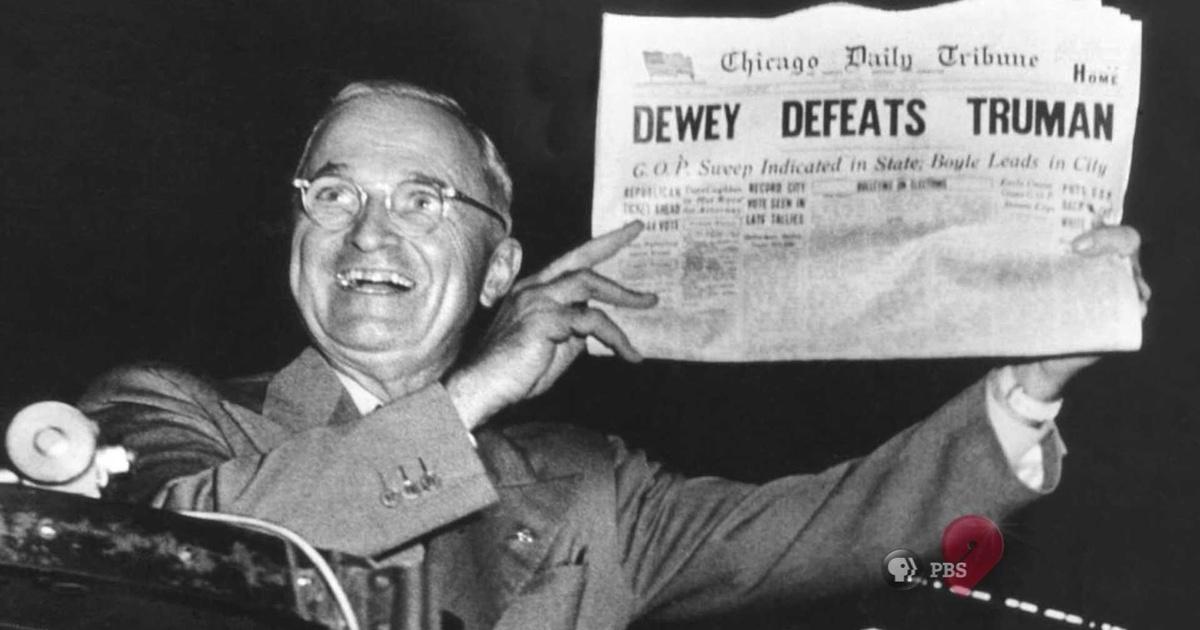
https://www.pbs.org/video/dewey-defeats-truman-iypfom/

Ghosts of 2016. Election Night 2016 was a trauma that Democrats may not recover from for a very long time. (I wonder if Republicans fretted this much about Eisenhower’s chances in 1952 after the Dewey debacle in 1948.) The Saturday before the election, the Princeton Election Consortium said Clinton had a 99% chance of winning. While other people’s speculations were less extreme — and Nate Silver’s election-eve estimate that Trump stood a 28% chance was probably about right; some unlikely things still had to happen, but everybody has gotten wet when there was a 28% chance of rain — few of us expected to see a President Trump.

And then it all fell apart: Florida and North Carolina early, and then Pennsylvania, Wisconsin, and Michigan.

So why couldn’t that happen again?

If you insist on a strict interpretation of could, then sure: Everything could still go wrong. But this isn’t like the horror-movie sequel where only one character remembers what happened in the original. Everyone is out there looking for signs that the polls are wrong, or that subterranean forces are shifting the election under our feet. Nobody’s finding them.

What’s different now: non-college voters. 538’s Dhrumil Mehta explains the extent to which the polls were wrong in 2016 and what has been done to correct them in 2020. Nationally, the 2016 polls were pretty accurate; they only mildly overestimated Clinton’s 2% popular vote win. Late polls in Michigan and Pennsylvania showed Trump momentum, even if they still had a small Clinton lead. Only Wisconsin was a true polling failure.

Mehta explains a mistake that has since been corrected by many pollsters: They didn’t rebalance their samples for education levels.

What is rebalancing? When you already know the demographics of the population you’re sampling, you may notice that your sample is off in some way. Suppose, for example, that the electorate in some state is 14% black, but your sample is only 10% black. So you might adjust for that by counting each sampled Black person as 1.4 people.

In 2016, polls in the upper Midwest regularly undersampled people without college degrees. They didn’t intend to do that, it just happened. But it didn’t occur to them to rebalance for education, and the result was that more non-college people — and especially non-college whites — voted than anyone expected. That was Trump’s margin of victory.

Pollsters know about that mistake now, and are taking various steps to avoid it this time around.

So Trump doesn’t have some magical ability to conjure voters out of nowhere. We know where his 2016 margin came from, and we’re looking for it but not finding it this time.

What’s different: margins. Biden’s polling leads are bigger and broader than Clinton’s were. Clinton went into the election leading in the polls by 3 or 4%. Biden’s lead is running 8-10%.

What’s different: favorability. One reason the 2016 race went south at the end was that Hillary Clinton had very high unfavorable ratings. Many of 2016’s “undecided” voters were actually people searching for an excuse to vote against her, which the last-minute Comey announcement provided. (Trump’s negatives were also high, but that’s where we see the effect of sexism: A male president you dislike is unfortunate, but we’ve all disliked a male president at one time or another. A female president you dislike, on the other hand, may seem like an unimaginable horror.)

The same thing does not seem to be happening to Joe Biden.

He has emerged with more Americans viewing him favorably now than at this time last year, the opposite of the usual trajectory of a campaign and far different from the circumstances that faced Hillary Clinton in 2016.

Biden may not inspire dreams of a utopian future, but he’s hard to dislike. That’s why Trump keeps trying to run against somebody else, preferably some woman: Kamala Harris or AOC or Nancy Pelosi or Clinton again.

What’s different: the news. In 2016, Clinton’s weak spot was the suspicion of corruption. Largely that was the result of a decades-long Republican smear, and none of the so-called Clinton scandals subsequently amounted to anything. (Not even Bill Barr can find an excuse to “Lock her up!”)

But nonetheless, the final-week announcement that the FBI had found more Clinton emails and needed to examine them brought that weak spot to the fore.

The news cycle this time around is playing out very differently. The Trump tactic of insinuation-with-little-basis worked in 2016 largely because the country was doing pretty well. No urgent crises loomed that we had to picture Trump or Clinton trying to handle. “What have you got to lose?” Trump asked, and a lot of people had no compelling answer.

Right now, the country is in terrible shape, and the problems hit home every day. People worry about getting sick, they worry about their vulnerable relatives, they worry about their jobs. Nobody would ask “What have you got to lose?” now.

Trump’s weak spot is that he has completely bungled the only real crisis he’s faced: the pandemic. More than 220,000 Americans are dead on his watch, and he doesn’t seem to care. “It is what it is,” he says. We’ll have to “learn to live with it”. We should thank him because millions haven’t died.

And the news cycle is bringing that to the fore: The virus is surging precisely at the moment people are voting. There’s no way to put that out of the voters’ minds.

Election night. One more consideration that’s on everybody’s mind is what will happen on November 3. Will we actually know anything that night? Or will we be in painful suspense for days or weeks?

538 has a video where Galen Druke talks through what election night might look like, and in particular the question of whether we’ll know a winner. The upshot: Florida, North Carolina, and Arizona should count ballots fairly quickly, so we probably will know who wins those states (unless they’re very close). If Biden takes any of them, he’s going to win. If Trump takes all of them, it’s still a race, but the odds tip in Trump’s favor.

You can also play with the interactive tool Druke is using. When I do that, and give Trump FL, NC, AZ, but give the other states where Biden has sizeable leads to him, leaving only Wisconsin and Pennsylvania undecided, Biden is again favored.

So there’s a chance next Tuesday won’t be an ordeal. Or maybe it will.

Feel better yet? Yeah, I know.

The Monday Morning Teaser

For months, I’ve been resisting (more successfully some weeks than others) the urge to focus entirely on the election. I’ve especially tried not to get lost in speculating about who’s going to win, because that’s a black hole that can suck down all your brain cycles without leading to any productive action.

But now voting is well underway. This year, Election Day marks the end of the voting season, and that’s a week from tomorrow. More than a third of the expected electorate has already voted. I dropped my own ballot off at the local court house a few days ago. I feel like I’ve crossed the event horizon — not thinking about the outcome is not an option any more.

But it’s a real challenge to think about it sanely. 2016 was the kind of nightmare you don’t soon recover from. Hillary was supposed to have it in the bag, and then everything went wrong. I didn’t even entertain the thought that she might lose until about 6 in the evening, when I heard over the radio that black turnout in Cleveland was unexpectedly light.

Time hasn’t eased those wounds, because Trump pokes at them every day. The last four years have been every bit as bad as we feared, and then some. Even Bill Barr isn’t corrupt enough or subservient enough for him now. Another four years of this and we’ll have a true autocracy that he can hand off to Don Jr. or Jared or Ivanka.

So it’s hard to feel sanguine no matter how good the signs look. But all the same, they do look good. That’s what I’ll talk about in the featured post “I Want To Believe”. That should be out around 10 EDT.

In the weekly summary I’ll also cover the virus, which has surged to a new peak in daily new cases. Unlike the spring and summer surges, this fall surge is just about everywhere: all sections of the country, urban and rural alike. The Northeast is probably the safest region right now, because we got the crap scared out of us in the spring and so we’re following the guidelines better than most other places. But cases are ramping up here too.

But I’ll also tempt fate a little and start thinking about what we need to fix after Trump is gone. Even if we dodge this bullet, his administration has stress-tested our democracy and exposed a lot of flaws. (I expect this to become a major theme of the Sift after the election is safely over.) I’ll talk some about the media and the environment (which needs a lot more attention in future weeks).

Also: what’s wrong with originalism, the all-electric Hummer, hacking Trump’s Twitter, and what can happen to a Twinkie if you leave in the basement for eight years. I’ll try to get that out by noon.

Complicity

When our leaders speak, their words matter. They carry weight. When our leaders meet, encourage or fraternize with domestic terrorists, they legitimize their actions and they are complicit. When they stoke and contribute to hate speech, they are complicit.

Governor Gretchen Whitmer of Michigan

No Sift next week. The next new articles will appear on October 26.

This week’s featured post is “The Hidden Threat of a Conservative Supreme Court (and what Biden should say about it)“.

This week everybody was talking about the White House coronavirus cluster

The Trump White House is displaying its usual lack of transparency. We still don’t know exactly who’s infected, when Trump’s last negative test was, whether he had been tested before his debate with Biden (as the rules stipulated), or who White House Patient Zero is. The Washington Post tried to summarize what we do know.

There’s also a lot we don’t know about Trump’s current condition. He held his comeback rally on the White House lawn Saturday, speaking from a balcony. (Almost forgotten in the hoopla is that using the White House for rallies used to be taboo. The Marine Band played, which was “pushing the boundaries of U.S. law and the military tradition of political neutrality”. More and more, Trump treats all government resources as his personal property.) He will hold a rally in Florida today.

Is that safe, either for him or for the people around him? We get carefully worded statements from his doctor that don’t really answer the question.

and right-wing terrorism in Michigan

Thursday, 13 right-wing domestic terrorists were charged with participating in a plot to kidnap (and possibly kill) Michigan Governor Gretchen Whitmer. Confidential informants taped conversations about storming the Capitol, placing Whitmer on trial for treason, and taking her from her vacation home. And they did more than just talk.

The conspirators conducted surveillance of Whitmer’s vacation home on two occasions in late August and September, the complaint said. Croft and Fox discussed detonating explosive devices to divert police from the vacation home area, according to the FBI.

President Trump stands back from groups like this when they get caught, but he has also been encouraging them. When armed protesters (including some of the conspirators) surrounded and entered the Michigan state capitol in April, Trump tweeted “LIBERATE MICHIGAN“, and urged Whitmer to “make a deal” with them because they are “very good people”. (It’s worth noting that Whitmer did not give in to Trump’s pressure to reopen prematurely, but the Republican governors of Arizona, Texas, Georgia, and Florida did, with disastrous results. Whitmer was right and Trump wrong.)

In his debate with Joe Biden, Trump addressed another right-wing hate group, the Proud Boys, telling them to “stand by” because “somebody’s got to do something about Antifa and the left”.

Whitmer has refused to let Trump off the hook for this:

When our leaders speak, their words matter. They carry weight. When our leaders meet, encourage or fraternize with domestic terrorists, they legitimize their actions and they are complicit. When they stoke and contribute to hate speech, they are complicit.

Michigan State Senator Mallory McMorrow (who sits next to the senator who took the picture above) amplified that message:

It’s clear all 13 of these men — and probably many more like them — were and still are listening for signals like these, and interpret them as permission and direction. When Republican leaders call the governor a “tyrant,” we see that language take hold among protesters, who then take to carrying signs saying, “Tyrants Get the Rope.” (In Michigan, protestors even brought a naked brunette doll hanging by a noose to a rally.)

Republicans didn’t create these 13 angry men, but they have absolutely encouraged them — like blowing on a tinder to start a campfire.


I think it’s time to stop dignifying Republican conspiracy theories about Antifa, or taking seriously their complaints about left-wing violence. It’s time for the media to stop their both-sides framing. Men plotting to kidnap political leaders, or ramming their cars into protesters, or gunning down protesters, or making heroes out of teen-agers who gun down protesters, or slaughtering Hispanics in a Walmart — that stuff only happens on the right. And no number of left-wing window-breakers or water bottles thrown at police can even it out.

What’s more, when there is some violent incident on the left, no one praises it. You don’t hear local officials or presidents of the United States justifying it. That stuff only happens on the right.

and Trump’s collapsing support

Two weeks ago, 538’s polling average had Biden leading Trump by 6.9%: 50.1%-43.2%. Now it’s up to 10.6%: 52.4%-41.8%. Then, the tipping point state was Pennsylvania, where Biden led by 5.2%. Now it’s Wisconsin, where Biden is up by 7.1%.

What I would call the coup de grâce state, the one that could tell us on election night that Biden has won, is Florida, where 538 has Biden ahead by 4.5%. Two weeks ago, Biden’s lead was only 1.7%.


Worse for Trump, nobody is coming to save him. There will be no just-in-time-for-the-election vaccine. The Durham investigation is not going to indict Biden, or even produce a report in the next three weeks.


Another bad sign for Trump is that Republican senators are slowly backing away from him. They’re still complicit in his crimes, but they don’t want to stand next to him any more.

Mitch McConnell is saying that literally, claiming that he hasn’t been to the White House in two months, because he “personally didn’t feel that they were approaching the protection from this illness in the same way that I thought was appropriate for the Senate.” And Joni Ernst says, “I’m running my own race.

and the off-again on-again stimulus deal

Right now it looks like it’s off, largely because McConnell shows no interest. I think McConnell is already looking past the Trump administration, and thinking about how he can sabotage the Biden economy.

and the 25th Amendment

The 25th Amendment cleaned up a bunch of possible problem areas related to presidential succession, including what happens when the President is incapacitated. Section 3 covers when the President knows he is (or is about to be) incapacitated: He sends a note to both houses of Congress telling them that the Vice President is taking over for a while. Ronald Reagan did it once and George W. Bush twice before going under general anesthetic for surgery.

Section 4 covers presidents who don’t know they’re incapacitated, either because they’re unexpectedly unconscious, or because they’re off their rockers.

Whenever the Vice President and a majority of either the principal officers of the executive departments or of such other body as Congress may by law provide, transmit to the President pro tempore of the Senate and the Speaker of the House of Representatives their written declaration that the President is unable to discharge the powers and duties of his office, the Vice President shall immediately assume the powers and duties of the office as Acting President.

That’s the situation we have appeared to be in this week. The steroid treatment Trump is receiving may have side effects:

While this commonly used drug is generally safe, there are a range of known side effects. “By far, the most common is hyperglycemia, so that’s where your blood sugars will shoot up,” [Dr. Celine] Gounder [of the New York University School of Medicine] said.

Also quite common, especially among older patients are a range of psychiatric side effects, she added. “Anything from feeling like you’re on top of the world … your arthritic aches and pains of age just melt away, you have lots of energy,” she said. “There may be some grandiosity.” The drug can also cause agitation, insomnia and even, psychosis, Gounder said.

It should be obvious that no one taking this drug should wield the powers of the presidency. And since he came back to the White House, Trump has been even more unstable than usual.

So Nancy Pelosi has started the 25th-Amendment conversation, with a bill that establishes “such other body as Congress may by law provide” to assess the President’s fitness for office. But I disagree with one part of that article’s interpretation:

The commission, if called upon through House and Senate approval of a concurrent resolution, would “carry out a medical examination of the president to determine whether the president is mentally or physically unable to discharge the powers and duties of the office,” according to the bill text. The president could refuse the examination, but the commission would be authorized to factor that into their decision.

If the commission determines the president is unfit to perform his executive duties, the vice president would take over.

As I read the “or” in the 25th Amendment, the commission replaces the cabinet’s role the process, but not the Vice President’s. If the VP stands by the President, I don’t think the President can be removed.

and the fly on Mike Pence

I didn’t last long watching the vice presidential debate [transcript]. The first substantive exchange was about the administration’s handling of the Covid pandemic, which Pence absurdly claimed “saved hundreds of thousands of American lives”. Harris then made the obvious response:

Whatever the vice president is claiming the administration has done, clearly, it hasn’t worked. When you’re looking at over 210,000 dead bodies in our country …

And Pence then spun her attack on his administration as an attack on the American people, because Trump is the People, apparently.

when you say what the American people have done over these last eight months, hasn’t worked, that’s a great disservice to the sacrifices the American people have made

I turned it off right there. I’ve given this administration plenty of opportunities to explain their point of view, and all they do is bullshit me. I’m done listening.

So I missed the news event of the night: the fly who spent two minutes on Pence’s head without him noticing.


For what it’s worth, 60% in a CNN poll said Harris performed better.

but don’t lose sight of Trump’s taxes

The NYT continues its series, looking at how Trump properties became a vehicle for corruption.

Mr. Trump did not merely fail to end Washington’s insider culture of lobbying and favor-seeking. He reinvented it, turning his own hotels and resorts into the Beltway’s new back rooms, where public and private business mix and special interests reign. …

Federal tax-return data for Mr. Trump and his business empire, which was disclosed by The New York Times last month, showed that even as he leveraged his image as a successful businessman to win the presidency, large swaths of his real estate holdings were under financial stress, racking up losses over the preceding decades.

But once Mr. Trump was in the White House, his family business discovered a lucrative new revenue stream: people who wanted something from the president. An investigation by The Times found over 200 companies, special-interest groups and foreign governments that patronized Mr. Trump’s properties while reaping benefits from him and his administration.

and you also might be interested in …

The featured post includes yet another of my rants against minority rule. Somewhat coincidentally, though, this week two Republican senators openly expressed doubt or discontent with democracy.

In an odd series of tweets, Mike Lee of Utah said “We’re not a democracy” and then proceeded to explain why it’s better that way.

democracy isn’t the objective; liberty, peace, and prospefity are. … We want the human condition to flourish. Rank democracy can thwart that

Vox’ Zack Beauchamp looks at the vague but ubiquitous conservative talking point that “We’re a republic, not a democracy.” It’s true that the Founders worried about the tyranny of the majority, but modern Republicans are using this rhetoric to justify rule by the minority, which is surely worse.

modern conservatism has long had a built-in intellectual justification for ruling without popular support. … [T]he tradition Lee is operating out of … casts doubt on the most basic democratic principle: that the people who win the public’s support should rightly govern.

… The idea that majority rule is intrinsically oppressive is necessarily an embrace of anti-democracy: an argument that an enlightened few, meaning Republican supporters, should be able to make decisions for the rest of us. If the election is close, and Trump makes a serious play to steal it, Lee’s “we’re not a democracy” argument provides a ready-made justification for tactics that amount to a kind of legal coup.

Ben Sasse is similarly anti-democratic in his proposal to repeal the 17th Amendment, so that senators would once again be chosen by state legislatures rather than by popular vote. As he surely realizes, that would allow the Senate to be even more gerrymandered than the House. Just as the voters of Michigan, Wisconsin, and several other states can’t get rid of the Republican majorities in their gerrymandered legislatures, they also wouldn’t be able to get rid of their Republican senators.


More and more Americans are realizing that science is on the ballot this year. A few weeks ago Scientific American made its first presidential endorsement ever. This week The New England Journal of Medicine did:

Reasonable people will certainly disagree about the many political positions taken by candidates. But truth is neither liberal nor conservative. When it comes to the response to the largest public health crisis of our time, our current political leaders have demonstrated that they are dangerously incompetent. We should not abet them and enable the deaths of thousands more Americans by allowing them to keep their jobs.


A research project in British Columbia picked 115 homeless people and randomly choose 50 of them to receive $7,500. Then it tracked all of them.

The people who received the money managed it pretty well: They were more likely to be food secure and got off the streets more quickly than the control group. Their spending on alcohol, cigarettes, and drugs went down.

“It challenges stereotypes we have here in the West about how to help people living on the margins,” [Claire Williams, CEO of the funding foundation] said. 

and let’s close with something analytic

This is from 2013, but I just found it, so maybe you haven’t seen it either. It’s a quiz the NYT’s Upshot column put together to analyze what your word usage says about where you’re from. My own dialect heat map doesn’t pick out my central Illinois home town precisely, but my years in Chicago apparently pulled my usage north a bit.