

Democrats in Washington are talking about one set of issues. Republicans in the state capitals have a different vision entirely.
Within living memory, Republicans and Democrats competed over “swing voters” who were assumed to be living in the political “center”. That meant that candidates mostly talked about the same issues, and sometimes even proposed similar solutions, or at least had similar rhetoric.
In 2000, for example, it was hard to tell at a glance which would be more right or left: George W. Bush’s “compassionate conservatism” or Al Gore’s “New Democrat” agenda. Both seemed to be tempering their party’s typical stances, and where precisely they had wound up was not immediately clear. Ralph Nader claimed that it made no difference at all; if you wanted anything to change, you had to vote for a third party.
In 2012, Obama and Romney disagreed, but were talking about the same things: ObamaCare should either be expanded or repealed. Taxes on the rich should go up or down. There should be either more or fewer restrictions on abortion. But both wanted an all-of-the-above energy plan, and both wanted to end the wars in Afghanistan and Iraq in some kind of honorable way.
But right now, the difference between the two parties seems particularly stark. They aren’t just proposing to go in different directions; they’re talking about different worlds. Rather than competing solutions, they offer competing realities.
The Biden agenda. President Biden and Democrats in Congress have put forward a very clear list of what they think America needs:
- Federal leadership in fighting Covid through vaccinations, treatments, and rallying Americans to practice good public health hygiene.
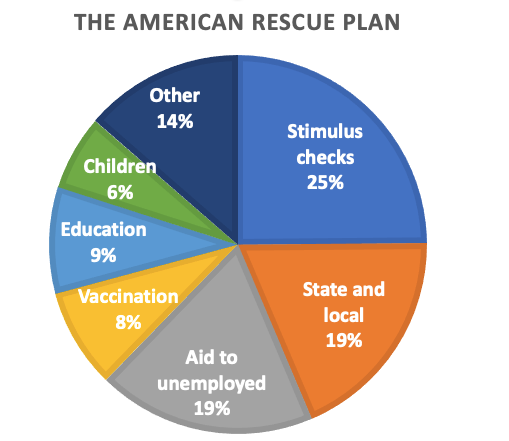
- Financial help for individuals who have lost their income due to the pandemic and the lockdowns that combat the pandemic. (This was covered in the American Rescue Plan Act.)
- Financial help for state and local governments to make the necessary adjustments to open schools safely, and to maintain public services in the face of falling revenues. (Also in the American Rescue Plan Act.)
- Investments in public infrastructure, from fixing crumbling roads and bridges to building a 21st-century electrical grid. (An infrastructure bill currently being written.)
- Protecting and restoring democracy by ending gerrymandering, making it easier to vote, and lessening the influence of big donors on our political system. (The For the People Act, which has passed the House.)
- At a minimum, letting immigrant children who grew up in the US can stay and make a life for themselves. Beyond that, passing a larger immigration reform bill that would give the 11 million undocumented immigrants some kind of legal status. (The American Dream and Promise Act, passed by the House earlier this month.)
So far, this agenda has met with no cooperation from Republicans in Congress. The American Rescue Plan passed (through the filibuster-avoiding reconciliation process) with no Republican votes. The For the People Act passed the House with no Republican votes, and Mitch McConnell has predicted it will get none in the Senate. McConnell ally John Cornyn described it as “an existential threat, I think, to our election system and to our democracy”.
Already, before an official version is even announced, Republicans are staking out reasons to oppose Biden’s infrastructure plan. (Apparently, dividing the plan into two pieces, giving Republicans the opportunity to support a consensus bill and oppose a more partisan one, is a “cynical ploy”. To me, it looks like a strategy to make sure that contentious issues don’t get in the way of actions everyone agrees are needed.)
The American Dream and Promise Act got nine Republican votes in the House. It seems unlikely to get the 10 Republican senators it needs to survive a filibuster.
Meanwhile, in the states where Republicans control the governorship and the legislature, a different set of priorities are central.
- Making it harder to vote.
- Barring transgender students from school sports.
- Creating more loopholes in anti-discrimination laws.
- Preventing schools from teaching an anti-racist curriculum.
- Stopping cities from fighting Covid with business closures or mask mandates
Voting. Georgia’s new election law — the one that makes it illegal to give water or snacks to people waiting in line to vote — got all the attention this week, but it’s one of many. The Brennan Center is tracking 253 bills in 43 states that involve some form of
- restricting absentee voting, early voting, and voting by mail
- tightening voter-ID requirements
- limiting voter-registration drives
- purging voters from registration lists
A recent law in Iowa allows less time for early voting and closes the polls an hour earlier. Perhaps the most disturbing aspect of the Georgia law is the legislature’s new control over the counties.
The law allows the State Elections Board to temporarily suspend county elections directors and boards that it deems in need of review. At the same time, the secretary of state will be removed as chair of the state board and will be made an ex-officio, nonvoting member.
Those provisions have raised particular concerns among Democrats, who say that it will give far-reaching control over state and local elections procedures to partisan legislators and allow them to determine, for example, which ballots to count.
The racial aspect here should be obvious: The white-dominated Republican legislature could take election control away from a majority-black county like Fulton, where Atlanta is.
Transgender kids in sports. Mississippi, Arkansas, and Tennessee have passed laws banning transgirls from participating in sports in public middle schools and high schools. Similar bills are pending in many other states.
[Tennessee Governor Bill] Lee has said transgender athletes would “destroy women’s sports” and remarked that transgender athletes would put “a glass ceiling back over women that hasn’t been there in some time.”
A well-publicized track meet in Connecticut in 2019 resulted in two trans athletes winning the top two places in the girls’ 55-meter dash, but so far such results are rare. The WNBA has at least one transwoman, but seems to be in no danger of the “destruction” Governor Lee fears. The LPGA has been open to trans golfers since 2010, but they are still relatively uncommon.
None of the supporters of the Tennessee measure could cite a single instance of transgender girls or boys having caused problems. A review by The Associated Press found only a few instances in which it has been an issue among the hundreds of thousands of American teenagers who play high school sports.
Megan Rapinoe of the National Women’s Soccer League writes in today’s Washington Post:
Already this year, lawmakers in more than 25 states have introduced legislation to ban transgender young people from sports. … These bills are attempting to solve a problem that doesn’t exist. Transgender kids want the opportunity to play sports for the same reasons other kids do: to be a part of a team where they feel like they belong. Proponents of these bills argue that they are protecting women. As a woman who has played sports my whole life, I know that the threats to women’s and girls’ sports are lack of funding, resources and media coverage; sexual harassment; and unequal pay.
Anti-discrimination exemptions. Friday, Arkansas Governor Asa Hutchinson signed a law “allowing doctors to refuse to treat someone because of religious or moral objections”.
Opponents have said types of health care that could be cut off include maintaining hormone treatments for transgender patients needing in-patient care for an infection, or grief counseling for a same-sex couple. They’ve also said it could also be used to refuse to fill prescriptions for birth control, or by physicians assistants to override patient directives on end of life care.
Banning anti-racism. Jeffrey Sachs outlines the various states passing laws to limit the teaching of anti-racist ideas. A proposed New Hampshire bill has a heading “Unlawful propagation of divisive concepts”.
Similar bills are being debated in West Virginia and Oklahoma. Meanwhile in Georgia, a GOP representative has ordered every public college and university to prepare a list identifying which courses are teaching students about concepts like “privilege” and “oppression.” Faculty there say it’s already having a chilling effect.
There’s more. In Arkansas, debate has begun on a bill that would prevent public schools and universities from offering any course, class, event, or activity that “promotes division between, resentment of, or social justice for” a race, gender, political affiliation, or social class.
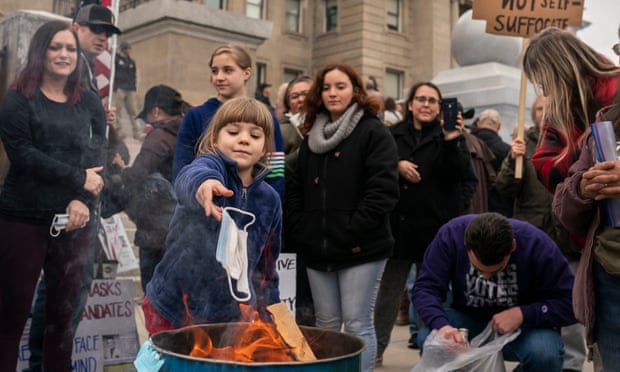
Banning public-health restrictions. Texas Governor Greg Abbott not only ended the state’s mask mandate, but has banned cities from having their own mandates. Austin is currently fighting in court to preserve its mandate. A bill in Idaho that forbids any government entity to require masks is working its way through the legislature. Florida’s legislature is working on a law to take away local governments’ emergency public-health powers.
So which world do you live in? The Democratic world, where you feel threatened by the spread of the virus, worry about the state of our democracy, want to rebuild our public infrastructure, and think kids who grew up in America should have a way to stay here? Or the Republican world, where too many people are voting, virus restrictions are too onerous, you feel threatened by transathletes, and you wish you could do more to express your Christian disapproval of deviant lifestyles?













 The Weekly Sift