The Monday Morning Teaser

One thing I appreciate about the Biden administration is that the rate of news has slowed a little. That gives me time to think about longer-term issues once in a while rather than constantly react to the most recent threat to democracy.

This week I take advantage of that freedom to reflect on Bitcoin, which crashed 30% against the dollar on Wednesday. I can’t guess what the market will do day-to-day or even month-to-month, but long-term, I’m bearish on Bitcoin. In order to catch on as a currency for everyday use, it’s going to need a aura of coolness; using it should impress your friends. But the environmental disaster of Bitcoin mining is anything but cool. I’ll develop that point — and make some rude observations about the paradoxes of money in general — the in the featured post “The Problem with Bitcoin”. That should be out shortly.

The weekly summary does have stuff to cover: Congress’ looming failure to authorize a bipartisan commission to investigate the Trump Insurrection, the Israel/Palestine ceasefire, the usual run of Republican scandals, and a few other articles that are taking advantage of breathing space in the news to reflect on the possibility of global population decline, or the reasons life expectancy doubled in the 20th century.

Let’s predict that to come out around noon EST.

Incompatibility

Since the election, Republicans, driven by the lie that is now their party’s central ideology, have systematically attacked the safeguards that protected the last election. They have sent the message that vigorous defense of democracy is incompatible with a career in Republican politics.

— Michelle Goldberg “How Republicans Could Steal the 2024 Election

This week’s featured posts are “What to Make of Israel/Palestine?” and “Why Liz Cheney Matters“.

This week everybody was talking about getting back to (sort of) normal

Tomorrow marks two weeks since my second Pfizer shot, so according to the new CDC guidance I should be able to more-or-less resume normal life.

If you’ve been fully vaccinated: You can resume activities that you did prior to the pandemic. You can resume activities without wearing a mask or staying 6 feet apart, except where required by federal, state, local, tribal, or territorial laws, rules, and regulations, including local business and workplace guidance.

Not everyone is happy about this advice, and I don’t think I’ll take full advantage of it either. While daily new-case numbers and daily deaths are dropping, cases are still higher than they were a year ago, and not far off the level in mid-September. Barely more than one-third of the country is fully vaccinated, and there are breakthrough infections even among the vaccinated, including eight members of the New York Yankees.

Now, breakthrough infections were expected, and don’t cast doubt on the effectiveness of the vaccines. Epidemiology is a numbers game; the vaccines substantially reduce the odds of catching, transmitting, or dying from Covid, but they’re not guarantees.

Personally, I regard mask-wearing as a fairly trivial hardship, so I think I’ll still do it when I’m in stores or crowds. I may wear masks in movie theaters for the rest of my life (unless I get popcorn). And I plan to keep avoiding indoor dining until the new-case numbers drop much further. Some people are being even more cautious.

There are at least a few reports of people being harassed for wearing masks, which apparently anti-maskers regard as turnabout-is-fair-play. But it’s not: People who refused to wear masks when they were necessary were endangering everyone else. People who continue to wear masks when they’re not necessary are only inconveniencing themselves. Why should anyone else care?


https://theweek.com/cartoons/982669/editorial-cartoon-cdc-masks-pinocchio

Caroline Orr Bueno tweets a number of examples to support this point:

Since CDC announced the new COVID-19 mask guidance for vaccinated Americans, a flurry of right-wing accounts — seemingly belonging to unvaccinated people — have tweeted saying they “identify as vaccinated” and won’t be wearing a mask. It’s the new anti-vaccine talking point.

“Identifying as vaccinated” is a twofer in conservative circles: It parodies the rhetoric of trans people in order to undermine the public health system’s battle against Covid. This is what passes for cleverness on the Right. As my junior high English teacher told us, “Some people are so stupid they think they’re intelligent.”


Long but worth it: Wired has a medical whodunnit: How did the medical establishment become so convinced (wrongly) that Covid could only travel short distances in droplets, rather than hanging in the air and covering longer distances? The problem goes back to a misinterpretation of a tuberculosis study in 1962, and it was fixed this year by a small group of scientists who wouldn’t let rejection slow them down. Their work not only helped control Covid (much later than it should have been controlled), but should prevent flu deaths for years to come.


Arthur Brooks offers an uncommon perspective on the end of the pandemic: Don’t restart aspects of your old life that didn’t make you happy.

If your relationships, work, and life have been disrupted by the pandemic, the weeks and months before you fully reenter the world should not be wasted. They are a once-in-a-lifetime opportunity to come clean with yourself—to admit that all was not perfectly well before.

… Many of us have taken to asking each other, over the past year or so, what we miss from before the pandemic and hate about living through it. But for your happiness, the more germane questions are “What did I dislike from before the pandemic and don’t miss?” and “What do I like from the pandemic times that I will miss?”

Brooks recommends that you take inventory of your pre-pandemic life and make a plan for not returning to normal.

I saw Brooks interviewed on CNBC, where he made another interesting point: The pandemic may be a once-in-a-lifetime event, but something turns the world upside-down about every ten years: the financial crisis of 2008, 9-11, the fall of the Soviet Union.

and Israel/Palestine

A featured post discusses two articles outlining very different ways to look at the situation.

Matt Yglesias makes an interesting point that doesn’t fit in that article:

I’m not saying you or your favorite politician should have a strong take on the Tigray conflict in Ethiopia — it is every American’s right to ignore foreign events! — but it’s worth asking why some things get on the news agenda and others don’t.

and Republicans behaving badly

I cover Liz Cheney’s ouster from House Republican leadership, and what it means for the GOP, in a featured post. But that was far from the only story illustrating the ongoing decline of the Republican Party.

But before leaving the Cheney story, I want to point out an irony: The GOP’s acceptance of Trump’s Big Lie is an example of what “political correctness” originally meant, before it became a meaningless insult.

In Stalinist circles, everybody understood that he Party told lies. So in order to function, you had to stay aware of two realities: the real world, but also the alternative reality described by the Party’s propaganda. To get things done, you had to appreciate what was factually correct. But often you couldn’t say the truth out loud, because those factually correct statements weren’t politically correct.

Same thing here: Kevin McCarthy and the rest of the House Republican leadership understand that Trump lost the election. But in an authoritarian party, you can’t contradict the Leader. “Biden won fair and square” may be factually correct, but it’s not politically correct.


House Republicans and Democrats finally agreed on a plan for a bipartisan January 6 Commission, but Kevin McCarthy hasn’t said whether he’ll support it.


Tom the Dancing Bug portrays the insurrectionists as a comic character. It had to be either Snoopy’s air ace or Calvin as Spaceman Spiff.


This is the kind of craziness the insurrectionists are still spreading: Trump lawyer Lin Wood in Myrtle Beach on May 11: Trump is still president, because he won the election. The military is still looking to him for leadership. “This isn’t about Trump. This isn’t about flesh. This is about God. This is about Powers and Principalities. God’s getting ready to clean up this world.”

And Rep. Louie Gohmert makes insurrectionists the victims of January 6.

Rep. Louie Gohmert of Texas took to the House floor on Friday to downplay the January 6 Capitol riot, describing the insurrections as “political prisoners held hostage by their own government.”

“Joe Biden’s Justice Department is criminalizing political protest, but only political protest by Republicans or conservatives,” Gohmert said in his lengthy speech in which he cited several conservative news outlets, according to CNN. “They’re destroying the lives of American families, they’re weaponizing the events of January 6 to silence Trump-supporting Americans.”

Lest we forget: Trump had masked federal police abducting people off the streets in Portland because protesters were defacing a federal court house with graffiti. But folks who broke windows and beat policemen with flagpoles in an attempt to stop Congress from certifying the peaceful transfer of power are “political prisoners”.


A lot of news stories this week told us about Republicans who might get indicted, but haven’t been yet. I’m keeping track of these developments, but trying not to get too excited about them until there’s something definite in the public record.

Friday, Joel Greenberg, often described as Congressman Matt Gaetz’ “wingman” (though I haven’t been able to track down how that started), pleaded guilty to six federal charges, including sex trafficking women, one of whom was a minor at the time.

As part of his plea deal, Greenberg plans to admit in court that he introduced a child “to other adult men, who engaged in commercial sex acts with the Minor in the Middle District of Florida,” according to the document filed Friday.

It’s widely suggested that one of those men was Gaetz, though the plea deal doesn’t name him, and Gaetz denies any wrongdoing. In the deal, Greenberg promises to “cooperate fully with the United States in the investigation and prosecution of other persons”. Who those persons are is not specified, but it’s reasonable to assume one of them is a bigger fish than Greenberg himself. If not Gaetz, then who?

The Daily Beast has been the leading news source on the Gaetz scandals. My impression of DB is middling: I don’t think they’d invent a story out of nothing, but I also don’t trust them to be as scrupulous as The New York Times or Washington Post. It bothers me that top-line news organizations haven’t been able to verify many of DB’s claims through their own reporting. (When MSNBC’s Chris Hayes interviewed DB’s reporter, he said: “I want to stress here that we at NBC have not confirmed this reporting.”)

Friday DB posted this claim: After Gaetz was the lead speaker at the Trump Defender Gala at a resort in Orlando on October 26, 2019, his hotel room was the site of cocaine party that Gaetz participated in. The drugs were provided by a woman who had an ongoing money-for-sex relationship with Gaetz and a no-show government job provided by Greenberg.

The woman is identified, but not the witnesses the story relies on.


Elsewhere, Manhattan District Attorney Cy Vance is still working on his investigation of Donald Trump’s finances. The investigations appears to be trying to get something on Trump accountant Allen Weisselberg in an effort to flip him against Trump.

Vance already has millions of pages of Trump financial documents, but (according to numerous lawyers speculating in the media) doesn’t want to make a purely document-based case against Trump. Documents are far more persuasive with an inside witness who can lead the jury through them.

Still no word on what might have been found in the raid on Rudy Giuliani’s home and office.

A good overview of the public knowledge on Trump-related cases is in this conversation between Slate’s Dahlia Lithwick and former SDNY US Attorney Preet Bahrara.


It looks like Trump’s former White House Counsel, Don McGahn, will finally testify to Congress. The interview will not be public, but a transcript will be released a week later.

The interview will be limited to information attributed to McGahn in the publicly available portions of the Mueller Report, as well as events that involved him personally. He can decline to answer questions that go beyond that scope.

That should include instances that the Mueller Report analyzed as possible obstructions of justice by Trump, like when Trump allegedly instructed McGahn to tell Rod Rosenstein to fire Mueller, and then instructed McGahn to publicly deny that Trump gave any such order.

And while McGahn “can” decline to answer other questions, it will be interesting to see what he chooses to answer.


Marjorie Taylor Greene appears to have cheated on her state taxes. She and her husband have claimed homestead exemptions on two houses. You’re only allowed one.

We also found out this week that Greene is not only harassing Alexandria Ocasio-Cortez in the halls of Congress, but that she started stalking AOC in 2019, before she got to Congress. Her 2020 campaign juxtaposed a picture of her holding a rifle with images of her presumed targets: Ocasio-Cortez along with Congresswomen Ilhan Omar and Rashida Tlaib.

Greene apologists would like to say this is just ordinary politics, but it isn’t. This is deeply disturbing behavior that could get somebody killed. No member of Congress has ever had to take out a restraining order against another, but AOC should.

https://www.snopes.com/fact-check/marjorie-taylor-greene-the-squad/

One of this week’s weirder arguments is whether Governor DeSantis might be able to shield Trump from extradition if New York indicts him. Ultimately, the answer seems to be no.

If Trump is indicted in New York, both the U.S. Constitution and a federal statute dating to 1793 require DeSantis (or the governor of whatever state Trump is in at the time) to hand him over. And if DeSantis still refuses, a 1987 Supreme Court decision makes clear that federal courts can order him to comply.

But state and local officials seem to be preparing to try.

and the pipeline shutdown

A ransomware attack, apparently by the Russian criminal group Darkside, shut down a major pipeline supplying gasoline to the east coast for a little over a week. The pipeline is now back in operation. The C|Net article on this is pretty good.

Back in the 1800s, someone described various cabals’ attempts to corner the wheat market as “like watching men wrestling under a blanket”. In other words, you can see that something is happening, but it’s hard to tell what it means. Ditto here.

Colonial Pipeline appears to have paid a $5 million ransom, so that looks like a win for Darkside. But the criminal group also appears to have suffered consequences.

As of Friday, the group appeared to have disbanded, according to the Journal, which reported Darkside had told associates that it had lost access to the infrastructure it needs for its activities. The group said law enforcement actions had prompted its decision, according to the paper.

Darkside itself seems like an unusually businesslike criminal operation.

Those responsible for DarkSide are very organized, and they have a mature Ransomware as a Service (RaaS) business model and affiliate program. The group has a phone number and even a help desk to facilitate negotiations with and collect information about its victims—not just technical information regarding their environment but also more general details relating to the company itself like the organization’s size and estimated revenue.


This is bound to be merely the first example of a larger problem. All kinds of vital infrastructure is controlled by computers, or related to computer systems in some other way. (One account I’ve seen of the Colonial Pipeline hack speculated that Darkside had hacked the billing software, not the software that runs the pipeline itself. So Colonial could still deliver gasoline, but wouldn’t know how to get paid. I don’t know if that’s true, but it points out the breadth of the vulnerability.) Software is notoriously full of bugs, and much of it is developed on platforms that are themselves full of bugs, like Windows.

Georgia Tech media studies Professor Ian Bogost commented on the general state of computer security:

You need a license to go fishing but not to deploy software at global scale.

and you also might be interested in …

If you’re wondering why President Biden is making such a big deal about infrastructure, consider the crack that the Tennessee Department of Transportation found in one of the girders holding up a bridge carrying I-40 over the Mississippi near Memphis.


No, the NRA will not be able to play games with the bankruptcy laws to escape their reckoning in New York.

The root issue is the extreme level of corruption in the organization, centering on Executive Vice President Wayne LaPierre. (Even GQ is horrified by LaPierre spending a quarter million of the NRA’s money on suits.) Escaping state regulatory enforcement, a federal judge in Texas ruled, is not “a purpose intended or sanctioned by the Bankruptcy Code”.


This week I noticed Hi/Storia, a Facebook page devoted to amusing memes and cartoons about history. For example:


I’m always amused by Trae Crowder’s “Liberal Redneck” rants. But his “Confederate Memorial Day” is laugh-out-loud funny.

in order to grasp the full nuance of his views, though, you should also watch his “In Defense of Dixie” from 2016.


While we’re talking about Confederate remembrance, Clint Smith is a Black man who tours some iconic Confederate shrines and writes “Why Confederate Lies Live On” for The Atlantic.

Confederate history is family history, history as eulogy, in which loyalty takes precedence over truth.

Among other myths, Smith debunks the frequently heard claim that

“From the perspective of my ancestors, [the Civil War] was not [about] slavery. My ancestors were not slaveholders. But my great-great-grandfather fought.”

Even if you didn’t own slaves — and large numbers of Confederate soldiers’ families did — you probably liked the idea that you weren’t at the bottom of society.

The proposition of equality with Black people was one that millions of southern white people were unwilling to accept. The existence of slavery meant that, no matter your socioeconomic status, there were always millions of people beneath you. As the historian Charles Dew put it, “You don’t have to be actively involved in the system to derive at least the psychological benefits of the system.”


and let’s close with something you can dance to

The genius of Lin-Manuel Miranda’s Hamilton was in translating a WASPy bit of American history into a modern ethnic musical genre, hip-hop. Well, what if somebody from a different American ethnicity had gotten a similar idea, and told Alexander Hamilton’s story through polkas?

Of course, this is a Weird Al Yankovic question, and he provides this answer.

Almost as amusing is to watch Lin-Manuel Miranda watch The Hamilton Polka on his phone.

Why Liz Cheney Matters

https://theweek.com/cartoons/982675/political-cartoon-gop-liz-cheney

Wednesday, House Republicans did what they had been expected to do for a week or two: ousted Liz Cheney as chair of the Republican conference.

From one point of view, this is a fairly meaningless event: A month ago, how many Americans could even name the House GOP’s #3, much less describe the position’s responsibilities? Since Cathy McMorris Rodgers got the job in 2013, it has functioned primarily as the party’s see-we’re-not-all-white-males leadership post. (That’s why Elise Stefanik was the obvious choice to replace Cheney.)

But from another view, Cheney’s removal matters very much, because it defines the GOP as the pro-insurrection Party. Cheney’s unforgivable sin is that she has continued to say the kinds of things that Kevin McCarthy said shortly after January 6.

The president bears responsibility for Wednesday’s attack on Congress by mob rioters. He should have immediately denounced the mob when he saw what was unfolding. These facts require immediate action by President Trump. … [He should] accept his share of responsibility, quell the brewing unrest and ensure President-Elect Joe Biden is able to successfully begin his term. … Let’s be clear, Joe Biden will be sworn in as president of the United States in one week because he won the election.

But that was before McCarthy made his pilgrimage to Mar-a-Lago to kiss the ring. Now there is no place in Republican leadership for anyone who disputes Trump’s Big Lie of a stolen election, or accurately describes the threat it poses, as Cheney did on on the House floor just before her ouster.

The Electoral College has voted. More than 60 state and federal courts, including multiple judges the former president appointed, have rejected [Trump’s] claims. The Trump Department of Justice investigated the former president’s claims of widespread fraud and found no evidence to support them. The election is over. That is the rule of law. That is our constitutional process. Those who refuse to accept the rulings of our courts are at war with the Constitution. Our duty is clear. Every one of us who has sworn the oath must act to prevent the unraveling of our democracy.

This is not about policy. This is not about partisanship. This is about our duty as Americans. Remaining silent and ignoring the lie emboldens the liar. I will not participate in that. I will not sit back and watch in silence, while others lead our party down a path that abandons the rule of law and joins the former president’s crusade to undermine our democracy.

Liz Cheney is just the most visible example of a much wider phenomenon: Republicans of integrity — the people at all levels who stopped Trump’s attempt to overturn the election and stay in power — are being purged. Michelle Goldberg lays out the details:

Trump’s attempt to steal the 2020 election revealed how much our democracy depends on officials at all levels of government acting honorably. Republicans on state boards of election, like Aaron Van Langevelde in Michigan, had to certify the results correctly. Georgia Secretary of State Brad Raffensperger had to resist Trump’s entreaties to “find” enough missing votes to put him over the top. Republican state legislatures had to refuse Trump campaign pressure to substitute their own slate of electors for those chosen by the people. Congress had to do its job in the face of mob violence and count the Electoral College votes. Trump’s rolling coup attempt didn’t succeed, but it did reveal multiple points at which our system can fail.

Since the election, Republicans, driven by the lie that is now their party’s central ideology, have systematically attacked the safeguards that protected the last election. They have sent the message that vigorous defense of democracy is incompatible with a career in Republican politics. (Besides losing her leadership role, Cheney could easily lose her House seat.) Michigan Republicans declined to renominate Van Langevelde to the Board of State Canvassers. Raffensperger will most likely face a tough primary challenge in 2022.

And let’s not forget Mike Pence, who allowed the certification of Biden’s electoral votes to proceed. In his January 6 incitement-to-riot speech, Trump put the onus on him:

If Mike Pence does the right thing, we win the election. … All Vice-President Pence has to do is send it back to the States to recertify, and we become president.

(Trump was assuming Republicans in the legislatures would participate in his coup, which might not have happened in 2020, but is more likely in 2024.) That’s why the insurrectionists were chanting “Hang Mike Pence.” Pence currently has no official position he can be purged from, but he is done in Republican politics, because he followed the Constitution and did his job rather than obey Trump.

It’s important to see what this means going forward. If Republicans succeed in this purge, and if gerrymandered districts continue to put a moat around their majorities in the legislatures of purplish-blue states like Pennsylvania, Michigan, and Wisconsin, then the voters may not get to decide the 2024 election at all. Or imagine Republicans controlling Congress after the 2022 elections, which is a real possibility. There will be no need for an insurrectionist mob to invade the Capitol and intimidate Congress into ignoring the voters, because the insurrectionists will already be inside the building.

Already at their 2020 convention, the GOP proclaimed that its platform was to support Trump. In other words, the party had a Leader, not a set of policies. Now the only duty of a GOP official is to bring Trump back to power. The “right” decision is not the one that follows the Constitution or the laws or respects the will of the voters. The only right decision is the one that returns Trump to power.

https://theweek.com/cartoons/982493/political-cartoon-trump-liz-cheney-gop-star-wars

Admittedly, agreeing with Liz Cheney is a strange position for most Democrats to find themselves in. After all, Cheney is unabashedly carrying forward the legacy of her father, Dick Cheney, who was the primary villain of the Bush-43 administration. It’s weird to see her portrayed as a champion of Truth, when her father’s lies got so many Americans (and many more Iraqis) killed in the Iraq War.

But we need to recognize that the current debate is happening on a different level. The proper use of American military power — like tax rates and environmental regulations — is a decision for the American people to make through the political process. But what we’re talking about now is whether there’s going to be a political process at all, or whether Trumpists will simply seize power at the first opportunity, like the fascists they are.

Jonathan Chait writes:

When Cheney’s liberal critics place her support for democracy alongside her other positions, they implicitly endorse the same calculation made by her conservative opponents: that the rule of law is just another issue.

The only way democracy survives is if both sides respect the outcome of a free and fair election as a precondition to all their other disagreements. Democracy is a system for maintaining domestic peace. You make peace with your enemies, not your friends.

I try to bear this in mind: In order to beat fascism the last time, FDR had to ally with Stalin. On the evil scale, Liz Cheney is nothing compared to Stalin.

What to make of Israel/Palestine?

https://www.economist.com/the-world-this-week/2021/05/13/kals-cartoon

The temperature of the fighting goes up and down, but there is no real prospect for peace. Two articles express two very different ways to look at this situation.


There are basically two truthful ways to cover the current wave of violence between Israelis and Palestinians:

  • A pox on both your houses, because neither side seems to have any plan that involves making peace with the other. (See cartoon above.)
  • One side, Israel, bears more responsibility because it is far more powerful, is doing far more damage, and has far more ability to shape the course of events.

A good example of the first type is Vox’ “The Gaza doom loop” by Zack Beauchamp. Beauchamp does mention that the two sides are not equal, but focuses on the similarities between them.

It would seem as if the current round of violence emerged out of a complex series of events in Jerusalem, most notably heavy-handed actions by Israeli police and aggression by far-right Jewish nationalists. But in reality, these events were merely triggers for escalations made almost inevitable by the way the major parties have chosen to approach the conflict. … It’s clear that that this status quo produces horrors. The problem, though, is that these terrible costs are seen as basically tolerable by the political leadership of all the major parties.

Hamas continues to be able to rule Gaza and reaps the political benefits from being the party of armed resistance to Israeli occupation. Palestinian Authority leader Mahmoud Abbas appears cowed by Hamas’s power — most analysts believe he canceled the Palestinian election because he thought he would lose — and so is content to let Israel keep his rivals contained in Gaza.

Beauchamp similarly breaks Israeli politics into two factions: “annexationists … who want to formally seize large chunks of Palestinian land while either expelling its residents or denying them political rights — ethnic cleansing or apartheid” and “the control camp” who (rather than looking for a viable long-term solution) are just trying to minimize the damage that Palestinians can do to Israelis.

The status quo in Gaza serves both groups. From the annexationist view, keeping the Palestinians weak and divided allows Israeli settlements to keep expanding and the seizure of both the West Bank and East Jerusalem to continue apace. Lifting the blockade on Gaza, and working to promote some kind of renewed peace process involving both Hamas and the Palestinian Authority, jeopardizes the agenda of “Greater Israel.”

… Meanwhile, the “control” camp sees this as the least bad option. Any easing of the Gaza blockade would risk Hamas breaking containment and expanding its presence in the West Bank, which would be far more dangerous than the rockets — a threat heavily mitigated by Israel’s Iron Dome missile defense system. In this analysis, periodic flare-ups are a price that has to be paid to minimize the threat to Israeli lives — with heavy escalations like this one required to restore a basically tolerable status quo.

There used to be a third faction, the “equality” camp, which “believed that Palestinians deserved a political voice as a matter of principle — either in a single state or, more typically, through a two-state arrangement”, but it “collapsed after the failure of the peace process and the second intifada in the early 2000s.” Beauchamp estimates that the equality camp controls about 10% of the Knesset, and so has virtually no influence on policy.


The second type of coverage is exemplified by Branko Marcetic’s article in Jacobin: “On Palestine, the Media is Allergic to the Truth“. To Marcetic, putting the recent Hamas rocket attacks on Israel and Israeli airstrikes on Gaza “in context” would mean

explaining that the rockets came in the wake of a series of outrageous and criminal Israeli provocations in occupied East Jerusalem: a series of violent police raids on the Al-Aqsa Mosque compound, the third holiest site in Islam during its holiest month, that have damaged the sacred structure and injured hundreds, including worshippers; that Israeli forces were attacking Palestinians who were occupying Aqsa both to pray and to protect it from bands of far-right Israeli extremists who have been marching through East Jerusalem, attacking Palestinians, and trying to break into the compound; and that all of this sits in the shadow of protests against Israel’s most recent attempt to steal land from Palestinians in the city, and the ramping up of Israel’s theft of Palestinian land more broadly under Trump.

While you’re at it, you might at least make clear that the Israeli attacks on Gaza have been far more vicious and deadly than the rockets they’re supposedly “retaliating” against, having killed forty-three people so far [many more since the article was published], including thirteen children, and leveled an entire residential building. You might make clear that Hamas’s rockets are, owing to their own cheapness and Israel’s Iron Dome defense system, at this point closer to the lashing-out-in-impotent-frustration part of the spectrum (which, of course, is not to say they don’t do damage or occasionally take lives — they’ve killed six Israelis thus far). All of this would help people understand why what they’re seeing unfold on their screens is happening, and what might be done to stop it.

Marcetic skewers the even-handedness of most articles of the first type, which refer to “clashes” and “rising tensions” as if they were reporting storms at sea rather than intentional human actions. Israel doesn’t do things so much as stuff happens and a bunch of people wind up dead.


As for what American policy should be, I have no idea. I’m not sure President Biden does either. How exactly do you make peace between sides whose leaders — backed by a sizeable chunk of their constituents — don’t want to make peace?

That said, I’m glad to see the end of the Trump/Kushner policy, which I would sum up as “Fuck the Palestinians.” The Trumpists’ primary goal in the Middle East was to create an Israel/Sunni alliance against Shiite Iran. So they brokered agreements between Israel and four minor Sunni states: Morocco, Sudan, Bahrain, and the Emirates. If that spirit of cooperation could be extended to larger Sunni countries like Saudi Arabia, the Palestinians would be left without any allies, and presumably would have to take whatever deal Israel feels like offering them.

In essence, the Palestinians were in the way of the strategic realignment Kushner wanted. So to hell with them.

The thing a pampered prat like Jared Kushner can never understand is the thought that Daredevil writer Frank Miller put into the mind of his villain the Kingpin: A man without hope is a man without fear.

No doubt Israel can create a situation where the Palestinians ought to give up. Arguably, it already has. The Kushners of the world, who have lots of non-hopeless options to choose from, certainly would give up and move on to Plan B, C, or D. But I don’t think the Palestinians will. They’ll keep throwing rocks at tanks until the Israelis either deal with them or kill them.

The Monday Morning Teaser

After taking a week off, I return to a full plate of news.

I don’t enjoy writing about Israel and Palestine, because it’s a dismal situation where I have no solutions to offer. So this week I lean heavily on two other articles, “The Gaza Doom Loop” in Vox and “On Palestine, the Media is Allergic to the Truth” in Jacobin. They reflect very different views: the Vox article fairly even-handedly explains why neither side wants peace, while the Jacobin article holds Israel responsible because it has far more power to shape events. Jacobin additionally offers a devastating critique of news sources that try to stay even-handed.

So that’ll be the first featured article to appear: “What to Make of Israel/Palestine?”. Let’s say that gets out by 9 EST.

Another featured article looks at the Liz Cheney ouster, and what it means for the Republican Party going forward. “Why Liz Cheney Matters” should be out around 11 or so.

That leaves the weekly summary to discuss the new CDC guidance for fully vaccinated people (a group I join tomorrow); other Republican problems like Matt Gaetz, Marjorie Taylor Greene, and the various Trump investigations; the pipeline that got shut down by a ransomware attack; the alarming cracked girder in the bridge that takes I-40 over the Mississippi; and a few other things, before closing with the question: What if Hamilton had been done with polkas rather than hip-hop? I’ll guess that gets out between noon and one.

Efficacy

Trickle-down economics has never worked.

President Biden, 4-28-2021

NO SIFT NEXT WEEK. The next new posts will appear on May 17.

This week’s featured post is “The Reagan Era is Finally Over“.

This week everybody was talking about Biden’s speech

https://theweek.com/cartoons/980339/political-cartoon-biden-address

Before getting into the details of either Biden’s televised speech to Congress [video, transcript] or Senator Tim Scott’s Republican response [video, transcript], I want to make one view-from-orbit observation: When Democratic leaders are given a microphone, they talk about the American people, the challenges we face, and what can be done to make things come out right. When Republicans leaders are given a microphone, they list their grievances against Democrats.

Biden’s speech was about fixing things and setting the country up for future prosperity. It was hopeful and encouraging. He kept saying things like “We can do this.”

Scott started out by saying that President Biden “seems like a good man … but”. God forbid Republicans should give a Democratic president the benefit of the doubt about being a good man. “I won’t waste your time tonight with finger-pointing or partisan bickering,” Scott said, and then did essentially nothing else.

More high-level impressions of Biden’s speech are in the featured post.


I won’t do a full bulleted list of what’s in Biden’s American Families Plan and American Jobs Plan, because CBS News already has that. Basically, the Families Plan is about child care, education, paid time off, and money for parents. The Jobs Plan is about traditional infrastructure like roads, bridges, and public transportation, plus broadband, adjusting to climate change, transitioning to electric vehicles, and capital spending on schools. It also includes “workforce development” (which I think we used to call “job training”), money for taking care of the elderly in their homes rather than institutionalizing them, R&D, and a few other things.

The NYT puts both plans in one chart.


What I found most striking in Scott’s speech was the amount of conservative Christian identity politics in it. He talked about prayer, original sin, grace, and closed with a Christian blessing.


The most quoted line of Scott’s response is “America is not a racist country.” I have to agree with Matt Yglesias:

“Is America a Racist Country?” is the perfect meaningless culture war debate because it has basically no content at all. What is it asking? Compared to what?

Scott clearly wasn’t claiming America has no racism, because he also said “I have experienced the pain of discrimination.” He even allowed that American racism is not entirely in the past: “I know our healing is not finished.” So the argument he started is basically semantic: How much racism does it take to count as a “racist country”? Today’s US is not as racist as the Confederacy or Nazi Germany or the old apartheid regime in South Africa. Is that good enough? How many angels of color have to be included before we consider a pinhead dance to be integrated?

Remember: Meaningless debates serve the interests of people who have nothing to say. If you have a real vision of the future you want, avoid getting baited into arguing about nothing.

https://claytoonz.com/2021/04/30/racist-country/

BTW: By talking about what America is or isn’t, Scott is invoking a popular trope of conservative rhetoric; he’s talking about essence rather than behavior or results. Similarly: an argument about whether certain drawings in a few Dr. Seuss books reinforce racial stereotypes — they do — becomes “Was Dr. Seuss a racist?”

The next step in that dance is to argue that we can’t know someone else’s essence, so it’s unfair to claim that so-and-so is a racist (which probably nobody did).

I saw this happen in my social media feed this week. Someone objected to Biden claiming that all police are racists. When I asked when he did that — he didn’t — she responded with a quote where Biden mentioned “systemic racism in law enforcement”, which is not at all the same thing. Systemic racism is about the results of our law enforcement system. “All police are racists” is a statement about the essence of a large number of individuals.


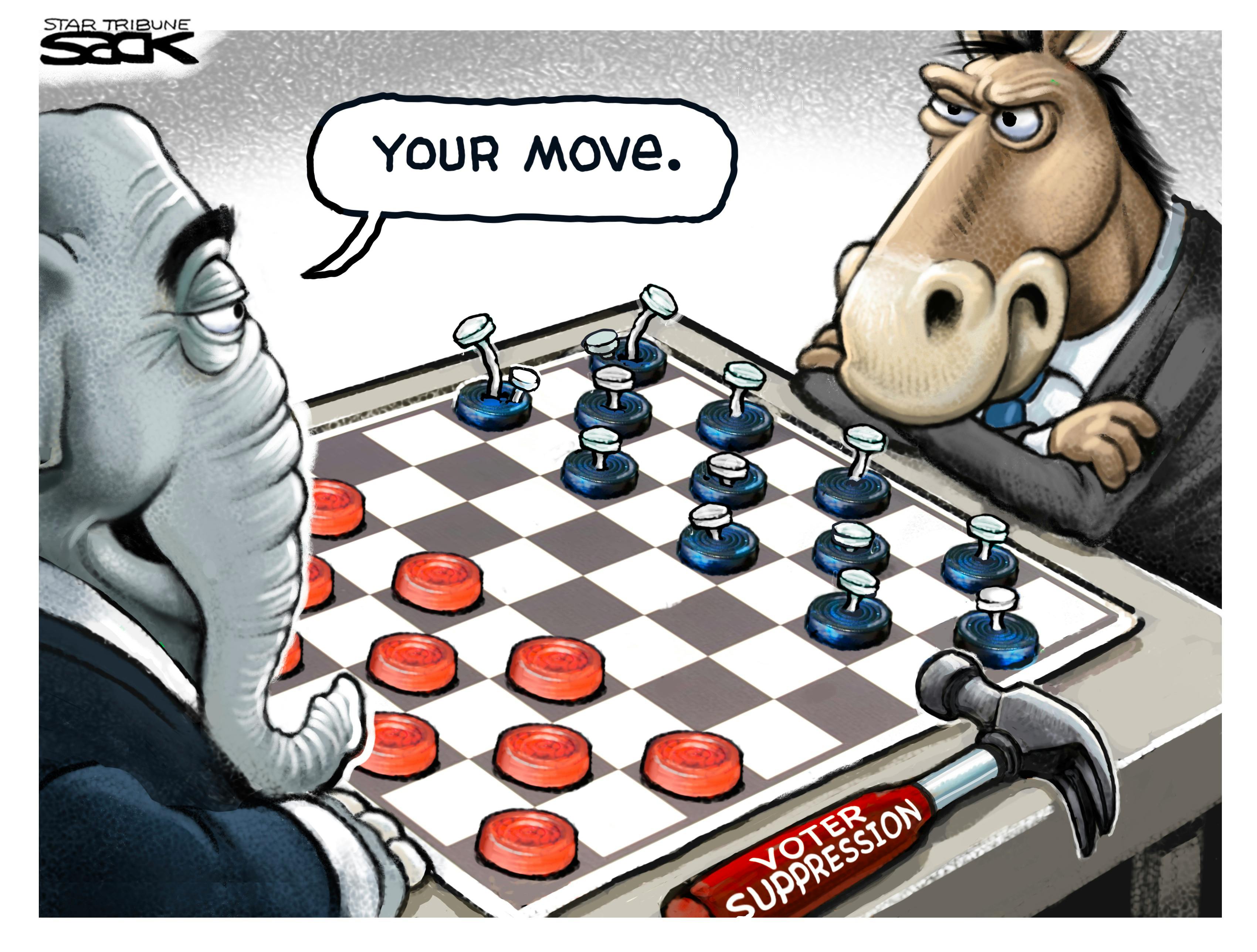
Another point of debate between the parties is the effect of Republican voter-suppression laws. It’s possible to cherry-pick comparisons between states, as Scott did when he claimed: “It will be easier to vote early in Georgia than in Democrat-run New York.”

But it’s important to keep your eyes on the bottom line: Where do people end up waiting in line for hours to vote? And the answer is: In Black neighborhoods, especially in states with Republican legislatures. Georgia was already particularly bad before the recent law, and now it will be worse.

Unlike voter fraud and ballot fraud, people waiting hours to vote actually happens already. It’s not a conspiracy theory or a what-if fantasy. It should deeply embarrass all Americans, and legislatures should be full of proposals to process more voters faster, especially in urban Black neighborhoods.

I live in a majority-white Boston suburb, and it takes me about five minutes to vote. Why can’t that happen in inner-city Atlanta?


Every time I checked Fox News on Thursday, they were talking how badly liberals were treating Tim Scott. WaPo columnist Kathleen Parker wrote:

The only Black Republican in the Senate, Scott was quickly trending as “Uncle Tim” on Twitter, as a tool of white supremacists and as a blind servant of the far right. Liberals just cannot handle a Black conservative.

This, my friends, is (also) what racism looks like in America today.

The New York Post devoted a whole article to the “Uncle Tim” insult, but could only attribute it to otherwise undistinguished Twitter users.

OK, white people should not lob racialized insults at non-white politicians of any philosophy. (Though Scott did indeed act as the mouthpiece of a party that panders to white supremacists; that’s not an insult, it’s just factual.) But Twitter was being mean? How is that news? Have you seen what conservatives tweet about AOC?

If Democratic politicians or opinion leaders are talking about “Uncle Tim”, that’s worth calling out. But I haven’t seen that. Vice President Harris responded to Scott by agreeing that American is not a racist country, but adding

We also do have to speak the truth about the history of racism in our country and its existence today. … One of the greatest threats to our national security is domestic terrorism manifested by white supremacists. And so these are issues that we must confront, and it does not help to heal our country, to unify us as a people, to ignore the realities of that.”

You can also find other sharp-but-not-racist disagreements with Scott from WaPo columnist Eugene Robinson, radio host Clay Cane, and many other liberals. Perhaps an actual discussion could be had. But Fox News does not want that.

Instead, Fox and its allies stoke conservative outrage by pointing out that there are obnoxious people on the internet, some of whom profess to be liberals. Who knew?

and the Giuliani raid

Much as I enjoy speculating about Rudy getting arrested and then flipping on Trump, it’s important not to get ahead of the facts. Here’s what we know:

FBI agents with a search warrant executed a crack-of-dawn raid on Rudy Giuliani’s apartment and office Wednesday. Giuliani ally Victoria Toensing was also raided. The agents took phones and other electronic devices.

The Justice Department isn’t commenting, but unofficially told AP the investigation “at least partly involves Giuliani’s dealings in Ukraine”. Giuliani’s attorney said the warrant mentioned “possible violation of foreign lobbying laws and that it sought communications between Giuliani and people including a former columnist for The Hill, John Solomon”. Reuters claims to have seen the warrant and lists a dozen people, all of whom have some Ukraine connection.

Toensing has also represented Dmitry Firtash, Putin’s favorite Ukrainian oligarch, who is already under indictment in the US. Solomon wrote a series of articles publicizing accusations about the Bidens and corruption in Ukraine. US intelligence has attributed these accusations to a Russian disinformation campaign intended to help reelect Trump. This is not some theory that the intel people have cooked up recently to please their new masters. Back in October the NYT reported:

The intelligence agencies warned the White House late last year [i.e. 2019] that Russian intelligence officers were using President Trump’s personal lawyer Rudolph W. Giuliani as a conduit for disinformation aimed at undermining Joseph R. Biden Jr.’s presidential run, according to four current and former American officials.

One question seems to be: To what extent was Giuliani knowingly working for Russia or its Ukrainian allies like Firtash?

It’s also important to understand exactly how this process works:

A search warrant must be based upon probable cause and the applicant must present a sworn affidavit to a neutral and detached magistrate or judge. Within this affidavit, there must be facts sufficient to persuade that judge that a crime was committed and that searching in the locations specified within the search warrant will reveal evidence of the crime, or crimes. The locations to be searched must be described with particularity, as well as the items that will be seized from those locations.

In the case of someone like Giuliani, there would have been the requirement that those search warrants be approved by someone at the highest levels of the Department of Justice, as well as the requirement of exhaustion of other less-intrusive investigative means. Giuliani is an attorney, and an attorney’s communications with clients are usually deemed to be confidential and protected by the attorney-client privilege.

We shouldn’t jump to the conclusion that Giuliani is guilty of something, that the government already had enough evidence to indict Giuliani, or that they necessarily found the evidence they were looking for. But they clearly have more than just a desire to harass a Trump ally.

Giuliani’s lawyer called the raid “another disturbing example of complete disregard for the attorney-client privilege”, but it’s not clear that’s true. Typical practice for searching a lawyer’s office, which we saw when former Trump attorney Michael Cohen’s office was searched, is for a “clean team” to conduct the actual search, forwarding to the investigating agents only the items not privileged.

CNN:

Giuliani’s son Andrew briefly stepped outside of his father’s Manhattan apartment on Wednesday afternoon to denounce the Department of Justice, saying that if this can happen to “the former president’s lawyer, this could happen to any American.”

Once you put the situation in context, the younger Giuliani’s statement is exactly right: If federal investigators can convince a judge that a crime has probably been committed and that evidence of that crime is probably in your home or office, they can get a warrant to search for that evidence, even if you’re buddies with a former president. It could happen to any American, but you’re most at risk if you’ve committed crimes.

Giuliani’s people are complaining about “politicization” of the Justice Department, but all the indications are that the political influence has been working in the other direction: Prosecutors have been investigating Giuliani since 2019, but his relationship with Trump protected him. Now that Trump is out of office, the investigation can continue the way it would against any suspected criminal.

and the virus

Good news and bad news this week. The good news is that the US definitely seems to have turned the corner on new cases. The daily average is down to about 50K. Deaths also continue their slow decline. We’re down to less than 700 per day.

The bad news is in this morning’s New York Times:

more than half of adults in the United States have been inoculated with at least one dose of a vaccine. But daily vaccination rates are slipping, and there is widespread consensus among scientists and public health experts that the herd immunity threshold is not attainable — at least not in the foreseeable future, and perhaps not ever.

Instead, they are coming to the conclusion that rather than making a long-promised exit, the virus will most likely become a manageable threat that will continue to circulate in the United States for years to come, still causing hospitalizations and deaths but in much smaller numbers.

The second piece of bad news is the international picture. New cases in India continue to skyrocket, and the numbers in several South American countries are near record highs. Adding it all up, the virus worldwide is spreading faster now than it ever has.

The more Covid-19 there is in the world, the more mutations we’ll see. Eventually, some variant could beat our vaccines.


The Atlantic’s Derek Thompson listens to people not planning to be vaccinated, and isn’t optimistic about convincing them. But this is his best suggestion:

Instead of shaming and hectoring, our focus should be on broadening their circle of care: Your cells might be good enough to protect you; but the shots are better to protect grandpa.

and you also might be interested in …

Last week I wrote about Republicans in Florida and several other states trying to criminalize protest, pointing out once again that the GOP’s commitment to “liberty” and “the Constitution” is bogus.

This week Florida went further, passing a law that forces social media companies to participate in disinformation campaigns, even if they predictably lead to violence.

The Florida bill would prohibit social media companies from knowingly “deplatforming” political candidates, meaning a service could not “permanently delete or ban” a candidate. Suspensions of up to 14 days would still be allowed, and a service could remove individual posts that violate its terms of service. 

The state’s elections commission would be empowered to fine a social media company $250,000 a day for statewide candidates and $25,000 a day for other candidates if a company’s actions are found to violate the law

I can imagine a proposal to split up social media companies, or perhaps to turn their networks into some kind of public/private entity like the post office. But as long as they are private corporations whose users, advertisers, and employees come to them by choice, they’ve got a right to manage their own affairs and set their own policies.

It’s hard to come up with any rationale that justifies this law and also upholds previous conservative causes, like allowing a baker to refuse to bake a cake for a same-sex wedding reception, or letting Hobby Lobby object to providing birth control for its employees. If Twitter decides it no longer wants to be associated with Trump’s domestic terrorism, how is that illegitimate?

One possible but scary rationale is contained in a Zero Hedge article a friend sent me. The author was discussing a scenario where companies require their employees and/or customers to be vaccinated (which would be terrible for some reason that escapes me).

These companies do not represent private business or free markets anymore. Instead, they are appendages of establishment power that receive billions in taxpayer dollars to finance their operations. They should no longer be treated as if they have the same rights as normal businesses.

That is one way the libertarian-to-fascist pipeline might work. Businesses have rights until they do something the fascists don’t like, at which point they become “appendages of establishment power” and their rights go away.


Weird development in the Matt Gaetz scandal. The Daily Beast claims to have copies of communications between Gaetz associate Joel Greenberg and (wait for it) Roger Stone, who Greenberg was willing to pay $250,000 if he could broker a pardon from Trump. (No pardon was given and no money paid.)

In the private text messages to Stone, Greenberg described his activities with Gaetz, repeatedly referring to the Republican congressman by his initials, “MG,” or as “Matt.”

“My lawyers that I fired, know the whole story about MG’s involvement,” Greenberg wrote to Stone on Dec. 21. “They know he paid me to pay the girls and that he and I both had sex with the girl who was underage.”

If you’re wondering “Why on Earth would you ever admit that to somebody, especially in writing?”, you’re not alone.


As Biden keeps proposing things the American people like, Trumpist attacks on him are getting increasingly desperate. Here, a NewsMax talking head goes off on a clip of Biden bending down to pick a dandelion and give it to Jill. This act is labelled “bizarre” and somehow deserving of ridicule.

All I can say is that Biden had better not wear a tan suit.


You know who’s a communist now? Mitt Romney. At least that’s what the hecklers at the Utah Republican Convention were calling out as he tried to speak. But a motion to censure Mitt for daring to vote to convict Donald Trump narrowly failed 711-798.


As someone who went to a few Burning Man festivals years ago, I’m not sure what I think about the proposal for a permanent art installation that generates solar electricity. Don’t-blink-or-you’ll-miss-it is a key element of the Burning Man experience. The fact that this is all going up in smoke at the end of the week teaches a lesson about being truly present.

On the other hand: renewable energy in an attractive package.

and let’s close with something artsy

You never know when someone might escape from a painting and fly around the Brussels airport.

The Reagan Era is Finally Over

https://edsteinink.com/long-wait-2ffdd30f0c70

Biden’s speech and the response (or lack of response) from Republicans demonstrates that no one believes in the old nostrums any more.


The day Clinton surrendered. In the 1996 State of the Union, President Bill Clinton said, “The era of big government is over.” This has been widely marked as the moment when the Democratic Party surrendered to the Reagan revolution.

For the 12 years of the Reagan and Bush administrations, many Democrats in Congress had tried to hold the line. Then, after Clinton was elected in 1992, he set out to extend the legacy of FDR and LBJ by fulfilling the longstanding Democratic ambition to create some version of universal health care. After seeming popular at first, “HillaryCare” didn’t pass. Democrats were subsequently routed in the 1994 midterm elections, making Newt Gingrich the first Republican Speaker of the House since the legendary Sam Rayburn replaced the much-less-legendary Joseph W. Martin Jr. in 1955.

The lesson Clinton learned from that defeat was that Democrats needed to temper their ambitions. Subsequently, he worked with Gingrich to achieve goals that appealed to Republicans, like balancing the budget, ending “welfare as we know it”, passing NAFTA, and de-regulating the banking system (in ways that would blow up by 2008). There would be no more big-ticket proposals until ObamaCare in 2009. Democratic governance became little more than a kinder, more efficient version of Republican governance.

For most of the 20th century, Democrats had stood for an active government trying to solve people’s problems. FDR’s New Deal had given the country Social Security, unemployment insurance, and the minimum wage. LBJ’s Great Society had added Medicare, the War on Poverty, and the Voting Rights Act. But all that was over now. Clinton was not just refusing to advance, he was actively capitulating: “Big government” was itself a Reaganite phrase that would have been anathema to Democrats just a few years before. (To make a present-day comparison: Imagine what it would mean if major Republicans started denouncing “white privilege”.)

Meanwhile, Republicans continued to worship at the shrine of the Great Communicator. For three decades, the philosophy of the Republican Party didn’t waver: low taxes, less regulation, free trade, more spending for defense but less for social programs, and “traditional family values” — which mainly meant opposing abortion and homosexuality.

This constancy gave Republican candidates a significant branding advantage in campaigns. If you saw an R next to a politician’s name, you immediately knew what he stood for — even if you had never heard of him before. Democrats, conversely, had to put considerable effort and money into introducing themselves to voters, and explaining why they weren’t the “tax-and-spend liberals” Reagan had so successfully vilified.

That was the Reagan Era. Even if you hadn’t been born yet when he left office in 1989, you have been living in his era. Until Wednesday, when President Biden announced the end of it.

Two cycles. The Reagan Era did not end all at once. It took two complete election cycles to bring it down.

When Republicans started campaigning for the presidency in 2015, Reaganite orthodoxy still seemed solidly in control. Marco Rubio, for example, might talk about “new ideas”, but what he really meant was “new faces”. After listening to his stump speech, I wrote:

What in that plan does he think Jeb Bush will disagree with? Less regulation, lower taxes on corporations and the rich, less government spending, traditional family values, strong defense, aggressive American leadership in the world. How is that different from what every Republican has been saying since Ronald Reagan?

Rubio’s “new leadership” plea just meant that the old Reagan program needed a fresh young Hispanic spokesman, and that nobody really wanted another Bush vs. Clinton election.

But Trump upended all that. Occasionally he would wave in the direction of tax cuts and strong defense, but his real applause lines appealed to a rising white nationalist anger that Bush or Rubio could not speak for. (“Build a wall.” “Lock her up.”) Jeb Bush was “low energy” compared to the violence-promoting Trump. “Little Marco” was too mousy and too brown to stand up for the oppressed white working class.

An undercurrent of the Trump campaign was that Republicans had sold out white workers just as much as Democrats had. (In the other primary, Bernie Sanders was saying that Democrats had sold out workers just as much as Republicans had.) It was never clear just what time period the “again” in “Make America Great Again” pointed back to, but it wasn’t the Reagan administration. Maybe it was the 1950s, or the 1920s, or the Confederacy.

Trump’s speeches had a scatter-shot approach that sometimes could invoke big government positively. He told 60 Minutes that he would replace ObamaCare with a “terrific” healthcare plan that would cover all Americans “much better”. “I’m going to take care of everybody” he claimed, and “the government’s going to pay for it.”

Free trade was out and tariffs were in. And while he professed to be against regulation in general, he often threatened to interfere with American business in ways far beyond what Obama or Clinton had done. If Ford threatened to move a plant to Mexico, Trump said he would tell Ford’s CEO

Let me give you the bad news: every car, every truck and every part manufactured in this plant that comes across the border, we’re going to charge you a 35 percent tax — OK? — and that tax is going to be paid simultaneously with the transaction.

By 2020, the GOP was not even pretending to be more than a Trump personality cult. Their convention didn’t bother to write a new platform, because why weigh down the Great Leader with a specific policy agenda? Republicans would support Trump in 2020 — that’s all voters needed to know.

Supply-side economics. The beating heart of Reaganism was supply-side economics, as crystalized in the not-at-all-funny Laffer Curve, which started out as a drawing on a napkin and never got much more precise than that. The idea was that as taxes rose, economic activity shrank, with the result that sometimes a higher tax rate produced less revenue than a lower one. (At the extreme, it makes sense: If the tax rate were 100%, nobody would bother to make money.)

There was never a solid estimate of where the peak of the Laffer Curve was supposed to be, but Republicans uniformly believed that it was always at a lower rate than the current one. So tax cuts became the free lunch that economics wasn’t supposed to have: Cut taxes and the economy will grow so fast that the government will get more revenue. Everybody wins!

It didn’t work for Reagan or either of the times when Bush Jr. tried it. Lower taxes might goose the economy a little, but not enough to raise revenue beyond the previous projections. Invariably, tax cuts led to deficits.

So by the time Trump proposed a tax cut in 2017, supply-side economics had hit the same point Soviet Communism did during the Brezhnev Era: Everyone trotted out the old slogans, but no one really believed them. Trump cut rich people’s taxes because he was rich and wanted to pay less tax. McConnell and the other Republicans in Congress went along because their donors were rich and wanted to pay less tax. Mnunchin and various other hired experts might claim that it would be different this time, but soon Trump’s deficits began to approach $1 trillion a year, pre-Covid, at a time in the economic cycle when classic Keynesianism would call for a surplus. Obama had run trillion-dollar deficits to pull the economy out of the Great Recession. Trump was running them because … well, why not?

And the personality cultists in the GOP didn’t care.

When Covid hit, Trump realized that direct payments from the government were popular, and that no one cared about the deficit. So the deficit for fiscal 2020 (October, 2019 to October, 2020) clocked in at $3.1 trillion. During the fall campaign, Trump proposed another round of direct payments, plus infrastructure spending. The second round of payments passed after the election, at a lower level than either Trump or the Democrats wanted, but the infrastructure proposal never turned into a specific piece of legislation.

Biden. After Trump’s coup attempt failed and Biden took over, Republicans in Congress attempted to run the same play that had stymied Obama: Underfund and slow-roll everything, so that the economy will limp along and the new administration will be blamed.

On Covid relief, Biden decided not to play that game. He politely listened to a lowball Republican proposal that they probably would have backed away from anyway, and then pushed ahead with a reconciliation strategy (the same one Trump had used to pass his tax cut). The $2 trillion package passed quickly with only Democratic votes. It has been quite popular, and Republicans have at times tried to take credit for it, despite unanimously voting against it.

In his speech to a joint session of Congress Wednesday night, the President promoted two additional proposals — the American Jobs Plan and the American Families Plan, that together would spend over $4 trillion during the next ten years. The plans are funded by tax increases on corporations (rolling back part — but not all — of Trump cut in the corporate tax rate) and the rich (the top tax rate returns to its pre-Trump level, and capital gains are taxed as ordinary income for those making more than $1 million a year). Biden pledges not to raise taxes on those making less than $400,000 a year. The middle class, he said, “is already paying enough”.

This is all heresy against Reaganomics, which says that if taxes on the wealthy are kept low, they’ll invest their money more productively than government could, resulting in higher economic growth, more jobs, and increased wages. That was a formidable argument in the 1980s, and still had teeth even when it was used against Obama.

But no one believes it any more. Biden saw no need to give an elaborate justification for taxing the rich to build American infrastructure. Instead, he called supply-side economics by its liberal name, and brushed it off:

Trickle-down economics has never worked.

That simple statement is the bookend to Clinton’s “The era of big government is over.”

The true history of American infrastructure. It has now been more than two centuries since New York State began constructing the Erie Canal, which made Buffalo a boom town and promoted economic growth across the Great Lakes. Once cargoes from Lake Superior started floating down the Hudson, New York City soon replaced Philadelphia as the nation’s top port.

What the last two centuries have taught us is that the economy needs a mixture of public and private investment. The logic of that can get a little wonky, but the gist is that certain big investments, like the Erie Canal, the transcontinental railroad, the interstate highway system, or rural electrification, create what economists call “positive externalities”. In other words, they promote a general growth that no private-sector entity is broad enough to capture. (Even New York State failed to capture the growth its canal promoted in Chicago and Detroit.) So the private sector either will not build them at all, or will build them much too small and too late.

One result of Reaganism has been an under-investment in the public sector. That’s what Biden is trying to reverse. By taxing the rich, he is taking money from a bloated private sector to catch up on the public-sector investments that have gone begging for decades. Biden is betting that this shift will increase growth and create jobs — the exact reverse of what Reaganomics predicts.

In the official Republican response to Biden’s speech, Senator Tim Scott invoked trickle-down when he described Biden’s tax plan as “job-killing”, and predicted “it would lower Americans’ wages and shrink our economy”. If the Trump tax cuts — or the Bush tax cuts before them — had actually created jobs and promoted growth, as they were supposed to do, then it would make sense to predict that reversing them would kill jobs and stifle growth. But none of the promised benefits of Trump’s plan actually happened, so the jobs that it didn’t create won’t be lost when Biden goes back to pre-Trump tax rates.

Where is the Tea Party? Writing in Politico, conservative Rich Lowry waxes nostalgic about 2009, when “President Barack Obama created a spontaneous, hugely influential conservative grassroots movement on the basis of an $800 billion stimulus bill and a health care plan estimated to cost less than a trillion.”

Once upon a time, Joe Biden’s spending proposals would have launched mass demonstrations in opposition.

Little else would have been talked about in conservative media, and ambitious Republican politicians would have competed with one another to demonstrate the most intense, comprehensive resistance, up to and perhaps including chaining themselves to the U.S. Treasury building in protest.

But now, he laments, Republicans just want to talk about the border and cancel culture. No one is defending the Reagan orthodoxy, because no one believes in it any more.

Perestroika has come.

The Monday Morning Teaser

This week’s big story was President Biden’s don’t-call-it-State-of-the-Union address to a joint session of Congress. No particular announcement in the speech was surprising, but his proposals for $4 trillion in new spending seemed to bookend Bill Clinton’s 1996 statement that “The era of big government is over.” Republicans were unable to mount a coherent critique, and there was no sign of the grass-roots uprising that Obama’s much smaller spending program had inspired in 2009.

My interpretation of this is that “The Reagan Era is Finally Over”. Ronald Reagan laid out a set of themes that dominated Republican politics (and even intimidated Democratic politicians) until 2016. But Trump laid waste to any principled Republican thinking, and replaced it with a cult of personality. The result is that when Biden proposes a liberal policy agenda, Republicans really have no basis for arguing against it.

Trump could do that because by 2015 supply-side economic orthodoxy had already reached the stage of Soviet Communism in the Brezhnev Era: Even the people repeating its slogans didn’t really believe in them any more. As president, Trump cut rich people’s taxes because he was rich and he wanted to pay less tax. McConnell and the rest of the Republicans got in line because their donors were rich and wanted to pay less tax. They might mouth platitudes about growth and an economic boom that would create jobs and wipe out the lost revenue, but everybody knew what the game was.

So when Biden announced Wednesday “Trickle-down economics has never worked”, there was no answering chorus of “Yes it has. Yes it does.” Of course it doesn’t. We all knew that.

Anyway, that post requires a history lesson that I’m still writing, so it probably won’t post until around 11 EST.

The weekly summary discusses some other issues in Biden’s speech and Tim Scott’s response, including what I see as a senseless debate over whether the US is a “racist country”, whatever that means. There’s also the FBI raid on Rudy Giuliani’s home and office, and what it might mean for Rudy’s legal jeopardy, and Trump’s. It was a good news/bad news week for the fight against Covid: Daily case numbers keep improving in the US, but getting worse worldwide. And we’re getting close to having vaccinated all the people who were eager to be vaccinated, but we’re still not at a herd immunity level. Florida continues to make a mockery of GOP rhetoric about “liberty”. This week they’re trying to dictate the policies of private companies like Facebook and Google. And we’ll close with a winged Cupid breaking out of a Rubens painting in the Brussels airport.

Let’s say that gets out between noon and 1.

Where the Weekly Summary Is

Here. Due to a technical glitch, WordPress thinks I published it two days ago.

Red States Crack Down on Protests

https://jensorensen.com/2021/01/26/freedom-vs-freedom-2021-coronavirus-authoritarianism/

The GOP’s “freedom” rhetoric yields to its authoritarian agenda.


Standard conservative rhetoric treats the word freedom like partisan property: Republicans defend freedom, while Democrats are all Stalin-wannabees.

Usually, pro-gun rallies are where you see this trope in its purest form, but during the pandemic it has shown up in anti-public-health protests as well. Two weeks ago, we saw it in Congress, when Jim Jordan assailed Dr. Fauci with “When do Americans get their freedom back?” Occasionally, the two issues combine, as when armed protesters stormed the Oregon Capitol while the legislature debated anti-Covid measures.

Lately, though, we’ve been seeing how hollow the Right’s commitment to “freedom” is, at least when people use their freedom to support liberal causes. In previous weeks, I’ve talked at length about the anti-voting laws red-state legislatures have been passing in response to their dark-but-baseless fantasies about election fraud. But lately their focus has turned towards punishing liberal protest.

The latest push in red-state legislatures — Florida, Oklahoma, Tennessee, and Iowa so far — is for laws that criminalize protest and encourage vigilante action against protesters.

[Oklahoma] HB 1674, which Republican legislators passed earlier this week, grants civil and criminal immunity for drivers who “unintentionally” harm or kill protesters while “fleeing from a riot,” as long as there is a “reasonable belief that fleeing was necessary.”

Running over protesters is a long-standing conservative fantasy, which James Alex Fields Jr. carried out when he killed Heather Heyer in Charlottesville in 2017. If I were a Democrat in one of these legislatures, I think I’d submit a motion to rename the bill “The Heather Heyer Had It Coming Act of 2021”.

At the end of last summer, USA Today reported:

There have been at least 104 incidents of people driving vehicles into protests from May 27 through Sept. 5, including 96 by civilians and eight by police, according to Ari Weil, a terrorism researcher at the University of Chicago’s Project on Security and Threats who spoke with USA TODAY this summer.

I have some sympathy for people who unexpectedly find themselves surrounded by protesters doing threatening things, like rocking the car or pounding on its roof. But I’m not sure how many cases, if any, fit that description. In this video, for example, the driver comes back for a second pass through the crowd.

“Unintentionally” sounds like it mitigates the harm, but it actually doesn’t, because intentionality is so hard to prove in court. And the “reasonable belief” standard in the Oklahoma law creates an opening for the same kind of racial bias we see in police-shooting and stand-your-ground cases: What if the driver’s impression of danger is based on the race of the protesters, rather than any threatening actions? Might a few white jurors sympathize with a driver who got scared simply because his car was surrounded by Black people?

These laws also give the government more power to clamp down on dissent. Florida’s law, which has already been signed by Gov. DeSantis, creates new crimes that you might commit just by showing up for what you believe to be a peaceful protest.

But opponents say it would make it easier for law enforcement to charge organizers and anyone involved in a protest, even if they had not engaged in any violence.

“The problem with this bill is that the language is so overbroad and vague … that it captures anybody who is peacefully protesting at a protest that turns violent through no fault of their own,” said Kara Gross, the legislative director at ACLU Florida. “Those individuals who do not engage in any violent conduct under this bill can be arrested and charged with a third-degree felony and face up to five years in prison and loss of voting rights. The whole point of this is to instill fear in Floridians.”

In addition:

If a local government chooses to decrease its law enforcement budget — to “defund the police,” as Mr. DeSantis put it — the measure provides a new mechanism for a prosecutor or a city or county commissioner to appeal the reduction to the state.

The law also increases penalties for taking down monuments, including Confederate ones, making the offense a second-degree felony punishable by up to 15 years in prison.

As with the anti-voting laws, the justification for the Florida law is largely imaginary.

Speakers including the governor said the law would protect law enforcement and private property against rioters, despite acknowledging there was little violent unrest in Florida during last year’s protests over Floyd’s death.

… Echoing DeSantis, Republican state House Speaker Chris Sprowls and Attorney General Ashley Moody vilified other states and cities for their handling of the protests last year, some of which did turn violent.

State CFO Jimmy Patronis claimed that Portland, New York and Seattle “burned to the ground” last summer.

I’m sure that’s news to the residents of those cities. If there were vast refugee camps in New Jersey, across the Hudson from burned-out New York, I’m sure I’d have heard about them. The main studios of Fox News are on Sixth Avenue, so they would just have to point a camera out the window to show us the devastation.

An interesting question is how this law interacts with Florida’s Stand Your Ground law.

In general, Floridians can defend themselves with deadly force if they believe they are in imminent danger or death — and not only when they are inside their homes. The person being threatened is not required to try to flee.

If I’m protesting peacefully, and a car is bearing down on me in a threatening way, can I just shoot the driver? If his fear justifies running over me, shouldn’t my fear justify shooting him?

Conservatives don’t ask these questions, because they know they are the ones who threaten deadly violence. In a relatively small number of cases, last summer’s George Floyd protests devolved into property damage and looting. But liberals didn’t get in their cars to mow down anti-lockdown protesters, and George Floyd marchers didn’t bring their AR-15s.

Another question conservatives like to avoid is: What if D.C. had such a law on January 6? Right now, the Justice Department expects to charge about 500 Trump cultists who trespassed into the Capitol after the crowd broke windows and pushed back police (injuring over 100 of them). But a law like Florida’s would justify felony charges against the many thousands of people from Trump’s rally who walked in the direction of the Capitol, not to mention Trump himself. By the new Florida standards, anyone who stood outside the Capitol with a Trump sign is a rioter, because they participated in a protest that had turned violent.

But for some reason, conservatives never imagine that the laws they support will ever aimed at them. Consider Thomas Webster, a retired NYPD cop who has been charged for his participation in the January 6 riot.

Prosecutors say that he “attacked a police officer with an aluminum pole and ripped off his protective gear and gas mask, causing the officer to choke.”

According to WaPo reporter Rachel Weiner:

Lawyer for Tommy Webster, retired NYPD cop accused of beating an MPD officer with flagpole on #J6, says his client is in a “dormitory setting” with people serving time for “inner-city crimes” – “for a middle aged guy whose never been arrested before this has been a shock for him”

Who could have guessed? You beat one cop with a flagpole, and suddenly people are treating you like you’re Black or something.