In this week’s featured post, I’ll lay out my theory of news-event anniversaries: News and History interface badly. News inevitably tends to be detail-focused, and to lose track of the larger story in favor of the new detail we just discovered. History, on the other hand, waits for all the dust to settle, which could take years. In the meantime, there’s a need to occasionally take stock of what we know so far, and retell the whole story as we now understand it, putting things in the perspective we expect historians to take eventually.
That’s what anniversaries are for. News may claim to be the first draft of History, but an anniversary report is a much-needed second draft.
So that’s what I’ll do today in “One Year Later”, which is still under construction. I’ll guess it comes out between 10 and 11 EST.
Meanwhile, the Omicron surge continues to push daily case-counts to record highs, and hospitalizations and deaths are beginning to rise as well. The Supreme Court heard arguments about Biden’s vaccine mandates, a case that has implications way beyond the current pandemic. The daylong traffic jam on I-95 may not seem like a big story nationally, but a WaPo columnist turned it into an attack on electric vehicles in an article that got a lot of national attention; that fear-mongering column needs a rational response, which I try to provide. The guys who lynched Ahmaud Arbery got an appropriately harsh sentence, Sidney Poitier died, and a few other things happened.
All in all, I thought the week needed an escapist closing, so I went with a video from the National Zoo of their panda cub enjoying his first snow. But the Covid horse race call was also irresistible, so I decided to have a double closing this week. We deserve it.
The weekly summary should be out between noon and 1.
This week everybody was talking about the Omicron surge
The vertical ascent in the case-count continued this week, reaching record levels. New cases are averaging over 400K per day, a record, more than tripling in the past two weeks. Hospitalizations are at 93K, up 35%. Deaths remain relatively flat, averaging 1254 per day, down 3%.
Bad as the case numbers are, the surge is still primarily restricted to the big cities east of the Mississippi. (Miami-Dade County in Florida is leading the pack with 525 new cases per day per 100K people. NYC isn’t far behind at 442.) You know it won’t stay there.
Hospitalizations and deaths always lag increases in new cases by 2-3 weeks, but the case-count started upwards around Thanksgiving, more than a month ago. So maybe Omicron is a less deadly variant. Maybe hospitalizations won’t skyrocket and deaths will flatten out.
That optimistic take is still speculative, but a theory I mentioned last week got some confirmation this week from animal studies: Omicron isn’t as likely as previous Covid variants to go deep into the lungs. That would explain the lower death toll. But animals aren’t people, so that opinion should still be held lightly.
Putting aside the possibility of death, the other nightmare outcome is long Covid. It’s way too soon to tell whether Omicron leads to more or less of that.
There are no ICU beds in all of Oklahoma, Kansas, Missouri, or Arkansas. Ask me how I know. Important clarification, no STAFFED icu beds that they will allow me to put a patient in.
Another interesting tweetstorm by a doctor: A medical team made up of “a Jewish physician, a Black nurse, and an Asian respiratory therapist” fight to save the life of a Covid patient with Nazi tattoos. The doctor realizes that this is getting harder for him as the pandemic wears him down, and thinks “Maybe I’m not OK.”
Conservative WaPo columnist Michael Gerson points out that the religious exemptions from vaccine and mask mandates that Evangelicals want have no basis in actual Christianity.
Most evangelical posturing on covid mandates is really syncretism, a merging of unrelated beliefs — in this case, the substitution of libertarianism for Christian ethics. In this distorted form of faith, evangelical Christians are generally known as people who loudly defend their own rights. They show not radical generosity but discreditable selfishness. There is no version of the Golden Rule that would recommend Christian resistance to basic public health measures during a pandemic. This is heresy compounded by lunacy.
Thursday is the one-year anniversary of the climactic event in Trump’s attempted coup: the invasion of the US Capitol that temporarily stopped Congress from counting the certified electoral votes that made Joe Biden president. I expect to see a number of summary articles about what we know now that we didn’t know then, which I’ll link to next week.
The NYT’s editorial board kicked that process off with a reminder that “Every Day is January 6 Now”, begging the country to face the reality that Trump’s (and his party’s) attempt to subvert democracy continues.
Countless times over the past six years, up to and including the events of Jan. 6, Mr. Trump and his allies openly projected their intent to do something outrageous or illegal or destructive. Every time, the common response was that they weren’t serious or that they would never succeed. How many times will we have to be proved wrong before we take it seriously?
On Sunday talk shows, members of the January 6 Committee indicated that they have “first-hand testimony” of what was going on inside the White House during the invasion of the Capitol by Trumpist rioters. CNN noted the significance in the Committee penetrating “Donald Trump’s wall of obstruction about what was going on inside the White House and his own family while he refused to stop the mob attack on the US Capitol”.
One thing should be obvious and can’t be repeated often enough: If Trump were proud of his actions, he wouldn’t be trying so hard to keep the American people from finding out about them.
The Washington Post and University of Maryland ran a very weird poll related to January 6.
A few of the questions were interesting, like “How proud are you of the way democracy works in America?” In 1996, very/somewhat garnered 79% compared to not-too/not-at-all’s 16%. Then there was a post-9/11 surge of pride that got that margin up to 96%-3%. Now it’s at 54%-46%.
Another interesting question was “How much responsibility do you think Donald Trump bears for the attack on the US Capitol?” 60% said a “great deal” or “good amount”, while 38% said “just some” or “none at all”. Among Republicans, though, the split was 27%/72%, with 48% choosing “none at all”.
But it starts getting odd when the poll asks about the Capitol invaders: Were they mostly violent or mostly peaceful? (violent 54%, peaceful 19%.)
So why exactly does that matter? What if “most” of the 1200 Capitol invaders were just opportunistic trespassers who came in nonviolently after the doors and/or windows were already broken, while only 400 or so intended to harm members of Congress and hang Mike Pence. Would that make the incident OK?
Apparently WaPo/UM asked the question that way so that they could compare it to a parallel question in a June poll about the George Floyd demonstrators — where, bizarrely, the result was 46%-46%. (My small town had a series of BLM demonstrations that were 100% non-violent, as did towns all over the country. Some protesters in some cities got violent, and in some cases the police were the ones who initiated violence. I can’t quite grasp the level of propaganda necessary to convince 46% of Americans that the demonstrators were “mostly violent”.)
But postulating some kind of equivalence between the Floyd demonstrations and January 6 is a right-wing trope, so asking parallel questions about them is already biased. (The events were different in kind. Whatever violence spilled out of a few of the BLM demonstrations was no threat to the Constitution; January 6 was such a threat.)
Question 7 asks whether Joe Biden’s election was “legitimate”. (Yes 69%, No 29%.) That’s a fine question to ask, but then the result is compared to a similar question about Trump in 2016. (Yes 57%, No 42%.) But circumstances make those two questions completely different in spite of their similar wording: In 2020, “illegitimate” meant legal illegitimacy based on imaginary election fraud. (In a separate question, 30% express a belief in “widespread voter fraud”.) In 2016, it was moral illegitimacy based on the Electoral College anointing the loser of the popular vote — which actually happened.
And most bizarre of all, the WaPo chose to headline a question about whether it is EVER justified for citizens to “take violent action against the government”. (34% Yes, 62% No.) I mean, seriously, the amazing thing to me is why the Yes number is so low. So, the people who tried to assassinate Hitler were unjustified? The 1776 revolutionaries were unjustified?
and the new year
It’s usually a mistake to assume that my particular acquaintances are typical of the world, but I can’t help noticing an overall sense of pessimism about 2022. People who let themselves feel hopeful about 2021 don’t want to get burned again.
But one lesson all the investing books teach is contrarianism: When everybody seems to be in the same mood, you can get an advantage by acting out of the opposite mood. So if you invest confidently when everyone else is panicking, or show caution when everyone else is taking chances, most of the time you’ll do well.
Consider the possibility that the same thing works on a larger scale. What if the current widespread pessimism means that there are opportunities lying around waiting to be seized? You would need to choose them carefully and judge them wisely, but there’s time to do that, because the optimists who would ordinarily beat you to them are temporarily sidelined.
Last night [i.e. New Year’s Eve], the subject of what year was worse — 2020 or 2021? — came up. And the very fact that we could talk about this with friends we were welcoming the new year in with answered that question. 2021 sucked, but don’t let recency bias fool you. It wasn’t as bad.
Betty White died just weeks away from her planned 100th birthday party. People magazine celebrated prematurely.
Several news sites picked out one moment in 1954 as her finest hour: She ignored demands not to host African-American tap dancer Arthur Duncan on her TV variety show.
“And all through the South, there was this whole ruckus,” White remembered in the [2018 documentary “Betty White: First Lady of Television”]. “They were going to take our show off the air if we didn’t get rid of Arthur, because he was Black.”
… Duncan appeared on the show at least three times. On another episode, White interviewed a Black child during the kids’ segment.
It’s unclear if her decision to keep Duncan affected the show’s fate, but it was repeatedly rescheduled for different time slots before quietly being taken off the air that same year.
For a couple days, Harry Reid’s death dominated the news on Democratic-leaning outlets like MSNBC. I found myself changing the channel a lot.
Reid, like Chuck Schumer after him, led Democratic senators through an era during which Mitch McConnell was destroying the institution, producing our current dysfunctional Senate. Today, when the Senate avoids blowing up the world economy with a debt-ceiling crisis, it’s considered an accomplishment. The Senate was designed to be the nation’s center of debate, but in the current era the most important issues never even come to the floor.
In general, institutions based on good faith are hard to defend against determined bad-faith actors, so I’m not sure what Reid, Schumer, or any other Democratic leader should have done differently. But I also have a hard time celebrating their achievements.
Trump just endorsed his fellow fascist, Hungarian strongman Viktor Orban, who is facing a more unified opposition in an upcoming election.
At this point in Donald Trump’s term he had gone golfing 91 times
Of course, Trump was more motivated to take golf vacations to his clubs in Mar-a-Lago and Bedminster, because he made money off the government every time he did.
Twitter just deplatformed Marjorie Taylor Greene for violating their Covid disinformation policy. Essay question: Is limiting the public’s exposure to Greene’s insanity good or bad for Republicans in general?
US oil production in 2021 is going to come out well ahead of the average figure from the Trump years, and I feel like neither party is going to want to say that.
and let’s close with something philosophical
Gingerbread Land is not just an eat-or-be-eaten society. Gingerbread people face ethical conundrums too.
For the first time in at least a decade, voters will have a chance to elect the legislature they want.
In the year since the January 6 coup attempt, Americans have had many opportunities to lament the decline of democracy. Voter suppression laws have passed in multiple states, while several attempts at federal legislation to protect democracy have died in the Senate. But there is good news in at least one state: Michigan.
Structural hurdles at a variety of levels often get in the way of the type of government most Americans believe in (and believe we have): majority rule with legal protections for minority rights. Instead, the Electoral College has allowed the popular-vote loser to claim the presidency in two of the last six elections. In this century, the Senate’s small-state bias has allowed Republicans to control the Senate about half of the time, even though they haven’t represented a majority of country or gotten more aggregate votes than Democrats since 1996. Gerrymandering has given Republicans a 3-5% advantage in the House; in years when the two parties split the vote evenly, Republicans will get a sizeable majority of the seats.
Few states have endured as much minority rule as Michigan. Back in 2015, Michigan State University’s Spartan Newsroom explained the state’s political situation:
By all accounts, 2014 was a good election year for Republicans in Michigan. They increased their majority in the Michigan House of Representatives by three seats, now holding 63 to Democrats’ 47. Out of the 14 congressional races, Republicans won nine.
You may assume Republicans across the state received substantially more votes than Democrats. However, that assumption would be wrong. Although Republicans won nine of the 14 congressional races, Democrats received about 50,000 more votes out of 3 million cast.
Last fall, voters statewide split their ballots essentially 50-50 between Republican and Democratic state House candidates. Yet Republicans won 57 percent of the House seats, claiming 63 seats to the Democrats’ 47. That amounted to an efficiency gap of 10.3 percent in favor of Michigan’s Republicans, one of the highest advantages among all states.
That also marked the third straight Michigan House election since redistricting with double-digit efficiency gaps favoring Republicans. [University of Chicago law professor Nick] Stephanopoulos said such a trend is “virtually unprecedented” and indicative of a durable Republican advantage.
In the 2018 elections the pattern continued: Democrats got a majority of the votes, but Republicans got a majority of seats in the legislature. In the state senate, Democrats won 51.3% of the votes, but got only 16 seats to the Republicans’ 22.
Imagine being a Michigan voter outraged by the fact that the Republican leadership of the state legislature was effectively untouchable. What could you do — ask nicely if the gerrymandered legislature would pass a law to end gerrymandering?
It turned out there was still one outlet for the popular will that Republicans hadn’t managed to choke off: ballot initiatives, where the electorate gets to change the law itself. So in 2018, Michigan voters passed Proposal 2 by a 61%-39% margin. (In 2020, Republicans in multiple states tried to put limits on ballot initiatives.)
Prop 2 created
a 13-member citizens redistricting commission made up of four Republicans, four Democrats, and five people who identify with neither party. The proposal would bar partisan officeholders, their employees, lobbyists, and others with ties to the current system from becoming commissioners.
Republicans sued to block the law from taking effect, but they lost, and so
One of the country’s most gerrymandered political maps has suddenly been replaced by one of the fairest.
The new Michigan map still has a slight Republican bias — expect the GOP to hang on to small majorities if the votes split evenly — but that’s because Democrats tend to cluster in Detroit and other cities, not because the Commission rigged things in the GOP’s favor.
And don’t be shocked if Republicans win legitimately. Michigan is a swing state that Biden won by only 2.8%, and many experts are predicting 2022 to be a bad year for Democrats. (A lot can happen between now and November, though.)
But this time, and for the rest of the decade, the voters will decide. And that’s what democracy is all about.
Maps in some other swing states are still undetermined, with a few hopeful (and a few discouraging) signs.
Ohio also passed an anti-gerrymandering ballot proposition in 2018, with an even bigger majority than in Michigan: 75%-25%. However, the legislature still had a role in drawing the new map for congressional districts, which gives Republicans an even bigger advantage than they had in the previous decade. The Ohio Supreme Court is considering whether or not they will get away with it.
Wisconsin has been one of the most gerrymandered states in the country, another state where Democratic votes often lead to substantial Republican majorities in the legislature and in Congress. In 2018, for example, Republicans lost the governorship and other statewide offices, but still held on to 63 of 99 seats in the Assembly.
Wisconsin looks likely to remain rigged: The gerrymandered Republican legislature and the Democratic governor couldn’t agree on a map, kicking the decision to the state Supreme Court. The court hasn’t yet produced a final map, but has committed itself to a minimum-change model that ignores partisan results, essentially maintaining the gerrymandered 2010-census map.
Having gotten the pessimism out of my system last week, I’ll start 2022 with an upbeat featured post: “Democracy Returns to Michigan”.
Since the 2011 redistricting, Michigan’s legislature has been so blatantly gerrymandered that the state has arguably not had the “Republican form of government” that Article IV of the Constitution guarantees to every member of the Union. But in 2018 the voters rose up and passed a ballot initiative establishing a non-partisan redistricting commission. In some states, gerrymandered Republican legislatures have managed to circumvent anti-gerrymandering ballot initiatives, but this one seems to have worked. So in November, the voters of Michigan should finally get to decide which party controls their legislature.
That post should be out by 9 EST.
The weekly summary will look at the Omicron surge, the upcoming anniversary of the January 6 coup attempt, the New Year, Betty White, and a few other things, before closing with an ethical dilemma that not even gingerbread people can escape. It should be out before noon.
I’m not telling you to make the world better, because I don’t think that progress is necessarily part of the package. I’m just telling you to live in it. Not just to endure it, not just to suffer it, not just to pass through it, but to live in it. To look at it. To try to get the picture. To live recklessly. To take chances. To make your own work and take pride in it. To seize the moment.
This week everybody was talking about the pandemic
Even for people expecting a Christmas/Omicron surge, the numbers this week have been frightening. The 7-day average for new cases per day in the US rose to 214K, up 83% from levels that were already surging two weeks ago. (The record is 251K on January 11. At the current rate of increase we’ll break it in a few days.)
Hospitalizations (71K, up 8%) and deaths (1328, up 3%) are not rising as fast, but it’s still uncertain whether that is the normal time lag or an indication that Omicron is less dangerous, at least for the vaccinated.
The other ominous thing about the increase is that (like the original Covid infection), it’s concentrated in a few big cities: The national average is 65 new cases per 100K per day, but Miami-Dade County has 276; Cuyahoga County (Cleveland) 262; New York City 231; Washington D.C. 186. As we’ve seen before, a surge that starts in the cities doesn’t stay there. Like fashions, infections in the cities eventually reach the countryside.
One hopeful possibility is still speculative: Maybe there’s a reason for Omicron to be more contagious but less deadly.
[T]he [Hong Kong] study also found that Omicron is significantly less effective than previous strains at multiplying in the lower-lung tissue. This might suggest a different disease profile for Omicron. Upper-respiratory-tract infections typically cause colds and sore throats, while lower-respiratory infections are more likely to cause pneumonia. The finding might also suggest a mechanism for greater contagiousness: Virus particles in the upper lung region are less likely to cause severe disease but more likely to be expelled when people talk or sing or just breathe.
Many workers who persisted through the first year of the pandemic have departed jobs because of burnout and anxiety. And with the Omicron variant pushing case numbers up dramatically, the caregivers who remain are getting infections, too, straining staff levels in unpredictable ways.
If you wonder why healthcare workers are throwing in the towel, read this Reddit account that claims to be from a doctor who has practiced for 30 years. (I know there’s no way to verify Reddit posts. You just have to read it and judge its credibility for yourself.)
He says the last straw was being physically assaulted by the wife of a Covid patient who had just died alone, because the family refused to wear the masks that hospital rules required for visitors. The wife blames the doctor for her husband’s death, because he used real anti-Covid medicine rather than hydroxychloroquine and ivermectin.
“I will never treat a patient again,” the doctor writes.
Israel has a more aggressive attitude towards vaccines than the US does. Rather than wait for clinical evidence that a fourth shot helps with Omicron, Israeli authorities are going ahead with a recommendation. Israel believes that early booster shots blunted its Delta wave.
Globally, airlines have canceled about 5,700 flights on Christmas Eve, Christmas Day and the day after, according to FlightAware. That includes about 1,700 flights within, into or out of the United States.
and January 6
Merrick Garland’s former professor Laurence Tribe is worried that his former student is not rising to the challenge of the times: holding former president Donald Trump and his top-level co-conspirators accountable for their attempt to keep Trump in power after he lost the election. Writing in the NYT with two former prosecutors, he says:
Based purely on what we know today from news reports and the steady stream of revelations coming from the House select committee investigating the attack, the attorney general has a powerful justification for a robust and forceful investigation into the former president and his inner circle. … And yet there are no signs, at least in media reports, that the attorney general is building a case against these individuals — no interviews with top administration officials, no reports of attempts to persuade the foot soldiers to turn on the people who incited them to violence.
… To decline from the outset to investigate would be appeasement, pure and simple, and appeasing bullies and wrongdoers only encourages more of the same. Without forceful action to hold the wrongdoers to account, we will likely not resist what some retired generals see as a march to another insurrection in 2024 if Mr. Trump or another demagogue loses.
NASA now faces “30 days of terror” as the telescope travels a million miles out to Lagrange point L2 (the place behind the Earth where terrestrial and solar gravitational fields cancel out orbital acceleration), and unfolds its mirrors and sun shields. Everything has to work: Unlike its predecessor, the Hubble, the Webb will operate well beyond the range of current manned vehicles.
“This telescope is not designed to be a serviceable mission,” Heidi Hammel, an interdisciplinary scientist on the James Webb Space Telescope project, tells Inverse. “So we’re designing it to work, not to send it up and try it.”
After deployment, the Webb will need months of calibration, so we probably won’t see images from it until summer.
But if everything works, the Webb will stretch the bounds of astronomy: It will tell us about the atmospheres of planets in other solar systems (including detecting possible signs of life), and will see light that has been in transit for billions of years — essentially looking into the universe’s distant past.
In the case of cosmology, JWST will be able to detect redder wavelengths than any Great Observatory before it, thereby looking further back in space and time. The proposed COSMOS-Webb project, for example, aims to explore the universe 400,000 to 1 billion years after the Big Bang, back when the first stars were just starting to shine, by examining the same patch of sky as the famous Hubble Deep Fields.
Last week, Joe Manchin’s announcement that he couldn’t support President Biden’s Build Back Better bill brought months of negotiations to an end. But BBB is a big collection of stuff, so the next question is: Is there anything in there that Democrats can still pass?
Some of the questions are abstract, like “What does it mean to be woke?”, while others point to specific events, like “Should Obama get to celebrate his birthday?” and “What happened to Nicki Minaj’s cousin’s friend?”
The NYT doesn’t make any judgments about whether these topics were worth the attention they got, it just remembers them. Put together, the 41 questions bring 2021 back (in all its glory and silliness) like few other year-in-review articles can.
Here’s the best summary of the difference between the parties: Democrats want to protect school children from mass shootings. Republicans want to protect them from books.
While we’re talking about parody, McSweeney’s “Ayn Rand Writes Rudolf the Red-nosed Reindeer” is priceless, particularly to anybody who read as much Rand as I did in my misspent youth. Do you think being left out of reindeer games would have bothered Howard Roark?
Apparently God told an Evangelical woman to intrude on the conversation of two young female friends to warn them about the dangers of lesbianism. Because the small god Evangelicals worship often makes mistakes like that.
Referring to tabloid-style surprise interviews, [Fox News host Jesse] Watters said in a speech that activists should “ambush” Dr. Fauci with adversarial questions that he deemed “the kill shot.” Describing the imagined effect of such a filmed confrontation, Mr. Watters added: “Boom! He is dead! He is dead! He’s done!”
And that’s another major difference between liberals and conservatives: Liberals embarrass their enemies with merciless Dr. Seuss parodies, while conservatives fantasize about “kill shots”.
I have no doubt that CNN or MSNBC would have fired any host who used similarly violent language during the Trump administration, but Fox News is not disciplining Watters in any way, reasoning that his kill-shot image is merely “metaphoric”.
No one disputes that, but the talking heads at Fox would never accept such an excuse from a liberal commentator at another network.
I mean, in 2017 nobody believed comedian Kathy Griffin had literally cut off Trump’s head, but she was not only fired from the CNN New Year’s Eve special, but spent two months on the federal no-fly list. The right-wing media still hates her; New Jersey’s Shore News Network could barely contain its glee in announcing this August that she had lung cancer.
Sarah Palin is trying to become relevant again by going full anti-vax. One reason I say the GOP has passed the point of no return is that no one thinks they can become relevant on the Right by speaking truth and being reasonable.
Another police conviction shows that the times might be changing. Police officer Kimberley Potter was convicted of first-degree manslaughter Thursday. In April, she killed Daunte Wright near Minneapolis when she mistook her gun for a taser. She’ll be sentenced in February. A typical sentence is about seven years. CNN analyzed:
“Three to five years ago, this would be a full acquittal, not even a concern over a mistrial. So the fact that we are now seeing more accountability for officers — the idea they are not above the law, that if they do the crime, they do the time,” criminal defense attorney Sara Azari said Thursday after the conviction. “It’s definitely not systemic change, but it is definitely a change in trend.”
Former Governor Andrew Cuomo won’t be charged with sexually harassing a female police officer in his security detail. The prosecutor found the allegation of inappropriate touching to be “credible, deeply troubling, but not criminal under New York law.”
A attorney for Cuomo charged that NY Attorney General Letitia James pursued the investigation for political purposes, a quote that I’m sure will be ammunition for Trump to attack the NY state investigation into his shady financial dealings.
#jaredschmeck was totally within his rights to say Let’s Go Brandon. But I’m within my rights to say Jared Schmeck is a total asshole. See how that works?
Frank Bruni argues against using adverbs that commonly modify gay, such as openly or flamboyantly, terms which are almost never paired with straight.
When milestones are being chronicled and a succinct qualifier is in order [as when Pete Buttigieg was described as “the first openly gay cabinet secretary” to acknowledge the probable existence of closeted gay secretaries in the past], I indeed vote for “out” over “openly.” And otherwise? If a person’s sexual orientation or identity is specifically and indisputably relevant to a given article or conversation and isn’t a secret, call that person simply “gay,” “lesbian,” “bisexual,” “trans” or such. Let the “openly” be implicit.
The Satanic Temple continues to point out the distinction between free expression of religion in public spaces and Christian supremacy. Their installation at the Illinois State Capitol of a baby Baphomet next to a Christian nativity scene has outraged Christians, who say that it “should have no place in this Capitol or any other place”.
But if you want a Christian nativity scene at the Capitol without any Satanic expression, then you don’t want religious freedom. You want Christian supremacy.
Personally, I would get rid of both displays. In America, government is a secular institution.
and let’s close with something musical
I suspect huskies evolved shortly after wolves and humans started singing together.
I didn’t completely get it until yesterday, when I read “Dave Barry’s 2021 Year in Review” in the Washington Post. But then it hit me full force: Not even Dave Barry can make 2021 funny.
He hit all the high points: January 6, Ted Cruz in Cancun, the George Floyd trial.
Hilarious, wasn’t it? I can tell you’re laughing already.
Another year-end WaPo article is actually funnier, though I don’t think the Editorial Board intended it to be: “21 Good Things That Happened in 2021“. It starts well with #1 “Vaccines”, which are undeniable good. But the article already begins to lose its way with #2 “Innovations”, which is partly repetition (vaccines were a great innovation) and already starting to get ambiguous.
Innovations abounded in telemedicine and remote work, and we began to commune as never before with faraway friends and family.
Think back to all the time you spent on Zoom this year. Was that really the second-best thing about 2021? Maybe it was. (Oh, shit.)
#3-#8 are all variations on the theme that we got rid of Trump, even though he was so determined to stay in office that he nearly overthrew American democracy. By #13 we’re celebrating Britney Spears getting free from her father’s conservatorship. (I haven’t done my research: When was the last time Britney was #13 on the charts?)
Imagine being down to Britney and knowing you still have to come up with eight more upbeat things to remember about the year. I want to make fun of the WaPo editorial board’s clueless choices, but try to do better: Did 21 genuinely good things happen in 2021? To anybody?
The Year of Almost
The true highlight of the year came in June, when we almost got past the Covid pandemic. Remember? It happened right after Biden’s vaccination program got rolling and before Delta and Omicron broke out. The national 7-day average for daily new cases got down to 14K (compared to nearly 200K on Inauguration Day and over 200K now).
In Massachusetts, where I live, that average got down to 52. Not 52 thousand — 52 cases in the whole state. Now it’s 7150. In early July, the 7-day average daily deaths was down to 1, and we had a number of days where nobody at all in Massachusetts died of Covid. Now we’re losing about 32 a day.
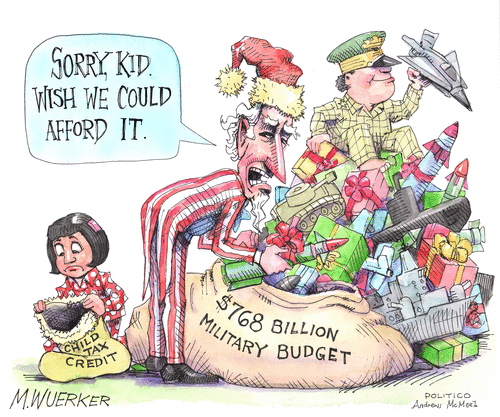
In Congress, the Democrats’ razor-thin margins in each house allowed them to almost accomplish all kinds of things. They almost started doing something about climate change, almost protected voting rights, almost renewed the child tax credit, almost reduced the cost of prescription drugs, almost reformed the filibuster, and much more.
As the year ends, the January 6 committee has almost gotten to the bottom of Trump’s coup, and I’m sure that 2022 will see the Justice Department almost get off its butt, investigate him, and send him on a well-deserved multiyear vacation inside some federal facility.
Well, I’m almost sure.
The point of no return
For Republicans, 2021 was the year when all hope of redemption was lost.
Remember the old Republican Party? I wasn’t a fan, because it was mostly dedicated to preserving traditional dominance relationships: rich over poor, capital over labor, men over women, Whites over people of color, Christians over non-Christians, the US over the rest of the world, and so on.
Nonetheless, Republicans could be counted on in certain important ways. Like all sensible Americans, they wanted to protect the country from invasion, terrorism, crime, and disease. They didn’t want to crash the economy. They had their own interpretation of democracy, human rights, and the Constitution, but they were more-or-less faithful to that interpretation, and could even at times be principled about it. Party leaders like Newt Gingrich and John McCain could see the reality of climate change and even support doing something about it.
Then came the Tea Party wave of 2010, and the rise of hostage-taking politics: If Obama wouldn’t give them what they wanted, they’d let the government crash into its debt ceiling, doing unpredictable damage to the world economy. Playing chicken with the debt has been a first-choice conservative tactic ever since, along with other hostage-taking tactics like government shutdowns and threatening to deport the Dreamers. Sure, almost nobody wants those things to happen, but what will you give me to make sure they don’t?
With Trump, the new anything-goes style came into the White House. But the old-time Republican Party was still represented by Senate-confirmed cabinet secretaries like John Kelly, Jim Mattis, and Rex Tillerson, who buffered the country from the worst impulses of the “fucking moron” in the Oval Office.
Then came the January 6 riot, whose purpose was to intimidate Pence and Congress into throwing the election to Trump, or at least delaying the electoral process past Inauguration Day and creating chaos Trump might use to stay in power.
For a few days, it looked like this was the long-anticipated moment when old-style Republicans would find a line they could not cross. Sending his thugs into the Capitol itself, staying silent while they threatened to hang the vice president — it was finally too much. Weather-vanes like Lindsey Graham and Kevin McCarthy turned against Trump.
Mitch McConnell could have convicted Trump in either one of his impeachment trials — the evidence to do so was certainly there — but ultimately he didn’t. During 2021, the whole party has gotten behind the Trump’s Big Lie about the stolen election, has made excuses for the attempted coup, and has calmly watched Trumpists set up for the next coup. Those few old-style Republicans who rediscovered their oath of office or their loyalty to the Constitution — Brad Raffensperger, Liz Cheney, and a handful of others — they’re targets now. The Party disowns them.
2021 was the GOP’s last chance to redeem itself, and it refused. Now it will either succeed in sweeping away democracy in favor of Trumpist fascism, or it will die. I wouldn’t want to place bets either way.
Today, our two-party system consists of one party committed to authoritarianism, and another that will almost defend democracy.
Dave Barry can’t make that situation funny, and the Washington Post editorial board can’t put a positive spin on it without looking ridiculous. So I won’t even try.
I have a bad attitude today. I’ve been reading a bunch of year-in-review articles, a genre that typically has a bittersweet tone: celebratory, wistful, nostalgic, reverent about the recently departed, and hopeful for the future.
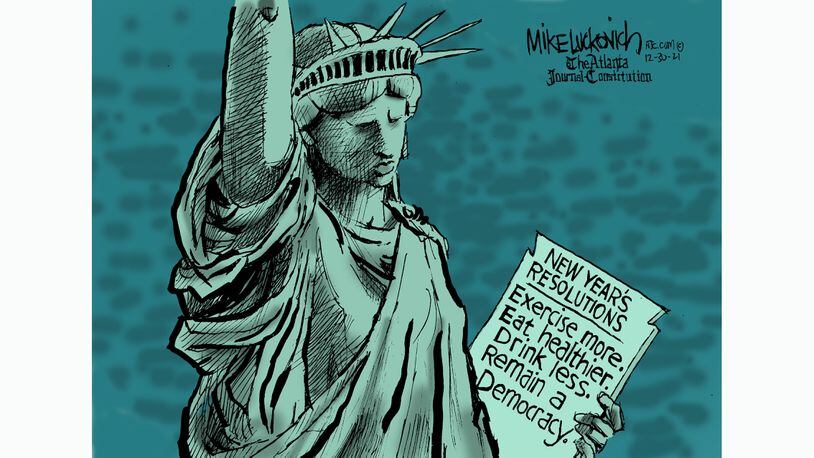
It doesn’t work this year, at least not for me. 2020 had been a terrible year by all accounts, but it ended on a hopeful note: Trump had been defeated, vaccines were coming, and maybe everything would be better soon. A year later a lot of things are better, but not by nearly as much as I imagined they would be. Covid is still terrorizing us, and the vultures are still circling our democracy. Republicans have closed ranks behind Trump’s sedition, while Democrats have been unable to maintain the kind of unity they need to pass legislation.
So watching year-end pundits try to apply the usual bittersweet glaze to the year has put me in a bad mood. That comes out in the featured post “Closing Out a Dismal Year”, which should appear shortly. (Truthfully, I’d skip it if I were you. Get yourself a too-sweet coffee drink and read a romance novel instead. Or watch the replay of a game your team has already won.)
The weekly summary has to begin with the startling Omicron surge, but there is some upbeat stuff as well: The James Webb space telescope, which launched Christmas Day, is a genuinely cool thing. And I love the audacity NASA has displayed by sending a complex mechanism well beyond the range of any repair crew. If it works, it’s going to be genuinely inspiring.
The world has never had a good definition of the word liberty, and the American people, just now, are much in want of one. We all declare for liberty; but in using the same word we do not all mean the same thing. With some the word liberty may mean for each man to do as he pleases with himself, and the product of his labor; while with others the same word may mean for some men to do as they please with other men, and the product of other men’s labor.… The shepherd drives the wolf from the sheep’s throat, for which the sheep thanks the shepherd as a liberator, while the wolf denounces him for the same act as the destroyer of liberty.
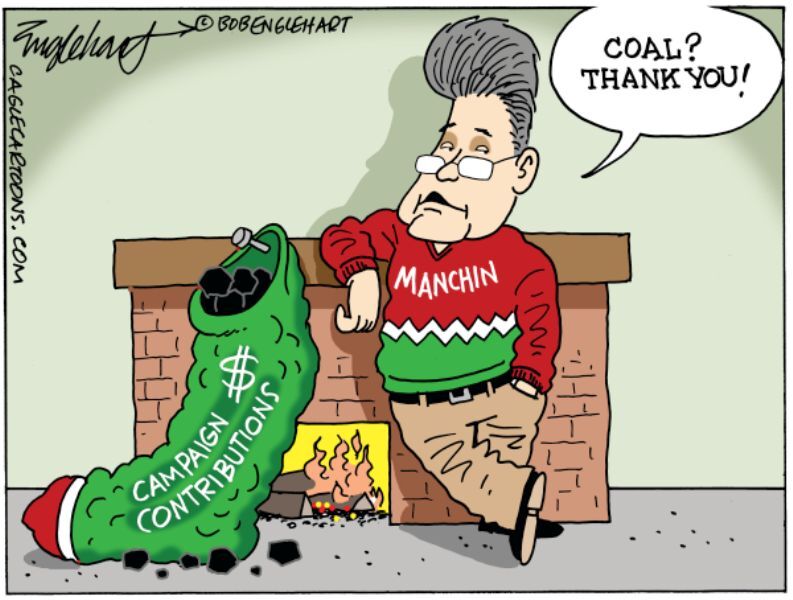
Joe Manchin announced on Fox News Sunday that he could not vote for President Biden’s Build Back Better bill, effectively dooming it. The White House released an angry statement in response, ratifying the breakdown in the Biden/Manchin relationship.
For half a year, Manchin has delayed progress on the bill, raising the question of whether he would eventually come through after he had whittled the proposal down to his liking, or if he was simply stringing Biden along. Now it looks like the latter.
Manchin’s decision sinks a number of popular proposals, including lowering prescription drug prices, continuing the child tax credit, and mitigating climate change.
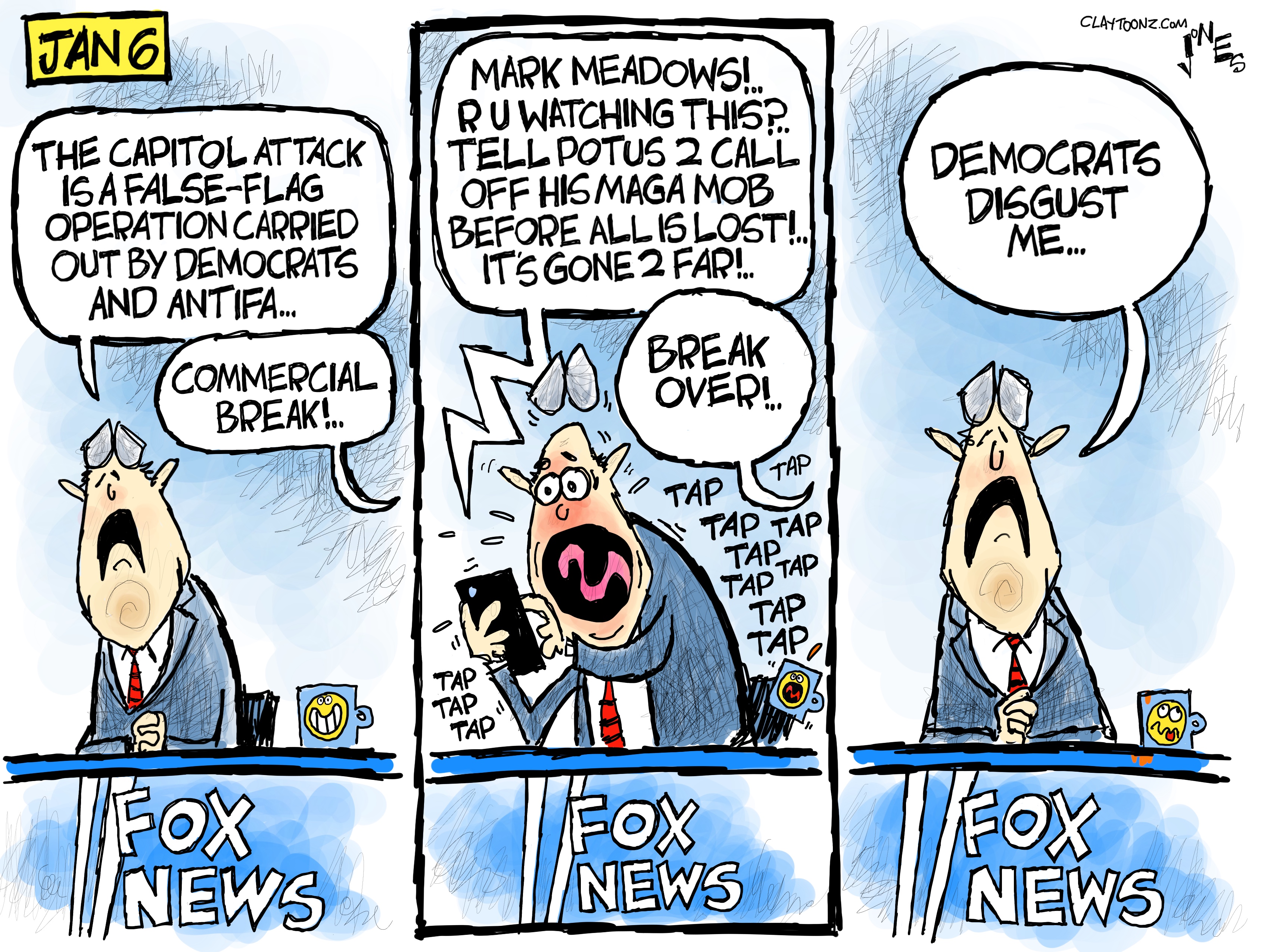
During the House debate on whether to find Trump Chief of Staff Mark Meadows in contempt of Congress for his defiance of a subpoena, (the contempt resolution passed) members of the January 6 Committee revealed a number of text messages Meadows had received on January 6 from various conservative luminaries, including Fox News hosts, at least one member of Congress, and Donald Trump Jr.
The point of publicizing these texts was that they emphasize the need for Meadows’ testimony. But they make another important point about the subsequent cover-up of January 6: As much as Trump propagandists try to claim that (1) the Capitol insurrection wasn’t a big deal, and/or that (2) Trump bore no responsibility for it, they knew at the time that those things weren’t true.
The texts plead with Meadows to get Trump to stop the violence, which demonstrate their authors’ belief at the time that Trump was controlling the violence. The texts would make no sense if the demonstrators were basically peaceful, or if the violence were a false-flag operation sparked by antifa, as Trumpists like to claim.
As Trump’s attempt to block the January 6 Committee’s access to documents from his administration goes to the Supreme Court, Vox points out what a flimsy claim he has under existing precedents. If the Court’s partisan majority wants to protect him, they’ll have to invent new law.
They might, but I’ll bet not. Roberts won’t go for it, and he only needs to convince one more conservative. Either Gorsuch or Kavanaugh might be that deciding vote. If the Court doesn’t find against Trump, they’ll manufacture an excuse to keep the legal wrangling going in hopes that a new Republican House majority will make the case moot by sacking the whole committee in 2023.
On the House floor, moments before the vote, Meijer approached a member who appeared on the verge of a breakdown. He asked his new colleague if he was okay. The member responded that he was not; that no matter his belief in the legitimacy of the election, he could no longer vote to certify the results, because he feared for his family’s safety. “Remember, this wasn’t a hypothetical. You were casting that vote after seeing with your own two eyes what some of these people are capable of,” Meijer says. “If they’re willing to come after you inside the U.S. Capitol, what will they do when you’re at home with your kids?”
This is one panel of a Tom Tomorrow comic in which the news anchors outline the run of recent bad news.
AP reviewed “every potential case of voter fraud in the six battleground states disputed by former President Donald Trump” — all 475 of them.
The cases could not throw the outcome into question even if all the potentially fraudulent votes were for Biden, which they were not, and even if those ballots were actually counted, which in most cases they were not.
The review also showed no collusion intended to rig the voting. Virtually every case was based on an individual acting alone to cast additional ballots.
Not all Republicans are comfortable centering their Party on a lie that undermines democracy. Wisconsin State Senator Kathy Bernier called out her fellow Republicans.
A Delaware judge has ruled that Dominion Voting System’s lawsuit against Fox News can go forward. At issue is whether Fox knew at the time that the election-fraud claims it was making against Dominion were baseless.
and Omicron
The pandemic numbers continue to increase: New cases per day in the US are up to 133K, a 21% rise over two weeks. Deaths are inching up: 1296 per day (7-day average), up 9%. Hospitalizations are at 69K, up 16%.
The records were set last January: 248K cases per day on January 11, deaths at 3336 per day on January 15, 140K hospitalized on January 5.
Omicron spread in the United Kingdom is running ahead of the US, so it may provide a glimpse of our future. The UK has been setting new-case records, and London bars and restaurants have begun shutting down on their own, creating a “lockdown by stealth”.
The economic consequences could be more dire this time around, because the government isn’t providing support to businesses that close temporarily. That could happen here too.
There’s no federal money left to keep restaurants open. The aid for concert halls and other customer-starved performance spaces has nearly gone dry. Federal officials ended their primary effort that pumped money into small businesses with sagging balance sheets, and they stopped paying out extra sums to workers who are out of a job.
Like the original strain of Covid-19, Omicron is hitting the US first in New York City. [See the correction in the comments. Covid his NYC early and hard, but not first.] I’m writing these words in Florida, which has become a low-Covid oasis since the summer surge passed. But a new outbreak seems to be starting in Miami.
The coronavirus is a microscopic ball studded with specially shaped spikes that it uses to recognize and infect our cells. Antibodies can thwart such infections by glomming onto the spikes, like gum messing up a key. But Omicron has a crucial advantage: 30-plus mutations that change the shape of its spike and disable many antibodies that would have stuck to other variants.
… In terms of catching the virus, everyone should assume that they are less protected than they were two months ago. As a crude shorthand, assume that Omicron negates one previous immunizing event—either an infection or a vaccine dose. Someone who considered themselves fully vaccinated in September would be just partially vaccinated now (and the official definition may change imminently). But someone who’s been boosted has the same ballpark level of protection against Omicron infection as a vaccinated-but-unboosted person did against Delta.
… Even if Omicron has an easier time infecting vaccinated individuals, it should still have more trouble causing severe disease. The vaccines were always intended to disconnect infection from dangerous illness, turning a life-threatening event into something closer to a cold. Whether they’ll fulfill that promise for Omicron is a major uncertainty, but we can reasonably expect that they will. The variant might sneak past the initial antibody blockade, but slower-acting branches of the immune system (such as T cells) should eventually mobilize to clear it before it wreaks too much havoc.
Moderna’s results show that the currently authorized booster dose of 50 micrograms — half the dose given for primary immunization — increased the level of antibodies by roughly 37-fold, the company said. A full dose of 100 micrograms was even more powerful, raising antibody levels about 83-fold compared with pre-boost levels, Moderna said.
All vaccines approved in the United States and European Union still seem to provide a significant degree of protection against serious illness from Omicron, which is the most crucial goal. But only the Pfizer and Moderna shots, when reinforced by a booster, appear to have success at stopping infections, and these vaccines are unavailable in most of the world.
The other shots — including those from AstraZeneca, Johnson & Johnson and vaccines manufactured in China and Russia — do little to nothing to stop the spread of Omicron, early research shows.
The protesters compared the employees who refused to serve them to Nazis, and claimed a constitutional right not to reveal their private medical information. (And that is true, of course. But there is no constitutional right to eat at Cheesecake Factory.)
Because the sports leagues do such regular testing, they are spotting mild and asymptomatic Covid cases that the larger society misses. In the last two weeks, Covid’s effect on games has greatly increased. We’re starting to hear calls for the leagues to shut down again.
When it comes to pronunciation, I am on Team OH-micron rather than Team AH-micron. To me, it’s obvious: omicron is a companion to omega (little-o/big-o) and nobody says AH-mega.
and inflation
The Bank of England became the first central bank to start raising interest rates in response to rising inflation.
The Federal Reserve is also responding, but more slowly. The Fed controls short-term interest rates on dollar deposits more-or-less directly, through the rates that it charges to banks; it affects long-term rates indirectly, by purchasing bonds in the market.
The Federal Reserve said on Wednesday it would end its pandemic-era bond purchases in March and pave the way for three quarter-percentage-point interest rate hikes by the end of 2022 as the economy nears full employment and the U.S. central bank copes with a surge of inflation.
Paul Krugman writes a readable account of the history and causes of inflation, and summarizes the debate between economists who think the current inflation is transitory and those who expect it to persist. Krugman himself is on Team Transitory, but he acknowledges that the current bout has already gone further than he expected, and I think he presents the debate fairly.
The problem, as Krugman presents it, isn’t so much that demand has soared as that during the pandemic it shifted from services into goods.
The caricature version is that people unable or unwilling to go to the gym bought Pelotons instead, and something like that has in fact happened across the board.
Services tend to be local, but goods depend on a global supply chain, which hasn’t broken, but hasn’t responded flexibly enough to accommodate increased demand. This, Krugman believes, will work itself out: As the pandemic recedes, service consumption will go back up, and supply-chain adjustments are already being made.
A second factor has been workers’ reluctance to return to the labor market, the so-called Great Resignation, which is forcing wages up. Krugman confesses he doesn’t understand exactly what is causing this or how quickly workers will come back.
A third factor in inflationary periods of the past has been psychological: Businesses raise prices and workers demand higher wages because they’re convinced that other prices will go up. In other words, inflation becomes a self-fulfilling prophecy. He doesn’t see evidence of this happening yet, but acknowledges that it could.
but you might want to think about this
Take a look at James Muldoon’s article “Regulating Big Tech is not enough. We need platform socialism.” I’m not sure how these specific ideas would work in practice, but I think we need to expand the universe of possible solutions to our social-media problem.
In practice, all participatory democracy processes — the daily hours-long open meetings of the Occupy movement being a prime example — run into the widespread desire for what I like to call Disneyland authoritarianism: Somebody should set things up so that I don’t have to worry about how anything works, and I don’t care if they exploit me a little as long as they also provide an enjoyable experience.
Disneyland authoritarianism works fine in a place like Disneyland, where management knows that you can easily walk out and never come back if you don’t like how you’re treated.
A lot of democratic-on-paper organizations end up running in a Disneyland authoritarian manner, because only a small group of people can be bothered to show up to decision-making meetings and man the bureaucracy. As long as the insider cabal keeps providing the services that the larger community expects and maintaining an acceptable level of quality, most people are content to fall into the role of customers rather than citizens. And that can be OK, as long as the processes are transparent and the cabal’s boundaries are permeable.
Small-town school boards are a good example. As long as local schools function at an acceptable level, most people can’t be bothered to participate, or even to vote in school-board elections. Democratic control exists mainly as a fail-safe, but that’s enough to keep authoritarian abuses at bay.
Disneyland authoritarianism becomes problematic when essential systems of everyday life depend on decisions made inside a Disneyland by a cabal that isn’t transparent or permeable. That’s the problem with social-media platforms like Facebook and Twitter.
In the beginning, free privately owned social media apps seemed like a good deal. We got to stay in touch with our friends, participate in communities of interest, and so on. Sure, they harvested our data and used it to target ads at us, but that seemed like a small price. If we didn’t like their online Disneylands, we could leave them and never come back.
But now we’ve gotten into a situation where democracy itself is strongly influenced by what happens inside social media platforms that are organized to maximize their owners’ profit. Disinformation and polarization are good for profits, but not for us as individuals, and not for our country or the world. But we can’t join the decision-making group, or even find out what they’re doing. And while we can walk away from the platforms themselves (at some cost to our ability to fully participate in society), we can’t isolate ourselves from their effect on our democratic systems.
For years we’ve been hearing about American airstrikes that go wrong and kill innocent people. This week the NYT published a series based on internal Pentagon assessments, claiming that
the American air war has been plagued by deeply flawed intelligence, rushed and imprecise targeting and the deaths of thousands of civilians, many of them children.
… Taken together, the 5,400 pages of records point to an institutional acceptance of civilian casualties. In the logic of the military, a strike was justifiable as long as the expected risk to civilians had been properly weighed against the military gain, and it had been approved up the chain of command.
The Pentagon records point to an official count of about 1,600 civilian deaths from airstrikes in Syria, Iraq, and Afghanistan since the official American ground war ended in Iraq in 2014. The Times’ estimate is much higher.
Christine Emba brings some common sense to the critical race theory disinformation campaign. Is math racist? Of course not. But the subject can be taught and its classes organized in racially biased ways.
The intrepid war correspondents of Fox News are on the front lines as the War on Christmas enters its 17th year. CNN’s John Avalon looks back at the origins of this annual conflict. He interviews Alisyn Camerota, who is now with CNN, but was at Fox back in those early days of the War, when “marching orders” to give national 24/7 coverage to any local nativity-scene controversy “so that you begin to think it’s a national crisis” came down from Fox president Roger Ailes.
The turning of something that unifying, something that really should transcend partisan politics in every way, into something divisive that people can fixate on and feel fear about — that’s a real trick. And it’s also a sign of sickness, a sign of partisanship seeping into every element of our lives at the hands of people who are trying to gin up this anxiety.
The Sackler family had negotiated a sweet deal for itself: The family’s company, Purdue Pharma, would take full responsibility for its role in creating the opioid crisis, and then declare bankruptcy. That plan would generate $4 billion to pay out to victims, but shield the family from any further lawsuits, letting them walk away with their own billions intact.
But a federal judge threw that agreement out Thursday, saying that the New York bankruptcy court didn’t have the authority to offer the family that protection.
Trust Stephen Colbert to remind us of what the Christmas season is really about: blockbuster movies. This year in particular marks the 20th anniversary of The Fellowship of the Ring, the first film in Peter Jackson’s Lord of the Rings trilogy. Colbert commemorates this milestone as they undoubtedly would in Rivendell, with rap.
The author, Matthew Walther, lives in rural southwestern Michigan and usually writes for Catholic and conservative outlets. The gist of his article is summed up well by the title: In Walther’s world, people already live as if the pandemic is over.
This was not news to me. This week my wife and I have been (very carefully) making our way down the East Coast to re-establish the decades-long Christmas-with-friends-who-now-live-in-Florida tradition that lapsed last year. We’ve seen the mostly unmasked travelers at the rest stops. (My college roommate and his wife caught Covid in 2020 after their own very careful road trip; they blame the rest stops.)
In North Carolina, we were the only diners who chose to sit on the restaurant’s outdoor patio. A Florida lunch spot had only one outdoor table, which no one else wanted. In South Carolina, we bought the instant Covid tests that no CVS back in Massachusetts could keep in stock. When we asked about a limit on how many we could buy, the clerk looked at us strangely, as if we didn’t understand that the whole point of retail is to sell as much as you can.
Believe me, the number of people living as if Covid isn’t happening any more has not escaped my attention.
So why do I feel trolled by Walther’s article? He isn’t denying evident reality, as so many Covid minimizers do. He acknowledges that the virus is still spreading, and that hospitalizations are high, though they “are always high this time of year without attracting much notice”. He backhandedly acknowledges the existence of variants, but claims not to be paying much attention.
COVID is invisible to me except when I am reading the news, in which case it strikes me with all the force of reports about distant coups in Myanmar.
He says (without much concern) that 136 people in his rural county have died of Covid, undermining the whole everybody-knows-everybody image urbanites have of the countryside. (He isn’t saying “Aunt Josie died, but I never liked her anyway.” 136 is just a number to him, like the “statistic” famously attributed to Stalin. I wonder how his Catholic sanctity-of-life sensibilities would react to hearing about 136 local abortions.)
His point isn’t that none of this is happening, but rather that trying to avoid catching and spreading the virus yourself is too bothersome.
What I wish to convey is that the virus simply does not factor into my calculations or those of my neighbors, who have been forgoing masks, tests (unless work imposes them, in which case they are shrugged off as the usual BS from human resources), and other tangible markers of COVID-19’s existence for months—perhaps even longer.
He reports that “from almost the very beginning” he has been attending weddings, taking vacations, and regularly going to indoor bars and restaurants unmasked. His kids belong to a homeschooling group, which they also attend unmasked. They regularly visit (and hug) their grandparents, and did even before vaccination was possible. And while Walther doesn’t disparage the vaccines directly, “The CDC recommends that all adults get a booster shot; I do not know a single person who has received one.”
Well, OK. The people he knows live differently than the people I know. That can’t be what got me roiled.
It also isn’t that his excellent arguments leave me without a coherent response. (We all know how annoying that can be.) Several quick retorts immediately pop to mind.
800,000 of our countrymen are dead. If we’d seen that many deaths in a war, most Americans would be ashamed to admit they had opted out of the war effort, as Walther and his community apparently have.
Risk-takers often have long runs of good luck, but that doesn’t prove that the risk isn’t real. Back in the days before they became a personality cult, conservatives understood this.
From the beginning of the pandemic, a steady stream of voices have scolded the rest of us for overreacting. And every few days, I hear about another one of those scolders dying.
So no, my annoyance isn’t covering up my embarrassment at finding myself speechless in the face of Walther’s unanswerable logic.
And yet, it was hard to let it go and move on. Why?
I had to do a careful second and third reading, watching my emotions closely, to figure it out: I’ve been reacting not to the content of Walther’s article, but to his tone of personal animus. He doesn’t just think that people like me are being foolish; fools are typically pitied. No, he harbors a deep resentment of us. What I can’t shake is a sense of “What did I ever do to him?”
His resentment expresses itself from the early paragraphs, when Walther’s wife responds to an article explaining how to have a Covid-safe Thanksgiving with an exasperated “These people.” [His italics.]
What people? A few lines later he makes that clear:
the professional and managerial classes in a handful of major metropolitan areas
Nailed me there, didn’t he? I have a graduate degree and live just beyond Boston’s Route 128 beltway. Outside my insulated world, he writes, “Americans are leading their lives as if COVID is over.”
So it isn’t just that the people I know are living differently than the people he knows. Walther’s people are “Americans”, while mine are an elite class isolated in our privileged enclaves.
This conservative culture-war version of the Marxist class struggle appears to be a regular part of Walther’s shtick, also demonstrated here and here.
Never mind the CNN poll released this week showing that a majority of Americans report “still taking extra precautions in your everyday life”. That’s just data, and what’s data compared to the deep intuition of a salt-of-the-Earth, real American literary-magazine editor like Walther?
I wager that I am now closer to most of my fellow Americans than the people, almost absurdly overrepresented in media and elite institutions, who are still genuinely concerned about this virus. And in some senses my situation has always been more in line with the typical American’s pandemic experience than that of someone in New York or Washington, D.C., or Los Angeles.
Put aside for a moment that the people being “absurdly overrepresented in the media” are primarily doctors, epidemiologists, and other people who know what they’re talking about. Even ignoring expertise, Walther is strongly implying that there is something illegitimate about the views of people who live in or near a city. (More than one American in seven lives in the three metro areas Walther calls out. Adding in the similarly elite Chicago, Philadelphia, Boston, and San Francisco metro areas gets you up to one in four. That’s a lot of illegitimate opinions.) No urbanite (or even suburbanite like me) can possibly be a “typical American”. We city folk who lower our masks to let acquaintances recognize us when we pass on the sidewalk are “like Edwardian gentlemen doffing their top hats”.
I can see how that kind of lordly behavior might set off a mere peasant like this contributing editor of American Conservative, who is so underrepresented in the media that I am reading his words in The Atlantic.
But you know the worst thing about people like me? It’s not what we’ve done or are doing, but what Walther is sure we will do.
I am afraid that the future, at least in major metropolitan areas, is one in which sooner or later elites will acknowledge their folly while continuing to impose it on others.
Because people like me are like that. No doubt the next time I drive down the coast, I’ll grab the last seat at the bar and insist that some working-class shlub sit out on the patio where it’s safer. Because by then I’ll have realized the folly of trying to avoid a disease that has killed more of my fellow citizens than World War II, but I’ll impose restrictions on the subordinate classes just to lord it over them.
And while I can’t remember ever having done anything like that before, it’s inevitable that I will. Because Walther really has my number.
That’s the kind of argument I have no answer for. It just leaves me wondering what I ever did to him.
It’s tempting to leave the topic there, but I think there’s a deeper lesson to be drawn. What makes culture-war arguments so frustrating generally is that they typically aren’t rooted in facts and logic, but in resentment. Fact-checking has proven to be impotent against Trumpism, for example, and right-wing cultists are never convinced when the absurdity of their logic is pointed out. Because no matter what is true or makes sense, their emotional resentment — wherever it comes from — endures.
And if you refute all that, chances are that the argument will circle back around to voting machines — Mike Lindell is still pushing that long-debunked lie — because the elite urban professional class (and their poorer dark-skinned minions) must have stolen the election somehow. There are too many “real Americans” for Trump to have lost, and if the ballots don’t show that, it’s because too many of them came from illegitimate places like Philadelphia or Detroit or Atlanta. How could Trump have lost, when all the White Catholics in rural southwestern Michigan voted for him?
Similarly, QAnoners aren’t bothered when their predictions fail. And even if they were, they could jump to other conspiracy theories that support the same narrative motif: You are part of the red-pilled vanguard party, who are ordinary people’s only hope against the powerful liberal cabal that manipulates the world. Your friends and relatives may not grasp the reality of the conspiracy yet, but someday they too will acknowledge their folly.
On Fox News, the lead story shifts from week to week, from critical race theory making White children ashamed of their heritage, to Biden wanting to raise your taxes or take your guns, to vaccine or mask mandates usurping your sacred freedom to die any way you want, to trans women menacing your daughters in bathrooms, to the War on Christmas desecrating your most revered traditions.
Whatever the specifics might be this week, and whether any particular story is true or not, the drumbeat is always the same: Liberals want to take something away from you. That deep resentment you feel against them is justified, because at this very moment they are plotting to destroy your way of life.
So it doesn’t matter whether any particular liberal plot checks out or not, because we must be hatching one. They know what we’re like.
I have to confess that I don’t know what to do about this.
As ridiculous as I find conservative attempts to liken themselves to Jews facing Nazi oppression, there is one particular way in which the current liberal situation resembles pre-Krystallnacht Judaism: When the details of particular plots are allowed to fluidly reshape themselves from day to day, and when you can be held responsible for misdeeds other people believe you are bound to commit, given the kind of person they are sure you must be, then it’s nearly impossible to prove that you are not part of a conspiratorial elite.
That’s where we seem to be.
I am 100% certain that I am not conspiring to destroy the way of life of White Catholics in rural southwestern Michigan. But if some of them want to believe that I am, I have no idea what I can say or do to change their minds.
An eventful week: Build Back Better looks dead. The Mark Meadows text messages show that major conservative voices were panicking in private on January 6 while they publicly said something very different. Omicron is spreading. Central banks are starting to respond to inflation. The NYT exposes what the Pentagon knew about the civilian casualties from its bombing raids. And the War on Christmas enters its 17th grim year.
The featured post isn’t about any of that. A conservative article in Atlantic got under my skin, and I tried to figure out why. That led to “The Emotional Roots of Political Polarization”, which should be out between 9 and 10 EST.
The weekly summary does cover the stuff I mentioned above, and also promotes an article calling for “platform socialism” as a solution to the problem of Big Tech monopolies. I haven’t decided whether I agree, but I do want to widen the range of debate on this issue. Then the summary closes with Stephen Colbert’s Lord of the Rings rap. That should appear before noon.










 The Weekly Sift
