Governing

Sometimes I feel like our party cares more about winning the argument than they care about winning elections. And if you don’t win elections, you can’t govern. And if you can’t govern, you can’t change the direction of a state, like we’ve done in New Jersey.

— Chris Christie, 11-5-2013

This week’s featured articles: “Nobody’s a Moderate in the Republican Civil War” and “Bullies, Victims, and Masculinity“.

This week everybody was talking about election results

After decades of rule by Republican/Independents like Mike Bloomberg and Rudy Guiliani, New York elected a Democratic mayor by a landslide. Bill de Blasio didn’t just wear the Democratic label, he put forward a genuinely progressive agenda.

In New Jersey, conservative (not moderate) Chris Christie was the landslide winner.

Here’s what stands out for me about the Virginia governor’s race: not that the Democrat won or that the final vote was closer than expected, but that the Democrat won a low-turnout election.

Conventional wisdom says that high turnout favors Democrats, low turnout Republicans. (That’s why Republicans work so hard to suppress the vote.) And it plays out in Virginia: When Obama took Virginia in 2008 and 2012, he did it by pulling in people who don’t usually vote. About 3.7 million Virginians voted each time, compared to 3.1 million when Bush beat Kerry by 270,000 votes in 2004. In 2010, when there was no top-of-the-ticket election and Republican House candidates outpolled Democrats by 275,000 votes, only 2.2 million voted.

Again Tuesday, about 2.2 million Virginians voted. They elected Democrats governor and lieutenant governor, and the attorney general race is still too close to call.

If I were a Republican, that would worry me.

and Typhoon Haiyan

As many as 10,000 may be dead in the Philippines in “one of the most powerful typhoons ever recorded”. Haiyan proceeded on to make landfall in Vietnam. I know there’s some famous quote about the number of deaths a disaster needs to make headlines being inversely proportional to its distance, but my Google skills failed me. (If you know, write a comment.)

Here’s Haiyan as seen from space:

and Iran

Negotiations about Iran’s nuclear program ended without a deal. It’s not clear how seriously to take claims of “significant progress”.

and the NFL, race, and masculinity

The Richie Incognito/Jonathan Martin bullying story jumped off the sports pages and became a discussion about race and masculinity. I discuss it in more detail in “Bullies, Victims, and Masculinity“.

and you also might be interested in …

CBS has pulled  the 60 Minutes segment on Benghazi off its web site, saying:

60 Minutes has learned of new information that undercuts the account told to us by Morgan Jones of his actions on the night of the attack on the Benghazi compound.

We are currently looking into this serious matter to determine if he misled us, and if so, we will make a correction.

It apologized on the air last night.

Apparently, their key witness had previously told the FBI a completely different story. Apologizing is fine, but that’s not going to correct all the misinformation that CBS’ report put into people’s heads.


Jonathan Chait notes that the limit of the Senate’s power to “advise and consent” on presidential nominees is limited by custom, not settled law. And then he raises an important question:

We may assume that another Supreme Court vacancy would result in the confirmation of a mainstream judge in the president’s broad ideological mold. But if one of the five Republican-appointed justices were to fall ill or suddenly retire, would Republicans really allow Obama to replace him with another Elena Kagan or Sonia Sotomayor? We believe that the Senate would yield because that’s simply the way things have always been done. But in the Obama era, the way things have always been done has not turned out to be a reliable guide.


The Rand Paul plagiarism scandal keeps growing. It started with Rachel Maddow spotting unattributed paragraphs from Wikipedia in Paul’s speeches. Then BuzzFeed’s Andrew Kaczynski noticed pieces of an article from The Week showing up in Paul’s Washington Times column. And then he found that a chunk of Paul’s latest book was cribbed from a Forbes article. Politico found “borrowed language” in Paul’s Howard University speech and his 2013 response to President Obama’s State of the Union address.

Tuesday, The Washington Times ended Paul’s weekly column, saying: “We expect our columnists to submit original work and to properly attribute material”.

It’s kind of a weird scandal, because (in all the examples I’ve seen) quoting the source material properly would not have detracted from the point Paul was making. The issue seems to be more about sloppiness and low intellectual standards than about honesty.

There’s also character component now, because of the way Paul initially tried to bluster his way through rather than just own up to the mistakes.

if dueling were legal in Kentucky, if they keep it up, you know, it would be a duel challenge. But I can’t do that, because I can’t hold office in Kentucky then.

That sounds big and tough until you realize that he’s fantasizing about dueling a girl, Rachel Maddow. (I don’t think they ever did that in Kentucky. Or anywhere.) By the time CNN called him to account, he was slightly more contrite: He blamed his staff, and then whined about “the standard I’m being held to”.

They’re now going back and reading every book from cover to cover and looking for places where we footnoted correctly and don’t have quotation marks in the right places or we didn’t indent correctly.

This all backs up my initial impression of Paul, which is that the champion-of-libertarian-philosophy mantle he inherited from his Dad doesn’t really fit. (How well it fit Ron Paul is a different discussion.) He appears to be an empty suit who doesn’t write, vet, or even understand very well the words he says or signs his name to.

That’s why he looked so silly when Rachel interviewed him in 2010: Rachel knows her stuff, and Rand only knows his talking points. Or why he seemed surprised that black students at Howard University know basic facts about American history (like that Lincoln was a Republican). (Jon Stewart described the Howard talk here, and then discussed it with Larry Wilmore.) His talking points say blacks are all Democrats because they don’t know that kind of stuff. How was he to know Howard students really do?


Young adults aren’t buying cars or houses at the usual rate. Are they just over-extended from student debt and poor job prospects? Or are they developing a different relationship with ownership?

and let’s end with something awesome

like the moon.

Bullies, Victims, and Masculinity

The Richie Incognito story is about more than just locker-room culture. It’s about how traditional masculinity sets poor men up for victimization by rich men.


Maybe I should eavesdrop more, but I seldom hear people in bars and restaurants talking about news stories … unless those stories have something to do with sports. A few weeks ago, I heard three guys at a bar talking about how silly it would be to change the name of the Washington Redskins. And Thursday night, a couple in a Thai restaurant were talking about the Richie Incognito bullying story.

We have a lot more speculation than facts about Incognito, but this much seems to be true: Miami Dolphins’ offensive tackle Jonathan Martin left the team October 28 for “emotional” reasons, and briefly checked into a hospital before going to California to stay with his parents. A few days later, fellow Dolphin lineman Richie Incognito was identified as the center of an ongoing harassment of Martin. Apparently it started last year, when Martin joined the team, as ordinary hazing of a rookie. But unlike most NFL rookies, Martin also appears to be a loner and a misfit in jock society. Perhaps his relatively upscale, intellectual childhood (both Martin’s parents are lawyers) was part of why teammates called him “Big Weirdo“. Incognito was suspended indefinitely after ESPN learned about a voicemail in which Incognito called the mixed-race Martin “a half-nigger piece of shit”.

Incognito claims that he had a good relationship with Martin, and that Martin knew the voicemail was a joke. His teammates more-or-less back him up, but The Nation’s Dave Zirin discounts that as “bully solidarity“. ESPN’s Adam Schefter (a former player) commented:

This is not about a football locker room mentality. This is about the right behavior in a workplace environment where people feel safe.

Whatever the facts turn out to be, the story has stirred up a wide-ranging discussion about the N-word (which I’m going to pass over) and about masculinity. To some people (like Hall of Fame linebacker Lawrence Taylor) it’s obvious that Martin should have punched Incognito in the face, and that would have been the end of it. Martin is 6’5″ and over 300 pounds, so (according to this point of view) he should be able to take care of himself. By instead making this issue public, he has violated the code of the locker room and hurt his team and teammates.

The resemblance to the keep-it-in-the-family view of child abuse or domestic violence (in my opinion) is more than coincidental.

Implicit in the criticism of Martin is the idea that there’s only one acceptable way to be a man, and being shy or non-confrontational is not part of it. Also, that a professional sports team is not just a workplace, it is a culture that only certain kinds of people can join. That seems to be the point of view of a rather disjointed defense of Incognito by former player Nate Jackson.

Richie Incognito lives in the world that our rabid consumption of the game has created. It’s a place for tough guys, where the mentally and physically weak are weeded out quickly. For those who show themselves to be affected by taunting and teasing, the taunting and teasing get louder, until they either break or develop a good defense. If you can’t handle a joke from your teammates, how are you going to handle the fourth quarter when we need you?—that, at least, is the conventional wisdom. Jonathan Martin’s defense was to walk out. Maybe that was a good thing. Maybe we need to get more sensitive about this stuff. But let’s also try to understand it. Richie Incognito acted like an animal because he lives in the jungle.

A particularly insightful discussion of the issue was on Melissa Harris-Perry’s MSNBC show yesterday. Perry connected the issue to larger notions of hazing (talking to documentary filmmaker Byron Hurt whose “Hazing: How badly do you want in?” will be released soon), and to the ways that traditional masculinity opens lower-class men to exploitation by those whose power comes from money rather than brawn.

In particular, Harris-Perry connected the Martin/Incognito story to the NFL’s concussion issue, which got that much hotter this week with the revelation that all-time-great Cowboy running back Tony Dorsett suffers from chronic trauma encephalopathy, a mood-and-memory disorder associated with repeated concussions. Harris-Perry talked to former NFL player Don McPherson, who said:

You hear all these men talking now about this “suck it up, take it like a man”. Well, should we therefore then take our concussions like a man? Should we stop complaining about the fact that we can’t remember our last Super Bowl, like Tony Dorsett was saying this last weekend? Should we take that like a man? Or should we understand that even though he’s a tough guy who plays football, he’s still a human being?

Hazing and bullying is often about group solidarity. And often the ultimate beneficiary of a solid group isn’t a team or teammate, or even the bully himself, it’s a boss or owner.

Ta-Nehisi Coates also made the Incognito/Dorsett connection:

I grew up in a time and place where you really did have to fight if you expected to be able to live. … when I was young our bodies were all we had. Imposing those bodies on other bodies was the height of our power. It was also the limits of it. All the while we knew that were other people with greater power, who imposed with force so great that it seemed mystical to us. To see football players—arguably the most exploited athletes in major sports—bragging about manly power, along the same codes that once ruled my youth, is saddening.

and in a different post, Coates says:

We all believe in the right to defend one’s own body. But the ability to kick someone’s ass is oft-stated and overrated. Jerry Jones doesn’t want to fight DeAngelo Hall. He won’t ever need to, because such is his power that he can erect a Wonderland of a stadium, reduce men to toy soldiers, and toss their battered bodies out onto the street when he’s done. Pimping ain’t easy, but it sure is fun.

If you squint hard enough you might dimly perceive the outlines of some phantasm, some illusion. You might see power back there behind the scrum. You might see how a national valorization of violence attaches itself to profit.

Nobody’s a Moderate in the Republican Civil War

The Tea Party and establishment Republicans differ on style and tactics, not goals.


After his loss in Tuesday’s Virginia gubernatorial election, Tea Party Republican Ken Cuccinelli refused to make the traditional phone call to congratulate the winner, Terry McAuliffe.

No big deal, you might say. Cuccinelli has admitted in public that he didn’t win, and McAuliffe becomes governor in any case. The Outside the Beltway blog argues that the congratulating call doesn’t matter, because such gracious gestures are insincere anyway. And Kevin Drum threw the question out to his readers: Does symbolic politeness still matter or not? (Typically, the comment thread quickly devolved into insults that leave no clear consensus answer. And that’s a meta-answer, I suppose.)

But whether the absent phone call has any direct significance on governance, I think it is important. Congratulating the winner, no matter how much your defeat still rankles, recognizes that in the end we are all on the same side. We are all Americans, or (in this case) all Virginians. However bitter the campaign has been, however overheated the rhetoric has become, we all want the collective project we call “government” to succeed, whether our side gets to lead that government  or not.

That is more-or-less precisely what the Tea Party denies: We are not all on the same side. In President Obama’s case, Tea Partiers often don’t even admit that he’s an American. And they see election campaigns not as contests between differing views of how to move our country forward, but as apocalyptic battles between Good and Evil.

The Obama/Romney election, evangelist Franklin (Billy’s son) Graham warned last fall, “could be America’s last call to repentance and faith. … There’s still time to turn from our wicked ways so that He might spare us from His wrath against sin.” And the American Family Association’s Bryan Fischer saw the shutdown/debt-ceiling showdown as evidence “the destruction of America” is on President Obama’s “bucket list”.

Like Cuccinelli, Ted Cruz did not even fake politeness when the President visited Cruz’ home state of Texas this week: “President Obama should take his broken promises tour elsewhere.” Where’s that famous Southern hospitality?

Tea Party strategist

Legitimate rivals merit politeness, but if the AntiChrist wins you don’t congratulate him on his victory or give him a chance to implement the vision the voters have endorsed. You continue the struggle wherever and however you can. And if you bring the temple down on your own head like Samson, you take satisfaction in the number of enemies who perish with you.

The Republican establishment. One popular interpretation of Tuesday’s election results was that establishment Republicans had flexed their muscles and proved that they (and not the Tea Party) are the GOP’s best hope for victory.

Christie and AntiChrist

There was some truth to that. Cuccinelli’s campaign suffered from a lack of money, in large part because big bankroll donors like the Chamber of Commerce wouldn’t contribute. The Chamber also figured in the victory of establishment Republican Bradley Byrne over Tea Party Republican (and birther) Dean Young in Alabama’s 1st congressional district.

And the biggest Republican winner of the night was New Jersey Governor Chris Christie, who had praised Obama’s handling of Hurricane Sandy and accompanied Obama on a photo-op tour of damaged areas late in the 2012 campaign: “It’s been very good working with the President,” Christie said. “He and his Administration have been coordinating with us. It’s been wonderful.”

Frontrunner? After his landslide win in a blue state, some pundits anointed Christie the early frontrunner for the 2016 Republican presidential nomination, while others were more skeptical.

But his potential opponents have treated Christie’s victory like a serious threat, barely even pretending to be happy about a Republican victory. Rand Paul gave Christie a backhanded compliment, saying that the Republican Party needs “moderates like Chris Christie who can win in New Jersey.” (Recall that “moderate” is an insult in GOP circles. It was Mitt Romney’s opponents who called him a “Massachusetts moderate“, which the Boston Globe characterized as “the two dirtiest words in the Republican lexicon”. Romney himself claimed to be “severely conservative“.) Rick Perry likewise questioned whether “a conservative in New Jersey a conservative in the rest of the country”.

Ted Cruz’ comments were even more pointed:

I think it is terrific that he is brash, that he is outspoken, and that he won his race. But I think we need more leaders in Washington with the courage to stand for principle.

So congratulations to the cowardly, unprincipled Governor Christie.

Moderate? For most of American history, moderate sounded reasonable and good, and to much of the electorate it still does. But what evidence is there of Christie’s moderation?

Traditionally, a moderate was someone who shared at least a few positions with the opposing party (like Democrat Joe Lieberman’s support for the Iraq War and waterboarding, or Republican Rudy Giuliani’s support for abortion rights and immigration reform), or shared goals with the other party but tried to achieve them by different means. (That’s what RomneyCare was about, and why Mitt Romney would have deserved the moderate label if he had truly run on his record. Mitt tried to achieve universal health care via private insurance and the free market. Obama’s embrace of that moderate-Republican approach should have earned him moderate status as well.)

I can’t think of any issue where Christie fits the bill. His position on marriage equality seems typical: He believes only in opposite-sex marriage. He vetoed a bill that would have legalized same-sex marriage in New Jersey, and then sued to prevent same-sex marriages after a state judge ruled in their favor. He eventually dropped the suit and allowed same-sex marriages to proceed in New Jersey, but only after it became clear he would lose.

That’s not moderation, it’s pragmatism. He doesn’t waste his effort on losing battles.

He occasionally makes agreeable noises about gun control, but in the only real test he vetoed three popular bills, one being a version of something he had proposed himself just a few months before.

On contraception and abortion, he vetoed funding for Planned Parenthood five times. The anti-abortion Life News says he proved wrong the “media elite [who] claim Republicans can’t win on a pro-life platform.”

He believes in tax cuts for the wealthy and spending cuts for the poor. There’s nothing in his record resembling RomneyCare.

ThinkProgress goes into more detail on Christie’s conservative record.

Opposing the Tea Party doesn’t make you a moderate. Likewise, you’ll search Bradley Byrne’s web site in vain for any moderate policy. He just won’t say stuff as gratuitously offensive as his Tea Party opponent Dean Young, who wants anybody who supports marriage equality thrown out of the Republican Party

If you want to have homosexuals pretending like they’re married, they need to go to the Democrat Party.

Mississippi Senator Thad Cochran, as well as Tennessee’s Lamar Alexander and Kentucky’s Mitch McConnell are all likely to face Tea Party opposition as they run for re-election. They all (eventually) voted to keep the government open and not default on America’s commitments, but they’re no moderates. Just because they won’t set themselves (or the country) on fire to protest ObamaCare doesn’t mean that they secretly support it.

So when they run against Tea Party extremists in the Republican primaries, I’ll be rooting for them. But that offer expires the morning after the primary. I respect their higher level of politeness and their caution about burning down the house we all live in. But they differ from the Cuccinellis and Cruzes and Youngs merely in tactics, not in goals.

The Monday Morning Teaser

Lots of news this week: off-year elections, one of the biggest storms ever, a breakdown in the talks with Iran, more Rand Paul plagiarism coming to light, CBS admitted the 60 Minutes Benghazi story was bogus, the NFL’s bullying scandal, and a bunch of other stuff.

The featured article this week, “Nobody’s a Moderate in the Republican Civil War”, will focus on the confusion some liberals may feel about the Tea Party vs. Republican establishment battle that played out in the elections and their aftermath: Yes, it will be better for the country if the establishment wins that war, but not because the establishment is “moderate” or shares any progressive goals. The goals of establishment Republicans like Chris Christie and Mitch McConnell are just as extreme as the Tea Party’s; they just seek those goals pragmatically rather than self-destructively. Left to its own devices, the establishment would go to the same place as the Tea Party, but with less collateral damage.

So for the sake of the country, I root for the GOP establishment in primaries — in spite of my belief that Tea Party candidates are easier to beat. But don’t make the mistake of thinking “he’s not so bad” about Christie or McConnell just because they don’t play chicken with things like a debt default.

That article should be out shortly, and everything else by about noon.

Carrot and Stick

I’m concerned about the fact there seems to be a war on the poor. That if you’re poor, somehow you’re shiftless and lazy. You know what? The very people who complain ought to ask their grandparents if they worked at the W.P.A.

— John Kasich, Republican Governor of Ohio
The New York Times, 10-28-2013

The dual process of cutting both taxes and social programs involved, however, a striking difference in the assumptions of the motivations governing the behavior of the affluent and of the poor. For those in the upper brackets, and for those managing corporate decision-making processes, the underlying assumption of the tax cuts was that the creation of new tax incentives would encourage more work, more investment, and more savings, that the best way to achieve sought-after behavior is to reward it, in this case with lowered tax rates on corporations, savings, executive stock options, and estates. At the bottom of the scale, the dominant assumption behind social program cuts was precisely the opposite: the best way to achieve increased work is by making life tougher.

— Thomas Byrne Edsall
The New Politics of Inequality (1984)

A shorter summary of the policy-set Edsall is describing: Carrots for the rich. Sticks for the poor.

This week’s featured post: “The Filibuster and the War on Women

This week everybody was talking about ObamaCare

The focus of Republican attacks shifted from HealthCare.gov to people whose policies got cancelled.

A lot of the media is reporting these cases without examining them. The few who do invariably notice the same things. Either

  • the cancelled policy is what Consumer Reports has called “junk insurance”. A low annual cap or the insurance company’s option to cancel if you actually get sick means that the policy really just provides the illusion of health insurance. In addition to the 50-million-or-so uninsured Americans pre-ObamaCare, about 25 million had insurance that would not have saved them from bankruptcy if they had a major health problem.
  • or, a better policy (typically, but not always) for less money is available on the ObamaCare exchanges.

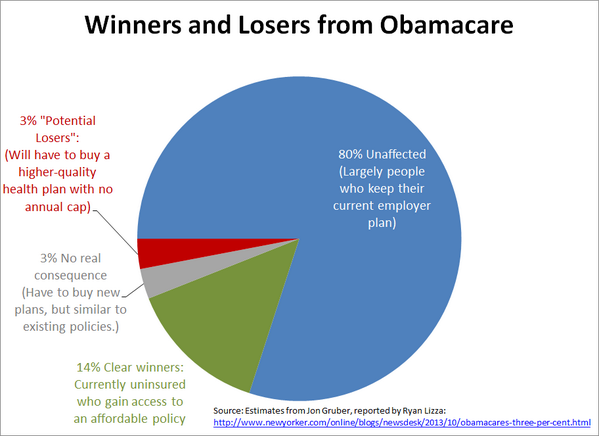
There are exceptions, but here’s the overall picture:

Nicholas Kristof reminds us of the real victims of our healthcare system: People who will die because they couldn’t get affordable health insurance. They’re not just abstract public-health statistics. They have names and stories. As Margaret Talbot writes in The New Yorker:

when it comes to evaluating the worth of Obamacare we may not remember the Web-site hiccups all that well. What we will remember, and what ultimately matters, is whether, in the next year, the A.C.A. fulfills its promise: to provide affordable health insurance to people who did not have it through an employer, could not afford it on their own, were denied it on the basis of preëxisting conditions, paid more for it than they should have because they were, say, women of child-bearing age, or could no longer get by because their insurance benefits had been capped.


A new poll shows why the “replace” part of the Republican slogan to “repeal and replace ObamaCare” will never happen: Republicans don’t want a replacement. Among Republicans, repeal-and-don’t-replace beats repeal-and-replace 42%-29%.

and the LAX shooting

Notice how closely the coverage tracks Juan Cole’s 2012 “Top Ten Differences Between White Terrorists and Others“. I don’t want to make too much of the early hints that this guy is a right-wing wacko, but if he were a dark-skinned Muslim with similar hints of radical Islamist views, that would be the whole story.

and food stamp cuts

The Food Stamp program became less generous on November 1, when a benefit increase that was part of the 2009 stimulus program expired. Eligibility standards don’t change, but families will get about 5% less help.

I have trouble getting excited about the expiration of a temporary program, but further food stamp cuts are on the docket. The current budget negotiations are supposed to reconcile the Senate’s $4-billion-over-ten-years cut with the House’s $40-billion-over-ten-years cut. About $76 billion was spent on food stamps this year.


The problem of scale: “Lawmakers could save millions by targeting food stamp fraud — will they?” says the Fox News headline. Millions? Those who keep reading will find this acknowledgement: “The amount appears relatively small considering the government pays out roughly $70 billion in annual food stamps benefits.”

Hmmm. I wonder if those “millions” are net savings, after accounting for the cost of implementing and enforcing whatever safeguards would prevent that relatively small amount of fraud. Fox doesn’t link to the report the number comes from — I think it’s this one, although an automatic text search fails to find the $3.7 million figure in it — but it looks like they’re talking about gross savings, estimated by a suspiciously simplistic method.

The projected potential savings from fraud-cutting is detailed in the inspector general report, which found $3.7 million in questionable monthly payouts across 10 states. … The $222 million figure was reached by multiplying the number by 12 to get an annual amount, then by five to get an estimate for all 50 states.

So on the bottom line, the headline “millions” in savings are probably considerably less than the article claims, and may even be negative.

and the NSA

Strangely, people who are OK with the NSA spying on you and me hit their limit when it was revealed that the NSA is spying on our allies.

and the Republican Civil War

The opening quote from Governor Kasich is a Republican-on-Republican attack, as Kasich struggles to govern in spite of his Republican legislature. Anybody who thinks President Obama could get along with the Right if he were only nicer to them should study Kasich, who was a Fox News host for six years.

People you never would have thought could be challenged from the Right are in danger of being challenged from the Right. The latest is Senator John Cornyn of Texas. A poll of Texas Republicans found that “a Tea Party candidate” beats Cornyn 46%-33%, though several specific challengers are less popular. (Cornyn beats Rep. Louis Gohmert 45%-20%.) You have to wonder about the poll, because the wording of some  questions seems biased, like “Do you support amnesty for illegal aliens?” But the horse-race questions look legit.

The craziest name suggested as a Cornyn challenger is fake historian David Barton. Barton’s latest book, The Jefferson Lies, was withdrawn by the publisher, because “There were historical details — matters of fact, not matters of opinion, that were not supported at all.” Barton’s misrepresentations of American history figure prominently in Chris Rodda’s debunking book Liars for Jesus.

And here’s a future civil-war battleground:

and the filibuster and court rulings about abortion and contraception

I covered this in “The Filibuster and the War on Women“.

and you also might be interested in …

Nature giveth and nature taketh away.


You know who couldn’t get a Texas voter ID on his first try? Former Speaker of the House Jim Wright. His driver’s license had expired (which is probably a good thing, given that he’s 90) and his faculty ID from TCU isn’t one of the forms of ID accepted. (If he’d had a gun license, though, he’d have been fine. Let’s hope that’s expired too.) Fortunately, he could go home and find his birth certificate, which not all 90-year-olds can do.

The point of the law isn’t to verify who you are — Wright did that the first time — it’s to make it harder to vote. There’s no evidence of a voter-impersonation problem in Texas or anywhere else. And there’s really no evidence for a forged-ID-to-enable-voter-impersonation problem.


The Organisation for the Prohibition of Chemical Weapons (OPCW) announced Thursday that Syria

has completed the functional destruction of critical equipment for all of its declared chemical weapons production facilities and mixing/filling plants, rendering them inoperable.

… The next milestone for the mission will be 15 November, by which time the Executive Council must approve a detailed plan of destruction submitted by Syria to eliminate its chemical weapons stockpile.


I still can’t decide whether I want to see the Ender’s Game movie. But there’s no denying how far Orson Scott Card has gone off the rails. It’s not just the gay-marriage-justifies-revolution screed (“when government is the enemy of marriage, then the people who are actually creating successful marriages have no choice but to change governments, by whatever means is made possible or necessary. … Biological imperatives trump laws.”), it’s this “plausible” scenario for Obama making himself dictator-for-life.

Interesting re-interpretation of the novel on Salon: It’s not really about war or genocide, it’s “an imaginative portrait of the inner life of an abused child, a fledgling psyche trying to reconcile the unbearable contradiction in receiving both love and gratuitous pain from the same source.”


Abstract ideas have consequences. According to Scientific American, believing in Satan and the existence of pure evil affects views on a number of political issues.

BPE [belief in pure evil] predicts such effects as: harsher punishments for crimes (e.g. murder, assault, theft), stronger reported support for the death penalty, and decreased support for criminal rehabilitation. Follow-up studies corroborate these findings, showing that BPE also predicts the degree to which participants perceive the world to be dangerous and vile, the perceived need for preemptive military aggression to solve conflicts, and reported support for torture.

I’d love to see research on my hypothesis connecting BPE to conspiracy theories. This is from the 2010 Weekly Sift article “Propaganda Lessons from the Religious Right“:

The Devil is the ultimate sinister conspirator, motivated by pure evil. Once you have a Devil, it follows without evidence that there is a conspiracy against anything true and good and right. How could there not be? The Devil is against it, and unless he has suddenly lost his innate cleverness and his characteristic ability to lie and tempt and cajole, he will have followers.

So if you are arguing in front of a Devil-postulating audience, you don’t have prove that there is a conspiracy against the Good — of course there is — you only have to identify that conspiracy. The Manichean frame (God/Devil, Good/Evil) is sitting there, waiting for you to connect yourself with Light and your opponent with Darkness.


This is the kind of thing that gives Congress a bad image: Part of the deal to end the shutdown/debt-ceiling standoff was to have a later vote on a “resolution to disapprove” of the debt-ceiling hike. That resolution was voted on in the Senate Tuesday, and lost on a party-line vote.

Here’s the ridiculous part: 27 Republican senators who voted to “disapprove” also voted for the deal they’re disapproving of. So, did the Devil make them cast that vote?


In five years, copyrights from the 1920s will start expiring, as they would have long ago if Disney and other copyright-owning corporations didn’t keep lobbying for extensions.

Extending copyrights on existing works is a pure corruption issue: There’s no public interest whatsoever in preventing Mickey Mouse and Batman from entering the public domain the way older cultural icons like Sherlock Holmes and Scrooge did long ago. Copyrights are supposed to be incentives for creators, but as Lawrence Lessig puts it: “No matter what the US Congress does with current law, George Gershwin is not going to produce anything more.”

The big money is already gearing up to buy another act of Congress. But there’s an internet and a blogosphere this time around, so they’ll have to buy their legislation in full public view.


American neighborhoods are getting more economically stratified.

Using U.S. Census data from 1970-2000 and American Community Survey data from 2005-2011, Cornell’s Kendra Bischoff and Stanford’s Sean F. Reardon found that more people are living in extremely high income areas or low income areas, while fewer are living in areas characterized as middle-income.

Kevin Drum annotates the chart:

This is yet another sign of the collapse of the American middle class, and it’s a bad omen for the American political system. We increasingly lack a shared culture or shared experiences, and that makes democracy a tough act to pull off. The well-off have less and less interaction with the poor outside of the market economy, and less and less empathy for how they live their lives. For too many of us, the “general welfare” these days is just an academic abstraction, not a lived experience.

and finally, something too good not to use

Miley Cyrus and Robin Thicke get Attenborrowed.

The Filibuster and the War on Women

The abuse of the filibuster is a hard issue to get people excited about. It’s one of those technical political things that takes too long to explain and is hard to connect to problems voters care about.

This week, making those connections was a little easier. If you care about a woman’s right to decide whether she gets pregnant or has a baby, the connection to the filibuster was all too clear. Here are three of this week’s big stories:

  • Senator John Cornyn threatened to filibuster anyone President Obama nominates to the D. C. federal appeals court. He’s not making objections to the specific judges Obama has picked, he’s arguing that Obama shouldn’t be allowed to make any picks at all. The court’s current 4-4 conservative/liberal balance should be locked in, no matter how many elections Democrats win.
  • That same court issued a temporary injunction to suspend ObamaCare’s contraception mandate for certain firms, in anticipation of a permanent ruling that employers’ religious freedom gives them power over employees’ health decisions. The judge who wrote the majority opinion is a radical conservative that Democrats tried to block when President Bush nominated her, but they had to back down when Republicans threatened the “nuclear option” to eliminate the filibuster permanently.
  • Another judge from that same batch of Bush appointees lifted a lower-court injunction against a Texas anti-abortion law that (among other restrictions) instantly closes about 1/3 of Texas abortion clinics, leaving large areas of the state without abortion services, again in anticipation of the law’s ultimate approval.

Let’s take those one at a time.

Filibuster abuse and the D. C. court. Wikipedia describes the federal appeals court for the District of Columbia circuit like this:

While it has the smallest geographic jurisdiction of any of the United States courts of appeals, the D.C. Circuit, with eleven active judgeships, is arguably the most important inferior appellate court. The court is given the responsibility of directly reviewing the decisions and rulemaking of many federal independent agencies of the United States government based in the national capital, often without prior hearing by a district court. Aside from the agencies whose statutes explicitly direct review by the D.C. Circuit, the court typically hears cases from other agencies under the more general jurisdiction granted to the Courts of Appeals under the Administrative Procedure Act. Given the broad areas over which federal agencies have power, this often gives the judges of the D.C. Circuit a central role in affecting national U.S. policy and law.

A judgeship on the D.C. Circuit is often thought of as a stepping-stone for appointment to the Supreme Court.

The court has 11 active judgeSHIPs, but only 8 active judges. (It had only 7 — and a 4-3 conservative majority — until Obama finally got his first pick approved in May. It also has six semi-retired senior judges. If you count them, the court has a 9-5 conservative majority.) That’s because there are three vacancies. The Constitution (Article II, Section 2) specifies how those vacancies should be filled:

The President … shall nominate, and by and with the Advice and Consent of the Senate, shall appoint Ambassadors, other public Ministers and Consuls, Judges of the supreme Court, and all other Officers of the United States, whose Appointments are not herein otherwise provided for

The filibuster is a historical accident. The Founders didn’t envision it, and although an 1806 rule change made filibusters possible, the first one didn’t happen until 1837. They were rare until the 1970s, and truly skyrocketed when the Republicans became the Senate minority after the 2006 election.

Filibusters of presidential nominations were rare until the Clinton administration, and then Democrats retaliated during the Bush years. But even then, the justification for a filibuster was always some alleged problem with the individual nominee. (Bush nominee Janice Rogers Brown, for example, was filibustered for a history of inflammatory decisions, having once written of Social Security: “Today’s senior citizens blithely cannibalize their grandchildren because they have the right to get as much ‘free’ stuff as the political system will permit them to extract.”)

What’s new in the Obama years is the use of the filibuster to nullify a federal office by refusing to approve anyone to head it, regardless of character or qualifications. Until Senate Democrats threatened to invoke the so-called nuclear option in July, Republicans were on track to invalidate the entire National Labor Relations Board, essentially nullifying all laws protecting workers’ rights to organize unions and bargain collectively in good faith.

Cornyn proposes an extension of this unprecedented tactic: using the filibuster to nullify the three vacancies on the D. C. court, ostensibly because the court’s case load doesn’t require 11 judges. (He wasn’t bothered by an even lower case load when Bush appointed Rogers.)

If over-staffing of the D.C. court is indeed a problem (and not just a pretext to stave off a liberal majority), the Constitution provides a way to solve it in Article I, Section 8:

The Congress shall have Power … To constitute Tribunals inferior to the supreme Court

In other words, Congress could pass a law shrinking the D. C. court, if that were really a problem. But legislation requires a majority vote in both houses and the signature of the President, which Cornyn can’t get because his party can’t win national elections.

This is what the filibuster has become: not just a way to block new laws or objectionable appointments, but a way for a minority to repeal legislation already passed or to achieve its goals without passing laws at all.

Who needs to win elections?

The contraception mandate. Thursday, the previously mentioned Janice Rogers Brown (of Social-Security-is-cannibalism fame) was the deciding vote in a 2-1 decision by the D. C. appeals court to grant an injunction blocking enforcement of ObamaCare’s contraception mandate on a business owned by two Catholic brothers. The ruling isn’t a final decision in the case, but it reads like one, because one key consideration in granting such an injunction is a belief that the injunction-seeking side is likely to prevail.

Fortunately, Rogers stopped short of declaring that corporations are protected by the First Amendment’s free-exercise-of-religion clause, which would have produced true chaos. But the 400-employee company is owned by two brothers who claim to operate according to Catholic principles (i.e., having pro-life bumper stickers on their trucks), so the brothers’ religious freedom is violated by the requirement that they provide contraception coverage to their female employees.

I’ve stated my position on this issue at length before: I believe these claims of “religious freedom” are actually passive aggression, stretching claims of one’s own moral purity to ridiculous lengths in order to control the behavior of others. I was pleased to see many of my own favorite arguments show up in the dissenting opinion of  Senior Judge Harry Edwards (the only Democratic appointee among the senior judges) (I’m not claiming Edwards reads the Sift or that the arguments are original to me):

It has been well understood since the founding of our nation that legislative restrictions may trump religious exercise. Braunfeld v. Brown, 366 U.S. 599, 603 (1961). Were it otherwise, “professed doctrines of religious belief [would be] superior to the law of the land, and in effect permit every citizen to become a law unto himself.”

and illustrates the point with an example Sift readers will recognize:

A Christian Scientist, whose religion has historically opposed conventional medical treatment, might claim that his corporation is entitled to a religious exemption from covering all medical care except healers who treat medical ailments with prayer.

Edwards sees the conflict between the owners’ religious beliefs and the mandate, but does not find that it meets the legal standard of a “substantial burden”, using another analogy I’ve used here.

The Supreme Court has never applied the Free Exercise Clause to find a substantial burden on a plaintiff’s religious exercise where the plaintiff is not himself required to take or forgo action that violates his religious beliefs, but is merely required to take action that might enable other people to do things that are at odds with the plaintiff’s religious beliefs.

… The Gilardis do not contend that their religious exercise is violated when Freshway pays wages that employees might use to purchase contraception, and the Mandate does not require the Gilardis to facilitate the use of contraception any more directly than they already do by authorizing Freshway to pay wages.

Edwards quotes a 1982 Supreme Court decision:

Congress and the courts have been sensitive to the needs flowing from the Free Exercise Clause, but every person cannot be shielded from all the burdens incident to exercising every aspect of the right to practice religious beliefs. When followers of a particular sect enter into commercial activity as a matter of choice, the limits they accept on their own conduct as a matter of conscience and faith are not to be superimposed on the statutory schemes which are binding on others in that activity.

If not for the filibuster, that might be the majority opinion.

Texas abortion law. One of the other Bush judicial appointees who made it through the Senate under threat of the nuclear option was Priscilla Owen, whose appointment the Houston Chronicle opposed with these words:

The problem is not that Owen is “too conservative,” as some of her critics complain, but that she too often contorts rulings to conform to her particular conservative outlook. It’s saying something that Owen is a regular dissenter on a Texas Supreme Court made up mostly of other conservative Republicans.

No less a conservative than Alberto Gonzales once characterized Owen’s opinion in a Texas abortion case as “an unconscionable act of judicial activism”. In other words, even among conservative judges, she stood out as particularly radical.

The stipulation in the recent Texas abortion law (the one Wendy Davis delayed for a session with her famous state-legislature filibuster) that doctors who perform abortions have admitting privileges in local hospitals is one of a number of regulations designed to close clinics, and is largely devoid of any legitimate purpose. The lower-court judge found that the law was “without a rational basis and places a substantial obstacle in the path of a woman seeking an abortion.” Similar laws in Wisconsin and other states have been blocked by federal judges.

But thanks to Judge Owen, this one is allowed to take effect. Abortion clinics are already closing, and it is estimated the 1/3 of all abortion clinics in Texas — already not that common — will be unable to meet the requirement.

End the filibuster. Right now, conservatives are benefitting from the fact that Senate Republicans have been more willing to play hardball than Democrats. Democrats under Bush attempted to block only the most outrageous nominees, and for the most part they failed. Those judges are on the bench now, fighting the war on women.

That’s just one front of the struggle, the one whose dots were most easily connected this week. Ultra-conservative judges have brought us Citizens United, came close to constructing an entirely novel interpretation of the Commerce Clause specifically to torpedo ObamaCare, and across-the-board have extended the rights of corporations and the rich over workers, consumers, and the general public.

President Bush did not try to be “reasonable” in his appointments or seek uncontroversial nominees. He nominated the most activist conservative judges he could find, and Senate Republicans refused to let the Democrats filibuster even the worst of them.

Now that the tables have turned, the filibuster has been expanded into a general tool of minority rule. It’s time to end it, once and for all.

The Monday Morning Teaser

The featured article this week, “The Filibuster and the War on Women”, will connect the dots between the blockade Senate Republicans have put around D. C. Court of Appeals (pledging to filibuster anybody President Obama might nominate to fill its three vacancies) and the effects of the radically conservative decisions that court produces (an injunction upholding a employer’s right to impose his moral code on his employees’ health insurance).

This week’s two most important legal decisions (the injunction I just mentioned, and removing an injunction that blocked Texas’ new anti-abortion bill, instantly closing 1/3 of the state’s abortion clinics) both were written by Bush-appointed judges that Democrats tried to block, but let through when Republicans threatened the “nuclear option” to end filibusters altogether. Will Harry Reid go there?

The weekly summary has a lot to cover: What’s up with all those policies canceled under ObamaCare? The LAX shooting. The food stamp cuts that took effect Thursday, and the ones looming in Congress’ budget negotiations. NSA spying hits home for the Germans. Science studies the political impact of believing in the Devil. The copyright wars restart. Syria keeps chugging along towards destroying its chemical weapons. Middle class neighborhoods are shrinking. And the Miley Cyrus/Robin Thicke video is much more amusing with a David Attenborough soundtrack.

No predictions about timing this morning. I’ll get stuff posted as soon as I can.

Quacks

Ultimately it was hoped to make articulate speech issue from the larynx without involving the higher brain centers at all. This aim was frankly admitted in the Newspeak word duckspeak, meaning ‘to quack like a duck’. Like various other words in the B vocabulary, duckspeak was ambivalent in meaning. Provided that the opinions which were quacked out were orthodox ones, it implied nothing but praise, and when The Times referred to one of the orators of the Party as a doubleplusgood duckspeaker it was paying a warm and valued compliment.

— George Orwell, “The Principles of Newspeak

This week’s featured posts: “A State-by-State Update on Voter Suppression” and “The Method of Madness“.

Everybody has been talking about the shutdown aftermath

There’s no question that President Obama won this showdown, though it was mainly a defensive victory: Republicans failed to destroy his main achievement, the Affordable Care Act. (More about this in “The Method of Madness“.)

Along the way, Republicans also trashed their public image and tanked their poll numbers. Control of the House may be up for grabs in 2014.

So why did they do it? Everyone — even conservatives like Charles Krauthammer — told the Tea Party radicals exactly what would happen, so it couldn’t have been a surprise or a miscalculation. Why, then?

Part of the answer is the usual right-wing hucksterism. The shutdown was a great fund-raising tactic in general, and Ted Cruz specifically vaulted himself into being the early front-runner for the GOP presidential nomination in 2016.

But the deeper reason may have been to complete the radicalization of the Republican Party. Erick Erickson explained this clearly:

those of us who were in this fight against Obamacare, have been quite open that we knew there were side benefits. This fight would expose conservative activists to the frauds they have funded.

Men like Mitch McConnell, John Cornyn, Eric Cantor, Kevin McCarthy, and others have preached a great sermon against Obamacare, but now conservatives who supported them see that these men have refused to actually practice what they’ve been preaching. They’ve refused to stand and fight with the rest of us.

… So we must advance. Two Republicans in the Senate caused this fight that their colleagues would have surrendered on more quickly but for them. Imagine a Senate filled with more. We have an opportunity to replace Mitch McConnell in Kentucky with a better conservative. We should do that. We have the opportunity to send a strong conservative from North Carolina and we should do that. Same in ColoradoKansas looks to be in play. Chris McDaniel will declare his candidacy for the Senate in Mississippi. Conservatives will rally to him quickly. Tennessee could be in play too.

Imagine a Senate where far-right Republicans like Mississippi’s Thad Cochran were replaced — not by people who are more conservative philosophically, that’s barely possible — but by Republicans willing to take the government hostage and blow up the economy if they don’t get what they want. Most of the senators on Erickson’s hit list — McConnell, Cochran, Tennessee’s Lamar Alexander, and Kansas’ Pat Roberts — are Republicans whose conservativism was not in question only a few years ago.

The game here appears to be longer than 2014 or even 2016. And increasingly, it looks to me like the point is not to win a majority. It’s to make the country ungovernable, so that some kind of right-wing minority rule starts to seem like a reasonable alternative.

The real question, as we look forward to the extended deadline for a budget/debt-ceiling deal, is what non-Tea-Party Republicans learned from this last crisis. Until now, most of the Republican establishment has been trying to appease the Tea Party revolutionaries; just don’t set them off, and hope they go after somebody else. I hope they’ve learned now that appeasement is impossible if you retain any loyalty to democracy and the government of the United States of America.

You will be targeted. You will have to fight. Better you should fight sooner than later.


About that guy waving a confederate flag in front of the White House during that bizarre Cruz/Palin rally protesting their own government shutdown. The Atlantic’s Ta-Nehisi Coates has it exactly right: The problem isn’t that one guy. “Lone idiots are often drawn to protest actions.”

The problem is the crowd that treated him like a normal person. The problem is when leaders like Ted Cruz get hold of the microphone and don’t say something like, “You need to put that away; you’re not helping us.”

That’s the Tea Party/racism problem in a nutshell. Tea Partiers get apoplectic when they’re accused of racism. But since the Goldwater/Nixon years, the Republican Party has made itself a place where racists can be comfortable. You don’t have to be racist to be a Republican. But if you are, that’s OK.

and HealthCare.gov

There’s been a lot of spin and sloppy coverage here: What’s being presented as “problems with ObamaCare” are usually just problems with HealthCare.gov, the web site that is one of the ways you can sign up for some of the new health-insurance options created by the Affordable Care Act. (An exception is Ezra Klein, who explains how problems with HealthCare.gov could eventually create problems with the insurance risk pool if they persist.)

An analogy might help put this in perspective: If something went wrong with the ticket-selling page on Denver Broncos’ web site, that would be a nuisance for ticket-seeking Broncos fans, who might have to call the box office or show up in person. But the Broncos’ season-ticket holders would be completely unaffected by the online difficulties, just as people who already have health insurance through their employers or Medicare or some other government program are unaffected by the problems at HealthCare.gov.

None of that would constitute “problems with the Denver Broncos”. Peyton Manning is doing fine.

ObamaCare is not just the health-insurance exchanges, and the exchanges are not just HealthCare.gov. ObamaCare is a system for achieving near-universal healthcare coverage. It works like this:

  • The majority of Americans already had adequate coverage through their employers, or through the government via Medicare, Medicaid, or the Veterans Administration. They would keep their coverage, with the additional security that they couldn’t lose coverage through pre-existing conditions or exceeding some lifetime cap.
  • Lower-income working people who aren’t covered some other way and previously made too much money to qualify for Medicaid would be covered by expanded Medicaid. (This is the part the Supreme Court messed up by allowing states to opt out. States like Texas are opting out so that their governors can win Republican primaries. The Corpus Christi Caller writes: “According to one esteemed estimate, the annual unnecessary death toll for continuing to leave a fourth of Texans uninsured is 9,000.”)
  • Middle-class people who aren’t covered some other way and don’t qualify for expanded Medicaid could buy health insurance from private insurance companies (not the government) through their state’s health-insurance exchange. The law encouraged states to set up and run their own exchanges, which most states controlled by Democrats have done. (Many of those seem to be working fine.) But in states that refused to set up their own exchanges (i.e., red states) the federal government would do so. Depending on your income, your insurance premiums might be partially subsidized by the federal government through a tax credit. (Unless another Republican court challenge gets rid of the subsidies for states that didn’t open their own exchanges.)
  • Rich people can do whatever, as always. No “government takeover of healthcare” or “death panels” prevent them from buying whatever services they want.

So if your job doesn’t already provide health insurance, and if you want to purchase it through your state health insurance exchange, and if your state didn’t set up its own program with its own web site, then you are inconvenienced by the problems at HealthCare.gov. If the federal government can’t fix the site, you might have to apply for health insurance over the phone or by showing up in person somewhere.

As for what kind of health insurance you will get if you do and what it will cost you, that’s looking pretty good. It’s looking so good that when Sean Hannity wanted to show his audience real-life examples of people harmed by ObamaCare, he had to deceive them. Salon’s Eric Stern fact-checked Hannity by tracking down the people he showcased, and discovered that none of them had actually been harmed by anything other than their own stubbornness.

Had they shopped on the exchange yet, I asked? No, Tina said, nor would they. They oppose Obamacare and want nothing to do with it. Fair enough, but they should know that I found a plan for them for, at most, $3,700 a year, 63 percent less than their current bill.

One of the ways you might buy tickets isn’t working very well, but the team is winning on the field.


The HealthCare.gov problem is yet another episode in the endless Republican search for “Obama’s Katrina”. The BP oil spill was supposed to be Obama’s Katrina, Hurricane Sandy was supposed to be Obama’s Katrina, and in general the phrase has been bandied about so much that 29% of Louisiana Republicans believe Katrina was Obama’s Katrina.

Esquire’s Charles Pierce points out why this is an over-the-top comparison:

Almost 2,000 people died so that, eight years later, Rich Lowry could have a cheap punchline.

HealthCare.gov still hasn’t killed anybody.


You may have heard that the government spent $600 million building the HealthCare.gov web site, with Fox News claiming the ultimate cost could go over $1 billion.

Media Matters explains where the first number came from. (Fox hasn’t said where they got the second one.) As so often happens inside the conservative media bubble, the figure $600 million appeared in a story about the web site — it’s the total value of all healthcare-related contracts the software company has received — and became the cost of the web site by daisy-chaining references.


Single-payer advocates have been passing around variations on this joke: The Canadian version of HealthCare.gov just says: “This is Canada. You have health care.”

and voter suppression

If you’re the minority party and you don’t want to change your policies to become more popular, you can still win if your voters are very motivated and you make it hard for the majority party’s voters to vote. The Supreme Court’s recent ruling on the Voting Rights Act might as well have been an announcement of open season on voting rights at the state level. I review what’s been happening lately in “A State-by-state Update on Voter Suppression“.

Even if you don’t click through to read that link, you really should see The Daily Show’s Aasif Mandvi interviewing North Carolina Republican official Don Yelton.

and you also might be interested in …

Don’t miss the dialog about journalism between the NYT’s Bill Keller and Glenn Greenwald.

In general, I’m Greenwald’s side in this debate. (Though I have criticisms of him as well: I like that he is open about the worldview that shapes his reporting, rather than hiding behind a pretense of objectivity. But too much of his personality makes it into his writing, and I find his personality abrasive and thin-skinned.) I think Keller comes into the discussion determined to fit Greenwald into a box, with the result that he never really listens to what Greenwald says.

Keller never acknowledges Greenwald’s criticism that the Times’ desire to maintain an appearance of impartiality conflicts with a deeper objectivity. Greenwald mentions how the Times changed its usage of the word torture when the Bush administration began claiming (against all prior usage) that waterboarding was not torture. A truly objective newspaper would apply definitions of controversial words impartially, regardless of whether powerful interests object.

To understand what Greenwald means when he describes NYT-like journalism as “nationalistic”, look at Joshua Keating’s “If It Happened There … the Government Shutdown“. How would the American press cover the shutdown if it were happening in another country?


If you think conservatives believe in small government and personal freedom, you must be male. Consider the bizarre case of Alicia Beltran, a 28-year-old woman who has the misfortune to be pregnant in Wisconsin, where “pro-family” fetal-protection laws give the government Orwellian powers over pregnant women.

Because of a prescription-drug problem that she had already overcome (and that no one would have known about if she hadn’t mentioned it to doctors herself), Beltran was prescribed an anti-addiction drug that she couldn’t afford. When she refused, she was arrested and forced to stay in an in-patient facility. During that involuntary absence, she lost her job.

The baby is due in January. You’re welcome, kid.


Birtherism is so hilarious. Funny, I don’t recall Democratic officials making years and years worth of 9-11 Truther jokes about W (rather than jokes about Truthers). Is that just my bad memory?


Even if you’re not usually a football fan, you should watch ESPN’s “The Book of Manning“, which may still be available on demand on some cable systems and is out on DVD. The story of Archie, Peyton, and Eli turns out to be more about family than about football. The Mannings totally cooperated, and Archie made his extensive (and, at times, incredibly cute) home videos available to the film-makers.


Two retired Canadian tourists decide to see the Alamo, and blunder into a protest rally of people carrying loaded assault rifles. “This is totally beyond our comprehension,” Mabel says.


Finally, if you’re wondering what I was doing that kept me from putting a Sift out last week, I was working on this talk.

The Method of Madness

It isn’t that Obama has the wrong policies or writes the wrong numbers into his budget proposals. It’s that he belongs to the wrong tribe.


In the shutdown/debt-ceiling fight, the Tea Party Republicans put President Obama in a position where compromise was a practical impossibility: They demanded concessions in exchange for a resolving a crisis that they created, and that they could recreate at will. To give them anything at all would invite an endless series of crises that drop-by-drop would bleed the administration dry. The election of 2012 would effectively have been nullified.

So Obama held firm and the non-Tea-Party Republicans blinked. The deal did not resolve the crisis, but it did buy time. The government is funded until January 15 and the debt ceiling is raised until February 7. Obama didn’t win anything in terms of policy; he just got the metaphorical hostages released for a few months.

Now, presumably, we should be negotiating about the budget and other government policies, so that January and February don’t hit us the way October did. But increasingly we face the question: Negotiate about what?

The essence of negotiation is to figure out what you where you would be willing to compromise with the other side and where they might be willing to compromise with you. It presumes a desire on both sides to reach an agreement.

But increasingly, liberals like me are becoming skeptical. For the Tea Party base, the point of this last fight seems to have been the fight itself. It accomplished nothing, and (by one estimate) cost the economy $24 billion, reducing the growth rate in 4th-quarter GDP from 3% to 2.4%. But that leads Ann Coulter to say, “We should be proud. Tea Partiers should be standing tall after the last few weeks.” And Ted Cruz went home to a victory tour, reportedly getting standing ovations of eight minutes and 14 minutes.

What’s up with that?

So often, when you try to grapple with the issues the fight is supposed to be about, they evaporate. The national debt is supposed to be an apocalyptic threat to America. But the fact that the annual deficit is dropping does not seem to mitigate the urgency. The prospect of going back to the tax rates that produced a surplus in the last years of the Clinton administration is off the table. No tax increase of any kind can be part of the solution, no matter what spending cuts it might be coupled with. Not even egregious tax loopholes can be closed, unless that money is used to lower taxes somewhere else.

So we have a problem that is destroying America, but you can’t consider paying any money to solve it?

Some on the Left have begun talking about “post-policy nihilism” — Republican opposition for the sake of opposition, even when Obama offers their own ideas back to them. Or passing a budget whose cuts they themselves won’t vote for when they’re spelled out.

What are we to make of bizarre irrationalities, like Ted Cruz shutting down the government, and then protesting that the national monuments are shut down? With a confederate flag in the audience and sharing the podium with a guy who called on President Obama to

leave town, to get up, to put the Quran down, to get up off his knees, and to figuratively come out with his hands up.

Ryan Cooper comments:

these tea partiers were absolutely incandescent with rage at Obama that the national parks are shut down. This was the plan, don’t you remember? Guys? The only operating principle at work here seems to be “If X is bad, then X is Obama’s fault.”

The total disregard for even the simplest details or logic here, even according to the Republicans’ own frame of reference, underscores again that this crisis has nothing to do with actual policy differences. This is nothing but the politics of reactionary grievance.

Mike the Mad Biologist elaborated by referring to a piece he had previously written about Sarah Palin:

Her policy ignorance isn’t a bug, it’s a feature. Palin is conceptually and intellectually poor because her politics are not about policies, but a romantic restoration of the ‘real’ America to its rightful place. The primary purpose of politics is not to govern, not to provide services, and not to solve mundane, although often important, problems. For the Palinist, politics first and foremost exists to enable the social restoration of ‘real’ Americans (think about the phrase “red blooded American”) and the emotional and social advantages that restoration would provide to its followers (obviously, if you’re not a ‘real’ American, you might view this as a bad thing…). Practicalities of governance, such as compromise and worrying about reality-based outcomes, actually get in the way.

And that, I think, gets to the heart of it. The root motivation of the Tea Party isn’t the deficit or ObamaCare or any other policy it’s currently focused on. The root motivation is tribal: a feeling that People-Like-Me used to own America, but it is being taken away by People-Like-Them and needs to be taken back.

That’s why nothing Obama can do is right. It isn’t that he has the wrong policies or writes the wrong numbers into his budget proposals. It’s that he belongs to the wrong tribe. Who that tribe is, exactly, varies from person to person and situation to situation. Sometimes it’s racial and sometimes it isn’t. Sometimes it’s cultural — the whole guns-and-religion thing. Sometimes it’s the Makers vs. the Takers. But what unites them all is a sense of tribal grievance. People-Like-Me used to own American and need to take it back.

I am in debt to Jonathan Korman (a.k.a Miniver Cheevy) for making the connection between the Palinist rhetorical style and the “Duckspeak” of 1984. After rendering an apparent word salad into free verse, Korman finds the structureless structure:

You may have trouble following Palin not only because of the way her arguments jump around, but also because they are almost all incomplete. To decode them, you need to know that they are allusions to right-wing talking points. … I submit that this is not just clumsiness. This is a method, if not necessarily a conscious one.

The point is to remind the initiated of feelings and conclusions and frames without providing any actual facts or ideas that could be thought about or disputed. Orwell noted the usefulness of this technique in “The Principles of Newspeak“.

For the purposes of everyday life it was no doubt necessary, or sometimes necessary, to reflect before speaking, but a Party member called upon to make a political or ethical judgment should be able to spray forth the correct opinions as automatically as a machine gun spraying forth bullets. His training fitted him to do this, the language gave him an almost foolproof instrument.

…. Ultimately it was hoped to make articulate speech issue from the larynx without involving the higher brain centers at all. This aim was frankly admitted in the Newspeak word duckspeak, meaning ‘to quack like a duck’.

This is a common speech pattern on the Right. You just quack “Benghazi” or “out-of-control spending” or “religious freedom” or “the Constitution” and whole narratives of misinformation click into place. And because they need not be spelled out, they cannot be challenged.

I’m not sure where we can go from here. A group with policy goals can be negotiated with. A aggrieved tribe with identity issues really can’t be.

A State-by-State Update on Voter Suppression

Since June’s Supreme Court ruling that threw out parts of the Voting Rights Act, the Justice Department has lost its ability to block state laws designed to disenfranchise blacks, Hispanics, and other minorities. Subsequently, Republican-run states have been eagerly taking advantage of their vote-suppressing opportunities.

Here are the stories I ran across just this month:

North Carolina. The can’t-miss video clip of the week was The Daily Show’s Aasif Mandvi interviewing North Carolina Republican Executive Committee member Don Yelton. Yelton

  • admitted that the voter-fraud problem in his county was no more than 1 or 2 people out of 60,000
  • used the cliche “One of my best friends is black.”
  • admitted he shared the famous Obama-witch-doctor photo on Facebook
  • admitted that North Carolina’s voter-suppression law “is going to kick the Democrats in the butt. … If it hurts a bunch of college kids that’s too lazy to get off their bohunkus and get a photo ID, so be it. If it hurts the whites, so be it. If it hurts a bunch of lazy blacks that want the government to give them everything, so be it.” When Mandvi summed up “and it just so happens that a lot of those people vote Democrat”, Yelton sarcastically said “Gee” as if no one could have possibly foreseen that.
  • justified voter suppression by pointing to people “too stupid” to get a photo ID and asking: “Do you want those people picking your president?”

At one point Yelton’s responses caused Mandvi to say, “You know that we can hear you, right?” Apparently the local Republican Committee chair could hear him too, because he asked for and got Yelton’s resignation.

Virginia. Virginia has a statewide election a week from tomorrow, so of course it’s time for a last-minute purge of the voter rolls. (That’s how Florida Governor Jeb Bush and Florida Secretary of State — and George W. Bush campaign chair — Katherine Harris won the White House for Jeb’s brother in 2000.) MSNBC reports:

Lawrence Haake III, the registrar of Chesterfield County and a Republican, told MSNBC he received a list from state election officials in August of around 2,200 voters in his county to be struck from the rolls. The state said the names had shown up in a database of voters registered in more than one state.

But when Haake tested a sample of around 1000 names, he found that 174 of them had registered in Virginia more recently than any other state, meaning they were eligible to vote. In an affidavit filed as part of the Democratic challenge to the purge, Haake called the list “clearly inaccurate and unreliable.”

Since there is no evidence that any of the voters on the purge list have voted in multiple states at once (or intend to), the main (and possibly the only) effect on Virginia’s elections will be to disenfranchise voters who believe they are registered legally.

The court challenge to the purge was denied. (Since Haake and a few other local election officials had refused to purge any name they found to be inaccurate, there was no proof that any specific person had been unfairly disenfranchised, despite the fact that other officials appear to have implemented the purge without further investigation.) The purge was defended in court by the Virginia Attorney General’s office. Coincidentally, the AG is Ken Cuccinelli, the Republican gubernatorial candidate who is currently trailing in the polls.

The problem here is similar to the one in South Carolina that I discussed in “The Myth of the Zombie Voter“: When you assemble lists like this by matching computer databases (in SC they matched voter rolls against death notices) you make mistakes. Taking a voter off the rolls needs to be treated as a serious matter, requiring human oversight. Those humans need time to do their jobs, and the purged voters need to be notified and given time to protest, rather than just being told they can’t vote when they show up at the polls.

Texas. Texas women are discovering an important reason everyone should care about protecting everyone else’s vote: You might be next. The new Texas voter-ID law mandates that the name on your voter registration and the ID you show match exactly, which can be a problem for many women. The new law tripped up Judge Sandra Watts, because her driver’s license lists her maiden name as her middle name (as was standard in 1964 when she got married); her voter registration lists her actual middle name.

KIII TV reports: “Nueces County election officials say it is often a problem for women who use maiden names or hyphenated names.” As for the voter fraud this law supposedly targets, KIII quotes District Attorney Mark Skurka: “I have never seen an issue of that in Nueces County, in all the years that I’ve been here.”

Because local election officials determined that the name on Judge Watts’ driver’s license was “substantially similar” [definition here] to her voter registration, she did get to vote after signing an additional affidavit. (Not only does this take extra time, but it gives a vote-suppressing local official an opportunity to cut corners on the definition of “substantially similar” or to say menacing things about the penalties for perjury in hopes that the voter will be intimidated and go away.) She could also have voted a provisional ballot, which would only be counted if she came back with “proper identification” within six days. If the problem is a name mismatch, proper ID might have to include a marriage or divorce certificate. (And if you can’t lay your hands on those documents and say “screw it, the election wasn’t decided by one vote anyway”, the vote suppressors win.)


Of course the primary targets of voter suppression are people who don’t drive: primarily the poor, the elderly, and the disabled. If you’re poor, live in a city, and take the bus to work, Republicans want to make it as hard as possible for you to vote.

It’s estimated that 1.4 million Texans who would otherwise be eligible to vote don’t have a driver’s license or other acceptable ID. Supposedly that’s OK, because they can obtain a free state ID card. According to the Dallas Morning News, 41 such cards have been issued.

Again, you need documentation verifying your current name. According to the Brennan Center for Justice, about 1/3 of women can’t meet that standard. Time quotes the Brennan Center’s Wendy Weiser: “A full 34% of women don’t have documents proving citizenship with their current name on it.”

And this is all supposed to solve the problem of voter impersonation, which the Dallas Morning News describes as “nearly non-existent“. In July I described the attempt of the conservative media to create a different impression in “The Myth of the Zombie Voter“.

Kansas and Arizona. Arizona’s proof-of-citizenship requirement for registering to vote was thrown out by the Supreme Court in June — it was so bad that the 7-2 majority opinion was written by arch-conservative Justice Scalia — because it violated the federal National Voter Registration Act. But Arizona (and Kansas, which passed a similar law) think they have a way around the Court’s ruling: two-tier voting. Federal elections may be subject to the NVRA, but maybe if a separate registration is required for state and local elections, the citizenship-proof requirement can be applied to them. And if the dual-registration process is time-consuming and confusing for new voters … well, that’s win/win, isn’t it?

If that tactic reminds you of Jim Crow, it should. The Nation’s Ari Berman quotes the ACLU’s Dale Ho:

These dual registration systems have a really ugly racial history. They were set up after Reconstruction alongside poll taxes, literacy tests and all the other devices that were used to disenfranchise African-American voters.

This time Hispanics are the primary target, but they’re also suppressing Arizona’s Native American vote. (The Intertribal Council was the lead plaintiff in the suit against the Arizona law. Native Americans have been specifically targeted in South Dakota and Montana.) (BTW, Fox News’ Megyn Kelly apparently did NOT say Native Americans were illegal immigrants. That rumor is another case of satire jumping the fence into the news pasture.)