Cold and Dark

Saying global warming isn’t real because it’s cold out is like saying the sun isn’t real because it’s dark out.

Ezra Klein

This week everybody was talking about a traffic jam near a bridge

Wednesday: Did something happen?

Well, almost everybody. Fox News barely covered the story the day it broke open, and now the strategy seems to be to use it as a segue to talk about Benghazi.

By now you may have heard too much about Bridgegate, or the same basic information repeated way too many times. So let me do a really quick sort:

  • What happened? Wikipedia has the essential facts. In September, Governor Christie’s appointees cut down access from Fort Lee, NJ to the George Washington Bridge into New York, causing massive traffic jams several days in a row.
  • Why are we talking about it now? Rachel Maddow has been covering this story for a month and the local media even longer, but it really broke open Wednesday, when a North Jersey newspaper released emails and texts that proved the jams were created intentionally for some punitive purpose. Thursday, Christie apologized to the state, claimed he knew nothing about it, and fired the deputy chief of staff who he claims misled him.
  • Who were Christie’s people trying to punish and why? That’s the mystery. The original claim was that they were taking revenge on Fort Lee’s mayor for not endorsing Christie’s re-election campaign. But that case seems really weak, given that many more important people didn’t endorse Christie and weren’t similarly punished. Maddow floated an alternate theory about judicial appointments and Fort Lee’s state senator, but Democrats in the NJ Senate have shot that down too. The latest theory has to do with Fort Lee’s billion-dollar development project whose value depends on its access to New York.

As always, the media is doing way too much speculating about whether Christie was really as disconnected from the wrongdoing as he claims. Basically, we’re all just predicting that the facts will eventually validate our prior opinions about Christie, whatever those happen to be. Better to just wait: Real investigations are happening, and they’ll probably produce solid information long before anybody has to vote on whether Christie should be president.

So far, the main beneficiaries of the scandal are the comedians. Jon Stewart, of course. And I enjoyed Andy Borowitz’s “All Lanes on George Washington Bridge Blocked by Chris Christie’s Ego“. (But enough with the fat jokes already; that should be out of bounds.)

After all the phony scandals they’ve tried to drum up about President Obama (IRS, Benghazi, his birth certificate, etc.), you’d think an authentic Republican scandal would be difficult for the conservative media to deal with. But they’re up to the job. Media Matters explains their game plan:

and the weather

The polar vortex came and went, and now the east coast is unseasonably warm.

Here’s the right point to make when deniers advance the global-warming-is-false-because-I’m-cold argument: Even when 2014 was just a few days old and wind chills were below zero for most of the country, there was a bet you could make that was almost a sure thing. No matter how it started, by its end 2014 will be yet another warm year. And by warm I mean: The global average temperature will wind up well above the 50-year average and the 20-year average. (When you get down to the five-year average, short-term randomness makes the bet iffy, as the graph below demonstrates.)

Deniers will tell you global warming is a religious belief that contrary evidence can’t touch. But in fact I can tell you exactly what would make me doubt: a genuinely cold year. If we had a year where the average global temperature fell below the 100-year average, with no obvious explanation like a massive volcano or a nuclear war, I’d have to rethink.

A decade cooler than the one before it would also impress me. Ezra Klein got this graph from the World Meteorological Association:

When Klein tweeted the quote at the top of this article, various conservatives tweeted back some version of:

no, it’s like saying “global warming is real because there’s a heat wave”

And that would be an excellent rejoinder if anyone ever made that argument.

In fact, if you look at environmentalists’ discussions of whether Hurricane Sandy or the Colorado brush fires or the Oklahoma tornadoes or any other weather event could be related to global warming, they are filled with nuance and explanations and acknowledgements that the connection between climate and specific weather events is probabilistic at best. And if you look at how the liberal portion of the mainstream media covers those discussions, as a rule they are likewise cautious and judicious. Unless you edit deceptively, you won’t find clips of top liberal pundits and spokesmen and political leaders saying anything remotely equivalent to this:

Which raises another interesting question: Who is the liberal equivalent of Donald Trump?

and Al Qaeda taking over Fallujah

The news that Sunni militants linked to Al Qaeda had taken control of Fallujah, the site of “the bloodiest battle of the entire Iraq War” — nearly 100 American troops died taking the city — re-opened a lot of the wounds of that struggle.

If you were against the war, it made you reflect on the pointlessness of it all. Thom Hartmann commented:

The freedom Bush promised the Iraqi people now looks like the freedom to die in a region-wide sectarian civil war that’s rapidly spiraling out of control.

War supporters, on the other hand, blamed President Obama for pulling our troops out and thereby squandering the gains they had made. Senators John McCain and Lindsey Graham released a statement:

When President Obama withdrew all U.S. forces from Iraq in 2011, over the objections of our military leaders and commanders on the ground, many of us predicted that the vacuum would be filled by America’s enemies and would emerge as a threat to U.S. national security interests. Sadly, that reality is now clearer than ever.

It’s given me an I-didn’t-want-to-be-right feeling.

Lots of folks were against starting the war. But after it got going, I kept hearing people say, “I want to get our troops out, but we can’t just cut and run.” So in 2005, when “only” 1800 or so American troops had died in the Iraq War and the price tag was still only in the hundreds of billions, I wrote a piece called “Cut and Run“, where I advocated exactly that: Don’t wait until something-or-other happens that will allow us to save face and make a graceful exit. Just get out of Iraq as fast as possible.

What are we fixing? What do we expect to get better if we stay for another year or five years or ten years? …

It is hard to let go of the fantasy that some good can salvaged from the thousands of lives and hundreds of billions of dollars that have already been sacrificed to this war. Americans like to believe in happy endings. We want to be told that one more push will make it all worthwhile.

But we need to face reality. The dead soldiers and spent dollars are gone and they have accomplished nothing. We are like the gambler who stays at the table because he cannot admit that he has already lost more than he can afford. One more game, we think, and we can win it all back. Or at least some of it.

We can’t. It is a hard truth, but it is a truth.

So we stayed for another six years and lost another 2600 or so American soldiers, killed tens of thousands of Iraqis, and added trillions to our national debt. And the result is … what? What did we fix?

We could have followed the McCain/Graham plan and kept troops there for many years more, and lost many more of them. And when we eventually left and things fell apart, they could still say, “We didn’t stay long enough.”

Anyway, here’s the lesson I want us to learn from Iraq. When we as a country make a mistake, the right time to stop making it is now, not “in six months” or “after we stabilize the situation” or whenever. Now. Cut-and-run was the right answer in 2005 in Iraq. It often is.

and the 50th anniversary of the War on Poverty

LBJ declared the war in his 1964 State of the Union address. Watching the movie newsreel coverage brings home just how long 50 years can be.

The anniversary evoked a longer-term look at poverty and the programs that are supposed to fight it. The best retrospective, I think, was Paul Krugman’s.

For a long time, everyone knew — or, more accurately, “knew” — that the war on poverty had been an abject failure. And they knew why: It was the fault of the poor themselves. But what everyone knew wasn’t true, and the public seems to have caught on.

The narrative went like this: Antipoverty programs hadn’t actually reduced poverty, because poverty in America was basically a social problem — a problem of broken families, crime and a culture of dependence that was only reinforced by government aid. And because this narrative was so widely accepted, bashing the poor was good politics, enthusiastically embraced by Republicans and some Democrats, too.

But in recent years something has changed: It’s become obvious that people are poor because wages don’t track productivity any more. People who have strong values and work hard can still be poor, and lots of lower-middle-class people now see their jobs as vulnerable and their economic security virtually non-existent without a government safety net.

On its 50th birthday, the war on poverty no longer looks like a failure. It looks, instead, like a template for a rising, increasingly confident progressive movement.

Over at The Atlantic, Peter Beinhart looks at the conservative approach to poverty.

the new Republican anti-poverty speeches have a depressingly theological quality. They usually begin with a catechism: Washington can’t effectively fight poverty. … Rarely is serious evidence offered for these assertions, because they are not statements of fact; they are declarations of faith. In truth, there’s ample evidence that some Washington programs significantly reduce poverty.

Starting with ideology leads to proposals that are “epistemologically backward”.

They don’t start with the assumption that since poverty is bad, any method of fighting that has proven effective has merit. They start with the assumption that since the federal government is bad, the only anti-poverty measures with merit are those that circumvent it. That doesn’t mean all the ideas Cantor and company propose are ineffective. But they’re disproportionately ineffective because proven effectiveness wasn’t the key criteria for their selection. Ideological comfort was. Until that changes, the GOP’s new focus on poverty won’t improve its own fortunes or those of America’s poor.

But more people should be paying attention to … lower healthcare inflation

Yeah, I know, it’s not as juicy as the bridge scandal. But Salon’s Brian Beutler makes a good case that

The furthest-reaching political news of the week … came in a seemingly boring actuarial report from a government agency most people probably have never of, showing that for the first time since the 1990s, total U.S. healthcare spending grew at a slower rate than the U.S. economy at the beginning of the current decade.

That’s important for two reasons: Specifically and in the medium term, ObamaCare. The fear was that getting more people covered would be too expensive, and the cost savings the law promised would never appear. But if the ACA is responsible for healthcare costs slowing, then it’s already a success. And even if it’s not, if the inflation slowdown is caused by something else entirely, ObamaCare still avoids its nightmare scenario.

More generally and longer term, the entire conservative narrative is based on those exponential curves projecting “unsustainable” growth in government spending.

What if “current policy” doesn’t do this?

And that, in turn, is based on projections of runaway healthcare spending. As Kevin Drum puts it: “Washington doesn’t have a spending problem. It has a health care problem. Period.” Beutler elaborates:

the slowdown [in healthcare inflation] threatens the pretext for key elements of the conservative policy agenda. If it’s permanent, it destroys the pretext completely. In a perverse way, the right needs healthcare inflation to return to unsustainable levels because without it, the enormous challenges of privatizing Medicare and crushing Medicaid become impossible.

and I wrote about atheism.

I’ve written before about the myth of Christian persecution in America. One reason that myth is so easy to sell to Christian fundamentalists is that many of them have no clue what it’s like to belong to a religious group that actually does suffer discrimination — atheists, for example. Two recent stories bring home the routine disapproval that atheists face in America. (A Christian pastor is surprised how quickly things get serious when he starts “a year without God”, and an atheist trying to give money away is compared to the KKK.) I discuss them in “To Experience Real Religious Discrimination, Turn Atheist“.

While researching that article I scanned the Friendly Atheist blog and ran across this hilarious video by dancer-turned-biologist Dr. Carin Anne Bondar. I’m sure you were all wondering: What if Miley Cyrus’ “Wrecking Ball” hadn’t been a metaphor for the disruptive impact of breaking up with someone, and instead had symbolized the shock of discovering that evolution is true?


In other religious news, AlterNet’s Amanda Marcotte explains the logic of a Satanist group proposing a statue of Baphomet for the Oklahoma capitol grounds.

Christian fundamentalists in Oklahoma managed to get a Ten Commandments monument placed on capitol grounds in 2012. Though the supporters of the monument deny it, it’s an obvious attempt by fundamentalists to get the state government to endorse Christianity above all other religious beliefs, in a direct violation of the Constitution’s ban on state establishment of religion. … No doubt the Satanists expect Oklahoma to reject their petition, which is the point, of course. By rejecting the petition, the legislature will make it clear they really are elevating one religion over another, strengthening the ACLU’s case against the state.

Here’s the weird thing about this issue: It’s the conservatives, the people who claim to respect government the least, who want the government to endorse their religion. That’s the question we should keep asking the right-wing Christians: Why is it so important that the government endorse your religion?

You also might be interested in …

Coal is supposed to be the cheap form of energy. But that’s only if you ignore the cost of stuff like nine counties of West Virginia going without water since Thursday, due to a spill of 4-Methylcyclohexane Methanol (a chemical used in processing coal) by the Elk River “near the intake facilities for the West Virginia division of American Water Works.”

The chemical is so dangerous that “American Water customers are being advised not to drink, cook with, bathe in or boil their water … to stop using water for everything other than flushing toilets and fire suppression.”

In a twist that would be cheesy in a movie, the corporation behind the spill is called Freedom Industries. Freedom didn’t find the “leaking storage unit” itself, the West Virginia Department of Environmental Protection did after it received reports of a “strange odor” in the area. So this is a story of government regulators interfering with Freedom.


Add Iowa to the list of places where a comprehensive investigation of voter fraud turned up nothing worth turning up. And in Ohio, an investigation turned up 17 cases of non-citizens voting, out of 5.6 million voters. The 17 were not part of any organized effort, and all had driver’s licenses that would pass photo-ID muster.


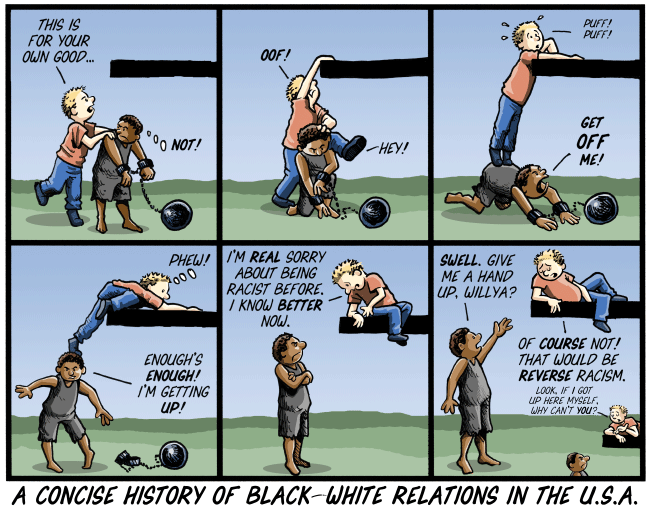
If you’ve been worrying that maybe you practice (or suffer from) reverse racism, it’s good to know that comedian Aamer Rahman has been thinking it through.


Normally my book reviews don’t get a lot of page views, but last week’s review of Angry White Men is over 3000 hits, making it #7 on the Sift’s all-time list. And that brings up a curious thing about viral posts: In my experience, the region between 3000 hits and 8000 hits is virtually unpopulated. There are four posts between 3145 (where AWM was at last count) and 2662. The next post up is at 7957. No idea why.

and let’s end with a cartoon too good not to mention

(This one is pretty good too.) You want an apt metaphor for sexism and racism and all the other forms of institutionalized privilege? They’re like The Matrix.

To Experience Real Religious Discrimination, Turn Atheist

From the War on Christmas to the ObamaCare contraception mandate, the media gives a lot of respect to the idea that Christians might be persecuted in America, or at least that their religious freedom might be in danger. But two recent stories underline a contrasting point: If Christians really want to know what religious discrimination is like, they should try being atheists.

Christian pastor Ryan Bell is literally trying, and it’s not going well. In the spirit of A. J. Jacobs’ The Year of Living Biblically, Bell announced that he would live 2014 as an atheist and chronicle his experiences on his A Year Without God blog. In his announcement post, he portrayed his experiment partly as a religious identity crisis and partly as an attempt to answer a friend’s question: “What difference does God make?”

How could Bell explain the difference unless he had tried both? So:

For the next 12 months I will live as if there is no God. I will not pray, read the Bible for inspiration, refer to God as the cause of things or hope that God might intervene and change my own or someone else’s circumstances. (I trust that if there really is a God that God will not be too flummoxed by my foolish experiment and allow others to suffer as a result).

I will read atheist “sacred texts” — from Hobbes and Spinoza to Russell and Nietzsche to the trinity of New Atheists, Hitchens, Dawkins and Dennett. I will explore the various ways of being atheist, from naturalism (Voltaire, Dewey, et al) to the new ‘religious atheists’ (Alain de Botton and Ronald Dworkin). I will also attempt to speak to as many actual atheists as possible — scholars, writers and ordinary unbelievers — to learn how they have come to their non-faith and what it means to them. I will visit atheist gatherings and try it on.

No doubt Bell anticipated writing about challenges like: Could he really “live as if there is no God”, or would his sensibilities rebel at the vision of a godless universe? Would he get depressed without God to give him hope? Would his moral character weaken? Would he have to abandon his experiment if he faced a true life crisis? Near the end of the year, would he look forward to the day when he could return to religion? In 2015 would he, like King David, be “glad when they said unto me, let us go into the house of the Lord”?

What actually happened is that in the first week he lost all his sources of income.

I was an adjunct professor at Azusa Pacific University (APU) teaching Intercultural Communication to undergrads, and Fuller Theological Seminary, coaching doctoral candidates in the writing of their dissertation proposals. Both are Christian institutions of higher learning that have a requirement that their instructors and staff be committed followers of Jesus and, obviously, believers in God. They simply feel they cannot have me as a part of the faculty while I’m am in this year long process. … The other work I do is consulting with congregations … the fact that I was embarking on a year without god was just too much for them.

His friends have not ostracized him, but he hadn’t realized that was even a risk. Apparently it was.

We still love you!

So many of my closest friends and colleagues have said this to me in the past few days. My initial, unspoken reaction was, “Well, I certainly hope so.” Now I understand that this is not a forgone conclusion. I didn’t realize, even four days ago, how difficult it would be for some people to embrace me while I was embracing this journey of open inquiry into the question of God’s existence.

The lesson seems pretty clear: If you’re having doubts about God’s existence, don’t tell anybody.

The second story concerns Hemant Mehta, author of the Friendly Atheist blog. Mehta lives in Naperville, Illinois. In October, the local American Legion post in nearby Morton Grove stopped giving financial support to the Morton Grove Park District because one of the district’s board members was refusing to stand during the Pledge of Allegiance. Mehta asked his readers to make up the difference, and raised $3000 to more than replace the Legion’s $2600. There were no strings. Mehta says, “the only ‘ethical implication’ of accepting money from atheists is that you get money.”

The Park District turned it down. So did the library, after the library’s treasurer referred to Mehta and his readers as “a hate group” and backed up that accusation by reading “a couple of the religiously-inflammatory and expletive-ridden comments posted on Mehta’s Friendly Atheist Facebook Page.” (As if you couldn’t find offensive comments on any popular Facebook page, including Christian ones.) She asked the other trustees: “Would you take money from the Klan?”

The apparent reference is to Georgia’s refusal to let a local chapter of the Ku Klux Klan participate in its Adopt-a-Highway program. But there the Klan would get a benefit:

The program provides advertising for sponsors who agree to clean a stretch of road on a sign posted along the stretch.

Mehta, on the other hand, was asking for nothing: no plaque, no mention in the newsletter, nothing. Just take the money. He comments:

I firmly believe that if the money came from the “Friendly Christian,” none of this would be an issue. The “A” word is just freaking everybody out.

Finally, the Niles Township Food Pantry cashed the check. If any of the food it bought burst into flames when the needy said grace over it, I haven’t heard.

I know: As examples of religious persecution, neither of these stories holds a candle to the Holocaust or the Inquisition. Nobody is dying, languishing in prison, or getting tossed into a fiery furnace. But in the same way, they put into perspective fundamentalist Christian problems like not being able to display a Ten Commandments monument at the state supreme court, or your monument maybe being forced to share public space with other people’s monuments, or the law forcing you to treat gays and lesbians as if they were part of the general public, or being offended that someone wished you “Happy Holidays” rather than “Merry Christmas”.

But still, Christians can give no-strings-attached money to the local library without worrying that they might be likened to the KKK. Compared to the alternatives, being Christian in America is still a pretty cushy gig.

The Monday Morning Teaser

It’s been a busy week for news. The Chris Christie Bridgegate scandal broke open. The polar vortex came and went. An al-Qaeda-linked group claimed control of Fallujah, a town that was a memorable Iraq-War battlefield for American troops; in this country that news pulled the scab off arguments that had been quiet since the last American combat troops left Iraq: What did Bush’s whole Iraq excursion accomplish? Or did Obama screw up Bush’s accomplishments by pulling out too soon?

Wednesday was the 50th anniversary of another war: President Johnson’s War on Poverty. That touched off a similar debate: Was the War on Poverty an example of misguided liberal over-reach? Or was it working until conservatives managed to sabotage it? What about poverty today? And what about growing inequality, which is pushing the lower middle class towards poverty?

At least one pundit claimed that the most important news of the week was something boring that nobody was paying much attention to: Inflation in the healthcare market slipped below the overall inflation rate for the first time since … well, maybe ever. If healthcare inflation starts behaving itself, then those scary exponential-growth-in-government-spending graphs go away.

With all that to discuss, most of this week’s Sift is devoted to the weekly summary. I did split off one short article to connect two stories related to atheism: A Christian pastor announced his intention to live 2014 as if there were no God and blog about the results; he got results much faster than he expected. And an atheist blogger tried to raise funds for charity and discovered nobody wanted his money; his attempt to do a good deed got him and his readers compared to the KKK and denounced as a “hate group”. The lesson I draw is that prejudice against atheists is alive and well. Christians who imagine they’re being discriminated against really have no idea what atheists go through.

The atheist article should be out in the next hour or so, and the weekly summary before noon.

Force and Injustice

There underlies a dictate of natural justice more imperious and ancient than any bargain between man and man, namely, that wages ought not to be insufficient to support a frugal and well-behaved wage-earner. If through necessity or fear of a worse evil the workman accept harder conditions because an employer or contractor will afford him no better, he is made the victim of force and injustice.

— Pope Leo XIII, Rerum Novarum (1891)

This week’s featured article: The Sifted Bookshelf: Angry White Men.

This week everybody was talking, yet again, about Benghazi

Maybe the New York Times can finally lay it to rest as a “scandal”. What the Times found in its exhaustive investigation was “months of American misunderstandings and misperceptions about Libya and especially Benghazi” leading up to the attack. The lesson it draws is that “an intensive focus on combating Al Qaeda may distract from safeguarding American interests.”

This all resembles nothing so much as the Cold War, when Americans tried to evaluate every new player on the world stage — Castro, Mao, Nasser, Saddam, bin Laden, and countless military juntas from South America to Pakistan — in terms of the cosmic struggle between us and the Soviet Union. We had a hard time grasping the possibility that, rather than being for “us” or for “them”, leaders of other nations or national movements might be for themselves or for their own countries or causes.

Likewise today, we see everything in the Muslim world as polarized between ourselves and Al Qaeda. Benghazi appears to have had little to do with all that. The Times

turned up no evidence that Al Qaeda or other international terrorist groups had any role in the assault. … The fixation on Al Qaeda might have distracted experts from more imminent threats.

So most of the national discussion of Benghazi has been based on false premises. Sometimes that was intentional; I recommend David Brock’s book The Benghazi Hoax, which chronicles Republicans’ ever-shifting accusations about Benghazi, and how little basis any of them ever had.

and extended unemployment insurance

The basic conflict around extended unemployment insurance (which ran out for 1.3 million people on December 28, and is expected to run out for millions more over the next year) is simple:

CONSERVATIVE: Unemployment is supposed to be short-term help while you find another job.

LIBERAL: What if there are no jobs?

Each side has an additional, more complicated point to make. Liberals take a macro-economic view: If there aren’t enough jobs for everybody who wants to work, and then you make millions of families drastically cut their spending, the economy will shrink and there will be even fewer jobs. Conservatives counter that long-term unemployment benefits create dependency: People get used to the idea that they don’t have to work, so they’re less and less likely to find a job.

Rand Paul put it like this:

When you allow people to be on unemployment insurance for 99 weeks, you’re causing them to become part of this perpetual unemployed group in our economy. And it really — while it seems good — it actually does a disservice to the people you’re trying to help.

Senator Paul justifies his conclusion by mentioning a study showing that employers would rather hire a worker who has been unemployed only a short time, rather one unemployed longer. One of the study’s authors responded:

Paul cites my work on long-term unemployment as a justification—which surprised me, because it implies the opposite of what he says it does. … Paul thinks that “extending long-term benefits will only hurt the chances of the unemployed in the job market,” because longer benefits will make them choose to stay unemployed longer—at which point firms won’t hire them. But just because companies discriminate against the long-term unemployed doesn’t mean long-term benefits are to blame. Paul might know that if he read beyond the first line of my paper’s abstract.

People with marketable skills tend to get snapped up right away, but the long-term unemployed would be even less likely to find work if they had no income at all. The longer you are unemployed, the more likely you are to fall into poverty traps: situations where lack of money prevents you from mounting an effective job search. Without money, it’s harder to arrange child care and transportation for job interviews, and harder to present the fresh-and-confident image employers are looking for. At the extreme, homeless people have difficulty maintaining basic hygiene, and so become almost unemployable.

The test case is North Carolina, which on July 1 cut unemployment compensation so drastically that its citizens became ineligible for federal extended unemployment benefits. By one measure the results look good: NC unemployment fell from 8.8% to 7.4%, more than twice as fast as unemployment was falling nationwide. But a closer look tells a different story: The state counted 102K fewer unemployed because the labor force shrunk by 95K. In other words, people stopped counting as “unemployed” because they gave up on finding a job.


Being unemployed or making minimum wage is bad enough on its own, but the injury is compounded by the insult of being treated like a loser. Noah Smith recalls his experiences in Japan, and imagines Americans calling fast-food workers “sir” and generally treating every worker with respect. I like the phrase he coins: redistribution of respect.

and changes that began with the New Year

ObamaCare coverage, legal pot in Colorado, gay boy scouts, and the tax credit on windmills expired (because, you know, who needs more wind energy?

Oh, and on January 2, the 199 Americans who make $50 million or more in annual salary were done paying Social Security taxes for the year.

and only a few people were talking about Dick Metcalf

Metcalf was a columnist for Guns & Ammo and appeared on The Sportsmen’s Channel’s Modern Rifle Adventures TV … until he wrote something reasonable about gun control:

The fact is, all constitutional rights are regulated, always have been regulated, and need to be.

Bye-bye, Dick. No more column. No more TV.

Last week I discussed Phil Robertson, who was briefly suspended from Duck Dynasty for, well, being an idiot in front of a journalist. His cause was taken up by Sarah Palin, Bobby Jindal, and countless others who said his “First Amendment rights” were being violated, which wasn’t true and showed a grave ignorance of the First Amendment.

Well, where are all those people now? Are they rushing to Dick Metcalf’s defense?.


Slate’s “If it happened there” series continues to be outstanding. How would American journalists write about the Duck Dynasty controversy if it were happening in some other country?

and you also might be interested in …

The rich are trying to turn the screws on Pope Francis. Home Depot mogul Ken Langone has warned New York’s Cardinal Dolan that rich donors might be reluctant to provide the $180 million needed to restore St. Patrick’s Cathedral if the Pope keeps saying mean things about capitalism. “You get more with honey than with vinegar,” Langone told Dolan.

Langone says he’s  trying to explain “the vast difference between the pope’s experience in Argentina and how we are in America. … Rich people in one country don’t act the same as rich people in another country.”

That last idea has become the standard right-wing talking point about the Pope: his limited experience makes him ignorant about economics. Arthur Brooks of the conservative American Enterprise Institute says: “In places like Argentina, what they call free enterprise is a combination of socialism and crony capitalism.” And that’s almost word-for-word what Paul Ryan said:

The guy is from Argentina, they haven’t had real capitalism in Argentina. They have crony capitalism in Argentina. They don’t have a true free enterprise system.

I wonder how that spin technique would work for liberals. Catholic women could try to explain how the Pope’s opinions on birth control and abortion are invalid because of “the vast difference between the pope’s experience as a man, and how we are” as women. Why didn’t anybody think of that before?

Of course, if you read Francis’ Evangelii Gaudium (I did), you’ll see there is nothing Argentina-centered about his economic analysis, which is about capitalism itself, not crony capitalism. Francis’ economic thought is right in the middle of a Catholic tradition that goes back to the 1890s and has been re-affirmed by every pope since — Italians, Germans, and Poles alike. It fits the U.S. like a glove.


Bill Nye the Science Guy is going to the Creation Museum in Kentucky to debate the topic “Is Creation A Viable Model of Origins?”. Like Greg Laden, I can’t help thinking that no good can come from this. I hope Nye understands how much easier it is to make stuff up than to debunk it, and has some strategy in mind that I don’t grasp.


Speaking of people who reject science, this week we heard the annual claims that global warming must be a myth because it’s cold outside. I must have been getting popcorn during the part of An Inconvenient Truth where Al Gore said it wasn’t going to snow any more.


And then there are the people who get angry when confronted with facts they don’t like. Josh Marshall reports: “As Obamacare Sign-Ups Surge, So Does Conservative Rage“. He calculates that around 10 million people now have coverage because of the various provisions of the Affordable Care Act, and the number would be 15 million if the Supreme Court hadn’t allowed Republican officials to block Medicaid expansion in red states.

These are the numbers. Lots of people have partisan or ideological or in many cases deeply emotional needs not to believe them. But these are the numbers.


An NYT article Thursday about the Israeli/Palestinian negotiations calls attention to the centrality of a point that might seem obvious: Israel insists that the Palestinians recognize its right to exist as a Jewish state.

Usually, American news coverage focuses on the “right to exist” part. Of course you can’t make a deal with somebody who won’t admit you have a right to exist. Denying Israel’s right to exist conjures up images of Hitler’s attempt to annihilate Europe’s Jews, which is what convinced the world that Jews needed their own homeland in the first place.

But Israel’s right to exist “as a Jewish state” is a little different. (Imagine how American Jews, Muslims, and atheists would feel about recognizing the United States as a Christian nation.) To Arabs whose families have been living for centuries in the region that is now Israel and who know no other homeland, recognizing Israel as a Jewish state means agreeing that Jewish Israelis are permanently tied to the identity of the country in a way that Arab Israelis are not. It ratifies a Jewish-centered national narrative in which the Palestinian refugees of 1948 are collateral damage.


Esquire provides some relevant backstory to Dr. Eben Alexander’s best-seller Proof of Heaven. Dr. Alexander has a long history of making up convenient details after the fact.


The House Republican leadership has a plan to improve the do-nothing Congress of last year: They plan to do even less.

and let’s end with something fun

The wonders of PhotoShop. You can edit present-day celebrities into classic paintings.

The Sifted Bookshelf: Angry White Men

They may not feel powerful, but they do feel entitled to feel powerful.


One of the privileges that still comes with being white or male is that you get to be an individual. When you do something unusually good or bad, the media doesn’t take you as a representative of all whites or all men. You’re just you; you did something; it’s news.

So nobody remarked on George W. Bush being the United States’ 43rd consecutive white male president, but 2008 buzzed with speculation that the 44th might be black or female. For example, pundits questioned whether a woman could be tough enough to be commander-in-chief of the military, but nobody has ever successfully made an issue of whether a man can be compassionate enough to be nurse-in-chief of Medicare, or understand small children well enough to be teacher-in-chief of Head Start.

Nobody ever asked why a white man had killed President Kennedy or tried to kill President Reagan. The gunmen had names; their stories were presumed to be personal. When Bernie Madoff conned his investors out of billions, nobody asked “What makes a white man do something like that?” or “What should be done about the white male swindler problem?”

Sikh temple shooter.

Even when the perpetrators themselves frame whiteness or masculinity as an issue, the media tends not to pick it up. Anders Behring Breivik, who killed 69 people at a camp for liberal youth in Norway, saw himself as a crusader against a Muslim takeover of Europe. His manifesto advocated a restoration of European “monoculturalism” and “patriarchy”. Wade Michael Page, killer of six in the Sikh Temple shooting in Wisconsin, was acting on his long-held white supremacist views. In each case, this motivation was spun mostly as a symptom of personal instability, and not of a dangerous cancer in the white community.

Mad as hell.

The upshot is that although we are surrounded by angry white men — on talk radio, on the internet, on the highways, in the workplace, in the NRA and the Tea Party, in the “men’s rights” movement, and in countless acts of domestic violence or public mayhem from Columbine to Sandy Hook — we aren’t having a national discussion about the anger problem of whites or men or white men. That’s because we don’t see them as “white men”; we see them as individuals whose stories reflect unique psychological, political, or social issues. (By contrast, consider how little Michelle Obama has to do to evoke the angry-black-woman stereotype.)

Enter Michael Kimmel and his book Angry White Men.

Chapter by chapter, Kimmel calls attention to angry white men wherever they are found: the loudest voices on the radio, the school shooters, the anti-feminist men’s-rights movement and its Dad’s-rights subculture, the wife beaters, the workers who go postal, and the white supremacists. He asks and answers the question you seldom hear: What makes white men so angry?

What links all these different groups … is a single core experience: what I call aggrieved entitlement.

Aggrieved entitlement is the belief that you have been cheated out of status and power that should have been part of your birthright. (It’s a close relative of what I have called privileged distress: the feeling that advantages you never consciously acknowledged are slipping away from you.) White men are angry, Kimmel claims, because

They may not feel powerful, but they do feel entitled to feel powerful.

How it was supposed to be.

High standards and failure. White men also feel judged (and judge themselves) according to the standards of fathers and grandfathers who received the full white-male birthright, who didn’t have to compete with other races on an almost-level playing field, and who could count on subservient wives, mothers, daughters, and Girls Friday at the office to rally behind their leadership rather than outshine them or make demands.

You want a recipe for anger? Here it is: I’m a failure and it’s not my fault.

The seldom-examined setting for white male anger is failure, or at least failure according to the standards of another era. Dad and/or Grandpa supported a family on one job, and when he got home he commanded respect from his family. His marriage lasted, and his kids were not being raised by a resentful ex-wife on the other side of the country. When Dad or Grandpa was young, he was comfortable in his masculinity. He hunted deer and lettered in football. Girls waited by the phone for him to call, and when he paid for dinner they knew they owed him something.

It’s not that way any more, and it’s not my fault. Don’t look at me like that.

The rich and powerful speak for me.

The visible spokesmen for angry white men may be millionaires like Rush Limbaugh or Donald Trump. But such success is what their listeners wish they had, not what they do have or will ever have. Kimmel observes:

It’s largely the downwardly mobile middle and lower middle classes who form the backbone of the Tea Party, of the listeners of outrage radio, of the neo-Nazis and white supremacists— in many cases literally the sons of those very farmers and workers who’ve lost the family farms or shuttered for good the businesses that had been family owned and operated for generations.

Violence. This sense of being cheated out of what was promised — and being judged as if it had been delivered — interacts badly with another part of the traditional male identity: Men have the privilege/right/duty to make things right by violence.

I don’t want to be violent, but I can be.

That is the plot of just about every action movie with a male hero: A man who would rather be left alone to live his life and take care of his family is confronted with an injustice that can only end if he becomes violent and defeats it. If he successfully wields violence he is a hero. If he remains peaceful he is a wimp.

And so, while many women also feel cheated and judged unfairly, they tend not to snap in a violent way. Kimmel observes that all the recent rampage school shooters (other than the Korean Virginia Tech shooter, whose race evoked a discussion, and another Korean shooter since Kimmel finished writing) have been white males, mostly from rural and suburban areas. Kimmel imagines what would happen if they’d all been, say, inner-city black girls

Can you picture the national debate, the headlines, the hand-wringing? There is no doubt we’d be having a national debate about inner-city poor black girls. The entire focus would be on race, class, and gender. The media would doubtless invent a new term for their behavior, as with wilding two decades ago.

Likewise,

In my research, I could find no cases of working women coming into their workplaces, packing assault weapons, and opening fire, seemingly indiscriminately.

The explanation is simple: When a man feels disrespected — on the job, in his school, in his family — the disrespect threatens not just his personal identity, but his identity as a man. (The archetypal Man is entitled to respect; if you are not being respected, you are failing as a man.) The obvious response is to re-assert manhood through violence, simultaneously righting the scales both socially and psychologically.

The Real and the True. One point I made in “The Distress of the Privileged” was that the “distress” part of privileged distress is very real: If you have convinced yourself that you don’t have any unfair advantages, and then those advantages start to go away, it feels like persecution. You’re not making it up; there are real events you can point to.

Kimmel covers this ground by distinguishing between what is “real” and what is “true”.

White men’s anger is “real”— that is, it is experienced deeply and sincerely. But it is not “true”— that is, it doesn’t provide an accurate analysis of their situation.

And what is most likely to be untrue is the object of the anger. When your well-paid factory job is shipped overseas and you can’t find another one, the villain isn’t the teen-age Chinese girl who does your old job for fifty cents an hour. If you can’t support a family on your income, the villain isn’t your working wife or her reasonable demand that you share the housewife duties she doesn’t have time for any more. If the value of your house crashes, the villain isn’t the black family that got talked into a sub-prime mortgage it couldn’t afford. If you judge yourself by the standards of another era, the villains are not the people whose fair competition keeps you from meeting those standards.

The collapsing pyramid. Patriarchy and racism are both systems of dominance that are coming apart. The white men who feel the change first are the ones just one step up from the bottom: Their step collapses, throwing them in with the “lesser” blacks and women, and the pyramid resettles on top of them. The white men higher up the pyramid want the victims of this collapse to identify with them and with the pyramid that gives them their status: What’s wrong isn’t that the pyramid itself is unfair — as you now can clearly see, being at the bottom of it. What’s wrong, they want you to believe, is that the pyramid is collapsing. You should defend the pyramid, blame the other bottom-dwellers for your loss of status, and maybe one day your one-step-up can be restored.

They know that’s not going to happen; they’re just counting on you not figuring it out. The Masters of the Universe are not going to bring your job back from China. Wal-Mart is not going to make room for your family shop to re-open. Bank of America is not going to forgive your underwater mortgage. Agri-business is not going to rescue your family farm.

The rich white men are not going to rebuild the lower step of the pyramid, no matter how much power they get. And nobody is making room for you on the upper levels.

If you have to blame someone, blame the people who promised you something they couldn’t (or decided not to) deliver. They sold you a bill of goods. Don’t buy another bill of goods from them.

But the best solution of all would be to get past the anger, forget about how things were supposed to be, and just start dealing with the situation as it is. Like a lot of people you never expected to have anything in common with, you find yourself at the bottom of the pyramid. It’s an unfair pyramid.

Let’s bring it down.

The Monday Morning Teaser

Late start today. (Last night I stayed up to finish The Goldfinch, which is a fabulous novel.)

This week’s featured article will be a review of Michael Kimmel’s book Angry White Men. What do school shootings, talk radio, the Tea Party, the men’s-rights movement, domestic violence, and workers going postal all have in common? Angry white men. We’re not used to grouping those events together, so we hardly ever ask the question: What makes white men so angry, and what can be done about it?

Central to Kimmel’s thesis is a concept that is a close relative of my notion of privileged distress: aggrieved entitlement.

The weekly summary focuses on the NYT’s revelations about Benghazi, the debate over unemployment insurance, new laws that kicked in on January 1, Israel/Palestine, Esquire’s critical examination of the author of Proof of Heaven, and a few other things.

I expect everything to come out about an hour later than usual. I blame Donna Tartt.

The Yearly Sift: 2013

The root motivation of the Tea Party isn’t the deficit or ObamaCare or any other policy it’s currently focused on. The root motivation is tribal: a feeling that People-Like-Me used to own America, but it is being taken away by People-Like-Them and needs to be taken back.

— “The Method of Madness” 10/28/2013

review all the Sift quotes of 2013

This week everybody was talking about … Duck Dynasty?

I grew up around enough uneducated rural white people that I don’t find them exotic, so I’ve never been tempted to watch Duck Dynasty. Anyway, DD star Phil Robertson gave GQ writer Drew Magary a tour of his domain, and along the way said a lot of ignorant crap about gays and blacks and non-Christian cultures. Then the A&E network suspended him from the show indefinitely, which turned out to be nine days.

The suspension made Robertson a poster child for the Christian persecution complex, whose culture warriors are now crowing victoriously. I’ve already posted what I think about Christian “persecution” in general. With respect to this case, Salon’s Elizabeth Stoker observes that persecution is about never having to say you’re sorry, no matter how much of a jerk you are:

If Christianity is posed as an institution on the defense, persecuted successfully by powers greater than itself, then it need not take stock of the impact of its chosen frames. The fantasy of the persecution of Christianity in America is thus mostly a technique aimed at protecting a particular approach to framing issues in the cruelest, least considerate method possible.

Along the way, conservatives showed their usual complete ignorance of the Constitution by claiming that Robertson’s First Amendment right to free speech had been violated.

From my point of view, the Duck Dynasty story isn’t about censorship at all, it’s one big orgy of freedom: Robertson is free to speak his mind without being fined or jailed by the government. A&E — a joint venture of Hearst and Disney — is free to disassociate itself from Robertson (or not) if that’s in the corporate interest. Robertson’s fans are free to respond by protesting or even boycotting A&E, as are the insulted gays, blacks, and non-Christians (who probably don’t watch the show anyway). The rest of us are free to judge those protests as we like.

Freedom reigns all around.

You know what DD fans ought to have been upset about? The way corporatism creates bland homogenized culture. In a perfect world, Duck Dynasty would be a transaction between the Robertsons and their fans, who could decide for themselves whether to go on supporting celebrities who promote such views. Instead, the Disney corporate brand is involved; hence the flip-flops in response to controversy. The Robertson saga ought to motivate people to break up the media leviathans. Needless to say, it hasn’t.

On the substance of what Robertson said, the anti-gay comments have gotten the most attention, but I find the racial ignorance more worrisome. (The claim that Nazi Germany was a non-Christian country is just too stupid for me to worry much about; maybe I’m being naive. In reality, the early electoral strongholds of the Nazi Party were areas dominated by rural Protestants, i.e., people a lot like the Robertsons. The urbane, gay-tolerant, Jew-tolerant, post-religious Germans mostly counted themselves among Weimar’s Social Democrats and Communists, i.e., the first people Hitler locked up.) Charles Blow and Ta-Nehisi Coates explain better than I can why Robertson’s black-people-were-happier-under-Jim-Crow notions are self-serving and anti-historical.

But let’s get on with reviewing the year.

In the Weekly Sift, 2013 had two themes

The Sift is an attempt to make sense of the news one week at a time, so I never go into a year looking to emphasize some particular theme. But invariably at the end of the year I see that I’ve been writing about one or two ideas over and over again.

2013 had two very different themes: minority rule and race. They overlapped in discussions of voter suppression and immigration reform, but mostly were two separate threads.

Minority rule. 2013 started with a focus on gun control. The Sandy Hook school shooting the previous December had seemed like a tipping point; now we were finally going to do something. In poll after poll, 90% or more of the public wanted to strengthen the gun laws at least a little. Pro-gun forces never convinced the public to agree with them, but they did manage to keep our democratic government from doing what the public wanted.

That special-interest victory set the tone for the entire year: no immigration reform, no jobs bill, a government shutdown (that wasn’t even popular among the Republican House caucus that caused it) used to attempt a minority-rule repeal of ObamaCare, and a year-end cut-off of unemployment benefits. All the tools of minority rule were on display: the threat of unlimited campaign spending on primary challenges, gerrymandering, voter suppression, the Hastert Rule, the filibuster. And those tools themselves became issues: the Senate eventually weakened the filibuster, but the Supreme Court strengthened voter suppression.

I broke this out into its own article: “Themes of 2013: Minority Rule“.

Race. Race didn’t make as coherent a yearlong story as minority rule, but it just kept coming up.

For me, the year-in-race actually started last December, when the movie Lincoln made me wonder how the two parties had switched positions on race since 1865. That led to “A Short History of Racism in the Two-Party System“, one of the most popular posts of 2012.

January 1, 2013 marked the 150th anniversary of the Emancipation Proclamation taking effect, and 2013 went on to have many other significant anniversaries: the Gettysburg Address and the Dream Speech (when I protested against the “safe” MLK that gets celebrated), among others. But it wasn’t just history that put race on the agenda. We also had the Zimmerman trial and verdict. Nelson Mandela died. The Supreme Court let Jim Crow out of his cage, and the former Confederate states seized their chance to resume suppressing the non-white vote. Pop culture gave us “The Accidental Racist“, Miley Cyrus twerking (which led me to write about when and why borrowing from ethnic cultures not your own is or isn’t legit), an argument about whether Santa has to be white — and we just ended the year talking about Duck Dynasty.

Each new event evoked the pattern I had described in “The Distress of the Privileged“: Whites felt persecuted by the very idea that someone could accuse them of racism, and insisted that their persecution be discussed first. President Obama’s envisioned “national conversation on race” never got past that obstacle.

The post I’m most proud of in this thread is “Sadly, the National Conversation About Race Has to Start Here“. Conservative opinion-makers did their best to de-legitimize the whole idea of a national conversation on race, turning it into an indictment of black culture that (from their point of view) had to be discussed before white racism could even be acknowledged.

I don’t think those opinions really deserved any answer from the black community; the point was to shut down conversation, not promote it. But I’m white, and nobody was attacking me directly, so I thought I’d take the time to respond. I took four conservative voices that seemed representative — Bill O’Reilly, Rush Limbaugh, Jennifer Rubin, and Victor Hansen — and started from the point of view of their audience.

Two weeks later (after CNN’s Don Lemon continued the black-culture bashing), “Acting White isn’t Really a Racial Issue” addressed the criticism that working hard in school is “acting white” by pointing out that white working-class kids have a similar hostility to conforming to school expectations.

The sifted books of the year

Book reviews are one of the staples of The Weekly Sift, but this year I did fewer of them. 21 books got discussed in 2012, but only 13 in 2013. That wasn’t a planned shift, it just worked out that way. (A discussion of Michael Kimmel’s Angry White Men is going to happen any week now.) The subjects were all over the map.

Discussions about class and race led me to discuss Reading Classes by Barbara Jensen and Learning to be White by Thandeka. What Then Must We Do?  by Gar Alperovitz and The Democracy Project by David Graeber reflected a rare attitude I labeled “Apocalyptic Optimism”. The vision of an economy with more cooperation and less competition led me to discuss The Penguin and the Leviathan by Yochai Benkler, The Victory Lab by Sasha Issenberg, Jane McGonigal’s Reality is Broken, and Assholes, a theory by Aaron James in “Nobody Likes the New Capitalist Man“. Nate Silver’s The Signal and the Noise and Blur by Bill Kovach and Tom Rosenstiel informed an article about how the internet is changing the public discourse in “How do you know what you know?

Tom Allen’s Dangerous Convictions provided an insider’s view of why Congress doesn’t work. Enough is Enough by Rob Dietz and Dan O’Neill envisioned a sustainable economy not based on growth. And finally, Pope Francis’ Evangelii Gaudium didn’t change Catholic doctrine, but definitely refocused the church on issues of poverty and inequality rather than sex.

The mosts …

My most prescient statement: In August, when everyone else was saying a government shutdown would never happen because the Republicans had nothing to gain from it:

Nothing I’ve heard in the last two weeks has changed my belief that we’re heading towards a major budget crisis, either when the new fiscal year starts in October or when we hit the debt ceiling in November. The gist of the conversation between the Republican leadership and their conservative base during the August recess — which I detail in How Republican Congressmen Spent Their Summer Vacation — has been the leaders’ warning that shutting down the government to stop ObamaCare is a doomed strategy, and the base responding “So?”

The Far Right really wants to see a Charge of the Light Brigade, and they may get it.

and my least prescient statement:

The reason Republicans are so desperate to get ObamaCare derailed right now is that the exchanges start up October 1. When Americans start dealing with the reality of ObamaCare rather than the monsters-under-the-bed conjured up by right-wing propaganda, they’re going to like it.

In the long run, I still believe the point I was making: Much of the unpopularity of ObamaCare stems from horror stories that don’t stand up to scrutiny; conversely, the reality of getting health insurance and knowing you can keep it is going to be popular, just as Medicare and Social Security are popular now. But the early implementation problems delayed that process considerably. Whether ObamaCare will be a plus or a minus for Democrats by the fall elections is still up in the air.

The year’s most pleasant surprise: Pope Francis. As someone who went to a conservative Lutheran K-8 grade school before setting off on a fairly wide-ranging religious journey, I can look at Christianity as either an insider or an outsider.

To me, there are two ways to be Christian, one that I find inspiring and one that turns me off. There’s what I call Pharisee Christianity (with apologies to my Jewish readers, for whom “Pharisee” means something completely different than it does in the New Testament context) in which the point is to be good according to a fixed set of rules, lest we piss God off. Pharisee Christianity is all about maintaining moral purity — especially with regard to sex — and avoiding contamination by sinners.

Most headline-making Christian leaders are actually Pharisees in this sense. The self-righteous essence of Pharisee Christianity was captured in that famous exchange between Jerry Falwell and Pat Robertson after 9-11.

FALWELL: I really believe that the pagans, and the abortionists, and the feminists, and the gays and the lesbians who are actively trying to make that an alternative lifestyle, the ACLU, People for the American Way, all of them who tried to secularize America … I point the finger in their face and say, “You helped this happen.”

ROBERTSON: Well, I totally concur.

The second way I call Samaritan Christianity, in which the point is to be motivated by love and compassion, and to go wherever that takes you. (In the parable of the Good Samaritan, the Samaritan sees the traveler’s limp body by the side of the road and risks becoming ritually unclean by touching blood or possibly a corpse, and so saves him.)

In Samaritan Christianity, the Ego is like the sound barrier: On the other side, there is a completely different way to move through the world. To be on God’s side isn’t to sing hymns of praise, or to be pure, or even to obey the letter of the law, but to care about what God cares about: people. The prophet Amos envisioned God saying this:

I will not listen to the music of your harps.
But let justice roll on like a river

And Amos is very clear what “justice” means in this context, or at least what “injustice” means: getting rich on the back of the poor. (BTW: The only place where the Bible explicitly states the sin of Sodom is in Ezekiel: “Now this was the sin of your sister Sodom: She and her daughters were arrogant, overfed and unconcerned; they did not help the poor and needy.” So when Paul Ryan tries to cut Food Stamps, he’s practicing sodomy.)

What Pope Francis has done in his short time on the throne of St. Peter is to start turning the Church away from Pharisee Christianity and towards Samaritan Christianity. It’s not a bit-flip, it’s turning an ocean liner. But at least he’s pointing and saying “That way.”

The best post nobody read: The Myth of the Zombie Voter“. So far it only has about 200 page views. This is an article to bookmark and keep ready when your conservative friend emails you something alarming about voter fraud. It describes how South Carolina’s attorney general made the tour of Fox News and conservative talk radio to claim that 953 dead people had voted in the last six years, including 207 in South Carolina’s most recent election. Horrors!

What happened next? The same thing that always happens — I mean always — when somebody takes such claims seriously and investigates. Months later, state election officials came out with the boring report that all but 10 of those 207 had innocent explanations. Nobody covered it. Then the state police investigated those ten cases and found innocent explanations for seven of them. They recommended no further action be taken on the three they couldn’t explain. So instead of 207 zombie voters in South Carolina in 2010, there were at most three and possibly none.

And the numbers

The general theme seems to be fewer viral posts and more regular readers, which was what I was aiming for when I changed the format in 2012.

The blog got about 214,000 hits this year, down slightly from last year’s 240,000. Due to the way WordPress counts hits, though, that doesn’t include the “syndicated views” of people who subscribe, and subscriptions are up significantly. On WordPress, the number of subscribers is up from 504 to 908. The Sift’s Facebook page has 256 Likes, up from 183 last year. It’s Twitter feed has 203 followers, up from 123. Google stopped supporting Reader this year, so I can’t directly compare last year’s 280 Google Reader subscriptions. But the Sift has 251 subscribers on Feedly.

For the second straight year, “The Distress of the Privileged” drew more than half of all the blog’s hits: 173K in 2012, the year it came out, and 133K in 2013. Those numbers dwarfed the year’s other popular posts: “Religious Freedom Means Christian Passive-Aggressive Domination” (8.2K), “Evolution/Creation for Non-Eggheads” (2.8K), “Nobody Likes the New Capitalist Man” (1.6K), and “Sadly, the National Conversation About Race Has to Start Here” (1.4K).

The weekly summaries have been more popular this year than last: 6 of the 7 weekly summaries with the most hits come from 2013.

My subjective impression is that the Sift is getting more legitimate comments this year, but I delete so many spam comments that I have no trustworthy numbers. (I could raise comment stats just by deleting less spam.) Obviously spam comments are up, for what that’s worth.

Themes of 2013: Minority Rule

It’s hard to remember now how 2013 began: with the Republicans (having believed their own skewed-polls rhetoric) in shock at having lost the 2012 presidential election by five million votes, and having lost even the aggregate House of Representative tally by 1.3 million (even if gerrymandering gave them a majority of seats). But … but … but … the deficit … unemployment … Benghazi … Obama is the worst president ever … real Americans are conservatives …

How could it have happened?

Demographics. The closer they looked at the exit polls, the worse it got. Sure, Obama got 93% of the black vote; everybody expected that. But also 71% of Latinos and 72% of Asians. (Asians? Aren’t they supposed to be the model minority? Don’t they have more makers than takers? How could they side with the Kenyan usurper?) 60% of 20-somethings and 55% of 30-somethings. 70% of folks who list their religion as “none”.

All those groups are growing. The groups that kept the election from being a complete blow-out are the ones that seem to be shuffling off center stage: Over-65s went for Romney 56%-44%. White men voted Republican 62%-35%. (In Teddy Roosevelt’s day, white men were the electorate. How can you get 62% of white men and lose?)

So 2012 wasn’t just a loss for Republicans, it was a loss that augured bigger losses in the future. All the predictions Jonathan Chait had made the previous February in “2012 or Never” seemed to be coming true, and it was looking like Never. As the balls fell and the corks popped to welcome 2013, Republicans were asking: What do we have to do to become the majority again?

Change? Some answers seemed obvious. (The best collection of these answers was put together by College Republicans.) Stop talking about Hispanic immigration as if it were the barbarian invasion of Rome. Tone down the anti-gay rhetoric (not because the gay vote is so pivotal, but because homophobic hate-mongering turns off young straights). Stop pandering to the radical fringe on abortion and other social issues. Come up with competing conservative answers to questions that loom ever larger to middle-class Americans: Where are the jobs going to come from? How are the kids going to pay for college? What will happen to me and my family if I get sick?

The new year brought an obvious issue to focus on first: gun violence. (The first Sift of 2013 started: “This week everybody was talking about guns again.”) Sandy Hook was still fresh when the new Congress was sworn in, and (unlike the response to previous mass shootings), the furor didn’t seem to be dying down.

By wide margins, the public supported universal background checks for gun buyers, re-instituting the assault-weapon ban that President Bush let lapse, and banning the high-capacity magazines that had played such a key role in the Tucson shooting. For a time, some kind of bipartisan gun bill looked to be a no-brainer.
Then we saw the pattern that would repeat itself again and again all year: Some well-funded extremist group (in this case the NRA) rallied the conservative base with scare tactics (Obama was planning to confiscate guns by executive order!), threatened primary challenges against wavering Republicans, and whipped the Republican leadership into line.

In the end, a Republican-led filibuster blocked even a weak-tea gun bill that 54 senators supported.

Something similar happened to immigration reform: In this case a bipartisan bill made it through the Senate only to be refused a vote by the Republican House leadership, which offered no alternative.

Take that, Hispanics! Screw you and your fastest-growing-voter-bloc BS. Think we care? Think again!

Ditto for women, who are already a voting majority. Again and again, Republicans pandered to the an extreme anti-abortion or anti-birth-control minority with the most outrageous proposals and rhetoric. The most extreme recent example is Michigan’s “rape insurance” law, which won’t allow insurance companies to cover abortion (even in cases of rape) in any general-purpose health plan. Unless you planned on being raped and paid in advance for a special abortion rider on your healthcare policy, you’re out of luck.

Did anybody notice a post-2012 let-up in Republican anti-gay rhetoric or an olive branch to people who don’t go to church? Or a Republican jobs plan? Or any healthcare plan beyond “repeal ObamaCare”? Nope.

In the fall, poll after poll showed large majorities against a government shutdown or a threat to the debt ceiling. Did that matter? No.

This isn’t how we’re used to seeing political parties behave. So what’s going on here? How do Republicans plan to persuade a majority of Americans to support them?

It’s simple: They don’t.

Minority rule. That is the single biggest development of 2013: Republicans have given up on the idea of persuading a majority to agree with them. Instead, conservatives plan to rule from the minority.

In the old days that might have meant a military coup or something, but modern minority-rule techniques are much more imaginative. The strategy is simple: take advantage of all the hurdles that exist between the will of the majority and the enforcement of a law. If you can knock that majority down just a little at each stage, what looked like a tidal wave can become just a little ripple.

Defense in depth. Consider all of the structural things Republicans have been pushing. Stop looking at them one-by-one and think about them as a system.

  • Voter suppression. You don’t have to ban people from voting, just make it difficult. Limit the days and hours and number of voting machines so that you create long lines. Find excuses to remove legitimate voters from the roles. Require IDs they don’t have, and don’t accept the IDs they do have. Change the rules late in the game. Plenty of determined people will manage to vote anyway, but all you’re trying to do is knock the numbers down.
  • Unlimited money. You don’t have to buy elections outright, you just want to control them a little. With unlimited money, you can keep incumbents in line by threatening a primary challenge based on fringe issues. You can eliminate the need for volunteers by hiring professionals. You can keep candidates in the race longer or knock them out earlier. You can create issues out of nothing, de-legitimize real issues, or just confuse the voters. You can make the campaign obnoxious and ugly, so that voters don’t want to participate.
  • Gerrymandering. If you concentrate the other party’s voters in a few districts, you can give your party an advantage in a majority of districts, even if you have fewer voters. The paradigm here is Pennsylvania, where a slim Democratic voting majority led to a 13-5 Republican advantage in members of Congress. The Senate itself is a form of gerrymandering: It took 7.7 million Democratic votes to elect Dianne Feinstein to the Senate, but only 102 thousand votes put Republican Lisa Murkowski in. Their Senate votes count the same. (The conservative pipe dream of repealing the 17th Amendment would make this situation worse.)
  • Shadow government. You may think your state laws come from the legislators you elected. Wrong! If your legislature has a Republican majority, chances are your state laws are being written by the American Legislative Executive Council (ALEC), a national pseudo-legislature whose controlling members are corporations rather than people.
  • Emergency managers. Here’s a neat trick: Cut state aid to cities and their school districts, then when they get into financial trouble replace their elected governments with “emergency managers“, i.e., dictators appointed by the governor, who can void union contracts and refuse to fund pensions already earned. More than half of the black citizens of Michigan have lost their right to local government. If the voters don’t like it and vote for repeal, pass the law again and make it referendum-proof. Think that can’t happen in your state or your town? Why not?
  • The Hastert Rule. Immigration reform is one of a number of ideas that are believed to be supported by a majority of House members, but never come up for a vote. Shutting down the government, on the other hand, had only minority support, but it happened. How does that work? The House operates by the majority-of-the-majority principle, a.k.a. the Hastert Rule. Speaker Boehner won’t bring bills up for a vote unless a majority of the House Republican caucus supports them. So instead of needing 218 votes (a majority) to block something, you can do it with only 117 (a majority of the 233-member Republican majority). The logic of primary challenges is similar: It doesn’t matter what the majority of voters in a Republican congressman’s district think, if a majority-of-the-majority (i.e., a majority of voters in his Republican primary) want to throw him out.
  • The filibuster. In the Senate, 41 votes can block legislation. Until recently, 41 votes could also block presidential appointments, which Republicans were using to prevent President Obama from altering the current conservative bias in the judiciary. So the senators representing the 21 smallest states — total population 35.4 million, or about 11% of the country — can block any law.
  • Hostage-taking. Sure a minority can block things, but how can they pass laws of their own? Simple: take hostages. That’s what the 2013 government shutdown and debt-ceiling crisis was about. An extremist minority could block the government from taking necessary actions, and what it wanted in return for not burning down the house was to repeal ObamaCare. Ordinarily that would take a majority, but not if you have a gun to the economy’s head.
  • Nullification. A similar tactic was implicit in a new use of the filibuster to nullify existing laws. Refuse to approve anybody to certain enforcement positions. So, you would need a majority to scrap all the nation’s labor laws, but they can’t be enforced if the National Labor Relations Board doesn’t have a quorum, and you can block appointments via the filibuster. Voila! No labor laws! (Nullification is what caused Democrats to eliminate the filibuster on presidential appointments.)
  • Judicial activism. Even if a law makes it past all those hurdles, it just takes five Supreme Court justices to declare it unconstitutional. The integrity of the system depends on judges not abusing their power, but sometimes they do. During the Warren Court of the 1960s, judicial activism was a liberal thing. That’s ancient history now, as we saw most clearly in the ObamaCare decision. At the time the Affordable Care Act was passed, there was no legal precedent to justify invalidating it, and few legal analysts were concerned about the possibility. (Salon’s Andrew Koppelman: “The constitutional limits that the bill supposedly disregarded could not have been anticipated because they did not exist while the bill was being written.”) But in a matter of months, a new interpretation of the Commerce Clause was invented and gained the support of the Court’s five conservative justices. (Justice Roberts narrowly saved the law by re-interpreting the individual mandate as a tax rather than a penalty, but the new narrowing of the Commerce Clause stands and could skewer any number of government programs in the future.) Conservative judicial activism has been key in the whole minority-rule enterprise, by unleashing the unlimited money and opening the door to voter suppression, which red states have been happy to walk through.

Across the board, Republicans are defending and in some cases sharpening the tools of minority rule. So if they annoy a majority of Americans with their extremist agenda, who cares? Democrats would need a really large majority, say 5-7%, just to overcome gerrymandering and get even in the House, not to mention getting 60 votes in the Senate. And even then, unlimited money can usually buy a handful of Democrats with a local special interest, and the Supreme Court can invent new kinds of “religious freedom” or “corporate rights” to keep any real change from happening.

The long term threat. In the long run, a dedicated majority can get its way. If Democrats can win the state legislatures in 2020, they can de-gerrymander both the congressional districts and the legislative districts within the states. If Democrats can hold the presidency long enough, they can end conservative judicial activism. Then, if that same dedicated majority will keep those Democrats honest, there’s a chance America can start controlling money in politics and make progress towards real democracy that serves the public interest.

But that’s the question: Will a majority stay dedicated, through years of watching politics amount to nothing? Those young people who believed Candidate Obama when he said, “Yes we can” — what will become of them? What if they conclude “No we can’t” and just stop bothering?

That’s the ultimate goal of minority rule: a discouraged majority that stops looking to political action as a way to solve its problems.

The Monday Morning Teaser

It’s time for the Yearly Sift, where I look back on the year’s hundred-or-so posts, find the larger themes that escaped my week-by-week focus, link to the year’s most popular articles, and discuss what the blog’s statistics say about how this whole project is going.

Since I only do this once a year, I don’t have a good estimate of how long it will take.

Constructs

No Sift next week. The Sift returns December 30 with the annual Yearly Sift.

Jesus wasn’t white because the category white didn’t exist when Jesus was around in the Roman Empire. That is a construction that was made later on for very intense social reasons.

Chris Hayes

Featured posts this week are “White Santa, White Jesus, White Christmas” and “Mandela’s Memorial Service Was All About Us“.

This week everybody was talking about another school shooting

I was wondering what the Weekly Sift should do to mark the anniversary of Sandy Hook, which was Saturday. Friday, that decision was taken out of my hands when somebody else commemorated Sandy Hook in what I suppose is the way we should have expected: with another school shooting.

In terms of carnage, Arapahoe High School in Centennial, Colorado (about ten miles from Columbine) got off lightly compared to Sandy Hook: The shooter himself is the only death so far, though one other student remains in a coma.

The Arapahoe shooting is the kind of bookend a novelist would hesitate to put on the year, thinking it too obvious and heavy-handed. But it is all too appropriate an ending to a year that began with such determination to do something about gun violence, and produced so little actual change.

and the Person of the Year

It came down to Pope Francis or Edward Snowden. I’ve already said what I think of Pope Francis. Here’s what Time thinks:

what makes this Pope so important is the speed with which he has captured the imaginations of millions who had given up on hoping for the church at all. People weary of the endless parsing of sexual ethics, the buck-passing infighting over lines of authority when all the while (to borrow from Milton), “the hungry Sheep look up, and are not fed.” In a matter of months, Francis has elevated the healing mission of the church—the church as servant and comforter of hurting people in an often harsh world—above the doctrinal police work so important to his recent predecessors.

The argument for Snowden was also pretty good. He certainly changed the way we think about government surveillance and got us all looking over our shoulders for Big Brother.

I feel like I owe Sift readers an apology about Snowden: I keep meaning to write a summary of what we now know about how the NSA’s spying and data-mining affects ordinary people. Every time I think I have a handle on it, though, something new comes out and I have to re-evaluate.

and about the budget deal

The two budget-committee chairs, Paul Ryan from the Republican House and Patty Murray from the Democratic Senate, came up with a bipartisan budget proposal Tuesday. It passed the House Thursday in a strikingly bipartisan fashion: 332-94, with 169 Republican votes and 163 Democratic votes. The Senate hasn’t voted yet, but supporters of the deal sound confident.

There are two pieces to this story: what’s actually in the deal and the nasty things Republicans said about each other while it was happening.

The deal. The word everybody uses to describe the agreement is “small”. It breaks the sequester spending cuts, but not by much. Spending in 2014 is $45 billion higher than the sequester agreement called for, and the budget pays for that spending with fee increases, not increases in income tax rates or even closing the most egregious tax loopholes.

The most noteworthy thing about the deal is what’s not in it: No “grand bargain” of deficit reduction through cutting Social Security and Medicare, and no extension of unemployment benefits.

The shouting. Several influential conservative groups came out against the deal, and John Boehner got mad about it. He pointed out that these same groups pushed House Republicans into the public-relations disaster that was the government shutdown in October.

I think they’ve lost all credibility. They pushed us into the fight to defund Obamacare and shut down the government… And the day before the government reopened, one of these groups said, “Well, we never thought it would work.” Are you kidding me?

Similar sniping broke out between Marco Rubio (“This budget … keeps us on the same road to ruin”) and Paul Ryan (senators in the Republican minority “don’t have the burden of governing”).

Pundits continue to cover this as a “Republican Civil War” or a battle for the soul of the party. But TPM’s Ed Kilgore points out that it’s really a struggle over tactics, not goals. The Tea Party wants scorched-earth tactics and no compromises, while the so-called “moderates” want to get what they can out of bipartisan agreements and hope to acquire the power to do more in the next election. But ultimately both sides want the same things:

a free-market economy with extremely limited government and a traditionalist, largely patriarchal culture. These policies, buttressed by an increasingly chiliastic view of the status quo (e.g., the “Holocaust” of legalized abortion, and the social policy “tipping point” at which an elite-underclass alliance will destroy private property and liberty entirely), simply are not negotiable.

Don’t let the back-biting confuse you: As Kilgore says, “the ‘soul’ of the GOP is pretty much right in plain sight.” People who oppose the Tea Party’s tactics may get to pose as “moderates”, but their Ideal America looks just like the Tea Party’s Ideal America.

and Nelson Mandela’s memorial service

Of course, you can’t expect Americans to care about some dead guy on another continent, so our news media manufactured conflicts to keep it interesting: the Castro handshake, the “Danish tart” selfie … I discuss them in “Mandela’s Memorial Was All About Us“.

and the whiteness of Jesus and Santa

Fox News’ Megyn Kelly tries not to be the nasty, trolling kind of race-baiter that Rush Limbaugh and Sean Hannity are. And that’s what made her Jesus-and-Santa-are-white pronouncement so interesting. She seems really sorry for the people who are hurt by this state of affairs, but it’s just how things have to be. I discuss the implications in “White Santa, White Jesus, White Christmas“.

and you also might be interested in …

Yet another study shows American high school students doing badly compared students in other countries. NBC News illustrated the problem in the most graphic way possible.

25 other countries teach ordinal numbers.

Yep, we’re “21th” in science. I wonder where we rank in proof-reading.


Oklahoma wanted a ten-commandments monument at the state capitol, so in 2009 the legislature passed the Ten Commandments Monument Display Act:

This monument shall be designed, constructed, and placed on the Capitol grounds by private entities at no expense to the State of Oklahoma. … The placement of this monument shall not be construed to mean that the State of Oklahoma favors any particular religion or denomination thereof over others, but rather will be placed on the Capitol grounds where there are numerous other monuments.

No public money, explicit non-favoritism … nothing for separation-of-church-and-state types to object to, right?

So the monument was installed last year. In a test of the non-favoritism language, last week a Satanist group offered to donate its own monument for display at the state capitol. Reportedly a Hindu group would also like to erect a statue of Hanuman, the monkey god. A representative of ACLU Oklahoma says they’d prefer not to have any religious monuments at the capitol, but …

If, at the end of the day, the Ten Commandments monument is allowed to remain on the Capitol grounds with its overtly Christian message, then the Satanic Temple’s proposal can’t be rejected because it is of a different religious viewpoint.

I can’t wait to hear what the courts say.


Here’s a nightmare come to life: Tom Wagner fell asleep on a plane flight and woke up on a dark, empty, locked-up airliner. The ExpressJet crew apparently didn’t notice him.


No new song has broken into the permanent Christmas playlist since Mariah Carey’s “All I Want for Christmas is You” in 1989. But it’s not for lack of trying. Slate’s Chris Klimek describes the more recent offerings and wonders why they don’t catch on.


The Daily Show’s Jason Jones discusses the “art” of gerrymandering.


The Onion’s “Deformed Freak Born Without Penis“:

According to reports, the sadly disfigured 26-year-old’s quality of life has been greatly diminished due to such a condition. Sources said the abnormal, visibly blemished creature has been repeatedly passed over for employment opportunities, frequently gawked at and harassed on the street by total strangers, and has faced near constant discrimination for over two decades, all due to the horrific and debilitating birth defect. Indeed, many are reportedly unable to look past the glaring deformity and simply see the 26-year-old as a human being.

and let’s end with a Christmas miracle

Even if you don’t believe in Santa, the “rational” explanation — a commercial airline did something unexpectedly wonderful for its passengers — is pretty miraculous too. 13 million people had watched this video before I did, and probably a lot more by now. But maybe a few of you missed it.