The Yearly Sift: 2013

The root motivation of the Tea Party isn’t the deficit or ObamaCare or any other policy it’s currently focused on. The root motivation is tribal: a feeling that People-Like-Me used to own America, but it is being taken away by People-Like-Them and needs to be taken back.

— “The Method of Madness” 10/28/2013

review all the Sift quotes of 2013

This week everybody was talking about … Duck Dynasty?

I grew up around enough uneducated rural white people that I don’t find them exotic, so I’ve never been tempted to watch Duck Dynasty. Anyway, DD star Phil Robertson gave GQ writer Drew Magary a tour of his domain, and along the way said a lot of ignorant crap about gays and blacks and non-Christian cultures. Then the A&E network suspended him from the show indefinitely, which turned out to be nine days.

The suspension made Robertson a poster child for the Christian persecution complex, whose culture warriors are now crowing victoriously. I’ve already posted what I think about Christian “persecution” in general. With respect to this case, Salon’s Elizabeth Stoker observes that persecution is about never having to say you’re sorry, no matter how much of a jerk you are:

If Christianity is posed as an institution on the defense, persecuted successfully by powers greater than itself, then it need not take stock of the impact of its chosen frames. The fantasy of the persecution of Christianity in America is thus mostly a technique aimed at protecting a particular approach to framing issues in the cruelest, least considerate method possible.

Along the way, conservatives showed their usual complete ignorance of the Constitution by claiming that Robertson’s First Amendment right to free speech had been violated.

From my point of view, the Duck Dynasty story isn’t about censorship at all, it’s one big orgy of freedom: Robertson is free to speak his mind without being fined or jailed by the government. A&E — a joint venture of Hearst and Disney — is free to disassociate itself from Robertson (or not) if that’s in the corporate interest. Robertson’s fans are free to respond by protesting or even boycotting A&E, as are the insulted gays, blacks, and non-Christians (who probably don’t watch the show anyway). The rest of us are free to judge those protests as we like.

Freedom reigns all around.

You know what DD fans ought to have been upset about? The way corporatism creates bland homogenized culture. In a perfect world, Duck Dynasty would be a transaction between the Robertsons and their fans, who could decide for themselves whether to go on supporting celebrities who promote such views. Instead, the Disney corporate brand is involved; hence the flip-flops in response to controversy. The Robertson saga ought to motivate people to break up the media leviathans. Needless to say, it hasn’t.

On the substance of what Robertson said, the anti-gay comments have gotten the most attention, but I find the racial ignorance more worrisome. (The claim that Nazi Germany was a non-Christian country is just too stupid for me to worry much about; maybe I’m being naive. In reality, the early electoral strongholds of the Nazi Party were areas dominated by rural Protestants, i.e., people a lot like the Robertsons. The urbane, gay-tolerant, Jew-tolerant, post-religious Germans mostly counted themselves among Weimar’s Social Democrats and Communists, i.e., the first people Hitler locked up.) Charles Blow and Ta-Nehisi Coates explain better than I can why Robertson’s black-people-were-happier-under-Jim-Crow notions are self-serving and anti-historical.

But let’s get on with reviewing the year.

In the Weekly Sift, 2013 had two themes

The Sift is an attempt to make sense of the news one week at a time, so I never go into a year looking to emphasize some particular theme. But invariably at the end of the year I see that I’ve been writing about one or two ideas over and over again.

2013 had two very different themes: minority rule and race. They overlapped in discussions of voter suppression and immigration reform, but mostly were two separate threads.

Minority rule. 2013 started with a focus on gun control. The Sandy Hook school shooting the previous December had seemed like a tipping point; now we were finally going to do something. In poll after poll, 90% or more of the public wanted to strengthen the gun laws at least a little. Pro-gun forces never convinced the public to agree with them, but they did manage to keep our democratic government from doing what the public wanted.

That special-interest victory set the tone for the entire year: no immigration reform, no jobs bill, a government shutdown (that wasn’t even popular among the Republican House caucus that caused it) used to attempt a minority-rule repeal of ObamaCare, and a year-end cut-off of unemployment benefits. All the tools of minority rule were on display: the threat of unlimited campaign spending on primary challenges, gerrymandering, voter suppression, the Hastert Rule, the filibuster. And those tools themselves became issues: the Senate eventually weakened the filibuster, but the Supreme Court strengthened voter suppression.

I broke this out into its own article: “Themes of 2013: Minority Rule“.

Race. Race didn’t make as coherent a yearlong story as minority rule, but it just kept coming up.

For me, the year-in-race actually started last December, when the movie Lincoln made me wonder how the two parties had switched positions on race since 1865. That led to “A Short History of Racism in the Two-Party System“, one of the most popular posts of 2012.

January 1, 2013 marked the 150th anniversary of the Emancipation Proclamation taking effect, and 2013 went on to have many other significant anniversaries: the Gettysburg Address and the Dream Speech (when I protested against the “safe” MLK that gets celebrated), among others. But it wasn’t just history that put race on the agenda. We also had the Zimmerman trial and verdict. Nelson Mandela died. The Supreme Court let Jim Crow out of his cage, and the former Confederate states seized their chance to resume suppressing the non-white vote. Pop culture gave us “The Accidental Racist“, Miley Cyrus twerking (which led me to write about when and why borrowing from ethnic cultures not your own is or isn’t legit), an argument about whether Santa has to be white — and we just ended the year talking about Duck Dynasty.

Each new event evoked the pattern I had described in “The Distress of the Privileged“: Whites felt persecuted by the very idea that someone could accuse them of racism, and insisted that their persecution be discussed first. President Obama’s envisioned “national conversation on race” never got past that obstacle.

The post I’m most proud of in this thread is “Sadly, the National Conversation About Race Has to Start Here“. Conservative opinion-makers did their best to de-legitimize the whole idea of a national conversation on race, turning it into an indictment of black culture that (from their point of view) had to be discussed before white racism could even be acknowledged.

I don’t think those opinions really deserved any answer from the black community; the point was to shut down conversation, not promote it. But I’m white, and nobody was attacking me directly, so I thought I’d take the time to respond. I took four conservative voices that seemed representative — Bill O’Reilly, Rush Limbaugh, Jennifer Rubin, and Victor Hansen — and started from the point of view of their audience.

Two weeks later (after CNN’s Don Lemon continued the black-culture bashing), “Acting White isn’t Really a Racial Issue” addressed the criticism that working hard in school is “acting white” by pointing out that white working-class kids have a similar hostility to conforming to school expectations.

The sifted books of the year

Book reviews are one of the staples of The Weekly Sift, but this year I did fewer of them. 21 books got discussed in 2012, but only 13 in 2013. That wasn’t a planned shift, it just worked out that way. (A discussion of Michael Kimmel’s Angry White Men is going to happen any week now.) The subjects were all over the map.

Discussions about class and race led me to discuss Reading Classes by Barbara Jensen and Learning to be White by Thandeka. What Then Must We Do?  by Gar Alperovitz and The Democracy Project by David Graeber reflected a rare attitude I labeled “Apocalyptic Optimism”. The vision of an economy with more cooperation and less competition led me to discuss The Penguin and the Leviathan by Yochai Benkler, The Victory Lab by Sasha Issenberg, Jane McGonigal’s Reality is Broken, and Assholes, a theory by Aaron James in “Nobody Likes the New Capitalist Man“. Nate Silver’s The Signal and the Noise and Blur by Bill Kovach and Tom Rosenstiel informed an article about how the internet is changing the public discourse in “How do you know what you know?

Tom Allen’s Dangerous Convictions provided an insider’s view of why Congress doesn’t work. Enough is Enough by Rob Dietz and Dan O’Neill envisioned a sustainable economy not based on growth. And finally, Pope Francis’ Evangelii Gaudium didn’t change Catholic doctrine, but definitely refocused the church on issues of poverty and inequality rather than sex.

The mosts …

My most prescient statement: In August, when everyone else was saying a government shutdown would never happen because the Republicans had nothing to gain from it:

Nothing I’ve heard in the last two weeks has changed my belief that we’re heading towards a major budget crisis, either when the new fiscal year starts in October or when we hit the debt ceiling in November. The gist of the conversation between the Republican leadership and their conservative base during the August recess — which I detail in How Republican Congressmen Spent Their Summer Vacation — has been the leaders’ warning that shutting down the government to stop ObamaCare is a doomed strategy, and the base responding “So?”

The Far Right really wants to see a Charge of the Light Brigade, and they may get it.

and my least prescient statement:

The reason Republicans are so desperate to get ObamaCare derailed right now is that the exchanges start up October 1. When Americans start dealing with the reality of ObamaCare rather than the monsters-under-the-bed conjured up by right-wing propaganda, they’re going to like it.

In the long run, I still believe the point I was making: Much of the unpopularity of ObamaCare stems from horror stories that don’t stand up to scrutiny; conversely, the reality of getting health insurance and knowing you can keep it is going to be popular, just as Medicare and Social Security are popular now. But the early implementation problems delayed that process considerably. Whether ObamaCare will be a plus or a minus for Democrats by the fall elections is still up in the air.

The year’s most pleasant surprise: Pope Francis. As someone who went to a conservative Lutheran K-8 grade school before setting off on a fairly wide-ranging religious journey, I can look at Christianity as either an insider or an outsider.

To me, there are two ways to be Christian, one that I find inspiring and one that turns me off. There’s what I call Pharisee Christianity (with apologies to my Jewish readers, for whom “Pharisee” means something completely different than it does in the New Testament context) in which the point is to be good according to a fixed set of rules, lest we piss God off. Pharisee Christianity is all about maintaining moral purity — especially with regard to sex — and avoiding contamination by sinners.

Most headline-making Christian leaders are actually Pharisees in this sense. The self-righteous essence of Pharisee Christianity was captured in that famous exchange between Jerry Falwell and Pat Robertson after 9-11.

FALWELL: I really believe that the pagans, and the abortionists, and the feminists, and the gays and the lesbians who are actively trying to make that an alternative lifestyle, the ACLU, People for the American Way, all of them who tried to secularize America … I point the finger in their face and say, “You helped this happen.”

ROBERTSON: Well, I totally concur.

The second way I call Samaritan Christianity, in which the point is to be motivated by love and compassion, and to go wherever that takes you. (In the parable of the Good Samaritan, the Samaritan sees the traveler’s limp body by the side of the road and risks becoming ritually unclean by touching blood or possibly a corpse, and so saves him.)

In Samaritan Christianity, the Ego is like the sound barrier: On the other side, there is a completely different way to move through the world. To be on God’s side isn’t to sing hymns of praise, or to be pure, or even to obey the letter of the law, but to care about what God cares about: people. The prophet Amos envisioned God saying this:

I will not listen to the music of your harps.
But let justice roll on like a river

And Amos is very clear what “justice” means in this context, or at least what “injustice” means: getting rich on the back of the poor. (BTW: The only place where the Bible explicitly states the sin of Sodom is in Ezekiel: “Now this was the sin of your sister Sodom: She and her daughters were arrogant, overfed and unconcerned; they did not help the poor and needy.” So when Paul Ryan tries to cut Food Stamps, he’s practicing sodomy.)

What Pope Francis has done in his short time on the throne of St. Peter is to start turning the Church away from Pharisee Christianity and towards Samaritan Christianity. It’s not a bit-flip, it’s turning an ocean liner. But at least he’s pointing and saying “That way.”

The best post nobody read: The Myth of the Zombie Voter“. So far it only has about 200 page views. This is an article to bookmark and keep ready when your conservative friend emails you something alarming about voter fraud. It describes how South Carolina’s attorney general made the tour of Fox News and conservative talk radio to claim that 953 dead people had voted in the last six years, including 207 in South Carolina’s most recent election. Horrors!

What happened next? The same thing that always happens — I mean always — when somebody takes such claims seriously and investigates. Months later, state election officials came out with the boring report that all but 10 of those 207 had innocent explanations. Nobody covered it. Then the state police investigated those ten cases and found innocent explanations for seven of them. They recommended no further action be taken on the three they couldn’t explain. So instead of 207 zombie voters in South Carolina in 2010, there were at most three and possibly none.

And the numbers

The general theme seems to be fewer viral posts and more regular readers, which was what I was aiming for when I changed the format in 2012.

The blog got about 214,000 hits this year, down slightly from last year’s 240,000. Due to the way WordPress counts hits, though, that doesn’t include the “syndicated views” of people who subscribe, and subscriptions are up significantly. On WordPress, the number of subscribers is up from 504 to 908. The Sift’s Facebook page has 256 Likes, up from 183 last year. It’s Twitter feed has 203 followers, up from 123. Google stopped supporting Reader this year, so I can’t directly compare last year’s 280 Google Reader subscriptions. But the Sift has 251 subscribers on Feedly.

For the second straight year, “The Distress of the Privileged” drew more than half of all the blog’s hits: 173K in 2012, the year it came out, and 133K in 2013. Those numbers dwarfed the year’s other popular posts: “Religious Freedom Means Christian Passive-Aggressive Domination” (8.2K), “Evolution/Creation for Non-Eggheads” (2.8K), “Nobody Likes the New Capitalist Man” (1.6K), and “Sadly, the National Conversation About Race Has to Start Here” (1.4K).

The weekly summaries have been more popular this year than last: 6 of the 7 weekly summaries with the most hits come from 2013.

My subjective impression is that the Sift is getting more legitimate comments this year, but I delete so many spam comments that I have no trustworthy numbers. (I could raise comment stats just by deleting less spam.) Obviously spam comments are up, for what that’s worth.

Themes of 2013: Minority Rule

It’s hard to remember now how 2013 began: with the Republicans (having believed their own skewed-polls rhetoric) in shock at having lost the 2012 presidential election by five million votes, and having lost even the aggregate House of Representative tally by 1.3 million (even if gerrymandering gave them a majority of seats). But … but … but … the deficit … unemployment … Benghazi … Obama is the worst president ever … real Americans are conservatives …

How could it have happened?

Demographics. The closer they looked at the exit polls, the worse it got. Sure, Obama got 93% of the black vote; everybody expected that. But also 71% of Latinos and 72% of Asians. (Asians? Aren’t they supposed to be the model minority? Don’t they have more makers than takers? How could they side with the Kenyan usurper?) 60% of 20-somethings and 55% of 30-somethings. 70% of folks who list their religion as “none”.

All those groups are growing. The groups that kept the election from being a complete blow-out are the ones that seem to be shuffling off center stage: Over-65s went for Romney 56%-44%. White men voted Republican 62%-35%. (In Teddy Roosevelt’s day, white men were the electorate. How can you get 62% of white men and lose?)

So 2012 wasn’t just a loss for Republicans, it was a loss that augured bigger losses in the future. All the predictions Jonathan Chait had made the previous February in “2012 or Never” seemed to be coming true, and it was looking like Never. As the balls fell and the corks popped to welcome 2013, Republicans were asking: What do we have to do to become the majority again?

Change? Some answers seemed obvious. (The best collection of these answers was put together by College Republicans.) Stop talking about Hispanic immigration as if it were the barbarian invasion of Rome. Tone down the anti-gay rhetoric (not because the gay vote is so pivotal, but because homophobic hate-mongering turns off young straights). Stop pandering to the radical fringe on abortion and other social issues. Come up with competing conservative answers to questions that loom ever larger to middle-class Americans: Where are the jobs going to come from? How are the kids going to pay for college? What will happen to me and my family if I get sick?

The new year brought an obvious issue to focus on first: gun violence. (The first Sift of 2013 started: “This week everybody was talking about guns again.”) Sandy Hook was still fresh when the new Congress was sworn in, and (unlike the response to previous mass shootings), the furor didn’t seem to be dying down.

By wide margins, the public supported universal background checks for gun buyers, re-instituting the assault-weapon ban that President Bush let lapse, and banning the high-capacity magazines that had played such a key role in the Tucson shooting. For a time, some kind of bipartisan gun bill looked to be a no-brainer.
Then we saw the pattern that would repeat itself again and again all year: Some well-funded extremist group (in this case the NRA) rallied the conservative base with scare tactics (Obama was planning to confiscate guns by executive order!), threatened primary challenges against wavering Republicans, and whipped the Republican leadership into line.

In the end, a Republican-led filibuster blocked even a weak-tea gun bill that 54 senators supported.

Something similar happened to immigration reform: In this case a bipartisan bill made it through the Senate only to be refused a vote by the Republican House leadership, which offered no alternative.

Take that, Hispanics! Screw you and your fastest-growing-voter-bloc BS. Think we care? Think again!

Ditto for women, who are already a voting majority. Again and again, Republicans pandered to the an extreme anti-abortion or anti-birth-control minority with the most outrageous proposals and rhetoric. The most extreme recent example is Michigan’s “rape insurance” law, which won’t allow insurance companies to cover abortion (even in cases of rape) in any general-purpose health plan. Unless you planned on being raped and paid in advance for a special abortion rider on your healthcare policy, you’re out of luck.

Did anybody notice a post-2012 let-up in Republican anti-gay rhetoric or an olive branch to people who don’t go to church? Or a Republican jobs plan? Or any healthcare plan beyond “repeal ObamaCare”? Nope.

In the fall, poll after poll showed large majorities against a government shutdown or a threat to the debt ceiling. Did that matter? No.

This isn’t how we’re used to seeing political parties behave. So what’s going on here? How do Republicans plan to persuade a majority of Americans to support them?

It’s simple: They don’t.

Minority rule. That is the single biggest development of 2013: Republicans have given up on the idea of persuading a majority to agree with them. Instead, conservatives plan to rule from the minority.

In the old days that might have meant a military coup or something, but modern minority-rule techniques are much more imaginative. The strategy is simple: take advantage of all the hurdles that exist between the will of the majority and the enforcement of a law. If you can knock that majority down just a little at each stage, what looked like a tidal wave can become just a little ripple.

Defense in depth. Consider all of the structural things Republicans have been pushing. Stop looking at them one-by-one and think about them as a system.

  • Voter suppression. You don’t have to ban people from voting, just make it difficult. Limit the days and hours and number of voting machines so that you create long lines. Find excuses to remove legitimate voters from the roles. Require IDs they don’t have, and don’t accept the IDs they do have. Change the rules late in the game. Plenty of determined people will manage to vote anyway, but all you’re trying to do is knock the numbers down.
  • Unlimited money. You don’t have to buy elections outright, you just want to control them a little. With unlimited money, you can keep incumbents in line by threatening a primary challenge based on fringe issues. You can eliminate the need for volunteers by hiring professionals. You can keep candidates in the race longer or knock them out earlier. You can create issues out of nothing, de-legitimize real issues, or just confuse the voters. You can make the campaign obnoxious and ugly, so that voters don’t want to participate.
  • Gerrymandering. If you concentrate the other party’s voters in a few districts, you can give your party an advantage in a majority of districts, even if you have fewer voters. The paradigm here is Pennsylvania, where a slim Democratic voting majority led to a 13-5 Republican advantage in members of Congress. The Senate itself is a form of gerrymandering: It took 7.7 million Democratic votes to elect Dianne Feinstein to the Senate, but only 102 thousand votes put Republican Lisa Murkowski in. Their Senate votes count the same. (The conservative pipe dream of repealing the 17th Amendment would make this situation worse.)
  • Shadow government. You may think your state laws come from the legislators you elected. Wrong! If your legislature has a Republican majority, chances are your state laws are being written by the American Legislative Executive Council (ALEC), a national pseudo-legislature whose controlling members are corporations rather than people.
  • Emergency managers. Here’s a neat trick: Cut state aid to cities and their school districts, then when they get into financial trouble replace their elected governments with “emergency managers“, i.e., dictators appointed by the governor, who can void union contracts and refuse to fund pensions already earned. More than half of the black citizens of Michigan have lost their right to local government. If the voters don’t like it and vote for repeal, pass the law again and make it referendum-proof. Think that can’t happen in your state or your town? Why not?
  • The Hastert Rule. Immigration reform is one of a number of ideas that are believed to be supported by a majority of House members, but never come up for a vote. Shutting down the government, on the other hand, had only minority support, but it happened. How does that work? The House operates by the majority-of-the-majority principle, a.k.a. the Hastert Rule. Speaker Boehner won’t bring bills up for a vote unless a majority of the House Republican caucus supports them. So instead of needing 218 votes (a majority) to block something, you can do it with only 117 (a majority of the 233-member Republican majority). The logic of primary challenges is similar: It doesn’t matter what the majority of voters in a Republican congressman’s district think, if a majority-of-the-majority (i.e., a majority of voters in his Republican primary) want to throw him out.
  • The filibuster. In the Senate, 41 votes can block legislation. Until recently, 41 votes could also block presidential appointments, which Republicans were using to prevent President Obama from altering the current conservative bias in the judiciary. So the senators representing the 21 smallest states — total population 35.4 million, or about 11% of the country — can block any law.
  • Hostage-taking. Sure a minority can block things, but how can they pass laws of their own? Simple: take hostages. That’s what the 2013 government shutdown and debt-ceiling crisis was about. An extremist minority could block the government from taking necessary actions, and what it wanted in return for not burning down the house was to repeal ObamaCare. Ordinarily that would take a majority, but not if you have a gun to the economy’s head.
  • Nullification. A similar tactic was implicit in a new use of the filibuster to nullify existing laws. Refuse to approve anybody to certain enforcement positions. So, you would need a majority to scrap all the nation’s labor laws, but they can’t be enforced if the National Labor Relations Board doesn’t have a quorum, and you can block appointments via the filibuster. Voila! No labor laws! (Nullification is what caused Democrats to eliminate the filibuster on presidential appointments.)
  • Judicial activism. Even if a law makes it past all those hurdles, it just takes five Supreme Court justices to declare it unconstitutional. The integrity of the system depends on judges not abusing their power, but sometimes they do. During the Warren Court of the 1960s, judicial activism was a liberal thing. That’s ancient history now, as we saw most clearly in the ObamaCare decision. At the time the Affordable Care Act was passed, there was no legal precedent to justify invalidating it, and few legal analysts were concerned about the possibility. (Salon’s Andrew Koppelman: “The constitutional limits that the bill supposedly disregarded could not have been anticipated because they did not exist while the bill was being written.”) But in a matter of months, a new interpretation of the Commerce Clause was invented and gained the support of the Court’s five conservative justices. (Justice Roberts narrowly saved the law by re-interpreting the individual mandate as a tax rather than a penalty, but the new narrowing of the Commerce Clause stands and could skewer any number of government programs in the future.) Conservative judicial activism has been key in the whole minority-rule enterprise, by unleashing the unlimited money and opening the door to voter suppression, which red states have been happy to walk through.

Across the board, Republicans are defending and in some cases sharpening the tools of minority rule. So if they annoy a majority of Americans with their extremist agenda, who cares? Democrats would need a really large majority, say 5-7%, just to overcome gerrymandering and get even in the House, not to mention getting 60 votes in the Senate. And even then, unlimited money can usually buy a handful of Democrats with a local special interest, and the Supreme Court can invent new kinds of “religious freedom” or “corporate rights” to keep any real change from happening.

The long term threat. In the long run, a dedicated majority can get its way. If Democrats can win the state legislatures in 2020, they can de-gerrymander both the congressional districts and the legislative districts within the states. If Democrats can hold the presidency long enough, they can end conservative judicial activism. Then, if that same dedicated majority will keep those Democrats honest, there’s a chance America can start controlling money in politics and make progress towards real democracy that serves the public interest.

But that’s the question: Will a majority stay dedicated, through years of watching politics amount to nothing? Those young people who believed Candidate Obama when he said, “Yes we can” — what will become of them? What if they conclude “No we can’t” and just stop bothering?

That’s the ultimate goal of minority rule: a discouraged majority that stops looking to political action as a way to solve its problems.

The Monday Morning Teaser

It’s time for the Yearly Sift, where I look back on the year’s hundred-or-so posts, find the larger themes that escaped my week-by-week focus, link to the year’s most popular articles, and discuss what the blog’s statistics say about how this whole project is going.

Since I only do this once a year, I don’t have a good estimate of how long it will take.

Constructs

No Sift next week. The Sift returns December 30 with the annual Yearly Sift.

Jesus wasn’t white because the category white didn’t exist when Jesus was around in the Roman Empire. That is a construction that was made later on for very intense social reasons.

Chris Hayes

Featured posts this week are “White Santa, White Jesus, White Christmas” and “Mandela’s Memorial Service Was All About Us“.

This week everybody was talking about another school shooting

I was wondering what the Weekly Sift should do to mark the anniversary of Sandy Hook, which was Saturday. Friday, that decision was taken out of my hands when somebody else commemorated Sandy Hook in what I suppose is the way we should have expected: with another school shooting.

In terms of carnage, Arapahoe High School in Centennial, Colorado (about ten miles from Columbine) got off lightly compared to Sandy Hook: The shooter himself is the only death so far, though one other student remains in a coma.

The Arapahoe shooting is the kind of bookend a novelist would hesitate to put on the year, thinking it too obvious and heavy-handed. But it is all too appropriate an ending to a year that began with such determination to do something about gun violence, and produced so little actual change.

and the Person of the Year

It came down to Pope Francis or Edward Snowden. I’ve already said what I think of Pope Francis. Here’s what Time thinks:

what makes this Pope so important is the speed with which he has captured the imaginations of millions who had given up on hoping for the church at all. People weary of the endless parsing of sexual ethics, the buck-passing infighting over lines of authority when all the while (to borrow from Milton), “the hungry Sheep look up, and are not fed.” In a matter of months, Francis has elevated the healing mission of the church—the church as servant and comforter of hurting people in an often harsh world—above the doctrinal police work so important to his recent predecessors.

The argument for Snowden was also pretty good. He certainly changed the way we think about government surveillance and got us all looking over our shoulders for Big Brother.

I feel like I owe Sift readers an apology about Snowden: I keep meaning to write a summary of what we now know about how the NSA’s spying and data-mining affects ordinary people. Every time I think I have a handle on it, though, something new comes out and I have to re-evaluate.

and about the budget deal

The two budget-committee chairs, Paul Ryan from the Republican House and Patty Murray from the Democratic Senate, came up with a bipartisan budget proposal Tuesday. It passed the House Thursday in a strikingly bipartisan fashion: 332-94, with 169 Republican votes and 163 Democratic votes. The Senate hasn’t voted yet, but supporters of the deal sound confident.

There are two pieces to this story: what’s actually in the deal and the nasty things Republicans said about each other while it was happening.

The deal. The word everybody uses to describe the agreement is “small”. It breaks the sequester spending cuts, but not by much. Spending in 2014 is $45 billion higher than the sequester agreement called for, and the budget pays for that spending with fee increases, not increases in income tax rates or even closing the most egregious tax loopholes.

The most noteworthy thing about the deal is what’s not in it: No “grand bargain” of deficit reduction through cutting Social Security and Medicare, and no extension of unemployment benefits.

The shouting. Several influential conservative groups came out against the deal, and John Boehner got mad about it. He pointed out that these same groups pushed House Republicans into the public-relations disaster that was the government shutdown in October.

I think they’ve lost all credibility. They pushed us into the fight to defund Obamacare and shut down the government… And the day before the government reopened, one of these groups said, “Well, we never thought it would work.” Are you kidding me?

Similar sniping broke out between Marco Rubio (“This budget … keeps us on the same road to ruin”) and Paul Ryan (senators in the Republican minority “don’t have the burden of governing”).

Pundits continue to cover this as a “Republican Civil War” or a battle for the soul of the party. But TPM’s Ed Kilgore points out that it’s really a struggle over tactics, not goals. The Tea Party wants scorched-earth tactics and no compromises, while the so-called “moderates” want to get what they can out of bipartisan agreements and hope to acquire the power to do more in the next election. But ultimately both sides want the same things:

a free-market economy with extremely limited government and a traditionalist, largely patriarchal culture. These policies, buttressed by an increasingly chiliastic view of the status quo (e.g., the “Holocaust” of legalized abortion, and the social policy “tipping point” at which an elite-underclass alliance will destroy private property and liberty entirely), simply are not negotiable.

Don’t let the back-biting confuse you: As Kilgore says, “the ‘soul’ of the GOP is pretty much right in plain sight.” People who oppose the Tea Party’s tactics may get to pose as “moderates”, but their Ideal America looks just like the Tea Party’s Ideal America.

and Nelson Mandela’s memorial service

Of course, you can’t expect Americans to care about some dead guy on another continent, so our news media manufactured conflicts to keep it interesting: the Castro handshake, the “Danish tart” selfie … I discuss them in “Mandela’s Memorial Was All About Us“.

and the whiteness of Jesus and Santa

Fox News’ Megyn Kelly tries not to be the nasty, trolling kind of race-baiter that Rush Limbaugh and Sean Hannity are. And that’s what made her Jesus-and-Santa-are-white pronouncement so interesting. She seems really sorry for the people who are hurt by this state of affairs, but it’s just how things have to be. I discuss the implications in “White Santa, White Jesus, White Christmas“.

and you also might be interested in …

Yet another study shows American high school students doing badly compared students in other countries. NBC News illustrated the problem in the most graphic way possible.

25 other countries teach ordinal numbers.

Yep, we’re “21th” in science. I wonder where we rank in proof-reading.


Oklahoma wanted a ten-commandments monument at the state capitol, so in 2009 the legislature passed the Ten Commandments Monument Display Act:

This monument shall be designed, constructed, and placed on the Capitol grounds by private entities at no expense to the State of Oklahoma. … The placement of this monument shall not be construed to mean that the State of Oklahoma favors any particular religion or denomination thereof over others, but rather will be placed on the Capitol grounds where there are numerous other monuments.

No public money, explicit non-favoritism … nothing for separation-of-church-and-state types to object to, right?

So the monument was installed last year. In a test of the non-favoritism language, last week a Satanist group offered to donate its own monument for display at the state capitol. Reportedly a Hindu group would also like to erect a statue of Hanuman, the monkey god. A representative of ACLU Oklahoma says they’d prefer not to have any religious monuments at the capitol, but …

If, at the end of the day, the Ten Commandments monument is allowed to remain on the Capitol grounds with its overtly Christian message, then the Satanic Temple’s proposal can’t be rejected because it is of a different religious viewpoint.

I can’t wait to hear what the courts say.


Here’s a nightmare come to life: Tom Wagner fell asleep on a plane flight and woke up on a dark, empty, locked-up airliner. The ExpressJet crew apparently didn’t notice him.


No new song has broken into the permanent Christmas playlist since Mariah Carey’s “All I Want for Christmas is You” in 1989. But it’s not for lack of trying. Slate’s Chris Klimek describes the more recent offerings and wonders why they don’t catch on.


The Daily Show’s Jason Jones discusses the “art” of gerrymandering.


The Onion’s “Deformed Freak Born Without Penis“:

According to reports, the sadly disfigured 26-year-old’s quality of life has been greatly diminished due to such a condition. Sources said the abnormal, visibly blemished creature has been repeatedly passed over for employment opportunities, frequently gawked at and harassed on the street by total strangers, and has faced near constant discrimination for over two decades, all due to the horrific and debilitating birth defect. Indeed, many are reportedly unable to look past the glaring deformity and simply see the 26-year-old as a human being.

and let’s end with a Christmas miracle

Even if you don’t believe in Santa, the “rational” explanation — a commercial airline did something unexpectedly wonderful for its passengers — is pretty miraculous too. 13 million people had watched this video before I did, and probably a lot more by now. But maybe a few of you missed it.

Mandela’s Memorial Was All About Us

How do you pitch a foreign funeral to a nation of Homer Simpsons?
Manufacture America-centered controversy.


Nelson Mandela’s public memorial service was held Tuesday in a vast stadium in Johannesburg. Leaders from all over the globe attended, and several of them spoke about Mandela, his significance in history, and how his life inspired people around the world.

The mood was generally upbeat, more like a New Orleans jazz funeral or an Irish wake than the somber kind of remembrance. But still you can imagine Homer Simpson pointing his remote at the TV and announcing his judgment: “BOR-ing.” A day devoted to some dead guy on the other side of the world and the stuff he did in some other century? Where’s the drama?

Khrushchev and Kennedy

So instead American news networks made the story all about us: The big news out of Johannesburg wasn’t anything about Mandela, it was President Obama shaking hands with Raul Castro.

To me, it looked like one of those awkward running-into-your-ex’s-new-boyfriend moments you might have at a wedding reception, and Obama handled it graciously. He’s shaking hands as he makes his way to the podium and suddenly there’s Castro, so Obama just keeps shaking hands like it’s no big deal.

Nice save, Mr. O.

Except — OMG!!!! — he’s shaking hands with Raul Castro! Rev up the outrage machine. It’s, like, Chamberlain shaking hands with Hitler or something!

Mao and Nixon

For the everything-Obama-does-is-an-outrage crowd, two bizarre ideas are at work: First, that Cuba’s government is something special among dictatorships, and second, that until now American presidents have maintained a hands-that-hold-whips-shall-never-hold-mine purity standard when it comes to tyrants.

The first point is best left to comedians like Jon Stewart:

[singing] Raul Castro is not Adolf Hitler. [/singing] … Raul Castro is not even Fidel. He’s like Cuba’s Jim Belusi. … And by the way, Cuba’s not the only country with a spotty record of imprisoning people in Cuba.

Second, not only is there a long history of American leaders meeting and greeting Communist dictators — Nixon and Mao, Kennedy and Khrushchev, and Nixon even gave Brezhnev a Lincoln Town Car — but we also have a long history of supporting some of the world’s most brutal dictators: Stalin was our ally in World War II, and who can forget such friends-of-America as the Shah of Iran, the Somoza dynasty in Nicaragua, General Pinochet in Chile, Saddam Hussein, or even the current regime in Turkmenistan?

So the only thing outrageous here is the outrage. When it comes to tyrants, America’s hands haven’t been clean for at least a century.


The other Obama-outrage from the funeral was this picture:

So here’s Obama and British Prime Minister Cameron taking a selfie with some red-hot blonde described by The Daily Mail as “flirty” and by the New York Post as a “Danish tart”. Fox News couldn’t stop chortling. The Post decided Obama-and-the-white-chick was a front-page scandal.

Who’s the mystery vixen? Prime Minister Helle Thorning-Schmidt of Denmark, a country where neither blondes nor powerful women are so rare as to make headlines. The selfie is of three world leaders, not Obama and some blonde.

I’m not sure what’s worse: The racist where-the-white-women-at angle or the sexist who’s-that-slut angle. What’s a girl gotta do to get some respect?


On Michelle’s apparently disapproving expression, Atlantic’s Garance Franke-Ruta offered a more mundane explanation:

[It’s] the look of a person with jetlag who flew halfway around the world overnight, spent four hours at a hotel early in the morning, and then had to go to a memorial service.”

Maybe that explains Laura Bush’s similarly sour expression when her man had a similarly animated conversation with an attractive female world leader, Jordan’s Queen Rania. (Oddly, that triangle drew virtually no international media attention.)

Salon’s Roxane Gay finds a race/gender issue in the media’s focus on and interpretation of that one image of Michelle (as opposed to others where she seems to be having a good time):

More than anything, the response to these latest images of Michelle Obama speaks volumes about the expectations placed on black women in the public eye and how a black women’s default emotional state is perceived as angry. The black woman is ever at the ready to aggressively defend her territory. She is making her disapproval known. She never gets to simply be.


Ted Cruz walked a fine line in Johannesburg. On the one hand, he wanted to appear statesmanlike on the world stage. But earlier in the week he got stung by his supporters when he tried to be gracious to Mandela on his Facebook page. So Cruz made his own Cuba moment Tuesday by walking out during Castro’s speech. Because that’s what the memorial services of great peacemakers are for: expressing your disapproval of the other mourners.


PolicyMic points out how differently the memorial might have been covered, even if you wanted an America-centric angle. The Bushes, Clintons, and Obamas all traveled together on Air Force One. Pictures suggest they got along and were even chummy. But again, where’s the drama in that? BOR-ing.

White Santa, White Jesus, White Christmas

Santa’s not alienating, but white supremacy is.


It all started Tuesday, when Slate’s Aisha Harris suggested replacing the fat-old-white-man version of Santa Claus with a penguin.

Why? Well, she found it confusing to grow up with a black Santa at home and a white Santa everywhere else. Her Dad’s ingenious explanation (that Santa magically changes race to match each household he visits) sounded phony.

I didn’t buy it. I remember feeling slightly ashamed that our black Santa wasn’t the “real thing.” … That this genial, jolly man can only be seen as white—and consequently, that a Santa of any other hue is merely a “joke” or a chance to trudge out racist stereotypes—helps perpetuate the whole “white-as-default” notion endemic to American culture

But since Santa is a cultural invention anyway

we can certainly change him however we’d like—and we have, many times over. … Isn’t it time that our image of Santa better serve all the children he delights each Christmas?

You may be charmed by this idea or just find it harmlessly goofy — unless you watch  a lot of Fox News. Then you’d realize that this change-Santa nonsense is a symptom of the political correctness and everything-is-up-for-grabs attitude that’s ruining America. Megyn Kelly laid it out:

For all you kids watching at home, Santa just is white.

And then she very sympathetically gave black people the bad news.

Just because it makes you feel uncomfortable doesn’t mean it has to change. You know, I mean, Jesus was a white man too. … He was a historical figure. That was a verifiable fact.

Forensic reconstruction of Saint Nicholas

These things are facts, people. In Fox Nation, they’re not up for discussion.

Historical Saint Nicholas. Monica Crowley, a member of Kelly’s all-white panel, elaborated:

Santa Claus is based on Saint Nicholas, who was an actual person, a Greek bishop, and was a white man. … You can’t take facts and then try to change them to try to fit some sort of a political agenda or a sensitivity agenda.

But on Chris Hayes’ MSNBC show, Harris pushed back:

Santa now looks nothing like that Santa [i.e. the historical Saint Nicholas]

So how white was Saint Nicholas, anyway? Kathleen Manning blogged for U.S. Catholic:

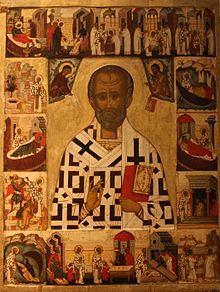
15th-century Saint Nicholas icon

In 2008, British anthropologists did a facial reconstruction of Saint Nicholas of Myra, based on his remains. The fourth-century Turkish bishop who signed the Nicene Creed looks less like Clement Clarke Moore’s description and more like the cabbie who drove you to the airport to catch your Christmas flight home.

And unlike Coca-Cola ads, religious icons often portray Saint Nicholas as a dark-skinned man whose race is hard to determine. He’s also skinny. And as I study those smaller panels on the pictured icon, I can’t find reindeer anywhere.

So if we want to stick to the historical facts, rather than “change them to try to fit some sort of a political agenda”, that’s what we get: a skinny, racially ambiguous Santa whose Turkish workshop is far from the land of reindeer.

If not reindeer …

Maybe he could drive a wagon instead of a sleigh, and borrow Thor’s flying goats to pull it.

Yeah, but Jesus was white. Wasn’t he? It depends on your definition of white. Jesus was a first-century Middle Eastern Jew. How white were they?

Probably not very. Religion News Service’s Jeffrey Weiss suggests Yasser Arafat or Osama bin Laden as comparable. Atlantic’s Jonathan Merritt says: “If he were taking the red-eye flight from San Francisco to New York today, Jesus might be profiled for additional security screening by TSA.”

Maybe. As a brownish, outspoken social activist from the Middle East with a Jerusalem police record of assault against money-lenders, I think he’d go straight to the no-fly list.

Would you sit next to this guy on an airplane?

What is “white” anyway? It’s easy to poke fun at people who believe their cultural happenstance represents eternal truth, the kind who will tell you “Where I come from people don’t have an accent.” But Chris Hayes got to the deeper issue:

Jesus wasn’t white because the category white didn’t exist when Jesus was around in the Roman Empire. That is a construction that was made later on for very intense social reasons.

The Romans had a word for white, albus, but it was a color, not a race. The same was probably true in Aramaic. First-century folks were Jews, Romans, Gauls, Egyptians, and so forth. Gauls tended towards blonde and some Egyptians could be very dark. But I believe first-century rabbis would have been quite perplexed by the idea that they belonged to a “white race”. True, a sub-Saharan African would have seemed like someone from another world, but so would a Pict from north of (what would soon become) Hadrian’s wall, and what the rabbis might have made of the central-Asian ancestors of the Rus is anybody’s guess.

Much later, Shakespeare pictured dark-skinned Othello as an outsider in Venice society, but no more so than the Jewish Shylock.

In Learning to be White, Thandeka traces the beginnings of the white-race concept to the late 1600s, when the founders of Virginia’s plantation system needed to discourage their English and Irish indentured servants from making common cause with their African and Native American slaves, as happened during Bacon’s Rebellion of 1676. So they divided the underclass by giving a few small rights and privileges to the European servants.

A new multiclass “white race” would emerge from the Virginia laws as one not biologically engineered but socially constructed. … The laws and the racial contempt they generated would sever ties of previous mutual interest and goodwill between European and African servants and workers, provide the ruling elite with a “buffer” of poor whites between themselves and the slaves to keep blacks down, and prevent either group from separately challenging the class interests of the elite.

In the North in the 1800s, the construction of the “white race” became the key to socializing America’s non-English-speaking European immigrants. They arrived identifying themselves as Polish, Russian, Irish, Italian, or some other ethnicity with its own distinctive language, history, and practices. In America they were homogenized as “whites” and their native xenophobia channeled against Africans and other people of color.

So Hayes is absolutely correct. Jesus would have been puzzled by any Roman who welcomed him as a member of the gens alba. He was a Jew, not a Roman, and being “white” didn’t mean anything at all until many centuries later.

Who’s a racist? In a follow-up segment, Megyn Kelly realized she needed a black on the panel, so she invited frequent Fox News contributor Zerlina Maxwell. Maxwell more-or-less agreed with Harris, which led Kelly to challenge her:

Why is white skin alienating? And why is that not racist?

This is the color-blind, flat-playing-field view of race currently popular among white conservatives: Since white supremacy is built into the cultural infrastructure, I (as a white) can live without thinking about race. If non-whites try to make me think about race, well then, that’s them being racist.

I mean, Santa and Jesus and Batman and all the other cultural icons just are white, so I don’t have to think about their race at all. When I look at pictures of Santa, I don’t see white Santa, I just see Santa. If it bothers you that all the cultural icons are white … whatta you, racist or something? What’s wrong with being white?

It comes down to two very different views of what American culture is. Is it the culture of all the people who live here? Or is it a historically white culture that some non-whites have been allowed to join, on the condition that they accept it the way it is and change themselves rather than seek to change the culture? Post-Martin-Luther-King, the public position of white conservatives (never mind what they say behind closed doors) is to treat people of all races as honorary whites. Isn’t that good enough? Or are you saying there’s something wrong with being white?

So Megyn Kelly is perfectly content to let your black children imagine that her white Santa is bringing presents to your black home. Isn’t that good enough? Or are you hostile to Santa because he’s white? “And why is that not racist?”

Untwisting Kelly’s pretzel takes more time than TV’s sound-bite culture allows, so Maxwell just had to dodge the reverse-racism charge. You can’t have a discussion about the particulars until you challenge several background assumptions.

First, there is no flat playing field. The privilege of ignoring race in America belongs to whites. Non-whites are confronted with race every day, no matter how much they might want to ignore it. The let’s-just-ignore-race notion really means: Let’s ignore the white supremacy built into everything.

Second, focusing on the whiteness of just Santa (or any other individual icon) misses the point. Because there is nothing wrong with Santa being white in isolation. By changing Santa, Harris was addressing her sense of encirclement, of growing up in a culture where all the major icons are white, and blackness seems like an aberration, even when you see it in the mirror.

To make a gender analogy: There’s nothing wrong with Barack Obama being a man. What’s wrong is that the 44 presidents have all been men. If a girl examines that line of portraits and feels alienated from the presidency, she’s not being sexist; she’s recognizing her country’s built-in male supremacy.

Life in the Garden of Sweden

And finally, Santa and Jesus and all the other icons aren’t white because of historical facts. They became white through a long social process. Coca-Cola’s Santa is considerably whiter than Saint Nicholas. The portrait of Jesus on the wall of my Lutheran grade school was much whiter than any first-century Palestinian Jew. In White Like Me, Tim Wise recalls growing up with picture-books — I had them too — that presented a white Adam and Eve, who frolicked in what Wise now calls “the Garden of Sweden”.

To say that this process is now at an end, that whiteness is now baked into our cultural icons and can’t be changed, is to say that white supremacy is baked into American culture and can’t be changed.

That’s what’s alienating, Megyn Kelly. And no, feeling alienated by white supremacy is not racist.

The Monday Morning Teaser

I try not to write about the same hot-button issues everyone else does, but this week I couldn’t help myself. The whole Santa-and-Jesus-are-white thing was … well, I just couldn’t lay off of it. This week’s first featured article “White Santa, White Jesus, White Christmas” should be out shortly. I’ll try to cover the issue a little better than everyone else has.

The second featured article will be “Mandela’s Memorial Service Was All About Us”. American news outlets just couldn’t face a whole day of talking about some dead guy from the other side of the world, so instead they obsessed over the Obama-Castro handshake and a manufactured mini-drama in which the Obamas’ marriage was threatened by the prime minister of Denmark. That story would have been funny in The Onion, but not on the front page of The New York Post.

The rest of the week left the weekly summary a lot to talk about. I was debating how the Sift should mark the anniversary of Sandy Hook when somebody else made the decision for me: Let’s have another school shooting! A novelist couldn’t have written a more appropriate conclusion to a year that started with the country determined to do something about guns, and ended with more laws loosened than tightened.

The other stories of the week: The debate over whether Pope Francis or Edward Snowden should have been Time’s Person of the Year; the House came to a bipartisan budget deal that is not doomed in the Senate (with Republicans saying lots of juicy, nasty things about each other); Oklahoma learned the downside of allowing religious monuments at the state capitol; and NBC News bemoaned an international study that ranked American teens “21th” in science. (If not for the fact that we were also 26th in math, somebody at NBC might have known how ordinal numbers work.)

And we’ll end with a video you may have seen already, in which WestJet made a Christmas miracle for the passengers of one lucky flight.

Basic Rights

Everyone has the right to have access to ­health care services, including reproductive health care.

— the Bill of Rights of the Constitution of South Africa

This week’s featured posts: “Rooting for Your Country to Fail is Unpatriotic” and “The Procrustean Sainthood of Nelson Mandela“.

This week everybody was talking about Nelson Mandela

Mandela died Thursday at the age of 95.

I discuss our tendency to let our pre-conceptions about sainthood overwhelm the actual lives of the people we want to canonize in “The Procrustean Sainthood of Nelson Mandela“.

and improvements in Healthcare.gov

29,000 people signed up for ObamaCare last Sunday and Monday, the first two days after the administration’s self-imposed deadline for getting the web site fixed. That’s more than signed up during the entire month of October. The best evidence we have about how well the ObamaCare web site is performing now is that Republicans are shifting to other attacks.


The latest lie about ObamaCare is that 80-100 million people who get their insurance through their jobs will have their plans “cancelled”. Ezra Klein points out that this is only true if you stretch “cancelled” to mean “changed in any way at all”, including the ways your plan already changes from year to year without you noticing.


Another new lie is that ObamaCare has expanded access to abortion coverage for Congress and its staff. ThinkProgress explains.


CNN explains what most news stories about Medicaid expansion miss: States (like mine) that refuse the expansion aren’t just opting for the pre-ObamaCare status quo. The Affordable Care Act lowered the federal subsidy to hospitals that treat uninsured people who can’t pay, because there weren’t supposed to be so many uninsured people who can’t pay. But conservatives on the Supreme Court allowed conservatives in state government to opt out of Medicaid expansion. And the result is that hospitals are closing.

You could imagine a sane Congress working some kind of a fix to keep those hospitals afloat. That would benefit red states, so it could be lumped together with some fixes that Democrats want, and everybody would be better off. But the Republican majority in the House refuses any fixes that improve ObamaCare. They’ll only back poison pills that sabotage the system or outright repeals. Improvements? No. Erick Erickson says it outright:

The website they can fix. We must deny them the opportunity to fix the law itself. Let the American people see big government in all its glory. Then offer a repeal.

This kind of sabotage is what I’m talking about in “Rooting for Your Country to Fail is Unpatriotic“.

and inequality

President Obama gave a speech on “economic mobility” Wednesday. In general it was good a good diagnosis: Over the last several decades, economic inequality is up, economic mobility is down, and this not only makes our individual households insecure, it makes our economy more vulnerable to recessions.

I wish he would say more about one structural cause of the problem: lax enforcement of antitrust laws and the resulting monopolistic bottlenecks in the economy, which I talked about here.

and the War of Christmas

Every year, the Christmas Empire expands. The once-independent celebration of Thanksgiving has become Christmas’ puppet holiday, Black Friday Eve. Only the popular Halloween prevents Christmas from rolling all the way to the Fourth of July. (Columbus Day? Labor Day? They’ll fall like dominoes if the Halloween Line is ever breached.)

And yet somehow, the Christmas propaganda machine always manages to portray the aggressor as the victim. There is a War ON Christmas. Christmas was just standing there minding its own business when people attacked it for no reason with their battle cry of “Happy Holidays”. Without constant vigilance, Santa and his mighty elves will be stabbed in the back by Jews and atheists, and Christmas will be lost.

Jon Stewart calls out this year’s propaganda: “How can I enjoy my Christmas, when I know that somewhere a little Jewish boy isn’t being forced to sing ‘O Little Town of Bethlehem’?”

and bringing automation to your doorstep

Amazon says it’s working on drone delivery copters. (And Rock City Times, “Arkansas’ 2nd most unreliable news source”, claims Walmart is installing surface-to-air missiles at its stores.) Google might “have one of the robots hop off an automated Google Car and race to your doorstep to deliver a package”.

I am reminded of a possibly apocryphal conversation between Henry Ford II and union president Walter Reuther as they toured a new Ford factory with advanced-for-the-times automation. “How are you going to get those robots to pay your union dues?” Ford gibed. And Reuther parried: “How are you going to get them to buy your cars?”

Maybe Amazon and Google should start working on an automated consumer.

and you also might be interested in …

It’s time for your annual dose of intellectual humility: The New York Times has put out its “100 Notable Books of 2013” list. I confess to having read exactly zero of them, though one is sitting on my bookshelf and I was already thinking about reading a handful of the others. (A few will have to wait: The publication of Thomas Pynchon’s The Bleeding Edge reminded me that I still haven’t finished Mason and Dixon. And Stephen King’s Doctor Sleep is a sequel to The Shining, which maybe I really should look at.)

Slate’s “The Overlooked Books of 2013” list — another zero for me — is somewhat less intimidating, both because it’s shorter and because the title suggests that other intelligent people might have missed these books too.


I just want to say that I am creeped out by how popular the Confederate cause still is in parts of the South. In Florida, there’s currently a push to put up a monument to the Union soldiers who died at the Battle of Olustee, partially balancing the three existing monuments to the Confederate soldiers. You might think this would be uncontroversial, but no, it is.

So the soldiers at Olustee who died fighting for the United States of America and against slavery should go unremembered. That’s seriously the position people are taking.


The NYT reports that big oil companies are starting to plan around the assumption that at some point there will be a price on carbon, either through a direct carbon tax or some kind of cap-and-trade system. Exxon-Mobil, for example, is shifting to be more a natural-gas company. (They’ve also stopped being the deep pockets behind climate-change denying pseudo-science. These days the Koch brothers fill that role.)

This follows reports that insurance companies are adjusting their risk models to allow for the effects of global warming. As one industry think-tank put it:

In the non-stationary environment caused by ocean warming, traditional approaches, which are solely based on analyzing historical data, increasingly fail to estimate today’s hazard probabilities. A paradigm shift from historic to predictive risk assessment methods is necessary.

The NYT comments:

Both supporters and opponents of action to fight global warming say the development is significant because businesses that chart a financial course to make money in a carbon-constrained future could be more inclined to support policies that address climate change.

Or at least they might be less inclined to throw their considerable weight behind political monkey-wrenching.


Andy Borowitz reports that the Hubble telescope has stopped looking out into space and is instead taking selfies to post on Instagram.


A mis-worded Republican tweet about Rosa Parks “role in ending racism” led to the hashtag #RacismEndedWhen. Some of the more amusing tweets are “#RacismEndedWhen The Jeffersons moved on up.” and “#racismendedwhen the iphone was available in both black and white.”

and for Advent, let’s end with a nativity scene

How minimal can you go and still have a nativity? This color nativity might be the limit. (Hat tip to whyismarko’s “the 50 worst and weirdest nativity sets“.)

Rooting for Your Country to Fail is Unpatriotic

America has decided to implement ObamaCare. Are you with your country or against it?


In America, we argue about everything. Just because the Leader proposes something, we don’t all have to get in line behind it.

We argue about whether to go to war in places like Syria, Libya, or Iraq. We argue about taxes. We argue about how much money our government should spend and what it should be spent on. We argue about which drugs and medical procedures should be legal.

We argue; it’s what we do. If you didn’t argue for your beliefs, if you just knuckled under as soon as the Powers That Be made their will known, you wouldn’t be a real American.

But we also come to decisions. We have a Congress that is empowered to pass laws. We have a president who is obliged to either veto those laws or enforce them. We have courts you can appeal to if you think those laws exceed the powers the Constitution delegates to the federal government.

In short, there are lots and lots of ways you can register your objection to a proposed public policy. Our Constitution creates many pressure points where the flow of an idea into law can be blocked.

But we do eventually make decisions.

Even after a decision is made, you can still argue that it was wrong. You can argue that we shouldn’t have invaded Iraq. You can argue that we shouldn’t have bailed out General Motors or Bank of America. You can argue that the CIA shouldn’t be launching drone attacks into countries we aren’t at war with or that the NSA shouldn’t be tracking your cell phone.

That’s not just a technicality of freedom of speech. You can make those arguments as a patriotic American, because the country has a process for reversing course. If you can convince enough people agree with you, maybe the power of public opinion will change the minds of our office-holders. And if not, elections can turn those offices over to new office-holders who can make new policies and pass new laws.

That’s not working against America, it’s part of how America works.

But there’s a line between legitimate partisanship and lack of patriotism, and this is where it runs: After a decision is made, after it is upheld as constitutional, after America has decided to do something, you don’t root for your country to fail — and you certainly don’t take action to make your country fail.

That’s unpatriotic.

Democrats respected that line when a Republican administration did something we thought was wrong: invading Iraq. We never stopped arguing against it. We never stopped trying to elect people who would get us out Iraq. And eventually we succeeded. The fighting in Iraq continues, but American troops are out of it.

You know what we didn’t do? We didn’t try to sabotage the war effort. Democratic leaders weren’t out there publicly rooting for failure. We didn’t aid the Iraqi resistance or gloat over defeats. And we certainly didn’t cheer when American troops came home in body bags. If a stray voice on a blog or in a public forum started rooting for defeat or gloating over American corpses, we jumped all over him. No external force had to police us on that; we policed ourselves.

We were Americans. We opposed what our government was doing in Iraq, but we stayed patriotic.

But on ObamaCare, Republicans have crossed that line between patriotic and unpatriotic. Let’s review a few of the ways.

McConnell and the NFL. In June, Republican Senate Leaders Mitch McConnell and John Cornyn sent a letter to the National Football League, warning it not to cooperate in efforts to publicize the law and tell the public how to get the benefits it offers. (They were successful; the NFL did not cooperate.)

This is unprecedented. Private organizations, including sports leagues, frequently take part in public information programs. When Massachusetts passed RomneyCare, the Boston Red Sox helped publicize it. Private companies like CVS, Shaw’s supermarkets, and H&R Block pitched in. This wasn’t controversial, because it wasn’t taking a position on a proposal, it was educating the public about the law.

The Bush administration organized a similar public-information campaign to introduce the Medicare prescription drug benefit. Democrats had opposed the bill in Congress (because it was written to benefit drug companies more than seniors), and we objected to the tactics used to pass the bill. But Democrats did not interfere with educating the public about how to get the new law’s benefits.

McConnell’s logic is revealing. The NFL should refuse to participate because ObamaCare “is one of the most divisive and polarizing political issues of the day.” Actually, no, it had been a political issue, but it was now a law. McConnell admitted as much, but discounted that fact because “this law was enacted … on a strictly partisan basis”. In other words, the constitutional process is insufficient as long as Republicans disapprove.

The Koch Brothers’ creepy Uncle Sam. The Koch brothers have funneled millions of dollars into ads that aim to sabotage ObamaCare by getting young people not to sign up. Not only are these ads misleading — amounting to an anti-public-education campaign against the law — they also turn a symbol of America, Uncle Sam, into something sinister and threatening.

This is well within the Kochs’ legal freedom of speech — just as it would have been within the freedom of speech of anti–Iraq-War billionaires to run creepy and misleading ads telling young Americans not to sign up for the military. (No such ads ran.) But it is similarly unpatriotic.

The fake Cover California web site. Republicans around the country crowed over the problems of the HealthCare.gov web site. Crowing over your country’s failures is unseemly enough, but California Republicans took it one step further: They set up a fake web site to actively confuse Californians looking for health insurance.

California is one of the states that set up its own ObamaCare exchange with its own web site, Covered California. The state web site was working much better than the national one, so naturally something had to be done to monkey-wrench it. Republicans put up their own fake site, Covering Health Care California, where you can’t sign up for health insurance, but you can access anti-ObamaCare propaganda and misinformation. Republican state representatives then distributed a mailer publicizing the bogus web site.

This is not normal. You want to argue that ObamaCare is a mistake and should be repealed? Fine. You want to run on a repeal platform? Fine.

But America has made a decision to do something about its 50 million uninsured. That decision, made through our constitutional process, is to implement ObamaCare. When you take action to screw that implementation up, you are working against your country.

It’s that simple.

The Procrustean Sainthood of Nelson Mandela

A strange thing happens when a political leader ascends to secular sainthood, as Nelson Mandela did in his old age and Martin Luther King and John F. Kennedy did after their assassinations: The popular notion of sainthood starts to overwhelm their personal reputations. Whatever they stood for in their active careers, as saints they represent whatever saints represent. Saints speak divine truth; so whatever you think the divine truth is, that’s what you’ll imagine the saint said.

So, for example, one the most widely recognized Mandela quotes — “Our deepest fear is not that we are inadequate. Our deepest fear is that we are powerful beyond measure.” — is something he didn’t say at all. But it sounds very generically saintlike, doesn’t it? That’s the kind of thing God should be trying to tell us, so it just stands to reason He would have said it through Nelson Mandela.

Except He didn’t.

Partisanship. The archetypal Saint is not divisive or partisan, so anything a particular saint stood for that isn’t universally accepted needs to be swept under the rug. So Martin Luther King is remembered for one sentence:

I have a dream that my four little children will one day live in a nation where they will not be judged by the color of their skin but by the content of their character.

And not for the more radical statements he made with some regularity, like:

These are revolutionary times. All over the globe men are revolting against old systems of exploitation and oppression, and out of the wounds of a frail world, new systems of justice and equality are being born. The shirtless and barefoot people of the land are rising up as never before.

and:

We know through painful experience that freedom is never voluntarily given by the oppressor; it must be demanded by the oppressed.

and especially not something really divisive, like:

All of America’s wealth today could not adequately compensate its Negroes for his centuries of exploitation and humiliation.

Quotes like that put King on one side and not the other. If we remembered King that way, only liberals could invoke his name, and conservatives would be stuck with the view of King they held when he was alive: that he was a dangerous left-wing radical. What kind of saint is that?

Ditto JFK. Because the memory of his real life has been overwhelmed by his post-assassination sainthood, he can be claimed by conservatives. Forget that the Great Society programs conservatives love to hate were proposals Kennedy couldn’t get Congress to pass (but that LBJ could after Kennedy’s death). He’s a saint, so he has to belong to everybody, no matter what he actually stood for.

Mandela’s real claim to sainthood. Nelson Mandela deserves our admiration for three simple reasons:

  • He was on the right side of history. In retrospect, it is clear to almost everyone that apartheid was wrong, just as it is clear that slavery was wrong and Jim Crow was wrong. (In their day, though, all these points were hotly debated. Those American conservatives who didn’t actively support apartheid usually held that it wasn’t our problem and viewed the South African government as our ally in the Cold War.) Mandela is the historical symbol of the battle against apartheid. No doubt various people did brave and noble things for apartheid at one time or another, but those people were on the wrong side of history so they will never be saints, just as Jefferson Davis is not seen as the equal of Abraham Lincoln.
  • He didn’t give up, no matter what they did to him. He approached his trial with an attitude he later described like this: “I felt we were likely to hang no matter what we said, so we might as well say what we truly believed.” Fearing Mandela’s martyrdom, the South African government did not hang him, but 27 years in prison didn’t break him. When the government gave in to the pressure to release him, he went back to leading the same movement he’d led when they arrested him.
  • When the pendulum swung his way, he used his power to seek peace rather than vengeance. One of the saintlike things Mandela really did say was: “Courageous people do not fear forgiving, for the sake of peace.” Post-apartheid South Africa opted for a Truth and Reconciliation Commission focused on finding and documenting the truth about the abuses of the apartheid government, rather than a set of show trials to settle scores.

So my point isn’t that he doesn’t deserve that level of admiration he is receiving. Rather, he deserves to be admired as the person he really was, not as some generic nice guy who was really brave and stuff.

The conservative attempt to claim Mandela. Basically, the logic goes like this: Mandela fought for freedom for his people. We have definitions of the words freedom and people that makes us freedom-fighters too. (We mean the people who own stuff, and their freedom to keep it, no matter how many hungry people have their noses pressed against the window. This definition may not look terribly different from the kind of freedom the apartheid regime recognized, but let’s not sweat the details.) So Mandela is one of us.

The dumbest and most outrageous invocation of Mandela this week came from Rick Santorum:

Nelson Mandela stood up against a great injustice and was willing to pay a huge price for that, and that’s the reason he is mourned today, because of that struggle that he performed…and I would make the argument that we have a great injustice going on right now in this country with an ever increasing size of government that is taking over and controlling people’s lives, and Obamacare is front and center in that.

So let’s completely forget Mandela’s real beliefs about health care, as expressed in section 27.1.a of the Bill of Rights in the South African constitution he campaigned for:

Everyone has the right to have access to ­health care services, including reproductive health care

In other words: Mandela’s beliefs about health care were the exact opposite of the position Santorum is invoking Mandela’s name to support.

What Mandela was. Nelson Mandela was a democratic socialist. In other words, he believed in the right of the people, through democratic elections and representative government, to correct the injustices of the existing property system and to regulate the workings of the market to achieve a more equitable outcome. At his trial, he said:

I am an admirer of such a [parliamentary] system. … [I]n my search for a political formula, I should be absolutely impartial and objective. I should tie myself to no particular system of society other than that of socialism.

When governments thwart lawful democratic methods for achieving justice, Mandela believed in breaking the law, even violently if necessary. At his trial he said:

We felt that without sabotage there would be no way open to the African people to succeed in their struggle against the principle of white supremacy. All lawful modes of expressing opposition to this principle had been closed by legislation, and we were placed in a position in which we had either to accept a permanent state of inferiority, or to defy the Government. We chose to defy the Government. We first broke the law in a way which avoided any recourse to violence; when this form was legislated against, and when the Government resorted to a show of force to crush opposition to its policies, only then did we decide to answer violence with violence.

He also was against racism, whether it was white-over-black or black-over-white.

[W]e want equal political rights, because without them our disabilities will be permanent. I know this sounds revolutionary to the whites in this country, because the majority of voters will be Africans. This makes the white man fear democracy. But this fear cannot be allowed to stand in the way of the only solution which will guarantee racial harmony and freedom for all. It is not true that the enfranchisement of all will result in racial domination. Political division, based on color, is entirely artificial and, when it disappears, so will the domination of one color group by another.

There’s a lot to admire here, but it is a particular point of view. It doesn’t capture all the wisdom and virtue that is contained in any point of view.

Mourning admirable people you disagree with. Death is a time to let by-gones be by-gones. The deceased can’t hurt you any more, so there’s no need to tear him down. His allies and admirers are sad, so it’s gracious not to salt their wounds*

But while there’s no need to dwell on past disagreements or re-fight old battles, it’s also gracious to let the deceased be the person he was, and let his reputation accrue to the side that he actually belonged to.

Nelson Mandela was a real person who lived and has now died. He did some admirable things and (in regard to the main issue of his career, the fight against apartheid) came out on the right side of the history. He had particular opinions and said some wise things.

But there is no need to recast him a generic saint who was all things to all people and a source of all wisdom. We respect him best by letting him be in death what he was in life.


*Ted Cruz, to his credit, took the high road in a Facebook post that praised Mandela without claiming him for the Tea Party. (Cruz’s followers were incensed.)