I have no doubt that Christian conservatives do feel limited by other people’s rights. There is that saying, “Your rights end where my nose begins.” Christian conservatives are arguing that they should be able to punch you in the nose if that desire to punch you in the nose is sincerely held.
The fix provides that Indiana’s RFRA does not authorize businesses “to refuse to offer or provide services, facilities, use of public accommodation, goods, employment, or housing to any member or members of the general public” on the basis of a list of protected traits that includes “sexual orientation” and “gender identity.” Another provision provides that the state’s RFRA law does not “establish a defense to a civil action or criminal prosecution” brought against someone who engages in such discrimination.
So it rolls back the worst of the new law, but in no case does it do any more than restore the status quo. Arkansas likewise watered down the RFRA it passed last week, though I’m not clear on the details.
I started to do a short explanation of how I think First Amendment rights should balance against gay rights, but it got out of hand so I turned it into its own article.
Bigotry can be profitable! That Indiana pizza shop has collected over $800K in donations, while the Oregon florist that was fined $1K has gotten $85K to help pay it.
CNN’s conversation with several florists in rural Georgia implicitly pointed out one of the holes in conservative Christian theology: They treat homosexuality as a more serious sin than just about anything else, when there’s no Biblical justification for doing so. There are a handful of verses in the Bible against homosexuality, but the idea that it’s worse than other common sins — premarital sex, say — is not Biblical.
and a nuclear deal with Iran
Or at least the framework of a deal that both sides are committed to finishing by the end of June.
Salon’s Jim Newell suggests that any politician who wants to renounce the deal be asked what they’d do next. He lists the realistic options he sees:
(1) sitting around and hoping that some magical unicorns swoop into Iran, topple its regime, and put in place a United States puppet government or (2) bombing Iran.
Rachel Maddow did a good job of summarizing the technical details involved, and why they matter.
Steve Benen discusses the plans in Congress to sabotage the deal.
and a massacre in Kenya
The al-Shabab terrorist group killed 148 people in an attack on a university.
and you also might be interested in …
Thursday will be the 150th anniversary of Lee’s surrender, which effectively ended the Civil War. Brian Beutler makes a modest proposal, which I endorse:
to mark the occasion, the federal government should make two modest changes: It should make April 9 a federal holiday; and it should commit to disavowing or renaming monuments to the Confederacy, and its leaders, that receive direct federal support.
The Bob Menendez corruption case demonstrates the kind of corruption that Justice Kennedy didn’t think would be an issue.
Who’re the oldest “people” in the United States? Corporate people. The oldest ones just turned 129.
11 Atlanta educators were convicted in a plot to raise test scores through cheating. 178 teachers and principals were involved, and 35 were indicted, with most negotiating guilty pleas to lesser charges.
This case exposes an important flaw in the high-stakes-testing approach to education, in which the futures of everyone from students and teachers to mayors and governors ride on test scores. Literally everyone in the system has a motive to cheat, and no one has a motive to catch cheaters. According to the NYT:
Evidence of systemic cheating has emerged in as many as a dozen places across the country, and protests in Chicago, New York City, Seattle, across Texas and elsewhere represent a growing backlash among educators and parents against high-stakes testing.
So if you’re going to do testing right, you need an independent testing bureaucracy, with its own employees and budget. And once you figure in the cost of that, I think the whole scheme might become impractical.
Here’s another Indiana law that should give people pause: After taking drugs to induce a miscarriage, a woman was convicted of “feticide” and sentenced to 20 years.
While we’re all waiting to see if the Supreme Court monkey-wrenches ObamaCare, it just did some serious damage to Medicaid.
and let’s close with a taste of things to come
Comedy Central has announced Jon Stewart’s successor as host of The Daily Show: South African comic Trevor Noah. In spite of some early problems, this could be good:
There have been a lot of painful back-and-forths about what the proposed state “religious freedom” laws allow. Like this one, where ABC’s Jake Trapper tries to get the sponsor of Arkansas’ original RFRA bill (which has since been watered down a little) to admit that it allows “discrimination” against a same-sex couple getting married, while the legislator will admit only that it allows bakers, florists, et al to refuse to “participate in the message”.
There actually is a sensible in-between position, and I doubt a new law was necessary to allow it, because it was already embedded in the judge’s decision in the 2013 Colorado bakery case, as I noted last week.
There is no doubt that decorating a wedding cake involves considerable skill and artistry. However, the finished product does not necessarily qualify as “speech,” as would saluting a flag, marching in a parade, or displaying a motto. … [The baker] was not asked to apply any message or symbol to the cake, or to construct the cake in any fashion that could be reasonably understood as advocating same-sex marriage. [my emphasis]
Let me take this out of the gay-rights arena with a hypothetical example: Suppose I represent an atheist group that is about to celebrate its tenth anniversary. I go to a baker and ask for a cake. Suppose I want him to write “God is Dead” on the cake, and he refuses. If I sue, then I believe he should win the case, because his freedom of speech is violated if he’s forced to write something he doesn’t agree with.
But now suppose we didn’t get that far: As soon as I say why I want a cake, the baker responds, “I’m not going to make a cake for an atheist group.” All I want is a cake with a 10 on top of it, and he says no. Now if I sue, I believe I should win, because the baker is discriminating against atheists as a religious group. In other words, a business open to the public should be (and I believe is, without any new religious-freedom laws) free to refuse to endorse an idea, but it should not be free to refuse service to people merely because they practice or promote that idea.
The complaint against Marjorie Silva, owner of Azucar Bakery, was filed by Castle Rock, Colo., resident Bill Jack, who claimed Silva discriminated against his religious beliefs when she refused to decorate a cake showing two groomsmen with a red “x” over them and messages about homosexuality being a sin.
Silva said she would make the cake, but declined to write his suggested messages on the cake, telling him she would give him icing and a pastry bag so he could write the words himself. Silva said the customer didn’t want that.
If conservative Christian bakers would offer gay and lesbian couples a similar compromise — “I’ll make the cake and sell you two groom figures, but you’ll have to put them on the cake yourself.” — I suspect they’d have no problems with the courts. Certainly not in Colorado, and probably not anywhere.
The loophole the Arkansas legislator is trying to wiggle through is that the Supreme Court has extended First Amendment protection to “symbolic speech” — wordless actions that make a statement, like burning an American flag. He wants to claim that providing any of the services involved in a same-sex wedding can be construed as a symbolic statement that the provider approves of same-sex marriage. So a florist’s or photographer’s right to free speech is violated if s/he is forced to make such a statement.
That’s ridiculous. It’s the kind of passive aggression I’ve pointed out before: exaggerating your sensitivity in order to control others by claiming offense. Society could not function if we allowed everyone to claim this degree of moral sensitivity. (“If you force me to hire beef-eaters in my widget factory, then you’re making me say I approve of eating beef, which violates my Hindu faith.”) So it’s an implicit claim that conservative Christians have special rights that other people don’t have.
What this situation cries out for is a “reasonable person” interpretation: Would reasonable people look at the flowers at a same-sex wedding and see the florist making a political/religious statement? (“Those must come from Belle’s Flowers. I didn’t know Belle endorsed same-sex marriage. I thought she was a Christian.”) Or would they just think “nice flowers”?
This interpretation separates actual religious-freedom issues from the bogus ones that fundamentalists are putting forward. A reasonable person would assume that the officiating minister approves of the ceremony, so the minister’s presence makes a statement that the law can’t force. But florists? photographers? bakers? caterers? No.
On March 23 at Liberty University in Virginia, Senator Ted Cruz of Texas became the first major Republican to announce his presidential candidacy. As I explained in the introduction to this series, I don’t think the mainstream media takes candidate stump speeches seriously enough: In them, a candidate presents a vision of what leadership America needs at the present moment, and why he or she is the person to provide it. That vision is typically a combination of truth and fantasy, both about himself/herself and about America, but it is a telling and instructive combination all the same.
Unless otherwise attributed, all quotes below are from the Washington Post transcript. (I’ve left out the crowd reactions.)
Significance of the site. “To come to the world’s largest Christian university [1] is a statement in and of itself,” said student government president Quincy Thompson. “I think he was very clear in his commitment to Christ.”
Liberty University was founded by televangelist Jerry Falwell and is still headed by his son, Jerry Jr. It describes its mission as “training champions for Christ“. Falwell Sr. can be regarded as a founder of the Theocrat wing of the Republican Party — I discuss the four Republican factions here and here — so by announcing his candidacy at Liberty, Cruz is identifying himself as a Theocrat. (He has since doubled down on that with his first campaign ad.)
Cruz’ speech is one of Liberty’s three-times-a-week Convocations, and he is introduced by President Falwell. (I haven’t found what Falwell said.) Attendance at Convocations is mandatory for students, which explains why you can see a few Rand Paul t-shirts in the crowd. In general, the audience is respectful but not enthusiastic, except when Cruz pledges his support to Israel. (Christian Theocrats are major supporters of Israel, for reasons largely having to do with end times prophecies.)
Outline. The overall theme of Cruz’s 31-minute speech is “re-igniting the promise of America”. It falls into three parts: The first ten minutes are about Cruz and his family, the next 13 make a contrast between where he thinks America is and where he wants to take it, and the final eight explain why the difficult things he wants to do are possible: a combination of people power (“The power of the American people when we rise up and stand for liberty knows no bounds.”) and divine assistance (“God’s blessing has been on America from the very beginning of this nation, and I believe God isn’t done with America yet.”).
Family bio. Telling your story is a standard part of a stump speech, and if your theme is “re-igniting the promise of America”, it helps if your family’s story illustrates the promise of America. This isn’t a conservative or liberal thing: In many ways Cruz’ use of his father’s Cuban-immigrant struggle reminds me of Mike Dukakis’ use of his father’s Greek-immigrant struggle.
As Ted tells it, his parents’ story has two themes: How in America two people can start with nothing and put their son in the Senate, and how Jesus Christ can transform a family. He also tries to pick up some working-women cred through his mother’s success in a male-dominated field (computer programming). [2]
Rafael arrived from Cuba at 18, after rebelling against the corrupt dictator Batista and then getting disillusioned by Castro. He worked his way through the University of Texas washing dishes (something you could do back in the days when state universities were heavily subsidized). Ted conveniently skips Rafael’s failed first marriage, but does tell how he abandoned his second wife when Ted was three. That was when Rafael found Jesus.
And God transformed his heart. And he drove to the airport, he bought a plane ticket, and he flew back to be with my mother and me. There are people who wonder if faith is real. I can tell you, in my family there’s not a second of doubt, because were it not for the transformative love of Jesus Christ … I would have been raised by a single mom without my father in the household.
Ted’s wife was the child of white missionaries to Africa. In telling the story of her business success, he focuses on her childhood cake-baking business, and manages not to say the words “Goldman Sachs”.
Similarly, he leaves out some things when talking about himself
heading off to school over a thousand miles away from home, in a place where he knew nobody, where he was alone and scared, and his parents going through bankruptcy meant there was no financial support at home, so at the age of 17, he went to get two jobs to help pay his way through school. He took over $100,000 in school loans, loans I suspect a lot of ya’ll can relate to, loans that I’ll point out I just paid off a few years ago.
That’s got to be the strangest way I’ve ever heard someone say he went to Princeton and then got his law degree at Harvard. [3]
He draws this segment to a close by saying: “These are all of our stories.” In other words, the American dream is “to come to America with nothing, and to achieve anything.” We all share that dream, but the Cruz family embodies it.
The threat. Having shown us how the promise of America has been fulfilled for him and his family, Cruz transitions to the second part of the speech by introducing the idea that the promise of America is threatened, and may not be available for the students in the audience unless they fight for it.
For so many Americans the promise of America seems more and more distant. … So many fear that that promise is today unattainable.
The promise of America has to be “re-ignited” if it’s going to be available to this generation.
What’s interesting here is how Left and Right are telling the same story with different villains. In Cruz’ version, the promise of America has been corrupted by over-reaching government and the loss of the Christian values the country was founded on. In the liberal version, the promise of America has been stolen by the 1%; they have climbed the ladder of success and pulled it up behind them. A candidate who could combine these stories would really have something; but I don’t see that coming from the husband of a Goldman Sachs executive — or from Jeb Bush or Hillary Clinton.
Cruz uses war imagery to imagine how this might turn around. He begins with Patrick Henry’s “Give me liberty or give me death.” [4]
Today millions of young people are scared, worried about the future, worried about what the future will hold. Imagine millions of young people coming together and standing together, saying “we will stand for liberty.”
and in the closing invites the students “to join a grassroots army”. His implicit message is that one way Liberty students can be “champions for Christ” is to be champions for Ted Cruz.
Imagine how things could be rather than how they are. The “imagine” in the previous quote is the start of a litany of the form “Instead of X, imagine Y.”
Imagine, instead of economic stagnation, booming economic growth. … Instead of small businesses going out of business in record numbers, imagine small businesses growing and prospering.
Again, this kind of stuff will play well in the Republican primaries, but I can imagine an attack-dog Democratic VP candidate (Al Franken would deliver the line best) countering with: “Instead of the slow but steady growth we’ve had under a centrist Democratic president, imagine the economy falling completely off a cliff the way it did the last time we had a conservative Republican president.”
That’s going to be the general-election challenge of any Republican candidate: You can talk a good game about “booming economic growth”, but when the details come out, what are you proposing other than a return to Bushism? In large part, that is what sunk Romney. He wanted to project an image as an economic turn-around specialist, but he didn’t have any credible proposals to back it up. Lower taxes? Less regulation? How is that different from what failed so disastrously under Bush?
And “small businesses going out of business in record numbers”? False.
Sometimes there are policies behind Cruz’ litany, if you know how to interpret.
Imagine innovation thriving on the Internet as government regulators and tax collectors are kept at bay and more and more opportunity is created.
If wasn’t until the second time I listened to the speech that I realized he was talking about his opposition to net neutrality. The idea that the FCC’s endorsement of net neutrality will have a side-effect of raising taxes is speculative at best, but is accepted as gospel on the right. And the belief that letting Comcast and Verizon dominate the internet will make innovation “thrive” and create “opportunity” … well, that’s just crazy.
Cruz repeats several other baseless conservative fantasies:
Instead of a tax code that crushes innovation, that imposes burdens on families struggling to make ends met, imagine a simple flat tax that lets every American fill out his or her taxes on a postcard. Imagine abolishing the IRS.
Every proposed flat tax that collects the same revenue as the current system does so by increasing taxes on “families struggling to make ends meet”. It has to, because the whole point of flattening the tax is so that rich people can pay less.
Similarly, the flatness of a tax has nothing to do with how complicated tax returns are. [5] The complicated part of the income tax is figuring out what your income is after deductions, not what tax rate you pay on it. Having a flat tax is not going to help you compute the basis price on your investments, or what part of your small-business revenue is actually income. (How are you going to do that on a postcard?) And if you want to simplify by getting rid of deductions, you can do that without flattening the tax. (If you want to make deduction-cutting revenue-neutral, lower all the tax rates by equal percentages.) The point of a flat tax is not simplicity or anything other than shifting the tax burden from the rich to the rest of us.
And “abolishing the IRS” means what exactly? That the government is just going to take our word for what our income is? The only way to abolish the IRS is to abolish the income tax, which would have to be replaced by something more regressive, like a national sales tax.
Instead of the lawlessness and the president’s unconstitutional executive amnesty, imagine a president that finally, finally, finally secures the borders.
What kind of police state would we need to “secure the border”? Reagan couldn’t do it. Bush couldn’t do it. Even Nazi Germany never managed to secure its borders completely. Also: about half our undocumented immigrants come in legally, but overstay their visas. Nothing we can do on the border will fix that.
And imagine a legal immigration system that welcomes and celebrates those who come to achieve the American dream.
All of them? Isn’t that exactly what a lot of conservatives want to prevent? How many immigrants does Cruz imagine letting in each year? Won’t they “steal our jobs“?
And some Cruz’ proposals are just nonsense:
Imagine repealing every word of Common Core.
As many people have pointed out, Common Core is not a law, so it can’t be repealed. Pretty much everything Cruz says about Common Core is disconnected from reality. Vox explains:
If Cruz really wanted to get rid of Common Core, he could run the Obama administration’s play in reverse: create his own version of Race to the Top, with financial incentives for states to toss out the Common Core standards and develop their own based on what local authorities think students should learn. But that’s just another form of federal interference — and Cruz wants the federal government out of the education standards business entirely.
Cruz continues:
every single child, regardless of race, regardless of ethnicity, regardless of wealth or ZIP Code, every child in America has the right to a quality education.
But if there are no national standards, what does “quality education” mean? And if there’s no definition, what is Cruz’ assertion of every child’s rights worth?
And of course, no Ted Cruz speech would be complete without trashing ObamaCare.
Instead of the joblessness, instead of the millions forced into part-time work, instead of the millions who’ve lost their health insurance, lost their doctors, have faced skyrocketing health insurance premiums, imagine in 2017 a new president signing legislation repealing every word of Obamacare.
It will be interesting to see how long the Right can stay in the alternate universe where ObamaCare is a horrible failure. An ever-larger percentage of the electorate either gets insurance through ObamaCare or knows someone who does, so the made-up horror stories can’t cut it forever, as Cathy McMorris Rodgers found out.
Imagine health care reform that keeps government out of the way between you and your doctor and that makes health insurance personal and portable and affordable.
You need imagination to see the Republican alternative to ObamaCare, because in the real world there isn’t one. I’ll bet Cruz will go as long as he can without offering any more details than what you see above.
But the portions of the Imagine litany aimed at the Religious Right ring true.
Instead of a federal government that wages an assault on our religious liberty, that goes after Hobby Lobby, that goes after the Little Sisters of the Poor, that goes after Liberty University, imagine a federal government that stands for the First Amendment rights of every American.
Instead of a federal government that works to undermine our values, imagine a federal government that works to defend the sanctity of human life and to uphold the sacrament of marriage.
Instead of a government that works to undermine our Second Amendment rights, that seeks to ban our ammunition imagine a federal government that protects the right to keep and bear arms of all law-abiding Americans.
I’ve got nothing cynical to say about any of that. [6] He means it.
God’s help. One theme of Cruz’ career is that conservatives don’t need to compromise, they just need to fight. That principle and Cruz’ leadership was how we wound up with the government shutdown of 2013.
So he closes his speech by explaining why he believes — in spite of sad experience — that compromise is unnecessary and his vision is possible. He recalls a number of crisis points in American history [7], and then concludes:
From the dawn of this country, at every stage America has enjoyed God’s providential blessing. Over and over again, when we face impossible odds, the American people rose to the challenge.
So Theocrats shouldn’t seek a compromise candidate that might have a better chance of winning. Ted Cruz should be their first choice, and with their help and God’s he will become president.
Is it working? The first new poll out says it is: Cruz has gone from 5% support to 16%, within striking distance of the leaders Scott Walker (20%) and Jeb Bush (17%). God may not be throwing his weight into the scale, but the Theocrats are.
[1] Liberty has nearly 14,000 students on its campus and another 100,000 online. I’m not sure exactly how it justifies its claim to be “the largest Christian university in the world”, which Cruz repeats in his speech.
Just in the U.S., Catholic DePaul has over 30,000 students on campus. Maybe Liberty has more online students, or maybe they think Catholic universities are not really Christian. Certainly you don’t have to be Christian to attend DePaul, while Liberty’s application requires an essay on “How will your personal faith and beliefs allow you to contribute to Liberty’s mission to develop Christ-centered leaders?”
One good background source is the book The Unlikely Disciple, by a liberal Brown student who goes undercover at Liberty.
[2] Since Ted was born while the family was living in Canada, he gets his American citizenship and his right to run for president from his mother, who was born in Delaware. Some on the left want to make an issue out of this, since there is at least more substance to it than to the pure-fantasy Birther objections to President Obama’s legitimacy — which Rafael Cruz promoted. But two wrongs don’t make a right. Birthers tear down democracy by injecting bullshit into the public discourse. Those of us who want to uphold democracy can’t use their tactics.
[3] In context, this talking-about-himself-in-the-third person is not as weird as it sounds out of context. Rhetorically, he has set it up well.
[4] That choice of founding father is a dog whistle: To most of us, Patrick Henry is just another founder. But he was a Theocrat in the Virginia of his day, and clashed often with secularists like Jefferson and Madison. Liberty students probably know this.
[5] I just finished doing my own taxes. If we’d had only one tax rate in 2014, all that would have changed were the numbers in the Tax Tables. Everything else in my tax return (and yours too, I believe) would have been exactly the same.
[6] Well, one thing. The “ban our ammunition” line is about a proposal to ban armor-piercing bullets, whose main civilian application is in killing cops. The Obama administration dropped that proposal after the NRA threw a fit.
This shows how far you have to stretch if you want to claim that Obama is a threat to gun owners: You have to point to a moderate, sensible proposal that he didn’t follow through on anyway.
[7] Leaving out the Civil War, interestingly. I wonder if Cruz believes God’s side won that war.
One benefit of living in New Hampshire is the opportunity to listen to presidential candidates unfiltered by the national media. It wasn’t until I arrived here in 1996 that I realized just how distorting that filter can be: Early in each cycle, the press corps decides on a narrative for each candidate, and from there on it’s very hard for any other message to get through.
For example, in 2003 Howard Dean was the anti-war candidate. That’s what I expected to hear when I went to see him, and when he instead talked about a wide range of issues, I thought he must be making a real effort to broaden his appeal. But when I read the press coverage the next morning, it only mentioned the anti-war parts of his speech. If I hadn’t been there, I would have thought the anti-war candidate gave another anti-war speech. In fact, I eventually discovered, Dean had given his standard stump speech, which had always been about a wide range of issues. It just never got covered that way.
In the same campaign, I listened to John Kerry and blogged about his talk, not realizing that I had totally ignored what became the mainstream-media story: Kerry calling for “regime change in the United States“. If you were there, it was a throw-away line in an otherwise serious talk about where America was heading and where it needed to go. If you weren’t there, it was the only line you heard.
Ever since, I’ve tried to listen to as many candidates’ stump speeches as I can. Often they contain a lot of slanted statistics and mis-stated facts — which are instructive in their own way — but they also constitute a candidate’s best answer to the fundamental question of any presidential campaign: Where does America need to go and why am I the person to lead us there?
It’s important not to lose sight of that, or to get lost in all the clever remarks and wardrobe choices and inside-baseball strategizing. Where does this candidate think America needs to go and why is s/he the one to lead us there?
Fortunately, in the YouTube era you don’t have to live in New Hampshire or Iowa to hear a stump speech. So in this series I’m going to link to videos and/or transcripts of stump speeches of all the major candidates as they start campaigning, and I’m going to take them seriously. I’ll fact-check, pull out larger themes, compare to other candidate’s speeches, and think about the parts of the picture I think are being left out.
Watch the speeches with me and add your comments. I’m going to start later today with Ted Cruz’s Liberty University speech, and I plan to update this post throughout the year as more candidates announce and more stump speeches become available.
Last week I finally had to recognize that the 2016 campaign had started. This week I begin covering it. I plan to do a series where I look at the stump speeches of all the major candidates, because I’ve learned in past campaigns that often they’re saying something different from what is being covered in the mainstream press.
So this week I need two featured posts: one to explain what the series is and the other to get it started by examining Ted Cruz announcement speech at Liberty University. They’re both more-or-less done, so they should be out shortly.
In the weekly summary, there’s still the “religious freedom” controversy, which I’ll catch up on and explain how I think the law ought to balance the competing values involved (as it seems to be doing in Colorado). But the more important development of the week was the announcement of the framework of a nuclear deal with Iran. And there was a massacre in Africa. I’ll close with a stand-up routine by Trevor Noah, who has been named as the next host of The Daily Show.
I’m writing from Arizona rather than my usual New Hampshire, so the usual schedule may slip a little. In the Eastern time zone, the weekly summary may not appear until afternoon.
The [university’s] policy with respect to intermarriage, the record also clearly establishes, was rooted from the beginning in a belief that is derived from scripture: not that races should not associate, but that races should not intermarry.
This week everybody was talking about Indiana’s new right-to-discriminate law
I’m tempted to go into detail about what’s in it and why it’s wrong, but it’s basically the same thing Governor Brewer vetoed in Arizona last year, so I’d just be repeating what I wrote then. (If you want details, an Indiana lawyer has blogged a better analysis than I could do.)
What I find most discouraging is my own reaction: The bigots are wearing me down. When Arizona was about to do it, I was outraged. Now it’s just “Oh, not this shit again.” And how the heck am I going to boycott Indiana, when I was never planning to go there anyway?
I include the quote at the top to point out that we’ve heard all these points in favor of religiously-mandated discrimination before. Then it was discrimination against blacks rather than discrimination against gays, but the arguments are exactly the same.
Georgia has a similar “religious freedom” bill pending. A few days ago, opponents thought they had it blocked by attaching an amendment that takes the bill’s supporters at their word.
As in Indiana, proponents of Georgia’s bill have tried to argue that it has nothing to do with discrimination. Rep. Mike Jacobs, an LGBT-friendly Republican, decided to test this theory by introducing an amendment that would not allow claims of religious liberty to be used to circumvent state and local nondiscrimination protections. Supporters of the bill, like Rep. Barry Fleming (R), countered that the amendment “will gut the bill.”
So it’s not about discrimination, but taking discrimination out of the law “guts” it.
It’s still possible that the unamended version will be restored and passed.
Big Atlanta-based corporations like Delta and Coke have spoken out against similar Georgia laws in the past, but aren’t making a big deal about this one. ThinkProgress speculates:
Some speculate that lawmakers have intimidated these companies into silence with bills that threaten their business — with Delta serving as the example for others. Still pending in the legislature is a bill (HB 175) that would eliminate Georgia’s tax subsidy on jet fuel, which would primarily hurt Delta. Its sponsor, Rep. Earl Ehrhart (R), makes no secret of the fact that the bill is retribution for Delta CEO Richard Anderson’s recent history of weighing in on public affairs, including last year’s version of RFRA.
It’s fascinating to watch the sleight-of-hand involved in defending so-called “religious freedom” laws, particularly when defenders try to make a parallel to liberal freedom issues, either to point out our obliviousness or our hypocrisy. For example:
Shoebat.com decided to call some 13 prominent pro-gay bakers in a row. Each one denied us the right to have “Gay Marriage Is Wrong” on a cake
But this is explicitly not what the bakery court case was about. As the judge wrote:
There is no doubt that decorating a wedding cake involves considerable skill and artistry. However, the finished product does not necessarily qualify as “speech,” as would saluting a flag, marching in a parade, or displaying a motto. … [The baker] was not asked to apply any message or symbol to the cake, or to construct the cake in any fashion that could be reasonably understood as advocating same-sex marriage. [my emphasis]
Or consider this cartoon:
In what sense are Klansmen analogous to gays, or right-wing Christians analogous to blacks? Have gays been lynching right-wing Christians or burning their churches? Does a fundamentalist baker feel physically threatened when lesbians come into his shop?
And finally, Bob the Baker’s reluctance to make a KKK cake is political, not religious. A religious freedom law doesn’t help.
and a plane crash
Once again, CNN has turned into the Air Disaster Network. Every time I checked CNN this week, they were talking about Germanwings Flight 9525. Somehow, they managed to spend 24 hours a day repeating: It crashed, everybody died, and we think one of the pilots might have crashed it intentionally.
Plane crashes are the junk food of news. They seem important — and they are important to the friends and families of the people who die — but otherwise they don’t affect your life and there’s nothing you can do about them. Beyond the simple announcement that a crash has happened, it’s literally News You Can’t Use.
Zak Cheney-Rice points out that CNN could also speculate about terrorism, if the suspect weren’t white. If he were a brown-skinned Muslim, they’d be talking about little else.
This is not an argument for jumping to conclusions. Nor is it meant to accuse Lubitz of terrorism. On the contrary, it is an argument for holding people who commit mass murder to similar standards, regardless of their race or religion. If one gets to be portrayed as a complex human being, they all should be portrayed as such.
and Bowe Bergdahl
But whenever I scanned through Fox News, they were talking about Bowe Bergdahl, the soldier that President Obama got back from the Taliban in a prisoner exchange last May.
The new development this week was that the Army decided to charge Bergdahl with desertion and “misbehavior before the enemy”. For some reason, this makes the prisoner swap a “fiasco” in the conservative mind. I guess they think we should have let the Taliban keep torturing him.
It’s tempting to frame this as part of the brewing regional Sunni/Shia war — Iran vs. ISIS in Tikrit is another part — but (as in Syria/Iraq) there are more than two sides. The Sunni government was helping us fight the local branch of Al Qaeda, which is also Sunni. The Shia rebels recently overran the air base we had been using for drone strikes against their enemies.
For those of you who can’t find Yemen on a map (don’t be ashamed, just learn), here’s a map.
You actually know more about Yemen than you think. Historically, it might be where the Biblical Queen of Sheba came from. More recently, its Aden harbor is where the U.S.S. Cole was attacked.
Yemen has been an oil producer, but its fields are near exhaustion. (In 2008, the World Bank predicted Yemen’s oil reserves would run out by 2017. How any government will replace that revenue is a mystery.) It’s a poor country that has been badly governedfor a long time, and has a scary water problem that climate change is making worse. (Thomas Friedman went there to film Episode 8 of Years of Living Dangerously.)
In short, it’s one of those tragic situations where people are squabbling over crumbs. The victor in the civil war will just win responsibility for solving intractable problems.
and 2016
Presidential candidates are starting to show up in New Hampshire, but it’s surprisingly hard to track them down. (Ted Cruz’ visit this week didn’t show up on WMUR’s candidate tracker.) We’re at a stage in the campaign where candidates want to talk to groups they expect to support them, and don’t want possibly hostile voters showing up to ask embarrassing questions. (Not that I do that.)
Cruz officially announced his candidacy at Liberty University, the school Jerry Falwell founded. WaPo has the transcript of his speech. Next week I plan to start an intermittent series where I look at candidate stump speeches in detail, starting with that one.
and you also might be interested in …
Most of the opposition to the administration’s negotiations with Iran have hidden behind the fig leaf of the “better deal” Obama could get if he took a firmer stand. So it’s kind of refreshing to see a NeoCon honestly admit that he wants war, as former Bush UN Ambassador John Bolton did in Thursday’s NYT.
Bolton thinks bombing “should be combined with vigorous American support for Iran’s opposition, aimed at regime change in Tehran.” Because that would totally work, just like Dick Cheney’s plan to have the Iraqis greet us as liberators.
In reality, Iranians would react to an attack the way we reacted to 9-11: 90% of them would rally behind the government, while the other 10% would either shut up or get ostracized as unpatriotic. If you want to completely destroy any chance of democratic change in Iraq, do what Bolton wants.
Two weeks ago I talked about a racist song sung on a fraternity bus. I remarked at the time that the song couldn’t be new, because the brothers in the video know the words. Now we know where they learned them: at an SAE national leadership school four years ago.
SAE also turned up in “The Hunting Ground” as a particularly dangerous frat for a woman to attend a party at. On some campuses, SAE is said to stand for “Sexual Assault Expected”.
As a Michigan State alum, I can’t not mention our most unlikely Final Four run ever. No one can strategize against us, because no one can figure out how we’re winning.
Four years ago, Jonathan Chait made the kind of prognosticating mistake people don’t let you forget: He picked Tim Pawlenty as the 2012 Republican nominee.
To be fair, Pawlenty wasn’t as ridiculous a choice as hindsight makes him look, and Chait wasn’t the only one forecasting great things for him: Pawlenty was Mitt Romney without the baggage of Mormonism and RomneyCare. He was conservative enough to be acceptable to the Party’s various factions, while sounding moderate enough not to scare off the national electorate.
In other words: If this were still the GOP of 1920, Pawlenty was exactly the kind of Warren-Harding-ish compromise candidate the smoke-filled room above the convention hall would have settled on after ten or twenty ballots. But since Pawlenty was nobody’s first choice in 2012, he never broke out of single digits in the polls and was out of the race before a single vote was cast.
The lesson of Chait/Pawlenty is that the modern Republican presidential process has two distinct phases: First a qualifying phase, where a few candidates break out of the pack to eliminate everyone else, and then a decision phase, where the party picks one of the qualifiers to unify around. Pawlenty is an example of a good decision-phase candidate who never made it out of the qualifying round.
To make it out of the qualifying phase, you need to be the first choice of one of the Party’s factions. But what are those factions?
The Four Factions. I still believe in the model from “The Four Flavors of Republican“, which boils down to this diagram:
The four groups overlap, which is how the GOP stays together. But each speaks a subtly different language and focuses on a different set of issues. In 2012, each faction had a favorite son: Mitt Romney (Corporatist), Newt Gingrich (NeoCon), Rick Santorum (Theocrat), and Ron Paul (Libertarian). Those candidates made it through the qualifying phase, with Romney substantially in the lead. The decision-phase question was then whether Romney could convince the NeoCons, Theocrats, and Libertarians not to divide the party — and so insure Obama’s re-election — by rejecting him.
That model, I believe, will hold again in 2016. To make in through the qualifying phase, a candidate will need to convince one of the four factions that he is their guy. To survive the decision phase and get the nomination, a qualifier has to convince each of the other three factions not to veto him.
So let’s look at the factions one-by-one. Each faction has its favorite sons, and a second category I call “fluent speakers” — candidates who aren’t necessarily identified with the faction, but who can go into a room of activists and speak their language. If a faction comes to believe that its favorite sons can’t be nominated, its members might throw their early support to a fluent speaker. On the flip side, a faction might identify some candidate as an enemy: somebody whose nomination could be a reason to bolt the party. In 2012, for example, many Theocrats had a hard time stomaching the Mormon Romney.
Theocrats. If a candidate denounces gay marriage, compares abortion to the Holocaust, talks about the Constitution as if it were a scripture God revealed to the Founders, and takes seriously the idea that Christians are persecuted in this country, he’s trying to win over the Theocrats.
The favorite sons are Mike Huckabee and Rick Santorum. (Sarah Palin could be favorite daughter if she actually ran and wasn’t looking increasingly loony. But I don’t think she has any interest in the hard work necessary to run a serious campaign. She floats her name to stay in the headlines, and she’ll tease her supporters as long she can. But she won’t run.) Ted Cruz, Rick Perry, and Bobby Jindal are fluent speakers of the Theocrat language. Scott Walker has the background and record to be a fluent speaker, but after watching his Iowa Freedom Summit speech, I’m still not sure he can really preach in Theocrat. (Questions like that are why we have campaigns.) Chris Christie might be an enemy.
Jeb Bush can speak the language, but fails key litmus tests. Theocrats worry about government-imposed secularism, and so are suspicious of any federal role in education. Bush was an early proponent of the Common Core standard, not realizing it would turn into a “vast network of conspiracy theories“. (To a Corporatist, Common Core is not a liberal conspiracy, it’s a corporate plan to skim more profits off of public education. That kind of conspiracy is OK.) A lot of Theocrats are also Nativists, so Bush’s sympathy for Hispanic immigrants also makes him suspect. One of the key issues of the decision phase will be whether Huckabee/Santorum can paint Bush as an enemy, or whether Bush can use his mastery of the language to convince Theocrats (who liked his brother in spite of No Child Left Behind) that he’s harmless.
In recent years, Iowa has picked the Theocrat qualifier: Santorum in 2012, Huckabee in 2008. Both are interested this year. Ted Cruz’ decision to announce his candidacy at Liberty University says that he’s pitching for the Theocrat vote as well.
NeoCons. This is the John McCain/Dick Cheney wing of the party. A candidate who identifies with Israel, denounces Islam by name, hates Obama’s move to end the Cuba embargo, and views war with Iran as more-or-less inevitable is appealing to the NeoCons.
The purest NeoCon candidates are John Bolton and Lindsay Graham, but it’s not clear that either of them is ever going to be taken seriously. Ted Cruz, Marco Rubio, Jeb Bush, Rick Perry, and a lot of other people are fluent speakers. Rand Paul is an enemy, while Scott Walker’s complete lack of military or foreign-policy experience makes him suspect.
The early primary with the strongest NeoCon flavor is South Carolina, and the kingmaker of the NeoCons is billionaire Sheldon Adelson; when he starts writing big checks, we’ll know who the NeoCon candidate is.
Corporatists. Articles about the “donor class” or the “Republican establishment” focus on the Corporatists. Corporatists value managerial experience, so they favor business executives and governors. They hate unions, want to privatize anything government does, and dislike government interference (but aren’t above taking a special tax break or a bail-out). They want to cut the taxes that affect rich people and corporations, but they also worry about “the 47%” who don’t pay federal income tax. So raising taxes on poor people is a winning issue here, if you come up with some euphemism (“broaden the tax base“) that doesn’t sound like “raising taxes”.
Moral issues are just tactical for the Corporatists; they used gay marriage to boost Republican turn-out in 2004, but are just as happy to drop it now that the wind has changed. However immigration reform works out, they don’t want to lose access to cheap labor.
Corporatists are well-connected in the media, so their candidates usually appear to be stronger than they actually are. (That’s why Romney seemed “inevitable” in the 2012 cycle, but had so much trouble nailing the nomination down.) As candidates from other factions emerge, the media will be shocked and say that they “came from nowhere”.
Jeb Bush, Chris Christie, and Scott Walker are the Corporatist favorite sons. Corporatists don’t usually have to accept a fluent speaker, but Rick Perry might be acceptable and most candidates speak pretty good Corporatist. Mike Huckabee is an enemy, and many Corporatists find Ted Cruz’ populist side scary.
The Koch Brothers are an interesting case. They present themselves as Libertarians, but much of their money goes to Corporatists. Koch-Corporate may just be a rival branch of the Corporatist faction, one that wants to support its own candidates rather than established ones like Bush. If so, Marco Rubio or Scott Walker might be its favorite son.
Libertarians. Libertarian Republicans are already united behind Rand Paul, just as they were behind Ron Paul in 2012. But they are probably the smallest faction of the party, and the question is whether Paul can pull support from other factions, or whether some fluent speaker might get their support if Paul embarrasses himself in the debates. (I think that’s a real possibility; Rand is just not as sharp as his Dad was.)
The key event to look for is whether Paul can get support from the Kochs. (I don’t think he will.) Paul was invited to the Koch Brothers’ candidate forum (where he clashed with Cruz and Rubio over foreign policy), but Rubio came out ahead in the straw poll.
What the numbers say.538’s Harry Enten looked at recent nominees and came up with this theory about early polls: At this stage of the campaign, you can be on your way to the nomination if you’re known and liked by your party (as Bush was in 1999), or if you’re not liked because you’re still unknown (like Dukakis in 1987). But it’s death to be known and not liked. No recent nominee has had both high name recognition and low net favorability at this stage of the process.
If you buy that theory, then Christie and Palin are hopeless, while Perry and Bush have work to do, and Jindal is on life support. Huckabee, Paul, Carson, and Walker are about where they ought to be, with Cruz and Rubio doing OK.
Other factors. A lot of unpredictable or hard-to-measure factors will turn out to be important, including:
The Money Primary. Whoever wins the first primary gets a boost, but the first primary isn’t Iowa or New Hampshire: It’s the Money Primary, where the “electorate” are the big donors. A Corporatist almost always wins: Bush in 2000, Romney in 2012.
In a few days we’ll start hearing fund-raising totals from the first quarter, and they will make it clear that Jeb Bush is decisively winning the Money Primary. That will shape the race in three ways:
It anoints Bush as the Corporatist qualifier, unless and until he screws up. It all but sinks Chris Christie, and tells Scott Walker he needs a more Theocratic image.
It will ignite the Jeb-is-inevitable talk, which will continue until a Theocrat “comes from nowhere” and wins Iowa. (If Jeb wins Iowa, then he probably is inevitable.) That will open up the possibility of a Libertarian or NeoCon winning New Hampshire and a NeoCon winning South Carolina.
Money gives a candidate resilience. If you have a lot of it banked, you can absorb a loss and regroup in the next state. In 2012, Romney lost South Carolina to Gingrich, then outspent him 4-to-1 to win Florida.
Identity politics. There’s a strong I-know-you-are-but-what-am-I aspect to Republican politics. In the Obama years, that helped non-white candidates like Herman Cain, Ben Carson, and Bobby Jindal, who let Republicans say, “See, we’re not racists; you’re the racists.” But as the Democratic mantle shifts from Obama to (presumably) Hillary, I expect Republicans to lose interest in non-whites. If there were a viable woman in the race — Palin isn’t, and Carly Fiorina has yet to emerge from obscurity — she might get a similar boost. Another female VP candidate is a real possibility.
Performance. The hardest factor to predict is how well candidates will perform on the campaign trail. In 2007, who knew Obama would be that good a campaigner or a strategist? And you can never guess when somebody is going to self-destruct in a debate, like Rick Perry did in 2011. (His excuse is that he was recovering from back pain and was over-medicated then, but he’s better now. I thought his Iowa Freedom Summit performance was impressive, but we won’t know until the debates start. Certainly any little flub he makes will get a lot of coverage.)
I expect Cruz and Christie to perform well, and Jindal and Paul to perform badly. (Watch Paul’s interview with Rachel Maddow.) The big wild card is Bush, who has never campaigned for national office, or for anything at all since 2002.
I don’t think we give Mitt Romney enough credit for how good a primary campaign he ran in 2012. He was the target in every debate, and nobody wounded him. Can Bush walk that gauntlet? It’s harder than Romney made it look.
Luck. If 2008’s October surprise had been an Iranian nuclear test rather than a financial crisis, John McCain might be president. You never know when Fate will serve up some issue that lets a candidate say, “I’ve been right about this all along.” Conversely, you have to wonder if the story Rick Perry wants to tell about the Texas economy will fall apart now that oil is under $50 a barrel. All the governors are tied to the events in their states. More bond downgrades for New Jersey could sink Christie, and the sluggish economy of Wisconsin could be trouble for Walker. The outbreak of an unpopular war could turn Rand Paul into the peace candidate.
What I Expect. Paul is the only Libertarian running; unless he self-destructs, he’s a qualifier. Similarly, unless some gaffe makes him a laughing stock, Bush will be the Corporatist qualifier. Iowa will anoint the Theocrat qualfier (or eliminate Theocrats if none of them can win it). Ditto for South Carolina and the NeoCons. Then the two qualifiers who are polling best against the Democrat — Hillary unless somebody else emerges soon — will have a shot at putting a coalition together.
I’ve been wondering when to start talking about 2016. Lots of pundits started before all the 2014 votes were counted, which seemed a little early to me. But Ted Cruz has officially announced his candidacy, and other unannounced candidates are finding reasons to meet with voters here in New Hampshire, so I guess it’s on.
With Elizabeth Warren still insisting she won’t run, I’m still not seeing any Democratic threat to Hillary. But I’m not buying the Jeb-is-inevitable talk on the Republican side, so I expect some fireworks there. I can’t predict who will prevail — maybe Jeb, maybe not — but I can describe a little about how the decision process will play out, building on the model of the GOP I constructed for the 2012 campaign in “The Four Flavors of Republican“. I’ll lay that out in this week’s featured post “2016: Understanding the Republican Process”, which should be out around nine or so.
The weekly summary discusses (what else?) Indiana’s new right-to-discriminate law, which as far as I can see has nothing to do with religious freedom. I make fun of CNN’s ghoulish 24/7 coverage of yet another air disaster and Fox’s nearly-as-total focus on Bowe Bergdahl. Meanwhile, Yemen has a civil war nobody can win; ObamaCare turns five; Harry Reid announces his retirement; and an inattentive Celtics fan loses his girlfriend to the Bulls mascot.
I have not yet heard … a persuasive vision of how Israel survives as a democracy and a Jewish state at peace with its neighbors in the absence of a peace deal with the Palestinians and a two-state solution. Nobody has presented me a credible scenario.
This week everybody was talking about Netanyahu’s re-election
What that means is the subject of this week’s featured post “What Just Happened?“. My main take-away from the election is that the problem in Israel isn’t Netanyahu, it’s the electorate.
One of the things I don’t discuss in that article is the early exit polls, which predicted a much closer election. Whenever that happens, suspicious people start charging fraud. In this case, though, it looks like late-and-early voters just voted differently than mid-day voters.
Now, a surge just before polls close is sometimes evidence of a different kind of fraud, but I haven’t seen any supporting evidence for that. In the U.S., you’d be talking about the difference between people who have day jobs and the rest of us. But in Israel, Election Day is a national holiday, so that’s not it.
I wouldn’t jump to conclusions here. If something is actually wrong, Israelis will probably figure it out for themselves.
and debates about the budget
It will be interesting to see whether Republicans in Congress can agree with themselves on next year’s budget; then we can worry about whether Democrats will filibuster or Obama will veto.
The basic political problem of the budget is that Americans grossly overestimate how much the government spends on things they don’t like. So cutting government spending sounds good in the abstract, but the vast majority of federal spending goes for stuff that is widely popular, like defense, Social Security, Medicare, unemployment compensation, and highway construction. A lot of the rest is spent on stuff that is useful and necessary: air traffic control, disaster relief, disease control, food safety, and so on. You may not think about it very often, but as soon as somebody dies of Ebola or a batch of tainted food hits the market, everybody wonders why the government doesn’t have this under control already.
What’s left is mostly spent on poor kids and poor sick people. When it’s made clear what a spending cut will do, in terms of kids going hungry and sick people dying, cutting there isn’t all that popular either.
So if you want to make major cuts, the best way to do it is to hide what you’re cutting. The two main tricks for doing this are the block grant and the magic asterisk. The proposed Republican budget (which achieves balance by 2025) has both.
The magic asterisk is an unspecified $1.1 trillion cut over ten years in “Other Mandatory” spending. The WaPo’s Wonkblog explains:
Other than health care and Social Security, mandatory spending includes a range of programs such as food stamps, disability payments for veterans, the earned income tax credit, and Pell grants for college students. The budget document did not specify which would be cut.
So if you’re a disabled veteran wondering if this means you’re going to be cut off — or anybody else who might be affected — your Republican congressman can assure you: “No, we meant other Other Mandatory spending.” He can say that to everybody.
The problem with magic-asterisk budgeting is that when it comes time to pass an appropriations bill, the Republicans will discover they can’t: They never really agreed on specific spending cuts, they just agreed on the abstract idea of spending cuts.
Block grants just push the sleight-of-hand down to the states. Ezra Klein explains:
A block grant takes money the federal government is already spending on a program and gives it to the states to administer — usually with fewer rules and conditions. That’s it. The hope is that states will use the money more efficiently. But block grants can cost more, cost the same, or cost less than the funding mechanisms they replace. Block grants changehowmoney is spent, not necessarily how much money is spent.
… There’s nothing magic about block grants that makes Medicaid cost $700 billion less; it just sounds better to say you’re going to save money by block-granting Medicaid and food stamps then by cutting hundreds of billions of dollars from Medicaid and food stamps.
The reason these kinds of tricks are necessary is that the federal budget is generally money well spent. If there were trillions budgeted for bridges to nowhere, Republicans wouldn’t have to hide what they’re cutting.
and I finally got around to paying attention to Hillary’s emails
I’ve had trouble getting interested in this story, because I know lots of people in Clinton’s generation who think email is magic. They use their mail app and something happens; they can’t be bothered with what it is. Colin Powell also used a private email account to do business as Secretary of State, because, well, who knows why? He didn’t think his email was broken when he became Secretary, so he didn’t fix it.
Nobody really cares about government email archives unless some other story makes them care. If you’re a Benghazi conspiracy theorist, for example, the fact that there might be a hidden trove of conspiratorial Clinton emails somewhere is a big deal; it keeps your fantasies alive. But none of those people were going to vote for Clinton anyway.
Another reason people might care is if Hillary were running as some squeaky-clean good-government reformer. Then the idea that she might have cut a corner somewhere would spoil the image she’s trying to project. But that image was never going to work anyway, and Clinton surely knew that already.
So there’s the possibility that the email story might feed into some other story later, and that people might care about it then. But until then, it’s no big deal.
What the story does point out, though, is the risk of Democrats putting all their eggs in the Clinton basket so early in the process. If tomorrow Jeb Bush were caught in a tryst with an underage boy, Republicans would shake their heads sadly and move on to the next candidate. But if some scandal or unexpected medical problem put Hillary out of the race, Democrats would be scrambling.
and you also might be interested in …
Alternet points out one thing that’s wrong with our national discussion of education policy: Often nobody in the room is an actual educator. No teachers, no principals, no education researchers, no professors of education — just “individuals from influential right-wing think tanks, with little to no scholarly work or graduate-level degree work in education.”
That’s not just on TV, it’s in fairly highbrow publications like The Economist. So that’s something to keep in mind the next time you watch or read a piece about how our education system needs to be completely re-organized: Is there any reason to believe that these people know what they’re talking about? Are the people presented as “experts” any more knowledgeable than someone you might meet at a bar?
When someone asked his office what that could possibly mean, since Common Core is not a law and so can’t be “repealed”, a Cruz spokesperson said:
Common Core is a federally created curriculum that the state’s ‘Race to the Top’ grants are tied to,” offered Catherine Frazier, a spokeswoman for Cruz. “So if the state does not adopt the standards, it gives up the grant money. But since the federal government created this mess, there should be a way to undo it.
And that’s the statement that is completely false. CC is not federally created, it’s not a curriculum, Race to the Top didn’t tie grants to it, and since the grants are almost all spent already anyway, there can’t be any penalty for a state to un-adopt the standards if it wants to.
But if none of the claims are true, they’re all “truthy” to Cruz’s right-wing target audience. So I’m sure he’ll keep repeating them.
Still on education: Remember Dave Brat, the Tea Party insurgent who upset Eric Cantor in a primary? He’s in Congress now, and he says education funding isn’t necessary, because “Socrates trained Plato on a rock.”
Aside from just being false — Plato was a aristocrat, and had a lot of expensive teachers before Socrates — Brat’s remark is evidence of a serious problem in his thinking: Are we just trying to train a handful of aristocratic geniuses, or do we want to have an educated society? Or does he think we could hire a Socrates for every child in America? If we could, maybe we could teach them on rocks.
Proof the NFL concussion problem is considered serious: 24-year-old Chris Borland, who was a well-regarded rookie linebacker for the 49ers last season, announced his retirement. He’s had only one concussion, described as “minor”, but: “From what I’ve researched and what I’ve experienced, I don’t think it’s worth the risk.”
He’s worked most of his young life to achieve his dream of playing in the NFL, and now he’s in a position to make millions. But it’s not worth the risk.
Prime Minister Netanyahu trashed President Obama, the peace process, and Israeli Arabs — and made a startling political comeback. Maybe it’s time Americans recognized that Israel has changed.
During George W. Bush’s first term, a lot of thoughtful foreign observers felt sorry for America and its good-hearted citizens. A fluke in our electoral system had allowed Bush to take office even though Al Gore had gotten more votes. Once in power, Bush turned out to be a radical conservative rather than the like-father-like-son moderate many voters had expected.
And now America wasn’t acting like itself at all: It was trumping up bogus reasons to start wars, creating a “law-free zone” in Guantanamo, torturing prisoners caught on the battlefield, and even imprisoning American citizens indefinitely without trials. How sad it must be for the peace-and-freedom-loving people of America, sympathetic foreigners thought, to see what was happening to their country.
Then we re-elected him.
Around the world, the shock of 2004 was the realization that the problem wasn’t him, it was us. Americans, or at least a majority of the Americans willing and able to get out and vote, liked this kind of government. Who could predict what we might do next? [see endnote 1]
That’s what came to my mind Tuesday when Benjamin Netanyahu was re-elected prime minister of Israel.
The spirit of 67. Like a lot of Americans (and in spite of my criticisms of Israeli policy on this blog) I have a deep and irrational affection for Israel. In June of 1967, I was an impressionable ten-year-old stuck inside with a cold and nothing to watch on TV but the Six Day War that was pre-empting all other programming. I was completely sucked in by the David-and-Goliath narrative all three networks presented as tiny Israel thrashed its much larger neighbors. What better fantasies could a housebound Midwestern Lutheran boy ask for than to be an Israeli tank commander kicking up sand in the Sinai, or a pilot screaming over the horizon and striking terror into Egyptian or Jordanian troops? [2]
In the decades that followed, Israelis were easy to identify with: They looked like us and dressed like us and talked like us. All the Israeli leaders who showed up on TV spoke marvelous English. They seemed so polished compared to Yassar Arafat, who always looked dusky and unshaven and foreign. Israel’s armed forces fought like ours, with tech and air power and a high value on each soldiers’ life. Their parliamentary system was more like the British, but that was OK too; it still had campaigns and elections and courts that enforced basic rights.
In high school, I had friends who had been to Israel, and others who wanted to go. They made it sound like such a magical place. Of the Arab countries, only Egypt piqued my interest, and then only the remnants of its dead civilization. Present-day Cairo or Baghdad or Damascus held no similar allure.
Through the 1980s, I paid little attention to the Palestinians. Sinai had gone back to Egypt in the prototype land-for-peace swap, and no doubt the West Bank would eventually be part of some similar deal. It was taking longer than I’d expected, and I wasn’t sure what to make of the new and expanding Jewish settlements [3], but peace seemed to be in everyone’s long-term interest, so I had little doubt it would eventually happen.
Since the 1990s, though, I’ve been increasingly bothered by the situation in the West Bank and Gaza. Even appreciating the complexities involved in resolving the problem, it’s hard for me to get past a basic sense of wrongness: This can’t go on. Something has to be done.
Israeli conscience. My main solace these last few decades has been that a lot of Israelis feel that same wrongness. For example, one chapter of Ari Shavit’s recent book My Promised Land discusses his military service as a guard at the Gaza Beach detention camp in 1991, and how he and his fellow soldiers struggled to cope. They know there is no real comparison between Israel and Nazi Germany — for starters, Israel isn’t out to annihilate the Palestinians — but they can’t help but feel the resonances.
And even N., who harbors strong right-wing views, grumbles to anyone who will listen that the place resembles a concentration camp. M. explains with a thin smile that he has accumulated so many days of reserve duty during the intifada that soon they will promote him to a senior Gestapo official.
I, too, who have always abhorred the analogy, who have always argued bitterly with anyone who so much as hinted at it, can no longer stop myself. The associations are too strong. They well up when I see a man from Pen Number 1 call through the fence to a man from Pen Number 2 to show him a picture of his daughter. They well up when a youngster who has just been arrested awaits my orders with a mixture of submission and panic and quiet pride. They well up when I glance at myself in the mirror, shocked to see myself here, a jailer in this ghastly prison. And when I see the thousand or so humans around me, locked up in pens, in cages. …
What makes this camp tick is the division of labor. The division makes it possible for evil to take place apparently without evil people. This is how it works: The people who vote for Israel’s right-wing parties are not evil; they do not round up youngsters in the middle of the night. And the ministers who represent the right-wing voters in the government are not evil; they don’t hit boys in the stomach with their own fists. And the army’s chief of staff is not evil; he carries out what a legitimate, elected government obliges him to carry out. And the commander of the internment facility is not evil — he is doing the best he can under impossible circumstances. And the interrogators — well, after all, they are doing their job. And it is, they are told, impossible to govern the occupied territories unless they do all this. As for the jailers, most of them are not evil, either. They only want to leave all this behind and get back home.
Yet in some mysterious way, all these nonevil people manage together to produce a result that is evil indeed.
Shavit is the great-grandson of one of the original British Zionists, and in his own way remains a Zionist, loyal to his great-grandfather’s Jewish humanism. (In an earlier chapter, he retraces his ancestor’s tour and tries to imagine what he saw and what he was thinking. [4]) He believes the Occupation is a cancer on the original Zionist vision, and it needs to end — not just for the sake of the Arabs, but also for the sake of the Jews.
But he is optimistic. The Zionist story, as Shavit tells it, has always balanced the need for the Jews to survive as a people with their need to survive as a moral people. The current moral challenge is nothing fundamentally new, and Zionists will figure it out as they always have.
The tension Shavit feels between morality and survival reminds me of a famous quote from Thomas Jefferson, who late in his life hoped for the eventual end of slavery but (fearing a race war if the slaves were freed) saw no practical way to bring it about:
We have the wolf by the ear, and we can neither hold him, nor safely let him go. Justice is in one scale, and self-preservation in the other.
I really want to believe Shavit, and to believe in the ability of Israelis like him to meet their moral challenge and shape a just future. But the politics of the Netanyahu era are hard to reconcile with his hopeful vision. And Jefferson’s Virginians never did figure out how to end slavery, did they?
Against democracy. Israelis deal with the contradiction between the Occupation and Israel’s traditional democratic values in two opposite ways: Some, like Shavit, come back from military duty with a determination that the Occupation must end. Others return with a weakened commitment to democracy, an attitude that is sometimes called “bringing the Occupation home”. It is psychologically difficult to serve in the territories, treating Palestinian Arabs as a subject population full of terrorists, and then in civilian life to see Israeli Arabs as fellow citizens with rights. Even Israeli Jews who oppose the Occupation can come to seem like a dangerous fifth column.
To appreciate the full anti-democratic ugliness of the Netanyahu era, read Max Blumenthal’s Goliath: Life and Loathing in Greater Israel. Blumenthal is a secular American Jew, the son of the former Clinton adviser Sidney Blumenthal. Like Shavit, Blumenthal mostly tells stories rather than argues. But the stories he tells come from the kind of Israelis you don’t usually see on CNN: Arabs and left-wing Jews, as well as members of the openly racist parties to Netanyahu’s right. [5]
Americans typically only notice Israel’s foreign policy, but Blumenthal calls attention to disturbing domestic laws that get little coverage in the American media. For example, the government has tried in a variety of ways to make it difficult for Israeli Arabs and their Jewish sympathizers to commemorate the Nakba, a day of mourning for the Palestinians driven from their homes in the Israeli War of Independence in 1948. [6]
On the Israeli left, there is an effort to boycott products made in the West Bank settlements they consider illegal. But a 2011 law makes promoting such a boycott a civil offense. Simply saying “I think people shouldn’t buy West Bank settlement products” in public could land you in court. Wikipedia summarizes:
The law states that individuals or organizations who publicize a call for an economic, cultural or academic boycott against a person or entity merely because of its affiliation to the State of Israel and/or to an Israeli institute and/or to a specific region under Israeli control, [my italics] may be sued civilly, in tort, by a party claiming that it might be damaged by such a boycott. The law also allows Israeli authorities to deny benefits from individuals or organizations – such as tax exemptions or participation in government contracts – if they have publicized a call to boycott and/or if they have obligated to participate in a boycott.
Some Israelis are ignoring the law and daring the government to enforce it, including the Hebrew-language Facebook page “Sue me, I’m boycotting settlement products.”
Most disturbing of all is a Netanyahu-supported and cabinet-approved bill that is still awaiting a final vote in the Knesset: the Nation-State Law, which would end the principle — often ignored by the government, but still occasionally invoked by the Supreme Court — that all Israeli citizens are equal under the law. Haaretz summarizes:
The legislation, which was originally drafted by right-wing MK Ze’ev Elkin (Likud), is an attempt to resolve the tension between the country’s dual Jewish and democratic character, as enshrined in the Declaration of Independence.
It does that by defining Jewishness as the default nature of the state in any instance, legal or legislative, in which the state’s Jewishness and its democratic aspirations clash.
In December, Bernard Avishai put the issues bluntly in The New Yorker:
[T]his bill is about writing into the law old Zionist provisions that have morphed into racist and theocratic practices. It will make judicial correctives nearly impossible. … If it comes to an election, it will be best for democratic forces to unify, not only around what Israel does, but what Israel is. Israelis not in the thrall of settler fanaticism need to decide whether they want to be part of the democratic Western world or not. The Jewish nation-state law puts the choice starkly: a globalist Hebrew republic or a little Jewish Pakistan.
Conflict over this bill is part of what led Netanyahu to call for the recent elections. But contrary to his hopes for a clearer mandate, late polls indicated his party might control only 20 seats in the 120-seat Knesset, and that a more liberal coalition might get first crack at forming a new government by controlling 24 seats. [7]
Americans are used to political campaigns ending on a Mom-and-apple-pie note. No matter how radical his positions might be, a candidate closes with an appeal to the center, and attempts to prove to late-deciding voters that he’s not as scary has he’s been made out to be.
And it worked. In a stunning comeback, his party took 30 seats in the Knesset, which (combined with the vote for other right-wing parties) grants him another term as prime minister. During that term, he will know he owes his office to anti-Arab, anti-peace, anti-international-community, anti-democratic rhetoric.
What this means for Americans. There is still a large bloc of reasonable, humanistic, democracy-valuing, peace-loving Israelis. They are the ones that Americans are more likely to know: more likely to visit this country, more likely to write books published in English, more likely to appear on American TV, and so on. Similarly, Americans who visit Israel will probably spend most of their time inside a bubble of humanistic and democratic sensibility; their academic or business contacts will be largely drawn from educated, well-traveled classes where people yearn for “a globalist Hebrew republic” rather than “a little Jewish Pakistan”. [9]
But what this election should teach us is that those people are not the majority. The problem in Israel isn’t Netanyahu, it’s the electorate. That problem is not going away; it’s getting worse. Israel is drifting away from peace and democracy, with no turnaround in sight. [10]
Americans need to face that reality, and re-evaluate our policies in response to it. We can no longer blindly support the Israeli government, hoping that someday it will produce an Anwar Sadat, or even another Yitzhak Rabin or Shimon Peres. Those days are over in Israel.
President Obama may be starting to figure that out. If he takes any action based on that new understanding, he will come under a blistering attack from our own right wing. The rest of us will need to have his back.
[1] That’s my explanation for those huge and adoring crowds Barack Obama drew across Europe during his candidacy in 2008. It wasn’t his personal charisma or even the inspiring symbolism of a black president. Europeans looked at Obama’s popularity and hoped: “Maybe the most powerful nation on Earth isn’t crazy.”
[2] I remember a joke from that war: An Egyptian commander sees an Israeli soldier stick his head out from behind a dune, and sends five men after him. None come back. Then he sends twenty men, and none of them come back either. Finally he sends a hundred men. An hour later, one badly wounded soldier crawls back to report. “It was ambush,” he says. “There were two of them.”
[3] I am careful not to use Jewish and Israeli interchangeably, and in this case Jewish is the more appropriate term. Arab citizens of Israel typically are not welcome in the West Bank settlements, even ones their taxes helped build. According to the Jerusalem Post, “Few, if any Arabs live in Jewish settlements in the West Bank, and a surge of violence in recent months has persuaded some to leave those in east Jerusalem.”
The right of Israeli Arabs to live in certain parts of Israel is also controversial.
[4] If I met Shavit, I’m sure we’d find a lot to argue about. But he has written a really good book. It is not an argument, but a series of historical vignettes of the Zionist movement. (HBO is about to make it into a movie.) As Palestinian author Sami al Jundi recognized in The Hour of Sunlight, the way to bridge a divide is not to convince opponents with your arguments, but to engage them with your stories.
[5] In his closing chapter, Blumenthal spends time with young leftist Israeli Jews who can no longer live in Israel freely or in good conscience. He finds an active community of Israeli expatriates in — of all places — Berlin.
A more nuanced but equally disturbing account of Israeli society is a review of Goliath by anthropologist (and self-described “nice Jewish girl”) Callie Madhof.
Even though for ten months, I hadn’t expressed a single political opinion, I had also not hidden the fact that I’m not afraid of Palestinians or Palestinian towns and cities. Even in my role as a researcher, by simply being open to visiting and speaking to Palestinians, I had marked myself as leftist. In Israel, a lack of racist paranoia is in itself a political position.
These are the parts of Israel that most American Jews don’t see, and most Israeli Jews don’t see anything wrong with. As a book about Israelis, Goliath runs up against the problem that the reality it depicts is beyond a large portion of its potential readership’s imagination. Whereas Israel’s liberal critics ask what went wrong, or how we can salvage the Zionist dream, Blumenthal’s critique cuts deeper, settling in the rifts of contemporary Israeli society and following the politics of apartheid to their terrible conclusion. His is not a picture of a polarized society, but one that is frighteningly cohesive, as it moves ever closer to fascism.
[6] The closest American parallel would be the celebration of Indigenous Peoples’ Day in place of Columbus Day. In the U.S. this can be controversial, but is considered a clear expression of free speech. I can’t imagine Congress passing a law to harass such celebrations.
[7] Forming a 61-vote majority is even harder than it looks, because no Arab party has ever been included in a governing coalition, forcing would-be prime ministers to cobble together super-majorities of the primarily Jewish parties. (That’s what has given those tiny religious parties their clout through the years.) The Joint Arab List captured 14 seats Tuesday.
[W]e have always claimed that the Palestinians were the ones who were guilty of saying one thing in Arabic to their home audience, and something different on the international stage. Now … our Prime Minister has been caught brazenly doing the same thing.
My reading of Netanyahu’s support for a two-state peace plan is similar to my reading of his support for a “better deal” with Iran: He is always available to accept his enemies’ surrender, but has no interest in finding a mutually acceptable compromise.
[9] Imagine coming to America and visiting only Berkeley or Wall Street. You might go home thinking of the Tea Party as a noisy rabble that wiser heads will easily handle.
[10] Optimists will point out that the United States rejected Bushism in 2008. But that reversal did not come from any new understanding, it resulted from external shocks: the Iraq War turning into a disaster and the economy collapsing. To hope for a similar Israeli turnaround means hoping for similar external shocks.





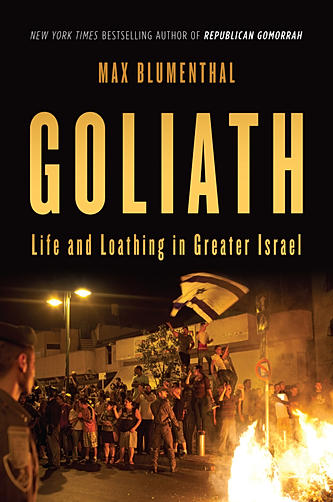 To appreciate the full anti-democratic ugliness of the Netanyahu era, read Max Blumenthal’s
  The Weekly Sift