The Monday Morning Teaser

When the Paris attacks happened, I expected a push to re-invade Iraq and put boots on the ground in Syria. (That’s why I focused last week’s featured post on the fact that ISIS wants us to do that.) What I wasn’t expecting, and feel a little silly about not foreseeing, was the demonization of Syrian refugees and American Muslims. That wave of public hysteria has been building all week, sweeping up even my own Democratic governor and congresswoman, and causing Republicans to say some things that sound downright fascist. (Explaining what I mean by fascist and why I think it’s appropriate to start using that word is what I’ve got planned for next week.)

But tempting as it is to blame politicians for all this craziness, I really think the problem is us, the American people. Some of us have gotten swept away by cruel, xenophobic impulses, and many of the rest of us have either taken a well-maybe-you’re-right, maybe-just-a-touch-of-fascism attitude. Or we were intimidated into silence, or defended our position in a way that just mirrored the hysteria of the other side. (That’s not how you talk somebody down.) Sad to say, our political representatives have been doing a pretty good job of representing us.

So if you accept that this is the public’s problem, the next thing you realize is that we’re going to have to step up and fix this. The insanity is only going to slow down if ordinary people stand up for reasonability in our conversations, our social media, and elsewhere. The politicians won’t get saner until the public gets saner.

How to take up that challenge is the subject of this week’s featured post, “In times of hysteria”. It will be out a little bit later than usual, maybe around 10 EST. That’s going to run a little long, so the weekly summary will be correspondingly thin: a variety of odds and ends concluding in a great song-and dance video. (We need something like that about now.)

Joining the Dance

Without knowing exactly why ISIS undertook these attacks, we risk dancing to their tune.

Will McCants

This week’s featured post is “A Meditation on Terrorism“.

This week everybody was talking about the Paris attacks

As I’ve said many times, a one-man blog is poorly equipped to cover breaking news. If you want to keep track of what is known, but avoid the TV networks’ often-baseless speculations and obsessive focus on the most recently revealed detail (which may turns out to be false two days later), I recommend rechecking the Wikipedia article from time to time. As new facts are established and old ones debunked, the article is updated to retell the story as currently understood.

The larger question, though, is how we should respond to attacks like this. My basic take on terrorism hasn’t changed since 2004, when I wrote one of my first popular blog posts “Terrorist Strategy 101: a quiz“, which I updated on its 10th anniversary with “Terrorist Strategy 101: a review“. I believe you shouldn’t view a terrorist attack through the same lens as military attacks, because the intention of the attacker is completely different.

The point of a military attack is to degrade a country’s ability to defend itself; by destroying something of military value, the attack is an end in itself. But the point of a terrorist attack is to provoke a response. So responding out of either fear or anger might be exactly what the enemy wants.

One advantage neo-cons have had since 9-11 is that they always have their frame well prepared: Every enemy is Hitler in 1938, and every response other than all-out war is Chamberlain betraying Czechoslovakia at Munich. The whole frame is already sitting in everybody’s head, and it leaps to mind the instant a neo-con uses one of its code words, like appeasement. The instant the frame is invoked, the favored response is obvious: Do whatever it takes to stop the Hitler-analog now, before he gets more powerful later.

That’s a really bad frame for thinking about ISIS. A few thousand jihadis in the Syrian desert don’t bear much resemblance to the nation of Germany, and less than a dozen guys in Paris with AK-47s and grenades are not General Guderian’s panzer corps. But a bad frame will win out against no frame, so we need to present a better way of thinking about this. That’s what I try to lay out in the extended analogy of “A Mediation on Terrorism“.


People always ask, “If Muslims don’t approve of terrorist attacks, why aren’t they saying so?” They are. Here are a bunch and here are a bunch more. It’s hard to miss them, if you want to see them. If you don’t want to see them, though, they’re invisible.


I haven’t vetted CaspianReport to any depth. It seems to be the work of one very dedicated guy, which makes me identify with him. But I’m not sure who he is or how he views his mission, so I’m not giving my full endorsement yet. But these two videos — one on the origins of ISIS and the other on terrorism in general seem very insightful.

And man, do I envy that logo.


and red coffee cups

Segueing from the serious to the ridiculous, I spent a chunk of Thursday morning trying to figure out whether the Christian outrage over Starbucks’ seasonal red coffee cups is a real thing. I don’t believe it is.

I mean, the red cups are real, and they are kind of minimalistic as holiday decorations go: just red with a green logo, rather than including a bunch of secular seasonal images of candy canes and snowmen and such, as Starbucks holiday cups usually do. But I kept feeling like I was being punked: I heard a lot more from people outraged at the ridiculous triviality of the Christian outrage than I heard from actual outraged Christians.

I think that was the point. It all started with an online rant posted by Joshua Feuerstein, a guy whose sole claim to fame is that he posts evangelistic rants. He’s not the leader of any face-to-face religious group. He has an online following, but it’s not clear how many of them are Christians who agree with him, as opposed to secularists who watch his stuff because his antics amuse them, aggravate them, or bolster their sense of superiority. So if he made you look, he won, and the joke was on you. (Correction: us.)

In my opinion, an even bigger joke was on the people who got counter-trolled: the Christians so upset to see people criticizing other Christians that they felt obligated to join in the original complaint, even though they never would have noticed or felt offended by the cups on their own. And then there were the people trying to pander to such people, like Donald Trump. (Loser!)

And the big winner? Starbucks, who dominated the national discussion for a day or two with no advertising expense. CNBC predicts they’ll wait a decent interval, release a cup with more traditional winter themes, and benefit from another huge wave of free publicity. (See the closing for another suggestion.)

and campus protests

By drawing the football team (and implicitly, its coach — not to mention the support of nine deans) into their protests, black activists at the University of Missouri managed to get the resignations of the university president and chancellor.

It’s kind of amazing how negatively this — and similar protests at Yale and elsewhere — have been covered. The gist of the complaint is that the university has tolerated a hostile environment for black students and faculty, in which they’re subject to racial insults and symbolic terrorism (like a swastika being drawn in human feces on a residence hall wall). No one is claiming that the administration has been actively against blacks, but it has showed no sign of regarding the hostile atmosphere as a big deal. Low points were when the president refused to talk to protesters that blocked his car during the homecoming parade, and when he defined systemic oppression by referring to what black students believe rather than anything real.

The black students have been widely characterized as whiny opponents of free speech, and yes, it’s true that Jackie Robinson and other civil-rights trailblazers endured far worse. But is that really the right standard? In 2015, should an African American need to be a Jackie Robinson to make it through a state university?

I’m also not buying the threat to free speech, or that our campuses are places where “political correctness” has run amok. (I stand by my definition of political correctness: “The bizarre liberal belief that whites, men, straights, Christians, the rich, and other Americans in positions of privilege should treat less privileged people with respect, even though such people have no power to force them to.”) As Sally Kohn wrote in The Atlantic:

“Political correctness” only acquired a name when, relatively recently in American history, the idea of treating others respectfully was finally extended to include how white people treat black people, how men treat women, and so on.

The last time Jonathan Chait went off on political correctness, I responded sarcastically:

it’s up to white men (like me and Chait) to decide whether your concerns deserve attention, or if you’re just being too sensitive. We’ll let you know what we decide, but until then try to keep the noise down so that you don’t disturb the neighbors.

I don’t see any reason to reconsider. In reality, campuses are not free speech zones and never have been. They’re more like bars. No bar would post a list of things you can’t talk about. But a good bartender tries to maintain a space where a diverse set of customers feels comfortable, and will not be afraid to tell one customer to tone it down if he’s chasing away some of the others. The University of Missouri — like a lot of American universities — has been doing a bad job of running its bar, when it comes to maintaining a good learning environment for black students. Hopefully it will improve under new management.

and another Republican debate

Until the Paris attack, the quote I was planning to lead with was Trevor Noah‘s:

One thing most pundits agreed on about last night’s Republican debate is that it was it was much better than previous debates, partly due to the fact that it had more substance — which is true, because bullshit is a substance.

I don’t want to repeat myself, so I’ll just say that what I outlined in “Three Hours in Bizarro World” still applies: Listening to a Republican presidential debate is like traveling to an alternate universe, one with its own history and facts and arithmetic. For example, it continues to be a place where you can drastically lower taxes, spend more money on the military, not cut any spending that people will notice or miss, and still balance the budget. Similar policies may have led to the greatest economic disaster since the Great Depression, but the Bush administration was a long time ago and no one remembers it any more.

If anything, Bizarro World has only gotten more bizarre since the candidates revolted against the third debate’s CNBC moderators. So the Fox Business Channel moderators of the fourth debate on Tuesday were careful not to notice when candidates dodged questions or said anything obviously false. They also phrased their questions in conservative NewSpeak, as when Gerard Baker opened a question on inequality with “Many are concerned that the new wealth seems to be going only to innovators and investors” rather than using, say, the equivalent phrase preferred by both Teddy and Franklin Roosevelt, malefactors of great wealth, or the more pedestrian rich greedy bastards.

But I will point out a few things that are either new or I neglected to mention in previous debate-response posts.

Syria. On Ben Carson’s statement that the Chinese are in Syria, Obama’s national security adviser Susan Rice says: “unless you’re talking about having a diplomatic presence, I’m not sure what he’s referring to”. I doubt he knows either, though Carson spokesman Armstrong Williams insists Carson’s claim is backed up by “our own intelligence and what Dr. Carson’s been told by people who are on the ground”. So I guess there’s a Carson Intelligence Agency now. Maybe they’re the ones who convinced him the pyramids weren’t built by aliens.

BTW, if the name Armstrong Williams rings a bell, it’s because of his role in the No Child Left Behind payola scandal.

The tax postcard. Ted Cruz managed to work in the two biggest applause lines from his stump speech: simplifying taxes so that you can fill out your return on a postcard, and abolishing the IRS. I’m waiting for a moderator to ask the obvious question: Who do you mail the post card to? Whoever that is, you may not call them the IRS any more, but they are the IRS. And unless they’re going to take your word for how much tax you owe, they’re going to have to behave a lot like the IRS does now.

Cruz’ postcard is worth looking at, because as soon as you picture filling it out, you realize he hasn’t made taxes that much simpler at all.

On line 1, you need to know your investment income, which means you’ll need to know the basis price of any investment you sold. And if you got dividends or interest payments, you’ll need to know what part represented a return of capital, and so on. Unless you expect the government to take your word about all this, you’ll have to be able to show your calculations if challenged. I’d suggest you retain the old Schedules B and D and fill them out just for your own records. And if part of your income is from self-employment, that’s going to be a whole different form with its own complexities.

Line 4 asks about your itemized deductions, which means you’ll have to understand how those are defined. Line 6 lets you deduct for a “savings plan”, so you’ll need to know which plans qualify and how much you’re allowed to deduct. Line 10 retains a tax credit for earned income and child care, so you’ll have to know whether you qualify for those and how to claim them.

In other words, if you have only the wage income reported on your W-2, and you take the standard deduction and don’t mess with the savings program or claim any tax credits, your taxes will be simple. But in that case, they’re simple now: the 1040-EZ form isn’t much bigger than Cruz’ postcard.

Line 9 is the only place where the flatness of Cruz’ tax makes a difference: you figure your tax by multiplying your taxable income (line 8) times 10%. But if he kept the progressive tax rates we have now, Line 9 could say “Look up your tax on the tax tables.” So the flat tax saves you maybe thirty seconds or so, at the cost of blowing a multi-trillion-dollar hole in the ten-year federal budget.

The three-page tax code. Related to Cruz’ postcard is Carly Fiorina’s “three-page tax code”. Fiorina is endorsing what is known as a Hall-Rabushka flat tax, named after the two economists who wrote a book describing it. CNN Money notes that the Hall-Rabushka tax code is kept short by using vague terms that would require “hundreds of pages of regulations” to define rigorously.

For instance, there might need to be more clarity around notoriously confusing areas of income and expenses, such as that for the self-employed. Where’s the dividing line between personal expenses and business expenses?

“Taxpayers want to claim all sorts of costs as deductible business expenses, and a lot of [today’s] rules are aimed at limiting such abuse. When is use of a car business or personal? What about meals? Can you hire your kid and pay her $100,000 for services rendered?” Burman said.

The complexity of the current tax code isn’t due to the perversity of the IRS, but to the ingenious justifications people dream up for not paying taxes. If taxes are going to be anything more than a voluntary pass-the-hat system, we’ll continue needing rules to disallow those schemes, even during a Fiorina administration.

The Fed. Rand Paul blamed the Federal Reserve for income inequality:

By artificially keeping interest rates below the market rate, average ordinary citizens have a tough time earning interest.

Yep, if only the people who are falling out of the middle class could get a higher interest rate on all that money they have in the bank, we’d have our inequality problem whipped. Paul also blamed the Fed for high inflation — which is only happening in his imagination — and claimed that  people making $20,000 a year are hurt worst by it. In the real world, the lowest inequality in American history was in the 1970s, when the annual inflation rate sometimes topped 10%.

Ads for Hillary. After Donald Trump called for a “deportation force” to track down and remove the 11 million undocumented immigrants, and cited Eisenhower’s Operation Wetback as a precedent that proves it can be done, Jeb Bush observed “they’re doing high-fives in the Clinton campaign right now” — which the Clinton campaign verified via Twitter.

Another Clinton high-five moment came when Trump and Carson both opposed raising the minimum wage. Trump cited “wages too high” as a factor making the U.S. non-competitive. (In addition to his general insensitivity, Trump is ignoring all those minimum-wage jobs that aren’t subject to foreign competition. I mean, I’m not going to Cambodia for an Egg McMuffin, even if they’re cheaper there. And no matter how little Honduran janitors earn, nobody’s going to ship a building to Tegucigalpa for cleaning.) And Carson echoed that black teen-agers are unemployed “because of those high wages”.

So if you’re making the federal minimum of $7.25 an hour, the Republican front-runners think your wage is high.

and you also might be interested in …

There was a Democratic debate in Iowa Saturday night. I haven’t had time to watch it yet myself. (One debate a week is about my limit.) According to most reports, both Sanders and O’Malley were more aggressive in attacking Clinton, though no one is reporting a serious knockdown moment.

If you thought O’Malley was angling for a VP slot with Clinton, he pretty well eliminated that possibility. If he were Clinton’s VP,  his assessment of the Obama/Clinton foreign policy would be in every Republican attack ad: “Libya is a mess. Syria is a mess. Iraq is a mess. Afghanistan is a mess.”


If you want to understand why it’s important to affirm that black lives matter, consider these two articles: Liam O’Ceallaigh looks at the bloody career of Belgium’s King Leopold II in “When You Kill Ten Million Africans, You Aren’t Called ‘Hitler’.” Nobody gets out of high school without hearing about the Holocaust, and you probably have at least some vague knowledge of the killing fields of Cambodia or the Armenian genocide. But Leopold’s genocide against the Congolese goes pretty much unnoticed. He is seldom mentioned among the great monsters of history, because, well, he just killed black people, and they don’t really count.

Now check out the Wikipedia article on the terrorist attack in Kenya in April. In terms of the number of deaths, it was similar to this week’s attacks in Paris. But even I have a reaction of “Oh yeah. I sort of remember that.” We can tell ourselves that all lives matter, but they don’t. Not really, not even among people like me. We’ve all got work to do.


I’ve given up on the fantasy of reading the Trans-Pacific Partnership treaty and making up my own mind. 3000 pages makes it a very boring equivalent of the entire Harry Potter series. So mostly I’m going to be relying on sources I trust on the various issues TPP affects.

So far that’s not looking good for the TPP. Here’s Grist‘s take on the environmental section.

and let’s close with something subtle

Flashing back to the most virulent-but-trivial controversy on the internet this year, here’s the cleverest response I’ve seen to the Starbucks-Christmas-cup flap: “Starbucks releases new White and Gold cups in hopes of offending less people.

A Meditation on Terrorism

Imagine you’re at one of those old-fashioned, bury-the-hatchet arranged weddings, where the son of your house is marrying the daughter of the enemy house. Picture it in as much detail as you can. The event has all the trappings of joy: A feast is cooking, a band is tuning up. And there’s some real joy in the air too: The long struggle might be over, and everybody present might be a survivor.

But there’s also tension. A few weeks ago, you were trying to kill these people, and they were trying to kill you. Some of them would still like to.

In particular, there’s one guy in the enemy camp who isn’t happy. He doesn’t like the peace, he didn’t like the terms of the treaty, and the war gave his life a sense of meaning that he doesn’t know how to replace.

As the reception starts, with the music and dancing and food, he looks around disgustedly. All of his friends, people he can remember swearing eternal vengeance with, are getting chummy with your friends. There’s got to be a way to put a stop to this.

That’s when he starts trying to pick a fight with you. First with jibes, then with open insults, and finally with shoves and even blows. You know what he’s up to: He’s hoping that once the fight breaks out, everyone will have to pick a side. All the old quarrels will be remembered and the war will start all over again.

What do you do? At first you tried to just ignore him and avoid him, but it’s really hard not to fight somebody who is determined to fight you. You can’t just let him kill you. But you also don’t want to let him write you into his script.

So your choice is not as simple as just fight or don’t fight. You can’t really avoid the fight, but your goal is that when the fight comes, it should stay between you and him, and not turn into a general brawl.

With that in mind, all your words and actions have to be chosen for the benefit of the larger audience. You’re a warrior. So if it were just between the two of you, you would answer insult for insult, and if he hit you, you would hit back harder. That’s how a warrior keeps a fight short: Let the other guy know that the price will higher than he wants to pay.

But that won’t work here, because he’s playing a different game. If he winds up bloodied, but the war restarts, he wins.

So yes, when he insults you, you answer him. But you have to focus on him personally, and not let your anger run away with you. Above all, you don’t want to shout out insults to his whole clan. This isn’t the kind of treachery you always expected from his side; this is just one guy being a jerk. And when you hit back, your blows have to be measured, so that it is clear to everyone which one of you keeps escalating. And you want to be sure you know what you’re hitting, so you can’t blindly throw things that might hit unintended targets.

Your goal is to survive, but your larger goal is for the peace between your peoples to survive. That makes everything more complicated.


I hope my analogy isn’t too hard to interpret: The West and Islam have a violent history that goes back to the Crusades and the fall of Constantinople and the Ottoman threat to Europe. ISIS wants that Clash of Civilizations back, and its leaders want to lead not just a gang of zealots in the desert, but a unified caliphate encompassing the world’s billion-plus Muslims.

The worst thing that could happen to ISIS would be for Muslim nations to assimilate into the world order, for parliamentary democracy to succeed in places like Turkey and Tunisia, and for Muslims in Western countries to be accepted and to think of themselves as French Muslims or Muslim Americans.

Attacks like the ones in Paris are intended to put a stop to all that. Militarily, they don’t amount to much. The civilian deaths are individually tragic, and collectively they strike at the pride of a great nation. But ISIS is not a existential threat to France. France cannot be defeated by attacking concert halls.

The same thing is true of ISIS’ affronts to America. The United States cannot be defeated by chopping off the heads of journalists or tourists. The point of these actions isn’t to destroy us, it’s to rile us up, in hopes that we will hit back harder, collaterally targeting a bunch of otherwise peaceful Muslims in the process.

ISIS needs the wedding reception to turn into a brawl.

The worst thing we could do in this situation is to play the role the terrorists have assigned us. Those politicians and pundits who either imply or proclaim openly that we are at war with Islam, and treat would-be Caliph al-Baghdadi as an existential threat to the West — they are doing al-Baghdadi’s work for him, and granting him a status he could never earn on his own.

That said, it’s too simplistic to jump to the other extreme and say, “Just ignore them.” If this attack doesn’t rile up the West, they’ll start planning a bigger one. It’s not a turn-the-other-cheek situation.

The important thing to remember, though, is which audience we should have in mind when we choose our words and actions. It’s tempting to narrow your focus and just see the person who’s goading you. But the real audience to our response isn’t al-Baghdadi or the jihadis who have already joined his cause, it’s all the world’s Muslims — especially the teen-agers who are trying to decide whether or not their dream of making it in the West or finding a place in the world for their country is really feasible.

If you’re a young Muslim in Paris or London or Berlin or Los Angeles, is there a place for you here? Or are the Christians and Jews and atheists just suckering you into betraying your heritage? If you’re in Cairo or Amman or Mosul, is a future of democracy and human rights worth your devotion? Or is your only hope for justice and self-respect out in the Syrian desert?

When you realize that the real battle is being decided inside the minds of these young people, it changes you. You’re not so quick to declare war on Islam, or to look at every local Muslim or refugee at the border as a potential terrorist. You realize that Islam is a word worth contesting, so you don’t give it away by tagging your enemy as “radical Islam”. (If you’re a Christian, think about how the phrase radical Christianity strikes you. Doesn’t it sound like something you should join? If somebody announces that he’s fighting against the radical Christians, is he your ally or your enemy? Why should a young Muslim feel differently?) And no matter how many terrorists you think are in some region, you don’t just kill everybody and let God sort it out.

Yes, once some group starts killing our civilians, we need to fight them. We need to take them down. But we also need to keep the fight as small as possible. The Clash of Civilizations is part of their plan. It shouldn’t be part of ours.


If you want to see this point of view worked out in more detail, you should read my 2014 post “Terrorist Strategy 101: a review“.

The Monday Morning Teaser

Friday night’s attacks in Paris made all my plans for today’s Sift obsolete. Naturally, a one-man blog can’t cover breaking news, so I’ll direct you elsewhere for that.

But there’s a larger issue of how the West should respond to terrorism launched by groups who claim to represent all of Islam. Getting the frame right is very important here. The neo-cons get this, so they always have the Munich frame handy: If we don’t stop ISIS now, they’ll just get stronger and be harder to stop later.

But a few thousand zealots in the desert between Syria and Iraq are not Germany in 1938. A handful of guys with AK-47s and grenades in Paris are not General Guderian’s panzer corps. Treating them as if they are might do more harm than good.

Realizing that the Munich frame doesn’t fit, though, doesn’t give us a better frame. I’ll take a shot at what the right frame is in this week’s featured post “A Mediation on Terrorism”. That should appear maybe 9ish EST.

In the weekly summary, I’ll recall some of my earlier (and longer) writings on terrorism. (Back in 2004, “Terrorist Strategy 101: a quiz” was one of my first blog posts to get a readership beyond my friends. On its ten-year anniversary, I updated it with “Terrorist Strategy 101: a review“.) I’ll also link to some other people whose views seem insightful.

But a weekly summary can’t be 100% grim, so I’ll also discuss the Starbucks red-cup controversy and make fun of some of the odder ideas in Tuesday’s Republican debate. By the time the Democratic debate rolled around on Saturday, I was already focused on Paris, so I’ll punt that to next week. There’s also the University of Missouri protests to talk about. And I’ll close by pointing out the one thing Starbucks could do to make the cup controversy even more contentious.

Products of Fear

Beware of the tiny gods frightened men create.

Hafiz (13th century)

This week’s featured posts are “I’d rather have Trump” and “Why are middle-aged whites dying?“.

This week everybody was talking about the off-year elections

In Houston, we saw that fear is still a winning tactic. A LGBT-rights ordinance decisively lost because it got characterized as a “bathroom ordinance” that sexual predators could take advantage of. Of course, similar ordinances exist elsewhere, and no one has assembled evidence that sexual predation is rising there. But how can you not want to protect that little girl in the commercial?

In Kentucky, it was the 2010 phenomenon all over again: When turnout is low, radical conservatives win. All those demographic projections that show the Republican electorate dying out mean nothing if Democratic constituencies don’t vote.

The one really encouraging result came from Ohio, where voters passed a measure that attempts to eliminate gerrymandering of state legislature districts. It has no effect on congressional districts, but it’s a step in the right direction.

and why white Americans are dying

I try to personalize the statistics in one of the featured posts.

and police vs. Tarantino

Movie director Quentin Tarantino has been called a “cop-hater” and accused of calling for “violence against police officers”. Police unions in New York and Los Angeles have announced boycotts of his new movie.

So what exactly did he say to incite all this? He spoke at a rally against police brutality and said:

What am I doing here? I’m doing here because I am a human being with a conscience. And when I see murder, I cannot stand by and I have to call the murdered the murdered. And I have to call the murderers the murderers.

Here’s the weird thing about this controversy: Cops are killing innocent unarmed people, or harmless people who have committed minor infractions. That’s not disputable; we have the video. Lots of video. Case after case, all over the country.

Everyone agrees that the vast majority of cops are not doing this. But for some reason they are choosing to identify with the ones who are. And by doing so, they are the ones who are slandering cops, not Tarantino. Tarantino is denouncing cops who murder people. If you then decide this is an offense to all cops, then you are the one saying that all cops are murderers. Not Tarantino.


Meanwhile, there was a weird turn in one of the stories that fed the war-on-cops meme. When a Houston deputy and an Illinois lieutenant were shot within a few days of each other last summer, suddenly the media — especially conservative media — were full of law enforcement officials blaming President Obama and Black Lives Matter for creating the hostile environment that had made it “open season on cops”.

Now that the case of Fox Lake, Illinois Lt. Joe Gliniewicz has been investigated, though, we get a different result: Gliniewicz’ death was “a carefully staged suicide … [that] was the end result of extensive criminal acts that Gliniewicz had been committing.” He had been stealing money from a program intended to mentor young people, and he staged his suicide to look like murder, hoping he would not be exposed.

Fortunately, the massive manhunt looking for the one black and two white men Gliniewicz had mentioned on the radio before his death didn’t turn up anyone fitting the description.


Trevor Noah captured the absurdity of some of the defenses of police:

The police are just trying to make a basic point: People are treating them unfairly just because of who they are and how they look. People keep following them around with cameras, watching everything they do, suspicious that they’re always about to break the law, leaving police afraid to even get out of their cars for fear that someone might whip out a phone and brutally film them. Who can imagine how that must feel? And if you listen carefully, all the police are saying is “phones down, don’t shoot.”

and Ben Carson

Carson is neck-and-neck with Donald Trump for leadership in the national polls of Republican voters. This week he faced a bunch of bad publicity, as I discuss in one of the featured posts. Whether this will puncture his bubble or give him increased cred for being “persecuted” by the “liberal media”, I can’t predict.

and you also might be interested in …

The Keystone Pipeline is dead. The process was agonizingly slow, but in the end President Obama seems to have played it right. He stalled until circumstances swung against the pipeline, and his decision seems more like a final nail in the coffin than a deathblow.

I stand by pretty much everything I wrote in “A Hotter Planet is in the Pipeline“. The big thing I learned in researching that article was that if we’re going to avoid a climate disaster, most of the fossil fuels we’ve already discovered will have to stay in the ground. That’s a fact that’s hard to wrap your mind around, and I think most Americans still don’t grasp it.


This week’s guns-make-us-safer story comes from a Cracker Barrel in Sanford, Florida, where a man’s gun fell out of his holster and went off. According to The Palm Beach Post, the bullet hit a kettle and split into fragments, wounding three people, including the gun-owner’s fiance. (Dump that loser, girlfriend.)

As somebody — I wish I could remember who — was saying on Facebook, incidents like this are treated as accidents, but they’re really not; they’re negligence. WFXT’s legal analyst says, “.” But if so, that law needs to be changed. Carrying a gun is serious business. If you don’t know how to keep it from going off, then you are endangering the public every time you go out armed.

Politically, that’s a gun-control battle I’d like to see. Make the NRA defend these bumbling fools, rather than spin fantasies about the John-Wayne-like good guy with a gun.


I didn’t post a guns-make-us-safer story last week, but I missed this one:

When Naomi Bettis called 911 on Halloween morning to report a gunman going on a shooting rampage in the streets of Colorado Springs, Colorado, it was her second call for help. Bettis had earlier called 911 to report a suspicious man brandishing a rifle, only to be told by the emergency operator that no help was coming because Colorado is an open-carry state.

That delay contributed to three people winding up dead.

The rationale for banning open carry is similar to that for banning drunk driving: Neither the drunk driver nor the guy walking down the street with a rifle has hurt anybody yet. And maybe they won’t. (Every night, I’ll bet thousands of drunks drive home without incident.) But it might be a good idea for police to notice them sooner rather than later.


Juan Cole begins his discussion of Ahmad Chalabi’s death with a Clarence Darrow quote: “I’ve never killed anyone, but I frequently get satisfaction reading the obituary notices.” Hoping to be set up as a pro-American ruler, Chalabi led the Iraqi exile group that fed the Bush administration the false intelligence it needed to justify invading Iraq. Cole concludes:

Chalabi was an accessory to one of the great crimes of the twenty-first century, the launching of an aggressive war with no casus belli and the ruination through incompetence and sectarianism of a great country.

and draws this lesson:

Persons full of overweening ambition and dedicated to the pursuit of narrow self-interest can often destroy the very prize that they so eagerly sought, crushing it to death in a satanic embrace.


The October jobs report was encouraging, with unemployment ticking down to 5% and the underlying numbers also looking good. For a little perspective, one of Mitt Romney’s promises was that his administration would create so many jobs that unemployment would go down to 6% by the end of his first term in 2017.

A statistic frequently quoted by people who don’t want to give the Obama administration credit for anything is the number of Americans not in the labor force. The Wall Street Journal took a look at who these people are and wasn’t particularly alarmed. Most of them are retired or in school.

None of this is to say that the American economy is unbelievably great or unusually rosy. By almost any conventional labor market measurement the economy has yet to recover from a recession that started almost eight years ago. But the notion that 92 million Americans are unaccounted for, that there’s a conspiracy in these statistics, or that we have no idea what 20 million prime-age Americans are up to, just isn’t right.

and let’s close with something both smart and amusing

Thames Valley Police explain the issue of sexual consent with a very British analogy.

Why are middle-aged whites dying?

I’m doing fine, but my cousin is dead.


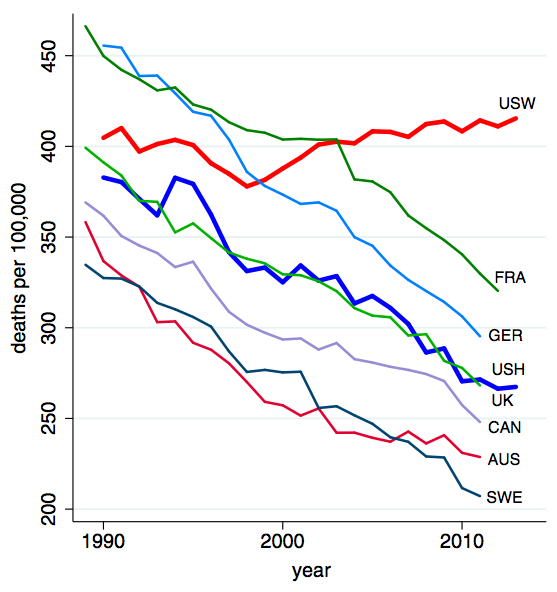
Look at this graph:

In 1990, the death rate for American whites aged 45-54 (USW) was within the normal range of similarly aged people in comparable countries, and similar to the death rate for middle-aged American Hispanics (USH). In all the other countries, death rates continued their centuries-long trend of dropping, with USH tracking the United Kingdom rate almost perfectly. But starting in 1998, USW turns up.

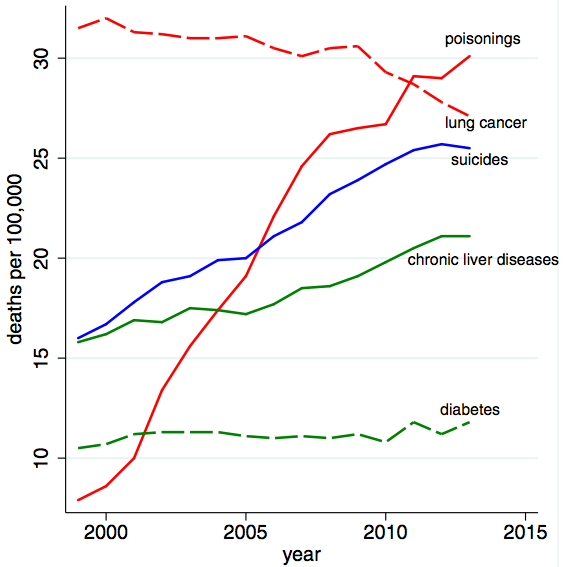
A good summary of this new study is in The Atlantic. The upshot is that about half a million American whites are dead who would be alive if USW death rates had followed the downward track of other first-world countries. The effect seems concentrated in the less-educated classes, and the cause is a sudden jump in the rate of what are called “poisonings” — mainly deaths related to alcohol and drugs — as well as an increase in suicides and other causes related to not taking care of yourself. Atlantic concludes that middle-aged whites “are dying of despair”.

This feels personal to me. My father was a high-school-educated white who was an adolescent during the Depression. For most of my childhood, he had a good-paying factory job that allowed him to buy a small farm that he worked on the side. Needless to say, he was a hard-working guy. But he also saw himself as extremely successful: He owned a house nicer than the one he grew up in, sent his kids to college, and after he retired had a winter home in Florida. He lived to be 90.

I took advantage of the opportunities my parents gave me and got a PhD. I also feel successful, and am in excellent health at 59. But what if, rather than reaching for a better life than my father’s, I had tried to duplicate his success? It wouldn’t have worked. The good-paying no-college-needed jobs went away during my lifetime. I probably would have bounced from one low-status job to another, always wondering why I couldn’t live at the level I had thought was normal for people like me. Compared to my father, I would be a failure.

That pretty well describes one of my cousins, who had alcohol problems for most of his adult life and died a little younger than I am now.

What we’re seeing here, I believe, is the end result of privileged distress. It’s still not objectively harder to be white in American than non-white, but the traditional privileges of whiteness have shrunk, particularly for the working class, while visions of how life is supposed to be (for white people) are pegged to the achievements of our parents. Consequently, it gets harder and harder for working-class whites to live up to the expectations they were raised to have. By middle age many feel like failures, and live with a corresponding lack of self-regard.

Is it any wonder they look for scapegoats, like the Hispanic immigrants, and are attracted to anger-channeling politicians like Donald Trump? They cheer when Trump says America is going to start winning again, and they love to identify with him when he calls his opponents “losers” — because looking down on somebody else is very satisfying when you feel like a loser yourself.

I’d rather have Trump

Who expected that when the Republicans anointed a new front-runner, it would be somebody worse?


Ever since he announced his candidacy last summer, political insiders have been telling us that Donald Trump was a fluke of the season: It was early in the process, and people weren’t serious yet. As the primaries got closer, Trump would fade and a more acceptable mainstream candidate like Bush or Rubio or Walker would emerge. Pundits recalled the 2012 cycle, where boomlets for far-out candidates like Michele Bachmann or Hermann Cain came and went every few weeks, but the establishment eventually nominated its man, Mitt Romney. As John Podhoretz put it:

Most of those who are telling pollsters they support the outsiders are basically dating Trump and Carson. They’ll likely settle down with someone else.

And Ross Douthat predicts GOP primary voters will soon start saying this to themselves:

The Donald is fun and I admire Carson, but let’s get real: I’m going to vote Rubio.

Well, according to the Real Clear Politics poll average, Trump replaced Jeb Bush as the front-runner on July 20, and stayed on top not for just a few weeks, but until November 4. And then, it wasn’t Bush or Rubio who passed him (Walker being long gone, along with fellow mainstream GOP candidate Rick Perry). No, in the November 4 average, Ben Carson took the lead with 24.8% to Trump’s 24.6%. [1]

To me, that’s a sign not that things are settling down, but that they’ve wobbled even further off course.

The Music Man. When I think of Donald Trump, the word that comes to mind is huckster. He’s a darker version of Harold Hill from The Music Man, spinning a vision of how fantastic things will be if people do what he wants. Right now we’re looking at trouble in River City, but after we elect him America will be great again. There will be lots of good jobs for real Americans, because he’ll throw out all the Mexicans who are stealing them now, and build a big, beautiful wall to stop any more from coming in. Don’t worry about what that wall will cost, because Mexico will pay for it (from its vast storehouse of wealth). China will stop dumping cheap stuff into our economy, Putin will behave, and we’ll finally crush ISIS. Taxes will be low, and we won’t have to do without any important government service, but there won’t be a deficit.

What’s not to like? [2]  After I hear Trump speak, I can’t get “76 Trombones” out of my head.

It’s hard to be a good huckster, though, if you don’t also know a lot about how the real world works. So if you look inside Trump’s business empire, I’ll bet somewhere you’ll find a legal department that hires lawyers and an accounting department full of accountants. Middle management probably includes a lot of MBAs. I haven’t noticed any of his flashy buildings falling down, so I suspect they are designed by architects and built by engineers.

That’s why, although I would expect a Trump administration to do a lot of things I wouldn’t like, I picture it doing them in a fairly sensible way. Whatever crazy things he had to say to get elected, once he was in office he’d get his economic advice from economists, his military advice from generals, and so on. His priorities would be misguided and some people would get hurt, but we’ve survived bad presidents before.

Carson is different. When you watch Ben Carson, it’s tempting to view him through the lens of Trump, as this Nick Anderson cartoon does: They say similarly crazy things, but in different styles.

But this week Carson had two major bursts of bad publicity, and in one of them [3] we see a personality type very different and far more dangerous than the huckster: Ben Carson is a crackpot.

Now, we’ve had reason to suspect Carson of crackpottery for some time, because his whole campaign has been a fountain of strange notions: The Holocaust wouldn’t have happened if Germany’s Jews had been armed; anarchy might force the 2016 elections to be cancelled; Russian president Putin, Palestinian leader Abbas, and Iranian leader Khamenei were all students together in 1968; Medicare and Medicaid fraud amounts to half a trillion dollars; Satan motivated Darwin to create the theory of evolution; and the signers of the Declaration of Independence had no elected office experience. He found fault with the victims of a mass shooting. He told Fox News’ Megyn Kelly: “I never saw a body with bullet holes that was more devastating than taking the right to arm ourselves away.” He wants to use the Department of Education to police liberal (but not conservative) bias at colleges and universities (and justified the need for such policing by citing an event that didn’t quite happen the way he claimed).

But even the odd sound bites don’t capture the weird vibe you’ll pick up if you listen to longer chunks of Carson’s speeches. He has the crackpot’s way of saying certain common phrases as if they had an occult meaning. Political correctness, for example, is far more sinister than just an exaggerated fear of giving offense, and secular progressives are much more dangerous than just liberals who don’t go to church. Why? I haven’t been initiated into that priesthood, so I can’t guess.

Many of his stranger ideas come from a Cold War era kook, W. Cleon Skousen, a man that even the conservative National Review has characterized as an “all-around nutjob“. In an interview with Alan Colmes, Carson recommended reading Skousen’s 1958 conspiracy-theory screed The Naked Communist as a way to see the connections between Hitler’s Mein Kampf, the writings of Lenin, Saul Alinsky’s Rules for Radicals, and the Obama administration. [4]

Pyramids. This week all doubt about Carson’s crackpottery was removed when Buzzfeed unearthed a 15-minute clip from the commencement speech Carson gave at Andrews University in 1998.

At around the 3-minute mark, he starts talking about the career of the Biblical patriarch Joseph as prime minister of Egypt, building up a grain surplus from the seven fat years to eat during the seven lean years. Andrews is a religious institution (associated with Carson’s own Seventh Day Adventist denomination), so recounting a famous Bible story is a perfectly reasonable thing for a commencement speaker to do. But then Carson goes off the rails and starts talking about the pyramids. As you listen, bear three things in mind:

  • The pyramids aren’t any part of the Joseph story as recounted in the Bible. Nor do they figure in any other Bible story; the Bible is pyramid-free.
  • Nobody asked Carson about the pyramids.
  • The pyramids don’t seem to have anything to do with the overall themes of his speech.

In other words, he just saw a microphone in front of him and decided to lay this bit of wisdom on his audience:

My own personal theory is that Joseph built the pyramids in order to store grain. Now, all the archaeologists think that they were made for the pharaohs’ graves. But, you know, it would have to be something awfully big — when you stop and think about it, and I don’t think it would just disappear over the course of time — to store that much grain. And when you look at the way the pyramids are made, with many chambers that are hermetically sealed, they would have to be that way for a reason.

And, you know, various scientists have said, “Well, you know, there were alien beings that came down, and they had special knowledge and that’s how [garbled, maybe ‘they arose’].” And, you know, it doesn’t require an alien being when God is with you. And that’s really the key. People may not even be able to explain what it is that you’re accomplishing. But they don’t have to be able to explain it when God is there. All you have to do is accept His presence, and His total understanding of everything and link yourself with that.

All the archaeologists think one thing, but I’m a smart guy, so why shouldn’t I have a different opinion and include it in my commencement speech, even though I have no idea what I’m talking about? (He’s not joking; nobody laughs.)

And the competing theory Carson rejects — and attributes to “scientists” — is that aliens built the pyramids. (Though, I suppose, if you imagine the pyramids being built during a seven-year period, you’d need more-than-human tech.) I mean, run the experiment yourself: Google “aliens built the pyramids”. You don’t get references from Nature or Scientific American. You get a rival camp of crackpots.

This is not some unfair reference to Carson’s misspent youth. (Every interesting person has believed something weird if you go back far enough. Heck, I used to be a libertarian.) When asked, Carson verified that, yes, he still believes Joseph built the pyramids. Present-day Ben Carson attributes criticism of his pyramid theory to those ubiquitous “secular progressives”, and so tries to turn it into an argument about religion and exploit the persecution complex many conservative Christians share: Are we saying a Biblical literalist can’t be president? How is that different from a statement Carson took heat for, that a Muslim shouldn’t be president?

But the point is far simpler than that, and doesn’t depend on bias against any particular religion or even religion in general: A crackpot shouldn’t be president. I don’t care if he or she is Christian, Muslim, atheist, or whatever. If (as Paul Waldman puts it) your beliefs are “impervious to evidence” and you hold them with an “an alarming lack of what we might call epistemological modesty”, then you shouldn’t be president. [5]

Contempt for expertise. Carson’s I-thought-about-this-for-five-minutes opposition to “all the archaeologists” is a symptom of a larger problem: his contempt for people who study things and know them more deeply than Carson does. Consider this recent Carson tweet:

It is important to remember that amateurs built the Ark and it was the professionals that built the Titanic.

In the context of the pyramid quote, you realize that this isn’t just a quip. Carson really means it: Noah’s Flood is a historical event, and the Ark is one of the great achievements of ancient engineering — more evidence of what you can accomplish when God is with you.

In interview after interview, Carson proves that he hasn’t bothered to study for the presidency; he seems to believe that a president doesn’t need to understand things any better than he already does. Marketplace‘s Kai Ryssdal interviewed him on economic issues, and the transcript makes scary reading. When asked about raising the debt ceiling, Carson seems not to grasp what it is, talking instead about refusing to increase the budget. And when asked what he would cut to balance the budget, he offers nothing, and doesn’t even seem to think it would be his job to do so.

Take every departmental head, or sub-department head and tell them, “I want a 3 to 4 percent reduction.” Now anybody who tells me there’s not 3 to 4 percent fat in virtually everything that we do is fibbing to themselves. … They would have to find a place to cut. … I would provide the kind of leadership that says, “Get on the stick guys, and stop messing around, and cut where you need to cut, because we’re not raising any spending limits, period.”

Because, apparently, no previous president has thought to tell Congress or the bureaucracy to “get on the stick”.

He has proposed a flat tax (based on the Biblical notion of tithing), but doesn’t know what the rate will be. When challenged during the CNBC debate by moderator Becky Quick, who thought his plan would blow a hole in the budget even at the highest rate he has considered (15%), he told her that her math was wrong. It wasn’t.

The Carson cabinet. Think about what all this portends for a Carson presidency. Unlike Trump, he wouldn’t be looking for advice from economists or generals or constitutional lawyers, or from people who speak foreign languages and study foreign cultures and know the history of the conflicts we’re getting involved in. Those “experts” are like the builders of the Titanic. Instead, President Carson would be looking at potential cabinet members and asking “Is God with them?”. If so, then he’d count on them to build whatever arks or pyramids America needs.

That doesn’t sound like The Music Man, it sounds like the Children’s Crusade of the 13th century.

A boy began preaching in either France or Germany claiming that he had been visited by Jesus and told to lead a Crusade to peacefully convert Muslims to Christianity. Through a series of supposed portents and miracles he gained a considerable following, including possibly as many as 30,000 children. He led his followers south towards the Mediterranean Sea, in the belief that the sea would part on their arrival, allowing him and his followers to march to Jerusalem, but this did not happen. They were sold to two merchants (Hugh the Iron and William of Posqueres) who gave free passage on boats to as many of the children as were willing, but they were actually either taken to Tunisia and sold into slavery by the cruel merchants, or died in a shipwreck on San Pietro Island off Sardinia during a gale.

A crackpot president poses a far greater danger than a huckster president. The huckster knows that he’s spinning a yarn, and understands that he’s going to have to finagle something when his story starts meeting the real world. But the crackpot doesn’t grasp this. He’ll walk right onto his invisible bridge and plunge into the abyss. And anybody who follows will plunge in after him.


[1] By Saturday, Trump had regained a similarly tiny lead. It’ll probably take a week or so for this to settle out.

[2] Unless, of course, you’re one of those Mexicans he’ll throw out, or care about any of them. So Trump’s vision looks good — to steal a phrase from a recent novel — “not counting the people who don’t count”.

[3] The kerfuffle I’m not going to say much about centers on a variety of anecdotes contained in Carson’s autobiography Gifted Hands. CNN went looking for other people who might have remembered these incidents, and couldn’t find any.  Politico claimed Carson had admitted one of them was false, but then had to tone down its headline, though it claims it stands by the story.

Let me explain why these reports don’t bother me: When Carson wrote Gifted Hands in 1992, the point was to tell an inspiring up-from-poverty story, not to build a case for becoming president. He wanted black kids in dodgy situations to realize that it wasn’t too late to turn their lives around and do something fantastic. So if he exaggerated how bad his life got before he turned it around to become a famous surgeon, that’s like a perfectly trim fitness instructor fibbing about how fat a slob she used to be.

I’m not inclined to hang him for it, because the overall story of Gifted Hands is still true: He was born into a bad situation and succeeded anyway. (But the NYT’s Charles Blow takes a harsher view.)

Now, his response to these criticisms — attributing them to “the liberal media” or “secular progressives”, and shooting back by referring to weird theories about Obama’s past that the press supposedly let slide — does bear on the crackpot question.

[4] Having finally read Rules for Radicals, I suspect Carson gets all his information about it from somebody else, probably fellow Skousen fan Glenn Beck. The book itself bears no resemblance to what Carson says about it.

You have to recognize that one of the rules in Saul Alinsky’s Rules for Radicals, is you make the majority believe that what they believe is no longer relevant and no intelligent person thinks that way and the way you believe is the only way intelligent people believe. And that way they’ll keep silent. Because I’ll tell you something. They don’t care if you don’t believe what they believe, as long as you keep your mouth shut.

There is no way that Carson has actually read the book, if this is what he thinks it says. A more accurate summary of Alinsky’s views is in his Playboy interview, done shortly before his death.

My only fixed truth is a belief in people, a conviction that if people have the opportunity to act freely and the power to control their own destinies, they’ll generally reach the right decisions. The only alternative to that belief is rule by an elite, whether it’s a Communist bureaucracy or our own present-day corporate establishment.

[5] As a further example of “lack of epistemological modesty”, Waldman references a later part of the commencement address, when Carson relates how he stumped a scientist with a simple question:

Would you just reconcile those two things for me, the Big Bang and entropy? Well of course he has no answer for that.

Carson repeated that anecdote almost word-for-word this September, which caused FactCheck.org to produce the answer Carson’s scientist couldn’t. It’s not that complicated, for people who want to understand it. I sincerely doubt that the conversation Carson describes really happened, because no scientist worthy of the name would be flustered by Carson’s question.

This stumping-the-scientist-with-an-obvious-question story is one of the mythic anecdotes you will hear often if you hang around in fundamentalist and evangelical circles. Others include the-famous-atheist-who-converted-on-his-deathbed and the-skeptic-who-set-out-to-list-all-the-Bible’s-contradictions-and-instead-found-God. The names and circumstances in the stories change, but the motifs have been around for centuries. They are basically religious urban legends. (So no: Christopher Hitchens did not convert on his deathbed; neither did David Hume or Thomas Paine.)

The Monday Morning Teaser

On Wednesday, Ben Carson took the lead over Donald Trump in the Real Clear Politics polling average (though Trump had regained a small lead by Saturday). Probably not coincidentally, Carson had two runs of bad publicity this week: One of them (the exaggerations in his autobiography) makes me shrug, while the other (Joseph built the pyramids) points out exactly why I think Carson is the scariest candidate in the race. I’ll talk through my thought process in this week’s featured post “I’d rather have Trump”. It just needs a proofreading, so it should be out soon.

The weekly summary will discuss the off-year elections, developments in the so-called “war on cops”, and another in the weekly series of guns-make-us-safer stories, before closing with a highly amusing (and very effective) video about sexual consent from a British police department.

I haven’t yet decided what to do with one of the week’s most interesting stories: a study showing that middle-aged whites who haven’t been to college are dying at a surprising rate, but only in the United States. It’ll either be a few paragraphs in the summary or spin out into a short article. Either way, the weekly summary will probably be late this week.

Losing to Idiots

[Chess Grandmaster Aron] Nimzowitsch … once missed first prize in a tournament in Berlin by losing to Sämisch, and when it became clear he was going to lose the game, Nimzowitsch stood up on the table and shouted, “Gegen diesen Idioten muss ich verlieren!” (‘That I should lose to this idiot!”)

Chess Review (1950), quoted by Wikipedia

I’ve about had it with these people. … We’ve got one candidate that says that we ought to abolish Medicaid and Medicare. Have you ever heard of anything as crazy as that? … We’ve got one person saying we ought to have a 10% flat tax that’ll drive up the deficit in this country by trillions of dollars. … We’ve got one guy that says we ought to take 10 or 11 million people … and pick them up and take them to the border and scream at them to get out of our country. That’s just crazy! … We’ve got people proposing health care reform that’s going to leave, I believe, millions of people without adequate health insurance. What has happened to our party? What has happened to the conservative movement?

— John Kasich, 10-27-2015

Ben Carson 26%, Donald Trump 22% … John Kasich 4%

— CBS/NYT poll, 10-27-2015

This week’s featured article is my attempt to explain Black Lives Matter to conservative Christians. It’s called “Samaritan Lives Matter“.

For months, July’s post “You Don’t Have to Hate Anybody to be a Bigot” has been asymptotically approaching 100,000 views. (Every week I’ve thought, “Two more weeks at this rate and it’ll get there.”) Well, it finally made it this morning. It’s the Sift’s third 100K post.

This week everybody was talking about Obama sending troops to Syria

So far he’s not talking big numbers: less than 50, with a mission to “assist” groups fighting against ISIS and call in air strikes. I have four problems with this.

First, I haven’t heard any explanation of exactly what the 50 are supposed to accomplish and why 50 is the right number to achieve that purpose. And that makes me wonder if in a month or two we’ll need 100 or 500 troops to do something equally vague. DefenseOne describes

the beginning of this new strategy in the war against [ISIS], which will focus in Iraq on helping security forces retake Ramadi and Bayji and then eventually Mosul. In Syria, the immediate objective is to take and ultimately hold ISIS’s self-declared capital of Raqqa.

But what the final we-can-leave-now objective is, I have no idea.

Second, you know ISIS will put a high priority on capturing a few of those Americans and beheading them on YouTube. And you know what will happen then: Americans back home will start clamoring to “get the bastards”, and it will be hard to resist mounting a full-scale invasion. Weirdly, that’s what ISIS wants: It has an apocalyptic vision, and the apocalypse won’t be complete until an American army arrives.

Third, I’m not sure who or what we’re fighting for. I know ISIS is bad. The Assad regime is also bad, but maybe not as threatening to us or our regional allies as ISIS. Iran and Russia and Hezbollah are helping Assad, and we’re happy about that when they attack ISIS, but not so happy when they attack other Syrian rebels. But even calling them “other Syrian rebels” makes the situation sound less chaotic than it is. Another DefenseOne article claims:

By one count from 2013, 13 “major” rebel groups were operating in Syria; counting smaller ones, the U.S. Defense Intelligence Agency puts the number of groups at 1,200.

Finally, Congress needs to authorize this. I know the Republican leadership doesn’t want any responsibility for either endorsing or stopping Obama’s moves against ISIS. But they’re Congress, damn it. They do have responsibility, whether they want it or not. The country needs the kind of intelligent debate that we had before the Gulf War in 1991.

and the budget deal

John Boehner kept his promise: He got Paul Ryan elected Speaker, and “cleaned the barn” before Ryan picked up the gavel. The debt limit is suspended until March, 2017, and a new budget deal circumvents the sequester agreement of 2011 to increase both military and domestic spending. Rather than Boehner’s barn-cleaning phrase, I would call it “releasing the hostages”. I’m sure Tea Partiers will try to find something else they can shut down the government over, but for now it looks like we will avoid such artificial crises for a while.


Paul Ryan has promised to re-impose the Hastert Rule, which says that the Speaker won’t bring a bill to the floor unless a majority of the Republican caucus supports it. Since there are 247 Republicans in the 435-member House, that means that 124 Republicans — less than 30% of the total House — can block any legislation. If Speaker Boehner had stuck to the Hastert Rule, the United States would be hitting its debt ceiling on Thursday, unleashing chaos in the global economy.

Here’s what the Hastert Rule should mean to American voters: If you don’t like the positions taken by most Republican congressmen, you should vote against the Republican in your district even if your local Republican candidate sounds reasonable. If your representative isn’t in “the majority of the majority”, his or her vote isn’t going to count for much, other than to empower the more conservative Republicans who dominate the caucus.

and the third Republican debate

The thing to know about the third Republican debate [held Wednesday; here’s the video and transcript] was that the candidates didn’t debate each other, they debated the moderators and rebelled against the whole concept of facts or accountability. As in the second debate, the biggest applause came whenever a candidate clearly and boldly stated something that isn’t true. (NowThis News made a video collecting some of the biggest lies.)

Slate’s Jamelle Bouie:

The problem isn’t that CNBC engaged in “gotcha” questions meant to “embarrass” the Republican candidates. It’s that any serious look is a fatal blow to GOP plans and proposals, which don’t deliver on promised substance. Trump can’t deport millions of immigrants; Carson can’t raise enough revenue to fund the federal government; and the “middle-class” tax plans of Bush, Rubio, and others shower most of their benefits on the rich. And as long as this is true, GOP candidates will have a hard time with all but the most friendly moderators.

and William Saletan:

What happened in this debate wasn’t an attack by the press on the candidates. It was an attack by the candidates on the press. Harwood, Quick, and the other CNBC panelists were no harsher to the Republicans on Wednesday than CNN’s Anderson Cooper was to Clinton and other Democrats in their debate two weeks ago. What was different this time was the reaction. Presented with facts and figures that didn’t fit their story, the leading Republican candidates accused the moderators of malice and deceit.

and Ezra Klein:

the problem for Republicans is that substantive questions about their policy proposals end up sounding like hostile attacks — but that’s because the policy proposals are ridiculous, not because the questions are actually unfair.

Here’s the strangest thing about the objections to the “liberal media” in this debate: If you’ve ever watched CNBC, you know that it isn’t liberal. Its target audience is the investing class, and it panders to them the same way that the Food Channel panders to foodies. In fact, the event usually cited as the beginning of the Tea Party was a Rick Santelli rant on CNBC in 2009. Santelli was one of the questioners Wednesday night. Not even Ann Coulter was buying that CNBC asked more hostile questions than Fox News did in the first debate.

What about Ted Cruz’ claim that the Democrats got softball questions in their debate? Nope.


A few of the other falsehoods in the debate deserve special attention. Chris Christie’s claims about Social Security were outrageous. First:

The government has lied to you and they have stolen from you. They told you that your Social Security money is in a trust fund. All that’s in that trust fund is a pile of IOUs for money they spent on something else a long time ago.

What he means by “a pile of IOUs” is that the Social Security Trust Fund has invested its money in Treasury bonds. If a private pension fund did that, the only complaint auditors might make is that it is too conservative an investment strategy. If your IRA contains government bonds, or mutual funds that own government bonds, you also are basing your retirement plans on “a pile of IOUs”.

And then he said:

Social Security is going to be insolvent in seven to eight years.

That claim is entirely baseless. The WaPo fact-checker: “Christie loves to say this but that doesn’t make it true.” The Social Security Trustees Report says:

Interest income and redemption of trust fund assets from the General Fund of the Treasury will provide the resources needed to offset Social Security’s annual aggregate cash-flow deficits until 2034.

Candidates should be talking about what happens after 2034, but that’s no excuse for Christie’s scaremongering.


Ben Carson was asked about his involvement with the shady nutritional-supplement company Mannatech, which has claimed its products can cure autism and cancer. He said

I didn’t have an involvement with them. That is total propaganda.

Jim Geraghty of National Review — usually considered a key part of the conservative media — recounted the Carson’s history with Mannatech and commented:

Carson’s lack of due diligence before working with the company is forgivable. His blatant lying about it now is much harder to forgive.


The only “lie” the candidates wanted to discuss, though, was what Hillary Clinton said about Benghazi in 2012. Marco Rubio launched this attack:

Democrats have the ultimate SuperPac. It’s called the mainstream media. … Last week, Hillary Clinton went before a committee. She admitted she had sent e-mails to her family saying, “Hey, this attack at Benghazi was caused by Al Qaida-like elements.” She spent over a week telling the families of those victims and the American people that it was because of a video. And yet the mainstream media is going around saying it was the greatest week in Hillary Clinton’s campaign. It was the week she got exposed as a liar.

The truth, which is well known, is that while Clinton did offer different explanations of the Benghazi attack during that first week, she was also getting a changing story from intelligence sources. If you dislike her, you can decide to interpret those facts as her lying, but her “fog of war” explanation also fits the facts.

I’m puzzled by why Republicans see the possibility that Clinton might have lied as a moral disqualification, while Carson’s Mannatech lie, or Christie’s Social Security lie, or Carly Fiorina’s claim to have watched a non-existent Planned Parenthood video (among other liberties she takes with the truth) aren’t.


The root problem here is discussed in Mike Lofgren’s “GOP and the Rise of Anti-Knowledge“.

Thanks to these overlapping and mutually reinforcing segments of the right-wing media-entertainment-“educational” complex, it is now possible for the true believer to sail on an ocean of political, historical, and scientific disinformation without ever sighting the dry land of empirical fact.

Ted Cruz solution to the debate “problem” is to take Republican debates entirely into the conservative news bubble. He’d like to see Rush Limbaugh, Sean Hannity, and Mark Levin moderate.

and meat

I had a hard time finding a good article about the International Agency for Research on Cancer’s classification of processed meat as a “definite” cause of cancer and red meat as a “probable” cause. Lots of news sources sensationalized the story, like The Guardian‘s headline: Processed meats pose same cancer risk as smoking and asbestos, reports say.

Well, not exactly. The Cancer Research UK blog did much better.

As Professor Phillips explains, “IARC does ‘hazard identification’, not ‘risk assessment’. That sounds quite technical, but what it means is that IARC isn’t in the business of telling us how potent something is in causing cancer – only whether it does so or not.”

So, yes, bacon and sausage are now in the same definite-cause category as tobacco, but that doesn’t mean that Egg McMuffins are as dangerous as cigarettes. Cancer Research UK quantifies using a 2011 study from the World Cancer Research Fund:

We know that, out of every 1000 people in the UK, about 61 will develop bowel cancer at some point in their lives. Those who eat the lowest amount of processed meat are likely to have a lower lifetime risk than the rest of the population (about 56 cases per 1000 low meat-eaters).

If this is correct, the WCRF’s analysis suggests that, among 1000 people who eat the most processed meat, you’d expect 66 to develop bowel cancer at some point in their lives – 10 more than the group who eat the least processed meat.

If nobody smoked, the article estimates, there would be 64,500 fewer cancers per year in the United Kingdom. If nobody ate processed meat, 8,800 fewer cancers.

The upshot isn’t that you should swear off hot dogs forever, but that if you eat a lot of them, you’d probably be healthier if you cut down. But you knew that already.


For balance, I have to link to this: “World Health Organization Warns that Consumption of Kale Leads to Arrogance“.

A spokesperson for the WHO told The (un)Australian: “These findings though alarming are not surprising, I mean we’ve all been at a dinner party and had to endure the whining of a vegetarian or worse a vegan, talking about how superior they are to us carnivores. Until recently they merely whined, now with the introduction of kale and to a lesser extent quinoa their whining is now more boastful and confrontational.

and more police abuse

You’ve probably already seen the video: A police officer assigned to a South Carolina high school was called into a classroom to address what sounds like a fairly ordinary discipline problem. The teacher had asked a 15-year-old black girl to leave the class, and she wasn’t going. When she also refused to cooperate with the cop, he flipped her desk over and threw her across the room. The student seems not to have posed any danger to the cop, the teacher, or any of the students.

The incident opened a larger debate on the role of “resource officers” assigned to schools. Originally, the idea was to humanize students’ image of cops, but more and more they are being used to criminalize problems schools used to deal with in less confrontational ways.

South Carolina — often a trail-blazer in bizarre laws — has a law against “disturbing school”. The first time I read it, I thought it was outlawing adults coming onto school property and making problems, which I guess it does. But apparently it applies to students too, who can be arrested for such vague things as “to act in an obnoxious manner” at school. (As I remember high school, I think we all could have been arrested for that at one time or another.)

As we saw in the recent it’s-a-clock-not-a-bomb case, vague laws create openings for the unconscious prejudices of authorities, especially racial prejudices. One student carrying a baseball bat through the halls might look like he’s taking a short cut to the playing field, while another — doing exactly the same thing — might look like a threat. One kid caught somewhere he shouldn’t be looks lost, while another is interpreted as a criminal trespasser.


In other police-brutality news, NBA player Thebo Sefolosha had his leg broken by New York police in April, just as his Atlanta Hawks were about to enter the playoffs. The incident was caught on video, and the police don’t look good. They charged Sefolosha with three misdemeanors, and apparently prosecutors thought they were being generous when they offered to let Sefolosha off with one day of community service.

He decided to go to trial, and was acquitted after less than an hour of jury deliberation. Now he’s filing suit against the NYPD.

The NYPD had another athlete-related incident in September, when an officer misidentified retired tennis pro James Blake as a member of a fake credit-card ring and arrested him. Blake offered no resistance, but was violently wrestled to the ground anyway. Again, it was caught on video.

I think Stephen Judkins is on to something:

It’s crazy that once personal video recorders became ubiquitous UFOs stopped visiting Earth and cops started brutalizing people all the time.

and you also might be interested in …

There are two kinds of states in America: states that expanded Medicaid, and states that have a lot of uninsured people.


Here’s why we need stronger anti-discrimination laws: A Michigan pediatrician refused to treat a six-day-old infant because she had two moms. He apologized in a note, saying: “I felt that I would not be able to develop the personal patient doctor relationship that I normally do with my patients.”

I’m sure that back in the Jim Crow era, a lot of white doctors felt that way about black patients. Some probably still do, but today the law tells them “Get over it.” It should say the same thing to homophobic doctors.


A few weeks ago, Donald Trump committed a Republican heresy when he challenged Jeb Bush’s claim that his brother “kept us safe”. (How safe were the three thousand people in the World Trade Center?) Last Monday, The Atlantic‘s Kathy Gilsinan took it a step further in “Is It Really Better That Saddam’s Gone?“, a question I’ve raised on this blog before.

Bad as he was, Saddam was a secular ruler who kept a lid on the Sunni/Shia conflict and religious extremists like the ones who eventually founded ISIS. His Iraq was a strong regional counterweight to Iran. Nobody wants to claim he was a good guy, but in certain ways he was useful. It should go without saying that replacing his repressive order with the current chaos wasn’t worth losing over a trillion dollars, four thousand American soldiers, and countless Iraqis.


Here’s how the Benghazi hearings are being spun now. In criticizing House Republicans’ move Tuesday to impeach the IRS commissioner, Fox News’ Charles Krauthammer said:

This is not going to end well. … Republicans in Congress have shown that they have no ability to conduct successful investigations of this administration.

Implicit in this statement is that the Obama administration can never be cleared of a charge. If no wrongdoing is found, the investigation is just “unsuccessful”. Maybe the next investigation will do better.

and let’s close with some uncommon sense

Samaritan Lives Matter

Why don’t we say “All lives matter”? For the same reason Jesus’ parable isn’t called “The Good Person”.


The picture shows a Black Lives Matter banner put up by a Unitarian Universalist church in Reno. Someone has edited the sign in red paint, replacing black with white. In recent months it’s become a thing among liberal churches to put up BLM banners, and it’s become a thing among vandals to deface them.

Usually the unwanted edits aren’t as blatant as turning black to white. At my church in Bedford, Massachusetts, black was just painted out, leaving “Lives Matter”. No doubt the painter thought he had made an improvement, because “Lives Matter” is a true statement of broader applicability. Other banners are “improved” by changing black to all, yielding another true statement: “All Lives Matter”.

What’s wrong with that? As a matter of logic, “Lives Matter” and “All Lives Matter” each imply “Black Lives Matter”, so we should still be happy, shouldn’t we? And if our anonymous editors are now happy too, then we’ve had a dialog of a sort and reached a consensus. Win-win.

What’s wrong with that?

People who make that argument are coming from such a different place that it’s often hard to figure out how to bridge the gap. But if they consider themselves Christians, I can at least suggest a place to start: Jesus’ parable of the Good Samaritan.

Have you ever thought about why the hero of that story is a Samaritan? Samaria was the next province over from Judea, where Jesus was probably telling the story. The Samaritans were ethnically related to Judeans, and practiced a similar but not identical religion. But Judeans looked down on Samaritans. [In John 4, Jesus is passing through Samaria and asks a local woman for water. Verse 4 reads: “The Samaritan woman said to him, ‘You are a Jew and I am a Samaritan woman. How can you ask me for a drink?’ (For Jews do not associate with Samaritans.)]

In Luke 10, Jesus is in a discussion with a lawyer, who makes the lawyerly suggestion that “Love thy neighbor as thyself” might be more complicated than it sounds. “But who is my neighbor?” he asks. To answer him, Jesus tells a story about a man (presumably a Judean) who is beaten and robbed on the road from Jerusalem to Jericho. A priest and a Levite pass by without helping, and then a Samaritan helps him. “Who was a neighbor to him?” Jesus asks. And the lawyer responds, “The one who had mercy on him.” (Some theologians speculate that the lawyer phrases it this way because he can’t bring himself to say “The Samaritan was a neighbor to him.”)

My question is: Why did Jesus make it all so specific? The third man could have been anybody, and the point could have been “Anybody can be your neighbor.” (If he’d put it that way, the lawyer probably would have had no trouble saying it.) That’s a nice, broad principle, and even if it doesn’t specifically say that a Samaritan can be a Judean’s neighbor, the implication would still be there for those who want to draw it.

So why didn’t Jesus tell it that way? Would we be improving the parable if we crossed out Samaritan and wrote in person?

The point, I believe, of making the third man a Samaritan rather than a generic human, is precisely that saying “A Samaritan is my neighbor” would stick in a Judean’s throat, while “Anybody can be my neighbor” probably wouldn’t. “Anybody can be my neighbor” is an abstract feel-good idea a Judean could hold in his head without raising any of his specific prejudices.

The same thing is going on with “Black Lives Matter”. It isn’t meant to say “Black lives matter more than white lives” any more than Jesus was trying to say that Samaritans are better than Judeans. The point of saying “Black lives matter” is that it sticks in the throat of a lot of white Americans. By contrast, “Lives matter” and “All lives matter” are nice, feel-good abstractions. When we say them, we can think about generic people — who we probably picture as white.

Sometimes I fantasize about Jesus coming to speak to my mostly white congregation, and wonder what he’d want to tell us. I can easily imagine him wanting to impress on us that we ought to take the lives of other people more seriously. Maybe he’d tell us a parable to get that idea across. But would his main character, the one whose life we should take more seriously, be a generic human being? I doubt it. I think he might well tell us a story about a person of color, maybe even a big scary-looking one. Until we understood that his life mattered, we wouldn’t have gotten the point.