What’s a 21st Century Equivalent of the Homestead Act?

A typical featured article on this blog is supposed to tell my readers something they might not already know, or at least to get them to think about it in a different way. But this time I’m just trying to raise a question, hoping that the combined wisdom and creativity of the readership will come up with stuff I haven’t thought of.

Before I ask the question, some background: One of the most radical things the United States government ever did was pass the Homestead Act (actually the Homestead Acts; there were a series of them). Beginning in 1850, and picking up steam after the Civil War, the government gave away relatively small plots of land — usually 160 acres — to settlers who over a period of five years would build a home on the land, live there, “improve” the land to make it farmable, and then farm it. Wikipedia claims that 10% of the total area of the United States was given away in this manner, to the benefit of 1.6 million families. [1]

I doubt Karl Marx had much influence on the U.S. Congress (though he was writing during this era) and there’s nothing particularly communist about establishing 1.6 million plots of private property. But I like to look at the Homestead Act in the light of the Marxist concept of the means of production. In a nutshell, the means of production is whatever resources are necessary to turn labor into goods and services. So, in a given society at a given state of technology,

Labor + X = Goods and Services

Solve for X, and that’s the means of production. Today, X is complicated: factories and patents and communication systems and whatever. But for most of human history, the means of production had mostly been land. And it still could be, even in the 19th century with its growing industrial economy; if you had fertile land, you could work it and produce sustenance for yourself, plus some extra to trade.

To Marx, the problem of capitalism is that the means of production — land, factories, mines, and so on — wind up privately owned by a fairly small group of people, and everybody else can only get access to the means of production by negotiating with those people. In other words, your productivity is not up to you; you can’t just go work and collect the fruit of your labor, you need an employer to hire you, so that you can have a job and get paid. Your labor only counts if you can get an employer’s permission to use his access to the means of production. Otherwise, you’re like a landless farmer or an auto worker who has been laid off from the factory.

Marx foresaw a vicious cycle: The narrower the ownership of the means of production became, the less bargaining power a worker would have, and the larger the premium an employer could demand in order to grant access. [2] This imbalance in bargaining power would increase the concentration of wealth, making the ownership of the means of production even narrower.

Usually, communists end up talking about state ownership of the means of production, but I want to point out that that’s a method, not a goal. What is really important is universal access to the means of production. State ownership is one way to try to do that, and I’m not sure how many other ways there might be — that’s part of the question here — but the real goal should be access: If all the people who want to work can find a way to turn their effort into goods and services, without needing to make a extortionate deal with some gatekeeper, then we’re on to something.

Now let’s return to the Homestead Act. What it did was vastly increase the number of Americans with access to the means of production. Mind you, it didn’t establish universal access — if you were a freedman sharecropping in Georgia, or were making pennies an hour in some dangerous factory in Connecticut, you had little prospect of assembling a big enough stake to go out West and homestead for five years — but it was vastly expanded access.

So now you’re in a position to understand what I’m asking: What would do that now? What change could we make (where we includes but is not necessarily limited to the federal government) that would vastly increase access to whatever the means of production is today?


[1] Probably most of you have already realized that this was an example of robbing Peter to pay Paul. The only reason the U.S. government had all this land to give was that they were in the process of stealing it from the Native Americans.

I would argue that at this point the decision to rob Peter had already been made; I doubt any major figure in the government saw much future for the Native Americans other than being pushed back onto reservations or annihilated. However we do the moral calculations today, at the time Congress saw itself with the power (and even the right, though don’t ask me to defend it) to dispose of that land however it wanted.

Given that robbery-in-progress, I think the decision to pay Paul is still remarkable. It certainly wasn’t the only thing Congress could have done. The government could have applied the Spanish model, and created a bunch of large haciendas to be controlled by a wealthy elite. Or it could have applied the English model, and granted the land in huge swathes to public/private companies like the East India Company or the Virginia Company, who could develop it for profit. What it did instead created a middle class of small landowners rather than an aristocracy or a managerial elite.

[2] Workers don’t usually pay an explicit “premium for access to the means of production”, but it’s implicit when a profitable business pays low wages: Money comes in and the owner keeps the lion’s share. If you don’t like it, go get another job.

One way to read the productivity vs. wages graphs I post every few months is that access premiums have been growing since the mid-1970s, and really started to accelerate in the mid-1980s.

The Monday Morning Teaser

There’s a lot to discuss this week, and no single dominating story.

As always, there are 2016 developments: Trump gave a couple of policy speeches, including calling for African-Americans to vote for him because they have “nothing to lose”, an observation that I’m sure came as a huge surprise to the many blacks who have jobs and homes and families, and particularly the ones who will lose their health insurance if Trump succeeds in repealing ObamaCare. The naked Trump statues appeared.

There are conspiracy theories to debunk about paying ransom to Iran, Clinton’s precarious health, and the plot to corrupt rural areas by introducing lesbian farmers. Two major science/technology magazines decided they needed to break their usual policies and comment on the presidential race.

A bunch of interesting stories also came out of the Olympics, including a debate about what it means to be a woman.

The Justice Department is going to stop using private prisons. Texas students are going to start hanging dildos from their backpacks. There’s a new reason to hate Walmart. And meanwhile, what about that flood in Louisiana? (Who’s God judging now, Tony Perkins?) And finally, I have a great closing: an experimental 3D printer that outputs food.

Covering all that didn’t leave much space for a featured article, so I decided to raise a question instead of trying to answer one: In the 19th century, the Homestead Act gave land to 1.6 million families. You don’t usually hear that discussed in Marxist terms, but it ought to be: In a stroke, the government vastly increased the number of people who had direct access to the means of production. It also established a middle class in the frontier territories. Is there anything similar we could do today? What would play the role of land? Who would the beneficiaries be? What effort would be the equivalent of homesteading? Think about it and if you come up with anything, share it.

The Homestead Act article should be out 9ish, with the weekly summary following by 11.

From the Beginning

When asked when community distrust of Baltimore law enforcement began, a former top city official deadpanned to Justice Department officials, “1729” — the year of the City’s founding.

– U.S. Department of Justice, Civil Rights Division
Investigation of the Baltimore City Police Department (2016)

This week’s featured posts are “Democracy Will Survive This, With Damage” about the even-darker turn in the Trump campaign, and “It’s not just Freddie Gray” about the Department of Justice’s report on the Baltimore Police Department.

This week everybody was talking about how far the Trump campaign will go

He’s not just bullying Muslims and immigrants any more. He’s telling people the whole election process is fraudulent and suggesting violence. I cover this in “Democracy Will Survive This, With Damage


In other Trump campaign news, he’s still not releasing his tax returns, even though Clinton just released her 2015 returns. According to CNN, 34 years worth of Clinton tax returns are now available, compared to none for Trump. The Daily Wire discounts Trump’s I’m-under-audit excuse by pointing out that Richard Nixon released his 1973 returns despite an audit.


I’ve been laying off Melania Trump for the nude photos that are circulating online (which I am not linking to), because I believe all of us have the right to display or not display our bodies as we see fit (with a few exceptions like the ones that protect children from flashers). On the same principle, I also defend the right of Muslim women in France to wear burqas if they choose to.

But Melania’s immigration controversy is fair game, I think, especially given her husband’s insistence on harsh immigration enforcement for everybody else. There are two issues: By her own account, Melania came to the United States with a visa in 1996.

but the nude photo shoot places her in the United States in 1995, as does a biography published in February by Slovenian journalists.

Also, she reports going back to Europe periodically to have her visa renewed. This indicates she had the wrong kind of visa, not one that would allow her to work in the U.S., as she did. If she did that knowingly, it would constitute visa fraud.

Visa fraud would call into question a green card application and subsequent citizenship application, said immigration lawyers — thus raising questions about Melania Trump’s legal status, even today, despite her marriage to a U.S. citizen.

Melania and the Trump campaign have issued blanket denials that she did anything wrong, but they haven’t released any paperwork to support that claim — even though that could clear things up immediately.


In 2007, Trump sued reporter Timothy O’Brien for the claims he made in his book Trump Nation, mainly the charge that Trump was not nearly as rich as he purported to be. As a result, Trump had to submit to a deposition under oath, where lawyers forced him to admit to 30 public lies.

and another attempt at a Clinton email scandal

The conservative watchdog group Judicial Watch released some emails they got through a Freedom of Information Act request. The emails are supposed to demonstrate an improper relationship between the Clinton State Department and the Clinton Foundation.

Here’s what I’m not seeing: A case where somebody at the State Department sacrificed the interests of the United States in favor of the interests of the Clinton Foundation. Instead, what the emails reveal looks more like networking: Clinton Foundation people suggest other people for jobs (which we don’t know whether they got), try to get their donors introductions with movers and shakers (apparently unsuccessfully, in the example given), and so on.

To me, it falls well short of scandalous. The New Yorker‘s Benjamin Wallace-Wells has looked at all this closer than I have.

In the e-mails around Clinton, there is a constant, low-amplitude, transactional scurry: of older people for an audience, and of younger people for a position.

Wallace-Wells finds this swirl “unsavory”, but sees it as the way the world works, not something unique about the Clintons.

What [the emails] have revealed is not some new hidden system of levers beneath the capital but, rather, the same old system that we’ve more or less tolerated all along. Access to governmental power depends too much on personal relationships; rich friends of politicians have too easy a time gaining an audience. “The scandal isn’t what’s illegal; the scandal is what’s legal,” the journalist Michael Kinsley famously said, during the George H. W. Bush Administration.

As with so many of the other attempts to find a Clinton scandal, we are left with little to compare it to, because no other government official has ever been scrutinized this thoroughly. Would we find exactly the same kinds of interactions if we delved into any other government department or any other administration to the same depth? Far worse? We don’t know.


The conservative press has tried to inflate the impression of scandal by claiming that investigations are being launched by the FBI, the IRS, and others, but it’s not at all clear that is happening. (Naturally, no one can disprove that investigators are looking into something, and even if some are, it’s a long, long way from there to the conclusion that there is something for them to find.)

One report of an “investigation”, for example, comes from this Washington Examiner article, whose source seems to be Republican Congresswoman Marsha Blackburn, who (along with other Republican congresspeople) had asked the IRS to investigate. Her evidence of an investigation appears to be this letter, which to me looks more like a brush-off: Her request has been forwarded to another office; the word investigation does not appear. But this questionable sourcing allows any other conservative website to say authoritatively that “the IRS is investigating”, with a link to the WE article.

This follows the standard script for fanning Nothing into Something: You release what you claim is an indication of some nefarious activity. You interpret hints from anonymous or third-hand sources into a claim that an official investigation is underway. Then you start revving up your audiences’ expectations about the horrifying crimes this investigation will reveal, and raising fantasies about how completely it will undo your enemies. How many times have we been through this?


In general, attacks on the work of the Clinton Foundation have proved baseless. FactCheck.org looked into several charges a year ago and found nothing sinister. CharityWatch gives the Clinton Foundation its A rating. Among other virtues, the Foundation spends only 2% of its money on fund-raising. That helps keep its overhead down to 12%, leaving 88% to spend on programs.

For comparison, the Environmental Defense Fund — also rated A; I just picked them at random — spends 11% on fund-raising and 20% on overhead. And here’s a comparison I didn’t pick at random: Freedom Alliance, which Sean Hannity pushes. It gets a D rating, spends 37% on fund-raising and 48% on overhead.

The Clinton Foundation works on a wide variety of projects, including HIV/AIDS in the developing world, building a viable economy in Haiti, and childhood obesity in the United States.

The Clinton Foundation’s FAQ reports that Bill, Hillary, and Chelsea Clinton do not receive any income from the Foundation, including personal expense reimbursement. The flow of cash seems to be in the other direction: Many of the Clintons’ speaking fees go to the Foundation.

but more people should be paying attention to the Justice Department’s report on policing in Baltimore

That gets discussed in “It’s not just Freddie Gray“.

and you might also be interested in

When religion and politics mix too closely, both get corrupted. Christian blogger Amy Gannett points out how Evangelical Christian leaders are “losing a whole generation” by attaching so closely to conservative partisan politics that they construct arguments that make a moral imperative out of supporting Donald Trump.

My generation will not identify with this. We cannot call a candidate “good,” as Grudem does with Trump, who has made racist remarks. We will not call a candidate “good” who has demoralized and dehumanized women on national television.

and let’s close with an endorsement of cosmic significance

Do you watch Donald Trump on TV and say, “Finally, somebody who agrees with me and will say all the things I’ve been thinking for years!”? Well, you’re not alone: the Devil feels exactly the same way.

It’s not just Freddie Gray

The Justice Department’s new report shows how wide and deep Baltimore’s police problems are.


In Season 4 of HBO’s The Wire, a landmark TV drama centered on the Baltimore Police Department, a new gangster has been taking over the city’s drug trade. Normally this would mean a bloodbath, but strangely the bodies of rival gangsters haven’t been turning up. Eventually Detective Freeman figures out where a dozen or two of them must be hidden: inside abandoned houses that have been re-boarded-up using a recognizable type of nail. When he explains this theory to his colonel, he gets this response:

You’re asking us to call out half of public works, and pull the plywood off thousands of vacant houses, all so we can raise the city’s murder rate by 10%.

The Wire has a lot of underlying themes, but one of the key ones (particularly in Season 4) is just how badly the statistics-based management fad interacts with municipal government, where statistics never quite capture exactly what you want. Think about it: What measurable quantities can define a good education, an efficient transit system, usable parks, or a safe and livable community?

Worse, the statistics you end up trying to optimize largely come from the people you will judge by those statistics. So for them, it will always be easier — and more tempting — to manipulate the count than to genuinely improve outcomes. It’s easier to teach to the test — or maybe just to change the answers later — than to provide a better education on a smaller budget. It’s easier to make more arrests and give out more tickets — or maybe even to misclassify crimes — than to improve public safety.  And if the statistical goals are set are unreasonably high, even people who are committed to the public they are supposed to be serving might end up cooperating with deception, because fudging the numbers is the only way to avoid the unfair and destructive consequences of perceived failure.

That’s what Detective Freeman is running into: The gang-war murders have in fact been committed already, but they don’t show up in the stats if the bodies are never found, so until then no one has to explain to the press why the murderers haven’t been caught. Finding the bodies — a genuinely good piece of police work — makes everybody look bad by raising the murder rate. Why should BPD do that to themselves?

In real-life policing, optimizing “productivity” statistics interacts badly with another idea that sounded good for a long time: the Broken Windows theory. Broken Windows says that police can keep a neighborhood from turning bad by strictly enforcing relatively minor laws. By doing so, they maintain public order and keep the citizenry from retreating behind locked doors and leaving the streets and sidewalks to the criminals.

Baltimore’s version of Broken Windows was called “zero tolerance”, a strategy that (according to the Justice Department) “prioritized attempts to suppress crime by regularly stopping and searching pedestrians and arresting them on any available charges, including discretionary misdemeanor offenses.”

Put a statistics focus together with zero tolerance, and police start to have a predator/prey relationship with the community: When a policeman drives through a poor neighborhood, he isn’t looking for a way to help, he’s looking for someone he can turn into a statistic that will look good on his record. Arrest someone for loitering or jaywalking or driving with a broken taillight, and you’re having a productive day. If the stop turns into more than that, so much the better. Stop a fight before it starts, and you have nothing to show for your effort; arrest somebody for assault, and you’re doing your job.

A year ago, a Slate reporter took a drive through Baltimore with former cop Michael Wood Jr., who explained the motivations embedded in the system.

Now you have the background to appreciate the new Justice Department report on the Baltimore Police Department and its relationship with its poorer citizens, who are mostly African-American. The executive summary gives you the highlights:

BPD engages in a pattern or practice of:
(1) making unconstitutional stops, searches, and arrests;
(2) using enforcement strategies that produce severe and unjustified disparities in the rates of stops, searches and arrests of African Americans;
(3) using excessive force; and
(4) retaliating against people engaging in constitutionally-protected expression.

This pattern or practice is driven by systemic deficiencies in BPD’s policies, training, supervision, and accountability structures that fail to equip officers with the tools they need to police effectively and within the bounds of the federal law.

… The agency fails to provide officers with sufficient policy guidance and training; fails to collect and analyze data regarding officers’ activities; and fails to hold officers accountable for misconduct. BPD also fails to
equip officers with the necessary equipment and resources they need to police safely, constitutionally, and effectively.

… BPD deployed a policing strategy that, by its design, led to differential enforcement in African-American communities. But BPD failed to use adequate policy, training and accountability mechanisms to prevent discrimination, despite longstanding notice of concerns about how it polices African-American communities in the City.

 The background section on Baltimore is horrifying:

[A] recent Harvard University study found that Baltimore has the least upward mobility in America. In the nation’s 100 largest jurisdictions, Baltimore’s children face the worst odds of escaping poverty. … The City has nearly three times the national rate of lead poisoning among children. … This past year reflected a notable surge in violence. On a per-capita basis, 2015 was the deadliest year in Baltimore’s history with 344 homicides. The City’s overall gun violence increased more than 75 percent compared to the previous year, with more than 900 people shot.

BPD itself is largely an external force:

Most BPD officers are neither originally from Baltimore nor live in the City, and many commute long distances to work at the Department. Indeed, BPD leadership informed us that roughly three-fourths of BPD officers live outside the Baltimore City limits.

DoJ documents BPD’s predator/prey relationship with the community.

BPD’s law enforcement practices at times exacerbate the longstanding structural inequalities in the City by encouraging officers to have unnecessary, adversarial interactions with community members that increase exposure to the criminal justice system and fail to improve public safety.

… BPD frequently makes investigative stops without reasonable suspicion of people who are lawfully present on Baltimore streets. During stops, officers commonly conduct weapons frisks — or more invasive searches — despite lacking reasonable suspicion that the subject of the search is armed. These practices escalate street encounters and contribute to officers making arrests without probable cause, often for discretionary misdemeanor offenses like disorderly conduct, resisting arrest, loitering, trespassing, and failure to obey.

… These and similar arrests identified by our investigation reflect BPD officers exercising nearly unfettered discretion to criminalize the act of standing on public sidewalks.

and the role of statistics:

One of the reasons that the intended move away from zero tolerance policing has not sufficiently curbed BPD’s practice of unconstitutional street-level enforcement is a persistent perception among officers that their performance continues to be measured by the raw numbers of stops and arrests they make, particularly for gun and drug offenses. Many officers believe that the path to promotions and favorable treatment, as well as the best way to avoid discipline, is to increase their number of stops and make arrests for these offenses. By frequently stopping and searching people they believe might possess contraband, with or without requisite reasonable suspicion, officers aim to improve their statistical output, which will in turn reflect favorably in their performance reviews. … Other officers told us that they were denied the opportunity to work overtime because supervisors believed they did not make enough stops and arrests.

But of course, you can’t boost your numbers by manufacturing charges against middle-class white people. As the Slate narrator (Leon Neyfakh) summarizes:

To close out our tour, Mike took me to a part of Baltimore that was very different from everything we’d seen so far: a white neighborhood on the north side of town, where he was transferred after about four years on the force. He found the contrast astonishing. He also found it difficult to make his numbers, because all of a sudden he didn’t have anyone to arrest. His solution? Drive two blocks away, to a part of town where he could easily find young black men.

The DoJ report validates that observation:

Statistical evidence shows that the Department intrudes disproportionately upon the lives of African Americans at every stage of its enforcement activities. BPD officers disproportionately stop African Americans; search them more frequently during these stops; and arrest them at rates that significantly exceed relevant benchmarks for criminal activity. African Americans are likewise subjected more often to false arrests. Indeed, for each misdemeanor street offense that we examined, local prosecutors and booking officials dismissed a higher proportion of African-American arrests upon initial review compared to arrests of people from other racial backgrounds. BPD officers also disproportionately use force — including constitutionally excessive force — against African-American subjects. Nearly 90 percent of the excessive force incidents identified by the Justice Department review involve force used against African Americans.

This is where the process goes from here:

The Department of Justice and the City have entered into an Agreement in Principle that identifies categories of reforms the parties agree must be taken to remedy the violations of the Constitution and federal law described in this report. Both the Justice Department and the City seek input from all communities in Baltimore on the reforms that should be included in a comprehensive, court-enforceable consent decree to be negotiated by the Justice Department and
the City in the coming months, and then entered as a federal court order.

Democracy Will Survive This, With Damage


Donald Trump will lose, but afterward the Republic will be weaker and more vulnerable.


Almost as soon as President Obama took office, his opponents began trying to delegitimize his presidency. He couldn’t really be president, they claimed, because he wasn’t really an American, or at least not a native-born one, as the Constitution requires. Within two months of his inauguration, the Oath Keepers organization was formed, for the purpose of encouraging members of the military and the police to disobey the “unconstitutional orders” they were sure would soon come from the new tyrant.

It’s tempting to believe this is just how partisan politics has always worked, but in fact it’s new. In 2000, by contrast, there were very legitimate questions about whether George W. Bush had really won the election. But Al Gore conceded graciously, and when 9-11 happened ten months later, Democrats rallied around their president. As recently as 2008, John McCain politely corrected supporters who raised bizarre theories about his opponent. “No ma’am,” he told one elderly woman, “He’s a decent family man [and] citizen that I just happen to have disagreements with on fundamental issues, and that’s what this campaign’s all about.”

After Obama was sworn in, though, everything changed.

Conspiracies. Every month or two for the last eight years, the fringe of the conservative media has found some new reason to tell its audience that we are on the brink of martial law or some other illegal seizure of power. FEMA is setting up camps to hold dissidents. ObamaCare is establishing death panels to eliminate the unworthy. New executive orders will soon confiscate guns. Obama plans to start a race warcancel the 2016 elections and stay in office forever. He’s secretly running ISIS from the White House. On and on.

Somehow, this apocalyptic mindset has achieved eternal youth. No matter how many times the predicted coup or edict or confiscation fails to materialize, the next one is absolutely going to happen, even if you’re hearing it from the same people who told you all the others. To conspiracy mongers like Alex Jones, the American Republic is like Kenny in South Park: Somebody has always just killed it, but with no explanation it will be back next week, when somebody else will kill it in a different way.

Occasionally — as with last summer’s Jade Helm 15 exercise — the mainstream press notices enough of the craziness to let the rest of us laugh at it. But usually these stories pass beneath most people’s radar until some uncle or cousin forwards them an email warning of the looming disaster.

GOP fellow travelers. Republican leaders have occasionally winked and nodded in the direction of this lunatic fringe. Maybe they “joke” about Obama’s citizenship, or pass laws to make sure that all future candidates have to present their birth certificates, or add legitimacy to one of these issues in some other way, without actually promoting them in so many words. They know these people are crazy, but they’re part of the Republican base, so why alienate them?

But the answer to that question ought to be obvious: Democracy only survives in a country as long as the overwhelming majority of people believe that it is working, or that it could work with some achievable revisions. The more Americans who believe in the kind of crazy crap that can only be corrected by an armed rebellion, the more fragile our whole system of government becomes.

The Trump normalization. Particularly since the conventions, Donald Trump has moved these fever-swamp issues into the spotlight, normalizing them as beliefs respectable Republicans might hold.

From the beginning of his candidacy, Trump has specialized in saying wild and dangerous things that draw media attention, whipping up white Christian anger, and flirting with violence. The sheer volume of bonkers things he says has overwhelmed the fact-checkers, [1] and can overwhelm our own ability to process each new outrage.

But it’s important to notice the recent shift in the kind of crazy he’s been promoting. As long as he was doing well (or could convince himself he was doing well), he played the bully, targeting politically weak groups like immigrants or Muslims. But as the polls turn against him, he has devoted more and more of his effort to undermining democracy itself.

Consider the claims in this week’s three major Trump stories:

  • He can’t lose this election, he can only be cheated out of it. [2]
  • Obama and Clinton are “founders of ISIS“, i.e., working for our enemies and against the American people.
  • If Clinton wins, only “Second Amendment people”, i.e., gun owners, will be able to stop her from “abolishing” constitutional rights. [3]

It’s hard to lay things out much more clearly than that: If Trump loses, then democracy has failed and it’s time to move on to more violent forms of resistance. After all, once an election has been stolen, what’s the point of waiting around for the next election? On the lunatic fringe, that message is coming through loud and clear.

This kind of talk goes far beyond fantasies about Mexico paying for a border wall or claims to have personally witnessed events that never happened. It strikes at the legitimacy of the government — or at least of any government that Trump doesn’t head himself. After he loses, a substantial number of his supporters are going to go on believing what he said about cheating and implied about violence. And that sets up a lot of bad things in the future.

We’ll get through this, this time. It’s important not to over-react. Despite his authoritarian and nativist tendencies, Trump is not Hitler. (As a friend recently pointed out to me, Hitler was more talented and more dedicated to his cause.) And all the signs currently point to him being soundly rejected by the American people. The more dangerous he sounds, the more likely it is that the electorate will turn out en masse to vote against him. Even many Republicans are disturbed by the idea that they are now in the party of Alex Jones.

In the short run, Trump’s loss might make things better. Mainstream Republicans seemed to have no answer for him in the primaries. But if Trump-like candidates appear in 2020, sane Republicans can at least say, “We don’t want to do that again.” A sound thrashing this fall might well send the Republican establishment back to the drawing board. Maybe they’ll conclude that pandering to the crazies wasn’t such a good idea after all.

But what about the sizable minority that will come out of the election believing what Trump said? That will be far fewer people than the 40-45% who will vote for him, but what if it’s 10%? What if 10% of the American electorate comes to the inauguration believing that their candidate legitimately won the election, but had it stolen? What if 10% believes that election fraud is not just a one-off event, but is how America works now? That our enemies are now in charge, that everything the government does is illegitimate, and that violent resistance is the only way for justice to prevail?

I don’t believe that there will be riots, assassinations, and civil war. As many people as might fantasize such things, I think few will try to carry them out. But Trump’s legacy could leave a very fertile ground for the next demagogue to mix politics and violence in a brownshirt fashion. As I said, Trump is not Hitler. But we may look back on him as Hitler’s warm-up act.


[1] The Week‘s Paul Waldman was already complaining about this in March:

The real genius of Trump’s mendacity lies in its brazenness. One of the assumptions behind the fact-checking enterprise is that politicians are susceptible to being shamed: If they lie, you can expose the lie and then they’ll be less likely to repeat it. After all, nobody wants to be tarred as a liar. But what happens when you’re confronted with a politician who is utterly without shame? You can reveal where he’s lied, explain all the facts, and try as hard as you can to inoculate the public against his falsehoods. But by the time you’ve done that, he has already told 10 more lies.

[2] Adding on to widely debunked comments he made last week, Trump said this Friday in Altoona:

Is everybody [here] voting? [Cheers.] If you do that, if you do that, we’re not gonna lose. The only way we can lose — in my opinion, I really mean this — Pennsylvania, is if cheating goes on. I really believe that. Because I looked at Erie and it was the same thing as this. And I’ve been all over the state, and I know this state well. I know the state well. But let me just tell you, I looked all over Pennsylvania, and I’m studying it, and we have some great people here, some great leaders here, of the Republican Party, and they’re very concerned about that. And that’s the way we can lose the state. And we have to call up law enforcement, and we have to have the sheriffs and the police chiefs and everybody watching. Because, if we get cheated out of this election, if we get cheated out of a win in Pennsylvania, which is such a vital state. Especially when I know what’s happening here folks — I know it. She can’t beat what’s happening here. The only way they can beat it, in my opinion, and I mean this 100%, [is] if in certain sections of the state, they cheat.

We’re gonna watch Pennsylvania. Go down to certain areas and watch and study and make sure other people don’t come in and vote five times. The only way we can lose, in my opinion – and I really mean this, Pennsylvania – is if cheating goes on. I really believe it.

His I-can’t-really-lose claim flies in the face of the last four polls of Pennsylvania, all of which have Clinton up by double digits. And that ties the “cheating” claim to another bogus claimall the polls are skewed against Trump. (Romney supporters claimed the same thing before the 2012 election, and the results proved them wrong.)

Think about what this means: After Trump loses Pennsylvania — which he will — his supporters will have already denied any basis for claiming that he lost legitimately. The polls were biased, the election results were fraudulent — all that remains is Trump’s pure feeling that he would have won a fair election.

The substance of the fraud claim also deserves to be addressed, particularly since Sean Hannity and others have been backing Trump up on it. They have nothing. There is no reason to believe voter fraud played any role in 2012 or will play a role in 2016. 

Trump and Hannity discussed the fact that Mitt Romney got zero votes in 59 precincts of Philadelphia as evidence that some kind of fraud must have happened. Ryan Godfrey, an independent (former Republican) election inspector in Philadelphia, explained in a tweetstorm just how ridiculous that accusation is to anyone who understands the process.

Here’s how it looks to anyone who understands journalism: Hannity has been complaining about those 59 precincts since 2012, as if he were not part of a news organization and is helpless to investigate any further. But if in fact fraud happened in Philadelphia, it would not be hard for a real journalist to come up with solid evidence. That’s the beauty of that zero result: If you can turn up anybody who claims to have voted for Romney, that’s evidence of fraud.

So Sean, here’s how you could do it:

  1. First, get access to the Romney campaign’s get-out-the-vote data for these precincts, and see if they were expecting anyone to vote for him. (That’s how GOTV works: You compile databases of the people you expect to vote for you, then on election day you remind/cajole/nag them until they vote.) If there are no such people, then you’re done; the zero-vote outcome is credible.
  2. If there are, check publicly available records to see if any of them voted. (Again, if none did, you’re done; there’s no story.)
  3. If you still have some names on your list, contact them and see if they will testify that they voted for Romney in a precinct where no Romney votes were recorded. One person might be explained away, but if you get a half-a-dozen-or-so such witnesses, you can probably send somebody to jail and maybe get yourself a Pulitzer.

The Philadelphia Inquirer tried something like this immediately after the election: They went looking for registered Republicans in the zero-for-Romney areas. They didn’t find them. (In Godfrey’s tweetstorm, he notes that some of those areas didn’t record any votes in the Republican primary either.)

Take North Philadelphia’s 28th Ward, third division, bounded by York, 24th, and 28th Streets and Susquehanna Avenue. About 94 percent of the 633 people who live in that division are black. Seven white residents were counted in the 2010 census. In the entire 28th Ward, Romney received only 34 votes to Obama’s 5,920. Although voter registration lists, which often contain outdated information, show 12 Republicans live in the ward’s third division, The Inquirer was unable to find any of them by calling or visiting their homes.

… A few blocks away, Eric Sapp, a 42-year-old chef, looked skeptical when told that city data had him listed as a registered Republican. “I got to check on that,” said Sapp, who voted for Obama.

That’s real journalism: You go out, talk to people, and get answers, rather than just raise questions because you think something smells off. The fact that Hannity, after four years of suspicions, still can’t point to anything more solid than his feeling that zero can’t be right, tells me that he knows there’s no real fraud here. Either he has so little confidence in the charge that he didn’t even think it worthwhile to do the follow-up work, or he did the work, turned up nothing, and decided his listeners didn’t need to know that.

This is a general pattern in election-fraud stories: Somebody does just enough research to find something that sounds suspicious, and then runs with it. Either they never do the follow-up investigation that seems called for, or when somebody else does, it turns up nothing — like this case in South Carolina, which I told you about in 2013.

[3] This also deserves a lengthy discussion. Here’s the quote:

Hillary wants to abolish — essentially abolish — the Second Amendment. By the way, if she gets to pick [booing from crowd] if she gets to pick her judges, nothing you can do, folks. Although the Second Amendment people, maybe there is. I don’t know.

The official Trump-campaign explanation — that he meant gun-rights supporters could use their political power to make sure Trump wins — is obviously nonsense. The scenario Trump had laid out in “if she gets to pick her judges” assumed she’d already been elected.

My favorite response was tweeted by Sarah Milov:

Maybe 19th amendment people can do something about Trump

(The 19th Amendment gave women the right to vote.)

Paul Ryan interpreted the quote as a joke gone bad, and if you watch the video, Trump’s tone and phrasing is consistent with a joke. But English-professor-turned-lawyer Jason Steed, who wrote his Ph.D. dissertation on the social function of humor, explained in a tweetstorm that

Nobody is ever “just joking”. Humor is a social act that performs a social function (always).

A joke, he explains, defines an in-group that laughs and an out-group that doesn’t.

If you’re willing to accept “just joking” as a defense, you’re willing to enter [the] in-group, where [the] idea conveyed by the joke is acceptable.

This is why you should never tell a racist joke, even if everybody in the room knows that you’re joking: The joke itself normalizes racism; by laughing, your audience ratifies that normalization.

Rolling Stone‘s David Cohen connected Trump’s “joke” to the important notion of stochastic terrorism: when you mark someone for attack by the wackos that you know are out there, while keeping your distance from the attack itself. Last November, after a mass shooting at a Planned Parenthood clinic in Colorado, Valerie Tarico explained the process:

1. A public figure with access to the airwaves or pulpit demonizes a person or group of persons.
2. With repetition, the targeted person or group is gradually dehumanized, depicted as loathsome and dangerous — arousing a combustible combination of fear and moral disgust.
3. Violent images and metaphors, jokes about violence, analogies to past “purges” against reviled groups, use of righteous religious language — all of these typically stop just short of an explicit call to arms.
4. When violence erupts, the public figures who have incited the violence condemn it — claiming no one could possibly have foreseen the “tragedy.”

Previous examples include the role Bill O’Reilly played in the assassination of the Kansas abortion-provider Dr. George Tiller, and Byron Williams, who shot two California policemen when stopped on his way to attack the Tides Foundation, which had become central in Glenn Beck’s fantastic theories.

BTW: Hillary Clinton has never called for “abolishing the Second Amendment” — essentially or otherwise. Here’s her list of proposals on guns, all of which are within current Supreme Court interpretations of the Second Amendment.

The Monday Morning Teaser

I have a long morning in front of me. There are two featured posts this week, and one still needs a lot of work.

The first is about the even more dangerous and destructive turn the Trump campaign has taken since the polls turned bad for him. When he thought he was winning Trump acted like a bully, targeting politically weak groups like immigrants and Muslims. But now that he’s clearly losing, he’s tearing down trust in American democracy. He’s started claiming that he can only lose by fraud, and hinting at violence as the appropriate response.

I’m not terribly worried that this message will work in a literal, immediate sense. He will still lose (legitimately), and his loss will not touch off a wave of riots and assassinations, much less the “civil war” that some of his more extreme supporters are predicting. But the long-term effect will be destructive. Trump began his campaign by uniting a segment of the electorate that feels — not entirely incorrectly — that they deserve better than what recent trends have given them. If many of them come out of this election feeling that peaceful organizing and voting is pointless, that opens the door for the next demagogue to be even worse. I don’t believe that Trump is Hitler, but it’s possible we may look back on him as Hitler’s warm-up act.

That post — which will include lengthy footnotes explaining why his fraud claim is absurd and his dog-whistle to “Second Amendment people” was not just a joke — is currently called “Democracy Will Survive This, With Damage” and should be out between 8 and 9 EDT.

The other story that deserved more attention than it got this week was the Justice Department’s report on Baltimore’s police. In some sense this was the big-city sequel to the report DoJ did last year on Ferguson. We now have very well documented accounts of how American policing shouldn’t work. Hopefully somebody is working on a model of how it should work. My post on the D0J report is called “It’s Not Just Freddie Gray”. It’s the one that still needs work. Let’s hope it gets out by 11.

The weekly summary will cover the latest attempt at raising a Clinton email scandal and a few other topics, before closing with some classics of literature rewritten in Trump style. Noon? 1? I don’t know.

Non-interference

Never interfere with an enemy while he’s in the process of destroying himself. 

– attributed to Napoleon

This week’s featured post is “Sexism and the Clinton Candidacy“. Short version: A man can misbehave and be an endearing rogue, but there’s no stereotypic loophole for a woman’s mistakes.

Last week the Sift had its two millionth page view since I moved the blog to weeklysift.com in 2011. The push over the line came from “Why Bernie Backed Hillary“, which got over 16K hits.

This week everybody was talking about Trump’s downward spiral

Up until this week, Republicans were willing to rationalize Donald Trump’s rhetorical excesses: It was a strategy, an act, a way to manipulate the media, and so on. He could turn it off and on as necessary to control the news cycle.

But when he went into a full-bore multi-day attack on gold-star parents Khizr and Ghazala Khan, raising stereotypes about Muslim women, describing his own wealthy lifestyle as “sacrifice“, and even connecting the Khans to terrorism, it became hard to ignore what’s really been going on: Trump has a character flaw that borders on a personality disorder.

There is no strategy here: He kept his self-destructive argument with the Khans going because he simply cannot control himself. If he feels disrespected, he must strike back and keep striking back until he can convince himself that he has won.

In other words, he proved the truth of what Clinton said about him in her acceptance speech:

A man you can bait with a tweet is not a man we can trust with nuclear weapons.

Combined with Clinton’s convention bounce, that put Trump’s poll numbers into free fall. Between the conventions, the race was either tied or Trump might even have been a point or two ahead. But this morning both Nate Silver and the RCP average have Clinton up 7 points. BTW, Nate has a great graphic of how the national and state-by-state polling fits together. (If you find this a little hard to read, click it and scroll down.)

Here’s how bad things are for Trump: He’s already making plans for how he’s going to soothe his ego after he loses: He’s going to claim Clinton cheated. More and more, this campaign is reminding me of third grade.

and I thought I was on vacation when …

… I was in Portland, Maine on Friday. I was on my way to my favorite Portland tea shop to read a book I hope to tell you about soon (Hillbilly Elegy by J. D. Vance), when I noticed a big crowd in front of city hall about a block away.

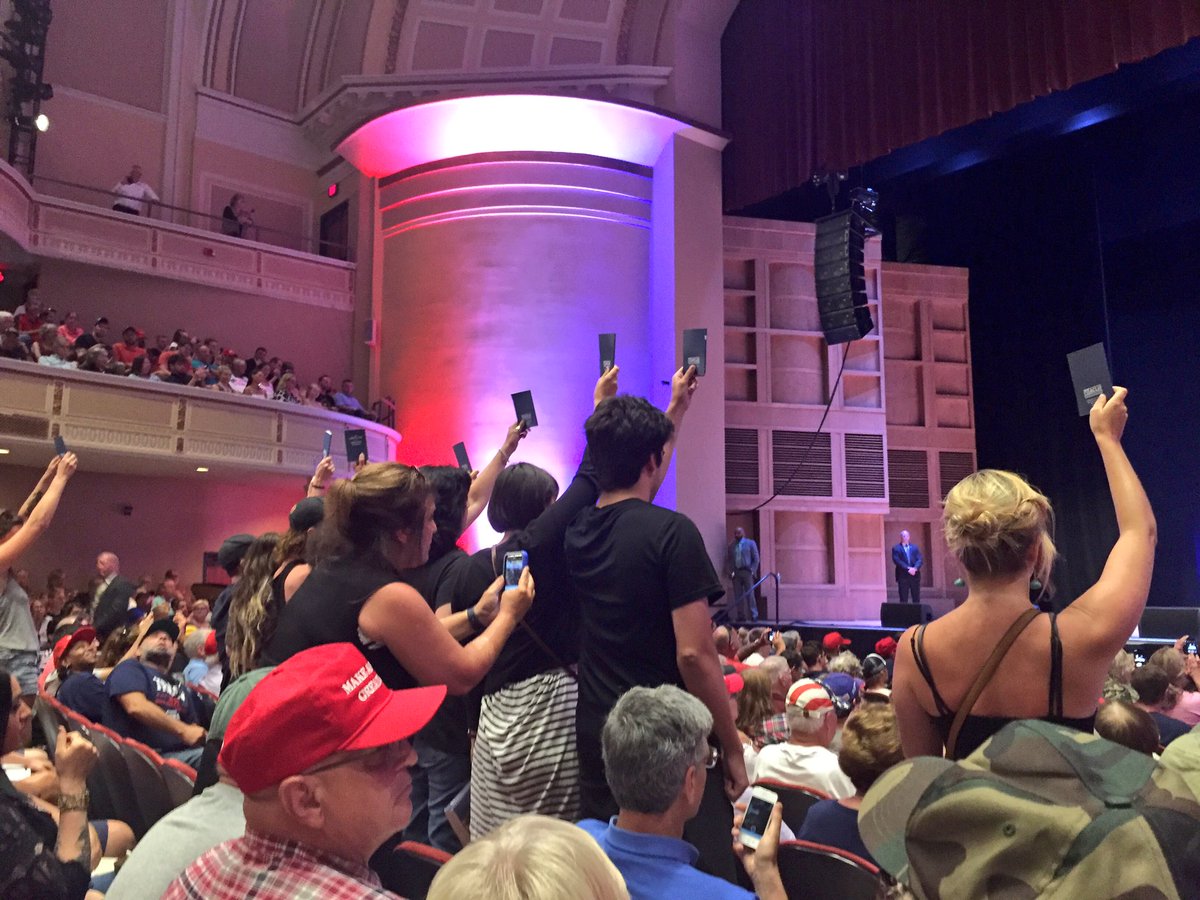
I knew Trump had been in Portland on Thursday, and I had seen on TV that protesters silently holding up pocket copies of the Constitution had been removed from his rally.

In that rally, Trump promoted a local version of the immigrant-crime-wave lie I pointed out in his convention speech.

We’ve just seen many, many crimes, getting worse all the time. And as Maine knows – a major destination for Somali refugees. They’re coming from among the most dangerous territories or countries anywhere in the world. We have no idea of who they are … this could be the great Trojan horse of all time!

To which the Portland Press Herald responded:

Mr. Trump can relax. We know who they are. They are our neighbors and our friends. Some of them work in our schools and hospitals. Some are students. Some own businesses. They pay taxes, which are used for, among other things, maintaining the stage from which he spoke.

What I had stumbled into Friday afternoon was originally supposed to be the Portland Somali community’s counter-demonstration, and it included some of the same Constitution-waving protesters. But when they had asked the mayor if they could hold their rally on the steps of City Hall, he asked if he could spread the word around, because “maybe some other people will want to join in.”

By the time I got there, there were about 400 of us, of all races. (My estimate on the spot matched the one in the newspaper the next morning.) It was not a partisan thing; I didn’t see any Clinton signs. People were there to support their neighbors and the unity of their city against outsiders peddling hate. The Press Herald quoted the police chiefs of Portland and nearby Lewiston, where many Somali refugees have settled. Both made the same points:

  • Crime is down, not up.
  • There is no special Somali-refugee crime problem.
  • Nobody from the Trump campaign had talked to them.

That third point is the one that most enrages me. Anybody can get a fact wrong. But Trump is not trying to get his facts right. He’s going to American cities and raising fear against the immigrants who have settled there without even checking that those fears are based on anything real.


BTW, the Constitution thing is a big deal. Khizr Khan started it at the Democratic Convention when he offered to give Donald Trump his copy of the Constitution. And Trump made a huge blunder when his people ejected the silent protesters in Portland. They weren’t disrupting anything, they were just holding up the Constitution, which Trump’s people saw as a hostile act. The crowd booed them (and their Constitutions) as they were led away.

Up until now, waving the Constitution has been a conservative thing. I imagine Ted Cruz pulling his hair out and yelling at Trump as he watched this on TV: “You let the Democrats take the Constitution away from us?”

and my church is also in the news

First Parish Unitarian Universalist in Bedford, Massachusetts — I know, I live in New Hampshire, but I go to a church 25 miles away in Massachusetts; it’s a long story — is in the middle of an expensive project to bring our carbon footprint as close to zero as we can. After new insulation and HVAC equipment, the last piece of that plan is to put solar panels on the roof of our early-19th-century building, carefully positioned so as not to be too striking from the road.

The local historical commission blocked that, and now we’re going to court. ThinkProgress picked up the story this week, noting that we’re using the kind of religious-freedom legal argument that “is more often used by conservative faith groups”. We’re arguing that publicly fighting climate change is part of living our faith. It’ll be interesting to see what a court does with that reasoning.

and you might also be interested in

No matter who wins in November, or what kind of Congress she gets, the new President will have to face the problem of slow growth. It’s not just an American problem, so it probably doesn’t have a purely American solution.

Both parties have been talking around that. There’s a certain amount of genuine mystery about global growth, so the idea that we can ramp up growth locally by cutting taxes or building infrastructure is a little iffy.


For Obama’s 55th birthday, USA Today put together this compilation of his most endearing moments.


There’s Liberal vs. Conservative, and then there’s Reality vs. Fantasy. Incumbent Wisconsin Senator Ron Johnson made it clear which side he’s on in an interview on a local radio show:

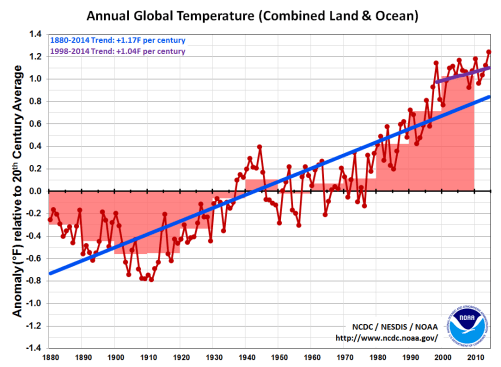
First of all, the climate hasn’t warmed in quite a few years. I mean, that is proven scientifically.

After 2014 turned out to be the hottest year on record (until 2015 was hotter), the government’s real scientists published this graph, showing that global warming has actually accelerated in recent years.

Senator Johnson went on to explain what really motivates climate change activists:

The reason they’re doing it is it’s such a great opportunity to control, you know, pretty much, government, and control your lives.

Yep, that’s why I drive a hybrid and why my church is going to court for the right to put solar panels on its roof: It’s all part of a nefarious plan to control everybody’s lives. I can’t remember exactly how the plot is supposed to work, but I’m sure somebody explained it to me once.

and let’s close with some Trump songs

Here a busker redoes “The Boxer”:

And Dennis Leary and James Corden put a Trump twist into Leary’s “I’m an Asshole”.

Sexism and the Clinton Candidacy

Open misogyny, like open racism, has become a fringe position in America. But even people who believe they don’t have a sexist bone in their bodies are still influenced by it.


I’m a guy, and I’m voting for Hillary Clinton. Lots of us are.

Naturally, I also know men who aren’t voting for her. But you know what I haven’t heard? Not one of the anti-Clinton men I know personally — not even in a wink-and-nod, just-between-us guys sort of way — says that it’s because she’s a woman, or that women in general have no business being president.

Of course, it’s also true that if you go looking for that opinion, you can find it. (Samantha Bee even found a woman who thinks women shouldn’t be in charge.) And if you want to rile yourself, it’s not hard at all to dredge up comments on Facebook and other social media calling the former Senator, First Lady, and Secretary of State a bitch, a cunt, or some other misogynistic name. If you visit the vendors outside a Trump rally, you can even get a misogynistic epithet on a t-shirt or bumper sticker.

But still, open misogyny has become a fringe position. In a 2015 Gallup survey, 92% of Americans said they could vote for a woman for president. Maybe that’s only because admitting otherwise has become uncool, but there are also more specific signs of progress. Just two election-cycles ago, during Clinton’s first presidential run, whether a woman could be commander-in-chief still came up from time to time. In this cycle, though, she has managed to turn that issue around, contrasting her own experience and gravity against Donald Trump’s impulsiveness. In a recent Fox News poll, voters trusted Clinton more than Trump on “making decisions about using nuclear weapons” by a 56%-34% margin.

So hurray! Sexism is over in American politics and we can stop talking about it.

Well, not exactly.

The racism parallel. Eight years ago, after we elected our first black president, a lot of people convinced themselves that racism was over. And if we’re talking about open KKK-style racism, they were almost right. Few people in 2008 or 2012 said they wouldn’t vote for Obama because he’s black. Using the N-word against him in public, openly calling for white supremacy — you can still find that if you look, but it’s a fringe position.

And yet, the last eight years have been a lesson in just how pervasive the more subtle forms of racism are. If few white Americans would admit — even to other whites — that they didn’t want a black president, many many white people have seemed to hunger for some non-racial reason to dislike or mistrust Barack Obama.

And so, based no credible evidence whatsoever, a large segment of the American public have decided that he isn’t really an American, and so isn’t eligible to be president at all. Another large segment (with considerable overlap, I imagine) has convinced themselves that Obama’s whole religious history is a fraud, that he is secretly a Muslim, and is probably rooting for the jihadi terrorists (the same ones that he’s been killing with raids and drone strikes).

Others look at his family through jaundiced eyes. To them, Michelle — a beautiful, elegant woman by any standard — resembles a gorilla. When Sasha and Malia wear typical teen-age-girl clothes they get admonished to “dress like you deserve respect, not a spot at a bar“. The luxurious White House lifestyle, never an issue when white families lived there, suddenly looks uppity; and the cost of keeping the First Family safe on vacations — again, never an issue for the Bushes, Clintons, or Reagans — has been a point of resentment.

Whenever Obama acts like the President of the United States and accepts the deference that is due his office — like when a Marine holds an umbrella for him, or he puts his feet up on a White House desk — it just looks wrong. Sure, white presidents have been doing the same things for decades without irritating anybody, but this is different because … because … well it just is.

And the aura of respect that has sheltered even our most unpopular presidents from direct abuse in formal settings? That vanished as soon as a black man took control of the White House. Undoubtedly, Joe Wilson was not the first congressman to think a president had said something dubious in a State of the Union address. But none of the previous doubters had judged it appropriate to yell “You lie!”.

Summing up, a lot of Americans might say to President Obama: “I don’t hate you because you’re black. I hate you because so many of the things you do look wrong to me.” But if you take a step back and look at comparable situations from previous administrations, it’s hard to escape the realization that what is really wrong in Obama’s actions is that he’s black when he does them.

It’s not that blackness is bad per se — that would be the Jim-Crow-style racism we’ve almost all outgrown. It’s that for many Americans, blackness-in-power invokes a harsher standard of judgment that makes “This black president is bad” an almost inevitable conclusion.

Back to Hillary. So I think we should bring some skepticism to the idea that Hillary Clinton’s high unfavorable ratings are simply a fair public reaction to things she has said or done.

As with Obama and racism, not everybody who opposes Clinton is a sexist or dislikes her for gender-related reasons. But even if you can list apparently good reasons for not liking her, you need to consider the possibility that the things she says or does seem as bad as they do because Clinton is a woman when she does them.

Like racism, sexism may no longer dictate the views of most Americans, but it still has a strong influence.

Appearance. The most obvious way that Clinton is treated differently from male candidates is with regard to her appearance. Prior to Clinton’s acceptance speech at the Democratic Convention, one of the most googled questions was what she would wear. A white pantsuit was the answer, a decision deemed worthy of historical analysis in The Atlantic.

For a man, of course, the question has a standard answer: a dark suit with a light-colored shirt and a red or blue tie. If a man wears that, he can count on everybody to forget what he’s wearing and concentrate on what he’s saying. But there is no standard choice for women, because no woman has ever been in this situation before. Whatever she wears, it just doesn’t look presidential. I mean, would Abe Lincoln wear a white pantsuit?

For contrast, look at the two men Clinton has run against — Donald Trump and Bernie Sanders. Both men have unusual hair. Both take some ribbing for it, but it’s really not a big deal. (Clinton could never have turned a bad-hair day into a t-shirt, as Bernie did.) I doubt that either of their campaigns wasted a single minute of meeting time discussing “What are we going to do about his hair?”

Ditto for wardrobe. Trump wears expensively tailored suits, while Bernie sometimes looks like he slept in his. Both choices are OK and raise no issues. But every fashion choice a female candidate makes is fraught. Does she look too “frumpy“? Or is she too vain? Does she worry too much about her appearance, or spend too much on her clothes? (Both Clinton and Sarah Palin got skewered on that one.) It’s fine for Mitch McConnell to get increasingly jowly as he ages, but could Nancy Pelosi get away with that? And if she takes action to avoid facial sagging, that’s an issue too.

Clinton’s voice is another perpetual problem: It’s too shrill and she shouts too much. But Trump and Sanders also shout a lot without anybody making an issue of it. Bernie’s gravelly voice is far from what they’re looking for in broadcasting school, but somehow it makes him more authentic, like Bob Dylan.

Sex and marriage. There’s also a moral double standard. As we all remember from high school, someone who has a lot of sex is a stud if male, and a slut if female. That double standard hasn’t gone away.

Imagine, for example, if Clinton had a marital history like Trump’s. Picture her standing on the convention stage with a much-younger male model for a husband, waving to the crowd while surrounded by the children she conceived with three different fathers, all still alive. It’s an absurd vision, because no such woman could be elected to any office whatsoever.

Oratory. The big fear leading up to Hillary’s acceptance speech was whether she could match the great speeches of the previous nights’ speakers: Michelle Obama, Bernie Sanders, Bill Clinton, Joe Biden, and the ultimate master of the convention speech, Barack Obama.

By all accounts, she didn’t. It was a good speech that made her case and did her credit, but she didn’t even attempt to lift our spirits like Obama did in 2004, 2008, and 2012.

But consider this: Is an Obama-level speech even possible for a woman candidate in 2016? Would we know how to listen to it and recognize its greatness?

I don’t think we would. I’m not even sure that I would. We’re well trained to hear certain kinds of ideas from men, and respond in a certain way to them. Hearing the same speech from a woman would be a different experience entirely. For example, Joe Biden basically gave a Knute Rockne halftime pep talk. Could a woman have pulled that off?

“But what about Michelle?” you might ask. “She’s a woman and her convention speech was magnificent.” Indeed it was, but it was rooted in her experience as a wife and mother. She was not a candidate, and was not asking us to give her power. If she had been, say, running for the open Senate seat in Illinois, we might have heard her speech very differently.

The rogue’s gallery. The example of Bernie’s “authentic” voice points to an even more subtle pattern that is frequently overlooked: Just as there are negative stereotypes (like slut or ball-buster) for women, there are endearing stereotypes that make excuses for the flaws of men. As a result, if a man needs us to cut him some slack, it doesn’t seem like that big a stretch.

As Franklin Roosevelt is supposed said about a Central American dictator: “He’s a son of a bitch, but he’s our son of a bitch.” That line has been repeated about a number of American politicians since, including Richard Nixon. It’s a compliment of sorts: This guy may be immoral, but he’s going to do immoral things for us.

Trump’s long history as a con-man generates a similar excuse: Yes, he cheats people, but that’s why we need him: so that he can cheat the Chinese and the Mexicans on our behalf. Trump claimed that dubious virtue in his acceptance speech:

Nobody knows the system better than me, which is why I alone can fix it. I have seen firsthand how the system is rigged against our citizens.

Lyndon Johnson was known as a wheeler-dealer, a stereotype that makes a virtue out of a man’s ability to bribe and threaten. If he can wheel and deal his way to Medicare and the Voting Rights Act, so much the better.

A standard character in our movies and TV shows is the charming rogue: Indiana Jones, Rhett Butler, Serenity‘s Captain Mal. He’s a rebel, a rule-breaker. He may be annoying at times and completely unreliable, but you keep forgiving him because it’s just so entertaining to watch him wriggle in and out of trouble. Trump and Bill Clinton both benefit from this stereotype, and in some circles so does Ted Cruz. (“Shut down the government? That scamp! What will he pull off next?”)

Female leaders don’t have any of those forgiving loopholes available to them. When the FBI announced that Hillary’s email mistakes were not indictable crimes, her supporters sighed with relief and her critics seethed with anger. (“Lock her up!”) Literally no one was charmed by her skill as a escape artist. (“She’s so smart! They’ll never nail her.”) If she were a man, though, many would be.

Clinton has been known to lie or mislead when she’s accused of something, behavior which (as the NYT’s Nicholas Kristof pointed out Sunday) is pretty standard for an American politician. And yet, a fairly small set of examples is enough to support an image of exceptional untrustworthiness.

Meanwhile, it is virtually impossible to hold a conversation with Donald Trump — on any subject — without hearing him lie. (Kristof: “In March, Politico chronicled a week of Trump remarks and found on average one misstatement every five minutes.”) The result: Slightly more voters describe Trump as “honest and trustworthy” than say the same of Clinton.

This is a pattern we should recognize from racial discrimination: We insist on high standards from our leaders, except when we don’t. Members of privileged groups — whites, men — can wrangle exceptions. Only the non-privileged — blacks, women — are actually held to those standards.

“But I just don’t like her.” Any woman running for office has to thread a very narrow needle: She has to look good without appearing vain, to sound strong but not bossy, project as friendly but not soft, and have years of experience without seeming old and stale. (Donald Trump can have no track record in government and be an outsider. A comparable woman would just be unqualified.) For a lot of Americans — even the 92% who told Gallup they could imagine voting for a woman — there might not be an eye in that needle at all.

Marianne Cooper, a sociologist at Stanford’s Clayman Institute, writes:

High-achieving women experience social backlash because their very success – and specifically the behaviors that created that success – violates our expectations about how women are supposed to behave. Women are expected to be nice, warm, friendly, and nurturing. Thus, if a woman acts assertively or competitively, if she pushes her team to perform, if she exhibits decisive and forceful leadership, she is deviating from the social script that dictates how she “should” behave. By violating beliefs about what women are like, successful women elicit pushback from others for being insufficiently feminine and too masculine.

Michael Arnovitz looked at the long-term graph of Clinton’s favorability and noted:

What I see is that the public view of Hillary Clinton does not seem to be correlated to “scandals” or issues of character or whether she murdered Vince Foster. No, the one thing that seems to most negatively and consistently affect public perception of Hillary is any attempt by her to seek power. Once she actually has that power her polls go up again. But whenever she asks for it her numbers drop like a manhole cover. … Most of the people who hate Hillary when she’s running for office end up liking her just fine once she’s won.

I’ve heard a number of people, even a few women, tell me that they wish the first woman nominee had been someone different. To which I respond: How different could she be and still have gotten here?

“But I’m not sexist! I’m voting for Jill Stein.” As every Green voter knows in his or her heart, Jill Stein is not going to be our next president. So the disorientation and the fear-of-the-unknown that Clinton evokes simply does not rise for anyone considering Stein.

Likewise, Stein hasn’t run the decades-long gauntlet (with its corresponding decades of unfair criticism and invented scandals) that puts a woman in position to be a major party nominee. If she had, I suspect she would seem like damaged goods too.

We’ve seen something similar to the Stein option with the Republicans and race. Herman Cain in 2011 and Ben Carson in 2015 both had moments in the sun, as Republicans waved their signs and said, “See! I’m against Obama, but I’m not racist.” Strangely, though, both candidacies had faded long before the first primaries. So no one ever had to cast a vote that had a serious chance of putting Cain or Carson into power. Similarly this November, no one will cast a vote that has a serious chance of putting Stein into power either.

A woman as a message-carrier? A woman as the symbol of an impossible dream? We’re all fine with that. But the prospect of giving a woman real power is something else.

Can we compensate? Obviously, it would make no more sense to vote for Clinton because she’s a woman than to vote against her for that reason. So what am I asking you to do?

Here’s my point: It is a very human reaction to instinctively recoil from something you’ve never seen before, to imagine that there’s something wrong with it, and then to go looking for reasons you can use to justify that pre-rational feeling of wrongness. I strongly suspect that lots of people who hate Hillary Clinton (and even a few who are going to hold their noses and vote for her out of disgust with Trump) have done that, or have been influenced by opinion-makers who do that.

Which is not to say that everyone who isn’t whole-hearted supporting Hillary is reacting out of sexism. She’s an American politician who has views, plans, and a record, none of which are perfect. No candidate — even great presidents who were white men — gets 100% of the vote.

But think about what you would like to have told those 2012 voters who were convinced that Barack Obama was a Kenyan-born terrorist-sympathizing fake Christian who hates America and wants to undermine our culture and society. Not that those wouldn’t be good reasons to vote against him, but why do you believe them? Could the thinking process that led you to those beliefs have been influenced by the subtle racism that infects almost everything in our society?

Our society is similarly infected with subtle sexism. Those things you believe about Hillary that make her uniquely objectionable, or so repellant that the difference between her and Trump seems too insignificant to take seriously, why do you believe them?

Could sexism have played a role in forming those beliefs? Think it through again.

The Monday Morning Teaser

It’s hard to believe that a week ago I was nervously waiting for a few more polls to validate Clinton’s convention bounce.

The bounce turned out to be just fine, and then Trump spent the entire week demonstrating the truth of the line in Clinton’s acceptance speech: “A man you can bait with a tweet is not a man we can trust with nuclear weapons.” He simply could not let go of his disastrous battle with two gold-star parents, to the point of starting to attack Republicans who told him to lay off.

But as arresting as that disaster has been, I am resisting the overall tendency of politics-watchers to focus 24/7 on Trump, because I don’t want Hillary to get to the White House with no mandate beyond not being him. So I’m taking a step back to focus on one of the campaign’s broader themes: sexism. What role has sexism played in building the kind of Hillary-hatred we’re seeing, and could we have expected anything different from the first serious attempt to put a woman in the White House?

In particular, I want to apply what eight years of Obama has taught us about subtle racism: People don’t hate Obama because he’s black, they hate him because they believe terrible things about him. But a big reason they believe those terrible things is because he’s black.

So the featured post will be “Sexism and the Clinton Candidacy”. It should be out before 9 EDT.

In the summary, I will have to focus on Trump, because his bizarre self-destruction really has dominated the news this week. I’ll also tell the story of how I tripped into a significant anti-Trump demonstration this weekend while vacationing in Maine.

But I’ll also touch on the global problem of slow growth, Obama’s last birthday in the White House, how my church is making religious freedom a liberal argument, and maybe a few other things, before closing with a couple Trump songs. That should be out around 11 or 12.

Resolve over Fear

At its core, discrimination is the result of fear. Those who think Americans scare easily enough to abandon our country’s ideals in exchange for a false sense of security underestimate our resolve.

Kareem Abdul-Jabar at the 2016 Democratic Convention

This week’s featured posts are “Why Bernie Backed Hillary” and “Disbanding NATO: Why Vlad Loves Donnie“.

This week everybody was talking about the Democratic Convention

Nate Silver summarized it pretty well:

Each day of the Democratic National Convention had an overarching strategic goal. Monday was about uniting the party. Tuesday was about telling Hillary Clinton’s life story (and, by extension, improving her dismal favorability ratings). Wednesday was about articulating forceful contrasts for swing voters and reminding them of the consequences of a potential President Trump. Thursday, with a lot of flag-waving and representation from the military, along with Clinton’s own remarks, was about establishing her credentials as commander in chief.

Headliners. Each day’s headliners came through with amazing speeches, which you should watch if you haven’t already. Monday: In what some have called “a speech for the ages“,  Michelle Obama subtly talked about the First Family as role models for children, reminded us of the class and dignity with which the Obamas have carried that responsibility, and left us imagining Donald Trump in that role. She also began what became a drumbeat in later speeches: defining a uniquely Democratic message of patriotism and optimism — not that America has always been right, but that we constantly get better.

Bernie Sanders gave Clinton everything she could have wanted in an endorsement. (Details in the featured article.)

Tuesday’s highlight was Bill Clinton playing a new role: the spouse who humanizes the candidate. This was an important moment in the convention. One comment I frequently see from Bernie-or-bust posters on Facebook is that no one is actually for Clinton, but we’re just supposed to vote against Trump. Bill’s 45-year love story (beginning with “In the spring of 1971, I met a girl.”) set her in a context that many voters (especially younger ones) have probably never seen. Yes, there are a large number of people who have loved and admired Hillary Clinton for many years.

Wednesday was Joe Biden and Tim Kaine and President Obama. As Nate Silver said, this was the night for convincing swing voters, and they did it by claiming a lot of the up-with-America themes that usually belong to Republicans, but which Trump’s convention abandoned. President Obama:

Look, we Democrats have always had plenty of differences with the Republican Party, and there’s nothing wrong with that. It’s precisely this contest of idea that pushes our country forward. But what we heard in Cleveland last week wasn’t particularly Republican — and it sure wasn’t conservative. What we heard was a deeply pessimistic vision of a country where we turn against each other, and turn away from the rest of the world. There were no serious solutions to pressing problems — just the fanning of resentment, and blame, and anger, and hate.

And that is not the America I know. The America I know is full of courage, and optimism, and ingenuity. The America I know is decent and generous.

Thursday was Clinton herself, whose major challenge was not to be overshadowed by all the excellent oratory that had come before. She didn’t attempt to compete with President Obama in terms of vision and inspiration, but presented herself as a steady hand with a lifelong record of public service and a progressive agenda. She left a very deft trap for Trump, which he proved unable to avoid blundering into:

He loses his cool at the slightest provocation – when he’s gotten a tough question from a reporter, when he’s challenged in a debate, when he sees a protestor at a rally. Imagine, if you dare imagine, imagine him in the Oval Office facing a real crisis. A man you can bait with a tweet is not a man we can trust with nuclear weapons.

Surprises. Wednesday also had an unusual endorsement from former New York Mayor Michael Bloomberg, who had mulled his own third-party presidential run. Bloomberg is also the kind of business success Trump only pretends to be.

Throughout his career, Trump has left behind a well-documented record of bankruptcies, thousands of lawsuits, angry shareholders and contractors who feel cheated, and disillusioned customers who feel ripped off. Trump says he wants to run the nation like he’s run his business. God help us. I’m a New Yorker, and New Yorkers know a con when we see one!

584274482-khizr-khan-father-of-deceased-muslim-u-s-soldier-crop-promo-xlarge2

But the big surprise came Thursday, with the speech by Khizr Khan (accompanied by his wife Ghazala), about his son Captain Humayun Khan, who died saving his soldiers in Iraq in 2004.

If it was up to Donald Trump, he never would have been in America. Donald Trump consistently smears the character of Muslims. He disrespects other minorities, women, judges, even his own party leadership. He vows to build walls and ban us from this country.

Donald Trump, you are asking Americans to trust you with our future. Let me ask you: Have you even read the U.S. Constitution? I will gladly lend you my copy. In this document, look for the words “liberty” and “equal protection of law.”

Have you ever been to Arlington Cemetery? Go look at the graves of the brave patriots who died defending America — you will see all faiths, genders, and ethnicities.

You have sacrificed nothing and no one.

As Hillary had predicted, Trump couldn’t just let that go. He couldn’t say something like “While I disagree with much of what Khizr Khan had to say about me, I respect his family’s sacrifice.” Instead, he asked why Ghazala didn’t say anything, invoking another stereotype of Muslims:

She had nothing to say. She probably, maybe she wasn’t allowed to have anything to say. You tell me.

And he defended his own “sacrifices”.

I think I’ve made a lot of sacrifices. I work very, very hard. I’ve created thousands and thousands of jobs, tens of thousands of jobs, built great structures. I’ve had tremendous success. I think I’ve done a lot.

Ghazala Khan replied in The Washington Post:

When Donald Trump is talking about Islam, he is ignorant. If he studied the real Islam and Koran, all the ideas he gets from terrorists would change, because terrorism is a different religion.

Donald Trump said he has made a lot of sacrifices. He doesn’t know what the word sacrifice means.

Like so many of the damaging spats Trump gets into, this could have been over in a day. Fox News didn’t even show the original speech, so many conservatives would never have noticed it. Instead, it’s a multi-day story and could turn into one of the defining moments of the campaign.


Now that even conservatives are saying that the Democrats put on a much better convention, Donald Trump is ducking responsibility for the Republican Convention: “I didn’t produce our show — I just showed up for the final speech on Thursday.” Though Trump’s speech did get slightly more viewers than Hillary’s — 34.9 million compared to 33.7 — overall the four-day Democratic Convention had a 16-million viewer lead in the ratings.

I guess viewers would rather hear from Meryl Streep and Katy Perry than Scott Baio and Willie Robertson, and would rather watch Kareem Abdul-Jabar than wonder why Tim Tebow decided not to come. In a rather pointed reference to the Melania plagiarism story, Trevor Noah observed that Republicans “don’t have a Michelle Obama. They just have a Michelle Obama tribute act.”

and its result

Polls that came out last week showed Trump getting a bounce from his convention and pulling into the lead. There are still a number of polls to hear from, but the early ones indicate that the Democratic Convention has undone that bounce and then some.

Since Trump’s own blunders are turning the post-convention news cycle against him, Clinton’s convention bounce may solidify into a lasting advantage.

and the Trump/Putin connection

which I discuss in the other featured post.

but you should notice the victories against voter suppression

The Fourth Circuit Court of Appeals annihilated North Carolina’s voter-suppression law:

Although the new provisions target African Americans with almost surgical precision, they constitute inapt remedies for the problems assertedly justifying them and, in fact, impose cures for problems that did not exist.

… Using race as a proxy for party may be an effective way to win an election. But intentionally targeting a particular race’s access to the franchise because its members vote for a particular party, in a predictable manner, constitutes discriminatory purpose. This is so even absent any evidence of race-based hatred and despite the obvious political dynamics. A state legislature acting on such a motivation engages in intentional racial discrimination in violation of the Fourteenth Amendment and the Voting Rights Act.

ThinkProgress called this opinion “a beat-down” and chose to illustrate it with a GIF of Hulk pounding Loki into the pavement in the first Avengers movie.


In a separate case, a federal judge struck down a string of voter-suppression provisions of Wisconsin law, writing:

The Wisconsin experience demonstrates that a preoccupation with mostly phantom election fraud leads to real incidents of disenfranchisement, which undermine rather than enhance confidence in elections, particularly in minority communities.

and you might also be interested in

The legal process against the yahoos who took over the Malheur Wildlife Refuge for more than a month last winter is continuing to churn. Ryan Bundy is defending himself in court, which must be entertaining for the press, if frustrating for the judge. Ryan is claiming to be a sovereign citizen who is not subject to federal law, and is making a number of absurd motions that follow from that assumption. Meanwhile, the government is asserting that the armed occupation is not a legitimate assertion of First and Second Amendment rights: “Taking a gun into a government office is not First Amendment protected activity.”


The Obama Presidential Library is going to be on the Chicago lakefront, about a mile from where I lived when I was a student at the University of Chicago.

and let’s close with somebody who has far too much time

If you’re feeling withdrawal during the Game of Thrones off-season, and you have hopelessly nerdy tendencies anyway, I’ve got a guy to introduce you to. Just as the Baker Street Irregulars take Sherlock Holmes way too seriously, Lyman Stone gives that kind of attention to Westeros. In particular, how big is it? In what ways do the demographic details in the novels fail basic rules of world-building? And how could you make it as realistic as any dragon-inhabited medieval world threatened by the undead could possibly be?